Microencapsulation
As a process, it is a means of applying
relatively thin coatings to small particles
of solids or droplets of liquids and
dispersions.
The uniqueness microencapsulation is
of smallness of the coated particles and
their subsequent adaptation to a wide
variety of dosage forms and product
application.
Applications
The applications of microencapsulation
 well includes in the formulation of

   Sustain release medications
   Delayed release medications
   Taste masked chewable tablets
   Single layer tablet containing
    incompatible ingredients.
Coating material
    The selection of a specific coating
    material from a lengthy list of
    candidate material presents the
    following questions to be considered
    by the research pharmacist.


   What is the specific dosage or product
    requirement e.g. stabilization, reduced
    volatility or release characteristics etc.
Cont…..


   What coating material will satisfy the
    product objective and requirement.


   What microencapsulation method is
    best suited to accomplish the coated
    product objective?
Cont…..
   In-addition the coating material
    should be capable of forming a
    film that is cohesive with the core
    material, be chemically compatible
    and non reactive with the core
    material and provide desired
    coating properties such as
    stability.
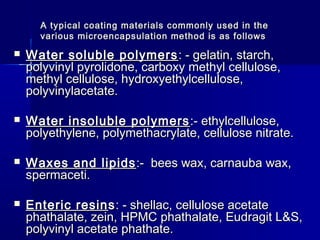
A typical coating materials commonly used in the
      various microencapsulation method is as follows
   Water soluble polymers : - gelatin, starch,
    polyvinyl pyrolidone, carboxy methyl cellulose,
    methyl cellulose, hydroxyethylcellulose,
    polyvinylacetate.

   Water insoluble polymers :- ethylcellulose,
    polyethylene, polymethacrylate, cellulose nitrate.

   Waxes and lipids :- bees wax, carnauba wax,
    spermaceti.

   Enteric resin s : - shellac, cellulose acetate
    phathalate, zein, HPMC phathalate, Eudragit L&S,
    polyvinyl acetate phathate.
Methodology
    Microencapsulation methods that have
    been or are being adapted to
    pharmaceutical use include
   Air suspension also known as fluidized
    bed coating.
   Spray drying
   Pan coating
   Coacervation- phase separation
   Solvent evaporation.
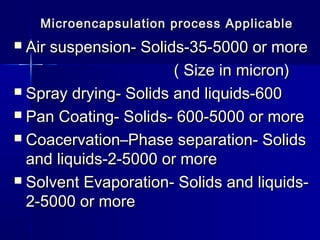
Microencapsulation process Applicable
 Air suspension- Solids-35-5000 or more
                       ( Size in micron)
 Spray drying- Solids and liquids-600

 Pan Coating- Solids- 600-5000 or more

 Coacervation–Phase separation- Solids
  and liquids-2-5000 or more
 Solvent Evaporation- Solids and liquids-
  2-5000 or more
Air suspension or fluidized bed coating
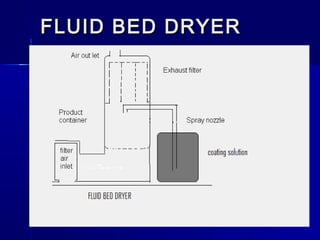
    it is also known as wurster process ,
    consist of the dispersing of solid particulate
    core material in a coating chamber. The
    particles are suspending on an upward
    moving hot air stream (fluidization) and
    coating material usually a polymer solution
    is applied in the form of spray to the moving
    particles. The supporting air stream also
    serves to dry the product while it is being
    encapsulated.
FLUID BED DRYER
Process variables that receive
   consideration for efficient
   encapsulation includes

 Melting   point, solubility, friability,
  volatility of the core material.
 Coating material concentration.
 Nature of the vehicle
 Coating material application rate
 Air velocity for fluidization.
 Inlet air temperature.
Spray drying

   In practice, microencapsulation by spray
    drying is conducted by dispersing the core
    material in a coating solution, in which the
    coating polymer is dissolved and the core
    material is insoluble and then atomizing the
    mixture in to an air stream. The air is
    usually heated required to remove the
    solvent from the coating material thus
    forming a microencapsulated product.
SPRAY DRYER
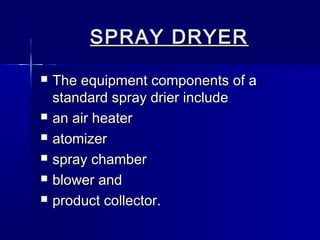
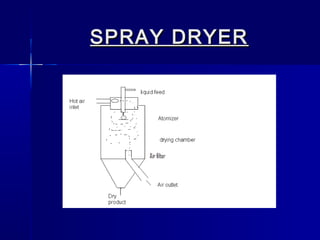
   The equipment components of a
    standard spray drier include
   an air heater
   atomizer
   spray chamber
   blower and
   product collector.
SPRAY DRYER
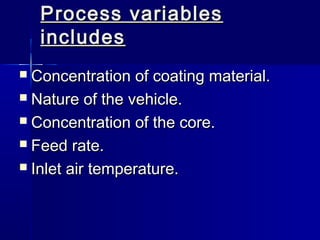
Process variables
    includes
 Concentration of coating material.
 Nature of the vehicle.

 Concentration of the core.

 Feed rate.

 Inlet air temperature.
Pan coating
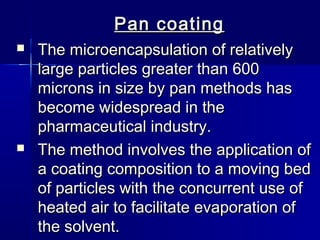
   The microencapsulation of relatively
    large particles greater than 600
    microns in size by pan methods has
    become widespread in the
    pharmaceutical industry.
   The method involves the application of
    a coating composition to a moving bed
    of particles with the concurrent use of
    heated air to facilitate evaporation of
    the solvent.
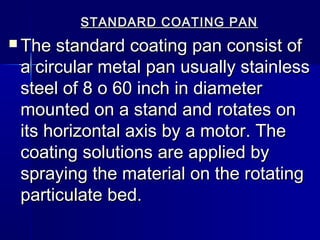
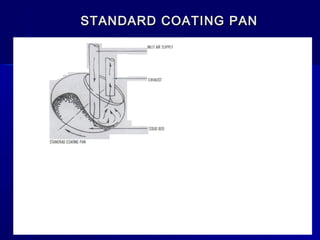
STANDARD COATING PAN
 The standard coating pan consist of
 a circular metal pan usually stainless
 steel of 8 o 60 inch in diameter
 mounted on a stand and rotates on
 its horizontal axis by a motor. The
 coating solutions are applied by
 spraying the material on the rotating
 particulate bed.
STANDARD COATING PAN
Process variables includes
 Diameter    and speed of rotation of
  the coating pan.
 In let air temperature.

 Concentration of coating material.

 Nature of the vehicle used for the
  preparation of coating solution.
 Spray rate.
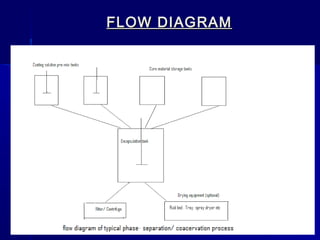
Coacervation- Phase Separation
Microencapsulation by coacervation phase
    separation processes consist of three
    steps carried out under continues
    agitation.
   Formation of three immiscible chemical
    phases

   Deposition of the coating

   Rigidization of the coating.
Step I
 Step I of the process is the formation
  of three immiscible chemical phases, a
  liquid manufacturing vehicle phase.
  Core material phase and a coating
  material phase.
 To form three phases, the core material
  is dispersed in a solution of the coating
  polymer, the solvent for the polymer
  being the liquid manufacturing vehicle
  phase.
Cont…
   The coating material phase, an
    immiscible polymer in a liquid phase is
    formed by utilization of one of the
    method s of phase separation
    coacervation i.e. by changing the
    temperature of the polymer solution, or
    by adding the salt, non solvent, or
    incompatible polymer.
Step II
   Step II of the process consists of depositing
    the liquid polymer coating upon the core
    material. this is one by controlled physical
    mixing of the coating material while in liquid
    and the core material in the manufacturing
    vehicle. Deposition of the liquid polymer
    coating around the core material occurs if the
    polymer is adsorbed at the interface between
    the core material and the liquid vehicle
    phase.
Step III

   Step III of the process involves
    rigidizating the coating.
FLOW DIAGRAM
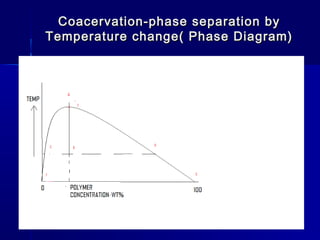
Coacervation-phase separation by
Temperature change( Phase Diagram)
Explanation


   Figure illustrates a general
    temperature- composition phase
    diagram for a binary system comprised
    of a polymer and a solvent. A system
    having an overall composition
    represented as point X , exist as a
    single phase, homogeneous solution
    at all points above the phase boundary
    i.e. FEG .
Cont….
   As the temperature of the system decreased
    from point A along the arrowed line AEB ,
    the phase boundary is crossed at point E ,
    and the two phase region is entered.
Cont…
   The phase separation of the dissolved
    polymer occurs in the form of liquid
    droplets and if the core material is
    present in the system, under proper
    polymer concentration and
    temperature, and agitation conditions,
    the liquid polymer droplets deposit
    around the core particles thus forming
    microcapsules.
Cont…..

   The phase boundary curve indicates that the
    decreasing temperature, one phase
    becomes polymer poor (vehicle phase) and
    the second phase (coating material phase)
    becomes polymer rich. At point B the vehicle
    phase is pure solvent, at C coexisting phase
    and at D, concentrated polymer-solvent
    mixture.
The example illustrates the microencapsulation by temperature
       change.

   Ethyl cellulose is insoluble in cyclohexane at room
    temperature but is soluble at elevated temperature.
    Thus 2% solution of ethyl cellulose is prepared in
    cyclohexane by heating to the boiling point. The
    core material n-acetyl para amino phenol is
    dispersed in the solution with stirring in the ratio of
    1:2( coat: core). Allow the mixture to cool with
    constant stirring, effects phase separation of ethyl
    cellulose and microencapsulation of the core
    material. Further cooling results in the solidification
    of the coating. The microencapsulated product is
    then collected by filtration or centrifugation.
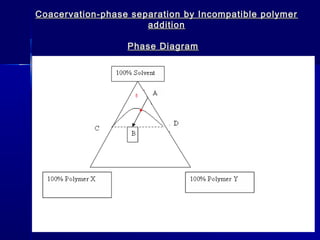
Coacervation-phase separation by Incompatible polymer
                      addition

                  Phase Diagram
Cont…..
   The diagram illustrates a ternary system
    consisting of a solvent, and two polymers X
    and Y. if an insoluble core material is
    dispersed in a solution of polymer Y(at point
    A in the figure) and polymer X( incompatible
    polymer) is added to the system denoted by
    the arrow line, the phase boundary is
    crossed at point E. further addition of
    polymer X, liquid polymer i.e polymer Y will
    separated out as droplets and coating of
    microcapsules exist at point B.
Example
   Microencapsulation of methylene blue
    HCL with ethyl cellulose by this mode
    is described as follows:- Ethyl cellulose
    dissolve in toluene to yield polymer
    concentration of 2% by weight. The
    methylene blue HCL, being insoluble in
    toluene, is dispersed with stirring in a
    polymer solution at a ratio of 4 parts of
    methylene blue HCL to 1 pqrt of
    ethylcellulose.
Cont…
   Phase separation is done by slowly adding
    liquid polybutadiene. The polybutadiene
    being quite soluble in toluene and
    incompatible with ethylcellulose effects the
    separation of ethylcellulose from the
    polybutadiene toluene solution and
    subsequent microencapsulation of the
    dispersed core material. The
    microencapsulated product is then collected
    by filtration or centrifugation.
Solvent evaporation
    The microcapsule coating is dissolved in a
    volatile solvent which is immiscible with the liquid
    manufacturing vehicle phase. A core material to
    be microencapsulated is dispersed in the coating
    polymer solution with agitation. The mixture is
    then heated to evaporate the solvent for the
    polymer with continues agitation. Once all the
    solvent for the polymer is evaporated, the liquid
    temperature is reduce to ambient temperature.
    The microencapsulated product is then collected
    by filtration or centrifugation.
Process variables


– Temperature for evaporation of
  polymer solvent
– Agitation rate.

Microencapsulation power point

  • 1.
    Microencapsulation As a process,it is a means of applying relatively thin coatings to small particles of solids or droplets of liquids and dispersions. The uniqueness microencapsulation is of smallness of the coated particles and their subsequent adaptation to a wide variety of dosage forms and product application.
  • 2.
    Applications The applications ofmicroencapsulation well includes in the formulation of  Sustain release medications  Delayed release medications  Taste masked chewable tablets  Single layer tablet containing incompatible ingredients.
  • 3.
    Coating material The selection of a specific coating material from a lengthy list of candidate material presents the following questions to be considered by the research pharmacist.  What is the specific dosage or product requirement e.g. stabilization, reduced volatility or release characteristics etc.
  • 4.
    Cont…..  What coating material will satisfy the product objective and requirement.  What microencapsulation method is best suited to accomplish the coated product objective?
  • 5.
    Cont…..  In-addition the coating material should be capable of forming a film that is cohesive with the core material, be chemically compatible and non reactive with the core material and provide desired coating properties such as stability.
  • 6.
    A typical coatingmaterials commonly used in the various microencapsulation method is as follows  Water soluble polymers : - gelatin, starch, polyvinyl pyrolidone, carboxy methyl cellulose, methyl cellulose, hydroxyethylcellulose, polyvinylacetate.  Water insoluble polymers :- ethylcellulose, polyethylene, polymethacrylate, cellulose nitrate.  Waxes and lipids :- bees wax, carnauba wax, spermaceti.  Enteric resin s : - shellac, cellulose acetate phathalate, zein, HPMC phathalate, Eudragit L&S, polyvinyl acetate phathate.
  • 7.
    Methodology Microencapsulation methods that have been or are being adapted to pharmaceutical use include  Air suspension also known as fluidized bed coating.  Spray drying  Pan coating  Coacervation- phase separation  Solvent evaporation.
  • 8.
    Microencapsulation process Applicable Air suspension- Solids-35-5000 or more ( Size in micron)  Spray drying- Solids and liquids-600  Pan Coating- Solids- 600-5000 or more  Coacervation–Phase separation- Solids and liquids-2-5000 or more  Solvent Evaporation- Solids and liquids- 2-5000 or more
  • 9.
    Air suspension orfluidized bed coating  it is also known as wurster process , consist of the dispersing of solid particulate core material in a coating chamber. The particles are suspending on an upward moving hot air stream (fluidization) and coating material usually a polymer solution is applied in the form of spray to the moving particles. The supporting air stream also serves to dry the product while it is being encapsulated.
  • 10.
  • 11.
    Process variables thatreceive consideration for efficient encapsulation includes  Melting point, solubility, friability, volatility of the core material.  Coating material concentration.  Nature of the vehicle  Coating material application rate  Air velocity for fluidization.  Inlet air temperature.
  • 12.
    Spray drying  In practice, microencapsulation by spray drying is conducted by dispersing the core material in a coating solution, in which the coating polymer is dissolved and the core material is insoluble and then atomizing the mixture in to an air stream. The air is usually heated required to remove the solvent from the coating material thus forming a microencapsulated product.
  • 13.
    SPRAY DRYER  The equipment components of a standard spray drier include  an air heater  atomizer  spray chamber  blower and  product collector.
  • 14.
  • 15.
    Process variables includes  Concentration of coating material.  Nature of the vehicle.  Concentration of the core.  Feed rate.  Inlet air temperature.
  • 16.
    Pan coating  The microencapsulation of relatively large particles greater than 600 microns in size by pan methods has become widespread in the pharmaceutical industry.  The method involves the application of a coating composition to a moving bed of particles with the concurrent use of heated air to facilitate evaporation of the solvent.
  • 17.
    STANDARD COATING PAN The standard coating pan consist of a circular metal pan usually stainless steel of 8 o 60 inch in diameter mounted on a stand and rotates on its horizontal axis by a motor. The coating solutions are applied by spraying the material on the rotating particulate bed.
  • 18.
  • 19.
    Process variables includes Diameter and speed of rotation of the coating pan.  In let air temperature.  Concentration of coating material.  Nature of the vehicle used for the preparation of coating solution.  Spray rate.
  • 20.
    Coacervation- Phase Separation Microencapsulationby coacervation phase separation processes consist of three steps carried out under continues agitation.  Formation of three immiscible chemical phases  Deposition of the coating  Rigidization of the coating.
  • 21.
    Step I  StepI of the process is the formation of three immiscible chemical phases, a liquid manufacturing vehicle phase. Core material phase and a coating material phase.  To form three phases, the core material is dispersed in a solution of the coating polymer, the solvent for the polymer being the liquid manufacturing vehicle phase.
  • 22.
    Cont…  The coating material phase, an immiscible polymer in a liquid phase is formed by utilization of one of the method s of phase separation coacervation i.e. by changing the temperature of the polymer solution, or by adding the salt, non solvent, or incompatible polymer.
  • 23.
    Step II  Step II of the process consists of depositing the liquid polymer coating upon the core material. this is one by controlled physical mixing of the coating material while in liquid and the core material in the manufacturing vehicle. Deposition of the liquid polymer coating around the core material occurs if the polymer is adsorbed at the interface between the core material and the liquid vehicle phase.
  • 24.
    Step III  Step III of the process involves rigidizating the coating.
  • 25.
  • 26.
  • 27.
    Explanation  Figure illustrates a general temperature- composition phase diagram for a binary system comprised of a polymer and a solvent. A system having an overall composition represented as point X , exist as a single phase, homogeneous solution at all points above the phase boundary i.e. FEG .
  • 28.
    Cont….  As the temperature of the system decreased from point A along the arrowed line AEB , the phase boundary is crossed at point E , and the two phase region is entered.
  • 29.
    Cont…  The phase separation of the dissolved polymer occurs in the form of liquid droplets and if the core material is present in the system, under proper polymer concentration and temperature, and agitation conditions, the liquid polymer droplets deposit around the core particles thus forming microcapsules.
  • 30.
    Cont…..  The phase boundary curve indicates that the decreasing temperature, one phase becomes polymer poor (vehicle phase) and the second phase (coating material phase) becomes polymer rich. At point B the vehicle phase is pure solvent, at C coexisting phase and at D, concentrated polymer-solvent mixture.
  • 31.
    The example illustratesthe microencapsulation by temperature change.  Ethyl cellulose is insoluble in cyclohexane at room temperature but is soluble at elevated temperature. Thus 2% solution of ethyl cellulose is prepared in cyclohexane by heating to the boiling point. The core material n-acetyl para amino phenol is dispersed in the solution with stirring in the ratio of 1:2( coat: core). Allow the mixture to cool with constant stirring, effects phase separation of ethyl cellulose and microencapsulation of the core material. Further cooling results in the solidification of the coating. The microencapsulated product is then collected by filtration or centrifugation.
  • 32.
    Coacervation-phase separation byIncompatible polymer addition Phase Diagram
  • 33.
    Cont…..  The diagram illustrates a ternary system consisting of a solvent, and two polymers X and Y. if an insoluble core material is dispersed in a solution of polymer Y(at point A in the figure) and polymer X( incompatible polymer) is added to the system denoted by the arrow line, the phase boundary is crossed at point E. further addition of polymer X, liquid polymer i.e polymer Y will separated out as droplets and coating of microcapsules exist at point B.
  • 34.
    Example  Microencapsulation of methylene blue HCL with ethyl cellulose by this mode is described as follows:- Ethyl cellulose dissolve in toluene to yield polymer concentration of 2% by weight. The methylene blue HCL, being insoluble in toluene, is dispersed with stirring in a polymer solution at a ratio of 4 parts of methylene blue HCL to 1 pqrt of ethylcellulose.
  • 35.
    Cont…  Phase separation is done by slowly adding liquid polybutadiene. The polybutadiene being quite soluble in toluene and incompatible with ethylcellulose effects the separation of ethylcellulose from the polybutadiene toluene solution and subsequent microencapsulation of the dispersed core material. The microencapsulated product is then collected by filtration or centrifugation.
  • 36.
    Solvent evaporation  The microcapsule coating is dissolved in a volatile solvent which is immiscible with the liquid manufacturing vehicle phase. A core material to be microencapsulated is dispersed in the coating polymer solution with agitation. The mixture is then heated to evaporate the solvent for the polymer with continues agitation. Once all the solvent for the polymer is evaporated, the liquid temperature is reduce to ambient temperature. The microencapsulated product is then collected by filtration or centrifugation.
  • 37.
    Process variables – Temperaturefor evaporation of polymer solvent – Agitation rate.