xi
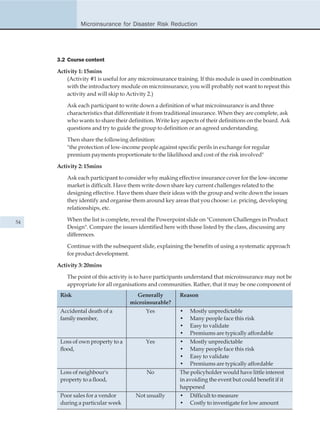
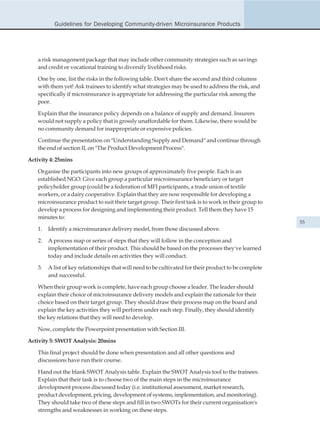
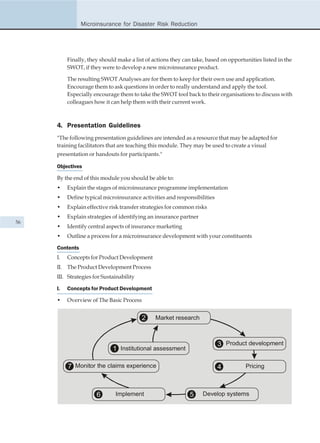
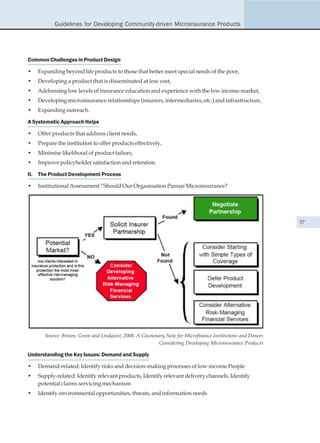
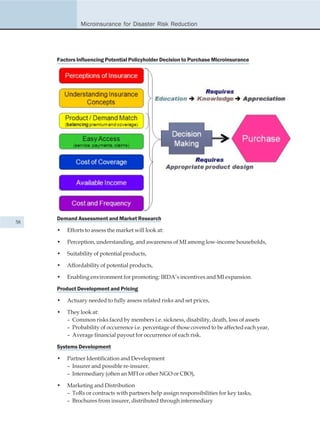
Community-Based
               Disaster Risk Reduction


               MICROINSURANCE
               FOR DISASTER RISK
               REDUCTION

                                         i


               November 2009


The Training
and Learning
Circle
Microinsurance for Disaster Risk Reduction


     Introduction
     The Training and Learning Circle (TLC) is a network of training institutions and
     universities that has been organised to re-examine, strengthen, and facilitate the
     crucial interface between training and education for community based disaster risk
     reduction (CBDRR). The TLC aims to strengthen the capacity of training
     institutions and universities by reviewing existing and developing new learner-
     centred learning materials and methodologies. The TLC enhances learning
     through South-South knowledge and solution exchanges, with a focus on
     addressing systemic gaps and topics in training and education that would benefit
     from a sector-wide approach. All India Disaster Mitigation Institute (AIDMI) is
     promoting and facilitating the formation of TLC in India, and Asia, together with
     the ProVention Consortium, the Asian Disaster Preparedness Centre (ADPC), the
     Centre for Disaster Preparedness (CDP) in the Philippines, and the UNDP's
     Special Unit for South-South Cooperation.


ii


     Title: Microinsurance for Disaster Risk Reduction

     ALL INDIA DISASTER MITIGATION INSTITUTE

     411 Sakar Five, Near Natraj Cinema
     Ashram Road, Ahmedabad-380 009 India
     Tele/Fax: +91-79-2658 2962
     E-mail: bestteam@aidmi.org
     Website: www.aidmi.org, www.southasiadisasters.net

     © All India Disaster Mitigation Institute
     November 2009, Copies: 500
Table of Contents
 Reaching New Heights in Training and Learning
 Foreword
 Why Create a Knowledge Product on Microinsurance?
 Overview of the Microinsurance Development Series
 Module 1: Introduction to Microinsurance and its Relevance for CBDRR 1
      1.1 What is Microinsurance?                                            4
      1.2 Importance of Microinsurance for Pro-Poor Disaster Management       5
      1.3 Common Microinsurance Products                                      6
           1.3.1 Different Products for Different Needs                      7
                 Life Insurance                                              7
                 Health and Disability Insurance                             7
                 Agriculture Insurance                                       7
                 Livestock Insurance                                         8
                 Crop Insurance                                              8
                                                                                  iii
                 Weather Insurance                                           8
                 Property and Asset Insurance                                8
      1.4 Microinsurance Roles and Models                                    8
           Partner - Agent Model                                             9
           Community-based Model                                             9
           In-house or Full-service Model                                    9
           Provider Model                                                    9
      1.5 Basics of Product Design and Provision                             10
      1.6 Issues for the Future                                              11
           Reaching Scale                                                    11
           New products: Index Insurance                                     11
           References                                                        12
 Annex 1: Glossary of Microinsurance Related Terms                           14
 Annex 2: Key Differences between Traditional Insurance and Microinsurance   16
 Annex 3: India's Microinsurance History                                     17
 Facilitator's Note
      1.   Suggestions for Facilitators prior to Training                    18
      2.   Facilitator Requirements during Training                          18
      3.   Suggested Methods and Activities                                  19
      4.   Presentation Guidelines                                           21
Microinsurance for Disaster Risk Reduction


     Module 2: Assessing Microinsurance Demand                                      27
          2.1 Importance of Proper Demand Assessment                                30
               2.1.1 Community Needs and Microinsurance Opportunities               30
               2.1.2 Risks and Related Products                                     31
          2.2 Factors Influencing Demand                                            31
          2.3 Assessment Process: Developing a Demand Study                         32
               2.3.1 Basic Information Needs in Product Conception                  33
               2.3.2 Basic Information Needs in Product Design and Delivery         33
               2.3.3 Using the Results                                              33
               References                                                           33
     Annex 1: Overview of Tools for Microinsurance Demand Assessment                35
     Facilitator's Note
          1.   Suggestions for Facilitators prior to Training                       37
          2.   Facilitator Requirements during Training                             37
          3.   Suggested Methods and Activities                                     38
          4.   Presentation Guidelines                                              40


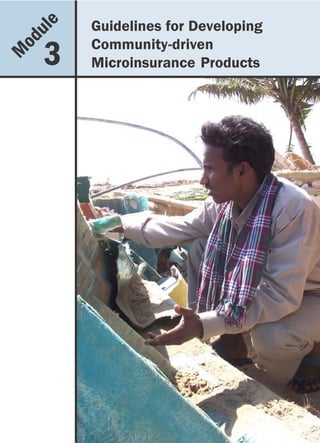
iv   Module 3: Guidelines for Developing Community-driven
     Microinsurance Products                                                        43
          3.1 Concepts for Product Development                                      46
               3.1.1 Common Challenges in Product Design                            46
               3.1.2 Addressing Challenges through Systematic Product Development   46
          3.2 The Product Development Process                                       46
               3.2.1 Should we be Involved?                                         46
               3.2.2 Understanding the Key Issues: Demand and Supply                47
               3.2.3 Product Development                                            48
               3.2.4 Systems Development                                            48
               3.2.5 Piloting                                                       49
               3.2.6 Rollout                                                        49
               References                                                           50
     Annex 1: Due Diligence Checklist for Identifying an Insurance Provider         51
     Facilitator's Note
          1.   Suggestions for Facilitators prior to Training                       52
          2.   Facilitator Requirements during Training                             52
          3.   Suggested Methods and Activities                                     53
          4.   Presentation Guidelines                                              66
Module 4: Four Case Examples of Successful Microinsurance
Initiatives in India                                                                    61
     4.1 Case Study 1: Tata-AIG Life Insurance Company Ltd.                              64
          4.1.1 Context and Tata-AIG Life Insurance Product                              64
          4.1.2 Product Administration                                                   64
          4.1.3 Products Offered                                                         65
          4.1.4 Distribution Channels                                                    66
          4.1.5 Product Design                                                           67
          4.1.6 Conclusions                                                              67
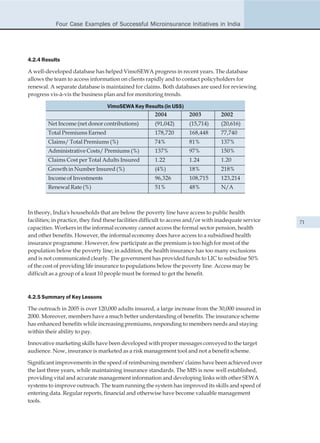
     4.2 Case Study 2: Vimo SEWA                                                         68
          4.2.1 Overview                                                                 68
          4.2.2 Membership                                                               70
          4.2.3 The VimoSEWA Product                                                     70
          4.2.4 Results                                                                  71
          4.2.5 Summary of Key Lessons                                                   71
     4.3 Case Study 3 : Taking Risk off the Backs of the Poor: A Case Study of Afat Vimo:
         Disaster Insurance                                                               73
     4.4 Case Study 4 : Scaling Up Microinsurance: The Case of Weather Insurance for           v
         Smallholders in India                                                           82
          4.4.1 Overview                                                                 82
          4.4.2 Why Index Insurance?                                                     82
          4.4.3 Programme Development                                                    83
          4.4.4 Product Marketing and Delivery                                           86
          4.4.5 Expected Weather Insurance Impact                                        87
          4.4.6 Lessons for Up-scaling Weather Insurance                                 87
     4.5 Case Study Synthesis                                                            88
Facilitator's Note
     1.   Suggestions for Facilitators prior to Training                                 90
     2.   Facilitator Requirements during Training                                       90
     3.   Suggested Methods and Activities                                               91
     4.   Presentation Guidelines                                                        92


List of Contributors in Curriculum Review and Pilot Testing                              96
Microinsurance for Disaster Risk Reduction


     Reaching New Heights in Training and
     Learning
     Training and learning around Disaster Risk Reduction (DRR) and humanitarian studies has
     been steadily picking up across India. All India Disaster Mitigation Institute (AIDMI) receives
     several requests each month from universities and training institutes to help them design a
     course, identify a suitable research topic or case study, develop a module, or receive their
     students for an internship. AIDMI receives so many requests because of the organisations
     leading role in disaster risk management since 1989 and its partnerships with UNDP, ADPC
     and ProVention under the Training and Learning Circle (TLC). The TLC is a group of 39
     training institutions, universities, and CSOs in India that share knowledge and expertise
     regarding disaster risk management.

     These requests come in as the general conditions of India's universities remain a serious cause
     for concern, even 60 years after independence. Though remarkable exceptions exist, including
     the much celebrated IITs and IIMs, the educational standards in many universities should be
     much higher to reflect the talent of their teachers and students. Yet economic expansion over the
     past five years has not been matched by suitable investments in universities or expanded
     opportunities for either students or faculty.
vi
     The traditional learning modalities of universities can incorporate many of the key functions
     involved in the advancement and transmission of DRR knowledge, including research,
     innovation, teaching, training and continuing education. Beyond these core activities, there is
     one additional component unique to this area of study: the globalisation of DRR and
     humanitarian response. Despite the crucial need for applied research around international
     DRR and humanitarian response, these topics lack interest and investment within our
     universities. Too much of the research that is conducted on the topic follows international
     interests and priorities identified in Geneva, London or New York. This research if often
     borrowed by our authorities and unsuccessfully applied to India's distinct context.
     Unfortunately, the flow of resources strongly influences the issues researched. The need for
     research on uniquely Indian issues becomes secondary to the priorities set by people thousands
     of miles away.

     Need-based research rooted in India's experience, but that is globally relevant, can easily
     originate with India's faculty and students. I have met these faculty members and students
     throughout India; they are consistently involved in both post-disaster response and in
     planning and preparedness initiatives between disasters. Yet attendant research has yet to
     develop a suitable profile or substantial following. Meanwhile, young people's hunger for
     university education and opportunities is rapidly expanding. Whether they come from small
     towns or larger cities, youth seek both knowledge and professional prospects. Developing a
     standardised system of student skills and course equivalents has also become an important
     issue as universities develop courses in the relatively new fields of DRR and humanitarian
     response.
In addition to understanding what needs to be researched and why, we must recognise the
formidable challenges in financing education. Unfortunately, the Tata's investment of Rs. 100
crores in the Disaster Studies Institute is a rare exception. Several other corporate houses can
repeat such investments in knowledge. AIDMI's efforts towards this have remained fruitless.
There is an apparent deficit of resources to support research and courses on risk management;
valuable, badly-needed innovations by teachers cannot be implemented without increased
financial commitment to education in these areas. As Indian universities rush towards the
future, meeting the challenges of expanding the academic base of humanitarianism becomes
more urgent. We must tackle these dilemmas within the next five years if India's university
system is to keep up with the nation's rising leadership in the global humanitarian system.
Regular training should now include conceptual and applied topics on natural and social
risks. Discussions should focus on the unique aspects of the Indian context and how these
conditions influence humanitarian relations with other nations and international
organisations.

It is with these thoughts in mind that AIDMI supports the efforts of Indian universities in DRR.
AIDMI's Mehul Pandya and Tommy Reynolds create this ToT Module on Microinsurance for
Disaster Risk Reduction with Dr. Vedant Pandya of Bhavnagar University, Rakhi Bhavnani of
ISDR, and Kuldeep Sagar, an international consultant. The ToT Module has been pilot tested in
December 2008. I welcome others to join TLC in our efforts to develop and use knowledge to
make India safer from disasters.
                                                                                                   vii


Mihir R. Bhatt
All India Disaster Mitigation Institute
Microinsurance for Disaster Risk Reduction


       Foreword
       The Special Unit for South-South Cooperation in UNDP is proud to present a
       Training Manual on Community Based Disaster Risk Reduction (CBDRR) and
       Micro Insurance. This manual was developed by the All India Disaster Mitigation
       Institute (AIDMI) based on its long experience on the subject.

       The development of this manual came about as a result of a process of
       identification of priority knowledge products by the core members of the Training
       and Learning Circle( a network of trainers and learners on CBDRR facilitated by
       the SU-SSC). While there is an increasing demand from various partner agencies
       on inputs on micro insurance, a recent review (September 2009) of existing
       training materials on CBDRR undertaken by AIDMI revealed that there is a dearth
       of reference materials on this relatively new topic. The production of this manual
       is therefore very timely and relevant for India and for other developing countries as
       well, particularly at this juncture when recovery from disasters has been a painful
       process for the poor. Micro insurance is designed for the poor people to help them
       recover after the onslaught of a disaster.

       The CBDRM and Micro insurance Training Manual covers the following modules:
       Micro insurance' relevance to CBDRR; Guidelines for developing community
viii
       driven micro insurance products; and, Assessing Micro Insurance Demand. The
       manual also includes four case studies of micro insurance initiatives in India, one
       of which is administered by AIDMI. These cases provide different micro insurance
       models which are tried and tested as well as lessons learnt.

       The special Unit for South-South cooperation would like to once again thank the
       partners under the TLC project for this collaboration.


       Yiping Zhou
       Director
       Special Unit for South-South Cooperation in UNDP
Why Create a Knowledge
Product on Microinsurance?
AIDMI has conducted a review of a selection of training materials from
participating agencies in the TLC network, and has identified a number of gaps in
the subjects covered. Based on these gaps, AIDMI intends to develop a series of
knowledge products that can be used by training institutions in the network to
address key issues of CBDRR, as suggested by the TLC's key objectives, activities
and outcomes.

As microinsurance for CBDRR was identified as one of the key gaps in training
material, AIDMI has produced this knowledge product. Training modules are
designed to increase the level of awareness about microinsurance amongst
organisations. They emerge from AIDMI's experience with it's Afat Vimo (disaster
insurance) work in India and in the region.

In India, personal, household and small business assets are often unprotected
against disasters. The costs for relief and rehabilitation often rely on aid; but
support from outside entities is often unpredictable—leaving the damaged assets
of the poor difficult to replace and making recovery difficult. Groups that fail to
                                                                                      ix
recover are more vulnerable to subsequent disasters. Insurance covers many losses
but is often unavailable to the poor due to the high transaction costs.
Microinsurance is one of a number of methods that has emerged to allow the poor
to access risk transfer products. Microinsurance puts cash into the hands of people
so they can better lead their own recovery. Microinsurance has emerged in a policy
environment that has made recent progress towards disaster risk reduction. Recent
insurance regulatory reforms within the Government of India and the dedication of
global donors have contributed to the advancement of microinsurance for the poor.

The promotion of microinsurance across India and Asia has enormous potential
for offsetting economic losses faced by the poor. The knowledge product on
microinsurance will help trainers to promote a culture of risk management within
their organisations and with those whom they serve.
Microinsurance for Disaster Risk Reduction


    Overview of the Microinsurance
    Development Series
    The "Microinsurance Development Series" has been developed by the All India Disaster
    Mitigation Institute as one of the key activities of the Training and Learning Circle.

    This module uses the experience of key microinsurance providers in India. By providing
    participants with examples of good and successful practice, this module should give them a
    good introduction into practical design and delivery mechanisms. After reviewing the case
    studies, teachers will be encouraged to identify elements that they could use in their own
    organisations, as well as developing new ideas.


    How to Use this Course Material
    The four modules in the knowledge product may be used in isolation as singular training
    seminars, or alternatively used together within a daylong training session. Each module is
    designed to last 1h 30mins, so a daylong session of 4 modules will last at least 6h, plus at least
    1h in breaks. The modules are designed for delivery to a group of participants, whether they
    represent one or a variety of different organisations.
x
    Additional information on how to implement each module can be found in each module's
    Facilitator's Note. There is also optional guidance material for trainers wishing to hold a
    daylong session, including opening and closing activities.


    Outline of Modules
    Module 1 - Introduction to Microinsurance and its Relevance for CBDRR
    Module learning objectives:

    By the end of this module you should be able to:

    •   Define microinsurance

    •   Explain the history of microinsurance

    •   Explain the usefulness of insurance as a tool for transferring disaster risk from the poor

    •   Explain common models of microinsurance

    •   Determine if microinsurance is suitable for your constituency and partners

    •   Identify stakeholders in microinsurance provision

    •   Explain the unique structure of index-based products

    •   Identify opportunities for up-scaling existing products
Module 2 - Assessing Microinsurance Demand
Module learning objectives:

By the end of this module, you should be able to:

•   Explain the relevance and process of effective microinsurance demand assessment

•   Identify key factors that influence potential policyholder demand for a product

•   Outline a process for assessing demand for microinsurance among your constituency


Module 3 - Guidelines for Developing Community-driven Microinsurance
Products
Module learning objectives:

By the end of this module, you should be able to:

•   Explain the stages of microinsurance programme implementation

•   Define typical microinsurance activities and responsibilities

•   Explain effective risk transfer strategies for common risks
                                                                                               xi
•   Explain strategies of identifying an insurance partner

•   Identify central aspects of insurance marketing

•   Outline a process for a microinsurance development with your constituents


Modules 4 - Four Case Examples of Successful Microinsurance Initiatives in
India
Module learning objectives:

By the end of this module, you should be able to:

•   Explain four Microinsurance (MI) policies currently used in India and how they address
    CBDRR

•   Identify central strengths and weaknesses, opportunities, and threats of each policy for
    CBDRR

•   Build on these case studies with ideas for your constituents
Microinsurance for Disaster Risk Reduction


      Abbreviations
      ADPC       Asian Disaster Preparedness Center
      AIDMI      All India Disaster Mitigation Institute
      AIG        American International Group
      CBDRR      Community Based Disaster Risk Reduction
      CBO        Community Based Organisation
      CCISB      Chamber of Commerce and Industry for Small Businesses
      CDP        Center for Disaster Preparedness
      CRIG       Community Rural Insurance Groups
      DFID       Department for International Development
      DRR        Disaster Risk Reduction
      GO         Government Organisation
      ICICI      Industrial Credit and Investment Corporation of India
      IIASA      International Institute for Applied Systems Analysis
      ILO        International Labour Organization
      IRDA       Insurance Regulatory and Development Authority
xii
      MFI        Micro Finance Institution
      NGO        Non Governmental Organisation
      PRA        Participatory Risk Appraisal
      SEWA       Self-Employed Women's Association
      SU-SSC     Special Unit for South-South Cooperation
      SWOT       Strength Weakness Opportunities Threats
      TLC        Training and Learning Circle
      UNDP       United Nations Development Program
      UNICEF     United Nations Children's Fund
      UNISDR     United Nations International Strategy for Disaster Reduction
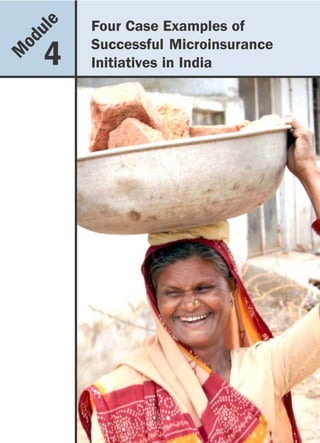
u le   Introduction to Microinsurance
    od
M        1      and its Relevance for CBDRR
Microinsurance for Disaster Risk Reduction


2
u le   Introduction to Microinsurance and its Relevance for CBDRR
                     Introduction to Microinsurance
    od
M        1           and its Relevance for CBDRR

                    Learning Objectives
                    By the end of this module you should be able to:
                    • Define microinsurance
                    • Explain the usefulness of insurance as a tool for transferring disaster risk from
                        the poor
                    • Explain common models of microinsurance
                    • Determine if microinsurance is suitable for your constituency and partners
                    • Identify stakeholders in microinsurance provision
                    • Explain the unique structure of index-based products
                    • Identify opportunities for up-scaling existing products


                    Contents
                    1.1 What is Microinsurance?                                                   4
                    1.2 Importance of Microinsurance for Pro-Poor Disaster Management             5
                    1.3 Common Microinsurance Products                                            6
                        1.3.1 Different Products for Different Needs                              7
                               Life Insurance                                                     7
                               Health and Disability Insurance                                    7       3
                               Agriculture Insurance                                              7
                               Livestock Insurance                                                8
                               Crop Insurance                                                     8
                               Weather Insurance                                                  8
                               Property and Asset Insurance                                       8
                    1.4 Microinsurance Roles and Models                                           8
                        Partner - Agent Model                                                     9
                        Community-based Model                                                     9
                        In-house or Full-service Model                                            9
                        Provider Model                                                            9
                    1.5 Basics of Product Design and Provision                                   10
                    1.6 Issues for the Future                                                    11
                        Reaching Scale                                                           11
                        New products: Index Insurance                                            11
                        References                                                               12
                    Annex 1: Glossary of Microinsurance Related Terms                            14
                    Annex 2: Key Differences between Traditional Insurance and Microinsurance    16
                    Annex 3: India's Microinsurance History                                      17


                    Facilitator's Note
                    1.   Suggestions for Facilitators prior to Training
                    2.   Facilitator Requirements during Training
                    3.   Suggested Methods and Activities
                    4.   Presentation Guidelines
Microinsurance for Disaster Risk Reduction


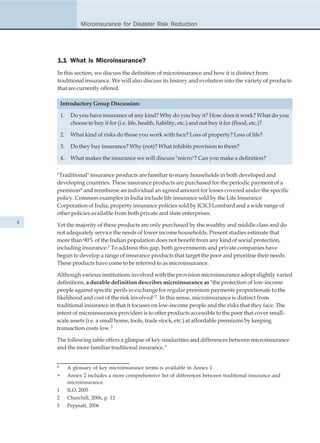
    1.1 What is Microinsurance?
    In this section, we discuss the definition of microinsurance and how it is distinct from
    traditional insurance. We will also discuss its history and evolution into the variety of products
    that are currently offered.

        Introductory Group Discussion:

        1.    Do you have insurance of any kind? Why do you buy it? How does it work? What do you
              choose to buy it for (i.e. life, health, liability, etc.) and not buy it for (flood, etc.)?

        2.    What kind of risks do those you work with face? Loss of property? Loss of life?

        3.    Do they buy insurance? Why (not)? What inhibits provision to them?

        4.    What makes the insurance we will discuss "micro"? Can you make a definition?


    "Traditional" insurance products are familiar to many households in both developed and
    developing countries. These insurance products are purchased for the periodic payment of a
    premium* and reimburse an individual an agreed amount for losses covered under the specific
    policy. Common examples in India include life insurance sold by the Life Insurance
    Corporation of India, property insurance policies sold by ICICI Lombard and a wide range of
    other policies available from both private and state enterprises.
4
    Yet the majority of these products are only purchased by the wealthy and middle class and do
    not adequately service the needs of lower income households. Present studies estimate that
    more than 90% of the Indian population does not benefit from any kind of social protection,
    including insurance.1 To address this gap, both governments and private companies have
    begun to develop a range of insurance products that target the poor and prioritise their needs.
    These products have come to be referred to as microinsurance.

    Although various institutions involved with the provision microinsurance adopt slightly varied
    definitions, a durable definition describes microinsurance as "the protection of low-income
    people against specific perils in exchange for regular premium payments proportionate to the
    likelihood and cost of the risk involved"2. In this sense, microinsurance is distinct from
    traditional insurance in that it focuses on low-income people and the risks that they face. The
    intent of microinsurance providers is to offer products accessible to the poor that cover small-
    scale assets (i.e. a small home, tools, trade stock, etc.) at affordable premiums by keeping
    transaction costs low.3

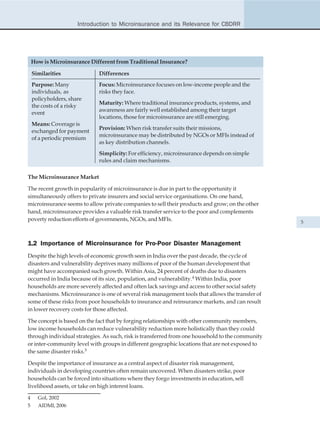
    The following table offers a glimpse of key similarities and differences between microinsurance
    and the more familiar traditional insurance.+


    *        A glossary of key microinsurance terms is available in Annex 1.
    +        Annex 2 includes a more comprehensive list of differences between traditional insurance and
             microinsurance.
    1        ILO, 2005
    2        Churchill, 2006, p. 12
    3        Peppiatt, 2006
Introduction to Microinsurance and its Relevance for CBDRR


    How is Microinsurance Different from Traditional Insurance?

    Similarities             Differences
    Purpose: Many            Focus: Microinsurance focuses on low-income people and the
    individuals, as          risks they face.
    policyholders, share
                             Maturity: Where traditional insurance products, systems, and
    the costs of a risky
                             awareness are fairly well established among their target
    event
                             locations, those for microinsurance are still emerging.
    Means: Coverage is
                             Provision: When risk transfer suits their missions,
    exchanged for payment
                             microinsurance may be distributed by NGOs or MFIs instead of
    of a periodic premium
                             as key distribution channels.
                             Simplicity: For efficiency, microinsurance depends on simple
                             rules and claim mechanisms.

The Microinsurance Market

The recent growth in popularity of microinsurance is due in part to the opportunity it
simultaneously offers to private insurers and social service organisations. On one hand,
microinsurance seems to allow private companies to sell their products and grow; on the other
hand, microinsurance provides a valuable risk transfer service to the poor and complements
poverty reduction efforts of governments, NGOs, and MFIs.
                                                                                                  5


1.2 Importance of Microinsurance for Pro-Poor Disaster Management
Despite the high levels of economic growth seen in India over the past decade, the cycle of
disasters and vulnerability deprives many millions of poor of the human development that
might have accompanied such growth. Within Asia, 24 percent of deaths due to disasters
occurred in India because of its size, population, and vulnerability.4 Within India, poor
households are more severely affected and often lack savings and access to other social safety
mechanisms. Microinsurance is one of several risk management tools that allows the transfer of
some of these risks from poor households to insurance and reinsurance markets, and can result
in lower recovery costs for those affected.

The concept is based on the fact that by forging relationships with other community members,
low income households can reduce vulnerability reduction more holistically than they could
through individual strategies. As such, risk is transferred from one household to the community
or inter-community level with groups in different geographic locations that are not exposed to
the same disaster risks.5

Despite the importance of insurance as a central aspect of disaster risk management,
individuals in developing countries often remain uncovered. When disasters strike, poor
households can be forced into situations where they forgo investments in education, sell
livelihood assets, or take on high interest loans.

4     GoI, 2002
5     AIDMI, 2006
Microinsurance for Disaster Risk Reduction


    Microinsurance has emerged in this context as a means to help meet the needs of poor
    households. As such, it can offer several advantages, including:

    •    predictable financial resources for recovery,

    •    post-disaster liquidity for continuation of livelihoods6,

    •    promotion of investments in productive assets7,

    •    incentives to reduce risks if insurers offer tiered premiums8,

    •    more local decision making about recovery investments 9.

    Yet, due to complexities involved with calculating accurate pricing and avoiding fraud, adverse
    selection, and moral hazard, insurance products have remained expensive and only accessible
    to large businesses and wealthier households.

    To address the gap between the demand for appropriate risk transfer from the poor and the few
    relevant products offered at the time, the Insurance Regulatory and Development Authority of
    India began to require that Indian insurers meet quotas in service to rural and low-income
    households. According to the policy, regulated providers that begin insurance provision
    following 1999 must meet certain quotas. This quota system has put considerable pressure on
    insurance companies to service traditionally excluded families and areas.

    The result has been exploration into microinsurance as a mechanism to meet regulatory quotas
6   at lower costs. The leadership of pioneering insurance companies, civil society intermediaries,
    and the private sector has resulted in microinsurance policies that now cover over 30 million
    individuals in India10. Although it is not yet known to what extent the different products really
    benefit the poor, the combination of the regulatory requirements and dedicated practitioners has
    helped make India a laboratory for microinsurance product testing with more policyholders
    than any other country.11


    1.3 Common Microinsurance Products
    In India, the first microinsurance schemes developed from traditional informal cooperative
    models and cover against funeral expenses, unemployment, accidents, and loss of life. In the
    past 10 years, application has expanded to include a wide variety of distribution channels
    including community-based savings groups, microfinance institutions (such as SEWA, BASIX
    et al.), credit unions, chambers of commerce (including Gujarat's Chamber of Commerce and
    Industry for Small Businesses), commercial insurance companies, and government social
    protection services.


    6    Mechler et al. 2006
    7    Cole and Topolova, 2007
    8    ProVention Consortium (forthcoming)
    9    Scheper et al. 2006
    10   Roth et al. 2007 p. 19
    11   Reynolds and Pandya, forthcoming
Introduction to Microinsurance and its Relevance for CBDRR


1.3.1 Different Products for Different Needs

 Group Discussion:

 1.    What risks do you face on a daily basis?

 2.    Again, think of risks faced by people you work with (loss of property, loss of life, etc.).
       What consequences would arise if these risks occurred, immediately, and in later months
       and years?

 3.    Do mainstream insurance providers have products for their risks?

The range of available and potential microinsurance products can help low-income households
manage risks related to their priorities. According to comprehensive research by the
International Labour Organisation12, primary self identified risks among small-scale
entrepreneurs related to financial losses that resulted from:
•     the death of a family member,
•     illness or injury,
•     natural disasters, or
•     theft or property damage.

Addressing these risks requires accurate selection of insurance products. The following list
includes the most common products for the Indian market as well as brief descriptions                7
provided by Microfinance Gateway13.

Life Insurance

Life Insurance covers the policy holder and his/her family on the event of death and disability.
It is an important measure of financial security for low-income households and the insurance
product currently most widely available. Life insurance is a relatively low-risk product for the
provider.

Health and Disability Insurance

Health insurance covers health care related costs linked to illness, injury and medical treatment.
Health policies offer many different options and combinations. Insuring health risks is a
complex task and highly dependent on access to the existent health care infrastructure.

Disability insurance protects the policyholder and his/her family in case of disability.
Examples include that of CARD MBA14 of the Philippines.

Agriculture Insurance

Insurance products for agriculture can be categorised as livestock insurance, crop insurance,
weather insurance. Agricultural insurance aims to reduce the vulnerability of low-income
households faced by natural disasters like drought, flood or livestock affecting epidemics.

12    Churchill et al. 2003
13    For additional information on microinsurance products, see: http://
      www.microfinancegateway.org/resource_centers/insurance/products#8.
14    McCord and Buczkowski, 2004
Microinsurance for Disaster Risk Reduction


    Livestock Insurance

    Livestock insurance is an agricultural insurance and covers against loss of livestock owned by
    the policy holder(s). Most livestock insurance schemes insure against a specific peril and can be
    paid out in the form of a lump sum payment or livestock replacement.

    Crop Insurance

    Crop insurance is an agricultural insurance product and covers crops against perils such as
    hail or fire. Index instruments are often used for crop insurance to avoid moral hazard risks and
    is not connected to one particular crop, but is based on the measurable occurrence of a specific
    peril.

    Weather Insurance

    Weather or climate Insurance is an agricultural insurance product and like crop insurance,
    often linked to index insurance. A key issue, for example, with weather index insurance is to
    have a strong correlation between the index (the rainfall) and the output expected (the harvest).

    Property and Asset Insurance

    Property and asset insurance covers against damage of property and damage and/or loss of
    assets in the event of the covered perils. Deposit insurance, addressing the risk of bank or MFI
    solvency problems as a type of asset insurance, is especially important for low-income
    households.
8


    1.4 Microinsurance Roles and Models
    Organising and streamlining microinsurance for client needs is a complex effort; it requires
    contributions and commitments from a range of different institutions, including insurers,
    intermediary community organisations, and target households. This section of the training
    discusses the critical stakeholder groups and some of the most successful models for
    microinsurance provision in India.
    A microinsurance system involves the following stakeholder groups15:

    •    Insurer- who carries the risk, finalises premium and product design and ultimately pays
         claims

    •    Delivery channel- who sells the insurance policy and provides basic after-sales services;
         they are in contact with the policyholder and should be close to poor people (this role may
         be assumed by the insurer, an agent, an MFI, etc.)

    •    Policyholder- who buys the product (may be an individual or a group)

    •    Covered lives- those who benefit from coverage (may be family or group member)

    •    Reinsurer- provides insurance to insurers for catastrophic risks (reinsurers are not always
         involved in microinsurance)


    15   Roth et al. 2007
Introduction to Microinsurance and its Relevance for CBDRR


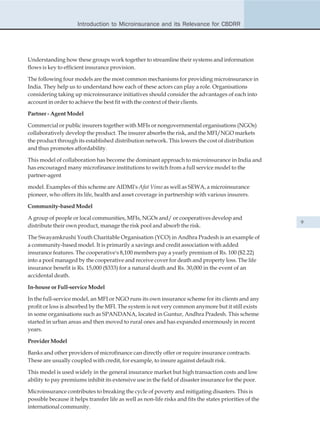
Understanding how these groups work together to streamline their systems and information
flows is key to efficient insurance provision.

The following four models are the most common mechanisms for providing microinsurance in
India. They help us to understand how each of these actors can play a role. Organisations
considering taking up microinsurance initiatives should consider the advantages of each into
account in order to achieve the best fit with the context of their clients.

Partner - Agent Model

Commercial or public insurers together with MFIs or nongovernmental organisations (NGOs)
collaboratively develop the product. The insurer absorbs the risk, and the MFI/NGO markets
the product through its established distribution network. This lowers the cost of distribution
and thus promotes affordability.

This model of collaboration has become the dominant approach to microinsurance in India and
has encouraged many microfinance institutions to switch from a full service model to the
partner-agent

model. Examples of this scheme are AIDMI's Afat Vimo as well as SEWA, a microinsurance
pioneer, who offers its life, health and asset coverage in partnership with various insurers.

Community-based Model

A group of people or local communities, MFIs, NGOs and/ or cooperatives develop and
                                                                                                          9
distribute their own product, manage the risk pool and absorb the risk.

The Swayamkrushi Youth Charitable Organisation (YCO) in Andhra Pradesh is an example of
a community-based model. It is primarily a savings and credit association with added
insurance features. The cooperative's 8,100 members pay a yearly premium of Rs. 100 ($2.22)
into a pool managed by the cooperative and receive cover for death and property loss. The life
insurance benefit is Rs. 15,000 ($333) for a natural death and Rs. 30,000 in the event of an
accidental death.

In-house or Full-service Model

In the full-service model, an MFI or NGO runs its own insurance scheme for its clients and any
profit or loss is absorbed by the MFI. The system is not very common anymore but it still exists
in some organisations such as SPANDANA, located in Guntur, Andhra Pradesh. This scheme
started in urban areas and then moved to rural ones and has expanded enormously in recent
years.

Provider Model

Banks and other providers of microfinance can directly offer or require insurance contracts.
These are usually coupled with credit, for example, to insure against default risk.

This model is used widely in the general insurance market but high transaction costs and low
ability to pay premiums inhibit its extensive use in the field of disaster insurance for the poor.

Microinsurance contributes to breaking the cycle of poverty and mitigating disasters. This is
possible because it helps transfer life as well as non-life risks and fits the states priorities of the
international community.
Microinsurance for Disaster Risk Reduction


     1.5 Basics of Product Design and Provision
     Designing and implementing a robust microinsurance product is a complex process involving
     actuarial experts, delivery channels, underwriters, and community leaders. Microinsurance
     development is a cycle that flows from conception to roll-out and renewal. More specifically, it
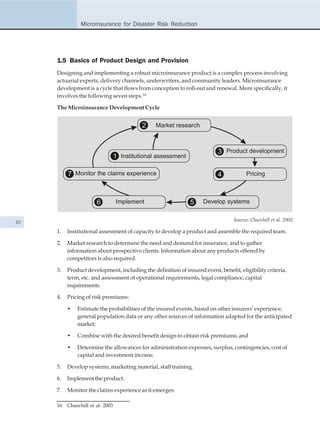
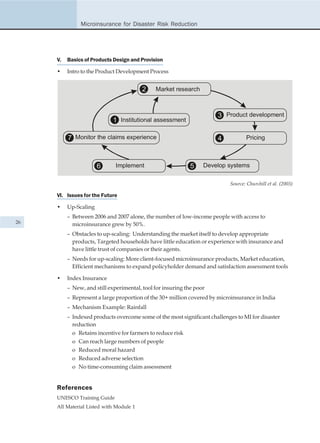
     involves the following seven steps.16

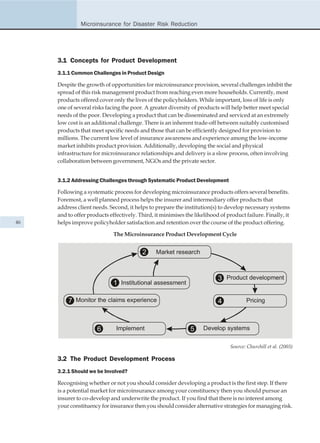
     The Microinsurance Development Cycle


                                            2    Market research


                                                                          3 Product development
                                  1 Institutional assessment

          7 Monitor the claims experience                                 4            Pricing


                       6          Implement                    5    Develop systems


10                                                                               Source: Churchill et al. 2003

     1.   Institutional assessment of capacity to develop a product and assemble the required team.

     2.   Market research to determine the need and demand for insurance, and to gather
          information about prospective clients. Information about any products offered by
          competitors is also required.

     3.   Product development, including the definition of insured event, benefit, eligibility criteria,
          term, etc. and assessment of operational requirements, legal compliance, capital
          requirements.

     4.   Pricing of risk premiums:

          •   Estimate the probabilities of the insured events, based on other insurers' experience,
              general population data or any other sources of information adapted for the anticipated
              market;

          •   Combine with the desired benefit design to obtain risk premiums; and

          •   Determine the allowances for administration expenses, surplus, contingencies, cost of
              capital and investment income.

     5.   Develop systems, marketing material, staff training.

     6.   Implement the product.

     7.   Monitor the claims experience as it emerges:

     16   Churchill et al. 2003
Introduction to Microinsurance and its Relevance for CBDRR


     •   Compare the actual claims experience to that expected in the premium basis using an
         experience investigation; and

     •   Return to step 2, adjusting the expected premium basis in light of the experience
         investigation and any other new information about the market, new factors affecting the
         risk and so on.


1.6 Issues for the Future
Reaching Scale

In spite of the limitations identified above, microinsurance products remain a powerful tool for
managing risks faced by the poor. Between 2006 and 2007 alone, it is estimated that the number
of low-income people with access to microinsurance grew by 50%.17 To continue to expand their
reach and provide quality service, current and future products will have to be "scaled up" to
reach more people.

The potential is huge, but there is insufficient experience with current programs to judge their
future viability. Current efforts of MIA, the Microinsurance Innovations Facility of the ILO, and
research by the ProVention Consortium with IIASA and AIDMI are collecting evidence and
lessons and providing support to emerging schemes.

New products: Index Insurance18                                                                     11
Index-linked insurance products have recently emerged as an additional tool for transferring
risks facing the poor. By conservative estimates, 56 out of 100 people in India are employed
directly in agriculture. Through their work, ownership, or support to small farms, many of the
147.9 million rural households in the country depend on satisfactory harvests to provide
(directly or indirectly) for their needs19.

Indexed insurances are a key step forward specifically for disaster insurance. This is because
indexed products have qualities that overcome some of the most significant challenges facing
traditional insurance and microinsurance when they are applied to transfer disaster risk.

While index insurance does not actually reduce the risk of a disaster occurring, it should,
through proper pricing and design, incentivise clients to reduce their disaster risk. This has so
far not been the case with traditional indemnity-based microinsurance. By de-linking losses
from payouts by using an independent index, farmers still have incentives to use risk reduction
measures in the hopes of saving their crop and yet still collecting an index insurance payment.

Second, de-linking losses from payouts also reduces moral hazard—the threat that
policyholders will neglect their insured assets and can even intentionally increase their risk as
the insurance payment will cover any losses.

Third, index insurance mechanisms allow a large number of policyholders to be covered with
lower administrative costs to the insurance company, thus reducing premiums. This is critical

17   McCord, 2008
18   Reynolds and Pandya, forthcoming
19   UNDP 2007
Microinsurance for Disaster Risk Reduction


     when the value of assets to be insured is low and administrative costs are more or less the same
     as for administering policies to middle-class urban dwellers.

     Fourth, compared with traditional insurance, adverse selection is reduced because
     policyholders seldom have more accurate information about the risk in the index than insurers.

     Finally, as there is no claim assessment or processing, indexed insurances can provide payment
     quickly after an adverse weather event—a time when liquidity is critical for affected
     households.

     In summary, indexed insurances:

     •   have lower transaction costs;

     •   have no moral hazard;

     •   have fewer asymmetric information problems and less adverse selection;

     •   involve simpler contract design and enforcement;

     •   can more easily transfer covariant risks out of country into international market;

     •   require no claims; payments are automatic.


12   References
     AIDMI. (2006). Community Risk Transfer through Microinsurance: An Opportunity for South Asia?
     southasiadisasters.net #13. Ahmedabad: AIDMI.

     Churchill, C. (2006). Protecting the poor: A microinsurance compendium. Geneva: International
     Labour Organization.

     Churchill, C., Liber, D., McCord, M., & Roth, J. (2003). Making Insurance Work for Microfinance
     Institutions. Geneva: ILO.

     Cole, S., & Topolova, P. (2007, April). Rainfall Insurance. Eye on Microfinance (4).

     Cole, S., Chattopadhyay, R., Hunt, S., Tobacman, J., & Topalova, P. (2008). Weather Insurance, Price
     Information, and Hedging: Financial Initiatives in Gujarat to Help the Poor Manage Agricultural Risk.
     Madison: BASICS/USAID.

     Government of India. (2002). Tenth Five Year Plan 2002-2007. New Delhi: GoI.

     International Labour Office. (2005). India: An Inventory of Microinsurance Schemes. Geneva: ILO.

     McCord, M., & Buczkowski, G. (2004). CARD MBA: The Philippines (CGAP Working Group on
     Microinsurance Good and Bad Practices Case Study No. 4). Washington, DC: CGAP. Available at:
     http://microfinancegateway.org/content/article/detail/23881.

     McCord, M. (2008). Visions of the Future of Microinsurance, and Thoughts on Getting There.
     Microinsurance Note No. 9. Washington, DC: USAID.

     Mechler, R., Linnerooth-Bayer, J., & Peppiatt, D. (2006). Disaster Insurance for the Poor? A reivew of
     microinsurance for natural disaster risks in developing countries. Geneva: ProVention/IIASA.
Introduction to Microinsurance and its Relevance for CBDRR


Mechler, R., Linnerooth-Bayer, J., & Peppiatt, D. (2006). Microinsurance for Natural Disaster Risks in
Developing Countries: Benefits, Limitations and Viability. Geneva: ProVention/IIASA.

Peppiatt, D. (2006). Recipes for Risk Reduction-the Emergence of Microinsurance. In AIDMI. (2006).
Community Risk Transfer through Microinsurance: An Opportunity for South Asia?
southasiadisasters.net #13. Ahmedabad: AIDMI.

ProVention Consortium. (forthcoming). Practice Review on Innovations in Disaster Risk Financing.
For the Global Assessment Report 2009.

Reynolds, T., Pandya, M. (forthcoming). Index Insurance and Disaster Resilience: Recent Experiences
and Opportunities in India. Ahmedabad: AIDMI.
Roth, J., McCord, M., & Liber, D. (2007). The Landscape of Microinsurance in the World's 100 Poorest
Countries. Appleton, WI: The Microinsurance Centre.

Scheper, E., Parakrama, A., & Patel, S. (2006). Impact of the Tsunami Response on Local and National
Capacities. London: Tsunami Evaluation Coalition.

Tomchinsky, G. (2008). Introduction to Microinsurance: Historical Perspective. Fourth International
Microinsurance Conference. Cartanega, Colombia; November 5, 2008. Munich: MunichRe Foundation.

UNDP. (2007). Building Security for the Poor: Potential and Prospects for Microinsurance in India.
Colombo: UNDP/RC Colombo/HDRU.


                                                                                                         13
Microinsurance for Disaster Risk Reduction


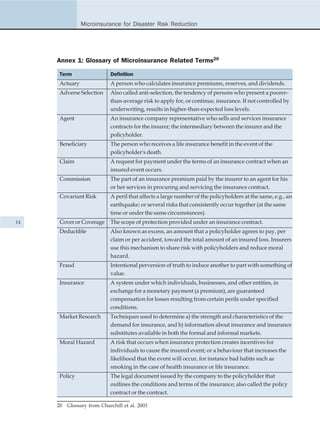
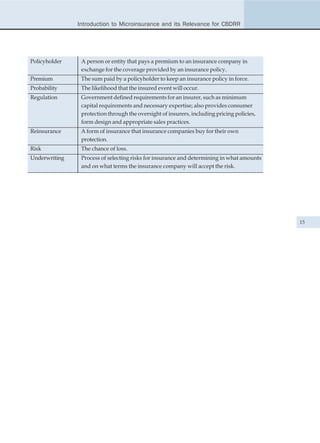
     Annex 1: Glossary of Microinsurance Related Terms20
      Term                  Definition
      Actuary               A person who calculates insurance premiums, reserves, and dividends.
      Adverse Selection     Also called anti-selection, the tendency of persons who present a poorer-
                            than-average risk to apply for, or continue, insurance. If not controlled by
                            underwriting, results in higher-than-expected loss levels.
      Agent                 An insurance company representative who sells and services insurance
                            contracts for the insurer; the intermediary between the insurer and the
                            policyholder.
      Beneficiary           The person who receives a life insurance benefit in the event of the
                            policyholder's death.
      Claim                 A request for payment under the terms of an insurance contract when an
                            insured event occurs.
      Commission            The part of an insurance premium paid by the insurer to an agent for his
                            or her services in procuring and servicing the insurance contract.
      Covariant Risk        A peril that affects a large number of the policyholders at the same, e.g., an
                            earthquake; or several risks that consistently occur together (at the same
                            time or under the same circumstances).
14    Cover or Coverage     The scope of protection provided under an insurance contract.
      Deductible            Also known as excess, an amount that a policyholder agrees to pay, per
                            claim or per accident, toward the total amount of an insured loss. Insurers
                            use this mechanism to share risk with policyholders and reduce moral
                            hazard.
      Fraud                 Intentional perversion of truth to induce another to part with something of
                            value.
      Insurance             A system under which individuals, businesses, and other entities, in
                            exchange for a monetary payment (a premium), are guaranteed
                            compensation for losses resulting from certain perils under specified
                            conditions.
      Market Research       Techniques used to determine a) the strength and characteristics of the
                            demand for insurance, and b) information about insurance and insurance
                            substitutes available in both the formal and informal markets.
      Moral Hazard          A risk that occurs when insurance protection creates incentives for
                            individuals to cause the insured event; or a behaviour that increases the
                            likelihood that the event will occur, for instance bad habits such as
                            smoking in the case of health insurance or life insurance.
      Policy                The legal document issued by the company to the policyholder that
                            outlines the conditions and terms of the insurance; also called the policy
                            contract or the contract.

     20   Glossary from Churchill et al. 2003
Introduction to Microinsurance and its Relevance for CBDRR


Policyholder    A person or entity that pays a premium to an insurance company in
                exchange for the coverage provided by an insurance policy.
Premium         The sum paid by a policyholder to keep an insurance policy in force.
Probability     The likelihood that the insured event will occur.
Regulation      Government defined requirements for an insurer, such as minimum
                capital requirements and necessary expertise; also provides consumer
                protection through the oversight of insurers, including pricing policies,
                form design and appropriate sales practices.
Reinsurance     A form of insurance that insurance companies buy for their own
                protection.
Risk            The chance of loss.
Underwriting    Process of selecting risks for insurance and determining in what amounts
                and on what terms the insurance company will accept the risk.


                                                                                            15
Microinsurance for Disaster Risk Reduction


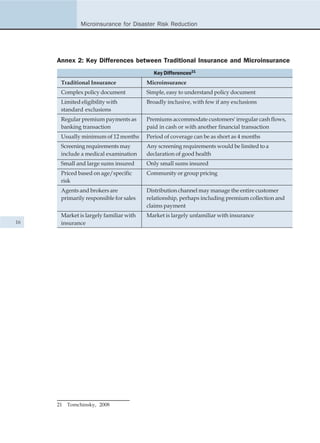
     Annex 2: Key Differences between Traditional Insurance and Microinsurance
                                          Key Differences21
      Traditional Insurance             Microinsurance
      Complex policy document           Simple, easy to understand policy document
      Limited eligibility with          Broadly inclusive, with few if any exclusions
      standard exclusions
      Regular premium payments as       Premiums accommodate customers' irregular cash flows,
      banking transaction               paid in cash or with another financial transaction
      Usually minimum of 12 months      Period of coverage can be as short as 4 months
      Screening requirements may        Any screening requirements would be limited to a
      include a medical examination     declaration of good health
      Small and large sums insured      Only small sums insured
      Priced based on age/specific      Community or group pricing
      risk
      Agents and brokers are            Distribution channel may manage the entire customer
      primarily responsible for sales   relationship, perhaps including premium collection and
                                        claims payment
      Market is largely familiar with   Market is largely unfamiliar with insurance
16    insurance


     21   Tomchinsky, 2008
Introduction to Microinsurance and its Relevance for CBDRR


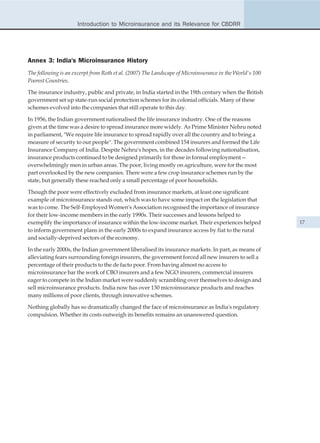
Annex 3: India's Microinsurance History
The following is an excerpt from Roth et al. (2007) The Landscape of Microinsurance in the World's 100
Poorest Countries.

The insurance industry, public and private, in India started in the 19th century when the British
government set up state-run social protection schemes for its colonial officials. Many of these
schemes evolved into the companies that still operate to this day.

In 1956, the Indian government nationalised the life insurance industry. One of the reasons
given at the time was a desire to spread insurance more widely. As Prime Minister Nehru noted
in parliament, "We require life insurance to spread rapidly over all the country and to bring a
measure of security to our people". The government combined 154 insurers and formed the Life
Insurance Company of India. Despite Nehru's hopes, in the decades following nationalisation,
insurance products continued to be designed primarily for those in formal employment—
overwhelmingly men in urban areas. The poor, living mostly on agriculture, were for the most
part overlooked by the new companies. There were a few crop insurance schemes run by the
state, but generally these reached only a small percentage of poor households.

Though the poor were effectively excluded from insurance markets, at least one significant
example of microinsurance stands out, which was to have some impact on the legislation that
was to come. The Self-Employed Women's Association recognised the importance of insurance
for their low-income members in the early 1990s. Their successes and lessons helped to
exemplify the importance of insurance within the low-income market. Their experiences helped             17
to inform government plans in the early 2000s to expand insurance access by fiat to the rural
and socially-deprived sectors of the economy.

In the early 2000s, the Indian government liberalised its insurance markets. In part, as means of
alleviating fears surrounding foreign insurers, the government forced all new insurers to sell a
percentage of their products to the de facto poor. From having almost no access to
microinsurance bar the work of CBO insurers and a few NGO insurers, commercial insurers
eager to compete in the Indian market were suddenly scrambling over themselves to design and
sell microinsurance products. India now has over 130 microinsurance products and reaches
many millions of poor clients, through innovative schemes.

Nothing globally has so dramatically changed the face of microinsurance as India's regulatory
compulsion. Whether its costs outweigh its benefits remains an unanswered question.
Microinsurance for Disaster Risk Reduction


     Facilitator's Note
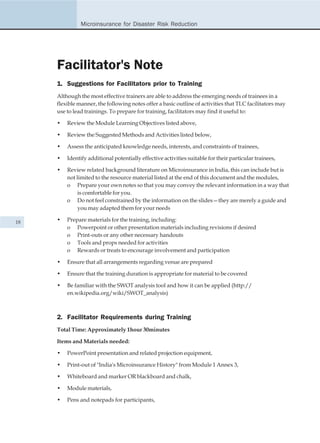
     1. Suggestions for Facilitators prior to Training
     Although the most effective trainers are able to address the emerging needs of trainees in a
     flexible manner, the following notes offer a basic outline of activities that TLC facilitators may
     use to lead trainings. To prepare for training, facilitators may find it useful to:

     •   Review the Module Learning Objectives listed above,

     •   Review the Suggested Methods and Activities listed below,

     •   Assess the anticipated knowledge needs, interests, and constraints of trainees,

     •   Identify additional potentially effective activities suitable for their particular trainees,

     •   Review related background literature on Microinsurance in India, this can include but is
         not limited to the resource material listed at the end of this document and the modules,
         o Prepare your own notes so that you may convey the relevant information in a way that
              is comfortable for you.
         o Do not feel constrained by the information on the slides—they are merely a guide and
              you may adapted them for your needs

18   •   Prepare materials for the training, including:
         o Powerpoint or other presentation materials including revisions if desired
         o Print-outs or any other necessary handouts
         o Tools and props needed for activities
         o Rewards or treats to encourage involvement and participation

     •   Ensure that all arrangements regarding venue are prepared

     •   Ensure that the training duration is appropriate for material to be covered

     •   Be familiar with the SWOT analysis tool and how it can be applied (http://
         en.wikipedia.org/wiki/SWOT_analysis)


     2. Facilitator Requirements during Training
     Total Time: Approximately 1hour 30minutes

     Items and Materials needed:

     •   PowerPoint presentation and related projection equipment,

     •   Print-out of "India's Microinsurance History" from Module 1 Annex 3,

     •   Whiteboard and marker OR blackboard and chalk,

     •   Module materials,

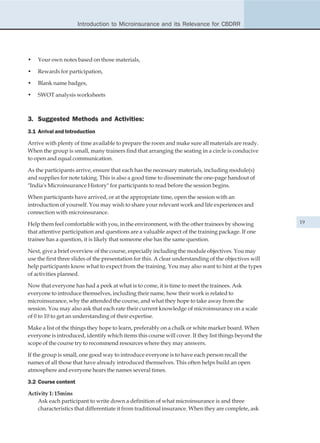
     •   Pens and notepads for participants,
Introduction to Microinsurance and its Relevance for CBDRR


•   Your own notes based on those materials,

•   Rewards for participation,

•   Blank name badges,

•   SWOT analysis worksheets


3. Suggested Methods and Activities:
3.1 Arrival and Introduction

Arrive with plenty of time available to prepare the room and make sure all materials are ready.
When the group is small, many trainers find that arranging the seating in a circle is conducive
to open and equal communication.

As the participants arrive, ensure that each has the necessary materials, including module(s)
and supplies for note taking. This is also a good time to disseminate the one-page handout of
"India's Microinsurance History" for participants to read before the session begins.

When participants have arrived, or at the appropriate time, open the session with an
introduction of yourself. You may wish to share your relevant work and life experiences and
connection with microinsurance.

Help them feel comfortable with you, in the environment, with the other trainees by showing             19
that attentive participation and questions are a valuable aspect of the training package. If one
trainee has a question, it is likely that someone else has the same question.

Next, give a brief overview of the course, especially including the module objectives. You may
use the first three slides of the presentation for this. A clear understanding of the objectives will
help participants know what to expect from the training. You may also want to hint at the types
of activities planned.

Now that everyone has had a peek at what is to come, it is time to meet the trainees. Ask
everyone to introduce themselves, including their name, how their work is related to
microinsurance, why the attended the course, and what they hope to take away from the
session. You may also ask that each rate their current knowledge of microinsurance on a scale
of 0 to 10 to get an understanding of their expertise.

Make a list of the things they hope to learn, preferably on a chalk or white marker board. When
everyone is introduced, identify which items this course will cover. If they list things beyond the
scope of the course try to recommend resources where they may answers.

If the group is small, one good way to introduce everyone is to have each person recall the
names of all those that have already introduced themselves. This often helps build an open
atmosphere and everyone hears the names several times.

3.2 Course content

Activity 1: 15mins
    Ask each participant to write down a definition of what microinsurance is and three
    characteristics that differentiate it from traditional insurance. When they are complete, ask
Microinsurance for Disaster Risk Reduction


         who wants to share their definition. Write key aspects of their definitions on the board. Ask
         questions and try to guide the group to definition or an agreed understanding.

         Reveal the Powerpoint slide with the definition. Compare this to the definition you
         identified as a group.

         Proceed through the remaining slides in Section I, on What is Microinsurance?

     Activity 2: 15mins

         Lead a discussion around the following, or similar questions:

         1.   What risks do you face on a daily basis?

         2.   What are the key risks that face people you work with (loss of property, loss of life, etc.).
              What consequences would arise if these risks occurred, immediately, and in later
              months and years?

         3.   Do mainstream insurance providers have products for their risks? Why or why not?

         Continue the presentation with Section II, on the Importance of Microinsurance for Pro-poor
         Disaster Management, and Section III, on Common Microinsurance Products. Ask for a
         show of hands for those participants that are currently working with each product.

     Activity 3: 10-15mins + trainer presentation time

20       Have the trainees read the excerpt on "India's Microinsurance History". Lead a discussion
         on the recent growth of microinsurance products offered by asking the following, or similar,
         questions:

         1.   What prevented insurers from offering products to the poor?

         2.   What change occurred that has spawned a range of new products to service the poor?

         3.   What factors drove that change?

         4.   Does anyone know approximately how many low-income individuals are now covered
              by microinsurance in India? Correct answer is 30+ million.

         Continue the presentation with Section IV, on Microinsurance Models and Roles.
         Emphasise that the changes in Indian insurance regulations discussed in the article have
         encouraged many new products to be offered through the Partner-agent Model.

     Activity 4: 25mins

         Organise the participants into groups of approximately five people. Give each group a
         particular microinsurance beneficiary or target policyholder group (could be a federation of
         MFI participants, a trade union of textile workers, or a dairy cooperative. Explain that they
         are now responsible for developing a microinsurance product to suit their target group.
         Their first task is to work in their group to develop a process for designing and
         implementing their product. Tell them they have 15 minutes to:

         1.   Identify a microinsurance delivery model, from those discussed above.

         2.   A process map or series of generalised steps that they will follow in the conception and
              implementation of their product.
Introduction to Microinsurance and its Relevance for CBDRR


    3.   A list of key relationships that will need to be cultivated for their product to be complete
         and successful.

    When their group work is complete, have each group choose a leader. The leader should
    explain their choice of microinsurance delivery models and explain the rationale for their
    choice based on their target group. They should draw their process map on the board and
    explain the key steps. Finally, they should identify the key relations that they will need to
    develop.

    Continue the presentation by showing the slide under Section V, with the diagram of the
    Product Development Process. Explain the steps in this process and highlight similarities
    between this diagram and the process maps created by the trainees.

    Ask participants to identify a list of key areas that will be important for microinsurance in
    the future. Write the list on the board.

    Continue the presentation with Section VI, on Issues for the Future.

Activity 5: SWOT Analysis: 20mins

    Hand out the blank SWOT Analysis table. Explain the SWOT Analysis tool to the trainees.
    Explain that their task is to take their current organisation and fill in the SWOTs for either:

    1.   Initiating a new microinsurance product for a key constituency or

    2.   Expanding their current microinsurance product into a new frontier (such as up-                21
         scaling to new policyholders, or providing appropriate complementary services).

    Finally, they should make a list of actions they can take, based on opportunities listed in the
    SWOT, if they were to implement their new/revised microinsurance product.

    The resulting SWOT Analyses are for them to keep for their own use and application.
    Encourage them to ask questions in order to really understand and apply the tool.
    Especially encourage them to take the SWOT tool back to their organisations to discuss with
    colleagues how it can help them with their current work.


4. Presentation Guidelines
"The following presentation guidelines are intended as a resource that may be adapted for
training facilitators that are teaching this module. They may be used to create a visual
presentation or handouts for participants."

Objectives

By the end of this module you should be able to:

•   Define microinsurance

•   Explain the usefulness of insurance as a tool for transferring disaster risk from the poor

•   Explain common models of microinsurance

•   Determine if microinsurance is suitable for your constituency and partners
Microinsurance for Disaster Risk Reduction


     •    Identify stakeholders in microinsurance provision

     •    Explain two opportunities in the frontier of microinsurance development in India

     Contents

     I.   What is Microinsurance?

     II. Importance of Microinsurance for Pro-Poor Disaster Management

     III. Common Microinsurance Products

     IV. Microinsurance Models and Roles

     V. Basics of Products Design and Provision

     VI. Issues for the Future

     I.   What is Microinsurance?

     •    Working definition: “the protection of low-income people against specific perils in
          exchange for regular premium payments proportionate to the likelihood and cost of the
          risk involved”

     •    Microinsurance is:

          – A risk-pooling product
22
          – Appropriate for the low-income market in terms of cost, terms, coverage, and delivery
            mechanisms

     •    Key Differences between Traditional and Microinsurance

          Traditional Insurance                        Microinsurance
          Small and large sums insured                 Only small sums insured
          Complex policy document                      Simple, easy to understand policy document
          Agents and brokers are primarily             Distribution channel may manage the entire
          responsible for sales                        customer relationship, perhaps including
                                                       premium collection and claims payment
          Market is largely familiar with insurance    Market is largely unfamiliar with insurance
          Priced based on age/specific risk            Community or group pricing
          Limited eligibility with standard exclusions Broadly inclusive, with few if any exclusions
          Regular premium payments as banking          Premiums accommodate customers’ irregular
          transaction                                  cash flows, paid in cash or with another
                                                       financial transaction
          Usually minimum of 12 months                 Period of coverage can be as short as 4
          months
          Screening requirements may include a         Any screening requirements would be limited
          medical examination                          to a declaration of good health
Introduction to Microinsurance and its Relevance for CBDRR


II. Importance of Microinsurance for Pro-Poor Disaster Management

•   Disparity of Insured Risks
                                                                                        Percentage of 2005 Disaster
    – Chart: Indicates lack of asset coverage in Asia                                  Losses Covered by Insurance

      (From MunichRe). Still, most is held by the                                60%
                                                                                          50.69%
      wealthy.                                                                   50%


                                                            Percentage Covered
    – Within Asia, 24 percent of deaths due to                                   40%
                                                                                                                 30.46%
      disasters occurred in India because of its size,                           30%
      population, and vulnerability (From GoI 2002
                                                                                 20%
      5YP).
                                                                                 10%                 4.88%

    – In India, poor households more severely
                                                                                 0%
      affected and lack savings and access to social                                   America      Asia       Europe
      safety mechanisms.
                                                         Losses to disasters in Asia have significantly
    – Direct natural disaster losses amount to 2% of less coverage than in America and Europe.
      India’s GDP and up to 12% of central
      government revenues. Not including informal sector losses (From World Bank).

•   Microinsurance, Risk, and the Poor

    – Characteristics of the Insurable Poor: Vulnerable to risks, Often work in the informal
      economy, Irregular cash flows, Manage risks through myriad of informal means,
                                                                                                                          23
      including social networks, Limited familiarity with formal insurance, May not trust
      insurance companies

    – Key risks: Death of family member, Natural disasters, Theft or property damage, Illness or
      injury

    – Microinsurance transfers some of these risks: From poor households to insurance markets
      and Can result in lower recovery costs for those affected.

•   Advantages of MI for Disaster Risk Management

    – Predictable financial resources for recovery,

    – Post-disaster liquidity for continuation of livelihoods,

    – Promote investments in productive assets,

    – Could offer incentive to reduce risks if insurers offer tiered premiums,

    – Could allow for more local decision making about recovery investments than top-down
      recovery programming seen after 2004 tsunami.

III. Common Microinsurance Products

•   Life Insurance

    – Covers the policyholder on the event of death and disability.

    – Most widely available insurance product due to simplicity.

    – Typically a low-risk product for provider.
Microinsurance for Disaster Risk Reduction


     •   Health Insurance

         – Covers health care related costs linked to illness, injury and treatment.

         – Complex and depends on access to health care.

     •   Agriculture Insurance

         – Includes livestock, crop insurance, or weather insurance.

         – Covers against losses due to drought, flood or livestock-affecting epidemics.

     •   Property and Asset Insurance

         – Covers against damage of property and/or loss of assets.

     •   Disaster Insurance-

         – Often a package that covers combination of life, health, agriculture, and property assets

     IV. Microinsurance Models and Roles

     •   Partner - Agent Model

         – Commercial or public insurers together with MFIs or NGOs collaboratively develop the
           product.

24
         – Insurer absorbs the risk, and the MFI/NGO markets the product through its established
           distribution network. This lowers the cost of distribution and thus promotes affordability.

         – Dominant approach to microinsurance in India.
     •   In-house or Full-service Model

         – An MFI or NGO runs its own insurance scheme for clients

         – Any profit or loss is absorbed by the MFI.

         – No longer common but still exists.

     •   Community-based Model

         – A group of people or local communities, MFIs, NGOs and/ or cooperatives develop and
           distribute their own product, manage the risk pool and absorb the risk.

     •   Provider Model

         – Banks and other MFIS directly offering insurance contracts.

         – Usually coupled with credit to insure against default risk.

         – Used widely in the general insurance market

         – High transaction costs, low ability to pay premiums inhibit use for disasters.
Introduction to Microinsurance and its Relevance for CBDRR


•                    Who Buys Insurance from Whom?


                                                                                    Source: The Microinsurance Center

•                    How these Roles Work Together
                          Reinsurers      Regulated insurers and Delivery channels         Policy-holders
                                          Un-regulated providers
                     • Can cover partial • Manage risk           • Direct contact with • Pay premiums
What they do


                       risk of an insurer • Pay claims             policyholders       • Make claims                    25
                     • Not usually        • Final say on pricing • Sell insurance      • Buy group cover
                       involved in MI     • Regulatory           • May aid clients       for all members,
                       except health and    compliance             with, or settle       clients, employees,
                       index              • Manage controls        claims                and others
                                                                 • Collect premiums
                     • Examples            • Multi-national and      • MFIs and banks        • Individuals
Who they are in MI


                     • Interpolis Re –       domestic commercial     • CBOs                  • Groups (for clients,
                       Mutuals               insurers                • NGOs                    members,
                     • Swiss Re – India    • Some Mutuals            • Specialty agents        employees, and
                       weather index       • CBOs                    • Employers               others)
                     • Munich Re           • NGOs                    • Governments
                     • Partner Re          • Funeral parlors         • Retailers
                                           • Informal groups         • Churches
                      REGULATIONS and SUPERVISION – The foundation of sound consumer protection
                                      DONORS – Strengthening the weak spots

•                    Stakeholder Opportunities

                     – Insurers: Profitability, Expansion of risk pool and market

                     – Delivery channels: Additional income stream, Competitive advantages, More stable
                       clients / members

                     – Policyholders in the low-income market: Affordable, accessible, responsive products that
                       help reduce risk
Microinsurance for Disaster Risk Reduction


     V.   Basics of Products Design and Provision

     •    Intro to the Product Development Process


                                         2    Market research


                                                                      3 Product development
                             1 Institutional assessment

          7 Monitor the claims experience                             4           Pricing


                       6      Implement                      5    Develop systems

                                                                           Source: Churchill et al. (2003)

     VI. Issues for the Future

     •    Up-Scaling
          – Between 2006 and 2007 alone, the number of low-income people with access to
26          microinsurance grew by 50%.
          – Obstacles to up-scaling: Understanding the market itself to develop appropriate
            products, Targeted households have little education or experience with insurance and
            have little trust of companies or their agents.
          – Needs for up-scaling: More client-focused microinsurance products, Market education,
            Efficient mechanisms to expand policyholder demand and satisfaction assessment tools

     •    Index Insurance
          – New, and still experimental, tool for insuring the poor
          – Represent a large proportion of the 30+ million covered by microinsurance in India
          – Mechanism Example: Rainfall
          – Indexed products overcome some of the most significant challenges to MI for disaster
            reduction
            o Retains incentive for farmers to reduce risk
            o Can reach large numbers of people
            o Reduced moral hazard
            o Reduced adverse selection
            o No time-consuming claim assessment


     References
     UNESCO Training Guide
     All Material Listed with Module 1
u le
                Assessing Microinsurance
    od
M        2      Demand
Microinsurance for Disaster Risk Reduction


28
u le                            Assessing Microinsurance Demand

                 Assessing Microinsurance
    od
M        2       Demand

                Learning Objectives
                By the end of this module you should be able to:
                •    Explain the relevance of effective microinsurance demand assessment
                •    Identify key factors that influence potential policyholder demand for a product
                •    Outline a process for assessing demand for microinsurance among your
                     constituency


                Contents
                2.1 Importance of Proper Demand Assessment                                    30
                     2.1.1 Community Needs and Microinsurance Opportunities                   30
                     2.1.2 Risks and Related Products                                         31
                2.2 Factors Influencing Demand                                                31       29

                2.3 Assessment Process: Developing a Demand Study                             32
                     2.3.1 Basic Information Needs in Product Conception                      33
                     2.3.2 Basic Information Needs in Product Design and Delivery             33
                     2.3.3 Using the Results                                                  33
                     References                                                               33
                Annex 1: Overview of Tools for Microinsurance Demand Assessment               35


                Facilitator's Note
                1.   Suggestions for Facilitators prior to Training
                2.   Facilitator Requirements during Training
                3.   Suggested Methods and Activities
                4.   Presentation Guidelines
Microinsurance for Disaster Risk Reduction


     2.1 Importance of Proper Demand Assessment
     Effective microinsurance products are built to address the needs of the poor. Even organisations
     that work with the poor on a regular basis will find designing effective products difficult
     without a suitably comprehensive assessment of the risks communities face and their preferred
     strategies for addressing this risk.

     Conducting a thorough demand assessment prior to product design or implementation will
     help you address critical questions:
     •   Should we be involved in microinsurance?
     •   What types of products should we offer, and to whom?
     •   How can our product be refined to better address local preferences and capacities?
     •   Will our product be attractive to others? With what revisions?
     •   What complementary activities should we pursue to support our MI product?


     2.1.1 Community Needs and Microinsurance Opportunities

     Although the number and variety of microinsurance products available is expanding rapidly,
     many products available are not suitable for low-income communities or are of low quality1 .
     Additionally, some products are mandatory for members of certain groups and some
30   policyholders are unaware that they are covered. Further, many of the products sold in India
     are only offered to meet regulatory quotas and it is not clear if insurers are dedicated to
     servicing them.

     Demand for microinsurance products is based on two general aspects: the suitability of product
     supplied and how this product compares with alternative coping systems. Although
     developing a suitable product requires knowledge of the low-income market that commercial
     insurers and even NGOs typically lack, a systematic demand assessment can help address this.

     Effectively designed products will be both financially viable (suitable for the insurer) and
     appropriate for the risks that the poor face (suitable for the policyholder). As such, not all
     eventualities are insurable. Before considering aspects of efficient delivery, the following criteria
     must be met.

     Is the Risk Insurable?

     •    Does the loss occur by chance?               •   Will the risk pool attract sufficient numbers of
                                                           clients who are unlikely to present claims
     •    Is the loss definite in time and amount?
                                                           (does it meet the criteria for adverse selection)?
     •    Does the loss create significant
                                                       •   Is the loss a genuine loss to the insured (no
          hardship relative to income?
                                                           house, no house insurance)?
     •    Are a large number of similar units
                                                       •   Is the loss one that will not be catastrophic to
          exposed to the risk?
                                                           the insurer? Does the same risk affect more
     •    Is it possible to estimate the possibility       than one person or household at a time? Is it
          of the loss occurring?                           idiosyncratic?
                                                                             Source: MicroSave in USAID 2006
     1 Roth et al. 2007.
Assessing Microinsurance Demand


2.1.2 Risks and Related Products

Microinsurance is one option among several that can be used by the poor to cope with
adversity. It is typically effective for moderate anticipated losses. Alternative strategies such as
savings and credit are more appropriate for smaller losses. Similarly, microinsurance is not a
suitable strategy for catastrophic losses as the premiums would often make the product
unaffordable. Catastrophic losses are often excluded through coverage limits.

Different Risk Management Strategies for Different Risks


                                              Source: Brown and Churchill. (2000) In Mechler, et al. (2006)


                                                                                                              31
2.2 Factors Influencing Demand
The decision to purchase microinsurance will depend on a combination of product
appropriateness and product appreciation. The following diagram illustrates the components
of product appreciation and appropriateness that are discussed in this section.

        Microinsurance Product Value is Based on Appreciation and Appropriateness


                                                                                   Source: McCord (2007)
Microinsurance for Disaster Risk Reduction


     Appreciation

     Purchasing insurance requires giving up something now, a premium for a possible payback in
     the future. This can be especially difficult for low-income households with very little
     discretional income and little experience with commercial insurers. To enter into such an
     arrangement requires an understanding and positive perception of the value of insurance.
     Additionally, it requires the policyholder to trust that the agreed amount will be paid if the risk
     is realised. Experience following the 2004 Indian Ocean tsunami and 2005 South Asia
     earthquake indicate that communities that have recently experienced disasters may be more
     likely to purchase insurance than those that have not faced a similar hazard.

     Appropriateness

     The second component of community demand relates to the perceived appropriateness of the
     product for addressing real needs. This is also influenced by the ease of payments and claims
     procedures, the cost of the policy, and the availability of money to make the regular premium
     payments.

     Enabling Environment

     In the case of microinsurance, supply and demand influence each other. Both the
     appropriateness and the appreciation for the product are influenced by contextual factors that
     can be influenced by legislation and other stakeholders. In India, the Insurance Regulatory and
     Development Authority has made servicing the poor a necessity for many commercial insurers.
32   Additionally, factors such the existence of service or sales taxes on such policies affect the cost-
     effectiveness of providing products at very low rates. The current service tax of 10.2% might be
     reduced or lowered to encourage more uptake.


     2.3 Assessment Process: Developing a Demand Study
     This section highlights the key steps involved in designing and conducting an assessment
     microinsurance demand. A comprehensive demand assessment will include efforts to
     understand client needs and a trial of the product prototype that is designed on the preliminary
     assessment.

     Microinsurance Demand Assessment Cycle

                                                                                Costing &
                                           Qualitative       Qualitative         Pricing
                          Research
                                            Research         Research:
                           Issue
                                              Plan           FGD/PRA

                                           Understanding client's needs       Concept
                                                                            Development


                           Product         Quantitative
                                            Research:           Refine the
                          Ready for                            Concept into
                          Pilot-test        Prototype
                                             Testing           a Prototype


                                            Testing the Product Prototype
                                                                                          Source: MicroSave
Assessing Microinsurance Demand


2.3.1 Basic Information Needs in Product Conception

During the first phase, critical information to gather will include community risk context and
strategies currently employed to address these. Specifically, you will need to gather information
on: 1) demographic and geographic characteristics i.e. age, health, location in a flood plane, etc.;
2) economic characteristics i.e. income and expenditure as well as distribution throughout the
year; 3) the nature of risks faced; 3) typical life cycle stresses and anticipated expenditure i.e.
sending children to school, starting a business, etc.; 4) the extent of impact of anticipated risk
events; 5) coping strategies used to address manageable risks i.e. savings, borrowing from
moneylenders, etc.; 6) how the community prioritises the risks that they face; and 7) how the
community understands and perceives insurance.2


2.3.2 Basic Information Needs in Product Design and Delivery

During the second phase, research should look at: 1) coverage and exclusions; 2) premiums; 3)
methods and timeliness of premium collection; 4) methods of claims processing; 5) the impact
that the insurance has on policyholders; 6) changes in understanding and perception of
insurance; and 7) level of client satisfaction.


2.3.3 Using the Results
                                                                                                       33
Finally, the findings and analysis of the collected information need to be communicated
effectively to improve the product and delivery mechanism. You may want to set up a short
briefing session to communicate key results with the project team and the insurer and project
team. This team meeting can provide a good opportunity to discuss the strengths and
weaknesses of the product and possible improvements to delivery.


References
MicroSave has a wide range of tools developed for designing and implementing microfinance
products. With a small amount of adaptation, these tools can be valuable for microinsurance demand
assessment and more. They can be accessed at: http://www.microsave.org/toolkits.asp?ID=14. Other
tools from MicroSave have been developed especially for microinsurance. A useful example of a
quantitative demand assessment is available at: http://www.mfc.org.pl/doc/
Demand_for_Microinsurance_in_Georgia.doc.

AIDMI. (2006). Community Risk Transfer through Microinsurance: An Opportunity for South Asia?
southasiadisasters.net #13. Ahmedabad: AIDMI.

Brown, W and C. Churchill (2000), Insurance Provision to Low-Income Communities. Part II. Initial
Lessons from Microinsurance Experiments for the Poor, Microenterprise Best Practices. Bethesda,
Maryland.

Brown, Green and Lindquist, 2000. A Cautionary Note for Microfinance Institutions and Donors
Considering Developing Microinsurance Products. Bethesda, Maryland.


2 Annex: 1 provides ‘Overview of Tools for Microinsurance Demand Assessment’.
Microinsurance for Disaster Risk Reduction


     Churchill, C. (2006). Protecting the poor: A microinsurance compendium. Geneva: International
     Labour Organization.

     Churchill, C., Liber, D., McCord, M., & Roth, J. (2003). Making Insurance Work for Microfinance
     Institutions. Geneva: ILO.

     Cole, S., & Topolova, P. (2007, April). Rainfall Insurance. Eye on Microfinance (4).

     Cole, S., Chattopadhyay, R., Hunt, S., Tobacman, J., & Topalova, P. (2008). Weather Insurance, Price
     Information, and Hedging: Financial Initiatives in Gujarat to Help the Poor Manage Agricultural Risk.
     Madison: BASICS/USAID.

     Government of India. (2002). Tenth Five Year Plan 2002-2007. New Delhi: GoI.
     International Labour Office. (2005). India: An Inventory of Microinsurance Schemes. Geneva: ILO.

     McCord, M., & Buczkowski, G. (2004). CARD MBA: The Philippines (CGAP Working Group on
     Microinsurance Good and Bad Practices Case Study No. 4). Washington, DC: CGAP. Available at:
     http://microfinancegateway.org/content/article/detail/23881.

     McCord, M. 2007. Improving Access to Microinsurance: Key Considerations. Presentation at Access to
     Insruance for the Poor. Rio de Janeiro, Brazil. MicroInsurance Centre.

     McCord, M. (2008). Visions of the Future of Microinsurance, and Thoughts on Getting There.
     Microinsurance Note No. 9. Washington, DC: USAID.

     Mechler, R., Linnerooth-Bayer, J., & Peppiatt, D. (2006). Disaster Insurance for the Poor? A reivew of
34   microinsurance for natural disaster risks in developing countries. Geneva: ProVention/IIASA.

     Mechler, R., Linnerooth-Bayer, J., & Peppiatt, D. (2006). Microinsurance for Natural Disaster Risks in
     Developing Countries: Benefits, Limitations and Viability. Geneva: ProVention/IIASA.

     Peppiatt, D. (2006). Recipes for Risk Reduction-the Emergence of Microinsurance. In AIDMI. (2006).
     Community Risk Transfer through Microinsurance: An Opportunity for South Asia?
     southasiadisasters.net #13. Ahmedabad: AIDMI.

     ProVention Consortium. (forthcoming). Practice Review on Innovations in Disaster Risk Financing.
     For the Global Assessment Report 2009.

     Reynolds, T., Pandya, M. (forthcoming). Index Insurance and Disaster Resilience: Recent Experiences
     and Opportunities in India. Ahmedabad: AIDMI.
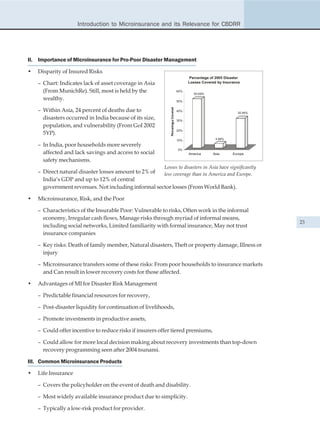
     Roth, J., McCord, M., & Liber, D. (2007). The Landscape of Microinsurance in the World's 100 Poorest
     Countries. Appleton, WI: The Microinsurance Centre.

     Scheper, E., Parakrama, A., & Patel, S. (2006). Impact of the Tsunami Response on Local and National
     Capacities. London: Tsunami Evaluation Coalition.

     Tomchinsky, G. (2008). Introduction to Microinsurance: Historical Perspective. Fourth International
     Microinsurance Conference. Cartanega, Colombia; November 5, 2008. Munich: MunichRe Foundation.

     UNDP. (2007). Building Security for the Poor: Potential and Prospects for Microinsurance in India.
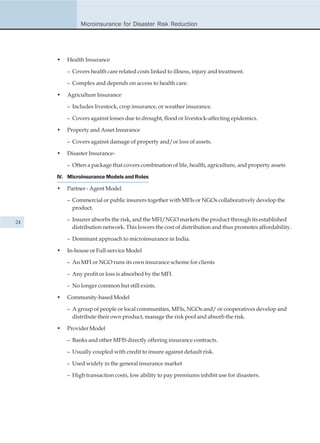
     Colombo: UNDP/RC Colombo/HDRU.
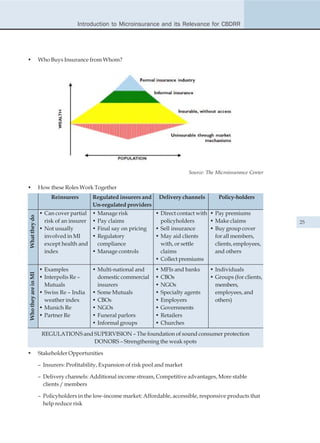
     USAID. 2006. Guidelines for Market Research on the Demand for Microinsurance. MicroReport #69.
     Washington, DC: USAID.
Assessing Microinsurance Demand


Annex 1: Overview of Tools for Microinsurance Demand Assessment3

Tools                               Relevant Data Generated
Focus group discussion guide:       Significant risks facing participant households ranked by
risk and risk management            impact.
strategies                          Economic impacts of specific risks on households.
                                    Precautionary strategies used by households to manage risks
                                    before they happen.
                                    Coping mechanisms used by households to respond to risks.
                                    Short and long-run impacts of risk management strategies on
                                    household.
Focus group discussion guide:       Assessment of participants' understanding of insurance and
client satisfaction with            how it works.
insurance products (formal          Information on insurance products used by participants.
and informal)                       Client perceptions of communications from the insurance
                                    provider about the product.
                                    Satisfaction with the terms and conditions of the insurance,
                                    the claims procedures and outcomes.
                                    Recommendations for improving the insurance project.
PRA tool: life cycle risks and      The major life cycle events which require large sums of cash
coping mechanisms                   for participant households.                                    35
                                    Relative expense or economic impact of life cycle events.
                                    Precautionary strategies used by households to manage the
                                    economic stress of life cycle events before they happen.
                                    Coping mechanisms used by households to respond to the
                                    economic stress of life cycle events after they happen.
                                    Short and long-run impacts of risk management strategies on
                                    households.
PRA tool: seasonality of            Seasonal flows of income and expenditures by month.
income, expenditure, savings        Sources of income.
and credit                          Demand for savings and credit by month.
                                    Events requiring large sums of cash.
PRA tool: seasonally of risks       Seasonal flows of risks and economic stresses by month.
(linked to above)                   Precautionary strategies used by households to manage risks
                                    before they happen.
                                    Coping mechanisms used by households to respond to
                                    specific risks.
                                    Short and long-run impacts or risk management strategies
                                    on household.
PRA tool: wealth ranking, to        Information on differences in risks and risk management
look at risks at different levels   strategies across different wealth levels.
and responses at different levels

3 From USAID 2006. Adapted from Microfinance Opportunities and MicroSave.
Microinsurance for Disaster Risk Reduction


     Tools                               Relevant Data Generated
     PRA tool: time series of risk       How the community/participants view change over time in
                                         significant risks.
                                         What are the most significant risks.
                                         How risk management strategies change over time and why.
     PRA tool: attribute preference      What do participants view as the key attributes of the
     ranking of microinsurance           microinsurance product.
     product (link to client             What is the relative importance of each attribute.
     satisfaction focus group            How satisfied are the participants with each attribute of the
     discussion)                         insurance product.
                                         Recommendations for improving the product attributes.
     Individual interview guide: load,   How an individual has used savings, loans and insurance
     savings, and insurance use          to manage risk and economic stresses.
                                         The effectiveness of their financial services for meeting the
                                         individual’s risk management needs.
                                         The evolution of an individual’s risk management strategies
                                         over time.
     Mini survey: client satisfaction    Assessment of participants’ understanding of insurance and
     with formal and informal            how it works.
     insurance products                  Information on insurance products used by participants
36                                       including: premium amount, timing of payment, method of
                                         payment, claims procedures, and impact of claim.
                                         Client perceptions of communications from the insurance
                                         provider about the product.
                                         Satisfaction with the terms and conditions of the insurance
                                         product and the claims procedures and outcomes.
                                         Recommendations for improving the insurance product.
     Case study format: Study of         Purpose of the informal insurance scheme.
     informal insurance                  Risks covered
                                         Size of group and characteristics of group members.
                                         Criteria/conditions for membership.
                                         Costs of participation.
                                         Frequency of contributions.
                                         Benefits of membership.
                                         Criteria and process for payout.
                                         Coverage, timeliness and accessibility of payout.
                                         Important features of the insurance scheme.
                                         Complementary loss management strategies used by the
                                         group members.
Assessing Microinsurance Demand


Facilitator's Note
1. Suggestions for Facilitators prior to Training
Although the most effective trainers are able to address the emerging needs of trainees in a
flexible manner, the following notes offer a basic outline of activities that TLC facilitators may
use to lead trainings. To prepare for training, facilitators may find it useful to:

•   Review the Module Learning Objectives listed above,

•   Review the Suggested Methods and Activities listed below,

•   Assess the anticipated knowledge needs, interests, and constraints of trainees,

•   Identify additional potentially effective activities suitable for their particular trainees,

•   Review related background literature on Microinsurance and product development in
    India, this can include but is not limited to the resource material listed at the end of this
    document and the modules,
    o Prepare your own notes so that you may convey the relevant information in a way that
        is comfortable for you.
    o Do not feel constrained by the information on the slides—they are merely a guide and
        you may adapted them for your needs
                                                                                                     37
•   Prepare materials for the training, including:
    o Powerpoint or other presentation materials including revisions if desired
    o Print-outs or any other necessary handouts
    o Tools and props needed for activities
    o Rewards or treats to encourage involvement and participation

•   Ensure that all arrangements regarding venue are prepared

•   Ensure that the training duration is appropriate for material to be covered

If this module is combined with others in the Microinsurance Development Series, the trainer
may skip the introduction activities and continue with the activities relating to the course
content directly.


2. Facilitator Requirements during Training
Total Time: Approximately 1hour 30minutes

Items and Materials needed:

•   PowerPoint presentation and related projection equipment,

•   Whiteboard and marker OR blackboard and chalk,

•   Module materials,

•   Pens and notepads for participants,
Microinsurance for Disaster Risk Reduction


     •   Your own notes based on those materials,

     •   Rewards for participation,

     •   Blank name badges,


     3. Suggested Methods and Activities:
     3.1 Arrival and Introduction

     Arrive with plenty of time available to prepare the room and make sure all materials are ready.
     When the group is small, many trainers find that arranging the seating in a circle is conducive
     to open and equal communication.

     As the participants arrive, ensure that each has the necessary materials, including module(s)
     and supplies for note taking. When participants have arrived, or at the appropriate time, open
     the session with an introduction of yourself. You may wish to share your relevant work and life
     experiences and connection with microinsurance.

     Help them feel comfortable with you, in the environment, with the other trainees by showing
     that attentive participation and questions are a valuable aspect of the training package. If one
     trainee has a question, it is likely that someone else has the same question.

38   Next, give a brief overview of the course, especially including the module objectives. You may
     use the first slides of the presentation for this. A clear understanding of the objectives will help
     participants know what to expect from the training. You may also want to hint at the types of
     activities planned.

     Now that everyone has had a peek at what is to come, it is time to meet the trainees. Ask
     everyone to introduce themselves, including their name, how their work is related to
     microinsurance, why the attended the course, and what they hope to take away from the day's
     session. You may also ask that each rate their current knowledge of microinsurance and
     product development on a scale of 0 to 10 to get an understanding of their expertise.

     Make a list of the things they hope to learn, preferably on a chalk or white marker board. When
     everyone is introduced, identify which items this course will cover. If they list things beyond the
     scope of the course try to recommend resources where they may answers.

     If the group is small, one good way to introduce everyone is to have each person recall the
     names of all those that have already introduced themselves. This often helps build an open
     atmosphere and everyone hears the names several times.


     3.2 Course content

     Activity 1: 15mins
         (Activity #1 is useful for any microinsurance training. If this module is used in combination
         with the introductory module on microinsurance, you will probably not want to repeat this
         activity and will skip to Activity 2.)
Assessing Microinsurance Demand


      Ask each participant to write down a definition of what microinsurance is and three
      characteristics that differentiate it from traditional insurance. When they are complete, ask
      who wants to share their definition. Write key aspects of their definitions on the board. Ask
      questions and try to guide the group to definition or an agreed understanding.

      Then share the following definition:
      "the protection of low-income people against specific perils in exchange for regular
      premium payments proportionate to the likelihood and cost of the risk involved"

Activity 2: 15mins

      Initiate a discussion with the participants on the importance of building a policy to fit
      specific community risk management needs. Organise the participants into three groups i.e.
      community, NGO/service provider, and insurance company for a role-play if time allows.
      Remember, participants love role-plays and it always take more time than intended.
      Encourage the NGO/service provider group to facilitate discussion between the remaining
      two groups to understand expectations from each other. This exercise will also help
      understand and clarify role of the NGO/service provider.

Activity 3: 10-15mins + trainer presentation time

      Organise the participants into groups of about five people. Now designate each group as
      either "Demand-side" or "Supply-side". Have each group discuss together and make a list of
      characteristics that would affect decision-making on their side. For example, those on the
                                                                                                      39
      demand side may list "appropriateness for my needs" or "affordability" as desirable
      characteristics, while those on the supply side may list "potential profitability", and
      "simplicity of administration".

      Divide the marker board into two sections: Supply, and Demand. After they have made their
      lists, have them choose a leader from their group to share their characteristics by writing
      them on the board under the correct side. Have them explain why they chose the
      characteristics that they did. Ask probing questions that will challenge them to include the
      following factors:


    Demand                                         Supply4

    Perceptions of insurance                       Similar units exposed to the same risk
    Understanding of insurance concepts            Limited policyholder control over insured event
    Product/ Demand match                          Existence of insurable interest
    Ease of access                                 Losses determinable and measurable
    Cost of coverage                               Losses are not catastrophic
    Availability of income                         Chance of loss is calculable
    Cost and frequency


4    A full explanation of these is given in Brown and Churchill (2000).
Microinsurance for Disaster Risk Reduction


     4. Presentation Guidelines
     "The following presentation guidelines are intended as a resource that may be adapted for
     training facilitators that are teaching this module. They may be used to create a visual
     presentation or handouts for participants."

     Objectives

     By the end of this module you should be able to:
     •    Explain the relevance and process of effective microinsurance demand assessment
     •    Identify key factors that influence potential policyholder demand for a product
     •    Outline a process for assessing demand for microinsurance among your constituency

     Contents

     I.   Importance of Proper Demand Assessment
     II. Factors Influencing Demand
     III. Assessment Process: Developing a Demand Study

     I.   Importance of Proper Demand Assessment

     •    What Demand Assessment Can Do
     Help you answer key questions:
40
     •    Should we become involved in microinsurance?
     •    What types of products should we offer, to whom?
     •    How can our product be refined to better address local preferences and capacities?
     •    Will our product be attractive to others? With what revisions?
     •    What complementary activities should we pursue to support our MI product?

     Addressing Community Needs

     •    Many products available are not suitable for low-income communities or are of low quality.
     •    Some products are mandatory or quota driven (most in India),
     •    Demand is based on:
          Suitability of what is supplied and
          Comparison of this with alternative coping systems.
     •    Developing a suitable product requires knowledge of the low-income market that
          commercial insurers and even NGOs typically lack.
     •    A systematic demand assessment can help address this.

     II. Factors Influencing Demand

     Understanding Low-income Households
     •    Factors affecting demand: Knowledge of risks, Affordability of product, Supply of suitable
          products, Trust of insurer and intermediary, Recent experience with disasters.
Assessing Microinsurance Demand


Creating an Enabling Environment

•   India’s IRDA promotes investment in MI (sustainable?)
•   Taxing premiums makes policies less affordable
•   Forming a microinsurance network for: Sharing lessons, Spreading awareness, Developing
    related tools, Advocacy

III. Assessment Process: Developing a Demand Study

Basic Information Needs in Product Conception
•   Demographic and geographic characteristics of target market,
•   Economic characteristics of the target market,
•   Nature of risks,
•   Life cycle stresses,
•   Impact of risk events,
•   Coping strategies to protect against managed risks,
•   Priority risks by target market,
•   Perception and understanding of insurance

Basic Information Needs in Product Design and Delivery

Find the balance between client desire and efficient:                                           41

•   Coverage and exclusions,
•   Premiums,
•   Premium collection,
•   Claims processing,
•   Impact of insurance,
•   Perception and understanding of insurance,
•   Client satisfaction

Demand Research Planning

•   Choose information sources:
    Primary: surveys and interviews with policyholders and insurers; may be costly but may be
    accurate and adaptable
    Secondary: datasets from insurers, published studies; less costly but may not suit
    information needs
•   Choose methods
•   Choose sample (may include):
    People that face risks similar to your target population,
    Members of groups that may offer MI,
•   Prepare interview sheets and matrix for summarising key points.
Microinsurance for Disaster Risk Reduction


     Using the Results

     •    Communicate key results with the insurer and project team
     •    Assess the feasibility of:
          Various MI products that may suit community needs
          Delivery mechanisms available
          Different premiums that may be charged
     •    Results of these analyses will for the basis of a product to pilot with partners.


     References
     All materials listed in training Module 2.

     Information on SWOT Analysis can be found at: http://en.wikipedia.org/wiki/SWOT_analysis.

     UNESCO. 2004. Training Guide and Training Techniques. Available at: http://unesdoc.unesco.org/
        images/0013/001356/135603e.pdf.

     Brown, W. and Churchill, C. 2000. Insurance provision in low-income communities: Part 2: Initial
         lessons from microinsurance experiments for the poor.


42   Useful Additional Resources (Solution Exchange India http://
     www.solutionexchange-un.net.in)
     Consolidated Replies on Micro insurance for disaster risk reduction:

     1.   Disaster Risk Insurance for Vulnerable Communities - Experiences; Examples. From Thiagu
          Ranganathan, Center for Insurance and Risk Management, Institute for Financial Management
          Research, Chennai.
          Available at: http://www.solutionexchange-un.net.in/mf/cr/cr-se-mf-drm-25070701.pdf
          Discusses Disaster Risk Insurance Schemes for Vulnerable Communities and insights on developing
          appropriate risk hedging mechanisms for long term risk hedging in Indian context.

     2.   Microfinance and Livelihood Support Projects in Disaster Affected Localities – Experiences;
          Examples.
          Available at http://www.solutionexchange-un.net.in/mf/cr/cr-se-mf-drm-050608.pdf
          Shares experiences for creating sustainable systems for planning, implementation and finance of ‘Fast Track’
          livelihood promotion projects in disaster affected areas.

     3.   Microfinance through Urban Local Bodies for Disaster Preparedness and Poverty Alleviation;
          Experiences, Advice.
          Available at: http://www.solutionexchange-un.net.in/mf/cr/cr-se-mf-drm-18070801.pdf
          Shares experiences of microfinance for disaster preparedness and poverty alleviation through ULBs; also
          enumerates possibilities and challenges for linkages with financial institutions.
u le   Guidelines for Developing
    od          Community-driven
M        3      Microinsurance Products
Microinsurance for Disaster Risk Reduction


44
u le           Guidelines for Developing
           Guidelines for Developing Community-driven Microinsurance Products


    od                  Community-driven
M        3              Microinsurance Products
                       Learning Objectives
                       By the end of this module you should be able to:
                       •    Explain the stages of microinsurance programme implementation
                       •    Define typical microinsurance activities and responsibilities
                       •    Explain effective risk transfer strategies for common risks
                       •    Explain strategies of identifying an insurance partner
                       •    Identify central aspects of insurance marketing
                       •    Outline a process for a microinsurance development with your constituents


                       Contents
                       3.1 Concepts for Product Development                                       46
                            3.1.1 Common Challenges in Product Design                             46
                            3.1.2 Addressing Challenges through Systematic Product Development 46
                       3.2 The Product Development Process                                        46    45
                            3.2.1 Should we be Involved?                                          46
                            3.2.2 Understanding the Key Issues: Demand and Supply                 47
                            3.2.3 Product Development                                             48
                            3.2.4 Systems Development                                             48
                            3.2.5 Piloting                                                        49
                            3.2.6 Rollout                                                         49
                            References                                                            50
                       Annex 1: Due Diligence Checklist for Identifying an Insurance Provider     51


                       Facilitator's Note
                       1.   Suggestions for Facilitators prior to Training
                       2.   Facilitator Requirements during Training
                       3.   Suggested Methods and Activities
                       4.   Presentation Guidelines
Microinsurance for Disaster Risk Reduction


     3.1 Concepts for Product Development
     3.1.1 Common Challenges in Product Design

     Despite the growth of opportunities for microinsurance provision, several challenges inhibit the
     spread of this risk management product from reaching even more households. Currently, most
     products offered cover only the lives of the policyholders. While important, loss of life is only
     one of several risks facing the poor. A greater diversity of products will help better meet special
     needs of the poor. Developing a product that can be disseminated and serviced at an extremely
     low cost is an additional challenge. There is an inherent trade-off between suitably customised
     products that meet specific needs and those that can be efficiently designed for provision to
     millions. The current low level of insurance awareness and experience among the low-income
     market inhibits product provision. Additionally, developing the social and physical
     infrastructure for microinsurance relationships and delivery is a slow process, often involving
     collaboration between government, NGOs and the private sector.


     3.1.2 Addressing Challenges through Systematic Product Development

     Following a systematic process for developing microinsurance products offers several benefits.
     Foremost, a well planned process helps the insurer and intermediary offer products that
     address client needs. Second, it helps to prepare the institution(s) to develop necessary systems
     and to offer products effectively. Third, it minimises the likelihood of product failure. Finally, it
46   helps improve policyholder satisfaction and retention over the course of the product offering.

                             The Microinsurance Product Development Cycle


                                         2     Market research


                                                                          3 Product development
                             1 Institutional assessment

         7 Monitor the claims experience                                  4            Pricing


                      6       Implement                       5     Develop systems

                                                                                Source: Churchill et al. (2003)

     3.2 The Product Development Process
     3.2.1 Should we be Involved?

     Recognising whether or not you should consider developing a product is the first step. If there
     is a potential market for microinsurance among your constituency then you should pursue an
     insurer to co-develop and underwrite the product. If you find that there is no interest among
     your constituency for insurance then you should consider alternative strategies for managing risk.
Guidelines for Developing Community-driven Microinsurance Products


3.2.2 Understanding the Key Issues: Demand and Supply

Demand-related Factors1

The decision to purchase microinsurance will depend on a combination of product
appropriateness and product appreciation. The following diagram illustrates the components
of product appreciation and appropriateness that are discussed in this section.

        Microinsurance Product Value is Based on Appreciation and Appropriateness


                                                                                                       47


                                                                               Source: McCord (2007)

Appreciation

Purchasing insurance requires giving up something now, a premium for a possible payback in
the future. This can be especially difficult for low-income households with very little
discretional income and little experience with commercial insurers. To enter into such an
arrangement requires an understanding and positive perception of the value of insurance.
Additionally, it requires the policyholder to trust that the agreed amount will be paid if the risk
is realised. Experience following the 2004 Indian Ocean tsunami and 2005 South Asia
earthquake indicate that communities that have recently experienced disasters may be more
likely to purchase insurance than those that have not faced a similar hazard.

Appropriateness

The second component of community demand relates to the perceived appropriateness of the
product for addressing real needs. This is also influenced by the ease of payments and claims
procedures, the cost of the policy, and the availability of money to make the regular premium
payments.
1 Module 2 in the Microinsurance Development Series, "Assessing Microinsurance Demand", is
  devoted exclusively to understanding this topic.
Microinsurance for Disaster Risk Reduction


     Enabling Environment

     In the case of microinsurance, supply and demand influence each other. Both the
     appropriateness and the appreciation for the product are influenced by contextual factors that
     can be influenced by legislation and other stakeholders. In India, the Insurance Regulatory and
     Development Authority has made servicing the poor a necessity for many commercial insurers.
     Additionally, factors such the existence of service or sales taxes on such policies affect the cost-
     effectiveness of providing products at very low rates. The current service tax of 10.2% might be
     reduced or lowered to encourage more uptake.

     Supply-related Factors

     The supply side development of your microinsurance product will be based on your
     identification of: 1) relevant products that suit your clients' needs; 2) relevant delivery channels;
     3) potential mechanisms to service claims that will be made; and 4) environmental
     opportunities and threats that you will need to manage. Some of these factors may be influenced
     by the partner that you choose to underwrite your policy. Choosing an insurer is an important
     process. You should contact several companies to see which relationships are most mutually
     beneficial2.


     3.2.3 Product Development

48   Once you have assessed the demand for related risk management strategies among the
     community, you will begin to develop (or probably co-develop) your policy. This technical
     process will require an actuary's expertise. Although the specific pricing calculations will be
     conducted by the actuary, input from your demand assessment and knowledge of the target
     community will be of assistance. The insurer will want to look at the common risks faced by
     members i.e. sickness, disability, death, loss of assets. They will also consider the probability of
     occurrence i.e. percentage of those covered to be affected each year as well as the average
     financial payout for occurrence of each risk.


     3.2.4 Systems Development

     Marketing, Distribution, Premium Collection and Claim Processing

     Microinsurance needs to be sold. Considering low levels of product awareness and the need to
     implement products at very low overhead mean that marketing is both necessary and difficult.
     One division of labour that has been successful in India is for the commercial insurer to use
     existing design and printing facilities to create small fliers for the microinsurance products. The
     leg-work of distributing and explaining the policies can then be done by the intermediary at the
     same time they meet with their constituents in the course of their ongoing work. Similarly, the
     intermediaries are typically responsible for collecting premiums and processing claims.

     Early in the product design phase, Terms of Reference can be shared between partners to help
     assign responsibilities for the most important groups of foreseeable tasks.


     2 Annex 1 includes a list of questions that you should consider while making this important decision.
Guidelines for Developing Community-driven Microinsurance Products


                                   Roles and Responsibilities3
Preparatory Activities       Front Office Activities             Back Office and Management
                                                                 Operations
•    Initial market          •   Marketing and sales             • Ongoing market research
     research                •   Assisting clients with             and feedback
•    Product design              contracts (designation of       • Claims review and
•    Risk analysis               beneficiaries,                     assessment
•    Pricing                     understanding the policy)       • Processing of applications,
•    Training staff on       •   Client monitoring and              payments and claims
     insurance concepts          verification                    • Capital mobilisation
•    Testing                 •   Claims application              • Internal audit
•    Contract preparation        completion assistance           • Reinsurance
•    Establishing the        •   Premium collection              • Conflict resolution
     framework of the        •   Claims disbursement (final      •   Statutory obligations (e.g.,
     administrative              disbursement to                     reporting)
     system                      beneficiary)                    •   Legal issues


3.2.5 Piloting

After the product is designed, a pilot phase will help identify and work out some of the            49
challenges in the devised scheme. Pilot phases usually last 1-3 cycles of the product. A
thorough multi-partner review should be conducted during this period to assess the market
acceptance, the financial viability, the effectiveness of developed systems, and additional
opportunities. ADA4 has developed a set of quantitative indicators that can be used to assist the
evaluation of pilot or up-scaled microinsurance products.

A training programme for key staff on the product as well as discussing frequently asked
questions will help to ensure a more efficient pilot experience. Beyond field staff, exposing
project managers, supervisors, and directors to other international microinsurance efforts will
promote discussion and help identify additional opportunities.


3.2.6 Rollout

The final stage in the product development cycle is the rollout or up-scaling of the scheme that
has been improved since the pilot. As early as the first cycle, project managers should identify
ways to reduce any remaining subsidies so that the product can be self-sustaining as rapidly as
possible. This may include reduced dependence on intermediaries for service provision as the
clients become more familiar with using microinsurance products. If the product is managed
well and continues to meet community needs, opportunities will come for expansion through
infrastructure and increasingly qualified personnel. Continued review and revision will help
keeping the fine balance to make the scheme profitable and continue to satisfy clients.

3 Churchill et al. 2003
4 See Appui au Développment Autonome. (2006).
Microinsurance for Disaster Risk Reduction


     References
     AIDMI. (2006). Community Risk Transfer through Microinsurance: An Opportunity for South Asia?
     southasiadisasters.net #13. Ahmedabad: AIDMI.

     Appui au Développment Autonome. (2006). Performance Indicators for Microinsurance Practitioners.
     Luxembourg: ADA.

     Churchill, C. (2006). Protecting the poor: A microinsurance compendium. Geneva: International
     Labour Organization.

     Churchill, C., Liber, D., McCord, M., & Roth, J. (2003). Making Insurance Work for Microfinance
     Institutions. Geneva: ILO.

     Cole, S., & Topolova, P. (2007, April). Rainfall Insurance. Eye on Microfinance (4).

     Cole, S., Chattopadhyay, R., Hunt, S., Tobacman, J., & Topalova, P. (2008). Weather Insurance, Price
     Information, and Hedging: Financial Initiatives in Gujarat to Help the Poor Manage Agricultural Risk.
     Madison: BASICS/USAID.

     Government of India. (2002). Tenth Five Year Plan 2002-2007. New Delhi: GoI.

     International Labour Office. (2005). India: An Inventory of Microinsurance Schemes. Geneva: ILO.

     McCord, M., & Buczkowski, G. (2004). CARD MBA: The Philippines (CGAP Working Group on
     Microinsurance Good and Bad Practices Case Study No. 4). Washington, DC: CGAP. Available at:
     http://microfinancegateway.org/content/article/detail/23881.

50   McCord. M. 2007. Product Development-Making Microinsurance Products Successful. Microinsurance
     NOTE 4. Washington, DC: USAID

     McCord, M. (2008). Visions of the Future of Microinsurance, and Thoughts on Getting There.
     Microinsurance Note No. 9. Washington, DC: USAID.

     Mechler, R., Linnerooth-Bayer, J., & Peppiatt, D. (2006). Disaster Insurance for the Poor? A reivew of
     microinsurance for natural disaster risks in developing countries. Geneva: ProVention/IIASA.

     Mechler, R., Linnerooth-Bayer, J., & Peppiatt, D. (2006). Microinsurance for Natural Disaster Risks in
     Developing Countries: Benefits, Limitations and Viability. Geneva: ProVention/IIASA.

     Peppiatt, D. (2006). Recipes for Risk Reduction-the Emergence of Microinsurance. In AIDMI. (2006).
     Community Risk Transfer through Microinsurance: An Opportunity for South Asia?
     southasiadisasters.net #13. Ahmedabad: AIDMI.

     ProVention Consortium. (forthcoming). Practice Review on Innovations in Disaster Risk Financing.
     For the Global Assessment Report 2009.

     Reynolds, T., Pandya, M. (forthcoming). Index Insurance and Disaster Resilience: Recent Experiences
     and Opportunities in India. Ahmedabad: AIDMI.
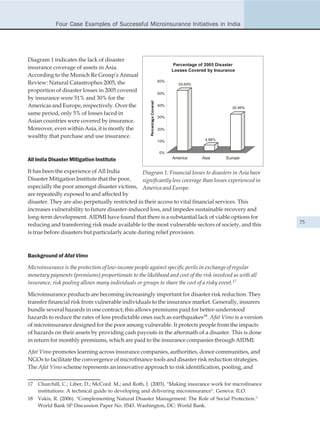
     Roth, J., McCord, M., & Liber, D. (2007). The Landscape of Microinsurance in the World's 100 Poorest
     Countries. Appleton, WI: The Microinsurance Centre.

     Scheper, E., Parakrama, A., & Patel, S. (2006). Impact of the Tsunami Response on Local and National
     Capacities. London: Tsunami Evaluation Coalition.

     Tomchinsky, G. (2008). Introduction to Microinsurance: Historical Perspective. Fourth International
     Microinsurance Conference. Cartanega, Colombia; November 5, 2008. Munich: MunichRe Foundation.

     UNDP. (2007). Building Security for the Poor: Potential and Prospects for Microinsurance in India.
     Colombo: UNDP/RC Colombo/HDRU.
Guidelines for Developing Community-driven Microinsurance Products


Annex 1: Due Diligence Checklist for Identifying an Insurance Provider6
         Questions                               What an MFI Should Look For
 What is the reputation of     It should be a strong institution that pays claims on time. Check
 the insurance provider?       with policyholders to see if they have had a positive experience.
 How is the insurer            The insurer should be financed from its earnings, and it should
 currently financed?           have a stable, conservative asset portfolio.
 What is the claims            They should pay most claims within a month and be willing to
 experience of the insurer     guarantee a fast turnaround (within two weeks guaranteed with
 and its history of claims     an effort to pay within one week) on claims from MFI clients. The
 payouts?                      MFI should track this once a relationship is finalised.
 How interested is the         They should not only express interest but also have examples of
 insurer in serving the        current work with this market or at least examples of efforts to
 low-income market?            work with this market.
 Will the insurer adjust its   They will likely need to reduce the coverage, reduce the price
 products to suit the          proportionately, and even adjust some procedures to facilitate
 preferences of the poor?      the transactions between the MFI and the insurer.
 Is the insurer willing to     This type of relationship will take time to mature. If the insurer is
 make a medium- or long-       not willing to make a commitment for at least three years, it is not
 term commitment to the        worth the MFI entering the arrangement. Note: the insurer is not
 MFI?                          tied to the original terms of the insurance for that period, just to    51
                               continue to work with the MFI and its clients.
 Is the insurer willing to     On short-term group life business, insurers typically pay an
 pay a commission to the       agent five to twenty percent of the premium. The MFI should get
 MFI for performing the        a substantial portion of that amount.
 agent role?
 Are there issues related to   An MFI should review the insurer's annual report and discuss
 regulatory compliance by      its regulatory compliance with the insurance commission. Some
 the insurer?                  insurance companies employ an ombudsman to interact with
                               the public. If one is available, the MFI should discuss with her
                               issues related to regulatory compliance and common customer
                               complaints.
 Will the insurer give the     It is not recommended for the insurer to verify claims. The two
 MFI responsibility for        partners should have a written understanding regarding what
 verifying claims?             proof the insurer requires. The agreed documentation should be
                               accessible to the poor, yet conclusive.
 Can the insurer minimise      Generally, MFIs have difficulty informing clients about complex
 the number of exclusions      products. Insurance will be the same. Not only will MFIs have to
 without jeopardising the      explain the concept of insurance (risk pooling), but they will also
 sustainability of the         have to help clients understand the product. The simpler the
 plan?                         product, the easier it will be to sell and administer the product.


6 AIDMI, 2006
Microinsurance for Disaster Risk Reduction


     Facilitator's Note
     1. Suggestions for Facilitators prior to Training
     Although the most effective trainers are able to address the emerging needs of trainees in a
     flexible manner, the following notes offer a basic outline of activities that TLC facilitators may
     use to lead trainings. To prepare for training, facilitators may find it useful to:

     •   Review the Module Learning Objectives listed above,

     •   Review the Suggested Methods and Activities listed below,

     •   Assess the anticipated knowledge needs, interests, and constraints of trainees,

     •   Identify additional potentially effective activities suitable for their particular trainees,

     •   Review related background literature on Microinsurance and product development in
         India, this can include but is not limited to the resource material listed at the end of this
         document and the modules,
         o Prepare your own notes so that you may convey the relevant information in a way that
             is comfortable for you.
         o Do not feel constrained by the information on the slides—they are merely a guide and
             you may adapted them for your needs
52
     •   Prepare materials for the training, including:
         o Powerpoint or other presentation materials including revisions if desired
         o Print-outs or any other necessary handouts
         o Tools and props needed for activities
         o Rewards or treats to encourage involvement and participation

     •   Ensure that all arrangements regarding venue are prepared

     •   Ensure that the training duration is appropriate for material to be covered

     •   Be familiar with the SWOT analysis tool and how it can be applied (http://
         en.wikipedia.org/wiki/SWOT_analysis)

     If this module is combined with others in the Microinsurance Development Series, the trainer
     may skip the introduction activities and continue with the activities relating to the course
     content directly.


     2. Facilitator Requirements during Training
     Total Time: Approximately 1hour 30minutes

     Items and Materials needed:

     •   PowerPoint presentation and related projection equipment,

     •   Whiteboard and marker OR blackboard and chalk,
Guidelines for Developing Community-driven Microinsurance Products


•   Module materials,

•   Pens and notepads for participants,

•   Your own notes based on those materials,

•   Rewards for participation,

•   Blank name badges,

•   SWOT analysis worksheets


3. Suggested Methods and Activities
3.1 Arrival and Introduction

Arrive with plenty of time available to prepare the room and make sure all materials are ready.
When the group is small, many trainers find that arranging the seating in a circle is conducive
to open and equal communication.

As the participants arrive, ensure that each has the necessary materials, including module(s)
and supplies for note taking.

When participants have arrived, or at the appropriate time, open the session with an
introduction of yourself. You may wish to share your relevant work and life experiences and            53
connection with microinsurance.

Help them feel comfortable with you, in the environment, with the other trainees by showing
that attentive participation and questions are a valuable aspect of the training package. If one
trainee has a question, it is likely that someone else has the same question.

Next, give a brief overview of the course, especially including the module objectives. You may
use the first slides of the presentation for this. A clear understanding of the objectives will help
participants know what to expect from the training. You may also want to hint at the types of
activities planned.

Now that everyone has had a peek at what is to come, it is time to meet the trainees. Ask
everyone to introduce themselves, including their name, how their work is related to
microinsurance, why the attended the course, and what they hope to take away from the day's
session. You may also ask that each rate their current knowledge of microinsurance and
product development on a scale of 0 to 10 to get an understanding of their expertise.

Make a list of the things they hope to learn, preferably on a chalk or white marker board. When
everyone is introduced, identify which items this course will cover. If they list things beyond the
scope of the course try to recommend resources where they may answers.

If the group is small, one good way to introduce everyone is to have each person recall the
names of all those that have already introduced themselves. This often helps build an open
atmosphere and everyone hears the names several times.
Microinsurance for Disaster Risk Reduction


     3.2 Course content

     Activity 1: 15mins
         (Activity #1 is useful for any microinsurance training. If this module is used in combination
         with the introductory module on microinsurance, you will probably not want to repeat this
         activity and will skip to Activity 2.)

         Ask each participant to write down a definition of what microinsurance is and three
         characteristics that differentiate it from traditional insurance. When they are complete, ask
         who wants to share their definition. Write key aspects of their definitions on the board. Ask
         questions and try to guide the group to definition or an agreed understanding.

         Then share the following definition:
         "the protection of low-income people against specific perils in exchange for regular
         premium payments proportionate to the likelihood and cost of the risk involved"

     Activity 2: 15mins

         Ask each participant to consider why making effective insurance cover for the low-income
         market is difficult. Have them write down share key current challenges related to the
         designing effective. Have them share their ideas with the group and write down the issues
         they identify and organise them around key areas that you choose: i.e. pricing, developing
         relationships, etc.

54       When the list is complete, reveal the Powerpoint slide on "Common Challenges in Product
         Design". Compare the issues identified here with those listed by the class, discussing any
         differences.

         Continue with the subsequent slide, explaining the benefits of using a systematic approach
         for product development.

     Activity 3: 20mins

         The point of this activity is to have participants understand that microinsurance may not be
         appropriate for all organisations and communities. Rather, that it may be one component of
      Risk                           Generally         Reason
                                   microinsurable?
      Accidental death of a              Yes           •    Mostly unpredictable
      family member,                                   •    Many people face this risk
                                                       •    Easy to validate
                                                       •    Premiums are typically affordable
      Loss of own property to a          Yes           •    Mostly unpredictable
      flood,                                           •    Many people face this risk
                                                       •    Easy to validate
                                                       •    Premiums are typically affordable
      Loss of neighbour's                 No           The policyholder would have little interest
      property to a flood,                             in avoiding the event but could benefit if it
                                                       happened
      Poor sales for a vendor        Not usually       •    Difficult to measure
      during a particular week                         •    Costly to investigate for low amount
Guidelines for Developing Community-driven Microinsurance Products


    a risk management package that may include other community strategies such as savings
    and credit or vocational training to diversify livelihood risks.

    One by one, list the risks in the following table. Don't share the second and third columns
    with them yet! Ask trainees to identify what strategies may be used to address the risk, and
    specifically if microinsurance is appropriate for addressing the particular risk among the
    poor.

    Explain that the insurance policy depends on a balance of supply and demand. Insurers
    would not supply a policy that is grossly unaffordable for them. Likewise, there would be
    no community demand for inappropriate or expensive policies.

    Continue the presentation on "Understanding Supply and Demand" and continue through
    the end of section II, on "The Product Development Process".

Activity 4: 25mins

    Organise the participants into new groups of approximately five people. Each is an
    established NGO. Give each group a particular microinsurance beneficiary or target
    policyholder group (could be a federation of MFI participants, a trade union of textile
    workers, or a dairy cooperative. Explain that they are now responsible for developing a
    microinsurance product to suit their target group. Their first task is to work in their group to
    develop a process for designing and implementing their product. Tell them they have 15
    minutes to:
                                                                                                        55
    1.   Identify a microinsurance delivery model, from those discussed above.

    2.   A process map or series of steps that they will follow in the conception and
         implementation of their product. This should be based on the processes they've learned
         today and include details on activities they will conduct.

    3.   A list of key relationships that will need to be cultivated for their product to be complete
         and successful.

    When their group work is complete, have each group choose a leader. The leader should
    explain their choice of microinsurance delivery models and explain the rationale for their
    choice based on their target group. They should draw their process map on the board and
    explain the key activities they will perform under each step. Finally, they should identify
    the key relations that they will need to develop.

    Now, complete the Powerpoint presentation with Section III.

Activity 5: SWOT Analysis: 20mins

    This final project should be done when presentation and all other questions and
    discussions have run their course.

    Hand out the blank SWOT Analysis table. Explain the SWOT Analysis tool to the trainees.
    Explain that their task is to choose two of the main steps in the microinsurance
    development process discussed today (i.e. institutional assessment, market research,
    product development, pricing, development of systems, implementation, and monitoring).
    They should take two of these steps and fill in two SWOTs for their current organisation's
    strengths and weaknesses in working on these steps.
Microinsurance for Disaster Risk Reduction


          Finally, they should make a list of actions they can take, based on opportunities listed in the
          SWOT, if they were to develop a new microinsurance product.

          The resulting SWOT Analyses are for them to keep for their own use and application.
          Encourage them to ask questions in order to really understand and apply the tool.
          Especially encourage them to take the SWOT tool back to their organisations to discuss with
          colleagues how it can help them with their current work.


     4. Presentation Guidelines
     "The following presentation guidelines are intended as a resource that may be adapted for
     training facilitators that are teaching this module. They may be used to create a visual
     presentation or handouts for participants."

     Objectives

     By the end of this module you should be able to:
     •    Explain the stages of microinsurance programme implementation
     •    Define typical microinsurance activities and responsibilities
     •    Explain effective risk transfer strategies for common risks
     •    Explain strategies of identifying an insurance partner
56
     •    Identify central aspects of insurance marketing
     •    Outline a process for a microinsurance development with your constituents

     Contents
     I.   Concepts for Product Development
     II. The Product Development Process
     III. Strategies for Sustainability

     I.   Concepts for Product Development

     •    Overview of The Basic Process


                                          2    Market research


                                                                          3 Product development
                             1 Institutional assessment

          7 Monitor the claims experience                                 4          Pricing


                      6       Implement                      5     Develop systems
Guidelines for Developing Community-driven Microinsurance Products


Common Challenges in Product Design

•   Expanding beyond life products to those that better meet special needs of the poor,
•   Developing a product that is disseminated at low cost,
•   Addressing low levels of insurance education and experience with the low income market,
•   Developing microinsurance relationships (insurers, intermediaries, etc.) and infrastructure,
•   Expanding outreach.

A Systematic Approach Helps

•   Offer products that address client needs,
•   Prepare the institution to offer products effectively,
•   Minimise likelihood of product failure,
•   Improve policyholder satisfaction and retention.

II. The Product Development Process

•   Institutional Assessment:”Should Our Organisation Pursue Microinsurance?


                                                                                                              57


       Source: Brown, Green and Lindquist, 2000. A Cautionary Note for Microfinance Institutions and Donors
                                                          Considering Developing Microinsurance Products

Understanding the Key Issues: Demand and Supply

•   Demand-related: Identify risks and decision-making processes of low-income People
•   Supply-related: Identify relevant products, Identify relevant delivery channels, Identify
    potential claims servicing mechanism
•   Identify environmental opportunities, threats, and information needs
Microinsurance for Disaster Risk Reduction


     Factors Influencing Potential Policyholder Decision to Purchase Microinsurance


     Demand Assessment and Market Research
58
     •   Efforts to assess the market will look at:

     •   Perception, understanding, and awareness of MI among low-income households,

     •   Suitability of potential products,

     •   Affordability of potential products,

     •   Enabling environment for promoting: IRDA’s incentives and MI expansion.

     Product Development and Pricing

     •   Actuary needed to fully assess related risks and set prices,

     •   They look at:
         – Common risks faced by members i.e. sickness, disability, death, loss of assets
         – Probability of occurrence i.e. percentage of those covered to be affected each year,
         – Average financial payout for occurrence of each risk.

     Systems Development

     •   Partner Identification and Development
         – Insurer and possible re-insurer,
         – Intermediary (often an MFI or other NGO or CBO),

     •   Marketing and Distribution
         – ToRs or contracts with partners help assign responsibilities for key tasks,
         – Brochures from insurer, distributed through intermediary
Guidelines for Developing Community-driven Microinsurance Products


     – Premium Collection and Claims Processing
       o Often taken by intermediary as part of another task: loan repayment, fertiliser purchase,
         post distribution (?)

Microinsurance Activities and Responsibilities

 Preparatory Activities       Front Office Activities                Back Office and Management
                                                                              Operations
 •    Initial market          •     Marketing and sales          •     Ongoing market research and
      research                •     Assisting clients with             feedback
 •    Product design                contracts (designation of    •     Claims review and
 •    Risk analysis                 beneficiaries,                     assessment
                                    understanding the            •     Processing of applications,
 •    Pricing
                                    policy)                            payments and claims
 •    Training staff on
                              •     Client monitoring and        •     Capital mobilisation
      insurance concepts
                                    verification                 •     Internal audit
 •    Testing
                              •     Claims application           •     Reinsurance
 •    Contract preparation          completion assistance
 •    Establishing the                                           •     Conflict resolution
                              •     Premium collection
      framework of the                                           •     Statutory obligations (e.g.,
                              •     Claims disbursement                reporting)
      administrative
                                    (final disbursement to
      system                                                     •     Legal issues
                                    beneficiary)                                                            59
                                                           Source: Churchill, Liber, McCord, Roth. 2003.
                                           Making Microinsurance Work for Microfinance Institutions. ILO.

Piloting and Review

•    Training for staff before pilot and discussing FAQs

•    Exposing project managers, supervisors, and directors to other international
     microinsurance efforts, where appropriate,

•    Selling product through 2-3 cycles,

•    Formal, multi-partner review: using performance indicators to assess viability, success, and
     additional opportunities.

•    Using lessons to revise product.

Rollout

•    Revision of product based on pilot lessons,

•    Slow reduction of subsidies,

•    Reduced dependence on intermediaries for service provision,

•    Availability of infrastructure and qualified personnel,

•    Continue to review client satisfaction and improvement options.
Microinsurance for Disaster Risk Reduction


     III. Strategies for Sustainability

     •   Key Lessons for Designing Sustainability into the Microinsurance Product

         – Successful product balances: Inclusion, Benefits desired by customers, Affordability and/
           or profitability.

         – Products should be designed with affordability in mind.

         – Easier to deliver if beneficiaries are a market is a well-organised group, MFI participants,
           union members, etc.

         – Group coverage minimises administrative costs and premiums.

         – Focus on most important insurable risk simplifies policies.

         – Claims procedures should be easy for the special market.


     References
     All materials listed in training Module 3.

     Information on SWOT Analysis can be found at: http://en.wikipedia.org/wiki/SWOT_analysis.

     UNESCO. 2004. Training Guide and Training Techniques. Available at: http://unesdoc.unesco.org/
60      images/0013/001356/135603e.pdf.

     Brown, W. and Churchill, C. 2000. Insurance provision in low-income communities: Part 2: Initial
         lessons from microinsurance experiments for the poor.
u le   Four Case Examples of
    od          Successful Microinsurance
M        4      Initiatives in India
Microinsurance for Disaster Risk Reduction


62
u le            Four Case Examples of
            Four Case Examples of Successful Microinsurance Initiatives in India


    od                   Successful Microinsurance
M        4               Initiatives in India
                        Learning Objectives
                        By the end of this module you should be able to:
                        •    Explain Four MI policies currently used in India and how they address
                             CBDRR
                        •    Identify central strengths and weaknesses, opportunities, and threats of each
                             policy for CBDRR
                        •    Build on these case studies with ideas for your constituents


                        Contents
                        4.1 Case Study 1: Tata-AIG Life Insurance Company Ltd.                        64
                            4.1.1 Context and Tata-AIG Life Insurance Product                         64
                            4.1.2 Product Administration                                              64
                            4.1.3 Products Offered                                                    65
                            4.1.4 Distribution Channels                                               66
                            4.1.5 Product Design                                                      67
                            4.1.6 Conclusions                                                         67     63
                        4.2 Case Study 2: Vimo SEWA                                                   68
                            4.2.1 Overview                                                            68
                            4.2.2 Membership                                                          70
                            4.2.3 The VimoSEWA Product                                                70
                            4.2.4 Results                                                             71
                            4.2.5 Summary of Key Lessons                                              71
                        4.3 Case Study 3 : Taking Risk off the Backs of the Poor: A Case Study of
                            Afat Vimo: Disaster Insurance                                             73
                        4.4 Case Study 4 : Scaling Up Microinsurance: The Case of Weather
                            Insurance for Smallholders in India                                       82
                            4.4.1 Overview                                                            82
                            4.4.2 Why Index Insurance?                                                82
                            4.4.3 Programme Development                                               83
                            4.4.4 Product Marketing and Delivery                                      86
                            4.4.5 Expected Weather Insurance Impact                                   87
                            4.4.6 Lessons for Up-scaling Weather Insurance                            87
                        4.5 Case Study Synthesis                                                      88


                        Facilitator's Note
                        1.   Suggestions for Facilitators prior to Training
                        2.   Facilitator Requirements during Training
                        3.   Suggested Methods and Activities
                        4.   Presentation Guidelines
Microinsurance for Disaster Risk Reduction


     4.1 Case Study 1: Tata-AIG Life Insurance Company Ltd.1
     4.1.1 Context and Tata-AIG Life Insurance Product

     Tata-AIG Life is a microinsurance product offered in India by Tata-AIG Life Insurance
     Company—a joint venture of the Tata Group and the American International Group (AIG).
     Tata-AIG Life has operated since 2001.

     The Tata Group is a large industrial conglomerate in India and the Tata name is widely
     recognised in Indian households across socioeconomic classes. This familiarity provides a level
     of trust among potential insurance clients that is critical for a successful microinsurance
     product. AIG is one of the world's largest insurers and offers technical and strategic guidance
     through its Hong Kong office. In addition to in-house capacity to administer a wide range of
     insurance products, AIG has experience with microinsurance products in Uganda.

     Though Tata-AIG had a well-established brand name, they lacked presence or alliances in
     many of India's remote areas. As a result, Tata-AIG needed to establish a network of partner
     organisations to penetrate rural areas for promoting sales of microinsurance.

     Tata-AIG senior managers saw microinsurance as a multi-fold opportunity. Microinsurance
     would allow them to fulfil regulatory obligations to service low-income and rural households,
     to enter relations with thousands of new customers, and to provide a financially viable social
     service.

64

     4.1.2 Product Administration

     In contrast to most microinsurance providers in India, Tata-AIG has created a single
     department to develop, sell, and service all microinsurance products. This helped ensure
     appropriateness of policy design for the product's unique low-income market.

     Tata-AIG has NGO partnerships with over 50 NGOs. Over 40% of its 35 000 social sector
     policies were sold through the partner-agent model. In this model, the NGO/MFI partner
     performs the sales and servicing functions, primarily for its current microfinance clients. The
     outsourcing of these front-end processes helps to keep costs lower than if Tata-AIG staff would
     work in the field directly. The two other models, the business associate model and the
     Community Rural Insurance Groups (CRIGs) model, account for the remaining 60% of the
     business.

     Local partners were invited upon recommendation to Tata-AIG by donors and others working
     in community development. When partners were selected, partners proposed community
     "micro-agents" to administer the products locally. The micro-agents established and led CRIGs.
     These groups consisted of five members, the leader of which was trained and licensed as an
     insurance agent. CRIG responsibility included promotion, sales, premium collection, and
     record keeping. They are monitored by the partner NGO and were able to receive commission,
     bonuses, and other incentives.
     1   Much of the following section is taken from a case study published by the CGAP Working Group
         on Microinsurance. Their report, "TATA-AIG Life Insurance Company Ltd.: India", Good and Bad
         Practices, Case Study No. 14, was published in September, 2005 and was written by James Roth
         and Vijay Athreye. The full version is accessible at: http://microfinancegateway.org/content/
         article/detail/28285.
Four Case Examples of Successful Microinsurance Initiatives in India


Community field agents are selected based on criteria chosen by Tata-AIG for an ideal
microinsurance leader2 and are evaluated through a written exam that is mandated by the
regulator. The exam is administered by an external examiner. Subsequently, the agent is trained
on processes for marketing and servicing the microinsurance product.

After being licensed and forming their CRIGs, the agents start selling. Training is provided to
many agents after three months. Three retraining modules are conducted over a period of a year
and each lasts three days. These modules cover basic knowledge on retail finance including
insurance, analysing company data, advice on objection handling, team building,
communications development, leadership practices, as well as general instruction on the
relevance of microinsurance to the poor. Training is also provided on computer usage,
particularly the Internet to facilitate the use of the agent's portal. Training programmes are
offered in local languages.

The amount insured under the microinsurance products is considered too small to pose
systemic risk to Tata-AIG. As such, microinsurance policies are not reinsured.


4.1.3 Products Offered

Tata-AIG has designed its products to relate to requirements of legislation aimed at social and
rural sectors. As such, only social sector products related closely to low-income households as
                                Tata-AIG Microinsurance Products
                                                                                                         65
Product Name             Kalyan Yojana            Karuna Yojana Jana Suraksha Yojana
                         ("Welfare Plan")         ("Mercy Plan")      ("Mass Protection Plan")
Microinsurance Type      Term life                Life                Life
Term (years)             5                        15                  15
Eligibility              Age 18-55, cannot renew Age 18-45, cannot renew beyond 60,
                         beyond 60, for men and for men and women
                         women
Renewal                  May renew within five years of lapse. 30 day grace period.
Annual Premium           4.43 to 25.824           279-289             672-687
(Amount in Rs.)3
Sum Insured (Rs.)        10000 to 150005           13000 to 250006 54000 to 290007
Payment Period           Monthly, quarterly, semi-annually, annually
Exclusions               Suicide in first year
All products are voluntary and offered to individuals (as opposed to whole households).
2   Among other characteristics, the agent must: be a resident in community servicing; have passed
    10th standard; married—for stability; demonstrate ability to write English; demonstrate integrity,
    leadership and ability; demonstrate training skills.
3   Variations depend on age of policyholder and sum insured.
4   Range represents premium in Rupees, per Rs. 1000 insured.
5   Total sum insured depends on age and equals Rs. 15000 for ages 18-40 and Rs. 10000 for ages 41-55.
6   Total sum insured depends on age and equals Rs. 25000 for ages 18-38, Rs. 21000 for age 39, Rs.
    20000 for age 40, Rs. 18000 for ages 41-44, and Rs 13000 for ages 45+.
7   Total sum insured depends on age and equals Rs. 54000 for ages 18-28, Rs. 52000 for age 29, Rs.
    51000 for ages 30-38, Rs. 41000 for age 39, Rs 38000 for ages 40, Rs. 36000 for ages 41-44, and Rs
    29000 for ages 45+.
Microinsurance for Disaster Risk Reduction


     rural sector policies can be more easily sold to high-income rural families. For example, rural
     sector obligations can be met through selling tractor insurance to wealthier clients.


     4.1.4 Distribution Channels

     The most interesting and innovative aspect of Tata-AIG's work lies in the development of the
     micro-agent delivery model. There are essentially two types of micro-agent models used. One is
     that of groups of micro-agents called CRIGs and the other of individual micro-agent. Both are
     supervised by NGOs (termed business associates) who perform a range of tasks including the
     recruitment of agents, frontend administration, and mentoring.

     The CRIG, which is essentially a firm of insurance agents, is supervised by a nearby rural
     organisation, like an NGO. The CRIG's members are involved in promotion, sales and collection
     of premiums, and maintaining records. The CRIG leader documents all fortnightly meetings
     with the NGO and all weekly CRIG meetings. At the weekly CRIG meetings, the leader records
     the microinsurance activities of CRIG members related to premium collection. Aside from this,
     the CRIG members discuss the operations of their firm. The fortnightly meetings are used by the
     NGOs to collect proposal forms, premiums and renewal notices. The NGO also provides policy
     documents for the CRIG to pass onto its clients.

     For every policy sold, the NGO gets 10% in the first year. The CRIG itself receives commission
     income, but not the individual CRIG members. The CRIG decides how to divide up commission
66
     income. The standard model is that the member of the CRIG who sold the policy gets all the
     commission income due to them except for 5% of the commission in the first year, which they
     give to the CRIG leader for the extra work she does in preparing and submitting the policy.
     Generally, the CRIG commission per policy is 26 to 30% of the premium for the first year, and
     between 5.5% and 6% for the 2nd and 3rd years. From the forth year onwards commissions vary
     between 4 and 5 percent. In addition, there are various bonuses and incentives. CRIGs that
     build a client base of 600 policies gets a bonus of Rs 10 000 and the NGO gets a Rs 5 000 bonus.
     There is no time limit for achieving these goals.

     In an MFI partner-agent model, the MFI collaborates with an insurance company and sells its
     products. The sales are usually linked to loans; typically, loan officers sell and service these
     policies. Compared to the MFI partner-agent model, the CRIG model has a number of
     advantages:

     1.   The CRIG model creates an insurance distribution infrastructure in low-income
          neighbourhoods; it creates a new profession, the micro-agent, with new livelihood
          opportunities for poor women.

     2.   The CRIG model can draw from many suitable NGO partners, while not being dependant
          on a few good MFIs.

     3.   The CRIG model creates a cheap distribution channel that is not linked to a loan, that can
          easily serve an NGO existing client base, but is not limited to it.

     4.   Since the CRIG members are earning income from their efforts, it creates incentives for them
          to increase their sales volumes, incentives not found in most MFI partner-agent models.
Four Case Examples of Successful Microinsurance Initiatives in India


5.   It is possible that, in the long run, the CRIGs may not need the assistance of the NGO and
     may deal with Tata-AIG directly, providing long-term sustainability.


4.1.5 Product Design

Before designing the social products, the preferences of the target market were determined.
During the research, it was clear that the target market desired products with a savings element,
but at the same time could not afford annual premiums in excess of US$25. It also became clear
that the there were slightly wealthier households who, while still poor (with a monthly
household income of less than US$125), could afford slightly more expensive products. This
finding suggested to Tata-AIG that it needed a diverse portfolio of products to meet the
preferences of this heterogeneous market.

Unfortunately, it was not actuarially feasible to offer very significant returns to counter inflation
at such low premium levels. The two "term return of premium products" (TROP) were designed
to be sold for an annual premium of US$7 (Rs 300) and US$17 (Rs 720). These TROP products
essentially return the cumulative premiums paid over 15 years plus 25 percent.

A further issue emerged once the products were priced. The death cover at higher ages of entry
worked out very low. To keep the premium low, it was decided to increase the death benefit and
reduce the maturity benefit. This is the reason for the decreasing savings element for the Karuna
and Jana Suraksha Yojana products (see Tables 4.3 and 4.4). The agents have been trained to
emphasise the death benefit while selling.                                                              67

The third social product is a 5-year term product where there is no return on maturity, but only
a death cover capped at Rs 15000 ($333) with an entry age of between 18 and 40 and at Rs
10,000 ($222) if they enter the scheme in the more risky age group of 41to 55. This offering was
designed to suit the needs of pure term cover at the lowest cost so that even the poorest could
afford it. Part of the motivation for the product came not from client demand but rather from
MFIs that wanted insurance to cover their loans. By far the most successful products have been
those offering a TROP, perhaps indicating the importance that clients attach to savings.

The premium was calculated by the in-house actuary. The lack of actuarial data caused
difficulty in calculating the premium. In the initial design, the actuaries simply assumed that
mortality figures were significantly higher for rural areas and low-income clients. Future life
insurance policies will be calculated with greater accuracy using the experiences generated by
the initial policies.


4.1.6 Conclusions

While most insurers in India tried to fulfil their regulatory obligations to sell microinsurance by
partnering with an MFI, Tata-AIG realised that the total number of MFIs was limited with
respect to both quantity and quality. Relying solely on MFIs to sell one's products would not be
sufficient in the Indian context. This led them to explore other distribution channels. Partnering
with MFIs or NGOs nonetheless remained a crucial component in Tata-AIG's distribution
strategy. They relied on MFIs and NGOs for information about the local community, to help
build trust with the local community, and finally Tata-AIG outsourced some operations to the
MFI/NGOs to lower servicing and selling costs.
Microinsurance for Disaster Risk Reduction


     The development of micro-agents and their firms (CRIGs) is the most significant innovation of
     Tata-AIG's microinsurance work. Microinsurance is a high volume, low cost business. In such
     businesses, cheap and efficient distribution is crucial. It is too early to make a judgement on
     whether the model is successful. If it is successful, the model will provide a major new means of
     overcoming the microinsurance distribution problem.

     Microinsurance is never likely to be a significant contributor to profits, therefore the CEO's
     support can never be assumed. Without the CEO's support from the inception, the project would
     not have taken off. There are a number of reasons why the CEO may be motivated to support
     microinsurance. In the case of Tata-AIG they included:

     •   Partial fulfilment of Corporate Social Responsibility

     •   Marketing — getting one's brand into the market early and creating a positive association
         with the brand.

     •   Future profitability — in a growing economy like India, today's microinsurance clients may
         be tomorrow's high premium clients

     •   The promotion of microinsurance often helps develop a good relationship with the local
         regulator. This is especially important for entrants into a foreign market, which was the
         case with AIG in India.
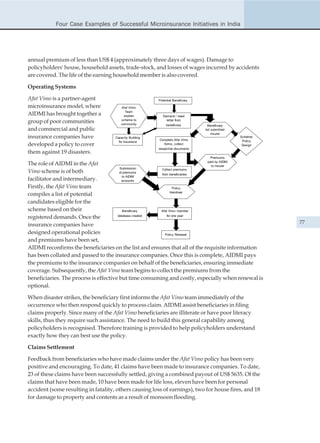
     Many insurance companies make the mistake of assuming that microinsurance is simply a
68   matter of reducing the price and benefits of existing policies. Microinsurance requires
     specialised staff and different distribution channels. The CEO of Tata-AIG realised this and
     created a specialised rural and social products channel within the company. It was also
     important to give the team a degree of latitude to be entrepreneurial and innovative. The staff
     chosen to run the microinsurance section were young and enthusiastic, with little or no
     previous experience in insurance, but often some experience working with low-income
     communities. This has been important because of the dramatically different approach that was
     needed to sell and service microinsurance products.

     The insurance business requires trust from policyholders, especially among the India's rural
     poor. Much of the Indian microinsurance market is unaware of insurance. However, for those
     that do have awareness, their perspective has been tainted by poor previous experiences of
     insurance. Teaming up with a trusted local company (Tata) helped to create policyholder trust
     in the insurer.


     4.2 Case Study 2: Vimo SEWA8
     4.2.1 Overview

     VimoSEWA is a unique microinsurance scheme offered by the Self-Employed Women's
     Association (SEWA). VimoSEWA has a mission "to provide social protection for SEWA

     8   Much of the following section is taken from a case study published by the CGAP Working Group
         on Microinsurance. Their report, "VimoSEWA: India", Good and Bad Practices, Case Study No. 16,
         was published in October, 2005 and was written by Denis Garand. The full version is accessible at:
         http://microfinancegateway.org/content/article/detail/28653.
Four Case Examples of Successful Microinsurance Initiatives in India


members to cover their life cycle needs and the various risks they face in their lives, through an
insurance organisation in which they themselves are the users, owners and managers of all
services." The initial product was offered in 1992 as a social security scheme operated by the
SEWA union. Participation in the scheme, which integrates life, accident, health, and asset
protection, is voluntary. As SEWA is a federation of self-employed women in the informal
sector, many members have lower income and face higher risk than more "typical" insurance
clients. In nearly 15 years, to 2005, participation in the scheme grew to over 120,000
policyholders, with the largest growth occurring just after the 2001 Gujarat earthquake.

Initially SEWA offered insurance products to members that were underwritten by the public
insurance monopolies that administered life and general insurance. In the late 1990s, as the
economy liberalised, VimoSEWA chose to maintain the products but to create a regulated
insurance company and that was owned by SEWA members. The transition to self-insurance
initially brought financial and service benefits. The earthquake, though, caused considerable
strain as it affected thousands of policyholders (a large proportion of the total) simultaneously.
That year US$75000 was required to satisfy policy claims compared with earlier year averages
of US$662. After the earthquake, VimoSEWA returned to the partner-agent model, where
National Insurance Company would underwrite and make payments on health and asset claims.

A post 2001 surge in demand for earthquake insurance combined with a range of new private
insurers and a more experienced VimoSEWA team. Now VimoSEWA was well positioned to
negotiate with insurers to establish a more efficient policy model. The team developed a
business plan to reach financial viability of the products. The new model would be based on          69
providing insurance for a wider community a voluntary basis over the long term.

                         A Chronology of Major Changes in VimoSEWA
              Year    Change
              1992    Mandatory life and accidental death insurance with LIC
              1993    Voluntary life and accidental death insurance
              1994    Added asset and health insurance
                      Added spouse life insurance
              1996    Self insured health
              1998    Self insured asset
              1999    Added health insurance for spouse
              2001    Gujarat earthquake
                      Developed business plan to scale up operations
                      Added Scheme III
              2002    NIC insures health and asset
                      Period of communal violence
                      Changed annual payment and insurance from July 1 to Jan 1
              2003    Child health insurance added
                      ICICI Lombard provides health and asset
              2005    Eliminated Scheme III
                      AVIVA becomes life insurance partner
Microinsurance for Disaster Risk Reduction


     4.2.2 Membership

     VimoSEWA offers its policies to SEWA members who predominantly reside in Gujarat state.
     Membership in SEWA continues to rise and in 2005, the federation had over 700,000 members.
     Target policyholders are both urban and rural, and include a range of workers in the informal
     economy, such as manual labourers, home-based workers, small scale vendors, and small scale
     farmers. Many members earn less than US$1 per day and are some of the society's most
     vulnerable. Their informal employment offers no protection from health or natural hazards.
     VimoSEWA is designed to transfer some of this risk.

     The initial coverage included life insurance on the member, widow insurance in the event of the
     spouse's death, and accidental death. These were expanded to include asset protection, health
     insurance, maternity coverage and most recently, health insurance for children. Without this
     insurance package, traditional approaches are used, such as borrowing from savings group/
     bank savings, moneylenders, aid of relatives, pawning and selling of assets to meet expenses.


     4.2.3 The VimoSEWA Product

     VimoSEWA offers an integrated product, covering assets, health, and accidental death. If
     members purchase the policy for themselves, they are typically eligible to purchase coverage for
     their husbands and children.

70                                  VimoSEWA Coverage and Price9
                   Scheme I                Member Spouse Child                Family
                   Natural Death           5000     5000
                   Health                  2000     2000       2000
                   Asset and Loss          10000
                   Accidental Death        40000    25000
                   Spouse Accidental Death 15000
                         Annual Premium    1000     70         100            250
                   Scheme II
                   Natural Death                  20000   20000
                   Health                         6000    6000
                   Asset and Loss                 20000
                   Accidental Death               65000   50000
                   Spouse Accidental Death 15000
                          Annual Premium          225     175       100       480

     Scheme I is the most popular and is affordable to most SEWA members. Benefits have evolved
     over years based on feedback from policyholders. Decisions to expand coverage are taken based
     on several factors: anticipated policyholder ability to pay for the expanded benefit, capacity to
     manage the product, and probability of viability. Members have noted an interest in livestock
     coverage, but it has not been added to the VimoSEWA package as it would be too costly for most
     policyholders to pay and would require a different management arrangement.
     9   Price (in rupees) given on January 1, 2005.
Four Case Examples of Successful Microinsurance Initiatives in India


4.2.4 Results

A well-developed database has helped VimoSEWA progress in recent years. The database
allows the team to access information on clients rapidly and to contact policyholders for
renewal. A separate database is maintained for claims. Both databases are used for reviewing
progress vis-à-vis the business plan and for monitoring trends.

                                  VimoSEWA Key Results (in US$)
                                                  2004          2003                2002
        Net Income (net donor contributions)           (91,042)       (15,714)      (20,616)
        Total Premiums Earned                          178,720        168,448       77,740
        Claims/ Total Premiums (%)                     74%            81%           137%
        Administrative Costs/ Premiums (%)             137%           97%           150%
        Claims Cost per Total Adults Insured           1.22           1.24          1.20
        Growth in Number Insured (%)                   (4%)           18%           218%
        Income of Investments                          96,326         108,715       123,214
        Renewal Rate (%)                               51%            48%           N/A


In theory, India's households that are below the poverty line have access to public health
facilities; in practice, they find these facilities difficult to access and/or with inadequate service   71
capacities. Workers in the informal economy cannot access the formal sector pension, health
and other benefits. However, the informal economy does have access to a subsidised health
insurance programme. However, few participate as the premium is too high for most of the
population below the poverty line; in addition, the health insurance has too many exclusions
and is not communicated clearly. The government has provided funds to LIC to subsidise 50%
of the cost of providing life insurance to populations below the poverty line. Access may be
difficult as a group of a least 10 people must be formed to get the benefit.


4.2.5 Summary of Key Lessons

The outreach in 2005 is over 120,000 adults insured, a large increase from the 30,000 insured in
2000. Moreover, members have a much better understanding of benefits. The insurance scheme
has enhanced benefits while increasing premiums, responding to members needs and staying
within their ability to pay.

Innovative marketing skills have been developed with proper messages conveyed to the target
audience. Now, insurance is marketed as a risk management tool and not a benefit scheme.

Significant improvements in the speed of reimbursing members' claims have been achieved over
the last three years, while maintaining insurance standards. The MIS is now well established,
providing vital and accurate management information and developing links with other SEWA
systems to improve outreach. The team running the system has improved its skills and speed of
entering data. Regular reports, financial and otherwise have become valuable management
tools.
Microinsurance for Disaster Risk Reduction


     Risk Management

     It is extremely dangerous for an organisation to provide insurance without reinsurance, as
     VimoSEWA experienced with its asset benefits following the earthquake. Based on that
     experience, almost all of VimoSEWA coverages are provided via insurance companies.

     Maintaining an accurate database is vital to an insurance operation. VimoSEWA can track
     claims costs by benefit and by various parameters, helping it to understand how to price each
     benefit in the package and negotiate with partners.

     For health insurance, a well-designed cashless system should contain claims costs. Health
     claims have increased substantially for VimoSEWA on a reimbursement basis. Moving to a
     cashless system will lower claims costs while improving customer service.

     Organisation and Management

     A separate organisation, even if it is a division of the existing NGO, should be given
     responsibility for the microinsurance operation. It has only been possible to manage
     VimoSEWA effectively once it had its own business plan, financial statements and performance
     reports.

     Management needs to be focused. With the development of the VimoSEWA business plan, key
     benchmarks were developed and responsibilities assigned. Periodic monitoring alerts
     management that adjustments to procedures are required. Maintaining year-to-year focus is
72   essential to achieving objectives.

     Acquiring and training management and staff is critical for an effective and viable
     microinsurance operation. Constant capacity building and knowledge of the insurance
     industry at large should be provided to the staff. SEWA's emphasis on training is beginning to
     reap significant results.

     Management information systems should be adequate to develop useful reports for
     management and other users. Insurance companies that have developed good information
     systems with clean relevant data have superior performance. Now that VimoSEWA has a well-
     maintained database, it is easier to monitor results and make appropriate modifications to
     achieve targets.

     Quick, efficient claims service is necessary for a microinsurer. Initially VimoSEWA's claims
     reimbursement took months, however today claims are paid in a timely manner. Donors have
     an important role to play in supporting the development and expansion of microinsurance;
     however, their efforts should be coordinated. The lack of a common donor reporting method
     imposed inefficiencies on VimoSEWA.

     Product Design

     Product design and features should be revisited on yearly a basis to make the scheme
     marketable and innovative. VimoSEWA collects feedback from members and other SEWA
     divisions to determine if it should implement any changes.

     The most viable microinsurance product is life insurance that is tied to microcredit; however,
     that coverage does not deal with the greater community's need for health insurance or other
     benefits, nor does it protect people when they are not borrowing money.
Four Case Examples of Successful Microinsurance Initiatives in India


VimoSEWA's integrated product is an innovative and risky means of addressing the real risk
management needs of poor women (and their families). Even though viability remains a distant
dream, it should be clear that VimoSEWA's multi-benefit product is both more challenging and
more needed than most microinsurance products.

Integrating benefits in one product helps reduce adverse selection in a voluntary scheme. If the
microinsurer offers health coverage, staff has to have health knowledge and skills. VimoSEWA
staff with health knowledge has been able to detect fraud from both health care providers and
members.

Preventative measures to promote good health practices ultimately reduce claims costs.

Distribution

Insurance is sold, not bought. To sell insurance, an organisation has to have the trust of the
community. Hiring sales promoters with the appropriate skill set will improve results.
VimoSEWA has seen an increase in renewal rates as the Vimo Aagewans have increased their
skills and communication has focused on clear messages about product benefits, exclusions
and claims procedures.

Obtaining a high participation of a target population is essential to achieving viability in health
insurance. VimoSEWA has found that results improve when whole families are insured and
when there is a large percentage of the target community insured.

                                                                                                       73

4.3 Case Study 3 : Taking Risk off the Backs of the Poor: A Case Study of
    Afat Vimo: Disaster Insurance10
                       Mihir R. Bhatt with Mehul Pandya and Tommy Reynolds

Abstract

In India, risk of personal, household and small business assets are often unprotected against
disasters. The costs for relief and rehabilitation often rely on aid, but support from outside
entities is often unpredictable-leaving the damaged assets of the poor by natural hazards
difficult to replace-and making recovery difficult. Groups that fail to recover are more vulnerable
to subsequent disasters. Insurance covers many losses but is often unavailable to the poor due
to the high transaction cost to affordable premium ratio. Microinsurance is one of a number of
viable methods that has emerged to provide the safety and preparedness benefits of insurance to
the poor. Microinsurance puts cash into the hands of people so they can begin rebuilding their
own livelihoods. Microinsurance has emerged in a policy environment that has made recent
progress towards disaster risk reduction. Recent insurance regulatory reforms within the Indian
Government and the prioritisation of risk reduction by the UNISDR, the ProVention
Consortium, and DFID have contributed to the viability and advancement of microinsurance for
the poor.

10   This text is an excerpt from a case study published by Tudor Rose in their book Real Risk. The
     original case study, "Taking Risk off the Backs of the Poor: A Case Study of Afat Vimo Disaster
     Insurance" was published in 2006 and was written by Mihir R. Bhatt, Mehul Pandya, and Tommy
     Reynolds.
Microinsurance for Disaster Risk Reduction


     Afat Vimo (Gujarati for 'Disaster Insurance') was born in this environment as a product of the
     All India Disaster Mitigation Institute. This document discusses the role of this instrument in an
     attempt to transfer disaster risk from the poor to the commercial insurance market. The
     operating system is detailed as well as procedures of claims settlement. Successes have
     included the design of an affordable product, transparent payout, and linking microinsurance
     with disaster preparedness education. Challenges include the fact that the administrative cost
     currently falls on the implementing agency, and is not paid by the insurance market. The
     demand for the Afat Vimo product has been growing: it currently covers over 5500.


     Background

     Due to the combination of high exposure to natural hazards and high human vulnerability,
     South Asia experiences significant losses to disasters perennially. Present studies estimate that
     more than 90% of the Indian population does not benefit from any kind of social protection.11
     Despite high and steady growth in the country, the cycle of disasters and vulnerability deprives
     many millions of poor of the human development that might have accompanied such growth.
     Within Asia, 24 percent of deaths due to disasters occurred in India because of its size,
     population, and vulnerability.12 Since 2004 alone, India has faced two major disasters—the
     Indian Ocean a tsunami, and the South Asia earthquake—which killed more than 10,000 and
     2000 people in India respectively.

74   Each year, India suffers disaster losses of US$1 billion according to World Bank studies13. On
     average, direct natural disaster losses amount to 2% of India's GDP and up to 12% of central
     government revenues14. These estimates do not fully include losses incurred by informal sector
     businesses and workers, which constitute a major proportion of the economy in India. The
     Calamity Relief Fund of the Government of India spends US$ 286 million towards providing
     relief to the victims of disasters. Over the past 35 years, India has suffered direct losses of US$30
     billion; losses are also increasing, US$9 billion in direct losses were suffered between 1996 and
     2000 alone15. The 2001 Gujarat earthquake alone has been to the tune of US$2.7 billion16. The
     price tag of the tsunami and South Asia earthquake are surely enormous but are yet to be seen.

     Assuming that the impact of natural disasters remains so high, and many estimates expect them
     to increase, how will India be able to cope, not to mention use the benefits of economic
     development to uplift the millions of poor? Just as it is the poor countries that are most
     adversely affected by natural hazards, the poor within countries face the greatest difficulties.
     Their small but important assets are often not secured, reinforced, and their financial risks are
     not spread across insurance markets.


     11   International Labour Office. (2005). India: An Inventory of Microinsurance Schemes. Geneva: ILO.
     12   Government of India. (2002). "Tenth Five Year Plan 2002-2007". New Delhi: GoI.
     13   Lester, R. and Gurenko, E. (2003). "India: Financing Rapid Onset Natural Disasters in India: A Risk
          Management Approach." World Bank Report No. 26844-IN. New York: World Bank.
     14   (Lester and Gurenko 2003).
     15   (Lester and Gurenko 2003).
     16   National Centre for Disaster Management (India). (2002). "Gujarat Earthquake: A Case Study." New
          Delhi: NCDM.
Four Case Examples of Successful Microinsurance Initiatives in India


Diagram 1 indicates the lack of disaster
                                                                                  Percentage of 2005 Disaster
insurance coverage of assets in Asia.                                            Losses Covered by Insurance
According to the Munich Re Group's Annual
                                                                           60%
Review: Natural Catastrophes 2005, the                                              50.69%
proportion of disaster losses in 2005 covered                              50%
by insurance were 51% and 30% for the


                                                      Percentage Covered
Americas and Europe, respectively. Over the                                40%
                                                                                                           30.46%
same period, only 5% of losses faced in
                                                                           30%
Asian countries were covered by insurance.
Moreover, even within Asia, it is mostly the                               20%
wealthy that purchase and use insurance.
                                                                           10%                 4.88%


                                                                           0%
All India Disaster Mitigation Institute                                          America      Asia       Europe


It has been the experience of All India          Diagram 1: Financial losses to disasters in Asia have
Disaster Mitigation Institute that the poor,     significantly less coverage than losses experienced in
especially the poor amongst disaster victims, America and Europe.
are repeatedly exposed to and affected by
disaster. They are also perpetually restricted in their access to vital financial services. This
increases vulnerability to future disaster-induced loss, and impedes sustainable recovery and
long-term development. AIDMI have found that there is a substantial lack of viable options for
reducing and transferring risk made available to the most vulnerable sectors of society, and this                   75

is true before disasters but particularly acute during relief provision.


Background of Afat Vimo

Microinsurance is the protection of low-income people against specific perils in exchange of regular
monetary payments (premiums) proportionate to the likelihood and cost of the risk involved as with all
insurance, risk pooling allows many individuals or groups to share the cost of a risky event.17

Microinsurance products are becoming increasingly important for disaster risk reduction. They
transfer financial risk from vulnerable individuals to the insurance market. Generally, insurers
bundle several hazards in one contract; this allows premiums paid for better-understood
hazards to reduce the rates of less predictable ones such as earthquakes18. Afat Vimo is a version
of microinsurance designed for the poor among vulnerable. It protects people from the impacts
of hazards on their assets by providing cash payouts in the aftermath of a disaster. This is done
in return for monthly premiums, which are paid to the insurance companies through AIDMI.

Afat Vimo promotes learning across insurance companies, authorities, donor communities, and
NGOs to facilitate the convergence of microfinance tools and disaster risk reduction strategies.
The Afat Vimo scheme represents an innovative approach to risk identification, pooling, and

17   Churchill, C.; Liber, D.; McCord. M.; and Roth, J. (2003). "Making insurance work for microfinance
     institutions: A technical guide to developing and delivering microinsurance". Geneva: ILO.
18   Vakis, R. (2006). "Complementing Natural Disaster Management: The Role of Social Protection."
     World Bank SP Discussion Paper No. 0543. Washington, DC: World Bank.
Microinsurance for Disaster Risk Reduction


     transfer, which recognises the fact that the majority of poor disaster victims have limited, or no
     access to risk transfer schemes or programmes.

     Afat Vimo is a project that has arisen under the Regional Risk Transfer Initiative of the
     ProVention Consortium; it builds upon the significant work done on risk identification
     undertaken by the ProVention Consortium through the Disaster Management Facility and
     Hazard Management Unit of the World Bank and the International Federation of Red Cross and
     Red Crescent Societies. The main objective of Afat Vimo is the convergence of micromitigation,
     and microinsurance as a precondition for effective local, low-cost risk transfer.

     Demand for Insurance

     In 2002, a majority of relief beneficiaries from Gujarat earthquake relief were still exposed to
     disaster induced financial losses. Studies including the Gujarat Community Survey of 2002 by
     AIDMI and the ProVention Consortium revealed that access to risk transfer is correlated with
     sustainable economic recovery among victims.19 Yet, AIDMI found that only 2% of those they
     surveyed had insurance. As a result, they designed a microinsurance scheme to augment their
     ongoing Livelihood Relief Fund20 activities. The resultant scheme was the product of extensive
     discussions and negotiations with insurance providers who might be interested in supplying
     low-premium insurance policies to poor clients. This was a challenge.


     Product Description and Client Profile
76
     Afat Vimo policyholders are covered for damage or loss up to the value of US$ 1744 for non-life
     assets and US$ Rs. 465 for the loss of life – giving a total coverage of US$ 2209. Current Afat
     Vimo clients include individuals from low-income households with annual income of US$ 280.
     These households are mainly involved in small enterprises in the informal sector and have
     assets worth approximately US$ 209.

     Disasters such as fire, explosion, riots, malicious damage, aircraft damage, cyclone, tempest,
     flood, inundation, earthquake, lightening, implosion, strike, impact damage, storm, typhoon,
     hurricane, tornado, and landslide are covered under the scheme. Afat Vimo policyholders are
     also supported with micro-mitigation measures such as fire-safety training, seismic-safe
     construction practices, and business development services. The policy is available for an

                   Disasters Covered by Afat Vimo                        Typical Loss/Damage from
                                                                          Disasters in South Asia
      Cyclone/hurricane, flood, earthquake, fire, explosion,        Life, income, livelihood assets,
      riot, malicious damage, aircraft damage, tempest,             household assets, shelter, health,
      inundation, lightening, implosion, strike, impact             livestock, crops
      damage, storm, typhoon, tornado, and landslide.

     19   All India Disaster Mitigation Institute. (2002). "Community Survey: Gujarat Earthquake 2001".
          AIDMI and ProVention.
     20   Established after the 1998 Kandla cyclone, the Livelihood Relief Fund (LRF) of AIDMI has
          supported livelihood recovery of 12912 victims to date. This demand driven and tailor-made
          relief has worked in 2001 Gujarat earthquake, 2002 riots, 2005 tsunami, 2005 Gujarat floods, and
          2005 Jammu and Kashmir earthquake.
Four Case Examples of Successful Microinsurance Initiatives in India


annual premium of less than US$ 4 (approximately three days of wages). Damage to
policyholders' house, household assets, trade-stock, and losses of wages incurred by accidents
are covered. The life of the earning household member is also covered.

Operating Systems

Afat Vimo is a partner-agent                             Potential Beneficiary

microinsurance model, where             Afat Vimo
                                           Team
AIDMI has brought together a              explain           Demand / need
                                        scheme to
group of poor communities               community
                                                              letter from
                                                              beneficiary          Beneficiary
and commercial and public                                                        list submitted
                                                                                      insurer
insurance companies have             Capacity Building
                                                         Complete Afat Vimo
                                                                                                  Scheme/
                                       for Insurance                                               Policy
developed a policy to cover                                forms, collect                          Design
                                                         respective documents
them against 19 disasters.
                                                                                    Premiums
                                                                            paid by AIDMI
The role of AIDMI in the Afat                                                 to insurer
                                        Submission      Collect premiums
Vimo scheme is of both                  of premiums
                                                        from beneficiaries
                                          to AIDMI
facilitator and intermediary.             acoounts

Firstly, the Afat Vimo team                                     Policy
                                                               Handover
compiles a list of potential
candidates eligible for the
scheme based on their                     Beneficiary   Afat Vimo member
                                       database created     for one year
registered demands. Once the
insurance companies have                                                                                    77

designed operational policies                              Policy Renewal
and premiums have been set,
AIDMI reconfirms the beneficiaries on the list and ensures that all of the requisite information
has been collated and passed to the insurance companies. Once this is complete, AIDMI pays
the premiums to the insurance companies on behalf of the beneficiaries, ensuring immediate
coverage. Subsequently, the Afat Vimo team begins to collect the premiums from the
beneficiaries. The process is effective but time consuming and costly, especially when renewal is
optional.

When disaster strikes, the beneficiary first informs the Afat Vimo team immediately of the
occurrence who then respond quickly to process claim. AIDMI assist beneficiaries in filing
claims properly. Since many of the Afat Vimo beneficiaries are illiterate or have poor literacy
skills, thus they require such assistance. The need to build this general capability among
policyholders is recognised. Therefore training is provided to help policyholders understand
exactly how they can best use the policy.

Claims Settlement

Feedback from beneficiaries who have made claims under the Afat Vimo policy has been very
positive and encouraging. To date, 41 claims have been made to insurance companies. To date,
23 of these claims have been successfully settled, giving a combined payout of US$ 5635. Of the
claims that have been made, 10 have been made for life loss, eleven have been for personal
accident (some resulting in fatality, others causing loss of earnings), two for house fires, and 18
for damage to property and contents as a result of monsoon flooding.
Microinsurance for Disaster Risk Reduction


     Success

     Microinsurance offers several advantages. It
     can be a transparent means of providing
     compensation against damage. It decreases
     the need for humanitarian aid. Additionally,
     microinsurance offers the disaster affected a
     more dignified means to cope with disasters
     than relying on the generosity of donors
     after disaster strikes.21 Microinsurance may
     also make tracking trends in vulnerability
     and hazards easier when claims are charted
     with geographic information systems.
                                                    Though insurance can provide immediate cash for
     Part of the success of Afat Vimo can be
                                                    replacing essential assets following disasters, the poor
     attributed to the affordable premium
                                                    are mostly uncovered.
     negotiated on behalf of the clients by AIDMI.
     This puts insurance within the reach of those who otherwise would not be able to access
     conventional insurance services. Similarly, AIDMI have had a great deal of success in the
     prompt settlement of claims, which has translated into client satisfaction and a good
     relationship with the insurance companies. It has also contributed to the good policy renewal
     rate. The renewal rate is currently 88%. From an original membership of 829 beneficiaries at the
78   launch of Afat Vimo in August 2004, coverage has grown to a staggering 5519 members in only
     20 months. Afat Vimo policyholders are now spread across several districts in Gujarat, as well
     as in Tamil Nadu and Pondicherry in South India.

     A particular strength of the Afat Vimo scheme is the unified policy design. Under Afat Vimo, life
     and non-life coverage is brought together under one policy. According to a recent study by the
     International Labour Office22, 45% of the microinsurance schemes researched cover only a
     single risk. Only 16% of schemes cover three risks, making Afat Vimo one of the most simple and
     comprehensive products in India. This not only makes the policy more attractive to clients, but
     also makes investment in the policy more efficient in economic terms. Another aspect of Afat
     Vimo that sets it apart from other microinsurance policies is the extensive range of eventualities
     covered under the policy. To combine micromitigation with microinsurance, community
     capacity building and involvement in Afat Vimo has provided more stability and viability.

     Reducing an entity's disaster risk is possible through increasing that entities physical/material,
     social/organisational, and behavioural/motivational capacities23 (Anderson and Woodrow
     1989). Using this framework, Afat Vimo is successful in reducing community risks to disasters.
     Physical/material goods are insured and can be replaced after loss and damage; social/
     organisational capacity is supported as informal businesses are brought together and receive a
     product unaffordable to individuals directly; motivational/behavioural capacity is built as
     understanding the issues of risk and disasters are increased.
     21   Mechler, R.; Linnerooth-Bayer, J.; and Peppiatt, D. (2006). Microinsurance for Natural Disaster
          Risks in Developing Countries: Benefits, Limitations and Viability. Geneva: ProVention/IIASA.
     22   International Labour Office. (2005). India: An Inventory of Microinsurance Schemes. Geneva: ILO.
     23   Anderson, M. and Woodrow, P. [1989](1999). Rising from the Ashes: Development Strategies in
          Times of Disaster. London: IT Publications.
Four Case Examples of Successful Microinsurance Initiatives in India


International initiatives have strengthened
the impact of Afat Vimo. The Hyogo
Framework for Action has brought attention,
discussion, resources, and commitment to
disaster risk reduction and to finding
opportunities to address it. The United
Nations' Year for Microcredit facilitated
commitments on October 14th-15th, 2005 for
"Disaster Risk Mitigation: Potential of
Microfinance for Tsunami Recovery".
Delegates spoke on the strengths of
microfinance as a tool for poverty and
disaster risk reduction, and experiences of
                                              The poor face disasters on a day-to-day basis. Afat
microcredit and tsunami recovery. The Afat
                                              Vimo covers risks that have impact on a small and
Vimo team was able to exchange lessons
                                              large scale.
with other practitioners on their
microinsurance product and how microfinance may be used for recovery. They learned about
opportunities for mixing support grants and microinsurance services with primary
stakeholders. They were also able to share progress and opportunities from the Afat Vimo
experience.

Corporate Sector
                                                                                                     79
Increasingly, partnerships with private commercial sector actors are being forged for the
application of microfinance and risk reduction. There is much that can be learnt in terms of risk
management from the private sector insurance providers; they have a wealth of experience that
can be shared, and, in this, can facilitate the provision of microinsurance policies for the poor.
AIDMI have engaged in a commercial partnership with the Life Insurance Company of India to
provide life insurance, and the Oriental Insurance Company Ltd. to provide non-life insurance
cover under the Afat Vimo scheme. They also continue to raise awareness of the opportunities
and benefits of insurance provision to the low-income strata of communities. There is additional
scope within microinsurance to motivate private sector insurance companies to develop and
provide products for low-income
individuals as initiatives for their own
corporate social responsibility.


Challenges

Though defrauding is one of the most
common challenges for the microinsurance
sector, AIDMI has experienced only one
incident of a false claim. Similarly, premium
defaulting is another such challenge. The
retrospective collection of premium
                                              "Victims" manage the majority of disaster recovery
payments from clients can be seen as a
                                              themselves. Microinsurance can help accelerate their
threat to the long-term sustainability of the
                                              efforts.
Afat Vimo scheme. At present, AIDMI must
Microinsurance for Disaster Risk Reduction


     absorb all of the operating costs of the programme, and recovers only the premium total from the
     beneficiaries. They must therefore shoulder all of the administration costs and costs of premium
     collection, field visits, supervision, and claims assistance. In terms of long-term sustainability,
     this means that unless the clients meet the operating costs, the scheme is not financially self-
     sustaining. In addition, there are a number of reasons why beneficiaries do not renew their
     policies. Migration, the inability to pay, and low desire to renew are believed to be factors.

     On a broader scale, commitment among donors and international organisations should exist for
     similar risk transfer initiatives to refine and thrive. AIDMI is a core manager of the Tsunami
     Evaluation Coalition's forthcoming thematic evaluation on "The Impact of Tsunami Response
     on Local Capacities". Under this initiative, stakeholders in Maldives and Sri Lanka (in April
     2006) have clearly identified the need for risk transfer. This need, however, is not articulated
     broadly and remains latent. The 2005 Community Survey by AIDMI and the Disaster
     Emergency Committee identified low levels of risk transfer awareness among communities of
     India, Sri Lanka and Indonesia. Organisations across the Asian Region should identify and
     initiate opportunities for similar experiments for transferring risk from the poor.


     Next Steps

     However, there is clearly scope for additional capacity building exercises designed to instil in
     beneficiaries the long term benefits of insurance coverage, and the importance of continued
80   coverage. Additionally, greater emphasis on adherence to the correct procedures for making
     claims to the insurance companies should perhaps be made to reduce the likelihood of claims
     being rejected which would decrease client dissatisfaction.

     The Afat Vimo scheme has tremendous potential for rapid expansion. Currently, microinsurance
     coverage under the Afat Vimo scheme is only available to communities where AIDMI has
     presence. Offering a similar policy in earthquake-affected Jammu and Kashmir and tsunami-
     affected areas is being considered. An emergent area of experimentation and international
     debate, weather-indexed insurance is being explored as a means of effective management of
     catastrophic risk, particularly in vulnerable rural areas. Based on the round table meeting with
     Agriculture Insurance Company of India (AIC) and a group of farmers from Kutch, Patan, and
     Surendranagar, AIDMI will be covering 1000 small and marginal farmers for the period of June
     2006 monsoon. In addition, AIDMI is about to launch insurance coverage for school children
     and school staff.


     Conclusion

     Converging interests of civil society, corporate world, and insurance regulators

     In India partnerships between the commercial sector and NGOs are increasing emerging for
     microinsurance provision. There is much that can be learnt in terms of risk management from
     private sector insurance providers. The impact of Afat Vimo has been strengthened through
     national policies that encourage private insurance companies to provide support to poor
     clients. The Insurance Regulatory and Development Authority also plays an important role in
     the provision of insurance to the poor. In March 2002, the IRDA published a set of regulations
Four Case Examples of Successful Microinsurance Initiatives in India


applicable to insurance companies operating in India, entitled "Obligations of Insurers to Rural
Social Sectors". Essentially, these regulations establish quotas of insurance provision to low-
income clients. The quotas for provision to "disadvantaged people" are as follows:

 Obligations of Insurers to Rural Social Sectors

 Rural areas: density of population > 400/km2 or 25% of men work in agricultural persuits

 • Life insurance: 5% of total policies in Year 1, up to 16% in Year 5
 • General insurance: 2% of gross premium income in Year 1. 3% in Year 2. and 5% thereafter

 Social Sector: unorganised workers, economic vulnerable or backward classes in urban and
 rural areas.

 • 5000 policies in Year 1; up to 20,000 in Year 5 for both life and general insurance

                                                                                Source: Roth et al. (2005) 24

The establishment of such regulations has greatly increased the volume of microinsurance
policies, which are being supplied to poor clients. The quota rises each year reaching a
maximum of 16% after 5 years of the total number of life policies sold for life insurance, and 5%
of premium income for other types of insurance. This condition has generated massive pressure
on insurers, as without selling microinsurance they cannot sell their more profitable products.
To date the IRDA has fined a number of insurers for failing to meet their targets. However, there
have also been a number of perceived and reported problems associated with the imposition of                    81
quotas.


Pro-poor financial risk transfer initiatives
combined with risk reduction measures
such as Afat Vimo are rare in South Asia
region. There is a "real" potential for disaster
risk management at community level
through insurance. The 2004 tsunami and
the 2005 Jammu and Kashmir earthquake
provides a huge opportunity for local
institutions to transfer future financial risks
of victims by facilitating access to the
microfinance services. However, this is not
easy. It is a great struggle to do such projects
as pilot, even more difficult to upscale action
and advocacy with government and
international bi-lateral institutions. This        Tsunami recovery is a huge opportunity to transfer
needs planning, awareness building,                financial risks of the poor. Following a major disaster
suitable services, and long-term                   like the 2004 tsunami, people understand the value of
commitment. Convergence of interest and            insuring their assets.

24   Roth, J.; Churchill, C.; Ramm, G.; and Namerta. (2005). "Microinsurance and Microfinance: Evidence
     from India". CGAP Working Group on microinsurance. "Good and Bad Practices: Case Study #15".
     Available at: www.microfinancegateway.org/section/resourcecentres/microinsurance.
Microinsurance for Disaster Risk Reduction


     attention of academicians, researchers, policy makers, donors, and risk mitigation practitioners
     along with victim communities is highly desirable. Generating the awareness—and building
     the commitment—to initiate microinsurance costs money, time, and efforts. These must be found
     to make Afat Vimo suitably resourced. AIDMI welcomes inputs and ideas for recasting and up
     scaling Afat Vimo, or similar microinsurance schemes, in India and outside.


     4.4 Case Study 4 : Scaling Up Microinsurance: The Case of Weather
         Insurance for Smallholders in India25
     4.4.1 Overview

     BASIX is a Hyderabad-based group of companies that began piloting a unique approach to
     microinsurance. Their product, offered in partnership with ICICI Lombard, offers rainfall index
     insurance contracts to small-scale farmers in Andhra Pradesh.

     In only three years, the small pilot programme with 230 participants graduated into a large
     weather insurance operation. During the 2005 monsoon season, BASIX sold 7,685 policies to
     6,703 customers in 36 locations in 6 states. This successful experience has sparked much
     broader interest in weather-indexed insurance in India.

     BASIX has a mission to "promote a large number of sustainable livelihoods, including for the
     rural poor and women, through the promotion of financial services and technical assistance in
82   an integrated manner." BASIX provides its rural customers with "the Livelihood Triad," which
     includes the following: (1) Livelihood Financial Services (credit, insurance, and savings); (2)
     Agricultural and Business Development Services (productivity enhancement and market links);
     and (3) Institutional Development Services. With 1,281 staff operating in 7 states across India,
     BASIX is present in more than 10,026 villages and serves approximately 200,000 customers, of
     whom 151,862 are active borrowers. On average, BASIX's customers have farm incomes of
     Indian rupees (Rs) 12,000-30,000 per year, or less than US$1 a day.


     4.4.2 Why Index Insurance?26

     Index insurance is a relatively new form of microinsurance. As opposed to traditional insurance
     were indemnity is based on claims after losses, usually requiring adjusters for verification, the
     product provides insurees with payouts based on objective and independent measures of a pre-
     determined threshold on an index that is highly correlated with loss. A common example of an
     index is rainfall as recorded by a public meteorological station.

     25 Much of the following section is taken from a case study published by the World Bank. Their
        report, "Scaling Up Microinsurance: The Case of Weather Insurance for Smallholders in India",
        Agriculture and Rural Development Discussion Paper 36, was published in 2007 and was written
        by Ornsaran Pomme Manuamorn. The full version is accessible at: http://www.climate-
        insurance.org/upload/pdf/Manuamorn2007_weather_insurance_india.pdf.
     26 This section includes information from a forthcoming publication by AIDMI, shared here for
        insight into the unique contribution of these risk transfer products for disaster risk management:
        Reynolds, T. (forthcoming). Index Insurance and Disaster Resilience: Recent Experiences and
        Opportunities in India. Ahmedabad: AIDMI.
Four Case Examples of Successful Microinsurance Initiatives in India


Index insurance is a relatively newer type of insurance product in India. Like traditional
insurance, it can help the poor by transferring the risk of asset and income losses that result
from medium and large-scale hazards. Index insurance makes use of pre-determined
independent measurements to calculate payouts instead of the administrative-heavy claim
submission, verification and adjustment system used to determine payouts in traditional
insurance. For example, in Gujarat, some farmers have purchased index-based insurance
policies that provide payouts if pre-determined thresholds of rainfall are exceeded (correlated to
crop losses due to flooding). Regardless of their actual crop loss, the farmers receive payments
(or do not receive payments) based on precipitation measurements taken by the public
meteorological association.

With traditional insurance, payments would only be made following claims and field or output
inspections—a process that drives up transaction costs and can take a long time. Like
traditional insurance, index-based products are designed by regulated insurance companies on
an actuarial basis.

Indexed insurances are a key step forward specifically for disaster insurance. This is because
indexed products have qualities that overcome some of the most significant challenges facing
traditional insurance and microinsurance when they are applied to transfer disaster risk. While
index insurance does not actually reduce the risk of a disaster occurring, it should, through
proper pricing and design, incentivise clients to reduce their disaster risk. This has so far not
been the case with traditional indemnity-based microinsurance. By de-linking losses from
payouts by using an independent index, farmers still have incentives to use risk reduction           83
measures in the hopes of saving their crop and yet still collecting an index insurance payment.

Second, de-linking losses from payouts also reduces moral hazard—the threat that
policyholders will neglect their insured assets and can even intentionally increase their risk as
the insurance payment will cover any losses. Third, index insurance mechanisms allow a large
number of policyholders to be covered with lower administrative costs to the insurance
company, thus reducing premiums. This is critical when the value of assets to be insured is low
and administrative costs are more or less the same as for administering policies to middle-class
urban dwellers. Fourth, compared with traditional insurance, adverse selection is reduced
because policyholders seldom have more accurate information about the risk in the index than
insurers. Finally, as there is no claim assessment or processing, indexed insurances can provide
payment quickly after an adverse weather event—a time when liquidity is critical for affected
households.


4.4.3 Programme Development

Weather risk is the predominant source of income instability for BASIX customers whose
agricultural activities depend on rainfall. Like farmers, BASIX is financially vulnerable to
weather risk: weather-induced crop failure, primarily resulting from rainfall deficit, often
caused overdue crop term loans threatening the institution's portfolio quality. BASIX gained
confidence in the insurance approach through its successful experience in livestock insurance.
As a result, BASIX applied the insurance solution to the systemic weather risk affecting
customers and the institution's portfolio. The main challenge was to design an innovative
insurance product to protect farmers' livelihoods from the erratic nature of weather while
Microinsurance for Disaster Risk Reduction


     avoiding the inefficiencies that plague the government's traditional yield-loss insurance
     scheme.

     Because BASIX operates in mostly non-irrigated areas where agriculture depends on the
     monsoon, realised rainfall during the monsoon season forms a good proxy of farm income, and
     therefore provides a simple and objective indicator on which to base insurance payouts for
     weather-induced losses.

                       Evolution of BASIX-ICICI Lombard Weather Insurance Product
     Criteria          2003                      2004                       2005
     Sale Locations    The product is sold       The product is sold in     The product is made
                       in only one district      three districts with 10    available across BASIX
                       (Mahahbubnagar)           product variations,        operational areas spread
                       with only one             linked to five weather     over six states where
                       reference weather         stations. Three out of     rainfall data will be
                       station at the district   these stations were        available. One product is
                       level.                    block-level (Mandal)       designed for each agro-
                                                 weather stations.          climatic region, which
                                                 Excess rainfall product    covers the minimal risk for
                                                 was introduced in one      all the principal rain-fed
                                                 location.                  crops in the region.
84   Premium           Premium is charged        The premium is             BASIX retains the per acre
                       per farmer based on       charged on a per acre      system from 2004.
                       the size of the land      basis, making the
                       holding and               product linked to the
                       proportionate risk        quantum of
                       coverage. Thus, there     agricultural activity
                       was one rate for          rather than loan size
                       farmers with land         and gives the farmer
                       holdings of fewer         the flexibility to buy
                       than 2 acres,             multiple units based
                       between 2 and 5           on affordability.
                       acres, and more than
                       5 acres, respectively.
     Product           The product has one       The product has three      BASIX adds two new
     Structure         phase of coverage for     phases with separate       features to the 2004 design
                       the entire monsoon        coverage for sowing,       based on farmers' feedback:
                       season.                   growth, and harvest        (1) Minimum rainfall level
                                                 windows. Claim             (2 mm per day) is
                                                 payout is made after       considered for arriving at
                                                 each of the three stages   the rainfall received during
                                                 of the crop season.        a period. Rainfall of more
                                                                            than 60 mm is excluded
                                                                            from the aggregate.
                                                                            (2) The starting date of the
Four Case Examples of Successful Microinsurance Initiatives in India


Criteria         2003                     2004                     2005

                                                                   insurance period is
                                                                   determined dynamically
                                                                   based on the minimal
                                                                   accumulative rainfall
                                                                   required to start sowing
                                                                   activity (50 mm) The
                                                                   coverage will start
                                                                   automatically on July 1,
                                                                   2005, if accumulative
                                                                   rainfall has not reached the
                                                                   50 mm mark.
 Payout           The loss payout is      The loss payout is       BASIX retains the per
                  made as a function      made a function of per   millimetre deviation system
                  of deviation in         millimetre deviation     from 2004.
                  percentage from the     from the threshold
                  threshold rainfall      rainfall index. The
                  index.                  farmers were able to
                                          grasp this payout
                                          structure in absolute
                                          deviation rather than                                   85
                                          as a percentage
                                          deviation.
 Process          BASIX operates the      The manual, paper-       The operational processes
                  sale of weather         based system is          have been designed to
                  insurance through a     continued.               reduce transaction costs,
                  manual, paper-                                   automate information
                  based system.                                    processing, and simplify
                                                                   premium routing process.
 Communication Product literature is      Continued vernacular     Continued vernacular
               delivered to customers     communication            communication regarding
               in vernacular,             regarding product        product details.
               resulting in good          details.
               awareness and
               grasp of the product
               by customers.
 Subsidy          There was no            There was no subsidy.    There was no subsidy.
                  subsidy. Farmers
                  paid the premiums
                  entirely out of their
                  own pockets.


The pilot experience proved to be valuable for BASIX and ICICI Lombard in understanding the
crop-rainfall relationships and the product design. In addition, interactions with farmers
Microinsurance for Disaster Risk Reduction


     indicated the potential for commercial expansion and highlighted the necessary factors in
     offering the right weather insurance products to farmers. In the 2005 scaling-up phase, BASIX
     and ICICI Lombard further improved the product by adding new features recommended by
     farmers. These new features included (1) dynamic starting dates, and (2) the exclusion of daily
     rainfall of less than 2 millimetres (mm) and greater than 60 mm from the cumulative total that
     determines the payout. Another important change was the contract application. Instead of crop-
     specific policies, BASIX began to sell area-specific generic weather insurance products that were
     suitable for all principal rain-fed crops within the same agro-climatic region. These products
     were sold to farmers in 36 locations in 6 Indian states. BASIX planned to reach a minimum goal
     of 5,000 policies, with a target of 10,000 policies. By year-end, 7,685 policies were sold.


     4.4.4 Product Marketing and Delivery

     Villages chosen for marketing had to satisfy four main criteria: (1) the presence of BASIX
     customers residing in the village to ensure some degree of trust in the institution; (2) preferably
     200 to 300 acres of groundnut and/or castor bean in the village to ensure a market for the
     weather insurance; (3) a reasonable number of small- and medium-size farms with 2 to 10 acres
     of land each; and (4) a village location less than 20 kilometres away from the nearest rainfall
     reference station, to reduce the basis risk born by the buyer.

     Several villages matched these criteria; however, because of the late finalisation of the insurance
86   policy's design, the product had to be marketed in a short time. As a result, not all of the villages
     that BASIX wanted to reach were actually targeted. BASIX had only 10 days to market and sell
     the insurance product before the start of the kharif season and thus of the coverage period.

     The product was marketed by first talking to a trusted opinion leader or progressive farmer in
     the village and explaining the insurance product to him or her. The selected leader or farmer
     would motivate the village and inform fellow villagers about the product and the upcoming
     marketing meeting, which would occur a few days later. Most people who heard about the
     meeting decided to attend; of those, 35 percent attended because they trusted BASIX and
     another 35 percent because friends and neighbours attended. A list of the attendants was made
     at the marketing meeting. After a general introduction to the insurance products at the meeting,
     BASIX representatives would visit interested attendants in their home. Policies were sold at the
     meeting and during these home visits. However, only 27 percent of the buyers purchased the
     insurance during the marketing meeting. Apart from the initial meeting with the selected
     motivator, BASIX agents would spend one day in each village for marketing and sales.

     In 2004, the insurance product covered three periods and payouts were decided by the end of
     each period. Payouts could take two forms: (1) a payout per millimetre of deficient rain or (2) a
     lump-sum pay out. These two options were provided to tailor the product as carefully as
     possible to the farmers' situations, but the options required considerable explanation. Meeting
     participants understood the crop to which the rainfall insurance was linked and the premium
     and payouts, but they did not understand the trigger levels. In fact, insurance trigger levels are
     expressed in millimetres of cumulative rainfall, but most farmers do not understand the concept
     of a millimetre. Most farmers determine when to sow by analysing the moisture in the ground,
     and, indeed, only 10 percent were able to estimate in millimetres the minimum accumulated
     rainfall required to sow.
Four Case Examples of Successful Microinsurance Initiatives in India


4.4.5 Expected Weather Insurance Impact

Because the product is newly introduced and buyers may not fully understand its potential, its
impact is unlikely to be instantaneous. Therefore, future rounds of data collection will be
necessary to determine how the availability of a formal insurance affects risk-coping strategies
and the informal insurance mechanisms of the households.

In theory, with the introduction of formal insurance, the crop mix should change because cash
crops, which were profitable but risky, will now be safer. For those who understand the
potential for hedging risk, a shift in the cropping patterns toward the insured crops is expected.
By reducing the degree of risk in agricultural production, farmers will be less apt to resort to ex
ante risk-coping mechanisms. Increased specialisation and higher profits are also expected,
because farmers will focus on maximising the output of the insured crop, rather than on
diversifying the weather risk through the cropping system. The analysis finds some evidence in
this regard, especially among those who have purchased other forms of insurance and thus
understand their benefits. But overall, the results are rather weak.

The best evidence that the product is attractive comes from the fact that most farmers in
treatment villages reported that they would like to purchase the insurance for the next kharif
season in June 2006. Once the benefits of the product are fully understood, farmers will be able
to alter their production strategies toward maximising output, rather than diversifying risk, and
to shift their demand for credit from consumption loans to investment loans. This shift is likely
to result in increased specialisation and investment, and to contribute to increased profits and
the well-being of the rural population.                                                               87


4.4.6 Lessons for Up-scaling Weather Insurance

Several factors account for BASIX's ability to dramatically scale up its weather insurance
business. First, the pilot stage was used not only as a feasibility experiment but also as a
platform to raise customer awareness and improve the product. As a result of the pilot
programme, BASIX was able to achieve the following: (1) design an economical product that
suits the weather risk management needs in different rural areas; (2) devise an effective product
communication strategy that sustains and boosts customer demand; and (3) make the necessary
trade-off between product specialisation and scalability.

Second, BASIX's holistic approach to livelihood promotion contributes directly to the capacity
to deliver a large number of weather insurance policies to rural customers. BASIX takes
advantage of its existing strong delivery channel by adding weather insurance to a
comprehensive set of livelihood services. This maximises staff productivity and cost-
effectiveness while increasing the impact of microinsurance in improving farmer livelihoods.

Third, scalability is a product of BASIX's consistent attention to details and of the effort to
convert the product details into the necessary administrative and technical infrastructure. Such
infrastructure is instrumental to the weather insurance process, which targets smallholder
farmers, requiring the capacity to process small but critical details.

BASIX identifies the following issues as major challenges in further expanding the weather
insurance business. First, BASIX and partner insurance companies must work together to
Microinsurance for Disaster Risk Reduction


     formalise a multiyear continuity plan to ensure common speed and matching energy in the
     business expansion. Second, as customer demand increases, BASIX must seek to build
     partnership with multiple insurance companies to overcome the underwriting limitations
     naturally incurred by reliance on one company. Third, there is a need for more investment in the
     network of weather stations throughout the country, especially in distant rural areas. The
     Indian government, private companies, and insurance companies should invest in the weather
     data infrastructure to facilitate the growth of the domestic weather risk market and the
     placement ability of domestically underwritten weather contracts in the international markets.


     4.5 Case Study Synthesis
     Microinsurance as a Tool for CBDRR

     The case studies of products offered by Tata-AIG, SEWA, AIDMI, and BASIX demonstrate that
     by transferring risk from policyholders to insurance markets, microinsurance serves as a unique
     tool for protecting the poor in India from the financial implications of natural hazards. Though
     a range of strategies are currently used by organisations to address disaster risk,
     microinsurance is a step ahead in reducing the burden facing poor households. Requirements
     of India's Insurance Regulatory and Development Authority stipulating quotas for service to
     social and rural sectors have initiated a range of pilot microinsurance initiatives that target poor
     clients. These requirements have encouraged the development of risk management tools that
88   integrate local community development with formal insurance protection. Beyond the products
     themselves, microinsurance delivery systems used in the case studies have been offered as
     complements to other social/economic services that increase access to capital and may reduce
     risk through livelihood opportunities

     Products Offered

     The case studies demonstrate that key assets of the poor—including health, life of income-
     earning family member, home, and livelihood tools—are insurable. By transferring some
     financial costs associated with the loss of these assets, microinsurance products can minimise
     the impact of disasters on the poor. As the case of Afat Vimo shows, specialised products can
     also be designed to cover policyholders and their assets against a range of natural and man-
     made hazards.

     Delivery

     To minimise the insurer's exposure to adverse selection, three of the four microinsurance cases
     examined deliver services to members of groups that were not formed to access insurance.
     SEWA offers VimoSEWA to its members; BASIX focuses on those involved in its microfinance
     activities; AIDMI offers their products to members of CCISB. Using such membership criteria
     has helped keep products affordable to the poor. The use of microinsurance can also encourage
     additional "financial literacy" among the poor as receipt of payments often requires creation of
     bank accounts. In the case of the BASIX weather insurance product, payouts are triggered by
     rainfall thresholds and time-consuming verification procedures are avoided.
Four Case Examples of Successful Microinsurance Initiatives in India


Benefits for Providers and Clients

In the case study examples, insurers found several benefits of offering microinsurance products.
These include increasing corporate social responsibility, expanded marketing to new classes of
clients, anticipated increases in profits accessing new markets, and strengthened relations with
the IRDA. Products that are offered as complements to microfinance programmes are further
believed to protect loan portfolios by decreasing the risk of disasters causing client default. For
policyholders, microinsurance offers benefits beyond the transfer of financial risk, including
strengthened connections with social service providers.

Innovations

The case studies demonstrate that efforts to insure large numbers of poor households have
resulted in new approaches to selling insurance. Creative products have been developed that
simplify transactions and manage information efficiently. In the case of weather insurance, the
challenges of moral hazard and adverse selection are also reduced. Further, through effective
design, weather insurance clients retain incentives to reduce their risk—overcoming the
challenge that insurance does not actually reduce risk but only transfers it. As microinsurance
products in India mature, these factors are likely to combine to produce additional
microinsurance products that are financially viable and available to a large number of poor
households.


                                                                                                      89
Microinsurance for Disaster Risk Reduction


     Facilitator's Note
     1. Suggestions for Facilitators prior to Training
     Although the most effective trainers are able to address the emerging needs of trainees in a
     flexible manner, the following notes offer a basic outline of activities that TLC facilitators may
     use to lead trainings. To prepare for training, facilitators may find it useful to:

     •   Review the Module Learning Objectives listed above,
     •   Review the Suggested Methods and Activities listed below,
     •   Assess the anticipated knowledge needs, interests, and constraints of trainees,
     •   Identify additional potentially effective activities suitable for their particular trainees,
     •   Review related background literature on Microinsurance in India, this can include but is
         not limited to the resource material listed at the end of this document and the modules,
         o Prepare your own notes so that you may convey the relevant information in a way that
              is comfortable for you.
         o Do not feel constrained by the information on the slides—they are merely a guide and
              you may adapted them for your needs

     •   Prepare materials for the training, including:
90
         o Powerpoint or other presentation materials including revisions if desired
         o Print-outs or any other necessary handouts
         o Tools and props needed for activities
         o Rewards or treats to encourage involvement and participation

     •   Ensure that all arrangements regarding venue are prepared

     •   Ensure that the training duration is appropriate for material to be covered

     •   Be familiar with the SWOT analysis tool and how it can be applied
         (http://en.wikipedia.org/wiki/SWOT_analysis)


     2. Facilitator Requirements during Training
     Total Time: Approximately 1hour 30minutes

     Items and Materials needed:

     •   PowerPoint presentation and related projection equipment,

     •   Whiteboard and marker OR blackboard and chalk,

     •   Module materials,

     •   Pens and notepads for participants,

     •   Your own notes based on those materials,

     •   Rewards for participation,
Four Case Examples of Successful Microinsurance Initiatives in India


•   Blank name badges,

•   SWOT analysis worksheets


3. Suggested Methods and Activities
Spend the first 5 minutes explaining the purpose of the module and introducing the titles of the
four case studies. 20 minutes should be spent on the presentation of each case study (so
approximately 5 minutes per slide).


1st Case Study:
The Tata-AIG (credit Life) case focuses on the poor and rural areas. The most unique feature of
the case is its unique delivery model. It is also promoted as an example of corporate social
responsibility (CRS). This example should give participants a glimpse of how CSR initiatives
can help the poor in India transfer their risks.


2nd Case Study:
Microinsurance at SEWA has a long history. The Vimo SEWA (credit life) example has many
valuable lessons to offer. The key feature of this case is the full-service partner-agent model and
a massive scale.                                                                                      91


3rd Case Study:
The Afat Vimo (non-tied, life and non life) initiative is administered by the AIDMI. Use the
supporting documents about the initiative to explain the activities and the areas of good
practice. This example has a strong focus on disaster victims and CBDRR. Special attention is
given make the microinsurance scheme affordable to the poor.


4th Case Study:
The BASIX indexed weather case is an unique example of an indexed insurance product for
microfinance participants in Tamil Nadu. Explanation on the unique aspects and rapid roll out
of the scheme will help participants understand the usefulness and relevance of indexed
schemes in India.

The case studies should consume all of the allotted time for this module. If, however, you find
that you were able to cover the examples valuable and you find yourself with a spare 10
minutes, there following a valuable short activity you can lead.


End Activity - SWOT analysis:
Form the participants into 4 groups and allocate one of the case studies to each of them. Hand
out a blank SWOT sheet to each group and explain the purpose of a 'Strengths, Weaknesses,
Opportunities and Threats' analysis. In the remaining time they should fill out their forms with
suggestions in the four categories for their particular case study.
Microinsurance for Disaster Risk Reduction


     4. Presentation Guidelines
     "The following presentation guidelines are intended as a resource that may be adapted for
     training facilitators that are teaching this module. They may be used to create a visual
     presentation or handouts for participants."

     Objectives

     By the end of this module you should be able to:
     •    Explain four MI policies currently used in India and how they address CBDRR
     •    Identify central strengths and weaknesses, opportunities, and threats of each policy for
          CBDRR
     •    Build on these case studies with ideas for your constituents

     Contents

     I.   Tata AIG (Credit Life)
     II. VimoSEWA (Credit Life and Credit Non-life)
     III. Afat Vimo (Life and Non-life)
     IV. BASIX (Indexed)

     I.   Tata AIG (Credit Life)
92
     •    Required to service poor and rural areas
     •    Saw it as opportunity to:
          Fulfill of CSR
          Enter a new market
          Develop good relations with the IRDA
     •    One department develops, sells, and services all MI products
     •    Developed unique micro-agent model

     Micro-agents and CRIGs

     •    Most unique aspect of Tata-AIG product: micro-agent delivery model
     •    Community Rural Insurance Groups (CRIGs)
          – Consist of ~ 5 Self Help Groups (SHG) members
          – One head, trained and licensed as an agent
          – Involved in promotion, sales, premium collection, and record keeping.
          – Monitored by NGO
          – Receive commission, bonuses, and incentives.

     Tata-AIG: Lessons and Good Practice

     •    Partner-agent model can inhibit growth
     •    Innovation: developing a unique relation model: Local NGOs and MFIs that:
          – Provide information about local communities
Four Case Examples of Successful Microinsurance Initiatives in India


    – Build trust with local communities
    – Serve as paid intermediaries for delivering and servicing policies.
•   Structure of the organisation unique for MI delivery.

II. VimoSEWA (Credit Life and Credit Non-life)

VimoSEWA: An Overview
•   Began in 1992 with mandatory membership among women involved in specific
    microfinance schemes.
•   Evolved through several models: partner-agent > full service.
•   Now covers +120K members against multiple perils.

VimoSEWA: Lessons and Good Practice

•   Reinsurance and provision through insurers may be safer than self-insuring.
•   Microinsurance department should be managed independently, even if within a larger
    organisation.
•   Focused management and an independent business plan have allowed more consistent
    growth.
•   Training staff has been key.
•   Policies should be revised annually to remain innovative.
                                                                                                  93
III. Afat Vimo (Life and Non-life)

Afat Vimo: An Overview
•   More than a year after the 2001 Gujarat earthquake, a majority of relief beneficiaries were
    still exposed to disaster induced financial losses.
•   Only 2% of those surveyed had insurance.
•   AIDMI developed a MI scheme to augment work on livelihood recovery and address the
    demand.
•   Developed Afat Vimo to cover multiple hazards.
•   Currently 5000+ policyholders covered against: cyclone/hurricane, flood, earthquake, fire,
    explosion, riot, malicious damage, aircraft damage, tempest, inundation, lightening,
    implosion, strike, impact damage, storm, typhoon, tornado, and landslide.
Microinsurance for Disaster Risk Reduction


     The Afat Vimo Process
                                                          Demand from
                                                         LRF beneficiaries
                                                                                  Designing of
                                                                              risk transfer scheme
                                      Renewal                                     and capacity
                                                                                      building


                              Compensation                                                 Awareness of
                               against loss          Risk Transfer                            risks
                                                  System Process Map

                                                                                          Creation of
                                Monitoring and
                                                                                       risk and at – risk
                               claim processing
                                                                                           database


                                              Possible Loss            Risk Transfer
                                                                        coverage


     Afat Vimo: Lessons and Good Practice

     •   Disaster insurance can accelerate recovery
     •   Afat Vimo has resulted in less indebtedness among beneficiaries
     •   Receipt of due indemnity is more dignified than waiting in line for assistance
94   IV. BASIX (Indexed)

     BASIX: An Overview
     •   Unique indexed insurance product for MFI members in Tamil Nadu.
     •   Index insurance mechanism: payouts if pre-determined thresholds of rainfall are exceeded.
     •   No moral hazard,
     •   Simple contract, no claims processing:
         – Regardless of their actual crop loss, the farmers receive payments (or do not receive
           payments) based on precipitation measurements taken by the public meteorological
           association.
     •   +6.7K policyholders within 3 years of product launch.

     BASIX: Lessons and Good Practice

     •   Scalability has resulted from:
         – Product simplification
         – Development of staff qualified to work with insurance
         – Established rural outreach
         – Process mapping for improved management
         – A self-developed information system to retain large volume of details
     •   Challenges:
         – Expanding to multiple insurers
         – Offering indexed products outside established MFI infrastructure.
Four Case Examples of Successful Microinsurance Initiatives in India


References
Allianz Ag, GTZ, UNDP. (2006). Microinsurance Demand and Market Prospects: India.

Appui au Développment Autonome. (2006). Performance Indicators for Microinsurance Practitioners.
Luxembourg: ADA.

CGAP. (nd). Key Principles of Micofinance. Washington, DC: CGAP.

Churchill, C. (2006). Protecting the poor: A microinsurance compendium. Geneva: International
Labour Organization.

Churchill, C., Liber, D., McCord, M., & Roth, J. (2003). Making Insurance Work for Microfinance
Institutions. Geneva: ILO.

Cohen, M., McCord, M., Sebstad, J. (2005). Reducing Vulnerability: Demand for and Supply of
Microinsurance in East Africa. Journal of International Development. 17. Pp. 319-325. Wiley
InterScience.

Enarson, E. (2000). Gender and Natural Disasters. Working Paper 1.Geneva: International Labour
Office.

Enarson, E.; Meyreles, L.; Gonzalez, M.; Morrow, B.; Mullings, A.; Soares, J. (2003). Working with
Women at Risk. Florida: International Hurricane Center.

International Labour Office. (2005). India: An Inventory of Microinsurance Schemes. Working Paper
No. 2. Geneva. ILO.
                                                                                                         95
Kenrick, A. (2006). Application of Microfinance for Disaster Risk Reduction in Tsunami Recovery.
Experience Learning Series No. 36. Ahmedabad: All India Disaster Mitigation Institute.

Mechler, R., Linnerooth-Bayer, J., & Peppiatt, D. (2006). Disaster Insurance for the Poor? A reivew of
microinsurance for natural disaster risks in developing countries. Geneva: ProVention/IIASA.

Mechler, R., Linnerooth-Bayer, J., & Peppiatt, D. (2006). Microinsurance for Natural Disaster Risks in
Developing Countries: Benefits, Limitations and Viability. Geneva: ProVention/IIASA.

Miamidian, E.; Arnold, M.; Burritt, K.; Jacquand, M. (2005). Surviving Disaster and Supporting
Recovery: A Guidebook for Microfinance Institutions. Disaster Risk Management Working Paper
Series No. 10. Washington, DC: World Bank.

Pantoja, E. (2002). Microfinance and Disaster Risk Management: Experiences and Lessons Learned.
Geneva: ProVention.

Roth, J.; Churchill, C.; Ramm, G.; Namerta. (2005). Microinsurance and Microfinance Institutions:
Evidence from India. CGAP Case Study No. 15. Washington, DC: CGAP.

UNCDF. (2005). Microfinance and the Millennium Development Goals. Geneva: UNCDF.

UNDP. (2007). Building Security for the Poor: Potential and Prospects for Microinsurance in India.
Colombo: UNDP/RC Colombo/HDRU.

UNISDR. (2005). Invest to Prevent Disaster. Geneva: UNISDR.

Wipf, J., & Garand, D. (2008). Performance Indicators for Microinsurance: A Handbook for
Microinsurance Practitioners. Luxembourg: ADA.
Microinsurance for Disaster Risk Reduction


     List of Contributors in Curriculum Review and Pilot Testing
     List of Resource Persons

     Adelina Sevilla - Alvarez, Director for Programs, Center for Community Journalism and Development,
     Philippines

     Alexandra Paterson, Project Associate, ADPC, Thailand

     Aparna Shah, AIDMI, Ahmedabad, India

     Baltazar S. Tribunalo, Country Program Advisor on Child Centered DRR, Plan International, Philippines

     Dr. Cely Binoya, Director, Camarines Sur Agricultural College, Philippines

     Dr. Gita Kewalramani, University of Mumbai, Department of Geography, Mumbai, India

     Dr. Vedant Pandya, Bhavnagar University, Bhavnagar, India

     Emma J. Molina, City Agriculturist and City Disaster Coordinating Council, Philippines

     Eufemia Castro-Andaya, Director, CDP, Philippines

     G Padmanabhan and Nupura Arora, Solution Exchange, India

     Hussein Macarambon, Project Coordinator, ADPC, Bangkok

96   Ian O'Donnell, ProVention Consortium Secretariat, Geneva, Switzerland

     Jesu Rethinam, Director, SNEHA, Tamil Nadu, India

     Kuldeep Sagar, International Consultant, Ahmedabad, India

     Lorna Victoria, CBDRM Training and Learning Circle, CDP, Philippines

     Loy Rego, Deputy Executive Director and Director for DMS, ADPC, Bangkok

     Manuel Abinales, Advisor, Buklod Tao, Philippines

     Maria "Malu" Fellizar Cagay, Managing Director, CDP, Philippines

     Mehul Pandya, TLC Coordinator, AIDMI, Ahmedabad, India

     Prof. G. M.Dar, IMPA, Jammu and Kashmir, India

     Rakhi Bhavnani, International Strategy for Disaster Reduction, New Delhi, India

     Sisira Kumara, Project Manager, Asian Disaster Preparedness Center, Bangkok

     Zenaid Delica-Willison, South-South Disaster Risk Reduction Advisor, Regional Centre in Bangkok,
     Serving Asia and the Pacific, UNDP, Thailand


     Mehul Pandya and Tommy Reynolds prepared this knowledge product. Graphic design has been coordinated by
     Manish Patel.
Micro  Insurance Module    T L C  India

Micro Insurance Module T L C India

  • 1.
  • 3.
    Community-Based Disaster Risk Reduction MICROINSURANCE FOR DISASTER RISK REDUCTION i November 2009 The Training and Learning Circle
  • 4.
    Microinsurance for DisasterRisk Reduction Introduction The Training and Learning Circle (TLC) is a network of training institutions and universities that has been organised to re-examine, strengthen, and facilitate the crucial interface between training and education for community based disaster risk reduction (CBDRR). The TLC aims to strengthen the capacity of training institutions and universities by reviewing existing and developing new learner- centred learning materials and methodologies. The TLC enhances learning through South-South knowledge and solution exchanges, with a focus on addressing systemic gaps and topics in training and education that would benefit from a sector-wide approach. All India Disaster Mitigation Institute (AIDMI) is promoting and facilitating the formation of TLC in India, and Asia, together with the ProVention Consortium, the Asian Disaster Preparedness Centre (ADPC), the Centre for Disaster Preparedness (CDP) in the Philippines, and the UNDP's Special Unit for South-South Cooperation. ii Title: Microinsurance for Disaster Risk Reduction ALL INDIA DISASTER MITIGATION INSTITUTE 411 Sakar Five, Near Natraj Cinema Ashram Road, Ahmedabad-380 009 India Tele/Fax: +91-79-2658 2962 E-mail: bestteam@aidmi.org Website: www.aidmi.org, www.southasiadisasters.net © All India Disaster Mitigation Institute November 2009, Copies: 500
  • 5.
    Table of Contents Reaching New Heights in Training and Learning Foreword Why Create a Knowledge Product on Microinsurance? Overview of the Microinsurance Development Series Module 1: Introduction to Microinsurance and its Relevance for CBDRR 1 1.1 What is Microinsurance? 4 1.2 Importance of Microinsurance for Pro-Poor Disaster Management 5 1.3 Common Microinsurance Products 6 1.3.1 Different Products for Different Needs 7 Life Insurance 7 Health and Disability Insurance 7 Agriculture Insurance 7 Livestock Insurance 8 Crop Insurance 8 iii Weather Insurance 8 Property and Asset Insurance 8 1.4 Microinsurance Roles and Models 8 Partner - Agent Model 9 Community-based Model 9 In-house or Full-service Model 9 Provider Model 9 1.5 Basics of Product Design and Provision 10 1.6 Issues for the Future 11 Reaching Scale 11 New products: Index Insurance 11 References 12 Annex 1: Glossary of Microinsurance Related Terms 14 Annex 2: Key Differences between Traditional Insurance and Microinsurance 16 Annex 3: India's Microinsurance History 17 Facilitator's Note 1. Suggestions for Facilitators prior to Training 18 2. Facilitator Requirements during Training 18 3. Suggested Methods and Activities 19 4. Presentation Guidelines 21
  • 6.
    Microinsurance for DisasterRisk Reduction Module 2: Assessing Microinsurance Demand 27 2.1 Importance of Proper Demand Assessment 30 2.1.1 Community Needs and Microinsurance Opportunities 30 2.1.2 Risks and Related Products 31 2.2 Factors Influencing Demand 31 2.3 Assessment Process: Developing a Demand Study 32 2.3.1 Basic Information Needs in Product Conception 33 2.3.2 Basic Information Needs in Product Design and Delivery 33 2.3.3 Using the Results 33 References 33 Annex 1: Overview of Tools for Microinsurance Demand Assessment 35 Facilitator's Note 1. Suggestions for Facilitators prior to Training 37 2. Facilitator Requirements during Training 37 3. Suggested Methods and Activities 38 4. Presentation Guidelines 40 iv Module 3: Guidelines for Developing Community-driven Microinsurance Products 43 3.1 Concepts for Product Development 46 3.1.1 Common Challenges in Product Design 46 3.1.2 Addressing Challenges through Systematic Product Development 46 3.2 The Product Development Process 46 3.2.1 Should we be Involved? 46 3.2.2 Understanding the Key Issues: Demand and Supply 47 3.2.3 Product Development 48 3.2.4 Systems Development 48 3.2.5 Piloting 49 3.2.6 Rollout 49 References 50 Annex 1: Due Diligence Checklist for Identifying an Insurance Provider 51 Facilitator's Note 1. Suggestions for Facilitators prior to Training 52 2. Facilitator Requirements during Training 52 3. Suggested Methods and Activities 53 4. Presentation Guidelines 66
  • 7.
    Module 4: FourCase Examples of Successful Microinsurance Initiatives in India 61 4.1 Case Study 1: Tata-AIG Life Insurance Company Ltd. 64 4.1.1 Context and Tata-AIG Life Insurance Product 64 4.1.2 Product Administration 64 4.1.3 Products Offered 65 4.1.4 Distribution Channels 66 4.1.5 Product Design 67 4.1.6 Conclusions 67 4.2 Case Study 2: Vimo SEWA 68 4.2.1 Overview 68 4.2.2 Membership 70 4.2.3 The VimoSEWA Product 70 4.2.4 Results 71 4.2.5 Summary of Key Lessons 71 4.3 Case Study 3 : Taking Risk off the Backs of the Poor: A Case Study of Afat Vimo: Disaster Insurance 73 4.4 Case Study 4 : Scaling Up Microinsurance: The Case of Weather Insurance for v Smallholders in India 82 4.4.1 Overview 82 4.4.2 Why Index Insurance? 82 4.4.3 Programme Development 83 4.4.4 Product Marketing and Delivery 86 4.4.5 Expected Weather Insurance Impact 87 4.4.6 Lessons for Up-scaling Weather Insurance 87 4.5 Case Study Synthesis 88 Facilitator's Note 1. Suggestions for Facilitators prior to Training 90 2. Facilitator Requirements during Training 90 3. Suggested Methods and Activities 91 4. Presentation Guidelines 92 List of Contributors in Curriculum Review and Pilot Testing 96
  • 8.
    Microinsurance for DisasterRisk Reduction Reaching New Heights in Training and Learning Training and learning around Disaster Risk Reduction (DRR) and humanitarian studies has been steadily picking up across India. All India Disaster Mitigation Institute (AIDMI) receives several requests each month from universities and training institutes to help them design a course, identify a suitable research topic or case study, develop a module, or receive their students for an internship. AIDMI receives so many requests because of the organisations leading role in disaster risk management since 1989 and its partnerships with UNDP, ADPC and ProVention under the Training and Learning Circle (TLC). The TLC is a group of 39 training institutions, universities, and CSOs in India that share knowledge and expertise regarding disaster risk management. These requests come in as the general conditions of India's universities remain a serious cause for concern, even 60 years after independence. Though remarkable exceptions exist, including the much celebrated IITs and IIMs, the educational standards in many universities should be much higher to reflect the talent of their teachers and students. Yet economic expansion over the past five years has not been matched by suitable investments in universities or expanded opportunities for either students or faculty. vi The traditional learning modalities of universities can incorporate many of the key functions involved in the advancement and transmission of DRR knowledge, including research, innovation, teaching, training and continuing education. Beyond these core activities, there is one additional component unique to this area of study: the globalisation of DRR and humanitarian response. Despite the crucial need for applied research around international DRR and humanitarian response, these topics lack interest and investment within our universities. Too much of the research that is conducted on the topic follows international interests and priorities identified in Geneva, London or New York. This research if often borrowed by our authorities and unsuccessfully applied to India's distinct context. Unfortunately, the flow of resources strongly influences the issues researched. The need for research on uniquely Indian issues becomes secondary to the priorities set by people thousands of miles away. Need-based research rooted in India's experience, but that is globally relevant, can easily originate with India's faculty and students. I have met these faculty members and students throughout India; they are consistently involved in both post-disaster response and in planning and preparedness initiatives between disasters. Yet attendant research has yet to develop a suitable profile or substantial following. Meanwhile, young people's hunger for university education and opportunities is rapidly expanding. Whether they come from small towns or larger cities, youth seek both knowledge and professional prospects. Developing a standardised system of student skills and course equivalents has also become an important issue as universities develop courses in the relatively new fields of DRR and humanitarian response.
  • 9.
    In addition tounderstanding what needs to be researched and why, we must recognise the formidable challenges in financing education. Unfortunately, the Tata's investment of Rs. 100 crores in the Disaster Studies Institute is a rare exception. Several other corporate houses can repeat such investments in knowledge. AIDMI's efforts towards this have remained fruitless. There is an apparent deficit of resources to support research and courses on risk management; valuable, badly-needed innovations by teachers cannot be implemented without increased financial commitment to education in these areas. As Indian universities rush towards the future, meeting the challenges of expanding the academic base of humanitarianism becomes more urgent. We must tackle these dilemmas within the next five years if India's university system is to keep up with the nation's rising leadership in the global humanitarian system. Regular training should now include conceptual and applied topics on natural and social risks. Discussions should focus on the unique aspects of the Indian context and how these conditions influence humanitarian relations with other nations and international organisations. It is with these thoughts in mind that AIDMI supports the efforts of Indian universities in DRR. AIDMI's Mehul Pandya and Tommy Reynolds create this ToT Module on Microinsurance for Disaster Risk Reduction with Dr. Vedant Pandya of Bhavnagar University, Rakhi Bhavnani of ISDR, and Kuldeep Sagar, an international consultant. The ToT Module has been pilot tested in December 2008. I welcome others to join TLC in our efforts to develop and use knowledge to make India safer from disasters. vii Mihir R. Bhatt All India Disaster Mitigation Institute
  • 10.
    Microinsurance for DisasterRisk Reduction Foreword The Special Unit for South-South Cooperation in UNDP is proud to present a Training Manual on Community Based Disaster Risk Reduction (CBDRR) and Micro Insurance. This manual was developed by the All India Disaster Mitigation Institute (AIDMI) based on its long experience on the subject. The development of this manual came about as a result of a process of identification of priority knowledge products by the core members of the Training and Learning Circle( a network of trainers and learners on CBDRR facilitated by the SU-SSC). While there is an increasing demand from various partner agencies on inputs on micro insurance, a recent review (September 2009) of existing training materials on CBDRR undertaken by AIDMI revealed that there is a dearth of reference materials on this relatively new topic. The production of this manual is therefore very timely and relevant for India and for other developing countries as well, particularly at this juncture when recovery from disasters has been a painful process for the poor. Micro insurance is designed for the poor people to help them recover after the onslaught of a disaster. The CBDRM and Micro insurance Training Manual covers the following modules: Micro insurance' relevance to CBDRR; Guidelines for developing community viii driven micro insurance products; and, Assessing Micro Insurance Demand. The manual also includes four case studies of micro insurance initiatives in India, one of which is administered by AIDMI. These cases provide different micro insurance models which are tried and tested as well as lessons learnt. The special Unit for South-South cooperation would like to once again thank the partners under the TLC project for this collaboration. Yiping Zhou Director Special Unit for South-South Cooperation in UNDP
  • 11.
    Why Create aKnowledge Product on Microinsurance? AIDMI has conducted a review of a selection of training materials from participating agencies in the TLC network, and has identified a number of gaps in the subjects covered. Based on these gaps, AIDMI intends to develop a series of knowledge products that can be used by training institutions in the network to address key issues of CBDRR, as suggested by the TLC's key objectives, activities and outcomes. As microinsurance for CBDRR was identified as one of the key gaps in training material, AIDMI has produced this knowledge product. Training modules are designed to increase the level of awareness about microinsurance amongst organisations. They emerge from AIDMI's experience with it's Afat Vimo (disaster insurance) work in India and in the region. In India, personal, household and small business assets are often unprotected against disasters. The costs for relief and rehabilitation often rely on aid; but support from outside entities is often unpredictable—leaving the damaged assets of the poor difficult to replace and making recovery difficult. Groups that fail to ix recover are more vulnerable to subsequent disasters. Insurance covers many losses but is often unavailable to the poor due to the high transaction costs. Microinsurance is one of a number of methods that has emerged to allow the poor to access risk transfer products. Microinsurance puts cash into the hands of people so they can better lead their own recovery. Microinsurance has emerged in a policy environment that has made recent progress towards disaster risk reduction. Recent insurance regulatory reforms within the Government of India and the dedication of global donors have contributed to the advancement of microinsurance for the poor. The promotion of microinsurance across India and Asia has enormous potential for offsetting economic losses faced by the poor. The knowledge product on microinsurance will help trainers to promote a culture of risk management within their organisations and with those whom they serve.
  • 12.
    Microinsurance for DisasterRisk Reduction Overview of the Microinsurance Development Series The "Microinsurance Development Series" has been developed by the All India Disaster Mitigation Institute as one of the key activities of the Training and Learning Circle. This module uses the experience of key microinsurance providers in India. By providing participants with examples of good and successful practice, this module should give them a good introduction into practical design and delivery mechanisms. After reviewing the case studies, teachers will be encouraged to identify elements that they could use in their own organisations, as well as developing new ideas. How to Use this Course Material The four modules in the knowledge product may be used in isolation as singular training seminars, or alternatively used together within a daylong training session. Each module is designed to last 1h 30mins, so a daylong session of 4 modules will last at least 6h, plus at least 1h in breaks. The modules are designed for delivery to a group of participants, whether they represent one or a variety of different organisations. x Additional information on how to implement each module can be found in each module's Facilitator's Note. There is also optional guidance material for trainers wishing to hold a daylong session, including opening and closing activities. Outline of Modules Module 1 - Introduction to Microinsurance and its Relevance for CBDRR Module learning objectives: By the end of this module you should be able to: • Define microinsurance • Explain the history of microinsurance • Explain the usefulness of insurance as a tool for transferring disaster risk from the poor • Explain common models of microinsurance • Determine if microinsurance is suitable for your constituency and partners • Identify stakeholders in microinsurance provision • Explain the unique structure of index-based products • Identify opportunities for up-scaling existing products
  • 13.
    Module 2 -Assessing Microinsurance Demand Module learning objectives: By the end of this module, you should be able to: • Explain the relevance and process of effective microinsurance demand assessment • Identify key factors that influence potential policyholder demand for a product • Outline a process for assessing demand for microinsurance among your constituency Module 3 - Guidelines for Developing Community-driven Microinsurance Products Module learning objectives: By the end of this module, you should be able to: • Explain the stages of microinsurance programme implementation • Define typical microinsurance activities and responsibilities • Explain effective risk transfer strategies for common risks xi • Explain strategies of identifying an insurance partner • Identify central aspects of insurance marketing • Outline a process for a microinsurance development with your constituents Modules 4 - Four Case Examples of Successful Microinsurance Initiatives in India Module learning objectives: By the end of this module, you should be able to: • Explain four Microinsurance (MI) policies currently used in India and how they address CBDRR • Identify central strengths and weaknesses, opportunities, and threats of each policy for CBDRR • Build on these case studies with ideas for your constituents
  • 14.
    Microinsurance for DisasterRisk Reduction Abbreviations ADPC Asian Disaster Preparedness Center AIDMI All India Disaster Mitigation Institute AIG American International Group CBDRR Community Based Disaster Risk Reduction CBO Community Based Organisation CCISB Chamber of Commerce and Industry for Small Businesses CDP Center for Disaster Preparedness CRIG Community Rural Insurance Groups DFID Department for International Development DRR Disaster Risk Reduction GO Government Organisation ICICI Industrial Credit and Investment Corporation of India IIASA International Institute for Applied Systems Analysis ILO International Labour Organization IRDA Insurance Regulatory and Development Authority xii MFI Micro Finance Institution NGO Non Governmental Organisation PRA Participatory Risk Appraisal SEWA Self-Employed Women's Association SU-SSC Special Unit for South-South Cooperation SWOT Strength Weakness Opportunities Threats TLC Training and Learning Circle UNDP United Nations Development Program UNICEF United Nations Children's Fund UNISDR United Nations International Strategy for Disaster Reduction
  • 15.
    u le Introduction to Microinsurance od M 1 and its Relevance for CBDRR
  • 16.
  • 17.
    u le Introduction to Microinsurance and its Relevance for CBDRR Introduction to Microinsurance od M 1 and its Relevance for CBDRR Learning Objectives By the end of this module you should be able to: • Define microinsurance • Explain the usefulness of insurance as a tool for transferring disaster risk from the poor • Explain common models of microinsurance • Determine if microinsurance is suitable for your constituency and partners • Identify stakeholders in microinsurance provision • Explain the unique structure of index-based products • Identify opportunities for up-scaling existing products Contents 1.1 What is Microinsurance? 4 1.2 Importance of Microinsurance for Pro-Poor Disaster Management 5 1.3 Common Microinsurance Products 6 1.3.1 Different Products for Different Needs 7 Life Insurance 7 Health and Disability Insurance 7 3 Agriculture Insurance 7 Livestock Insurance 8 Crop Insurance 8 Weather Insurance 8 Property and Asset Insurance 8 1.4 Microinsurance Roles and Models 8 Partner - Agent Model 9 Community-based Model 9 In-house or Full-service Model 9 Provider Model 9 1.5 Basics of Product Design and Provision 10 1.6 Issues for the Future 11 Reaching Scale 11 New products: Index Insurance 11 References 12 Annex 1: Glossary of Microinsurance Related Terms 14 Annex 2: Key Differences between Traditional Insurance and Microinsurance 16 Annex 3: India's Microinsurance History 17 Facilitator's Note 1. Suggestions for Facilitators prior to Training 2. Facilitator Requirements during Training 3. Suggested Methods and Activities 4. Presentation Guidelines
  • 18.
    Microinsurance for DisasterRisk Reduction 1.1 What is Microinsurance? In this section, we discuss the definition of microinsurance and how it is distinct from traditional insurance. We will also discuss its history and evolution into the variety of products that are currently offered. Introductory Group Discussion: 1. Do you have insurance of any kind? Why do you buy it? How does it work? What do you choose to buy it for (i.e. life, health, liability, etc.) and not buy it for (flood, etc.)? 2. What kind of risks do those you work with face? Loss of property? Loss of life? 3. Do they buy insurance? Why (not)? What inhibits provision to them? 4. What makes the insurance we will discuss "micro"? Can you make a definition? "Traditional" insurance products are familiar to many households in both developed and developing countries. These insurance products are purchased for the periodic payment of a premium* and reimburse an individual an agreed amount for losses covered under the specific policy. Common examples in India include life insurance sold by the Life Insurance Corporation of India, property insurance policies sold by ICICI Lombard and a wide range of other policies available from both private and state enterprises. 4 Yet the majority of these products are only purchased by the wealthy and middle class and do not adequately service the needs of lower income households. Present studies estimate that more than 90% of the Indian population does not benefit from any kind of social protection, including insurance.1 To address this gap, both governments and private companies have begun to develop a range of insurance products that target the poor and prioritise their needs. These products have come to be referred to as microinsurance. Although various institutions involved with the provision microinsurance adopt slightly varied definitions, a durable definition describes microinsurance as "the protection of low-income people against specific perils in exchange for regular premium payments proportionate to the likelihood and cost of the risk involved"2. In this sense, microinsurance is distinct from traditional insurance in that it focuses on low-income people and the risks that they face. The intent of microinsurance providers is to offer products accessible to the poor that cover small- scale assets (i.e. a small home, tools, trade stock, etc.) at affordable premiums by keeping transaction costs low.3 The following table offers a glimpse of key similarities and differences between microinsurance and the more familiar traditional insurance.+ * A glossary of key microinsurance terms is available in Annex 1. + Annex 2 includes a more comprehensive list of differences between traditional insurance and microinsurance. 1 ILO, 2005 2 Churchill, 2006, p. 12 3 Peppiatt, 2006
  • 19.
    Introduction to Microinsuranceand its Relevance for CBDRR How is Microinsurance Different from Traditional Insurance? Similarities Differences Purpose: Many Focus: Microinsurance focuses on low-income people and the individuals, as risks they face. policyholders, share Maturity: Where traditional insurance products, systems, and the costs of a risky awareness are fairly well established among their target event locations, those for microinsurance are still emerging. Means: Coverage is Provision: When risk transfer suits their missions, exchanged for payment microinsurance may be distributed by NGOs or MFIs instead of of a periodic premium as key distribution channels. Simplicity: For efficiency, microinsurance depends on simple rules and claim mechanisms. The Microinsurance Market The recent growth in popularity of microinsurance is due in part to the opportunity it simultaneously offers to private insurers and social service organisations. On one hand, microinsurance seems to allow private companies to sell their products and grow; on the other hand, microinsurance provides a valuable risk transfer service to the poor and complements poverty reduction efforts of governments, NGOs, and MFIs. 5 1.2 Importance of Microinsurance for Pro-Poor Disaster Management Despite the high levels of economic growth seen in India over the past decade, the cycle of disasters and vulnerability deprives many millions of poor of the human development that might have accompanied such growth. Within Asia, 24 percent of deaths due to disasters occurred in India because of its size, population, and vulnerability.4 Within India, poor households are more severely affected and often lack savings and access to other social safety mechanisms. Microinsurance is one of several risk management tools that allows the transfer of some of these risks from poor households to insurance and reinsurance markets, and can result in lower recovery costs for those affected. The concept is based on the fact that by forging relationships with other community members, low income households can reduce vulnerability reduction more holistically than they could through individual strategies. As such, risk is transferred from one household to the community or inter-community level with groups in different geographic locations that are not exposed to the same disaster risks.5 Despite the importance of insurance as a central aspect of disaster risk management, individuals in developing countries often remain uncovered. When disasters strike, poor households can be forced into situations where they forgo investments in education, sell livelihood assets, or take on high interest loans. 4 GoI, 2002 5 AIDMI, 2006
  • 20.
    Microinsurance for DisasterRisk Reduction Microinsurance has emerged in this context as a means to help meet the needs of poor households. As such, it can offer several advantages, including: • predictable financial resources for recovery, • post-disaster liquidity for continuation of livelihoods6, • promotion of investments in productive assets7, • incentives to reduce risks if insurers offer tiered premiums8, • more local decision making about recovery investments 9. Yet, due to complexities involved with calculating accurate pricing and avoiding fraud, adverse selection, and moral hazard, insurance products have remained expensive and only accessible to large businesses and wealthier households. To address the gap between the demand for appropriate risk transfer from the poor and the few relevant products offered at the time, the Insurance Regulatory and Development Authority of India began to require that Indian insurers meet quotas in service to rural and low-income households. According to the policy, regulated providers that begin insurance provision following 1999 must meet certain quotas. This quota system has put considerable pressure on insurance companies to service traditionally excluded families and areas. The result has been exploration into microinsurance as a mechanism to meet regulatory quotas 6 at lower costs. The leadership of pioneering insurance companies, civil society intermediaries, and the private sector has resulted in microinsurance policies that now cover over 30 million individuals in India10. Although it is not yet known to what extent the different products really benefit the poor, the combination of the regulatory requirements and dedicated practitioners has helped make India a laboratory for microinsurance product testing with more policyholders than any other country.11 1.3 Common Microinsurance Products In India, the first microinsurance schemes developed from traditional informal cooperative models and cover against funeral expenses, unemployment, accidents, and loss of life. In the past 10 years, application has expanded to include a wide variety of distribution channels including community-based savings groups, microfinance institutions (such as SEWA, BASIX et al.), credit unions, chambers of commerce (including Gujarat's Chamber of Commerce and Industry for Small Businesses), commercial insurance companies, and government social protection services. 6 Mechler et al. 2006 7 Cole and Topolova, 2007 8 ProVention Consortium (forthcoming) 9 Scheper et al. 2006 10 Roth et al. 2007 p. 19 11 Reynolds and Pandya, forthcoming
  • 21.
    Introduction to Microinsuranceand its Relevance for CBDRR 1.3.1 Different Products for Different Needs Group Discussion: 1. What risks do you face on a daily basis? 2. Again, think of risks faced by people you work with (loss of property, loss of life, etc.). What consequences would arise if these risks occurred, immediately, and in later months and years? 3. Do mainstream insurance providers have products for their risks? The range of available and potential microinsurance products can help low-income households manage risks related to their priorities. According to comprehensive research by the International Labour Organisation12, primary self identified risks among small-scale entrepreneurs related to financial losses that resulted from: • the death of a family member, • illness or injury, • natural disasters, or • theft or property damage. Addressing these risks requires accurate selection of insurance products. The following list includes the most common products for the Indian market as well as brief descriptions 7 provided by Microfinance Gateway13. Life Insurance Life Insurance covers the policy holder and his/her family on the event of death and disability. It is an important measure of financial security for low-income households and the insurance product currently most widely available. Life insurance is a relatively low-risk product for the provider. Health and Disability Insurance Health insurance covers health care related costs linked to illness, injury and medical treatment. Health policies offer many different options and combinations. Insuring health risks is a complex task and highly dependent on access to the existent health care infrastructure. Disability insurance protects the policyholder and his/her family in case of disability. Examples include that of CARD MBA14 of the Philippines. Agriculture Insurance Insurance products for agriculture can be categorised as livestock insurance, crop insurance, weather insurance. Agricultural insurance aims to reduce the vulnerability of low-income households faced by natural disasters like drought, flood or livestock affecting epidemics. 12 Churchill et al. 2003 13 For additional information on microinsurance products, see: http:// www.microfinancegateway.org/resource_centers/insurance/products#8. 14 McCord and Buczkowski, 2004
  • 22.
    Microinsurance for DisasterRisk Reduction Livestock Insurance Livestock insurance is an agricultural insurance and covers against loss of livestock owned by the policy holder(s). Most livestock insurance schemes insure against a specific peril and can be paid out in the form of a lump sum payment or livestock replacement. Crop Insurance Crop insurance is an agricultural insurance product and covers crops against perils such as hail or fire. Index instruments are often used for crop insurance to avoid moral hazard risks and is not connected to one particular crop, but is based on the measurable occurrence of a specific peril. Weather Insurance Weather or climate Insurance is an agricultural insurance product and like crop insurance, often linked to index insurance. A key issue, for example, with weather index insurance is to have a strong correlation between the index (the rainfall) and the output expected (the harvest). Property and Asset Insurance Property and asset insurance covers against damage of property and damage and/or loss of assets in the event of the covered perils. Deposit insurance, addressing the risk of bank or MFI solvency problems as a type of asset insurance, is especially important for low-income households. 8 1.4 Microinsurance Roles and Models Organising and streamlining microinsurance for client needs is a complex effort; it requires contributions and commitments from a range of different institutions, including insurers, intermediary community organisations, and target households. This section of the training discusses the critical stakeholder groups and some of the most successful models for microinsurance provision in India. A microinsurance system involves the following stakeholder groups15: • Insurer- who carries the risk, finalises premium and product design and ultimately pays claims • Delivery channel- who sells the insurance policy and provides basic after-sales services; they are in contact with the policyholder and should be close to poor people (this role may be assumed by the insurer, an agent, an MFI, etc.) • Policyholder- who buys the product (may be an individual or a group) • Covered lives- those who benefit from coverage (may be family or group member) • Reinsurer- provides insurance to insurers for catastrophic risks (reinsurers are not always involved in microinsurance) 15 Roth et al. 2007
  • 23.
    Introduction to Microinsuranceand its Relevance for CBDRR Understanding how these groups work together to streamline their systems and information flows is key to efficient insurance provision. The following four models are the most common mechanisms for providing microinsurance in India. They help us to understand how each of these actors can play a role. Organisations considering taking up microinsurance initiatives should consider the advantages of each into account in order to achieve the best fit with the context of their clients. Partner - Agent Model Commercial or public insurers together with MFIs or nongovernmental organisations (NGOs) collaboratively develop the product. The insurer absorbs the risk, and the MFI/NGO markets the product through its established distribution network. This lowers the cost of distribution and thus promotes affordability. This model of collaboration has become the dominant approach to microinsurance in India and has encouraged many microfinance institutions to switch from a full service model to the partner-agent model. Examples of this scheme are AIDMI's Afat Vimo as well as SEWA, a microinsurance pioneer, who offers its life, health and asset coverage in partnership with various insurers. Community-based Model A group of people or local communities, MFIs, NGOs and/ or cooperatives develop and 9 distribute their own product, manage the risk pool and absorb the risk. The Swayamkrushi Youth Charitable Organisation (YCO) in Andhra Pradesh is an example of a community-based model. It is primarily a savings and credit association with added insurance features. The cooperative's 8,100 members pay a yearly premium of Rs. 100 ($2.22) into a pool managed by the cooperative and receive cover for death and property loss. The life insurance benefit is Rs. 15,000 ($333) for a natural death and Rs. 30,000 in the event of an accidental death. In-house or Full-service Model In the full-service model, an MFI or NGO runs its own insurance scheme for its clients and any profit or loss is absorbed by the MFI. The system is not very common anymore but it still exists in some organisations such as SPANDANA, located in Guntur, Andhra Pradesh. This scheme started in urban areas and then moved to rural ones and has expanded enormously in recent years. Provider Model Banks and other providers of microfinance can directly offer or require insurance contracts. These are usually coupled with credit, for example, to insure against default risk. This model is used widely in the general insurance market but high transaction costs and low ability to pay premiums inhibit its extensive use in the field of disaster insurance for the poor. Microinsurance contributes to breaking the cycle of poverty and mitigating disasters. This is possible because it helps transfer life as well as non-life risks and fits the states priorities of the international community.
  • 24.
    Microinsurance for DisasterRisk Reduction 1.5 Basics of Product Design and Provision Designing and implementing a robust microinsurance product is a complex process involving actuarial experts, delivery channels, underwriters, and community leaders. Microinsurance development is a cycle that flows from conception to roll-out and renewal. More specifically, it involves the following seven steps.16 The Microinsurance Development Cycle 2 Market research 3 Product development 1 Institutional assessment 7 Monitor the claims experience 4 Pricing 6 Implement 5 Develop systems 10 Source: Churchill et al. 2003 1. Institutional assessment of capacity to develop a product and assemble the required team. 2. Market research to determine the need and demand for insurance, and to gather information about prospective clients. Information about any products offered by competitors is also required. 3. Product development, including the definition of insured event, benefit, eligibility criteria, term, etc. and assessment of operational requirements, legal compliance, capital requirements. 4. Pricing of risk premiums: • Estimate the probabilities of the insured events, based on other insurers' experience, general population data or any other sources of information adapted for the anticipated market; • Combine with the desired benefit design to obtain risk premiums; and • Determine the allowances for administration expenses, surplus, contingencies, cost of capital and investment income. 5. Develop systems, marketing material, staff training. 6. Implement the product. 7. Monitor the claims experience as it emerges: 16 Churchill et al. 2003
  • 25.
    Introduction to Microinsuranceand its Relevance for CBDRR • Compare the actual claims experience to that expected in the premium basis using an experience investigation; and • Return to step 2, adjusting the expected premium basis in light of the experience investigation and any other new information about the market, new factors affecting the risk and so on. 1.6 Issues for the Future Reaching Scale In spite of the limitations identified above, microinsurance products remain a powerful tool for managing risks faced by the poor. Between 2006 and 2007 alone, it is estimated that the number of low-income people with access to microinsurance grew by 50%.17 To continue to expand their reach and provide quality service, current and future products will have to be "scaled up" to reach more people. The potential is huge, but there is insufficient experience with current programs to judge their future viability. Current efforts of MIA, the Microinsurance Innovations Facility of the ILO, and research by the ProVention Consortium with IIASA and AIDMI are collecting evidence and lessons and providing support to emerging schemes. New products: Index Insurance18 11 Index-linked insurance products have recently emerged as an additional tool for transferring risks facing the poor. By conservative estimates, 56 out of 100 people in India are employed directly in agriculture. Through their work, ownership, or support to small farms, many of the 147.9 million rural households in the country depend on satisfactory harvests to provide (directly or indirectly) for their needs19. Indexed insurances are a key step forward specifically for disaster insurance. This is because indexed products have qualities that overcome some of the most significant challenges facing traditional insurance and microinsurance when they are applied to transfer disaster risk. While index insurance does not actually reduce the risk of a disaster occurring, it should, through proper pricing and design, incentivise clients to reduce their disaster risk. This has so far not been the case with traditional indemnity-based microinsurance. By de-linking losses from payouts by using an independent index, farmers still have incentives to use risk reduction measures in the hopes of saving their crop and yet still collecting an index insurance payment. Second, de-linking losses from payouts also reduces moral hazard—the threat that policyholders will neglect their insured assets and can even intentionally increase their risk as the insurance payment will cover any losses. Third, index insurance mechanisms allow a large number of policyholders to be covered with lower administrative costs to the insurance company, thus reducing premiums. This is critical 17 McCord, 2008 18 Reynolds and Pandya, forthcoming 19 UNDP 2007
  • 26.
    Microinsurance for DisasterRisk Reduction when the value of assets to be insured is low and administrative costs are more or less the same as for administering policies to middle-class urban dwellers. Fourth, compared with traditional insurance, adverse selection is reduced because policyholders seldom have more accurate information about the risk in the index than insurers. Finally, as there is no claim assessment or processing, indexed insurances can provide payment quickly after an adverse weather event—a time when liquidity is critical for affected households. In summary, indexed insurances: • have lower transaction costs; • have no moral hazard; • have fewer asymmetric information problems and less adverse selection; • involve simpler contract design and enforcement; • can more easily transfer covariant risks out of country into international market; • require no claims; payments are automatic. 12 References AIDMI. (2006). Community Risk Transfer through Microinsurance: An Opportunity for South Asia? southasiadisasters.net #13. Ahmedabad: AIDMI. Churchill, C. (2006). Protecting the poor: A microinsurance compendium. Geneva: International Labour Organization. Churchill, C., Liber, D., McCord, M., & Roth, J. (2003). Making Insurance Work for Microfinance Institutions. Geneva: ILO. Cole, S., & Topolova, P. (2007, April). Rainfall Insurance. Eye on Microfinance (4). Cole, S., Chattopadhyay, R., Hunt, S., Tobacman, J., & Topalova, P. (2008). Weather Insurance, Price Information, and Hedging: Financial Initiatives in Gujarat to Help the Poor Manage Agricultural Risk. Madison: BASICS/USAID. Government of India. (2002). Tenth Five Year Plan 2002-2007. New Delhi: GoI. International Labour Office. (2005). India: An Inventory of Microinsurance Schemes. Geneva: ILO. McCord, M., & Buczkowski, G. (2004). CARD MBA: The Philippines (CGAP Working Group on Microinsurance Good and Bad Practices Case Study No. 4). Washington, DC: CGAP. Available at: http://microfinancegateway.org/content/article/detail/23881. McCord, M. (2008). Visions of the Future of Microinsurance, and Thoughts on Getting There. Microinsurance Note No. 9. Washington, DC: USAID. Mechler, R., Linnerooth-Bayer, J., & Peppiatt, D. (2006). Disaster Insurance for the Poor? A reivew of microinsurance for natural disaster risks in developing countries. Geneva: ProVention/IIASA.
  • 27.
    Introduction to Microinsuranceand its Relevance for CBDRR Mechler, R., Linnerooth-Bayer, J., & Peppiatt, D. (2006). Microinsurance for Natural Disaster Risks in Developing Countries: Benefits, Limitations and Viability. Geneva: ProVention/IIASA. Peppiatt, D. (2006). Recipes for Risk Reduction-the Emergence of Microinsurance. In AIDMI. (2006). Community Risk Transfer through Microinsurance: An Opportunity for South Asia? southasiadisasters.net #13. Ahmedabad: AIDMI. ProVention Consortium. (forthcoming). Practice Review on Innovations in Disaster Risk Financing. For the Global Assessment Report 2009. Reynolds, T., Pandya, M. (forthcoming). Index Insurance and Disaster Resilience: Recent Experiences and Opportunities in India. Ahmedabad: AIDMI. Roth, J., McCord, M., & Liber, D. (2007). The Landscape of Microinsurance in the World's 100 Poorest Countries. Appleton, WI: The Microinsurance Centre. Scheper, E., Parakrama, A., & Patel, S. (2006). Impact of the Tsunami Response on Local and National Capacities. London: Tsunami Evaluation Coalition. Tomchinsky, G. (2008). Introduction to Microinsurance: Historical Perspective. Fourth International Microinsurance Conference. Cartanega, Colombia; November 5, 2008. Munich: MunichRe Foundation. UNDP. (2007). Building Security for the Poor: Potential and Prospects for Microinsurance in India. Colombo: UNDP/RC Colombo/HDRU. 13
  • 28.
    Microinsurance for DisasterRisk Reduction Annex 1: Glossary of Microinsurance Related Terms20 Term Definition Actuary A person who calculates insurance premiums, reserves, and dividends. Adverse Selection Also called anti-selection, the tendency of persons who present a poorer- than-average risk to apply for, or continue, insurance. If not controlled by underwriting, results in higher-than-expected loss levels. Agent An insurance company representative who sells and services insurance contracts for the insurer; the intermediary between the insurer and the policyholder. Beneficiary The person who receives a life insurance benefit in the event of the policyholder's death. Claim A request for payment under the terms of an insurance contract when an insured event occurs. Commission The part of an insurance premium paid by the insurer to an agent for his or her services in procuring and servicing the insurance contract. Covariant Risk A peril that affects a large number of the policyholders at the same, e.g., an earthquake; or several risks that consistently occur together (at the same time or under the same circumstances). 14 Cover or Coverage The scope of protection provided under an insurance contract. Deductible Also known as excess, an amount that a policyholder agrees to pay, per claim or per accident, toward the total amount of an insured loss. Insurers use this mechanism to share risk with policyholders and reduce moral hazard. Fraud Intentional perversion of truth to induce another to part with something of value. Insurance A system under which individuals, businesses, and other entities, in exchange for a monetary payment (a premium), are guaranteed compensation for losses resulting from certain perils under specified conditions. Market Research Techniques used to determine a) the strength and characteristics of the demand for insurance, and b) information about insurance and insurance substitutes available in both the formal and informal markets. Moral Hazard A risk that occurs when insurance protection creates incentives for individuals to cause the insured event; or a behaviour that increases the likelihood that the event will occur, for instance bad habits such as smoking in the case of health insurance or life insurance. Policy The legal document issued by the company to the policyholder that outlines the conditions and terms of the insurance; also called the policy contract or the contract. 20 Glossary from Churchill et al. 2003
  • 29.
    Introduction to Microinsuranceand its Relevance for CBDRR Policyholder A person or entity that pays a premium to an insurance company in exchange for the coverage provided by an insurance policy. Premium The sum paid by a policyholder to keep an insurance policy in force. Probability The likelihood that the insured event will occur. Regulation Government defined requirements for an insurer, such as minimum capital requirements and necessary expertise; also provides consumer protection through the oversight of insurers, including pricing policies, form design and appropriate sales practices. Reinsurance A form of insurance that insurance companies buy for their own protection. Risk The chance of loss. Underwriting Process of selecting risks for insurance and determining in what amounts and on what terms the insurance company will accept the risk. 15
  • 30.
    Microinsurance for DisasterRisk Reduction Annex 2: Key Differences between Traditional Insurance and Microinsurance Key Differences21 Traditional Insurance Microinsurance Complex policy document Simple, easy to understand policy document Limited eligibility with Broadly inclusive, with few if any exclusions standard exclusions Regular premium payments as Premiums accommodate customers' irregular cash flows, banking transaction paid in cash or with another financial transaction Usually minimum of 12 months Period of coverage can be as short as 4 months Screening requirements may Any screening requirements would be limited to a include a medical examination declaration of good health Small and large sums insured Only small sums insured Priced based on age/specific Community or group pricing risk Agents and brokers are Distribution channel may manage the entire customer primarily responsible for sales relationship, perhaps including premium collection and claims payment Market is largely familiar with Market is largely unfamiliar with insurance 16 insurance 21 Tomchinsky, 2008
  • 31.
    Introduction to Microinsuranceand its Relevance for CBDRR Annex 3: India's Microinsurance History The following is an excerpt from Roth et al. (2007) The Landscape of Microinsurance in the World's 100 Poorest Countries. The insurance industry, public and private, in India started in the 19th century when the British government set up state-run social protection schemes for its colonial officials. Many of these schemes evolved into the companies that still operate to this day. In 1956, the Indian government nationalised the life insurance industry. One of the reasons given at the time was a desire to spread insurance more widely. As Prime Minister Nehru noted in parliament, "We require life insurance to spread rapidly over all the country and to bring a measure of security to our people". The government combined 154 insurers and formed the Life Insurance Company of India. Despite Nehru's hopes, in the decades following nationalisation, insurance products continued to be designed primarily for those in formal employment— overwhelmingly men in urban areas. The poor, living mostly on agriculture, were for the most part overlooked by the new companies. There were a few crop insurance schemes run by the state, but generally these reached only a small percentage of poor households. Though the poor were effectively excluded from insurance markets, at least one significant example of microinsurance stands out, which was to have some impact on the legislation that was to come. The Self-Employed Women's Association recognised the importance of insurance for their low-income members in the early 1990s. Their successes and lessons helped to exemplify the importance of insurance within the low-income market. Their experiences helped 17 to inform government plans in the early 2000s to expand insurance access by fiat to the rural and socially-deprived sectors of the economy. In the early 2000s, the Indian government liberalised its insurance markets. In part, as means of alleviating fears surrounding foreign insurers, the government forced all new insurers to sell a percentage of their products to the de facto poor. From having almost no access to microinsurance bar the work of CBO insurers and a few NGO insurers, commercial insurers eager to compete in the Indian market were suddenly scrambling over themselves to design and sell microinsurance products. India now has over 130 microinsurance products and reaches many millions of poor clients, through innovative schemes. Nothing globally has so dramatically changed the face of microinsurance as India's regulatory compulsion. Whether its costs outweigh its benefits remains an unanswered question.
  • 32.
    Microinsurance for DisasterRisk Reduction Facilitator's Note 1. Suggestions for Facilitators prior to Training Although the most effective trainers are able to address the emerging needs of trainees in a flexible manner, the following notes offer a basic outline of activities that TLC facilitators may use to lead trainings. To prepare for training, facilitators may find it useful to: • Review the Module Learning Objectives listed above, • Review the Suggested Methods and Activities listed below, • Assess the anticipated knowledge needs, interests, and constraints of trainees, • Identify additional potentially effective activities suitable for their particular trainees, • Review related background literature on Microinsurance in India, this can include but is not limited to the resource material listed at the end of this document and the modules, o Prepare your own notes so that you may convey the relevant information in a way that is comfortable for you. o Do not feel constrained by the information on the slides—they are merely a guide and you may adapted them for your needs 18 • Prepare materials for the training, including: o Powerpoint or other presentation materials including revisions if desired o Print-outs or any other necessary handouts o Tools and props needed for activities o Rewards or treats to encourage involvement and participation • Ensure that all arrangements regarding venue are prepared • Ensure that the training duration is appropriate for material to be covered • Be familiar with the SWOT analysis tool and how it can be applied (http:// en.wikipedia.org/wiki/SWOT_analysis) 2. Facilitator Requirements during Training Total Time: Approximately 1hour 30minutes Items and Materials needed: • PowerPoint presentation and related projection equipment, • Print-out of "India's Microinsurance History" from Module 1 Annex 3, • Whiteboard and marker OR blackboard and chalk, • Module materials, • Pens and notepads for participants,
  • 33.
    Introduction to Microinsuranceand its Relevance for CBDRR • Your own notes based on those materials, • Rewards for participation, • Blank name badges, • SWOT analysis worksheets 3. Suggested Methods and Activities: 3.1 Arrival and Introduction Arrive with plenty of time available to prepare the room and make sure all materials are ready. When the group is small, many trainers find that arranging the seating in a circle is conducive to open and equal communication. As the participants arrive, ensure that each has the necessary materials, including module(s) and supplies for note taking. This is also a good time to disseminate the one-page handout of "India's Microinsurance History" for participants to read before the session begins. When participants have arrived, or at the appropriate time, open the session with an introduction of yourself. You may wish to share your relevant work and life experiences and connection with microinsurance. Help them feel comfortable with you, in the environment, with the other trainees by showing 19 that attentive participation and questions are a valuable aspect of the training package. If one trainee has a question, it is likely that someone else has the same question. Next, give a brief overview of the course, especially including the module objectives. You may use the first three slides of the presentation for this. A clear understanding of the objectives will help participants know what to expect from the training. You may also want to hint at the types of activities planned. Now that everyone has had a peek at what is to come, it is time to meet the trainees. Ask everyone to introduce themselves, including their name, how their work is related to microinsurance, why the attended the course, and what they hope to take away from the session. You may also ask that each rate their current knowledge of microinsurance on a scale of 0 to 10 to get an understanding of their expertise. Make a list of the things they hope to learn, preferably on a chalk or white marker board. When everyone is introduced, identify which items this course will cover. If they list things beyond the scope of the course try to recommend resources where they may answers. If the group is small, one good way to introduce everyone is to have each person recall the names of all those that have already introduced themselves. This often helps build an open atmosphere and everyone hears the names several times. 3.2 Course content Activity 1: 15mins Ask each participant to write down a definition of what microinsurance is and three characteristics that differentiate it from traditional insurance. When they are complete, ask
  • 34.
    Microinsurance for DisasterRisk Reduction who wants to share their definition. Write key aspects of their definitions on the board. Ask questions and try to guide the group to definition or an agreed understanding. Reveal the Powerpoint slide with the definition. Compare this to the definition you identified as a group. Proceed through the remaining slides in Section I, on What is Microinsurance? Activity 2: 15mins Lead a discussion around the following, or similar questions: 1. What risks do you face on a daily basis? 2. What are the key risks that face people you work with (loss of property, loss of life, etc.). What consequences would arise if these risks occurred, immediately, and in later months and years? 3. Do mainstream insurance providers have products for their risks? Why or why not? Continue the presentation with Section II, on the Importance of Microinsurance for Pro-poor Disaster Management, and Section III, on Common Microinsurance Products. Ask for a show of hands for those participants that are currently working with each product. Activity 3: 10-15mins + trainer presentation time 20 Have the trainees read the excerpt on "India's Microinsurance History". Lead a discussion on the recent growth of microinsurance products offered by asking the following, or similar, questions: 1. What prevented insurers from offering products to the poor? 2. What change occurred that has spawned a range of new products to service the poor? 3. What factors drove that change? 4. Does anyone know approximately how many low-income individuals are now covered by microinsurance in India? Correct answer is 30+ million. Continue the presentation with Section IV, on Microinsurance Models and Roles. Emphasise that the changes in Indian insurance regulations discussed in the article have encouraged many new products to be offered through the Partner-agent Model. Activity 4: 25mins Organise the participants into groups of approximately five people. Give each group a particular microinsurance beneficiary or target policyholder group (could be a federation of MFI participants, a trade union of textile workers, or a dairy cooperative. Explain that they are now responsible for developing a microinsurance product to suit their target group. Their first task is to work in their group to develop a process for designing and implementing their product. Tell them they have 15 minutes to: 1. Identify a microinsurance delivery model, from those discussed above. 2. A process map or series of generalised steps that they will follow in the conception and implementation of their product.
  • 35.
    Introduction to Microinsuranceand its Relevance for CBDRR 3. A list of key relationships that will need to be cultivated for their product to be complete and successful. When their group work is complete, have each group choose a leader. The leader should explain their choice of microinsurance delivery models and explain the rationale for their choice based on their target group. They should draw their process map on the board and explain the key steps. Finally, they should identify the key relations that they will need to develop. Continue the presentation by showing the slide under Section V, with the diagram of the Product Development Process. Explain the steps in this process and highlight similarities between this diagram and the process maps created by the trainees. Ask participants to identify a list of key areas that will be important for microinsurance in the future. Write the list on the board. Continue the presentation with Section VI, on Issues for the Future. Activity 5: SWOT Analysis: 20mins Hand out the blank SWOT Analysis table. Explain the SWOT Analysis tool to the trainees. Explain that their task is to take their current organisation and fill in the SWOTs for either: 1. Initiating a new microinsurance product for a key constituency or 2. Expanding their current microinsurance product into a new frontier (such as up- 21 scaling to new policyholders, or providing appropriate complementary services). Finally, they should make a list of actions they can take, based on opportunities listed in the SWOT, if they were to implement their new/revised microinsurance product. The resulting SWOT Analyses are for them to keep for their own use and application. Encourage them to ask questions in order to really understand and apply the tool. Especially encourage them to take the SWOT tool back to their organisations to discuss with colleagues how it can help them with their current work. 4. Presentation Guidelines "The following presentation guidelines are intended as a resource that may be adapted for training facilitators that are teaching this module. They may be used to create a visual presentation or handouts for participants." Objectives By the end of this module you should be able to: • Define microinsurance • Explain the usefulness of insurance as a tool for transferring disaster risk from the poor • Explain common models of microinsurance • Determine if microinsurance is suitable for your constituency and partners
  • 36.
    Microinsurance for DisasterRisk Reduction • Identify stakeholders in microinsurance provision • Explain two opportunities in the frontier of microinsurance development in India Contents I. What is Microinsurance? II. Importance of Microinsurance for Pro-Poor Disaster Management III. Common Microinsurance Products IV. Microinsurance Models and Roles V. Basics of Products Design and Provision VI. Issues for the Future I. What is Microinsurance? • Working definition: “the protection of low-income people against specific perils in exchange for regular premium payments proportionate to the likelihood and cost of the risk involved” • Microinsurance is: – A risk-pooling product 22 – Appropriate for the low-income market in terms of cost, terms, coverage, and delivery mechanisms • Key Differences between Traditional and Microinsurance Traditional Insurance Microinsurance Small and large sums insured Only small sums insured Complex policy document Simple, easy to understand policy document Agents and brokers are primarily Distribution channel may manage the entire responsible for sales customer relationship, perhaps including premium collection and claims payment Market is largely familiar with insurance Market is largely unfamiliar with insurance Priced based on age/specific risk Community or group pricing Limited eligibility with standard exclusions Broadly inclusive, with few if any exclusions Regular premium payments as banking Premiums accommodate customers’ irregular transaction cash flows, paid in cash or with another financial transaction Usually minimum of 12 months Period of coverage can be as short as 4 months Screening requirements may include a Any screening requirements would be limited medical examination to a declaration of good health
  • 37.
    Introduction to Microinsuranceand its Relevance for CBDRR II. Importance of Microinsurance for Pro-Poor Disaster Management • Disparity of Insured Risks Percentage of 2005 Disaster – Chart: Indicates lack of asset coverage in Asia Losses Covered by Insurance (From MunichRe). Still, most is held by the 60% 50.69% wealthy. 50% Percentage Covered – Within Asia, 24 percent of deaths due to 40% 30.46% disasters occurred in India because of its size, 30% population, and vulnerability (From GoI 2002 20% 5YP). 10% 4.88% – In India, poor households more severely 0% affected and lack savings and access to social America Asia Europe safety mechanisms. Losses to disasters in Asia have significantly – Direct natural disaster losses amount to 2% of less coverage than in America and Europe. India’s GDP and up to 12% of central government revenues. Not including informal sector losses (From World Bank). • Microinsurance, Risk, and the Poor – Characteristics of the Insurable Poor: Vulnerable to risks, Often work in the informal economy, Irregular cash flows, Manage risks through myriad of informal means, 23 including social networks, Limited familiarity with formal insurance, May not trust insurance companies – Key risks: Death of family member, Natural disasters, Theft or property damage, Illness or injury – Microinsurance transfers some of these risks: From poor households to insurance markets and Can result in lower recovery costs for those affected. • Advantages of MI for Disaster Risk Management – Predictable financial resources for recovery, – Post-disaster liquidity for continuation of livelihoods, – Promote investments in productive assets, – Could offer incentive to reduce risks if insurers offer tiered premiums, – Could allow for more local decision making about recovery investments than top-down recovery programming seen after 2004 tsunami. III. Common Microinsurance Products • Life Insurance – Covers the policyholder on the event of death and disability. – Most widely available insurance product due to simplicity. – Typically a low-risk product for provider.
  • 38.
    Microinsurance for DisasterRisk Reduction • Health Insurance – Covers health care related costs linked to illness, injury and treatment. – Complex and depends on access to health care. • Agriculture Insurance – Includes livestock, crop insurance, or weather insurance. – Covers against losses due to drought, flood or livestock-affecting epidemics. • Property and Asset Insurance – Covers against damage of property and/or loss of assets. • Disaster Insurance- – Often a package that covers combination of life, health, agriculture, and property assets IV. Microinsurance Models and Roles • Partner - Agent Model – Commercial or public insurers together with MFIs or NGOs collaboratively develop the product. 24 – Insurer absorbs the risk, and the MFI/NGO markets the product through its established distribution network. This lowers the cost of distribution and thus promotes affordability. – Dominant approach to microinsurance in India. • In-house or Full-service Model – An MFI or NGO runs its own insurance scheme for clients – Any profit or loss is absorbed by the MFI. – No longer common but still exists. • Community-based Model – A group of people or local communities, MFIs, NGOs and/ or cooperatives develop and distribute their own product, manage the risk pool and absorb the risk. • Provider Model – Banks and other MFIS directly offering insurance contracts. – Usually coupled with credit to insure against default risk. – Used widely in the general insurance market – High transaction costs, low ability to pay premiums inhibit use for disasters.
  • 39.
    Introduction to Microinsuranceand its Relevance for CBDRR • Who Buys Insurance from Whom? Source: The Microinsurance Center • How these Roles Work Together Reinsurers Regulated insurers and Delivery channels Policy-holders Un-regulated providers • Can cover partial • Manage risk • Direct contact with • Pay premiums What they do risk of an insurer • Pay claims policyholders • Make claims 25 • Not usually • Final say on pricing • Sell insurance • Buy group cover involved in MI • Regulatory • May aid clients for all members, except health and compliance with, or settle clients, employees, index • Manage controls claims and others • Collect premiums • Examples • Multi-national and • MFIs and banks • Individuals Who they are in MI • Interpolis Re – domestic commercial • CBOs • Groups (for clients, Mutuals insurers • NGOs members, • Swiss Re – India • Some Mutuals • Specialty agents employees, and weather index • CBOs • Employers others) • Munich Re • NGOs • Governments • Partner Re • Funeral parlors • Retailers • Informal groups • Churches REGULATIONS and SUPERVISION – The foundation of sound consumer protection DONORS – Strengthening the weak spots • Stakeholder Opportunities – Insurers: Profitability, Expansion of risk pool and market – Delivery channels: Additional income stream, Competitive advantages, More stable clients / members – Policyholders in the low-income market: Affordable, accessible, responsive products that help reduce risk
  • 40.
    Microinsurance for DisasterRisk Reduction V. Basics of Products Design and Provision • Intro to the Product Development Process 2 Market research 3 Product development 1 Institutional assessment 7 Monitor the claims experience 4 Pricing 6 Implement 5 Develop systems Source: Churchill et al. (2003) VI. Issues for the Future • Up-Scaling – Between 2006 and 2007 alone, the number of low-income people with access to 26 microinsurance grew by 50%. – Obstacles to up-scaling: Understanding the market itself to develop appropriate products, Targeted households have little education or experience with insurance and have little trust of companies or their agents. – Needs for up-scaling: More client-focused microinsurance products, Market education, Efficient mechanisms to expand policyholder demand and satisfaction assessment tools • Index Insurance – New, and still experimental, tool for insuring the poor – Represent a large proportion of the 30+ million covered by microinsurance in India – Mechanism Example: Rainfall – Indexed products overcome some of the most significant challenges to MI for disaster reduction o Retains incentive for farmers to reduce risk o Can reach large numbers of people o Reduced moral hazard o Reduced adverse selection o No time-consuming claim assessment References UNESCO Training Guide All Material Listed with Module 1
  • 41.
    u le Assessing Microinsurance od M 2 Demand
  • 42.
    Microinsurance for DisasterRisk Reduction 28
  • 43.
    u le Assessing Microinsurance Demand Assessing Microinsurance od M 2 Demand Learning Objectives By the end of this module you should be able to: • Explain the relevance of effective microinsurance demand assessment • Identify key factors that influence potential policyholder demand for a product • Outline a process for assessing demand for microinsurance among your constituency Contents 2.1 Importance of Proper Demand Assessment 30 2.1.1 Community Needs and Microinsurance Opportunities 30 2.1.2 Risks and Related Products 31 2.2 Factors Influencing Demand 31 29 2.3 Assessment Process: Developing a Demand Study 32 2.3.1 Basic Information Needs in Product Conception 33 2.3.2 Basic Information Needs in Product Design and Delivery 33 2.3.3 Using the Results 33 References 33 Annex 1: Overview of Tools for Microinsurance Demand Assessment 35 Facilitator's Note 1. Suggestions for Facilitators prior to Training 2. Facilitator Requirements during Training 3. Suggested Methods and Activities 4. Presentation Guidelines
  • 44.
    Microinsurance for DisasterRisk Reduction 2.1 Importance of Proper Demand Assessment Effective microinsurance products are built to address the needs of the poor. Even organisations that work with the poor on a regular basis will find designing effective products difficult without a suitably comprehensive assessment of the risks communities face and their preferred strategies for addressing this risk. Conducting a thorough demand assessment prior to product design or implementation will help you address critical questions: • Should we be involved in microinsurance? • What types of products should we offer, and to whom? • How can our product be refined to better address local preferences and capacities? • Will our product be attractive to others? With what revisions? • What complementary activities should we pursue to support our MI product? 2.1.1 Community Needs and Microinsurance Opportunities Although the number and variety of microinsurance products available is expanding rapidly, many products available are not suitable for low-income communities or are of low quality1 . Additionally, some products are mandatory for members of certain groups and some 30 policyholders are unaware that they are covered. Further, many of the products sold in India are only offered to meet regulatory quotas and it is not clear if insurers are dedicated to servicing them. Demand for microinsurance products is based on two general aspects: the suitability of product supplied and how this product compares with alternative coping systems. Although developing a suitable product requires knowledge of the low-income market that commercial insurers and even NGOs typically lack, a systematic demand assessment can help address this. Effectively designed products will be both financially viable (suitable for the insurer) and appropriate for the risks that the poor face (suitable for the policyholder). As such, not all eventualities are insurable. Before considering aspects of efficient delivery, the following criteria must be met. Is the Risk Insurable? • Does the loss occur by chance? • Will the risk pool attract sufficient numbers of clients who are unlikely to present claims • Is the loss definite in time and amount? (does it meet the criteria for adverse selection)? • Does the loss create significant • Is the loss a genuine loss to the insured (no hardship relative to income? house, no house insurance)? • Are a large number of similar units • Is the loss one that will not be catastrophic to exposed to the risk? the insurer? Does the same risk affect more • Is it possible to estimate the possibility than one person or household at a time? Is it of the loss occurring? idiosyncratic? Source: MicroSave in USAID 2006 1 Roth et al. 2007.
  • 45.
    Assessing Microinsurance Demand 2.1.2Risks and Related Products Microinsurance is one option among several that can be used by the poor to cope with adversity. It is typically effective for moderate anticipated losses. Alternative strategies such as savings and credit are more appropriate for smaller losses. Similarly, microinsurance is not a suitable strategy for catastrophic losses as the premiums would often make the product unaffordable. Catastrophic losses are often excluded through coverage limits. Different Risk Management Strategies for Different Risks Source: Brown and Churchill. (2000) In Mechler, et al. (2006) 31 2.2 Factors Influencing Demand The decision to purchase microinsurance will depend on a combination of product appropriateness and product appreciation. The following diagram illustrates the components of product appreciation and appropriateness that are discussed in this section. Microinsurance Product Value is Based on Appreciation and Appropriateness Source: McCord (2007)
  • 46.
    Microinsurance for DisasterRisk Reduction Appreciation Purchasing insurance requires giving up something now, a premium for a possible payback in the future. This can be especially difficult for low-income households with very little discretional income and little experience with commercial insurers. To enter into such an arrangement requires an understanding and positive perception of the value of insurance. Additionally, it requires the policyholder to trust that the agreed amount will be paid if the risk is realised. Experience following the 2004 Indian Ocean tsunami and 2005 South Asia earthquake indicate that communities that have recently experienced disasters may be more likely to purchase insurance than those that have not faced a similar hazard. Appropriateness The second component of community demand relates to the perceived appropriateness of the product for addressing real needs. This is also influenced by the ease of payments and claims procedures, the cost of the policy, and the availability of money to make the regular premium payments. Enabling Environment In the case of microinsurance, supply and demand influence each other. Both the appropriateness and the appreciation for the product are influenced by contextual factors that can be influenced by legislation and other stakeholders. In India, the Insurance Regulatory and Development Authority has made servicing the poor a necessity for many commercial insurers. 32 Additionally, factors such the existence of service or sales taxes on such policies affect the cost- effectiveness of providing products at very low rates. The current service tax of 10.2% might be reduced or lowered to encourage more uptake. 2.3 Assessment Process: Developing a Demand Study This section highlights the key steps involved in designing and conducting an assessment microinsurance demand. A comprehensive demand assessment will include efforts to understand client needs and a trial of the product prototype that is designed on the preliminary assessment. Microinsurance Demand Assessment Cycle Costing & Qualitative Qualitative Pricing Research Research Research: Issue Plan FGD/PRA Understanding client's needs Concept Development Product Quantitative Research: Refine the Ready for Concept into Pilot-test Prototype Testing a Prototype Testing the Product Prototype Source: MicroSave
  • 47.
    Assessing Microinsurance Demand 2.3.1Basic Information Needs in Product Conception During the first phase, critical information to gather will include community risk context and strategies currently employed to address these. Specifically, you will need to gather information on: 1) demographic and geographic characteristics i.e. age, health, location in a flood plane, etc.; 2) economic characteristics i.e. income and expenditure as well as distribution throughout the year; 3) the nature of risks faced; 3) typical life cycle stresses and anticipated expenditure i.e. sending children to school, starting a business, etc.; 4) the extent of impact of anticipated risk events; 5) coping strategies used to address manageable risks i.e. savings, borrowing from moneylenders, etc.; 6) how the community prioritises the risks that they face; and 7) how the community understands and perceives insurance.2 2.3.2 Basic Information Needs in Product Design and Delivery During the second phase, research should look at: 1) coverage and exclusions; 2) premiums; 3) methods and timeliness of premium collection; 4) methods of claims processing; 5) the impact that the insurance has on policyholders; 6) changes in understanding and perception of insurance; and 7) level of client satisfaction. 2.3.3 Using the Results 33 Finally, the findings and analysis of the collected information need to be communicated effectively to improve the product and delivery mechanism. You may want to set up a short briefing session to communicate key results with the project team and the insurer and project team. This team meeting can provide a good opportunity to discuss the strengths and weaknesses of the product and possible improvements to delivery. References MicroSave has a wide range of tools developed for designing and implementing microfinance products. With a small amount of adaptation, these tools can be valuable for microinsurance demand assessment and more. They can be accessed at: http://www.microsave.org/toolkits.asp?ID=14. Other tools from MicroSave have been developed especially for microinsurance. A useful example of a quantitative demand assessment is available at: http://www.mfc.org.pl/doc/ Demand_for_Microinsurance_in_Georgia.doc. AIDMI. (2006). Community Risk Transfer through Microinsurance: An Opportunity for South Asia? southasiadisasters.net #13. Ahmedabad: AIDMI. Brown, W and C. Churchill (2000), Insurance Provision to Low-Income Communities. Part II. Initial Lessons from Microinsurance Experiments for the Poor, Microenterprise Best Practices. Bethesda, Maryland. Brown, Green and Lindquist, 2000. A Cautionary Note for Microfinance Institutions and Donors Considering Developing Microinsurance Products. Bethesda, Maryland. 2 Annex: 1 provides ‘Overview of Tools for Microinsurance Demand Assessment’.
  • 48.
    Microinsurance for DisasterRisk Reduction Churchill, C. (2006). Protecting the poor: A microinsurance compendium. Geneva: International Labour Organization. Churchill, C., Liber, D., McCord, M., & Roth, J. (2003). Making Insurance Work for Microfinance Institutions. Geneva: ILO. Cole, S., & Topolova, P. (2007, April). Rainfall Insurance. Eye on Microfinance (4). Cole, S., Chattopadhyay, R., Hunt, S., Tobacman, J., & Topalova, P. (2008). Weather Insurance, Price Information, and Hedging: Financial Initiatives in Gujarat to Help the Poor Manage Agricultural Risk. Madison: BASICS/USAID. Government of India. (2002). Tenth Five Year Plan 2002-2007. New Delhi: GoI. International Labour Office. (2005). India: An Inventory of Microinsurance Schemes. Geneva: ILO. McCord, M., & Buczkowski, G. (2004). CARD MBA: The Philippines (CGAP Working Group on Microinsurance Good and Bad Practices Case Study No. 4). Washington, DC: CGAP. Available at: http://microfinancegateway.org/content/article/detail/23881. McCord, M. 2007. Improving Access to Microinsurance: Key Considerations. Presentation at Access to Insruance for the Poor. Rio de Janeiro, Brazil. MicroInsurance Centre. McCord, M. (2008). Visions of the Future of Microinsurance, and Thoughts on Getting There. Microinsurance Note No. 9. Washington, DC: USAID. Mechler, R., Linnerooth-Bayer, J., & Peppiatt, D. (2006). Disaster Insurance for the Poor? A reivew of 34 microinsurance for natural disaster risks in developing countries. Geneva: ProVention/IIASA. Mechler, R., Linnerooth-Bayer, J., & Peppiatt, D. (2006). Microinsurance for Natural Disaster Risks in Developing Countries: Benefits, Limitations and Viability. Geneva: ProVention/IIASA. Peppiatt, D. (2006). Recipes for Risk Reduction-the Emergence of Microinsurance. In AIDMI. (2006). Community Risk Transfer through Microinsurance: An Opportunity for South Asia? southasiadisasters.net #13. Ahmedabad: AIDMI. ProVention Consortium. (forthcoming). Practice Review on Innovations in Disaster Risk Financing. For the Global Assessment Report 2009. Reynolds, T., Pandya, M. (forthcoming). Index Insurance and Disaster Resilience: Recent Experiences and Opportunities in India. Ahmedabad: AIDMI. Roth, J., McCord, M., & Liber, D. (2007). The Landscape of Microinsurance in the World's 100 Poorest Countries. Appleton, WI: The Microinsurance Centre. Scheper, E., Parakrama, A., & Patel, S. (2006). Impact of the Tsunami Response on Local and National Capacities. London: Tsunami Evaluation Coalition. Tomchinsky, G. (2008). Introduction to Microinsurance: Historical Perspective. Fourth International Microinsurance Conference. Cartanega, Colombia; November 5, 2008. Munich: MunichRe Foundation. UNDP. (2007). Building Security for the Poor: Potential and Prospects for Microinsurance in India. Colombo: UNDP/RC Colombo/HDRU. USAID. 2006. Guidelines for Market Research on the Demand for Microinsurance. MicroReport #69. Washington, DC: USAID.
  • 49.
    Assessing Microinsurance Demand Annex1: Overview of Tools for Microinsurance Demand Assessment3 Tools Relevant Data Generated Focus group discussion guide: Significant risks facing participant households ranked by risk and risk management impact. strategies Economic impacts of specific risks on households. Precautionary strategies used by households to manage risks before they happen. Coping mechanisms used by households to respond to risks. Short and long-run impacts of risk management strategies on household. Focus group discussion guide: Assessment of participants' understanding of insurance and client satisfaction with how it works. insurance products (formal Information on insurance products used by participants. and informal) Client perceptions of communications from the insurance provider about the product. Satisfaction with the terms and conditions of the insurance, the claims procedures and outcomes. Recommendations for improving the insurance project. PRA tool: life cycle risks and The major life cycle events which require large sums of cash coping mechanisms for participant households. 35 Relative expense or economic impact of life cycle events. Precautionary strategies used by households to manage the economic stress of life cycle events before they happen. Coping mechanisms used by households to respond to the economic stress of life cycle events after they happen. Short and long-run impacts of risk management strategies on households. PRA tool: seasonality of Seasonal flows of income and expenditures by month. income, expenditure, savings Sources of income. and credit Demand for savings and credit by month. Events requiring large sums of cash. PRA tool: seasonally of risks Seasonal flows of risks and economic stresses by month. (linked to above) Precautionary strategies used by households to manage risks before they happen. Coping mechanisms used by households to respond to specific risks. Short and long-run impacts or risk management strategies on household. PRA tool: wealth ranking, to Information on differences in risks and risk management look at risks at different levels strategies across different wealth levels. and responses at different levels 3 From USAID 2006. Adapted from Microfinance Opportunities and MicroSave.
  • 50.
    Microinsurance for DisasterRisk Reduction Tools Relevant Data Generated PRA tool: time series of risk How the community/participants view change over time in significant risks. What are the most significant risks. How risk management strategies change over time and why. PRA tool: attribute preference What do participants view as the key attributes of the ranking of microinsurance microinsurance product. product (link to client What is the relative importance of each attribute. satisfaction focus group How satisfied are the participants with each attribute of the discussion) insurance product. Recommendations for improving the product attributes. Individual interview guide: load, How an individual has used savings, loans and insurance savings, and insurance use to manage risk and economic stresses. The effectiveness of their financial services for meeting the individual’s risk management needs. The evolution of an individual’s risk management strategies over time. Mini survey: client satisfaction Assessment of participants’ understanding of insurance and with formal and informal how it works. insurance products Information on insurance products used by participants 36 including: premium amount, timing of payment, method of payment, claims procedures, and impact of claim. Client perceptions of communications from the insurance provider about the product. Satisfaction with the terms and conditions of the insurance product and the claims procedures and outcomes. Recommendations for improving the insurance product. Case study format: Study of Purpose of the informal insurance scheme. informal insurance Risks covered Size of group and characteristics of group members. Criteria/conditions for membership. Costs of participation. Frequency of contributions. Benefits of membership. Criteria and process for payout. Coverage, timeliness and accessibility of payout. Important features of the insurance scheme. Complementary loss management strategies used by the group members.
  • 51.
    Assessing Microinsurance Demand Facilitator'sNote 1. Suggestions for Facilitators prior to Training Although the most effective trainers are able to address the emerging needs of trainees in a flexible manner, the following notes offer a basic outline of activities that TLC facilitators may use to lead trainings. To prepare for training, facilitators may find it useful to: • Review the Module Learning Objectives listed above, • Review the Suggested Methods and Activities listed below, • Assess the anticipated knowledge needs, interests, and constraints of trainees, • Identify additional potentially effective activities suitable for their particular trainees, • Review related background literature on Microinsurance and product development in India, this can include but is not limited to the resource material listed at the end of this document and the modules, o Prepare your own notes so that you may convey the relevant information in a way that is comfortable for you. o Do not feel constrained by the information on the slides—they are merely a guide and you may adapted them for your needs 37 • Prepare materials for the training, including: o Powerpoint or other presentation materials including revisions if desired o Print-outs or any other necessary handouts o Tools and props needed for activities o Rewards or treats to encourage involvement and participation • Ensure that all arrangements regarding venue are prepared • Ensure that the training duration is appropriate for material to be covered If this module is combined with others in the Microinsurance Development Series, the trainer may skip the introduction activities and continue with the activities relating to the course content directly. 2. Facilitator Requirements during Training Total Time: Approximately 1hour 30minutes Items and Materials needed: • PowerPoint presentation and related projection equipment, • Whiteboard and marker OR blackboard and chalk, • Module materials, • Pens and notepads for participants,
  • 52.
    Microinsurance for DisasterRisk Reduction • Your own notes based on those materials, • Rewards for participation, • Blank name badges, 3. Suggested Methods and Activities: 3.1 Arrival and Introduction Arrive with plenty of time available to prepare the room and make sure all materials are ready. When the group is small, many trainers find that arranging the seating in a circle is conducive to open and equal communication. As the participants arrive, ensure that each has the necessary materials, including module(s) and supplies for note taking. When participants have arrived, or at the appropriate time, open the session with an introduction of yourself. You may wish to share your relevant work and life experiences and connection with microinsurance. Help them feel comfortable with you, in the environment, with the other trainees by showing that attentive participation and questions are a valuable aspect of the training package. If one trainee has a question, it is likely that someone else has the same question. 38 Next, give a brief overview of the course, especially including the module objectives. You may use the first slides of the presentation for this. A clear understanding of the objectives will help participants know what to expect from the training. You may also want to hint at the types of activities planned. Now that everyone has had a peek at what is to come, it is time to meet the trainees. Ask everyone to introduce themselves, including their name, how their work is related to microinsurance, why the attended the course, and what they hope to take away from the day's session. You may also ask that each rate their current knowledge of microinsurance and product development on a scale of 0 to 10 to get an understanding of their expertise. Make a list of the things they hope to learn, preferably on a chalk or white marker board. When everyone is introduced, identify which items this course will cover. If they list things beyond the scope of the course try to recommend resources where they may answers. If the group is small, one good way to introduce everyone is to have each person recall the names of all those that have already introduced themselves. This often helps build an open atmosphere and everyone hears the names several times. 3.2 Course content Activity 1: 15mins (Activity #1 is useful for any microinsurance training. If this module is used in combination with the introductory module on microinsurance, you will probably not want to repeat this activity and will skip to Activity 2.)
  • 53.
    Assessing Microinsurance Demand Ask each participant to write down a definition of what microinsurance is and three characteristics that differentiate it from traditional insurance. When they are complete, ask who wants to share their definition. Write key aspects of their definitions on the board. Ask questions and try to guide the group to definition or an agreed understanding. Then share the following definition: "the protection of low-income people against specific perils in exchange for regular premium payments proportionate to the likelihood and cost of the risk involved" Activity 2: 15mins Initiate a discussion with the participants on the importance of building a policy to fit specific community risk management needs. Organise the participants into three groups i.e. community, NGO/service provider, and insurance company for a role-play if time allows. Remember, participants love role-plays and it always take more time than intended. Encourage the NGO/service provider group to facilitate discussion between the remaining two groups to understand expectations from each other. This exercise will also help understand and clarify role of the NGO/service provider. Activity 3: 10-15mins + trainer presentation time Organise the participants into groups of about five people. Now designate each group as either "Demand-side" or "Supply-side". Have each group discuss together and make a list of characteristics that would affect decision-making on their side. For example, those on the 39 demand side may list "appropriateness for my needs" or "affordability" as desirable characteristics, while those on the supply side may list "potential profitability", and "simplicity of administration". Divide the marker board into two sections: Supply, and Demand. After they have made their lists, have them choose a leader from their group to share their characteristics by writing them on the board under the correct side. Have them explain why they chose the characteristics that they did. Ask probing questions that will challenge them to include the following factors: Demand Supply4 Perceptions of insurance Similar units exposed to the same risk Understanding of insurance concepts Limited policyholder control over insured event Product/ Demand match Existence of insurable interest Ease of access Losses determinable and measurable Cost of coverage Losses are not catastrophic Availability of income Chance of loss is calculable Cost and frequency 4 A full explanation of these is given in Brown and Churchill (2000).
  • 54.
    Microinsurance for DisasterRisk Reduction 4. Presentation Guidelines "The following presentation guidelines are intended as a resource that may be adapted for training facilitators that are teaching this module. They may be used to create a visual presentation or handouts for participants." Objectives By the end of this module you should be able to: • Explain the relevance and process of effective microinsurance demand assessment • Identify key factors that influence potential policyholder demand for a product • Outline a process for assessing demand for microinsurance among your constituency Contents I. Importance of Proper Demand Assessment II. Factors Influencing Demand III. Assessment Process: Developing a Demand Study I. Importance of Proper Demand Assessment • What Demand Assessment Can Do Help you answer key questions: 40 • Should we become involved in microinsurance? • What types of products should we offer, to whom? • How can our product be refined to better address local preferences and capacities? • Will our product be attractive to others? With what revisions? • What complementary activities should we pursue to support our MI product? Addressing Community Needs • Many products available are not suitable for low-income communities or are of low quality. • Some products are mandatory or quota driven (most in India), • Demand is based on: Suitability of what is supplied and Comparison of this with alternative coping systems. • Developing a suitable product requires knowledge of the low-income market that commercial insurers and even NGOs typically lack. • A systematic demand assessment can help address this. II. Factors Influencing Demand Understanding Low-income Households • Factors affecting demand: Knowledge of risks, Affordability of product, Supply of suitable products, Trust of insurer and intermediary, Recent experience with disasters.
  • 55.
    Assessing Microinsurance Demand Creatingan Enabling Environment • India’s IRDA promotes investment in MI (sustainable?) • Taxing premiums makes policies less affordable • Forming a microinsurance network for: Sharing lessons, Spreading awareness, Developing related tools, Advocacy III. Assessment Process: Developing a Demand Study Basic Information Needs in Product Conception • Demographic and geographic characteristics of target market, • Economic characteristics of the target market, • Nature of risks, • Life cycle stresses, • Impact of risk events, • Coping strategies to protect against managed risks, • Priority risks by target market, • Perception and understanding of insurance Basic Information Needs in Product Design and Delivery Find the balance between client desire and efficient: 41 • Coverage and exclusions, • Premiums, • Premium collection, • Claims processing, • Impact of insurance, • Perception and understanding of insurance, • Client satisfaction Demand Research Planning • Choose information sources: Primary: surveys and interviews with policyholders and insurers; may be costly but may be accurate and adaptable Secondary: datasets from insurers, published studies; less costly but may not suit information needs • Choose methods • Choose sample (may include): People that face risks similar to your target population, Members of groups that may offer MI, • Prepare interview sheets and matrix for summarising key points.
  • 56.
    Microinsurance for DisasterRisk Reduction Using the Results • Communicate key results with the insurer and project team • Assess the feasibility of: Various MI products that may suit community needs Delivery mechanisms available Different premiums that may be charged • Results of these analyses will for the basis of a product to pilot with partners. References All materials listed in training Module 2. Information on SWOT Analysis can be found at: http://en.wikipedia.org/wiki/SWOT_analysis. UNESCO. 2004. Training Guide and Training Techniques. Available at: http://unesdoc.unesco.org/ images/0013/001356/135603e.pdf. Brown, W. and Churchill, C. 2000. Insurance provision in low-income communities: Part 2: Initial lessons from microinsurance experiments for the poor. 42 Useful Additional Resources (Solution Exchange India http:// www.solutionexchange-un.net.in) Consolidated Replies on Micro insurance for disaster risk reduction: 1. Disaster Risk Insurance for Vulnerable Communities - Experiences; Examples. From Thiagu Ranganathan, Center for Insurance and Risk Management, Institute for Financial Management Research, Chennai. Available at: http://www.solutionexchange-un.net.in/mf/cr/cr-se-mf-drm-25070701.pdf Discusses Disaster Risk Insurance Schemes for Vulnerable Communities and insights on developing appropriate risk hedging mechanisms for long term risk hedging in Indian context. 2. Microfinance and Livelihood Support Projects in Disaster Affected Localities – Experiences; Examples. Available at http://www.solutionexchange-un.net.in/mf/cr/cr-se-mf-drm-050608.pdf Shares experiences for creating sustainable systems for planning, implementation and finance of ‘Fast Track’ livelihood promotion projects in disaster affected areas. 3. Microfinance through Urban Local Bodies for Disaster Preparedness and Poverty Alleviation; Experiences, Advice. Available at: http://www.solutionexchange-un.net.in/mf/cr/cr-se-mf-drm-18070801.pdf Shares experiences of microfinance for disaster preparedness and poverty alleviation through ULBs; also enumerates possibilities and challenges for linkages with financial institutions.
  • 57.
    u le Guidelines for Developing od Community-driven M 3 Microinsurance Products
  • 58.
    Microinsurance for DisasterRisk Reduction 44
  • 59.
    u le Guidelines for Developing Guidelines for Developing Community-driven Microinsurance Products od Community-driven M 3 Microinsurance Products Learning Objectives By the end of this module you should be able to: • Explain the stages of microinsurance programme implementation • Define typical microinsurance activities and responsibilities • Explain effective risk transfer strategies for common risks • Explain strategies of identifying an insurance partner • Identify central aspects of insurance marketing • Outline a process for a microinsurance development with your constituents Contents 3.1 Concepts for Product Development 46 3.1.1 Common Challenges in Product Design 46 3.1.2 Addressing Challenges through Systematic Product Development 46 3.2 The Product Development Process 46 45 3.2.1 Should we be Involved? 46 3.2.2 Understanding the Key Issues: Demand and Supply 47 3.2.3 Product Development 48 3.2.4 Systems Development 48 3.2.5 Piloting 49 3.2.6 Rollout 49 References 50 Annex 1: Due Diligence Checklist for Identifying an Insurance Provider 51 Facilitator's Note 1. Suggestions for Facilitators prior to Training 2. Facilitator Requirements during Training 3. Suggested Methods and Activities 4. Presentation Guidelines
  • 60.
    Microinsurance for DisasterRisk Reduction 3.1 Concepts for Product Development 3.1.1 Common Challenges in Product Design Despite the growth of opportunities for microinsurance provision, several challenges inhibit the spread of this risk management product from reaching even more households. Currently, most products offered cover only the lives of the policyholders. While important, loss of life is only one of several risks facing the poor. A greater diversity of products will help better meet special needs of the poor. Developing a product that can be disseminated and serviced at an extremely low cost is an additional challenge. There is an inherent trade-off between suitably customised products that meet specific needs and those that can be efficiently designed for provision to millions. The current low level of insurance awareness and experience among the low-income market inhibits product provision. Additionally, developing the social and physical infrastructure for microinsurance relationships and delivery is a slow process, often involving collaboration between government, NGOs and the private sector. 3.1.2 Addressing Challenges through Systematic Product Development Following a systematic process for developing microinsurance products offers several benefits. Foremost, a well planned process helps the insurer and intermediary offer products that address client needs. Second, it helps to prepare the institution(s) to develop necessary systems and to offer products effectively. Third, it minimises the likelihood of product failure. Finally, it 46 helps improve policyholder satisfaction and retention over the course of the product offering. The Microinsurance Product Development Cycle 2 Market research 3 Product development 1 Institutional assessment 7 Monitor the claims experience 4 Pricing 6 Implement 5 Develop systems Source: Churchill et al. (2003) 3.2 The Product Development Process 3.2.1 Should we be Involved? Recognising whether or not you should consider developing a product is the first step. If there is a potential market for microinsurance among your constituency then you should pursue an insurer to co-develop and underwrite the product. If you find that there is no interest among your constituency for insurance then you should consider alternative strategies for managing risk.
  • 61.
    Guidelines for DevelopingCommunity-driven Microinsurance Products 3.2.2 Understanding the Key Issues: Demand and Supply Demand-related Factors1 The decision to purchase microinsurance will depend on a combination of product appropriateness and product appreciation. The following diagram illustrates the components of product appreciation and appropriateness that are discussed in this section. Microinsurance Product Value is Based on Appreciation and Appropriateness 47 Source: McCord (2007) Appreciation Purchasing insurance requires giving up something now, a premium for a possible payback in the future. This can be especially difficult for low-income households with very little discretional income and little experience with commercial insurers. To enter into such an arrangement requires an understanding and positive perception of the value of insurance. Additionally, it requires the policyholder to trust that the agreed amount will be paid if the risk is realised. Experience following the 2004 Indian Ocean tsunami and 2005 South Asia earthquake indicate that communities that have recently experienced disasters may be more likely to purchase insurance than those that have not faced a similar hazard. Appropriateness The second component of community demand relates to the perceived appropriateness of the product for addressing real needs. This is also influenced by the ease of payments and claims procedures, the cost of the policy, and the availability of money to make the regular premium payments. 1 Module 2 in the Microinsurance Development Series, "Assessing Microinsurance Demand", is devoted exclusively to understanding this topic.
  • 62.
    Microinsurance for DisasterRisk Reduction Enabling Environment In the case of microinsurance, supply and demand influence each other. Both the appropriateness and the appreciation for the product are influenced by contextual factors that can be influenced by legislation and other stakeholders. In India, the Insurance Regulatory and Development Authority has made servicing the poor a necessity for many commercial insurers. Additionally, factors such the existence of service or sales taxes on such policies affect the cost- effectiveness of providing products at very low rates. The current service tax of 10.2% might be reduced or lowered to encourage more uptake. Supply-related Factors The supply side development of your microinsurance product will be based on your identification of: 1) relevant products that suit your clients' needs; 2) relevant delivery channels; 3) potential mechanisms to service claims that will be made; and 4) environmental opportunities and threats that you will need to manage. Some of these factors may be influenced by the partner that you choose to underwrite your policy. Choosing an insurer is an important process. You should contact several companies to see which relationships are most mutually beneficial2. 3.2.3 Product Development 48 Once you have assessed the demand for related risk management strategies among the community, you will begin to develop (or probably co-develop) your policy. This technical process will require an actuary's expertise. Although the specific pricing calculations will be conducted by the actuary, input from your demand assessment and knowledge of the target community will be of assistance. The insurer will want to look at the common risks faced by members i.e. sickness, disability, death, loss of assets. They will also consider the probability of occurrence i.e. percentage of those covered to be affected each year as well as the average financial payout for occurrence of each risk. 3.2.4 Systems Development Marketing, Distribution, Premium Collection and Claim Processing Microinsurance needs to be sold. Considering low levels of product awareness and the need to implement products at very low overhead mean that marketing is both necessary and difficult. One division of labour that has been successful in India is for the commercial insurer to use existing design and printing facilities to create small fliers for the microinsurance products. The leg-work of distributing and explaining the policies can then be done by the intermediary at the same time they meet with their constituents in the course of their ongoing work. Similarly, the intermediaries are typically responsible for collecting premiums and processing claims. Early in the product design phase, Terms of Reference can be shared between partners to help assign responsibilities for the most important groups of foreseeable tasks. 2 Annex 1 includes a list of questions that you should consider while making this important decision.
  • 63.
    Guidelines for DevelopingCommunity-driven Microinsurance Products Roles and Responsibilities3 Preparatory Activities Front Office Activities Back Office and Management Operations • Initial market • Marketing and sales • Ongoing market research research • Assisting clients with and feedback • Product design contracts (designation of • Claims review and • Risk analysis beneficiaries, assessment • Pricing understanding the policy) • Processing of applications, • Training staff on • Client monitoring and payments and claims insurance concepts verification • Capital mobilisation • Testing • Claims application • Internal audit • Contract preparation completion assistance • Reinsurance • Establishing the • Premium collection • Conflict resolution framework of the • Claims disbursement (final • Statutory obligations (e.g., administrative disbursement to reporting) system beneficiary) • Legal issues 3.2.5 Piloting After the product is designed, a pilot phase will help identify and work out some of the 49 challenges in the devised scheme. Pilot phases usually last 1-3 cycles of the product. A thorough multi-partner review should be conducted during this period to assess the market acceptance, the financial viability, the effectiveness of developed systems, and additional opportunities. ADA4 has developed a set of quantitative indicators that can be used to assist the evaluation of pilot or up-scaled microinsurance products. A training programme for key staff on the product as well as discussing frequently asked questions will help to ensure a more efficient pilot experience. Beyond field staff, exposing project managers, supervisors, and directors to other international microinsurance efforts will promote discussion and help identify additional opportunities. 3.2.6 Rollout The final stage in the product development cycle is the rollout or up-scaling of the scheme that has been improved since the pilot. As early as the first cycle, project managers should identify ways to reduce any remaining subsidies so that the product can be self-sustaining as rapidly as possible. This may include reduced dependence on intermediaries for service provision as the clients become more familiar with using microinsurance products. If the product is managed well and continues to meet community needs, opportunities will come for expansion through infrastructure and increasingly qualified personnel. Continued review and revision will help keeping the fine balance to make the scheme profitable and continue to satisfy clients. 3 Churchill et al. 2003 4 See Appui au Développment Autonome. (2006).
  • 64.
    Microinsurance for DisasterRisk Reduction References AIDMI. (2006). Community Risk Transfer through Microinsurance: An Opportunity for South Asia? southasiadisasters.net #13. Ahmedabad: AIDMI. Appui au Développment Autonome. (2006). Performance Indicators for Microinsurance Practitioners. Luxembourg: ADA. Churchill, C. (2006). Protecting the poor: A microinsurance compendium. Geneva: International Labour Organization. Churchill, C., Liber, D., McCord, M., & Roth, J. (2003). Making Insurance Work for Microfinance Institutions. Geneva: ILO. Cole, S., & Topolova, P. (2007, April). Rainfall Insurance. Eye on Microfinance (4). Cole, S., Chattopadhyay, R., Hunt, S., Tobacman, J., & Topalova, P. (2008). Weather Insurance, Price Information, and Hedging: Financial Initiatives in Gujarat to Help the Poor Manage Agricultural Risk. Madison: BASICS/USAID. Government of India. (2002). Tenth Five Year Plan 2002-2007. New Delhi: GoI. International Labour Office. (2005). India: An Inventory of Microinsurance Schemes. Geneva: ILO. McCord, M., & Buczkowski, G. (2004). CARD MBA: The Philippines (CGAP Working Group on Microinsurance Good and Bad Practices Case Study No. 4). Washington, DC: CGAP. Available at: http://microfinancegateway.org/content/article/detail/23881. 50 McCord. M. 2007. Product Development-Making Microinsurance Products Successful. Microinsurance NOTE 4. Washington, DC: USAID McCord, M. (2008). Visions of the Future of Microinsurance, and Thoughts on Getting There. Microinsurance Note No. 9. Washington, DC: USAID. Mechler, R., Linnerooth-Bayer, J., & Peppiatt, D. (2006). Disaster Insurance for the Poor? A reivew of microinsurance for natural disaster risks in developing countries. Geneva: ProVention/IIASA. Mechler, R., Linnerooth-Bayer, J., & Peppiatt, D. (2006). Microinsurance for Natural Disaster Risks in Developing Countries: Benefits, Limitations and Viability. Geneva: ProVention/IIASA. Peppiatt, D. (2006). Recipes for Risk Reduction-the Emergence of Microinsurance. In AIDMI. (2006). Community Risk Transfer through Microinsurance: An Opportunity for South Asia? southasiadisasters.net #13. Ahmedabad: AIDMI. ProVention Consortium. (forthcoming). Practice Review on Innovations in Disaster Risk Financing. For the Global Assessment Report 2009. Reynolds, T., Pandya, M. (forthcoming). Index Insurance and Disaster Resilience: Recent Experiences and Opportunities in India. Ahmedabad: AIDMI. Roth, J., McCord, M., & Liber, D. (2007). The Landscape of Microinsurance in the World's 100 Poorest Countries. Appleton, WI: The Microinsurance Centre. Scheper, E., Parakrama, A., & Patel, S. (2006). Impact of the Tsunami Response on Local and National Capacities. London: Tsunami Evaluation Coalition. Tomchinsky, G. (2008). Introduction to Microinsurance: Historical Perspective. Fourth International Microinsurance Conference. Cartanega, Colombia; November 5, 2008. Munich: MunichRe Foundation. UNDP. (2007). Building Security for the Poor: Potential and Prospects for Microinsurance in India. Colombo: UNDP/RC Colombo/HDRU.
  • 65.
    Guidelines for DevelopingCommunity-driven Microinsurance Products Annex 1: Due Diligence Checklist for Identifying an Insurance Provider6 Questions What an MFI Should Look For What is the reputation of It should be a strong institution that pays claims on time. Check the insurance provider? with policyholders to see if they have had a positive experience. How is the insurer The insurer should be financed from its earnings, and it should currently financed? have a stable, conservative asset portfolio. What is the claims They should pay most claims within a month and be willing to experience of the insurer guarantee a fast turnaround (within two weeks guaranteed with and its history of claims an effort to pay within one week) on claims from MFI clients. The payouts? MFI should track this once a relationship is finalised. How interested is the They should not only express interest but also have examples of insurer in serving the current work with this market or at least examples of efforts to low-income market? work with this market. Will the insurer adjust its They will likely need to reduce the coverage, reduce the price products to suit the proportionately, and even adjust some procedures to facilitate preferences of the poor? the transactions between the MFI and the insurer. Is the insurer willing to This type of relationship will take time to mature. If the insurer is make a medium- or long- not willing to make a commitment for at least three years, it is not term commitment to the worth the MFI entering the arrangement. Note: the insurer is not MFI? tied to the original terms of the insurance for that period, just to 51 continue to work with the MFI and its clients. Is the insurer willing to On short-term group life business, insurers typically pay an pay a commission to the agent five to twenty percent of the premium. The MFI should get MFI for performing the a substantial portion of that amount. agent role? Are there issues related to An MFI should review the insurer's annual report and discuss regulatory compliance by its regulatory compliance with the insurance commission. Some the insurer? insurance companies employ an ombudsman to interact with the public. If one is available, the MFI should discuss with her issues related to regulatory compliance and common customer complaints. Will the insurer give the It is not recommended for the insurer to verify claims. The two MFI responsibility for partners should have a written understanding regarding what verifying claims? proof the insurer requires. The agreed documentation should be accessible to the poor, yet conclusive. Can the insurer minimise Generally, MFIs have difficulty informing clients about complex the number of exclusions products. Insurance will be the same. Not only will MFIs have to without jeopardising the explain the concept of insurance (risk pooling), but they will also sustainability of the have to help clients understand the product. The simpler the plan? product, the easier it will be to sell and administer the product. 6 AIDMI, 2006
  • 66.
    Microinsurance for DisasterRisk Reduction Facilitator's Note 1. Suggestions for Facilitators prior to Training Although the most effective trainers are able to address the emerging needs of trainees in a flexible manner, the following notes offer a basic outline of activities that TLC facilitators may use to lead trainings. To prepare for training, facilitators may find it useful to: • Review the Module Learning Objectives listed above, • Review the Suggested Methods and Activities listed below, • Assess the anticipated knowledge needs, interests, and constraints of trainees, • Identify additional potentially effective activities suitable for their particular trainees, • Review related background literature on Microinsurance and product development in India, this can include but is not limited to the resource material listed at the end of this document and the modules, o Prepare your own notes so that you may convey the relevant information in a way that is comfortable for you. o Do not feel constrained by the information on the slides—they are merely a guide and you may adapted them for your needs 52 • Prepare materials for the training, including: o Powerpoint or other presentation materials including revisions if desired o Print-outs or any other necessary handouts o Tools and props needed for activities o Rewards or treats to encourage involvement and participation • Ensure that all arrangements regarding venue are prepared • Ensure that the training duration is appropriate for material to be covered • Be familiar with the SWOT analysis tool and how it can be applied (http:// en.wikipedia.org/wiki/SWOT_analysis) If this module is combined with others in the Microinsurance Development Series, the trainer may skip the introduction activities and continue with the activities relating to the course content directly. 2. Facilitator Requirements during Training Total Time: Approximately 1hour 30minutes Items and Materials needed: • PowerPoint presentation and related projection equipment, • Whiteboard and marker OR blackboard and chalk,
  • 67.
    Guidelines for DevelopingCommunity-driven Microinsurance Products • Module materials, • Pens and notepads for participants, • Your own notes based on those materials, • Rewards for participation, • Blank name badges, • SWOT analysis worksheets 3. Suggested Methods and Activities 3.1 Arrival and Introduction Arrive with plenty of time available to prepare the room and make sure all materials are ready. When the group is small, many trainers find that arranging the seating in a circle is conducive to open and equal communication. As the participants arrive, ensure that each has the necessary materials, including module(s) and supplies for note taking. When participants have arrived, or at the appropriate time, open the session with an introduction of yourself. You may wish to share your relevant work and life experiences and 53 connection with microinsurance. Help them feel comfortable with you, in the environment, with the other trainees by showing that attentive participation and questions are a valuable aspect of the training package. If one trainee has a question, it is likely that someone else has the same question. Next, give a brief overview of the course, especially including the module objectives. You may use the first slides of the presentation for this. A clear understanding of the objectives will help participants know what to expect from the training. You may also want to hint at the types of activities planned. Now that everyone has had a peek at what is to come, it is time to meet the trainees. Ask everyone to introduce themselves, including their name, how their work is related to microinsurance, why the attended the course, and what they hope to take away from the day's session. You may also ask that each rate their current knowledge of microinsurance and product development on a scale of 0 to 10 to get an understanding of their expertise. Make a list of the things they hope to learn, preferably on a chalk or white marker board. When everyone is introduced, identify which items this course will cover. If they list things beyond the scope of the course try to recommend resources where they may answers. If the group is small, one good way to introduce everyone is to have each person recall the names of all those that have already introduced themselves. This often helps build an open atmosphere and everyone hears the names several times.
  • 68.
    Microinsurance for DisasterRisk Reduction 3.2 Course content Activity 1: 15mins (Activity #1 is useful for any microinsurance training. If this module is used in combination with the introductory module on microinsurance, you will probably not want to repeat this activity and will skip to Activity 2.) Ask each participant to write down a definition of what microinsurance is and three characteristics that differentiate it from traditional insurance. When they are complete, ask who wants to share their definition. Write key aspects of their definitions on the board. Ask questions and try to guide the group to definition or an agreed understanding. Then share the following definition: "the protection of low-income people against specific perils in exchange for regular premium payments proportionate to the likelihood and cost of the risk involved" Activity 2: 15mins Ask each participant to consider why making effective insurance cover for the low-income market is difficult. Have them write down share key current challenges related to the designing effective. Have them share their ideas with the group and write down the issues they identify and organise them around key areas that you choose: i.e. pricing, developing relationships, etc. 54 When the list is complete, reveal the Powerpoint slide on "Common Challenges in Product Design". Compare the issues identified here with those listed by the class, discussing any differences. Continue with the subsequent slide, explaining the benefits of using a systematic approach for product development. Activity 3: 20mins The point of this activity is to have participants understand that microinsurance may not be appropriate for all organisations and communities. Rather, that it may be one component of Risk Generally Reason microinsurable? Accidental death of a Yes • Mostly unpredictable family member, • Many people face this risk • Easy to validate • Premiums are typically affordable Loss of own property to a Yes • Mostly unpredictable flood, • Many people face this risk • Easy to validate • Premiums are typically affordable Loss of neighbour's No The policyholder would have little interest property to a flood, in avoiding the event but could benefit if it happened Poor sales for a vendor Not usually • Difficult to measure during a particular week • Costly to investigate for low amount
  • 69.
    Guidelines for DevelopingCommunity-driven Microinsurance Products a risk management package that may include other community strategies such as savings and credit or vocational training to diversify livelihood risks. One by one, list the risks in the following table. Don't share the second and third columns with them yet! Ask trainees to identify what strategies may be used to address the risk, and specifically if microinsurance is appropriate for addressing the particular risk among the poor. Explain that the insurance policy depends on a balance of supply and demand. Insurers would not supply a policy that is grossly unaffordable for them. Likewise, there would be no community demand for inappropriate or expensive policies. Continue the presentation on "Understanding Supply and Demand" and continue through the end of section II, on "The Product Development Process". Activity 4: 25mins Organise the participants into new groups of approximately five people. Each is an established NGO. Give each group a particular microinsurance beneficiary or target policyholder group (could be a federation of MFI participants, a trade union of textile workers, or a dairy cooperative. Explain that they are now responsible for developing a microinsurance product to suit their target group. Their first task is to work in their group to develop a process for designing and implementing their product. Tell them they have 15 minutes to: 55 1. Identify a microinsurance delivery model, from those discussed above. 2. A process map or series of steps that they will follow in the conception and implementation of their product. This should be based on the processes they've learned today and include details on activities they will conduct. 3. A list of key relationships that will need to be cultivated for their product to be complete and successful. When their group work is complete, have each group choose a leader. The leader should explain their choice of microinsurance delivery models and explain the rationale for their choice based on their target group. They should draw their process map on the board and explain the key activities they will perform under each step. Finally, they should identify the key relations that they will need to develop. Now, complete the Powerpoint presentation with Section III. Activity 5: SWOT Analysis: 20mins This final project should be done when presentation and all other questions and discussions have run their course. Hand out the blank SWOT Analysis table. Explain the SWOT Analysis tool to the trainees. Explain that their task is to choose two of the main steps in the microinsurance development process discussed today (i.e. institutional assessment, market research, product development, pricing, development of systems, implementation, and monitoring). They should take two of these steps and fill in two SWOTs for their current organisation's strengths and weaknesses in working on these steps.
  • 70.
    Microinsurance for DisasterRisk Reduction Finally, they should make a list of actions they can take, based on opportunities listed in the SWOT, if they were to develop a new microinsurance product. The resulting SWOT Analyses are for them to keep for their own use and application. Encourage them to ask questions in order to really understand and apply the tool. Especially encourage them to take the SWOT tool back to their organisations to discuss with colleagues how it can help them with their current work. 4. Presentation Guidelines "The following presentation guidelines are intended as a resource that may be adapted for training facilitators that are teaching this module. They may be used to create a visual presentation or handouts for participants." Objectives By the end of this module you should be able to: • Explain the stages of microinsurance programme implementation • Define typical microinsurance activities and responsibilities • Explain effective risk transfer strategies for common risks • Explain strategies of identifying an insurance partner 56 • Identify central aspects of insurance marketing • Outline a process for a microinsurance development with your constituents Contents I. Concepts for Product Development II. The Product Development Process III. Strategies for Sustainability I. Concepts for Product Development • Overview of The Basic Process 2 Market research 3 Product development 1 Institutional assessment 7 Monitor the claims experience 4 Pricing 6 Implement 5 Develop systems
  • 71.
    Guidelines for DevelopingCommunity-driven Microinsurance Products Common Challenges in Product Design • Expanding beyond life products to those that better meet special needs of the poor, • Developing a product that is disseminated at low cost, • Addressing low levels of insurance education and experience with the low income market, • Developing microinsurance relationships (insurers, intermediaries, etc.) and infrastructure, • Expanding outreach. A Systematic Approach Helps • Offer products that address client needs, • Prepare the institution to offer products effectively, • Minimise likelihood of product failure, • Improve policyholder satisfaction and retention. II. The Product Development Process • Institutional Assessment:”Should Our Organisation Pursue Microinsurance? 57 Source: Brown, Green and Lindquist, 2000. A Cautionary Note for Microfinance Institutions and Donors Considering Developing Microinsurance Products Understanding the Key Issues: Demand and Supply • Demand-related: Identify risks and decision-making processes of low-income People • Supply-related: Identify relevant products, Identify relevant delivery channels, Identify potential claims servicing mechanism • Identify environmental opportunities, threats, and information needs
  • 72.
    Microinsurance for DisasterRisk Reduction Factors Influencing Potential Policyholder Decision to Purchase Microinsurance Demand Assessment and Market Research 58 • Efforts to assess the market will look at: • Perception, understanding, and awareness of MI among low-income households, • Suitability of potential products, • Affordability of potential products, • Enabling environment for promoting: IRDA’s incentives and MI expansion. Product Development and Pricing • Actuary needed to fully assess related risks and set prices, • They look at: – Common risks faced by members i.e. sickness, disability, death, loss of assets – Probability of occurrence i.e. percentage of those covered to be affected each year, – Average financial payout for occurrence of each risk. Systems Development • Partner Identification and Development – Insurer and possible re-insurer, – Intermediary (often an MFI or other NGO or CBO), • Marketing and Distribution – ToRs or contracts with partners help assign responsibilities for key tasks, – Brochures from insurer, distributed through intermediary
  • 73.
    Guidelines for DevelopingCommunity-driven Microinsurance Products – Premium Collection and Claims Processing o Often taken by intermediary as part of another task: loan repayment, fertiliser purchase, post distribution (?) Microinsurance Activities and Responsibilities Preparatory Activities Front Office Activities Back Office and Management Operations • Initial market • Marketing and sales • Ongoing market research and research • Assisting clients with feedback • Product design contracts (designation of • Claims review and • Risk analysis beneficiaries, assessment understanding the • Processing of applications, • Pricing policy) payments and claims • Training staff on • Client monitoring and • Capital mobilisation insurance concepts verification • Internal audit • Testing • Claims application • Reinsurance • Contract preparation completion assistance • Establishing the • Conflict resolution • Premium collection framework of the • Statutory obligations (e.g., • Claims disbursement reporting) administrative (final disbursement to system • Legal issues beneficiary) 59 Source: Churchill, Liber, McCord, Roth. 2003. Making Microinsurance Work for Microfinance Institutions. ILO. Piloting and Review • Training for staff before pilot and discussing FAQs • Exposing project managers, supervisors, and directors to other international microinsurance efforts, where appropriate, • Selling product through 2-3 cycles, • Formal, multi-partner review: using performance indicators to assess viability, success, and additional opportunities. • Using lessons to revise product. Rollout • Revision of product based on pilot lessons, • Slow reduction of subsidies, • Reduced dependence on intermediaries for service provision, • Availability of infrastructure and qualified personnel, • Continue to review client satisfaction and improvement options.
  • 74.
    Microinsurance for DisasterRisk Reduction III. Strategies for Sustainability • Key Lessons for Designing Sustainability into the Microinsurance Product – Successful product balances: Inclusion, Benefits desired by customers, Affordability and/ or profitability. – Products should be designed with affordability in mind. – Easier to deliver if beneficiaries are a market is a well-organised group, MFI participants, union members, etc. – Group coverage minimises administrative costs and premiums. – Focus on most important insurable risk simplifies policies. – Claims procedures should be easy for the special market. References All materials listed in training Module 3. Information on SWOT Analysis can be found at: http://en.wikipedia.org/wiki/SWOT_analysis. UNESCO. 2004. Training Guide and Training Techniques. Available at: http://unesdoc.unesco.org/ 60 images/0013/001356/135603e.pdf. Brown, W. and Churchill, C. 2000. Insurance provision in low-income communities: Part 2: Initial lessons from microinsurance experiments for the poor.
  • 75.
    u le Four Case Examples of od Successful Microinsurance M 4 Initiatives in India
  • 76.
    Microinsurance for DisasterRisk Reduction 62
  • 77.
    u le Four Case Examples of Four Case Examples of Successful Microinsurance Initiatives in India od Successful Microinsurance M 4 Initiatives in India Learning Objectives By the end of this module you should be able to: • Explain Four MI policies currently used in India and how they address CBDRR • Identify central strengths and weaknesses, opportunities, and threats of each policy for CBDRR • Build on these case studies with ideas for your constituents Contents 4.1 Case Study 1: Tata-AIG Life Insurance Company Ltd. 64 4.1.1 Context and Tata-AIG Life Insurance Product 64 4.1.2 Product Administration 64 4.1.3 Products Offered 65 4.1.4 Distribution Channels 66 4.1.5 Product Design 67 4.1.6 Conclusions 67 63 4.2 Case Study 2: Vimo SEWA 68 4.2.1 Overview 68 4.2.2 Membership 70 4.2.3 The VimoSEWA Product 70 4.2.4 Results 71 4.2.5 Summary of Key Lessons 71 4.3 Case Study 3 : Taking Risk off the Backs of the Poor: A Case Study of Afat Vimo: Disaster Insurance 73 4.4 Case Study 4 : Scaling Up Microinsurance: The Case of Weather Insurance for Smallholders in India 82 4.4.1 Overview 82 4.4.2 Why Index Insurance? 82 4.4.3 Programme Development 83 4.4.4 Product Marketing and Delivery 86 4.4.5 Expected Weather Insurance Impact 87 4.4.6 Lessons for Up-scaling Weather Insurance 87 4.5 Case Study Synthesis 88 Facilitator's Note 1. Suggestions for Facilitators prior to Training 2. Facilitator Requirements during Training 3. Suggested Methods and Activities 4. Presentation Guidelines
  • 78.
    Microinsurance for DisasterRisk Reduction 4.1 Case Study 1: Tata-AIG Life Insurance Company Ltd.1 4.1.1 Context and Tata-AIG Life Insurance Product Tata-AIG Life is a microinsurance product offered in India by Tata-AIG Life Insurance Company—a joint venture of the Tata Group and the American International Group (AIG). Tata-AIG Life has operated since 2001. The Tata Group is a large industrial conglomerate in India and the Tata name is widely recognised in Indian households across socioeconomic classes. This familiarity provides a level of trust among potential insurance clients that is critical for a successful microinsurance product. AIG is one of the world's largest insurers and offers technical and strategic guidance through its Hong Kong office. In addition to in-house capacity to administer a wide range of insurance products, AIG has experience with microinsurance products in Uganda. Though Tata-AIG had a well-established brand name, they lacked presence or alliances in many of India's remote areas. As a result, Tata-AIG needed to establish a network of partner organisations to penetrate rural areas for promoting sales of microinsurance. Tata-AIG senior managers saw microinsurance as a multi-fold opportunity. Microinsurance would allow them to fulfil regulatory obligations to service low-income and rural households, to enter relations with thousands of new customers, and to provide a financially viable social service. 64 4.1.2 Product Administration In contrast to most microinsurance providers in India, Tata-AIG has created a single department to develop, sell, and service all microinsurance products. This helped ensure appropriateness of policy design for the product's unique low-income market. Tata-AIG has NGO partnerships with over 50 NGOs. Over 40% of its 35 000 social sector policies were sold through the partner-agent model. In this model, the NGO/MFI partner performs the sales and servicing functions, primarily for its current microfinance clients. The outsourcing of these front-end processes helps to keep costs lower than if Tata-AIG staff would work in the field directly. The two other models, the business associate model and the Community Rural Insurance Groups (CRIGs) model, account for the remaining 60% of the business. Local partners were invited upon recommendation to Tata-AIG by donors and others working in community development. When partners were selected, partners proposed community "micro-agents" to administer the products locally. The micro-agents established and led CRIGs. These groups consisted of five members, the leader of which was trained and licensed as an insurance agent. CRIG responsibility included promotion, sales, premium collection, and record keeping. They are monitored by the partner NGO and were able to receive commission, bonuses, and other incentives. 1 Much of the following section is taken from a case study published by the CGAP Working Group on Microinsurance. Their report, "TATA-AIG Life Insurance Company Ltd.: India", Good and Bad Practices, Case Study No. 14, was published in September, 2005 and was written by James Roth and Vijay Athreye. The full version is accessible at: http://microfinancegateway.org/content/ article/detail/28285.
  • 79.
    Four Case Examplesof Successful Microinsurance Initiatives in India Community field agents are selected based on criteria chosen by Tata-AIG for an ideal microinsurance leader2 and are evaluated through a written exam that is mandated by the regulator. The exam is administered by an external examiner. Subsequently, the agent is trained on processes for marketing and servicing the microinsurance product. After being licensed and forming their CRIGs, the agents start selling. Training is provided to many agents after three months. Three retraining modules are conducted over a period of a year and each lasts three days. These modules cover basic knowledge on retail finance including insurance, analysing company data, advice on objection handling, team building, communications development, leadership practices, as well as general instruction on the relevance of microinsurance to the poor. Training is also provided on computer usage, particularly the Internet to facilitate the use of the agent's portal. Training programmes are offered in local languages. The amount insured under the microinsurance products is considered too small to pose systemic risk to Tata-AIG. As such, microinsurance policies are not reinsured. 4.1.3 Products Offered Tata-AIG has designed its products to relate to requirements of legislation aimed at social and rural sectors. As such, only social sector products related closely to low-income households as Tata-AIG Microinsurance Products 65 Product Name Kalyan Yojana Karuna Yojana Jana Suraksha Yojana ("Welfare Plan") ("Mercy Plan") ("Mass Protection Plan") Microinsurance Type Term life Life Life Term (years) 5 15 15 Eligibility Age 18-55, cannot renew Age 18-45, cannot renew beyond 60, beyond 60, for men and for men and women women Renewal May renew within five years of lapse. 30 day grace period. Annual Premium 4.43 to 25.824 279-289 672-687 (Amount in Rs.)3 Sum Insured (Rs.) 10000 to 150005 13000 to 250006 54000 to 290007 Payment Period Monthly, quarterly, semi-annually, annually Exclusions Suicide in first year All products are voluntary and offered to individuals (as opposed to whole households). 2 Among other characteristics, the agent must: be a resident in community servicing; have passed 10th standard; married—for stability; demonstrate ability to write English; demonstrate integrity, leadership and ability; demonstrate training skills. 3 Variations depend on age of policyholder and sum insured. 4 Range represents premium in Rupees, per Rs. 1000 insured. 5 Total sum insured depends on age and equals Rs. 15000 for ages 18-40 and Rs. 10000 for ages 41-55. 6 Total sum insured depends on age and equals Rs. 25000 for ages 18-38, Rs. 21000 for age 39, Rs. 20000 for age 40, Rs. 18000 for ages 41-44, and Rs 13000 for ages 45+. 7 Total sum insured depends on age and equals Rs. 54000 for ages 18-28, Rs. 52000 for age 29, Rs. 51000 for ages 30-38, Rs. 41000 for age 39, Rs 38000 for ages 40, Rs. 36000 for ages 41-44, and Rs 29000 for ages 45+.
  • 80.
    Microinsurance for DisasterRisk Reduction rural sector policies can be more easily sold to high-income rural families. For example, rural sector obligations can be met through selling tractor insurance to wealthier clients. 4.1.4 Distribution Channels The most interesting and innovative aspect of Tata-AIG's work lies in the development of the micro-agent delivery model. There are essentially two types of micro-agent models used. One is that of groups of micro-agents called CRIGs and the other of individual micro-agent. Both are supervised by NGOs (termed business associates) who perform a range of tasks including the recruitment of agents, frontend administration, and mentoring. The CRIG, which is essentially a firm of insurance agents, is supervised by a nearby rural organisation, like an NGO. The CRIG's members are involved in promotion, sales and collection of premiums, and maintaining records. The CRIG leader documents all fortnightly meetings with the NGO and all weekly CRIG meetings. At the weekly CRIG meetings, the leader records the microinsurance activities of CRIG members related to premium collection. Aside from this, the CRIG members discuss the operations of their firm. The fortnightly meetings are used by the NGOs to collect proposal forms, premiums and renewal notices. The NGO also provides policy documents for the CRIG to pass onto its clients. For every policy sold, the NGO gets 10% in the first year. The CRIG itself receives commission income, but not the individual CRIG members. The CRIG decides how to divide up commission 66 income. The standard model is that the member of the CRIG who sold the policy gets all the commission income due to them except for 5% of the commission in the first year, which they give to the CRIG leader for the extra work she does in preparing and submitting the policy. Generally, the CRIG commission per policy is 26 to 30% of the premium for the first year, and between 5.5% and 6% for the 2nd and 3rd years. From the forth year onwards commissions vary between 4 and 5 percent. In addition, there are various bonuses and incentives. CRIGs that build a client base of 600 policies gets a bonus of Rs 10 000 and the NGO gets a Rs 5 000 bonus. There is no time limit for achieving these goals. In an MFI partner-agent model, the MFI collaborates with an insurance company and sells its products. The sales are usually linked to loans; typically, loan officers sell and service these policies. Compared to the MFI partner-agent model, the CRIG model has a number of advantages: 1. The CRIG model creates an insurance distribution infrastructure in low-income neighbourhoods; it creates a new profession, the micro-agent, with new livelihood opportunities for poor women. 2. The CRIG model can draw from many suitable NGO partners, while not being dependant on a few good MFIs. 3. The CRIG model creates a cheap distribution channel that is not linked to a loan, that can easily serve an NGO existing client base, but is not limited to it. 4. Since the CRIG members are earning income from their efforts, it creates incentives for them to increase their sales volumes, incentives not found in most MFI partner-agent models.
  • 81.
    Four Case Examplesof Successful Microinsurance Initiatives in India 5. It is possible that, in the long run, the CRIGs may not need the assistance of the NGO and may deal with Tata-AIG directly, providing long-term sustainability. 4.1.5 Product Design Before designing the social products, the preferences of the target market were determined. During the research, it was clear that the target market desired products with a savings element, but at the same time could not afford annual premiums in excess of US$25. It also became clear that the there were slightly wealthier households who, while still poor (with a monthly household income of less than US$125), could afford slightly more expensive products. This finding suggested to Tata-AIG that it needed a diverse portfolio of products to meet the preferences of this heterogeneous market. Unfortunately, it was not actuarially feasible to offer very significant returns to counter inflation at such low premium levels. The two "term return of premium products" (TROP) were designed to be sold for an annual premium of US$7 (Rs 300) and US$17 (Rs 720). These TROP products essentially return the cumulative premiums paid over 15 years plus 25 percent. A further issue emerged once the products were priced. The death cover at higher ages of entry worked out very low. To keep the premium low, it was decided to increase the death benefit and reduce the maturity benefit. This is the reason for the decreasing savings element for the Karuna and Jana Suraksha Yojana products (see Tables 4.3 and 4.4). The agents have been trained to emphasise the death benefit while selling. 67 The third social product is a 5-year term product where there is no return on maturity, but only a death cover capped at Rs 15000 ($333) with an entry age of between 18 and 40 and at Rs 10,000 ($222) if they enter the scheme in the more risky age group of 41to 55. This offering was designed to suit the needs of pure term cover at the lowest cost so that even the poorest could afford it. Part of the motivation for the product came not from client demand but rather from MFIs that wanted insurance to cover their loans. By far the most successful products have been those offering a TROP, perhaps indicating the importance that clients attach to savings. The premium was calculated by the in-house actuary. The lack of actuarial data caused difficulty in calculating the premium. In the initial design, the actuaries simply assumed that mortality figures were significantly higher for rural areas and low-income clients. Future life insurance policies will be calculated with greater accuracy using the experiences generated by the initial policies. 4.1.6 Conclusions While most insurers in India tried to fulfil their regulatory obligations to sell microinsurance by partnering with an MFI, Tata-AIG realised that the total number of MFIs was limited with respect to both quantity and quality. Relying solely on MFIs to sell one's products would not be sufficient in the Indian context. This led them to explore other distribution channels. Partnering with MFIs or NGOs nonetheless remained a crucial component in Tata-AIG's distribution strategy. They relied on MFIs and NGOs for information about the local community, to help build trust with the local community, and finally Tata-AIG outsourced some operations to the MFI/NGOs to lower servicing and selling costs.
  • 82.
    Microinsurance for DisasterRisk Reduction The development of micro-agents and their firms (CRIGs) is the most significant innovation of Tata-AIG's microinsurance work. Microinsurance is a high volume, low cost business. In such businesses, cheap and efficient distribution is crucial. It is too early to make a judgement on whether the model is successful. If it is successful, the model will provide a major new means of overcoming the microinsurance distribution problem. Microinsurance is never likely to be a significant contributor to profits, therefore the CEO's support can never be assumed. Without the CEO's support from the inception, the project would not have taken off. There are a number of reasons why the CEO may be motivated to support microinsurance. In the case of Tata-AIG they included: • Partial fulfilment of Corporate Social Responsibility • Marketing — getting one's brand into the market early and creating a positive association with the brand. • Future profitability — in a growing economy like India, today's microinsurance clients may be tomorrow's high premium clients • The promotion of microinsurance often helps develop a good relationship with the local regulator. This is especially important for entrants into a foreign market, which was the case with AIG in India. Many insurance companies make the mistake of assuming that microinsurance is simply a 68 matter of reducing the price and benefits of existing policies. Microinsurance requires specialised staff and different distribution channels. The CEO of Tata-AIG realised this and created a specialised rural and social products channel within the company. It was also important to give the team a degree of latitude to be entrepreneurial and innovative. The staff chosen to run the microinsurance section were young and enthusiastic, with little or no previous experience in insurance, but often some experience working with low-income communities. This has been important because of the dramatically different approach that was needed to sell and service microinsurance products. The insurance business requires trust from policyholders, especially among the India's rural poor. Much of the Indian microinsurance market is unaware of insurance. However, for those that do have awareness, their perspective has been tainted by poor previous experiences of insurance. Teaming up with a trusted local company (Tata) helped to create policyholder trust in the insurer. 4.2 Case Study 2: Vimo SEWA8 4.2.1 Overview VimoSEWA is a unique microinsurance scheme offered by the Self-Employed Women's Association (SEWA). VimoSEWA has a mission "to provide social protection for SEWA 8 Much of the following section is taken from a case study published by the CGAP Working Group on Microinsurance. Their report, "VimoSEWA: India", Good and Bad Practices, Case Study No. 16, was published in October, 2005 and was written by Denis Garand. The full version is accessible at: http://microfinancegateway.org/content/article/detail/28653.
  • 83.
    Four Case Examplesof Successful Microinsurance Initiatives in India members to cover their life cycle needs and the various risks they face in their lives, through an insurance organisation in which they themselves are the users, owners and managers of all services." The initial product was offered in 1992 as a social security scheme operated by the SEWA union. Participation in the scheme, which integrates life, accident, health, and asset protection, is voluntary. As SEWA is a federation of self-employed women in the informal sector, many members have lower income and face higher risk than more "typical" insurance clients. In nearly 15 years, to 2005, participation in the scheme grew to over 120,000 policyholders, with the largest growth occurring just after the 2001 Gujarat earthquake. Initially SEWA offered insurance products to members that were underwritten by the public insurance monopolies that administered life and general insurance. In the late 1990s, as the economy liberalised, VimoSEWA chose to maintain the products but to create a regulated insurance company and that was owned by SEWA members. The transition to self-insurance initially brought financial and service benefits. The earthquake, though, caused considerable strain as it affected thousands of policyholders (a large proportion of the total) simultaneously. That year US$75000 was required to satisfy policy claims compared with earlier year averages of US$662. After the earthquake, VimoSEWA returned to the partner-agent model, where National Insurance Company would underwrite and make payments on health and asset claims. A post 2001 surge in demand for earthquake insurance combined with a range of new private insurers and a more experienced VimoSEWA team. Now VimoSEWA was well positioned to negotiate with insurers to establish a more efficient policy model. The team developed a business plan to reach financial viability of the products. The new model would be based on 69 providing insurance for a wider community a voluntary basis over the long term. A Chronology of Major Changes in VimoSEWA Year Change 1992 Mandatory life and accidental death insurance with LIC 1993 Voluntary life and accidental death insurance 1994 Added asset and health insurance Added spouse life insurance 1996 Self insured health 1998 Self insured asset 1999 Added health insurance for spouse 2001 Gujarat earthquake Developed business plan to scale up operations Added Scheme III 2002 NIC insures health and asset Period of communal violence Changed annual payment and insurance from July 1 to Jan 1 2003 Child health insurance added ICICI Lombard provides health and asset 2005 Eliminated Scheme III AVIVA becomes life insurance partner
  • 84.
    Microinsurance for DisasterRisk Reduction 4.2.2 Membership VimoSEWA offers its policies to SEWA members who predominantly reside in Gujarat state. Membership in SEWA continues to rise and in 2005, the federation had over 700,000 members. Target policyholders are both urban and rural, and include a range of workers in the informal economy, such as manual labourers, home-based workers, small scale vendors, and small scale farmers. Many members earn less than US$1 per day and are some of the society's most vulnerable. Their informal employment offers no protection from health or natural hazards. VimoSEWA is designed to transfer some of this risk. The initial coverage included life insurance on the member, widow insurance in the event of the spouse's death, and accidental death. These were expanded to include asset protection, health insurance, maternity coverage and most recently, health insurance for children. Without this insurance package, traditional approaches are used, such as borrowing from savings group/ bank savings, moneylenders, aid of relatives, pawning and selling of assets to meet expenses. 4.2.3 The VimoSEWA Product VimoSEWA offers an integrated product, covering assets, health, and accidental death. If members purchase the policy for themselves, they are typically eligible to purchase coverage for their husbands and children. 70 VimoSEWA Coverage and Price9 Scheme I Member Spouse Child Family Natural Death 5000 5000 Health 2000 2000 2000 Asset and Loss 10000 Accidental Death 40000 25000 Spouse Accidental Death 15000 Annual Premium 1000 70 100 250 Scheme II Natural Death 20000 20000 Health 6000 6000 Asset and Loss 20000 Accidental Death 65000 50000 Spouse Accidental Death 15000 Annual Premium 225 175 100 480 Scheme I is the most popular and is affordable to most SEWA members. Benefits have evolved over years based on feedback from policyholders. Decisions to expand coverage are taken based on several factors: anticipated policyholder ability to pay for the expanded benefit, capacity to manage the product, and probability of viability. Members have noted an interest in livestock coverage, but it has not been added to the VimoSEWA package as it would be too costly for most policyholders to pay and would require a different management arrangement. 9 Price (in rupees) given on January 1, 2005.
  • 85.
    Four Case Examplesof Successful Microinsurance Initiatives in India 4.2.4 Results A well-developed database has helped VimoSEWA progress in recent years. The database allows the team to access information on clients rapidly and to contact policyholders for renewal. A separate database is maintained for claims. Both databases are used for reviewing progress vis-à-vis the business plan and for monitoring trends. VimoSEWA Key Results (in US$) 2004 2003 2002 Net Income (net donor contributions) (91,042) (15,714) (20,616) Total Premiums Earned 178,720 168,448 77,740 Claims/ Total Premiums (%) 74% 81% 137% Administrative Costs/ Premiums (%) 137% 97% 150% Claims Cost per Total Adults Insured 1.22 1.24 1.20 Growth in Number Insured (%) (4%) 18% 218% Income of Investments 96,326 108,715 123,214 Renewal Rate (%) 51% 48% N/A In theory, India's households that are below the poverty line have access to public health facilities; in practice, they find these facilities difficult to access and/or with inadequate service 71 capacities. Workers in the informal economy cannot access the formal sector pension, health and other benefits. However, the informal economy does have access to a subsidised health insurance programme. However, few participate as the premium is too high for most of the population below the poverty line; in addition, the health insurance has too many exclusions and is not communicated clearly. The government has provided funds to LIC to subsidise 50% of the cost of providing life insurance to populations below the poverty line. Access may be difficult as a group of a least 10 people must be formed to get the benefit. 4.2.5 Summary of Key Lessons The outreach in 2005 is over 120,000 adults insured, a large increase from the 30,000 insured in 2000. Moreover, members have a much better understanding of benefits. The insurance scheme has enhanced benefits while increasing premiums, responding to members needs and staying within their ability to pay. Innovative marketing skills have been developed with proper messages conveyed to the target audience. Now, insurance is marketed as a risk management tool and not a benefit scheme. Significant improvements in the speed of reimbursing members' claims have been achieved over the last three years, while maintaining insurance standards. The MIS is now well established, providing vital and accurate management information and developing links with other SEWA systems to improve outreach. The team running the system has improved its skills and speed of entering data. Regular reports, financial and otherwise have become valuable management tools.
  • 86.
    Microinsurance for DisasterRisk Reduction Risk Management It is extremely dangerous for an organisation to provide insurance without reinsurance, as VimoSEWA experienced with its asset benefits following the earthquake. Based on that experience, almost all of VimoSEWA coverages are provided via insurance companies. Maintaining an accurate database is vital to an insurance operation. VimoSEWA can track claims costs by benefit and by various parameters, helping it to understand how to price each benefit in the package and negotiate with partners. For health insurance, a well-designed cashless system should contain claims costs. Health claims have increased substantially for VimoSEWA on a reimbursement basis. Moving to a cashless system will lower claims costs while improving customer service. Organisation and Management A separate organisation, even if it is a division of the existing NGO, should be given responsibility for the microinsurance operation. It has only been possible to manage VimoSEWA effectively once it had its own business plan, financial statements and performance reports. Management needs to be focused. With the development of the VimoSEWA business plan, key benchmarks were developed and responsibilities assigned. Periodic monitoring alerts management that adjustments to procedures are required. Maintaining year-to-year focus is 72 essential to achieving objectives. Acquiring and training management and staff is critical for an effective and viable microinsurance operation. Constant capacity building and knowledge of the insurance industry at large should be provided to the staff. SEWA's emphasis on training is beginning to reap significant results. Management information systems should be adequate to develop useful reports for management and other users. Insurance companies that have developed good information systems with clean relevant data have superior performance. Now that VimoSEWA has a well- maintained database, it is easier to monitor results and make appropriate modifications to achieve targets. Quick, efficient claims service is necessary for a microinsurer. Initially VimoSEWA's claims reimbursement took months, however today claims are paid in a timely manner. Donors have an important role to play in supporting the development and expansion of microinsurance; however, their efforts should be coordinated. The lack of a common donor reporting method imposed inefficiencies on VimoSEWA. Product Design Product design and features should be revisited on yearly a basis to make the scheme marketable and innovative. VimoSEWA collects feedback from members and other SEWA divisions to determine if it should implement any changes. The most viable microinsurance product is life insurance that is tied to microcredit; however, that coverage does not deal with the greater community's need for health insurance or other benefits, nor does it protect people when they are not borrowing money.
  • 87.
    Four Case Examplesof Successful Microinsurance Initiatives in India VimoSEWA's integrated product is an innovative and risky means of addressing the real risk management needs of poor women (and their families). Even though viability remains a distant dream, it should be clear that VimoSEWA's multi-benefit product is both more challenging and more needed than most microinsurance products. Integrating benefits in one product helps reduce adverse selection in a voluntary scheme. If the microinsurer offers health coverage, staff has to have health knowledge and skills. VimoSEWA staff with health knowledge has been able to detect fraud from both health care providers and members. Preventative measures to promote good health practices ultimately reduce claims costs. Distribution Insurance is sold, not bought. To sell insurance, an organisation has to have the trust of the community. Hiring sales promoters with the appropriate skill set will improve results. VimoSEWA has seen an increase in renewal rates as the Vimo Aagewans have increased their skills and communication has focused on clear messages about product benefits, exclusions and claims procedures. Obtaining a high participation of a target population is essential to achieving viability in health insurance. VimoSEWA has found that results improve when whole families are insured and when there is a large percentage of the target community insured. 73 4.3 Case Study 3 : Taking Risk off the Backs of the Poor: A Case Study of Afat Vimo: Disaster Insurance10 Mihir R. Bhatt with Mehul Pandya and Tommy Reynolds Abstract In India, risk of personal, household and small business assets are often unprotected against disasters. The costs for relief and rehabilitation often rely on aid, but support from outside entities is often unpredictable-leaving the damaged assets of the poor by natural hazards difficult to replace-and making recovery difficult. Groups that fail to recover are more vulnerable to subsequent disasters. Insurance covers many losses but is often unavailable to the poor due to the high transaction cost to affordable premium ratio. Microinsurance is one of a number of viable methods that has emerged to provide the safety and preparedness benefits of insurance to the poor. Microinsurance puts cash into the hands of people so they can begin rebuilding their own livelihoods. Microinsurance has emerged in a policy environment that has made recent progress towards disaster risk reduction. Recent insurance regulatory reforms within the Indian Government and the prioritisation of risk reduction by the UNISDR, the ProVention Consortium, and DFID have contributed to the viability and advancement of microinsurance for the poor. 10 This text is an excerpt from a case study published by Tudor Rose in their book Real Risk. The original case study, "Taking Risk off the Backs of the Poor: A Case Study of Afat Vimo Disaster Insurance" was published in 2006 and was written by Mihir R. Bhatt, Mehul Pandya, and Tommy Reynolds.
  • 88.
    Microinsurance for DisasterRisk Reduction Afat Vimo (Gujarati for 'Disaster Insurance') was born in this environment as a product of the All India Disaster Mitigation Institute. This document discusses the role of this instrument in an attempt to transfer disaster risk from the poor to the commercial insurance market. The operating system is detailed as well as procedures of claims settlement. Successes have included the design of an affordable product, transparent payout, and linking microinsurance with disaster preparedness education. Challenges include the fact that the administrative cost currently falls on the implementing agency, and is not paid by the insurance market. The demand for the Afat Vimo product has been growing: it currently covers over 5500. Background Due to the combination of high exposure to natural hazards and high human vulnerability, South Asia experiences significant losses to disasters perennially. Present studies estimate that more than 90% of the Indian population does not benefit from any kind of social protection.11 Despite high and steady growth in the country, the cycle of disasters and vulnerability deprives many millions of poor of the human development that might have accompanied such growth. Within Asia, 24 percent of deaths due to disasters occurred in India because of its size, population, and vulnerability.12 Since 2004 alone, India has faced two major disasters—the Indian Ocean a tsunami, and the South Asia earthquake—which killed more than 10,000 and 2000 people in India respectively. 74 Each year, India suffers disaster losses of US$1 billion according to World Bank studies13. On average, direct natural disaster losses amount to 2% of India's GDP and up to 12% of central government revenues14. These estimates do not fully include losses incurred by informal sector businesses and workers, which constitute a major proportion of the economy in India. The Calamity Relief Fund of the Government of India spends US$ 286 million towards providing relief to the victims of disasters. Over the past 35 years, India has suffered direct losses of US$30 billion; losses are also increasing, US$9 billion in direct losses were suffered between 1996 and 2000 alone15. The 2001 Gujarat earthquake alone has been to the tune of US$2.7 billion16. The price tag of the tsunami and South Asia earthquake are surely enormous but are yet to be seen. Assuming that the impact of natural disasters remains so high, and many estimates expect them to increase, how will India be able to cope, not to mention use the benefits of economic development to uplift the millions of poor? Just as it is the poor countries that are most adversely affected by natural hazards, the poor within countries face the greatest difficulties. Their small but important assets are often not secured, reinforced, and their financial risks are not spread across insurance markets. 11 International Labour Office. (2005). India: An Inventory of Microinsurance Schemes. Geneva: ILO. 12 Government of India. (2002). "Tenth Five Year Plan 2002-2007". New Delhi: GoI. 13 Lester, R. and Gurenko, E. (2003). "India: Financing Rapid Onset Natural Disasters in India: A Risk Management Approach." World Bank Report No. 26844-IN. New York: World Bank. 14 (Lester and Gurenko 2003). 15 (Lester and Gurenko 2003). 16 National Centre for Disaster Management (India). (2002). "Gujarat Earthquake: A Case Study." New Delhi: NCDM.
  • 89.
    Four Case Examplesof Successful Microinsurance Initiatives in India Diagram 1 indicates the lack of disaster Percentage of 2005 Disaster insurance coverage of assets in Asia. Losses Covered by Insurance According to the Munich Re Group's Annual 60% Review: Natural Catastrophes 2005, the 50.69% proportion of disaster losses in 2005 covered 50% by insurance were 51% and 30% for the Percentage Covered Americas and Europe, respectively. Over the 40% 30.46% same period, only 5% of losses faced in 30% Asian countries were covered by insurance. Moreover, even within Asia, it is mostly the 20% wealthy that purchase and use insurance. 10% 4.88% 0% All India Disaster Mitigation Institute America Asia Europe It has been the experience of All India Diagram 1: Financial losses to disasters in Asia have Disaster Mitigation Institute that the poor, significantly less coverage than losses experienced in especially the poor amongst disaster victims, America and Europe. are repeatedly exposed to and affected by disaster. They are also perpetually restricted in their access to vital financial services. This increases vulnerability to future disaster-induced loss, and impedes sustainable recovery and long-term development. AIDMI have found that there is a substantial lack of viable options for reducing and transferring risk made available to the most vulnerable sectors of society, and this 75 is true before disasters but particularly acute during relief provision. Background of Afat Vimo Microinsurance is the protection of low-income people against specific perils in exchange of regular monetary payments (premiums) proportionate to the likelihood and cost of the risk involved as with all insurance, risk pooling allows many individuals or groups to share the cost of a risky event.17 Microinsurance products are becoming increasingly important for disaster risk reduction. They transfer financial risk from vulnerable individuals to the insurance market. Generally, insurers bundle several hazards in one contract; this allows premiums paid for better-understood hazards to reduce the rates of less predictable ones such as earthquakes18. Afat Vimo is a version of microinsurance designed for the poor among vulnerable. It protects people from the impacts of hazards on their assets by providing cash payouts in the aftermath of a disaster. This is done in return for monthly premiums, which are paid to the insurance companies through AIDMI. Afat Vimo promotes learning across insurance companies, authorities, donor communities, and NGOs to facilitate the convergence of microfinance tools and disaster risk reduction strategies. The Afat Vimo scheme represents an innovative approach to risk identification, pooling, and 17 Churchill, C.; Liber, D.; McCord. M.; and Roth, J. (2003). "Making insurance work for microfinance institutions: A technical guide to developing and delivering microinsurance". Geneva: ILO. 18 Vakis, R. (2006). "Complementing Natural Disaster Management: The Role of Social Protection." World Bank SP Discussion Paper No. 0543. Washington, DC: World Bank.
  • 90.
    Microinsurance for DisasterRisk Reduction transfer, which recognises the fact that the majority of poor disaster victims have limited, or no access to risk transfer schemes or programmes. Afat Vimo is a project that has arisen under the Regional Risk Transfer Initiative of the ProVention Consortium; it builds upon the significant work done on risk identification undertaken by the ProVention Consortium through the Disaster Management Facility and Hazard Management Unit of the World Bank and the International Federation of Red Cross and Red Crescent Societies. The main objective of Afat Vimo is the convergence of micromitigation, and microinsurance as a precondition for effective local, low-cost risk transfer. Demand for Insurance In 2002, a majority of relief beneficiaries from Gujarat earthquake relief were still exposed to disaster induced financial losses. Studies including the Gujarat Community Survey of 2002 by AIDMI and the ProVention Consortium revealed that access to risk transfer is correlated with sustainable economic recovery among victims.19 Yet, AIDMI found that only 2% of those they surveyed had insurance. As a result, they designed a microinsurance scheme to augment their ongoing Livelihood Relief Fund20 activities. The resultant scheme was the product of extensive discussions and negotiations with insurance providers who might be interested in supplying low-premium insurance policies to poor clients. This was a challenge. Product Description and Client Profile 76 Afat Vimo policyholders are covered for damage or loss up to the value of US$ 1744 for non-life assets and US$ Rs. 465 for the loss of life – giving a total coverage of US$ 2209. Current Afat Vimo clients include individuals from low-income households with annual income of US$ 280. These households are mainly involved in small enterprises in the informal sector and have assets worth approximately US$ 209. Disasters such as fire, explosion, riots, malicious damage, aircraft damage, cyclone, tempest, flood, inundation, earthquake, lightening, implosion, strike, impact damage, storm, typhoon, hurricane, tornado, and landslide are covered under the scheme. Afat Vimo policyholders are also supported with micro-mitigation measures such as fire-safety training, seismic-safe construction practices, and business development services. The policy is available for an Disasters Covered by Afat Vimo Typical Loss/Damage from Disasters in South Asia Cyclone/hurricane, flood, earthquake, fire, explosion, Life, income, livelihood assets, riot, malicious damage, aircraft damage, tempest, household assets, shelter, health, inundation, lightening, implosion, strike, impact livestock, crops damage, storm, typhoon, tornado, and landslide. 19 All India Disaster Mitigation Institute. (2002). "Community Survey: Gujarat Earthquake 2001". AIDMI and ProVention. 20 Established after the 1998 Kandla cyclone, the Livelihood Relief Fund (LRF) of AIDMI has supported livelihood recovery of 12912 victims to date. This demand driven and tailor-made relief has worked in 2001 Gujarat earthquake, 2002 riots, 2005 tsunami, 2005 Gujarat floods, and 2005 Jammu and Kashmir earthquake.
  • 91.
    Four Case Examplesof Successful Microinsurance Initiatives in India annual premium of less than US$ 4 (approximately three days of wages). Damage to policyholders' house, household assets, trade-stock, and losses of wages incurred by accidents are covered. The life of the earning household member is also covered. Operating Systems Afat Vimo is a partner-agent Potential Beneficiary microinsurance model, where Afat Vimo Team AIDMI has brought together a explain Demand / need scheme to group of poor communities community letter from beneficiary Beneficiary and commercial and public list submitted insurer insurance companies have Capacity Building Complete Afat Vimo Scheme/ for Insurance Policy developed a policy to cover forms, collect Design respective documents them against 19 disasters. Premiums paid by AIDMI The role of AIDMI in the Afat to insurer Submission Collect premiums Vimo scheme is of both of premiums from beneficiaries to AIDMI facilitator and intermediary. acoounts Firstly, the Afat Vimo team Policy Handover compiles a list of potential candidates eligible for the scheme based on their Beneficiary Afat Vimo member database created for one year registered demands. Once the insurance companies have 77 designed operational policies Policy Renewal and premiums have been set, AIDMI reconfirms the beneficiaries on the list and ensures that all of the requisite information has been collated and passed to the insurance companies. Once this is complete, AIDMI pays the premiums to the insurance companies on behalf of the beneficiaries, ensuring immediate coverage. Subsequently, the Afat Vimo team begins to collect the premiums from the beneficiaries. The process is effective but time consuming and costly, especially when renewal is optional. When disaster strikes, the beneficiary first informs the Afat Vimo team immediately of the occurrence who then respond quickly to process claim. AIDMI assist beneficiaries in filing claims properly. Since many of the Afat Vimo beneficiaries are illiterate or have poor literacy skills, thus they require such assistance. The need to build this general capability among policyholders is recognised. Therefore training is provided to help policyholders understand exactly how they can best use the policy. Claims Settlement Feedback from beneficiaries who have made claims under the Afat Vimo policy has been very positive and encouraging. To date, 41 claims have been made to insurance companies. To date, 23 of these claims have been successfully settled, giving a combined payout of US$ 5635. Of the claims that have been made, 10 have been made for life loss, eleven have been for personal accident (some resulting in fatality, others causing loss of earnings), two for house fires, and 18 for damage to property and contents as a result of monsoon flooding.
  • 92.
    Microinsurance for DisasterRisk Reduction Success Microinsurance offers several advantages. It can be a transparent means of providing compensation against damage. It decreases the need for humanitarian aid. Additionally, microinsurance offers the disaster affected a more dignified means to cope with disasters than relying on the generosity of donors after disaster strikes.21 Microinsurance may also make tracking trends in vulnerability and hazards easier when claims are charted with geographic information systems. Though insurance can provide immediate cash for Part of the success of Afat Vimo can be replacing essential assets following disasters, the poor attributed to the affordable premium are mostly uncovered. negotiated on behalf of the clients by AIDMI. This puts insurance within the reach of those who otherwise would not be able to access conventional insurance services. Similarly, AIDMI have had a great deal of success in the prompt settlement of claims, which has translated into client satisfaction and a good relationship with the insurance companies. It has also contributed to the good policy renewal rate. The renewal rate is currently 88%. From an original membership of 829 beneficiaries at the 78 launch of Afat Vimo in August 2004, coverage has grown to a staggering 5519 members in only 20 months. Afat Vimo policyholders are now spread across several districts in Gujarat, as well as in Tamil Nadu and Pondicherry in South India. A particular strength of the Afat Vimo scheme is the unified policy design. Under Afat Vimo, life and non-life coverage is brought together under one policy. According to a recent study by the International Labour Office22, 45% of the microinsurance schemes researched cover only a single risk. Only 16% of schemes cover three risks, making Afat Vimo one of the most simple and comprehensive products in India. This not only makes the policy more attractive to clients, but also makes investment in the policy more efficient in economic terms. Another aspect of Afat Vimo that sets it apart from other microinsurance policies is the extensive range of eventualities covered under the policy. To combine micromitigation with microinsurance, community capacity building and involvement in Afat Vimo has provided more stability and viability. Reducing an entity's disaster risk is possible through increasing that entities physical/material, social/organisational, and behavioural/motivational capacities23 (Anderson and Woodrow 1989). Using this framework, Afat Vimo is successful in reducing community risks to disasters. Physical/material goods are insured and can be replaced after loss and damage; social/ organisational capacity is supported as informal businesses are brought together and receive a product unaffordable to individuals directly; motivational/behavioural capacity is built as understanding the issues of risk and disasters are increased. 21 Mechler, R.; Linnerooth-Bayer, J.; and Peppiatt, D. (2006). Microinsurance for Natural Disaster Risks in Developing Countries: Benefits, Limitations and Viability. Geneva: ProVention/IIASA. 22 International Labour Office. (2005). India: An Inventory of Microinsurance Schemes. Geneva: ILO. 23 Anderson, M. and Woodrow, P. [1989](1999). Rising from the Ashes: Development Strategies in Times of Disaster. London: IT Publications.
  • 93.
    Four Case Examplesof Successful Microinsurance Initiatives in India International initiatives have strengthened the impact of Afat Vimo. The Hyogo Framework for Action has brought attention, discussion, resources, and commitment to disaster risk reduction and to finding opportunities to address it. The United Nations' Year for Microcredit facilitated commitments on October 14th-15th, 2005 for "Disaster Risk Mitigation: Potential of Microfinance for Tsunami Recovery". Delegates spoke on the strengths of microfinance as a tool for poverty and disaster risk reduction, and experiences of The poor face disasters on a day-to-day basis. Afat microcredit and tsunami recovery. The Afat Vimo covers risks that have impact on a small and Vimo team was able to exchange lessons large scale. with other practitioners on their microinsurance product and how microfinance may be used for recovery. They learned about opportunities for mixing support grants and microinsurance services with primary stakeholders. They were also able to share progress and opportunities from the Afat Vimo experience. Corporate Sector 79 Increasingly, partnerships with private commercial sector actors are being forged for the application of microfinance and risk reduction. There is much that can be learnt in terms of risk management from the private sector insurance providers; they have a wealth of experience that can be shared, and, in this, can facilitate the provision of microinsurance policies for the poor. AIDMI have engaged in a commercial partnership with the Life Insurance Company of India to provide life insurance, and the Oriental Insurance Company Ltd. to provide non-life insurance cover under the Afat Vimo scheme. They also continue to raise awareness of the opportunities and benefits of insurance provision to the low-income strata of communities. There is additional scope within microinsurance to motivate private sector insurance companies to develop and provide products for low-income individuals as initiatives for their own corporate social responsibility. Challenges Though defrauding is one of the most common challenges for the microinsurance sector, AIDMI has experienced only one incident of a false claim. Similarly, premium defaulting is another such challenge. The retrospective collection of premium "Victims" manage the majority of disaster recovery payments from clients can be seen as a themselves. Microinsurance can help accelerate their threat to the long-term sustainability of the efforts. Afat Vimo scheme. At present, AIDMI must
  • 94.
    Microinsurance for DisasterRisk Reduction absorb all of the operating costs of the programme, and recovers only the premium total from the beneficiaries. They must therefore shoulder all of the administration costs and costs of premium collection, field visits, supervision, and claims assistance. In terms of long-term sustainability, this means that unless the clients meet the operating costs, the scheme is not financially self- sustaining. In addition, there are a number of reasons why beneficiaries do not renew their policies. Migration, the inability to pay, and low desire to renew are believed to be factors. On a broader scale, commitment among donors and international organisations should exist for similar risk transfer initiatives to refine and thrive. AIDMI is a core manager of the Tsunami Evaluation Coalition's forthcoming thematic evaluation on "The Impact of Tsunami Response on Local Capacities". Under this initiative, stakeholders in Maldives and Sri Lanka (in April 2006) have clearly identified the need for risk transfer. This need, however, is not articulated broadly and remains latent. The 2005 Community Survey by AIDMI and the Disaster Emergency Committee identified low levels of risk transfer awareness among communities of India, Sri Lanka and Indonesia. Organisations across the Asian Region should identify and initiate opportunities for similar experiments for transferring risk from the poor. Next Steps However, there is clearly scope for additional capacity building exercises designed to instil in beneficiaries the long term benefits of insurance coverage, and the importance of continued 80 coverage. Additionally, greater emphasis on adherence to the correct procedures for making claims to the insurance companies should perhaps be made to reduce the likelihood of claims being rejected which would decrease client dissatisfaction. The Afat Vimo scheme has tremendous potential for rapid expansion. Currently, microinsurance coverage under the Afat Vimo scheme is only available to communities where AIDMI has presence. Offering a similar policy in earthquake-affected Jammu and Kashmir and tsunami- affected areas is being considered. An emergent area of experimentation and international debate, weather-indexed insurance is being explored as a means of effective management of catastrophic risk, particularly in vulnerable rural areas. Based on the round table meeting with Agriculture Insurance Company of India (AIC) and a group of farmers from Kutch, Patan, and Surendranagar, AIDMI will be covering 1000 small and marginal farmers for the period of June 2006 monsoon. In addition, AIDMI is about to launch insurance coverage for school children and school staff. Conclusion Converging interests of civil society, corporate world, and insurance regulators In India partnerships between the commercial sector and NGOs are increasing emerging for microinsurance provision. There is much that can be learnt in terms of risk management from private sector insurance providers. The impact of Afat Vimo has been strengthened through national policies that encourage private insurance companies to provide support to poor clients. The Insurance Regulatory and Development Authority also plays an important role in the provision of insurance to the poor. In March 2002, the IRDA published a set of regulations
  • 95.
    Four Case Examplesof Successful Microinsurance Initiatives in India applicable to insurance companies operating in India, entitled "Obligations of Insurers to Rural Social Sectors". Essentially, these regulations establish quotas of insurance provision to low- income clients. The quotas for provision to "disadvantaged people" are as follows: Obligations of Insurers to Rural Social Sectors Rural areas: density of population > 400/km2 or 25% of men work in agricultural persuits • Life insurance: 5% of total policies in Year 1, up to 16% in Year 5 • General insurance: 2% of gross premium income in Year 1. 3% in Year 2. and 5% thereafter Social Sector: unorganised workers, economic vulnerable or backward classes in urban and rural areas. • 5000 policies in Year 1; up to 20,000 in Year 5 for both life and general insurance Source: Roth et al. (2005) 24 The establishment of such regulations has greatly increased the volume of microinsurance policies, which are being supplied to poor clients. The quota rises each year reaching a maximum of 16% after 5 years of the total number of life policies sold for life insurance, and 5% of premium income for other types of insurance. This condition has generated massive pressure on insurers, as without selling microinsurance they cannot sell their more profitable products. To date the IRDA has fined a number of insurers for failing to meet their targets. However, there have also been a number of perceived and reported problems associated with the imposition of 81 quotas. Pro-poor financial risk transfer initiatives combined with risk reduction measures such as Afat Vimo are rare in South Asia region. There is a "real" potential for disaster risk management at community level through insurance. The 2004 tsunami and the 2005 Jammu and Kashmir earthquake provides a huge opportunity for local institutions to transfer future financial risks of victims by facilitating access to the microfinance services. However, this is not easy. It is a great struggle to do such projects as pilot, even more difficult to upscale action and advocacy with government and international bi-lateral institutions. This Tsunami recovery is a huge opportunity to transfer needs planning, awareness building, financial risks of the poor. Following a major disaster suitable services, and long-term like the 2004 tsunami, people understand the value of commitment. Convergence of interest and insuring their assets. 24 Roth, J.; Churchill, C.; Ramm, G.; and Namerta. (2005). "Microinsurance and Microfinance: Evidence from India". CGAP Working Group on microinsurance. "Good and Bad Practices: Case Study #15". Available at: www.microfinancegateway.org/section/resourcecentres/microinsurance.
  • 96.
    Microinsurance for DisasterRisk Reduction attention of academicians, researchers, policy makers, donors, and risk mitigation practitioners along with victim communities is highly desirable. Generating the awareness—and building the commitment—to initiate microinsurance costs money, time, and efforts. These must be found to make Afat Vimo suitably resourced. AIDMI welcomes inputs and ideas for recasting and up scaling Afat Vimo, or similar microinsurance schemes, in India and outside. 4.4 Case Study 4 : Scaling Up Microinsurance: The Case of Weather Insurance for Smallholders in India25 4.4.1 Overview BASIX is a Hyderabad-based group of companies that began piloting a unique approach to microinsurance. Their product, offered in partnership with ICICI Lombard, offers rainfall index insurance contracts to small-scale farmers in Andhra Pradesh. In only three years, the small pilot programme with 230 participants graduated into a large weather insurance operation. During the 2005 monsoon season, BASIX sold 7,685 policies to 6,703 customers in 36 locations in 6 states. This successful experience has sparked much broader interest in weather-indexed insurance in India. BASIX has a mission to "promote a large number of sustainable livelihoods, including for the rural poor and women, through the promotion of financial services and technical assistance in 82 an integrated manner." BASIX provides its rural customers with "the Livelihood Triad," which includes the following: (1) Livelihood Financial Services (credit, insurance, and savings); (2) Agricultural and Business Development Services (productivity enhancement and market links); and (3) Institutional Development Services. With 1,281 staff operating in 7 states across India, BASIX is present in more than 10,026 villages and serves approximately 200,000 customers, of whom 151,862 are active borrowers. On average, BASIX's customers have farm incomes of Indian rupees (Rs) 12,000-30,000 per year, or less than US$1 a day. 4.4.2 Why Index Insurance?26 Index insurance is a relatively new form of microinsurance. As opposed to traditional insurance were indemnity is based on claims after losses, usually requiring adjusters for verification, the product provides insurees with payouts based on objective and independent measures of a pre- determined threshold on an index that is highly correlated with loss. A common example of an index is rainfall as recorded by a public meteorological station. 25 Much of the following section is taken from a case study published by the World Bank. Their report, "Scaling Up Microinsurance: The Case of Weather Insurance for Smallholders in India", Agriculture and Rural Development Discussion Paper 36, was published in 2007 and was written by Ornsaran Pomme Manuamorn. The full version is accessible at: http://www.climate- insurance.org/upload/pdf/Manuamorn2007_weather_insurance_india.pdf. 26 This section includes information from a forthcoming publication by AIDMI, shared here for insight into the unique contribution of these risk transfer products for disaster risk management: Reynolds, T. (forthcoming). Index Insurance and Disaster Resilience: Recent Experiences and Opportunities in India. Ahmedabad: AIDMI.
  • 97.
    Four Case Examplesof Successful Microinsurance Initiatives in India Index insurance is a relatively newer type of insurance product in India. Like traditional insurance, it can help the poor by transferring the risk of asset and income losses that result from medium and large-scale hazards. Index insurance makes use of pre-determined independent measurements to calculate payouts instead of the administrative-heavy claim submission, verification and adjustment system used to determine payouts in traditional insurance. For example, in Gujarat, some farmers have purchased index-based insurance policies that provide payouts if pre-determined thresholds of rainfall are exceeded (correlated to crop losses due to flooding). Regardless of their actual crop loss, the farmers receive payments (or do not receive payments) based on precipitation measurements taken by the public meteorological association. With traditional insurance, payments would only be made following claims and field or output inspections—a process that drives up transaction costs and can take a long time. Like traditional insurance, index-based products are designed by regulated insurance companies on an actuarial basis. Indexed insurances are a key step forward specifically for disaster insurance. This is because indexed products have qualities that overcome some of the most significant challenges facing traditional insurance and microinsurance when they are applied to transfer disaster risk. While index insurance does not actually reduce the risk of a disaster occurring, it should, through proper pricing and design, incentivise clients to reduce their disaster risk. This has so far not been the case with traditional indemnity-based microinsurance. By de-linking losses from payouts by using an independent index, farmers still have incentives to use risk reduction 83 measures in the hopes of saving their crop and yet still collecting an index insurance payment. Second, de-linking losses from payouts also reduces moral hazard—the threat that policyholders will neglect their insured assets and can even intentionally increase their risk as the insurance payment will cover any losses. Third, index insurance mechanisms allow a large number of policyholders to be covered with lower administrative costs to the insurance company, thus reducing premiums. This is critical when the value of assets to be insured is low and administrative costs are more or less the same as for administering policies to middle-class urban dwellers. Fourth, compared with traditional insurance, adverse selection is reduced because policyholders seldom have more accurate information about the risk in the index than insurers. Finally, as there is no claim assessment or processing, indexed insurances can provide payment quickly after an adverse weather event—a time when liquidity is critical for affected households. 4.4.3 Programme Development Weather risk is the predominant source of income instability for BASIX customers whose agricultural activities depend on rainfall. Like farmers, BASIX is financially vulnerable to weather risk: weather-induced crop failure, primarily resulting from rainfall deficit, often caused overdue crop term loans threatening the institution's portfolio quality. BASIX gained confidence in the insurance approach through its successful experience in livestock insurance. As a result, BASIX applied the insurance solution to the systemic weather risk affecting customers and the institution's portfolio. The main challenge was to design an innovative insurance product to protect farmers' livelihoods from the erratic nature of weather while
  • 98.
    Microinsurance for DisasterRisk Reduction avoiding the inefficiencies that plague the government's traditional yield-loss insurance scheme. Because BASIX operates in mostly non-irrigated areas where agriculture depends on the monsoon, realised rainfall during the monsoon season forms a good proxy of farm income, and therefore provides a simple and objective indicator on which to base insurance payouts for weather-induced losses. Evolution of BASIX-ICICI Lombard Weather Insurance Product Criteria 2003 2004 2005 Sale Locations The product is sold The product is sold in The product is made in only one district three districts with 10 available across BASIX (Mahahbubnagar) product variations, operational areas spread with only one linked to five weather over six states where reference weather stations. Three out of rainfall data will be station at the district these stations were available. One product is level. block-level (Mandal) designed for each agro- weather stations. climatic region, which Excess rainfall product covers the minimal risk for was introduced in one all the principal rain-fed location. crops in the region. 84 Premium Premium is charged The premium is BASIX retains the per acre per farmer based on charged on a per acre system from 2004. the size of the land basis, making the holding and product linked to the proportionate risk quantum of coverage. Thus, there agricultural activity was one rate for rather than loan size farmers with land and gives the farmer holdings of fewer the flexibility to buy than 2 acres, multiple units based between 2 and 5 on affordability. acres, and more than 5 acres, respectively. Product The product has one The product has three BASIX adds two new Structure phase of coverage for phases with separate features to the 2004 design the entire monsoon coverage for sowing, based on farmers' feedback: season. growth, and harvest (1) Minimum rainfall level windows. Claim (2 mm per day) is payout is made after considered for arriving at each of the three stages the rainfall received during of the crop season. a period. Rainfall of more than 60 mm is excluded from the aggregate. (2) The starting date of the
  • 99.
    Four Case Examplesof Successful Microinsurance Initiatives in India Criteria 2003 2004 2005 insurance period is determined dynamically based on the minimal accumulative rainfall required to start sowing activity (50 mm) The coverage will start automatically on July 1, 2005, if accumulative rainfall has not reached the 50 mm mark. Payout The loss payout is The loss payout is BASIX retains the per made as a function made a function of per millimetre deviation system of deviation in millimetre deviation from 2004. percentage from the from the threshold threshold rainfall rainfall index. The index. farmers were able to grasp this payout structure in absolute deviation rather than 85 as a percentage deviation. Process BASIX operates the The manual, paper- The operational processes sale of weather based system is have been designed to insurance through a continued. reduce transaction costs, manual, paper- automate information based system. processing, and simplify premium routing process. Communication Product literature is Continued vernacular Continued vernacular delivered to customers communication communication regarding in vernacular, regarding product product details. resulting in good details. awareness and grasp of the product by customers. Subsidy There was no There was no subsidy. There was no subsidy. subsidy. Farmers paid the premiums entirely out of their own pockets. The pilot experience proved to be valuable for BASIX and ICICI Lombard in understanding the crop-rainfall relationships and the product design. In addition, interactions with farmers
  • 100.
    Microinsurance for DisasterRisk Reduction indicated the potential for commercial expansion and highlighted the necessary factors in offering the right weather insurance products to farmers. In the 2005 scaling-up phase, BASIX and ICICI Lombard further improved the product by adding new features recommended by farmers. These new features included (1) dynamic starting dates, and (2) the exclusion of daily rainfall of less than 2 millimetres (mm) and greater than 60 mm from the cumulative total that determines the payout. Another important change was the contract application. Instead of crop- specific policies, BASIX began to sell area-specific generic weather insurance products that were suitable for all principal rain-fed crops within the same agro-climatic region. These products were sold to farmers in 36 locations in 6 Indian states. BASIX planned to reach a minimum goal of 5,000 policies, with a target of 10,000 policies. By year-end, 7,685 policies were sold. 4.4.4 Product Marketing and Delivery Villages chosen for marketing had to satisfy four main criteria: (1) the presence of BASIX customers residing in the village to ensure some degree of trust in the institution; (2) preferably 200 to 300 acres of groundnut and/or castor bean in the village to ensure a market for the weather insurance; (3) a reasonable number of small- and medium-size farms with 2 to 10 acres of land each; and (4) a village location less than 20 kilometres away from the nearest rainfall reference station, to reduce the basis risk born by the buyer. Several villages matched these criteria; however, because of the late finalisation of the insurance 86 policy's design, the product had to be marketed in a short time. As a result, not all of the villages that BASIX wanted to reach were actually targeted. BASIX had only 10 days to market and sell the insurance product before the start of the kharif season and thus of the coverage period. The product was marketed by first talking to a trusted opinion leader or progressive farmer in the village and explaining the insurance product to him or her. The selected leader or farmer would motivate the village and inform fellow villagers about the product and the upcoming marketing meeting, which would occur a few days later. Most people who heard about the meeting decided to attend; of those, 35 percent attended because they trusted BASIX and another 35 percent because friends and neighbours attended. A list of the attendants was made at the marketing meeting. After a general introduction to the insurance products at the meeting, BASIX representatives would visit interested attendants in their home. Policies were sold at the meeting and during these home visits. However, only 27 percent of the buyers purchased the insurance during the marketing meeting. Apart from the initial meeting with the selected motivator, BASIX agents would spend one day in each village for marketing and sales. In 2004, the insurance product covered three periods and payouts were decided by the end of each period. Payouts could take two forms: (1) a payout per millimetre of deficient rain or (2) a lump-sum pay out. These two options were provided to tailor the product as carefully as possible to the farmers' situations, but the options required considerable explanation. Meeting participants understood the crop to which the rainfall insurance was linked and the premium and payouts, but they did not understand the trigger levels. In fact, insurance trigger levels are expressed in millimetres of cumulative rainfall, but most farmers do not understand the concept of a millimetre. Most farmers determine when to sow by analysing the moisture in the ground, and, indeed, only 10 percent were able to estimate in millimetres the minimum accumulated rainfall required to sow.
  • 101.
    Four Case Examplesof Successful Microinsurance Initiatives in India 4.4.5 Expected Weather Insurance Impact Because the product is newly introduced and buyers may not fully understand its potential, its impact is unlikely to be instantaneous. Therefore, future rounds of data collection will be necessary to determine how the availability of a formal insurance affects risk-coping strategies and the informal insurance mechanisms of the households. In theory, with the introduction of formal insurance, the crop mix should change because cash crops, which were profitable but risky, will now be safer. For those who understand the potential for hedging risk, a shift in the cropping patterns toward the insured crops is expected. By reducing the degree of risk in agricultural production, farmers will be less apt to resort to ex ante risk-coping mechanisms. Increased specialisation and higher profits are also expected, because farmers will focus on maximising the output of the insured crop, rather than on diversifying the weather risk through the cropping system. The analysis finds some evidence in this regard, especially among those who have purchased other forms of insurance and thus understand their benefits. But overall, the results are rather weak. The best evidence that the product is attractive comes from the fact that most farmers in treatment villages reported that they would like to purchase the insurance for the next kharif season in June 2006. Once the benefits of the product are fully understood, farmers will be able to alter their production strategies toward maximising output, rather than diversifying risk, and to shift their demand for credit from consumption loans to investment loans. This shift is likely to result in increased specialisation and investment, and to contribute to increased profits and the well-being of the rural population. 87 4.4.6 Lessons for Up-scaling Weather Insurance Several factors account for BASIX's ability to dramatically scale up its weather insurance business. First, the pilot stage was used not only as a feasibility experiment but also as a platform to raise customer awareness and improve the product. As a result of the pilot programme, BASIX was able to achieve the following: (1) design an economical product that suits the weather risk management needs in different rural areas; (2) devise an effective product communication strategy that sustains and boosts customer demand; and (3) make the necessary trade-off between product specialisation and scalability. Second, BASIX's holistic approach to livelihood promotion contributes directly to the capacity to deliver a large number of weather insurance policies to rural customers. BASIX takes advantage of its existing strong delivery channel by adding weather insurance to a comprehensive set of livelihood services. This maximises staff productivity and cost- effectiveness while increasing the impact of microinsurance in improving farmer livelihoods. Third, scalability is a product of BASIX's consistent attention to details and of the effort to convert the product details into the necessary administrative and technical infrastructure. Such infrastructure is instrumental to the weather insurance process, which targets smallholder farmers, requiring the capacity to process small but critical details. BASIX identifies the following issues as major challenges in further expanding the weather insurance business. First, BASIX and partner insurance companies must work together to
  • 102.
    Microinsurance for DisasterRisk Reduction formalise a multiyear continuity plan to ensure common speed and matching energy in the business expansion. Second, as customer demand increases, BASIX must seek to build partnership with multiple insurance companies to overcome the underwriting limitations naturally incurred by reliance on one company. Third, there is a need for more investment in the network of weather stations throughout the country, especially in distant rural areas. The Indian government, private companies, and insurance companies should invest in the weather data infrastructure to facilitate the growth of the domestic weather risk market and the placement ability of domestically underwritten weather contracts in the international markets. 4.5 Case Study Synthesis Microinsurance as a Tool for CBDRR The case studies of products offered by Tata-AIG, SEWA, AIDMI, and BASIX demonstrate that by transferring risk from policyholders to insurance markets, microinsurance serves as a unique tool for protecting the poor in India from the financial implications of natural hazards. Though a range of strategies are currently used by organisations to address disaster risk, microinsurance is a step ahead in reducing the burden facing poor households. Requirements of India's Insurance Regulatory and Development Authority stipulating quotas for service to social and rural sectors have initiated a range of pilot microinsurance initiatives that target poor clients. These requirements have encouraged the development of risk management tools that 88 integrate local community development with formal insurance protection. Beyond the products themselves, microinsurance delivery systems used in the case studies have been offered as complements to other social/economic services that increase access to capital and may reduce risk through livelihood opportunities Products Offered The case studies demonstrate that key assets of the poor—including health, life of income- earning family member, home, and livelihood tools—are insurable. By transferring some financial costs associated with the loss of these assets, microinsurance products can minimise the impact of disasters on the poor. As the case of Afat Vimo shows, specialised products can also be designed to cover policyholders and their assets against a range of natural and man- made hazards. Delivery To minimise the insurer's exposure to adverse selection, three of the four microinsurance cases examined deliver services to members of groups that were not formed to access insurance. SEWA offers VimoSEWA to its members; BASIX focuses on those involved in its microfinance activities; AIDMI offers their products to members of CCISB. Using such membership criteria has helped keep products affordable to the poor. The use of microinsurance can also encourage additional "financial literacy" among the poor as receipt of payments often requires creation of bank accounts. In the case of the BASIX weather insurance product, payouts are triggered by rainfall thresholds and time-consuming verification procedures are avoided.
  • 103.
    Four Case Examplesof Successful Microinsurance Initiatives in India Benefits for Providers and Clients In the case study examples, insurers found several benefits of offering microinsurance products. These include increasing corporate social responsibility, expanded marketing to new classes of clients, anticipated increases in profits accessing new markets, and strengthened relations with the IRDA. Products that are offered as complements to microfinance programmes are further believed to protect loan portfolios by decreasing the risk of disasters causing client default. For policyholders, microinsurance offers benefits beyond the transfer of financial risk, including strengthened connections with social service providers. Innovations The case studies demonstrate that efforts to insure large numbers of poor households have resulted in new approaches to selling insurance. Creative products have been developed that simplify transactions and manage information efficiently. In the case of weather insurance, the challenges of moral hazard and adverse selection are also reduced. Further, through effective design, weather insurance clients retain incentives to reduce their risk—overcoming the challenge that insurance does not actually reduce risk but only transfers it. As microinsurance products in India mature, these factors are likely to combine to produce additional microinsurance products that are financially viable and available to a large number of poor households. 89
  • 104.
    Microinsurance for DisasterRisk Reduction Facilitator's Note 1. Suggestions for Facilitators prior to Training Although the most effective trainers are able to address the emerging needs of trainees in a flexible manner, the following notes offer a basic outline of activities that TLC facilitators may use to lead trainings. To prepare for training, facilitators may find it useful to: • Review the Module Learning Objectives listed above, • Review the Suggested Methods and Activities listed below, • Assess the anticipated knowledge needs, interests, and constraints of trainees, • Identify additional potentially effective activities suitable for their particular trainees, • Review related background literature on Microinsurance in India, this can include but is not limited to the resource material listed at the end of this document and the modules, o Prepare your own notes so that you may convey the relevant information in a way that is comfortable for you. o Do not feel constrained by the information on the slides—they are merely a guide and you may adapted them for your needs • Prepare materials for the training, including: 90 o Powerpoint or other presentation materials including revisions if desired o Print-outs or any other necessary handouts o Tools and props needed for activities o Rewards or treats to encourage involvement and participation • Ensure that all arrangements regarding venue are prepared • Ensure that the training duration is appropriate for material to be covered • Be familiar with the SWOT analysis tool and how it can be applied (http://en.wikipedia.org/wiki/SWOT_analysis) 2. Facilitator Requirements during Training Total Time: Approximately 1hour 30minutes Items and Materials needed: • PowerPoint presentation and related projection equipment, • Whiteboard and marker OR blackboard and chalk, • Module materials, • Pens and notepads for participants, • Your own notes based on those materials, • Rewards for participation,
  • 105.
    Four Case Examplesof Successful Microinsurance Initiatives in India • Blank name badges, • SWOT analysis worksheets 3. Suggested Methods and Activities Spend the first 5 minutes explaining the purpose of the module and introducing the titles of the four case studies. 20 minutes should be spent on the presentation of each case study (so approximately 5 minutes per slide). 1st Case Study: The Tata-AIG (credit Life) case focuses on the poor and rural areas. The most unique feature of the case is its unique delivery model. It is also promoted as an example of corporate social responsibility (CRS). This example should give participants a glimpse of how CSR initiatives can help the poor in India transfer their risks. 2nd Case Study: Microinsurance at SEWA has a long history. The Vimo SEWA (credit life) example has many valuable lessons to offer. The key feature of this case is the full-service partner-agent model and a massive scale. 91 3rd Case Study: The Afat Vimo (non-tied, life and non life) initiative is administered by the AIDMI. Use the supporting documents about the initiative to explain the activities and the areas of good practice. This example has a strong focus on disaster victims and CBDRR. Special attention is given make the microinsurance scheme affordable to the poor. 4th Case Study: The BASIX indexed weather case is an unique example of an indexed insurance product for microfinance participants in Tamil Nadu. Explanation on the unique aspects and rapid roll out of the scheme will help participants understand the usefulness and relevance of indexed schemes in India. The case studies should consume all of the allotted time for this module. If, however, you find that you were able to cover the examples valuable and you find yourself with a spare 10 minutes, there following a valuable short activity you can lead. End Activity - SWOT analysis: Form the participants into 4 groups and allocate one of the case studies to each of them. Hand out a blank SWOT sheet to each group and explain the purpose of a 'Strengths, Weaknesses, Opportunities and Threats' analysis. In the remaining time they should fill out their forms with suggestions in the four categories for their particular case study.
  • 106.
    Microinsurance for DisasterRisk Reduction 4. Presentation Guidelines "The following presentation guidelines are intended as a resource that may be adapted for training facilitators that are teaching this module. They may be used to create a visual presentation or handouts for participants." Objectives By the end of this module you should be able to: • Explain four MI policies currently used in India and how they address CBDRR • Identify central strengths and weaknesses, opportunities, and threats of each policy for CBDRR • Build on these case studies with ideas for your constituents Contents I. Tata AIG (Credit Life) II. VimoSEWA (Credit Life and Credit Non-life) III. Afat Vimo (Life and Non-life) IV. BASIX (Indexed) I. Tata AIG (Credit Life) 92 • Required to service poor and rural areas • Saw it as opportunity to: Fulfill of CSR Enter a new market Develop good relations with the IRDA • One department develops, sells, and services all MI products • Developed unique micro-agent model Micro-agents and CRIGs • Most unique aspect of Tata-AIG product: micro-agent delivery model • Community Rural Insurance Groups (CRIGs) – Consist of ~ 5 Self Help Groups (SHG) members – One head, trained and licensed as an agent – Involved in promotion, sales, premium collection, and record keeping. – Monitored by NGO – Receive commission, bonuses, and incentives. Tata-AIG: Lessons and Good Practice • Partner-agent model can inhibit growth • Innovation: developing a unique relation model: Local NGOs and MFIs that: – Provide information about local communities
  • 107.
    Four Case Examplesof Successful Microinsurance Initiatives in India – Build trust with local communities – Serve as paid intermediaries for delivering and servicing policies. • Structure of the organisation unique for MI delivery. II. VimoSEWA (Credit Life and Credit Non-life) VimoSEWA: An Overview • Began in 1992 with mandatory membership among women involved in specific microfinance schemes. • Evolved through several models: partner-agent > full service. • Now covers +120K members against multiple perils. VimoSEWA: Lessons and Good Practice • Reinsurance and provision through insurers may be safer than self-insuring. • Microinsurance department should be managed independently, even if within a larger organisation. • Focused management and an independent business plan have allowed more consistent growth. • Training staff has been key. • Policies should be revised annually to remain innovative. 93 III. Afat Vimo (Life and Non-life) Afat Vimo: An Overview • More than a year after the 2001 Gujarat earthquake, a majority of relief beneficiaries were still exposed to disaster induced financial losses. • Only 2% of those surveyed had insurance. • AIDMI developed a MI scheme to augment work on livelihood recovery and address the demand. • Developed Afat Vimo to cover multiple hazards. • Currently 5000+ policyholders covered against: cyclone/hurricane, flood, earthquake, fire, explosion, riot, malicious damage, aircraft damage, tempest, inundation, lightening, implosion, strike, impact damage, storm, typhoon, tornado, and landslide.
  • 108.
    Microinsurance for DisasterRisk Reduction The Afat Vimo Process Demand from LRF beneficiaries Designing of risk transfer scheme Renewal and capacity building Compensation Awareness of against loss Risk Transfer risks System Process Map Creation of Monitoring and risk and at – risk claim processing database Possible Loss Risk Transfer coverage Afat Vimo: Lessons and Good Practice • Disaster insurance can accelerate recovery • Afat Vimo has resulted in less indebtedness among beneficiaries • Receipt of due indemnity is more dignified than waiting in line for assistance 94 IV. BASIX (Indexed) BASIX: An Overview • Unique indexed insurance product for MFI members in Tamil Nadu. • Index insurance mechanism: payouts if pre-determined thresholds of rainfall are exceeded. • No moral hazard, • Simple contract, no claims processing: – Regardless of their actual crop loss, the farmers receive payments (or do not receive payments) based on precipitation measurements taken by the public meteorological association. • +6.7K policyholders within 3 years of product launch. BASIX: Lessons and Good Practice • Scalability has resulted from: – Product simplification – Development of staff qualified to work with insurance – Established rural outreach – Process mapping for improved management – A self-developed information system to retain large volume of details • Challenges: – Expanding to multiple insurers – Offering indexed products outside established MFI infrastructure.
  • 109.
    Four Case Examplesof Successful Microinsurance Initiatives in India References Allianz Ag, GTZ, UNDP. (2006). Microinsurance Demand and Market Prospects: India. Appui au Développment Autonome. (2006). Performance Indicators for Microinsurance Practitioners. Luxembourg: ADA. CGAP. (nd). Key Principles of Micofinance. Washington, DC: CGAP. Churchill, C. (2006). Protecting the poor: A microinsurance compendium. Geneva: International Labour Organization. Churchill, C., Liber, D., McCord, M., & Roth, J. (2003). Making Insurance Work for Microfinance Institutions. Geneva: ILO. Cohen, M., McCord, M., Sebstad, J. (2005). Reducing Vulnerability: Demand for and Supply of Microinsurance in East Africa. Journal of International Development. 17. Pp. 319-325. Wiley InterScience. Enarson, E. (2000). Gender and Natural Disasters. Working Paper 1.Geneva: International Labour Office. Enarson, E.; Meyreles, L.; Gonzalez, M.; Morrow, B.; Mullings, A.; Soares, J. (2003). Working with Women at Risk. Florida: International Hurricane Center. International Labour Office. (2005). India: An Inventory of Microinsurance Schemes. Working Paper No. 2. Geneva. ILO. 95 Kenrick, A. (2006). Application of Microfinance for Disaster Risk Reduction in Tsunami Recovery. Experience Learning Series No. 36. Ahmedabad: All India Disaster Mitigation Institute. Mechler, R., Linnerooth-Bayer, J., & Peppiatt, D. (2006). Disaster Insurance for the Poor? A reivew of microinsurance for natural disaster risks in developing countries. Geneva: ProVention/IIASA. Mechler, R., Linnerooth-Bayer, J., & Peppiatt, D. (2006). Microinsurance for Natural Disaster Risks in Developing Countries: Benefits, Limitations and Viability. Geneva: ProVention/IIASA. Miamidian, E.; Arnold, M.; Burritt, K.; Jacquand, M. (2005). Surviving Disaster and Supporting Recovery: A Guidebook for Microfinance Institutions. Disaster Risk Management Working Paper Series No. 10. Washington, DC: World Bank. Pantoja, E. (2002). Microfinance and Disaster Risk Management: Experiences and Lessons Learned. Geneva: ProVention. Roth, J.; Churchill, C.; Ramm, G.; Namerta. (2005). Microinsurance and Microfinance Institutions: Evidence from India. CGAP Case Study No. 15. Washington, DC: CGAP. UNCDF. (2005). Microfinance and the Millennium Development Goals. Geneva: UNCDF. UNDP. (2007). Building Security for the Poor: Potential and Prospects for Microinsurance in India. Colombo: UNDP/RC Colombo/HDRU. UNISDR. (2005). Invest to Prevent Disaster. Geneva: UNISDR. Wipf, J., & Garand, D. (2008). Performance Indicators for Microinsurance: A Handbook for Microinsurance Practitioners. Luxembourg: ADA.
  • 110.
    Microinsurance for DisasterRisk Reduction List of Contributors in Curriculum Review and Pilot Testing List of Resource Persons Adelina Sevilla - Alvarez, Director for Programs, Center for Community Journalism and Development, Philippines Alexandra Paterson, Project Associate, ADPC, Thailand Aparna Shah, AIDMI, Ahmedabad, India Baltazar S. Tribunalo, Country Program Advisor on Child Centered DRR, Plan International, Philippines Dr. Cely Binoya, Director, Camarines Sur Agricultural College, Philippines Dr. Gita Kewalramani, University of Mumbai, Department of Geography, Mumbai, India Dr. Vedant Pandya, Bhavnagar University, Bhavnagar, India Emma J. Molina, City Agriculturist and City Disaster Coordinating Council, Philippines Eufemia Castro-Andaya, Director, CDP, Philippines G Padmanabhan and Nupura Arora, Solution Exchange, India Hussein Macarambon, Project Coordinator, ADPC, Bangkok 96 Ian O'Donnell, ProVention Consortium Secretariat, Geneva, Switzerland Jesu Rethinam, Director, SNEHA, Tamil Nadu, India Kuldeep Sagar, International Consultant, Ahmedabad, India Lorna Victoria, CBDRM Training and Learning Circle, CDP, Philippines Loy Rego, Deputy Executive Director and Director for DMS, ADPC, Bangkok Manuel Abinales, Advisor, Buklod Tao, Philippines Maria "Malu" Fellizar Cagay, Managing Director, CDP, Philippines Mehul Pandya, TLC Coordinator, AIDMI, Ahmedabad, India Prof. G. M.Dar, IMPA, Jammu and Kashmir, India Rakhi Bhavnani, International Strategy for Disaster Reduction, New Delhi, India Sisira Kumara, Project Manager, Asian Disaster Preparedness Center, Bangkok Zenaid Delica-Willison, South-South Disaster Risk Reduction Advisor, Regional Centre in Bangkok, Serving Asia and the Pacific, UNDP, Thailand Mehul Pandya and Tommy Reynolds prepared this knowledge product. Graphic design has been coordinated by Manish Patel.