Copyright © 2015 McGraw-Hill Education. All rights reserved. No reproduction or distribution without the prior written consent of McGraw-Hill Education.
Planning,
Strategy, and
Competitive
Advantage
Chapter Six
6-2
Learning Objectives
LO6-1 Identify the three main steps of the planning process
and explain the relationship between planning and
strategy
LO6-2 Differentiate between the main types of business-
level strategies and explain how they give an
organization a competitive advantage that may lead
to superior performance
LO6-3 Differentiate between the main types of corporate-
level strategies and explain how they are used to
strengthen a company’s business-level strategy and
competitive advantage
LO6-4 Describe the vital role managers play in
implementing strategies to achieve an organization’s
mission and goals.
6-3
Planning and Strategy
Planning
 Identifying and
selecting appropriate
goals and courses of
action for an
organization
Strategy
 A cluster of decisions
about what goals to
pursue, what actions
to take, and how to
use resources to
achieve goals
6-4
Question?
What is a broad declaration of an organization’s
purpose ?
A. Company Bill of Rights
B. Mission Statement
C. Business Plan
D. Executive Summary
6-5
Planning and Strategy
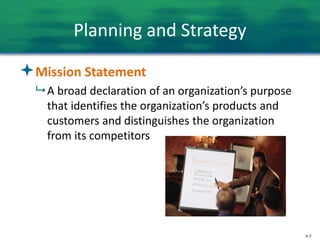
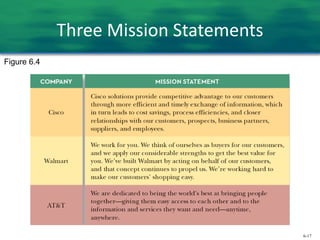
Mission Statement
 A broad declaration of an organization’s purpose
that identifies the organization’s products and
customers and distinguishes the organization
from its competitors
6-6
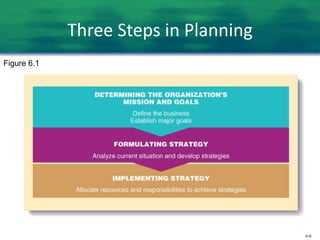
Three Steps in Planning
Figure 6.1
6-7
Why Planning is Important
1. Planning is necessary to give the organization
a sense of direction and purpose
2. Planning is a useful way of getting managers
to participate in decision making about the
appropriate goals and strategies for an
organization
6-8
Why Planning is Important
3. A plan helps coordinate managers of the
different functions and divisions of an
organization to ensure that they all pull in the
same direction and work to achieve its
desired future state
4. A plan can be used as a device for controlling
managers within an organization
6-9
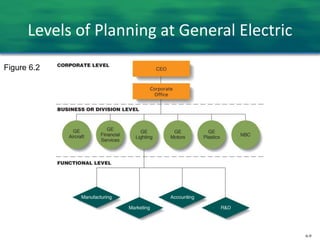
Levels of Planning at General Electric
Figure 6.2
6-10
Levels and Types of Planning
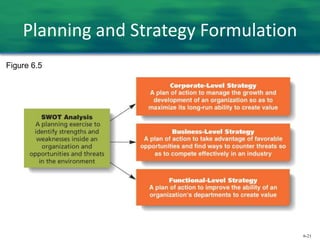
Corporate-Level Plan
 Top management’s decisions pertaining to the
organization’s mission, overall strategy, and
structure.
Corporate-Level Strategy
 A plan that indicates in which industries and
national markets an organization intends to
compete.
6-11
Levels and Types of Planning
Business-Level Plan
 Divisional managers’ decisions pertaining to
divisions long-term goals overall strategy, and
structure
Business-Level Strategy
 outlines the specific methods a division, business
unit, or organization will use to compete
effectively against its rivals in an industry
6-12
Levels and Types of Planning
Functional-Level Plan
 Functional managers’ decisions pertaining to the
goals that they propose to pursue to help the
division attain its business-level goals
Functional-level strategy
 A plan of action to improve the ability of each of
an organization’s functions to perform its task-
specific activities in ways that add value to an
organization’s goods and services.
6-13
Time Horizons of Plans
Time Horizon
 The intended duration of a plan.
• Long-term plans are usually 5 years or more.
• Intermediate-term plans are 1 to 5 years.
• Short-term plans are less than 1 year.
6-14
Types of Plans
Standing Plans
 Use in programmed decision situations
Single-Use Plans
 Developed for a one-time, non-programmed issue
6-15
Standing Plans
Policies
 general guides to action.
Rules
 formal written specific guides to action.
Standard operating procedures (SOP)
 specify an exact series of actions to follow
6-16
Types of Plans
Programs
 integrated plans
achieving specific
goals.
Project
 specific action plans
to complete
programs.
6-17
Three Mission Statements
Figure 6.4
6-18
Determining the Organization’s
Mission and Goals
Defining the Business
1. Who are our customers?
2. What customer needs are being satisfied?
3. How are we satisfying customer needs
6-19
Determining the Organization’s
Mission and Goals
Establishing Major Goals
 Provides the organization with a sense of
direction
 Stretches the organization to higher levels of
performance.
 Goals must be challenging but realistic with a
definite period in which they are to be achieved.
6-20
Determining the Organization’s
Mission and Goals
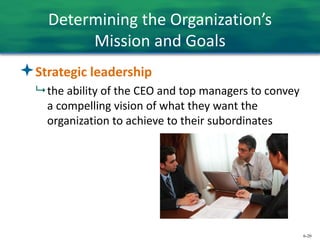
Strategic leadership
 the ability of the CEO and top managers to convey
a compelling vision of what they want the
organization to achieve to their subordinates
6-21
Planning and Strategy Formulation
Figure 6.5
6-22
Formulating Strategy
SWOT Analysis
 A planning exercise in which managers identify
internal organizational strengths and weaknesses
external opportunities and threats
6-23
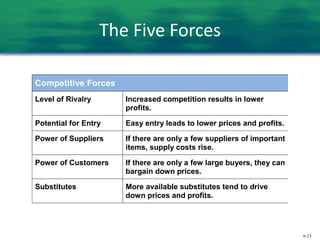
The Five Forces
Competitive Forces
Level of Rivalry Increased competition results in lower
profits.
Potential for Entry Easy entry leads to lower prices and profits.
Power of Suppliers If there are only a few suppliers of important
items, supply costs rise.
Power of Customers If there are only a few large buyers, they can
bargain down prices.
Substitutes More available substitutes tend to drive
down prices and profits.
6-24
Formulating Business-Level Strategies
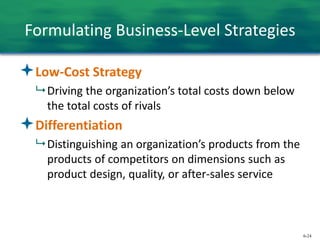
Low-Cost Strategy
 Driving the organization’s total costs down below
the total costs of rivals
Differentiation
 Distinguishing an organization’s products from the
products of competitors on dimensions such as
product design, quality, or after-sales service
6-25
Formulating Business-Level Strategies
“Stuck in the Middle”
 Attempting to simultaneously pursue both a low
cost strategy and a differentiation strategy
 Difficult to achieve low cost with the added costs
of differentiation
6-26
Formulating Business-Level Strategies
Focused low-cost strategy
 Serving only one segment of the overall market
and trying to be the lowest-cost organization
serving that segment.
Focused differentiation strategy
 Serving only one segment of the overall market
and trying to be the most differentiated
organization serving that segment.
6-27
Formulating Corporate-Level Strategies
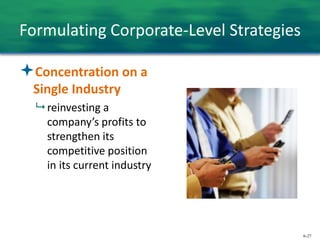
Concentration on a
Single Industry
 reinvesting a
company’s profits to
strengthen its
competitive position
in its current industry
6-28
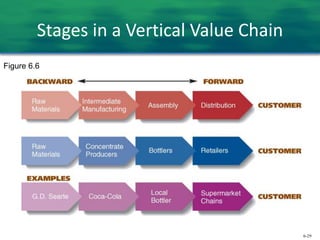
Vertical Integration
Vertical Integration
 expanding a company’s operations either
backward into an industry that produces inputs
for its products or forward into an industry that
uses, distributes, or sells its products
6-29
Stages in a Vertical Value Chain
Figure 6.6
6-30
Question?
What is expanding a company’s business
operations into a new industry in order to
produce new kinds of valuable goods or
services?
A. Differentiation
B. Diversification
C. Synergy
D. International expansion
6-31
Diversification
Diversification
 expanding a company’s business operations into a
new industry in order to produce new kinds of
valuable goods or services
6-32
Diversification
Related Diversification
 entering a new business or industry to create a
competitive advantage in one or more of an
organization’s existing divisions or businesses
Unrelated diversification
 entering a new industry or buying a company in a
new industry that is not related in any way to an
organization’s current businesses or industries
6-33
International Expansion
Basic Question
 To what extent do we customize products and
marketing for different national conditions?
Global strategy
 Selling the same standardized product and using
the same basic marketing approach in each
national market
6-34
International Expansion
Multi-domestic Strategy
 Customizing products and marketing strategies to
specific national conditions
 Helps gain local market share
 Raises production costs
6-35
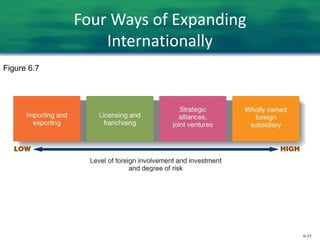
Four Ways of Expanding
Internationally
Figure 6.7
6-36
International Expansion
Exporting
 making products at home and selling them
abroad
Importing
 selling at home products that are made abroad
6-37
International Expansion
Licensing
 allowing a foreign organization to take charge of
manufacturing and distributing a product in its
country in return for a negotiated fee
Franchising
 selling to a foreign organization the rights to use a
brand name and operating know-how in return
for a lump-sum payment and a share of the
profits
6-38
International Expansion
Strategic alliance
 managers pool resources with those of a foreign
company
 Organizations agree to share risk and reward
Joint venture
 strategic alliance among companies that agree to
jointly establish and share the ownership of a new
business
6-39
International Expansion
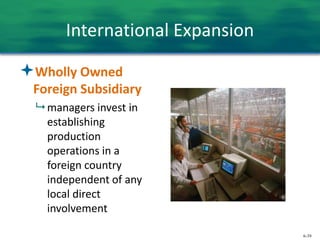
Wholly Owned
Foreign Subsidiary
 managers invest in
establishing
production
operations in a
foreign country
independent of any
local direct
involvement
6-40
Video: Free for All
How does “free” work as a business model?
How does Google leverage its ownership of
YouTube?

MG 371 CH6

  • 1.
    Copyright © 2015McGraw-Hill Education. All rights reserved. No reproduction or distribution without the prior written consent of McGraw-Hill Education. Planning, Strategy, and Competitive Advantage Chapter Six
  • 2.
    6-2 Learning Objectives LO6-1 Identifythe three main steps of the planning process and explain the relationship between planning and strategy LO6-2 Differentiate between the main types of business- level strategies and explain how they give an organization a competitive advantage that may lead to superior performance LO6-3 Differentiate between the main types of corporate- level strategies and explain how they are used to strengthen a company’s business-level strategy and competitive advantage LO6-4 Describe the vital role managers play in implementing strategies to achieve an organization’s mission and goals.
  • 3.
    6-3 Planning and Strategy Planning Identifying and selecting appropriate goals and courses of action for an organization Strategy  A cluster of decisions about what goals to pursue, what actions to take, and how to use resources to achieve goals
  • 4.
    6-4 Question? What is abroad declaration of an organization’s purpose ? A. Company Bill of Rights B. Mission Statement C. Business Plan D. Executive Summary
  • 5.
    6-5 Planning and Strategy MissionStatement  A broad declaration of an organization’s purpose that identifies the organization’s products and customers and distinguishes the organization from its competitors
  • 6.
    6-6 Three Steps inPlanning Figure 6.1
  • 7.
    6-7 Why Planning isImportant 1. Planning is necessary to give the organization a sense of direction and purpose 2. Planning is a useful way of getting managers to participate in decision making about the appropriate goals and strategies for an organization
  • 8.
    6-8 Why Planning isImportant 3. A plan helps coordinate managers of the different functions and divisions of an organization to ensure that they all pull in the same direction and work to achieve its desired future state 4. A plan can be used as a device for controlling managers within an organization
  • 9.
    6-9 Levels of Planningat General Electric Figure 6.2
  • 10.
    6-10 Levels and Typesof Planning Corporate-Level Plan  Top management’s decisions pertaining to the organization’s mission, overall strategy, and structure. Corporate-Level Strategy  A plan that indicates in which industries and national markets an organization intends to compete.
  • 11.
    6-11 Levels and Typesof Planning Business-Level Plan  Divisional managers’ decisions pertaining to divisions long-term goals overall strategy, and structure Business-Level Strategy  outlines the specific methods a division, business unit, or organization will use to compete effectively against its rivals in an industry
  • 12.
    6-12 Levels and Typesof Planning Functional-Level Plan  Functional managers’ decisions pertaining to the goals that they propose to pursue to help the division attain its business-level goals Functional-level strategy  A plan of action to improve the ability of each of an organization’s functions to perform its task- specific activities in ways that add value to an organization’s goods and services.
  • 13.
    6-13 Time Horizons ofPlans Time Horizon  The intended duration of a plan. • Long-term plans are usually 5 years or more. • Intermediate-term plans are 1 to 5 years. • Short-term plans are less than 1 year.
  • 14.
    6-14 Types of Plans StandingPlans  Use in programmed decision situations Single-Use Plans  Developed for a one-time, non-programmed issue
  • 15.
    6-15 Standing Plans Policies  generalguides to action. Rules  formal written specific guides to action. Standard operating procedures (SOP)  specify an exact series of actions to follow
  • 16.
    6-16 Types of Plans Programs integrated plans achieving specific goals. Project  specific action plans to complete programs.
  • 17.
  • 18.
    6-18 Determining the Organization’s Missionand Goals Defining the Business 1. Who are our customers? 2. What customer needs are being satisfied? 3. How are we satisfying customer needs
  • 19.
    6-19 Determining the Organization’s Missionand Goals Establishing Major Goals  Provides the organization with a sense of direction  Stretches the organization to higher levels of performance.  Goals must be challenging but realistic with a definite period in which they are to be achieved.
  • 20.
    6-20 Determining the Organization’s Missionand Goals Strategic leadership  the ability of the CEO and top managers to convey a compelling vision of what they want the organization to achieve to their subordinates
  • 21.
    6-21 Planning and StrategyFormulation Figure 6.5
  • 22.
    6-22 Formulating Strategy SWOT Analysis A planning exercise in which managers identify internal organizational strengths and weaknesses external opportunities and threats
  • 23.
    6-23 The Five Forces CompetitiveForces Level of Rivalry Increased competition results in lower profits. Potential for Entry Easy entry leads to lower prices and profits. Power of Suppliers If there are only a few suppliers of important items, supply costs rise. Power of Customers If there are only a few large buyers, they can bargain down prices. Substitutes More available substitutes tend to drive down prices and profits.
  • 24.
    6-24 Formulating Business-Level Strategies Low-CostStrategy  Driving the organization’s total costs down below the total costs of rivals Differentiation  Distinguishing an organization’s products from the products of competitors on dimensions such as product design, quality, or after-sales service
  • 25.
    6-25 Formulating Business-Level Strategies “Stuckin the Middle”  Attempting to simultaneously pursue both a low cost strategy and a differentiation strategy  Difficult to achieve low cost with the added costs of differentiation
  • 26.
    6-26 Formulating Business-Level Strategies Focusedlow-cost strategy  Serving only one segment of the overall market and trying to be the lowest-cost organization serving that segment. Focused differentiation strategy  Serving only one segment of the overall market and trying to be the most differentiated organization serving that segment.
  • 27.
    6-27 Formulating Corporate-Level Strategies Concentrationon a Single Industry  reinvesting a company’s profits to strengthen its competitive position in its current industry
  • 28.
    6-28 Vertical Integration Vertical Integration expanding a company’s operations either backward into an industry that produces inputs for its products or forward into an industry that uses, distributes, or sells its products
  • 29.
    6-29 Stages in aVertical Value Chain Figure 6.6
  • 30.
    6-30 Question? What is expandinga company’s business operations into a new industry in order to produce new kinds of valuable goods or services? A. Differentiation B. Diversification C. Synergy D. International expansion
  • 31.
    6-31 Diversification Diversification  expanding acompany’s business operations into a new industry in order to produce new kinds of valuable goods or services
  • 32.
    6-32 Diversification Related Diversification  enteringa new business or industry to create a competitive advantage in one or more of an organization’s existing divisions or businesses Unrelated diversification  entering a new industry or buying a company in a new industry that is not related in any way to an organization’s current businesses or industries
  • 33.
    6-33 International Expansion Basic Question To what extent do we customize products and marketing for different national conditions? Global strategy  Selling the same standardized product and using the same basic marketing approach in each national market
  • 34.
    6-34 International Expansion Multi-domestic Strategy Customizing products and marketing strategies to specific national conditions  Helps gain local market share  Raises production costs
  • 35.
    6-35 Four Ways ofExpanding Internationally Figure 6.7
  • 36.
    6-36 International Expansion Exporting  makingproducts at home and selling them abroad Importing  selling at home products that are made abroad
  • 37.
    6-37 International Expansion Licensing  allowinga foreign organization to take charge of manufacturing and distributing a product in its country in return for a negotiated fee Franchising  selling to a foreign organization the rights to use a brand name and operating know-how in return for a lump-sum payment and a share of the profits
  • 38.
    6-38 International Expansion Strategic alliance managers pool resources with those of a foreign company  Organizations agree to share risk and reward Joint venture  strategic alliance among companies that agree to jointly establish and share the ownership of a new business
  • 39.
    6-39 International Expansion Wholly Owned ForeignSubsidiary  managers invest in establishing production operations in a foreign country independent of any local direct involvement
  • 40.
    6-40 Video: Free forAll How does “free” work as a business model? How does Google leverage its ownership of YouTube?