


McGraw-Hill/Irwin Copyright © 2009 by The McGraw-Hill Companies, Inc.  All rights reserved.
4-
Learning Objectives L01: Basic steps in planning process. L02: Integration of strategic planning  with tactical and operational planning. L03: Define strategy after analysis of  external environment and firm’s strength’s and weaknesses.
Learning Objectives L04: Companies can achieve competitive advantage through business strategy. L05: Keys to effective strategy implementation. L06: Making effective decisions as a manager. L07: Principles for group decision making.
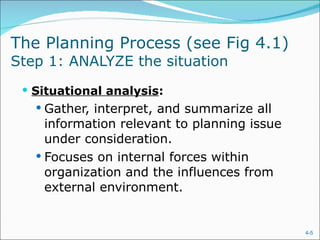
The Planning Process (see Fig 4.1)  Step 1: ANALYZE the situation  Situational analysis :  Gather, interpret, and summarize all information relevant to planning issue under consideration. Focuses on internal forces within organization and the influences from external environment.
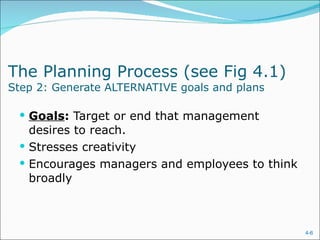
The Planning Process (see Fig 4.1)  Step 2: Generate ALTERNATIVE goals and plans Goals :  Target or end that management desires to reach. Stresses creativity Encourages managers and employees to think broadly
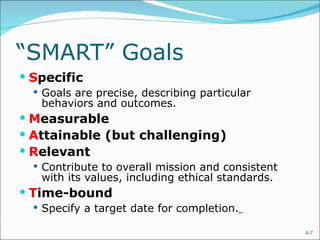
“ SMART” Goals S pecific Goals are precise, describing particular behaviors and outcomes. M easurable A ttainable (but challenging) R elevant Contribute to overall mission and consistent with its values, including ethical standards. T ime-bound Specify a target date for completion.
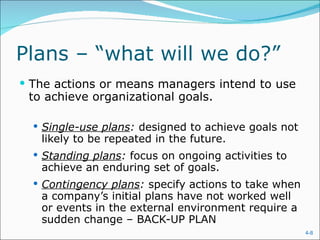
Plans – “what will we do?”  The actions or means managers intend to use to achieve organizational goals. Single-use plans :  designed to achieve goals not likely to be repeated in the future. Standing plans :  focus on ongoing activities to achieve an enduring set of goals. Contingency plans :  specify actions to take when a company’s initial plans have not worked well or events in the external environment require a sudden change – BACK-UP PLAN
The Planning Process (see Fig 4.1)  Step 3: EVALUATE goals and plans Evaluate advantages, disadvantages, and potential effects of each alternative goal and plan. Prioritize the goals. Consider costs of each initiative and  likely ROI.
The Planning Process (see Fig 4.1)  Step 4: SELECT goals and plans Select most appropriate and feasible alternative. Identifies priorities and trade-offs among goals and plans.
The Planning Process (see Fig 4.1)  Step 5: IMPLEMENT goals and plans Key to achieving goals Requires understanding, adequate resources and motivation. Link plan to other systems in the organization, such as rewards, to help ensure successful implementation.
The Planning Process (see Fig 4.1)  Step 6: Monitor and CONTROL performance Monitor actual performance of employees against the goals and plans. Adjust course as necessary.
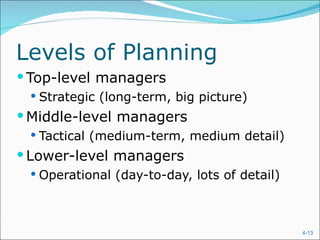
Levels of Planning Top-level managers Strategic (long-term, big picture) Middle-level managers Tactical (medium-term, medium detail) Lower-level managers Operational (day-to-day, lots of detail)
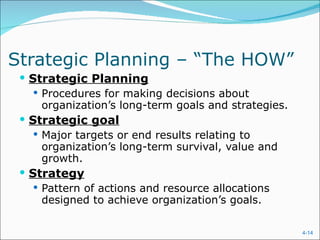
Strategic Planning – “The HOW”  Strategic Planning Procedures for making decisions about  organization’s long-term goals and strategies. Strategic goal Major targets or end results relating to organization’s long-term survival, value and growth. Strategy Pattern of actions and resource allocations designed to achieve organization’s goals.
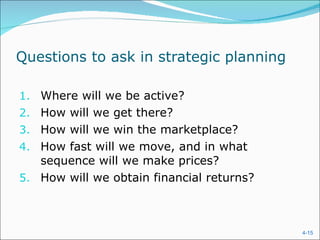
Questions to ask in strategic planning Where will we be active? How will we get there? How will we win the marketplace? How fast will we move, and in what sequence will we make prices? How will we obtain financial returns?
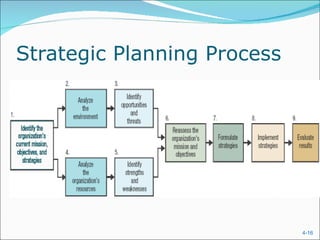
Strategic Planning Process
Strategic Planning Process (see Fig. 4.3) Step 1: ESTABLISH a mission, vision, and goals Mission - PURPOSE Organization’s basic purpose and scope of operations. Strategic vision - VIEW Long-term direction and strategic intent  Points to the future Perspective on where organization is headed and what it can become
Microsoft’s Mission Statement “ At Microsoft, our mission is to enable people and businesses throughout the world to realize their full potential… We consider our mission statement a promise to our customers. We deliver on that promise by striving to create technology that is accessible to everyone—including people who experience the world in different ways because of impairments and disabilities.”
Vision Statements INSPIRE organization members Offer a WORTHWHILE TARGET to achieve. DuPont’s Vision Statement “ To be the world’s most dynamic science company, creating sustainable solutions essential to a better, safer and healthier life for people everywhere.”
4-
Strategic goals – “SMART” TARGETS Evolve from the organization’s mission and vision.
Strategic Planning Process (see Fig. 4.3) Step 2: ANALYZE ETERNAL opportunities / threats Industry  Profile Growth Forces Competitor  Profile Analysis Advantages Legislative / regulatory activities Political activity Social issues Social interest groups Labor issues Macroeconomic conditions Technological factors
Stakeholders – “Vested Interest” Groups and individuals who affect and are affected  by the achievement of the organization’s mission, goals, and strategies. Examples Buyers, suppliers, competitors, government and regulatory agencies, unions and employee groups, financial community, owners and shareholders, and trade associations.
Strategic Planning Process (see Fig. 4.3)  Step 3: ANALYZE INTERNAL strengths  /  weaknesses Internal resource analysis Financial Human resources  Marketing Operations
Resources and capabilities Resources inputs to production that can be accumulated over time to enhance firm’s performance. Resource types Tangible assets  –  real estate, production of facilities, raw materials – “touchy-feely” Intangible assets-   company reputation, culture, technical knowledge, and patents, accumulated learning and experience – “can’t touch that!”
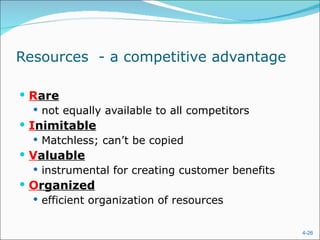
Resources  - a competitive advantage R are not equally available to all competitors I nimitable Matchless; can’t be copied V aluable instrumental for creating customer benefits O rganized efficient organization of resources
Core Competence – “What We Do Best” A unique skill and/or knowledge an organization possesses that gives it an  EDGE  over competitors
Benchmarking  - “Best Practices” Measure company’s basic functions and skills compare with those of another company or set of companies. To undertake actions to achieve better performance and lower costs
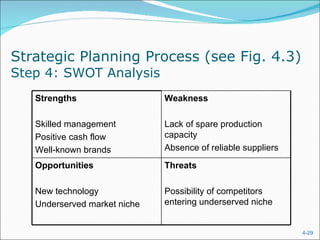
Strategic Planning Process (see Fig. 4.3)  Step 4: SWOT Analysis Strengths Skilled management Positive cash flow Well-known brands Weakness Lack of spare production capacity Absence of reliable suppliers Opportunities New technology Underserved market niche Threats Possibility of competitors entering underserved niche
Corporate Strategy Identifies  Businesses Markets Industries  in which the organization competes and the distribution of resources among those businesses
Four Alternative Corporate Strategies Concentration  single business / single industry focus Vertical integration – “UP and DOWN” expanding into the organization’s supply channels or to distributors;  eliminates uncertainties and reduces costs associated with suppliers or distributors
Alternatives to Corporate Strategy Concentric diversification – “related variety” Moving into new businesses  related to  company’s original core business. Conglomerate diversification – “unrelated expansion”  Enter unrelated businesses, typically to minimize risks due to market fluctuations in one industry.
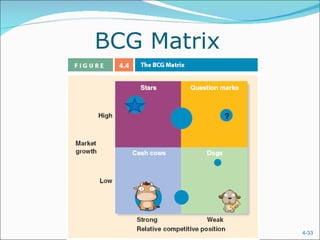
BCG Matrix ?
BCG Matrix (see Fig. 4) BCG Categories of Businesses Question Marks  -  ? High-growth, weak-competitive position Require substantial investment to improve their position Else divest Stars –  High growth, strong competitive position  Require heavy investment
BCG Matrix (see Fig. 4)  BCG Categories of Businesses Cash cows –  Low-growth, strong competitive position  generate revenues in excess of their investment needs fund other businesses Dogs –  low-growth, weak-competitive-position divest after their remaining revenues are realized
Business Strategy The major actions by which an organization builds competitive advantage in a particular industry or market. Low-cost strategy Efficiency, offering a standard, no-frills product. Differentiation unique in its industry or market segment along one or more dimensions.
Technology Leadership Advantages First-mover advantage Little or no competition Greater efficiency Higher profit margins Sustainable advantage Reputation or innovation Establishment of entry barriers Occupation of best market niches Opportunities to learn Disadvantages Greater risks Cost of technology development Costs of market development and customer education Infrastructure costs Costs of learning and eliminating defects Possible cannibalization of existing products
Functional Strategy Implemented by each functional area  Support the organization’s business strategy Developed with input of and approval from the executives responsible for business strategy.
Strategic Planning Process (see Fig. 4.3)  Step 5: IMPLEMENT the strategy Define strategic tasks. Assess organization capabilities. Develop an implementation agenda. Create an implementation plan.
Strategic Planning Process (see Fig. 4.3)  Step 6: CONTROL Your Progress Strategic control system Evaluate organization’s progress with its strategy  When discrepancies exist, taking corrective action Encourage  efficient  operations that are  consistent  with the plan while allowing  flexibility  to adapt to changing conditions. Includes a budget to monitor and control major financial expenditures.
Formal Decision Making Identify  and diagnose the problem. Generate alternative  solutions. Evaluate  alternatives. Make choice . Implement  the decision. Evaluate  the decision.
Barriers to Good Decisions Psychological biases Illusion of control Framing effects Discounting the future Time Pressures Social Realities
 
Identifying the Problem Recognize there is a problem or opportunity Managers compare current performance against: past performance, or current performance of other organizations or units, or future expected performance
Diagnosing the Problem Decision maker must want to do something and believe that the resources and abilities to solve the problem exist Diagnostic Questions: Is there a difference between what is actually happening and what should be happpening? How can you describe the deviation, as specifically as possible? What is/are the cause(s) of the deviation? What specific goals should be met? Which of the these goals are absolutely critical to the success of the decision?
Generate Alternative Solutions Based on the diagnosis, alternative courses of action aimed at solving the problem are developed. Ready-made solutions :  ideas that have been or tried before. Custom-made solutions :  new, creative solutions designed specifically for the problem.
Evaluate Alternatives Determine the  value  or adequacy of the alternatives that were generated. Predict the  consequences  that will occur if the various options are put into effect. Original goals must be taken into account Consider the potential consequences of several different scenarios.
Making the Choice Maximizing:  achieving the  best possible outcome , the one that realizes the greatest positive consequences and the fewest negative consequences. Satisficing:  choosing the  first option that is minimally acceptable or adequate ; the choice appears to meet a targeted goal or criterion. Optimizing:  achieving the  best possible balance among several goals.
Implement the Decision Determine how things will look when the decision is fully operational. Chronologically order, perhaps with a flow diagram, the steps necessary to achieve a fully operational decision. List the resources and activities required to implement each step. Estimate the time needed for each step. Assign responsibility for each step to specific individuals.
Evaluate the Decision Collect information on how well the decision is working. Gather objective data for accurately determining the decision’s success or failure. Feedback provides information on the success or failure of the decision.
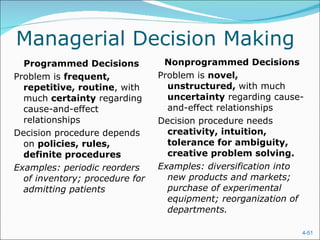
Managerial Decision Making Programmed Decisions Problem is  frequent, repetitive, routine , with much  certainty  regarding cause-and-effect relationships Decision procedure depends on  policies, rules, definite procedures Examples: periodic reorders of inventory; procedure for admitting patients Nonprogrammed Decisions Problem is  novel, unstructured,  with much  uncertainty  regarding cause-and-effect relationships Decision procedure needs  creativity, intuition,   tolerance for ambiguity, creative problem solving. Examples: diversification into new products and markets; purchase of experimental equipment; reorganization of departments.
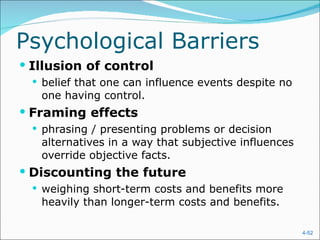
Psychological Barriers Illusion of control belief that one can influence events despite no one having control. Framing effects phrasing / presenting problems or decision alternatives in a way that subjective influences override objective facts. Discounting the future weighing short-term costs and benefits more heavily than longer-term costs and benefits.
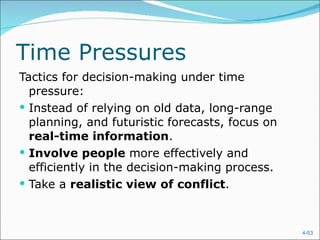
Time Pressures Tactics for decision-making under time pressure: Instead of relying on old data, long-range planning, and futuristic forecasts, focus on  real-time information . Involve people  more effectively and efficiently in the decision-making process. Take a  realistic view of conflict .
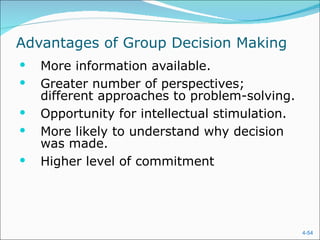
Advantages of Group Decision Making More information available. Greater number of perspectives; different approaches to problem-solving. Opportunity for intellectual stimulation. More likely to understand why decision was made. Higher level of commitment
Disadvantages of Group Decision Making One group member may dominate discussion. Satisficing may occur. Groupthink – the pressure to avoid disagreement can lead to a phenomenon. Goal displacement – decision-making group loses sight of its original goal and a new, less important goal emerges.
Effective Management of Group Decision Makers Appropriate leadership style Constructive use of disagreement and conflict. Enhancement of creativity
Remaining slides are review.
YOU should be able to L01: Summarize the basic steps in any planning process. L02: Discuss how strategic planning should be integrated with tactical and operational planning. L03: Describe how strategy is based on analysis of the external environment and the firm’s strength’s and weaknesses.
YOU should be able to (cont’d) L04: Discuss how companies can achieve competitive advantage through business strategy. L05: Identify the keys to effective strategy implementation. L06: Explain how to make effective decisions as a manager. L07: Summarize principles for group decision making.
Test Your Knowledge Describe the basic steps in any planning process.
Test Your Knowledge Identify the keys to effective strategy implementation
Test Your Knowledge The manager of the Gallery Restaurant noted that the restaurant had experienced a decreased number of evening customers.  The manager promptly ordered the chef to rewrite the evening menu. Customer feedback later indicated that the problem had not been the menu but poor service from the wait staff.  The manager's decision to have the menu revised suggests that she failed to:  A) identify the problem.  B) evaluate the alternatives and consequences.  C) properly diagnose the cause of the problem.  D) evaluate the decision and its consequences.  E) identify a solution.
Test Your Knowledge Discuss the principles for group decision making.
Triton Logging Read the Triton story on page 84. Classify and describe what you believe Triton Logging’s corporate strategy to be.  How does this strategy reflect Chris Godsall’s vision? Triton Logging practices a business strategy of differentiation, setting itself apart from other logging firms by finding new technology to harvest timber in an ecofriendly way.  What are the potential advantages and disadvantages of this type of leadership?

BUS137 Chapter 4

  • 1.
    McGraw-Hill/Irwin Copyright ©2009 by The McGraw-Hill Companies, Inc. All rights reserved.
  • 2.
  • 3.
    Learning Objectives L01:Basic steps in planning process. L02: Integration of strategic planning with tactical and operational planning. L03: Define strategy after analysis of external environment and firm’s strength’s and weaknesses.
  • 4.
    Learning Objectives L04:Companies can achieve competitive advantage through business strategy. L05: Keys to effective strategy implementation. L06: Making effective decisions as a manager. L07: Principles for group decision making.
  • 5.
    The Planning Process(see Fig 4.1) Step 1: ANALYZE the situation Situational analysis : Gather, interpret, and summarize all information relevant to planning issue under consideration. Focuses on internal forces within organization and the influences from external environment.
  • 6.
    The Planning Process(see Fig 4.1) Step 2: Generate ALTERNATIVE goals and plans Goals : Target or end that management desires to reach. Stresses creativity Encourages managers and employees to think broadly
  • 7.
    “ SMART” GoalsS pecific Goals are precise, describing particular behaviors and outcomes. M easurable A ttainable (but challenging) R elevant Contribute to overall mission and consistent with its values, including ethical standards. T ime-bound Specify a target date for completion.
  • 8.
    Plans – “whatwill we do?” The actions or means managers intend to use to achieve organizational goals. Single-use plans : designed to achieve goals not likely to be repeated in the future. Standing plans : focus on ongoing activities to achieve an enduring set of goals. Contingency plans : specify actions to take when a company’s initial plans have not worked well or events in the external environment require a sudden change – BACK-UP PLAN
  • 9.
    The Planning Process(see Fig 4.1) Step 3: EVALUATE goals and plans Evaluate advantages, disadvantages, and potential effects of each alternative goal and plan. Prioritize the goals. Consider costs of each initiative and likely ROI.
  • 10.
    The Planning Process(see Fig 4.1) Step 4: SELECT goals and plans Select most appropriate and feasible alternative. Identifies priorities and trade-offs among goals and plans.
  • 11.
    The Planning Process(see Fig 4.1) Step 5: IMPLEMENT goals and plans Key to achieving goals Requires understanding, adequate resources and motivation. Link plan to other systems in the organization, such as rewards, to help ensure successful implementation.
  • 12.
    The Planning Process(see Fig 4.1) Step 6: Monitor and CONTROL performance Monitor actual performance of employees against the goals and plans. Adjust course as necessary.
  • 13.
    Levels of PlanningTop-level managers Strategic (long-term, big picture) Middle-level managers Tactical (medium-term, medium detail) Lower-level managers Operational (day-to-day, lots of detail)
  • 14.
    Strategic Planning –“The HOW” Strategic Planning Procedures for making decisions about organization’s long-term goals and strategies. Strategic goal Major targets or end results relating to organization’s long-term survival, value and growth. Strategy Pattern of actions and resource allocations designed to achieve organization’s goals.
  • 15.
    Questions to askin strategic planning Where will we be active? How will we get there? How will we win the marketplace? How fast will we move, and in what sequence will we make prices? How will we obtain financial returns?
  • 16.
  • 17.
    Strategic Planning Process(see Fig. 4.3) Step 1: ESTABLISH a mission, vision, and goals Mission - PURPOSE Organization’s basic purpose and scope of operations. Strategic vision - VIEW Long-term direction and strategic intent Points to the future Perspective on where organization is headed and what it can become
  • 18.
    Microsoft’s Mission Statement“ At Microsoft, our mission is to enable people and businesses throughout the world to realize their full potential… We consider our mission statement a promise to our customers. We deliver on that promise by striving to create technology that is accessible to everyone—including people who experience the world in different ways because of impairments and disabilities.”
  • 19.
    Vision Statements INSPIREorganization members Offer a WORTHWHILE TARGET to achieve. DuPont’s Vision Statement “ To be the world’s most dynamic science company, creating sustainable solutions essential to a better, safer and healthier life for people everywhere.”
  • 20.
  • 21.
    Strategic goals –“SMART” TARGETS Evolve from the organization’s mission and vision.
  • 22.
    Strategic Planning Process(see Fig. 4.3) Step 2: ANALYZE ETERNAL opportunities / threats Industry Profile Growth Forces Competitor Profile Analysis Advantages Legislative / regulatory activities Political activity Social issues Social interest groups Labor issues Macroeconomic conditions Technological factors
  • 23.
    Stakeholders – “VestedInterest” Groups and individuals who affect and are affected by the achievement of the organization’s mission, goals, and strategies. Examples Buyers, suppliers, competitors, government and regulatory agencies, unions and employee groups, financial community, owners and shareholders, and trade associations.
  • 24.
    Strategic Planning Process(see Fig. 4.3) Step 3: ANALYZE INTERNAL strengths / weaknesses Internal resource analysis Financial Human resources Marketing Operations
  • 25.
    Resources and capabilitiesResources inputs to production that can be accumulated over time to enhance firm’s performance. Resource types Tangible assets – real estate, production of facilities, raw materials – “touchy-feely” Intangible assets- company reputation, culture, technical knowledge, and patents, accumulated learning and experience – “can’t touch that!”
  • 26.
    Resources -a competitive advantage R are not equally available to all competitors I nimitable Matchless; can’t be copied V aluable instrumental for creating customer benefits O rganized efficient organization of resources
  • 27.
    Core Competence –“What We Do Best” A unique skill and/or knowledge an organization possesses that gives it an EDGE over competitors
  • 28.
    Benchmarking -“Best Practices” Measure company’s basic functions and skills compare with those of another company or set of companies. To undertake actions to achieve better performance and lower costs
  • 29.
    Strategic Planning Process(see Fig. 4.3) Step 4: SWOT Analysis Strengths Skilled management Positive cash flow Well-known brands Weakness Lack of spare production capacity Absence of reliable suppliers Opportunities New technology Underserved market niche Threats Possibility of competitors entering underserved niche
  • 30.
    Corporate Strategy Identifies Businesses Markets Industries in which the organization competes and the distribution of resources among those businesses
  • 31.
    Four Alternative CorporateStrategies Concentration single business / single industry focus Vertical integration – “UP and DOWN” expanding into the organization’s supply channels or to distributors; eliminates uncertainties and reduces costs associated with suppliers or distributors
  • 32.
    Alternatives to CorporateStrategy Concentric diversification – “related variety” Moving into new businesses related to company’s original core business. Conglomerate diversification – “unrelated expansion” Enter unrelated businesses, typically to minimize risks due to market fluctuations in one industry.
  • 33.
  • 34.
    BCG Matrix (seeFig. 4) BCG Categories of Businesses Question Marks - ? High-growth, weak-competitive position Require substantial investment to improve their position Else divest Stars – High growth, strong competitive position Require heavy investment
  • 35.
    BCG Matrix (seeFig. 4) BCG Categories of Businesses Cash cows – Low-growth, strong competitive position generate revenues in excess of their investment needs fund other businesses Dogs – low-growth, weak-competitive-position divest after their remaining revenues are realized
  • 36.
    Business Strategy Themajor actions by which an organization builds competitive advantage in a particular industry or market. Low-cost strategy Efficiency, offering a standard, no-frills product. Differentiation unique in its industry or market segment along one or more dimensions.
  • 37.
    Technology Leadership AdvantagesFirst-mover advantage Little or no competition Greater efficiency Higher profit margins Sustainable advantage Reputation or innovation Establishment of entry barriers Occupation of best market niches Opportunities to learn Disadvantages Greater risks Cost of technology development Costs of market development and customer education Infrastructure costs Costs of learning and eliminating defects Possible cannibalization of existing products
  • 38.
    Functional Strategy Implementedby each functional area Support the organization’s business strategy Developed with input of and approval from the executives responsible for business strategy.
  • 39.
    Strategic Planning Process(see Fig. 4.3) Step 5: IMPLEMENT the strategy Define strategic tasks. Assess organization capabilities. Develop an implementation agenda. Create an implementation plan.
  • 40.
    Strategic Planning Process(see Fig. 4.3) Step 6: CONTROL Your Progress Strategic control system Evaluate organization’s progress with its strategy When discrepancies exist, taking corrective action Encourage efficient operations that are consistent with the plan while allowing flexibility to adapt to changing conditions. Includes a budget to monitor and control major financial expenditures.
  • 41.
    Formal Decision MakingIdentify and diagnose the problem. Generate alternative solutions. Evaluate alternatives. Make choice . Implement the decision. Evaluate the decision.
  • 42.
    Barriers to GoodDecisions Psychological biases Illusion of control Framing effects Discounting the future Time Pressures Social Realities
  • 43.
  • 44.
    Identifying the ProblemRecognize there is a problem or opportunity Managers compare current performance against: past performance, or current performance of other organizations or units, or future expected performance
  • 45.
    Diagnosing the ProblemDecision maker must want to do something and believe that the resources and abilities to solve the problem exist Diagnostic Questions: Is there a difference between what is actually happening and what should be happpening? How can you describe the deviation, as specifically as possible? What is/are the cause(s) of the deviation? What specific goals should be met? Which of the these goals are absolutely critical to the success of the decision?
  • 46.
    Generate Alternative SolutionsBased on the diagnosis, alternative courses of action aimed at solving the problem are developed. Ready-made solutions : ideas that have been or tried before. Custom-made solutions : new, creative solutions designed specifically for the problem.
  • 47.
    Evaluate Alternatives Determinethe value or adequacy of the alternatives that were generated. Predict the consequences that will occur if the various options are put into effect. Original goals must be taken into account Consider the potential consequences of several different scenarios.
  • 48.
    Making the ChoiceMaximizing: achieving the best possible outcome , the one that realizes the greatest positive consequences and the fewest negative consequences. Satisficing: choosing the first option that is minimally acceptable or adequate ; the choice appears to meet a targeted goal or criterion. Optimizing: achieving the best possible balance among several goals.
  • 49.
    Implement the DecisionDetermine how things will look when the decision is fully operational. Chronologically order, perhaps with a flow diagram, the steps necessary to achieve a fully operational decision. List the resources and activities required to implement each step. Estimate the time needed for each step. Assign responsibility for each step to specific individuals.
  • 50.
    Evaluate the DecisionCollect information on how well the decision is working. Gather objective data for accurately determining the decision’s success or failure. Feedback provides information on the success or failure of the decision.
  • 51.
    Managerial Decision MakingProgrammed Decisions Problem is frequent, repetitive, routine , with much certainty regarding cause-and-effect relationships Decision procedure depends on policies, rules, definite procedures Examples: periodic reorders of inventory; procedure for admitting patients Nonprogrammed Decisions Problem is novel, unstructured, with much uncertainty regarding cause-and-effect relationships Decision procedure needs creativity, intuition, tolerance for ambiguity, creative problem solving. Examples: diversification into new products and markets; purchase of experimental equipment; reorganization of departments.
  • 52.
    Psychological Barriers Illusionof control belief that one can influence events despite no one having control. Framing effects phrasing / presenting problems or decision alternatives in a way that subjective influences override objective facts. Discounting the future weighing short-term costs and benefits more heavily than longer-term costs and benefits.
  • 53.
    Time Pressures Tacticsfor decision-making under time pressure: Instead of relying on old data, long-range planning, and futuristic forecasts, focus on real-time information . Involve people more effectively and efficiently in the decision-making process. Take a realistic view of conflict .
  • 54.
    Advantages of GroupDecision Making More information available. Greater number of perspectives; different approaches to problem-solving. Opportunity for intellectual stimulation. More likely to understand why decision was made. Higher level of commitment
  • 55.
    Disadvantages of GroupDecision Making One group member may dominate discussion. Satisficing may occur. Groupthink – the pressure to avoid disagreement can lead to a phenomenon. Goal displacement – decision-making group loses sight of its original goal and a new, less important goal emerges.
  • 56.
    Effective Management ofGroup Decision Makers Appropriate leadership style Constructive use of disagreement and conflict. Enhancement of creativity
  • 57.
  • 58.
    YOU should beable to L01: Summarize the basic steps in any planning process. L02: Discuss how strategic planning should be integrated with tactical and operational planning. L03: Describe how strategy is based on analysis of the external environment and the firm’s strength’s and weaknesses.
  • 59.
    YOU should beable to (cont’d) L04: Discuss how companies can achieve competitive advantage through business strategy. L05: Identify the keys to effective strategy implementation. L06: Explain how to make effective decisions as a manager. L07: Summarize principles for group decision making.
  • 60.
    Test Your KnowledgeDescribe the basic steps in any planning process.
  • 61.
    Test Your KnowledgeIdentify the keys to effective strategy implementation
  • 62.
    Test Your KnowledgeThe manager of the Gallery Restaurant noted that the restaurant had experienced a decreased number of evening customers. The manager promptly ordered the chef to rewrite the evening menu. Customer feedback later indicated that the problem had not been the menu but poor service from the wait staff. The manager's decision to have the menu revised suggests that she failed to: A) identify the problem. B) evaluate the alternatives and consequences. C) properly diagnose the cause of the problem. D) evaluate the decision and its consequences. E) identify a solution.
  • 63.
    Test Your KnowledgeDiscuss the principles for group decision making.
  • 64.
    Triton Logging Readthe Triton story on page 84. Classify and describe what you believe Triton Logging’s corporate strategy to be. How does this strategy reflect Chris Godsall’s vision? Triton Logging practices a business strategy of differentiation, setting itself apart from other logging firms by finding new technology to harvest timber in an ecofriendly way. What are the potential advantages and disadvantages of this type of leadership?