MYERS-BRIGGS TYPE INDICATOR®
TYPE DESCRIPTION
Myers-Briggs Type Indicator®
Type Description Copyright 2007, 2014 by Peter B. Myers and Katharine D. Myers. Report developed by
Allen L. Hammer. All rights reserved. Myers-Briggs Type Indicator, MBTI, and the MBTI logo are trademarks or registered trademarks of
the Myers & Briggs Foundation in the United States and other countries. The CPP logo is a trademark or registered trademark of CPP, Inc.,
in the United States and other countries.
CPP, Inc. | 800.624.1765 | www.cpp.com
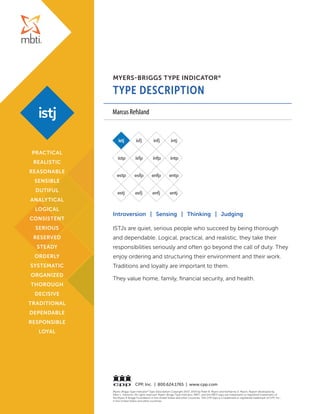
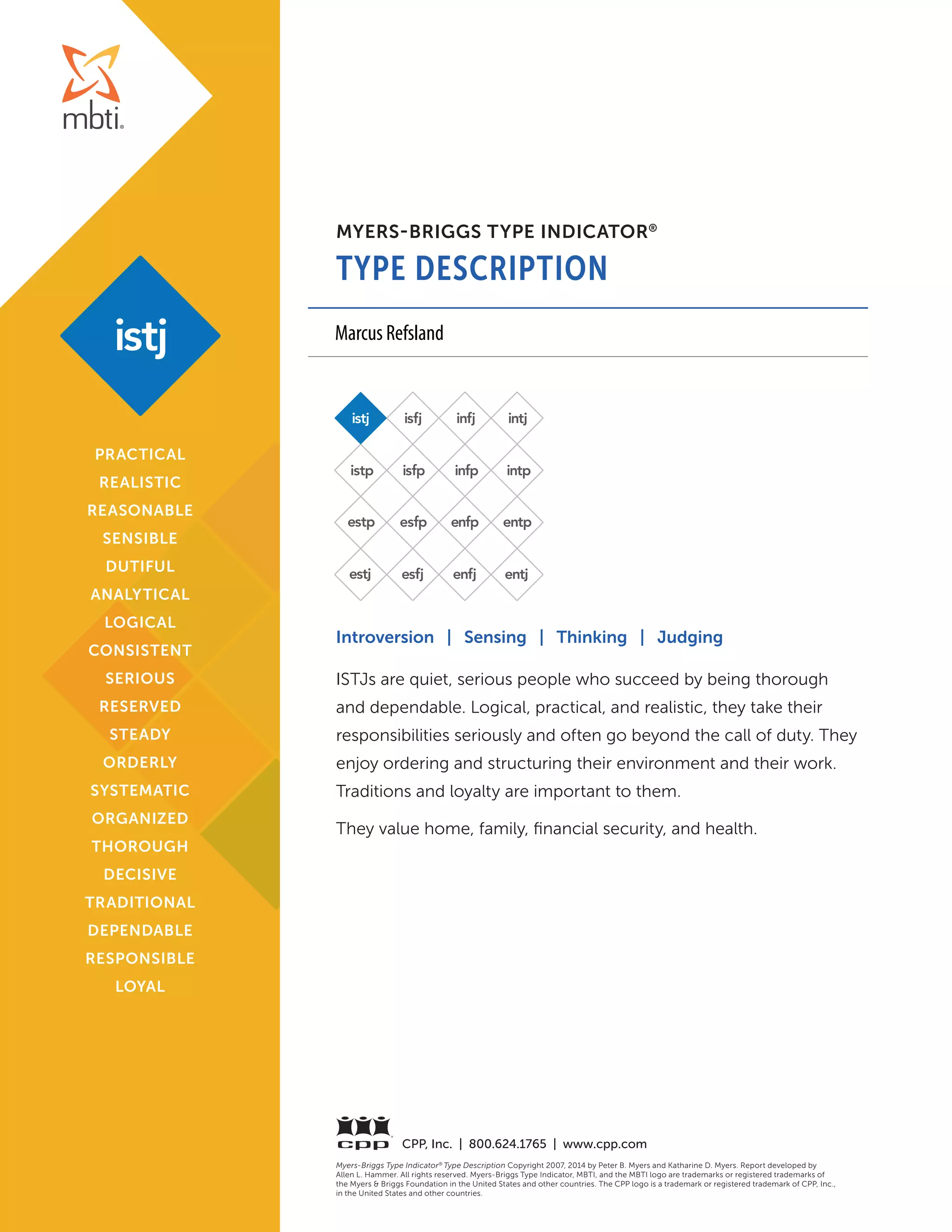
Introversion | Sensing | Thinking | Judging
ISTJs are quiet, serious people who succeed by being thorough
and dependable. Logical, practical, and realistic, they take their
responsibilities seriously and often go beyond the call of duty. They
enjoy ordering and structuring their environment and their work.
Traditions and loyalty are important to them.
They value home, family, financial security, and health.
PRACTICAL
REALISTIC
REASONABLE
SENSIBLE
DUTIFUL
ANALYTICAL
LOGICAL
CONSISTENT
SERIOUS
RESERVED
STEADY
ORDERLY
SYSTEMATIC
ORGANIZED
THOROUGH
DECISIVE
TRADITIONAL
DEPENDABLE
RESPONSIBLE
LOYAL
Marcus Refsland
| 2
Myers-Briggs Type Indicator®
Type Description Copyright 2007, 2014 by Peter B. Myers and Katharine D. Myers. Report developed by
Allen L. Hammer. All rights reserved. Myers-Briggs Type Indicator, MBTI, and the MBTI logo are trademarks or registered trademarks of
the Myers & Briggs Foundation in the United States and other countries. The CPP logo is a trademark or registered trademark of CPP, Inc.,
in the United States and other countries.
CPP, Inc. | 800.624.1765 | www.cpp.com
Characteristics of ISTJs
•	 ISTJs are mainly interested in the realities they perceive with their five senses.
•	 They know what has worked in the past and base their decisions on facts and
experience.
•	 They value security and stability.
•	 They take a logical, analytical approach to problems.
•	 They tend to put off play or leisure until all their responsibilities are met.
ISTJs with Others
•	 ISTJs have a strong sense of loyalty and responsibility to their families and
relationships.
•	 They may share their humor and their wealth of rich Sensing observations and
memories only with close friends.
•	 They sometimes try to help others by pointing out what they are doing wrong.
•	 They tend to express their caring through actions rather than words and assume
that others will notice.
•	 They always follow through on their commitments to others.
•	 ISTJs may have difficulty making sense of needs that differ widely from their
own. However, once they are convinced that something matters to a person
they care about, that need becomes a reality they must deal with, whether it
makes sense to them or not; they then will go to generous lengths to meet the
need.
Marcus Refsland
| 3
Myers-Briggs Type Indicator®
Type Description Copyright 2007, 2014 by Peter B. Myers and Katharine D. Myers. Report developed by
Allen L. Hammer. All rights reserved. Myers-Briggs Type Indicator, MBTI, and the MBTI logo are trademarks or registered trademarks of
the Myers & Briggs Foundation in the United States and other countries. The CPP logo is a trademark or registered trademark of CPP, Inc.,
in the United States and other countries.
CPP, Inc. | 800.624.1765 | www.cpp.com
ISTJs at Work
•	 ISTJs prefer to focus on the task rather than on the people involved.
•	 They work to establish standard policies and procedures.
•	 Their motto might be: “If it ain’t broke, don’t fix it.”
•	 ISTJs will support change only when convinced by the facts that it will bring
better results.
•	 They are logical and analytical, readily spotting the flaws in ideas and
immediately pointing out why something won’t work.
•	 When they see that something needs to be done, they accept the responsibility,
often going beyond the call of duty.
•	 ISTJs often choose careers in which their talent for organization and accuracy
is rewarded. Examples are accounting, civil engineering, law, production,
construction, health careers, and office work. They often move into supervisory
and management roles.
•	 They are less likely to be happy in work that demands mastery of abstract ideas
or that requires constant and close contact with people.
Potential Blind Spots for ISTJs
•	 If ISTJs have not developed their Sensing preference, they may not take in
enough facts and then may rush into action prematurely.
•	 If they don’t take in enough information, they run the risk of passing judgment
on others inappropriately.
•	 They may be suspicious of imagination and intuition, and may not take them
seriously.
•	 ISTJs may expect everyone to be as logical and analytical as they are and
become impatient when events prove otherwise.
•	 If they have not developed their Thinking preference, they may retreat from the
world, becoming absorbed with their inner reactions or sense impressions, and
produce nothing of value in the outer world.
•	 They can sometimes appear critical of others’ behavior.
Marcus Refsland

Meyers Briggs Report

  • 1.
    MYERS-BRIGGS TYPE INDICATOR® TYPEDESCRIPTION Myers-Briggs Type Indicator® Type Description Copyright 2007, 2014 by Peter B. Myers and Katharine D. Myers. Report developed by Allen L. Hammer. All rights reserved. Myers-Briggs Type Indicator, MBTI, and the MBTI logo are trademarks or registered trademarks of the Myers & Briggs Foundation in the United States and other countries. The CPP logo is a trademark or registered trademark of CPP, Inc., in the United States and other countries. CPP, Inc. | 800.624.1765 | www.cpp.com Introversion | Sensing | Thinking | Judging ISTJs are quiet, serious people who succeed by being thorough and dependable. Logical, practical, and realistic, they take their responsibilities seriously and often go beyond the call of duty. They enjoy ordering and structuring their environment and their work. Traditions and loyalty are important to them. They value home, family, financial security, and health. PRACTICAL REALISTIC REASONABLE SENSIBLE DUTIFUL ANALYTICAL LOGICAL CONSISTENT SERIOUS RESERVED STEADY ORDERLY SYSTEMATIC ORGANIZED THOROUGH DECISIVE TRADITIONAL DEPENDABLE RESPONSIBLE LOYAL Marcus Refsland
  • 2.
    | 2 Myers-Briggs TypeIndicator® Type Description Copyright 2007, 2014 by Peter B. Myers and Katharine D. Myers. Report developed by Allen L. Hammer. All rights reserved. Myers-Briggs Type Indicator, MBTI, and the MBTI logo are trademarks or registered trademarks of the Myers & Briggs Foundation in the United States and other countries. The CPP logo is a trademark or registered trademark of CPP, Inc., in the United States and other countries. CPP, Inc. | 800.624.1765 | www.cpp.com Characteristics of ISTJs • ISTJs are mainly interested in the realities they perceive with their five senses. • They know what has worked in the past and base their decisions on facts and experience. • They value security and stability. • They take a logical, analytical approach to problems. • They tend to put off play or leisure until all their responsibilities are met. ISTJs with Others • ISTJs have a strong sense of loyalty and responsibility to their families and relationships. • They may share their humor and their wealth of rich Sensing observations and memories only with close friends. • They sometimes try to help others by pointing out what they are doing wrong. • They tend to express their caring through actions rather than words and assume that others will notice. • They always follow through on their commitments to others. • ISTJs may have difficulty making sense of needs that differ widely from their own. However, once they are convinced that something matters to a person they care about, that need becomes a reality they must deal with, whether it makes sense to them or not; they then will go to generous lengths to meet the need. Marcus Refsland
  • 3.
    | 3 Myers-Briggs TypeIndicator® Type Description Copyright 2007, 2014 by Peter B. Myers and Katharine D. Myers. Report developed by Allen L. Hammer. All rights reserved. Myers-Briggs Type Indicator, MBTI, and the MBTI logo are trademarks or registered trademarks of the Myers & Briggs Foundation in the United States and other countries. The CPP logo is a trademark or registered trademark of CPP, Inc., in the United States and other countries. CPP, Inc. | 800.624.1765 | www.cpp.com ISTJs at Work • ISTJs prefer to focus on the task rather than on the people involved. • They work to establish standard policies and procedures. • Their motto might be: “If it ain’t broke, don’t fix it.” • ISTJs will support change only when convinced by the facts that it will bring better results. • They are logical and analytical, readily spotting the flaws in ideas and immediately pointing out why something won’t work. • When they see that something needs to be done, they accept the responsibility, often going beyond the call of duty. • ISTJs often choose careers in which their talent for organization and accuracy is rewarded. Examples are accounting, civil engineering, law, production, construction, health careers, and office work. They often move into supervisory and management roles. • They are less likely to be happy in work that demands mastery of abstract ideas or that requires constant and close contact with people. Potential Blind Spots for ISTJs • If ISTJs have not developed their Sensing preference, they may not take in enough facts and then may rush into action prematurely. • If they don’t take in enough information, they run the risk of passing judgment on others inappropriately. • They may be suspicious of imagination and intuition, and may not take them seriously. • ISTJs may expect everyone to be as logical and analytical as they are and become impatient when events prove otherwise. • If they have not developed their Thinking preference, they may retreat from the world, becoming absorbed with their inner reactions or sense impressions, and produce nothing of value in the outer world. • They can sometimes appear critical of others’ behavior. Marcus Refsland