What you’ll need?
• Small soft drink bottle
• Water
• Food colouring
• 2 tablespoons of
cooking oil
• Dish washing liquid or
detergent
Procedure:
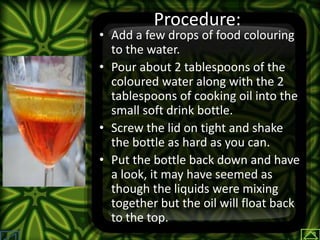
• Add a few drops of food colouring
to the water.
• Pour about 2 tablespoons of the
coloured water along with the 2
tablespoons of cooking oil into the
small soft drink bottle.
• Screw the lid on tight and shake
the bottle as hard as you can.
• Put the bottle back down and have
a look, it may have seemed as
though the liquids were mixing
together but the oil will float back
to the top.
FILTRATION
 used to separate an
insoluble solid from a liquid.
 The solid remains in the
filter paper and the liquid
goes into the beaker.
 The liquid that passes
through is the filtrate.
 The substance that is left in
the filter paper is called the
residue.
VIDEO
MECHANICAL SEPARATION
 Involves the use of forceps,
sieve, and other similar tools.
 Gravel and sand are
separated by picking the
gravel or passing the mixture
into a wire screen. This
process is called sieving.
 The use of magnets in
separating sulfur powder and
iron nails is appropriate when
metal is involved.
VIDEO
DECANTATION
 Is a method where solids of
a suspension are made to
settle down and the liquid
materials poured off.
VIDEO
CENTRIFUGATION
Is a motor-driven machine that
speeds up the settling of the
precipitate.
Uses the centripetal force
developed through the rotation
of the apparatus.
The rotation brings the
precipitate to the bottom of the
tube, then the centrifugate or
supernatant liquid poured off.
VIDEO
DISTILLATION
is the evaporation and
condensation of volatile liquids.
It uses a condenser to
transform a gas into a liquid.
The more volatile liquid boils
and evaporate first, then it is
condensed on the cooled area
of the set-up.
The distillate is the liquid
formed after condensation.
VIDEO
FRACTIONAL DISTILLATION
 Is a special type of distillation
used to separate a mixture of
liquids with different boiling
points.
 Different liquid boil at different
temperatures.
 When heated, they boil off and
condense at different times.
 The apparatus features a
fractioning column, which
ensures that only the liquid
boils at its boiling point will
pass through the condenser.
VIDEO
EASY
Direction: Choose the letter of
the correct answer.
1. It is a method where solids of a suspension
are made to settle down and the liquid
material is poured off.
a. Centrifugation
b. Decantation
c. Filtration
2. What process involves the use of
forceps, sieve, and other similar tools?
a. Distillation
b. Filtration
c. Mechanical Separation
3. ____________ is the evaporation
and condensation of volatile liquids.
a.Distillation
b. Distillate
c. Fractional Distillation
4. It is used to separate an insoluble
solid from a liquid.
A .Residue
b. Filtration
c. Filtrate
5. What method uses the centripetal force
developed through the rotation of the
apparatus?
a. Centrifugate
b. Centrifuge
c. Centrifugation
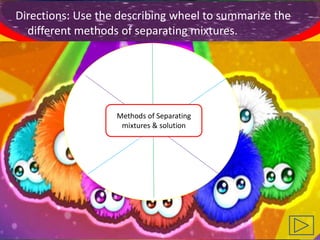
Directions: Use the describing wheel to summarize the
different methods of separating mixtures.
Methods of Separating
mixtures & solution
1. Make a list of all
the household chemicals
that you use at home.
Research on the possible
effects of their
components to the
environment.
2. Why is there a
need to research and
test the effects of the
components of those
substances?
3. How will your
knowledge of mixtures
and solutions help you
understand the
environment?

Methods in separating mixture and solution (CAI)

  • 5.
    What you’ll need? •Small soft drink bottle • Water • Food colouring • 2 tablespoons of cooking oil • Dish washing liquid or detergent
  • 6.
    Procedure: • Add afew drops of food colouring to the water. • Pour about 2 tablespoons of the coloured water along with the 2 tablespoons of cooking oil into the small soft drink bottle. • Screw the lid on tight and shake the bottle as hard as you can. • Put the bottle back down and have a look, it may have seemed as though the liquids were mixing together but the oil will float back to the top.
  • 8.
    FILTRATION  used toseparate an insoluble solid from a liquid.  The solid remains in the filter paper and the liquid goes into the beaker.  The liquid that passes through is the filtrate.  The substance that is left in the filter paper is called the residue. VIDEO
  • 9.
    MECHANICAL SEPARATION  Involvesthe use of forceps, sieve, and other similar tools.  Gravel and sand are separated by picking the gravel or passing the mixture into a wire screen. This process is called sieving.  The use of magnets in separating sulfur powder and iron nails is appropriate when metal is involved. VIDEO
  • 10.
    DECANTATION  Is amethod where solids of a suspension are made to settle down and the liquid materials poured off. VIDEO
  • 11.
    CENTRIFUGATION Is a motor-drivenmachine that speeds up the settling of the precipitate. Uses the centripetal force developed through the rotation of the apparatus. The rotation brings the precipitate to the bottom of the tube, then the centrifugate or supernatant liquid poured off. VIDEO
  • 12.
    DISTILLATION is the evaporationand condensation of volatile liquids. It uses a condenser to transform a gas into a liquid. The more volatile liquid boils and evaporate first, then it is condensed on the cooled area of the set-up. The distillate is the liquid formed after condensation. VIDEO
  • 13.
    FRACTIONAL DISTILLATION  Isa special type of distillation used to separate a mixture of liquids with different boiling points.  Different liquid boil at different temperatures.  When heated, they boil off and condense at different times.  The apparatus features a fractioning column, which ensures that only the liquid boils at its boiling point will pass through the condenser. VIDEO
  • 15.
  • 16.
    Direction: Choose theletter of the correct answer. 1. It is a method where solids of a suspension are made to settle down and the liquid material is poured off. a. Centrifugation b. Decantation c. Filtration
  • 17.
    2. What processinvolves the use of forceps, sieve, and other similar tools? a. Distillation b. Filtration c. Mechanical Separation
  • 18.
    3. ____________ isthe evaporation and condensation of volatile liquids. a.Distillation b. Distillate c. Fractional Distillation
  • 19.
    4. It isused to separate an insoluble solid from a liquid. A .Residue b. Filtration c. Filtrate
  • 20.
    5. What methoduses the centripetal force developed through the rotation of the apparatus? a. Centrifugate b. Centrifuge c. Centrifugation
  • 23.
    Directions: Use thedescribing wheel to summarize the different methods of separating mixtures. Methods of Separating mixtures & solution
  • 27.
    1. Make alist of all the household chemicals that you use at home. Research on the possible effects of their components to the environment.
  • 28.
    2. Why isthere a need to research and test the effects of the components of those substances?
  • 29.
    3. How willyour knowledge of mixtures and solutions help you understand the environment?