Metallic Systems A Quantum Chemists Perspective
Thomas C Allison Ed download
https://ebookbell.com/product/metallic-systems-a-quantum-
chemists-perspective-thomas-c-allison-ed-4421900
Explore and download more ebooks at ebookbell.com
Here are some recommended products that we believe you will be
interested in. You can click the link to download.
Bacterial Cellular Metabolic Systems Metabolic Regulation Of A Cell
System With 13cmetabolic Flux Analysis 1st Edition Kazuyuki Shimizu
https://ebookbell.com/product/bacterial-cellular-metabolic-systems-
metabolic-regulation-of-a-cell-system-with-13cmetabolic-flux-
analysis-1st-edition-kazuyuki-shimizu-4182904
A Systems Biology Approach To Study Metabolic Syndrome Matej Orei
https://ebookbell.com/product/a-systems-biology-approach-to-study-
metabolic-syndrome-matej-orei-52606432
Systems Biology Of Metabolic And Signaling Networks Energy Mass And
Information Transfer 1st Edition M A Aon
https://ebookbell.com/product/systems-biology-of-metabolic-and-
signaling-networks-energy-mass-and-information-transfer-1st-edition-m-
a-aon-4408806
Optical Properties Of Nanostructured Metallic Systems Studied With The
Finitedifference Timedomain Method 1st Edition Sergio G Rodrigo Auth
https://ebookbell.com/product/optical-properties-of-nanostructured-
metallic-systems-studied-with-the-finitedifference-timedomain-
method-1st-edition-sergio-g-rodrigo-auth-2486186
Kondo Effect And Dephasing In Lowdimensional Metallic Systems 1st
Edition T M Jacobs
https://ebookbell.com/product/kondo-effect-and-dephasing-in-
lowdimensional-metallic-systems-1st-edition-t-m-jacobs-4203940
Metallic Nanocrystallites And Their Interaction With Microbial Systems
1st Edition Anil K Suresh Auth
https://ebookbell.com/product/metallic-nanocrystallites-and-their-
interaction-with-microbial-systems-1st-edition-anil-k-suresh-
auth-4110648
Relaxation Phenomena Liquid Crystals Magnetic Systems Polymers Hightc
Superconductors Metallic Glasses 1st Edition W Haase
https://ebookbell.com/product/relaxation-phenomena-liquid-crystals-
magnetic-systems-polymers-hightc-superconductors-metallic-glasses-1st-
edition-w-haase-4204330
Systems Metabolic Engineering Methods And Protocols 1st Edition
Stephan Pabinger
https://ebookbell.com/product/systems-metabolic-engineering-methods-
and-protocols-1st-edition-stephan-pabinger-4177962
Systems Metabolic Engineering 1st Edition Sang Yup Lee Seung Bum Sohn
https://ebookbell.com/product/systems-metabolic-engineering-1st-
edition-sang-yup-lee-seung-bum-sohn-4178518
METALLIC
SYSTEMS
A Quantum Chemist’s
Perspective
METALLIC
SYSTEMS
A Quantum Chemist’s
Perspective
Edited by
Thomas C. Allison
Orkid Coskuner
Carlos A. González
CRC Press is an imprint of the
Taylor & Francis Group, an informa business
Boca Raton London New York
CRC Press
Taylor & Francis Group
6000 Broken Sound Parkway NW, Suite 300
Boca Raton, FL 33487-2742
© 2011 by Taylor and Francis Group, LLC
CRC Press is an imprint of Taylor & Francis Group, an Informa business
No claim to original U.S. Government works
Printed in the United States of America on acid-free paper
10 9 8 7 6 5 4 3 2 1
International Standard Book Number-13: 978-1-4200-6086-7 (Ebook-PDF)
This book contains information obtained from authentic and highly regarded sources. Reasonable
efforts have been made to publish reliable data and information, but the author and publisher cannot
assume responsibility for the validity of all materials or the consequences of their use. The authors and
publishers have attempted to trace the copyright holders of all material reproduced in this publication
and apologize to copyright holders if permission to publish in this form has not been obtained. If any
copyright material has not been acknowledged please write and let us know so we may rectify in any
future reprint.
Except as permitted under U.S. Copyright Law, no part of this book may be reprinted, reproduced,
transmitted, or utilized in any form by any electronic, mechanical, or other means, now known or
hereafter invented, including photocopying, microfilming, and recording, or in any information stor-
age or retrieval system, without written permission from the publishers.
For permission to photocopy or use material electronically from this work, please access www.copy-
right.com (http://www.copyright.com/) or contact the Copyright Clearance Center, Inc. (CCC), 222
Rosewood Drive, Danvers, MA 01923, 978-750-8400. CCC is a not-for-profit organization that pro-
vides licenses and registration for a variety of users. For organizations that have been granted a pho-
tocopy license by the CCC, a separate system of payment has been arranged.
Trademark Notice: Product or corporate names may be trademarks or registered trademarks, and are
used only for identification and explanation without intent to infringe.
Visit the Taylor & Francis Web site at
http://www.taylorandfrancis.com
and the CRC Press Web site at
http://www.crcpress.com
vii
© 2011 by Taylor & Francis Group, LLC
Contents
Introduction.
..............................................................................................................vii
Contributors............................................................................................................ xiii
Chapter 1 First Principles DFT Studies of Metal-Based Biological
and Biomimetic Systems.......................................................................1
Arturo Robertazzi, Alessandra Magistrato, Matteo Dal Peraro,
and Paolo Carloni
Chapter 2 Structural and Thermodynamic Studies of α-Synuclein Proteins
Related to Parkinson’s Disease: Impact of Aqueous Solution and
Fe3+ Coordination................................................................................29
Olivia M. Wise, Liang Xu, and Orkid Coskuner
Chapter 3 Carbohydrate and Trivalent Iron Ion Interactions in the Gas
Phase and in Aqueous Solution...........................................................83
Orkid Coskuner and Carlos A. González
Chapter 4 Aqueous Solutions of Metal Ions......................................................107
Orkid Coskuner and Thomas C. Allison
Chapter 5 Structure of Liquid Metal Surfaces: A First Principles
Perspective.......................................................................................135
Brent Walker, Nicola Marzari, and Carla Molteni
Chapter 6 Some Practical Considerations for Density Functional Theory
Studies of Chemistry at Metal Surfaces.
........................................... 163
Rudolph J. Magyar, Ann E. Mattsson, and Peter A. Schultz
Chapter 7 Computational Investigations of Metal Oxide Surfaces...................201
Emily A. A. Jarvis and Cynthia S. Lo
Chapter 8 Tight Binding Methods for Metallic Systems...................................225
Luis Rincón, Thomas C. Allison, and Carlos A. González
viii Contents
© 2011 by Taylor & Francis Group, LLC
Chapter 9 Density Functional Calculations of Metal Clusters: Structure,
Dynamics, and Reactivity.................................................................267
Dennis R. Salahub, Patrizia Calaminici, Gabriel U. Gamboa,
Andreas M. Köster, and J. Manuel Vásquez
Chapter 10 Density Functional Theory Calculations on Cobalt and
Platinum Transition Metal Clusters.
.................................................. 341
Ali Sebetci
Chapter 11 Exploring the Borderland between Physics and Chemistry:
Theoretical Methods in the Study of Atomic Clusters.
..................... 371
Yamil Simón-Manso, Carlos A. González,
and Patricio Fuentealba
ix
© 2011 by Taylor & Francis Group, LLC
Introduction
The chemistry of metals is rich and diverse. It is important in many traditional dis-
ciplines such as inorganic chemistry, metallurgy, geochemistry, solid state physics,
medicine, and biochemistry among others. It spans many orders of magnitude in
size, from nanoclusters containing a few atoms up to extended macroscopic sol-
ids. It encompasses studies of the properties of pure metals, alloys, nanoparticles,
small metal-containing molecules and biomolecules, as well as the interactions that
occur on and between metal surfaces. Metals and metal-containing compounds may
be studied in all three phases. Other properties of metals of particular interest are
magnetism and electrical conductivity. Bonding with and between metals frequently
involves d orbitals, which adds to the complexity of structures they form. This both
enhances the variety of chemistry that these compounds may exhibit and confounds
simple prediction of their properties. Many metals are of sufficient mass that relativ-
istic effects must be taken into account.
In this book, we explore topics that touch on most, if not all, of the areas listed
above. The topic of metals and metal-containing molecules will be presented from
the viewpoint of the quantum chemist, that is, we are interested in the calculation
of properties of metals and metal-containing molecules using first principles (or
semiempirical) methods. From the perspective of the chemist, we are more fre-
quently interested in molecular properties as opposed to properties of extended
solids, or, rather, we are interested in the chemistry that occurs on the surfaces of
metals. The exploration of this chemistry will take place via calculations of the static
electronic structure and via dynamics calculations.
The book begins with two chapters on biological studies involving metals. As
biological applications frequently take place in solution, the next chapters consider
metals in solution. A chapter on liquid metals leads to the consideration of systems
that are mostly or entirely metallic. There are several chapters on metal surfaces fol-
lowed by a presentation of the theory and application of tight-binding methods that
have been used to study metals for a long time. The chapter on tight-binding methods
includes a discussion of metallic nanoparticles, which continues through the remain-
der of the book. The chapters are largely independent and may be read in any order
without loss of continuity.
Throughout the chapters, there is presentation of the underlying theory as well as
practical advice for the application of these methods. The reader will gain an appre-
ciation for the subtlety and complexity of many calculations while learning how to
approach the simulation of such systems.
In the remainder of this introduction, we will briefly discuss the theory underly-
ing the methods presented in this book and give a brief introduction to each of the
chapters. We acknowledge that while the material presented in this book covers a
wide range of topics, it is by no means a complete discussion of the chemistry of met-
als. Likewise, it would take several volumes to adequately describe the theory under-
lying the calculations presented in this book. We will content ourselves to introduce
x Introduction
© 2011 by Taylor & Francis Group, LLC
a few of the salient details and provide references that the unfamiliar reader may
consult for a deeper discussion of this important topic.
The fundamental equation of quantum chemistry is, of course, the Schrödinger
equation
H E
Ψ Ψ
= (I.1)
where
H is the Hamiltonian operator
Ψ is the wavefunction
E is the energy
The main occupation of the quantum chemist, then, is to solve this equation for the
molecular system of interest. There is lengthy literature on the Schrödinger equa-
tion and methods for its solution. The unfamiliar reader may wish to consult an
introductory text [1–3] for a solid introduction to the theory and practice of quantum
chemistry calculations. For readers desiring a more in-depth treatment of the subject,
several advanced texts are available [4–6]. Several chapters in this book also contain
discussions of the theory.
Solution of the Schrödinger equation usually involves the Born–Oppenheimer
approximation that separates Equation I.1 into an electronic structure problem and
a dynamics problem. This approximation gives rise to the concept of the potential
energy surface in which the potential energy of a molecular system is expressed as
a function of the positions of the nuclei. The electronic structure problem is solved
under the assumption that the nuclei remain in a fixed position. The dynamics prob-
lem then considers the motion of the nuclei on the potential energy surface.
One may broadly divide the methods for solution of the electronic structure
problem into three categories: semiempirical methods, ab initio methods, and den-
sity functional theory (DFT) methods. Semiempirical methods include traditional
semiempirical methods in quantum chemistry (e.g., AM1, PM3, PM6) as well as
extended Hückel and tight-binding methods. These methods generally neglect some
terms in the Hamiltonian and approximate others to gain computational speed at the
expense of rigorous solution. The loss in accuracy is usually compensated through
parameterization to accurate data (either from experiment or higher-level theory).
Ab initio is taken to mean those methods based on the Hartree–Fock equations.
Examples include the Hartree–Fock method, Møller–Plesset perturbation theory
methods, coupled-cluster methods, and multi-reference methods [4,5]. Finally, DFT,
typically realized through the Kohn–Sham method [6], will form the basis for most
of the calculations presented in this book.
It is difficult to overstate the importance of the Kohn–Sham DFT method in the
treatment of metallic systems. There are many functionals available that permit the
efficient and accurate treatment of metallic systems. DFT methods are the driving
force behind the advances made in this area. Many chapters in this book emphasize
the importance of DFT and discuss the underlying theory. The interested reader is
directed to two recent reviews for a comprehensive review of many topics related to
the subject at this book [7,8].
xi
Introduction
© 2011 by Taylor & Francis Group, LLC
Analogous to the importance of DFT in the solution of the electronic structure
problem, the Car–Parrinello method [9] for performing molecular dynamics calcula-
tions is one of the primary tools available to the quantum chemist. Car–Parrinello
molecular dynamics (CPMD) calculations, which are based on DFT calculations,
are efficient and accurate for a wide variety of chemical studies of metallic systems.
These methods are discussed in several chapters.
At the heart of many biological processes are molecules whose function depends
on the metal atoms they contain. Chapter 1 is concerned with understanding such
molecules with molecular detail. Topics in this chapter include first principles calcu-
lations of biomolecules and pharmaceuticals, the incorporation of solvation effects
via explicit solvent models, and studies of chemical reactivity. These topics are pre-
sented through several interesting applications.
Metal ions in solution can have significant effects on nearby molecules. In
Chapter 2, chemical dynamics calculations are used to investigate interactions
between metal ions and carbohydrates. The importance of using dynamics methods
that are based on ab initio calculations of the potential energy surface (as opposed
to classical force field methods) is emphasized. Results are presented both in the gas
phase and in solution, thus highlighting the role of the solvent.
The techniques introduced in Chapter 2 are used again in Chapter 3, this time
to explore the interactions of iron ions with α-synuclein proteins and the role that
this interaction may play in Parkinson’s disease. This chapter highlights the value
of chemical computation in obtaining molecular detail about important biological
processes that may ultimately lead to the development of more effective treatments.
Significant attention is given to classical molecular dynamics calculations, and the
value and limitations of these calculations versus their quantum counterparts are
discussed. Again, the role of the solvent is emphasized.
The discussion of metal ions in aqueous solutions, a central theme in the preced-
ing two chapters, culminates in Chapter 4. In this chapter, the effect of a metal ion
on surrounding water molecules is considered. Although on the surface this seems to
be simpler than the systems considered in the preceding chapters, the reader will dis-
cover the rich and detailed dynamics of these solutions. In particular, topics such as
the migration of a proton through aqueous solution and the formation of Zundel and
Eigen complexes are discussed. As before, the primary tool is chemical dynamics
calculations, but these are augmented with a rare event sampling technique known as
transition path sampling that is essential to the study of these systems.
The focus of the book shifts to liquid metal surfaces in Chapter 5. Such systems
have considerable industrial importance. In this chapter, dynamics simulations
based on DFT calculations are used to obtain molecular level detail of the layering
of various liquid metals. Attention is given to the comparison of simulation results
with experimental results. Liquid sodium surfaces are presented in detail with an
emphasis on the role played by geometrical confinement in the layering of these
systems.
Chapter 6 presents a wealth of practical advice on the calculation of solid metal
surfaces. This chapter contains a detailed discussion of the importance of DFT
in calculations on metals. The two main themes in this chapter are the choice of
the exchange-correlation potential and the choice of pseudopotential in these
xii Introduction
© 2011 by Taylor & Francis Group, LLC
calculations. The development of these topics in this chapter will be of great value to
most researchers wishing to perform calculations on metal surfaces.
The theme of metal surfaces is continued in Chapter 7, but this time with an
emphasis on the formation and properties of oxides. The role played by quan-
tum chemical computation is illustrated through a discussion of Al2O3 and Fe2O3
surfaces. The importance of metal oxides is discussed in the context of applica-
tions of current relevance in areas such as catalysis, environmental chemistry,
and energy.
In Chapter 8, an important semiempirical technique—tight binding—is dis-
cussed both from a historical perspective and from an application-oriented point
of view. The importance of the tight-binding method to larger molecular systems
is discussed. Several practical applications of the method are described such as
the determination of global minima of nanoclusters and the computation of optical
properties. Since tight-binding methods can be applied at much lower computational
expense than methods such as DFT, several aspects of their implementation that
impact performance are discussed, namely, parallelization and the role of sparse
matrix techniques.
Nanoclusters of metal atoms, introduced in Chapter 8, are the main subject of
the remainder of the book. Chapter 9 continues the discussion of metal clusters
from the point of view of the developers of a DFT code, deMon. The develop-
ment of DFT is discussed from its earliest realizations through the various meth-
ods implemented in the deMon code and up to the present version of the code,
deMon2k. A wide variety of properties and metals are discussed along with present
and future capabilities.
Chapter 10 contains a detailed investigation of cobalt and platinum nanoclusters.
Topics such as magnetism and spin-orbit coupling effects are investigated. Particular
attention is given to the dramatic changes that occur in properties of the nanocluster
upon the addition of single atoms, a theme that is also discussed in Chapter 11, and
due to changes in the charge of the nanocluster.
The book concludes in Chapter 11 with another perspective on metal clusters.
Special attention is given to methods for the optimization of nanoclusters, to the
electron localization function for determining chemical bonding, and to the Fukui
function for predicting reactivity. This chapter also explores the onset of magnetism
in nanoclusters and thin films of gold.
REFERENCES
1. W. A. Harrison, 1999, Elementary Electronic Structure, Singapore, World Scientific
Publishing Company.
2. C. J. Cramer, 2002, Essentials of Computational Chemistry, Theories and Models,
Chichester, England, John Wiley & Sons Ltd.
3. R. M. Martin, 2004, Electronic Structure: Basic Theory and Practical Methods,
Cambridge, U.K., Cambridge University Press.
4. A. Szabo and N. Ostlund, 1982, Modern Quantum Chemistry: Introduction to Advanced
Electronic Structure Theory, New York, Macmillan Publishing Co.
5. W. J. Hehre, L. Radom, P. R. Schleyer, and J. A. Pople, 1986, Ab Initio Molecular
Orbital Theory, New York, Wiley.
xiii
Introduction
© 2011 by Taylor & Francis Group, LLC
6. R. G. Parr and W.Yang, 1989, Density-Functional Theory of Atoms and Molecules, New
York, Oxford University Press.
7. P. Huang and E. A. Carter, Advances in correlated electronic structure methods for sol-
ids, surfaces, and nanostructures, Annu. Rev. Phys. Chem., 2008, 59, 261–290.
8. C. J. Cramer and D. G. Truhlar, Density functional theory for transition metals and tran-
sition metal chemistry, Phys. Chem. Chem. Phys., 2009, 11, 10757–10816.
9. R. Car and M. Parrinello, Unified approach for molecular dynamics and density-
functional theory, Phys. Rev. Lett., 1985, 55, 2471–2474.
xv
© 2011 by Taylor & Francis Group, LLC
Contributors
Thomas C. Allison
Chemical and Biochemical Reference
Data Division
National Institute of Standards and
Technology
Gaithersburg, Maryland
Patrizia Calaminici
Departamento de Química
Centro de Investigación y de Estudios
Avanzados
Avenida Instituto Politécnico Nacional
2508
Col. San Pedro Zacatenco, México
Paolo Carloni
German Research School for Simulation
Sciences GmbH
Jülich, Germany
and
International School for Advanced
Studies
Statistical and Biological Physics Sector
Italian Institute of Technology
Trieste, Italy
Orkid Coskuner
Department of Chemistry
The University of Texas
San Antonio, Texas
Matteo Dal Peraro
Institute of Bioengineering, School of
Life Sciences
Ecole Polytechnique Federale de
Lausanne
Swiss Federal Institute of Technology
Lausanne
Lausanne, Switzerland
Patricio Fuentealba
Departamento de Física
Facultad de Ciencias
Universidad de Chile
Santiago, Chile
Gabriel U. Gamboa
Departamento de Química
Centro de Investigación y de Estudios
Avanzados
Avenida Instituto Politécnico Nacional
2508
Col. San Pedro Zacatenco, México
Carlos A. González
Chemical and Biochemical Reference
Data Division
National Institute of Standards and
Technology
Gaithersburg, Maryland
Emily A. A. Jarvis
Department of Chemistry
Loyola Marymount University
Los Angeles, California
Andreas M. Köster
Departamento de Química
Centro de Investigación y de Estudios
Avanzados
Avenida Instituto Politécnico Nacional
2508
Col. San Pedro Zacatenco, México
Cynthia S. Lo
Department of Energy, Environmental,
and Chemical Engineering
Washington University
Saint Louis, Missouri
xvi Contributors
© 2011 by Taylor & Francis Group, LLC
Alessandra Magistrato
Permanent Research Staff
CNR-INFM-Democritos National
Simulation Center and International
School for Advanced Studies
(SISSA/ISAS)
Trieste, Italy
Rudolph J. Magyar
Multiscale Dynamic Materials
Modeling Department
Sandia National Laboratories
Albuquerque, New Mexico
Nicola Marzari
Department of Materials Science and
Engineering
Massachusetts Institute of Technology
Cambridge, Massachusetts
Ann E. Mattsson
Multiscale Dynamic Materials
Modeling Department
Sandia National Laboratories
Albuquerque, New Mexico
Carla Molteni
Physics Department
King’s College London
London, United Kingdom
Luis Rincón
Chemical and Biochemical Reference
Data Division
National Institute of Standards and
Technology
Gaithersburg, Maryland
and
Departamento de Quimica
Facultad de Ciencias
Universidad de Los Andes
Merida, Venezuela
Arturo Robertazzi
Department of Biology, Chemistry,
Pharmacy
Free University of Berlin
Berlin, Germany
and
Istituto Nazionale per la Fisica della
Materia
Consiglio Nazionale delle Ricerche
Laboratorio sardo for Computational
Materials Science
Dipartimento di Fisica
Università di Cagliari
Monserrato, Italy
and
International School for Advanced
Studies
Trieste, Italy
Dennis R. Salahub
Department of Chemistry
Institute for Biocomplexity and
Informatics
Institute for Sustainable Energy,
Environment, Economy
University of Calgary
Alberta, Canada
Peter A. Schultz
Multiscale Dynamic Materials
Modeling Department
Sandia National Laboratories
Albuquerque, New Mexico
Ali Sebetci
Computer Engineering Department
Zirve University
Gaziantep, Turkey
Yamil Simón-Manso
Chemical and Biochemical References
Data Division
National Institute of Standards and
Technology
Gaithersburg, Maryland
xvii
Contributors
© 2011 by Taylor & Francis Group, LLC
J. Manuel Vásquez
Departamento de Química
Centro de Investigación y de Estudios
Avanzados
Avenida Instituto Politécnico Nacional
2508
Col. San Pedro Zacatenco, México
Brent Walker
London Centre for Nanotechnology
University College London
London, United Kingdom
Olivia M. Wise
Department of Chemistry
The University of Texas
San Antonio, Texas
Liang Xu
Department of Chemistry
The University of Texas
San Antonio, Texas
1
© 2011 by Taylor & Francis Group, LLC
1 First Principles
DFT Studies of
Metal-Based Biological
and Biomimetic Systems
Arturo Robertazzi, Alessandra Magistrato,
Matteo Dal Peraro, and Paolo Carloni
1.1 INTRODUCTION
Metal elements play a pivotal role in many aspects of living organisms, from the
stabilization of nucleic acids (RNA and DNA) to a variety of proteins.1–5 One of the
most peculiar features of metal elements is their ability to be oxidized and bind to
(or otherwise interact with) electron-rich biological molecules, such as proteins and
DNA. Natural evolution has led living organisms to employ metal elements exten-
sively in a wide variety of tasks. For instance, approximately one-third of known
enzymes contains metals.1,6 Metal ions promote a number of chemical processes
including bond cleavage and formation, electron transfer, and radical reactions.6
These processes are central to many biological phenomena, such as DNA synthesis
and replication, cellular energy production, and O2 generation, sensing and trans-
port.6 Iron and copper are essential elements in mammalian metabolism: iron is
the metal constituent of heme in hemoproteins such as hemoglobin and myoglobin
and copper is relatively abundant in the ferroxidases ceruplasmin and haphaestin
and in other enzymes such as cytochrome c oxidase.7 Magnesium is, with few
CONTENTS
1.1 Introduction.......................................................................................................1
1.2 Density Functional Theory and Its Application to Biological Systems............3
1.3 Discussion..........................................................................................................6
1.3.1 Solvent Effects on Nitrogen Fixation Biomimetic Molybdenum
Catalyst..................................................................................................6
1.3.2 Platinum Anticancer Complexes.........................................................10
1.3.3 Catalytic Mechanism of Metallo β-Lactamases.
.................................15
1.4 General Conclusions........................................................................................21
References.................................................................................................................22
2 Metallic Systems: A Quantum Chemists’s Perspective
© 2011 by Taylor & Francis Group, LLC
exceptions, the metal ion of choice in the enzymes involved in the biochemistry
of nucleic acids, while potassium is close to DNA in the cell.8 Zinc plays a struc-
tural and catalytic role in a large number of proteins, enzymes, and transcription
factors.9,10 Manganese-containing enzymes have a wide range of functionalities,
especially in redox-active biomolecules such as manganese catalase and superox-
ide dismutase.11
Not only are metal elements vital in many biological phenomena, but they can
also be exploited in therapeutics: medicinal applications have been known for
almost 5000 years.1 The development of modern medicinal inorganic chemistry
has been fueled by the serendipitous discovery of cisplatin as an anticancer agent
at the beginning of the 1960s.12 Since then, the application of metal-based drugs
for therapeutics has experienced tremendous and continuous growth.13 Nowadays,
research is fervent with the aim of providing effective anticancer, antibiotic, anti-
bacterial, antiviral, and radio-sensitizing agents exploiting the special features of
metal elements.1 Besides platinum, whose complexes are probably the best-studied
metal-based compounds in therapeutics, many other metal complexes are currently
being used, tested, or designed.13 A great hope lies in ruthenium compounds as a
valid alternatives to cisplatin for the treatment of cancer.14 Examples of the latter
include NAMI-A,15 ICR,16 and Salder’s compounds.17,18 Furthermore, complexes of
V,19 Au,20 Rh,21 Ir,22 and Cu23 are considered potentially active against tumors fea-
turing a diversity of mechanisms of action. Another important field of bioscience
in which metals can play an important role is the research for artificial compounds
that can mimic biosystems. One of the most recent and striking examples of this is
the molybdenum-based catalyst of Yandulov and Schrock, which promotes nitrogen
fixation under mild conditions.24–30
The impressive improvements achieved by theoretical methods have provided
an important support to biosciences in many fields.31–34 In particular, the theoreti-
cal investigation of biological systems has now achieved the necessary maturity to
complement the experimental approach. For example, quantum mechanical (QM)
calculations are applied to drug design and to the prediction of spectroscopic phe-
nomena.35–41 The advantage of QM calculations with respect to force fields based
methods is that they account for quantum electronic effects and can therefore
describe bond forming/breaking phenomena, polarization effects, and charge trans-
fer along with an accurate estimation of reaction (free) energies.
Unfortunately, the investigation of systems of biological relevance with first
principles methods is not straightforward as many issues render their application
rather awkward, among which the timescale problem is perhaps the most difficult to
solve.32,42,43 A complete QM description of biomolecules, with the exception of few
remarkable instances,44,45 is, in fact, beyond the possibility of present theories and
computer power. First, biological processes occur in aqueous solution (and/or mem-
branes), i.e., to achieve an accurate description of the system, solvation effects cannot
be neglected. However, modeling solvation is one of the most critical challenges of
QM calculations,40,46–48 due to the size of the system, the large number of degrees of
freedom and the effects of counter ions. Second, most biological phenomena occur
around 300K, and temperature effects should be taken into account. A further com-
plication is the dynamical effects on both short and long time scales that become
3
First Principles DFT Studies
© 2011 by Taylor & Francis Group, LLC
crucial for many biochemical phenomena that take place in the living cell.40 The use
of Density Functional Theory (DFT), possibly coupled with molecular mechanics or
molecular dynamics methods, may help to overcome most of these issues.35,39,40,48–52
In the first instance, DFT methods represent an excellent trade-off between accuracy
and computer requirements, particularly suitable for the investigation of biological
systems.35,40 The simple principle on which DFT is based is that of expressing the
total energy of the system as a functional of the electron density.53,54 This leads to
the treatment of correlation effects at a lower computational cost than that of more
rigorous post-Hartree–Fock methods. QM (and in particular DFT) methods can be
coupled with molecular mechanics in the well-known QM/MM approaches.55–58 In a
typical protocol, a relatively small region of the entire model, e.g., the active site of
an enzyme or the solute in an aqueous solution, is described at the DFT level, with
the remainder being treated within the MM level. Based on this approach, a myriad
of studies have been successfully completed in recent years.35,36,39,40,44,51,52,59–65
In this review, we illustrate some examples of how DFT calculations may be
employed to address crucial issues of biological simulations. Our contribution is
clearly limited to a few examples taken from our studies and does not cover impor-
tant studies from several other research groups. For other surveys on this topic the
reader is directed to the following references.31,32,34,40,49,50,52
Our focus is on DFT and on QM(DFT)/MM methods applied to metal-­
containing
biosystems. First, an intriguing example of solvation effects in the Yandulov and
Schrock biomimetic nitrogen fixation is discussed.24–30 Second, the important con-
tribution played by QM/MM calculations for macromolecules such as DNA and
proteins is covered. In particular, examples of platinum-containing anticancer com-
pounds interacting with DNA fragments are proposed,66–68 as well as the reactivity
of specific zinc-containing proteins. Each of the following sections describes the
limitations as well as the potential of DFT methods with the overall goal of convinc-
ing the reader that these calculations are central to modern biosciences and can offer
a solid complement to the experimental approach.
1.2 
DENSITY FUNCTIONAL THEORY AND ITS
APPLICATION TO BIOLOGICAL SYSTEMS
This section illustrates the basic elements of the theoretical tools employed in the
selected examples discussed below. It is clearly beyond our aims to propose a rig-
orous description of DFT-based methods, which is already available in many text
books53,54,69,70 and in recent reviews.32,34,35,40,42,48,50–52
The electron correlation, i.e., the quantum interaction of electrons, is central to
achieving a quantitative theoretical description of natural processes, especially those
for which, for instance, hydrophobic forces, weak H-bonding, transition metals,
covalent bond breaking/forming are important. The most rigorous approach to take
into account this physical feature is the use of post-Hartree–Fock (post-HF) meth-
ods, such as Møller–Plesset or coupled cluster methods. Successful applications of
these two systems of biological relevance are reviewed in references.32,42,43 However,
biological systems often contain many heavy atoms, and high-level correlated meth-
ods become rapidly prohibitive in computer time and resources. DFT, in contrast,
4 Metallic Systems: A Quantum Chemists’s Perspective
© 2011 by Taylor  Francis Group, LLC
offers a reasonable (mostly based on empirical corrections) treatment of electron
correlation at computational cost similar to that of HF calculations:35,40,51–54 for this
reason, DFT is the most common correlated method employed for investigation of
proteins and DNA.35,40,51–54
Fermi and Thomas developed a model in which they suggested that the ground
state energy of a system may be connected to the overall electron density of the sys-
tem itself.71,72 The breakthrough came with the work of Hohenberg and Kohn about
40 years later.73 They showed that the ground-state energy of a system is uniquely
defined by its overall electron density. In other words, the energy is a unique func-
tional of the electron density. Shortly thereafter, Kohn and Sham, by replacing the
kinetic energy of the interacting electrons with that of a noninteracting system, pro-
posed the final expression of the ground-state electronic energy.74 For a rigorous
description of DFT methods the reader is directed to the following references.75,76
One of the most delicate points of the DFT theory is the expression of the
exchange–correlation functional in terms of electron density, which if correctly
determined could lead to the exact solution of the many-body problem. To date, no
exact analytical form of the exchange–correlation functional in terms of the elec-
tron density has been formulated. However, even very simple approximations to the
exchange–correlation functional can give satisfactory results. For instance, the sim-
plest local density approximation (LDA), which replaces the exchange–correlation
energy density of the real system with that of an homogeneous electron gas of the
same density, is known to yield excellent results for solids,40 but performs poorly for
molecules. Thus, when dealing with biological systems, more sophisticated approxi-
mations are required. For instance, within the gradient-corrected approximation, the
exchange–correlation functional depends on the electron density as well as on its
gradient. A typical example is the exchange functional proposed by Becke, used
in combination with Lee, Parr, and Yang’s correlation functional, i.e., the BLYP
functional.77,78 Many other functionals have been designed that perform well for a
wide range of chemical and biochemical systems including BP,79,80 PBE,81,82 and
PW91.83–85 However, a further improvement to the accuracy of the exchange cor-
relation functional has been achieved by combining the exchange functional with
HF exact exchange. This approach led to the development of the so-called hybrid
functionals, such as the very popular B3LYP.77,78
Biological processes take place in a complex environment consisting of thou-
sands of atoms, and the straightforward application of DFT (or of other QM meth-
ods) to DNA oligonucleotides, proteins, and enzymes is difficult or impossible. The
most commonly used approach to elude the size limitation is the combination of
DFT (or other QM methods) with classical force-field-based molecular mechanics
in the so-called QM/MM approaches.35,36,49,50,86–88 In these methods the system is
partitioned in two or more regions (or layers) where different levels of theory can
be applied. The chemically relevant part of the system is often described quantum
mechanically, whereas the remainder of the system is treated with a more efficient
molecular mechanics method. The choice of QM region is not trivial as solvent mol-
ecules, counter ions and part of protein/DNA may be directly involved in the process
of interest. In addition, a proper treatment of the long-range electrostatic interac-
tions between the QM and MM atoms is crucial to obtain reliable results.35,40,50–52
5
First Principles DFT Studies
© 2011 by Taylor  Francis Group, LLC
Nowadays, several QM/MM schemes are available: for a detailed description of
these methods, see for example.50,55–58,86,89,90 Among these, the QM/MM approach in
combination with the Car–Parrinello molecular dynamics (CPMD) scheme has been
extensively employed for the studies reported below.35,51,52,91 Within this scheme,
simulations are typically performed by using plane wave (PW) basis sets rather
than localized functions as the former perform better for first principles molecular
dynamics of large systems. PW basis sets have further advantages,40 e.g., conver-
gence can be easily monitored by increasing the number of PWs that, unlike local
basis sets, depends on one parameter, i.e., the cutoff energy; PWs are completely
unbiased and do not suffer from basis set superposition error which affects local
basis sets. Pseudopotentials (which can be applied to local basis sets as well) are
employed for the core electrons, providing a great computational advantage as only
valence electrons are explicitly described. Relativistic effects, which are crucial for
heavy metals may also be included in pseudopotentials. It has to be stressed that the
choice of the basis sets is crucial for the reliability of the theoretical description,
and special care has to be taken for charged molecules, and for those systems in
which intermolecular forces (such as H-bonding and/or hydrophobic interactions,
vide infra) play an important role.53,54
Albeit widely applied, DFT methods as implemented suffer severe limitations.
Even the popular B3LYP and BLYP exchange–correlation functionals tend to under-
estimate reaction barriers of chemical processes compared to MP2 calculations.36,92–94
This may be due to the failure of gradient-corrected functionals in describing three-
center, two-electron chemical bonds as previously reported.40 When predicting reac-
tion barriers, the accuracy of DFT functional becomes a crucial consideration and the
functional employed should always be compared with higher-level calculations (usu-
ally HF-based calculations with explicit electron correlation) and/or experimental
data. Moreover, DFT functionals are not capable of rigorously describing dispersive
forces which play a fundamental role in many aspects of chemistry and biochemis-
try.95–97 For instance, π-stacking is central to the correct function of proteins and in
determining the packing of DNA base pairs.98,99 Current implementations of gra-
dient-corrected exchange–correlation functionals prevent accurate descriptions of
π-stacking since long-range electron correlation is not included. Fortunately, recent
advances allow such problems to be partially overcome.100–110
A further issue that affects DFT calculations is the so-called self-interaction
problem.32,34,35 Unlike HF theory, the self-interaction term in Coulomb interaction
is not fully cancelled by the approximate self-exchange term.75 This may lead to an
unphysical localization of the spin densities in open shell systems (such as heavy
metals), although a few cases of reasonable agreement between DFT calculations
and experimental spin density exist.111–113 Several schemes to overcome this error
have been proposed, but they are generally too computationally demanding to be
extensively employed in QM/MM molecular dynamics (QM/MM MD).40
The final scenario is that DFT calculations have to be performed carefully and
comparison with experimental data and/or higher-level calculations is essential to
provide a correct picture of the system of interest. Yet once the model has been built
carefully, the exchange–correlation performance rigorously checked, the suitable
basis set chosen, and the system properly partitioned into QM and MM layers, DFT
6 Metallic Systems: A Quantum Chemists’s Perspective
© 2011 by Taylor  Francis Group, LLC
becomes a powerful predictive tool, ideal for the study of large biological systems
containing metal elements.
1.3 DISCUSSION
1.3.1 
Solvent Effects on Nitrogen Fixation
Biomimetic Molybdenum Catalyst
Nitrogen fixation, i.e., the conversion of molecular nitrogen to ammonia, is a key
reaction in nature, performed by a number of different prokaryotes including bac-
teria, actinobacteria and certain types of anaerobic bacteria.24,114,115 The nitrogenase
enzyme catalyzes nitrogen fixation at room temperature through complex reactions
that are not fully understood.116 Artificial nitrogen fixation, instead, requires high
temperature and strong pressure and it is industrially achieved by the well-known
Haber–Bosch reaction.117 For years, coordination chemists have been searching for a
nonbiological catalyst that will render the nitrogen fixation under mild ambient con-
ditions feasible.118,119 Among many adopted strategies, those based on biomimetics
(i.e., compounds that perform a similar chemical reaction to that of natural enzymes)
of Fe- and Mo-containing nitrogenase enzyme seemed to be the most promising.120,121
The search for the “Holy Grail of coordination chemistry”122 was over in 2002,30
when a molybdenum triamidoamine chelate complex ([Mo(hiptN3N)], where
hiptN3N=tris(hexaisopropylterphenyl)triamidoamine, Figure 1.1A and B)25–30 was
shown to catalyze the reduction of molecular nitrogen to ammonia with high effi-
ciency at room temperature. The catalytic process proceeds with the slow addi-
tion of a proton source (2,6-lutidiniumBAr4 where Ar is 3,5-(CF3)2C6H3, hereafter
referred to as LutH+ and Lut in the protonated and deprotonated forms respec-
tively, Figure 1.1C) and a reducing agent (decamethylcromocene) to a solution of
the catalyst in liquid heptane at ambient conditions (Figure 1.1D). Clearly, a full
description of the single steps of the whole process is extremely important not
only to comprehend the Yandulov and Schrock cycle in detail, but also to obtain
hints about the intricate functioning of the enzymes that naturally perform nitro-
gen fixation. While many intermediates of the cycle were experimentally char-
acterized,26,27,29 an exhaustive understanding of the molecular processes is still
lacking.24 To support the experimental research, DFT calculations, in vacuo and
corrected with implicit solvation models,123 were performed and provided prelimi-
nary insights into these reactions.122,124,125 While structural characterization of the
compounds was satisfactory, energetics of the catalytic cycle turned out to differ
remarkably from the available experimental data.26,27,125 In particular the exother-
mic character of the two protonation steps for which experimental data are avail-
able (step I=MoNNH+H+ → MoNNH2
+
and step II=MoN+H+ →MoNH+) was
overestimated (Figure 1.1D and Table 1.1), e.g., the free energy was predicted to
be too negative by these calculations.27,125 Such a discrepancy (that is well beyond
the standard DFT error, 3–5kcal mol−1)94 may be caused by many factors including
(i) the choice of the exchange and correlation functionals, (ii) the solvation model,
and (iii) the lack of a rigorous treatment of entropic effects. In this section we shall
describe an extensive study aimed at finding the reasons of the apparent failure of
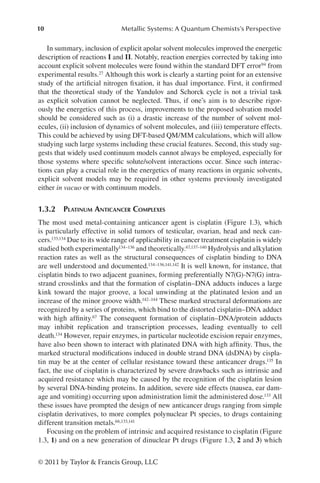
7
First Principles DFT Studies
© 2011 by Taylor  Francis Group, LLC
i-Pr
i-Pr
i-Pr
i-Pr
i-Pr i-Pr
HIPT
TPIH
TPIH
N
N
N
N
N
N
Mo
Mo
Na
N
N
NH3 N2
Mo
Mo-N2
2
3
12
13
14
1
11
+H
+
+H
+
+
+H+
+H
+
+H+
+H+
+e
–
+c
–
+e
–
Mo-NNH2
Mo-NNH
1+
Mo-NNH2
Mo-NH2
1+
Mo-NH2
Mo-NH3
1+
Mo-NH3
Mo-NH
7
6
HIPT
HIPT HIPT
N
N
N
N
N Mo
NH
Step II
Step I
N N
N
N
Mo
HIPT
TPIH
TPIH TPIH
TPIH
TPIH
TPIH
TPIH
+
TPIH
NH NH2
N
N
N
N
N
N
N
N
N
N
Mo Mo
NH3
(A) (B) (C)
(D)
HIPT=
FIGURE 1.1 (A) Experimental catalyst and (B) theoretical model. (C) Proton source, LutH+.
(D) Reactions I and II from the putative nitrogen fixation cycle. (Reprinted with permission
from Alessandra Magistrato et al., J. Chem. Theory Comput., 3(5), 1708. Copyright 2007
American Chemical Society.)
TABLE 1.1
Reaction Energies in Solution (ΔER, kcal/mol) of Step I and Step II:
DFT vs. Experimental Results
DFT Expt.
C6H6 C7H16 C6H6
B3LYP
(PCM)a BHHa,d BHHc,d
B3LYP
(PCM)b BHHa,d BHHc,d
Step I −8.7 4.7 2.9 −10.2 −5.3 −4.7 0
Step II −7.9 6.4 4.6 −13.2 −3.6 −3.0 −1
a With 6–31+G(d).
b B3LYP/TZVP, Ref. 125.
c With BHH/6–311++G(d,p).
d Considering solvated LutH+ and Lut with four solvent molecules.
8 Metallic Systems: A Quantum Chemists’s Perspective
© 2011 by Taylor  Francis Group, LLC
DFT on steps I and II of the Yandulov and Schrock cycle for which experimental
results are known (Figure 1.1).
From the comparison of calculated structural and electronic properties with experi-
mental data we concluded,126 in agreement with experimental findings, that the large
hexaisopropylterphenyl (HIPT) substituents mainly play a steric role,115 preventing the
formation of catalyst dimers. Indeed, further DFT calculations confirmed that the cho-
sen model (Figure 1.1B) without the HIPT substituents is the best trade-off between
accuracy and computational costs to explore the energetic profile of dinitrogen reduc-
tion at a single Mo center. In order to study the interaction between solvent molecules
and the solutes, many DFT functionals were used; among these Becke’s “half-and-
half” functional (BHH) was extensively employed to account for possible disper-
sive interactions.77 This functional, combined with medium-sized basis sets (such as
6–31+G*, for instance), can reproduce both geometries and energies of correlated
ab initio methods for several archetypal π-stacked complexes.100 Many recent studies
have further confirmed that the BHH functional can provide crucial information for
molecular systems dominated by dispersive forces.101,106,109,127,128 The atoms in mol-
ecules (AIM) theory129,130 were then employed to characterise intermolecular interac-
tions between solute and solvent molecules of the studied systems. It has to be stressed
that electron density, at the so-called bond critical points (BCPs) of the AIM topology
is a valuable tool to quantify chemical bonds and intermolecular interactions.100,129–132
In agreement with previous findings, geometries of molybdenum complexes were
well reproduced by several DFT functionals,126 whereas reaction energies (ΔER) of
steps I and II calculated in the gas-phase strongly differed from experimental values,
with an overestimation larger than ∼15kcal mol−1 (data not shown).122,125 The inclu-
sion of solvent effects with an implicit solvent model (i.e., PCM)123 as previously
suggested125 hardly improved DFT performance (Table 1.1). Since reaction energies
have been demonstrated to be rather independent of the exchange correlation func-
tional used,122,125 and PCM was unable to significantly improve the in vacuo energies
(Table 1.1),125 the lack of an explicit description of solvent effects seemed to be one
of the most likely reasons for the poor energetic agreement. Both molybdenum com-
pounds and the proton source have aromatic rings which may interact significantly
with apolar solvent molecules via C—H…π and π…π interactions. While individu-
ally weak, these interactions may play a significant role in the energetics of reac-
tions I and II. In order to address this issue, the effect of an increasing number of
explicit solvent molecules (from one up to four) on the energetics of steps I and II
was explored. Both benzene and heptane molecules were chosen: the former is the
solvent in which available experiments were carried out and the latter is the most
suitable solvent to perform the entire catalytic cycle.25–30 For this preliminary study,
no more than four solvent molecules were considered as the size of the system rap-
idly becomes prohibitive for DFT calculations combined with medium/large basis
sets such as 6–31+G*. Nevertheless, we were confident that four solvent molecules
were a good trade-off between computational costs and a reasonable description of
solvation effects. Indeed, four solvent molecules occupied the entire space around
the solute, i.e., further solvent molecules would probably interact with one of the
solvent molecules rather than with the solute.126 In addition, solvation energies esti-
mated with three and four solvent molecules hardly differed.126
9
First Principles DFT Studies
© 2011 by Taylor  Francis Group, LLC
This approach clearly showed that the strongest solvation effects (with either ben-
zene or heptane molecules) were occurring for the proton source, rather than for
the catalyst. Also, the molybdenum complexes employed in experiments are even
larger than the model used in this study, with the metal center being less accessible
to solvent molecules, i.e., the real effect of solvent molecules is expected to be even
smaller than that observed in our calculations.
As reported in Table 1.1, once solvation effects were included in the estimation of
reaction energies, the discrepancy between experimental free energies and calculated
reaction energies was drastically reduced to less than ∼5kcal mol−1,126 leading to rea-
sonable agreement between experimental and calculated reaction energies. Moreover,
our calculations suggested that reactions in heptane are expected to be only slightly
exothermic, in line with experimental measurements carried out in benzene.126
The reasons behind such a strong solvent effect were revealed by analysis of the
solvation energies of the compounds involved in the reactions and by the atoms-in-
molecules approach. These clearly showed that LutH+ undergoes a larger stabiliza-
tion than Lut in the presence of explicit solvent. In particular, Figure 1.2 displays a
schematic view of C—H…π interactions between heptane molecules and both forms
of proton source (Figure 1.2A′-B′). Lut(heptane)4 has seven BCPs corresponding to
C—H…π interactions with a total electron density (ρTOT) equal to 0.0497 au, where
LutH+(heptane)4 shows nine BCPs with ρTOT =0.0550 au. Similarly, π…π interactions
bind the benzene molecules around the proton source. These interactions are stron-
ger in LutH+(benzene)4 (with seven BCPs and ρTOT =0.160 au) than in Lut(benzene)4
(with six BCPs and ρTOT =0.137 au), confirming once more that LutH+ can interact
much more strongly with solvent molecules than Lut.
(A) (A')
(B) (B')
FIGURE 1.2 Views of solvation models with four heptane molecules of (A) LutH+ and
(B) Lut; schematic view of C—H…π interactions (black arrows) in A′ and B′, respectively.
(Reprinted with permission from Alessandra Magistrato, et al., J. Chem. Theory Comput.,
3(5), 1708. Copyright 2007 American Chemical Society.)
10 Metallic Systems: A Quantum Chemists’s Perspective
© 2011 by Taylor  Francis Group, LLC
In summary, inclusion of explicit apolar solvent molecules improved the energetic
description of reactions I and II. Notably, reaction energies corrected by taking into
account explicit solvent molecules were found within the standard DFT error94 from
experimental results.27 Although this work is clearly a starting point for an extensive
study of the artificial nitrogen fixation, it has dual importance. First, it confirmed
that the theoretical study of the Yandulov and Schorck cycle is not a trivial task
as explicit solvation cannot be neglected. Thus, if one’s aim is to describe rigor-
ously the energetics of this process, improvements to the proposed solvation model
should be considered such as (i) a drastic increase of the number of solvent mol-
ecules, (ii) inclusion of dynamics of solvent molecules, and (iii) temperature effects.
This could be achieved by using DFT-based QM/MM calculations, which will allow
studying such large systems including these crucial features. Second, this study sug-
gests that widely used continuum models cannot always be employed, especially for
those systems where specific solute/solvent interactions occur. Since such interac-
tions can play a crucial role in the energetics of many reactions in organic solvents,
explicit solvent models may be required in other systems previously investigated
either in vacuo or with continuum models.
1.3.2 Platinum Anticancer Complexes
The most used metal-containing anticancer agent is cisplatin (Figure 1.3), which
is particularly effective in solid tumors of testicular, ovarian, head and neck can-
cers.133,134 Due to its wide range of applicability in cancer treatment cisplatin is widely
studied both experimentally134–136 and theoretically.67,137–140 Hydrolysis and alkylation
reaction rates as well as the structural consequences of cisplatin binding to DNA
are well understood and documented.134–136,141,142 It is well known, for instance, that
cisplatin binds to two adjacent guanines, forming preferentially N7(G)-N7(G) intra-
strand crosslinks and that the formation of cisplatin–DNA adducts induces a large
kink toward the major groove, a local unwinding at the platinated lesion and an
increase of the minor groove width.142–144 These marked structural deformations are
recognized by a series of proteins, which bind to the distorted cisplatin–DNA adduct
with high affinity.67 The consequent formation of cisplatin–DNA/protein adducts
may inhibit replication and transcription processes, leading eventually to cell
death.134 However, repair enzymes, in particular nucleotide excision repair enzymes,
have also been shown to interact with platinated DNA with high affinity. Thus, the
marked structural modifications induced in double strand DNA (dsDNA) by cispla-
tin may be at the center of cellular resistance toward these anticancer drugs.135 In
fact, the use of cisplatin is characterized by severe drawbacks such as intrinsic and
acquired resistance which may be caused by the recognition of the cisplatin lesion
by several DNA-binding proteins. In addition, severe side effects (nausea, ear dam-
age and vomiting) occurring upon administration limit the administered dose.133 All
these issues have prompted the design of new anticancer drugs ranging from simple
cisplatin derivatives, to more complex polynuclear Pt species, to drugs containing
different transition metals.66,133,141
Focusing on the problem of intrinsic and acquired resistance to cisplatin (Figure
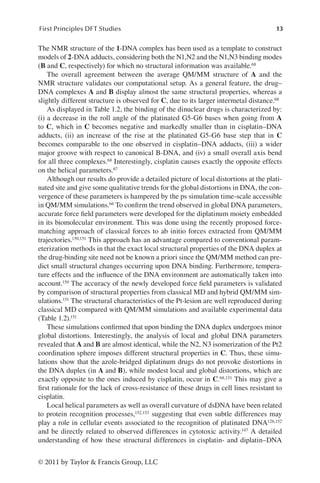
1.3, 1) and on a new generation of dinuclear Pt drugs (Figure 1.3, 2 and 3) which
11
First Principles DFT Studies
© 2011 by Taylor  Francis Group, LLC
have been designed to bind DNA has led to a reduction in the structural distor-
tions induced by cisplatin, possibly reducing the risk of cross and intrinsic resis-
tance.133,145–147 Three hybrid QM/MM simulations (in which the Pt moiety and the
guanine are treated at the QM level, while the rest is treated at the MM level) were
performed: (i) starting from the x-ray structures of platinated DNA,142 (ii) the cis-
platin–DNA adduct in complex with High Mobility Group (HMG) protein,144 and
(iii) from cisplatin docked to the same oligomer in the canonical B-DNA confor-
mation.67 All simulations reproduced the relevant experimental and structural fea-
tures with good accuracy, even though the DNA duplex is rather flexible in all three
models. During the simulation, the helical parameters asymptotically approached
the values of the simulation based on the x-ray structure with the rise increasing
from 4 to 7 Å, the roll angle ranging from 28° to 61° and the global axis curva-
ture ranging from 48° to 57°.67 However, a complete structural agreement among
the three simulations is prevented by the puckering of the sugars: conformational
NH3
NH3
NH3
NH3
NH3
NH3
G G
G
G
DNA DNA
B: 3-DNA
C: 3'-DNA
NH3
NH3
NH3
NH3
CI
CI
Pt
Pt
G
G
Pt
Pt
Pt
Pt1 Pt1
Pt2
Pt2
Pt
H3N
DNA 1-DNA
2+
2+
1
2 3
H3N
N2–N1
N2–N1
O
H O
H
H3N
H3N
H3N
H3N
H3N
H3N
H3N
N3
N3
N2
N2
N1
N1
H3N
N3
FIGURE 1.3 Cisplatin (1) and its adduct with dsDNA (1-DNA). The azole-bridged diplati-
num compounds [Pt2(í-OH)(í-pz)]2+ (2), [Pt2(í-OH)(í-1,2,3ta)]2+ (3), and the atom numbering
in the rings. Two different binding modes of 3 to DNA yield to adducts B and C. The 2-DNA
adduct (A) is equivalent to B. (Reprinted with permission from Katrin Spiegel et al., J. Phys.
Chem. B, 111(41), 11873. Copyright Oct 2007 American Chemical Society.)
12 Metallic Systems: A Quantum Chemists’s Perspective
© 2011 by Taylor  Francis Group, LLC
changes of the sugar occur on a time scale of hundreds of ps and thus are not
accessible on our simulation time scale. Nevertheless, the extent to which DNA
can rearrange in a few ps suggests that our method may qualitatively predict struc-
tural changes of drug–DNA adducts for which limited structural information is
available.
Azole-bridged dinuclear platinum(II) compounds (2, 3, Figure 1.3)146,147 have
been specifically designed to bind DNA, inducing small structural changes in order
to render the platinated lesion less recognizable by repair enzymes.133 This hypothe-
sis was confirmed by the NMR-structure of the 2-DNA (the only available structural
information of a diplatinated drug–DNA complex) showing structural parameters
very similar to that of canonical B-DNA (Table 1.2)133,148,149 and by an improved
cytotoxic behavior of these drugs an relative to cisplatin in several tumor cisplatin
resistant cell lines.147
Experiments show that for 3, the mechanism of binding to dsDNA is quite com-
plex.147 For instance, after the first alkylation step, a nucleophilic attack of the second
guanine can occur or, alternatively, Pt2 (and its coordination sphere) can migrate
from N2 to N3, followed by the second alkylation step. Therefore, 3 can alkylate two
adjacent guanines of dsDNA in both an N1,N2 and an N1,N3 mode. The N1,N3 iso-
mer presents a larger intermetal distance and can lead to the formation of a variety of
inter- and intrastrand crosslinks which may be a key factor for the high cytotoxicity
of these drugs.147
Since the QM/MM approach has been of help in characterizing the structural prop-
erties of the cisplatin–DNA adduct67 we have also used it to characterize and predict
the structural features of 2 and 3 in complex with the dsDNA decamer (A–C).66,68
TABLE 1.2
Selected Helical Parameters at the N7(G)-N7(G) Crosslink Formed by
Pt-Drugs Binding to DNA: [Pt2(μOH)(μ
~-pz)](NO3)2 (pz=Pyrazolate) (1) and
[{cis-Pt(NH3)2}2(μ-OH)(μ-1,2,3-ta-N1,N2)](NO3)2 (ta=1,2,3 Triazolate) (2)
Bound to 5′-d(CpTpCpTpG*pG*pTpCpTpCp)-3′, Resulting in Complexes A, B,
and C (Figure 1.3), Compared to NMR structure,149 and Reference
Simulation of the Unbound Decamer with the Same Sequence (DNA MD)
A B C A B C
QM/MM QM/MM QM/MM CMD CMD CMD DNA MD NMR
Rise 3.6±0.2 3.6±0.2 4.1±0.3 3.5±0.3 3.4±0.3 4.1±0.5 3.4±0.2 3.3
Roll 9±4 4±4 −5±5 6±7 6±5 −14±9 −3±7 5
Global axis
curvature
19±5 10±3 8±4 18±9 18±3 14±7 19±8 5
Rise, major and minor groove width (W) and depth (D) are given in [Å], Roll and global axis curvature
are in degrees. The minor and major groove parameters refer to the largest value measured at the plati-
nated site (G–G step). Structural parameters resulting from QM/MM MD and classical MD are labeled
as QM/MM and CMD, respectively.
13
First Principles DFT Studies
© 2011 by Taylor  Francis Group, LLC
The NMR structure of the 1-DNA complex has been used as a template to construct
models of 2-DNA adducts, considering both the N1,N2 and the N1,N3 binding modes
(B and C, respectively) for which no structural information was available.68
The overall agreement between the average QM/MM structure of A and the
NMR structure validates our computational setup. As a general feature, the drug–
DNA complexes A and B display almost the same structural properties, whereas a
slightly different structure is observed for C, due to its larger intermetal distance.68
As displayed in Table 1.2, the binding of the dinuclear drugs is characterized by:
(i) a decrease in the roll angle of the platinated G5-G6 bases when going from A
to C, which in C becomes negative and markedly smaller than in cisplatin–DNA
adducts, (ii) an increase of the rise at the platinated G5-G6 base step that in C
becomes comparable to the one observed in cisplatin–DNA adducts, (iii) a wider
major groove with respect to canonical B-DNA, and (iv) a small overall axis bend
for all three complexes.68 Interestingly, cisplatin causes exactly the opposite effects
on the helical parameters.67
Although our results do provide a detailed picture of local distortions at the plati-
nated site and give some qualitative trends for the global distortions in DNA, the con-
vergence of these parameters is hampered by the ps simulation time-scale accessible
in QM/MM simulations.66 To confirm the trend observed in global DNA parameters,
accurate force field parameters were developed for the diplatinum moiety embedded
in its biomolecular environment. This was done using the recently proposed force-
matching approach of classical forces to ab initio forces extracted from QM/MM
trajectories.150,151 This approach has an advantage compared to conventional param-
eterization methods in that the exact local structural properties of the DNA duplex at
the drug-binding site need not be known a priori since the QM/MM method can pre-
dict small structural changes occurring upon DNA binding. Furthermore, tempera-
ture effects and the influence of the DNA environment are automatically taken into
account.150 The accuracy of the newly developed force field parameters is validated
by comparison of structural properties from classical MD and hybrid QM/MM sim-
ulations.151 The structural characteristics of the Pt-lesion are well reproduced during
classical MD compared with QM/MM simulations and available experimental data
(Table 1.2).151
These simulations confirmed that upon binding the DNA duplex undergoes minor
global distortions. Interestingly, the analysis of local and global DNA parameters
revealed that A and B are almost identical, while the N2, N3 isomerization of the Pt2
coordination sphere imposes different structural properties in C. Thus, these simu-
lations show that the azole-bridged diplatinum drugs do not provoke distortions in
the DNA duplex (in A and B), while modest local and global distortions, which are
exactly opposite to the ones induced by cisplatin, occur in C.68,151 This may give a
first rationale for the lack of cross-resistance of these drugs in cell lines resistant to
cisplatin.
Local helical parameters as well as overall curvature of dsDNA have been related
to protein recognition processes,152,153 suggesting that even subtle differences may
play a role in cellular events associated to the recognition of platinated DNA126,152
and be directly related to observed differences in cytotoxic activity.147 A detailed
understanding of how these structural differences in cisplatin- and diplatin–DNA
14 Metallic Systems: A Quantum Chemists’s Perspective
© 2011 by Taylor  Francis Group, LLC
adducts affect protein recognition and other cellular processes is a highly challenging
task.126
Groove flexibility plays an important role in many biological functions involving
DNA; in particular, groove deformability can influence DNA recognition by many
DNA-binding proteins, including those proteins involved in repair mechanisms.152
Generally, the binding of proteins to the DNA minor groove resulted in a significant
deformation from the standard B-DNA conformation, e.g., an opening of the minor
groove and a bending of DNA toward the major groove.153,154 To date this aspect has
not been considered in the case of Pt drugs, therefore we have investigated the effect
of cisplatin and dinuclear Pt drugs on minor groove flexibility by performing clas-
sical MD simulations in combination with an adaptive bias force (ABF)155 method
to calculate free-energy profiles. Simulations were carried out on A, B, C and cis-
platin–DNA (D) considering a hexadecamer with the same sequence as the x-ray
structure of the platined DNA in complex with HMG with the sequence (5′-d(CpCp
UpCpTpCpTpG*pG*pACpCpTpTpCpCp)-3′). The free oligonucleotide (E) was also
considered for comparison.126
By choosing the reaction coordinate as the distance between the center of mass
of the backbone atoms of G9 and A10 on the first strand and to C25 and A26 on the
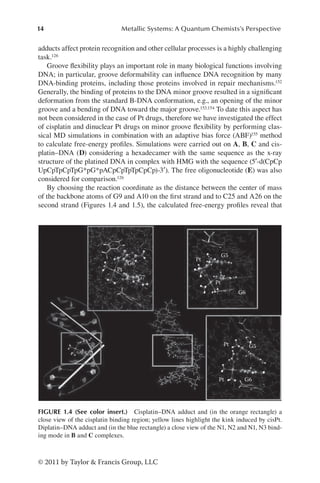
second strand (Figures 1.4 and 1.5), the calculated free-energy profiles reveal that
G6
G5
G6
G5
G6
G7
Pt
Pt
Pt
Pt
Pt
FIGURE 1.4 (See color insert.) Cisplatin–DNA adduct and (in the orange rectangle) a
close view of the cisplatin binding region; yellow lines highlight the kink induced by cisPt.
Diplatin–DNA adduct and (in the blue rectangle) a close view of the N1, N2 and N1, N3 bind-
ing mode in B and C complexes.
15
First Principles DFT Studies
© 2011 by Taylor  Francis Group, LLC
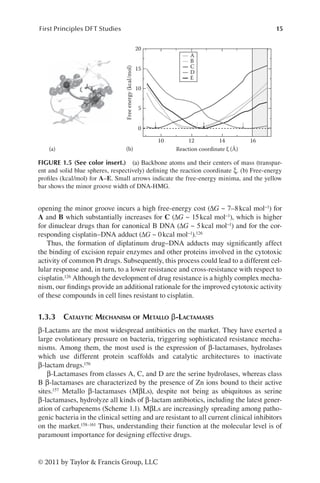
opening the minor groove incurs a high free-energy cost (ΔG ~ 7–8kcal mol−1) for
A and B which substantially increases for C (ΔG ~ 15kcal mol−1), which is higher
for dinuclear drugs than for canonical B DNA (ΔG ~ 5kcal mol−1) and for the cor-
responding cisplatin–DNA adduct (ΔG ~ 0kcal mol−1).126
Thus, the formation of diplatinum drug–DNA adducts may significantly affect
the binding of excision repair enzymes and other proteins involved in the cytotoxic
activity of common Pt drugs. Subsequently, this process could lead to a different cel-
lular response and, in turn, to a lower resistance and cross-resistance with respect to
cisplatin.126 Although the development of drug resistance is a highly complex mecha-
nism, our findings provide an additional rationale for the improved cytotoxic activity
of these compounds in cell lines resistant to cisplatin.
1.3.3 Catalytic Mechanism of Metallo β-Lactamases
β-Lactams are the most widespread antibiotics on the market. They have exerted a
large evolutionary pressure on bacteria, triggering sophisticated resistance mecha-
nisms. Among them, the most used is the expression of β-lactamases, hydrolases
which use different protein scaffolds and catalytic architectures to inactivate
β-lactam drugs.156
β-Lactamases from classes A, C, and D are the serine hydrolases, whereas class
B β-lactamases are characterized by the presence of Zn ions bound to their active
sites.157 Metallo β-lactamases (MβLs), despite not being as ubiquitous as serine
β-lactamases, hydrolyze all kinds of β-lactam antibiotics, including the latest gener-
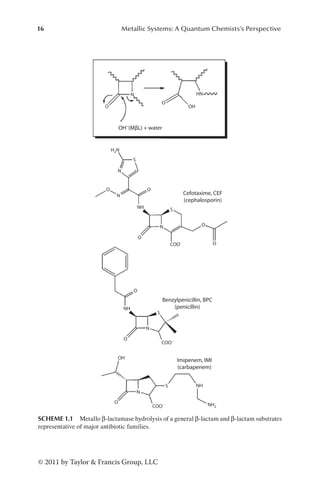
ation of carbapenems (Scheme 1.1). MβLs are increasingly spreading among patho-
genic bacteria in the clinical setting and are resistant to all current clinical inhibitors
on the market.158–161 Thus, understanding their function at the molecular level is of
paramount importance for designing effective drugs.
20
A
B
C
D
E
15
10
5
0
(a) (b)
10
Reaction coordinate ξ (Å)
Free
energy
(kcal/mol)
12 14 16
ξ
FIGURE 1.5 (See color insert.) (a) Backbone atoms and their centers of mass (transpar-
ent and solid blue spheres, respectively) defining the reaction coordinate ξ. (b) Free-energy
profiles (kcal/mol) for A–E. Small arrows indicate the free-energy minima, and the yellow
bar shows the minor groove width of DNA-HMG.
16 Metallic Systems: A Quantum Chemists’s Perspective
© 2011 by Taylor  Francis Group, LLC
O
O O
O
O
O
COO–
COO–
COO–
O
O
O
S
S
S
S
O
OH
OH–
(MβL) + water
Cefotaxime, CEF
(cephalosporin)
Benzylpenicillin, BPC
(penicillin)
Imipenem, IMI
(carbapenem)
HN
H2N
NH2
NH
N
N
N
N
N
N
NH
NH
OH
SCHEME 1.1 Metallo β-lactamase hydrolysis of a general β-lactam and β-lactam substrates
representative of major antibiotic families.
17
First Principles DFT Studies
© 2011 by Taylor  Francis Group, LLC
MβLs are classified by sequence homology in three subclasses: B1, B2, and B3.159–162
We focus here on the B1 subclass, which includes several chromosomally encoded
enzymes such as the ones from Bacillus cereus (BcII),163–168 Bacteroides fragilis
(CcrA)169,170 and Elizabethkingia meningoseptica (BlaB)171,172 as well as the transfer-
able VIM, IMP, SPM, and GIM-type enzymes.173–179 Subclass B1 represents, to date,
the best structurally and functionally characterized MβL species161,163,165–170,180–186
based on its clinical relevance.187 The MβL folding frame is characterized by a com-
pact αβ/βα sandwich, accommodating an active site that can allocate one or two Zn
ions.158,188 At the active pocket, the first metal site (Zn1) is tetrahedrally coordinated
by three histidine ligands (His116, His118, and His196) and the nucleophilic hydrox-
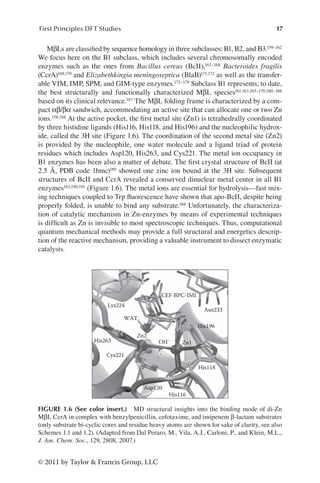
ide, called the 3H site (Figure 1.6). The coordination of the second metal site (Zn2)
is provided by the nucleophile, one water molecule and a ligand triad of protein
residues which includes Asp120, His263, and Cys221. The metal ion occupancy in
B1 enzymes has been also a matter of debate. The first crystal structure of BcII (at
2.5 Å, PDB code 1bmc)189 showed one zinc ion bound at the 3H site. Subsequent
structures of BcII and CcrA revealed a conserved dinuclear metal center in all B1
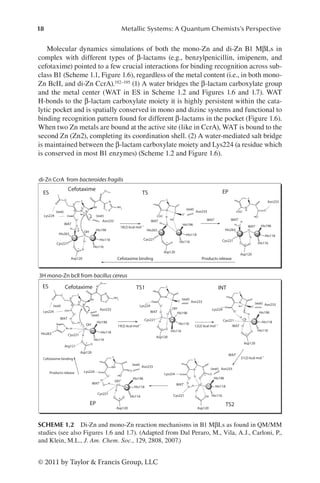
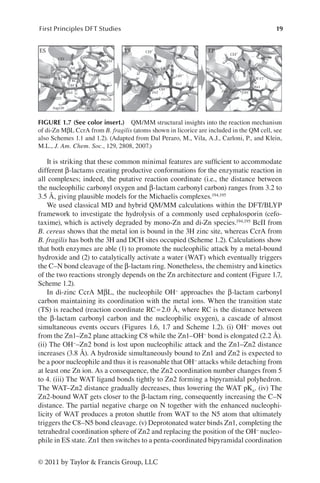
enzymes163,190,191 (Figure 1.6). The metal ions are essential for hydrolysis—fast mix-
ing techniques coupled to Trp fluorescence have shown that apo-BcII, despite being
properly folded, is unable to bind any substrate.168 Unfortunately, the characteriza-
tion of catalytic mechanism in Zn-enzymes by means of experimental techniques
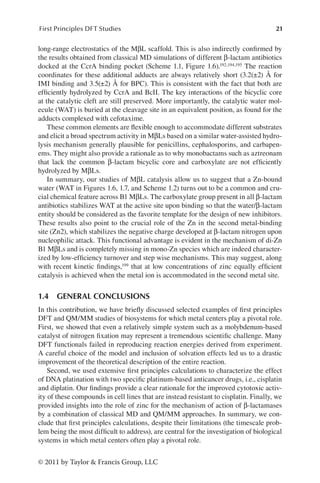
is difficult as Zn is invisible to most spectroscopic techniques. Thus, computational
quantum mechanical methods may provide a full structural and energetics descrip-
tion of the reactive mechanism, providing a valuable instrument to dissect enzymatic
catalysis.
Lys224
WAT
CEF-BPC-IMI
Asn233
His196
His118
His116
Asp120
Cys221
His263 Zn1
Zn2
OH–
FIGURE 1.6 (See color insert.) MD structural insights into the binding mode of di-Zn
MβL CcrA in complex with benzylpenicillin, cefotaxime, and imipenem β-lactam substrates
(only substrate bi-cyclic cores and residue heavy atoms are shown for sake of clarity, see also
Schemes 1.1 and 1.2). (Adapted from Dal Peraro, M., Vila, A.J., Carloni, P., and Klein, M.L.,
J. Am. Chem. Soc., 129, 2808, 2007.)
18 Metallic Systems: A Quantum Chemists’s Perspective
© 2011 by Taylor  Francis Group, LLC
Molecular dynamics simulations of both the mono-Zn and di-Zn B1 MβLs in
complex with different types of β-lactams (e.g., benzylpenicillin, imipenem, and
cefotaxime) pointed to a few crucial interactions for binding recognition across sub-
class B1 (Scheme 1.1, Figure 1.6), regardless of the metal content (i.e., in both mono-
Zn BcII, and di-Zn CcrA).192–195 (1) A water bridges the β-lactam carboxylate group
and the metal center (WAT in ES in Scheme 1.2 and Figures 1.6 and 1.7). WAT
H-bonds to the β-lactam carboxylate moiety it is highly persistent within the cata-
lytic pocket and is spatially conserved in mono and dizinc systems and functional to
binding recognition pattern found for different β-lactams in the pocket (Figure 1.6).
When two Zn metals are bound at the active site (like in CcrA), WAT is bound to the
second Zn (Zn2), completing its coordination shell. (2) A water-mediated salt bridge
is maintained between the β-lactam carboxylate moiety and Lys224 (a residue which
is conserved in most B1 enzymes) (Scheme 1.2 and Figure 1.6).
WAT
WAT
WAT' WAT'
WAT
WAT
WAT'
WAT WAT'
WAT–
WAT'
(wat)
(wat)
(wat)
(wat)
(wat)
(wat)
(wat)
(wat)
(wat)
OH–
Zn2 Zn1
Zn2 Zn2 Zn1
Zn1
Zn1 Zn1
Zn1
Zn1
Zn1
OH+
His263
His263 Cys221
Cys221 Cys221
Cys221
Cys221
Cys221 Cys221
Cys221
Asp120
Asp120
Asp120 Asp120
Asp120
Asp120
Arg121
Asp120
Asp120
Cefotaxime binding Products release
His116
His116
His116 His116
OH–
OH–
His116
His116 His116
His116
His118
His118
His118 His118
His118
His118 His118
His118
His196
His196 His196
His196
His196 His196
His196
His263 His263
Asn233
His196
Asn233
Asn233
Asn233
Asn233
Asn233
Asn233
Asn233
18(2) kcal mol–1
19(2) kcal mol–1
12(2) kcal mol–1
21(2) kcal mol–1
Lys224
Lys224
Lys224
Lys224
Lys224
Lys224
Cefotaxime
Cefotaxime
Cefotaxime binding
Products release
di-Zn CcrA from bacteroides fragilis
3H mono-Zn bcll from bacillus cereus
ES
ES
EP
EP
TS2
TS
TS1 INT
O
O S S
S
S
S
S
S
S
S
S
N
N
3
3
4
4
5
5
8
8
N
N
N
N
N
N
N
N
N
NH
N
N
H
H
H
H
H
H
H
H
H
H
H
H
H
H
H
H
H
H
H
H
H
H
H
H
H
H
NH
NH
HO
HO
HO
NH2
NH
2
O
O
O
–
O
–
O
O–
O
–
O
–
O
–
O
O
–
O
–
O
–
COO
–
COO
–
O
O
O
O O O
O
O
O
O
O
O
O OH
O
O
O
O
O
O
O
O
O
O
O
O
O
O
O
O
O
O
O
O
O
O
O
O
O
O
O
O
O
O
O
SCHEME 1.2 Di-Zn and mono-Zn reaction mechanisms in B1 MβLs as found in QM/MM
studies (see also Figures 1.6 and 1.7). (Adapted from Dal Peraro, M., Vila, A.J., Carloni, P.,
and Klein, M.L., J. Am. Chem. Soc., 129, 2808, 2007.)
19
First Principles DFT Studies
© 2011 by Taylor  Francis Group, LLC
It is striking that these common minimal features are sufficient to accommodate
different β-lactams creating productive conformations for the enzymatic reaction in
all complexes; indeed, the putative reaction coordinate (i.e., the distance between
the nucleophilic carbonyl oxygen and β-lactam carbonyl carbon) ranges from 3.2 to
3.5 Å, giving plausible models for the Michaelis complexes.194,195
We used classical MD and hybrid QM/MM calculations within the DFT/BLYP
framework to investigate the hydrolysis of a commonly used cephalosporin (cefo-
taxime), which is actively degraded by mono-Zn and di-Zn species.194,195 BcII from
B. cereus shows that the metal ion is bound in the 3H zinc site, whereas CcrA from
B. fragilis has both the 3H and DCH sites occupied (Scheme 1.2). Calculations show
that both enzymes are able (1) to promote the nucleophilic attack by a metal-bound
hydroxide and (2) to catalytically activate a water (WAT) which eventually triggers
the C–N bond cleavage of the β-lactam ring. Nonetheless, the chemistry and kinetics
of the two reactions strongly depends on the Zn architecture and content (Figure 1.7,
Scheme 1.2).
In di-zinc CcrA MβL, the nucleophile OH− approaches the β-lactam carbonyl
carbon maintaining its coordination with the metal ions. When the transition state
(TS) is reached (reaction coordinate RC=2.0 Å, where RC is the distance between
the β-lactam carbonyl carbon and the nucleophilic oxygen), a cascade of almost
simultaneous events occurs (Figures 1.6, 1.7 and Scheme 1.2). (i) OH− moves out
from the Zn1–Zn2 plane attacking C8 while the Zn1–OH− bond is elongated (2.2 Å).
(ii) The OH−–Zn2 bond is lost upon nucleophilic attack and the Zn1–Zn2 distance
increases (3.8 Å). A hydroxide simultaneously bound to Zn1 and Zn2 is expected to
be a poor nucleophile and thus it is reasonable that OH− attacks while detaching from
at least one Zn ion. As a consequence, the Zn2 coordination number changes from 5
to 4. (iii) The WAT ligand bonds tightly to Zn2 forming a bipyramidal polyhedron.
The WAT–Zn2 distance gradually decreases, thus lowering the WAT pKa. (iv) The
Zn2-bound WAT gets closer to the β-lactam ring, consequently increasing the C–N
distance. The partial negative charge on N together with the enhanced nucleophi-
licity of WAT produces a proton shuttle from WAT to the N5 atom that ultimately
triggers the C8–N5 bond cleavage. (v) Deprotonated water binds Zn1, completing the
tetrahedral coordination sphere of Zn2 and replacing the position of the OH− nucleo-
phile in ES state. Zn1 then switches to a penta-coordinated bipyramidal coordination
ES TS EP
CEF
CEF'
CEF'
WAT'
Zn1
Zn2 OH'
WAT
His263
N5
C8 N5 C8
RC
OH–
OH–
OH–'
Zn2
Zn1
Asn233
His196
Zn1
Zn2
Cys221
Asp120 His116
His118
FIGURE 1.7 (See color insert.) QM/MM structural insights into the reaction mechanism
of di-Zn MβL CcrA from B. fragilis (atoms shown in licorice are included in the QM cell, see
also Schemes 1.1 and 1.2). (Adapted from Dal Peraro, M., Vila, A.J., Carloni, P., and Klein,
M.L., J. Am. Chem. Soc., 129, 2808, 2007.)
20 Metallic Systems: A Quantum Chemists’s Perspective
© 2011 by Taylor  Francis Group, LLC
from the initial tetrahedral coordination. When the constraint on RC is released, the
system evolves into the product state (EP, Figure 1.7, Scheme 1.2), where OH− reori-
ents H-bonding to Asp120 and bridging the Zn1 and Zn2 ions as in the ES state.
The CEF substrate is now completely hydrolyzed, the β-lactam ring is open and C8
acquires planar sp2 hybridization and is finally detached from the metal center. The
estimated free energy of activation (ΔF) for the single-step mechanism is ΔF=18(±2)
kcal mol−1, which is consistent with experimental evidence that suggests a single-
step reaction for cephalosporin hydrolysis and a free energy of activation of about
17kcal mol−1 for similar reactions.
In mono-Zn BcII, Zn1 undergoes a large rearrangement of its coordination shell
upon nucleophilic attack. When the hydroxyl nucleophile attacks the β-lactam car-
bonyl carbon, Zn1 distorts its polyhedron and coordinates WAT as a fifth ligand.
This leads to the formation of a stable high-energy intermediate state (INT, 12(±2)
kcal mol−1, Scheme 1.2). Thus, the presence of only one Zn equivalent in BcII spe-
cies leads to a two-step mechanism so that WAT replaces the nucleophile during
the first step upon entering the Zn1 coordination shell and then is activated in the
second step as proton donor for β-lactam N5 (the latter being the rate limiting step
of the reaction). In CcrA, the presence of Zn2 merges these two movements in a
concerted single step—Zn2 already activates WAT as soon as the OH–Zn1 bond is
broken upon nucleophilic attack. This also explains the improved catalytic efficiency
of di-Zn versus mono-Zn variants, as found in the calculation of the free energy of
activation for di-Zn (ΔF=18(±2) kcal mol−1) and mono-Zn (ΔF=21(±3) kcal mol−1)
species, respectively.
Di-Zn CcrA showed a highly concerted single-step mechanism in which the role
of the two metal ion is crucial (Figure 1.7, Scheme 1.2). In particular, the Zn2 site
promotes the protonation of the bridging nitrogen that kinetic studies indicate to be
the rate-determining step.165,180,186,196 A series of mutagenesis studies on di-Zn BcII
confirms this view, since engineering a more buried position of the Zn2 site gives
rise to an inactive β-lactamase even though it is dinuclear.197 Instead, an optimized
BcII obtained by in vitro evolution has been shown to be more efficient through the
action of a second-shell ligand, which optimizes the position of Zn2 for the proton-
ation step.198 These works provide an excellent example of close cooperation between
theoretical and experimental studies in a metalloenzyme, and point to an impor-
tant and more flexible role of the second metal site in B1 species. Moreover, recent
mechanistic studies on BcII have shown the accumulation during turnover of an
active mono-Zn variant with the metal ion localized at the DCH site, in contrast to
what was observed in the first reported x-ray structure of BcII.199,200 Unfortunately,
the lack of structural data for such conformations hampers QM/MM investigations
of this alternative pathway, but points consistently to the crucial role of the Zn2
metal-binding site (Zn1).
Because the zinc ligands and most active site residues are highly conserved among
subclass B1 MβLs, the binding and mechanism found for CcrA may be a template for
the entire B1 subclass, where β-lactams might follow similar catalytic pathways as
all the groups involved in the catalysis do not depend on the substrate chemical diver-
sity. Of course, slightly different activation free energies are expected because of the
substrate binding modes generated by different β-lactam substituents and differing
21
First Principles DFT Studies
© 2011 by Taylor  Francis Group, LLC
long-range electrostatics of the MβL scaffold. This is also indirectly confirmed by
the results obtained from classical MD simulations of different β-lactam antibiotics
docked at the CcrA binding pocket (Scheme 1.1, Figure 1.6).192,194,195 The reaction
coordinates for these additional adducts are always relatively short (3.2(±2) Å for
IMI binding and 3.5(±2) Å for BPC). This is consistent with the fact that both are
efficiently hydrolyzed by CcrA and BcII. The key interactions of the bicyclic core
at the catalytic cleft are still preserved. More importantly, the catalytic water mol-
ecule (WAT) is buried at the cleavage site in an equivalent position, as found for the
adducts complexed with cefotaxime.
These common elements are flexible enough to accommodate different substrates
and elicit a broad spectrum activity in MβLs based on a similar water-assisted hydro-
lysis mechanism generally plausible for penicillins, cephalosporins, and carbapen-
ems. They might also provide a rationale as to why monobactams such as aztreonam
that lack the common β-lactam bicyclic core and carboxylate are not efficiently
hydrolyzed by MβLs.
In summary, our studies of MβL catalysis allow us to suggest that a Zn-bound
water (WAT in Figures 1.6, 1.7, and Scheme 1.2) turns out to be a common and cru-
cial chemical feature across B1 MβLs. The carboxylate group present in all β-lactam
antibiotics stabilizes WAT at the active site upon binding so that the water/β-lactam
entity should be considered as the favorite template for the design of new inhibitors.
These results also point to the crucial role of the Zn in the second metal-binding
site (Zn2), which stabilizes the negative charge developed at β-lactam nitrogen upon
nucleophilic attack. This functional advantage is evident in the mechanism of di-Zn
B1 MβLs and is completely missing in mono-Zn species which are indeed character-
ized by low-efficiency turnover and step wise mechanisms. This may suggest, along
with recent kinetic findings,199 that at low concentrations of zinc equally efficient
catalysis is achieved when the metal ion is accommodated in the second metal site.
1.4 GENERAL CONCLUSIONS
In this contribution, we have briefly discussed selected examples of first principles
DFT and QM/MM studies of biosystems for which metal centers play a pivotal role.
First, we showed that even a relatively simple system such as a molybdenum-based
catalyst of nitrogen fixation may represent a tremendous scientific challenge. Many
DFT functionals failed in reproducing reaction energies derived from experiment.
A careful choice of the model and inclusion of solvation effects led us to a drastic
improvement of the theoretical description of the entire reaction.
Second, we used extensive first principles calculations to characterize the effect
of DNA platination with two specific platinum-based anticancer drugs, i.e., cisplatin
and diplatin. Our findings provide a clear rationale for the improved cytotoxic activ-
ity of these compounds in cell lines that are instead resistant to cisplatin. Finally, we
provided insights into the role of zinc for the mechanism of action of β-lactamases
by a combination of classical MD and QM/MM approaches. In summary, we con-
clude that first principles calculations, despite their limitations (the timescale prob-
lem being the most difficult to address), are central for the investigation of biological
systems in which metal centers often play a pivotal role.
22 Metallic Systems: A Quantum Chemists’s Perspective
© 2011 by Taylor  Francis Group, LLC
REFERENCES
1. Orvig, C.; Abrams, M. J. Chem. Rev. 1999, 99, 2201–2204.
2. Spiegel, K.; Magistrato, A.; Maurer, P.; Ruggerone, P.; Carloni, P.; Rothlisberger, U.;
Reedijk, J.; Klein, M. L. J. Comput. Chem. 2008, 29(1), 38–49.
3. Frausto da Silva, J. J. R.; Williams, R. J. P. The Biological Chemistry of the Elements.
The Inorganic Chemistry of Life. Clarendon Press: Oxford, 1994.
4. Hanzlik, R. P. Inorganic Aspects of Biological and Organic Chemistry. Academic Press:
New York, 1976.
5. Voet, D.; Voet, J. G.; Pratt, C. W. Fundamentals of Biochemistry. Wiley  Sons, Inc:
New York, 1999.
6. Ragsdale, S. W. Chem. Rev. 2006, 106, 3317–3337.
7. Andrews, N. C. Curr. Opin. Chem. Biol. 2002, 6, 181–186.
8. Cowan, J. A. Chem. Rev. 1998, 98, 1067–1088.
9. Vasák, M.; Hasler, D. W. Curr. Opin. Chem. Biol. 2000, 4, 177–183.
10. Cox, E. H.; McLendon, G. L. Curr. Opin. Chem. Biol. 2000, 4, 162–165.
11. Siegbahn, P. E. M. Curr. Opin. Chem. Biol. 2002, 6, 227–235.
12. Rosenberg, B.; VanCamp, L.; Krigas, T. Nature (London) 1965, 205, 698.
13. Gordon, M.; Hollander, S. J. Med. 1993, 24, 209–265.
14. Kostova, I. Curr. Med. Chem. 2006, 13, 1085–1107.
15. Alessio, E.; Mestroni, G.; Bergamo,A.; Sava, G. Met. Ions Biol. Syst. 2004, 42, 323–351.
16. Kapitza, S.; Pongratz, M.; Jakupec, M. A.; Heffeter, P.; Berger, W.; Lackinger, L.;
Keppler, B. K.; Marian, B. J. Cancer Res. Clin. Oncol. 2005, 131, 101–110.
17. Chen, H.; Parkinson, J. A.; Parsons, S.; Coxall, R. A.; Gould, R. O.; Sadler, P. J. J. Am.
Chem. Soc. 2002, 124, 3064–3082.
18. McNae, I. W.; Fishburne, K.; Habtemariam,A.; Hunter, T. M.; Melchart, M.; Wang, F.Y.;
Walkinshaw, M. D.; Sadler, P. J. Chem. Commun. 2004, 16, 1786–1787.
19. Ghosh, P.; D’Cruz, O. J.; Narla, R. K.; Uckun, F. M. Clin. Cancer Res. 2000, 6,
1536–1545.
20. Calamai, P.; Carotti, S.; Guerri, A.; Mazzei, T.; Messori, L.; Mini, E.; Orioli, P.; Speroni,
G. P. Anti-Cancer Drug Des. 1998, 13, 67–80.
21. Katsaros, N.; Anagnostopoulou, A. Crit. Rev. Oncol./Hematol. 2002, 42, 297–308.
22. Sava, G.; Giraldi, T.; Mestroni, G.; Zassinovich, G. Chem. Biol. Interact. 1983, 45, 1–6.
23. de Hoog, P.; Boldron, C.; Gamez, P.; Sliedregt-Bol, K.; Roland, I.; Pitie, M.; Kiss, R.;
Meunier, B.; Reedijk, J. J. Med. Chem. 2007, 50, 3148–3152.
24. Neese, F. Angew. Chem. Int. Ed. 2006, 45, 196–199.
25. Yandulov, D. V.; Schrock, R. R. Science 2003, 301, 76–78.
26. Yandulov, D. V.; Schrock, R. R. Inorg. Chem. 2005, 44, 5542–5542.
27. Yandulov, D. V.; Schrock, R. R. Inorg. Chem. 2005, 44, 1103–1117.
28. Ritleng, V.; Yandulov, D. V.; Weare, W. W.; Schrock, R. R.; Hock, A. S.; Davis, W. M.
J. Am. Chem. Soc. 2004, 126, 6150–6163.
29. Yandulov, D. V.; Schrock, R. R.; Rheingold, A. L.; Ceccarelli, C.; Davis, W. M. Inorg.
Chem. 2003, 42, 796–813.
30. Yandulov, D. V.; Schrock, R. R. J. Am. Chem. Soc. 2002, 124, 6252–6253.
31. van Mourik, T. Phil. Trans. R. Soc. A 2004, 362, 2653–2670.
32. Siegbahn, P. E. M.; Blomberg, M. R. A. Chem. Rev. 2000, 100, 421–438.
33. Davidson, E. R. Chem. Rev. 2000, 100, 351–352.
34. Rotzinger, F. P. Chem. Rev. 2005, 105, 2003–2038.
35. Carloni, P.; Rothlisberger, U.; Parrinello, P. Acc. Chem. Res. 2002, 35, 455–464.
36. Colombo, M. C.; Guidoni, L.; Laio, A.; Magistrato, A.; Maurer, P.; Piana, S.; Rohrig, U.
et al. Chimia 2002, 56, 13–19.
37. Klahn, M.; Schlitter, J.; Gerwert, K. Biophys. J. 2005, 88, 3829–3844.
23
First Principles DFT Studies
© 2011 by Taylor  Francis Group, LLC
38. Ludger, W.; Michele, L.; Francesco, M.; Angel, R. Phys. Rev. B 2005, 71, 241402.
39. Piana, S.; Sebastiani, D.; Carloni, P.; Parrinello, M. J. Am. Chem. Soc. 2001, 123,
8730–8737.
40. Simone Raugei, F. L. G. P. C. Phys. Stat. Sol. (b) 2006, 243, 2500–2515.
41. Rodziewicz, P.; Melikova, S. M.; Rutkowski, K. S.; Buda, F. ChemPhysChem 2005, 6,
1719–1724.
42. Hobza, P.; Sponer, J. Chem. Rev. 1999, 99, 3247–3276.
43. Himo, F.; Siegbahn, P. E. M. Chem. Rev. 2003, 103, 2421–2456.
44. Laio, A.; Gervasio, F. L.; VandeVondele, J.; Sulpizi, M.; Rothlisberger, U. J. Phys.
Chem. B 2004, 108, 7963–7968.
45. Gervasio, F. L.; Laio, A.; Parrinello, M.; Boero, M. Phys. Rev. Lett. 2005, 94, 158103.
46. Tomasi, J.; Mennucci, B.; Cammi, R. Chem. Rev. 2005, 105, 2999–3094.
47. Cramer, C. J.; Truhlar, D. G. Chem. Rev. 1999, 99, 2161–2200.
48. Rode, B. M.; Schwenk, C. F.; Hofer, T. S.; Randolf, B. R. Coord. Chem. Rev. 2005, 249,
2993–3006.
49. Friesner, R. A.; Guallar, V. Annu. Rev. Phys. Chem. 2005, 56, 389–427.
50. Lin, H.; Truhlar, D. Theor. Chem. Acc. 2007, 117, 185–199.
51. Dal Peraro, M.; Spiegel, K.; Lamoureux, G.; De Vivo, M.; DeGrado, W. F.; Klein, M. L.
J. Struct. Biol. 2007, 157, 444.
52. Cavalli, A.; Carloni, P.; Recanatini, M. Chem. Rev. 2006, 106, 3497–3519.
53. Jensen, F. Introduction to Computational Chemistry. Wiley  Sons: Chichester,
1999.
54. Leach, A. R. Molecular Modelling. Principles and Applications. Prentice Hall: Harlow,
2001.
55. Svensson, M.; Humbel, S.; Froese, R. D. J.; Matsubara, T.; Sieber, S.; Morokuma, K.
J. Phys. Chem. A 1996, 100, 19357–19363.
56. Maseras, F.; Morokuma, K. J. Comput. Chem. 1995, 16, 1170–1179.
57. Matsubara, T.; Sieber, S.; Morokuma, K. Int. J. Quantum Chem. 1996, 60, 1101–1109.
58. Svensson, M.; Humbel, S.; Morokuma, K. J. Chem. Phys. 1996, 105, 3654–3661.
59. Komin, S.; Gossens, C.; Tavernelli, I.; Rothlisberger, U.; Sebastiani, D. J. Phys. Chem.
B 2007, 111, 5225–5232.
60. Sulpizi, M.; Laio, A.; VandeVondele, J.; Cattaneo, A.; Rothlisberger, U.; Carloni, P.
Proteins 2003, 52, 212–224.
61. Biarnes, X.; Ardevol, A.; Planas, A.; Rovirat, C.; Laio, A.; Parrinello, M. J. Am. Chem.
Soc. 2007, 129, 10686–10693.
62. Stirling, A.; Iannuzzi, M.; Parrinello, M.; Molnar, F.; Bernhart, V.; Luinstra, G. A.
Organometallics 2005, 24, 2533–2537.
63. Kastner, J.; Senn, H. M.; Thiel, S.; Otte, N.; Thiel, W. J. Chem. Theory Comput. 2006,
2, 452–461.
64. Jensen, V. R.; Koley, D.; Jagadeesh, M. N.; Thiel, W. Macromolecules 2005, 38,
10266–10278.
65. Zhu, X.; Yethiraj, A.; Cui, Q. J. Chem. Theory Comput. 2007, 3, 1538–1549.
66. Spiegel, K.; Magistrato, A. Org. Biomol. Chem. 2006, 4, 2507–2517.
67. Spiegel, K.; Rothlisberger, U.; Carloni, P. J. Phys. Chem. B 2004, 108, 2699–2707.
68. Magistrato, A.; Ruggerone, P.; Spiegel, K.; Carloni, P.; Reedijk, J. J. Phys. Chem. B
2006, 110, 3604–3613.
69. Atkins, P. W.; Friedman, R. S. Molecular Quantum Mechanics. Oxford University Press:
Oxford, 1997.
70. Szabo, A.; Ostlund, N. S. Modern Quantum Chemistry: Introduction to Advanced
Electronic Structure Theory. Macmillan Publishing Co. Inc.: New York, 1982.
71. Thomas., L. H. Cambridge Phil. Soc. 1926, 23, 542.
72. Fermi, E. Rend. Lincei 6, 1927.
24 Metallic Systems: A Quantum Chemists’s Perspective
© 2011 by Taylor  Francis Group, LLC
73. Hohenberg, P.; Kohn, W. Phys. Rev. 1964, 136, B864–B871.
74. Kohn, W.; Sham, L. J. Phys. Rev. 1965, 140, A1133.
75. Parr, R. G.; Yang, W. Density-Functional Theory of Atoms and Molecules. Oxford
University Press: New York, 1989.
76. Kohanoff, J. Electronic Structure Calculations for Solids and Molecules: Theory and
Computational Methods. Cambridge University Press: Cambridge, 2006.
77. Becke, A. D. Phys. Rev. A 1998, 38, 3098–3100.
78. Lee, C. T.; Yang, W. T.; Parr, R. G. Phys. Rev. B 1988, 37, 785–789.
79. Becke, A. D. Phys. Rev. A 1988, 38, 3098.
80. Perdew, J. P. Phys. Rev. B 1986, 33, 8822–8824.
81. Perdew, J. P.; Burke, K.; Ernzerhof, M. Phys. Rev. Lett. 1996, 77, 3865.
82. Perdew, J. P.; Burke, K.; Ernzerhof, M. Phys. Rev. Lett. 1997, 78, 1396.
83. Perdew, J. P.; Chevary, J. A.; Vosko S. H.; Jackson, K. A.; Pederson, M. R.; Singh, D. J.;
Fiolhais, C. Phys. Rev. B 1993, 48.
84. Burke, K.; Perdew, J. P.; Wang, Y. In: Electronic Density Functional Theory: Recent
Progress and New Directions; Eds. J. F. Dobson, G. Vignale, and M. P. Das, Plenum
Press: New York, 1998.
85. Perdew, J. P. In: Electronic Structure of Solids ‘91. Akademie Verlag: Berlin, 1991.
86. Sherwood, P. Hybrid Quantum Mechanics/Molecular Mechanics Approaches, in
Modern Methods and Algorithms of Quantum Chemistry; Proceedings, 2nd edition,
2000.
87. Garcia-Viloca, M.; Gao, J. Theor. Chem. Acc. 2004, 111, 280–286.
88. Konig, P. H.; Hoffmann, M.; Frauenheim, T.; Cui, Q. J. Phys. Chem. B 2005, 109,
9082–9095.
89. Laio, A.; VandeVondele, J.; Rothlisberger, U. J. Phys. Chem. B 2002, 106, 7300–7307.
90. Gao, J.; Amara, P.; Alhambra, C.; Field, M. J. J. Phys. Chem. A 1998, 102, 4714–4721.
91. Car, R.; Parrinello, M. Phys. Rev. Lett. 1985, 55, 2471.
92. Latajka, Z.; Bouteiller, Y.; Scheiner, S. Chem. Phys. Lett. 1995, 234, 159–164.
93. Baker, J.; Andzelm, J.; Muir, M.; Taylor, P. R. Chem. Phys. Lett. 1995, 237, 53–60.
94. Friesner, R. A. Proc. Natl. Acad. Sci. 2005, 102, 6648–6653.
95. Hunter, C. A.; Sanders, J. K. M. J. Am. Chem. Soc. 1990, 112, 5525–5534.
96. Burley, S. K.; Petsko, G. A Science 1985, 229, 23–28.
97. Hunter, C. A.; Singh, J.; Thornton, J. M. J. Mol. Biol. 1991, 218, 837–846.
98. McGaughey, G. B.; Gagne, M.; Rappe, A. K. J. Biol. Chem. 1998, 273, 15458–15463.
99. Watson, J. D.; Crick, F. H. C. Nature 1953, 171, 737–738.
100. Waller, P.; Robertazzi, A.; Platts, J. A.; Hibbs, D. E.; Williams, P. A. J. Comput. Chem.
2006, 27, 491–504.
101. Wang, W. Z.; Pitonak, M.; Hobza, P. Chemphyschem 2007, 8, 2107–2111.
102. Grimme, S. J. Comput. Chem. 2004, 25, 1463–1473.
103. Cerny, J.; Hobza, P. Phys. Chem. Chem. Phys. 2007, 9, 5291–5303.
104. Riley, K. E.; Vondrasek, J.; Hobza, P. Phys. Chem. Chem. Phys. 2007, 9, 5555–5560.
105. Swart, M.; van der Wijst, T.; Guerra, C. F.; Bickelhaupt, F. M. J. Mol. Model. 2007, 13,
1245–1257.
106. Overgaard, J.; Waller, M. P.; Piltz, R.; Platts, J. A.; Emseis, P.; Leverett, P.; Williams,
P. A.; Hibbs, D. E. J. Phys. Chem. A 2007, 111, 10123–10133.
107. Grimme, S.; Antony, J.; Schwabe, T.; Muck-Lichtenfeld, C. Org. Biomol. Chem. 2007,
5, 741–758.
108. Zhao, Y.; Truhlar, D. G. J. Chem. Theory Comput. 2007, 3, 289–300.
109. Meyer, M.; Steinke, T.; Suhnel, J. J. Mol. Model. 2007, 13, 335–345.
110. Antony, J.; Grimme, S. Phys. Chem. Chem. Phys. 2006, 8, 5287–5293.
111. Stein, M.; Lubitz, W. Phys. Chem. Chem. Phys. 2001, 3, 2668–2675.
112. Holland, J.; Green, J. C.; Dilworth, J. R. Dalton Trans. 2006, 783–794.
25
First Principles DFT Studies
© 2011 by Taylor  Francis Group, LLC
113. Wang, X. J.; Wang, W.; Koyama, M.; Kubo, M.; Miyamoto, A. J. Photochem. Photobiol.
A 2006, 179, 149–155.
114. Schlogl, R. Angew. Chem. Int. Ed. 2003, 42, 2004–2008.
115. Schrock, R. R. Acc. Chem. Res. 2005, 38, 955–962.
116. Triplett, E. W. Prokaryotic Nitrogen Fixation. Horizon Scientific: Wymondham, 2000.
117. Selvaraj, S.; Kono, H.; Sarai, A. J. Mol. Biol. 2002, 322, 907–15.
118. MacKay, B. A.; Fryzuk, M. D. Chem. Rev. 2004, 104, 385–401.
119. Hidai, M. Coord. Chem. Rev. 1999, 186, 99–108.
120. Burgess, B. K.; Lowe, D. J. Chem. Rev. 1996, 96, 2983–3012.
121. Rees, D. C.; Howard, J. B. Curr. Opin. Chem. Biol. 2000, 4, 559–566.
122. Le Guennic, B.; Kirchner, B.; Reiher, M. Chem. Eur. J. 2005, 11, 7448–7460.
123. Cammi, R.; Mennucci, B.; Tomasi, J. J. Phys. Chem. A 2000, 9100.
124. Zexing Cao; Zhou, Z.; Wan, H.; Zhang, Q. Int. J. Quantum Chem. 2005, 103,
344–353.
125. Studt, F.; Tuczek, F. Angew. Chem. Int. Ed. 2005, 44, 5639–5642.
126. Spiegel, K.; Magistrato, A.; Carloni, P.; Reedijk, J.; Klein, M. L. J. Phys. Chem. B 2007,
111, 11873–11876.
127. Hatfield, M. P. D.; Palermo, N.Y.; Jozsef, C.Y.; Murphy, R. F.; Lovas, S. Int. J. Quantum
Chem. 2008, 108, 1017–1021.
128. Meyer, M.; Suhnel, J. J. Phys. Chem. A 2008, 112, 4336–4341.
129. Bader, R. F. W. Chem. Rev. 1991, 91, 893–928.
130. Bader, R. F. W. Atoms in Molecules—A Quantum Theory. Oxford University Press:
Oxford, 1990.
131. Boyd, R. J.; Choi, S. C. Chem. Phys. Lett. 1986, 129, 62–65.
132. Howard, S. T.; Lamarche, O. J. Phys. Org. Chem. 2003, 16, 133–141.
133. Reedijk, J. Proc. Natl. Acad. Sci. USA 2003, 100, 3611–3616.
134. Zorbas, H.; Keppler, B. K. Chembiochem 2005, 6, 1157–1166.
135. Jung, Y. W.; Lippard, S. J. Chem. Rev. 2007, 107, 1387–1407.
136. Rabik, C. A.; Dolan, M. E. Cancer Treat. Rev. 2007, 33, 9–23.
137. Deubel, D. V. J. Am. Chem. Soc. 2006, 128, 1654–1663.
138. Robertazzi, A.; Platts, J. A. Chem. Eur. J. 2006, 12, 5747–5756.
139. Carloni, P.; Andreoni, W.; Hutter, J.; Curioni, A.; Giannozzi, P.; Parrinello, M. Chem.
Phys. Lett. 1995, 234, 50–56.
140. Carloni, P.; Sprik, M.; Andreoni, W. J. Phys. Chem. B 2000, 104, 823–835.
141. Wang, D.; Lippard, S. J. Nat. Rev. Drug Discov. 2005, 4, 307–320.
142. Takahara, P. M.; Rosenzweig, A. C.; Frederick, C. A.; Lippard, S. J. Nature 1995, 377,
649–652.
143. Pasheva, E.; Ugrinova, I.; Spassovska, N.; Pashev, I. Int. J. Biochem. Cell Biol. 2002, 34,
87–92.
144. Ohndorf, U.; Rould, M.; He, Q.; Pabo, C.; Lippard, S. J. Nature 1999, 399, 708–712.
145. Komeda, S.; Kalayda, G. V.; Lutz, M.; Spek, A. L.; Yamanaka, Y.; Sato, T.; Chikuma,
M.; Reedijk, J. J. Med. Chem. 2003, 46, 1210–1219.
146. Komeda, S.; Bombard, S.; Perrier, S.; Reedijk, J.; Kozelka, J. J. Inorg. Biochem. 2003,
96, 357–366.
147. Komeda, S.; Lutz, M.; Spek, A. L.; Yamanaka, Y.; Sato, T.; Chikuma, M.; Reedijk, J.
J. Am. Chem. Soc. 2002, 124, 4738–4746.
148. Komeda, S.; Lutz, M.; Spek, A. L.; Chikuma, M.; Reedijk, J. Inorg. Chem. 2000, 39,
4230–4236.
149. Teletchea, S.; Komeda, S.; Teuben, J. M.; Elizondo-Riojas, M. A.; Reedijk, J.; Kozelka,
J. Chem. Eur. J. 2006, 12, 3741–3753.
150. Maurer, P.; Laio, A.; Hugosson, H.; Colombo, M. C.; Rothlisberger, U. J. Chem. Theory
Comput. 2007, 3, 628–639.
26 Metallic Systems: A Quantum Chemists’s Perspective
© 2011 by Taylor  Francis Group, LLC
151. Spiegel, K.; Magistrato, A.; Maurer, P.; Ruggerone, P.; Rothlisberger, U.; Carloni, P.;
Reedijk, J.; Klein, M. L. J. Comput. Chem. 2008, 29, 38–49.
152. Zacharias, M. Biophys. J. 2006.
153. Olson, W. K.; Gorin, A. A.; Lu, X. J.; Hock, L. M.; Zhurkin, V. B. Proc. Natl. Acad. Sci.
1998, 95, 11163–11168.
154. Deremble, C.; Lavery, R. Curr. Opin. Struct. Biol. 2005, 15, 171–175.
155. Henin, J.; Chipot, C. J. Chem. Phys. 2004, 121, 2904–2914.
156. Fisher, J. F.; Meroueh, S. O.; Mobashery, S. Chem. Rev. 2005, 105, 395–424.
157. Hall, B. G.; Barlow, M. J. Mol. Evol. 2003, 57, 255–260.
158. Galleni, M.; Lamotte-Brasseur, J.; Rossolini, G. M.; Spencer, J.; Dideberg, O.; Frere,
J. M.; Grp, M.-B.-L. W.; Antimicrob. Agents Chemother. 2001, 45, 660–663.
159. Garau, G.; Di Guilmi, A. M.; Hall, B. G. Antimicrob. Agents Chemother. 2005, 49,
2778–2784.
160. Walsh, T. R.; Toleman, M. A.; Poirel, L.; Nordmann, P. Clin. Microbiol. Rev. 2005, 18,
306–325.
161. Crowder, M. W.; Spencer, J.; Vila, A. J. Acc. Chem. Res. 2006, 39(10), 721–728.
162. Hall, B. G.; Barlow, M. J. Antimicrob. Chemother. 2005, 55, 1050–1051.
163. Orellano, E. G.; Girardini, J. E.; Cricco, J. A.; Ceccarelli, E. A.; Vila, A. J. Biochemistry
1998, 37, 10173–10180.
164. Prosperi-Meys, C.; Wouters, J.; Galleni, M.; Lamotte-Brasseur, J. Cell Mol. Life Sci.
2001, 58, 2136–2143.
165. Bounaga, S.; Laws, A. P.; Galleni, M.; Page, M. I. Biochem. J. 1998, 331, 703–711.
166. Rasia, R. M.; Ceolin, M.; Vila, A. J. Protein Sci. 2003, 12, 1538–1546.
167. Rasia, R. M.; Vila, a. J. Biochemistry 2002, 41, 1853–1860.
168. Rasia, R. M.; Vila, a. J. J. Biol. Chem. 2004, 279, 26046–26051.
169. Wang, Z. G.; Fast, W.; Benkovic, S. J. J. Am. Chem. Soc. 1998, 120, 10788–10789.
170. Wang, Z. G.; Fast, W.; Benkovic, S. J. Biochemistry 1999, 38, 10013–10023.
171. Garcia-Saez, I.; Hopkins, J.; Papamicael, C.; Franceschini, N.; Amicosante, G.;
Rossolini, G. M.; Galleni, M.; Frere, J. M.; Dideberg, O. J. Biol. Chem. 2003, 278,
23868–23873.
172. Rossolini, G. M.; Franceschini, N.; Riccio, M. L.; Mercuri, P. S.; Perilli, M.; Galleni,
M.; Frere, J. M.; Amicosante, G. Biochem. J. 1998, 332, 145–152.
173. Docquier, J. D.; Lamotte-Brasseur, J.; Galleni, M.; Amicosante, G.; Frere, J. M.;
Rossolini, G. M. J. Antimicrob. Chemother. 2003, 51, 257–266.
174. Oelschlaeger, P.; Mayo, S. L.; Pleiss, J. Protein Sci. 2005, 14, 765–774.
175. Yamaguchi, Y.; Kuroki, T.; Yasuzawa, H.; Higashi, T.; Jin, W. C.; Kawanami, A.;
Yamagata, Y.; Arakawa, Y.; Goto, M.; Kurosaki, H. J. Biol. Chem. 2005, 280,
20824–20832.
176. Materon, I. C.; Beharry, Z.; Huang, W. Z.; Perez, C.; Palzkill, T. J. Mol. Biol. 2004, 344,
653–663.
177. Oelschlaeger, P.; Schmid, R. D.; Pleiss, J. Protein Eng. 2003, 16, 341–350.
178. Moali, C.;Anne, C.; Lamotte-Brasseur, J.; Groslambert, S.; Devreese, B.;Van Beeumen,
J.; Galleni, M.; Frere, J. M. Chem. Biol. 2003, 10, 319–329.
179. Toleman, M. A.; Simm, A. M.; Murphy, T. A.; Gales, A. C.; Biedenbach, D. J.; Jones, R.
N.; Walsh, T. R. J. Antimicrob. Chemother. 2002, 50, 673–679.
180. Yanchak, M. P.; Taylor, R. A.; Crowder, M. W. Biochemistry 2000, 39, 11330–11339.
181. Garrity, J. D.; Carenbauer, A. L.; Herron, L. R.; Crowder, M. W. J. Biol. Chem. 2004,
279, 920–927.
182. Crawford, P. A.; Yang, K. W.; Sharma, N.; Bennett, B.; Crowder, M. W. Biochemistry
2005, 44, 5168–5176.
183. Davies, A. M.; Rasia, R. M.; Vila, A. J.; Sutton, B. J.; Fabiane, S. M. Biochemistry 2005,
44, 4841–4849.
27
First Principles DFT Studies
© 2011 by Taylor  Francis Group, LLC
184. Fast, W.; Wang, Z. G.; Benkovic, S. J. Biochemistry 2001, 40, 1640–1650.
185. Wang, Z. G.; Fast, W.; Valentine, A. M.; Benkovic, S. J. Curr. Opin. Chem. Biol. 1999,
3, 614–622.
186. Wang, Z. G.; Fast, W.; Benkovic, S. J. Biochemistry 1999, 38, 10013–10023.
187. Walsh, T. R.; Hall, L.; Assinder, S. J.; Nichols, W. W.; Cartwright, S. J.; Macgowan, A.
P.; Bennett, P. M. BBA—Gene Struct. Expr. 1994, 1218, 199–201.
188. Garau, G.; Bebrone, C.; Anne, C.; Galleni, M.; Frere, J. M.; Dideberg, O. J. Mol. Biol.
2005, 345, 785–795.
189. Carfi, A.; Pares, S.; Duee, E.; Galleni, M.; Duez, C.; Frere, J. M.; Dideberg, O. EMBO
J. 1995, 14, 4914–4921.
190. Concha, N. O.; Rasmussen, B. A.; Bush, K.; Herzberg, O. Structure 1996, 4, 823–836.
191. Fabiane, S. M.; Sohi, M. K.; Wan, T.; Payne, D. J.; Bateson, J. H.; Mitchell, T.; Sutton,
B. J. Biochemistry 1998, 37, 12404–12411.
192. Dal Peraro, M.; Vila, A. J.; Carloni, P. Proteins 2004, 54, 412–423.
193. Simona, F.; Magistrato, A.; Vera, D. M.; Garau, G.; Vila, A. J.; Carloni, P. Proteins 2007,
69, 595–605.
194. Dal Peraro, M.; Llarrull, L. I.; Rothlisberger, U.; Vila, A. J.; Carloni, P. J. Am. Chem.
Soc. 2004, 126, 12661–12668.
195. Dal Peraro, M.; Vila, A. J.; Carloni, P.; Klein, M. L. J. Am. Chem. Soc. 2007, 129,
2808–2816.
196. Llarrull, L. I.; Fabiane, S. M.; Kowalski, J. M.; Bennett, B.; Sutton, B. J.; Vila, A. J.
J. Biol. Chem. 2007, 282, 18276–18285.
197. Gonzalez, J. M.; Martin, F. J. M.; Costello, A. L.; Tierney, D. L.; Vila, A. J. J. Mol. Biol.
2007, 373, 1141–1156.
198. Tomatis, P. E.; Fabiane, S. M.; Simona, F.; Carloni, P.; Sutton, B. J.; Vila, A. J. Proc.
Natl. Acad. Sci. USA 2008, 105, 20605–20610.
199. Llarrull, L. I.; Tioni, M. F.; Vila, A. J. J. Am. Chem. Soc. 2008, 130, 15842–15851.
200. Tioni, M. F.; Llarrull, L. I.; Poeylaut-Palena,A.A.; Marti, M.A.; Saggu, M.; Periyannan,
G. R.; Mata, E. G.; Bennett, B.; Murgida, D. H.; Vila, A. J. J. Am. Chem. Soc. 2008, 130,
15852–15863.
29
© 2011 by Taylor  Francis Group, LLC
2 Structural and
Thermodynamic Studies
of α-Synuclein Proteins
Related to Parkinson’s
Disease: Impact of
Aqueous Solution and
Fe3+ Coordination
Olivia M. Wise, Liang Xu, and Orkid Coskuner
2.1 INTRODUCTION
Parkinson’s disease is a severe neurodegenerative disorder that currently affects
more than 1.5 million people in the United States. The total health care costs for
Parkinson’s disease are approximately $25 billion per year, and this cost is expected
to rise unless an effective treatment can be found.12 For an efficient treatment to be
developed, however, the cause (molecular mechanism) of the disease must first be
determined and a therapy must be devised. Often the most effective ways to dis-
cover the cause of any disease is to start with data and observations from those
patients already presenting symptoms and work backward through the progression
of the disease until the root cause is exposed. A thorough understanding of what is
CONTENTS
2.1 Introduction.....................................................................................................29
2.2 Methods...........................................................................................................40
2.3 Results and Discussion....................................................................................50
2.4 Conclusion.......................................................................................................75
References.................................................................................................................77
30 Metallic Systems: A Quantum Chemists’s Perspective
© 2011 by Taylor  Francis Group, LLC
already known about Parkinson’s disease will make clear why the avenue of research
discussed in this chapter may aid in the search for the cause of this disease.
Every year, approximately 50,000 new cases of Parkinson’s disease are diagnosed.
However, it is estimated that many more people are affected by this disease.12 The
average age of onset for Parkinson’s disease is 60 years, but many people frequently
go years with either an incorrect diagnosis or without realizing they have the disease
because the symptoms are often associated with normal aging. There is no definitive
test to determine if a patient actually has Parkinson’s disease; instead, a diagnosis is
obtained from a combination of medical history and a neurological examination.12,13
Tests such as magnetic resonance imaging (MRI) and computed tomography (CT)
scans are performed to rule out other diseases with symptoms similar to Parkinson’s
disease, as brain scans of those affected often appear normal in the beginning stages
of the disease. Unfortunately, the progression and development of the disease varies
from person to person, making it even harder to diagnose.13
The first recorded case of Parkinson’s disease was documented in 1817 by James
Parkinson, after whom the disease was later named, in “An Essay on the Shaking
Palsy.”14 The symptoms described in his paper are still the symptoms considered to
be the hallmark of this debilitating disease. Hand tremors, limb rigidity, bradykine-
sia (slowness of movement), and postural instability (impaired balance) are the four
most common symptoms observed among all Parkinson’s disease patients.12 These
symptoms cause those affected with this disease to be unable to perform even the
simplest tasks as the disease continues to progress. Patients are not only affected
by well-known external symptoms, but may also suffer from pain, dementia, sleep
disturbances, depression, fatigue, and memory difficulties.12 Although the average
onset occurs at 60 years, there are several cases of early onset (before the age of 50)
and even juvenile parkinsonism (onset at approximately 20 years old).12 Current sta-
tistics also show that on average more men than women are affected by Parkinson’s
disease.12
This disease affects not only the patient, but the caregivers as well. Often family
members of patients are the primary caregivers, and in some instances, depend-
ing on the severity of the disease, may spend in excess of 40h per week caring for
affected family members.15 This level of care can have many adverse effects beyond
the amount of time required, such as lower income due to time lost from work and
increased medical expenses. Some statistics have shown that caregivers suffer from
higher levels of stress.15 As the “baby boomer” generation approaches the average
age for onset of this disease, more and more people will be affected, either as a
patient or as a caregiver.
Although there are many hypotheses on the cause of Parkinson’s disease cur-
rently being investigated, the underlying cause remains a mystery. The hypotheses
being investigated are varied and it may ultimately prove to be a combination of
these hypotheses that results in a full understanding of Parkinson’s disease. The
current hypotheses being investigated include increased nigral iron,16 mitochondrial
dysfunction,17 changes in antioxidant systems,18 neuromelanin/iron interaction,19
α-synuclein/iron interaction,16 protein aggregation,20 Lewy body formation,4 and
oxidative stress.21 All of these factors, or a combination of several factors, may lead
31
Structural and Thermodynamic Studies of α-Synuclein Proteins
© 2011 by Taylor  Francis Group, LLC
to dopaminergic neuronal cell death in the substantia nigra that occurs as a result of
Parkinson’s disease.
The substantia nigra is a compact collection of mostly dopaminergic neurons
located in the mid brain and appears to control motor function throughout the body.19
This region of the brain is easily characterized by its dark color, which is also the
origin of the name substantia nigra (from the Latin meaning black body), relative
to the surrounding neurons due to the presence of a pigment called neuromelanin
in the cells.19 Currently, no active neuromelanin synthesis pathway is known, but it
is hypothesized to be a by-product of the autoxidation of dopamine and noradrena-
line in neuronal cells, which, until recently, was assumed to be inert.19 One recent
hypothesis is that the neuromelanin, like peripheral melanins in cells outside of the
central nervous system, serves a protective role in dopaminergic neuronal cells.22
Peripheral melanins protect cells from free radical damage by inactivating them.22
It is hypothesized that neuromelanin may protect the cell from toxic by-products of
dopamine metabolism and oxidation and may also play a role in maintaining iron
homeostatis in the neuronal cells.22
Experimental evidence shows that as the dopaminergic cells degenerate during
the progression of Parkinson’s disease, the dying cells release stored neuromelanin,
causing a marked decrease in the pigmentation of the substantia nigra.19 Although
these are not the only cells affected by Parkinson’s disease, the decrease in dark
color of the substantia nigra of the brain is one of the pathological diagnostic criteria
for this disease.19 Some studies suggest that this pattern of discoloration is not ran-
dom and that neuromelanin may play a role in the pathogenesis. However, whether
the discoloration has a positive or negative effect on the cell is still debated.19 One
theory suggests that the presence of neuromelanin may have a negative influence on
neuronal cells since the pathway from which neuromelanin is believed to be synthe-
sized also produces other active oxidizers such as quinine, semiquinone, and super-
oxide radicals.19 Therefore, increased neuromelanin would indicate an increased
amount of oxidizers present in the cell, which could lead to cell damage in a variety
of ways. Another theory suggests that neuromelanin may in fact have a positive influ-
ence on cells during the progression of Parkinson’s disease.19 This theory comes
from an observation by Gibb that substantia nigra neuronal cells that contain less
neuromelanin are more susceptible to degeneration, i.e., they are the first to die, in
Parkinson’s disease than cells that are more heavily pigmented by neuromelanin.19
Additionally, there is some evidence that the structure of neuromelanin in the par-
kinsonian brain may differ from a healthy brain or that parkinsonian brain neurons
may contain less neuromelanin than healthy neurons.19 Despite these studies, the role
of neuromelanin in the brain still remains unclear.
Experimental evidence shows that neuromelanin is capable of binding a variety
of metal ions, including iron, copper, zinc, and lead. In addition, the substantia nigra
contains several metal ions, including iron, at concentrations up to four times that
of other neuronal cells.19,22 There is some experimental evidence of iron binding to
neuromelanin, but the actual role of this binding remains unclear.19,22 It is hypoth-
esized that neuromelanin may have a function similar to the protein ferritin, which is
to store iron in the cell in an effectively chemically inactive state until it is needed.22
Another Random Document on
Scribd Without Any Related Topics
[48]
“What?”
“If we did collect this money we could donate it to the
college to have the swimming pool repaired.”
“That’s sweet of you and a good idea, Arden, but I don’t
believe we could do it,” objected Sim. “Besides, I don’t
exactly believe what it says on this poster. It seems very
silly for a young fellow to disappear just when he’s
coming into a lot of money—a fortune.”
“Perhaps he was made to disappear,” suggested Terry,
her eyes opening wide.
“Oh! You mean—kidnaped?” asked Arden.
“Yes.”
“Worse and more of it!” laughed Sim.
“Well, anyhow, we could try, couldn’t we?” Arden asked.
“You’d help, wouldn’t you, Terry?”
“Yes, indeed I’ll help. I’ve always fancied myself in the
rôle of a detective, spouting pithy Chinese philosophy
and generally getting underfoot.”
“Now, Terry, just be serious for once. And Sim, you also.
You know how disappointed you were when you found
out the swimming pool was——”
“Kapoot!” chuckled Sim, supplying Arden’s evident lack
of a word with the latest Russian expression. “Go on!”
“Well,” resumed Arden, pouting a little, “you never can
tell. Maybe we could do it. It isn’t impossible. Stranger
things have happened. And I just know I’ve seen that
[49]
young man on the poster somewhere before. If I could
only remember where! Did either of you ever have that
feeling?”
“Lots of times. I’m for you, Arden!” declared Sim. “I’ll do
what I can and whatever you say. This mysterious Harry
Pangborn may very well be right around here.”
“Around Cedar Ridge!” shrilled Terry.
“Certainly! Why not? If the authorities didn’t think it
likely that he might be in this vicinity, why did they put
the poster up here in the post office? And they
mentioned Morrisville,” challenged Sim.
“There’s something in that,” Terry admitted.
“Oh, if he should be in hiding around here and we could
find him and claim the thousand dollars reward,”
breathed Arden, “wouldn’t it be just wonderful! And
what a sensation when we magnanimously turned the
money over to the college for the swimming pool. Oh,
oh!”
“Would you do that for dear old Alma Mater when you
don’t know her so very well?” asked Sim, who, with her
chums, was still gazing at the poster of the good-
looking but missing heir of the Pangborn estate of
millions.
“I’d do it for you, Sim, dear,” murmured Arden. “I want
you to be happy here, since I teased you so to come.”
“And you think I won’t be happy without the swimming
pool?”
“Will you?”
[50]
“Not as happy as I would be with it.”
“But even admitting that this missing young man may
be around here,” suggested Terry, “what chance have
we of finding him? We have so much college work to
do. For, after all, we were sent here to learn something,”
she sighed.
“Granted,” laughed Arden. “But we may find time for a
little detective work on the side as well as for hazing.
Oh, it’s a wonderful prospect!” She swung around in a
few dance steps right there in the old post office.
“Well, we’d better be getting back,” suggested Sim after
this. “Oh, look at the clock!” she gasped. Then followed
a hurried sending of some picture postcards they had
bought; cards on which they marked with an X the
location of their room.
The three chums were bubbling with life, laughter, and
merriment as they turned to leave the little building, but
their mirth was turned to alarm as a stern voice assailed
them.
“Young ladies!”
They looked around to see Rev. Dr. Henry Bordmust
sternly regarding them from the doorway.
“Yes, Dr. Bordmust,” Sim almost whispered as the
chaplain appeared to be waiting for formal recognition.
“You are freshmen!” he accused, with a glance at their
mortarboards, the tassels of which told the tale. “You
know you are not permitted over here—in the post
office. It is against the college rules—for you freshmen.
Return at once! You must! You must!”
[51]
[52]
He appeared strangely stirred and angry, and his dark
brows, shading his bright little eyes, bent into a frown.
But somehow, after that first booming and accusative
“young ladies,” the chaplain seemed exhausted, as
though the anger pent up in him had taken something
from his none too profuse vitality. He was an old man.
Now he essayed a wintry smile and added, as he gently
waved them out with motions of his thin white hands:
“That is to say, you shouldn’t have come here. You—er
—have no need to be—er—frightened at this first
infraction of the rules, but—er—another time you may
be—er—campused for such action.”
Then, having seen that the three were on their way out,
Dr. Bordmust turned to the window, evidently to buy
some stamps for the letters he held in one hand. He
murmured to himself in those queer, quavering,
meaningless tones:
“Too bad; too bad! I can’t always be watching! Dear
me!”
Wonderingly, Arden and her chums looked at the
shrinking figure in black as they passed out of the door.
But Dr. Bordmust gave them no further attention.
CHAPTER V
Rescued
Sim, who was hurrying after Arden and Terry up the
steep hill on top of which was perched Bordmust Hall,
uttered a series of frightened exclamations.
“Oo-oo-oo! Oh, my! Oh, but I was frightened. Wasn’t he
angry!”
“Since Dr. Bordmust is our chaplain, it was probably
what might be called righteous anger,” suggested Arden.
“What do you suppose he meant when he spoke about
not always watching?” asked Terry.
“I don’t know,” Arden had to admit. “The girls say Dr.
Bordmust is really queer at times. I suppose it is
because he’s such a profound student. He knows such a
lot, all about Egypt, so many languages, and they say
ancient history is an open book to him.” Arden was fairly
sprinting along the boardwalk that made the steep path
up to Bordmust Hall a little easier. What with talking and
hurrying, her breath was a bit gaspy.
[53]
[54]
“Well, don’t ask me what it all means,” begged Terry. “I
can’t even guess. But, oh! I do hope I’m not going to be
late for this first class.”
“So say we all of us,” chanted Sim.
“They can’t be too severe at the very beginning,”
murmured Arden.
Bordmust Hall, where most of the class sessions were
held, crowned with its classic architecture the summit of
the long slope which formed the eminence of the broad
acres about Cedar Ridge College. It was behind the
main, or dormitory, building in which were housed the
executive offices and the residence rooms of the faculty.
To the southwest of the hall, and easily viewed from the
steps, was the unused pool. To the northwest, and in
line with the main building, was the beautiful Gothic
chapel with its wonderful stained-glass windows. Near
the chapel was the unimposing home of the chaplain,
Rev. Dr. Bordmust; one of whose ancestors had partly
endowed Cedar Ridge. For this reason the hall was
named for him.
At the foot of the slope on which the hall stood were the
rambling fields and gardens where much of the farm
produce for the college tables was raised. The nearest
of the farm-lands, so called, was the orchard, part of
which could be seen from the southeast windows of the
dormitory. And it was this orchard that the taxi-man had
indicated in such a warning manner. It was this orchard
into which Tom Scott, the good-looking porter, had been
staring the night of the arrival of Arden Blake and her
chums. So much had been crowded into the
comparatively short time the three freshmen had been
at college that they had almost forgotten the strange
[55]
orchard. Even now they had no chance to consider the
matter, for they, with many other girls, were hastening
to their first classes.
They gave a momentary glance toward the orchard,
with its quaint gnarled trees. The morning sun was
glinting on red, dark-green, and golden russet apples
which the gardener and his men had not yet started to
gather.
Arden, especially, gazed searchingly at the orchard.
Apple trees grow in such strange shapes and huddle so
closely to themselves, as if each one guarded a secret.
There was a puzzled look in Arden’s blue eyes as she
tried to guess what might be hidden by those trees and
the tall hedge surrounding them.
Sim was gazing rather sorrowfully at the pool building,
but Terry was smiling, perhaps because everything
seemed, for the moment, at least, to be so filled with
good and pleasant life.
“Go on in, kids!” Sim urged her two chums. “I’ll be
along in a minute or two. I just want to take a look at—I
just want to—oh, well, go on. Don’t wait for me.”
“But won’t you be late?” objected Arden.
“No, I have some time to my credit.”
As her surprised friends watched, Sim left them and
hurried down across a stretch of smooth lawn toward
the disused swimming pool.
“Too bad,” murmured Arden.
“What is?” asked Terry.
[56]
“I really think Sim feels more keenly than we realize
about the pool. But she’s such a good sport. Look at
her! Going to view the ashes of her hopes or the
collapse of her dreams or something equally tragic.”
“Don’t let’s say anything about this,” proposed Terry. “If
Sim cares so much, I’m sure she’d rather not talk about
this little visit.”
Arden agreed and, taking Terry’s arm, they hurried into
the hall.
Sim reached the pool building and tried to get some
idea of the wreck within by peering through a window.
But the sill was too high to afford a view, even if the
window had not been made of heavily frosted glass,
quite opaque.
Then she stepped back and gazed up at the copper and
glass domed roof. Around the top of the building were
set at intervals glazed tiles depicting nautical scenes.
Dolphins were diving merrily as if to tantalize sea horses
with necks proudly arched, and mermaids flicked their
tails disdainfully at Father Neptune.
“I may as well try the door,” Sim murmured. “I’d like to
see what it’s like inside, though it will probably break my
heart!”
After several hard pushes to the extent of her strength,
she succeeded in swinging back the door. She found
herself in a sort of vestibule, but the inner door of this
opened easily, and then Sim stood almost on the edge
of the abandoned pool.
A peculiar smell assailed her, as of a place long shut up,
but at the same time it had something of out-of-doors
[57]
about it, the odor of clean earth and ripe vegetables.
“It isn’t as bad as Toots said,” mused Sim. “At least, it
looks as though there isn’t so very much the matter. It
isn’t filled with vegetables, either; just a few bags as
yet, though they probably will bring in more when they
pick the apples. This must have been a beautiful pool
once.”
The bottom of the pool was tiled a pea green, a color
which must have given the water a most cooling tone
on a hot day. But the white tile sides no longer
gleamed, and in more than one place jagged dark
cracks ran crazily down the walls like streaks of black
lightning. Sim looked at the cracked tile and concrete
edge at her feet. The depth was still indicated, though
there was no water in the pool—5 feet.
“This is the shallow end, of course,” Sim thought, and
she walked slowly around the edge and toward the
melancholy spring-boards to which some strips of
cocoa-fiber matting still clung.
“How quiet it is in here,” Sim murmured. “Like a
museum after hours—or an Egyptian tomb.” She
shivered a little, though it was warm in the natatorium.
In the deep end several filled burlap bags were piled up,
and in each corner were barrels of cabbages leaning
against the walls.
“I thought, from what Toots said, the whole place would
be filled to the brim with cabbages and turnips,” Sim
said to herself, smiling a little ruefully. “I wonder how
long this pool is, or should I say was?”
[58]
She began to measure the length with her eyes,
mentally swimming with long, smooth strokes while her
feet churned up and down.
“About seventy-five yards long, I guess,” she went on.
“And about twenty-five across. A lovely size. I could do
three lengths a day here and really enjoy it. Let’s see
how deep it is from the end of the board.”
She walked gingerly out on the diving plank, choosing
the center one for there were three at the deep end,
tiered at different heights. It was difficult to estimate,
without water in the pool and with the barrels and bags
of vegetables scattered about, how close the different
boards came to the surface of the filled space. Sim
decided that the plank she was standing on was the
lowest.
She permitted herself a little pre-diving, teetery bounce
on the very end, half fearful lest the dried wood should
crack beneath even her light weight. But it held, and
Sim gave a bolder jump.
“A straight dive—cutting the water about there!” With
her eyes Sim indicated to herself just the spot where
her finger tips should enter the water—had there been
any water there.
She jumped again and came down safely, with no
warning cracking of the dried plank. Then she balanced
herself on the very tip of the board before, mentally,
springing into the air. Now she performed a most
ambitious jump, but this time the stiffened wood
snapped back suddenly. Sim was thrown to one side,
and she swung her arms around and around like a child
[59]
on its first roller skates, trying desperately not to topple
backward.
But her motions only caused the board to quiver more
violently, and in a split second Sim slipped off and clung,
with her finger tips only, to the edge of the plank, while
the hard-tiled bottom of the pool, seemingly miles
below, waited to receive her.
“Oh, gosh! What’ll I do?” poor Sim thought. “Those tiles
don’t look very soft, and I’ll drop in a minute!”
Her fingers ached from their stiff clinging grip, and her
arms were quickly tiring. She decided she must soon let
go for after a futile attempt to sling one leg up over the
side edge of the board it bent so alarmingly that she
feared it would snap. She began to swing to and fro like
a pendulum, hoping she might cast herself upon a bag
of vegetables which would serve to break her fall, when,
suddenly, she felt her wrists firmly gripped by two
hands, and she looked up to see Tom Scott, the porter-
gardener, smiling down at her. He was kneeling on the
end of the plank.
“Don’t jump!” he warned. “I’ll pull you up. It’s rather the
reverse of ‘don’t shoot, I’ll come down,’ isn’t it?” he said
lightly. He could not have taken better means to quiet
Sim’s excited nerves than with Mr. Crockett’s little coon
banter.
With what seemed no effort at all, Tom Scott lifted her
up and held her clear of the end of the board so her
legs did not scrape against it. Then he carefully walked
back with her toward the middle of the plank, where
there was no danger of its breaking, set her down, and
[60]
stood grinning at her. A nice grin it was, too, Sim
thought later.
She managed to produce a weak, embarrassed smile.
“Thank you so much!” she said a bit stiffly. The man
must think her crazy. “I—I slipped! I—er—I was—that is,
I was trying——” To cover her confusion she looked at
her red finger tips.
“Hurt?” he inquired.
“Broke two or three nails,” Sim responded ruefully. “I’m
very glad you came along. I might have sprained an
ankle if I had let go, for this end must be nine feet
deep.”
“The water, when there is any, is over nine feet deep
nearest this wall,” said Tom Scott. “You certainly would
have been jarred a bit, to say the least.”
“Then I must thank you again. But please don’t mention
to anyone that you found me in such a silly fix, will
you?” Sim begged. She was quickly regaining her lost
composure. “I just wanted to get a look at the pool and
foolishly walked out on the board. I imagined myself
poising for a dive and I slipped off. You won’t tell?”
“Of course I won’t,” Tom agreed, somewhat gayly, it
seemed. “I came in to get a few of the early apples we
have stored here. One of the cooks asked me to. I
imagine there are going to be pies. But, honestly, I
won’t tell a soul.”
“Thank you,” Sim murmured.
[61]
[62]
The young gardener walked up to the middle of the pool
and with athletic ease jumped down in it near several
bags of vegetables. He picked up one containing apples,
heaved it up on the edge and jumped up himself. Then,
slinging the sack up on his shoulder, he walked toward
the door, giving Sim a friendly backward glance as he
went out.
“What a nice young man!” said Sim to herself. “He
doesn’t seem like a gardener at all. No brogue and no
accent of any kind. I wish I could tell Arden and Terry,
but I’d rather die than have them know of this dizzy
adventure. I must have looked perfectly stupid hanging
there on the end of the plank!”
The clanging of a distant bell brought Sim back to
reality, and as she looked at her wrist watch she left all
thoughts of pools and good-looking rescuing gardeners
behind her. For it would need a swift dash to get her to
Bordmust Hall before she would be late for her class.
CHAPTER VI
Apple Hazing
Girls of various sizes, types, and descriptions were
hurrying into the building, and their clothes, of all
colors, gave a luster otherwise lacking in the dull, sand-
colored structure. The freshmen were easily
distinguished from the other students by the fact that
they were all carrying or scanning yellow cards which
told them in what rooms to report for their first classes.
Sim was surprised to see Arden and Terry still outside
the hall.
“I thought you had to hurry in to class,” she said,
hoping they wouldn’t notice her broken nails.
“Wrong number,” remarked Terry. “We went in and were
told to come back in fifteen minutes, so we came up for
air.”
“Where were you?” asked Arden, glancing sharply at
Sim.
“Oh—just walking around. I think I’m about in time for
my class. Let’s go in.”
[63]
[64]
The three found they were to be separated for the
morning session though the first class in the afternoon
would find them in the same room for English literature.
“And we must try to sit together,” called Arden to Sim
and Terry as they parted.
Inside the hall all was confusion. Girls were running
hither and yon. Stairways were crowded with students
going up or coming down, and all were excited. Doors
were suddenly pushed open by uncertain freshmen and
again by oversure sophomores. The latter, in a spirit of
fun, several times sent a poor “frosh” up to the top floor
when she should have remained on the first.
Another warning bell rang and, almost at once, the
corridors were empty and quiet. Inside their classrooms
the three girls from 513 looked, listened, and answered
somewhat in a daze. That first day always remained
more or less of a hazy recollection. Something of an
organization was arranged, the roll was checked and
corrected, names were asked and given, everyone was
on edge and nervous, even the instructors. Strange
faces, many of them timid, looked on other strange
faces, also somewhat timid.
Then came welcome noon, and the rush out of
Bordmust and some of the other study buildings to the
dining hall was comparable only to the New York
subway rush at five o’clock.
The afternoon classes were attended by all more
pleasantly and with less strain. To their delight, Arden,
Sim, and Terry managed to get into the same room and
sat near one another.
[65]
As they were leaving Bordmust Hall, at the close of the
afternoon session, Arden heard someone say:
“Here come our three!”
Toots Everett, Jessica, and Pip were regarding the other
trio with sardonic smiles and, as Terry said later, “with
murder in their eyes.”
“Good afternoon, freshies! How about a little song for
my friends, here?” Jessica was mockingly speaking. “A
song befitting your talents. Arden Blake, come here!”
Arden stepped forward, blushing. “I can’t sing,” she
quavered.
“You shall learn. Your friend here, with the red hair,
looks like a singer. And while you two sing, Sim
Westover shall dance. On with the dance, freshies!”
The trio from 513 looked at one another in dismay, but
there was no help for it. Amused seniors and juniors
had gathered to see the fun. From the classmates of
Arden and her chums two kinds of advice was
forthcoming, the “don’t-you-do-it!” and “go-on-be-
sports!”
Finally, in a weak and uncertain voice, Arden and Terry,
after a moment of embarrassed consultation, sang one
verse from their prep-school song; something about
“Bring Me Violets for My Hair,” while Sim tapped about
more like a sparrow than a swan.
At last it was over.
“Not bad,” commented Toots.
[66]
“I’ve seen worse,” said Pip.
“But not much,” was Jessica’s opinion.
Then the sophomores delivered a rhyming ultimatum.
They stood with their heads together and chanted:
“From yonder orchard, old and green,
Where, ’tis said, strange things are seen,
You three, upon this fatal day,
Must gather apples while ye may.
At once repair to that dread spot,
And in your quest dare pass it not.
Then bring, for our symbolic use,
Fair apples with but smallest bruise.
Ten perfect fruits, no less, must we
Your mentors have, in time for tea.”
There was a dramatic pause, following this delivery, and
then, as though they had rehearsed it, as, indeed, they
had, the three sophomores picked up the books they
had deposited on the ground in front of them while
singing, and marched away, leaving the trio from 513
the center of an excited and thrilled group.
“What does it all mean?” asked Sim.
“Is it part of the hazing?” asked Terry.
“Must we really go after the apples?” asked Arden in
astonishment.
“Yes,” said Mary Todd. “It’s just part of college life. And
you may as well go to the orchard now, while it is still
light and bright. I certainly hope I don’t have to do that
stunt. No orchard in mine.”
[67]
“Some of us probably will have to gather the apples
later,” declared Jane Randall. “But a soph, who got a
little friendly with me, said that the best apples were at
the far side of the orchard. So you girls had better go
there at the start, as Toots and her crowd won’t accept
nubbins, and you don’t want to have to make two trips.”
“I should say not,” murmured Sim. “One is bad enough.”
Arden and Terry were still a bit bewildered, even after
this well-meant advice, and Sim declared she was
“dying from embarrassment.”
“I suppose we may as well go. What do you say, girls?”
asked Arden.
“Yes, let’s! Anything to get away from here!” Sim was
regarding the circle of amused girls.
“You take our books to our room, will you?” Terry asked
Mary Todd. “We’ll let you know later how we make out.”
The fated trio started down the southern slope of
Bordmust Hall hill toward the picturesque orchard
where, even now, though it was not very late, the
shadows were lengthening and the sun had lost some of
its brightness. They crossed a field, deep with grass,
crawled through the bars of a snake-rail fence, and
found themselves beneath the trees.
“I vote we pick up the first apples we can see,” voiced
Terry.
“Certainly!” agreed Arden.
“Apples are apples,” quoth Sim. “Why should we go to
the far end to gather fine fruit when windfalls may
[68]
answer?”
“Why, indeed,” assented Arden. “But still I suppose we
had better not pick up these.” With her foot she kicked
out from amid the fallen leaves some withered,
wrinkled, and partly rotted specimens.
“No, they won’t do,” declared Sim.
“Then let’s separate a bit. We can cover more ground
that way,” suggested Arden. “Whoever first finds some
decent apples must give a shout, and we’ll gather
there.” She was quite businesslike.
“All right, Colonel!” laughed Terry. “‘You take the
highland and I’ll take the low,’” she sang softly. “Scatter,
my lassies!”
They separated and began the search in the growing
dusk.
Apples there were, but such poor things, windfalls and
rots, that even the enthusiastic Arden began to feel
discouraged. They might, after all, need to go to the far
end of the orchard. Still, it was delightful beneath the
old, gnarled trees. Their trunks were shaped like
dragons, their branches like Chinese letters, and the
roots, where they cropped out above the ground, like
intertwined serpents grim and black, seeming to writhe
in the shifting shadows. A little wind rustled the leaves,
swung the hanging fruit, and made the limbs squeak as
they rubbed one on the other.
Here and there they wandered, growing more and more
apprehensive and nervous as the darkness deepened.
There seemed to be something sinister about that
orchard, although it was so close to the life and joy of
[69]
Cedar Ridge College. The taxi-man had surely warned
them—but of what? This was no time to think about
that.
“Ah!” Sim suddenly exclaimed. “A perfect apple, red and
round!” She picked it up from beneath a large gnarled
tree. “And there are others,” she called. “This way! Over
here, girls!” Her voice was joyous.
Arden and Terry ran toward Sim. But as Sim stooped to
pick up another apple she saw something in a pile of
leaves. It looked like—surely not the leg of blue overalls!
A last lingering gleam of the setting sun, shining
through a cleft in the hills, glinted upon that leg. Sim
glided closer. Could it be——?
It was part of an overall suit, and there, thrust out of
the lower end and twisted grotesquely to one side, was
a foot!
“Oh-h-h-h-ee!” screamed Sim, dropping her apples.
“Oh, girls, look here! Quick! Hurry!”
She stood in a panic of terror, rooted as firmly to the
spot, for the moment, as one of the black gnarled trees.
“What is it, Sim? What’s the matter?” gasped Terry, the
first to arrive.
“Look!” Sim pointed, breathless. She and the others, for
Arden was now one of the trio beneath the tree, saw
more than just the overall leg and the foot. They saw
the huddled form of a man partly buried in the fallen
leaves. And they could see—his face!
“Why, it’s Tom—the porter!” cried Arden. Instantly she
was down on her knees beside him. “His head is cut.
Welcome to our website – the perfect destination for book lovers and
knowledge seekers. We believe that every book holds a new world,
offering opportunities for learning, discovery, and personal growth.
That’s why we are dedicated to bringing you a diverse collection of
books, ranging from classic literature and specialized publications to
self-development guides and children's books.
More than just a book-buying platform, we strive to be a bridge
connecting you with timeless cultural and intellectual values. With an
elegant, user-friendly interface and a smart search system, you can
quickly find the books that best suit your interests. Additionally,
our special promotions and home delivery services help you save time
and fully enjoy the joy of reading.
Join us on a journey of knowledge exploration, passion nurturing, and
personal growth every day!
ebookbell.com
Metallic Systems A Quantum Chemists Perspective Thomas C Allison Ed

  • 1.
    Metallic Systems AQuantum Chemists Perspective Thomas C Allison Ed download https://ebookbell.com/product/metallic-systems-a-quantum- chemists-perspective-thomas-c-allison-ed-4421900 Explore and download more ebooks at ebookbell.com
  • 2.
    Here are somerecommended products that we believe you will be interested in. You can click the link to download. Bacterial Cellular Metabolic Systems Metabolic Regulation Of A Cell System With 13cmetabolic Flux Analysis 1st Edition Kazuyuki Shimizu https://ebookbell.com/product/bacterial-cellular-metabolic-systems- metabolic-regulation-of-a-cell-system-with-13cmetabolic-flux- analysis-1st-edition-kazuyuki-shimizu-4182904 A Systems Biology Approach To Study Metabolic Syndrome Matej Orei https://ebookbell.com/product/a-systems-biology-approach-to-study- metabolic-syndrome-matej-orei-52606432 Systems Biology Of Metabolic And Signaling Networks Energy Mass And Information Transfer 1st Edition M A Aon https://ebookbell.com/product/systems-biology-of-metabolic-and- signaling-networks-energy-mass-and-information-transfer-1st-edition-m- a-aon-4408806 Optical Properties Of Nanostructured Metallic Systems Studied With The Finitedifference Timedomain Method 1st Edition Sergio G Rodrigo Auth https://ebookbell.com/product/optical-properties-of-nanostructured- metallic-systems-studied-with-the-finitedifference-timedomain- method-1st-edition-sergio-g-rodrigo-auth-2486186
  • 3.
    Kondo Effect AndDephasing In Lowdimensional Metallic Systems 1st Edition T M Jacobs https://ebookbell.com/product/kondo-effect-and-dephasing-in- lowdimensional-metallic-systems-1st-edition-t-m-jacobs-4203940 Metallic Nanocrystallites And Their Interaction With Microbial Systems 1st Edition Anil K Suresh Auth https://ebookbell.com/product/metallic-nanocrystallites-and-their- interaction-with-microbial-systems-1st-edition-anil-k-suresh- auth-4110648 Relaxation Phenomena Liquid Crystals Magnetic Systems Polymers Hightc Superconductors Metallic Glasses 1st Edition W Haase https://ebookbell.com/product/relaxation-phenomena-liquid-crystals- magnetic-systems-polymers-hightc-superconductors-metallic-glasses-1st- edition-w-haase-4204330 Systems Metabolic Engineering Methods And Protocols 1st Edition Stephan Pabinger https://ebookbell.com/product/systems-metabolic-engineering-methods- and-protocols-1st-edition-stephan-pabinger-4177962 Systems Metabolic Engineering 1st Edition Sang Yup Lee Seung Bum Sohn https://ebookbell.com/product/systems-metabolic-engineering-1st- edition-sang-yup-lee-seung-bum-sohn-4178518
  • 7.
  • 9.
    METALLIC SYSTEMS A Quantum Chemist’s Perspective Editedby Thomas C. Allison Orkid Coskuner Carlos A. González CRC Press is an imprint of the Taylor & Francis Group, an informa business Boca Raton London New York
  • 10.
    CRC Press Taylor &Francis Group 6000 Broken Sound Parkway NW, Suite 300 Boca Raton, FL 33487-2742 © 2011 by Taylor and Francis Group, LLC CRC Press is an imprint of Taylor & Francis Group, an Informa business No claim to original U.S. Government works Printed in the United States of America on acid-free paper 10 9 8 7 6 5 4 3 2 1 International Standard Book Number-13: 978-1-4200-6086-7 (Ebook-PDF) This book contains information obtained from authentic and highly regarded sources. Reasonable efforts have been made to publish reliable data and information, but the author and publisher cannot assume responsibility for the validity of all materials or the consequences of their use. The authors and publishers have attempted to trace the copyright holders of all material reproduced in this publication and apologize to copyright holders if permission to publish in this form has not been obtained. If any copyright material has not been acknowledged please write and let us know so we may rectify in any future reprint. Except as permitted under U.S. Copyright Law, no part of this book may be reprinted, reproduced, transmitted, or utilized in any form by any electronic, mechanical, or other means, now known or hereafter invented, including photocopying, microfilming, and recording, or in any information stor- age or retrieval system, without written permission from the publishers. For permission to photocopy or use material electronically from this work, please access www.copy- right.com (http://www.copyright.com/) or contact the Copyright Clearance Center, Inc. (CCC), 222 Rosewood Drive, Danvers, MA 01923, 978-750-8400. CCC is a not-for-profit organization that pro- vides licenses and registration for a variety of users. For organizations that have been granted a pho- tocopy license by the CCC, a separate system of payment has been arranged. Trademark Notice: Product or corporate names may be trademarks or registered trademarks, and are used only for identification and explanation without intent to infringe. Visit the Taylor & Francis Web site at http://www.taylorandfrancis.com and the CRC Press Web site at http://www.crcpress.com
  • 11.
    vii © 2011 byTaylor & Francis Group, LLC Contents Introduction. ..............................................................................................................vii Contributors............................................................................................................ xiii Chapter 1 First Principles DFT Studies of Metal-Based Biological and Biomimetic Systems.......................................................................1 Arturo Robertazzi, Alessandra Magistrato, Matteo Dal Peraro, and Paolo Carloni Chapter 2 Structural and Thermodynamic Studies of α-Synuclein Proteins Related to Parkinson’s Disease: Impact of Aqueous Solution and Fe3+ Coordination................................................................................29 Olivia M. Wise, Liang Xu, and Orkid Coskuner Chapter 3 Carbohydrate and Trivalent Iron Ion Interactions in the Gas Phase and in Aqueous Solution...........................................................83 Orkid Coskuner and Carlos A. González Chapter 4 Aqueous Solutions of Metal Ions......................................................107 Orkid Coskuner and Thomas C. Allison Chapter 5 Structure of Liquid Metal Surfaces: A First Principles Perspective.......................................................................................135 Brent Walker, Nicola Marzari, and Carla Molteni Chapter 6 Some Practical Considerations for Density Functional Theory Studies of Chemistry at Metal Surfaces. ........................................... 163 Rudolph J. Magyar, Ann E. Mattsson, and Peter A. Schultz Chapter 7 Computational Investigations of Metal Oxide Surfaces...................201 Emily A. A. Jarvis and Cynthia S. Lo Chapter 8 Tight Binding Methods for Metallic Systems...................................225 Luis Rincón, Thomas C. Allison, and Carlos A. González
  • 12.
    viii Contents © 2011by Taylor & Francis Group, LLC Chapter 9 Density Functional Calculations of Metal Clusters: Structure, Dynamics, and Reactivity.................................................................267 Dennis R. Salahub, Patrizia Calaminici, Gabriel U. Gamboa, Andreas M. Köster, and J. Manuel Vásquez Chapter 10 Density Functional Theory Calculations on Cobalt and Platinum Transition Metal Clusters. .................................................. 341 Ali Sebetci Chapter 11 Exploring the Borderland between Physics and Chemistry: Theoretical Methods in the Study of Atomic Clusters. ..................... 371 Yamil Simón-Manso, Carlos A. González, and Patricio Fuentealba
  • 14.
    ix © 2011 byTaylor & Francis Group, LLC Introduction The chemistry of metals is rich and diverse. It is important in many traditional dis- ciplines such as inorganic chemistry, metallurgy, geochemistry, solid state physics, medicine, and biochemistry among others. It spans many orders of magnitude in size, from nanoclusters containing a few atoms up to extended macroscopic sol- ids. It encompasses studies of the properties of pure metals, alloys, nanoparticles, small metal-containing molecules and biomolecules, as well as the interactions that occur on and between metal surfaces. Metals and metal-containing compounds may be studied in all three phases. Other properties of metals of particular interest are magnetism and electrical conductivity. Bonding with and between metals frequently involves d orbitals, which adds to the complexity of structures they form. This both enhances the variety of chemistry that these compounds may exhibit and confounds simple prediction of their properties. Many metals are of sufficient mass that relativ- istic effects must be taken into account. In this book, we explore topics that touch on most, if not all, of the areas listed above. The topic of metals and metal-containing molecules will be presented from the viewpoint of the quantum chemist, that is, we are interested in the calculation of properties of metals and metal-containing molecules using first principles (or semiempirical) methods. From the perspective of the chemist, we are more fre- quently interested in molecular properties as opposed to properties of extended solids, or, rather, we are interested in the chemistry that occurs on the surfaces of metals. The exploration of this chemistry will take place via calculations of the static electronic structure and via dynamics calculations. The book begins with two chapters on biological studies involving metals. As biological applications frequently take place in solution, the next chapters consider metals in solution. A chapter on liquid metals leads to the consideration of systems that are mostly or entirely metallic. There are several chapters on metal surfaces fol- lowed by a presentation of the theory and application of tight-binding methods that have been used to study metals for a long time. The chapter on tight-binding methods includes a discussion of metallic nanoparticles, which continues through the remain- der of the book. The chapters are largely independent and may be read in any order without loss of continuity. Throughout the chapters, there is presentation of the underlying theory as well as practical advice for the application of these methods. The reader will gain an appre- ciation for the subtlety and complexity of many calculations while learning how to approach the simulation of such systems. In the remainder of this introduction, we will briefly discuss the theory underly- ing the methods presented in this book and give a brief introduction to each of the chapters. We acknowledge that while the material presented in this book covers a wide range of topics, it is by no means a complete discussion of the chemistry of met- als. Likewise, it would take several volumes to adequately describe the theory under- lying the calculations presented in this book. We will content ourselves to introduce
  • 15.
    x Introduction © 2011by Taylor & Francis Group, LLC a few of the salient details and provide references that the unfamiliar reader may consult for a deeper discussion of this important topic. The fundamental equation of quantum chemistry is, of course, the Schrödinger equation H E Ψ Ψ = (I.1) where H is the Hamiltonian operator Ψ is the wavefunction E is the energy The main occupation of the quantum chemist, then, is to solve this equation for the molecular system of interest. There is lengthy literature on the Schrödinger equa- tion and methods for its solution. The unfamiliar reader may wish to consult an introductory text [1–3] for a solid introduction to the theory and practice of quantum chemistry calculations. For readers desiring a more in-depth treatment of the subject, several advanced texts are available [4–6]. Several chapters in this book also contain discussions of the theory. Solution of the Schrödinger equation usually involves the Born–Oppenheimer approximation that separates Equation I.1 into an electronic structure problem and a dynamics problem. This approximation gives rise to the concept of the potential energy surface in which the potential energy of a molecular system is expressed as a function of the positions of the nuclei. The electronic structure problem is solved under the assumption that the nuclei remain in a fixed position. The dynamics prob- lem then considers the motion of the nuclei on the potential energy surface. One may broadly divide the methods for solution of the electronic structure problem into three categories: semiempirical methods, ab initio methods, and den- sity functional theory (DFT) methods. Semiempirical methods include traditional semiempirical methods in quantum chemistry (e.g., AM1, PM3, PM6) as well as extended Hückel and tight-binding methods. These methods generally neglect some terms in the Hamiltonian and approximate others to gain computational speed at the expense of rigorous solution. The loss in accuracy is usually compensated through parameterization to accurate data (either from experiment or higher-level theory). Ab initio is taken to mean those methods based on the Hartree–Fock equations. Examples include the Hartree–Fock method, Møller–Plesset perturbation theory methods, coupled-cluster methods, and multi-reference methods [4,5]. Finally, DFT, typically realized through the Kohn–Sham method [6], will form the basis for most of the calculations presented in this book. It is difficult to overstate the importance of the Kohn–Sham DFT method in the treatment of metallic systems. There are many functionals available that permit the efficient and accurate treatment of metallic systems. DFT methods are the driving force behind the advances made in this area. Many chapters in this book emphasize the importance of DFT and discuss the underlying theory. The interested reader is directed to two recent reviews for a comprehensive review of many topics related to the subject at this book [7,8].
  • 16.
    xi Introduction © 2011 byTaylor & Francis Group, LLC Analogous to the importance of DFT in the solution of the electronic structure problem, the Car–Parrinello method [9] for performing molecular dynamics calcula- tions is one of the primary tools available to the quantum chemist. Car–Parrinello molecular dynamics (CPMD) calculations, which are based on DFT calculations, are efficient and accurate for a wide variety of chemical studies of metallic systems. These methods are discussed in several chapters. At the heart of many biological processes are molecules whose function depends on the metal atoms they contain. Chapter 1 is concerned with understanding such molecules with molecular detail. Topics in this chapter include first principles calcu- lations of biomolecules and pharmaceuticals, the incorporation of solvation effects via explicit solvent models, and studies of chemical reactivity. These topics are pre- sented through several interesting applications. Metal ions in solution can have significant effects on nearby molecules. In Chapter 2, chemical dynamics calculations are used to investigate interactions between metal ions and carbohydrates. The importance of using dynamics methods that are based on ab initio calculations of the potential energy surface (as opposed to classical force field methods) is emphasized. Results are presented both in the gas phase and in solution, thus highlighting the role of the solvent. The techniques introduced in Chapter 2 are used again in Chapter 3, this time to explore the interactions of iron ions with α-synuclein proteins and the role that this interaction may play in Parkinson’s disease. This chapter highlights the value of chemical computation in obtaining molecular detail about important biological processes that may ultimately lead to the development of more effective treatments. Significant attention is given to classical molecular dynamics calculations, and the value and limitations of these calculations versus their quantum counterparts are discussed. Again, the role of the solvent is emphasized. The discussion of metal ions in aqueous solutions, a central theme in the preced- ing two chapters, culminates in Chapter 4. In this chapter, the effect of a metal ion on surrounding water molecules is considered. Although on the surface this seems to be simpler than the systems considered in the preceding chapters, the reader will dis- cover the rich and detailed dynamics of these solutions. In particular, topics such as the migration of a proton through aqueous solution and the formation of Zundel and Eigen complexes are discussed. As before, the primary tool is chemical dynamics calculations, but these are augmented with a rare event sampling technique known as transition path sampling that is essential to the study of these systems. The focus of the book shifts to liquid metal surfaces in Chapter 5. Such systems have considerable industrial importance. In this chapter, dynamics simulations based on DFT calculations are used to obtain molecular level detail of the layering of various liquid metals. Attention is given to the comparison of simulation results with experimental results. Liquid sodium surfaces are presented in detail with an emphasis on the role played by geometrical confinement in the layering of these systems. Chapter 6 presents a wealth of practical advice on the calculation of solid metal surfaces. This chapter contains a detailed discussion of the importance of DFT in calculations on metals. The two main themes in this chapter are the choice of the exchange-correlation potential and the choice of pseudopotential in these
  • 17.
    xii Introduction © 2011by Taylor & Francis Group, LLC calculations. The development of these topics in this chapter will be of great value to most researchers wishing to perform calculations on metal surfaces. The theme of metal surfaces is continued in Chapter 7, but this time with an emphasis on the formation and properties of oxides. The role played by quan- tum chemical computation is illustrated through a discussion of Al2O3 and Fe2O3 surfaces. The importance of metal oxides is discussed in the context of applica- tions of current relevance in areas such as catalysis, environmental chemistry, and energy. In Chapter 8, an important semiempirical technique—tight binding—is dis- cussed both from a historical perspective and from an application-oriented point of view. The importance of the tight-binding method to larger molecular systems is discussed. Several practical applications of the method are described such as the determination of global minima of nanoclusters and the computation of optical properties. Since tight-binding methods can be applied at much lower computational expense than methods such as DFT, several aspects of their implementation that impact performance are discussed, namely, parallelization and the role of sparse matrix techniques. Nanoclusters of metal atoms, introduced in Chapter 8, are the main subject of the remainder of the book. Chapter 9 continues the discussion of metal clusters from the point of view of the developers of a DFT code, deMon. The develop- ment of DFT is discussed from its earliest realizations through the various meth- ods implemented in the deMon code and up to the present version of the code, deMon2k. A wide variety of properties and metals are discussed along with present and future capabilities. Chapter 10 contains a detailed investigation of cobalt and platinum nanoclusters. Topics such as magnetism and spin-orbit coupling effects are investigated. Particular attention is given to the dramatic changes that occur in properties of the nanocluster upon the addition of single atoms, a theme that is also discussed in Chapter 11, and due to changes in the charge of the nanocluster. The book concludes in Chapter 11 with another perspective on metal clusters. Special attention is given to methods for the optimization of nanoclusters, to the electron localization function for determining chemical bonding, and to the Fukui function for predicting reactivity. This chapter also explores the onset of magnetism in nanoclusters and thin films of gold. REFERENCES 1. W. A. Harrison, 1999, Elementary Electronic Structure, Singapore, World Scientific Publishing Company. 2. C. J. Cramer, 2002, Essentials of Computational Chemistry, Theories and Models, Chichester, England, John Wiley & Sons Ltd. 3. R. M. Martin, 2004, Electronic Structure: Basic Theory and Practical Methods, Cambridge, U.K., Cambridge University Press. 4. A. Szabo and N. Ostlund, 1982, Modern Quantum Chemistry: Introduction to Advanced Electronic Structure Theory, New York, Macmillan Publishing Co. 5. W. J. Hehre, L. Radom, P. R. Schleyer, and J. A. Pople, 1986, Ab Initio Molecular Orbital Theory, New York, Wiley.
  • 18.
    xiii Introduction © 2011 byTaylor & Francis Group, LLC 6. R. G. Parr and W.Yang, 1989, Density-Functional Theory of Atoms and Molecules, New York, Oxford University Press. 7. P. Huang and E. A. Carter, Advances in correlated electronic structure methods for sol- ids, surfaces, and nanostructures, Annu. Rev. Phys. Chem., 2008, 59, 261–290. 8. C. J. Cramer and D. G. Truhlar, Density functional theory for transition metals and tran- sition metal chemistry, Phys. Chem. Chem. Phys., 2009, 11, 10757–10816. 9. R. Car and M. Parrinello, Unified approach for molecular dynamics and density- functional theory, Phys. Rev. Lett., 1985, 55, 2471–2474.
  • 20.
    xv © 2011 byTaylor & Francis Group, LLC Contributors Thomas C. Allison Chemical and Biochemical Reference Data Division National Institute of Standards and Technology Gaithersburg, Maryland Patrizia Calaminici Departamento de Química Centro de Investigación y de Estudios Avanzados Avenida Instituto Politécnico Nacional 2508 Col. San Pedro Zacatenco, México Paolo Carloni German Research School for Simulation Sciences GmbH Jülich, Germany and International School for Advanced Studies Statistical and Biological Physics Sector Italian Institute of Technology Trieste, Italy Orkid Coskuner Department of Chemistry The University of Texas San Antonio, Texas Matteo Dal Peraro Institute of Bioengineering, School of Life Sciences Ecole Polytechnique Federale de Lausanne Swiss Federal Institute of Technology Lausanne Lausanne, Switzerland Patricio Fuentealba Departamento de Física Facultad de Ciencias Universidad de Chile Santiago, Chile Gabriel U. Gamboa Departamento de Química Centro de Investigación y de Estudios Avanzados Avenida Instituto Politécnico Nacional 2508 Col. San Pedro Zacatenco, México Carlos A. González Chemical and Biochemical Reference Data Division National Institute of Standards and Technology Gaithersburg, Maryland Emily A. A. Jarvis Department of Chemistry Loyola Marymount University Los Angeles, California Andreas M. Köster Departamento de Química Centro de Investigación y de Estudios Avanzados Avenida Instituto Politécnico Nacional 2508 Col. San Pedro Zacatenco, México Cynthia S. Lo Department of Energy, Environmental, and Chemical Engineering Washington University Saint Louis, Missouri
  • 21.
    xvi Contributors © 2011by Taylor & Francis Group, LLC Alessandra Magistrato Permanent Research Staff CNR-INFM-Democritos National Simulation Center and International School for Advanced Studies (SISSA/ISAS) Trieste, Italy Rudolph J. Magyar Multiscale Dynamic Materials Modeling Department Sandia National Laboratories Albuquerque, New Mexico Nicola Marzari Department of Materials Science and Engineering Massachusetts Institute of Technology Cambridge, Massachusetts Ann E. Mattsson Multiscale Dynamic Materials Modeling Department Sandia National Laboratories Albuquerque, New Mexico Carla Molteni Physics Department King’s College London London, United Kingdom Luis Rincón Chemical and Biochemical Reference Data Division National Institute of Standards and Technology Gaithersburg, Maryland and Departamento de Quimica Facultad de Ciencias Universidad de Los Andes Merida, Venezuela Arturo Robertazzi Department of Biology, Chemistry, Pharmacy Free University of Berlin Berlin, Germany and Istituto Nazionale per la Fisica della Materia Consiglio Nazionale delle Ricerche Laboratorio sardo for Computational Materials Science Dipartimento di Fisica Università di Cagliari Monserrato, Italy and International School for Advanced Studies Trieste, Italy Dennis R. Salahub Department of Chemistry Institute for Biocomplexity and Informatics Institute for Sustainable Energy, Environment, Economy University of Calgary Alberta, Canada Peter A. Schultz Multiscale Dynamic Materials Modeling Department Sandia National Laboratories Albuquerque, New Mexico Ali Sebetci Computer Engineering Department Zirve University Gaziantep, Turkey Yamil Simón-Manso Chemical and Biochemical References Data Division National Institute of Standards and Technology Gaithersburg, Maryland
  • 22.
    xvii Contributors © 2011 byTaylor & Francis Group, LLC J. Manuel Vásquez Departamento de Química Centro de Investigación y de Estudios Avanzados Avenida Instituto Politécnico Nacional 2508 Col. San Pedro Zacatenco, México Brent Walker London Centre for Nanotechnology University College London London, United Kingdom Olivia M. Wise Department of Chemistry The University of Texas San Antonio, Texas Liang Xu Department of Chemistry The University of Texas San Antonio, Texas
  • 24.
    1 © 2011 byTaylor & Francis Group, LLC 1 First Principles DFT Studies of Metal-Based Biological and Biomimetic Systems Arturo Robertazzi, Alessandra Magistrato, Matteo Dal Peraro, and Paolo Carloni 1.1 INTRODUCTION Metal elements play a pivotal role in many aspects of living organisms, from the stabilization of nucleic acids (RNA and DNA) to a variety of proteins.1–5 One of the most peculiar features of metal elements is their ability to be oxidized and bind to (or otherwise interact with) electron-rich biological molecules, such as proteins and DNA. Natural evolution has led living organisms to employ metal elements exten- sively in a wide variety of tasks. For instance, approximately one-third of known enzymes contains metals.1,6 Metal ions promote a number of chemical processes including bond cleavage and formation, electron transfer, and radical reactions.6 These processes are central to many biological phenomena, such as DNA synthesis and replication, cellular energy production, and O2 generation, sensing and trans- port.6 Iron and copper are essential elements in mammalian metabolism: iron is the metal constituent of heme in hemoproteins such as hemoglobin and myoglobin and copper is relatively abundant in the ferroxidases ceruplasmin and haphaestin and in other enzymes such as cytochrome c oxidase.7 Magnesium is, with few CONTENTS 1.1 Introduction.......................................................................................................1 1.2 Density Functional Theory and Its Application to Biological Systems............3 1.3 Discussion..........................................................................................................6 1.3.1 Solvent Effects on Nitrogen Fixation Biomimetic Molybdenum Catalyst..................................................................................................6 1.3.2 Platinum Anticancer Complexes.........................................................10 1.3.3 Catalytic Mechanism of Metallo β-Lactamases. .................................15 1.4 General Conclusions........................................................................................21 References.................................................................................................................22
  • 25.
    2 Metallic Systems:A Quantum Chemists’s Perspective © 2011 by Taylor & Francis Group, LLC exceptions, the metal ion of choice in the enzymes involved in the biochemistry of nucleic acids, while potassium is close to DNA in the cell.8 Zinc plays a struc- tural and catalytic role in a large number of proteins, enzymes, and transcription factors.9,10 Manganese-containing enzymes have a wide range of functionalities, especially in redox-active biomolecules such as manganese catalase and superox- ide dismutase.11 Not only are metal elements vital in many biological phenomena, but they can also be exploited in therapeutics: medicinal applications have been known for almost 5000 years.1 The development of modern medicinal inorganic chemistry has been fueled by the serendipitous discovery of cisplatin as an anticancer agent at the beginning of the 1960s.12 Since then, the application of metal-based drugs for therapeutics has experienced tremendous and continuous growth.13 Nowadays, research is fervent with the aim of providing effective anticancer, antibiotic, anti- bacterial, antiviral, and radio-sensitizing agents exploiting the special features of metal elements.1 Besides platinum, whose complexes are probably the best-studied metal-based compounds in therapeutics, many other metal complexes are currently being used, tested, or designed.13 A great hope lies in ruthenium compounds as a valid alternatives to cisplatin for the treatment of cancer.14 Examples of the latter include NAMI-A,15 ICR,16 and Salder’s compounds.17,18 Furthermore, complexes of V,19 Au,20 Rh,21 Ir,22 and Cu23 are considered potentially active against tumors fea- turing a diversity of mechanisms of action. Another important field of bioscience in which metals can play an important role is the research for artificial compounds that can mimic biosystems. One of the most recent and striking examples of this is the molybdenum-based catalyst of Yandulov and Schrock, which promotes nitrogen fixation under mild conditions.24–30 The impressive improvements achieved by theoretical methods have provided an important support to biosciences in many fields.31–34 In particular, the theoreti- cal investigation of biological systems has now achieved the necessary maturity to complement the experimental approach. For example, quantum mechanical (QM) calculations are applied to drug design and to the prediction of spectroscopic phe- nomena.35–41 The advantage of QM calculations with respect to force fields based methods is that they account for quantum electronic effects and can therefore describe bond forming/breaking phenomena, polarization effects, and charge trans- fer along with an accurate estimation of reaction (free) energies. Unfortunately, the investigation of systems of biological relevance with first principles methods is not straightforward as many issues render their application rather awkward, among which the timescale problem is perhaps the most difficult to solve.32,42,43 A complete QM description of biomolecules, with the exception of few remarkable instances,44,45 is, in fact, beyond the possibility of present theories and computer power. First, biological processes occur in aqueous solution (and/or mem- branes), i.e., to achieve an accurate description of the system, solvation effects cannot be neglected. However, modeling solvation is one of the most critical challenges of QM calculations,40,46–48 due to the size of the system, the large number of degrees of freedom and the effects of counter ions. Second, most biological phenomena occur around 300K, and temperature effects should be taken into account. A further com- plication is the dynamical effects on both short and long time scales that become
  • 26.
    3 First Principles DFTStudies © 2011 by Taylor & Francis Group, LLC crucial for many biochemical phenomena that take place in the living cell.40 The use of Density Functional Theory (DFT), possibly coupled with molecular mechanics or molecular dynamics methods, may help to overcome most of these issues.35,39,40,48–52 In the first instance, DFT methods represent an excellent trade-off between accuracy and computer requirements, particularly suitable for the investigation of biological systems.35,40 The simple principle on which DFT is based is that of expressing the total energy of the system as a functional of the electron density.53,54 This leads to the treatment of correlation effects at a lower computational cost than that of more rigorous post-Hartree–Fock methods. QM (and in particular DFT) methods can be coupled with molecular mechanics in the well-known QM/MM approaches.55–58 In a typical protocol, a relatively small region of the entire model, e.g., the active site of an enzyme or the solute in an aqueous solution, is described at the DFT level, with the remainder being treated within the MM level. Based on this approach, a myriad of studies have been successfully completed in recent years.35,36,39,40,44,51,52,59–65 In this review, we illustrate some examples of how DFT calculations may be employed to address crucial issues of biological simulations. Our contribution is clearly limited to a few examples taken from our studies and does not cover impor- tant studies from several other research groups. For other surveys on this topic the reader is directed to the following references.31,32,34,40,49,50,52 Our focus is on DFT and on QM(DFT)/MM methods applied to metal-­ containing biosystems. First, an intriguing example of solvation effects in the Yandulov and Schrock biomimetic nitrogen fixation is discussed.24–30 Second, the important con- tribution played by QM/MM calculations for macromolecules such as DNA and proteins is covered. In particular, examples of platinum-containing anticancer com- pounds interacting with DNA fragments are proposed,66–68 as well as the reactivity of specific zinc-containing proteins. Each of the following sections describes the limitations as well as the potential of DFT methods with the overall goal of convinc- ing the reader that these calculations are central to modern biosciences and can offer a solid complement to the experimental approach. 1.2 DENSITY FUNCTIONAL THEORY AND ITS APPLICATION TO BIOLOGICAL SYSTEMS This section illustrates the basic elements of the theoretical tools employed in the selected examples discussed below. It is clearly beyond our aims to propose a rig- orous description of DFT-based methods, which is already available in many text books53,54,69,70 and in recent reviews.32,34,35,40,42,48,50–52 The electron correlation, i.e., the quantum interaction of electrons, is central to achieving a quantitative theoretical description of natural processes, especially those for which, for instance, hydrophobic forces, weak H-bonding, transition metals, covalent bond breaking/forming are important. The most rigorous approach to take into account this physical feature is the use of post-Hartree–Fock (post-HF) meth- ods, such as Møller–Plesset or coupled cluster methods. Successful applications of these two systems of biological relevance are reviewed in references.32,42,43 However, biological systems often contain many heavy atoms, and high-level correlated meth- ods become rapidly prohibitive in computer time and resources. DFT, in contrast,
  • 27.
    4 Metallic Systems:A Quantum Chemists’s Perspective © 2011 by Taylor Francis Group, LLC offers a reasonable (mostly based on empirical corrections) treatment of electron correlation at computational cost similar to that of HF calculations:35,40,51–54 for this reason, DFT is the most common correlated method employed for investigation of proteins and DNA.35,40,51–54 Fermi and Thomas developed a model in which they suggested that the ground state energy of a system may be connected to the overall electron density of the sys- tem itself.71,72 The breakthrough came with the work of Hohenberg and Kohn about 40 years later.73 They showed that the ground-state energy of a system is uniquely defined by its overall electron density. In other words, the energy is a unique func- tional of the electron density. Shortly thereafter, Kohn and Sham, by replacing the kinetic energy of the interacting electrons with that of a noninteracting system, pro- posed the final expression of the ground-state electronic energy.74 For a rigorous description of DFT methods the reader is directed to the following references.75,76 One of the most delicate points of the DFT theory is the expression of the exchange–correlation functional in terms of electron density, which if correctly determined could lead to the exact solution of the many-body problem. To date, no exact analytical form of the exchange–correlation functional in terms of the elec- tron density has been formulated. However, even very simple approximations to the exchange–correlation functional can give satisfactory results. For instance, the sim- plest local density approximation (LDA), which replaces the exchange–correlation energy density of the real system with that of an homogeneous electron gas of the same density, is known to yield excellent results for solids,40 but performs poorly for molecules. Thus, when dealing with biological systems, more sophisticated approxi- mations are required. For instance, within the gradient-corrected approximation, the exchange–correlation functional depends on the electron density as well as on its gradient. A typical example is the exchange functional proposed by Becke, used in combination with Lee, Parr, and Yang’s correlation functional, i.e., the BLYP functional.77,78 Many other functionals have been designed that perform well for a wide range of chemical and biochemical systems including BP,79,80 PBE,81,82 and PW91.83–85 However, a further improvement to the accuracy of the exchange cor- relation functional has been achieved by combining the exchange functional with HF exact exchange. This approach led to the development of the so-called hybrid functionals, such as the very popular B3LYP.77,78 Biological processes take place in a complex environment consisting of thou- sands of atoms, and the straightforward application of DFT (or of other QM meth- ods) to DNA oligonucleotides, proteins, and enzymes is difficult or impossible. The most commonly used approach to elude the size limitation is the combination of DFT (or other QM methods) with classical force-field-based molecular mechanics in the so-called QM/MM approaches.35,36,49,50,86–88 In these methods the system is partitioned in two or more regions (or layers) where different levels of theory can be applied. The chemically relevant part of the system is often described quantum mechanically, whereas the remainder of the system is treated with a more efficient molecular mechanics method. The choice of QM region is not trivial as solvent mol- ecules, counter ions and part of protein/DNA may be directly involved in the process of interest. In addition, a proper treatment of the long-range electrostatic interac- tions between the QM and MM atoms is crucial to obtain reliable results.35,40,50–52
  • 28.
    5 First Principles DFTStudies © 2011 by Taylor Francis Group, LLC Nowadays, several QM/MM schemes are available: for a detailed description of these methods, see for example.50,55–58,86,89,90 Among these, the QM/MM approach in combination with the Car–Parrinello molecular dynamics (CPMD) scheme has been extensively employed for the studies reported below.35,51,52,91 Within this scheme, simulations are typically performed by using plane wave (PW) basis sets rather than localized functions as the former perform better for first principles molecular dynamics of large systems. PW basis sets have further advantages,40 e.g., conver- gence can be easily monitored by increasing the number of PWs that, unlike local basis sets, depends on one parameter, i.e., the cutoff energy; PWs are completely unbiased and do not suffer from basis set superposition error which affects local basis sets. Pseudopotentials (which can be applied to local basis sets as well) are employed for the core electrons, providing a great computational advantage as only valence electrons are explicitly described. Relativistic effects, which are crucial for heavy metals may also be included in pseudopotentials. It has to be stressed that the choice of the basis sets is crucial for the reliability of the theoretical description, and special care has to be taken for charged molecules, and for those systems in which intermolecular forces (such as H-bonding and/or hydrophobic interactions, vide infra) play an important role.53,54 Albeit widely applied, DFT methods as implemented suffer severe limitations. Even the popular B3LYP and BLYP exchange–correlation functionals tend to under- estimate reaction barriers of chemical processes compared to MP2 calculations.36,92–94 This may be due to the failure of gradient-corrected functionals in describing three- center, two-electron chemical bonds as previously reported.40 When predicting reac- tion barriers, the accuracy of DFT functional becomes a crucial consideration and the functional employed should always be compared with higher-level calculations (usu- ally HF-based calculations with explicit electron correlation) and/or experimental data. Moreover, DFT functionals are not capable of rigorously describing dispersive forces which play a fundamental role in many aspects of chemistry and biochemis- try.95–97 For instance, π-stacking is central to the correct function of proteins and in determining the packing of DNA base pairs.98,99 Current implementations of gra- dient-corrected exchange–correlation functionals prevent accurate descriptions of π-stacking since long-range electron correlation is not included. Fortunately, recent advances allow such problems to be partially overcome.100–110 A further issue that affects DFT calculations is the so-called self-interaction problem.32,34,35 Unlike HF theory, the self-interaction term in Coulomb interaction is not fully cancelled by the approximate self-exchange term.75 This may lead to an unphysical localization of the spin densities in open shell systems (such as heavy metals), although a few cases of reasonable agreement between DFT calculations and experimental spin density exist.111–113 Several schemes to overcome this error have been proposed, but they are generally too computationally demanding to be extensively employed in QM/MM molecular dynamics (QM/MM MD).40 The final scenario is that DFT calculations have to be performed carefully and comparison with experimental data and/or higher-level calculations is essential to provide a correct picture of the system of interest. Yet once the model has been built carefully, the exchange–correlation performance rigorously checked, the suitable basis set chosen, and the system properly partitioned into QM and MM layers, DFT
  • 29.
    6 Metallic Systems:A Quantum Chemists’s Perspective © 2011 by Taylor Francis Group, LLC becomes a powerful predictive tool, ideal for the study of large biological systems containing metal elements. 1.3 DISCUSSION 1.3.1 Solvent Effects on Nitrogen Fixation Biomimetic Molybdenum Catalyst Nitrogen fixation, i.e., the conversion of molecular nitrogen to ammonia, is a key reaction in nature, performed by a number of different prokaryotes including bac- teria, actinobacteria and certain types of anaerobic bacteria.24,114,115 The nitrogenase enzyme catalyzes nitrogen fixation at room temperature through complex reactions that are not fully understood.116 Artificial nitrogen fixation, instead, requires high temperature and strong pressure and it is industrially achieved by the well-known Haber–Bosch reaction.117 For years, coordination chemists have been searching for a nonbiological catalyst that will render the nitrogen fixation under mild ambient con- ditions feasible.118,119 Among many adopted strategies, those based on biomimetics (i.e., compounds that perform a similar chemical reaction to that of natural enzymes) of Fe- and Mo-containing nitrogenase enzyme seemed to be the most promising.120,121 The search for the “Holy Grail of coordination chemistry”122 was over in 2002,30 when a molybdenum triamidoamine chelate complex ([Mo(hiptN3N)], where hiptN3N=tris(hexaisopropylterphenyl)triamidoamine, Figure 1.1A and B)25–30 was shown to catalyze the reduction of molecular nitrogen to ammonia with high effi- ciency at room temperature. The catalytic process proceeds with the slow addi- tion of a proton source (2,6-lutidiniumBAr4 where Ar is 3,5-(CF3)2C6H3, hereafter referred to as LutH+ and Lut in the protonated and deprotonated forms respec- tively, Figure 1.1C) and a reducing agent (decamethylcromocene) to a solution of the catalyst in liquid heptane at ambient conditions (Figure 1.1D). Clearly, a full description of the single steps of the whole process is extremely important not only to comprehend the Yandulov and Schrock cycle in detail, but also to obtain hints about the intricate functioning of the enzymes that naturally perform nitro- gen fixation. While many intermediates of the cycle were experimentally char- acterized,26,27,29 an exhaustive understanding of the molecular processes is still lacking.24 To support the experimental research, DFT calculations, in vacuo and corrected with implicit solvation models,123 were performed and provided prelimi- nary insights into these reactions.122,124,125 While structural characterization of the compounds was satisfactory, energetics of the catalytic cycle turned out to differ remarkably from the available experimental data.26,27,125 In particular the exother- mic character of the two protonation steps for which experimental data are avail- able (step I=MoNNH+H+ → MoNNH2 + and step II=MoN+H+ →MoNH+) was overestimated (Figure 1.1D and Table 1.1), e.g., the free energy was predicted to be too negative by these calculations.27,125 Such a discrepancy (that is well beyond the standard DFT error, 3–5kcal mol−1)94 may be caused by many factors including (i) the choice of the exchange and correlation functionals, (ii) the solvation model, and (iii) the lack of a rigorous treatment of entropic effects. In this section we shall describe an extensive study aimed at finding the reasons of the apparent failure of
  • 30.
    7 First Principles DFTStudies © 2011 by Taylor Francis Group, LLC i-Pr i-Pr i-Pr i-Pr i-Pr i-Pr HIPT TPIH TPIH N N N N N N Mo Mo Na N N NH3 N2 Mo Mo-N2 2 3 12 13 14 1 11 +H + +H + + +H+ +H + +H+ +H+ +e – +c – +e – Mo-NNH2 Mo-NNH 1+ Mo-NNH2 Mo-NH2 1+ Mo-NH2 Mo-NH3 1+ Mo-NH3 Mo-NH 7 6 HIPT HIPT HIPT N N N N N Mo NH Step II Step I N N N N Mo HIPT TPIH TPIH TPIH TPIH TPIH TPIH TPIH + TPIH NH NH2 N N N N N N N N N N Mo Mo NH3 (A) (B) (C) (D) HIPT= FIGURE 1.1 (A) Experimental catalyst and (B) theoretical model. (C) Proton source, LutH+. (D) Reactions I and II from the putative nitrogen fixation cycle. (Reprinted with permission from Alessandra Magistrato et al., J. Chem. Theory Comput., 3(5), 1708. Copyright 2007 American Chemical Society.) TABLE 1.1 Reaction Energies in Solution (ΔER, kcal/mol) of Step I and Step II: DFT vs. Experimental Results DFT Expt. C6H6 C7H16 C6H6 B3LYP (PCM)a BHHa,d BHHc,d B3LYP (PCM)b BHHa,d BHHc,d Step I −8.7 4.7 2.9 −10.2 −5.3 −4.7 0 Step II −7.9 6.4 4.6 −13.2 −3.6 −3.0 −1 a With 6–31+G(d). b B3LYP/TZVP, Ref. 125. c With BHH/6–311++G(d,p). d Considering solvated LutH+ and Lut with four solvent molecules.
  • 31.
    8 Metallic Systems:A Quantum Chemists’s Perspective © 2011 by Taylor Francis Group, LLC DFT on steps I and II of the Yandulov and Schrock cycle for which experimental results are known (Figure 1.1). From the comparison of calculated structural and electronic properties with experi- mental data we concluded,126 in agreement with experimental findings, that the large hexaisopropylterphenyl (HIPT) substituents mainly play a steric role,115 preventing the formation of catalyst dimers. Indeed, further DFT calculations confirmed that the cho- sen model (Figure 1.1B) without the HIPT substituents is the best trade-off between accuracy and computational costs to explore the energetic profile of dinitrogen reduc- tion at a single Mo center. In order to study the interaction between solvent molecules and the solutes, many DFT functionals were used; among these Becke’s “half-and- half” functional (BHH) was extensively employed to account for possible disper- sive interactions.77 This functional, combined with medium-sized basis sets (such as 6–31+G*, for instance), can reproduce both geometries and energies of correlated ab initio methods for several archetypal π-stacked complexes.100 Many recent studies have further confirmed that the BHH functional can provide crucial information for molecular systems dominated by dispersive forces.101,106,109,127,128 The atoms in mol- ecules (AIM) theory129,130 were then employed to characterise intermolecular interac- tions between solute and solvent molecules of the studied systems. It has to be stressed that electron density, at the so-called bond critical points (BCPs) of the AIM topology is a valuable tool to quantify chemical bonds and intermolecular interactions.100,129–132 In agreement with previous findings, geometries of molybdenum complexes were well reproduced by several DFT functionals,126 whereas reaction energies (ΔER) of steps I and II calculated in the gas-phase strongly differed from experimental values, with an overestimation larger than ∼15kcal mol−1 (data not shown).122,125 The inclu- sion of solvent effects with an implicit solvent model (i.e., PCM)123 as previously suggested125 hardly improved DFT performance (Table 1.1). Since reaction energies have been demonstrated to be rather independent of the exchange correlation func- tional used,122,125 and PCM was unable to significantly improve the in vacuo energies (Table 1.1),125 the lack of an explicit description of solvent effects seemed to be one of the most likely reasons for the poor energetic agreement. Both molybdenum com- pounds and the proton source have aromatic rings which may interact significantly with apolar solvent molecules via C—H…π and π…π interactions. While individu- ally weak, these interactions may play a significant role in the energetics of reac- tions I and II. In order to address this issue, the effect of an increasing number of explicit solvent molecules (from one up to four) on the energetics of steps I and II was explored. Both benzene and heptane molecules were chosen: the former is the solvent in which available experiments were carried out and the latter is the most suitable solvent to perform the entire catalytic cycle.25–30 For this preliminary study, no more than four solvent molecules were considered as the size of the system rap- idly becomes prohibitive for DFT calculations combined with medium/large basis sets such as 6–31+G*. Nevertheless, we were confident that four solvent molecules were a good trade-off between computational costs and a reasonable description of solvation effects. Indeed, four solvent molecules occupied the entire space around the solute, i.e., further solvent molecules would probably interact with one of the solvent molecules rather than with the solute.126 In addition, solvation energies esti- mated with three and four solvent molecules hardly differed.126
  • 32.
    9 First Principles DFTStudies © 2011 by Taylor Francis Group, LLC This approach clearly showed that the strongest solvation effects (with either ben- zene or heptane molecules) were occurring for the proton source, rather than for the catalyst. Also, the molybdenum complexes employed in experiments are even larger than the model used in this study, with the metal center being less accessible to solvent molecules, i.e., the real effect of solvent molecules is expected to be even smaller than that observed in our calculations. As reported in Table 1.1, once solvation effects were included in the estimation of reaction energies, the discrepancy between experimental free energies and calculated reaction energies was drastically reduced to less than ∼5kcal mol−1,126 leading to rea- sonable agreement between experimental and calculated reaction energies. Moreover, our calculations suggested that reactions in heptane are expected to be only slightly exothermic, in line with experimental measurements carried out in benzene.126 The reasons behind such a strong solvent effect were revealed by analysis of the solvation energies of the compounds involved in the reactions and by the atoms-in- molecules approach. These clearly showed that LutH+ undergoes a larger stabiliza- tion than Lut in the presence of explicit solvent. In particular, Figure 1.2 displays a schematic view of C—H…π interactions between heptane molecules and both forms of proton source (Figure 1.2A′-B′). Lut(heptane)4 has seven BCPs corresponding to C—H…π interactions with a total electron density (ρTOT) equal to 0.0497 au, where LutH+(heptane)4 shows nine BCPs with ρTOT =0.0550 au. Similarly, π…π interactions bind the benzene molecules around the proton source. These interactions are stron- ger in LutH+(benzene)4 (with seven BCPs and ρTOT =0.160 au) than in Lut(benzene)4 (with six BCPs and ρTOT =0.137 au), confirming once more that LutH+ can interact much more strongly with solvent molecules than Lut. (A) (A') (B) (B') FIGURE 1.2 Views of solvation models with four heptane molecules of (A) LutH+ and (B) Lut; schematic view of C—H…π interactions (black arrows) in A′ and B′, respectively. (Reprinted with permission from Alessandra Magistrato, et al., J. Chem. Theory Comput., 3(5), 1708. Copyright 2007 American Chemical Society.)
  • 33.
    10 Metallic Systems:A Quantum Chemists’s Perspective © 2011 by Taylor Francis Group, LLC In summary, inclusion of explicit apolar solvent molecules improved the energetic description of reactions I and II. Notably, reaction energies corrected by taking into account explicit solvent molecules were found within the standard DFT error94 from experimental results.27 Although this work is clearly a starting point for an extensive study of the artificial nitrogen fixation, it has dual importance. First, it confirmed that the theoretical study of the Yandulov and Schorck cycle is not a trivial task as explicit solvation cannot be neglected. Thus, if one’s aim is to describe rigor- ously the energetics of this process, improvements to the proposed solvation model should be considered such as (i) a drastic increase of the number of solvent mol- ecules, (ii) inclusion of dynamics of solvent molecules, and (iii) temperature effects. This could be achieved by using DFT-based QM/MM calculations, which will allow studying such large systems including these crucial features. Second, this study sug- gests that widely used continuum models cannot always be employed, especially for those systems where specific solute/solvent interactions occur. Since such interac- tions can play a crucial role in the energetics of many reactions in organic solvents, explicit solvent models may be required in other systems previously investigated either in vacuo or with continuum models. 1.3.2 Platinum Anticancer Complexes The most used metal-containing anticancer agent is cisplatin (Figure 1.3), which is particularly effective in solid tumors of testicular, ovarian, head and neck can- cers.133,134 Due to its wide range of applicability in cancer treatment cisplatin is widely studied both experimentally134–136 and theoretically.67,137–140 Hydrolysis and alkylation reaction rates as well as the structural consequences of cisplatin binding to DNA are well understood and documented.134–136,141,142 It is well known, for instance, that cisplatin binds to two adjacent guanines, forming preferentially N7(G)-N7(G) intra- strand crosslinks and that the formation of cisplatin–DNA adducts induces a large kink toward the major groove, a local unwinding at the platinated lesion and an increase of the minor groove width.142–144 These marked structural deformations are recognized by a series of proteins, which bind to the distorted cisplatin–DNA adduct with high affinity.67 The consequent formation of cisplatin–DNA/protein adducts may inhibit replication and transcription processes, leading eventually to cell death.134 However, repair enzymes, in particular nucleotide excision repair enzymes, have also been shown to interact with platinated DNA with high affinity. Thus, the marked structural modifications induced in double strand DNA (dsDNA) by cispla- tin may be at the center of cellular resistance toward these anticancer drugs.135 In fact, the use of cisplatin is characterized by severe drawbacks such as intrinsic and acquired resistance which may be caused by the recognition of the cisplatin lesion by several DNA-binding proteins. In addition, severe side effects (nausea, ear dam- age and vomiting) occurring upon administration limit the administered dose.133 All these issues have prompted the design of new anticancer drugs ranging from simple cisplatin derivatives, to more complex polynuclear Pt species, to drugs containing different transition metals.66,133,141 Focusing on the problem of intrinsic and acquired resistance to cisplatin (Figure 1.3, 1) and on a new generation of dinuclear Pt drugs (Figure 1.3, 2 and 3) which
  • 34.
    11 First Principles DFTStudies © 2011 by Taylor Francis Group, LLC have been designed to bind DNA has led to a reduction in the structural distor- tions induced by cisplatin, possibly reducing the risk of cross and intrinsic resis- tance.133,145–147 Three hybrid QM/MM simulations (in which the Pt moiety and the guanine are treated at the QM level, while the rest is treated at the MM level) were performed: (i) starting from the x-ray structures of platinated DNA,142 (ii) the cis- platin–DNA adduct in complex with High Mobility Group (HMG) protein,144 and (iii) from cisplatin docked to the same oligomer in the canonical B-DNA confor- mation.67 All simulations reproduced the relevant experimental and structural fea- tures with good accuracy, even though the DNA duplex is rather flexible in all three models. During the simulation, the helical parameters asymptotically approached the values of the simulation based on the x-ray structure with the rise increasing from 4 to 7 Å, the roll angle ranging from 28° to 61° and the global axis curva- ture ranging from 48° to 57°.67 However, a complete structural agreement among the three simulations is prevented by the puckering of the sugars: conformational NH3 NH3 NH3 NH3 NH3 NH3 G G G G DNA DNA B: 3-DNA C: 3'-DNA NH3 NH3 NH3 NH3 CI CI Pt Pt G G Pt Pt Pt Pt1 Pt1 Pt2 Pt2 Pt H3N DNA 1-DNA 2+ 2+ 1 2 3 H3N N2–N1 N2–N1 O H O H H3N H3N H3N H3N H3N H3N H3N N3 N3 N2 N2 N1 N1 H3N N3 FIGURE 1.3 Cisplatin (1) and its adduct with dsDNA (1-DNA). The azole-bridged diplati- num compounds [Pt2(í-OH)(í-pz)]2+ (2), [Pt2(í-OH)(í-1,2,3ta)]2+ (3), and the atom numbering in the rings. Two different binding modes of 3 to DNA yield to adducts B and C. The 2-DNA adduct (A) is equivalent to B. (Reprinted with permission from Katrin Spiegel et al., J. Phys. Chem. B, 111(41), 11873. Copyright Oct 2007 American Chemical Society.)
  • 35.
    12 Metallic Systems:A Quantum Chemists’s Perspective © 2011 by Taylor Francis Group, LLC changes of the sugar occur on a time scale of hundreds of ps and thus are not accessible on our simulation time scale. Nevertheless, the extent to which DNA can rearrange in a few ps suggests that our method may qualitatively predict struc- tural changes of drug–DNA adducts for which limited structural information is available. Azole-bridged dinuclear platinum(II) compounds (2, 3, Figure 1.3)146,147 have been specifically designed to bind DNA, inducing small structural changes in order to render the platinated lesion less recognizable by repair enzymes.133 This hypothe- sis was confirmed by the NMR-structure of the 2-DNA (the only available structural information of a diplatinated drug–DNA complex) showing structural parameters very similar to that of canonical B-DNA (Table 1.2)133,148,149 and by an improved cytotoxic behavior of these drugs an relative to cisplatin in several tumor cisplatin resistant cell lines.147 Experiments show that for 3, the mechanism of binding to dsDNA is quite com- plex.147 For instance, after the first alkylation step, a nucleophilic attack of the second guanine can occur or, alternatively, Pt2 (and its coordination sphere) can migrate from N2 to N3, followed by the second alkylation step. Therefore, 3 can alkylate two adjacent guanines of dsDNA in both an N1,N2 and an N1,N3 mode. The N1,N3 iso- mer presents a larger intermetal distance and can lead to the formation of a variety of inter- and intrastrand crosslinks which may be a key factor for the high cytotoxicity of these drugs.147 Since the QM/MM approach has been of help in characterizing the structural prop- erties of the cisplatin–DNA adduct67 we have also used it to characterize and predict the structural features of 2 and 3 in complex with the dsDNA decamer (A–C).66,68 TABLE 1.2 Selected Helical Parameters at the N7(G)-N7(G) Crosslink Formed by Pt-Drugs Binding to DNA: [Pt2(μOH)(μ ~-pz)](NO3)2 (pz=Pyrazolate) (1) and [{cis-Pt(NH3)2}2(μ-OH)(μ-1,2,3-ta-N1,N2)](NO3)2 (ta=1,2,3 Triazolate) (2) Bound to 5′-d(CpTpCpTpG*pG*pTpCpTpCp)-3′, Resulting in Complexes A, B, and C (Figure 1.3), Compared to NMR structure,149 and Reference Simulation of the Unbound Decamer with the Same Sequence (DNA MD) A B C A B C QM/MM QM/MM QM/MM CMD CMD CMD DNA MD NMR Rise 3.6±0.2 3.6±0.2 4.1±0.3 3.5±0.3 3.4±0.3 4.1±0.5 3.4±0.2 3.3 Roll 9±4 4±4 −5±5 6±7 6±5 −14±9 −3±7 5 Global axis curvature 19±5 10±3 8±4 18±9 18±3 14±7 19±8 5 Rise, major and minor groove width (W) and depth (D) are given in [Å], Roll and global axis curvature are in degrees. The minor and major groove parameters refer to the largest value measured at the plati- nated site (G–G step). Structural parameters resulting from QM/MM MD and classical MD are labeled as QM/MM and CMD, respectively.
  • 36.
    13 First Principles DFTStudies © 2011 by Taylor Francis Group, LLC The NMR structure of the 1-DNA complex has been used as a template to construct models of 2-DNA adducts, considering both the N1,N2 and the N1,N3 binding modes (B and C, respectively) for which no structural information was available.68 The overall agreement between the average QM/MM structure of A and the NMR structure validates our computational setup. As a general feature, the drug– DNA complexes A and B display almost the same structural properties, whereas a slightly different structure is observed for C, due to its larger intermetal distance.68 As displayed in Table 1.2, the binding of the dinuclear drugs is characterized by: (i) a decrease in the roll angle of the platinated G5-G6 bases when going from A to C, which in C becomes negative and markedly smaller than in cisplatin–DNA adducts, (ii) an increase of the rise at the platinated G5-G6 base step that in C becomes comparable to the one observed in cisplatin–DNA adducts, (iii) a wider major groove with respect to canonical B-DNA, and (iv) a small overall axis bend for all three complexes.68 Interestingly, cisplatin causes exactly the opposite effects on the helical parameters.67 Although our results do provide a detailed picture of local distortions at the plati- nated site and give some qualitative trends for the global distortions in DNA, the con- vergence of these parameters is hampered by the ps simulation time-scale accessible in QM/MM simulations.66 To confirm the trend observed in global DNA parameters, accurate force field parameters were developed for the diplatinum moiety embedded in its biomolecular environment. This was done using the recently proposed force- matching approach of classical forces to ab initio forces extracted from QM/MM trajectories.150,151 This approach has an advantage compared to conventional param- eterization methods in that the exact local structural properties of the DNA duplex at the drug-binding site need not be known a priori since the QM/MM method can pre- dict small structural changes occurring upon DNA binding. Furthermore, tempera- ture effects and the influence of the DNA environment are automatically taken into account.150 The accuracy of the newly developed force field parameters is validated by comparison of structural properties from classical MD and hybrid QM/MM sim- ulations.151 The structural characteristics of the Pt-lesion are well reproduced during classical MD compared with QM/MM simulations and available experimental data (Table 1.2).151 These simulations confirmed that upon binding the DNA duplex undergoes minor global distortions. Interestingly, the analysis of local and global DNA parameters revealed that A and B are almost identical, while the N2, N3 isomerization of the Pt2 coordination sphere imposes different structural properties in C. Thus, these simu- lations show that the azole-bridged diplatinum drugs do not provoke distortions in the DNA duplex (in A and B), while modest local and global distortions, which are exactly opposite to the ones induced by cisplatin, occur in C.68,151 This may give a first rationale for the lack of cross-resistance of these drugs in cell lines resistant to cisplatin. Local helical parameters as well as overall curvature of dsDNA have been related to protein recognition processes,152,153 suggesting that even subtle differences may play a role in cellular events associated to the recognition of platinated DNA126,152 and be directly related to observed differences in cytotoxic activity.147 A detailed understanding of how these structural differences in cisplatin- and diplatin–DNA
  • 37.
    14 Metallic Systems:A Quantum Chemists’s Perspective © 2011 by Taylor Francis Group, LLC adducts affect protein recognition and other cellular processes is a highly challenging task.126 Groove flexibility plays an important role in many biological functions involving DNA; in particular, groove deformability can influence DNA recognition by many DNA-binding proteins, including those proteins involved in repair mechanisms.152 Generally, the binding of proteins to the DNA minor groove resulted in a significant deformation from the standard B-DNA conformation, e.g., an opening of the minor groove and a bending of DNA toward the major groove.153,154 To date this aspect has not been considered in the case of Pt drugs, therefore we have investigated the effect of cisplatin and dinuclear Pt drugs on minor groove flexibility by performing clas- sical MD simulations in combination with an adaptive bias force (ABF)155 method to calculate free-energy profiles. Simulations were carried out on A, B, C and cis- platin–DNA (D) considering a hexadecamer with the same sequence as the x-ray structure of the platined DNA in complex with HMG with the sequence (5′-d(CpCp UpCpTpCpTpG*pG*pACpCpTpTpCpCp)-3′). The free oligonucleotide (E) was also considered for comparison.126 By choosing the reaction coordinate as the distance between the center of mass of the backbone atoms of G9 and A10 on the first strand and to C25 and A26 on the second strand (Figures 1.4 and 1.5), the calculated free-energy profiles reveal that G6 G5 G6 G5 G6 G7 Pt Pt Pt Pt Pt FIGURE 1.4 (See color insert.) Cisplatin–DNA adduct and (in the orange rectangle) a close view of the cisplatin binding region; yellow lines highlight the kink induced by cisPt. Diplatin–DNA adduct and (in the blue rectangle) a close view of the N1, N2 and N1, N3 bind- ing mode in B and C complexes.
  • 38.
    15 First Principles DFTStudies © 2011 by Taylor Francis Group, LLC opening the minor groove incurs a high free-energy cost (ΔG ~ 7–8kcal mol−1) for A and B which substantially increases for C (ΔG ~ 15kcal mol−1), which is higher for dinuclear drugs than for canonical B DNA (ΔG ~ 5kcal mol−1) and for the cor- responding cisplatin–DNA adduct (ΔG ~ 0kcal mol−1).126 Thus, the formation of diplatinum drug–DNA adducts may significantly affect the binding of excision repair enzymes and other proteins involved in the cytotoxic activity of common Pt drugs. Subsequently, this process could lead to a different cel- lular response and, in turn, to a lower resistance and cross-resistance with respect to cisplatin.126 Although the development of drug resistance is a highly complex mecha- nism, our findings provide an additional rationale for the improved cytotoxic activity of these compounds in cell lines resistant to cisplatin. 1.3.3 Catalytic Mechanism of Metallo β-Lactamases β-Lactams are the most widespread antibiotics on the market. They have exerted a large evolutionary pressure on bacteria, triggering sophisticated resistance mecha- nisms. Among them, the most used is the expression of β-lactamases, hydrolases which use different protein scaffolds and catalytic architectures to inactivate β-lactam drugs.156 β-Lactamases from classes A, C, and D are the serine hydrolases, whereas class B β-lactamases are characterized by the presence of Zn ions bound to their active sites.157 Metallo β-lactamases (MβLs), despite not being as ubiquitous as serine β-lactamases, hydrolyze all kinds of β-lactam antibiotics, including the latest gener- ation of carbapenems (Scheme 1.1). MβLs are increasingly spreading among patho- genic bacteria in the clinical setting and are resistant to all current clinical inhibitors on the market.158–161 Thus, understanding their function at the molecular level is of paramount importance for designing effective drugs. 20 A B C D E 15 10 5 0 (a) (b) 10 Reaction coordinate ξ (Å) Free energy (kcal/mol) 12 14 16 ξ FIGURE 1.5 (See color insert.) (a) Backbone atoms and their centers of mass (transpar- ent and solid blue spheres, respectively) defining the reaction coordinate ξ. (b) Free-energy profiles (kcal/mol) for A–E. Small arrows indicate the free-energy minima, and the yellow bar shows the minor groove width of DNA-HMG.
  • 39.
    16 Metallic Systems:A Quantum Chemists’s Perspective © 2011 by Taylor Francis Group, LLC O O O O O O COO– COO– COO– O O O S S S S O OH OH– (MβL) + water Cefotaxime, CEF (cephalosporin) Benzylpenicillin, BPC (penicillin) Imipenem, IMI (carbapenem) HN H2N NH2 NH N N N N N N NH NH OH SCHEME 1.1 Metallo β-lactamase hydrolysis of a general β-lactam and β-lactam substrates representative of major antibiotic families.
  • 40.
    17 First Principles DFTStudies © 2011 by Taylor Francis Group, LLC MβLs are classified by sequence homology in three subclasses: B1, B2, and B3.159–162 We focus here on the B1 subclass, which includes several chromosomally encoded enzymes such as the ones from Bacillus cereus (BcII),163–168 Bacteroides fragilis (CcrA)169,170 and Elizabethkingia meningoseptica (BlaB)171,172 as well as the transfer- able VIM, IMP, SPM, and GIM-type enzymes.173–179 Subclass B1 represents, to date, the best structurally and functionally characterized MβL species161,163,165–170,180–186 based on its clinical relevance.187 The MβL folding frame is characterized by a com- pact αβ/βα sandwich, accommodating an active site that can allocate one or two Zn ions.158,188 At the active pocket, the first metal site (Zn1) is tetrahedrally coordinated by three histidine ligands (His116, His118, and His196) and the nucleophilic hydrox- ide, called the 3H site (Figure 1.6). The coordination of the second metal site (Zn2) is provided by the nucleophile, one water molecule and a ligand triad of protein residues which includes Asp120, His263, and Cys221. The metal ion occupancy in B1 enzymes has been also a matter of debate. The first crystal structure of BcII (at 2.5 Å, PDB code 1bmc)189 showed one zinc ion bound at the 3H site. Subsequent structures of BcII and CcrA revealed a conserved dinuclear metal center in all B1 enzymes163,190,191 (Figure 1.6). The metal ions are essential for hydrolysis—fast mix- ing techniques coupled to Trp fluorescence have shown that apo-BcII, despite being properly folded, is unable to bind any substrate.168 Unfortunately, the characteriza- tion of catalytic mechanism in Zn-enzymes by means of experimental techniques is difficult as Zn is invisible to most spectroscopic techniques. Thus, computational quantum mechanical methods may provide a full structural and energetics descrip- tion of the reactive mechanism, providing a valuable instrument to dissect enzymatic catalysis. Lys224 WAT CEF-BPC-IMI Asn233 His196 His118 His116 Asp120 Cys221 His263 Zn1 Zn2 OH– FIGURE 1.6 (See color insert.) MD structural insights into the binding mode of di-Zn MβL CcrA in complex with benzylpenicillin, cefotaxime, and imipenem β-lactam substrates (only substrate bi-cyclic cores and residue heavy atoms are shown for sake of clarity, see also Schemes 1.1 and 1.2). (Adapted from Dal Peraro, M., Vila, A.J., Carloni, P., and Klein, M.L., J. Am. Chem. Soc., 129, 2808, 2007.)
  • 41.
    18 Metallic Systems:A Quantum Chemists’s Perspective © 2011 by Taylor Francis Group, LLC Molecular dynamics simulations of both the mono-Zn and di-Zn B1 MβLs in complex with different types of β-lactams (e.g., benzylpenicillin, imipenem, and cefotaxime) pointed to a few crucial interactions for binding recognition across sub- class B1 (Scheme 1.1, Figure 1.6), regardless of the metal content (i.e., in both mono- Zn BcII, and di-Zn CcrA).192–195 (1) A water bridges the β-lactam carboxylate group and the metal center (WAT in ES in Scheme 1.2 and Figures 1.6 and 1.7). WAT H-bonds to the β-lactam carboxylate moiety it is highly persistent within the cata- lytic pocket and is spatially conserved in mono and dizinc systems and functional to binding recognition pattern found for different β-lactams in the pocket (Figure 1.6). When two Zn metals are bound at the active site (like in CcrA), WAT is bound to the second Zn (Zn2), completing its coordination shell. (2) A water-mediated salt bridge is maintained between the β-lactam carboxylate moiety and Lys224 (a residue which is conserved in most B1 enzymes) (Scheme 1.2 and Figure 1.6). WAT WAT WAT' WAT' WAT WAT WAT' WAT WAT' WAT– WAT' (wat) (wat) (wat) (wat) (wat) (wat) (wat) (wat) (wat) OH– Zn2 Zn1 Zn2 Zn2 Zn1 Zn1 Zn1 Zn1 Zn1 Zn1 Zn1 OH+ His263 His263 Cys221 Cys221 Cys221 Cys221 Cys221 Cys221 Cys221 Cys221 Asp120 Asp120 Asp120 Asp120 Asp120 Asp120 Arg121 Asp120 Asp120 Cefotaxime binding Products release His116 His116 His116 His116 OH– OH– His116 His116 His116 His116 His118 His118 His118 His118 His118 His118 His118 His118 His196 His196 His196 His196 His196 His196 His196 His263 His263 Asn233 His196 Asn233 Asn233 Asn233 Asn233 Asn233 Asn233 Asn233 18(2) kcal mol–1 19(2) kcal mol–1 12(2) kcal mol–1 21(2) kcal mol–1 Lys224 Lys224 Lys224 Lys224 Lys224 Lys224 Cefotaxime Cefotaxime Cefotaxime binding Products release di-Zn CcrA from bacteroides fragilis 3H mono-Zn bcll from bacillus cereus ES ES EP EP TS2 TS TS1 INT O O S S S S S S S S S S N N 3 3 4 4 5 5 8 8 N N N N N N N N N NH N N H H H H H H H H H H H H H H H H H H H H H H H H H H NH NH HO HO HO NH2 NH 2 O O O – O – O O– O – O – O – O O – O – O – COO – COO – O O O O O O O O O O O O O OH O O O O O O O O O O O O O O O O O O O O O O O O O O O O O O O SCHEME 1.2 Di-Zn and mono-Zn reaction mechanisms in B1 MβLs as found in QM/MM studies (see also Figures 1.6 and 1.7). (Adapted from Dal Peraro, M., Vila, A.J., Carloni, P., and Klein, M.L., J. Am. Chem. Soc., 129, 2808, 2007.)
  • 42.
    19 First Principles DFTStudies © 2011 by Taylor Francis Group, LLC It is striking that these common minimal features are sufficient to accommodate different β-lactams creating productive conformations for the enzymatic reaction in all complexes; indeed, the putative reaction coordinate (i.e., the distance between the nucleophilic carbonyl oxygen and β-lactam carbonyl carbon) ranges from 3.2 to 3.5 Å, giving plausible models for the Michaelis complexes.194,195 We used classical MD and hybrid QM/MM calculations within the DFT/BLYP framework to investigate the hydrolysis of a commonly used cephalosporin (cefo- taxime), which is actively degraded by mono-Zn and di-Zn species.194,195 BcII from B. cereus shows that the metal ion is bound in the 3H zinc site, whereas CcrA from B. fragilis has both the 3H and DCH sites occupied (Scheme 1.2). Calculations show that both enzymes are able (1) to promote the nucleophilic attack by a metal-bound hydroxide and (2) to catalytically activate a water (WAT) which eventually triggers the C–N bond cleavage of the β-lactam ring. Nonetheless, the chemistry and kinetics of the two reactions strongly depends on the Zn architecture and content (Figure 1.7, Scheme 1.2). In di-zinc CcrA MβL, the nucleophile OH− approaches the β-lactam carbonyl carbon maintaining its coordination with the metal ions. When the transition state (TS) is reached (reaction coordinate RC=2.0 Å, where RC is the distance between the β-lactam carbonyl carbon and the nucleophilic oxygen), a cascade of almost simultaneous events occurs (Figures 1.6, 1.7 and Scheme 1.2). (i) OH− moves out from the Zn1–Zn2 plane attacking C8 while the Zn1–OH− bond is elongated (2.2 Å). (ii) The OH−–Zn2 bond is lost upon nucleophilic attack and the Zn1–Zn2 distance increases (3.8 Å). A hydroxide simultaneously bound to Zn1 and Zn2 is expected to be a poor nucleophile and thus it is reasonable that OH− attacks while detaching from at least one Zn ion. As a consequence, the Zn2 coordination number changes from 5 to 4. (iii) The WAT ligand bonds tightly to Zn2 forming a bipyramidal polyhedron. The WAT–Zn2 distance gradually decreases, thus lowering the WAT pKa. (iv) The Zn2-bound WAT gets closer to the β-lactam ring, consequently increasing the C–N distance. The partial negative charge on N together with the enhanced nucleophi- licity of WAT produces a proton shuttle from WAT to the N5 atom that ultimately triggers the C8–N5 bond cleavage. (v) Deprotonated water binds Zn1, completing the tetrahedral coordination sphere of Zn2 and replacing the position of the OH− nucleo- phile in ES state. Zn1 then switches to a penta-coordinated bipyramidal coordination ES TS EP CEF CEF' CEF' WAT' Zn1 Zn2 OH' WAT His263 N5 C8 N5 C8 RC OH– OH– OH–' Zn2 Zn1 Asn233 His196 Zn1 Zn2 Cys221 Asp120 His116 His118 FIGURE 1.7 (See color insert.) QM/MM structural insights into the reaction mechanism of di-Zn MβL CcrA from B. fragilis (atoms shown in licorice are included in the QM cell, see also Schemes 1.1 and 1.2). (Adapted from Dal Peraro, M., Vila, A.J., Carloni, P., and Klein, M.L., J. Am. Chem. Soc., 129, 2808, 2007.)
  • 43.
    20 Metallic Systems:A Quantum Chemists’s Perspective © 2011 by Taylor Francis Group, LLC from the initial tetrahedral coordination. When the constraint on RC is released, the system evolves into the product state (EP, Figure 1.7, Scheme 1.2), where OH− reori- ents H-bonding to Asp120 and bridging the Zn1 and Zn2 ions as in the ES state. The CEF substrate is now completely hydrolyzed, the β-lactam ring is open and C8 acquires planar sp2 hybridization and is finally detached from the metal center. The estimated free energy of activation (ΔF) for the single-step mechanism is ΔF=18(±2) kcal mol−1, which is consistent with experimental evidence that suggests a single- step reaction for cephalosporin hydrolysis and a free energy of activation of about 17kcal mol−1 for similar reactions. In mono-Zn BcII, Zn1 undergoes a large rearrangement of its coordination shell upon nucleophilic attack. When the hydroxyl nucleophile attacks the β-lactam car- bonyl carbon, Zn1 distorts its polyhedron and coordinates WAT as a fifth ligand. This leads to the formation of a stable high-energy intermediate state (INT, 12(±2) kcal mol−1, Scheme 1.2). Thus, the presence of only one Zn equivalent in BcII spe- cies leads to a two-step mechanism so that WAT replaces the nucleophile during the first step upon entering the Zn1 coordination shell and then is activated in the second step as proton donor for β-lactam N5 (the latter being the rate limiting step of the reaction). In CcrA, the presence of Zn2 merges these two movements in a concerted single step—Zn2 already activates WAT as soon as the OH–Zn1 bond is broken upon nucleophilic attack. This also explains the improved catalytic efficiency of di-Zn versus mono-Zn variants, as found in the calculation of the free energy of activation for di-Zn (ΔF=18(±2) kcal mol−1) and mono-Zn (ΔF=21(±3) kcal mol−1) species, respectively. Di-Zn CcrA showed a highly concerted single-step mechanism in which the role of the two metal ion is crucial (Figure 1.7, Scheme 1.2). In particular, the Zn2 site promotes the protonation of the bridging nitrogen that kinetic studies indicate to be the rate-determining step.165,180,186,196 A series of mutagenesis studies on di-Zn BcII confirms this view, since engineering a more buried position of the Zn2 site gives rise to an inactive β-lactamase even though it is dinuclear.197 Instead, an optimized BcII obtained by in vitro evolution has been shown to be more efficient through the action of a second-shell ligand, which optimizes the position of Zn2 for the proton- ation step.198 These works provide an excellent example of close cooperation between theoretical and experimental studies in a metalloenzyme, and point to an impor- tant and more flexible role of the second metal site in B1 species. Moreover, recent mechanistic studies on BcII have shown the accumulation during turnover of an active mono-Zn variant with the metal ion localized at the DCH site, in contrast to what was observed in the first reported x-ray structure of BcII.199,200 Unfortunately, the lack of structural data for such conformations hampers QM/MM investigations of this alternative pathway, but points consistently to the crucial role of the Zn2 metal-binding site (Zn1). Because the zinc ligands and most active site residues are highly conserved among subclass B1 MβLs, the binding and mechanism found for CcrA may be a template for the entire B1 subclass, where β-lactams might follow similar catalytic pathways as all the groups involved in the catalysis do not depend on the substrate chemical diver- sity. Of course, slightly different activation free energies are expected because of the substrate binding modes generated by different β-lactam substituents and differing
  • 44.
    21 First Principles DFTStudies © 2011 by Taylor Francis Group, LLC long-range electrostatics of the MβL scaffold. This is also indirectly confirmed by the results obtained from classical MD simulations of different β-lactam antibiotics docked at the CcrA binding pocket (Scheme 1.1, Figure 1.6).192,194,195 The reaction coordinates for these additional adducts are always relatively short (3.2(±2) Å for IMI binding and 3.5(±2) Å for BPC). This is consistent with the fact that both are efficiently hydrolyzed by CcrA and BcII. The key interactions of the bicyclic core at the catalytic cleft are still preserved. More importantly, the catalytic water mol- ecule (WAT) is buried at the cleavage site in an equivalent position, as found for the adducts complexed with cefotaxime. These common elements are flexible enough to accommodate different substrates and elicit a broad spectrum activity in MβLs based on a similar water-assisted hydro- lysis mechanism generally plausible for penicillins, cephalosporins, and carbapen- ems. They might also provide a rationale as to why monobactams such as aztreonam that lack the common β-lactam bicyclic core and carboxylate are not efficiently hydrolyzed by MβLs. In summary, our studies of MβL catalysis allow us to suggest that a Zn-bound water (WAT in Figures 1.6, 1.7, and Scheme 1.2) turns out to be a common and cru- cial chemical feature across B1 MβLs. The carboxylate group present in all β-lactam antibiotics stabilizes WAT at the active site upon binding so that the water/β-lactam entity should be considered as the favorite template for the design of new inhibitors. These results also point to the crucial role of the Zn in the second metal-binding site (Zn2), which stabilizes the negative charge developed at β-lactam nitrogen upon nucleophilic attack. This functional advantage is evident in the mechanism of di-Zn B1 MβLs and is completely missing in mono-Zn species which are indeed character- ized by low-efficiency turnover and step wise mechanisms. This may suggest, along with recent kinetic findings,199 that at low concentrations of zinc equally efficient catalysis is achieved when the metal ion is accommodated in the second metal site. 1.4 GENERAL CONCLUSIONS In this contribution, we have briefly discussed selected examples of first principles DFT and QM/MM studies of biosystems for which metal centers play a pivotal role. First, we showed that even a relatively simple system such as a molybdenum-based catalyst of nitrogen fixation may represent a tremendous scientific challenge. Many DFT functionals failed in reproducing reaction energies derived from experiment. A careful choice of the model and inclusion of solvation effects led us to a drastic improvement of the theoretical description of the entire reaction. Second, we used extensive first principles calculations to characterize the effect of DNA platination with two specific platinum-based anticancer drugs, i.e., cisplatin and diplatin. Our findings provide a clear rationale for the improved cytotoxic activ- ity of these compounds in cell lines that are instead resistant to cisplatin. Finally, we provided insights into the role of zinc for the mechanism of action of β-lactamases by a combination of classical MD and QM/MM approaches. In summary, we con- clude that first principles calculations, despite their limitations (the timescale prob- lem being the most difficult to address), are central for the investigation of biological systems in which metal centers often play a pivotal role.
  • 45.
    22 Metallic Systems:A Quantum Chemists’s Perspective © 2011 by Taylor Francis Group, LLC REFERENCES 1. Orvig, C.; Abrams, M. J. Chem. Rev. 1999, 99, 2201–2204. 2. Spiegel, K.; Magistrato, A.; Maurer, P.; Ruggerone, P.; Carloni, P.; Rothlisberger, U.; Reedijk, J.; Klein, M. L. J. Comput. Chem. 2008, 29(1), 38–49. 3. Frausto da Silva, J. J. R.; Williams, R. J. P. The Biological Chemistry of the Elements. The Inorganic Chemistry of Life. Clarendon Press: Oxford, 1994. 4. Hanzlik, R. P. Inorganic Aspects of Biological and Organic Chemistry. Academic Press: New York, 1976. 5. Voet, D.; Voet, J. G.; Pratt, C. W. Fundamentals of Biochemistry. Wiley Sons, Inc: New York, 1999. 6. Ragsdale, S. W. Chem. Rev. 2006, 106, 3317–3337. 7. Andrews, N. C. Curr. Opin. Chem. Biol. 2002, 6, 181–186. 8. Cowan, J. A. Chem. Rev. 1998, 98, 1067–1088. 9. Vasák, M.; Hasler, D. W. Curr. Opin. Chem. Biol. 2000, 4, 177–183. 10. Cox, E. H.; McLendon, G. L. Curr. Opin. Chem. Biol. 2000, 4, 162–165. 11. Siegbahn, P. E. M. Curr. Opin. Chem. Biol. 2002, 6, 227–235. 12. Rosenberg, B.; VanCamp, L.; Krigas, T. Nature (London) 1965, 205, 698. 13. Gordon, M.; Hollander, S. J. Med. 1993, 24, 209–265. 14. Kostova, I. Curr. Med. Chem. 2006, 13, 1085–1107. 15. Alessio, E.; Mestroni, G.; Bergamo,A.; Sava, G. Met. Ions Biol. Syst. 2004, 42, 323–351. 16. Kapitza, S.; Pongratz, M.; Jakupec, M. A.; Heffeter, P.; Berger, W.; Lackinger, L.; Keppler, B. K.; Marian, B. J. Cancer Res. Clin. Oncol. 2005, 131, 101–110. 17. Chen, H.; Parkinson, J. A.; Parsons, S.; Coxall, R. A.; Gould, R. O.; Sadler, P. J. J. Am. Chem. Soc. 2002, 124, 3064–3082. 18. McNae, I. W.; Fishburne, K.; Habtemariam,A.; Hunter, T. M.; Melchart, M.; Wang, F.Y.; Walkinshaw, M. D.; Sadler, P. J. Chem. Commun. 2004, 16, 1786–1787. 19. Ghosh, P.; D’Cruz, O. J.; Narla, R. K.; Uckun, F. M. Clin. Cancer Res. 2000, 6, 1536–1545. 20. Calamai, P.; Carotti, S.; Guerri, A.; Mazzei, T.; Messori, L.; Mini, E.; Orioli, P.; Speroni, G. P. Anti-Cancer Drug Des. 1998, 13, 67–80. 21. Katsaros, N.; Anagnostopoulou, A. Crit. Rev. Oncol./Hematol. 2002, 42, 297–308. 22. Sava, G.; Giraldi, T.; Mestroni, G.; Zassinovich, G. Chem. Biol. Interact. 1983, 45, 1–6. 23. de Hoog, P.; Boldron, C.; Gamez, P.; Sliedregt-Bol, K.; Roland, I.; Pitie, M.; Kiss, R.; Meunier, B.; Reedijk, J. J. Med. Chem. 2007, 50, 3148–3152. 24. Neese, F. Angew. Chem. Int. Ed. 2006, 45, 196–199. 25. Yandulov, D. V.; Schrock, R. R. Science 2003, 301, 76–78. 26. Yandulov, D. V.; Schrock, R. R. Inorg. Chem. 2005, 44, 5542–5542. 27. Yandulov, D. V.; Schrock, R. R. Inorg. Chem. 2005, 44, 1103–1117. 28. Ritleng, V.; Yandulov, D. V.; Weare, W. W.; Schrock, R. R.; Hock, A. S.; Davis, W. M. J. Am. Chem. Soc. 2004, 126, 6150–6163. 29. Yandulov, D. V.; Schrock, R. R.; Rheingold, A. L.; Ceccarelli, C.; Davis, W. M. Inorg. Chem. 2003, 42, 796–813. 30. Yandulov, D. V.; Schrock, R. R. J. Am. Chem. Soc. 2002, 124, 6252–6253. 31. van Mourik, T. Phil. Trans. R. Soc. A 2004, 362, 2653–2670. 32. Siegbahn, P. E. M.; Blomberg, M. R. A. Chem. Rev. 2000, 100, 421–438. 33. Davidson, E. R. Chem. Rev. 2000, 100, 351–352. 34. Rotzinger, F. P. Chem. Rev. 2005, 105, 2003–2038. 35. Carloni, P.; Rothlisberger, U.; Parrinello, P. Acc. Chem. Res. 2002, 35, 455–464. 36. Colombo, M. C.; Guidoni, L.; Laio, A.; Magistrato, A.; Maurer, P.; Piana, S.; Rohrig, U. et al. Chimia 2002, 56, 13–19. 37. Klahn, M.; Schlitter, J.; Gerwert, K. Biophys. J. 2005, 88, 3829–3844.
  • 46.
    23 First Principles DFTStudies © 2011 by Taylor Francis Group, LLC 38. Ludger, W.; Michele, L.; Francesco, M.; Angel, R. Phys. Rev. B 2005, 71, 241402. 39. Piana, S.; Sebastiani, D.; Carloni, P.; Parrinello, M. J. Am. Chem. Soc. 2001, 123, 8730–8737. 40. Simone Raugei, F. L. G. P. C. Phys. Stat. Sol. (b) 2006, 243, 2500–2515. 41. Rodziewicz, P.; Melikova, S. M.; Rutkowski, K. S.; Buda, F. ChemPhysChem 2005, 6, 1719–1724. 42. Hobza, P.; Sponer, J. Chem. Rev. 1999, 99, 3247–3276. 43. Himo, F.; Siegbahn, P. E. M. Chem. Rev. 2003, 103, 2421–2456. 44. Laio, A.; Gervasio, F. L.; VandeVondele, J.; Sulpizi, M.; Rothlisberger, U. J. Phys. Chem. B 2004, 108, 7963–7968. 45. Gervasio, F. L.; Laio, A.; Parrinello, M.; Boero, M. Phys. Rev. Lett. 2005, 94, 158103. 46. Tomasi, J.; Mennucci, B.; Cammi, R. Chem. Rev. 2005, 105, 2999–3094. 47. Cramer, C. J.; Truhlar, D. G. Chem. Rev. 1999, 99, 2161–2200. 48. Rode, B. M.; Schwenk, C. F.; Hofer, T. S.; Randolf, B. R. Coord. Chem. Rev. 2005, 249, 2993–3006. 49. Friesner, R. A.; Guallar, V. Annu. Rev. Phys. Chem. 2005, 56, 389–427. 50. Lin, H.; Truhlar, D. Theor. Chem. Acc. 2007, 117, 185–199. 51. Dal Peraro, M.; Spiegel, K.; Lamoureux, G.; De Vivo, M.; DeGrado, W. F.; Klein, M. L. J. Struct. Biol. 2007, 157, 444. 52. Cavalli, A.; Carloni, P.; Recanatini, M. Chem. Rev. 2006, 106, 3497–3519. 53. Jensen, F. Introduction to Computational Chemistry. Wiley Sons: Chichester, 1999. 54. Leach, A. R. Molecular Modelling. Principles and Applications. Prentice Hall: Harlow, 2001. 55. Svensson, M.; Humbel, S.; Froese, R. D. J.; Matsubara, T.; Sieber, S.; Morokuma, K. J. Phys. Chem. A 1996, 100, 19357–19363. 56. Maseras, F.; Morokuma, K. J. Comput. Chem. 1995, 16, 1170–1179. 57. Matsubara, T.; Sieber, S.; Morokuma, K. Int. J. Quantum Chem. 1996, 60, 1101–1109. 58. Svensson, M.; Humbel, S.; Morokuma, K. J. Chem. Phys. 1996, 105, 3654–3661. 59. Komin, S.; Gossens, C.; Tavernelli, I.; Rothlisberger, U.; Sebastiani, D. J. Phys. Chem. B 2007, 111, 5225–5232. 60. Sulpizi, M.; Laio, A.; VandeVondele, J.; Cattaneo, A.; Rothlisberger, U.; Carloni, P. Proteins 2003, 52, 212–224. 61. Biarnes, X.; Ardevol, A.; Planas, A.; Rovirat, C.; Laio, A.; Parrinello, M. J. Am. Chem. Soc. 2007, 129, 10686–10693. 62. Stirling, A.; Iannuzzi, M.; Parrinello, M.; Molnar, F.; Bernhart, V.; Luinstra, G. A. Organometallics 2005, 24, 2533–2537. 63. Kastner, J.; Senn, H. M.; Thiel, S.; Otte, N.; Thiel, W. J. Chem. Theory Comput. 2006, 2, 452–461. 64. Jensen, V. R.; Koley, D.; Jagadeesh, M. N.; Thiel, W. Macromolecules 2005, 38, 10266–10278. 65. Zhu, X.; Yethiraj, A.; Cui, Q. J. Chem. Theory Comput. 2007, 3, 1538–1549. 66. Spiegel, K.; Magistrato, A. Org. Biomol. Chem. 2006, 4, 2507–2517. 67. Spiegel, K.; Rothlisberger, U.; Carloni, P. J. Phys. Chem. B 2004, 108, 2699–2707. 68. Magistrato, A.; Ruggerone, P.; Spiegel, K.; Carloni, P.; Reedijk, J. J. Phys. Chem. B 2006, 110, 3604–3613. 69. Atkins, P. W.; Friedman, R. S. Molecular Quantum Mechanics. Oxford University Press: Oxford, 1997. 70. Szabo, A.; Ostlund, N. S. Modern Quantum Chemistry: Introduction to Advanced Electronic Structure Theory. Macmillan Publishing Co. Inc.: New York, 1982. 71. Thomas., L. H. Cambridge Phil. Soc. 1926, 23, 542. 72. Fermi, E. Rend. Lincei 6, 1927.
  • 47.
    24 Metallic Systems:A Quantum Chemists’s Perspective © 2011 by Taylor Francis Group, LLC 73. Hohenberg, P.; Kohn, W. Phys. Rev. 1964, 136, B864–B871. 74. Kohn, W.; Sham, L. J. Phys. Rev. 1965, 140, A1133. 75. Parr, R. G.; Yang, W. Density-Functional Theory of Atoms and Molecules. Oxford University Press: New York, 1989. 76. Kohanoff, J. Electronic Structure Calculations for Solids and Molecules: Theory and Computational Methods. Cambridge University Press: Cambridge, 2006. 77. Becke, A. D. Phys. Rev. A 1998, 38, 3098–3100. 78. Lee, C. T.; Yang, W. T.; Parr, R. G. Phys. Rev. B 1988, 37, 785–789. 79. Becke, A. D. Phys. Rev. A 1988, 38, 3098. 80. Perdew, J. P. Phys. Rev. B 1986, 33, 8822–8824. 81. Perdew, J. P.; Burke, K.; Ernzerhof, M. Phys. Rev. Lett. 1996, 77, 3865. 82. Perdew, J. P.; Burke, K.; Ernzerhof, M. Phys. Rev. Lett. 1997, 78, 1396. 83. Perdew, J. P.; Chevary, J. A.; Vosko S. H.; Jackson, K. A.; Pederson, M. R.; Singh, D. J.; Fiolhais, C. Phys. Rev. B 1993, 48. 84. Burke, K.; Perdew, J. P.; Wang, Y. In: Electronic Density Functional Theory: Recent Progress and New Directions; Eds. J. F. Dobson, G. Vignale, and M. P. Das, Plenum Press: New York, 1998. 85. Perdew, J. P. In: Electronic Structure of Solids ‘91. Akademie Verlag: Berlin, 1991. 86. Sherwood, P. Hybrid Quantum Mechanics/Molecular Mechanics Approaches, in Modern Methods and Algorithms of Quantum Chemistry; Proceedings, 2nd edition, 2000. 87. Garcia-Viloca, M.; Gao, J. Theor. Chem. Acc. 2004, 111, 280–286. 88. Konig, P. H.; Hoffmann, M.; Frauenheim, T.; Cui, Q. J. Phys. Chem. B 2005, 109, 9082–9095. 89. Laio, A.; VandeVondele, J.; Rothlisberger, U. J. Phys. Chem. B 2002, 106, 7300–7307. 90. Gao, J.; Amara, P.; Alhambra, C.; Field, M. J. J. Phys. Chem. A 1998, 102, 4714–4721. 91. Car, R.; Parrinello, M. Phys. Rev. Lett. 1985, 55, 2471. 92. Latajka, Z.; Bouteiller, Y.; Scheiner, S. Chem. Phys. Lett. 1995, 234, 159–164. 93. Baker, J.; Andzelm, J.; Muir, M.; Taylor, P. R. Chem. Phys. Lett. 1995, 237, 53–60. 94. Friesner, R. A. Proc. Natl. Acad. Sci. 2005, 102, 6648–6653. 95. Hunter, C. A.; Sanders, J. K. M. J. Am. Chem. Soc. 1990, 112, 5525–5534. 96. Burley, S. K.; Petsko, G. A Science 1985, 229, 23–28. 97. Hunter, C. A.; Singh, J.; Thornton, J. M. J. Mol. Biol. 1991, 218, 837–846. 98. McGaughey, G. B.; Gagne, M.; Rappe, A. K. J. Biol. Chem. 1998, 273, 15458–15463. 99. Watson, J. D.; Crick, F. H. C. Nature 1953, 171, 737–738. 100. Waller, P.; Robertazzi, A.; Platts, J. A.; Hibbs, D. E.; Williams, P. A. J. Comput. Chem. 2006, 27, 491–504. 101. Wang, W. Z.; Pitonak, M.; Hobza, P. Chemphyschem 2007, 8, 2107–2111. 102. Grimme, S. J. Comput. Chem. 2004, 25, 1463–1473. 103. Cerny, J.; Hobza, P. Phys. Chem. Chem. Phys. 2007, 9, 5291–5303. 104. Riley, K. E.; Vondrasek, J.; Hobza, P. Phys. Chem. Chem. Phys. 2007, 9, 5555–5560. 105. Swart, M.; van der Wijst, T.; Guerra, C. F.; Bickelhaupt, F. M. J. Mol. Model. 2007, 13, 1245–1257. 106. Overgaard, J.; Waller, M. P.; Piltz, R.; Platts, J. A.; Emseis, P.; Leverett, P.; Williams, P. A.; Hibbs, D. E. J. Phys. Chem. A 2007, 111, 10123–10133. 107. Grimme, S.; Antony, J.; Schwabe, T.; Muck-Lichtenfeld, C. Org. Biomol. Chem. 2007, 5, 741–758. 108. Zhao, Y.; Truhlar, D. G. J. Chem. Theory Comput. 2007, 3, 289–300. 109. Meyer, M.; Steinke, T.; Suhnel, J. J. Mol. Model. 2007, 13, 335–345. 110. Antony, J.; Grimme, S. Phys. Chem. Chem. Phys. 2006, 8, 5287–5293. 111. Stein, M.; Lubitz, W. Phys. Chem. Chem. Phys. 2001, 3, 2668–2675. 112. Holland, J.; Green, J. C.; Dilworth, J. R. Dalton Trans. 2006, 783–794.
  • 48.
    25 First Principles DFTStudies © 2011 by Taylor Francis Group, LLC 113. Wang, X. J.; Wang, W.; Koyama, M.; Kubo, M.; Miyamoto, A. J. Photochem. Photobiol. A 2006, 179, 149–155. 114. Schlogl, R. Angew. Chem. Int. Ed. 2003, 42, 2004–2008. 115. Schrock, R. R. Acc. Chem. Res. 2005, 38, 955–962. 116. Triplett, E. W. Prokaryotic Nitrogen Fixation. Horizon Scientific: Wymondham, 2000. 117. Selvaraj, S.; Kono, H.; Sarai, A. J. Mol. Biol. 2002, 322, 907–15. 118. MacKay, B. A.; Fryzuk, M. D. Chem. Rev. 2004, 104, 385–401. 119. Hidai, M. Coord. Chem. Rev. 1999, 186, 99–108. 120. Burgess, B. K.; Lowe, D. J. Chem. Rev. 1996, 96, 2983–3012. 121. Rees, D. C.; Howard, J. B. Curr. Opin. Chem. Biol. 2000, 4, 559–566. 122. Le Guennic, B.; Kirchner, B.; Reiher, M. Chem. Eur. J. 2005, 11, 7448–7460. 123. Cammi, R.; Mennucci, B.; Tomasi, J. J. Phys. Chem. A 2000, 9100. 124. Zexing Cao; Zhou, Z.; Wan, H.; Zhang, Q. Int. J. Quantum Chem. 2005, 103, 344–353. 125. Studt, F.; Tuczek, F. Angew. Chem. Int. Ed. 2005, 44, 5639–5642. 126. Spiegel, K.; Magistrato, A.; Carloni, P.; Reedijk, J.; Klein, M. L. J. Phys. Chem. B 2007, 111, 11873–11876. 127. Hatfield, M. P. D.; Palermo, N.Y.; Jozsef, C.Y.; Murphy, R. F.; Lovas, S. Int. J. Quantum Chem. 2008, 108, 1017–1021. 128. Meyer, M.; Suhnel, J. J. Phys. Chem. A 2008, 112, 4336–4341. 129. Bader, R. F. W. Chem. Rev. 1991, 91, 893–928. 130. Bader, R. F. W. Atoms in Molecules—A Quantum Theory. Oxford University Press: Oxford, 1990. 131. Boyd, R. J.; Choi, S. C. Chem. Phys. Lett. 1986, 129, 62–65. 132. Howard, S. T.; Lamarche, O. J. Phys. Org. Chem. 2003, 16, 133–141. 133. Reedijk, J. Proc. Natl. Acad. Sci. USA 2003, 100, 3611–3616. 134. Zorbas, H.; Keppler, B. K. Chembiochem 2005, 6, 1157–1166. 135. Jung, Y. W.; Lippard, S. J. Chem. Rev. 2007, 107, 1387–1407. 136. Rabik, C. A.; Dolan, M. E. Cancer Treat. Rev. 2007, 33, 9–23. 137. Deubel, D. V. J. Am. Chem. Soc. 2006, 128, 1654–1663. 138. Robertazzi, A.; Platts, J. A. Chem. Eur. J. 2006, 12, 5747–5756. 139. Carloni, P.; Andreoni, W.; Hutter, J.; Curioni, A.; Giannozzi, P.; Parrinello, M. Chem. Phys. Lett. 1995, 234, 50–56. 140. Carloni, P.; Sprik, M.; Andreoni, W. J. Phys. Chem. B 2000, 104, 823–835. 141. Wang, D.; Lippard, S. J. Nat. Rev. Drug Discov. 2005, 4, 307–320. 142. Takahara, P. M.; Rosenzweig, A. C.; Frederick, C. A.; Lippard, S. J. Nature 1995, 377, 649–652. 143. Pasheva, E.; Ugrinova, I.; Spassovska, N.; Pashev, I. Int. J. Biochem. Cell Biol. 2002, 34, 87–92. 144. Ohndorf, U.; Rould, M.; He, Q.; Pabo, C.; Lippard, S. J. Nature 1999, 399, 708–712. 145. Komeda, S.; Kalayda, G. V.; Lutz, M.; Spek, A. L.; Yamanaka, Y.; Sato, T.; Chikuma, M.; Reedijk, J. J. Med. Chem. 2003, 46, 1210–1219. 146. Komeda, S.; Bombard, S.; Perrier, S.; Reedijk, J.; Kozelka, J. J. Inorg. Biochem. 2003, 96, 357–366. 147. Komeda, S.; Lutz, M.; Spek, A. L.; Yamanaka, Y.; Sato, T.; Chikuma, M.; Reedijk, J. J. Am. Chem. Soc. 2002, 124, 4738–4746. 148. Komeda, S.; Lutz, M.; Spek, A. L.; Chikuma, M.; Reedijk, J. Inorg. Chem. 2000, 39, 4230–4236. 149. Teletchea, S.; Komeda, S.; Teuben, J. M.; Elizondo-Riojas, M. A.; Reedijk, J.; Kozelka, J. Chem. Eur. J. 2006, 12, 3741–3753. 150. Maurer, P.; Laio, A.; Hugosson, H.; Colombo, M. C.; Rothlisberger, U. J. Chem. Theory Comput. 2007, 3, 628–639.
  • 49.
    26 Metallic Systems:A Quantum Chemists’s Perspective © 2011 by Taylor Francis Group, LLC 151. Spiegel, K.; Magistrato, A.; Maurer, P.; Ruggerone, P.; Rothlisberger, U.; Carloni, P.; Reedijk, J.; Klein, M. L. J. Comput. Chem. 2008, 29, 38–49. 152. Zacharias, M. Biophys. J. 2006. 153. Olson, W. K.; Gorin, A. A.; Lu, X. J.; Hock, L. M.; Zhurkin, V. B. Proc. Natl. Acad. Sci. 1998, 95, 11163–11168. 154. Deremble, C.; Lavery, R. Curr. Opin. Struct. Biol. 2005, 15, 171–175. 155. Henin, J.; Chipot, C. J. Chem. Phys. 2004, 121, 2904–2914. 156. Fisher, J. F.; Meroueh, S. O.; Mobashery, S. Chem. Rev. 2005, 105, 395–424. 157. Hall, B. G.; Barlow, M. J. Mol. Evol. 2003, 57, 255–260. 158. Galleni, M.; Lamotte-Brasseur, J.; Rossolini, G. M.; Spencer, J.; Dideberg, O.; Frere, J. M.; Grp, M.-B.-L. W.; Antimicrob. Agents Chemother. 2001, 45, 660–663. 159. Garau, G.; Di Guilmi, A. M.; Hall, B. G. Antimicrob. Agents Chemother. 2005, 49, 2778–2784. 160. Walsh, T. R.; Toleman, M. A.; Poirel, L.; Nordmann, P. Clin. Microbiol. Rev. 2005, 18, 306–325. 161. Crowder, M. W.; Spencer, J.; Vila, A. J. Acc. Chem. Res. 2006, 39(10), 721–728. 162. Hall, B. G.; Barlow, M. J. Antimicrob. Chemother. 2005, 55, 1050–1051. 163. Orellano, E. G.; Girardini, J. E.; Cricco, J. A.; Ceccarelli, E. A.; Vila, A. J. Biochemistry 1998, 37, 10173–10180. 164. Prosperi-Meys, C.; Wouters, J.; Galleni, M.; Lamotte-Brasseur, J. Cell Mol. Life Sci. 2001, 58, 2136–2143. 165. Bounaga, S.; Laws, A. P.; Galleni, M.; Page, M. I. Biochem. J. 1998, 331, 703–711. 166. Rasia, R. M.; Ceolin, M.; Vila, A. J. Protein Sci. 2003, 12, 1538–1546. 167. Rasia, R. M.; Vila, a. J. Biochemistry 2002, 41, 1853–1860. 168. Rasia, R. M.; Vila, a. J. J. Biol. Chem. 2004, 279, 26046–26051. 169. Wang, Z. G.; Fast, W.; Benkovic, S. J. J. Am. Chem. Soc. 1998, 120, 10788–10789. 170. Wang, Z. G.; Fast, W.; Benkovic, S. J. Biochemistry 1999, 38, 10013–10023. 171. Garcia-Saez, I.; Hopkins, J.; Papamicael, C.; Franceschini, N.; Amicosante, G.; Rossolini, G. M.; Galleni, M.; Frere, J. M.; Dideberg, O. J. Biol. Chem. 2003, 278, 23868–23873. 172. Rossolini, G. M.; Franceschini, N.; Riccio, M. L.; Mercuri, P. S.; Perilli, M.; Galleni, M.; Frere, J. M.; Amicosante, G. Biochem. J. 1998, 332, 145–152. 173. Docquier, J. D.; Lamotte-Brasseur, J.; Galleni, M.; Amicosante, G.; Frere, J. M.; Rossolini, G. M. J. Antimicrob. Chemother. 2003, 51, 257–266. 174. Oelschlaeger, P.; Mayo, S. L.; Pleiss, J. Protein Sci. 2005, 14, 765–774. 175. Yamaguchi, Y.; Kuroki, T.; Yasuzawa, H.; Higashi, T.; Jin, W. C.; Kawanami, A.; Yamagata, Y.; Arakawa, Y.; Goto, M.; Kurosaki, H. J. Biol. Chem. 2005, 280, 20824–20832. 176. Materon, I. C.; Beharry, Z.; Huang, W. Z.; Perez, C.; Palzkill, T. J. Mol. Biol. 2004, 344, 653–663. 177. Oelschlaeger, P.; Schmid, R. D.; Pleiss, J. Protein Eng. 2003, 16, 341–350. 178. Moali, C.;Anne, C.; Lamotte-Brasseur, J.; Groslambert, S.; Devreese, B.;Van Beeumen, J.; Galleni, M.; Frere, J. M. Chem. Biol. 2003, 10, 319–329. 179. Toleman, M. A.; Simm, A. M.; Murphy, T. A.; Gales, A. C.; Biedenbach, D. J.; Jones, R. N.; Walsh, T. R. J. Antimicrob. Chemother. 2002, 50, 673–679. 180. Yanchak, M. P.; Taylor, R. A.; Crowder, M. W. Biochemistry 2000, 39, 11330–11339. 181. Garrity, J. D.; Carenbauer, A. L.; Herron, L. R.; Crowder, M. W. J. Biol. Chem. 2004, 279, 920–927. 182. Crawford, P. A.; Yang, K. W.; Sharma, N.; Bennett, B.; Crowder, M. W. Biochemistry 2005, 44, 5168–5176. 183. Davies, A. M.; Rasia, R. M.; Vila, A. J.; Sutton, B. J.; Fabiane, S. M. Biochemistry 2005, 44, 4841–4849.
  • 50.
    27 First Principles DFTStudies © 2011 by Taylor Francis Group, LLC 184. Fast, W.; Wang, Z. G.; Benkovic, S. J. Biochemistry 2001, 40, 1640–1650. 185. Wang, Z. G.; Fast, W.; Valentine, A. M.; Benkovic, S. J. Curr. Opin. Chem. Biol. 1999, 3, 614–622. 186. Wang, Z. G.; Fast, W.; Benkovic, S. J. Biochemistry 1999, 38, 10013–10023. 187. Walsh, T. R.; Hall, L.; Assinder, S. J.; Nichols, W. W.; Cartwright, S. J.; Macgowan, A. P.; Bennett, P. M. BBA—Gene Struct. Expr. 1994, 1218, 199–201. 188. Garau, G.; Bebrone, C.; Anne, C.; Galleni, M.; Frere, J. M.; Dideberg, O. J. Mol. Biol. 2005, 345, 785–795. 189. Carfi, A.; Pares, S.; Duee, E.; Galleni, M.; Duez, C.; Frere, J. M.; Dideberg, O. EMBO J. 1995, 14, 4914–4921. 190. Concha, N. O.; Rasmussen, B. A.; Bush, K.; Herzberg, O. Structure 1996, 4, 823–836. 191. Fabiane, S. M.; Sohi, M. K.; Wan, T.; Payne, D. J.; Bateson, J. H.; Mitchell, T.; Sutton, B. J. Biochemistry 1998, 37, 12404–12411. 192. Dal Peraro, M.; Vila, A. J.; Carloni, P. Proteins 2004, 54, 412–423. 193. Simona, F.; Magistrato, A.; Vera, D. M.; Garau, G.; Vila, A. J.; Carloni, P. Proteins 2007, 69, 595–605. 194. Dal Peraro, M.; Llarrull, L. I.; Rothlisberger, U.; Vila, A. J.; Carloni, P. J. Am. Chem. Soc. 2004, 126, 12661–12668. 195. Dal Peraro, M.; Vila, A. J.; Carloni, P.; Klein, M. L. J. Am. Chem. Soc. 2007, 129, 2808–2816. 196. Llarrull, L. I.; Fabiane, S. M.; Kowalski, J. M.; Bennett, B.; Sutton, B. J.; Vila, A. J. J. Biol. Chem. 2007, 282, 18276–18285. 197. Gonzalez, J. M.; Martin, F. J. M.; Costello, A. L.; Tierney, D. L.; Vila, A. J. J. Mol. Biol. 2007, 373, 1141–1156. 198. Tomatis, P. E.; Fabiane, S. M.; Simona, F.; Carloni, P.; Sutton, B. J.; Vila, A. J. Proc. Natl. Acad. Sci. USA 2008, 105, 20605–20610. 199. Llarrull, L. I.; Tioni, M. F.; Vila, A. J. J. Am. Chem. Soc. 2008, 130, 15842–15851. 200. Tioni, M. F.; Llarrull, L. I.; Poeylaut-Palena,A.A.; Marti, M.A.; Saggu, M.; Periyannan, G. R.; Mata, E. G.; Bennett, B.; Murgida, D. H.; Vila, A. J. J. Am. Chem. Soc. 2008, 130, 15852–15863.
  • 52.
    29 © 2011 byTaylor Francis Group, LLC 2 Structural and Thermodynamic Studies of α-Synuclein Proteins Related to Parkinson’s Disease: Impact of Aqueous Solution and Fe3+ Coordination Olivia M. Wise, Liang Xu, and Orkid Coskuner 2.1 INTRODUCTION Parkinson’s disease is a severe neurodegenerative disorder that currently affects more than 1.5 million people in the United States. The total health care costs for Parkinson’s disease are approximately $25 billion per year, and this cost is expected to rise unless an effective treatment can be found.12 For an efficient treatment to be developed, however, the cause (molecular mechanism) of the disease must first be determined and a therapy must be devised. Often the most effective ways to dis- cover the cause of any disease is to start with data and observations from those patients already presenting symptoms and work backward through the progression of the disease until the root cause is exposed. A thorough understanding of what is CONTENTS 2.1 Introduction.....................................................................................................29 2.2 Methods...........................................................................................................40 2.3 Results and Discussion....................................................................................50 2.4 Conclusion.......................................................................................................75 References.................................................................................................................77
  • 53.
    30 Metallic Systems:A Quantum Chemists’s Perspective © 2011 by Taylor Francis Group, LLC already known about Parkinson’s disease will make clear why the avenue of research discussed in this chapter may aid in the search for the cause of this disease. Every year, approximately 50,000 new cases of Parkinson’s disease are diagnosed. However, it is estimated that many more people are affected by this disease.12 The average age of onset for Parkinson’s disease is 60 years, but many people frequently go years with either an incorrect diagnosis or without realizing they have the disease because the symptoms are often associated with normal aging. There is no definitive test to determine if a patient actually has Parkinson’s disease; instead, a diagnosis is obtained from a combination of medical history and a neurological examination.12,13 Tests such as magnetic resonance imaging (MRI) and computed tomography (CT) scans are performed to rule out other diseases with symptoms similar to Parkinson’s disease, as brain scans of those affected often appear normal in the beginning stages of the disease. Unfortunately, the progression and development of the disease varies from person to person, making it even harder to diagnose.13 The first recorded case of Parkinson’s disease was documented in 1817 by James Parkinson, after whom the disease was later named, in “An Essay on the Shaking Palsy.”14 The symptoms described in his paper are still the symptoms considered to be the hallmark of this debilitating disease. Hand tremors, limb rigidity, bradykine- sia (slowness of movement), and postural instability (impaired balance) are the four most common symptoms observed among all Parkinson’s disease patients.12 These symptoms cause those affected with this disease to be unable to perform even the simplest tasks as the disease continues to progress. Patients are not only affected by well-known external symptoms, but may also suffer from pain, dementia, sleep disturbances, depression, fatigue, and memory difficulties.12 Although the average onset occurs at 60 years, there are several cases of early onset (before the age of 50) and even juvenile parkinsonism (onset at approximately 20 years old).12 Current sta- tistics also show that on average more men than women are affected by Parkinson’s disease.12 This disease affects not only the patient, but the caregivers as well. Often family members of patients are the primary caregivers, and in some instances, depend- ing on the severity of the disease, may spend in excess of 40h per week caring for affected family members.15 This level of care can have many adverse effects beyond the amount of time required, such as lower income due to time lost from work and increased medical expenses. Some statistics have shown that caregivers suffer from higher levels of stress.15 As the “baby boomer” generation approaches the average age for onset of this disease, more and more people will be affected, either as a patient or as a caregiver. Although there are many hypotheses on the cause of Parkinson’s disease cur- rently being investigated, the underlying cause remains a mystery. The hypotheses being investigated are varied and it may ultimately prove to be a combination of these hypotheses that results in a full understanding of Parkinson’s disease. The current hypotheses being investigated include increased nigral iron,16 mitochondrial dysfunction,17 changes in antioxidant systems,18 neuromelanin/iron interaction,19 α-synuclein/iron interaction,16 protein aggregation,20 Lewy body formation,4 and oxidative stress.21 All of these factors, or a combination of several factors, may lead
  • 54.
    31 Structural and ThermodynamicStudies of α-Synuclein Proteins © 2011 by Taylor Francis Group, LLC to dopaminergic neuronal cell death in the substantia nigra that occurs as a result of Parkinson’s disease. The substantia nigra is a compact collection of mostly dopaminergic neurons located in the mid brain and appears to control motor function throughout the body.19 This region of the brain is easily characterized by its dark color, which is also the origin of the name substantia nigra (from the Latin meaning black body), relative to the surrounding neurons due to the presence of a pigment called neuromelanin in the cells.19 Currently, no active neuromelanin synthesis pathway is known, but it is hypothesized to be a by-product of the autoxidation of dopamine and noradrena- line in neuronal cells, which, until recently, was assumed to be inert.19 One recent hypothesis is that the neuromelanin, like peripheral melanins in cells outside of the central nervous system, serves a protective role in dopaminergic neuronal cells.22 Peripheral melanins protect cells from free radical damage by inactivating them.22 It is hypothesized that neuromelanin may protect the cell from toxic by-products of dopamine metabolism and oxidation and may also play a role in maintaining iron homeostatis in the neuronal cells.22 Experimental evidence shows that as the dopaminergic cells degenerate during the progression of Parkinson’s disease, the dying cells release stored neuromelanin, causing a marked decrease in the pigmentation of the substantia nigra.19 Although these are not the only cells affected by Parkinson’s disease, the decrease in dark color of the substantia nigra of the brain is one of the pathological diagnostic criteria for this disease.19 Some studies suggest that this pattern of discoloration is not ran- dom and that neuromelanin may play a role in the pathogenesis. However, whether the discoloration has a positive or negative effect on the cell is still debated.19 One theory suggests that the presence of neuromelanin may have a negative influence on neuronal cells since the pathway from which neuromelanin is believed to be synthe- sized also produces other active oxidizers such as quinine, semiquinone, and super- oxide radicals.19 Therefore, increased neuromelanin would indicate an increased amount of oxidizers present in the cell, which could lead to cell damage in a variety of ways. Another theory suggests that neuromelanin may in fact have a positive influ- ence on cells during the progression of Parkinson’s disease.19 This theory comes from an observation by Gibb that substantia nigra neuronal cells that contain less neuromelanin are more susceptible to degeneration, i.e., they are the first to die, in Parkinson’s disease than cells that are more heavily pigmented by neuromelanin.19 Additionally, there is some evidence that the structure of neuromelanin in the par- kinsonian brain may differ from a healthy brain or that parkinsonian brain neurons may contain less neuromelanin than healthy neurons.19 Despite these studies, the role of neuromelanin in the brain still remains unclear. Experimental evidence shows that neuromelanin is capable of binding a variety of metal ions, including iron, copper, zinc, and lead. In addition, the substantia nigra contains several metal ions, including iron, at concentrations up to four times that of other neuronal cells.19,22 There is some experimental evidence of iron binding to neuromelanin, but the actual role of this binding remains unclear.19,22 It is hypoth- esized that neuromelanin may have a function similar to the protein ferritin, which is to store iron in the cell in an effectively chemically inactive state until it is needed.22
  • 55.
    Another Random Documenton Scribd Without Any Related Topics
  • 56.
    [48] “What?” “If we didcollect this money we could donate it to the college to have the swimming pool repaired.” “That’s sweet of you and a good idea, Arden, but I don’t believe we could do it,” objected Sim. “Besides, I don’t exactly believe what it says on this poster. It seems very silly for a young fellow to disappear just when he’s coming into a lot of money—a fortune.” “Perhaps he was made to disappear,” suggested Terry, her eyes opening wide. “Oh! You mean—kidnaped?” asked Arden. “Yes.” “Worse and more of it!” laughed Sim. “Well, anyhow, we could try, couldn’t we?” Arden asked. “You’d help, wouldn’t you, Terry?” “Yes, indeed I’ll help. I’ve always fancied myself in the rôle of a detective, spouting pithy Chinese philosophy and generally getting underfoot.” “Now, Terry, just be serious for once. And Sim, you also. You know how disappointed you were when you found out the swimming pool was——” “Kapoot!” chuckled Sim, supplying Arden’s evident lack of a word with the latest Russian expression. “Go on!” “Well,” resumed Arden, pouting a little, “you never can tell. Maybe we could do it. It isn’t impossible. Stranger things have happened. And I just know I’ve seen that
  • 57.
    [49] young man onthe poster somewhere before. If I could only remember where! Did either of you ever have that feeling?” “Lots of times. I’m for you, Arden!” declared Sim. “I’ll do what I can and whatever you say. This mysterious Harry Pangborn may very well be right around here.” “Around Cedar Ridge!” shrilled Terry. “Certainly! Why not? If the authorities didn’t think it likely that he might be in this vicinity, why did they put the poster up here in the post office? And they mentioned Morrisville,” challenged Sim. “There’s something in that,” Terry admitted. “Oh, if he should be in hiding around here and we could find him and claim the thousand dollars reward,” breathed Arden, “wouldn’t it be just wonderful! And what a sensation when we magnanimously turned the money over to the college for the swimming pool. Oh, oh!” “Would you do that for dear old Alma Mater when you don’t know her so very well?” asked Sim, who, with her chums, was still gazing at the poster of the good- looking but missing heir of the Pangborn estate of millions. “I’d do it for you, Sim, dear,” murmured Arden. “I want you to be happy here, since I teased you so to come.” “And you think I won’t be happy without the swimming pool?” “Will you?”
  • 58.
    [50] “Not as happyas I would be with it.” “But even admitting that this missing young man may be around here,” suggested Terry, “what chance have we of finding him? We have so much college work to do. For, after all, we were sent here to learn something,” she sighed. “Granted,” laughed Arden. “But we may find time for a little detective work on the side as well as for hazing. Oh, it’s a wonderful prospect!” She swung around in a few dance steps right there in the old post office. “Well, we’d better be getting back,” suggested Sim after this. “Oh, look at the clock!” she gasped. Then followed a hurried sending of some picture postcards they had bought; cards on which they marked with an X the location of their room. The three chums were bubbling with life, laughter, and merriment as they turned to leave the little building, but their mirth was turned to alarm as a stern voice assailed them. “Young ladies!” They looked around to see Rev. Dr. Henry Bordmust sternly regarding them from the doorway. “Yes, Dr. Bordmust,” Sim almost whispered as the chaplain appeared to be waiting for formal recognition. “You are freshmen!” he accused, with a glance at their mortarboards, the tassels of which told the tale. “You know you are not permitted over here—in the post office. It is against the college rules—for you freshmen. Return at once! You must! You must!”
  • 59.
    [51] [52] He appeared strangelystirred and angry, and his dark brows, shading his bright little eyes, bent into a frown. But somehow, after that first booming and accusative “young ladies,” the chaplain seemed exhausted, as though the anger pent up in him had taken something from his none too profuse vitality. He was an old man. Now he essayed a wintry smile and added, as he gently waved them out with motions of his thin white hands: “That is to say, you shouldn’t have come here. You—er —have no need to be—er—frightened at this first infraction of the rules, but—er—another time you may be—er—campused for such action.” Then, having seen that the three were on their way out, Dr. Bordmust turned to the window, evidently to buy some stamps for the letters he held in one hand. He murmured to himself in those queer, quavering, meaningless tones: “Too bad; too bad! I can’t always be watching! Dear me!” Wonderingly, Arden and her chums looked at the shrinking figure in black as they passed out of the door. But Dr. Bordmust gave them no further attention.
  • 60.
    CHAPTER V Rescued Sim, whowas hurrying after Arden and Terry up the steep hill on top of which was perched Bordmust Hall, uttered a series of frightened exclamations. “Oo-oo-oo! Oh, my! Oh, but I was frightened. Wasn’t he angry!” “Since Dr. Bordmust is our chaplain, it was probably what might be called righteous anger,” suggested Arden. “What do you suppose he meant when he spoke about not always watching?” asked Terry. “I don’t know,” Arden had to admit. “The girls say Dr. Bordmust is really queer at times. I suppose it is because he’s such a profound student. He knows such a lot, all about Egypt, so many languages, and they say ancient history is an open book to him.” Arden was fairly sprinting along the boardwalk that made the steep path up to Bordmust Hall a little easier. What with talking and hurrying, her breath was a bit gaspy.
  • 61.
    [53] [54] “Well, don’t askme what it all means,” begged Terry. “I can’t even guess. But, oh! I do hope I’m not going to be late for this first class.” “So say we all of us,” chanted Sim. “They can’t be too severe at the very beginning,” murmured Arden. Bordmust Hall, where most of the class sessions were held, crowned with its classic architecture the summit of the long slope which formed the eminence of the broad acres about Cedar Ridge College. It was behind the main, or dormitory, building in which were housed the executive offices and the residence rooms of the faculty. To the southwest of the hall, and easily viewed from the steps, was the unused pool. To the northwest, and in line with the main building, was the beautiful Gothic chapel with its wonderful stained-glass windows. Near the chapel was the unimposing home of the chaplain, Rev. Dr. Bordmust; one of whose ancestors had partly endowed Cedar Ridge. For this reason the hall was named for him. At the foot of the slope on which the hall stood were the rambling fields and gardens where much of the farm produce for the college tables was raised. The nearest of the farm-lands, so called, was the orchard, part of which could be seen from the southeast windows of the dormitory. And it was this orchard that the taxi-man had indicated in such a warning manner. It was this orchard into which Tom Scott, the good-looking porter, had been staring the night of the arrival of Arden Blake and her chums. So much had been crowded into the comparatively short time the three freshmen had been at college that they had almost forgotten the strange
  • 62.
    [55] orchard. Even nowthey had no chance to consider the matter, for they, with many other girls, were hastening to their first classes. They gave a momentary glance toward the orchard, with its quaint gnarled trees. The morning sun was glinting on red, dark-green, and golden russet apples which the gardener and his men had not yet started to gather. Arden, especially, gazed searchingly at the orchard. Apple trees grow in such strange shapes and huddle so closely to themselves, as if each one guarded a secret. There was a puzzled look in Arden’s blue eyes as she tried to guess what might be hidden by those trees and the tall hedge surrounding them. Sim was gazing rather sorrowfully at the pool building, but Terry was smiling, perhaps because everything seemed, for the moment, at least, to be so filled with good and pleasant life. “Go on in, kids!” Sim urged her two chums. “I’ll be along in a minute or two. I just want to take a look at—I just want to—oh, well, go on. Don’t wait for me.” “But won’t you be late?” objected Arden. “No, I have some time to my credit.” As her surprised friends watched, Sim left them and hurried down across a stretch of smooth lawn toward the disused swimming pool. “Too bad,” murmured Arden. “What is?” asked Terry.
  • 63.
    [56] “I really thinkSim feels more keenly than we realize about the pool. But she’s such a good sport. Look at her! Going to view the ashes of her hopes or the collapse of her dreams or something equally tragic.” “Don’t let’s say anything about this,” proposed Terry. “If Sim cares so much, I’m sure she’d rather not talk about this little visit.” Arden agreed and, taking Terry’s arm, they hurried into the hall. Sim reached the pool building and tried to get some idea of the wreck within by peering through a window. But the sill was too high to afford a view, even if the window had not been made of heavily frosted glass, quite opaque. Then she stepped back and gazed up at the copper and glass domed roof. Around the top of the building were set at intervals glazed tiles depicting nautical scenes. Dolphins were diving merrily as if to tantalize sea horses with necks proudly arched, and mermaids flicked their tails disdainfully at Father Neptune. “I may as well try the door,” Sim murmured. “I’d like to see what it’s like inside, though it will probably break my heart!” After several hard pushes to the extent of her strength, she succeeded in swinging back the door. She found herself in a sort of vestibule, but the inner door of this opened easily, and then Sim stood almost on the edge of the abandoned pool. A peculiar smell assailed her, as of a place long shut up, but at the same time it had something of out-of-doors
  • 64.
    [57] about it, theodor of clean earth and ripe vegetables. “It isn’t as bad as Toots said,” mused Sim. “At least, it looks as though there isn’t so very much the matter. It isn’t filled with vegetables, either; just a few bags as yet, though they probably will bring in more when they pick the apples. This must have been a beautiful pool once.” The bottom of the pool was tiled a pea green, a color which must have given the water a most cooling tone on a hot day. But the white tile sides no longer gleamed, and in more than one place jagged dark cracks ran crazily down the walls like streaks of black lightning. Sim looked at the cracked tile and concrete edge at her feet. The depth was still indicated, though there was no water in the pool—5 feet. “This is the shallow end, of course,” Sim thought, and she walked slowly around the edge and toward the melancholy spring-boards to which some strips of cocoa-fiber matting still clung. “How quiet it is in here,” Sim murmured. “Like a museum after hours—or an Egyptian tomb.” She shivered a little, though it was warm in the natatorium. In the deep end several filled burlap bags were piled up, and in each corner were barrels of cabbages leaning against the walls. “I thought, from what Toots said, the whole place would be filled to the brim with cabbages and turnips,” Sim said to herself, smiling a little ruefully. “I wonder how long this pool is, or should I say was?”
  • 65.
    [58] She began tomeasure the length with her eyes, mentally swimming with long, smooth strokes while her feet churned up and down. “About seventy-five yards long, I guess,” she went on. “And about twenty-five across. A lovely size. I could do three lengths a day here and really enjoy it. Let’s see how deep it is from the end of the board.” She walked gingerly out on the diving plank, choosing the center one for there were three at the deep end, tiered at different heights. It was difficult to estimate, without water in the pool and with the barrels and bags of vegetables scattered about, how close the different boards came to the surface of the filled space. Sim decided that the plank she was standing on was the lowest. She permitted herself a little pre-diving, teetery bounce on the very end, half fearful lest the dried wood should crack beneath even her light weight. But it held, and Sim gave a bolder jump. “A straight dive—cutting the water about there!” With her eyes Sim indicated to herself just the spot where her finger tips should enter the water—had there been any water there. She jumped again and came down safely, with no warning cracking of the dried plank. Then she balanced herself on the very tip of the board before, mentally, springing into the air. Now she performed a most ambitious jump, but this time the stiffened wood snapped back suddenly. Sim was thrown to one side, and she swung her arms around and around like a child
  • 66.
    [59] on its firstroller skates, trying desperately not to topple backward. But her motions only caused the board to quiver more violently, and in a split second Sim slipped off and clung, with her finger tips only, to the edge of the plank, while the hard-tiled bottom of the pool, seemingly miles below, waited to receive her. “Oh, gosh! What’ll I do?” poor Sim thought. “Those tiles don’t look very soft, and I’ll drop in a minute!” Her fingers ached from their stiff clinging grip, and her arms were quickly tiring. She decided she must soon let go for after a futile attempt to sling one leg up over the side edge of the board it bent so alarmingly that she feared it would snap. She began to swing to and fro like a pendulum, hoping she might cast herself upon a bag of vegetables which would serve to break her fall, when, suddenly, she felt her wrists firmly gripped by two hands, and she looked up to see Tom Scott, the porter- gardener, smiling down at her. He was kneeling on the end of the plank. “Don’t jump!” he warned. “I’ll pull you up. It’s rather the reverse of ‘don’t shoot, I’ll come down,’ isn’t it?” he said lightly. He could not have taken better means to quiet Sim’s excited nerves than with Mr. Crockett’s little coon banter. With what seemed no effort at all, Tom Scott lifted her up and held her clear of the end of the board so her legs did not scrape against it. Then he carefully walked back with her toward the middle of the plank, where there was no danger of its breaking, set her down, and
  • 67.
    [60] stood grinning ather. A nice grin it was, too, Sim thought later. She managed to produce a weak, embarrassed smile. “Thank you so much!” she said a bit stiffly. The man must think her crazy. “I—I slipped! I—er—I was—that is, I was trying——” To cover her confusion she looked at her red finger tips. “Hurt?” he inquired. “Broke two or three nails,” Sim responded ruefully. “I’m very glad you came along. I might have sprained an ankle if I had let go, for this end must be nine feet deep.” “The water, when there is any, is over nine feet deep nearest this wall,” said Tom Scott. “You certainly would have been jarred a bit, to say the least.” “Then I must thank you again. But please don’t mention to anyone that you found me in such a silly fix, will you?” Sim begged. She was quickly regaining her lost composure. “I just wanted to get a look at the pool and foolishly walked out on the board. I imagined myself poising for a dive and I slipped off. You won’t tell?” “Of course I won’t,” Tom agreed, somewhat gayly, it seemed. “I came in to get a few of the early apples we have stored here. One of the cooks asked me to. I imagine there are going to be pies. But, honestly, I won’t tell a soul.” “Thank you,” Sim murmured.
  • 68.
    [61] [62] The young gardenerwalked up to the middle of the pool and with athletic ease jumped down in it near several bags of vegetables. He picked up one containing apples, heaved it up on the edge and jumped up himself. Then, slinging the sack up on his shoulder, he walked toward the door, giving Sim a friendly backward glance as he went out. “What a nice young man!” said Sim to herself. “He doesn’t seem like a gardener at all. No brogue and no accent of any kind. I wish I could tell Arden and Terry, but I’d rather die than have them know of this dizzy adventure. I must have looked perfectly stupid hanging there on the end of the plank!” The clanging of a distant bell brought Sim back to reality, and as she looked at her wrist watch she left all thoughts of pools and good-looking rescuing gardeners behind her. For it would need a swift dash to get her to Bordmust Hall before she would be late for her class.
  • 69.
    CHAPTER VI Apple Hazing Girlsof various sizes, types, and descriptions were hurrying into the building, and their clothes, of all colors, gave a luster otherwise lacking in the dull, sand- colored structure. The freshmen were easily distinguished from the other students by the fact that they were all carrying or scanning yellow cards which told them in what rooms to report for their first classes. Sim was surprised to see Arden and Terry still outside the hall. “I thought you had to hurry in to class,” she said, hoping they wouldn’t notice her broken nails. “Wrong number,” remarked Terry. “We went in and were told to come back in fifteen minutes, so we came up for air.” “Where were you?” asked Arden, glancing sharply at Sim. “Oh—just walking around. I think I’m about in time for my class. Let’s go in.”
  • 70.
    [63] [64] The three foundthey were to be separated for the morning session though the first class in the afternoon would find them in the same room for English literature. “And we must try to sit together,” called Arden to Sim and Terry as they parted. Inside the hall all was confusion. Girls were running hither and yon. Stairways were crowded with students going up or coming down, and all were excited. Doors were suddenly pushed open by uncertain freshmen and again by oversure sophomores. The latter, in a spirit of fun, several times sent a poor “frosh” up to the top floor when she should have remained on the first. Another warning bell rang and, almost at once, the corridors were empty and quiet. Inside their classrooms the three girls from 513 looked, listened, and answered somewhat in a daze. That first day always remained more or less of a hazy recollection. Something of an organization was arranged, the roll was checked and corrected, names were asked and given, everyone was on edge and nervous, even the instructors. Strange faces, many of them timid, looked on other strange faces, also somewhat timid. Then came welcome noon, and the rush out of Bordmust and some of the other study buildings to the dining hall was comparable only to the New York subway rush at five o’clock. The afternoon classes were attended by all more pleasantly and with less strain. To their delight, Arden, Sim, and Terry managed to get into the same room and sat near one another.
  • 71.
    [65] As they wereleaving Bordmust Hall, at the close of the afternoon session, Arden heard someone say: “Here come our three!” Toots Everett, Jessica, and Pip were regarding the other trio with sardonic smiles and, as Terry said later, “with murder in their eyes.” “Good afternoon, freshies! How about a little song for my friends, here?” Jessica was mockingly speaking. “A song befitting your talents. Arden Blake, come here!” Arden stepped forward, blushing. “I can’t sing,” she quavered. “You shall learn. Your friend here, with the red hair, looks like a singer. And while you two sing, Sim Westover shall dance. On with the dance, freshies!” The trio from 513 looked at one another in dismay, but there was no help for it. Amused seniors and juniors had gathered to see the fun. From the classmates of Arden and her chums two kinds of advice was forthcoming, the “don’t-you-do-it!” and “go-on-be- sports!” Finally, in a weak and uncertain voice, Arden and Terry, after a moment of embarrassed consultation, sang one verse from their prep-school song; something about “Bring Me Violets for My Hair,” while Sim tapped about more like a sparrow than a swan. At last it was over. “Not bad,” commented Toots.
  • 72.
    [66] “I’ve seen worse,”said Pip. “But not much,” was Jessica’s opinion. Then the sophomores delivered a rhyming ultimatum. They stood with their heads together and chanted: “From yonder orchard, old and green, Where, ’tis said, strange things are seen, You three, upon this fatal day, Must gather apples while ye may. At once repair to that dread spot, And in your quest dare pass it not. Then bring, for our symbolic use, Fair apples with but smallest bruise. Ten perfect fruits, no less, must we Your mentors have, in time for tea.” There was a dramatic pause, following this delivery, and then, as though they had rehearsed it, as, indeed, they had, the three sophomores picked up the books they had deposited on the ground in front of them while singing, and marched away, leaving the trio from 513 the center of an excited and thrilled group. “What does it all mean?” asked Sim. “Is it part of the hazing?” asked Terry. “Must we really go after the apples?” asked Arden in astonishment. “Yes,” said Mary Todd. “It’s just part of college life. And you may as well go to the orchard now, while it is still light and bright. I certainly hope I don’t have to do that stunt. No orchard in mine.”
  • 73.
    [67] “Some of usprobably will have to gather the apples later,” declared Jane Randall. “But a soph, who got a little friendly with me, said that the best apples were at the far side of the orchard. So you girls had better go there at the start, as Toots and her crowd won’t accept nubbins, and you don’t want to have to make two trips.” “I should say not,” murmured Sim. “One is bad enough.” Arden and Terry were still a bit bewildered, even after this well-meant advice, and Sim declared she was “dying from embarrassment.” “I suppose we may as well go. What do you say, girls?” asked Arden. “Yes, let’s! Anything to get away from here!” Sim was regarding the circle of amused girls. “You take our books to our room, will you?” Terry asked Mary Todd. “We’ll let you know later how we make out.” The fated trio started down the southern slope of Bordmust Hall hill toward the picturesque orchard where, even now, though it was not very late, the shadows were lengthening and the sun had lost some of its brightness. They crossed a field, deep with grass, crawled through the bars of a snake-rail fence, and found themselves beneath the trees. “I vote we pick up the first apples we can see,” voiced Terry. “Certainly!” agreed Arden. “Apples are apples,” quoth Sim. “Why should we go to the far end to gather fine fruit when windfalls may
  • 74.
    [68] answer?” “Why, indeed,” assentedArden. “But still I suppose we had better not pick up these.” With her foot she kicked out from amid the fallen leaves some withered, wrinkled, and partly rotted specimens. “No, they won’t do,” declared Sim. “Then let’s separate a bit. We can cover more ground that way,” suggested Arden. “Whoever first finds some decent apples must give a shout, and we’ll gather there.” She was quite businesslike. “All right, Colonel!” laughed Terry. “‘You take the highland and I’ll take the low,’” she sang softly. “Scatter, my lassies!” They separated and began the search in the growing dusk. Apples there were, but such poor things, windfalls and rots, that even the enthusiastic Arden began to feel discouraged. They might, after all, need to go to the far end of the orchard. Still, it was delightful beneath the old, gnarled trees. Their trunks were shaped like dragons, their branches like Chinese letters, and the roots, where they cropped out above the ground, like intertwined serpents grim and black, seeming to writhe in the shifting shadows. A little wind rustled the leaves, swung the hanging fruit, and made the limbs squeak as they rubbed one on the other. Here and there they wandered, growing more and more apprehensive and nervous as the darkness deepened. There seemed to be something sinister about that orchard, although it was so close to the life and joy of
  • 75.
    [69] Cedar Ridge College.The taxi-man had surely warned them—but of what? This was no time to think about that. “Ah!” Sim suddenly exclaimed. “A perfect apple, red and round!” She picked it up from beneath a large gnarled tree. “And there are others,” she called. “This way! Over here, girls!” Her voice was joyous. Arden and Terry ran toward Sim. But as Sim stooped to pick up another apple she saw something in a pile of leaves. It looked like—surely not the leg of blue overalls! A last lingering gleam of the setting sun, shining through a cleft in the hills, glinted upon that leg. Sim glided closer. Could it be——? It was part of an overall suit, and there, thrust out of the lower end and twisted grotesquely to one side, was a foot! “Oh-h-h-h-ee!” screamed Sim, dropping her apples. “Oh, girls, look here! Quick! Hurry!” She stood in a panic of terror, rooted as firmly to the spot, for the moment, as one of the black gnarled trees. “What is it, Sim? What’s the matter?” gasped Terry, the first to arrive. “Look!” Sim pointed, breathless. She and the others, for Arden was now one of the trio beneath the tree, saw more than just the overall leg and the foot. They saw the huddled form of a man partly buried in the fallen leaves. And they could see—his face! “Why, it’s Tom—the porter!” cried Arden. Instantly she was down on her knees beside him. “His head is cut.
  • 76.
    Welcome to ourwebsite – the perfect destination for book lovers and knowledge seekers. We believe that every book holds a new world, offering opportunities for learning, discovery, and personal growth. That’s why we are dedicated to bringing you a diverse collection of books, ranging from classic literature and specialized publications to self-development guides and children's books. More than just a book-buying platform, we strive to be a bridge connecting you with timeless cultural and intellectual values. With an elegant, user-friendly interface and a smart search system, you can quickly find the books that best suit your interests. Additionally, our special promotions and home delivery services help you save time and fully enjoy the joy of reading. Join us on a journey of knowledge exploration, passion nurturing, and personal growth every day! ebookbell.com