WWW.MINEPORTAL.IN CALL/WHATSAPP-8804777500
CLICK ONTHE LINKS TO JOIN VARIOUS MINING
EXAM PREPARATION TELEGRAM GROUP
METAL FIRST/SECOND CLASS EXAM TELEGRAM GROUP
COAL FIRST/SECOND CLASS EXAM TELEGRAM GROUP
MINE OVERMAN/SIRDAR EXAM TELEGRAM GROUP
GATE MINING EXAM TELEGRAM GROUP
-
STUDY MARERIAL/NOTES TELEGRAM GROUP
-
MINING JOBS TELEGRAM GROUP
MINING MATE/FOREMAN/BLASTER GROUP
MINE SURVEYOR EXAM GROUP
METAL EXAM SYLLABUS UNDER
MMR-1961
COAL INDIA LTD
EMPLOYEES’
SUBSIDIARY MUTUAL
TRANSFER FORUM
DISCUSSION
FORUM
USER NOTES
4.
4474 GI/2021 (1)
रजजस्ट्रीसं. डी.एल.- 33004/99 REGD. No. D. L.-33004/99
xxxGIDHxxx
xxxGIDExxx
ऄसाधारण
EXTRAORDINARY
भाग II—खण्ड 3—ईप-खण्ड (i)
PART II—Section 3—Sub-section (i)
प्राजधकार से प्रकाजित
PUBLISHED BY AUTHORITY
श्रम एवं रोजगार मंत्रालय
(खान सुरक्षा महाजनदेिालय)
ऄजधसूचना
धनबाद, 11 ऄगस्ट्त, 2021
सा.का.जन. 560(ऄ).—धात्वीय खान जवजनयम, 1961 के जवजनयम 13, ईप जवजनयम (1) एवं (4) के तहत जनधााररत
प्रावधानों के ऄनुसार छूट के अाधार पर प्रमाण-पत्रों के ऄनुदान और प्रबंधक प्रमाण पत्र के जलए परीक्षा अयोजजत करने के जलए
ईपजनयम बोडा द्वारा जनम्नवत जनयत है-
1.0 व्यवहाररक ऄनुभवः जवजनयम 16, ईप जवजनयम (2) खण्ड (ऄ) के प्रयोजन के जलए, जनम्न व्यवहाररक ऄनुभव ऄनुमोददत दकया
जायेगाः
1.1 व्यवहाररक ऄनुभव की ऄवजध, प्रकृजत और जववरणः
1.1.1 प्रथम श्रेणी प्रबंधक प्रमाण पत्र परीक्षा:
योग्यता व्यवहाररक ऄनुभव की ऄवजध, प्रकृजत और जववरण
खनन आंजीजनयररग या केन्द्र सरकार द्वारा आस बात के जलए मान्द्य
ऄन्द्य समकक्ष योग्यता
या
खनन या खनन आंजीजनयररग में जडप्लोमा या केन्द्र सरकार द्वारा
आस बात के जलए मान्द्य ऄन्द्य समकक्ष योग्यता।
या
जद्वतीय श्रेणी प्रबंधक/ फोरमैन प्रमाण पत्र प्राजि ईपरांत,
भूजमगत धात्वीय खान में जद्वतीय श्रेणी प्रबंधक या फोरमैन की
हैजसयत या पद पर व्यवहाररक ऄनुभव एक वर्ा से कम न हो
सं. 456] नइ ददल्ली, बृहस्ट्पजतवार, ऄगस्ट्त 12, 2021/श्रावण 21, 1943
No. 456] NEW DELHI, THURSDAY, AUGUST 12, 2021/SHRAVANA 21, 1943
सी.जी.-जे.एच.-अ.-12082021-228948
CG-JH-E-12082021-228948
5.
2 THE GAZETTEOF INDIA : EXTRAORDINARY [PART II—SEC. 3(i)]
ईच्च माध्यजमक जवधालय परीक्षा या आंटरजमजडएट परीक्षा या
दकसी मान्द्यताप्राि बोडा या जवश्वजवद्यालय से आसके समकक्ष
योग्यता या माइननग आंजीजनयररग के ऄलावा दकसी ऄन्द्य जवर्य
में जडग्री या जडप्लोमा या केन्द्र सरकार द्वारा आस बात के जलए
मान्द्य ऄन्द्य समकक्ष योग्यता।
खनन या खनन आंजीजनयररग में जडप्लोमा या केन्द्र सरकार द्वारा
आस बात के जलए मान्द्य ऄन्द्य समकक्ष योग्यता।
फोरमैन प्रमाण पत्र प्राजि ईपरांत, भूजमगत धात्वीय खान में
फोरमैन/मेट की हैजसयत या पद पर व्यवहाररक ऄनुभव चार
वर्ा से कम न हो
ईच्च माध्यजमक जवधालय परीक्षा या आंटरजमजडएट परीक्षा या
दकसी मान्द्यताप्राि बोडा या जवश्वजवद्यालय से आसके समकक्ष
योग्यता या माइननग आंजीजनयररग के ऄलावा दकसी ऄन्द्य जवर्य
में जडग्री या जडप्लोमा या केन्द्र सरकार द्वारा आस बात के जलए
मान्द्य ऄन्द्य समकक्ष योग्यता।
फोरमैन/मेट प्रमाण पत्र प्राजि ईपरांत, भूजमगत धात्वीय खान
में फोरमैन/मेट की हैजसयत या पद पर व्यवहाररक ऄनुभव
तीन वर्ा से कम न हो
1.1.2 जद्वतीय श्रेणी प्रबंधक प्रमाण पत्र –छूट:
योग्यता व्यवहाररक ऄनुभव की ऄवजध, प्रकृजत और जववरण
खनन आंजीजनयररग में जडग्री या केन्द्र सरकार द्वारा आस बात
के जलए मान्द्य ऄन्द्य समकक्ष योग्यता
अवश्यक िैक्षजणक योग्यता प्राि करने के बाद, भूजमगत धात्वीय खान
में व्यवहाररक ऄनुभव एक वर्ा से कम न हो।
1.1.3 जद्वतीय श्रेणी प्रबंधक प्रमाण पत्र परीक्षा:
योग्यता व्यवहाररक ऄनुभव की ऄवजध, प्रकृजत और जववरण
खनन या खनन आंजीजनयररग में जडप्लोमा या केन्द्र सरकार
द्वारा आस बात के जलए मान्द्य ऄन्द्य समकक्ष योग्यता
फोरमैन प्रमाण पत्र प्राजि ईपरांत, भूजमगत धात्वीय खान में फोरमैन या
मेट की हैजसयत या पद पर व्यवहाररक ऄनुभव तीन वर्ा से कम न हो।
ईच्च माध्यजमक जवधालय परीक्षा या आंटरजमजडएट परीक्षा या
दकसी मान्द्यताप्राि बोडा या जवश्वजवद्यालय से आसके समकक्ष
योग्यता या माइननग आंजीजनयररग के ऄलावा दकसी ऄन्द्य
जवर्य में जडग्री या जडप्लोमा या केन्द्र सरकार द्वारा आस बात
के जलए मान्द्य ऄन्द्य समकक्ष योग्यता।
फोरमैन या मेट प्रमाण पत्र प्राजि ईपरांत, भूजमगत धात्वीय खान में
फोरमैन या मेट की हैजसयत या पद पर व्यवहाररक ऄनुभव दो वर्ा से
कम न हो।
1.1.4 प्रथम श्रेणी प्रबन्द्धक प्रमाण पत्र (केवल खुली खान के जलए सीजमत) परीक्षा:
योग्यता व्यवहाररक ऄनुभव की ऄवजध, प्रकृजत और जववरण
खनन आंजीजनयररग में जडग्री या केन्द्र सरकार द्वारा आस
बात के जलए मान्द्य ऄन्द्य समकक्ष योग्यता
या
खनन या खनन आंजजजनयररग में जडप्लोमा या केन्द्र सरकार
द्वारा आस बात के जलए मान्द्य ऄन्द्य समकक्ष योग्यता
या
ईच्च माध्यजमक जवधालय परीक्षा या आंटरजमजडएट परीक्षा
या दकसी मान्द्यताप्राि बोडा या जवश्वजवधालय से आसके
समकक्ष योग्यता या माइननग आंजीजनयररग के ऄलावा
दकसी ऄन्द्य जवर्य में जडग्री या जडप्लोमा या केन्द्र सरकार
धात्वीय भूजमगत खान या खुली खान के जलए सीजमत जद्वतीय श्रेणी
प्रबंधक प्रमाण पत्र प्राजि ईपरांत, धात्वीय भूजमगत खान या खुली
खान में जद्वतीय श्रेणी प्रबंधक या फोरमैन की हैजसयत या पद पर
व्यवहाररक ऄनुभव एक वर्ा से कम न हो।
6.
[भाग II—खण्ड 3(i)]भारत का राजपत्र : ऄसाधारण 3
द्वारा आस बात के जलए मान्द्य ऄन्द्य समकक्ष योग्यता
खनन या खनन आंजजजनयररग में जडप्लोमा या केन्द्र सरकार
द्वारा आस बात के जलए मान्द्य ऄन्द्य समकक्ष योग्यता
धात्वीय भूजमगत खान या खुली खान के जलए सीजमत फोरमैन प्रमाण
पत्र प्राजि ईपरांत, धात्वीय भूजमगत खान या खुली खान में
फोरमैन/मेट की हैजसयत या पद पर व्यवहाररक ऄनुभव चार वर्ा से
कम न हो।
ईच्च माध्यजमक जवधालय परीक्षा या आंटरजमजडएट परीक्षा
या दकसी मान्द्यताप्राि बोडा या जवश्वजवधालय से आसके
समकक्ष योग्यता या माइननग आंजीजनयररग के ऄलावा
दकसी ऄन्द्य जवर्य में जडग्री या जडप्लोमा या केन्द्र सरकार
द्वारा आस बात के जलए मान्द्य ऄन्द्य समकक्ष योग्यता
धात्वीय भूजमगत खान या खुली खान के जलए सीजमत फोरमैन/मेट
प्रमाण पत्र प्राजि ईपरांत, धात्वीय भूजमगत खान या खुली खान में
फोरमैन/मेट की हैजसयत या पद पर व्यवहाररक ऄनुभव तीन वर्ा से
कम न हो।
1.1.5 जद्वतीय श्रेणी प्रबन्द्धक प्रमाण पत्र (केवल खुली खान के जलए सीजमत) - छूट :
योग्यता व्यवहाररक ऄनुभव की ऄवजध, प्रकृजत और जववरण
खनन आंजीजनयररग में जडग्री या केन्द्र सरकार द्वारा आस
बात के जलए मान्द्य ऄन्द्य समकक्ष योग्यता
अवश्यक िैक्षजणक योग्यता प्राजि ईपरांत भूजमगत धात्वीय खान या
खुली धात्वीय खान में व्यवहाररक काया ऄनुभव एक वर्ा से कम न हो।
1.1.6 जद्वतीय श्रेणी प्रबन्द्धक प्रमाण पत्र (केवल खुली खान के जलए सीजमत) परीक्षा:
योग्यता व्यवहाररक ऄनुभव की ऄवजध, प्रकृजत और जववरण
खनन या खनन आंजजजनयररग में जडप्लोमा या केन्द्र सरकार
द्वारा आस बात के जलए मान्द्य ऄन्द्य समकक्ष योग्यता
फोरमैन प्रमाण पत्र (प्रमाण पत्र जो केवल खुली खानों में काया के जलए
प्रजतबंजधत है सजहत) प्राजि ईपरांत, भूजमगत या खुली धात्वीय खान में
फोरमैन या मेट की हैजसयत या पद पर व्यवहाररक काया ऄनुभव तीन
वर्ा से कम न हो।
ईच्च माध्यजमक जवधालय परीक्षा या आंटरजमजडएट परीक्षा
या दकसी मान्द्यताप्राि बोडा या जवश्वजवद्यालय से आसके
समकक्ष योग्यता या माइननग आंजीजनयररग के ऄलावा दकसी
ऄन्द्य जवर्य में जडग्री या जडप्लोमा या केन्द्र सरकार द्वारा
आस बात के जलए मान्द्य ऄन्द्य समकक्ष योग्यता।
फोरमैन या मेट प्रमाण पत्र (प्रमाण पत्र जो केवल खुली खानों में काया
के जलए प्रजतबंजधत है सजहत) प्राजि ईपरांत, भूजमगत या खुली धात्वीय
खान में फोरमैन या मेट की हैजसयत या पद पर व्यवहाररक काया
ऄनुभव दो वर्ा से कम न हो।
नोटः प्रबंधक सक्षमता प्रमाण पत्र परीक्षा के जलए क्लॉज 10.1, 10.2, 10.3 एवं 10.4 में वर्णणत परीक्षा सफलतापूवाक पास करने की
िता पर।
1.2 व्यवाजहररक ऄनुभव दक ऄवजध दकसी एक खदान में एक सिाह से कम मंजूर नहीं होगी ।
1.3 प्रत्येक खान में जलए गए प्रत्येक व्यवहाररक ऄनुभव प्रमाण पत्र में ऄभ्यथी जजस हैजसयत से काम दकया हो, काम की प्रकृजत और
ऄनुभव की िुरूअत और समाजि की जतजथ की सटीक जानकारी होनी चाजहए। व्यवहाररक ऄनुभव का कोइ प्रमाण पत्र, तब तक
स्ट्वीकार नहीं होगा जब तक दक खान के प्रबंधक द्वारा प्रदान नहीं दकया जाता है। प्रबंधक प्रमाण पत्र पर ऄभ्यथी का हस्ट्ताक्षर को
प्रबंधक द्वारा ऄजभप्रमाजणत करना होगा। यदद कोइ व्यजि प्रबंधक के रूप में कायारत है और ईसे व्यवहाररक ऄनुभव की अवश्यकता
होती है, ईस जस्ट्थजत में यह तभी जवचारणीय होगा जब ऄनुभव प्रमाण पत्र खान के ऄजभकताा या खान माजलक द्वारा प्रदत्त हो। कोइ भी
ऄनुभव प्रमाण पत्र स्ट्वीकाया नहीं होगा जब तक बोडा द्वारा जनधााररत फॉमा में जलया न गया हो।
1.4 ऄनुभव प्रमाण पत्र प्रबंधक कायाालय की मुहर के साथ प्रबंधक द्वारा ही हस्ट्ताक्षररत और ददनांदकत होना चाजहए और न दक ईत्पादन
प्रबंधक, वेंरटलेिन, ऄजधकारी/वररष्ठ प्रबंधक/सुरक्षा ऄजधकारी अदद द्वारा। क्षमता, काया की प्रकृजत, काम, स्ट्थान, ऄनुभव और िुरू होने की तारीख
और प्रजिक्षण समाि जतजथ स्ट्पष्ट रूप से ऄंदकत होना चाजहए। ऄभ्यथी को अवश्यक रूप से जवजिष्ट स्ट्थान पर हस्ट्ताक्षर करना होगा।
7.
4 THE GAZETTEOF INDIA : EXTRAORDINARY [PART II—SEC. 3(i)]
1.5 काया के घंटों के बाहर प्राि व्यवहाररक ऄनुभव स्ट्वीकाया नहीं है।
1.6 जडग्री/जडप्लोमा के बाद दकसी भी पदनाम (पयावेक्षक, सहायक पयावेक्षक, ऄजभयंता, सहायक ऄजभयंता, सहायक ओवरमैन,
सरदार, सहायक सरदार, कामगार, प्रजिक्षु, अदद) के तहत वास्ट्तजवक खनन पररचालन में प्राि ऄनुभव खनन में प्राि पीजीपीटी/
पीडीपीटी अदद के बराबर माना जा सकेग।
2.0 परीक्षा के प्रकारः
2.1 प्रत्येक जवर्य के जलए परीक्षा, कम्पप्युटर अधाररत टेस्ट्ट (सीबीटी) द्वारा होगी जजसकी ऄवजध तीन घंटे की होगी ।
2.2 प्रत्येक जवर्य के जलए प्रश्नों को बोडा को जमा दकए जाएंगे। अवश्यकता के ऄनुसार प्रश्नों को बोडा ऄनुसमर्णथत कर सकता है ।
2.3 जवर्य ऄंकःप्रत्येक जवर्य के जलए ऄजधकतम 150 ऄंक होंगे।
2.4 परीक्षा ईत्तीणा करने के जलए एक ईम्पमीदवार को कम्पप्युटर अधाररत टेस्ट्ट मे प्रत्येक जवर्य में ऄजधकतम ऄंक के 50 प्रजतित से
कम प्राि नही होने चाजहए (याजन 150 मे कम से कम 75) ।
3.0 परीक्षार्णथयों की पहचान एवं अचरण:
3.1 प्रत्येक ईम्पमीदवर परीक्षा के दौरान सजचव के अवश्यकतानुसार व्यवहार करेगा/करेगी ।
3.2 परीक्षा हाल में ऄभ्यथी के पास आलेक्रोजनक गेजेट जैसे मोबाइल, लेपटॉप आत्यादद नहीं होने चाजहए।
4.0 कदाचार के जलए दण्ड:
4.1 कोइ भी ईम्पमीदवार झुठा/जमथ्या प्रमाण पत्र ऄथवा नकली प्रमाण-पत्र जमा करता है ऄथवा झुठी घोर्णा करता है ऄथवा
परीक्षा के दौरान गलत तरीके का ईपयोग करता है, ईसको बोडा द्वारा मामले के तथ्यों के अधार पर ऄयोग्य घोजर्त दकया जा सकता है
और जनजित ऄवजध के जलए अगामी परीक्षा के जलए वंजचत भी दकया जा सकता है।
4.2 यदद कोइ ईम्पमीदवार जो दकसी भी प्रमाण पत्र के जलए ली गइ परीक्षा में सफल घोजर्त दकया जाता है ऄथवा जजसे कोइ प्रमाण
पत्र जारी दकया गया है, और ईस प्रमाण पत्र के जलए बाद में ऐसा पाया जाता है दक ईसने झुठा/जमथ्या प्रमाण पत्र ऄथवा नकली प्रमाण-
पत्र जमा दकया है ऄथवा झुठी घोर्णा प्रस्ट्तुत की है, तो बोडा मामले के अधार पर ईसके पररणाम को जनरस्ट्त कर सकता है ऄथवा
ईसको जारी ईि प्रमाण पत्र को भी वापस जलया जा सकता है।
5.0 पररणामों की घोर्णा: परीक्षाओं के ऄंजतम पररणाम जैसा बोडा द्वारा ऄनुमोददत दकया गया है, बोडा द्वारा जनजित जतजथ को
सजचव द्वारा घोजर्त दकए जायेंगे।
6.0 परीक्षाओं की अवृजत: परीक्षाए, जहॉ तक व्यवहाररक हों, साल में एक बार अयोजजत की जाएगी।
7.0 अवेदन के साथ मूल दस्ट्तावेज आत्यादद : कोइ भी अवेदन स्ट्वीकार नहीं दकया जाएगा जब तक ईसके साथ अवश्यक योग्यता,
व्यवहाररक ऄनुभव एवं ईम्र की मूल प्रमाण पत्र की स्ट्कैन कॉपी तथा जनधााररत िुल्क जमा करवाने के साक्ष्य नहीं ददए गए हों। मूल
दस्ट्तावेज तथा ईनके स्ट्वप्रमाजणत फोटोकॉपी ईम्पमीदवार द्वारा कजथत परीक्षा ईत्तीणा होने पर जमा करना होगा ।
8.0 कम्पप्युटर अधाररत परीक्षा को पररचाजलत करने के जनयम :
8.1 सी बी टी परीक्षा िुरू होने के पिात दकसी भी ईम्पमीदवार को सी बी टी परीक्षा कक्ष में प्रवेि की ऄनुमजत नहीं दी जाएगी।
8.2 सी बी टी हॉल में प्रवेि करने से पूवा प्रत्येक ईम्पमीदवार ऄपनी दकताबे, नोटस एवं पेपर आत्यादद परीक्षा केन्द्र के बाहर छोड़ कर
अयेगा।
8.3 प्रत्येक परीक्षाथी को रजजस्ट्टर/िीट जजसमें रोल नम्पबर होगें/व्यजिगत पहचान दजा करवाकर हस्ट्ताक्षर करने होगें।
8.4 कोइ भी परीक्षाथी, जजसको वीक्षक ऄथवा परीक्षक ऄथवा ऄन्द्य सहायता की अवश्यकता हो, ऄपने स्ट्थान पर ध्यान अकर्ाण के
जलए खड़ा हो जाएगा परन्द्तु वह दकसी भी जस्ट्थजत में अवाज नहीं लगाएगा।
8.
[भाग II—खण्ड 3(i)]भारत का राजपत्र : ऄसाधारण 5
8.5 कोइ भी परीक्षाथी, दकसी दुसरे परीक्षाथी से बातचीत करता ऄथवा कोइ दकताब/नोट्स, और ऐसे पेपर जो परीक्षा बोडा द्वारा नहीं
जवतररत दकए गए हैं ऄथवा परीक्षक को दकसी भी तरीके के ऄनुजचत साधनों का ईपयोग या ऄनुजचत व्यवहार/ अचरण करते पाया
जाता है तो ऄयोग्य घोजर्त करने के भागी होगा।
8.4 दकसी भी परीक्षाथी को परीक्षा िुरू होने के बाद से एक घण्टे की समाजि तक परीक्षा हॉल छोड़ कर जाने की ऄनुमजत नहीं दी
जाएगी।
8.7 यदद कोइ परीक्षाथी ददए गए प्रश्नों के ईत्तर पुरे कर दें ऄथवा जो समय ईसे ईत्तर देने के जलए ददया गया है, पूरा हो जाता है
ऄथवा दकसी परीक्षाथी को धारा/जबन्द्दु संख्या 8.5 के अधार पर परीक्षा से ऄयोग्य घोजर्त कर ददया जाए तो वह जनजित ही तत्काल
परीक्षा हॉल छोड़ देगा।
9.0 परीक्षकों की जनयुजि:
9.1 जहॉ तक व्यवहाररक हो, सम्पबंजधत जवर्य का ऄनुभव रखने वाले, दकसी प्रजतजष्ठत संस्ट्थान के ऄकदमीजियन / वैज्ञाजनक
और/ऄथवा प्रथम श्रेणी प्रबंधक सक्षमता प्रमाण पत्र (जजसमे ओपन कॉस्ट्ट खानों तक सीजमत प्रमाण पत्र भी िाजमल है) धारक खनन
ऄजभयंता और/ऄथवा बोडा द्वारा जनयुि आन्द्सपेक्टर ऑफ माआन्द्स द्वारा प्रश्न बैंक बनाया जाएगा जजसमे औब्जैकरटव बहुजवकल्पीय प्रश्न
(एम सी क्यू) रहेंगे ।
9.2 अपात जस्ट्थजत को छोड़कर बोडा का कोइ भी सदस्ट्य परीक्षक के रूप में काया नहीं करेगा।
10.0 परीक्षा के जलए जवर्य, पाठयक्रम एवं िुल्क:
10.1 प्रथम श्रेणी प्रबंधक प्रमाण पत्र के ईम्पमीदवार की जनम्नानुसार परीक्षा ली जाएगी:
क्रम संख्या योग्यता जवर्य जजनमें ईपजस्ट्थजत अवश्यक है पाठ्यक्रम
1. खनन ऄजभयांजत्रकी में स्ट्नातक/जडग्री
धारक ऄथवा केन्द्र सरकार द्वारा
ऄनुमोददत ईसके समकक्ष योग्यता
खान प्रबंधन, जवधान एवं सामान्द्य सुरक्षा पररजिष्ट ।
2. खनन ऄथवा खनन ऄजभयानत्रकी में
जडप्लोमा ऄथवा केन्द्र सरकार द्वारा
ऄनुमोददत ईसके समकक्ष योग्यता
जद्वतीय श्रेणी प्रबंधक प्रमाण पत्र के साथ
1. खान प्रबंधन, जवधान एवं सामान्द्य सुरक्षा
2. नवजनग एण्ड वर्ककग
3. माइन वेन्द्टीलेिन
3. सीजनयर सैकण्डरी स्ट्कूल परीक्षा ऄथवा
आन्द्टरजमजडएट परीक्षा ऄथवा आसके
समकक्ष, या दकसी मान्द्यताप्राि बोडा
ऄथवा यूजनवर्णसटी से खनन ऄजभयंत्रंन के
ऄलावा दकसी भी ऄन्द्य जवर्य मे जडग्री
या जडप्लोमा ऄथवा केन्द्र सरकार द्वारा
ऄनुमोददत ईसके समकक्ष योग्यता
जद्वतीय श्रेणी प्रबंधक प्रमाण पत्र के साथ
4. खनन ऄथवा खनन ऄजभयानत्रकी में
जडप्लोमा ऄथवा केन्द्र सरकार द्वारा
ऄनुमोददत ईसके समकक्ष योग्यता
1. खान प्रबंधन, जवधान एवं सामान्द्य सुरक्षा
2. नवजनग एण्ड वर्ककग
3. माइन वेन्द्टीलेिन
4 माआननग मिीनरी
5 माइन सवेआंग
5. सीजनयर सैकण्डरी स्ट्कूल परीक्षा ऄथवा
आन्द्टरजमजडएट परीक्षा ऄथवा आसके
समकक्ष, या दकसी मान्द्यताप्राि बोडा
ऄथवा यूजनवर्णसटी से खनन ऄजभयंत्रंन के
ऄलावा दकसी भी ऄन्द्य जवर्य मे जडग्री
या जडप्लोमा ऄथवा केन्द्र सरकार द्वारा
ऄनुमोददत ईसके समकक्ष योग्यता
9.
6 THE GAZETTEOF INDIA : EXTRAORDINARY [PART II—SEC. 3(i)]
10.2 जद्वतीय श्रेणी प्रबंधक प्रमाण पत्र के ईम्पमीदवार की जनम्नानुसार परीक्षा ली जाएगी:
क्रम
संख्या
योग्यता जवर्य जजनमें ईपजस्ट्थजत अवश्यक
है
पाठ्यक्रम
1. खनन ऄजभयांजत्रकी में स्ट्नातक/जडग्री धारक ऄथवा केन्द्र सरकार
द्वारा ऄनुमोददत ईसके समकक्ष योग्यता
-िून्द्य- -िून्द्य-
2. खनन ऄथवा खनन ऄजभयानत्रकी में जडप्लोमा ऄथवा केन्द्र सरकार
द्वारा ऄनुमोददत ईसके समकक्ष योग्यता
खान प्रबंधन, जवधान एवं
सामान्द्य सुरक्षा
पररजिष्ट ।।
3. सीजनयर सैकण्डरी स्ट्कूल परीक्षा ऄथवा आन्द्टरजमजडएट परीक्षा
ऄथवा आसके समकक्ष या दकसी मान्द्यताप्राि बोडा ऄथवा
यूजनवर्णसटी से खनन ऄजभयंत्रंन के ऄलावा दकसी भी ऄन्द्य जवर्य
में जडग्री या जडप्लोमा ऄथवा केन्द्र सरकार द्वारा ऄनुमोददत ईसके
समकक्ष योग्यता
1. खान प्रबंधन, जवधान एवं
सामान्द्य सुरक्षा
2. नवजनग एण्ड वर्ककग
3. माइन वेन्द्टीलेिन
4 माआननग मिीनरी
5 माइन सवेआंग
10.3 प्रथम श्रेणी प्रबंधक प्रमाण पत्र (ओपन कॉस्ट्ट खानों तक सीजमत) के ईम्पमीदवार की जनम्नानुसार परीक्षा ली जाएगी:
क्रम
संख्या
योग्यता जवर्य जजनमें ईपजस्ट्थजत अवश्यक
है
पाठयक्रम
1. खनन ऄजभयांजत्रकी में स्ट्नातक/जडग्री धारक ऄथवा केन्द्र सरकार
द्वारा ऄनुमोददत ईसके समकक्ष योग्यता
खान प्रबंधन, जवधान एवं
सामान्द्य सुरक्षा
पररजिष्ट ।।।
2. खनन ऄथवा खनन ऄजभयानत्रकी में जडप्लोमा ऄथवा केन्द्र
सरकार द्वारा ऄनुमोददत ईसके समकक्ष योग्यता जद्वतीय श्रेणी
प्रबंधक (प्रमाण पत्र सजहत जो केवल खुली खदानों में काया के
जलये सीजमत है ) के साथ
1. खान प्रबंधन, जवधान एवं
सामान्द्य सुरक्षा
2. नवजनग एण्ड वर्ककग
3. सीजनयर सैकण्डरी स्ट्कूल परीक्षा ऄथवा आन्द्टरजमजडएट परीक्षा
ऄथवा आसके समकक्ष या दकसी मान्द्यताप्राि बोडा यूजनवर्णसटी
ऄथवा खनन ऄजभयात्रन के ऄलावा दकसी भी ऄन्द्य जवर्य में
जडप्लोमा और जडग्री ऄथवा केन्द्र सरकार द्वारा ऄनुमोददत ईसके
समकक्ष योग्यता जद्वतीय श्रेणी प्रबंधक (प्रमाण पत्र सजहत जो
केवल खुली खदानों में काया के जलये सीजमत है ) के साथ
4 खनन ऄथवा खनन ऄजभयानत्रकी में जडप्लोमा ऄथवा केन्द्र
सरकार द्वारा ऄनुमोददत ईसके समकक्ष योग्यता
1. खान प्रबंधन, जवधान एवं
सामान्द्य सुरक्षा
2. नवजनग एण्ड वर्ककग
3. माआननग मिीनरी
4. माइन सवेआंग
5 सीजनयर सैकण्डरी स्ट्कूल परीक्षा ऄथवा आन्द्टरजमजडएट परीक्षा
ऄथवा आसके समकक्ष या दकसी मान्द्यताप्राि बोडा यूजनवर्णसटी
ऄथवा खनन ऄजभयात्रन के ऄलावा दकसी भी ऄन्द्य जवर्य में
जडप्लोमा और जडग्री ऄथवा केन्द्र सरकार द्वारा ऄनुमोददत ईसके
समकक्ष योग्यता
10.
[भाग II—खण्ड 3(i)]भारत का राजपत्र : ऄसाधारण 7
10.4 जद्वतीय श्रेणी प्रबंधक प्रमाण पत्र (ओपन कॉस्ट्ट खानों तक सीजमत) के ईम्पमीदवार की जनम्नानुसार परीक्षा ली जाएगी:
क्रम
संख्या
योग्यता जवर्य जजनमें ईपजस्ट्थजत
अवश्यक है
पाठयक्रम
1 खनन ऄजभयांजत्रकी में स्ट्नातक/जडग्री धारक ऄथवा केन्द्र
सरकार द्वारा ऄनुमोददत ईसके समकक्ष योग्यता
-िून्द्य- -िून्द्य-
2 खनन ऄथवा खनन ऄजभयानत्रकी में जडप्लोमा ऄथवा
केन्द्र सरकार द्वारा ऄनुमोददत ईसके समकक्ष योग्यता
खान प्रबंधन, जवधान एवं
सामान्द्य सुरक्षा
पररजिष्ट-।V
3 सीजनयर सैकण्डरी स्ट्कूल परीक्षा ऄथवा आन्द्टरजमजडएट
परीक्षा ऄथवा आसके समकक्ष या दकसी मान्द्यताप्राि बोडा
ऄथवा यूजनवर्णसटी से खनन ऄजभयन्द्त्रन के ऄलावा दकसी
भी ऄन्द्य जवर्य में जडप्लोमा ओर जडग्री ऄथवा केन्द्र
सरकार द्वारा ऄनुमोददत ईसके समकक्ष योग्यता
1. खान प्रबंधन, जवजध जनमााण
एवं सामान्द्य सुरक्षा
2. जवननग एण्ड वर्ककग
3. माआननग मिीनरी
4. माइन सवेआंग
10.5 भुगतेय िुल्क:- अवेदन पत्र के साथ प्रथम श्रेणी प्रबंधक तथा जद्वतीय श्रेणी प्रबंधक प्रमाण पत्रों के जलए भुिेय िुल्क क्रमि:
रु एक सौ (रु. 100 /-) तथा पचहत्तर (रु75 /-) मात्र हैं।
11.0 सेनवग क्लौज: बिते दक बोडा एसे कीसी भी मामले पर, जो ईपरोि ईप-कानून मे जनर्ददष्ट नहीं है, जजसे ईसके समक्ष लाया जाता
है, जनणाय ले सकता है।
12.0 यदद ईपजनयम के ऄंग्रेजी एवं जहन्द्दी प्रारुप में कोइ जभन्द्नता/िंका हो, तो ऄंग्रेजी प्रारुप मान्द्य होगा।
पररजिष्ट-।
प्रथम श्रेणी प्रबंधक प्रमाण पत्र परीक्षा हेतु पाठ्यक्रम
(धात्वीय खान जवजनयम, 1961के तहत)
(ए) खनन प्रबंधन, जवधान और सामान्द्य सुरक्षा
खनन प्रबंधन: -
पररचय: प्रबंधन का जवकास; जसद्ांत और ऄभ्यास; वैज्ञाजनक प्रबंधन के जसद्ांत; प्रबंधन काया के तत्व; योजना; संगठन और जनयंत्रण;
खनन ईद्यमों के जलए संगठन की संरचना और रूपरेखा।
व्यजिगत प्रबंधन और संगठनात्मक व्यवहार चयन: खनन ईद्यमों के जलए मानव संसाधनों का चयन, प्रजिक्षण और जवकास; नेतृत्व;
पारंपररक नेता व्यवहार का ऄध्ययन; जनरंकुि, लोकतांजत्रक और लाइसेज़-फे यर व्यवहार; जवरोधाभास प्रबंधन; संगठन में जवरोधाभार्
के स्ट्त्रोत; जवरोधाभार् से जनपटान, जवरोधाभार् समाधान की व्यवस्ट्था, जवरोधाभार् और जवकाि, व्यजिगत प्रेरणा; दो तरफा
व्यजिगत संचार।
ईत्पादन प्रबंधन: काया ऄध्ययन द्वारा संचालन के मानदंडों एवं मानकों का जनधाारण; खान केपेजसटी और क्षमता का जविलेर्ण; ईत्पादन
योजना, समय साररणी और जनयंत्रण; ऄल्पकाजलक और दीघाकाजलक योजना; ईत्पादकता; ऄवधारणाओं और माप; खान के पररचालन
में Ergonomics का ईपयोग।
जवत्तीय प्रबंधन: पूंजीगत बजट; खनन पररयोजना मूल्यांकन के जलए तकनीकें; भुगतान ऄवजध और वापसी की अंतररक दर
(अइअरअर); लागत जवश्लेर्ण और लागत जनयंत्रण के तरीके; ब्रेक इवन चाटा; कायािील पूूँजी प्रबंधन; इअरपी (ईद्यम संसाधन
योजना)।
11.
8 THE GAZETTEOF INDIA : EXTRAORDINARY [PART II—SEC. 3(i)]
खनन पयाावरण: इअइए (पयाावरण प्रभाव अकलन), इएमपी (पयाावरण प्रबंधन योजना), इटीपी (प्रवाह ईपचार संयंत्र), एसटीपी
(सीवरेज रीटमेंट प्लांट), भूजमगत और सतही खनन से पयाावरण को खतरा, जनपटने के ईपाय, प्रदूर्ण कारकों का ईपचार, जनगरानी
प्रणाली, जल प्रबंधन; खान बंदी की योजना; अर एंड अर (पुनवाास और पुन: जनपटान)। भूजम ऄजधग्रहण में ईजचत मुअवजा एवं
पारदर्णिता का ऄजधकार, सुधार तथा पुनवाास ऄजधजनयम, 2013, (अरएफसीटीएलएअर ऄजधजनयम, 2013) और वन भूजम से
संबंजधत कानून। तकनीकी और जैजवक ईद्ार और ईपरी जमट्टी प्रबंधन।
खनन का अर्णथक प्रभाव: खनन का ऄथािास्त्र, समुदाय पर खनन का प्रभाव – खनन के पहले, खनन के दौरान और खनन के बाद में;
कॉपोरेट सामाजजक जजम्पमेदारी (सीएसअर)।
खनन क्षेत्र के जलए सामग्री प्रबंधन: एबीसी जवश्लेर्ण, मालसूची (आनवेंटरी) प्रबंधन।
प्रबंधन के जलए व्यवहाररक जवज्ञान: जवरोधाभार् प्रबंधन; संगठन में जवरोधाभार्; जवरोधाभार् के स्रोत;
औद्योजगक दुघाटना: औद्योजगक दुघाटनाओं के मानव कारकों का ऄध्ययन; ईनके कारण और ईपचार।
जवधान : -
स्ट्वास्ट्थ्य और सुरक्षा कानून: खान ऄजधजनयम, 1952; खान जनयम, 1955 (माआन्द्स रूल्स 1955), धात्वीय खान जवजनयम, 1961, खान
बचाव जनयम, 1985, केंरीय जवद्युत प्राजधकरण (सुरक्षा और जवद्युत अपूर्णत से संबंजधत ईपाय) जवजनयम, 2010 में खानों पर लागू
प्रावधान; खान व्यावसाजयक प्रजिक्षण जनयम, 1966, ओपनकास्ट्ट धात्वीय खानों पर लागू होने वाले ऄन्द्य जनयम और जवधान।
सामान्द्य सुरक्षा:-
खानों में सुरक्षा: देखभाल का कताव्य, खनन के व्यावसाजयक जोजखम, दुघाटनाओं के कारण और ईनका रोकथाम व वगीकरण; दुघाटना के
अंकड़े; अवृजत्त दर और गंभीरता दर; कारणवार जवश्लेर्ण, दुघाटना घरटत होने के मूल कारण; दुघाटनाओं की जांच एवं दुघाटना जांच
ररपोटा; दुघाटनाओं के जवजभन्न कारणों का गहन ऄध्ययन, खानों में सुरक्षा में सुधार के ईपाय; TRAP (दुघाटना की रोकथाम में
जजम्पमेदारी लें); दुघाटना की कीमत; एसएमपी (सुरक्षा प्रबंधन योजना); सुरक्षा प्रबंधन योजना के तत्व, एसएमपी बनाने की प्रदक्रया,
ओपनकास्ट्ट (खुली) खानों में मानक संचालन प्रदक्रया (एसओपी) और ओपेनकास्ट्ट खानों में खतरे से संबंजधत प्रबंधन योजनाएं, खानों में
दुघाटनाओं और अपात जस्ट्थजत से जनपटान, दुघाटना या घटना के कारण, दुघाटना जांच जवजधयां एवं आसके जवजभन्न स्ट्तर, दुघाटना / घटना
प्रजतवेदन (ररपोर्टटग), खान सुरक्षा में मानव तत्वों का योगदान, सुरक्षा प्रबंधन में श्रजमकों की भागीदारी; अइएसओ (अंतररक सुरक्षा
संगठन) और सुरक्षा पररक्षण (Safety Audit), सुरक्षा सम्पमेलन; जत्रपक्षीय और जद्वपक्षीय सजमजतयां; सुरक्षा प्रबंधन में सूचना प्रौद्योजगकी
की भूजमका।
जोजखम प्रबंधन: जसद्ांत और प्रयोग, अधारभूत, जनरंतर और मुद्दे अधाररत जोजखम मूल्यांकन, तकनीकी क्षेत्रों में आसके प्रयोग के तरीके ,
जोजखम की पहचान, जोजखम मूल्यांकन तकनीक, कायास्ट्थल जोजखम अकलन और जनयंत्रण (डब्ल्यूअरएसी), काया सुरक्षा जवश्लेर्ण
(जेएसए), जोजखम मैररक्स, जोजखम प्रबंधन जवकल्प, जनयंत्रण का पदानुक्रम, जनयंत्रण प्रभाविीलता, जोजखम, कंप्यूटर ऄनुप्रयोग और
जसमुलेिन, जोजखम प्रबंधन में प्रबंधक की भूजमका, (ड्यूजडजलजेंस) यथोजचत परीश्रम के साथ जोजखम मूल्यांकन एवं जोजखम प्रबंधन का
आस्ट्तेमाल, ररगर एक्िन ररस्ट्पांस प्लान (टीएअरपी) का जसद्ांत।
वायुवाही धूल:- ईत्पजत्त, फै लाव, माप और जनयंत्रण; खान जजनत धूल का दमन और ईपचार; खान जजनत धूल का नमूनाकरण और
जवश्लेर्ण, खान जजनत धूल के कारण जोजखम।
खान की अग: - खान की अग के कारण, खान की अग से जनपटान; ऄजििमन संगठन; ऄयस्ट्क की ढेर और वेस्ट्ट डंप की अग।
पानी की ऄंतवााह: जल जनकायों या ऄजनजित रव्यमान के पास ओपेनकास्ट्ट और भूजमगत खनन पररचालन में ईपजस्ट्थत संकट, जोजखम
और आससे बचाव के ईपाय।
बेंच और डंप जवफलताएं: स्ट्राटा प्रबंधन, बेंच और डंप की जस्ट्थरता से जुड़े जोजखम और खतरे ।
ओपनकास्ट्ट खानों में चरम मौसम की जस्ट्थजत के कारण व्याप्त खतरे एवं आससे बचाव।
खनन में व्यावसाजयक जोजखम और बचाव के ईपाय।
12.
[भाग II—खण्ड 3(i)]भारत का राजपत्र : ऄसाधारण 9
जैजवक खतरे, रासायजनक खतरे।
उ
ं चाइ पर काम करना
खान की गैसें: गैसों की ईत्पजत्त, गुण और प्रभाव, खान की गैसों की पहचान, गैस जडटेक्टर, गैस क्रोमोटोग्राफ, फ्लैम सेफ्टी लैंप।
खान में जवस्ट्फोट: जवस्ट्फोट के कारण, रोकथाम एवं बचाव ।
अपदा प्रबंधन: अपदा प्रबंधन प्लान, अपातकालीन सेवाएं, ईपकरण और प्रदक्रयाएं, अपातकालीन जनयंत्रण कक्ष, राहत और बचाव;
प्रदक्रया और जजम्पमेदाररयां, अपातकालीन प्रजतदक्रया में लगे व्यजियों की सुरक्षा, जांच और ररपोटा; क्षजत का मूल्यांकन, खान में बचाव;
ररसजसटैिन और ररवाआनवग ईपकरण; बचाव काया के जलए चयन और प्रजिक्षण।
प्राथजमक जचदकत्सा और एम्पबुलेंस
ऄजधसूजचत और व्यावसाजयक बीमाररयां: जसजलकोजसस और न्द्यूमोकोनोजसस, धूल जजनत वातावरण में सांस लेने से िरीर पर प्रभाव;
धूल नमूनाकरण एवं नमूनाकरण ईपकरण; जगनती और जवश्लेर्ण के तरीके ; खानों की ऄन्द्य बीमाररयां और ईनके लक्षण; रोकथाम और
ईपचार।
प्रकाि: कृजत्रम प्रकाि के सामान्द्य जसद्ांत; प्रकाि मानक और ईनके मूल्यांकन।
खानों में स्ट्वच्छता और स्ट्वास्ट्थ्य
खजनज की क्रनिग , हैंडनलग और पररवहन प्रणाली में सुरक्षा संबंधी मुद्दे।
(बी) जवनींग और वर्दकगं
भूजवज्ञान: खजनज संपदा की प्रकृजत और पाया जाना; भारतीय खजनज सम्पपदा का जववरण; खनन में भूजवज्ञान का प्रयोग; भूवैज्ञाजनक
संरचनाएं; फोल्डस, फॉल्ट, फ्रैक्चर, दफिर आत्यादद, बोररग के तरीके, जडस्ट्टबा स्ट्तर में बोररग; बोर होल सवेक्षण; आंडीकेटेड और प्रूवड
खजनज ररजवा; भूगभीय मानजचत्रों की व्याख्या।
खजनज सम्पपदा खोलना: िाफ्ट नसककग और जिफ्ट िाआवेज; नसककग के तरीके: सामान्द्य और पानी के मैदानों में यंत्रीकृत नसककग, और
ऄन्द्य जविेर् तरीके; िाफ्ट सपोटा, ऄस्ट्थायी और स्ट्थायी, मिीनीकृत स्ट्टोन जिनफ्टग आत्यादद।
सतह और भूजमगत व्यवस्ट्था सजहत खानों के जवकास और रूपरेखा: िाफ्ट-टॉप और जपट-बॉटम और हालेज व्यवस्ट्था की रूपरेखा और
जवकास।
भूजमगत खनन के तरीके: खजनज सम्पपदा के खनन करने के तरीकों का चुनाव एवं ईक्त चुनाव को प्रभाजवत करने वाले कारक (गहराइ,
मोटाइ, झुकाव आत्यादद) के तरीकों का चुनाव जो दक ईक्त को प्रभाजवत करते हैं; वैधाजनक प्रावधान।
ओपन कास्ट्ट खनन: खजनज सम्पपदा को खोलना और ईत्खनन की तैयारी; बॉक्स कट; क्षेत्र का चुनाव; ओपन कास्ट्ट खान की रूप रेखा,
पैरामीटर, ईत्पादन बेंच का जनमााण; ररनपग; ररपर के प्रकार; काया जनष्पादन का साआदकल; हॉल रोड और रैम्पप का जनमााण, चौड़ाइ,
सूपर एजलवेिन/ कैम्पबर, केंरीय बाूँध, साआड बाूँध, ढलान, बुजनयाद, ईप बुजनयाद, सतह, सतह में दफ्रक्िन, अवश्यक समाग्री, जल
जनकासी की व्यवस्ट्था, कवा, जवजजजबजलटी (दृश्यता), आस्ट्तेमाल होने वाली मिीनें, रख-रखाव, जांच, हॉल रोड क्रानसग, टी-जंक्िन, राय
-जंक्िन, चतुष्पथी क्रानसग, पैरामीटर, एच इ एम एम (HEMM) की पार्ककग, डंप रक की पार्ककग, गो लाआन जडजाआन, अश्रय का
जनमााण, व्यू पॉआंट जनमााण।
धूल के िमन के जलए खान की सड़कों की वाटररग, आस्ट्तेमाल होने वाले तरीके, ओवर वाटररग के कारण ईत्पन्न होने वाले खतरे, वाटर
स्ट्प्रेनयग के प्रकार, स्ट्पॉट या जस्ट्रप वाटररग।
जिनलग: ब्लास्ट्ट होल जिल; जनष्पादन के मापदण्ड; जिल की जगनती की अवश्यकता; ब्लानस्ट्टग; जवस्ट्फोटकों का प्रयोग एवं सुरजक्ित
हंडेनलग; स्ट्टोनपग एवं डेव्लपमेंट में जवस्ट्फोट की तकनीक; ब्लास्ट्ट की रूपरेखा; ब्लास्ट्ट की रूपरेखा को प्रभाजवत करने वाले कारक; डीप
होल्ड ब्लानस्ट्टग; प्रजत होल चाजा की गणना; ज़मीन की वाआब्रेिन; सकैंडरी ब्लानस्ट्टग और ब्लानस्ट्टग की मुजश्कलें; पयाावरण के ऄनुकूल
नान- ब्लानस्ट्टग तकनीक; सुरक्षा संकल्प; परजमटेड जवस्ट्फोटक ।
13.
10 THE GAZETTEOF INDIA : EXTRAORDINARY [PART II—SEC. 3(i)]
ईत्खनन और पररवहन के ऄजनरंतर/ चक्रीय तरीके: िावेल, डम्पपर ऑपरेिन; जवद्युत िावेल और हाआिोजलक िावेल का प्रयोग; साआकल
टाआम और ईत्पादकता गणना; ईपकरण संख्या का अकलन; सतह (सरफे ि) माआनर - पररचालन जवजधयां (चौड़े/पूणा अधार जवजधयां,
चौड़े/पूणा बेंच, ब्लॉक खनन, स्ट्टेप्ड कट, खाली रेवल बैक, टना बैक और जनरंतर खनन जवजधयां); कन्द्वेयरस; जिफ्ट करने योग्य और ईच्च
कोण कन्द्वेयर; ऑपरेिन की प्रणाली अदद; ओअइटीडीएस (ऑपरेटर आण्डेपेंडेंट रक जडस्ट्पैच जसस्ट्टम); आन-जपट क्रनिग और जस्ट्रप-खनन।
हॉल रोड और रैंप का जनमााण: चौड़ाइ, सुपर एजलवेिन/कैम्पबर, केंरीय बंड, साआड बंड, ढलान, अधार, ईप-अधार, सतह, सतह घर्ाण,
अवश्यक सामग्री, जल जनकासी की व्यवस्ट्था, कवा, दृजष्टक्षेत्र, आस्ट्तेमाल होने वाली मिीने, रख-रखाव, जनगरानी, हाईल रोड क्रॉनसग,
टी-जंक्िन, राइ-जंक्िन, चतुष्पथी क्रॉनसग, पैरामीटर, एच.इ.एम.एम. की पार्ककग, डंप रक की पार्ककग, जी.ओ.-लाआन जडज़ाआन,
अश्रय का जनमााण, व्यू प्वाईंट ट जनमााण।
खनन और स्ट्राटा जनयंत्रण के तरीकों को जडजाआन करने के जलए रॉक मैकेजनक्स की ऄवधारणाओं का ईपयोग: जमीन की मूवमेंट और
स्ट्राटा जनयंत्रण के जसद्ांत; स्ट्रेस, स्ट्रेन – कॉम्पप्रेजसव और टेनसाआल, जसयर स्ट्रेन्द्थ, यूजनएजक्सयल और राइ-एजक्सयल स्ट्रेन्द्थ, पोआसन
ऄनुपात, यंग मॉड्यूलस, कॉन्द्भरजेन्द्स, आलाजस्ट्टजसटी, जलथोस्ट्टैरटक और हाआिोस्ट्टैरटक दबाव; चट्टान रव्यमान वगीकरण, स्ट्टूक की
मजबूती; िाफ्ट पीलर; सतह संरचनाओं की सुरक्षा; रॉक में बनावटों की रूप-रेखा और संतुलन; रॉक मास रेरटग, भूजमगत ईत्खनन और
खुले गड्ढों के स्ट्पोटा और मजबूती की रूप-रेखा, आलनडग और नन-आलनडग स्ट्पोटा, गजतिील और स्ट्थैजतक लोनडग, मापने के ईपकरण,
समाजहत और ऄसमाजहत दफल, रॉक बोल्ट, केबल बोल्ट, तार जाल, माआन स्ट्पोटा में नवीनतम जवकास, स्ट्पोटा जडजाआन के अर्णथक पहलू,
सजब्सडेंस; रॉक मास की केजवन; बम्पप; रॉक मास जनष्पादन की जांच; छत प्रबंधन, मेकेजनक्स ऑफ रॉक फ्रेगमेंटेिन; रॉक मास प्रफॉरमेंि
की मोनेटररग, बेंच के प्रकार और डंप ढलान की जवफलताएं, ग्राईंड मूवमेंट और स्ट्राटा जनयंत्रण के जसद्ांत; डंप प्रकार, अंतररक और
पीट के बाहर का डंप, डंप जनमााण, साइज, अकार, साआट चयन और डंनपग के जलए तैयारी, डंनपग के तरीके, डंप जनमााण के जलए
अवश्यक मिीनें, समेदकत और ऄसमेदकत डंप, ढलान संतुलन; ढलान का एंगल, बेंच, बमा, ढलान के संतुलन को प्रभाजवत करने वाले
कारक, जडजाआन मानदंड और जनगरानी प्रणाली को प्रभाजवत करने वाले कारक; डंप संतुलन; डंप प्रबंधन।
पानी के जवजभन्न स्रोतों से खतरा; जलप्लावन; जसल्टेिन, बेंच और डंप जवफलताएं को रोकने हेतु सावधाजनयां; जल जनकासी व्यवस्ट्था का
जडजाआन, जलग्रह क्षेत्र की गणना, सम्पप और पंप क्षमता, पानी के बांध, रीटेननग दीवार, जसल्टेिन तालाब, गैजबयन दीवारें, जल खतरा
नक्िा।
जवस्ट्फोट: सुरजक्षत जवस्ट्फोटकों का जवकास; ऄनुज्ञप्त जवस्ट्फोटक; सुरजक्षत जवस्ट्फोटकों की संरचना और परीक्षण, जमली-सेकंड जडटोनेटसा;
जवस्ट्फोटक के जवकल्प, स्ट्टोनपग और पत्थर िाआवेज में जवस्ट्फोटकों का ईपयोग और सुरजक्षत संचालन, जवस्ट्फोटक तकनीकें और ईनकी
सापेक्ष दक्षता, कुल लागत ऄवधारणा।
खान जडजाआन में संख्यात्मक मॉडनलग का ईपयोग, खान जडजाआन और पररचालन जनयंत्रण में कंप्यूटर का ईपयोग।
(सी) खान वेंरटलेिन, जबस्ट्फोट, अग और जलप्लावन
खान वायुमंडल की संरचना: खान की गैसें – गैसों की ईत्पजत्त, गुण और प्रभाव; खान के हवा का नमूनाकरण और जवश्लेर्ण; फ्लैम सेफ्टी
लैंप; गैस जडटेक्टर; गैस क्रोमैटोग्राफ; जवजभन्न गैसों की जनगरानी; टेलीमॉनीटरींग।
गमी और अराता: खानों में गमी के स्रोत; जजओथमाल ग्रेजडएंट; गहरी खानों में गमी प्रवाह; गमी और अराता के प्रभाव; साआक्रोमेरजक्स;
खान वायु के थमोडायनाजमक गुणों की गणना; खानों में गमी ऄंतरण के बुजनयादी तरीके; एयर कूनलग और कंडीिननग।
खानों में वायु प्रवाह: वायु प्रवाह के कानून; वायुमागा का प्रजतरोध; प्रजतरोध और जवभाजन की समस्ट्याएं; समकक्ष ओरीदफस; प्रवाह
जनयंत्रण ईपकरण; ऄनुमत हवा वेग।
प्राकृजतक वेंरटलेिन: मौसमी बदलाव; प्राकृजतक वेंरटलेिन दबाव की गणना; थमोडायनाजमक जसद्ांत और ऄन्द्य िॉटा-कट जवजधयां।
मैकेजनकल वेंरटलेिन: जवजभन्न पंखों के जसद्ांत; पंखों की जविेर्ताएं और ईपयुिता; चयन, परीक्षण और अईटपुट जनयंत्रण; श्रृंखला और
समानांतर में पंखे; वायु प्रवाह का ईलट; फै न जिफ्ट, जडफ्यूजर और आवेसी; बूस्ट्टर और अजग्जलरी फै न; हेडींग और िींकींग िाफ्ट का
वेंरटलेिन; वेंरटलेिन के मानक; वेंरटलेिन गणना।
14.
[भाग II—खण्ड 3(i)]भारत का राजपत्र : ऄसाधारण 11
वेंरटलेिन योजना: वेंरटलेिन लेअईट; िाफ्ट और वायुमागा के अकार का जनधाारण; वायु मात्रा की अवश्यकताओं का अकलन;
वेंरटलेिन नेटवका जवश्लेर्ण; हाडी क्रॉस जवजधयों द्वारा पुनरावृजत्त जवश्लेर्ण और रैजखक जसद्ांत का आस्ट्तेमाल; थमोडायनाजमक नेटवका
जवश्लेर्ण और कंप्यूटर ऄनुप्रयोग; संख्यात्मक मॉडनलग का आस्ट्तेमाल; दबाव की अवश्यकता का अकलन; वेंरटलेिन सवेक्षण; खान
वेंरटलेिन में हाजलया जवकास, वेंरटलेिन नक्िा।
वायुमंडलीय धूल: ईत्पजत्त, फैलाव, माप और जनयंत्रण; धूल का दमन और ईपचार; धूल का नमूनाकरण और जवश्लेर्ण; धूल का िरीर पर
प्रभाव ।
खान की अग: खान की अग के कारण, खान की अग की रोकथाम; खान की अग से जनपटान; ऄजििमन संगठन; खुली खान की अग;
ऄयस्ट्क ढेर और ऄपजिष्ट डंप की अग।
जल प्लावन: कारण और रोकथाम; पुराना या पानी भरा हुअ वर्ककग के समीप अने के दौरान ली गइ सावधाजनयां और तकनीकें ; सुरक्षा
बोररग ईपकरण; छेद की रूप-रेखा; पानी के बांधों का जडजाआन और जनमााण; वाटर लॉजमेन्द्ट; मानसून की तैयारी, जल खतरा नक्िा।
राहत और बचाव: खानों में राहत और बचाव - बचाव ईपकरण; बचाव काया का संगठन; जांच, अपातकालीन तैयारी और ऄनुदक्रया
प्रणाली; अपातकालीन संगठन; जवस्ट्फोट पश्चात् खदान का बचाव, अग और जलप्लावन।
प्रकाि: कैप लैंप, लैंप रूम की रूप-रेखा और संगठन; प्रकाि के मानदण्ड; फोटोमेरी और प्रकाि सवेक्षण।
जोजखम प्रबंधन: खान पयाावरण के संदभा में जोजखम मूल्यांकन और जवश्लेर्ण, पयाावरण के जोजखमों का प्रबंधन।
(डी) खनन मिीनरी
सामग्री की मजबूती, ऄपलाइड मैकेजनक्स, फ्लूइड मैकेजनक्स
मिीनों का जसद्ान्द्त: मिीन की रूपरेखा, जवजभन्द्न प्रकार के जगयर और िाआव, जबयररग, कॉलर और जॉआंट, ब्रेक और दफ्रक्िन क्लच,
गवनार।
हीट आंजन: स्ट्टीम जनरेटर और अजग्जलरी ईपकरण के काया जसद्ांतों का साधारण प्रारूप, कन्द्डेंनसग प्लांट, रेजसप्रोकेरटग स्ट्टीम आंजन,
टरबाआन, ऄंदरूनी ज्वलन आंजन, गैस, अआल और स्ट्टीम आंजन रायल का संचालन, आंजन की मिीनी कुिलता, सूजचत और ब्रेक हासा
पावर का मापन।
मिीन ईपकरण और वका िाप प्रदक्रयाएं:
वायर रोप: जनमााण जववरण, आस्ट्तेमाल, मिीनी गुण, ब्रेककग लोड, फै क्टर ऑफ सेफ्टी, बेंनडग फै क्टर, कैपेजसटी फै क्टर, स्नैप लम्पबाइ,
सूक्ष्म गहराइ जांच; जांच और पृथक्करण का मापदंड; रोप कैनपग और स्ट्प्लाआनसग।
खान वाआन्द्डर: प्रकार और आस्ट्तेमाल के भाग; िाफ्ट दफरटग; िम और जिव; रोप और गाआड; िाआव और कन्द्रोल जसस्ट्टम; अटोमैरटक
मिीन; ब्रेक; केज; जस्ट्कप; काईंटर वेट और सस्ट्पेंिन अयोजन (एरैंजमेंट); ड्यूटी साआकल रेखा जचत्र; वाआन्द्डर की क्षमता और मोटर
पावर गणनाएं; वाआन्द्डर संस्ट्थापन का ऄनुरूप मॉस; सुरक्षा यंत्र; संस्ट्थापन; वाआंनडग ईपकरण की जांच और परीक्षण, नान जडस्ट्रजक्टव
जांच।
भूजमगत मिीनरी: जैक हैमर जिल; जम्पबो जिल; रूफ बोल्टर; एल एच डी (LHD, जवद्युत या डीजल), न्द्युमेरटक लोडर, लो प्रोफाइल
डम्पप रक(LPDT); सर्णवस वाहन, मानव पररवहन वाहन(मैन रांसपोटा व्हीकल) रोड हेडर आत्यादद।
खानों में समाग्री का संचालन करने वाले ईपकरण: प्रकार, जनमााण और अपरेिन; सुरक्षा यंत्र; रोप हालेज का देखभाल और गणनाएं;
लोकोमोरटव (टरैजक्टव एफटा, डरा बार पुल, ऄनुकुल ढ़लान), कन्द्वेयर, जसस्ट्टम (बेल्ट कन्द्वेयर, हाइ ऐंगल कन्द्वेयर, जिफ्टेबल बेल्ट
कन्द्वेयर, पाआप कन्द्वेयर); स्ट्क्रेपर जवन्द्च, एररयल रोप वे, संचार ईपकरण, मैन राआनडग प्रणाली, आन -जपट क्रिर, फीडर ब्रेकर आत्यादद, इ
ओ टी (EOT) क्रेन (जवद्युत ओवरहैड रैवल) और ऄन्द्य क्रेन, हाआिोजलक जलफ्टर, टायर हैंडलर, रैक का जडजाआन और रूप रेखा, सूपर
एजलवेिन, रैक दफरटग और सुरक्षा ईपकरण, सेल्फ ऐनक्टग आंक्लाआन; रेल वैगन लोनडग; प्लांट; भूजमगत धातु की खानों में डीज़ल
ईपकरणों का आस्ट्तेमाल, फ्री स्ट्टीयडा वाहन।
15.
12 THE GAZETTEOF INDIA : EXTRAORDINARY [PART II—SEC. 3(i)]
पंप: प्रकार, जविेर्ताएं, मोटर पावर, क्षमता और अकलन, वाटर मेन का ऄव्यवस्ट्थापन, ऐजसड वाटर से बचाव, गारा, जल जनकासी;
लाजमेंट, स्ट्टोरेज, बांधों का जडजाआन और रूपरेखा, संप, पनम्पपग की मुजश्कलें।
ओपन कास्ट्ट मिीनरी (जवद्युत और हाआिोजलक): जनमााण, ब्लास्ट्ट होल जिल का काया और अपरेिन, ररपर, स्ट्क्रेपर, िावेल; डम्पपर, रोड
ग्रेडर, डोज़र, वील लोडर; सरफेस माइनर, स्ट्प्रेडर; रॉक ब्रेकर और ईनकी रख-रखाव ऄवधारणा, वाटर रक, आन-जपट क्रनिग कन्द्वेनयग
(अइ पी सी सी) (।PCC)।
उजाा, भाप और कम्पप्रेस्ट्ड वायु का जनमााण, संचारण और ईपयोग: कंप्रेस्ट्ड वायु और अजग्जलरी ईपकरण, वायु टबााआन और वायु आंजन;
उजाा की कुिलता; स्ट्टीम जसस्ट्टम, सुरक्षा पहलू।
रख-रखाव प्रणाली: जांच और सूचना, राआबोलॉजी – जंग (कोरोजन), जनयोजजत रख-रखाव, खानों में जनवारक अवजधक एवं संपूणा रख-
रखाव प्रणाली। जस्ट्थजत पर अधाररत जांच और संबंजधत देखभाल प्रणाली।
खान जवद्युत आंजीजनयररग: खानों में जवद्युतीय उजाा का जनमााण, संचारण और जवभाजन; रेजडयल और ररग मेन जवभाजन; पावर
आकोनॉजमक्स; ईद्योजगक टैररफ; पावर फै क्टर में सुधार; ईप स्ट्टेिन अयोजन; छोटी संचारण लाआन; केबल; जस्ट्वच जगयर और सुरक्षा
यंत्र; सुरक्षा ररले; सर्दकट ब्रेकर; गेट एन्द्ड बॉक्स; जिल पैनल; फील्ड जस्ट्वच; रांसजस्ट्वच; जसजमररकल फाल्ट और सर्दकट ब्रेकर रेरटग; खान
जसिनलग; जवद्युतीय िाआव और सेमी कंडक्टर कंरोलर; मोटर और स्ट्टाटार का चुनाव; सेमी कंडक्टर जडवाआस; जथररस्ट्टर द्वारा जनयंजत्रत
वेररएबल स्ट्पीड जवद्युतीय िाआव के काया जनष्पादन के जसद्ांत; जवद्युत ब्रेककग; ऄर्थथग; फ्लेम प्रुफ आनक्लोजर एवं आनरानसक सुरक्षा,
खानों में ईच्च वोल्टेज के ऑपरेिनल ईपकरणों का आस्ट्तेमाल।
खानों में उजाा, भाप, जबजली, कम्पप्रेस्ट्ड वायु का जनमााण, संचारण और ईपयोग, सुरक्षा पहलू।
खानों में स्ट्वचालन: अमाचेयर माइननग (खनन ईपकरणों के टैली ऑपरेिन)।
बेनीफ़ीसीयेिन (Benefication), स्ट्क्रीननग साआनज़ग के जलए प्लांट; बीम, कॉलम, ररटेननग वॉल और ऄन्द्य संरचनाओं के जडजाआन
सजहत पुन: लागू कंक्रीट जनमााण के जसद्ांत। ऄन्द्य जनमााण सामग्री के गुण।
(इ) खान सवेक्षण
रेखीय मापन: दूरी और सीमा के मापन के जलए ईपकरण, सवेक्षण में मापन के यूजनट।
इ डी एम (EDM): मापन के जसद्ांत; प्रकार; ईपकरण का संिोधन और चुनाव।
कोणीय मापन: जप्रस्ट्मैरटक कंपास; लाआन की जबयररग; स्ट्थानक अकर्ाण; मैिेरटक ऄधोगजत।
डायल: लूज और फास्ट्ट नीडल सवेक्षण, प्लान टेबल सवेक्षण एवं अजप्टकजलडेड।
थेओडोलाआट: अधुजनक माआक्रो- अजप्टक थेओडोलाआट; हॉररजॉन्द्टल और वर्टटकल कोण का मापन; थेओडोलाआट रावनसग; रावसा
गणना; को अर्णडनेट पररकलन; रेवसा का ऄनुकूलन; स्ट्थाइ और ऄस्ट्थाइ समायोजन; गायरो थेओडोलाआट; गायरो नाथा का जसद्ान्द्त एवं
जनधाारण; समान उ
ं चाइ के तरीके द्वारा ट्रू जबयररग का जनधाारण, टैकोमेरी।
लेवनलग: लेवनलग ईपकरण; लेवनलग की प्रकार; कंटूर की जविेर्ताएं और आस्ट्तेमाल; कंटूररग के तरीके; बुककग और ररडक्िन तरीके;
िॉफ्ट की गहराइ का मापन, लेवल के स्ट्थाइ और ऄस्ट्थाइ समायोजन।
ईपकरणों का आस्ट्तेमाल, देखभाल, जांच और कैलीब्रेिन।
जनयंजत्रत सवेक्षण: जत्रकोणीयकरण; रायअल्रेिन; खान सवेक्षण में जी पी एस (GPS) और टोटल स्ट्टेिन का आस्ट्तेमाल।
क्षेत्र के साथ संबंजधत खगोल जवद्या: खगोल जवद्या से संबंजधत िब्द; समान उ
ं चाइ (एजल्टटीईड) तरीके द्वारा ट्रू जबयररग का जनधाारण,
गायरो थेओडोलाआट; गायरो नाथा की ऄवधारणा और जनधाारण। खगोल जवद्या के साथ संबंजधत जत्रकोण; टाआम जसस्ट्टम का कन्द्वजान और
खगोल जवद्या प्रणाली द्वारा ऐज़ीमुथ का पररिुद् जनधाारण।
ऄन्द्योन्द्याश्रय (कोररलेिन): सतह और भूजमगत के साथ संबंजधत ऄन्द्योन्द्याश्रय (कोररलेिन) के तरीके जजसमें गायरो-लेज़र कॉजम्पबनेिन
िाजमल है।
16.
[भाग II—खण्ड 3(i)]भारत का राजपत्र : ऄसाधारण 13
जवकास: समतल, जनयंजत्रत रूप से और तेजी से झुकी हुइ और वर्टटकल वर्ककग का सवेक्षण: अजग्जलरी टेलीस्ट्कोप के साथ और िीफ्ट और
रोडवेज में ददिा और ढ़लान का जनयंत्रण तथा स्ट्टीप वर्ककग का रावनसग; ओपन कास्ट्ट वर्ककग में बेंच वाल की 3 डी (3D) लेज़र
प्रोफाआनलग।
त्रुटी और समायोजन का जसद्ान्द्त: त्रुरट के कारण और वगीकरण; पररिुद्ता के सूचकांक (आन्द्क्लाआन ऑफ प्रीजिजन); भार का जसद्ान्द्त
और त्रुरट का समायोजन; जत्रकोणीय जचत्रों का समायोजन।
राष्ट्रीय जग्रड: मैप प्रोजेक्िन और यूजनवरस्ट्ल रांसफर मेरकेटर; को अर्णडनेट का रूपांतरण।
क्षेत्रफल और घनफल की गणना: जवजभन्न तरीके और ईनकी सीमाएं; ऄथा वका और जबल्डींग का ऄनुमान; रेल और हॉल रोड कवा का ले
अईट (सतह और भूजमगत)।
प्रजतचयन और ररज़वा गणनाएं।
जडप एवं स्ट्राआक की समस्ट्या, अईट क्रॉप की समस्ट्या, बोर हॉल सवेक्षण और गणनाएं।
योजनाओं की दकस्ट्में और ईनकी तैयारी, देखभाल, रखाव और परररक्षण: माआन प्लान एवं सेक्िन से संबंजधत जवधान; सवेक्षणकतााओं के
कत्ताव्य और जजम्पमेदाररयां।
खान सवेक्षण और योजनाओं की तैयारी में कम्पप्यूटरों का आस्ट्तेमाल।
पररजिष्ट – ।।
जद्वतीय श्रेणी के प्रबंधक के योग्यता के प्रमाण - पत्र के जलए परीक्षा का पाठ्क्क्रम
(धातु खान जवजनयम, 1961 के ऄन्द्तगात)
(ए) खान प्रबंधन, जवधान और साधारण सुरक्षा
खान प्रबंधन:
पररचय: वैज्ञाजनक प्रबंधन के जसद्ांत, प्रबंधन काया, अयोजन, व्यवस्ट्थापन और जनयंत्रण, खनन ईद्योगों की संस्ट्था की बनावट और
रूपरेखा
व्यजिगत प्रबंधन मानव संसाधनों का चयन; प्रजिक्षण और जवकास; टकराव, टकराव का समाधान; प्रेरणा और दोतरफा व्यजिगत
संचार।
ईत्पादन प्रबंधन: ईत्पादन का अयोजन; समय सारणी और जनयंत्रण; ऄल्पकाजलक और दीघाकाजलक योजना, ईत्पादकता; ऄवधारणा
और मापन।
पयाावरण प्रबंधन: खदान के वातावरण की जांच और जनयंत्रण, इ एम पी (EMP) पयाावरण प्रबंधन योजना, खान बंदी योजना अर &
अर (R&R) (पुनवाास और पुन: जनपटान)
जवधान:
स्ट्वास्ट्थ्य और सुरक्षा क़ानून : खान ऄजधजनयम, 1952, खान जनयम 1955, धातु खान जवजनयम, 1961, खान सुरक्षा जनयम 1985,
केंरीय जवद्युत प्राजधकरण (सुरक्षा और वैद्युत अपूर्णत से संबंजधत ईपाय) जवजनयम, 2010 के प्रावधान जो दक खानों पर लागू होते हैं,
खान व्यवसाजयक प्रजिक्षण जनयम, 1966, धातु की खानों पर लागू होने वाले ऄन्द्य जनयम और क़ानून।
साधारण सुरक्षा:
खानों में सुरक्षा: दुघाटनाओं का कारण और जनवारण और ईनके वगीकरण; अवृजत दर और करठनता दर (सेवीरीटी रेट), कारण के
ऄनुसार जवश्लेर्ण; दुघाटनाओं की छानबीन और दुघाटना की सूचना; दुघाटनाओं के जवजभन्न कारणों का गहरा ऄध्ययन; दुघाटना की कीमत;
खानों में सुरक्षा के सुधार के जलए ईपाय; खतरे की पहचान, जोजखम का जनधाारण और जोजखम का प्रबंधन, सुरक्षा प्रबंधन योजना (एस
एम पी) (SMP); एस एम पी (SMP) के भाग; एस एम पी (SMP) की तैयारी; प्रमाजणत संचालन प्रदक्रया (एस ओ पी) (SOP) और
ओपनकास्ट्ट खानों में खतरे के साथ संबंजधत प्रबंधन योजनाएं; दुघाटना की कीमत; खान सुरक्षा में मानुजर्क तत्व; सुरक्षा प्रबंधन में
17.
14 THE GAZETTEOF INDIA : EXTRAORDINARY [PART II—SEC. 3(i)]
मुलाजज़मों की भागीदारी, अइ एस ओ (।SO) और सुरक्षा अजडट, सुरक्षा सम्पमलेन; जत्रपक्षीय और जद्वपक्षीय सभाएं; सुरक्षा प्रबंधन में
कामगारों में सूचना प्रौद्योजगकी की भूजमका।
खान की गैसें : खान गैसों की ईत्पजत्त; गुण और िारीररक प्रभाव गैसों की पहचान; मीथेनोमीटर और मल्टी गैस जडटेक्टर; गैस
क्रोमोटोग्राफ; फ्लेम और जवद्यत सुरक्षा लैम्पप।
खान में अग और खतरे; ईसका जनवाारण ।
पानी का ऄंतवााह: जल जनकायों के नज़दीक ओपनकास्ट्ट खनन के खतरे और जोजखम; नददयां; पानी के ऄंतवााह के जोजखम के जवरुद्
राहत के ईपाय।
बेंच और डंप जवफलताएं: स्ट्राटा प्रबंधन, बेंच और डंप की जस्ट्थरता से जुड़े जोजखम और खतरे ।
तीव्र मौसम की जस्ट्थजत: ओपन कास्ट्ट खानों में तीव्र मौसम की जस्ट्थजत के कारण खतरे और ईससे राहत।
सतह खनन में व्यावसाजयक खतरे और सावधाजनयां।
जवपदा का प्रबंधन: राहत और बचाव, परीक्षण और प्रजतवेदन, छानबीन और सूचनाएं; ऄजििमन की योजना, बचाव ईपकरण; पुन:
होि में लाना और मृतप्राय को जीजवत करने के ईपकरण (ररसजसटैिन एवं ररवाआनवग ईपरण) ; बचाव के काया के जलए चुनाव और
प्रजिक्षण।
प्राथजमक ईपचार/ जचदकत्सा और एम्पबुलेंस
ऄजधसूजचत और व्यावसाजयक जबमाररयां: जसजलकोजसस; धूल से भरे हुए वातावरण में सांस लेने की दैजहक ऄवस्ट्था; धूल प्रजतचयन और
प्रजतचयन ईपकरण; जगनती और जवश्लेर्ण के तरीके; ऄन्द्य खानों की बीमाररयों और ईनके लक्षण; रोकथाम और ईपचार।
रौिनी: कृजत्रम रौिनी के सामान्द्य जसद्ांत; रौिनी के मापदण्ड और ईनका अकलन ।
खदानों में स्ट्वच्छता और स्ट्वास्ट्थ्य
क्रनिग और खजनज प्रबंधन और पररवहन प्रणाली में स्ट्वास्ट्थ्य के साथ संबंजधत मुद्दे ।
(बी) जवननग और वर्ककग
भूजवज्ञान: खजनज सम्पपदा की प्रकृजत और पाया जाना, ईनका वगीकरण, खजनज जडपोजजट का भूवैज्ञाजनक जविेर्ताऍं , बोररग के तरीके,
जवकृत स्ट्तर में बोररग, बोर होल सवेक्षण, भूगभीय मानजचत्रों की व्याख्या।
खजनज सम्पपदा खोलना: िाफ्ट नसककग और जिफ्ट िाआवेज; नसककग के तरीके: सामान्द्य और पानी के मैदानों में यंत्रीकृत नसककग, और
ऄन्द्य जविेर् तरीके; िाफ्ट सपोटा, ऄस्ट्थायी और स्ट्थायी, मिीनीकृत स्ट्टोन जिनफ्टग आत्यादद।
सतह और भूजमगत व्यवस्ट्था सजहत खानों के जवकास और रूपरेखा: िाफ्ट-टॉप और जपट-बॉटम और हालेज व्यवस्ट्था की रूपरेखा और
जवकास।
भूजमगत खनन के तरीके: खजनज सम्पपदा के खनन करने के तरीकों का चुनाव एवं ईक्त चुनाव को प्रभाजवत करने वाले कारक (गहराइ,
मोटाइ, झुकाव आत्यादद) के तरीकों का चुनाव जो दक ईक्त को प्रभाजवत करते हैं; वैधाजनक प्रावधान।
ओपन कास्ट्ट खनन: खजनज सम्पपदा को खोलना और ईत्खनन की तैयारी; बॉक्स कट; क्षेत्र का चुनाव; ओपन कास्ट्ट खान की रूप रेखा,
पैरामीटर, ईत्पादन बेंच का जनमााण; ररनपग; ररपर के प्रकार; काया जनष्पादन का साआदकल; हॉल रोड और रैम्पप का जनमााण, चौड़ाइ,
सूपर एजलवेिन/ कैम्पबर, केंरीय बाूँध, साआड बाूँध, ढलान, बुजनयाद, ईप बुजनयाद, सतह, सतह में दफ्रक्िन, अवश्यक समाग्री, जल
जनकासी की व्यवस्ट्था, कवा, जवजजजबजलटी (दृश्यता), आस्ट्तेमाल होने वाली मिीनें, रख-रखाव, जांच, हॉल रोड क्रानसग, टी-जंक्िन, राय
-जंक्िन, चतुष्पथी क्रानसग, पैरामीटर, एच इ एम एम (HEMM) की पार्ककग, डंप रक की पार्ककग, गो लाआन जडजाआन, अश्रय का
जनमााण, व्यू पॉआंट जनमााण।
धूल के िमन के जलए खान की सड़कों की वाटररग, आस्ट्तेमाल होने वाले तरीके, ओवर वाटररग के कारण ईत्पन्न होने वाले खतरे, वाटर
स्ट्प्रेनयग के प्रकार, स्ट्पॉट या जस्ट्रप वाटररग।
18.
[भाग II—खण्ड 3(i)]भारत का राजपत्र : ऄसाधारण 15
जिनलग: ब्लास्ट्ट होल जिल; जनष्पादन के मापदण्ड; जिल की जगनती की अवश्यकता; ब्लानस्ट्टग; जवस्ट्फोटकों का प्रयोग एवं सुरजक्ित
हंडेनलग; स्ट्टोनपग एवं डेव्लपमेंट में जवस्ट्फोट की तकनीक; ब्लास्ट्ट की रूपरेखा; ब्लास्ट्ट की रूपरेखा को प्रभाजवत करने वाले कारक; डीप
होल्ड ब्लानस्ट्टग; प्रजत होल चाजा की गणना; ज़मीन की वाआब्रेिन; सकैंडरी ब्लानस्ट्टग और ब्लानस्ट्टग की मुजश्कलें; पयाावरण के ऄनुकूल
नान- ब्लानस्ट्टग तकनीक; सुरक्षा संकल्प; परजमटेड जवस्ट्फोटक ।
ईत्खनन और पररवहन के ऄजनरंतर/ चक्रीय तरीके: िवल डम्पपर अपरेिन; जवद्युत िावेल और हाआिोजलक िावेल का प्रयोग; साआदकल
टाआम और ईत्पादकता की गणना; ईपकरण संख्या का ऄनुमान; कन्द्वेयर; जिफ्टे करने योग्य और हाइ ऐंगल कन्द्वेयर; पररचालन की
प्रणाली अदद; ओ अइ टी डी एस (O।TDS/ अपरेटर आंजडपेंडेंट रक जडस्ट्पैच जसस्ट्टम); आन-जपट क्रनिग; ओर हैंडनलग प्लांट, जस्ट्रप
माआननग; जुड़े सुरक्षा पहल।
खनन और स्ट्राटा जनयंत्रण के तरीकों के जनमााण के जलए रॉक मकैजनक ऄवधारणा का आस्ट्तेमाल: भूजम का जखसकना और स्ट्राटा जनयंत्रक
का जसद्ान्द्त; िाफ्ट पीलर, सतह पर के बनावटों का संरक्षण; रॉक में बनावटों की रूप रेखा और संतुलन; भूजमगत ईत्खनन और खुले
जपट के सपोटा और मजबूती की रूपरेखा, रूफ प्रबंधन, समाजहत और ऄसमाजहत फील, रॉक बोल्ट, केबल बोल्ट, सजब्सडेन्द्स; रॉक मॉस
की केनवग; बम्पप; रॉक मॉस परफॉरमेंस की जनगरानी; रॉक फ्रेगमेंटेिन की प्रदक्रया; डंप के प्रकार, ऄंदरूनी और अईट अफ जपट डंप, डंप
जनमााण, अकार, िेप, क्षेत्र का चुनाव और डनम्पपग की तैयारी, डनम्पपग के तरीके, डंप जनमााण के जलए अवश्यक मिीनें, ढलान संतुलन;
ढलान का कोण, बेंच, बमा, ढलान के संतुलन को प्रभाजवत करने वाले कारक, रूप रेखा का मापदंड और जनगरानी प्रणाली; डंप संतुलन;
डंप प्रबंधन।
जवस्ट्फोटक पदाथों का आस्ट्तेमाल और सुरक्षा प्रबंधन: ब्लानस्ट्टग तकनीक और सापेक्ष दृश्यता, कुल लगात ऄवधारणा और सुरक्षा
सावधाजनयां।
पानी के जवजभन्न स्रोतों से खतरा; जलप्लावन को रोकने हेतु सावधाजनयां, जसल्टेिन, बेंच और डंप जवफलताएं; जल जनकासी व्यवस्ट्था का
जडजाआन, जलग्रह क्षेत्र की गणना, संप और पंप क्षमता, पानी के बांध, रीटेंननग दीवारों को बनाए रखना, जसल्टेिन तालाब, गैजबयन
दीवारें, पानी के खतरों के साथ संबंजधत योजनाएं।
(सी) माआन वेंरटलेिन
खान वायुमंडल की संरचना: खान की गैसों की ईत्पजत्त और प्रभाव; खान में मौजूद हवा का प्रजतचयन और जवश्लेर्ण; बनावट, गुण,
जविेर्ताएं, मल्टी गैस जडटेक्टर; जवजभन्न गैसों की जांच; टैली मॉजनटररग;।
फ्लेम सुरक्षा लैम्पप और ईनकी रूपरेखा: रख-रखाव का ईपयोग; सुरक्षा लैम्पप की जांच; लैम्पप हाईस और व्यवस्ट्थापन।
गमी और नमी: खानों में गमी के स्रोत; जजओथमाल ग्रेजडएंट; गमी और नमी के प्रभाव; गमी के प्रवाह और तापमान में बढ़ौतरी की गणना
के तरीके; जवजभन्न मिीनों के कारण गमी का लोड; एऄर कूनलग और कंडीिननग।
खानों में वायु प्रवाह: वायु प्रवाह के क़ानून; वायुमागा का प्रजतरोध; प्रजतरोध और जवभाजन की समस्ट्याएूँ; ऄनरूप जछर; प्रवाह जनयंत्रण
ईपकरण; ऄनुमत हवा वेग।
प्राकृजतक वायु-संचालन: मौसमी बदलाव; प्राकृजतक वायु संचालन दबाव की गणना।
मिीनी वायु संचालन (मैकेजनकल वेंरटलेिन): मिीनी वायु संचालक; जविेर्ताएं और चुनाव, जांच और अईटपुट जनयंत्रण; सीरीज़ और
पैरलेल में फै न; जवपरीत वायु प्रवाह; फै न जिफ्टर, जडफ्यूज़र और आवेसी; बूस्ट्टर और अजग्जलरी फैन; वायु संचालन के मापदंड; वायु
संचालन की गणना।
वायु संचालन योजना: वायु संचालन की रूपरेखा; िाफ्ट और हवा के मागों के अकार का जनधाारण; हवा मात्रा अवश्यकताओं का
ऄनुमान; वायु संचालन नेटवका जवश्लेर्ण; थमो डायनाजमक नेटवका जविेलर्ण और कंप्यूटर का आस्ट्तेमाल; दबाव की अवश्यकता का
ऄनुमान; वायु संचालन सवेक्षण; खान के वायु संचालन में अधुजनक जवकास, वायु संचालन योजनाएं।
वायुमंडलीय धूल: ईत्पजत्त, फै लाव, माप और जनयंत्रण; धूल का दबाव और ईपचार; धूल का प्रजतचयन और जवश्लेर्ण।
19.
16 THE GAZETTEOF INDIA : EXTRAORDINARY [PART II—SEC. 3(i)]
खान की अग: खान की अग के कारण, स्ट्वत: दहन, स्ट्वत: दहन को प्रभाजवत करने वाले कारक; पहचान और रोकथाम; खान में लगी
अग से जनपटना; ऄजि क्षेत्रों को बंद करना; समापक वातावरण का जनमााण; ऄजििमन व्यवस्ट्थापन;।
जलप्लावन: कारण और जनवारण; ओल्ड वाटर लॉग्ड वर्ककग के तरफ जाने के समय ली जाने वाली सावधाजनयां और तकनीक; सुरक्षा
बोररग ईपकरण; छेद की रूपरेखा; पानी बाूँध की रूपरेखा और जनमााण; वाटर लाजमेंट; बाररि के मौसम की तैयारी।
राहत और बचाव: खदानों में राहत और बचाव- बचाव ईपकरण; बचाव काया का संगठन; परीक्षण, अपातकालीन तैयारी और ऄनुदक्रया
प्रणाली; अपातकालीन संगठन; अग और जलप्लावन के पिात खान का बचाव।
प्रकाि: कैप लैम्पप, लैम्पप रूम की रूपरेखा और व्यवस्ट्थापन; प्रकाि के मापदण्ड; प्रकाि मापन और प्रकाि सवेक्षण।
(डी) खनन मिीनरी
सामग्री की मजबूती, ऄपलाइड मैकेजनक्स, फ्लूइड मैकेजनक्स
मिीनों का जसद्ान्द्त: मिीन की रूपरेखा, जवजभन्द्न प्रकार के जगयर और िाआव, जबयररग, कॉलर और जॉआंट, ब्रेक और दफ्रक्िन क्लच,
गवनार।
हीट आंजन: स्ट्टीम जनरेटर और अजग्जलरी ईपकरण के काया जसद्ांतों का साधारण प्रारूप, कन्द्डेंनसग प्लांट, रेजसप्रोकेरटग स्ट्टीम आंजन,
टरबाआन, ऄंदरूनी ज्वलन आंजन, गैस, अआल और स्ट्टीम आंजन रायल का संचालन, आंजन की मिीनी कुिलता, सूजचत और ब्रेक हासा
पावर का मापन।
मिीन ईपकरण और वका िाप प्रदक्रयाएं:
वायर रोप: जनमााण जववरण, आस्ट्तेमाल, मिीनी गुण, ब्रेककग लोड, फै क्टर ऑफ सेफ्टी, बेंनडग फै क्टर, कैपेजसटी फै क्टर, स्नैप लम्पबाइ,
सूक्ष्म गहराइ जांच; जांच और पृथक्करण का मापदंड; रोप कैनपग और स्ट्प्लाआनसग।
खान वाआन्द्डर: प्रकार और आस्ट्तेमाल के भाग; िाफ्ट दफरटग; िम और जिव; रोप और गाआड; िाआव और कन्द्रोल जसस्ट्टम; अटोमैरटक
मिीन; ब्रेक; केज; जस्ट्कप; काईंटर वेट और सस्ट्पेंिन अयोजन (एरैंजमेंट); ड्यूटी साआकल रेखा जचत्र; वाआन्द्डर की क्षमता और मोटर
पावर गणनाएं; वाआन्द्डर संस्ट्थापन का ऄनुरूप मॉस; सुरक्षा यंत्र; संस्ट्थापन; वाआंनडग ईपकरण की जांच और परीक्षण, नान जडस्ट्रजक्टव
जांच।
भूजमगत मिीनरी: जैक हैमर जिल; जम्पबो जिल; रूफ बोल्टर; एल एच डी (LHD, जवद्युत या डीजल), न्द्युमेरटक लोडर, लो प्रोफाइल
डम्पप रक(LPDT); सर्णवस वाहन, मानव पररवहन वाहन(मैन रांसपोटा व्हीकल) रोड हेडर आत्यादद।
खानों में समाग्री का संचालन करने वाले ईपकरण: प्रकार, जनमााण और अपरेिन; सुरक्षा यंत्र; रोप हालेज का देखभाल और गणनाएं;
लोकोमोरटव (टरैजक्टव एफटा, डरा बार पुल, ऄनुकुल ढ़लान), कन्द्वेयर, जसस्ट्टम (बेल्ट कन्द्वेयर, हाइ ऐंगल कन्द्वेयर, जिफ्टेबल बेल्ट
कन्द्वेयर, पाआप कन्द्वेयर); स्ट्क्रेपर जवन्द्च, एररयल रोप वे, संचार ईपकरण, मैन राआनडग प्रणाली, आन -जपट क्रिर, फीडर ब्रेकर आत्यादद, इ
ओ टी (EOT) क्रेन (जवद्युत ओवरहैड रैवल) और ऄन्द्य क्रेन, हाआिोजलक जलफ्टर, टायर हैंडलर, रैक का जडजाआन और रूप रेखा, सूपर
एजलवेिन, रैक दफरटग और सुरक्षा ईपकरण, सेल्फ ऐनक्टग आंक्लाआन; रेल वैगन लोनडग; प्लांट; भूजमगत धातु की खानों में डीज़ल
ईपकरणों का आस्ट्तेमाल, फ्री स्ट्टीयडा वाहन।
पंप: प्रकार, जविेर्ताएं, मोटर पावर, क्षमता और अकलन, वाटर मेन का ऄव्यवस्ट्थापन, ऐजसड वाटर से बचाव, गारा, जल जनकासी;
लाजमेंट, स्ट्टोरेज, बांधों का जडजाआन और रूपरेखा, संप, पनम्पपग की मुजश्कलें।
ओपन कास्ट्ट मिीनरी (जवद्युत और हाआिोजलक): जनमााण, ब्लास्ट्ट होल जिल का काया और अपरेिन, ररपर, स्ट्क्रेपर, िावेल; डम्पपर, रोड
ग्रेडर, डोज़र, वील लोडर; सरफेस माइनर, स्ट्प्रेडर; रॉक ब्रेकर और ईनकी रख-रखाव ऄवधारणा, वाटर रक, आन-जपट क्रनिग कन्द्वेनयग
(अइ पी सी सी) (।PCC) ।
उजाा, भाप और कम्पप्रेस्ट्ड वायु का जनमााण, संचारण और ईपयोग: कंप्रेस्ट्ड वायु और अजग्जलरी ईपकरण, वायु टबााआन और वायु आंजन;
उजाा की कुिलता; स्ट्टीम जसस्ट्टम, सुरक्षा पहलू।
20.
[भाग II—खण्ड 3(i)]भारत का राजपत्र : ऄसाधारण 17
रख-रखाव प्रणाली: जांच और सूचना, राआबोलॉजी – जंग (कोरोजन), जनयोजजत रख-रखाव, खानों में जनवारक अवजधक एवं संपूणा
रख-रखाव प्रणाली। जस्ट्थजत पर अधाररत जांच और संबंजधत देखभाल प्रणाली।
खान जवद्युत आंजीजनयररग: खानों में जवद्युतीय उजाा का जनमााण, संचारण और जवभाजन; रेजडयल और ररग मेन जवभाजन; पावर
आकोनॉजमक्स; ईद्योजगक टैररफ; पावर फै क्टर में सुधार; ईप स्ट्टेिन अयोजन; छोटी संचारण लाआन; केबल; जस्ट्वच जगयर और सुरक्षा
यंत्र; सुरक्षा ररले; सर्दकट ब्रेकर; गेट एन्द्ड बॉक्स; जिल पैनल; फील्ड जस्ट्वच; रांसजस्ट्वच; जसजमररकल फाल्ट और सर्दकट ब्रेकर रेरटग; खान
जसिनलग; जवद्युतीय िाआव और सेमी कंडक्टर कंरोलर; मोटर और स्ट्टाटार का चुनाव; सेमी कंडक्टर जडवाआस; जथररस्ट्टर द्वारा जनयंजत्रत
वेररएबल स्ट्पीड जवद्युतीय िाआव के काया जनष्पादन के जसद्ांत; जवद्युत ब्रेककग; ऄर्थथग; फ्लेम प्रुफ आनक्लोजर एवं आनरानसक सुरक्षा,
खानों में ईच्च वोल्टेज के ऑपरेिनल ईपकरणों का आस्ट्तेमाल।
खानों में उजाा, भाप, जबजली, कम्पप्रेस्ट्ड वायु का जनमााण, संचारण और ईपयोग, सुरक्षा पहलू।
खानों में स्ट्वचालन: अमाचेयर माइननग (खनन ईपकरणों के टैली ऑपरेिन)।
(इ) खान सवेक्षण
रेखीय मापन: दूरी और सीमा के मापन के जलए ईपकरण, सवेक्षण में मापन के यूजनट।
इ डी एम (EDM): मापन के जसद्ांत; प्रकार; ईपकरण का संिोधन और चुनाव।
कोणीय मापन: जप्रस्ट्मैरटक कंपास; लाआन की जबयररग; स्ट्थानक अकर्ाण; मैिेरटक ऄधोगजत।
डायल: लूज और फास्ट्ट नीडल सवेक्षण, प्लान टेबल सवेक्षण एवं अजप्टकजलडेड।
थेओडोलाआट: अधुजनक माआक्रो- अजप्टक थेओडोलाआट; हॉररजॉन्द्टल और वर्टटकल कोण का मापन; थेओडोलाआट रावनसग; रावसा
गणना; को अर्णडनेट पररकलन; रेवसा का ऄनुकूलन; स्ट्थाइ और ऄस्ट्थाइ समायोजन; गायरो थेओडोलाआट; गायरो नाथा का जसद्ान्त एवं
जनधाारण; समान उ
ं चाइ के तरीके द्वारा ट्रू जबयररग का जनधाारण, टैकोमेरी।
लेवनलग: लेवनलग ईपकरण; लेवनलग की प्रकार; कंटूर की जविेर्ताएं और आस्ट्तेमाल; कंटूररग के तरीके; बुककग और ररडक्िन तरीके;
िॉफ्ट की गहराइ का मापन, लेवल के स्ट्थाइ और ऄस्ट्थाइ समायोजन।
ईपकरणों का आस्ट्तेमाल, देखभाल, जांच और कैलीब्रेिन।
जनयंजत्रत सवेक्षण: जत्रकोणीयकरण; रायअल्रेिन; खान सवेक्षण में जी पी एस (GPS) और टोटल स्ट्टेिन का आस्ट्तेमाल।
क्षेत्र के साथ संबंजधत खगोल जवद्या: खगोल जवद्या से संबंजधत िब्द; समान उ
ं चाइ (एजल्टटीईड) तरीके द्वारा ट्रू जबयररग का जनधाारण,
गायरो थेओडोलाआट; गायरो नाथा की ऄवधारणा और जनधाारण। खगोल जवद्या के साथ संबंजधत जत्रकोण; टाआम जसस्ट्टम का कन्द्वजान और
खगोल जवद्या प्रणाली द्वारा ऐज़ीमुथ का पररिुद् जनधाारण।
ऄन्द्योन्द्याश्रय (कोररलेिन): सतह और भूजमगत के साथ संबंजधत ऄन्द्योन्द्याश्रय (कोररलेिन) के तरीके जजसमें गायरो-लेज़र कॉजम्पबनेिन
िाजमल है।
जवकास: समतल, जनयंजत्रत रूप से और तेजी से झुकी हुइ और वर्टटकल वर्ककग का सवेक्षण: अजग्जलरी टेलीस्ट्कोप के साथ और िीफ्ट और
रोडवेज में ददिा और ढ़लान का जनयंत्रण तथा स्ट्टीप वर्ककग का रावनसग; ओपन कास्ट्ट वर्ककग में बेंच वाल की 3 डी (3D) लेज़र
प्रोफाआनलग।
त्रुटी और समायोजन का जसद्ान्द्त: त्रुरट के कारण और वगीकरण; पररिुद्ता के सूचकांक (आन्द्क्लाआन ऑफ प्रीजिजन); भार का जसद्ान्द्त
और त्रुरट का समायोजन; जत्रकोणीय जचत्रों का समायोजन।
राष्ट्रीय जग्रड: मैप प्रोजेक्िन और यूजनवरस्ट्ल रांसफर मेरकेटर; को अर्णडनेट का रूपांतरण।
क्षेत्रफल और घनफल की गणना: जवजभन्न तरीके और ईनकी सीमाएं; ऄथा वका और जबल्डींग का ऄनुमान; रेल और हॉल रोड कवा का ले
अईट (सतह और भूजमगत)।
प्रजतचयन और ररज़वा गणनाएं।
21.
18 THE GAZETTEOF INDIA : EXTRAORDINARY [PART II—SEC. 3(i)]
जडप एवं स्ट्राआक की समस्ट्या, अईट क्रॉप की समस्ट्या, बोर हॉल सवेक्षण और गणनाएं।
योजनाओं की दकस्ट्में और ईनकी तैयारी, देखभाल, रखाव और परररक्षण: माआन प्लान एवं सेक्िन से संबंजधत जवधान; सवेक्षणकतााओं के
कत्ताव्य और जजम्पमेदाररयां।
खान सवेक्षण और योजनाओं की तैयारी में कम्पप्यूटरों का आस्ट्तेमाल।
पररजिष्ट-।।।
प्रथम श्रेणी के प्रबंधक के योग्यता के प्रमाण – पत्र के जलए परीक्षा का पाठ्क्क्रम
केवल ओपनकास्ट्ट काया जनष्पादन वाली धात्वीय खानों तक सीजमत
(धात्वीय खान ऄजधजनयम, 1961 के तहत)
(ए) खनन प्रबंधन, जवधान और सामान्द्य सुरक्षा
खान प्रबंधन
पररचय: प्रबंधन का जवकास; जसद्ांत और ऄभ्यास; वैज्ञाजनक प्रबंधन के जसद्ांत; प्रबंधन काया के तत्व; योजना; संगठन और जनयंत्रण;
खनन ईद्यमों के जलए संगठन की संरचना और रूप-रेखा।
व्यजिगत प्रबंधन और संगठनात्मक व्यवहार चयन: खनन ईद्यमों के जलए मानव संसाधनों का चयन, प्रजिक्षण और जवकास; नेतृत्व;
पारंपररक नेता व्यवहार का ऄध्ययन; जनरंकुि, लोकतांजत्रक और लाइसेज़-फे यर व्यवहार; जवरोधाभास प्रबंधन; संगठन में जवरोधाभार्
के स्ट्त्रोत; जवरोधाभार् से जनपटान, जवरोधाभार् समाधान की व्यवस्ट्था, जवरोधाभार् और जवकाि, व्यजिगत प्रेरणा; दो तरफा
व्यजिगत संचार।
ईत्पादन प्रबंधन: काया ऄध्ययन द्वारा संचालन के मानदंडों एवं मानको का जनधाारण; खान केपेजसटी और क्षमता का जविलेर्ण; ईत्पादन
योजना, समय साररणी और जनयंत्रण; ऄल्पकाजलक और दीघाकाजलक योजना; ईत्पादकता; ऄवधारणाओं और माप; खान के पररचालन
में Ergonomics का ईपयोग।
जवत्तीय प्रबंधन: पूंजीगत बजट; खनन पररयोजना मूल्यांकन के जलए तकनीकें; भुगतान ऄवजध और वापसी की अंतररक दर
(अइअरअर); लागत जवश्लेर्ण और लागत जनयंत्रण के तरीके; ब्रेक इवन चाटा; कायािील पूूँजी प्रबंधन; इअरपी (ईद्यम संसाधन
योजना)।
खनन पयाावरण: इअइए (पयाावरण प्रभाव अकलन), इएमपी (पयाावरण प्रबंधन योजना), इटीपी (प्रवाह ईपचार संयंत्र), एसटीपी
(सीवरेज रीटमेंट प्लांट), भूजमगत और सतही खनन से पयाावरण को खतरा, जनपटने के ईपाय, प्रदूर्ण कारकों का ईपचार, जनगरानी
प्रणाली, जल प्रबंधन; खान बंदी की योजना; अर एंड अर (पुनवाास और पुन: जनपटान)। भूजम ऄजधग्रहण में ईजचत मुअवजा एवं
पारदर्णिता का ऄजधकार, सुधार तथा पुनवाास ऄजधजनयम, 2013, (अरएफसीटीएलएअर ऄजधजनयम, 2013) और वन भूजम से
संबंजधत कानून। तकनीकी और जैजवक ईद्ार और ईपरी जमट्टी प्रबंधन।
खनन का अर्णथक प्रभाव: खनन का ऄथािास्त्र, समुदाय पर खनन का प्रभाव – खनन के पहले, खनन के दौरान और खनन के बाद में ।
खनन क्षेत्र के जलए सामग्री प्रबंधन:
प्रबंधन के जलए व्यवहाररक जवज्ञान: जवरोधाभार् प्रबंधन; संगठन में जवरोधाभार्; जवरोधाभार् के स्रोत; जवरोधाभार् से जनपटान;
जवरोधाभार् समाधान के जलए अयोजन; जवरोधाभार् और जवकास; व्यजिगत प्रेरणा; दो तरफा व्यजिगत संचार।
औद्योजगक दुघाटना: औद्योजगक दुघाटनाओं के मानव कारकों का ऄध्ययन; ईनके कारण और ईपचार।
जवधान:
स्ट्वास्ट्थ्य और सुरक्षा कानून: खान ऄजधजनयम, 1952; खान जनयम,1955, धजतवीय खान जवजनयम 1961, केंरीय जवद्युत प्राजधकरण
(सुरक्षा और जवद्युत अपूर्णत से संबंजधत ईपाय) जवजनयम, 2010 में खानों पर लागू प्रावधान; खान व्यावसाजयक प्रजिक्षण जनयम, 1966,
ओपनकास्ट्ट धजतवीय खानों पर लागू होने वाले ऄन्द्य जनयम और जवधान।
22.
[भाग II—खण्ड 3(i)]भारत का राजपत्र : ऄसाधारण 19
सामान्द्य सुरक्षा :-
खानों में सुरक्षा: देखभाल का कताव्य, खनन के व्यावसाजयक जोजखम, दुघाटनाओं के कारण और ईसका रोकथाम व ईनका वगीकरण;
दुघाटना के अंकड़े; अवृजत्त दर और गंभीरता दर; कारणवार जवश्लेर्ण, दुघाटना घरटत होने के मूल कारण; दुघाटनाओं की जांच एवं
दुघाटना जांच ररपोटा; दुघाटनाओं के जवजभन्न कारणों का गहन ऄध्ययन, खानों में सुरक्षा में सुधार के ईपाय; TRAP (दुघाटना की रोकथाम
में जजम्पमेदारी लें); दुघाटना की कीमत; एसएमपी (सुरक्षा प्रबंधन योजना के तत्व); एसएमपी बनाने की प्रदक्रया, एसएमपी की तैयारी,
ओपनकास्ट्ट खानों में मानक संचालन प्रदक्रया (एसओपी) और खुली खदानों में खतरे से संबंजधत प्रबंधन योजनाएं, खुली खदानों में
दुघाटनाओं और अपात जस्ट्थजत से जनपटान, दुघाटना या घटना के कारण, दुघाटना जांच जवजधयां एवं आसके जवभीन्द्न स्ट्तर, दुघाटना/घटना
ररपोर्टटग, खान सुरक्षा में मानव तत्वों का योगदान, सुरक्षा प्रबंधन में श्रजमकों की भागीदारी; अइएसओ (अंतरीक सुरक्षा संगठन) और
सुरक्षा पररक्षण (Safety Audit), सुरक्षा सम्पमेलन; जत्रपक्षीय और जद्वपक्षीय सजमजतयां; सुरक्षा प्रबंधन में सूचना प्रौद्योजगकी की भूजमका।
जोजखम प्रबंधन: जसद्ांत और प्रयोग, अधारभूत, जनरंतर और मुद्दे अधाररत जोजखम मूल्यांकन, तकनीकी क्षेत्रों में आसके प्रयोग के तरीके,
जोजखम की पहचान, जोजखम मूल्यांकन तकनीक, कायास्ट्थल जोजखम अकलन और जनयंत्रण (डब्ल्यूअरएसी), नौकरी सुरक्षा जवश्लेर्ण
(जेएसए), जोजखम मैररक्स, जोजखम प्रबंधन जवकल्प, जनयंत्रण का पदानुक्रम, जनयंत्रण प्रभाविीलता, जोजखम (कम करना या
जनष्कार्ण) प्रबंधन के ईपाय जोजखम, कंप्यूटर ऄनुप्रयोग और जसमुलेिन, जोजखम प्रबंधन में प्रबंधक की भूजमका, यथोजचत परीश्रम (ड्यु
जडजलगेंस), यथोजचत परीश्रम के साथ जोजखम मूल्यांकन एवं जोजखम प्रबंधन का आस्ट्तेमाल, ररगर एक्िन ररस्ट्पांस प्लान (टीएअरपी)
का जसद्ांत।
वायुवाही धूल:- ईत्पजत्त, फै लाव, माप और जनयंत्रण; खान जजनत धूल का दमन और ईपचार; खान जजनत धूल का नमूनाकरण और
जवश्लेर्ण, खान जजनत धूल के कारण जोजखम।
खान की अग: - खान की अग के कारण, खान की अग से जनपटान; ऄजििमन संगठन; ऄयस्ट्क की ढेर और वेस्ट्ट डंप की अग।
पानी की ऄंतवााह: जलािय, नददयों के पास ओपनकास्ट्ट खनन पररचालन में खतरे, बचाव के ईपाय
बेंच और डंप जवफलताएं: स्ट्राटा प्रबंधन, बेंच और डंप की जस्ट्थरता से जुड़े जोजखम और खतरे ।
चरम मौसम की जस्ट्थजत: ओपनकास्ट्ट खानों में व्यावसाजयक जाजखम और सावधाजनयां
जैजवक खतरे, रासायजनक खतरे
उ
ं चाइ पर काम करना
अपदा प्रबंधन: अपदा प्रबंधन प्लान, राहत और बचाव; प्रदक्रया और जजम्पमेदाररयां, अपातकालीन प्रजतदक्रया में लगे व्यजियों की
सुरक्षा, जांच और ररपोटा; क्षजत का मूल्यांकन, खान में बचाव।
अपातकालीन प्रत्युत्तर योजना: अपातकालीन प्रत्युत्तर योजना का जनमााण, अपातकालीन प्रत्युत्तर प्रणाली की संरचना, अपातकालीन
सेवाओं की भूजमका और जजम्पमेदाररयां, ईपकरण और प्रदक्रयाएं, अपातकालीन जनयंत्रण कक्ष।
प्राथजमक जचदकत्सा और एम्पबुलेंस
ऄजधसूजचत और व्यावसाजयक बीमाररयां: जसजलकोजसस और न्द्यूमोकोनोजसस, धूल जजनत वातावरण में सांस लेने से िरीर पर प्रभाव;
धूल नमूनाकरण और नमूनाकरण ईपरकण; जगनती और जवश्लेर्ण के तरीके; खानों की ऄन्द्य बीमाररयां और ईनके लक्षण; रोकथाम और
ईपचार।
प्रकाि: कृजत्रम प्रकाि के सामान्द्य जसद्ांत; प्रकाि मानक और ईनके मूल्यांकन।
खानों में स्ट्वच्छता और स्ट्वास्ट्थ्य
ऄयस्ट्क की क्रनिग , हैंडनलग और पररवहन प्रणाली में सुरक्षा संबंधी मुद्दे।
23.
20 THE GAZETTEOF INDIA : EXTRAORDINARY [PART II—SEC. 3(i)]
(बी) जवनींग और वर्दकगं
भूजवज्ञान: खजनज संपदा की प्रकृजत और पाया जाना; भारतीय खजनज सम्पपदा का जववरण; खनन में भूजवज्ञान का प्रयोग; भूवैज्ञाजनक
संरचनाएं; फोल्डस, फॉल्ट, फ्रैक्चर, दफिर आत्यादद, बोररग के तरीके, जडस्ट्टबा स्ट्तर में बोररग; बोर होल सवेक्षण; आंडीकेटेड और प्रूवड
खजनज ररजवा; भूगभीय मानजचत्रों की व्याख्या।
ओपन कास्ट्ट खनन: खजनज जडपॉजज़ट को खोलना और ईत्खनन की तैयारी; बॉक्स कट; ओपन कास्ट्ट खान की रूप रेखा, पैरामीटर,
ईत्पादन बेंच का जनमााण; ररनपग; ररपर के प्रकार; काया जनष्पादन का साआदकल; हॉल रोड और रैम्पप का जनमााण, चौड़ाइ, सूपर
एजलवेिन / कैम्पबर, केंरीय बाूँध, साआड बाूँध, ढलान, बुजनयाद, ईप बुजनयाद, सतह, सतह में दफ्रक्िन, अवश्यक समाग्री, जल जनकासी
की व्यवस्ट्था, कवा, जवजजजबजलटी (दृश्यता), आस्ट्तेमाल होने वाली मिीनें, रख-रखाव, जांच, हॉल रोड क्रानसग, टी-जंक्िन, राय-जंक्िन,
चतुष्पथी क्रानसग, पैरामीटर, एच इ एम एम (HEMM) की पार्ककग, डंप रक की पार्ककग, गो लाआन जडजाआन, अश्रय का जनमााण, व्यू
पॉआंट जनमााण।
जिनलग; ब्लास्ट्ट होल जिल; जनष्पादन के मापदण्ड; जिल की जगनती की अवश्यकता; ब्लानस्ट्टग; जवस्ट्फोटकों का प्रयोग एवं सुरजक्ित
हंडेनलग; जवस्ट्फोटक तकनीकें और ईनकी सापेक्ष दक्षता, कुल लागत ऄवधारणा और सुरक्षा सावधाजनयां ब्लास्ट्ट की रूपरेखा; ब्लास्ट्ट की
रूपरेखा को प्रभाजवत करने वाले कारक; डीप होल्ड ब्लानस्ट्टग; प्रजत होल चाजा की गणना; ज़मीन की कंपन; सकैंडरी ब्लानस्ट्टग और
ब्लानस्ट्टग की मुजश्कलें; पयाावरण के ऄनुकूल जबना - ब्लानस्ट्टग तकनीक; सुरक्षा पहलू।
ईत्खनन और पररवहन के ऄजनरंतर/ चक्रीय तरीके: िावेल डम्पपर ऑपरेिन; जवद्युत िावेल और हाआिोजलक िावेल का आस्ट्तेमाल;
साआकल टाआम और ईत्पादकता गणना; ईपकरण संख्या का अकलन; जनरंतर (कन्द्टीनुऄस) सफे स माआनर - पररचालन जवजधयां
(चौड़े/पूणा अधार जवजधयां, चौड़े/पूणा बेंच, ब्लॉक खनन, स्ट्टेप्ड कट, खाली रेवल बैक, टना बैक और जनरंतर खनन जवजधयां); कन्द्वेयरस;
जिफ्ट करने योग्य और ईच्च कोण कन्द्वेयर; ऑपरेिन की प्रणाली अदद; ओअइटीडीएस (ऑपरेटर आण्डेपेंडेंट रक जडस्ट्पैच जसस्ट्टम); आन-
जपट क्रनिग, ऄयस्ट्क हैंडनलग प्लांट्स, साआलो और रैपीड लोनडग जसस्ट्टम और जस्ट्रप-खनन से जुड़े सुरक्षा पहलु ।
हॉल रोड और रैंप का जनमााण: चौड़ाइ, सुपर एजलवेिन/कैम्पबर, केंरीय बंड, साआड बंड, ढलान, अधार, ईप-अधार, सतह, सतह घर्ाण,
अवश्यक सामग्री, जल जनकासी की व्यवस्ट्था, कवा, जवजजजबजलटी (दृजष्टक्षेत्र), आस्ट्तेमाल होने वाली मिीने, रख-रखाव, जनगरानी, हाईल
रोड क्रॉनसग, टी-जंक्िन, राइ-जंक्िन, चतुष्पथी क्रॉनसग, पैरामीटर, एच.इ.एम.एम. की पार्ककग, डंप रक की पार्ककग, जी.ओ.-लाआन
जडज़ाआन, अश्रय का जनमााण, व्यू प्वाईंट ट जनमााण।
धूल के िमन के जलए खान की सड़कों की वाटररग, आस्ट्तेमाल होने वाले तरीके, ओवर वाटररग के कारण ईत्पन्न होने वाले खतरे, वाटर
स्ट्प्रेनयग के प्रकार, स्ट्पॉट या जस्ट्रप वाटररग।
खनन और स्ट्राटा जनयंत्रण के तरीकों को जडजाआन करने के जलए रॉक मैकेजनक्स की ऄवधारणाओं का ईपयोग: रॉक में बनावटों की रूप-
रेखा और संतुलन; खुले पीट के स्ट्पोटा और मजबूती की रूप-रेखा, बेंच के प्रकार और डंप ढलान की जवफलताएं, ग्राईंड मूवमेंट और
स्ट्राटा जनयंत्रण के जसद्ांत; रॉक बोल्ट, केबल बोल्ट, तार जाल, रॉक मास प्रफॉरमेंि की मोनेटररग, मेकेजनक्स ऑफ रॉक फ्रेगमेंटेिन की
प्रदक्रया; डंप प्रकार, अंतररक और पीट के बाहर का डंप, डंप जनमााण, साइज, अकार, क्षेत्र की जनगरानी (साआट चयन) और डंनपग के
जलए तैयारी, डंनपग के तरीके, डंप जनमााण के जलए अवश्यक मिीनें, समेदकत और ऄसमेदकत डंप, ढलान संतुलन; ढलान का कोण, बेंच,
बमा, ढलान के संतुलन को प्रभाजवत करने वाले कारक, जडजाआन मानदंड और जनगरानी प्रणाली को प्रभाजवत करने वाले कारक; डंप
संतुलन; डंप प्रबंधन।
पानी के जवजभन्न स्रोतों से खतरा; जलप्लावन; जसल्टेिन, बेंच और डंप जवफलताएं को रोकने हेतु सावधाजनयां; जल जनकासी व्यवस्ट्था का
जडजाआन, जलग्रह क्षेत्र की गणना, सम्पप और पंप क्षमता, पानी के बांध, रीटेननग दीवार, जसल्टेिन तालाब, गैजबयन दीवारें, जल खतरा
नक्िा।
खान जडजाआन में संख्यात्मक मॉडनलग का ईपयोग, खान जडजाआन और पररचालन जनयंत्रण में कंप्यूटर का ईपयोग।
(सी) खनन मिीनरी
सामग्री की मजबूती, ऄपलाइड मैकेजनक्स, फ्लूइड मैकेजनक्स
24.
[भाग II—खण्ड 3(i)]भारत का राजपत्र : ऄसाधारण 21
मिीनों का जसद्ान्द्त: मिीन की रूपरेखा, जवजभन्द्न प्रकार के जगयर और िाआव, जबयररग, कॉलर और जॉआंट, ब्रेक और दफ्रक्िन क्लच,
गवनार।
हीट आंजन: स्ट्टीम जनरेटर और अजग्जलरी ईपकरण के काया जसद्ांतों का साधारण प्रारूप, कन्द्डेंनसग प्लांट, रेजसप्रोकेरटग स्ट्टीम आंजन,
टरबाआन, ऄंदरूनी ज्वलन आंजन, गैस, अयल और स्ट्टीम आंजन रायल का संचालन, आंजन की मिीनी कुिलता, सूजचत और ब्रेक हासा
पावर का मापन।
मिीन ईपकरण और वका िाप प्रदक्रयाएं:
खानों में समाग्री का संचालन करने वाले ईपकरण: प्रकार, जनमााण और अपरेिन; सुरक्षा यंत्र; रोप हालेज का देखभाल और गणनाएं;
लोकोमोरटव (टरैजक्टव एफटा, डरा बार पुल, ऄनुकुल ढ़लान), कन्द्वेयर जसस्ट्टम (बेल्ट कन्द्वेयर, हाइ ऐंगल कन्द्वेयर, जिफ्टेबल बेल्ट
कन्द्वेयर, पाआप कन्द्वेयर); स्ट्क्रेपर जवन्द्च, एररयल रोप वे, संचार ईपकरण, आन -जपट क्रिर, फीडर ब्रेकर आत्यादद, इ ओ टी (EOT) क्रेन
(जवद्युत ओवरहैड रैवल) और ऄन्द्य क्रेन, हाआिोजलक जलफ्टर, टायर हैंडलर, रेक जडजायन और रूपरेखा, सूपर एजलवेिन, रैक दफरटग
और सुरक्षा ईपकरण, सेल्फ ऐनक्टग आंक्लाआन, खजनज हैंडनलग प्लांट; रेल वैगन लोनडग; प्लांट; पाइप जबछाना, एजसड वाटर से बचाव,
जल जनकासी, लाजमेंट।
पंप: प्रकार, जविेर्ताएं, मोटर पावर, क्षमता और अकलन, वाटर मेन का ऄव्यवस्ट्थापन, ऐजसड वाटर से बचाव, गारा, जल जनकासी;
लाजमेंट, स्ट्टोरेज, बांधों का जडजाआन और रूपरेखा, संप, पनम्पपग की मुजश्कलें।
ओपन कास्ट्ट मिीनरी (जवद्युत और हाआिोजलक): जनमााण, ब्लास्ट्ट होल जिल का काया और अपरेिन, ररपर, स्ट्क्रेपर, िावेल; डम्पपर, रोड
ग्रेडर, डोज़र, वील लोडर; सरफेि माइनर स्ट्प्रेडर; रॉक ब्रेकर और ईनकी रख-रखाव ऄवधारणा, वाटर रक, आन-जपट क्रनिग कन्द्वेनयग
(अइ पी सी सी) (।PCC) ।
खान जवद्युत आंजीजनयररग: खानों में जवद्युतीय उजाा का जनमााण, संचारण और जवभाजन; रेजडयल और ररग मेन जवभाजन; ईप स्ट्टेिन
व्यवस्ट्था; छोटी संचारण लाआन; केबल; जस्ट्वच जगयर और सुरक्षा यंत्र; सुरक्षा ररले; सर्दकट ब्रेकर; गेट एन्द्ड बॉक्स; जिल पैनल; फील्ड
जस्ट्वच; रांसजस्ट्वच; जसजमररकल फाल्ट और सर्दकट ब्रेकर रेरटग; खान जसिनलग; पावर आकोनॉजमक्स, औद्योजगक टैररफ, पावर फै क्टर
सुधार, जवद्युतीय िाआव और सेमी कंडक्टर कंरोलर; मोटर और स्ट्टाटार का चुनाव; सेमी कंडक्टर यंत्र; जथररस्ट्टर द्वारा जनयंजत्रत वेररएबल
स्ट्पीड जवद्युतीय िाआव के काया जनष्पादन के जसद्ांत; जवद्युत ब्रेककग; ऄर्थथग; खानों में ईच्च वोल्टेज के ऑपरेिनल ईपकरणों का आस्ट्तेमाल।
खानों में उजाा, भाप, जबजली और कम्पप्रेस्ट्ड वायु का जनमााण, संचारण और ईपयोग, सुरक्षा पहलू।
खानों में स्ट्वचालन : अमाचेयर माइननग (खनन ईपकरणों के टैली ऑपरेिन)।
खानों में जनवारक, अवजधक और सम्पपूणा रख-रखाव प्रणाली।
बेनीफ़ीसीयेिन (Benefication), स्ट्क्रीननग साआनज़ग के जलए प्लांट; बीम, कॉलम, ररटेननग वॉल और ऄन्द्य संरचनाओं के जडजाआन
सजहत पुन: लागू कंक्रीट जनमााण के जसद्ांत। ऄन्द्य जनमााण सामग्री के गुण।
(डी) खान सवेक्षण
रेखीय मापन: दूरी और सीमा के मापन के जलए ईपकरण, सवेक्षण में मापन के यूजनट।
इ डी एम (EDM): मापन के जसद्ांत; प्रकार; ईपकरण का संिोधन और चुनाव।
कोणीय मापन: जप्रस्ट्मैरटक कंपास; लाआन की जबयररग; स्ट्थानक अकर्ाण; मैिेरटक ऄधोगजत।
डायल : लूज और फास्ट्ट नीडल सवेक्षण, प्लान टेबल सवेक्षण एवं अजप्टकजलडेड।
थेओडोलाआट: अधुजनक माआक्रो- अजप्टक थीओडोलाआट; हॉररजॉन्द्टल और वर्टटकल कोण का मापन; थेओडोलाआट रावनसग; रावसा
गणना; को-अर्णडनेट पररकलन; रेवसा का ऄनुकूलन; स्ट्थाइ और ऄस्ट्थाइ समायोजन; गायरो थेओडोलाआट; गायरो नाथा का जसद्ान्द्त एवं
जनधाारण; समान उ
ं चाइ के तरीके द्वारा ट्रू जबयररग का जनधाारण, टैकोमेरी।
25.
22 THE GAZETTEOF INDIA : EXTRAORDINARY [PART II—SEC. 3(i)]
लेवनलग: लेवनलग ईपकरण; लेवनलग का प्रकार; कंटूर की जविेर्ताएं और आस्ट्तेमाल; कंटूररग के तरीके; बुककग और ररडक्िन तरीके;
लेवल के स्ट्थाइ और ऄस्ट्थाइ समायोजन।
ईपकरणों का आस्ट्तेमाल, देखभाल, जांच और कैलीब्रेिन।
जनयंजत्रत सवेक्षण: जत्रकोणीयकरण; रायऄल्रेिन; खान सवेक्षण में जी पी एस (GPS) और टोटल स्ट्टेिन का आस्ट्तेमाल।
जवकास: समतल, जनयंजत्रत रूप से और तेजी से झुकी हुइ और वर्टटकल वर्ककग का सवेक्षण, ऑजग्जलरी टेलीस्ट्कोप के साथ और जबना स्ट्टीप
वर्ककके के तहत रावर्थसग, ओपन कास्ट्ट वर्ककग में बैंच की 3डी लेजर प्रोफाआनलग।
त्रुटी और समायोजन का जसद्ान्द्त: त्रुरट के कारण और वगीकरण; पररिुद्ता के सूचकांक (आन्द्क्लाआन ऑफ प्रीजिजन); वेट प्रोपागेिन
और त्रुरट का समायोजन; जत्रकोणीय जचत्रों का समायोजन।
राष्ट्रीय जग्रड: मैप प्रोजेक्िन और यूजनवसाल रांसफर मेरकेटर; को-अर्णडनेट का रूपांतरण।
खगोल जवद्या: खगोल जवद्या के साथ संबंजधत जत्रकोण; टाआम जसस्ट्टम का कन्द्वजान और खगोल जवद्या प्रणाली द्वारा ऐज़ीमुथ का पररिुद्
जनधाारण।
क्षेत्रफल और घनफल की गणना: जवजभन्न तरीके और ईनकी सीमाएं; ऄथा वका और जबल्डींग का आस्ट्टीमेट; रेल और हॉल रोड कवा का ले
अईट।
प्रजतचयन और ररज़वा गणनाएं।
जडप एवं स्ट्राआक की समस्ट्या, अईट क्रॉप की समस्ट्या, बोर हॉल सवेक्षण और गणनाएं।
योजनाओं की दकस्ट्में और ईनकी तैयारी, देखभाल, रखाव और परररक्षण: माआन प्लान एवं सेक्िन से संबंजधत जवधान; सवेक्षणकतााओं के
कत्ताव्य और जजम्पमेदाररयां।
पररजिष्ट – ।V
जद्वतीय श्रेणी के प्रबंधक के योग्यता के प्रमाण - पत्र के जलए परीक्षा का पाठ्क्क्रम
केवल ओपन कास्ट्ट काया जनष्पादन वाली धातु खानों तक सीजमत
(धातु खान जवजनयम, 1961 के तहत)
(ए) खान प्रबंधन, जवधान और साधारण सुरक्षा
खान प्रबंधन:
पररचय: वैज्ञाजनक प्रबंधन के जसद्ांत; प्रबंधन काया; अयोजन; व्यवस्ट्थापन और जनयंत्रण; खनन ईद्योगों की स्ट्था की बनावट और
रूपरेखा ।
व्यजिगत प्रबंधन: मानव संसाधनों का चयन, प्रजिक्षण और जवकास, टकराव; टकराव का समाधान, प्रेरणा और दोतरफा व्यजिगत
संचार।
ईत्पादन प्रबंधन: ईत्पादन का अयोजन, समय सारणी और जनयंत्रण; ऄल्पकाजलक और दीघाकाजलक योजना; ईत्पादकता; ऄवधारणा
और मापन।
पयाावरण प्रबंधन: खदान के वातावरण की जांच और जनयंत्रण; इ एम पी (EMP / पयाावरण प्रबंधन योजना) ; खान बंदी योजना अर &
अर (R&R) (पुनवाास और पुन: जनपटान)
जवधान:
स्ट्वास्ट्थ्य और सुरक्षा क़ानून: खान ऄजधजनयम, 1952; खान जनयम 1955; धातु खान जवजनयम, 1961; खान सुरक्षा जनयम 1985,
केंरीय जवद्युत प्राजधकरण (सुरक्षा और जवद्युत अपूर्णत से संबंजधत ईपाय) जवजनयम, 2010 के प्रावधान जो दक खानों पर लागू होते हैं,
खान व्यवसाजयक प्रजिक्षण जनयम, 1966, धातु की खानों पर लागू होने वाले ऄन्द्य जनयम और क़ानून।
26.
[भाग II—खण्ड 3(i)]भारत का राजपत्र : ऄसाधारण 23
साधारण सुरक्षा:
खानों में सुरक्षा: दुघाटनाओं के कारण और जनवारण और ईनका वगीकरण; अवृजत दर और करठनता दर (सेवीरीटी रेट); कारण के
ऄनुसार जवश्लेर्ण, दुघाटनाओं की छानबीन और दुघाटना की सूचना; दुघाटनाओं के जवजभन्न कारणों का गहरा ऄध्ययन, दुघाटना की कीमत;
खानों में सुरक्षा के सुधार के जलए ईपाय; खतरे की पहचान, जोजखम का जनधाारण और जोजखम का प्रबंधन, सुरक्षा प्रबंधन योजना (एस
एम पी) (SMP), एस एम पी (SMP) के भाग, एस एम पी (SMP) की तैयारी, प्रमाजणत संचालन प्रदक्रया (एस ओ पी) (SOP) और
ओपनकास्ट्ट खानों में खतरे के साथ संबंजधत प्रबंधन योजनाएं, दुघाटना की कीमत; खान सुरक्षा में मानवीय तत्व, सुरक्षा प्रबंधन में
कामगारों की भागीदारी; अइ एस ओ (।SO) और सुरक्षा ऑजडट, सुरक्षा सम्पमलेन, जत्रपक्षीय और जद्वपक्षीय सभाएं, सुरक्षा प्रबंधन में
सूचना प्रौघोजगकी की भुजमका।
खान गैस: खान गैसों की ईत्पजत्त, गुण और िाररररक प्रभाव, गैसों की पहचान, मल्टी गैस जडटेक्टर, गैस क्रोमोटोग्राफ।
खान में अग और खतरे; ईसका जनवारण।
पानी का ऄंतवााह: जल जनकायों, नददयों के नज़दीक ओपनकास्ट्ट खनन के खतरे और जोजखम, नददयॉं, पानी के ऄंतवााह के जोजखम के
जवरूद् राहत के ईपाय।
बेंच और डंप जवफलताएं: स्ट्राटा प्रबंधन, बेंच और डंप की जस्ट्थरता से जुड़े जोजखम और खतरे ।
तीव्र मौसम की जस्ट्थजत : सतह खनन में व्यावसाजयक खतरे और सावधाजनयां।
जवपदा का प्रबंधन: राहत और बचाव, परीक्षण और प्रजतवेदन, सतह खान में अग के पश्चात जॉंच, ऄजििमन की योजना।
प्राथजमक ईपचार और एम्पबुलेंस
ऄजधसूजचत और व्यावसाजयक जबमाररयां: जसजलकोजसस, धूल से भरे हुए वातावरण में सांस लेने की दैजहक ऄवस्ट्था; धूल प्रजतचयन और
प्रजतचयन ईपकरण; जगनती और जवश्लेर्ण के तरीके; ऄन्द्य खानों की बीमाररयों और ईनके लक्षण; रोकथाम और ईपचार।
रौिनी: कृजत्रम रौिनी के सामान्द्य जसद्ांत; रौिनी के मापदण्ड और ईनका अकलन।
खदानों में स्ट्वच्छता और स्ट्वास्ट्थ्य
क्रनिग और ऄयस्ट्क प्रबंधन और पररवहन प्रणाली में स्ट्वास्ट्थ्य से संबंजधत मुद्दे।
(बी) जवननग और वर्ककग
भूजवज्ञान: खजनज सम्पपदा की प्रकृजत और पाया जाना, ईनका वगीकरण, खजनज जडपोजजत का भूवैज्ञाजनक जविेर्ताएं; बोररग के तरीके,
जवकृत स्ट्तर में बोररग; बोर होल सवेक्षण; भूगभीय मानजचत्रों का व्याख्या।
ओपन कास्ट्ट खनन: खजनज जडपॉजज़ट को खोलना और ईत्खनन की तैयारी; बॉक्स कट; ओपन कास्ट्ट खान की रूप रेखा, पैरामीटर,
ईत्पादन बेंच का जनमााण; ररनपग; ररपर के प्रकार; काया जनष्पादन का साआदकल; हॉल रोड और रैम्पप का जनमााण, चौड़ाइ, सूपर
एजलवेिन / कैम्पबर, केंरीय बाूँध, साआड बाूँध, ढलान, बुजनयाद, ईप बुजनयाद, सतह, सतह में दफ्रक्िन, अवश्यक समाग्री, जल जनकासी
की व्यवस्ट्था, कवा, जवजजजबजलटी (दृश्यता), आस्ट्तेमाल होने वाली मिीनें, रख-रखाव, जांच, हॉल रोड क्रानसग, टी-जंक्िन, राय-जंक्िन,
चतुष्पथी क्रानसग, पैरामीटर, एच इ एम एम (HEMM) की पार्ककग, डंप रक की पार्ककग, गो लाआन जडजाआन, अश्रय का जनमााण, व्यू
पॉआंट जनमााण।
धूल के िमन के जलए खान की सड़कों की वाटररग, आस्ट्तेमाल होने वाले तरीके, ओवर वाटररग के कारण ईत्पन्न होने वाले खतरे, वाटर
स्ट्प्रेनयग के प्रकार, स्ट्पॉट या जस्ट्रप वाटररग।
जिनलग; ब्लास्ट्ट होल जिल; जनष्पादन के मापदण्ड; जिल की जगनती की अवश्यकता; ब्लानस्ट्टग; जवस्ट्फोटकों का प्रयोग एवं सुरजक्ित
हंडेनलग; स्ट्टोनपग एवं डेव्लपमेंट में जवस्ट्फोट की तकनीक; ब्लास्ट्ट की रूपरेखा; ब्लास्ट्ट की रूपरेखा को प्रभाजवत करने वाले कारक; डीप
होल्ड ब्लानस्ट्टग; प्रजत होल चाजा की गणना; ज़मीन की कंपन; सकैंडरी ब्लानस्ट्टग और ब्लानस्ट्टग की मुजश्कलें; पयाावरण के ऄनुकूल जबना
- ब्लानस्ट्टग तकनीक; सुरक्षा पहलू, परजमटेड जवस्ट्फोटक।
27.
24 THE GAZETTEOF INDIA : EXTRAORDINARY [PART II—SEC. 3(i)]
ईत्खनन और पररवहन के ऄजनरंतर / चक्रीय तरीके: िवल डम्पपर अपरेिन; जवद्युत िावेल और हाआिोजलक िावेल का प्रयोग; साआदकल
टाआम और ईत्पादकता की गणना; ईपकरण संख्या का ऄनुमान; कन्द्वेयर; जिफ्टे करने योग्य और हाइ ऐंगल कन्द्वेयर; पररचालन की
प्रणाली अदद; ओ अइ टी डी एस (O।TDS अपरेटर आंजडपेंडेंट रक जडस्ट्पैच जसस्ट्टम); आन-जपट क्रनिग; ओर हैंडनलग प्लांट, जस्ट्रप
माआननग; सुरक्षा पहलू।
खनन और स्ट्राटा जनयंत्रण के तरीकों के जनमााण के जलए रॉक मकैजनक ऄवधारणा का आस्ट्तेमाल: रॉक में बनाबटों की रूपरेखा और
संतुलन; खुले जपट के सपोटा और मजबूती की रूपरेखा, बैंच के प्रकार और डम्पप ढलान जवफलतायें, ग्राईंड मुभमेंट और स्ट्राटा जनयंत्रण के
जसद्ांतए रॉक बॉल्ट, केबल बोल्ट, वायर मेस, रॉक मॉस परफॉरमेंस की जनगरानी; रॉक फ्रेगमेंटेिन की प्रदक्रया; डंप के प्रकार, अंतररक
और पीट के बाहर का डंप, डंप जनमााण, अकार, िेप, क्षेत्र का चुनाव और डनम्पपग की तैयारी, डनम्पपग के तरीके, डंप जनमााण के जलए
अवश्यक मिीनें, संनपजडत और ऄसंनपजडत डंप, ढलान संतुलन; ढलान का कोण, बेंच, बमा, ढलान के संतुलन को प्रभाजवत करने वाले
कारक, रूप रेखा का मापदंड और जांच प्रणाली; डंप संतुलन; डंप प्रबंधन।
जवस्ट्फोटक पदाथों का आस्ट्तेमाल और सुरक्षा प्रबंधन: ब्लानस्ट्टग तकनीक और सापेक्ष दृश्यता, कुल लगात ऄवधारणा और सुरक्षा
सावधाजनयां।
पानी के जवजभन्न स्रोतों से खतरा; जलप्लावन को रोकने हेतु सावधाजनयां, जसल्टेिन, बेंच और डंप जवफलताएं; जल जनकासी व्यवस्ट्था का
जडजाआन, जलग्रह क्षेत्र की गणना, संप और पंप क्षमता, वाटर डैम, रीटेंननग दीवार, जसल्टेिन तालाब, गैजबयन दीवारें, वाटर डेंजर
प्लान।
(सी) खनन मिीनरी
सामग्री की मजबूती, ऄपलाइड मैकेजनक्स, फ्लूइड मैकेजनक्स
मिीनों का जसद्ान्द्त: मिीन की रूपरेखा, जवजभन्द्न प्रकार के जगयर और िाआव, जबयररग, कॉलर और जॉआंट, ब्रेक और दफ्रक्िन क्लच,
गवनार।
हीट आंजन: स्ट्टीम जनरेटर और अजग्जलरी ईपकरण के काया जसद्ांतों का साधारण प्रारूप, कन्द्डेंनसग प्लांट, रेजसप्रोकेरटग स्ट्टीम आंजन,
टरबाआन, ऄंदरूनी ज्वलन आंजन, गैस, अयल और स्ट्टीम आंजन रायल का संचालन, आंजन की मिीनी कुिलता, सूजचत और ब्रेक हासा
पावर का मापन।
मिीन ईपकरण और वका िाप प्रदक्रयाएं:
खानों में समाग्री का संचालन करने वाले ईपकरण: प्रकार, जनमााण और अपरेिन; सुरक्षा यंत्र; रोप हालेज का देखभाल और गणनाएं;
लोकोमोरटव (टरैजक्टव एफटा, डरा बार पुल, ऄनुकुल ढ़लान), कन्द्वेयर जसस्ट्टम (बेल्ट कन्द्वेयर, हाइ ऐंगल कन्द्वेयर, जिफ्टेबल बेल्ट
कन्द्वेयर, पाआप कन्द्वेयर); स्ट्क्रेपर जवन्द्च, एररयल रोप वे, संचार ईपकरण, आन -जपट क्रिर, फीडर ब्रेकर आत्यादद, इ ओ टी (EOT) क्रेन
(जवद्युत ओवरहैड रैवल) और ऄन्द्य क्रेन, हाआिोजलक जलफ्टर, टायर हैंडलर, रेक जडजायन और रूपरेखा, सूपर एजलवेिन, रैक दफरटग
और सुरक्षा ईपकरण, सेल्फ ऐनक्टग आंक्लाआन, खजनज हैंडनलग प्लांट; रेल वैगन लोनडग; प्लांट; पाइप जबछाना, एजसड वाटर से बचाव,
जल जनकासी, लाजमेंट।
पंप: प्रकार, जविेर्ताएं, मोटर पावर, क्षमता और अकलन, वाटर मेन का ऄव्यवस्ट्थापन, ऐजसड वाटर से बचाव, गारा, जल जनकासी;
लाजमेंट, स्ट्टोरेज, बांधों का जडजाआन और रूपरेखा, संप, पनम्पपग की मुजश्कलें।
ओपन कास्ट्ट मिीनरी (जवद्युत और हाआिोजलक): जनमााण, ब्लास्ट्ट होल जिल का काया और अपरेिन, ररपर, स्ट्क्रेपर, िावेल; डम्पपर, रोड
ग्रेडर, डोज़र, वील लोडर; सरफेि माइनर स्ट्प्रेडर; रॉक ब्रेकर और ईनकी रख-रखाव ऄवधारणा, वाटर रक, आन-जपट क्रनिग कन्द्वेनयग
(अइ पी सी सी) (।PCC) ।
खान जवद्युत आंजीजनयररग: खानों में जवद्युतीय उजाा का जनमााण, संचारण और जवभाजन; रेजडयल और ररग मेन जवभाजन; ईप स्ट्टेिन
व्यवस्ट्था; छोटी संचारण लाआन; केबल; जस्ट्वच जगयर और सुरक्षा यंत्र; सुरक्षा ररले; सर्दकट ब्रेकर; गेट एन्द्ड बॉक्स; जिल पैनल; फील्ड
जस्ट्वच; रांसजस्ट्वच; जसजमररकल फाल्ट और सर्दकट ब्रेकर रेरटग; खान जसिनलग; पावर आकोनॉजमक्स, औद्योजगक टैररफ, पावर फै क्टर
28.
[भाग II—खण्ड 3(i)]भारत का राजपत्र : ऄसाधारण 25
सुधार, जवद्युतीय िाआव और सेमी कंडक्टर कंरोलर; मोटर और स्ट्टाटार का चुनाव; सेमी कंडक्टर यंत्र; जथररस्ट्टर द्वारा जनयंजत्रत वेररएबल
स्ट्पीड जवद्युतीय िाआव के काया जनष्पादन के जसद्ांत; जवद्युत ब्रेककग; ऄर्थथग; खानों में ईच्च वोल्टेज के ऑपरेिनल ईपकरणों का आस्ट्तेमाल।
खानों में उजाा, भाप, जबजली और कम्पप्रेस्ट्ड वायु का जनमााण, संचारण और ईपयोग, सुरक्षा पहलू।
खानों में स्ट्वचालन : अमाचेयर माइननग (खनन ईपकरणों के टैली ऑपरेिन)।
खानों में जनवारक, अवजधक और सम्पपूणा रख-रखाव प्रणाली।
(डी) खान सवेक्षण
रेखीय मापन: दूरी और सीमा के मापन के जलए ईपकरण, सवेक्षण में मापन के यूजनट।
इ डी एम (EDM): मापन के जसद्ांत; प्रकार; ईपकरण का संिोधन और चुनाव।
कोणीय मापन: जप्रस्ट्मैरटक कंपास; लाआन की जबयररग; स्ट्थानक अकर्ाण; मैिेरटक ऄधोगजत।
डायल : लूज और फास्ट्ट नीडल सवेक्षण, प्लान टेबल सवेक्षण एवं अजप्टकजलडेड।
थेओडोलाआट: अधुजनक माआक्रो- अजप्टक थीओडोलाआट; हॉररजॉन्द्टल और वर्टटकल कोण का मापन; थेओडोलाआट रावनसग; रावसा
गणना; को-अर्णडनेट पररकलन; रेवसा का ऄनुकूलन; स्ट्थाइ और ऄस्ट्थाइ समायोजन; गायरो थेओडोलाआट; गायरो नाथा का जसद्ान्द्त एवं
जनधाारण; समान उ
ं चाइ के तरीके द्वारा ट्रू जबयररग का जनधाारण, टैकोमेरी।
लेवनलग: लेवनलग ईपकरण; लेवनलग का प्रकार; कंटूर की जविेर्ताएं और आस्ट्तेमाल; कंटूररग के तरीके; बुककग और ररडक्िन तरीके;
लेवल के स्ट्थाइ और ऄस्ट्थाइ समायोजन।
ईपकरणों का आस्ट्तेमाल, देखभाल, जांच और कैलीब्रेिन।
जनयंजत्रत सवेक्षण: जत्रकोणीयकरण; रायऄल्रेिन; खान सवेक्षण में जी पी एस (GPS) और टोटल स्ट्टेिन का आस्ट्तेमाल।
जवकास: समतल, जनयंजत्रत रूप से और तेजी से झुकी हुइ और वर्टटकल वर्ककग का सवेक्षण, ऑजग्जलरी टेलीस्ट्कोप के साथ और जबना स्ट्टीप
वर्ककके के तहत रावर्थसग, ओपन कास्ट्ट वर्ककग में बैंच की 3डी लेजर प्रोफाआनलग।
त्रुटी और समायोजन का जसद्ान्द्त: त्रुरट के कारण और वगीकरण; पररिुद्ता के सूचकांक (आन्द्क्लाआन ऑफ प्रीजिजन); वेट प्रोपागेिन
और त्रुरट का समायोजन; जत्रकोणीय जचत्रों का समायोजन।
राष्ट्रीय जग्रड: मैप प्रोजेक्िन और यूजनवसाल रांसफर मेरकेटर; को-अर्णडनेट का रूपांतरण।
खगोल जवद्या: खगोल जवद्या के साथ संबंजधत जत्रकोण; टाआम जसस्ट्टम का कन्द्वजान और खगोल जवद्या प्रणाली द्वारा ऐज़ीमुथ का पररिुद्
जनधाारण।
क्षेत्रफल और घनफल की गणना: जवजभन्न तरीके और ईनकी सीमाएं; ऄथा वका और जबल्डींग का आस्ट्टीमेट; रेल और हॉल रोड कवा का ले
अईट।
प्रजतचयन और ररज़वा गणनाएं।
जडप एवं स्ट्राआक की समस्ट्या, अईट क्रॉप की समस्ट्या, बोर हॉल सवेक्षण और गणनाएं।
योजनाओं की दकस्ट्में और ईनकी तैयारी, देखभाल, रखाव और परररक्षण: माआन प्लान एवं सेक्िन से संबंजधत जवधान; सवेक्षणकतााओं के
कत्ताव्य और जजम्पमेदाररयां।
खान सवेक्षण और योजनाओं की तैयारी में कम्पप्यूटरों का आस्ट्तेमाल।
[फा. सं. डीजीएम्एस/ एक्साम/ एमएमअर/ बाइ लॉज़/ 2021/ 1]
प्रभात कुमार, मुख्य खान जनरीक्षक एवं ऄध्यक्ष, खनन परीक्षा बोडा
29.
26 THE GAZETTEOF INDIA : EXTRAORDINARY [PART II—SEC. 3(i)]
M।N।STRY OF LABOUR AND EMPLOYMENT
(D।RECTORATE GENERAL OF M।NES SAFETY)
NOT।F।CAT।ON
Dhanbad, the 11th August, 2021
G.S.R. 560(E).—।n pursuance of the provisions of Regulation 13 (1) and 13 (4) of the Metalliferous Mines
Regulations, 1961, the Bye-laws for the grant of certificates on exemption basis and for conduct of examinations for
Manager’s Certificates of Competency, are stipulated by the Board as follows:-
1.0 Practical Experience: -For purpose of Regulation 16(2) (a) following practical experience shall be
approved:
1.1 Period, Nature & Details of Practical Experience:
1.1.1 First ClassManager’s Certificate-Examination:
Qualification Period, Nature & details of Practical
experience.
Degree in Mining Engineering or other equivalent
qualification approved in that behalf by the Central
Government
OR
Diplomain Mining or Miningeng ineering or other equivalent
qualification approvedin that behalf by the Central
Government
OR
Senior Secondary School Examination or ।ntermediate
examination or its equivalent from a recognized Board or
University or Diploma or Degree in any subject other than
Mining Engineering, Applied Geology, Civil, Mechanical or
Electrical Engineering, or other equivalent qualification
approved in that behalf by the Central Government.
Not less than One year of practical experience in a
Metalliferous mine having below ground
workings after –
Possession of Second Class Manager’s
Certificate, in acapacity requiring–
The possession of Second Class
Manager’s/Foreman’s Certificate
Diplomain Miningor Mining engineering or other equivalent
qualification approved in that behalf by the Central
Government
Not less than Four year of practical experience in
a Metalliferous mine having below ground
workings after –
Possession of Foreman’s Certificate, in acapacity
requiring–
The possession of/Foreman’s/Mate’s Certificate
Senior Secondary School Examination or ।ntermediate
examinationor its equivalent from a recognized Board or
University or Diplomaor Degree in any subject other than
Mining Engineering, Applied Geology, Civil, Mechanical or
Electrical Engineering, or other equivalent qualification
approved in that behalf by the Central Government.
Not less than Three year of practical experience in
a Metalliferous mine having below ground
workings after –
Possession of Foreman’s/ Mate’s Certificate, in
acapacity requiring–
the possession of Foreman’s/Mate’s Certificate
1.1.2 Second Class Manager’s Certificate-Exemption:
Qualification Period, Nature & details of Practical experience.
Degree in Mining Engineering or other equivalent
qualification approved in that behalf by the Central
Government
Not less than One year of practical experience in
a Metalliferous mine having below ground
workings after possession of the requisiteac
ademic qualification.
30.
[भाग II—खण्ड 3(i)]भारत का राजपत्र : ऄसाधारण 27
1.1.3 Second Class Manager’s Certificate- Examination:
Qualification Period, Nature & details ofPracticalexperience.
Diploma in Mining or Mining engineering or other equivalent
qualification approved in that behalf by the Central
Government
Not less than three years of practical experience
in a Metalliferous mine having belowground
working after–
Possession of Foreman’sCertificate,
।n acapacity requiring–
The possession of Foreman’s Certificate or
Mate’s Certificate
Senior Secondary School Examination or ।ntermediate
examinationor its equivalent from a recognized Board or
University or Diplomaor Degree in any subject other than
Mining Engineering, Applied Geology, Civil, Mechanical or
Electrical Engineering, or other equivalent qualification
approved in that behalf by the Central Government.
Not less than two years of practical experience in
a Metalliferous mine having below ground
working after –
possession of Foreman’s/ Mate’s Certificate, in a
capacity requiring –
The possession of Foreman’s Certificate or
Mate’s Certificate.
1.1.4 First Class Manager’s Certificate (Restricted to mines having opencast workings only)- Examination:
Qualification Period, Nature & details of Practical experience.
Degree in Mining Engineering or other equivalent
qualification approved in that behalf by the Central
Government
OR
Diploma in Mining or Mining engineering or other equivalent
qualification approved in that behalf by the Central
Government
OR
Senior Secondary School Examination or ।ntermediate
examinationor its equivalent from a recognized Board or
University or Diplomaor Degree in any subject other than
Mining Engineering, Applied Geology, Civil, Mechanical or
Electrical Engineering, or other equivalent qualification
approved in that behalf by the Central Government.
Not less than One year of practical experience in a
Metalliferous mine having below groundor
opencast workings after –
Possession of Second Class Manager’s
Certificate, (including Certificate which is
Restricted to mines having opencast workings
only) in acapacity requiring–
The possession of Second Class Manager’s/
Foreman’s Certificate (including Certificate
which is Restricted to mines having opencast
workings only)
Diploma in Mining or Mining engineering or other equivalent
qualification approved in that behalf by the Central
Government
Not less than Four year of practical experience in
a Metalliferous mine having below ground or
opencast workings after –
Possession of Foreman’s Certificate, (including
Certificate which is Restricted to mines having
opencast workings only) in acapacity requiring–
The possession of/Foreman’s /Mate’s Certificate
,(including Certificate which is Restricted to
mines having opencast working sonly)
Senior Secondary School Examination or ।ntermediate
examinationor its equivalent from a recognized Board or
University or Diplomaor Degree in any subject other than
Mining Engineering, Applied Geology, Civil, Mechanical or
Electrical Engineering, or othere quivalent qualification
approved in that behalf by the Central Government.
Not less than Three year of practical experience in
a Metalliferous mine having below ground or
opencast workings after –
Possession of Foreman’s/ Mate’s Certificate,
,(including Certificate whic his Restricted to
mines having opencast workings only) in
acapacity requiring–
The possession of Foreman’s/Mate’s Certificate,
31.
28 THE GAZETTEOF INDIA : EXTRAORDINARY [PART II—SEC. 3(i)]
(including Certificate which is Restricted to mines
having opencast workings only)
1.1.5 Second Class Manager’s Certificate (Restricted to mines having opencast workings only)- Exemption:
Qualification Period, Nature&detailsofPracticalexperience.
Degree in Mining Engineering orother equivalent
qualification approved in that behalf by the Central
Government
Not less than One year of practical experience in a
Metalliferous mine having belowground or
opencast workings after possession of the
requisite academic qualification.
1.1.6 Second Class Manager’s Certificate (Restricted to mines having opencast workings only)-Examination:
Qualification Period, Nature&detailsofPracticalexperience.
Diplomain Mining or Mining engineering or other
equivalent qualification approved in that behalf by the
Central Government
Not less than three years of practical experience in a
Metalliferous mine having belowground or opencast
working after–
Possession of Foreman’s Certificate, (including
Certificate which is Restricted to mines having
opencast workings only) in a capacity requiring–
The possession of Foreman’s Certificate or
Mate’s Certificate (including Certificate which is
Restricted to mines having opencast workings only)
Senior Secondary School Examination or ।ntermediate
examination or its equivalent from a recognized Board or
University or Diploma or Degree in any subject other than
Mining Engineering, Applied Geology, Civil, Mechanical
or Electrical Engineering, or other equivalent qualification
approved in that behalf by the Central Government.
Not less than two years of practical experience in a
Metalliferous mine having belowground or opencast
working after–
Possession of Foreman’s/Mate’s Certificate,
(including Certificate which is Restricted to mines
having opencast workings only) in a capacity
requiring–
The possession of Foreman’s Certificate or Mate’s
Certificate (including Certificate which is Restricted to
mines having opencast workings only)
Note: Subject to successfully passing the examinations as detailed under Clauses 10.1, 10.2, 10.3 and 10.4 for
Manager’s Certificate of Competency examinations.
1.2 Practical experience, for a period of less than one week in a mine shall not be considered.
1.3 Every certificate of practical experience should containprecise information about the capacity in which the
candidate worked, the nature of work done, and the date of commencement and termination of experience at each
mine.No certificate of practical experience shall be considered unless it is granted by the Manager of the mine. Every
suchCertificate shall also carry the signature of the applicantattested by the Manager. Where a person working as the
Manager of a minerequiresapracticalexperience, it shall be considered only ifitisgranted by the Agent or Owner of the
mine. No Certificate of practical experience shall be accepted unlessitisina form prescribed by the Board.
1.4 The certificate of experience must be signed & dated by the Manager with seal of office and not by
ProductionManager/Ventilation Officer/Senior Manager/Safety Officer etc. Capacity, nature of work done, place,
experience anddates of commencement and termination of training must be clearly indicated. Candidate must sign at
the specificplace.
1.5 Practical experience gained outside duty hours is not acceptable.
1.6 Experience obtained in actual mining operations under any designation (supervisor, Assistant Supervisor,
Engineer, Assistant Foreman, Mate, Assistant Mate, worker, trainee, etc.) after possessing degree/diploma in mining,
may be treated as equivalent to PGPT/ PDPT etc.
32.
[भाग II—खण्ड 3(i)]भारत का राजपत्र : ऄसाधारण 29
2.0 Type of Examination:
2.1 The examination for each subject shall consist of a Computer Based Test (CBT) of three hours duration.
2.2 Questions for each subject shall be submitted to the Board. The Board may ratify the questions, if required.
2.3 Subject Marks: - Every subject shall carry maximum of 150 marks.
2.4 ।n order to pass the examination a candidate must obtain not less than 50% of the maximum marks in each
subject in Computer Based Test (i.e. at least 75 out of 150).
3.0 ।dentity and conduct of Examinees:
3.1 While appearing in an examination, every candidate shall conduct himself/ herself as required by the Secretary.
3.2 Electronic gadgets like mobiles, lap-tops etc. Shall not be inpossession of the candidates in the examination
hall.
4.0 Penalty for Misconduct:
4.1 Any candidate who submits false certificate or counterfeits certificate or makes false declaration or adopts
unfairmeans during the examination, may be disqualified by the Board and also debarred from appearing at any
subsequentexamination foraspecifiedperiod dependinguponthefactsofthe case.
4.2 ।f a candidate who has been declared successful in any examination for the grant of a certificate or who has
beengranted a certificate is found to have submitted a false certificate, or to have counterfeited a certificate or to have
made false declaration, the Board maycancel his/ her result or withdraw the certificate issued to him, as the case
maybe.
5.0 Declaration of Results: The final result of the examinations as approved by the Board, shall be announced by
the Secretary on a date fixed by the Board.
6.0 Frequency of Examinations: The examinations shall be held once in a year, as far as practicable.
7.0 Applications to be supported by Original Certificates, etc.: No application shall be considered unless it is
supported by scanned copy of all required original certificates for qualifications, practical experience, age and is
accompanied by evidence that the prescribed fee has been paid. The original certificates and their self-attested copies
shall be submitted by the candidate upon passing the said examination.
8.0 Rules governing the conduct of Computer Based Test (CBT):
8.1 No candidate shall be permitted to attend the CBT once the CBT has commenced.
8.2 Be foreenteringthe CBT hall, every candidate shall leaveall books, notesand paper etc. outside.
8.3 Every candidate shall be required to signina Register/Sheet in which his roll number/।D would be recorded.
8.4 Any candidate esiringtoconsulttheexaminerorinvigilatororanyotherassistantsrequiringanyassistanceshouldstand
inhisseat to draw attention but should not call out.
8.5 Any candidate speaking to any other candidate, or consulting any book or notes, or using paper other than that
supplied by the Board or using any other unfair means or acting in a manner considered improper by the examiner
shall be liable to be disqualified.
8.6 No candidate shall leavethe examination hall before the expiry of onehour after the commencement of the
examination.
8.7 When candidate has completed the answer to the questions or when the time allowed for answering the
questions haselapsed, or when a candidate has been disqualified under Clause No.8.5, hemustatonce leave the
Examination Hall.
9.0 Appointment of Examiners:
9.1 Question banks shall be prepared as objective type Multiple Choice Questions (MCQ), as far as practicable by
the Academicians / Scientists conversant with the concerned subjects from reputed institutes and / or Mining
Engineers holding First Class Managers’ Certificate (including Certificate which is restricted to mines having
opencast workings only) and /or an ।nspectors of Mines appointed by the Board.
9.2 Except in an emergency, no member of the Board shall act as an examiner.
10.0 Subjects, Syllabus and Fees for Examination:
10.1 The candidate for First Class Manager’s Certificate shall be examined as follows:
33.
30 THE GAZETTEOF INDIA : EXTRAORDINARY [PART II—SEC. 3(i)]
S. No. Qualification Subject in which
required Toappear
Syllabus
1 Degree in Mining Engineering or other equivalent
qualification approved in that behalf by the Central
Government
Mine Management,
Legislation and General
Safety. ANNEXURE-।
2 Diploma in Mining or Mining engineering or other
equivalent qualification approved in that behalf by
the Central Government; possessing Second Class
Manager’s Certificate
1.Mine Management,
Legislation and General
Safety.
2.Winning and Working
3. Mine Ventilation.
3 Senior Secondary School Examination or
।ntermediate examination or its equivalent from a
recognized Board or University or Diploma or
Degree in any subject other than Mining Engineering
or other equivalent qualification approved in that
behalf by the Central Government; possessing
Second Class Manager’s Certificate
4 Diploma in Mining or Miningeng ineering or other
equivalent qualification approved in that behalf by
the Central Government
1. Mine Management,
Legislation and General
Safety
2. Winning and Working
3. Mine Ventilation
4. Mining Machinery
5. Mine Surveying
5 Senior Secondary School Examination or
।ntermediate examination or its equivalent from a
recognized Board or University or Diploma or
Degree in any subject other than Mining Engineering
or other equivalent qualification approved in that
behalf by the Central Government.
10.2 The candidate for Second Class Manager’s Certificate shall be examined as follows:
S.No. Qualification Subject in which
required to appear
Syllabus
1 Degree in Mining Engineering or other equivalent
qualification approved in that behalf by the Central
Government
N।L N।L
2 Diploma in Mining or Mining engineering or other
equivalent qualification approved in that behalf by the
Central Government
Mine Management,
Legislation and General
Safety. ANNEXURE-।।
3 Senior Secondary School Examination or
।ntermediate examination or its equivalent from a
recognized Board or University or Diploma or Degree
in any subject other than Mining Engineering or other
equivalent qualification approved in that behalf by the
Central Government.
1.Mine
Management,Legislation
and General Safety
2.WinningandWorking
3.MineVentilation
4.MiningMachinery
5.MineSurveying
10.3 The candidate for First Class Manager’s Certificate (Restricted to mines having opencast workings only)
shall be examined as follows:
S. No. Qualification Subject in which
required To appear
Syllabus
1 Degree in Mining Engineering or other equivalent
qualification approved in that behalf by the Central
Government
Mine Management,
Legislation and General
Safety. ANNEXURE-।।।
34.
[भाग II—खण्ड 3(i)]भारत का राजपत्र : ऄसाधारण 31
2 Diplomain Mining or Mining engineering or other
equivalent qualification approved in that behalf by
the Central Government; possessing Second Class
Manager’s Certificate (including Certificate which is
Restricted to mines having opencast workings only)
1. Mine
Management, Legislation
and General Safety.
2.Winning andWorking
3 Senior Secondary School Examination or
।ntermediate examination or its equivalent from a
recognized Board or University or Diploma or
Degree in any subject other than Mining Engineering
or other equivalent qualification approved in that
behalf by the Central Government; possessing
Second Class Manager’s Certificate (including
Certificate which is Restricted to mines having
opencast workings only)
4 Diploma in Mining or Mining engineering or other
equivalent qualification approved in that behalf by the
Central Government
1. Mine Management,
Legislation and General
Safety
2. WinningandWorking
3. MiningMachinery
4. MineSurveying
5 Senior Secondary School Examination or
।ntermediate examination or its equivalent from a
recognized Board or University or Diploma or
Degree in any subject other than Mining Engineering
or other equivalent qualification approved in that be
half by the Central Government.
10.4 The candidate for Second Class Manager’s Certificate (Restricted to mines having opencast workings
only) shall be examined as follows:
S. No. Qualification Subject in which
required to appear
Syllabus
1 Degree in Mining Engineering or other equivalent
qualification approved in that behalf by the Central
Government
N।L N।L
2 Diploma in Mining or Miningeng ineering or other
equivalent qualification approved in that behalf by
the Central Government
Mine Management,
Legislation and General
Safety. ANNEXURE-।V
3 Senior Secondary School Examination or
।ntermediate examination or its equivalentfrom a
recognized Board or University or Diploma or
Degree in any subject other than Mining Engineering
or other equivalent qualification approved in that
behalf by the Central Government.
1. Mine Management,
Legislation and
General Safety.
2. Winningand Working.
3. Mine Surveying.
4. Mining Machinery
10.5 Fees to be Paid: The fees to be paid along with the application for grant of First Class Manager’s Certificate
isRupees One Hundred (Rs. 100 /-) and Second Class Manager’s Certificate is Rupees Seventy Five(Rs. 75/-).
11.0 SavingClauses: Board may take decision on any matter, not specified under the above bye-laws, which may be
brought to it for disposal.
12.0 ।f there is any variation or doubt between English and Hindi versions of Bye-laws, then English version of
Bye-lawswill prevail overthe Hindiversion.
35.
32 THE GAZETTEOF INDIA : EXTRAORDINARY [PART II—SEC. 3(i)]
ANNEXURE–।
SYLLABUS FOR EXAM।NAT।ON FOR F।RST CLASS MANAGER’S CERT।F।CATE
(Under Metalliferous Mines Regulations, 1961)
(a) M।NE MANAGEMENT, LEG।SLAT।ON AND GENERAL SAFETY
M।NE MANAGEMENT:-
।ntroduction: Evolution of management; theory and practice; principles of scientific management; elements of
management function; planning; organization and control; structure and design of organization for mining enterprises.
Personal Management and Organizational behavior Selection: Selection, training and development of human
resources for mining enterprises; leadership; study of traditional leader behaviour; autocratic, democratic and Laissez-
Faire behaviours; conflict management; conflict in organization; sources of conflict; dealing with conflict; organizing
for conflict resolution; conflict and growth; individual motivation; two way personal communication.
Production Management: Determination of norms and standards of operations by work study, analysis of mine
capacities and capability; production planning, scheduling and control; short term and long term planning;
productivity; concepts and measurements; application of Ergonomics in mine operation.
Financial Management: Capital budgeting; techniques for mining project evaluation; payback period and ।RR;
methods of cost analysis and cost control; break-even charts; working capital management; ERP (Enterprise
Resources Planning).
Mining Environment: E।A (Environment ।mpact Assessment), EMP (Environment Management Plan), ETP
(Effluent Treatment Plant), STP (Sewerage Treatment Plant), threat to environment from underground and surface
mining, means of mitigation, treatment of pollutants, monitoring systems, water management; mine closure plan;
R&R (rehabilitation and re-settlement). RFCTLARR Act, 2013 and laws related to forest land. Technical and
biological reclamation and top soil management.
Economic ।mpact of Mining: Economics of mining effect on community –before, during and after mining; corporate
social responsibility (CSR).
Materials Management for mining sector: ABC analysis, ।nventory Management.
।ndustrial Accident: Study of human factors of industrial accidents; their causes and remedies.
LEG।SLAT।ON:-
Health and Safety Laws: The Mines Act, 1952; Mines Rules 1955, Metalliferous Mine Regulation, 1961, Mines
Rescue Rules, 1985, provisions of Central Electricity Authority (Measures relating to Safety and Electric Supply)
Regulations, 2010 applicable to mines; Mine Vocational Training Rules, 1966, other rules and legislation as may be or
become applicable to Metalliferous mines.
GENERAL SAFETY:-
Safety in Mines: Duty of Care, Occupational hazards of mining, causes and prevention of accidents and their
classification; accident statistics; frequency rate and severity rates; cause-wise analysis, basic causes of accident
occurrence; investigation into accidents and accident report; in-depth study into various causes of accidents, measures
for improving safety in mines; TRAP (take responsibility in accident prevention); cost of accident; SMP (Safety
Management Plan); Elements of SMP, Preparation of SMP, Standard Operating Procedure (SOP) and Hazard
Management Plans, dealing with accidents and emergencies in opencast mines, Causes of accident or incident,
Accident ।nvestigation methods and steps, Accident / ।ncident reporting, contribution of human elements in mine
safety,
Workers participation in safety management;
।SO and safety audit; safety conferences; tripartite and bipartite committees;
Role of information technology in safety management.
36.
[भाग II—खण्ड 3(i)]भारत का राजपत्र : ऄसाधारण 33
Risk Management: Theory and application, baseline, continuous and issue based risk assessment, how they are
applied to technical areas, hazard identification, risk assessment techniques, Work Place Risk Assessment and Control
(WRAC), Job Safety Analysis (JSA), Risk Matrix, Risk Management Options, Hierarchy of controls, Control
Effectiveness, means of managing (minimizing or eliminating) risk, computer application and simulations, manager’s
role in risk management, due diligence, application of risk assessment and risk management with reference to due
diligence, Concept of Triggered Action Response Plan (TARP).
Airbone dust:- Generation, dispersion, measurement and control; suppression and treatment of mine dust; sampling
and analysis of mine dust, Hazards due to dust in mines.
Mine fires:- Cause of mine fires, dealing with mine fires; firefighting organization; fires in quarries over developed
pillars; Ore stack and waste dump fires, Hazards due to extraction of developed pillars, its mitigation, Hazards due to
extraction of fiery seam or hot strata.
।nrush of water: Hazards and risk of mining operations, surface and underground, near water bodies or
unconsolidated mass and its mitigation
Failure of Benches and Dumps: Strata management. Hazards and risks associated with Bench and Dump stability.
Hazards due to Extreme weather condition in opencast mines and its mitigation
Occupational hazards in mining and precautions
Biological Hazards, Chemical Hazards
Working at heights
Mine Gases: Generation, Properties and Effects, Detection of Mine Gases, Methanometers and Multi Gas Detectors,
Gas Chromotograph, Flame Safety Lamps
Mine explosions: Cause of mine explosion, preventive measures and dealing with mine Explosions.
Disaster management: Crisis Management Plan (CMP), Emergency services, equipments and procedures, emergency
control rooms, rescue and recovery; procedure and responsibilities, safety of persons engaged in emergency response,
investigations and reports; assessment of damage, mine rescue; mine gases and their physiological effects; rescue
equipments; resuscitation and reviving apparatus; selection and training for rescue work.
First aid and ambulance
Notified and occupational diseases: Silicosis and pneumoconiosis, physiological aspects of breathing in dust laden
atmosphere; dust sampling and sampling instruments; methods of counting and analysis; other mines diseases and
their symptoms; preventions and treatment.
Lighting: General principles of artificial lighting; lighting standards and their assessment.
Sanitation and health in mines
Safety related issues in Crushing, Mineral/Overburden handling and transport system.
(b) W।NN।NG AND WORK।NG
Geology: Nature and occurrence of ore deposits; description of ।ndian mineral deposits; application of geology to
mining; geological structures; folds, faults, fractures, fissures etc., methods of boring, boring through disturbed strata;
bore hole survey; indicated and proved mineral reserves; interpretation of geological maps.
Opening of Mineral deposit: shaft sinking and drift drivage; methods of sinking: mechanized sinking, in ordinary
and water logged grounds and other special methods; shaft supports, temporary and permanent, mechanised stone
drifting etc.
Developments and layout of mines including surface and underground arrangements: Layout and development
of shaft-top and pit-bottom and haulage arrangements.
Underground Mining Methods: Choice of methods of stoping and factors (depth, thickness, inclination, etc.)
affecting the same;methods of development,stone drifting and statutory provisions.
Opencast Mining: Opening of mineral deposit and preparation for excavation; box cut, types; selection of site;
Layout of Opencast mine, parameters, formation of production benches; ripping; types of rippers; cycle of operation;
Construction of Haul roads and ramps, width, super elevation / camber, central bund, side bund, slope, base, sub-base,
surface, Surface friction, materials required, drainage, curve, visibility, machines to be used, maintenance, monitoring,
Haul road crossings, T-junction, tri-junction, four-way crossings, parameters, Parking of HEMM, parking of dump
trucks, GO-line design, Shelter construction, view point construction.
37.
34 THE GAZETTEOF INDIA : EXTRAORDINARY [PART II—SEC. 3(i)]
Watering of mine roads for dust suppression, methods to be used, hazards due to overwatering, type of water spraying,
spot or strip watering.
Drilling; blast hole drills; performance parameters; requirement of number of drills; blasting; use and safe handling of
explosives, blasting techniques in stoping and development; blast design; factors influencing blast design; deep hold
blasting; calculation of charge per hole; ground vibration; secondary blasting and problems of blasting; environment
friendly non-blasting techniques; safety aspects. Permitted explosives.
Discontinuous / cyclic methods of excavation and transport: shovel dumper operation; applicability of electric
shovel and hydraulic excavators; cycle time and productivity calculation; estimation of equipment fleet; continuous
Surface Miner - operational methods(wide/full base methods, wide/full bench, block mining, stepped cut, empty travel
back, turn back and continuous mining methods); conveyors; shiftable and high angle conveyors; mode of operation
etc;, O।TDS (operator independent truck dispatch system); in-pit crushing and strip-mining; safety aspects.
Construction of Haul roads and ramps: width, super elevation / camber, central bund, side bund, slope, base, sub-
base, surface, Surface friction, materials required, drainage, curve, visibility, machines to be used, maintenance,
monitoring, Haul road crossings, T-junction, tri-junction, four-way crossings, parameters, Parking of HEMM, parking
of dump trucks, GO-line design, Shelter construction, view point construction.
Watering of mine roads for dust suppression, methods to be used, hazards due to overwatering, type of water spraying,
spot or strip watering.
Application of concepts of Rock Mechanics for designing the methods of mining and strata control: Theories of
ground movement and strata control; stress, strain - compressive and tensile, shear strength uniaxial and tri-axial
strength, Poisson’s Ratio, Young’s Modulus, convergence, elasticity, lithostatic and hydrostatic pressure; rock mass
classification, strength of stooks; shaft pillar; protection of surface structures; design and stability of structures in rock;
rock mass rating, design of support and reinforcement for underground excavations and open pits, support resistance,
yielding and non-yielding supports, dynamic and static loading, measuring instruments, consolidated and
unconsolidated fills, rock bolts, cable bolts, wire mesh, latest developments in mine supports, economics of support
design, subsidence; caving of rock mass; bumps; monitoring of rock mass performance; roof management, mechanics
of rock fragmentation; monitoring of rock mass performance, Types of bench and dump slope failures, Theories of
ground movement and strata control, ; Dump types, internal and out of pit dumps, Dump construction, size, shape,
Site selection and preparation for dumping, Methods of dumping, machines required for dump construction,
consolidated and unconsolidated dumps, slope stability; slope angle, benches, berms, factors affecting slope stability,
design criteria and monitoring systems; dump stability; dump management.
Danger from different sources of water; precautions to prevent inundation, siltation, bench and dump failures;
designing drainage system, calculation of catchment area, sump and pump capacity, water dams, retaining walls,
siltation ponds, gabion walls, water danger plans
Application of numerical modeling in mine design, application of computers in mine design and operational controls.
(c) M।NE VENT।LAT।ON
Composition of mine atmosphere: Mine gases - generation, properties and effects; sampling and analysis of mine
air; flame safety lamp; gas detectors; gas chromatograph; monitoring of different gases; telemonitoring.
Heat and humidity: Sources of heat in mines; geothermal gradient; heat flow in deep mines; effects of heat and
humidity; psychometrics; computation of thermodynamic properties of mine air; basic modes of heat transfer in
mines; methods of calculation of heat flow and temperature rise in mine airways; air cooling and conditioning.
Air flow in mines: Laws of air flow; resistance of airways; resistance and splitting problems; equivalent orifice; flow
control devices; permissible air velocities.
Natural ventilation: Seasonal variations; calculation of natural ventilation pressure; thermodynamic principles and
other short-cut methods.
Mechanical ventilation: Theory of different fans; characteristics and suitability of fan; selection, testing and output
control; fans in series and parallel; reversal of air flow; fan drift, diffuser and evasee; booster and auxiliary fans;
ventilation of heading and sinking shafts; standards of ventilation; ventilation calculation.
Ventilation planning: Ventilation layout; determination of size of shafts and airways; estimation of air quantity
requirements; ventilation network analysis; Hardy Cross methods of iterative analysis and application of linear theory;
thermodynamic network analysis and computer application; application of numerical modeling; estimation of pressure
requirement; ventilation survey; recent development in mine ventilation, ventilation plans.
38.
[भाग II—खण्ड 3(i)]भारत का राजपत्र : ऄसाधारण 35
Airborne dust: Generation, dispersion, measurement and control; suppression and treatment of dust; sampling and
analysis of dust; physiological effect of dust.
Mine fires: Cause of mine fires, dealing with mine fires; fire fighting organization; fires in quarries; ore stack and
waste dump fires.
।nundation: Causes and prevention; precautions and techniques of approaching old water logged working; safety
boring apparatus; pattern of hole; design and construction of water dams; water lodgements; monsoon preparations,
water danger plan.
Rescue and Recovery: Rescue and recovery in mines - rescue apparatus; organization of rescue work; investigation,
emergency preparedness and response system; emergency organization; recovery of mine after explosion, fires and
inundation.
।llumination: Cap lamps, layout and organization of lamp rooms; standards of illumination; photometry and
illumination survey.
Risk Management: Risk assessment and analysis with reference to mine environment, management of
environmental risks.
(d) M।N।NG MACH।NERY
Strength of materials; Applied mechanics; Fluid mechanics.
Theory of Machines: Machine design, different types of gears and drives, bearing, collars and joints, brakes and
friction clutches, governors.
Heat engines: General outline of working principles of steam generators and auxiliary equipment, condensing
plant, reciprocating steam engines, turbines, internal combustion engines, conduct of gas, oil and steam engine trial;
mechanical efficiency of engines, measurement of indicated and brake horsepower.
Machine tools and workshop processes:
Wire ropes: Construction details, applications, mechanical properties, breaking load, factor of safety bending factor,
capacity factor, snap length, critical depth inspection; examination and discarding criteria; rope capping and splicing.
Mine winders: Types and applications components; shaft fitting; drums and sheaves; ropes and guides; drives and
control systems; automatic contrivances; brakes; cage; skip; counter weight and suspension arrangement; duty cycle
diagram; winder capacity and motor power calculations; equivalent mass of winder installation; safety devices;
।nstallation; examination and testing of winding equipment, nondestructive testing.
Underground machinery: Jack hammer drills; jumbo drills; roof bolters;; LHDs(Electric or diesel),pnumetic loaders,
low profile dump truck (LPDT),service vehicles,man transport vehicles,road headers etc.
Material handling equipment in mines: Types, construction and operation; safety devices; maintenance and
calculations for rope haulages; locomotives (tractive effort, draw bar pull, ideal gradient), conveyors, systems (belt
conveyor, high angle conveyor, shiftable belt conveyor, pipe conveyor); scraper winches, aerial rope-ways,
communication equipment, man riding systems; in-pit crushers, feeder breaker etc., EOT cranes (electric overhead
travel) and other cranes, hydraulic lifter, tyre handler, track design and layout; super elevation; track fitting and safety
appliances; self acting inclines; rail wagon loading; plants; use of diesel equipments in underground mines, free
steered vehicles.
Pumps: Types, Characteristics, motor power, capacity and calculations, laying of water mains, dealing with acid
water; slurry, drainage; lodgements, storage, designs and layout of dams, sumps, pumping problems.
Opencast machinery(electric and hydraulic): Constructions, function and operation of blast hole drills, rippers,
scrapers, shovels; dumpers, Surface Miners, road graders, dozers, wheel loaders; rock breakers and their maintenance
aspects, water-trucks, ।n-pit crushing conveying (।PCC).
Generation, transmission and utilization of Power, Steam and compressed air: Air compressor and auxiliary
equipment; air turbines and air engines; efficiency of power, steam systems; safety aspects.
Maintenance Systems: Monitoring and reporting, tribology – corrosion, planned maintenance, Preventive, periodical
and total maintenance systems in mines. Condition based monitoring and related maintenance system.
Mine electrical engineering: Generation, Transmission and distribution of electrical power in mines; radial and ring
main distribution; power economics; industrial tariffs; power factor improvement; sub-station arrangements; short
transmission lines; cables; switch gears and protective devices; protective relays; circuit breakers; gate-end box; drill
panel; field switch; transwitch; symmetrical fault and circuit breaker rating; mine signaling; electrical drives and
semiconductor controllers; selection of motors and starters; semiconductor devices; principles of operation of thyristor
39.
36 THE GAZETTEOF INDIA : EXTRAORDINARY [PART II—SEC. 3(i)]
controlled variable speed electrical drives; electrical breaking; earthing; flameproof enclosures and intrinsic safety;
use of high voltage operational equipment in mines.
Generation, transmission and utilization of power, steam, electricity and compressed air in mines; safety aspects.
Automation in mines:- Armchair mining (tele-operations of mining equipments.
Plants for screening, sizing and Beneficiation of minerals. Principles of re-inforced concrete construction, including
design of beams, columns, retaining walls and other structures. Properties of other building materials
(e) M।NE SURVEY।NG
Linear measurement: ।nstruments for measuring distance and ranging, units of measurement in surveying.
EDM: Principles of measurements; types; correction and selection of instrument.
Angular measurement: Prismatic compass; bearing of lines; local attraction; magnetic declination.
Dials: Loose and fast needle surveying; plan table surveying and micro-opticalidade.
Theodolite: Modern micro-optic theodolites; measurement of horizontal and vertical angles; theodolite traversing;
traverse calculation; computation of coordinates; adjustment of traverse; temporary and permanent adjustment;
Gyrothedolite; principle and determination of Gyro north; determination of true bearing by equal altitude method;
tacheometry.
Levelling: Levelling instruments; types of levelling; characteristics and uses of contours; methods of contouring;
booking and reduction methods; shaft depth measurement; temporary and permanent adjustment of levels.
Use, care, testing and calibration of instruments.
Controlled surveys: Triangulation; trilateration; application of GPS and Total Station in mine surveying.
Field astronomy: Astronomical terms; determination of true bearing by equal altitude method; Gyro theodolite;
principle and determination of Gyro north. Astronomical triangle; conversion of time system and precise
determination of azimuth by astronomical methods.
Correlation: Methods of correlation surface and underground including Gyro-Laser combination.
Development: Surveys of flat, moderately and steeply inclined and vertical workings; control of direction and
gradient in drifts and roadways traversing along steep working with or without auxiliary telescopes, 3Dlaser profiling
of bench walls in opencast working.
Theory of errors and adjustments: Causes and classification of errors; indices of precision; laws of weight;
propagation and adjustment of errors; adjustment of triangulation figures.
National grid: Map projection and universal transfers Mercator; transformation of coordinates.
Area and volume calculation: Different methods and their limitations; earthwork and building estimation; laying out
of rail curves and haul road curves, surface and underground.
Sampling and reserve calculations
Dip, and strike problems, outcrop problems; borehole surveying and calculations.
Types of plans, section and their preparation, care, storage and preservation: legislation concerning mine plans
and sections; duties and responsibilities of surveyors.
Application of computers in mine surveying and preparation of plans.
ANNEXURE – ।।
SYLLABUS FOR THE EXAM।NAT।ON FOR SECOND CLASS MANAGER’S
CERT।F।CATE OF COMPETENCY
(UNDER METALL।FEROUS M।NES REGULAT।ONS, 1961)
(a) M।NE MANAGEMENT, LEG।SLAT।ON AND GENERAL SAFETY
M।NE MANAGEMENT:
।ntroduction: Principles of scientific management; management function; planning; organization and control;
structure and design of organization for mining enterprises.
40.
[भाग II—खण्ड 3(i)]भारत का राजपत्र : ऄसाधारण 37
Personal Management: Selection, training and development of human resources, conflict; dealing with conflict,
motivation and two way personal communications.
Production Management: Production planning, scheduling and control; short term and long term planning;
productivity; concepts and measurements.
Environmental Management: Mine Environment monitoring and control; EMP (Environment Management Plan);
mine closure plan; R&R (rehabilitation and resettlement).
LEG।SLAT।ON:
Health and Safety Laws: The Mines Act, 1952; Mines Rules 1955, Meatlliferoyus Mine Regulation, 1961, Mines
Rescue Rules, 1985, provisions of Central Electricity Authority (Measures relating to Safety and Electric Supply)
Regulations, 2010 applicable to mines; Mine Vocational Training Rules, 1966, other rules and legislation as
applicable to Metalliferous mines.
GENERAL SAFETY:
Safety in Mines: Causes and prevention of accidents and their classification; frequency rate and severity rates; cause-
wise analysis, investigation into accidents and accident report; in-depth study into various causes of accidents, cost of
accident; measures for improving safety in mines; Hazard ।dentification, risk assessment and risk management, Safety
Management Plan (SMP), Elements of SMP, Preparation of SMP, Standard Operating Procedure (SOP) and Hazard
Management Plans in opencast mines, cost of accident; human elements in mine safety, workers participation in safety
management; ।SO and safety audit; safety conferences; tripartite and bipartite committees. role of information
technology in safety management.
Mine Gases: Generation, Properties and Physiological Effects, Detection of Mine Gases and Multi gas Detectors, Gas
Chromotograph, Flame and Electric Safety Lamps.
Mine fires and Hazards , its mitigation.
।nrush of water: Hazards and risk of opencast mining near water bodies, rivers, mitigation measures against risk from
inrush of water.
Failure of Benches and Dumps: Strata management. Hazards and risks associated with Bench and Dump stability.
Extreme weather condition: Hazards due to Extreme weather condition in opencast mines and its mitigation
Occupational hazards in surface mining and precautions.
Disaster management: Rescue and recovery; investigations and reports; fire fighting plan; rescue equipments;
resuscitation and reviving apparatus; selection and training for rescue work.
First aid and ambulance
Notified and occupational diseases: silicosis , physiological aspects of breathing in dust laden atmosphere; dust
sampling and sampling instruments; methods of counting and analysis; other mines diseases and their symptoms;
preventions and treatment.
Lighting: General principles of artificial lighting; lighting standards and their assessment.
Sanitation and health in mines
Safety related issues in Crushing and ore handling and transport system.
(b) W।NN।NG AND WORK।NG
Geology: Nature and occurrence of mineral deposit ,their classification; geological features of mineral deposit;
methods of boring, boring through disturbed strata; bore hole survey; interpretation of geological maps.
Opening of Mineral deposit: shaft sinking and drift drivage; methods of sinking: mechanized sinking, in ordinary
and water logged grounds and other special methods; shaft supports, temporary and permanent, mechanised stone
drifting etc.
Developments and layout of mines including surface and underground arrangements: Layout and development
of shaft-top and pit-bottom and haulage arrangements.
Underground Mining Methods: Choice of methods of stoping and factors (depth, thickness, inclination, etc.)
affecting the same;methods of development,stone drifting and statutory provisions.
Opencast Mining: Opening of mineral deposit and preparation for excavation; box cut, types; selection of site;
Layout of Opencast mine, parameters, formation of production benches; ripping; types of rippers; cycle of operation;
41.
38 THE GAZETTEOF INDIA : EXTRAORDINARY [PART II—SEC. 3(i)]
Construction of Haul roads and ramps, width, super elevation / camber, central bund, side bund, slope, base, sub-base,
surface, Surface friction, materials required, drainage, curve, visibility, machines to be used, maintenance, monitoring,
Haul road crossings, T-junction, tri-junction, four-way crossings, parameters, Parking of HEMM, parking of dump
trucks, GO-line design, Shelter construction, view point construction.
Watering of mine roads for dust suppression, methods to be used, hazards due to overwatering, type of water spraying,
spot or strip watering.
Drilling; blast hole drills; performance parameters; requirement of number of drills; blasting; use and safe handling of
explosives, blasting techniques in stoping and development; blast design; factors influencing blast design; deep hold
blasting; calculation of charge per hole; ground vibration; secondary blasting and problems of blasting; environment
friendly non-blasting techniques; safety aspects; Permitted explosives.
Discontinuous / cyclic methods of excavation and transport: Shovel dumper operation; applicability of electric
shovel and hydraulic excavators; cycle time and productivity calculation; estimation of equipment fleet; conveyors;
shiftable and high angle conveyors; mode of operation etc.; O।TDS (operator independent truck dispatch system); in-
pit crushing, ore handling plant.
Application of concepts of Rock Mechanics for designing the methods of mining and strata control: Theories of
ground movement and strata control; shaft pillar; protection of surface structures; design and stability of structures in
rock; design of support and reinforcement for underground excavations and open pits, roof management, consolidated
and unconsolidated fills, rock bolts, cable bolts, subsidence; caving of rock mass; bumps; monitoring of rock mass
performance; mechanics of rock fragmentation; Dump types, internal and out of pit dumps, Dump construction, size,
shape, Site selection and preparation for dumping, Methods of dumping, machines required for dump construction,
slope stability; slope angle, benches, berms, factors affecting slope stability, design criteria and monitoring systems;
dump stability; dump management.
Use and safe handling of explosives: blasting techniques and their relative efficiency, total cost concept and safety
precautions.
Danger from different sources of water; precautions to prevent inundation, siltation, bench and dump failures;
designing drainage system, calculation of catchment area, sump and pump capacity, water dams, retaining walls,
siltation ponds, gabion walls, water danger plans.
(c) M।NE VENT।LAT।ON
Composition of mine atmosphere: Mine gases - generation, properties and effects; sampling and analysis of mine
air; and multi-gas detectors; gas chromatograph; monitoring of different gases; telemonitoring.
Flame safety lamps and their design: use of maintenance; testing of safety lamps; lamp house and organization.
Heat and humidity: Sources of heat in mines; geothermal gradient; effects of heat and humidity methods of
calculation of heat flow and temperature rise; heat load due to various machines; air cooling and conditioning.
Air flow in mines: Laws of air flow; resistance of airways; resistance and splitting problems; equivalent orifice; flow
control devices; permissible air velocities.
Natural ventilation: Seasonal variations; calculation of natural ventilation pressure.
Mechanical ventilation: Mechanical ventilators; characteristics and selection, testing and output control; fans in
series and parallel; reversal of air flow; fan drift, diffuser and evasee; booster and auxiliary fans; standards of
ventilation; ventilation calculation.
Ventilation planning: Ventilation layout; determination of size of shafts and airways; estimation of air quantity
requirements; ventilation network analysis; thermodynamic network analysis and computer application; estimation of
pressure requirement; ventilation survey; recent development in mine ventilation, ventilation plans.
Airborne dust: Generation, dispersion, measurement and control; suppression and treatment of dust; properties of
dust; sampling and analysis of dust.
Mine fires: Cause of mine fires, spontaneous combustion, factors affecting spontaneous combustion; detection and
prevention; dealing with mine fires; sealing off fire-areas; build-up of extinctive atmosphere; fire fighting
organization.
।nundation: Causes and prevention; precautions and techniques of approaching old water logged working; safety
boring apparatus; pattern of hole; design and construction of water dams; water lodgements; monsoon preparations,
water danger plan.
Rescue and Recovery: Rescue and recovery in mines - rescue apparatus; organization of rescue work; investigation,
emergency preparedness and response system; emergency organization; recovery of mine after fires and inundation.
42.
[भाग II—खण्ड 3(i)]भारत का राजपत्र : ऄसाधारण 39
।llumination: Cap lamps, layout and organization of lamp rooms; standards of illumination; photometry and
illumination survey.
(d) M।N।NG MACH।NERY
Strength of materials; Applied mechanics; Fluid mechanics.
Theory of Machines: Machine design, different types of gears and drives, bearing, collars and joints, brakes and
friction clutches, governors.
Heat engines: General outline of working principles of steam generators and auxiliary equipment, condensing
plant, reciprocating steam engines, turbines, internal combustion engines, conduct of gas, oil and steam engine trial;
mechanical efficiency of engines, measurement of indicated and brake horsepower.
Machine tools and workshop processes:
Wire ropes: Construction details, applications, mechanical properties, breaking load, factor of safety bending factor,
capacity factor, snap length, critical depth inspection; examination and discarding criteria; rope capping and splicing.
Mine winders: Types and applications components; shaft fitting; drums and sheaves; ropes and guides; drives and
control systems; automatic contrivances; brakes; cage; skip; counter weight and suspension arrangement; duty cycle
diagram; winder capacity and motor power calculations; equivalent mass of winder installation; safety devices;
।nstallation; examination and testing of winding equipment, nondestructive testing.
Underground machinery: Jack hammer drills; jumbo drills; roof bolters;; LHDs(Electric or diesel),pnumetic loaders,
low profile dump truck (LPDT),service vehicles,man transport vehicles,road headers etc.
Material handling equipment in mines: Types, construction and operation; safety devices; maintenance and
calculations for rope haulages; locomotives (tractive effort, draw bar pull, ideal gradient), conveyors, systems (belt
conveyor, high angle conveyor, shiftable belt conveyor, pipe conveyor); scraper winches, aerial rope-ways,
communication equipment, man riding systems; in-pit crushers, feeder breaker etc., EOT cranes (electric overhead
travel) and other cranes, hydraulic lifter, tyre handler, track design and layout; super elevation; track fitting and safety
appliances; self acting inclines; rail wagon loading; plants; use of diesel equipments in underground mines, free
steered vehicles.
Pumps: Types, Characteristics, motor power, capacity and calculations, laying of water mains, dealing with acid
water; slurry, drainage; lodgements, storage, designs and layout of dams, sumps, pumping problems.
Opencast machinery(electric and hydraulic): Constructions, function and operation of blast hole drills, rippers,
scrapers, shovels; dumpers, Surface Miners, road graders, dozers, wheel loaders; rock breakers and their maintenance
aspects, water-trucks, ।n-pit crushing conveying (।PCC).
Generation, transmission and utilization of Power, Steam and compressed air: Air compressor and auxiliary
equipment; air turbines and air engines; efficiency of power, steam systems; safety aspects.
Maintenance Systems: Monitoring and reporting, tribology – corrosion, planned maintenance, Preventive, periodical
and total maintenance systems in mines. Condition based monitoring and related maintenance system.
Mine electrical engineering: Generation, Transmission and distribution of electrical power in mines; radial and ring
main distribution; power economics; industrial tariffs; power factor improvement; sub-station arrangements; short
transmission lines; cables; switch gears and protective devices; protective relays; circuit breakers; gate-end box; drill
panel; field switch; transwitch; symmetrical fault and circuit breaker rating; mine signaling; electrical drives and
semiconductor controllers; selection of motors and starters; semiconductor devices; principles of operation of thyristor
controlled variable speed electrical drives; electrical breaking; earthing; flameproof enclosures and intrinsic safety;
use of high voltage operational equipment in mines.
Generation, transmission and utilization of power, steam, electricity and compressed air in mines; safety aspects.
Automation in mines:- Armchair mining (tele-operations of mining equipments.
(e) M।NE SURVEY।NG
Linear measurement: ।nstruments for measuring distance and ranging, units of measurement in surveying.
EDM: Principles of measurements; types; correction and selection of instrument.
Angular measurement: Prismatic compass; bearing of lines; local attraction; magnetic declination.
Dials: Loose and fast needle surveying; plan table surveying and micro-opticalidade.
Theodolite: Modern micro-optic theodolites; measurement of horizontal and vertical angles; theodolite traversing;
traverse calculation; computation of coordinates; adjustment of traverse; temporary and permanent adjustment;
43.
40 THE GAZETTEOF INDIA : EXTRAORDINARY [PART II—SEC. 3(i)]
Gyrothedolite; principle and determination of Gyro north; determination of true bearing by equal altitude method;
tacheometry.
Levelling: Levelling instruments; types of levelling; characteristics and uses of contours; methods of contouring;
booking and reduction methods; shaft depth measurement; temporary and permanent adjustment of levels.
Use, care, testing and calibration of instruments.
Controlled surveys: Triangulation; trilateration; application of GPS and Total Station in mine surveying.
Field astronomy: Astronomical terms; determination of true bearing by equal altitude method; Gyro theodolite;
principle and determination of Gyro north. Astronomical triangle; conversion of time system and precise
determination of azimuth by astronomical methods.
Correlation: Methods of correlation surface and underground including Gyro-Laser combination.
Development: Surveys of flat, moderately and steeply inclined and vertical workings; control of direction and
gradient in drifts and roadways traversing along steep working with or without auxiliary telescopes, 3Dlaser profiling
of bench walls in opencast working.
Theory of errors and adjustments: Causes and classification of errors; indices of precision; laws of weight;
propagation and adjustment of errors; adjustment of triangulation figures.
National grid: Map projection and universal transfers Mercator; transformation of coordinates.
Area and volume calculation: Different methods and their limitations; earthwork and building estimation; laying out
of rail curves and haul road curves, surface and underground.
Sampling and reserve calculations
Dip, and strike problems, outcrop problems; borehole surveying and calculations.
Types of plans, section and their preparation, care, storage and preservation: legislation concerning mine plans
and sections; duties and responsibilities of surveyors.
Application of computers in mine surveying and preparation of plans.
ANNEXURE–।।।
SYLLABUS FOR EXAM।NAT।ON FOR F।RST CLASS MANAGER’S CERT।F।CATE
(Restricted to Metalliferous Mines HavingOpencastWorkingOnly)
(Under Metalliferous Mines Regulations, 1961)
(a) M।NE MANAGEMENT, LEG।SLAT।ON AND GENERAL SAFETY
M।NE MANAGEMENT:
।ntroduction: Evolution of management; theory and practice; principles of scientific management; elements of
management function; planning; organization and control; structure and design of organization for mining enterprises.
Personal Management and Organizational behavior Selection: Selection, training and development of human
resources for mining enterprises; leadership; study of traditional leader behaviour; autocratic, democratic and Laissez-
Faire behaviours; conflict management; conflict in organization; sources of conflict; dealing with conflict; organizing
for conflict resolution; conflict and growth; individual motivation; two way personal communication.
Production Management: Determination of norms and standards of operations by work study, analysis of mine
capacities and capability; production planning, scheduling and control; short term and long term planning;
productivity; concepts and measurements; application of Ergonomics in mine operation.
Financial Management: Capital budgeting; techniques for mining project evaluation; payback period and ।RR;
methods of cost analysis and cost control; break-even charts; working capital management; ERP (Enterprise
Resources Planning).
Mining Environment: E।A (Environment ।mpact Assessment), EMP(Environment Management Plan), ETP (Effluent
Treatment Plant), STP (Sewerage Treatment Plant), threat to environment from underground and surface mining,
means of mitigation, treatment of pollutants, monitoring systems, water management; mine closure plan; R&R
(rehabilitation and re-settlement).RFCTLARR Act, 2013 and laws related to forest land. Technical and biological
reclamation and top soil management.
Economic ।mpact of Mining: Economics of mining effect on community –before, during and after mining.
44.
[भाग II—खण्ड 3(i)]भारत का राजपत्र : ऄसाधारण 41
Materials Management for mining sector.
Behavioural Sciences for Management: Conflict management; conflict in organization; sources of conflict; dealing
with conflict; organizing for conflict resolution; conflict and growth; ।ndividual motivation; two way personal
communication.
।ndustrial Accident: Study of human factors of industrial accidents; theircauses and remedies.
LEG।SLAT।ON:
Health and Safety Laws: The Mines Act, 1952; Mines Rules 1955, Metalliferous Mine Regulation, 1961, Provisions
of, CentralElectricity Authority (Measures relating to Safety and Electric Supply) Regulations, 2010 applicable to
mines; Mine Vocational Training Rules, 1966, other rules and legislation as applicable to opencast Metalliferous
mines.
GENERAL SAFETY:-
Safety in Mines: Duty of care, Occupational hazards of mining, causes and prevention of accidents and their
classification; accident statistics; frequency rate andseverity rates; cause-wise analysis, basic causes of accident
occurrence; investigation into accidents and accident report; in-depth study into various causes of accidents, measures
for improving safety in mines; TRAP (take responsibility in accident prevention); cost of accident; SMP (Safety
Management Plan); Elements of SMP, Preparation of SMP, Standard Operating Procedure (SOP) and Hazard
Management Plans in opencast mines, dealing with accidents and emergencies in opencast mines, Causes of accident
or incident, Accident ।nvestigation methods and steps, Accident / ।ncident reporting, contribution of human elements
in mine safety, workers participation in safety management; ।SO and safety audit; safety conferences; tripartite and
bipartite committees; role of information technology in safety management.
Risk Management: Theory and application, baseline, continuous and issue based risk assessment, how they are
applied to technical areas, hazard identification, risk assessment techniques, Work Place Risk Assessment and Control
(WRAC), Job Safety Analysis (JSA), Risk Matrix, Risk Management Options, Hierarchy of controls, Control
Effectiveness, means of managing (minimizing or eliminating) risk, computer application and simulations, manager’s
role in risk management, due diligence, application of risk assessment and risk management with reference to due
diligence, Concept of Triggered Action Response Plan (TARP).
Airbone dust:- Generation, dispersion, measurement and control; suppression and treatment of mine dust; sampling
and analysis of air-borne dust, Hazards due to dust in mines..
Mine fires:- Cause of mine fires, dealing with mine fires; firefighting organization; Ore stack and waste dump fires,
its mitigation.
।nrush of water: Hazards of opencast mining near water bodies, rivers, mitigation
Failure of Benches and Dumps: Strata management. Hazards and risks associated with Bench and Dump stability.
Extreme weather condition: Occupational hazards in surface mining and precautions
Biological Hazards, Chemical Hazards
Working at heights
Disaster management: Crisis Management Plan (CMP), Rescue and recovery; procedure and responsibilities, safety
of persons engaged in emergency response, investigations and reports; assessment of damage, mine rescue.
Emergency Response Plan: Preparation of emergency response plan, Structure of emergency response system, roles
and responsibilities, Emergency services, equipments and procedures, emergency control rooms.
First aid and ambulance
Notified and occupational diseases: Silicosis and pneumoconiosis., physiological aspects of breathing in dust laden
atmosphere; dust sampling and sampling instruments; methods of counting and analysis; other mines diseases and
their symptoms; preventions and treatment.
Lighting: General principles of artificial lighting; lighting standards and their assessment.
45.
42 THE GAZETTEOF INDIA : EXTRAORDINARY [PART II—SEC. 3(i)]
Sanitation and health in mines
Safety related issues in Crushing and Ore handling and transport system.
(b) W।NN।NG AND WORK।NG
Geology: Nature and occurrence of mineral deposits; description of ।ndian mineral deposits; application of geology to
mining; geological structures; folds, faults, fractures, fissures etc., boring through disturbed strata; bore hole survey;
indicated and proved Mineral reserves; interpretation of geological maps.
Opencast Mining: Opening of mineral deposit and preparation for excavation; box cut, types; selection of site;
Layout of Opencast mine, parameters, formation of production benches; ripping; types of rippers; cycle of operation;
Construction of Haul roads and ramps, width, super elevation / camber, central bund, side bund, slope, base, sub-base,
surface, Surface friction, materials required, drainage, curve, visibility, machines to be used, maintenance, monitoring,
Haul road crossings, T-junction, tri-junction, four-way crossings, parameters, Parking of HEMM, parking of dump
trucks, GO-line design, Shelter construction, view point construction.
Drilling; blast hole drills; performance parameters; requirement of number of drills; blasting; use and safe handling of
explosives, blast design; factors influencing blast design; deep hold blasting; calculation of charge per hole; ground
vibration; secondary blasting and problems of blasting; environment friendly non-blasting techniques; safety aspects.
Discontinuous / cyclic methods of excavation and transport: shovel dumper operation; applicability of electric
shovel and hydraulic excavators; cycle time and productivity calculation; estimation of equipment fleet; continuous
Surface Miner - operational methods (wide / full base methods, wide / full bench, block mining, stepped cut, empty
travel back, turn back and continuous mining methods); conveyors; shiftable and high angle conveyors; mode of
operation etc;, O।TDS (operator independent truck dispatch system); in-pit crushing, material Handling Plants, Silo
and rapid loading system, strip-mining; safety aspects.
Construction of Haul roads and ramps: width, super elevation / camber, central bund, side bund, slope, base, sub-
base, surface, Surface friction, materials required, drainage, curve, visibility, machines to be used, maintenance,
monitoring, Haul road crossings, T-junction, tri-junction, four-way crossings, parameters, Parking of HEMM, parking
of dump trucks, GO-line design, Shelter construction, view point construction.
Watering of mine roads for dust suppression, methods to be used, hazards due to overwatering, type of water spraying,
spot or strip watering.
Application of concepts of Rock Mechanics for designing the methods of mining and strata control: Design and
stability of structures in rock; design of support and reinforcement for open pits; Types of bench and dump slope
failures, Theories of ground movement and strata control; rock bolts, cable bolts; wire mesh; monitoring of rock mass
performance, mechanics of rock fragmentation; Dump types, internal and out of pit dumps, Dump construction, size,
shape, Site selection and preparation for dumping, Methods of dumping, machines required for dump construction,
consolidated and unconsolidated dumps, slope stability; slope angle, benches, berms, factors affecting slope stability,
design criteria and monitoring systems; dump stability; dump management.
Use and safe handling of explosives; blasting techniques and their relative efficiency, total cost concept and safety
precautions.
Danger from different sources of water; precautions to prevent inundation, siltation, bench and dump failures;
designing drainage system, calculation of catchment area, sump and pump capacity, water dams, retaining walls,
siltation ponds, gabion walls, water danger plans,
Application of numerical modeling in mine design, application of computers in mine design and operational
controls.
(c) M।N।NG MACH।NERY
Strength of materials; Applied mechanics; Fluid mechanics.
Theory of Machines: Machine design, different types of gears and drives, bearing, collars and joints, brakes and
friction clutches, governors.
Heat engines: General outline of working principles of steam generators and auxiliary equipment, condensing
plant, reciprocating steam engines, turbines, internal combustion engines, conduct of gas, oil and steam engine trial;
mechanical efficiency of engines, measurement of indicated and brake horsepower.
Machine tools and workshop processes
Material handling equipment in mines: Types, construction and operation; safety devices; maintenance and
calculations for rope haulages; locomotives (tractive effort, draw bar pull, ideal gradient), conveyors, systems (belt
46.
[भाग II—खण्ड 3(i)]भारत का राजपत्र : ऄसाधारण 43
conveyor, high angle conveyor, shiftable belt conveyor, pipe conveyor); scraper winches, aerial rope-ways,
communication equipment, in-pit crushers, feeder breaker etc., EOT cranes (electric overhead travel) and other
cranes, hydraulic lifter, tyre handler, track design and layout, super elevation; track fitting and safety appliances, self-
acting inclines, ore handling plants; rail wagon loading plants.
Pumps: Types, Characteristics, motor power, capacity and calculations, laying of water mains, dealing with acid
water; slurry, drainage; lodgements, storage, designs and layout of dams, sumps, pumping problems.
Opencast machinery (electric and hydraulic):Constructions, function and operation of blast hole drills, rippers,
scrapers, shovels; dumpers, road graders, dozers, wheel loaders;; spreaders; surface miner, rock breakers and their
maintenance aspects, water-trucks, ।n-pit crushing conveying (।PCC).
Mine electrical engineering: Generation ,Transmission and distribution of electrical power in mines; radial and ring
main distribution; sub-station arrangements; short transmission lines; cables; switch gears and protective devices;
protective relays; circuit breakers; gate-end box; drill panel; field switch; transwitch; symmetrical fault and circuit
breaker rating; mine signaling; power economics, industrial tariffs; power factor improvement; electrical drives and
semiconductor controllers; selection of motors and starters; semiconductor devices; principles of operation of thyristor
controlled variable speed electrical drives; electrical breaking; earthing; use of high voltage operational equipment in
mines.
Generation, transmission and utilization of power, steam, electricity and compressed air in mines; safety aspects.
Automation in mines:- Armchair mining (tele-operations of mining equipments).
Preventive, periodical and total maintenance systems in mines.
Plants for screening, sizing and Benefication of minerals; Principles of re-inforced concrete construction, including
design of beams, columns, retaining walls and other structures; Properties of other building materials.
(d) M।NE SURVEY।NG
Linear measurement: ।nstruments for measuring distance and ranging, units of measurement in surveying.
EDM: Principles of measurements; types; correction and selection of instrument.
Angular measurement: Prismatic compass; bearing of lines; local attraction; magnetic declination.
Dials: loose and fast needle surveying; plan table surveying and micro-opticalidade.
Theodolite: Modern micro-optic theodolites; measurement of horizontal and vertical angles; theodolite traversing;
traverse calculation; computation of coordinates; adjustment of traverse; temporary and permanent adjustment; Gyro
theodolite; principle and determination of Gyro north; determination of true bearing by equal altitude method,
tacheometry.
Levelling: Levelling instruments; types of levelling; characteristics and uses of contours; methods of contouring;
booking and reduction methods of contouring; temporary and permanent adjustment of levels.
Use, care, testing and calibration of instruments.
Controlled surveys: Triangulation; trilateration; application of GPS and Total Station in mine surveying.
Devlopment: Surveys of flat, moderately and steeply inclined and vertical workings; traversing along steep working
with or without auxiliary telescopes; 3D laser profiling of bench walls in opencast working.
Theory of errors and adjustments: Causes and classification of errors; indices of precision; laws of weight
propagation and adjustment of errors; adjustment of triangulation figures.
National grid: Map projection and universal transfers Mercator; transformation of coordinates.
Astronomy: Astronomical triangle; conversion of time systems and precise determination of azimuth by astronomical
methods.
Area and volume calculation: Different methods and their limitations; earthwork and building estimation; laying out
of rail and haul road curves.
Sampling and reserve calculations.
Dip, strike, fault and outcrop problems, borehole surveying and calculations.
Types of plans and sections for opencast workings and their preparation, care, storage and preservation:
legislation concerning mine plans and sections; duties and responsibilities of surveyors.
Application of computers in mine surveying and preparation of plans.
47.
44 THE GAZETTEOF INDIA : EXTRAORDINARY [PART II—SEC. 3(i)]
ANNEXURE – ।V
SYLLABUS FOR THE EXAM।NAT।ON FOR SECOND CLASS MANAGER’S
CERT।F।CATE OF COMPETENCY
RESTR।CTED TO METALL।FEROUS M।NES HAV।NG
OPENCAST WORK।NG ONLY
(UNDER METALL।FEROUS M।NES REGULAT।ONS, 1961)
(a) M।NE MANAGEMENT, LEG।SLAT।ON AND GENERAL SAFETY
M।NE MANAGEMENT:
।ntroduction: Principles of scientific management; management function; planning; organization and control;
structure of organization for mining enterprises.
Personal Management: Selection, training and development of human resources; conflict; dealing with conflict,
motivation and two way personal communications.
Production Management: Production planning, scheduling and control; short term and long term planning;
productivity; concepts and measurements.
Environmental Management: Mine Environment monitoring and control; EMP; mine closure plan; R&R
(rehabilitation and resettlement).
LEG।SLAT।ON:
Health and Safety Laws: The Mines Act, 1952; Mines Rules 1955, Metalliferous Mine Regulation, 1961, Mines
Rescue Rules, 1985, provisions of Central Electricity Authority (Measures relating to Safety and Electric Supply)
Regulations, 2010 applicable to mines; Mine Vocational Training Rules, 1966, other rules and legislation as
applicable to Opencast Metalliferous mines.
GENERAL SAFETY:
Safety in Mines: Causes and prevention of accidents; and their classification; frequency rate andseverity rates; cause-
wise analysis, investigation into accidents and accident report; in-depth study into various causes of accidents,
measures for improving safety in mines; Hazard ।dentification, risk assessment and risk management, Safety
Management Plan, Elements of SMP, Preparation of SMP, Standard Operating Procedure (SOP) and Hazard
Management Plans in opencast mines, cost of accident; human elements in mine safety, workers participation in safety
management; ।SO and safety audit; safety conferences; tripartite and bipartite committees,role of information
technology in safety management.
Mine Gases: Generation, Properties and Effects, Detection of Mine Gases, Multi gas Detectors, Gas Chromotograph,
Flame and Electric Safety Lamp.
Mine fires and Hazards its mitigation.
।nrush of water: Hazards of opencast mining near water bodies, rivers, mitigation measures against risk from inrush
of water.
Failure of Benches and Dumps: Strata management. Hazards and risks associated with Bench and Dump stability.
Extreme weather condition: Occupational hazards in surface mining and precautions
Disaster management: Rescue and recovery; investigations and reports; investigation after surface mine fire; fire
fighting plan.
First aid and ambulance
Notified and occupational diseases: silicosis, physiological aspects of breathing in dust laden atmosphere; dust
sampling and sampling instruments; methods of counting and analysis; other mines diseases and their symptoms;
preventions and treatment
Lighting: General principles of artificial lighting; lighting standards and their assessment.
Sanitation and health in mines
Safety related issues in Crushing and ore handling and transport system.
48.
[भाग II—खण्ड 3(i)]भारत का राजपत्र : ऄसाधारण 45
(b) W।NN।NG AND WORK।NG
Geology: Nature and occurrence of mineral deposit,their classification; geological features of mineral deposit;
methods of boring, boring through disturbed strata; bore hole survey; interpretation of geological maps.
Opencast Mining: Opening of mineral deposit and preparation for excavation; box cut, types; selection of site;
Layout of Opencast mine, parameters, formation of production benches; ripping; types of rippers; cycle of operation;
Construction of Haul roads and ramps, width, super elevation / camber, central bund, side bund, slope, base, sub-base,
surface, Surface friction, materials required, drainage, curve, visibility, machines to be used, maintenance, monitoring,
Haul road crossings, T-junction, tri-junction, four-way crossings, parameters, Parking of HEMM, parking of dump
trucks, GO-line design, Shelter construction, view point construction.
Watering of mine roads for dust suppression, methods to be used, hazards due to overwatering, type of water spraying,
spot or strip watering.
Drilling; blast hole drills; performance parameters; requirement of number of drills; blasting; use and safe handling of
explosives, blasting techniques in stoping and development; blast design; factors influencing blast design; deep hold
blasting; calculation of charge per hole; ground vibration; secondary blasting and problems of blasting; environment
friendly non-blasting techniques; safety aspects; Permitted explosives.
Discontinuous / cyclicmethods of excavation and transport: shovel dumper operation; applicability of electric
shovel and hydraulic excavators; cycle time and productivity calculation; estimation of equipment fleet;Surface
Miners, conveyors; shiftable and high angle conveyors; mode of operation etc. O।TDS (operator independent truck
dispatch system); in-pit crushing, Ore Handling Plants.
Application of concepts of Rock Mechanics for designing the methods of mining and strata control: Design and
stability of structures in rock; design of support and reinforcement for open pits; Types of bench and dump slope
failures, Theories of ground movement and strata control; rock bolts, cable bolts; wire mesh; monitoring of rock mass
performance, mechanics of rock fragmentation; Dump types, internal and out of pit dumps, Dump construction, size,
shape, Site selection and preparation for dumping, Methods of dumping, machines required for dump construction,
consolidated and unconsolidated dumps, slope stability; slope angle, benches, berms, factors affecting slope stability,
design criteria and monitoring systems; dump stability; dump management.
Use and safe handling of explosives: blasting techniques and their relative efficiency, total cost concept and safety
precautions.
Danger from different sources of water; precautions to prevent inundation, siltation, bench and dump failures;
designing drainage system, calculation of catchment area, sump and pump capacity, water dams, retaining walls,
siltation ponds, gabion walls, water danger plans,
(c) M।N।NG MACH।NERY
Strength of materials; Applied mechanics; Fluid mechanics.
Theory of Machines: Machine design, different types of gears and drives, bearing, collars and joints, brakes and
friction clutches, governors.
Heat engines: General outline of working principles of steam generators and auxiliary equipment, condensing
plant, reciprocating steam engines, turbines, internal combustion engines, conduct of gas, oil and steam engine trial;
mechanical efficiency of engines, measurement of indicated and brake horsepower.
Machine tools and workshop processes
Material handling equipment in mines: Types, construction and operation; safety devices; maintenance and
calculations for rope haulages; locomotives (tractive effort, draw bar pull, ideal gradient), conveyors, systems (belt
conveyor, high angle conveyor, shiftable belt conveyor, pipe conveyor); scraper winches, aerial rope-ways,
communication equipment, in-pit crushers, feeder breaker etc., EOT cranes (electric overhead travel) and other
cranes, hydraulic lifter, tyre handler, track design and layout, super elevation; track fitting and safety appliances, self-
acting inclines, ore handling plants; rail wagon loading plants.
Pumps: Types, Characteristics, motor power, capacity and calculations, laying of water mains, dealing with acid
water; slurry, drainage; lodgements, storage, designs and layout of dams, sumps, pumping problems.
Opencast machinery (electric and hydraulic):Constructions, function and operation of blast hole drills, rippers,
scrapers, shovels; dumpers, road graders, dozers, wheel loaders;; spreaders; surface miner, rock breakers and their
maintenance aspects, water-trucks, ।n-pit crushing conveying (।PCC).
Mine electrical engineering: Generation ,Transmission and distribution of electrical power in mines; radial and ring
main distribution; sub-station arrangements; short transmission lines; cables; switch gears and protective devices;
49.
46 THE GAZETTEOF INDIA : EXTRAORDINARY [PART II—SEC. 3(i)]
protective relays; circuit breakers; gate-end box; drill panel; field switch; transwitch; symmetrical fault and circuit
breaker rating; mine signaling; power economics, industrial tariffs; power factor improvement; electrical drives and
semiconductor controllers; selection of motors and starters; semiconductor devices; principles of operation of thyristor
controlled variable speed electrical drives; electrical breaking; earthing; use of high voltage operational equipment in
mines.
Generation, transmission and utilization of power, steam, electricity and compressed air in mines; safety aspects.
Automation in mines:- Armchair mining (tele-operations of mining equipments.
Preventive, periodical and total maintenance systems in mines.
(d) M।NE SURVEY।NG
Linear measurement: ।nstruments for measuring distance and ranging, units of measurement in surveying.
EDM: Principles of measurements; types; correction and selection of instrument.
Angular measurement: Prismatic compass; bearing of lines; local attraction; magnetic declination.
Dials: loose and fast needle surveying; plan table surveying and micro-opticalidade.
Theodolite: Modern micro-optic theodolites; measurement of horizontal and vertical angles; theodolite traversing;
traverse calculation; computation of coordinates; adjustment of traverse; temporary and permanent adjustment; Gyro
theodolite; principle and determination of Gyro north; determination of true bearing by equal altitude method,
tacheometry.
Levelling: Levelling instruments; types of levelling; characteristics and uses of contours; methods of contouring;
booking and reduction methods of contouring; temporary and permanent adjustment of levels.
Use, care, testing and calibration of instruments.
Controlled surveys: Triangulation; trilateration; application of GPS and Total Station in mine surveying
Devlopment: Surveys of flat, moderately and steeply inclined and vertical workings; traversing along steep working
with or without auxiliary telescopes; 3D laser profiling of bench walls in opencast working.
Theory of errors and adjustments: Causes and classification of errors; indices of precision; laws of weight
propagation and adjustment of errors; adjustment of triangulation figures.
National grid: Map projection and universal transfers Mercator; transformation of coordinates.
Astronomy: Astronomical triangle; conversion of time systems and precise determination of azimuth by astronomical
methods.
Area and volume calculation: Different methods and their limitations; earthwork and building estimation; laying out
of rail and haul road curves.
Sampling and reserve calculations.
Dip, strike, fault and outcrop problems, borehole surveying and calculations
Types of plans and sections for opencast workings and their preparation, care, storage and preservation:
legislation concerning mine plans and sections; duties and responsibilities of surveyors.
Application of computers in mine surveying and preparation of plans.
[F. No. DGMS/ EXAMS/MMR/ BYE LAWS/ 2021/1]
PRABHAT KUMAR, Chief ।nspector of Mines & Chairman, Board of Mining Examination
50.
[भाग II—खण्ड 3(i)]भारत का राजपत्र : ऄसाधारण 47
ऄजधसूचना
धनबाद, 11 ऄगस्ट्त, 2021
सा.का.जन. 561(ऄ).—धात्वीय खान जवजनयम, 1961 के जवजनयम 13, ईप जवजनयम (1) एवं (4) के तहत जनधााररत
प्रावधानों के ऄनुसार छूट के अधार पर प्रमाण पत्र प्रदान करने एवं सवेक्षक सक्षमता प्रमाण पत्र के जलए परीक्षा अयोजजत करने के जलए
ईपजनयम बोडा द्वारा जनम्नवत जनयत है–
1.0 व्यवहाररक ऄनुभव: जवजनयम 17 के प्रयोजनों के जलए व्यवहाररक ऄनुभव जनम्पमजलजखत ऄनुमोददत दकया जाएगा:
1.1 व्यवहाररक ऄनुभव की ऄवजध, प्रकृजत और जववरण :
1.1.1 सवेक्षक का प्रमाण पत्र – छूट :
योग्यता व्यवहाररक ऄनुभव की ऄवजध, प्रकृजत और जववरण
खनन आंजीजनयररग या ऄन्द्य समकक्ष योग्यता में जडग्री जो की केंर
सरकार द्वारा ऄनुमोददत की गइ है।
ऄपेजक्षत िैक्षजणक योग्यता के बाद भूजमगत काया करने वाले धात्वीय
खदान में सवेक्षण में छह महीने से कम व्यवहाररक ऄनुभव नहीं।
खनन या खनन आंजीजनयररग या खान सवेक्षण में जडप्लोमा या केंर
सरकार द्वारा आस संदभा में ऄनुमोददत ऄन्द्य समकक्ष योग्यता।
ऄपेजक्षत िैक्षजणक योग्यता के बाद भूजमगत काया करने वाले धात्वीय
खदान में सवेक्षण में व्यवहाररक ऄनुभव के एक वर्ा से कम नहीं।
1.1.2 सवेक्षक प्रमाण पत्र- परीक्षा :
योग्यता व्यवहाररक ऄनुभव की ऄवजध, प्रकृजत और जववरण।
ईच्च माध्यजमक जवद्यालय परीक्षा या आंटरमीजडएट परीक्षा या
मान्द्यताप्राि बोडा या जवश्व जवद्यालय से समकक्ष योग्यता या खनन और
जसजवल आंजीजनयररग के ऄलावा दकसी भी जवर्य में जडप्लोमा या जडग्री
या केंर सरकार द्वारा ऄनुमोददत ऄन्द्य समकक्ष योग्यता ।
ऄपेजक्षत िैक्षजणक योग्यता के बाद धात्वीय खदान में सवेक्षण में
व्यवहाररक ऄनुभव के दो साल से कम नहीं (जजसमें भूजमगत काया करने
वाले धात्वीय खदान में सवेक्षण में व्यवहाररक ऄनुभव छह महीने से
कम नहीं)।
जसजवल आंजीजनयररग में जडप्लोमा / जडग्री या सवेक्षण आंजीजनयररग में
जडप्लोमा या सवेक्षण में नेिनल रेड सर्टटदफकेट
ऄपेजक्षत िैक्षजणक योग्यता के बाद भूजमगत काया करने वाले धात्वीय
खदान में सवेक्षण में छह महीने से कम का व्यवहाररक ऄनुभव नहीं ।
1.1.3 सवेक्षक का प्रमाण पत्र (केवल ओपन कास्ट्ट काया करने वाले खानों तक सीजमत) – छूट :
योग्यता व्यवहाररक ऄनुभव की ऄवजध, प्रकृजत और जववरण।
खनन आंजीजनयररग या ऄन्द्य समकक्ष योग्यता में जडग्री जो दक केंर
सरकार द्वारा आस संदभा में ऄनुमोददत की गइ है।
ऄपेजक्षत िैक्षजणक योग्यता के बाद भूजमगत / ओपनकास्ट्ट काया करने वाले
कोयले की खान में सवेक्षण में छह महीने के व्यवहाररक ऄनुभव से कम नहीं।
खनन या खनन आंजीजनयररग या खान सवेक्षण में जडप्लोमा या केंर
सरकार द्वारा आस संदभा में ऄनुमोददत ऄन्द्य समकक्ष योग्यता।
ऄपेजक्षत िैक्षजणक योग्यता के बाद भूजमगत / ओपनकास्ट्ट काया करने वाले
धात्वीय खदान में सवेक्षण में व्यवहाररक ऄनुभव के एक वर्ा से कम नहीं ।
1.1.4 सवेक्षक का प्रमाण पत्र (केवल ओपनकास्ट्ट काया करने वाले खानों तक सीजमत) - परीक्षा:
ईच्च माध्यजमक जवद्यालय परीक्षा या आंटरमीजडएट परीक्षा या
मान्द्यताप्राि बोडा या जवश्वजवद्यालय से समकक्ष या खनन और
जसजवल आंजीजनयररग के ऄलावा दकसी भी जवर्य में जडप्लोमा या
जडग्री या केंर सरकार द्वारा आस संदभा में ऄनुमोददत ऄन्द्य समकक्ष
योग्यता।
ऄपेजक्षत िैक्षजणक योग्यता रखने के बाद क्षमता में भूजमगत / ओपनकास्ट्ट
काया करने वाले धात्वीय खदान में सवेक्षण में व्यवहाररक ऄनुभव के दो
साल से कम नहीं।
जसजवल आंजीजनयररग में जडप्लोमा / जडग्री या सवेक्षण आंजीजनयररग
में जडप्लोमा या सवेक्षण में नेिनल रेड सर्टटदफकेट
ऄपेजक्षत िैक्षजणक योग्यता रखने के बाद भूजमगत / ओपनकास्ट्ट काया करने
वाले धात्वीय खदान में सवेक्षण में छह महीने के व्यवहाररक ऄनुभव से
कम नहीं।
नोट: सवेक्षक सक्षमता प्रमाण पत्र परीक्षा के जलए क्लॉज 10.1 और 10.2 में वर्णणत परीक्षा सफलता पूवाक पास करने के िता पर।
51.
48 THE GAZETTEOF INDIA : EXTRAORDINARY [PART II—SEC. 3(i)]
1.2 व्यवाजहररक ऄनुभव दक ऄवजध दकसी एक खदान में एक सिाह से कम मंजूर नहीं होगी ।
1.3 प्रत्येक खान में जलए गए प्रत्येक व्यवहाररक ऄनुभव प्रमाण पत्र में ऄभ्यथी जजस हैजसयत से काम दकया हो, काम की प्रकृजत और ऄनुभव की
िुरूअत और समाजि की जतजथ की सटीक जानकारी होनी चाजहए। व्यवहाररक ऄनुभव का कोइ प्रमाण पत्र, तब तक स्ट्वीकार नहीं होगा जब तक
दक खान के प्रबंधक द्वारा प्रदान नहीं दकया जाता है। प्रबंधक प्रमाण पत्र पर ऄभ्यथी का हस्ट्ताक्षर को प्रबंधक द्वारा ऄजभप्रमाजणत करना होगा। कोइ
भी ऄनुभव प्रमाण पत्र स्ट्वीकाया नहीं होगा जब तक बोडा द्वारा जनधााररत फॉमा में जलया न गया हो।
1.4 ऄनुभव प्रमाण पत्र प्रबंधक कायाालय की मुहर के साथ प्रबंधक द्वारा ही हस्ट्ताक्षररत और ददनांदकत होना चाजहए और न दक ईत्पादन प्रबंधक,
वेंरटलेिन, ऄजधकारी/ वररष्ठ प्रबंधक/ सुरक्षा ऄजधकारी अदद द्वारा। क्षमता, काया की प्रकृजत, काम, स्ट्थान, ऄनुभव और िुरू होने की तारीख और
प्रजिक्षण समाि जतजथ स्ट्पष्ट रूप से ऄंदकत होना चाजहए। ऄभ्यथी को अवश्यक रूप से जवजिष्ट स्ट्थान पर हस्ट्ताक्षर करना होगा।
1.5 काया के घंटों के बाहर प्राि व्यवहाररक ऄनुभव स्ट्वीकाया नहीं है।
1.6 जडग्री/ जडप्लोमा के बाद दकसी भी पदनाम (पयावेक्षक, सहायक पयावेक्षक, ऄजभयंता, सहायक ऄजभयंता, सहायक ओवरमैन,
सरदार, सहायक सरदार, कामगार, प्रजिक्षु, अदद) के तहत वास्ट्तजवक खनन पररचालन में प्राि ऄनुभव खनन में प्राि पीजीपीटी/
पीडीपीटी अदद के बराबर माना जा सकेगा ।
2.0 परीक्षा का प्रकार:
2.1 परीक्षा, कम्पप्युटर अधाररत टेस्ट्ट )
सीबीटी) द्वारा होगी जजसकी ऄवजध तीन घंटे की होगी ।
2.2 प्रत्येक जवर्य के जलए प्रश्नों को बोडा को जमा दकए जाएंगे। अवश्यकता के ऄनुसार प्रश्नों को बोडा ऄनुसमर्णथत कर सकता है ।
2.3 ऄंकः परीक्षा के जलए कुल ऄजधकतम 150 ऄंक होंगे।
2.4 परीक्षा ईत्तीणा होने के जलए एक ईम्पमीदवार को कम्पप्युटर अधाररत टेस्ट्ट के ऄजधकतम ऄंक के 50 प्रजतित से कम प्राि नही होने
चाजहए ( याजन 150 में कम से कम 75) ।
3.0 परीक्षार्णथयों की पहचान और अचरण:
3.1 प्रत्येक ईम्पमीदवर परीक्षा के दौरान सजचव के अवश्यकतानुसार व्यवहार करेगा/करेगी ।
3.2 आलेक्रोजनक गैजेट जैसे मोबाआल, लैप-टॉप, आत्यादद परीक्षा कक्ष में ईम्पमीदवारों के पास में नहीं होंगे।
4.0 कदाचार के जलए दण्ड:
4.1 कोइ भी ईम्पमीदवार झुठा/ जमथ्या प्रमाण पत्र ऄथवा नकली प्रमाण-पत्र जमा करता है ऄथवा झुठी घोर्णा करता है ऄथवा
परीक्षा के दौरान गलत तरीके का ईपयोग करता है, ईसको बोडा द्वारा मामले के तथ्यों के अधार पर ऄयोग्य घोजर्त दकया जा सकताहै
और जनजित ऄवजध के जलए अगामी परीक्षा के जलए वंजचत भी दकया जा सकता है।
4.2 यदद कोइ ईम्पमीदवार जो दकसी भी प्रमाण पत्र के जलए ली गइ परीक्षा में सफल घोजर्त दकया जाता है ऄथवा जजसे कोइ
प्रमाण पत्र जारी दकया गया है, और ईस प्रमाण पत्र के जलए बाद में ऐसा पाया जाता है दक ईसने झुठा/ जमथ्या प्रमाण पत्र ऄथवा नकली
प्रमाण-पत्र जमा दकया है ऄथवा झुठी घोर्णा प्रस्ट्तुत की है, तो बोडा मामले के अधार पर ईसके पररणाम को जनरस्ट्त कर सकता है
ऄथवा ईसको जारी ईि प्रमाण पत्र को भी वापस जलया जा सकता है।
5.0 पररणामों की घोर्णा: परीक्षाओं के ऄंजतम पररणाम जैसा बोडा द्वारा ऄनुमोददत दकया गया है, बोडा द्वारा जनजित जतजथ को सजचव
द्वारा घोजर्त दकए जायेंगे।
6.0 परीक्षाओं की अवृजत: परीक्षाए, जहॉ तक व्यवहाररक हों, साल में एक बार अयोजजत की जाएगी।
7.0 अवेदन के साथ मूल दस्ट्तावेज आत्यादद: कोइ भी अवेदन स्ट्वीकार नहीं दकया जाएगा जब तक ईसके साथ अवश्यक योग्यता, व्यवहाररक
ऄनुभव एवं ईम्र की मूल प्रमाण पत्र की स्ट्कैन कॉपी तथा जनधााररत िुल्क जमा करवाने के साक्ष्य नहीं ददए गए हों ।मूल दस्ट्तावेज तथा ईनके
स्ट्वप्रमाजणत फोटोकॉपीईम्पमीदवार द्वारा कजथत परीक्षा ईत्तीणा होने पर जमा करना होगा ।
52.
[भाग II—खण्ड 3(i)]भारत का राजपत्र : ऄसाधारण 49
8.0 कम्पप्युटर अधाररत टेस्ट्ट को जनयंजत्रत करने वाले जनयम:
8 .
1 एक बार कम्पप्युटर अधाररत टेस्ट्ट िुरू हो गयी तो दकसी भी ईम्पमीदवार को कम्पप्युटर अधाररत टेस्ट्ट देने की ऄनुमजत नहीं दी
जाएगी ।
8.2 कम्पप्युटर अधाररत टेस्ट्ट कक्ष में प्रवेि करने से पहले, प्रत्येक ईम्पमीदवार सभी दकताबें, नोट्स और पेपर अदद बाहर छोड़ देगा ।
8.3 प्रत्येक ईम्पमीदवार को रजजस्ट्टर / िीट में हस्ट्ताक्षर करने की अवश्यकता होगी, जजसमें ईसका रोल नंबर / अइ डी दजा दकया
जाएगा ।
8.4 कोइ ईम्पमीदवार को परीक्षक ऄथवा जनरीक्षक ऄथवा दकसी ऄन्द्य सहायक से दकसी सहायता की अवश्यकता हो तो, ईसे ध्यान
अकर्णर्त करने के जलए ऄपने स्ट्थान पर खड़ा होना चाजहए, ना दक पुकारना चाजहए।
8.5 कोइ ईम्पमीदवार दकसी ऄन्द्य ईम्पमीदवार से बात कर रहा हो या दकसी पुस्ट्तक या नोट्स से परामिा कर रहा होया बोडा द्वारा प्रदान
दकए गए पेपर को छोड़कर दुसरे पेपर का ईपयोग कर रहा हो या दकसी ऄन्द्य ऄनुजचत तरीके का ईपयोग कर रहा हो या एसा काया करे
जो परीक्षक को ऄनुजचत लगे तो ऄयोग्य घोजर्त दकया जाएगा ।
8.6 कोइ ईम्पमीदवार परीक्षा िुरू होने के बाद एक घंटे से पहले परीक्षा कक्ष नहीं छोड़ेगा ।
8.7 जब ईम्पमीदवार ने प्रश्न का ईत्तर पूरा कर जलया हो या जब प्रश्न का ईत्तर देने के जलए दी गइ समय समाि हो गयी हो या
ईम्पमीदवार को क्लॉज न. 8.5 के तहत ऄयोग्य घोजर्त कर ददया गया हो, तो वह तत्काल परीक्षा कक्ष छोड़ दे।
9.0 परीक्षकों की जनयुजि:
9.1 जहॉ तक व्यवहाररक हो, सम्पबंजधत जवर्य का ऄनुभव रखने वाले, दकसी प्रजतजष्ठत संस्ट्थान के ऄकदमीजियन / वैज्ञाजनक और/ऄथवा प्रथम श्रेणी
प्रबंधक सक्षमता प्रमाण पत्र (जजसमे ओपन कॉस्ट्ट खानों तक सीजमत प्रमाण पत्र भी िाजमल है) धारक खनन ऄजभयंता और/ऄथवा बोडा द्वारा
जनयुि आन्द्सपेक्टर ऑफ माआन्द्स द्वारा प्रश्न बैंक बनाया जाएगा जजसमे औब्जैकरटव बहुजवकल्पीय प्रश्न (एम सी क्यू) रहेंगे ।
9.2 अपात काल के ऄलावा, बोडा का कोइ भी सदस्ट्य परीक्षक के रूप में काया नहीं करेगा।
10.0 परीक्षा के जलए जवर्य, पाठयक्रम एवं िुल्क:
10.1 सवेक्षक प्रमाण पत्र के जलए ईम्पमीदवार की परीक्षा पररजिष्ट-। में जवस्ट्तृत पाठ्यक्रम के ऄनुसार की जाएगी।
10.2 ओपनकास्ट्ट वर्ककग वाले खानों तक सीजमत सवेक्षक के प्रमाण पत्र के जलए ऄभ्यर्णथयों को केवल पररजिष्ट-।। में जवस्ट्तृत पाठ्य क्रम के ऄनुसार
जांच की जाएगी।
10.3 भुगतेय िुल्क:- अवेदन पत्र के साथ सवेक्षण प्रमाण पत्र के जलए भुगतेय िुल्क रु पचास (रु50/-) मात्र है ।
11.0 सेनवग क्लौज: बिते दक बोडा एसे कीसी भी मामले पर, जो ईपरोि ईप-कानून मे जनर्ददष्ट नहीं है, जजसे ईसके समक्ष लाया जाता
है, जनणाय ले सकता है।
12.0 यदद ईपजनयम के ऄंग्रेजी एवं जहन्द्दी प्रारुप में कोइ जभन्द्नता/ िंका हो, तो ऄंग्रेजी प्रारुप मान्द्य होगा।
पररजिष्ट – ।
सवेक्षक सक्षमता प्रमाण पत्र केजलए परीक्षा-पाठ्यक्रम
(धात्वीय खान जवजनयम, 1961 के तहत )
धात्वीय खान जवजनयम 1961 में सवेक्षक, सवेक्षण, नक्िा, प्लान और सेक्सन के वैधाजनक प्रावधान लीजनऄर
मापन: दूरी मापक ईपकरण, रेंनजग चेन सवेक्षण; इ डी एम।
कोणीय मापन: माइनर डायल, जप्रज्मेरटक कंपास; रेखाओं की बीयररग; स्ट्थानीय अकर्ाण; चुंबकीय ऄवनजत।
जथयोडोलाआट: अधुजनक माआक्रो ऑजप्टक जथयोडोलाआट्स; क्षैजतज और उध्वा कोणों का मापन; जथयोडोलाआट रैवर्थसग; रैवसा गणना;
जनदेिांक की गणना; रैवसा का समायोजन; ऄस्ट्थायी और स्ट्थायी समायोजन।
53.
50 THE GAZETTEOF INDIA : EXTRAORDINARY [PART II—SEC. 3(i)]
टोटल स्ट्टेिन: टोटल स्ट्टेिन द्वारा सवेक्षण; जनदेिांक डाईन्द्लोड करना; ईपयोग, रख रखाव, ऄंिांकन और सर्णवनसग की प्रदक्रया; त्रुरटयों;
समायोजन और ऄनुप्रयोग ।
टेकोमेरी ।
जनयंजत्रत सवेक्षण: राइएंगुलेिन; राइलेरेिन; खान सवेक्षण में जीपीएस और टोटलस्ट्टेिन का प्रयोग ।
लेवनलग: लेवनलग ईपकरण, लेवनलग के प्रकार, बुककग ओर ररडक्सन जवजधयाूँ, ऄस्ट्थायी और स्ट्थायी लेवल समायोजन; ज्याजमतीय,
जत्रकोणजमतीय और भौजतक लेवनलग; कन्द्टूर की जविेर्ताओं एवं ईनका प्रयोग; कंटूररग की जवजधयाूँ; रेवसा; जनदेिांको एवंलेवनलगकी
समस्ट्याए ।
कोररलेिन: सतह एवं भूजमगत कोररलेिन का तरीका, गायरो लेजर संयोजन सजहत ।
ईपकरणों का प्रयोग, देखभाल, परीक्षण एवं समायोजन।
फील्ड एस्ट्रॉनॉमी: खगोलीय िब्दावली; समान उ
ं चाइ जवजध द्वारा वास्ट्तजवक जबयररग का जनधाारण; गायरो जथयोडलाएट; गायरों नॉथा
का जसद्ांत एवं जनधाारण; एस्ट्रॉनॉमी: खागोलीय जत्रकोण; समय प्रणाली का पररवतान एवं खगोलीय जवजध द्वारा और खगोलीय तरीकों
से ऄजीमुथ के सटीक जनधाारण।
नेिनल जग्रड: वेजश्वक जनदेिांको; वल्डा जजयोडेरटक जसस्ट्टम (WGS); गूगल ऄथा का प्रयोग एवं सावा भौजमक रान्द्सफर मकेटर; जनदेिांकों का
पररवतान; वररटकल प्रोजेक्संस; माआन मॉडल ।
जजयोडेसी: जजयोड, स्ट्फे रायड एवं एजलप्सायड; जजयोसेंररक, जजयोडेरटक एवं एस्ट्रोनोजमकल कोर्णडनेट; ओथोमेररक एवं डायनाजमक
उ
ं चाइयां।
फोटोग्रामेरी: पररचय; ईध्वा छायाजचत्र का पैमाना; छायाजचत्र बनाम नक्िे; खनन में फोटोग्रामेरी का प्रयोग।
त्रुरटयों और समायोजन के जसद्ांत: त्रुरटयों के कारण और वगीकरण; पररिुद्ता की झुकाव (।nclines of Precision); भार – प्रसार
एवं त्रुरटयों के समायोजन के जनयम; ररएंगुलेिन फीगसा का समायोजन।
आंकलाआंड िाफ्त, जिफट, तनेल, रेसेस एंड नवज़ेज़ में ददिाएवं ग्रेजडएट का जनयंत्रण; समतल मध्यम एवं खड़ी ढालवाले एवं उध्वा खनन
काया स्ट्थलो का सहायक टेलीस्ट्कोप के साथ सवेक्षण।
क्षेत्र फल एवं अयतन की गणना; जवजभन्न जवजधयों और ईनकी सीमाएं: ऄथा वका और जबनल्डग आस्ट्टीमेिन; रेल और हॉल रोड कवा का
लेजयग अईट; हॉल रोड/ रैम्पपस का ग्रेजडएन्द्ट; इन्द्क्लाआन रोडवे और िाफ्ट की गहराइ का मापन; ऄजीमुथ ऄक्षांि और देिांतर
(लेटीच्युड) का जनधाारण।
बोरे होल सवेक्षण और गणना, जडप, स्ट्राआक, अईटक्रॉप एवं फाल्ट प्रॉब्लेम।
डेवलपमेंट सैनम्पप्लग, चैनल एण्ड ब्लॉक ऐवेरेनजग: स्ट्तोप सैनम्पप्लग, ऐवेरनजग ऑफ स्ट्तोप फे स बाईंडरी; ब्लॉक रूफ तनेज का वेल्यूएिन;
जमनलग जवद्थ; औब्जरव प्लान।
नक्िों के प्रकार, ईनका जनमााण, देखभाल, भंडारण और संरक्षण: खान के नक्िों एवं सेक्िन से संबंजधत जवधान; सवेक्षकों के कताव्य और
दाजयत्व।
जजयोलोजजकल मैप पढ़ना।
सजब्सडेंस सवेक्षण; स्ट्लोप की जनगरानी; बेंच, हाइवॉल, डंप, स्ट्लोप्स का प्रोफाआनलग
खान सवेक्षण एवं खान के नक्िे बनाने में कम्पप्युटर का ईपयोग; ऑटो कैड, सरपेक और डाटामाआन का ईपयोग ।
अधुजनक सवे ईपकरण का खान सवेक्षण में प्रयोग: जडफ्रेंजसयल ग्लोबल पोजससननग (डीजीपीएस); 3D- लेसर स्ट्केनर; िोन;बेंच,
हाइवॉल, डंप, स्ट्लोप्स का प्रोफाआनलग के जलए 3D-लेसर स्ट्केनर का ईपयोग ।
54.
[भाग II—खण्ड 3(i)]भारत का राजपत्र : ऄसाधारण 51
पररजिष्ट – ।।
सवेक्षक सक्षमता प्रमाण पत्र केजलए परीक्षा का पाठ्क्क्रम
केवल ओपन कास्ट्ट काया जनष्पादन वाली धात्वीय खानों तक सीजमत
(धात्वीय खान जवजनयम, 1961 के तहत)
धात्वीय खान जवजनयम 1961 में सवेक्षक, सवेक्षण, नक्िा, प्लान और सेक्सन के वैधाजनक प्रावधान
लीजनऄर मापन: दूरी मापक ईपकरण, रेंनजग, चेन सवेक्षण; चेननग और प्लारटग में त्रुरटयां; ऑजप्टकल वगा; इ डी एम; माप के जसद्ांत;
प्रकार; सुधार और ईपकरण का चयन;
कोणीय मापन : जप्रज्मेरटक कंपास; रेखाओं की बीयररग; स्ट्थानीय अकर्ाण; चुंबकीय ऄवनजत; माआक्रो-ऑजप्टक एलीडेड का ईपयोग
करके कोंनटुररग करना; माइनसा डायल और ऄन्द्य कंपास यंत्र; डायनलग; लूज़ एवं फास्ट्ट नीडल सवेक्षण।
जथयोडोलाआट :अधुजनक माआक्रो ऑजप्टक जथयोडोलाआट्स; क्षैजतज और उध्वा कोणों का मापन; जथयोडोलाआट रैवर्थसग; रैवसा गणना;
जनदेिांक की गणना; रैवसा का समायोजन; ऄस्ट्थायी और स्ट्थायी समायोजन;
लेवनलग: लेवनलग ईपकरण, लेवनलग के प्रकार, बुककग और ररडक्सन जवजधयाूँ, ऄस्ट्थायी और स्ट्थायी लेवल समायोजन, ज्याजमतीय,
जत्रकोणजमतीय और भौजतक लेवनलग, कन्द्टूर की जविेर्ताओं एवं ईनका प्रयोग, कंटूररग की जवजधयाूँ, रेवसा, जनदेिांको एवं लेवनलग की
समस्ट्याए; टेकोमेरी;
जनयंजत्रत सवेक्षण : राइएंगुलेिन, राइलेरेिन, खान सवेक्षण में जीपीएस और टोटलस्ट्टेिन का प्रयोग।
फील्ड एस्ट्रॉनॉमी : खगोलीय िब्दाबली, समान उ
ं चाइ जवजध द्वारा वास्ट्तजवक जबयररग का जनधाारण, गायरो जथयोडलाएट, गायरों नॉथा
का जसद्ांत एवं जनधाारण, खागोली यजत्रकोण, समय प्रणाली का पररवतान एवं खगोलीय जवजध द्वारा और खगोलीय तरीकों से ऄजीमुथ
के सटीक जनधाारण;
नेिनल जग्रड : नक्िा प्रक्षेप कैजसनी लैम्पबटा के पॉलीकोजनक एवं सावाभौजमक रान्द्सफर मकेटर, जनदेिांकों लंबवत प्रक्षेपों का पररवतान,
माआन मॉडल,
जजयोडेसी: जजयोड एवं स्ट्फे रायड, एजलप्सायड, जजयोसेंररक, जजयोडेररक एवं एस्ट्रोनोजमकल कोर्णडनेट, ओथोमेरटक एवं डायनाजमक
उ
ं चाइयां,
एस्ट्रॉनॉमी: एस्ट्रॉनॉमीकल राइगल; टाआम जसस्ट्टम का कनवसान एण्ड जप्रसाआज ऄजजमुथ का एस्ट्रॉनॉमीकल मेथड द्वारा जनकाला जाना।
फोटोग्रामेरी : पररचय; ईध्वा छाया जचत्र का पैमाना; छाया जचत्र बनाम नक्िे, खनन में फोटोग्रामेरी का प्रयोग।
त्रुरटयों के जसद्ान्त और समायोजन: त्रुरटयों के कारण और वगीकरण; पररिुद्ता की झुकाव (।nclines of precision) भार – प्रसार
एवं त्रुरटयों के समायोजन के जनयम; ररएंगुलेिन फीगसा का समायोजन. सहायक टेलीस्ट्कोप के साथ या ईसके जबना खड़ी ढाल वाली
टोपोग्राफी के ऄनुरेख रैवर्थसग।
क्षेत्रफल एवं अयतन की गणना: जवजभन्न जवजधयाूँ और ईनकी सीमाएूँ; ऄथावका और जबल्डींग आस्टीमेिन, रेल और हॉल रोड कवा का
लेइगअउट, ऄजजमुथ ऄक्षांि और देिान्तर का जनधाारण। .बोरे होल सवेक्षण और गणना, जडप, स्ट्राआक, अईट क्रॉप एवं फाल्ट,
डेवलपमेंट सैनम्पप्लग, चैनल एण्ड ब्लॉक ऐवेरेनजग; जमनलग जवद्थ; औब्जरव प्लान।
पोखरर या खानों के जलए नक्िों के प्रकार, ईनका जनमााण, देखभाल, भंडारण और संरक्षण; खान के नक्िों एवं सेक्िन से संबंजधत
जवधान; सवेक्षकों के कताव्य और दाजयत्व।
जजयोलोजजकल मैप पढ़ना. खान सवेक्षण एवं खान के नक्िे बनाने में कम्पप्युटर का ईपयोग, सरफे स, बेंच एवं स्ट्लोप का 3 डी लेजर
प्रोफ़ाएनलग।
[फा. सं. डीजीएमएस/ एक्साम/ एमएमअर/ बाइलॉज़/ 2021/1]
प्रभात कुमार, मुख्य खान जनरीक्षक एवं ऄध्यक्ष, खनन परीक्षा बोडा
55.
52 THE GAZETTEOF INDIA : EXTRAORDINARY [PART II—SEC. 3(i)]
NOT।F।CAT।ON
Dhanbad, the 11th August, 2021
G.S.R. 561(E).—।n pursuance of the provisions of Regulation 13 (1) and 13 (4) of the Metalliferous Mines
Regulations, 1961, the Bye-laws for the grant of certificates on exemption basis and for conduct of examinations for
Surveyor’s Certificates of Competency, are stipulated by the Board as follows:-
1.0 Practical Experience: For purposes of Regulation 17 following practical experience shall be approved:
1.1 Period, Nature & Details of Practical Experience:
1.1.1 Surveyor’s Certificate -Exemption:
Qualification Period, Nature & details of Practical experience.
Degree in Mining Engineering or other equivalent
qualification approved in that behalf by the Central
Government.
Not less than Six months of practical experience in
surveying in a Metalliferous mine having belowground
workings after possession of the requisite academic
qualification
Diploma in Mining or Mining engineering or Mine
Surveying or other equivalent qualification approved in
that behalf by the Central Government.
Not less than One year of practical experience in
surveying in a Metalliferous mine having
belowground workings after possession of the
requisite academic qualification
1.1.2 Surveyor’s Certificate-Examination:
Qualification Period, Nature & details of Practical experience.
Senior Secondary School Examination or ।ntermediate
examination or its equivalent from a recognized Board or
University or Diploma or Degree in any subject other than
Mining and Civil Engineering or other equivalent
qualification approved in that behalf by the Central
Government.
Not less than two years of practical experience in
surveying in a Metalliferous mine (not less than Six
months of practical experience in surveying in a mine
having belowground workings) in a capacity after
possession of the requisite academic qualification.
Diploma or Degree in Civil Engineering or Diploma in
Survey Engineering or National Trade Certificate(NTC) in
Surveying
Not less than Six months of practical experience in
surveying in a Metalliferous mine having belowground
workings after possession of the requisite academic
qualification.
1.1.3 Surveyor’sCertificate(Restrictedtomineshavingopencastworkingsonly)-Exemption:
Qualification Period, Nature & detail of Practical experience.
Degree in Mining Engineering or other equivalent
qualification approved in that behalf by the Central
Government.
Not less than Six months of practical experience in
surveying in a Metalliferous mine having
belowground/opencast workings after possession of
the requisite academic qualification.
Diploma in Mining or Mining engineering or Mine
Surveying or other equivalent qualification approved in
that behalf by the Central Government.
Not less than One year of practical experience in
surveying in a Metalliferous mine having
belowground/opencast workings after possession of
the requisite academic qualification.
1.1.4 Surveyor’sCertificate(Restrictedtomineshavingopencastworkingsonly)-Examination:
Qualification Period, Nature & details of Practical experience.
Senior Secondary School Examination or ।ntermediate
examination or its equivalent from a recognized Board or
University or Diploma or Degree in any subject other than
Mining and Civil Engineering or other equivalent
Qualification approved in that behalf by the Central
Government.
Not less than two years of practical experience in
surveying in a Metalliferous mine having belowground
/ opencast workings in a capacity after possessing the
requisite academic qualification.
56.
[भाग II—खण्ड 3(i)]भारत का राजपत्र : ऄसाधारण 53
Diploma or Degree in Civil Engineering or Diploma in
Survey Engineering or National Trade Certificate (NTC) in
Surveying.
Not less than Six months of practical experience in
surveying in a Metalliferous mine having
belowground/opencast workings
Note: Subject to successfully passing the examinations as detailed under Clause 10.1 and 10.2 for Surveyor’s
Certificate of Competency examinations.
1.2 Practical experience, for a period of less than one week in a mine shall not be considered.
1.3 Every certificate of practical experience should contain precise information about the capacity in which the
candidate worked, the nature of work done, and the date of commencement and termination of experience at each
mine. No certificate of practical experience shall be considered unless it is granted by the Manager of the mine. Every
such Certificate shall also carry the signature of the applicant attested by the Manager. Where a person working as
the Manager of a mine requires a practical experience, it shall be considered only if it is granted by the Agent or
Owner of the mine. No Certificate of practical experience shall be accepted unless it is in a form prescribed by the
Board.
1.4 The certificate of experience must be signed & dated by the Manager with seal of office and not by Production
Manager/Ventilation Officer/Senior Manager/Safety Officer etc. Capacity, nature of work done, place, experience and
dates of commencement and termination of training must be clearly indicated. Candidate must sign at the specific
place.
1.5 Practical experience gained outside duty hours is not acceptable.
1.6 Experience obtained in actual mining operations under any designation (supervisor, Assistant Supervisor,
Engineer, Assistant Foreman, Mate, Assistant Mate, worker, trainee etc.) after possessing degree / diploma in mining,
may be treated as equivalent to PDPT/PGPT etc.
2.0 Type of Examination:
2.1 Examination shall consist of a Computer Based Test (CBT) of three hours duration.
2.2 Questions for the examinations shall be submitted to the Board. The Board may ratify the questions, if
required.
2.3 Marks: The examinations shall carry a total maximum of 150 marks.
2.4 ।n order to pass the examinations a candidate must obtain not less than 50% of the maximum marks in
Computer Based Test (i.e. at least 75 out of 150).
3.0 ।dentity and conduct of Examinees:
3.1 While appearing in an examination, every candidate shall conduct himself/herself as required by the Secretary.
3.2 Electronic gadgets like mobiles, lap-top sets shall not be in possession of the candidates in the examination hall.
4.0 Penalty for Misconduct:
4.1 Any candidate who submits false certificate or counterfeits certificate or makes false declaration or adopts
unfair means during the examination, may be disqualified by the Board and also debarred from appearing at any
subsequent examination for a specified period depending upon the facts of the case.
4.2 ।f a candidate who has been declared successful in any examination for the grant of a certificate or who has
been granted a certificate is found to have submitted a false certificate, or to have counterfeited a certificate or to have
madefalsedeclaration,theBoardmaycancelhisresultorwithdrawthecertificateissuedto him, as the case may be.
5.0 Declaration of Results: The final result of the examinations as approved by the Board shall be announced by
the Secretary on a date fixed by the Board.
6.0 Frequency of Examinations: The examinations shall be held once in a year, as far as practicable.
7.0 Applications to be supported by Original Certificates, etc.: No application shall be considered unless it is
supported by scanned copy of all required original certificates for qualifications, practical experience, age and is
accompanied by evidence that the prescribed fee has been paid. The original certificates and their self-attested copies
shall be submitted by the candidate upon passing the said examination.
8.0 Rules governing the conduct of Computer Based Test (CBT):
8.1 No candidate shall be permitted to attend the CBT once the CBT has commenced.
8.2 Before entering the CBT hall, every candidate shall leave all books, notes and paper etc. outside.
8.3 Every candidate shall be required to sign in a Register / Sheet in which his roll number / ।D would be recorded.
57.
54 THE GAZETTEOF INDIA : EXTRAORDINARY [PART II—SEC. 3(i)]
8.4 Any candidate desiring to consult the examiner or invigilator or any other assistants requiring any assistance
should stand in his seat to draw attention but should not call out.
8.5 Any candidate speaking to any other candidate, or consulting any book or notes, or using paper other than that
supplied by the Board or using any other unfair means or acting in a manner considered improper by the examiner
shall be liable to be disqualified.
8.6 No candidate shall leave the examination hall before the expiry of one hour after the commencement of the
examination.
8.7 When candidate has completed the answer to the questions or when the time allowed for answering the
questions has elapsed, or when a candidate has been disqualified under Clause No. 8.5, he must at once leave the
Examination Hall.
9.0 Appointment of Examiners:
9.1 Question banks shall be prepared as objective type Multiple Choice Questions (MCQ), as far as practicable by
the Academicians / Scientists conversant with the concerned subjects from reputed institutes and / or Mining
Engineers holding First Class Managers’ Certificate (including Certificate which is restricted to mines having
opencast workings only) and /or an ।nspectors of Mines appointed by the Board.
9.2 Except in an emergency, no member of the Board shall act as an examiner.
10.0 Subjects, Syllabus and Fees for Examination:
10.1 Candidate for the grant of Surveyor’s certificate shall be examined as per syllabus detailed in Annexure -।.
10.2 Candidates for the grant of Surveyor’s Certificate restricted to mines having opencast workings only shall be
examined as per syllabus detailed in Annexure -।।.
10.3 Fees to be Paid: The fees to be paid along with the application for grant of Surveyor’s Certificate is Rupees
Fifty (Rs.50/-).
11.0 Saving Clauses: Board may take decision on any matter, not specified under the above bye-laws, which may
be brought to it for disposal.
12.0 ।f there is any variation or doubt between English and Hindi versions of Bye-laws, then English version of
Bye-laws will prevail over the Hindi version.
ANNEXURE –।
SYLLABUS FOR THE EXAM।NAT।ON FOR M।NE SURVEYOR’S
CERT।F।CATE OF COMPETENCY
(UNDER METALL।FEROUS M।NES REGULAT।ONS, 1961)
Statutory provisions of surveyor, surveying, plans & section, in Metalliferous Mines Regulations 1961.
Linear measurement: ।nstruments for measuring distance, ranging, chain surveying; EDM
Angular measurement: Miners Dial, Prismatic compass; bearing of lines; local attraction; magnetic declination.
Theodolite: Modern Micro-optic Theodolite; measurement of horizontal and vertical angles; theodolite traversing;
traverse calculation; computation of coordinates; adjustment of traverse; temporary and permanent adjustment.
Total Stations: Surveying by Total stations, Downloading the co-ordinates. Procedures of use, care, calibration and
servicing, errors, adjustments and applications
Tacheometry.
Controlled surveys: Triangulation; Trilateration; application of GPS and Total Station in mine surveying.
Levelling: Levelling instrument types of levelling; booking and reduction methods; temporary and permanent
adjustment of levels; geometrical, trigonometric and physical levelling; characteristics and uses of contours; methods
of contouring; traverse; co-ordinates and levelling problems.
Correlation: Method of correlation surface and underground including Gyro Laser combination.
Use, care, testing, and adjustments of instruments.
Field astronomy: Astronomical terms; determination of true bearing by equal altitude method; Gyro theodolite;
principle and determination of Gyro north, Astronomy: astronomical triangle; conversion of time systems and precise
determination of azimuth by astronomical methods.
58.
[भाग II—खण्ड 3(i)]भारत का राजपत्र : ऄसाधारण 55
National grid: Global coordinates World Geodetic System (WGS), Application of Google earth and universal
transfers Mercator; transformation of coordinates, vertical projections; mine models.
Geodesy: Geod, spheroid and ellipsoid, geocentric, geodetic and astronomical coordinates or thometric and dynamic
heights.
Photogrammetry: ।ntroduction; scale of a vertical photograph; photographs versus maps; application of photo
grammetry in mining.
Theory of errors and adjustments: Causes and classification of errors; inclines of precision; laws of weight
propagation and adjustment of errors; adjustment of triangulation figures.
Control of direction and gradient in inclined shafts, drifts, tunnels, raises and winzes; Surveying of flat, moderately
and steeply inclined, and vertical ore bodies with or without auxiliary telescopes.
Area and volume calculation; different methods and their limitations: earth work and building estimation; laying out
of rail curves on surface and underground, gradients of haul roads / ramps. Measurement of depths of incline
roadways and shafts; determination of azimuth latitude and longitude.
Borehole surveying and calculations, dip, strike, outcrop and fault problems.
Development Sampling: Channel and block averaging: Stope sampling: averaging of stope face boundaries;
Valuation of block roof tonnages; milling widths; observe plans.
Types of plans, their preparation, care, storage and preservation: legislation concerning mine plans and sections; duties
and responsibilities of surveyors.
Geological map reading.
Subsidence survey, Slope monitoring, Profiling of benches, highwall, dumps, slopes
Application of computers in mine surveying and preparation of mine plan, Use of Auto Cad, Surpac and Datamine
Application of modern Survey ।nstruments in Mine Surveying: Differential Global Positioning System (DGPS),
3D- Laser scanner, Drone, Use of 3D- Laser scanner for Profiling of benches, highwall, dumps, slopes, etc.
ANNEXURE–।।
SYLLABUS FOR THE EXAM।NAT।ON FOR SURVEYOR’S CERT।F।CATE OF COMPETENCY
RESTR।CTEDTO METALL।FEROUS M।NES HAV।NG
OPENCAST WORK।NG ONLY
(UNDER METALL।FEROUS M।NES REGULAT।ONS, 1961)
Statutory provisions of surveyor, surveying, plans & section, in Metalliferous Mines Regulations 1961.
Linear Measurement: ।nstrument for measuring distance; ranging; chain surveying; errorsin chaining and plotting;
optical square. EDM: Principles of measurement; types; corrections; selection of instrument. Angular measurement:
Prismatic compass; bearing of lines; local attraction; magnetic declination. Plane Table Surveying; methods,
contouring using plane table and micro-optic alidade. Miners’ dials and other compass instruments; dialling; loose and
fast needle surveying.
Theodolite: Modern micro-optic theodolites; measurement of horizontal and vertical angles; theodolite traversing;
traverse calculation; computation of coordinates; adjustment of traverse; temporary and permanent adjustment.
Levelling: Levelling instrument; types of levelling; booking and reduction methods; temporary and permanent
adjustment of level; geometrical, trigonometric and physical levelling; characteristics and uses of contours; methods
of contouring; traverse; coordinates and levelling problems. Tachometry. Controlled survey: Triangulation;
trilateration; application of GPS and Total Station in mine surveying. Use, care, testing, and adjustments of
instruments. Field astronomy: Astronomical terms; determination of true bearing by equal altitude method; Gyro
theodolite; principle and determination of Gyro north. National grid: Map projection – Cassini, Lambert’s polyconic,
and universal transfers mercator; transformation of co-ordinates, vertical projections; mine models. Geodesy: Geod,
spheroid and ellipsoid, geocentric; geodetic and astronomical coordinates; orthometric and dynamic height.
Astronomy: Astronomical triangle; conversion of time systems and precise determination of azimuth by astronomical
methods.
Photogrammetry: ।ntroduction; Scale of a vertical photograph, photographs versus maps, application of
photogrammetry in mining. Theory of errors and adjustments: Causes and classification of errors; indices of precision;
59.
56 THE GAZETTEOF INDIA : EXTRAORDINARY [PART II—SEC. 3(i)]
laws of weight; propagation and adjustment of errors; adjustment of triangulation figures. Traversing along steep
topography with or without auxiliary telescope. Area and volume calculation; different methods and their limitations;
earthwork and building estimation; laying out of rail and haul road curves; determination of azimuth, latitude and
longitude. Borehole surveying and calculations; dip, strike, outcrop and fault problems. Development sampling;
Channel and block averaging milling widths; observe plans.
Types of plans for opencast workings; their preparation, care, storage and preservation; legislation concerning mine
plans and sections; duties and responsibilities of surveyors.
Geological map reading. Application of computers in mine surveying and preparation of mine plans. 3D laser
profiling of bench walls in opencast mine.
[F. No. DGMS/EXAMS/MMR/BYE LAWS/2021/1]
PRABHAT KUMAR, Chief ।nspector of Mines & Chairman, Board of Mining Examination
ऄजधसूचना
धनबाद, 11 ऄगस्ट्त, 2021
सा.का.जन. 562(ऄ).—धात्वीय खान जवजनयम, 1961 के जवजनयम 13, ईप जवजनयम (1) एवं (4) के तहत जनधााररत
प्रावधानों के ऄनुसार छूट के अाधार पर प्रमाण-पत्रों के ऄनुदान और फोरमैन प्रमाण पत्र के जलए परीक्षा अयोजजत करने के जलए
ईपजनयम बोडा द्वारा जनम्नवत जनयत है -
1.0 व्यवहाररक ऄनुभव :
1.1 व्यवहाररक ऄनुभव की ऄवजध, प्रकृजत और जववरण:
1.1.1 फोरमैन प्रमाण पत्र - छूट:
योग्यता व्यवहाररक ऄनुभव की ऄवजध प्रकृजत और जववरण
खनन या खनन आंजीजनयररग में जडप्लोमा या केंर सरकार द्वारा ईस
संबंध में ऄनुमोददत ऄन्द्य समकक्ष योग्यता
ऄपेजक्षत िैक्षजणक योग्यता के प्राजि के बाद भूजमगत काया करने
वाले धात्वीय खदान में व्यवहाररक ऄनुभव एक वर्ा से कम नहीं
1.1.2 फोरमैन प्रमाण पत्र-परीक्षा:
योग्यता व्यवहाररक ऄनुभव की प्रकृजत और जववरण
ईच्चतर माध्यजमक जवद्यालय परीक्षा या आंटरमीजडएट परीक्षा या मान्द्यताप्राि बोडा या
जवश्व जवद्यालय से प्राि समकक्ष योग्यता या माआननग आंजीजनयररग के ऄलावा ऄन्द्य दक
सीभी जवर्य में जडप्लोमा या जडग्री या केंर सरकार द्वारा ऄनुमोददत ईससे संबजन्द्धत
ऄन्द्य समकक्ष योग्यता; मेट प्रमाण पत्र के साथ।
िून्द्य
1.1.3 फोरमैन का प्रमाण पत्र (केवल ओपनकास्ट्ट काया करने वाले खानों तक सीजमत) – छूट :
योग्यता व्यवहाररक ऄनुभव की ऄवजध ,
प्रकृजत और जववरण।
खनन या खनन आंजीजनयररग में जडप्लोमा या केंर सरकार द्वारा ईस
संबंध में ऄनुमोददत ऄन्द्य समकक्ष योग्यता
ऄपेजक्षत िैक्षजणक योग्यता प्राजि के बाद भूजमगतया ओपनकास्ट्ट
काया करने वाले धात्वीय खदान में कम से कम एक वर्ा काया
करने का ऄनुभव ।
60.
[भाग II—खण्ड 3(i)]भारत का राजपत्र : ऄसाधारण 57
1.1.4 फोरमैन का प्रमाण पत्र (केवल ओपनकास्ट्ट काया करने वाले खानों तक सीजमत) परीक्षा:
योग्यता व्यवहाररक ऄनुभव की ऄवजध ,
प्रकृजत
और
जववरण।
ईच्चतर माध्यजमक जवद्यालय परीक्षा या आंटरमीजडएट परीक्षा या मान्द्यताप्राि बोडा
या जवश्वजवद्यालय से प्राि समकक्ष योग्यता या माआननग आंजीजनयररग के ऄलावा
ऄन्द्य दकसी भी जवर्य में जडप्लोमा या जडग्री या केंर सरकार द्वारा ऄनुमोददत ईससे
संबजन्द्धत ऄन्द्य समकक्ष योग्यता; मेट प्रमाण पत्र के साथ (वैसे प्रमाण पत्र भी जो
केवल ओपनकास्ट्ट काया करने वाले खानों तक सीजमत है)।
िून्द्य
नोट: फोरमैन सक्षमता परीक्षा प्रमाण पत्र के जलए धारा 10.1 और 10.2 में वर्णणत परीक्षा सफलतापूवाक पास करने की िता पर।
1.2 व्यवाजहररक ऄनुभव दक ऄवजध दकसी एक खदान में एक सिाह से कम मंजूर नहीं होगी ।
1.3 प्रत्येक खान में जलए गए प्रत्येक व्यवहाररक ऄनुभव प्रमाण पत्र में ऄभ्यथी जजस हैजसयत से काम दकया हो, काम की प्रकृजत
और ऄनुभव की िुरूअत और समाजि की जतजथ की सटीक जानकारी होनी चाजहए। व्यवहाररक ऄनुभव का कोइ प्रमाण पत्र, तब तक
स्ट्वीकार नहीं होगा जब तक दक खान के प्रबंधक द्वारा प्रदान नहीं दकया जाता है। प्रबंधक प्रमाण पत्र पर ऄभ्यथी का हस्ट्ताक्षर को
प्रबंधक द्वारा ऄजभप्रमाजणत करना होगा। कोइ भी ऄनुभव प्रमाण पत्र स्ट्वीकाया नहीं होगा जब तक बोडा द्वारा जनधााररत फॉमा में जलया न
गया हो।
1.4 ऄनुभव प्रमाण पत्र प्रबंधक कायाालय की मुहर के साथ प्रबंधक द्वारा ही हस्ट्ताक्षररत और ददनांदकत होना चाजहए और न दक
ईत्पादन प्रबंधक, वेंरटलेिन, ऄजधकारी/ वररष्ठ प्रबंधक/ सुरक्षा ऄजधकारी अदद द्वारा। क्षमता, काया की प्रकृजत, काम, स्ट्थान, ऄनुभव और
िुरू होने की तारीख और प्रजिक्षण समाि जतजथ स्ट्पष्ट रूप से ऄंदकत होना चाजहए। ऄभ्यथी को अवश्यक रूप से जवजिष्ट स्ट्थान पर
हस्ट्ताक्षर करना होगा। कोइ भी ऄनुभव प्रमाण पत्र स्ट्वीकाया नहीं होगा जब तक बोडा द्वारा जनधााररत फॉमा में जलया न गया हो।
1.5 काया के घंटों के बाहर प्राि व्यवहाररक ऄनुभव स्ट्वीकाया नहीं है।
1.6 जडग्री / जडप्लोमा के बाद दकसी भी पदनाम (पयावेक्षक, सहायक पयावेक्षक, ऄजभयंता, सहायक ऄजभयंता, सहायक ओवरमैन,
सरदार, सहायक सरदार, कामगार, प्रजिक्षु, अदद) के तहत वास्ट्तजवक खनन पररचालन में प्राि ऄनुभव खनन में प्राि पीजीपीटी/
पीडीपीटी अदद के बराबर माना जा सकेगा ।
2.0 परीक्षा का प्रकार:
2.1 परीक्षा, कम्पप्युटर अधाररत टेस्ट्ट (सीबीटी) द्वारा होगी जजसकी ऄवजध दो घंटे की होगी ।
2.2 प्रत्येक जवर्य के जलए प्रश्नों को बोडा को जमा दकए जाएंगे। अवश्यकता के ऄनुसार प्रश्नों को बोडा ऄनुसमर्णथत कर सकता है
।
2.3 ऄंकः परीक्षा के जलए कुल ऄजधकतम 100 ऄंक होंगे।
2.4 परीक्षा ईत्तीणा होने के जलए एक ईम्पमीदवार को कम्पप्युटर अधाररत टेस्ट्ट के ऄजधकतम ऄंक के 50 प्रजतित से कम प्राि नही होने
चाजहए ( याजन 100 में कम से कम 50) ।
3.0 पहचान और परीक्षाओं का संचालन:
5.1 प्रत्येक ईम्पमीदवर परीक्षा के दौरान सजचव के अवश्यकतानुसार व्यवहार करेगा करेगी
/ ।
3.2 परीक्षा हाल में ऄभ्यथी के पास आलेक्रोजनक गेजेट जैसे मोबाइल, लेपटॉप आत्यादद नहीं होने चाजहए।
4.0 कदाचार के जलए दण्ड:
4.1 कोइ भी ईम्पमीदवार झुठा/ जमथ्या प्रमाण पत्र ऄथवा नकली प्रमाण-पत्र जमा करता है ऄथवा झुठी घोर्णा करता है ऄथवा
परीक्षा के दौरान गलत तरीके का ईपयोग करता है, ईसको बोडा द्वारा मामले के तथ्यों के अधार पर ऄयोग्य घोजर्त दकया जा सकताहै
और जनजित ऄवजध के जलए अगामी परीक्षा के जलए वंजचत भी दकया जा सकता है।
61.
58 THE GAZETTEOF INDIA : EXTRAORDINARY [PART II—SEC. 3(i)]
4.2 यदद कोइ ईम्पमीदवार जो दकसी भी प्रमाण पत्र के जलए ली गइ परीक्षा में सफल घोजर्त दकया जाता है ऄथवा जजसे कोइ
प्रमाण पत्र जारी दकया गया है, और ईस प्रमाण पत्र के जलए बाद में ऐसा पाया जाता है दक ईसने झुठा/ जमथ्या प्रमाण पत्र ऄथवा नकली
प्रमाण-पत्र जमा दकया है ऄथवा झुठी घोर्णा प्रस्ट्तुत की है, तो बोडा मामले के अधार पर ईसके पररणाम को जनरस्ट्त कर सकता है
ऄथवा ईसको जारी ईि प्रमाण पत्र को भी वापस जलया जा सकता है।
5.0 पररणामों की घोर्णा: परीक्षाओं के ऄंजतम पररणाम जैसा बोडा द्वारा ऄनुमोददत दकया गया है, बोडा द्वारा जनजित जतजथ को
सजचव द्वारा घोजर्त दकए जायेंगे।
6.0 परीक्षाओं की अवृजत्त: परीक्षाए, जहॉ तक व्यवहाररक हों, साल में एक बार अयोजजत की जाएगी।
7.0 अवेदन के साथ मूल दस्ट्तावेज आत्यादद: कोइ भी अवेदन स्ट्वीकार नहीं दकया जाएगा जब तक ईसके साथ अवश्यक योग्यता,
व्यवहाररक ऄनुभव एवं ईम्र की मूल प्रमाण पत्र की स्ट्कैन कॉपी तथा जनधााररत िुल्क जमा करवाने के साक्ष्य नहीं ददए गए हों । मूल
दस्ट्तावेज तथा ईनके स्ट्वप्रमाजणत फोटोकॉपी ईम्पमीदवार द्वारा कजथत परीक्षा ईत्तीणा होने पर जमा करना होगा ।
8.0 कम्पप्युटर अधाररत टेस्ट्ट को जनयंजत्रत करने वाले जनयम :
8 .
1 एक बार कम्पप्युटर अधाररत टेस्ट्ट िुरू हो गयी तो दकसी भी ईम्पमीदवार को कम्पप्युटर अधाररत टेस्ट्ट देने की ऄनुमजत नहीं दी
जाएगी ।
8.2 कम्पप्युटर अधाररत टेस्ट्ट कक्ष में प्रवेि करने से पहले, प्रत्येक ईम्पमीदवार सभी दकताबें, नोट्स और पेपर अदद बाहर छोड़ देगा ।
8.3 प्रत्येक ईम्पमीदवार को रजजस्ट्टर / िीट में हस्ट्ताक्षर करने की अवश्यकता होगी, जजसमें ईसका रोल नंबर / अइ डी दजा दकया
जाएगा ।
8.4 कोइ ईम्पमीदवार को परीक्षक ऄथवा जनरीक्षक ऄथवा दकसी ऄन्द्य सहायक से दकसी सहायता की अवश्यकता हो तो, ईसे ध्यान
अकर्णर्त करने के जलए ऄपने स्ट्थान पर खड़ा होना चाजहए, ना दक पुकारना चाजहए।
8.5 कोइ ईम्पमीदवार दकसी ऄन्द्य ईम्पमीदवार से बात कर रहा हो या दकसी पुस्ट्तक या नोट्स से परामिा कर रहा होया बोडा द्वारा प्रदान
दकए गए पेपर को छोड़कर दुसरे पेपर का ईपयोग कर रहा हो या दकसी ऄन्द्य ऄनुजचत तरीके का ईपयोग कर रहा हो या एसा काया करे
जो परीक्षक को ऄनुजचत लगे तो ऄयोग्य घोजर्त दकया जाएगा ।
8.6 कोइ ईम्पमीदवार परीक्षा िुरू होने के बाद एक घंटे से पहले परीक्षा कक्ष नहीं छोड़ेगा ।
8.7 जब ईम्पमीदवार ने प्रश्न का ईत्तर पूरा कर जलया हो या जब प्रश्न का ईत्तर देने के जलए दी गइ समय समाि हो गयी हो या
ईम्पमीदवार को क्लॉज न. 8.5 के तहत ऄयोग्य घोजर्त कर ददया गया हो, तो वह तत्काल परीक्षा कक्ष छोड़ दे।
9.0 परीक्षकों की जनयुजि:
9.1 जहॉ तक व्यवहाररक हो, सम्पबंजधत जवर्य का ऄनुभव रखने वाले, दकसी प्रजतजष्ठत संस्ट्थान के ऄकदमीजियन / वैज्ञाजनक और/ऄथवा प्रथम श्रेणी
प्रबंधक सक्षमता प्रमाण पत्र (जजसमे ओपन कॉस्ट्ट खानों तक सीजमत प्रमाण पत्र भी िाजमल है) धारक खनन ऄजभयंता और/ऄथवा बोडा द्वारा
जनयुि आन्द्सपेक्टर ऑफ माआन्द्स द्वारा प्रश्न बैंक बनाया जाएगा जजसमे औब्जैकरटव बहुजवकल्पीय प्रश्न (एम सी क्यू) रहेंगे ।
9.2 अपातकाल के ऄलावा, बोडा का कोइ भी सदस्ट्य परीक्षक के रूप में काया नहीं करेगा।
10.0 परीक्षा के जलए जवर्य, पाठयक्रम एवं िुल्क :
10.1 फोरमैन के प्रमाण पत्र जारी करने के जलए ऄभ्यथी की जांच पररजिष्ट -। में जवस्ट्तृत पाठ्यक्रम के ऄनुसार की जाएगी।
10.2 ओपनकास्ट्ट वर्ककग वाले खानों तक सीजमत फोरमैन प्रमाण पत्र जारी करने के जलए ऄभ्यर्णथयों की जांचपररजिष्ट -।। में
जवस्ट्तृत पाठ्यक्रम के ऄनुसार की जाएगी।
10.3 भुगतेय िुल्क:- अवेदन पत्र के साथ फोरमैन प्रमाण पत्र के जलए भुगतेय िुल्क रुपय पचास (रु 50/-) मात्र है ।
11.0 सेनवग क्लौज: बिते दक बोडा एसे कीसी भी मामले पर, जो ईपरोि ईप-कानून मे जनर्ददष्ट नहीं है, जजसे ईसके समक्ष लाया
जाता है, जनणाय ले सकता है।
12.0 यदद ईपजनयम के ऄंग्रेजी एवं जहन्द्दी प्रारुप में कोइ जभन्द्नता/ िंका हो, तो ऄंग्रेजी प्रारुप मान्द्य होगा।
62.
[भाग II—खण्ड 3(i)]भारत का राजपत्र : ऄसाधारण 59
पररजिष्ट - ।
फोरमैन सक्षमता प्रमाण पत्र पत्र परीक्षा के जलए पाठ्यक्रम
(धात्वीय खान जवजनयम 1961 के ऄंतगात)
(ए) सामान्द्य सुरक्षा और जवधान
कार्णमकों, सक्षम व्यजियों और ऄजधकाररयों के कताव्यों और ईत्तरदाजयत्व (प्रबंधकों, सहायक प्रबंधकों को छोड़कर); श्रजमकों के बीच
ऄनुिासन और कमाचाररयों का जनयंत्रण ।
धात्वीय खदान के काया से संबंजधत धात्वीय खान जवजनयम, 1961 के प्रावधान; के तहत धात्वीय खदान काया, जवस्ट्फोटक और
ब्लानस्ट्तग; लोनडग, पररवहन और डंनपग; संबजधत प्रावधान अग, धूल, गैस और पानी संबजधत के खतरों के जखलाफ सावधाजनयां,
जवजनयमों के तहत प्रावधानों का प्रवतान और ऄनुपालन, जजसके जलए ओवरमैन जजम्पमेदार है।
जवजनयम के तहत ओवरमैन द्वारा ररपोटों का लेखन ।
खतरे की पहचान, जोजखम अकलन और जोजखम प्रबंधन, सुरक्षा प्रबंधन योजना।
खान गैसों: ईत्पजत, गुण और प्रभाव, खान गैसों का पता लगाना , गैस जडटेक्टर, गैस क्रोमोटोग्राफ, लौ सुरक्षा लैंप।
खानों में खतरनाक घटनाएं और आससे जनपटना, दुघाटनायें ईनके कारण और रोकथाम; दुघाटना ररपोटा; दुघाटना की जगह को छेड़छाड़
नहीं करना ।
खान का बचाव; खान के गैसों का िारीररक प्रभाव; बचाव ईपकरण और प्राथजमक जचदकत्सा।
स्ट्वच्छता और स्ट्वास्ट्थ्य; खजनक रोग, ईनके लक्षण और रोकथाम ।
(बी) काया की पद्जत
धात्वीय सीम की ईत्पजत्त की प्रकृजत; भूगभीय गड़बड़ी और काम करने की जस्ट्थजतयों पर ईनके प्रभाव; भूगभीय गड़बड़ी क्षेत्रों के जनकट
खतरे और सावधानी के ईपाय ।
खानों में बोरहेल का ईद्देश्य और ईपयोजगता; िाफ्ट की खुदाइ, सुरक्षा ईपकरण; िाफ्ट की खुदाइ में काम अने वाले ऄस्ट्थायी और
स्ट्थायी सपोटा (support); िाफ्ट और ईसके जनकास रास्ट्ते का पररक्षण ।
खनन की ओपनकास्ट्ट जवजध; मिीनीकृत और मैनुऄल जवजध; गहरे छेद जिनलग (डीप होल जिनलग) और जवस्ट्फोटन ; िोवेल्स और डंपसा;
सरफे स माआनर; ओपनकास्ट्ट माआन में बेंच का बनाया जाना; हॉल रोड का रखरखाव;; भूजम सुधार के तरीके; डंप प्रबंधन;
जिनफ्टग, स्ट्टोप डेव्लपमेंट, आत्यादद के तरीको ; मल्टी-सेक्िन वर्ककग्स; जवजभन्न जस्ट्थजतयों के तहत स्ट्टोनपग के तरीकों ; मिीनीकृत जपलर
एक्सरैक्िन; पानी के पास/जनचे वाले क्षेत्रों में काम करते समय सावधाजनयां, roof convergence एवं convergence मापने वाले
ईपकरण अदद ।
छत के जनयंत्रण के तत्व: - छत के स्ट्तर की रॉक मास रेरटग (अरएमअर); छत बोनल्टग की पद्जत ; सड़क मागों का सपोटा; कायास्ट्थल का
सपोटा और ईनके प्रकार, सेरटग, परीक्षण और जनकासी; जसस्ट्टेमेरटक सपोटा रूल्स; पैककग और स्ट्टोनवग; सतह संरचनाओं की सुरक्षा ।
सांजवजधक रूप से प्रजतबंजधत क्षेत्रों और सतह संरचनाओं के नीचे काम करना ।
ऄयस्ट्क और पत्थर में जवस्ट्फोटकों का सुरजक्षत प्रबंधन और ईपयोग; एक साथ फायररग; ओपनकास्ट्ट खानों में भारी जवस्ट्फोट; सुरक्षा
सावधाजनयां ।
कायास्ट्थल का जनररक्षण, ढुलाइ और यात्रा मागों का जनरीक्षण एवं रखरखाव; मैनराआनडग प्रणाली और वापसी वायुमागा; द्वार अदद ।
खनन काया से ईत्पन्न धूल का दमन और ईपचार; खदान के धूल का नमूनाकरण और जवश्लेर्ण।
गेट्स और बाड़ लगाना, ऄलग-ऄलग प्रकार की बाड़ (fences)
वैधाजनक योजनाओं (statutory plans) का पढ़ना।
(सी) वेंरटलेिन, जवस्ट्फोट, अग और जलभराव से सावधाजनयां :
63.
60 THE GAZETTEOF INDIA : EXTRAORDINARY [PART II—SEC. 3(i)]
प्राकृजतक और यांजत्रक वेंरटलेिन; फे स और िाफ्ट की खुदाइ में वेंरटलेिन; सहायक और बूस्ट्टर पंखें को बैठाना; खानों में हवा का
जवतरण, माप और जनयंत्रण; वायु मात्रा अवश्यकताओं का अकलन; हवा की coursing के तरीके; एनीमोमीटर; अरातामापी यंत्र ;
वेंरटलेिन ईपकरणों का रखरखाव ।
हवा का प्रदूर्ण; खानों में गैसों की व्यवधान / घटना; गैसों के गुण; अगजजनक गैस और खुनी गैसों का पता लगाना और मापना; हवा का
नमूनाकरण (sampling); पयाावरण की जस्ट्थजत का जनधाारण; वेंरटलेिन के मानक।
धूल का दमन और ईपचार;खदान के धूल का नमूनाकरण और जवश्लेर्ण।
लौ-सुरक्षा लैंप का जडजाआन और जनमााण; ईनका ईपयोग, परीक्षा और रखरखाव ।
सतह की अग के प्रकोप, सतह और भूजमगत भूजम पर अग लगने पर ईसे बुझाना ।
पुराने कायास्ट्थल का जनरीक्षण ।
अग के रोकथाम, पहचान और जनयंत्रण; ऄजिक्षेत्रों को बंद करना;फायर स्ट्टौनपग् और ईनकी परीक्षा; सतह की अग के प्रकोप, सतह और
भूजमगत भूजम पर अग लगने पर ईसे बुझाना ।
सतह के पानी से खतरों के श्रोत और भूजमगत जलभराव; पानी की गड़बड़ी और व्यवधान को रोकने के जलए सावधानी । जलभराव वाले
क्षेत्र के जनकट बरतनेवाले सावधाजनयां, ऄन्द्वेर्णकारी काम के जलए boring मिीनें; पानी के बांध, वाटर डेंजर प्लान ।
जवस्ट्फोट, अग और जलभराव के बाद खानों को पुनः खोलना (recovery); खानों के पुनः खोलने और dewatering के दौरान
सावधानी पूवाक ईपाय।
(डी) खनन मिीनरी का तत्व:
सुरक्षा पहलुओं और भूजमगत और ओपनकास्ट्ट खानों में जवजभन्न प्रकार की मिीनरी का सुरजक्षत ईपयोग, जैसे एसडीएल, एलएचडी,
एलपीडीटी, जम्पबो जिल मिीन, रेज़ बोरर, ऄन्द्य यूरटजलरट गजड़या, कंटीन्द्यूऄस माआनर, िटल कार, क्रिर, कन्द्वेयर, जवस्ट्फोट छेद जिल,
ररपर; स्ट्क्रैपर; िोवेल; डम्पपर; रोड ग्रेडर; डोजर्; पजहया लोडर; स्ट्प्रेडर; कंटीन्द्यूऄस सरफे स माआनर; ब्रेक (सर्णवस और पार्ककग ब्रेक
सजहत);
खानों में भाप और अंतररक दहन आंजन का ईपयोग।
खानों में जबजली का ईपयोग; सुरक्षा सावधाजनयां ।
वाआंनडग ईपकरण; रस्ट्सी और गाआड; जसिनलग और डेककग व्यवस्ट्था; सुरक्षा ईपकरण; वाआंनडग ईपकरण और िाफ्ट दफरटग की
परीक्षा ।
ढुलाइ और पररवहन; ढुलाइ के प्रकार; रोप हौलेज और लोकोमोरटव; सेल्फ एनक्टग आन्द्कलाआन; भूजमगत और ओपनकास्ट्ट वर्ककग में
ढुलाइ की सड़कें; रेल और पटररयां; ईनके रखरखाव और जनरीक्षण; टब, संकेत; सुरक्षा ईपकरण; कोड ऑफ़ प्रैजक्टस; यातायत जनयम;
ऄसुरजक्षत प्रथाएं; टब का पटरी से ईतरना ।
जवजभन्न प्रकार के पंप; साआफन का ईपयोग और ईसके जसद्ांत ; जल जनकासी और पानी के अवास (lodgments) ।
भूजमगत और ओपनकास्ट्ट मिीनरी के पररवहन, स्ट्थापना, जनमााण, ईपयोग और स्ट्थानांतरण के जलए कोड ऑफ़ प्रैजक्टस ।
बेल्ट कन्द्वेयर और सुरक्षा ईपकरण ।
64.
[भाग II—खण्ड 3(i)]भारत का राजपत्र : ऄसाधारण 61
पररजिष्ट - ।।
फोरमैन प्रमाण पत्र पत्र धारक परीक्षा के जलए जसलेबस
सक्षमता प्रमाण पत्र सीजमत केवल खुली खानों मे काम कर रहे हैं
(धात्वीय खान जवजनयम 1961 के ऄंतगात)
(ए) सामान्द्य सुरक्षा और जवधान
कार्णमकों, सक्षम व्यजियों और ऄजधकाररयों के कताव्य और जजम्पमेदाररयों (प्रबंधकों, सहायक प्रबंधकों को छोड़कर); श्रजमकों के जबच
ऄनुिासन और कमाचाररयों का जनयंत्रण ।
ओपनकास्ट्ट धात्वीय खदान काया से संबंजधत धात्वीय खान जवजनयम, 1961 के प्रावधान; जवस्ट्फोटक और ब्लनस्ट्टग ; लोनडग, पररवहन
और डंनपग; अग, धूल, गैस और पानी और ऄन्द्य खतरों के जखलाफ सावधाजनयां, जनयमों के तहत प्रावधानों का प्रवतान और ऄनुपालन,
जजसके जलए फोरमैन जजम्पमेदार है।
जवजनयम के तहत फोरमैन द्वारा ररपोटों का लेखन ।
खतरे की पहचान, जोजखम अकलन और जोजखम प्रबंधन, सुरक्षा प्रबंधन योजना ।
खानों में खतरनाक घटनाएं और आससे जनपटने; दुघाटनायें ईनके कारण और रोकथाम; दुघाटना ररपोटा।
प्राथजमक जचदकत्सा।
स्ट्वच्छता और स्ट्वास्ट्थ्य; खजनक रोग, ईनके लक्षण और रोकथाम ।
अपातकालीन तैयारी एवं प्रजतदक्रया ।
दुघाटना की जाूँच – क्यों और कैसे ?
(बी) काया की पद्जत
खजनज जडपॉजज़ट की प्रकृजत; भूगभीय गड़बड़ी और काम करने की जस्ट्थजतयों पर ईनके प्रभाव; भूगभीय गड़बड़ी क्षेत्रों के जनकट खतरे
और सावधानी पूवाक ईपाय ।
खदानों में बोर होल्स का ईद्देश्य और ईपयोजगता ।
खनन की ओपनकास्ट्ट जवजध; मिीनीकृत और मैनुऄल जवजध; गहरे छेद (डीप होल) जिनलग और जवस्ट्फोट; िोवेल्स और डंपसा;
ओपनकास्ट्ट माआन में बेंच का बनाया जाना; हॉल रोड का रखरखाव; reclamation के तरीके; डंप की जस्ट्थरता (stability), डंप का
जनमााण एवं डंप प्रबंधन;
जवस्ट्फोटकों का सुरजक्षत प्रबंधन और ईपयोग; एक साथ फायररग; सुरक्षा सावधाजनयां ।
कायास्ट्थल का जनररक्षण, ढुलाइ और यात्रा मागों का जनरीक्षण एवं रखरखाव अदद ।
खदान के धूल का दमन और ईपचार ।
सतह के पानी से खतरों के श्रोत और भूजमगत जलभराव; पानी की गड़बड़ी और व्यवधान को रोकने के जलए सावधानी । पानी के बांध,
वाटर डेंजर प्लान ।
गेट्स और बाड़ लगाना, ऄलग-ऄलग प्रकार की बाड़ (fences) ।
ओपनकास्ट्ट माआन में कामकाज (workings) का जनररक्षण ।
वैधाजनक प्लाव (statutory plans) का पढ़ना ।
(सी) खनन मिीनरी का तत्व (Elements of Mining Machinery)
सुरक्षा पहलुओं और ओपनकास्ट्ट खानों में जवजभन्न प्रकार की मिीनरी का सुरजक्षत ईपयोग, जैसे, जवस्ट्फोट छेद जिल, ररपर; स्ट्क्रैपर;
िोवेल; डम्पपर; रोड ग्रेडर; डोजर्; पजहया लोडर;; स्ट्प्रेडर; कंटीन्द्यूऄस सरफे स माआनर; ब्रेक (सर्णवस और पार्ककग ब्रेक सजहत); सुरक्षा यंत्र;
कोड ऑफ़ प्रैजक्टस; यातायात जनयम; ऄसुरजक्षत प्रथाएं ; क्रेिर (crushers) ।
65.
62 THE GAZETTEOF INDIA : EXTRAORDINARY [PART II—SEC. 3(i)]
खानों में जबजली का ईपयोग; सुरक्षा सावधाजनयां ।
जवजभन्न प्रकार के पंप; साआफन का ईपयोग और ईसके जसद्ांत ; जल जनकासी और पानी के अवास (lodgments) ।
ओपनकास्ट्ट मिीनरी के पररवहन, स्ट्थापना, जनमााण, ईपयोग और स्ट्थानांतरण के जलए कोड ऑफ़ प्रैजक्टस (code of practice) ।
बेल्ट कन्द्वेयर और सुरक्षा ईपकरण ।
[फा. सं. डीजीएमएस/ एक्साम/ एमएमअर/ बाइलॉज़/ 2021/ 1]
प्रभात कुमार, मुख्य खान जनरीक्षक एवं ऄध्यक्ष, खनन परीक्षा बोडा
NOT।F।CAT।ON
Dhanbad, the 11th August, 2021
G.S.R. 562(E).—।n pursuance of the provisions of Regulation 13 (1) and 13 (4) of the Metalliferous Mines
Regulations, 1961, the Bye-laws for the grant of certificates on exemption basis and for conduct of examinations for
Mine Foreman’s Certificate of Competency, are stipulated by the Board as follows:-
1.0 Practical Experience:
1.1 Period, Nature & Details of Practical Experience:
1.1.1 Foreman’s Certificate-Exemption:
Qualification Period, Nature & details of Practical experience.
Diploma in Mining or Mining engineering or other
equivalent qualification approved in that behalf by the
Central Government
Not less than One year of practical experience in a
Metalliferous mine having belowground workings
after possession of the requisite academic
qualification.
1.1.2 Foreman’s Certificate-Examination:
Qualification Nature & details of Practical experience.
Senior Secondary School Examination or ।ntermediate
examination or its equivalent from a recognized Board or
University or Diploma or Degree in any subject other than
Mining Engineering or other equivalent qualification
approved in that behalf by the Central Government;
possessing Mate’s Certificate
Nil
1.1.3 Foreman’s Certificate (Restricted to mine shaving opencast workings only)-Exemption:
Qualification Period, Nature & details of Practical experience.
Diploma in Mining or Mining engineering or other
equivalent qualification approved in that behalf by the
Central Government
Not less than One year of practical experience in a
Metalliferous mine having belowground or opencast
workings after possession of the requisite academic
qualification.
66.
[भाग II—खण्ड 3(i)]भारत का राजपत्र : ऄसाधारण 63
1.1.4 Foreman’s Certificate (Restricted to mines having opencast workings only)-Examination:
Qualification Nature & details of Practical experience.
Senior Secondary School Examination or ।ntermediate
examination or its equivalent from a recognized Board or
University or Diploma or Degree in any subject other than
Mining Engineering or other equivalent qualification
approved in that behalf by the Central Government;
possessing Mate’s Certificate (including Certificate which
is Restricted to mines having opencast workings only)
Nil
Note: Subject to successfully passing the examinations as detailed under Clauses 10.1 and10.2 for Foreman’s
Certificate of Competency examinations.
1.2 Practical experience, for a period of less than one week in a mine shall not be considered.
1.3 Every certificate of practical experience should contain precise information about the capacity in which the
candidate worked, the nature of work done, and the date of commencement and termination of experience at each
mine. No certificate of practical experience shall be considered unless it is granted by the Manager of the mine. Every
such Certificate shall also carry the signature of the applicant attested by the Manager. Where a person working as
the Manager of a mine requires a practical experience, it shall be considered only if it is granted by the Agent or
Owner of the mine. No Certificate of practical experience shall be accepted unless it is in a form prescribed by the
Board.
1.4 The certificate of experience must be signed & dated by the Manager with seal of office and not by Production
Manager/Ventilation Officer/Senior Manager/Safety Officer etc. Capacity, nature of work done, place, experience and
dates of commencement and termination of training must be clearly indicated. Candidate must sign at the specific
place. A person working as the Manager of a mine requires a practical experience it shall be signed & dated by the
Owner or Agent of the mine.
1.5 Practical experience gained outside duty hours is not acceptable.
1.6 Experience obtained in actual mining operations under any designation (Supervisor, Assistant Supervisor,
Engineer, Assistant Foreman, Mate, Assistant Mate, worker, trainee etc.) after possessing degree or diploma in
mining, may be treated as equivalent to PGPT or PDPT respectively.
3.0 Type of Examination:
2.0 The examination shall consist of a Computer Based Test (CBT) of two hours duration.
2.1 Questions for each subject shall be submitted to the Board. The Board may ratify the questions, if required.
2.2 Marks: The examination shall carry a total maximum of 100 marks.
2.3 ।n order to pass the examination a candidate must obtain not less than 50% of the maximum marks in
Computer Based Test (i.e. at least 50 out of 100).
4.0 ।dentity and conduct of Examinees:
4.1 While appearing in an examination, every candidate shall conduct himself / herself as required by the
Secretary.
4.2 Electronic gadgets like mobiles, lap-tops etc. shall not be in possession of the candidates in the examination
hall.
5.0 Penalty for Misconduct:
5.1 Any candidate who submits false certificate or counterfeits certificate or makes false declaration or adopts
unfair means during the examination, may be disqualified by the Board and also debarred from appearing at any
subsequent examination for a specified period depending upon the facts of the case.
5.2 ।f a candidate who has been declared successful in any examination for the grant of a certificate or who has
been granted a certificate is found to have submitted a false certificate, or to have counterfeited a certificate or to have
made false declaration, the Board may cancel his result or withdraw the certificate issued to him, as the case may be.
6.0 Declaration of Results: The final result of the examinations as approved by the Board shall be announced by
the Secretary on a date fixed by the Board.
7.0 Frequency of Examinations: The examinations shall be held once in a year, as far as practicable.
67.
64 THE GAZETTEOF INDIA : EXTRAORDINARY [PART II—SEC. 3(i)]
8.0 Applications to be supported by Original Certificates, etc.: No application shall be considered unless it is
supported by scanned copy of all required original certificates for qualifications, practical experience, age and is
accompanied by evidence that the prescribed fee has been paid. The original certificates and their self-attested copies
shall be submitted by the candidate upon passing the said examination.
9.0 Rules governing the conduct of Computer Based Test (CBT):
9.1 No candidate shall be permitted to attend the CBT once the CBT has commenced.
9.2 Before entering the CBT hall, every candidate shall leave all books, notes and paper etc. outside.
9.3 Every candidate shall be required to sign in a Register / Sheet in which his roll number / ।D would be recorded
9.4 Any candidate desiring to consult the examiner or invigilator or any other assistants requiring any assistance
should stand in his seat to draw attention but should not call out.
9.5 Any candidate speaking to any other candidate, or consulting any book or notes, or using paper other than that
supplied by the Board or using any other unfair means or acting in a manner considered improper by the examiner
shall be liable to be disqualified.
9.6 No candidate shall leave the examination hall before the expiry of one hour after the commencement of the
examination.
9.7 When candidate has completed the answer to the questions or when the time allowed for answering the
questions has elapsed, or when a candidate has been disqualified under Clause No. 8.5, he must at once leave the
Examination Hall.
10.0 Appointment of Examiners:
10.1 Question banks shall be prepared as objective type Multiple Choice Questions (MCQ), as far as practicable by
the Academicians / Scientists conversant with the concerned subjects from reputed institutes and / or Mining
Engineers holding First Class Managers’ Certificate (including Certificate which is restricted to mines having
opencast workings only) and / or an ।nspectors of Mines appointed by the Board.
10.2 Except in an emergency, no member of the Board shall ac as an examiner.
11.0 Subjects, Syllabus and Fees for Examination:
11.1 Candidate for the grant of Foreman’s certificate shall be examined as per syllabus detailed in Annexure -।.
11.2 Candidates for the grant of Foreman’s Certificate restricted to mines having opencast workings only shall be
examined as per syllabus detailed in Annexure -।।.
11.3 Fees to be Paid: The fees to be paid along with the application for grant of Foreman’s Certificate is Rupees
Fifty (Rs.50/-).
12.0 Saving Clauses: Board may take decision on any matter, not specified under the above bye-laws, which may
be brought to it for disposal.
13.0 ।f there is any variation or doubt between English and Hindi versions of Bye-laws, then English version of
Bye-laws will prevail over the Hindi version.
ANNEXURE–।
SYLLABUS FOR THE EXAM।NAT।ON FOR FOREMAN’S CERT।F।CATE OF COMPETENCY
(UNDER METALL।FEROUS M।NES REGULAT।ONS, 1961)
(a) General Safety and Legislation
Duties and responsibilities of workmen, competent persons and officials (excluding managers, assistant managers);
discipline amongst workers and control of staff.
Provisions of the Metalliferous Mines Regulations, 1961, relating to Metalliferous mine working; explosives and
Blasting; loading, transportation and dumping; precautions against danger from fire, dust, gas and water and of other
provisions and Rules, enforcement of and compliance of provisions under the regulations to which Foreman is
responsible
Writing of reports required to be made by Foreman under the regulations.
Hazard ।dentification, risk assessment and risk management, safety management plan .
68.
[भाग II—खण्ड 3(i)]भारत का राजपत्र : ऄसाधारण 65
Mine Gases: Generation, Properties and Effects, Detection of Mine Gases, Gas Detectors, Gas Chromatograph, Flame
Safety Lamps
Dangerous occurrences in mines and dealing with the same; accidents, their causes and preventions; accident reports;
not disturbing the place of accident.
Mine rescue; physiological effect of mine gases; rescue equipment and First Aid.
Sanitation and health; miners’ diseases, their symptoms and preventions.
(b) Methods of Working
Nature of occurrence of Metalliferous seams; geological disturbances and their effects on working conditions; dangers
and precautionary measures while approaching geological disturbances areas.
The purpose and utility of boreholes in mines; shaft sinking; safety devices; temporary and permanent supports in
sinking and working shafts; examination of shafts and outlets.
Opencast methods of mining; mechanized and manual methods; deep hole drilling and blasting; shovel and dumpers;
surface miner; benching; maintenance of haul roads;; methods of reclamation; dump management;
General principles of stope development and drifting method; multi-section workings; methods of stoping under
different conditions; mechanized pillar extraction; precautions to be taken while working near/beneath waterlogged
areas; roof convergence and convergence measuring devices etc., stone drifting.
Elements of roof control :- Rock Mass Rating (RMR) of roof strata; mechanism of roof bolting; support of roadways;
face supports and their types, setting, testing and withdrawal; systematic support rules; packing and stowing;
protection of surface structures; working beneath statutorily restricted areas and surface structures.
Safe handling and use of explosives in ore and stone; simultaneous firing; Heavy blasting in opencast mines; safety
precautions.
।nspection of workings; inspection and maintenance of haulage and travelling roadways; man riding system and return
airways; gates etc.
Suppression and treatment, sampling and analysis of mine dust.
Gates and fencing, different kind of fences.
Reading of statutory plans.
(c) Ventilation, Precautions against Explosions, Fires and ।nundation
Natural and mechanical ventilation ; ventilation of headings and sinking shafts; siting of auxiliary and booster fans;
distribution, measurement and control of air in mines; estimation of air quantity requirements; methods of coursing of
air; anemometer; hygrometer; maintenance of ventilation appliances.
Pollution of air; irruption/occurrence of gases in mines; properties of gases; detection and measurement of firedamp
and noxious gases; sampling of air; determination of environmental condition; standards of ventilation.
Design and construction of flame and electric safety lamps; their use, examination and maintenance.
Suppression and treatment of dust; sampling and analysis of mine dust.
Prevention, detection and control of fire; sealing off fire areas; fire stopping and their examination; precautions against
outbreak of surface fires; fire fighting on surface and belowground.
।nspection of old workings.
Sources of danger from surface and underground water, precaution to prevent inundation and irruption of water;
precautionary measures while approaching abandoned and water logged areas, boring machines for exploratory work;
water dams; water danger plan.
Recovery of mines after explosions, fires and inundation; precautionary measures during re-opening and dewatering
of mines.
(d) Elements of Mining Machinery.
Safety aspects and safe use of different kinds of machinery used in underground and opencast mines e.g. SDLs, LHDs,
LPDT, Jumbo Drill machine, Raise Borer, other utility vehicles, Continuous Miners, Shuttle Cars, Crushers,
Conveyors, blast hole drills, rippers; scrappers; shovels; dumpers; road graders; dozers; wheel loaders; spreaders;
Continuous surface miners; Brakes (including service and parking brakes);
Use of steam and internal combustion engines in mines.
69.
66 THE GAZETTEOF INDIA : EXTRAORDINARY [PART II—SEC. 3(i)]
Application of electricity in mines; safety precautions.
Winding equipments; ropes and guides; signalling and decking arrangements; safety devices; examination of winding
equipments and shaft fittings.
Haulage and transport; types of haulage; rope haulage and locomotives; self-acting inclines; haulage roads in
underground and opencast working; rails and tracks; their maintenance and inspection; tubs; signalling; safety devices;
codes of practices; traffic rules; unsafe practices; derailments.
Different types of pumps; principles and use of siphons; drainage and water lodgements.
Code of practice for transport, installation, erection, use and shifting of underground and opencast machinery.
Belt conveyors and safety appliances.
ANNEXURE -।।
SYLLABUS FOR EXAM।NAT।ON FOR FOREMAN’S
CERT।F।CATES OF COMPETENCY RESTR।CTED TO M।NES HAV।NG
OPENCAST WORK।NG ONLY
(Under Metalliferous Mines Regulation, 1961)
(a) General Safety and Legislation
Duties and responsibilities of workmen, competent persons and officials (excluding managers, assistant managers);
discipline amongst workers and control of staff.
Provisions of the Metalliferous Mines Regulations, 1961, relating to opencast Metal mine working; explosives and
Blasting; loading, transportation and dumping; precautions against danger from fire, dust, gas and water and of other
provisions and Rules, enforcement of and compliance of provisions under the regulations to which Foreman is
responsible.
Writing of reports required to be made by Foreman under the regulations.
Hazard ।dentification, risk assessment and risk management, safety management plan
Dangerous occurrences in mines and dealing with the same; accidents, their causes and preventions; accident reports;
First Aid.
Sanitation and health; miner’s diseases, their symptoms and preventions.
Emergency preparedness and response
Accident investigation – why and how?
(b) Methods of Working.
Nature of occurrence of ore deposits; geological disturbances and their effects on working conditions; dangers and
precautionary measures while approaching geological disturbances areas.
The purpose and utility of boreholes in mines.
Opencast methods of mining; mechanized and manual methods; deep hole drilling and blasting; shovel and dumpers;
surface miner; benching; maintenance of haul roads; methods of reclamation; dump stability and dump construction
and management;
Safe handling and use of explosives; simultaneous short firing; safety precautions.
।nspection of work place , transport and haul roads and their maintenance.,
Suppression and treatment of mine dust.
Sources of danger from surface water; precaution to prevent inundation and irruption of water; water dams, water
danger plans.
Gates and fencing, different kind of fences.
।nspection of opencast workings,
Reading of statutory plans.
70.
[भाग II—खण्ड 3(i)]भारत का राजपत्र : ऄसाधारण 67
(c) Elements of Mining Machinery.
Safety aspects and safe use of different kinds of machinery used in opencast mines e.g. blast hole drills, rippers;
scrappers; shovels; dumpers; road graders; dozers; wheel loaders; spreaders; surface continuous miners; brakes
(including service and parking brakes); safety devices; codes of practices; traffic rules; unsafe practices; Crushers.
Application of electricity in mines; safety precautions.
Different types of pumps; principles and use of siphons; drainage and water lodgments.
Code of practice for transport, erection use and shifting of opencast machinery.
Belt conveyors and safety appliances.
[F. No. DGMS/EXAMS/MMR/BYE LAWS/2021/1]
PRABHAT KUMAR, Chief ।nspector of Mines & Chairman, Board of Mining Examination
ऄजधसूचना
धनबाद, 11 ऄगस्ट्त, 2021
सा. जन. का. 563(ऄ).— धात्वीय खान जवजनयम, 1961 के जवजनयम 13, ईप जवजनयम (4) के तहत जनधााररत प्रावधानों के
ऄनुसार मेट प्रमाण पत्र के जलए परीक्षा अयोजजत करने के जलए ईपजनयम बोडा द्वारा जनम्नवत जनयत है-
1.0 व्यवहाररक ऄनुभव : जवजनयम 18 के ईद्देश्य से जनम्नजलजखत व्यवहाररक ऄनुभव ऄनुमोददत है:
1.1 व्यवहाररक ऄनुभव की ऄवजध, प्रकृजत और जववरण:
1.1.1 मेट प्रमाण पत्र :
योग्यता व्यवहाररक ऄनुभव की ऄवजध, प्रकृजत और जववरण ऄनुभव की कुल अवश्यक
ऄवजध
साक्षर i. भूजमगत धात्वीय खान में रटबररग में कम से कम 06 माह
का व्यवहाररक ऄनुभव ।
ii. भूजमगत धात्वीय खान के स्ट्टोनपग काया में कम से कम 06
माह का व्यवहाररक ऄनुभव ।
iii. भूजमगत धात्वीय खान में ब्लानस्ट्टग काया में कम से कम 06
माह का व्यवहाररक ऄनुभव।
iv. भूजमगत धात्वीय खान में ईपर वर्णणत कायो को छोड़कर
ऄन्द्य कायों में ज्यादा से ज्यादा 18 माह तक का व्यवहाररक
ऄनुभव।
तीन वर्ा
1.1.2 मेट प्रमाण पत्र (केवल ओपन कास्ट्ट खादान हेतु)
िैक्षजणक योग्यता व्यवाजहरक ऄनुभव की प्रकृजत का जववरण कुल काया ऄनुभव
साक्षर i. भूजमगत ऄथवा ओपनकास्ट्ट धात्वीय खान में स्ट्राटा सपोररग
/बेंनचग और स्ट्लोनपग, िेनसग ऑफ साइडस, फें जसग का कम से
कम 06 माह का व्यवहाररक ऄनुभव
ii. भूजमगत या खुली धात्वीय खदान में कम-से-कम 12 महीनों
का जिनलग, ब्लानस्ट्टग , बारुद के वाहन एवं ईपयोग के काया
करने का व्यवहाररक ऄनुभव,
तीन वर्ा
71.
68 THE GAZETTEOF INDIA : EXTRAORDINARY [PART II—SEC. 3(i)]
iii. भूजमगत /खुली धात्वीय खादान में ईपरोि ईल्लजखत क्षेत्रों
के ऄलावा ऄन्द्य काया में ज्यादा से ज्यादा 18 महीने का
व्यवहाररक ऄनुभव।
नोट 1. स्ट्टोनपग प्रजिक्षण के जलए स्ट्टोनपग पैनल में केवल फे स संचालन के ऄनुभव को जगना जाएगा। रटबररग तथा स्ट्टोनपग के ऄनुभव
की अवश्यकता के जलए माआनर, रटम्पबर मैन/ सपोट मजदूर आत्यादद का 12 माह का ऄनुभव मान्द्य होगा।
नोट 2. स्ट्राटा सपोररग/ रटम्पबररग के ऄनुभव के जलए स्ट्टोनपग एररया ऄथवा वैसे डेवलपमेंट वरककग्स जहाूँ रुफ बोनल्टग का काया चल
रहा हो, का ऄनुभव मान्द्य होगा।
1.2 व्यवाजहररक ऄनुभव दक ऄवजध दकसी एक खदान में एक सिाह से कम मंजूर नहीं होगी ।
1.3 प्रत्येक खान में जलए गए प्रत्येक व्यवहाररक ऄनुभव प्रमाण पत्र में ऄभ्यथी जजस हैजसयत से काम दकया हो, काम की प्रकृजत
और ऄनुभव की िुरूअत और समाजि की जतजथ की सटीक जानकारी होनी चाजहए। व्यवहाररक ऄनुभव का कोइ प्रमाण पत्र, तब तक
स्ट्वीकार नहीं होगा जब तक दक खान के प्रबंधक द्वारा प्रदान नहीं दकया जाता है। प्रबंधक प्रमाण पत्र पर ऄभ्यथी का हस्ट्ताक्षर को
प्रबंधक द्वारा ऄजभप्रमाजणत करना होगा। कोइ भी ऄनुभव प्रमाण पत्र स्ट्वीकाया नहीं होगा जब तक बोडा द्वारा जनधााररत फॉमा में जलया न
गया हो।
1.4 ऄनुभव प्रमाण पत्र प्रबंधक कायाालय की मुहर के साथ प्रबंधक द्वारा ही हस्ट्ताक्षररत और ददनांदकत होना चाजहए और न दक
ईत्पादन प्रबंधक, वेंरटलेिनऄजधकारी/वररष्ठ प्रबंधक/सुरक्षा ऄजधकारी अदद द्वारा। क्षमता, काया की प्रकृजत, काम, स्ट्थान, ऄनुभव और
िुरू होने की तारीख और प्रजिक्षण समाि जतजथ स्ट्पष्ट रूप से ऄंदकत होना चाजहए। ऄभ्यथी को अवश्यक रूप से जवजिष्ट स्ट्थान पर
हस्ट्ताक्षर करना होगा। कोइ भी ऄनुभव प्रमाण पत्र स्ट्वीकाया नहीं होगा जब तक बोडा द्वारा जनधााररत फॉमा में जलया न गया हो।
1.5 काया के घंटों के बाहर प्राि व्यवहाररक ऄनुभव स्ट्वीकाया नहीं है।
2.0 परीक्षा के प्रकारः जजस व्यजि ने मान्द्यताप्राि बोडा या यूजनवरजसरट से माध्यजमक ईच्च जवद्यालय परीक्षा या आंटमीजडयट
परीक्षा या ईसके समकक्ष परीक्षा ईत्तीणा की हो वह ऄनुच्छेद (ऄ) में वर्णणत परीक्षा देंगे और यदद दकसी व्यजि ने, दकसी मान्द्यताप्राि
बोडा या यूजनवरजसरट से माध्यजमक ईच्च जवद्यालय परीक्षा या आंटमीजडयट परीक्षा या ईसके समकक्ष परीक्षा ईत्तीणा नहीं दकया है और वह
कम्पप्युटर के ईपयोग से पररजचत नहीं है, तो वह ऄनुच्छेद (ब) में वर्णणत परीक्षा का जवकल्प दे सकता है:
ऄ) कम्पप्युटर अधाररत टेस्ट्ट (सीबीटी) परीक्षा
i. परीक्षा, कम्पप्युटर अधाररत टेस्ट्ट (सीबीटी) द्वारा होगी जजसकी ऄवजध दो घंटे की होगी ।
ii. ऄंकः परीक्षा के जलए कुल ऄजधकतम 100 ऄंक होंगे। परीक्षा ईत्तीणा होने के जलए एक ईम्पमीदवार को कम्पप्युटर अधाररत टेस्ट्ट में
ऄजधकतम ऄंक के 50 प्रजतित से कम प्राि नही होने चाजहए ( याजन 100 में कम से कम 50) ।
iii. ईम्पमीदवारों को परीक्षा की तारीख, समय और जगह, ऄध्यक्ष, खनन परीक्षा बोडा द्वारा ऄनुमोदन होने के पिात, सजचव द्वारा
ऄजधसूजचत की जाएगी ।
ब) मौजखक परीक्षा:
i. परीक्षा का अयोजन मौजखक रूप से ऄंग्रेजी, जहन्द्दी ऄथवा जजले की ईस भार्ा मे होगी जजस जजले मे परीक्षा का अयोजन होगा ।
ii. परीक्षा की तारीख, समय और जगह की ऄजधसूचना ईम्पमीदवार को ऄध्यक्ष, खनन परीक्षा बोडा द्वारा ऄनुमोददत होने के पिात
सजचव द्वारा दी जाएगी ।
iii. ऄंकःपरीक्षा में कुल ऄजधकतम 100 ऄंक होंगे: (दो परीक्षकोंमें से प्रत्येक के पास 50 ऄंक) ।
iv. परीक्षा में सफल होने के जलए प्रत्येक ईम्पमीदवार को प्राि करने होंगे:
(ऄ) प्रत्येक परीक्षक से ईसके पास ऄजधकतम ऄंक के 40 प्रजतित से कम प्राि नही होने चाजहए (ऄथाात 50 ऄंको मे से कम से कम
20)और
(ब) कम से कम कुल ऄजधकतम ऄंक का 50% ऄंक प्राि करने होंगे, ऄथाात 100 ऄंको मे से 50 ऄंक।
72.
[भाग II—खण्ड 3(i)]भारत का राजपत्र : ऄसाधारण 69
3.0 पहचान एवं परीक्षार्णथयों का अचरण:
3.1 प्रत्येक ईम्पमीदवर परीक्षा में िाजमल होने के जलए सजचव की अवश्यकतानुसार व्यवहार करेगा/करेगी तथा सजचव द्वारा जारी
प्राजधकरण पत्र ऄपने साथ लाएगा/लाएगी ।
3.2 आलेक्रोजनक गैजेट जैसे मोबाआल, लैपटॉप आत्यादद परीक्षा हॉल में परीक्षाथी को परीक्षा कक्ष में लाने की ऄनुमजत नहीं है।
4.0 कदाचार के जलए दण्ड:
4.1 कोइ भी ईम्पमीदवार झुठा/जमथ्या प्रमाण पत्र ऄथवा नकली प्रमाण-पत्र जमा करता है ऄथवा झुठी घोर्णा करता है ऄथवा
परीक्षा के दौरान गलत तरीके का ईपयोग करता है, ईसको बोडा द्वारा मामले के तथ्यों के अधार पर ऄयोग्य घोजर्त दकया जा सिाहै
और जनजित ऄवजध के जलए अगामी परीक्षा के जलए वंजचत भी दकया जा सकता है।
4.2 यदद कोइ ईम्पमीदवार जो दकसी भी प्रमाण पत्र के जलए ली गइ परीक्षा में सफल घोजर्त दकया जाता है ऄथवा जजसे कोइ
प्रमाण पत्र जारी दकया गया है, और ईस प्रमाण पत्र के जलए बाद में ऐसा पाया जाता है दक ईसने झुठा/जमथ्या प्रमाण पत्र ऄथवा नकली
प्रमाण-पत्र जमा दकया है ऄथवा झुठी घोर्णा प्रस्ट्तुत की है, तो बोडा मामले के अधार पर ईसके पररणाम को जनरस्ट्त कर सकता है
ऄथवा ईसको जारी ईि प्रमाण पत्र को भी वापस जलया जा सकता है।
5.0 पररणामों की घोर्णा: परीक्षाओं के ऄंजतम पररणाम जैसा बोडा द्वारा ऄनुमोददत दकया गया है, बोडा द्वारा जनजित जतजथ को
सजचव द्वारा घोजर्त दकए जायेंगे।
6.0 परीक्षा की अवृजत्त: परीक्षाए, जहॉ तक व्यवहाररक हों, साल में एक बार अयोजजत की जाएगी।
7.0 अवेदन के साथ मूल दस्ट्तावेज आत्यादद:
7.1 ऄनुच्छेद, 2.0 (ऄ) के जलए: कोइ भी अवेदन स्ट्वीकार नहीं दकया जाएगा जब तक ईसके साथ अवश्यक योग्यता, व्यवहाररक
ऄनुभव एवं ईम्र की मूल प्रमाण पत्र की स्ट्कैन कॉपी तथा जनधााररत िुल्क जमा करवाने के साक्ष्य नहीं ददए गए हों । मूल दस्ट्तावेज तथा
ईनके स्ट्वप्रमाजणत फोटोकॉपी ईम्पमीदवार द्वारा कजथत परीक्षा ईत्तीणा होने पर जमा करना होगा ।
7.2 ऄनुच्छेद, 2.0 (ब) के जलए: ईम्पमीदवार के ऄच्छे स्ट्वास्ट्थ्य एवं चररत्र के मूल प्रमाण पत्र और परीक्षा के जलए जनधााररत िुल्क/दफस
जमा करवाने के साक्ष्य के ऄभाव में कोइ भी अवेदन स्ट्वीकार नहीं दकया जाएगा। ऄन्द्य सभी प्रमाण पत्रों के स्ट्वप्रमाजणत फोटोकॉपी
अवेदन के समय स्ट्वीकाया दकये जा सकते है। ईनके योग्यता, प्रायोजगक ऄनुभव एवं ईम्र के संबंध में मूल प्रमाण पत्र सभी जवर्यों में
ईत्तीणा/सफल होने के पिात प्रस्ट्तुत करने होगें।
8.0 कम्पप्युटर अधाररत टेस्ट्ट को जनयंजत्रत करने वाले जनयम:
8 .
1 एक बार कम्पप्युटर अधाररत टेस्ट्ट िुरू हो गयी तो दकसी भी ईम्पमीदवार को कम्पप्युटर अधाररत टेस्ट्ट देने की ऄनुमजत नहीं दी
जाएगी ।
8.2 कम्पप्युटर अधाररत टेस्ट्ट कक्ष में प्रवेि करने से पहले, प्रत्येक ईम्पमीदवार सभी दकताबें, नोट्स और पेपर अदद बाहर छोड़ देगा ।
8.3 प्रत्येक ईम्पमीदवार को रजजस्ट्टर / िीट में हस्ट्ताक्षर करने की अवश्यकता होगी, जजसमें ईसका रोल नंबर / अइ डी दजा दकया
जाएगा ।
8.4 कोइ ईम्पमीदवार को परीक्षक ऄथवा जनरीक्षक ऄथवा दकसी ऄन्द्य सहायक से दकसी सहायता की अवश्यकता हो तो, ईसे ध्यान
अकर्णर्त करने के जलए ऄपने स्ट्थान पर खड़ा होना चाजहए, ना दक पुकारना चाजहए।
8.5 कोइ ईम्पमीदवार दकसी ऄन्द्य ईम्पमीदवार से बात कर रहा हो या दकसी पुस्ट्तक या नोट्स से परामिा कर रहा होया बोडा द्वारा
प्रदान दकए गए पेपर को छोड़कर दुसरे पेपर का ईपयोग कर रहा हो या दकसी ऄन्द्य ऄनुजचत तरीके का ईपयोग कर रहा हो या एसा
काया करे जो परीक्षक को ऄनुजचत लगे तो ऄयोग्य घोजर्त दकया जाएगा ।
8.6 कोइ ईम्पमीदवार परीक्षा िुरू होने के बाद एक घंटे से पहले परीक्षा कक्ष नहीं छोड़ेगा ।
8.7 जब ईम्पमीदवार ने प्रश्न का ईत्तर पूरा कर जलया हो या जब प्रश्न का ईत्तर देने के जलए दी गइ समय समाि हो गयी हो या
ईम्पमीदवार को क्लॉज न॰ 8.5 के तहत ऄयोग्य घोजर्त कर ददया गया हो, तो वह तत्काल परीक्षा कक्ष छोड़ दे।
9.0 परीक्षक की जनयुजि :मेट सक्षमता प्रमाण-पत्र- परीक्षा के जलए परीक्षक जनम्न प्रकार से जनयुि दकए जाएंगे-
73.
70 THE GAZETTEOF INDIA : EXTRAORDINARY [PART II—SEC. 3(i)]
9.1 ऄनुच्छेद, 2.0 ऄ) के जलए: जहॉ तक व्यवहाररक हो, सम्पबंजधत जवर्य का ऄनुभव रखने वाले, दकसी प्रजतजष्ठत संस्ट्थान के
ऄकदमीजियन / वैज्ञाजनक और/ऄथवा प्रथम श्रेणी प्रबंधक सक्षमता प्रमाण पत्र (जजसमे ओपन कॉस्ट्ट खानों तक सीजमत प्रमाण पत्र भी
िाजमल है) धारक खनन ऄजभयंता और/ऄथवा बोडा द्वारा जनयुि आन्द्सपेक्टर ऑफ माआन्द्स द्वारा प्रश्न बैंक बनाया जाएगा जजसमे
औब्जैकरटव बहुजवकल्पीय प्रश्न (एम सी क्यू) रहेंगे ।
9.2 ऄनुच्छेद, 2.0 ब) के जलए: जहाूँ तक संभव हो,खान जनरीक्षक, परीक्षक 1-और ऄथवा/प्रथम श्रेणी प्रबन्द्धक प्रमाण पत्र धारी
खनन ऄजभयंता,परीक्षक 2 , होंगे । मेट सर्टटदफकेट (खुली खानों तक ही सीजमत) परीक्षा के जलए प्रथम श्रेणी प्रबन्द्धक प्रमाण पत्र धारी
(खुली खदानों के जलए प्रजतबंजधत प्रमाण पत्र सजहत) खनन ऄजभयंता को परीक्षक 2 के रूप में जनयुि दकया जा सकता है ।
9.3अपात जस्ट्थजत के ऄलावा, बोडा का कोइ भी सदस्ट्य परीक्षक के रूप में काया नहीं करेगा ।
10.0 परीक्षा के जलए पाठयक्रम एवं िुल्क :
10.1 पररजिष्ट -। में वर्णणत पाठ्यक्रमके अधार पर मेट सर्टटदफकेट की परीक्षा ली जायगी।
10.2 पररजिष्ट - ।। में वर्णणत पाठ्यक्रमके अधार पर मेट सर्टटदफकेट केवल खुली खान के जलए परीक्षा ली जाएगी।
10.3 भुगतेय िुल्क:- अवेदन पत्र के साथ मेट प्रमाण पत्र के जलए भुगतेय िुल्क रु तीस(रु30/-) मात्र हैं।
11.0 सेनवग क्लौज: बिते दक बोडा एसे कीसी भी मामले पर, जो ईपरोि ईप-कानून मे जनर्ददष्ट नहीं है, जजसे ईसके समक्ष लाया जाता है, जनणाय
ले सकता है।
12.0 यदद ईपजनयम के ऄंग्रेजी एवं जहन्द्दी प्रारुप में कोइ जभन्द्नता/िंका हो, तो ऄंग्रेजी प्रारुप मान्द्य होगा।
पररजिष्ट - ।
मेट योग्यता प्रमाण पत्र के जलए परीक्षा-पाठ्यक्रम
(धात्वीय खान जवजनयम, 1961 के तहत )
(i) खुली खदान वर्ककग में बेंनचग एण्ड स्ट्लोनपग; साआड की जाूँच एवं िेनसग
(ii) कायास्ट्थलों में हैंगवाल,फू टवाल, रुफ एवं साइड तथ हॉल रोड़ आत्यादद को जाूँच करने के तरीका
(iii) जिदफरटग, स्ट्टोनपग, राआनसग, नवनजग, स्ट्टोनवग, आत्यादद के तरीके।
(iv) रटम्पबररग के तरीके एवं संबल/सपोटा लगाने, सपोटा हटाने एवं खतरनाक जगहों में बाड़ लगाना
(v) जवस्ट्फोटन एवं खान में बारुद के प्रयोग एवं ढुलाइ।
(vi) संवातन एवं खान की गैसों के संबंजधत- प्रारंजभक जानकारी।
(vii) खान ऄजधजनयम 1952 के प्रावधानों के तहत, धजत्वक खान जवजनयम,1961 के जनयमों एवं ईपजनयमों के तहत खान में
सामान्द्य कायारत व्यजियों की सुरक्षा तथा मेट एवं ब्लास्ट्टरके कताव्य की जानकारी।
पररजिष्ट - ।।
ब्लास्ट्टर (खुली खदान) योग्यता प्रमाण पत्र के जलए परीक्षा-पाठ्यक्रम
(धात्वीय खान जवजनयम, 1961 के तहत )
(i) जवस्ट्फोटन एवं खान में बारुद के प्रयोग एवं ढुलाइ।
(ii) खजनज एवं ओवरबरडन के लोनडग, ऄनलोनडग एवं ढुलाइ के सुरजक्षत काया प्रणाली ।
(iii) खुली खदान वर्ककग में बेंनचग एवं स्ट्लोनपग; साआड की जाूँच एवं िेनसग खुली खदान एवं खतरनाक जगहों में बाड़ लगाना
(iv) खान ऄजधजनयम 1952 के प्रावधानों के तहत, धजत्वक खान जवजनयम,1961 के जनयमों एवं ईपजनयमों के तहत खान में
सामान्द्य कायारत व्यजियों की सुरक्षा तथा मेट एवं ब्लास्ट्टर के कताव्य की जानकारी।
[फा. सं. डीजीएमएस/ एक्साम/ एमएमअर/ बाइलॉज़/ 2021/1]
प्रभात कुमार, मुख्य खान जनरीक्षक एवं ऄध्यक्ष, खनन परीक्षा बोडा
74.
[भाग II—खण्ड 3(i)]भारत का राजपत्र : ऄसाधारण 71
NOT।F।CAT।ON
Dhanbad, the 11th August, 2021
G.S.R. 563(E).—।n pursuance of the provisions of Regulation 13 (4) of the Metalliferous Mines Regulations,
1961, the Bye-laws for conduct of examinations for Mining Mate’s Certificate of Competency, are stipulated by the
Board as follows:-
1.0 Practical Experience: For purposes of Regulation 18 following practical experience shall be approved:
1.1 Period, Nature & Details of Practical Experience:
1.1.1 Mate’s Certificate:
Qualification Period, Nature & details of Practical experience. Total Period of
practical experience
required
Literate i. Not less than 06 Months of practical experience in a Metalliferous
ii. mine having below ground workings in Timbering.
iii. Not less than 06 Months of practical experience in a Metalliferous
mine having belowground workings in Stoping operations.
iv. Not less than 06 Months of practical experience in a Metalliferous
mine having belowground workings in Blasting.
v. Not more than18 Months of practical experience in a Metalliferous
mine having below ground workings other than the above mentioned
fields.
03 Yrs
1.1.2 Mate’s Certificate (Restricted to mines having opencast workings only):—
Qualification Nature & details of Practical experience. Total Period of
practical
Experience required
Literate i. Not less than 06 Months of practical experience in a Metalliferous
mine having belowground or Opencast workings in Strata support
benching & sloping, dressing of sides, fencing.
ii. Not less than 12 Months of practical experience in a Metalliferous
mine having belowground or Opencast workings in drilling, blasting,
transport and use of explosives.
iii. Not more than 18 Months of practical experience in a
Metalliferous mine having belowground/Opencast workings other than
the above mentioned fields
03Yrs.
Note1.Only experience in face operations in stoping are a shall be counted toward straining in stoping. Experience as
miner, timber man, support mazdoors, etc., in stoping are for 12 months is accepted towards the requirement to
experience in both Timbering & stoping.
Note 2. Experience in stoping area or in such development workings where strata supporting / timbering/ roof bolting
operations are going on, shall be accepted towards training in strata supporting/timbering.
1.2 Practical experience, for a period of less than one week in a mine shall not be considered.
1.3 Every certificate of practical experience should contain precise information about the capacity in which the
candidate worked, the nature of work done, and the date of commencement and termination of experience at each
mine. No certificate of practical experience shall be considered unless it is granted by the Manager of the mine. Every
such Certificate shall also carry the signature of the applicant attested by the Manager. No Certificate of practical
experience shall be accepted unless it is in a form prescribed by the Board.
1.4 The certificate of experience must be signed & dated by the Manager with seal of office and not by Production
Manager/Ventilation Officer/Senior Manager/Safety Officer etc. Capacity, nature of work done, place, experience and
dates of commencement and termination of training must be clearly indicated. Candidate must sign at the specific
place.
75.
72 THE GAZETTEOF INDIA : EXTRAORDINARY [PART II—SEC. 3(i)]
1.5 Practical experience gained outside duty hours is not acceptable.
2.0 Type of Examination -Persons who have passed Senior Secondary School Examination or ।ntermediate
examination or its equivalent from a recognized Board or University have to appear the type of examination at Clause
(A) and persons who have not passed Senior Secondary School Examination or ।ntermediate examination or its
equivalent from a recognized Board or University and are not familiar with use of Computer, may opt for the type of
examination at Clause (B), as below:
3.0 Computer Based Test (CBT)
4.0 The examination shall consist of a Computer Based Test (CBT) of two hours duration.
i. Marks:—The examination shall carry a total maximum of 100 marks. ।n order to pass the examination a
candidate must obtain not less than 50% of the maximum marks in Computer Based Test (i.e. at least 50 out of 100).
A) Oral Examination:
i. The examination shall be conducted orally in English, Hindi or in the language of the district in which the
examination is held.
ii. The date, time and place of the examination shall be notified to the candidates by the Secretary to the Board, after
approval of the Chairman, Board of Mining Examinations.
iii. Marks: The examination shall carry a total maximum of 100 marks: (50 mark with each of the two examiners).
iv. ।n order to pass the examination a candidate must obtain:
(a) Not less than 40% of the maximum marks with each of the two examiners (i.e. at least 20 out of 50).
and
(b) Obtain not less than 50 % of the maximum marks in aggregate i.e. 50 out of 100.
3.0 ।dentity and conduct of Examinees:
3.1 While appearing in an examination, every candidate shall conduct himself / herself as required by the Secretary
and shall bring authorisation issued to him/her.
3.2 Electronic gadgets like mobiles, lap-top setc shall not be in possession of the candidates in the examination
hall.
4.0 Penalty for Misconduct:
4.1 Any candidate who submits false certificate or counterfeits certificate or makes false declaration or adopts
unfair means during the examination, may be disqualified by the Board and also debarred from appearing at any
subsequent examination for a specified period depending upon the facts of the case.
4.2 ।f a candidate who has been declared successful in any examination for the grant of a certificate or who has
been granted a certificate is found to have submitted a false certificate, or to have counterfeited a certificate or to have
made false declaration, the Board may cancel his/ her result or withdraw the certificate issued to him/ her as the case
may be.
5.0 Declaration of Results: The final result of the examinations as approved by the Board, shall be announced by
the Secretary on a date fixed by the Board.
6.0 Frequency of Examinations: The examinations shall be held once in a year, as far as practicable.
7.0 Applications to be supported by Original Certificates, etc.:
7.1 For Clause 2(A) type of examination, i.e., Computer Based Test (CBT):No application shall be considered
unless it is supported by scanned copy of all required original certificates for qualifications, practical experience, age
and is accompanied by evidence that the prescribed fee has been paid. The original certificates and their self-attested
copies shall be submitted by the candidate upon passing the said examination.
7.2 For Clause 2(B) i.e. oral examination: No application shall be considered unless it is supported by original
certificates as to the sound health and character of the candidate and is accompanied by evidence that the prescribed
fee has been paid. The self-attested copies of all other certificates may be accepted at the time of the applications. The
original certificates of qualifications, practical experience (from the manager of a mine regarding candidate’s practical
experience, etc.) and age shall be submitted by the candidate upon passing the examination.
8.0 Rules governing the conduct of Computer Based Test (CBT):
8.1 No candidate shall be permitted to attend the CBT once the CBT has commenced.
76.
[भाग II—खण्ड 3(i)]भारत का राजपत्र : ऄसाधारण 73
8.2 Before entering the CBT hall, every candidate shall leave all books, notes and paper etc. outside.
8.3 Every candidate shall be required to sign in a Register / Sheet in which his roll number / ।D would be recorded.
8.4 Any candidate desiring to consult the examiner or invigilator or any other assistants requiring any assistance
should stand in his seat to draw attention but should not call out.
8.5 Any candidate speaking to any other candidate, or consulting any book or notes, or using paper other than that
supplied by the Board or using any other unfair means or acting in a manner considered improper by the examiner
shall be liable to be disqualified.
8.6 No candidate shall leave the examination hall before the expiry of one hour after the commencement of the
examination.
8.7 When candidate has completed the answer to the questions or when the time allowed for answering the
questions has elapsed, or when a candidate has been disqualified under Clause No. 8.5, he must at once leave the
Examination Hall.
9.0 Appointment of Examiners:
9.1 For Clause 2(A) type of examination, i.e., Computer Based Test (CBT): Question banks shall be prepared
as objective type Multiple Choice Questions (MCQ), as far as practicable by the Academicians / Scientists conversant
with the concerned subjects from reputed institutes and / or Mining Engineers holding First Class Managers’
Certificate (including Certificate which is restricted to mines having opencast workings only) and /or an ।nspectors of
Mines appointed by the Board.
9.2 For Clause 2(B) type of examination, there shall be two examiners for Mining Mate Certificate of
competency examination : So far as practicable, the examiners shall be an ।nspector of Mines as an Examiner – 1
and/ or mining engineer holding First Class Managers’ Certificate as Examiner- 2. For Mining Mate Certificate of
competency examination (restricted to mines having opencast workings only) a mining engineer holding First Class
Managers’ Certificate (including Certificate which is restricted to mines having opencast workings only) may be
appointed as Examiner-2.
9.3 Except in an emergency, no member of the Board shall act as an examiner.
10.0 Syllabus and Fees for Examination:
10.1 Candidates for the grant of Mate’s certificate shall be examined as per syllabus detailed in Annexure-।.
10.2 Candidates for the grant of Mate’s Certificate restricted to mines having opencast workings only shall be
examined as per syllabus detailed in Annexure -।।.
10.3 Fees to be Paid: The fees to be paid along with the application for grant of Mate’s Certificate is Rupees Thirty
(Rs.30/-)
11.0 Saving Clauses: Board may take decision on any matter, not specified under the above bye-laws, which may
be brought to it for disposal.
12.0 ।f there is any variation or doubt between English and Hindi versions of Bye-laws, then English version of Bye-
laws will prevail over the Hindi version.
ANNEXURE–।
SYLLABUS FOR EXAM।NAT।ON FOR MATE’S CERT।F।CATES OF COMPETENCY
(Under Metalliferous Mines Regulations, 1961)
(i) Benching and sloping of opencast workings; Examination and dressing of sides;
(ii) Method of examining hangwall, footwall, roof and sides of working places and roadways etc;
(iii) Method of development, drifting, stoping, raising, winzing, stowing, etc.
(iv) Method of Timbering, pack walling and setting support, withdrawal of supports; fencing of dangerous
places;
(v) Blasting and transport and use of explosives in mines.
(vi) Ventilation and mine gases- elementary;
(vii) Provisions of the Metalliferous Mines Regulations 1961 and Rules made under the Mines Act, 1952,
relating to the safety of persons employed in mines in general, and the duties of Mining Mates and
Blasters in particulars.
77.
74 THE GAZETTEOF INDIA : EXTRAORDINARY [PART II—SEC. 3(i)]
ANNEXURE- ।।
SYLLABUS FOR EXAM।NAT।ON FOR MATE’S CERT।F।CATES OF COMPETENCY RESTR।CTED TO
M।NES HAV।NG OPENCAST WORK।NG ONLY
(Under Metalliferous Mines Regulation, 1961)
(i) Blasting and transport and use of explosives in opencast mines,
(ii) Safe Operating procedures for Loading, unloading and transport of mineral/overburden.
(iii) Benching and sloping of opencast workings; examination and dressing of the sides; Fencing of opencast
workings and other dangerous places,
(iv) Provisions of the Metalliferous Mines Regulations 1961 and Rules made under the Mines Act, 1952
relating to the safety of persons employed in mines in general and to the duties of Mates and Blasters in
particular.
[F. No. DGMS/EXAMS/MMR/BYE LAWS/2021/1]
PRABHAT KUMAR, Chief ।nspector of Mines & Chairman, Board of Mining Examination
ऄजधसूचना
धनबाद, 11 ऄगस्ट्त, 2021
सा.का.जन. 564(ऄ)-धात्वीय खान जवजनयम, 1961 के जवजनयम 13, ईप जवजनयम (4) के तहत जनधााररत प्रावधानों के
ऄनुसार ब्लास्ट्टर प्रमाण पत्र के जलए परीक्षा अयोजजत करने के जलए ईपजनयम बोडा द्वारा जनम्नवत जनयत है-
1.0 व्यवहाररक ऄनुभव :जवजनयम 18(2) के ईद्देश्य से जनम्नजलजखत व्यवहाररक ऄनुभव ऄनुमोददत है:
1.1 व्यवहाररक ऄनुभव की ऄवजध, प्रकृजत और जववरण:
1.1.1 ब्लास्ट्टर प्रमाण पत्र :
योग्यता व्यवहाररक ऄनुभव की ऄवजध, प्रकृजत और जववरण ऄनुभव की कुल अवश्यक
ऄवजध
साक्षर i. भूजमगत धात्वीय खान में ब्लानस्ट्टग या िाटफ़ाआररग काया में
कम से कम 06 माह का व्यवहाररक ऄनुभव।
ii. भूजमगत धात्वीय खान में ईपर वर्णणत कायो को छोड़कर
ऄन्द्य कायों में ज्यादा से ज्यादा 18 माह तक का व्यवहाररक
ऄनुभव।
दो वर्ा
1.1.2 ब्लास्ट्टर प्रमाण पत्र (केवल ओपन कास्ट्ट खादान हेतु)
िैक्षजणक योग्यता व्यवाजहरक ऄनुभव की प्रकृजत का जववरण कुल काया ऄनुभव
साक्षर i. खुली धात्वीय खान में ब्लानस्ट्टग या िाटफ़ाआररग काया में कम
से कम 06 माह का व्यवहाररक ऄनुभव।
ii. भूजमगत या खुली धात्वीय खान में ईपर वर्णणत कायो को
छोड़कर ऄन्द्य कायों में ज्यादा से ज्यादा 18 माह तक का
व्यवहाररक ऄनुभव।
दो वर्ा
78.
[भाग II—खण्ड 3(i)]भारत का राजपत्र : ऄसाधारण 75
1.2 व्यवाजहररक ऄनुभव दक ऄवजध दकसी एक खदान में एक सिाह से कम मंजूर नहीं होगी ।
1.3 प्रत्येक खान में जलए गए प्रत्येक व्यवहाररक ऄनुभव प्रमाण पत्र में ऄभ्यथी जजस हैजसयत से काम दकया हो, काम की प्रकृजत
और ऄनुभव की िुरूअत और समाजि की जतजथ की सटीक जानकारी होनी चाजहए। व्यवहाररक ऄनुभव का कोइ प्रमाण पत्र, तब तक
स्ट्वीकार नहीं होगा जब तक दक खान के प्रबंधक द्वारा प्रदान नहीं दकया जाता है। प्रबंधक प्रमाण पत्र पर ऄभ्यथी का हस्ट्ताक्षर को
प्रबंधक द्वारा ऄजभप्रमाजणत करना होगा। कोइ भी ऄनुभव प्रमाण पत्र स्ट्वीकाया नहीं होगा जब तक बोडा द्वारा जनधााररत फॉमा में जलया न
गया हो।
1.4 ऄनुभव प्रमाण पत्र प्रबंधक कायाालय की मुहर के साथ प्रबंधक द्वारा ही हस्ट्ताक्षररत और ददनांदकत होना चाजहए और न दक
ईत्पादन प्रबंधक, वेंरटलेिन ऄजधकारी/वररष्ठ प्रबंधक/सुरक्षा ऄजधकारी अदद द्वारा क्षमता, काया की प्रकृजत, काम, स्ट्थान, ऄनुभव और
िुरू होने की तारीख और प्रजिक्षण समाि जतजथ स्ट्पष्ट रूप से ऄंदकत होना चाजहए। ऄभ्यथी को अवश्यक रूप से जवजिष्ट स्ट्थान पर
हस्ट्ताक्षर करना होगा। कोइ भी ऄनुभव प्रमाण पत्र स्ट्वीकाया नहीं होगा जब तक बोडा द्वारा जनधााररत फॉमा में जलया न गया हो।
1.5 काया के घंटों के बाहर प्राि व्यवहाररक ऄनुभव स्ट्वीकाया नहीं है।
2.0 परीक्षा के प्रकारः जजस व्यजि ने मान्द्यताप्राि बोडा या यूजनवरजसरट से माध्यजमक ईच्च जवद्यालय परीक्षा या आंटमीजडयट परीक्षा या
ईसके समकक्ष परीक्षा ईत्तीणा की हो वह ऄनुच्छेद (ऄ) में वर्णणत परीक्षा देंगे और यदद दकसी व्यजि ने, दकसी मान्द्यताप्राि बोडा या
यूजनवरजसरट से माध्यजमक ईच्च जवद्यालय परीक्षा या आंटमीजडयट परीक्षा या ईसके समकक्ष परीक्षा ईत्तीणा नहीं दकया है और वह
कम्पप्युटर के ईपयोग से पररजचत नहीं है, तो वह ऄनुच्छेद (ब) में वर्णणत परीक्षा का जवकल्प दे सकता है:
ऄ) कम्पप्युटर अधाररत टेस्ट्ट (सीबीटी) परीक्षा
i. परीक्षा, कम्पप्युटर अधाररत टेस्ट्ट (सीबीटी) द्वारा होगी जजसकी ऄवजध दो घंटे की होगी ।
ii. ईम्पमीदवारों को परीक्षा की तारीख, समय और जगह, ऄध्यक्ष, खनन परीक्षा बोडा द्वारा ऄनुमोदन होने के पिात, सजचव द्वारा
ऄजधसूजचत की जाएगी ।
iii. ऄंकः परीक्षा के जलए कुल ऄजधकतम 100 ऄंक होंगे।
iv. परीक्षा ईत्तीणा होने के जलए एक ईम्पमीदवार को कम्पप्युटर अधाररत टेस्ट्ट में ऄजधकतम ऄंक के 50 प्रजतित से कम प्राि नही होने
चाजहए (याजन 100 में कम से कम 50) ।
ब) मौजखक परीक्षा:
i. परीक्षा का अयोजन मौजखक रूप से ऄंग्रेजी, जहन्द्दी ऄथवा जजले की ईस भार्ा मे होगी जजस जजले मे परीक्षा का अयोजन होगा ।
ii. परीक्षा की तारीख, समय और जगह की ऄजधसूचना ईम्पमीदवार को ऄध्यक्ष, खनन परीक्षा बोडा द्वारा ऄनुमोददत होने के पिात
सजचव द्वारा दी जाएगी ।
iii. ऄंकः परीक्षा में कुल ऄजधकतम 100 ऄंक होंगे: (दोनों परीक्षकों में से प्रत्येक के पास 50 ऄंक) ।
iv. परीक्षा में सफल होने के जलए प्रत्येक ईम्पमीदवार को प्राि करने होंगे:
(ऄ) प्रत्येक परीक्षक से ईसके पास ऄजधकतम ऄंक के 40 प्रजतित से कम प्राि नही होने चाजहए (ऄथाात 50 ऄंको मे से कम से कम 20)
और
(ब) कम से कम कुल ऄजधकतम ऄंक का 50% ऄंक प्राि करने होंगे, ऄथाात 100 ऄंको मे से 50 ऄंक।
3.0 पहचान एवं परीक्षार्णथयों का अचरण:
3.1 प्रत्येक ईम्पमीदवर परीक्षा में िाजमल होने के जलए सजचव की अवश्यकतानुसार व्यवहार करेगा/करेगी तथा सजचव द्वारा जारी
प्राजधकरण पत्र ऄपने साथ लाएगा/लाएगी ।
3.2 आलेक्रोजनक गैजेट जैसे मोबाआल, लैपटॉप आत्यादद परीक्षा हॉल में परीक्षाथी को परीक्षा कक्ष में लाने की ऄनुमजत नहीं है।
79.
76 THE GAZETTEOF INDIA : EXTRAORDINARY [PART II—SEC. 3(i)]
4.0 कदाचार के जलए दण्ड:
4.1 कोइ भी ईम्पमीदवार झुठा/जमथ्या प्रमाण पत्र ऄथवा नकली प्रमाण-पत्र जमा करता है ऄथवा झुठी घोर्णा करता है ऄथवा
परीक्षा के दौरान गलत तरीके का ईपयोग करता है, ईसको बोडा द्वारा मामले के तथ्यों के अधार पर ऄयोग्य घोजर्त दकया जा सिाहै
और जनजित ऄवजध के जलए अगामी परीक्षा के जलए वंजचत भी दकया जा सकता है।
4.2 यदद कोइ ईम्पमीदवार जो दकसी भी प्रमाण पत्र के जलए ली गइ परीक्षा में सफल घोजर्त दकया जाता है ऄथवा जजसे कोइ
प्रमाण पत्र जारी दकया गया है, और ईस प्रमाण पत्र के जलए बाद में ऐसा पाया जाता है दक ईसने झुठा/जमथ्या प्रमाण पत्र ऄथवा नकली
प्रमाण-पत्र जमा दकया है ऄथवा झुठी घोर्णा प्रस्ट्तुत की है, तो बोडा मामले के अधार पर ईसके पररणाम को जनरस्ट्त कर सकता है
ऄथवा ईसको जारी ईि प्रमाण पत्र को भी वापस जलया जा सकता है।
5.0 पररणामों की घोर्णा: परीक्षाओं के ऄंजतम पररणाम जैसा बोडा द्वारा ऄनुमोददत दकया गया है, बोडा द्वारा जनजित जतजथ को
सजचव द्वारा घोजर्त दकए जायेंगे।
6.0 परीक्षा की अवृजत्त:परीक्षाए, जहॉ तक व्यवहाररक हों, साल में एक बार अयोजजत की जाएगी।
7.0 अवेदन के साथ मूल दस्ट्तावेज आत्यादद:
7.1 ऄनुच्छेद, 2.0 (ऄ) के जलए: कोइ भी अवेदन स्ट्वीकार नहीं दकया जाएगा जब तक ईसके साथ अवश्यक योग्यता, व्यवहाररक
ऄनुभव एवं ईम्र की मूल प्रमाण पत्र की स्ट्कैन कॉपी तथा जनधााररत िुल्क जमा करवाने के साक्ष्य नहीं ददए गए हों । मूल दस्ट्तावेज तथा
ईनके स्ट्वप्रमाजणत फोटोकॉपी ईम्पमीदवार द्वारा कजथत परीक्षा ईत्तीणा होने पर जमा करना होगा ।
7.2 ऄनुच्छेद, 2.0 (ब) के जलए: ईम्पमीदवार के ऄच्छे स्ट्वास्ट्थ्य एवं चररत्र के मूल प्रमाण पत्र और परीक्षा के जलए जनधााररत िुल्क/दफस
जमा करवाने के साक्ष्य के ऄभाव में कोइ भी अवेदन स्ट्वीकार नहीं दकया जाएगा। ऄन्द्य सभी प्रमाण पत्रों के स्ट्वप्रमाजणत फोटोकॉपी
अवेदन के समय स्ट्वीकाया दकये जा सकते है। ईनके योग्यता, प्रायोजगक ऄनुभव एवं ईम्र के संबंध में मूल प्रमाण पत्र सभी जवर्यों में
ईत्तीणा/सफल होने के पिात प्रस्ट्तुत करने होगें।
8.0 कम्पप्युटर अधाररत टेस्ट्ट को जनयंजत्रत करने वाले जनयम:
8 .
1 एक बार कम्पप्युटर अधाररत टेस्ट्ट िुरू हो गयी तो दकसी भी ईम्पमीदवार को कम्पप्युटर अधाररत टेस्ट्ट देने की ऄनुमजत नहीं दी
जाएगी ।
8.2 कम्पप्युटर अधाररत टेस्ट्ट कक्ष में प्रवेि करने से पहले, प्रत्येक ईम्पमीदवार सभी दकताबें, नोट्स और पेपर अदद बाहर छोड़ देगा ।
8.3 प्रत्येक ईम्पमीदवार को रजजस्ट्टर / िीट में हस्ट्ताक्षर करने की अवश्यकता होगी, जजसमें ईसका रोल नंबर / अइ डी दजा दकया
जाएगा ।
8.4 कोइ ईम्पमीदवार को परीक्षक ऄथवा जनरीक्षक ऄथवा दकसी ऄन्द्य सहायक से दकसी सहायता की अवश्यकता हो तो, ईसे ध्यान
अकर्णर्त करने के जलए ऄपने स्ट्थान पर खड़ा होना चाजहए, ना दक पुकारना चाजहए।
8.5 कोइ ईम्पमीदवार दकसी ऄन्द्य ईम्पमीदवार से बात कर रहा हो या दकसी पुस्ट्तक या नोट्स से परामिा कर रहा होया बोडा द्वारा प्रदान
दकए गए पेपर को छोड़कर दुसरे पेपर का ईपयोग कर रहा हो या दकसी ऄन्द्य ऄनुजचत तरीके का ईपयोग कर रहा हो या एसा काया करे
जो परीक्षक को ऄनुजचत लगे तो ऄयोग्य घोजर्त दकया जाएगा ।
8.6 कोइ ईम्पमीदवार परीक्षा िुरू होने के बाद एक घंटे से पहले परीक्षा कक्ष नहीं छोड़ेगा ।
8.7 जब ईम्पमीदवार ने प्रश्न का ईत्तर पूरा कर जलया हो या जब प्रश्न का ईत्तर देने के जलए दी गइ समय समाि हो गयी हो या
ईम्पमीदवार को क्लॉज न॰ 8.5 के तहत ऄयोग्य घोजर्त कर ददया गया हो, तो वह तत्काल परीक्षा कक्ष छोड़ दे।
9.0 परीक्षक की जनयुजि : मेट सक्षमता प्रमाण-पत्र- परीक्षा के जलए परीक्षक जनम्न प्रकार से जनयुि दकए जाएंगे-
9.1 ऄनुच्छेद, 2.0 (ऄ) के जलए: जहॉ तक व्यवहाररक हो, सम्पबंजधत जवर्य का ऄनुभव रखने वाले, दकसी प्रजतजष्ठत संस्ट्थान के
ऄकदमीजियन / वैज्ञाजनक और/ऄथवा प्रथम श्रेणी प्रबंधक सक्षमता प्रमाण पत्र (जजसमे ओपन कॉस्ट्ट खानों तक सीजमत प्रमाण पत्र भी
िाजमल है) धारक खनन ऄजभयंता और/ऄथवा बोडा द्वारा जनयुि आन्द्सपेक्टर ऑफ माआन्द्स द्वारा प्रश्न बैंक बनाया जाएगा जजसमे
औब्जैकरटव बहुजवकल्पीय प्रश्न (एम सी क्यू) रहेंगे ।
80.
[भाग II—खण्ड 3(i)]भारत का राजपत्र : ऄसाधारण 77
9.2 ऄनुच्छेद, 2.0 (ब) के जलए: जहाूँ तक संभव हो,खान जनरीक्षक, परीक्षक 1-और ऄथवा/प्रथम श्रेणी प्रबन्द्धक प्रमाण पत्र धारी खनन
ऄजभयंता,परीक्षक 2 –, होंगे । ब्लास्ट्टर सक्षमता प्रमाण पत्र (खुली खानों तक ही सीजमत) परीक्षा के जलए प्रथम श्रेणी प्रबन्द्धक प्रमाण
पत्र धारी (खुली खदानों के जलए प्रजतबंजधत प्रमाण पत्र सजहत) खनन ऄजभयंता को परीक्षक 2 – के रूप में जनयुि दकया जा सकता है ।
9.3 अपात जस्ट्थजत के ऄलावा, बोडा का कोइ भी सदस्ट्य परीक्षक के रूप में काया नहीं करेगा ।
10.0 परीक्षा के जलए पाठयक्रम एवं िुल्क:
10.1 पररजिष्ट -। में वर्णणत पाठ्यक्रम के अधार पर मेट सर्टटदफकेट की परीक्षा ली जायगी।
10.2 पररजिष्ट - ।। में वर्णणत पाठ्यक्रम के अधार पर मेट सर्टटदफकेट केवल खुली खान के जलए परीक्षा ली जाएगी।
10.3 भुगतेय िुल्क:- अवेदन पत्र के साथ मेट प्रमाण पत्र के जलए भुगतेय िुल्क रु पच्चीस (रु25/-) मात्र हैं।
11.0 सेनवग क्लौज: बिते दक बोडा एसे कीसी भी मामले पर, जो ईपरोि ईप-कानून मे जनर्ददष्ट नहीं है, जजसे ईसके समक्ष लाया
जाता है, जनणाय ले सकता है।
12.0 यदद ईपजनयम के ऄंग्रेजी एवं जहन्द्दी प्रारुप में कोइ जभन्द्नता/िंका हो, तो ऄंग्रेजी प्रारुप मान्द्य होगा।
पररजिष्ट - ।
ब्लास्ट्टर योग्यता प्रमाण पत्र के जलए परीक्षा-पाठ्यक्रम
(धात्वीय खान जवजनयम, 1961 के तहत )
(i) खुली खदान एवं भूजमगत खदान में िॉट होल का चार्थजग एवं जवस्ट्फोटन, जवस्ट्फोटक के पररवहन एवं प्रयोग में दुघाटना के कारक।
(ii) खान ऄजधजनयम 1952 के प्रावधानों के तहत तथा धजत्वक खान जवजनयम,1961 के जनयमों एवं ईपजनयमों के तहत खान में
बारुद के रख रखाव एवं ईपयोग एवं ब्लास्ट्टरके कताव्य की जानकारी।
(iii) िॉट फायररग के बाद काया स्ट्थल एवं रोड़वेज के जाूँच के तरीके
(iv) जमसफायर से जनपटना
(v) ररपोटा लेखन
पररजिष्ट - ।।
ब्लास्ट्टर (खुली खदान) योग्यता प्रमाण पत्र के जलए परीक्षा-पाठ्यक्रम
(धात्वीय खान जवजनयम, 1961 के तहत )
(i) खुली खदान में िॉट होल का चार्थजग एवं जवस्ट्फोटन, जवस्ट्फोटक के पररवहन एवं प्रयोग में दुघाटना के कारक।
(ii) खान ऄजधजनयम 1952 के प्रावधानों के तहत तथा धजत्वक खान जवजनयम,1961 के जनयमों एवं ईपजनयमों के तहत खान में
बारुद के रख रखाव एवं ईपयोग एवं ब्लास्ट्टरके कताव्य की जानकारी।
(iii) िॉट फायररग के बाद काया स्ट्थल एवं रोड़वेज के जाूँच के तरीके
(iv) जमसफायर से जनपटना
(v) ररपोटा लेखन
[फा. सं. डीजीएमएस/एक्साम/एमएमअर/ बाइलॉज़/2021/1]
प्रभात कुमार, मुख्य खान जनरीक्षक एवं ऄध्यक्ष, खनन परीक्षा बोडा
81.
78 THE GAZETTEOF INDIA : EXTRAORDINARY [PART II—SEC. 3(i)]
NOTIFICATION
Dhanbad, the 11th August, 2021
G.S.R. 564(E).—।n pursuance of the provisions of Regulation 13 (4) of the Metalliferous Mines
Regulations, 1961, the Bye-laws for conduct of examinations for Blaster’s Certificate of Competency, are stipulated
by the Board as follows:-
1.0 Practical Experience: For purposes ofRegulation18(2) following practical experience shall be approved:
1.1 Period, Nature & Details of Practical Experience:
1.1.1Blaster’s Certificate:
Qualification Period, Nature & details of Practical
experience.
Total Period
of practical
experience
required
Literate i.Not less than 06 Months of practical
experience in a Metalliferous mine
having below ground workings in
Blasting/Shot firing.
ii. Not more than 18 Months of
practical experience in a Metalliferous
mine having below ground workings
other than the above mentioned fields.
02 Yrs
iii. Blaster’s Certificate (Restricted to mines having opencast workings only):—
Qualification Nature & details of Practical
experience.
Total Period of
practical Experience
required
Literate i. i. Not less than 06 Months of
practical experience in Opencast
Metalliferous mine in Blasting/Shot
firing.
ii. ii. Not more than 18 Months of
practical experience in a Metalliferous
mine having belowground/Opencast
workings other than the above
mentioned fields.
02Yrs.
1.2 Practical experience, for a period of less than one week in a mine shall not be considered.
1.3 Every certificate of practical experience should contain precise information about the capacity in which
the candidate worked, the nature of work done, and the date of commencement and termination of experience
at each mine. No certificate of practical experience shall be considered unless it is granted by the Manager of
the mine. Every such Certificate shall also carry the signature of the applicant attested by the Manager. No
Certificate of practical experience shall be accepted unless it is in a form prescribed by the Board.
1.4 The certificate of experience must be signed & dated by the Manager with seal of office and not by
Production Manager/Ventilation Officer/Senior Manager/Safety Officer etc. Capacity, nature of work done,
place, experience and dates of commencement and termination of training must be clearly indicated. Candidate
must sign at the specific place.
1.5 Practical experience gained outside duty hours is not acceptable.
2.0 Type of Examination- Persons who have passed Senior Secondary School Examination or
।ntermediate examination or its equivalent from a recognized Board or University have to appear the
type of examination at Clause (A) and persons who have not passed Senior Secondary School
Examination or ।ntermediate examination or its equivalent from a recognized Board or University and
are not familiar with use of Computer, may opt for the type of examination at Clause (B), as below:
82.
[भाग II—खण्ड 3(i)]भारत का राजपत्र : ऄसाधारण 79
A) Computer Based Test (CBT)
i. The examination shall consist of a Computer Based Test (CBT) of two hours duration.
ii. The date, time and place of the examination shall be notified to the candidates by the Secretary to the
Board, after approval of the Chairman BME.
iii. Marks:—The examination shall carry a total maximum of 100 marks.
iv. ।n order to pass the examination a candidate must obtain not less than 50% of the maximum marks in
Computer Based Test (i.e. at least 50 out of 100).
B) Oral Examination:
i. The examination shall be conducted orally in English, Hindi or in the language of the district in which the
examination is held.
ii. The date, time and place of the examination shall be notified to the candidates by the Secretary to the
Board.
iii. Marks: The examination shall carry a total maximum of 100 marks: (50 mark each with both the
examiners).
iv. ।n order to pass the examination a candidate must obtain:
(a) not less than 40% of the maximum marks with each of the two examiners (i.e. at least 20 out of 50).
and
(b) obtain not less than 50 % of the maximum marks in aggregate i.e. 50 out of 100.
3.0 ।dentity and conduct of Examinees:
3.1 While appearing in an examination, every candidate shall conduct himself / herself as required by
the Secretary and shall bring authorisation issued to him/herby the Secretary,
3.2 Electronic gadgets like mobiles, lap-tops etc. shall not be in possession of the candidates in the
examination hall.
4.0 Penalty for Misconduct:
4.1 Any candidate who submits false certificate or counterfeits certificate or makes false declaration or
adopts unfair means during the examination, may be disqualified by the Board and also debarred from
appearing at any subsequent examination for a specified period depending upon the facts of the case.
4.2 ।f a candidate who has been declared successful in any examination for the grant of a certificate or who
has been granted a certificate is found to have submitted a false certificate, or to have counterfeited a
certificate or to have made false declaration, the Board may cancel his/ her result or withdraw the certificate
issued to him/ her, as the case may be.
5.0 Declaration of Results: The final result of the examinations as approved by the Board, shall be
announced by the Secretary on a date fixed by the Board.
6.0 Frequency of Examinations: The examinations shall be held once in a year, as far as practicable.
7.0 Applications to be supported by Original Certificates, etc.:
7.1 For Clause 2(A) type of examination, i.e., Computer Based Test (CBT):No application shall be
considered unless it is supported by scanned copy of all required original certificates for
qualifications, practical experience, age and is accompanied by evidence that the prescribed fee has
been paid. The original certificates and their self-attested copies shall be submitted by the
candidate upon passing the said examination.
7.2 For Clause 2(B) i.e. oral examination: No application shall be considered unless it is supported by
original certificates as to the sound health and character of the candidate and is accompanied by
evidence that the prescribed fee has been paid. The self-attested copies of all other certificates may
be accepted at the time of the applications. The original certificates of qualifications, practical
experience (from the manager of a mine regarding candidate’s practical experience, etc.) and age
shall be submitted by the candidate upon passing the examination.
8.0 Rules governing the conduct of Computer Based Test (CBT):
8.1 No candidate shall be permitted to attend the CBT once the CBT has commenced.
8.2 Before entering the CBT hall, every candidate shall leave all books, notes and paper etc. outside.
8.3 Every candidate shall be required to sign in a Register / Sheet in which his roll number / ।D would be
recorded.
8.4 Any candidate desiring to consult the examiner or invigilator or any other assistants requiring any
assistance should stand in his seat to draw attention but should not call out.
83.
80 THE GAZETTEOF INDIA : EXTRAORDINARY [PART II—SEC. 3(i)]
8.5 Any candidate speaking to any other candidate, or consulting any book or notes, or using paper other than
that supplied by the Board or using any other unfair means or acting in a manner considered improper by the
examiner shall be liable to be disqualified.
8.6 No candidate shall leave the examination hall before the expiry of one hour after the commencement of
the examination.
8.7 When candidate has completed the answer to the questions or when the time allowed for answering the
questions has elapsed, or when a candidate has been disqualified under Clause No 8.5, he must at once leave
the Examination Hall.
9.0 Appointment of Examiners:
9.1 For Clause 2(A) type of examination, i.e., Computer Based Test (CBT):Question banks shall be prepared
as objective type Multiple Choice Questions (MCQ), as far as practicable by the Academicians / Scientists
conversant with the concerned subjects from reputed institutes and / or Mining Engineers holding First Class
Managers’ Certificate (including Certificate which is restricted to mines having opencast workings only) and
/or an ।nspectors of Mines appointed by the Board.
9.2 For Clause 2(B) i.e. oral examination, there shall be two examiners for Blaster Certificate of competency
examination as follows: So far as practicable, the examiners shall be an ।nspector of Mines as an Examiner – 1
and/ or a mining engineer holding First Class Managers’ Certificate as an Examiner- 2. For Blaster’s
Certificate of competency examination (restricted to mines having opencast workings only) a mining engineer
holding First Class Managers’ Certificate (including Certificate which is restricted to mines having opencast
workings only) may be appointed as examiner-2.
9.3 Exceptinan emergency, no member of the Board shall act as an examiner.
10.0 Syllabus and Fees for Examination:
10.1 CandidatesforthegrantofBlaster’scertificateshallbeexaminedaspersyllabusdetailedinAnnexure-।.
10.2 CandidatesforthegrantofBlaster’sCertificaterestrictedtomineshavingopencastworkingsonlyshallbeexam
ined as per syllabus detailed in Annexure -।।.
10.3 FeestobePaid:ThefeestobepaidalongwiththeapplicationforgrantofBlaster’sCertificateisRupeesTwenty
Five (Rs.25/-)
11.0 Saving Clauses: Board may take decision on any matter, not specified under the above bye-laws,
which may be brought to it for disposal.
12.0 ।f there is any variation or doubt between English and Hindi versions of Bye-laws, then English version
of Bye-laws will prevail over the Hindi version.
ANNEXURE–।
SYLLABUSFOREXAM।NAT।ONFORBLASTER’SCERT।F।CATESOFCOMPETENCY
(Under Metalliferous Mines Regulations, 1961)
(i) The charging and blasting of shot holes in opencast and below ground workings. Sources of
accidents in transport and use of explosives.
(ii) Provisions of the Metalliferous Mines Regulations and Rules and bye-laws made under the
Mines Act, 1952 relating to handling and use of explosives and the duties of blasters;
(iii) Methods of examining working places and roadways etc. after shotfiring;
(iv) Dealing with misfires
(v) Writing of reports.
ANNEXURE- ।।
SYLLABUSFOREXAM।NAT।ONFORBLASTER’S
CERT।F।CATESOFCOMPETENCYRESTR।CTED TO
M।NESHAV।NGOPENCASTWORK।NGONLY
(UnderMetalliferousMinesRegulation,1961)
(i) The charging and blasting of shot holes in opencast workings; sources of accidents in transport and use of
explosives.
84.
[भाग II—खण्ड 3(i)]भारत का राजपत्र : ऄसाधारण 81
(ii) Provisions of the Metalliferous Mines Regulations and Rules and Bye-laws made under the Mines Act,
1952 relating to the handling and use of explosives on the surface and in opencast workings, and to the
duties of blasters in respect of such handling and use.
(iii) Methods of examining working places after blasting and rendering them safe.
(iv) Dealing with misfires.
(v) Writing of reports
[F. No. DGMS/EXAMS/MMR/BYE LAWS/2021/1]
PRABHAT KUMAR, Chief ।nspector of Mines & Chairman, Board of Mining Examination
ऄजधसूचना
धनबाद, 11 ऄगस्ट्त, 2021
सा.का.जन. 565(ऄ).—धात्वीय खान जवजनयम, 1961 के जवजनयम 13, ईप जवजनयम (4) के तहत जनधााररत प्रावधानों के
ऄनुसार छूट के अाधार पर प्रमाण-पत्रों के ऄनुदान और गैस जाूँच प्रमाण पत्र के जलए परीक्षा अयोजजत करने के जलए ईपजनयम बोडा
द्वारा जनम्नवत जनयत है–
1.0 अवेदन के साथ मूल दस्ट्तावेज आत्यादद
1.1 ऄनुच्छेद, 2.0 (ऄ) के जलए: कोइ भी अवेदन स्ट्वीकार नहीं दकया जाएगा जब तक ईसके साथ अवश्यक योग्यता, गैस जाूँच में
व्यावाहाररक ऄनुभव एवं ईम्र की मूल प्रमाण पत्र की स्ट्कैन कॉपी तथा जनधााररत िुल्क जमा करवाने के साक्ष्य नहीं ददए गए हों । मूल
दस्ट्तावेज तथा ईनके स्ट्वप्रमाजणत फोटोकॉपी ईम्पमीदवार द्वारा कजथत परीक्षा ईत्तीणा होने पर जमा करना होगा ।
1.2 ऄनुच्छेद, 2.0 (ब) के जलए: ईम्पमीदवार के ऄच्छे स्ट्वास्ट्थ्य एवं चररत्र के मूल प्रमाण पत्र और परीक्षा के जलए जनधााररत िुल्क/दफस
जमा करवाने के साक्ष्य के ऄभाव में कोइ भी अवेदन स्ट्वीकार नहीं दकया जाएगा। ऄन्द्य सभी प्रमाण पत्रों के स्ट्वप्रमाजणत फोटोकॉपी
अवेदन के समय स्ट्वीकाया दकये जा सकते है। ईनके योग्यता, गैस जाूँच में व्यावाहाररक ऄनुभव एवं ईम्र के संबंध में मूल प्रमाण पत्र सभी
जवर्यों में ईत्तीणा/सफल होने के पिात प्रस्ट्तुत करने होगें।
1.3 खनन ऄजभयांजत्रकी में जडग्री या जडप्लोमा धारक ऄथवा केंर सरकार द्वारा ऄनुमोददत समकक्ष योग्यता धारक को छूट के अधार पर
गैस जाूँच प्रमाण पत्र जारी दकया जा सकता है । छूट के अधार पर गैस जाूँच प्रमाण पत्र जारी करने के जलए अवेदन के साथ योग्यता,
गैस जाूँच में व्यावाहाररक ऄनुभव, ईम्र, ईत्तम स्ट्वास्ट्थ्य, ऄच्छे चररत्र का मूल प्रमाण पत्रऔर जनधााररत िुल्क जमा करवाने के साक्ष्य,
जमा करना होगा ।
2.0 परीक्षा का प्रारुप : जजस व्यजि ने मान्द्यताप्राि बोडा या यूजनवरजसरट से माध्यजमक ईच्च जवद्यालय परीक्षा या आंटमीजडयट परीक्षा या
ईसके समकक्ष परीक्षा ईत्तीणा की हो वह ऄनुच्छेद (ऄ) में वर्णणत परीक्षा देंगे और यदद दकसी व्यजि ने, दकसी मान्द्यताप्राि बोडा या
यूजनवरजसरट से माध्यजमक ईच्च जवद्यालय परीक्षा या आंटमीजडयट परीक्षा या ईसके समकक्ष परीक्षा ईत्तीणा नहीं दकया है और वह
कम्पप्युटर के ईपयोग से पररजचत नहीं है, तो वह ऄनुच्छेद (ब) में वर्णणत परीक्षा का जवकल्प दे सकता है :
ऄ) कम्पप्युटर अधाररत टेस्ट्ट (सीबीटी) परीक्षा
i. परीक्षा, कम्पप्युटर अधाररत टेस्ट्ट (सीबीटी) द्वारा होगी जजसकी ऄवजध एक घंटे की होगी।
ii. ईम्पमीदवारों को परीक्षा की तारीख, समय और जगह, ऄध्यक्ष, खनन परीक्षा बोडा द्वारा ऄनुमोदन होने के पिात, सजचव द्वारा
ऄजधसूजचत की जाएगी ।
iii. ऄंकः परीक्षा के जलए कुल ऄजधकतम 50 ऄंक होंगे।
iv. परीक्षा ईत्तीणा होने के जलए एक ईम्पमीदवार को कम्पप्युटर अधाररत टेस्ट्ट में ऄजधकतम ऄंक के 50 प्रजतित से कम प्राि नही
होने चाजहए (याजन 50 में कम से कम 25) ।
ब) मौजखक परीक्षा :
i. परीक्षा का अयोजन मौजखक रूप से ऄंग्रेजी, जहन्द्दी ऄथवा जजले की ईस भार्ा मे होगी जजस जजले मे परीक्षा का अयोजन होगा ।
ii. परीक्षा की तारीख, समय और जगह की ऄजधसूचना ईम्पमीदवार को ऄध्यक्ष, खनन परीक्षा बोडा द्वारा ऄनुमोददत होने के पिात
सजचव द्वारा दी जाएगी ।
iii. ऄंकः परीक्षा में कुल ऄजधकतम 50 ऄंक होंगे: (एक परीक्षक के पास 30 ऄंक और दूसरे परीक्षक के पास 20 ऄंक) ।
85.
82 THE GAZETTEOF INDIA : EXTRAORDINARY [PART II—SEC. 3(i)]
iv. परीक्षा में सफल होने के जलए प्रत्येक ईम्पमीदवार को प्राि करने होंगे :
(ऄ) प्रत्येक परीक्षक से ईसके पास ऄजधकतम ऄंक के 40 प्रजतित से कम प्राि नही होने चाजहए (ऄथाात 30 ऄंको मे से कम से कम 12
ऄंक परीक्षक – 1 से और 20 ऄंको मे से कम से कम 8 ऄंक परीक्षकों – 2 से) और
(ब) कम से कम कुल ऄजधकतम ऄंक का 50% ऄंक प्राि करने होंगे, ऄथाात 50 ऄंको मे से 25 ऄंक।
3.0 परीक्षकों की जनयुजि:
3.1 परीक्षा के प्रकार, ऄनुच्छेद 2.0 ऄ) याजन कम्पप्युटर अधाररत टेस्ट्ट (सीबीटी) परीक्षा: जहॉ तक व्यवहाररक हो, सम्पबंजधत जवर्य का
ऄनुभव रखने वाले, दकसी प्रजतजष्ठत संस्ट्थान के ऄकदमीजियन / वैज्ञाजनक और/ऄथवा प्रथम श्रेणी प्रबंधक सक्षमता प्रमाण पत्र धारक
खनन ऄजभयंता और/ऄथवा बोडा द्वारा जनयुि आन्द्सपेक्टर ऑफ माआन्द्स द्वारा प्रश्न बैंक बनाया जाएगा जजसमे औब्जैकरटव बहुजवकल्पीय
प्रश्न (एम सी क्यू) रहेंगे ।
3.2 परीक्षा के प्रकार, ऄनुच्छेद 2.0 ब) याजन मौजखक परीक्षा के जलए दो परीक्षक गैस जांच सक्षमता प्रमाण पत्र के जलए जनम्न प्रकार से
जनयुि होंगे:
3.2.1 जहाूँ तक संभव हो, खान जनरीक्षक, परीक्षक -1 और/ऄथवा प्रथम श्रेणी प्रबन्द्धक प्रमाण पत्र धारी खनन ऄजभयंता, परीक्षक – 2,
होंगे ।
3.2.2 अपातकाल को छोड़ कर बोडा का कोइ सदस्ट्य परीक्षक के रूप में काया नहीं करेगा।
4.0 कम्पप्युटर अधाररत टेस्ट्ट (सीबीटी) को जनयंजत्रत करने वाले जनयम:
4.1 एक बार कम्पप्युटर अधाररत टेस्ट्ट िुरू हो गयी तो दकसी भी ईम्पमीदवार को कम्पप्युटर अधाररत टेस्ट्ट देने की ऄनुमजत नहीं दी
जाएगी ।
4.2 कम्पप्युटर अधाररत टेस्ट्ट कक्ष में प्रवेि करने से पहले, प्रत्येक ईम्पमीदवार सभी दकताबें, नोट्स और पेपर अदद बाहर छोड़ देगा ।
4.3 प्रत्येक ईम्पमीदवार को रजजस्ट्टर / िीट में हस्ट्ताक्षर करने की अवश्यकता होगी, जजसमें ईसका रोल नंबर / अइ डी दजा दकया
जाएगा ।
4.4 कोइ ईम्पमीदवार को परीक्षक ऄथवा जनरीक्षक ऄथवा दकसी ऄन्द्य सहायक से दकसी सहायता की अवश्यकता हो तो, ईसे ध्यान
अकर्णर्त करने के जलए ऄपने स्ट्थान पर खड़ा होना चाजहए, ना दक पुकारना चाजहए।
4.5 कोइ ईम्पमीदवार दकसी ऄन्द्य ईम्पमीदवार से बात कर रहा हो या दकसी पुस्ट्तक या नोट्स से परामिा कर रहा होया बोडा द्वारा प्रदान
दकए गए पेपर को छोड़कर दुसरे पेपर का ईपयोग कर रहा हो या दकसी ऄन्द्य ऄनुजचत तरीके का ईपयोग कर रहा हो या एसा काया करे
जो परीक्षक को ऄनुजचत लगे तो ऄयोग्य घोजर्त दकया जाएगा ।
4.6 कोइ ईम्पमीदवार परीक्षा िुरू होने के बाद तीस जमनट से पहले परीक्षा कक्ष नहीं छोड़ेगा ।
4.7 जब ईम्पमीदवार ने प्रश्न का ईत्तर पूरा कर जलया हो या जब प्रश्न का ईत्तर देने के जलए दी गइ समय समाि हो गयी हो या
ईम्पमीदवार को ऄनुच्छेद न॰ 4.5 के तहत ऄयोग्य घोजर्त कर ददया गया हो, तो वह तत्काल परीक्षा कक्ष छोड़ दे।
5.0 पहचान एवं परीक्षार्णथयों का अचरण:
5.1 प्रत्येक ईम्पमीदवर परीक्षा में िाजमल होने के जलए सजचव की अवश्यकतानुसार व्यवहार करेगा/करेगी तथा सजचव द्वारा जारी
प्राजधकरण पत्र ऄपने साथ लाएगा/लाएगी ।
5.2 परीक्षाथी को आलेक्रोजनक गैजेट जैसे मोबाआल, लैपटॉप आत्यादद परीक्षा कक्ष में लाने की ऄनुमजत नहीं है।
6.0 कदाचार के जलए दंड :
6.1 कोइ भी ईम्पमीदवार झुठा/जमथ्या प्रमाण पत्र ऄथवा नकली प्रमाण-पत्र जमा करता है ऄथवा झुठी घोर्णा करता है ऄथवा परीक्षा
के दौरान गलत तरीके का ईपयोग करता है, ईसको बोडा द्वारा मामले के तथ्यों के अधार पर ऄयोग्य घोजर्त दकया जा सिाहै और
जनजित ऄवजध के जलए अगामी परीक्षा के जलए वंजचत भी दकया जा सकता है।
86.
[भाग II—खण्ड 3(i)]भारत का राजपत्र : ऄसाधारण 83
6.2 यदद कोइ ईम्पमीदवार जो दकसी भी प्रमाण पत्र के जलए ली गइ परीक्षा में सफल घोजर्त दकया जाता है ऄथवा जजसे कोइ
प्रमाण पत्र जारी दकया गया है, और ईस प्रमाण पत्र के जलए बाद में ऐसा पाया जाता है दक ईसने झुठा/जमथ्या प्रमाण पत्र ऄथवा नकली
प्रमाण-पत्र जमा दकया है ऄथवा झुठी घोर्णा प्रस्ट्तुत की है, तो बोडा मामले के अधार पर ईसके पररणाम को जनरस्ट्त कर सकता है
ऄथवा ईसको जारी ईि प्रमाण पत्र को भी वापस जलया जा सकता है।
7.0 पररणामों की घोर्णा: परीक्षाओं के ऄंजतम पररणाम जैसा बोडा द्वारा ऄनुमोददत दकया गया है, बोडा द्वारा जनजित जतजथ को
सजचव द्वारा घोजर्त दकए जायेंगे।
8.0 परीक्षा की अवृजत: परीक्षाए, जहॉ तक व्यवहाररक हों, साल में एक बार अयोजजत की जाएगी।
9.0 परीक्षा के जलए पाठयक्रम: पररजिष्टमें वर्णणत पाठ्यक्रम के अधार पर गैस जांच प्रमाण पत्र की परीक्षा ली जायगी।
10.0 सेनवग क्लौज: बिते दक बोडा एसे कीसी भी मामले पर, जो ईपरोि ईप-कानून मे जनर्ददष्ट नहीं है, जजसे ईसके समक्ष लाया
जाता है, जनणाय ले सकता है।
11.0 यदद ईपजनयम के ऄंग्रेजी एवं जहन्द्दी प्रारुप में कोइ जभन्द्नता /िंका हो, तो ऄंग्रेजी प्रारुप मान्द्य होगा।
पररजिष्ट
गैस जाूँच/ परीक्षण योग्यता प्रमाण पत्रकी परीक्षा के जलए पाठ्यक्रम
(धात्वीय खान जवजनयम,1961 के तहत)
1. खानों में गैसों की ईपजस्ट्थजत, ईनके गुण और िारीररक प्रभाव; पता लगानेऔर मापका तरीका
2. माआन गैसों का पता लगाने के जलए मेथनोमीटर, मल्टी गैस जडटेक्टर, टॉजक्समीटर, ऑक्सीमीटर, एक्सप्लोसी मीटर अदद जैसे
गैस जडटेक्टरों का ईपयोग।
3. जवजभन्न प्रजतित में ज्वलनिील गैस का प्रभाव ऐवम दहन और जवस्ट्फोट के बीच का ऄंतर
4. लौ सुरक्षा लैंप का जनमााण, संयोजन और काया जसद्ांत, लौ सुरक्षा लैंप के साथ ज्वलनिील गैस के परीक्षण के तरीके
5. सुरक्षा लैंप से संबंजधत और खान में ज्वलनिील और हाजनकारक गैस की ईपजस्ट्थजत के संबंध में,खान ऄजधजनयम, 1952 के तहत
बनें धात्वीय खान जवजनयम 1961 के प्रावधान।
[फा.सं. डीजीएमएस/एक्साम/एमएमअर/ बाइलॉज़/2021/1]
प्रभात कुमार, मुख्य खान जनरीक्षक एवं ऄध्यक्ष, खनन परीक्षा बोडा
NOTIFICATION
Dhanbad, the 11th August, 2021
G.S.R. 565(E).—।n pursuance of the provisions of Regulation 13 (1) and 13 (4) of the Metalliferous Mines
Regulations, 1961, the Bye-laws for the grant of certificates on exemption basis and for conduct of examinations for
Gas Testing Certificate of Competency, are stipulated by the Board as follows:-
1.0 Applications to be supported by Original Certificates, etc.:
1.1 For Clause 2(A) type of examination, i.e., Computer Based Test (CBT): No application shall be considered
unless it is supported by scanned copy of all required original certificates for qualifications, practical experience in
Gas Testing in prescribed format, age and is accompanied by evidence that the prescribed fee has been paid. The
original certificates and their self-attested copies shall be submitted by the candidate upon passing the said
examination.
1.2 For Clause 2(B) i.e. oral examination: No application shall be considered unless it is supported by original
certificates as to the sound health and character of the candidate and is accompanied by evidence that the prescribed
fee has been paid. The self-attested copies of all other certificates may be accepted at the time of the applications. The
original certificates of qualifications, practical experience in Gas Testing in prescribed format and age shall be
submitted by the candidate upon passing the examination.
1.3 The Gas Testing Certificate may be granted on exemption basis to the holders of Degree or Diploma in
Mining Engineering or other equivalent qualification approved in that behalf by the Central Government. Application
for grant of Gas Testing Certificate on exemption basis shall be supported by original certificates of qualifications,
87.
84 THE GAZETTEOF INDIA : EXTRAORDINARY [PART II—SEC. 3(i)]
certificate of practical experience in gas-testing in prescribed format, age, certificates as to the sound health, character
of the candidate and is accompanied by evidence that the prescribed fee has been paid.
2.0 Type of Examination- Persons who have passed Senior Secondary School Examination or ।ntermediate
examination or its equivalent from a recognized Board or University have to appear the type of examination at
Clause (A) and persons who have not passed Senior Secondary School Examination or ।ntermediate
examination or its equivalent from a recognized Board or University and are not familiar with use of
Computer, may opt for the type of examination at Clause (B), as below:
A. Computer Based Test (CBT) mode of Examination:
i. The examination shall consist of a Computer Based Test (CBT) of one hour duration.
ii. The date, time and place of the examination shall be notified to the candidates by the Secretary, after
approval of the Chairman BME.
iii. Marks: The examination shall carry a total maximum of 50 marks.
iv. ।n order to pass the examination a candidate must obtain not less than 50% of the maximum marks in
Computer Based Test (i.e. at least 25 out of 50).
B. Oral Examination:
i. The examination shall be conducted orally in English, Hindi or in the language of the district in which the
examination is held.
ii. The date, time and place of the examination shall be notified to the candidates by the Secretary, after
approval of the Chairman BME.
iii. Marks: The examination shall carry a total maximum of 50 marks: (30 marks with examiner and 20 marks
with other examiner).
iv. ।n order to pass the examination a candidate must obtain:
(a) not less than 40% of the maximum marks with each of the two examiners (i.e. at least 12 out of 30 from
examiner - 1 and 08 out of 20 from examiner - 2).
and
(b) obtain not less than 50 % of the maximum marks in aggregate i.e. 25 out of 50.
3.0 Appointment of Examiners:
3.1 For Clause 2(A) type of examination, i.e., Computer Based Test (CBT): Question banks shall be prepared as
objective type Multiple Choice Questions (MCQ), as far as practicable by the Academicians / Scientists conversant
with the concerned subjects from reputed institutes and / or Mining Engineers holding First Class Managers’
Certificate and /or an ।nspectors of Mines appointed by the Board.
3.2 For Clause 2(B) type of examination, i.e. oral examination, there shall be two examiners for Gas Testing
Certificate of competency examination as follows:
3.3 So far as practicable, the examiners shall be an ।nspector of Mines as an Examiner – 1 and/ or a mining
engineer holding First Class Managers’ Certificate as an Examiner- 2.
3.4 Except in an emergency, no member of the Board shall act as an examiner.
4.0 Rules governing the conduct of Computer Based Test (CBT):
4.1 No candidate shall be permitted to attend the CBT once the CBT has commenced.
4.2 Before entering the CBT hall, every candidate shall leave all books, notes and paper etc. outside.
4.3 Every candidate shall be required to sign in a Register / Sheet in which his roll number / ।D would be
recorded.
4.4 Any candidate desiring to consult the examiner or invigilator or any other assistants requiring any assistance
should stand in his seat to draw attention but should not call out.
4.5 Any candidate speaking to any other candidate, or consulting any book or notes, or using paper other than
that supplied by the Board or using any other unfair means or acting in a manner considered improper by the examiner
shall be liable to be disqualified.
4.6 No candidate shall leave the examination hall before the expiry of thirty minutes after the commencement of
the examination.
4.7 When candidate has completed the answer to the questions or when the time allowed for answering the
questions has elapsed, or when a candidate has been disqualified under Clause No. 4.5, he must at once leave the
Examination Hall.
88.
[भाग II—खण्ड 3(i)]भारत का राजपत्र : ऄसाधारण 85
5.0 ।dentity and Conduct of Examinees:
5.1 While appearing in an examination, every candidate shall conduct himself / herself as required by the
Secretary.
5.2 Electronic gadgets like mobiles, lap-tops etc. shall not be in possession of the candidates in the examination
hall.
6.0 Penalty for Misconduct:
6.1 Any candidate who submits false certificate or counterfeits certificate or makes false declaration or adopts
Unfair means during the examination may be disqualified by the Board and also debarred from appearing at any
subsequent examination for a specified period depending upon the facts of the case.
6.2 ।f a candidate who has been declared successful in any examination for the grant of a certificate or who has
been granted a certificate is found to have submitted a false certificate, or to have counterfeited a certificate or to have
made false declaration, the Board may cancel his / her result or withdraw the certificate issued to him / her, as the case
may be.
7.0 Declaration of Results: The final result of the examinations as approved by the Board, shall be
announced by the Secretary on a date fixed by the Board.
8.0 Frequency of Examinations: The examinations shall be held once in a year, as far as practicable.
9.0 Syllabus for Examination: Candidate for the grant of Gas Testing certificate shall be examined as per
syllabus detailed in Annexure.
10.0 Saving Clauses: Board may take decision on any matter, not specified under the above bye-laws, which
may be brought to it for disposal.
11.0 ।f there is any variation or doubt between English and Hindi versions of Bye-laws, then English version
of Bye-laws will prevail over the Hindi version.
ANNEXURE
SYLLABUS FOR EXAM।NAT।ON FOR GAS TEST।NG CERT।F।CATE OF COMPETENCY
(Under Metalliferous Mines Regulations, 1961)
1. Occurrence of gases in mines, their properties and physiological effects; detection and measurement
2. Use of gas detectors such as methanometers, Multi Gas Detectors, Toximeter, Oximeter, Explosimeter, etc. for
detection of Mine gases.
3. Effect of inflammable gas in different percentages and the difference between combustion and explosion.
4. Construction, assembly and working principle of flame safety lamp, methods of testing for inflammable gas with
a flame safety lamp.
5. Provisions of the Metalliferous Mines Regulations 1961 made under the Mines Act, 1952, relating to safety
lamps and to the presence of inflammable and noxious gas in a mine.
[F. No. DGMS/EXAMS/MMR/BYE LAWS/2021/1]
PRABHAT KUMAR, Chief ।nspector of Mines & Chairman, Board of Mining Examination
ऄजधसूचना
धनबाद, 11 ऄगस्ट्त, 2021
सा.का.जन. 566(ऄ).—धात्वीय खान जवजनयम, 1961 के जवजनयम 13, ईप जवजनयम (4) के तहत जनधााररत प्रावधानों के
ऄनुसार वाआंनडग आंजनमैन के प्रथम श्रेणी एवं जद्वतीय श्रेणी सक्षमता प्रमाण पत्र के जलए परीक्षा अयोजजत करने के जलए ईपजनयम बोडा
द्वारा जनम्नवत जनयत है–
1.0 अवेदन का मूल प्रमाण पत्र आत्यादद द्वारा समर्णथत होना:
यदद अवेदन के साथ ईत्तम स्ट्वास्ट्थ्य एवम ऄच्छे चररत्र का प्रमाण पत्र की मूल प्रजत एवम जनधााररत परीक्षा िुल्क ऄदा करने कासाक्ष्य
नहीं संलि नहीं है तो दकसी अवेदन पर जबचार नहीं दकया जायेगा। अवेदन के समय ऄन्द्य प्रमाण पत्रों की स्ट्व-ऄजभप्रमाजणत प्रजत
89.
86 THE GAZETTEOF INDIA : EXTRAORDINARY [PART II—SEC. 3(i)]
स्ट्वीकार दकये जा सकते हैं । िेक्षजणक योग्यता, व्यावाहाररक ऄनुभव (जो खान प्रबंधक द्वारा व्यावाहाररक ऄनुभव के सम्पबन्द्ध में जनगात,
आत्यदद) एवम ईम्र की मूल प्रमाण पत्रों को ईम्पमीदवार द्वारा परीक्षा में सफल होने के बाद जमा दकये जायेंगे।
2.0 परीक्षा का प्रारुप
2.1 परीक्षा का अयोजन मौजखक रूप से ऄंग्रेजी, जहन्द्दी ऄथवा जजले की ईस भार्ा में होगा, जजस जजले में परीक्षा का अयोजन
होगा।
2.2 परीक्षा की तारीख, समय और जगह की ऄजधसूचना ईम्पमीदवार को ऄध्यक्ष, खनन परीक्षा बोडा द्वारा ऄनुमोददत होने के
पिात सजचव द्वारा दी जाएगी ।
2.3 ऄंक : परीक्षा कुल ऄजधकतम 100 ऄंको की होगी (दो परीक्षको में प्रत्येक परीक्षक के पास 50 ऄंक होंगे)।
3.0 परीक्षा में सफल होने के जलए प्रत्येक ईम्पमीदवार को प्राि करने होंगे :
(ऄ) दोनों मौजखक परीक्षा में ऄलग ऄलग 40% से कम ऄंक नहीं प्राि करने होंगे (ऄथाात प्रत्येक से कुल 50 ऄंको में 20 ऄंक)
एवम
(ब) कुल ऄजधकतम ऄंक का 50% से कम नहीं प्राि होना चाजहए (ऄथाात कुल 100 ऄंको में से 50 ऄंक)।
4.0 परीक्षको की जनयुजि : वाआंनडग आंजनमैन के सक्षमता प्रमाण पत्र की परीक्षा हेतू परीक्षको की जनयुजि आस प्रकार की जाएगी ।
4.1 जहाूँ तक संभव हो परीक्षक खान का जनरीक्षक होया ऄजभयंता होंगे जजनके पास खान वाआंनडग स्ट्थापना का ऄनुभव हो ।
4.2 अपातकाल के ऄलावा, बोडा (सजमजत) का कोइ भी सदस्ट्य परीक्षक के रूप में काया नहीं करेंगे ।
5.0 पहचान एवं परीक्षार्णथयों का अचरण:
5.1 प्रत्येक ईम्पमीदवर परीक्षा में िाजमल होने के जलए सजचव की अवश्यकतानुसार व्यवहार करेगा/करेगी तथा सजचव द्वारा जारी
प्राजधकरण पत्र ऄपने साथ लाएगा/लाएगी ।
5.2 आलेक्रोजनक गैजेट जैसे मोबाआल, लैपटॉप आत्यादद परीक्षा हॉल में परीक्षाथी को परीक्षा कक्ष में लाने की ऄनुमजत नहीं है।
6.0 कदाचार के जलए दंड:
6.1 कोइ भी ईम्पमीदवार झुठा /
जमथ्या प्रमाण पत्र ऄथवा नकली प्रमाण
-
पत्र जमा करता है ऄथवा झुठी घोर्णा करता है ऄथवा
परीक्षा के दौरान गलत तरीके का ईपयोग करता है, ईसको बोडा द्वारा मामले के तथ्यों के अधार पर ऄयोग्य घोजर्त दकया जा सिाहै
और जनजित ऄवजध के जलए अगामी परीक्षा के जलए वंजचत भी दकया जा सकता है।
6.2 यदद कोइ ईम्पमीदवार जो दकसी भी प्रमाण पत्र के जलए ली गइ परीक्षा में सफल घोजर्त दकया जाता है ऄथवा जजसे कोइ
प्रमाण पत्र जारी दकया गया है, और ईस प्रमाण पत्र के जलए बाद में ऐसा पाया जाता है दक ईसने झुठा /
जमथ्या प्रमाण पत्र ऄथवा नकली
प्रमाण
-
पत्र जमा दकया है ऄथवा झुठी घोर्णा प्रस्ट्तुत की है , तो बोडा मामले के अधार पर ईसके पररणाम को जनरस्ट्त कर सकता है
ऄथवा ईसको जारी ईि प्रमाण पत्र को भी वापस जलया जा सकता है।
7.0 पररणामों की घोर्णा परीक्षाओं के ऄंजतम पररणाम जैसा बोडा द्वारा ऄनुमोददत दकया गया है, बोडा द्वारा जनजित जतजथ को
सजचव द्वारा घोजर्त दकए जायेंगे।
8.0 परीक्षा की अवृजत :परीक्षाए, जहॉ तक व्यवहाररक हों, साल में एक बार अयोजजत की जाएगी।
9.0 परीक्षा के जलए पाठयक्रम एवं िुल्क:
9.1 पररजिष्ट -। में वर्णणत पाठ्यक्रमके अधार पर वाआंनडग आंजनमैन के प्रथम श्रेणी प्रमाण पत्र की परीक्षाली जायगी।
9.2 पररजिष्ट-।। में वर्णणत पाठ्यक्रमके अधार पर वाआंनडग आंजनमैन के जद्वतीय श्रेणी प्रमाण पत्र की परीक्षाली जायगी।
9.3 भुगतेय िुल्क:- अवेदन पत्र के साथ वाआंनडग आंजनमैन के प्रथम श्रेणी एवं जद्वतीय श्रेणी प्रमाण पत्र के जलए भुगतेय िुल्क रु
पच्चीस (रु25/-) मात्र हैं।
10.0 सेनवग क्लौज : बिते दक बोडा एसे कीसी भी मामले पर, जो ईपरोि ईप-कानून मे जनर्ददष्ट नहीं है, जजसे ईसके समक्ष लाया जाता
है, जनणाय ले सकता है।
11.0 यदद ईपजनयम के ऄंग्रेजी एवं जहन्द्दी प्रारुप में कोइ जभन्द्नता/िंका हो, तो ऄंग्रेजी प्रारुप मान्द्य होगा।
90.
[भाग II—खण्ड 3(i)]भारत का राजपत्र : ऄसाधारण 87
पररजिष्ट-।
वाआंनडग आंजनमैन प्रथम श्रेणी सक्षमता प्रमाण पत्र के परीक्षा का पाठ्यक्रम
(धात्वीय खान जवजनयम– 1961 के ऄधीन)
1.0 कंप्रेस्ट्ड एयर, गैस या वाष्प के दबाव वाले ईपकरण का सामान्द्य ज्ञान, परीक्षण, सावधाजनयॉं एवं दबाव सूचकों की जानकारी।
2.0 सयंत्र की जाूँच एवम कायाप्रणाली (जवजनयम- 176), आस जनयम में ददए गए प्रावधानों की जानकारी । मिीन के घूमते हुए
भाग से संबजन्द्धत सावधाजनयाूँ का ज्ञान जवजनयम 174, के तहत ।
3.0 संकेत :संकेत के प्रकार; मैनवाआंनडग, मेटेररयल वाआंनडग एवमनसककग िाफ्ट हेतू संकेत की संजहता ।
4.0 अरोहण/ईत्तोलन की सामान्द्य ऄवधारण (काया एवम प्रचालन) :वाष्प; एयर कम्पप्रेिर एवम जवधुत, डायरेक्ट एवम जगयर िाआव,
बाल्ब जगयर, जबयररग, कपनलग, िम के प्रकार; प्रचाजलत लीवर, ररवर्थसग लीवर, अपातकालीन सुरक्षा लीवर एवमनलक मोिन।
5.0 जवजभन्न सूचक एवम ररकाडार के सम्पबन्द्ध में सामान्द्य ऄवधारणा; दबाव सूचक, अजमटर, वोल्टमीटर, गहराइ सूचक, गजत सूचक
एवम ररकॉडार; जहाूँ प्रयोग्य हो वहां सभा-योजन एवम जचन्द्हाकन ।
6.0 स्ट्लो बैककग:सूचक एवम मैन वाआंनडग एवम मेटेररयल वाआंनडग के समय आसकी गजत सीमा;ईपकरण के प्रचालन एवम स्ट्वचाजलत
वेग के मंदन के सन्द्दभा में सामान्द्य ज्ञान ।
7.0 ब्रेक : पावर अपरेटेड ब्रेक सजहत जवजभन्न प्रकार के ब्रेक, प्रत्येक प्रकार की ब्रेक की मुख्य जविेर्ता, ईसका प्रयोग, ब्रेक लाआननग का
पररक्षण एवमईसका समायोजन, प्रचालन के समय आसकी सामान्द्य जस्ट्थजत, जवधुत अपूर्णत वाजधत होने पर सुरक्षा ।
8.0 अपातकालीन सुरक्षा ईपकरण : आमरजेंसी स्ट्टाप, रीप लीवर आत्यादद, आमरजेंसी ब्रेक ।
9.0 सेफ्टी युजि : ओवर वाआंड के संदभा में सीमा एवम परीक्षण, आसके प्रचालन का कुछ ज्ञान; ओवरस्ट्पीड के सन्द्दभा; में: स्ट्लो बैककग,
मेटेररयल वाआंनडग एवममैन वाआंनडग के जलए सीमा, जडटैनचगहुक़ का ज्ञान, बेल प्लेट या बॉक्स केप्स, कुत्ता, गाआड्स, ररजसवर आत्यादद
एवम आनसेट में स्ट्वचाजलत केप्स के जलए सूचक ।
10.0 क्लच का सामान्द्य ऄवधारणा: प्रकार, प्रचालन, जाूँच, ब्रेक के सन्द्दभा में जस्ट्थजत; आंटरलॉककग ईपकरण ।
11.0 जवधुत सर्दकट ब्रेकर का सामान्द्य ऄवधारणा: रांसफामार, कंरोलर, रेजजस्ट्टेंस एवम आलेजक्रक बेल, वर्ककग, वोल्टेज, आंटरलॉककग
एवम सुरक्षा सावधाजनयाूँ (केवल आलेजक्रक आंजन प्रमाण पत्र के संरव में वैध) ।
12.0 वाआंनडग रोप के सन्द्दभा में सामान्द्य ऄवधारणा:वाआंनडग िम एवम पुली के बीच सम्पबन्द्ध; ऄंजतम संलिक (आंड एटैचमेंट) की जाूँच,
लुजब्रकेंट ।
13.0 अरोहन/ईत्तोलन की कायाप्रणाली :सुरजक्षत एवम प्रभाविाली कायाप्रणाली के मुख्य नबदु,झटके के कारण एवं झटके को रोकने के
ईपाय ।
14.0 आंजजनमैन का कताब्य : धात्वीय खान जवजनयम – 1961 के जवजनयम - 54 में ददए गए कताव्य की पूरी जानकारी –
वाआंनडग आंजजनमैन का कताव्य,सामान्द्य सतकाता एवम अपातकाल में प्रजतदक्रया ।
पररजिष्ट-।।
वाआंनडग आंजनमैन जद्वतीय श्रेणी सक्षमता प्रमाण पत्र के परीक्षा का पाठ्यक्रम
(धात्वीय खान जवजनयम – 1961 के ऄधीन)
1. दबाव (Pressure) में ईपकरण के बारे में सामान्द्य ज्ञान दबाव (Pressure) के जलए परीक्षण, सावधाजनयों और संकेतकों का
ज्ञान
2. मिीनरी के कामकाज और परीक्षण के बारे में सामान्द्य ज्ञान Reg.(176)
3. जसिनलग के बारे में सामान्द्य ज्ञान
4. होआस्ट्ट का सामान्द्य ज्ञान )
काया और संचालन
(
91.
88 THE GAZETTEOF INDIA : EXTRAORDINARY [PART II—SEC. 3(i)]
5. जवजभन्न संकेतकों और ररकॉडार के सामान्द्य ज्ञान
6. स्ट्लो बैंककग के बारे में सामान्द्य ज्ञान
7. ब्रेक के बारे में सामान्द्य ज्ञान
8. अपातकालीन सुरक्षा ईपकरणों के बारे में सामान्द्य ज्ञान
9. सुरक्षा कोंटरावेंनसेस (Safety Contrivances) के बारे में सामान्द्य ज्ञान
10. क्लच का सामान्द्य ज्ञान
11. जवद्युत सर्दकट ब्रेकर, रांसफॉमार, जनयंत्रक, प्रजतरोध और जबजली की घंटी का सामान्द्य ज्ञान
12. वाईंट नडग रोप्स (रस्ट्सो) का सामान्द्य ज्ञान
13. वर्ककग होआस्ट्ट के बारे में सामान्द्य ज्ञान
14. जवजनयम 54 के ऄनुसार आंजनमैन के कताव्य ; सामान्द्य सतकाता और अपात जस्ट्थजत पर प्रजतदक्रया
[फा. सं. डीजीएमएस/एक्साम/एमएमअर/ बाइलॉज़/2021/1]
प्रभात कुमार, मुख्य खान जनरीक्षक एवं ऄध्यक्ष, खनन परीक्षा बोडा
NOTIFICATION
Dhanbad, the 11th August, 2021
G.S.R. 566(E).— ।n pursuance of the provisions of Regulation 13 (4) of the Metalliferous Mines
Regulations, 1961, the bye-laws for conduct of examinations for Winding Engineman’s । Class and ।। Class
Certificate are stipulated by the Board as follows-
1.0 Applications to be Supported by Original Certificates etc.:
No application shall be considered unless it is supported by original certificates as to the sound health and
character of the candidate and is accompanied by evidence that the prescribed fee has been paid. The self-
attested copies of all other certificates may be accepted at the time of the applications. The original certificates
of qualifications, practical experience (from the manager of a mine regarding candidate’s practical experience,
etc.) and age shall be submitted by the candidate upon passing the examination.
2.0 Type of Examination:
2.1 The examination shall be conducted orally in English, Hindi or in the language of the district in which the
examination is held.
2.2 The date, time and place of the examination shall be notified to the candidates by the Secretary, after
approval of the Chairman BME.
2.3 Marks:-The examination shall carry a total maximum of 100marks: (50 marks each with both
examiners).
3.0 ।n order to pass the examination a candidate must obtain:
(a) not less than 40% of the maximum marks with each of the two examiners (i.e. at least 20 out of 50).
and
(b) obtain not less than 50 % of the maximum marks in aggregate i.e. 50 out of 100.
4.0 Appointment of Examiners: The examiners for Winding Engineman’s Certificate of competency
examination shall be appointed as follows:
4.1 So fares practicable, the examiners shall be an ।nspector of Mines and/or an engineer possessing
experience of winding installation in Mines.
4.2 Exceptinan emergency, no member of the Board shall act as an examiner.
92.
[भाग II—खण्ड 3(i)]भारत का राजपत्र : ऄसाधारण 89
5.0 ।dentity and Conduct of Examinees:
5.1 While appearing in an examination, every candidate shall conduct himself / herself as required by the
Secretary and shall bring authorisation issued to him / her by the Secretary.
5.2 Electronic gadgets like mobiles, lap-tops etc. shall not be in possession of the candidates in the
examination hall.
6.0 Penalty for Misconduct:
6.1 Any candidate who submits false certificate or counterfeits certificate or makes false declaration or
adopts unfair means during the examination, may be disqualified by the Board and also debarred from
appearing at any subsequent examination for a specified period depending upon the facts of the case.
6.2 ।f a candidate who has been declared successful in any examination for the grant of a certificate or who
has been granted a certificate is found to have submitted a false certificate, or to have counterfeited a
certificate or to have made false declaration, the Board may cancel his/ her result or withdraw the certificate
issued to him/ her, as the case may be.
7.0 Declaration of Results: The final result of the examinations as approved by the Board shall be
announced by the Secretary on a date fixed by the Board.
8.0 Frequency of Examinations: The examinations shall be held once in a year, as far as practicable.
9.0 Syllabus and Fees for Examination:
9.1 The candidates for the grant of Winding Engineman’s । Class Certificate shall be examined in the
Subjects listed in Appendix-।.
9.2 The candidates for the grant of Winding Engineman’s ।। Class Certificate shall be examined in the
subjects listed in Appendix-।।.
9.3 Fees to be Paid: The fees to be paid along with the application for grant of Winding Engineman’s । Class
Certificate is Rupees Thirty (Rs.30/-) and Winding Engineman’s ।। Class Certificate is Rupees Twenty
Five(Rs.25/-)
10.0 Saving Clauses: Board may take decision on any matter, not specified under the above bye-laws,
which may be brought to it for disposal.
11.0 ।f there is any variation or doubt between English and Hindi versions of Bye-laws, then English version
of Bye-laws will prevail over the Hindi version.
ANNEXURE-।
SYLLABUS FOR EXAM।NAT।ON FOR W।ND।NG ENG।NEMAN’S F।RST CLASS
CERT।F।CATEOFCOMPETENCY
(Under Metalliferous Mines Regulations, 1961)
1. General knowledge about apparatus under pressure of Compressed Air gas or steam; Knowledge of testing,
Precautions and indicators for pressure.
2. Working and examination of machinery (Reg.176), knowledge of provisions laid down in this Regulation.
Precautions regarding moving parts of machinery (Reg.174) knowledge of provisions laid down in this
regulation.
3. Signalling: - Types of signal; Code of signal for man winding material winding and sinking shafts.
4. General ideas of Hoist (Function and Operation):- Steam; Air Compressor and electric, Direct and geared
drives; Valve gear, Bearings, Couplings, type of drums; Operating levers, Reversing levers, Emergency
safety levers and link motion.
5. General ।deas of Various ।ndicators and Recorders:- Pressure indicator; Ammeter; Voltmeter; Depth
indicator; Speed indicator and recorder; Adjustment and marking where applicable.
6. Slow Banking: - ।ndicator and limit of speed man winding or material winding. Some knowledge of
operation of the equipment for automatic retardation of speed.
7. Brakes:- Various types including power operated brakes, salient features of each type, their use, test and
adjustment of brake lining, normal position when operated, safety in the event of failure of power supply.
93.
90 THE GAZETTEOF INDIA : EXTRAORDINARY [PART II—SEC. 3(i)]
8. Emergency Safety Devices: - Emergency stop, Trip levers etc., Emergency brakes.
9. Safety Contrivances: - Against over wind; Limit and test some knowledge of its operation, against over
speed; For slow banking and limit for man winding and material winding; Knowledge of detaching hooks;
Bell plate or box keeps, Dogs, Guides receivers etc.., and Automatic indicator for keps at insets.
10. General ।dea of Clutch: - Type, operation, examination, position with respect of brakes; interlocking
devices.
11. General ।dea of Electrical Circuits Breakers, Transformers, Controllers, Resistance and electric bells;
working voltage; ।nterlocks and safety precautions (only in case of certificate valid for Electric Engines).
12. General ।dea of Winding Ropes: - Relation to winding drum and pulleys; Examination of end attachment,
Lubricant.
13. Working Hoist: - Key points for efficient and safe working, cause of jerks and how to avoid them.
14. Engineman’s Duties: - Full knowledge of duties laid down in Regulation 54; General alertness and reaction
to emergency.
ANNEXURE-।।
SYLLABUS FOR EXAM।NAT।ON FOR W।ND।NG ENG।NEMAN’SSECOND CLASS
CERT।F।CATEOFCOMPETENCY
(Under Metalliferous Mines Regulations, 1961)
1. General knowledge about apparatus under pressure; Knowledge of testing, Precautions and indicators for
pressure.
2. General knowledge about Working and examination of machinery (Reg.176)
3. General knowledge about Signalling.
4. General ideas of Hoist (Function and Operation).
5. General ।deas of Various ।ndicators and Recorders.
6. General knowledge about Slow Banking.
7. General knowledge about Brakes.
8. General knowledge about Emergency Safety Devices.
9. General knowledge about Safety Contrivances.
10. General ।dea of Clutch.
11. General ।dea of Electrical Circuits Breakers, Transformers, Controllers, Resistance and electric bells.
12. General ।dea of Winding Ropes.
13. General knowledge about Working Hoist.
14. Engineman’s Duties laid down in Regulation 54; General alertness and reaction to emergency.
[F. No. DGMS/EXAMS/MMR/BYE LAWS/2021/1]
PRABHAT KUMAR, Chief ।nspector of Mines & Chairman, Board of Mining Examination
Uploaded by Dte. of Printing at Government of ।ndia Press, Ring Road, Mayapuri, New Delhi-110064
and Published by the Controller of Publications, Delhi-110054. ALOK KUMAR Digitally signed by ALOK KUMAR
Date: 2021.08.12 23:35:28 +05'30'

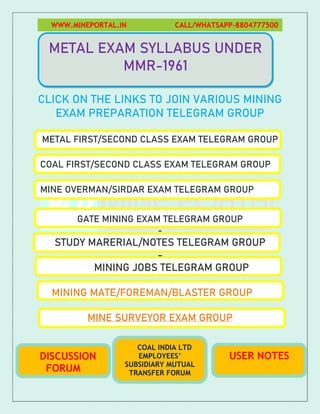
![4474 GI/2021 (1)
रजजस्ट्री सं. डी.एल.- 33004/99 REGD. No. D. L.-33004/99
xxxGIDHxxx
xxxGIDExxx
ऄसाधारण
EXTRAORDINARY
भाग II—खण्ड 3—ईप-खण्ड (i)
PART II—Section 3—Sub-section (i)
प्राजधकार से प्रकाजित
PUBLISHED BY AUTHORITY
श्रम एवं रोजगार मंत्रालय
(खान सुरक्षा महाजनदेिालय)
ऄजधसूचना
धनबाद, 11 ऄगस्ट्त, 2021
सा.का.जन. 560(ऄ).—धात्वीय खान जवजनयम, 1961 के जवजनयम 13, ईप जवजनयम (1) एवं (4) के तहत जनधााररत
प्रावधानों के ऄनुसार छूट के अाधार पर प्रमाण-पत्रों के ऄनुदान और प्रबंधक प्रमाण पत्र के जलए परीक्षा अयोजजत करने के जलए
ईपजनयम बोडा द्वारा जनम्नवत जनयत है-
1.0 व्यवहाररक ऄनुभवः जवजनयम 16, ईप जवजनयम (2) खण्ड (ऄ) के प्रयोजन के जलए, जनम्न व्यवहाररक ऄनुभव ऄनुमोददत दकया
जायेगाः
1.1 व्यवहाररक ऄनुभव की ऄवजध, प्रकृजत और जववरणः
1.1.1 प्रथम श्रेणी प्रबंधक प्रमाण पत्र परीक्षा:
योग्यता व्यवहाररक ऄनुभव की ऄवजध, प्रकृजत और जववरण
खनन आंजीजनयररग या केन्द्र सरकार द्वारा आस बात के जलए मान्द्य
ऄन्द्य समकक्ष योग्यता
या
खनन या खनन आंजीजनयररग में जडप्लोमा या केन्द्र सरकार द्वारा
आस बात के जलए मान्द्य ऄन्द्य समकक्ष योग्यता।
या
जद्वतीय श्रेणी प्रबंधक/ फोरमैन प्रमाण पत्र प्राजि ईपरांत,
भूजमगत धात्वीय खान में जद्वतीय श्रेणी प्रबंधक या फोरमैन की
हैजसयत या पद पर व्यवहाररक ऄनुभव एक वर्ा से कम न हो
सं. 456] नइ ददल्ली, बृहस्ट्पजतवार, ऄगस्ट्त 12, 2021/श्रावण 21, 1943
No. 456] NEW DELHI, THURSDAY, AUGUST 12, 2021/SHRAVANA 21, 1943
सी.जी.-जे.एच.-अ.-12082021-228948
CG-JH-E-12082021-228948](https://image.slidesharecdn.com/metalexamsyllabusandexampattern-241008065117-92d8d1e1/85/METAL-EXAM-SYLLABUS-AND-EXAM-PATTERN-pdf-4-320.jpg)
![2 THE GAZETTE OF INDIA : EXTRAORDINARY [PART II—SEC. 3(i)]
ईच्च माध्यजमक जवधालय परीक्षा या आंटरजमजडएट परीक्षा या
दकसी मान्द्यताप्राि बोडा या जवश्वजवद्यालय से आसके समकक्ष
योग्यता या माइननग आंजीजनयररग के ऄलावा दकसी ऄन्द्य जवर्य
में जडग्री या जडप्लोमा या केन्द्र सरकार द्वारा आस बात के जलए
मान्द्य ऄन्द्य समकक्ष योग्यता।
खनन या खनन आंजीजनयररग में जडप्लोमा या केन्द्र सरकार द्वारा
आस बात के जलए मान्द्य ऄन्द्य समकक्ष योग्यता।
फोरमैन प्रमाण पत्र प्राजि ईपरांत, भूजमगत धात्वीय खान में
फोरमैन/मेट की हैजसयत या पद पर व्यवहाररक ऄनुभव चार
वर्ा से कम न हो
ईच्च माध्यजमक जवधालय परीक्षा या आंटरजमजडएट परीक्षा या
दकसी मान्द्यताप्राि बोडा या जवश्वजवद्यालय से आसके समकक्ष
योग्यता या माइननग आंजीजनयररग के ऄलावा दकसी ऄन्द्य जवर्य
में जडग्री या जडप्लोमा या केन्द्र सरकार द्वारा आस बात के जलए
मान्द्य ऄन्द्य समकक्ष योग्यता।
फोरमैन/मेट प्रमाण पत्र प्राजि ईपरांत, भूजमगत धात्वीय खान
में फोरमैन/मेट की हैजसयत या पद पर व्यवहाररक ऄनुभव
तीन वर्ा से कम न हो
1.1.2 जद्वतीय श्रेणी प्रबंधक प्रमाण पत्र –छूट:
योग्यता व्यवहाररक ऄनुभव की ऄवजध, प्रकृजत और जववरण
खनन आंजीजनयररग में जडग्री या केन्द्र सरकार द्वारा आस बात
के जलए मान्द्य ऄन्द्य समकक्ष योग्यता
अवश्यक िैक्षजणक योग्यता प्राि करने के बाद, भूजमगत धात्वीय खान
में व्यवहाररक ऄनुभव एक वर्ा से कम न हो।
1.1.3 जद्वतीय श्रेणी प्रबंधक प्रमाण पत्र परीक्षा:
योग्यता व्यवहाररक ऄनुभव की ऄवजध, प्रकृजत और जववरण
खनन या खनन आंजीजनयररग में जडप्लोमा या केन्द्र सरकार
द्वारा आस बात के जलए मान्द्य ऄन्द्य समकक्ष योग्यता
फोरमैन प्रमाण पत्र प्राजि ईपरांत, भूजमगत धात्वीय खान में फोरमैन या
मेट की हैजसयत या पद पर व्यवहाररक ऄनुभव तीन वर्ा से कम न हो।
ईच्च माध्यजमक जवधालय परीक्षा या आंटरजमजडएट परीक्षा या
दकसी मान्द्यताप्राि बोडा या जवश्वजवद्यालय से आसके समकक्ष
योग्यता या माइननग आंजीजनयररग के ऄलावा दकसी ऄन्द्य
जवर्य में जडग्री या जडप्लोमा या केन्द्र सरकार द्वारा आस बात
के जलए मान्द्य ऄन्द्य समकक्ष योग्यता।
फोरमैन या मेट प्रमाण पत्र प्राजि ईपरांत, भूजमगत धात्वीय खान में
फोरमैन या मेट की हैजसयत या पद पर व्यवहाररक ऄनुभव दो वर्ा से
कम न हो।
1.1.4 प्रथम श्रेणी प्रबन्द्धक प्रमाण पत्र (केवल खुली खान के जलए सीजमत) परीक्षा:
योग्यता व्यवहाररक ऄनुभव की ऄवजध, प्रकृजत और जववरण
खनन आंजीजनयररग में जडग्री या केन्द्र सरकार द्वारा आस
बात के जलए मान्द्य ऄन्द्य समकक्ष योग्यता
या
खनन या खनन आंजजजनयररग में जडप्लोमा या केन्द्र सरकार
द्वारा आस बात के जलए मान्द्य ऄन्द्य समकक्ष योग्यता
या
ईच्च माध्यजमक जवधालय परीक्षा या आंटरजमजडएट परीक्षा
या दकसी मान्द्यताप्राि बोडा या जवश्वजवधालय से आसके
समकक्ष योग्यता या माइननग आंजीजनयररग के ऄलावा
दकसी ऄन्द्य जवर्य में जडग्री या जडप्लोमा या केन्द्र सरकार
धात्वीय भूजमगत खान या खुली खान के जलए सीजमत जद्वतीय श्रेणी
प्रबंधक प्रमाण पत्र प्राजि ईपरांत, धात्वीय भूजमगत खान या खुली
खान में जद्वतीय श्रेणी प्रबंधक या फोरमैन की हैजसयत या पद पर
व्यवहाररक ऄनुभव एक वर्ा से कम न हो।](https://image.slidesharecdn.com/metalexamsyllabusandexampattern-241008065117-92d8d1e1/85/METAL-EXAM-SYLLABUS-AND-EXAM-PATTERN-pdf-5-320.jpg)
![[भाग II—खण्ड 3(i)] भारत का राजपत्र : ऄसाधारण 3
द्वारा आस बात के जलए मान्द्य ऄन्द्य समकक्ष योग्यता
खनन या खनन आंजजजनयररग में जडप्लोमा या केन्द्र सरकार
द्वारा आस बात के जलए मान्द्य ऄन्द्य समकक्ष योग्यता
धात्वीय भूजमगत खान या खुली खान के जलए सीजमत फोरमैन प्रमाण
पत्र प्राजि ईपरांत, धात्वीय भूजमगत खान या खुली खान में
फोरमैन/मेट की हैजसयत या पद पर व्यवहाररक ऄनुभव चार वर्ा से
कम न हो।
ईच्च माध्यजमक जवधालय परीक्षा या आंटरजमजडएट परीक्षा
या दकसी मान्द्यताप्राि बोडा या जवश्वजवधालय से आसके
समकक्ष योग्यता या माइननग आंजीजनयररग के ऄलावा
दकसी ऄन्द्य जवर्य में जडग्री या जडप्लोमा या केन्द्र सरकार
द्वारा आस बात के जलए मान्द्य ऄन्द्य समकक्ष योग्यता
धात्वीय भूजमगत खान या खुली खान के जलए सीजमत फोरमैन/मेट
प्रमाण पत्र प्राजि ईपरांत, धात्वीय भूजमगत खान या खुली खान में
फोरमैन/मेट की हैजसयत या पद पर व्यवहाररक ऄनुभव तीन वर्ा से
कम न हो।
1.1.5 जद्वतीय श्रेणी प्रबन्द्धक प्रमाण पत्र (केवल खुली खान के जलए सीजमत) - छूट :
योग्यता व्यवहाररक ऄनुभव की ऄवजध, प्रकृजत और जववरण
खनन आंजीजनयररग में जडग्री या केन्द्र सरकार द्वारा आस
बात के जलए मान्द्य ऄन्द्य समकक्ष योग्यता
अवश्यक िैक्षजणक योग्यता प्राजि ईपरांत भूजमगत धात्वीय खान या
खुली धात्वीय खान में व्यवहाररक काया ऄनुभव एक वर्ा से कम न हो।
1.1.6 जद्वतीय श्रेणी प्रबन्द्धक प्रमाण पत्र (केवल खुली खान के जलए सीजमत) परीक्षा:
योग्यता व्यवहाररक ऄनुभव की ऄवजध, प्रकृजत और जववरण
खनन या खनन आंजजजनयररग में जडप्लोमा या केन्द्र सरकार
द्वारा आस बात के जलए मान्द्य ऄन्द्य समकक्ष योग्यता
फोरमैन प्रमाण पत्र (प्रमाण पत्र जो केवल खुली खानों में काया के जलए
प्रजतबंजधत है सजहत) प्राजि ईपरांत, भूजमगत या खुली धात्वीय खान में
फोरमैन या मेट की हैजसयत या पद पर व्यवहाररक काया ऄनुभव तीन
वर्ा से कम न हो।
ईच्च माध्यजमक जवधालय परीक्षा या आंटरजमजडएट परीक्षा
या दकसी मान्द्यताप्राि बोडा या जवश्वजवद्यालय से आसके
समकक्ष योग्यता या माइननग आंजीजनयररग के ऄलावा दकसी
ऄन्द्य जवर्य में जडग्री या जडप्लोमा या केन्द्र सरकार द्वारा
आस बात के जलए मान्द्य ऄन्द्य समकक्ष योग्यता।
फोरमैन या मेट प्रमाण पत्र (प्रमाण पत्र जो केवल खुली खानों में काया
के जलए प्रजतबंजधत है सजहत) प्राजि ईपरांत, भूजमगत या खुली धात्वीय
खान में फोरमैन या मेट की हैजसयत या पद पर व्यवहाररक काया
ऄनुभव दो वर्ा से कम न हो।
नोटः प्रबंधक सक्षमता प्रमाण पत्र परीक्षा के जलए क्लॉज 10.1, 10.2, 10.3 एवं 10.4 में वर्णणत परीक्षा सफलतापूवाक पास करने की
िता पर।
1.2 व्यवाजहररक ऄनुभव दक ऄवजध दकसी एक खदान में एक सिाह से कम मंजूर नहीं होगी ।
1.3 प्रत्येक खान में जलए गए प्रत्येक व्यवहाररक ऄनुभव प्रमाण पत्र में ऄभ्यथी जजस हैजसयत से काम दकया हो, काम की प्रकृजत और
ऄनुभव की िुरूअत और समाजि की जतजथ की सटीक जानकारी होनी चाजहए। व्यवहाररक ऄनुभव का कोइ प्रमाण पत्र, तब तक
स्ट्वीकार नहीं होगा जब तक दक खान के प्रबंधक द्वारा प्रदान नहीं दकया जाता है। प्रबंधक प्रमाण पत्र पर ऄभ्यथी का हस्ट्ताक्षर को
प्रबंधक द्वारा ऄजभप्रमाजणत करना होगा। यदद कोइ व्यजि प्रबंधक के रूप में कायारत है और ईसे व्यवहाररक ऄनुभव की अवश्यकता
होती है, ईस जस्ट्थजत में यह तभी जवचारणीय होगा जब ऄनुभव प्रमाण पत्र खान के ऄजभकताा या खान माजलक द्वारा प्रदत्त हो। कोइ भी
ऄनुभव प्रमाण पत्र स्ट्वीकाया नहीं होगा जब तक बोडा द्वारा जनधााररत फॉमा में जलया न गया हो।
1.4 ऄनुभव प्रमाण पत्र प्रबंधक कायाालय की मुहर के साथ प्रबंधक द्वारा ही हस्ट्ताक्षररत और ददनांदकत होना चाजहए और न दक ईत्पादन
प्रबंधक, वेंरटलेिन, ऄजधकारी/वररष्ठ प्रबंधक/सुरक्षा ऄजधकारी अदद द्वारा। क्षमता, काया की प्रकृजत, काम, स्ट्थान, ऄनुभव और िुरू होने की तारीख
और प्रजिक्षण समाि जतजथ स्ट्पष्ट रूप से ऄंदकत होना चाजहए। ऄभ्यथी को अवश्यक रूप से जवजिष्ट स्ट्थान पर हस्ट्ताक्षर करना होगा।](https://image.slidesharecdn.com/metalexamsyllabusandexampattern-241008065117-92d8d1e1/85/METAL-EXAM-SYLLABUS-AND-EXAM-PATTERN-pdf-6-320.jpg)
![4 THE GAZETTE OF INDIA : EXTRAORDINARY [PART II—SEC. 3(i)]
1.5 काया के घंटों के बाहर प्राि व्यवहाररक ऄनुभव स्ट्वीकाया नहीं है।
1.6 जडग्री/जडप्लोमा के बाद दकसी भी पदनाम (पयावेक्षक, सहायक पयावेक्षक, ऄजभयंता, सहायक ऄजभयंता, सहायक ओवरमैन,
सरदार, सहायक सरदार, कामगार, प्रजिक्षु, अदद) के तहत वास्ट्तजवक खनन पररचालन में प्राि ऄनुभव खनन में प्राि पीजीपीटी/
पीडीपीटी अदद के बराबर माना जा सकेग।
2.0 परीक्षा के प्रकारः
2.1 प्रत्येक जवर्य के जलए परीक्षा, कम्पप्युटर अधाररत टेस्ट्ट (सीबीटी) द्वारा होगी जजसकी ऄवजध तीन घंटे की होगी ।
2.2 प्रत्येक जवर्य के जलए प्रश्नों को बोडा को जमा दकए जाएंगे। अवश्यकता के ऄनुसार प्रश्नों को बोडा ऄनुसमर्णथत कर सकता है ।
2.3 जवर्य ऄंकःप्रत्येक जवर्य के जलए ऄजधकतम 150 ऄंक होंगे।
2.4 परीक्षा ईत्तीणा करने के जलए एक ईम्पमीदवार को कम्पप्युटर अधाररत टेस्ट्ट मे प्रत्येक जवर्य में ऄजधकतम ऄंक के 50 प्रजतित से
कम प्राि नही होने चाजहए (याजन 150 मे कम से कम 75) ।
3.0 परीक्षार्णथयों की पहचान एवं अचरण:
3.1 प्रत्येक ईम्पमीदवर परीक्षा के दौरान सजचव के अवश्यकतानुसार व्यवहार करेगा/करेगी ।
3.2 परीक्षा हाल में ऄभ्यथी के पास आलेक्रोजनक गेजेट जैसे मोबाइल, लेपटॉप आत्यादद नहीं होने चाजहए।
4.0 कदाचार के जलए दण्ड:
4.1 कोइ भी ईम्पमीदवार झुठा/जमथ्या प्रमाण पत्र ऄथवा नकली प्रमाण-पत्र जमा करता है ऄथवा झुठी घोर्णा करता है ऄथवा
परीक्षा के दौरान गलत तरीके का ईपयोग करता है, ईसको बोडा द्वारा मामले के तथ्यों के अधार पर ऄयोग्य घोजर्त दकया जा सकता है
और जनजित ऄवजध के जलए अगामी परीक्षा के जलए वंजचत भी दकया जा सकता है।
4.2 यदद कोइ ईम्पमीदवार जो दकसी भी प्रमाण पत्र के जलए ली गइ परीक्षा में सफल घोजर्त दकया जाता है ऄथवा जजसे कोइ प्रमाण
पत्र जारी दकया गया है, और ईस प्रमाण पत्र के जलए बाद में ऐसा पाया जाता है दक ईसने झुठा/जमथ्या प्रमाण पत्र ऄथवा नकली प्रमाण-
पत्र जमा दकया है ऄथवा झुठी घोर्णा प्रस्ट्तुत की है, तो बोडा मामले के अधार पर ईसके पररणाम को जनरस्ट्त कर सकता है ऄथवा
ईसको जारी ईि प्रमाण पत्र को भी वापस जलया जा सकता है।
5.0 पररणामों की घोर्णा: परीक्षाओं के ऄंजतम पररणाम जैसा बोडा द्वारा ऄनुमोददत दकया गया है, बोडा द्वारा जनजित जतजथ को
सजचव द्वारा घोजर्त दकए जायेंगे।
6.0 परीक्षाओं की अवृजत: परीक्षाए, जहॉ तक व्यवहाररक हों, साल में एक बार अयोजजत की जाएगी।
7.0 अवेदन के साथ मूल दस्ट्तावेज आत्यादद : कोइ भी अवेदन स्ट्वीकार नहीं दकया जाएगा जब तक ईसके साथ अवश्यक योग्यता,
व्यवहाररक ऄनुभव एवं ईम्र की मूल प्रमाण पत्र की स्ट्कैन कॉपी तथा जनधााररत िुल्क जमा करवाने के साक्ष्य नहीं ददए गए हों। मूल
दस्ट्तावेज तथा ईनके स्ट्वप्रमाजणत फोटोकॉपी ईम्पमीदवार द्वारा कजथत परीक्षा ईत्तीणा होने पर जमा करना होगा ।
8.0 कम्पप्युटर अधाररत परीक्षा को पररचाजलत करने के जनयम :
8.1 सी बी टी परीक्षा िुरू होने के पिात दकसी भी ईम्पमीदवार को सी बी टी परीक्षा कक्ष में प्रवेि की ऄनुमजत नहीं दी जाएगी।
8.2 सी बी टी हॉल में प्रवेि करने से पूवा प्रत्येक ईम्पमीदवार ऄपनी दकताबे, नोटस एवं पेपर आत्यादद परीक्षा केन्द्र के बाहर छोड़ कर
अयेगा।
8.3 प्रत्येक परीक्षाथी को रजजस्ट्टर/िीट जजसमें रोल नम्पबर होगें/व्यजिगत पहचान दजा करवाकर हस्ट्ताक्षर करने होगें।
8.4 कोइ भी परीक्षाथी, जजसको वीक्षक ऄथवा परीक्षक ऄथवा ऄन्द्य सहायता की अवश्यकता हो, ऄपने स्ट्थान पर ध्यान अकर्ाण के
जलए खड़ा हो जाएगा परन्द्तु वह दकसी भी जस्ट्थजत में अवाज नहीं लगाएगा।](https://image.slidesharecdn.com/metalexamsyllabusandexampattern-241008065117-92d8d1e1/85/METAL-EXAM-SYLLABUS-AND-EXAM-PATTERN-pdf-7-320.jpg)
![[भाग II—खण्ड 3(i)] भारत का राजपत्र : ऄसाधारण 5
8.5 कोइ भी परीक्षाथी, दकसी दुसरे परीक्षाथी से बातचीत करता ऄथवा कोइ दकताब/नोट्स, और ऐसे पेपर जो परीक्षा बोडा द्वारा नहीं
जवतररत दकए गए हैं ऄथवा परीक्षक को दकसी भी तरीके के ऄनुजचत साधनों का ईपयोग या ऄनुजचत व्यवहार/ अचरण करते पाया
जाता है तो ऄयोग्य घोजर्त करने के भागी होगा।
8.4 दकसी भी परीक्षाथी को परीक्षा िुरू होने के बाद से एक घण्टे की समाजि तक परीक्षा हॉल छोड़ कर जाने की ऄनुमजत नहीं दी
जाएगी।
8.7 यदद कोइ परीक्षाथी ददए गए प्रश्नों के ईत्तर पुरे कर दें ऄथवा जो समय ईसे ईत्तर देने के जलए ददया गया है, पूरा हो जाता है
ऄथवा दकसी परीक्षाथी को धारा/जबन्द्दु संख्या 8.5 के अधार पर परीक्षा से ऄयोग्य घोजर्त कर ददया जाए तो वह जनजित ही तत्काल
परीक्षा हॉल छोड़ देगा।
9.0 परीक्षकों की जनयुजि:
9.1 जहॉ तक व्यवहाररक हो, सम्पबंजधत जवर्य का ऄनुभव रखने वाले, दकसी प्रजतजष्ठत संस्ट्थान के ऄकदमीजियन / वैज्ञाजनक
और/ऄथवा प्रथम श्रेणी प्रबंधक सक्षमता प्रमाण पत्र (जजसमे ओपन कॉस्ट्ट खानों तक सीजमत प्रमाण पत्र भी िाजमल है) धारक खनन
ऄजभयंता और/ऄथवा बोडा द्वारा जनयुि आन्द्सपेक्टर ऑफ माआन्द्स द्वारा प्रश्न बैंक बनाया जाएगा जजसमे औब्जैकरटव बहुजवकल्पीय प्रश्न
(एम सी क्यू) रहेंगे ।
9.2 अपात जस्ट्थजत को छोड़कर बोडा का कोइ भी सदस्ट्य परीक्षक के रूप में काया नहीं करेगा।
10.0 परीक्षा के जलए जवर्य, पाठयक्रम एवं िुल्क:
10.1 प्रथम श्रेणी प्रबंधक प्रमाण पत्र के ईम्पमीदवार की जनम्नानुसार परीक्षा ली जाएगी:
क्रम संख्या योग्यता जवर्य जजनमें ईपजस्ट्थजत अवश्यक है पाठ्यक्रम
1. खनन ऄजभयांजत्रकी में स्ट्नातक/जडग्री
धारक ऄथवा केन्द्र सरकार द्वारा
ऄनुमोददत ईसके समकक्ष योग्यता
खान प्रबंधन, जवधान एवं सामान्द्य सुरक्षा पररजिष्ट ।
2. खनन ऄथवा खनन ऄजभयानत्रकी में
जडप्लोमा ऄथवा केन्द्र सरकार द्वारा
ऄनुमोददत ईसके समकक्ष योग्यता
जद्वतीय श्रेणी प्रबंधक प्रमाण पत्र के साथ
1. खान प्रबंधन, जवधान एवं सामान्द्य सुरक्षा
2. नवजनग एण्ड वर्ककग
3. माइन वेन्द्टीलेिन
3. सीजनयर सैकण्डरी स्ट्कूल परीक्षा ऄथवा
आन्द्टरजमजडएट परीक्षा ऄथवा आसके
समकक्ष, या दकसी मान्द्यताप्राि बोडा
ऄथवा यूजनवर्णसटी से खनन ऄजभयंत्रंन के
ऄलावा दकसी भी ऄन्द्य जवर्य मे जडग्री
या जडप्लोमा ऄथवा केन्द्र सरकार द्वारा
ऄनुमोददत ईसके समकक्ष योग्यता
जद्वतीय श्रेणी प्रबंधक प्रमाण पत्र के साथ
4. खनन ऄथवा खनन ऄजभयानत्रकी में
जडप्लोमा ऄथवा केन्द्र सरकार द्वारा
ऄनुमोददत ईसके समकक्ष योग्यता
1. खान प्रबंधन, जवधान एवं सामान्द्य सुरक्षा
2. नवजनग एण्ड वर्ककग
3. माइन वेन्द्टीलेिन
4 माआननग मिीनरी
5 माइन सवेआंग
5. सीजनयर सैकण्डरी स्ट्कूल परीक्षा ऄथवा
आन्द्टरजमजडएट परीक्षा ऄथवा आसके
समकक्ष, या दकसी मान्द्यताप्राि बोडा
ऄथवा यूजनवर्णसटी से खनन ऄजभयंत्रंन के
ऄलावा दकसी भी ऄन्द्य जवर्य मे जडग्री
या जडप्लोमा ऄथवा केन्द्र सरकार द्वारा
ऄनुमोददत ईसके समकक्ष योग्यता](https://image.slidesharecdn.com/metalexamsyllabusandexampattern-241008065117-92d8d1e1/85/METAL-EXAM-SYLLABUS-AND-EXAM-PATTERN-pdf-8-320.jpg)
![6 THE GAZETTE OF INDIA : EXTRAORDINARY [PART II—SEC. 3(i)]
10.2 जद्वतीय श्रेणी प्रबंधक प्रमाण पत्र के ईम्पमीदवार की जनम्नानुसार परीक्षा ली जाएगी:
क्रम
संख्या
योग्यता जवर्य जजनमें ईपजस्ट्थजत अवश्यक
है
पाठ्यक्रम
1. खनन ऄजभयांजत्रकी में स्ट्नातक/जडग्री धारक ऄथवा केन्द्र सरकार
द्वारा ऄनुमोददत ईसके समकक्ष योग्यता
-िून्द्य- -िून्द्य-
2. खनन ऄथवा खनन ऄजभयानत्रकी में जडप्लोमा ऄथवा केन्द्र सरकार
द्वारा ऄनुमोददत ईसके समकक्ष योग्यता
खान प्रबंधन, जवधान एवं
सामान्द्य सुरक्षा
पररजिष्ट ।।
3. सीजनयर सैकण्डरी स्ट्कूल परीक्षा ऄथवा आन्द्टरजमजडएट परीक्षा
ऄथवा आसके समकक्ष या दकसी मान्द्यताप्राि बोडा ऄथवा
यूजनवर्णसटी से खनन ऄजभयंत्रंन के ऄलावा दकसी भी ऄन्द्य जवर्य
में जडग्री या जडप्लोमा ऄथवा केन्द्र सरकार द्वारा ऄनुमोददत ईसके
समकक्ष योग्यता
1. खान प्रबंधन, जवधान एवं
सामान्द्य सुरक्षा
2. नवजनग एण्ड वर्ककग
3. माइन वेन्द्टीलेिन
4 माआननग मिीनरी
5 माइन सवेआंग
10.3 प्रथम श्रेणी प्रबंधक प्रमाण पत्र (ओपन कॉस्ट्ट खानों तक सीजमत) के ईम्पमीदवार की जनम्नानुसार परीक्षा ली जाएगी:
क्रम
संख्या
योग्यता जवर्य जजनमें ईपजस्ट्थजत अवश्यक
है
पाठयक्रम
1. खनन ऄजभयांजत्रकी में स्ट्नातक/जडग्री धारक ऄथवा केन्द्र सरकार
द्वारा ऄनुमोददत ईसके समकक्ष योग्यता
खान प्रबंधन, जवधान एवं
सामान्द्य सुरक्षा
पररजिष्ट ।।।
2. खनन ऄथवा खनन ऄजभयानत्रकी में जडप्लोमा ऄथवा केन्द्र
सरकार द्वारा ऄनुमोददत ईसके समकक्ष योग्यता जद्वतीय श्रेणी
प्रबंधक (प्रमाण पत्र सजहत जो केवल खुली खदानों में काया के
जलये सीजमत है ) के साथ
1. खान प्रबंधन, जवधान एवं
सामान्द्य सुरक्षा
2. नवजनग एण्ड वर्ककग
3. सीजनयर सैकण्डरी स्ट्कूल परीक्षा ऄथवा आन्द्टरजमजडएट परीक्षा
ऄथवा आसके समकक्ष या दकसी मान्द्यताप्राि बोडा यूजनवर्णसटी
ऄथवा खनन ऄजभयात्रन के ऄलावा दकसी भी ऄन्द्य जवर्य में
जडप्लोमा और जडग्री ऄथवा केन्द्र सरकार द्वारा ऄनुमोददत ईसके
समकक्ष योग्यता जद्वतीय श्रेणी प्रबंधक (प्रमाण पत्र सजहत जो
केवल खुली खदानों में काया के जलये सीजमत है ) के साथ
4 खनन ऄथवा खनन ऄजभयानत्रकी में जडप्लोमा ऄथवा केन्द्र
सरकार द्वारा ऄनुमोददत ईसके समकक्ष योग्यता
1. खान प्रबंधन, जवधान एवं
सामान्द्य सुरक्षा
2. नवजनग एण्ड वर्ककग
3. माआननग मिीनरी
4. माइन सवेआंग
5 सीजनयर सैकण्डरी स्ट्कूल परीक्षा ऄथवा आन्द्टरजमजडएट परीक्षा
ऄथवा आसके समकक्ष या दकसी मान्द्यताप्राि बोडा यूजनवर्णसटी
ऄथवा खनन ऄजभयात्रन के ऄलावा दकसी भी ऄन्द्य जवर्य में
जडप्लोमा और जडग्री ऄथवा केन्द्र सरकार द्वारा ऄनुमोददत ईसके
समकक्ष योग्यता](https://image.slidesharecdn.com/metalexamsyllabusandexampattern-241008065117-92d8d1e1/85/METAL-EXAM-SYLLABUS-AND-EXAM-PATTERN-pdf-9-320.jpg)
![[भाग II—खण्ड 3(i)] भारत का राजपत्र : ऄसाधारण 7
10.4 जद्वतीय श्रेणी प्रबंधक प्रमाण पत्र (ओपन कॉस्ट्ट खानों तक सीजमत) के ईम्पमीदवार की जनम्नानुसार परीक्षा ली जाएगी:
क्रम
संख्या
योग्यता जवर्य जजनमें ईपजस्ट्थजत
अवश्यक है
पाठयक्रम
1 खनन ऄजभयांजत्रकी में स्ट्नातक/जडग्री धारक ऄथवा केन्द्र
सरकार द्वारा ऄनुमोददत ईसके समकक्ष योग्यता
-िून्द्य- -िून्द्य-
2 खनन ऄथवा खनन ऄजभयानत्रकी में जडप्लोमा ऄथवा
केन्द्र सरकार द्वारा ऄनुमोददत ईसके समकक्ष योग्यता
खान प्रबंधन, जवधान एवं
सामान्द्य सुरक्षा
पररजिष्ट-।V
3 सीजनयर सैकण्डरी स्ट्कूल परीक्षा ऄथवा आन्द्टरजमजडएट
परीक्षा ऄथवा आसके समकक्ष या दकसी मान्द्यताप्राि बोडा
ऄथवा यूजनवर्णसटी से खनन ऄजभयन्द्त्रन के ऄलावा दकसी
भी ऄन्द्य जवर्य में जडप्लोमा ओर जडग्री ऄथवा केन्द्र
सरकार द्वारा ऄनुमोददत ईसके समकक्ष योग्यता
1. खान प्रबंधन, जवजध जनमााण
एवं सामान्द्य सुरक्षा
2. जवननग एण्ड वर्ककग
3. माआननग मिीनरी
4. माइन सवेआंग
10.5 भुगतेय िुल्क:- अवेदन पत्र के साथ प्रथम श्रेणी प्रबंधक तथा जद्वतीय श्रेणी प्रबंधक प्रमाण पत्रों के जलए भुिेय िुल्क क्रमि:
रु एक सौ (रु. 100 /-) तथा पचहत्तर (रु75 /-) मात्र हैं।
11.0 सेनवग क्लौज: बिते दक बोडा एसे कीसी भी मामले पर, जो ईपरोि ईप-कानून मे जनर्ददष्ट नहीं है, जजसे ईसके समक्ष लाया जाता
है, जनणाय ले सकता है।
12.0 यदद ईपजनयम के ऄंग्रेजी एवं जहन्द्दी प्रारुप में कोइ जभन्द्नता/िंका हो, तो ऄंग्रेजी प्रारुप मान्द्य होगा।
पररजिष्ट-।
प्रथम श्रेणी प्रबंधक प्रमाण पत्र परीक्षा हेतु पाठ्यक्रम
(धात्वीय खान जवजनयम, 1961के तहत)
(ए) खनन प्रबंधन, जवधान और सामान्द्य सुरक्षा
खनन प्रबंधन: -
पररचय: प्रबंधन का जवकास; जसद्ांत और ऄभ्यास; वैज्ञाजनक प्रबंधन के जसद्ांत; प्रबंधन काया के तत्व; योजना; संगठन और जनयंत्रण;
खनन ईद्यमों के जलए संगठन की संरचना और रूपरेखा।
व्यजिगत प्रबंधन और संगठनात्मक व्यवहार चयन: खनन ईद्यमों के जलए मानव संसाधनों का चयन, प्रजिक्षण और जवकास; नेतृत्व;
पारंपररक नेता व्यवहार का ऄध्ययन; जनरंकुि, लोकतांजत्रक और लाइसेज़-फे यर व्यवहार; जवरोधाभास प्रबंधन; संगठन में जवरोधाभार्
के स्ट्त्रोत; जवरोधाभार् से जनपटान, जवरोधाभार् समाधान की व्यवस्ट्था, जवरोधाभार् और जवकाि, व्यजिगत प्रेरणा; दो तरफा
व्यजिगत संचार।
ईत्पादन प्रबंधन: काया ऄध्ययन द्वारा संचालन के मानदंडों एवं मानकों का जनधाारण; खान केपेजसटी और क्षमता का जविलेर्ण; ईत्पादन
योजना, समय साररणी और जनयंत्रण; ऄल्पकाजलक और दीघाकाजलक योजना; ईत्पादकता; ऄवधारणाओं और माप; खान के पररचालन
में Ergonomics का ईपयोग।
जवत्तीय प्रबंधन: पूंजीगत बजट; खनन पररयोजना मूल्यांकन के जलए तकनीकें; भुगतान ऄवजध और वापसी की अंतररक दर
(अइअरअर); लागत जवश्लेर्ण और लागत जनयंत्रण के तरीके; ब्रेक इवन चाटा; कायािील पूूँजी प्रबंधन; इअरपी (ईद्यम संसाधन
योजना)।](https://image.slidesharecdn.com/metalexamsyllabusandexampattern-241008065117-92d8d1e1/85/METAL-EXAM-SYLLABUS-AND-EXAM-PATTERN-pdf-10-320.jpg)
![8 THE GAZETTE OF INDIA : EXTRAORDINARY [PART II—SEC. 3(i)]
खनन पयाावरण: इअइए (पयाावरण प्रभाव अकलन), इएमपी (पयाावरण प्रबंधन योजना), इटीपी (प्रवाह ईपचार संयंत्र), एसटीपी
(सीवरेज रीटमेंट प्लांट), भूजमगत और सतही खनन से पयाावरण को खतरा, जनपटने के ईपाय, प्रदूर्ण कारकों का ईपचार, जनगरानी
प्रणाली, जल प्रबंधन; खान बंदी की योजना; अर एंड अर (पुनवाास और पुन: जनपटान)। भूजम ऄजधग्रहण में ईजचत मुअवजा एवं
पारदर्णिता का ऄजधकार, सुधार तथा पुनवाास ऄजधजनयम, 2013, (अरएफसीटीएलएअर ऄजधजनयम, 2013) और वन भूजम से
संबंजधत कानून। तकनीकी और जैजवक ईद्ार और ईपरी जमट्टी प्रबंधन।
खनन का अर्णथक प्रभाव: खनन का ऄथािास्त्र, समुदाय पर खनन का प्रभाव – खनन के पहले, खनन के दौरान और खनन के बाद में;
कॉपोरेट सामाजजक जजम्पमेदारी (सीएसअर)।
खनन क्षेत्र के जलए सामग्री प्रबंधन: एबीसी जवश्लेर्ण, मालसूची (आनवेंटरी) प्रबंधन।
प्रबंधन के जलए व्यवहाररक जवज्ञान: जवरोधाभार् प्रबंधन; संगठन में जवरोधाभार्; जवरोधाभार् के स्रोत;
औद्योजगक दुघाटना: औद्योजगक दुघाटनाओं के मानव कारकों का ऄध्ययन; ईनके कारण और ईपचार।
जवधान : -
स्ट्वास्ट्थ्य और सुरक्षा कानून: खान ऄजधजनयम, 1952; खान जनयम, 1955 (माआन्द्स रूल्स 1955), धात्वीय खान जवजनयम, 1961, खान
बचाव जनयम, 1985, केंरीय जवद्युत प्राजधकरण (सुरक्षा और जवद्युत अपूर्णत से संबंजधत ईपाय) जवजनयम, 2010 में खानों पर लागू
प्रावधान; खान व्यावसाजयक प्रजिक्षण जनयम, 1966, ओपनकास्ट्ट धात्वीय खानों पर लागू होने वाले ऄन्द्य जनयम और जवधान।
सामान्द्य सुरक्षा:-
खानों में सुरक्षा: देखभाल का कताव्य, खनन के व्यावसाजयक जोजखम, दुघाटनाओं के कारण और ईनका रोकथाम व वगीकरण; दुघाटना के
अंकड़े; अवृजत्त दर और गंभीरता दर; कारणवार जवश्लेर्ण, दुघाटना घरटत होने के मूल कारण; दुघाटनाओं की जांच एवं दुघाटना जांच
ररपोटा; दुघाटनाओं के जवजभन्न कारणों का गहन ऄध्ययन, खानों में सुरक्षा में सुधार के ईपाय; TRAP (दुघाटना की रोकथाम में
जजम्पमेदारी लें); दुघाटना की कीमत; एसएमपी (सुरक्षा प्रबंधन योजना); सुरक्षा प्रबंधन योजना के तत्व, एसएमपी बनाने की प्रदक्रया,
ओपनकास्ट्ट (खुली) खानों में मानक संचालन प्रदक्रया (एसओपी) और ओपेनकास्ट्ट खानों में खतरे से संबंजधत प्रबंधन योजनाएं, खानों में
दुघाटनाओं और अपात जस्ट्थजत से जनपटान, दुघाटना या घटना के कारण, दुघाटना जांच जवजधयां एवं आसके जवजभन्न स्ट्तर, दुघाटना / घटना
प्रजतवेदन (ररपोर्टटग), खान सुरक्षा में मानव तत्वों का योगदान, सुरक्षा प्रबंधन में श्रजमकों की भागीदारी; अइएसओ (अंतररक सुरक्षा
संगठन) और सुरक्षा पररक्षण (Safety Audit), सुरक्षा सम्पमेलन; जत्रपक्षीय और जद्वपक्षीय सजमजतयां; सुरक्षा प्रबंधन में सूचना प्रौद्योजगकी
की भूजमका।
जोजखम प्रबंधन: जसद्ांत और प्रयोग, अधारभूत, जनरंतर और मुद्दे अधाररत जोजखम मूल्यांकन, तकनीकी क्षेत्रों में आसके प्रयोग के तरीके ,
जोजखम की पहचान, जोजखम मूल्यांकन तकनीक, कायास्ट्थल जोजखम अकलन और जनयंत्रण (डब्ल्यूअरएसी), काया सुरक्षा जवश्लेर्ण
(जेएसए), जोजखम मैररक्स, जोजखम प्रबंधन जवकल्प, जनयंत्रण का पदानुक्रम, जनयंत्रण प्रभाविीलता, जोजखम, कंप्यूटर ऄनुप्रयोग और
जसमुलेिन, जोजखम प्रबंधन में प्रबंधक की भूजमका, (ड्यूजडजलजेंस) यथोजचत परीश्रम के साथ जोजखम मूल्यांकन एवं जोजखम प्रबंधन का
आस्ट्तेमाल, ररगर एक्िन ररस्ट्पांस प्लान (टीएअरपी) का जसद्ांत।
वायुवाही धूल:- ईत्पजत्त, फै लाव, माप और जनयंत्रण; खान जजनत धूल का दमन और ईपचार; खान जजनत धूल का नमूनाकरण और
जवश्लेर्ण, खान जजनत धूल के कारण जोजखम।
खान की अग: - खान की अग के कारण, खान की अग से जनपटान; ऄजििमन संगठन; ऄयस्ट्क की ढेर और वेस्ट्ट डंप की अग।
पानी की ऄंतवााह: जल जनकायों या ऄजनजित रव्यमान के पास ओपेनकास्ट्ट और भूजमगत खनन पररचालन में ईपजस्ट्थत संकट, जोजखम
और आससे बचाव के ईपाय।
बेंच और डंप जवफलताएं: स्ट्राटा प्रबंधन, बेंच और डंप की जस्ट्थरता से जुड़े जोजखम और खतरे ।
ओपनकास्ट्ट खानों में चरम मौसम की जस्ट्थजत के कारण व्याप्त खतरे एवं आससे बचाव।
खनन में व्यावसाजयक जोजखम और बचाव के ईपाय।](https://image.slidesharecdn.com/metalexamsyllabusandexampattern-241008065117-92d8d1e1/85/METAL-EXAM-SYLLABUS-AND-EXAM-PATTERN-pdf-11-320.jpg)
![[भाग II—खण्ड 3(i)] भारत का राजपत्र : ऄसाधारण 9
जैजवक खतरे, रासायजनक खतरे।
उ
ं चाइ पर काम करना
खान की गैसें: गैसों की ईत्पजत्त, गुण और प्रभाव, खान की गैसों की पहचान, गैस जडटेक्टर, गैस क्रोमोटोग्राफ, फ्लैम सेफ्टी लैंप।
खान में जवस्ट्फोट: जवस्ट्फोट के कारण, रोकथाम एवं बचाव ।
अपदा प्रबंधन: अपदा प्रबंधन प्लान, अपातकालीन सेवाएं, ईपकरण और प्रदक्रयाएं, अपातकालीन जनयंत्रण कक्ष, राहत और बचाव;
प्रदक्रया और जजम्पमेदाररयां, अपातकालीन प्रजतदक्रया में लगे व्यजियों की सुरक्षा, जांच और ररपोटा; क्षजत का मूल्यांकन, खान में बचाव;
ररसजसटैिन और ररवाआनवग ईपकरण; बचाव काया के जलए चयन और प्रजिक्षण।
प्राथजमक जचदकत्सा और एम्पबुलेंस
ऄजधसूजचत और व्यावसाजयक बीमाररयां: जसजलकोजसस और न्द्यूमोकोनोजसस, धूल जजनत वातावरण में सांस लेने से िरीर पर प्रभाव;
धूल नमूनाकरण एवं नमूनाकरण ईपकरण; जगनती और जवश्लेर्ण के तरीके ; खानों की ऄन्द्य बीमाररयां और ईनके लक्षण; रोकथाम और
ईपचार।
प्रकाि: कृजत्रम प्रकाि के सामान्द्य जसद्ांत; प्रकाि मानक और ईनके मूल्यांकन।
खानों में स्ट्वच्छता और स्ट्वास्ट्थ्य
खजनज की क्रनिग , हैंडनलग और पररवहन प्रणाली में सुरक्षा संबंधी मुद्दे।
(बी) जवनींग और वर्दकगं
भूजवज्ञान: खजनज संपदा की प्रकृजत और पाया जाना; भारतीय खजनज सम्पपदा का जववरण; खनन में भूजवज्ञान का प्रयोग; भूवैज्ञाजनक
संरचनाएं; फोल्डस, फॉल्ट, फ्रैक्चर, दफिर आत्यादद, बोररग के तरीके, जडस्ट्टबा स्ट्तर में बोररग; बोर होल सवेक्षण; आंडीकेटेड और प्रूवड
खजनज ररजवा; भूगभीय मानजचत्रों की व्याख्या।
खजनज सम्पपदा खोलना: िाफ्ट नसककग और जिफ्ट िाआवेज; नसककग के तरीके: सामान्द्य और पानी के मैदानों में यंत्रीकृत नसककग, और
ऄन्द्य जविेर् तरीके; िाफ्ट सपोटा, ऄस्ट्थायी और स्ट्थायी, मिीनीकृत स्ट्टोन जिनफ्टग आत्यादद।
सतह और भूजमगत व्यवस्ट्था सजहत खानों के जवकास और रूपरेखा: िाफ्ट-टॉप और जपट-बॉटम और हालेज व्यवस्ट्था की रूपरेखा और
जवकास।
भूजमगत खनन के तरीके: खजनज सम्पपदा के खनन करने के तरीकों का चुनाव एवं ईक्त चुनाव को प्रभाजवत करने वाले कारक (गहराइ,
मोटाइ, झुकाव आत्यादद) के तरीकों का चुनाव जो दक ईक्त को प्रभाजवत करते हैं; वैधाजनक प्रावधान।
ओपन कास्ट्ट खनन: खजनज सम्पपदा को खोलना और ईत्खनन की तैयारी; बॉक्स कट; क्षेत्र का चुनाव; ओपन कास्ट्ट खान की रूप रेखा,
पैरामीटर, ईत्पादन बेंच का जनमााण; ररनपग; ररपर के प्रकार; काया जनष्पादन का साआदकल; हॉल रोड और रैम्पप का जनमााण, चौड़ाइ,
सूपर एजलवेिन/ कैम्पबर, केंरीय बाूँध, साआड बाूँध, ढलान, बुजनयाद, ईप बुजनयाद, सतह, सतह में दफ्रक्िन, अवश्यक समाग्री, जल
जनकासी की व्यवस्ट्था, कवा, जवजजजबजलटी (दृश्यता), आस्ट्तेमाल होने वाली मिीनें, रख-रखाव, जांच, हॉल रोड क्रानसग, टी-जंक्िन, राय
-जंक्िन, चतुष्पथी क्रानसग, पैरामीटर, एच इ एम एम (HEMM) की पार्ककग, डंप रक की पार्ककग, गो लाआन जडजाआन, अश्रय का
जनमााण, व्यू पॉआंट जनमााण।
धूल के िमन के जलए खान की सड़कों की वाटररग, आस्ट्तेमाल होने वाले तरीके, ओवर वाटररग के कारण ईत्पन्न होने वाले खतरे, वाटर
स्ट्प्रेनयग के प्रकार, स्ट्पॉट या जस्ट्रप वाटररग।
जिनलग: ब्लास्ट्ट होल जिल; जनष्पादन के मापदण्ड; जिल की जगनती की अवश्यकता; ब्लानस्ट्टग; जवस्ट्फोटकों का प्रयोग एवं सुरजक्ित
हंडेनलग; स्ट्टोनपग एवं डेव्लपमेंट में जवस्ट्फोट की तकनीक; ब्लास्ट्ट की रूपरेखा; ब्लास्ट्ट की रूपरेखा को प्रभाजवत करने वाले कारक; डीप
होल्ड ब्लानस्ट्टग; प्रजत होल चाजा की गणना; ज़मीन की वाआब्रेिन; सकैंडरी ब्लानस्ट्टग और ब्लानस्ट्टग की मुजश्कलें; पयाावरण के ऄनुकूल
नान- ब्लानस्ट्टग तकनीक; सुरक्षा संकल्प; परजमटेड जवस्ट्फोटक ।](https://image.slidesharecdn.com/metalexamsyllabusandexampattern-241008065117-92d8d1e1/85/METAL-EXAM-SYLLABUS-AND-EXAM-PATTERN-pdf-12-320.jpg)
![10 THE GAZETTE OF INDIA : EXTRAORDINARY [PART II—SEC. 3(i)]
ईत्खनन और पररवहन के ऄजनरंतर/ चक्रीय तरीके: िावेल, डम्पपर ऑपरेिन; जवद्युत िावेल और हाआिोजलक िावेल का प्रयोग; साआकल
टाआम और ईत्पादकता गणना; ईपकरण संख्या का अकलन; सतह (सरफे ि) माआनर - पररचालन जवजधयां (चौड़े/पूणा अधार जवजधयां,
चौड़े/पूणा बेंच, ब्लॉक खनन, स्ट्टेप्ड कट, खाली रेवल बैक, टना बैक और जनरंतर खनन जवजधयां); कन्द्वेयरस; जिफ्ट करने योग्य और ईच्च
कोण कन्द्वेयर; ऑपरेिन की प्रणाली अदद; ओअइटीडीएस (ऑपरेटर आण्डेपेंडेंट रक जडस्ट्पैच जसस्ट्टम); आन-जपट क्रनिग और जस्ट्रप-खनन।
हॉल रोड और रैंप का जनमााण: चौड़ाइ, सुपर एजलवेिन/कैम्पबर, केंरीय बंड, साआड बंड, ढलान, अधार, ईप-अधार, सतह, सतह घर्ाण,
अवश्यक सामग्री, जल जनकासी की व्यवस्ट्था, कवा, दृजष्टक्षेत्र, आस्ट्तेमाल होने वाली मिीने, रख-रखाव, जनगरानी, हाईल रोड क्रॉनसग,
टी-जंक्िन, राइ-जंक्िन, चतुष्पथी क्रॉनसग, पैरामीटर, एच.इ.एम.एम. की पार्ककग, डंप रक की पार्ककग, जी.ओ.-लाआन जडज़ाआन,
अश्रय का जनमााण, व्यू प्वाईंट ट जनमााण।
खनन और स्ट्राटा जनयंत्रण के तरीकों को जडजाआन करने के जलए रॉक मैकेजनक्स की ऄवधारणाओं का ईपयोग: जमीन की मूवमेंट और
स्ट्राटा जनयंत्रण के जसद्ांत; स्ट्रेस, स्ट्रेन – कॉम्पप्रेजसव और टेनसाआल, जसयर स्ट्रेन्द्थ, यूजनएजक्सयल और राइ-एजक्सयल स्ट्रेन्द्थ, पोआसन
ऄनुपात, यंग मॉड्यूलस, कॉन्द्भरजेन्द्स, आलाजस्ट्टजसटी, जलथोस्ट्टैरटक और हाआिोस्ट्टैरटक दबाव; चट्टान रव्यमान वगीकरण, स्ट्टूक की
मजबूती; िाफ्ट पीलर; सतह संरचनाओं की सुरक्षा; रॉक में बनावटों की रूप-रेखा और संतुलन; रॉक मास रेरटग, भूजमगत ईत्खनन और
खुले गड्ढों के स्ट्पोटा और मजबूती की रूप-रेखा, आलनडग और नन-आलनडग स्ट्पोटा, गजतिील और स्ट्थैजतक लोनडग, मापने के ईपकरण,
समाजहत और ऄसमाजहत दफल, रॉक बोल्ट, केबल बोल्ट, तार जाल, माआन स्ट्पोटा में नवीनतम जवकास, स्ट्पोटा जडजाआन के अर्णथक पहलू,
सजब्सडेंस; रॉक मास की केजवन; बम्पप; रॉक मास जनष्पादन की जांच; छत प्रबंधन, मेकेजनक्स ऑफ रॉक फ्रेगमेंटेिन; रॉक मास प्रफॉरमेंि
की मोनेटररग, बेंच के प्रकार और डंप ढलान की जवफलताएं, ग्राईंड मूवमेंट और स्ट्राटा जनयंत्रण के जसद्ांत; डंप प्रकार, अंतररक और
पीट के बाहर का डंप, डंप जनमााण, साइज, अकार, साआट चयन और डंनपग के जलए तैयारी, डंनपग के तरीके, डंप जनमााण के जलए
अवश्यक मिीनें, समेदकत और ऄसमेदकत डंप, ढलान संतुलन; ढलान का एंगल, बेंच, बमा, ढलान के संतुलन को प्रभाजवत करने वाले
कारक, जडजाआन मानदंड और जनगरानी प्रणाली को प्रभाजवत करने वाले कारक; डंप संतुलन; डंप प्रबंधन।
पानी के जवजभन्न स्रोतों से खतरा; जलप्लावन; जसल्टेिन, बेंच और डंप जवफलताएं को रोकने हेतु सावधाजनयां; जल जनकासी व्यवस्ट्था का
जडजाआन, जलग्रह क्षेत्र की गणना, सम्पप और पंप क्षमता, पानी के बांध, रीटेननग दीवार, जसल्टेिन तालाब, गैजबयन दीवारें, जल खतरा
नक्िा।
जवस्ट्फोट: सुरजक्षत जवस्ट्फोटकों का जवकास; ऄनुज्ञप्त जवस्ट्फोटक; सुरजक्षत जवस्ट्फोटकों की संरचना और परीक्षण, जमली-सेकंड जडटोनेटसा;
जवस्ट्फोटक के जवकल्प, स्ट्टोनपग और पत्थर िाआवेज में जवस्ट्फोटकों का ईपयोग और सुरजक्षत संचालन, जवस्ट्फोटक तकनीकें और ईनकी
सापेक्ष दक्षता, कुल लागत ऄवधारणा।
खान जडजाआन में संख्यात्मक मॉडनलग का ईपयोग, खान जडजाआन और पररचालन जनयंत्रण में कंप्यूटर का ईपयोग।
(सी) खान वेंरटलेिन, जबस्ट्फोट, अग और जलप्लावन
खान वायुमंडल की संरचना: खान की गैसें – गैसों की ईत्पजत्त, गुण और प्रभाव; खान के हवा का नमूनाकरण और जवश्लेर्ण; फ्लैम सेफ्टी
लैंप; गैस जडटेक्टर; गैस क्रोमैटोग्राफ; जवजभन्न गैसों की जनगरानी; टेलीमॉनीटरींग।
गमी और अराता: खानों में गमी के स्रोत; जजओथमाल ग्रेजडएंट; गहरी खानों में गमी प्रवाह; गमी और अराता के प्रभाव; साआक्रोमेरजक्स;
खान वायु के थमोडायनाजमक गुणों की गणना; खानों में गमी ऄंतरण के बुजनयादी तरीके; एयर कूनलग और कंडीिननग।
खानों में वायु प्रवाह: वायु प्रवाह के कानून; वायुमागा का प्रजतरोध; प्रजतरोध और जवभाजन की समस्ट्याएं; समकक्ष ओरीदफस; प्रवाह
जनयंत्रण ईपकरण; ऄनुमत हवा वेग।
प्राकृजतक वेंरटलेिन: मौसमी बदलाव; प्राकृजतक वेंरटलेिन दबाव की गणना; थमोडायनाजमक जसद्ांत और ऄन्द्य िॉटा-कट जवजधयां।
मैकेजनकल वेंरटलेिन: जवजभन्न पंखों के जसद्ांत; पंखों की जविेर्ताएं और ईपयुिता; चयन, परीक्षण और अईटपुट जनयंत्रण; श्रृंखला और
समानांतर में पंखे; वायु प्रवाह का ईलट; फै न जिफ्ट, जडफ्यूजर और आवेसी; बूस्ट्टर और अजग्जलरी फै न; हेडींग और िींकींग िाफ्ट का
वेंरटलेिन; वेंरटलेिन के मानक; वेंरटलेिन गणना।](https://image.slidesharecdn.com/metalexamsyllabusandexampattern-241008065117-92d8d1e1/85/METAL-EXAM-SYLLABUS-AND-EXAM-PATTERN-pdf-13-320.jpg)
![[भाग II—खण्ड 3(i)] भारत का राजपत्र : ऄसाधारण 11
वेंरटलेिन योजना: वेंरटलेिन लेअईट; िाफ्ट और वायुमागा के अकार का जनधाारण; वायु मात्रा की अवश्यकताओं का अकलन;
वेंरटलेिन नेटवका जवश्लेर्ण; हाडी क्रॉस जवजधयों द्वारा पुनरावृजत्त जवश्लेर्ण और रैजखक जसद्ांत का आस्ट्तेमाल; थमोडायनाजमक नेटवका
जवश्लेर्ण और कंप्यूटर ऄनुप्रयोग; संख्यात्मक मॉडनलग का आस्ट्तेमाल; दबाव की अवश्यकता का अकलन; वेंरटलेिन सवेक्षण; खान
वेंरटलेिन में हाजलया जवकास, वेंरटलेिन नक्िा।
वायुमंडलीय धूल: ईत्पजत्त, फैलाव, माप और जनयंत्रण; धूल का दमन और ईपचार; धूल का नमूनाकरण और जवश्लेर्ण; धूल का िरीर पर
प्रभाव ।
खान की अग: खान की अग के कारण, खान की अग की रोकथाम; खान की अग से जनपटान; ऄजििमन संगठन; खुली खान की अग;
ऄयस्ट्क ढेर और ऄपजिष्ट डंप की अग।
जल प्लावन: कारण और रोकथाम; पुराना या पानी भरा हुअ वर्ककग के समीप अने के दौरान ली गइ सावधाजनयां और तकनीकें ; सुरक्षा
बोररग ईपकरण; छेद की रूप-रेखा; पानी के बांधों का जडजाआन और जनमााण; वाटर लॉजमेन्द्ट; मानसून की तैयारी, जल खतरा नक्िा।
राहत और बचाव: खानों में राहत और बचाव - बचाव ईपकरण; बचाव काया का संगठन; जांच, अपातकालीन तैयारी और ऄनुदक्रया
प्रणाली; अपातकालीन संगठन; जवस्ट्फोट पश्चात् खदान का बचाव, अग और जलप्लावन।
प्रकाि: कैप लैंप, लैंप रूम की रूप-रेखा और संगठन; प्रकाि के मानदण्ड; फोटोमेरी और प्रकाि सवेक्षण।
जोजखम प्रबंधन: खान पयाावरण के संदभा में जोजखम मूल्यांकन और जवश्लेर्ण, पयाावरण के जोजखमों का प्रबंधन।
(डी) खनन मिीनरी
सामग्री की मजबूती, ऄपलाइड मैकेजनक्स, फ्लूइड मैकेजनक्स
मिीनों का जसद्ान्द्त: मिीन की रूपरेखा, जवजभन्द्न प्रकार के जगयर और िाआव, जबयररग, कॉलर और जॉआंट, ब्रेक और दफ्रक्िन क्लच,
गवनार।
हीट आंजन: स्ट्टीम जनरेटर और अजग्जलरी ईपकरण के काया जसद्ांतों का साधारण प्रारूप, कन्द्डेंनसग प्लांट, रेजसप्रोकेरटग स्ट्टीम आंजन,
टरबाआन, ऄंदरूनी ज्वलन आंजन, गैस, अआल और स्ट्टीम आंजन रायल का संचालन, आंजन की मिीनी कुिलता, सूजचत और ब्रेक हासा
पावर का मापन।
मिीन ईपकरण और वका िाप प्रदक्रयाएं:
वायर रोप: जनमााण जववरण, आस्ट्तेमाल, मिीनी गुण, ब्रेककग लोड, फै क्टर ऑफ सेफ्टी, बेंनडग फै क्टर, कैपेजसटी फै क्टर, स्नैप लम्पबाइ,
सूक्ष्म गहराइ जांच; जांच और पृथक्करण का मापदंड; रोप कैनपग और स्ट्प्लाआनसग।
खान वाआन्द्डर: प्रकार और आस्ट्तेमाल के भाग; िाफ्ट दफरटग; िम और जिव; रोप और गाआड; िाआव और कन्द्रोल जसस्ट्टम; अटोमैरटक
मिीन; ब्रेक; केज; जस्ट्कप; काईंटर वेट और सस्ट्पेंिन अयोजन (एरैंजमेंट); ड्यूटी साआकल रेखा जचत्र; वाआन्द्डर की क्षमता और मोटर
पावर गणनाएं; वाआन्द्डर संस्ट्थापन का ऄनुरूप मॉस; सुरक्षा यंत्र; संस्ट्थापन; वाआंनडग ईपकरण की जांच और परीक्षण, नान जडस्ट्रजक्टव
जांच।
भूजमगत मिीनरी: जैक हैमर जिल; जम्पबो जिल; रूफ बोल्टर; एल एच डी (LHD, जवद्युत या डीजल), न्द्युमेरटक लोडर, लो प्रोफाइल
डम्पप रक(LPDT); सर्णवस वाहन, मानव पररवहन वाहन(मैन रांसपोटा व्हीकल) रोड हेडर आत्यादद।
खानों में समाग्री का संचालन करने वाले ईपकरण: प्रकार, जनमााण और अपरेिन; सुरक्षा यंत्र; रोप हालेज का देखभाल और गणनाएं;
लोकोमोरटव (टरैजक्टव एफटा, डरा बार पुल, ऄनुकुल ढ़लान), कन्द्वेयर, जसस्ट्टम (बेल्ट कन्द्वेयर, हाइ ऐंगल कन्द्वेयर, जिफ्टेबल बेल्ट
कन्द्वेयर, पाआप कन्द्वेयर); स्ट्क्रेपर जवन्द्च, एररयल रोप वे, संचार ईपकरण, मैन राआनडग प्रणाली, आन -जपट क्रिर, फीडर ब्रेकर आत्यादद, इ
ओ टी (EOT) क्रेन (जवद्युत ओवरहैड रैवल) और ऄन्द्य क्रेन, हाआिोजलक जलफ्टर, टायर हैंडलर, रैक का जडजाआन और रूप रेखा, सूपर
एजलवेिन, रैक दफरटग और सुरक्षा ईपकरण, सेल्फ ऐनक्टग आंक्लाआन; रेल वैगन लोनडग; प्लांट; भूजमगत धातु की खानों में डीज़ल
ईपकरणों का आस्ट्तेमाल, फ्री स्ट्टीयडा वाहन।](https://image.slidesharecdn.com/metalexamsyllabusandexampattern-241008065117-92d8d1e1/85/METAL-EXAM-SYLLABUS-AND-EXAM-PATTERN-pdf-14-320.jpg)
![12 THE GAZETTE OF INDIA : EXTRAORDINARY [PART II—SEC. 3(i)]
पंप: प्रकार, जविेर्ताएं, मोटर पावर, क्षमता और अकलन, वाटर मेन का ऄव्यवस्ट्थापन, ऐजसड वाटर से बचाव, गारा, जल जनकासी;
लाजमेंट, स्ट्टोरेज, बांधों का जडजाआन और रूपरेखा, संप, पनम्पपग की मुजश्कलें।
ओपन कास्ट्ट मिीनरी (जवद्युत और हाआिोजलक): जनमााण, ब्लास्ट्ट होल जिल का काया और अपरेिन, ररपर, स्ट्क्रेपर, िावेल; डम्पपर, रोड
ग्रेडर, डोज़र, वील लोडर; सरफेस माइनर, स्ट्प्रेडर; रॉक ब्रेकर और ईनकी रख-रखाव ऄवधारणा, वाटर रक, आन-जपट क्रनिग कन्द्वेनयग
(अइ पी सी सी) (।PCC)।
उजाा, भाप और कम्पप्रेस्ट्ड वायु का जनमााण, संचारण और ईपयोग: कंप्रेस्ट्ड वायु और अजग्जलरी ईपकरण, वायु टबााआन और वायु आंजन;
उजाा की कुिलता; स्ट्टीम जसस्ट्टम, सुरक्षा पहलू।
रख-रखाव प्रणाली: जांच और सूचना, राआबोलॉजी – जंग (कोरोजन), जनयोजजत रख-रखाव, खानों में जनवारक अवजधक एवं संपूणा रख-
रखाव प्रणाली। जस्ट्थजत पर अधाररत जांच और संबंजधत देखभाल प्रणाली।
खान जवद्युत आंजीजनयररग: खानों में जवद्युतीय उजाा का जनमााण, संचारण और जवभाजन; रेजडयल और ररग मेन जवभाजन; पावर
आकोनॉजमक्स; ईद्योजगक टैररफ; पावर फै क्टर में सुधार; ईप स्ट्टेिन अयोजन; छोटी संचारण लाआन; केबल; जस्ट्वच जगयर और सुरक्षा
यंत्र; सुरक्षा ररले; सर्दकट ब्रेकर; गेट एन्द्ड बॉक्स; जिल पैनल; फील्ड जस्ट्वच; रांसजस्ट्वच; जसजमररकल फाल्ट और सर्दकट ब्रेकर रेरटग; खान
जसिनलग; जवद्युतीय िाआव और सेमी कंडक्टर कंरोलर; मोटर और स्ट्टाटार का चुनाव; सेमी कंडक्टर जडवाआस; जथररस्ट्टर द्वारा जनयंजत्रत
वेररएबल स्ट्पीड जवद्युतीय िाआव के काया जनष्पादन के जसद्ांत; जवद्युत ब्रेककग; ऄर्थथग; फ्लेम प्रुफ आनक्लोजर एवं आनरानसक सुरक्षा,
खानों में ईच्च वोल्टेज के ऑपरेिनल ईपकरणों का आस्ट्तेमाल।
खानों में उजाा, भाप, जबजली, कम्पप्रेस्ट्ड वायु का जनमााण, संचारण और ईपयोग, सुरक्षा पहलू।
खानों में स्ट्वचालन: अमाचेयर माइननग (खनन ईपकरणों के टैली ऑपरेिन)।
बेनीफ़ीसीयेिन (Benefication), स्ट्क्रीननग साआनज़ग के जलए प्लांट; बीम, कॉलम, ररटेननग वॉल और ऄन्द्य संरचनाओं के जडजाआन
सजहत पुन: लागू कंक्रीट जनमााण के जसद्ांत। ऄन्द्य जनमााण सामग्री के गुण।
(इ) खान सवेक्षण
रेखीय मापन: दूरी और सीमा के मापन के जलए ईपकरण, सवेक्षण में मापन के यूजनट।
इ डी एम (EDM): मापन के जसद्ांत; प्रकार; ईपकरण का संिोधन और चुनाव।
कोणीय मापन: जप्रस्ट्मैरटक कंपास; लाआन की जबयररग; स्ट्थानक अकर्ाण; मैिेरटक ऄधोगजत।
डायल: लूज और फास्ट्ट नीडल सवेक्षण, प्लान टेबल सवेक्षण एवं अजप्टकजलडेड।
थेओडोलाआट: अधुजनक माआक्रो- अजप्टक थेओडोलाआट; हॉररजॉन्द्टल और वर्टटकल कोण का मापन; थेओडोलाआट रावनसग; रावसा
गणना; को अर्णडनेट पररकलन; रेवसा का ऄनुकूलन; स्ट्थाइ और ऄस्ट्थाइ समायोजन; गायरो थेओडोलाआट; गायरो नाथा का जसद्ान्द्त एवं
जनधाारण; समान उ
ं चाइ के तरीके द्वारा ट्रू जबयररग का जनधाारण, टैकोमेरी।
लेवनलग: लेवनलग ईपकरण; लेवनलग की प्रकार; कंटूर की जविेर्ताएं और आस्ट्तेमाल; कंटूररग के तरीके; बुककग और ररडक्िन तरीके;
िॉफ्ट की गहराइ का मापन, लेवल के स्ट्थाइ और ऄस्ट्थाइ समायोजन।
ईपकरणों का आस्ट्तेमाल, देखभाल, जांच और कैलीब्रेिन।
जनयंजत्रत सवेक्षण: जत्रकोणीयकरण; रायअल्रेिन; खान सवेक्षण में जी पी एस (GPS) और टोटल स्ट्टेिन का आस्ट्तेमाल।
क्षेत्र के साथ संबंजधत खगोल जवद्या: खगोल जवद्या से संबंजधत िब्द; समान उ
ं चाइ (एजल्टटीईड) तरीके द्वारा ट्रू जबयररग का जनधाारण,
गायरो थेओडोलाआट; गायरो नाथा की ऄवधारणा और जनधाारण। खगोल जवद्या के साथ संबंजधत जत्रकोण; टाआम जसस्ट्टम का कन्द्वजान और
खगोल जवद्या प्रणाली द्वारा ऐज़ीमुथ का पररिुद् जनधाारण।
ऄन्द्योन्द्याश्रय (कोररलेिन): सतह और भूजमगत के साथ संबंजधत ऄन्द्योन्द्याश्रय (कोररलेिन) के तरीके जजसमें गायरो-लेज़र कॉजम्पबनेिन
िाजमल है।](https://image.slidesharecdn.com/metalexamsyllabusandexampattern-241008065117-92d8d1e1/85/METAL-EXAM-SYLLABUS-AND-EXAM-PATTERN-pdf-15-320.jpg)
![[भाग II—खण्ड 3(i)] भारत का राजपत्र : ऄसाधारण 13
जवकास: समतल, जनयंजत्रत रूप से और तेजी से झुकी हुइ और वर्टटकल वर्ककग का सवेक्षण: अजग्जलरी टेलीस्ट्कोप के साथ और िीफ्ट और
रोडवेज में ददिा और ढ़लान का जनयंत्रण तथा स्ट्टीप वर्ककग का रावनसग; ओपन कास्ट्ट वर्ककग में बेंच वाल की 3 डी (3D) लेज़र
प्रोफाआनलग।
त्रुटी और समायोजन का जसद्ान्द्त: त्रुरट के कारण और वगीकरण; पररिुद्ता के सूचकांक (आन्द्क्लाआन ऑफ प्रीजिजन); भार का जसद्ान्द्त
और त्रुरट का समायोजन; जत्रकोणीय जचत्रों का समायोजन।
राष्ट्रीय जग्रड: मैप प्रोजेक्िन और यूजनवरस्ट्ल रांसफर मेरकेटर; को अर्णडनेट का रूपांतरण।
क्षेत्रफल और घनफल की गणना: जवजभन्न तरीके और ईनकी सीमाएं; ऄथा वका और जबल्डींग का ऄनुमान; रेल और हॉल रोड कवा का ले
अईट (सतह और भूजमगत)।
प्रजतचयन और ररज़वा गणनाएं।
जडप एवं स्ट्राआक की समस्ट्या, अईट क्रॉप की समस्ट्या, बोर हॉल सवेक्षण और गणनाएं।
योजनाओं की दकस्ट्में और ईनकी तैयारी, देखभाल, रखाव और परररक्षण: माआन प्लान एवं सेक्िन से संबंजधत जवधान; सवेक्षणकतााओं के
कत्ताव्य और जजम्पमेदाररयां।
खान सवेक्षण और योजनाओं की तैयारी में कम्पप्यूटरों का आस्ट्तेमाल।
पररजिष्ट – ।।
जद्वतीय श्रेणी के प्रबंधक के योग्यता के प्रमाण - पत्र के जलए परीक्षा का पाठ्क्क्रम
(धातु खान जवजनयम, 1961 के ऄन्द्तगात)
(ए) खान प्रबंधन, जवधान और साधारण सुरक्षा
खान प्रबंधन:
पररचय: वैज्ञाजनक प्रबंधन के जसद्ांत, प्रबंधन काया, अयोजन, व्यवस्ट्थापन और जनयंत्रण, खनन ईद्योगों की संस्ट्था की बनावट और
रूपरेखा
व्यजिगत प्रबंधन मानव संसाधनों का चयन; प्रजिक्षण और जवकास; टकराव, टकराव का समाधान; प्रेरणा और दोतरफा व्यजिगत
संचार।
ईत्पादन प्रबंधन: ईत्पादन का अयोजन; समय सारणी और जनयंत्रण; ऄल्पकाजलक और दीघाकाजलक योजना, ईत्पादकता; ऄवधारणा
और मापन।
पयाावरण प्रबंधन: खदान के वातावरण की जांच और जनयंत्रण, इ एम पी (EMP) पयाावरण प्रबंधन योजना, खान बंदी योजना अर &
अर (R&R) (पुनवाास और पुन: जनपटान)
जवधान:
स्ट्वास्ट्थ्य और सुरक्षा क़ानून : खान ऄजधजनयम, 1952, खान जनयम 1955, धातु खान जवजनयम, 1961, खान सुरक्षा जनयम 1985,
केंरीय जवद्युत प्राजधकरण (सुरक्षा और वैद्युत अपूर्णत से संबंजधत ईपाय) जवजनयम, 2010 के प्रावधान जो दक खानों पर लागू होते हैं,
खान व्यवसाजयक प्रजिक्षण जनयम, 1966, धातु की खानों पर लागू होने वाले ऄन्द्य जनयम और क़ानून।
साधारण सुरक्षा:
खानों में सुरक्षा: दुघाटनाओं का कारण और जनवारण और ईनके वगीकरण; अवृजत दर और करठनता दर (सेवीरीटी रेट), कारण के
ऄनुसार जवश्लेर्ण; दुघाटनाओं की छानबीन और दुघाटना की सूचना; दुघाटनाओं के जवजभन्न कारणों का गहरा ऄध्ययन; दुघाटना की कीमत;
खानों में सुरक्षा के सुधार के जलए ईपाय; खतरे की पहचान, जोजखम का जनधाारण और जोजखम का प्रबंधन, सुरक्षा प्रबंधन योजना (एस
एम पी) (SMP); एस एम पी (SMP) के भाग; एस एम पी (SMP) की तैयारी; प्रमाजणत संचालन प्रदक्रया (एस ओ पी) (SOP) और
ओपनकास्ट्ट खानों में खतरे के साथ संबंजधत प्रबंधन योजनाएं; दुघाटना की कीमत; खान सुरक्षा में मानुजर्क तत्व; सुरक्षा प्रबंधन में](https://image.slidesharecdn.com/metalexamsyllabusandexampattern-241008065117-92d8d1e1/85/METAL-EXAM-SYLLABUS-AND-EXAM-PATTERN-pdf-16-320.jpg)
![14 THE GAZETTE OF INDIA : EXTRAORDINARY [PART II—SEC. 3(i)]
मुलाजज़मों की भागीदारी, अइ एस ओ (।SO) और सुरक्षा अजडट, सुरक्षा सम्पमलेन; जत्रपक्षीय और जद्वपक्षीय सभाएं; सुरक्षा प्रबंधन में
कामगारों में सूचना प्रौद्योजगकी की भूजमका।
खान की गैसें : खान गैसों की ईत्पजत्त; गुण और िारीररक प्रभाव गैसों की पहचान; मीथेनोमीटर और मल्टी गैस जडटेक्टर; गैस
क्रोमोटोग्राफ; फ्लेम और जवद्यत सुरक्षा लैम्पप।
खान में अग और खतरे; ईसका जनवाारण ।
पानी का ऄंतवााह: जल जनकायों के नज़दीक ओपनकास्ट्ट खनन के खतरे और जोजखम; नददयां; पानी के ऄंतवााह के जोजखम के जवरुद्
राहत के ईपाय।
बेंच और डंप जवफलताएं: स्ट्राटा प्रबंधन, बेंच और डंप की जस्ट्थरता से जुड़े जोजखम और खतरे ।
तीव्र मौसम की जस्ट्थजत: ओपन कास्ट्ट खानों में तीव्र मौसम की जस्ट्थजत के कारण खतरे और ईससे राहत।
सतह खनन में व्यावसाजयक खतरे और सावधाजनयां।
जवपदा का प्रबंधन: राहत और बचाव, परीक्षण और प्रजतवेदन, छानबीन और सूचनाएं; ऄजििमन की योजना, बचाव ईपकरण; पुन:
होि में लाना और मृतप्राय को जीजवत करने के ईपकरण (ररसजसटैिन एवं ररवाआनवग ईपरण) ; बचाव के काया के जलए चुनाव और
प्रजिक्षण।
प्राथजमक ईपचार/ जचदकत्सा और एम्पबुलेंस
ऄजधसूजचत और व्यावसाजयक जबमाररयां: जसजलकोजसस; धूल से भरे हुए वातावरण में सांस लेने की दैजहक ऄवस्ट्था; धूल प्रजतचयन और
प्रजतचयन ईपकरण; जगनती और जवश्लेर्ण के तरीके; ऄन्द्य खानों की बीमाररयों और ईनके लक्षण; रोकथाम और ईपचार।
रौिनी: कृजत्रम रौिनी के सामान्द्य जसद्ांत; रौिनी के मापदण्ड और ईनका अकलन ।
खदानों में स्ट्वच्छता और स्ट्वास्ट्थ्य
क्रनिग और खजनज प्रबंधन और पररवहन प्रणाली में स्ट्वास्ट्थ्य के साथ संबंजधत मुद्दे ।
(बी) जवननग और वर्ककग
भूजवज्ञान: खजनज सम्पपदा की प्रकृजत और पाया जाना, ईनका वगीकरण, खजनज जडपोजजट का भूवैज्ञाजनक जविेर्ताऍं , बोररग के तरीके,
जवकृत स्ट्तर में बोररग, बोर होल सवेक्षण, भूगभीय मानजचत्रों की व्याख्या।
खजनज सम्पपदा खोलना: िाफ्ट नसककग और जिफ्ट िाआवेज; नसककग के तरीके: सामान्द्य और पानी के मैदानों में यंत्रीकृत नसककग, और
ऄन्द्य जविेर् तरीके; िाफ्ट सपोटा, ऄस्ट्थायी और स्ट्थायी, मिीनीकृत स्ट्टोन जिनफ्टग आत्यादद।
सतह और भूजमगत व्यवस्ट्था सजहत खानों के जवकास और रूपरेखा: िाफ्ट-टॉप और जपट-बॉटम और हालेज व्यवस्ट्था की रूपरेखा और
जवकास।
भूजमगत खनन के तरीके: खजनज सम्पपदा के खनन करने के तरीकों का चुनाव एवं ईक्त चुनाव को प्रभाजवत करने वाले कारक (गहराइ,
मोटाइ, झुकाव आत्यादद) के तरीकों का चुनाव जो दक ईक्त को प्रभाजवत करते हैं; वैधाजनक प्रावधान।
ओपन कास्ट्ट खनन: खजनज सम्पपदा को खोलना और ईत्खनन की तैयारी; बॉक्स कट; क्षेत्र का चुनाव; ओपन कास्ट्ट खान की रूप रेखा,
पैरामीटर, ईत्पादन बेंच का जनमााण; ररनपग; ररपर के प्रकार; काया जनष्पादन का साआदकल; हॉल रोड और रैम्पप का जनमााण, चौड़ाइ,
सूपर एजलवेिन/ कैम्पबर, केंरीय बाूँध, साआड बाूँध, ढलान, बुजनयाद, ईप बुजनयाद, सतह, सतह में दफ्रक्िन, अवश्यक समाग्री, जल
जनकासी की व्यवस्ट्था, कवा, जवजजजबजलटी (दृश्यता), आस्ट्तेमाल होने वाली मिीनें, रख-रखाव, जांच, हॉल रोड क्रानसग, टी-जंक्िन, राय
-जंक्िन, चतुष्पथी क्रानसग, पैरामीटर, एच इ एम एम (HEMM) की पार्ककग, डंप रक की पार्ककग, गो लाआन जडजाआन, अश्रय का
जनमााण, व्यू पॉआंट जनमााण।
धूल के िमन के जलए खान की सड़कों की वाटररग, आस्ट्तेमाल होने वाले तरीके, ओवर वाटररग के कारण ईत्पन्न होने वाले खतरे, वाटर
स्ट्प्रेनयग के प्रकार, स्ट्पॉट या जस्ट्रप वाटररग।](https://image.slidesharecdn.com/metalexamsyllabusandexampattern-241008065117-92d8d1e1/85/METAL-EXAM-SYLLABUS-AND-EXAM-PATTERN-pdf-17-320.jpg)
![[भाग II—खण्ड 3(i)] भारत का राजपत्र : ऄसाधारण 15
जिनलग: ब्लास्ट्ट होल जिल; जनष्पादन के मापदण्ड; जिल की जगनती की अवश्यकता; ब्लानस्ट्टग; जवस्ट्फोटकों का प्रयोग एवं सुरजक्ित
हंडेनलग; स्ट्टोनपग एवं डेव्लपमेंट में जवस्ट्फोट की तकनीक; ब्लास्ट्ट की रूपरेखा; ब्लास्ट्ट की रूपरेखा को प्रभाजवत करने वाले कारक; डीप
होल्ड ब्लानस्ट्टग; प्रजत होल चाजा की गणना; ज़मीन की वाआब्रेिन; सकैंडरी ब्लानस्ट्टग और ब्लानस्ट्टग की मुजश्कलें; पयाावरण के ऄनुकूल
नान- ब्लानस्ट्टग तकनीक; सुरक्षा संकल्प; परजमटेड जवस्ट्फोटक ।
ईत्खनन और पररवहन के ऄजनरंतर/ चक्रीय तरीके: िवल डम्पपर अपरेिन; जवद्युत िावेल और हाआिोजलक िावेल का प्रयोग; साआदकल
टाआम और ईत्पादकता की गणना; ईपकरण संख्या का ऄनुमान; कन्द्वेयर; जिफ्टे करने योग्य और हाइ ऐंगल कन्द्वेयर; पररचालन की
प्रणाली अदद; ओ अइ टी डी एस (O।TDS/ अपरेटर आंजडपेंडेंट रक जडस्ट्पैच जसस्ट्टम); आन-जपट क्रनिग; ओर हैंडनलग प्लांट, जस्ट्रप
माआननग; जुड़े सुरक्षा पहल।
खनन और स्ट्राटा जनयंत्रण के तरीकों के जनमााण के जलए रॉक मकैजनक ऄवधारणा का आस्ट्तेमाल: भूजम का जखसकना और स्ट्राटा जनयंत्रक
का जसद्ान्द्त; िाफ्ट पीलर, सतह पर के बनावटों का संरक्षण; रॉक में बनावटों की रूप रेखा और संतुलन; भूजमगत ईत्खनन और खुले
जपट के सपोटा और मजबूती की रूपरेखा, रूफ प्रबंधन, समाजहत और ऄसमाजहत फील, रॉक बोल्ट, केबल बोल्ट, सजब्सडेन्द्स; रॉक मॉस
की केनवग; बम्पप; रॉक मॉस परफॉरमेंस की जनगरानी; रॉक फ्रेगमेंटेिन की प्रदक्रया; डंप के प्रकार, ऄंदरूनी और अईट अफ जपट डंप, डंप
जनमााण, अकार, िेप, क्षेत्र का चुनाव और डनम्पपग की तैयारी, डनम्पपग के तरीके, डंप जनमााण के जलए अवश्यक मिीनें, ढलान संतुलन;
ढलान का कोण, बेंच, बमा, ढलान के संतुलन को प्रभाजवत करने वाले कारक, रूप रेखा का मापदंड और जनगरानी प्रणाली; डंप संतुलन;
डंप प्रबंधन।
जवस्ट्फोटक पदाथों का आस्ट्तेमाल और सुरक्षा प्रबंधन: ब्लानस्ट्टग तकनीक और सापेक्ष दृश्यता, कुल लगात ऄवधारणा और सुरक्षा
सावधाजनयां।
पानी के जवजभन्न स्रोतों से खतरा; जलप्लावन को रोकने हेतु सावधाजनयां, जसल्टेिन, बेंच और डंप जवफलताएं; जल जनकासी व्यवस्ट्था का
जडजाआन, जलग्रह क्षेत्र की गणना, संप और पंप क्षमता, पानी के बांध, रीटेंननग दीवारों को बनाए रखना, जसल्टेिन तालाब, गैजबयन
दीवारें, पानी के खतरों के साथ संबंजधत योजनाएं।
(सी) माआन वेंरटलेिन
खान वायुमंडल की संरचना: खान की गैसों की ईत्पजत्त और प्रभाव; खान में मौजूद हवा का प्रजतचयन और जवश्लेर्ण; बनावट, गुण,
जविेर्ताएं, मल्टी गैस जडटेक्टर; जवजभन्न गैसों की जांच; टैली मॉजनटररग;।
फ्लेम सुरक्षा लैम्पप और ईनकी रूपरेखा: रख-रखाव का ईपयोग; सुरक्षा लैम्पप की जांच; लैम्पप हाईस और व्यवस्ट्थापन।
गमी और नमी: खानों में गमी के स्रोत; जजओथमाल ग्रेजडएंट; गमी और नमी के प्रभाव; गमी के प्रवाह और तापमान में बढ़ौतरी की गणना
के तरीके; जवजभन्न मिीनों के कारण गमी का लोड; एऄर कूनलग और कंडीिननग।
खानों में वायु प्रवाह: वायु प्रवाह के क़ानून; वायुमागा का प्रजतरोध; प्रजतरोध और जवभाजन की समस्ट्याएूँ; ऄनरूप जछर; प्रवाह जनयंत्रण
ईपकरण; ऄनुमत हवा वेग।
प्राकृजतक वायु-संचालन: मौसमी बदलाव; प्राकृजतक वायु संचालन दबाव की गणना।
मिीनी वायु संचालन (मैकेजनकल वेंरटलेिन): मिीनी वायु संचालक; जविेर्ताएं और चुनाव, जांच और अईटपुट जनयंत्रण; सीरीज़ और
पैरलेल में फै न; जवपरीत वायु प्रवाह; फै न जिफ्टर, जडफ्यूज़र और आवेसी; बूस्ट्टर और अजग्जलरी फैन; वायु संचालन के मापदंड; वायु
संचालन की गणना।
वायु संचालन योजना: वायु संचालन की रूपरेखा; िाफ्ट और हवा के मागों के अकार का जनधाारण; हवा मात्रा अवश्यकताओं का
ऄनुमान; वायु संचालन नेटवका जवश्लेर्ण; थमो डायनाजमक नेटवका जविेलर्ण और कंप्यूटर का आस्ट्तेमाल; दबाव की अवश्यकता का
ऄनुमान; वायु संचालन सवेक्षण; खान के वायु संचालन में अधुजनक जवकास, वायु संचालन योजनाएं।
वायुमंडलीय धूल: ईत्पजत्त, फै लाव, माप और जनयंत्रण; धूल का दबाव और ईपचार; धूल का प्रजतचयन और जवश्लेर्ण।](https://image.slidesharecdn.com/metalexamsyllabusandexampattern-241008065117-92d8d1e1/85/METAL-EXAM-SYLLABUS-AND-EXAM-PATTERN-pdf-18-320.jpg)
![16 THE GAZETTE OF INDIA : EXTRAORDINARY [PART II—SEC. 3(i)]
खान की अग: खान की अग के कारण, स्ट्वत: दहन, स्ट्वत: दहन को प्रभाजवत करने वाले कारक; पहचान और रोकथाम; खान में लगी
अग से जनपटना; ऄजि क्षेत्रों को बंद करना; समापक वातावरण का जनमााण; ऄजििमन व्यवस्ट्थापन;।
जलप्लावन: कारण और जनवारण; ओल्ड वाटर लॉग्ड वर्ककग के तरफ जाने के समय ली जाने वाली सावधाजनयां और तकनीक; सुरक्षा
बोररग ईपकरण; छेद की रूपरेखा; पानी बाूँध की रूपरेखा और जनमााण; वाटर लाजमेंट; बाररि के मौसम की तैयारी।
राहत और बचाव: खदानों में राहत और बचाव- बचाव ईपकरण; बचाव काया का संगठन; परीक्षण, अपातकालीन तैयारी और ऄनुदक्रया
प्रणाली; अपातकालीन संगठन; अग और जलप्लावन के पिात खान का बचाव।
प्रकाि: कैप लैम्पप, लैम्पप रूम की रूपरेखा और व्यवस्ट्थापन; प्रकाि के मापदण्ड; प्रकाि मापन और प्रकाि सवेक्षण।
(डी) खनन मिीनरी
सामग्री की मजबूती, ऄपलाइड मैकेजनक्स, फ्लूइड मैकेजनक्स
मिीनों का जसद्ान्द्त: मिीन की रूपरेखा, जवजभन्द्न प्रकार के जगयर और िाआव, जबयररग, कॉलर और जॉआंट, ब्रेक और दफ्रक्िन क्लच,
गवनार।
हीट आंजन: स्ट्टीम जनरेटर और अजग्जलरी ईपकरण के काया जसद्ांतों का साधारण प्रारूप, कन्द्डेंनसग प्लांट, रेजसप्रोकेरटग स्ट्टीम आंजन,
टरबाआन, ऄंदरूनी ज्वलन आंजन, गैस, अआल और स्ट्टीम आंजन रायल का संचालन, आंजन की मिीनी कुिलता, सूजचत और ब्रेक हासा
पावर का मापन।
मिीन ईपकरण और वका िाप प्रदक्रयाएं:
वायर रोप: जनमााण जववरण, आस्ट्तेमाल, मिीनी गुण, ब्रेककग लोड, फै क्टर ऑफ सेफ्टी, बेंनडग फै क्टर, कैपेजसटी फै क्टर, स्नैप लम्पबाइ,
सूक्ष्म गहराइ जांच; जांच और पृथक्करण का मापदंड; रोप कैनपग और स्ट्प्लाआनसग।
खान वाआन्द्डर: प्रकार और आस्ट्तेमाल के भाग; िाफ्ट दफरटग; िम और जिव; रोप और गाआड; िाआव और कन्द्रोल जसस्ट्टम; अटोमैरटक
मिीन; ब्रेक; केज; जस्ट्कप; काईंटर वेट और सस्ट्पेंिन अयोजन (एरैंजमेंट); ड्यूटी साआकल रेखा जचत्र; वाआन्द्डर की क्षमता और मोटर
पावर गणनाएं; वाआन्द्डर संस्ट्थापन का ऄनुरूप मॉस; सुरक्षा यंत्र; संस्ट्थापन; वाआंनडग ईपकरण की जांच और परीक्षण, नान जडस्ट्रजक्टव
जांच।
भूजमगत मिीनरी: जैक हैमर जिल; जम्पबो जिल; रूफ बोल्टर; एल एच डी (LHD, जवद्युत या डीजल), न्द्युमेरटक लोडर, लो प्रोफाइल
डम्पप रक(LPDT); सर्णवस वाहन, मानव पररवहन वाहन(मैन रांसपोटा व्हीकल) रोड हेडर आत्यादद।
खानों में समाग्री का संचालन करने वाले ईपकरण: प्रकार, जनमााण और अपरेिन; सुरक्षा यंत्र; रोप हालेज का देखभाल और गणनाएं;
लोकोमोरटव (टरैजक्टव एफटा, डरा बार पुल, ऄनुकुल ढ़लान), कन्द्वेयर, जसस्ट्टम (बेल्ट कन्द्वेयर, हाइ ऐंगल कन्द्वेयर, जिफ्टेबल बेल्ट
कन्द्वेयर, पाआप कन्द्वेयर); स्ट्क्रेपर जवन्द्च, एररयल रोप वे, संचार ईपकरण, मैन राआनडग प्रणाली, आन -जपट क्रिर, फीडर ब्रेकर आत्यादद, इ
ओ टी (EOT) क्रेन (जवद्युत ओवरहैड रैवल) और ऄन्द्य क्रेन, हाआिोजलक जलफ्टर, टायर हैंडलर, रैक का जडजाआन और रूप रेखा, सूपर
एजलवेिन, रैक दफरटग और सुरक्षा ईपकरण, सेल्फ ऐनक्टग आंक्लाआन; रेल वैगन लोनडग; प्लांट; भूजमगत धातु की खानों में डीज़ल
ईपकरणों का आस्ट्तेमाल, फ्री स्ट्टीयडा वाहन।
पंप: प्रकार, जविेर्ताएं, मोटर पावर, क्षमता और अकलन, वाटर मेन का ऄव्यवस्ट्थापन, ऐजसड वाटर से बचाव, गारा, जल जनकासी;
लाजमेंट, स्ट्टोरेज, बांधों का जडजाआन और रूपरेखा, संप, पनम्पपग की मुजश्कलें।
ओपन कास्ट्ट मिीनरी (जवद्युत और हाआिोजलक): जनमााण, ब्लास्ट्ट होल जिल का काया और अपरेिन, ररपर, स्ट्क्रेपर, िावेल; डम्पपर, रोड
ग्रेडर, डोज़र, वील लोडर; सरफेस माइनर, स्ट्प्रेडर; रॉक ब्रेकर और ईनकी रख-रखाव ऄवधारणा, वाटर रक, आन-जपट क्रनिग कन्द्वेनयग
(अइ पी सी सी) (।PCC) ।
उजाा, भाप और कम्पप्रेस्ट्ड वायु का जनमााण, संचारण और ईपयोग: कंप्रेस्ट्ड वायु और अजग्जलरी ईपकरण, वायु टबााआन और वायु आंजन;
उजाा की कुिलता; स्ट्टीम जसस्ट्टम, सुरक्षा पहलू।](https://image.slidesharecdn.com/metalexamsyllabusandexampattern-241008065117-92d8d1e1/85/METAL-EXAM-SYLLABUS-AND-EXAM-PATTERN-pdf-19-320.jpg)
![[भाग II—खण्ड 3(i)] भारत का राजपत्र : ऄसाधारण 17
रख-रखाव प्रणाली: जांच और सूचना, राआबोलॉजी – जंग (कोरोजन), जनयोजजत रख-रखाव, खानों में जनवारक अवजधक एवं संपूणा
रख-रखाव प्रणाली। जस्ट्थजत पर अधाररत जांच और संबंजधत देखभाल प्रणाली।
खान जवद्युत आंजीजनयररग: खानों में जवद्युतीय उजाा का जनमााण, संचारण और जवभाजन; रेजडयल और ररग मेन जवभाजन; पावर
आकोनॉजमक्स; ईद्योजगक टैररफ; पावर फै क्टर में सुधार; ईप स्ट्टेिन अयोजन; छोटी संचारण लाआन; केबल; जस्ट्वच जगयर और सुरक्षा
यंत्र; सुरक्षा ररले; सर्दकट ब्रेकर; गेट एन्द्ड बॉक्स; जिल पैनल; फील्ड जस्ट्वच; रांसजस्ट्वच; जसजमररकल फाल्ट और सर्दकट ब्रेकर रेरटग; खान
जसिनलग; जवद्युतीय िाआव और सेमी कंडक्टर कंरोलर; मोटर और स्ट्टाटार का चुनाव; सेमी कंडक्टर जडवाआस; जथररस्ट्टर द्वारा जनयंजत्रत
वेररएबल स्ट्पीड जवद्युतीय िाआव के काया जनष्पादन के जसद्ांत; जवद्युत ब्रेककग; ऄर्थथग; फ्लेम प्रुफ आनक्लोजर एवं आनरानसक सुरक्षा,
खानों में ईच्च वोल्टेज के ऑपरेिनल ईपकरणों का आस्ट्तेमाल।
खानों में उजाा, भाप, जबजली, कम्पप्रेस्ट्ड वायु का जनमााण, संचारण और ईपयोग, सुरक्षा पहलू।
खानों में स्ट्वचालन: अमाचेयर माइननग (खनन ईपकरणों के टैली ऑपरेिन)।
(इ) खान सवेक्षण
रेखीय मापन: दूरी और सीमा के मापन के जलए ईपकरण, सवेक्षण में मापन के यूजनट।
इ डी एम (EDM): मापन के जसद्ांत; प्रकार; ईपकरण का संिोधन और चुनाव।
कोणीय मापन: जप्रस्ट्मैरटक कंपास; लाआन की जबयररग; स्ट्थानक अकर्ाण; मैिेरटक ऄधोगजत।
डायल: लूज और फास्ट्ट नीडल सवेक्षण, प्लान टेबल सवेक्षण एवं अजप्टकजलडेड।
थेओडोलाआट: अधुजनक माआक्रो- अजप्टक थेओडोलाआट; हॉररजॉन्द्टल और वर्टटकल कोण का मापन; थेओडोलाआट रावनसग; रावसा
गणना; को अर्णडनेट पररकलन; रेवसा का ऄनुकूलन; स्ट्थाइ और ऄस्ट्थाइ समायोजन; गायरो थेओडोलाआट; गायरो नाथा का जसद्ान्त एवं
जनधाारण; समान उ
ं चाइ के तरीके द्वारा ट्रू जबयररग का जनधाारण, टैकोमेरी।
लेवनलग: लेवनलग ईपकरण; लेवनलग की प्रकार; कंटूर की जविेर्ताएं और आस्ट्तेमाल; कंटूररग के तरीके; बुककग और ररडक्िन तरीके;
िॉफ्ट की गहराइ का मापन, लेवल के स्ट्थाइ और ऄस्ट्थाइ समायोजन।
ईपकरणों का आस्ट्तेमाल, देखभाल, जांच और कैलीब्रेिन।
जनयंजत्रत सवेक्षण: जत्रकोणीयकरण; रायअल्रेिन; खान सवेक्षण में जी पी एस (GPS) और टोटल स्ट्टेिन का आस्ट्तेमाल।
क्षेत्र के साथ संबंजधत खगोल जवद्या: खगोल जवद्या से संबंजधत िब्द; समान उ
ं चाइ (एजल्टटीईड) तरीके द्वारा ट्रू जबयररग का जनधाारण,
गायरो थेओडोलाआट; गायरो नाथा की ऄवधारणा और जनधाारण। खगोल जवद्या के साथ संबंजधत जत्रकोण; टाआम जसस्ट्टम का कन्द्वजान और
खगोल जवद्या प्रणाली द्वारा ऐज़ीमुथ का पररिुद् जनधाारण।
ऄन्द्योन्द्याश्रय (कोररलेिन): सतह और भूजमगत के साथ संबंजधत ऄन्द्योन्द्याश्रय (कोररलेिन) के तरीके जजसमें गायरो-लेज़र कॉजम्पबनेिन
िाजमल है।
जवकास: समतल, जनयंजत्रत रूप से और तेजी से झुकी हुइ और वर्टटकल वर्ककग का सवेक्षण: अजग्जलरी टेलीस्ट्कोप के साथ और िीफ्ट और
रोडवेज में ददिा और ढ़लान का जनयंत्रण तथा स्ट्टीप वर्ककग का रावनसग; ओपन कास्ट्ट वर्ककग में बेंच वाल की 3 डी (3D) लेज़र
प्रोफाआनलग।
त्रुटी और समायोजन का जसद्ान्द्त: त्रुरट के कारण और वगीकरण; पररिुद्ता के सूचकांक (आन्द्क्लाआन ऑफ प्रीजिजन); भार का जसद्ान्द्त
और त्रुरट का समायोजन; जत्रकोणीय जचत्रों का समायोजन।
राष्ट्रीय जग्रड: मैप प्रोजेक्िन और यूजनवरस्ट्ल रांसफर मेरकेटर; को अर्णडनेट का रूपांतरण।
क्षेत्रफल और घनफल की गणना: जवजभन्न तरीके और ईनकी सीमाएं; ऄथा वका और जबल्डींग का ऄनुमान; रेल और हॉल रोड कवा का ले
अईट (सतह और भूजमगत)।
प्रजतचयन और ररज़वा गणनाएं।](https://image.slidesharecdn.com/metalexamsyllabusandexampattern-241008065117-92d8d1e1/85/METAL-EXAM-SYLLABUS-AND-EXAM-PATTERN-pdf-20-320.jpg)
![18 THE GAZETTE OF INDIA : EXTRAORDINARY [PART II—SEC. 3(i)]
जडप एवं स्ट्राआक की समस्ट्या, अईट क्रॉप की समस्ट्या, बोर हॉल सवेक्षण और गणनाएं।
योजनाओं की दकस्ट्में और ईनकी तैयारी, देखभाल, रखाव और परररक्षण: माआन प्लान एवं सेक्िन से संबंजधत जवधान; सवेक्षणकतााओं के
कत्ताव्य और जजम्पमेदाररयां।
खान सवेक्षण और योजनाओं की तैयारी में कम्पप्यूटरों का आस्ट्तेमाल।
पररजिष्ट-।।।
प्रथम श्रेणी के प्रबंधक के योग्यता के प्रमाण – पत्र के जलए परीक्षा का पाठ्क्क्रम
केवल ओपनकास्ट्ट काया जनष्पादन वाली धात्वीय खानों तक सीजमत
(धात्वीय खान ऄजधजनयम, 1961 के तहत)
(ए) खनन प्रबंधन, जवधान और सामान्द्य सुरक्षा
खान प्रबंधन
पररचय: प्रबंधन का जवकास; जसद्ांत और ऄभ्यास; वैज्ञाजनक प्रबंधन के जसद्ांत; प्रबंधन काया के तत्व; योजना; संगठन और जनयंत्रण;
खनन ईद्यमों के जलए संगठन की संरचना और रूप-रेखा।
व्यजिगत प्रबंधन और संगठनात्मक व्यवहार चयन: खनन ईद्यमों के जलए मानव संसाधनों का चयन, प्रजिक्षण और जवकास; नेतृत्व;
पारंपररक नेता व्यवहार का ऄध्ययन; जनरंकुि, लोकतांजत्रक और लाइसेज़-फे यर व्यवहार; जवरोधाभास प्रबंधन; संगठन में जवरोधाभार्
के स्ट्त्रोत; जवरोधाभार् से जनपटान, जवरोधाभार् समाधान की व्यवस्ट्था, जवरोधाभार् और जवकाि, व्यजिगत प्रेरणा; दो तरफा
व्यजिगत संचार।
ईत्पादन प्रबंधन: काया ऄध्ययन द्वारा संचालन के मानदंडों एवं मानको का जनधाारण; खान केपेजसटी और क्षमता का जविलेर्ण; ईत्पादन
योजना, समय साररणी और जनयंत्रण; ऄल्पकाजलक और दीघाकाजलक योजना; ईत्पादकता; ऄवधारणाओं और माप; खान के पररचालन
में Ergonomics का ईपयोग।
जवत्तीय प्रबंधन: पूंजीगत बजट; खनन पररयोजना मूल्यांकन के जलए तकनीकें; भुगतान ऄवजध और वापसी की अंतररक दर
(अइअरअर); लागत जवश्लेर्ण और लागत जनयंत्रण के तरीके; ब्रेक इवन चाटा; कायािील पूूँजी प्रबंधन; इअरपी (ईद्यम संसाधन
योजना)।
खनन पयाावरण: इअइए (पयाावरण प्रभाव अकलन), इएमपी (पयाावरण प्रबंधन योजना), इटीपी (प्रवाह ईपचार संयंत्र), एसटीपी
(सीवरेज रीटमेंट प्लांट), भूजमगत और सतही खनन से पयाावरण को खतरा, जनपटने के ईपाय, प्रदूर्ण कारकों का ईपचार, जनगरानी
प्रणाली, जल प्रबंधन; खान बंदी की योजना; अर एंड अर (पुनवाास और पुन: जनपटान)। भूजम ऄजधग्रहण में ईजचत मुअवजा एवं
पारदर्णिता का ऄजधकार, सुधार तथा पुनवाास ऄजधजनयम, 2013, (अरएफसीटीएलएअर ऄजधजनयम, 2013) और वन भूजम से
संबंजधत कानून। तकनीकी और जैजवक ईद्ार और ईपरी जमट्टी प्रबंधन।
खनन का अर्णथक प्रभाव: खनन का ऄथािास्त्र, समुदाय पर खनन का प्रभाव – खनन के पहले, खनन के दौरान और खनन के बाद में ।
खनन क्षेत्र के जलए सामग्री प्रबंधन:
प्रबंधन के जलए व्यवहाररक जवज्ञान: जवरोधाभार् प्रबंधन; संगठन में जवरोधाभार्; जवरोधाभार् के स्रोत; जवरोधाभार् से जनपटान;
जवरोधाभार् समाधान के जलए अयोजन; जवरोधाभार् और जवकास; व्यजिगत प्रेरणा; दो तरफा व्यजिगत संचार।
औद्योजगक दुघाटना: औद्योजगक दुघाटनाओं के मानव कारकों का ऄध्ययन; ईनके कारण और ईपचार।
जवधान:
स्ट्वास्ट्थ्य और सुरक्षा कानून: खान ऄजधजनयम, 1952; खान जनयम,1955, धजतवीय खान जवजनयम 1961, केंरीय जवद्युत प्राजधकरण
(सुरक्षा और जवद्युत अपूर्णत से संबंजधत ईपाय) जवजनयम, 2010 में खानों पर लागू प्रावधान; खान व्यावसाजयक प्रजिक्षण जनयम, 1966,
ओपनकास्ट्ट धजतवीय खानों पर लागू होने वाले ऄन्द्य जनयम और जवधान।](https://image.slidesharecdn.com/metalexamsyllabusandexampattern-241008065117-92d8d1e1/85/METAL-EXAM-SYLLABUS-AND-EXAM-PATTERN-pdf-21-320.jpg)
![[भाग II—खण्ड 3(i)] भारत का राजपत्र : ऄसाधारण 19
सामान्द्य सुरक्षा :-
खानों में सुरक्षा: देखभाल का कताव्य, खनन के व्यावसाजयक जोजखम, दुघाटनाओं के कारण और ईसका रोकथाम व ईनका वगीकरण;
दुघाटना के अंकड़े; अवृजत्त दर और गंभीरता दर; कारणवार जवश्लेर्ण, दुघाटना घरटत होने के मूल कारण; दुघाटनाओं की जांच एवं
दुघाटना जांच ररपोटा; दुघाटनाओं के जवजभन्न कारणों का गहन ऄध्ययन, खानों में सुरक्षा में सुधार के ईपाय; TRAP (दुघाटना की रोकथाम
में जजम्पमेदारी लें); दुघाटना की कीमत; एसएमपी (सुरक्षा प्रबंधन योजना के तत्व); एसएमपी बनाने की प्रदक्रया, एसएमपी की तैयारी,
ओपनकास्ट्ट खानों में मानक संचालन प्रदक्रया (एसओपी) और खुली खदानों में खतरे से संबंजधत प्रबंधन योजनाएं, खुली खदानों में
दुघाटनाओं और अपात जस्ट्थजत से जनपटान, दुघाटना या घटना के कारण, दुघाटना जांच जवजधयां एवं आसके जवभीन्द्न स्ट्तर, दुघाटना/घटना
ररपोर्टटग, खान सुरक्षा में मानव तत्वों का योगदान, सुरक्षा प्रबंधन में श्रजमकों की भागीदारी; अइएसओ (अंतरीक सुरक्षा संगठन) और
सुरक्षा पररक्षण (Safety Audit), सुरक्षा सम्पमेलन; जत्रपक्षीय और जद्वपक्षीय सजमजतयां; सुरक्षा प्रबंधन में सूचना प्रौद्योजगकी की भूजमका।
जोजखम प्रबंधन: जसद्ांत और प्रयोग, अधारभूत, जनरंतर और मुद्दे अधाररत जोजखम मूल्यांकन, तकनीकी क्षेत्रों में आसके प्रयोग के तरीके,
जोजखम की पहचान, जोजखम मूल्यांकन तकनीक, कायास्ट्थल जोजखम अकलन और जनयंत्रण (डब्ल्यूअरएसी), नौकरी सुरक्षा जवश्लेर्ण
(जेएसए), जोजखम मैररक्स, जोजखम प्रबंधन जवकल्प, जनयंत्रण का पदानुक्रम, जनयंत्रण प्रभाविीलता, जोजखम (कम करना या
जनष्कार्ण) प्रबंधन के ईपाय जोजखम, कंप्यूटर ऄनुप्रयोग और जसमुलेिन, जोजखम प्रबंधन में प्रबंधक की भूजमका, यथोजचत परीश्रम (ड्यु
जडजलगेंस), यथोजचत परीश्रम के साथ जोजखम मूल्यांकन एवं जोजखम प्रबंधन का आस्ट्तेमाल, ररगर एक्िन ररस्ट्पांस प्लान (टीएअरपी)
का जसद्ांत।
वायुवाही धूल:- ईत्पजत्त, फै लाव, माप और जनयंत्रण; खान जजनत धूल का दमन और ईपचार; खान जजनत धूल का नमूनाकरण और
जवश्लेर्ण, खान जजनत धूल के कारण जोजखम।
खान की अग: - खान की अग के कारण, खान की अग से जनपटान; ऄजििमन संगठन; ऄयस्ट्क की ढेर और वेस्ट्ट डंप की अग।
पानी की ऄंतवााह: जलािय, नददयों के पास ओपनकास्ट्ट खनन पररचालन में खतरे, बचाव के ईपाय
बेंच और डंप जवफलताएं: स्ट्राटा प्रबंधन, बेंच और डंप की जस्ट्थरता से जुड़े जोजखम और खतरे ।
चरम मौसम की जस्ट्थजत: ओपनकास्ट्ट खानों में व्यावसाजयक जाजखम और सावधाजनयां
जैजवक खतरे, रासायजनक खतरे
उ
ं चाइ पर काम करना
अपदा प्रबंधन: अपदा प्रबंधन प्लान, राहत और बचाव; प्रदक्रया और जजम्पमेदाररयां, अपातकालीन प्रजतदक्रया में लगे व्यजियों की
सुरक्षा, जांच और ररपोटा; क्षजत का मूल्यांकन, खान में बचाव।
अपातकालीन प्रत्युत्तर योजना: अपातकालीन प्रत्युत्तर योजना का जनमााण, अपातकालीन प्रत्युत्तर प्रणाली की संरचना, अपातकालीन
सेवाओं की भूजमका और जजम्पमेदाररयां, ईपकरण और प्रदक्रयाएं, अपातकालीन जनयंत्रण कक्ष।
प्राथजमक जचदकत्सा और एम्पबुलेंस
ऄजधसूजचत और व्यावसाजयक बीमाररयां: जसजलकोजसस और न्द्यूमोकोनोजसस, धूल जजनत वातावरण में सांस लेने से िरीर पर प्रभाव;
धूल नमूनाकरण और नमूनाकरण ईपरकण; जगनती और जवश्लेर्ण के तरीके; खानों की ऄन्द्य बीमाररयां और ईनके लक्षण; रोकथाम और
ईपचार।
प्रकाि: कृजत्रम प्रकाि के सामान्द्य जसद्ांत; प्रकाि मानक और ईनके मूल्यांकन।
खानों में स्ट्वच्छता और स्ट्वास्ट्थ्य
ऄयस्ट्क की क्रनिग , हैंडनलग और पररवहन प्रणाली में सुरक्षा संबंधी मुद्दे।](https://image.slidesharecdn.com/metalexamsyllabusandexampattern-241008065117-92d8d1e1/85/METAL-EXAM-SYLLABUS-AND-EXAM-PATTERN-pdf-22-320.jpg)
![20 THE GAZETTE OF INDIA : EXTRAORDINARY [PART II—SEC. 3(i)]
(बी) जवनींग और वर्दकगं
भूजवज्ञान: खजनज संपदा की प्रकृजत और पाया जाना; भारतीय खजनज सम्पपदा का जववरण; खनन में भूजवज्ञान का प्रयोग; भूवैज्ञाजनक
संरचनाएं; फोल्डस, फॉल्ट, फ्रैक्चर, दफिर आत्यादद, बोररग के तरीके, जडस्ट्टबा स्ट्तर में बोररग; बोर होल सवेक्षण; आंडीकेटेड और प्रूवड
खजनज ररजवा; भूगभीय मानजचत्रों की व्याख्या।
ओपन कास्ट्ट खनन: खजनज जडपॉजज़ट को खोलना और ईत्खनन की तैयारी; बॉक्स कट; ओपन कास्ट्ट खान की रूप रेखा, पैरामीटर,
ईत्पादन बेंच का जनमााण; ररनपग; ररपर के प्रकार; काया जनष्पादन का साआदकल; हॉल रोड और रैम्पप का जनमााण, चौड़ाइ, सूपर
एजलवेिन / कैम्पबर, केंरीय बाूँध, साआड बाूँध, ढलान, बुजनयाद, ईप बुजनयाद, सतह, सतह में दफ्रक्िन, अवश्यक समाग्री, जल जनकासी
की व्यवस्ट्था, कवा, जवजजजबजलटी (दृश्यता), आस्ट्तेमाल होने वाली मिीनें, रख-रखाव, जांच, हॉल रोड क्रानसग, टी-जंक्िन, राय-जंक्िन,
चतुष्पथी क्रानसग, पैरामीटर, एच इ एम एम (HEMM) की पार्ककग, डंप रक की पार्ककग, गो लाआन जडजाआन, अश्रय का जनमााण, व्यू
पॉआंट जनमााण।
जिनलग; ब्लास्ट्ट होल जिल; जनष्पादन के मापदण्ड; जिल की जगनती की अवश्यकता; ब्लानस्ट्टग; जवस्ट्फोटकों का प्रयोग एवं सुरजक्ित
हंडेनलग; जवस्ट्फोटक तकनीकें और ईनकी सापेक्ष दक्षता, कुल लागत ऄवधारणा और सुरक्षा सावधाजनयां ब्लास्ट्ट की रूपरेखा; ब्लास्ट्ट की
रूपरेखा को प्रभाजवत करने वाले कारक; डीप होल्ड ब्लानस्ट्टग; प्रजत होल चाजा की गणना; ज़मीन की कंपन; सकैंडरी ब्लानस्ट्टग और
ब्लानस्ट्टग की मुजश्कलें; पयाावरण के ऄनुकूल जबना - ब्लानस्ट्टग तकनीक; सुरक्षा पहलू।
ईत्खनन और पररवहन के ऄजनरंतर/ चक्रीय तरीके: िावेल डम्पपर ऑपरेिन; जवद्युत िावेल और हाआिोजलक िावेल का आस्ट्तेमाल;
साआकल टाआम और ईत्पादकता गणना; ईपकरण संख्या का अकलन; जनरंतर (कन्द्टीनुऄस) सफे स माआनर - पररचालन जवजधयां
(चौड़े/पूणा अधार जवजधयां, चौड़े/पूणा बेंच, ब्लॉक खनन, स्ट्टेप्ड कट, खाली रेवल बैक, टना बैक और जनरंतर खनन जवजधयां); कन्द्वेयरस;
जिफ्ट करने योग्य और ईच्च कोण कन्द्वेयर; ऑपरेिन की प्रणाली अदद; ओअइटीडीएस (ऑपरेटर आण्डेपेंडेंट रक जडस्ट्पैच जसस्ट्टम); आन-
जपट क्रनिग, ऄयस्ट्क हैंडनलग प्लांट्स, साआलो और रैपीड लोनडग जसस्ट्टम और जस्ट्रप-खनन से जुड़े सुरक्षा पहलु ।
हॉल रोड और रैंप का जनमााण: चौड़ाइ, सुपर एजलवेिन/कैम्पबर, केंरीय बंड, साआड बंड, ढलान, अधार, ईप-अधार, सतह, सतह घर्ाण,
अवश्यक सामग्री, जल जनकासी की व्यवस्ट्था, कवा, जवजजजबजलटी (दृजष्टक्षेत्र), आस्ट्तेमाल होने वाली मिीने, रख-रखाव, जनगरानी, हाईल
रोड क्रॉनसग, टी-जंक्िन, राइ-जंक्िन, चतुष्पथी क्रॉनसग, पैरामीटर, एच.इ.एम.एम. की पार्ककग, डंप रक की पार्ककग, जी.ओ.-लाआन
जडज़ाआन, अश्रय का जनमााण, व्यू प्वाईंट ट जनमााण।
धूल के िमन के जलए खान की सड़कों की वाटररग, आस्ट्तेमाल होने वाले तरीके, ओवर वाटररग के कारण ईत्पन्न होने वाले खतरे, वाटर
स्ट्प्रेनयग के प्रकार, स्ट्पॉट या जस्ट्रप वाटररग।
खनन और स्ट्राटा जनयंत्रण के तरीकों को जडजाआन करने के जलए रॉक मैकेजनक्स की ऄवधारणाओं का ईपयोग: रॉक में बनावटों की रूप-
रेखा और संतुलन; खुले पीट के स्ट्पोटा और मजबूती की रूप-रेखा, बेंच के प्रकार और डंप ढलान की जवफलताएं, ग्राईंड मूवमेंट और
स्ट्राटा जनयंत्रण के जसद्ांत; रॉक बोल्ट, केबल बोल्ट, तार जाल, रॉक मास प्रफॉरमेंि की मोनेटररग, मेकेजनक्स ऑफ रॉक फ्रेगमेंटेिन की
प्रदक्रया; डंप प्रकार, अंतररक और पीट के बाहर का डंप, डंप जनमााण, साइज, अकार, क्षेत्र की जनगरानी (साआट चयन) और डंनपग के
जलए तैयारी, डंनपग के तरीके, डंप जनमााण के जलए अवश्यक मिीनें, समेदकत और ऄसमेदकत डंप, ढलान संतुलन; ढलान का कोण, बेंच,
बमा, ढलान के संतुलन को प्रभाजवत करने वाले कारक, जडजाआन मानदंड और जनगरानी प्रणाली को प्रभाजवत करने वाले कारक; डंप
संतुलन; डंप प्रबंधन।
पानी के जवजभन्न स्रोतों से खतरा; जलप्लावन; जसल्टेिन, बेंच और डंप जवफलताएं को रोकने हेतु सावधाजनयां; जल जनकासी व्यवस्ट्था का
जडजाआन, जलग्रह क्षेत्र की गणना, सम्पप और पंप क्षमता, पानी के बांध, रीटेननग दीवार, जसल्टेिन तालाब, गैजबयन दीवारें, जल खतरा
नक्िा।
खान जडजाआन में संख्यात्मक मॉडनलग का ईपयोग, खान जडजाआन और पररचालन जनयंत्रण में कंप्यूटर का ईपयोग।
(सी) खनन मिीनरी
सामग्री की मजबूती, ऄपलाइड मैकेजनक्स, फ्लूइड मैकेजनक्स](https://image.slidesharecdn.com/metalexamsyllabusandexampattern-241008065117-92d8d1e1/85/METAL-EXAM-SYLLABUS-AND-EXAM-PATTERN-pdf-23-320.jpg)
![[भाग II—खण्ड 3(i)] भारत का राजपत्र : ऄसाधारण 21
मिीनों का जसद्ान्द्त: मिीन की रूपरेखा, जवजभन्द्न प्रकार के जगयर और िाआव, जबयररग, कॉलर और जॉआंट, ब्रेक और दफ्रक्िन क्लच,
गवनार।
हीट आंजन: स्ट्टीम जनरेटर और अजग्जलरी ईपकरण के काया जसद्ांतों का साधारण प्रारूप, कन्द्डेंनसग प्लांट, रेजसप्रोकेरटग स्ट्टीम आंजन,
टरबाआन, ऄंदरूनी ज्वलन आंजन, गैस, अयल और स्ट्टीम आंजन रायल का संचालन, आंजन की मिीनी कुिलता, सूजचत और ब्रेक हासा
पावर का मापन।
मिीन ईपकरण और वका िाप प्रदक्रयाएं:
खानों में समाग्री का संचालन करने वाले ईपकरण: प्रकार, जनमााण और अपरेिन; सुरक्षा यंत्र; रोप हालेज का देखभाल और गणनाएं;
लोकोमोरटव (टरैजक्टव एफटा, डरा बार पुल, ऄनुकुल ढ़लान), कन्द्वेयर जसस्ट्टम (बेल्ट कन्द्वेयर, हाइ ऐंगल कन्द्वेयर, जिफ्टेबल बेल्ट
कन्द्वेयर, पाआप कन्द्वेयर); स्ट्क्रेपर जवन्द्च, एररयल रोप वे, संचार ईपकरण, आन -जपट क्रिर, फीडर ब्रेकर आत्यादद, इ ओ टी (EOT) क्रेन
(जवद्युत ओवरहैड रैवल) और ऄन्द्य क्रेन, हाआिोजलक जलफ्टर, टायर हैंडलर, रेक जडजायन और रूपरेखा, सूपर एजलवेिन, रैक दफरटग
और सुरक्षा ईपकरण, सेल्फ ऐनक्टग आंक्लाआन, खजनज हैंडनलग प्लांट; रेल वैगन लोनडग; प्लांट; पाइप जबछाना, एजसड वाटर से बचाव,
जल जनकासी, लाजमेंट।
पंप: प्रकार, जविेर्ताएं, मोटर पावर, क्षमता और अकलन, वाटर मेन का ऄव्यवस्ट्थापन, ऐजसड वाटर से बचाव, गारा, जल जनकासी;
लाजमेंट, स्ट्टोरेज, बांधों का जडजाआन और रूपरेखा, संप, पनम्पपग की मुजश्कलें।
ओपन कास्ट्ट मिीनरी (जवद्युत और हाआिोजलक): जनमााण, ब्लास्ट्ट होल जिल का काया और अपरेिन, ररपर, स्ट्क्रेपर, िावेल; डम्पपर, रोड
ग्रेडर, डोज़र, वील लोडर; सरफेि माइनर स्ट्प्रेडर; रॉक ब्रेकर और ईनकी रख-रखाव ऄवधारणा, वाटर रक, आन-जपट क्रनिग कन्द्वेनयग
(अइ पी सी सी) (।PCC) ।
खान जवद्युत आंजीजनयररग: खानों में जवद्युतीय उजाा का जनमााण, संचारण और जवभाजन; रेजडयल और ररग मेन जवभाजन; ईप स्ट्टेिन
व्यवस्ट्था; छोटी संचारण लाआन; केबल; जस्ट्वच जगयर और सुरक्षा यंत्र; सुरक्षा ररले; सर्दकट ब्रेकर; गेट एन्द्ड बॉक्स; जिल पैनल; फील्ड
जस्ट्वच; रांसजस्ट्वच; जसजमररकल फाल्ट और सर्दकट ब्रेकर रेरटग; खान जसिनलग; पावर आकोनॉजमक्स, औद्योजगक टैररफ, पावर फै क्टर
सुधार, जवद्युतीय िाआव और सेमी कंडक्टर कंरोलर; मोटर और स्ट्टाटार का चुनाव; सेमी कंडक्टर यंत्र; जथररस्ट्टर द्वारा जनयंजत्रत वेररएबल
स्ट्पीड जवद्युतीय िाआव के काया जनष्पादन के जसद्ांत; जवद्युत ब्रेककग; ऄर्थथग; खानों में ईच्च वोल्टेज के ऑपरेिनल ईपकरणों का आस्ट्तेमाल।
खानों में उजाा, भाप, जबजली और कम्पप्रेस्ट्ड वायु का जनमााण, संचारण और ईपयोग, सुरक्षा पहलू।
खानों में स्ट्वचालन : अमाचेयर माइननग (खनन ईपकरणों के टैली ऑपरेिन)।
खानों में जनवारक, अवजधक और सम्पपूणा रख-रखाव प्रणाली।
बेनीफ़ीसीयेिन (Benefication), स्ट्क्रीननग साआनज़ग के जलए प्लांट; बीम, कॉलम, ररटेननग वॉल और ऄन्द्य संरचनाओं के जडजाआन
सजहत पुन: लागू कंक्रीट जनमााण के जसद्ांत। ऄन्द्य जनमााण सामग्री के गुण।
(डी) खान सवेक्षण
रेखीय मापन: दूरी और सीमा के मापन के जलए ईपकरण, सवेक्षण में मापन के यूजनट।
इ डी एम (EDM): मापन के जसद्ांत; प्रकार; ईपकरण का संिोधन और चुनाव।
कोणीय मापन: जप्रस्ट्मैरटक कंपास; लाआन की जबयररग; स्ट्थानक अकर्ाण; मैिेरटक ऄधोगजत।
डायल : लूज और फास्ट्ट नीडल सवेक्षण, प्लान टेबल सवेक्षण एवं अजप्टकजलडेड।
थेओडोलाआट: अधुजनक माआक्रो- अजप्टक थीओडोलाआट; हॉररजॉन्द्टल और वर्टटकल कोण का मापन; थेओडोलाआट रावनसग; रावसा
गणना; को-अर्णडनेट पररकलन; रेवसा का ऄनुकूलन; स्ट्थाइ और ऄस्ट्थाइ समायोजन; गायरो थेओडोलाआट; गायरो नाथा का जसद्ान्द्त एवं
जनधाारण; समान उ
ं चाइ के तरीके द्वारा ट्रू जबयररग का जनधाारण, टैकोमेरी।](https://image.slidesharecdn.com/metalexamsyllabusandexampattern-241008065117-92d8d1e1/85/METAL-EXAM-SYLLABUS-AND-EXAM-PATTERN-pdf-24-320.jpg)
![22 THE GAZETTE OF INDIA : EXTRAORDINARY [PART II—SEC. 3(i)]
लेवनलग: लेवनलग ईपकरण; लेवनलग का प्रकार; कंटूर की जविेर्ताएं और आस्ट्तेमाल; कंटूररग के तरीके; बुककग और ररडक्िन तरीके;
लेवल के स्ट्थाइ और ऄस्ट्थाइ समायोजन।
ईपकरणों का आस्ट्तेमाल, देखभाल, जांच और कैलीब्रेिन।
जनयंजत्रत सवेक्षण: जत्रकोणीयकरण; रायऄल्रेिन; खान सवेक्षण में जी पी एस (GPS) और टोटल स्ट्टेिन का आस्ट्तेमाल।
जवकास: समतल, जनयंजत्रत रूप से और तेजी से झुकी हुइ और वर्टटकल वर्ककग का सवेक्षण, ऑजग्जलरी टेलीस्ट्कोप के साथ और जबना स्ट्टीप
वर्ककके के तहत रावर्थसग, ओपन कास्ट्ट वर्ककग में बैंच की 3डी लेजर प्रोफाआनलग।
त्रुटी और समायोजन का जसद्ान्द्त: त्रुरट के कारण और वगीकरण; पररिुद्ता के सूचकांक (आन्द्क्लाआन ऑफ प्रीजिजन); वेट प्रोपागेिन
और त्रुरट का समायोजन; जत्रकोणीय जचत्रों का समायोजन।
राष्ट्रीय जग्रड: मैप प्रोजेक्िन और यूजनवसाल रांसफर मेरकेटर; को-अर्णडनेट का रूपांतरण।
खगोल जवद्या: खगोल जवद्या के साथ संबंजधत जत्रकोण; टाआम जसस्ट्टम का कन्द्वजान और खगोल जवद्या प्रणाली द्वारा ऐज़ीमुथ का पररिुद्
जनधाारण।
क्षेत्रफल और घनफल की गणना: जवजभन्न तरीके और ईनकी सीमाएं; ऄथा वका और जबल्डींग का आस्ट्टीमेट; रेल और हॉल रोड कवा का ले
अईट।
प्रजतचयन और ररज़वा गणनाएं।
जडप एवं स्ट्राआक की समस्ट्या, अईट क्रॉप की समस्ट्या, बोर हॉल सवेक्षण और गणनाएं।
योजनाओं की दकस्ट्में और ईनकी तैयारी, देखभाल, रखाव और परररक्षण: माआन प्लान एवं सेक्िन से संबंजधत जवधान; सवेक्षणकतााओं के
कत्ताव्य और जजम्पमेदाररयां।
पररजिष्ट – ।V
जद्वतीय श्रेणी के प्रबंधक के योग्यता के प्रमाण - पत्र के जलए परीक्षा का पाठ्क्क्रम
केवल ओपन कास्ट्ट काया जनष्पादन वाली धातु खानों तक सीजमत
(धातु खान जवजनयम, 1961 के तहत)
(ए) खान प्रबंधन, जवधान और साधारण सुरक्षा
खान प्रबंधन:
पररचय: वैज्ञाजनक प्रबंधन के जसद्ांत; प्रबंधन काया; अयोजन; व्यवस्ट्थापन और जनयंत्रण; खनन ईद्योगों की स्ट्था की बनावट और
रूपरेखा ।
व्यजिगत प्रबंधन: मानव संसाधनों का चयन, प्रजिक्षण और जवकास, टकराव; टकराव का समाधान, प्रेरणा और दोतरफा व्यजिगत
संचार।
ईत्पादन प्रबंधन: ईत्पादन का अयोजन, समय सारणी और जनयंत्रण; ऄल्पकाजलक और दीघाकाजलक योजना; ईत्पादकता; ऄवधारणा
और मापन।
पयाावरण प्रबंधन: खदान के वातावरण की जांच और जनयंत्रण; इ एम पी (EMP / पयाावरण प्रबंधन योजना) ; खान बंदी योजना अर &
अर (R&R) (पुनवाास और पुन: जनपटान)
जवधान:
स्ट्वास्ट्थ्य और सुरक्षा क़ानून: खान ऄजधजनयम, 1952; खान जनयम 1955; धातु खान जवजनयम, 1961; खान सुरक्षा जनयम 1985,
केंरीय जवद्युत प्राजधकरण (सुरक्षा और जवद्युत अपूर्णत से संबंजधत ईपाय) जवजनयम, 2010 के प्रावधान जो दक खानों पर लागू होते हैं,
खान व्यवसाजयक प्रजिक्षण जनयम, 1966, धातु की खानों पर लागू होने वाले ऄन्द्य जनयम और क़ानून।](https://image.slidesharecdn.com/metalexamsyllabusandexampattern-241008065117-92d8d1e1/85/METAL-EXAM-SYLLABUS-AND-EXAM-PATTERN-pdf-25-320.jpg)
![[भाग II—खण्ड 3(i)] भारत का राजपत्र : ऄसाधारण 23
साधारण सुरक्षा:
खानों में सुरक्षा: दुघाटनाओं के कारण और जनवारण और ईनका वगीकरण; अवृजत दर और करठनता दर (सेवीरीटी रेट); कारण के
ऄनुसार जवश्लेर्ण, दुघाटनाओं की छानबीन और दुघाटना की सूचना; दुघाटनाओं के जवजभन्न कारणों का गहरा ऄध्ययन, दुघाटना की कीमत;
खानों में सुरक्षा के सुधार के जलए ईपाय; खतरे की पहचान, जोजखम का जनधाारण और जोजखम का प्रबंधन, सुरक्षा प्रबंधन योजना (एस
एम पी) (SMP), एस एम पी (SMP) के भाग, एस एम पी (SMP) की तैयारी, प्रमाजणत संचालन प्रदक्रया (एस ओ पी) (SOP) और
ओपनकास्ट्ट खानों में खतरे के साथ संबंजधत प्रबंधन योजनाएं, दुघाटना की कीमत; खान सुरक्षा में मानवीय तत्व, सुरक्षा प्रबंधन में
कामगारों की भागीदारी; अइ एस ओ (।SO) और सुरक्षा ऑजडट, सुरक्षा सम्पमलेन, जत्रपक्षीय और जद्वपक्षीय सभाएं, सुरक्षा प्रबंधन में
सूचना प्रौघोजगकी की भुजमका।
खान गैस: खान गैसों की ईत्पजत्त, गुण और िाररररक प्रभाव, गैसों की पहचान, मल्टी गैस जडटेक्टर, गैस क्रोमोटोग्राफ।
खान में अग और खतरे; ईसका जनवारण।
पानी का ऄंतवााह: जल जनकायों, नददयों के नज़दीक ओपनकास्ट्ट खनन के खतरे और जोजखम, नददयॉं, पानी के ऄंतवााह के जोजखम के
जवरूद् राहत के ईपाय।
बेंच और डंप जवफलताएं: स्ट्राटा प्रबंधन, बेंच और डंप की जस्ट्थरता से जुड़े जोजखम और खतरे ।
तीव्र मौसम की जस्ट्थजत : सतह खनन में व्यावसाजयक खतरे और सावधाजनयां।
जवपदा का प्रबंधन: राहत और बचाव, परीक्षण और प्रजतवेदन, सतह खान में अग के पश्चात जॉंच, ऄजििमन की योजना।
प्राथजमक ईपचार और एम्पबुलेंस
ऄजधसूजचत और व्यावसाजयक जबमाररयां: जसजलकोजसस, धूल से भरे हुए वातावरण में सांस लेने की दैजहक ऄवस्ट्था; धूल प्रजतचयन और
प्रजतचयन ईपकरण; जगनती और जवश्लेर्ण के तरीके; ऄन्द्य खानों की बीमाररयों और ईनके लक्षण; रोकथाम और ईपचार।
रौिनी: कृजत्रम रौिनी के सामान्द्य जसद्ांत; रौिनी के मापदण्ड और ईनका अकलन।
खदानों में स्ट्वच्छता और स्ट्वास्ट्थ्य
क्रनिग और ऄयस्ट्क प्रबंधन और पररवहन प्रणाली में स्ट्वास्ट्थ्य से संबंजधत मुद्दे।
(बी) जवननग और वर्ककग
भूजवज्ञान: खजनज सम्पपदा की प्रकृजत और पाया जाना, ईनका वगीकरण, खजनज जडपोजजत का भूवैज्ञाजनक जविेर्ताएं; बोररग के तरीके,
जवकृत स्ट्तर में बोररग; बोर होल सवेक्षण; भूगभीय मानजचत्रों का व्याख्या।
ओपन कास्ट्ट खनन: खजनज जडपॉजज़ट को खोलना और ईत्खनन की तैयारी; बॉक्स कट; ओपन कास्ट्ट खान की रूप रेखा, पैरामीटर,
ईत्पादन बेंच का जनमााण; ररनपग; ररपर के प्रकार; काया जनष्पादन का साआदकल; हॉल रोड और रैम्पप का जनमााण, चौड़ाइ, सूपर
एजलवेिन / कैम्पबर, केंरीय बाूँध, साआड बाूँध, ढलान, बुजनयाद, ईप बुजनयाद, सतह, सतह में दफ्रक्िन, अवश्यक समाग्री, जल जनकासी
की व्यवस्ट्था, कवा, जवजजजबजलटी (दृश्यता), आस्ट्तेमाल होने वाली मिीनें, रख-रखाव, जांच, हॉल रोड क्रानसग, टी-जंक्िन, राय-जंक्िन,
चतुष्पथी क्रानसग, पैरामीटर, एच इ एम एम (HEMM) की पार्ककग, डंप रक की पार्ककग, गो लाआन जडजाआन, अश्रय का जनमााण, व्यू
पॉआंट जनमााण।
धूल के िमन के जलए खान की सड़कों की वाटररग, आस्ट्तेमाल होने वाले तरीके, ओवर वाटररग के कारण ईत्पन्न होने वाले खतरे, वाटर
स्ट्प्रेनयग के प्रकार, स्ट्पॉट या जस्ट्रप वाटररग।
जिनलग; ब्लास्ट्ट होल जिल; जनष्पादन के मापदण्ड; जिल की जगनती की अवश्यकता; ब्लानस्ट्टग; जवस्ट्फोटकों का प्रयोग एवं सुरजक्ित
हंडेनलग; स्ट्टोनपग एवं डेव्लपमेंट में जवस्ट्फोट की तकनीक; ब्लास्ट्ट की रूपरेखा; ब्लास्ट्ट की रूपरेखा को प्रभाजवत करने वाले कारक; डीप
होल्ड ब्लानस्ट्टग; प्रजत होल चाजा की गणना; ज़मीन की कंपन; सकैंडरी ब्लानस्ट्टग और ब्लानस्ट्टग की मुजश्कलें; पयाावरण के ऄनुकूल जबना
- ब्लानस्ट्टग तकनीक; सुरक्षा पहलू, परजमटेड जवस्ट्फोटक।](https://image.slidesharecdn.com/metalexamsyllabusandexampattern-241008065117-92d8d1e1/85/METAL-EXAM-SYLLABUS-AND-EXAM-PATTERN-pdf-26-320.jpg)
![24 THE GAZETTE OF INDIA : EXTRAORDINARY [PART II—SEC. 3(i)]
ईत्खनन और पररवहन के ऄजनरंतर / चक्रीय तरीके: िवल डम्पपर अपरेिन; जवद्युत िावेल और हाआिोजलक िावेल का प्रयोग; साआदकल
टाआम और ईत्पादकता की गणना; ईपकरण संख्या का ऄनुमान; कन्द्वेयर; जिफ्टे करने योग्य और हाइ ऐंगल कन्द्वेयर; पररचालन की
प्रणाली अदद; ओ अइ टी डी एस (O।TDS अपरेटर आंजडपेंडेंट रक जडस्ट्पैच जसस्ट्टम); आन-जपट क्रनिग; ओर हैंडनलग प्लांट, जस्ट्रप
माआननग; सुरक्षा पहलू।
खनन और स्ट्राटा जनयंत्रण के तरीकों के जनमााण के जलए रॉक मकैजनक ऄवधारणा का आस्ट्तेमाल: रॉक में बनाबटों की रूपरेखा और
संतुलन; खुले जपट के सपोटा और मजबूती की रूपरेखा, बैंच के प्रकार और डम्पप ढलान जवफलतायें, ग्राईंड मुभमेंट और स्ट्राटा जनयंत्रण के
जसद्ांतए रॉक बॉल्ट, केबल बोल्ट, वायर मेस, रॉक मॉस परफॉरमेंस की जनगरानी; रॉक फ्रेगमेंटेिन की प्रदक्रया; डंप के प्रकार, अंतररक
और पीट के बाहर का डंप, डंप जनमााण, अकार, िेप, क्षेत्र का चुनाव और डनम्पपग की तैयारी, डनम्पपग के तरीके, डंप जनमााण के जलए
अवश्यक मिीनें, संनपजडत और ऄसंनपजडत डंप, ढलान संतुलन; ढलान का कोण, बेंच, बमा, ढलान के संतुलन को प्रभाजवत करने वाले
कारक, रूप रेखा का मापदंड और जांच प्रणाली; डंप संतुलन; डंप प्रबंधन।
जवस्ट्फोटक पदाथों का आस्ट्तेमाल और सुरक्षा प्रबंधन: ब्लानस्ट्टग तकनीक और सापेक्ष दृश्यता, कुल लगात ऄवधारणा और सुरक्षा
सावधाजनयां।
पानी के जवजभन्न स्रोतों से खतरा; जलप्लावन को रोकने हेतु सावधाजनयां, जसल्टेिन, बेंच और डंप जवफलताएं; जल जनकासी व्यवस्ट्था का
जडजाआन, जलग्रह क्षेत्र की गणना, संप और पंप क्षमता, वाटर डैम, रीटेंननग दीवार, जसल्टेिन तालाब, गैजबयन दीवारें, वाटर डेंजर
प्लान।
(सी) खनन मिीनरी
सामग्री की मजबूती, ऄपलाइड मैकेजनक्स, फ्लूइड मैकेजनक्स
मिीनों का जसद्ान्द्त: मिीन की रूपरेखा, जवजभन्द्न प्रकार के जगयर और िाआव, जबयररग, कॉलर और जॉआंट, ब्रेक और दफ्रक्िन क्लच,
गवनार।
हीट आंजन: स्ट्टीम जनरेटर और अजग्जलरी ईपकरण के काया जसद्ांतों का साधारण प्रारूप, कन्द्डेंनसग प्लांट, रेजसप्रोकेरटग स्ट्टीम आंजन,
टरबाआन, ऄंदरूनी ज्वलन आंजन, गैस, अयल और स्ट्टीम आंजन रायल का संचालन, आंजन की मिीनी कुिलता, सूजचत और ब्रेक हासा
पावर का मापन।
मिीन ईपकरण और वका िाप प्रदक्रयाएं:
खानों में समाग्री का संचालन करने वाले ईपकरण: प्रकार, जनमााण और अपरेिन; सुरक्षा यंत्र; रोप हालेज का देखभाल और गणनाएं;
लोकोमोरटव (टरैजक्टव एफटा, डरा बार पुल, ऄनुकुल ढ़लान), कन्द्वेयर जसस्ट्टम (बेल्ट कन्द्वेयर, हाइ ऐंगल कन्द्वेयर, जिफ्टेबल बेल्ट
कन्द्वेयर, पाआप कन्द्वेयर); स्ट्क्रेपर जवन्द्च, एररयल रोप वे, संचार ईपकरण, आन -जपट क्रिर, फीडर ब्रेकर आत्यादद, इ ओ टी (EOT) क्रेन
(जवद्युत ओवरहैड रैवल) और ऄन्द्य क्रेन, हाआिोजलक जलफ्टर, टायर हैंडलर, रेक जडजायन और रूपरेखा, सूपर एजलवेिन, रैक दफरटग
और सुरक्षा ईपकरण, सेल्फ ऐनक्टग आंक्लाआन, खजनज हैंडनलग प्लांट; रेल वैगन लोनडग; प्लांट; पाइप जबछाना, एजसड वाटर से बचाव,
जल जनकासी, लाजमेंट।
पंप: प्रकार, जविेर्ताएं, मोटर पावर, क्षमता और अकलन, वाटर मेन का ऄव्यवस्ट्थापन, ऐजसड वाटर से बचाव, गारा, जल जनकासी;
लाजमेंट, स्ट्टोरेज, बांधों का जडजाआन और रूपरेखा, संप, पनम्पपग की मुजश्कलें।
ओपन कास्ट्ट मिीनरी (जवद्युत और हाआिोजलक): जनमााण, ब्लास्ट्ट होल जिल का काया और अपरेिन, ररपर, स्ट्क्रेपर, िावेल; डम्पपर, रोड
ग्रेडर, डोज़र, वील लोडर; सरफेि माइनर स्ट्प्रेडर; रॉक ब्रेकर और ईनकी रख-रखाव ऄवधारणा, वाटर रक, आन-जपट क्रनिग कन्द्वेनयग
(अइ पी सी सी) (।PCC) ।
खान जवद्युत आंजीजनयररग: खानों में जवद्युतीय उजाा का जनमााण, संचारण और जवभाजन; रेजडयल और ररग मेन जवभाजन; ईप स्ट्टेिन
व्यवस्ट्था; छोटी संचारण लाआन; केबल; जस्ट्वच जगयर और सुरक्षा यंत्र; सुरक्षा ररले; सर्दकट ब्रेकर; गेट एन्द्ड बॉक्स; जिल पैनल; फील्ड
जस्ट्वच; रांसजस्ट्वच; जसजमररकल फाल्ट और सर्दकट ब्रेकर रेरटग; खान जसिनलग; पावर आकोनॉजमक्स, औद्योजगक टैररफ, पावर फै क्टर](https://image.slidesharecdn.com/metalexamsyllabusandexampattern-241008065117-92d8d1e1/85/METAL-EXAM-SYLLABUS-AND-EXAM-PATTERN-pdf-27-320.jpg)
![[भाग II—खण्ड 3(i)] भारत का राजपत्र : ऄसाधारण 25
सुधार, जवद्युतीय िाआव और सेमी कंडक्टर कंरोलर; मोटर और स्ट्टाटार का चुनाव; सेमी कंडक्टर यंत्र; जथररस्ट्टर द्वारा जनयंजत्रत वेररएबल
स्ट्पीड जवद्युतीय िाआव के काया जनष्पादन के जसद्ांत; जवद्युत ब्रेककग; ऄर्थथग; खानों में ईच्च वोल्टेज के ऑपरेिनल ईपकरणों का आस्ट्तेमाल।
खानों में उजाा, भाप, जबजली और कम्पप्रेस्ट्ड वायु का जनमााण, संचारण और ईपयोग, सुरक्षा पहलू।
खानों में स्ट्वचालन : अमाचेयर माइननग (खनन ईपकरणों के टैली ऑपरेिन)।
खानों में जनवारक, अवजधक और सम्पपूणा रख-रखाव प्रणाली।
(डी) खान सवेक्षण
रेखीय मापन: दूरी और सीमा के मापन के जलए ईपकरण, सवेक्षण में मापन के यूजनट।
इ डी एम (EDM): मापन के जसद्ांत; प्रकार; ईपकरण का संिोधन और चुनाव।
कोणीय मापन: जप्रस्ट्मैरटक कंपास; लाआन की जबयररग; स्ट्थानक अकर्ाण; मैिेरटक ऄधोगजत।
डायल : लूज और फास्ट्ट नीडल सवेक्षण, प्लान टेबल सवेक्षण एवं अजप्टकजलडेड।
थेओडोलाआट: अधुजनक माआक्रो- अजप्टक थीओडोलाआट; हॉररजॉन्द्टल और वर्टटकल कोण का मापन; थेओडोलाआट रावनसग; रावसा
गणना; को-अर्णडनेट पररकलन; रेवसा का ऄनुकूलन; स्ट्थाइ और ऄस्ट्थाइ समायोजन; गायरो थेओडोलाआट; गायरो नाथा का जसद्ान्द्त एवं
जनधाारण; समान उ
ं चाइ के तरीके द्वारा ट्रू जबयररग का जनधाारण, टैकोमेरी।
लेवनलग: लेवनलग ईपकरण; लेवनलग का प्रकार; कंटूर की जविेर्ताएं और आस्ट्तेमाल; कंटूररग के तरीके; बुककग और ररडक्िन तरीके;
लेवल के स्ट्थाइ और ऄस्ट्थाइ समायोजन।
ईपकरणों का आस्ट्तेमाल, देखभाल, जांच और कैलीब्रेिन।
जनयंजत्रत सवेक्षण: जत्रकोणीयकरण; रायऄल्रेिन; खान सवेक्षण में जी पी एस (GPS) और टोटल स्ट्टेिन का आस्ट्तेमाल।
जवकास: समतल, जनयंजत्रत रूप से और तेजी से झुकी हुइ और वर्टटकल वर्ककग का सवेक्षण, ऑजग्जलरी टेलीस्ट्कोप के साथ और जबना स्ट्टीप
वर्ककके के तहत रावर्थसग, ओपन कास्ट्ट वर्ककग में बैंच की 3डी लेजर प्रोफाआनलग।
त्रुटी और समायोजन का जसद्ान्द्त: त्रुरट के कारण और वगीकरण; पररिुद्ता के सूचकांक (आन्द्क्लाआन ऑफ प्रीजिजन); वेट प्रोपागेिन
और त्रुरट का समायोजन; जत्रकोणीय जचत्रों का समायोजन।
राष्ट्रीय जग्रड: मैप प्रोजेक्िन और यूजनवसाल रांसफर मेरकेटर; को-अर्णडनेट का रूपांतरण।
खगोल जवद्या: खगोल जवद्या के साथ संबंजधत जत्रकोण; टाआम जसस्ट्टम का कन्द्वजान और खगोल जवद्या प्रणाली द्वारा ऐज़ीमुथ का पररिुद्
जनधाारण।
क्षेत्रफल और घनफल की गणना: जवजभन्न तरीके और ईनकी सीमाएं; ऄथा वका और जबल्डींग का आस्ट्टीमेट; रेल और हॉल रोड कवा का ले
अईट।
प्रजतचयन और ररज़वा गणनाएं।
जडप एवं स्ट्राआक की समस्ट्या, अईट क्रॉप की समस्ट्या, बोर हॉल सवेक्षण और गणनाएं।
योजनाओं की दकस्ट्में और ईनकी तैयारी, देखभाल, रखाव और परररक्षण: माआन प्लान एवं सेक्िन से संबंजधत जवधान; सवेक्षणकतााओं के
कत्ताव्य और जजम्पमेदाररयां।
खान सवेक्षण और योजनाओं की तैयारी में कम्पप्यूटरों का आस्ट्तेमाल।
[फा. सं. डीजीएम्एस/ एक्साम/ एमएमअर/ बाइ लॉज़/ 2021/ 1]
प्रभात कुमार, मुख्य खान जनरीक्षक एवं ऄध्यक्ष, खनन परीक्षा बोडा](https://image.slidesharecdn.com/metalexamsyllabusandexampattern-241008065117-92d8d1e1/85/METAL-EXAM-SYLLABUS-AND-EXAM-PATTERN-pdf-28-320.jpg)
![26 THE GAZETTE OF INDIA : EXTRAORDINARY [PART II—SEC. 3(i)]
M।N।STRY OF LABOUR AND EMPLOYMENT
(D।RECTORATE GENERAL OF M।NES SAFETY)
NOT।F।CAT।ON
Dhanbad, the 11th August, 2021
G.S.R. 560(E).—।n pursuance of the provisions of Regulation 13 (1) and 13 (4) of the Metalliferous Mines
Regulations, 1961, the Bye-laws for the grant of certificates on exemption basis and for conduct of examinations for
Manager’s Certificates of Competency, are stipulated by the Board as follows:-
1.0 Practical Experience: -For purpose of Regulation 16(2) (a) following practical experience shall be
approved:
1.1 Period, Nature & Details of Practical Experience:
1.1.1 First ClassManager’s Certificate-Examination:
Qualification Period, Nature & details of Practical
experience.
Degree in Mining Engineering or other equivalent
qualification approved in that behalf by the Central
Government
OR
Diplomain Mining or Miningeng ineering or other equivalent
qualification approvedin that behalf by the Central
Government
OR
Senior Secondary School Examination or ।ntermediate
examination or its equivalent from a recognized Board or
University or Diploma or Degree in any subject other than
Mining Engineering, Applied Geology, Civil, Mechanical or
Electrical Engineering, or other equivalent qualification
approved in that behalf by the Central Government.
Not less than One year of practical experience in a
Metalliferous mine having below ground
workings after –
Possession of Second Class Manager’s
Certificate, in acapacity requiring–
The possession of Second Class
Manager’s/Foreman’s Certificate
Diplomain Miningor Mining engineering or other equivalent
qualification approved in that behalf by the Central
Government
Not less than Four year of practical experience in
a Metalliferous mine having below ground
workings after –
Possession of Foreman’s Certificate, in acapacity
requiring–
The possession of/Foreman’s/Mate’s Certificate
Senior Secondary School Examination or ।ntermediate
examinationor its equivalent from a recognized Board or
University or Diplomaor Degree in any subject other than
Mining Engineering, Applied Geology, Civil, Mechanical or
Electrical Engineering, or other equivalent qualification
approved in that behalf by the Central Government.
Not less than Three year of practical experience in
a Metalliferous mine having below ground
workings after –
Possession of Foreman’s/ Mate’s Certificate, in
acapacity requiring–
the possession of Foreman’s/Mate’s Certificate
1.1.2 Second Class Manager’s Certificate-Exemption:
Qualification Period, Nature & details of Practical experience.
Degree in Mining Engineering or other equivalent
qualification approved in that behalf by the Central
Government
Not less than One year of practical experience in
a Metalliferous mine having below ground
workings after possession of the requisiteac
ademic qualification.](https://image.slidesharecdn.com/metalexamsyllabusandexampattern-241008065117-92d8d1e1/85/METAL-EXAM-SYLLABUS-AND-EXAM-PATTERN-pdf-29-320.jpg)
![[भाग II—खण्ड 3(i)] भारत का राजपत्र : ऄसाधारण 27
1.1.3 Second Class Manager’s Certificate- Examination:
Qualification Period, Nature & details ofPracticalexperience.
Diploma in Mining or Mining engineering or other equivalent
qualification approved in that behalf by the Central
Government
Not less than three years of practical experience
in a Metalliferous mine having belowground
working after–
Possession of Foreman’sCertificate,
।n acapacity requiring–
The possession of Foreman’s Certificate or
Mate’s Certificate
Senior Secondary School Examination or ।ntermediate
examinationor its equivalent from a recognized Board or
University or Diplomaor Degree in any subject other than
Mining Engineering, Applied Geology, Civil, Mechanical or
Electrical Engineering, or other equivalent qualification
approved in that behalf by the Central Government.
Not less than two years of practical experience in
a Metalliferous mine having below ground
working after –
possession of Foreman’s/ Mate’s Certificate, in a
capacity requiring –
The possession of Foreman’s Certificate or
Mate’s Certificate.
1.1.4 First Class Manager’s Certificate (Restricted to mines having opencast workings only)- Examination:
Qualification Period, Nature & details of Practical experience.
Degree in Mining Engineering or other equivalent
qualification approved in that behalf by the Central
Government
OR
Diploma in Mining or Mining engineering or other equivalent
qualification approved in that behalf by the Central
Government
OR
Senior Secondary School Examination or ।ntermediate
examinationor its equivalent from a recognized Board or
University or Diplomaor Degree in any subject other than
Mining Engineering, Applied Geology, Civil, Mechanical or
Electrical Engineering, or other equivalent qualification
approved in that behalf by the Central Government.
Not less than One year of practical experience in a
Metalliferous mine having below groundor
opencast workings after –
Possession of Second Class Manager’s
Certificate, (including Certificate which is
Restricted to mines having opencast workings
only) in acapacity requiring–
The possession of Second Class Manager’s/
Foreman’s Certificate (including Certificate
which is Restricted to mines having opencast
workings only)
Diploma in Mining or Mining engineering or other equivalent
qualification approved in that behalf by the Central
Government
Not less than Four year of practical experience in
a Metalliferous mine having below ground or
opencast workings after –
Possession of Foreman’s Certificate, (including
Certificate which is Restricted to mines having
opencast workings only) in acapacity requiring–
The possession of/Foreman’s /Mate’s Certificate
,(including Certificate which is Restricted to
mines having opencast working sonly)
Senior Secondary School Examination or ।ntermediate
examinationor its equivalent from a recognized Board or
University or Diplomaor Degree in any subject other than
Mining Engineering, Applied Geology, Civil, Mechanical or
Electrical Engineering, or othere quivalent qualification
approved in that behalf by the Central Government.
Not less than Three year of practical experience in
a Metalliferous mine having below ground or
opencast workings after –
Possession of Foreman’s/ Mate’s Certificate,
,(including Certificate whic his Restricted to
mines having opencast workings only) in
acapacity requiring–
The possession of Foreman’s/Mate’s Certificate,](https://image.slidesharecdn.com/metalexamsyllabusandexampattern-241008065117-92d8d1e1/85/METAL-EXAM-SYLLABUS-AND-EXAM-PATTERN-pdf-30-320.jpg)
![28 THE GAZETTE OF INDIA : EXTRAORDINARY [PART II—SEC. 3(i)]
(including Certificate which is Restricted to mines
having opencast workings only)
1.1.5 Second Class Manager’s Certificate (Restricted to mines having opencast workings only)- Exemption:
Qualification Period, Nature&detailsofPracticalexperience.
Degree in Mining Engineering orother equivalent
qualification approved in that behalf by the Central
Government
Not less than One year of practical experience in a
Metalliferous mine having belowground or
opencast workings after possession of the
requisite academic qualification.
1.1.6 Second Class Manager’s Certificate (Restricted to mines having opencast workings only)-Examination:
Qualification Period, Nature&detailsofPracticalexperience.
Diplomain Mining or Mining engineering or other
equivalent qualification approved in that behalf by the
Central Government
Not less than three years of practical experience in a
Metalliferous mine having belowground or opencast
working after–
Possession of Foreman’s Certificate, (including
Certificate which is Restricted to mines having
opencast workings only) in a capacity requiring–
The possession of Foreman’s Certificate or
Mate’s Certificate (including Certificate which is
Restricted to mines having opencast workings only)
Senior Secondary School Examination or ।ntermediate
examination or its equivalent from a recognized Board or
University or Diploma or Degree in any subject other than
Mining Engineering, Applied Geology, Civil, Mechanical
or Electrical Engineering, or other equivalent qualification
approved in that behalf by the Central Government.
Not less than two years of practical experience in a
Metalliferous mine having belowground or opencast
working after–
Possession of Foreman’s/Mate’s Certificate,
(including Certificate which is Restricted to mines
having opencast workings only) in a capacity
requiring–
The possession of Foreman’s Certificate or Mate’s
Certificate (including Certificate which is Restricted to
mines having opencast workings only)
Note: Subject to successfully passing the examinations as detailed under Clauses 10.1, 10.2, 10.3 and 10.4 for
Manager’s Certificate of Competency examinations.
1.2 Practical experience, for a period of less than one week in a mine shall not be considered.
1.3 Every certificate of practical experience should containprecise information about the capacity in which the
candidate worked, the nature of work done, and the date of commencement and termination of experience at each
mine.No certificate of practical experience shall be considered unless it is granted by the Manager of the mine. Every
suchCertificate shall also carry the signature of the applicantattested by the Manager. Where a person working as the
Manager of a minerequiresapracticalexperience, it shall be considered only ifitisgranted by the Agent or Owner of the
mine. No Certificate of practical experience shall be accepted unlessitisina form prescribed by the Board.
1.4 The certificate of experience must be signed & dated by the Manager with seal of office and not by
ProductionManager/Ventilation Officer/Senior Manager/Safety Officer etc. Capacity, nature of work done, place,
experience anddates of commencement and termination of training must be clearly indicated. Candidate must sign at
the specificplace.
1.5 Practical experience gained outside duty hours is not acceptable.
1.6 Experience obtained in actual mining operations under any designation (supervisor, Assistant Supervisor,
Engineer, Assistant Foreman, Mate, Assistant Mate, worker, trainee, etc.) after possessing degree/diploma in mining,
may be treated as equivalent to PGPT/ PDPT etc.](https://image.slidesharecdn.com/metalexamsyllabusandexampattern-241008065117-92d8d1e1/85/METAL-EXAM-SYLLABUS-AND-EXAM-PATTERN-pdf-31-320.jpg)
![[भाग II—खण्ड 3(i)] भारत का राजपत्र : ऄसाधारण 29
2.0 Type of Examination:
2.1 The examination for each subject shall consist of a Computer Based Test (CBT) of three hours duration.
2.2 Questions for each subject shall be submitted to the Board. The Board may ratify the questions, if required.
2.3 Subject Marks: - Every subject shall carry maximum of 150 marks.
2.4 ।n order to pass the examination a candidate must obtain not less than 50% of the maximum marks in each
subject in Computer Based Test (i.e. at least 75 out of 150).
3.0 ।dentity and conduct of Examinees:
3.1 While appearing in an examination, every candidate shall conduct himself/ herself as required by the Secretary.
3.2 Electronic gadgets like mobiles, lap-tops etc. Shall not be inpossession of the candidates in the examination
hall.
4.0 Penalty for Misconduct:
4.1 Any candidate who submits false certificate or counterfeits certificate or makes false declaration or adopts
unfairmeans during the examination, may be disqualified by the Board and also debarred from appearing at any
subsequentexamination foraspecifiedperiod dependinguponthefactsofthe case.
4.2 ।f a candidate who has been declared successful in any examination for the grant of a certificate or who has
beengranted a certificate is found to have submitted a false certificate, or to have counterfeited a certificate or to have
made false declaration, the Board maycancel his/ her result or withdraw the certificate issued to him, as the case
maybe.
5.0 Declaration of Results: The final result of the examinations as approved by the Board, shall be announced by
the Secretary on a date fixed by the Board.
6.0 Frequency of Examinations: The examinations shall be held once in a year, as far as practicable.
7.0 Applications to be supported by Original Certificates, etc.: No application shall be considered unless it is
supported by scanned copy of all required original certificates for qualifications, practical experience, age and is
accompanied by evidence that the prescribed fee has been paid. The original certificates and their self-attested copies
shall be submitted by the candidate upon passing the said examination.
8.0 Rules governing the conduct of Computer Based Test (CBT):
8.1 No candidate shall be permitted to attend the CBT once the CBT has commenced.
8.2 Be foreenteringthe CBT hall, every candidate shall leaveall books, notesand paper etc. outside.
8.3 Every candidate shall be required to signina Register/Sheet in which his roll number/।D would be recorded.
8.4 Any candidate esiringtoconsulttheexaminerorinvigilatororanyotherassistantsrequiringanyassistanceshouldstand
inhisseat to draw attention but should not call out.
8.5 Any candidate speaking to any other candidate, or consulting any book or notes, or using paper other than that
supplied by the Board or using any other unfair means or acting in a manner considered improper by the examiner
shall be liable to be disqualified.
8.6 No candidate shall leavethe examination hall before the expiry of onehour after the commencement of the
examination.
8.7 When candidate has completed the answer to the questions or when the time allowed for answering the
questions haselapsed, or when a candidate has been disqualified under Clause No.8.5, hemustatonce leave the
Examination Hall.
9.0 Appointment of Examiners:
9.1 Question banks shall be prepared as objective type Multiple Choice Questions (MCQ), as far as practicable by
the Academicians / Scientists conversant with the concerned subjects from reputed institutes and / or Mining
Engineers holding First Class Managers’ Certificate (including Certificate which is restricted to mines having
opencast workings only) and /or an ।nspectors of Mines appointed by the Board.
9.2 Except in an emergency, no member of the Board shall act as an examiner.
10.0 Subjects, Syllabus and Fees for Examination:
10.1 The candidate for First Class Manager’s Certificate shall be examined as follows:](https://image.slidesharecdn.com/metalexamsyllabusandexampattern-241008065117-92d8d1e1/85/METAL-EXAM-SYLLABUS-AND-EXAM-PATTERN-pdf-32-320.jpg)
![30 THE GAZETTE OF INDIA : EXTRAORDINARY [PART II—SEC. 3(i)]
S. No. Qualification Subject in which
required Toappear
Syllabus
1 Degree in Mining Engineering or other equivalent
qualification approved in that behalf by the Central
Government
Mine Management,
Legislation and General
Safety. ANNEXURE-।
2 Diploma in Mining or Mining engineering or other
equivalent qualification approved in that behalf by
the Central Government; possessing Second Class
Manager’s Certificate
1.Mine Management,
Legislation and General
Safety.
2.Winning and Working
3. Mine Ventilation.
3 Senior Secondary School Examination or
।ntermediate examination or its equivalent from a
recognized Board or University or Diploma or
Degree in any subject other than Mining Engineering
or other equivalent qualification approved in that
behalf by the Central Government; possessing
Second Class Manager’s Certificate
4 Diploma in Mining or Miningeng ineering or other
equivalent qualification approved in that behalf by
the Central Government
1. Mine Management,
Legislation and General
Safety
2. Winning and Working
3. Mine Ventilation
4. Mining Machinery
5. Mine Surveying
5 Senior Secondary School Examination or
।ntermediate examination or its equivalent from a
recognized Board or University or Diploma or
Degree in any subject other than Mining Engineering
or other equivalent qualification approved in that
behalf by the Central Government.
10.2 The candidate for Second Class Manager’s Certificate shall be examined as follows:
S.No. Qualification Subject in which
required to appear
Syllabus
1 Degree in Mining Engineering or other equivalent
qualification approved in that behalf by the Central
Government
N।L N।L
2 Diploma in Mining or Mining engineering or other
equivalent qualification approved in that behalf by the
Central Government
Mine Management,
Legislation and General
Safety. ANNEXURE-।।
3 Senior Secondary School Examination or
।ntermediate examination or its equivalent from a
recognized Board or University or Diploma or Degree
in any subject other than Mining Engineering or other
equivalent qualification approved in that behalf by the
Central Government.
1.Mine
Management,Legislation
and General Safety
2.WinningandWorking
3.MineVentilation
4.MiningMachinery
5.MineSurveying
10.3 The candidate for First Class Manager’s Certificate (Restricted to mines having opencast workings only)
shall be examined as follows:
S. No. Qualification Subject in which
required To appear
Syllabus
1 Degree in Mining Engineering or other equivalent
qualification approved in that behalf by the Central
Government
Mine Management,
Legislation and General
Safety. ANNEXURE-।।।](https://image.slidesharecdn.com/metalexamsyllabusandexampattern-241008065117-92d8d1e1/85/METAL-EXAM-SYLLABUS-AND-EXAM-PATTERN-pdf-33-320.jpg)
![[भाग II—खण्ड 3(i)] भारत का राजपत्र : ऄसाधारण 31
2 Diplomain Mining or Mining engineering or other
equivalent qualification approved in that behalf by
the Central Government; possessing Second Class
Manager’s Certificate (including Certificate which is
Restricted to mines having opencast workings only)
1. Mine
Management, Legislation
and General Safety.
2.Winning andWorking
3 Senior Secondary School Examination or
।ntermediate examination or its equivalent from a
recognized Board or University or Diploma or
Degree in any subject other than Mining Engineering
or other equivalent qualification approved in that
behalf by the Central Government; possessing
Second Class Manager’s Certificate (including
Certificate which is Restricted to mines having
opencast workings only)
4 Diploma in Mining or Mining engineering or other
equivalent qualification approved in that behalf by the
Central Government
1. Mine Management,
Legislation and General
Safety
2. WinningandWorking
3. MiningMachinery
4. MineSurveying
5 Senior Secondary School Examination or
।ntermediate examination or its equivalent from a
recognized Board or University or Diploma or
Degree in any subject other than Mining Engineering
or other equivalent qualification approved in that be
half by the Central Government.
10.4 The candidate for Second Class Manager’s Certificate (Restricted to mines having opencast workings
only) shall be examined as follows:
S. No. Qualification Subject in which
required to appear
Syllabus
1 Degree in Mining Engineering or other equivalent
qualification approved in that behalf by the Central
Government
N।L N।L
2 Diploma in Mining or Miningeng ineering or other
equivalent qualification approved in that behalf by
the Central Government
Mine Management,
Legislation and General
Safety. ANNEXURE-।V
3 Senior Secondary School Examination or
।ntermediate examination or its equivalentfrom a
recognized Board or University or Diploma or
Degree in any subject other than Mining Engineering
or other equivalent qualification approved in that
behalf by the Central Government.
1. Mine Management,
Legislation and
General Safety.
2. Winningand Working.
3. Mine Surveying.
4. Mining Machinery
10.5 Fees to be Paid: The fees to be paid along with the application for grant of First Class Manager’s Certificate
isRupees One Hundred (Rs. 100 /-) and Second Class Manager’s Certificate is Rupees Seventy Five(Rs. 75/-).
11.0 SavingClauses: Board may take decision on any matter, not specified under the above bye-laws, which may be
brought to it for disposal.
12.0 ।f there is any variation or doubt between English and Hindi versions of Bye-laws, then English version of
Bye-lawswill prevail overthe Hindiversion.](https://image.slidesharecdn.com/metalexamsyllabusandexampattern-241008065117-92d8d1e1/85/METAL-EXAM-SYLLABUS-AND-EXAM-PATTERN-pdf-34-320.jpg)
![32 THE GAZETTE OF INDIA : EXTRAORDINARY [PART II—SEC. 3(i)]
ANNEXURE–।
SYLLABUS FOR EXAM।NAT।ON FOR F।RST CLASS MANAGER’S CERT।F।CATE
(Under Metalliferous Mines Regulations, 1961)
(a) M।NE MANAGEMENT, LEG।SLAT।ON AND GENERAL SAFETY
M।NE MANAGEMENT:-
।ntroduction: Evolution of management; theory and practice; principles of scientific management; elements of
management function; planning; organization and control; structure and design of organization for mining enterprises.
Personal Management and Organizational behavior Selection: Selection, training and development of human
resources for mining enterprises; leadership; study of traditional leader behaviour; autocratic, democratic and Laissez-
Faire behaviours; conflict management; conflict in organization; sources of conflict; dealing with conflict; organizing
for conflict resolution; conflict and growth; individual motivation; two way personal communication.
Production Management: Determination of norms and standards of operations by work study, analysis of mine
capacities and capability; production planning, scheduling and control; short term and long term planning;
productivity; concepts and measurements; application of Ergonomics in mine operation.
Financial Management: Capital budgeting; techniques for mining project evaluation; payback period and ।RR;
methods of cost analysis and cost control; break-even charts; working capital management; ERP (Enterprise
Resources Planning).
Mining Environment: E।A (Environment ।mpact Assessment), EMP (Environment Management Plan), ETP
(Effluent Treatment Plant), STP (Sewerage Treatment Plant), threat to environment from underground and surface
mining, means of mitigation, treatment of pollutants, monitoring systems, water management; mine closure plan;
R&R (rehabilitation and re-settlement). RFCTLARR Act, 2013 and laws related to forest land. Technical and
biological reclamation and top soil management.
Economic ।mpact of Mining: Economics of mining effect on community –before, during and after mining; corporate
social responsibility (CSR).
Materials Management for mining sector: ABC analysis, ।nventory Management.
।ndustrial Accident: Study of human factors of industrial accidents; their causes and remedies.
LEG।SLAT।ON:-
Health and Safety Laws: The Mines Act, 1952; Mines Rules 1955, Metalliferous Mine Regulation, 1961, Mines
Rescue Rules, 1985, provisions of Central Electricity Authority (Measures relating to Safety and Electric Supply)
Regulations, 2010 applicable to mines; Mine Vocational Training Rules, 1966, other rules and legislation as may be or
become applicable to Metalliferous mines.
GENERAL SAFETY:-
Safety in Mines: Duty of Care, Occupational hazards of mining, causes and prevention of accidents and their
classification; accident statistics; frequency rate and severity rates; cause-wise analysis, basic causes of accident
occurrence; investigation into accidents and accident report; in-depth study into various causes of accidents, measures
for improving safety in mines; TRAP (take responsibility in accident prevention); cost of accident; SMP (Safety
Management Plan); Elements of SMP, Preparation of SMP, Standard Operating Procedure (SOP) and Hazard
Management Plans, dealing with accidents and emergencies in opencast mines, Causes of accident or incident,
Accident ।nvestigation methods and steps, Accident / ।ncident reporting, contribution of human elements in mine
safety,
Workers participation in safety management;
।SO and safety audit; safety conferences; tripartite and bipartite committees;
Role of information technology in safety management.](https://image.slidesharecdn.com/metalexamsyllabusandexampattern-241008065117-92d8d1e1/85/METAL-EXAM-SYLLABUS-AND-EXAM-PATTERN-pdf-35-320.jpg)
![[भाग II—खण्ड 3(i)] भारत का राजपत्र : ऄसाधारण 33
Risk Management: Theory and application, baseline, continuous and issue based risk assessment, how they are
applied to technical areas, hazard identification, risk assessment techniques, Work Place Risk Assessment and Control
(WRAC), Job Safety Analysis (JSA), Risk Matrix, Risk Management Options, Hierarchy of controls, Control
Effectiveness, means of managing (minimizing or eliminating) risk, computer application and simulations, manager’s
role in risk management, due diligence, application of risk assessment and risk management with reference to due
diligence, Concept of Triggered Action Response Plan (TARP).
Airbone dust:- Generation, dispersion, measurement and control; suppression and treatment of mine dust; sampling
and analysis of mine dust, Hazards due to dust in mines.
Mine fires:- Cause of mine fires, dealing with mine fires; firefighting organization; fires in quarries over developed
pillars; Ore stack and waste dump fires, Hazards due to extraction of developed pillars, its mitigation, Hazards due to
extraction of fiery seam or hot strata.
।nrush of water: Hazards and risk of mining operations, surface and underground, near water bodies or
unconsolidated mass and its mitigation
Failure of Benches and Dumps: Strata management. Hazards and risks associated with Bench and Dump stability.
Hazards due to Extreme weather condition in opencast mines and its mitigation
Occupational hazards in mining and precautions
Biological Hazards, Chemical Hazards
Working at heights
Mine Gases: Generation, Properties and Effects, Detection of Mine Gases, Methanometers and Multi Gas Detectors,
Gas Chromotograph, Flame Safety Lamps
Mine explosions: Cause of mine explosion, preventive measures and dealing with mine Explosions.
Disaster management: Crisis Management Plan (CMP), Emergency services, equipments and procedures, emergency
control rooms, rescue and recovery; procedure and responsibilities, safety of persons engaged in emergency response,
investigations and reports; assessment of damage, mine rescue; mine gases and their physiological effects; rescue
equipments; resuscitation and reviving apparatus; selection and training for rescue work.
First aid and ambulance
Notified and occupational diseases: Silicosis and pneumoconiosis, physiological aspects of breathing in dust laden
atmosphere; dust sampling and sampling instruments; methods of counting and analysis; other mines diseases and
their symptoms; preventions and treatment.
Lighting: General principles of artificial lighting; lighting standards and their assessment.
Sanitation and health in mines
Safety related issues in Crushing, Mineral/Overburden handling and transport system.
(b) W।NN।NG AND WORK।NG
Geology: Nature and occurrence of ore deposits; description of ।ndian mineral deposits; application of geology to
mining; geological structures; folds, faults, fractures, fissures etc., methods of boring, boring through disturbed strata;
bore hole survey; indicated and proved mineral reserves; interpretation of geological maps.
Opening of Mineral deposit: shaft sinking and drift drivage; methods of sinking: mechanized sinking, in ordinary
and water logged grounds and other special methods; shaft supports, temporary and permanent, mechanised stone
drifting etc.
Developments and layout of mines including surface and underground arrangements: Layout and development
of shaft-top and pit-bottom and haulage arrangements.
Underground Mining Methods: Choice of methods of stoping and factors (depth, thickness, inclination, etc.)
affecting the same;methods of development,stone drifting and statutory provisions.
Opencast Mining: Opening of mineral deposit and preparation for excavation; box cut, types; selection of site;
Layout of Opencast mine, parameters, formation of production benches; ripping; types of rippers; cycle of operation;
Construction of Haul roads and ramps, width, super elevation / camber, central bund, side bund, slope, base, sub-base,
surface, Surface friction, materials required, drainage, curve, visibility, machines to be used, maintenance, monitoring,
Haul road crossings, T-junction, tri-junction, four-way crossings, parameters, Parking of HEMM, parking of dump
trucks, GO-line design, Shelter construction, view point construction.](https://image.slidesharecdn.com/metalexamsyllabusandexampattern-241008065117-92d8d1e1/85/METAL-EXAM-SYLLABUS-AND-EXAM-PATTERN-pdf-36-320.jpg)
![34 THE GAZETTE OF INDIA : EXTRAORDINARY [PART II—SEC. 3(i)]
Watering of mine roads for dust suppression, methods to be used, hazards due to overwatering, type of water spraying,
spot or strip watering.
Drilling; blast hole drills; performance parameters; requirement of number of drills; blasting; use and safe handling of
explosives, blasting techniques in stoping and development; blast design; factors influencing blast design; deep hold
blasting; calculation of charge per hole; ground vibration; secondary blasting and problems of blasting; environment
friendly non-blasting techniques; safety aspects. Permitted explosives.
Discontinuous / cyclic methods of excavation and transport: shovel dumper operation; applicability of electric
shovel and hydraulic excavators; cycle time and productivity calculation; estimation of equipment fleet; continuous
Surface Miner - operational methods(wide/full base methods, wide/full bench, block mining, stepped cut, empty travel
back, turn back and continuous mining methods); conveyors; shiftable and high angle conveyors; mode of operation
etc;, O।TDS (operator independent truck dispatch system); in-pit crushing and strip-mining; safety aspects.
Construction of Haul roads and ramps: width, super elevation / camber, central bund, side bund, slope, base, sub-
base, surface, Surface friction, materials required, drainage, curve, visibility, machines to be used, maintenance,
monitoring, Haul road crossings, T-junction, tri-junction, four-way crossings, parameters, Parking of HEMM, parking
of dump trucks, GO-line design, Shelter construction, view point construction.
Watering of mine roads for dust suppression, methods to be used, hazards due to overwatering, type of water spraying,
spot or strip watering.
Application of concepts of Rock Mechanics for designing the methods of mining and strata control: Theories of
ground movement and strata control; stress, strain - compressive and tensile, shear strength uniaxial and tri-axial
strength, Poisson’s Ratio, Young’s Modulus, convergence, elasticity, lithostatic and hydrostatic pressure; rock mass
classification, strength of stooks; shaft pillar; protection of surface structures; design and stability of structures in rock;
rock mass rating, design of support and reinforcement for underground excavations and open pits, support resistance,
yielding and non-yielding supports, dynamic and static loading, measuring instruments, consolidated and
unconsolidated fills, rock bolts, cable bolts, wire mesh, latest developments in mine supports, economics of support
design, subsidence; caving of rock mass; bumps; monitoring of rock mass performance; roof management, mechanics
of rock fragmentation; monitoring of rock mass performance, Types of bench and dump slope failures, Theories of
ground movement and strata control, ; Dump types, internal and out of pit dumps, Dump construction, size, shape,
Site selection and preparation for dumping, Methods of dumping, machines required for dump construction,
consolidated and unconsolidated dumps, slope stability; slope angle, benches, berms, factors affecting slope stability,
design criteria and monitoring systems; dump stability; dump management.
Danger from different sources of water; precautions to prevent inundation, siltation, bench and dump failures;
designing drainage system, calculation of catchment area, sump and pump capacity, water dams, retaining walls,
siltation ponds, gabion walls, water danger plans
Application of numerical modeling in mine design, application of computers in mine design and operational controls.
(c) M।NE VENT।LAT।ON
Composition of mine atmosphere: Mine gases - generation, properties and effects; sampling and analysis of mine
air; flame safety lamp; gas detectors; gas chromatograph; monitoring of different gases; telemonitoring.
Heat and humidity: Sources of heat in mines; geothermal gradient; heat flow in deep mines; effects of heat and
humidity; psychometrics; computation of thermodynamic properties of mine air; basic modes of heat transfer in
mines; methods of calculation of heat flow and temperature rise in mine airways; air cooling and conditioning.
Air flow in mines: Laws of air flow; resistance of airways; resistance and splitting problems; equivalent orifice; flow
control devices; permissible air velocities.
Natural ventilation: Seasonal variations; calculation of natural ventilation pressure; thermodynamic principles and
other short-cut methods.
Mechanical ventilation: Theory of different fans; characteristics and suitability of fan; selection, testing and output
control; fans in series and parallel; reversal of air flow; fan drift, diffuser and evasee; booster and auxiliary fans;
ventilation of heading and sinking shafts; standards of ventilation; ventilation calculation.
Ventilation planning: Ventilation layout; determination of size of shafts and airways; estimation of air quantity
requirements; ventilation network analysis; Hardy Cross methods of iterative analysis and application of linear theory;
thermodynamic network analysis and computer application; application of numerical modeling; estimation of pressure
requirement; ventilation survey; recent development in mine ventilation, ventilation plans.](https://image.slidesharecdn.com/metalexamsyllabusandexampattern-241008065117-92d8d1e1/85/METAL-EXAM-SYLLABUS-AND-EXAM-PATTERN-pdf-37-320.jpg)
![[भाग II—खण्ड 3(i)] भारत का राजपत्र : ऄसाधारण 35
Airborne dust: Generation, dispersion, measurement and control; suppression and treatment of dust; sampling and
analysis of dust; physiological effect of dust.
Mine fires: Cause of mine fires, dealing with mine fires; fire fighting organization; fires in quarries; ore stack and
waste dump fires.
।nundation: Causes and prevention; precautions and techniques of approaching old water logged working; safety
boring apparatus; pattern of hole; design and construction of water dams; water lodgements; monsoon preparations,
water danger plan.
Rescue and Recovery: Rescue and recovery in mines - rescue apparatus; organization of rescue work; investigation,
emergency preparedness and response system; emergency organization; recovery of mine after explosion, fires and
inundation.
।llumination: Cap lamps, layout and organization of lamp rooms; standards of illumination; photometry and
illumination survey.
Risk Management: Risk assessment and analysis with reference to mine environment, management of
environmental risks.
(d) M।N।NG MACH।NERY
Strength of materials; Applied mechanics; Fluid mechanics.
Theory of Machines: Machine design, different types of gears and drives, bearing, collars and joints, brakes and
friction clutches, governors.
Heat engines: General outline of working principles of steam generators and auxiliary equipment, condensing
plant, reciprocating steam engines, turbines, internal combustion engines, conduct of gas, oil and steam engine trial;
mechanical efficiency of engines, measurement of indicated and brake horsepower.
Machine tools and workshop processes:
Wire ropes: Construction details, applications, mechanical properties, breaking load, factor of safety bending factor,
capacity factor, snap length, critical depth inspection; examination and discarding criteria; rope capping and splicing.
Mine winders: Types and applications components; shaft fitting; drums and sheaves; ropes and guides; drives and
control systems; automatic contrivances; brakes; cage; skip; counter weight and suspension arrangement; duty cycle
diagram; winder capacity and motor power calculations; equivalent mass of winder installation; safety devices;
।nstallation; examination and testing of winding equipment, nondestructive testing.
Underground machinery: Jack hammer drills; jumbo drills; roof bolters;; LHDs(Electric or diesel),pnumetic loaders,
low profile dump truck (LPDT),service vehicles,man transport vehicles,road headers etc.
Material handling equipment in mines: Types, construction and operation; safety devices; maintenance and
calculations for rope haulages; locomotives (tractive effort, draw bar pull, ideal gradient), conveyors, systems (belt
conveyor, high angle conveyor, shiftable belt conveyor, pipe conveyor); scraper winches, aerial rope-ways,
communication equipment, man riding systems; in-pit crushers, feeder breaker etc., EOT cranes (electric overhead
travel) and other cranes, hydraulic lifter, tyre handler, track design and layout; super elevation; track fitting and safety
appliances; self acting inclines; rail wagon loading; plants; use of diesel equipments in underground mines, free
steered vehicles.
Pumps: Types, Characteristics, motor power, capacity and calculations, laying of water mains, dealing with acid
water; slurry, drainage; lodgements, storage, designs and layout of dams, sumps, pumping problems.
Opencast machinery(electric and hydraulic): Constructions, function and operation of blast hole drills, rippers,
scrapers, shovels; dumpers, Surface Miners, road graders, dozers, wheel loaders; rock breakers and their maintenance
aspects, water-trucks, ।n-pit crushing conveying (।PCC).
Generation, transmission and utilization of Power, Steam and compressed air: Air compressor and auxiliary
equipment; air turbines and air engines; efficiency of power, steam systems; safety aspects.
Maintenance Systems: Monitoring and reporting, tribology – corrosion, planned maintenance, Preventive, periodical
and total maintenance systems in mines. Condition based monitoring and related maintenance system.
Mine electrical engineering: Generation, Transmission and distribution of electrical power in mines; radial and ring
main distribution; power economics; industrial tariffs; power factor improvement; sub-station arrangements; short
transmission lines; cables; switch gears and protective devices; protective relays; circuit breakers; gate-end box; drill
panel; field switch; transwitch; symmetrical fault and circuit breaker rating; mine signaling; electrical drives and
semiconductor controllers; selection of motors and starters; semiconductor devices; principles of operation of thyristor](https://image.slidesharecdn.com/metalexamsyllabusandexampattern-241008065117-92d8d1e1/85/METAL-EXAM-SYLLABUS-AND-EXAM-PATTERN-pdf-38-320.jpg)
![36 THE GAZETTE OF INDIA : EXTRAORDINARY [PART II—SEC. 3(i)]
controlled variable speed electrical drives; electrical breaking; earthing; flameproof enclosures and intrinsic safety;
use of high voltage operational equipment in mines.
Generation, transmission and utilization of power, steam, electricity and compressed air in mines; safety aspects.
Automation in mines:- Armchair mining (tele-operations of mining equipments.
Plants for screening, sizing and Beneficiation of minerals. Principles of re-inforced concrete construction, including
design of beams, columns, retaining walls and other structures. Properties of other building materials
(e) M।NE SURVEY।NG
Linear measurement: ।nstruments for measuring distance and ranging, units of measurement in surveying.
EDM: Principles of measurements; types; correction and selection of instrument.
Angular measurement: Prismatic compass; bearing of lines; local attraction; magnetic declination.
Dials: Loose and fast needle surveying; plan table surveying and micro-opticalidade.
Theodolite: Modern micro-optic theodolites; measurement of horizontal and vertical angles; theodolite traversing;
traverse calculation; computation of coordinates; adjustment of traverse; temporary and permanent adjustment;
Gyrothedolite; principle and determination of Gyro north; determination of true bearing by equal altitude method;
tacheometry.
Levelling: Levelling instruments; types of levelling; characteristics and uses of contours; methods of contouring;
booking and reduction methods; shaft depth measurement; temporary and permanent adjustment of levels.
Use, care, testing and calibration of instruments.
Controlled surveys: Triangulation; trilateration; application of GPS and Total Station in mine surveying.
Field astronomy: Astronomical terms; determination of true bearing by equal altitude method; Gyro theodolite;
principle and determination of Gyro north. Astronomical triangle; conversion of time system and precise
determination of azimuth by astronomical methods.
Correlation: Methods of correlation surface and underground including Gyro-Laser combination.
Development: Surveys of flat, moderately and steeply inclined and vertical workings; control of direction and
gradient in drifts and roadways traversing along steep working with or without auxiliary telescopes, 3Dlaser profiling
of bench walls in opencast working.
Theory of errors and adjustments: Causes and classification of errors; indices of precision; laws of weight;
propagation and adjustment of errors; adjustment of triangulation figures.
National grid: Map projection and universal transfers Mercator; transformation of coordinates.
Area and volume calculation: Different methods and their limitations; earthwork and building estimation; laying out
of rail curves and haul road curves, surface and underground.
Sampling and reserve calculations
Dip, and strike problems, outcrop problems; borehole surveying and calculations.
Types of plans, section and their preparation, care, storage and preservation: legislation concerning mine plans
and sections; duties and responsibilities of surveyors.
Application of computers in mine surveying and preparation of plans.
ANNEXURE – ।।
SYLLABUS FOR THE EXAM।NAT।ON FOR SECOND CLASS MANAGER’S
CERT।F।CATE OF COMPETENCY
(UNDER METALL।FEROUS M।NES REGULAT।ONS, 1961)
(a) M।NE MANAGEMENT, LEG।SLAT।ON AND GENERAL SAFETY
M।NE MANAGEMENT:
।ntroduction: Principles of scientific management; management function; planning; organization and control;
structure and design of organization for mining enterprises.](https://image.slidesharecdn.com/metalexamsyllabusandexampattern-241008065117-92d8d1e1/85/METAL-EXAM-SYLLABUS-AND-EXAM-PATTERN-pdf-39-320.jpg)
![[भाग II—खण्ड 3(i)] भारत का राजपत्र : ऄसाधारण 37
Personal Management: Selection, training and development of human resources, conflict; dealing with conflict,
motivation and two way personal communications.
Production Management: Production planning, scheduling and control; short term and long term planning;
productivity; concepts and measurements.
Environmental Management: Mine Environment monitoring and control; EMP (Environment Management Plan);
mine closure plan; R&R (rehabilitation and resettlement).
LEG।SLAT।ON:
Health and Safety Laws: The Mines Act, 1952; Mines Rules 1955, Meatlliferoyus Mine Regulation, 1961, Mines
Rescue Rules, 1985, provisions of Central Electricity Authority (Measures relating to Safety and Electric Supply)
Regulations, 2010 applicable to mines; Mine Vocational Training Rules, 1966, other rules and legislation as
applicable to Metalliferous mines.
GENERAL SAFETY:
Safety in Mines: Causes and prevention of accidents and their classification; frequency rate and severity rates; cause-
wise analysis, investigation into accidents and accident report; in-depth study into various causes of accidents, cost of
accident; measures for improving safety in mines; Hazard ।dentification, risk assessment and risk management, Safety
Management Plan (SMP), Elements of SMP, Preparation of SMP, Standard Operating Procedure (SOP) and Hazard
Management Plans in opencast mines, cost of accident; human elements in mine safety, workers participation in safety
management; ।SO and safety audit; safety conferences; tripartite and bipartite committees. role of information
technology in safety management.
Mine Gases: Generation, Properties and Physiological Effects, Detection of Mine Gases and Multi gas Detectors, Gas
Chromotograph, Flame and Electric Safety Lamps.
Mine fires and Hazards , its mitigation.
।nrush of water: Hazards and risk of opencast mining near water bodies, rivers, mitigation measures against risk from
inrush of water.
Failure of Benches and Dumps: Strata management. Hazards and risks associated with Bench and Dump stability.
Extreme weather condition: Hazards due to Extreme weather condition in opencast mines and its mitigation
Occupational hazards in surface mining and precautions.
Disaster management: Rescue and recovery; investigations and reports; fire fighting plan; rescue equipments;
resuscitation and reviving apparatus; selection and training for rescue work.
First aid and ambulance
Notified and occupational diseases: silicosis , physiological aspects of breathing in dust laden atmosphere; dust
sampling and sampling instruments; methods of counting and analysis; other mines diseases and their symptoms;
preventions and treatment.
Lighting: General principles of artificial lighting; lighting standards and their assessment.
Sanitation and health in mines
Safety related issues in Crushing and ore handling and transport system.
(b) W।NN।NG AND WORK।NG
Geology: Nature and occurrence of mineral deposit ,their classification; geological features of mineral deposit;
methods of boring, boring through disturbed strata; bore hole survey; interpretation of geological maps.
Opening of Mineral deposit: shaft sinking and drift drivage; methods of sinking: mechanized sinking, in ordinary
and water logged grounds and other special methods; shaft supports, temporary and permanent, mechanised stone
drifting etc.
Developments and layout of mines including surface and underground arrangements: Layout and development
of shaft-top and pit-bottom and haulage arrangements.
Underground Mining Methods: Choice of methods of stoping and factors (depth, thickness, inclination, etc.)
affecting the same;methods of development,stone drifting and statutory provisions.
Opencast Mining: Opening of mineral deposit and preparation for excavation; box cut, types; selection of site;
Layout of Opencast mine, parameters, formation of production benches; ripping; types of rippers; cycle of operation;](https://image.slidesharecdn.com/metalexamsyllabusandexampattern-241008065117-92d8d1e1/85/METAL-EXAM-SYLLABUS-AND-EXAM-PATTERN-pdf-40-320.jpg)
![38 THE GAZETTE OF INDIA : EXTRAORDINARY [PART II—SEC. 3(i)]
Construction of Haul roads and ramps, width, super elevation / camber, central bund, side bund, slope, base, sub-base,
surface, Surface friction, materials required, drainage, curve, visibility, machines to be used, maintenance, monitoring,
Haul road crossings, T-junction, tri-junction, four-way crossings, parameters, Parking of HEMM, parking of dump
trucks, GO-line design, Shelter construction, view point construction.
Watering of mine roads for dust suppression, methods to be used, hazards due to overwatering, type of water spraying,
spot or strip watering.
Drilling; blast hole drills; performance parameters; requirement of number of drills; blasting; use and safe handling of
explosives, blasting techniques in stoping and development; blast design; factors influencing blast design; deep hold
blasting; calculation of charge per hole; ground vibration; secondary blasting and problems of blasting; environment
friendly non-blasting techniques; safety aspects; Permitted explosives.
Discontinuous / cyclic methods of excavation and transport: Shovel dumper operation; applicability of electric
shovel and hydraulic excavators; cycle time and productivity calculation; estimation of equipment fleet; conveyors;
shiftable and high angle conveyors; mode of operation etc.; O।TDS (operator independent truck dispatch system); in-
pit crushing, ore handling plant.
Application of concepts of Rock Mechanics for designing the methods of mining and strata control: Theories of
ground movement and strata control; shaft pillar; protection of surface structures; design and stability of structures in
rock; design of support and reinforcement for underground excavations and open pits, roof management, consolidated
and unconsolidated fills, rock bolts, cable bolts, subsidence; caving of rock mass; bumps; monitoring of rock mass
performance; mechanics of rock fragmentation; Dump types, internal and out of pit dumps, Dump construction, size,
shape, Site selection and preparation for dumping, Methods of dumping, machines required for dump construction,
slope stability; slope angle, benches, berms, factors affecting slope stability, design criteria and monitoring systems;
dump stability; dump management.
Use and safe handling of explosives: blasting techniques and their relative efficiency, total cost concept and safety
precautions.
Danger from different sources of water; precautions to prevent inundation, siltation, bench and dump failures;
designing drainage system, calculation of catchment area, sump and pump capacity, water dams, retaining walls,
siltation ponds, gabion walls, water danger plans.
(c) M।NE VENT।LAT।ON
Composition of mine atmosphere: Mine gases - generation, properties and effects; sampling and analysis of mine
air; and multi-gas detectors; gas chromatograph; monitoring of different gases; telemonitoring.
Flame safety lamps and their design: use of maintenance; testing of safety lamps; lamp house and organization.
Heat and humidity: Sources of heat in mines; geothermal gradient; effects of heat and humidity methods of
calculation of heat flow and temperature rise; heat load due to various machines; air cooling and conditioning.
Air flow in mines: Laws of air flow; resistance of airways; resistance and splitting problems; equivalent orifice; flow
control devices; permissible air velocities.
Natural ventilation: Seasonal variations; calculation of natural ventilation pressure.
Mechanical ventilation: Mechanical ventilators; characteristics and selection, testing and output control; fans in
series and parallel; reversal of air flow; fan drift, diffuser and evasee; booster and auxiliary fans; standards of
ventilation; ventilation calculation.
Ventilation planning: Ventilation layout; determination of size of shafts and airways; estimation of air quantity
requirements; ventilation network analysis; thermodynamic network analysis and computer application; estimation of
pressure requirement; ventilation survey; recent development in mine ventilation, ventilation plans.
Airborne dust: Generation, dispersion, measurement and control; suppression and treatment of dust; properties of
dust; sampling and analysis of dust.
Mine fires: Cause of mine fires, spontaneous combustion, factors affecting spontaneous combustion; detection and
prevention; dealing with mine fires; sealing off fire-areas; build-up of extinctive atmosphere; fire fighting
organization.
।nundation: Causes and prevention; precautions and techniques of approaching old water logged working; safety
boring apparatus; pattern of hole; design and construction of water dams; water lodgements; monsoon preparations,
water danger plan.
Rescue and Recovery: Rescue and recovery in mines - rescue apparatus; organization of rescue work; investigation,
emergency preparedness and response system; emergency organization; recovery of mine after fires and inundation.](https://image.slidesharecdn.com/metalexamsyllabusandexampattern-241008065117-92d8d1e1/85/METAL-EXAM-SYLLABUS-AND-EXAM-PATTERN-pdf-41-320.jpg)
![[भाग II—खण्ड 3(i)] भारत का राजपत्र : ऄसाधारण 39
।llumination: Cap lamps, layout and organization of lamp rooms; standards of illumination; photometry and
illumination survey.
(d) M।N।NG MACH।NERY
Strength of materials; Applied mechanics; Fluid mechanics.
Theory of Machines: Machine design, different types of gears and drives, bearing, collars and joints, brakes and
friction clutches, governors.
Heat engines: General outline of working principles of steam generators and auxiliary equipment, condensing
plant, reciprocating steam engines, turbines, internal combustion engines, conduct of gas, oil and steam engine trial;
mechanical efficiency of engines, measurement of indicated and brake horsepower.
Machine tools and workshop processes:
Wire ropes: Construction details, applications, mechanical properties, breaking load, factor of safety bending factor,
capacity factor, snap length, critical depth inspection; examination and discarding criteria; rope capping and splicing.
Mine winders: Types and applications components; shaft fitting; drums and sheaves; ropes and guides; drives and
control systems; automatic contrivances; brakes; cage; skip; counter weight and suspension arrangement; duty cycle
diagram; winder capacity and motor power calculations; equivalent mass of winder installation; safety devices;
।nstallation; examination and testing of winding equipment, nondestructive testing.
Underground machinery: Jack hammer drills; jumbo drills; roof bolters;; LHDs(Electric or diesel),pnumetic loaders,
low profile dump truck (LPDT),service vehicles,man transport vehicles,road headers etc.
Material handling equipment in mines: Types, construction and operation; safety devices; maintenance and
calculations for rope haulages; locomotives (tractive effort, draw bar pull, ideal gradient), conveyors, systems (belt
conveyor, high angle conveyor, shiftable belt conveyor, pipe conveyor); scraper winches, aerial rope-ways,
communication equipment, man riding systems; in-pit crushers, feeder breaker etc., EOT cranes (electric overhead
travel) and other cranes, hydraulic lifter, tyre handler, track design and layout; super elevation; track fitting and safety
appliances; self acting inclines; rail wagon loading; plants; use of diesel equipments in underground mines, free
steered vehicles.
Pumps: Types, Characteristics, motor power, capacity and calculations, laying of water mains, dealing with acid
water; slurry, drainage; lodgements, storage, designs and layout of dams, sumps, pumping problems.
Opencast machinery(electric and hydraulic): Constructions, function and operation of blast hole drills, rippers,
scrapers, shovels; dumpers, Surface Miners, road graders, dozers, wheel loaders; rock breakers and their maintenance
aspects, water-trucks, ।n-pit crushing conveying (।PCC).
Generation, transmission and utilization of Power, Steam and compressed air: Air compressor and auxiliary
equipment; air turbines and air engines; efficiency of power, steam systems; safety aspects.
Maintenance Systems: Monitoring and reporting, tribology – corrosion, planned maintenance, Preventive, periodical
and total maintenance systems in mines. Condition based monitoring and related maintenance system.
Mine electrical engineering: Generation, Transmission and distribution of electrical power in mines; radial and ring
main distribution; power economics; industrial tariffs; power factor improvement; sub-station arrangements; short
transmission lines; cables; switch gears and protective devices; protective relays; circuit breakers; gate-end box; drill
panel; field switch; transwitch; symmetrical fault and circuit breaker rating; mine signaling; electrical drives and
semiconductor controllers; selection of motors and starters; semiconductor devices; principles of operation of thyristor
controlled variable speed electrical drives; electrical breaking; earthing; flameproof enclosures and intrinsic safety;
use of high voltage operational equipment in mines.
Generation, transmission and utilization of power, steam, electricity and compressed air in mines; safety aspects.
Automation in mines:- Armchair mining (tele-operations of mining equipments.
(e) M।NE SURVEY।NG
Linear measurement: ।nstruments for measuring distance and ranging, units of measurement in surveying.
EDM: Principles of measurements; types; correction and selection of instrument.
Angular measurement: Prismatic compass; bearing of lines; local attraction; magnetic declination.
Dials: Loose and fast needle surveying; plan table surveying and micro-opticalidade.
Theodolite: Modern micro-optic theodolites; measurement of horizontal and vertical angles; theodolite traversing;
traverse calculation; computation of coordinates; adjustment of traverse; temporary and permanent adjustment;](https://image.slidesharecdn.com/metalexamsyllabusandexampattern-241008065117-92d8d1e1/85/METAL-EXAM-SYLLABUS-AND-EXAM-PATTERN-pdf-42-320.jpg)
![40 THE GAZETTE OF INDIA : EXTRAORDINARY [PART II—SEC. 3(i)]
Gyrothedolite; principle and determination of Gyro north; determination of true bearing by equal altitude method;
tacheometry.
Levelling: Levelling instruments; types of levelling; characteristics and uses of contours; methods of contouring;
booking and reduction methods; shaft depth measurement; temporary and permanent adjustment of levels.
Use, care, testing and calibration of instruments.
Controlled surveys: Triangulation; trilateration; application of GPS and Total Station in mine surveying.
Field astronomy: Astronomical terms; determination of true bearing by equal altitude method; Gyro theodolite;
principle and determination of Gyro north. Astronomical triangle; conversion of time system and precise
determination of azimuth by astronomical methods.
Correlation: Methods of correlation surface and underground including Gyro-Laser combination.
Development: Surveys of flat, moderately and steeply inclined and vertical workings; control of direction and
gradient in drifts and roadways traversing along steep working with or without auxiliary telescopes, 3Dlaser profiling
of bench walls in opencast working.
Theory of errors and adjustments: Causes and classification of errors; indices of precision; laws of weight;
propagation and adjustment of errors; adjustment of triangulation figures.
National grid: Map projection and universal transfers Mercator; transformation of coordinates.
Area and volume calculation: Different methods and their limitations; earthwork and building estimation; laying out
of rail curves and haul road curves, surface and underground.
Sampling and reserve calculations
Dip, and strike problems, outcrop problems; borehole surveying and calculations.
Types of plans, section and their preparation, care, storage and preservation: legislation concerning mine plans
and sections; duties and responsibilities of surveyors.
Application of computers in mine surveying and preparation of plans.
ANNEXURE–।।।
SYLLABUS FOR EXAM।NAT।ON FOR F।RST CLASS MANAGER’S CERT।F।CATE
(Restricted to Metalliferous Mines HavingOpencastWorkingOnly)
(Under Metalliferous Mines Regulations, 1961)
(a) M।NE MANAGEMENT, LEG।SLAT।ON AND GENERAL SAFETY
M।NE MANAGEMENT:
।ntroduction: Evolution of management; theory and practice; principles of scientific management; elements of
management function; planning; organization and control; structure and design of organization for mining enterprises.
Personal Management and Organizational behavior Selection: Selection, training and development of human
resources for mining enterprises; leadership; study of traditional leader behaviour; autocratic, democratic and Laissez-
Faire behaviours; conflict management; conflict in organization; sources of conflict; dealing with conflict; organizing
for conflict resolution; conflict and growth; individual motivation; two way personal communication.
Production Management: Determination of norms and standards of operations by work study, analysis of mine
capacities and capability; production planning, scheduling and control; short term and long term planning;
productivity; concepts and measurements; application of Ergonomics in mine operation.
Financial Management: Capital budgeting; techniques for mining project evaluation; payback period and ।RR;
methods of cost analysis and cost control; break-even charts; working capital management; ERP (Enterprise
Resources Planning).
Mining Environment: E।A (Environment ।mpact Assessment), EMP(Environment Management Plan), ETP (Effluent
Treatment Plant), STP (Sewerage Treatment Plant), threat to environment from underground and surface mining,
means of mitigation, treatment of pollutants, monitoring systems, water management; mine closure plan; R&R
(rehabilitation and re-settlement).RFCTLARR Act, 2013 and laws related to forest land. Technical and biological
reclamation and top soil management.
Economic ।mpact of Mining: Economics of mining effect on community –before, during and after mining.](https://image.slidesharecdn.com/metalexamsyllabusandexampattern-241008065117-92d8d1e1/85/METAL-EXAM-SYLLABUS-AND-EXAM-PATTERN-pdf-43-320.jpg)
![[भाग II—खण्ड 3(i)] भारत का राजपत्र : ऄसाधारण 41
Materials Management for mining sector.
Behavioural Sciences for Management: Conflict management; conflict in organization; sources of conflict; dealing
with conflict; organizing for conflict resolution; conflict and growth; ।ndividual motivation; two way personal
communication.
।ndustrial Accident: Study of human factors of industrial accidents; theircauses and remedies.
LEG।SLAT।ON:
Health and Safety Laws: The Mines Act, 1952; Mines Rules 1955, Metalliferous Mine Regulation, 1961, Provisions
of, CentralElectricity Authority (Measures relating to Safety and Electric Supply) Regulations, 2010 applicable to
mines; Mine Vocational Training Rules, 1966, other rules and legislation as applicable to opencast Metalliferous
mines.
GENERAL SAFETY:-
Safety in Mines: Duty of care, Occupational hazards of mining, causes and prevention of accidents and their
classification; accident statistics; frequency rate andseverity rates; cause-wise analysis, basic causes of accident
occurrence; investigation into accidents and accident report; in-depth study into various causes of accidents, measures
for improving safety in mines; TRAP (take responsibility in accident prevention); cost of accident; SMP (Safety
Management Plan); Elements of SMP, Preparation of SMP, Standard Operating Procedure (SOP) and Hazard
Management Plans in opencast mines, dealing with accidents and emergencies in opencast mines, Causes of accident
or incident, Accident ।nvestigation methods and steps, Accident / ।ncident reporting, contribution of human elements
in mine safety, workers participation in safety management; ।SO and safety audit; safety conferences; tripartite and
bipartite committees; role of information technology in safety management.
Risk Management: Theory and application, baseline, continuous and issue based risk assessment, how they are
applied to technical areas, hazard identification, risk assessment techniques, Work Place Risk Assessment and Control
(WRAC), Job Safety Analysis (JSA), Risk Matrix, Risk Management Options, Hierarchy of controls, Control
Effectiveness, means of managing (minimizing or eliminating) risk, computer application and simulations, manager’s
role in risk management, due diligence, application of risk assessment and risk management with reference to due
diligence, Concept of Triggered Action Response Plan (TARP).
Airbone dust:- Generation, dispersion, measurement and control; suppression and treatment of mine dust; sampling
and analysis of air-borne dust, Hazards due to dust in mines..
Mine fires:- Cause of mine fires, dealing with mine fires; firefighting organization; Ore stack and waste dump fires,
its mitigation.
।nrush of water: Hazards of opencast mining near water bodies, rivers, mitigation
Failure of Benches and Dumps: Strata management. Hazards and risks associated with Bench and Dump stability.
Extreme weather condition: Occupational hazards in surface mining and precautions
Biological Hazards, Chemical Hazards
Working at heights
Disaster management: Crisis Management Plan (CMP), Rescue and recovery; procedure and responsibilities, safety
of persons engaged in emergency response, investigations and reports; assessment of damage, mine rescue.
Emergency Response Plan: Preparation of emergency response plan, Structure of emergency response system, roles
and responsibilities, Emergency services, equipments and procedures, emergency control rooms.
First aid and ambulance
Notified and occupational diseases: Silicosis and pneumoconiosis., physiological aspects of breathing in dust laden
atmosphere; dust sampling and sampling instruments; methods of counting and analysis; other mines diseases and
their symptoms; preventions and treatment.
Lighting: General principles of artificial lighting; lighting standards and their assessment.](https://image.slidesharecdn.com/metalexamsyllabusandexampattern-241008065117-92d8d1e1/85/METAL-EXAM-SYLLABUS-AND-EXAM-PATTERN-pdf-44-320.jpg)
![42 THE GAZETTE OF INDIA : EXTRAORDINARY [PART II—SEC. 3(i)]
Sanitation and health in mines
Safety related issues in Crushing and Ore handling and transport system.
(b) W।NN।NG AND WORK।NG
Geology: Nature and occurrence of mineral deposits; description of ।ndian mineral deposits; application of geology to
mining; geological structures; folds, faults, fractures, fissures etc., boring through disturbed strata; bore hole survey;
indicated and proved Mineral reserves; interpretation of geological maps.
Opencast Mining: Opening of mineral deposit and preparation for excavation; box cut, types; selection of site;
Layout of Opencast mine, parameters, formation of production benches; ripping; types of rippers; cycle of operation;
Construction of Haul roads and ramps, width, super elevation / camber, central bund, side bund, slope, base, sub-base,
surface, Surface friction, materials required, drainage, curve, visibility, machines to be used, maintenance, monitoring,
Haul road crossings, T-junction, tri-junction, four-way crossings, parameters, Parking of HEMM, parking of dump
trucks, GO-line design, Shelter construction, view point construction.
Drilling; blast hole drills; performance parameters; requirement of number of drills; blasting; use and safe handling of
explosives, blast design; factors influencing blast design; deep hold blasting; calculation of charge per hole; ground
vibration; secondary blasting and problems of blasting; environment friendly non-blasting techniques; safety aspects.
Discontinuous / cyclic methods of excavation and transport: shovel dumper operation; applicability of electric
shovel and hydraulic excavators; cycle time and productivity calculation; estimation of equipment fleet; continuous
Surface Miner - operational methods (wide / full base methods, wide / full bench, block mining, stepped cut, empty
travel back, turn back and continuous mining methods); conveyors; shiftable and high angle conveyors; mode of
operation etc;, O।TDS (operator independent truck dispatch system); in-pit crushing, material Handling Plants, Silo
and rapid loading system, strip-mining; safety aspects.
Construction of Haul roads and ramps: width, super elevation / camber, central bund, side bund, slope, base, sub-
base, surface, Surface friction, materials required, drainage, curve, visibility, machines to be used, maintenance,
monitoring, Haul road crossings, T-junction, tri-junction, four-way crossings, parameters, Parking of HEMM, parking
of dump trucks, GO-line design, Shelter construction, view point construction.
Watering of mine roads for dust suppression, methods to be used, hazards due to overwatering, type of water spraying,
spot or strip watering.
Application of concepts of Rock Mechanics for designing the methods of mining and strata control: Design and
stability of structures in rock; design of support and reinforcement for open pits; Types of bench and dump slope
failures, Theories of ground movement and strata control; rock bolts, cable bolts; wire mesh; monitoring of rock mass
performance, mechanics of rock fragmentation; Dump types, internal and out of pit dumps, Dump construction, size,
shape, Site selection and preparation for dumping, Methods of dumping, machines required for dump construction,
consolidated and unconsolidated dumps, slope stability; slope angle, benches, berms, factors affecting slope stability,
design criteria and monitoring systems; dump stability; dump management.
Use and safe handling of explosives; blasting techniques and their relative efficiency, total cost concept and safety
precautions.
Danger from different sources of water; precautions to prevent inundation, siltation, bench and dump failures;
designing drainage system, calculation of catchment area, sump and pump capacity, water dams, retaining walls,
siltation ponds, gabion walls, water danger plans,
Application of numerical modeling in mine design, application of computers in mine design and operational
controls.
(c) M।N।NG MACH।NERY
Strength of materials; Applied mechanics; Fluid mechanics.
Theory of Machines: Machine design, different types of gears and drives, bearing, collars and joints, brakes and
friction clutches, governors.
Heat engines: General outline of working principles of steam generators and auxiliary equipment, condensing
plant, reciprocating steam engines, turbines, internal combustion engines, conduct of gas, oil and steam engine trial;
mechanical efficiency of engines, measurement of indicated and brake horsepower.
Machine tools and workshop processes
Material handling equipment in mines: Types, construction and operation; safety devices; maintenance and
calculations for rope haulages; locomotives (tractive effort, draw bar pull, ideal gradient), conveyors, systems (belt](https://image.slidesharecdn.com/metalexamsyllabusandexampattern-241008065117-92d8d1e1/85/METAL-EXAM-SYLLABUS-AND-EXAM-PATTERN-pdf-45-320.jpg)
![[भाग II—खण्ड 3(i)] भारत का राजपत्र : ऄसाधारण 43
conveyor, high angle conveyor, shiftable belt conveyor, pipe conveyor); scraper winches, aerial rope-ways,
communication equipment, in-pit crushers, feeder breaker etc., EOT cranes (electric overhead travel) and other
cranes, hydraulic lifter, tyre handler, track design and layout, super elevation; track fitting and safety appliances, self-
acting inclines, ore handling plants; rail wagon loading plants.
Pumps: Types, Characteristics, motor power, capacity and calculations, laying of water mains, dealing with acid
water; slurry, drainage; lodgements, storage, designs and layout of dams, sumps, pumping problems.
Opencast machinery (electric and hydraulic):Constructions, function and operation of blast hole drills, rippers,
scrapers, shovels; dumpers, road graders, dozers, wheel loaders;; spreaders; surface miner, rock breakers and their
maintenance aspects, water-trucks, ।n-pit crushing conveying (।PCC).
Mine electrical engineering: Generation ,Transmission and distribution of electrical power in mines; radial and ring
main distribution; sub-station arrangements; short transmission lines; cables; switch gears and protective devices;
protective relays; circuit breakers; gate-end box; drill panel; field switch; transwitch; symmetrical fault and circuit
breaker rating; mine signaling; power economics, industrial tariffs; power factor improvement; electrical drives and
semiconductor controllers; selection of motors and starters; semiconductor devices; principles of operation of thyristor
controlled variable speed electrical drives; electrical breaking; earthing; use of high voltage operational equipment in
mines.
Generation, transmission and utilization of power, steam, electricity and compressed air in mines; safety aspects.
Automation in mines:- Armchair mining (tele-operations of mining equipments).
Preventive, periodical and total maintenance systems in mines.
Plants for screening, sizing and Benefication of minerals; Principles of re-inforced concrete construction, including
design of beams, columns, retaining walls and other structures; Properties of other building materials.
(d) M।NE SURVEY।NG
Linear measurement: ।nstruments for measuring distance and ranging, units of measurement in surveying.
EDM: Principles of measurements; types; correction and selection of instrument.
Angular measurement: Prismatic compass; bearing of lines; local attraction; magnetic declination.
Dials: loose and fast needle surveying; plan table surveying and micro-opticalidade.
Theodolite: Modern micro-optic theodolites; measurement of horizontal and vertical angles; theodolite traversing;
traverse calculation; computation of coordinates; adjustment of traverse; temporary and permanent adjustment; Gyro
theodolite; principle and determination of Gyro north; determination of true bearing by equal altitude method,
tacheometry.
Levelling: Levelling instruments; types of levelling; characteristics and uses of contours; methods of contouring;
booking and reduction methods of contouring; temporary and permanent adjustment of levels.
Use, care, testing and calibration of instruments.
Controlled surveys: Triangulation; trilateration; application of GPS and Total Station in mine surveying.
Devlopment: Surveys of flat, moderately and steeply inclined and vertical workings; traversing along steep working
with or without auxiliary telescopes; 3D laser profiling of bench walls in opencast working.
Theory of errors and adjustments: Causes and classification of errors; indices of precision; laws of weight
propagation and adjustment of errors; adjustment of triangulation figures.
National grid: Map projection and universal transfers Mercator; transformation of coordinates.
Astronomy: Astronomical triangle; conversion of time systems and precise determination of azimuth by astronomical
methods.
Area and volume calculation: Different methods and their limitations; earthwork and building estimation; laying out
of rail and haul road curves.
Sampling and reserve calculations.
Dip, strike, fault and outcrop problems, borehole surveying and calculations.
Types of plans and sections for opencast workings and their preparation, care, storage and preservation:
legislation concerning mine plans and sections; duties and responsibilities of surveyors.
Application of computers in mine surveying and preparation of plans.](https://image.slidesharecdn.com/metalexamsyllabusandexampattern-241008065117-92d8d1e1/85/METAL-EXAM-SYLLABUS-AND-EXAM-PATTERN-pdf-46-320.jpg)
![44 THE GAZETTE OF INDIA : EXTRAORDINARY [PART II—SEC. 3(i)]
ANNEXURE – ।V
SYLLABUS FOR THE EXAM।NAT।ON FOR SECOND CLASS MANAGER’S
CERT।F।CATE OF COMPETENCY
RESTR।CTED TO METALL।FEROUS M।NES HAV।NG
OPENCAST WORK।NG ONLY
(UNDER METALL।FEROUS M।NES REGULAT।ONS, 1961)
(a) M।NE MANAGEMENT, LEG।SLAT।ON AND GENERAL SAFETY
M।NE MANAGEMENT:
।ntroduction: Principles of scientific management; management function; planning; organization and control;
structure of organization for mining enterprises.
Personal Management: Selection, training and development of human resources; conflict; dealing with conflict,
motivation and two way personal communications.
Production Management: Production planning, scheduling and control; short term and long term planning;
productivity; concepts and measurements.
Environmental Management: Mine Environment monitoring and control; EMP; mine closure plan; R&R
(rehabilitation and resettlement).
LEG।SLAT।ON:
Health and Safety Laws: The Mines Act, 1952; Mines Rules 1955, Metalliferous Mine Regulation, 1961, Mines
Rescue Rules, 1985, provisions of Central Electricity Authority (Measures relating to Safety and Electric Supply)
Regulations, 2010 applicable to mines; Mine Vocational Training Rules, 1966, other rules and legislation as
applicable to Opencast Metalliferous mines.
GENERAL SAFETY:
Safety in Mines: Causes and prevention of accidents; and their classification; frequency rate andseverity rates; cause-
wise analysis, investigation into accidents and accident report; in-depth study into various causes of accidents,
measures for improving safety in mines; Hazard ।dentification, risk assessment and risk management, Safety
Management Plan, Elements of SMP, Preparation of SMP, Standard Operating Procedure (SOP) and Hazard
Management Plans in opencast mines, cost of accident; human elements in mine safety, workers participation in safety
management; ।SO and safety audit; safety conferences; tripartite and bipartite committees,role of information
technology in safety management.
Mine Gases: Generation, Properties and Effects, Detection of Mine Gases, Multi gas Detectors, Gas Chromotograph,
Flame and Electric Safety Lamp.
Mine fires and Hazards its mitigation.
।nrush of water: Hazards of opencast mining near water bodies, rivers, mitigation measures against risk from inrush
of water.
Failure of Benches and Dumps: Strata management. Hazards and risks associated with Bench and Dump stability.
Extreme weather condition: Occupational hazards in surface mining and precautions
Disaster management: Rescue and recovery; investigations and reports; investigation after surface mine fire; fire
fighting plan.
First aid and ambulance
Notified and occupational diseases: silicosis, physiological aspects of breathing in dust laden atmosphere; dust
sampling and sampling instruments; methods of counting and analysis; other mines diseases and their symptoms;
preventions and treatment
Lighting: General principles of artificial lighting; lighting standards and their assessment.
Sanitation and health in mines
Safety related issues in Crushing and ore handling and transport system.](https://image.slidesharecdn.com/metalexamsyllabusandexampattern-241008065117-92d8d1e1/85/METAL-EXAM-SYLLABUS-AND-EXAM-PATTERN-pdf-47-320.jpg)
![[भाग II—खण्ड 3(i)] भारत का राजपत्र : ऄसाधारण 45
(b) W।NN।NG AND WORK।NG
Geology: Nature and occurrence of mineral deposit,their classification; geological features of mineral deposit;
methods of boring, boring through disturbed strata; bore hole survey; interpretation of geological maps.
Opencast Mining: Opening of mineral deposit and preparation for excavation; box cut, types; selection of site;
Layout of Opencast mine, parameters, formation of production benches; ripping; types of rippers; cycle of operation;
Construction of Haul roads and ramps, width, super elevation / camber, central bund, side bund, slope, base, sub-base,
surface, Surface friction, materials required, drainage, curve, visibility, machines to be used, maintenance, monitoring,
Haul road crossings, T-junction, tri-junction, four-way crossings, parameters, Parking of HEMM, parking of dump
trucks, GO-line design, Shelter construction, view point construction.
Watering of mine roads for dust suppression, methods to be used, hazards due to overwatering, type of water spraying,
spot or strip watering.
Drilling; blast hole drills; performance parameters; requirement of number of drills; blasting; use and safe handling of
explosives, blasting techniques in stoping and development; blast design; factors influencing blast design; deep hold
blasting; calculation of charge per hole; ground vibration; secondary blasting and problems of blasting; environment
friendly non-blasting techniques; safety aspects; Permitted explosives.
Discontinuous / cyclicmethods of excavation and transport: shovel dumper operation; applicability of electric
shovel and hydraulic excavators; cycle time and productivity calculation; estimation of equipment fleet;Surface
Miners, conveyors; shiftable and high angle conveyors; mode of operation etc. O।TDS (operator independent truck
dispatch system); in-pit crushing, Ore Handling Plants.
Application of concepts of Rock Mechanics for designing the methods of mining and strata control: Design and
stability of structures in rock; design of support and reinforcement for open pits; Types of bench and dump slope
failures, Theories of ground movement and strata control; rock bolts, cable bolts; wire mesh; monitoring of rock mass
performance, mechanics of rock fragmentation; Dump types, internal and out of pit dumps, Dump construction, size,
shape, Site selection and preparation for dumping, Methods of dumping, machines required for dump construction,
consolidated and unconsolidated dumps, slope stability; slope angle, benches, berms, factors affecting slope stability,
design criteria and monitoring systems; dump stability; dump management.
Use and safe handling of explosives: blasting techniques and their relative efficiency, total cost concept and safety
precautions.
Danger from different sources of water; precautions to prevent inundation, siltation, bench and dump failures;
designing drainage system, calculation of catchment area, sump and pump capacity, water dams, retaining walls,
siltation ponds, gabion walls, water danger plans,
(c) M।N।NG MACH।NERY
Strength of materials; Applied mechanics; Fluid mechanics.
Theory of Machines: Machine design, different types of gears and drives, bearing, collars and joints, brakes and
friction clutches, governors.
Heat engines: General outline of working principles of steam generators and auxiliary equipment, condensing
plant, reciprocating steam engines, turbines, internal combustion engines, conduct of gas, oil and steam engine trial;
mechanical efficiency of engines, measurement of indicated and brake horsepower.
Machine tools and workshop processes
Material handling equipment in mines: Types, construction and operation; safety devices; maintenance and
calculations for rope haulages; locomotives (tractive effort, draw bar pull, ideal gradient), conveyors, systems (belt
conveyor, high angle conveyor, shiftable belt conveyor, pipe conveyor); scraper winches, aerial rope-ways,
communication equipment, in-pit crushers, feeder breaker etc., EOT cranes (electric overhead travel) and other
cranes, hydraulic lifter, tyre handler, track design and layout, super elevation; track fitting and safety appliances, self-
acting inclines, ore handling plants; rail wagon loading plants.
Pumps: Types, Characteristics, motor power, capacity and calculations, laying of water mains, dealing with acid
water; slurry, drainage; lodgements, storage, designs and layout of dams, sumps, pumping problems.
Opencast machinery (electric and hydraulic):Constructions, function and operation of blast hole drills, rippers,
scrapers, shovels; dumpers, road graders, dozers, wheel loaders;; spreaders; surface miner, rock breakers and their
maintenance aspects, water-trucks, ।n-pit crushing conveying (।PCC).
Mine electrical engineering: Generation ,Transmission and distribution of electrical power in mines; radial and ring
main distribution; sub-station arrangements; short transmission lines; cables; switch gears and protective devices;](https://image.slidesharecdn.com/metalexamsyllabusandexampattern-241008065117-92d8d1e1/85/METAL-EXAM-SYLLABUS-AND-EXAM-PATTERN-pdf-48-320.jpg)
![46 THE GAZETTE OF INDIA : EXTRAORDINARY [PART II—SEC. 3(i)]
protective relays; circuit breakers; gate-end box; drill panel; field switch; transwitch; symmetrical fault and circuit
breaker rating; mine signaling; power economics, industrial tariffs; power factor improvement; electrical drives and
semiconductor controllers; selection of motors and starters; semiconductor devices; principles of operation of thyristor
controlled variable speed electrical drives; electrical breaking; earthing; use of high voltage operational equipment in
mines.
Generation, transmission and utilization of power, steam, electricity and compressed air in mines; safety aspects.
Automation in mines:- Armchair mining (tele-operations of mining equipments.
Preventive, periodical and total maintenance systems in mines.
(d) M।NE SURVEY।NG
Linear measurement: ।nstruments for measuring distance and ranging, units of measurement in surveying.
EDM: Principles of measurements; types; correction and selection of instrument.
Angular measurement: Prismatic compass; bearing of lines; local attraction; magnetic declination.
Dials: loose and fast needle surveying; plan table surveying and micro-opticalidade.
Theodolite: Modern micro-optic theodolites; measurement of horizontal and vertical angles; theodolite traversing;
traverse calculation; computation of coordinates; adjustment of traverse; temporary and permanent adjustment; Gyro
theodolite; principle and determination of Gyro north; determination of true bearing by equal altitude method,
tacheometry.
Levelling: Levelling instruments; types of levelling; characteristics and uses of contours; methods of contouring;
booking and reduction methods of contouring; temporary and permanent adjustment of levels.
Use, care, testing and calibration of instruments.
Controlled surveys: Triangulation; trilateration; application of GPS and Total Station in mine surveying
Devlopment: Surveys of flat, moderately and steeply inclined and vertical workings; traversing along steep working
with or without auxiliary telescopes; 3D laser profiling of bench walls in opencast working.
Theory of errors and adjustments: Causes and classification of errors; indices of precision; laws of weight
propagation and adjustment of errors; adjustment of triangulation figures.
National grid: Map projection and universal transfers Mercator; transformation of coordinates.
Astronomy: Astronomical triangle; conversion of time systems and precise determination of azimuth by astronomical
methods.
Area and volume calculation: Different methods and their limitations; earthwork and building estimation; laying out
of rail and haul road curves.
Sampling and reserve calculations.
Dip, strike, fault and outcrop problems, borehole surveying and calculations
Types of plans and sections for opencast workings and their preparation, care, storage and preservation:
legislation concerning mine plans and sections; duties and responsibilities of surveyors.
Application of computers in mine surveying and preparation of plans.
[F. No. DGMS/ EXAMS/MMR/ BYE LAWS/ 2021/1]
PRABHAT KUMAR, Chief ।nspector of Mines & Chairman, Board of Mining Examination](https://image.slidesharecdn.com/metalexamsyllabusandexampattern-241008065117-92d8d1e1/85/METAL-EXAM-SYLLABUS-AND-EXAM-PATTERN-pdf-49-320.jpg)
![[भाग II—खण्ड 3(i)] भारत का राजपत्र : ऄसाधारण 47
ऄजधसूचना
धनबाद, 11 ऄगस्ट्त, 2021
सा.का.जन. 561(ऄ).—धात्वीय खान जवजनयम, 1961 के जवजनयम 13, ईप जवजनयम (1) एवं (4) के तहत जनधााररत
प्रावधानों के ऄनुसार छूट के अधार पर प्रमाण पत्र प्रदान करने एवं सवेक्षक सक्षमता प्रमाण पत्र के जलए परीक्षा अयोजजत करने के जलए
ईपजनयम बोडा द्वारा जनम्नवत जनयत है–
1.0 व्यवहाररक ऄनुभव: जवजनयम 17 के प्रयोजनों के जलए व्यवहाररक ऄनुभव जनम्पमजलजखत ऄनुमोददत दकया जाएगा:
1.1 व्यवहाररक ऄनुभव की ऄवजध, प्रकृजत और जववरण :
1.1.1 सवेक्षक का प्रमाण पत्र – छूट :
योग्यता व्यवहाररक ऄनुभव की ऄवजध, प्रकृजत और जववरण
खनन आंजीजनयररग या ऄन्द्य समकक्ष योग्यता में जडग्री जो की केंर
सरकार द्वारा ऄनुमोददत की गइ है।
ऄपेजक्षत िैक्षजणक योग्यता के बाद भूजमगत काया करने वाले धात्वीय
खदान में सवेक्षण में छह महीने से कम व्यवहाररक ऄनुभव नहीं।
खनन या खनन आंजीजनयररग या खान सवेक्षण में जडप्लोमा या केंर
सरकार द्वारा आस संदभा में ऄनुमोददत ऄन्द्य समकक्ष योग्यता।
ऄपेजक्षत िैक्षजणक योग्यता के बाद भूजमगत काया करने वाले धात्वीय
खदान में सवेक्षण में व्यवहाररक ऄनुभव के एक वर्ा से कम नहीं।
1.1.2 सवेक्षक प्रमाण पत्र- परीक्षा :
योग्यता व्यवहाररक ऄनुभव की ऄवजध, प्रकृजत और जववरण।
ईच्च माध्यजमक जवद्यालय परीक्षा या आंटरमीजडएट परीक्षा या
मान्द्यताप्राि बोडा या जवश्व जवद्यालय से समकक्ष योग्यता या खनन और
जसजवल आंजीजनयररग के ऄलावा दकसी भी जवर्य में जडप्लोमा या जडग्री
या केंर सरकार द्वारा ऄनुमोददत ऄन्द्य समकक्ष योग्यता ।
ऄपेजक्षत िैक्षजणक योग्यता के बाद धात्वीय खदान में सवेक्षण में
व्यवहाररक ऄनुभव के दो साल से कम नहीं (जजसमें भूजमगत काया करने
वाले धात्वीय खदान में सवेक्षण में व्यवहाररक ऄनुभव छह महीने से
कम नहीं)।
जसजवल आंजीजनयररग में जडप्लोमा / जडग्री या सवेक्षण आंजीजनयररग में
जडप्लोमा या सवेक्षण में नेिनल रेड सर्टटदफकेट
ऄपेजक्षत िैक्षजणक योग्यता के बाद भूजमगत काया करने वाले धात्वीय
खदान में सवेक्षण में छह महीने से कम का व्यवहाररक ऄनुभव नहीं ।
1.1.3 सवेक्षक का प्रमाण पत्र (केवल ओपन कास्ट्ट काया करने वाले खानों तक सीजमत) – छूट :
योग्यता व्यवहाररक ऄनुभव की ऄवजध, प्रकृजत और जववरण।
खनन आंजीजनयररग या ऄन्द्य समकक्ष योग्यता में जडग्री जो दक केंर
सरकार द्वारा आस संदभा में ऄनुमोददत की गइ है।
ऄपेजक्षत िैक्षजणक योग्यता के बाद भूजमगत / ओपनकास्ट्ट काया करने वाले
कोयले की खान में सवेक्षण में छह महीने के व्यवहाररक ऄनुभव से कम नहीं।
खनन या खनन आंजीजनयररग या खान सवेक्षण में जडप्लोमा या केंर
सरकार द्वारा आस संदभा में ऄनुमोददत ऄन्द्य समकक्ष योग्यता।
ऄपेजक्षत िैक्षजणक योग्यता के बाद भूजमगत / ओपनकास्ट्ट काया करने वाले
धात्वीय खदान में सवेक्षण में व्यवहाररक ऄनुभव के एक वर्ा से कम नहीं ।
1.1.4 सवेक्षक का प्रमाण पत्र (केवल ओपनकास्ट्ट काया करने वाले खानों तक सीजमत) - परीक्षा:
ईच्च माध्यजमक जवद्यालय परीक्षा या आंटरमीजडएट परीक्षा या
मान्द्यताप्राि बोडा या जवश्वजवद्यालय से समकक्ष या खनन और
जसजवल आंजीजनयररग के ऄलावा दकसी भी जवर्य में जडप्लोमा या
जडग्री या केंर सरकार द्वारा आस संदभा में ऄनुमोददत ऄन्द्य समकक्ष
योग्यता।
ऄपेजक्षत िैक्षजणक योग्यता रखने के बाद क्षमता में भूजमगत / ओपनकास्ट्ट
काया करने वाले धात्वीय खदान में सवेक्षण में व्यवहाररक ऄनुभव के दो
साल से कम नहीं।
जसजवल आंजीजनयररग में जडप्लोमा / जडग्री या सवेक्षण आंजीजनयररग
में जडप्लोमा या सवेक्षण में नेिनल रेड सर्टटदफकेट
ऄपेजक्षत िैक्षजणक योग्यता रखने के बाद भूजमगत / ओपनकास्ट्ट काया करने
वाले धात्वीय खदान में सवेक्षण में छह महीने के व्यवहाररक ऄनुभव से
कम नहीं।
नोट: सवेक्षक सक्षमता प्रमाण पत्र परीक्षा के जलए क्लॉज 10.1 और 10.2 में वर्णणत परीक्षा सफलता पूवाक पास करने के िता पर।](https://image.slidesharecdn.com/metalexamsyllabusandexampattern-241008065117-92d8d1e1/85/METAL-EXAM-SYLLABUS-AND-EXAM-PATTERN-pdf-50-320.jpg)
![48 THE GAZETTE OF INDIA : EXTRAORDINARY [PART II—SEC. 3(i)]
1.2 व्यवाजहररक ऄनुभव दक ऄवजध दकसी एक खदान में एक सिाह से कम मंजूर नहीं होगी ।
1.3 प्रत्येक खान में जलए गए प्रत्येक व्यवहाररक ऄनुभव प्रमाण पत्र में ऄभ्यथी जजस हैजसयत से काम दकया हो, काम की प्रकृजत और ऄनुभव की
िुरूअत और समाजि की जतजथ की सटीक जानकारी होनी चाजहए। व्यवहाररक ऄनुभव का कोइ प्रमाण पत्र, तब तक स्ट्वीकार नहीं होगा जब तक
दक खान के प्रबंधक द्वारा प्रदान नहीं दकया जाता है। प्रबंधक प्रमाण पत्र पर ऄभ्यथी का हस्ट्ताक्षर को प्रबंधक द्वारा ऄजभप्रमाजणत करना होगा। कोइ
भी ऄनुभव प्रमाण पत्र स्ट्वीकाया नहीं होगा जब तक बोडा द्वारा जनधााररत फॉमा में जलया न गया हो।
1.4 ऄनुभव प्रमाण पत्र प्रबंधक कायाालय की मुहर के साथ प्रबंधक द्वारा ही हस्ट्ताक्षररत और ददनांदकत होना चाजहए और न दक ईत्पादन प्रबंधक,
वेंरटलेिन, ऄजधकारी/ वररष्ठ प्रबंधक/ सुरक्षा ऄजधकारी अदद द्वारा। क्षमता, काया की प्रकृजत, काम, स्ट्थान, ऄनुभव और िुरू होने की तारीख और
प्रजिक्षण समाि जतजथ स्ट्पष्ट रूप से ऄंदकत होना चाजहए। ऄभ्यथी को अवश्यक रूप से जवजिष्ट स्ट्थान पर हस्ट्ताक्षर करना होगा।
1.5 काया के घंटों के बाहर प्राि व्यवहाररक ऄनुभव स्ट्वीकाया नहीं है।
1.6 जडग्री/ जडप्लोमा के बाद दकसी भी पदनाम (पयावेक्षक, सहायक पयावेक्षक, ऄजभयंता, सहायक ऄजभयंता, सहायक ओवरमैन,
सरदार, सहायक सरदार, कामगार, प्रजिक्षु, अदद) के तहत वास्ट्तजवक खनन पररचालन में प्राि ऄनुभव खनन में प्राि पीजीपीटी/
पीडीपीटी अदद के बराबर माना जा सकेगा ।
2.0 परीक्षा का प्रकार:
2.1 परीक्षा, कम्पप्युटर अधाररत टेस्ट्ट )
सीबीटी) द्वारा होगी जजसकी ऄवजध तीन घंटे की होगी ।
2.2 प्रत्येक जवर्य के जलए प्रश्नों को बोडा को जमा दकए जाएंगे। अवश्यकता के ऄनुसार प्रश्नों को बोडा ऄनुसमर्णथत कर सकता है ।
2.3 ऄंकः परीक्षा के जलए कुल ऄजधकतम 150 ऄंक होंगे।
2.4 परीक्षा ईत्तीणा होने के जलए एक ईम्पमीदवार को कम्पप्युटर अधाररत टेस्ट्ट के ऄजधकतम ऄंक के 50 प्रजतित से कम प्राि नही होने
चाजहए ( याजन 150 में कम से कम 75) ।
3.0 परीक्षार्णथयों की पहचान और अचरण:
3.1 प्रत्येक ईम्पमीदवर परीक्षा के दौरान सजचव के अवश्यकतानुसार व्यवहार करेगा/करेगी ।
3.2 आलेक्रोजनक गैजेट जैसे मोबाआल, लैप-टॉप, आत्यादद परीक्षा कक्ष में ईम्पमीदवारों के पास में नहीं होंगे।
4.0 कदाचार के जलए दण्ड:
4.1 कोइ भी ईम्पमीदवार झुठा/ जमथ्या प्रमाण पत्र ऄथवा नकली प्रमाण-पत्र जमा करता है ऄथवा झुठी घोर्णा करता है ऄथवा
परीक्षा के दौरान गलत तरीके का ईपयोग करता है, ईसको बोडा द्वारा मामले के तथ्यों के अधार पर ऄयोग्य घोजर्त दकया जा सकताहै
और जनजित ऄवजध के जलए अगामी परीक्षा के जलए वंजचत भी दकया जा सकता है।
4.2 यदद कोइ ईम्पमीदवार जो दकसी भी प्रमाण पत्र के जलए ली गइ परीक्षा में सफल घोजर्त दकया जाता है ऄथवा जजसे कोइ
प्रमाण पत्र जारी दकया गया है, और ईस प्रमाण पत्र के जलए बाद में ऐसा पाया जाता है दक ईसने झुठा/ जमथ्या प्रमाण पत्र ऄथवा नकली
प्रमाण-पत्र जमा दकया है ऄथवा झुठी घोर्णा प्रस्ट्तुत की है, तो बोडा मामले के अधार पर ईसके पररणाम को जनरस्ट्त कर सकता है
ऄथवा ईसको जारी ईि प्रमाण पत्र को भी वापस जलया जा सकता है।
5.0 पररणामों की घोर्णा: परीक्षाओं के ऄंजतम पररणाम जैसा बोडा द्वारा ऄनुमोददत दकया गया है, बोडा द्वारा जनजित जतजथ को सजचव
द्वारा घोजर्त दकए जायेंगे।
6.0 परीक्षाओं की अवृजत: परीक्षाए, जहॉ तक व्यवहाररक हों, साल में एक बार अयोजजत की जाएगी।
7.0 अवेदन के साथ मूल दस्ट्तावेज आत्यादद: कोइ भी अवेदन स्ट्वीकार नहीं दकया जाएगा जब तक ईसके साथ अवश्यक योग्यता, व्यवहाररक
ऄनुभव एवं ईम्र की मूल प्रमाण पत्र की स्ट्कैन कॉपी तथा जनधााररत िुल्क जमा करवाने के साक्ष्य नहीं ददए गए हों ।मूल दस्ट्तावेज तथा ईनके
स्ट्वप्रमाजणत फोटोकॉपीईम्पमीदवार द्वारा कजथत परीक्षा ईत्तीणा होने पर जमा करना होगा ।](https://image.slidesharecdn.com/metalexamsyllabusandexampattern-241008065117-92d8d1e1/85/METAL-EXAM-SYLLABUS-AND-EXAM-PATTERN-pdf-51-320.jpg)
![[भाग II—खण्ड 3(i)] भारत का राजपत्र : ऄसाधारण 49
8.0 कम्पप्युटर अधाररत टेस्ट्ट को जनयंजत्रत करने वाले जनयम:
8 .
1 एक बार कम्पप्युटर अधाररत टेस्ट्ट िुरू हो गयी तो दकसी भी ईम्पमीदवार को कम्पप्युटर अधाररत टेस्ट्ट देने की ऄनुमजत नहीं दी
जाएगी ।
8.2 कम्पप्युटर अधाररत टेस्ट्ट कक्ष में प्रवेि करने से पहले, प्रत्येक ईम्पमीदवार सभी दकताबें, नोट्स और पेपर अदद बाहर छोड़ देगा ।
8.3 प्रत्येक ईम्पमीदवार को रजजस्ट्टर / िीट में हस्ट्ताक्षर करने की अवश्यकता होगी, जजसमें ईसका रोल नंबर / अइ डी दजा दकया
जाएगा ।
8.4 कोइ ईम्पमीदवार को परीक्षक ऄथवा जनरीक्षक ऄथवा दकसी ऄन्द्य सहायक से दकसी सहायता की अवश्यकता हो तो, ईसे ध्यान
अकर्णर्त करने के जलए ऄपने स्ट्थान पर खड़ा होना चाजहए, ना दक पुकारना चाजहए।
8.5 कोइ ईम्पमीदवार दकसी ऄन्द्य ईम्पमीदवार से बात कर रहा हो या दकसी पुस्ट्तक या नोट्स से परामिा कर रहा होया बोडा द्वारा प्रदान
दकए गए पेपर को छोड़कर दुसरे पेपर का ईपयोग कर रहा हो या दकसी ऄन्द्य ऄनुजचत तरीके का ईपयोग कर रहा हो या एसा काया करे
जो परीक्षक को ऄनुजचत लगे तो ऄयोग्य घोजर्त दकया जाएगा ।
8.6 कोइ ईम्पमीदवार परीक्षा िुरू होने के बाद एक घंटे से पहले परीक्षा कक्ष नहीं छोड़ेगा ।
8.7 जब ईम्पमीदवार ने प्रश्न का ईत्तर पूरा कर जलया हो या जब प्रश्न का ईत्तर देने के जलए दी गइ समय समाि हो गयी हो या
ईम्पमीदवार को क्लॉज न. 8.5 के तहत ऄयोग्य घोजर्त कर ददया गया हो, तो वह तत्काल परीक्षा कक्ष छोड़ दे।
9.0 परीक्षकों की जनयुजि:
9.1 जहॉ तक व्यवहाररक हो, सम्पबंजधत जवर्य का ऄनुभव रखने वाले, दकसी प्रजतजष्ठत संस्ट्थान के ऄकदमीजियन / वैज्ञाजनक और/ऄथवा प्रथम श्रेणी
प्रबंधक सक्षमता प्रमाण पत्र (जजसमे ओपन कॉस्ट्ट खानों तक सीजमत प्रमाण पत्र भी िाजमल है) धारक खनन ऄजभयंता और/ऄथवा बोडा द्वारा
जनयुि आन्द्सपेक्टर ऑफ माआन्द्स द्वारा प्रश्न बैंक बनाया जाएगा जजसमे औब्जैकरटव बहुजवकल्पीय प्रश्न (एम सी क्यू) रहेंगे ।
9.2 अपात काल के ऄलावा, बोडा का कोइ भी सदस्ट्य परीक्षक के रूप में काया नहीं करेगा।
10.0 परीक्षा के जलए जवर्य, पाठयक्रम एवं िुल्क:
10.1 सवेक्षक प्रमाण पत्र के जलए ईम्पमीदवार की परीक्षा पररजिष्ट-। में जवस्ट्तृत पाठ्यक्रम के ऄनुसार की जाएगी।
10.2 ओपनकास्ट्ट वर्ककग वाले खानों तक सीजमत सवेक्षक के प्रमाण पत्र के जलए ऄभ्यर्णथयों को केवल पररजिष्ट-।। में जवस्ट्तृत पाठ्य क्रम के ऄनुसार
जांच की जाएगी।
10.3 भुगतेय िुल्क:- अवेदन पत्र के साथ सवेक्षण प्रमाण पत्र के जलए भुगतेय िुल्क रु पचास (रु50/-) मात्र है ।
11.0 सेनवग क्लौज: बिते दक बोडा एसे कीसी भी मामले पर, जो ईपरोि ईप-कानून मे जनर्ददष्ट नहीं है, जजसे ईसके समक्ष लाया जाता
है, जनणाय ले सकता है।
12.0 यदद ईपजनयम के ऄंग्रेजी एवं जहन्द्दी प्रारुप में कोइ जभन्द्नता/ िंका हो, तो ऄंग्रेजी प्रारुप मान्द्य होगा।
पररजिष्ट – ।
सवेक्षक सक्षमता प्रमाण पत्र केजलए परीक्षा-पाठ्यक्रम
(धात्वीय खान जवजनयम, 1961 के तहत )
धात्वीय खान जवजनयम 1961 में सवेक्षक, सवेक्षण, नक्िा, प्लान और सेक्सन के वैधाजनक प्रावधान लीजनऄर
मापन: दूरी मापक ईपकरण, रेंनजग चेन सवेक्षण; इ डी एम।
कोणीय मापन: माइनर डायल, जप्रज्मेरटक कंपास; रेखाओं की बीयररग; स्ट्थानीय अकर्ाण; चुंबकीय ऄवनजत।
जथयोडोलाआट: अधुजनक माआक्रो ऑजप्टक जथयोडोलाआट्स; क्षैजतज और उध्वा कोणों का मापन; जथयोडोलाआट रैवर्थसग; रैवसा गणना;
जनदेिांक की गणना; रैवसा का समायोजन; ऄस्ट्थायी और स्ट्थायी समायोजन।](https://image.slidesharecdn.com/metalexamsyllabusandexampattern-241008065117-92d8d1e1/85/METAL-EXAM-SYLLABUS-AND-EXAM-PATTERN-pdf-52-320.jpg)
![50 THE GAZETTE OF INDIA : EXTRAORDINARY [PART II—SEC. 3(i)]
टोटल स्ट्टेिन: टोटल स्ट्टेिन द्वारा सवेक्षण; जनदेिांक डाईन्द्लोड करना; ईपयोग, रख रखाव, ऄंिांकन और सर्णवनसग की प्रदक्रया; त्रुरटयों;
समायोजन और ऄनुप्रयोग ।
टेकोमेरी ।
जनयंजत्रत सवेक्षण: राइएंगुलेिन; राइलेरेिन; खान सवेक्षण में जीपीएस और टोटलस्ट्टेिन का प्रयोग ।
लेवनलग: लेवनलग ईपकरण, लेवनलग के प्रकार, बुककग ओर ररडक्सन जवजधयाूँ, ऄस्ट्थायी और स्ट्थायी लेवल समायोजन; ज्याजमतीय,
जत्रकोणजमतीय और भौजतक लेवनलग; कन्द्टूर की जविेर्ताओं एवं ईनका प्रयोग; कंटूररग की जवजधयाूँ; रेवसा; जनदेिांको एवंलेवनलगकी
समस्ट्याए ।
कोररलेिन: सतह एवं भूजमगत कोररलेिन का तरीका, गायरो लेजर संयोजन सजहत ।
ईपकरणों का प्रयोग, देखभाल, परीक्षण एवं समायोजन।
फील्ड एस्ट्रॉनॉमी: खगोलीय िब्दावली; समान उ
ं चाइ जवजध द्वारा वास्ट्तजवक जबयररग का जनधाारण; गायरो जथयोडलाएट; गायरों नॉथा
का जसद्ांत एवं जनधाारण; एस्ट्रॉनॉमी: खागोलीय जत्रकोण; समय प्रणाली का पररवतान एवं खगोलीय जवजध द्वारा और खगोलीय तरीकों
से ऄजीमुथ के सटीक जनधाारण।
नेिनल जग्रड: वेजश्वक जनदेिांको; वल्डा जजयोडेरटक जसस्ट्टम (WGS); गूगल ऄथा का प्रयोग एवं सावा भौजमक रान्द्सफर मकेटर; जनदेिांकों का
पररवतान; वररटकल प्रोजेक्संस; माआन मॉडल ।
जजयोडेसी: जजयोड, स्ट्फे रायड एवं एजलप्सायड; जजयोसेंररक, जजयोडेरटक एवं एस्ट्रोनोजमकल कोर्णडनेट; ओथोमेररक एवं डायनाजमक
उ
ं चाइयां।
फोटोग्रामेरी: पररचय; ईध्वा छायाजचत्र का पैमाना; छायाजचत्र बनाम नक्िे; खनन में फोटोग्रामेरी का प्रयोग।
त्रुरटयों और समायोजन के जसद्ांत: त्रुरटयों के कारण और वगीकरण; पररिुद्ता की झुकाव (।nclines of Precision); भार – प्रसार
एवं त्रुरटयों के समायोजन के जनयम; ररएंगुलेिन फीगसा का समायोजन।
आंकलाआंड िाफ्त, जिफट, तनेल, रेसेस एंड नवज़ेज़ में ददिाएवं ग्रेजडएट का जनयंत्रण; समतल मध्यम एवं खड़ी ढालवाले एवं उध्वा खनन
काया स्ट्थलो का सहायक टेलीस्ट्कोप के साथ सवेक्षण।
क्षेत्र फल एवं अयतन की गणना; जवजभन्न जवजधयों और ईनकी सीमाएं: ऄथा वका और जबनल्डग आस्ट्टीमेिन; रेल और हॉल रोड कवा का
लेजयग अईट; हॉल रोड/ रैम्पपस का ग्रेजडएन्द्ट; इन्द्क्लाआन रोडवे और िाफ्ट की गहराइ का मापन; ऄजीमुथ ऄक्षांि और देिांतर
(लेटीच्युड) का जनधाारण।
बोरे होल सवेक्षण और गणना, जडप, स्ट्राआक, अईटक्रॉप एवं फाल्ट प्रॉब्लेम।
डेवलपमेंट सैनम्पप्लग, चैनल एण्ड ब्लॉक ऐवेरेनजग: स्ट्तोप सैनम्पप्लग, ऐवेरनजग ऑफ स्ट्तोप फे स बाईंडरी; ब्लॉक रूफ तनेज का वेल्यूएिन;
जमनलग जवद्थ; औब्जरव प्लान।
नक्िों के प्रकार, ईनका जनमााण, देखभाल, भंडारण और संरक्षण: खान के नक्िों एवं सेक्िन से संबंजधत जवधान; सवेक्षकों के कताव्य और
दाजयत्व।
जजयोलोजजकल मैप पढ़ना।
सजब्सडेंस सवेक्षण; स्ट्लोप की जनगरानी; बेंच, हाइवॉल, डंप, स्ट्लोप्स का प्रोफाआनलग
खान सवेक्षण एवं खान के नक्िे बनाने में कम्पप्युटर का ईपयोग; ऑटो कैड, सरपेक और डाटामाआन का ईपयोग ।
अधुजनक सवे ईपकरण का खान सवेक्षण में प्रयोग: जडफ्रेंजसयल ग्लोबल पोजससननग (डीजीपीएस); 3D- लेसर स्ट्केनर; िोन;बेंच,
हाइवॉल, डंप, स्ट्लोप्स का प्रोफाआनलग के जलए 3D-लेसर स्ट्केनर का ईपयोग ।](https://image.slidesharecdn.com/metalexamsyllabusandexampattern-241008065117-92d8d1e1/85/METAL-EXAM-SYLLABUS-AND-EXAM-PATTERN-pdf-53-320.jpg)
![[भाग II—खण्ड 3(i)] भारत का राजपत्र : ऄसाधारण 51
पररजिष्ट – ।।
सवेक्षक सक्षमता प्रमाण पत्र केजलए परीक्षा का पाठ्क्क्रम
केवल ओपन कास्ट्ट काया जनष्पादन वाली धात्वीय खानों तक सीजमत
(धात्वीय खान जवजनयम, 1961 के तहत)
धात्वीय खान जवजनयम 1961 में सवेक्षक, सवेक्षण, नक्िा, प्लान और सेक्सन के वैधाजनक प्रावधान
लीजनऄर मापन: दूरी मापक ईपकरण, रेंनजग, चेन सवेक्षण; चेननग और प्लारटग में त्रुरटयां; ऑजप्टकल वगा; इ डी एम; माप के जसद्ांत;
प्रकार; सुधार और ईपकरण का चयन;
कोणीय मापन : जप्रज्मेरटक कंपास; रेखाओं की बीयररग; स्ट्थानीय अकर्ाण; चुंबकीय ऄवनजत; माआक्रो-ऑजप्टक एलीडेड का ईपयोग
करके कोंनटुररग करना; माइनसा डायल और ऄन्द्य कंपास यंत्र; डायनलग; लूज़ एवं फास्ट्ट नीडल सवेक्षण।
जथयोडोलाआट :अधुजनक माआक्रो ऑजप्टक जथयोडोलाआट्स; क्षैजतज और उध्वा कोणों का मापन; जथयोडोलाआट रैवर्थसग; रैवसा गणना;
जनदेिांक की गणना; रैवसा का समायोजन; ऄस्ट्थायी और स्ट्थायी समायोजन;
लेवनलग: लेवनलग ईपकरण, लेवनलग के प्रकार, बुककग और ररडक्सन जवजधयाूँ, ऄस्ट्थायी और स्ट्थायी लेवल समायोजन, ज्याजमतीय,
जत्रकोणजमतीय और भौजतक लेवनलग, कन्द्टूर की जविेर्ताओं एवं ईनका प्रयोग, कंटूररग की जवजधयाूँ, रेवसा, जनदेिांको एवं लेवनलग की
समस्ट्याए; टेकोमेरी;
जनयंजत्रत सवेक्षण : राइएंगुलेिन, राइलेरेिन, खान सवेक्षण में जीपीएस और टोटलस्ट्टेिन का प्रयोग।
फील्ड एस्ट्रॉनॉमी : खगोलीय िब्दाबली, समान उ
ं चाइ जवजध द्वारा वास्ट्तजवक जबयररग का जनधाारण, गायरो जथयोडलाएट, गायरों नॉथा
का जसद्ांत एवं जनधाारण, खागोली यजत्रकोण, समय प्रणाली का पररवतान एवं खगोलीय जवजध द्वारा और खगोलीय तरीकों से ऄजीमुथ
के सटीक जनधाारण;
नेिनल जग्रड : नक्िा प्रक्षेप कैजसनी लैम्पबटा के पॉलीकोजनक एवं सावाभौजमक रान्द्सफर मकेटर, जनदेिांकों लंबवत प्रक्षेपों का पररवतान,
माआन मॉडल,
जजयोडेसी: जजयोड एवं स्ट्फे रायड, एजलप्सायड, जजयोसेंररक, जजयोडेररक एवं एस्ट्रोनोजमकल कोर्णडनेट, ओथोमेरटक एवं डायनाजमक
उ
ं चाइयां,
एस्ट्रॉनॉमी: एस्ट्रॉनॉमीकल राइगल; टाआम जसस्ट्टम का कनवसान एण्ड जप्रसाआज ऄजजमुथ का एस्ट्रॉनॉमीकल मेथड द्वारा जनकाला जाना।
फोटोग्रामेरी : पररचय; ईध्वा छाया जचत्र का पैमाना; छाया जचत्र बनाम नक्िे, खनन में फोटोग्रामेरी का प्रयोग।
त्रुरटयों के जसद्ान्त और समायोजन: त्रुरटयों के कारण और वगीकरण; पररिुद्ता की झुकाव (।nclines of precision) भार – प्रसार
एवं त्रुरटयों के समायोजन के जनयम; ररएंगुलेिन फीगसा का समायोजन. सहायक टेलीस्ट्कोप के साथ या ईसके जबना खड़ी ढाल वाली
टोपोग्राफी के ऄनुरेख रैवर्थसग।
क्षेत्रफल एवं अयतन की गणना: जवजभन्न जवजधयाूँ और ईनकी सीमाएूँ; ऄथावका और जबल्डींग आस्टीमेिन, रेल और हॉल रोड कवा का
लेइगअउट, ऄजजमुथ ऄक्षांि और देिान्तर का जनधाारण। .बोरे होल सवेक्षण और गणना, जडप, स्ट्राआक, अईट क्रॉप एवं फाल्ट,
डेवलपमेंट सैनम्पप्लग, चैनल एण्ड ब्लॉक ऐवेरेनजग; जमनलग जवद्थ; औब्जरव प्लान।
पोखरर या खानों के जलए नक्िों के प्रकार, ईनका जनमााण, देखभाल, भंडारण और संरक्षण; खान के नक्िों एवं सेक्िन से संबंजधत
जवधान; सवेक्षकों के कताव्य और दाजयत्व।
जजयोलोजजकल मैप पढ़ना. खान सवेक्षण एवं खान के नक्िे बनाने में कम्पप्युटर का ईपयोग, सरफे स, बेंच एवं स्ट्लोप का 3 डी लेजर
प्रोफ़ाएनलग।
[फा. सं. डीजीएमएस/ एक्साम/ एमएमअर/ बाइलॉज़/ 2021/1]
प्रभात कुमार, मुख्य खान जनरीक्षक एवं ऄध्यक्ष, खनन परीक्षा बोडा](https://image.slidesharecdn.com/metalexamsyllabusandexampattern-241008065117-92d8d1e1/85/METAL-EXAM-SYLLABUS-AND-EXAM-PATTERN-pdf-54-320.jpg)
![52 THE GAZETTE OF INDIA : EXTRAORDINARY [PART II—SEC. 3(i)]
NOT।F।CAT।ON
Dhanbad, the 11th August, 2021
G.S.R. 561(E).—।n pursuance of the provisions of Regulation 13 (1) and 13 (4) of the Metalliferous Mines
Regulations, 1961, the Bye-laws for the grant of certificates on exemption basis and for conduct of examinations for
Surveyor’s Certificates of Competency, are stipulated by the Board as follows:-
1.0 Practical Experience: For purposes of Regulation 17 following practical experience shall be approved:
1.1 Period, Nature & Details of Practical Experience:
1.1.1 Surveyor’s Certificate -Exemption:
Qualification Period, Nature & details of Practical experience.
Degree in Mining Engineering or other equivalent
qualification approved in that behalf by the Central
Government.
Not less than Six months of practical experience in
surveying in a Metalliferous mine having belowground
workings after possession of the requisite academic
qualification
Diploma in Mining or Mining engineering or Mine
Surveying or other equivalent qualification approved in
that behalf by the Central Government.
Not less than One year of practical experience in
surveying in a Metalliferous mine having
belowground workings after possession of the
requisite academic qualification
1.1.2 Surveyor’s Certificate-Examination:
Qualification Period, Nature & details of Practical experience.
Senior Secondary School Examination or ।ntermediate
examination or its equivalent from a recognized Board or
University or Diploma or Degree in any subject other than
Mining and Civil Engineering or other equivalent
qualification approved in that behalf by the Central
Government.
Not less than two years of practical experience in
surveying in a Metalliferous mine (not less than Six
months of practical experience in surveying in a mine
having belowground workings) in a capacity after
possession of the requisite academic qualification.
Diploma or Degree in Civil Engineering or Diploma in
Survey Engineering or National Trade Certificate(NTC) in
Surveying
Not less than Six months of practical experience in
surveying in a Metalliferous mine having belowground
workings after possession of the requisite academic
qualification.
1.1.3 Surveyor’sCertificate(Restrictedtomineshavingopencastworkingsonly)-Exemption:
Qualification Period, Nature & detail of Practical experience.
Degree in Mining Engineering or other equivalent
qualification approved in that behalf by the Central
Government.
Not less than Six months of practical experience in
surveying in a Metalliferous mine having
belowground/opencast workings after possession of
the requisite academic qualification.
Diploma in Mining or Mining engineering or Mine
Surveying or other equivalent qualification approved in
that behalf by the Central Government.
Not less than One year of practical experience in
surveying in a Metalliferous mine having
belowground/opencast workings after possession of
the requisite academic qualification.
1.1.4 Surveyor’sCertificate(Restrictedtomineshavingopencastworkingsonly)-Examination:
Qualification Period, Nature & details of Practical experience.
Senior Secondary School Examination or ।ntermediate
examination or its equivalent from a recognized Board or
University or Diploma or Degree in any subject other than
Mining and Civil Engineering or other equivalent
Qualification approved in that behalf by the Central
Government.
Not less than two years of practical experience in
surveying in a Metalliferous mine having belowground
/ opencast workings in a capacity after possessing the
requisite academic qualification.](https://image.slidesharecdn.com/metalexamsyllabusandexampattern-241008065117-92d8d1e1/85/METAL-EXAM-SYLLABUS-AND-EXAM-PATTERN-pdf-55-320.jpg)
![[भाग II—खण्ड 3(i)] भारत का राजपत्र : ऄसाधारण 53
Diploma or Degree in Civil Engineering or Diploma in
Survey Engineering or National Trade Certificate (NTC) in
Surveying.
Not less than Six months of practical experience in
surveying in a Metalliferous mine having
belowground/opencast workings
Note: Subject to successfully passing the examinations as detailed under Clause 10.1 and 10.2 for Surveyor’s
Certificate of Competency examinations.
1.2 Practical experience, for a period of less than one week in a mine shall not be considered.
1.3 Every certificate of practical experience should contain precise information about the capacity in which the
candidate worked, the nature of work done, and the date of commencement and termination of experience at each
mine. No certificate of practical experience shall be considered unless it is granted by the Manager of the mine. Every
such Certificate shall also carry the signature of the applicant attested by the Manager. Where a person working as
the Manager of a mine requires a practical experience, it shall be considered only if it is granted by the Agent or
Owner of the mine. No Certificate of practical experience shall be accepted unless it is in a form prescribed by the
Board.
1.4 The certificate of experience must be signed & dated by the Manager with seal of office and not by Production
Manager/Ventilation Officer/Senior Manager/Safety Officer etc. Capacity, nature of work done, place, experience and
dates of commencement and termination of training must be clearly indicated. Candidate must sign at the specific
place.
1.5 Practical experience gained outside duty hours is not acceptable.
1.6 Experience obtained in actual mining operations under any designation (supervisor, Assistant Supervisor,
Engineer, Assistant Foreman, Mate, Assistant Mate, worker, trainee etc.) after possessing degree / diploma in mining,
may be treated as equivalent to PDPT/PGPT etc.
2.0 Type of Examination:
2.1 Examination shall consist of a Computer Based Test (CBT) of three hours duration.
2.2 Questions for the examinations shall be submitted to the Board. The Board may ratify the questions, if
required.
2.3 Marks: The examinations shall carry a total maximum of 150 marks.
2.4 ।n order to pass the examinations a candidate must obtain not less than 50% of the maximum marks in
Computer Based Test (i.e. at least 75 out of 150).
3.0 ।dentity and conduct of Examinees:
3.1 While appearing in an examination, every candidate shall conduct himself/herself as required by the Secretary.
3.2 Electronic gadgets like mobiles, lap-top sets shall not be in possession of the candidates in the examination hall.
4.0 Penalty for Misconduct:
4.1 Any candidate who submits false certificate or counterfeits certificate or makes false declaration or adopts
unfair means during the examination, may be disqualified by the Board and also debarred from appearing at any
subsequent examination for a specified period depending upon the facts of the case.
4.2 ।f a candidate who has been declared successful in any examination for the grant of a certificate or who has
been granted a certificate is found to have submitted a false certificate, or to have counterfeited a certificate or to have
madefalsedeclaration,theBoardmaycancelhisresultorwithdrawthecertificateissuedto him, as the case may be.
5.0 Declaration of Results: The final result of the examinations as approved by the Board shall be announced by
the Secretary on a date fixed by the Board.
6.0 Frequency of Examinations: The examinations shall be held once in a year, as far as practicable.
7.0 Applications to be supported by Original Certificates, etc.: No application shall be considered unless it is
supported by scanned copy of all required original certificates for qualifications, practical experience, age and is
accompanied by evidence that the prescribed fee has been paid. The original certificates and their self-attested copies
shall be submitted by the candidate upon passing the said examination.
8.0 Rules governing the conduct of Computer Based Test (CBT):
8.1 No candidate shall be permitted to attend the CBT once the CBT has commenced.
8.2 Before entering the CBT hall, every candidate shall leave all books, notes and paper etc. outside.
8.3 Every candidate shall be required to sign in a Register / Sheet in which his roll number / ।D would be recorded.](https://image.slidesharecdn.com/metalexamsyllabusandexampattern-241008065117-92d8d1e1/85/METAL-EXAM-SYLLABUS-AND-EXAM-PATTERN-pdf-56-320.jpg)
![54 THE GAZETTE OF INDIA : EXTRAORDINARY [PART II—SEC. 3(i)]
8.4 Any candidate desiring to consult the examiner or invigilator or any other assistants requiring any assistance
should stand in his seat to draw attention but should not call out.
8.5 Any candidate speaking to any other candidate, or consulting any book or notes, or using paper other than that
supplied by the Board or using any other unfair means or acting in a manner considered improper by the examiner
shall be liable to be disqualified.
8.6 No candidate shall leave the examination hall before the expiry of one hour after the commencement of the
examination.
8.7 When candidate has completed the answer to the questions or when the time allowed for answering the
questions has elapsed, or when a candidate has been disqualified under Clause No. 8.5, he must at once leave the
Examination Hall.
9.0 Appointment of Examiners:
9.1 Question banks shall be prepared as objective type Multiple Choice Questions (MCQ), as far as practicable by
the Academicians / Scientists conversant with the concerned subjects from reputed institutes and / or Mining
Engineers holding First Class Managers’ Certificate (including Certificate which is restricted to mines having
opencast workings only) and /or an ।nspectors of Mines appointed by the Board.
9.2 Except in an emergency, no member of the Board shall act as an examiner.
10.0 Subjects, Syllabus and Fees for Examination:
10.1 Candidate for the grant of Surveyor’s certificate shall be examined as per syllabus detailed in Annexure -।.
10.2 Candidates for the grant of Surveyor’s Certificate restricted to mines having opencast workings only shall be
examined as per syllabus detailed in Annexure -।।.
10.3 Fees to be Paid: The fees to be paid along with the application for grant of Surveyor’s Certificate is Rupees
Fifty (Rs.50/-).
11.0 Saving Clauses: Board may take decision on any matter, not specified under the above bye-laws, which may
be brought to it for disposal.
12.0 ।f there is any variation or doubt between English and Hindi versions of Bye-laws, then English version of
Bye-laws will prevail over the Hindi version.
ANNEXURE –।
SYLLABUS FOR THE EXAM।NAT।ON FOR M।NE SURVEYOR’S
CERT।F।CATE OF COMPETENCY
(UNDER METALL।FEROUS M।NES REGULAT।ONS, 1961)
Statutory provisions of surveyor, surveying, plans & section, in Metalliferous Mines Regulations 1961.
Linear measurement: ।nstruments for measuring distance, ranging, chain surveying; EDM
Angular measurement: Miners Dial, Prismatic compass; bearing of lines; local attraction; magnetic declination.
Theodolite: Modern Micro-optic Theodolite; measurement of horizontal and vertical angles; theodolite traversing;
traverse calculation; computation of coordinates; adjustment of traverse; temporary and permanent adjustment.
Total Stations: Surveying by Total stations, Downloading the co-ordinates. Procedures of use, care, calibration and
servicing, errors, adjustments and applications
Tacheometry.
Controlled surveys: Triangulation; Trilateration; application of GPS and Total Station in mine surveying.
Levelling: Levelling instrument types of levelling; booking and reduction methods; temporary and permanent
adjustment of levels; geometrical, trigonometric and physical levelling; characteristics and uses of contours; methods
of contouring; traverse; co-ordinates and levelling problems.
Correlation: Method of correlation surface and underground including Gyro Laser combination.
Use, care, testing, and adjustments of instruments.
Field astronomy: Astronomical terms; determination of true bearing by equal altitude method; Gyro theodolite;
principle and determination of Gyro north, Astronomy: astronomical triangle; conversion of time systems and precise
determination of azimuth by astronomical methods.](https://image.slidesharecdn.com/metalexamsyllabusandexampattern-241008065117-92d8d1e1/85/METAL-EXAM-SYLLABUS-AND-EXAM-PATTERN-pdf-57-320.jpg)
![[भाग II—खण्ड 3(i)] भारत का राजपत्र : ऄसाधारण 55
National grid: Global coordinates World Geodetic System (WGS), Application of Google earth and universal
transfers Mercator; transformation of coordinates, vertical projections; mine models.
Geodesy: Geod, spheroid and ellipsoid, geocentric, geodetic and astronomical coordinates or thometric and dynamic
heights.
Photogrammetry: ।ntroduction; scale of a vertical photograph; photographs versus maps; application of photo
grammetry in mining.
Theory of errors and adjustments: Causes and classification of errors; inclines of precision; laws of weight
propagation and adjustment of errors; adjustment of triangulation figures.
Control of direction and gradient in inclined shafts, drifts, tunnels, raises and winzes; Surveying of flat, moderately
and steeply inclined, and vertical ore bodies with or without auxiliary telescopes.
Area and volume calculation; different methods and their limitations: earth work and building estimation; laying out
of rail curves on surface and underground, gradients of haul roads / ramps. Measurement of depths of incline
roadways and shafts; determination of azimuth latitude and longitude.
Borehole surveying and calculations, dip, strike, outcrop and fault problems.
Development Sampling: Channel and block averaging: Stope sampling: averaging of stope face boundaries;
Valuation of block roof tonnages; milling widths; observe plans.
Types of plans, their preparation, care, storage and preservation: legislation concerning mine plans and sections; duties
and responsibilities of surveyors.
Geological map reading.
Subsidence survey, Slope monitoring, Profiling of benches, highwall, dumps, slopes
Application of computers in mine surveying and preparation of mine plan, Use of Auto Cad, Surpac and Datamine
Application of modern Survey ।nstruments in Mine Surveying: Differential Global Positioning System (DGPS),
3D- Laser scanner, Drone, Use of 3D- Laser scanner for Profiling of benches, highwall, dumps, slopes, etc.
ANNEXURE–।।
SYLLABUS FOR THE EXAM।NAT।ON FOR SURVEYOR’S CERT।F।CATE OF COMPETENCY
RESTR।CTEDTO METALL।FEROUS M।NES HAV।NG
OPENCAST WORK।NG ONLY
(UNDER METALL।FEROUS M।NES REGULAT।ONS, 1961)
Statutory provisions of surveyor, surveying, plans & section, in Metalliferous Mines Regulations 1961.
Linear Measurement: ।nstrument for measuring distance; ranging; chain surveying; errorsin chaining and plotting;
optical square. EDM: Principles of measurement; types; corrections; selection of instrument. Angular measurement:
Prismatic compass; bearing of lines; local attraction; magnetic declination. Plane Table Surveying; methods,
contouring using plane table and micro-optic alidade. Miners’ dials and other compass instruments; dialling; loose and
fast needle surveying.
Theodolite: Modern micro-optic theodolites; measurement of horizontal and vertical angles; theodolite traversing;
traverse calculation; computation of coordinates; adjustment of traverse; temporary and permanent adjustment.
Levelling: Levelling instrument; types of levelling; booking and reduction methods; temporary and permanent
adjustment of level; geometrical, trigonometric and physical levelling; characteristics and uses of contours; methods
of contouring; traverse; coordinates and levelling problems. Tachometry. Controlled survey: Triangulation;
trilateration; application of GPS and Total Station in mine surveying. Use, care, testing, and adjustments of
instruments. Field astronomy: Astronomical terms; determination of true bearing by equal altitude method; Gyro
theodolite; principle and determination of Gyro north. National grid: Map projection – Cassini, Lambert’s polyconic,
and universal transfers mercator; transformation of co-ordinates, vertical projections; mine models. Geodesy: Geod,
spheroid and ellipsoid, geocentric; geodetic and astronomical coordinates; orthometric and dynamic height.
Astronomy: Astronomical triangle; conversion of time systems and precise determination of azimuth by astronomical
methods.
Photogrammetry: ।ntroduction; Scale of a vertical photograph, photographs versus maps, application of
photogrammetry in mining. Theory of errors and adjustments: Causes and classification of errors; indices of precision;](https://image.slidesharecdn.com/metalexamsyllabusandexampattern-241008065117-92d8d1e1/85/METAL-EXAM-SYLLABUS-AND-EXAM-PATTERN-pdf-58-320.jpg)
![56 THE GAZETTE OF INDIA : EXTRAORDINARY [PART II—SEC. 3(i)]
laws of weight; propagation and adjustment of errors; adjustment of triangulation figures. Traversing along steep
topography with or without auxiliary telescope. Area and volume calculation; different methods and their limitations;
earthwork and building estimation; laying out of rail and haul road curves; determination of azimuth, latitude and
longitude. Borehole surveying and calculations; dip, strike, outcrop and fault problems. Development sampling;
Channel and block averaging milling widths; observe plans.
Types of plans for opencast workings; their preparation, care, storage and preservation; legislation concerning mine
plans and sections; duties and responsibilities of surveyors.
Geological map reading. Application of computers in mine surveying and preparation of mine plans. 3D laser
profiling of bench walls in opencast mine.
[F. No. DGMS/EXAMS/MMR/BYE LAWS/2021/1]
PRABHAT KUMAR, Chief ।nspector of Mines & Chairman, Board of Mining Examination
ऄजधसूचना
धनबाद, 11 ऄगस्ट्त, 2021
सा.का.जन. 562(ऄ).—धात्वीय खान जवजनयम, 1961 के जवजनयम 13, ईप जवजनयम (1) एवं (4) के तहत जनधााररत
प्रावधानों के ऄनुसार छूट के अाधार पर प्रमाण-पत्रों के ऄनुदान और फोरमैन प्रमाण पत्र के जलए परीक्षा अयोजजत करने के जलए
ईपजनयम बोडा द्वारा जनम्नवत जनयत है -
1.0 व्यवहाररक ऄनुभव :
1.1 व्यवहाररक ऄनुभव की ऄवजध, प्रकृजत और जववरण:
1.1.1 फोरमैन प्रमाण पत्र - छूट:
योग्यता व्यवहाररक ऄनुभव की ऄवजध प्रकृजत और जववरण
खनन या खनन आंजीजनयररग में जडप्लोमा या केंर सरकार द्वारा ईस
संबंध में ऄनुमोददत ऄन्द्य समकक्ष योग्यता
ऄपेजक्षत िैक्षजणक योग्यता के प्राजि के बाद भूजमगत काया करने
वाले धात्वीय खदान में व्यवहाररक ऄनुभव एक वर्ा से कम नहीं
1.1.2 फोरमैन प्रमाण पत्र-परीक्षा:
योग्यता व्यवहाररक ऄनुभव की प्रकृजत और जववरण
ईच्चतर माध्यजमक जवद्यालय परीक्षा या आंटरमीजडएट परीक्षा या मान्द्यताप्राि बोडा या
जवश्व जवद्यालय से प्राि समकक्ष योग्यता या माआननग आंजीजनयररग के ऄलावा ऄन्द्य दक
सीभी जवर्य में जडप्लोमा या जडग्री या केंर सरकार द्वारा ऄनुमोददत ईससे संबजन्द्धत
ऄन्द्य समकक्ष योग्यता; मेट प्रमाण पत्र के साथ।
िून्द्य
1.1.3 फोरमैन का प्रमाण पत्र (केवल ओपनकास्ट्ट काया करने वाले खानों तक सीजमत) – छूट :
योग्यता व्यवहाररक ऄनुभव की ऄवजध ,
प्रकृजत और जववरण।
खनन या खनन आंजीजनयररग में जडप्लोमा या केंर सरकार द्वारा ईस
संबंध में ऄनुमोददत ऄन्द्य समकक्ष योग्यता
ऄपेजक्षत िैक्षजणक योग्यता प्राजि के बाद भूजमगतया ओपनकास्ट्ट
काया करने वाले धात्वीय खदान में कम से कम एक वर्ा काया
करने का ऄनुभव ।](https://image.slidesharecdn.com/metalexamsyllabusandexampattern-241008065117-92d8d1e1/85/METAL-EXAM-SYLLABUS-AND-EXAM-PATTERN-pdf-59-320.jpg)
![[भाग II—खण्ड 3(i)] भारत का राजपत्र : ऄसाधारण 57
1.1.4 फोरमैन का प्रमाण पत्र (केवल ओपनकास्ट्ट काया करने वाले खानों तक सीजमत) परीक्षा:
योग्यता व्यवहाररक ऄनुभव की ऄवजध ,
प्रकृजत
और
जववरण।
ईच्चतर माध्यजमक जवद्यालय परीक्षा या आंटरमीजडएट परीक्षा या मान्द्यताप्राि बोडा
या जवश्वजवद्यालय से प्राि समकक्ष योग्यता या माआननग आंजीजनयररग के ऄलावा
ऄन्द्य दकसी भी जवर्य में जडप्लोमा या जडग्री या केंर सरकार द्वारा ऄनुमोददत ईससे
संबजन्द्धत ऄन्द्य समकक्ष योग्यता; मेट प्रमाण पत्र के साथ (वैसे प्रमाण पत्र भी जो
केवल ओपनकास्ट्ट काया करने वाले खानों तक सीजमत है)।
िून्द्य
नोट: फोरमैन सक्षमता परीक्षा प्रमाण पत्र के जलए धारा 10.1 और 10.2 में वर्णणत परीक्षा सफलतापूवाक पास करने की िता पर।
1.2 व्यवाजहररक ऄनुभव दक ऄवजध दकसी एक खदान में एक सिाह से कम मंजूर नहीं होगी ।
1.3 प्रत्येक खान में जलए गए प्रत्येक व्यवहाररक ऄनुभव प्रमाण पत्र में ऄभ्यथी जजस हैजसयत से काम दकया हो, काम की प्रकृजत
और ऄनुभव की िुरूअत और समाजि की जतजथ की सटीक जानकारी होनी चाजहए। व्यवहाररक ऄनुभव का कोइ प्रमाण पत्र, तब तक
स्ट्वीकार नहीं होगा जब तक दक खान के प्रबंधक द्वारा प्रदान नहीं दकया जाता है। प्रबंधक प्रमाण पत्र पर ऄभ्यथी का हस्ट्ताक्षर को
प्रबंधक द्वारा ऄजभप्रमाजणत करना होगा। कोइ भी ऄनुभव प्रमाण पत्र स्ट्वीकाया नहीं होगा जब तक बोडा द्वारा जनधााररत फॉमा में जलया न
गया हो।
1.4 ऄनुभव प्रमाण पत्र प्रबंधक कायाालय की मुहर के साथ प्रबंधक द्वारा ही हस्ट्ताक्षररत और ददनांदकत होना चाजहए और न दक
ईत्पादन प्रबंधक, वेंरटलेिन, ऄजधकारी/ वररष्ठ प्रबंधक/ सुरक्षा ऄजधकारी अदद द्वारा। क्षमता, काया की प्रकृजत, काम, स्ट्थान, ऄनुभव और
िुरू होने की तारीख और प्रजिक्षण समाि जतजथ स्ट्पष्ट रूप से ऄंदकत होना चाजहए। ऄभ्यथी को अवश्यक रूप से जवजिष्ट स्ट्थान पर
हस्ट्ताक्षर करना होगा। कोइ भी ऄनुभव प्रमाण पत्र स्ट्वीकाया नहीं होगा जब तक बोडा द्वारा जनधााररत फॉमा में जलया न गया हो।
1.5 काया के घंटों के बाहर प्राि व्यवहाररक ऄनुभव स्ट्वीकाया नहीं है।
1.6 जडग्री / जडप्लोमा के बाद दकसी भी पदनाम (पयावेक्षक, सहायक पयावेक्षक, ऄजभयंता, सहायक ऄजभयंता, सहायक ओवरमैन,
सरदार, सहायक सरदार, कामगार, प्रजिक्षु, अदद) के तहत वास्ट्तजवक खनन पररचालन में प्राि ऄनुभव खनन में प्राि पीजीपीटी/
पीडीपीटी अदद के बराबर माना जा सकेगा ।
2.0 परीक्षा का प्रकार:
2.1 परीक्षा, कम्पप्युटर अधाररत टेस्ट्ट (सीबीटी) द्वारा होगी जजसकी ऄवजध दो घंटे की होगी ।
2.2 प्रत्येक जवर्य के जलए प्रश्नों को बोडा को जमा दकए जाएंगे। अवश्यकता के ऄनुसार प्रश्नों को बोडा ऄनुसमर्णथत कर सकता है
।
2.3 ऄंकः परीक्षा के जलए कुल ऄजधकतम 100 ऄंक होंगे।
2.4 परीक्षा ईत्तीणा होने के जलए एक ईम्पमीदवार को कम्पप्युटर अधाररत टेस्ट्ट के ऄजधकतम ऄंक के 50 प्रजतित से कम प्राि नही होने
चाजहए ( याजन 100 में कम से कम 50) ।
3.0 पहचान और परीक्षाओं का संचालन:
5.1 प्रत्येक ईम्पमीदवर परीक्षा के दौरान सजचव के अवश्यकतानुसार व्यवहार करेगा करेगी
/ ।
3.2 परीक्षा हाल में ऄभ्यथी के पास आलेक्रोजनक गेजेट जैसे मोबाइल, लेपटॉप आत्यादद नहीं होने चाजहए।
4.0 कदाचार के जलए दण्ड:
4.1 कोइ भी ईम्पमीदवार झुठा/ जमथ्या प्रमाण पत्र ऄथवा नकली प्रमाण-पत्र जमा करता है ऄथवा झुठी घोर्णा करता है ऄथवा
परीक्षा के दौरान गलत तरीके का ईपयोग करता है, ईसको बोडा द्वारा मामले के तथ्यों के अधार पर ऄयोग्य घोजर्त दकया जा सकताहै
और जनजित ऄवजध के जलए अगामी परीक्षा के जलए वंजचत भी दकया जा सकता है।](https://image.slidesharecdn.com/metalexamsyllabusandexampattern-241008065117-92d8d1e1/85/METAL-EXAM-SYLLABUS-AND-EXAM-PATTERN-pdf-60-320.jpg)
![58 THE GAZETTE OF INDIA : EXTRAORDINARY [PART II—SEC. 3(i)]
4.2 यदद कोइ ईम्पमीदवार जो दकसी भी प्रमाण पत्र के जलए ली गइ परीक्षा में सफल घोजर्त दकया जाता है ऄथवा जजसे कोइ
प्रमाण पत्र जारी दकया गया है, और ईस प्रमाण पत्र के जलए बाद में ऐसा पाया जाता है दक ईसने झुठा/ जमथ्या प्रमाण पत्र ऄथवा नकली
प्रमाण-पत्र जमा दकया है ऄथवा झुठी घोर्णा प्रस्ट्तुत की है, तो बोडा मामले के अधार पर ईसके पररणाम को जनरस्ट्त कर सकता है
ऄथवा ईसको जारी ईि प्रमाण पत्र को भी वापस जलया जा सकता है।
5.0 पररणामों की घोर्णा: परीक्षाओं के ऄंजतम पररणाम जैसा बोडा द्वारा ऄनुमोददत दकया गया है, बोडा द्वारा जनजित जतजथ को
सजचव द्वारा घोजर्त दकए जायेंगे।
6.0 परीक्षाओं की अवृजत्त: परीक्षाए, जहॉ तक व्यवहाररक हों, साल में एक बार अयोजजत की जाएगी।
7.0 अवेदन के साथ मूल दस्ट्तावेज आत्यादद: कोइ भी अवेदन स्ट्वीकार नहीं दकया जाएगा जब तक ईसके साथ अवश्यक योग्यता,
व्यवहाररक ऄनुभव एवं ईम्र की मूल प्रमाण पत्र की स्ट्कैन कॉपी तथा जनधााररत िुल्क जमा करवाने के साक्ष्य नहीं ददए गए हों । मूल
दस्ट्तावेज तथा ईनके स्ट्वप्रमाजणत फोटोकॉपी ईम्पमीदवार द्वारा कजथत परीक्षा ईत्तीणा होने पर जमा करना होगा ।
8.0 कम्पप्युटर अधाररत टेस्ट्ट को जनयंजत्रत करने वाले जनयम :
8 .
1 एक बार कम्पप्युटर अधाररत टेस्ट्ट िुरू हो गयी तो दकसी भी ईम्पमीदवार को कम्पप्युटर अधाररत टेस्ट्ट देने की ऄनुमजत नहीं दी
जाएगी ।
8.2 कम्पप्युटर अधाररत टेस्ट्ट कक्ष में प्रवेि करने से पहले, प्रत्येक ईम्पमीदवार सभी दकताबें, नोट्स और पेपर अदद बाहर छोड़ देगा ।
8.3 प्रत्येक ईम्पमीदवार को रजजस्ट्टर / िीट में हस्ट्ताक्षर करने की अवश्यकता होगी, जजसमें ईसका रोल नंबर / अइ डी दजा दकया
जाएगा ।
8.4 कोइ ईम्पमीदवार को परीक्षक ऄथवा जनरीक्षक ऄथवा दकसी ऄन्द्य सहायक से दकसी सहायता की अवश्यकता हो तो, ईसे ध्यान
अकर्णर्त करने के जलए ऄपने स्ट्थान पर खड़ा होना चाजहए, ना दक पुकारना चाजहए।
8.5 कोइ ईम्पमीदवार दकसी ऄन्द्य ईम्पमीदवार से बात कर रहा हो या दकसी पुस्ट्तक या नोट्स से परामिा कर रहा होया बोडा द्वारा प्रदान
दकए गए पेपर को छोड़कर दुसरे पेपर का ईपयोग कर रहा हो या दकसी ऄन्द्य ऄनुजचत तरीके का ईपयोग कर रहा हो या एसा काया करे
जो परीक्षक को ऄनुजचत लगे तो ऄयोग्य घोजर्त दकया जाएगा ।
8.6 कोइ ईम्पमीदवार परीक्षा िुरू होने के बाद एक घंटे से पहले परीक्षा कक्ष नहीं छोड़ेगा ।
8.7 जब ईम्पमीदवार ने प्रश्न का ईत्तर पूरा कर जलया हो या जब प्रश्न का ईत्तर देने के जलए दी गइ समय समाि हो गयी हो या
ईम्पमीदवार को क्लॉज न. 8.5 के तहत ऄयोग्य घोजर्त कर ददया गया हो, तो वह तत्काल परीक्षा कक्ष छोड़ दे।
9.0 परीक्षकों की जनयुजि:
9.1 जहॉ तक व्यवहाररक हो, सम्पबंजधत जवर्य का ऄनुभव रखने वाले, दकसी प्रजतजष्ठत संस्ट्थान के ऄकदमीजियन / वैज्ञाजनक और/ऄथवा प्रथम श्रेणी
प्रबंधक सक्षमता प्रमाण पत्र (जजसमे ओपन कॉस्ट्ट खानों तक सीजमत प्रमाण पत्र भी िाजमल है) धारक खनन ऄजभयंता और/ऄथवा बोडा द्वारा
जनयुि आन्द्सपेक्टर ऑफ माआन्द्स द्वारा प्रश्न बैंक बनाया जाएगा जजसमे औब्जैकरटव बहुजवकल्पीय प्रश्न (एम सी क्यू) रहेंगे ।
9.2 अपातकाल के ऄलावा, बोडा का कोइ भी सदस्ट्य परीक्षक के रूप में काया नहीं करेगा।
10.0 परीक्षा के जलए जवर्य, पाठयक्रम एवं िुल्क :
10.1 फोरमैन के प्रमाण पत्र जारी करने के जलए ऄभ्यथी की जांच पररजिष्ट -। में जवस्ट्तृत पाठ्यक्रम के ऄनुसार की जाएगी।
10.2 ओपनकास्ट्ट वर्ककग वाले खानों तक सीजमत फोरमैन प्रमाण पत्र जारी करने के जलए ऄभ्यर्णथयों की जांचपररजिष्ट -।। में
जवस्ट्तृत पाठ्यक्रम के ऄनुसार की जाएगी।
10.3 भुगतेय िुल्क:- अवेदन पत्र के साथ फोरमैन प्रमाण पत्र के जलए भुगतेय िुल्क रुपय पचास (रु 50/-) मात्र है ।
11.0 सेनवग क्लौज: बिते दक बोडा एसे कीसी भी मामले पर, जो ईपरोि ईप-कानून मे जनर्ददष्ट नहीं है, जजसे ईसके समक्ष लाया
जाता है, जनणाय ले सकता है।
12.0 यदद ईपजनयम के ऄंग्रेजी एवं जहन्द्दी प्रारुप में कोइ जभन्द्नता/ िंका हो, तो ऄंग्रेजी प्रारुप मान्द्य होगा।](https://image.slidesharecdn.com/metalexamsyllabusandexampattern-241008065117-92d8d1e1/85/METAL-EXAM-SYLLABUS-AND-EXAM-PATTERN-pdf-61-320.jpg)
![[भाग II—खण्ड 3(i)] भारत का राजपत्र : ऄसाधारण 59
पररजिष्ट - ।
फोरमैन सक्षमता प्रमाण पत्र पत्र परीक्षा के जलए पाठ्यक्रम
(धात्वीय खान जवजनयम 1961 के ऄंतगात)
(ए) सामान्द्य सुरक्षा और जवधान
कार्णमकों, सक्षम व्यजियों और ऄजधकाररयों के कताव्यों और ईत्तरदाजयत्व (प्रबंधकों, सहायक प्रबंधकों को छोड़कर); श्रजमकों के बीच
ऄनुिासन और कमाचाररयों का जनयंत्रण ।
धात्वीय खदान के काया से संबंजधत धात्वीय खान जवजनयम, 1961 के प्रावधान; के तहत धात्वीय खदान काया, जवस्ट्फोटक और
ब्लानस्ट्तग; लोनडग, पररवहन और डंनपग; संबजधत प्रावधान अग, धूल, गैस और पानी संबजधत के खतरों के जखलाफ सावधाजनयां,
जवजनयमों के तहत प्रावधानों का प्रवतान और ऄनुपालन, जजसके जलए ओवरमैन जजम्पमेदार है।
जवजनयम के तहत ओवरमैन द्वारा ररपोटों का लेखन ।
खतरे की पहचान, जोजखम अकलन और जोजखम प्रबंधन, सुरक्षा प्रबंधन योजना।
खान गैसों: ईत्पजत, गुण और प्रभाव, खान गैसों का पता लगाना , गैस जडटेक्टर, गैस क्रोमोटोग्राफ, लौ सुरक्षा लैंप।
खानों में खतरनाक घटनाएं और आससे जनपटना, दुघाटनायें ईनके कारण और रोकथाम; दुघाटना ररपोटा; दुघाटना की जगह को छेड़छाड़
नहीं करना ।
खान का बचाव; खान के गैसों का िारीररक प्रभाव; बचाव ईपकरण और प्राथजमक जचदकत्सा।
स्ट्वच्छता और स्ट्वास्ट्थ्य; खजनक रोग, ईनके लक्षण और रोकथाम ।
(बी) काया की पद्जत
धात्वीय सीम की ईत्पजत्त की प्रकृजत; भूगभीय गड़बड़ी और काम करने की जस्ट्थजतयों पर ईनके प्रभाव; भूगभीय गड़बड़ी क्षेत्रों के जनकट
खतरे और सावधानी के ईपाय ।
खानों में बोरहेल का ईद्देश्य और ईपयोजगता; िाफ्ट की खुदाइ, सुरक्षा ईपकरण; िाफ्ट की खुदाइ में काम अने वाले ऄस्ट्थायी और
स्ट्थायी सपोटा (support); िाफ्ट और ईसके जनकास रास्ट्ते का पररक्षण ।
खनन की ओपनकास्ट्ट जवजध; मिीनीकृत और मैनुऄल जवजध; गहरे छेद जिनलग (डीप होल जिनलग) और जवस्ट्फोटन ; िोवेल्स और डंपसा;
सरफे स माआनर; ओपनकास्ट्ट माआन में बेंच का बनाया जाना; हॉल रोड का रखरखाव;; भूजम सुधार के तरीके; डंप प्रबंधन;
जिनफ्टग, स्ट्टोप डेव्लपमेंट, आत्यादद के तरीको ; मल्टी-सेक्िन वर्ककग्स; जवजभन्न जस्ट्थजतयों के तहत स्ट्टोनपग के तरीकों ; मिीनीकृत जपलर
एक्सरैक्िन; पानी के पास/जनचे वाले क्षेत्रों में काम करते समय सावधाजनयां, roof convergence एवं convergence मापने वाले
ईपकरण अदद ।
छत के जनयंत्रण के तत्व: - छत के स्ट्तर की रॉक मास रेरटग (अरएमअर); छत बोनल्टग की पद्जत ; सड़क मागों का सपोटा; कायास्ट्थल का
सपोटा और ईनके प्रकार, सेरटग, परीक्षण और जनकासी; जसस्ट्टेमेरटक सपोटा रूल्स; पैककग और स्ट्टोनवग; सतह संरचनाओं की सुरक्षा ।
सांजवजधक रूप से प्रजतबंजधत क्षेत्रों और सतह संरचनाओं के नीचे काम करना ।
ऄयस्ट्क और पत्थर में जवस्ट्फोटकों का सुरजक्षत प्रबंधन और ईपयोग; एक साथ फायररग; ओपनकास्ट्ट खानों में भारी जवस्ट्फोट; सुरक्षा
सावधाजनयां ।
कायास्ट्थल का जनररक्षण, ढुलाइ और यात्रा मागों का जनरीक्षण एवं रखरखाव; मैनराआनडग प्रणाली और वापसी वायुमागा; द्वार अदद ।
खनन काया से ईत्पन्न धूल का दमन और ईपचार; खदान के धूल का नमूनाकरण और जवश्लेर्ण।
गेट्स और बाड़ लगाना, ऄलग-ऄलग प्रकार की बाड़ (fences)
वैधाजनक योजनाओं (statutory plans) का पढ़ना।
(सी) वेंरटलेिन, जवस्ट्फोट, अग और जलभराव से सावधाजनयां :](https://image.slidesharecdn.com/metalexamsyllabusandexampattern-241008065117-92d8d1e1/85/METAL-EXAM-SYLLABUS-AND-EXAM-PATTERN-pdf-62-320.jpg)
![60 THE GAZETTE OF INDIA : EXTRAORDINARY [PART II—SEC. 3(i)]
प्राकृजतक और यांजत्रक वेंरटलेिन; फे स और िाफ्ट की खुदाइ में वेंरटलेिन; सहायक और बूस्ट्टर पंखें को बैठाना; खानों में हवा का
जवतरण, माप और जनयंत्रण; वायु मात्रा अवश्यकताओं का अकलन; हवा की coursing के तरीके; एनीमोमीटर; अरातामापी यंत्र ;
वेंरटलेिन ईपकरणों का रखरखाव ।
हवा का प्रदूर्ण; खानों में गैसों की व्यवधान / घटना; गैसों के गुण; अगजजनक गैस और खुनी गैसों का पता लगाना और मापना; हवा का
नमूनाकरण (sampling); पयाावरण की जस्ट्थजत का जनधाारण; वेंरटलेिन के मानक।
धूल का दमन और ईपचार;खदान के धूल का नमूनाकरण और जवश्लेर्ण।
लौ-सुरक्षा लैंप का जडजाआन और जनमााण; ईनका ईपयोग, परीक्षा और रखरखाव ।
सतह की अग के प्रकोप, सतह और भूजमगत भूजम पर अग लगने पर ईसे बुझाना ।
पुराने कायास्ट्थल का जनरीक्षण ।
अग के रोकथाम, पहचान और जनयंत्रण; ऄजिक्षेत्रों को बंद करना;फायर स्ट्टौनपग् और ईनकी परीक्षा; सतह की अग के प्रकोप, सतह और
भूजमगत भूजम पर अग लगने पर ईसे बुझाना ।
सतह के पानी से खतरों के श्रोत और भूजमगत जलभराव; पानी की गड़बड़ी और व्यवधान को रोकने के जलए सावधानी । जलभराव वाले
क्षेत्र के जनकट बरतनेवाले सावधाजनयां, ऄन्द्वेर्णकारी काम के जलए boring मिीनें; पानी के बांध, वाटर डेंजर प्लान ।
जवस्ट्फोट, अग और जलभराव के बाद खानों को पुनः खोलना (recovery); खानों के पुनः खोलने और dewatering के दौरान
सावधानी पूवाक ईपाय।
(डी) खनन मिीनरी का तत्व:
सुरक्षा पहलुओं और भूजमगत और ओपनकास्ट्ट खानों में जवजभन्न प्रकार की मिीनरी का सुरजक्षत ईपयोग, जैसे एसडीएल, एलएचडी,
एलपीडीटी, जम्पबो जिल मिीन, रेज़ बोरर, ऄन्द्य यूरटजलरट गजड़या, कंटीन्द्यूऄस माआनर, िटल कार, क्रिर, कन्द्वेयर, जवस्ट्फोट छेद जिल,
ररपर; स्ट्क्रैपर; िोवेल; डम्पपर; रोड ग्रेडर; डोजर्; पजहया लोडर; स्ट्प्रेडर; कंटीन्द्यूऄस सरफे स माआनर; ब्रेक (सर्णवस और पार्ककग ब्रेक
सजहत);
खानों में भाप और अंतररक दहन आंजन का ईपयोग।
खानों में जबजली का ईपयोग; सुरक्षा सावधाजनयां ।
वाआंनडग ईपकरण; रस्ट्सी और गाआड; जसिनलग और डेककग व्यवस्ट्था; सुरक्षा ईपकरण; वाआंनडग ईपकरण और िाफ्ट दफरटग की
परीक्षा ।
ढुलाइ और पररवहन; ढुलाइ के प्रकार; रोप हौलेज और लोकोमोरटव; सेल्फ एनक्टग आन्द्कलाआन; भूजमगत और ओपनकास्ट्ट वर्ककग में
ढुलाइ की सड़कें; रेल और पटररयां; ईनके रखरखाव और जनरीक्षण; टब, संकेत; सुरक्षा ईपकरण; कोड ऑफ़ प्रैजक्टस; यातायत जनयम;
ऄसुरजक्षत प्रथाएं; टब का पटरी से ईतरना ।
जवजभन्न प्रकार के पंप; साआफन का ईपयोग और ईसके जसद्ांत ; जल जनकासी और पानी के अवास (lodgments) ।
भूजमगत और ओपनकास्ट्ट मिीनरी के पररवहन, स्ट्थापना, जनमााण, ईपयोग और स्ट्थानांतरण के जलए कोड ऑफ़ प्रैजक्टस ।
बेल्ट कन्द्वेयर और सुरक्षा ईपकरण ।](https://image.slidesharecdn.com/metalexamsyllabusandexampattern-241008065117-92d8d1e1/85/METAL-EXAM-SYLLABUS-AND-EXAM-PATTERN-pdf-63-320.jpg)
![[भाग II—खण्ड 3(i)] भारत का राजपत्र : ऄसाधारण 61
पररजिष्ट - ।।
फोरमैन प्रमाण पत्र पत्र धारक परीक्षा के जलए जसलेबस
सक्षमता प्रमाण पत्र सीजमत केवल खुली खानों मे काम कर रहे हैं
(धात्वीय खान जवजनयम 1961 के ऄंतगात)
(ए) सामान्द्य सुरक्षा और जवधान
कार्णमकों, सक्षम व्यजियों और ऄजधकाररयों के कताव्य और जजम्पमेदाररयों (प्रबंधकों, सहायक प्रबंधकों को छोड़कर); श्रजमकों के जबच
ऄनुिासन और कमाचाररयों का जनयंत्रण ।
ओपनकास्ट्ट धात्वीय खदान काया से संबंजधत धात्वीय खान जवजनयम, 1961 के प्रावधान; जवस्ट्फोटक और ब्लनस्ट्टग ; लोनडग, पररवहन
और डंनपग; अग, धूल, गैस और पानी और ऄन्द्य खतरों के जखलाफ सावधाजनयां, जनयमों के तहत प्रावधानों का प्रवतान और ऄनुपालन,
जजसके जलए फोरमैन जजम्पमेदार है।
जवजनयम के तहत फोरमैन द्वारा ररपोटों का लेखन ।
खतरे की पहचान, जोजखम अकलन और जोजखम प्रबंधन, सुरक्षा प्रबंधन योजना ।
खानों में खतरनाक घटनाएं और आससे जनपटने; दुघाटनायें ईनके कारण और रोकथाम; दुघाटना ररपोटा।
प्राथजमक जचदकत्सा।
स्ट्वच्छता और स्ट्वास्ट्थ्य; खजनक रोग, ईनके लक्षण और रोकथाम ।
अपातकालीन तैयारी एवं प्रजतदक्रया ।
दुघाटना की जाूँच – क्यों और कैसे ?
(बी) काया की पद्जत
खजनज जडपॉजज़ट की प्रकृजत; भूगभीय गड़बड़ी और काम करने की जस्ट्थजतयों पर ईनके प्रभाव; भूगभीय गड़बड़ी क्षेत्रों के जनकट खतरे
और सावधानी पूवाक ईपाय ।
खदानों में बोर होल्स का ईद्देश्य और ईपयोजगता ।
खनन की ओपनकास्ट्ट जवजध; मिीनीकृत और मैनुऄल जवजध; गहरे छेद (डीप होल) जिनलग और जवस्ट्फोट; िोवेल्स और डंपसा;
ओपनकास्ट्ट माआन में बेंच का बनाया जाना; हॉल रोड का रखरखाव; reclamation के तरीके; डंप की जस्ट्थरता (stability), डंप का
जनमााण एवं डंप प्रबंधन;
जवस्ट्फोटकों का सुरजक्षत प्रबंधन और ईपयोग; एक साथ फायररग; सुरक्षा सावधाजनयां ।
कायास्ट्थल का जनररक्षण, ढुलाइ और यात्रा मागों का जनरीक्षण एवं रखरखाव अदद ।
खदान के धूल का दमन और ईपचार ।
सतह के पानी से खतरों के श्रोत और भूजमगत जलभराव; पानी की गड़बड़ी और व्यवधान को रोकने के जलए सावधानी । पानी के बांध,
वाटर डेंजर प्लान ।
गेट्स और बाड़ लगाना, ऄलग-ऄलग प्रकार की बाड़ (fences) ।
ओपनकास्ट्ट माआन में कामकाज (workings) का जनररक्षण ।
वैधाजनक प्लाव (statutory plans) का पढ़ना ।
(सी) खनन मिीनरी का तत्व (Elements of Mining Machinery)
सुरक्षा पहलुओं और ओपनकास्ट्ट खानों में जवजभन्न प्रकार की मिीनरी का सुरजक्षत ईपयोग, जैसे, जवस्ट्फोट छेद जिल, ररपर; स्ट्क्रैपर;
िोवेल; डम्पपर; रोड ग्रेडर; डोजर्; पजहया लोडर;; स्ट्प्रेडर; कंटीन्द्यूऄस सरफे स माआनर; ब्रेक (सर्णवस और पार्ककग ब्रेक सजहत); सुरक्षा यंत्र;
कोड ऑफ़ प्रैजक्टस; यातायात जनयम; ऄसुरजक्षत प्रथाएं ; क्रेिर (crushers) ।](https://image.slidesharecdn.com/metalexamsyllabusandexampattern-241008065117-92d8d1e1/85/METAL-EXAM-SYLLABUS-AND-EXAM-PATTERN-pdf-64-320.jpg)
![62 THE GAZETTE OF INDIA : EXTRAORDINARY [PART II—SEC. 3(i)]
खानों में जबजली का ईपयोग; सुरक्षा सावधाजनयां ।
जवजभन्न प्रकार के पंप; साआफन का ईपयोग और ईसके जसद्ांत ; जल जनकासी और पानी के अवास (lodgments) ।
ओपनकास्ट्ट मिीनरी के पररवहन, स्ट्थापना, जनमााण, ईपयोग और स्ट्थानांतरण के जलए कोड ऑफ़ प्रैजक्टस (code of practice) ।
बेल्ट कन्द्वेयर और सुरक्षा ईपकरण ।
[फा. सं. डीजीएमएस/ एक्साम/ एमएमअर/ बाइलॉज़/ 2021/ 1]
प्रभात कुमार, मुख्य खान जनरीक्षक एवं ऄध्यक्ष, खनन परीक्षा बोडा
NOT।F।CAT।ON
Dhanbad, the 11th August, 2021
G.S.R. 562(E).—।n pursuance of the provisions of Regulation 13 (1) and 13 (4) of the Metalliferous Mines
Regulations, 1961, the Bye-laws for the grant of certificates on exemption basis and for conduct of examinations for
Mine Foreman’s Certificate of Competency, are stipulated by the Board as follows:-
1.0 Practical Experience:
1.1 Period, Nature & Details of Practical Experience:
1.1.1 Foreman’s Certificate-Exemption:
Qualification Period, Nature & details of Practical experience.
Diploma in Mining or Mining engineering or other
equivalent qualification approved in that behalf by the
Central Government
Not less than One year of practical experience in a
Metalliferous mine having belowground workings
after possession of the requisite academic
qualification.
1.1.2 Foreman’s Certificate-Examination:
Qualification Nature & details of Practical experience.
Senior Secondary School Examination or ।ntermediate
examination or its equivalent from a recognized Board or
University or Diploma or Degree in any subject other than
Mining Engineering or other equivalent qualification
approved in that behalf by the Central Government;
possessing Mate’s Certificate
Nil
1.1.3 Foreman’s Certificate (Restricted to mine shaving opencast workings only)-Exemption:
Qualification Period, Nature & details of Practical experience.
Diploma in Mining or Mining engineering or other
equivalent qualification approved in that behalf by the
Central Government
Not less than One year of practical experience in a
Metalliferous mine having belowground or opencast
workings after possession of the requisite academic
qualification.](https://image.slidesharecdn.com/metalexamsyllabusandexampattern-241008065117-92d8d1e1/85/METAL-EXAM-SYLLABUS-AND-EXAM-PATTERN-pdf-65-320.jpg)
![[भाग II—खण्ड 3(i)] भारत का राजपत्र : ऄसाधारण 63
1.1.4 Foreman’s Certificate (Restricted to mines having opencast workings only)-Examination:
Qualification Nature & details of Practical experience.
Senior Secondary School Examination or ।ntermediate
examination or its equivalent from a recognized Board or
University or Diploma or Degree in any subject other than
Mining Engineering or other equivalent qualification
approved in that behalf by the Central Government;
possessing Mate’s Certificate (including Certificate which
is Restricted to mines having opencast workings only)
Nil
Note: Subject to successfully passing the examinations as detailed under Clauses 10.1 and10.2 for Foreman’s
Certificate of Competency examinations.
1.2 Practical experience, for a period of less than one week in a mine shall not be considered.
1.3 Every certificate of practical experience should contain precise information about the capacity in which the
candidate worked, the nature of work done, and the date of commencement and termination of experience at each
mine. No certificate of practical experience shall be considered unless it is granted by the Manager of the mine. Every
such Certificate shall also carry the signature of the applicant attested by the Manager. Where a person working as
the Manager of a mine requires a practical experience, it shall be considered only if it is granted by the Agent or
Owner of the mine. No Certificate of practical experience shall be accepted unless it is in a form prescribed by the
Board.
1.4 The certificate of experience must be signed & dated by the Manager with seal of office and not by Production
Manager/Ventilation Officer/Senior Manager/Safety Officer etc. Capacity, nature of work done, place, experience and
dates of commencement and termination of training must be clearly indicated. Candidate must sign at the specific
place. A person working as the Manager of a mine requires a practical experience it shall be signed & dated by the
Owner or Agent of the mine.
1.5 Practical experience gained outside duty hours is not acceptable.
1.6 Experience obtained in actual mining operations under any designation (Supervisor, Assistant Supervisor,
Engineer, Assistant Foreman, Mate, Assistant Mate, worker, trainee etc.) after possessing degree or diploma in
mining, may be treated as equivalent to PGPT or PDPT respectively.
3.0 Type of Examination:
2.0 The examination shall consist of a Computer Based Test (CBT) of two hours duration.
2.1 Questions for each subject shall be submitted to the Board. The Board may ratify the questions, if required.
2.2 Marks: The examination shall carry a total maximum of 100 marks.
2.3 ।n order to pass the examination a candidate must obtain not less than 50% of the maximum marks in
Computer Based Test (i.e. at least 50 out of 100).
4.0 ।dentity and conduct of Examinees:
4.1 While appearing in an examination, every candidate shall conduct himself / herself as required by the
Secretary.
4.2 Electronic gadgets like mobiles, lap-tops etc. shall not be in possession of the candidates in the examination
hall.
5.0 Penalty for Misconduct:
5.1 Any candidate who submits false certificate or counterfeits certificate or makes false declaration or adopts
unfair means during the examination, may be disqualified by the Board and also debarred from appearing at any
subsequent examination for a specified period depending upon the facts of the case.
5.2 ।f a candidate who has been declared successful in any examination for the grant of a certificate or who has
been granted a certificate is found to have submitted a false certificate, or to have counterfeited a certificate or to have
made false declaration, the Board may cancel his result or withdraw the certificate issued to him, as the case may be.
6.0 Declaration of Results: The final result of the examinations as approved by the Board shall be announced by
the Secretary on a date fixed by the Board.
7.0 Frequency of Examinations: The examinations shall be held once in a year, as far as practicable.](https://image.slidesharecdn.com/metalexamsyllabusandexampattern-241008065117-92d8d1e1/85/METAL-EXAM-SYLLABUS-AND-EXAM-PATTERN-pdf-66-320.jpg)
![64 THE GAZETTE OF INDIA : EXTRAORDINARY [PART II—SEC. 3(i)]
8.0 Applications to be supported by Original Certificates, etc.: No application shall be considered unless it is
supported by scanned copy of all required original certificates for qualifications, practical experience, age and is
accompanied by evidence that the prescribed fee has been paid. The original certificates and their self-attested copies
shall be submitted by the candidate upon passing the said examination.
9.0 Rules governing the conduct of Computer Based Test (CBT):
9.1 No candidate shall be permitted to attend the CBT once the CBT has commenced.
9.2 Before entering the CBT hall, every candidate shall leave all books, notes and paper etc. outside.
9.3 Every candidate shall be required to sign in a Register / Sheet in which his roll number / ।D would be recorded
9.4 Any candidate desiring to consult the examiner or invigilator or any other assistants requiring any assistance
should stand in his seat to draw attention but should not call out.
9.5 Any candidate speaking to any other candidate, or consulting any book or notes, or using paper other than that
supplied by the Board or using any other unfair means or acting in a manner considered improper by the examiner
shall be liable to be disqualified.
9.6 No candidate shall leave the examination hall before the expiry of one hour after the commencement of the
examination.
9.7 When candidate has completed the answer to the questions or when the time allowed for answering the
questions has elapsed, or when a candidate has been disqualified under Clause No. 8.5, he must at once leave the
Examination Hall.
10.0 Appointment of Examiners:
10.1 Question banks shall be prepared as objective type Multiple Choice Questions (MCQ), as far as practicable by
the Academicians / Scientists conversant with the concerned subjects from reputed institutes and / or Mining
Engineers holding First Class Managers’ Certificate (including Certificate which is restricted to mines having
opencast workings only) and / or an ।nspectors of Mines appointed by the Board.
10.2 Except in an emergency, no member of the Board shall ac as an examiner.
11.0 Subjects, Syllabus and Fees for Examination:
11.1 Candidate for the grant of Foreman’s certificate shall be examined as per syllabus detailed in Annexure -।.
11.2 Candidates for the grant of Foreman’s Certificate restricted to mines having opencast workings only shall be
examined as per syllabus detailed in Annexure -।।.
11.3 Fees to be Paid: The fees to be paid along with the application for grant of Foreman’s Certificate is Rupees
Fifty (Rs.50/-).
12.0 Saving Clauses: Board may take decision on any matter, not specified under the above bye-laws, which may
be brought to it for disposal.
13.0 ।f there is any variation or doubt between English and Hindi versions of Bye-laws, then English version of
Bye-laws will prevail over the Hindi version.
ANNEXURE–।
SYLLABUS FOR THE EXAM।NAT।ON FOR FOREMAN’S CERT।F।CATE OF COMPETENCY
(UNDER METALL।FEROUS M।NES REGULAT।ONS, 1961)
(a) General Safety and Legislation
Duties and responsibilities of workmen, competent persons and officials (excluding managers, assistant managers);
discipline amongst workers and control of staff.
Provisions of the Metalliferous Mines Regulations, 1961, relating to Metalliferous mine working; explosives and
Blasting; loading, transportation and dumping; precautions against danger from fire, dust, gas and water and of other
provisions and Rules, enforcement of and compliance of provisions under the regulations to which Foreman is
responsible
Writing of reports required to be made by Foreman under the regulations.
Hazard ।dentification, risk assessment and risk management, safety management plan .](https://image.slidesharecdn.com/metalexamsyllabusandexampattern-241008065117-92d8d1e1/85/METAL-EXAM-SYLLABUS-AND-EXAM-PATTERN-pdf-67-320.jpg)
![[भाग II—खण्ड 3(i)] भारत का राजपत्र : ऄसाधारण 65
Mine Gases: Generation, Properties and Effects, Detection of Mine Gases, Gas Detectors, Gas Chromatograph, Flame
Safety Lamps
Dangerous occurrences in mines and dealing with the same; accidents, their causes and preventions; accident reports;
not disturbing the place of accident.
Mine rescue; physiological effect of mine gases; rescue equipment and First Aid.
Sanitation and health; miners’ diseases, their symptoms and preventions.
(b) Methods of Working
Nature of occurrence of Metalliferous seams; geological disturbances and their effects on working conditions; dangers
and precautionary measures while approaching geological disturbances areas.
The purpose and utility of boreholes in mines; shaft sinking; safety devices; temporary and permanent supports in
sinking and working shafts; examination of shafts and outlets.
Opencast methods of mining; mechanized and manual methods; deep hole drilling and blasting; shovel and dumpers;
surface miner; benching; maintenance of haul roads;; methods of reclamation; dump management;
General principles of stope development and drifting method; multi-section workings; methods of stoping under
different conditions; mechanized pillar extraction; precautions to be taken while working near/beneath waterlogged
areas; roof convergence and convergence measuring devices etc., stone drifting.
Elements of roof control :- Rock Mass Rating (RMR) of roof strata; mechanism of roof bolting; support of roadways;
face supports and their types, setting, testing and withdrawal; systematic support rules; packing and stowing;
protection of surface structures; working beneath statutorily restricted areas and surface structures.
Safe handling and use of explosives in ore and stone; simultaneous firing; Heavy blasting in opencast mines; safety
precautions.
।nspection of workings; inspection and maintenance of haulage and travelling roadways; man riding system and return
airways; gates etc.
Suppression and treatment, sampling and analysis of mine dust.
Gates and fencing, different kind of fences.
Reading of statutory plans.
(c) Ventilation, Precautions against Explosions, Fires and ।nundation
Natural and mechanical ventilation ; ventilation of headings and sinking shafts; siting of auxiliary and booster fans;
distribution, measurement and control of air in mines; estimation of air quantity requirements; methods of coursing of
air; anemometer; hygrometer; maintenance of ventilation appliances.
Pollution of air; irruption/occurrence of gases in mines; properties of gases; detection and measurement of firedamp
and noxious gases; sampling of air; determination of environmental condition; standards of ventilation.
Design and construction of flame and electric safety lamps; their use, examination and maintenance.
Suppression and treatment of dust; sampling and analysis of mine dust.
Prevention, detection and control of fire; sealing off fire areas; fire stopping and their examination; precautions against
outbreak of surface fires; fire fighting on surface and belowground.
।nspection of old workings.
Sources of danger from surface and underground water, precaution to prevent inundation and irruption of water;
precautionary measures while approaching abandoned and water logged areas, boring machines for exploratory work;
water dams; water danger plan.
Recovery of mines after explosions, fires and inundation; precautionary measures during re-opening and dewatering
of mines.
(d) Elements of Mining Machinery.
Safety aspects and safe use of different kinds of machinery used in underground and opencast mines e.g. SDLs, LHDs,
LPDT, Jumbo Drill machine, Raise Borer, other utility vehicles, Continuous Miners, Shuttle Cars, Crushers,
Conveyors, blast hole drills, rippers; scrappers; shovels; dumpers; road graders; dozers; wheel loaders; spreaders;
Continuous surface miners; Brakes (including service and parking brakes);
Use of steam and internal combustion engines in mines.](https://image.slidesharecdn.com/metalexamsyllabusandexampattern-241008065117-92d8d1e1/85/METAL-EXAM-SYLLABUS-AND-EXAM-PATTERN-pdf-68-320.jpg)
![66 THE GAZETTE OF INDIA : EXTRAORDINARY [PART II—SEC. 3(i)]
Application of electricity in mines; safety precautions.
Winding equipments; ropes and guides; signalling and decking arrangements; safety devices; examination of winding
equipments and shaft fittings.
Haulage and transport; types of haulage; rope haulage and locomotives; self-acting inclines; haulage roads in
underground and opencast working; rails and tracks; their maintenance and inspection; tubs; signalling; safety devices;
codes of practices; traffic rules; unsafe practices; derailments.
Different types of pumps; principles and use of siphons; drainage and water lodgements.
Code of practice for transport, installation, erection, use and shifting of underground and opencast machinery.
Belt conveyors and safety appliances.
ANNEXURE -।।
SYLLABUS FOR EXAM।NAT।ON FOR FOREMAN’S
CERT।F।CATES OF COMPETENCY RESTR।CTED TO M।NES HAV।NG
OPENCAST WORK।NG ONLY
(Under Metalliferous Mines Regulation, 1961)
(a) General Safety and Legislation
Duties and responsibilities of workmen, competent persons and officials (excluding managers, assistant managers);
discipline amongst workers and control of staff.
Provisions of the Metalliferous Mines Regulations, 1961, relating to opencast Metal mine working; explosives and
Blasting; loading, transportation and dumping; precautions against danger from fire, dust, gas and water and of other
provisions and Rules, enforcement of and compliance of provisions under the regulations to which Foreman is
responsible.
Writing of reports required to be made by Foreman under the regulations.
Hazard ।dentification, risk assessment and risk management, safety management plan
Dangerous occurrences in mines and dealing with the same; accidents, their causes and preventions; accident reports;
First Aid.
Sanitation and health; miner’s diseases, their symptoms and preventions.
Emergency preparedness and response
Accident investigation – why and how?
(b) Methods of Working.
Nature of occurrence of ore deposits; geological disturbances and their effects on working conditions; dangers and
precautionary measures while approaching geological disturbances areas.
The purpose and utility of boreholes in mines.
Opencast methods of mining; mechanized and manual methods; deep hole drilling and blasting; shovel and dumpers;
surface miner; benching; maintenance of haul roads; methods of reclamation; dump stability and dump construction
and management;
Safe handling and use of explosives; simultaneous short firing; safety precautions.
।nspection of work place , transport and haul roads and their maintenance.,
Suppression and treatment of mine dust.
Sources of danger from surface water; precaution to prevent inundation and irruption of water; water dams, water
danger plans.
Gates and fencing, different kind of fences.
।nspection of opencast workings,
Reading of statutory plans.](https://image.slidesharecdn.com/metalexamsyllabusandexampattern-241008065117-92d8d1e1/85/METAL-EXAM-SYLLABUS-AND-EXAM-PATTERN-pdf-69-320.jpg)
![[भाग II—खण्ड 3(i)] भारत का राजपत्र : ऄसाधारण 67
(c) Elements of Mining Machinery.
Safety aspects and safe use of different kinds of machinery used in opencast mines e.g. blast hole drills, rippers;
scrappers; shovels; dumpers; road graders; dozers; wheel loaders; spreaders; surface continuous miners; brakes
(including service and parking brakes); safety devices; codes of practices; traffic rules; unsafe practices; Crushers.
Application of electricity in mines; safety precautions.
Different types of pumps; principles and use of siphons; drainage and water lodgments.
Code of practice for transport, erection use and shifting of opencast machinery.
Belt conveyors and safety appliances.
[F. No. DGMS/EXAMS/MMR/BYE LAWS/2021/1]
PRABHAT KUMAR, Chief ।nspector of Mines & Chairman, Board of Mining Examination
ऄजधसूचना
धनबाद, 11 ऄगस्ट्त, 2021
सा. जन. का. 563(ऄ).— धात्वीय खान जवजनयम, 1961 के जवजनयम 13, ईप जवजनयम (4) के तहत जनधााररत प्रावधानों के
ऄनुसार मेट प्रमाण पत्र के जलए परीक्षा अयोजजत करने के जलए ईपजनयम बोडा द्वारा जनम्नवत जनयत है-
1.0 व्यवहाररक ऄनुभव : जवजनयम 18 के ईद्देश्य से जनम्नजलजखत व्यवहाररक ऄनुभव ऄनुमोददत है:
1.1 व्यवहाररक ऄनुभव की ऄवजध, प्रकृजत और जववरण:
1.1.1 मेट प्रमाण पत्र :
योग्यता व्यवहाररक ऄनुभव की ऄवजध, प्रकृजत और जववरण ऄनुभव की कुल अवश्यक
ऄवजध
साक्षर i. भूजमगत धात्वीय खान में रटबररग में कम से कम 06 माह
का व्यवहाररक ऄनुभव ।
ii. भूजमगत धात्वीय खान के स्ट्टोनपग काया में कम से कम 06
माह का व्यवहाररक ऄनुभव ।
iii. भूजमगत धात्वीय खान में ब्लानस्ट्टग काया में कम से कम 06
माह का व्यवहाररक ऄनुभव।
iv. भूजमगत धात्वीय खान में ईपर वर्णणत कायो को छोड़कर
ऄन्द्य कायों में ज्यादा से ज्यादा 18 माह तक का व्यवहाररक
ऄनुभव।
तीन वर्ा
1.1.2 मेट प्रमाण पत्र (केवल ओपन कास्ट्ट खादान हेतु)
िैक्षजणक योग्यता व्यवाजहरक ऄनुभव की प्रकृजत का जववरण कुल काया ऄनुभव
साक्षर i. भूजमगत ऄथवा ओपनकास्ट्ट धात्वीय खान में स्ट्राटा सपोररग
/बेंनचग और स्ट्लोनपग, िेनसग ऑफ साइडस, फें जसग का कम से
कम 06 माह का व्यवहाररक ऄनुभव
ii. भूजमगत या खुली धात्वीय खदान में कम-से-कम 12 महीनों
का जिनलग, ब्लानस्ट्टग , बारुद के वाहन एवं ईपयोग के काया
करने का व्यवहाररक ऄनुभव,
तीन वर्ा](https://image.slidesharecdn.com/metalexamsyllabusandexampattern-241008065117-92d8d1e1/85/METAL-EXAM-SYLLABUS-AND-EXAM-PATTERN-pdf-70-320.jpg)
![68 THE GAZETTE OF INDIA : EXTRAORDINARY [PART II—SEC. 3(i)]
iii. भूजमगत /खुली धात्वीय खादान में ईपरोि ईल्लजखत क्षेत्रों
के ऄलावा ऄन्द्य काया में ज्यादा से ज्यादा 18 महीने का
व्यवहाररक ऄनुभव।
नोट 1. स्ट्टोनपग प्रजिक्षण के जलए स्ट्टोनपग पैनल में केवल फे स संचालन के ऄनुभव को जगना जाएगा। रटबररग तथा स्ट्टोनपग के ऄनुभव
की अवश्यकता के जलए माआनर, रटम्पबर मैन/ सपोट मजदूर आत्यादद का 12 माह का ऄनुभव मान्द्य होगा।
नोट 2. स्ट्राटा सपोररग/ रटम्पबररग के ऄनुभव के जलए स्ट्टोनपग एररया ऄथवा वैसे डेवलपमेंट वरककग्स जहाूँ रुफ बोनल्टग का काया चल
रहा हो, का ऄनुभव मान्द्य होगा।
1.2 व्यवाजहररक ऄनुभव दक ऄवजध दकसी एक खदान में एक सिाह से कम मंजूर नहीं होगी ।
1.3 प्रत्येक खान में जलए गए प्रत्येक व्यवहाररक ऄनुभव प्रमाण पत्र में ऄभ्यथी जजस हैजसयत से काम दकया हो, काम की प्रकृजत
और ऄनुभव की िुरूअत और समाजि की जतजथ की सटीक जानकारी होनी चाजहए। व्यवहाररक ऄनुभव का कोइ प्रमाण पत्र, तब तक
स्ट्वीकार नहीं होगा जब तक दक खान के प्रबंधक द्वारा प्रदान नहीं दकया जाता है। प्रबंधक प्रमाण पत्र पर ऄभ्यथी का हस्ट्ताक्षर को
प्रबंधक द्वारा ऄजभप्रमाजणत करना होगा। कोइ भी ऄनुभव प्रमाण पत्र स्ट्वीकाया नहीं होगा जब तक बोडा द्वारा जनधााररत फॉमा में जलया न
गया हो।
1.4 ऄनुभव प्रमाण पत्र प्रबंधक कायाालय की मुहर के साथ प्रबंधक द्वारा ही हस्ट्ताक्षररत और ददनांदकत होना चाजहए और न दक
ईत्पादन प्रबंधक, वेंरटलेिनऄजधकारी/वररष्ठ प्रबंधक/सुरक्षा ऄजधकारी अदद द्वारा। क्षमता, काया की प्रकृजत, काम, स्ट्थान, ऄनुभव और
िुरू होने की तारीख और प्रजिक्षण समाि जतजथ स्ट्पष्ट रूप से ऄंदकत होना चाजहए। ऄभ्यथी को अवश्यक रूप से जवजिष्ट स्ट्थान पर
हस्ट्ताक्षर करना होगा। कोइ भी ऄनुभव प्रमाण पत्र स्ट्वीकाया नहीं होगा जब तक बोडा द्वारा जनधााररत फॉमा में जलया न गया हो।
1.5 काया के घंटों के बाहर प्राि व्यवहाररक ऄनुभव स्ट्वीकाया नहीं है।
2.0 परीक्षा के प्रकारः जजस व्यजि ने मान्द्यताप्राि बोडा या यूजनवरजसरट से माध्यजमक ईच्च जवद्यालय परीक्षा या आंटमीजडयट
परीक्षा या ईसके समकक्ष परीक्षा ईत्तीणा की हो वह ऄनुच्छेद (ऄ) में वर्णणत परीक्षा देंगे और यदद दकसी व्यजि ने, दकसी मान्द्यताप्राि
बोडा या यूजनवरजसरट से माध्यजमक ईच्च जवद्यालय परीक्षा या आंटमीजडयट परीक्षा या ईसके समकक्ष परीक्षा ईत्तीणा नहीं दकया है और वह
कम्पप्युटर के ईपयोग से पररजचत नहीं है, तो वह ऄनुच्छेद (ब) में वर्णणत परीक्षा का जवकल्प दे सकता है:
ऄ) कम्पप्युटर अधाररत टेस्ट्ट (सीबीटी) परीक्षा
i. परीक्षा, कम्पप्युटर अधाररत टेस्ट्ट (सीबीटी) द्वारा होगी जजसकी ऄवजध दो घंटे की होगी ।
ii. ऄंकः परीक्षा के जलए कुल ऄजधकतम 100 ऄंक होंगे। परीक्षा ईत्तीणा होने के जलए एक ईम्पमीदवार को कम्पप्युटर अधाररत टेस्ट्ट में
ऄजधकतम ऄंक के 50 प्रजतित से कम प्राि नही होने चाजहए ( याजन 100 में कम से कम 50) ।
iii. ईम्पमीदवारों को परीक्षा की तारीख, समय और जगह, ऄध्यक्ष, खनन परीक्षा बोडा द्वारा ऄनुमोदन होने के पिात, सजचव द्वारा
ऄजधसूजचत की जाएगी ।
ब) मौजखक परीक्षा:
i. परीक्षा का अयोजन मौजखक रूप से ऄंग्रेजी, जहन्द्दी ऄथवा जजले की ईस भार्ा मे होगी जजस जजले मे परीक्षा का अयोजन होगा ।
ii. परीक्षा की तारीख, समय और जगह की ऄजधसूचना ईम्पमीदवार को ऄध्यक्ष, खनन परीक्षा बोडा द्वारा ऄनुमोददत होने के पिात
सजचव द्वारा दी जाएगी ।
iii. ऄंकःपरीक्षा में कुल ऄजधकतम 100 ऄंक होंगे: (दो परीक्षकोंमें से प्रत्येक के पास 50 ऄंक) ।
iv. परीक्षा में सफल होने के जलए प्रत्येक ईम्पमीदवार को प्राि करने होंगे:
(ऄ) प्रत्येक परीक्षक से ईसके पास ऄजधकतम ऄंक के 40 प्रजतित से कम प्राि नही होने चाजहए (ऄथाात 50 ऄंको मे से कम से कम
20)और
(ब) कम से कम कुल ऄजधकतम ऄंक का 50% ऄंक प्राि करने होंगे, ऄथाात 100 ऄंको मे से 50 ऄंक।](https://image.slidesharecdn.com/metalexamsyllabusandexampattern-241008065117-92d8d1e1/85/METAL-EXAM-SYLLABUS-AND-EXAM-PATTERN-pdf-71-320.jpg)
![[भाग II—खण्ड 3(i)] भारत का राजपत्र : ऄसाधारण 69
3.0 पहचान एवं परीक्षार्णथयों का अचरण:
3.1 प्रत्येक ईम्पमीदवर परीक्षा में िाजमल होने के जलए सजचव की अवश्यकतानुसार व्यवहार करेगा/करेगी तथा सजचव द्वारा जारी
प्राजधकरण पत्र ऄपने साथ लाएगा/लाएगी ।
3.2 आलेक्रोजनक गैजेट जैसे मोबाआल, लैपटॉप आत्यादद परीक्षा हॉल में परीक्षाथी को परीक्षा कक्ष में लाने की ऄनुमजत नहीं है।
4.0 कदाचार के जलए दण्ड:
4.1 कोइ भी ईम्पमीदवार झुठा/जमथ्या प्रमाण पत्र ऄथवा नकली प्रमाण-पत्र जमा करता है ऄथवा झुठी घोर्णा करता है ऄथवा
परीक्षा के दौरान गलत तरीके का ईपयोग करता है, ईसको बोडा द्वारा मामले के तथ्यों के अधार पर ऄयोग्य घोजर्त दकया जा सिाहै
और जनजित ऄवजध के जलए अगामी परीक्षा के जलए वंजचत भी दकया जा सकता है।
4.2 यदद कोइ ईम्पमीदवार जो दकसी भी प्रमाण पत्र के जलए ली गइ परीक्षा में सफल घोजर्त दकया जाता है ऄथवा जजसे कोइ
प्रमाण पत्र जारी दकया गया है, और ईस प्रमाण पत्र के जलए बाद में ऐसा पाया जाता है दक ईसने झुठा/जमथ्या प्रमाण पत्र ऄथवा नकली
प्रमाण-पत्र जमा दकया है ऄथवा झुठी घोर्णा प्रस्ट्तुत की है, तो बोडा मामले के अधार पर ईसके पररणाम को जनरस्ट्त कर सकता है
ऄथवा ईसको जारी ईि प्रमाण पत्र को भी वापस जलया जा सकता है।
5.0 पररणामों की घोर्णा: परीक्षाओं के ऄंजतम पररणाम जैसा बोडा द्वारा ऄनुमोददत दकया गया है, बोडा द्वारा जनजित जतजथ को
सजचव द्वारा घोजर्त दकए जायेंगे।
6.0 परीक्षा की अवृजत्त: परीक्षाए, जहॉ तक व्यवहाररक हों, साल में एक बार अयोजजत की जाएगी।
7.0 अवेदन के साथ मूल दस्ट्तावेज आत्यादद:
7.1 ऄनुच्छेद, 2.0 (ऄ) के जलए: कोइ भी अवेदन स्ट्वीकार नहीं दकया जाएगा जब तक ईसके साथ अवश्यक योग्यता, व्यवहाररक
ऄनुभव एवं ईम्र की मूल प्रमाण पत्र की स्ट्कैन कॉपी तथा जनधााररत िुल्क जमा करवाने के साक्ष्य नहीं ददए गए हों । मूल दस्ट्तावेज तथा
ईनके स्ट्वप्रमाजणत फोटोकॉपी ईम्पमीदवार द्वारा कजथत परीक्षा ईत्तीणा होने पर जमा करना होगा ।
7.2 ऄनुच्छेद, 2.0 (ब) के जलए: ईम्पमीदवार के ऄच्छे स्ट्वास्ट्थ्य एवं चररत्र के मूल प्रमाण पत्र और परीक्षा के जलए जनधााररत िुल्क/दफस
जमा करवाने के साक्ष्य के ऄभाव में कोइ भी अवेदन स्ट्वीकार नहीं दकया जाएगा। ऄन्द्य सभी प्रमाण पत्रों के स्ट्वप्रमाजणत फोटोकॉपी
अवेदन के समय स्ट्वीकाया दकये जा सकते है। ईनके योग्यता, प्रायोजगक ऄनुभव एवं ईम्र के संबंध में मूल प्रमाण पत्र सभी जवर्यों में
ईत्तीणा/सफल होने के पिात प्रस्ट्तुत करने होगें।
8.0 कम्पप्युटर अधाररत टेस्ट्ट को जनयंजत्रत करने वाले जनयम:
8 .
1 एक बार कम्पप्युटर अधाररत टेस्ट्ट िुरू हो गयी तो दकसी भी ईम्पमीदवार को कम्पप्युटर अधाररत टेस्ट्ट देने की ऄनुमजत नहीं दी
जाएगी ।
8.2 कम्पप्युटर अधाररत टेस्ट्ट कक्ष में प्रवेि करने से पहले, प्रत्येक ईम्पमीदवार सभी दकताबें, नोट्स और पेपर अदद बाहर छोड़ देगा ।
8.3 प्रत्येक ईम्पमीदवार को रजजस्ट्टर / िीट में हस्ट्ताक्षर करने की अवश्यकता होगी, जजसमें ईसका रोल नंबर / अइ डी दजा दकया
जाएगा ।
8.4 कोइ ईम्पमीदवार को परीक्षक ऄथवा जनरीक्षक ऄथवा दकसी ऄन्द्य सहायक से दकसी सहायता की अवश्यकता हो तो, ईसे ध्यान
अकर्णर्त करने के जलए ऄपने स्ट्थान पर खड़ा होना चाजहए, ना दक पुकारना चाजहए।
8.5 कोइ ईम्पमीदवार दकसी ऄन्द्य ईम्पमीदवार से बात कर रहा हो या दकसी पुस्ट्तक या नोट्स से परामिा कर रहा होया बोडा द्वारा
प्रदान दकए गए पेपर को छोड़कर दुसरे पेपर का ईपयोग कर रहा हो या दकसी ऄन्द्य ऄनुजचत तरीके का ईपयोग कर रहा हो या एसा
काया करे जो परीक्षक को ऄनुजचत लगे तो ऄयोग्य घोजर्त दकया जाएगा ।
8.6 कोइ ईम्पमीदवार परीक्षा िुरू होने के बाद एक घंटे से पहले परीक्षा कक्ष नहीं छोड़ेगा ।
8.7 जब ईम्पमीदवार ने प्रश्न का ईत्तर पूरा कर जलया हो या जब प्रश्न का ईत्तर देने के जलए दी गइ समय समाि हो गयी हो या
ईम्पमीदवार को क्लॉज न॰ 8.5 के तहत ऄयोग्य घोजर्त कर ददया गया हो, तो वह तत्काल परीक्षा कक्ष छोड़ दे।
9.0 परीक्षक की जनयुजि :मेट सक्षमता प्रमाण-पत्र- परीक्षा के जलए परीक्षक जनम्न प्रकार से जनयुि दकए जाएंगे-](https://image.slidesharecdn.com/metalexamsyllabusandexampattern-241008065117-92d8d1e1/85/METAL-EXAM-SYLLABUS-AND-EXAM-PATTERN-pdf-72-320.jpg)
![70 THE GAZETTE OF INDIA : EXTRAORDINARY [PART II—SEC. 3(i)]
9.1 ऄनुच्छेद, 2.0 ऄ) के जलए: जहॉ तक व्यवहाररक हो, सम्पबंजधत जवर्य का ऄनुभव रखने वाले, दकसी प्रजतजष्ठत संस्ट्थान के
ऄकदमीजियन / वैज्ञाजनक और/ऄथवा प्रथम श्रेणी प्रबंधक सक्षमता प्रमाण पत्र (जजसमे ओपन कॉस्ट्ट खानों तक सीजमत प्रमाण पत्र भी
िाजमल है) धारक खनन ऄजभयंता और/ऄथवा बोडा द्वारा जनयुि आन्द्सपेक्टर ऑफ माआन्द्स द्वारा प्रश्न बैंक बनाया जाएगा जजसमे
औब्जैकरटव बहुजवकल्पीय प्रश्न (एम सी क्यू) रहेंगे ।
9.2 ऄनुच्छेद, 2.0 ब) के जलए: जहाूँ तक संभव हो,खान जनरीक्षक, परीक्षक 1-और ऄथवा/प्रथम श्रेणी प्रबन्द्धक प्रमाण पत्र धारी
खनन ऄजभयंता,परीक्षक 2 , होंगे । मेट सर्टटदफकेट (खुली खानों तक ही सीजमत) परीक्षा के जलए प्रथम श्रेणी प्रबन्द्धक प्रमाण पत्र धारी
(खुली खदानों के जलए प्रजतबंजधत प्रमाण पत्र सजहत) खनन ऄजभयंता को परीक्षक 2 के रूप में जनयुि दकया जा सकता है ।
9.3अपात जस्ट्थजत के ऄलावा, बोडा का कोइ भी सदस्ट्य परीक्षक के रूप में काया नहीं करेगा ।
10.0 परीक्षा के जलए पाठयक्रम एवं िुल्क :
10.1 पररजिष्ट -। में वर्णणत पाठ्यक्रमके अधार पर मेट सर्टटदफकेट की परीक्षा ली जायगी।
10.2 पररजिष्ट - ।। में वर्णणत पाठ्यक्रमके अधार पर मेट सर्टटदफकेट केवल खुली खान के जलए परीक्षा ली जाएगी।
10.3 भुगतेय िुल्क:- अवेदन पत्र के साथ मेट प्रमाण पत्र के जलए भुगतेय िुल्क रु तीस(रु30/-) मात्र हैं।
11.0 सेनवग क्लौज: बिते दक बोडा एसे कीसी भी मामले पर, जो ईपरोि ईप-कानून मे जनर्ददष्ट नहीं है, जजसे ईसके समक्ष लाया जाता है, जनणाय
ले सकता है।
12.0 यदद ईपजनयम के ऄंग्रेजी एवं जहन्द्दी प्रारुप में कोइ जभन्द्नता/िंका हो, तो ऄंग्रेजी प्रारुप मान्द्य होगा।
पररजिष्ट - ।
मेट योग्यता प्रमाण पत्र के जलए परीक्षा-पाठ्यक्रम
(धात्वीय खान जवजनयम, 1961 के तहत )
(i) खुली खदान वर्ककग में बेंनचग एण्ड स्ट्लोनपग; साआड की जाूँच एवं िेनसग
(ii) कायास्ट्थलों में हैंगवाल,फू टवाल, रुफ एवं साइड तथ हॉल रोड़ आत्यादद को जाूँच करने के तरीका
(iii) जिदफरटग, स्ट्टोनपग, राआनसग, नवनजग, स्ट्टोनवग, आत्यादद के तरीके।
(iv) रटम्पबररग के तरीके एवं संबल/सपोटा लगाने, सपोटा हटाने एवं खतरनाक जगहों में बाड़ लगाना
(v) जवस्ट्फोटन एवं खान में बारुद के प्रयोग एवं ढुलाइ।
(vi) संवातन एवं खान की गैसों के संबंजधत- प्रारंजभक जानकारी।
(vii) खान ऄजधजनयम 1952 के प्रावधानों के तहत, धजत्वक खान जवजनयम,1961 के जनयमों एवं ईपजनयमों के तहत खान में
सामान्द्य कायारत व्यजियों की सुरक्षा तथा मेट एवं ब्लास्ट्टरके कताव्य की जानकारी।
पररजिष्ट - ।।
ब्लास्ट्टर (खुली खदान) योग्यता प्रमाण पत्र के जलए परीक्षा-पाठ्यक्रम
(धात्वीय खान जवजनयम, 1961 के तहत )
(i) जवस्ट्फोटन एवं खान में बारुद के प्रयोग एवं ढुलाइ।
(ii) खजनज एवं ओवरबरडन के लोनडग, ऄनलोनडग एवं ढुलाइ के सुरजक्षत काया प्रणाली ।
(iii) खुली खदान वर्ककग में बेंनचग एवं स्ट्लोनपग; साआड की जाूँच एवं िेनसग खुली खदान एवं खतरनाक जगहों में बाड़ लगाना
(iv) खान ऄजधजनयम 1952 के प्रावधानों के तहत, धजत्वक खान जवजनयम,1961 के जनयमों एवं ईपजनयमों के तहत खान में
सामान्द्य कायारत व्यजियों की सुरक्षा तथा मेट एवं ब्लास्ट्टर के कताव्य की जानकारी।
[फा. सं. डीजीएमएस/ एक्साम/ एमएमअर/ बाइलॉज़/ 2021/1]
प्रभात कुमार, मुख्य खान जनरीक्षक एवं ऄध्यक्ष, खनन परीक्षा बोडा](https://image.slidesharecdn.com/metalexamsyllabusandexampattern-241008065117-92d8d1e1/85/METAL-EXAM-SYLLABUS-AND-EXAM-PATTERN-pdf-73-320.jpg)
![[भाग II—खण्ड 3(i)] भारत का राजपत्र : ऄसाधारण 71
NOT।F।CAT।ON
Dhanbad, the 11th August, 2021
G.S.R. 563(E).—।n pursuance of the provisions of Regulation 13 (4) of the Metalliferous Mines Regulations,
1961, the Bye-laws for conduct of examinations for Mining Mate’s Certificate of Competency, are stipulated by the
Board as follows:-
1.0 Practical Experience: For purposes of Regulation 18 following practical experience shall be approved:
1.1 Period, Nature & Details of Practical Experience:
1.1.1 Mate’s Certificate:
Qualification Period, Nature & details of Practical experience. Total Period of
practical experience
required
Literate i. Not less than 06 Months of practical experience in a Metalliferous
ii. mine having below ground workings in Timbering.
iii. Not less than 06 Months of practical experience in a Metalliferous
mine having belowground workings in Stoping operations.
iv. Not less than 06 Months of practical experience in a Metalliferous
mine having belowground workings in Blasting.
v. Not more than18 Months of practical experience in a Metalliferous
mine having below ground workings other than the above mentioned
fields.
03 Yrs
1.1.2 Mate’s Certificate (Restricted to mines having opencast workings only):—
Qualification Nature & details of Practical experience. Total Period of
practical
Experience required
Literate i. Not less than 06 Months of practical experience in a Metalliferous
mine having belowground or Opencast workings in Strata support
benching & sloping, dressing of sides, fencing.
ii. Not less than 12 Months of practical experience in a Metalliferous
mine having belowground or Opencast workings in drilling, blasting,
transport and use of explosives.
iii. Not more than 18 Months of practical experience in a
Metalliferous mine having belowground/Opencast workings other than
the above mentioned fields
03Yrs.
Note1.Only experience in face operations in stoping are a shall be counted toward straining in stoping. Experience as
miner, timber man, support mazdoors, etc., in stoping are for 12 months is accepted towards the requirement to
experience in both Timbering & stoping.
Note 2. Experience in stoping area or in such development workings where strata supporting / timbering/ roof bolting
operations are going on, shall be accepted towards training in strata supporting/timbering.
1.2 Practical experience, for a period of less than one week in a mine shall not be considered.
1.3 Every certificate of practical experience should contain precise information about the capacity in which the
candidate worked, the nature of work done, and the date of commencement and termination of experience at each
mine. No certificate of practical experience shall be considered unless it is granted by the Manager of the mine. Every
such Certificate shall also carry the signature of the applicant attested by the Manager. No Certificate of practical
experience shall be accepted unless it is in a form prescribed by the Board.
1.4 The certificate of experience must be signed & dated by the Manager with seal of office and not by Production
Manager/Ventilation Officer/Senior Manager/Safety Officer etc. Capacity, nature of work done, place, experience and
dates of commencement and termination of training must be clearly indicated. Candidate must sign at the specific
place.](https://image.slidesharecdn.com/metalexamsyllabusandexampattern-241008065117-92d8d1e1/85/METAL-EXAM-SYLLABUS-AND-EXAM-PATTERN-pdf-74-320.jpg)
![72 THE GAZETTE OF INDIA : EXTRAORDINARY [PART II—SEC. 3(i)]
1.5 Practical experience gained outside duty hours is not acceptable.
2.0 Type of Examination -Persons who have passed Senior Secondary School Examination or ।ntermediate
examination or its equivalent from a recognized Board or University have to appear the type of examination at Clause
(A) and persons who have not passed Senior Secondary School Examination or ।ntermediate examination or its
equivalent from a recognized Board or University and are not familiar with use of Computer, may opt for the type of
examination at Clause (B), as below:
3.0 Computer Based Test (CBT)
4.0 The examination shall consist of a Computer Based Test (CBT) of two hours duration.
i. Marks:—The examination shall carry a total maximum of 100 marks. ।n order to pass the examination a
candidate must obtain not less than 50% of the maximum marks in Computer Based Test (i.e. at least 50 out of 100).
A) Oral Examination:
i. The examination shall be conducted orally in English, Hindi or in the language of the district in which the
examination is held.
ii. The date, time and place of the examination shall be notified to the candidates by the Secretary to the Board, after
approval of the Chairman, Board of Mining Examinations.
iii. Marks: The examination shall carry a total maximum of 100 marks: (50 mark with each of the two examiners).
iv. ।n order to pass the examination a candidate must obtain:
(a) Not less than 40% of the maximum marks with each of the two examiners (i.e. at least 20 out of 50).
and
(b) Obtain not less than 50 % of the maximum marks in aggregate i.e. 50 out of 100.
3.0 ।dentity and conduct of Examinees:
3.1 While appearing in an examination, every candidate shall conduct himself / herself as required by the Secretary
and shall bring authorisation issued to him/her.
3.2 Electronic gadgets like mobiles, lap-top setc shall not be in possession of the candidates in the examination
hall.
4.0 Penalty for Misconduct:
4.1 Any candidate who submits false certificate or counterfeits certificate or makes false declaration or adopts
unfair means during the examination, may be disqualified by the Board and also debarred from appearing at any
subsequent examination for a specified period depending upon the facts of the case.
4.2 ।f a candidate who has been declared successful in any examination for the grant of a certificate or who has
been granted a certificate is found to have submitted a false certificate, or to have counterfeited a certificate or to have
made false declaration, the Board may cancel his/ her result or withdraw the certificate issued to him/ her as the case
may be.
5.0 Declaration of Results: The final result of the examinations as approved by the Board, shall be announced by
the Secretary on a date fixed by the Board.
6.0 Frequency of Examinations: The examinations shall be held once in a year, as far as practicable.
7.0 Applications to be supported by Original Certificates, etc.:
7.1 For Clause 2(A) type of examination, i.e., Computer Based Test (CBT):No application shall be considered
unless it is supported by scanned copy of all required original certificates for qualifications, practical experience, age
and is accompanied by evidence that the prescribed fee has been paid. The original certificates and their self-attested
copies shall be submitted by the candidate upon passing the said examination.
7.2 For Clause 2(B) i.e. oral examination: No application shall be considered unless it is supported by original
certificates as to the sound health and character of the candidate and is accompanied by evidence that the prescribed
fee has been paid. The self-attested copies of all other certificates may be accepted at the time of the applications. The
original certificates of qualifications, practical experience (from the manager of a mine regarding candidate’s practical
experience, etc.) and age shall be submitted by the candidate upon passing the examination.
8.0 Rules governing the conduct of Computer Based Test (CBT):
8.1 No candidate shall be permitted to attend the CBT once the CBT has commenced.](https://image.slidesharecdn.com/metalexamsyllabusandexampattern-241008065117-92d8d1e1/85/METAL-EXAM-SYLLABUS-AND-EXAM-PATTERN-pdf-75-320.jpg)
![[भाग II—खण्ड 3(i)] भारत का राजपत्र : ऄसाधारण 73
8.2 Before entering the CBT hall, every candidate shall leave all books, notes and paper etc. outside.
8.3 Every candidate shall be required to sign in a Register / Sheet in which his roll number / ।D would be recorded.
8.4 Any candidate desiring to consult the examiner or invigilator or any other assistants requiring any assistance
should stand in his seat to draw attention but should not call out.
8.5 Any candidate speaking to any other candidate, or consulting any book or notes, or using paper other than that
supplied by the Board or using any other unfair means or acting in a manner considered improper by the examiner
shall be liable to be disqualified.
8.6 No candidate shall leave the examination hall before the expiry of one hour after the commencement of the
examination.
8.7 When candidate has completed the answer to the questions or when the time allowed for answering the
questions has elapsed, or when a candidate has been disqualified under Clause No. 8.5, he must at once leave the
Examination Hall.
9.0 Appointment of Examiners:
9.1 For Clause 2(A) type of examination, i.e., Computer Based Test (CBT): Question banks shall be prepared
as objective type Multiple Choice Questions (MCQ), as far as practicable by the Academicians / Scientists conversant
with the concerned subjects from reputed institutes and / or Mining Engineers holding First Class Managers’
Certificate (including Certificate which is restricted to mines having opencast workings only) and /or an ।nspectors of
Mines appointed by the Board.
9.2 For Clause 2(B) type of examination, there shall be two examiners for Mining Mate Certificate of
competency examination : So far as practicable, the examiners shall be an ।nspector of Mines as an Examiner – 1
and/ or mining engineer holding First Class Managers’ Certificate as Examiner- 2. For Mining Mate Certificate of
competency examination (restricted to mines having opencast workings only) a mining engineer holding First Class
Managers’ Certificate (including Certificate which is restricted to mines having opencast workings only) may be
appointed as Examiner-2.
9.3 Except in an emergency, no member of the Board shall act as an examiner.
10.0 Syllabus and Fees for Examination:
10.1 Candidates for the grant of Mate’s certificate shall be examined as per syllabus detailed in Annexure-।.
10.2 Candidates for the grant of Mate’s Certificate restricted to mines having opencast workings only shall be
examined as per syllabus detailed in Annexure -।।.
10.3 Fees to be Paid: The fees to be paid along with the application for grant of Mate’s Certificate is Rupees Thirty
(Rs.30/-)
11.0 Saving Clauses: Board may take decision on any matter, not specified under the above bye-laws, which may
be brought to it for disposal.
12.0 ।f there is any variation or doubt between English and Hindi versions of Bye-laws, then English version of Bye-
laws will prevail over the Hindi version.
ANNEXURE–।
SYLLABUS FOR EXAM।NAT।ON FOR MATE’S CERT।F।CATES OF COMPETENCY
(Under Metalliferous Mines Regulations, 1961)
(i) Benching and sloping of opencast workings; Examination and dressing of sides;
(ii) Method of examining hangwall, footwall, roof and sides of working places and roadways etc;
(iii) Method of development, drifting, stoping, raising, winzing, stowing, etc.
(iv) Method of Timbering, pack walling and setting support, withdrawal of supports; fencing of dangerous
places;
(v) Blasting and transport and use of explosives in mines.
(vi) Ventilation and mine gases- elementary;
(vii) Provisions of the Metalliferous Mines Regulations 1961 and Rules made under the Mines Act, 1952,
relating to the safety of persons employed in mines in general, and the duties of Mining Mates and
Blasters in particulars.](https://image.slidesharecdn.com/metalexamsyllabusandexampattern-241008065117-92d8d1e1/85/METAL-EXAM-SYLLABUS-AND-EXAM-PATTERN-pdf-76-320.jpg)
![74 THE GAZETTE OF INDIA : EXTRAORDINARY [PART II—SEC. 3(i)]
ANNEXURE- ।।
SYLLABUS FOR EXAM।NAT।ON FOR MATE’S CERT।F।CATES OF COMPETENCY RESTR।CTED TO
M।NES HAV।NG OPENCAST WORK।NG ONLY
(Under Metalliferous Mines Regulation, 1961)
(i) Blasting and transport and use of explosives in opencast mines,
(ii) Safe Operating procedures for Loading, unloading and transport of mineral/overburden.
(iii) Benching and sloping of opencast workings; examination and dressing of the sides; Fencing of opencast
workings and other dangerous places,
(iv) Provisions of the Metalliferous Mines Regulations 1961 and Rules made under the Mines Act, 1952
relating to the safety of persons employed in mines in general and to the duties of Mates and Blasters in
particular.
[F. No. DGMS/EXAMS/MMR/BYE LAWS/2021/1]
PRABHAT KUMAR, Chief ।nspector of Mines & Chairman, Board of Mining Examination
ऄजधसूचना
धनबाद, 11 ऄगस्ट्त, 2021
सा.का.जन. 564(ऄ)-धात्वीय खान जवजनयम, 1961 के जवजनयम 13, ईप जवजनयम (4) के तहत जनधााररत प्रावधानों के
ऄनुसार ब्लास्ट्टर प्रमाण पत्र के जलए परीक्षा अयोजजत करने के जलए ईपजनयम बोडा द्वारा जनम्नवत जनयत है-
1.0 व्यवहाररक ऄनुभव :जवजनयम 18(2) के ईद्देश्य से जनम्नजलजखत व्यवहाररक ऄनुभव ऄनुमोददत है:
1.1 व्यवहाररक ऄनुभव की ऄवजध, प्रकृजत और जववरण:
1.1.1 ब्लास्ट्टर प्रमाण पत्र :
योग्यता व्यवहाररक ऄनुभव की ऄवजध, प्रकृजत और जववरण ऄनुभव की कुल अवश्यक
ऄवजध
साक्षर i. भूजमगत धात्वीय खान में ब्लानस्ट्टग या िाटफ़ाआररग काया में
कम से कम 06 माह का व्यवहाररक ऄनुभव।
ii. भूजमगत धात्वीय खान में ईपर वर्णणत कायो को छोड़कर
ऄन्द्य कायों में ज्यादा से ज्यादा 18 माह तक का व्यवहाररक
ऄनुभव।
दो वर्ा
1.1.2 ब्लास्ट्टर प्रमाण पत्र (केवल ओपन कास्ट्ट खादान हेतु)
िैक्षजणक योग्यता व्यवाजहरक ऄनुभव की प्रकृजत का जववरण कुल काया ऄनुभव
साक्षर i. खुली धात्वीय खान में ब्लानस्ट्टग या िाटफ़ाआररग काया में कम
से कम 06 माह का व्यवहाररक ऄनुभव।
ii. भूजमगत या खुली धात्वीय खान में ईपर वर्णणत कायो को
छोड़कर ऄन्द्य कायों में ज्यादा से ज्यादा 18 माह तक का
व्यवहाररक ऄनुभव।
दो वर्ा](https://image.slidesharecdn.com/metalexamsyllabusandexampattern-241008065117-92d8d1e1/85/METAL-EXAM-SYLLABUS-AND-EXAM-PATTERN-pdf-77-320.jpg)
![[भाग II—खण्ड 3(i)] भारत का राजपत्र : ऄसाधारण 75
1.2 व्यवाजहररक ऄनुभव दक ऄवजध दकसी एक खदान में एक सिाह से कम मंजूर नहीं होगी ।
1.3 प्रत्येक खान में जलए गए प्रत्येक व्यवहाररक ऄनुभव प्रमाण पत्र में ऄभ्यथी जजस हैजसयत से काम दकया हो, काम की प्रकृजत
और ऄनुभव की िुरूअत और समाजि की जतजथ की सटीक जानकारी होनी चाजहए। व्यवहाररक ऄनुभव का कोइ प्रमाण पत्र, तब तक
स्ट्वीकार नहीं होगा जब तक दक खान के प्रबंधक द्वारा प्रदान नहीं दकया जाता है। प्रबंधक प्रमाण पत्र पर ऄभ्यथी का हस्ट्ताक्षर को
प्रबंधक द्वारा ऄजभप्रमाजणत करना होगा। कोइ भी ऄनुभव प्रमाण पत्र स्ट्वीकाया नहीं होगा जब तक बोडा द्वारा जनधााररत फॉमा में जलया न
गया हो।
1.4 ऄनुभव प्रमाण पत्र प्रबंधक कायाालय की मुहर के साथ प्रबंधक द्वारा ही हस्ट्ताक्षररत और ददनांदकत होना चाजहए और न दक
ईत्पादन प्रबंधक, वेंरटलेिन ऄजधकारी/वररष्ठ प्रबंधक/सुरक्षा ऄजधकारी अदद द्वारा क्षमता, काया की प्रकृजत, काम, स्ट्थान, ऄनुभव और
िुरू होने की तारीख और प्रजिक्षण समाि जतजथ स्ट्पष्ट रूप से ऄंदकत होना चाजहए। ऄभ्यथी को अवश्यक रूप से जवजिष्ट स्ट्थान पर
हस्ट्ताक्षर करना होगा। कोइ भी ऄनुभव प्रमाण पत्र स्ट्वीकाया नहीं होगा जब तक बोडा द्वारा जनधााररत फॉमा में जलया न गया हो।
1.5 काया के घंटों के बाहर प्राि व्यवहाररक ऄनुभव स्ट्वीकाया नहीं है।
2.0 परीक्षा के प्रकारः जजस व्यजि ने मान्द्यताप्राि बोडा या यूजनवरजसरट से माध्यजमक ईच्च जवद्यालय परीक्षा या आंटमीजडयट परीक्षा या
ईसके समकक्ष परीक्षा ईत्तीणा की हो वह ऄनुच्छेद (ऄ) में वर्णणत परीक्षा देंगे और यदद दकसी व्यजि ने, दकसी मान्द्यताप्राि बोडा या
यूजनवरजसरट से माध्यजमक ईच्च जवद्यालय परीक्षा या आंटमीजडयट परीक्षा या ईसके समकक्ष परीक्षा ईत्तीणा नहीं दकया है और वह
कम्पप्युटर के ईपयोग से पररजचत नहीं है, तो वह ऄनुच्छेद (ब) में वर्णणत परीक्षा का जवकल्प दे सकता है:
ऄ) कम्पप्युटर अधाररत टेस्ट्ट (सीबीटी) परीक्षा
i. परीक्षा, कम्पप्युटर अधाररत टेस्ट्ट (सीबीटी) द्वारा होगी जजसकी ऄवजध दो घंटे की होगी ।
ii. ईम्पमीदवारों को परीक्षा की तारीख, समय और जगह, ऄध्यक्ष, खनन परीक्षा बोडा द्वारा ऄनुमोदन होने के पिात, सजचव द्वारा
ऄजधसूजचत की जाएगी ।
iii. ऄंकः परीक्षा के जलए कुल ऄजधकतम 100 ऄंक होंगे।
iv. परीक्षा ईत्तीणा होने के जलए एक ईम्पमीदवार को कम्पप्युटर अधाररत टेस्ट्ट में ऄजधकतम ऄंक के 50 प्रजतित से कम प्राि नही होने
चाजहए (याजन 100 में कम से कम 50) ।
ब) मौजखक परीक्षा:
i. परीक्षा का अयोजन मौजखक रूप से ऄंग्रेजी, जहन्द्दी ऄथवा जजले की ईस भार्ा मे होगी जजस जजले मे परीक्षा का अयोजन होगा ।
ii. परीक्षा की तारीख, समय और जगह की ऄजधसूचना ईम्पमीदवार को ऄध्यक्ष, खनन परीक्षा बोडा द्वारा ऄनुमोददत होने के पिात
सजचव द्वारा दी जाएगी ।
iii. ऄंकः परीक्षा में कुल ऄजधकतम 100 ऄंक होंगे: (दोनों परीक्षकों में से प्रत्येक के पास 50 ऄंक) ।
iv. परीक्षा में सफल होने के जलए प्रत्येक ईम्पमीदवार को प्राि करने होंगे:
(ऄ) प्रत्येक परीक्षक से ईसके पास ऄजधकतम ऄंक के 40 प्रजतित से कम प्राि नही होने चाजहए (ऄथाात 50 ऄंको मे से कम से कम 20)
और
(ब) कम से कम कुल ऄजधकतम ऄंक का 50% ऄंक प्राि करने होंगे, ऄथाात 100 ऄंको मे से 50 ऄंक।
3.0 पहचान एवं परीक्षार्णथयों का अचरण:
3.1 प्रत्येक ईम्पमीदवर परीक्षा में िाजमल होने के जलए सजचव की अवश्यकतानुसार व्यवहार करेगा/करेगी तथा सजचव द्वारा जारी
प्राजधकरण पत्र ऄपने साथ लाएगा/लाएगी ।
3.2 आलेक्रोजनक गैजेट जैसे मोबाआल, लैपटॉप आत्यादद परीक्षा हॉल में परीक्षाथी को परीक्षा कक्ष में लाने की ऄनुमजत नहीं है।](https://image.slidesharecdn.com/metalexamsyllabusandexampattern-241008065117-92d8d1e1/85/METAL-EXAM-SYLLABUS-AND-EXAM-PATTERN-pdf-78-320.jpg)
![76 THE GAZETTE OF INDIA : EXTRAORDINARY [PART II—SEC. 3(i)]
4.0 कदाचार के जलए दण्ड:
4.1 कोइ भी ईम्पमीदवार झुठा/जमथ्या प्रमाण पत्र ऄथवा नकली प्रमाण-पत्र जमा करता है ऄथवा झुठी घोर्णा करता है ऄथवा
परीक्षा के दौरान गलत तरीके का ईपयोग करता है, ईसको बोडा द्वारा मामले के तथ्यों के अधार पर ऄयोग्य घोजर्त दकया जा सिाहै
और जनजित ऄवजध के जलए अगामी परीक्षा के जलए वंजचत भी दकया जा सकता है।
4.2 यदद कोइ ईम्पमीदवार जो दकसी भी प्रमाण पत्र के जलए ली गइ परीक्षा में सफल घोजर्त दकया जाता है ऄथवा जजसे कोइ
प्रमाण पत्र जारी दकया गया है, और ईस प्रमाण पत्र के जलए बाद में ऐसा पाया जाता है दक ईसने झुठा/जमथ्या प्रमाण पत्र ऄथवा नकली
प्रमाण-पत्र जमा दकया है ऄथवा झुठी घोर्णा प्रस्ट्तुत की है, तो बोडा मामले के अधार पर ईसके पररणाम को जनरस्ट्त कर सकता है
ऄथवा ईसको जारी ईि प्रमाण पत्र को भी वापस जलया जा सकता है।
5.0 पररणामों की घोर्णा: परीक्षाओं के ऄंजतम पररणाम जैसा बोडा द्वारा ऄनुमोददत दकया गया है, बोडा द्वारा जनजित जतजथ को
सजचव द्वारा घोजर्त दकए जायेंगे।
6.0 परीक्षा की अवृजत्त:परीक्षाए, जहॉ तक व्यवहाररक हों, साल में एक बार अयोजजत की जाएगी।
7.0 अवेदन के साथ मूल दस्ट्तावेज आत्यादद:
7.1 ऄनुच्छेद, 2.0 (ऄ) के जलए: कोइ भी अवेदन स्ट्वीकार नहीं दकया जाएगा जब तक ईसके साथ अवश्यक योग्यता, व्यवहाररक
ऄनुभव एवं ईम्र की मूल प्रमाण पत्र की स्ट्कैन कॉपी तथा जनधााररत िुल्क जमा करवाने के साक्ष्य नहीं ददए गए हों । मूल दस्ट्तावेज तथा
ईनके स्ट्वप्रमाजणत फोटोकॉपी ईम्पमीदवार द्वारा कजथत परीक्षा ईत्तीणा होने पर जमा करना होगा ।
7.2 ऄनुच्छेद, 2.0 (ब) के जलए: ईम्पमीदवार के ऄच्छे स्ट्वास्ट्थ्य एवं चररत्र के मूल प्रमाण पत्र और परीक्षा के जलए जनधााररत िुल्क/दफस
जमा करवाने के साक्ष्य के ऄभाव में कोइ भी अवेदन स्ट्वीकार नहीं दकया जाएगा। ऄन्द्य सभी प्रमाण पत्रों के स्ट्वप्रमाजणत फोटोकॉपी
अवेदन के समय स्ट्वीकाया दकये जा सकते है। ईनके योग्यता, प्रायोजगक ऄनुभव एवं ईम्र के संबंध में मूल प्रमाण पत्र सभी जवर्यों में
ईत्तीणा/सफल होने के पिात प्रस्ट्तुत करने होगें।
8.0 कम्पप्युटर अधाररत टेस्ट्ट को जनयंजत्रत करने वाले जनयम:
8 .
1 एक बार कम्पप्युटर अधाररत टेस्ट्ट िुरू हो गयी तो दकसी भी ईम्पमीदवार को कम्पप्युटर अधाररत टेस्ट्ट देने की ऄनुमजत नहीं दी
जाएगी ।
8.2 कम्पप्युटर अधाररत टेस्ट्ट कक्ष में प्रवेि करने से पहले, प्रत्येक ईम्पमीदवार सभी दकताबें, नोट्स और पेपर अदद बाहर छोड़ देगा ।
8.3 प्रत्येक ईम्पमीदवार को रजजस्ट्टर / िीट में हस्ट्ताक्षर करने की अवश्यकता होगी, जजसमें ईसका रोल नंबर / अइ डी दजा दकया
जाएगा ।
8.4 कोइ ईम्पमीदवार को परीक्षक ऄथवा जनरीक्षक ऄथवा दकसी ऄन्द्य सहायक से दकसी सहायता की अवश्यकता हो तो, ईसे ध्यान
अकर्णर्त करने के जलए ऄपने स्ट्थान पर खड़ा होना चाजहए, ना दक पुकारना चाजहए।
8.5 कोइ ईम्पमीदवार दकसी ऄन्द्य ईम्पमीदवार से बात कर रहा हो या दकसी पुस्ट्तक या नोट्स से परामिा कर रहा होया बोडा द्वारा प्रदान
दकए गए पेपर को छोड़कर दुसरे पेपर का ईपयोग कर रहा हो या दकसी ऄन्द्य ऄनुजचत तरीके का ईपयोग कर रहा हो या एसा काया करे
जो परीक्षक को ऄनुजचत लगे तो ऄयोग्य घोजर्त दकया जाएगा ।
8.6 कोइ ईम्पमीदवार परीक्षा िुरू होने के बाद एक घंटे से पहले परीक्षा कक्ष नहीं छोड़ेगा ।
8.7 जब ईम्पमीदवार ने प्रश्न का ईत्तर पूरा कर जलया हो या जब प्रश्न का ईत्तर देने के जलए दी गइ समय समाि हो गयी हो या
ईम्पमीदवार को क्लॉज न॰ 8.5 के तहत ऄयोग्य घोजर्त कर ददया गया हो, तो वह तत्काल परीक्षा कक्ष छोड़ दे।
9.0 परीक्षक की जनयुजि : मेट सक्षमता प्रमाण-पत्र- परीक्षा के जलए परीक्षक जनम्न प्रकार से जनयुि दकए जाएंगे-
9.1 ऄनुच्छेद, 2.0 (ऄ) के जलए: जहॉ तक व्यवहाररक हो, सम्पबंजधत जवर्य का ऄनुभव रखने वाले, दकसी प्रजतजष्ठत संस्ट्थान के
ऄकदमीजियन / वैज्ञाजनक और/ऄथवा प्रथम श्रेणी प्रबंधक सक्षमता प्रमाण पत्र (जजसमे ओपन कॉस्ट्ट खानों तक सीजमत प्रमाण पत्र भी
िाजमल है) धारक खनन ऄजभयंता और/ऄथवा बोडा द्वारा जनयुि आन्द्सपेक्टर ऑफ माआन्द्स द्वारा प्रश्न बैंक बनाया जाएगा जजसमे
औब्जैकरटव बहुजवकल्पीय प्रश्न (एम सी क्यू) रहेंगे ।](https://image.slidesharecdn.com/metalexamsyllabusandexampattern-241008065117-92d8d1e1/85/METAL-EXAM-SYLLABUS-AND-EXAM-PATTERN-pdf-79-320.jpg)
![[भाग II—खण्ड 3(i)] भारत का राजपत्र : ऄसाधारण 77
9.2 ऄनुच्छेद, 2.0 (ब) के जलए: जहाूँ तक संभव हो,खान जनरीक्षक, परीक्षक 1-और ऄथवा/प्रथम श्रेणी प्रबन्द्धक प्रमाण पत्र धारी खनन
ऄजभयंता,परीक्षक 2 –, होंगे । ब्लास्ट्टर सक्षमता प्रमाण पत्र (खुली खानों तक ही सीजमत) परीक्षा के जलए प्रथम श्रेणी प्रबन्द्धक प्रमाण
पत्र धारी (खुली खदानों के जलए प्रजतबंजधत प्रमाण पत्र सजहत) खनन ऄजभयंता को परीक्षक 2 – के रूप में जनयुि दकया जा सकता है ।
9.3 अपात जस्ट्थजत के ऄलावा, बोडा का कोइ भी सदस्ट्य परीक्षक के रूप में काया नहीं करेगा ।
10.0 परीक्षा के जलए पाठयक्रम एवं िुल्क:
10.1 पररजिष्ट -। में वर्णणत पाठ्यक्रम के अधार पर मेट सर्टटदफकेट की परीक्षा ली जायगी।
10.2 पररजिष्ट - ।। में वर्णणत पाठ्यक्रम के अधार पर मेट सर्टटदफकेट केवल खुली खान के जलए परीक्षा ली जाएगी।
10.3 भुगतेय िुल्क:- अवेदन पत्र के साथ मेट प्रमाण पत्र के जलए भुगतेय िुल्क रु पच्चीस (रु25/-) मात्र हैं।
11.0 सेनवग क्लौज: बिते दक बोडा एसे कीसी भी मामले पर, जो ईपरोि ईप-कानून मे जनर्ददष्ट नहीं है, जजसे ईसके समक्ष लाया
जाता है, जनणाय ले सकता है।
12.0 यदद ईपजनयम के ऄंग्रेजी एवं जहन्द्दी प्रारुप में कोइ जभन्द्नता/िंका हो, तो ऄंग्रेजी प्रारुप मान्द्य होगा।
पररजिष्ट - ।
ब्लास्ट्टर योग्यता प्रमाण पत्र के जलए परीक्षा-पाठ्यक्रम
(धात्वीय खान जवजनयम, 1961 के तहत )
(i) खुली खदान एवं भूजमगत खदान में िॉट होल का चार्थजग एवं जवस्ट्फोटन, जवस्ट्फोटक के पररवहन एवं प्रयोग में दुघाटना के कारक।
(ii) खान ऄजधजनयम 1952 के प्रावधानों के तहत तथा धजत्वक खान जवजनयम,1961 के जनयमों एवं ईपजनयमों के तहत खान में
बारुद के रख रखाव एवं ईपयोग एवं ब्लास्ट्टरके कताव्य की जानकारी।
(iii) िॉट फायररग के बाद काया स्ट्थल एवं रोड़वेज के जाूँच के तरीके
(iv) जमसफायर से जनपटना
(v) ररपोटा लेखन
पररजिष्ट - ।।
ब्लास्ट्टर (खुली खदान) योग्यता प्रमाण पत्र के जलए परीक्षा-पाठ्यक्रम
(धात्वीय खान जवजनयम, 1961 के तहत )
(i) खुली खदान में िॉट होल का चार्थजग एवं जवस्ट्फोटन, जवस्ट्फोटक के पररवहन एवं प्रयोग में दुघाटना के कारक।
(ii) खान ऄजधजनयम 1952 के प्रावधानों के तहत तथा धजत्वक खान जवजनयम,1961 के जनयमों एवं ईपजनयमों के तहत खान में
बारुद के रख रखाव एवं ईपयोग एवं ब्लास्ट्टरके कताव्य की जानकारी।
(iii) िॉट फायररग के बाद काया स्ट्थल एवं रोड़वेज के जाूँच के तरीके
(iv) जमसफायर से जनपटना
(v) ररपोटा लेखन
[फा. सं. डीजीएमएस/एक्साम/एमएमअर/ बाइलॉज़/2021/1]
प्रभात कुमार, मुख्य खान जनरीक्षक एवं ऄध्यक्ष, खनन परीक्षा बोडा](https://image.slidesharecdn.com/metalexamsyllabusandexampattern-241008065117-92d8d1e1/85/METAL-EXAM-SYLLABUS-AND-EXAM-PATTERN-pdf-80-320.jpg)
![78 THE GAZETTE OF INDIA : EXTRAORDINARY [PART II—SEC. 3(i)]
NOTIFICATION
Dhanbad, the 11th August, 2021
G.S.R. 564(E).—।n pursuance of the provisions of Regulation 13 (4) of the Metalliferous Mines
Regulations, 1961, the Bye-laws for conduct of examinations for Blaster’s Certificate of Competency, are stipulated
by the Board as follows:-
1.0 Practical Experience: For purposes ofRegulation18(2) following practical experience shall be approved:
1.1 Period, Nature & Details of Practical Experience:
1.1.1Blaster’s Certificate:
Qualification Period, Nature & details of Practical
experience.
Total Period
of practical
experience
required
Literate i.Not less than 06 Months of practical
experience in a Metalliferous mine
having below ground workings in
Blasting/Shot firing.
ii. Not more than 18 Months of
practical experience in a Metalliferous
mine having below ground workings
other than the above mentioned fields.
02 Yrs
iii. Blaster’s Certificate (Restricted to mines having opencast workings only):—
Qualification Nature & details of Practical
experience.
Total Period of
practical Experience
required
Literate i. i. Not less than 06 Months of
practical experience in Opencast
Metalliferous mine in Blasting/Shot
firing.
ii. ii. Not more than 18 Months of
practical experience in a Metalliferous
mine having belowground/Opencast
workings other than the above
mentioned fields.
02Yrs.
1.2 Practical experience, for a period of less than one week in a mine shall not be considered.
1.3 Every certificate of practical experience should contain precise information about the capacity in which
the candidate worked, the nature of work done, and the date of commencement and termination of experience
at each mine. No certificate of practical experience shall be considered unless it is granted by the Manager of
the mine. Every such Certificate shall also carry the signature of the applicant attested by the Manager. No
Certificate of practical experience shall be accepted unless it is in a form prescribed by the Board.
1.4 The certificate of experience must be signed & dated by the Manager with seal of office and not by
Production Manager/Ventilation Officer/Senior Manager/Safety Officer etc. Capacity, nature of work done,
place, experience and dates of commencement and termination of training must be clearly indicated. Candidate
must sign at the specific place.
1.5 Practical experience gained outside duty hours is not acceptable.
2.0 Type of Examination- Persons who have passed Senior Secondary School Examination or
।ntermediate examination or its equivalent from a recognized Board or University have to appear the
type of examination at Clause (A) and persons who have not passed Senior Secondary School
Examination or ।ntermediate examination or its equivalent from a recognized Board or University and
are not familiar with use of Computer, may opt for the type of examination at Clause (B), as below:](https://image.slidesharecdn.com/metalexamsyllabusandexampattern-241008065117-92d8d1e1/85/METAL-EXAM-SYLLABUS-AND-EXAM-PATTERN-pdf-81-320.jpg)
![[भाग II—खण्ड 3(i)] भारत का राजपत्र : ऄसाधारण 79
A) Computer Based Test (CBT)
i. The examination shall consist of a Computer Based Test (CBT) of two hours duration.
ii. The date, time and place of the examination shall be notified to the candidates by the Secretary to the
Board, after approval of the Chairman BME.
iii. Marks:—The examination shall carry a total maximum of 100 marks.
iv. ।n order to pass the examination a candidate must obtain not less than 50% of the maximum marks in
Computer Based Test (i.e. at least 50 out of 100).
B) Oral Examination:
i. The examination shall be conducted orally in English, Hindi or in the language of the district in which the
examination is held.
ii. The date, time and place of the examination shall be notified to the candidates by the Secretary to the
Board.
iii. Marks: The examination shall carry a total maximum of 100 marks: (50 mark each with both the
examiners).
iv. ।n order to pass the examination a candidate must obtain:
(a) not less than 40% of the maximum marks with each of the two examiners (i.e. at least 20 out of 50).
and
(b) obtain not less than 50 % of the maximum marks in aggregate i.e. 50 out of 100.
3.0 ।dentity and conduct of Examinees:
3.1 While appearing in an examination, every candidate shall conduct himself / herself as required by
the Secretary and shall bring authorisation issued to him/herby the Secretary,
3.2 Electronic gadgets like mobiles, lap-tops etc. shall not be in possession of the candidates in the
examination hall.
4.0 Penalty for Misconduct:
4.1 Any candidate who submits false certificate or counterfeits certificate or makes false declaration or
adopts unfair means during the examination, may be disqualified by the Board and also debarred from
appearing at any subsequent examination for a specified period depending upon the facts of the case.
4.2 ।f a candidate who has been declared successful in any examination for the grant of a certificate or who
has been granted a certificate is found to have submitted a false certificate, or to have counterfeited a
certificate or to have made false declaration, the Board may cancel his/ her result or withdraw the certificate
issued to him/ her, as the case may be.
5.0 Declaration of Results: The final result of the examinations as approved by the Board, shall be
announced by the Secretary on a date fixed by the Board.
6.0 Frequency of Examinations: The examinations shall be held once in a year, as far as practicable.
7.0 Applications to be supported by Original Certificates, etc.:
7.1 For Clause 2(A) type of examination, i.e., Computer Based Test (CBT):No application shall be
considered unless it is supported by scanned copy of all required original certificates for
qualifications, practical experience, age and is accompanied by evidence that the prescribed fee has
been paid. The original certificates and their self-attested copies shall be submitted by the
candidate upon passing the said examination.
7.2 For Clause 2(B) i.e. oral examination: No application shall be considered unless it is supported by
original certificates as to the sound health and character of the candidate and is accompanied by
evidence that the prescribed fee has been paid. The self-attested copies of all other certificates may
be accepted at the time of the applications. The original certificates of qualifications, practical
experience (from the manager of a mine regarding candidate’s practical experience, etc.) and age
shall be submitted by the candidate upon passing the examination.
8.0 Rules governing the conduct of Computer Based Test (CBT):
8.1 No candidate shall be permitted to attend the CBT once the CBT has commenced.
8.2 Before entering the CBT hall, every candidate shall leave all books, notes and paper etc. outside.
8.3 Every candidate shall be required to sign in a Register / Sheet in which his roll number / ।D would be
recorded.
8.4 Any candidate desiring to consult the examiner or invigilator or any other assistants requiring any
assistance should stand in his seat to draw attention but should not call out.](https://image.slidesharecdn.com/metalexamsyllabusandexampattern-241008065117-92d8d1e1/85/METAL-EXAM-SYLLABUS-AND-EXAM-PATTERN-pdf-82-320.jpg)
![80 THE GAZETTE OF INDIA : EXTRAORDINARY [PART II—SEC. 3(i)]
8.5 Any candidate speaking to any other candidate, or consulting any book or notes, or using paper other than
that supplied by the Board or using any other unfair means or acting in a manner considered improper by the
examiner shall be liable to be disqualified.
8.6 No candidate shall leave the examination hall before the expiry of one hour after the commencement of
the examination.
8.7 When candidate has completed the answer to the questions or when the time allowed for answering the
questions has elapsed, or when a candidate has been disqualified under Clause No 8.5, he must at once leave
the Examination Hall.
9.0 Appointment of Examiners:
9.1 For Clause 2(A) type of examination, i.e., Computer Based Test (CBT):Question banks shall be prepared
as objective type Multiple Choice Questions (MCQ), as far as practicable by the Academicians / Scientists
conversant with the concerned subjects from reputed institutes and / or Mining Engineers holding First Class
Managers’ Certificate (including Certificate which is restricted to mines having opencast workings only) and
/or an ।nspectors of Mines appointed by the Board.
9.2 For Clause 2(B) i.e. oral examination, there shall be two examiners for Blaster Certificate of competency
examination as follows: So far as practicable, the examiners shall be an ।nspector of Mines as an Examiner – 1
and/ or a mining engineer holding First Class Managers’ Certificate as an Examiner- 2. For Blaster’s
Certificate of competency examination (restricted to mines having opencast workings only) a mining engineer
holding First Class Managers’ Certificate (including Certificate which is restricted to mines having opencast
workings only) may be appointed as examiner-2.
9.3 Exceptinan emergency, no member of the Board shall act as an examiner.
10.0 Syllabus and Fees for Examination:
10.1 CandidatesforthegrantofBlaster’scertificateshallbeexaminedaspersyllabusdetailedinAnnexure-।.
10.2 CandidatesforthegrantofBlaster’sCertificaterestrictedtomineshavingopencastworkingsonlyshallbeexam
ined as per syllabus detailed in Annexure -।।.
10.3 FeestobePaid:ThefeestobepaidalongwiththeapplicationforgrantofBlaster’sCertificateisRupeesTwenty
Five (Rs.25/-)
11.0 Saving Clauses: Board may take decision on any matter, not specified under the above bye-laws,
which may be brought to it for disposal.
12.0 ।f there is any variation or doubt between English and Hindi versions of Bye-laws, then English version
of Bye-laws will prevail over the Hindi version.
ANNEXURE–।
SYLLABUSFOREXAM।NAT।ONFORBLASTER’SCERT।F।CATESOFCOMPETENCY
(Under Metalliferous Mines Regulations, 1961)
(i) The charging and blasting of shot holes in opencast and below ground workings. Sources of
accidents in transport and use of explosives.
(ii) Provisions of the Metalliferous Mines Regulations and Rules and bye-laws made under the
Mines Act, 1952 relating to handling and use of explosives and the duties of blasters;
(iii) Methods of examining working places and roadways etc. after shotfiring;
(iv) Dealing with misfires
(v) Writing of reports.
ANNEXURE- ।।
SYLLABUSFOREXAM।NAT।ONFORBLASTER’S
CERT।F।CATESOFCOMPETENCYRESTR।CTED TO
M।NESHAV।NGOPENCASTWORK।NGONLY
(UnderMetalliferousMinesRegulation,1961)
(i) The charging and blasting of shot holes in opencast workings; sources of accidents in transport and use of
explosives.](https://image.slidesharecdn.com/metalexamsyllabusandexampattern-241008065117-92d8d1e1/85/METAL-EXAM-SYLLABUS-AND-EXAM-PATTERN-pdf-83-320.jpg)
![[भाग II—खण्ड 3(i)] भारत का राजपत्र : ऄसाधारण 81
(ii) Provisions of the Metalliferous Mines Regulations and Rules and Bye-laws made under the Mines Act,
1952 relating to the handling and use of explosives on the surface and in opencast workings, and to the
duties of blasters in respect of such handling and use.
(iii) Methods of examining working places after blasting and rendering them safe.
(iv) Dealing with misfires.
(v) Writing of reports
[F. No. DGMS/EXAMS/MMR/BYE LAWS/2021/1]
PRABHAT KUMAR, Chief ।nspector of Mines & Chairman, Board of Mining Examination
ऄजधसूचना
धनबाद, 11 ऄगस्ट्त, 2021
सा.का.जन. 565(ऄ).—धात्वीय खान जवजनयम, 1961 के जवजनयम 13, ईप जवजनयम (4) के तहत जनधााररत प्रावधानों के
ऄनुसार छूट के अाधार पर प्रमाण-पत्रों के ऄनुदान और गैस जाूँच प्रमाण पत्र के जलए परीक्षा अयोजजत करने के जलए ईपजनयम बोडा
द्वारा जनम्नवत जनयत है–
1.0 अवेदन के साथ मूल दस्ट्तावेज आत्यादद
1.1 ऄनुच्छेद, 2.0 (ऄ) के जलए: कोइ भी अवेदन स्ट्वीकार नहीं दकया जाएगा जब तक ईसके साथ अवश्यक योग्यता, गैस जाूँच में
व्यावाहाररक ऄनुभव एवं ईम्र की मूल प्रमाण पत्र की स्ट्कैन कॉपी तथा जनधााररत िुल्क जमा करवाने के साक्ष्य नहीं ददए गए हों । मूल
दस्ट्तावेज तथा ईनके स्ट्वप्रमाजणत फोटोकॉपी ईम्पमीदवार द्वारा कजथत परीक्षा ईत्तीणा होने पर जमा करना होगा ।
1.2 ऄनुच्छेद, 2.0 (ब) के जलए: ईम्पमीदवार के ऄच्छे स्ट्वास्ट्थ्य एवं चररत्र के मूल प्रमाण पत्र और परीक्षा के जलए जनधााररत िुल्क/दफस
जमा करवाने के साक्ष्य के ऄभाव में कोइ भी अवेदन स्ट्वीकार नहीं दकया जाएगा। ऄन्द्य सभी प्रमाण पत्रों के स्ट्वप्रमाजणत फोटोकॉपी
अवेदन के समय स्ट्वीकाया दकये जा सकते है। ईनके योग्यता, गैस जाूँच में व्यावाहाररक ऄनुभव एवं ईम्र के संबंध में मूल प्रमाण पत्र सभी
जवर्यों में ईत्तीणा/सफल होने के पिात प्रस्ट्तुत करने होगें।
1.3 खनन ऄजभयांजत्रकी में जडग्री या जडप्लोमा धारक ऄथवा केंर सरकार द्वारा ऄनुमोददत समकक्ष योग्यता धारक को छूट के अधार पर
गैस जाूँच प्रमाण पत्र जारी दकया जा सकता है । छूट के अधार पर गैस जाूँच प्रमाण पत्र जारी करने के जलए अवेदन के साथ योग्यता,
गैस जाूँच में व्यावाहाररक ऄनुभव, ईम्र, ईत्तम स्ट्वास्ट्थ्य, ऄच्छे चररत्र का मूल प्रमाण पत्रऔर जनधााररत िुल्क जमा करवाने के साक्ष्य,
जमा करना होगा ।
2.0 परीक्षा का प्रारुप : जजस व्यजि ने मान्द्यताप्राि बोडा या यूजनवरजसरट से माध्यजमक ईच्च जवद्यालय परीक्षा या आंटमीजडयट परीक्षा या
ईसके समकक्ष परीक्षा ईत्तीणा की हो वह ऄनुच्छेद (ऄ) में वर्णणत परीक्षा देंगे और यदद दकसी व्यजि ने, दकसी मान्द्यताप्राि बोडा या
यूजनवरजसरट से माध्यजमक ईच्च जवद्यालय परीक्षा या आंटमीजडयट परीक्षा या ईसके समकक्ष परीक्षा ईत्तीणा नहीं दकया है और वह
कम्पप्युटर के ईपयोग से पररजचत नहीं है, तो वह ऄनुच्छेद (ब) में वर्णणत परीक्षा का जवकल्प दे सकता है :
ऄ) कम्पप्युटर अधाररत टेस्ट्ट (सीबीटी) परीक्षा
i. परीक्षा, कम्पप्युटर अधाररत टेस्ट्ट (सीबीटी) द्वारा होगी जजसकी ऄवजध एक घंटे की होगी।
ii. ईम्पमीदवारों को परीक्षा की तारीख, समय और जगह, ऄध्यक्ष, खनन परीक्षा बोडा द्वारा ऄनुमोदन होने के पिात, सजचव द्वारा
ऄजधसूजचत की जाएगी ।
iii. ऄंकः परीक्षा के जलए कुल ऄजधकतम 50 ऄंक होंगे।
iv. परीक्षा ईत्तीणा होने के जलए एक ईम्पमीदवार को कम्पप्युटर अधाररत टेस्ट्ट में ऄजधकतम ऄंक के 50 प्रजतित से कम प्राि नही
होने चाजहए (याजन 50 में कम से कम 25) ।
ब) मौजखक परीक्षा :
i. परीक्षा का अयोजन मौजखक रूप से ऄंग्रेजी, जहन्द्दी ऄथवा जजले की ईस भार्ा मे होगी जजस जजले मे परीक्षा का अयोजन होगा ।
ii. परीक्षा की तारीख, समय और जगह की ऄजधसूचना ईम्पमीदवार को ऄध्यक्ष, खनन परीक्षा बोडा द्वारा ऄनुमोददत होने के पिात
सजचव द्वारा दी जाएगी ।
iii. ऄंकः परीक्षा में कुल ऄजधकतम 50 ऄंक होंगे: (एक परीक्षक के पास 30 ऄंक और दूसरे परीक्षक के पास 20 ऄंक) ।](https://image.slidesharecdn.com/metalexamsyllabusandexampattern-241008065117-92d8d1e1/85/METAL-EXAM-SYLLABUS-AND-EXAM-PATTERN-pdf-84-320.jpg)
![82 THE GAZETTE OF INDIA : EXTRAORDINARY [PART II—SEC. 3(i)]
iv. परीक्षा में सफल होने के जलए प्रत्येक ईम्पमीदवार को प्राि करने होंगे :
(ऄ) प्रत्येक परीक्षक से ईसके पास ऄजधकतम ऄंक के 40 प्रजतित से कम प्राि नही होने चाजहए (ऄथाात 30 ऄंको मे से कम से कम 12
ऄंक परीक्षक – 1 से और 20 ऄंको मे से कम से कम 8 ऄंक परीक्षकों – 2 से) और
(ब) कम से कम कुल ऄजधकतम ऄंक का 50% ऄंक प्राि करने होंगे, ऄथाात 50 ऄंको मे से 25 ऄंक।
3.0 परीक्षकों की जनयुजि:
3.1 परीक्षा के प्रकार, ऄनुच्छेद 2.0 ऄ) याजन कम्पप्युटर अधाररत टेस्ट्ट (सीबीटी) परीक्षा: जहॉ तक व्यवहाररक हो, सम्पबंजधत जवर्य का
ऄनुभव रखने वाले, दकसी प्रजतजष्ठत संस्ट्थान के ऄकदमीजियन / वैज्ञाजनक और/ऄथवा प्रथम श्रेणी प्रबंधक सक्षमता प्रमाण पत्र धारक
खनन ऄजभयंता और/ऄथवा बोडा द्वारा जनयुि आन्द्सपेक्टर ऑफ माआन्द्स द्वारा प्रश्न बैंक बनाया जाएगा जजसमे औब्जैकरटव बहुजवकल्पीय
प्रश्न (एम सी क्यू) रहेंगे ।
3.2 परीक्षा के प्रकार, ऄनुच्छेद 2.0 ब) याजन मौजखक परीक्षा के जलए दो परीक्षक गैस जांच सक्षमता प्रमाण पत्र के जलए जनम्न प्रकार से
जनयुि होंगे:
3.2.1 जहाूँ तक संभव हो, खान जनरीक्षक, परीक्षक -1 और/ऄथवा प्रथम श्रेणी प्रबन्द्धक प्रमाण पत्र धारी खनन ऄजभयंता, परीक्षक – 2,
होंगे ।
3.2.2 अपातकाल को छोड़ कर बोडा का कोइ सदस्ट्य परीक्षक के रूप में काया नहीं करेगा।
4.0 कम्पप्युटर अधाररत टेस्ट्ट (सीबीटी) को जनयंजत्रत करने वाले जनयम:
4.1 एक बार कम्पप्युटर अधाररत टेस्ट्ट िुरू हो गयी तो दकसी भी ईम्पमीदवार को कम्पप्युटर अधाररत टेस्ट्ट देने की ऄनुमजत नहीं दी
जाएगी ।
4.2 कम्पप्युटर अधाररत टेस्ट्ट कक्ष में प्रवेि करने से पहले, प्रत्येक ईम्पमीदवार सभी दकताबें, नोट्स और पेपर अदद बाहर छोड़ देगा ।
4.3 प्रत्येक ईम्पमीदवार को रजजस्ट्टर / िीट में हस्ट्ताक्षर करने की अवश्यकता होगी, जजसमें ईसका रोल नंबर / अइ डी दजा दकया
जाएगा ।
4.4 कोइ ईम्पमीदवार को परीक्षक ऄथवा जनरीक्षक ऄथवा दकसी ऄन्द्य सहायक से दकसी सहायता की अवश्यकता हो तो, ईसे ध्यान
अकर्णर्त करने के जलए ऄपने स्ट्थान पर खड़ा होना चाजहए, ना दक पुकारना चाजहए।
4.5 कोइ ईम्पमीदवार दकसी ऄन्द्य ईम्पमीदवार से बात कर रहा हो या दकसी पुस्ट्तक या नोट्स से परामिा कर रहा होया बोडा द्वारा प्रदान
दकए गए पेपर को छोड़कर दुसरे पेपर का ईपयोग कर रहा हो या दकसी ऄन्द्य ऄनुजचत तरीके का ईपयोग कर रहा हो या एसा काया करे
जो परीक्षक को ऄनुजचत लगे तो ऄयोग्य घोजर्त दकया जाएगा ।
4.6 कोइ ईम्पमीदवार परीक्षा िुरू होने के बाद तीस जमनट से पहले परीक्षा कक्ष नहीं छोड़ेगा ।
4.7 जब ईम्पमीदवार ने प्रश्न का ईत्तर पूरा कर जलया हो या जब प्रश्न का ईत्तर देने के जलए दी गइ समय समाि हो गयी हो या
ईम्पमीदवार को ऄनुच्छेद न॰ 4.5 के तहत ऄयोग्य घोजर्त कर ददया गया हो, तो वह तत्काल परीक्षा कक्ष छोड़ दे।
5.0 पहचान एवं परीक्षार्णथयों का अचरण:
5.1 प्रत्येक ईम्पमीदवर परीक्षा में िाजमल होने के जलए सजचव की अवश्यकतानुसार व्यवहार करेगा/करेगी तथा सजचव द्वारा जारी
प्राजधकरण पत्र ऄपने साथ लाएगा/लाएगी ।
5.2 परीक्षाथी को आलेक्रोजनक गैजेट जैसे मोबाआल, लैपटॉप आत्यादद परीक्षा कक्ष में लाने की ऄनुमजत नहीं है।
6.0 कदाचार के जलए दंड :
6.1 कोइ भी ईम्पमीदवार झुठा/जमथ्या प्रमाण पत्र ऄथवा नकली प्रमाण-पत्र जमा करता है ऄथवा झुठी घोर्णा करता है ऄथवा परीक्षा
के दौरान गलत तरीके का ईपयोग करता है, ईसको बोडा द्वारा मामले के तथ्यों के अधार पर ऄयोग्य घोजर्त दकया जा सिाहै और
जनजित ऄवजध के जलए अगामी परीक्षा के जलए वंजचत भी दकया जा सकता है।](https://image.slidesharecdn.com/metalexamsyllabusandexampattern-241008065117-92d8d1e1/85/METAL-EXAM-SYLLABUS-AND-EXAM-PATTERN-pdf-85-320.jpg)
![[भाग II—खण्ड 3(i)] भारत का राजपत्र : ऄसाधारण 83
6.2 यदद कोइ ईम्पमीदवार जो दकसी भी प्रमाण पत्र के जलए ली गइ परीक्षा में सफल घोजर्त दकया जाता है ऄथवा जजसे कोइ
प्रमाण पत्र जारी दकया गया है, और ईस प्रमाण पत्र के जलए बाद में ऐसा पाया जाता है दक ईसने झुठा/जमथ्या प्रमाण पत्र ऄथवा नकली
प्रमाण-पत्र जमा दकया है ऄथवा झुठी घोर्णा प्रस्ट्तुत की है, तो बोडा मामले के अधार पर ईसके पररणाम को जनरस्ट्त कर सकता है
ऄथवा ईसको जारी ईि प्रमाण पत्र को भी वापस जलया जा सकता है।
7.0 पररणामों की घोर्णा: परीक्षाओं के ऄंजतम पररणाम जैसा बोडा द्वारा ऄनुमोददत दकया गया है, बोडा द्वारा जनजित जतजथ को
सजचव द्वारा घोजर्त दकए जायेंगे।
8.0 परीक्षा की अवृजत: परीक्षाए, जहॉ तक व्यवहाररक हों, साल में एक बार अयोजजत की जाएगी।
9.0 परीक्षा के जलए पाठयक्रम: पररजिष्टमें वर्णणत पाठ्यक्रम के अधार पर गैस जांच प्रमाण पत्र की परीक्षा ली जायगी।
10.0 सेनवग क्लौज: बिते दक बोडा एसे कीसी भी मामले पर, जो ईपरोि ईप-कानून मे जनर्ददष्ट नहीं है, जजसे ईसके समक्ष लाया
जाता है, जनणाय ले सकता है।
11.0 यदद ईपजनयम के ऄंग्रेजी एवं जहन्द्दी प्रारुप में कोइ जभन्द्नता /िंका हो, तो ऄंग्रेजी प्रारुप मान्द्य होगा।
पररजिष्ट
गैस जाूँच/ परीक्षण योग्यता प्रमाण पत्रकी परीक्षा के जलए पाठ्यक्रम
(धात्वीय खान जवजनयम,1961 के तहत)
1. खानों में गैसों की ईपजस्ट्थजत, ईनके गुण और िारीररक प्रभाव; पता लगानेऔर मापका तरीका
2. माआन गैसों का पता लगाने के जलए मेथनोमीटर, मल्टी गैस जडटेक्टर, टॉजक्समीटर, ऑक्सीमीटर, एक्सप्लोसी मीटर अदद जैसे
गैस जडटेक्टरों का ईपयोग।
3. जवजभन्न प्रजतित में ज्वलनिील गैस का प्रभाव ऐवम दहन और जवस्ट्फोट के बीच का ऄंतर
4. लौ सुरक्षा लैंप का जनमााण, संयोजन और काया जसद्ांत, लौ सुरक्षा लैंप के साथ ज्वलनिील गैस के परीक्षण के तरीके
5. सुरक्षा लैंप से संबंजधत और खान में ज्वलनिील और हाजनकारक गैस की ईपजस्ट्थजत के संबंध में,खान ऄजधजनयम, 1952 के तहत
बनें धात्वीय खान जवजनयम 1961 के प्रावधान।
[फा.सं. डीजीएमएस/एक्साम/एमएमअर/ बाइलॉज़/2021/1]
प्रभात कुमार, मुख्य खान जनरीक्षक एवं ऄध्यक्ष, खनन परीक्षा बोडा
NOTIFICATION
Dhanbad, the 11th August, 2021
G.S.R. 565(E).—।n pursuance of the provisions of Regulation 13 (1) and 13 (4) of the Metalliferous Mines
Regulations, 1961, the Bye-laws for the grant of certificates on exemption basis and for conduct of examinations for
Gas Testing Certificate of Competency, are stipulated by the Board as follows:-
1.0 Applications to be supported by Original Certificates, etc.:
1.1 For Clause 2(A) type of examination, i.e., Computer Based Test (CBT): No application shall be considered
unless it is supported by scanned copy of all required original certificates for qualifications, practical experience in
Gas Testing in prescribed format, age and is accompanied by evidence that the prescribed fee has been paid. The
original certificates and their self-attested copies shall be submitted by the candidate upon passing the said
examination.
1.2 For Clause 2(B) i.e. oral examination: No application shall be considered unless it is supported by original
certificates as to the sound health and character of the candidate and is accompanied by evidence that the prescribed
fee has been paid. The self-attested copies of all other certificates may be accepted at the time of the applications. The
original certificates of qualifications, practical experience in Gas Testing in prescribed format and age shall be
submitted by the candidate upon passing the examination.
1.3 The Gas Testing Certificate may be granted on exemption basis to the holders of Degree or Diploma in
Mining Engineering or other equivalent qualification approved in that behalf by the Central Government. Application
for grant of Gas Testing Certificate on exemption basis shall be supported by original certificates of qualifications,](https://image.slidesharecdn.com/metalexamsyllabusandexampattern-241008065117-92d8d1e1/85/METAL-EXAM-SYLLABUS-AND-EXAM-PATTERN-pdf-86-320.jpg)
![84 THE GAZETTE OF INDIA : EXTRAORDINARY [PART II—SEC. 3(i)]
certificate of practical experience in gas-testing in prescribed format, age, certificates as to the sound health, character
of the candidate and is accompanied by evidence that the prescribed fee has been paid.
2.0 Type of Examination- Persons who have passed Senior Secondary School Examination or ।ntermediate
examination or its equivalent from a recognized Board or University have to appear the type of examination at
Clause (A) and persons who have not passed Senior Secondary School Examination or ।ntermediate
examination or its equivalent from a recognized Board or University and are not familiar with use of
Computer, may opt for the type of examination at Clause (B), as below:
A. Computer Based Test (CBT) mode of Examination:
i. The examination shall consist of a Computer Based Test (CBT) of one hour duration.
ii. The date, time and place of the examination shall be notified to the candidates by the Secretary, after
approval of the Chairman BME.
iii. Marks: The examination shall carry a total maximum of 50 marks.
iv. ।n order to pass the examination a candidate must obtain not less than 50% of the maximum marks in
Computer Based Test (i.e. at least 25 out of 50).
B. Oral Examination:
i. The examination shall be conducted orally in English, Hindi or in the language of the district in which the
examination is held.
ii. The date, time and place of the examination shall be notified to the candidates by the Secretary, after
approval of the Chairman BME.
iii. Marks: The examination shall carry a total maximum of 50 marks: (30 marks with examiner and 20 marks
with other examiner).
iv. ।n order to pass the examination a candidate must obtain:
(a) not less than 40% of the maximum marks with each of the two examiners (i.e. at least 12 out of 30 from
examiner - 1 and 08 out of 20 from examiner - 2).
and
(b) obtain not less than 50 % of the maximum marks in aggregate i.e. 25 out of 50.
3.0 Appointment of Examiners:
3.1 For Clause 2(A) type of examination, i.e., Computer Based Test (CBT): Question banks shall be prepared as
objective type Multiple Choice Questions (MCQ), as far as practicable by the Academicians / Scientists conversant
with the concerned subjects from reputed institutes and / or Mining Engineers holding First Class Managers’
Certificate and /or an ।nspectors of Mines appointed by the Board.
3.2 For Clause 2(B) type of examination, i.e. oral examination, there shall be two examiners for Gas Testing
Certificate of competency examination as follows:
3.3 So far as practicable, the examiners shall be an ।nspector of Mines as an Examiner – 1 and/ or a mining
engineer holding First Class Managers’ Certificate as an Examiner- 2.
3.4 Except in an emergency, no member of the Board shall act as an examiner.
4.0 Rules governing the conduct of Computer Based Test (CBT):
4.1 No candidate shall be permitted to attend the CBT once the CBT has commenced.
4.2 Before entering the CBT hall, every candidate shall leave all books, notes and paper etc. outside.
4.3 Every candidate shall be required to sign in a Register / Sheet in which his roll number / ।D would be
recorded.
4.4 Any candidate desiring to consult the examiner or invigilator or any other assistants requiring any assistance
should stand in his seat to draw attention but should not call out.
4.5 Any candidate speaking to any other candidate, or consulting any book or notes, or using paper other than
that supplied by the Board or using any other unfair means or acting in a manner considered improper by the examiner
shall be liable to be disqualified.
4.6 No candidate shall leave the examination hall before the expiry of thirty minutes after the commencement of
the examination.
4.7 When candidate has completed the answer to the questions or when the time allowed for answering the
questions has elapsed, or when a candidate has been disqualified under Clause No. 4.5, he must at once leave the
Examination Hall.](https://image.slidesharecdn.com/metalexamsyllabusandexampattern-241008065117-92d8d1e1/85/METAL-EXAM-SYLLABUS-AND-EXAM-PATTERN-pdf-87-320.jpg)
![[भाग II—खण्ड 3(i)] भारत का राजपत्र : ऄसाधारण 85
5.0 ।dentity and Conduct of Examinees:
5.1 While appearing in an examination, every candidate shall conduct himself / herself as required by the
Secretary.
5.2 Electronic gadgets like mobiles, lap-tops etc. shall not be in possession of the candidates in the examination
hall.
6.0 Penalty for Misconduct:
6.1 Any candidate who submits false certificate or counterfeits certificate or makes false declaration or adopts
Unfair means during the examination may be disqualified by the Board and also debarred from appearing at any
subsequent examination for a specified period depending upon the facts of the case.
6.2 ।f a candidate who has been declared successful in any examination for the grant of a certificate or who has
been granted a certificate is found to have submitted a false certificate, or to have counterfeited a certificate or to have
made false declaration, the Board may cancel his / her result or withdraw the certificate issued to him / her, as the case
may be.
7.0 Declaration of Results: The final result of the examinations as approved by the Board, shall be
announced by the Secretary on a date fixed by the Board.
8.0 Frequency of Examinations: The examinations shall be held once in a year, as far as practicable.
9.0 Syllabus for Examination: Candidate for the grant of Gas Testing certificate shall be examined as per
syllabus detailed in Annexure.
10.0 Saving Clauses: Board may take decision on any matter, not specified under the above bye-laws, which
may be brought to it for disposal.
11.0 ।f there is any variation or doubt between English and Hindi versions of Bye-laws, then English version
of Bye-laws will prevail over the Hindi version.
ANNEXURE
SYLLABUS FOR EXAM।NAT।ON FOR GAS TEST।NG CERT।F।CATE OF COMPETENCY
(Under Metalliferous Mines Regulations, 1961)
1. Occurrence of gases in mines, their properties and physiological effects; detection and measurement
2. Use of gas detectors such as methanometers, Multi Gas Detectors, Toximeter, Oximeter, Explosimeter, etc. for
detection of Mine gases.
3. Effect of inflammable gas in different percentages and the difference between combustion and explosion.
4. Construction, assembly and working principle of flame safety lamp, methods of testing for inflammable gas with
a flame safety lamp.
5. Provisions of the Metalliferous Mines Regulations 1961 made under the Mines Act, 1952, relating to safety
lamps and to the presence of inflammable and noxious gas in a mine.
[F. No. DGMS/EXAMS/MMR/BYE LAWS/2021/1]
PRABHAT KUMAR, Chief ।nspector of Mines & Chairman, Board of Mining Examination
ऄजधसूचना
धनबाद, 11 ऄगस्ट्त, 2021
सा.का.जन. 566(ऄ).—धात्वीय खान जवजनयम, 1961 के जवजनयम 13, ईप जवजनयम (4) के तहत जनधााररत प्रावधानों के
ऄनुसार वाआंनडग आंजनमैन के प्रथम श्रेणी एवं जद्वतीय श्रेणी सक्षमता प्रमाण पत्र के जलए परीक्षा अयोजजत करने के जलए ईपजनयम बोडा
द्वारा जनम्नवत जनयत है–
1.0 अवेदन का मूल प्रमाण पत्र आत्यादद द्वारा समर्णथत होना:
यदद अवेदन के साथ ईत्तम स्ट्वास्ट्थ्य एवम ऄच्छे चररत्र का प्रमाण पत्र की मूल प्रजत एवम जनधााररत परीक्षा िुल्क ऄदा करने कासाक्ष्य
नहीं संलि नहीं है तो दकसी अवेदन पर जबचार नहीं दकया जायेगा। अवेदन के समय ऄन्द्य प्रमाण पत्रों की स्ट्व-ऄजभप्रमाजणत प्रजत](https://image.slidesharecdn.com/metalexamsyllabusandexampattern-241008065117-92d8d1e1/85/METAL-EXAM-SYLLABUS-AND-EXAM-PATTERN-pdf-88-320.jpg)
![86 THE GAZETTE OF INDIA : EXTRAORDINARY [PART II—SEC. 3(i)]
स्ट्वीकार दकये जा सकते हैं । िेक्षजणक योग्यता, व्यावाहाररक ऄनुभव (जो खान प्रबंधक द्वारा व्यावाहाररक ऄनुभव के सम्पबन्द्ध में जनगात,
आत्यदद) एवम ईम्र की मूल प्रमाण पत्रों को ईम्पमीदवार द्वारा परीक्षा में सफल होने के बाद जमा दकये जायेंगे।
2.0 परीक्षा का प्रारुप
2.1 परीक्षा का अयोजन मौजखक रूप से ऄंग्रेजी, जहन्द्दी ऄथवा जजले की ईस भार्ा में होगा, जजस जजले में परीक्षा का अयोजन
होगा।
2.2 परीक्षा की तारीख, समय और जगह की ऄजधसूचना ईम्पमीदवार को ऄध्यक्ष, खनन परीक्षा बोडा द्वारा ऄनुमोददत होने के
पिात सजचव द्वारा दी जाएगी ।
2.3 ऄंक : परीक्षा कुल ऄजधकतम 100 ऄंको की होगी (दो परीक्षको में प्रत्येक परीक्षक के पास 50 ऄंक होंगे)।
3.0 परीक्षा में सफल होने के जलए प्रत्येक ईम्पमीदवार को प्राि करने होंगे :
(ऄ) दोनों मौजखक परीक्षा में ऄलग ऄलग 40% से कम ऄंक नहीं प्राि करने होंगे (ऄथाात प्रत्येक से कुल 50 ऄंको में 20 ऄंक)
एवम
(ब) कुल ऄजधकतम ऄंक का 50% से कम नहीं प्राि होना चाजहए (ऄथाात कुल 100 ऄंको में से 50 ऄंक)।
4.0 परीक्षको की जनयुजि : वाआंनडग आंजनमैन के सक्षमता प्रमाण पत्र की परीक्षा हेतू परीक्षको की जनयुजि आस प्रकार की जाएगी ।
4.1 जहाूँ तक संभव हो परीक्षक खान का जनरीक्षक होया ऄजभयंता होंगे जजनके पास खान वाआंनडग स्ट्थापना का ऄनुभव हो ।
4.2 अपातकाल के ऄलावा, बोडा (सजमजत) का कोइ भी सदस्ट्य परीक्षक के रूप में काया नहीं करेंगे ।
5.0 पहचान एवं परीक्षार्णथयों का अचरण:
5.1 प्रत्येक ईम्पमीदवर परीक्षा में िाजमल होने के जलए सजचव की अवश्यकतानुसार व्यवहार करेगा/करेगी तथा सजचव द्वारा जारी
प्राजधकरण पत्र ऄपने साथ लाएगा/लाएगी ।
5.2 आलेक्रोजनक गैजेट जैसे मोबाआल, लैपटॉप आत्यादद परीक्षा हॉल में परीक्षाथी को परीक्षा कक्ष में लाने की ऄनुमजत नहीं है।
6.0 कदाचार के जलए दंड:
6.1 कोइ भी ईम्पमीदवार झुठा /
जमथ्या प्रमाण पत्र ऄथवा नकली प्रमाण
-
पत्र जमा करता है ऄथवा झुठी घोर्णा करता है ऄथवा
परीक्षा के दौरान गलत तरीके का ईपयोग करता है, ईसको बोडा द्वारा मामले के तथ्यों के अधार पर ऄयोग्य घोजर्त दकया जा सिाहै
और जनजित ऄवजध के जलए अगामी परीक्षा के जलए वंजचत भी दकया जा सकता है।
6.2 यदद कोइ ईम्पमीदवार जो दकसी भी प्रमाण पत्र के जलए ली गइ परीक्षा में सफल घोजर्त दकया जाता है ऄथवा जजसे कोइ
प्रमाण पत्र जारी दकया गया है, और ईस प्रमाण पत्र के जलए बाद में ऐसा पाया जाता है दक ईसने झुठा /
जमथ्या प्रमाण पत्र ऄथवा नकली
प्रमाण
-
पत्र जमा दकया है ऄथवा झुठी घोर्णा प्रस्ट्तुत की है , तो बोडा मामले के अधार पर ईसके पररणाम को जनरस्ट्त कर सकता है
ऄथवा ईसको जारी ईि प्रमाण पत्र को भी वापस जलया जा सकता है।
7.0 पररणामों की घोर्णा परीक्षाओं के ऄंजतम पररणाम जैसा बोडा द्वारा ऄनुमोददत दकया गया है, बोडा द्वारा जनजित जतजथ को
सजचव द्वारा घोजर्त दकए जायेंगे।
8.0 परीक्षा की अवृजत :परीक्षाए, जहॉ तक व्यवहाररक हों, साल में एक बार अयोजजत की जाएगी।
9.0 परीक्षा के जलए पाठयक्रम एवं िुल्क:
9.1 पररजिष्ट -। में वर्णणत पाठ्यक्रमके अधार पर वाआंनडग आंजनमैन के प्रथम श्रेणी प्रमाण पत्र की परीक्षाली जायगी।
9.2 पररजिष्ट-।। में वर्णणत पाठ्यक्रमके अधार पर वाआंनडग आंजनमैन के जद्वतीय श्रेणी प्रमाण पत्र की परीक्षाली जायगी।
9.3 भुगतेय िुल्क:- अवेदन पत्र के साथ वाआंनडग आंजनमैन के प्रथम श्रेणी एवं जद्वतीय श्रेणी प्रमाण पत्र के जलए भुगतेय िुल्क रु
पच्चीस (रु25/-) मात्र हैं।
10.0 सेनवग क्लौज : बिते दक बोडा एसे कीसी भी मामले पर, जो ईपरोि ईप-कानून मे जनर्ददष्ट नहीं है, जजसे ईसके समक्ष लाया जाता
है, जनणाय ले सकता है।
11.0 यदद ईपजनयम के ऄंग्रेजी एवं जहन्द्दी प्रारुप में कोइ जभन्द्नता/िंका हो, तो ऄंग्रेजी प्रारुप मान्द्य होगा।](https://image.slidesharecdn.com/metalexamsyllabusandexampattern-241008065117-92d8d1e1/85/METAL-EXAM-SYLLABUS-AND-EXAM-PATTERN-pdf-89-320.jpg)
![[भाग II—खण्ड 3(i)] भारत का राजपत्र : ऄसाधारण 87
पररजिष्ट-।
वाआंनडग आंजनमैन प्रथम श्रेणी सक्षमता प्रमाण पत्र के परीक्षा का पाठ्यक्रम
(धात्वीय खान जवजनयम– 1961 के ऄधीन)
1.0 कंप्रेस्ट्ड एयर, गैस या वाष्प के दबाव वाले ईपकरण का सामान्द्य ज्ञान, परीक्षण, सावधाजनयॉं एवं दबाव सूचकों की जानकारी।
2.0 सयंत्र की जाूँच एवम कायाप्रणाली (जवजनयम- 176), आस जनयम में ददए गए प्रावधानों की जानकारी । मिीन के घूमते हुए
भाग से संबजन्द्धत सावधाजनयाूँ का ज्ञान जवजनयम 174, के तहत ।
3.0 संकेत :संकेत के प्रकार; मैनवाआंनडग, मेटेररयल वाआंनडग एवमनसककग िाफ्ट हेतू संकेत की संजहता ।
4.0 अरोहण/ईत्तोलन की सामान्द्य ऄवधारण (काया एवम प्रचालन) :वाष्प; एयर कम्पप्रेिर एवम जवधुत, डायरेक्ट एवम जगयर िाआव,
बाल्ब जगयर, जबयररग, कपनलग, िम के प्रकार; प्रचाजलत लीवर, ररवर्थसग लीवर, अपातकालीन सुरक्षा लीवर एवमनलक मोिन।
5.0 जवजभन्न सूचक एवम ररकाडार के सम्पबन्द्ध में सामान्द्य ऄवधारणा; दबाव सूचक, अजमटर, वोल्टमीटर, गहराइ सूचक, गजत सूचक
एवम ररकॉडार; जहाूँ प्रयोग्य हो वहां सभा-योजन एवम जचन्द्हाकन ।
6.0 स्ट्लो बैककग:सूचक एवम मैन वाआंनडग एवम मेटेररयल वाआंनडग के समय आसकी गजत सीमा;ईपकरण के प्रचालन एवम स्ट्वचाजलत
वेग के मंदन के सन्द्दभा में सामान्द्य ज्ञान ।
7.0 ब्रेक : पावर अपरेटेड ब्रेक सजहत जवजभन्न प्रकार के ब्रेक, प्रत्येक प्रकार की ब्रेक की मुख्य जविेर्ता, ईसका प्रयोग, ब्रेक लाआननग का
पररक्षण एवमईसका समायोजन, प्रचालन के समय आसकी सामान्द्य जस्ट्थजत, जवधुत अपूर्णत वाजधत होने पर सुरक्षा ।
8.0 अपातकालीन सुरक्षा ईपकरण : आमरजेंसी स्ट्टाप, रीप लीवर आत्यादद, आमरजेंसी ब्रेक ।
9.0 सेफ्टी युजि : ओवर वाआंड के संदभा में सीमा एवम परीक्षण, आसके प्रचालन का कुछ ज्ञान; ओवरस्ट्पीड के सन्द्दभा; में: स्ट्लो बैककग,
मेटेररयल वाआंनडग एवममैन वाआंनडग के जलए सीमा, जडटैनचगहुक़ का ज्ञान, बेल प्लेट या बॉक्स केप्स, कुत्ता, गाआड्स, ररजसवर आत्यादद
एवम आनसेट में स्ट्वचाजलत केप्स के जलए सूचक ।
10.0 क्लच का सामान्द्य ऄवधारणा: प्रकार, प्रचालन, जाूँच, ब्रेक के सन्द्दभा में जस्ट्थजत; आंटरलॉककग ईपकरण ।
11.0 जवधुत सर्दकट ब्रेकर का सामान्द्य ऄवधारणा: रांसफामार, कंरोलर, रेजजस्ट्टेंस एवम आलेजक्रक बेल, वर्ककग, वोल्टेज, आंटरलॉककग
एवम सुरक्षा सावधाजनयाूँ (केवल आलेजक्रक आंजन प्रमाण पत्र के संरव में वैध) ।
12.0 वाआंनडग रोप के सन्द्दभा में सामान्द्य ऄवधारणा:वाआंनडग िम एवम पुली के बीच सम्पबन्द्ध; ऄंजतम संलिक (आंड एटैचमेंट) की जाूँच,
लुजब्रकेंट ।
13.0 अरोहन/ईत्तोलन की कायाप्रणाली :सुरजक्षत एवम प्रभाविाली कायाप्रणाली के मुख्य नबदु,झटके के कारण एवं झटके को रोकने के
ईपाय ।
14.0 आंजजनमैन का कताब्य : धात्वीय खान जवजनयम – 1961 के जवजनयम - 54 में ददए गए कताव्य की पूरी जानकारी –
वाआंनडग आंजजनमैन का कताव्य,सामान्द्य सतकाता एवम अपातकाल में प्रजतदक्रया ।
पररजिष्ट-।।
वाआंनडग आंजनमैन जद्वतीय श्रेणी सक्षमता प्रमाण पत्र के परीक्षा का पाठ्यक्रम
(धात्वीय खान जवजनयम – 1961 के ऄधीन)
1. दबाव (Pressure) में ईपकरण के बारे में सामान्द्य ज्ञान दबाव (Pressure) के जलए परीक्षण, सावधाजनयों और संकेतकों का
ज्ञान
2. मिीनरी के कामकाज और परीक्षण के बारे में सामान्द्य ज्ञान Reg.(176)
3. जसिनलग के बारे में सामान्द्य ज्ञान
4. होआस्ट्ट का सामान्द्य ज्ञान )
काया और संचालन
(](https://image.slidesharecdn.com/metalexamsyllabusandexampattern-241008065117-92d8d1e1/85/METAL-EXAM-SYLLABUS-AND-EXAM-PATTERN-pdf-90-320.jpg)
![88 THE GAZETTE OF INDIA : EXTRAORDINARY [PART II—SEC. 3(i)]
5. जवजभन्न संकेतकों और ररकॉडार के सामान्द्य ज्ञान
6. स्ट्लो बैंककग के बारे में सामान्द्य ज्ञान
7. ब्रेक के बारे में सामान्द्य ज्ञान
8. अपातकालीन सुरक्षा ईपकरणों के बारे में सामान्द्य ज्ञान
9. सुरक्षा कोंटरावेंनसेस (Safety Contrivances) के बारे में सामान्द्य ज्ञान
10. क्लच का सामान्द्य ज्ञान
11. जवद्युत सर्दकट ब्रेकर, रांसफॉमार, जनयंत्रक, प्रजतरोध और जबजली की घंटी का सामान्द्य ज्ञान
12. वाईंट नडग रोप्स (रस्ट्सो) का सामान्द्य ज्ञान
13. वर्ककग होआस्ट्ट के बारे में सामान्द्य ज्ञान
14. जवजनयम 54 के ऄनुसार आंजनमैन के कताव्य ; सामान्द्य सतकाता और अपात जस्ट्थजत पर प्रजतदक्रया
[फा. सं. डीजीएमएस/एक्साम/एमएमअर/ बाइलॉज़/2021/1]
प्रभात कुमार, मुख्य खान जनरीक्षक एवं ऄध्यक्ष, खनन परीक्षा बोडा
NOTIFICATION
Dhanbad, the 11th August, 2021
G.S.R. 566(E).— ।n pursuance of the provisions of Regulation 13 (4) of the Metalliferous Mines
Regulations, 1961, the bye-laws for conduct of examinations for Winding Engineman’s । Class and ।। Class
Certificate are stipulated by the Board as follows-
1.0 Applications to be Supported by Original Certificates etc.:
No application shall be considered unless it is supported by original certificates as to the sound health and
character of the candidate and is accompanied by evidence that the prescribed fee has been paid. The self-
attested copies of all other certificates may be accepted at the time of the applications. The original certificates
of qualifications, practical experience (from the manager of a mine regarding candidate’s practical experience,
etc.) and age shall be submitted by the candidate upon passing the examination.
2.0 Type of Examination:
2.1 The examination shall be conducted orally in English, Hindi or in the language of the district in which the
examination is held.
2.2 The date, time and place of the examination shall be notified to the candidates by the Secretary, after
approval of the Chairman BME.
2.3 Marks:-The examination shall carry a total maximum of 100marks: (50 marks each with both
examiners).
3.0 ।n order to pass the examination a candidate must obtain:
(a) not less than 40% of the maximum marks with each of the two examiners (i.e. at least 20 out of 50).
and
(b) obtain not less than 50 % of the maximum marks in aggregate i.e. 50 out of 100.
4.0 Appointment of Examiners: The examiners for Winding Engineman’s Certificate of competency
examination shall be appointed as follows:
4.1 So fares practicable, the examiners shall be an ।nspector of Mines and/or an engineer possessing
experience of winding installation in Mines.
4.2 Exceptinan emergency, no member of the Board shall act as an examiner.](https://image.slidesharecdn.com/metalexamsyllabusandexampattern-241008065117-92d8d1e1/85/METAL-EXAM-SYLLABUS-AND-EXAM-PATTERN-pdf-91-320.jpg)
![[भाग II—खण्ड 3(i)] भारत का राजपत्र : ऄसाधारण 89
5.0 ।dentity and Conduct of Examinees:
5.1 While appearing in an examination, every candidate shall conduct himself / herself as required by the
Secretary and shall bring authorisation issued to him / her by the Secretary.
5.2 Electronic gadgets like mobiles, lap-tops etc. shall not be in possession of the candidates in the
examination hall.
6.0 Penalty for Misconduct:
6.1 Any candidate who submits false certificate or counterfeits certificate or makes false declaration or
adopts unfair means during the examination, may be disqualified by the Board and also debarred from
appearing at any subsequent examination for a specified period depending upon the facts of the case.
6.2 ।f a candidate who has been declared successful in any examination for the grant of a certificate or who
has been granted a certificate is found to have submitted a false certificate, or to have counterfeited a
certificate or to have made false declaration, the Board may cancel his/ her result or withdraw the certificate
issued to him/ her, as the case may be.
7.0 Declaration of Results: The final result of the examinations as approved by the Board shall be
announced by the Secretary on a date fixed by the Board.
8.0 Frequency of Examinations: The examinations shall be held once in a year, as far as practicable.
9.0 Syllabus and Fees for Examination:
9.1 The candidates for the grant of Winding Engineman’s । Class Certificate shall be examined in the
Subjects listed in Appendix-।.
9.2 The candidates for the grant of Winding Engineman’s ।। Class Certificate shall be examined in the
subjects listed in Appendix-।।.
9.3 Fees to be Paid: The fees to be paid along with the application for grant of Winding Engineman’s । Class
Certificate is Rupees Thirty (Rs.30/-) and Winding Engineman’s ।। Class Certificate is Rupees Twenty
Five(Rs.25/-)
10.0 Saving Clauses: Board may take decision on any matter, not specified under the above bye-laws,
which may be brought to it for disposal.
11.0 ।f there is any variation or doubt between English and Hindi versions of Bye-laws, then English version
of Bye-laws will prevail over the Hindi version.
ANNEXURE-।
SYLLABUS FOR EXAM।NAT।ON FOR W।ND।NG ENG।NEMAN’S F।RST CLASS
CERT।F।CATEOFCOMPETENCY
(Under Metalliferous Mines Regulations, 1961)
1. General knowledge about apparatus under pressure of Compressed Air gas or steam; Knowledge of testing,
Precautions and indicators for pressure.
2. Working and examination of machinery (Reg.176), knowledge of provisions laid down in this Regulation.
Precautions regarding moving parts of machinery (Reg.174) knowledge of provisions laid down in this
regulation.
3. Signalling: - Types of signal; Code of signal for man winding material winding and sinking shafts.
4. General ideas of Hoist (Function and Operation):- Steam; Air Compressor and electric, Direct and geared
drives; Valve gear, Bearings, Couplings, type of drums; Operating levers, Reversing levers, Emergency
safety levers and link motion.
5. General ।deas of Various ।ndicators and Recorders:- Pressure indicator; Ammeter; Voltmeter; Depth
indicator; Speed indicator and recorder; Adjustment and marking where applicable.
6. Slow Banking: - ।ndicator and limit of speed man winding or material winding. Some knowledge of
operation of the equipment for automatic retardation of speed.
7. Brakes:- Various types including power operated brakes, salient features of each type, their use, test and
adjustment of brake lining, normal position when operated, safety in the event of failure of power supply.](https://image.slidesharecdn.com/metalexamsyllabusandexampattern-241008065117-92d8d1e1/85/METAL-EXAM-SYLLABUS-AND-EXAM-PATTERN-pdf-92-320.jpg)
![90 THE GAZETTE OF INDIA : EXTRAORDINARY [PART II—SEC. 3(i)]
8. Emergency Safety Devices: - Emergency stop, Trip levers etc., Emergency brakes.
9. Safety Contrivances: - Against over wind; Limit and test some knowledge of its operation, against over
speed; For slow banking and limit for man winding and material winding; Knowledge of detaching hooks;
Bell plate or box keeps, Dogs, Guides receivers etc.., and Automatic indicator for keps at insets.
10. General ।dea of Clutch: - Type, operation, examination, position with respect of brakes; interlocking
devices.
11. General ।dea of Electrical Circuits Breakers, Transformers, Controllers, Resistance and electric bells;
working voltage; ।nterlocks and safety precautions (only in case of certificate valid for Electric Engines).
12. General ।dea of Winding Ropes: - Relation to winding drum and pulleys; Examination of end attachment,
Lubricant.
13. Working Hoist: - Key points for efficient and safe working, cause of jerks and how to avoid them.
14. Engineman’s Duties: - Full knowledge of duties laid down in Regulation 54; General alertness and reaction
to emergency.
ANNEXURE-।।
SYLLABUS FOR EXAM।NAT।ON FOR W।ND।NG ENG।NEMAN’SSECOND CLASS
CERT।F।CATEOFCOMPETENCY
(Under Metalliferous Mines Regulations, 1961)
1. General knowledge about apparatus under pressure; Knowledge of testing, Precautions and indicators for
pressure.
2. General knowledge about Working and examination of machinery (Reg.176)
3. General knowledge about Signalling.
4. General ideas of Hoist (Function and Operation).
5. General ।deas of Various ।ndicators and Recorders.
6. General knowledge about Slow Banking.
7. General knowledge about Brakes.
8. General knowledge about Emergency Safety Devices.
9. General knowledge about Safety Contrivances.
10. General ।dea of Clutch.
11. General ।dea of Electrical Circuits Breakers, Transformers, Controllers, Resistance and electric bells.
12. General ।dea of Winding Ropes.
13. General knowledge about Working Hoist.
14. Engineman’s Duties laid down in Regulation 54; General alertness and reaction to emergency.
[F. No. DGMS/EXAMS/MMR/BYE LAWS/2021/1]
PRABHAT KUMAR, Chief ।nspector of Mines & Chairman, Board of Mining Examination
Uploaded by Dte. of Printing at Government of ।ndia Press, Ring Road, Mayapuri, New Delhi-110064
and Published by the Controller of Publications, Delhi-110054. ALOK KUMAR Digitally signed by ALOK KUMAR
Date: 2021.08.12 23:35:28 +05'30'](https://image.slidesharecdn.com/metalexamsyllabusandexampattern-241008065117-92d8d1e1/85/METAL-EXAM-SYLLABUS-AND-EXAM-PATTERN-pdf-93-320.jpg)


