The document provides an analysis of mesh-connected networks, detailing the structure and communication methods of multiprocessor mesh interconnection networks, which consist of nodes arranged in a two-dimensional grid. It discusses the advantages of this topology, such as high traffic capacity and reliability, as well as its disadvantages, including high costs and maintenance challenges. Additionally, it covers the significance of parallel processing in mesh networks and includes references for further reading.
Overview of mesh networks and their historical context in communication. Discusses the architecture of multiprocessor mesh interconnection networks.
Definition of mesh networks highlighting node functionalities and the ad hoc routing protocols, explaining the role of mesh nodes in data relay.
Describes the connection types in mesh networks: unidirectional and bidirectional link structures.
Details the organization of mesh nodes, message routing process, and routing functions for connecting processors. Provides examples of mesh node structures and distances.
Highlights advantages like high traffic support, reliability through redundancy, and potential for expansion without service disruption.
Discusses the high costs, complicated setup, maintenance challenges, and redundancy issues related to mesh topology.
List of references used to gather information about mesh interconnection networks.
The Analysis ofMesh-Connected Networks
By Fatima Radi
Kufa University
College of Computer Science and mathematics
Computer
Architecture
2.
Introduction
• Multiprocessor meshinterconnection networks are 2-dimensional networks,
with the processors arranged at the nodes of a grid, and point-to-point links
connecting each node to its neighbors.
• Networking strategy was originally employed in the 1950's by the telephone
industry as a means of reducing the time required for a call to go through.
Similarly, the computer industry employs networking strategy to provide fast
communication between computer subparts, particularly with regard to
parallel machines.
1
Fatima Radi
3.
Introduction
• A MeshNetwork is a network topology in which each node relays
data for the network. All nodes cooperate in the distribution of
data in the network. Every node in a mesh network is called a
mesh node.
• Mesh networking is a type of network topology in which a device
(node) transmits its own data as well as serves as a relay for
other nodes
2
Fatima Radi
4.
• The performancerequirements of many applications, such as
weather prediction, signal processing, radar tracking, and image
processing, far exceed the capabilities of single-processor
architectures. Parallel machines break a single problem down into
parallel tasks that are performed concurrently, reducing
significantly the application processing time.
3
Fatima Radi
5.
Mesh Node
A meshnode is a node on a mesh network. This node can be
anything with a network transceiver. Mesh nodes communicate with
each other and use some sort of ad hoc networking protocol to
route messages amongst themselves without the need for a
traditional, hierarchical routing model. This also allows for nodes to
join, move among, and drop out of the network without having to
make administrative changes.
4
Fatima Radi
6.
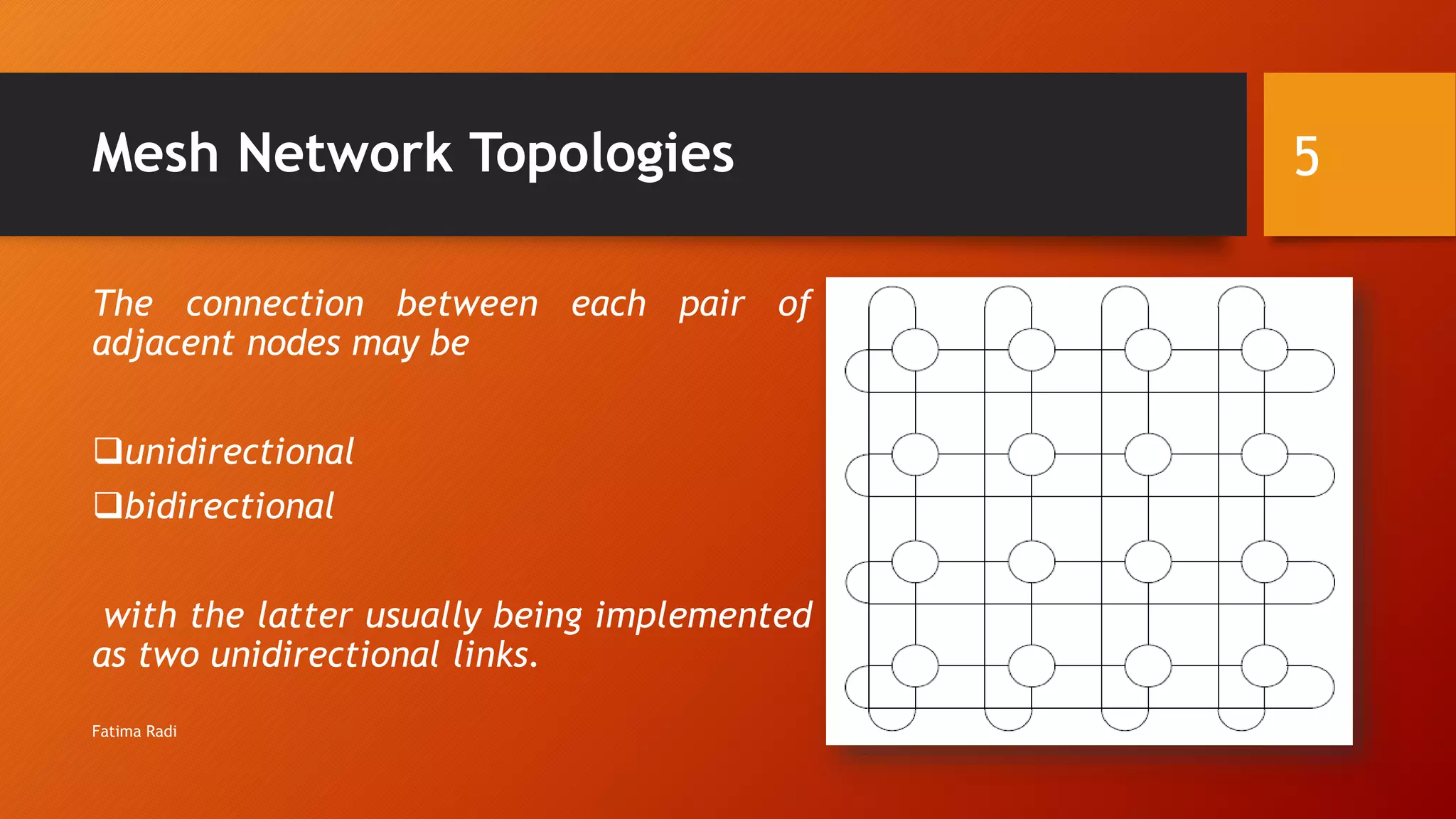
Mesh Network Topologies
Theconnection between each pair of
adjacent nodes may be
unidirectional
bidirectional
with the latter usually being implemented
as two unidirectional links.
5
Fatima Radi
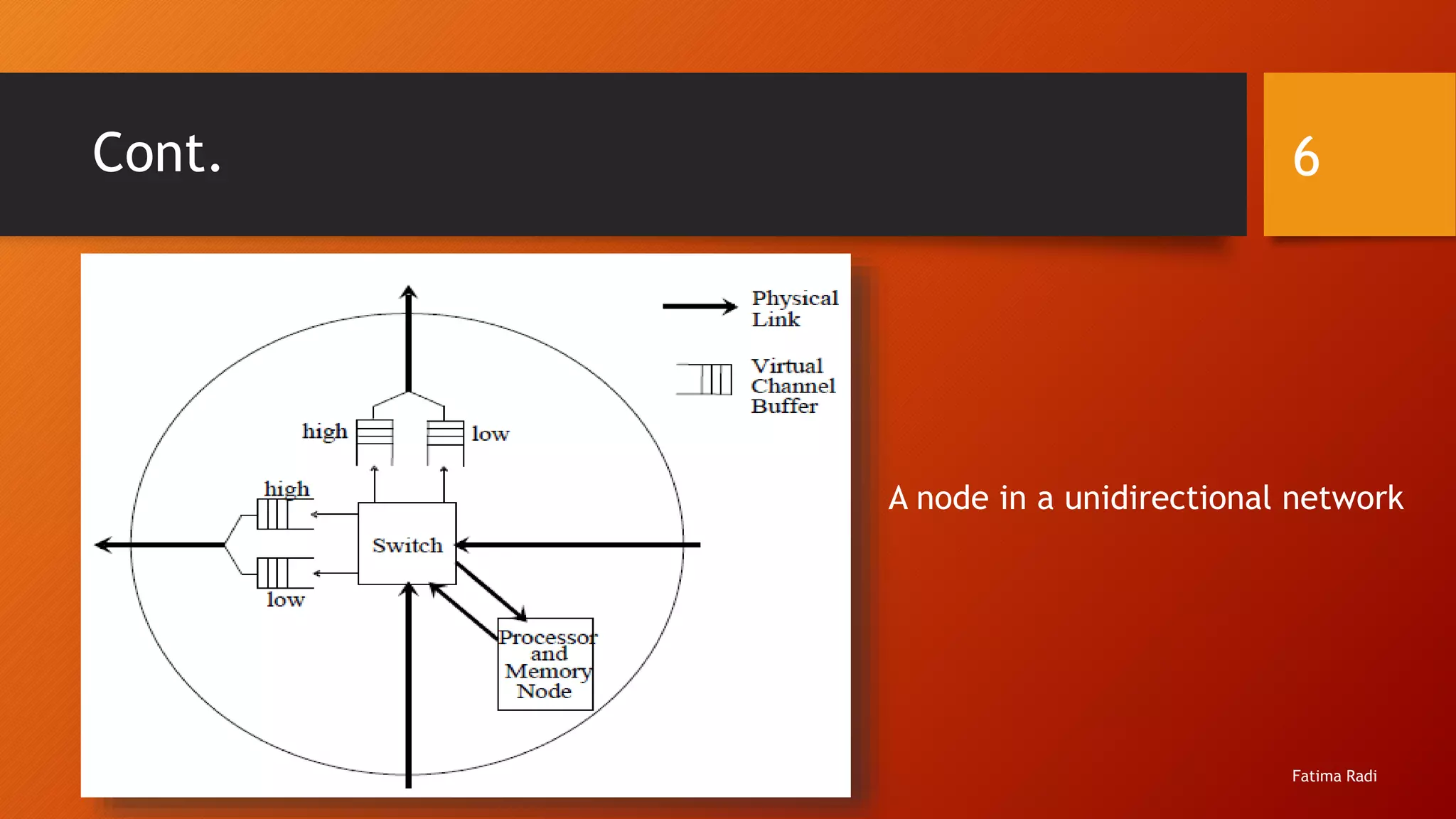
Organization of aNode
• A node in the system typically consists of one or more processors,
some associated local memory, and a hardware switch that
controls the routing of messages through the node .
• When the node needs to send a message to another node, it
queues the message in a local buffer . The message waits until
the node-to-switch link (connecting the processor and memory to
the local switch) becomes free
7
Fatima Radi
9.
Example
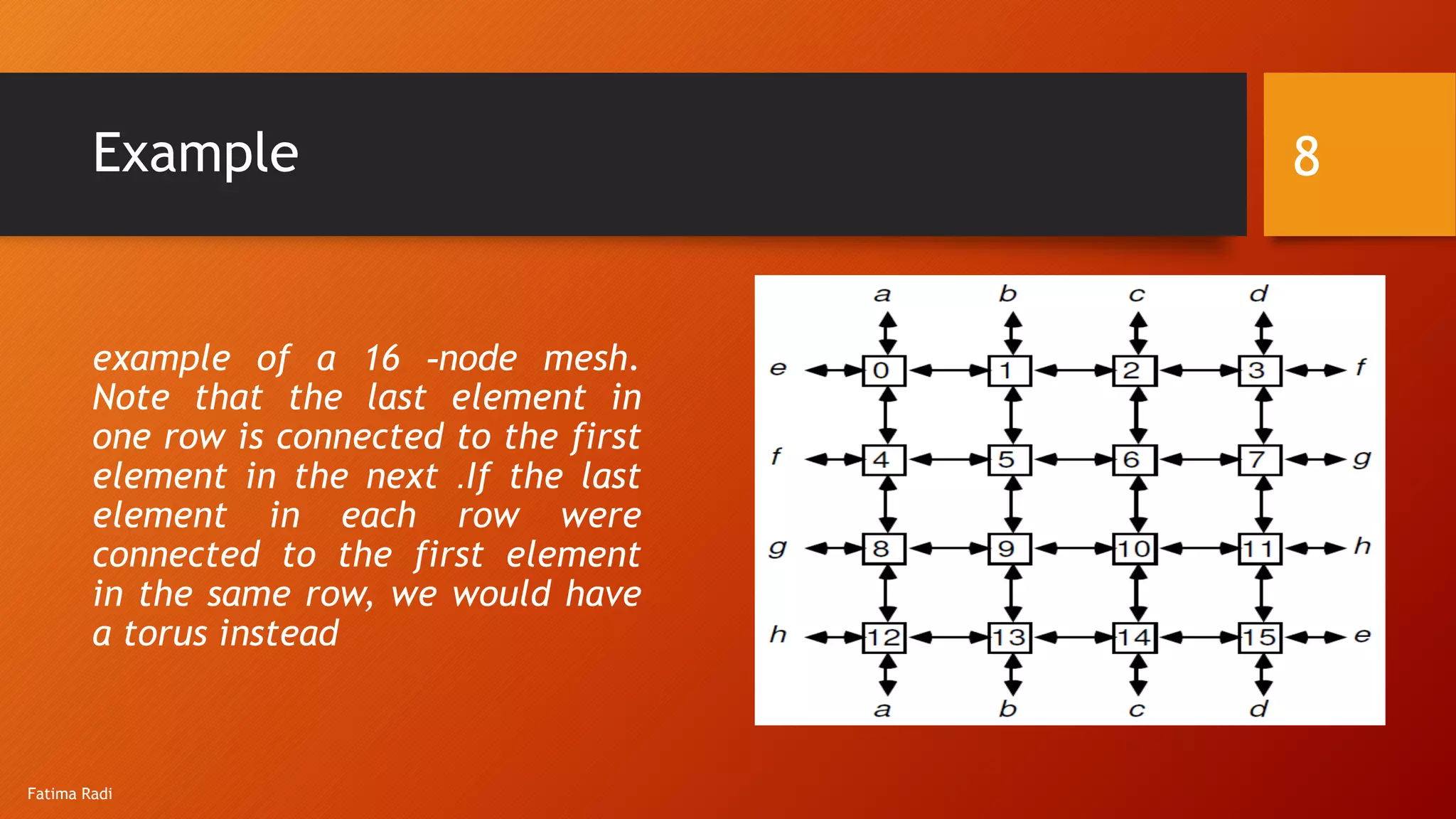
example of a16 -node mesh.
Note that the last element in
one row is connected to the first
element in the next .If the last
element in each row were
connected to the first element
in the same row, we would have
a torus instead
8
Fatima Radi
10.
cont.
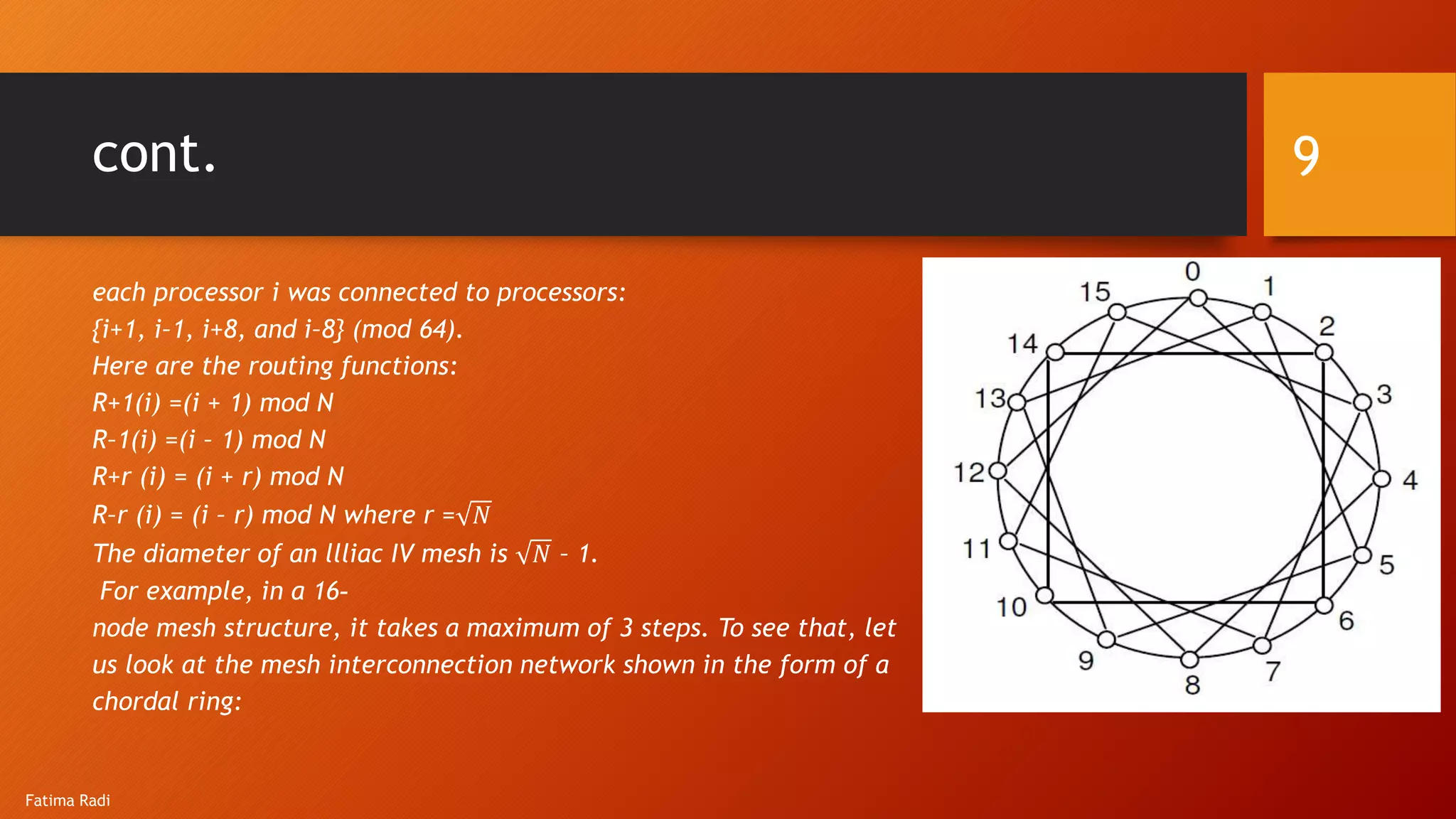
each processor iwas connected to processors:
{i+1, i–1, i+8, and i–8} (mod 64).
Here are the routing functions:
R+1(i) =(i + 1) mod N
R–1(i) =(i – 1) mod N
R+r (i) = (i + r) mod N
R–r (i) = (i – r) mod N where r = 𝑁
The diameter of an llliac IV mesh is 𝑁 – 1.
For example, in a 16-
node mesh structure, it takes a maximum of 3 steps. To see that, let
us look at the mesh interconnection network shown in the form of a
chordal ring:
9
Fatima Radi
11.
Cont.
In a 64-elementmesh, any node can be reached from any other in no
more than 7 of these shifts.
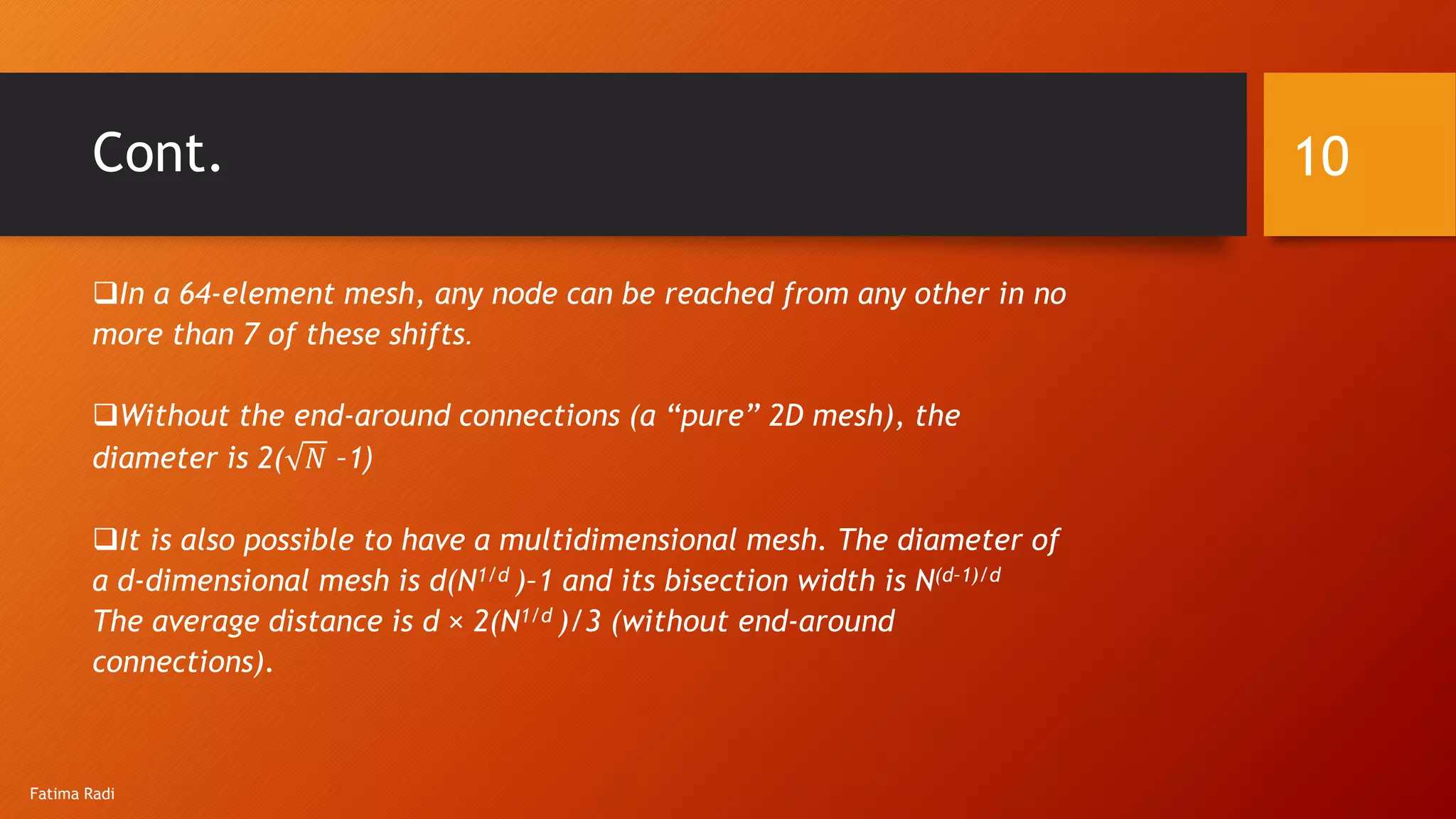
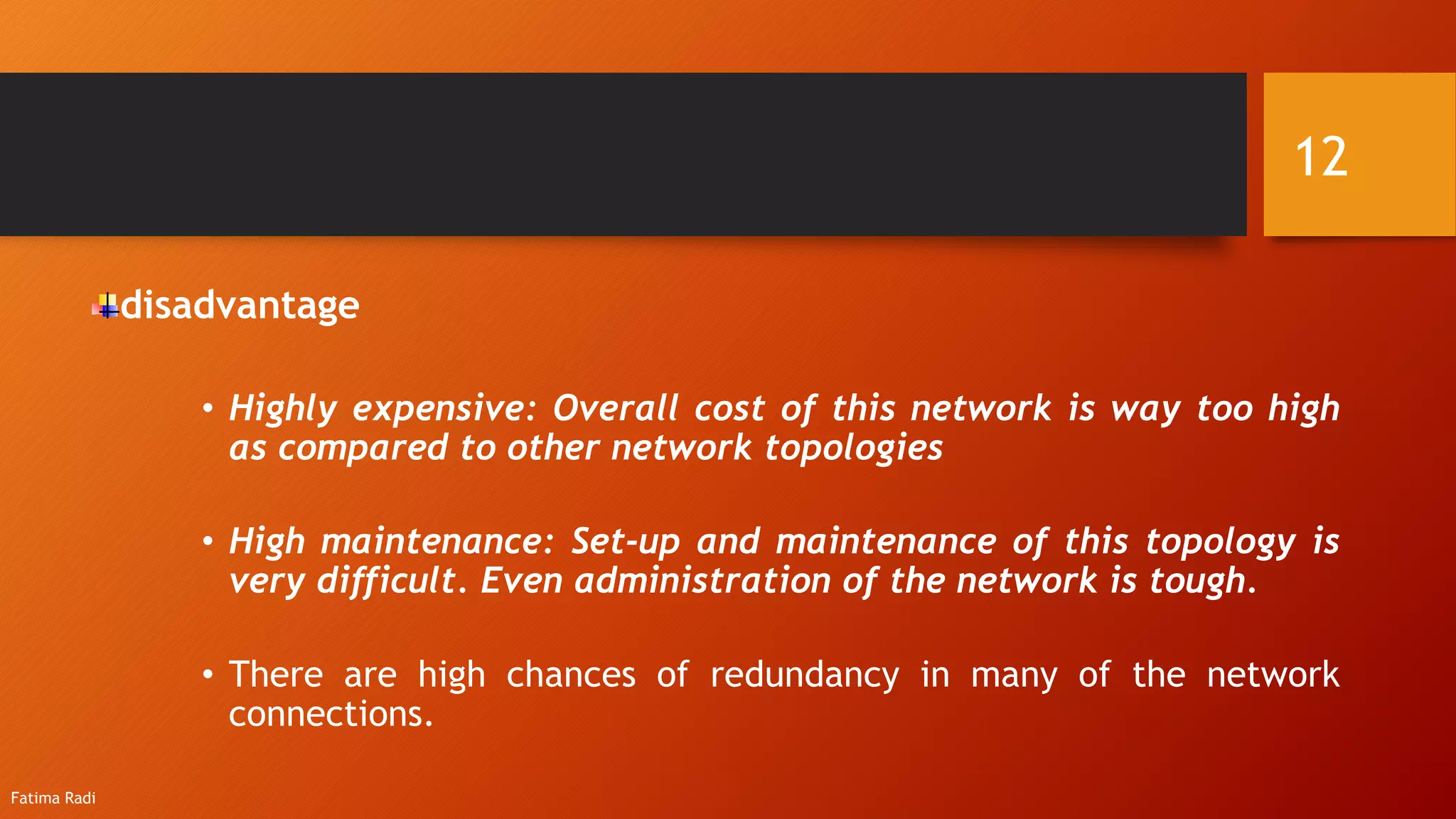
Without the end-around connections (a “pure” 2D mesh), the
diameter is 2( 𝑁 –1(
It is also possible to have a multidimensional mesh. The diameter of
a d-dimensional mesh is d(N1/d )–1 and its bisection width is N(d–1)/d
The average distance is d × 2(N1/d )/3 (without end-around
connections).
10
Fatima Radi
12.
Advantage and disadvantageof mesh Network
Advantage
• Traffic Abundance : Data can be transmitted from different
devices simultaneously. This topology can withstand high
traffic.
• Reliability : Even if one of the components fails there is
always an alternative present. So data transfer doesn’t get
affected.
• Ever growing Expansion and modification in topology can be
done without disrupting other nodes.
11
Fatima Radi
13.
disadvantage
• Highly expensive:Overall cost of this network is way too high
as compared to other network topologies
• High maintenance: Set-up and maintenance of this topology is
very difficult. Even administration of the network is tough.
• There are high chances of redundancy in many of the network
connections.
12
Fatima Radi
14.
References
• [1] VikramS. Adve &Mary K. Vernon " Performance Analysis of
Mesh Interconnection Networks with Deterministic Routing "
Computer Sciences Technical Report #1001b † July 1993
• [2]http://networkwire.org/what-is-mesh-topology.html
• [3] http://en.wikipedia.org/
• [4] http://www.ianswer4u.com/2011/05/mesh-topology-
advantages-and.html
• [5]http://people.engr.ncsu.edu/efg/506/s03/lectures/notes/lec2
5.html
13