www.facebook.com/meripropertymagazine ÙßÕÚU 20156061
Website & Micro Websites | Facebook Marketing | Twitter Marketing |
Whatsapp Marketing | Social Media ManagementMultiple your business with digital marketing
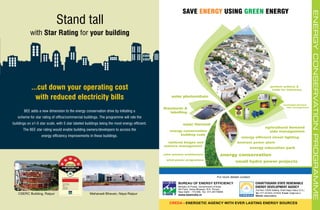
ECBC (Energy conservation building
codes) are the codes which provides
necessary measures in the buildings
thus, results into less energy con-
sumption per unit.
HISTORY :
The Energy Conservation Building
Code (ECBC) was launched by Min-
istry of Power, Government of India
in May 2007, as a first step towards
promoting energy efficiency in the
building sector.
The ECBC was developed by an Ex-
pert Committee, set up by India's Bu-
reau of Energy Efficiency, with sup-
port and guidance from United States
Agency for International Develop-
ment (USAID) and significant inputs
from various other stakeholders such
as practicing architects, consultants,
educational institutions and other gov-
ernment organizations.
SCOPE:
The code is applicable to new com-
mercial buildings having a connected
load of 100 KW or greater or a con-
tract demand of 120 KVA or greater.
This code would become mandatory
as and when it is notified by the cen-
tral and state government under En-
ergy Conservation Act, 2001
Applicable Building Systems : The
provision of this code applies to:
Building envelopes, except for un-
conditioned storage spaces or ware-
houses,
Mechanical systems and equipment's
including HVAC,
Service hot water and pumping,
Interior and exterior lighting, and
Electrical power and motors.
The provisions of this code do not ap-
ply to:
1) Buildings that do not use either
electricity or fossil fuel,
2) Equipment
and portions
of building
system that
use energy
primarily for
manufactur-
ing process-
es, and
3) Where this
code is found
to conflict with safety, health, or
environment codes.
Reference Standards: National Build-
ing Code, 2005 is the reference docu-
ment.
FRAMEWORK:
The successful implementation of the
code requires development of compli-
ance procedures, in addition to build-
ing capacity of architects /designers /
builders /contractors and government
official in States and Urban and Local
Bodies (ULBs). It is also dependent
on availability of materials and equip-
ment that meet or exceed performance
specifications specified in ECBC.
BEE with the support of USAID
ECO- III Project is promoting ECBC
awareness and voluntary adoption
through training and capacity building
programmes, pilot demonstration pro-
jects, and identifying steps for compli-
ance check and monitoring of ECBC.
ECBC User Guide was developed to
support ECBC implementation by
providing detailed guidance to the us-
ers on how to comply with the Code.
Four ECBC tip sheets on Energy Sim-
ulation, Building Envelope, Lighting
Design andHVAC are also available
and provide useful information on
Code compliance at the system level
and through Whole Building Perfor-
mance approach that require knowl-
edge of energy simulation to model
the proposed building.
The ECBC provides design
norms for:
Building envelope, including thermal
performance requirements for walls,
roofs, and windows;
Lighting system, including daylight-
ing, and lamps and luminaire perfor-
mance requirements;
HVAC system, including energy per-
formance of chillers and air distribu-
tion systems;
Electrical system; andWater heating
and pumping systems, including re-
quirements for solar hot-water sys-
tems.
The code provides three options for
compliance:
CREDA organized Advanced Level Training Programme on ECBC
ECBC – Energy Conservation Building Codes
Chhattisgarh State Renewable Energy
Development Agency (CREDA) in
association with Bureau of Energy Ef-
ficiency (BEE) organized Advanced
Level Training Programme on En-
ergy Conservation Building Code
(ECBC) on 13th& 14th October 2015
in Raipur.
Shri Sanjeev Jain, Chief Engineer,
CREDAin his welcome note informed
that the draft ECBC for Chhattisgarh
State has been prepared by CREDA
in consultation with BEE. The same
was also put up on CREDA's web-
site for comments from general pub-
lic. Based on the comments received
from the public& related stakeholder
departments, the final draft has been
amended &submitted to State Govt.
for approval. Shri Jain informed that
for better implementation of ECBC
programme capacity building of rel-
evant persons are regularly being or-
ganized by CREDA& this was the 3rd
such programme in the State. It was
also informed that building sector is
the 2nd most energy intensive sector
after industries and there is huge po-
tential for tapping the energy savings
in new upcoming as well as in existing
buildings. The training programme
was conducted by Mr. Ashu Gupta
from Jaipur & Ms. Samhita from Hy-
derabad, both of whom are BEE certi-
fied Master Trainers on ECBC.
The training programme provided
overview on ECBC. The participants
were also informed on the various pa-
rameters of making an ECBC compli-
ant building. Some of the case stud-
ies on ECBC compliant buildings in
the country were also presented to the
participants. The participants also had
good opportunity for hand-on train-
ing to understand and work on ECBC
simulation software.
Mr. Rajeev Gyani, Executive Engi-
neer, CREDA thanked all the officials
and delegates present from various
Govt. departments, practicing archi-
tects, officials from NIT and other
private sectors.
1) Compliance with the performance
requirements for each subsystem
and system;
2) Compliance with the performance
requirements of each system, but
with tradeoffs between subsys-
tems; and
3) Building-level performance com-
pliance.
During the development of ECBC,
analysis conducted through energy
simulation indicated that ECBC-com-
pliant buildings may use 40 to 60%
less energy than similar buildings be-
ing designed and constructed at that
time.
BENEFITS OF ECBC:
ECBC encourages energy efficient de-
sign of building or alteration of com-
mercial buildings to reduce energy
use without affecting building func-
tion, comfort, health or productivity;
with appropriate regard for economic
considerations. These codes eliminate
design practices that lead to high ener-
gy use and associated costs. Resulting
energy savings directly benefits own-
ers and occupants over the entire life
of the building.
The average energy use for typical
commercial building is 200 kWh/sqm
per annum. Considering 30% saving
by compliance of ECBC, this can be
brought to 140 kWh/sqm per annum.
In 2004-05, residential and commer-
cial construction accounred for 19.25
million sqm and 21.50 million sqm
respectively, and further an increase
of 10% each year is expected. This
shows tremendous potential for en-
ergy saving.
Reference websites:
http://www.ibecc.in/
http://beeindia.in/
http://www.creda.in/energy-conserva-
tion-building-code-ecbc
http://www.gbpn.org/databases-tools/
bc-detail-pages/india
·ýð¤ÇUæ