MERCHANT BANKING
 Presented BY
PRAGATI SINGH
Contents:
 Meaning
 Definition
 Merchant Banking : Origin
 About Merchant Banking
Functions of Merchant Banking
Advantages and Disadvantages of Merchant Banking
Meaning
 Merchant banking is a non-banking financial
activity similar to banking;
 Merchant banking is a fee based business,
where the bank assumes market risk but no long-
term credit risk.
The term merchant banking has been used
differently in different parts of the world. While in
UK, a merchant banking refers to the ‘accepting
and issuing houses’ , in USA it is known as
‘investment banking’.
4/8/2021 XIDAS, Jabalpur 3
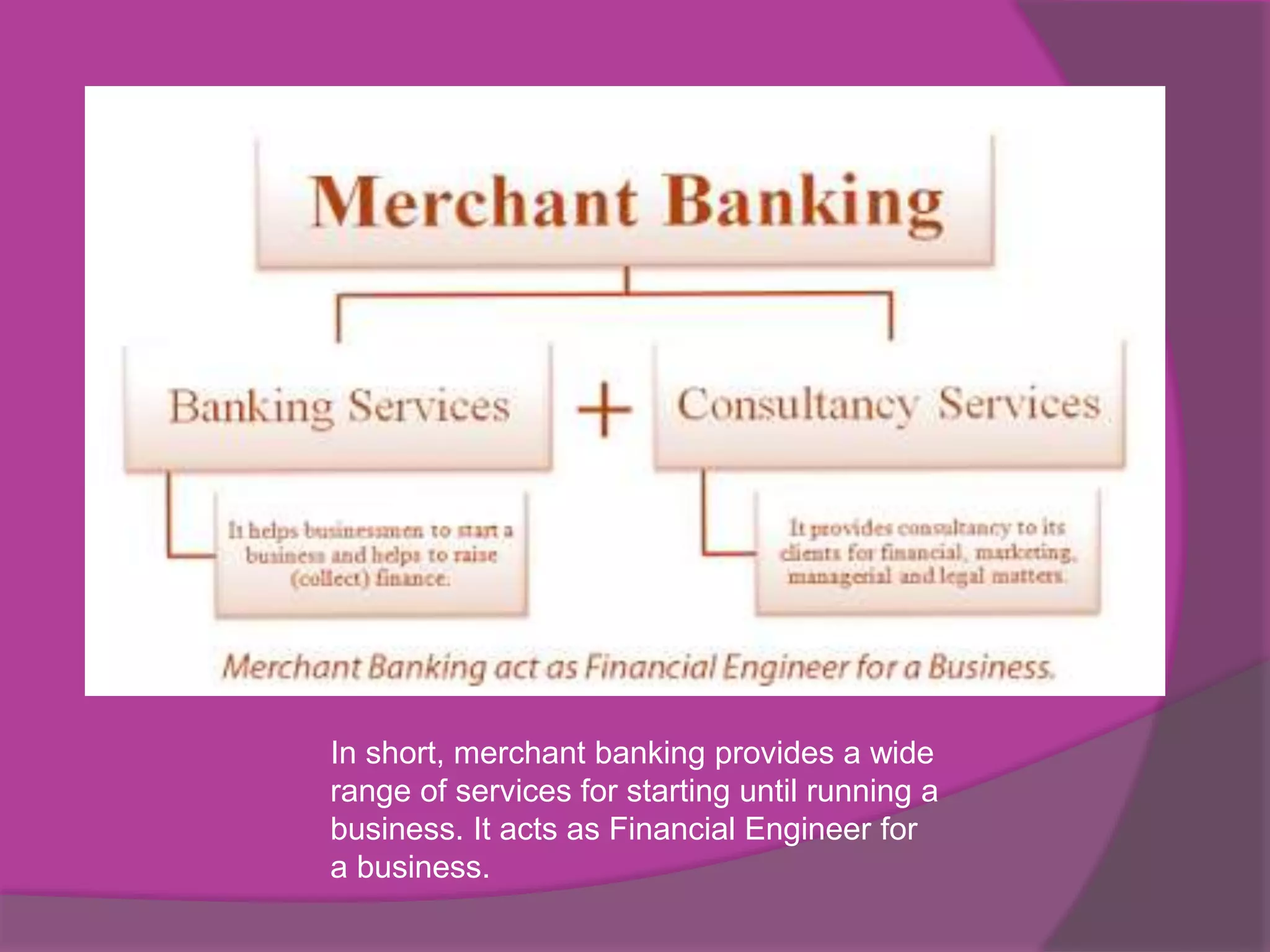
 Merchant Banking is a combination of Banking
and consultancy services. It provides
consultancy to its clients for financial,
marketing, managerial and legal matters.
Consultancy means to provide advice,
guidance and service for a fee. It helps a
businessman to start a business. It helps to
raise (collect) finance. It helps to expand and
modernize the business. It helps in
restructuring of a business. It helps to revive
sick business units. It also helps companies to
register, buy and sell shares at the stock
exchange.
In short, merchant banking provides a wide
range of services for starting until running a
business. It acts as Financial Engineer for
a business.
Merchant Banking: Origin
 Merchant Banking survived and continued during the
13th century.
 Merchant Banking came into existence in 17th & 18th
century in Italy & France.
 Merchant banking in the modern era started from
London; Merchants started to finance the foreign trade
through acceptance of bill.
 Merchant Banking officially came to India through
Grindlays Bank in 1967 and followed by Citi Bank in
1970.
Merchant Banking : Contd.
Indian banks Started banking Services from
1972.
The State bank of India was the first Indian
commercial bank started the merchant banking
division in 1972.
Many other banks came after this like ICICI,
Canara Bank, UCO bank etc.
About Merchant Banking
 Merchant banking primarily involves financial advice
and services for large corporations and wealthy
individuals.
 Merchant banks do not provide regular banking services
to the general public.
 Merchant banks invest their own capital in client
companies & provide services for mergers and
acquisitions.
Contd.
 A merchant bank is sometimes said to be a wholesale
bank, or in the business of wholesale banking.
 It’s because merchant banks tend to deal primarily with
other merchant banks and other large financial
institutions.
 As of today there are 135 Merchant bankers who are
registered with SEBI, India.
 This includes Private, Public & Foreign players.
Merchant Banking
 Advantages:
 Merchant banks perform
functions that cannot be carried
out by businesses on their own.
 Merchant banks have access to
traders, financial institutions,
and markets that companies or
individuals could not possibly
reach.
 By using their skills and
contacts, merchant banks can get
the best possible deals for their
clients.
 Disadvantages:
 Merchant banks are really only
for large corporate customers, or
extremely wealthy smaller
businesses owned by individual
clients.
 Not all deals carried out by
merchant banks meet with
unqualified success.
 There is always risk attached to
the kinds of deal that merchant
banks undertake.
Functions of Merchant
Banks
 Merchant Banks provide a variety of services,such as
issue management, portfolio management, asset
management underwriting of new issues, act as
registrars, share transfer agents, trustees, and
provide leasing, project consultation, advice on
mergers and amalgamations, Euro credits, etc.
 Thus, merchant banking can be defined as a
non-banking financial activity resembling banking,
originated, grown and sustained in Europe, got
enriched under American influence and now being
performed all over the world by both banking and
non-banking institutions.
:
THANK
YOU……..

Merchant Banking ppt

  • 1.
  • 2.
    Contents:  Meaning  Definition Merchant Banking : Origin  About Merchant Banking Functions of Merchant Banking Advantages and Disadvantages of Merchant Banking
  • 3.
    Meaning  Merchant bankingis a non-banking financial activity similar to banking;  Merchant banking is a fee based business, where the bank assumes market risk but no long- term credit risk. The term merchant banking has been used differently in different parts of the world. While in UK, a merchant banking refers to the ‘accepting and issuing houses’ , in USA it is known as ‘investment banking’. 4/8/2021 XIDAS, Jabalpur 3
  • 4.
     Merchant Bankingis a combination of Banking and consultancy services. It provides consultancy to its clients for financial, marketing, managerial and legal matters. Consultancy means to provide advice, guidance and service for a fee. It helps a businessman to start a business. It helps to raise (collect) finance. It helps to expand and modernize the business. It helps in restructuring of a business. It helps to revive sick business units. It also helps companies to register, buy and sell shares at the stock exchange.
  • 5.
    In short, merchantbanking provides a wide range of services for starting until running a business. It acts as Financial Engineer for a business.
  • 6.
    Merchant Banking: Origin Merchant Banking survived and continued during the 13th century.  Merchant Banking came into existence in 17th & 18th century in Italy & France.  Merchant banking in the modern era started from London; Merchants started to finance the foreign trade through acceptance of bill.  Merchant Banking officially came to India through Grindlays Bank in 1967 and followed by Citi Bank in 1970.
  • 7.
    Merchant Banking :Contd. Indian banks Started banking Services from 1972. The State bank of India was the first Indian commercial bank started the merchant banking division in 1972. Many other banks came after this like ICICI, Canara Bank, UCO bank etc.
  • 8.
    About Merchant Banking Merchant banking primarily involves financial advice and services for large corporations and wealthy individuals.  Merchant banks do not provide regular banking services to the general public.  Merchant banks invest their own capital in client companies & provide services for mergers and acquisitions.
  • 9.
    Contd.  A merchantbank is sometimes said to be a wholesale bank, or in the business of wholesale banking.  It’s because merchant banks tend to deal primarily with other merchant banks and other large financial institutions.  As of today there are 135 Merchant bankers who are registered with SEBI, India.  This includes Private, Public & Foreign players.
  • 10.
    Merchant Banking  Advantages: Merchant banks perform functions that cannot be carried out by businesses on their own.  Merchant banks have access to traders, financial institutions, and markets that companies or individuals could not possibly reach.  By using their skills and contacts, merchant banks can get the best possible deals for their clients.  Disadvantages:  Merchant banks are really only for large corporate customers, or extremely wealthy smaller businesses owned by individual clients.  Not all deals carried out by merchant banks meet with unqualified success.  There is always risk attached to the kinds of deal that merchant banks undertake.
  • 11.
    Functions of Merchant Banks Merchant Banks provide a variety of services,such as issue management, portfolio management, asset management underwriting of new issues, act as registrars, share transfer agents, trustees, and provide leasing, project consultation, advice on mergers and amalgamations, Euro credits, etc.  Thus, merchant banking can be defined as a non-banking financial activity resembling banking, originated, grown and sustained in Europe, got enriched under American influence and now being performed all over the world by both banking and non-banking institutions.
  • 12.
  • 13.