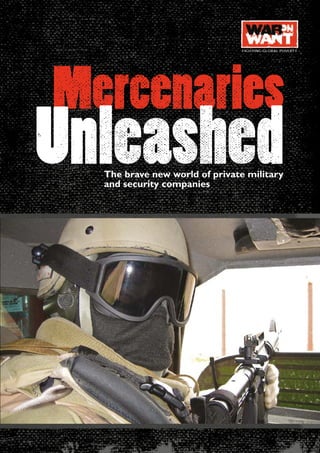
The brave new world of private military
and security companies
WaronWantfightsagainsttherootcauses
ofpovertyandhumanrightsviolation,aspart
oftheworldwidemovementforglobaljustice.
We do this by:
• working in partnership with grassroots social movements,
trade unions and workers’ organisations to empower
people to fight for their rights
• running hard-hitting popular campaigns against the root
causes of poverty and human rights violation
• mobilising support and building alliances for political
action in support of human rights, especially workers’ rights
• raising public awareness of the root causes of poverty,
inequality and injustice, and empowering people to take
action for change
Joinus!
The success of our work relies on inspiring people to join
the fight against poverty and human rights abuse. Get
involved with our work:
Visit 	
Email
Call
Write to
facebook.org/waronwant @waronwant
waronwant.org/donate
support@waronwant.org
020 7324 5040
War on Want
44-48 Shepherdess Walk
London N1 7JP
01
Preface
In the 15 years since the declaration
of a ‘war on terror’ and the invasions
of first Afghanistan and then Iraq, the
world has witnessed an enormous
proliferation of private military and
security companies (PMSCs) seeking
to profit from instability and conflict.
Hundreds of companies have been
established in the past few years alone,
and there now exists a vast private
industry worth hundreds of billions
of dollars.1
Sadly, rather than
introducing binding regulation of the
industry, the British government has
decided to allow the mercenaries to
regulate themselves.
In 2006, three years after the invasion of Iraq,
War on Want published a groundbreaking
report on corporate mercenaries,
documenting the increasingly central role
of PMSCs in the continuing occupation.
The report linked the rise of PMSCs with
increasing human rights abuses, a flourishing
weapons trade and political destabilisation.  At
that time, with the companies operating in a
complete legal vacuum, we made an urgent
appeal for a ban on PMSCs in conflict zones,
strict public scrutiny requirements and an end
to the revolving door between senior defence
and security officials and the industry.
This briefing provides an update on the
mercenary industry, detailing the latest
developments in the murky world of these
‘guns for hire’. UK companies continue to
dominate the industry, and can be found at
the forefront both in the conflict zones of
the ‘war on terror’ and in the expansion to
Africa and the high seas.  The use of private
armies by governments and corporations was
previously an exception. It is now becoming
the norm, as states and companies seek to
evade responsibility for the use of violent and
often deadly force.  The industry will continue
to grow unchecked unless it is brought
under control.
Voluntary codes like the 2010 International
Code of Conduct for Private Security
Service Providers (ICoC) are not the answer
to the culture of impunity that PMSCs
enjoy. Such codes are used by companies
to legitimise existing industry practice and
to block the introduction of legally binding
regulation.  The UN Human Rights Council
has been developing a binding convention for
the regulation of PMSCs at the international
level, and Switzerland has introduced new
legislation banning all Swiss-based PMSCs
from operating in conflict zones.  The UK
government, by contrast, has consistently
backed standards for the PMSC industry
that are based on self-regulation, not
public accountability.
War on Want believes that the privatisation
of war must end, and that PMSCs must be
banned altogether from operating in conflict
zones.  Voluntary self-regulation for this lethal
industry is unacceptable. National regulation,
alongside legally binding international
mechanisms, is long overdue.
John Hilary
Executive Director
MercenariesUnleashed:Thebravenewworldofprivatemilitaryandsecuritycompanies
02
1 UK:mercenarykingpin
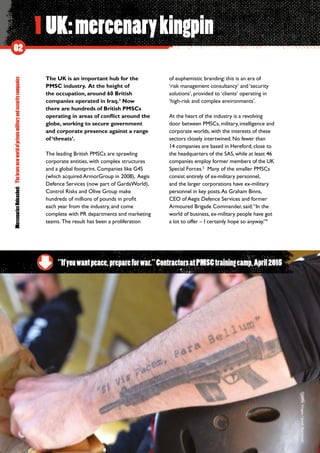
The UK is an important hub for the
PMSC industry. At the height of
the occupation, around 60 British
companies operated in Iraq.2
Now
there are hundreds of British PMSCs
operating in areas of conflict around the
globe, working to secure government
and corporate presence against a range
of ‘threats’.
The leading British PMSCs are sprawling
corporate entities, with complex structures
and a global footprint. Companies like G4S
(which acquired ArmorGroup in 2008), Aegis
Defence Services (now part of GardaWorld),
Control Risks and Olive Group make
hundreds of millions of pounds in profit
each year from the industry, and come
complete with PR departments and marketing
teams.  The result has been a proliferation
of euphemistic branding: this is an era of
‘risk management consultancy’ and ‘security
solutions’, provided to ‘clients’ operating in
‘high-risk and complex environments’.
At the heart of the industry is a revolving
door between PMSCs, military, intelligence and
corporate worlds, with the interests of these
sectors closely intertwined. No fewer than
14 companies are based in Hereford, close to
the headquarters of the SAS, while at least 46
companies employ former members of the UK
Special Forces.3
Many of the smaller PMSCs
consist entirely of ex-military personnel,
and the larger corporations have ex-military
personnel in key posts.As Graham Binns,
CEO of Aegis Defence Services and former
Armoured Brigade Commander, said:“In the
world of business, ex-military people have got
a lot to offer – I certainly hope so anyway.”4
“Ifyouwantpeace,prepareforwar.”ContractorsatPMSCtrainingcamp,April2015
©GettyImages/JanekSkarzynski
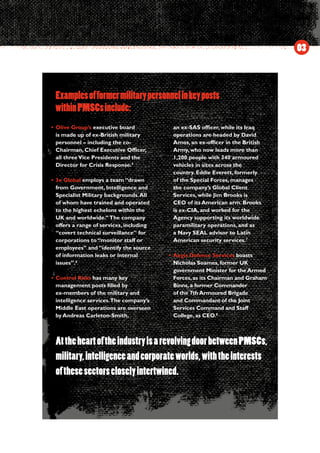
Examplesofformermilitarypersonnelinkeyposts
•	Olive Group’s executive board
is made up of ex-British military
personnel – including the co-
Chairman, Chief Executive Officer,
all threeVice Presidents and the
Director for Crisis Response.5
•	3e Global employs a team “drawn
from Government, Intelligence and
Specialist Military backgrounds.All
of whom have trained and operated
to the highest echelons within the
UK and worldwide.”The company
offers a range of services, including
“covert technical surveillance” for
corporations to “monitor staff or
employees” and “identify the source
of information leaks or internal
issues”.6
•	Control Risks has many key
management posts filled by
ex-members of the military and
intelligence services.The company’s
Middle East operations are overseen
by Andreas Carleton-Smith,
an ex-SAS officer, while its Iraq
operations are headed by David
Amos, an ex-officer in the British
Army, who now leads more than
1,200 people with 340 armoured
vehicles in sites across the
country. Eddie Everett, formerly
of the Special Forces, manages
the company’s Global Client
Services, while Jim Brooks is
CEO of its American arm. Brooks
is ex-CIA, and worked for the
Agency supporting its worldwide
paramilitary operations, and as
a Navy SEAL advisor to Latin
American security services.7
•	Aegis Defence Services boasts
Nicholas Soames, former UK
government Minister for the Armed
Forces, as its Chairman and Graham
Binns, a former Commander
of the 7th Armoured Brigade
and Commandant of the Joint
Services Command and Staff
College, as CEO.8
03
withinPMSCsinclude:
AttheheartoftheindustryisarevolvingdoorbetweenPMSCs,
military,intelligenceandcorporateworlds,withtheinterests
ofthesesectorscloselyintertwined.
MercenariesUnleashed:Thebravenewworldofprivatemilitaryandsecuritycompanies
04
2 Iraq:mercenaryincubator
The British PMSC industry took off
with the occupation of Iraq and the
resulting unrest.  The Director General
of the British Association of Private
Security Companies,Andy Bearpark,
has made clear:“In Iraq in 2003 and
2004 money was basically free.That
meant contracts were being let for
ridiculous amounts of money – millions
and millions of dollars of contracts
being pumped into the industry.  The
industry exploded in terms of the
volume of business on the back of Iraq.”9
UK firms like Aegis Defence Services,
ArmorGroup (now a subsidiary of G4S),
Control Risks and Olive Group snapped
up large contracts.
As the large-scale military occupation of
the country by US and UK troops wound
down, PMSC roles there expanded in scope.
Security operations which were once the
preserve of the occupying armed forces were
outsourced, with UK companies remaining
key players.Aegis Defence Services, for
example, is one of several PMSCs under
contract from the US military providing
services to the Pentagon’s programme for
training and equipping Iraqi security forces
under the Office of Security Cooperation’s
Iraq programme.10
 The company has also
been hired by the governor of Basra to
replace the British troops who have left.Aegis
Defence Services, whose chief executive
Graham Binns led the attack on Basra in 2003
and later supervised the handover to Iraqi
security forces, was contracted to establish
a ‘ring of steel’ around the city and to
provide training for Iraqi intelligence units.11
The US and Iraqi governments are not
the only players that continue to pay for
the services of UK PMSCs in Iraq.
The UK’s Foreign and Commonwealth Office
has awarded contracts to PMSCs in conflict
zones with a combined value of around
£50 million each year.  This includes
nearly £150 million in the five years
between 2007 and 2012 awarded for
operations in Iraq.12
Perhaps the biggest market for British
PMSCs in Iraq is the provision of security
for private corporations seeking to invest
in the country.  Such contracts have become
critical to the private security sector now
that the Pentagon’s war chest in the country
has emptied.As one industry executive put
it in late 2012:“Everyone is looking for work
that is not OCA-funded [i.e. from the US
occupation budget]. It’s going to be like when
the tide goes out at the beach...” 13
The oil and gas sector is the central focus
of multinational corporations in Iraq. Royal
Dutch Shell, BP, ExxonMobil and other
multinationals have signed deals to produce,
refine and export oil and gas from the
country, and are willing to pay PMSCs to help
secure their operations.14
 Aegis Defence
Services boasts that the company’s “largest
area of business is Iraq”, and that it “has
been operating in support of the oil and
gas sector for over two years”, providing
“a full security service including Command,
Control and Information, Mobile, and
Static Security Services on major oilfields
for international oil companies as well as
oil service providers”.The dedicated Iraq
team also provides intelligence services for
Perhapsthebiggestmarket
forBritishPMSCsinIraqis
theprovisionofsecurityfor
privatecorporationsseeking
toinvestinthecountry.
drawing up “personality profiles”, identifying
“legal and regulatory obstacles” and reaching
“into the very heart of the Iraqi political
and commercial establishment”.15
Likewise,
Control Risks has seen huge increases to
its operating profits, largely due to “higher
workload in the Middle East and a gush of
contracts in Iraq.”16
UK multinational G4S is the world’s largest
private security company. Its 2008 acquisition
of the UK’s biggest mercenary company,
ArmorGroup, granted G4S access to the
private military and security market in Iraq, as
ArmorGroup had previously won a number
of significant contracts in the country. G4S
was subsequently found by a coroner’s
inquiry to have failed in its duty to conduct a
proper vetting process in its employment of
ex-serviceman Danny Fitzsimons, who shot
dead two other private security contractors
in Iraq in 2009 and was sentenced to 20
years’ imprisonment for their murder.17
Despite this, G4S announced in September
2015 that it had secured a new contract
worth up to $270 million to provide security
services to the Basra Gas Company.  At the
same time, the company successfully renewed
its contract to provide security services to
the British embassy in Afghanistan, to the
value of £100 million over five years.18
G4S is
the target of an international campaign over
its complicity in the Israeli oppression of the
Palestinian people, as it provides equipment
and services to prisons and detention centres
where Palestinian political prisoners are held,
and to military checkpoints along the illegal
Apartheid Wall.
05
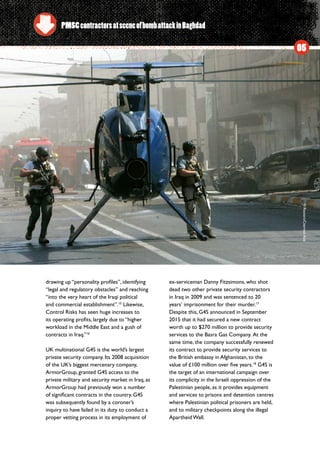
PMSCcontractorsatsceneofbombattackinBaghdad
©Reuters/CeerwanAziz
MercenariesUnleashed:Thebravenewworldofprivatemilitaryandsecuritycompanies
06
3 Emergingmarkets:Africa
While Iraq and Afghanistan remain
longstanding markets for British PMSCs,
instability in other resource-rich regions of
the world, such as northern and western
Africa, is leading to increased opportunities
for these companies.  All major UK PMSCs
now operate across the continent.Aegis
Defence Services claims it has experience
in 18 African states, including resource-
rich Angola, Niger, Nigeria, the Democratic
Republic of Congo and Central African
Republic, where it provides “protective
security for multinationals in very high-risk
environments”.19
G4S, meanwhile, makes
over a third of its profits in the “emerging
markets business”, with annual turnover of
around £500 million in Africa.  According to
Andy Baker, head of African operations for
the company,“Demand has been very high
across Africa.  The nature of our business is
such that in high-risk environments the need
for our services increases.” Multinationals
have approached the company for
‘pan-African security deals’, and G4S, whose
clients include Royal Dutch Shell and
AngloGold Ashanti, is known to be targeting
the natural resources sector.20
Smaller PMSCs also operate throughout the
continent, often for extractive corporations
looking to secure their assets against loss or
damage from local unrest. One such UK-
based PMSC, Special Projects and Services
Ltd, is based alongside the SAS headquarters
in Hereford, and lists among its past
achievements working alongside government
forces in an unnamed West African state to
secure a mine site that had been overrun.21
The toppling of Muammar Gaddafi’s regime
in Libya in 2011 led to a rapid influx of
PMSCs into the country, spearheading the
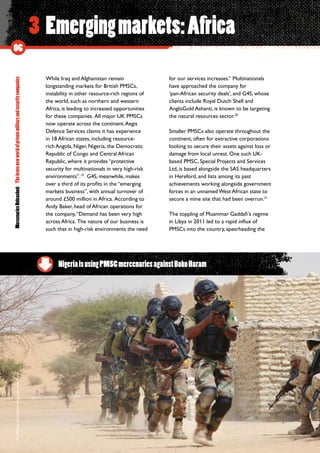
NigeriaisusingPMSCmercenariesagainstBokoHaram
©AP/PressAssociationImages/JeromeDelay
arrival of multinationals keen to restore
their involvement in Libya’s oil and gas
sector.As one PMSC executive put it:“We’re
there to facilitate the re-entry of clients in
Libya.”22
Security companies have also seen
an opportunity for training post-Gaddafi
security forces and, compared to the former
regime, Intelligence Online noted that “Libya’s
new leadership is showing greater openness
toward foreign private security companies.”23
Again, British companies are leading the
way. Just days after Gaddafi’s death, the UK
company Trango Special Projects was touting
for business among prospective investors:
“Whilst speculation continues regarding
Qaddafi’s killing,” it said on its website,
“are you and your business ready to return
to Libya?” At the same time, one online
forum for security recruitment, the Security
Contracting Network, was emphasising
opportunities in the country:“There will be
an uptick of activity as foreign oil companies
scramble to get back to Libya. Keep an eye on
who wins related contracts, follow the money,
and find your next job.”24
Other UK PMSCs operating in Libya include
Control Risks, Olive Group,AKE and Blue
Mountain, a company whose name is derived
from a poem inscribed on a clock tower
at the headquarters of the SAS.25
SNE
Special Projects, another UK company, is
run by Jason Woods, an ex-soldier with
the Parachute Regiment who has acted as
a ‘security consultant’ for Control Risks
Group, specialising in the Nigerian oil
and gas industry.26
 SNE claims that it was
“one of the first security companies to
establish a permanent presence in Libya
post-revolution”, and that it “specialises in
supporting oil and gas companies in hostile
and remote environments around the
world, particularly in North Africa with
ongoing operations in Libya, Egypt and
Algeria.”27
SicuroGroup, run by ex-British
military personnel including former
members of Special Forces and military
intelligence, operates throughout West
and East Africa, and also has a significant
contract for “an international oil and
gas company re-establishing operations
in Libya.”28
PMSCs from several countries are now
being contracted to take up active combat
roles in ongoing wars within African and
Middle Eastern states.  The Nigerian army
has secured the services of South African
mercenary troops from the apartheid era to
fight the militant Islamist group Boko Haram
in the north of the country, while hundreds
of Colombian mercenaries recruited by
the infamous US PMSC Blackwater (now
renamed Academi) have been fighting
alongside Saudi Arabian forces inYemen.29
According to its former director, Nick
Buckles, G4S has also benefited from the
unrest in North Africa and the Middle East,
“with particularly strong growth in Egypt,
Yemen and Bahrain.”30
G4S was involved in
the evacuation of high-ranking government
officials, multinational employees and
embassy staff during the 2011 uprising in
Egypt, and saw its revenues in that country
double to approximately £8 million between
2007 and 2011.31
07
JustdaysafterGaddafi’s
death,theUKcompany
TrangoSpecialProjects
wastoutingfor
businessamong
prospectiveinvestors.
MercenariesUnleashed:Thebravenewworldofprivatemilitaryandsecuritycompanies
08
4 Militarisingtheoceans
The use of private armies in the maritime
industry is booming, and British companies
are again at the forefront. Over half of
the member companies of the Security
Association for the Maritime Industry (SAMI)
are British. In the north-west Indian Ocean
alone, SAMI estimates there are more than
200 PMSCs operating in a sector worth $500
million per year and growing. According to
Professor Chris Kinsey at King’s College
London, British PMSCs are “following the cash
cow.... putting armed contractors on ships is
something the British are particularly good at,
and they seem to be the ones dominating this
particular type of security activity.”32
Many maritime security companies are
filled with ex-Navy and ex-Special Forces
personnel, and carry military grade
equipment. Indeed, one such company has
built a private navy of three large boats, each
capable of carrying 40 private marines and
equipped with a helicopter and drones.33
According to G4S, enhancing the security
of trade vessels in the Indian Ocean is “a
big commercial opportunity”.The company
provides armed guards, as well as tactical and
strategic advice, to a range of oil and other
corporations seeking to secure their assets
through major sea lanes.34
 This opportunity
has only increased since October 2011,
when British Prime Minister David Cameron
formally authorised the use of private armed
guards on board UK-registered ships.35
The militarisation of the oceans is having
significant consequences. PMSCs have shot
indiscriminately at approaching vessels,
sometimes resulting in the deaths of innocent
fishermen.36
In one videotaped incident,
leaked after it was played by the US PMSC
Trident Group Inc. at a shipping conference,
armed personnel were seen firing without
warning on two skiffs which had approached
the vessel. Company President Thomas
Rothrauff acknowledged that those on board
were probably killed, although the exact
extent of injuries and the real intent of those
in the skiff remains unknown:“We’re not in
the business of counting injuries,” he said.
According to one captain working in the
Indian Ocean,“It’s the Wild Wild West out
there.There are no regulations or vetting
process for these teams.The company doesn’t
know who it’s getting on board.”37
The presence of private armies on board
ships can contravene local and international
law, and security companies have been known
to buy arms illegally in war-torn countries
such asYemen, and then dump them
overboard before reaching their destination.
According to one contractor:“Given that
you can get an AK-47 for about $200 in most
big African towns and it costs about $1,000
per weapon to do it legally, and then there’s
all the forms, coastguard licences etc., a lot
of people think it’s easier to buy weapons
illegally and drop them [overboard] when you
get out of the danger area.”38
UK PMSCs have not avoided such
controversy. One instance concerns
contractors working for the UK company
ProtectionVessels International Ltd (PVI),
a signatory to the International Code
of Conduct for Private Security Service
Providers (ICoC) and the self-proclaimed
“global leader in armed maritime security”.39
It’stheWildWildWest
outthere.Thereareno
regulationsorvetting
processfortheseteams.
Thecompanydoesn’tknow
whoit’sgettingonboard.”
“
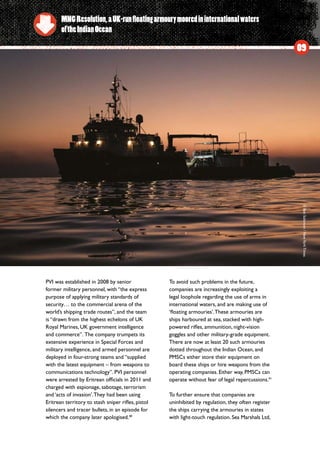
PVI was established in 2008 by senior
former military personnel, with “the express
purpose of applying military standards of
security… to the commercial arena of the
world’s shipping trade routes”, and the team
is “drawn from the highest echelons of UK
Royal Marines, UK government intelligence
and commerce”.  The company trumpets its
extensive experience in Special Forces and
military intelligence, and armed personnel are
deployed in four-strong teams and “supplied
with the latest equipment – from weapons to
communications technology”. PVI personnel
were arrested by Eritrean officials in 2011 and
charged with espionage, sabotage, terrorism
and ‘acts of invasion’.They had been using
Eritrean territory to stash sniper rifles, pistol
silencers and tracer bullets, in an episode for
which the company later apologised.40
To avoid such problems in the future,
companies are increasingly exploiting a
legal loophole regarding the use of arms in
international waters, and are making use of
‘floating armouries’.These armouries are
ships harboured at sea, stacked with high-
powered rifles, ammunition, night-vision
goggles and other military-grade equipment.
There are now at least 20 such armouries
dotted throughout the Indian Ocean, and
PMSCs either store their equipment on
board these ships or hire weapons from the
operating companies. Either way, PMSCs can
operate without fear of legal repercussions.41
To further ensure that companies are
uninhibited by regulation, they often register
the ships carrying the armouries in states
with light-touch regulation. Sea Marshals Ltd,
MNGResolution,aUK-runfloatingarmourymooredininternationalwaters
oftheIndianOcean
09
©BenSolomon/NewYorkTimes
MercenariesUnleashed:Thebravenewworldofprivatemilitaryandsecuritycompanies
10
for example, is a Cardiff-based PMSC
employing ex-Navy and Special Forces
personnel using “military grade weapons”
throughout the Indian Ocean.42
The company
operates a floating armoury in the middle of
the Red Sea, using ships registered in
land-locked Mongolia.43
One of the largest providers of offshore
armouries is Avant Garde Maritime Services
(AGMS), a subsidiary of the largest Sri Lankan
PMSC,Avant Garde Security Services, which
has entered into a joint venture with the Sri
Lankan government to provide a range of ex-
military weapons to PMSCs. On its website,
AGMS boasts that it is a “proud Signatory
Company of the ICoC”, and declares its
mission to become “the most sought after
supplier of weapons and associated items to
private maritime security companies”.The
company offers weapons owned by the
Sri Lankan government, including assault
rifles, machine guns and night-vision
equipment, and the Advisory Board
consists of high ranking Sri Lankan military
officers.44
According to the company’s
chairman, there are “thousands” of
weapons on board the ships, with
hundreds of movements on and off the
armouries each month.45
Although initially the UK government did
not allow British companies to exploit this
loophole, the Foreign and Commonwealth
Office was clear from early on that they were
engaged with “interested parties, including the
Sri Lankan authorities”, and that they were
“determined to find a solution that allows
British companies to compete for contracts
in a fair and transparent manner”.46
In
August 2013 the UK Department of Business,
Innovation and Skills issued 50 licences for
floating armouries operating in the Indian
Ocean and Gulf of Aden.47
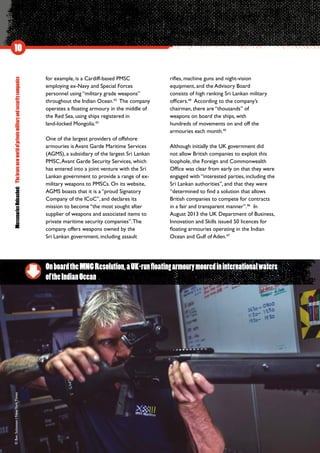
OnboardtheMNGResolution,aUK-runfloatingarmourymooredininternationalwaters
oftheIndianOcean
©BenSolomon/NewYorkTimes
11
The International Code of Conduct
for Private Security Service Providers
(ICoC) is a voluntary code of conduct
launched in 2010 that was developed
out of discussions between PMSCs,
governments and civil society. Its stated
aim is to establish a set of principles for
the industry based on international law,
as well as to improve the accountability
of PMSCs by establishing an
independent oversight mechanism with
responsibility for certification, auditing,
monitoring and reporting.
The US government subsequently funded
international security trade association ASIS
to develop an auditable standard for PMSCs
operating around the world.The standard,
named PSC.1, is based on principles drawn
up with the involvement of the military
establishment and the PMSC industry itself,
relying on self-regulation and voluntary
reporting rather than binding regulations
with redress mechanisms and sanctions.
The UK government swiftly adopted the
PSC.1 standard as the applicable standard
for British PMSCs operating overseas, and
in September 2015 it was published in the
International Standards series as ISO 18788.A
parallel standard has been developed for the
maritime security industry, published in April
2015 as ISO 28007-1.
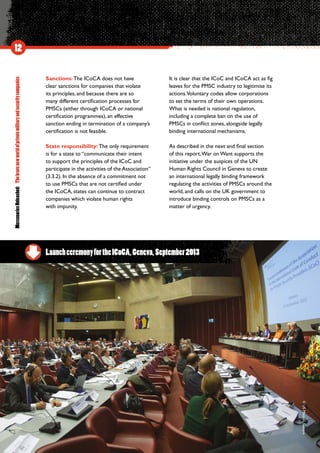
The ICoC Association (ICoCA) was launched
at a conference in Geneva in September 2013,
at which point 708 companies had formally
signed up to the ICoC.The UK, along with
Australia, Sweden, Switzerland and the USA,
was a founding member of the ICoCA.The
disparity between civil society and industry
involvement in the initiative was glaring: 13
civil society organisations joined the ICoCA
as founding members compared with 135
PMSCs, meaning that the body developed
to regulate PMSCs is dominated by them.
The ICoCA formally recognised the PSC.1
standard in September 2015 as an appropriate
basis for certification that individual PMSCs
meet the principles of the ICoC.
The ICoCA fails as a credible
instrument in key areas such as
governance, monitoring, redress,
sanctions, and state responsibility:
Governance: The Board includes Major
General Charles Tucker, who has served as
a legal expert in various positions in the
US military, and Chris Sanderson, Director
Government Support for Control Risks since
2005, who served as the first chairman of
SCEG, the UK trade association partnered
with the British government for regulation
of UK private security providers operating
overseas. Because of the dominance of PMSC
and military figures in the governance of the
ICoCA, many civil society organisations have
refused to participate.
Monitoring: Field-based investigations
may be initiated by the Executive Director,
but the ICoCA Board can decide against
them.These investigations “shall be aimed at
improving performance or addressing specific
compliance concerns”. However, the ICoCA
Secretariat’s capacity to independently
monitor member companies through field
visits is extremely limited.
Redress:The ICoCA is reliant on the
grievance mechanisms of the companies
themselves.It can only provide advice on
the effectiveness of those mechanisms and
suggest alternative grievance avenues should
a complainant not feel comfortable lodging
a complaint through the member company’s
grievance mechanism.The ICoCA is not
empowered to decide on a complaint or
to award any reparations.In practice this
means that the victims of PMSC human rights
violations are unable to seek redress via
the ICoCA.
5 ICoC:figleaf forPMSCs
MercenariesUnleashed:Thebravenewworldofprivatemilitaryandsecuritycompanies
12
Sanctions: The ICoCA does not have
clear sanctions for companies that violate
its principles, and because there are so
many different certification processes for
PMSCs (either through ICoCA or national
certification programmes), an effective
sanction ending in termination of a company’s
certification is not feasible.
State responsibility: The only requirement
is for a state to “communicate their intent
to support the principles of the ICoC and
participate in the activities of the Association”
(3.3.2). In the absence of a commitment not
to use PMSCs that are not certified under
the ICoCA, states can continue to contract
companies which violate human rights
with impunity.
It is clear that the ICoC and ICoCA act as fig
leaves for the PMSC industry to legitimise its
actions.Voluntary codes allow corporations
to set the terms of their own operations.
What is needed is national regulation,
including a complete ban on the use of
PMSCs in conflict zones, alongside legally
binding international mechanisms.
As described in the next and final section
of this report,War on Want supports the
initiative under the auspices of the UN
Human Rights Council in Geneva to create
an international legally binding framework
regulating the activities of PMSCs around the
world, and calls on the UK government to
introduce binding controls on PMSCs as a
matter of urgency.
LaunchceremonyfortheICoCA,Geneva,September2013
©USMission,Geneva
13
As the number of boots on the ground of
occupying forces has fallen, public attention
has turned away from Iraq and Afghanistan
and the private armies which gained notoriety
there.Away from the public gaze, the business
of PMSCs has boomed. From dependency on
Pentagon contracts, they have found a wealth
of new and eager clients amongst the private
sector, especially in the extractive industries.
They have sought out and exploited political
instability in the wake of the Arab uprisings.
And they have spread floating armouries
across the world’s oceans to protect
commercial shipping interests. In all of this,
UK companies are playing a leading role,
reaping enormous profits.
PMSCs have a track record of profiting from
war and conflict. Despite facing numerous
accusations of human rights abuses in conflict
situations around the world, they remain
unaccountable and unregulated.  Ten years ago,
War on Want mounted a campaign calling
for binding regulation of this dangerous
industry, including a complete ban on the use
of PMSCs in conflict zones.  The campaign
was successful in bringing the need for PMSC
accountability to international attention, and
in 2010 the UN Human Rights Council in
Geneva debated the first draft of a possible
Convention on Private Military and Security
Companies.The draft has since been reviewed
by a dedicated intergovernmental working
group, whose fourth session in April 2015
discussed revisions to the text in advance of
submitting its analysis of the global situation
to the UN General Assembly in 2016.
There have also been positive moves at the
national level.With effect from September
2015, the Swiss government has banned all
PMSCs based in Switzerland from operating
in conflict zones, and has introduced strict
regulation of all PMSC activity outside its
borders.The UK government, by contrast,
argues that PMSCs are best left to police
themselves through voluntary codes.
It’s time to get binding regulation of
Private Military and Security Companies
back on the UK government’s agenda.
6 Takeaction
Actnow:
1.	Write to your MP raising the issue of PMSC accountability and the need for
binding regulation at both national and international levels, in place of the
self-regulation mechanisms favoured by the UK government up to now.
2.	Order more copies of this briefing and other campaign materials for your
events, stalls, student unions, union branches, local groups, family and friends
at waronwant.org/materials.
3.	Get involved with our Stop G4S campaign in order to put pressure on G4S
to end its complicity with Israel’s oppression of the Palestinian people; visit
waronwant.org/StopG4S for regular updates.
MercenariesUnleashed:Thebravenewworldofprivatemilitaryandsecuritycompanies©KarelPrinsloo/AP/PressAssociationImages
15
1
For competing estimates of the size of the sector, see Lou
Pingeot, Dangerous Partnership: private military and security
companies and the UN, Global Policy Forum, June 2012.
2
‘The rise of the UK’s private security companies’, BBC News,
2 November 2010.
3
According to the information supplied to ICOC-PSP; there
are almost certainly more companies employing Special
Forces that not signed up to ICOC.The 46 PMSCs are: 3rg,
Actus International Security Ltd,AKE Ltd,Ambrey Risk Ltd,
Artemis-UK Solutions Ltd,Associated Risks Ltd,Audeamus
Security Ltd, Bahari Security Ltd, Blackwall Maritime Ltd,
Blue Mountain Group, British Maritime Solutions Ltd,
Citadel Maritime Ltd, Claymore Security Solutions, Constant
Maritime, Corinthian Protection International, CS:5 Security
Ltd, Defensores Ltd, Diligence Security Solutions Limited,
Emergent Risk Solutions LLC, Erus Maritime Security
Services Ltd, Galene Global Maritime Security, Global Sprint
Security Ltd, Grunts Security Partnership Ltd, Hadcon Ltd,
Kingdom Securities Ltd, Maritime Security Solutions Ltd, Miris
International Ltd, Nemesis Security LLC, Neptune Maritime
Security Ltd, OBS24 Security Ltd, Ocean Protection Services,
Oceanic Maritime Organisation, Optima Defence and
Security Ltd, PGS Group, QuinSec, Ronin Concepts Security
Elite Ltd, Sea Hawk Maritime Risk Management, Secure a
Ship, Shadow Security Solutions Ltd, Solace Global Maritime,
Spartent Global Solutions, Specialist Security Services and
Solutions International, Specialized Global Services Ltd, Stent
(International) Ltd, Stonehill Global,Veritas International
Consultancy Ltd.
4
‘The rise of the UK’s private security companies’, BBC News,
2 November 2010.
5
Olive Group website, Executive LeadershipTeam:
olivegroup.com
6
3e International CovertTechnical Surveillance: 3e-intl.com
7
Control Risks website, Senior Management section:
controlrisks.com
8
Aegis official website, key personalities section:
aegisworld.com
9
‘The rise of the UK’s private security companies’, BBC News,
2 November 2010.
10
Iraq Britain Business Council,Aegis membership profile:
www.webuildiraq.org
11
‘Basra invites British back for security role’, Daily Telegraph, 3
January 2014.
12
Foreign and Commonwealth Office, Freedom of Information
Act 2000 Request, Ref 0669-12, 6 September 2012.
13
‘As Iraq,Afghan wars end, private security firms adapt’,
Reuters, 21 October 2012.
14
‘Western oil firms remain as US exits Iraq’, Al Jazeera, 7
January 2012.
15
Iraq Britain Business Council,Aegis membership profile:
www.webuildiraq.org
16
‘UK leads the world in private security industry’, Independent,
6 January 2012.
17
‘Paul McGuigan murder: Killer “not properly vetted”’, BBC
News, 11 May 2015.
18
‘G4S wins security contracts in Iraq and Afghanistan’, G4S
press release, 11 September 2015.
19
Aegis Defence Services profile on British Expertise: http://
www.britishexpertise.org/bx/pages/Organisation_view/726.
php
20
‘G4S says Algeria, Mali unrest raising security demand’,
Reuters, 25 January 2013.
21
Special Projects and Services Ltd crisis management study,
see http://www.sps-global.com/2011/cases/Crisis%20
Management%20case%20study.pdf
22
Oliver Westmacott, President of GardaWorld, quoted in
‘As War Winds Down in Libya, Enter the Consultants’,
Bloomberg Business, 21 September 2011.
23
‘Private guards replace military in Libya’, Intelligence Online, 8
December 2011.
24
‘Western companies see prospects for business in Libya’,
NewYork Times, 28 October 2011.
25
‘Security firms hustle in lawless Libya’, UPI, 9 December
2011. For the origins of Blue Mountain’s name and motto,
see http://www.bluemountaingroup.co.uk/about/
26
Jason Woods’ LinkedIn account: http://uk.linkedin.com/pub/
jason-woods/14/984/505
27
SNE Special projects, Oil and Gas section. http://
snespecialprojects.com/sectors/oil-gas/
28
Sicuro website, Libya - IVMS section. http://www.
sicurogroup.com/Project-2.html
29
‘Nigeria hires S African mercenaries again to battle
Boko Haram’, This Day Live, 23 October 2015;‘Dogs of
War: British mercenary reported killed inYemen’, RT, 11
December 2015.
30
R Neate,‘G4S spots great opportunities for security work in
the new Libya’, Guardian, 23 August 2011.
31
AT Meuse,‘Revolution opens doors for security companies’,
American Chamber of Commerce in Egypt, July 2011.
32
‘The UK firms who tackle Somali pirates’, BBC News, 24
March 2012.
33
James Brown,‘Pirates and Privateers: Managing the Indian
Ocean’s private security boom’, Lowry Institute for
International Policy, 12 September 2012.
Notes
MercenariesUnleashed:Thebravenewworldofprivatemilitaryandsecuritycompanies
34
‘Exclusive: Security firms take up arms against pirates’,
Reuters, 21 November 2011.
35
‘Somali piracy: armed guards to protect UK ships’, BBC News,
30 October 2011.
36
‘The UK firms who tackle Somali pirates’, BBC News, 24
March 2012;‘India charges Italian marines with murder of
fishermen’, BBC News, 18 May 2012.
37
‘Shooting to kill pirates risks Blackwater moment’, Bloomberg,
8 May 2012.
38
‘To catch a pirate: the British ex-servicemen battling to
protect international shipping from the clutches of Somali
pirates’, Daily Mail, 20 December 2011.
39
ProtectionVessels International website;‘Delivering
Certainty in Uncertain World’ section. www.pviltd.com
40
‘Eritrea detains four antipiracy contractors’, NewYork Times,
11 June 2011.
41
‘Piracy fears over ships laden with weapons in international
waters’, Guardian, 10 January 2013.
42
Sea Marshals official website: seamarshals.com
43
‘Piracy fighters use floating armouries’, Seattle Times, 22
March 2012.
44
Avant Garde Maritime Services website: avantmaritime.com
45
‘Piracy fears over ships laden with weapons in international
waters’, Guardian, 10 January 2013.
46
‘Piracy fears over ships laden with weapons in international
waters’, Guardian, 10 January 2013.
47
‘UK gives go ahead for floating armouries’, Lloyd’s List, 8
August 2013.
16
MercenariesUnleashed:Thebravenewworldofprivatemilitaryandsecuritycompanies
00
Charity No. 208724 / Company limited by guarantee Reg No. 629916
Published: January 2016
Written by Dr Sam Raphael, Kingston
University, with funding support from the
Joseph Rowntree Charitable Trust.
This briefing is based on original
research carried out by the following
Kingston University students, as part
of a partnership between War on Want
and Kingston University’s Department
of Politics and International Relations:
Zaineb Alshakri, Bianca Bello-Biamonti,
Carolina Costa Candal,Ana Da Silva,
Russel Harland, Josie Hill, Hal Holmes,
Youriy Ichtchouk, Kate Jones, Rachel
Peonides, Megan Smith and Patricia Syka.
Cover picture: Private military contractor
on mission in Baghdad.
@Getty Images / Stocktrek Images
Design by www.wave.coop
War on Want
44-48 Shepherdess Walk
London N1 7JP
United Kingdom
Tel: +44 (0)20 7324 5040
Email: support@waronwant.org
www.waronwant.org
@waronwant
facebook.com/waronwant
Company limited by guarantee
Reg No. 629916
Charity No. 208724
Printed on recycled paper
War on Want fights against the root causes of
poverty and human rights violation, as part of
the worldwide movement for global justice.

Mercenaries Unleashed, 2016

  • 1.
    The brave newworld of private military and security companies
  • 2.
    WaronWantfightsagainsttherootcauses ofpovertyandhumanrightsviolation,aspart oftheworldwidemovementforglobaljustice. We do thisby: • working in partnership with grassroots social movements, trade unions and workers’ organisations to empower people to fight for their rights • running hard-hitting popular campaigns against the root causes of poverty and human rights violation • mobilising support and building alliances for political action in support of human rights, especially workers’ rights • raising public awareness of the root causes of poverty, inequality and injustice, and empowering people to take action for change Joinus! The success of our work relies on inspiring people to join the fight against poverty and human rights abuse. Get involved with our work: Visit Email Call Write to facebook.org/waronwant @waronwant waronwant.org/donate support@waronwant.org 020 7324 5040 War on Want 44-48 Shepherdess Walk London N1 7JP
  • 3.
    01 Preface In the 15years since the declaration of a ‘war on terror’ and the invasions of first Afghanistan and then Iraq, the world has witnessed an enormous proliferation of private military and security companies (PMSCs) seeking to profit from instability and conflict. Hundreds of companies have been established in the past few years alone, and there now exists a vast private industry worth hundreds of billions of dollars.1 Sadly, rather than introducing binding regulation of the industry, the British government has decided to allow the mercenaries to regulate themselves. In 2006, three years after the invasion of Iraq, War on Want published a groundbreaking report on corporate mercenaries, documenting the increasingly central role of PMSCs in the continuing occupation. The report linked the rise of PMSCs with increasing human rights abuses, a flourishing weapons trade and political destabilisation.  At that time, with the companies operating in a complete legal vacuum, we made an urgent appeal for a ban on PMSCs in conflict zones, strict public scrutiny requirements and an end to the revolving door between senior defence and security officials and the industry. This briefing provides an update on the mercenary industry, detailing the latest developments in the murky world of these ‘guns for hire’. UK companies continue to dominate the industry, and can be found at the forefront both in the conflict zones of the ‘war on terror’ and in the expansion to Africa and the high seas.  The use of private armies by governments and corporations was previously an exception. It is now becoming the norm, as states and companies seek to evade responsibility for the use of violent and often deadly force.  The industry will continue to grow unchecked unless it is brought under control. Voluntary codes like the 2010 International Code of Conduct for Private Security Service Providers (ICoC) are not the answer to the culture of impunity that PMSCs enjoy. Such codes are used by companies to legitimise existing industry practice and to block the introduction of legally binding regulation.  The UN Human Rights Council has been developing a binding convention for the regulation of PMSCs at the international level, and Switzerland has introduced new legislation banning all Swiss-based PMSCs from operating in conflict zones.  The UK government, by contrast, has consistently backed standards for the PMSC industry that are based on self-regulation, not public accountability. War on Want believes that the privatisation of war must end, and that PMSCs must be banned altogether from operating in conflict zones.  Voluntary self-regulation for this lethal industry is unacceptable. National regulation, alongside legally binding international mechanisms, is long overdue. John Hilary Executive Director
  • 4.
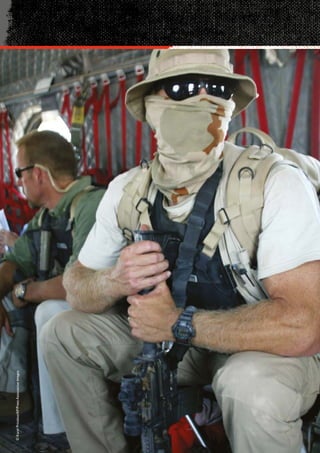
    MercenariesUnleashed:Thebravenewworldofprivatemilitaryandsecuritycompanies 02 1 UK:mercenarykingpin The UKis an important hub for the PMSC industry. At the height of the occupation, around 60 British companies operated in Iraq.2 Now there are hundreds of British PMSCs operating in areas of conflict around the globe, working to secure government and corporate presence against a range of ‘threats’. The leading British PMSCs are sprawling corporate entities, with complex structures and a global footprint. Companies like G4S (which acquired ArmorGroup in 2008), Aegis Defence Services (now part of GardaWorld), Control Risks and Olive Group make hundreds of millions of pounds in profit each year from the industry, and come complete with PR departments and marketing teams.  The result has been a proliferation of euphemistic branding: this is an era of ‘risk management consultancy’ and ‘security solutions’, provided to ‘clients’ operating in ‘high-risk and complex environments’. At the heart of the industry is a revolving door between PMSCs, military, intelligence and corporate worlds, with the interests of these sectors closely intertwined. No fewer than 14 companies are based in Hereford, close to the headquarters of the SAS, while at least 46 companies employ former members of the UK Special Forces.3 Many of the smaller PMSCs consist entirely of ex-military personnel, and the larger corporations have ex-military personnel in key posts.As Graham Binns, CEO of Aegis Defence Services and former Armoured Brigade Commander, said:“In the world of business, ex-military people have got a lot to offer – I certainly hope so anyway.”4 “Ifyouwantpeace,prepareforwar.”ContractorsatPMSCtrainingcamp,April2015 ©GettyImages/JanekSkarzynski
  • 5.
    Examplesofformermilitarypersonnelinkeyposts • Olive Group’s executiveboard is made up of ex-British military personnel – including the co- Chairman, Chief Executive Officer, all threeVice Presidents and the Director for Crisis Response.5 • 3e Global employs a team “drawn from Government, Intelligence and Specialist Military backgrounds.All of whom have trained and operated to the highest echelons within the UK and worldwide.”The company offers a range of services, including “covert technical surveillance” for corporations to “monitor staff or employees” and “identify the source of information leaks or internal issues”.6 • Control Risks has many key management posts filled by ex-members of the military and intelligence services.The company’s Middle East operations are overseen by Andreas Carleton-Smith, an ex-SAS officer, while its Iraq operations are headed by David Amos, an ex-officer in the British Army, who now leads more than 1,200 people with 340 armoured vehicles in sites across the country. Eddie Everett, formerly of the Special Forces, manages the company’s Global Client Services, while Jim Brooks is CEO of its American arm. Brooks is ex-CIA, and worked for the Agency supporting its worldwide paramilitary operations, and as a Navy SEAL advisor to Latin American security services.7 • Aegis Defence Services boasts Nicholas Soames, former UK government Minister for the Armed Forces, as its Chairman and Graham Binns, a former Commander of the 7th Armoured Brigade and Commandant of the Joint Services Command and Staff College, as CEO.8 03 withinPMSCsinclude: AttheheartoftheindustryisarevolvingdoorbetweenPMSCs, military,intelligenceandcorporateworlds,withtheinterests ofthesesectorscloselyintertwined.
  • 6.
    MercenariesUnleashed:Thebravenewworldofprivatemilitaryandsecuritycompanies 04 2 Iraq:mercenaryincubator The BritishPMSC industry took off with the occupation of Iraq and the resulting unrest.  The Director General of the British Association of Private Security Companies,Andy Bearpark, has made clear:“In Iraq in 2003 and 2004 money was basically free.That meant contracts were being let for ridiculous amounts of money – millions and millions of dollars of contracts being pumped into the industry.  The industry exploded in terms of the volume of business on the back of Iraq.”9 UK firms like Aegis Defence Services, ArmorGroup (now a subsidiary of G4S), Control Risks and Olive Group snapped up large contracts. As the large-scale military occupation of the country by US and UK troops wound down, PMSC roles there expanded in scope. Security operations which were once the preserve of the occupying armed forces were outsourced, with UK companies remaining key players.Aegis Defence Services, for example, is one of several PMSCs under contract from the US military providing services to the Pentagon’s programme for training and equipping Iraqi security forces under the Office of Security Cooperation’s Iraq programme.10  The company has also been hired by the governor of Basra to replace the British troops who have left.Aegis Defence Services, whose chief executive Graham Binns led the attack on Basra in 2003 and later supervised the handover to Iraqi security forces, was contracted to establish a ‘ring of steel’ around the city and to provide training for Iraqi intelligence units.11 The US and Iraqi governments are not the only players that continue to pay for the services of UK PMSCs in Iraq. The UK’s Foreign and Commonwealth Office has awarded contracts to PMSCs in conflict zones with a combined value of around £50 million each year.  This includes nearly £150 million in the five years between 2007 and 2012 awarded for operations in Iraq.12 Perhaps the biggest market for British PMSCs in Iraq is the provision of security for private corporations seeking to invest in the country.  Such contracts have become critical to the private security sector now that the Pentagon’s war chest in the country has emptied.As one industry executive put it in late 2012:“Everyone is looking for work that is not OCA-funded [i.e. from the US occupation budget]. It’s going to be like when the tide goes out at the beach...” 13 The oil and gas sector is the central focus of multinational corporations in Iraq. Royal Dutch Shell, BP, ExxonMobil and other multinationals have signed deals to produce, refine and export oil and gas from the country, and are willing to pay PMSCs to help secure their operations.14  Aegis Defence Services boasts that the company’s “largest area of business is Iraq”, and that it “has been operating in support of the oil and gas sector for over two years”, providing “a full security service including Command, Control and Information, Mobile, and Static Security Services on major oilfields for international oil companies as well as oil service providers”.The dedicated Iraq team also provides intelligence services for Perhapsthebiggestmarket forBritishPMSCsinIraqis theprovisionofsecurityfor privatecorporationsseeking toinvestinthecountry.
  • 7.
    drawing up “personalityprofiles”, identifying “legal and regulatory obstacles” and reaching “into the very heart of the Iraqi political and commercial establishment”.15 Likewise, Control Risks has seen huge increases to its operating profits, largely due to “higher workload in the Middle East and a gush of contracts in Iraq.”16 UK multinational G4S is the world’s largest private security company. Its 2008 acquisition of the UK’s biggest mercenary company, ArmorGroup, granted G4S access to the private military and security market in Iraq, as ArmorGroup had previously won a number of significant contracts in the country. G4S was subsequently found by a coroner’s inquiry to have failed in its duty to conduct a proper vetting process in its employment of ex-serviceman Danny Fitzsimons, who shot dead two other private security contractors in Iraq in 2009 and was sentenced to 20 years’ imprisonment for their murder.17 Despite this, G4S announced in September 2015 that it had secured a new contract worth up to $270 million to provide security services to the Basra Gas Company.  At the same time, the company successfully renewed its contract to provide security services to the British embassy in Afghanistan, to the value of £100 million over five years.18 G4S is the target of an international campaign over its complicity in the Israeli oppression of the Palestinian people, as it provides equipment and services to prisons and detention centres where Palestinian political prisoners are held, and to military checkpoints along the illegal Apartheid Wall. 05 PMSCcontractorsatsceneofbombattackinBaghdad ©Reuters/CeerwanAziz
  • 8.
    MercenariesUnleashed:Thebravenewworldofprivatemilitaryandsecuritycompanies 06 3 Emergingmarkets:Africa While Iraqand Afghanistan remain longstanding markets for British PMSCs, instability in other resource-rich regions of the world, such as northern and western Africa, is leading to increased opportunities for these companies.  All major UK PMSCs now operate across the continent.Aegis Defence Services claims it has experience in 18 African states, including resource- rich Angola, Niger, Nigeria, the Democratic Republic of Congo and Central African Republic, where it provides “protective security for multinationals in very high-risk environments”.19 G4S, meanwhile, makes over a third of its profits in the “emerging markets business”, with annual turnover of around £500 million in Africa.  According to Andy Baker, head of African operations for the company,“Demand has been very high across Africa.  The nature of our business is such that in high-risk environments the need for our services increases.” Multinationals have approached the company for ‘pan-African security deals’, and G4S, whose clients include Royal Dutch Shell and AngloGold Ashanti, is known to be targeting the natural resources sector.20 Smaller PMSCs also operate throughout the continent, often for extractive corporations looking to secure their assets against loss or damage from local unrest. One such UK- based PMSC, Special Projects and Services Ltd, is based alongside the SAS headquarters in Hereford, and lists among its past achievements working alongside government forces in an unnamed West African state to secure a mine site that had been overrun.21 The toppling of Muammar Gaddafi’s regime in Libya in 2011 led to a rapid influx of PMSCs into the country, spearheading the NigeriaisusingPMSCmercenariesagainstBokoHaram ©AP/PressAssociationImages/JeromeDelay
  • 9.
    arrival of multinationalskeen to restore their involvement in Libya’s oil and gas sector.As one PMSC executive put it:“We’re there to facilitate the re-entry of clients in Libya.”22 Security companies have also seen an opportunity for training post-Gaddafi security forces and, compared to the former regime, Intelligence Online noted that “Libya’s new leadership is showing greater openness toward foreign private security companies.”23 Again, British companies are leading the way. Just days after Gaddafi’s death, the UK company Trango Special Projects was touting for business among prospective investors: “Whilst speculation continues regarding Qaddafi’s killing,” it said on its website, “are you and your business ready to return to Libya?” At the same time, one online forum for security recruitment, the Security Contracting Network, was emphasising opportunities in the country:“There will be an uptick of activity as foreign oil companies scramble to get back to Libya. Keep an eye on who wins related contracts, follow the money, and find your next job.”24 Other UK PMSCs operating in Libya include Control Risks, Olive Group,AKE and Blue Mountain, a company whose name is derived from a poem inscribed on a clock tower at the headquarters of the SAS.25 SNE Special Projects, another UK company, is run by Jason Woods, an ex-soldier with the Parachute Regiment who has acted as a ‘security consultant’ for Control Risks Group, specialising in the Nigerian oil and gas industry.26  SNE claims that it was “one of the first security companies to establish a permanent presence in Libya post-revolution”, and that it “specialises in supporting oil and gas companies in hostile and remote environments around the world, particularly in North Africa with ongoing operations in Libya, Egypt and Algeria.”27 SicuroGroup, run by ex-British military personnel including former members of Special Forces and military intelligence, operates throughout West and East Africa, and also has a significant contract for “an international oil and gas company re-establishing operations in Libya.”28 PMSCs from several countries are now being contracted to take up active combat roles in ongoing wars within African and Middle Eastern states.  The Nigerian army has secured the services of South African mercenary troops from the apartheid era to fight the militant Islamist group Boko Haram in the north of the country, while hundreds of Colombian mercenaries recruited by the infamous US PMSC Blackwater (now renamed Academi) have been fighting alongside Saudi Arabian forces inYemen.29 According to its former director, Nick Buckles, G4S has also benefited from the unrest in North Africa and the Middle East, “with particularly strong growth in Egypt, Yemen and Bahrain.”30 G4S was involved in the evacuation of high-ranking government officials, multinational employees and embassy staff during the 2011 uprising in Egypt, and saw its revenues in that country double to approximately £8 million between 2007 and 2011.31 07 JustdaysafterGaddafi’s death,theUKcompany TrangoSpecialProjects wastoutingfor businessamong prospectiveinvestors.
  • 10.
    MercenariesUnleashed:Thebravenewworldofprivatemilitaryandsecuritycompanies 08 4 Militarisingtheoceans The useof private armies in the maritime industry is booming, and British companies are again at the forefront. Over half of the member companies of the Security Association for the Maritime Industry (SAMI) are British. In the north-west Indian Ocean alone, SAMI estimates there are more than 200 PMSCs operating in a sector worth $500 million per year and growing. According to Professor Chris Kinsey at King’s College London, British PMSCs are “following the cash cow.... putting armed contractors on ships is something the British are particularly good at, and they seem to be the ones dominating this particular type of security activity.”32 Many maritime security companies are filled with ex-Navy and ex-Special Forces personnel, and carry military grade equipment. Indeed, one such company has built a private navy of three large boats, each capable of carrying 40 private marines and equipped with a helicopter and drones.33 According to G4S, enhancing the security of trade vessels in the Indian Ocean is “a big commercial opportunity”.The company provides armed guards, as well as tactical and strategic advice, to a range of oil and other corporations seeking to secure their assets through major sea lanes.34  This opportunity has only increased since October 2011, when British Prime Minister David Cameron formally authorised the use of private armed guards on board UK-registered ships.35 The militarisation of the oceans is having significant consequences. PMSCs have shot indiscriminately at approaching vessels, sometimes resulting in the deaths of innocent fishermen.36 In one videotaped incident, leaked after it was played by the US PMSC Trident Group Inc. at a shipping conference, armed personnel were seen firing without warning on two skiffs which had approached the vessel. Company President Thomas Rothrauff acknowledged that those on board were probably killed, although the exact extent of injuries and the real intent of those in the skiff remains unknown:“We’re not in the business of counting injuries,” he said. According to one captain working in the Indian Ocean,“It’s the Wild Wild West out there.There are no regulations or vetting process for these teams.The company doesn’t know who it’s getting on board.”37 The presence of private armies on board ships can contravene local and international law, and security companies have been known to buy arms illegally in war-torn countries such asYemen, and then dump them overboard before reaching their destination. According to one contractor:“Given that you can get an AK-47 for about $200 in most big African towns and it costs about $1,000 per weapon to do it legally, and then there’s all the forms, coastguard licences etc., a lot of people think it’s easier to buy weapons illegally and drop them [overboard] when you get out of the danger area.”38 UK PMSCs have not avoided such controversy. One instance concerns contractors working for the UK company ProtectionVessels International Ltd (PVI), a signatory to the International Code of Conduct for Private Security Service Providers (ICoC) and the self-proclaimed “global leader in armed maritime security”.39 It’stheWildWildWest outthere.Thereareno regulationsorvetting processfortheseteams. Thecompanydoesn’tknow whoit’sgettingonboard.” “
  • 11.
    PVI was establishedin 2008 by senior former military personnel, with “the express purpose of applying military standards of security… to the commercial arena of the world’s shipping trade routes”, and the team is “drawn from the highest echelons of UK Royal Marines, UK government intelligence and commerce”.  The company trumpets its extensive experience in Special Forces and military intelligence, and armed personnel are deployed in four-strong teams and “supplied with the latest equipment – from weapons to communications technology”. PVI personnel were arrested by Eritrean officials in 2011 and charged with espionage, sabotage, terrorism and ‘acts of invasion’.They had been using Eritrean territory to stash sniper rifles, pistol silencers and tracer bullets, in an episode for which the company later apologised.40 To avoid such problems in the future, companies are increasingly exploiting a legal loophole regarding the use of arms in international waters, and are making use of ‘floating armouries’.These armouries are ships harboured at sea, stacked with high- powered rifles, ammunition, night-vision goggles and other military-grade equipment. There are now at least 20 such armouries dotted throughout the Indian Ocean, and PMSCs either store their equipment on board these ships or hire weapons from the operating companies. Either way, PMSCs can operate without fear of legal repercussions.41 To further ensure that companies are uninhibited by regulation, they often register the ships carrying the armouries in states with light-touch regulation. Sea Marshals Ltd, MNGResolution,aUK-runfloatingarmourymooredininternationalwaters oftheIndianOcean 09 ©BenSolomon/NewYorkTimes
  • 12.
    MercenariesUnleashed:Thebravenewworldofprivatemilitaryandsecuritycompanies 10 for example, isa Cardiff-based PMSC employing ex-Navy and Special Forces personnel using “military grade weapons” throughout the Indian Ocean.42 The company operates a floating armoury in the middle of the Red Sea, using ships registered in land-locked Mongolia.43 One of the largest providers of offshore armouries is Avant Garde Maritime Services (AGMS), a subsidiary of the largest Sri Lankan PMSC,Avant Garde Security Services, which has entered into a joint venture with the Sri Lankan government to provide a range of ex- military weapons to PMSCs. On its website, AGMS boasts that it is a “proud Signatory Company of the ICoC”, and declares its mission to become “the most sought after supplier of weapons and associated items to private maritime security companies”.The company offers weapons owned by the Sri Lankan government, including assault rifles, machine guns and night-vision equipment, and the Advisory Board consists of high ranking Sri Lankan military officers.44 According to the company’s chairman, there are “thousands” of weapons on board the ships, with hundreds of movements on and off the armouries each month.45 Although initially the UK government did not allow British companies to exploit this loophole, the Foreign and Commonwealth Office was clear from early on that they were engaged with “interested parties, including the Sri Lankan authorities”, and that they were “determined to find a solution that allows British companies to compete for contracts in a fair and transparent manner”.46 In August 2013 the UK Department of Business, Innovation and Skills issued 50 licences for floating armouries operating in the Indian Ocean and Gulf of Aden.47 OnboardtheMNGResolution,aUK-runfloatingarmourymooredininternationalwaters oftheIndianOcean ©BenSolomon/NewYorkTimes
  • 13.
    11 The International Codeof Conduct for Private Security Service Providers (ICoC) is a voluntary code of conduct launched in 2010 that was developed out of discussions between PMSCs, governments and civil society. Its stated aim is to establish a set of principles for the industry based on international law, as well as to improve the accountability of PMSCs by establishing an independent oversight mechanism with responsibility for certification, auditing, monitoring and reporting. The US government subsequently funded international security trade association ASIS to develop an auditable standard for PMSCs operating around the world.The standard, named PSC.1, is based on principles drawn up with the involvement of the military establishment and the PMSC industry itself, relying on self-regulation and voluntary reporting rather than binding regulations with redress mechanisms and sanctions. The UK government swiftly adopted the PSC.1 standard as the applicable standard for British PMSCs operating overseas, and in September 2015 it was published in the International Standards series as ISO 18788.A parallel standard has been developed for the maritime security industry, published in April 2015 as ISO 28007-1. The ICoC Association (ICoCA) was launched at a conference in Geneva in September 2013, at which point 708 companies had formally signed up to the ICoC.The UK, along with Australia, Sweden, Switzerland and the USA, was a founding member of the ICoCA.The disparity between civil society and industry involvement in the initiative was glaring: 13 civil society organisations joined the ICoCA as founding members compared with 135 PMSCs, meaning that the body developed to regulate PMSCs is dominated by them. The ICoCA formally recognised the PSC.1 standard in September 2015 as an appropriate basis for certification that individual PMSCs meet the principles of the ICoC. The ICoCA fails as a credible instrument in key areas such as governance, monitoring, redress, sanctions, and state responsibility: Governance: The Board includes Major General Charles Tucker, who has served as a legal expert in various positions in the US military, and Chris Sanderson, Director Government Support for Control Risks since 2005, who served as the first chairman of SCEG, the UK trade association partnered with the British government for regulation of UK private security providers operating overseas. Because of the dominance of PMSC and military figures in the governance of the ICoCA, many civil society organisations have refused to participate. Monitoring: Field-based investigations may be initiated by the Executive Director, but the ICoCA Board can decide against them.These investigations “shall be aimed at improving performance or addressing specific compliance concerns”. However, the ICoCA Secretariat’s capacity to independently monitor member companies through field visits is extremely limited. Redress:The ICoCA is reliant on the grievance mechanisms of the companies themselves.It can only provide advice on the effectiveness of those mechanisms and suggest alternative grievance avenues should a complainant not feel comfortable lodging a complaint through the member company’s grievance mechanism.The ICoCA is not empowered to decide on a complaint or to award any reparations.In practice this means that the victims of PMSC human rights violations are unable to seek redress via the ICoCA. 5 ICoC:figleaf forPMSCs
  • 14.
    MercenariesUnleashed:Thebravenewworldofprivatemilitaryandsecuritycompanies 12 Sanctions: The ICoCAdoes not have clear sanctions for companies that violate its principles, and because there are so many different certification processes for PMSCs (either through ICoCA or national certification programmes), an effective sanction ending in termination of a company’s certification is not feasible. State responsibility: The only requirement is for a state to “communicate their intent to support the principles of the ICoC and participate in the activities of the Association” (3.3.2). In the absence of a commitment not to use PMSCs that are not certified under the ICoCA, states can continue to contract companies which violate human rights with impunity. It is clear that the ICoC and ICoCA act as fig leaves for the PMSC industry to legitimise its actions.Voluntary codes allow corporations to set the terms of their own operations. What is needed is national regulation, including a complete ban on the use of PMSCs in conflict zones, alongside legally binding international mechanisms. As described in the next and final section of this report,War on Want supports the initiative under the auspices of the UN Human Rights Council in Geneva to create an international legally binding framework regulating the activities of PMSCs around the world, and calls on the UK government to introduce binding controls on PMSCs as a matter of urgency. LaunchceremonyfortheICoCA,Geneva,September2013 ©USMission,Geneva
  • 15.
    13 As the numberof boots on the ground of occupying forces has fallen, public attention has turned away from Iraq and Afghanistan and the private armies which gained notoriety there.Away from the public gaze, the business of PMSCs has boomed. From dependency on Pentagon contracts, they have found a wealth of new and eager clients amongst the private sector, especially in the extractive industries. They have sought out and exploited political instability in the wake of the Arab uprisings. And they have spread floating armouries across the world’s oceans to protect commercial shipping interests. In all of this, UK companies are playing a leading role, reaping enormous profits. PMSCs have a track record of profiting from war and conflict. Despite facing numerous accusations of human rights abuses in conflict situations around the world, they remain unaccountable and unregulated.  Ten years ago, War on Want mounted a campaign calling for binding regulation of this dangerous industry, including a complete ban on the use of PMSCs in conflict zones.  The campaign was successful in bringing the need for PMSC accountability to international attention, and in 2010 the UN Human Rights Council in Geneva debated the first draft of a possible Convention on Private Military and Security Companies.The draft has since been reviewed by a dedicated intergovernmental working group, whose fourth session in April 2015 discussed revisions to the text in advance of submitting its analysis of the global situation to the UN General Assembly in 2016. There have also been positive moves at the national level.With effect from September 2015, the Swiss government has banned all PMSCs based in Switzerland from operating in conflict zones, and has introduced strict regulation of all PMSC activity outside its borders.The UK government, by contrast, argues that PMSCs are best left to police themselves through voluntary codes. It’s time to get binding regulation of Private Military and Security Companies back on the UK government’s agenda. 6 Takeaction Actnow: 1. Write to your MP raising the issue of PMSC accountability and the need for binding regulation at both national and international levels, in place of the self-regulation mechanisms favoured by the UK government up to now. 2. Order more copies of this briefing and other campaign materials for your events, stalls, student unions, union branches, local groups, family and friends at waronwant.org/materials. 3. Get involved with our Stop G4S campaign in order to put pressure on G4S to end its complicity with Israel’s oppression of the Palestinian people; visit waronwant.org/StopG4S for regular updates.
  • 16.
  • 17.
    15 1 For competing estimatesof the size of the sector, see Lou Pingeot, Dangerous Partnership: private military and security companies and the UN, Global Policy Forum, June 2012. 2 ‘The rise of the UK’s private security companies’, BBC News, 2 November 2010. 3 According to the information supplied to ICOC-PSP; there are almost certainly more companies employing Special Forces that not signed up to ICOC.The 46 PMSCs are: 3rg, Actus International Security Ltd,AKE Ltd,Ambrey Risk Ltd, Artemis-UK Solutions Ltd,Associated Risks Ltd,Audeamus Security Ltd, Bahari Security Ltd, Blackwall Maritime Ltd, Blue Mountain Group, British Maritime Solutions Ltd, Citadel Maritime Ltd, Claymore Security Solutions, Constant Maritime, Corinthian Protection International, CS:5 Security Ltd, Defensores Ltd, Diligence Security Solutions Limited, Emergent Risk Solutions LLC, Erus Maritime Security Services Ltd, Galene Global Maritime Security, Global Sprint Security Ltd, Grunts Security Partnership Ltd, Hadcon Ltd, Kingdom Securities Ltd, Maritime Security Solutions Ltd, Miris International Ltd, Nemesis Security LLC, Neptune Maritime Security Ltd, OBS24 Security Ltd, Ocean Protection Services, Oceanic Maritime Organisation, Optima Defence and Security Ltd, PGS Group, QuinSec, Ronin Concepts Security Elite Ltd, Sea Hawk Maritime Risk Management, Secure a Ship, Shadow Security Solutions Ltd, Solace Global Maritime, Spartent Global Solutions, Specialist Security Services and Solutions International, Specialized Global Services Ltd, Stent (International) Ltd, Stonehill Global,Veritas International Consultancy Ltd. 4 ‘The rise of the UK’s private security companies’, BBC News, 2 November 2010. 5 Olive Group website, Executive LeadershipTeam: olivegroup.com 6 3e International CovertTechnical Surveillance: 3e-intl.com 7 Control Risks website, Senior Management section: controlrisks.com 8 Aegis official website, key personalities section: aegisworld.com 9 ‘The rise of the UK’s private security companies’, BBC News, 2 November 2010. 10 Iraq Britain Business Council,Aegis membership profile: www.webuildiraq.org 11 ‘Basra invites British back for security role’, Daily Telegraph, 3 January 2014. 12 Foreign and Commonwealth Office, Freedom of Information Act 2000 Request, Ref 0669-12, 6 September 2012. 13 ‘As Iraq,Afghan wars end, private security firms adapt’, Reuters, 21 October 2012. 14 ‘Western oil firms remain as US exits Iraq’, Al Jazeera, 7 January 2012. 15 Iraq Britain Business Council,Aegis membership profile: www.webuildiraq.org 16 ‘UK leads the world in private security industry’, Independent, 6 January 2012. 17 ‘Paul McGuigan murder: Killer “not properly vetted”’, BBC News, 11 May 2015. 18 ‘G4S wins security contracts in Iraq and Afghanistan’, G4S press release, 11 September 2015. 19 Aegis Defence Services profile on British Expertise: http:// www.britishexpertise.org/bx/pages/Organisation_view/726. php 20 ‘G4S says Algeria, Mali unrest raising security demand’, Reuters, 25 January 2013. 21 Special Projects and Services Ltd crisis management study, see http://www.sps-global.com/2011/cases/Crisis%20 Management%20case%20study.pdf 22 Oliver Westmacott, President of GardaWorld, quoted in ‘As War Winds Down in Libya, Enter the Consultants’, Bloomberg Business, 21 September 2011. 23 ‘Private guards replace military in Libya’, Intelligence Online, 8 December 2011. 24 ‘Western companies see prospects for business in Libya’, NewYork Times, 28 October 2011. 25 ‘Security firms hustle in lawless Libya’, UPI, 9 December 2011. For the origins of Blue Mountain’s name and motto, see http://www.bluemountaingroup.co.uk/about/ 26 Jason Woods’ LinkedIn account: http://uk.linkedin.com/pub/ jason-woods/14/984/505 27 SNE Special projects, Oil and Gas section. http:// snespecialprojects.com/sectors/oil-gas/ 28 Sicuro website, Libya - IVMS section. http://www. sicurogroup.com/Project-2.html 29 ‘Nigeria hires S African mercenaries again to battle Boko Haram’, This Day Live, 23 October 2015;‘Dogs of War: British mercenary reported killed inYemen’, RT, 11 December 2015. 30 R Neate,‘G4S spots great opportunities for security work in the new Libya’, Guardian, 23 August 2011. 31 AT Meuse,‘Revolution opens doors for security companies’, American Chamber of Commerce in Egypt, July 2011. 32 ‘The UK firms who tackle Somali pirates’, BBC News, 24 March 2012. 33 James Brown,‘Pirates and Privateers: Managing the Indian Ocean’s private security boom’, Lowry Institute for International Policy, 12 September 2012. Notes
  • 18.
    MercenariesUnleashed:Thebravenewworldofprivatemilitaryandsecuritycompanies 34 ‘Exclusive: Security firmstake up arms against pirates’, Reuters, 21 November 2011. 35 ‘Somali piracy: armed guards to protect UK ships’, BBC News, 30 October 2011. 36 ‘The UK firms who tackle Somali pirates’, BBC News, 24 March 2012;‘India charges Italian marines with murder of fishermen’, BBC News, 18 May 2012. 37 ‘Shooting to kill pirates risks Blackwater moment’, Bloomberg, 8 May 2012. 38 ‘To catch a pirate: the British ex-servicemen battling to protect international shipping from the clutches of Somali pirates’, Daily Mail, 20 December 2011. 39 ProtectionVessels International website;‘Delivering Certainty in Uncertain World’ section. www.pviltd.com 40 ‘Eritrea detains four antipiracy contractors’, NewYork Times, 11 June 2011. 41 ‘Piracy fears over ships laden with weapons in international waters’, Guardian, 10 January 2013. 42 Sea Marshals official website: seamarshals.com 43 ‘Piracy fighters use floating armouries’, Seattle Times, 22 March 2012. 44 Avant Garde Maritime Services website: avantmaritime.com 45 ‘Piracy fears over ships laden with weapons in international waters’, Guardian, 10 January 2013. 46 ‘Piracy fears over ships laden with weapons in international waters’, Guardian, 10 January 2013. 47 ‘UK gives go ahead for floating armouries’, Lloyd’s List, 8 August 2013. 16
  • 19.
  • 20.
    Charity No. 208724/ Company limited by guarantee Reg No. 629916 Published: January 2016 Written by Dr Sam Raphael, Kingston University, with funding support from the Joseph Rowntree Charitable Trust. This briefing is based on original research carried out by the following Kingston University students, as part of a partnership between War on Want and Kingston University’s Department of Politics and International Relations: Zaineb Alshakri, Bianca Bello-Biamonti, Carolina Costa Candal,Ana Da Silva, Russel Harland, Josie Hill, Hal Holmes, Youriy Ichtchouk, Kate Jones, Rachel Peonides, Megan Smith and Patricia Syka. Cover picture: Private military contractor on mission in Baghdad. @Getty Images / Stocktrek Images Design by www.wave.coop War on Want 44-48 Shepherdess Walk London N1 7JP United Kingdom Tel: +44 (0)20 7324 5040 Email: support@waronwant.org www.waronwant.org @waronwant facebook.com/waronwant Company limited by guarantee Reg No. 629916 Charity No. 208724 Printed on recycled paper War on Want fights against the root causes of poverty and human rights violation, as part of the worldwide movement for global justice.