MODULE 10
Measuring progress in health
10
MONITORING & EVALUATION (M&E),
HEALTH IN ALL POLICIES (HiAP),
HEALTH IMPACT ASSESSMENT (HIA),
AND HEALTH LENS ANALYSIS
LEARNING OBJECTIVES
10
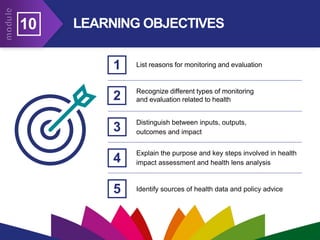
List reasons for monitoring and evaluation
Recognize different types of monitoring
and evaluation related to health
Distinguish between inputs, outputs,
outcomes and impact
1
2
3
Explain the purpose and key steps involved in health
impact assessment and health lens analysis
4
5 Identify sources of health data and policy advice
MONITORING AND EVALUATION IN THE
REVIEW STAGE OF THE POLICY CYCLE
10
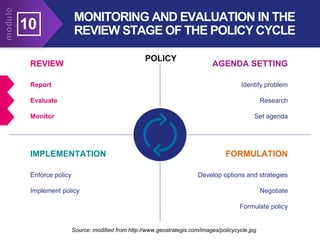
REVIEW
Report
Evaluate
Monitor
AGENDA SETTING
Identify problem
Research
Set agenda
FORMULATION
Develop options and strategies
Negotiate
Formulate policy
IMPLEMENTATION
Enforce policy
Implement policy
Source: modified from http://www.geostrategis.com/images/policycycle.jpg
POLICY
MONITORING HEALTH
DETERMINANTS
Source: https://www.cdc.gov/mmwr/preview/mmwrhtml/rr5013a1.htm
The ongoing, systematic collection, analysis,
interpretation, and dissemination of data
regarding a health-related event for use in
public health action.
10
EVALUATION
10
Analysis of the effectiveness of
a specific intervention or set of interventions
in achieving an intended outcome or set of
outcomes.
HiAP is not an endpoint in itself, but a
continuous approach to the promotion of health,
health equity, and health systems.
Policy-makers usually require:
–Evidence of progress that HiAP has improved health
and well-being and their determinants
in the general population or in targeted population
groups; and
–Justification for the investment in establishing,
fostering and sustaining HiAP.
Acknowledgements: slide adapted from Zeinab Khadr’s Powerpoint for HiAP training
in the Eastern Mediterranean Region, February 2017.
10
WHY MONITORING AND EVALUATION IN
HiAP?
10
Acknowledgements: slide adapted from Zeinab Khadr’s Powerpoint for HiAP training
in the Eastern Mediterranean Region, February 2017.
Acknowledgements: slide adapted from Zeinab Khadr’s Powerpoint for HiAP training
in the Eastern Mediterranean Region, February 2017.
Once a policy has been changed, subsequent
monitoring is necessary to evaluate the
outcomes of the new policy, and thus
monitoring should be an iterative and cyclical
process that operates continuously.
–Built into the planning stage rather
than an ‘afterthought’.
WHY MONITORING AND EVALUATION IN
HiAP?
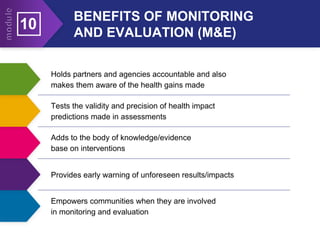
Holds partners and agencies accountable and also
makes them aware of the health gains made
Tests the validity and precision of health impact
predictions made in assessments
Adds to the body of knowledge/evidence
base on interventions
Provides early warning of unforeseen results/impacts
BENEFITS OF MONITORING
AND EVALUATION (M&E)
10
Empowers communities when they are involved
in monitoring and evaluation
10
Provides a way to inform stakeholders and the community
Strengthens the vision of health in
the community and stakeholders
Provides a better understanding of the value of HiAP
Lessons learned to improve HiAP approaches
BENEFITS OF MONITORING
AND EVALUATION (M&E)
STAGES OF THE HEALTH
MONITORING CYCLE
10
Source: WHO (2013) Handbook on Health Inequality Monitoring with a Special Focus
on Low- and Middle-Income Countries. Geneva, WHO, p. 2.
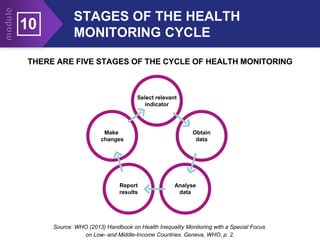
THERE ARE FIVE STAGES OF THE CYCLE OF HEALTH MONITORING
Select relevant
indicator
Obtain
data
Make
changes
Report
results
Analyse
data
DIRECT AND INDIRECT
INDICATORS
FOR MONITORING HEALTH
10
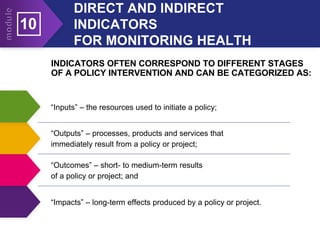
INDICATORS OFTEN CORRESPOND TO DIFFERENT STAGES
OF A POLICY INTERVENTION AND CAN BE CATEGORIZED AS:
“Inputs” – the resources used to initiate a policy;
“Outputs” – processes, products and services that
immediately result from a policy or project;
“Outcomes” – short- to medium-term results
of a policy or project; and
“Impacts” – long-term effects produced by a policy or project.
WHAT DO WE WANT TO KNOW?
10
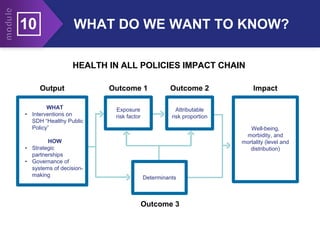
HEALTH IN ALL POLICIES IMPACT CHAIN
Output Outcome 1 Outcome 2 Impact
WHAT
• Interventions on
SDH “Healthy Public
Policy”
HOW
• Strategic
partnerships
• Governance of
systems of decision-
making
Well-being,
morbidity, and
mortality (level and
distribution)
Outcome 3
Attributable
risk proportion
Exposure
risk factor
Determinants
10 WHAT DO WE WANT TO KNOW?
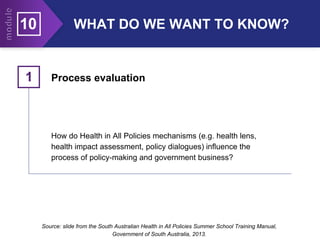
Process evaluation
1
How do Health in All Policies mechanisms (e.g. health lens,
health impact assessment, policy dialogues) influence the
process of policy-making and government business?
Source: slide from the South Australian Health in All Policies Summer School Training Manual,
Government of South Australia, 2013.
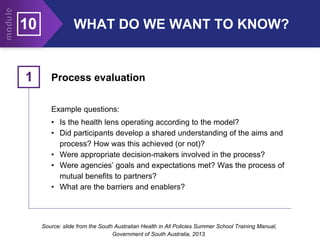
Process evaluation
1
Example questions:
• Is the health lens operating according to the model?
• Did participants develop a shared understanding of the aims and
process? How was this achieved (or not)?
• Were appropriate decision-makers involved in the process?
• Were agencies’ goals and expectations met? Was the process of
mutual benefits to partners?
• What are the barriers and enablers?
Source: slide from the South Australian Health in All Policies Summer School Training Manual,
Government of South Australia, 2013.
WHAT DO WE WANT TO KNOW?
10
10 WHAT DO WE WANT TO KNOW?
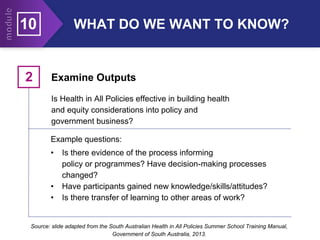
Examine Outputs
2
Is Health in All Policies effective in building health
and equity considerations into policy and
government business?
Example questions:
• Is there evidence of the process informing
policy or programmes? Have decision-making processes
changed?
• Have participants gained new knowledge/skills/attitudes?
• Is there transfer of learning to other areas of work?
Source: slide adapted from the South Australian Health in All Policies Summer School Training Manual,
Government of South Australia, 2013.
10 WHAT DO WE WANT TO KNOW?
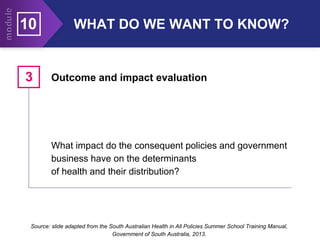
What impact do the consequent policies and government
business have on the determinants
of health and their distribution?
Outcome and impact evaluation
3
Source: slide adapted from the South Australian Health in All Policies Summer School Training Manual,
Government of South Australia, 2013.
WHAT DO WE WANT TO KNOW?
10
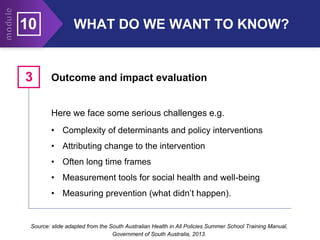
Here we face some serious challenges e.g.
• Complexity of determinants and policy interventions
• Attributing change to the intervention
• Often long time frames
• Measurement tools for social health and well-being
• Measuring prevention (what didn’t happen).
Outcome and impact evaluation
3
Source: slide adapted from the South Australian Health in All Policies Summer School Training Manual,
Government of South Australia, 2013.
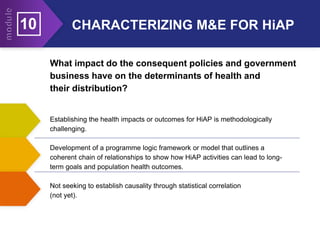
Establishing the health impacts or outcomes for HiAP is methodologically
challenging.
Development of a programme logic framework or model that outlines a
coherent chain of relationships to show how HiAP activities can lead to long-
term goals and population health outcomes.
Not seeking to establish causality through statistical correlation
(not yet).
What impact do the consequent policies and government
business have on the determinants of health and
their distribution?
10 CHARACTERIZING M&E FOR HiAP
SOUTH AUSTRALIAN CASE
10
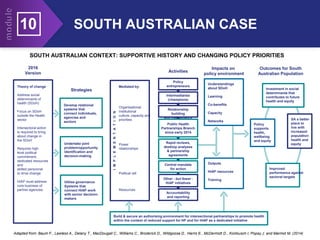
SOUTH AUSTRALIAN CONTEXT: SUPPORTIVE HISTORY AND CHANGING POLICY PRIORITIES
2016
Version
Strategies
Theory of change
Address social
determinants of
health (SDoH)
Focus on SDoH
outside the Health
sector
Intersectoral action
is required to bring
about change in
the SDoH
Requires high
level political
commitment,
dedicated resources
and
skilled personnel
to drive change
HiAP must address
core business of
partner agencies
Develop relational
systems that
connect individuals,
agencies and
sectors
Undertake joint
problem/opportunity
identification and
decision-making
Utilise governance
Systems that
connect HiAP work
with senior decision-
makers
Mediated by:
Organisational
Institutional
culture, capacity and
priorities
Power
relationships
Political will
Resources
I
M
P
L
E
M
E
N
T
A
T
I
O
N
Adapted from: Baum F., Lawless A., Delany T., MacDougall C., Williams C., Broderick D., Wildgoose D., Harris E., McDermott D., Kickbusch I, Popay J. and Marmot M. (2014)
Policy
entrepreneurs
Intermediaries
(champions)
Relationship
building
and maintenance
Public Health
Partnerships Branch
since early 2014
Rapid reviews,
desktop analyses
& partnership
agreements
Central mandate
for action
Other - but fewer -
HiAP initiatives
Accountability
and reporting
Activities
Impacts on
policy environment
Understandings
about SDoH
Learning
Co-benefits
Capacity
Networks
Outputs
HiAP resources
Training
Outcomes for South
Australian Population
Investment in social
determinants that
contributes to future
health and equity
Policy
supports
health,
wellbeing
and equity
SA a better
place to
live with
increased
population
health and
equity
Improved
performance against
sectoral targets
Build & secure an authorising environment for intersectional partnerships to promote health
within the context of reduced support for HP and for HiAP as a dedicated initiative
BRINGING IT ALL TOGETHER
10
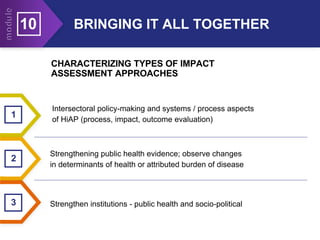
Intersectoral policy-making and systems / process aspects
of HiAP (process, impact, outcome evaluation)
CHARACTERIZING TYPES OF IMPACT
ASSESSMENT APPROACHES
Strengthening public health evidence; observe changes
in determinants of health or attributed burden of disease
Strengthen institutions - public health and socio-political
1
2
3
BRINGING IT ALL TOGETHER
10
METHODOLOGICAL APPROACHES
Organizational learning and critical action research
Realistic evaluation
Programme logic as a basis for attribution of health and equity outcomes
Theories on policy agenda setting and implementation
Complexity as a frame for understanding policy-making processes
Health, human impact assessment
STRENGTHEN PUBLIC HEALTH
EVIDENCE: SUPPORTING EVALUATIVE
CAPACITIES
10
Types of assessments to predict health and
health equity impacts (predictive evaluations /
policy analysis)
• Health impact assessment
• Cost-benefit analysis
• Integrated impact assessment
• Environmental impact assessment
• Human health risk assessment
Effectiveness data / intervention research / what
interventions work?
WHAT IS HEALTH IMPACT
ASSESSMENT (HIA)?
10
A HIA is a combination of procedures,
methods and tools that assesses the potential
effects of a policy or project on the health of a
population and the distribution of those effects
within the population. HIAs also identify
appropriate actions to manage those effects.
HIA IS BASED ON FOUR VALUES
10
Democracy
Equity
Sustainable development
Ethical use of evidence
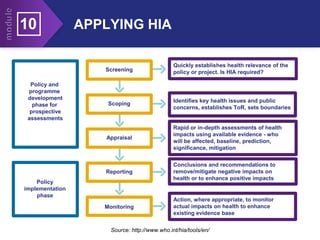
APPLYING HIA
10
Source: http://www.who.int/hia/tools/en/
Policy and
programme
development
phase for
prospective
assessments
Policy
implementation
phase
Screening
Scoping
Appraisal
Reporting
Monitoring
Quickly establishes health relevance of the
policy or project. Is HIA required?
Identifies key health issues and public
concerns, establishes ToR, sets boundaries
Conclusions and recommendations to
remove/mitigate negative impacts on
health or to enhance positive impacts
Action, where appropriate, to monitor
actual impacts on health to enhance
existing evidence base
Rapid or in-depth assessments of health
impacts using available evidence - who
will be affected, baseline, prediction,
significance, mitigation
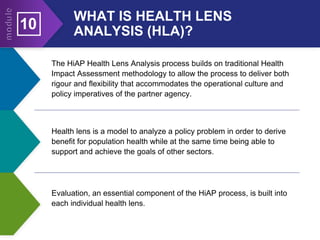
The HiAP Health Lens Analysis process builds on traditional Health
Impact Assessment methodology to allow the process to deliver both
rigour and flexibility that accommodates the operational culture and
policy imperatives of the partner agency.
Health lens is a model to analyze a policy problem in order to derive
benefit for population health while at the same time being able to
support and achieve the goals of other sectors.
Evaluation, an essential component of the HiAP process, is built into
each individual health lens.
WHAT IS HEALTH LENS
ANALYSIS (HLA)?
10
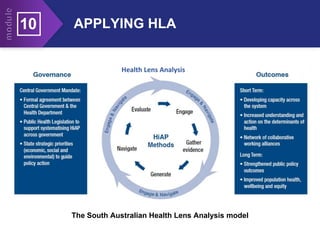
APPLYING HLA
10
The South Australian Health Lens Analysis model
Health Lens Analysis
10
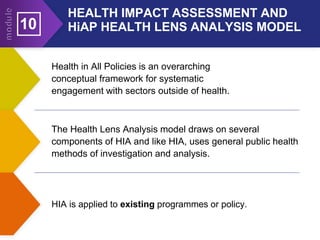
Health in All Policies is an overarching
conceptual framework for systematic
engagement with sectors outside of health.
The Health Lens Analysis model draws on several
components of HIA and like HIA, uses general public health
methods of investigation and analysis.
HIA is applied to existing programmes or policy.
HEALTH IMPACT ASSESSMENT AND
HiAP HEALTH LENS ANALYSIS MODEL
10
HiAP is applied to programmes or policy
yet to be developed.
HiAP does not rigidly apply the steps of HIA and their
application is highly context specific.
HEALTH IMPACT ASSESSMENT AND
HiAP HEALTH LENS ANALYSIS MODEL
STRENGTHEN PUBLIC HEALTH AND
OTHER SOCIO-POLITICAL
INSTITUTIONS
10
Strengthen public health institutions:
• Reports on sustainable development
• Reporting on health determinants, including HiAP activities
• Public health legislation
• Capacities for health impact evaluation
• Education and training for HiAP
• New tools for monitoring and evaluation
1
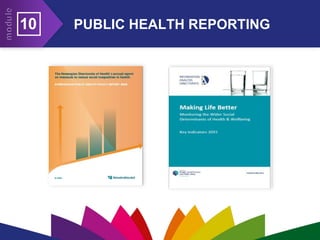
PUBLIC HEALTH REPORTING
10
STRENGTHEN PUBLIC HEALTH AND
OTHER SOCIO-POLITICAL
INSTITUTIONS
10
Strengthen social and political institutions:
• Reporting and laws in parliament includes criteria for health
• Human rights impact assessments
• Media education
• Citizen health forums
• Education
• Interlinked data on health determinants
2
End of
Module 10
Please continue
to Module 11

m&e-ppt-module-10.pptx

  • 1.
    MODULE 10 Measuring progressin health 10 MONITORING & EVALUATION (M&E), HEALTH IN ALL POLICIES (HiAP), HEALTH IMPACT ASSESSMENT (HIA), AND HEALTH LENS ANALYSIS
  • 2.
    LEARNING OBJECTIVES 10 List reasonsfor monitoring and evaluation Recognize different types of monitoring and evaluation related to health Distinguish between inputs, outputs, outcomes and impact 1 2 3 Explain the purpose and key steps involved in health impact assessment and health lens analysis 4 5 Identify sources of health data and policy advice
  • 3.
    MONITORING AND EVALUATIONIN THE REVIEW STAGE OF THE POLICY CYCLE 10 REVIEW Report Evaluate Monitor AGENDA SETTING Identify problem Research Set agenda FORMULATION Develop options and strategies Negotiate Formulate policy IMPLEMENTATION Enforce policy Implement policy Source: modified from http://www.geostrategis.com/images/policycycle.jpg POLICY
  • 4.
    MONITORING HEALTH DETERMINANTS Source: https://www.cdc.gov/mmwr/preview/mmwrhtml/rr5013a1.htm Theongoing, systematic collection, analysis, interpretation, and dissemination of data regarding a health-related event for use in public health action. 10
  • 5.
    EVALUATION 10 Analysis of theeffectiveness of a specific intervention or set of interventions in achieving an intended outcome or set of outcomes.
  • 6.
    HiAP is notan endpoint in itself, but a continuous approach to the promotion of health, health equity, and health systems. Policy-makers usually require: –Evidence of progress that HiAP has improved health and well-being and their determinants in the general population or in targeted population groups; and –Justification for the investment in establishing, fostering and sustaining HiAP. Acknowledgements: slide adapted from Zeinab Khadr’s Powerpoint for HiAP training in the Eastern Mediterranean Region, February 2017. 10 WHY MONITORING AND EVALUATION IN HiAP?
  • 7.
    10 Acknowledgements: slide adaptedfrom Zeinab Khadr’s Powerpoint for HiAP training in the Eastern Mediterranean Region, February 2017. Acknowledgements: slide adapted from Zeinab Khadr’s Powerpoint for HiAP training in the Eastern Mediterranean Region, February 2017. Once a policy has been changed, subsequent monitoring is necessary to evaluate the outcomes of the new policy, and thus monitoring should be an iterative and cyclical process that operates continuously. –Built into the planning stage rather than an ‘afterthought’. WHY MONITORING AND EVALUATION IN HiAP?
  • 8.
    Holds partners andagencies accountable and also makes them aware of the health gains made Tests the validity and precision of health impact predictions made in assessments Adds to the body of knowledge/evidence base on interventions Provides early warning of unforeseen results/impacts BENEFITS OF MONITORING AND EVALUATION (M&E) 10 Empowers communities when they are involved in monitoring and evaluation
  • 9.
    10 Provides a wayto inform stakeholders and the community Strengthens the vision of health in the community and stakeholders Provides a better understanding of the value of HiAP Lessons learned to improve HiAP approaches BENEFITS OF MONITORING AND EVALUATION (M&E)
  • 10.
    STAGES OF THEHEALTH MONITORING CYCLE 10 Source: WHO (2013) Handbook on Health Inequality Monitoring with a Special Focus on Low- and Middle-Income Countries. Geneva, WHO, p. 2. THERE ARE FIVE STAGES OF THE CYCLE OF HEALTH MONITORING Select relevant indicator Obtain data Make changes Report results Analyse data
  • 11.
    DIRECT AND INDIRECT INDICATORS FORMONITORING HEALTH 10 INDICATORS OFTEN CORRESPOND TO DIFFERENT STAGES OF A POLICY INTERVENTION AND CAN BE CATEGORIZED AS: “Inputs” – the resources used to initiate a policy; “Outputs” – processes, products and services that immediately result from a policy or project; “Outcomes” – short- to medium-term results of a policy or project; and “Impacts” – long-term effects produced by a policy or project.
  • 12.
    WHAT DO WEWANT TO KNOW? 10 HEALTH IN ALL POLICIES IMPACT CHAIN Output Outcome 1 Outcome 2 Impact WHAT • Interventions on SDH “Healthy Public Policy” HOW • Strategic partnerships • Governance of systems of decision- making Well-being, morbidity, and mortality (level and distribution) Outcome 3 Attributable risk proportion Exposure risk factor Determinants
  • 13.
    10 WHAT DOWE WANT TO KNOW? Process evaluation 1 How do Health in All Policies mechanisms (e.g. health lens, health impact assessment, policy dialogues) influence the process of policy-making and government business? Source: slide from the South Australian Health in All Policies Summer School Training Manual, Government of South Australia, 2013.
  • 14.
    Process evaluation 1 Example questions: •Is the health lens operating according to the model? • Did participants develop a shared understanding of the aims and process? How was this achieved (or not)? • Were appropriate decision-makers involved in the process? • Were agencies’ goals and expectations met? Was the process of mutual benefits to partners? • What are the barriers and enablers? Source: slide from the South Australian Health in All Policies Summer School Training Manual, Government of South Australia, 2013. WHAT DO WE WANT TO KNOW? 10
  • 15.
    10 WHAT DOWE WANT TO KNOW? Examine Outputs 2 Is Health in All Policies effective in building health and equity considerations into policy and government business? Example questions: • Is there evidence of the process informing policy or programmes? Have decision-making processes changed? • Have participants gained new knowledge/skills/attitudes? • Is there transfer of learning to other areas of work? Source: slide adapted from the South Australian Health in All Policies Summer School Training Manual, Government of South Australia, 2013.
  • 16.
    10 WHAT DOWE WANT TO KNOW? What impact do the consequent policies and government business have on the determinants of health and their distribution? Outcome and impact evaluation 3 Source: slide adapted from the South Australian Health in All Policies Summer School Training Manual, Government of South Australia, 2013.
  • 17.
    WHAT DO WEWANT TO KNOW? 10 Here we face some serious challenges e.g. • Complexity of determinants and policy interventions • Attributing change to the intervention • Often long time frames • Measurement tools for social health and well-being • Measuring prevention (what didn’t happen). Outcome and impact evaluation 3 Source: slide adapted from the South Australian Health in All Policies Summer School Training Manual, Government of South Australia, 2013.
  • 18.
    Establishing the healthimpacts or outcomes for HiAP is methodologically challenging. Development of a programme logic framework or model that outlines a coherent chain of relationships to show how HiAP activities can lead to long- term goals and population health outcomes. Not seeking to establish causality through statistical correlation (not yet). What impact do the consequent policies and government business have on the determinants of health and their distribution? 10 CHARACTERIZING M&E FOR HiAP
  • 19.
    SOUTH AUSTRALIAN CASE 10 SOUTHAUSTRALIAN CONTEXT: SUPPORTIVE HISTORY AND CHANGING POLICY PRIORITIES 2016 Version Strategies Theory of change Address social determinants of health (SDoH) Focus on SDoH outside the Health sector Intersectoral action is required to bring about change in the SDoH Requires high level political commitment, dedicated resources and skilled personnel to drive change HiAP must address core business of partner agencies Develop relational systems that connect individuals, agencies and sectors Undertake joint problem/opportunity identification and decision-making Utilise governance Systems that connect HiAP work with senior decision- makers Mediated by: Organisational Institutional culture, capacity and priorities Power relationships Political will Resources I M P L E M E N T A T I O N Adapted from: Baum F., Lawless A., Delany T., MacDougall C., Williams C., Broderick D., Wildgoose D., Harris E., McDermott D., Kickbusch I, Popay J. and Marmot M. (2014) Policy entrepreneurs Intermediaries (champions) Relationship building and maintenance Public Health Partnerships Branch since early 2014 Rapid reviews, desktop analyses & partnership agreements Central mandate for action Other - but fewer - HiAP initiatives Accountability and reporting Activities Impacts on policy environment Understandings about SDoH Learning Co-benefits Capacity Networks Outputs HiAP resources Training Outcomes for South Australian Population Investment in social determinants that contributes to future health and equity Policy supports health, wellbeing and equity SA a better place to live with increased population health and equity Improved performance against sectoral targets Build & secure an authorising environment for intersectional partnerships to promote health within the context of reduced support for HP and for HiAP as a dedicated initiative
  • 20.
    BRINGING IT ALLTOGETHER 10 Intersectoral policy-making and systems / process aspects of HiAP (process, impact, outcome evaluation) CHARACTERIZING TYPES OF IMPACT ASSESSMENT APPROACHES Strengthening public health evidence; observe changes in determinants of health or attributed burden of disease Strengthen institutions - public health and socio-political 1 2 3
  • 21.
    BRINGING IT ALLTOGETHER 10 METHODOLOGICAL APPROACHES Organizational learning and critical action research Realistic evaluation Programme logic as a basis for attribution of health and equity outcomes Theories on policy agenda setting and implementation Complexity as a frame for understanding policy-making processes Health, human impact assessment
  • 22.
    STRENGTHEN PUBLIC HEALTH EVIDENCE:SUPPORTING EVALUATIVE CAPACITIES 10 Types of assessments to predict health and health equity impacts (predictive evaluations / policy analysis) • Health impact assessment • Cost-benefit analysis • Integrated impact assessment • Environmental impact assessment • Human health risk assessment Effectiveness data / intervention research / what interventions work?
  • 23.
    WHAT IS HEALTHIMPACT ASSESSMENT (HIA)? 10 A HIA is a combination of procedures, methods and tools that assesses the potential effects of a policy or project on the health of a population and the distribution of those effects within the population. HIAs also identify appropriate actions to manage those effects.
  • 24.
    HIA IS BASEDON FOUR VALUES 10 Democracy Equity Sustainable development Ethical use of evidence
  • 25.
    APPLYING HIA 10 Source: http://www.who.int/hia/tools/en/ Policyand programme development phase for prospective assessments Policy implementation phase Screening Scoping Appraisal Reporting Monitoring Quickly establishes health relevance of the policy or project. Is HIA required? Identifies key health issues and public concerns, establishes ToR, sets boundaries Conclusions and recommendations to remove/mitigate negative impacts on health or to enhance positive impacts Action, where appropriate, to monitor actual impacts on health to enhance existing evidence base Rapid or in-depth assessments of health impacts using available evidence - who will be affected, baseline, prediction, significance, mitigation
  • 26.
    The HiAP HealthLens Analysis process builds on traditional Health Impact Assessment methodology to allow the process to deliver both rigour and flexibility that accommodates the operational culture and policy imperatives of the partner agency. Health lens is a model to analyze a policy problem in order to derive benefit for population health while at the same time being able to support and achieve the goals of other sectors. Evaluation, an essential component of the HiAP process, is built into each individual health lens. WHAT IS HEALTH LENS ANALYSIS (HLA)? 10
  • 27.
    APPLYING HLA 10 The SouthAustralian Health Lens Analysis model Health Lens Analysis
  • 28.
    10 Health in AllPolicies is an overarching conceptual framework for systematic engagement with sectors outside of health. The Health Lens Analysis model draws on several components of HIA and like HIA, uses general public health methods of investigation and analysis. HIA is applied to existing programmes or policy. HEALTH IMPACT ASSESSMENT AND HiAP HEALTH LENS ANALYSIS MODEL
  • 29.
    10 HiAP is appliedto programmes or policy yet to be developed. HiAP does not rigidly apply the steps of HIA and their application is highly context specific. HEALTH IMPACT ASSESSMENT AND HiAP HEALTH LENS ANALYSIS MODEL
  • 30.
    STRENGTHEN PUBLIC HEALTHAND OTHER SOCIO-POLITICAL INSTITUTIONS 10 Strengthen public health institutions: • Reports on sustainable development • Reporting on health determinants, including HiAP activities • Public health legislation • Capacities for health impact evaluation • Education and training for HiAP • New tools for monitoring and evaluation 1
  • 31.
  • 32.
    STRENGTHEN PUBLIC HEALTHAND OTHER SOCIO-POLITICAL INSTITUTIONS 10 Strengthen social and political institutions: • Reporting and laws in parliament includes criteria for health • Human rights impact assessments • Media education • Citizen health forums • Education • Interlinked data on health determinants 2
  • 33.
    End of Module 10 Pleasecontinue to Module 11