text by CHERYL ROSE
W
ith a
popula-
tion
that is
living
longer and a culture that puts
a premium on appearance,
Americans are investing in aes-
thetic treatments to tweak the
damage done by sun exposure,
normal aging and poor lifestyle
choices. This trend isn’t just in
New York and Hollywood, but a
bustling business in Southeast
Texas, too.
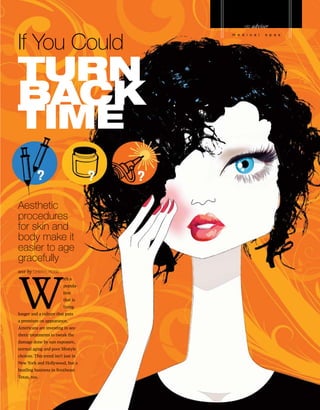
If You Could
TURN
BACK
TIME
m e d i c a l s p a s
vip adviser
Aesthetic
procedures
for skin and
body make it
easier to age
gracefully
“It’s gaining more popularity, since
services are more accessible and prices
are better than when some of these
procedures first came out,” said Julie
Broussard, a certified family nurse
practitioner and the owner of Skinolo-
gie in Beaumont. “We constantly have
new patients who have never had
anything done before, but now to want
venture into the world of aesthetics.”
Medical supervision a must
Aesthetic treatments offer a menu
of options to reduce wrinkles, remove
brown and red spots, improve skin
texture, tighten pores, help acne,
remove unwanted hair, reduce cellulite
and many more. These treatments can
be administered by injections, lasers,
chemicals, ultraviolet light, radio-fre-
quency waves and other mechanisms
that are considered nonsurgical, but
are not necessarily simple or pain-
free. Because of the nature of these
procedures, trained medical oversight
is recommended. The U.S. Food and
Drug Administration has approved the
use of various aesthetic treatments, but
the State of Texas has few regulations
guiding the administration of these
products. At this time, the respon-
sibility lies heavily on consumers to
do due diligence in selecting a physi-
cian’s office or medical spa that has
capably trained personnel and medical
oversight.
Broussard’s No. 1 piece of advice
to anyone considering an aesthetic
treatment is to ask who the medical
supervisor is and about the certifica-
tions, licensing and training of the
aestheticians. “These treatments are
not a typical facial at a salon,” Brous-
sard said. “We do exfoliate layers of
the skin and some treatments are more
invasive. If you’re going to have any
kind of injectable procedure, you need
a medical provider in the office.”
What to expect
Unhappy with age spots, spider
veins or love handles? There are mul-
tiple aesthetic offerings that could ben-
efit your problem spots, but navigating
the choices can be confusing.
“Everyone is different,” said Tara
Villarreal, the spa director at Christus
Healthy Living Spa in Beaumont. “If
you talk with the aesthetician about the
issue that bothers you, he or she can
point you in the right direction for the
results you want.”
Villarreal and Broussard said the
most popular treatments at their spas
are Botox injections, microdermabra-
sion, derma fillers and chemical peels.
Though both see predominantly
women clients, men are coming in
more often. Men are seeking many of
the same treatments as women, includ-
ing Botox and derma fillers, but they
often are also seeking hair removal.
Some procedures are painless,
others have mild discomfort and still
others require longer recovery. “A lot
of people are scared,” Villarreal said.
“They might start with a micro-peel,
which is just a resurfacing and reju-
venating of the skin that shows good
results with no downtime.”
Derma fillers are used to smooth
wrinkles and creases in the face. There
are several brands of fillers, but at
Christus Healthy Living Spa, Villarreal
said they use Juvederm for lips and
Radiesse for the chin and smile lines.
“It is a little painful. I won’t lie,” she
said. “Our Juvederm is mixed with Li-
docaine (a numbing drug). You feel the
first stick and then you’re numb. There
is slight bruising with most fillers for a
few days, but it can be covered up with
make-up.”
Botox injections may have a prick-
ing sensation, laser hair removal may
sting, but most common procedures
have minimal pain and recovery. Villar-
real gave the example of Fraxel, a laser
resurfacing technique, that is a more
painful choice that requires longer
recovery. “You’re going to swell and be
down five to seven days,” she said. “But
it brings so much collagen back to the
skin and the overall skin is a lot better.”
Several treatments require more
than one session for best results. The
benefits last for differing lengths of
Aesthetics Advice
■ Ask about the medical supervisor,
licensing and certifications of any treat-
ment providers.
■ Check the background and references
of the provider/office/spa.
■ Don’t have a procedure the day of a
special event. Depending on the treatment,
a few days to a week may be needed to
see results or for recovery.
■ Many topical procedures require that
clients stay off antibiotics, Retin-A or acne
medications for a week prior to treatment.
■ Wear sunblock and follow healing
guidelines after a procedure.
>>
photography and illustration by MCT
time. For example, Villarreal said
Juvederm typically lasts six to eight
months.
Body contouring
The majority of aesthetic treat-
ments are used on the face, how-
ever several are used on different
parts of the body. Laser hair remov-
al can be done on the back or chest,
for example. Spider vein sclero-
therapy is done on legs. There
are also several options to melt or
freeze localized fat deposits. For
example, CoolSculpting is a proce-
dure that destroys fat cells by freez-
ing them without damaging the
skin. After a treatment, the dead
cells are reabsorbed or excreted by
the body over several weeks. The
FDA cleared the process as a body
contouring treatment in 2010.
According to Dr. Garrett Peel,
the CEO and president of Prev-
ity Clinic in Beaumont, about 30
percent of his patients return after
a successful treatment to work
on other problem spots. Peel said
people commonly request help
with stomach bulges and “love
handles.”
An important caveat of the pro-
cess is that it is not a cure for obe-
sity. The best results are for people
already close to an appropriately
healthy weight. This works for
people who can pinch an inch of
love handle rather than those with
a spare tire around the middle. Peel
said the average patient seeking
treatment is 30 to 50 years of age,
though he has had patients into
their 70s. Most patients only re-
quire one treatment, though some
may choose to do more.
“Twenty to 40 percent of the fat
is gone after a one-hour treatment
that also tightens the skin,” Peel
said. “Some people have better
results than others, however, there
is no room for skepticism in our
results. Our before-and-after pic-
tures along with our enthusiastic
patients prove it.”
Art to the Aesthetics
Another important reason to
have a fully-trained aesthetician or
medical provider involved in the
procedure of choice is that the re-
sults are not just about the product
being used. Injecting Botox just
anywhere on your face won’t get
an attractive result. The knowl-
edge and skill of the technician is
equally important.
“If you don’t have an artistic
sense, you can’t do this,” according
to Gayle Pugh, a physician assistant
at Buna Skin Center in Buna. “You
need to appreciate beauty, under-
stand anatomy and be familiar with
the process of aging and sculpting
the face. You have to understand
what makes a woman attractive in
our society and also work with how
she perceives herself.”
Nonsurgical aesthetic treat-
ments have a limited scope, so
Broussard said she does refer
people to plastic surgeons or other
providers if the desired results in-
volve more invasive or surgical pro-
cedures. “With what we provide,
you will see very good results – you
just have to have realistic expecta-
tions,” she said.
Body Contouring
Also known as: Lipo-Ex, Velashape
Reduces fat and improves the appear-
ance of cellulite. All are non-surgical
and non-invasive. All require multiple
sessions to see desired results. All
work best for clients near their weight
goals in good physical health that just
want to improve an area of localized
fat. All three use radio-frequency
energy to gradually melt fat cells,
combining massage to tighten skin
and stimulate collagen.
Laser Hair Removal
Using a precise wavelength of light,
the laser is used to target the melanin
of the hair follicle. The type of laser
used depends on the color of skin,
color of hair, and area being treated.
The best candidates have fair skin and
dark hair. Though the majority of hair
loss is permanent, it often requires
multiple treatments and occasional
follow-ups.
Microdermabrasion
Microdermabrasion gently exfoliates
the skin to remove the outer layer,
improving complexion and the ap-
pearance of sun damage. There are
two methods of microdermabrasion
treatments: One uses calcium crystals
and the other uses a diamond-tipped
wand. The latest technology to hit the
market is the hydra-dermabrasion,
which uses water to exfoliate and
extract while infusing the skin with
serums
Ultrasound Facial
Also known as: Sonophoresis
A serum of active ingredients is ap-
plied to the skin, containing agents
and vitamins to hydrate the cells and
stimulate collagen. Then ultrasonic
waves are used to dramatically in-
crease the depth and rate the serums
are absorbed into the skin.
Radio-Frequency
Skin Tightening
Also known as: Thermage
Using a device to deliver radio-
frequency (RF) energy into the deeper
layers of the skin, this treatment is
non-invasive and FDA-approved. The
energy causes a heating action that
immediately tightens skin tissue and
structures, improving facial lines and
wrinkles. A single treatment can last
a month, but a series of treatments is
recommended for better quality and
longevity.
Chemical Peels
A chemical solution is applied to the
skin to smooth texture and tone by
removing damaged outer layers. The
types of peels differ based on which
solution is used and how deeply it
penetrates. Most spas do superficial
peels that use a mild acid. Deeper
peels are usually done in a medical
office using sedatives or anesthesia.
Common
Medical Spa
Procedures
Explosive Growth in Non-surgical Procedures
In a 2012 national survey, the American Society for Aesthetic Plastic Surgery reported astounding growth in the number of
Americans electing to have aesthetic procedures. Here are a few highlights:
■ Since 1997, the number of reported non-surgical procedures, such as Botox, facial fillers and laser hair removal, has surged
by 356 percent.
■ People age 35 to 50 had the most procedures – almost 4 million and 43 percent of the total. People age 19 to 34 had 20
percent of procedures; age 51 to 64 had 28 percent; age 65 and over had 8 percent; and age 18 and younger had 1.4 percent.
■ Americans spent $1.7 billion on injectable procedures; $1.6 billion on skin rejuvenation procedures; and over $360 million
on other nonsurgical procedures, including laser hair removal and laser treatment of leg veins.
■ The most popular nonsurgical procedure was injections of Botulinum Toxin Type A (including Botox and Dysport).
■ When procedures performed by physicians, physician assistants and nurse injectors are collated, the total number of the five
most popular procedures performed in the practices surveyed were: 1. Botulinum Toxin Type A: 4,125,179; 2. Hyaluronic Acid:
1,806,806; 3. Laser Hair Removal: 1,224,920; 4. Chemical Peel: 718,465; 5. Microdermabrasion: 672,430
VIP
Botulinum Injection
Also known as: Botox, Dysport,
Xeomin
All three use an FDA-approved
neurotoxin injected into the skin for
paralyzing little muscles in the face to
prevent those muscles from furrowing
the brow or squinting around the eyes.
All three work slightly differently, and
often practitioners and clients will have
a preference for one over the other.
Botox has been the gold standard for
more than a decade, with Xeomin be-
ing the most recent on the market.
Laser Resurfacing
Also known as: Fraxel
The laser beam used in laser resur-
facing will remove the outer layer of
skin, called the epidermis. It simul-
taneously heats the underlying skin,
called the dermis. This action works to
stimulate the growth of new collagen
fibers. As the treated area heals, the
new skin that forms is smoother and
firmer.
Derma Fillers
Also known as: Juvederm, Radiesse,
Restylane, Perlane
These products are gels or pastes
that are injected under the skin to
minimize lines or grooves caused by
time. All treat the laugh lines around
the mouth, but some are also used for
other areas including the cheeks and
lips. Again, the four products are for
the same purpose but work slightly
differently, so practitioners may have
differing preferences for brands and
uses.
Laser Hair Removal
Using a precise wavelength of light,
the laser is used to target the melanin
of the hair follicle. The type of laser
used depends on the color of skin,
color of hair, and area being treated.
The best candidates have fair skin and
dark hair. Though the majority of hair
loss is permanent, it often requires
multiple treatments and occasional
follow-ups.
Photo Rejuvenation
Also known as: Intense Pulsed Light-
IPL, PhotoFacial, FotoFacial
Using a handheld device, a focused,
broad-spectrum light is emitted in
gentle pulses over the skin, penetrat-
ing to all levels of the skin. It is used
for improving the appearance of sun-
damaged or aged skin and minimizes
any dark spots, including age spots,
freckles, birthmarks and rosacea. The
recommendation is multiple sessions
over several weeks for best results.
IPL is also used for hair removal.
Cryogenic lipolysis
Also known as: CoolSculpting, Freez-
eFat, Cryolipo
A nonsurgical alternative to liposuc-
tion, the procedure involves destroying
fat cells by freezing them without
damaging the skin. The dead fat cells
are then gradually digested by the
body over a few months, reducing the
thickness of the fat layer.
Photodynamic
Therapy
Also known as: PDT
A form of LED light, that when
combined with nontoxic light-sensitive
compounds, destroys the bacteria that
causes acne painlessly. It can also be
used to treate rosacea. Most patients
need more than one treatment over
several weeks.
Spider Vein
Treatment
The most common treatment for spi-
der veins on the legs is sclerotherapy.
This involves the injection of a scle-
rosing solution into the veins, causing
them to collapse and fade from view.
Facial spider veins are usually treated
with lasers or IPL that cauterize the
blood vessels

MedSpa

  • 1.
    text by CHERYLROSE W ith a popula- tion that is living longer and a culture that puts a premium on appearance, Americans are investing in aes- thetic treatments to tweak the damage done by sun exposure, normal aging and poor lifestyle choices. This trend isn’t just in New York and Hollywood, but a bustling business in Southeast Texas, too. If You Could TURN BACK TIME m e d i c a l s p a s vip adviser Aesthetic procedures for skin and body make it easier to age gracefully
  • 2.
    “It’s gaining morepopularity, since services are more accessible and prices are better than when some of these procedures first came out,” said Julie Broussard, a certified family nurse practitioner and the owner of Skinolo- gie in Beaumont. “We constantly have new patients who have never had anything done before, but now to want venture into the world of aesthetics.” Medical supervision a must Aesthetic treatments offer a menu of options to reduce wrinkles, remove brown and red spots, improve skin texture, tighten pores, help acne, remove unwanted hair, reduce cellulite and many more. These treatments can be administered by injections, lasers, chemicals, ultraviolet light, radio-fre- quency waves and other mechanisms that are considered nonsurgical, but are not necessarily simple or pain- free. Because of the nature of these procedures, trained medical oversight is recommended. The U.S. Food and Drug Administration has approved the use of various aesthetic treatments, but the State of Texas has few regulations guiding the administration of these products. At this time, the respon- sibility lies heavily on consumers to do due diligence in selecting a physi- cian’s office or medical spa that has capably trained personnel and medical oversight. Broussard’s No. 1 piece of advice to anyone considering an aesthetic treatment is to ask who the medical supervisor is and about the certifica- tions, licensing and training of the aestheticians. “These treatments are not a typical facial at a salon,” Brous- sard said. “We do exfoliate layers of the skin and some treatments are more invasive. If you’re going to have any kind of injectable procedure, you need a medical provider in the office.” What to expect Unhappy with age spots, spider veins or love handles? There are mul- tiple aesthetic offerings that could ben- efit your problem spots, but navigating the choices can be confusing. “Everyone is different,” said Tara Villarreal, the spa director at Christus Healthy Living Spa in Beaumont. “If you talk with the aesthetician about the issue that bothers you, he or she can point you in the right direction for the results you want.” Villarreal and Broussard said the most popular treatments at their spas are Botox injections, microdermabra- sion, derma fillers and chemical peels. Though both see predominantly women clients, men are coming in more often. Men are seeking many of the same treatments as women, includ- ing Botox and derma fillers, but they often are also seeking hair removal. Some procedures are painless, others have mild discomfort and still others require longer recovery. “A lot of people are scared,” Villarreal said. “They might start with a micro-peel, which is just a resurfacing and reju- venating of the skin that shows good results with no downtime.” Derma fillers are used to smooth wrinkles and creases in the face. There are several brands of fillers, but at Christus Healthy Living Spa, Villarreal said they use Juvederm for lips and Radiesse for the chin and smile lines. “It is a little painful. I won’t lie,” she said. “Our Juvederm is mixed with Li- docaine (a numbing drug). You feel the first stick and then you’re numb. There is slight bruising with most fillers for a few days, but it can be covered up with make-up.” Botox injections may have a prick- ing sensation, laser hair removal may sting, but most common procedures have minimal pain and recovery. Villar- real gave the example of Fraxel, a laser resurfacing technique, that is a more painful choice that requires longer recovery. “You’re going to swell and be down five to seven days,” she said. “But it brings so much collagen back to the skin and the overall skin is a lot better.” Several treatments require more than one session for best results. The benefits last for differing lengths of Aesthetics Advice ■ Ask about the medical supervisor, licensing and certifications of any treat- ment providers. ■ Check the background and references of the provider/office/spa. ■ Don’t have a procedure the day of a special event. Depending on the treatment, a few days to a week may be needed to see results or for recovery. ■ Many topical procedures require that clients stay off antibiotics, Retin-A or acne medications for a week prior to treatment. ■ Wear sunblock and follow healing guidelines after a procedure. >> photography and illustration by MCT
  • 3.
    time. For example,Villarreal said Juvederm typically lasts six to eight months. Body contouring The majority of aesthetic treat- ments are used on the face, how- ever several are used on different parts of the body. Laser hair remov- al can be done on the back or chest, for example. Spider vein sclero- therapy is done on legs. There are also several options to melt or freeze localized fat deposits. For example, CoolSculpting is a proce- dure that destroys fat cells by freez- ing them without damaging the skin. After a treatment, the dead cells are reabsorbed or excreted by the body over several weeks. The FDA cleared the process as a body contouring treatment in 2010. According to Dr. Garrett Peel, the CEO and president of Prev- ity Clinic in Beaumont, about 30 percent of his patients return after a successful treatment to work on other problem spots. Peel said people commonly request help with stomach bulges and “love handles.” An important caveat of the pro- cess is that it is not a cure for obe- sity. The best results are for people already close to an appropriately healthy weight. This works for people who can pinch an inch of love handle rather than those with a spare tire around the middle. Peel said the average patient seeking treatment is 30 to 50 years of age, though he has had patients into their 70s. Most patients only re- quire one treatment, though some may choose to do more. “Twenty to 40 percent of the fat is gone after a one-hour treatment that also tightens the skin,” Peel said. “Some people have better results than others, however, there is no room for skepticism in our results. Our before-and-after pic- tures along with our enthusiastic patients prove it.” Art to the Aesthetics Another important reason to have a fully-trained aesthetician or medical provider involved in the procedure of choice is that the re- sults are not just about the product being used. Injecting Botox just anywhere on your face won’t get an attractive result. The knowl- edge and skill of the technician is equally important. “If you don’t have an artistic sense, you can’t do this,” according to Gayle Pugh, a physician assistant at Buna Skin Center in Buna. “You need to appreciate beauty, under- stand anatomy and be familiar with the process of aging and sculpting the face. You have to understand what makes a woman attractive in our society and also work with how she perceives herself.” Nonsurgical aesthetic treat- ments have a limited scope, so Broussard said she does refer people to plastic surgeons or other providers if the desired results in- volve more invasive or surgical pro- cedures. “With what we provide, you will see very good results – you just have to have realistic expecta- tions,” she said. Body Contouring Also known as: Lipo-Ex, Velashape Reduces fat and improves the appear- ance of cellulite. All are non-surgical and non-invasive. All require multiple sessions to see desired results. All work best for clients near their weight goals in good physical health that just want to improve an area of localized fat. All three use radio-frequency energy to gradually melt fat cells, combining massage to tighten skin and stimulate collagen. Laser Hair Removal Using a precise wavelength of light, the laser is used to target the melanin of the hair follicle. The type of laser used depends on the color of skin, color of hair, and area being treated. The best candidates have fair skin and dark hair. Though the majority of hair loss is permanent, it often requires multiple treatments and occasional follow-ups. Microdermabrasion Microdermabrasion gently exfoliates the skin to remove the outer layer, improving complexion and the ap- pearance of sun damage. There are two methods of microdermabrasion treatments: One uses calcium crystals and the other uses a diamond-tipped wand. The latest technology to hit the market is the hydra-dermabrasion, which uses water to exfoliate and extract while infusing the skin with serums Ultrasound Facial Also known as: Sonophoresis A serum of active ingredients is ap- plied to the skin, containing agents and vitamins to hydrate the cells and stimulate collagen. Then ultrasonic waves are used to dramatically in- crease the depth and rate the serums are absorbed into the skin. Radio-Frequency Skin Tightening Also known as: Thermage Using a device to deliver radio- frequency (RF) energy into the deeper layers of the skin, this treatment is non-invasive and FDA-approved. The energy causes a heating action that immediately tightens skin tissue and structures, improving facial lines and wrinkles. A single treatment can last a month, but a series of treatments is recommended for better quality and longevity. Chemical Peels A chemical solution is applied to the skin to smooth texture and tone by removing damaged outer layers. The types of peels differ based on which solution is used and how deeply it penetrates. Most spas do superficial peels that use a mild acid. Deeper peels are usually done in a medical office using sedatives or anesthesia. Common Medical Spa Procedures Explosive Growth in Non-surgical Procedures In a 2012 national survey, the American Society for Aesthetic Plastic Surgery reported astounding growth in the number of Americans electing to have aesthetic procedures. Here are a few highlights: ■ Since 1997, the number of reported non-surgical procedures, such as Botox, facial fillers and laser hair removal, has surged by 356 percent. ■ People age 35 to 50 had the most procedures – almost 4 million and 43 percent of the total. People age 19 to 34 had 20 percent of procedures; age 51 to 64 had 28 percent; age 65 and over had 8 percent; and age 18 and younger had 1.4 percent. ■ Americans spent $1.7 billion on injectable procedures; $1.6 billion on skin rejuvenation procedures; and over $360 million on other nonsurgical procedures, including laser hair removal and laser treatment of leg veins. ■ The most popular nonsurgical procedure was injections of Botulinum Toxin Type A (including Botox and Dysport). ■ When procedures performed by physicians, physician assistants and nurse injectors are collated, the total number of the five most popular procedures performed in the practices surveyed were: 1. Botulinum Toxin Type A: 4,125,179; 2. Hyaluronic Acid: 1,806,806; 3. Laser Hair Removal: 1,224,920; 4. Chemical Peel: 718,465; 5. Microdermabrasion: 672,430 VIP
  • 4.
    Botulinum Injection Also knownas: Botox, Dysport, Xeomin All three use an FDA-approved neurotoxin injected into the skin for paralyzing little muscles in the face to prevent those muscles from furrowing the brow or squinting around the eyes. All three work slightly differently, and often practitioners and clients will have a preference for one over the other. Botox has been the gold standard for more than a decade, with Xeomin be- ing the most recent on the market. Laser Resurfacing Also known as: Fraxel The laser beam used in laser resur- facing will remove the outer layer of skin, called the epidermis. It simul- taneously heats the underlying skin, called the dermis. This action works to stimulate the growth of new collagen fibers. As the treated area heals, the new skin that forms is smoother and firmer. Derma Fillers Also known as: Juvederm, Radiesse, Restylane, Perlane These products are gels or pastes that are injected under the skin to minimize lines or grooves caused by time. All treat the laugh lines around the mouth, but some are also used for other areas including the cheeks and lips. Again, the four products are for the same purpose but work slightly differently, so practitioners may have differing preferences for brands and uses. Laser Hair Removal Using a precise wavelength of light, the laser is used to target the melanin of the hair follicle. The type of laser used depends on the color of skin, color of hair, and area being treated. The best candidates have fair skin and dark hair. Though the majority of hair loss is permanent, it often requires multiple treatments and occasional follow-ups. Photo Rejuvenation Also known as: Intense Pulsed Light- IPL, PhotoFacial, FotoFacial Using a handheld device, a focused, broad-spectrum light is emitted in gentle pulses over the skin, penetrat- ing to all levels of the skin. It is used for improving the appearance of sun- damaged or aged skin and minimizes any dark spots, including age spots, freckles, birthmarks and rosacea. The recommendation is multiple sessions over several weeks for best results. IPL is also used for hair removal. Cryogenic lipolysis Also known as: CoolSculpting, Freez- eFat, Cryolipo A nonsurgical alternative to liposuc- tion, the procedure involves destroying fat cells by freezing them without damaging the skin. The dead fat cells are then gradually digested by the body over a few months, reducing the thickness of the fat layer. Photodynamic Therapy Also known as: PDT A form of LED light, that when combined with nontoxic light-sensitive compounds, destroys the bacteria that causes acne painlessly. It can also be used to treate rosacea. Most patients need more than one treatment over several weeks. Spider Vein Treatment The most common treatment for spi- der veins on the legs is sclerotherapy. This involves the injection of a scle- rosing solution into the veins, causing them to collapse and fade from view. Facial spider veins are usually treated with lasers or IPL that cauterize the blood vessels