© 2015 American Medical Association. All rights reserved.
Medication
Adherence
Improve patient outcomes and reduce costs
© 2015 American Medical Association. All rights reserved.
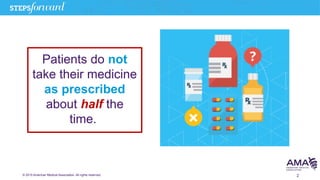
Patients do not
take their medicine
as prescribed
about half the
time.
2
© 2015 American Medical Association. All rights reserved.
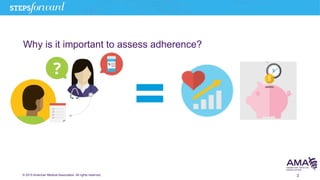
Why is it important to assess adherence?
=
3
© 2015 American Medical Association. All rights reserved. 4
Eight steps to improve medication adherence in
your practice
1
2
3
4
Consider medication nonadherence first as the reason a
patient’s condition is not under control
Develop a process for routinely asking about medication
adherence
Create a blame-free environment to discuss medications
with the patient
Identify why the patient is not taking their medicine
© 2015 American Medical Association. All rights reserved. 5
Eight steps to improve medication adherence in
your practice
5
6
8
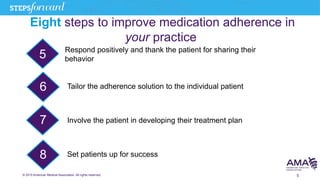
Respond positively and thank the patient for sharing their
behavior
Tailor the adherence solution to the individual patient
Involve the patient in developing their treatment plan
Set patients up for success
7
© 2015 American Medical Association. All rights reserved.
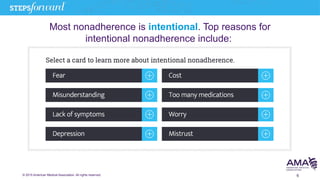
Most nonadherence is intentional. Top reasons for
intentional nonadherence include:
6
© 2015 American Medical Association. All rights reserved. 7
For additional resources,
frequently asked questions
and implementation support,
visit www.stepsforward.org!

Medication Adherence improve patient outcome.pptx

  • 1.
    © 2015 AmericanMedical Association. All rights reserved. Medication Adherence Improve patient outcomes and reduce costs
  • 2.
    © 2015 AmericanMedical Association. All rights reserved. Patients do not take their medicine as prescribed about half the time. 2
  • 3.
    © 2015 AmericanMedical Association. All rights reserved. Why is it important to assess adherence? = 3
  • 4.
    © 2015 AmericanMedical Association. All rights reserved. 4 Eight steps to improve medication adherence in your practice 1 2 3 4 Consider medication nonadherence first as the reason a patient’s condition is not under control Develop a process for routinely asking about medication adherence Create a blame-free environment to discuss medications with the patient Identify why the patient is not taking their medicine
  • 5.
    © 2015 AmericanMedical Association. All rights reserved. 5 Eight steps to improve medication adherence in your practice 5 6 8 Respond positively and thank the patient for sharing their behavior Tailor the adherence solution to the individual patient Involve the patient in developing their treatment plan Set patients up for success 7
  • 6.
    © 2015 AmericanMedical Association. All rights reserved. Most nonadherence is intentional. Top reasons for intentional nonadherence include: 6
  • 7.
    © 2015 AmericanMedical Association. All rights reserved. 7 For additional resources, frequently asked questions and implementation support, visit www.stepsforward.org!

Editor's Notes

  • #2 patient = adherent if they take 80% of their prescribed medicine(s). patient = nonadherent if they take LESS than 80% of their prescribed medicine(s).
  • #3 nonadherent patients result in increased costs to patient and healthcare system, increased time, potential harm to the patient, unnecessary work on part of practice and unnecessary hospitalization/ER visits