TFFT STRATEGIC PLAN
2012-2015: An Evaluation
March 15, 2016
Introduction:
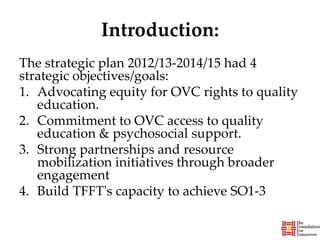
The strategic plan 2012/13-2014/15 had 4
strategic objectives/goals:
1. Advocating equity for OVC rights to quality
education.
2. Commitment to OVC access to quality
education & psychosocial support.
3. Strong partnerships and resource
mobilization initiatives through broader
engagement
4. Build TFFT's capacity to achieve SO1-3
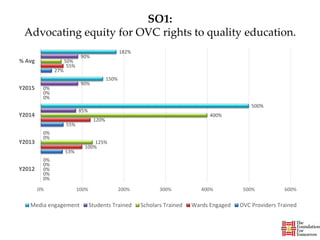
SO1:
Advocating equity for OVC rights to quality education.
0%
53%
55%
0%
27%
0%
100%
120%
0%
55%
0%
125%
400%
0%
50%
0%
0%
85%
90%
90%
0%
0%
500%
150%
182%
0% 100% 200% 300% 400% 500% 600%
Y2012
Y2013
Y2014
Y2015
% Avg
Media engagement Students Trained Scholars Trained Wards Engaged OVC Providers Trained
SO1_Analysis of factors
Assumption Capacity exists for community engagement
Facilitators CPP approach; CCON Network; Systemic
change
Constraints Partner schools and rules; Legal status of
CCON Membership; Expansion strategy absent;
Allowance syndrome; Late implementation
[2013]; Low/Absent Targets
Lessons Schools must be more accountable; Parochial
interests; Community engagement be tied to
disturbing the status quo
Taken
Forward
Strategic engagement with government; ToT
approaches; Innovative pilots with target
Weighted
Average
81%
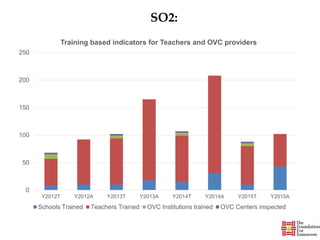
SO2:
0
50
100
150
200
250
Y2012T Y2012A Y2013T Y2013A Y2014T Y2014A Y2015T Y2015A
Training based indicators for Teachers and OVC providers
Schools Trained Teachers Trained OVC Institutions trained OVC Centers inspected
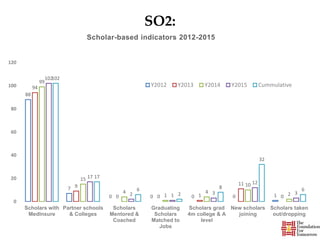
SO2:
88
7
0 0 0 0 1
94
9
0 0 1
11
0
99
15
4
1
4
10
2
102
17
2 1 3
12
3
102
17
6
2
8
32
6
0
20
40
60
80
100
120
Scholars with
MedInsure
Partner schools
& Colleges
Scholars
Mentored &
Coached
Graduating
Scholars
Matched to
Jobs
Scholars grad
4m college & A
level
New scholars
joining
Scholars taken
out/dropping
Scholar-based indicators 2012-2015
Y2012 Y2013 Y2014 Y2015 Cummulative
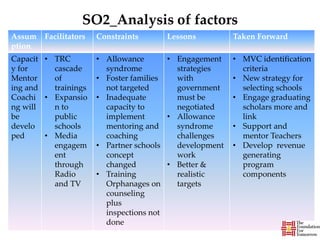
SO2_Analysis of factors
Assum
ption
Facilitators Constraints Lessons Taken Forward
Capacit
y for
Mentor
ing and
Coachi
ng will
be
develo
ped
• TRC
cascade
of
trainings
• Expansio
n to
public
schools
• Media
engagem
ent
through
Radio
and TV
• Allowance
syndrome
• Foster families
not targeted
• Inadequate
capacity to
implement
mentoring and
coaching
• Partner schools
concept
changed
• Training
Orphanages on
counseling
plus
inspections not
done
• Engagement
strategies
with
government
must be
negotiated
• Allowance
syndrome
challenges
development
work
• Better &
realistic
targets
• MVC identification
criteria
• New strategy for
selecting schools
• Engage graduating
scholars more and
link
• Support and
mentor Teachers
• Develop revenue
generating
program
components
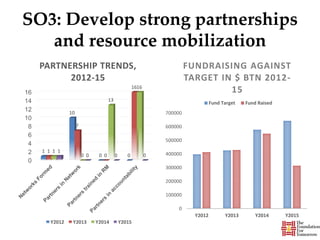
SO3: Develop strong partnerships
and resource mobilization
0
2
4
6
8
10
12
14
16
1
10
0 0
1
7
0
16
1
0
13
16
1
0 0 0
PARTNERSHIP TRENDS,
2012-15
Y2012 Y2013 Y2014 Y2015
0
100000
200000
300000
400000
500000
600000
700000
Y2012 Y2013 Y2014 Y2015
FUNDRAISING AGAINST
TARGET IN $ BTN 2012-
15
Fund Target Fund Raised
SO3_Analysis of factors
Assumption: Facilitating networks will contribute to strong advocacy on child rights and
open opportunities for increased visibility and donor funding [It is not the network but
values and interests of individuals and their practices that defines the visibility]
Facilitators
Partnership:
• TFFT Leadership of CCON buoyed the network
and consortia
• Positive values of some members in regard to
accountability
• ED passion on Fundraising provided opportunity
for training
Fundraising:
• Empowering donors to
fundraise on behalf of TFFT
• Integrating new approaches to
funding
• Expanding donor base and
nurturing relationships
Constrain
ts
• SEGAL withdrawal after just one year of funding
• Lack of a shared vision in CCON, and members wanting to benefit from TFFT instead of
being equal partners
• Low exposure of staff to grant based fundraising and engagement
Lessons
learned
• Diversifying fundraising mechanisms and spaces
• Building staff capacity in grant fundraisng
• Local fundraising initiatives critical for sustainability
• Coordinated management of grants & donor nurture
Taken
Forwar
d
• Local Fundraising initiated
• Focus on value-adding partnerships
• Strategic partnerships and fundraising
SO4: Build TFFT's organizational
capacity
0
5
10
15
20
25
Tgt[2012] Achv[2012] Tgt[2013] Achv[2013] Tgt[2014] Achv[2014] Tgt[2015] Achv[2015]
Some organization capacity indicators
Bi-annual perf revs done Additional staff recruited Annual Prog Reviews done Staff access to Prof Dev
SO4_Analysis of factors
Assumption: Adequate and competent staff are critical in building strong
organizations [It is the way such staff are led, supported and motivated that
matters most]
Facilitat
ors
• Performance management system and staff development
• Systems, policies, innovations & learning institutionalized
• Partners and stakeholder engagement including media
Constra
ints
• Apathy towards the actual practice of M&E and learning
• Multiple transitions in 2015
• Communication and compensation policies
Lessons
• External faced program reviews facilitates visibility and partnership
• Appreciative use of M&E is an individual attitude and drive
• Institutionalization of policies and practices provides security and
focus.
Taken
Forward
• Annual Program Reviews and Annual M&E and Program Budgeting
• Institutionalization of progressive systems , policies and practices
• Performance review, Staff development, motivation and recognition
• Integration of research, monitoring, learning and evaluations in new
strategic plan
ASANTENI SANA

TFFT STRATEGIC PLAN EVALUATION

  • 1.
    TFFT STRATEGIC PLAN 2012-2015:An Evaluation March 15, 2016
  • 2.
    Introduction: The strategic plan2012/13-2014/15 had 4 strategic objectives/goals: 1. Advocating equity for OVC rights to quality education. 2. Commitment to OVC access to quality education & psychosocial support. 3. Strong partnerships and resource mobilization initiatives through broader engagement 4. Build TFFT's capacity to achieve SO1-3
  • 3.
    SO1: Advocating equity forOVC rights to quality education. 0% 53% 55% 0% 27% 0% 100% 120% 0% 55% 0% 125% 400% 0% 50% 0% 0% 85% 90% 90% 0% 0% 500% 150% 182% 0% 100% 200% 300% 400% 500% 600% Y2012 Y2013 Y2014 Y2015 % Avg Media engagement Students Trained Scholars Trained Wards Engaged OVC Providers Trained
  • 4.
    SO1_Analysis of factors AssumptionCapacity exists for community engagement Facilitators CPP approach; CCON Network; Systemic change Constraints Partner schools and rules; Legal status of CCON Membership; Expansion strategy absent; Allowance syndrome; Late implementation [2013]; Low/Absent Targets Lessons Schools must be more accountable; Parochial interests; Community engagement be tied to disturbing the status quo Taken Forward Strategic engagement with government; ToT approaches; Innovative pilots with target Weighted Average 81%
  • 5.
    SO2: 0 50 100 150 200 250 Y2012T Y2012A Y2013TY2013A Y2014T Y2014A Y2015T Y2015A Training based indicators for Teachers and OVC providers Schools Trained Teachers Trained OVC Institutions trained OVC Centers inspected
  • 6.
    SO2: 88 7 0 0 00 1 94 9 0 0 1 11 0 99 15 4 1 4 10 2 102 17 2 1 3 12 3 102 17 6 2 8 32 6 0 20 40 60 80 100 120 Scholars with MedInsure Partner schools & Colleges Scholars Mentored & Coached Graduating Scholars Matched to Jobs Scholars grad 4m college & A level New scholars joining Scholars taken out/dropping Scholar-based indicators 2012-2015 Y2012 Y2013 Y2014 Y2015 Cummulative
  • 7.
    SO2_Analysis of factors Assum ption FacilitatorsConstraints Lessons Taken Forward Capacit y for Mentor ing and Coachi ng will be develo ped • TRC cascade of trainings • Expansio n to public schools • Media engagem ent through Radio and TV • Allowance syndrome • Foster families not targeted • Inadequate capacity to implement mentoring and coaching • Partner schools concept changed • Training Orphanages on counseling plus inspections not done • Engagement strategies with government must be negotiated • Allowance syndrome challenges development work • Better & realistic targets • MVC identification criteria • New strategy for selecting schools • Engage graduating scholars more and link • Support and mentor Teachers • Develop revenue generating program components
  • 8.
    SO3: Develop strongpartnerships and resource mobilization 0 2 4 6 8 10 12 14 16 1 10 0 0 1 7 0 16 1 0 13 16 1 0 0 0 PARTNERSHIP TRENDS, 2012-15 Y2012 Y2013 Y2014 Y2015 0 100000 200000 300000 400000 500000 600000 700000 Y2012 Y2013 Y2014 Y2015 FUNDRAISING AGAINST TARGET IN $ BTN 2012- 15 Fund Target Fund Raised
  • 9.
    SO3_Analysis of factors Assumption:Facilitating networks will contribute to strong advocacy on child rights and open opportunities for increased visibility and donor funding [It is not the network but values and interests of individuals and their practices that defines the visibility] Facilitators Partnership: • TFFT Leadership of CCON buoyed the network and consortia • Positive values of some members in regard to accountability • ED passion on Fundraising provided opportunity for training Fundraising: • Empowering donors to fundraise on behalf of TFFT • Integrating new approaches to funding • Expanding donor base and nurturing relationships Constrain ts • SEGAL withdrawal after just one year of funding • Lack of a shared vision in CCON, and members wanting to benefit from TFFT instead of being equal partners • Low exposure of staff to grant based fundraising and engagement Lessons learned • Diversifying fundraising mechanisms and spaces • Building staff capacity in grant fundraisng • Local fundraising initiatives critical for sustainability • Coordinated management of grants & donor nurture Taken Forwar d • Local Fundraising initiated • Focus on value-adding partnerships • Strategic partnerships and fundraising
  • 10.
    SO4: Build TFFT'sorganizational capacity 0 5 10 15 20 25 Tgt[2012] Achv[2012] Tgt[2013] Achv[2013] Tgt[2014] Achv[2014] Tgt[2015] Achv[2015] Some organization capacity indicators Bi-annual perf revs done Additional staff recruited Annual Prog Reviews done Staff access to Prof Dev
  • 11.
    SO4_Analysis of factors Assumption:Adequate and competent staff are critical in building strong organizations [It is the way such staff are led, supported and motivated that matters most] Facilitat ors • Performance management system and staff development • Systems, policies, innovations & learning institutionalized • Partners and stakeholder engagement including media Constra ints • Apathy towards the actual practice of M&E and learning • Multiple transitions in 2015 • Communication and compensation policies Lessons • External faced program reviews facilitates visibility and partnership • Appreciative use of M&E is an individual attitude and drive • Institutionalization of policies and practices provides security and focus. Taken Forward • Annual Program Reviews and Annual M&E and Program Budgeting • Institutionalization of progressive systems , policies and practices • Performance review, Staff development, motivation and recognition • Integration of research, monitoring, learning and evaluations in new strategic plan
  • 12.