
MOBILE
COMMERCE
Karthik-9524663251
YI INFOTECH
Contents
Objective
Literature Review
Issues to be addressed
Block diagram
Work plan
System requirements
References
OBJECTIVES
To buying and selling of a product is conducted
over electronic systems such as the Mobile.
The customers of today are convenient and
attracted by online shopping.
To receives a message that the order has
been successfully placed.
To reduce the Manual processing time.
What Is E-Commerce ?
Ecommerce applications allow consumers to
buy goods or services directly over the Mobile
Apps. This online shopping evokes the
business-to-consumer (B2C) process where a
consumer buys directly from the business. The
process where a business buys from another
business is called a business-to-business (B2B)
process.
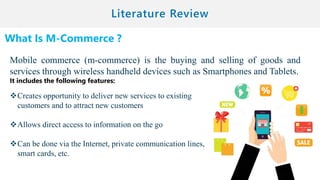
What Is M-Commerce ?
Mobile commerce (m-commerce) is the buying and selling of goods and
services through wireless handheld devices such as Smartphones and Tablets.
It includes the following features:
Creates opportunity to deliver new services to existing
customers and to attract new customers
Allows direct access to information on the go
Can be done via the Internet, private communication lines,
smart cards, etc.
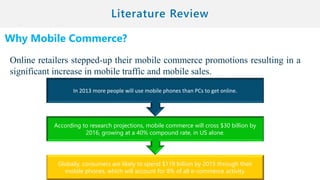
Why Mobile Commerce?
Online retailers stepped-up their mobile commerce promotions resulting in a
significant increase in mobile traffic and mobile sales.
Globally, consumers are likely to spend $119 billion by 2015 through their
mobile phones, which will account for 8% of all e-commerce activity.
According to research projections, mobile commerce will cross $30 billion by
2016, growing at a 40% compound rate, in US alone.
In 2013 more people will use mobile phones than PCs to get online.
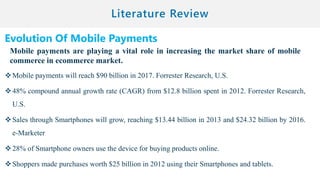
Evolution Of Mobile Payments
Mobile payments are playing a vital role in increasing the market share of mobile
commerce in ecommerce market.
Mobile payments will reach $90 billion in 2017. Forrester Research, U.S.
48% compound annual growth rate (CAGR) from $12.8 billion spent in 2012. Forrester Research,
U.S.
Sales through Smartphones will grow, reaching $13.44 billion in 2013 and $24.32 billion by 2016.
e-Marketer
28% of Smartphone owners use the device for buying products online.
Shoppers made purchases worth $25 billion in 2012 using their Smartphones and tablets.
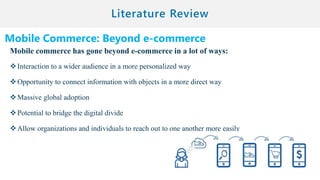
Mobile Commerce: Beyond e-commerce
Mobile commerce has gone beyond e-commerce in a lot of ways:
Interaction to a wider audience in a more personalized way
Opportunity to connect information with objects in a more direct way
Massive global adoption
Potential to bridge the digital divide
Allow organizations and individuals to reach out to one another more easily
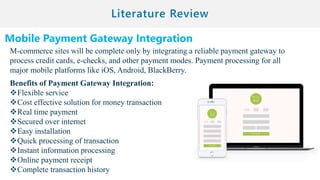
Mobile Payment Gateway Integration
M-commerce sites will be complete only by integrating a reliable payment gateway to
process credit cards, e-checks, and other payment modes. Payment processing for all
major mobile platforms like iOS, Android, BlackBerry.
Benefits of Payment Gateway Integration:
Flexible service
Cost effective solution for money transaction
Real time payment
Secured over internet
Easy installation
Quick processing of transaction
Instant information processing
Online payment receipt
Complete transaction history
Key Issues in Mobile Commerce
* Security in mobile commerce
* Location management issues
* Limitations of mobile devices
* Ethics and Privacy
* Wireless Infrastructure
* Usability
* Legal and Regulatory challenges
* Consumer Trust
* Interoperability and Compatibility
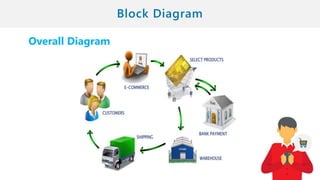
Overall Diagram
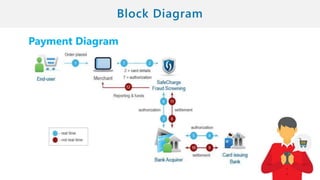
Payment Diagram
* Create the Admin side Script
* Create App Using Android Studio
* Create a Web Service For integrate to Website and Android App
* Create the Admin side Script
* Create App Using Android Studio
* Create a Web Service For integrate to Website and Android App
* https://developer.android.com
* www.learn-php.org
* https://www.w3schools.com/php/
* https://codeigniter.com
m-Commerce

m-Commerce

  • 1.
  • 2.
    Contents Objective Literature Review Issues tobe addressed Block diagram Work plan System requirements References
  • 3.
    OBJECTIVES To buying andselling of a product is conducted over electronic systems such as the Mobile. The customers of today are convenient and attracted by online shopping. To receives a message that the order has been successfully placed. To reduce the Manual processing time.
  • 4.
    What Is E-Commerce? Ecommerce applications allow consumers to buy goods or services directly over the Mobile Apps. This online shopping evokes the business-to-consumer (B2C) process where a consumer buys directly from the business. The process where a business buys from another business is called a business-to-business (B2B) process.
  • 5.
    What Is M-Commerce? Mobile commerce (m-commerce) is the buying and selling of goods and services through wireless handheld devices such as Smartphones and Tablets. It includes the following features: Creates opportunity to deliver new services to existing customers and to attract new customers Allows direct access to information on the go Can be done via the Internet, private communication lines, smart cards, etc.
  • 6.
    Why Mobile Commerce? Onlineretailers stepped-up their mobile commerce promotions resulting in a significant increase in mobile traffic and mobile sales. Globally, consumers are likely to spend $119 billion by 2015 through their mobile phones, which will account for 8% of all e-commerce activity. According to research projections, mobile commerce will cross $30 billion by 2016, growing at a 40% compound rate, in US alone. In 2013 more people will use mobile phones than PCs to get online.
  • 7.
    Evolution Of MobilePayments Mobile payments are playing a vital role in increasing the market share of mobile commerce in ecommerce market. Mobile payments will reach $90 billion in 2017. Forrester Research, U.S. 48% compound annual growth rate (CAGR) from $12.8 billion spent in 2012. Forrester Research, U.S. Sales through Smartphones will grow, reaching $13.44 billion in 2013 and $24.32 billion by 2016. e-Marketer 28% of Smartphone owners use the device for buying products online. Shoppers made purchases worth $25 billion in 2012 using their Smartphones and tablets.
  • 8.
    Mobile Commerce: Beyonde-commerce Mobile commerce has gone beyond e-commerce in a lot of ways: Interaction to a wider audience in a more personalized way Opportunity to connect information with objects in a more direct way Massive global adoption Potential to bridge the digital divide Allow organizations and individuals to reach out to one another more easily
  • 9.
    Mobile Payment GatewayIntegration M-commerce sites will be complete only by integrating a reliable payment gateway to process credit cards, e-checks, and other payment modes. Payment processing for all major mobile platforms like iOS, Android, BlackBerry. Benefits of Payment Gateway Integration: Flexible service Cost effective solution for money transaction Real time payment Secured over internet Easy installation Quick processing of transaction Instant information processing Online payment receipt Complete transaction history
  • 10.
    Key Issues inMobile Commerce * Security in mobile commerce * Location management issues * Limitations of mobile devices * Ethics and Privacy * Wireless Infrastructure * Usability * Legal and Regulatory challenges * Consumer Trust * Interoperability and Compatibility
  • 11.
  • 12.
  • 13.
    * Create theAdmin side Script * Create App Using Android Studio * Create a Web Service For integrate to Website and Android App
  • 14.
    * Create theAdmin side Script * Create App Using Android Studio * Create a Web Service For integrate to Website and Android App
  • 15.
    * https://developer.android.com * www.learn-php.org *https://www.w3schools.com/php/ * https://codeigniter.com

Editor's Notes

  • #2 This slide contains the editable pieces that were used to build infographic sample Icons – Eye, PC