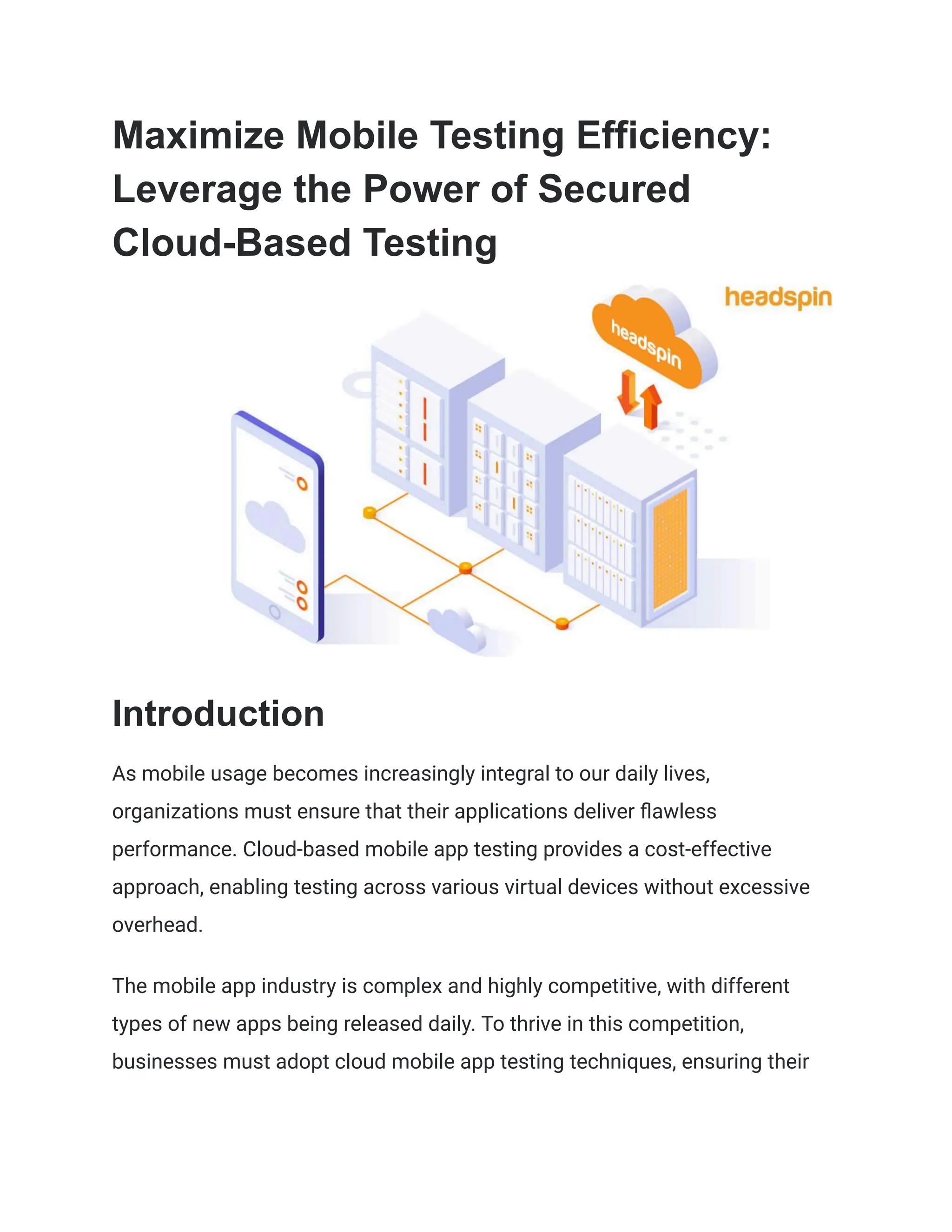
Maximize Mobile Testing Efficiency:
Leverage the Power of Secured
Cloud-Based Testing
Introduction
As mobile usage becomes increasingly integral to our daily lives,
organizations must ensure that their applications deliver flawless
performance. Cloud-based mobile app testing provides a cost-effective
approach, enabling testing across various virtual devices without excessive
overhead.
The mobile app industry is complex and highly competitive, with different
types of new apps being released daily. To thrive in this competition,
businesses must adopt cloud mobile app testing techniques, ensuring their
applications meet user expectations. Even a single glitch can lead to an app's
removal, making thorough testing essential.
Businesses and developers can enhance app quality by employing a skilled
testing team, ensuring optimal performance and a seamless user experience.
This blog explores the key benefits and best practices of cloud-based mobile
app testing. Let's dive into what makes cloud-based testing so effective.
Understanding Cloud-Based Mobile App
Testing Services
Cloud-based mobile app testing leverages the power of cloud infrastructure to
simulate real-world conditions across various devices and platforms. This
method allows testing teams to verify app functionality, performance, and
compatibility without physical devices. By using cloud environments, testers
gain remote access to a diverse set of real devices, streamlining the testing
process while broadening the scope of device coverage.
Effective Approaches to Cloud-Based
Testing
1. Maximizing Device Coverage: Cloud platforms provide access to a
wide array of real devices, enabling testers to evaluate app
performance across different OS versions, device types, screen sizes,
and network conditions.
2. Integrating Automated Testing: Automation tools like Appium,
Selenium, and XCUITest work effortlessly with cloud environments,
allowing for continuous and automated testing on multiple devices.
This helps accelerate feedback loops and speeds up defect resolution.
3. Implementing Parallel Testing: Cloud infrastructure supports running
tests concurrently across various devices, significantly reducing the
time required to assess app performance in diverse environments.
4. Ensuring Scalability: Cloud platforms offer flexible scaling, allowing
testing teams to adjust resources based on the app's complexity. This
adaptability ensures efficient testing without being restricted by
hardware limitations.
5. Simulating Geolocation Scenarios: Cloud-based testing enables the
simulation of different location-based conditions, ensuring that mobile
apps deliver optimal performance for users across various geographic
regions.
The Importance of Cloud-Based Mobile
App Testing
Cloud-based mobile app testing represents a significant shift from traditional
methods, offering several key advantages:
Traditional testing relies on physical infrastructure and local resources,
leading to lengthy setup processes and high costs due to necessary software
and hardware. In contrast, cloud-based testing leverages online platforms for
greater flexibility and efficiency, allowing access from anywhere with an
internet connection and operating on a pay-per-use model.
Cloud-based testing excels in scalability and flexibility, facilitating faster
deployment without delays associated with physical setups. Engaging a
dedicated team for tailored testing services enhances project outcomes.
Prioritize cloud-based setups for their scalability, flexibility, and cost efficiency.
Choose a reputable cloud provider to manage testing resources and ensure
optimal performance effectively. Cloud-based testing includes both manual
and automated approaches; manual testing offers detailed control through
scripts and configurations, while automated testing allows for rapid,
simultaneous execution, promoting comprehensive reporting and reduced
resource needs.
When implementing a cloud-based mobile app testing platform, consider
performance, scalability, security, cost-effectiveness, and ease of
management.
Benefits of Cloud-Based Mobile App
Testing
Cloud-based mobile app testing has gained popularity for its numerous
advantages over traditional methods. Here are the key benefits:
● Comprehensive Test Coverage: Cloud-based testing ensures
extensive coverage, enabling seamless application performance
across diverse platforms. Testing on various devices, browsers, and
OS versions guarantees an optimal user experience under real-world
conditions.
● Compatibility Across Diverse User Scenarios: Cloud mobile app
testing provides access to various devices and tools, including
operating systems, screen sizes, and resolutions. This flexibility
allows developers to verify compatibility across multiple user
scenarios, minimizing the need for extensive infrastructure and
maintenance costs.
● Scalability and Flexibility: With cloud-based mobile app testing,
testers can quickly scale testing resources. Businesses can access
unlimited resources and simulate various testing scenarios,
facilitating early detection of potential issues and assessment of
real-world performance.
● Customized Testing Resources: Cloud-based solutions allow
organizations to invest only in essential resources, optimizing testing
costs. They enable the simulation of multiple network environments
and locations based on project needs without requiring additional
software or hardware infrastructure.
● Cost Efficiency: Cloud-based testing significantly reduces purchasing
and maintaining hardware and software expenses. Eliminating the
need for expensive testing tools lowers overall testing and
development costs.
● Minimized Reliance on Physical Infrastructure: Cloud-based mobile
testing offers enhanced security features compared to on-premises
methods, ensuring compliance with security regulations. Dedicated
cloud platforms provide a secure testing environment, reducing
dependence on physical devices and infrastructure.
● Lower Overhead Maintenance Costs: Cloud-based mobile
applications minimize overhead maintenance costs, freeing up
resources for other priorities.
● Faster Time-to-Market: Cloud-based mobile app testing streamlines
the testing process, leading to quicker issue identification and
reduced release times. This agility aids businesses in maintaining a
competitive edge.
● Support for Continuous Integration and Delivery: Cloud-based
solutions facilitate seamless integration and delivery, expediting
application development and testing without interruptions.
Strategies for Effective Mobile App
Testing on the Cloud
With the rise in smartphone popularity, various models have emerged,
demanding that back-end teams develop device-neutral applications.
However, bugs and errors may still occur, making cloud mobile testing
essential for ensuring seamless app performance. Here are critical
considerations for creating a mobile testing strategy.
Planning Your Testing Approach
Cloud testing begins with creating a test strategy, a high-level document
derived from the business requirement document that establishes software
testing criteria. Typically crafted by a business analyst or project manager, the
test strategy outlines long-term objectives, while the test plan, based on the
Software Requirements Specification (SRS), details specific processes and
requirements. Critical elements of test strategies include:
● Objectives and scope
● Test procedures and documentation formats
● Team reporting arrangements
● Client communication plans
In contrast, test plans specify the test plan ID, characteristics to be tested,
tasks, deliverables, responsibilities, and timelines.
Choosing the Right Testing Tools
Selecting an efficient testing tool is crucial for effectively identifying bugs.
While various tools are available, relying on single-point solutions may lead to
system fragmentation, compromising performance and data integrity. A
comprehensive quality management system can help streamline mobile
testing by offering features like cross-functional testing and
cross-environment execution.
Best Practices for Cloud Mobile App Testing
1. Utilize Load Testing Tools: Ensure compatibility with your application's
architecture, focusing on upload/download speeds and bandwidth
simulation.
2. Implement Scheduling and Automation: Choose load-testing solutions
with scheduling and reporting features to streamline testing processes
and provide stakeholders with clear performance insights.
3. Test Inside and Outside the Firewall: Conduct tests under various
conditions to accurately identify performance bottlenecks.
4. Create Realistic Testing Conditions: Use a load testing platform that
simulates diverse scenarios while maintaining minimal user load.
Embracing Test Automation
Automating repetitive tests enhances testing efficiency, saves development
cycles, and improves software quality. Quality assurance teams can maximize
their limited resources by implementing automated testing tools for
comprehensive and data-intensive tests. While manual testing is preferable
for infrequent tests, automated testing is ideal for cases requiring frequent
execution.
Navigating Challenges in Mobile Testing
Fragmentation poses a significant challenge, necessitating extensive testing
across various devices, operating systems, and browsers. Testing must
encompass a wide range of configurations to ensure compatibility rather than
relying on a single framework. While establishing a physical hub of popular
devices can be one solution, it is often costly and less scalable.
Additionally, new technologies introduced during the app lifecycle may require
ongoing adjustments to ensure compatibility. Developers must also prioritize
security, as apps with weak encryption are vulnerable to breaches. Rigorous
testing is essential to protect user data and maintain robust security
protocols.
Effective mobile app testing in the cloud requires a strategic approach
encompassing thorough planning, appropriate tool selection, and adherence
to best practices. By addressing challenges such as fragmentation and
security, teams can enhance the app's overall quality and ensure a perfect
user experience across diverse devices and configurations.
Challenges of Cloud-based Mobile App
Testing
While cloud testing offers numerous benefits, it also presents several
challenges that can impact its effectiveness. These challenges include a lack
of standardization, security concerns, complex service-level agreements
(SLAs), and limitations in configuration and bandwidth, leading to delays and
increased costs. Here are a few challenges associated with cloud testing:
1. Data Security and Privacy: Security and privacy concerns are prevalent
in cloud testing, similar to broader cloud usage. Outsourcing to a cloud
environment can lead to losing control over data security and privacy,
raising significant risks.
2. Multi-Cloud Complexity: Multi-cloud models, which utilize different
cloud types (public, private, hybrid) across various providers, can
complicate synchronization, security, and management.
3. Environment Development: Specific configurations for servers,
storage, and networks can create testing challenges, making it
essential to develop the testing environment carefully.
4. User Environment Replication: Ideally, testing should occur in an
environment that closely mirrors that of end users. However, achieving
this can be difficult, leading to potential discrepancies.
5. Comprehensive IT System Testing: Cloud testing must encompass
the application, servers, storage, and network interactions. Validating
these interactions across all layers and components can be complex.
6. Limited Control Over Test Environments: Certain aspects that require
testing may extend beyond the capabilities of the test environment,
complicating the testing process.
7. Bandwidth Fluctuations: Bandwidth availability can be inconsistent, as
resources are often shared among multiple users within the provider's
infrastructure, potentially impacting testing performance.
Addressing these hurdles is crucial for elevating the effectiveness of cloud
testing and ensuring robust application performance.
Cloud Testing vs. On-Premises Testing
Cloud testing offers significant advantages over traditional on-premises
testing, including flexible pricing models and quicker time to market. While the
functional testing processes remain similar for both cloud and on-premises
applications, addressing the specific nonfunctional risks associated with
cloud environments is crucial.
When testing involves production data, ensuring robust security measures and
validating data integrity protocols are essential prior to starting functional
testing. Moreover, cloud testing enables access from any location or device
with internet connectivity, contrasting with on-premises testing, which requires
on-site presence.
Transforming Cloud-Based App Testing
with HeadSpin's Global Device
Infrastructure
HeadSpin is revolutionizing cloud-based testing by offering a unique mobile
app development and testing solution. This overview highlights the key
features of
HeadSpin's Global Device Infrastructure and its impact on cloud-based testing
for mobile applications.
1. Flexible Deployment Options
HeadSpin offers various deployment choices, including on-Premise,
Single-Tenant Cloud, Multi-Tenant Cloud, and CYOL—reverse Bridge, to
accommodate diverse customer requirements.
2. Extensive Real Device Inventory
With a vast collection of real devices, HeadSpin enables thorough app
evaluations across multiple models, operating systems, and network
configurations, replicating real-world user experiences for improved app
reliability.
3. Seamless Automation Framework Integration
HeadSpin supports over 60 automation frameworks, including Tosca, AccelQ,
Katalon, and Selenium, streamlining the end-to-end mobile testing process.
4. Global Accessibility
HeadSpin's infrastructure spans numerous locations worldwide, allowing
businesses to assess app performance across different markets while
considering regional device variations, network conditions, and user behavior.
5. Real-Time Data Visualization and Collaboration
Automatic provisioning of Grafana accounts enhances real-time data
visualization and fosters collaboration among various roles and stakeholders.
6. Scalability and Cost Efficiency
HeadSpin's cloud-based model allows for dynamic scaling of testing
infrastructure, eliminating the need for substantial in-house device lab
investments and ensuring effective resource allocation.
7. Comprehensive Geolocation Testing
Access to devices globally facilitates extensive geolocation testing, ensuring
location-based features operate seamlessly across GPS signals and physical
locations.
8. Enhanced Location Data Accuracy
By identifying discrepancies in device readings across regions, HeadSpin
optimizes app location data accuracy, improving functionality while
conserving device resources.
HeadSpin's innovative approach elevates mobile app testing, equipping
businesses with the necessary tools to thrive in diverse global landscapes.
Conclusion
Behind every successful application is a dedicated team committed to its
success. As discussed, a cloud-based mobile app testing solution
strategically aligns your business. Effective strategies are essential for
addressing the significant challenges encountered during the development as
well as testing phases. Partnering with a mobile app testing company ensures
optimal functionality and high-quality applications that maintain your
competitive edge.
With HeadSpin's global device infrastructure, enterprises can confidently
navigate this evolving landscape, benefiting from a comprehensive and
advanced testing solution. By leveraging the capabilities of cloud-based
testing with HeadSpin, organizations can elevate their app development and
quality assurance processes, ensuring a future-ready approach to mobile app
testing.
This article was originally published on:
https://www.headspin.io/blog/secured-cloud-based-testing-for-elevating-mobile
-testing-efficiency

Maximize Mobile Testing Efficiency_ Leverage the Power of Secured Cloud-Based Testing.pdf

  • 1.
    Maximize Mobile TestingEfficiency: Leverage the Power of Secured Cloud-Based Testing Introduction As mobile usage becomes increasingly integral to our daily lives, organizations must ensure that their applications deliver flawless performance. Cloud-based mobile app testing provides a cost-effective approach, enabling testing across various virtual devices without excessive overhead. The mobile app industry is complex and highly competitive, with different types of new apps being released daily. To thrive in this competition, businesses must adopt cloud mobile app testing techniques, ensuring their
  • 2.
    applications meet userexpectations. Even a single glitch can lead to an app's removal, making thorough testing essential. Businesses and developers can enhance app quality by employing a skilled testing team, ensuring optimal performance and a seamless user experience. This blog explores the key benefits and best practices of cloud-based mobile app testing. Let's dive into what makes cloud-based testing so effective. Understanding Cloud-Based Mobile App Testing Services Cloud-based mobile app testing leverages the power of cloud infrastructure to simulate real-world conditions across various devices and platforms. This method allows testing teams to verify app functionality, performance, and compatibility without physical devices. By using cloud environments, testers gain remote access to a diverse set of real devices, streamlining the testing process while broadening the scope of device coverage. Effective Approaches to Cloud-Based Testing 1. Maximizing Device Coverage: Cloud platforms provide access to a wide array of real devices, enabling testers to evaluate app performance across different OS versions, device types, screen sizes, and network conditions.
  • 3.
    2. Integrating AutomatedTesting: Automation tools like Appium, Selenium, and XCUITest work effortlessly with cloud environments, allowing for continuous and automated testing on multiple devices. This helps accelerate feedback loops and speeds up defect resolution. 3. Implementing Parallel Testing: Cloud infrastructure supports running tests concurrently across various devices, significantly reducing the time required to assess app performance in diverse environments. 4. Ensuring Scalability: Cloud platforms offer flexible scaling, allowing testing teams to adjust resources based on the app's complexity. This adaptability ensures efficient testing without being restricted by hardware limitations. 5. Simulating Geolocation Scenarios: Cloud-based testing enables the simulation of different location-based conditions, ensuring that mobile apps deliver optimal performance for users across various geographic regions. The Importance of Cloud-Based Mobile App Testing Cloud-based mobile app testing represents a significant shift from traditional methods, offering several key advantages: Traditional testing relies on physical infrastructure and local resources, leading to lengthy setup processes and high costs due to necessary software and hardware. In contrast, cloud-based testing leverages online platforms for
  • 4.
    greater flexibility andefficiency, allowing access from anywhere with an internet connection and operating on a pay-per-use model. Cloud-based testing excels in scalability and flexibility, facilitating faster deployment without delays associated with physical setups. Engaging a dedicated team for tailored testing services enhances project outcomes. Prioritize cloud-based setups for their scalability, flexibility, and cost efficiency. Choose a reputable cloud provider to manage testing resources and ensure optimal performance effectively. Cloud-based testing includes both manual and automated approaches; manual testing offers detailed control through scripts and configurations, while automated testing allows for rapid, simultaneous execution, promoting comprehensive reporting and reduced resource needs. When implementing a cloud-based mobile app testing platform, consider performance, scalability, security, cost-effectiveness, and ease of management. Benefits of Cloud-Based Mobile App Testing Cloud-based mobile app testing has gained popularity for its numerous advantages over traditional methods. Here are the key benefits: ● Comprehensive Test Coverage: Cloud-based testing ensures extensive coverage, enabling seamless application performance across diverse platforms. Testing on various devices, browsers, and
  • 5.
    OS versions guaranteesan optimal user experience under real-world conditions. ● Compatibility Across Diverse User Scenarios: Cloud mobile app testing provides access to various devices and tools, including operating systems, screen sizes, and resolutions. This flexibility allows developers to verify compatibility across multiple user scenarios, minimizing the need for extensive infrastructure and maintenance costs. ● Scalability and Flexibility: With cloud-based mobile app testing, testers can quickly scale testing resources. Businesses can access unlimited resources and simulate various testing scenarios, facilitating early detection of potential issues and assessment of real-world performance. ● Customized Testing Resources: Cloud-based solutions allow organizations to invest only in essential resources, optimizing testing costs. They enable the simulation of multiple network environments and locations based on project needs without requiring additional software or hardware infrastructure. ● Cost Efficiency: Cloud-based testing significantly reduces purchasing and maintaining hardware and software expenses. Eliminating the need for expensive testing tools lowers overall testing and development costs. ● Minimized Reliance on Physical Infrastructure: Cloud-based mobile testing offers enhanced security features compared to on-premises methods, ensuring compliance with security regulations. Dedicated
  • 6.
    cloud platforms providea secure testing environment, reducing dependence on physical devices and infrastructure. ● Lower Overhead Maintenance Costs: Cloud-based mobile applications minimize overhead maintenance costs, freeing up resources for other priorities. ● Faster Time-to-Market: Cloud-based mobile app testing streamlines the testing process, leading to quicker issue identification and reduced release times. This agility aids businesses in maintaining a competitive edge. ● Support for Continuous Integration and Delivery: Cloud-based solutions facilitate seamless integration and delivery, expediting application development and testing without interruptions. Strategies for Effective Mobile App Testing on the Cloud With the rise in smartphone popularity, various models have emerged, demanding that back-end teams develop device-neutral applications. However, bugs and errors may still occur, making cloud mobile testing essential for ensuring seamless app performance. Here are critical considerations for creating a mobile testing strategy. Planning Your Testing Approach Cloud testing begins with creating a test strategy, a high-level document derived from the business requirement document that establishes software
  • 7.
    testing criteria. Typicallycrafted by a business analyst or project manager, the test strategy outlines long-term objectives, while the test plan, based on the Software Requirements Specification (SRS), details specific processes and requirements. Critical elements of test strategies include: ● Objectives and scope ● Test procedures and documentation formats ● Team reporting arrangements ● Client communication plans In contrast, test plans specify the test plan ID, characteristics to be tested, tasks, deliverables, responsibilities, and timelines. Choosing the Right Testing Tools Selecting an efficient testing tool is crucial for effectively identifying bugs. While various tools are available, relying on single-point solutions may lead to system fragmentation, compromising performance and data integrity. A comprehensive quality management system can help streamline mobile testing by offering features like cross-functional testing and cross-environment execution. Best Practices for Cloud Mobile App Testing 1. Utilize Load Testing Tools: Ensure compatibility with your application's architecture, focusing on upload/download speeds and bandwidth simulation.
  • 8.
    2. Implement Schedulingand Automation: Choose load-testing solutions with scheduling and reporting features to streamline testing processes and provide stakeholders with clear performance insights. 3. Test Inside and Outside the Firewall: Conduct tests under various conditions to accurately identify performance bottlenecks. 4. Create Realistic Testing Conditions: Use a load testing platform that simulates diverse scenarios while maintaining minimal user load. Embracing Test Automation Automating repetitive tests enhances testing efficiency, saves development cycles, and improves software quality. Quality assurance teams can maximize their limited resources by implementing automated testing tools for comprehensive and data-intensive tests. While manual testing is preferable for infrequent tests, automated testing is ideal for cases requiring frequent execution. Navigating Challenges in Mobile Testing Fragmentation poses a significant challenge, necessitating extensive testing across various devices, operating systems, and browsers. Testing must encompass a wide range of configurations to ensure compatibility rather than relying on a single framework. While establishing a physical hub of popular devices can be one solution, it is often costly and less scalable. Additionally, new technologies introduced during the app lifecycle may require ongoing adjustments to ensure compatibility. Developers must also prioritize security, as apps with weak encryption are vulnerable to breaches. Rigorous
  • 9.
    testing is essentialto protect user data and maintain robust security protocols. Effective mobile app testing in the cloud requires a strategic approach encompassing thorough planning, appropriate tool selection, and adherence to best practices. By addressing challenges such as fragmentation and security, teams can enhance the app's overall quality and ensure a perfect user experience across diverse devices and configurations. Challenges of Cloud-based Mobile App Testing While cloud testing offers numerous benefits, it also presents several challenges that can impact its effectiveness. These challenges include a lack of standardization, security concerns, complex service-level agreements (SLAs), and limitations in configuration and bandwidth, leading to delays and increased costs. Here are a few challenges associated with cloud testing: 1. Data Security and Privacy: Security and privacy concerns are prevalent in cloud testing, similar to broader cloud usage. Outsourcing to a cloud environment can lead to losing control over data security and privacy, raising significant risks. 2. Multi-Cloud Complexity: Multi-cloud models, which utilize different cloud types (public, private, hybrid) across various providers, can complicate synchronization, security, and management.
  • 10.
    3. Environment Development:Specific configurations for servers, storage, and networks can create testing challenges, making it essential to develop the testing environment carefully. 4. User Environment Replication: Ideally, testing should occur in an environment that closely mirrors that of end users. However, achieving this can be difficult, leading to potential discrepancies. 5. Comprehensive IT System Testing: Cloud testing must encompass the application, servers, storage, and network interactions. Validating these interactions across all layers and components can be complex. 6. Limited Control Over Test Environments: Certain aspects that require testing may extend beyond the capabilities of the test environment, complicating the testing process. 7. Bandwidth Fluctuations: Bandwidth availability can be inconsistent, as resources are often shared among multiple users within the provider's infrastructure, potentially impacting testing performance. Addressing these hurdles is crucial for elevating the effectiveness of cloud testing and ensuring robust application performance. Cloud Testing vs. On-Premises Testing Cloud testing offers significant advantages over traditional on-premises testing, including flexible pricing models and quicker time to market. While the functional testing processes remain similar for both cloud and on-premises applications, addressing the specific nonfunctional risks associated with cloud environments is crucial.
  • 11.
    When testing involvesproduction data, ensuring robust security measures and validating data integrity protocols are essential prior to starting functional testing. Moreover, cloud testing enables access from any location or device with internet connectivity, contrasting with on-premises testing, which requires on-site presence. Transforming Cloud-Based App Testing with HeadSpin's Global Device Infrastructure HeadSpin is revolutionizing cloud-based testing by offering a unique mobile app development and testing solution. This overview highlights the key features of HeadSpin's Global Device Infrastructure and its impact on cloud-based testing for mobile applications. 1. Flexible Deployment Options HeadSpin offers various deployment choices, including on-Premise, Single-Tenant Cloud, Multi-Tenant Cloud, and CYOL—reverse Bridge, to accommodate diverse customer requirements. 2. Extensive Real Device Inventory With a vast collection of real devices, HeadSpin enables thorough app evaluations across multiple models, operating systems, and network
  • 12.
    configurations, replicating real-worlduser experiences for improved app reliability. 3. Seamless Automation Framework Integration HeadSpin supports over 60 automation frameworks, including Tosca, AccelQ, Katalon, and Selenium, streamlining the end-to-end mobile testing process. 4. Global Accessibility HeadSpin's infrastructure spans numerous locations worldwide, allowing businesses to assess app performance across different markets while considering regional device variations, network conditions, and user behavior. 5. Real-Time Data Visualization and Collaboration Automatic provisioning of Grafana accounts enhances real-time data visualization and fosters collaboration among various roles and stakeholders. 6. Scalability and Cost Efficiency HeadSpin's cloud-based model allows for dynamic scaling of testing infrastructure, eliminating the need for substantial in-house device lab investments and ensuring effective resource allocation. 7. Comprehensive Geolocation Testing Access to devices globally facilitates extensive geolocation testing, ensuring location-based features operate seamlessly across GPS signals and physical locations.
  • 13.
    8. Enhanced LocationData Accuracy By identifying discrepancies in device readings across regions, HeadSpin optimizes app location data accuracy, improving functionality while conserving device resources. HeadSpin's innovative approach elevates mobile app testing, equipping businesses with the necessary tools to thrive in diverse global landscapes. Conclusion Behind every successful application is a dedicated team committed to its success. As discussed, a cloud-based mobile app testing solution strategically aligns your business. Effective strategies are essential for addressing the significant challenges encountered during the development as well as testing phases. Partnering with a mobile app testing company ensures optimal functionality and high-quality applications that maintain your competitive edge. With HeadSpin's global device infrastructure, enterprises can confidently navigate this evolving landscape, benefiting from a comprehensive and advanced testing solution. By leveraging the capabilities of cloud-based testing with HeadSpin, organizations can elevate their app development and quality assurance processes, ensuring a future-ready approach to mobile app testing. This article was originally published on:
  • 14.