Cloud Testing Strategies and Benefits
for Improving Mobile Apps
Introduction
The mobile app industry is constantly growing. With billions of smartphone
users, the demand for innovative and high-performing mobile applications is
soaring. Businesses must deliver apps that meet user expectations and
provide seamless experiences across various platforms.
As a result, ensuring the reliability, functionality, and performance of mobile
apps has become a critical component of the development lifecycle. This
necessity has catalyzed significant advancements in mobile app testing
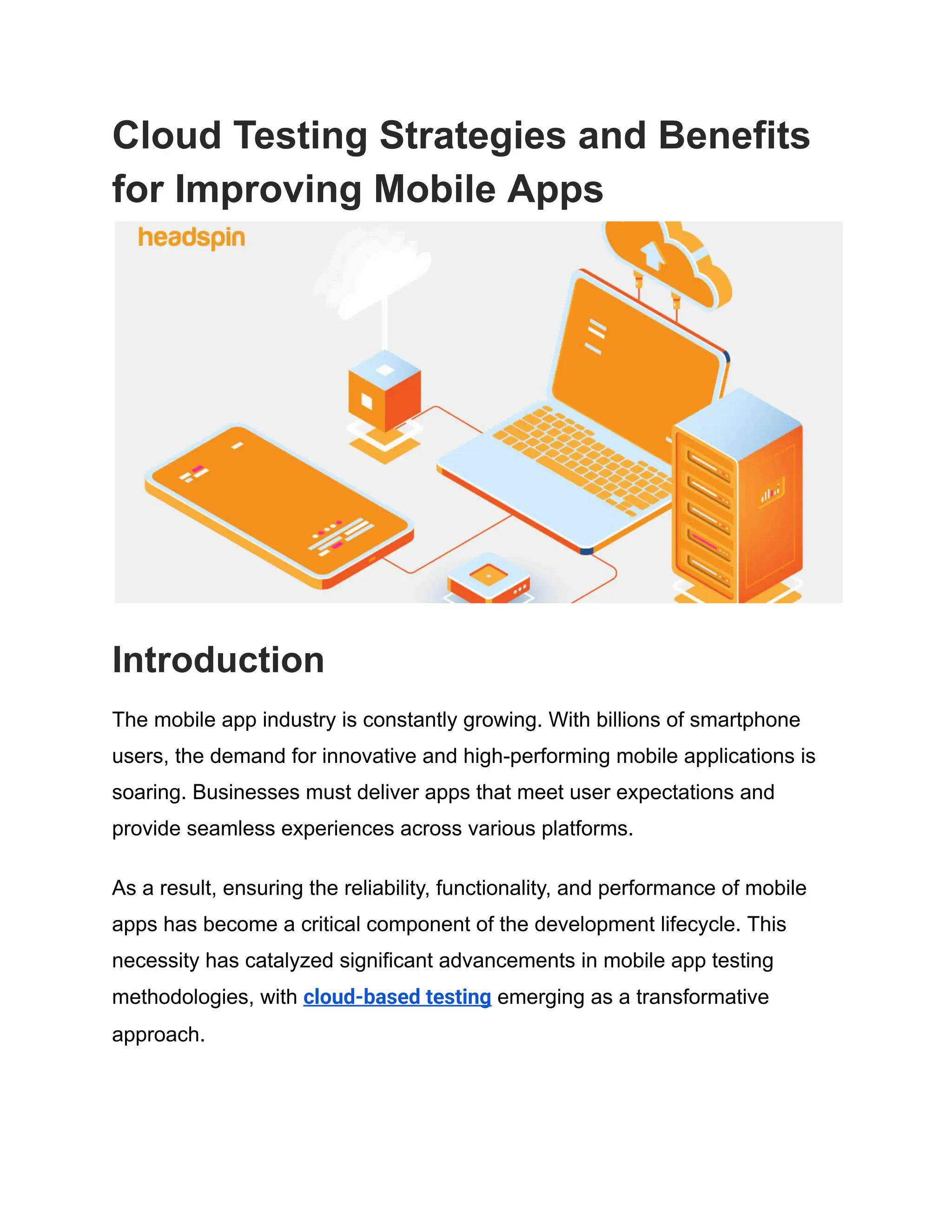
methodologies, with cloud-based testing emerging as a transformative
approach.
The Evolution of Mobile App Testing
Mobile app testing has evolved significantly over the past decade. Initially,
testing was predominantly manual, involving testers physically interacting with
devices to identify bugs and performance issues. This method was
labor-intensive, time-consuming, and limited in scope, particularly as the
diversity of devices and operating systems expanded.
The introduction of automation tools has allowed repetitive tests to be
conducted more efficiently. However, even with automation, the need for
physical devices posed logistical challenges. The exponential growth in device
types, screen resolutions, OS versions, and network conditions made it
impractical for organizations to maintain an exhaustive inventory of test
devices.
Challenges in Traditional Mobile App
Testing
Traditional mobile app testing methods face several inherent challenges:
1.​ High Infrastructure Costs: Establishing and maintaining an in-house
testing lab with a wide range of devices is financially burdensome. The
costs include purchasing devices, updating them regularly, and
allocating physical space and personnel for maintenance.
2.​ Limited Test Coverage: Due to resource constraints, testing is often
limited to a subset of devices and environments, leading to gaps in
coverage. This limitation increases the risk of undetected issues in
untested scenarios, potentially impacting user satisfaction and app
ratings.
3.​ Time Constraints: Manual testing processes can slow down the
development cycle. In competitive markets where speed to market is
crucial, delays caused by prolonged testing phases can result in
missed opportunities.
4.​ Inadequate Real-World Simulation: Testing in controlled
environments may not accurately reflect real-world conditions. Factors
such as varying network speeds, geographical differences, and user
behaviors are difficult to replicate without extensive resources.
The Rise of Cloud-Based Testing
Solutions
Cloud-based testing solutions have emerged as a response to these
challenges. Leveraging the scalability of cloud computing to revolutionize
mobile app testing, these solutions host testing environments and resources
on cloud servers and provide on-demand access to a wide array of devices,
platforms, and configurations.
Benefits of Cloud Testing on Mobile Apps
1. Scalability and Flexibility
Cloud-based testing platforms enable organizations to scale their testing
efforts seamlessly. They can adjust resources based on project needs, scaling
up during peak testing periods and scaling down when fewer resources are
required. This flexibility ensures efficient resource utilization and aligns with
agile development practices.
2. Access to a Wide Range of Devices
These platforms offer access to an extensive collection of real devices,
including the latest models and OS versions. This access allows testers to
conduct comprehensive compatibility testing, ensuring the app functions
correctly across different devices and operating systems.
3. Cost Efficiency
Organizations can significantly reduce expenditures associated with
purchasing and maintaining physical devices by adopting a cloud-based
approach. Operational costs are optimized through subscription-based or
pay-as-you-go models, providing financial flexibility.
4. Real-Time Collaboration
Cloud environments support collaborative workflows, allowing team members
from different locations to access testing environments simultaneously. This
feature enhances communication, reduces bottlenecks, and fosters a more
cohesive development process.
5. Faster Time-to-Market
Accelerated testing cycles contribute to a reduced time-to-market for
applications. Cloud-based testing enables parallel testing processes,
automated test execution, and quicker identification of issues, facilitating
faster iterations and deployments.
6. Enhanced Test Coverage
The ability to test under various network conditions, geographic locations, and
usage scenarios increases test coverage. This approach helps locate and
resolve issues that might not surface in limited testing environments, leading
to a more robust and user-friendly application.
Strategies for Effective Cloud-Based
Mobile App Testing
1. Selecting the Right Testing Tools
Choosing appropriate tools is critical for successful cloud-based testing.
Evaluate platforms based on their device inventory, support for automation
frameworks, ease of integration with existing tools, and user interface.
Consider solutions that offer extensive support and documentation to facilitate
a smooth transition.
2. Automating Test Processes
Automation is key to maximizing efficiency in cloud-based testing. Implement
test automation for repetitive and regression tests using frameworks like
Appium, Selenium, or XCTest. Automation reduces manual effort, minimizes
human error, and accelerates testing.
3. Implementing Continuous Testing
Integrate continuous testing into the CI/CD pipeline to ensure ongoing
validation of code changes. Continuous testing provides quick feedback on
the impact of new code, enabling rapid identification and resolution of issues.
This approach supports agile methodologies and enhances the overall quality
of the application.
4. Ensuring Security and Compliance
Security is a vital concern when dealing with cloud services. Ensure the
cloud-based testing platform adheres to industry-standard security protocols,
including data encryption, secure access controls, and compliance with
regulations. Establish clear policies for data handling and access to protect
sensitive information.
5. Performance Testing Under Real User Conditions
Leverage the cloud's capabilities to simulate real-world conditions, including
network variability, geographic diversity, and user behavior patterns. Conduct
performance and load testing to assess how the app handles high-traffic and
stress scenarios. This testing helps optimize the app's performance and
ensure a consistent user experience.
6. Monitoring and Analytics
Utilize monitoring tools and analytics provided by cloud-based platforms to
gain insights into app performance. Analyze metrics like response times,
resource utilization, crash reports, and user interactions. Data-driven insights
help teams make informed decisions and prioritize improvements effectively.
How the HeadSpin Platform Can Help
with Real Device Testing
The HeadSpin Platform is a comprehensive cloud-based mobile app testing
solution, particularly in real device testing. Here’s how it can enhance your
testing strategy:
●​ Global Device Infrastructure: HeadSpin offers a vast global device
infrastructure, providing access to real devices in many locations
worldwide. This feature allows testers to evaluate app performance
under various network conditions and geographies.
●​ AI-Driven Performance Optimization: The platform incorporates AI
and machine learning to deliver actionable insights. It can
automatically detect performance issues, such as slow loading times
or UI glitches, and provide detailed reports. This intelligence helps
teams proactively address problems and optimize the app's
performance.
●​ Seamless Integration and Automation: HeadSpin supports
integration with popular automation frameworks and CI/CD tools. This
compatibility enables teams to incorporate testing into their existing
workflows seamlessly. Automation capabilities facilitate efficient
regression testing and support continuous testing practices.
●​ Real-Time Collaboration and Reporting: The platform enables
teams to collaborate in real-time, with shared access to testing
environments and results. Customizable reporting tools allow
stakeholders to generate reports tailored to their needs, enhancing
transparency and communication.
●​ Security and Compliance: HeadSpin prioritizes security, offering
secure data handling and compliance with industry standards.
Features like secure tunneling, access controls, and data encryption
ensure that testing activities and data remain protected.
●​ Support for a Wide Range of Technologies: Whether you're
developing native, hybrid, or web applications, HeadSpin provides
robust support. It accommodates various programming languages
and frameworks, making it a versatile tool.
By integrating the HeadSpin Platform into your testing strategy, you can
leverage its advanced capabilities to enhance test coverage, improve app
quality, and accelerate time-to-market.
Conclusion
The shift towards cloud-based testing represents a significant advancement
in mobile app testing practices. Addressing traditional methods' limitations
offers a scalable, flexible, cost-effective solution that aligns with modern
development needs. Implementing effective strategies and utilizing platforms
like the
HeadSpin Platform can further optimize testing efforts. As the mobile app
landscape evolves, embracing cloud-based testing is essential for delivering
high-quality applications that meet and exceed user expectations.
This article was originally published on:
https://www.headspin.io/blog/enhancing-mobile-app-quality-with-cloud-testing-s
trategies

Cloud Testing Strategies and Benefits for Improving Mobile Apps.pdf

  • 1.
    Cloud Testing Strategiesand Benefits for Improving Mobile Apps Introduction The mobile app industry is constantly growing. With billions of smartphone users, the demand for innovative and high-performing mobile applications is soaring. Businesses must deliver apps that meet user expectations and provide seamless experiences across various platforms. As a result, ensuring the reliability, functionality, and performance of mobile apps has become a critical component of the development lifecycle. This necessity has catalyzed significant advancements in mobile app testing methodologies, with cloud-based testing emerging as a transformative approach.
  • 2.
    The Evolution ofMobile App Testing Mobile app testing has evolved significantly over the past decade. Initially, testing was predominantly manual, involving testers physically interacting with devices to identify bugs and performance issues. This method was labor-intensive, time-consuming, and limited in scope, particularly as the diversity of devices and operating systems expanded. The introduction of automation tools has allowed repetitive tests to be conducted more efficiently. However, even with automation, the need for physical devices posed logistical challenges. The exponential growth in device types, screen resolutions, OS versions, and network conditions made it impractical for organizations to maintain an exhaustive inventory of test devices. Challenges in Traditional Mobile App Testing Traditional mobile app testing methods face several inherent challenges: 1.​ High Infrastructure Costs: Establishing and maintaining an in-house testing lab with a wide range of devices is financially burdensome. The costs include purchasing devices, updating them regularly, and allocating physical space and personnel for maintenance. 2.​ Limited Test Coverage: Due to resource constraints, testing is often limited to a subset of devices and environments, leading to gaps in coverage. This limitation increases the risk of undetected issues in
  • 3.
    untested scenarios, potentiallyimpacting user satisfaction and app ratings. 3.​ Time Constraints: Manual testing processes can slow down the development cycle. In competitive markets where speed to market is crucial, delays caused by prolonged testing phases can result in missed opportunities. 4.​ Inadequate Real-World Simulation: Testing in controlled environments may not accurately reflect real-world conditions. Factors such as varying network speeds, geographical differences, and user behaviors are difficult to replicate without extensive resources. The Rise of Cloud-Based Testing Solutions Cloud-based testing solutions have emerged as a response to these challenges. Leveraging the scalability of cloud computing to revolutionize mobile app testing, these solutions host testing environments and resources on cloud servers and provide on-demand access to a wide array of devices, platforms, and configurations. Benefits of Cloud Testing on Mobile Apps 1. Scalability and Flexibility Cloud-based testing platforms enable organizations to scale their testing efforts seamlessly. They can adjust resources based on project needs, scaling up during peak testing periods and scaling down when fewer resources are
  • 4.
    required. This flexibilityensures efficient resource utilization and aligns with agile development practices. 2. Access to a Wide Range of Devices These platforms offer access to an extensive collection of real devices, including the latest models and OS versions. This access allows testers to conduct comprehensive compatibility testing, ensuring the app functions correctly across different devices and operating systems. 3. Cost Efficiency Organizations can significantly reduce expenditures associated with purchasing and maintaining physical devices by adopting a cloud-based approach. Operational costs are optimized through subscription-based or pay-as-you-go models, providing financial flexibility. 4. Real-Time Collaboration Cloud environments support collaborative workflows, allowing team members from different locations to access testing environments simultaneously. This feature enhances communication, reduces bottlenecks, and fosters a more cohesive development process. 5. Faster Time-to-Market Accelerated testing cycles contribute to a reduced time-to-market for applications. Cloud-based testing enables parallel testing processes, automated test execution, and quicker identification of issues, facilitating faster iterations and deployments.
  • 5.
    6. Enhanced TestCoverage The ability to test under various network conditions, geographic locations, and usage scenarios increases test coverage. This approach helps locate and resolve issues that might not surface in limited testing environments, leading to a more robust and user-friendly application. Strategies for Effective Cloud-Based Mobile App Testing 1. Selecting the Right Testing Tools Choosing appropriate tools is critical for successful cloud-based testing. Evaluate platforms based on their device inventory, support for automation frameworks, ease of integration with existing tools, and user interface. Consider solutions that offer extensive support and documentation to facilitate a smooth transition. 2. Automating Test Processes Automation is key to maximizing efficiency in cloud-based testing. Implement test automation for repetitive and regression tests using frameworks like Appium, Selenium, or XCTest. Automation reduces manual effort, minimizes human error, and accelerates testing. 3. Implementing Continuous Testing Integrate continuous testing into the CI/CD pipeline to ensure ongoing validation of code changes. Continuous testing provides quick feedback on
  • 6.
    the impact ofnew code, enabling rapid identification and resolution of issues. This approach supports agile methodologies and enhances the overall quality of the application. 4. Ensuring Security and Compliance Security is a vital concern when dealing with cloud services. Ensure the cloud-based testing platform adheres to industry-standard security protocols, including data encryption, secure access controls, and compliance with regulations. Establish clear policies for data handling and access to protect sensitive information. 5. Performance Testing Under Real User Conditions Leverage the cloud's capabilities to simulate real-world conditions, including network variability, geographic diversity, and user behavior patterns. Conduct performance and load testing to assess how the app handles high-traffic and stress scenarios. This testing helps optimize the app's performance and ensure a consistent user experience. 6. Monitoring and Analytics Utilize monitoring tools and analytics provided by cloud-based platforms to gain insights into app performance. Analyze metrics like response times, resource utilization, crash reports, and user interactions. Data-driven insights help teams make informed decisions and prioritize improvements effectively. How the HeadSpin Platform Can Help with Real Device Testing
  • 7.
    The HeadSpin Platformis a comprehensive cloud-based mobile app testing solution, particularly in real device testing. Here’s how it can enhance your testing strategy: ●​ Global Device Infrastructure: HeadSpin offers a vast global device infrastructure, providing access to real devices in many locations worldwide. This feature allows testers to evaluate app performance under various network conditions and geographies. ●​ AI-Driven Performance Optimization: The platform incorporates AI and machine learning to deliver actionable insights. It can automatically detect performance issues, such as slow loading times or UI glitches, and provide detailed reports. This intelligence helps teams proactively address problems and optimize the app's performance. ●​ Seamless Integration and Automation: HeadSpin supports integration with popular automation frameworks and CI/CD tools. This compatibility enables teams to incorporate testing into their existing workflows seamlessly. Automation capabilities facilitate efficient regression testing and support continuous testing practices. ●​ Real-Time Collaboration and Reporting: The platform enables teams to collaborate in real-time, with shared access to testing environments and results. Customizable reporting tools allow stakeholders to generate reports tailored to their needs, enhancing transparency and communication. ●​ Security and Compliance: HeadSpin prioritizes security, offering secure data handling and compliance with industry standards.
  • 8.
    Features like securetunneling, access controls, and data encryption ensure that testing activities and data remain protected. ●​ Support for a Wide Range of Technologies: Whether you're developing native, hybrid, or web applications, HeadSpin provides robust support. It accommodates various programming languages and frameworks, making it a versatile tool. By integrating the HeadSpin Platform into your testing strategy, you can leverage its advanced capabilities to enhance test coverage, improve app quality, and accelerate time-to-market. Conclusion The shift towards cloud-based testing represents a significant advancement in mobile app testing practices. Addressing traditional methods' limitations offers a scalable, flexible, cost-effective solution that aligns with modern development needs. Implementing effective strategies and utilizing platforms like the HeadSpin Platform can further optimize testing efforts. As the mobile app landscape evolves, embracing cloud-based testing is essential for delivering high-quality applications that meet and exceed user expectations. This article was originally published on: https://www.headspin.io/blog/enhancing-mobile-app-quality-with-cloud-testing-s trategies