MATTER What is Matter? 
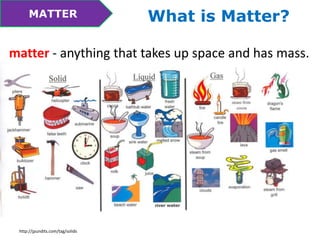
matter - anything that takes up space and has mass. 
http://jpundits.com/tag/solids
MATTER Physical Properties of Matter 
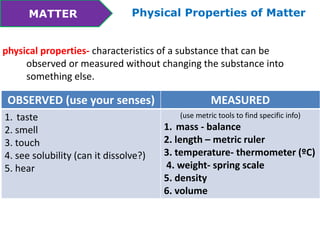
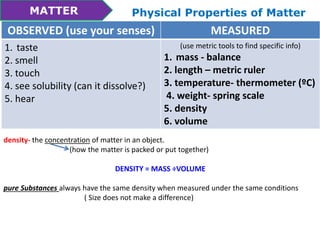
physical properties- characteristics of a substance that can be 
observed or measured without changing the substance into 
something else. 
OBSERVED (use your senses) MEASURED 
1. taste 
2. smell 
3. touch 
4. see solubility (can it dissolve?) 
5. hear 
(use metric tools to find specific info) 
1. mass - balance 
2. length – metric ruler 
3. temperature- thermometer (ºC) 
4. weight- spring scale 
5. density 
6. volume
MATTER Physical Properties of Matter 
OBSERVED (use your senses) MEASURED 
1. taste 
2. smell 
3. touch 
4. see solubility (can it dissolve?) 
5. hear 
(use metric tools to find specific info) 
1. mass - balance 
2. length – metric ruler 
3. temperature- thermometer (ºC) 
4. weight- spring scale 
5. density 
6. volume 
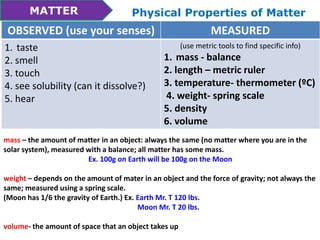
mass – the amount of matter in an object: always the same (no matter where you are in the 
solar system), measured with a balance; all matter has some mass. 
Ex. 100g on Earth will be 100g on the Moon 
weight – depends on the amount of mater in an object and the force of gravity; not always the 
same; measured using a spring scale. 
(Moon has 1/6 the gravity of Earth.) Ex. Earth Mr. T 120 lbs. 
Moon Mr. T 20 lbs. 
volume- the amount of space that an object takes up
MATTER Physical Properties of Matter 
OBSERVED (use your senses) MEASURED 
1. taste 
2. smell 
3. touch 
4. see solubility (can it dissolve?) 
5. hear 
(use metric tools to find specific info) 
1. mass - balance 
2. length – metric ruler 
3. temperature- thermometer (ºC) 
4. weight- spring scale 
5. density 
6. volume 
density- the concentration of matter in an object. 
(how the matter is packed or put together) 
DENSITY = MASS ÷VOLUME 
pure Substances always have the same density when measured under the same conditions 
( Size does not make a difference)
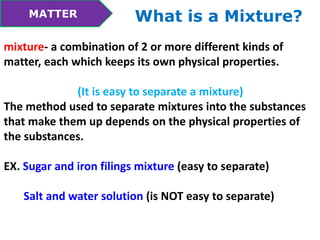
MATTER What is a Mixture? 
mixture- a combination of 2 or more different kinds of 
matter, each which keeps its own physical properties. 
(It is easy to separate a mixture) 
The method used to separate mixtures into the substances 
that make them up depends on the physical properties of 
the substances. 
EX. Sugar and iron filings mixture (easy to separate) 
Salt and water solution (is NOT easy to separate)
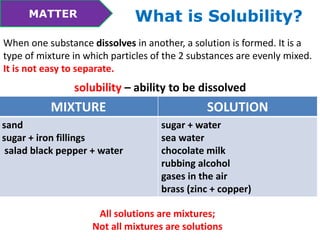
MATTER What is Solubility? 
When one substance dissolves in another, a solution is formed. It is a 
type of mixture in which particles of the 2 substances are evenly mixed. 
It is not easy to separate. 
solubility – ability to be dissolved 
MIXTURE SOLUTION 
sand 
sugar + iron fillings 
salad black pepper + water 
sugar + water 
sea water 
chocolate milk 
rubbing alcohol 
gases in the air 
brass (zinc + copper) 
All solutions are mixtures; 
Not all mixtures are solutions
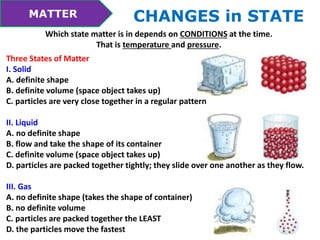
MATTER CHANGES in STATE 
Which state matter is in depends on CONDITIONS at the time. 
That is temperature and pressure. 
Three States of Matter 
I. Solid 
A. definite shape 
B. definite volume (space object takes up) 
C. particles are very close together in a regular pattern 
II. Liquid 
A. no definite shape 
B. flow and take the shape of its container 
C. definite volume (space object takes up) 
D. particles are packed together tightly; they slide over one another as they flow. 
III. Gas 
A. no definite shape (takes the shape of container) 
B. no definite volume 
C. particles are packed together the LEAST 
D. the particles move the fastest
MATTER CHANGES in STATE 
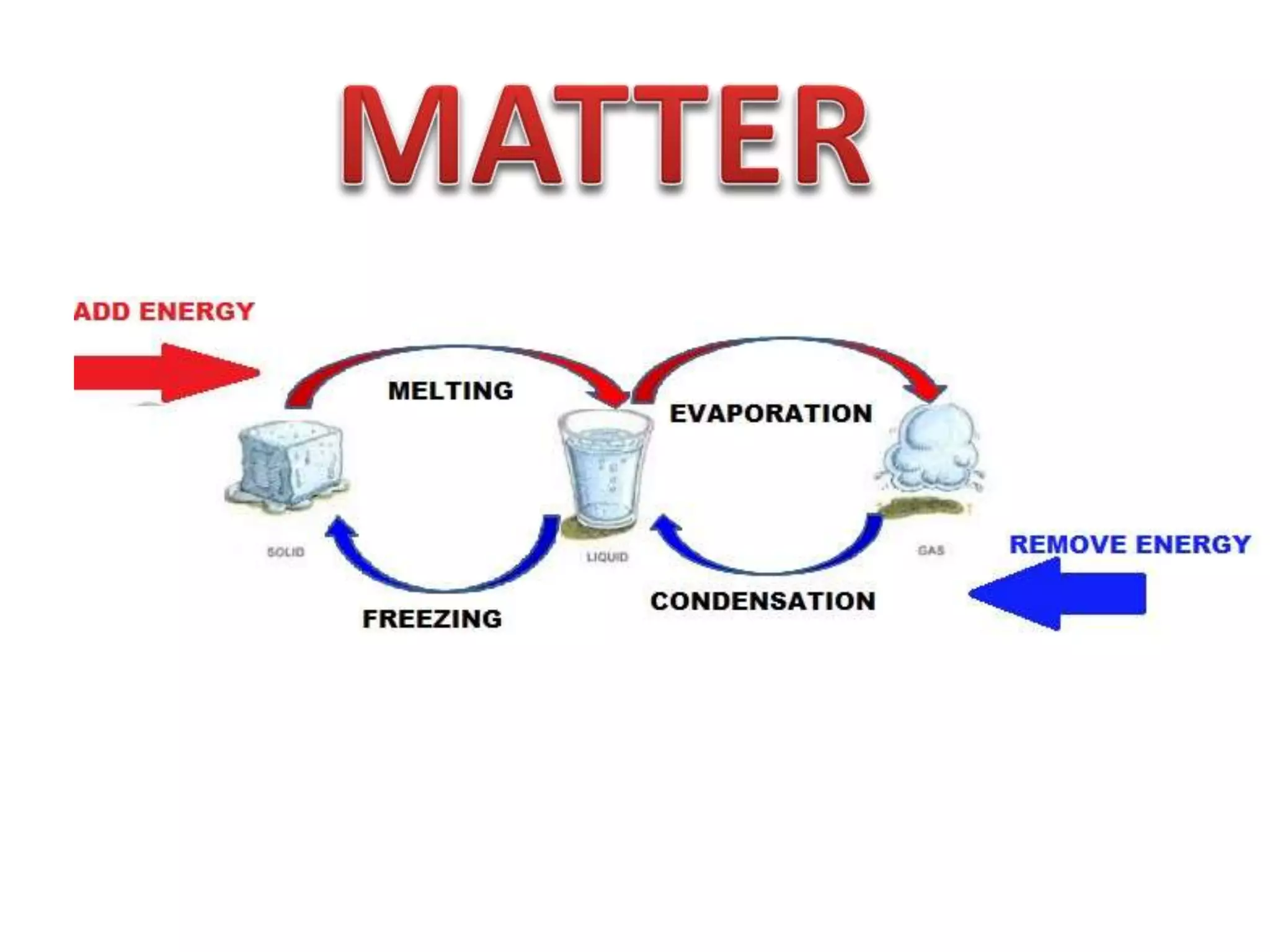
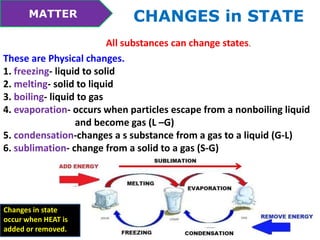
All substances can change states. 
These are Physical changes. 
1. freezing- liquid to solid 
2. melting- solid to liquid 
3. boiling- liquid to gas 
4. evaporation- occurs when particles escape from a nonboiling liquid 
and become gas (L –G) 
5. condensation-changes a s substance from a gas to a liquid (G-L) 
6. sublimation- change from a solid to a gas (S-G) 
Changes in state 
occur when HEAT is 
added or removed.
MATTER CHANGES in STATE 
Changes in state occur when HEAT is added or removed. 
Add heat - particles gain energy; move faster and farther apart 
Remove heat- particles slow down; particles move closer together 
Every substance has its own TEMPERATURE at which it changes from a liquid to a 
solid. 
If it is a solid at room temperature, then it has a very high freezing point. 
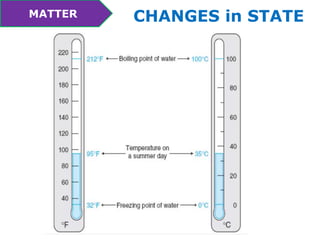
Water Freezes at 0º C 
The temperature at which a substance melts and freezes is the SAME. 
MELTING and FREEZING points are the same. 
The point at which a liquid changes to a gas is its Boiling point. 
Water Boils at 100º C 
Substances can be identified by their BOILING and MELTING points.
MATTER CHANGES in STATE
MATTER The end

Matter

  • 2.
    MATTER What isMatter? matter - anything that takes up space and has mass. http://jpundits.com/tag/solids
  • 3.
    MATTER Physical Propertiesof Matter physical properties- characteristics of a substance that can be observed or measured without changing the substance into something else. OBSERVED (use your senses) MEASURED 1. taste 2. smell 3. touch 4. see solubility (can it dissolve?) 5. hear (use metric tools to find specific info) 1. mass - balance 2. length – metric ruler 3. temperature- thermometer (ºC) 4. weight- spring scale 5. density 6. volume
  • 4.
    MATTER Physical Propertiesof Matter OBSERVED (use your senses) MEASURED 1. taste 2. smell 3. touch 4. see solubility (can it dissolve?) 5. hear (use metric tools to find specific info) 1. mass - balance 2. length – metric ruler 3. temperature- thermometer (ºC) 4. weight- spring scale 5. density 6. volume mass – the amount of matter in an object: always the same (no matter where you are in the solar system), measured with a balance; all matter has some mass. Ex. 100g on Earth will be 100g on the Moon weight – depends on the amount of mater in an object and the force of gravity; not always the same; measured using a spring scale. (Moon has 1/6 the gravity of Earth.) Ex. Earth Mr. T 120 lbs. Moon Mr. T 20 lbs. volume- the amount of space that an object takes up
  • 5.
    MATTER Physical Propertiesof Matter OBSERVED (use your senses) MEASURED 1. taste 2. smell 3. touch 4. see solubility (can it dissolve?) 5. hear (use metric tools to find specific info) 1. mass - balance 2. length – metric ruler 3. temperature- thermometer (ºC) 4. weight- spring scale 5. density 6. volume density- the concentration of matter in an object. (how the matter is packed or put together) DENSITY = MASS ÷VOLUME pure Substances always have the same density when measured under the same conditions ( Size does not make a difference)
  • 6.
    MATTER What isa Mixture? mixture- a combination of 2 or more different kinds of matter, each which keeps its own physical properties. (It is easy to separate a mixture) The method used to separate mixtures into the substances that make them up depends on the physical properties of the substances. EX. Sugar and iron filings mixture (easy to separate) Salt and water solution (is NOT easy to separate)
  • 7.
    MATTER What isSolubility? When one substance dissolves in another, a solution is formed. It is a type of mixture in which particles of the 2 substances are evenly mixed. It is not easy to separate. solubility – ability to be dissolved MIXTURE SOLUTION sand sugar + iron fillings salad black pepper + water sugar + water sea water chocolate milk rubbing alcohol gases in the air brass (zinc + copper) All solutions are mixtures; Not all mixtures are solutions
  • 8.
    MATTER CHANGES inSTATE Which state matter is in depends on CONDITIONS at the time. That is temperature and pressure. Three States of Matter I. Solid A. definite shape B. definite volume (space object takes up) C. particles are very close together in a regular pattern II. Liquid A. no definite shape B. flow and take the shape of its container C. definite volume (space object takes up) D. particles are packed together tightly; they slide over one another as they flow. III. Gas A. no definite shape (takes the shape of container) B. no definite volume C. particles are packed together the LEAST D. the particles move the fastest
  • 9.
    MATTER CHANGES inSTATE All substances can change states. These are Physical changes. 1. freezing- liquid to solid 2. melting- solid to liquid 3. boiling- liquid to gas 4. evaporation- occurs when particles escape from a nonboiling liquid and become gas (L –G) 5. condensation-changes a s substance from a gas to a liquid (G-L) 6. sublimation- change from a solid to a gas (S-G) Changes in state occur when HEAT is added or removed.
  • 10.
    MATTER CHANGES inSTATE Changes in state occur when HEAT is added or removed. Add heat - particles gain energy; move faster and farther apart Remove heat- particles slow down; particles move closer together Every substance has its own TEMPERATURE at which it changes from a liquid to a solid. If it is a solid at room temperature, then it has a very high freezing point. Water Freezes at 0º C The temperature at which a substance melts and freezes is the SAME. MELTING and FREEZING points are the same. The point at which a liquid changes to a gas is its Boiling point. Water Boils at 100º C Substances can be identified by their BOILING and MELTING points.
  • 11.
  • 12.