MATERIAL 
MANAGEMENT 
MADHUR 
VERMA 
PG JR
INTRODUCTION 
 Material is defined as “equipment, apparatus and 
supplies used by an organization for the purpose of 
rendering services”, 
The basic objective of management is to optimize the 
resources, i.e: Men, Money, Materials, Machines& 
Minutes(time)
INTRODUCTION 
 Lack of proper attention to the material management in the 
health system in the country has been a major problem in 
effective implementation of various health programs 
 Man fails to realize the fact that material represents money 
and also there is a lack of perception about the inter-relatonship 
between money and the material 
Non availability of drugs and materials supplies– 
dissatisfaction among health personnel and also community
DEFINITION 
MM is a scientific technique which is concerned 
with the planning, organizing and controlling the 
flow of materials from their initial purchase through 
internal operation to the distribution to the service 
points
BASIC FUNCTIONS OF MATERIAL 
MANAGEMENT 
1. Effective management and supervision 
2. Sound purchasing methods 
3. An efficient purchase system 
4. A simple inventory control programme 
5. A result oriented requisition and distribution system 
6. Written policies and procedures 
7. A practical receiving programme: It denotes the need for 
accountability and responsibility. For the best results, the 
purchasing, receiving & paying of invoice should be done 
by separate persons.
AIM for MM 
To have material in hand when needed 
To pay the lowest possible price, consistent with quality 
and value requirement 
To minimize inventory investment 
To operate efficiently
PURPOSE OF MATERIAL 
MANAGEMENT 
•To gain economy in purchasing 
•To satisfy the demand during period of 
replenishment 
•To carry reserve stock to avoid stock out 
•To stabilize fluctuations in consumption 
•To provide reasonable level of client services
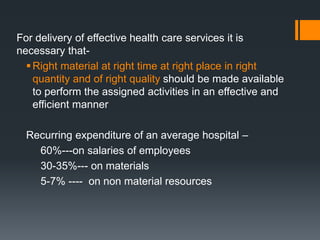
For delivery of effective health care services it is 
necessary that- 
 Right material at right time at right place in right 
quantity and of right quality should be made available 
to perform the assigned activities in an effective and 
efficient manner 
Recurring expenditure of an average hospital – 
60%---on salaries of employees 
30-35%--- on materials 
5-7% ---- on non material resources
 Stock: The goods kept on the premises of a 
business or warehouse and available for sale or 
distribution 
 Inventory–- total quantity of material available in 
the store 
Logistics–- defined as function of moving, storing 
and distributing resources and goods
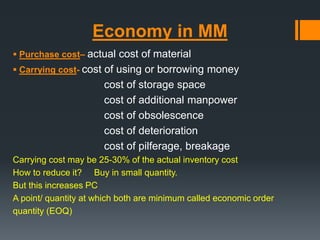
Economy in MM 
 Purchase cost– actual cost of material 
 Carrying cost- cost of using or borrowing money 
cost of storage space 
cost of additional manpower 
cost of obsolescence 
cost of deterioration 
cost of pilferage, breakage 
Carrying cost may be 25-30% of the actual inventory cost 
How to reduce it? Buy in small quantity. 
But this increases PC 
A point/ quantity at which both are minimum called economic order 
quantity (EOQ)
Shortage cost--- deals with the cost of not having 
a material. It would vary according to the nature of 
an item 
 Ordering cost--- cost of placing an order to the 
firm
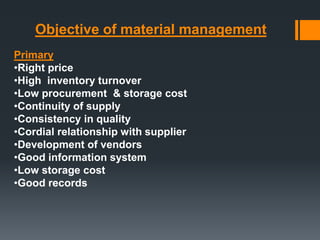
Objective of material management 
Primary 
•Right price 
•High inventory turnover 
•Low procurement & storage cost 
•Continuity of supply 
•Consistency in quality 
•Cordial relationship with supplier 
•Development of vendors 
•Good information system 
•Low storage cost 
•Good records
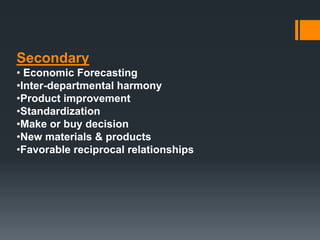
Secondary 
• Economic Forecasting 
•Inter-departmental harmony 
•Product improvement 
•Standardization 
•Make or buy decision 
•New materials & products 
•Favorable reciprocal relationships
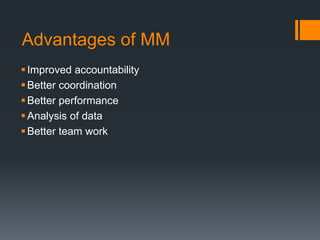
Advantages of MM 
 Improved accountability 
 Better coordination 
 Better performance 
Analysis of data 
 Better team work
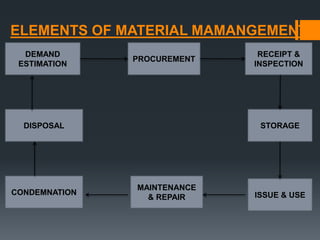
ELEMENTS OF MATERIAL MAMANGEMENT 
DEMAND 
ESTIMATION 
PROCUREMENT 
DISPOSAL 
CONDEMNATION 
MAINTENANCE 
RECEIPT & 
INSPECTION 
STORAGE 
& REPAIR ISSUE & USE
SELECTION AND DEMAND 
ESTIMATION 
Selection of items to be purchased need some basal 
document, e.g., for medicines as per latest figure sixty 
thousand formulation of drugs are manufactured and sold in 
Indian market, while WHO says only three hundred odd 
number of drugs are sufficient even for a tertiary hospital of 
developing country. 
 Limited funds available are often ill spent on ineffective 
duplication or unacceptable dangerous drugs. 
 It is therefore imperative to prepare a list of essential drugs 
for a hospital & included in HOSPITAL FORMULARY.
FORECEASTING OR ESTIMATING 
DEMAND 
 Forecasting is the method of estimating demand based on time series 
analysis of past while anticipating the future. 
Demands for materials could be certain or predictable, and uncertain or 
unpredictable. 
Following guidelines: 
 Trends in consumption pattern during last 2-3 years. 
 Objective of the hospital. 
 Morbidity pattern of the community 
 The clienteles 
 Cyclic changes in epidemiological occurrence of disease. 
 Resources constraint. 
 Existing stock position.
Methods of forecasting of demands in hospital 
1. Last period demand– 
2. The arithmetic average & 
3. Moving average– it generates the next period’s 
forecast by averaging the actual demands for the 
last ‘n’ time periods
PROCUREMENT 
 Process of acquiring supplies 
Three sources: 
 Purchase 
 Donations 
 Manufacturing 
 Objective of well procurement system: 
 Acquire needed supplies as inexpensively as possible. 
 Obtain supplies of high quality 
 Assure prompt, dependable delivery. 
 Distribute the procurement workload to avoid period of idleness & 
overwork. 
 Optimize inventory management the scientific procurement procedures.
PROCUREMENT 
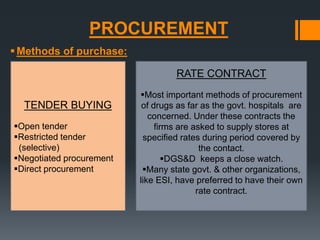
Methods of purchase: 
TENDER BUYING 
Open tender 
Restricted tender 
(selective) 
Negotiated procurement 
Direct procurement 
RATE CONTRACT 
Most important methods of procurement 
of drugs as far as the govt. hospitals are 
concerned. Under these contracts the 
firms are asked to supply stores at 
specified rates during period covered by 
the contact. 
DGS&D keeps a close watch. 
Many state govt. & other organizations, 
like ESI, have preferred to have their own 
rate contract.
RECEIPT AND INSPECTION 
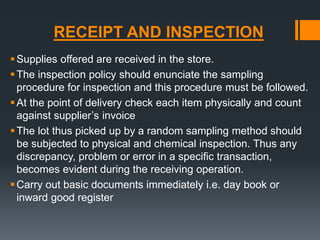
Supplies offered are received in the store. 
The inspection policy should enunciate the sampling 
procedure for inspection and this procedure must be followed. 
 At the point of delivery check each item physically and count 
against supplier’s invoice 
The lot thus picked up by a random sampling method should 
be subjected to physical and chemical inspection. Thus any 
discrepancy, problem or error in a specific transaction, 
becomes evident during the receiving operation. 
Carry out basic documents immediately i.e. day book or 
inward good register
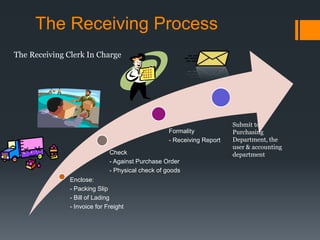
The Receiving Process 
Check 
- Against Purchase Order 
- Physical check of goods 
Enclose: 
- Packing Slip 
- Bill of Lading 
- Invoice for Freight 
Formality 
- Receiving Report 
Submit to 
Purchasing 
Department, the 
user & accounting 
department 
The Receiving Clerk In Charge
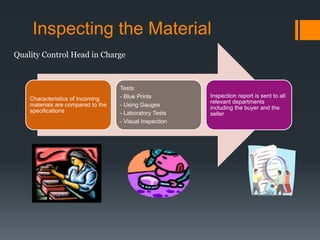
Inspecting the Material 
Characteristics of Incoming 
materials are compared to the 
specifications 
Tests: 
- Blue Prints 
- Using Gauges 
- Laboratory Tests 
- Visual Inspection 
Inspection report is sent to all 
relevant departments 
including the buyer and the 
seller 
Quality Control Head in Charge
RECEIPT AND INSPECTION 
Procedures: 
Unloading & checking supplies 
Unpacking & inspecting supplies 
 Goods received notes 
Delivery of materials to the proper stocking locations 
Receiving records shows– 
- - which supplies are consistently late in their deliveries 
 -- which have the maximum number of rejects 
 ---which deliver the greatest no. for split consignments 
Any of these supplier is costly to the buyer
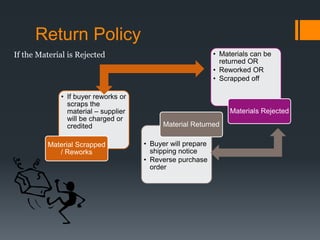
Return Policy 
• If buyer reworks or 
scraps the 
material – supplier 
will be charged or 
credited 
Material Scrapped 
/ Reworks 
Material Returned 
• Buyer will prepare 
shipping notice 
• Reverse purchase 
order 
• Materials can be 
returned OR 
• Reworked OR 
• Scrapped off 
Materials Rejected 
If the Material is Rejected
STORAGE 
 Medical store should be accessible to supplies as well as 
indenters. 
 Location of store will, therefore, be guided by the flow 
activities of the store. Also, light, ventilation, cupboards, 
shelves should be of adequate size. 
 Items received later from the supplies should be stored 
behind similar items and the principle of FIFO should be 
adopted. 
Refrigerators or cold rooms are necessary. 
Combustible and non-combustible– should be kept separate 
Poisonous drugs & narcotics should be stored in locked 
cupboards 
Rodent free.
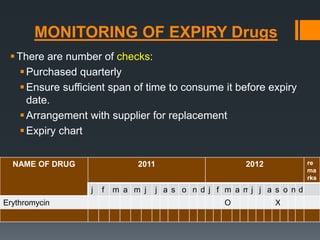
MONITORING OF EXPIRY Drugs 
There are number of checks: 
Purchased quarterly 
Ensure sufficient span of time to consume it before expiry 
date. 
 Arrangement with supplier for replacement 
Expiry chart 
NAME OF DRUG 2011 2012 re 
ma 
rks 
j f m a m j j a s o n d j f m a mj j a s o n d 
Erythromycin O X
STORAGE METHODS 
 The Two-Bin system—stock of each item is physical 
separated into two bins -–working bin and reserve bin 
When working bin empty the store keeper changes to the 
second bin and is alerted that new supplies are needed 
Double shelf system – modification of two-bin system 
This system works well only if the supply time is half the 
purchasing interval
ISSUE AND USE 
 Issue should be made after receiving written indents 
 Distribution system can be either by direct supply or through a sub store’ 
Push method (allocation system) 
Pull methods (requisition system)
Selective inventory control 
 LEAD TIME --It denotes the average duration of time between placing an 
order to the supplier and receipt of materials in your medical stores 
 Internal lead time– duration between the moment at which some one is 
aware of the need for the additional stock and order is placed 
 External lead time—taken by the supplier to supply the materials after it 
receives the supply order from an org.
Working stock– used to satisfy the demand between 
deliveries 
Safety stock( Buffer stock)– exits to protect against stock 
outs which would otherwise occur when either the 
deliveries are delayed on the working stock is consumed at 
an unexpectedly high rates 
Reorder level-stock level at which a fresh order has to be 
placed. It is equal to average consumption per day 
multiplied by the lead time
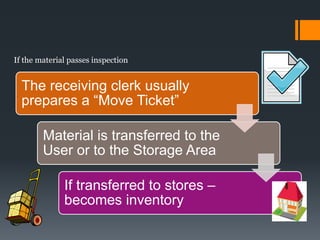
If the material passes inspection 
Inventory Control 
The receiving clerk usually 
prepares a “Move Ticket” 
Material is transferred to the 
User or to the Storage Area 
If transferred to stores – 
becomes inventory
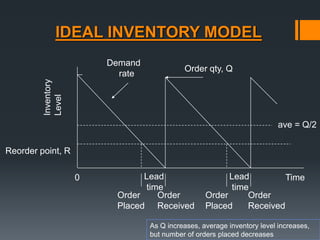
IDEAL INVENTORY MODEL 
Demand 
rate 
ave = Q/2 
0 Lead Time 
time 
Lead 
time 
Order 
Placed 
Order 
Placed 
Order 
Received 
Order 
Received 
Inventory 
Level 
Reorder point, R 
Order qty, Q 
As Q increases, average inventory level increases, 
but number of orders placed decreases
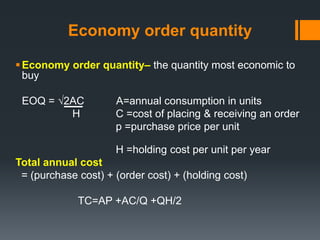
Economy order quantity 
Economy order quantity– the quantity most economic to 
buy 
EOQ = √2AC A=annual consumption in units 
H C =cost of placing & receiving an order 
p =purchase price per unit 
H =holding cost per unit per year 
Total annual cost 
= (purchase cost) + (order cost) + (holding cost) 
TC=AP +AC/Q +QH/2
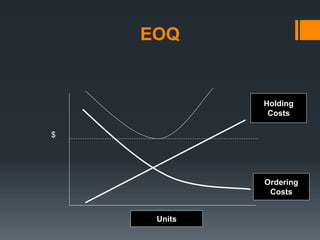
Holding 
Costs 
Ordering 
Costs 
EOQ 
Units 
$
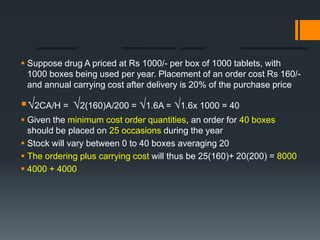
 Suppose drug A priced at Rs 1000/- per box of 1000 tablets, with 
1000 boxes being used per year. Placement of an order cost Rs 160/- 
and annual carrying cost after delivery is 20% of the purchase price 
√2CA/H = √2(160)A/200 = √1.6A = √1.6x 1000 = 40 
 Given the minimum cost order quantities, an order for 40 boxes 
should be placed on 25 occasions during the year 
 Stock will vary between 0 to 40 boxes averaging 20 
 The ordering plus carrying cost will thus be 25(160)+ 20(200) = 8000 
 4000 + 4000
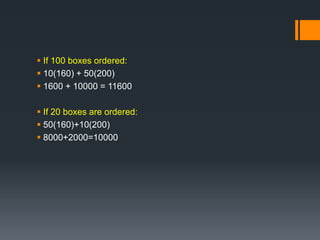
 If 100 boxes ordered: 
 10(160) + 50(200) 
 1600 + 10000 = 11600 
 If 20 boxes are ordered: 
 50(160)+10(200) 
 8000+2000=10000
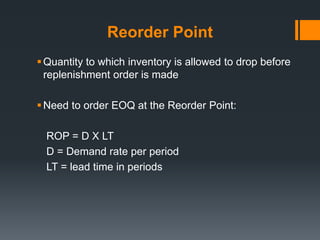
Reorder Point 
 Quantity to which inventory is allowed to drop before 
replenishment order is made 
Need to order EOQ at the Reorder Point: 
ROP = D X LT 
D = Demand rate per period 
LT = lead time in periods
SELECTIVE INVENTORY CONTROL 
 Effective manager should isolate those items that 
require more precise control from those that do not 
 Items are classified into groups based on different 
criteria 
ABC analysis of drugs-- based on annual cost of the 
items. Also known as Always Better Control
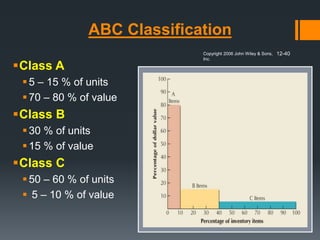
ABC Classification 
Class A 
 5 – 15 % of units 
 70 – 80 % of value 
Class B 
 30 % of units 
 15 % of value 
Class C 
 50 – 60 % of units 
 5 – 10 % of value 
Copyright 2006 John Wiley & Sons, 
Inc. 
12-40
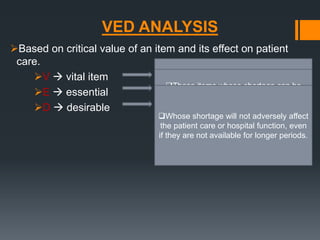
VED ANALYSIS 
Based on critical value of an item and its effect on patient 
care. 
V  vital item 
E  essential 
D  desirable 
Without which institution cannot 
function. 
Those items whose shortage can be 
Should tolerated always for be short present period in only. 
sufficient 
quantity But and if not sufficient available safety over stock a long 
should 
be maintained to ensure 100% availability. 
period…adversely affect patient care and 
Whose shortage will not adversely affect 
the patient Controlled hospital care by or top hospital functioning. 
manager function, levels. 
even 
if they Controlled are not available by middle for manager longer periods. 
level.
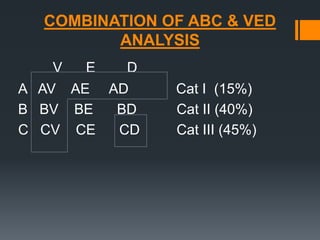
COMBINATION OF ABC & VED 
ANALYSIS 
V E D 
A AV AE AD Cat I (15%) 
B BV BE BD Cat II (40%) 
C CV CE CD Cat III (45%)
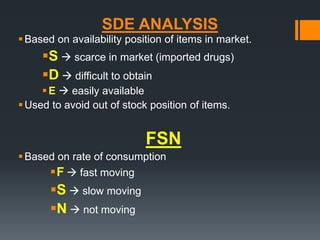
SDE ANALYSIS 
Based on availability position of items in market. 
S  scarce in market (imported drugs) 
D  difficult to obtain 
E  easily available 
Used to avoid out of stock position of items. 
FSN 
Based on rate of consumption 
F  fast moving 
S  slow moving 
N  not moving
Equipments Management 
Equipments play a major role in a hospital. 
 Medical equipments aids the treating physician in providing 
efficient health care in diagnostic and therapeutic areas and 
make the patient stay comfortable 
 Effective management and efficient maintenance of health 
care delivery and are vital for the smooth functioning of every 
health facility from PHC to the most sophisticated hospital in 
every country
Problems- wide variety of equipments at various level of 
sophistication level but without adequate maintenance 
support 
Even less sophisticated equipments lead to high maintenance 
cost by local agents 
 Lack of technically qualified manpower 
A hostile environment 
A developing country will seldom have about 50% of its 
equipments in usable condition at a given time
 Before ordering an equipment hospital should ensure 
 Latest technology is being purchased 
 Full repair and maintenance facilities exist with a minimum of down time 
 Availability of post –warranty repair of reasonable cost 
 Purchased from reputed manufacture 
 Consumables are readily available 
 Operating cost should be low
RECORDS NEEDED FOR 
MAINTENANCE 
HISTORY SHEET: 
 Identification data  make model and date of purchase 
Source of details of supplies and its spares 
 Purchase cost and detail of purchase procedure 
 Details of breakdowns and repair undertaken 
Expenditure incurred on repair 
LOG BOOK FOR EQUIPMENT: 
Records for its maintenance should be kept, i.e., warranty 
period & servicing/repair done, annual service contract, 
expenditure incurred. 
 Details of preventive maintenance 
 Whether in working condition or not.
RECORDS NEEDED FOR 
MAINTENANCE 
PERFORMANCE RECORD OF EQUIPMENT: 
 Essential to recommend for condemnation 
 Period since working 
 Level of utilization in terms of output 
 Periods when not working, with reasons 
 If beyond economic repair, a certificate from the 
engineering unit should be procured.
CONDEMNATION & DISPOSAL 
Minimum criteria to be followed for condemnation. 
Non-functional and beyond economical repair 
Non-functional and obsolete 
Functional but obsolete 
Functional but hazardous 
Functional but no longer required 
A CONDEMNATION COMMITTEE should be constituted for 
assessing whether or not an equipment should be condemned 
and disposed of based on the history sheet & 
recommendations of the user department.
CONDEMNATION & DISPOSAL 
This committee should meet periodically at regular intervals, at 
least twice an year. 
However, for condemnation of costly hospital equipment, a 
SPECIAL CONDEMNATION BOARD may be constituted as 
per rule of the organization.
CONDEMNATION & DISPOSAL 
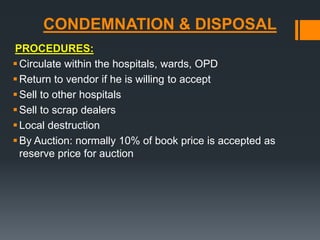
PROCEDURES: 
 Circulate within the hospitals, wards, OPD 
Return to vendor if he is willing to accept 
Sell to other hospitals 
Sell to scrap dealers 
 Local destruction 
 By Auction: normally 10% of book price is accepted as 
reserve price for auction
CONCLUSION 
 Material management is an important management tool which 
is very useful in getting the right quality & right quantity of 
supplies at right time. 
 Provides good inventory control & helps in adopting sound 
methods of condemnation & disposal, and therefore improves 
the efficiency of the organization, whether it is Private, 
Government, Small organization, Big organization or 
Household. All these makes the working atmosphere healthy. 
Even a common man must know the basics of material 
management so that he can get the best of the available 
resources and make it a habit to adopt the principles of 
material management in all daily activities.
Thank 
you….

MATERIALS MANAGEMENT

  • 1.
  • 2.
    INTRODUCTION  Materialis defined as “equipment, apparatus and supplies used by an organization for the purpose of rendering services”, The basic objective of management is to optimize the resources, i.e: Men, Money, Materials, Machines& Minutes(time)
  • 3.
    INTRODUCTION  Lackof proper attention to the material management in the health system in the country has been a major problem in effective implementation of various health programs  Man fails to realize the fact that material represents money and also there is a lack of perception about the inter-relatonship between money and the material Non availability of drugs and materials supplies– dissatisfaction among health personnel and also community
  • 4.
    DEFINITION MM isa scientific technique which is concerned with the planning, organizing and controlling the flow of materials from their initial purchase through internal operation to the distribution to the service points
  • 5.
    BASIC FUNCTIONS OFMATERIAL MANAGEMENT 1. Effective management and supervision 2. Sound purchasing methods 3. An efficient purchase system 4. A simple inventory control programme 5. A result oriented requisition and distribution system 6. Written policies and procedures 7. A practical receiving programme: It denotes the need for accountability and responsibility. For the best results, the purchasing, receiving & paying of invoice should be done by separate persons.
  • 6.
    AIM for MM To have material in hand when needed To pay the lowest possible price, consistent with quality and value requirement To minimize inventory investment To operate efficiently
  • 7.
    PURPOSE OF MATERIAL MANAGEMENT •To gain economy in purchasing •To satisfy the demand during period of replenishment •To carry reserve stock to avoid stock out •To stabilize fluctuations in consumption •To provide reasonable level of client services
  • 8.
    For delivery ofeffective health care services it is necessary that-  Right material at right time at right place in right quantity and of right quality should be made available to perform the assigned activities in an effective and efficient manner Recurring expenditure of an average hospital – 60%---on salaries of employees 30-35%--- on materials 5-7% ---- on non material resources
  • 9.
     Stock: Thegoods kept on the premises of a business or warehouse and available for sale or distribution  Inventory–- total quantity of material available in the store Logistics–- defined as function of moving, storing and distributing resources and goods
  • 10.
    Economy in MM  Purchase cost– actual cost of material  Carrying cost- cost of using or borrowing money cost of storage space cost of additional manpower cost of obsolescence cost of deterioration cost of pilferage, breakage Carrying cost may be 25-30% of the actual inventory cost How to reduce it? Buy in small quantity. But this increases PC A point/ quantity at which both are minimum called economic order quantity (EOQ)
  • 11.
    Shortage cost--- dealswith the cost of not having a material. It would vary according to the nature of an item  Ordering cost--- cost of placing an order to the firm
  • 12.
    Objective of materialmanagement Primary •Right price •High inventory turnover •Low procurement & storage cost •Continuity of supply •Consistency in quality •Cordial relationship with supplier •Development of vendors •Good information system •Low storage cost •Good records
  • 13.
    Secondary • EconomicForecasting •Inter-departmental harmony •Product improvement •Standardization •Make or buy decision •New materials & products •Favorable reciprocal relationships
  • 14.
    Advantages of MM  Improved accountability  Better coordination  Better performance Analysis of data  Better team work
  • 15.
    ELEMENTS OF MATERIALMAMANGEMENT DEMAND ESTIMATION PROCUREMENT DISPOSAL CONDEMNATION MAINTENANCE RECEIPT & INSPECTION STORAGE & REPAIR ISSUE & USE
  • 16.
    SELECTION AND DEMAND ESTIMATION Selection of items to be purchased need some basal document, e.g., for medicines as per latest figure sixty thousand formulation of drugs are manufactured and sold in Indian market, while WHO says only three hundred odd number of drugs are sufficient even for a tertiary hospital of developing country.  Limited funds available are often ill spent on ineffective duplication or unacceptable dangerous drugs.  It is therefore imperative to prepare a list of essential drugs for a hospital & included in HOSPITAL FORMULARY.
  • 17.
    FORECEASTING OR ESTIMATING DEMAND  Forecasting is the method of estimating demand based on time series analysis of past while anticipating the future. Demands for materials could be certain or predictable, and uncertain or unpredictable. Following guidelines:  Trends in consumption pattern during last 2-3 years.  Objective of the hospital.  Morbidity pattern of the community  The clienteles  Cyclic changes in epidemiological occurrence of disease.  Resources constraint.  Existing stock position.
  • 18.
    Methods of forecastingof demands in hospital 1. Last period demand– 2. The arithmetic average & 3. Moving average– it generates the next period’s forecast by averaging the actual demands for the last ‘n’ time periods
  • 19.
    PROCUREMENT  Processof acquiring supplies Three sources:  Purchase  Donations  Manufacturing  Objective of well procurement system:  Acquire needed supplies as inexpensively as possible.  Obtain supplies of high quality  Assure prompt, dependable delivery.  Distribute the procurement workload to avoid period of idleness & overwork.  Optimize inventory management the scientific procurement procedures.
  • 20.
    PROCUREMENT Methods ofpurchase: TENDER BUYING Open tender Restricted tender (selective) Negotiated procurement Direct procurement RATE CONTRACT Most important methods of procurement of drugs as far as the govt. hospitals are concerned. Under these contracts the firms are asked to supply stores at specified rates during period covered by the contact. DGS&D keeps a close watch. Many state govt. & other organizations, like ESI, have preferred to have their own rate contract.
  • 21.
    RECEIPT AND INSPECTION Supplies offered are received in the store. The inspection policy should enunciate the sampling procedure for inspection and this procedure must be followed.  At the point of delivery check each item physically and count against supplier’s invoice The lot thus picked up by a random sampling method should be subjected to physical and chemical inspection. Thus any discrepancy, problem or error in a specific transaction, becomes evident during the receiving operation. Carry out basic documents immediately i.e. day book or inward good register
  • 22.
    The Receiving Process Check - Against Purchase Order - Physical check of goods Enclose: - Packing Slip - Bill of Lading - Invoice for Freight Formality - Receiving Report Submit to Purchasing Department, the user & accounting department The Receiving Clerk In Charge
  • 23.
    Inspecting the Material Characteristics of Incoming materials are compared to the specifications Tests: - Blue Prints - Using Gauges - Laboratory Tests - Visual Inspection Inspection report is sent to all relevant departments including the buyer and the seller Quality Control Head in Charge
  • 24.
    RECEIPT AND INSPECTION Procedures: Unloading & checking supplies Unpacking & inspecting supplies  Goods received notes Delivery of materials to the proper stocking locations Receiving records shows– - - which supplies are consistently late in their deliveries  -- which have the maximum number of rejects  ---which deliver the greatest no. for split consignments Any of these supplier is costly to the buyer
  • 25.
    Return Policy •If buyer reworks or scraps the material – supplier will be charged or credited Material Scrapped / Reworks Material Returned • Buyer will prepare shipping notice • Reverse purchase order • Materials can be returned OR • Reworked OR • Scrapped off Materials Rejected If the Material is Rejected
  • 26.
    STORAGE  Medicalstore should be accessible to supplies as well as indenters.  Location of store will, therefore, be guided by the flow activities of the store. Also, light, ventilation, cupboards, shelves should be of adequate size.  Items received later from the supplies should be stored behind similar items and the principle of FIFO should be adopted. Refrigerators or cold rooms are necessary. Combustible and non-combustible– should be kept separate Poisonous drugs & narcotics should be stored in locked cupboards Rodent free.
  • 27.
    MONITORING OF EXPIRYDrugs There are number of checks: Purchased quarterly Ensure sufficient span of time to consume it before expiry date.  Arrangement with supplier for replacement Expiry chart NAME OF DRUG 2011 2012 re ma rks j f m a m j j a s o n d j f m a mj j a s o n d Erythromycin O X
  • 28.
    STORAGE METHODS The Two-Bin system—stock of each item is physical separated into two bins -–working bin and reserve bin When working bin empty the store keeper changes to the second bin and is alerted that new supplies are needed Double shelf system – modification of two-bin system This system works well only if the supply time is half the purchasing interval
  • 29.
    ISSUE AND USE  Issue should be made after receiving written indents  Distribution system can be either by direct supply or through a sub store’ Push method (allocation system) Pull methods (requisition system)
  • 30.
    Selective inventory control  LEAD TIME --It denotes the average duration of time between placing an order to the supplier and receipt of materials in your medical stores  Internal lead time– duration between the moment at which some one is aware of the need for the additional stock and order is placed  External lead time—taken by the supplier to supply the materials after it receives the supply order from an org.
  • 31.
    Working stock– usedto satisfy the demand between deliveries Safety stock( Buffer stock)– exits to protect against stock outs which would otherwise occur when either the deliveries are delayed on the working stock is consumed at an unexpectedly high rates Reorder level-stock level at which a fresh order has to be placed. It is equal to average consumption per day multiplied by the lead time
  • 32.
    If the materialpasses inspection Inventory Control The receiving clerk usually prepares a “Move Ticket” Material is transferred to the User or to the Storage Area If transferred to stores – becomes inventory
  • 33.
    IDEAL INVENTORY MODEL Demand rate ave = Q/2 0 Lead Time time Lead time Order Placed Order Placed Order Received Order Received Inventory Level Reorder point, R Order qty, Q As Q increases, average inventory level increases, but number of orders placed decreases
  • 34.
    Economy order quantity Economy order quantity– the quantity most economic to buy EOQ = √2AC A=annual consumption in units H C =cost of placing & receiving an order p =purchase price per unit H =holding cost per unit per year Total annual cost = (purchase cost) + (order cost) + (holding cost) TC=AP +AC/Q +QH/2
  • 35.
    Holding Costs Ordering Costs EOQ Units $
  • 36.
     Suppose drugA priced at Rs 1000/- per box of 1000 tablets, with 1000 boxes being used per year. Placement of an order cost Rs 160/- and annual carrying cost after delivery is 20% of the purchase price √2CA/H = √2(160)A/200 = √1.6A = √1.6x 1000 = 40  Given the minimum cost order quantities, an order for 40 boxes should be placed on 25 occasions during the year  Stock will vary between 0 to 40 boxes averaging 20  The ordering plus carrying cost will thus be 25(160)+ 20(200) = 8000  4000 + 4000
  • 37.
     If 100boxes ordered:  10(160) + 50(200)  1600 + 10000 = 11600  If 20 boxes are ordered:  50(160)+10(200)  8000+2000=10000
  • 38.
    Reorder Point Quantity to which inventory is allowed to drop before replenishment order is made Need to order EOQ at the Reorder Point: ROP = D X LT D = Demand rate per period LT = lead time in periods
  • 39.
    SELECTIVE INVENTORY CONTROL  Effective manager should isolate those items that require more precise control from those that do not  Items are classified into groups based on different criteria ABC analysis of drugs-- based on annual cost of the items. Also known as Always Better Control
  • 40.
    ABC Classification ClassA  5 – 15 % of units  70 – 80 % of value Class B  30 % of units  15 % of value Class C  50 – 60 % of units  5 – 10 % of value Copyright 2006 John Wiley & Sons, Inc. 12-40
  • 41.
    VED ANALYSIS Basedon critical value of an item and its effect on patient care. V  vital item E  essential D  desirable Without which institution cannot function. Those items whose shortage can be Should tolerated always for be short present period in only. sufficient quantity But and if not sufficient available safety over stock a long should be maintained to ensure 100% availability. period…adversely affect patient care and Whose shortage will not adversely affect the patient Controlled hospital care by or top hospital functioning. manager function, levels. even if they Controlled are not available by middle for manager longer periods. level.
  • 42.
    COMBINATION OF ABC& VED ANALYSIS V E D A AV AE AD Cat I (15%) B BV BE BD Cat II (40%) C CV CE CD Cat III (45%)
  • 43.
    SDE ANALYSIS Basedon availability position of items in market. S  scarce in market (imported drugs) D  difficult to obtain E  easily available Used to avoid out of stock position of items. FSN Based on rate of consumption F  fast moving S  slow moving N  not moving
  • 44.
    Equipments Management Equipmentsplay a major role in a hospital.  Medical equipments aids the treating physician in providing efficient health care in diagnostic and therapeutic areas and make the patient stay comfortable  Effective management and efficient maintenance of health care delivery and are vital for the smooth functioning of every health facility from PHC to the most sophisticated hospital in every country
  • 45.
    Problems- wide varietyof equipments at various level of sophistication level but without adequate maintenance support Even less sophisticated equipments lead to high maintenance cost by local agents  Lack of technically qualified manpower A hostile environment A developing country will seldom have about 50% of its equipments in usable condition at a given time
  • 46.
     Before orderingan equipment hospital should ensure  Latest technology is being purchased  Full repair and maintenance facilities exist with a minimum of down time  Availability of post –warranty repair of reasonable cost  Purchased from reputed manufacture  Consumables are readily available  Operating cost should be low
  • 47.
    RECORDS NEEDED FOR MAINTENANCE HISTORY SHEET:  Identification data  make model and date of purchase Source of details of supplies and its spares  Purchase cost and detail of purchase procedure  Details of breakdowns and repair undertaken Expenditure incurred on repair LOG BOOK FOR EQUIPMENT: Records for its maintenance should be kept, i.e., warranty period & servicing/repair done, annual service contract, expenditure incurred.  Details of preventive maintenance  Whether in working condition or not.
  • 48.
    RECORDS NEEDED FOR MAINTENANCE PERFORMANCE RECORD OF EQUIPMENT:  Essential to recommend for condemnation  Period since working  Level of utilization in terms of output  Periods when not working, with reasons  If beyond economic repair, a certificate from the engineering unit should be procured.
  • 49.
    CONDEMNATION & DISPOSAL Minimum criteria to be followed for condemnation. Non-functional and beyond economical repair Non-functional and obsolete Functional but obsolete Functional but hazardous Functional but no longer required A CONDEMNATION COMMITTEE should be constituted for assessing whether or not an equipment should be condemned and disposed of based on the history sheet & recommendations of the user department.
  • 50.
    CONDEMNATION & DISPOSAL This committee should meet periodically at regular intervals, at least twice an year. However, for condemnation of costly hospital equipment, a SPECIAL CONDEMNATION BOARD may be constituted as per rule of the organization.
  • 51.
    CONDEMNATION & DISPOSAL PROCEDURES:  Circulate within the hospitals, wards, OPD Return to vendor if he is willing to accept Sell to other hospitals Sell to scrap dealers  Local destruction  By Auction: normally 10% of book price is accepted as reserve price for auction
  • 52.
    CONCLUSION  Materialmanagement is an important management tool which is very useful in getting the right quality & right quantity of supplies at right time.  Provides good inventory control & helps in adopting sound methods of condemnation & disposal, and therefore improves the efficiency of the organization, whether it is Private, Government, Small organization, Big organization or Household. All these makes the working atmosphere healthy. Even a common man must know the basics of material management so that he can get the best of the available resources and make it a habit to adopt the principles of material management in all daily activities.
  • 53.