Gladiators
MATERIAL MANAGEMENT
IN CONSTRUCTION
Raviz hills
MATERIAL
• Material is the main component in construction
projects.
• If the material management is not properly
managed it will create a project cost variance.
• Project cost can be controlled by taking
corrective actins towards the cost variance.
MATERIAL MANAGEMENT
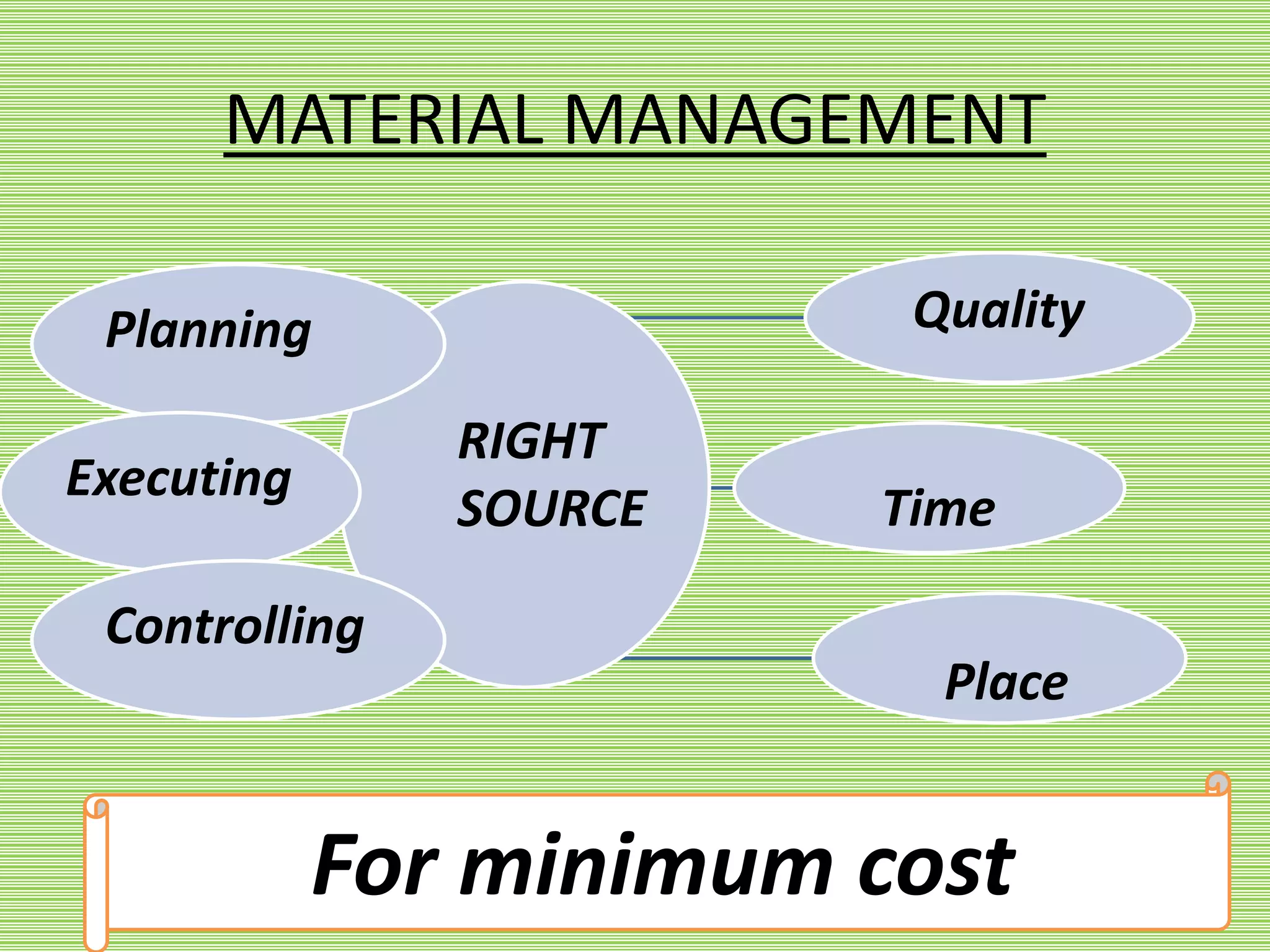
“Materials management can be defined as a
process of planning, executing, and
controlling the right source of materials with
the exact quality, at the right time and place
suitable for minimum cost construction
process.”
MATERIAL MANAGEMENT
Planning
Executing
Controlling
For minimum cost
RIGHT
SOURCE Time
Place
Quality
SUCCESSFUL MATERIAL MANAGEMENT
• Three important phases that holds the key
to a successful materials management are :
Purchasing StoringUsage
It is used to reduce the cost, which increases profitability.
MATERIAL MANAGEMENT
Selection and training of personnel for
• marketing,
• purchasing,
• inventory control,
• stores management
• materials handling
• and placement is also to be seen by the
materials management department.
Raviz Hills
• The present case study was done at Raviz hills
(a construction company).
• It was noticed that the materials are
improperly procured and stored
• And there is a lack of inventory control and
improper management.
EXPERIMENTAL METHODOLOGIES
• The experimental analysis consists of
theories and practical consideration of
the concepts.
• Therefore, the present work was
classified as follows.
Analysis of site and management
Analysis on Inventory controlling
Analysis on purchasing procedures
Analysis on Procurement and Tracking
Analysis on costs
EXPERIMENTAL METHODOLOGIES
Analysis of Site and Management
• The analysis was done to understand what are
all the problems occurring in the company
because of improper application of material
management.
• The solutions that provided in this work may
cost a lot in the beginning, but it will help the
company in the long run.
It will help
• By providing solutions to the key problems like
Lack of specification
Delay
Improper procurement
Purchase problems
Disbursement issues
Methodology
The study was done by visiting the site
Prepared questionnaires and gave to
Site managers
quality control inspector
project manager
purchase manager
Inventory manager
Analysis of site and Management
• It was understood that lack of
technological implications and scientific
approach were lacking with respect to
the procurement process.
• Thus the problems were pointed out
to them and they agreed
Analysis on Inventory Controlling
• Methodology adopted was preparing
questionnaires and allocating marks for
each.
Supply
Materials
Equipment
weightages were given substantially
Analysis on Inventory Controlling
Inventory Planning
• i. Production planning requires purchase
and inventory planning decisions for an
organization to control expenses and finances.
• ii. To get the purchase benefits, discounts,
reduced transportation and ordering cost
the bulk purchase may be economical.
Inventory of such materials are stored for
longer time.
Analysis on Purchasing Proceduresi.
All the organizations need an efficient and
economic purchasing and procurement of
its various supplies of materials from the
suppliers.
Analysis on Purchasing Proceduresi.
Process of Purchasing
The process of purchasing involves various
steps to be followed as routine matter by the
purchase department.
1. Identification of materials:
2. Purchase requisitions:
Analysis on procurement & Tracking
In procurement tracking, the concept
of tracking the material is done mainly
with the help of barcode scanners,
where the quality control manager can
view the materials to where it is being
transported.
Hence a check on the materials can be
done.
Analysis On Cost
This is most popular inventory control
technique adopted as Pareto’s Law.
Eighty percent of the cost of materials
purchased is required for only Twenty
percent costly items.
ABC Analysis
Classification
• The classification of them is necessary to take
particular care of costly items
• To classify the materials according to their
sales values. In this method, all the items of
stores are classified in three groups as A, B
and C as explained below.
Classification
I. The quantity of each item used annually
multiply by its unit sales price is sales value
of that item.
II. The items, its quantity sold and sales values
are tabulated in decreasing order and the
sales values are added item-wise and shown
in next column.
III. The totals of quantity and sales values of
all the items used annually are found out.
Characteristics of ABC Items
I. A-Items.
These items have 70% of sales value but less in
quantity about 15 to 20%. The capital should not
be blocked in these items. They can be ordered
frequently and consumed immediately.
Characteristics of ABC Items
I. B-Items.
They have about 20 to 25% sales value and same
quantity to purchase. Since they are medium
valued items therefore large inventory of them is
not necessary.
They are less valued than A items and
quantity-wise about 15 to 25%
Characteristics of ABC Items
I. C-Items.
They have the least sales cost about 10%. They are
required in large quantity about 50 to 60%. They
can be purchased in bulk to avail large discounts
and fewer prices to pay. This will also reduce the
cost of ordering and purchasing. They can be
purchased once or twice in a year.
They are least-valued items.
Advantages of ABC Analysis
Following are the advantages of ABC Analysis.
The inventory control will be better
Items are economically ordered and stored as
per need
Purchasing becomes easy and discounts on
large purchase
Better record keeping of different categories
First in First out Method (FIFO)
In this method, the material stored first is
issued first. For using this procedure, the
following methods are used.
Double Area System
Moving Division System
Gravity Feed System
Double Area System
In this particular method, two areas are used
for each item to be stored and issued. The
new lots of items are stored in second empty
area and materials are issued from first area
where previous old lot is stored. When first
area is emptied, the material from second
area is shifted to first area so that second
area is emptied to receive the fresh
materials.
Moving Division System
In this method is the place selected for
each item is more in area than required
to provide space between new and old
lots. The materials supplied first are
placed first in right hand side area from
where it is issued. The fresh lot is supplied
in the second area on left hand side and
shifted to right hand side when it is
emptied.
Gravity Feed System
The new materials are fed at the top of the
containers or piles and removed from the
bottom.
Benefits of the method
The method uses actual cost of the
material for valuation and it is very easy to
use.
The only disadvantage of the method is
that if large variation of prices is there,
no consideration is given to current
market prices.
Conclusion
In the present case study, analysis on
the work site was done with the
previous knowledge of the material
management, and new methodologies
were implemented at work site, based on
the current construction scenario.
Conclusion
Following aspects were taken into
consideration, the original site layout was
redesigned, then the proper
management was bought in and a
whole new concept was derived.
Conclusion
Understanding of the problems that occur
at the work site due to, inventory,
purchasing and on how materials are
being handled at the work site were
taken into consideration. On how,
materials are being procured was done
with questionnaires and weightages were
given to each.
Conclusion
Similarly, analysis was done on
purchasing and new concept of purchase
requisition slip and tender quotation were
introduced.
Conclusion
Importance on how materials are properly
procured at the site was also taken into
consideration and new appropriate
technological implications were
introduced which helped us in a proper
scheduling and financial control
ABC analysis and FIFO analysis were done.
Conclusion
from the above theory and concepts,
new theories which help us in proper
material management at worksite were
identified and prime importance was given
to them.
The case study as a whole was
submitted to the Raviz Hills
management system.
Thank you

Material management in construction jeemi

  • 1.
  • 2.
  • 3.
    MATERIAL • Material isthe main component in construction projects. • If the material management is not properly managed it will create a project cost variance. • Project cost can be controlled by taking corrective actins towards the cost variance.
  • 4.
    MATERIAL MANAGEMENT “Materials managementcan be defined as a process of planning, executing, and controlling the right source of materials with the exact quality, at the right time and place suitable for minimum cost construction process.”
  • 5.
  • 6.
    SUCCESSFUL MATERIAL MANAGEMENT •Three important phases that holds the key to a successful materials management are : Purchasing StoringUsage It is used to reduce the cost, which increases profitability.
  • 7.
    MATERIAL MANAGEMENT Selection andtraining of personnel for • marketing, • purchasing, • inventory control, • stores management • materials handling • and placement is also to be seen by the materials management department.
  • 8.
    Raviz Hills • Thepresent case study was done at Raviz hills (a construction company). • It was noticed that the materials are improperly procured and stored • And there is a lack of inventory control and improper management.
  • 9.
    EXPERIMENTAL METHODOLOGIES • Theexperimental analysis consists of theories and practical consideration of the concepts. • Therefore, the present work was classified as follows.
  • 10.
    Analysis of siteand management Analysis on Inventory controlling Analysis on purchasing procedures Analysis on Procurement and Tracking Analysis on costs EXPERIMENTAL METHODOLOGIES
  • 12.
    Analysis of Siteand Management • The analysis was done to understand what are all the problems occurring in the company because of improper application of material management. • The solutions that provided in this work may cost a lot in the beginning, but it will help the company in the long run.
  • 13.
    It will help •By providing solutions to the key problems like Lack of specification Delay Improper procurement Purchase problems Disbursement issues
  • 14.
    Methodology The study wasdone by visiting the site Prepared questionnaires and gave to Site managers quality control inspector project manager purchase manager Inventory manager
  • 15.
    Analysis of siteand Management • It was understood that lack of technological implications and scientific approach were lacking with respect to the procurement process. • Thus the problems were pointed out to them and they agreed
  • 16.
    Analysis on InventoryControlling • Methodology adopted was preparing questionnaires and allocating marks for each. Supply Materials Equipment weightages were given substantially
  • 17.
    Analysis on InventoryControlling Inventory Planning • i. Production planning requires purchase and inventory planning decisions for an organization to control expenses and finances. • ii. To get the purchase benefits, discounts, reduced transportation and ordering cost the bulk purchase may be economical. Inventory of such materials are stored for longer time.
  • 19.
    Analysis on PurchasingProceduresi. All the organizations need an efficient and economic purchasing and procurement of its various supplies of materials from the suppliers.
  • 20.
    Analysis on PurchasingProceduresi. Process of Purchasing The process of purchasing involves various steps to be followed as routine matter by the purchase department. 1. Identification of materials: 2. Purchase requisitions:
  • 21.
    Analysis on procurement& Tracking In procurement tracking, the concept of tracking the material is done mainly with the help of barcode scanners, where the quality control manager can view the materials to where it is being transported. Hence a check on the materials can be done.
  • 22.
    Analysis On Cost Thisis most popular inventory control technique adopted as Pareto’s Law. Eighty percent of the cost of materials purchased is required for only Twenty percent costly items. ABC Analysis
  • 23.
    Classification • The classificationof them is necessary to take particular care of costly items • To classify the materials according to their sales values. In this method, all the items of stores are classified in three groups as A, B and C as explained below.
  • 24.
    Classification I. The quantityof each item used annually multiply by its unit sales price is sales value of that item. II. The items, its quantity sold and sales values are tabulated in decreasing order and the sales values are added item-wise and shown in next column. III. The totals of quantity and sales values of all the items used annually are found out.
  • 25.
    Characteristics of ABCItems I. A-Items. These items have 70% of sales value but less in quantity about 15 to 20%. The capital should not be blocked in these items. They can be ordered frequently and consumed immediately.
  • 26.
    Characteristics of ABCItems I. B-Items. They have about 20 to 25% sales value and same quantity to purchase. Since they are medium valued items therefore large inventory of them is not necessary. They are less valued than A items and quantity-wise about 15 to 25%
  • 27.
    Characteristics of ABCItems I. C-Items. They have the least sales cost about 10%. They are required in large quantity about 50 to 60%. They can be purchased in bulk to avail large discounts and fewer prices to pay. This will also reduce the cost of ordering and purchasing. They can be purchased once or twice in a year. They are least-valued items.
  • 29.
    Advantages of ABCAnalysis Following are the advantages of ABC Analysis. The inventory control will be better Items are economically ordered and stored as per need Purchasing becomes easy and discounts on large purchase Better record keeping of different categories
  • 30.
    First in Firstout Method (FIFO) In this method, the material stored first is issued first. For using this procedure, the following methods are used. Double Area System Moving Division System Gravity Feed System
  • 31.
    Double Area System Inthis particular method, two areas are used for each item to be stored and issued. The new lots of items are stored in second empty area and materials are issued from first area where previous old lot is stored. When first area is emptied, the material from second area is shifted to first area so that second area is emptied to receive the fresh materials.
  • 32.
    Moving Division System Inthis method is the place selected for each item is more in area than required to provide space between new and old lots. The materials supplied first are placed first in right hand side area from where it is issued. The fresh lot is supplied in the second area on left hand side and shifted to right hand side when it is emptied.
  • 33.
    Gravity Feed System Thenew materials are fed at the top of the containers or piles and removed from the bottom.
  • 34.
    Benefits of themethod The method uses actual cost of the material for valuation and it is very easy to use. The only disadvantage of the method is that if large variation of prices is there, no consideration is given to current market prices.
  • 36.
    Conclusion In the presentcase study, analysis on the work site was done with the previous knowledge of the material management, and new methodologies were implemented at work site, based on the current construction scenario.
  • 37.
    Conclusion Following aspects weretaken into consideration, the original site layout was redesigned, then the proper management was bought in and a whole new concept was derived.
  • 38.
    Conclusion Understanding of theproblems that occur at the work site due to, inventory, purchasing and on how materials are being handled at the work site were taken into consideration. On how, materials are being procured was done with questionnaires and weightages were given to each.
  • 39.
    Conclusion Similarly, analysis wasdone on purchasing and new concept of purchase requisition slip and tender quotation were introduced.
  • 40.
    Conclusion Importance on howmaterials are properly procured at the site was also taken into consideration and new appropriate technological implications were introduced which helped us in a proper scheduling and financial control ABC analysis and FIFO analysis were done.
  • 41.
    Conclusion from the abovetheory and concepts, new theories which help us in proper material management at worksite were identified and prime importance was given to them. The case study as a whole was submitted to the Raviz Hills management system.
  • 42.