Standardization & Codification
Presented by :
RAVI KUMAR
13MT07IND010
What is Standardization?
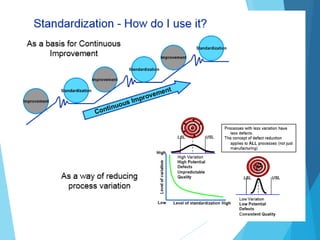
Standardization (Seiketsu)
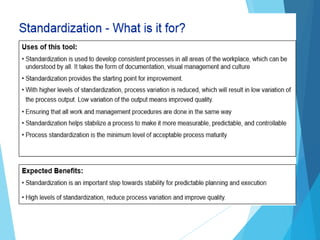
 “Standardization is an activity
giving solution to repetitive
application essentially in the sphere
of science, technology and
economics. aim at the achievement
of the optimum degree of order in a
given context.
- ISO
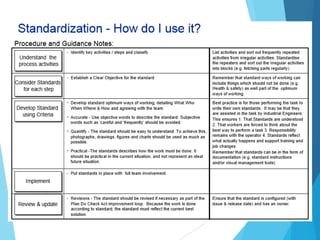
What to standardize?
 Usually starts with a core product as the
foundation.
 Various features are added, these may differ
according to the country market.
 100% standardization is rare.
Objective of Standardization
 To achieve maximum overall economy. this may be
in terms of cost, human effort, construction of
essential material and judicious choice of raw
material.
 Reduction in materials cost, reduction of storage and
inventory.
 Improvement in quality.
Continued…
 Availability of standardized materials,
reduction in the cost of maintenance and
services.
 Elimination of wastes and scrap.
 Achieving higher productivity and higher
profit.
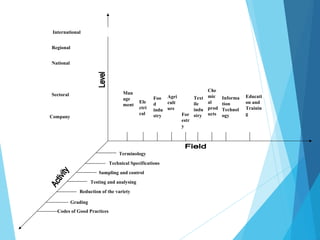
International
Regional
National
Sectoral
Company
Terminology
Technical Specifications
Sampling and control
Testing and analysing
Reduction of the variety
Grading
Codes of Good Practices
Ele
ctri
cal
Foo
d
indu
stry
Agri
cult
ure
For
estr
y
Text
ile
indu
stry
Che
mic
al
prod
ucts
Informa
tion
Technol
ogy
Educati
on and
Trainin
g
Man
age
ment
Product standards
 For product standards the benefits may
be broadly summarized under the
headings variety reduction,
interchangeability, and availability:
 variety reduction
 Interchangeability
 Availability
Types of standard
 Company individual standards
 National standards
 International standards
For international and national
standards
 Uniform terminology is created
 Sizes and dimensions are co-ordinated and
adapted
 Variety is reduced
 Function requirements and characteristics are
specified
 Unambiguous testing methods are established
Advantages of standardization
 Cost reduction
 Improved quality(reliability)
 Global customers(mobility)
 Centralized R & D
Drawbacks of standardization
 Lack of uniqueness
 More barriers, less standardization
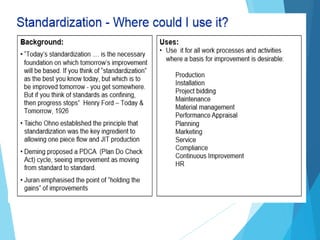
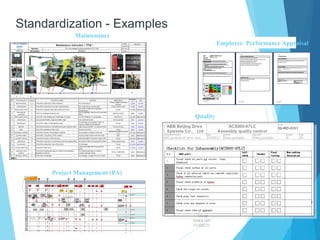
Standardization - Examples
Project Management (PA)
Employee Performance Appraisal
Maintenance
Quality
© ABB
Group
9AKK105
151D0123
15 July 2010, Slide 17
Definitions
 Codification in an industry is the systematic concise
representation of equipment, raw materials, tools,
spares, supplies etc.In an abbreviated form employing
alphabets, numerals, colours, symbols etc.
Need for codification
Speed
Unambiguity
Saving of efforts
Space saving on forms
 Ease of classification,
Stages of Scientific
Codification
 Identification – to know the type of
material in detail
 Classification – description, nature, source
or origin.
 Codification – as per the requirement and
the system
Characteristics of Codes
 Code should be simple.
 Code should be unique.
 Coding should be compact, concise and consistent.
 Code should be sufficiently flexible to meet future
demands
Objectives of Codification
 
 Accurate and logical identification
 Prevention of duplication
 Standardisation and reduction of varieties
 Efficient purchasing
 Easy computerization
TYPES OF CODES
 Alphabetical
Eg: Sulphuric acid~AC-SU
 Numerical
Eg: Pan number, Pin code
 Alpha-numerical
Eg: Vehicleno MH 02 BF 5462
 Color code
Eg: privatevehicle-whitenumber plates
Commercial vehicles-yellow number plates
Basic System
 Arbitrary system
 Numerical system
 Mnemonic system or alpha numeric
system
 Decimal
 Frisch system
 Kodak system
Arbitrary system
 As the name suggests ,this approach does not use any design for
codification. Rather , as and when an item is received by stores in its
receiving bay, a running and unique serial number is assigned to it.
This number becomes the code of the item for subsequent use at
different stages. While this system is the easiest one to use, it does
not help in scientific management of  inventory
 Arbitrary approach is useable only where perhaps items are non-
repetitive and the inventory management need not be scientific.
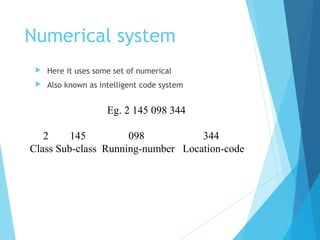
Numerical system
 Here it uses some set of numerical
 Also known as intelligent code system
Eg. 2 145 098 344
2 145 098 344
Class Sub-class Running-number Location-code
Frisch System
 Concieved by Mr. E. G. Frisch with J. Gombinski.
 Divides all facets of organisation into number of main
categories according to nature of requirements.
 The first block gives major classification e.g packing,
raw materials etc.
Frisch System
 The second block gives next level of classification based
on the type of materials.
 The third block gives the lowest level of classification
normally the specifications.
 Originated by Eastman Kodak Company.
 Based on numerical system of codification and
combines all good other points.
 The system employs ten digit codes.
 The Materials are classified according to Purchase
categorisation rather than their nature.
 Divided into few broad classification called Basic
Classification.
Kodak System
Kodak System
 The basic classification is restricted to
100.
 Each class is then further divided into sub
classes.
 Eg – 40(cutting tools)0(drills)
 Each sub class is again further sub divided
 Eg – 400-00
Colour Coding
 Here colours are used to identify the content.
 Generally is used for pipelines, raw materials,
lubricants etc.
Advantages
 Provides absolute clarity to the supplier as to what is required by the
buyer without knowing the technical details.
 Eleminates need to create company‘s specifications.
 It automatically leads to standardization.
 Allows accurate comparison of quotes.
 Variety reduction
 Allows buying from more than one manufacturer.
 Communication between different department is improved.
Continued…
 Reduces inspection and quality costs.
 Ensures interchangability of parts.
 Routinises procurement efforts and reduces clerical
work.
 Reduces procurement lead time.
Can I have Query please?Can I have Query please?

ravi kumar standardization & codification presentation

  • 1.
    Standardization & Codification Presentedby : RAVI KUMAR 13MT07IND010
  • 2.
  • 3.
    Standardization (Seiketsu)  “Standardizationis an activity giving solution to repetitive application essentially in the sphere of science, technology and economics. aim at the achievement of the optimum degree of order in a given context. - ISO
  • 4.
    What to standardize? Usually starts with a core product as the foundation.  Various features are added, these may differ according to the country market.  100% standardization is rare.
  • 5.
    Objective of Standardization To achieve maximum overall economy. this may be in terms of cost, human effort, construction of essential material and judicious choice of raw material.  Reduction in materials cost, reduction of storage and inventory.  Improvement in quality.
  • 6.
    Continued…  Availability ofstandardized materials, reduction in the cost of maintenance and services.  Elimination of wastes and scrap.  Achieving higher productivity and higher profit.
  • 11.
    International Regional National Sectoral Company Terminology Technical Specifications Sampling andcontrol Testing and analysing Reduction of the variety Grading Codes of Good Practices Ele ctri cal Foo d indu stry Agri cult ure For estr y Text ile indu stry Che mic al prod ucts Informa tion Technol ogy Educati on and Trainin g Man age ment
  • 12.
    Product standards  Forproduct standards the benefits may be broadly summarized under the headings variety reduction, interchangeability, and availability:  variety reduction  Interchangeability  Availability
  • 13.
    Types of standard Company individual standards  National standards  International standards
  • 14.
    For international andnational standards  Uniform terminology is created  Sizes and dimensions are co-ordinated and adapted  Variety is reduced  Function requirements and characteristics are specified  Unambiguous testing methods are established
  • 15.
    Advantages of standardization Cost reduction  Improved quality(reliability)  Global customers(mobility)  Centralized R & D
  • 16.
    Drawbacks of standardization Lack of uniqueness  More barriers, less standardization
  • 17.
    Standardization - Examples ProjectManagement (PA) Employee Performance Appraisal Maintenance Quality © ABB Group 9AKK105 151D0123 15 July 2010, Slide 17
  • 19.
    Definitions  Codification inan industry is the systematic concise representation of equipment, raw materials, tools, spares, supplies etc.In an abbreviated form employing alphabets, numerals, colours, symbols etc.
  • 20.
    Need for codification Speed Unambiguity Savingof efforts Space saving on forms  Ease of classification,
  • 21.
    Stages of Scientific Codification Identification – to know the type of material in detail  Classification – description, nature, source or origin.  Codification – as per the requirement and the system
  • 22.
    Characteristics of Codes Code should be simple.  Code should be unique.  Coding should be compact, concise and consistent.  Code should be sufficiently flexible to meet future demands
  • 23.
    Objectives of Codification   Accurate and logical identification  Prevention of duplication  Standardisation and reduction of varieties  Efficient purchasing  Easy computerization
  • 24.
    TYPES OF CODES Alphabetical Eg: Sulphuric acid~AC-SU  Numerical Eg: Pan number, Pin code  Alpha-numerical Eg: Vehicleno MH 02 BF 5462  Color code Eg: privatevehicle-whitenumber plates Commercial vehicles-yellow number plates
  • 25.
    Basic System  Arbitrarysystem  Numerical system  Mnemonic system or alpha numeric system  Decimal  Frisch system  Kodak system
  • 26.
    Arbitrary system  Asthe name suggests ,this approach does not use any design for codification. Rather , as and when an item is received by stores in its receiving bay, a running and unique serial number is assigned to it. This number becomes the code of the item for subsequent use at different stages. While this system is the easiest one to use, it does not help in scientific management of  inventory  Arbitrary approach is useable only where perhaps items are non- repetitive and the inventory management need not be scientific.
  • 27.
    Numerical system  Hereit uses some set of numerical  Also known as intelligent code system Eg. 2 145 098 344 2 145 098 344 Class Sub-class Running-number Location-code
  • 28.
    Frisch System  Concievedby Mr. E. G. Frisch with J. Gombinski.  Divides all facets of organisation into number of main categories according to nature of requirements.  The first block gives major classification e.g packing, raw materials etc.
  • 29.
    Frisch System  Thesecond block gives next level of classification based on the type of materials.  The third block gives the lowest level of classification normally the specifications.
  • 30.
     Originated byEastman Kodak Company.  Based on numerical system of codification and combines all good other points.  The system employs ten digit codes.  The Materials are classified according to Purchase categorisation rather than their nature.  Divided into few broad classification called Basic Classification. Kodak System
  • 31.
    Kodak System  Thebasic classification is restricted to 100.  Each class is then further divided into sub classes.  Eg – 40(cutting tools)0(drills)  Each sub class is again further sub divided  Eg – 400-00
  • 32.
    Colour Coding  Herecolours are used to identify the content.  Generally is used for pipelines, raw materials, lubricants etc.
  • 33.
    Advantages  Provides absoluteclarity to the supplier as to what is required by the buyer without knowing the technical details.  Eleminates need to create company‘s specifications.  It automatically leads to standardization.  Allows accurate comparison of quotes.  Variety reduction  Allows buying from more than one manufacturer.  Communication between different department is improved.
  • 34.
    Continued…  Reduces inspectionand quality costs.  Ensures interchangability of parts.  Routinises procurement efforts and reduces clerical work.  Reduces procurement lead time.
  • 36.
    Can I haveQuery please?Can I have Query please?

Editor's Notes

  • #30 Brisch System     The Brisch system consist of seven digits applied in three stages. The items are grouped into suitable preliminary categories, such as assemblies, sub-assemblies,components and off the shelf items. After these preliminary categories, items are grouped within the respective class in order to bring similar items together. The Brisch system through it consists only of seven digits, is quite comprehensive as the basis is on logical major groupings.        
  • #32 Kodak System     The Kodak system consists of 10 digits of numerical code. The logic of major grouping is based on sources of supply. All materials are divided into 100 basic classifications, contributed only by procurement considerations. For instance, a bolt is listed as hardware item if this is listed in hardware catalogues and available with hardware suppliers. If this bolt is available as a part of the machine, it will be available under maintenance.