Bobby Katoli and Jonathan Startz are members of the management team at MassCatalyst. Their contact information is provided should readers wish to reach out to them.
Page | 2
CROWDFUNDING& JOBS ACT
Definition
Crowdsourcing is the collection of ideas, services, and content from a large group of people. Crowdfunding is an extension of this
concept focusing on the aggregate collection of capital with modern crowdfunding heavily relying on the connectivity of the
Internet. Crowdfunding leverages the Internet to take small amounts of money from multiple funders, pool them together, and give
an aggregate large sum of money to a project, concept, or business.
JOBS Act
The passage of the JOBS Act on April 5, 2012 made it legal for entrepreneurs to solve the obstacle of funding by selling equity to a
large number of investors online via the power of the Internet. The two main titles under the JOBS Act that pertain to MassCatalyst
are Title II and Title III. Title III is expected to be in full effect by the end of the year.
Targets accredited investors
No individual investment limit
No funding limit (i.e. businesses may ask to
receive an unlimited amount of money)
Title II Title III
Targets non-accredited (“ordinary”) investors
Individual investment limit based on
income
Businesses are limited to $1.0 million of
funding every 12 months.
Platform Structure
MassCatalyst will be structured to help all businesses receive funding regardless of investment limit (i.e. the platform will be legally
structured to fund businesses that need more than $1.0 million under Title II and fund businesses that need less than $1.0 million
under Title III).
3.
Page | 3
INTRASTATECROWDFUNDING EXEMPTIONS
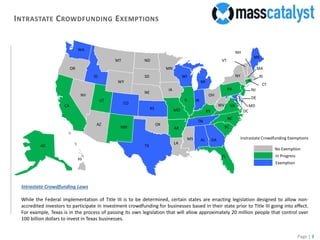
Intrastate Crowdfunding Laws
While the Federal implementation of Title III is to be determined, certain states are enacting legislation designed to allow non-
accredited investors to participate in investment crowdfunding for businesses based in their state prior to Title III going into effect.
For example, Texas is in the process of passing its own legislation that will allow approximately 20 million people that control over
100 billion dollars to invest in Texas businesses.
In Progress
No Exemption
Instrastate Crowdfunding Exemptions
TX
NM
AZ
NV
UT
CA
OR
WA
MT
ID
WY
CO
ND
SD
NE
KS
OK
LA
AR
MO
IA
MN
MS
WI
MI
IL
AL GA
FL
SC
TN
NC
KY
VA
IN
OH
PA
WV
AK
HI
ME
NY
VT
NH
MA
RI
CT
NJ
DE
MD
DC
Exemption
4.
Page | 4
MASSCATALYST’SPLATFORM
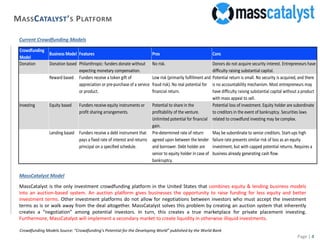
Current Crowdfunding Models
MassCatalyst Model
MassCatalyst is the only investment crowdfunding platform in the United States that combines equity & lending business models
into an auction-based system. An auction platform gives businesses the opportunity to raise funding for less equity and better
investment terms. Other investment platforms do not allow for negotiations between investors who must accept the investment
terms as is or walk away from the deal altogether. MassCatalyst solves this problem by creating an auction system that inherently
creates a “negotiation” among potential investors. In turn, this creates a true marketplace for private placement investing.
Furthermore, MassCatalyst will implement a secondary market to create liquidity in otherwise illiquid investments.
Crowdfunding Models Source: “Crowdfunding’s Potential for the Developing World” published by the World Bank
Crowdfunding
Model
Business Model Features Pros Cons
Donation Donation based Philanthropic: funders donate without
expecting monetary compensation.
No risk. Donors do not acquire security interest. Entrepreneurs have
difficulty raising substantial capital.
Reward based Funders receive a token gift of
appreciation or pre-purchase of a service
or product.
Low risk (primarily fulfillment and
fraud risk). No real potential for
financial return.
Potential return is small. No security is acquired, and there
is no accountability mechanism. Most entrepreneurs may
have difficulty raising substantial capital without a product
with mass appeal to sell.
Investing Equity based Funders receive equity instruments or
profit sharing arrangements.
Potential to share in the
profitability of the venture.
Unlimited potential for financial
gain.
Potential loss of investment. Equity holder are subordinate
to creditors in the event of bankruptcy. Securities laws
related to crowdfund investing may be complex.
Lending based Funders receive a debt instrument that
pays a fixed rate of interest and returns
principal on a specified schedule.
Pre-determined rate of return
agreed upon between the lender
and borrower. Debt holder are
senior to equity holder in case of
bankruptcy.
May be subordinate to senior creditors. Start-ups high
failure rate presents similar risk of loss as an equity
investment, but with capped potential returns. Requires a
business already generating cash flow.
5.
Page | 5
DIFFERENTIATORS
Problem
Crowdfundingis striving to solve the funding gap for startups and businesses in early growth phases. By leveraging the JOBS Act,
crowdfunding is democratizing the investment process by allowing non-accredited investors to invest in business startups. However,
most crowdfunding platforms are very rigid and do not allow for negotiation between investors and businesses. The investors either
accept the terms of the offer set by the business or walk away from the deal altogether. This model does not consider the potential
market forces of supply and demand. To this extent, current investment crowdfunding in this country is failing to truly leverage the
Internet and the JOBS Act to positively benefit businesses and ordinary investors.
Auction Model
Combine equity & debt models (e.g.
auction convertible debt)
Secondary market to create liquidity in an
illiquid investment
Solution Benefit
Businesses can get overfunded for less
equity; early investing is incentivized
Access to a diverse range of financial
products
Investors may have an exit opportunity in
the secondary market
Overall Benefit
Creates a true marketplace to facilitate the flow of capital from investors to entrepreneurs. An auction system creates an inherent
“negotiation” between investors and businesses through the bidding process. Investors bid the value they believe shares in the
business are worth and if their value is high enough they receive equity ownership. Effectively, if bidding is high enough, the business
is issuing the same or less equity for more money than compared to traditional crowdfunding. In addition, a secondary market will
create liquidity and a potential exit opportunity for existing investors. MassCatalyst’s business model provides an effective solution
for the age-old problem of raising capital for a business, in a manner that is superior to all other current competitors.
6.
Page | 6
BENEFITSFOR INVESTORS
Benefits
Our platform wants to privately raise money before the auction goes live.
Auction Model
Combine equity & debt models (e.g.
auction convertible debt)
Secondary market to create liquidity in an
illiquid investment
Solution Benefit
Businesses can get overfunded for less
equity; early investing is incentivized
Access to a diverse range of financial
products
Investors may have an exit opportunity in
the secondary market
Overall Benefit
Creates a true marketplace to facilitate the flow of capital from investors to entrepreneurs. An auction system creates an inherent
“negotiation” between investors and businesses through the bidding process. Investors bid the value they believe shares in the
business are worth and if their value is high enough they receive equity ownership. Effectively, if bidding is high enough, the business
is issuing the same or less equity for more money than compared to traditional crowdfunding. In addition, a secondary market will
create liquidity and a potential exit opportunity for existing investors. MassCatalyst’s business model provides an effective solution
for the age-old problem of raising capital for a business, in a manner that is superior to all other current competitors.
7.
Page | 7
EQUITYAUCTION WALKTHROUGH
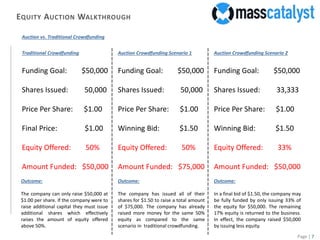
Auction vs. Traditional Crowdfunding
Traditional Crowdfunding
Funding Goal: $50,000
Shares Issued: 50,000
Price Per Share: $1.00
Final Price: $1.00
Equity Offered: 50%
Amount Funded: $50,000
Outcome:
The company can only raise $50,000 at
$1.00 per share. If the company were to
raise additional capital they must issue
additional shares which effectively
raises the amount of equity offered
above 50%.
Auction Crowdfunding Scenario 1
Funding Goal: $50,000
Shares Issued: 50,000
Price Per Share: $1.00
Winning Bid: $1.50
Equity Offered: 50%
Amount Funded: $75,000
Outcome:
The company has issued all of their
shares for $1.50 to raise a total amount
of $75,000. The company has already
raised more money for the same 50%
equity as compared to the same
scenario in traditional crowdfunding.
Auction Crowdfunding Scenario 2
Funding Goal: $50,000
Shares Issued: 33,333
Price Per Share: $1.00
Winning Bid: $1.50
Equity Offered: 33%
Amount Funded: $50,000
Outcome:
In a final bid of $1.50, the company may
be fully funded by only issuing 33% of
the equity for $50,000. The remaining
17% equity is returned to the business.
In effect, the company raised $50,000
by issuing less equity.
8.
Page | 8
EQUITYAUCTION WALKTHROUGH (CONTINUED)
Bidding Process
Investors bid on the price per share, and ultimately, the highest per share bids win the auction.
Investor A:
Investor Amount Invested: Bid:
Investor B:
Investor C:
$25,000
$25,000
$30,000
$2.00
$1.71
$1.50
Auction Information
Funding Goal: $50,000
Shares Issued: 50,000
Price Per Share: $1.00
Equity Offered: 50%
Winning Bid: $1.50
Amount Funded: $75,000
Shares Received:
10,000
23,333
16,667
Investor D: $30,000 $1.40 20,000
Bidding Process
The winning bidders are Investors A, B, & C because these investors were the highest bidders for the 50,000 shares issued by the
company. The total number of shares received by Investors A, B, & C are equal to the 50,000 shares the company offered. All
winning investors will pay the lowest winning price of $1.50. The lowest winning price means that since Investor C was the last
investor to win the auction and only paid $1.50, then it is only fair that all other winning investors pay the same amount of $1.50. In
this example, the company was able to raise $75,000 for the same 50% equity offering while initially seeking only $50,000.
Winning Price:
$1.50
$1.50
$1.50
9.
Page | 9
DEBTAUCTION WALKTHROUGH
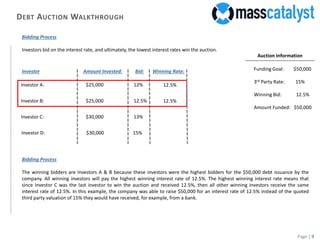
Bidding Process
Investors bid on the interest rate, and ultimately, the lowest interest rates win the auction.
Investor A:
Investor Amount Invested: Bid:
Investor B:
Investor C:
$25,000
$25,000
$30,000
12%
12.5%
13%
Auction Information
Funding Goal: $50,000
3rd Party Rate: 15%
Winning Bid: 12.5%
Amount Funded: $50,000
Investor D: $30,000 15%
Bidding Process
The winning bidders are Investors A & B because these investors were the highest bidders for the $50,000 debt issuance by the
company. All winning investors will pay the highest winning interest rate of 12.5%. The highest winning interest rate means that
since Investor C was the last investor to win the auction and received 12.5%, then all other winning investors receive the same
interest rate of 12.5%. In this example, the company was able to raise $50,000 for an interest rate of 12.5% instead of the quoted
third party valuation of 15% they would have received, for example, from a bank.
Winning Rate:
12.5%
12.5%
10.
Page | 10
CONTACTUS
Management Team
Our executive team brings smart, stable, and trusted guidance to MassCatalyst. With experience ranging from wealth management
and hedge funds to healthcare and valuation, our management team brings the talent, vision, and knowledge necessary to ensure
MassCatalyst provides unparalleled value for our clients.
Bobby Katoli
Email: Bobbykatoli@masscatalyst.com
Direct: 817-308-4319
Office: 469-730-6026
Jonathan Startz
Email: Jonathanstartz@masscatalyst.com
Direct: 281-687-5112
Office: 469-730-6026






![Crowdfunding and it’s benefit for funding real estate 1 [autosaved]](https://cdn.slidesharecdn.com/ss_thumbnails/crowdfundinganditsbenefitforfundingrealestate1autosaved-170627144304-thumbnail.jpg?width=640&height=640&fit=bounds)


