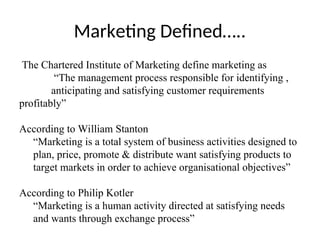
Marketing Defined…..
The CharteredInstitute of Marketing define marketing as
“The management process responsible for identifying ,
anticipating and satisfying customer requirements
profitably”
According to William Stanton
“Marketing is a total system of business activities designed to
plan, price, promote & distribute want satisfying products to
target markets in order to achieve organisational objectives”
According to Philip Kotler
“Marketing is a human activity directed at satisfying needs
and wants through exchange process”
4.
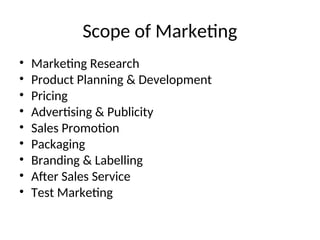
Scope of Marketing
•Marketing Research
• Product Planning & Development
• Pricing
• Advertising & Publicity
• Sales Promotion
• Packaging
• Branding & Labelling
• After Sales Service
• Test Marketing
5.
Importance/ Benefits OfMarketing
• Satisfaction of human needs & wants
• Profits & market reputation
• Facilitates specialisation division of labour
• Widens the market
• Improves standard of living
• Bring economic growth
• Creates new norms of social economic behaviour
• Provides channels of communication to business firms
• Facilitates price control
• Develops social significance at.
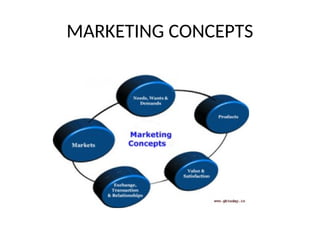
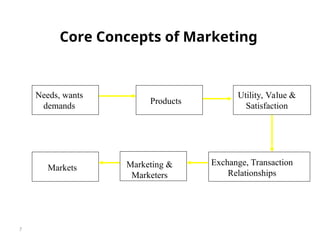
Need, Want &Demand
Aneed is a state of felt deprivation of some basic satisfaction
Wants are desires for specific satisfiers of these deprived needs
Demands are wants for specific products that are backed by an
ability and willingness to buy them
9.
Marketing Concept Continued…
Productis any thing that can be offered to satisfy a need or
want
Exchange is the act of obtaining a desired product from
someone by offering something in return
A Market consists of all the potential customers sharing a
particular need or want who might be willing and able to
engage in exchange to satisfy that need or want.
10.
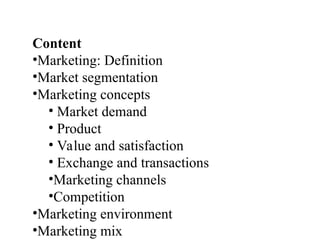
Market Segmentation
Market segmentationis a marketing strategy that involves dividing a
broad target market into subsets of consumers who have common needs,
and then designing and implementing strategies to target their needs and
desires using media channels and other touch-points that best allow to
reach them.
The process of defining and subdividing a large homogeneous market
into clearly identifiable segments having similar needs, wants or
demand characteristics. Its objective is to design a market mix that
precisely matches the expectations of customers in the targeted segment.
12.
• Geographic—The studyof city size,
urban/suburban/rural population distribution and
climate.
• Demographic—The study of distribution of
population’s age, sex, income, stage in family cycle
and ethnic background.
• Psychographic—Personalties, lifestyles, social class
including Activities Interests and Opinions (AIO).
• Behaviour towards products.
• Benefits desired or sought.
• Product usage rate.
13.
Objectives of segmentationare:
1) To reduce risk in deciding where, when, how, and to
whom a product, service, or brand will be marketed;
2) To increase marketing efficiency by directing effort
specifically toward the designated segment in a
manner consistent with that segment's characteristics.
14.
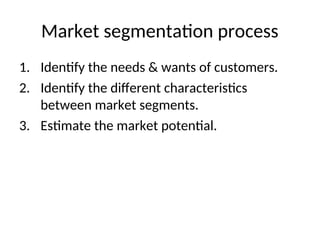
Market segmentation process
1.Identify the needs & wants of customers.
2. Identify the different characteristics
between market segments.
3. Estimate the market potential.
15.
Marketing channels
Marketing channelscan be viewed as a sets of interdependent organizations
involved in the process of making a product or service available for use or
consumption
Functions
• Information
• Promotion
• Negotiation
• Ordering
• Financing
• Risk taking
• Physical possession
• Payment
• Title
16.
Channel selection
• Analyzingthe customer needs (lot size, waiting time, product
variety, service backing etc)
• Establishing channel objectives( product characteristics)
• Identifying the major alternatives (types & No of intermediaries)
• Evaluating (Economic, Control, Adaptive Criteria)
Competition
To prepare aneffective marketing strategy, a
company must study its competitors as well as its
actual and potential customers
A company's closest competitors are those seeking to
satisfy the same customers and needs and marketing
similar offers
A company needs to gather information on
competitor’s strategies objectives, strengths,
weakness, and reaction pattern
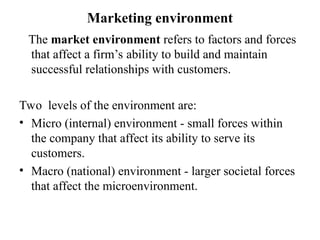
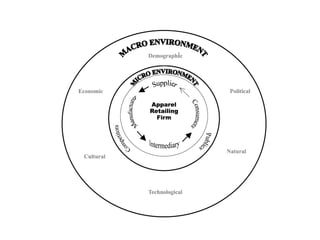
Marketing environment
The marketenvironment refers to factors and forces
that affect a firm’s ability to build and maintain
successful relationships with customers.
Two levels of the environment are:
• Micro (internal) environment - small forces within
the company that affect its ability to serve its
customers.
• Macro (national) environment - larger societal forces
that affect the microenvironment.
23.
Marketing Mix
Is theset of marketing tools that the firm uses to pursue its
marketing objectives in the target market.
From the sellers view point (4P)
• Product
• Price
• Place
• Promotion
Customers View point (4C)
• Customer needs and wants
• Cost
• Convenience
• Communication
24.
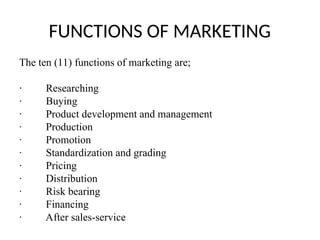
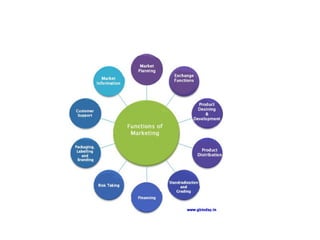
FUNCTIONS OF MARKETING
Theten (11) functions of marketing are;
· Researching
· Buying
· Product development and management
· Production
· Promotion
· Standardization and grading
· Pricing
· Distribution
· Risk bearing
· Financing
· After sales-service
Relating Price toAds and
Promotion
Price must be consistent with perceptions of
the product
Higher prices communicate higher product
quality
Lower prices reflect bargain or “value”
perceptions
Price, advertising and distribution be unified
in
identifying product position
Pricing
Considerations
A product positioned as high quality while
carrying a lower price than competitors will
confuse customers
#17 Relation to text
This slide refers to material on pp. 65-66 of the text.
Summary Overview
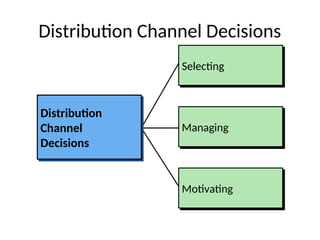
Distribution decisions are among the most important made by marketers and often play a role in shaping the image of a company or brand. This slide shows various distribution channel decisions marketers must make including:
Selecting the type of channels that will be used to distribute a product
Managing the relationship with channel members
Motivating channel members to stock and promote the company’s product
Use of this slide
This slide can be used as part of a discussion of distribution channel decisions and how they must be coordinated with the other elements of the marketing mix.
#18 Relation to text
This slide refers to material on pp. 65-66 of the text.
Summary Overview
Marketing channel intermediaries are critical to the success of a company’s marketing program. Brokers, distributors, wholesalers, and retailers are all intermediaries or “middlemen” who are involved in the process of making a product or service available for use or consumption. Intermediaries are sometimes called resellers.
Consistent with the product and pricing decisions, where the product is distributed sends a message. Selling a product at Neiman Marcus conveys a very different message than selling it at Wal-Mart.
Use of this slide
This slide can be used to introduce the various marketing intermediaries and discuss the important role they play in the marketing process.
#27 Relation to text
This slide relates to material on pp. 64-65 of the text.
Summary Overview
The price that a firm charges for a product or services must be consistent with it’s advertising and promotion campaigns. A number of pricing considerations are shown on this slide. It is important to point out that a product positioned as a high quality while carrying a lower price than competitors will confuse customers
Use of this slide
This slide can be used to explain the role of pricing decisions in an IMC program. Pricing needs to be coordinated with the other elements in the marketing mix to create an effective IMC program.











![[EN].CleverGroup Vietnam Profile 20251202](https://cdn.slidesharecdn.com/ss_thumbnails/en-260120091417-fe6f88ec-thumbnail.jpg?width=640&height=640&fit=bounds)

![[rokonz.com] Glossary of Semantic SEO Part-1.pdf](https://cdn.slidesharecdn.com/ss_thumbnails/rokonz-260123200456-440e4060-thumbnail.jpg?width=640&height=640&fit=bounds)


