INTRODUCTION TO
MARKETING
Definition of Marketing
• According to American Marketing Association (2004) - "Marketing is an organisational function and set of
processes for creating, communicating and delivering value to customers and for managing relationships in a
way that benefits both the organisation and the stakeholder.“
• AMA (1960) - "Marketing is the performance of business activities that direct the flow of goods and services
from producer to consumer or user."
• According to Eldridge (1970) - "Marketing is the combination of activities designed to produce profit through
ascertaining, creating, stimulating, and satisfying the needs and/or wants of a selected segment of the market."
• According to Kotler (2000) - "A societal process by which individuals and groups obtain what they need and
want through creating, offering, and freely exchanging products and services of value with others."
Nature of Marketing
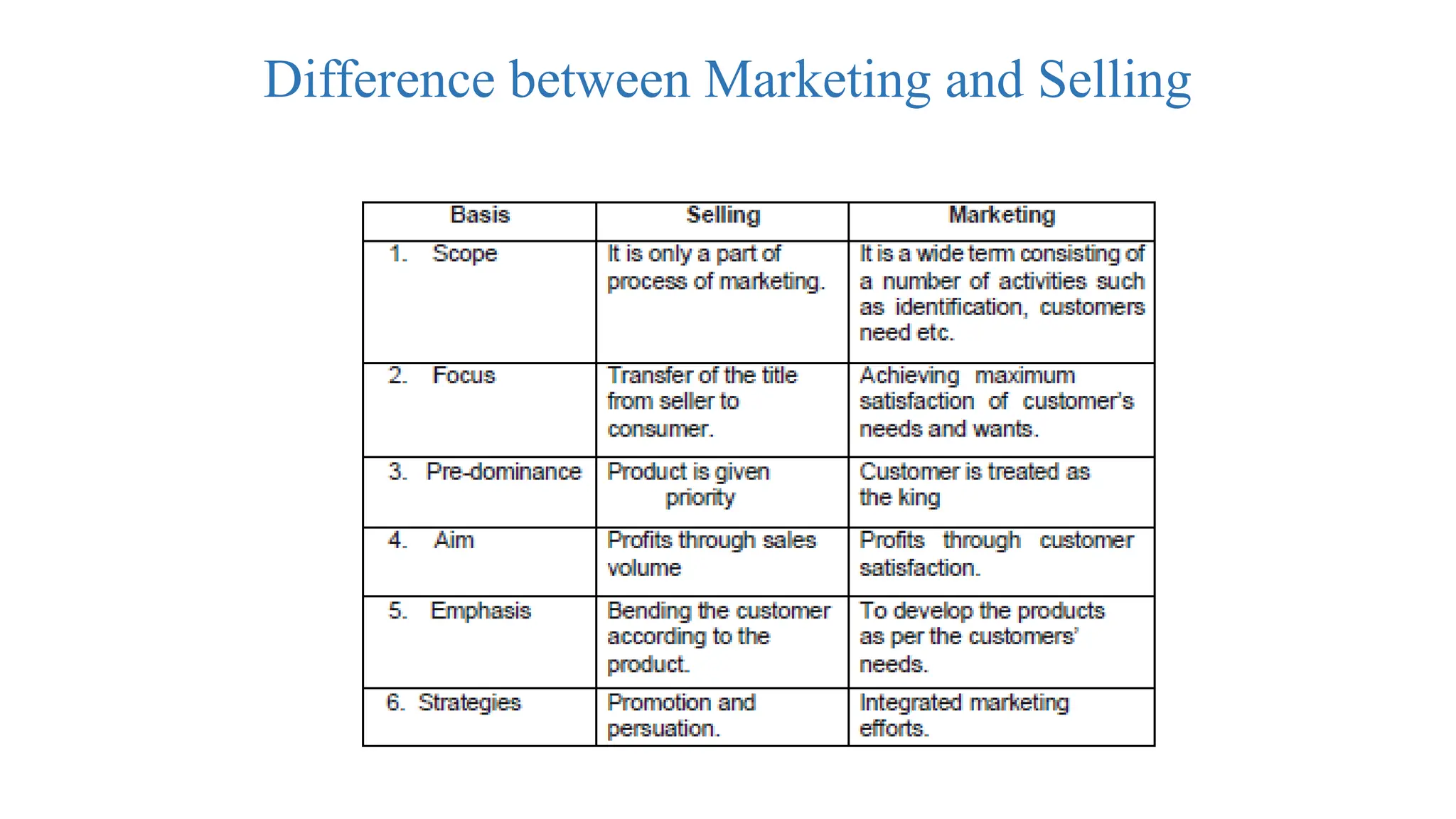
Difference between Marketing and Selling
Objectives of Marketing
•Customer Satisfaction
•Ensure Profitability
•Building Organizational Goodwill
•Create Demand
•Increase Sales Volume
•Enhance Product Quality
•Create Time and Place Utility
IMPORTANCE OF MARKETING
1. Analyzing Market Opportunities
2. Determination of Target Market
3. Planning and Decision Making
4. Creation of Customer
5. Helps in Increasing Profit
6. Improvement in Quality of Life
7. Employment Opportunities
Approaches to the study of Marketing
1. Product or Commodity Approach:
• Under the commodity approach the focus is placed on the product or it is an approach on the marketing on commodity wise basis. In other
words, the study relates to the flow of a certain commodity and its movement from the original producer right up to the ultimate customer.
The subject-matter, under this study, is commodity.
• When one studies the marketing on this basis—commodity approach, one must begin to study and analyses the problems relating to a
commodity i.e., sources and conditions of supply, nature and extent of demand, mode of transporting, storage, standardization, packing etc.
Again, take an example of a commodity, say rice.
• One has to study the sources of rice, location, people involved in buying and selling, means of transport, problems of selling the product,
financing, storage, packing etc. Thus, we get a full picture of the marketing from the original producer to the ultimate consumer. The method
of study is repeated for each item.
• The system claims that it is simple and gives good result over the marketing of each product; description study is possible. But at the same
time this approach is time-consuming and repetitive process which is a drawback.
2. Institutional Approach:
• In the institutional approach, the focus is on the study of institutions- middlemen, wholesalers, retailers,
importers, exporters, agencies, warehousing etc., engaged in the marketing during the movement of goods. The
approach is also known as middlemen approach. Here, emphasis is given to understand and analyses the functions
of institutions, who are discharging their marketing functions.
• The activities of each institution form a part of marketing and collectively complete the marketing functions. In
the process of moving the goods from the producer to the final consumers, a large number of persons are engaged.
This system pays attention to the problems and functions of marketing institutions-transporting, banks and other
financial institutions, warehousing, advertising, insurance etc. This method does not give adequate knowledge of
the entire marketing functions and also’ fails to explain the interrelations of different institutions.
3. Functional Approach:
• The functional approach gives importance on the various functions of marketing. In other words, one concentrates
attention on the specialized services or functions performed by marketers. In this approach, marketing splits into
many functions-buying, selling, pricing, standardization, storage, transportation, advertising, packing etc. This
may be studied one after another. Here each function is studied in detail in order to understand it and analyses the
nature, need and importance of each function.
• In this approach, marketing is regarded as “business of buying and selling and as including those business
activities involved in the flow of goods and services between producers and customers.” This system gives too
much importance to various marketing functions and fails to explain how such functions are applied to the
specific business operations.
4. Management Approach:
• This approach is the latest and scientific. It concentrates upon the activities or marketing functions and focuses on the
role of decision-making at the level of firm. This approach is mainly concerned with how managers handle specific
problems and situations. It aims through evaluation of current market practices to achieve specific marketing objectives.
• Generally there are two factors-controllable and uncontrollable, which are more concerned with the decision-making.
Controllable include price adjustment, advertisement etc. Uncontrollable-economical, sociological, psychological,
political etc. are the basic causes for market changes. And these changes cannot be controlled by any firm.
• But controllable can be controlled by the firm. The uncontrollable limit the marketing opportunities. As such, managerial
approach is concerned with the study of uncontrollable and then taking decisions for controllable within the scope set by
uncontrollable. Managerial or decision-making approach emphasizes on the practical aspects of marketing, but ignores
the theoretical aspects of marketing. At the same time, this approach, provides an overall information of the entire
business.
5. System Approach:
• The system approach can be defined as “a set of objects together with the relationships among them and their attributes.”
Systems focus on interrelations and interconnections among the functions of marketing. The system examines marketing
connections (linkage) inside as well as outside the firm. Inside the firm there is a co-ordination of business activities-
engineering, production, marketing, price etc.
• On the basis of feedback information proper control is exercised to modify or alter in the producing process, so that the desired
output can be produced. Here, the aim is to secure profit through customer-satisfaction. Markets can be understood only through
the study of marketing information. For instance, business is composed of many functions, which are composed of sub
functions. Each function or sub-function is independent, but interrelated and enables the other to achieve marketing objectives.
6. Societal Approach:
• This approach has been originated recently. The marketing process is
regarded as a means by which society meets its own consumption needs.
This system gives no importance as to how the business meets the
consumer’s needs. Therefore, attention is paid to ecological factors
(sociological, cultural, legal etc.) and marketing decisions and their impact
on the society’s well-being.
7. Legal Approach:
• This approach emphasizes only one aspect i.e., transfer of ownership to
buyer: It explains the regulatory aspect of marketing. In India, the
marketing activities are largely controlled by Sales of Goods Act, Carrier
Act etc. The study is concentrated only on legal aspects, leaving other
important aspects. This does not give an idea of marketing.
8. Economic Approach:
• This approach deals with only the problems of supply, demand and
price. These are important from the economic point of view, but fail to
give a clear idea of marketing.
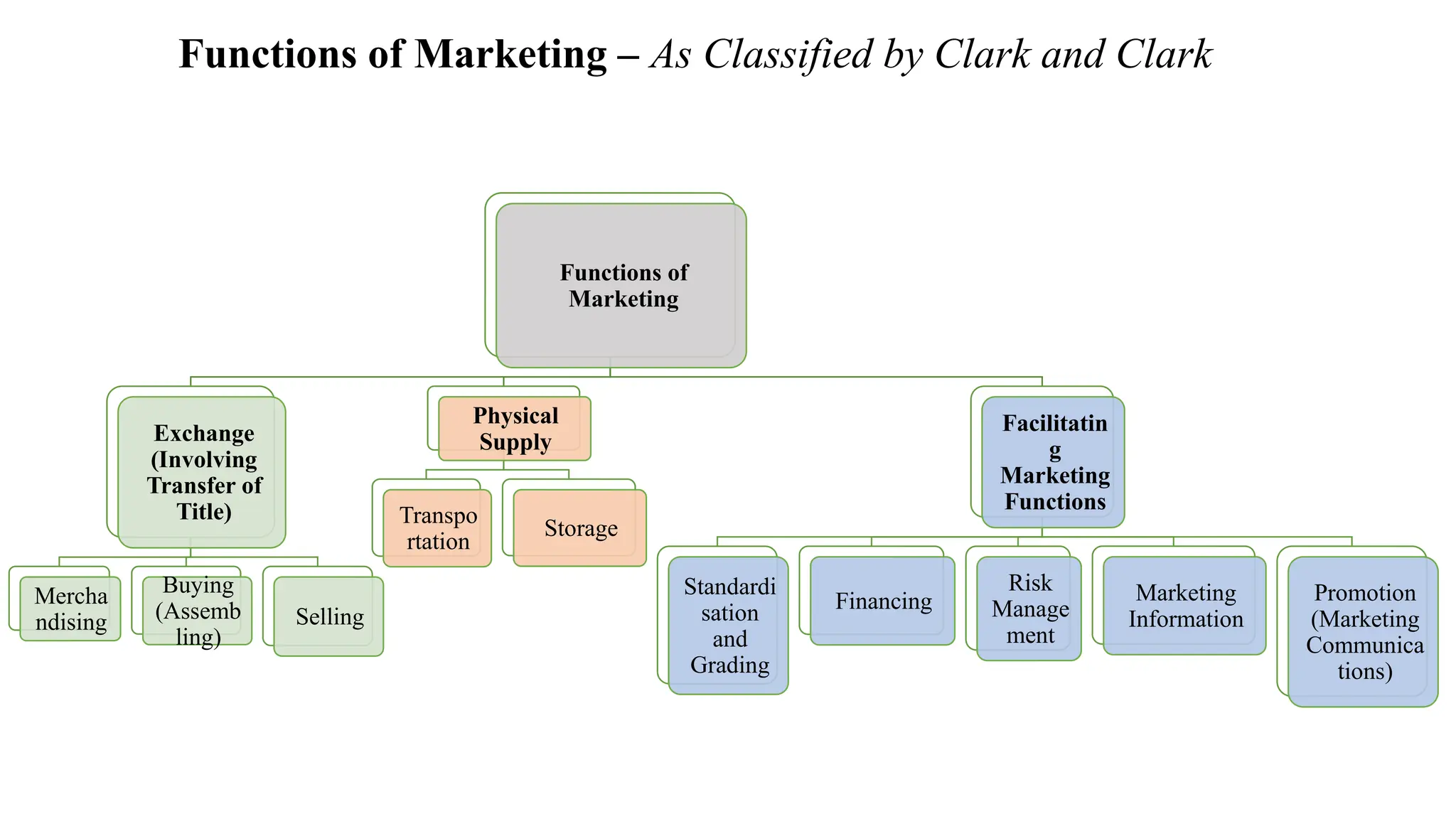
Functions of Marketing – As Classified by Clark and Clark
Functions of
Marketing
Exchange
(Involving
Transfer of
Title)
Mercha
ndising
Buying
(Assemb
ling)
Selling
Physical
Supply
Transpo
rtation
Storage
Facilitatin
g
Marketing
Functions
Standardi
sation
and
Grading
Financing
Risk
Manage
ment
Marketing
Information
Promotion
(Marketing
Communica
tions)
Marketing management Introduction Part-1

Marketing management Introduction Part-1

  • 1.
  • 2.
    Definition of Marketing •According to American Marketing Association (2004) - "Marketing is an organisational function and set of processes for creating, communicating and delivering value to customers and for managing relationships in a way that benefits both the organisation and the stakeholder.“ • AMA (1960) - "Marketing is the performance of business activities that direct the flow of goods and services from producer to consumer or user." • According to Eldridge (1970) - "Marketing is the combination of activities designed to produce profit through ascertaining, creating, stimulating, and satisfying the needs and/or wants of a selected segment of the market." • According to Kotler (2000) - "A societal process by which individuals and groups obtain what they need and want through creating, offering, and freely exchanging products and services of value with others."
  • 3.
  • 4.
  • 5.
    Objectives of Marketing •CustomerSatisfaction •Ensure Profitability •Building Organizational Goodwill •Create Demand •Increase Sales Volume •Enhance Product Quality •Create Time and Place Utility
  • 6.
    IMPORTANCE OF MARKETING 1.Analyzing Market Opportunities 2. Determination of Target Market 3. Planning and Decision Making 4. Creation of Customer 5. Helps in Increasing Profit 6. Improvement in Quality of Life 7. Employment Opportunities
  • 7.
    Approaches to thestudy of Marketing 1. Product or Commodity Approach: • Under the commodity approach the focus is placed on the product or it is an approach on the marketing on commodity wise basis. In other words, the study relates to the flow of a certain commodity and its movement from the original producer right up to the ultimate customer. The subject-matter, under this study, is commodity. • When one studies the marketing on this basis—commodity approach, one must begin to study and analyses the problems relating to a commodity i.e., sources and conditions of supply, nature and extent of demand, mode of transporting, storage, standardization, packing etc. Again, take an example of a commodity, say rice. • One has to study the sources of rice, location, people involved in buying and selling, means of transport, problems of selling the product, financing, storage, packing etc. Thus, we get a full picture of the marketing from the original producer to the ultimate consumer. The method of study is repeated for each item. • The system claims that it is simple and gives good result over the marketing of each product; description study is possible. But at the same time this approach is time-consuming and repetitive process which is a drawback.
  • 8.
    2. Institutional Approach: •In the institutional approach, the focus is on the study of institutions- middlemen, wholesalers, retailers, importers, exporters, agencies, warehousing etc., engaged in the marketing during the movement of goods. The approach is also known as middlemen approach. Here, emphasis is given to understand and analyses the functions of institutions, who are discharging their marketing functions. • The activities of each institution form a part of marketing and collectively complete the marketing functions. In the process of moving the goods from the producer to the final consumers, a large number of persons are engaged. This system pays attention to the problems and functions of marketing institutions-transporting, banks and other financial institutions, warehousing, advertising, insurance etc. This method does not give adequate knowledge of the entire marketing functions and also’ fails to explain the interrelations of different institutions.
  • 9.
    3. Functional Approach: •The functional approach gives importance on the various functions of marketing. In other words, one concentrates attention on the specialized services or functions performed by marketers. In this approach, marketing splits into many functions-buying, selling, pricing, standardization, storage, transportation, advertising, packing etc. This may be studied one after another. Here each function is studied in detail in order to understand it and analyses the nature, need and importance of each function. • In this approach, marketing is regarded as “business of buying and selling and as including those business activities involved in the flow of goods and services between producers and customers.” This system gives too much importance to various marketing functions and fails to explain how such functions are applied to the specific business operations.
  • 10.
    4. Management Approach: •This approach is the latest and scientific. It concentrates upon the activities or marketing functions and focuses on the role of decision-making at the level of firm. This approach is mainly concerned with how managers handle specific problems and situations. It aims through evaluation of current market practices to achieve specific marketing objectives. • Generally there are two factors-controllable and uncontrollable, which are more concerned with the decision-making. Controllable include price adjustment, advertisement etc. Uncontrollable-economical, sociological, psychological, political etc. are the basic causes for market changes. And these changes cannot be controlled by any firm. • But controllable can be controlled by the firm. The uncontrollable limit the marketing opportunities. As such, managerial approach is concerned with the study of uncontrollable and then taking decisions for controllable within the scope set by uncontrollable. Managerial or decision-making approach emphasizes on the practical aspects of marketing, but ignores the theoretical aspects of marketing. At the same time, this approach, provides an overall information of the entire business.
  • 11.
    5. System Approach: •The system approach can be defined as “a set of objects together with the relationships among them and their attributes.” Systems focus on interrelations and interconnections among the functions of marketing. The system examines marketing connections (linkage) inside as well as outside the firm. Inside the firm there is a co-ordination of business activities- engineering, production, marketing, price etc. • On the basis of feedback information proper control is exercised to modify or alter in the producing process, so that the desired output can be produced. Here, the aim is to secure profit through customer-satisfaction. Markets can be understood only through the study of marketing information. For instance, business is composed of many functions, which are composed of sub functions. Each function or sub-function is independent, but interrelated and enables the other to achieve marketing objectives.
  • 12.
    6. Societal Approach: •This approach has been originated recently. The marketing process is regarded as a means by which society meets its own consumption needs. This system gives no importance as to how the business meets the consumer’s needs. Therefore, attention is paid to ecological factors (sociological, cultural, legal etc.) and marketing decisions and their impact on the society’s well-being.
  • 13.
    7. Legal Approach: •This approach emphasizes only one aspect i.e., transfer of ownership to buyer: It explains the regulatory aspect of marketing. In India, the marketing activities are largely controlled by Sales of Goods Act, Carrier Act etc. The study is concentrated only on legal aspects, leaving other important aspects. This does not give an idea of marketing.
  • 14.
    8. Economic Approach: •This approach deals with only the problems of supply, demand and price. These are important from the economic point of view, but fail to give a clear idea of marketing.
  • 15.
    Functions of Marketing– As Classified by Clark and Clark Functions of Marketing Exchange (Involving Transfer of Title) Mercha ndising Buying (Assemb ling) Selling Physical Supply Transpo rtation Storage Facilitatin g Marketing Functions Standardi sation and Grading Financing Risk Manage ment Marketing Information Promotion (Marketing Communica tions)