Group No. 03
Members         Roll No
1.    Tayyab       7633 Group Leader (History, Definition)
2.    Sumaira      7655 Advantage & Disadvantage
3.    Hafiz Irbaz  7674 Kinds (half)
4.    Saim Mughal 7697 Kinds (half)
5.    Hafiza Pakiza7659 Objectives
6.    Arslan Niazi 7691 Advertisement Budget
7.    Nawaz        7688 Budget Factor & Method
8.    Mubashar 7682 Development Advertisement Strategies
9.    Usman        7685 Selecting Media
10.   M. Usman     7650 Evaluation of Advertisement
11.   Abdullah     7653 Public Relation
12.   Ali Goraya 7662 Tools of Public Relation
Advertising and Public
Relations
    Advertising
    History
    Advantages & Disadvantages
    Types of advertisement
    Setting Advertising Objectives
    Setting the Advertising Budget
    Factor of Advertisement Budget
    Method of Advertisement Budget
    Developing Advertising Strategy
    Evaluating Advertising
    Public Relations
    The Role and Impact of Public Relations
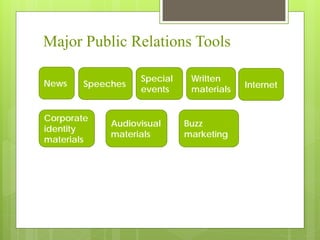
    Major Public Relations Tools
Advertising
Advertising means the bringing the
 product into the market for a general
 public and increase it sale.
Toinform
Knowledge
Awareness
History
 Ago 4000 BC years the roman painted the
 wall to announce the gladiator fights.
Phoenicians painted the picture graces
shows to sale castles cosmetics.
3 R’s of Advertisement
 Recruiting new customers
 Retaining loyal customer
 Reducing lost customer
Advantages:-
 Reducing  per unit cost
 New product
 Increasing sale
 Consumer benefits
 Medea income
 Research
 Good will
 Regular demand
 Improving quality
 Expansion of market
Disadvantages
 High  pricing
 Economic wastages
 Inflation
 Disappointment
 Misuse
 Burdon on consumer
 Bad results
 Discourage competition
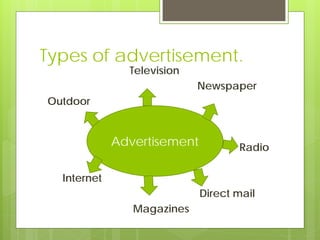
Types of advertisement.
               Television
                            Newspaper
Outdoor


             Advertisement          Radio

  Internet
                             Direct mail
                Magazines
Setting Advertising Objectives
An advertising objective is a specific
   communication task to be
   accomplished with a specific
   target audience during a specific
   time

Objectives are classified by primary
  purpose
 Inform
 Persuade
 Remind
Informative advertising is used when
introducing a new product category;
the objective is to build primary
demand
Comparative advertising directly or
indirectly compares the brand with one
or more other brands
 Persuasive advertising is important with
increased competition to build
selective demand
Reminder advertising is important with
mature products to help maintain
customer relationships and keep
customers thinking about the product
Advertising Budget
 The amount which is set aside from total
 budget of company for advertisement
 expenses
 1. Depends on your money

 2. Requirement

 3.Target consumer
 .
Factors of setting advertising budget
1.   Stages in the product life cycle.
    New product
      Maturity stage.
2.   Impact on Market shares.
    Taking market share.
    Low share brands.
3.    Competition and clutter.
     Create image against competitors.
     Know about the strong competitors.
4.Undifferentiated Product.
Soft drinks (Coke and Pepsi)
Laundry detergents (Arial and Surf excel)
Methods of advertising
budget
     There are commonly five methods use for
                     advertising budget
1.    Inertia Method
     Spend same amount in last year.
2.    Competitive Method
     Spending same as our competitors spend.
3.    Affordability Method
     Spend as much as we can afford.
     Totally ignore our competitors.
     Also ignore the market situation
4.Percentage of sales
Method
Predetermined percentage of expected sales.
5. Objective and Task
Method
Objectives and tasks that need to be
accomplished.
Developing Advertising
Strategy
 Advertising strategy is a campaign
 developed to communicate ideas about
 products and services to potential
 consumers in the hope of convincing
 them to buy those products and services.
Creating the Advertising
Message

Advertising Strategy consists of two elements.

   Creating advertising messages

   Selecting advertising media
Creating the Advertising
Message
  A creative strategy focus on what the advertising
  message says or communicate and guides the
  development of all messages used in the
  advertising campaign.

It’s Success depends (Break through the clutter)
 Gain attention
 Powerful communication
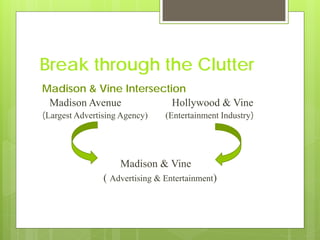
Break through the Clutter
Madison & Vine Intersection
 Madison Avenue          Hollywood & Vine
(Largest Advertising Agency)    (Entertainment Industry)


                    Madison & Vine
                ( Advertising & Entertainment)
Elements of a successful
Advertising Message
 Well  planned
   More imaginative
   Attractive
   Entertaining
   More beneficial or rewarding for consumer.
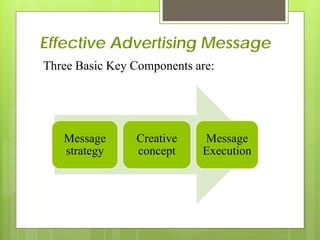
Effective Advertising Message
Three Basic Key Components are:


   Message      Creative    Message
   strategy     concept     Execution
Message strategy
General message communicated to consumers

Purpose:
 To get consumer to think about or react to the
  product. So the ultimate focus is identifying
  customer benefits as advertising appeals.
Cont……
Message strategy statements should be

   Plain (simple language)
   Straightforward outlines of benefits
   Positioning points ( wants to stress)
Creative concept
Big idea that will bring the message strategy to life in
             a distinctive & memorable way.

Creative concept may be:
 visual
 Phrase
 combination of both.
Cont…
It'll guide the choice of specific appeals
   to be used in advertising campaign.

Advertising appeals should be:
 Meaningful
 Believable
 Distinctive


 For Example: wrist watch
Message execution
Message execution Turns the big idea into an actual
 ad execution. that will capture the Target market’s
 attention and interest.

Execution Style:
Best approach, Style, Tone, words & format used for
          executing an advertising message.
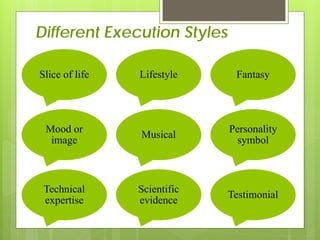
Different Execution Styles

Slice of life   Lifestyle     Fantasy


 Mood or                     Personality
                Musical
  image                       symbol


 Technical      Scientific
                             Testimonial
 expertise      evidence
Consumer Generated Messages
    Tapping consumers for message ideas or ads.

 It includes:
  Searching existing video sites
  Setting up their own sites
  Sponsoring ad-creation contests
  Other promotions
Cont….

Benefits:
   Little Expense
   Collect new creative ideas
   Fresh perspective on brand
   Brand value for consumer
   Consumer involvement
   Develop consumer interest in your brand.
Selecting Advertising Media

Major steps include:
 Deciding on reach—frequency—impact
 Selecting media vehicles
 Deciding on media timing
Selecting Advertising Media

Reach is a measure of the percentage of
   people in the target market who are
   exposed to the ad campaign during a
   given period of time

Frequency is a measure of how many times
   the average person in the target market
   is exposed to the message

Impact is the qualitative value of a message
   exposure through a given medium
Selecting Advertising Media

Selecting media vehicles involves decisions
    presenting the media effectively and
    efficiently to the target customer and
    must consider the message’s:
 Impact
 Effectiveness
 Cost
Selecting Advertising Media

When deciding on media timing, the
  planner must consider:
 Seasonality
 Pattern of the advertising
     Continuity—scheduling within a given
      period
     Pulsing—scheduling unevenly within a
      given period
Evaluating Advertising
Communication effects indicate whether
  the ad and media are communicating
  the ad message well and should be
  tested before or after the ad runs

Sales and profit effects compare past sales
    and profits with past expenditures or
    through experiments
Public Relations
 Public relations involves building good
    relations with the company’s various
    publics by obtaining favorable
    publicity, building up a good
    corporate image, and handling or
    heading off unfavorable rumors,
    stories, and events

 Public relations is used to promote
   product, people, ideas, and activities
Public Relations
Public relations department functions
   include:
 Press relations or press agency
 Product publicity
 Public affairs
 Lobbying
 Investor relations
 Development
Public Relations
Press relations or press agency involves the
    creation and placing of newsworthy
    information to attract attention to a
    person, product, or service

Product publicity involves publicizing
   specific products

Public affairs involves building and
   maintaining national or local community
   relations
Public Relations
Lobbying involves building and maintaining
   relations with legislators and government
   officials to influence legislation and
   regulation

Investor relations involves maintaining
   relationships with shareholders and others
   in the financial community

Development involves public relations with
   donors or members of nonprofit
   organizations to gain financial or
   volunteer support
Public Relations

The    Role and Impact of
    Public Relations
   Lower cost than advertising
   Stronger impact on public awareness
    than advertising
Major Public Relations Tools

                   Special    Written
News    Speeches                          Internet
                   events     materials


Corporate
             Audiovisual     Buzz
identity
             materials       marketing
materials

Market advertizing

  • 2.
    Group No. 03 Members Roll No 1. Tayyab 7633 Group Leader (History, Definition) 2. Sumaira 7655 Advantage & Disadvantage 3. Hafiz Irbaz 7674 Kinds (half) 4. Saim Mughal 7697 Kinds (half) 5. Hafiza Pakiza7659 Objectives 6. Arslan Niazi 7691 Advertisement Budget 7. Nawaz 7688 Budget Factor & Method 8. Mubashar 7682 Development Advertisement Strategies 9. Usman 7685 Selecting Media 10. M. Usman 7650 Evaluation of Advertisement 11. Abdullah 7653 Public Relation 12. Ali Goraya 7662 Tools of Public Relation
  • 3.
    Advertising and Public Relations  Advertising  History  Advantages & Disadvantages  Types of advertisement  Setting Advertising Objectives  Setting the Advertising Budget  Factor of Advertisement Budget  Method of Advertisement Budget  Developing Advertising Strategy  Evaluating Advertising  Public Relations  The Role and Impact of Public Relations  Major Public Relations Tools
  • 4.
    Advertising Advertising means thebringing the product into the market for a general public and increase it sale. Toinform Knowledge Awareness
  • 5.
    History  Ago 4000BC years the roman painted the wall to announce the gladiator fights. Phoenicians painted the picture graces shows to sale castles cosmetics.
  • 6.
    3 R’s ofAdvertisement  Recruiting new customers  Retaining loyal customer  Reducing lost customer
  • 7.
    Advantages:-  Reducing per unit cost  New product  Increasing sale  Consumer benefits  Medea income  Research  Good will  Regular demand  Improving quality  Expansion of market
  • 8.
    Disadvantages  High pricing  Economic wastages  Inflation  Disappointment  Misuse  Burdon on consumer  Bad results  Discourage competition
  • 9.
    Types of advertisement. Television Newspaper Outdoor Advertisement Radio Internet Direct mail Magazines
  • 10.
    Setting Advertising Objectives Anadvertising objective is a specific communication task to be accomplished with a specific target audience during a specific time Objectives are classified by primary purpose  Inform  Persuade  Remind
  • 11.
    Informative advertising isused when introducing a new product category; the objective is to build primary demand Comparative advertising directly or indirectly compares the brand with one or more other brands Persuasive advertising is important with increased competition to build selective demand
  • 12.
    Reminder advertising isimportant with mature products to help maintain customer relationships and keep customers thinking about the product
  • 13.
    Advertising Budget Theamount which is set aside from total budget of company for advertisement expenses 1. Depends on your money 2. Requirement 3.Target consumer .
  • 14.
    Factors of settingadvertising budget 1. Stages in the product life cycle.  New product  Maturity stage. 2. Impact on Market shares.  Taking market share.  Low share brands. 3. Competition and clutter.  Create image against competitors.  Know about the strong competitors.
  • 15.
    4.Undifferentiated Product. Soft drinks(Coke and Pepsi) Laundry detergents (Arial and Surf excel)
  • 16.
    Methods of advertising budget There are commonly five methods use for advertising budget 1. Inertia Method  Spend same amount in last year. 2. Competitive Method  Spending same as our competitors spend. 3. Affordability Method  Spend as much as we can afford.  Totally ignore our competitors.  Also ignore the market situation
  • 17.
    4.Percentage of sales Method Predeterminedpercentage of expected sales. 5. Objective and Task Method Objectives and tasks that need to be accomplished.
  • 18.
    Developing Advertising Strategy  Advertisingstrategy is a campaign developed to communicate ideas about products and services to potential consumers in the hope of convincing them to buy those products and services.
  • 19.
    Creating the Advertising Message AdvertisingStrategy consists of two elements.  Creating advertising messages  Selecting advertising media
  • 20.
    Creating the Advertising Message A creative strategy focus on what the advertising message says or communicate and guides the development of all messages used in the advertising campaign. It’s Success depends (Break through the clutter)  Gain attention  Powerful communication
  • 21.
    Break through theClutter Madison & Vine Intersection Madison Avenue Hollywood & Vine (Largest Advertising Agency) (Entertainment Industry) Madison & Vine ( Advertising & Entertainment)
  • 22.
    Elements of asuccessful Advertising Message  Well planned  More imaginative  Attractive  Entertaining  More beneficial or rewarding for consumer.
  • 23.
    Effective Advertising Message ThreeBasic Key Components are: Message Creative Message strategy concept Execution
  • 24.
    Message strategy General messagecommunicated to consumers Purpose: To get consumer to think about or react to the product. So the ultimate focus is identifying customer benefits as advertising appeals.
  • 25.
    Cont…… Message strategy statementsshould be  Plain (simple language)  Straightforward outlines of benefits  Positioning points ( wants to stress)
  • 26.
    Creative concept Big ideathat will bring the message strategy to life in a distinctive & memorable way. Creative concept may be:  visual  Phrase  combination of both.
  • 27.
    Cont… It'll guide thechoice of specific appeals to be used in advertising campaign. Advertising appeals should be:  Meaningful  Believable  Distinctive For Example: wrist watch
  • 28.
    Message execution Message executionTurns the big idea into an actual ad execution. that will capture the Target market’s attention and interest. Execution Style: Best approach, Style, Tone, words & format used for executing an advertising message.
  • 29.
    Different Execution Styles Sliceof life Lifestyle Fantasy Mood or Personality Musical image symbol Technical Scientific Testimonial expertise evidence
  • 30.
    Consumer Generated Messages Tapping consumers for message ideas or ads. It includes:  Searching existing video sites  Setting up their own sites  Sponsoring ad-creation contests  Other promotions
  • 31.
    Cont…. Benefits:  Little Expense  Collect new creative ideas  Fresh perspective on brand  Brand value for consumer  Consumer involvement  Develop consumer interest in your brand.
  • 32.
    Selecting Advertising Media Majorsteps include:  Deciding on reach—frequency—impact  Selecting media vehicles  Deciding on media timing
  • 33.
    Selecting Advertising Media Reachis a measure of the percentage of people in the target market who are exposed to the ad campaign during a given period of time Frequency is a measure of how many times the average person in the target market is exposed to the message Impact is the qualitative value of a message exposure through a given medium
  • 34.
    Selecting Advertising Media Selectingmedia vehicles involves decisions presenting the media effectively and efficiently to the target customer and must consider the message’s:  Impact  Effectiveness  Cost
  • 35.
    Selecting Advertising Media Whendeciding on media timing, the planner must consider:  Seasonality  Pattern of the advertising  Continuity—scheduling within a given period  Pulsing—scheduling unevenly within a given period
  • 36.
    Evaluating Advertising Communication effectsindicate whether the ad and media are communicating the ad message well and should be tested before or after the ad runs Sales and profit effects compare past sales and profits with past expenditures or through experiments
  • 37.
    Public Relations Publicrelations involves building good relations with the company’s various publics by obtaining favorable publicity, building up a good corporate image, and handling or heading off unfavorable rumors, stories, and events Public relations is used to promote product, people, ideas, and activities
  • 38.
    Public Relations Public relationsdepartment functions include:  Press relations or press agency  Product publicity  Public affairs  Lobbying  Investor relations  Development
  • 39.
    Public Relations Press relationsor press agency involves the creation and placing of newsworthy information to attract attention to a person, product, or service Product publicity involves publicizing specific products Public affairs involves building and maintaining national or local community relations
  • 40.
    Public Relations Lobbying involvesbuilding and maintaining relations with legislators and government officials to influence legislation and regulation Investor relations involves maintaining relationships with shareholders and others in the financial community Development involves public relations with donors or members of nonprofit organizations to gain financial or volunteer support
  • 41.
    Public Relations The Role and Impact of Public Relations  Lower cost than advertising  Stronger impact on public awareness than advertising
  • 42.
    Major Public RelationsTools Special Written News Speeches Internet events materials Corporate Audiovisual Buzz identity materials marketing materials