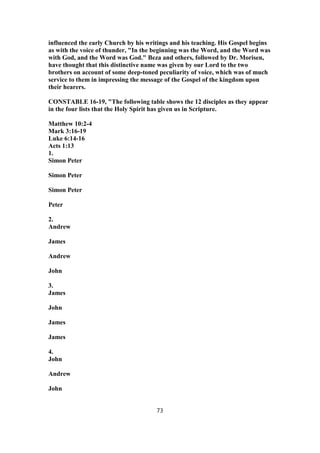
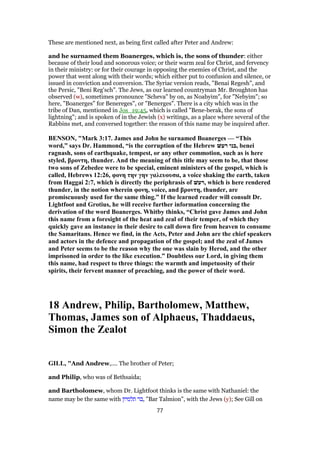
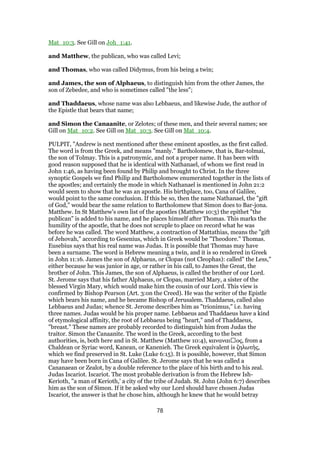
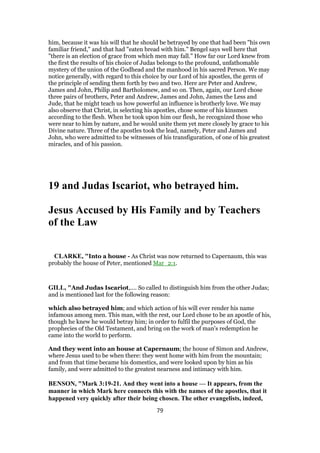
MARK 3 COMMENTARY
EDITED BY GLENN PEASE
Jesus Heals on the Sabbath
1 Another time Jesus went into the synagogue,
and a man with a shriveled hand was there.
CLARKE, "A man there which had a withered hand - See this explained on
Mat_12:10 (note), etc., and on Luk_6:6, Luk_6:10 (note).
GILL, "And he entered again into the synagogue,.... Perhaps in Capernaum,
where he had before cast out the unclean spirit; but not on the same day, nor on that
day he had had the debate with the Pharisees, about his disciples plucking the ears of
corn on the sabbath day; but on another sabbath, perhaps the next; see Luk_6:6.
And there was a man there which had a withered hand; who came there
either for a cure, knowing Christ to be in the synagogue, or for the sake of worship;
See Gill on Mat_12:10.
HENRY, "Here, as before, we have our Lord Jesus busy at work in the synagogue
first, and then by the sea side; to teach us that his presence should not be confined
either to the one or to the other, but, wherever any are gathered together in his name,
whether in the synagogue or any where else, there is he in the midst of them. In
every place where he records his name, he will meet his people, and bless them; it is
his will that men pray every where. Now here we have some account of what he did.
I. When he entered again into the synagogue, he improved the opportunity he had
there, of doing good, and having, no doubt, preached a sermon there, he wrought a
miracle for the confirmation of it, or at least for the confirmation of this truth - that it
is lawful to do good on the sabbath day. We had the narrative, Mat_12:9.
1. The patient's case was piteous; he had a withered hand, by which he was
disabled to work for his living; and those that are so, are the most proper objects of
charity; let those be helped that cannot help themselves.
2. The spectators were very unkind, both to the patient and to the Physician;
instead of interceding for a poor neighbour, they did what they could to hinder his
cure: for they intimated that if Christ cured him now on the sabbath day, they would
accuse him as a Sabbath breaker. It had been very unreasonable, if they should have
opposed a physician or surgeon in helping any poor body in misery, by ordinary
methods; but much more absurd was it to oppose him that cured without any labour,
but by a word's speaking.
JAMIESON, "Mar_3:1-12. The healing of a withered hand on the Sabbath day,
1
and retirement of Jesus to avoid danger. ( = Mat_12:9-21; Luk_6:6-11).
See on Mat_12:9-21.
SBC, "Note:—
I. The meaning of the withered hand. It was a word picture of that infirmity—
whatever it may be—which destroys a man’s power of doing anything well in this
world of ours. There was a man there who had a withered hand. That right hand, as
St. Luke describes it, robbed of its nourishment, hanging helplessly in a sling, was a
picture of whatever deprives a man of the power of holy work, and renders him an
incumbrance, if not a mischief, in God’s great kingdom. (1) The bigotry of the
Pharisees rendered them useless in the great kingdom of God and destroyed their
power of serving Christ. (2) Prejudices wither up some of the energies of men. (3)
Past inconsistences often wither up the power of service. (4) Easily besetting sins will
paralyse the usefulness of any man who does not with earnestness, faith, and prayer,
wage war against them. (5) The fear of man is another of the silent withering
influences which restrain usefulness, and quench our zeal.
II. The healing of the withered hand. Christ came into this world not merely to set
man free from the bondage of sin, but to emancipate all his faculties for holy service,
to strengthen all his powers, to summon him to work while it is day. He cried in
words which are preserved by three Evangelists, "Stretch forth thine hand," and
immediately that hand which had no power in itself, which no human skill could
heal, felt at once that a Divine energy was given to it. Divine strength was perfected in
its weakness, and it was made whole even as the other. There are three lessons of
practical value which we may learn from this narrative: (1) We may gather Christ’s
willingness to heal, as He is ever seeking us; His eye is always scanning our necessity;
He knows our imperfections and shortcomings as no other can do, and He is able and
willing to remove all that hampers and impedes the freedom of our spiritual life. (2)
We may learn the way in which we are to make use of Divine strength. When the man
willed to stretch forth his hand God willed in him; the communication of Divine
strength was granted to him at the very moment when he determined to obey the will
of Christ. This is just a type of what takes place whenever a sinner tries to seize and
appropriate God’s promises or God’s strength. (4) Here is the great rule by which, at
all times, we may overcome our listlessness and uselessness in God’s service. It is by
our own vigorous effort to overcome the withering up of our faculties that we shall
test the worth of Divine promises. Let us stretch forth our hands, let us try to serve
our Master; and let us work while it is day, for the night cometh.
H. R. Reynolds, Notes of the Christian Life, p. 207.
Mark 3:1-5
Note:—
I. Christ’s detection of human incompleteness. He instantly discovered that there was
a man in the synagogue with a withered hand.
II. Jesus Christ’s power over partial disease. The man had only a withered hand. In
some cases Christ used to heal thoroughly diseased men; in this case the disease was
local; yet in both instances His power was the same.
III. Christ’s inability to heal the obstinacy of His enemies.
2
IV. Christ’s moral indignation overcoming all outward obstacles. He was indignant
with the men who valued the sacredness of a day above the sacredness of a human
life.
Parker, City Temple, 1871, p. 68.
COFFMAN, "COFFMAN, "The continuation of Jesus' ministry is detailed in
this chapter which recounts the healing of a man on the sabbath in the
synagogue (Mark 3:1-6), healings at the seashore with demons confessing him
(Mark 3:7-12), appointment of the Twelve (Mark 3:13-19), teachings regarding
"an eternal sin" (Mark 3:20-30), and the incident of his mother and brethren
seeking him (Mark 3:31-35).
And he entered again into the synagogue; and they saw a man there who had his
hand withered. And they watched him, whether he would heal him on the
sabbath day; that they might accuse him. (Mark 3:1-2)
A feature of this healing was the anticipation of it by the Pharisees, who had
evidently been sent from Jerusalem for the purpose of spying on Jesus with a
view to destroying him. The purpose of the hierarchy to kill Christ had already
been formed earlier (John 5:18) on their decision that Christ was a sabbath-
breaker and a blasphemer. Their alleged evidence, however, was unsatisfactory,
even to them; therefore the search was continued in the hope of uncovering what
would have been, in their eyes, a better charge. Their hatred of the Lord and
their presence at the performance of this wonder emphasize the authenticity of
the deed.
BENSON, "Mark 3:1-5. He entered again into the synagogue — Luke says, On
another sabbath. The synagogue seems not to have been at Capernaum, but in
some city which lay in his way as he went through Galilee. And there was a man
which had a withered hand — His hand was not only withered, but contracted,
as appears from Mark 3:5. See the notes on Matthew 12:10-13. And they — The
scribes and Pharisees, watched him — These men, being ever unfriendly to the
Saviour, carefully attended to every thing he said and did, with an expectation of
finding some matter of blame in him, by which they might blast his reputation
with the people. Their pride, anger, and shame, after being so often put to
silence, began now to ripen into malice. Luke observes, He knew their thoughts,
their malicious designs. We may therefore see, in this instance, the greatness of
our blessed Lord’s courage, who resolutely performed the benevolent action he
had undertaken, notwithstanding he knew it would expose him to the fiercest
resentment of these wicked men. And said to the man, Rise up, and stand forth in
the midst. He ordered him to stand forth and show himself to the congregation,
that the sight of his distress might move them to pity him; and that they might be
the more sensibly struck with the miracle, when they observed the wasted hand
restored to perfect soundness in an instant. Then Jesus said, Is it lawful to do
good, &c. — That he might expose the malice and superstition of these scribes
and Pharisees, he appealed to the dictates of their own minds, whether it was not
more lawful to do good on the sabbath days, than to do evil; to save life, than to
kill. He meant, more lawful for him to save men’s lives, than for them to plot his
death without the least provocation. But it is justly observed here by Dr.
3
Campbell, that in the style of Scripture, the mere negation of any thing is often
expressed by the affirmation of the contrary. Thus, Luke 14:26, not to love, or
even to love less, is called, to hate; Matthew 11:25. not to reveal, is to hide; and
here, not to do good, when we can, is to do evil; not to save, is to kill. From this,
and many other passages of the New Testament, it may be justly deduced, as a
standing principle of Christian ethics, that not to do the good which we have the
opportunity and power to do, is, in a certain degree, the same as to do the
contrary evil; and not to prevent mischief, when we can, the same as to commit
it. Thus, also, Dr. Whitby: “Hence, it seems to follow, that he who doth not do
good to his neighbour when he can, doth evil to him; it being a want of charity,
and therefore evil, to neglect any opportunity of doing good, or showing kindness
to any man in misery; and that not to preserve his life when it is in danger, is to
transgress that precept which saith, Thou shalt not kill.” Our Lord’s words
contained a severe, but just rebuke, which in the present circumstances must
have been sensibly felt. Yet these men, pretending not to understand his
meaning, held their peace — Being confounded, though not convinced, therefore
he answered them with an argument which the dulness of stupidity could not
possibly overlook, nor the peevishness of cavilling gainsay: What man that shall
have one sheep, &c. — See on Matthew 12:11. Having uttered these convincing
arguments and cutting reproofs, he looked round about on them, (Luke, on them
all,) with anger, grieved at the hardness of their hearts — Showing at once his
indignation at their wickedness, and his grief for their impenitence. See on
Matthew as above. He knew his arguments did not prevail with them, because
they were resisting the convictions of their own minds; and was both angry at
their obstinacy, and grieved on account of the consequences of it; showing these
just affections of his righteous spirit by his looks, that if possible an impression
might be made either on them or on the spectators. He might in this, likewise,
propose to teach us the just regulation of the passions and affections of our
nature, which are not sinful in themselves, otherwise he who was without sin
could not have been subject to them. The evil of them lies in their being excited
by wrong objects, or by right objects in an improper degree. Thus Dr. Whitby:
“Hence we learn that anger is not always sinful; this passion being found in him
in whom was no sin. But then it must be noted, that anger is not properly defined
by philosophers, ορεξις αντιλυπησεως, a desire of revenge, or, of causing grief, to
him who hath provoked or hath grieved us; for this desire of revenge is always
evil; and though our Saviour was angry with the Pharisees for the hardness of
their hearts, yet had he no desire to revenge this sin upon them, but had a great
compassion for them, and desire to remove this evil.” Mr. Scott, who quotes a
part of the above note properly adds, “Our Lord’s anger was not only not sinful,
but it was a holy indignation, a perfectly right state of heart, and the want of it
would have been a sinful defect. It would show a want of filial respect and
affection for a son to hear, without emotion, his father’s character unjustly
aspersed. Would it not, then, be a want of due reverence for God, to hear his
name blasphemed, without feeling and expressing an indignant disapprobation?
Vengeance belongs to the ruler exclusively; and he may grieve at the necessity
imposed on him of thus expressing his disapprobation of crimes; but it is his
duty. Eli ought to have shown anger as well as grief when informed of the vile
conduct of his sons; and to have expressed it by severe coercive measures. Thus
4
parents and masters, as well as magistrates, may sin, in not feeling and
expressing just displeasure against those under their care: and anger is only
sinful when it springs from selfishness and malevolence; when causeless, or
above the cause; and when expressed by unhallowed words and actions.”
BI 1-3, "And there was a man there which had a withered hand.
The withered hand
I. What the withered hand may be said to symbolize.
1. It represents capacity for work. By the hand the toiling millions earn their
bread.
2. The hand stands as the symbol of fellowship. This is what our custom of
shaking hands expresses.
3. There is one more thing symbolized by the hand-generosity. By the hand we
convey our gifts.
II. The causes of the hand’s withering.
1. The first suggestion is that, like some forms of blindness and certain
deformities, it is sometimes a sad, inexplicable inheritance, possessed from birth.
2. The hand would become withered, I should think, if you fastened tight
ligatures or bandages round the arm so as to impede the free circulation of blood.
Our narrowness may cause the same result.
3. And then, perhaps, another cause may be cited-disuse of the hand, if long
continued. Nature’s gifts are cancelled, if not made use of.
III. The means of healing.
1. The man is made to “stand forth.” The healthful effects which flow to a man
when he is drawn out of the solitude of a self-shrouded life, and constrained by
force of circumstances to come into contact with other human beings: We need to
be stored up with all sorts of social agencies.
2. There is another thing in this narrative-obedience to Christ. His obedience
evidenced his faith. (W. S. Houghton.)
The withered hand
I. The meaning of the withered hand. The disease was not like the palsy, a type of
universal inaction; it was not like some consuming fever, a type of the way in which
sin and vice pervert all the faculties of the soul; but there was a vivid picture of that
infirmity which destroys a man’s power of doing anything well in this world of ours.
The hand of man is one of those noble physical features which distinguish him from
the brute. “The hand” is but another name for human skill, power, and usefulness,
and for She studied adaptation of means to ends.
1. The bigotry of these Pharisees rendered them useless in the great kingdom of
God, and destroyed their power of serving Christ. Christ did not keep the Sabbath
in their way, and that was enough for their malice. That man with a “withered
hand” was an apt picture of the way in which their bigotry had incapacitated
them for any holy service. Bigotry ties up men’s hands still.
2. Prejudices wither up some of the energies of men. By prejudices I mean
5
opinions taken up without sufficient reasons, and maintained with obstinacy;
opinions that rest on feelings rather than on facts. There are many men-and
professing Christians, too-who are so full of obstinate prejudices that they
invariably find fault with every good work that has to be done, and with every
possible way of doing it; but who very seldom do anything themselves. Their
hand is withered.
3. Past inconsistencies often wither up the power of service. It is a mournful truth
that if a man has once forfeited his character for integrity, or Christian prudence,
he may have repented; but still his power for service is crippled.
4. Easily-besetting sins will paralyze the usefulness of any man who does not with
earnestness wage war against them. Let a man yield himself indolently to the
slavery of an evil habit, idle talk, vain thoughts, he will soon find that his hand is
withered, that his power of serving God is gone. Indolence, fear of man,
ungoverned temper, paralyze our energies.
II. The healing of the withered hand. Christ came into this world not mainly to set
men free from the bondage of sin, but to emancipate all his faculties for holy service.
There are three lessons we may learn from this narrative.
1. We may gather Christ’s willingness to heal us.
2. The way in which we are to make use of Divine strength. When the man willed
to stretch forth his hand, God willed in him; the communication of Divine
strength was granted to him at the very moment when he determined to obey the
command of Christ. If we will we may make the Divine strength our own. Verily
while we “work out salvation with fear and trembling,” God is working “within us
both to will and do of His good pleasure.”
3. Here is the great rule by which at all times, through the help of God’s grace, we
may overcome our listlessness and uselessness in His service. It is by our own
vigorous effort to overcome the withering up of our faculties that we shall test the
worth of Divine promises. (H. R. Reynolds, B. A.)
Restoring of the man with the withered hand
I. the scene of this miracle.
“He went into their synagogue.” We often find our Saviour in the synagogue.
1. To show respect for Divine institutions. Places of worship may be despised by
some, but not by Christ who came to do His Father’s will.
2. To secure the great objects of His own mission. He appeared as a Divine
Teacher, and frequented the synagogue in order to make known the glad tidings
of His kingdom.
II. The person on whom this miracle was wrought. We are first shown-
1. The nature of his complaint. He was not affected in his whole body, but in one
of his members.
2. Something similar to this was occasionally inflicted as a Divine judgment.
Jeroboam (1Ki_13:1-34).
3. This case may be regarded as a representation of man’s spiritual condition. By
sin the powers of his soul have been paralyzed.
6
III. The dispute by which this miracle was preceded.
1. The question proposed-“Is it lawful to heal on the Sabbath day?”
2. The conclusive reply-“What man shall there be among you, etc.” Interest is a
very decisive casuist, and removes men’s scruples in a moment. It is always
soonest consulted and most readily obeyed.
3. The verdict pronounced-“The Son of man is Lord even of the Sabbath.”
IV. The manner in which the miracle was performed.
1. An authoritative mandate-“Stretch forth thine hand.”
2. An instant compliance.
3. A gratifying result-“And it was restored whole, like the other.” (Expository
Outlines.)
Withered hands
If there were no withered hearts there would be no withered hands-make the
fountain clear, and the stream will be pure. (Dr. Parker.)
The human side of a miracle
No great stretch of imagination is needed to see in this narrative a picture of man’s
spiritual state. The gospel of Jesus not merely tells us what we ought to be, but gives
the power by which we actually become that which it requires. There have been many
teaching gospels, but this is the only transforming gospel. But the strength of grace is
bestowed upon conditions, and these seem to be set forth in the text, “Stretch forth
thine hand.” By the command of the text three conditions were demanded.
I. It is easy to see that there was faith required. His faith had much to encourage it;
yet he would perhaps feel something of that diffidence which makes it hard to realize
as possible to oneself the blessings which have come to others. His faith would also
be somewhat severely tested by the manner in which the Saviour dealt with him.
Moreover, it appears that there was no outward act on the part of our Lord. It was
merely by a word that the invisible power was communicated. This faith was
indispensable. It was a condition invariably demanded. Without it Jesus wrought no
miracles. Unbelief hinders His merciful designs. Faith is the mysterious moral force
which thrusts out the hand of humanity to take the gift Divine.
II. The faith of this man was accompanied by obedience. The commands, “Stand
forth,” “Stretch forth thine hand,” were by no means easy to obey. But undaunted he
obeyed, and in the very act of obedience he found the blessing that he craved. This
obedience was the fruit of his faith, and the faith which does not produce obedience
is of little worth. Saving faith is always obedient faith.
III. It seems evident that there was needed in the case of this man a strong
resolution. This may appear from what has been already said. Still more if we
consider the act which was required of him. But he found that the law of Christ is,
Obey, and thou hast the power. (S. S. Bosward.)
Analogies of faith
7
You say, “I have no faith.” We answer, “Believe, and faith is yours.” Does it seem a
paradox. But paradoxes are often great truths, and are only hard to us because they
come to us from a higher region, where our poor logic is of small account. But how
many analogies there are of this paradox of faith even in the lower spheres of life!
How often is the ability to perform an act, not merely revealed, but actually
developed or even created by the very effort to accomplish it! How many works exist
today as monuments of genius which never would have existed if their authors had
waited till they had the necessary power. So it is in the matter of salvation. You can
never have it till you take it. You will never have the gift of faith until you believe.
Your will is all God waits for. He speaks by His prophet thus: “Hear, ye deaf, that ye
may hear; and look, ye blind, that ye may see.” And by His incarnate Son He says to
every impotent soul, “Stretch forth thine hand!” (S. S. Bosward.)
Stretch forth thine hand
I. Christ sometimes enjoins what seems to be impossible.
II. Faith is shown in doing what He commands, even when it seems to be impossible.
III. Where there is the “obedience of faith,” power will be granted. (A. F. Muir, M.
A.)
Divine kindness amid human opposition
The destructive effects of sin are abundantly seen in this life. It destroys men’s
mental eyesight, making them blind to their own best interests. Notice here-
I. The Divine Healer seeking opportunity to do good.
1. The pathway of filial obedience is the pathway of useful service. Jesus went to
the synagogue because there He was sure to meet with human needs. He went to
do good as well as to get good. These two things are identical at the root.
2. The comprehensiveness of God’s purpose puts to shame the selfish narrowness
of man’s. No place or day can be too sacred for giving free play to the love of God.
II. The Divine Healer disciplining the faith of the distressed. The measure of our
present strength is not the limit of what we can do. Divine help supplements human
endeavour.
III. The Divine Healer provoking the hostility of the proud.
1. It is possible for man’s will to resist Divine influence.
2. The choicest blessing can he perverted into the direst curse.
3. Contact with Jesus makes men either better or worse. The ice that is not
melted by the midsummer sun is greatly hardened thereby.
IV. The Divine Healer doing good, heedless of his own interests. Come what may,
Jesus Christ must do good. It was the natural forth-putting of His inexhaustible love.
It is as natural for Christ to show unmerited kindness as for the sun to shed its light,
the rose to diffuse its fragrance. (D. Davies, M. A.)
A withered hand
8
We may behold our own weakness in this emblem, which represents that total
inability of doing good to which sin has reduced mankind. A withered hand, in the
sight of God, and in the eyes of faith, is-
(1) a covetous wretch, who bestows on the poor little or no alms at all;
(2) a lukewarm and negligent Christian, who performs no good works;
(3) a magistrate or person in authority, who takes no care to maintain order
and justice;
(4) a great man who abandons the innocent when oppressed. None but Thou,
O Lord, can heal this withered hand, because its indisposition proceeds from
the heart, and Thou alone canst apply Thy healing and almighty hand to that.
(Quesnel.)
Publicity
There is no public action which the world is not ready to scan; there is no action so
private which the evil spirits are not witnesses of. I will endeavour so to live, as
knowing that I am ever in the eyes of mine enemies. (Bishop Hall.)
The good eye and the evil eye
“They watched Him.” And He watched them. But with what different eyes! The evil
eye, like the eye of the serpent, confuses with distress, overcomes by pain; and a good
eye, like the eye of man fronting the wild beast of the forest, subdues. But the evil eye
makes us a prey; the good eye subdues the beast of prey itself. If we can but gaze
calmly on the angry face of the world, we have already half tamed that great foe.
Christ went on His daily course surrounded with evil eyes. He did indeed face the
angry world. Men quailed before Him, multitudes hushed, and enemies whose
tongue was arrogantly loud, were silenced. But think not that courage can be exerted
even by the best without frequent anguish. To be watched by the unkind, even if we
can maintain our composure and good will, inflicts a pang; and to be watched in time
of festive and unsuspicious pleasure by the enemy, instead of being permitted to
utter all with unusual freedom through the presence of kind sympathy-this is indeed
distressing. (T. T. Lynch.)
“To save life or to kill?”
The man was not in danger of his life, and he would have survived undoubtedly had
no cure been wrought. But that question implied, that not to give health and
strength, not to restore the vital power when the restoration lies within your reach, is
equivalent to taking it away. To leave a good deed undone is hardly less sinful than
doing a bad one. (H. M. Luckock, D. D.)
The sin of neglecting to do good
In God’s account there is no difference, in regard of simple unlawfulness, between
not doing good to the body or life of our neighbour, in the case of necessity, and
doing hurt unto them: he that doth not good to the body and life of his neighbour
(when his necessity requireth, and when it is in his power) is truly said to do hurt
9
unto them, at least indirectly and by consequence. The rich glutton, e.g., in not
relieving poor Lazarus, may be truly said to have murdered him. The reason of which
is, because both these, as well the not doing of good to our neighbour’s body and life,
as the doing of hurt to them, are forbidden in the sixth commandment, as degrees of
murder; therefore he that doth not good, he that shows not mercy to his neighbour’s
body in case of necessity, is truly said to do hurt, and to show cruelty against it. How
deceived, then, are those who think it enough if they do no harm to others, if they do
not wrong or oppress them, though they take no trouble to relieve or help them. Let
us clearly understand this: that not to save life is to destroy it, though not directly, yet
indirectly and by consequence. They are both degrees of murder, though the latter is
a higher degree than the former. Let this move us not only to forbear hurting our
neighbour, but also to make conscience of doing good to him. (G. Petter.)
Christ and the Sabbath
They watched Him with an evil eye. Not to understand but to bring accusation
against Him.
I. The world watched the Saviour; the world watches the Saviour’s disciples. “No
man liveth to himself.” The eye of the world is always on the Church, on every
disciple, just as it was on the Church’s and the disciples’ Lord. What a lesson of
circumspection this should read!
II. The Saviour did good on the Sabbath day; it is the duty of his disciples to do good.
Did men expect that He would be held within the stone walls of Jewish
ceremonialism? (J. B. Lister.)
Good lawfully done on the Sabbath: or, love the over-ruling law
At other times the defence of the Lord was based on the nature of the works which
He had performed. He held and taught that “it was lawful to do good on the Sabbath
day.” Nay, He went farther, and maintained that there is a class of duties which we
not only may, but must perform on that day. It was ordained at first for the benefit of
man, and, therefore, it was never intended that it should operate to his detriment.
Whenever, therefore, an injury would be inflicted on a fellow man by our refusing to
labour for his assistance on the Sabbath, we are bound to exert ourselves, even on
that day, for his relief. Nay, more; in the case of the lower animals, when an
emergency shall arise like that which a fire or a flood creates, or when a necessity
exists like that which requires that they shall be regularly fed, the higher law of
benevolence comes in and suspends, for the moment, the lower law of rest. There are
thus degrees of obligation in moral duties. As a general rule children are bound to
obey their parents; but when that obedience would interfere with their duty to God,
the stronger obligation comes in and requires them to do what is right in the sight of
God. In chemistry you may have a substance which, yielding to the law of gravitation,
falls to the bottom of the vase; but when you introduce another ingredient, you shall
see the particles, whose weight formerly held them down, rising in obedience to the
mightier principle of affinity, and combining to produce a new result. Precisely so the
new principle of love operates in the interpretation of law. All law is for the good of
man and the glory of God; and when the highest welfare of the individual creates a
necessity, love is to seek to meet that emergency, even though in doing so it may
seem to be violating the Sabbath. (W. M. Taylor, D. D.)
10
The power of the human hand
The hand of a man is one of those noble physical features which distinguish him from
the brute. “The hand” is but another name for human skill, power, and usefulness,
and for the studied adaptation of means to ends. By his hand, as the servant of his
intellect and his heart, man is put on a physical level with, if not far above, all other
living beings, in respect of his power to defend himself against the formidable
creatures who are furnished by nature with ponderous and deadly weapons, both of
attack and resistance. By the aid of this wonderful instrument, he can cover his
nakedness, he can build for himself a home, and make the whole world do his
bidding; he can subdue it unto himself, and fill it with the trophies of his mastery.
The houses, the roads, the bridges, the fleets, the palaces, the temples, the pyramids,
of earth, have all been wrought by the little hands of men. The agriculture and
industry by which the whole habitable face of our globe has been fashioned into “the
great bright useful thing it is,” have been file work of man’s hand. While the working
man’s hand is his sole capital, the hand of man is constantly used as the symbol of
power and the type of developed and practical wisdom. The hand commits thought to
paper, and imagination to marble and to canvas. Literature, science, and art are as
dependent on its service, as are the toils of the labourer, or the fabric of the artizan. If
manual toil is economized by machinery, still man’s hand is essential for the
construction of the machine, and for its subsequent control, so that the hand is the
symbol and the instrument of all the arts of human life. We can, therefore, scarcely
refrain from the thought that that “withered hand” in the synagogue was a type of
uselessness and feebleness; and that “right hand,” as St. Luke describes it, robbed of
its nourishment, hanging helplessly in a sling, was a picture of whatever deprives a
man of the power of holy work, and renders him an encumbrance, if not a mischief,
in God’s great kingdom. (H. R. Reynolds, B. A.)
BURKITT, "The former part of this chapter reports to us a miraculous cure
wrought by Christ upon a man who had a withered hand. The place where he
wrought it, was the synagogue; the time when, was the sabbath-day; the manner
how, was by speaking a word; the persons before whom, were the envious and
malicious Pharisees. These men were always cavilling at our Saviour's doctrine,
and slandering his miracles; yet our Saviour goes on with his work before their
faces, without either interruption or discouragement.
Learn thence, That the unjust censures and malicious cavils of wicked men
against us for well-doing, must not discourage us from doing our duty either
towards God, or towards our neighbour. Though the Pharisees watched our
Saviour, and when their envy and malice could find no occasion of quarrel, they
could invent and make one; yet such was our Lord's courage and resolution, that
he bids the man which had the withered hand, stand forth: to show that he was
resolved to heal him, notwithstanding their malicious purpose to accuse him for
it as a breaker of the sabbath. Opposition met with in doing our duty, must not
discourage us from doing good, if we will follow the example of our blessed
Redeemer.
11
PULPIT, "Mark 3:1-6
Parallel passages: Matthew 12:9-14; Luke 6:6-11.—
The man with the withered hand.
I. THE NATURE OF THE DISEASE. It was a case of severe paralysis of the
hand—the right hand, as St. Luke, with a physician's accuracy, informs us. The
sinews were shrunken, and the hand shrivelled and dried up. And yet we owe to
St. Mark's great particularity in narration and minuteness of detail a piece of
information that one might rather have expected from the professional skill of
"the beloved physician," Luke. St. Luke, as well as St. Matthew, uses an
adjective ( ξηρὰ, equivalent to dry) to describe, in a general way, the state of the
diseased member; but St. Mark employs the participle of the perfect passive
( ἐξηραμμένην, equivalent to having been dried up), which furnishes a hint as to
the origin of the ailment. While from the expression of the former two evangelists
we might conclude that the ailment was congenital—that the man was born with
it; we are enabled, by the term made use of in the Gospel before us, to correct
that conclusion, and to trace this defect of the hand as the result of disease or of
accident.
II. VARIETY OF DISEASES. The multitude of "ills that flesh is heir to" is truly
wonderful; the variety of diseases that afflict poor frail humanity is astonishing.
Whatever be the place of our abode, or wherever we travel, we find our fellow-
creatures subject to weakness, pains, physical defects, wasting all sense, pining
sickness, and bodily ailments, too many and too various to enumerate. No
continent, no island, no zone of earth, is exempt. The greatest salubrity of
climate, though it may somewhat diminish the number, does not do away with
cases of the kind. Though our lot be cast amid the mildness of Southern climes,
or under the clear bright sky of Eastern lands; though our dwelling-place be—
"Far from the winters of the West,
By every breeze and season blest;"
still we find ourselves within the reach of those infirmities that seem the common
of man. We cannot read far in the Gospels, or trace the ministry of our Lord to
much length, until we find him surrounded by and ministering to whole troops of
invalids and impotent folk.
III. SOURCE OF ALL DISEASES. If there were no sin there would be no
sorrow, and if there were no sin there would be no sickness. The effects of sin
12
extend to both body and soul. Sin has brought disease as well as death into the
world, as we read, "By one man sin entered into the world, and death by sin; and
so death hath passed upon all men, for that all have sinned." As death has thus
passed upon all men, so disease, more or less aggravated, at one time or other,
has become the lot of all; for what are pain and disease and sickness but
forerunners, remote it may be, of death, and forfeitures of sin? The original
punitive sentence was not Moth tumath," Thou shalt be put to death," that is,
immediately or instantaneously; but Moth tamuth, "Thou shalt die," namely, by
a process now commenced, and, though slow, yet sure; for sin has planted the
germ of death in the system. It is as though, simultaneously with the breath of
life, the process of decay and death began, part after part wasting away in
consequence of disease or in the so-called course of nature, till the vital spark at
last becomes extinct, and "the dust returns to the earth as it was." A heathen
poet preserves the remnant of an old tradition, which, like many of the traditions
of heathenism, is evidently a dispersed and distorted ray from the light of
revelation. He tells us that a crowd of wasting diseases invaded this earth's
inhabitants in consequence of crime; while a Christian poet speaks of that lazar-
house which sin has erected on our earth, "wherein are laid numbers of all
diseased, all maladies,.. and where dire are the tossings, deep the groans." But
for transgression manhood would have remained in all its original health and
vigor and perfection, like "Adam, the goodliest man of men since born his sons;"
and womanhood would have retained all the primitive grace and loveliness and
beauty that bloomed in "the fairest of her daughters, Eve."
IV. TIME AND PLACE OF THE CURE. The time was the sabbath day; and this
was one of the seven miracles which our Lord performed on the sabbath. Of
these St. Mark records three—the cure of the demoniac at Capernaum, the cure
of fever in the case of Peter's mother-in-law, and the cure of the withered hand;
the former two recorded in the first chapter of this Gospel, and the last in the
passage under consideration. Two more of the sabbath-day miracles are
recorded by St. Luke—the cure of the woman afflicted with the spirit of
infirmity, and also of the man who had the disease of dropsy; the former in the
thirteenth and the latter in the fourteenth chapter of St. Luke's Gospel. Besides
these, two more are recorded by St. John—the recovery of the impotent man at
the pool of Bethesda, and the restoration of sight to the man born blind; the
former in the fifth and the latter in the ninth chapter of St. John's Gospel. Our
Lord had vindicated his disciples for plucking the cars of corn on the sabbath; he
had now to vindicate himself for the miracle of healing, which he was about to
perform also on the sabbath. The place where he was going to perform this
miracle was the synagogue.
V. PERSONS PRESENT AT THE PERFORMANCE OF THE CURE, This is a
most important item in the narrative, and a most important element in the
transaction. There was a multitude present, and that multitude consisted of foes
as well as friends. It could not, therefore, be said that the thing was done in a
corner, or that it was done only in the presence of friends, with whom collusion
or connivance might possibly be suspected. The persons, then, in whose presence
13
this cure was effected were the worshippers on that sabbath day in the
synagogue—a goodly number, no doubt, comprehending not only those who
assembled ordinarily for the sabbath service, but many more drawn together by
the rumors about the great Miracle-worker and in expectation of some
manifestation of his wonder-working power. But besides these ordinary
worshippers and these curiosity-mongers, as perhaps we may designate them,
there were others—the scribes and Pharisees, as we learn from St. Luke—whose
motive was malignancy, and whose business on that occasion was espionage.
They kept watching our Lord closely and intently ( παρετήρουν) to see if he
should heal on the sabbath; not in admiration of his wondrous power, nor in
gratitude for his marvellous goodness, but in order to find some ground of
accusation against him.
VI. OBJECTION TO THE PERFORMANCE OF THE CURE ON THE
SABBATH. In pursuance of their plan, they anticipated our Lord, as we learn
from St. Matthew, with the question, "Is it lawful to heal on the sabbath day?"
Our Lord, in reply, as we are informed in the same Gospel, appealed to their
feelings of humanity and to the exercise of mercy which men usually extend even
to a dumb animal—a sheep, which, if it fall into a pit on the sabbath, is laid hold
of and lifted out. The superiority of a man to a sheep justifies a still greater
exercise of mercy, even on the sabbath. But to their captious and ensnaring
question he made further answer, replying, as was his wont, by a counter-
question, "Is it lawful to do good on the sabbath day, or to do evil? to save life, or
to kill?" The alternative here is between doing good and doing evil, or, putting
an extreme case, between saving a life and destroying it ( ἀπολέσαι in St. Luke).
We may observe, in passing, that the received text, which reads τι in this passage
of St. Luke's Gospel, admits one or other of the two following renderings,
according to the punctuation: either
VII. MODE OF PREPARATION FOR THE CURE. He commanded the man
who had his hand withered to stand forth. This was a somewhat trying ordeal for
that poor disabled man. Standing forward, he became the gazing-stock of all
eyes. He thereby made himself and his peculiar defect conspicuous. He thus
practically confessed his helplessness and eagerness for relief. There he stood, an
object of heartless curiosity to some, an object of contempt to others; the
scrutinizing looks of some, the scowling glances of others, were fixed upon him.
Few like to be thus looked out of countenance. Besides, in addition to all this, he
was publicly expressing confidence in the ability of the Physician, and so
exposing himself to like condemnation. And then there was the contingency of
failure. What of that? The man must have had some, yea, much, moral courage
to brave all this. Thus it is with all who will come to Christ with earnestness of
spirit and manfully confess him. False shame must be laid aside. The scowl of
enemies, perhaps the sneer of friends, the scorn of the world, may be calculated
on and contemned; much must be done and dared in this direction. Yet the true
confessor will not shrink from all this, and more. His spirit is—
14
"I'm not ashamed to own my Lord
Or to defend his cause,
Maintain the glory of his cross,
And honor all his laws."
VIII. OUR LORD'S LOOK WHEN PROCEEDING TO PERFORM THE
CURE. The man was now standing forth in the midst, with the eyes of all present
fastened on him. Our Lord, before actually speaking the word of healing power,
looked round upon the persons present—upon all of them, as St. Luke informs
us. There was deep meaning in that look. The expression of that look needed an
interpreter, and so St. Mark tells us that the feelings which that intent and
earnest look into every man's thee gave expression to were twofold—there was
anger and there was grief at the same time. This at, get was righteous
indignation; as the apostle says, "Be angry and sin not." This anger was
incurred by the wicked malevolence which the Saviour, in his omniscience, read
in the dark hearts of those dark-visaged men; for, as St. Luke reminds us, "he
knew their thoughts," or rather their reasonings. But there was grief as well.
1. Though the compound verb συλλυπούμενος is interpreted by some as identical
with the simple form, yet the prepositional element cannot be thus overlooked,
but must add somewhat to the meaning of the whole.
2. This additional significancy, however., may be variously understood. The
preposition σύν may mean
IX. THE CURE PERFORMED. "Stretch forth thy hand!" is the command; and
as the aorist imperative, used here, generally denotes a speedy execution of the
order given, like o phrase, "Have it done!" the command amounted to "Stretch
forth thy hand at once!" How unreasonable this command, at the first blush of
the matter, appears! Many a time the attempt had been made, but in vain; many
a time before he had tried to stretch it out, but that withered hand had refused
obedience to the volitions of the will. Was not the Saviour's command, then,
strange and unnatural in bidding him extend a hand that had long lost the
proper power of motion; a hand crippled and contracted in every joint,
shrunken and shrivelled in every part—in a word, completely lifeless and
motionless? And yet this man did not cavil nor question; he did not doubt nor
delay. Soon as the mandate came he made the effort; soon as the command was
uttered, hard as it must have seemed, he essayed compliance; and no sooner is
compliance attempted than the cure is effected, Divine, power accompanying the
command, or rather both acting with simultaneous effect. Thus his word was a
15
word of power, as we read, "He sent his word and healed them." And now the
tendons are unbound, the nerves act, the muscles are suppled, the vital fluid
flows once more along the reopened channel. Thus it was brought back again to
what it once was; in power, appearance, and use it was restored to its original
condition, whole and sound.
X. CONSEQUENT ON THE CURE WAS AN UNNATURAL, COALITION.
The enemies were filled with folly, wicked and senseless folly ( ἀνοίας), but not
madness, as it is generally understood, for that would properly be μανίας. They
felt humiliated in the presence of so many people. Their pride was humbled, for
they were silenced; their logic was shown to be shallow, for with them "to do or
not to do"—that was the question; but our Lord showed them that" to do good
or not to do good, while not to do good was tantamount to doing evil," was in
reality the question; and so they were put to shame. They were disappointed,
moreover, for they were deprived of any ground whereon to found an
accusation, because, in the mode of effecting the cure, there had been no touch,
no contact of any kind, no external means used—nothing but a word, so that
even the letter of the Law had been in no way infringed. In their desperation
they communed one with another, held a council, or, as St. Mark informs us
more explicitly, "took or made counsel with the Herodians." Misfortune,
according to an old saw, brings men into acquaintance with strange associates,
and never more so than on this occasion. In theology the Herodians, as far as
they held any theological opinions, fraternized with the Sadducees, the
latitudinarians of that day; in politics they were adherents of Herod Antipas, and
so advocates of the Roman domination. To both these the Pharisees were
diametrically opposed. Yet now they enter into an unholy alliance with those who
were at once their political opponents and religious antagonists. Nor was this the
only time that extremes met and leagued themselves against Christ and his cause.
Herod and Pilate mutually sacrificed their feelings of hostility, and confederated
against the Lord and his Anointed. It has been thought strange that Luke, who
from his acquaintance with Manaen, the foster-brother of Herod the Tetrarch,
had special facilities for knowledge of the Herods, their family relations, and
friends, omits this alliance of the Herodians with the Pharisees; while it has been
surmised that, from that very acquaintance, sprang a delicacy of feeling that
made the evangelist loth to record their hostility to Christ.
XI. LESSONS TO BE LEARNT FROM THIS SECTION.
1. The first lesson we learn here is the multitude of witnesses that are watching
the movements of the disciples of Christ; for as it was with the Master so is it
with ourselves. The eye of God is upon us, according to the language of ancient
piety, "Thou God seest us;" the eyes of angels are upon us to aid us with their
blessed and beneficent ministries; the eyes of good men are upon us to cheer us
onward and help us forward; the eyes of bad men are upon us to mark our
halting and take advantage of our errors; the eyes of Satan and his servants—
evil angels as well as evil men—are upon us to entrap us by their machinations
and gloat over our fall. How vigilant, then, must we be, watching and praying
16
that we fall not into, nor succumb to, temptation!
2. In every case of spiritual withering we know the Physician to whom we must
apply. Has our faith been withering, or has it lost aught of its freshness? we pray
him to help our unbelief and increase our faith. Has our love been withering and
languishing? we must seek from him a renewal of the love of our espousals, and
meditate on him till in our hearts there is rekindled a flame of heavenly love to
him who first loved us. Is our zeal for the Divine glory, or our activity in the
Divine service, withering and decaying? then we must seek grace to repent and
do our first works, stretching out at Christ's command the withered hand to
Christian work, whether it be the resumption of neglected duty, or the rendering
of needful help, or relieving the wants of the indigent, or wiping away the tears
of the sorrowing, or usefulness of whatever kind in our day and generation, or
honest endeavors to leave the world better than we found it.
3. It is well worthy of notice that if we are doing no good we are doing evil; nay,
if we are doing nothing, we are doing evil; still more, if we are not engaged at
least in helping to save, we are guilty of abetting, if not actually causing
destruction. Let us, then, be "not slothful in business; fervent in spirit; serving
the Lord."
4. The mercifulness of the Saviour is an encouragement to faith and obedience.
With his anger against sin was mingled grief for sinners' hardness of heart.
Many a tear he shed for perishing souls in the days of his flesh. He dropped a
tear at the grave of a beloved friend—only dropped a silent tear ( ἐδάκρυσεν);
but over the impenitent inhabitants of a doomed city his eyes brimmed over with
tears and he wept aloud, for we there read ἔκλαυσεν. In this restoration of the
withered hand we have evidence of the Saviour's gracious disposition, a warrant
to take him at his word, and a guarantee that when he gives a precept he will
grant power for its performance.
5. Divine power was here displayed in human weakness. The sinner has a
warrant to believe, and in responding to that warrant he realizes Divine help; in
his willingness to obey he experiences Divine power; in his earnest entreating
Christ for strength to believe, he is actually and already exercising a reliance on
Christ for salvation. Divine power harmonized with the faith of this afflicted
man, and the Saviour's strength made itself manifest in his obedience. And yet
faith lays claim to no inherent power; it is, on the contrary, human weakness
laying hold of Divine strength. Its potency is derived entirely from that on which
it rests; believing the Word of God, trusting in the Son of God, relying on aid
from the Spirit of God, it surmounts every obstacle, overcomes every difficulty,
and triumphs over every enemy. It is a principle that develops most wonderful
potencies for good; in its exercise we cress the borderland that lies between the
humanly impossible and heavenly possibilities; for "what is the victory that
overcometh the world? Even our faith."—J.J.G.
17
2 Some of them were looking for a reason to
accuse Jesus, so they watched him closely to see
if he would heal him on the Sabbath.
CLARKE, "They watched him - Παρετηρουν αυτον, they maliciously watched
him. See on Luk_14:1 (note).
GILL, "And they watched him,.... The ruler of the synagogue, and the principal
men in it; particularly the Scribes and Pharisees, who followed him wherever he
went; they observed him diligently, and kept their eyes upon him; this lame man
being in the synagogue, to see
whether he would heal him on the sabbath day; which, knowing his readiness
to do good, they might expect he would:
that they might accuse him; as they had accused his disciples before, of the
violation of the sabbath: according to the Evangelist Matthew, they put a question to
him, whether it was lawful to heal on the sabbath day? with this view, that they
might, one way or another, have something to accuse him of, either to the people, or
to the sanhedrim; See Gill on Mat_12:10.
HENRY, "3. Christ dealt very fairly with the spectators, and dealt with them first,
if possible to prevent the offence.
(1.) He laboured to convince their judgment. He bade the man stand forth (Mar_
3:3), that by the sight of him they might be moved with compassion toward him, and
might not, for shame, account his cure a crime. And then he appeals to their own
consciences; though the thing speaks itself, yet he is pleased to speak it; “Is it lawful
to do good on the sabbath days, as I design to do, or to do evil, as you design to do?
Whether is better, to save life or to kill?” What fairer question could be put? And yet,
because they saw it would turn against them, they held their peace. Note, Those are
obstinate indeed in their infidelity, who, when they can say nothing against a truth,
will say nothing to it; and, when they cannot resist, yet will not yield.
JAMIESON, "
BARCLAY, "THE CLASH OF IDEAS (Mark 3:1-6)
3:1-6 Jesus went into the synagogue again; and there was a man there who had a
hand which had withered; and they were watching him closely to see if he would
heal him on the Sabbath day, so that, if he did, they might be able to formulate a
charge against him. He said to the man who had the withered hand, "Stand up
and come out in to the middle of the congregation." He said to them, "Is it lawful
18
to do good on the Sabbath day? Or to do evil? To save a life? Or to kill it?" But
they remained silent. He looked round on them with anger, for he was grieved at
the obtuseness of their hearts. He said to the man, "Stretch out your hand!" He
stretched it out; and his hand was restored. The Pharisees immediately went out
and began to concoct a plot with Herod's entourage against Jesus, with a view to
killing him.
This is a crucial incident in the life of Jesus. It was already clear that he and the
orthodox leaders of the Jews were quite at variance. For him to go back into the
synagogue at all was a brave thing to do. It was the act of a man who refused to
seek safety and who was determined to look a dangerous situation in the face. In
the synagogue there was a deputation from the Sanhedrin. No one could miss
them, for, in the synagogue, the front seats were the seats of honour and they
were sitting there. It was the duty of the Sanhedrin to deal with anyone who was
likely to mislead the people and seduce them from the right way; and that is
precisely what this deputation conceived of themselves as doing. The last thing
they were there to do was to worship and to learn; they were there to scrutinize
Jesus' every action.
In the synagogue there was a man with a paralysed hand. The Greek word
means that he had not been born that way but that some illness had taken the
strength from him. The gospel according to the Hebrews, a gospel which is lost
except for a few fragments, tells us that the man was a stone mason and that he
besought Jesus to help him, for his livelihood was in his hands and he was
ashamed to beg. If Jesus had been a cautious, prudent person he would have
conveniently arranged not to see the man, for he knew that to heal him was
asking for trouble.
It was the Sabbath day; all work was forbidden and to heal was to work. The
Jewish law was definite and detailed about this. Medical attention could be given
only if a life was in danger. To take some examples--a woman in childbirth might
be helped on the Sabbath; an infection of the throat might be treated; if a wall
fell on anyone, enough might be cleared away to see whether he was dead or
alive; if he was alive he might be helped, if he was dead the body must be left
until the next day. A fracture could not be attended to. Cold water might not be
poured on a sprained hand or foot. A cut finger might be bandaged with a plain
bandage but not with ointment. That is to say, at the most an injury could be
kept from getting worse; it must not be made better.
It is extraordinarily difficult for us to grasp this. The best way in which we can
see the strict orthodox view of the Sabbath is to remember that a strict Jew
would not even defend his life on the Sabbath. In the wars of the Maccabees,
when resistance broke out, some of the Jewish rebels took refuge in caves. The
Syrian soldiers pursued them. Josephus, the Jewish historian, tells us that they
gave them the chance to surrender and they would not, so "they fought against
them on the Sabbath day, and they burned them as they were in caves, without
resistance and without so much as stopping up the entrances of the caves. They
refused to defend themselves on that day because they were not willing to break
in upon the honour they owed to the Sabbath, even in such distress; for our law
19
requires that we rest on that day." When Pompey, the Roman general, was
besieging Jerusalem, the defenders took refuge in the Temple precincts. Pompey
proceeded to build a mound which would overtop them and from which he might
bombard them. He, knew the beliefs of the Jews and he built on the Sabbath day,
and the Jews lifted not one hand to defend themselves or to hinder the building,
although they knew that by their Sabbath inactivity they were signing their own
death warrant. The Romans, who had compulsory military service, had in the
end to exempt the Jews from army service because no strict Jew would fight on
the Sabbath. The orthodox Jewish attitude to the Sabbath was completely rigid
and unbending.
Jesus knew that. This man's life was not in the least danger. Physically he would
be no worse off if he were left until to-morrow. For Jesus this was a test case, and
he met it fairly and squarely. He told the man to rise and to come out of his place
and stand where everyone could see him. There were probably two reasons for
that. Very likely Jesus wished to make one last effort to waken sympathy for the
stricken man by showing everyone his wretchedness. Quite certainly Jesus
wished to take the step he was going to take in such a way that no one could
possibly fail to see it.
He asked the experts in the law two questions. Is it lawful to do good or to do evil
on the Sabbath day? He put them in a dilemma. They were bound to admit that
it was lawful to do good; and it was a good thing he proposed to do. They were
bound to deny that it was lawful to do evil; and, yet, surely it was an evil thing to
leave a man in wretchedness when it was possible to help him. Then he asked, Is
it lawful to save a life or to kill it? Here he was driving the thing home. He was
taking steps to save this wretched man's life; they were thinking out methods of
killing himself. On any reckoning it was surely a better thing to be thinking
about helping a man than it was to be thinking of killing a man. No wonder they
had nothing to say!
Then Jesus with a word of power healed the man; and the Pharisees went out
and tried to hatch a plot with the Herodians to kill him. This shows the lengths to
which the Pharisees would go. No Pharisee would normally have anything to do
with a Gentile or a man who did not keep the law; such people were unclean. The
Herodians were the court entourage of Herod; they were continually coming into
contact with Romans. For all normal purposes the Pharisees would have
considered them unclean; but now they were prepared to enter into what was for
them an unholy alliance. In their hearts there was a hate which would stop at
nothing.
This passage is fundamental because it shows the clash of two ideas of religion.
(i) To the Pharisee religion was ritual; it meant obeying certain rules and
regulations. Jesus broke these regulations and they were genuinely convinced
that he was a bad man. It is like the man who believes that religion consists in
going to church, reading the Bible, saying grace at meals, having family worship,
and carrying out all the external acts which are looked on as religious, and who
yet never put himself out to do anything for anyone, who has no sense of
20
sympathy, no desire to sacrifice, who is serene in his rigid orthodoxy, and deaf to
the call of need and blind to the tears of the world.
(ii) To Jesus religion was service. It was love of God and love of men. Ritual was
irrelevant compared with love in action.
"Our Friend, our Brother, and our Lord,
What may Thy service be?
Nor name, nor form, nor ritual word,
But simply following Thee."
To Jesus the most important thing in the world was not the correct performance
of a ritual, but the spontaneous answer to the cry of human need.
3 Jesus said to the man with the shriveled hand,
“Stand up in front of everyone.”
GILL, "And he saith unto the man which had the withered hand,.... After
he had reasoned with them from the lesser to the greater, upon their own principles
and practices, in relieving and taking out a sheep fallen into a ditch, on a sabbath day,
Mat_12:10, and knowing "their thoughts", as Luke says, Luk_6:8, their reasonings
and designs; and as the Persic version here, from thence "understanding their
conspiracy", turns himself to the lame man, and bids him
stand forth: or, as in Luke, "rise up and stand forth in the midst", Luk_6:8. He bid
him rise up from his seat, and stand forth in the midst of the synagogue: this he said,
partly to raise the attention of the people to the following miracle; and partly to move
commiseration upon the sight of the object; and to aggravate the hard heartedness of
the Pharisees; as also, that it might be manifest to all, that the man's hand was really
withered; and that there was no fraud in the following cure.
HENRY, "(1.) He laboured to convince their judgment. He bade the man stand
forth (Mar_3:3), that by the sight of him they might be moved with compassion
toward him, and might not, for shame, account his cure a crime. And then he appeals
to their own consciences; though the thing speaks itself, yet he is pleased to speak it;
“Is it lawful to do good on the sabbath days, as I design to do, or to do evil, as you
design to do? Whether is better, to save life or to kill?” What fairer question could be
put? And yet, because they saw it would turn against them, they held their peace.
Note, Those are obstinate indeed in their infidelity, who, when they can say nothing
against a truth, will say nothing to it; and, when they cannot resist, yet will not yield.
COFFMAN, "Stand forth ... Christ accepted the challenge of his enemies. He
21
would indeed heal the man on the sabbath day; but first, he would contrast his
own act of saving mercy with their act, also performed on the sabbath day, of
killing the Saviour of the world, that being their only purpose, which objective
they pursued constantly, on sabbath days as well as all other days. But, if the
Pharisees were blind to the inconsistency which accepted their own murderous
actions as "lawful" sabbath day conduct, while at the same time condemning
such an act as Jesus would do as "unlawful" on the sabbath, the people were not
so blind and could easily see the difference.
To save a life, or to kill ... Christ was about to "save a life" from pain, inability,
and frustration. The Pharisees were present for the purpose of killing Jesus. The
contrast was dramatic, and there could have been no better example of opposite
purposes of Satan and Christ than that which precipitated the stark, ugly
incident here. The Pharisees themselves were speechless when Jesus called
attention to it.
But they held their peace ... What THEY were doing was satanic and malignant;
and they were stunned into silence by Jesus' obvious reference to their evil
employment on the sabbath.
4 Then Jesus asked them, “Which is lawful on
the Sabbath: to do good or to do evil, to save life
or to kill?” But they remained silent.
BARNES, "Mar_3:4
Or to do evil? to save life, or to kill? - It seems to have been a maxim with the
Jews that not to do good when we have an opportunity is to do evil; not to save life is
to kill or to be guilty of murder. If a man has an opportunity of saving a man’s life
when he is in danger, and does not do it, he is evidently guilty of his death. On this
principle our Saviour puts this question to the Jews - whether it was better for him,
having the power to heal this man, to do it, or to suffer him to remain in this
suffering condition; and he illustrates it by an example, showing that in a manner of
much less importance - that respecting their cattle - they would do on the Sabbath
just as “he” would if he should heal this man. The same remark may apply to all
opportunities of doing good. “The ability to do good imposes an obligation to do it”
(Cotton Mather) He that has the means of feeding the hungry, and clothing the
naked, and instructing the ignorant, and sending the gospel to the destitute, and that
does it not, is guilty, for he is practically doing evil; he is suffering evils to exist which
he might remove. So the wicked will be condemned in the day of judgment because
“they did it not,” Mat_25:45. If this is true, what an obligation rests upon the rich to
do good!
Mar_3:5
With anger - With a severe and stern countenance; with indignation at their
22
hypocrisy and hardness of heart. This was not, however, a spiteful or revengeful
passion; it was caused by excessive “grief” at their state: “being grieved for the
hardness of their hearts.” It was not hatred of the “men” whose hearts were so hard;
it was hatred of the sin which they exhibited, joined with the extreme grief that
neither his teaching nor the law of God, nor any means which could be used,
overcame their confirmed wickedness. Such anger is not unlawful, Eph_4:26.
However, in this instance, our Lord has taught us that anger is never lawful except
when it is tempered with grief or compassion for those who have offended.
Hardness of their hearts - The heart, figuratively the seat of feeling or
affection, is said to be tender when it is easily affected by the sufferings of others - by
our own sin and danger - by the love and commands of God; when we are easily made
to feel on the great subjects pertaining to our interest, Eze_11:19-20. It is hard when
nothing moves it; when a man is alike insensible to the sufferings of others, to the
dangers of his own condition, and to the commands, the love, and the threatenings of
God. It is most tender in youth, or when we have committed fewest crimes. It is made
hard by indulgence in sin, by long resisting the offers of salvation, or by opposing any
great and affecting appeals which God may make to us by his Spirit or providence, by
affliction, or by a revival of religion. Hence, it is that the most favorable period for
securing an interest in Christ, or for becoming a Christian, is in youth the first, the
tenderest, and the best days of life. Nay, in the days of childhood, in the Sabbath-
school, God may be found, and the soul prepared to die.
CLARKE, "To do good - or - evil? to save life, or to kill? - It was a maxim
with the Jews, as it should be with all men, that he who neglected to preserve life
when it was in his power, was to be reputed a murderer. Every principle of sound
justice requires that he should be considered in this light. But, if this be the case, how
many murderers are there against whom there is no law but the law of God!
To kill - but instead of αποκτειναι, several MSS. and versions have απολεσαι to
destroy. Wetstein and Griesbach quote Theophylact for this reading; but it is not in
my copy. Paris edit. 1635.
GILL, "And he saith unto them,.... Either to the whole multitude, to all the
assembly in the synagogue; and so the Persic version renders it, "again he said to the
multitude"; or rather, to the Scribes and Pharisees, who were watching him, and had
put a question to him, which he answers by another:
is it lawful to do good on the sabbath days, or to do evil, to save life, or to
kill? The Vulgate Latin, Syriac, Arabic, and Persic versions read, or "to destroy", as
in Luk_6:9, To do evil, kill, or destroy, are not lawful at any time; and to do good,
and to save life, must be right at all times: our Lord has a particular view to the
Scribes and Pharisees, and the question is put home to their own consciences; whose
hearts and thoughts, designs and views, were all open to Christ; and who were now
watching to do evil to him, and even to destroy and take away his life: for the
violation of the sabbath was death by the law, and this was what they sought to
accuse him of: now he puts the question to them, and makes them judges which must
appear most right and just in the sight of God and men, for him to heal this poor man
of his withered hand, though on the sabbath day; which would be doing a good and
beneficent action to him, whereby his life would be saved, and preserved with
comfort and usefulness, and he would be in a capacity of getting his livelihood; or for
23
them to cherish an evil intention against him, to seek to bring mischief on him; and
not only destroy his character and usefulness as much as in them lay, but even take
away his very life also: he leaves it with them to consider of which was most
agreeable to the law of God, the nature of a sabbath, and the good of mankind;
but they held their peace; or "were silent", not being able to return an answer,
but what must have been in his favour, and to their own confusion, and therefore
chose to say nothing.
5 He looked around at them in anger and,
deeply distressed at their stubborn hearts, said
to the man, “Stretch out your hand.” He
stretched it out, and his hand was completely
restored.
BARNES, "With anger - With a severe and stern countenance; with indignation
at their hypocrisy and hardness of heart. This was not, however, a spiteful or
revengeful passion; it was caused by excessive “grief” at their state: “being grieved for
the hardness of their hearts.” It was not hatred of the “men” whose hearts were so
hard; it was hatred of the sin which they exhibited, joined with the extreme grief that
neither his teaching nor the law of God, nor any means which could be used,
overcame their confirmed wickedness. Such anger is not unlawful, Eph_4:26.
However, in this instance, our Lord has taught us that anger is never lawful except
when it is tempered with grief or compassion for those who have offended.
Hardness of their hearts - The heart, figuratively the seat of feeling or
affection, is said to be tender when it is easily affected by the sufferings of others - by
our own sin and danger - by the love and commands of God; when we are easily made
to feel on the great subjects pertaining to our interest, Eze_11:19-20. It is hard when
nothing moves it; when a man is alike insensible to the sufferings of others, to the
dangers of his own condition, and to the commands, the love, and the threatenings of
God. It is most tender in youth, or when we have committed fewest crimes. It is made
hard by indulgence in sin, by long resisting the offers of salvation, or by opposing any
great and affecting appeals which God may make to us by his Spirit or providence, by
affliction, or by a revival of religion. Hence, it is that the most favorable period for
securing an interest in Christ, or for becoming a Christian, is in youth the first, the
tenderest, and the best days of life. Nay, in the days of childhood, in the Sabbath-
school, God may be found, and the soul prepared to die.
CLARKE, "With anger, being grieved for the hardness of their hearts -
These words are not found in any of the other evangelists. For πωρωσει hardness, or
rather callousness, the Codex Bezae, and four of the Itala, read νεκρωσει, deadness;
the Vulgate and some of the Itala, caecitate, blindness. Join all these together, and
they will scarcely express the fullness of this people’s wretchedness. By a long
24
resistance to the grace and Spirit of God, their hearts had become callous; they were
past feeling. By a long opposition to the light of God, they became dark in their
understanding, were blinded by the deceitfulness of sin, and thus were past seeing.
By a long continuance in the practice of every evil work, they were cut off from all
union with God, the fountain of spiritual life; and, becoming dead in trespasses and
sins, they were incapable of any resurrection but through a miraculous power of God.
With anger. What was the anger which our Lord felt? That which proceeded from
excessive grief, which was occasioned by their obstinate stupidity and blindness:
therefore it was no uneasy passion, but an excess of generous grief.
Whole as the other - This is omitted by the best MSS. and versions.
Grotius, Mill, and Bengel approve of the omission, and Griesbach leaves it out of
the text.
GILL, "And when he had looked round about on them,.... In the several
parts of the synagogue; for there were many of them on every side of him; which he
might do, to observe their countenances, which might justly fall, upon such a close
question put to them, and what answer they would return to him: and his look upon
them was
with anger, with a stern countenance, which showed indignation at them, though
without sin, or any desire of revenge, for the evil they were meditating against him;
for at the same time he had pity and compassion for them,
being grieved for the hardness of their hearts: or "the blindness of their
hearts", as the Vulgate Latin, Arabic, and Ethiopic versions render it; being troubled
in his human soul, both at their inhumanity and cruelty to a miserable object, whose
cure, in their opinion, would have been a breach of the sabbath; and to himself,
having a malicious design against him, should he perform it; and at their stupidity
and ignorance of the law of God, the nature and design of the sabbath, and of their
duty to God, and their fellow creatures: wherefore as one not to be intimidated by
their evil designs against him, or prevented thereby from doing good,
he saith unto the man, stretch forth thine hand; that is, the lame one; and
such power went along with his words, as at once effected a cure:
and he stretched it out, and his hand was restored whole as the other.
This last clause, "whole as the other", is not in the Vulgate Latin, nor in the Syriac,
Arabic, Persic, and Ethiopic versions; and may be added from Mat_12:13; see the
note there; since it is wanting in the Alexandrian copy, and in Beza's most ancient
copy, and in others.
HENRY, "(2.) When they rebelled against the light, he lamented their
stubbornness (Mar_3:5); He looked round about on them with anger, being grieved
for the hardness of their hearts. The sin he had an eye to, was, the hardness of their
hearts, their insensibleness of the evidence of his miracles, and their inflexible
resolution to persist in unbelief. We hear what is said amiss, and see what is done
amiss; but Christ looks at the root of bitterness in the heart, the blindness and
hardness of that. Observe, [1.] How he was provoked by the sin; he looked round
upon them; for they were so many, and had so placed themselves, that they
surrounded him: and he looked with anger; his anger, it is probable, appeared in his
countenance; his anger was, like God's, without the least perturbation to himself, but
25
not without great provocation from us. Note, The sin of sinners is very displeasing to
Jesus Christ; and the way to be angry, and not to sin, is it be angry, as Christ was, at
nothing but sin. Let hard-hearted sinners tremble to think of the anger with which he
will look round upon them shortly, when the great day of his wrath comes. [2.] How
he pitied the sinners; he was grieved for the hardness of their hearts; as God was
grieved forty years for the hardness of the hearts of their fathers in the wilderness.
Note, It is a great grief to our Lord Jesus, to see sinners bent upon their own ruin,
and obstinately set against the methods of their conviction and recovery, for he
would not that any should perish. This is a good reason why the hardness of our own
hearts and of the hearts of others, should be a grief to us.
4. Christ dealt very kindly with the patient; he bade him stretch forth his hand, and
it was immediately restored. Now, (1.) Christ has hereby taught us to go on with
resolution in the way of our duty, how violent soever the opposition is, that we meet
with in it. We must deny ourselves sometimes in our ease, pleasure, and convenience,
rather than give offence even to those who causelessly take it; but we must not deny
ourselves the satisfaction of serving God, and doing good, though offence may
unjustly be taken at it. None could be more tender of giving offence than Christ; yet,
rather than send this poor man away uncured, he would venture offending all the
scribes and Pharisees that compassed him about. (2.) He hath hereby given us a
specimen of the cures wrought by his grace upon poor souls; our hands are
spiritually withered, the powers of our souls weakened by sin, and disabled for that
which is good. The great healing day is the sabbath, and the healing place the
synagogue; the healing power is that of Christ. The gospel command is like this
recorded here; and the command is rational and just; though our hands are withered,
and we cannot of ourselves stretch them forth, we must attempt it, must, as well as
we can, lift them up to God in prayer, lay hold on Christ and eternal life, and employ
them in good works; and if we do our endeavour, power goes along with the word of
Christ, he effects the cure. Though our hands be withered, yet, if we will not offer to
stretch them out, it is our own fault that we are not healed; but if we do, and are
healed, Christ and his power and grace must have all the glory.
CALVIN, "Mark 3:5.And when he had looked around upon them with
indignation To convince us that this was a just and holy anger, Mark explains
the reason of it to be, that he was grieved on account of the blindness of their
hearts. First, then, Christ is grieved, because men who have been instructed in
the Law of God are so grossly blind; but as it was malice that blinded them, his
grief is accompanied by indignation. This is the true moderation of zeal, to be
distressed about the destruction of wicked men, and, at the same time, to be filled
with wrath at their ungodliness. Again, as this passage assures us, that Christ
was not free from human passions, we infer from it, that the passions themselves
are not sinful, provided there be no excess. In consequence of the corruption of
our nature, we do not preserve moderation; and our anger, even when it rests on
proper grounds, is never free from sin. With Christ the case was different; for
not only did his nature retain its original purity, but he was a perfect pattern of
righteousness. We ought therefore to implore from heaven the Spirit of God to
correct our excesses.
PULPIT, "When he had looked round about on them with anger, being grieved
( συλλυπούμενος)—the word has a touch of "condolence" in it—at the hardening
of their heart. All this is very characteristic of St. Mark, who is careful to notice
26
the visible expression of our Lord's feelings in his looks. The account is evidently
from an eye-witness, or from one who had it from an eye-witness. He looked
round about on them with anger. He was indignant at their blindness of heart,
and their unbelief, which led them to attack the miracles of mercy wrought by
him on the sabbath day as though they were a violation of the law of the sabbath.
We see hero how plainly there were in Christ the passions and affections
common to the human nature, only restrained and subordinated to reason. Hero
is the difference between the anger of fallen man and the anger of the sinless
One. With fallen man, auger is the desire of retaliating, of punishing those by
whom you consider yourself unjustly treated. Hence, in other men, anger springs
from self-love; in Christ it sprang from the love of God. He loved God above all
things; hence he was distressed and irritated on account of the wrongs done to
God by sins and sinners. So that his anger was a righteous zeal for the honour of
God; and hence it was mingled with grief, because, in their blindness and
obstinacy, they would not acknowledge him to be the Messiah, but
misrepresented his kindnesses wrought on the sick on the sabbath day, and
found fault with them as evil. Thus our Lord, by showing grief and sorrow,
makes it plain that his anger did not spring from the desire of revenge. He was
indeed angry at the sin, while he grieved over and with the sinners, as those
whom he loved, and for whose sake he came into the world that he might redeem
and save them. Stretch forth thy hand. And he stretched it forth: and his hand
was restored. The words "whole as the other" ( ὑγιὴς ὡς ἡ ἄλλη) are not found
in the best uncials. They were probably inserted from St. Matthew. In this
instance our Lord performed no outward act. "He spake, and it was done." The
Divine power wrought the miracle concurrently with the act of faith on the part
of the man in obeying the command.
JOHN MACDUFF, ""Being grieved for the hardness of their hearts."—Mar_
3:5.
On this one occasion only is the expression used with reference to Jesus—(what
intensity of emotion does it denote, spoken of a sinless nature!)—"He looked
round on them with anger!" Never did He grieve for Himself. His intensest
sorrows were reserved for those who were tampering with their own souls, and
dishonoring His God. The continual spectacle of moral evil, thrust on the gaze of
spotless purity, made His earthly history one consecutive history of grief, one
perpetual "cross and passion."
In the tears shed at the grave of Bethany, sympathy, doubtless, for the world's
myriad mourners, had its own share (the bereaved could not part with so
precious a tribute in their hours of sadness), but a far more impressive cause was
one undiscerned by the weeping sisters and sorrowing crowd—His knowledge of
the deep and obdurate impenitence of those who were about to gaze on the
mightiest of miracles, only to "despise, and wonder, and perish." "Jesus
wept!"—but His profoundest anguish was over resisted grace, abused privileges,
scorned mercy. It was the Divine Craftsman mourning over His shattered
handiwork—the Almighty Creator weeping over His ruined world—God, the
God-man, "grieving" over the Temple of the soul, a humiliating wreck of what
once was made "after His own image!"
27
Can we sympathize in any respect with such exalted tears? Do we mourn for sin,
our own sin—the deep insult which it inflicts on God—the ruinous consequences
it entails on ourselves? Do we grieve at sin in others? Do we know anything of
"vexing our souls," like righteous Lot, "from day to day," with the world's
"unlawful deeds,"—the stupid hardness and obduracy of the depraved heart,
which resists alike the appliances of wrath and love, judgment and mercy? Ah! it
is easy, in general terms, to condemn vice, and to utter harsh, severe, and cutting
denunciations on the guilty: it is easy to pass uncharitable comments on the
inconsistencies or follies of others; but to "grieve" as our Lord did, is a different
thing; to mourn over the hardness of heart, and yet to have the burning desire to
teach it better things—to hate, as He did, the sin, but, like Him also, to love the
sinner!
Reader! look specially to your own spirit. In one respect, the example of Jesus
falls short of your case. He had no sin of His own to mourn over. He could only
commiserate others. Your intensest grief must begin with yourself. Like the
watchful Levite of old, be a guardian at the temple-gates of your own soul.
Whatever be your besetting iniquity, your constitutional bias to sin, seek to
guard it with wakeful vigilance. Grieve at the thought of incurring one passing
shadow of displeasure from so kind and compassionate a Savior. Let this be a
holy preservative in your every hour of temptation, "How can I do this great
wickedness, and sin against God?"
Grieve for a perishing world—a groaning creation fettered and chained in
unwilling "subjection to vanity." Do what you can, by effort, by prayer to hasten
on the hour of jubilee when its ashy robes of sin and sorrow shall be laid aside,
and, attired in the "beauties of holiness," it shall exult in "the glorious liberty of
the sons of God!"
SIMEON, "THE MAN WITH THE WITHERED HAND
Mark 3:5-7. And when he had looked round about on them with anger, being
grieved for the hardness of their hearts, he saith unto the man, Stretch forth
thine hand. And he stretched it out: and his hand was restored whole as the
other. And the Pharisees went forth, and straightway took counsel with the
Herodians against him, how they might destroy him. But Jesus withdrew himself
with his Disciples to the sea.
THE exercise of benevolence is, in itself, calculated to excite universal
admiration; but it is far from producing that effect on those who are blinded by
prejudice or passion. They whose conduct is reproved by it will rather take
occasion from it to vent their spleen the more. This our Lord uniformly
experienced from the Pharisees. A remarkable instance of it is recorded in the
text. Let us,
I. Consider the circumstances of the miracle—
The Pharisees, observing our Lord’s intention to heal a man who had a withered
28
hand, questioned his right to do so on the Sabbath-day—
[Wishing to accuse him of inconsistency, or a contempt of the law, they asked
him whether it was lawful to heal on the sabbath-day [Note: Matthew 12:10.]?
Our Lord shewed them, that it was [Note: Matthew 12:11-12.]. He then asked
them, Whether, while they condemned him for doing so benevolent an action on
the Sabbath, they were more justified in indulging murderous purposes against
him on the Sabbath [Note: ver. 4. This seems the true import of this question.]?
They, unable to answer except to their own confusion, “held their peace.”
Though convinced of their unreasonableness and impiety, they would not confess
it.]
Our Lord beheld their obstinacy with indignation and grief—
[Meek as our Lord was, he was susceptible of anger; yet that anger was not like
the passion that too often agitates us. It was perfectly just and righteous. Sin was
the object against which it was directed; and, while he was angry with the sin, he
mourned over the sinner. Hereafter indeed his anger will be unmixed with any
pity; but now it is, as ours also should ever be, tempered with compassion
towards the offending person.]
Not intimidated by their malice, he proceeded to heal the withered hand—
[He bade the man stand forth in the midst of all. Surely such a pitiable object
should have engaged all to interest themselves with Christ in his behalf. He then
ordered him to stretch forth his hand. The man, notwithstanding he knew his
inability to do it of himself, attempted to obey, and, in the attempt, received an
instantaneous and perfect cure.]
Having thus more than ever exasperated his enemies, Jesus retired from their
rage—
[One would have thought that all should have adored the author of such a
benefit: but, instead of this, the Pharisees were “filled with madness [Note: Luke
6:11.].” Alas! what wickedness is there in the human heart! They joined
immediately with the Herodians in a conspiracy against his life [Note: The
Herodians and Pharisees differed so widely both in their political and religious
sentiments, that they hated each other exceedingly. But what enemies will not
unite against Jesus? Luke 23:12.]: but our Lord’s hour was not yet come; he
withdrew therefore from their power, and thus defeated, for the present at least,
their efforts against him.]
Having thus touched upon the principal incidents in the miracle, we shall
proceed to,
II. Deduce from it some practical observations—
My first observation refers to our blessed Lord who wrought the miracle—
29
[Did our Lord in defiance of the rage of the surrounding Pharisees discharge his
office boldly, yet, when he saw their murderous designs, withdraw himself? Then
it may be observed, that, though we are never to decline any duty through the
fear of man, yet are we at liberty to avoid the storms which we cannot allay.
Nothing is more clear than the duty of dismissing from our hearts altogether the
fear of man. “Fear not man who can only kill the body; but fear him who can
destroy both body and soul in hell [Note: Luke 12:4-5. Isaiah 51:7-8; Isaiah
51:12-13.] — — — Indeed so obvious is this duty, that it commends itself even to
the most prejudiced and embittered mind [Note: Acts 4:19; Acts 5:29.] — — —
Not life itself is to be of any value in our eyes in comparison of a faithful
adherence to this principle: we must be ready to lay down our lives for Christ’s
sake, if ever we would be approved of him in the day of judgment [Note:
Matthew 10:38-39.] — — —
But this does not forbid our prudently withdrawing from scenes of danger,
provided we can do it without making any compromise of our fidelity to God.
The seventy whom our Lord sent out to preach his Gospel, were told, that, “if
they were persecuted in one city, they should flee to another [Note: Matthew
10:23.].” And St. Paul, when the Jews of Damascus watched the gates night and
day in order to destroy him, was let down by the wall in a basket, in order that
he might escape their murderous rage [Note: Acts 9:23-25.]. On many occasions
our Lord himself withdrew from those who sought his life. And when Paul would
have gone into the theatre at Ephesus, the Disciples kept him from his purpose,
because they knew that he would instantly be put to death by his blood-thirsty
enemies [Note: Acts 19:30-31.]. The truth is, that life is a talent to be improved
for God, and is not to be carelessly thrown away. We must be willing to sacrifice
it, if called to do so in the providence of God. Neither a fiery furnace, nor a den
of lions must so intimidate us, as to cause any violation of our integrity. But if,
consistently with fidelity to God, we may preserve life, our duty is rather to
preserve it for God, than to throw it away by a needless exposure of it to dangers
which we cannot withstand.]
My next observation relates to him in whom the miracle was wrought—
[Did the man with the withered hand, in compliance with the Lord’s command,
stretch out his hand, and in that act experience the healing of it? Then we,
however desperate am condition be, should endeavour to execute the commands
of God, and in that act expect his blessing on our souls.
Doubtless we are in ourselves as impotent as the man with the withered hand.
But are we therefore at liberty to sit still without making any effort to save
ourselves? If that man who laboured under a natural infirmity had refused to
make the effort which our Lord enjoined, he had in all probability lost the cure
which, in making the attempt, he obtained. How much more then shall we be left
to rue our folly, if we, whose impotence is only of a moral nature, decline using
the means which God has ordained! It is our duty to repent: it is our duty to
believe in Christ: it is our duty to surrender up ourselves unreservedly to God.
And if, when called to these exertions, we excuse ourselves by saying that we are
30
not able, we shall provoke Almighty God to withhold from us the blessings which
we so greatly need, and which he is ever ready to bestow upon us. He has told us,
that “his Spirit shall help our infirmities.” But how will he help us? Not by
moving us without any co-operation on our part, but by taking hold of the
opposite end of a burthen, and bearing it together with us [Note: Romans 8:26.
συναντιλαμβάνεται.]. Very remarkable is that answer which Jehovah gave to his
people of old. The Church prayed, “Awake, awake, put on strength, O arm of the
Lord.” The Lord answered, “Awake, awake, stand up, O Jerusalem.” “Awake,
awake, put on thy strength, O Zion [Note: Isaiah 51:9; Isaiah 51:17; Isaiah
52:1.]” God does not need our efforts; but he requires them; and when they are
put forth in obedience to his commands, and in dependence on his grace, he will
“perfect his own strength in our weakness.”
I call upon you all then to repent of sin, to flee to Christ for refuge from the guilt
and power of it, and to consecrate yourselves unreservedly to him. I readily
acknowledge, that you are not of yourselves sufficient for these things: but “the
grace of Christ is, and shall be, sufficient for you,” if, in dependence on his
promised aid, you will address yourselves to these all-important duties. “Be
workers together with God;” and he will never suffer you to work in vain. I
grant, you are asleep; I grant, you are dead: but I say with confidence, “Awake
thou that sleepest, and arise from the dead, and Christ will give you light [Note:
Ephesians 5:14.].”]
My last observation is, that if, like this man, you have experienced the mighty
working of Christ’s power, you must, throughout the whole remainder of your
lives, shew yourselves living monuments of his power and grace.
[Wherever he went, he was a witness for Christ. And such must you be. You
must let it be seen that he both does and will renew the powers of a withered
soul, and infuse into it such energies as shall bear the stamp and character of
divinity upon them. And one such witness, if he provoke hostility in some, will
afford the greatest possible encouragement to others. The Sabbath-day is now
the time that our Lord especially selects for the communication of his blessings to
the souls of men. But the generality are content with an attendance on outward
ordinances, without expecting any peculiar blessing from them. Let it however
be seen in you that “his word is quick and powerful,” and, that to those who
receive it aright, it “is the power of God to their salvation.”]
COFFMAN, "Looked ... on them with anger ... This is one of the places in which
it is asserted that "Matthew corrected" Mark! It is alleged that this was
considered by Matthew to have been too harsh a statement of the Lord's
emotion, "anger" for some undisclosed reason being considered by critics as
"unbecoming" to Jesus. Regardless of the scholarship of those advocating such a
view, it is founded, apparently, in ignorance of the fact that Matthew was just as
precise in his assignment of this emotion to Jesus as was Mark. The vituperative
passages of Matthew 23 are a far more impressive account of Jesus' anger than
Mark's casual reference to it here. Furthermore, Jesus was quoted by Matthew
as saying, "The King was wroth; and he sent his armies, and destroyed those
murderers, and burned their city!" (Matthew 22:7), the king, of course, standing
31
for God himself, making it impossible for Matthew to have considered Mark's
attribution of anger to Jesus as anything inappropriate. Therefore, the conceit
that Matthew corrected Mark in this particular is rejected.
And his hand was restored ... Barclay is at great pains to show that Jesus
actually violated God's sabbath by this miracle, He said, "On the sabbath day all
work was forbidden, and to heal was to work."[1] But as Dummelow accurately
observed, "Only malice could call healing by a word, without labor or medicine,
a breach of the sabbath."[2] It is nothing short of outrageous how "Christian"
scholars are so determined to make Jesus a sabbath breaker. Not even the
Pharisees, in the last analysis, used that charge as the basis of demanding
Christ's crucifixion (John 19:7). However, the liberal scholars have an axe to
grind by their inaccurate portrayal of Jesus as a sabbath-breaker. Barclay
explained his conclusions on this as follows:
To the Pharisees religion was ritual; it meant obeying certain rules and laws and
regulations. Jesus broke these regulations and they were genuinely convinced
that he was a bad man. It is like the man who believes that religion consists in
going to church, reading the Bible, saying grace at meals, even having family
worship, and carrying on all the external acts which are looked upon as
religious, and who yet never put himself out to do anything for anyone in his life,
who has no sense of sympathy, no desire to sacrifice, who is serene in his rigid
orthodoxy, and deaf to the call of need and blind to the tears of the world.[3]
Barclay's slander of equating his caricature of the church-going Christian with
the murderous Pharisees of Jesus' day is criminal. It may be a fact that such
unfeeling Christians exist; but it is the conviction of this author that such a
phenomenon is rare, atypical, and extraordinary. The great hindrance to true
Christianity does not come from Christians like those of Barclay's caricature,
there being an insufficient number of them to make any difference at all. The
great hindrance comes from insinuations, like this, which imply that Bible study,
church attendance and family worship are "secondary" to "helping people" and
are in no sense part of Jesus' true religion. He even went so far as to say, "To
Jesus, religion was SERVICE."[4] Jesus' religion INCLUDED service, but mere
humanism is as far from true Christianity as Shintoism. Christ's testimony
regarding the law of Moses that he did not come to destroy but to fulfill would be
violated by any view that he deliberately broke God's sabbath law. Of course, the
Pharisaical additions and improvisations regarding the sacred law were no part
of God's true law and were righteously flouted by Christ, but break God's
sabbath he did not.
Therefore, let Christians beware of all interpretations that would make a sinner
out of the Saviour himself.
[1] William Barclay, The Gospel of Mark (Philadelphia: The Westminster Press,
1956), p. 62.
[2] J. R. Dummelow, Commentary on the Holy Bible (New York: The Macmillan
Company, 1937), p. 667.
32
[3] William Barclay, op. cit., p. 64.
[4] Ibid.
COKE, "Mark 3:5. And when he had looked, &c.— Our Saviour looked about
upon all, in such a manner, as to shew both his indignation at their wickedness,
and his grief for their impenitence. He knew that his arguments did not prevail
with his enemies present, because they wereresisting the conviction of their own
minds; and he was both angry at their obstinacy, and grieved on account of the
consequences of it; shewing these just affections of his righteous spirit by his
looks, that if possible an impression might be made either on them, or on the
spectators. He might in this likewise propose to teach us the just regulation of the
passions and affections of our nature, which are not sinful in themselves;
otherwise, he who was without sin could not have been subject to them. The evil
of them lies in their being excited by wrong objects, or by right objects in an
improper degree. "I am resolved," says Bishop Beveridge, "by the grace of God,
so to be angry, as not to sin, and therefore to be angry at nothing but sin." See
his Private Thoughts, 8vo. vol. 1: p. 221. At the same time that Jesus testified his
displeasure at the Pharisees, he comforted the infirm man; for he commanded
him to stretch out his contracted hand, and with the command communicated
power to obey.
In an instant his hand was made sound as the other; so that he stretched it out
immediately, in the sight of all present, who thus were eye-witnesses of the
miracle. The Evangelists say no more; they leave their readers to imagine the
wonder and astonishment of the numerous spectators, and the joy of the man,
who had recovered the use of so necessary a member.
CONSTABLE, "Vainly Jesus "looked around" for someone who would respond
to His question (cf. Mark 3:34; Mark 5:32; Mark 10:23; Mark 11:11). This
expression is unique to the second Gospel. Evidently Peter remembered Jesus'
looks around and communicated these to Mark as significant indications of His
looking for the proper response from people.
This is the only place in the New Testament where a writer explicitly stated that
Jesus was angry. This was a case of righteous indignation in the presence of
unrepentant evil. This is also the only account of this miracle that records Jesus'
compassion for the objects of His anger. The tenses of the Greek verbs indicate
that Jesus was angry momentarily (aorist tense), but His attitude of compassion
was persistent (present tense). References to Jesus' emotions are peculiar to
Mark's Gospel. They show His humanity.
"Jesus' action was perfectly consistent with His love and mercy. As a true man,
Jesus experienced normal human emotions, among them anger as well as grief at
obstinate sin. In His reaction to the sullen refusal of the Pharisees to respond to
the truth, the incarnate Christ revealed the character of our holy God." [Note:
Hiebert, p. 81.]
"Their opposition rested on a fundamental misunderstanding-an inability, or
refusal, to see that Jesus was God's eschatological agent and that his sovereign
33
freedom with regard to law and custom sprang from that fact." [Note: D. E.
Nineham, Saint Mark, p. 110.]
Since Jesus did not use anything but His word to heal the man, His enemies
could not charge Him with performing work on the Sabbath. Jesus' beneficent
creative work on this occasion recalls His work in creating the cosmos (Genesis
1). The Pharisees should have made the connection and worshipped Jesus as
God.
"Thus when Jesus as Son of Man declares himself to be master of the Sabbath ...
he presumes the very authority by which the Sabbath was instituted by the
Creator.
"This sovereign disposition toward the Sabbath is typical of Jesus' challenges to
the rabbinic tradition as a whole. Such challenges are found primarily at the
outset and conclusion of Mark, as if to signify that from beginning to end the
antidote to the 'leaven of the Pharisees' (Mark 8:15) is the exousia [authority] of
Jesus. He violates laws of purity by touching and cleansing a leper (Mark
1:40-45) and by association with sinners and tax collectors (Mark 2:13-17). He
places in question the issue of purification by violating food prohibitions in
fasting (Mark 2:18-22) and by eating with unwashed hands (Mark 7:1-23). He
contravenes marriage laws in his teaching on divorce (Mark 10:1-12), and he
openly denounces the scribes (Mark 12:38-40). In the question on the son of
David he tacitly assumes supremacy over Israel's greatest king who, according to
2 Samuel 7:14, would be the progenitor of the Messiah (Mark 12:35-37)." [Note:
Edwards, p. 225.]
BURKITT, "Observe here, 1. The Pharisees' sinful and graceless disposition,
and that was hardness of heart. The heart of man is naturally hard, and full of
obstinacy and enmity against Christ: but there is an acquired hardness, which
continuance in sin occasions; the Pharisees laboured under both.
Observe, 2. A double affection which this hardness of heart found in the
Pharisees did stir up in Christ: namely, anger and indignation, grief and
commiseration: He was grieved for the hardness of their hearts.
Learn hence, 1. That human passions are not sinful, and that the christian
religion doth not destroy natural affections.
2. That anger at sin, either in ourselves or others, if kept within its due bounds, is
not only lawful but commendable. This passion of anger was found in him, in
whom was no sin.
3. That our anger against sin ought to be accompanied with grief and
compassion towards sinners. We should pour out our tears of compassion, when
men pour forth their abominations.
4. That all sins, hardness of heart and unbelief are most grievous and offensive,
nost displeasing and provoking to Jesus Christ: He looked about with anger,
being grieved for the hardness of their hearts.
34
Obsreve, 3. The sudden aned instantaneous cure which our Saviour wrought
upon the man that had the withered hand: our Saviour did not touch him, but
only said to him, Stretch forth thy hand, and it was presently cured.
Learn hence, That Christ's having absolute power over all bodily diseases and
infirmities to cure them miraculously without means, only by a word speaking, is
one argument that proves him to be truly and really God
6 Then the Pharisees went out and began to plot
with the Herodians how they might kill Jesus.
BARNES, "Straightway - Immediately, or as soon as possible.
Took counsel - Laid a plan. Consulted with them. Literally, “made a
consultation.”
The Harridans - See the notes at Mat_22:16.
How they might destroy him - They hated him, he was so holy; because he
reproved them; because he laid open their hypocrisy; and because he won the hearts
of the people and lessened their influence. They therefore determined to remove him,
if possible, and thus avoid his reproofs. Sinners would often rather put to death the
man that reproves them than forsake their sins. The Pharisees had rather commit
any crime, even to the murder of the Messiah, than forsake the sins for which he
rebuked them.
CLARKE, "Herodians - For an account of these, see the note on Mat_16:1;
Mat_22:16.
GILL, "And the Pharisees went forth,.... Out of the synagogue, being dreadfully
galled with the reasonings of Christ, at the silence and confusion they were put to,
and with the miracle he wrought, to the exposing of them, and establishing his own
credit:
and straightway took counsel with the Herodians against him: See Gill on
Mat_22:16.
How they might destroy him: persisting still in their evil intentions, though
Christ had so fully and clearly exposed the wickedness of them: and it is to be
observed, that those men who thought it was not lawful to heal a lame man on the
sabbath day, yet make no scruple of meeting and consulting together on that day, and
even with profane men, what measures and methods were best to take, to destroy the
life of an innocent person.
HENRY, "5. The enemies of Christ dealt very barbarously with him. Such a work
35
of mercy should have engaged their love to him, and such a work of wonder their
faith in him. But, instead of that, the Pharisees, who pretended to be oracles in the
church, and the Herodians, who pretended to be the supporters of the state, though
of opposite interests one to another, took counsel together against him, how they
might destroy him. Note, They that suffer for doing good, do but suffer as their
Master did.
CALVIN, "Mark 3:6.The Pharisees took counsel with the Herodians. Now they
regarded the Herodians with the fiercest hatred; for their eagerness to be
considered the guardians and protectors of public liberty made it necessary for
them to make an open profession of mortal hatred to the ministers of that tyrant.
And yet this aversion is counteracted by their hatred and fury against Christ,
(88) which makes them not only enter into a conspiracy with foreigners, but
insinuate themselves into the good graces of those with whom, on other
occasions, they would have shrunk from intercourse. While ungodliness hurries
men in various directions, and drives them to different courses, it engages them,
with one consent, in a contest with God. No hostilities prevent them from giving
their hand to each other for opposing the truth of God.
COFFMAN, "Straightway ... This term is used 39 times in Mark, occurring at
least one time in every chapter except Mark 12 and Mark 13, with the greatest
number coming in Mark 1, where it occurs eleven times!
With the Herodians ... The Herodians were a sect of the Jews who favored the
kingship of Herod. Normally, they were bitter enemies of the Pharisees; but these
old foes made common cause against the Saviour.
How they might destroy him ... This does not mean that they decided to kill him,
that having long ago been decided (John 5:18), but that they plotted on the
mechanics of his murder, just how they were going to bring it about.
BENSON, "Mark 3:6-12. And the Pharisees went forth, &c. — From Matthew’s
observing that they held a council against him, it seems probable that those of
them, with the scribes, who were present at this miracle, were members of the
sanhedrim, or great council; with the Herodians — As bitter as they and the
Pharisees usually were against each other. How they might destroy him — For to
such a pitch was their anger raised, that nothing but his life would satisfy them.
But Jesus withdrew himself — Knowing their designs, he retired into Galilee,
where he preached the word, and wrought so many miracles, that his fame was
spread abroad more than ever, and great multitudes were gathered round him
from all parts; not only from Judea, but from Idumea, the natives of which had
now professed the Jewish religion above one hundred and fifty years; and from
beyond Jordan — The regions that lay east of that river; and they about Tyre
and Sidon — The Israelites who lived in those coasts. And he spake, that a small
ship should wait on him — Should be in readiness near him; because of the
multitude which was now flocking around him; lest they should throng him —
Namely, in a manner that would be very inconvenient to him, and would prevent
great numbers from either seeing his miracles or hearing his discourses. For he
had healed many — Matthew, he healed them all, namely, that applied to him.
36
Insomuch that they pressed upon him — Gr. ωστε επιπιπτειν αυτω, so that they
rushed, or fell upon him. The expression signifies, that they were ready to drive
each other upon him, so that those nearer him could hardly stand, being pressed
forward by those behind. For to touch him, as many as had plagues — Gr.
μαστιγας, scourges, as the word properly signifies. Those very painful and
afflictive disorders seem to be intended, which were frequently sent, or at least
permitted of God, as a scourge or punishment of sin. And unclean spirits — That
is, those who were possessed by them — when they saw him — Even though they
had been entire strangers to him; fell down before him — In a posture of
submission and homage; and cried, saying, Thou art the Son of God — That is,
the true Messiah that was to come into the world. And he charged them that they
should not make him known — It was not the time yet; nor were they fit
preachers. For a further explanation of this passage, see notes on Matthew
12:14-21.
PULPIT, "The Pharisees and the Herodians combine together against the Lord.
This was a terrible crisis in his history, or rather in the history of those
unbelieving men. They are now in this dilemma: they must either accept his
teaching, or they must take steps against him as a sabbath-breaker. But what
had he done? The miracle had been wrought by a word only. It would have been
difficult, therefore, to have obtained a judgment against him. Therefore they
secured some fresh allies. They had already gained to their side some of the
disciples of John the Baptist (Mark 2:18), now they associate with themselves the
Herodians. This is the first mention that we find made of the Herodians. They
were the natural opponents of the Pharisees; but here they seem to have found
some common ground of agreement, though it is not very easy to say what it was,
in combining against our Lord. But it is no uncommon thing to find coalitions of
men, strangely opposed to one another on most points, but united to effect some
particular object; and it is easy to see how the purity and spirituality of our Lord
and of his doctrine would be opposed, on the one hand, to the ceremonial
formality of the Pharisee, and on the other to the worldly and secular spirit of
the Herodian.
BI, "How they might destroy Him.
The meanness, evil, and sinfulness of hatred
I. The meanness of hatred is exhibited in the conduct of the Pharisees.
1. They professed to be peculiarly holy and righteous men. But here, on the
Sabbath, in the synagogue, they watched Jesus, only that they might bring an
accusation against Him.
2. They charged the Herodians with being traitors to their country. Yet now, in
order to accomplish their murderous purpose on Jesus, they are willing to join
hands with them.
II. The evil of hatred is here seen.
1. Its evil effects upon themselves. They grew more and more bitter towards
Jesus, and their hearts and consciences more and more seared.
2. Its evil effects upon society. They ultimately induced the people in a fit of
madness to demand the murder of Jesus.
37
III. The sinfulness of hatred.
1. The Bible denounces it as murder (1Jn_3:15).
2. It is inconsistent with a state of grace (1Jn_3:14; 1Jn_4:8). (D. C. Hughes, M.
A.)
Sin breeds sin
The Pharisees having before harboured malice and hatred in their hearts, now show
it by seeking Christ’s death. From this we may observe the policy of Satan, tempting
and drawing men to the practice of sin by certain steps and degrees-first to lesser
sins, and then to greater and more heinous ones. First the heart is drawn away and
enticed by some sinful object: then lust conceives, i.e., consent is given to the sin in
heart: then this inward consent brings forth actual sin: nor does the sinner stay here,
but proceeds to the finishing or perfecting of sin, which is done by custom and
continuance in it. This should teach us a point of spiritual wisdom, viz., to resist sin
in the first beginnings of it, before we proceed far in it. Withstand the first motions of
sin arising in the heart, or suggested by Satan; strive and pray against them at first;
and labour at the very first to cast them out of the heart and mind, and not to suffer
them to lodge or take possession there. Satan and sin are most easily resisted at first;
but if either of them get hold in us, it will be very hard afterwards to dispossess them.
Be wise, therefore, to resist and keep them out betimes. The only way to be kept from
actual committing of gross sins is to withstand the first motions of those sins. The
only way to be kept from the fearful sin of actual murder is, to guard against yielding
to unadvised anger, and especially to take care not to harbour malice and rancour in
our hearts against such as wrong us. These lower degrees of murder do often make
way to the highest degree of that bloody sin; therefore, as thou wouldst be prevented
from falling into the latter, beware of giving way to the former. Once give way to the
first occasions and beginnings of any sin, and it is a thousand to one but thou wilt
proceed further in it; and the further thou goest on in it, the worse and the harder
thou wilt find the return by repentance; therefore resist it betimes. We must deal
with sin, if we would mortify it in ourselves, as we do with venomous creatures such
as adders or snakes; we must kill the young brood. If we could practise but this one
point of resisting the first beginnings of sin in ourselves, how profitable would it be.
How many dangerous sins might we be kept from by this means. And the not
practising of this has been the cause of the fearful falls of many into most grievous
sins. If our first parents, and David, Peter, Judas, had resisted the beginnings of
those sins into which they fell, they had not fallen into them so dangerously as they
did. Let us therefore be warned by their harms, and beware of giving way to the first
occasions and beginnings of any sin, lest if we yield to them, the devil bring us by
degrees to the highest pitch of that sin. (G. Petter.)
Hatred of Christ
A generous nature would have hoped for some other result than is here described;
that on reflection they would mark the love, the omnipotence, the courage and the
tenderness of Christ. Marking these things they might have learned some more
excellent way than that bondage of scrupulous forms under which they groaned. But,
alas! they only feel their discomfiture-not the Saviour’s greatness; the wound given to
their pride-not the lesson given to their conscience. All His greatness seems to them a
reason only for making their efforts to suppress Him more rigorous. And from the
gracious teaching and the wondrous works of the Saviour they gather only harm and
38
hatred. How true it is that “the carnal mind is enmity against God.” There is in all of
us something which, if not checked, will grow into hatred of our Saviour. Our envy
will make us dislike His goodness; our pride, His authority; our evil, the purity of His
precepts; while our indolence will make us dislike His very love, because of the
obligations under which it lays us. (R. Glover.)
MACLAEREN 6-19, "AMBASSADORS FOR CHRIST
A common object of hatred cements antagonists into strange alliance. Hawks and
kites join in assailing a dove. Pharisees and Herod’s partisans were antipodes; the
latter must have parted with all their patriotism and much of their religion, but both
parties were ready to sink their differences in order to get rid of Jesus, whom they
instinctively felt to threaten destruction to them both. Such alliances of mutually
repellent partisans against Christ’s cause are not out of date yet. Extremes join forces
against what stands in the middle between them.
Jesus withdrew from the danger which was preparing, not from selfish desire to
preserve life, but because His ‘hour’ was not yet come. Discretion is sometimes the
better part of valour. To avoid peril is right, to fly from duty is not. There are times
when Luther’s ‘Here I stand; I can do nothing else; God help me! Amen,’ must be our
motto; and there are times when the persecuted in one city are bound to flee to
another. We shall best learn to distinguish between these times by keeping close to
Jesus.
But side by side with official hatred, and in some measure the cause of it, was a
surging rush of popular enthusiasm. Pharisees took offence at Christ’s breaches of
law in his Sabbath miracles. The crowd gaped at the wonders, and grasped at the
possibility of cures for their afflicted. Neither party in the least saw below the surface.
Mark describes two ‘multitudes’-one made up of Galileans who, he accurately says,
‘followed Him’; while the other ‘came to Him’ from further afield. Note the
geographical order in the list: the southern country of Judea, and the capital; then
the trans-Jordanic territories beginning with Idumea in the south, and coming
northward to Perea; and then the north-west bordering lands of Tyre and Sidon.
Thus three parts of a circle round Galilee as centre are described. Observe, also, how
turbid and impure the full stream of popular enthusiasm was.
Christ’s gracious, searching, illuminating words had no attraction for the multitude.
‘The great things He did’ drew them with idle curiosity or desire for bodily healing.
Still more impure was the motive which impelled the ‘evil spirits’ to approach Him,
drawn by a strange fascination to gaze on Him whom they knew to be their
conqueror, and hated as the Son of God. Terror and malice drove them to His
presence, and wrung from them acknowledgment of His supremacy. What intenser
pain can any hell have than the clear recognition of Christ’s character and power,
coupled with fiercely obstinate and utterly vain rebellion against Him? Note, further,
our Lord’s recoil from the tumult. He had retired before cunning plotters; He
withdrew from gaping admirers, who did not know what they were crowding to, nor
cared for His best gifts. It was no fastidious shrinking from low natures, nor any
selfish wish for repose, that made Him take refuge in the fisherman’s little boat. But
His action teaches us a lesson that the best Christian work is hindered rather than
helped by the ‘popularity’ which dazzles many, and is often mistaken for success.
Christ’s motive for seeking to check rather than to stimulate such impure admiration,
was that it would certainly increase the rulers’ antagonism, and might even excite the
attention of the Roman authorities, who had to keep a very sharp outlook for
agitations among their turbulent subjects. Therefore Christ first took to the boat, and
39
then withdrew into the hills above the lake.
In that seclusion He summoned to Him a small nucleus, as it would appear, by
individual selection. These would be such of the ‘multitude’ as He had discerned to
be humble souls who yearned for deliverance from worse than outward diseases or
bondage, and who therefore waited for a Messiah who was more than a physician or
a patriot warrior. A personal call and a personal yielding make true disciples. Happy
we if our history can be summed up in ‘He called them unto Him, and they came.’
But there was an election within the chosen circle.
The choice of the Twelve marks an epoch in the development of Christ’s work, and
was occasioned, at this point of time, by both the currents which we find running so
strong at this point in it. Precisely because Pharisaic hatred was becoming so
threatening, and popular enthusiasm was opening opportunities which He singly
could not utilise, He felt His need both for companions and for messengers.
Therefore He surrounded Himself with that inner circle, and did it then, The
appointment of the Apostles has been treated by some as a masterpiece of
organisation, which largely contributed to the progress of Christianity, and by others
as an endowment of the Twelve with supernatural powers which are transmitted on
certain outward conditions to their successors, and thereby give effect to sacraments,
and are the legitimate channels for grace. But if we take Mark’s statement of their
function, our view will be much simpler. The number of twelve distinctly alludes to
the tribes of Israel, and implies that the new community is to be the true people of
God.
The Apostles were chosen for two ends, of which the former was preparatory to the
latter. The latter was the more important and permanent, and hence gave the office
its name. They were to be ‘with Christ,’ and we may fairly suppose that He wished
that companionship for His own sake as well as for theirs. No doubt, the primary
purpose was their training for their being sent forth to preach. But no doubt, also, the
lonely Christ craved for companions, and was strengthened and soothed by even the
imperfect sympathy and unintelligent love of these humble adherents. Who can fail
to hear tones which reveal how much He hungered for companions in His grateful
acknowledgment, ‘Ye are they which have continued with Me in My temptations’? It
still remains true that we must be ‘with Christ’ much and long before we can go forth
as His messengers.
Note, too, that the miracle-working power comes last as least important. Peter had
understood his office better than some of his alleged successors, when he made its
qualification to be having been with Jesus during His life, and its office to be that of
being witnesses of His resurrection (Act_1:1-26).
The list of the Apostles presents many interesting points, at which we can only
glance. If compared with the lists in the other Gospels and in Acts, it brings out
clearly the division into three groups of four persons each. The order in which the
four are named varies within the limits of each group; but none of the first four are
ever in the lists degraded to the second or third group, and none of these are ever
promoted beyond their own class. So there were apparently degrees among the
Twelve, depending, no doubt, on spiritual receptivity, each man being as close to the
Lord, and gifted with as much of the sunshine of His love, as he was fit for.
Further, their places in relation to each other vary. The first four are always first, and
Peter is always at their head; but in Matthew and Luke, the pairs of brothers are kept
together, while, in Mark, Andrew is parted from his brother Simon, and put last of
the first four. That place indicates the closer relation of the other three to Jesus, of
which several instances will occur to every one. But Mark puts James before John,
and his list evidently reflects the memory of the original superiority of James as
40
probably the elder. There was a time when John was known as ‘James’s brother.’ But
the time came, as Acts shows, when John took precedence, and was closely linked
with Peter as the two leaders. So the ties of kindred may be loosened, and new bonds
of fellowship created by similarity of relation to Jesus. In His kingdom, the elder may
fall behind the younger. Rank in it depends on likeness to the king.
The surname of Boanerges, ‘Sons of Thunder,’ given to the brothers, can scarcely be
supposed to commemorate a characteristic prior to discipleship. Christ does not
perpetuate old faults in his servants’ new names. It must rather refer to excellences
which were heightened and hallowed in them by following Jesus. Probably, therefore,
it points to a certain majesty of utterance. Do we not hear the boom of thunder-peals
in the prologue to John’s Gospel, perhaps the grandest words ever written?
In the second quartet, Bartholomew is probably Nathanael; and, if so, his
conjunction with Philip is an interesting coincidence with Joh_1:45, which tells that
Philip brought him to Jesus. All three Gospels put the two names together, as if the
two men had kept up their association; but, in Acts, Thomas takes precedence of
Bartholomew, as if a closer spiritual relationship had by degrees sprung up between
Philip, the leader of the second group, and Thomas, which slackened the old bond.
Note that these two, who are coupled in Acts, are two of the interlocutors in the final
discourses in the upper room (Joh_14:1-31). Mark, like Luke, puts Matthew before
Thomas; but Matthew puts himself last, and adds his designation of ‘publican,’-a
beautiful example of humility.
The last group contains names which have given commentators trouble. I am not
called on to discuss the question of the identity of the James who is one of its
members. Thaddeus is by Luke called Judas, both in his Gospel and in the Acts; and
by Matthew, according to one reading, Lebbaeus. Both names are probably
surnames, the former being probably derived from a word meaning breast, and the
latter from one signifying heart. They seem, therefore, to be nearly equivalent, and
may express large-heartedness.
Simon ‘the Canaanite’ (Auth. Ver.) is properly ‘the Cananæan’ (Rev. Ver.). There was
no alien in blood among the Twelve. The name is a late Aramaic word meaning
zealot. Hence Luke translates it for Gentile readers. He was one of the fanatical sect
who would not have anything to do with Rome, and who played such a terrible part
in the final catastrophe of Israel. The baser elements were purged out of his fiery
enthusiasm when he became Christ’s man. The hallowing and curbing of earthly
passion, the ennobling of enthusiasm, are achieved when the pure flame of love to
Christ burns up their dross.
Judas Iscariot closes the list, cold and venomous as a snake. Enthusiasm in him there
was none. The problem of his character is too complex to be entered on here. But we
may lay to heart the warning that, if a man is not knit to Christ by heart’s love and
obedience, the more he comes into contact with Jesus the more will he recoil from
Him, till at last he is borne away by a passion of detestation. Christ is either a sure
foundation or a stone of stumbling.
CONSTABLE, "This verse is the climax of this whole confrontation section (Mark 2:1
to Mark 3:6). Faced with the most convincing arguments and actions about Jesus'
deity, the Pharisees chose to reject them. Furthermore instead of simply leaving
Jesus alone they took steps to kill Him. As the gospel story unfolds, it becomes
increasingly clear that Jesus' enemies opposed Him because He constituted a threat
to their authority. That motivation is evident here, too, because the Herodians were
supporters of Roman authority over Palestine. Together the Pharisees and the
41
Herodians "feared he might be an unsettling political influence in Palestine." [Note:
Wessel, p. 640.] These two groups had little in common except their common enemy,
Jesus.
This is Mark's first explicit reference to Jesus' death. Jesus' enemies had decided to
destroy Him. They only needed to plan how. In spite of their objections to Jesus
working on the Sabbath, they did not mind plotting His death on that day. His words
and works, from their viewpoint, undermined their whole approach to the Law, their
piety, and their actions.
This decision of Jesus' enemies to kill Him constitutes a turning point in Mark's
narrative. It is a benchmark that affected Jesus' ministry from then on.
BURKITT, "Observe here, 1. What dismal effects this famous miracle of Christ had
upon the Pharisees and Herodians. Instead of being convinced by it, they conspire
against him for it. These Herodians and Pharisees were of different opinions,
enemies to one another, yet they join together in seeking the death of Christ.
The Pharisees were against paying tribute to Caesar, looking upon themselves as a
free people, accounting the Roman emperor an usurper. The Herodians were for it.
Herod being made by the Roman emperor king of the Jews, was zealous for having
the Jews pay tribute to Caesar; and such of the Jews as sided with him, particularly
his courtiers and favourites, were styled Herodians; but both Pharisees and
Herodians take counsel against Christ.
Learn thence, That unity and consent is of itself alone far from being a mark and note
of the true church. Unity in the faith and doctrine of Christ, and in the profession and
practice of the true religion, is a note indeed of the true church: but unity in opposing
Christ, his person, his doctrine, his people, is so far from being a mark of the true
church, that it is the badge of the antichristian synagogue.
Observe, 2. The prudent means which our Saviour uses to preserve himself from the
rage of the Pharisees, he withdrew himself from them. Christ's example teaches his
ministers their duty in a time of danger to fly from persecution, and to endeavour to
preserve their lives, unless when their sufferings are like to do more good than their
lives.
Observe, 3. The great zeal and forwardness of the people in flocking after our
Saviour's ministry; people come now at first from all places and countries, from
Judea, from Idumea, from beyond Jordan, from Tyre and Sidon, to hear his doctrine,
and see his miracles. The people came from all parts when our Saviour first began to
preach. His ministers find it thus: at their first coming amongst a people their
labours are most acceptable, and they do most good; our people's affections are then
warmest, and perhaps our own too.
Observe, 4. What sort of people they were which attended thus zealously upon our
42
Saviour's ministry, they were the common and ordinary people; the poor received the
gospel, whilst the Pharisees, and other men of most account, the mighty, the noble,
and the wise men after the flesh, despised our Saviour's person, slighted his ministry,
and sought his life. The ordinary and meanest sort of people ever have been more
zealous and forward in embracing the gospel, than ever the great, and the rich, and
the honourable part of the world have been.
It is a sad but certain truth, heaven is the place where few, comparatively, of the great
men of the world, are like to come; their temptations are many, their lusts are strong,
and their great estates, through their own abuse, become fuel to their lusts.
Observe, 5. The behaviour of these unclean spirits (the devils) towards our Saviour,
and our Saviour's carriage towards them; they fall down at the very sight of him, they
cry out, and confess him to be the Son of God; but he sharply rebukes them, and
charges them that they should not make him known. Not that our Saviour would
have the knowledge of his person suppressed, but because the devils were not fit
persons to preach Jesus Christ. A truth out of the mouth of the father of lies, is
enough to render truth itself suspected. Besides, the time appointed for the full and
clear manifestation of the Godhead of Christ was not yet come. This was not to be
done till after his resurrection; the divine nature was to be hid under the veil of
Christ's flesh, during his state of humiliation and abasement.
Crowds Follow Jesus
7 Jesus withdrew with his disciples to the lake,
and a large crowd from Galilee followed.
BARNES, "To the sea - The Sea of Galilee, or to the lonely regions which
surrounded the sea, where he might be in obscurity, and avoid their designs against
his life. His time had not yet come, and he prudently took care of his life, thus
showing that we are not needlessly to throw ourselves into danger.
Galilee - See the notes at Mat_2:22.
Judea - The southern division of the land of Palestine.
Jerusalem - Jerusalem was “in” Judea. It is mentioned particularly to show that
not only the people of the surrounding country came, but also many from the capital,
the place of wealth, and honor, and power.
Idumea - The country formerly inhabited by the “Edomites.” In the time of the
Saviour it was embraced in the country belonging to the Jews. It was south of Judea
proper. The word “Idumea” is a Greek word made from the Hebrew “Edom.” It
signifies the land of Edom, a name given to Esau, one of the sons of Isaac, Gen_
25:30. The word signifies “red,” and the name was given to him because he sought of
Jacob red pottage as the price of his birthright. He settled in Mount Seir Deu_2:5, on
43
the south of the land of Canaan, and the country of Idumea was bounded by Palestine
on the north. During the Babylonian captivity the Edomites spread themselves into
the country of Judea, and occupied a considerable part of the south of Palestine.
They had, however, submitted to the rite of circumcision, and were incorporated with
the Jews. From them sprang Herod the Great.
From beyond Jordan - From the region lying east of the river Jordan. The
sacred writers lived on the west side of Jordan, and by the country “beyond Jordan”
they meant that on the east side.
Tyre and Sidon - See the notes at Mat_11:21.
GILL, "But Jesus withdrew himself with his disciples to the sea,....
Knowing their evil designs against him, he departed out of the synagogue, and city of
Capernaum; and taking his disciples with him, he went to the shore of the sea of
Galilee; not out of fear, but because his time was not yet come, and he had more work
to do:
and a great multitude from Galilee: from the several parts of it, in which
country he now was:
and from Judea: that part of the land of Israel, which was particularly so called,
and belonged to the tribe of Judah.
HENRY, "II. When he withdrew to the sea, he did good there. While his enemies
sought to destroy him, he quitted the place; to teach us in troublous times to shift for
our own safety; but see here,
1. How he was followed into his retirement. When some had such an enmity to him,
that they drove him out of their country, others had such a value for him, that they
followed him wherever he went; and the enmity of their leaders to Christ did not cool
their respect to him. Great multitudes followed him from all parts of the nation; as
far north, as from Galilee; as far south, as from Judea and Jerusalem; nay, and from
Idumea; as far east, as from beyond Jordan; and west, as from about Tyre and Sidon,
Mar_3:7, Mar_3:8. Observe, (1.) What induced them to follow him; it was the report
they heard of the great things he did for all that applied themselves to him; some
wished to see one that had done such great things, and others hoped he would do
great things for them. Note, The consideration of the great things Christ has done,
should engage us to come to him.
SBC, "I. There is a time to withdraw from opponents.
II. Withdrawment is not necessarily the result of cowardice.
III. Withdrawment from one sphere should be followed by entrance into another.
Great things draw great multitudes. How did Christ exercise His influence over great
throngs? (1) He never lowered the moral tone of His teaching. (2) He was never
unequal to the increasing demands made upon His power. (3) He never requested
the multitude to help Him in any selfish endeavours.
Parker, City Temple, 1871, p. 69.
COFFMAN, "Rather than continue his teachings in the synagogues, Jesus took
his message to the seashore where he continued under the open sky to deliver the
message of God to humanity. The place names mentioned here as sending a great
multitude to Jesus covered the entire extent of ancient Palestine. Tyre and Sidon
44
were in the northwest, Jerusalem a hundred miles south, Idumaea extended from
the far south all the way to Arabia, and "beyond the Jordan" referred to the
east.
COKE, "Mark 3:7-8. Jesus withdrew himself— The immense multitude which
followed our Lord, did not all come together purely out of curiosity; it was
principle, no doubt, which moved many; but others came merely to be healed of
their diseases and infirmities; and as our Lord's fame had spread, not only
through the whole land of Israel, but into the neighbouring heathen countries,
Idumea, Tyre, Sidon, Syria, and the rest, we may be sure that the diseased who
came at this time to be cured by him were not a few; and that they with their
attendants made a considerable part of the crowd; which was now so great, that,
to avoid being trodden down by those who came to touch him, in order to be
healed, Jesus was obliged to go into one of his disciples' boats; out of which, as
on other occasions of a like nature, he no doubt taught them the doctrines of
salvation; for it was his constant custom to join preaching with the working of
miracles, the latter giving efficacy to the former. Idumea, Mark 3:8
comprehended not only the ancient possession of the Edomites, but the southern
parts of Judea. After our Lord's time, the whole of Judea was sometimes called
Idumea by the Greeks and Romans, who named even the Jews themselves
Idumaeans, from the country which they possessed. See Grotius.
PULPIT, "Jesus with his disciples withdrew to the sea. This shows that the
miracle just recorded took place in the interior of Galilee, and not at
Capernaum, which was close by the sea. The chief city in Galilee at that time was
Sepphoris, which Herod Antipas had made his capital. There the Herodiaus
would of course be numerous, and so too would the Pharisees; since that city was
one of the five places where the five Sanhedrims met. The remainder of these two
verses should be read and pointed thus: And a great multitude from Galilee
followed: and from Judaea, and from Jerusalem, and from Idumaea, and beyond
Jordan, and about Tyre and Sidon, a great multitude, hearing what great things
he did, come unto him. The meaning of the evangelist is this, that, in addition to
the great multitude that followed him from the parts of Galilee which he had just
been visiting, there were vast numbers from other parts who had now heard of
his fame, and flocked to him from every quarter. This description sets before us
in a strikingly graphic manner the mixed character of the multitude who
gathered around our Lord to listen to his teaching, and to be healed by him—as
many, at least, as had need of healing.
BARCLAY, "IN THE MIDST OF THE CROWDS (Mark 3:7-12)
3:7-12 So Jesus withdrew to the lakeside with his disciples, and a great multitude
from Galilee followed him; and from Judaea and from Jerusalem, and from
Idumaea and from the Transjordan country, and from the territory round Tyre
and Sidon, there came to him a great crowd of people, for they were hearing
about what great things he was doing. He told his disciples to have a boat ready
waiting for him because of the crowd, so that they would not crush him; for he
healed many, and the result was that all who were suffering from the scourges of
disease rushed upon him to touch him. And as often as unclean spirits saw him,
they kept flinging themselves down before him and shouting, "You are the Son
45
of God." Many times he sternly forbade them to make him known.
Unless Jesus wished to be involved in a head-on collision with the authorities he
had to leave the synagogues. It was not that he withdrew through fear; it was not
the retreat of a man who feared to face the consequences. But his hour was not
yet come. There was much that he had still to do and say before the time of final
conflict.
So he left the synagogues and went out to the lakeside and the open sky. Even
there the crowds flocked to him from far afield. From all over Galilee they came;
many made the hundred-mile journey from Jerusalem in Judaea to see him and
to listen to him. Idumaea was the ancient realm of Edom, away in the deep south,
between the southern borders of Palestine and Arabia. From the east side of
Jordan they came; and even from foreign territory, for people came from the
Phoenician cities of Tyre and Sidon, which lie on the Mediterranean coast,
northwest of Galilee.
So large were the crowds that it became dangerous and a boat had to be kept
ready, just off the shore, in case he might be overwhelmed with the crushing of
the mob. His cures brought him into even greater danger; for the sick people did
not even wait for him to touch them; they rushed to touch him.
At this time he was faced with one special problem, the problem of those who
were possessed by demons. Let us remember that, whatever our belief about
demons may be, these people were convinced they were possessed by an alien and
an evil power external to themselves. They called Jesus the Son of God. What did
they mean by that? They certainly did not use the term in what we might call a
philosophical or a theological sense. In the ancient world Son of God was by no
means an uncommon title. The kings of Egypt were said to be the sons of Ra,
their god. From Augustus onwards many of the Roman Emperors were
described on inscriptions as sons of God.
The Old Testament has four ways in which it uses this term. (i) The angels are
the sons of God. The old story in Genesis 6:2, says that the sons of God saw the
daughters of men and were fatally attracted to them. Job 1:6, tells of the day
when the sons of God came to present themselves before the Lord. It was a
regular title for the angels. (ii) The nation of Israel is the son of God. God called
his son out of Egypt (Hosea 11:1). In Exodus 4:22, God says of the nation, "Israel
is my first-born son," (iii) The king of the nation is the son of God. In 2 Samuel
7:14, the promise to the king is, "I will be his father, and he shall be my son." (iv)
In the later books, which were written between the Testaments, the good man is
the son of God. In Sirach 4:10, the promise to the man who is kind to the
fatherless is,
"So shalt thou be a son of the Most High,
And he shall love thee more than thy mother doth."
In all these cases the term son describes someone who is specially near and close
46
to God. We get a parallel to this which shows something of its meaning in the
New Testament. Paul calls Timothy his son (1 Timothy 1:2; 1 Timothy 1:18).
Timothy was no blood relation to Paul at all, but there was no one, as Paul says
(Philippians 2:19-22), who knew his mind so well. Peter calls Mark his son (1
Peter 5:13), because there was no one who could interpret his mind so well.
When we meet this title in the simplicity of the gospel story we are not to think in
terms of philosophy or theology or of the doctrine of the Trinity; we are to think
of it as expressing the fact that Jesus' relationship to God was so close that no
other word could describe it. Now these demon-possessed men felt that in them
there was an independent evil spirit; they somehow felt that in Jesus was one
near and kin to God; they felt that in the presence of this nearness to God the
demons could not live and therefore they were afraid.
We must ask, "Why did Jesus so sternly bid them to remain silent?" The reason
was very simple and very compelling. Jesus was the Messiah, God's anointed
king; but his idea of Messiahship was quite different from the popular idea. He
saw in Messiahship a way of service, of sacrifice and of love with a cross at the
end of it. The popular idea of the Messiah was of a conquering king who, with
his mighty armies, would blast the Romans and lead the Jews to world power.
Therefore, if a rumour were to go out that the Messiah had arrived, the
inevitable consequence would be rebellions and uprisings, especially in Galilee
where the people were ever ready to follow a nationalist leader.
Jesus thought of Messiahship in terms of love; the people thought of Messiahship
in terms of Jewish nationalism. Therefore, before there could be any
proclamation of his Messiahship, Jesus had to educate the people into the true
idea of what it meant. At this stage nothing but harm and trouble and disaster
could come from the proclamation that the Messiah had arrived. It would have
issued in nothing but useless war and bloodshed. First of all men had to learn the
true conception of what the Messiah was; a premature announcement such as
this could have wrecked Jesus' whole mission.
BI, "Came unto Him.
A powerful reason for coming to Christ
I. The attraction. They had heard with somewhat of a believing ear. They drew from
what they heard an argument of hope. No doubt they were partly urged to come to
Him by their own sad condition. They also perceived that Jesus was able to meet
their case.
II. The gathering. Hearing did not content them. They did not wait until Jesus came
to them. These people did not stop at His disciples. These people who came to Jesus
in such crowds must have left their business. Many of them came from a great
distance. They came with all their ailments about them.
III. The result. Not one was ever repulsed. All were cured. The attraction, therefore,
grew. Therefore, sinners should come because-
(a) Jesus’ name invites them;
(b) His power encourages them;
(c) His character should allure them;
47
(d) His preparations should compel them. (C. H. Spurgeon.)
Christ accepted by some if hated by others: Christian effort not all in vain
All the world is not bound up in a Pharisee’s phylactery, nor held in chains by a
philosopher’s new fancy. If some will not have the Saviour, others will; God’s eternal
purpose will stand, and the kingdom of His anointed will come. (C. H. Spurgeon.)
Flowers after showers
I would have you count upon opposition, and regard it as a token of coming blessing.
Dread not the black cloud, it does but prognosticate a shower. March may howl and
bluster; April may damp all things with its rains, but the May flowers and the
autumn’s harvest of varied fruits will come, and come by this very means. (C. H.
Spurgeon.)
CONSTABLE, "The sea to which Jesus withdrew was the Sea of Galilee. He
went there rather than to the areas farther south where it would have been easier
for His enemies to harass Him. Jesus withdrew because of the religious leaders'
plot to kill Him (Matthew 12:15).
Mark put the disciples in the emphatic first position in the Greek text. They
shared Jesus' breach with the religious leaders. They would be the objects of His
preparation for future ministry because of Jesus' coming death.
Mark described many people coming to Jesus from all over Jewish Palestine.
Jerusalem was in Judea to the south. Idumea, named only here in the New
Testament, was the old Edomite territory southeast of Judea. People also came
from the east side of the Jordan River (Perea and the Decapolis) and from the
Mediterranean coast to the northwest. It is interesting that these locations form
something of an outline of this Gospel. Jesus first ministered in Galilee (chs. 1-6),
then in Tyre, Sidon, and the Decapolis (ch. 7), and finally in Jerusalem (chs.
10-16). [Note: Eduard Schweizer, The Good News According to Mark, p. 79.]
Notably absent were people from Samaria, the land of Jewish iconoclasts who
separated from the other Jews.
PULPIT, "Mark 3:7-12
Parallel passage: Matthew 12:15-21.—
Popularity of Christ on the increase.
48
I. THE POPULARITY OF JESUS. It was ever increasing, as is proved by this
passage. A great multitude followed him from Galilee in the north; from Judaea
and its capital in a central position; and from Idumaea in the far south, situated
as it was between Judaea, Arabia, and Egypt; then from Peraea, east of the
Jordan; the people of Tyre and Sidon also in the north-west;—all these, attracted
by the fame of what Jesus was doing, flocked unto him. So great were the
multitude and pressure that he directed his disciples to procure a little boat to
keep close to him in order to escape the crowding ( διὰ τὸν ὄχλον) and
consequent confusion.
II. His power to heal. This appears to be as yet the main attraction. The miracles
of healing were abundant, so much so that the afflicted sufferers actually fell
against him ( ἐπιπίπτειν), that by the contact their plagues might be removed.
Unclean spirits also, wherever they saw him, kept falling down before him,
crying out, "Thou art the of God."
III. PECULIARITY OF THE SYRIAC VERSION IN THIS PLACE. It strangely
combines the two last classes in its rendering, namely, "Those that had plagues
of unclean spirits, as often as they saw him, kept falling down before him." Our
Lord, however, invariably reprobated and rejected their testimony, as if there
were something insidious in it or injurious to his cause.
IV. THE PHYSICAL HEALTH RESTORED TO SO MANY AFFLICTED
BODIES WAS A GUARANTEE OF SPIRITUAL HEALTH FOR THE SOUL.
In all the ages, and in all the annals of medical science, and in all the countries of
the world, we have account of one Physician, and only one, who was able to lay
his hand on the aching head and diseased heart of suffering humanity, bringing
immediate cure and effectual relief. No malady could resist his healing power, no
sickness withstand his touch, and no illness remain incurable once he but spoke
the word. No disease, however deep-seated in the system, or deadly in its nature,
or inveterate from long duration, could baffle his skill or defy his power.
Whether it was palsy, or dropsy, or asthma, or convulsions, or ulceration, or
bloody issue, or fever, or even consumption, or, what was still worse, leprosy
itself,—whatever the form of disease might be, he cured it. Persons labouring
under organic defects—the deaf, the dumb, the blind, the lame—were brought to
him, and he removed all those defects. Mental ailments also, as lunacy and
demoniacal possession, all were relieved by him. Sometimes it was a word,
sometimes a touch, again some external appliance, not as a remedy but to act as a
conductor, or to show a connection instituted between the operator and the
patient, but, whatever was the plan adopted, the power never failed to produce
the desired effect. Now, whatever he did in this way to the body is proof positive
of his ability and willingness to do the same and more for the soul. We may be
diseased with sin so as to be loathsome in our own eyes and morally infectious to
our neighbors and acquaintances; we may be leprous with sin so as to be cut off
from the fellowship of the saints and the communion of the holy; we may be
under the ban of man and the curse of heaven; yet if we approach this great
Physician of soul as well as body, confiding in his power and trusting in his
49
mercy, we shall obtain, and that without fail, healing and health for our diseased
spirits and sin-sick souls. Thousands alive this day can testify from actual happy
experience to the healing power of Jesus' word, the cleansing efficacy of his
blood, and the renewing, purifying, and sanctifying influences of his Spirit.
Millions this day in the realms of bliss above are enjoying the health and the
happiness, the brightness and the beauty, the purity and perfection of that upper
sanctuary, though on earth the diseases of their souls had been of the most
desperate character—utterly incurable had it not been for the mercy and grace
of this great Physician. And he is still the same—"the same, yesterday, to-day,
and for ever," and able as ever to "save to the uttermost all that come unto God
by him."
V. A RECONCILIATION. It is thought by some that a discrepancy exists
between the fourth verse of the fifty-third chapter of Isaiah and the seventeenth
verse of the eighth chapter of St. Matthew. But if we take the first clause of each
verse as referring to bodily diseases, and the second clause to the diseases of the
mind or soul, we shall have an instructive harmony in place of an insuperable
difficulty or seeming discrepancy. The verbs will then be most suitable and
appropriate: the nasa of the Hebrew, being general in its meaning, to take up in
any way, or to take up in order to take away, will correspond in its generality of
signification to ἔλαβε, to take in any way; while saval, for which ἐβάστασε of St.
Matthew is an exact equivalent, is to bear as a burden. "Thus," says Archbishop
Magee, in his invaluable work on the Atonement, "are Isaiah and Matthew
perfectly reconciled; the first clause in each relating to diseases removed, and the
second to sufferings endured." Thus too there is a close correlation between the
removal of the diseases of the body and the expiation of the sins of our souls.—
J.J.G.
8 When they heard about all he was doing,
many people came to him from Judea,
Jerusalem, Idumea, and the regions across the
Jordan and around Tyre and Sidon.
CLARKE, "Tyre - Sidon, etc. - See Mat_11:21.
When they had heard what great things he did, came unto him - So, if
Christ be persecuted and abandoned by the wicked, there are a multitude of pious
souls who earnestly seek and follow him. He who labors for God will always find
more than he loses, in the midst of all his contradictions and persecutions.
GILL, "And from Jerusalem,.... The metropolis of the country of Judea;
50
and from Idumea, or Edom, as the Syriac version reads it; a country that lay on
the south of Judea, formerly inhabited by the sons of Edom, but now by Jews; or at
least the inhabitants of it were proselytes to the Jewish religion. Mention is made of
the plains of Idumea, along with Gazera, Azotus, and Jamnia, as in 1 Maccabees:
"Howbeit all the hindmost of them were slain with the sword: for they pursued them
unto Gazera, and unto the plains of Idumea, and Azotus, and Jamnia, so that there
were slain of them upon a three thousand men.'' (1 Maccabees 4:15)
Pliny (t) speaks of Idumea and Judea together, as a part of Syria; and Ptolemy says
(u), this country lies on the west of the river Jordan; and it is here added,
and from beyond Jordan; the country of Peraea, on the east of Jordan:
and they about Tyre and Sidon; either the inhabitants of these places, as the
Syriac, Arabic, Persic, and Ethiopic versions favour, reading "a great company from
Tyre and Sidon"; or those that lived near the borders, and upon the confines of these
cities of Phoenicia:
a great multitude; when all met together, from these several parts; who
when they had heard what great things he did, came unto him: for his fame
went through all the countries, for the miracles he wrought; which drew this vast
concourse of people after him; and who, inquiring where he was, came to him at the
sea of Galilee.
9 Because of the crowd he told his disciples to
have a small boat ready for him, to keep the
people from crowding him.
BARNES, "A small ship - Rather a “boat.” There were properly speaking, no
“ships” on the Sea of Tiberias. This was probably a small boat that belonged to the
disciples, in which he could draw off from the shore, and teach the people without
being pressed by them.
Lest they should throng him - They pressed upon him in great numbers. He
had healed many, and those who were still diseased pressed or crowded on him, so
that his labors were interrupted and embarrassed. He therefore withdrew from the
multitude, and sought a situation where he might address them to greater advantage.
CLARKE, "A small ship - Πλοιαριον. The lytil boot, Old English MS. It was
doubtless something of the boat kind, which probably belonged to some of the
51
disciples. Our Lord was at this time teaching by the sea of Galilee. The word ship is
utterly improper in many places of our translation, and tends to mislead the people.
GILL, "And he spake unto his disciples,.... In an authoritative way; he ordered
and commanded them,
that a small ship should wait on him: that a boat should be got ready, be near at
hand, and attend him, who was on shore; that he might go into it, should there be
any occasion for it; and from thence preach to the people:
because of the multitude; which came from the above parts, and all together
made a very numerous body of people:
lest they should throng him; crowd, press, afflict, and distress, and make him
uneasy, that he could not be able to stand conveniently, and preach to them: so that
should this be the case, as it was very likely it would, having a small vessel near the
shore, he could go into it, and free himself from such an inconvenience.
HENRY, "What provision he made to be ready to attend them (Mar_3:9); He
spoke to his disciples, who were fishermen, and had fisher-boats at command, that a
small ship should constantly wait on him, to carry him from place to place on the
same coast; that, when he had despatched the necessary business he had to do in one
place, he might easily remove to another, where his presence was requisite, without
pressing through the crowds of people that followed him for curiosity. Wise men, as
much as they can, decline a crowd.
BI, "A small ship.
Christ was always willing to accept service
He borrowed a boat, an ass, a grave. He accepted a draught of water from a well, a
few fishes from a net, and the money of those women who ministered unto Him. He
who loves the Saviour will be surprised to find how many things there are that He
can consecrate and that Christ can use. Some persons cannot preach unless they have
a proper pulpit, their priestly robe, organ, choir, and other things; but Christ is at
home anywhere, and can preach afloat as well as in the synagogue. Note this
characteristic of Christ. The late Bishop Selwyn, who was a devoted missionary
bishop in New Zealand, said that all a missionary wanted in going about was a
blanket and a frying pan. He might have gathered that homely ease from the example
of the great Master Himself. (R. Glover.)
CONSTABLE, "Jesus addressed the crowds from a little boat (Gr. ploiarion, not a
fishing boat) on the lake when the crowds pressed too heavily upon Him. Apparently
the disciples kept this little boat handy whenever Jesus spoke to the crowds from the
shore. If He needed to step back from them, He would have a place of retreat. Mark
probably mentioned this detail to stress the large numbers of people who followed
Jesus. It also shows Jesus' willingness to adapt His presentation to the needs of His
audience. Perhaps "the big fisherman," Peter, was responsible for this notation.
The multitudes seemed to have little interest in worshipping Jesus as God, but they
52
were eager to receive the physical benefits of His ministry. These benefits Jesus
graciously bestowed on them.
10 For he had healed many, so that those with
diseases were pushing forward to touch him.
BARNES, "As many as had plagues - As many as had diseases or maladies of
body or mind. The word plague, now confined to the pestilence, does not express the
meaning of the original, and tends to mislead.
CLARKE, "They pressed upon him - Rushed upon him, επιπιπτειν - through
eagerness to have their spiritual and bodily maladies immediately removed.
Plagues - Rather disorders, µα̣ιγας; properly such disorders as were inflicted by
the Lord. The word plague also tends to mislead.
GILL, "For he had healed many,.... Of various diseases, and the fame of this
brought more still to him:
insomuch that they pressed upon him; or pushed upon him, with great
eagerness and violence. The Arabic version renders it, "they rushed upon him, so that
they fell": they pushed on, and pressed so hard to get to him, that they fell upon one
another, and on him: the Persic version renders it, "they cast themselves on him, for
the sake of touching him"; which must be very troublesome indeed. Though some
think the phrase signifies no more, than that they fell down before him at his feet, in
a submissive and petitionary way, entreating they might have the favour
for to touch him; either any part of his body, or his garments, even the hem of
them: and so the Ethiopic version translates the words; "they prayed him that they
might touch him"; see Mar_6:56.
As many as had plagues; of leprosy, and other diseases, which were inflicted on
them by God, as scourges and chastisements for their sins, as the word signifies, and
which answers to ‫,נגעים‬ "Negaim"; concerning which, there is a whole treatise in the
Misna; and which bears that name, and particularly regards the plagues of leprosy.
Some versions join this with the beginning of the next verse. The Syriac version reads
thus, "who had plagues of unclean spirits"; as if these plagues were their being
possessed by unclean spirits. The Persic version thus, "having plagues from unclean
spirits"; as if these plagues were inflicted upon them by them, and which was
sometimes the case. The Arabic version after this manner, "who had diseases and
unclean spirits"; both the one and the other.
53
HENRY, "2. What abundance of good he did in his retirement. He did not withdraw
to be idle, nor did he send back those who rudely crowded after him when he
withdrew, but took it kindly, and gave them what they came for; for he never said to
any that sought him diligently, Seek ye me in vain. (1.) Diseases were effectually
cured; He healed many; divers sorts of patients, ill of divers sorts of diseases; though
numerous, though various, he healed them.
BI, "They pressed upon Him for to touch Him.
Crowding to touch the Saviour
I. The parallel between the present times and those of the text. Jesus had healed
many. These have been thoroughly and effectually restored. So far the parallel exists,
but here is the marvel-that those who know this do not throng to Christ to obtain the
self-same blessing.
II. What are the sins which prevent the carrying out of this parallel? Ignorance.
Insensibility. Indifference. Procrastination. They really love the disease.
III. The grace which invites us to complete the parallel of the text. You are spared in
this world. Spared to hear the gospel.
IV. Two cautions which seek to be needful. Never be content with merely pressing
upon Christ. Do not be content with touching them who are healed. (C. H.
Spurgeon.)
The desire for healing an instinct of humanity
As many as had plagues came to Jesus, that they might touch Him and be healed. Tell
of the annual pilgrimages to the shrine of Thomas Becket at Canterbury, where
thousands gathered from all parts of England, believing that their needs could be
supplied and their diseases healed at the shrine of the saint. It is their needs that
today take so many to Lourdes and Knock. Two centuries ago-and the superstition is
not dead yet-it was believed that the touch of a king could heal a certain painful
disorder; how eagerly people sought for that touch is seen in the case of Charles II. of
England, who, in his reign, touched over a hundred thousand persons for the healing
of the “king’s evil.” During the recent famines in India and in Turkey, the houses of
the missionaries were besieged by crowds of hungry people seeking relief. When a
medical missionary first appears in a new district, and his mission is made known to
the people, the sick are brought to him from all the country around. It was therefore
one of the commonest instincts of humanity that brought the needy to Jesus, in
whom only they could find all that they sought.
11 Whenever the impure spirits saw him, they
fell down before him and cried out, “You are
the Son of God.”
54
BARNES 11-12, "Unclean spirits - Persons who were possessed of evil spirits.
Thou art the Son of God - The Son of God, by way of eminence. In this place it
is equivalent to the Messiah, who was, among the Jews, called the Son of God. Hence,
they were charged not to make him known, because he was not desirous that it
should be blazoned abroad that he claimed to be the Messiah. He had not yet done
what he wished in order to establish his claims to the Messiahship. He was poor and
unhonored, and the claim would be treated as that of an impostor. “For the present,”
therefore, he did not wish that it should be proclaimed abroad that he was the
Messiah. The circumstance here referred to demonstrates the existence of evil spirits.
If these were merely diseased or deranged persons, then it is strange that they should
be endowed with knowledge so much superior to those in health. If they were under
the influence of an order of spirits superior to man - whose appropriate habitation
was in another world - then it is not strange that they should know him, even in the
midst of his poverty, to be the Messiah, the Son of God.
CLARKE, "Thou art the Son of God - Two MSS., and the later Syriac, have,
Thou art the Christ, the Son of God. One of Stephens’s MSS. has, Thou art the Holy
One of God. A MS. in the library of Leicester has, συ ει ᆇ Θεος, υᅷος, Thou art God, the
Son. This is an uncommon reading, which is not confirmed by any MS. yet
discovered.
GILL, "And unclean spirits, when they saw him,.... That is, as the Syriac and
Arabic versions read, "they who had unclean spirits": or, as the Ethiopic, "they that
were possessed with unclean spirits"; as soon as ever they beheld Christ, though they
had never seen him before, and he was an entire stranger to them, yet
fell down before him: the unclean spirits being said to do that, which they that
were possessed with them did; and which, notwithstanding their possession of them,
they could not prevent, but were obliged to admit of it, as a token of their subjection
to Christ:
and even the devils themselves in the men,
cried, saying, thou art the Son of God; a divine person, equal with God; and
such his power over them, and his healing all manner of diseases, by a word, or
touch, showed him to be.
HENRY, "Devils were effectually conquered; those whom unclean spirits had got
possession of, when they saw him, trembled at his presence, and they also fell down
before him, not to supplicate his favour, but to deprecate his wrath, and by their own
terrors were compelled to own that he was the Son of God, Mar_3:11. It is sad that
this great truth should be denied by any of the children of men, who may have the
benefit of it, when a confession of it has so often been extorted from devils, who are
excluded from having benefit by it.
COFFMAN, "Unclean spirits ... For discussion of demon possession, see under
Mark 1:24.
55
Thou art the Son of God ... This demonic witness was true, although proffered in
keeping with some ulterior design of the evil one; and it is of the utmost
significance that Jesus rejected this witness of the unclean. Two clear reasons for
this rejection are: (1) it was premature for Jesus to be hailed as "the Son of
God," a title with strong secular implications in the Hebrew mind and actually
being equated with "King of Israel" (John 1:49). Had he permitted this title of
himself to stand, Christ would have been hauled before the Romans for sedition.
(2) If demons had been freely permitted to bear such testimony, it might have
appeared to reinforce the slander of the Pharisees that he cast out demons by the
prince of the demons (Mark 3:22).
Son of God ... must be understood here in its unique Messianic import. Any other
meaning would not have served the demonic purpose. It should be noted that
Christ did not deny their testimony as true, but on the other hand he forbade
them to utter it.
CONSTABLE, "As before, Jesus continued to exorcize demons. He also
continued to forbid them to reveal His identity. This would have encouraged the
people to associate the title "Son of God" with the physical aspects of Jesus'
ministry almost exclusively (cf. Mark 1:34). Moreover Jesus thereby retained
more control over His self-revelation and the progress of His mission. Perhaps
He also did not want the people to associate Him with these demons.
The idea that Jesus silenced the demons because they sought to control Him by
using His name and thereby gaining power over Him seems improbable to me.
[Note: Cf. Lane, p. 130.] While conflict with demonic forces is definitely a theme
in Mark's Gospel, the demons had no real power over Jesus simply because they
knew His name. This was a pagan superstition.
"The earliest confession of the Sonship seems to have come from evil spirits, who
knew Jesus better than he was known by His own disciples." [Note: Henry B.
Swete, The Gospel According to St. Mark, p. 57.]
PULPIT, "And the unclean spirits, whensoever they beheld him, fell down
before him, and cried, saying. It is worthy of notice that the afflicted people fell
upon him ( ἐπίπιπτειν αὐτῷ); but the unclean spirits felt down before him
( προσέπιπτεν αὐτῷ), and this not out of love or devotion, but out of abject fear,
dreading lest he should drive them out of the "possessed," and send them before
their time to their destined torment. It is just possible that this homage paid to
our Lord may have been an act of cunning—a ruse, as it were, to lead the people
to suppose that our Lord was in league with evil spirits. Thou art the Son of God.
Did, then, the unclean spirits really know that Jesus was the Son of God? A voice
from heaven at his baptism had proclaimed him to be the Son of God, and that
voice must have vibrated through the spiritual world. Then, further, they must
have known him to be the Son of God by the numerous and mighty miracles
which he wrought, and which they must have seen [o be real miracles, such as
could only have been wrought by the supernatural power of God, and which
were wrought by Christ for this very purpose, that they might prove him to be
the promised Messiah, the only begotten Son of God. It may, however, be
56
observed that they did not know this so clearly, but that, considering, on the
other hand, the greatness of the mystery, they hesitated. It is probable that they
were ignorant of the end and fruit of this great mystery, namely, that mankind
were to be redeemed by the Incarnation, the Cross, and the Death of Christ; and
so their own kingdom was to be overthrown, and the kingdom of God
established. Blinded by their hatred of Jesus, whom they perceived to be a most
holy Being, drawing multitudes to himself, they stirred up the passions of evil
men against him, little dreaming that in promoting his destruction they were
overthrowing their own kingdom.
12 But he gave them strict orders not to tell
others about him.
GILL, "And he straitly charged them,.... Or vehemently rebuked them, as the
Syriac and Arabic versions render it; or threatened them much and vehemently, as
the Vulgate Latin and Ethiopic. The Persic version renders it, "threatened many";
both the devils that confessed him, and the many that were healed of their diseases:
he gave them a strict and severe charge,
that they should not make him known; or "his work", as the Arabic, his
miracles: he sought not vain glory and popular applause, nor did he need the
testimony of men or devils; and especially did not choose the latter, lest his enemies
should traduce him, as having familiarity with them, as they did.
HENRY, "Christ sought not applause to himself in doing those great things, for he
strictly charged those for whom he did them, that they should not make him known
(Mar_3:12); that they should not be industrious to spread the notice of his cures, as
it were by advertisements in the newspapers, but let them leave his own works to
praise him, and let the report of them diffuse itself, and make its own way. Let not
those that are cured, be forward to divulge it, lest it should feed their pride who are
so highly favoured; but let the standers-by carry away the intelligence of it. When we
do that which is praiseworthy, and yet covet not to be praised of men for it, then the
same mind is in us, which was in Christ Jesus.
BI, "That they should not make Him known.
The art to conceal good deeds
It is the art of art to hide art, and the glory of glory to conceal glory. It is only the
Christ who can charge the trophies of His healing power that they should not make
Him known. (L. Palmer.)
57
Creation’s glories concealed
Many of the most glorious works of God in creation are concealed from the eye of
man. Some of the most beautiful forms in nature are the shells in the deepest depths
of the sea. Nowhere is ornament more richly seen than in the insects which the most
powerful microscopes enable only a few to see just once in their lives. Neither in
nature nor grace does the Lord parade His works before the eyes of men. (Anon.)
Jesus Appoints the Twelve
13 Jesus went up on a mountainside and called
to him those he wanted, and they came to him.
GILL, "And he goeth up into a mountain,.... Near Capernaum, being solitary,
and a place of recess and retirement, "to pray", as Luke says, Luk_6:12, who adds,
"and continued all night in prayer to God", notwithstanding the great fatigue of the
day past. His prayer, as is very probable, was chiefly concerning the great and
important work, which was upon his mind, and he was about to do; the making and
constituting twelve of his disciples, as his apostles, to preach in his name, and work
miracles:
and calleth unto him whom he would; that is, "when it was day", as the above
evangelist observes; when he called his disciples, such as had been for some time
followers of him, as many of them as he thought fit: for it seems by the same
evangelist, that others were called to him besides the twelve; and out of them he
chose them: the phrase "whom he would", is in the Arabic version rendered, "whom
he loved"; and it is a common observation of expositors, that the choice and call of
the apostles to office, were not according to their will, works and merits, but
according to the sovereign will and grace of Christ, who chose them, and not they
him: but to me there seems no foundation for such a remark here, though it is a
truth; because this regards not the call of the twelve only, and much less of them to
office, but a call of many of the followers of Christ to come to him on the mountain:
and they came unto him; as many as he called out of the multitude; and from
among these he made the following choice.
HENRY, "In these verses, we have,
I. The choice Christ made of the twelve apostles to be his constant followers and
attendants, and to be sent abroad as there was occasion, to preach the gospel.
Observe,
1. The introduction to this call or promotion of disciples; He goes up into a
mountain, and his errand thither was to pray. Ministers must be set apart with
solemn prayer for the pouring out of the Spirit upon them; though Christ had
authority to confer the gifts of the Holy Ghost, yet, to set us an example, he prayed
58
for them.
2. The rule he went by in his choice, and that was his own good pleasure; He called
unto him whom he would. Not such as we should have thought fittest to be called,
looking upon the countenance, and the height of the stature; but such as he thought
fit to call, and determined to make fit for the service to which he called them: even
so, blessed Jesus, because it seemed good in thine eyes. Christ calls whom he will;
for he is a free Agent, and his grace is his own.
3. The efficacy of the call; He called them to separate themselves from the crowd,
and stand by him, and they came unto him. Christ calls those who were given him
(Joh_17:6); and all that the Father gave him, shall come to him, Joh_6:37. Those
whom it was his will to call, he made willing to come; his people shall be willing in
the day of his power. Perhaps they came to him readily enough, because they were in
expectation of reigning with him in temporal pomp and power; but when afterward
they were undeceived in that matter, yet they had such a prospect given them of
better things, that they would not say they were deceived in their Master, nor
repented their leaving all to be with him.
JAMIESON, "Mar_3:13-19. The twelve apostles chosen.
See on Luk_6:12-19.
CALVIN, "Mark 3:13.And he went up into a mountain. By this election he does
not yet ordain them to be Apostles, to enter immediately into the discharge of
their office, but merely admits them to enjoy his private instructions (348) with a
view to the apostleship. Commentators have fallen into a mistake here, by
confounding those passages with the tenth chapter of the Gospel by Matthew.
For the plain meaning of the words is, that they are only destined to a future
commission, the bestowal of which is recorded by Matthew; and Mark and Luke
will be found afterwards relating, in its proper place, the mission which Matthew
there describes. And we need not wonder, if their heavenly Master chose to train
and accustom them gradually to so arduous an employment: for, even by a long
course of instruction, their ignorance could not be corrected.
Both the Evangelists say, that Christ went up into a mountain. Luke explains the
cause to have been, that he might pray with greater freedom in his retirement,
which he was accustomed to do frequently, as is evident from other passages.
Now, this example ought to be regarded by us as a perpetual rule, to begin with
prayer, when we are about to choose pastors to churches: otherwise, what we
attempt will not succeed well. And certainly our Lord prayed, not so much on his
own account, as to lay down a rule for us. We are deficient in prudence and skill;
and though our sagacity were of the highest order, nothing is more easy than to
be deceived in this matter. Granting that we were in no danger of mistake, if the
Lord does not regulate our affections, with what force, or rather violence, shall
we be carried away (349) by favor and prepossession, or hatred or ambition?
Besides, though the election were conducted in the very best manner, all will be
unsuccessful, unless the Lord take under his guidance those who are elected, and
furnish them with the necessary gifts. “What then?” it will be said, “did not
Christ earnestly implore the Father to preside in the election?” This I readily
acknowledge, and I have also to state, that this was a declaration and
59
acknowledgment of his care for his Church. Accordingly, he did not pray to the
Father in the ordinary manner, but spent the whole night in prayer. But if he,
who was full of the Holy Spirit, (John 3:34,) implored the Father, with such
ardor and earnestness, to preside in the election, how much greater need have we
to do so?
He called to him whom he would. By this expression, I have no doubt, Mark
conveys to us the instruction, that it was to the unmixed grace of Christ, and not
to any excellence of their own, that they were indebted for receiving so honorable
an office: for, if you understand him to say, that those were chosen, who were
more excellent than others, this will not apply to Judas. The meaning, therefore,
is the apostle-ship was not bestowed on account of any human merits; but, by the
free mercy of God, persons, who were altogether unworthy of it, were raised to
that high rank; and thus was fulfilled what Christ says on another occasion, “Ye
have not chosen me, but I have chosen you,” (John 15:16.) To the same effect
Paul frequently speaks, extolling the purpose of God in bestowing on him the
apostleship, (Ephesians 3:7; Colossians 1:25.)
But here many questions arise. First, why did our Lord deliberately choose
Judas, who, he perfectly knew, was unworthy of the honor, and would be his
betrayer? Secondly, why did God, after being so earnestly supplicated by his
Son, and as if he had given a refusal to Christ, permit a base and wicked man to
find his way to the highest rank in his Church? (350) Thirdly, why did he resolve
that the first-fruits (351) of his Church should be stained by so foul a disgrace?
Fourthly, how came it, that Jesus Christ, knowingly and willingly, preferred
Judas to honest and faithful ministers?
The first objection is met by the following reply. Our Lord expressly intended to
prevent future offenses, that we may not feel excessive uneasiness, when
unprincipled men occupy the situation of teachers in the Church, or when
professors of the Gospel become apostates. He gave, at the same time, in the
person of one man, an instance of fearful defection, (352) that those who occupy
a higher rank may not indulge in self-complacency. At the same time, with
regard to the second question, we do not admit that our Lord suffered a refusal.
(353) This answer will serve also for the third question. At the very beginning, it
was judged proper to give an early demonstration of the future state of the
Church, that weak persons might not stumble on account of the fall of a
reprobate; for it is not proper, that the stability of the Church should depend on
men. With regard to the last objection, Christ did not prefer Judas to devout and
holy disciples, but raised him to an eminence from which he was afterwards to
fall, and thus intended to make him an example and instruction to men of every
condition and of every age, that no one may abuse the honor which God has
conferred upon him, and likewise that, when even the pillars fall, those who
appear to be the weakest of believers may remain steady.
BENSON, "Mark 3:13. He goeth up into a mountain — Thus Luke also
represents him as retiring to a mountain for solemn prayer, and indeed
continuing all night in that duty, before he made choice of twelve out of his
disciples, and appointed them to be apostles: thereby showing, that much
60
consideration and prayer ought to precede and accompany the choice and
ordination of persons for ministers, and that nothing in so important a business
should be done rashly. And calleth unto him whom he would — With regard to
the eternal states of men, God always acts as a merciful Saviour and just
Lawgiver, Governor, and Judge. But with regard to numberless other things, he
seems to us to act as a mere Sovereign.
COFFMAN, "The mountain ... probably refers to the elevation some five miles
west of Galilee, called Mount Hatten, where it is also supposed that Jesus
delivered the Sermon on the Mount. Luke adds the significant detail that Christ
prayed all night before appointing the Twelve (Luke 6:13).
And they went unto him ... Bickersteth states that these words actually mean
"went away to him, implying that they forsook their former pursuits."[5] This
tends to remove the abruptness of the call of four apostles recounted in the first
chapter and shows that Mark did not mean that at that time they forsook their
occupations. This was the occasion when they gave up their fishing.
Preach ... and cast out demons ... Mark laid great stress on the mission of Christ
to destroy the works of the devil. The demonic creation, under satanic
domination, had doubtless learned who Christ was from the heavenly
announcement: at Jesus' baptism, which must have sent a shudder of
apprehension throughout the whole kingdom of evil. Satan and all of the beings
in his service worked feverishly to kill Jesus, little dreaming that in the death of
Christ their entire kingdom and all of its works would be overthrown.
ENDNOTE:
[5] E. Bickersteth, The Pulpit Commentary (Grand Rapids, Michigan: William
B. Eerdmans Publishing Company, 1962), Vol. 16, p. 117/
BARCLAY, "THE CHOSEN COMPANY (Mark 3:13-19)
3:13-19 Jesus went up into the mountain and invited to his service the men of his
choice; and he appointed twelve that they might be with him, and that he might
send them out to act as his heralds, and to have power to cast out demons. He
chose Simon, and to him he gave the name of Peter; he chose James, Zebedee's
son, and John, James' brother, and to them he gave the name Boanerges, which
means Sons of Thunder; he chose Andrew and Philip and Bartholomew and
Matthew and Thomas, and James, Alphaeus' son, and Thaddeus and Simon, the
Cananaean, and Judas Iscariot, who also betrayed him.
Jesus had come to a very important moment in his life and work. He had
emerged with his message; he had chosen his method; he had gone throughout
Galilee preaching and healing. By this time he had made a very considerable
impact on the public mind. Now he had to face two very practical problems.
First, he had to find some way of making his message permanent if anything
happened to him, and that something would happen he did not doubt. Second, he
had to find some way of disseminating his message, and in an age when there was
no such thing as a printed book or newspaper, and no way of reaching large
61
numbers of people at the one time, that was no easy task. There was only one
way to solve these two problems: he had to choose certain men on whose hearts
and lives he could write his message and who would go out from his presence to
carry that message abroad. Here we see him doing exactly that.
It is significant that Christianity began with a group. The Christian faith is
something which from the beginning had to be discovered and lived out in a
fellowship. The whole essence of the way of the Pharisees was that it separated
men from their fellows; the very name Pharisee means the separated one; the
whole essence of Christianity was that it bound men to their fellows, and
presented them with the task of living with each other and for each other.
Further, Christianity began with a very mixed group. In it the two extremes met.
Matthew was a tax-collector and, therefore, an outcast; he was a renegade and a
traitor to his fellow countrymen. Simon the Cananaean is correctly called by
Luke, Simon the Zealot; and the Zealots were a band of fiery, violent nationalists
who were pledged even to murder and assassination to clear their country of the
foreign yoke. The man who was lost to patriotism and the fanatical patriot came
together in that group, and no doubt between them there were all kinds of
backgrounds and opinions. Christianity began by insisting that the most diverse
people should live together and by enabling them to do so, because they were all
living with Jesus.
Judging them by worldly standards the men Jesus chose had no special
qualifications at all. They were not wealthy; they had no special social position;
they had no special education--they were not trained theologians; they were not
high-ranking churchmen and ecclesiastics; they were twelve ordinary men. But
they had two special qualifications. First, they had felt the magnetic attraction of
Jesus. There was something about him that made them wish to take him as their
Master. And second, they had the courage to show that they were on his side.
Make no mistake, that did require courage. Here was Jesus calmly crashing
through the rules and regulations; here was Jesus heading for an inevitable
collision with the orthodox leaders; here was Jesus already branded as a sinner
and labelled as a heretic; and yet they had the courage to attach themselves to
him. No band of men ever staked everything on such a forlorn hope as these
Galilaeans, and no band of men ever did it with more open eyes. These twelve
had all kinds of faults, but whatever else could be said about them, they loved
Jesus and they were not afraid to tell the world that they loved him--and that is
being a Christian.
Jesus called them to him for two purposes. First, he called them to be with him.
He called them to be his steady and consistent companions. Others might come
and go; the crowd might be there one day and away the next; others might be
fluctuating and spasmodic in their attachment to him, but these twelve were to
identify their lives with his life and live with him all the time. Second, he called
them to send them out. He wanted them to be his representatives. He wanted
them to tell others about him. They themselves had been won in order to win
others.
62
For their task Jesus equipped them with two things. First, he gave them a
message. They were to be his heralds. A wise man said that no one has any right
to be a teacher unless he has a teaching of his own to offer, or the teaching of
another that with all the passion of his heart he wishes to propagate. Men will
always listen to the man with a message. Jesus gave these friends of his
something to say. Second, he gave them a power. They were also to cast out
demons. Because they companied with him something of his power was on their
lives.
If we would learn what discipleship is we will do well to think again of these first
disciples.
PULPIT, "Into a mountain; literally, into the mountain ( εἰς τὸ ὄρος). Similarly,
St. Luke (Luke 6:12) says," He went out into the mountain to pray." The use of
the definite article might either point to some well-known eminence, or to the
high table-land as distinguished from the plain, and in which there would be
many recesses, which would explain the use of the preposition Tradition
indicates Mount Hatten as the place, about five miles to the west of the Sea of
Galilee. The summit rises above a level space, where large numbers might stand
within hearing. It is supposed, with good reason, that it was from thence that the
sermon on the mount was delivered. It was at daybreak, as we learn from St.
Luke (Luke 6:13), after this night of prayer, that he called unto him whom he
himself would ( οὓς ἤθελεν αὐτός): and they went unto him ( καὶ ἀπῆλθον πρὸς);
literally, they went away to him, the word implying that they forsook their
former pursuits. His own will was the motive power: he called "whom he himself
would;" but their will consented. "When thou saidst, Seek ye my face; my heart
said unto thee, Thy face, Lord, will seek."
BURKITT, "As the Jewish church arose from twelve patriarchs, so the christian
church became planted by twelve apostles. The person commissioning them was
Christ; none may undertake the work and calling of the ministry, but those
whom Christ appoints and calls. The persons commissioned were disciples before
they were apostles; to teach us, that Christ will have such as preach the gospel to
be disciples before they are ministers; trained up in the faith and doctrine of the
gospel, before they undertake a public charge.
Observe farther, The holy preparative which our Saviour uses in order to this
election of his apostles; he goeth up into a mountain to pray upon that great
occasion. He went up into a mountain to pray, and spent the night in prayer to
God. Luke 6:12
And when it was day, he called his disciples, and of them he chose twelve. In this
prayer no doubt he pleaded with his Father to furnish all those that were to be
sent forth by him with all ministerial gifts and graces.
Learn thence, That as prayer is a necessary preparative to all duties, so more
especially befoe the public election and ordination of the ministers of the church:
solemn prayer is to be used by such as are to ordain and choose them: our Lord's
practice is to be a standing rule herein to all church-officers.
63
Observe again, Though Christ called his apostles now, yet he did not send them
forth now, yet he did not send them forth now: He ordained twelve that they
should be with him. That is, that they might converse with him, and be eye-
witnesses and ear-witnesses of his life, doctrine, and miracles. And having been
thus with Christ, and fitted and prepared for him for their work, afterwards
they went forth.
Thence learn, That such as are to take upon them the office of the ministry,
ought first to be fitted and prepared for it, then solemnly called to it, befoe they
enterprize and undertake the execution of it: if the apostles here, who were called
and qualified extraordinarily, were to spend some time with Christ to receive
direction and instruction from him before they went forth to preach; how much
more needful is it for such as are ordinarily called, to be well fitted and furnished
for the ministerial service, before they undertake it!
Observe next, How the several names of the apostles are here registered and
recorded: God will honour those that honour him, and are the special
instruments of his glory. Of these apostles Peter is named first, and Judas last.
Peter is named first, because probably elder than the rest, or because for order
sake he might speak before the rest.
From whence may be inferred a primacy, but no supremacy; a priority of order,
not a superiority of degree. As the foreman of a grand juty has a precedency but
no pre-eminency; he is first in order before the rest, but has no authority or
power over the rest. Judas is named last, with a brand of infamy upon him; that
he was a traitor, the person that betrayed his Lord and Master.
Whence learn, That though the truth of grace be absolutely necessary to a
minister's salvation, yet the want of it doth not disannul his office, nor hinder the
lawfulnes of his ministry. Judas, though a traitor, was yet a lawful minister. The
mission of a person may be valid, though he be not sanctified.
Observe lastly, That our Saviour surnamed James and John, Boanerges, the
Sons of thunder. St. Jerome thinks this name was given them, because being with
Christ in the mount at his transfiguration, they heard the Father's voice out of
the cloud like thunder: others think them so called, because they were more
vehement and earnest than the rest in preaching, and did with greater zeal and
power sound forth the doctrine of the gospel like thunder. It is very probable,
that Christ gave them this name from a foresight of the heat and zeal of their
temper, of which they soon gave an instance, in desiring fire to come down from
heaven to consume the Samaritans.
CONSTABLE, "The exact location of this incident is uncertain. It was probably
somewhere in Galilee since this whole section describes Jesus' ministry there
(Mark 1:14 to Mark 6:6 a). Jesus first called His disciples to join Him. Then
from that larger group He selected 12 as apostles (Luke 6:13). Evidently Jesus
selected 12 for leadership over Israel's 12 tribes during His messianic reign
64
(Matthew 19:28). In view of Israel's rejection of Jesus, they became the nucleus
of the church, which the New Testament never refers to as the "new Israel." This
is a term that covenant theologians have applied to the church that has created
serious confusion in the minds of many Bible students.
". . . from a mountaintop, an imagery reminiscent of Yahweh's summons to
Moses on Mount Sinai (Exodus 19:20), Jesus sovereignly summons the Twelve
into a new community (Mark 3:13-19) and to a mission that is founded on a
relationship with himself ('in order that they might be with him,' Mark 3:14). He
confers his authority on the Twelve and sends them out with dominion over
demons (Mark 6:7-13) and with freedom from the tradition of the elders (Mark
7:5-13)." [Note: Edwards, p. 224.]
"In Mark's story world, the mountain connotes nearness to God and is therefore
a place of divine-human communication and encounter. Atop a mountain, Jesus
prays (Mark 6:46), is transfigured by God (Mark 9:2-8), and foretells the future
(Mark 13:3-5)." [Note: Kingsbury, p. 93.]
Mark stressed that Jesus initiated this appointment, and the Twelve voluntarily
responded (cf. Exodus 19:20). Perhaps he did this to remind his readers that God
had chosen them as disciples; they had not sought this privilege. The response of
these initial disciples provided a good example for all succeeding followers of
Jesus.
SPURGEON, "And he goeth up into a mountain, and calleth unto him whom he
would: and they came unto him."
- Mark 3:13
Here was sovereignty. Impatient spirits may fret and fume, because they are not
called to the highest places in the ministry; but reader be it thine to rejoice that
Jesus calleth whom he wills. If he shall leave me to be a doorkeeper in his house,
I will cheerfully bless him for his grace in permitting me to do anything in his
service. The call of Christ's servants comes from above. Jesus stands on the
mountain, evermore above the world in holiness, earnestness, love and power.
Those whom he calls must go up the mountain to him, they must seek to rise to
his level by living in constant communion with him. They may not be able to
mount to classic honours, or attain scholastic eminence, but they must like Moses
go up into the mount of God and have familiar intercourse with the unseen God,
or they will never be fitted to proclaim the gospel of peace. Jesus went apart to
hold high fellowship with the Father, and we must enter into the same divine
companionship if we would bless our fellowmen. No wonder that the apostles
were clothed with power when they came down fresh from the mountain where
Jesus was. This morning we must endeavour to ascend the mount of communion,
that there we may be ordained to the lifework for which we are set apart. Let us
not see the face of man to-day till we have seen Jesus. Time spent with him is laid
out at blessed interest. We too shall cast out devils and work wonders if we go
down into the world girded with that divine energy which Christ alone can give.
It is of no use going to the Lord's battle till we are armed with heavenly weapons.
We must see Jesus, this is essential. At the mercy-seat we will linger till he shall
manifest himself unto us as he doth not unto the world, and until we can
truthfully say, "We were with him in the Holy Mount. "
65
PULPIT, "Mark 3:13-19
Parallel passages: Matthew 10:2-4; Luke 6:12-19.—
The choosing of the twelve.
I. THE CHOICE AND ITS OBJECT. The Saviour ascends the mountain that
was near at hand, probably Karun Hattin, "and calls to him whom he wished."
At once they went off away ( ἀπό), leaving other things, and turning to him as
their sole object. Of these he appointed, or ordained—though the original word
is more simple, viz. "he made "—twelve for a threefold purpose:
II. THE LIST OF NAMES. The order and meaning of the names require only a
few remarks. The twelve are distributed into three classes. Simon, the Hearer,
whom our Lord surnamed the Rock-man, heads the first class; next to him were
James, the son of Zebedee, and John his brother, both of whom were surnamed
Boanerges, "Sons of Thunder," that is, bene (oa equivalent to e) regesh; and
Andrew. The second class is headed by Philip; then comes Bartholomew, which
means the son of Tolmai, the word being a patronymic—in all probability the
person meant was Nathanael, the proper name of the same; also Matthew and
Thomas. The third class begins with James the son of Alphaeus; then Judas,
surnamed Thaddseus, or Lebbseus, the Courageous; and Simon the Kananite,
that is, the Zealot, not a Canaanite; while Judas Iscariot, that is, the man of
Kerioth, the traitor, is the last in every list.—J.J.G.
14 He appointed twelve[a] that they might be
with him and that he might send them out to
preach
BARNES, "Mar_3:14
He ordained twelve - The word rendered “ordained” here does not express our
notion of ordination to the ministry. It means, literally, “he made” - that is, he
“appointed” twelve to be with him.
Twelve - The reason why “twelve” were chosen was, probably, that such a number
would be deemed competent witnesses of what they saw; that they could not be easily
charged with being excited by sympathy, or being deluded, as a multitude might; and
that, being destined to go into all the world, a considerable number seemed
indispensable. Perhaps, also, there was some reference to the fact that “twelve” was
the number of the twelve tribes of Israel.
66
CLARKE, "He ordained twelve - Εποιησε, he made twelve. Here is nothing of
what we call ordaining. Christ simply appointed them to be with him; and that he
might send them occasionally to preach, etc.
To preach - The Codex Bezae, Saxon, and all the Itala, except one, add το
ευαγγελιον, the Gospel.
GILL, "And he ordained twelve,.... Or made, constituted, and appointed twelve
men, out of those he called to him. The Arabic version adds, "and called them
apostles"; which seems to be taken out of Luk_6:13.
That they should be with him; constantly, in private and in public; be taken into
his family, and reckoned such; be his familiars, and privy to all his affairs; hear all his
discourses, and see his miracles; that so they might be trained up and fitted for the
great work he designed them for:
and that he might send them forth to preach; the Gospel in Judea first, and
then in all the world: for he did not at this time send them to preach, only chose;
called, and appointed them; and after they had been with him some time, and were
better qualified for such service, he sent them forth, as in Mat_10:1, for this
constitution of them was before that mission, and was in order to it.
HENRY, "4. The end and intention of this call; He ordained them (probably by
the imposition of hands, which was a ceremony used among the Jews), that they
should be with him constantly, to be witnesses of his doctrine, manner of life, and
patience, that they might fully know it, and be able to give an account of it; and
especially that they might attest the truth of his miracles; they must be with him to
receive instructions from him, that they might be qualified to give instructions to
others. It would require time to fit them for that which he designed them for; for they
must be sent forth to preach; not to preach till they were sent, and not to be sent till
by a long and intimate acquaintance with Christ they were fitted. Note, Christ's
ministers must be much with him.
5. The power he gave them to work miracles; and hereby he put a very great
honour upon them, beyond that of the great men of the earth. He ordained them to
heal sicknesses and to cast out devils. This showed that the power which Christ had
to work these miracles was an original power; that he had it not as a Servant, but as
a Son in his own house, in that he could confer it upon others, and invest them with
it: they have a rule in the law, Deputatus non potest deputare - He that is only
deputed himself, cannot depute another; but our Lord Jesus had life in himself, and
the Spirit without measure; for he could give this power even to the weak and foolish
things of the world.
6. Their number and names; He ordained twelve, according to the number of the
twelve tribes of Israel. They are here named not just in the same order as they were in
Matthew, nor by couples, as they were there; but as there, so here, Peter is put first
and Judas last. Here Matthew is put before Thomas, probably being called in that
order; but in that catalogue which Matthew himself drew up, he puts himself after
Thomas; so far was he from insisting upon the precedency of his consecration. But
that which Mark only takes notice of in this list of the apostles, is, that Christ called
James and John Boanerges, which is, The sons of thunder; perhaps they were
remarkable for a loud commanding voice, they were thundering preachers; or,
rather, it denotes the zeal and fervency of their spirits, which would make them
active for God above their brethren. These two (saith Dr. Hammond) were to be
67
special eminent ministers of the gospel, which is called a voice shaking the earth,
Heb_12:26. Yet John, one of those sons of thunder, was full of love and tenderness,
as appears by his epistles, and was the beloved disciple.
7. Their retirement with their Master, and close adherence to him; They went into
a house. Now that this jury was impanelled, they stood together, to hearken to their
evidence. They went together into the house, to settle the orders of their infant
college; and now, it is likely, the bag was given to Judas, which pleased him, and
made him easy.
COKE, "Mark 3:14. And he ordained twelve,— See Luke 6:12; Luke 6:49. Our
Saviour ordained the twelve to be always with him, that they might learn from
his mouth the doctrine which they were in due time to preach to the world;—that
they might see his glory, John 1:14 the transcendent glory of the virtues which
adorned his human life, and might be witnesses to all the wonderful works which
he should perform, (Acts 10:39-41.) and by which his mission from God was to
be clearly demonstrated. The twelve were thus to be qualified for supplying the
people with that spiritual food which their teachers neglected to give them;—and
that before and after their Master's death. Accordingly, when they had
continued with Jesus as long as was necessary for this end, he sent them out by
two and two into Judea on the important work of preparing the people for his
reception, who was the true Shepherd. Hence he named them Apostles, that is,
"Persons sent out." But their name was more particularly applicable to them,
and their office was raised to its perfection, after Christ's ascension, when he
sent them out into all the world with the doctrine of the Gospel, which he
enabled them to preach by inspiration; givingthem power at the same time to
confirm it by the most astonishing miracles. That this was the natureof the new
dignity which Jesus now conferred on the twelve disciples, is evident from John
20:21 where we find him confirming them in the apostolical office; as my Father
hath sent me, even so send I you. "I send you upon the same errand, and with the
same authority: I send you to reveal the will of God for the salvation of men; and
I bestow on you both the gift of tongues, and the power of working miracles, that
you may be able to preach the doctrine of salvation in every country, and to
confirm it as divine, in opposition to all gain-sayers."After their election, the
twelve accompanied Jesus constantly, lived with him on one common stock as his
family, and never departed from him, unless by his express appointment.
BENSON, "Mark 3:14-16. He ordained, Gr. εποιησε, he made, constituted, or
appointed, twelve — The word is elsewhere used for appointing to an office. See
1 Samuel 12:6 — Greek; Hebrews 3:2. Henry thinks our Lord appointed them
by imposition of hands, but of this there is no proof. Indeed, this appointment
seems to have been made some time before they were sent out to preach, or
entered properly on their office. They were now called and appointed merely to
be with him, that is, not only to attend on his public ministry, but to enjoy the
benefit of his private conversation and daily instructions, that they might
thereby be better fitted for the great work in which they were to be employed. If,
as is generally supposed, our Lord, in appointing twelve, had a reference to the
twelve patriarchs, and twelve tribes of Israel, and therefore, on the death of
Judas, another was chosen to make up the number, this was only a piece of
respect paid to that people, previous to the grand offer of the gospel to them. For,
68
when they had generally rejected it, two more, Paul and Barnabas, were added,
without any regard to the particular number of twelve. That he might send them
forth to preach — His gospel, and thereby make way for his own visits to some
places where he had not been; and to have power to heal sicknesses, &c. — And
thereby to show that they were sent of God, and that he approved and confirmed
their doctrine. After their election, these twelve accompanied Jesus constantly,
lived with him on one common stock as his family, and never departed from him
unless by his express appointment.
CONSTABLE, ""The Twelve" became a technical term for this group of
disciples. Some early manuscripts add "whom also He named apostles" (cf.
NIV). This was probably not in Mark's original Gospel. Probably a scribe
inserted it having read Luke 6:13, the parallel passage, though some disagree.
[Note: E.g., Christopher W. Skinner, "'Whom He Also Named Apostles': A
Textual Problem in Mark 3:14," Bibliotheca Sacra 161:643 (July-September
2004):322-29.]
Jesus appointed these disciples for a twofold purpose: to be with Him, and to
preach. The order is significant.
"Fellowship with Him must precede preaching about Him." [Note: George
Williams, The Student's Commentary on the Holy Scriptures, p. 734.]
Jesus also gave these disciples the ability to cast out demons along with
preaching. The miracles would convince many of their hearers that God had sent
them as His spokesmen. Mark probably mentioned exorcisms because this was
the greatest demonstration of the disciples' authority, not the only one. This
Gospel documents Jesus' training of the Twelve in these two basic areas
particularly: being with Jesus and preaching.
PULPIT, "Out of those who thus came to him, he ordained twelve literally, he
made or appointed twelve. They were not solemnly ordained or consecrated to
their office until after his resurrection. Their actual consecration (of all of them
at least but one, namely, Judas Iscariot) took place when he breathed on them
and said, "Receive ye the Holy Ghost" (John 20:22). But from this time they
were his apostles "designate." They were henceforth to Be with him as his
attendants and disciples. They were to go forth and preach under his direction,
and by his power they were to cast out devils. Several manuscripts add here that
they were "to heal sicknesses," but the words are emitted in some of the oldest
authorities. The authority over unclean spirits is more formally conveyed later
on, so that here St. Mark speaks by anticipation. But this shows how much
importance was attached to this part of their mission; for it recognizes the
spiritual world, and the special purpose of the manifestation of the Son of God,
namely, that he might "destroy the works of the devil." He appointed twelve.
The number twelve symbolizes perfection and universality. The number three
indicates what is Divine; and the number four, created things. Three multiplied
by four gives twelve, the number of those who were to go forth as apostles into
the four quarters of the world—called to the faith of the holy Trinity.
69
15 and to have authority to drive out demons.
CLARKE, "To have power to heal - and to cast out devils - The business of
a minister of Christ is,
1st. To preach the Gospel.
2dly. To be the physician of souls. And,
3dly. To wage war with the devil, and destroy his kingdom.
GILL, "And to have power to heal sicknesses,.... All manner of corporeal
diseases that attend men and women:
and to cast out devils; from such who were possessed with them: that is, he chose
and appointed them to be his apostles, with a view of conferring such powers upon
them hereafter; for as yet, they were not vested with them, nor sent out to exercise
them; no, not till near twelve months after.
HENRY, " The power he gave them to work miracles; and hereby he put a very
great honour upon them, beyond that of the great men of the earth. He ordained
them to heal sicknesses and to cast out devils. This showed that the power which
Christ had to work these miracles was an original power; that he had it not as a
Servant, but as a Son in his own house, in that he could confer it upon others, and
invest them with it: they have a rule in the law, Deputatus non potest deputare - He
that is only deputed himself, cannot depute another; but our Lord Jesus had life in
himself, and the Spirit without measure; for he could give this power even to the
weak and foolish things of the world.
16 These are the twelve he appointed: Simon (to
whom he gave the name Peter),
GILL, "And Simon he surnamed Peter. Or Cephas, which signifies a rock, or
stone, because of his courage and constancy, his strength and fortitude, steadiness
and firmness of mind: this name was imposed upon him, not at the time of his
mission as an apostle; nor when he made that noble confession of his faith in Christ,
as the Son of the living God, at which time this name was taken notice of; but when
Christ first called him to be his disciple and apostle; see Joh_1:42.
70
CALVIN, "Mark 3:16.And to Simon he gave the name Peter. Though all
Christians must be living stones (354), of the spiritual temple, yet Christ gave
this name peculiarly to Simon, according to the measure of grace which he
intended to bestow upon him. This is not inconsistent with the shameful
weakness which he manifested in denying his Lord: for this title showed his
invincible power and steadiness, which continued till his death. Yet it is absurd
in the Papists to infer from this, that the Church is founded on him, as will
afterwards be more fully explained, (Matthew 16:18 .)Christ called the sons of
Zebedee sons of thunder, because he was to give them a powerful voice, that they
might thunder throughout the whole world. (355) And that thunder is heard, in
the present day, from the mouth of John. As to his brother, there can be no
doubt that, so long as he lived, he shook the earth. The word has been corrupted:
for the full pronunciation would be ‫רגש‬ ‫(,בני‬Benae-regesh;) (356) but the changes
which words undergo in passing into other languages are well known.
COFFMAN, "The twelve apostles are listed four times in the New Testament, as
given below. The number twelve corresponds to the twelve tribes of Israel and to
the twelve foundations of the eternal city. In this dispensation, the Twelve sit
upon twelve thrones judging the twelve tribes of spiritual Israel (Matthew
19:28). These men, in one sense, are the most important men who ever lived. In
their capacity as the God-ordained witnesses of the incarnation and the
custodians and deliverers of God's message to mankind, they are fully worthy of
the honor God has reserved for them in the inscription of their names upon the
foundations of the Eternal City (Revelation 21:14).
MATTHEW (Matthew 10:2-4)
Peter Andrew James John Philip Bartholomew Thomas Matthew James, son of
Alphaeus Thaddaeus Simon the Cananean Judas Iscariot
MARK (Mark 3:16-19)
Peter James John Andrew Philip Bartholomew Matthew Thomas James, son of
Alphaeus Thaddaeus Simon the Cananean Judas Iscariot
LUKE (Luke 6:14-16)
Peter Andrew James John Philip Bartholomew Matthew Thomas James, son of
Alphaeus Simon the Zealot Judas of James Judas Iscariot
ACTS (Acts 1:13)
Peter John James Andrew Philip Thomas Bartholomew Matthew James, son of
Alphaeus Simon the Zealot Judas of James
The obvious reconciliation of the slight variations above is found in the fact that
Thaddaeus was also called Judas the son of James and that Simon the Cananean
was also known as Simon the Zealot. There is no need whatever to imagine, as
71
McMillan suggested, that "the earliest selections were not final" or that it
became "necessary to find replacements."[6] If one of the sacred authors had
listed James and John as the Boanerges Brothers, it would have been another
example of disciples being known by more than one name.
It is interesting that the first, fifth and ninth named apostles were unanimously
reported in those exact positions, suggesting that the Twelve marched in groups
of four, Peter, Philip, and James the son of Alphaeus being the leaders of these
groups. Of course, this is a mere speculation.
For articles on some of the individual apostles, reference is made to the
Commentary on John, and for articles concerning Peter's so-called primacy, and
the questions regarding the keys of the kingdom, see the Commentary on
Matthew, Matthew 16:16-19.
ENDNOTE:
[6] Earle McMillan, The Gospel according to Mark (Austin, Texas: R. B. Sweet
Publishing Company, 1973), p. 50.
PULPIT, "And Simon he surnamed Peter. Our Lord had previously declared
that Simon should be so called. But St. Mark avoids as much as possible the
recognition of any special honor belonging to St. Peter; so he here simply
mentions the fact of this surname having been given to him, a fact which was
necessary in order that he might be identified. All the early Christian writers
held that Peter was virtually the author of this Gospel. Simon, or Simeon, is from
a Hebrew word, meaning "to hear." James the son of Zebedee, so called to
distinguish him from the other James; and John his brother. In St. Matthew's
list, Andrew is mentioned next after Peter, as his brother, and the first called.
But here St. Mark mentions James and John first after Peter; these three, Peter
and James and John, being the three leading apostles. Of James and John, James
is mentioned first, as the eldest of the two brothers. And them he surnamed
Boanerges, which is, Sons of thunder. "Boanerges" is the Aramaic pronunciation
of the Hebrew B'ne-ragesh; B'ne, sons, and ragesh, thunder. The word was not
intended as a term of reproach; although it fitly expressed that natural
impetuosity and vehemence of character, which showed itself in their desire to
bring down fire from heaven upon the Samaritan village, and in their ambitious
request that they might have the highest places of honor in his coming kingdom.
But their natural dispositions, under the Holy Spirit's influence, were gradually
transformed so as to serve the cause of Christ, and their fiery zeal was
transmuted into the steady flame of Christian earnestness and love, so as to
become an element of great power in their new life as Christians. Christ called
these men "Sons of thunder" because he would make their natural dispositions,
when restrained and elevated by his grace, the great instruments of spreading his
Gospel. He destined them for high service in his kingdom. By their holy lives they
were to be as lightning, and by their preaching they were to be as thunder to
rouse unbelievers, and to bring them to repentance and a holy life. It was no
doubt on account of this zeal that James fell so early a victim to the wrath of
Herod. A different lot was that which fell to St. John. Spared to a ripe old age, he
72
influenced the early Church by his writings and his teaching. His Gospel begins
as with the voice of thunder, "In the beginning was the Word, and the Word was
with God, and the Word was God." Beza and others, followed by Dr. Morisen,
have thought that this distinctive name was given by our Lord to the two
brothers on account of some deep-toned peculiarity of voice, which was of much
service to them in impressing the message of the Gospel of the kingdom upon
their hearers.
CONSTABLE 16-19, "The following table shows the 12 disciples as they appear
in the four lists that the Holy Spirit has given us in Scripture.
Matthew 10:2-4
Mark 3:16-19
Luke 6:14-16
Acts 1:13
1.
Simon Peter
Simon Peter
Simon Peter
Peter
2.
Andrew
James
Andrew
John
3.
James
John
James
James
4.
John
Andrew
John
73
Andrew
5.
Philip
Philip
Philip
Philip
6.
Bartholomew
Bartholomew
Bartholomew
Thomas
7.
Thomas
Matthew
Matthew
Bartholomew
8.
Matthew
Thomas
Thomas
Matthew
9.
James, son of Alphaeus
10.
Thaddaeus
74
Thaddaeus
Judas, son or brother of James
11.
Simon the Cananaean
Simon the Cananaean
Simon the Zealot
Simon the Zealot
12.
Judas Iscariot
Judas Iscariot
Judas Iscariot
All four lists contain three groups of four names each. The same individuals head
each group, though there is variation within each group. Probably these groups
constituted ministry teams that broke up into pairs when the Twelve preached
apart from Jesus (Mark 6:7).
Mark never used the double name "Simon Peter." Peter ("Rocky") was Simon's
second given name, his nickname. All the lists place Peter first, and they all put
Judas Iscariot last, except for the Acts list that omits him. "Boanerges" is a
Hebrew word, but why Jesus called James and John "sons of thunder" is
unknown. Perhaps they had an impetuous nature (cf. Mark 9:38; Luke 9:54).
Bartholomew is not really a name but a patronym meaning "son of Talmai
(Ptolemy)." He may have had another name, but the disciples consistently
referred to him as Bartholomew. Matthew's other name was Levi.
James the son of Alphaeus was James the Less (or little, Mark 15:40). Thaddaeus
and Judas, the son or brother of James, may have been the same person.
Likewise Simon the Cananaean was the same person as Simon the Zealot,
"Cananaean" being the Aramaic form of "Zealot." The Zealots were a later
political party bent on the overthrow of the Roman government, so it is unlikely
that Simon was a member of this party. Probably the name "zealot" referred to
Simon's personality, not his political affiliation. "Iscariot" is a name of origin,
but the exact location of Judas' hometown is uncertain, though many believe it
was a town in Judea named Kerioth. "Iscariot" means "man of Kerioth." [Note:
See The New Bible Dictionary, 1962 ed., s.v. "Judas Iscariot," by R. P. Martin.]
75
"It was a strange group of men our Lord chose to be his disciples. Four of them
were fishermen, one a hated tax collector, another a member of a radical and
violent political party [?]. Of six of them we know practically nothing. All were
laymen. There was not a preacher or an expert in the Scriptures in the lot. Yet it
was with these men that Jesus established his church and disseminated his Good
News to the end of the earth." [Note: Wessel, p. 643.]
17 James son of Zebedee and his brother John
(to them he gave the name Boanerges, which
means “sons of thunder”),
BARNES, "Mar_3:17
Boanerges - This word is made up of two Hebrew words signifying “sons of
thunder,” meaning that they, on some accounts, “resembled” thunder. See the notes
at Mat_1:1. It is not known why this name was given to James and John. They are
nowhere else called by it. Some suppose it was because they wished to call down fire
from heaven and consume a certain village of the Samaritans, Luk_9:54. It is,
however, more probable that it was on account of something fervid, and glowing, and
powerful in their genius and eloquence.
CLARKE, "Sons of thunder - A Hebraism for thunderers; probably so named
because of their zeal and power in preaching the Gospel.
The term Boanerges is neither Hebrew nor Syriac. Calmet and others think that
there is reason to believe that the Greek transcribers have not copied it exactly. ‫בני‬
‫רעם‬ beney raam, which the ancient Greeks would pronounce Beneregem, and which
means sons of thunder, was probably the appellative used by our Lord: or ‫רעש‬ ‫בני‬ beni
reges, sons of tempest, which comes nearest to the Boanerges of the evangelist. St.
Jerome, on Daniel 1, gives ‫רעם‬ ‫בני‬ (which he writes Benereem, softening the sound of
the ‫ע‬ ain) as the more likely reading, and Luther, supposing our Lord spoke in
Hebrew, gives the proper Hebrew term above mentioned, which he writes
Bnehargem. Some think that the reason why our Lord gave this appellative to the
sons of Zebedee was, their desire to bring fire down from heaven, i.e. a storm of
thunder and lightning, to overturn and consume a certain Samaritan village, the
inhabitants of which would not receive their Master. See the account in Luk_9:53,
Luk_9:54 (note). It was a very usual thing among the Jews to give surnames, which
signified some particular quality or excellence, to their rabbins. See several instances
in Schoettgen.
GILL, "And James the son of Zebedee, and John the brother of James,....
76
These are mentioned next, as being first called after Peter and Andrew:
and he surnamed them Boanerges, which is, the sons of thunder: either
because of their loud and sonorous voice; or their warm zeal for Christ, and fervency
in their ministry: or for their courage in opposing the enemies of Christ, and the
power that went along with their words; which either put to confusion and silence, or
issued in conviction and conversion. The Syriac version reads, "Benai Regesh", and
the Persic, "Beni Reg'sch". The Jews, as our learned countryman Mr. Broughton has
observed (w), sometimes pronounce "Scheva" by on, as Noabyim", for "Nebyim"; so
here, "Boanerges" for Benereges", or "Benerges". There is a city which was in the
tribe of Dan, mentioned in Jos_19:45, which is called "Bene-berak, the sons of
lightning"; and is spoken of in the Jewish (x) writings, as a place where several of the
Rabbins met, and conversed together: the reason of this name may be inquired after.
BENSON, "Mark 3:17. James and John he surnamed Boanerges — “This
word,” says Dr. Hammond, “is the corruption of the Hebrew ‫רעשּׁ‬ ‫,בני‬ benei
ragnash, sons of earthquake, tempest, or any other commotion, such as is here
styled, βροντη, thunder. And the meaning of this title may seem to be, that those
two sons of Zebedee were to be special, eminent ministers of the gospel, which is
called, Hebrews 12:26, φονη την γην γαλευουσα, a voice shaking the earth, taken
from Haggai 2:7, which is directly the periphrasis of ‫,רעשּׁ‬ which is here rendered
thunder, in the notion wherein φονη, voice, and βροντη, thunder, are
promiscuously used for the same thing.” If the learned reader will consult Dr.
Lightfoot and Grotius, he will receive further information concerning the
derivation of the word Boanerges. Whitby thinks, “Christ gave James and John
this name from a foresight of the heat and zeal of their temper, of which they
quickly gave an instance in their desire to call down fire from heaven to consume
the Samaritans. Hence we find, in the Acts, Peter and John are the chief speakers
and actors in the defence and propagation of the gospel; and the zeal of James
and Peter seems to be the reason why the one was slain by Herod, and the other
imprisoned in order to the like execution.” Doubtless our Lord, in giving them
this name, had respect to three things: the warmth and impetuosity of their
spirits, their fervent manner of preaching, and the power of their word.
18 Andrew, Philip, Bartholomew, Matthew,
Thomas, James son of Alphaeus, Thaddaeus,
Simon the Zealot
GILL, "And Andrew,.... The brother of Peter;
and Philip, who was of Bethsaida;
and Bartholomew, whom Dr. Lightfoot thinks is the same with Nathaniel: the
name may be the same with ‫תלמיון‬ ‫,בר‬ "Bar Talmion", with the Jews (y); See Gill on
77
Mat_10:3. See Gill on Joh_1:41.
and Matthew, the publican, who was called Levi;
and Thomas, who was called Didymus, from his being a twin;
and James, the son of Alphaeus, to distinguish him from the other James, the
son of Zebedee, and who is sometimes called "the less";
and Thaddaeus, whose name was also Lebbaeus, and likewise Jude, the author of
the Epistle that bears that name;
and Simon the Canaanite, or Zelotes; of these men, and their several names; see
Gill on Mat_10:2. See Gill on Mat_10:3. See Gill on Mat_10:4.
PULPIT, "Andrew is next mentioned after these eminent apostles, as the first called.
The word is from the Greek, and means "manly." Bartholomew, that is, Bar-tolmai,
the son of Tolmay. This is a patronymic, and not a proper name. It has been with
good reason supposed that he is identical with Nathanael, of whom we first read in
John 1:46, as having been found by Philip and brought to Christ. In the three
synoptic Gospels we find Philip and Bartholomew enumerated together in the lists of
the apostles; and certainly the mode in which Nathanael is mentioned in John 21:2
would seem to show that he was an apostle. His birthplace, too, Cana of Galilee,
would point to the same conclusion. If this be so, then the name Nathanael, the "gift
of God," would bear the same relation to Bartholomew that Simon does to Bar-jona.
Matthew. In St Matthew's own list of the apostles (Matthew 10:3) the epithet "the
publican" is added to his name, and he places himself after Thomas. This marks the
humility of the apostle, that he does not scruple to place on record what he was
before he was called. The word Matthew, a contraction of Mattathias, means the "gift
of Jehovah," according to Gesenius, which in Greek would be "Theodore." Thomas.
Eusebius says that his real name was Judas. It is possible that Thomas may have
been a surname. The word is Hebrew meaning a twin, and it is so rendered in Greek
in John 11:16. James the son of Alphaeus, or Clopas (not Cleophas): called" the Less,"
either because he was junior in age, or rather in his call, to James the Great, the
brother of John. This James, the son of Alphaeus, is called the brother of our Lord.
St. Jerome says that his father Alphaeus, or Clopas, married Mary, a sister of the
blessed Virgin Mary, which would make him the cousin of our Lord. This view is
confirmed by Bishop Pearson (Art. 3:on the Creed). He was the writer of the Epistle
which bears his name, and he became Bishop of Jerusalem. Thaddaeus, called also
Lebbaeus and Judas; whence St. Jerome describes him as "trionimus," i.e. having
three names. Judas would be his proper name. Lebbaeus and Thaddaeus have a kind
of etymological affinity, the root of Lebbaeus being "heart," and of Thaddaeus,
"breast." These names are probably recorded to distinguish him from Judas the
traitor. Simon the Canaanite. The word in the Greek, according to the best
authorities, is, both here and in St. Matthew (Matthew 10:4), καναναι ος, from a
Chaldean or Syriac word, Kanean, or Kanenieh. The Greek equivalent is ζηλωτής,
which we find preserved in St. Luke (Luke 6:15). It is possible, however, that Simon
may have been born in Cana of Galilee. St. Jerome says that he was called a
Cananaean or Zealot, by a double reference to the place of his birth and to his zeal.
Judas Iscariot. Iscariot. The most probable derivation is from the Hebrew Ish-
Kerioth, "a man of Kerioth,' a city of the tribe of Judah. St. John (John 6:7) describes
him as the son of Simon. If it be asked why our Lord should have chosen Judas
Iscariot, the answer is that he chose him, although he knew that he would betray
78
him, because it was his will that he should be betrayed by one that had been "his own
familiar friend," and that had "eaten bread with him." Bengel says well here that
"there is an election of grace from which men may fall." How far our Lord knew from
the first the results of his choice of Judas belongs to the profound, unfathomable
mystery of the union of the Godhead and the manhood in his sacred Person. We may
notice generally, with regard to this choice by our Lord of his apostles, the germ of
the principle of sending them forth by two and two. Here are Peter and Andrew,
James and John, Philip and Bartholomew, and so on. Then, again, our Lord chose
three pairs of brothers, Peter and Andrew, James and John, James the Less and
Jude, that he might teach us how powerful an influence is brotherly love. We may
also observe that Christ, in selecting his apostles, chose some of his kinsmen
according to the flesh. When he took upon him our flesh, he recognized those who
were near to him by nature, and he would unite them yet mere closely by grace to his
Divine nature. Three of the apostles took the lead, namely, Peter and James and
John, who were admitted to be witnesses of his transfiguration, of one of his greatest
miracles, and of his passion.
19 and Judas Iscariot, who betrayed him.
Jesus Accused by His Family and by Teachers
of the Law
CLARKE, "Into a house - As Christ was now returned to Capernaum, this was
probably the house of Peter, mentioned Mar_2:1.
GILL, "And Judas Iscariot,.... So called to distinguish him from the other Judas;
and is mentioned last for the following reason:
which also betrayed him; and which action of his will ever render his name
infamous among men. This man, with the rest, our Lord chose to be an apostle of his,
though he knew he would betray him; in order to fulfil the purposes of God, the
prophecies of the Old Testament, and bring on the work of man's redemption he
came into the world to perform.
And they went into an house at Capernaum; the house of Simon and Andrew,
where Jesus used to be when there: they went home with him from the mountain;
and from that time became his domestics, and were looked upon by him as his
family, and were admitted to the greatest nearness and intimacy with him.
BENSON, "Mark 3:19-21. And they went into a house — It appears, from the
manner in which Mark here connects this with the names of the apostles, that it
happened very quickly after their being chosen. The other evangelists, indeed,
79
inform us of some previous events which happened in the meantime, but they
might be despatched in a few hours. And the multitude cometh together —
Assembled again about the doors and windows of the house, and pressed so
eagerly upon him; that they — Christ and his disciples, or the members of the
family — could not so much as eat bread — Or take any sustenance, though it
was the proper hour for it. And when his friends heard of it — Greek, οι παρ’
αυτου; “a common phrase,” says Dr. Campbell, “for denoting sui, (so the
Vulgate,) his friends, propinqui, cognati, his kinsmen or relations. I prefer,” says
he, “the word kinsmen, as the circumstances of the story evince that it is not his
disciples who are meant.” This interpretation of the expression the doctor
defends very ably by a critical examination of the original text, and an elaborate
exposition of the verse; but which is too long to be inserted here. They went —
Or, went forth, namely, from their own homes; to lay hold on him — Namely,
says Grotius, “that they might take him away from that house, in which he was
pressed, to another place:” for they said, οτι εξεστη, that he faints, or, may faint;
so Grotius, Dr. Whitby, and some others, understand the word, thinking it
“absurd to say, that Christ did, either in his gestures or in his actions, show any
symptoms of transportation or excess of mind; nor could his kindred, they think,
have any reason to conceive thus of him, who had never given the least symptoms
of any such excess, though those of them who believed not in him, might have
such unworthy thoughts of him.” Dr. Hammond, however, justly observes that
the word here used “doth, in all places of the New Testament but this and 2
Corinthians 5:13, signify being amazed, or astonished, or in some sudden
perturbation of mind, depriving a person of the exercise of his faculties. And in
the place just referred to, it is opposed to σωφρονειν, sobriety, or temper. And
thus in the Old Testament it is variously used for excess, vehemency, or
commotion of mind. Psalms 31:22, we read, I said in my haste, &c., where the
Greek is, εν τη εκστασει μου, in the excess, or vehemence of my mind.
Accordingly, here he supposes the word may be most fitly taken for a
commotions, excess, vehemence, or transportation of mind, acting or speaking in
zeal, (above what is ordinarily called temper and sobriety;) or in such a manner
as they were wont to act or speak who were moved by some extraordinary
influence, as the prophets, and other inspired persons, according to that of
Chrysostom, τουτο μαντεως ιδιον το εξεστηκεναι, It belongs to prophets to be
thus transported, which sense of the word is suited to the place, for in this
chapter Christ begins to show himself in the full lustre of his office; he cures on
the sabbath day, which the Pharisees conceived to be unlawful; looks about him
with anger, or some incitation of mind; is followed by great multitudes; heals the
diseased, and is flocked to for that purpose; is called openly the Son of God by
the demoniacs; makes twelve disciples, and commissions them to preach and to
do cures. Upon this the Pharisees and Herodians take counsel against him, and
those of their faction say, He acts by Beelzebub, and is possessed by him, that is,
that he was actuated by some principal evil spirit, and did all his miracles
thereby; and so was not to be followed, but abhorred by men. And they who
uttered not these high blasphemies against him, yet thought and said, οτι εξεστη,
that he was in an excess, or transportation of mind, and this, it seems, was the
conceit of his own kindred. They had a special prejudice against him, chap.
Mark 6:4; and did not believe on him, John 7:5; and accordingly, hearing a
80
report of his doing these extraordinary things, they came out, κρατησαι, to lay
hold on, or get him into their hands, and take him home with them, for they said
he was guilty of some excesses.” The above interpretation supposes the sense of
the expression to be nearly the same with that which is given by our translators,
He is beside himself, which has the sanction of the Vulgate, in furorem versus est,
and which, as has been noticed, is fully justified by Dr. Campbell, who concludes
his defence of it in the following words: “I cannot help observing, on the whole,
that in the way the verse is here rendered, no signification is assigned to the
words which it is not universally allowed they frequently bear; no force is put
upon the construction, but every thing interpreted in the manner which would
most readily occur to a reader of common understanding, who, without any
preconceived opinion, entered on the study. On the contrary, there is none of the
other interpretations which does not, as has been shown, offer some violence to
the words or to the syntax; in consequence of which, the sense extracted is far
from being that which would most readily present itself to an unprejudiced
reader. It hardly admits a doubt, that the only thing which has hindered the
universal concurrence of translators in the common version, is the unfavourable
light it puts our Lord’s relations in. But that their disposition was, at least, not
always favourable to his claims, we have the best authority for asserting.”
20 Then Jesus entered a house, and again a
crowd gathered, so that he and his disciples
were not even able to eat.
BARNES, "They could not so much as eat bread - Their time and attention
were so occupied that they were obliged to forego their regular meals. The affairs of
religion may so occupy the attention of ministers and others as to prevent their
engaging in their customary pursuits. Religion is all-important - far more important
than the ordinary business of this life; and there is nothing unreasonable if our
temporal affairs sometimes give way to the higher interests of our own souls and the
souls of others. At the same time, it is true that religion is ordinarily consistent with a
close attention to worldly business. It promotes industry, economy, order, neatness,
and punctuality - all indispensable to worldly prosperity. Of these there has been no
more illustrious example than that of our Saviour himself.
CLARKE, "Eat bread - Had no time to take any necessary refreshment.
GILL, "And the multitude coming together again,.... Either the multitude that
were about the door of this house; insomuch that there was no room about, nor any
81
coming near it, Mar_2:2, or the multitude that came from different parts, and had
thronged about him at the sea side, before he went up into the mountain: these
understanding that he was come down from thence, and was returned to Capernaum,
and was at Simon's house, flocked thither, in great numbers, to see his person, hear
his doctrines, and observe his miracles;
so that they could not so much as eat bread; the press was so great, and their
importunities so urgent, either to hear him preach, or have their sick healed, that
Christ, and his disciples, had neither room nor opportunity to eat some food for the
refreshment of nature; though it was very necessary, and high time they had,
especially Christ, who had been up all night, which he had spent in prayer; and had
been very busy that morning in calling and appointing his apostles, and instructing
them what they should do.
HENRY, "II. The continual crowds that attended Christ's motions (Mar_3:20);
The multitude cometh together again, unsent for, and unseasonably pressing upon
him, some with one errand and some with another; so that he and his disciples could
not get time so much as to eat bread, much less for a set and full meal. Yet he did not
shut his doors against the petitioners, but bade them welcome, and gave to each of
them an answer of peace. Note, They whose hearts are enlarged in the work of God,
can easily bear with great inconveniences to themselves, in the prosecution of it, and
will rather lose a meal's meat at any time than slip an opportunity of doing good. It is
happy when zealous hearers and zealous preachers thus meet, and encourage one
another. Now the kingdom of God was preached, and men pressed into it, Luk_
16:16. This was a gale of opportunity worth improving; and the disciples might well
afford to adjourn their meals, to lay hold on it. It is good striking while the iron is
hot.
JAMIESON, "Mar_3:20-30. Jesus is charged with madness and demoniacal
possession - His reply. ( = Mat_12:22-37; Luk_11:14-26).
See on Mat_12:22-37; see on Luk_11:21-26.
CALVIN, "Mark 3:20.And they come into the house. Mark undoubtedly takes in
a somewhat extended period of time, when he passes from the miracles to that
wicked conspiracy which the relatives of Christ formed with each other, to bind
him as if he had been a madman. Matthew and Luke mention not more than a
single miracle, as having given to the Pharisees an opportunity of slander; but as
all the three agree in this last clause which is contained in Mark’s narrative, I
have thought it proper to insert it here.
It is wonderful that such wickedness should have been found among the relatives
of Christ, who ought to have been the first to aid him in advancing the kingdom
of God. When they see that he has already obtained some reputation, their
ambition leads them to desire that he should be admired in Jerusalem; for they
exhort him to go up to that city,
that he may show himself more openly, (John 7:3.)
But now that they perceive him to be hated on one side by the rulers, exposed on
another to numerous slanders, and even despised by the great body of the
82
people--to prevent any injury, or envy, or dishonor, from arising to the whole
family, they form the design of laying hands on him, and binding him at home, as
if he had been a person who labored under mental derangement; and, as appears
from the words of the Evangelist, such was their actual belief.
Hence we learn, first, how great is the blindness of the human mind, in forming
such perverse judgments about the glory of God when openly displayed.
Certainly, in all that Christ said and did, the power of the Holy Spirit shone
magnificently; and if others had not clearly perceived it, how could it be
unknown to his relatives, who were intimately acquainted with him? But because
Christ’s manner of acting does not please the world, and is so far from gaining
its good graces that it exposes him to the resentments of many, they give out that
he is deranged. Let us learn, in the second place, that the light of faith does not
proceed from flesh and blood, but from heavenly grace, that no man may glory
in any thing else than in the regeneration of the Spirit; as Paul tells us,
If any man wishes to be considered to be in Christ,
let him be a new creature, (2 Corinthians 5:17.)
COFFMAN, "Sanner understood the "house" mentioned here as the one "in
Capernaum"[7] where he usually stayed. It was perhaps the one belonging to
Peter and Andrew (Mark 1:29). Having returned from his preaching and
teaching on Mount Hatten, Jesus immediately plunged into the work of his
ministry in Capernaum, the crowds being so vast that there was no time even for
meals.
ENDNOTE:
[7] A. Elwood Sanner, Beacon Bible Commentary (Kansas City: Beacon Hill
Press, 1964), Vol. VI, p. 295.
BARCLAY, "THE VERDICT OF HIS OWN (Mark 3:20-21)
3:20-21 Jesus went into a house; and once again so dense a crowd collected that
they could not even eat bread. When his own people heard What was going on,
they went out to restrain him, for they said, "He has taken leave of his senses."
Sometimes a man drops a remark which cannot be interpreted otherwise than as
the product of bitter experience. Once when Jesus was enumerating the things
which a man might have to face for following him, he said, "A man's foes will be
those of his own household." (Matthew 10:36.) His own family had come to the
conclusion that he had taken leave of his senses and that it was time he was taken
home. Let us see if we can understand what made them feel like that.
(i) Jesus had left home and the carpenter's business at Nazareth. No doubt it was
a flourishing business from which he could at least have made a living; and quite
suddenly he had flung the whole thing up and gone out to be a wandering
preacher. No sensible man, they must have been thinking, would throw up a
business where the money came in every week to become a vagrant who had not
83
any place to lay his head.
(ii) Jesus was obviously on the way to a head-on collision with the orthodox
leaders of his day. There are certain people who can do a man a great deal of
harm, people on whose right side it is better to keep, people whose opposition can
be very dangerous. No sensible man, they must have been thinking, would ever
get up against the powers that be, because he would know that in any collision
with them he would be bound to come off second best. No one could take on the
Scribes and the Pharisees and the orthodox leaders and hope to get away with it.
(iii) Jesus had newly started a little society of his own--and a very queer society it
was. There were some fishermen; there was a reformed tax-collector; there was a
fanatical nationalist. They were not the kind of people whom any ambitious man
would particularly want to know. They certainly were not the kind of people
who would be any good to a man who was set on a career. No sensible man, they
must have been thinking, would pick a crowd of friends like that. They were
definitely not the kind of people a prudent man would want to get mixed up with.
By his actions Jesus had made it clear that the three laws by which men tend to
organize their lives meant nothing to him.
(i) He had thrown away security. The one thing that most people in this world
want more than anything else is just that. They want above all things a job and a
position which are secure, and where there are as few material and financial
risks as possible.
(ii) He had thrown away safety. Most people tend at all times to play safe. They
are more concerned with the safety of any course of action than with its moral
quality, its rightness or its wrongness. A course of action which involves risk is
something from which they instinctively shrink.
(iii) He had shown himself utterly indifferent to the verdict of society. He had
shown that he did not much care what men said about him. In point of fact, as H.
G. Wells said, for most people "the voice of their neighbours is louder than the
voice of God." "What will people say?" is one of the first questions that most of
us are in the habit of asking.
What appalled Jesus' friends was the risks that he was taking, risks which, as
they thought, no sensible man would take.
When John Bunyan was in prison he was quite frankly afraid. "My
imprisonment," he thought, "might end on the gallows for ought that I could
tell." He did not like the thought of being hanged. Then came the day when he
was ashamed of being afraid. "Methought I was ashamed to die with a pale face
and tottering knees for such a cause as this." So finally he came to a conclusion
as he thought of himself climbing up the ladder to the scaffold: "Wherefore,
thought I, I am for going on and venturing my eternal state with Christ whether
I have comfort here or no; if God doth not come in, thought I, I will leap off the
ladder even blindfold into eternity, sink or swim, come heaven, come hell; Lord
84
Jesus, if thou wilt catch me, do: if not, I will venture for thy name." That is
precisely what Jesus was willing to do. I will venture for thy name. That was the
essence of the life of Jesus, and that--not safety and security--should be the motto
of the Christian man and the mainspring of the Christian life.
CONSTABLE, "The plan of Jesus' family 3:20-21
The picture the writer painted was of Jesus and his disciples in a house in
Capernaum. Jews wanting healing or some other favor from Jesus barged right
in the door. There were so many of them that Jesus could not even eat a meal
much less get some needed rest. The house was completely full of seekers.
Probably more people thronged around outside the building trying to get in the
doors and windows. The Servant of the Lord was constantly at work serving.
Jesus' family members heard about His extreme busyness. The Greek term
translated "His own people" (NASB, lit. "those with Him") is an idiom meaning
His family members, not just His friends. [Note: J. H. Moulton and G. Milligan,
The Vocabulary of the Greek Testament, pp. 478-79.] They felt concern for His
health. Perhaps they worried that He was not eating properly. They may even
have concluded that His overworked condition had affected His mental stability.
They decided to come to Capernaum from Nazareth and take charge of Him for
His own good. The Greek word kratesai ("take custody" or "take charge")
elsewhere describes arresting someone (cf. Mark 6:17; Mark 12:12; Mark 14:1;
Mark 14:44; Mark 14:46; Mark 14:49; Mark 14:51). Thus it appears that the
best of intentions motivated Jesus' family. However they misread the evidence.
He was not too busy nor was He out of His mind (cf. Acts 26:24; 2 Corinthians
5:13). He was simply carrying out His Father's will. Sometimes those who have
concern for a disciple's welfare apply pressure to depart from God's will. This
constitutes opposition, not assistance. Some readers of Mark's story who suffer
persecution from family members for following Jesus can identify.
BURKITT, "Observe here, 1. How truly our Lord's words were verified, My
meat is to do the will of him that sent me, John 4:34 : for he and his apostles
going into an house to refresh themselves in their hunger, the people pressed
upon him so fast to hear the word that he regards not the satisfying of his
hunger, but applies himself to instruct the people.
Lord! how exemplary was thy zeal and diligence in preaching the everlasting
gospel to a lost world! As it is instructive to, may it be imitated and followed by,
all thy ambassadors.
Observe, 2. The rash censure of our Saviour's friends, that is, his kinsmen,
concerning this action, in neglecting to eat bread, and suffering the multitude
thus unseasonably to press upon him.
They conclude, he is beside himself, out of his right mind; and accordingly went
out to lay hold upon him.
Learn hence, (1.) That the forward zeal and diligence of Christ and his ministers
in preaching the gospel, is accounted madness and frenzy by a blind world. But
85
they may say with the apostle, If we be beside ourselves it is to God, 2
Corinthians 5:13. But who were persons that thus looked upon our Saviour as
beside himself? Verily his own kindred and relations according to the flesh.
Learn hence, (2.) That oft-times the servants of God meet with the strongest
temptations from, and are most discouraged and molested by, such as are their
nearest relations by blood or alliance. This is a great trial, to find our relations
setting us back, instead of helping us forward, in the ways of religion; but we
must bear it patiently, knowing, that not only others of God's children, but Jesus
Christ, his own and only son, did experience this trial.
Observe, 3. The malicious and wicked slander which the scribes endeavoured to
fix on our blessed Saviour; namely, that he was possessed by the devil, and by a
familiarity with him, and help from him, cast forth devils out of others.
Good God! how was thine own and only Son, the holy and innocent Jesus,
censured, slandered, and falsely accused of the worst of crimes: of gluttony, of
blasphemy, of sorcery! Can any of thy children expect freedom from the
persecution of the tongue, when innocency itself could not protect thy holy Son
from slander and false accusation?
Observe, 4. Our Saviour's answer, and just apology for himself, in which are
contained, (1.) A confutation of their calumny and slander.
(2.) A reprehension of the scribes for the same. To confute this slander, our
Saviour, by several arguments, shows how absurd and unlikely it is that the devil
should cast out himself, and any way seek to oppose and destroy his own
kingdom. As if our Saviour had said, "Is it likely that Satan would lend me his
power to use it against himself? Surely Satan will do nothing to weaken his own
interest, or shake the pillars of his own kingdom. Now if I have received any
power from Satan, for destroying him and kingdom, then is Satan like a family
divided within itself, and like a kingdom divided against itself, which can never
stand, but be brought to desolation."
Our Saviour having sufficiently shown that he did not work his miracles by the
power of the devil, he next informs them from whence he had that power, even
from God himself; and accordingly he compares Satan to a strong man well
armed, with weapons to defend his house; and he compares himself, clothed with
divine power, to one that is stronger than the strong man.
So that the argument runs thus: The devil is very strong and powerful, and there
is no power but God's only that is stronger than his. If then, says Christ, I were
not assisted with a divine power, I could never cast out this strong man, who
reigns in the bodies and souls of men as in this house, for it must be a stronger
than the strong man that shall bind Satan; and who is he but the God of
strength?--
Learn hence, That Christ's divine power only is superior to Satan's strength. He
only can vanquish and overrule him at his pleasure, and drive him out of that
86
possession which he holds either in the bodies or in the souls of men.
Observe, 5. The charge which our Saviour brings against the scribes and
Pharisees' blaspheming his divine power in working miracles. He charges them
of sinning the unpardonable sin against the Holy Ghost. All sin and blasphemy
shall be forgiven, but he that shall blaspheme against the Holy Ghost, hath never
forgiveness.
As if Christ had said, "All the reproaches which you cast upon me as man are
pardonable; as when you check me with the poverty and meanness of my birth,
when you censure me for a wine-bibber, a glutton, a friend and companion of
sinners, and the like unjust crimes. But when you blaspheme that divine power
by which all my miracles are wrought, and, contrary to the conviction of your
own enlightened minds, maliciously ascribe all my miracles to the power of the
Holy Ghost, this makes your condition not only dangerous but desperate,
because you resist the last remedy, and oppose the best means for your
conviction. For what can be done more to convince you that I am the true and
promised Messiah, than to work so many miracles before your eyes to that
purpose?
Now, if when you see these you will say, it is not the Spirit of God that works
these, but the power of the devil: as if Satan would conspire against himself, and
seek the ruin of his own kingdom; there is no way or means lift to convince you,
but you will continue in your obstinacy, and malicious opposition to truth, to
your unutterable and inevitable condemnation.
PULPIT, "Mark 3:20-30
Parallel passages: Matthew 12:22-37; Luke 11:14-23.—
Mistaken friends and malignant foes.
I. MISTAKEN FRIENDS.
1. The connection. Between the appointment of the apostles and the transactions
here narrated several important matters intervened. There was the sermon on
the mount, recorded in the Gospel of St. Matthew, chs. 5-7; and an abridgment
or modification of the same repeated in the Gospel of St. Luke, Luke 6:17-49.
Next followed the events recorded throughout the seventh chapter of St. Luke,
and which were as follows:—The cure of the centurion's servant; the restoration
to life of the widow's son of Nain; the message sent by John the Baptist; the
dinner in the house of Simon, with the anointing by a woman who had been a
stoner. Previously to this last had been the doom pronounced on the impenitent
cities, narrated by St. Matthew in Matthew 11:1-30. towards the end; the second
circuit through Galilee, of which we read in Luke 8:1-56., at the beginning; while
immediately before, and indeed leading to, the circumstances mentioned in this
section was the healing of a blind and dumb demoniac.
2. The concourse. Our Lord had just returned, not into the house of some
87
believer, as Euthymius thinks; nor into the house in which he made his abode
while at Capernaum, as this meaning would require the article; but more
generally, "to home," as in Mark 2:1. And no sooner is his return reported than
he is followed by a great concourse of people. Again a crowd, as on several
previous occasions, especially that mentioned in Mark 2:2, when "there was no
room to receive them, no, not so much as about the door," pressed after him.
Such was the curiosity of the crowd, and so great their eagerness, that no
opportunity was allowed our Lord and his apostles to enjoy their ordinary
repasts; "they could not so much as eat bread." This rendering corresponds to
that of the Peshito, which omits the second and strengthening negative, for, while
in Greek a negative is neutralized by a subsequent simple negative of the same
kind, it is continued and intensified by a following compound negative of the
same kind. The meaning, therefore, is stronger, whether we read μήτε or μηδὲ;
thus, "They were able, no, not ( μήτε) to eat bread;" or, stronger still, "They
could not even ( μηδὲ) eat bread," much less find leisure to attend to anything
else: though, it may be observed in passing, if μήτε were the right reading, the
meaning would rather be that they were neither able nor did eat bread. In fact,
the crowd was so great, so continuous, so obtrusive, that no time was allowed our
Lord and his apostles for their ordinary and necessary meals. From this we learn
that our Lord's popularity was steadily as well as rapidly increasing, and that
the excitement, instead of diminishing, was daily, nay, hourly, intensifying.
3. The concern of our Lord's kinsfolk. Hearing of this wonderful excitement
which the presence of Jesus was everywhere occasioning, his friends or kinsmen
were alarmed by the circumstance; and, dreading the effect of such excitement
upon his physical constitution—fearing, no doubt, that he might be carried away
by his enthusiasm and zeal beyond the measure of his bodily strength, and even
to the detriment of his mental powers—our Lord's relations went forth to check
his excessive efforts and repress his superabundant ardor. The statement is
either general, that is to say, "they went forth," or it may be understood in the
stricter sense of their coming out of their place of abode, probably Nazareth, or
possibly Capernaum. The expression, οἱ παρ ̓ αὐτοῦ, according to ordinary
usage, would mean persons sent by him or away from him, as οἱ παρὰ τοῦ νικίου,
in Thucydides, is "the messengers of Nicias." But the expression cannot mean
4. Their course of action. We have now to consider their course of action or mode
of procedure, and the object which they had in view. They went out to lay hold of
him, and so
5. Their confined notions of religion. It is painfully manifest that the kinsfolk of
our Lord entertained very contracted and very commonplace, or rather indeed
low, ideas of religion. They were very imperfectly acquainted with the great
object of Jesus' mission; their notions of his work were of the crudest kind; their
faith, if at this period it existed at all, must have been in a very incipient state.
Their anxiety at the same time for his safety, and their alarm at the public
agitation and the probable upshot of that agitation, all combined to force on
them the conclusion that he was on the border between fanaticism and frenzy, or
that he had actually made the transition into the region of the latter.
88
6. A common experience. We find in this mistake no new or very strange
experience. The Rev. Rowland Hill, on one occasion, strained his voice, raising it
to the highest pitch, in order to warn some persons of impending danger, and so
rescued them from peril. For this he was warmly applauded, as he deserved. But
when he elevated his voice to a similar pitch in warning sinners of the error and
evil of their ways, and in order to save their souls from a still greater peril, the
same friends who before had praised him now pronounced him fool and fanatic.
II. MALIGNANT FOES.
1. The charge of the scribes. The evangelist never suppresses truth; he keeps
nothing back, however harsh or unnatural it may at first sight appear. Having
shown the effect of the Saviour's ministry on his friends, he proceeds to exhibit
the impression it made on his foes. A notable miracle had been performed, as we
learn from St. Matthew's Gospel, Matthew 12:22, a blind and dumb demoniac—
sad complication—had been cured. Now, there are two ways in which men
diminish the merit of a good quality, and destroy the credit of a noble action—
denial is the one, and depreciation is the other. The scribes, or theologians, of the
Pharisaic sect, had come down as emissaries from the metropolis, to dog our
Saviour's steps and destroy, if they could, his influence. Had denial of the
miracle been possible, it is plain they would have adopted that course; but facts
are stubborn things, and denial in the face of facts is impossible. The miracle was
too plain, too palpable, and too public to admit denial. The next best thing for
their nefarious purpose was depreciation or detraction. "He casteth out devils,"
they say—they could not deny this; "but he hath Beelzebub, and in union ( ἐν)
with him, or by the prince of the devils casteth he out devils," or rather
"demons," as we have already seen. Beelzebub was the god of Ekron, and got
this name from the supposed power which he possessed to ward off flies, like the
Latin averrunci or the Greek ἀποτρόπαιοι, who were named averters, which
those words signify, as though they possessed the power of averting disease or
pestilence from their worshippers. But the name Beelzebub was changed,
contemptuously and insultingly no doubt, into Beelzebul, the god of dung; nor is
the affinity between the god of flies and the god of the dunghill difficult to
discover, while the filth of idolatry is not obscurely implied. Now, this name was
given to the evil one, whose proper name is either Satan the adversary, in
Hebrew, or Diabolos the accuser, in Greek. Other names he also bears, such as
"prince of darkness," "prince of the power of the air," "the tempter," "the God
of this world," "the old serpent," "the dragon," and Belial. All of these, more or
less indicate his hostility to God and man, his opposition to all good, and
instigation to all evil.
2. Confutation. The Saviour refutes this charge by four different arguments. The
first argument is an appeal to common sense, the second is ad absurdum, the
third is ad hominem, and the fourth from human experience. The first
III. PICTURE OF SATAN.
1. His power. He is the strong man. He is strong in his princedom. He is "prince
of the power of the air; " that is, chieftain of those powerful spirits that have
89
their residence in the air. He is strong in his power to destroy, and hence he is
called Apollyon, or Abaddon, the destroyer. By his powerful temptations he
destroyed the happiness of our first parents and ruined their race. He is strong in
the power of cunning. Oh, how subtle, how insidious, how cunning, in his work
of destruction I "We are not ignorant," says the apostle, "of his devices." He is
strong in the power of calumny, and consequently he is called "the accuser of the
brethren," while his accusations are founded on falsehood. He maligned the
patriarch of Uz, upright and perfect though he was, misrepresenting that good
man's principles and practice and patience. He is strong in the sovereignty which
he exercises over his subjects, and strong in the multitude of those subjects,
leading thousands, yea, millions, of men and women captive at his will, and
enslaving them with his hellish yoke. He is strong in the fearfully despotic power
with which he controls the souls and bodies of his slaves; and every sinner is his
slave, and, what is worse, a willing slave, so that, though we urge them by the
tenderest motives, address to them the most solemn warnings, allure them by the
most precious promises, and appeal to them by the most valuable interests,
thousands reject all our overtures, preferring to go on and continue, to live and
die, in slavish subjection to the complete control and terrible power of Satan—
this strong man.
2. His palace and property. St. Luke is fuller in his description here. He speaks of
his complete armor, his panoply; he speaks of his palace, the other synoptists
speak of his house; he speaks of his goods and of those goods as spoils, the other
two speak of his vessels. They all tell us of one stronger than the strong one. St.
Luke again tells us that, though the strong man is armed cap-a-pie, and stands
warder of his own palace, and keeps his goods in security, yet that he who is
stronger than the strong one, having effected an entrance, overcomes him, strips
him of his armor in which he reposed such confidence, and distributes his spoils;
while the other two Evangelists tell us that, having entered the strong man's
dwelling, he binds the strong man, and plunders, taking as a prey both his house
and his vessels—the container and the contained. The groundwork of the
description is to be found, perhaps, in Isaiah 49:24, Isaiah 49:25, "Shall the prey
be taken from the mighty, or the lawful captive delivered? But thus saith the
Lord, Even the captives of the mighty shall be taken away, and the prey of the
terrible shall be delivered: for I will contend with him that contendeth with thee,
and I will save thy children." But what are we to understand by these
particulars? The strong man is Satan, the stronger than the strong man is our
blessed Saviour; this world is his palace or house; his goods in general and
vessels in particular which are made spoils of are inferior demons according to
some, or men according to others, rather both, as Chrysostom explains the
meaning when he says, "Not only are demons vessels of the devil, but men also
who do his work." In a still narrower sense, man or man's heart is the palace,
and its powers and affections are the goods. The heart of man was once a palace,
a princely dwelling, worthy of and intended for the habitation of God. But that
palace is now in ruins. We have gazed on a ruined palace; and oh, how sad the
sight! Its chambers are dismantled, its columns are prostrate, its arches are
broken; fragments of the once stately fabric are scattered about. Ivy twines
round its ruined walls, grass grows in its halls, weeds and nettles cover the
courtyard. Owls look out of the apertures that once were windows, or hoot in
90
melancholy mood to their fellows. Mounds of earth or heaps of rubbish occupy
the apartments once grand and gorgeous. The whole is a sad though striking
picture of decay, desolation, and death. Just such a place is the heart of man. It
was a palace once; it is a palace still, but the palace is now in ruins, and over
these ruins Satan rules and reigns. But what are the goods, or vessels, or spoils?
If the unrenewed heart itself be the palace where Satan resides, and which he has
made his dwelling, then the powers of that heart—for the Hebrews referred to
the heart what we attribute to the head—its faculties so noble, its feelings so
tender, its affections so precious, are Satan's goods, for he uses them for his own
purposes; they are his vessels, for he employs them in his work and service; they
are his spoils, for he has usurped authority over them. His, no doubt, they are by
right of conquest, if might ever makes right. He is not only a possessor, but
wields over them the power of a sovereign. He is enthroned in the sinner's heart,
and exalted to a chief place in his affections. Accordingly, he receives the homage
of his intellect, he claims and gets the ready service of his will, he controls the
actions of the life; and thus over head and heart and life he sways his scepter,
exercising unlimited and incessant control. To one faculty or feeling he says,
"Come," and it cometh; to another power or principle of action he says, "Go,"
and it goeth.
3. His possession, and how he keeps it. In the heart of man there are what Ezekiel
calls "chambers of imagery." These chambers of imagery in the human heart are
of themselves dark enough and dreary enough; but Satan, if we yield to him and
resist him not, for he cannot control us without our consent or coerce us against
our consent, will curtain those chambers with darkness—spiritual darkness. As
long as he can keep us in the darkness of ignorance—ignorance of God, of
Christ, of the way of salvation, of ourselves, of our slavery, of our responsibility,
of our danger, and of our duty—he is secure in his possession. "The god of this
world hath blinded the minds of them that believe not, lest the light of the
glorious gospel of Christ, who is the image of God, should shine unto them." By
subtlety and stratagem, by wiles and wickedness, he holds possession of those
chambers, actually furnishing them with his own hand, while the furniture thus
supplied consists of delusions—strong delusions, sinful delusions. Even the
pictures on the walls are painted by him; scenes base and bad, wicked and
abominable, are there portrayed to pervert the judgment and incline it to what is
perverse, to debase the imagination with visions foul and filthy, to inflame the
affections with objects indelicate and impure. Another effectual way in which
Satan holds possession of the palace of man's heart is by keeping it under the
influence of sense. He occupies men with the things of sense and sight, to the
neglect of things spiritual and eternal; he employs them with material objects
and worldly interests; he amuses them with the trifles of the present time, to the
neglect of the interests of the never-ending future; he engrosses our attention
with worldliness, vanity, and pride—things sensual, earthly, and perishable;
thoughts about the body and its wants are pressed on men, to the neglect of the
soul and its necessities. Such questions as, "What shall I eat, or what shall!
drink, or wherewithal shall! be clothed?" are ever present, while the vastly more
important question, "What must! do to be saved?" is lost sight of or left in
abeyance. Present profits and worldly pursuits absorb attention, to the neglect of
present responsibilities and future realities; the pleasures of sin, short-lived and
91
unsatisfactory as they are sure to prove, divert men's thoughts from those
"pleasures which are at God's right hand for evermore." But, as the Word of
God warns us of Satan's devices that we may be on our guard against them, it
may not be amiss to pay the more particular attention to them. Another way by
which he holds possession of the palace of what Bunyan calls Mansoul is delay.
This is a favourite method, and one specially successful with the young. "Time
enough yet," Satan whispers into the young ear, and the inexperienced heart of
youth is too ready to believe the falsehood. He persuades them into the belief that
it is too soon for such grave subjects, too early to engage in such solemn
reflections. Many other and even better opportunities, they are induced to think,
will be afforded; they are yet young and strong, and with a keen zest for youthful
pleasures, and the world is all before them. Every year the delay becomes more
difficult to break away from, and the delusion the more dangerous; and while
the difficulty as well as the danger increases, the strength of the sinner, or his
power to overcome the suggestions of Satan, decreases. A more convenient
season is expected, and thus procrastination becomes, as usual, "the thief of
time; year after year it steals till all is past, and to the mercies of a moment leaves
the vast concerns of an eternal scene." But to delay succeeds at length another
means by which he keeps possession, and that other means, in one respect the
opposite, is despair. Thus extremes meet. Satan had long flattered them with the
delusive fancy that it was too soon; now he drives them to the desperate notion
that it is too late. Once he flattered them with the false hope of a long and happy
future, with death in the remote distance, and with means of grace not only
ample but abundant, and power at pleasure to turn to God; now he tortures
them with the thought that the day of grace is gone, irrevocably gone. Once he
made them believe that the time to break up their fallow ground and sow to
themselves in righteousness had not yet come; now, on the contrary, he induces
the belief that "the harvest is past, the summer ended, and their souls not saved.
Once he deluded them with the thought that sin was only a trifle, and they were
willing to lay to their soul the false unction that sin was too small a matter to
incur the wrath of Heaven; now he prompts the despairing thought that their sin
is too great to be forgiven, and their guilt too heinous to be ever blotted out.
4. The peace he produces. All the while he produces a sort of peace; all the while
"his goods are in peace;" all the while sinners are promising themselves "peace,
peace; but there is no peace," saith God, "to the wicked." Satan may promise,
and even produce, a kind of peace; but that peace is perilous—it is a false peace.
He may lead them into a sort of calm, but it is the lull before the storm; he may
amuse them with a species of quietude, but it is the sure forerunner of the fast-
approaching hurricane. The only true peace is that which the Spirit bestows—a
"peace that passeth all understanding," a peace which the world with all its
wealth cannot give, and with all its wickedness cannot take away. This peace is
compared to a river: "Then shall thy peace be as a river"—a river broad and
beautiful, glancing in the bright sunshine of the heaven above, and reflecting the
varied beauties along its banks; a river deepening and widening at every reach,
bearing health and fertility throughout its course, broadening out and expanding
at last into the boundless, shoreless ocean of everlasting bliss.
5. Satan's defeat and dispossession. Though Satan be strong, there is One
92
stronger than he—One "mighty to save," even from his grasp, and "lead
captivity captive." That stronger One is the mighty Saviour, whose mission of
mercy was meant to take the prey from the mighty, to bruise his head and
destroy his works, and so rescue man from the thraldom of Satan and the
dominion of sin. Himself mightier than the mighty, he is "able to save to the
uttermost all that come unto God by him." St. Luke informs us of the manner in
which he effects the great emancipation. He comes upon him ( ἐπελθὼν) both
suddenly and by way of hostile attack. He comes upon him suddenly, and so
takes him by surprise. Satan's goods are meantime in peace, and he fancies he
has it all his own way, and that for ever. The Saviour comes upon the heart
enslaved by Satan with the sword of the Spirit, which is the word and truth of
God, and immediately the chains are burst asunder and the shackles fall off.
Henceforth it enjoys that freedom with which Christ makes his people free. He
comes upon the sinner's soul with the power of the Spirit, convincing of sin, of
righteousness, and of judgment. The Spirit takes of the things of Christ and
shows them to the sinner, and so the truth is brought home to the heart and
conscience; not in word only, "but also in power, and in the Holy Ghost, and in
much assurance." He comes upon the sinner, whose powers lay dormant, or
rather "dead in trespasses and sins," and he awakens the powers that thus lay
dormant, and quickens the soul, it may be long dead, into new spiritual life, and
makes it "alive unto God through Christ Jesus." But with life comes light. Soon
as the life-giving Spirit operates upon the mass erewhile chaotic and dead, living
forces are developed, and light springs up; the light of the glorious gospel of the
grace of God shines through all that heart, however dead and dark it had been
before. Every soul thus awakened, enlightened, quickened, and truly converted
to God, is a victory of the Saviour over Satan—a trophy snatched from the
strong one by him who thus proves himself stronger than the strong man. Every
such one is evidence of Satan's defeat, and proves the destruction of his power, as
also his expulsion from his usurped dominion—a thorough and blessed
dispossession of the spirit of evil.
6. Satan's armor. His offensive weapons are his snares, his devices, his wiles, his
lies, his lusts; of all these we read in Scripture. But he has other armor; and, as
panoply has its root in ὅπλον, or "thing moved about," as the shield, from ἕπω,
according to Donaldson, the reference may rather be to defensive armor. The
parts of this armor may be regarded as consisting of our ignorance of God and
hatred of him, our unbelief and ungodliness, hardness of heart and
unrighteousness. Theophylact explains Satan's armor to be made of our sins in
general; his words are πάντα τὰ εἴδη τῆς ἁμαρτίας αὕτη γαρ ὅπλα τοῦ διαβόλου,
equivalent to "All forms of sin, for this is the arms of the devil." By such armor
he defends his possessions and maintains his interest in them; by such armor he
repels all attacks on his goods, opposing the impressions of the Divine Word, the
influences of the Holy Spirit, and the leadings of God's providence. Christ
captures his arms when he enables us to guard against his devices and wiles, to
avoid his snares, to discredit his lies, shun his lusts, and resist his temptations.
Further, he takes from Satan the armor in which he places such confidence when
he breaks the power of sin in the soul, opens men's eyes to the perils that
surround them, regenerates the heart, and renews the life, humbles their spirit,
rectifies their errors, checks their corruption, and, in a word, bruises Satan
93
under their feet.
7. Division of the spoils. This is usually the consequence of conquest. When Satan
led the sinner captive and made him his prey, he took him with all he is and all
he has for his spoil, employing all his endowments of mind and energies of body,
his time, his talents, his health, his influence, his estate, small or great, in his
service. But again, in the day of the sinner's conversion to God, not only is Satan
defeated and dispossessed, Christ recovers the long-lost possession—all of it for
himself. He regains those energies and endowments, that time, those talents, that
influence; he restores all to their right use and to the great end for which they
were intended. The whole man—body, soul, and spirit—is brought back to the
service of his Maker, and every thought becomes subject to the law of Jesus
Christ. Further, the Saviour not only regains those spoils and recovers them for
himself, but also, like a great and good Captain, he divides them among his
followers. In every case when he defeats, disarms, and dispossesses Satan, Christ
shares with his soldiers—his servants—the spoils consequent on victory. The
sinner thus rescued is blessed "with all spiritual blessings in heavenly things in
Christ Jesus;" but he is not only blessed in his own soul, he is made a blessing to
all around. He becomes a blessing to friend and fellow-man. In this way the spoil
is divided and the blessing distributed. He becomes a proof of Divine power and
a pattern of purity to an ungodly world; while his talents, be they many or few—
ten, or five, or one—are employed for the good of Christ's Church," for the
perfecting of the saints, for the edification of the body of Christ." To sinners he
serves as a beacon-light to warn them of the sunken rocks or breakers ahead,
and to direct their course into the haven of heavenly rest. A curious and not
uninteresting exposition by Theophylact of the distribution of the spoils is to this
effect, that men, being the spoils first taken by Satan, and then retaken by
Christ, the Saviour distributes them, giving one to one angel and another to
another angel as a faithful guardian, that, instead of the demon that lorded it
over him, an angel may now have him in safe keeping—of course, in order to be
his guide and guard him.
8. Practical lessons.
"Thou hast, O Lord most glorious,
Ascended up on high;
And in triumph victorious led
Captive captivity ..
Bless'd be the Lord, who is to us
Of our salvation God;
Who daily with his benefits
Us plenteously doth load."
94
IV. THE BLASPHEMY AGAINST THE HOLY GHOST.
1. Patristic explanations of this sin. Some have understood it of apostasy in time
of persecution. This was the opinion of Cyprian, who says, in 'Epist.' 16, that "It
was a very great crime which persecution compelled men to commit, as they
themselves know who have committed it, inasmuch as our Lord and Judge has
said, 'Whosoever shall confess me before men, him will I confess before my
Father who is in heaven. But he that denieth me, him will I also deny.' And
again, 'All sins and blasphemies shall be forgiven to the sons of men: but he that
blasphemeth against the Holy Ghost, shall not have forgiveness, but is guilty of
eternal sin' (reus est aeterni peccati)." Some understand it of the denial of the
divinity of our Lord, as Athanasius, who says that "the Pharisees in the
Saviour's time, and the Arians in our days, running into the same madness,
denied the real Word to be incarnate, and ascribed the works of the Godhead to
the devil and his angels, and therefore justly undergo the punishment which is
due to this impiety, without remission. For they put the devil in the place of God,
and imagined the works of the living and true God to be nothing more than the
works of the devil." And elsewhere the same Father says, "They who spake
against Christ, considering him only as the Son of man, were pardonable,
because in the beginning of the gospel the world looked upon him only as a
prophet, not as God, but as the Son of man: but they who blasphemed his
divinity after his works had demonstrated him to be God, had no forgiveness, so
long as they continued in this blasphemy; but if they repented they might obtain
pardon: for there is no sin unpardonable with God to them who truly and
worthily repent." Others again have understood it to consist in the denial of the
divinity of the Holy Ghost. Thus Epiphanius charged with this sin the
Maccdonian heretics, because they opposed the Godhead of the Holy Spirit,
making him a mere creature. In like manner Ambrose accused these same
heretics of blasphemy against the Holy Ghost, because they denied his divinity.
2. The two most important patristic authorities on this subject. These are
Chrysostom among the Greek Fathers, and Augustine of the Latin Fathers; both
near the close of the fourth century. The former on the nature of the sin itself
says, "For though you say that you know me not, you are surely not ignorant of
that also, that to expel demons and cure diseases are the work of the Holy Spirit.
Not only, then, do you insult me, but the Holy Spirit also. Therefore your
punishment is inevitable both here and hereafter." Again, in reference to the
unpardonableness of this sin, he says, "'Ye have said many things against me—
that I am a deceiver, that I am an opponent of God. These things I forgive you on
your repentance, and I do not exact punishment of you; but the blasphemy of the
Holy Spirit shall not be forgiven even to the penitent.' And how could this have
reason, for truly even this sin was forgiven to persons repenting? Many, then, of
those who said these things believed afterwards, and all was forgiven them.
What, then, does he mean? That this sin above all is least capable of pardon.
Why at all? Because they were ignorant who Christ was; but of the Holy Spirit
they had had sufficient proof. For truly the prophets spake by him what they did
speak, and all in the old dispensation had had abundant knowledge of him. What
he means then is this: 'Grant it, you stumble at me because of the garb of flesh I
95
have assumed; can you also say about the Holy Spirit that you are ignorant of
him? Therefore this blasphemy shall not be forgiven you; both here and there
you shall suffer punishment.'" Further on he proceeds to say, "For truly some
men are punished both here and there; others only here; others only there; while
others neither here nor there. Here and there, as these very persons (i.e. the
Pharisees), for truly both here they suffered punishment when they endured
those irremediable sufferings at the capture of their city; and there they shall
undergo the most severe punishment, as the inhabitants of Sodom, and as many
others. But there only, as that rich man when tortured in flames was not master
of even a drop of water. Some only here, as the person who had committed
fornication among the Corinthians. Others again, neither here nor there, as the
apostles, as the prophets, and as the blessed Job; for what they suffered did not
belong to punishment, but was exercises and conflicts." The blasphemy against
the Holy Spirit is, according to Chrysostom, greater than the sin against the Son
of man, and, though not absolutely irremissible to such as repent, yet in the
absence of such timely repentance it will be punished both here and hereafter.
Augustine has several references to this sin, but his opinion of the matter may be
briefly summed up in continued resistance to the influences of the Holy Spirit by
insuperable hardness of heart, and in perseverance in obduracy and impenitence
to the last. Thus in his Commentary on Romans he says, "That man sins against
the Holy Spirit who, despairing or deriding and despising the preaching of grace
by which sins are washed away, and of peace by which we are reconciled to God,
refuses to repent of his sins, and resolves that he must go on hardening himself in
a certain impious and fatal sweetness of them, and persists therein to the end."
He further insists that neither pagans, nor Jews, nor heretics, nor schismatics,
however they may have opposed the Holy Spirit before baptism, were shut out by
the Church from that sacrament in case they truly repented; nor after baptism in
case of falling into sin, or resisting the Spirit of God, were they debarred from
restoration to pardon and peace on repentance, and that even those whom our
Lord charged with this blasphemy might repent and betake themselves to the
Divine mercy. "What else remains," he asks, "but that the sin against the Holy
Spirit, which our Lord says is neither forgiven in this world nor in that which is
to come, must be understood to be no other than perseverance in malignity and
wickedness with despair of the indulgence and mercy of God? For this is to resist
the grace and peace of the Spirit of which we speak."
3. Modern expositions of this sin. Some of these reproduce or nearly so the
interpretations of the ancients. They may in the main be divided into three
classes. The first class consists of those who, like Hammond, Tillotson, Wetstein,
understand the sin in question to be the diabolical calumny of the Pharisees, in
ascribing to the power of Satan the miracles which the Saviour by the Spirit
given him without measure performed. Here was evidently the mighty power of
God, but these men, maliciously, wantonly, and wickedly, as also
presumptuously and blasphemously, pronounced the miracle just wrought
before their eyes and in their presence to be an effect produced by the evil one.
The connection instituted between the twenty-ninth and thirtieth verses of this
third chapter of St. Mark by the word ὅτι, corresponding to the parallel διὰ
τοῦτο of St. Matthew, and the imperfect ἔλεγον, equivalent to" they kept
saying," are both in favor of this interpretation. Under this first class are several
96
modifications, such as that which proceeds on the supposed distinction between
"Son of man" and "Son of God," as though he said that whosoever spake a word
against Jesus as the Son of man, having his divinity shrouded and veiled in his
humanity, might obtain forgiveness; but blasphemy against him as the Son of
God, evidencing his divinity by miracles, could not obtain forgiveness. Another
modification understands our Lord's warning the Pharisees that they were fast
approaching an unpardonable sin by wickedly rejecting the Son of man as a
Saviour; that one step further—one other blasphemy, that of the Spirit who, if
not then, might hereafter reveal this, or a coming, Saviour unto them, would
deprive them of the means and agent and so of the hope of salvation, and
consequently of pardon. Yet another modification is that of Grotius, following in
the steps of Chrysostom, to the effect that it is easier for any or all sins to obtain
forgiveness than that this calumny should be pardoned; and that it will be
severely punished both in the present and coming age. The second class, to which
Whitby, Doddridge, and Macknight belong, holds that the Pharisees, by their
conduct on this particular occasion or at the time then present, were not guilty of
the sin referred to, and in fact that the sin against the Holy Ghost could not be
committed while Christ still abode on earth, and before his ascension; because
the Spirit was not yet given. They hold, therefore, that after our Lord's
resurrection and ascension, when he would send down the Holy Ghost to attest
his mission, and when his supernatural gifts and miraculous operations would
furnish incontestable proofs of almighty power, any such calumny or blasphemy
uttered against the Spirit then would be unpardonable. The reason was plain,
because the Son of man, while he was clothed in human flesh, and his divinity
shrouded from human sight, and while his work on earth was not yet finished,
might be slandered by persons unwittingly, or, according to the Scripture
phrase, "ignorantly in unbelief;" but once the Holy Spirit had come down, and
shed the light of heaven over the events of the Saviour's life from the cradle to
the cross, and had illumined with glory unspeakable the scenes of Gethsemane
and Calvary and Olivet, making plain to every willing mind the momentous
import of all those marvellous transactions, the blasphemy of the Spirit could not
then be in ignorance or for lack of sufficient demonstration; but presumptuous
against light and against knowledge, from sheer malevolence and unaccountable
malignity. The Pharisees were preparing for this—they were approaching the
brink of this fearful abyss, and our Lord warns them back before it was possible
for them to take the fatal plunge, and involve themselves in ruin without remedy.
A third class of interpreters generalizes the sin in question in much the same way
as we have seen Augustine do, and resolves it into continued resistance and
obstinate opposition to the grace of the gospel, impenitently and unbelievingly
persisted in till the end. This is the view which Dr. Chalmers elabourates with
great eloquence and power in his sermon on "Sin against the Holy Ghost." In
that sermon we read as follows:—"A man may shut against himself all the
avenues of reconciliation. There is nothing mysterious in the kind of sin by which
the Holy Spirit is tempted to abandon him to that state in which there can be no
forgiveness and no return unto God. It is by a movement of conscience within
him, that the man is made sensible of sin, that he is visited with the desire of
reformation, that he is given to feel his need both of mercy to pardon, and of
grace to help him; in a word, that he is drawn unto the Saviour, and brought into
that intimate alliance with him by faith which brings down upon him both
97
acceptance with the Father and all the power of a new and constraining impulse
to the way of obedience. But this movement is a suggestion of the Spirit of God,
and, if it be resisted by any man, the Spirit is resisted. The God who offers to
draw him unto Christ is resisted. The man refuses to believe because his deeds
are evil; and by every day of perseverance in these deeds, the voice which tells
him of their guilt and urges him to abandon them is resisted; and thus the Spirit
ceases to suggest, and the Father, from whom the Spirit proceedeth, ceases to
draw, and the inward voice ceases to remonstrate—and all this because their
authority has been so often put forth and so often turned away. This is the
deadly offense which has reared an impassable wall against the return of the
obstinately impenitent. This is the blasphemy to which no forgiveness can be
granted, because, in its very nature, the man who has come this length feels no
movement of conscience towards that ground on which alone forgiveness can be
awarded to him, and where it is never refused even to the very worst and most
malignant of human iniquities. This is the sin against the Holy Ghost. It is not
peculiar to any one age. It does not lie in any one unfathomable mystery. It may
be seen at this day in thousands and thousands more, who, by that most familiar
and most frequently exemplified of all habits, a habit of resistance to a sense of
duty, have at length stifled it altogether, and driven their, inward monitor away
from them, and have sunk into a profound moral lethargy, and so will never
obtain forgiveness—not because forgiveness is ever refused to any who repent
and believe the gospel, but because they have made their faith and their
repentance impracticable The whole mysteriousness of this sin against the Holy
Ghost is thus done away. Grant him the office with which he is invested in the
Word of God, even the office of instigating the conscience to all its reprovals of
sin, and to all its admonitions of repentance; and then, if ever you witnessed the
case of a man whose conscience had fallen into a profound and irrecoverable
sleep, or, at least, had lost to such a degree its power of control over him, that he
stood out against every engine which was set up to bring him to the faith and
repentance of the New Testament,—behold in such a man a stoner against
conscience to such a woeful extent that conscience had given up its direction of
him; or, in other words, a sinner against the Holy Ghost to such an extent that he
had let down the office of warning him away from that ground of danger and of
guilt on which he stood so immovably posted." There are some modifications of
this view which it may be well to notice. One is that which makes the sin against
the Holy Ghost to be resistance to conscience as the voice of God in the soul—the
voice which the Holy Spirit employs in testifying to truth and goodness, and in
reprobating sin and recommending the Saviour. Another modification is that
which makes blasphemy against the Holy Ghost to consist in the expression of
malignant unbelief of, and wilful apostasy from, the truth of God, and that,
because it is the Holy Ghost which illumines the understanding and applies the
truth to the heart of believers.
4. Remarks on the foregoing theories. In our observations on the foregoing
theories we do not deem it prudent dogmatically to determine which of them is
the correct one. In a ease where such diversities of opinion have prevailed, even
among the ablest scholars and the most eloquent theologians, it is better that
every one should be persuaded in his own mind. We may, however, be permitted
to state that view which has recommended itself most to our mind, and some
98
grounds for the preference to which we think it entitled. The view held by the
first class above mentioned appears to us on the whole the most tenable, for
5. Perilous approximations to this sin. That marry have been unduly exercised
and harassed by fancied guiltiness of this sin, is certain; that some have
despaired or become melancholy on this account, is credible; that many have
been driven to insanity by it we can scarcely believe. To any who are troubled
with anxious thoughts about the matter we may say that, according to the
theories of the first and second classes, they could not have committed the same
sin in kind—as they did not, like the Pharisees, see the miracles wrought by our
Lord, nor did they witness the supernatural operations of the Spirit after his
descent at Pentecost—whatever the degree of their sin may have been; while,
with respect to the third, the sin being that of continued resistance, they have
only to abandon their dogged opposition, the abandonment of which their very
anxiety proves to have become already an accomplished fact. To all, of whatever
class of opinion, who are apprehensive—earnestly apprehensive and afraid of
having committed this sin—their very uneasiness on that score is proof of their
guiltlessness of the fancied crime, for these very upbraidings of conscience prove
incompatibility with commission of this sin. At the same time, there are
approximations to this sin which we should most carefully guard against. A
rejection of the truth of Scripture wilfully persisted in; or trifling with the
operations of the Holy Spirit in the heart; or ridicule of religion and opposition
to its ordinances in general; or hostility to Christianity in particular; or
contempt, malevolence, and slander directed against God and the things of God,
or against the Church and people of God; or mockery of sacred things; or
blasphemous suggestions harboured and indulged in—each of these involves an
awfulness of criminality and a fearfulness of guilt that betoken a considerable
similarity or close approximation to the heinousness of the unpardonable sin. We
do not affirm that any of these is actually that sin, but only such an approach to
the verge of the precipice as is sufficient to startle men to a sense of danger, and
drive them back before they venture a step further. Alford, who makes the
blasphemy against the Holy Ghost to be a state of wilful, determined opposition
to the present power of the Holy Ghost, in which state or at least approaching
very near to which the act of the Pharisees proved them to be, compares, among
other Scriptures, Hebrews 6:4-8 and Hebrews 10:26, Hebrews 10:27. But the
purport of the last-cited Scripture is that, in case the sacrifice of Christ is
rejected, there is no other sacrifice available, all others having been done away,
and consequently no other means of escape from the wrath of God; while the
former passage refers to apostasy so aggravated as to render restoration
impossible, because the persons guilty of it felt away in spite of the clearest
possible evidence to the truth of the Christian faith. Another Scripture
frequently compared with that before us is 1 John 5:16. The there mentioned as
tending unto ( εἰς) death is regarded by some to be the act of denying Jesus to be
the Christ, the Son of God, or the state of apostasy indicated by that act; others
hold it to be apostasy from Christianity, combined with diabolical enmity, and
that in the face of extraordinary evidence; but it appears to be a specific act of
sin, of the commission of which the evidence is clear and convincing, distinct and
precise—such an act of apostasy as blasphemes the Holy Ghost by ascribing his
operations to Satanic power. This sin unto death is certainly the nearest
99
approach to the unpardonable sin, if it be not, as many hold it to be, identical
with it. Of the three different readings, κρίσεως, κολάσεως, and ἁμαρτήματος,
the last is the best supported; while the expression "an eternal sin" signifies
either a sin that is not pardoned or a sin of which the punishment is not remitted.
The connection of the aphoristic expression which immediately follows in St.
Matthew, viz. "Either make the tree good, and his fruit good; or else make the
tree corrupt, and his fruit corrupt: for the tree is known by his fruit," is briefly
but correctly pointed out in the remark of Chrysostom, "Since they did not
reprove the works, but calumniated him that did them, he shows that this
accusation was contrary to the natural sequence of affairs."—J.J.G
PULPIT, "The last clause of Mark 3:19, And they went into an house, should
form the opening sentence of a new paragraph, and should therefore become the
first clause of Mark 3:20, as in the Revised Version. According to the most
approved reading, the words are ( ἐξῆλθον), He cometh into an house, or, He
cometh home. There is here a considerable gap in St. Mark's narrative. The
sermon on the mount followed upon the call of the apostles, at all events so far as
it affected them and their mission. Moreover, St. Matthew interposes hero two
miracles wrought by our Lord after his descent from the mount, and before his
return to his own house at Capernaum. St. Mark seems anxious here to hasten
on to describe the treatment of our Lord by his own near relatives at this
important crisis in his ministry. So that they—i.e., our Lord and his disciples—
could not so much as eat bread; such was the pressure of the crowd upon them.
St. Mark evidently records this, in order to show the contrast between the zeal of
the multitude and the very different feelings of our Lord's own connections.
They, his friends, when they heard how he was thronged, went out to lay hold on
him; for they said, He is beside himself. This little incident is mentioned only by
St. Mark. When his friends saw him so bent upon his great mission as to neglect
his bodily necessities, they considered that he was bereft of his reason, that too
much zeal and piety had deranged his mind. His friends went out ( ἐξῆλθον) to
lay hold on him. They may probably have come from Nazareth. St. John (John
7:5) says that "even his brethren did not believe on him;" that is, they did not
believe in him with that fuiness of trust which is of the essence of true faith.
Their impression was that he was in a condition requiring that he should be put
under some restraint.
21 When his family[b] heard about this, they
went to take charge of him, for they said, “He is
out of his mind.”
100
BARNES, "When his friends - Greek, “they who were of him.” Not the
apostles, but his relatives, his friends, who were in the place of his nativity.
Heard of it - Heard of his conduct: his preaching; his appointing the apostles; his
drawing such a multitude to his preaching. This shows that by “his friends” were not
meant the apostles, but his neighbors and others who “heard” of his conduct.
They went out to lay hold on him - To take him away from the multitude, and
to remove him to his home, that he might be treated as a maniac, so that, by absence
from the “causes” of excitement, he might be restored to his right mind.
They said - That is, common report said; or his friends and relatives said, for they
did not believe on him, Joh_7:5. Probably the enemies of Jesus raised the report, and
his relatives were persuaded to believe it to be true.
He is beside himself - He is delirious or deranged. The reason why this report
gained any belief was, probably, that he had lived among them as a carpenter; that he
was poor and unknown; and that now, at 30 years of age, he broke off from his
occupations, abandoned his common employment, spent much time in the deserts,
denied himself the common comforts of life, and set up his claims to be the Messiah
who was expected by all the people to come with great pomp and splendor. The
charge of “derangement” on account of attention to religion has not been confined to
the Saviour. Let a man be made deeply sensible of his sins, and spend much of his
time in prayer, and have no relish for the ordinary amusements or business of life; or
let a Christian be much impressed with his obligation to devote himself to God, and
“act” as if he believed there was an “eternity,” and warn his neighbors of their danger;
or let a minister show uncommon zeal and spend his strength in the service of his
Master, and the world is not slow to call it derangement. And none will be more
ready to originate or believe the charge than an ungodly and infidel parent or
brother, a self-righteous Pharisee or professor in the church. At the same time, men
may endanger themselves on the bosom of the deep or in the bowels of the earth for
wealth; or may plunge into the vortex of fashion, folly, and vice, and break in upon
the hours of repose, and neglect their duties to their family and the demands of
business, and in the view of the world it is wisdom and proof of a sane mind! Such is
the consistency of boasted reason; such the wisdom and prudence of worldly men!
CLARKE, "His friends - Or, relations. On this verse several MSS. differ
considerably. I have followed the reading of the Syriac, because I think it the best: οᅷ
παρ’ αυτου signify merely his relatives, his brethren, etc., see Mar_3:31; and the
phrase is used by the best writers to signify relatives, companions, and domestics.
See Kypke in loc.
They said, He is beside himself - It was the enemies of Christ that raised this
report; and his relatives, probably thinking that it was true, went to confine him. Let
a Christian but neglect the care of his body for a time, in striving to enter in at the
strait gate; let a minister of Christ but impair his health by his pastoral labors;
presently “he is distracted;” he has “not the least conduct nor discretion.” But let a
man forget his soul, let him destroy his health by debaucheries, let him expose his life
through ambition, and he may, notwithstanding, pass for a very prudent and sensible
man!
Schoettgen contends that the multitude, and not Christ, is here intended. Christ
was in the house: the multitude, οχλος, Mar_3:20, pressed upon him so that he could
not eat bread. His disciples, or friends, went out, κρατησαι αυτον (scil. οχλον), to
101
restrain it, viz. the multitude, to prevent them from rushing into the house and
disturbing their Master, who was now taking some refreshment. This conjecture
should not be lightly regarded.
GILL, "When his friends heard of it,.... Not his spiritual friends, his disciples
and followers, that believed in him; but his kinsmen, as the Syriac and Ethiopic
versions render the words, who were so according to the flesh; when they heard
where he was, and what a crowd was about him, so that he could not so much as take
the necessaries of life for his refreshment and support,
they went out to lay hold on him: either out of their houses at Capernaum, or
they went forth from Nazareth, where they dwelt, to Capernaum, to take him from
this house, where he was thronged and pressed, along with them; where he might
have some refreshment without being incommoded, and take some rest, which
seemed very necessary: so that this was done in kindness to him, and does not design
any violent action upon him, in order to take him home with them, and to confine
him as a madman; though the following words seem to incline to such a sense;
for they said, he is beside himself: some render it, "he is gone out": that is, out
of doors, to preach again to the people, which they might fear would be greatly
detrimental to his health, since, he had had no sleep the night before; had been much
fatigued all that morning, and for the throng of the people could take no food; so that
for this reason they came to take him with them, to their own habitations, to prevent
the ill consequences of such constant exercise without refreshment. Moreover,
though this may not be the sense of the word, yet it is not to be understood of
downright madness and distraction, but of some perturbation of mind, which they
imagined, or heard, he was under; and answers to a phrase frequently used by the
Jews, that such an one, ‫דעתו‬ ‫,נטרפה‬ "his knowledge is snatched away", or his mind is
disturbed; which was sometimes occasioned by disorder of body: so it is said (z),
"a deaf woman, or one that is foolish, or blind, ‫דעתה‬ ‫,ושנטרפה‬ or "whose mind is
disturbed"; and if there are any wise women, they prepare themselves, and eat of the
oblation.''
On that phrase, "whose mind is disturbed", the note of Maimonides is,
"it means a sick person, whose understanding is disturbed through the force of the
disease:''
and was sometimes the case of a person when near death (a): and it was usual to give
a person that was condemned to die, and going to be executed, a grain of
frankincense in a cup of wine, ‫דעתו‬ ‫שתטרף‬ ‫,כדי‬ "that so his knowledge may be snatched
away", or his mind disturbed (b), and: be intoxicated; that so he might not be
sensible of his pain, or feel his misery; in all which cases, there was nothing of proper
madness: and so the kinsmen and friends of Christ, having heard of the situation that
he was in, said one to another, he is in a transport and excess of mind; his zeal carries
him beyond due bounds; he has certainly forgotten himself; his understanding is
disturbed; he is unmindful of himself; takes no care of his health; he will certainly
greatly impair it, if he goes on at this rate, praying all night, and preaching all day,
without taking any rest or food: wherefore they came out, in order to dissuade him
102
from such excessive labours, and engage him to go with them, where he might have
rest and refreshment, and be composed, and retire.
HENRY, "III. The care of his relations concerning him (Mar_3:21); When his
friends in Capernaum heard how he was followed, and what pains he took, they went
out, to lay hold on him, and fetch him home, for they said, He is beside himself. 1.
Some understand it of an absurd preposterous care, which had more in it of reproach
to him than of respect; and so we must take it as we read it, He is beside himself;
either they suspected it themselves, or it was suggested to them, and they gave credit
to the suggestion, that he was gone distracted, and therefore his friends ought to
bind him, and put him in a dark room, to bring him to his right mind again. His
kindred, many of them, had mean thoughts of him (Joh_7:5), and were willing to
hearken to this ill construction which some put upon his great zeal, and to conclude
him crazed in his intellects, and under that pretence to take him off from his work.
The prophets were called mad fellows, 2Ki_9:11. 2. Others understand it of a well-
meaning care; and then they read exestē - “He fainteth, he has no time to eat bread,
and therefore his strength will fail him; he will be stifled with the crowd of people,
and will have his spirits quite exhausted with constant speaking, and the virtue that
goes out of him in his miracles; and therefore let us use a friendly violence with him,
and get him a little breathing-time.” In his preaching-work, as well as his suffering-
work, he was attacked with, Master, spare thyself. Note, They who go on with vigour
and zeal in the work of God, must expect to meet with hindrances, both from the
groundless disaffection of their enemies, and the mistaken affections of their friends,
and they have need to stand upon their guard against both.
COFFMAN, "His friends ... These words are made to read "his family" in
GNNT, IV, and the New English Bible (1961), and this reading is supposed by
McMillan, Cranfield; and many other recent commentators; but there are solid
reasons for rejecting this change from the English Revised Version (1885), RSV,
and KJV. To begin with, Mark referred to the immediate family of Jesus as "his
mother and his brethren" just six verses later (Mark 3:27), and why he should
have called them by another term here cannot be explained. To make Mark 3:27
an "explanation" of Mark 3:21 is sheer guesswork. Goodspeed, Weymouth,
Phillips, Wesley, and others translate "relatives" or "relations," which in context
cannot mean family.
To lay hold on him ... means something like "to take into custody," or "to take
charge of"; those misguided friends or "neighbors," which is as likely a guess as
any, were seeking to restrain Jesus. It is important to note that "his mother and
brethren" (Mark 3:27) were not said to have been seeking to "lay hold on him,"
nor is there any hint that they said, "He is beside himself," these actions being
attributed not to his "family" but to his "friends"; and there has always been a
world of difference in THOSE words.
He is beside himself ... The true meaning is simply that the zeal of Jesus had, in
the view of his neighbors, gone too far, or as Ryle translated, he has been
"transported too far," that is, "carried away with his work."
Zeal in the service of God has never been intelligible to carnal and
103
unregenerated men. Zeal for business, war, science, pleasure, politics, or nearly
any earthly pursuit, is admired, complimented, and emulated; but let a man
devote himself fully to the service of holy religion, and the neighbors begin to
shake their heads and say, "He's getting carried away with it!"
COKE, "Mark 3:21. For they said, He is beside himself.— For they said, He
fainted away. So the version of 1729. Dr. Macknight observes, that most
translators render this verse as we do; but the meaning which they give is false,
and such as suggests a very unbecoming idea of our Lord, who on no other
occasion behaved so as to give his friends room to suspect that he was mad. The
original runs thus; u922?αι ακουσαντες οι παρ αυτου, εξηλθον κρατησαι αυτον .
u917?λεγον γαρ-g0-. u927?τι εξεστη-g0-. They that were with him, namely, in the
house, (Mark 3:19.) ακουσαντες, hearing, viz. the noise which the mob made at
the door, they went out, κρατησαι αυτον, to restrain, or quell,—not Jesus, for he
was in the house, (Mark 3:19.) But the multitude, or mob [ αυτον, it, viz. οχλος ]
the multitude, either by dispersing them, or keeping them out; for they said
εξεστη, (viz. οχλος) the multitude or mob is mad. This sense the verb κρατεω has
without dispute, Revelation 7:1 where we read, κρατουντας τους τεσσαρας
ανεμους, — holding, detaining, restraining the four winds of the earth. Dr.
Doddridge renders the words, he is transported too far. One can hardly think,
says he, that Christ's friends would speak of him so contemptibly and impiously
as our version represents; and if that sense must necessarily be retained, it would
be much more decent to render the clause, "It (that is, the multitude, mentioned
in the verse) is mad, thus unseasonably to break in upon him." But 2 Corinthians
5:13 is the only passage in the New Testament where the word has this
signification: it generally signifies to be greatly transported; or as we express it,
in a word derived from this, to be thrown into an exstasy. See Ch. Mark 2:12,
Mark 5:42, Mark 6:51. Luke 8:56. Acts 2:7; Acts 2:12; Acts 12:16. And though
the LXX sometimes use it for fainting away, as in Genesis 45:26. Joshua 2:11.
Isaiah 7:2. I do not find that it ever signifies that faintness which arises from
excess of labour, or want of food: but our Lord's attendants here seem to have
feared, lest his zeal and the present fervency of his spirit should have been
injurious to his health.
MACLAREN, "‘HE IS BESIDE HIMSELF’
There had been great excitement in the little town of Capernaum in consequence of
Christ’s teachings and miracles. It had been intensified by His infractions of the
Rabbinical Sabbath law, and by His appointment of the twelve Apostles. The
sacerdotal party in Capernaum apparently communicated with Jerusalem, with the
result of bringing a deputation from the Sanhedrim to look into things, and see what
this new rabbi was about. A plot for His assassination was secretly on foot. And at
this juncture the incident of my text, which we owe to Mark alone of the Evangelists,
occurs. Christ’s friends, apparently the members of His own family-sad to say, as
would appear from the context, including His mother-came with a kindly design to
rescue their misguided kinsman from danger, and laying hands upon Him, to carry
Him off to some safe restraint in Nazareth, where He might indulge His delusions
without doing any harm to Himself. They wish to excuse His eccentricities on the
ground that He is not quite responsible-scarcely Himself; and so to blunt the point of
104
the more hostile explanation of the Pharisees that He is in league with Beelzebub.
Conceive of that! The Incarnate Wisdom shielded by friends from the accusation that
He is a demoniac by the apology that He is a lunatic! What do you think of popular
judgment? But this half-pitying, half-contemptuous, and wholly benevolent excuse
for Jesus, though it be the words of friends, is like the words of His enemies, in that it
contains a distorted reflection of His true character. And if we will think about it, I
fancy that we may gather from it some lessons not altogether unprofitable.
I. The first point, then, that I make, is just this-there was something in
the character of Jesus Christ which could be plausibly explained to
commonplace people as madness.
A well-known modern author has talked a great deal about ‘the sweet reasonableness
of Jesus Christ.’ His contemporaries called it simple insanity; if they did not say ‘He
hath a devil,’ as well as ‘He is mad.’
Now, if we try to throw ourselves back to the life of Jesus Christ, as it was unfolded
day by day, and think nothing about either what preceded in the revelation of the Old
Covenant, or what followed in the history of Christianity, we shall not be so much at a
loss to account for such explanations of it as these of my text. Remember that charges
like these, in all various keys of contempt or of pity, or of fierce hostility, have been
cast against all innovators, against every man that has broken a new path; against all
teachers that have cut themselves apart from tradition and encrusted formulas;
against every man that has waged war with the conventionalisms of society; against
all idealists who have dreamed dreams and seen visions; against every man that has
been touched with a lofty enthusiasm of any sort; and, most of all, against all to
whom God and their relations to Him, the spiritual world and their relations to it, the
future life and their relations to that, have become dominant forces and motives in
their lives.
The short and easy way with which the world excuses itself from the poignant lessons
and rebukes which come from such lives is something like that of my text, ‘He is
beside himself.’ And the proof that he is beside himself is that he does not act in the
same fashion as these incomparably wise people that make up the majority in every
age. There is nothing that commonplace men hate like anything fresh and original.
There is nothing that men of low aims are so utterly bewildered to understand, and
which so completely passes all the calculus of which they are masters, as lofty self-
abnegation. And wherever you get men smitten with such, or with anything like it,
you will find all the low-aimed people gathering round them like bats round a torch
in a cavern, flapping their obscene wings and uttering their harsh croaks, and only
desiring to quench the light.
One of our cynical authors says that it is the mark of a genius that all the dullards are
against him. It is the mark of the man who dwells with God that all the people whose
portion is in this life with one consent say, ‘He is beside himself.’
And so the Leader of them all was served in His day; and that purest, perfectest,
noblest, loftiest, most utterly self-oblivious, and God-and-man-devoted life that ever
was lived upon earth, was disposed of in this extremely simple method, so
comforting to the complacency of the critics-either ‘He is beside Himself,’ or ‘He hath
a devil.’
And yet, is not the saying a witness to the presence in that wondrous and gentle
career of an element entirely unlike what exists in the most of mankind? Here was a
new star in the heavens, and the law of its orbit was manifestly different from that of
all the rest. That is what ‘eccentric’ means-that the life to which it applies does not
move round the same centre as do the other satellites, but has a path of its own.
105
Away out yonder somewhere, in the infinite depths, lay the hidden point which drew
it to itself and determined its magnificent and overwhelmingly vast orbit. These men
witness to Jesus Christ, even by their half excuse, half reproach, that His was a life
unique and inexplicable by the ordinary motives which shape the little lives of the
masses of mankind. They witness to His entire neglect of ordinary and low aims; to
His complete absorption in lofty purposes, which to His purblind would-be critics
seem to be delusions and fond imaginations that could never be realised. They
witness to what His disciples remembered had been written of Him, ‘The zeal of Thy
house hath eaten Me up’; to His perfect devotion to man and to God. They witness to
His consciousness of a mission; and there is nothing that men are so ready to resent
as that. To tell a world, engrossed in self and low aims, that one is sent from God to
do His will, and to spread it among men, is the sure way to have all the heavy artillery
and the lighter weapons of the world turned against one.
These characteristics of Jesus seem then to be plainly implied in that allegation of
insanity-lofty aims, absolute originality, utter self-abnegation, the continual
consciousness of communion with God, devotion to the service of man, and the sense
of being sent by God for the salvation of the world. It was because of these that His
friends said, ‘He is beside Himself.’
These men judged themselves by judging Jesus Christ. And all men do. There are as
many different estimates of a great man as there are people to estimate, and hence
the diversity of opinion about all the characters that fill history and the galleries of
the past. The eye sees what it brings and no more. To discern the greatness of a great
man, or the goodness of a good one, is to possess, in lower measure, some portion of
that which we discern. Sympathy is the condition of insight into character. And so
our Lord said once, ‘He that receiveth a prophet in the name of a prophet shall
receive a prophet’s reward,’ because he is a dumb prophet himself, and has a lower
power of the same gift in him, which is eloquent on the prophet’s lips.
In like manner, to discern what is in Christ is the test of whether there is any of it in
myself. And thus it is no mere arbitrary appointment which suspends your salvation
and mine on our answer to this question, ‘What think ye of Christ?’ The answer will
be-I was going to say-the elixir of our whole moral and spiritual nature. It will be the
outcome of our inmost selves. This ploughshare turns up the depths of the soil. That
is eternally true which the grey-bearded Simeon, the representative of the Old, said
when he took the Infant in his arms and looked down upon the unconscious, placid,
smooth face. ‘This Child is set for the rise and fall of many in Israel, that the thoughts
of many hearts may be revealed.’ Your answer to that question discloses your whole
spiritual condition and capacities. And so to judge Christ is to be judged by Him; and
what we think Him to be, that we make Him to ourselves. The question which tests
us is not merely, ‘Whom do men say that I am?’ It is easy to answer that; but this is
the all-important interrogation, ‘Whom do ye say that I am?’ I pray that we may each
answer as he to whom it was first put answered it, ‘Rabbi, Thou art the Son of God,
Thou art the King of Israel!’
II. Secondly, mark the similarity of the estimate which will be passed by
the world on all Christ’s true followers.
The same elements exist to-day, the same intolerance of anything higher than the low
level, the same incapacity to comprehend simple devotion and lofty aims, the same
dislike of a man who comes and rebukes by his silent presence the vices in which he
takes no part. And it is a great deal easier to say, ‘Poor fool! enthusiastic fanatic!’ than
it is to lay to heart the lesson that lies in such a life.
The one thing, or at least the principal thing, which the Christianity of this
generation wants is a little more of this madness. It would be a great deal better for
106
us who call ourselves Christians if we had earned and deserved the world’s sneer, ‘He
is beside himself.’ But our modern Christianity, like an epicure’s rare wines, is
preferred iced. And the last thing that anybody would think of suggesting in
connection with the demeanour-either the conduct or the words-of the average
Christian man of this day is that his religion had touched his brain a little.
But, dear friends, go in Christ’s footsteps and you will have the same missiles flung at
you. If a church or an individual has earned the praise of the outside ring of godless
people because its or his religion is ‘reasonable and moderate; and kept in its proper
place; and not allowed to interfere with social enjoyments, and political and
municipal corruptions,’ and the like, then there is much reason to ask whether that
church or man is Christian after Christ’s pattern. Oh, I pray that there may come
down on the professing Church of this generation a baptism of the Spirit; and I am
quite sure that when that comes, the people that admire moderation and approve of
religion, but like it to be ‘kept in its own place,’ will be all ready to say, when they
hear the ‘sons and the daughters prophesying, and the old men seeing visions, and
the young men dreaming dreams,’ and the fiery tongues uttering their praises of God,
‘These men are full of new wine!’ Would we were full of the new wine of the Spirit!
Do you think any one would say of your religion that you were ‘beside yourself,’
because you made so much of it? They said it about your Master, and if you were like
Him it would be said, in one tone or another, about you. We are all desperately afraid
of enthusiasm to-day. It seems to me that it is the want of the Christian Church, and
that we are not enthusiastic because we don’t half believe the truths that we say are
our creed.
One more word. Christian men and women have to make up their minds to go on in
the path of devotion, conformity to Christ’s pattern, self-sacrificing surrender,
without minding one bit what is said about them. Brethren, I do not think Christian
people are in half as much danger of dropping the standard of the Christian life by
reason of the sarcasms of the world, as they are by reason of the low tone of the
Church. Don’t you take your ideas of what a reasonable Christian life is from the men
round you, howsoever they may profess to be Christ’s followers. And let us keep so
near the Master that we may be able to say, ‘With me it is a very small matter to be
judged of you, or of man’s judgment. He that judgeth me is the Lord.’ Never mind,
though they say, ‘Beside himself!’ Never mind, though they say, ‘Oh! utterly
extravagant and impracticable.’ Better that than to be patted on the back by a world
that likes nothing so well as a Church with its teeth drawn, and its claws cut; which
may be made a plaything and an ornament by the world. And that is what much of
our modern Christianity has come to be.
III. Lastly, notice the sanity of the insane.
I have only space to put before you three little pictures, and ask you what you think of
them. I dare say the originals might be found among us without much search.
Here is one. Suppose a man who, like the most of us, believes that there is a God,
believes that he has something to do with Him, believes that he is going to die,
believes that the future state is, in some way or other, and in some degree, one of
retribution; and from Monday morning to Saturday night he ignores all these facts,
and never allows them to influence one of his actions. May I venture to speak direct
to this hypothetical person, whose originals are dotted about in my audience? It
would be the very same to you if you said ‘No’ instead of ‘Yes’ to all these
affirmations. The fact that there is a God does not make a bit of difference to what
you do, or what you think, or what you feel. The fact that there is a future life makes
just as little difference. You are going on a voyage next week, and you never dream of
getting your outfit. You believe all these things, you are an intelligent man-you are
107
very likely, in a great many ways, a very amiable and pleasant one; you do many
things very well; you cultivate congenial virtues, and you abhor uncongenial vices;
but you never think about God; and you have made absolutely no preparation
whatever for stepping into the scene in which you know that you are to live.
Well, you may be a very wise man, a student with high aims, cultivated
understanding, and all the rest of it. I want to know whether, taking into account all
that you are, and your inevitable connection with God, and your certain death and
certain life in a state of retribution-I want to know whether we should call your
conduct sanity or insanity? Which? Take another picture. Here is a man that
believes-really believes-the articles of the Christian creed, and in some measure has
received them into his heart and life. He believes that Jesus Christ, the Son of God,
died for him upon the Cross, and yet his heart has but the feeblest tick of pulsating
love in answer. He believes that prayer will help a man in all circumstances, and yet
he hardly ever prays. He believes that self-denial is the law of the Christian life, and
yet he lives for himself. He believes that he is here as a ‘pilgrim’ and as a ‘sojourner,’
and yet his heart clings to the world, and his hand would fain cling to it, like that of a
drowning man swept over Niagara, and catching at anything on the banks. He
believes that he is sent into the world to be a ‘light’ of the world, and yet from out of
his self-absorbed life there has hardly ever come one sparkle of light into any dark
heart. And that is a picture, not exaggerated, of the enormous majority of professing
Christians in so-called Christian lands. And I want to know whether we shall call that
sanity or insanity? The last of my little miniatures is that of a man who keeps in close
touch with Jesus Christ, and so, like Him, can say, ‘Lo! I come; I delight to do Thy
will, O Lord. Thy law is within my heart.’ He yields to the strong motives and
principles that flow from the Cross of Jesus Christ, and, drawn by the ‘mercies of
God,’ gives himself a ‘living sacrifice’ to be used as God will. Aims as lofty as the
Throne which Christ His Brother fills; sacrifice as entire as that on which his
trembling hope relies; realisation of the unseen future as vivid and clear as His who
could say that He was ‘in Heaven’ whilst He walked the earth; subjugation of self as
complete as that of the Lord’s, who pleased not Himself, and came not to do His own
will-these are some of the characteristics which mark the true disciple of Jesus
Christ. And I want to know whether the conduct of the man who believes in the love
that God hath to him, as manifested in the Cross, and surrenders his whole self
thereto, despising the world and living for God, for Christ, for man, for eternity-
whether his conduct is insanity or sanity? ‘The fear of the Lord is the beginning of
wisdom.’
22 And the teachers of the law who came down
from Jerusalem said, “He is possessed by
Beelzebul! By the prince of demons he is driving
out demons.”
108
BARNES, "And the scribes ... - See the notes at Mat_12:24-32. The occasion of
their saying this was, that he had healed a man possessed with a devil. The scribes,
who came from Jerusalem to watch his conduct, charged him with having made a
compact or agreement with the prince of the devils.
CLARKE, "He hath Beelzebub - See on Mat_12:24-26 (note).
GILL, "And the Scribes which came down from Jerusalem,.... Or, "but the
Scribes", &c. who had an aversion to Christ, and a different opinion of him: these
were they, who having heard much of the doctrine and miracles of Christ, came down
from Jerusalem, which lay in the upper, and higher part of the land of Israel, into
Galilee, a low country, to make their observations upon him; and take every
advantage they could against him, being men, in their way, letter learned, and artful,
and cunning: these
said, he hath Beelzebub: or, as the Syriac and Persic versions render it,
"Beelzebub is in him": sometimes they call him Beelzebub; sometimes say that he
cast out devils by him; and here, that he had him, or was in him; Beelzebub
possessed him, and assisted him, and there was a confederacy and familiarity
between them:
and by the prince of devils casteth he out devils; for so they reckoned
Beelzebub to be; See Gill on Mat_10:25, Mat_12:24.
HENRY, "I. Here is, The impudent impious brand which the scribes fastened
upon Christ's casting out devils, that they might evade and invalidate the conviction
of it, and have a poor excuse for not yielding to it. These scribes came down from
Jerusalem, Mar_3:22. It should seem they came this long journey on purpose to
hinder the progress of the doctrine of Christ; such pains did they take to do mischief;
and, coming from Jerusalem, where were the most polite and learned scribes, and
where they had opportunity of consulting together against the Lord and his
Anointed, they were in the greater capacity to do mischief; the reputation of scribes
from Jerusalem would have an influence not only upon the country people, but upon
the country scribes; they had never thought of this base suggestion concerning
Christ's miracles till the scribes from Jerusalem put it into their heads. They could
not deny but that he cast out devils, which plainly bespoke him sent of God; but they
insinuated that he had Beelzebub on his side, was in league with him, and by the
prince of the devils cast out devils. There is a trick in the case; Satan is not cast out,
he only goes out by consent. There was nothing in the manner of Christ's casting out
devils, that gave any cause to suspect this; he did it as one having authority; but so
they will have it, who resolve not to believe him.
CONSTABLE, "While well-meaning family opponents were coming from Nazareth,
which lay to the west, hostile adversaries were moving up from Jerusalem to the
south. The scribes (teachers of the law) who constituted an official delegation had
concluded that Satan possessed Jesus and gave Him power to exorcize demons. They
viewed Jesus as being allied with Satan.
"In the Greek, the name is always Beelzeboul; the familiar 'Beelzebub' is from the
109
[Latin] Vulgate. Some view the name as a derisive corruption of the title of the god of
Ekron, Baal-zebub, 'the lord of flies,' to make it mean the lord of dung. More
probably it means lord of the dwelling, that is, the dwelling of the evil spirits. This
agrees with the reference to 'the strong man's house' in Mark 3:27, as well as Christ's
comment in Matthew 10:25, that as 'the master of the house,' He has been called
Beelzebub." [Note: Hiebert, p. 92.]
COFFMAN, "Come down from Jerusalem ... Geographically, they came up from
Jerusalem, but the relative dignity of the priestly class in the Jewish capital was
recognized in the idiom of that day which referred to all journeys as "up" to
Jerusalem and "down" from Jerusalem.
Beelzebub ... This word is actually Beelzebub (English Revised Version (1885)
margin) and has the meaning of "the dunghill god," "lord of flies" or "master of
the house of demons"; but all such meanings may be ignored in this context, for
"in the New Testament form the word means THE DEVIL."[8] This charge of
the scribes was therefore that Christ was performing such wonderful works
through being in league with the devil. The necessary inference from this charge
points to the genuineness of Jesus' works, the charge itself being an admission
that the miracles wrought by Jesus were altogether beyond the power of human
nature and were therefore supernatural. The charge that Christ was in league
with Satan was an exceedingly sinful one, and it occasioned the warning Jesus at
once uttered.
ENDNOTE:
[8] J. R. Dummelow, op. cit., p. 663.
BARCLAY, "ALLIANCE OR CONQUEST? (Mark 3:22-27)
3:22-27 The experts in the law from Jerusalem came down. They said, "He has
Beelzebub on his side." They said, "It is by the ruler of the demons that he casts
out the demons." Jesus called them and spoke to them by way of analogy. "How
can Satan cast out Satan? If a kingdom is divided against itself, that kingdom
cannot stand. And if a house is divided against itself that house will not be able to
stand. And if Satan had risen up against himself, and is divided, he cannot
stand--he is finished. No one can go into the house of a strong man and plunder
his gear unless he first binds the strong man--then he will plunder his house."
The orthodox officials never questioned Jesus' power to exorcise demons. They
did not need to, for exorcism was a common phenomenon then, as it still is, in the
East. What they did say was that Jesus' power was due to the fact that he was in
league with the king of the demons, that, as one commentator puts it, "it was by
the great demon he cast out the little demons." People have always believed in
"black magic," and that is what they claimed Jesus was practising.
Jesus had no difficulty in exploding that argument. The essence of exorcism has
always been that the exorcist calls to his aid some stronger power to drive out the
weaker demon. So Jesus says: "Just think! If there is internal dissension in a
kingdom, that kingdom cannot last. If there are quarrels in a house, that house
110
will not endure long. If Satan is actually making war with his own demons then
he is finished as an effective power, because civil war has begun in the kingdom
of Satan." "Put it another way," Jesus said. "Suppose you want to rob a strong
man. You have no hope of doing so until you have got the strong man under
subjection. Once you have got him tied up you can plunder his goods--but not
until then." The defeat of the demons did not show that Jesus was in alliance
with Satan; it showed that Satan's defences had been breached; a stronger name
had arrived; the conquest of Satan had begun. Two things emerge here.
(i) Jesus accepts life as a struggle between the power of evil and the power of
God. He did not waste his time in speculations about problems to which there is
no answer. He did not stop to argue about where evil came from; but he did deal
with it most effectively. One of the odd things is that we spend a good deal of
time discussing the origin of evil; but we spend less time working out practical
methods of tackling the problem. Someone put it this way--suppose a man wakes
up to find his house on fire, he does not sit down in a chair and embark upon the
reading of a treatise entitled "The Origin of Fires in Private Houses." He grabs
such defences as he can muster and deals with the fire. Jesus saw the essential
struggle between good and evil which is at the heart of life and raging in the
world. He did not speculate about it; he dealt with it and gave to others the
power to overcome evil and do the right.
(ii) Jesus regarded the defeat of disease as part of the conquest of Satan. This is
an essential part of Jesus' thought. He desired, and was able, to save men's
bodies as well as men's souls. The doctor and the scientist who meet the challenge
of disease are sharing in the defeat of Satan as much as the preacher of the word.
The doctor and the minister are not doing different work but the same work.
They are not rivals but allies in God's warfare against the power of evil.
BENSON, "Mark 3:22. The scribes (and Pharisees, Matthew 12:22) who had
come down from Jerusalem, &c. — Purposely, on the devil’s errand; and not
without success. For the common people now began to drink in the poison from
these learned, good, honourable men! He hath Beelzebub — At command; is in
league with him: And by the prince of the devils casteth he out devils — How
easily may a man of learning elude the strongest proof of a work of God! How
readily can he account for every incident, without ever taking God into the
question! See note on Matthew 9:34; Matthew 12:22-32, where this passage
occurs, and is explained at large.
PULPIT, "The scribes which came down from Jerusalem said, He hath
Beelzebub, etc. These scribes had apparently been sent down by the Sanhedrim,
on purpose to watch him, and, by giving their own opinion upon his claims, to
undermine his influence. They gave as their authoritative judgment, "He hath
Beelzebub." One of the most prominent characteristics of the public works of
our Lord was the expulsion of evil spirits. There was no questioning the facts.
Even modern scepticism is here at fault, and is constrained to admit the fact of
sudden and complete cures of insanity. So the scribes were obliged to account for
what they could not deny. "He hath Beelzebub," they say; that is, he is possessed
by Beelzebub, or "the lord of the dwelling," as a source of supernatural power.
111
They had heard it alleged against him," He hath a devil;" and so they fall in with
this popular error, and give it emphasis, by saying, Not only has he a devil, but
he is possessed by the chief of the devils, and therefore has authority over
inferior spirits. Observe the contrast between the thoughts of the multitude and
of those who professed to be their teachers, the scribes and Pharisees. The
multitude, free from prejudice, and using only their natural light of reason,
candidly owned the greatness of Christ's miracles as wrought by a Divine power;
whereas the Pharisees, filled with envy and malice, attributed these mighty
works which he wrought by the finger of God, to the direct agency of Satan.
MACLAREN, "THE MISTAKES OF CHRIST'S FOES AND FRIENDS
We have in this passage three parts,-the outrageous official explanation of Christ and
His works, the Lord’s own solution of His miracles, and His relatives’ well-meant
attempt to secure Him, with His answer to it.
I. The scribes, like Christ’s other critics, judged themselves in judging
Him, and bore witness to the truths which they were eager to deny.
Their explanation would be ludicrous, if it were not dreadful. Mark that it distinctly
admits His miracles. It is not fashionable at present to attach much weight to the fact
that none of Christ’s enemies ever doubted these. Of course, the credence of men, in
an age which believed in the possibility of the supernatural, is more easy, and their
testimony less cogent, than that of a jury of twentieth-century scientific sceptics. But
the expectation of miracle had been dead for centuries when Christ came; and at
first, at all events, no anticipation that He would work them made it easier to believe
that He did.
It would have been a sure way of exploding His pretensions, if the officials could have
shown that His miracles were tricks. Not without weight is the attestation from the
foe that ‘this man casteth out demons.’ The preposterous explanation that He cast
out demons by Beelzebub, is the very last resort of hatred so deep that it will father
an absurdity rather than accept the truth. It witnesses to the inefficiency of
explanations of Him which omit the supernatural. The scribes recognised that here
was a man who was in touch with the unseen. They fell back upon ‘by Beelzebub,’ and
thereby admitted that humanity, without seeing something more at the back of it,
never made such a man as Jesus.
It is very easy to solve an insoluble problem, if you begin by taking the insoluble
elements out of it. That is how a great many modern attempts to account for
Christianity go to work. Knock out the miracles, waive Christ’s own claims as
mistaken reports, declare His resurrection to be entirely unhistorical, and the
remainder will be easily accounted for, and not worth accounting for. But the whole
life of the Christ of the Gospels is adequately explained by no explanation which
leaves out His coming forth from the Father, and His exercise of powers above those
of humanity and ‘nature.’
This explanation is an instance of the credulity of unbelief. It is more difficult to
believe the explanation than the alternative which it is framed to escape. If like
produces like, Christ cannot be explained by anything but the admission of His divine
nature. Serpents’ eggs do not hatch out into doves. The difficulties of faith are ‘gnats’
beside the ‘camels’ which unbelief has to swallow.
II. The true explanation of Christ’s power over demoniacs.
Jesus has no difficulty in putting aside the absurd theory that, in destroying the
112
kingdom of evil, He was a servant of evil and its dark ruler. Common-sense says, If
Satan cast out Satan, he is divided against himself, and his kingdom cannot stand. An
old play is entitled, ‘The Devil is an Ass,’ but he is not such an ass as to fight against
himself. As the proverb has it, ‘Hawks do not pick out hawks’ eyes.’
It would carry us too far to deal at length with the declarations of our Lord here,
which throw a dim light into the dark world of supernatural evil. His words are far
too solemn and didactic to be taken as accommodations to popular prejudice, or as
mere metaphor. Is it not strange that people will believe in spiritual communications,
when they are vouched for by a newspaper editor, more readily than when Christ
asserts their reality? Is it not strange that scientists, who find difficulty in the
importance which Christianity attaches to man in the plan of the universe, and will
not believe that all its starry orbs were built for him (which Christianity does not
allege), should be incredulous of teachings which reveal a crowd of higher
intelligences? Jesus not only tests the futile explanation by common-sense, but goes
on to suggest the true one. He accepts the belief that there is a ‘prince of the demons.’
He regards the souls of men who have not yielded themselves to God as His ‘goods.’
He declares that the lord of the house must be bound before his property can be
taken from him. We cannot stay to enlarge on the solemn view of the condition of
unredeemed men thus given. Let us not put it lightly away. But we must note how
deep into the centre of Christ’s work this teaching leads us. Translated into plain
language it just means that Christ by incarnation, life, death, resurrection, ascension,
and present work from the throne, has broken the power of evil in its central hold.
He has crushed the serpent’s head, his heel is firmly planted on it, and, though the
reptile may still ‘swinge the scaly horror of his folded tail,’ it is but the dying flurries
of the creature. He was manifested ‘that He might destroy the works of the devil.’
No trace of indignation can be detected in Christ’s answer to the hideous charge. But
His patient heart overflows in pity for the reckless slanderers, and He warns them
that they are coming near the edge of a precipice. Their malicious blindness is
hurrying them towards a sin which hath never forgiveness. Blasphemy is, in form,
injurious speaking, and in essence, it is scorn or malignant antagonism. The Holy
Spirit is the divine agent in revealing God’s heart and will. To blaspheme Him is ‘the
external symptom of a heart so radically and finally set against God that no power
which God can consistently use will ever save it.’ ‘The sin, therefore, can only be the
culmination of a long course of self-hardening and depraving.’ It is unforgivable,
because the soul which can recognise God’s revelation of Himself in all His goodness
and moral perfection, and be stirred only to hatred thereby, has reached a dreadful
climax of hardness, and has ceased to be capable of being influenced by His
beseeching. It has passed beyond the possibility of penitence and acceptance of
forgiveness. The sin is unforgiven, because the sinner is fixed in impenitence, and his
stiffened will cannot bow to receive pardon.
The true reason why that sin has never forgiveness is suggested by the accurate
rendering, ‘Is guilty of an eternal sin’ (R.V.). Since the sin is eternal, the forgiveness is
impossible. Practically hardened and permanent unbelief, conjoined with malicious
hatred of the only means of forgiveness, is the unforgivable sin. Much torture of heart
would have been saved if it had been observed that the Scripture expression is not
sin, but blasphemy. Fear that it has been committed is proof positive that it has not;
for, if it have been, there will be no relenting in enmity, nor any wish for deliverance.
But let not the terrible picture of the depths of impenitence to which a soul may fall,
obscure the blessed universality of the declaration from Christ’s lips which preludes
it, and declares that all sin but the sin of not desiring pardon is pardoned. No matter
how deep the stain, no matter how inveterate the habit, whosoever will can come and
113
be sure of pardon.
III. The attempt of Christ’s relatives to withdraw Him from publicity, and
His reply to it.
Mar_3:21 tells us that His kindred sent out to lay hold on Him; for they thought Him
beside Himself. He was to be shielded from the crowd of followers, and from the
plots of scribes, by being kept at home and treated as a harmless lunatic. Think of
Jesus defended from the imputation of being in league with Beelzebub by the excuse
that He was mad! This visit of His mother and brethren must be connected with their
plan to lay hold on Him, in order to apprehend rightly Christ’s answer. If they did not
mean to use violence, why should they have tried to get Him away from the crowd of
followers, by a message, when they could have reached Him as easily as it did? He
knew the snare laid for Him, and puts it aside without shaming its contrivers. With a
wonderful blending of dignity and tenderness, He turns from kinsmen who were not
akin, to draw closer to Himself, and pour His love over, those who do the will of God.
The test of relationship with Jesus is obedience to His Father. Christ is not laying
down the means of becoming His kinsmen, but the tokens that we are such. He is
sometimes misunderstood as saying, ‘Do God’s will without My help, and ye will
become My kindred.’ What He really says is, ‘If ye are My kindred, you will do God’s
will; and if you do, you will show that you are such.’ So the statement that we become
His kindred by faith does not conflict with this great saying. The two take hold of the
Christian life at different points: the one deals with the means of its origination, the
other with the tokens of its reality. Faith is the root of obedience, obedience is the
blossom of faith. Jesus does not stand like a stranger till we have hammered out
obedience to His Father, and then reward us by welcoming us as His brethren, but
He answers our faith by giving us a life kindred with, because derived from, His own,
and then we can obey.
It is active submission to God’s will, not orthodox creed or devout emotion, which
shows that we are His blood relations. By such obedience, we draw His love more and
more to us. Though it is not the means of attaining to kinship with Him, it is the
condition of receiving love-tokens from Him, and of increasing affinity with Him.
That relationship includes and surpasses all earthly ones. Each obedient man is, as it
were, all three,-mother, sister, and brother. Of course the enumeration had reference
to the members of the waiting group, but the remarkable expression has deep truth
in it. Christ’s relation to the soul covers all various sweetnesses of earthly bonds, and
is spoken of in terms of many of them. He is the bridegroom, the brother, the
companion, and friend. All the scattered fragrances of these are united and surpassed
in the transcendent and ineffable union of the soul with Jesus. Every lonely heart
may find in Him what it most needs, and perhaps is bleeding away its life for the loss
or want of. To many a weeping mother He has said, pointing to Himself, ‘Woman,
behold thy son’; to many an orphan He has whispered, revealing His own love, ‘Son,
behold thy mother.’
All earthly bonds are honoured most when they are woven into crowns for His head;
all human love is then sweetest when it is as a tiny mirror in which the great Sun is
reflected. Christ is husband, brother, sister, friend, lover, mother, and more than all
which these sacred names designate,-even Saviour and life. If His blood is in our
veins, and His spirit is the spirit of our lives, we shall do the will of His and our
Father in heaven.
114
23 So Jesus called them over to him and began
to speak to them in parables: “How can Satan
drive out Satan?
GILL, "And he called them unto him,.... The Jerusalem Scribes, to come nearer
to him, and attend to what he had to say in defence of his character and miracles:
and said unto them in parables: similitudes, and proverbial expressions, as the
following seem to be,
how can Satan cast out Satan? or one devil cast out another? how unreasonable
is it to suppose it? can it ever be thought that such, whose interest it is to unite,
would ever oppose and dispossess one another? if therefore, as if he should say, I am
Beelzebub, or have him, and he is in me, and I am in confederacy with him; was this
the case, can any think I should ever cast him out of others, as I do?
HENRY, "II. The rational answer which Christ gave to this objection,
demonstrating the absurdity of it.
1. Satan is so subtle, that he will never voluntarily quit his possession; If Satan cast
out Satan, his kingdom is divided against itself, and it cannot stand, Mar_3:23-26.
He called them to him, as one desirous they should be convinced; he treated them
with all the freedom, friendliness, and familiarity that could be; he vouchsafed to
reason the case with them, that every mouth may be stopped. It was plain that the
doctrine of Christ made war upon the devil's kingdom, and had a direct tendency to
break his power, and crush his interest in the souls of men; and it was as plain that
the casting of him out of the bodies of people confirmed that doctrine, and gave it the
setting on; and therefore it cannot be imagined that he should come into such a
design; every one knows that Satan is no fool, nor will act so directly against his own
interest.
COFFMAN, "Jesus met the charges of his foes with three arguments, two of
which are in these verses, and the third in Mark 3:28-30.
1. Argument of the divided kingdom. It is of immense importance that Jesus here
revealed a world view of Satan and the kingdom of evil. The demoniacs whom
Jesus had healed were actually controlled by forces administered by Satan.
Satan is represented as an intelligent ruler of his evil domain and as being in
possession of a desire to maintain and protect it. Satan is not stupid, as the
charge of the scribes would have implied. Certainly, the devil would not rise up
against himself and destroy his own wicked domain. If indeed Satan should do
such a thing as they were suggesting, it would mean an end of Satan and his
works.
2. Argument regarding binding the strong man. Mark omitted to relate how the
temptation of Jesus ended, but it is implied here. The Lord had entered into the
115
house of the strong man (the world) and had bound the strong man (Satan), and
was in the process of spoiling his goods. This carried the affirmation that what
Jesus was doing was opposed to the works of Satan and that his casting out
demons was being done contrary to Satan's will, and that Satan did not have the
power to restrain such deeds.
CONSTABLE, "Jesus replied to the charge against Him with parables (cf.
Matthew 12:29; Luke 11:21-22). That is, He used comparisons. He pointed out
that it was illogical for Him to cast out Satan's agents if He was one of Satan's
agents. Satan would then be working against himself. Moreover since Jesus was
really destroying Satan's work, He must be stronger than Satan (Mark 3:27).
"It may be enough to say that Mark 3:22-27 declares Jesus' ministry, without
specifying the 'when,' to reflect the eschatological defeat of Satan as seen in his
exorcisms." [Note: Guelich, p. 177.]
"Jesus occasionally avoids indictment by talking in riddles." [Note: Rhoads and
Michie, p. 85.]
PULPIT, "Mark 3:23-27
How can Satan cast out Satan? Observe here that our Lord distinctly affirms the
personality of Satan, and a real kingdom of evil. But then he goes on to show that
if this their allegation were true, namely, that he cast out devils by the prince or
the devils, then it would follow that Satan's kingdom would be divided against
itself. As a house divided against itself cannot stand, so neither could the
kingdom of Satan exist in the world if one evil spirit was opposed to another for
the purpose of dispossessing, the one the other, from the minds and bodies of
men. Our Lord thus employs another argument to show that he casts out evil
spirits, not by Beelzebub, but by the power of God. It is as though he said, "As
he who invades the house of a strong man cannot succeed until he first binds the
strong man; in like manner I, Christ Jesus, who spoil the kingdom of Satan,
whilst I lead sinners who had been under his power to repentance and salvation,
must first bind Satan himself, otherwise he would never suffer me to take his
captives from him. Therefore he is my enemy, and not in league with me, not my
ally in the casting out of evil spirits, as you falsely represent me to be. It behoves
you, then, to understand that it is with the Spirit of God that I cast out devils,
and that therefore the kingdom of God is come upon you."
24 If a kingdom is divided against itself, that
kingdom cannot stand.
GILL, "And if a kingdom be divided against itself,.... Any of the kingdoms of
116
this world, and the kingdom of "Satan":
that kingdom cannot stand: not long; its internal broils and divisions will, soon
bring it to desolation; See Gill on Mat_12:25.
25 If a house is divided against itself, that house
cannot stand.
GILL, "And if a house be divided against itself,.... Any family, small or great,
that house cannot stand; its contentions and discords will soon bring it down
from a comfortable and flourishing situation, to a very distressed one; See Gill on
Mat_12:25.
26 And if Satan opposes himself and is divided,
he cannot stand; his end has come.
GILL, "And if Satan rise up against himself,.... As he must do in such a case as
this, if devils are cast out by Beelzebub, the prince of devils:
and be divided; one devil against another, as the above calumny supposes;
he cannot stand, but hath an end: his kingdom cannot stand long, but must
soon come to an end; his power and authority will soon be destroyed, both over his
own species, and among men; See Gill on Mat_12:26.
HENRY, "1. Satan is so subtle, that he will never voluntarily quit his possession; If
Satan cast out Satan, his kingdom is divided against itself, and it cannot stand,
Mar_3:23-26. He called them to him, as one desirous they should be convinced; he
treated them with all the freedom, friendliness, and familiarity that could be; he
vouchsafed to reason the case with them, that every mouth may be stopped. It was
plain that the doctrine of Christ made war upon the devil's kingdom, and had a
direct tendency to break his power, and crush his interest in the souls of men; and it
was as plain that the casting of him out of the bodies of people confirmed that
doctrine, and gave it the setting on; and therefore it cannot be imagined that he
should come into such a design; every one knows that Satan is no fool, nor will act so
directly against his own interest.
117
27 In fact, no one can enter a strong man’s
house without first tying him up. Then he can
plunder the strong man’s house.
CLARKE 27-30, "No man, etc. - For an explanation of these verses, and a
definition of the sin against the Holy Ghost, see Mat_12:29-33.
GILL, "No man can enter into a strong man's house,.... This is properly a
parable; the other seem to be proverbs, or sayings, that were commonly used to show
the ill consequences of discords, factions, and divisions, as is explained in the note on
See Gill on Mat_12:29.
HENRY, "2. Christ is so wise, that, being engaged in war with him, he will attack
his forces wherever he meets them, whether in the bodies or souls of people, Mar_
3:27. It is plain, Christ's design is to enter into the strong man's house, to take
possession of the interest he has in the world, and to spoil his goods, and convert
them to his own service; and therefore it is natural to suppose that he will thus bind
the strong man, will forbid him to speak when he would, and to stay where he
would, and thus show that he has gained a victory over him.
SBC, "The world, or, to reduce the subject to what is equally true, and perhaps more
practical, every one’s own heart, is—we have the authority of Christ to say it—"a
house" or a palace, which Satan, as a strong man, holds and keeps. So long as the
strong man holds his palace on an undisputed tenure, it is all quiet; his goods are in
peace. But when Christ, who is represented as the stronger One, comes, there is
warfare—warfare to the death; and thus warfare in the breast is the first, and for a
long while the only, token for good. There are three stages, then. We will take them in
their order.
I. First, "the strong man armed keepeth his palace." The strong one—none know how
strong, but those who try to escape and break off his tyranny—so strong, that his
strength is unseen, while in stillness and in silence he holds his own; so strong that
the greatest determination of the most strong-minded man, unaided, trying to break
any one of those many bonds, would be as if he were to try to uproot a mountain.
II. But the stronger comes, and now the fighting begins. Unknown to you, the
stronger is binding the strong one. Heavy blasts blew, bitter winds came, and severe
discipline and desolating bereavements fell upon you; but they were never meant to
hurt you; they were to kill the strong one, the power of evil that is in you.
III. Now mark the spoil. He will bind the strong man, and then he will spoil his
house. The habit of sin broken, the power of sin reduced, the love of sin destroyed—
the soul is emancipated; and now Christ is free to claim His own property, which His
118
own blood has purchased, and His own right hand has rescued. Has He not a right?
Are not all the spoils His? So once, two thousand years ago, when He had gained the
victory over the whole world by His death, and when He had led captivity captive "up
to the highest heaven," He took His seat before the throne, and distributed to men,
from His royal greatness, the good things which, by that death, He had redeemed
from Satan’s grasp. Then, the outpourings of the day of Pentecost—then the largesses
of pardon, life, grace, joy, wisdom, service, love, heaven, which from His throne He is
always pouring upon men. He had bound the strong man on Calvary. He had
restored the property to the lawful owner, and then He ascended into the heaven of
heavens, and "divided the spoils."
J. Vaughan, Sermons, 1867, p. 45.
Human life as affected by two different forces.
I. The strong enemy.
II. The strong friend. Man must be under one or other of these forces, the enemy or
the friend. Those who continue under the devil will share the ruin to which he is
doomed. When Satan’s head is bruised, all who are in Satan’s empire will be crushed.
Parker, City Temple, 1871, p. 71.
28 Truly I tell you, people can be forgiven all
their sins and every slander they utter,
GILL, "Verily I say unto you,.... The Scribes and Pharisees, who had not only
blasphemed him, but the Spirit of God also:
all sins shall be forgiven unto the sons of men, and blasphemies
wherewith soever they shall blaspheme; God; or the Son of God, angels, and
men, and that through the blood of Christ, and when brought to a sense of the evil of
them; for though pardon is procured before, it is not applied till then; See Gill on
Mat_12:31.
HENRY, "III. The awful warning Christ gave them to take heed how they spoke
such dangerous words as these; however they might make light of them, as only
conjectures, and the language of free-thinking, if they persisted in it, it would be of
fatal consequence to them; it would be found a sin against the last remedy, and
consequently unpardonable; for what could be imagined possible to bring them to
repentance for their sin in blaspheming Christ, who would set aside such a strong
conviction with such a weak evasion? It is true, the gospel promiseth, because Christ
hath purchased, forgiveness for the greatest sins and sinners, Mar_3:28. Many of
those who reviled Christ on the cross (which was a blaspheming of the Son of man,
aggravated to the highest degree), found mercy, and Christ himself prayed, Father,
forgive them; but this was blaspheming the Holy Ghost, for it was by the Holy Spirit
that he cast out devils, and they said, It was by the unclean spirit, Mar_3:30. By this
119
method they would outface the conviction of all the gifts of the Holy Ghost after
Christ's ascension, and defeat them all, after which there remained no more proof,
and therefore they should never have forgiveness, but were liable to eternal
damnation. They were in imminent danger of that everlasting punishment, from
which there was no redemption, and in which there was no intermission, no
remission.
JAMIESON, "
COFFMAN, "3. This third response to their blasphemous charge was to imply,
without actually stating it, that the blasphemers were guilty of a sin that could
never be forgiven. The final clause, "because they said, etc.," connects the
eternal sin with their blasphemy of the Holy Spirit. Jesus made a distinction
between blasphemy against the "Son of man" (Matthew 12:32) and that against
the Holy Spirit. A little further discussion of this sin is appropriate.
(a) What was their particular sin? It was the sin of reading the pure and holy life
of Jesus Christ as satanic, the sin of viewing black as white and white as black, of
making wickedness righteous and righteousness wicked. "Woe unto them that
call evil good, and good evil; that put darkness for light, and light for darkness;
that put bitter for sweet, and sweet for bitter" (Isaiah 5:20). John Milton
expressed it as the soul's deliberate choice, "Evil, be thou my good."[9]
(b) Can such a sin be committed today? There is every reason to believe that it
can be, and the fear is justified that the commission of it is prevalent. This does
not mean that any person should entertain any morbid fear that he has
committed such a sin, because it may be safely concluded that any person
whosoever who still retains some concern for the welfare of his eternal soul has
not committed the sin in view here. We agree with Cranfield who said:
We can say with absolute confidence to anyone who is overwhelmed by the fear
that he has committed this sin, that the fact that he is so troubled is itself sure
proof that he has not committed it.[10]
The view should be rejected, however, that would make it impossible for one to
commit this sin. The argument for such a view makes a distinction between men
today and the scribes here in this text on the basis that they had literally seen
Jesus raise the dead and do many other mighty deeds, whereas men today
"believe" that Jesus did such things, thus making THEIR blasphemy contrary to
their own senses, contrasting with current blasphemy which is alleged to be only
against what is believed. At best, such a view is unconvincing, for there are men
who have said by their actions, and presumably within themselves, "Satan, be
my god!"
An eternal sin ... This phrase is the key to unraveling the teachings of God's
word on this subject. It identifies the sin under consideration as not a unique
thing at all, but as one of a class of sins, suggested by the indefinite article, thus
being one of a class that could be so designated. If we might be so bold as to
identify the class, it is composed of the sins which cause the spiritual death of the
sinner. It is the sin which is fatal spiritually and answers to the analogy in the
120
physical world of the fatal disease. What is the fatal disease? It is the one the
doctor writes on the death certificate. The sin against the Holy Spirit is therefore
not a specific sin limited to any form or circumstance, but ANY SIN that
destroys the spiritual life. It is the sin that "quenches the Holy Spirit" (1
Thessalonians 5:19); the sin that ends in spiritual death (1 Corinthians 11:30);
the sin that marks a condition of the sinner described as being "worse" than lost,
the only conceivable state answering to such a condition being the state of being
lost without possibility of recovery (2 Peter 2:20,21); the sin that makes the
sinner "dead" while being alive physically (1 Timothy 5:6); the sin unto death (1
John 5:16); the sin from which "it is impossible" to renew the sinner (Hebrews
6:4-6); the sin which results in the condition wherein there "remaineth no more a
sacrifice for sins" (Hebrews 10:26,27).
Once a person is dead physically, life cannot be renewed; and the same is true
spiritually. And just as no dead person is ever concerned about his health, no
person who is dead spiritually has any concern whatever regarding the
commission of any sin, even an eternal sin.
Another question that arises in this connection is, "What about the man who has
indulged every kind of sin for many years and then returns to God and lives out
his days as a faithful Christian? It is clear in such cases that "an eternal sin" was
not committed. However, he grieved and insulted the Holy Spirit, he did not
"quench" the holy light within. Fortunately, the spiritual life is hardy and
cannot be destroyed except in the most deliberate and sustained rebellion against
God, that being exactly the conduct of the Jewish hierarchy with regard to Jesus.
This is not to take an easy or casual view of sin, any sin. Sin being what it is, and
capable, when it is finished, of bringing forth "death" (James 1:15), should never
be lightly viewed. No mother ever judged the danger of a splinter in a child's
knee by the size of the splinter. What a blunder to classify sins as mortal and
venial. Everyone knows that the tiniest lesion can produce disastrous
consequences; and, in the spiritual life, any sin, however counted by men as
unimportant, can if unchecked and unforgiven, lead to eternal death.
[9] John Milton, Paradise Lost, Book IV, 1:110.
[10] C. E. B. Cranfield, The Gospel according to St. Mark (Cambridge: The
University Press, 1966), p. 142.
GREAT TEXTS OF THE BIBLE 28-30, “An Eternal Sin
Verily I say unto you, All their sins shall be forgiven unto the sons of men, and
their blasphemies wherewith soever they shall blaspheme: but whosoever shall
blaspheme against the Holy Spirit hath never forgiveness, but is guilty of an
eternal sin: because they said, He hath an unclean spirit.—Mar_3:28-30.
I shall never forget, says Dr. Samuel Cox,1 [Note: Expositor, 2nd Ser., iii. 321.]
the chill that struck into my childish heart so often as I heard of this mysterious
sin which carried men, and for ought I knew might have carried even me,
121
beyond all reach of pardon; or the wonder and perplexity with which I used to
ask myself why, if this sin was possible,—if, as the words of our Lord seem to
imply, it was probable even and by no means infrequent,—it was not clearly
defined, so that we might at least know, and know beyond all doubt, whether it
had been committed or had not. And, since then, I have again and again met with
men and women of tender conscience and devout spirit who, by long brooding
over these terrible words, had convinced themselves that they had fallen,
inadvertently for the most part, into this fatal sin, and whose reason had been
disbalanced and unhinged by a fearful anticipation of the doom they held
themselves to have provoked. The religious monomaniac is to be found in well-
nigh every madhouse in the kingdom; and in the large majority of cases, as there
is only too much ground to believe, he has been driven mad by the fear that he
has committed the unpardonable sin: although the man who honestly fears that
he has committed this sin is just the one man who has the witness in himself that
he cannot possibly have committed it.
I was as silent as my friends; after a little time we retired to our separate places
of rest. About midnight I was awakened by a noise; I started up and listened; it
appeared to me that I heard voices and groans. In a moment I had issued from
my tent—all was silent—but the next moment I again heard groans and voices;
they proceeded from the tilted cart whore Peter and his wife lay; I drew near,
again there was a pause, and then I heard the voice of Peter, in an accent of
extreme anguish, exclaim, “Pechod Ysprydd Glan—O pechod Ysprydd Glan!”
and then he uttered a deep groan. Anon, I heard the voice of “Winifred, and
never shall I forget the sweetness and gentleness of the tones of her voice in the
stillness of that night.… I felt I had no right to pry into their afflictions, and
retired. Now “pechod Ysprydd Glan,” interpreted, is the sin against the Holy
Ghost.1 [Note: G. Borrow, Lavengro, chap. lxxiii.]
I
The Occasion of this Warning
It was a time of spiritual decisions, when the thoughts of many hearts were being
revealed. For nearly two years the Gospel had been proclaimed in the land, and
for nearly a year Christ had been teaching in Galilee. All eyes were upon the new
Prophet. His words were with authority, His deeds were of amazing power,
though as yet no dazzling “sign from heaven” had appeared. Public opinion was
divided. The multitudes were heard saying, “Can it be that this is the Son of
David? We fear not! Why is no great deed done for the nation’s deliverance?
This Messiah, if He be the Messiah, forgives sins and heals the sick, but that will
not drive out Herod from Tiberias nor the Romans from Jerusalem.” Our Lord’s
own brothers, hearing the reports brought to them, made up their mind that He
was deranged. On the other hand there were many, though but few compared
with the great majority, who could already say with Nathanael and Peter: “Thou
art the Son of God; thou art the King of Israel.” But in high ecclesiastical circles
another theory was heard which had its part in shaping public sentiment: “He is
a false prophet, possessed by Satan.”
122
The immediate occasion of the discourse was the healing of a peculiarly afflicted
demoniac. It was in the house at Capernaum, soon after Christ had returned
from an extended evangelistic tour, accompanied by the Twelve and many other
disciples. A sad picture—this man brought before Him in the midst of the
pressing crowd—dumb, blind, and possessed by an evil spirit; a soul imprisoned
in silence, shut away into hopeless darkness, reached by no ray of earth’s light
and beauty, and, what was still more terrible, subject to that mysterious
“oppression of the devil” by which an evil presence from the unseen world was
housed within him, and rendered his inner life a hideous and discordant
anomaly. With what unutterable joy must this man have gone forth from the
Saviour’s presence, with unsealed lips, with eyes looking out upon the world, and
in his right mind.
Every such miracle must of necessity have raised afresh the question of the hour,
Who is this Son of Man? Jesus must be accounted for. The scribes are ready with
their theory—plausible, clear, and conveniently capable of being put into a
nutshell. Jesus is Himself a demoniac, but differs from all other demoniacs in this
respect, that it is no ordinary demon, but the prince of all the evil spirits, that has
taken possession of Him; hence His control over all inferior demons: “by the
prince of the devils casteth he out the devils.”
I was greatly perplexed about the second lesson I should read in the conducting
of a Sabbath morning service. It seemed an utter impossibility to fix my mind
upon any chapter. In this uncertain state I remained until the singing of the last
verse of the hymn preceding the lesson. I prayed for direction. A voice said,
“Read what is before you.” It was the twelfth chapter of St. Luke. At the tenth
verse (similar to Mar_3:28-29) I paused, read again the verse, “Whosoever shall
speak a word against the Son of man it shall be forgiven him, but unto him that
blasphemeth against the Holy Ghost it shall not be forgiven.” Then I asked:
“What is this sin against the Holy Ghost?” I explained it as attributing the works
and words of Christ, His influence, spirit, and power to Satanic agency. Just then
I turned to my right, and noticing a beautiful bouquet which some one had
placed on my table, I took the bouquet in my hand, saying, “There are bad men
in this district, but I do not think there is one so depraved as to say that the
growth, the beauty, and the fragrance of these flowers are the work of the devil.
In the lower sense that would be sinning against the Holy Ghost.” Then I
continued my reading. The result was that the following Tuesday the gardener’s
daughter called to thank me, saying her father had found the Saviour the
preceding Sabbath. She said he had long thought he had sinned against the Holy
Ghost, but that illustration about the flowers set him at liberty. Going down the
garden, standing before a rose bush in full bloom, he said, “Bad as I have been, I
have never said these flowers were the creation of the devil. No, my Father made
them all.”1 [Note: C. G. Holt.]
II
The Language
1. “Verily I say unto you.” This is the earliest occurrence of the phrase in St.
123
Mark, and therefore in the Gospels.
2. “All their sins shall be forgiven unto the sons of men.” As if He shrank from
the saying that is to follow, He prefaces it with a fresh and loving proclamation
of the wideness of God’s mercy. There is no shortcoming in the bestowal of the
Divine mercy, there is no reluctance to pardon sin. Equal, abundantly equal, to
the human need is the Divine provision. “For as the heaven is high above the
earth”—and we have no line to measure that distance—“so great is his mercy
toward them that fear him.” “All their sins”—not one of them shall be put down
as unforgivable; they may all be taken away, though they be red like crimson.
The very thief upon the Cross, the vilest at whom the world hisses, may appeal in
his last desperate hour for mercy, and receive the assurance of it from the lips of
Christ. It is a very tender proof of the love and longing of Christ for men’s souls
that He speaks thus ere He lets fall the most solemn warning that ever came from
His lips. “All their sins shall be forgiven unto the sons of men.” What more do we
want to hear? Is not this enough? “He shall redeem Israel from all his
iniquities”; “the blood of Jesus Christ his Son cleanseth us from all sin.” But
there is more.
3. “And their blasphemies.” What is meant by blasphemy? It is hardly necessary
to explain that the word blasphemy means primarily injurious speech, and, as
applied to God, speech derogatory to His Divine majesty. When our Lord said to
the palsied man, “Thy sins are forgiven,” the bystanders complained that the
words were blasphemous, for no one but God had the right to say them. To
blaspheme is by contemptuous speech intentionally to come short of the
reverence due to God or to sacred things; and this, according to Jesus, was the
offence of the Scribes and Pharisees. What He says is occasioned by their charge
that He had an evil spirit, that is, that the power acting in Him was not good but
bad. Their offence lay in their failure to value the moral element in the work of
Jesus. They saw what was being done; in their hearts they felt the power of
Christ; they knew His words were true, and that His works were good works.
Rather than acknowledge this, and own Christ for what He was, they chose to
say that the spirit in Him was not God’s Spirit but the spirit of the devil,
involving a complete upsetting of all moral values, and revealing in themselves a
stupendous and well-nigh irrecoverable moral blindness.
4. “But whosoever shall blaspheme against the Holy Ghost.” From this the sin is
often and properly described as “Blasphemy against the Holy Spirit,” though the
popular title, taken from what follows, is “The Unpardonable Sin.”
5. “Hath never forgiveness.” Literally “hath not forgiveness unto the age” ( åἰò
ôὸí áἰῶíá ). The phrase is used in the Septuagint for the Hebrew le’olam, which
means “in perpetuity” (Exo_21:6; Exo_40:15), or with a negative, “never more”
(2Sa_12:10; Pro_6:33). But in the New Testament it gains a wider meaning in
view of the eternal relations which the Gospel reveals. It signifies “this present
world” in Mar_4:19, the future life being distinguished from it as “the world to
come” ( áἰὼí ὁ ἐñ÷üìåíïò ) in Mar_10:30. In the passage in Matthew about the
blasphemy against the Holy Ghost, corresponding to the present passage in
Mark, the two words are “neither in this world, nor in that which is to come”
124
(Mat_12:32).
6. “But is guilty of an eternal sin.” The passage is in no case easy to understand,
but it is made much harder in the Authorized translation than it is in the
original. The Greek word ( êñßóéò ), which in the reading adopted by the
Authorized Version, ends the 29th verse of the chapter, is not “damnation” or
even “condemnation,” but simply “judgment.” It is now, however, universally
allowed that the word in the original manuscripts is here not “judgment” at all,
but “sin”—“is guilty of (or “liable to”) an eternal sin.” Some early
commentators, not understanding the expression, inserted “judgment,” as more
intelligible, in the margin, from which it crept into the text.
The word here translated “eternal” ( áἰþíéïò ) is the adjective formed from the
word “age” or “world” ( áἰþí ) of the previous phrase. In a great many places
where this adjective may be rendered “everlasting,” it is impossible not to feel
that this does not give the whole or the exact meaning. This is very noticeable in
such profound sayings of our Lord as “Whoso eateth my flesh hath eternal life,”
“This is life eternal, that they might know thee”; “He that hath my word, hath
eternal life, and shall not come into condemnation, but is passed from death into
life”; “Thou hast the words of eternal life.” All such expressions rather convey a
thought somewhat like that of St. Paul’s “Hidden with Christ in God,” life not of
the world, but above and beyond temporal and worldly things; not so much the
endlessness of eternity, as its apartness from time. Something in the same way,
“an eternal sin” can hardly mean an everlasting sin, but rather a sin which has
in it a living power of evil, the bounds of which cannot be prescribed.
We regard the argument against endless punishment drawn from áἰþí and
áἰþíéïò as a purely verbal one, which does not touch the heart of the question at
issue. We append several utterances of its advocates. The Christian Union:
“Eternal punishment is punishment in eternity, not throughout eternity; as
temporal punishment is punishment in time, not throughout time.” Westcott:
“Eternal life is not an endless duration of being in time, but being of which time
is not a measure. We have indeed no powers to grasp the idea except through
forms and images of sense. These must be used, but we must not transfer them to
realities of another order.”
Farrar holds that ἀßäéïò , “everlasting,” which occurs but twice in the New
Testament (Rom_1:20 and Jud_1:6), is not a synonym of áἰþíéïò , “eternal,” but
the direct antithesis of it; the former being the unrealisable conception of endless
time, and the latter referring to a state from which our imperfect human
conception of time is absolutely excluded. Whiton, Gloria Patri, 145, claims that
the perpetual immanence of God in conscience makes recovery possible after
death; yet he speaks of the possibility that in the incorrigible sinner conscience
may become extinct. To all these views we may reply with Schaff, Church
History, ii. 66—” After the general judgment we have nothing revealed but the
boundless prospect of æonian life and æonian death.1 [Note: A. H. Strong,
Systematic Theology, iii. 1046.]
III
125
The Meaning
1. How is it that sin against the Son of Man may be forgiven, while blasphemy
against the Holy Ghost may not? The Son of Man, says Dalman,2 [Note: The
Words of Jesus, 254.] here refers to the Messiah in His estate of humiliation.
“The primary form of the utterance is seen in Mark, who merely contrasts
blasphemy in general with blasphemy against the Spirit which inspired Jesus
(Mar_3:28 f.). Luk_12:10 speaks of blasphemy of the ‘Son of man’ and of the
‘Spirit’; Mat_12:32 is similar, but the statement to this effect is annexed to
another, which corresponds to the form found in Mark. It is impossible that
Matthew and Luke should here intend to make a distinction between two
Persons of the Godhead, as if it were a venial sin to blaspheme the ‘Son.’ The
distinction is between Jesus as man and the Divine Spirit working through Him.
Invective against the man Jesus may be forgiven; blasphemy against the Divine
power inherent in Him is unpardonable, because it is blasphemy against God.”
2. How then may one be guilty of this unpardonable sin of blasphemy against the
Holy Ghost? The conditions of obtaining pardon are three, namely—Confession,
i.e. acknowledgment of sin; Repentance, or hearty sorrow for sin; and Faith, or
trust in the sinner’s Saviour. Now, how can these conditions be fulfilled? How
are we brought into a state in which we can realise the willingness to
acknowledge our transgressions, the hearty sorrow which breaks us down on
account of our sin, and the trust which helps us to believe that Jesus can forgive?
We can be brought into this condition only by one Power, through the agency of
one Person, the Holy Spirit of God. The Holy Spirit of God must teach our
consciences, the Holy Spirit of God must gain control over our wills; and only
through the teaching of the Holy Spirit in our souls are we made able or willing
to acknowledge our sin, repent of our sin, and believe in our Saviour. This Holy
Scripture teaches us. But it is possible for us to reject and blaspheme the whole
testimony of the Spirit of God; it is possible for us, not only to reject what the
Holy Spirit teaches us, but even to say, in the wilfulness of our depraved nature,
that what the Holy Spirit says is truth is untruth, and what the Holy Spirit says
is light is darkness. Progression along this awful pathway is marked in Bible
language by three words. First, there is “Grieving the Spirit of God.” The second
stage is “Resisting the Holy Spirit.” Then, thirdly, there comes the awful state in
which the Spirit of God is “quenched.” Grieve, resist, quench! These three sad
words mark the progress along this path of evil, this path of sin, which ultimately
brings men into a state where their sin is unpardonable. When that is done, and
not until that is done, the unpardonable sin has been committed. Here, then, we
see the nature of this sin. It is a stubborn and conscious unwillingness to fulfil the
conditions of pardon. If a man brings himself into a state in which he at first will
not, but which ultimately becomes a state in which he cannot, fulfil the
conditions of pardon, how can he be pardoned? It is not that God is unwilling to
pardon him; it is not that God’s forgiving grace is incapable of bringing him
forgiveness; it is that he has brought his own soul into such a state that it is
impossible for him to fulfil those conditions upon the fulfilment of which alone
God can grant forgiveness.1 [Note: W. A. Challacombe.]
126
3. The Freedom of the Will.—Those who hold that the will of man is absolutely
free, should remember that unlimited freedom is unlimited freedom to sin, as
well as unlimited freedom to turn to God. If restoration is possible, endless
persistence in evil is possible also; and this last the Scripture predicts. Whittier:
What if thine eye refuse to see,
Thine ear of Heaven’s free welcome fail,
And thou a willing captive be,
Thyself thy own dark jail?
Swedenborg says that the man who obstinately refuses the inheritance of the
sons of God is allowed the pleasures of the beast, and enjoys in his own low way
the hell to which he has confined himself. Every occupant of hell prefers it to
heaven. Dante, Hell, iv.:
All here together come from every clime,
And to o’erpass the river are not loth,
For so heaven’s justice goads them on, that fear
Is turned into desire. Hence never passed good spirit.
The lost are Heautontimoroumenoi, or self-tormentors, to adopt the title of
Terence’s play.
The very conception of human freedom involves the possibility of its permanent
misuse, or of what our Lord Himself calls “eternal sin.”1 [Note: Denney, Studies
in Theology, 255.]
Origen’s Restorationism grew naturally out of his view of human liberty—the
liberty of indifference—an endless alternation of falls and recoveries, of hells and
heavens; so that practically he taught nothing but a hell.2 [Note: Shedd,
Dogmatic Theology, ii. 669.]
It is lame logic to maintain the inviolable freedom of the will, and at the same
time insist that God can, through His ample power, through protracted
punishment, bring the soul into a disposition which it does not wish to feel. There
is no compulsory holiness possible. In our Civil War there was some talk of
“compelling men to volunteer,” but the idea was soon seen to involve a self-
contradiction.3 [Note: J. C. Adams, The Leisure of God.]
A gentleman once went to a doctor in London to consult him about his health.
The doctor told him that, unless he made up his mind to give up a certain sin, he
would be blind in three months. The gentleman turned for a moment to the
window, and looked out. Clasping his hands together, he exclaimed, “Then
127
farewell, sweet light; farewell, sweet light!” And turning to the doctor, he said, “I
can’t give up my sin.” He was blind in three months.4 [Note: Henry Drummond.]
4. The Irrevocable.—How easy it is after a time to lose the sense of sin in this
world; to substitute for it outward propriety of conduct, to transgress which is
immorality; to substitute the opinion of the world, good or bad, to go against
which is bad taste; to look at the world around us as affecting duty, benevolence,
and the like; and to make our relationships towards this the test of character,
whereby we may be known as good or bad.
Thou little child, yet glorious in the might
Of heaven-born freedom on thy being’s height,
Why with such earnest pains dost thou provoke
The years to bring the inevitable yoke,
Thus blindly, with thy blessedness at strife?
Full soon thy soul shall have her earthly freight,
And custom lie upon thee with a weight
Heavy as frost, and deep almost as life!1 [Note: Wordsworth.]
Taught in the school of propriety, reared on utility, and pointed to success, by
degrees the sense of sin may become faint and dim to him, until out of the ruins
of respectability and the desolation of his inner life, he is brought face to face
with an eternal sin. The figures of existence have deceived him; he has made the
addition of life, omitting the top line, and not allowing for deductions—he is face
to face with an utter loss, an eternal sin.2 [Note: W. C. E. Newbolt.]
The laws of God’s universe are closing in upon the impenitent sinner, as the iron
walls of the mediæval prison closed in, night by night, upon the victim,—each
morning there was one window less, and the dungeon came to be a coffin. In
Jean Ingelow’s poem “Divided,” two friends, parted by a little rivulet across
which they could clasp hands, walk on in the direction in which the stream is
flowing, till the rivulet becomes a brook, and the brook a river, and the river an
arm of the sea, across which no voice can be heard and there is no passing. By
constant neglect to use our opportunity, we lose the power to cross from sin to
righteousness, until between the soul and God “there is a great gulf fixed” (Luk_
16:26).
Whittier wrote within a twelvemonth of his death: “I do believe that we take
with us into the next world the same freedom of will as we have here, and that
there, as here, he that turns to the Lord will find mercy; that God never ceases to
follow His creatures with love, and is always ready to hear the prayer of the
penitent. But I also believe that now is the accepted time, and that he who dallies
128
with sin may find the chains of evil habit too strong to break in this world or the
other.” And the following is the Quaker poet’s verse:
Though God be good and free be Heaven,
No force divine can love compel;
And, though the song of sins forgiven
May sound through lowest hell,
The sweet persuasion of His voice
Respects thy sanctity of will.
He giveth day: thou hast thy choice
To walk in darkness still.
As soon as any organ falls into disuse, it degenerates, and finally is lost
altogether.… In parasites the organs of sense degenerate. Marconi’s wireless
telegraphy requires an attuned “receiver.” The “transmitter” sends out countless
rays into space: only one capable of corresponding vibrations can understand
them. The sinner may so destroy his receptivity, that the whole universe may be
uttering God’s truth, yet he be unable to hear a word of it. The Outlook: “If a
man should put out his eyes, he could not see—nothing could make him see. So if
a man should by obstinate wickedness destroy his power to believe in God’s
forgiveness, he would be in a hopeless state. Though God would still be gracious,
the man could not see it, and so could not take God’s forgiveness to himself.”
Lowell’s warning to the nation at the beginning of the Mexican War was only an
echo of a profounder fact in the individual life of the soul:
Once to every man and nation comes the moment to decide,
In the strife of Truth with Falsehood, for the good or evil side;
Some great cause, God’s new Messiah, offering each the bloom or blight,
Parts the goats upon the left hand, and the sheep upon the right,
And the choice goes by forever ’twixt that darkness and that light.1 [Note:
Lowell, The Present Crisis.]
Throughout the physical world you may cure fevers, dropsies, fractures,
derangements of vital organs; you may violate all the multiplied economies that
go to constitute the individual physical man, and rebound will bring forgiveness;
but there is a point beyond which if you go it will not, either in youth, in middle
life, or in old age. Many a young man who spends himself until he has drained
129
the fountain of vitality dry in youth is an old man at thirty; he creeps and crawls
at forty; and at fifty, if he is alive, he is a wreck. Nature says: “I forgive all
manner of iniquity and transgression and sin to a man who does not commit the
unpardonable sin,”—for there is an unpardonable sin, physically speaking, that
is possible to every man. If a thousand pound weight fall upon a man so that it
grinds the bones of his leg to powder, like flour, I should like to know the
surgeon that could restore it to him. He may give him a substitute in the form of
wood or cork, but he cannot give him his leg again. There is an unpardonable sin
that may be committed in connection with the lungs, with the heart, or with the
head. They are strung with nerves as thick as beads on a string; and up to a
certain point of excess, or abuse of the nervous system, if you rebound there will
be remission, and you will be put back, or nearly back, where you were before
you transgressed nature’s laws; but beyond that point—it differs in different
men, and in different parts of the same man—if you go on transgressing, and
persist in transgressing, you will never get over the effect of it as long as you live.
So men may go so far in sinning that there can be no salvation for them, their
case being hopeless just in proportion to the degree in which they become moral
imbeciles.1 [Note: Henry Ward Beecher.]
IV
The Use
1. There are three ways in which this sin may be regarded at the present day.
(1) As a Great Mistake.—It is part of that almost automatic punishment of sin
(automatic, i.e. unless checked) in which God, who can release, unbind, and
forgive, stands on one side, and allows the sin to work itself out. Surely we are
face to face with the possibility of a great mistake, where a man gets so entirely
out of sympathy with God that, where there is God, he can see only an evil spirit;
where there is goodness, he can see only malignity; where there is mercy, he can
see only cruel tyranny. The great mistake! It begins, perhaps, in the will. Life is
presented with all its fascinating material; there is the deadly bias of disposition,
while there is the make-weight of grace; and the will gives in, appetite after
appetite is pressed into the service, present enjoyment, present gratification, are
everything; the world is one great terrestrial paradise of enjoyment,
indiscriminated, unchecked. And the dishonoured will now seeks to justify its
degradation by an appeal to the intellect. Sin is decried as an ecclesiastical bogey.
It is easy to get rid of grace by saying that it has been dangerously patronised by
an enslaving priestcraft. Enjoyment must be scientifically sought, and that means
sometimes at our neighbour’s expense by acts of unkindness, malignity, or
incredible meanness. And then from the intellect it goes to the heart. “My people
love to have it so.” This is looked upon as a sufficient account of life. Nothing
more is desired, nothing more is looked for. “I will pull down my barns, and
build greater.” This is the extent of the heart’s ambition. See how the great
mistake has spread! Self has deflected all the relations of life until the man has
become denaturalised. What can the Holy Spirit do for him? The claims of
religion are a tiresome impertinence; the duties to society are a wearisome toil.
The thought of death is a terror, and the other world a blank. He has made a
130
great mistake—his relations to the world, to God, to self, are inverted unless God
interferes, i.e. unless the man allows God to interfere; he is guilty of an eternal
sin, in the sense of having made an irreparable mistake, and missed the object
for which he was created, the purpose for which he was endowed.
(2) As a Great Catastrophe.—Whereas the lower animals are almost
mechanically kept in bounds by instinct, man owes this to the sovereignty of his
will, that in every action he does, he must command and be obeyed as a free man,
or submit and be controlled like a conscious slave. And from the early days of his
history there has been a tendency to dissolution and catastrophe in the injury
known as sin. Sin means a defeat; it means that the man has been beaten
somewhere, that the enemy has swept over the barrier, and laid siege to the soul;
it means a revolution, that the lower powers have risen up and shaken off
control; and this in the end means injury; if persisted in, an eternal prostration
of the soul. It is an awful moment for a man when he feels he cannot stop, when
the will utters a feeble voice, and the passions only mock; when habit winds its
coils tighter and tighter round him like a python, and he feels his life contracting
in its cruel folds. What a terrible consciousness to wake up to the thought that
the position which God has given us, the talents, the intellect, the skill have been
abused by a real perversion of life, and that we have been doing only harm when
we were meant to be centres of good! See how an eternal sin may mean an
eternal catastrophe, where the forces of life have become mutinous and
disobedient; where self-control has gone for ever, and anarchy or misrule riot
across life—where there is the perversion of blessings, which reaches its climax
in the fact that man is the great exception in the order of Nature; that while
every other living thing is striving for its own good, man alone is found choosing
what he knows to be for his hurt. There is no ruin to compare to it, no depravity
so utterly depraved as that which comes from a disordered and shattered human
nature. There it floats down the tide of life, a derelict menacing the commerce of
the world, an active source of evil as it drifts along, burning itself slowly away
down to the water’s edge, once a gallant ship, now a wreck; once steered in the
path of active life, now drifting in the ways of death—an eternal sin.
(3) As a Great Loss.—“I do not wonder at what people suffer; but I wonder often
at what they lose.” You see a blind man gazing with vacant stare at the glorious
beauty of a sunrise or sunset, when the changing light displays ever a fresh
vesture for the majesty of God. It is all blank to him, and you say, “Poor man,
ah, what he has lost!” You see one impassive and unmoved at the sound of
splendid music, where the notes ebb and flow in waves of melody about his ears;
one who can hear no voice of birds, no voice of man, in the mystery of deafness;
and you say again, “Poor man, what he has lost!” But there is a loss of which
these are but faint shadows. The loss of God out of life, which begins, it may be,
with a deprivation, and is a disquieting pang; which, if it is not arrested, becomes
death; which, if persisted in, becomes eternal, becomes utter and complete
separation from God; which becomes what we know as hell—the condition of an
eternal sin. A mortal sin as it passes over the soul is a fearful phenomenon. And
yet it has been pointed out that the little sins play a more terrible part than we
know in the soul’s tragedy. A great sin often brings its own visible punishment,
its own results; we see its loathsomeness; but the little sins are so little we hardly
131
notice them. “They are like the drizzling rain which wets us through before we
think of taking shelter.” The trifling acts of pride or sloth, the unchecked love of
self, the evil thought, the word of shame, the neglect of prayer—we never
thought that these could kill down the soul and separate from God, and suddenly
we wake up to find that God has, as it were, dropped out of our lives. To
measure the cost of sin, little or great, we have but to look at two scenes. Let us
reverently gaze at the form of our blessed Lord in His agony in the Garden, bent
beneath the insupportable weight of the sins of the world, and see in the sweat of
blood and the voice of shrinking dread the anguish of the weight of sin which
could extort a groan which the pangs of the Cross failed to evoke. Or listen again
to that word of mystery which echoed out of the darkness of the Cross into the
darkness of our understanding—“My God, my God, why hast thou forsaken
me?”1 [Note: Canon Newbolt.]
Without forming any theory about sin, Jesus treats it as a blindness of the soul.
If only the eye were in a healthy state—that is, if the organ of spiritual sense
were normal, the light of God would stream into the soul as it did with Him. But
here lies the mischief. The centre of life—the heart—is wrong. In vain the light
from without solicits entrance; it plays on blind eyeballs. The light within is
darkness. The goodness which passes muster among the Pharisees, or the
religious philosophy of the Scribes, is no better than the blundering of those who
know not the law. When the blind leads the blind, leader and led fall into the
ditch.2 [Note: R. F. Horton.]
2. There are two applications of Christ’s words that we may make for our own
instruction.
(1) First of all, we may put away from ourselves the thought that the blasphemy
here spoken of has anything in common with those unhappy wanderings of
thought and affection which morbid introspection broods upon until it pleads
guilty to the unpardonable sin. It is no sin of the flesh, of impulse or frailty or
passion, no spiritual lapse of an unguarded hour, of erring or misled opinion,
that shuts us out from the Divine forgiveness. There is nothing here to alarm any
mourner for sin whose contrition proves that it has actually been possible to
renew him unto repentance. Whoever is troubled with the thought that he may
have committed the unpardonable sin proves, by his very grief and self-
accusation, that he has not committed it; for he who is really guilty will be secure
against all such self-reproaches. The perilous state is theirs, who have no qualms
and no doubts, but are blinded by their pride and self-complacency.
(2) Secondly, the narrative illustrates this other great truth—that with what
measure men judge of Christ and His work it shall be measured to them again.
The Scribes thought they had given an answer sufficient in its contemptuousness
when they referred Christ and His miracles to the devil. They little knew all they
were doing; they were revealing their own character and writing their own
condemnation. Their judgment was in reality the most complete betrayal of
themselves. What they thought of Christ was the key to open up their own
miserable souls.1 [Note: D. Fairweather.]
132
There is an Eastern story, not unknown,
Doubtless, to thee, of one whose magic skill
Called demons up his water-jars to fill;
Deftly and silently they did his will,
But, when the task was done, kept pouring still.
In vain with spell and charm the wizard wrought,
Faster and faster were the buckets brought,
Higher and higher rose the flood around,
Till the fiends clapped their hands above their master drowned!2 [Note:
Whittier.]
BARCLAY, "THE SIN FOR WHICH THERE IS NO FORGIVENESS (Mark
3:28-30)
3:28-30 "This is the truth I tell you--all sins will be forgiven to the sons of men--I
mean all the insulting things that they say; but whoever insults the Holy Spirit
will not be forgiven for ever but he has made himself guilty of the sin that not
even eternity can wipe out." This he said because they were saying, "He has an
unclean spirit."
If we are to understand what this terrible saying means we must first understand
the circumstances in which it was said. It was said by Jesus when the Scribes and
Pharisees had declared that the cures he wrought were wrought not by the
power of God, but by the power of the devil. These men had been able to look at
the incarnate love of God and to think it the incarnate power of Satan.
We must begin by remembering that Jesus could not have used the phrase the
Holy Spirit in the fun Christian sense of the term. The Spirit in all his fullness
did not come to men until Jesus had returned to his glory. It was not until
Pentecost that there came to men the supreme experience of the Holy Spirit.
Jesus must have used the term in the Jewish sense of the term. Now in Jewish
thought the Holy Spirit had two great functions. First, he revealed God's truth to
men; second, he enabled men to recognize that truth when they saw it. That will
give us the key to this passage.
(i) The Holy Spirit enabled men to recognize God's truth when it entered their
lives. But if a man refuses to exercise any God-given faculty he will in the end
lose it. If he lives in the dark long enough he will lose the ability to see. If he stays
in bed long enough he will lose the power to walk. If he refuses to do any serious
study he will lose the power to study. And if a man refuses the guidance of God's
Spirit often enough he will become in the end incapable of recognizing that truth
when he sees it. Evil to him becomes good and good evil. He can look on the
133
goodness of God and call it the evil of Satan.
(ii) Why should such a sin have no forgiveness? H. B. Swete says, "To identify
the source of good with the impersonation of evil implies a moral wreck for
which the Incarnation itself provides no remedy." A. J. Rawlinson calls it
"essential wickedness," as if here we see the quintessence of all evil. Bengel said
that all other sins are human but this sin is Satanic. Why should all this be so?
Consider the effect of Jesus on a man. The very first effect is to make him see his
own utter unworthiness in comparison with the beauty and the loveliness of the
life of Jesus. "Depart from me," said Peter, "for I am a sinful man." (Luke 5:8.)
When Tokichi Ishii first read the story of the Gospel he said, "I stopped. I was
stabbed to the heart as if pierced by a five-inch nail. Shall I call it the love of
Christ? Shall I call it his compassion? I do not know what to call it. I only know
that I believed and my hardness of heart was changed." The first reaction was
that he was stabbed to the heart. The result of that sense of unworthiness and the
result of that stabbed heart is a heartfelt penitence, and penitence is the only
condition of forgiveness. But, if a man has got himself into such a state, by
repeated refusals to listen to the promptings of the Holy Spirit, that he cannot see
anything lovely in Jesus at all, then the sight of Jesus will not give him any sense
of sin; because he has no sense of sin he cannot be penitent, and because he is not
penitent he cannot be forgiven.
One of the Lucifer legends tells how one day a priest noticed in his congregation
a magnificently handsome young man. After the service the young man stayed
for confession. He confessed so many and such terrible sins that the priest's hair
stood on end. "You must have lived long to have done all that," the priest said.
"My name is Lucifer and I fell from heaven at the beginning of time," said the
young man. "Even so," said the priest, "say that you are sorry, say that you
repent and even you can be forgiven." The young man looked at the priest for a
moment and then turned and strode away. He would not and could not say it;
and therefore he had to go on still desolate and still damned.
There is only one condition of forgiveness and that is penitence. So long as a man
sees loveliness in Christ, so long as he hates his sin even if he cannot leave it, even
if he is in the mud and the mire, he can still be forgiven. But if a man, by
repeated refusals of God's guidance, has lost the ability to recognize goodness
when he sees it, if he has got his moral values inverted until evil to him is good
and good to him is evil, then, even when he is confronted by Jesus, he is
conscious of no sin; he cannot repent and therefore he can never be forgiven.
That is the sin against the Holy Spirit.
CONSTABLE, "Jesus followed up His refutation with a solemn warning. The
words "truly I say to you" or "I tell you the truth" occur 13 times in this Gospel,
always on Jesus' lips. This phrase occurs 30 times in Matthew, six times in Luke,
and 25 times in John where the "truly" is always double. It denotes that Jesus
was speaking out of His own authority. A comparable expression in the Old
Testament is, "As I live, says the Lord."
134
"His use of 'Amen' to introduce and endorse his own words is without analogy in
the whole of Jewish literature and in the remainder of the NT. ... 'Amen' denotes
that his words are reliable and true because he is totally committed to do and
speak the will of God. As such, the Amen-formulation is not only a highly
significant characteristic of Jesus' speech, but a Christological affirmation: Jesus
is the true witness of God." [Note: Lane, p. 144.]
"In light of the context this [sin] refers to an attitude (not an isolated act or
utterance) of defiant hostility toward God that rejects His saving power toward
man, expressed in the spirit-empowered person and work of Jesus. It is one's
preference for darkness even though he has been exposed to light (cf. John 3:19).
Such a persistent attitude of willful unbelief can harden into a condition in which
repentance and forgiveness, both mediated by God's Spirit, become impossible.
This person is guilty (enochos, 'liable to, in the grasp') of an eternal sin (sing., the
ultimate sin because it remains forever unforgiven; cf. Matthew 12:32). Judas
Iscariot (cf. Mark 3:29; Mark 14:43-46) proved the reality of these words."
[Note: Grassmick, p. 117.]
We should not focus so exclusively on the exception to forgiveness that we fail to
appreciate the breadth of forgiveness that Jesus offered here. "All sins" means
all classes and types of sins, not all sins without exception. Jesus was not teaching
universalism, the theory that everyone will go to heaven. Blasphemy is a type of
sin, namely, speech that is hostile, malicious, injurious, and derogatory of God.
This was the type of sin the scribes were committing.
The scribes came perilously close to committing an unpardonable sin because
they attributed the power of Jesus' exorcisms to Satan rather than to the Holy
Spirit (cf. Mark 1:11-12).
"Having rejected the testimony of the Father, the Son, and now the Spirit's
miraculous authentication, nothing more could be done for the salvation of those
religious leaders." [Note: Bailey, p. 74.]
"Those who most particularly should heed the warning of this verse today are
the theological teachers and the official leaders of the churches." [Note:
Cranfield, p. 148.]
This saying of Jesus has caused many people great anxiety throughout the
history of the church. Many have wondered if they have committed the
unpardonable sin. Concern that one may have committed it is a good indication
that one probably has not. The way to avoid committing the unpardonable sin is
to believe the testimony that the Holy Spirit has given about Jesus in Scripture,
namely, that He is the Christ (i.e., the divine Messiah, cf. 1 John 5:1).
PULPIT, "Mark 3:28
All their sins shall be forgiven unto the sons of men, etc. St. Mark adds the words
(verse 30), "Because they said, [ ἔλεγον, 'they were saying,'] He hath an unclean
spirit." This helps us much to the true meaning of this declaration. Our Lord
does not here speak of every sin against the Holy Spirit, but of blasphemy against
the Holy Spirit. These words of St. Mark point to a sin of the tongue mere
especially, although not excluding thoughts and deeds against the Holy Spirit.
135
Observe what these scribes and Pharisees did; they cavilled at works manifestly
Divine—works wrought by God for the salvation of men, by which he confirmed
his faith and truth. Now, when they spake against these, and knowingly and of
malice ascribed them to the evil spirit, then they blasphemed against the Holy
Ghost, dishonoring God by assigning his power to Satan. What could be more
hateful than this? What greater blasphemy could be imagined? And surely they
must be guilty of this sin who ascribe the fruits and actions of the Holy Spirit to
an impure and unholy source, and so strive to mar his work and to hinder his
influence in the hearts of men.
29 but whoever blasphemes against the Holy
Spirit will never be forgiven; they are guilty of
an eternal sin.”
GILL, "But he that shall blaspheme against the Holy Ghost,.... Against his
person, and the works performed by him, by ascribing them to diabolical power and
influence, as the Scribes did,
hath never forgiveness: there is no pardon provided in the covenant of grace, nor
obtained by the blood of Christ for such persons, or ever applied to them by the
Spirit;
but is in danger of eternal damnation. The Vulgate Latin reads it, and so it is
read in an ancient copy of Beza's, guilty of an eternal sin; a sin which can never be
blotted out, and will never be forgiven, but will be punished with everlasting
destruction; See Gill on Mat_12:32.
PULPIT, "Hath never forgiveness. Not that any sinner need despair of
forgiveness through the fear that he may have committed this sin; for his
repentance shows that his state of mind has never been one of entire enmity, and
that he has not so grieved the Holy Spirit as to have been entirely forsaken by
him. But is in danger of eternal damnation. The Greek words, according to the
most approved reading, are ἀλλ ἔνοχός ἐστιν αἰωνίου ἁμαρτήματος: but is guilty
of an eternal sin; thus showing that there are sins of which the effects and the
punishment belong to eternity. He is bound by a chain or' sin from which he can
never be loosed. (See St. John 9:41, "Therefore your sin remaineth.")
30 He said this because they were saying, “He
136
has an impure spirit.”
GILL, "Because they, said, he hath an, unclean spirit. They charged Christ
with having a devil, and his miracles with being wrought by the help of the devil;
when, at the same time, they knew in their own consciences they were works which
were wrought by the finger and Spirit of God, and so were guilty of the sin against the
Holy Ghost; the unpardonable sin, for which there is no remission: and this is
mentioned as a reason why our Lord said what he did concerning that sin; because
they had been guilty of it, and so were liable to everlasting punishment on account of
it.
HENRY, "Many of those who reviled Christ on the cross (which was a
blaspheming of the Son of man, aggravated to the highest degree), found mercy, and
Christ himself prayed, Father, forgive them; but this was blaspheming the Holy
Ghost, for it was by the Holy Spirit that he cast out devils, and they said, It was by the
unclean spirit, Mar_3:30. By this method they would outface the conviction of all the
gifts of the Holy Ghost after Christ's ascension, and defeat them all, after which there
remained no more proof, and therefore they should never have forgiveness, but were
liable to eternal damnation. They were in imminent danger of that everlasting
punishment, from which there was no redemption, and in which there was no
intermission, no remission.
BENSON, "Mark 3:30. Because they said, He hath an unclean spirit — That is,
because they said, he hath Beelzebub, and by the prince of the devils casteth out
devils, Mark 3:22. Is it not astonishing that men who have ever read these words
should doubt what is the blasphemy against the Holy Ghost? Can any words
declare more plainly that it is “the ascribing those miracles to the power of the
devil, which Christ wrought by the power of the Holy Ghost?”
31 Then Jesus’ mother and brothers arrived.
Standing outside, they sent someone in to call
him.
CLARKE, "His brethren and his mother - Or rather, his mother and his
brethren. This is the arrangement of the best and most ancient MSS.; and this clause,
και αᅷ αδελφαι σου, and thy sisters, Mar_3:32, should be Added, on the authority of
ADEFGMSUV, fifty-five others, some editions, the margin of the later Syriac,
Slavonic, Gothic, and all the Itala except four. Griesbach has received this reading
137
into the text.
Calling him - This clause is wanting in one copy of the Itala. The Codex
Alexandrinus has ζητουντες αυτον, seeking him.
GILL, "There came then his brethren and his mother,.... At the same time he
was speaking to the Scribes, who seem to be different persons from his friends and
kinsmen, Mar_3:21,
and standing without; for Christ was within, in the house, talking with the Scribes
and Pharisees, and preaching to the people; and the crowd being so great, that they
could not get into the house; they
sent unto him, calling him: they not only sent one in to let him know who they
were, and that they were without doors, desirous to speak with him; but also, with a
voice as loud as they could, called to him themselves; See Gill on Mat_12:46.
HENRY, "Here is, 1. The disrespect which Christ's kindred, according to the
flesh, showed to him, when he was preaching (and they knew very well that he was
then in his element); they not only stood without, having no desire to come in, and
hear him, but they sent in a message to call him out to them (Mar_3:31, Mar_3:32),
as if he must leave his work, to hearken to their impertinences; it is probable that
they had no business with him, only sent for him on purpose to oblige him to break
off, lest he should kill himself. He knew how far his strength would go, and preferred
the salvation of souls before his own life, and soon after made it to appear with a
witness; it was therefore an idle thing for them, under pretence of his sparing
himself, to interrupt him; and it was worse, if really they had business with him,
when they knew he preferred his business, as a Saviour, so much before any other
business.
JAMIESON, "Mar_3:31-35. His mother and brethren seek to speak with him
and the reply. ( = Mat_12:46-50; Luk_8:19-21).
See on Mat_12:46-50.
SBC, "Note:—
I. The spirituality of Christ’s relationships. The kinship of the body is held
subordinate to the kinship of the spirit.
II. The true bond of communion with Christ is obedience to God’s will. (1) There is
but one infallible will. (2) That will appeals for universal obedience.
III. The privileges resulting from communion with Christ. (a) Intimate relationship—
mother, sister, brother. (b) Social communion—this is the family idea.
Parker, City Temple, 1871, p. 71.
BARCLAY, "THE CONDITIONS OF KINSHIP (Mark 3:31-35)
3:31-35 His mother and his brothers came. They stood outside and sent someone
in with a message to him. The crowd were sitting round him. "Look!" they said,
"your mother and your brothers are outside inquiring for you." "Who" he
138
answered, "is my mother and my brothers?" He looked round those who were
sitting in a circle round about him. "Look!" he said, "my mother and my
brothers! Whoever does God's will, he is my brother, my sister and my mother."
Here Jesus lays down the conditions of true kinship. It is not solely a matter of
flesh and blood. It can happen that a man is really nearer to someone who is no
blood relation to him at all than he is to those who are bound to him by the
closest ties of kin and blood. Wherein lies this true kinship?
(i) True kinship lies in a common experience, especially when it is an experience
where two people have really come through things together. It has been said that
two people really become friends when they are able to say to each other, "Do
you remember?" and then to go on and talk about the things they have come
through together. Someone once met an old negro woman. An acquaintance of
hers had died. "You will be sorry," he said, "that Mrs. So-and-so is dead."
"Yes," she said but without showing any great grief. "I saw you just last week,"
he said, "laughing and talking with each other. You must have been great
friends." "Yes," she said, "I was friendly with her. I used to laugh with her; but
to be real friends folk have got to weep together." That is profoundly true. The
basis of true kinship lies in a common experience, and Christians have the
common experience of being forgiven sinners.
(ii) True kinship lies in a common interest. A. M. Chirgwin tells us a very
interesting thing in The Bible in World Evangelism. One of the greatest
difficulties that colporteurs and distributors of the Scriptures have is not so
much to sell their books as to keep people reading them. He goes on, "A
colporteur in pre-Communist China had for years been in the habit of going
from shop to shop and house to house. But he was often disappointed because
many of his new Bible readers lost their zeal, until he hit upon the plan of
putting them in touch with one another and forming them into a worshipping
group which in time became a duly organized Church." Only when these isolated
units became part of a group which was bound together by a common interest
did real kinship come into being. Christians have that common interest because
they are all people who desire to know more about Jesus Christ.
(iii) True kinship lies in a common obedience. The disciples were a very mixed
group. All kinds of beliefs and opinions were mixed up among them. A tax-
collector like Matthew and a fanatical nationalist like Simon the Zealot ought to
have hated each other like poison and no doubt at one time did. But they were
bound together because both had accepted Jesus Christ as Master and Lord.
Any platoon of soldiers will be made up of men from different backgrounds and
from different walks of life and holding very different opinions; yet, if they are
long enough together, they will be welded into a band of comrades because of the
common obedience which they all share. Men can become friends of each other
when they share a common master. Men can love each other only when they all
love Jesus Christ.
(iv) True kinship lies in a common goat There is nothing for binding men
together like a common aim. Here there is a great lesson for the church. A. M.
139
Chirgwin, talking of renewed interest in the Bible, asks, does this "point to the
possibility of a new approach to the ecumenical problem based on biblical rather
than on ecclesiastical considerations?" The churches will never draw together so
long as they argue about the ordination of their ministers, the form of church
government, the administration of the sacraments and all the rest of it. The one
thing on which they can all come together is the fact that all of them are seeking
to win men for Jesus Christ. If kinship comes from a common goal then
Christians above all men possess its secret, for all are seeking to know Christ
better and to bring others within his Kingdom. Wherever else we differ, on that
we can agree.
BENSON, "Mark 3:31-35. There came then his brethren and his mother —
Having at length made their way through the crowd, so as to come to the door.
His brethren are here named first, as being first and most earnest in the design
of taking him; for neither did these of his brethren believe on him. They sent to
him, calling him — They sent one into the house, who called him aloud by name.
Looking round on them who sat about him — With the utmost sweetness: he
said, Behold my mother and my brethren — In this preference of his true
disciples even to the Virgin Mary, considered merely as his mother after the
flesh, he not only shows his high and tender affection for them, but seems
designedly to guard against those excessive and idolatrous honours which he
foresaw would, in after ages, be paid to her. See the notes on Matthew 12:46-50.
BURKITT, "Observe here, 1. The truth and verity of Christ's human nature; he
had affinity and consanguinity with men, persons near in blood to him by the
mother's side, called here his brethren; that is, his kinsmen.
Observe, 2. That the mother of Christ, though she was a blessed and holy
woman, yet she was not free from sin, but failures and infirmities are found with
her. It was a fault to interrupt our Saviour unreasonably at this time, when he
was preaching to the people. The like we see in her at other times, Luke 2:48, and
John 2:3. No saint here on earth ever was in a state of sinless perfection.--Blessed
be God, we are hastening to such a state.
Observe, 3. That Christ did not neglect his holy mother, or disregard his poor
kindred and relations, but only showed that he preferred his Father's work and
business before their company and acquaintance at this time.
Observe, 4. How exceedingly dear obedient Christians are to Jesus Christ; he
prefers his spiritual kindred before his natural. Alliance by faith is more valued
by our Saviour than alliance by blood. To bear Christ in the heart, is a greater
honour than to bear him in the womb. Blessed be God, this great and gracious
privilege is not denied us even now. Although we cannot see Christ, yet love him
we may. His bodily presence cannot be enjoyed by us, but his spiritual presence
is not denied us. Though Christ be not ours in house, in arms, in affinity,
inconsanguinity; yet in heart, in faith, in love, in service, he is, or may be ours.
Verily, spiritual regeneration bringeth men into a more honourable relation to
Christ than natural generation ever did.
140
SIMEON, "CHRIST’S LOVE TO HIS PEOPLE
Mark 3:31-35. There came then his brethren and his mother, and,
standing without, sent unto him, calling him. And the multitude sat
about him, and they said unto him, Behold, thy mother and thy
brethren without seek for thee. And he answered them, saying, Who
is my mother, or my brethren? And he looked round about on them
which sat about him, and said, Behold my mother and my brethren!
For whosoever shall do the will of God, the same is my brother, and
my sister, and mother [Note: Another on nearly the same words
(Matthew 12:46-50.) has occurred before. But on a comparison of the
two they are so exceedingly different, that without altering a word in
either, they are both presented to the public, in hope that both of
them may be profitable, as illustrating different modes of treating
the same text.].
IT is common for persons to feel an undue degree of solicitude for
the bodily welfare of their friends, whilst they have little anxiety for
the spiritual and eternal welfare of mankind at large. Hence, if a
minister be in danger of impairing his health by his exertions, they
are ready to say to him, “Spare thyself” but, if thousands be
perishing all around them for lack of knowledge, they are not so
ready to stir him up to increased activity and diligence. The near
relations of our Lord were under the influence of this partial regard,
when “they went out to lay hold on him, and said of him, “He is
beside himself;” or, as it might rather be translated, “He is
transported too far [Note: ver. 20, 21. ὅτι ἐξέστη.].” It should seem
that it was with that view that they called for him at this time: they
were afraid that he would sink under the weight of his continued
labours. But he felt, that both health, and life too, were well
sacrificed in such a cause: and therefore he disregarded their
message, and turned it into an occasion of expressing the greatness of
his regard for his obedient followers.
From this declaration of our Lord, we shall be led to shew,
I. The character of those whom Jesus loves—
This is expressed in few, but comprehensive words; “They do the will
of God.” But what is this will? It includes two things:
1. They believe in Jesus Christ—
141
[This is eminently the will of God [Note: 1 John 3:23. John 6:29.]:
and till this be done, nothing is done to any good purpose: the
persons remain, and ever must remain, objects of his wrath [Note:
John 3:18; John 3:36.] — — — This therefore they do in the first
place — — — And they do it humbly, renouncing utterly every other
ground of hope — — — and thankfully adoring God from their
inmost souls for such a refuge — — —]
2. They seek after universal holiness—
[This also is the will of God [Note: 1 Thessalonians 4:3.]; nor are the
loudest professions of attachment to Christ of any avail without it
[Note: Matthew 7:21.] — — —And, this also they do. And they do it
unreservedly, accounting “no commandment grievous [Note: 1 John
5:3.]” — — — and in a progressive manner, never thinking they
have attained, while any thing remains to be attained [Note:
Philippians 3:12-14.] — — —
We pass on to consider,
II. The regard he bears towards them—
Our Lord gives them the preference to his nearest relations, as such;
and honours them with the most endearing appellations of brother,
sister, mother. Now from this we must understand, that,
1. He bears the tenderest affection towards them—
[We naturally expect the warmest affection to subsist between
persons so closely allied to each other. But the love that is found
amongst earthly relatives is but a faint image of that which both
Christ and his Father feel towards all their obedient followers [Note:
John 14:21.] — — —]
2. He will give them the most familiar access to him—
[His mother and his brethren were all this time without, whilst Jesus
and his attentive followers were within, the house: and, though
solicited by his own mother, he would not go out to her, because it
would deprive them of the instructions which they were anxious to
receive. And who can tell, what gracious communications Jesus will
142
vouchsafe to those who serve him in spirit and in truth? They shall
never seek his face in vain: they shall never call for him, but he will
answer them, Here I am [Note: Compare John 14:23. with Isaiah
58:9; Isaiah 65:24.] — — —]
3. He will order every thing for their good—
[Any man that is not devoid of principle will consult the good of his
family, when the management of their affairs is committed to him.
And will not Jesus, who is constituted “Head over all things for the
express benefit of his Church [Note: Ephesians 1:22.],” be attentive
to the interests of his obedient people? Will he not supply all their
wants, mitigate all their sorrows, and over rule all things for their
eternal good [Note: Romans 8:28.]? — — —]
4. He will own them as his, in the last day—
[Suppose him in that day surrounded by the whole assembled
universe; and many who were once related to him in the flesh, or
who once professed themselves his followers, calling upon him, and
saying, ‘We want a nearer access to thee; “we have eaten and drunk
in thy presence; we have cast out devils in thy name, and in thy name
done many wonderful works;” we are thy brethren, thy sisters, thy
nearest and dearest relatives.’ Methinks he will then renew the same
gracious declaration that is contained in our text; “Who is my
mother, or my brethren?” And then, “stretching out his hand
towards his obedient followers, he will say, Behold my mother, and
my brethren: for, whosoever did the will of God, the same is my
brother, and sister, and mother.”]
Infer—
1. How reasonable are the terms on which Christ proposes to
acknowledge us as his disciples!
[He requires that all who would be his disciples should apparently
cast off all regard for their nearest friends and relatives [Note: Luke
14:26.]. I say apparently; for nothing is really farther from his
intentions, than to encourage, either by this declaration, or by that in
the text, any disrespect to our parents: on the contrary, we are
commanded to honour our parents; and are told by the Apostle, that
“that is the first commandment with promise.” But when our love or
143
obedience to earthly parents stands in competition with our
obedience to Christ, then we must resemble Levi; in commendation
of whom it is said, “He said unto his father and to his mother, I have
not seen him, neither did he acknowledge his brethren, nor knew his
own children [Note: Deuteronomy 33:9. with Exodus 32:26-28.].”
And shall this appear harsh or unreasonable? See what Jesus has
done for us: He knew not his mother and his brethren in comparison
of his believing and obedient people: and shall we prefer our earthly
relatives to him? If he has so loved us, who are altogether polluted,
and deserve nothing but evil at his hands, how much more should we
so love him, who is altogether lovely, and deserves infinitely more
love at our hands than eternity will be sufficient to express!]
2. What encouragement have we to comply with these terms!
[In complying with the terms which Christ has proposed, and
adhering to him in opposition to the will of earthly friends, we may
possibly incur their displeasure, and feel to the uttermost of their
power the effects of their resentment: they may frown upon us,
disown us, disinherit us. But “when father and mother forsake us,
the Lord will take us up.” His express promise is, that for one father,
mother, brother, sister, house, or estate we lose for his sake, we shall
even in this life receive a hundred fathers, mothers, brothers, sisters,
houses, and estates [Note: Mark 10:29-30.]. Does any one ask, How
shall this be accomplished? We might answer, that it is abundantly
verified in the regard shewn to us by the Lord’s people: but,
independent of that, we say, the Lord Jesus will give himself to us,
and be to us more than ten thousand relatives, or ten thousand
worlds. Let any one say, whether the love of Christ, the grace of
Christ, and the glory of Christ, do not compensate a hundred-fold
for all the creature-love, and all the temporal advantages, that we
can lose for him? Let the determination then of Joshua be ours; that
whatever course others may follow, and whatever obstacles they may
lay in our way, “we, with God’s help, will serve the Lord.”]
3. How unlike to Christ are they, to whom a compliance with
these terms is odious!
[None are so odious in the eyes of the ungodly world as the true,
faithful, determined Christian. The generality, instead of loving him
in proportion to his advancement in piety, will despise him; and will
make his high attainments, not only the occasion, but the measure, of
144
their contempt. They will be ashamed to acknowledge a pious
character as a relation, or friend, or even as an acquaintance. They
would rather be seen in public with an infidel or debauchee, than
with one who was eminent for his love to Christ. But how unlike to
Christ are they; when the very thing which endears them to him,
renders them odious in their eyes! Surely it will be well for such
persons to consider what Christ’s views of them must be? for if the
godly are so precious to him because they are godly, surely the haters
and despisers of godliness must for that very reason be most hateful
in his eyes. Accordingly he has told us, how he will resent the
contempt shewn to his people; and that “it were better for a man to
have a millstone hanged about his neck, and to be cast into the sea,
than that he should offend one of his little ones [Note: Matthew
18:6.].”]
COFFMAN, "As noted under Mark 3:21, this terminology applied to Jesus'
immediate family makes it impossible to construe "friends" in that verse as a
reference to the same persons. Turlington said:
This passage must not be used as evidence that Jesus' mother opposed his
mission ... That Mary was among the "friends" of Mark 3:21 is an unlikely and
unnecessary conclusion.[11]
It is true that Jesus' brothers did not believe in him, even as late as October prior
to the Passion in April of the following year (John 7:5), but there is no evidence
that the mother and brethren said, "He is crazy" and tried to get him locked up,
as indicated in some of the perverted paraphrases marketed under misleading
titles as "translations."
And his brethren ... The most logical way to understand this reference to Jesus'
brothers is that the persons meant were his literal brothers, sons of Joseph and
Mary after Jesus was born. This view is harmonious with all the Scriptures say
of the blessed Mary, whose virginity PRIOR TO THE BIRTH OF JESUS is
clearly stated, but whose so-called perpetual virginity is nothing but superstition.
See Matthew 13:55 for names of his four brothers.
Sent to him and called him ... means only that they asked to see and talk with
Jesus.
ENDNOTE:
[11] Henry E. Turlington, The Broadman Bible Commentary (Nashville:
Broadman Press, 1946), Vol. 8, p. 295.
CONSTABLE, "Mary, along with Jesus' half-brothers, finally arrived from
Nazareth (cf. Mark 3:20-21). By inserting Jesus' conflict with the scribes in this
story Mark heightened the readers' suspense about the results of Jesus' conflict
145
with His family. Perhaps the house where Jesus was was so full of people that His
family could not get in but had to send word to Him that they had arrived. This
approach reflects normal family relationships. Jesus' mother and brothers were
not being rude but were expecting that Jesus would acknowledge their presence
by respectfully coming out to meet them. They wanted to talk to Him privately
and to restrain His activity.
BI, "There came then His brethren and His mother.
Spiritual kinship with Christ
See the honour and dignity of good Christians that believe in Christ. There is a most
near union between Christ and them, even as near as between natural parents and
children, or between those that are of nearest kindred by natural birth: therefore He
accounts them as His spiritual kindred, as dear nod near to Him as His mother and
brethren. And what an honour is this, to be of the spiritual kindred of Christ Himself,
to be called and accounted His brother or His sister. If it be an honour to be of the
blood-royal, or of the kindred of some noble personage, how much more honourable
to be the brother or sister of Christ Jesus! Let all believers think of this dignity
vouchsafed to them; and let it comfort them (as well it may) against all the contempt
they meet with in the world. The grace of faith engrafts the believer into the stock of
Christ, and brings him within His pedigree, making him to be of most near kindred
with Him in a spiritual manner: it makes Christ and the believer as near to each other
as natural parents and children; yea, as husband and wife, for it marries them
together, whence it is that Christ is said to be the Husband of the true Church. Let
this move us to labour for true faith in Christ. If we had been born and lived about
the time when He was upon earth, would we not have been glad to be in the number
of His natural brethren and sisters? How much more desirous should we be to be His
brethren and sisters by faith? Never rest till thou know thyself a believer in Christ,
and one of His kindred spiritually engrafted into Him; without this thou art
miserable, though thou hast kinship by natural blood with all the princes and great
men in the world. (G. Petter.)
The result of relationship with Jesus
The tenderest human ties were used by the Son of God as an illustration of our Divine
relationship. To be Christ’s disciple is to belong to His family. Home, with its deep-
rooted sympathies and precious endearments, is to picture our union with the Lord.
Religion is as personal in its affections as in its duties. Holiness may seem to the
undeveloped saint an almost fearful thing, hard to imagine, impossible to realize. But
to live with Jesus and love Him is very real and very glorious. The believer finds a
hand to clasp, a face to gaze upon, an ear for whispered confidences. How strange
and beautiful the words must have sounded. It is as if a prince had taken by the hand
a rude and ignorant slave, and drawn him into the dignity and affection of the royal
household. (C. M. Southgate.)
Doing the will of God
One of the household words of the kingdom of God. It emphatically teaches that
there are but two divisions of mankind-those who do the will of God, and those who
disobey that will; and that not even the closest blood relationships (much less the
146
possession of national, or church, or religious privileges) can in the slightest degree
affect the distinctness and permanence of the line between these divisions. Of all
relationships, spiritual ones are the closest; and there is but one permanent
relationship to God, which is conformity to His will. (M. F. Sadler.)
Spiritual relationship
A poor, but pious, woman called upon two wealthy and refined young ladies, who,
regardless of her poverty, received her with Christian affection, and sat down in the
drawing room to converse with her upon religious subjects. While thus employed, a
dashing youth by chance entered, and appeared astonished to see his sisters thus
engaged. One of them instantly started up and exclaimed, “Brother, don’t be
surprised; this is a king’s daughter, though she has not yet got her fine clothing.”
Divine relationships
Let us look at this subject in one or two of its important bearings upon some of the
relative positions of life.
I. As regards our ties of natural relationship one to another. There is a bond stronger
even than the strongest bond of nature. We may not say that Christ, as Divine, had an
independence of natural affections. Yet these considerations are not to diminish the
duty and affection which are to fasten relations together; no book invests our home
relationship with such sweetness and power as the Bible. Yet there is a bond
stronger. It is of the very last importance that the ties which fasten us together in
blood and kindred should be exceedingly and paramountly strong. What parent does
not feel it with his child? What husband does not feel it to his wife? Or what brother
and sister do not feel it one to another? See, then, the immense necessity that the
spiritual and the natural attachment run in one. Otherwise, there will be a want of
sympathy. Otherwise, look at your position, worldly parents, if you have a pious
child; or you, worldly children, if you have pious parents; or worldly brothers and
sisters, if you have pious ones. With all you love, there is an influence at work in this
world-and it may spring up any moment in your family-which may clash with the
natural affections and the human obligations. And remember (it is almost awful to
say it), remember, it has in it the elements of an infinite separation forever and ever.
Do I say, that if your child is religious he will love you less? God forbid. But this I say,
that if a worldly parent has a religious child, that child may be, and indeed sometimes
must be, placed in the most difficult and perplexing of all possible relationships-a
relationship of which the result may be most disastrous to peace. On the other hand,
what and if the tide of grace rolls into the current of nature? What and if the
omnipotence of a heavenly love wrap round and bind the human attachment? What
and if relations are one in the unity of the mystical body of Christ? What and if we
have our natural fathers spiritual fathers, and our natural children spiritual children,
and our natural brothers and sisters brothers and sisters in Christ? How exceedingly,
how eternally happy the bond! Now then, brethren, if it be so, what an argument
there is here! Never voluntarily form any connection which is not “in the Lord!” And
what an argument is here for continual, earnest prayer, and efforts for the conversion
and salvation of those who are nearest and dearest to us. For then are they fathers,
mothers, brothers, sisters, children indeed when the one Christ in all hearts makes
one body and one soul; and the ray from heaven meeting the ray from earth, they
blend together, till they glow into a perfect flame of light and love. But there is
another relative duty which necessarily grows out of these words.
II. And now, God is gathering such a family around Him, and all the feelings and
affections which He has planted in these hearts of ours, even the fondest, are only the
147
dim types and shadows of that higher life, when before admiring hosts He shall say,
“Behold My mother and My brethren.” But who are they who are so very dear to
Christ? Now mark everywhere Christ’s jealousy for the Father’s glory, “Whosoever
shall do the will of My Father.” That is the road to the heart of Christ-do God’s will.
The determining question is, What is the will of God? Am I doing it? (J. Vaughan, M.
A.)
The different phases of the love of Christ
And so it is, my brethren. The love of Christ is represented to us in the text as
comprising within itself all those affections which endear our homes to us, and
which, being all derived from His fulness, are parted in a fragmentary state among
the various relationships of human life. Consider the manifoldness of aspect under
which this love is represented to us. Christ Himself is represented to us under
manifold aspects-each aspect suitable and satisfying to some want of the human
mind. There are four portraitures of Christ-four gospels; and why? Because the
subject to be apprehended is infinitely grand, and the mind’s capabilities of
apprehension limited. It is with the mind as with the eye. If an object be real and
substantial, the eye does not take it in, in its integrity, by viewing it on one side only.
Thus it is with a house or other building. You survey it from a point at which only one
side is turned towards you. It presents certain features, a certain arrangement of
buttress and arch, doorway and window. This, however, is but a superficial
acquaintance with it. Go round, and view another side. You discover there fresh
designs of architectural beauty, or fresh adaptations to the convenience of the
inmates. And now a third side. It is in shade and frowns-leaving altogether an
impression on the mind, totally different from that upon whose white marble the
sunlight was sparkling. When you have seen the fourth side, you have seen all: your
impression is complete-it is made up of various elements, but all combine to form
one whole. Now the mind resembles the eye. It can only become acquainted with
objects-especially with large and comprehensive objects-piecemeal. It cannot gain
the whole truth from one survey, without planting itself at different standing points.
Even so it will help us to realize the love of Christ, if we consider one by one its
various elements, those bright lines which enter into its composition.
I. What is the distinguishing trait of a brother’s love. The idea is not congeniality of
tastes in every respect, but active support in all the struggles and difficulties of life.
This, then, is the first phase of the love which is in Christ-the love of active support.
II. “The same is My sister.” A love remarkable for its tenderness and delicacy-
different from that entertained towards a brother. This, then, is the second phase of
the love which is in Christ-the being sensitive to the feelings of the person loved.
III. “The same is My mother.” The love entertained for a sister and mother have the
one element in common. But superadded is a feeling of reverence, honour, and
gratitude (1Ki_2:19). “Them that honour me I will honour” (1Sa_2:30). That God
and Christ will honour sinful man confers great dignity. Such, then, are the several
ingredients of the love of Christ towards all those who come under the terms here
specified. Nay, all love and affection, existing among men, in whatever quarter and
under whatever circumstances, may be said to be comprised in His love, into be a
mere emanation from the fulness of love which is in Him. Again I recur to my image
of the light. Light is one thing, though comprising in itself several hues. All the fair
hues of nature inhere in the light-so that where there is no light, there is no colour.
Wherever the light travels, it disparts its colours to natural objects-to one after this
manner, to another after that-the emerald green to the leaves-to the flowers violet,
148
and yellow, and crimson. And in the same manner all love is in Christ, and is from
Him, as its Fountainhead and Centre, disparted among the various relations of
human life. A ray from His light struggles forth in the care of the father, in the
tenderness of the mother, in the active support of the brother or friend, in the sister’s
refined sympathy-nay, in the affectionate homage of the son. And this whole love, in
all its manifold elements, is brought to converge, with unshorn beams, upon that
thrice happy man or boy, who does the will of God. (E. F. Goulburn, D. C. L.)
The kinsmen of Christ
I. Christ determines the claims of earthly relationship when compared with the
claims of God and duty.
1. His mother and brethren presumed on their relationship.
2. The multitude concurred.
3. Christ practically declared the superior claims of duty-or of God, to those of
earthly relations. Relations and duty often clash. But for this decision, how much
difficulty, etc. How much support has it given.
II. The weakness of the ties of nature, when compared with those ties to which the
gospel gives existence.
1. Christ asked who His mother and brethren were, i.e., who stood to Him in
nearest relation?
2. He answered the question-His disciples. The one temporary, the other eternal.
3. Their comparative strength has been tried.
4. How beautiful when united!
III. The honourable position of believers-the kinsmen of Christ.
1. He has entered the human family.
2. He has introduced them into the Divine family.
3. As a kinsman He redeemed the inheritance which was lost.
4. He is not ashamed, in heaven, to call them brethren.
5. They take rank from Him, not He from them.
IV. The character of Christ’s kinsmen.
1. It is in respect of the moral nature that man is born again.
2. The Divine nature, which through regeneration is imparted, is holiness.
3. Hence the family likeness, i.e., holiness. (Expository Discourses.)
Relationship to Christ
I. Its importance. It is an everlasting relationship.
1. It delivers us from what is earthly and vain. It is only by the formation of a
higher kinsmanship that we can be severed from the drag of the carnal.
2. It connects with salvation and eternal life. It is the grafting into the living stem
of the vine.
149
3. It connects us with honour and glory. All that our kinsman has becomes ours.
II. Its formation (Joh_1:12). This is the first point at which we commence doing the
will of God.
III. Its manifestation. A life of service, of doing the Father’s will.
1. Are our hearts doing the Father’s will?
2. Are our intellects doing the Father’s will?
3. Are our purposes doing the Father’s will?
4. Is our life doing the Father’s will?
5. Is our family doing the Father’s will?
6. Is our business life doing the Father’s will? Thus let us test our relationship to
Christ. (H. Bonar, D. D.)
The test of relationship:-If you go out into the woods in the summer, you may see,
high up on some tree, a branch with dry twigs and withered leaves. It seems to be a
part of the tree. Yet when you look closer, you find it has been broken away, and now
it is only a piece of dead wood encumbering a living tree. The test of relationship with
the tree is life-fruit-bearing. That is also the test of relationship with Christ. The
power which binds the iron to the magnet is unseen, but real; the iron so bound
becomes itself a magnet: the power that binds believers to Christ and makes them
members of Him, is as real, though also unseen..
PULPIT, "Mark 3:31-35
Parallel passages: Matthew 12:46-50; Luke 8:19-21.—
The real relationship.
I. NO SLIGHT INTENDED. The crowd that sat around prevented his relatives
reaching him; they therefore sent a message, to which his reply cannot with any
propriety be twisted into an expression of contempt. His obedience to his parents in
the humble home at Nazareth during the years of youth, and his tender solicitude for
his apparently widowed mother when, as he hung on the cross, he commended her to
the care of the beloved disciple, preclude the possibility of such a meaning.
II. HEAVENLY KINSHIP. He looked round in a circle; this expression of the look,
like that of the sitting posture of the multitude, implies the report of an eye-witness.
Looking round about him and directly into the face of every faithful follower sitting
there, he announced a higher and holier relationship than that formed by an earthly
tie; he acquainted them with the existence of kinship near and dear as that which
unites the nearest and dearest of human kindred. The Church is Christ's family, and
to every true member of that family he is bound by the tenderest bonds of love. What
a privilege to be thus closely united to and tenderly loved by Christ!
150
III. CONDITION OF THIS RELATIONSHIP. It is not the possession of varied
knowledge of God's will and works and ways, though that is important; nor is it the
possession of faith, though that is the root; nor is it the acceptance of Christ in the
exercise of faith, though that is indispensable to salvation; but it is a more practical
condition, and one more easily known and more readily discernible;—it is doing the
will of God.
IV. THE MEASURE OF ENDEARMENT BELONGING TO THIS KINSHIP. The
Saviour makes his natural affections the measure of his spiritual friendship. When
we are enjoined to love our neighbor as ourselves, it does not mean that we should
love ourselves less, but our neighbor more; so here, he does not love his mother and
brothers and sisters less, but his true disciples more. The poorest and meanest as
well as the richest may attain to this honor and share this love. We may obtain in this
way a name better than that of sons and daughters; we may be honored with that
new, best name of love.
"Behold th' amazing gift of love
The Father hath bestow'd
On us, the sinful sons of men,
To call us some of God."
J.J.G.
32 A crowd was sitting around him, and they
told him, “Your mother and brothers are
outside looking for you.”
GILL, "And the multitude sat about him,.... In a circle, all around him, to hear
him preach; so that there was no such thing as the messenger coming near him; but
the message being whispered from one to another, it came to those who sat nearest
him:
and they said unto him, behold, thy mother and thy brethren without
151
seek for thee: in five of Beza's ancient copies, and in his most ancient one, are
added, and thy sisters: agreeably, Christ hereafter makes mention of sister, as well as
mother and brother; See Gill on Mat_12:47, and so it is read in the Alexandrian copy.
CONSTABLE, "The multitude sitting around Jesus evidently consisted of a group of
His disciples (Mark 3:34). Jesus' question focused on the quality of relationship with
Himself. He meant, Who are the sort of people who are my family? Again Jesus
looked around, but this time affectionately (cf. Mark 3:5). He identified His disciples
as those closest to Him. This would have been a startling statement to Jesus' hearers
because the Jews valued natural family relationships highly. Jesus was not
repudiating family relationships (cf. Mark 7:10-13). He was teaching the priority of
spiritual over natural relationships.
33 “Who are my mother and my brothers?” he
asked.
GILL, "And he answered them,.... The multitude that sat about him, and
informed him of his mother and brethren being without, and desirous of speaking
with him:
saying, who is my mother, or my brethren? which is said not through
ignorance or contempt, but either, as displeased with the interruption given him; or
with a view to take an opportunity from hence of expressing his superior value to his
spiritual relations; which looks with no favourable aspect on the superstitious
notions, and veneration of the virgin Mary among the papists; See Gill on Mat_12:48.
HENRY, "2. The respect which Christ showed to his spiritual kindred upon this
occasion. Now, as at other times, he put a comparative neglect upon his mother,
which seemed purposely designed to obviate the prevent the extravagant respect
which men in aftertimes would be apt to pay her. Our respect ought to be guided and
governed by Christ's; now the virgin Mary, or Christ's mother, is not equalled with,
but postponed to, ordinary believers, on whom Christ here puts a superlative
honour. He looked upon those that at about him, and pronounced those of them that
not only heard, but did, the will of God, to be to him as his brother, and sister, and
mother; as much esteemed, loved, and cared for, as his nearest relations, Mar_
3:33-35. This is a good reason why we should honour those that fear the Lord, and
choose them for our people; why we should be not hearers of the word only, but
doers of the work, that we may share with the saints in this honour, Surely it is good
to be akin to those who are thus nearly allied to Christ, and to have fellowship with
those that have fellowship with Christ; and woe to those that hate and persecute
Christ's kindred, that are his bone and his flesh, every one resembling the children of
a king (see Jdg_8:18, Jdg_8:19); for he will with jealously plead their cause, and
avenge their blood.
COFFMAN, "Who is my mother and my brethren ... is another of the seven-
word sayings which abound in Mark. In a few minutes, this writer counted fifty
152
such seven-word jewels, and their total number might be well in excess of one
hundred. Jesus would lay down in the next breath the principle that spiritual
kinship with Jesus is far more important than fleshly relationship; and, if there
had been no fleshly relationship with the brothers, it is unlikely Jesus would
have used such an analogy.
34 Then he looked at those seated in a circle
around him and said, “Here are my mother and
my brothers!
GILL, "And he looked round about on them which sat about him,.... To
find out his disciples among them, and point them out particularly, by stretching
forth his hand towards them: and said,
behold my mother and my brethren: not in a natural, but in a spiritual sense;
his mother, because, in regeneration, he was formed in them; his brethren, because,
by adoption, his God was their God, his Father their Father; See Gill on Mat_12:49.
COFFMAN, "This was called by Clarke "the adoption of the obedient"![12] It
should never be lost sight of that, in the last analysis, it is obedience to the will of
God that separates the saved from the lost. Undue stress upon the doctrine of
justification by faith, making it read, "by faith only," has obscured this fact in
much of the current religious literature.
Looking round on them ... is a graphic detail provided by Mark, and Matthew
added another, "He stretched forth his hand towards his disciples" (Matthew
12:49). Did anyone copy anyone here? No! In these two accounts, there is eye-
witness reporting; one noticed Jesus' look, the other his gesture.
As John Wesley said:
In this preference of his true disciples, even to the Virgin Mary considered
merely as his mother after the flesh, he not only shows his high and tender
affection for them, but seems designedly to guard against those excessive and
idolatrous honors which he foresaw would, in after ages, be paid to her.[13]
In our Lord's pronouncement here is revealed the glorious nature of the
privilege of Christian discipleship. Those who follow Christ, believing in him and
obeying his teachings, are considered as the true family of God, being endowed
with a relationship to Christ that is superior to that of fleshly mother, brother, or
sister. And what is that relationship? It is union with Christ in the spiritual
sense, incorporation into his spiritual body, identification with him and in him
153
and "as Christ."
[12] W. N. Clarke, Commentary on the Gospel of Mark (Valley Forge: The
Judson Press, 1881), p. 56.
[13] John Wesley, New Testament Commentary (Grand Rapids, Michigan:
Baker Book House, 1972), en loco.
COKE, "Mark 3:28. Blasphemies—blaspheme— Or revilings—revile. Mark
3:29. Is in danger of] Is liable to.
Inferences.—There is something peculiarly beautiful in the account which St.
Mark gives us of our Lord's indignation in Mark 3:5. Even his anger was
compassionate; he was angry, and yet grieved; angry at the sin, grieved for the
sinner. Even when we, through our fatal obstinacy and hardness of heart, give
him the justest cause for anger, yet at the same time is he afflicted for us; more
pitiful and compassionate towards us, more anxious and earnest for our welfare
and recovery, than the shepherd for his lost and wandering sheep; than the
father for his prodigal and abandoned son. Our hardness of heart very justly
excites his anger; our condemnation and destruction consequent upon this
perverseness, raise in his heart the tenderest concern.
How much should this caution us, not to abuse his compassion and mercy, lest he
be at length angry indeed, and utterly turn away his face in wrathful indignation
from us! how much, on the contrary, should it prevent despair, and incline us to
hasten to his feet, when we know that we have given him just cause of anger!—
To our comfort recollecting, that though he be angry, yet he is also grieved at our
offences, and willing to receive us, when, humbled in heart, we return unto him.
Our Lord's example also in this respect shews us, how our zeal in his cause
should be moderated; teaching us to be angry at, and express our resentment
solely against the sin, while we grieve for the sinner; truly sorry for that
hardness of heart, which must involve those in destruction who resist all the
motions of grace, all the offers of Christ; and who, like the Pharisees, when fully
convinced, will yet contradict the evidence of their senses; will yet deny the Lord
that bought them, and through base and malevolent principles oppose the Gospel
of light and love. Therefore, worthy of all our observance is that resolution of
Bishop Beveridge quoted in the note on the verse now under our notice: "For oh,
what a sedate and contented spirit, says the good man, will this resolution
breathe in me! how easy and quiet shall I be under all circumstances! Whilst
others are peevish and fretful, and torment themselves with every petty trifle
which doth but cross their inclinations, or seem to be injurious to them, or fall
into the other extreme of a Stoical insensibility, I shall, by this resolution,
maintain a medium betwixt both; and possess my soul in peace and patience."
When we consider how much the church in all ages has been indebted to the
labours of the Apostles, and how much we ourselves owe to them, we shall see
great reason for thankfulness to our wise and gracious Master, who was pleased
to assign this work to his servants, and so eminently to qualify them for it. It is
154
observable, that before he sent them forth, he chose them to be with him, in a
more constant attendance on his person and ministry. May all who succeed them
as preachers of the Gospel, be such as have intimately known Christ themselves,
and have been accustomed to spiritual converse with him! that so they may with
the greater ability recommend him to others.
All ecclesiastical functions are denoted by preaching, because this is a principal
function of bishops and pastors; and because it is by means of the word, and of
instruction, that the kingdom of God is spread and established. How then shall
they presume to call themselves ministers of Christ, who either wholly omit, or
perform in the most neglectful manner, this important duty!
How terrible, yet adorable is the judgment of God, who sometimes calls to the
ministry one, who, he fore-knows, will make it an occasion of his damnation!
Mark 3:19. One of the advantages which God draws from the perfidiousness of
one of the twelve Apostles is, to prevent the scandal of wicked ministers in the
church, at which the weak are apt to be troubled.
REFLECTIONS.—1st, We see Christ dispensing his miraculous cures.
1. In the synagogue, on the sabbath-day, he healed a man who had a withered
hand. He knew the malignity of his enemies, and that from such a deed of mercy
they would seek to raise an accusation against him as a sabbath-breaker. He
therefore first put a question to them for their determination, whether it was
lawful on the sabbath day to do an act of mercy, or to do evil by neglecting it? to
contribute to man's health and ease, or to let him languish, perhaps die, for want
of assistance? The question answered itself; but they resolved not to admit the
conviction, and in sullen silence held their peace. With indignation looking round
upon them, grieved and displeased at their wilful obstinacy and hardness of
heart, Jesus will not suffer their malevolence to prevent his works of grace;
therefore in the face of the congregation he bids the lame man stretch out his
hand, and instantly it was restored to perfect strength and soundness. Note; (1.)
Deeds of mercy and charity are ever pleasing to God, and no day unseasonable
for them. (2.) They who are obstinate in error and unbelief, will be convinced by
no arguments. (3.) Jesus looks still with indignation upon the hard-hearted
sinner; and if he do not now tremble under his frowns, he must quickly be
consumed under his wrath. (4.) It is a grief to the Saviour, and all who are his
people, when they behold men wilfully sinning against their own mercies. (5.) If
people will be offended at our well-doing, we must not be concerned about their
censures.
2. By the sea-side, whither he withdrew to shelter himself from the malice of his
exasperated foes, who were now consulting about his destruction, he liberally
dispensed his cures to the multitudes who resorted to him for healing from all the
regions round about; till at last he was constrained to go into a boat, and put off
a little from the shore, such crowds of diseased persons thronging upon him, in
the confidence that could they but touch him, it would be sufficient to heal them
of the most inveterate plagues. Even the devils, who dwelt in many whose bodies
they had possessed, no sooner saw him, than they were forced to prostrate
155
themselves before him, confess his divine power and Godhead, and own him as
the Messiah. But to avoid the least appearance of receiving a testimony from
them of his mission and character, lest his enemies should suggest that there was
a confederacy between him and them, he sealed up their lips in silence, and left
his own works to speak his glory, enjoining the same silence on all whom he had
healed. Note; (1.) It is grievous to think, that men should ever deny that Divinity
of our Lord, which even devils confessed. (2.) We never should seek the applause
of men; it is enough that our works testify for us.
2nd, We have,
1. The ordination of the twelve Apostles. Going up into a mountain, he called to
him whom he would from among his professed disciples, and they immediately
came to him. Twelve of them he selected to be his constant attendants, to be
witnesses of his doctrine, life, and miracles, and to preach his Gospel. Their
names we have had before; but St. Mark particularly mentions the title given to
the sons of Zebedee: they were called Boanerges, sons of thunder; either from the
loudness of their voice, the vehemence of their address, or the powerful energy
which should accompany their preaching. St. John, whose epistles breathe
nothing but love, was one of them; and it would seem thereby to be intimated,
that nothing acts so powerfully and forcibly upon the sinner's heart, as the
doctrines of the rich love and free grace of God in Jesus Christ. These twelve the
Lord was pleased to invest with miraculous powers to heal sicknesses, and cast
out devils, in confirmation of the doctrines that they were to teach. And having
thus appointed them their office, Christ retired with them into a house for
refreshment; and they henceforward attended him as his peculiar family, and
continued in the greatest intimacy with him during his abode upon earth.
2. No sooner was he known to be in the house at Capernaum, than the multitude
assembled, eager to hear him; and though he and his disciples had scarcely time
for necessary refreshment, yet he is ready to instruct them. Such incessant
labours, without respite, excited the concern of some of his friends, who could
not help thinking his zeal carried him too far, and that he would faint with
fatigue and want of repose. They came therefore to persuade him to desist for a
while, lest he should impair his health by such uninterrupted toils. Perhaps some
might think his intellects disturbed, and would fain constrain him to come in and
rest himself. Note; (1.) Faithful ministers will sometimes find as great trials from
the mistaken affection of their friends, as from the avowed opposition of their
enemies. (2.) Fervent zeal is often branded with madness by those who never felt
the love of immortal souls; but if we be beside ourselves, it is to God, 2
Corinthians 5:13.
3rdly, That he did cast out devils from them that were possessed, was evident. To
evade the force of the miracles therefore, we have,
1. The cavil raised by the scribes and Pharisees who came down from Jerusalem.
They pretended that he was in compact with Beelzebub, the prince of the devils,
and derived this power from him.
156
2. Christ confutes their suggestion. It was as absurd and self-contradictory to
suppose, that Satan would cast out Satan, to confirm doctrines directly tending
to destroy his power over the souls of men, as to suppose that a kingdom, or a
house, divided against itself, can stand, or be established by intestine factions
and civil wars. The power which Jesus exerted over the fiends of darkness was
like that, which the conqueror exercises over the vanquished, when he enters the
fortress, binds the prisoner, and spoils his substance: Satan never would quit his
hold, unless compelled. Evident therefore it was, that Christ came not as his
associate, but as his destroyer. See this subject fully considered in the critical
notes on this chapter, and on Matthew 12:31-32.
4thly, While he was thus employed in instructing the simple-hearted in the ways
of salvation, and in reproving the self-righteous Pharisees, those greatest enemies
of Christ and vital religion,—his mother and kinsmen drew near to the
congregation: and though the crowd sat so thick around him that they could
have no immediate access to him, they conveyed to him, by some of the
multitude, their desire to speak with him: but he was too well employed to be
diverted from his sacred function; and therefore, instead of paying any regard to
his mother or brethren in this case, he turned to those around him, professing for
them a regard like that due to a mother or brethren, and declaring those to be
his nearest and dearest relations who truly believed, and heartily obeyed the
revealed will of God. Note; (1.) How great is the folly, as well as idolatry of the
Romish church in worshipping the virgin, as if she could command her Son now
that he is in heaven, when even in the days of his flesh she was judged so unfit to
advise him, though he certainly omitted no acts of filial duty towards her! (2.)
When we are engaged in the work of Jesus, and in the way of duty, nothing must
divert us from the service.
35 Whoever does God’s will is my brother and
sister and mother.”
GILL, "For whosoever shall do the will of God,.... By believing in Christ,
receiving him as a Saviour and Redeemer, and submitting to him in all his
ordinances, as King of saints:
the same is my brother, and my sister, and my mother: such are openly, and
manifestly related to Christ in a spiritual sense; and are as dear to him, and more so,
than such persons are who stand in such a relation to others, or did to him according
to the flesh. And this shows not only the near relation, and strong affection which
Christ has for his people, but that he is not ashamed of them; and it may be
concluded, that he will resent, in the keenest manner, every injury that is done them;
See Gill on Mat_12:50.
157
JOHN MACDUFF, ""Whoever shall do the will of my Father who is in heaven,
the same is my brother, and my sister, and mother." —Mark 3:35
As if no solitary earthly type were enough to image forth the love of Jesus, He
assembles into one verse a group of the tenderest earthly relationships. Human
affection has to focus its loveliest hues, but all is too little to afford an exponent
of the depth and intensity of His love. "As one whom his mother comforts;" "my
sister, my spouse." He is "Son," "Brother," "Friend"—all in one; "cleaving
closer than any brother."
And can we wonder at such language? Is it merely figurative, expressive of more
than the reality?—He gave Himself for us; after that pledge of His affection we
must cease to marvel at any expression of the interest He feels in us. Anything He
can say or do is infinitely less than what He has done.
Believer! are you solitary and desolate? Has bereavement severed earthly ties?
Has the grave made forced estrangements—sundered the closest links of earthly
affection? In Jesus you have filial and fraternal love combined; He is the Friend
of friends, whose presence and fellowship compensates for all losses, and supplies
all blanks; "He sets the solitary in families." If you are orphaned, friendless,
comfortless here, remember there is in the Elder Brother on the Throne a love
deep as the unfathomed ocean, boundless as Eternity! And who are those who
can claim the blessedness spoken of under this wondrous imagery? On whom
does He lavish this unutterable affection? No outward profession will purchase
it. No church, no priest, no ordinances, no denominational distinctions. It is on
those who are possessed of holy characters. "He who does the will of my Father
who is in heaven!" He who reflects the mind of Jesus; imbibes His Spirit; takes
His Word as the regulator of his daily walk, and makes His glory the great end of
his being; he who lives to God, and with God, and for God; the humble, lowly,
Christ-like, Heaven-seeking Christian—he it is who can claim as his own this
wondrous heritage of love! If it be a worthy object of ambition to be loved by the
good and the great on earth, what must it be to have an eye of love ever beaming
upon us from the Throne, in comparison of which the attachment here of
brother, sister, kinsman, friend—all combined—pales like the stars before the
rising sun! Though we are often ashamed to call Him "Brother," "He is not
ashamed to call us brethren." He looks down on poor worms, and says, "The
same is my mother, and sister, and brother!" "I will write upon them," He says
in another place, "my new name." Just as we write our name on a book to tell
that it belongs to us; so Jesus would write His own name on us, the wondrous
volumes of His grace, that they may be read and pondered by principalities and
powers.
Have we "known and believed this love of God?" Ah, how poor has been the
requital! Who cannot subscribe to the words of one, whose name was in all the
churches—"Your love has been as a shower; the return but a dew-drop, and that
dew-drop stained with sin."
"If a man love me, he will keep My Words; and my father will love him, and we
will come unto him, and make our abode with him."
158
CONSTABLE, "Those who do God's will, not just those who profess
discipleship, constitute Jesus' spiritual family. The terms "brother and sister and
mother" are figurative. "Father" is absent because Jesus had only one spiritual
Father. His spiritual mothers were those believing female disciples who sustained
Him in motherly ways. Jesus claimed the authority to redefine motherhood and
sibling relationships according to doing God's will rather than blood lineage (cf.
Mark 6:1-6). [Note: Edwards, p. 224.]
This pericope should be a great encouragement to any disciple who is suffering
persecution for his or her faith. Such disciples were Mark's original readers.
Some disciples suffer broken family relationships and even ostracism because of
their commitment to do God's will. Some experience intense opposition from
unbelievers who try to make their good works look bad. One reward for such
sacrifices is intimate relationship with Jesus Christ.
159

Mark 3 commentary

  • 1.
    MARK 3 COMMENTARY EDITEDBY GLENN PEASE Jesus Heals on the Sabbath 1 Another time Jesus went into the synagogue, and a man with a shriveled hand was there. CLARKE, "A man there which had a withered hand - See this explained on Mat_12:10 (note), etc., and on Luk_6:6, Luk_6:10 (note). GILL, "And he entered again into the synagogue,.... Perhaps in Capernaum, where he had before cast out the unclean spirit; but not on the same day, nor on that day he had had the debate with the Pharisees, about his disciples plucking the ears of corn on the sabbath day; but on another sabbath, perhaps the next; see Luk_6:6. And there was a man there which had a withered hand; who came there either for a cure, knowing Christ to be in the synagogue, or for the sake of worship; See Gill on Mat_12:10. HENRY, "Here, as before, we have our Lord Jesus busy at work in the synagogue first, and then by the sea side; to teach us that his presence should not be confined either to the one or to the other, but, wherever any are gathered together in his name, whether in the synagogue or any where else, there is he in the midst of them. In every place where he records his name, he will meet his people, and bless them; it is his will that men pray every where. Now here we have some account of what he did. I. When he entered again into the synagogue, he improved the opportunity he had there, of doing good, and having, no doubt, preached a sermon there, he wrought a miracle for the confirmation of it, or at least for the confirmation of this truth - that it is lawful to do good on the sabbath day. We had the narrative, Mat_12:9. 1. The patient's case was piteous; he had a withered hand, by which he was disabled to work for his living; and those that are so, are the most proper objects of charity; let those be helped that cannot help themselves. 2. The spectators were very unkind, both to the patient and to the Physician; instead of interceding for a poor neighbour, they did what they could to hinder his cure: for they intimated that if Christ cured him now on the sabbath day, they would accuse him as a Sabbath breaker. It had been very unreasonable, if they should have opposed a physician or surgeon in helping any poor body in misery, by ordinary methods; but much more absurd was it to oppose him that cured without any labour, but by a word's speaking. JAMIESON, "Mar_3:1-12. The healing of a withered hand on the Sabbath day, 1
  • 2.
    and retirement ofJesus to avoid danger. ( = Mat_12:9-21; Luk_6:6-11). See on Mat_12:9-21. SBC, "Note:— I. The meaning of the withered hand. It was a word picture of that infirmity— whatever it may be—which destroys a man’s power of doing anything well in this world of ours. There was a man there who had a withered hand. That right hand, as St. Luke describes it, robbed of its nourishment, hanging helplessly in a sling, was a picture of whatever deprives a man of the power of holy work, and renders him an incumbrance, if not a mischief, in God’s great kingdom. (1) The bigotry of the Pharisees rendered them useless in the great kingdom of God and destroyed their power of serving Christ. (2) Prejudices wither up some of the energies of men. (3) Past inconsistences often wither up the power of service. (4) Easily besetting sins will paralyse the usefulness of any man who does not with earnestness, faith, and prayer, wage war against them. (5) The fear of man is another of the silent withering influences which restrain usefulness, and quench our zeal. II. The healing of the withered hand. Christ came into this world not merely to set man free from the bondage of sin, but to emancipate all his faculties for holy service, to strengthen all his powers, to summon him to work while it is day. He cried in words which are preserved by three Evangelists, "Stretch forth thine hand," and immediately that hand which had no power in itself, which no human skill could heal, felt at once that a Divine energy was given to it. Divine strength was perfected in its weakness, and it was made whole even as the other. There are three lessons of practical value which we may learn from this narrative: (1) We may gather Christ’s willingness to heal, as He is ever seeking us; His eye is always scanning our necessity; He knows our imperfections and shortcomings as no other can do, and He is able and willing to remove all that hampers and impedes the freedom of our spiritual life. (2) We may learn the way in which we are to make use of Divine strength. When the man willed to stretch forth his hand God willed in him; the communication of Divine strength was granted to him at the very moment when he determined to obey the will of Christ. This is just a type of what takes place whenever a sinner tries to seize and appropriate God’s promises or God’s strength. (4) Here is the great rule by which, at all times, we may overcome our listlessness and uselessness in God’s service. It is by our own vigorous effort to overcome the withering up of our faculties that we shall test the worth of Divine promises. Let us stretch forth our hands, let us try to serve our Master; and let us work while it is day, for the night cometh. H. R. Reynolds, Notes of the Christian Life, p. 207. Mark 3:1-5 Note:— I. Christ’s detection of human incompleteness. He instantly discovered that there was a man in the synagogue with a withered hand. II. Jesus Christ’s power over partial disease. The man had only a withered hand. In some cases Christ used to heal thoroughly diseased men; in this case the disease was local; yet in both instances His power was the same. III. Christ’s inability to heal the obstinacy of His enemies. 2
  • 3.
    IV. Christ’s moralindignation overcoming all outward obstacles. He was indignant with the men who valued the sacredness of a day above the sacredness of a human life. Parker, City Temple, 1871, p. 68. COFFMAN, "COFFMAN, "The continuation of Jesus' ministry is detailed in this chapter which recounts the healing of a man on the sabbath in the synagogue (Mark 3:1-6), healings at the seashore with demons confessing him (Mark 3:7-12), appointment of the Twelve (Mark 3:13-19), teachings regarding "an eternal sin" (Mark 3:20-30), and the incident of his mother and brethren seeking him (Mark 3:31-35). And he entered again into the synagogue; and they saw a man there who had his hand withered. And they watched him, whether he would heal him on the sabbath day; that they might accuse him. (Mark 3:1-2) A feature of this healing was the anticipation of it by the Pharisees, who had evidently been sent from Jerusalem for the purpose of spying on Jesus with a view to destroying him. The purpose of the hierarchy to kill Christ had already been formed earlier (John 5:18) on their decision that Christ was a sabbath- breaker and a blasphemer. Their alleged evidence, however, was unsatisfactory, even to them; therefore the search was continued in the hope of uncovering what would have been, in their eyes, a better charge. Their hatred of the Lord and their presence at the performance of this wonder emphasize the authenticity of the deed. BENSON, "Mark 3:1-5. He entered again into the synagogue — Luke says, On another sabbath. The synagogue seems not to have been at Capernaum, but in some city which lay in his way as he went through Galilee. And there was a man which had a withered hand — His hand was not only withered, but contracted, as appears from Mark 3:5. See the notes on Matthew 12:10-13. And they — The scribes and Pharisees, watched him — These men, being ever unfriendly to the Saviour, carefully attended to every thing he said and did, with an expectation of finding some matter of blame in him, by which they might blast his reputation with the people. Their pride, anger, and shame, after being so often put to silence, began now to ripen into malice. Luke observes, He knew their thoughts, their malicious designs. We may therefore see, in this instance, the greatness of our blessed Lord’s courage, who resolutely performed the benevolent action he had undertaken, notwithstanding he knew it would expose him to the fiercest resentment of these wicked men. And said to the man, Rise up, and stand forth in the midst. He ordered him to stand forth and show himself to the congregation, that the sight of his distress might move them to pity him; and that they might be the more sensibly struck with the miracle, when they observed the wasted hand restored to perfect soundness in an instant. Then Jesus said, Is it lawful to do good, &c. — That he might expose the malice and superstition of these scribes and Pharisees, he appealed to the dictates of their own minds, whether it was not more lawful to do good on the sabbath days, than to do evil; to save life, than to kill. He meant, more lawful for him to save men’s lives, than for them to plot his death without the least provocation. But it is justly observed here by Dr. 3
  • 4.
    Campbell, that inthe style of Scripture, the mere negation of any thing is often expressed by the affirmation of the contrary. Thus, Luke 14:26, not to love, or even to love less, is called, to hate; Matthew 11:25. not to reveal, is to hide; and here, not to do good, when we can, is to do evil; not to save, is to kill. From this, and many other passages of the New Testament, it may be justly deduced, as a standing principle of Christian ethics, that not to do the good which we have the opportunity and power to do, is, in a certain degree, the same as to do the contrary evil; and not to prevent mischief, when we can, the same as to commit it. Thus, also, Dr. Whitby: “Hence, it seems to follow, that he who doth not do good to his neighbour when he can, doth evil to him; it being a want of charity, and therefore evil, to neglect any opportunity of doing good, or showing kindness to any man in misery; and that not to preserve his life when it is in danger, is to transgress that precept which saith, Thou shalt not kill.” Our Lord’s words contained a severe, but just rebuke, which in the present circumstances must have been sensibly felt. Yet these men, pretending not to understand his meaning, held their peace — Being confounded, though not convinced, therefore he answered them with an argument which the dulness of stupidity could not possibly overlook, nor the peevishness of cavilling gainsay: What man that shall have one sheep, &c. — See on Matthew 12:11. Having uttered these convincing arguments and cutting reproofs, he looked round about on them, (Luke, on them all,) with anger, grieved at the hardness of their hearts — Showing at once his indignation at their wickedness, and his grief for their impenitence. See on Matthew as above. He knew his arguments did not prevail with them, because they were resisting the convictions of their own minds; and was both angry at their obstinacy, and grieved on account of the consequences of it; showing these just affections of his righteous spirit by his looks, that if possible an impression might be made either on them or on the spectators. He might in this, likewise, propose to teach us the just regulation of the passions and affections of our nature, which are not sinful in themselves, otherwise he who was without sin could not have been subject to them. The evil of them lies in their being excited by wrong objects, or by right objects in an improper degree. Thus Dr. Whitby: “Hence we learn that anger is not always sinful; this passion being found in him in whom was no sin. But then it must be noted, that anger is not properly defined by philosophers, ορεξις αντιλυπησεως, a desire of revenge, or, of causing grief, to him who hath provoked or hath grieved us; for this desire of revenge is always evil; and though our Saviour was angry with the Pharisees for the hardness of their hearts, yet had he no desire to revenge this sin upon them, but had a great compassion for them, and desire to remove this evil.” Mr. Scott, who quotes a part of the above note properly adds, “Our Lord’s anger was not only not sinful, but it was a holy indignation, a perfectly right state of heart, and the want of it would have been a sinful defect. It would show a want of filial respect and affection for a son to hear, without emotion, his father’s character unjustly aspersed. Would it not, then, be a want of due reverence for God, to hear his name blasphemed, without feeling and expressing an indignant disapprobation? Vengeance belongs to the ruler exclusively; and he may grieve at the necessity imposed on him of thus expressing his disapprobation of crimes; but it is his duty. Eli ought to have shown anger as well as grief when informed of the vile conduct of his sons; and to have expressed it by severe coercive measures. Thus 4
  • 5.
    parents and masters,as well as magistrates, may sin, in not feeling and expressing just displeasure against those under their care: and anger is only sinful when it springs from selfishness and malevolence; when causeless, or above the cause; and when expressed by unhallowed words and actions.” BI 1-3, "And there was a man there which had a withered hand. The withered hand I. What the withered hand may be said to symbolize. 1. It represents capacity for work. By the hand the toiling millions earn their bread. 2. The hand stands as the symbol of fellowship. This is what our custom of shaking hands expresses. 3. There is one more thing symbolized by the hand-generosity. By the hand we convey our gifts. II. The causes of the hand’s withering. 1. The first suggestion is that, like some forms of blindness and certain deformities, it is sometimes a sad, inexplicable inheritance, possessed from birth. 2. The hand would become withered, I should think, if you fastened tight ligatures or bandages round the arm so as to impede the free circulation of blood. Our narrowness may cause the same result. 3. And then, perhaps, another cause may be cited-disuse of the hand, if long continued. Nature’s gifts are cancelled, if not made use of. III. The means of healing. 1. The man is made to “stand forth.” The healthful effects which flow to a man when he is drawn out of the solitude of a self-shrouded life, and constrained by force of circumstances to come into contact with other human beings: We need to be stored up with all sorts of social agencies. 2. There is another thing in this narrative-obedience to Christ. His obedience evidenced his faith. (W. S. Houghton.) The withered hand I. The meaning of the withered hand. The disease was not like the palsy, a type of universal inaction; it was not like some consuming fever, a type of the way in which sin and vice pervert all the faculties of the soul; but there was a vivid picture of that infirmity which destroys a man’s power of doing anything well in this world of ours. The hand of man is one of those noble physical features which distinguish him from the brute. “The hand” is but another name for human skill, power, and usefulness, and for She studied adaptation of means to ends. 1. The bigotry of these Pharisees rendered them useless in the great kingdom of God, and destroyed their power of serving Christ. Christ did not keep the Sabbath in their way, and that was enough for their malice. That man with a “withered hand” was an apt picture of the way in which their bigotry had incapacitated them for any holy service. Bigotry ties up men’s hands still. 2. Prejudices wither up some of the energies of men. By prejudices I mean 5
  • 6.
    opinions taken upwithout sufficient reasons, and maintained with obstinacy; opinions that rest on feelings rather than on facts. There are many men-and professing Christians, too-who are so full of obstinate prejudices that they invariably find fault with every good work that has to be done, and with every possible way of doing it; but who very seldom do anything themselves. Their hand is withered. 3. Past inconsistencies often wither up the power of service. It is a mournful truth that if a man has once forfeited his character for integrity, or Christian prudence, he may have repented; but still his power for service is crippled. 4. Easily-besetting sins will paralyze the usefulness of any man who does not with earnestness wage war against them. Let a man yield himself indolently to the slavery of an evil habit, idle talk, vain thoughts, he will soon find that his hand is withered, that his power of serving God is gone. Indolence, fear of man, ungoverned temper, paralyze our energies. II. The healing of the withered hand. Christ came into this world not mainly to set men free from the bondage of sin, but to emancipate all his faculties for holy service. There are three lessons we may learn from this narrative. 1. We may gather Christ’s willingness to heal us. 2. The way in which we are to make use of Divine strength. When the man willed to stretch forth his hand, God willed in him; the communication of Divine strength was granted to him at the very moment when he determined to obey the command of Christ. If we will we may make the Divine strength our own. Verily while we “work out salvation with fear and trembling,” God is working “within us both to will and do of His good pleasure.” 3. Here is the great rule by which at all times, through the help of God’s grace, we may overcome our listlessness and uselessness in His service. It is by our own vigorous effort to overcome the withering up of our faculties that we shall test the worth of Divine promises. (H. R. Reynolds, B. A.) Restoring of the man with the withered hand I. the scene of this miracle. “He went into their synagogue.” We often find our Saviour in the synagogue. 1. To show respect for Divine institutions. Places of worship may be despised by some, but not by Christ who came to do His Father’s will. 2. To secure the great objects of His own mission. He appeared as a Divine Teacher, and frequented the synagogue in order to make known the glad tidings of His kingdom. II. The person on whom this miracle was wrought. We are first shown- 1. The nature of his complaint. He was not affected in his whole body, but in one of his members. 2. Something similar to this was occasionally inflicted as a Divine judgment. Jeroboam (1Ki_13:1-34). 3. This case may be regarded as a representation of man’s spiritual condition. By sin the powers of his soul have been paralyzed. 6
  • 7.
    III. The disputeby which this miracle was preceded. 1. The question proposed-“Is it lawful to heal on the Sabbath day?” 2. The conclusive reply-“What man shall there be among you, etc.” Interest is a very decisive casuist, and removes men’s scruples in a moment. It is always soonest consulted and most readily obeyed. 3. The verdict pronounced-“The Son of man is Lord even of the Sabbath.” IV. The manner in which the miracle was performed. 1. An authoritative mandate-“Stretch forth thine hand.” 2. An instant compliance. 3. A gratifying result-“And it was restored whole, like the other.” (Expository Outlines.) Withered hands If there were no withered hearts there would be no withered hands-make the fountain clear, and the stream will be pure. (Dr. Parker.) The human side of a miracle No great stretch of imagination is needed to see in this narrative a picture of man’s spiritual state. The gospel of Jesus not merely tells us what we ought to be, but gives the power by which we actually become that which it requires. There have been many teaching gospels, but this is the only transforming gospel. But the strength of grace is bestowed upon conditions, and these seem to be set forth in the text, “Stretch forth thine hand.” By the command of the text three conditions were demanded. I. It is easy to see that there was faith required. His faith had much to encourage it; yet he would perhaps feel something of that diffidence which makes it hard to realize as possible to oneself the blessings which have come to others. His faith would also be somewhat severely tested by the manner in which the Saviour dealt with him. Moreover, it appears that there was no outward act on the part of our Lord. It was merely by a word that the invisible power was communicated. This faith was indispensable. It was a condition invariably demanded. Without it Jesus wrought no miracles. Unbelief hinders His merciful designs. Faith is the mysterious moral force which thrusts out the hand of humanity to take the gift Divine. II. The faith of this man was accompanied by obedience. The commands, “Stand forth,” “Stretch forth thine hand,” were by no means easy to obey. But undaunted he obeyed, and in the very act of obedience he found the blessing that he craved. This obedience was the fruit of his faith, and the faith which does not produce obedience is of little worth. Saving faith is always obedient faith. III. It seems evident that there was needed in the case of this man a strong resolution. This may appear from what has been already said. Still more if we consider the act which was required of him. But he found that the law of Christ is, Obey, and thou hast the power. (S. S. Bosward.) Analogies of faith 7
  • 8.
    You say, “Ihave no faith.” We answer, “Believe, and faith is yours.” Does it seem a paradox. But paradoxes are often great truths, and are only hard to us because they come to us from a higher region, where our poor logic is of small account. But how many analogies there are of this paradox of faith even in the lower spheres of life! How often is the ability to perform an act, not merely revealed, but actually developed or even created by the very effort to accomplish it! How many works exist today as monuments of genius which never would have existed if their authors had waited till they had the necessary power. So it is in the matter of salvation. You can never have it till you take it. You will never have the gift of faith until you believe. Your will is all God waits for. He speaks by His prophet thus: “Hear, ye deaf, that ye may hear; and look, ye blind, that ye may see.” And by His incarnate Son He says to every impotent soul, “Stretch forth thine hand!” (S. S. Bosward.) Stretch forth thine hand I. Christ sometimes enjoins what seems to be impossible. II. Faith is shown in doing what He commands, even when it seems to be impossible. III. Where there is the “obedience of faith,” power will be granted. (A. F. Muir, M. A.) Divine kindness amid human opposition The destructive effects of sin are abundantly seen in this life. It destroys men’s mental eyesight, making them blind to their own best interests. Notice here- I. The Divine Healer seeking opportunity to do good. 1. The pathway of filial obedience is the pathway of useful service. Jesus went to the synagogue because there He was sure to meet with human needs. He went to do good as well as to get good. These two things are identical at the root. 2. The comprehensiveness of God’s purpose puts to shame the selfish narrowness of man’s. No place or day can be too sacred for giving free play to the love of God. II. The Divine Healer disciplining the faith of the distressed. The measure of our present strength is not the limit of what we can do. Divine help supplements human endeavour. III. The Divine Healer provoking the hostility of the proud. 1. It is possible for man’s will to resist Divine influence. 2. The choicest blessing can he perverted into the direst curse. 3. Contact with Jesus makes men either better or worse. The ice that is not melted by the midsummer sun is greatly hardened thereby. IV. The Divine Healer doing good, heedless of his own interests. Come what may, Jesus Christ must do good. It was the natural forth-putting of His inexhaustible love. It is as natural for Christ to show unmerited kindness as for the sun to shed its light, the rose to diffuse its fragrance. (D. Davies, M. A.) A withered hand 8
  • 9.
    We may beholdour own weakness in this emblem, which represents that total inability of doing good to which sin has reduced mankind. A withered hand, in the sight of God, and in the eyes of faith, is- (1) a covetous wretch, who bestows on the poor little or no alms at all; (2) a lukewarm and negligent Christian, who performs no good works; (3) a magistrate or person in authority, who takes no care to maintain order and justice; (4) a great man who abandons the innocent when oppressed. None but Thou, O Lord, can heal this withered hand, because its indisposition proceeds from the heart, and Thou alone canst apply Thy healing and almighty hand to that. (Quesnel.) Publicity There is no public action which the world is not ready to scan; there is no action so private which the evil spirits are not witnesses of. I will endeavour so to live, as knowing that I am ever in the eyes of mine enemies. (Bishop Hall.) The good eye and the evil eye “They watched Him.” And He watched them. But with what different eyes! The evil eye, like the eye of the serpent, confuses with distress, overcomes by pain; and a good eye, like the eye of man fronting the wild beast of the forest, subdues. But the evil eye makes us a prey; the good eye subdues the beast of prey itself. If we can but gaze calmly on the angry face of the world, we have already half tamed that great foe. Christ went on His daily course surrounded with evil eyes. He did indeed face the angry world. Men quailed before Him, multitudes hushed, and enemies whose tongue was arrogantly loud, were silenced. But think not that courage can be exerted even by the best without frequent anguish. To be watched by the unkind, even if we can maintain our composure and good will, inflicts a pang; and to be watched in time of festive and unsuspicious pleasure by the enemy, instead of being permitted to utter all with unusual freedom through the presence of kind sympathy-this is indeed distressing. (T. T. Lynch.) “To save life or to kill?” The man was not in danger of his life, and he would have survived undoubtedly had no cure been wrought. But that question implied, that not to give health and strength, not to restore the vital power when the restoration lies within your reach, is equivalent to taking it away. To leave a good deed undone is hardly less sinful than doing a bad one. (H. M. Luckock, D. D.) The sin of neglecting to do good In God’s account there is no difference, in regard of simple unlawfulness, between not doing good to the body or life of our neighbour, in the case of necessity, and doing hurt unto them: he that doth not good to the body and life of his neighbour (when his necessity requireth, and when it is in his power) is truly said to do hurt 9
  • 10.
    unto them, atleast indirectly and by consequence. The rich glutton, e.g., in not relieving poor Lazarus, may be truly said to have murdered him. The reason of which is, because both these, as well the not doing of good to our neighbour’s body and life, as the doing of hurt to them, are forbidden in the sixth commandment, as degrees of murder; therefore he that doth not good, he that shows not mercy to his neighbour’s body in case of necessity, is truly said to do hurt, and to show cruelty against it. How deceived, then, are those who think it enough if they do no harm to others, if they do not wrong or oppress them, though they take no trouble to relieve or help them. Let us clearly understand this: that not to save life is to destroy it, though not directly, yet indirectly and by consequence. They are both degrees of murder, though the latter is a higher degree than the former. Let this move us not only to forbear hurting our neighbour, but also to make conscience of doing good to him. (G. Petter.) Christ and the Sabbath They watched Him with an evil eye. Not to understand but to bring accusation against Him. I. The world watched the Saviour; the world watches the Saviour’s disciples. “No man liveth to himself.” The eye of the world is always on the Church, on every disciple, just as it was on the Church’s and the disciples’ Lord. What a lesson of circumspection this should read! II. The Saviour did good on the Sabbath day; it is the duty of his disciples to do good. Did men expect that He would be held within the stone walls of Jewish ceremonialism? (J. B. Lister.) Good lawfully done on the Sabbath: or, love the over-ruling law At other times the defence of the Lord was based on the nature of the works which He had performed. He held and taught that “it was lawful to do good on the Sabbath day.” Nay, He went farther, and maintained that there is a class of duties which we not only may, but must perform on that day. It was ordained at first for the benefit of man, and, therefore, it was never intended that it should operate to his detriment. Whenever, therefore, an injury would be inflicted on a fellow man by our refusing to labour for his assistance on the Sabbath, we are bound to exert ourselves, even on that day, for his relief. Nay, more; in the case of the lower animals, when an emergency shall arise like that which a fire or a flood creates, or when a necessity exists like that which requires that they shall be regularly fed, the higher law of benevolence comes in and suspends, for the moment, the lower law of rest. There are thus degrees of obligation in moral duties. As a general rule children are bound to obey their parents; but when that obedience would interfere with their duty to God, the stronger obligation comes in and requires them to do what is right in the sight of God. In chemistry you may have a substance which, yielding to the law of gravitation, falls to the bottom of the vase; but when you introduce another ingredient, you shall see the particles, whose weight formerly held them down, rising in obedience to the mightier principle of affinity, and combining to produce a new result. Precisely so the new principle of love operates in the interpretation of law. All law is for the good of man and the glory of God; and when the highest welfare of the individual creates a necessity, love is to seek to meet that emergency, even though in doing so it may seem to be violating the Sabbath. (W. M. Taylor, D. D.) 10
  • 11.
    The power ofthe human hand The hand of a man is one of those noble physical features which distinguish him from the brute. “The hand” is but another name for human skill, power, and usefulness, and for the studied adaptation of means to ends. By his hand, as the servant of his intellect and his heart, man is put on a physical level with, if not far above, all other living beings, in respect of his power to defend himself against the formidable creatures who are furnished by nature with ponderous and deadly weapons, both of attack and resistance. By the aid of this wonderful instrument, he can cover his nakedness, he can build for himself a home, and make the whole world do his bidding; he can subdue it unto himself, and fill it with the trophies of his mastery. The houses, the roads, the bridges, the fleets, the palaces, the temples, the pyramids, of earth, have all been wrought by the little hands of men. The agriculture and industry by which the whole habitable face of our globe has been fashioned into “the great bright useful thing it is,” have been file work of man’s hand. While the working man’s hand is his sole capital, the hand of man is constantly used as the symbol of power and the type of developed and practical wisdom. The hand commits thought to paper, and imagination to marble and to canvas. Literature, science, and art are as dependent on its service, as are the toils of the labourer, or the fabric of the artizan. If manual toil is economized by machinery, still man’s hand is essential for the construction of the machine, and for its subsequent control, so that the hand is the symbol and the instrument of all the arts of human life. We can, therefore, scarcely refrain from the thought that that “withered hand” in the synagogue was a type of uselessness and feebleness; and that “right hand,” as St. Luke describes it, robbed of its nourishment, hanging helplessly in a sling, was a picture of whatever deprives a man of the power of holy work, and renders him an encumbrance, if not a mischief, in God’s great kingdom. (H. R. Reynolds, B. A.) BURKITT, "The former part of this chapter reports to us a miraculous cure wrought by Christ upon a man who had a withered hand. The place where he wrought it, was the synagogue; the time when, was the sabbath-day; the manner how, was by speaking a word; the persons before whom, were the envious and malicious Pharisees. These men were always cavilling at our Saviour's doctrine, and slandering his miracles; yet our Saviour goes on with his work before their faces, without either interruption or discouragement. Learn thence, That the unjust censures and malicious cavils of wicked men against us for well-doing, must not discourage us from doing our duty either towards God, or towards our neighbour. Though the Pharisees watched our Saviour, and when their envy and malice could find no occasion of quarrel, they could invent and make one; yet such was our Lord's courage and resolution, that he bids the man which had the withered hand, stand forth: to show that he was resolved to heal him, notwithstanding their malicious purpose to accuse him for it as a breaker of the sabbath. Opposition met with in doing our duty, must not discourage us from doing good, if we will follow the example of our blessed Redeemer. 11
  • 12.
    PULPIT, "Mark 3:1-6 Parallelpassages: Matthew 12:9-14; Luke 6:6-11.— The man with the withered hand. I. THE NATURE OF THE DISEASE. It was a case of severe paralysis of the hand—the right hand, as St. Luke, with a physician's accuracy, informs us. The sinews were shrunken, and the hand shrivelled and dried up. And yet we owe to St. Mark's great particularity in narration and minuteness of detail a piece of information that one might rather have expected from the professional skill of "the beloved physician," Luke. St. Luke, as well as St. Matthew, uses an adjective ( ξηρὰ, equivalent to dry) to describe, in a general way, the state of the diseased member; but St. Mark employs the participle of the perfect passive ( ἐξηραμμένην, equivalent to having been dried up), which furnishes a hint as to the origin of the ailment. While from the expression of the former two evangelists we might conclude that the ailment was congenital—that the man was born with it; we are enabled, by the term made use of in the Gospel before us, to correct that conclusion, and to trace this defect of the hand as the result of disease or of accident. II. VARIETY OF DISEASES. The multitude of "ills that flesh is heir to" is truly wonderful; the variety of diseases that afflict poor frail humanity is astonishing. Whatever be the place of our abode, or wherever we travel, we find our fellow- creatures subject to weakness, pains, physical defects, wasting all sense, pining sickness, and bodily ailments, too many and too various to enumerate. No continent, no island, no zone of earth, is exempt. The greatest salubrity of climate, though it may somewhat diminish the number, does not do away with cases of the kind. Though our lot be cast amid the mildness of Southern climes, or under the clear bright sky of Eastern lands; though our dwelling-place be— "Far from the winters of the West, By every breeze and season blest;" still we find ourselves within the reach of those infirmities that seem the common of man. We cannot read far in the Gospels, or trace the ministry of our Lord to much length, until we find him surrounded by and ministering to whole troops of invalids and impotent folk. III. SOURCE OF ALL DISEASES. If there were no sin there would be no sorrow, and if there were no sin there would be no sickness. The effects of sin 12
  • 13.
    extend to bothbody and soul. Sin has brought disease as well as death into the world, as we read, "By one man sin entered into the world, and death by sin; and so death hath passed upon all men, for that all have sinned." As death has thus passed upon all men, so disease, more or less aggravated, at one time or other, has become the lot of all; for what are pain and disease and sickness but forerunners, remote it may be, of death, and forfeitures of sin? The original punitive sentence was not Moth tumath," Thou shalt be put to death," that is, immediately or instantaneously; but Moth tamuth, "Thou shalt die," namely, by a process now commenced, and, though slow, yet sure; for sin has planted the germ of death in the system. It is as though, simultaneously with the breath of life, the process of decay and death began, part after part wasting away in consequence of disease or in the so-called course of nature, till the vital spark at last becomes extinct, and "the dust returns to the earth as it was." A heathen poet preserves the remnant of an old tradition, which, like many of the traditions of heathenism, is evidently a dispersed and distorted ray from the light of revelation. He tells us that a crowd of wasting diseases invaded this earth's inhabitants in consequence of crime; while a Christian poet speaks of that lazar- house which sin has erected on our earth, "wherein are laid numbers of all diseased, all maladies,.. and where dire are the tossings, deep the groans." But for transgression manhood would have remained in all its original health and vigor and perfection, like "Adam, the goodliest man of men since born his sons;" and womanhood would have retained all the primitive grace and loveliness and beauty that bloomed in "the fairest of her daughters, Eve." IV. TIME AND PLACE OF THE CURE. The time was the sabbath day; and this was one of the seven miracles which our Lord performed on the sabbath. Of these St. Mark records three—the cure of the demoniac at Capernaum, the cure of fever in the case of Peter's mother-in-law, and the cure of the withered hand; the former two recorded in the first chapter of this Gospel, and the last in the passage under consideration. Two more of the sabbath-day miracles are recorded by St. Luke—the cure of the woman afflicted with the spirit of infirmity, and also of the man who had the disease of dropsy; the former in the thirteenth and the latter in the fourteenth chapter of St. Luke's Gospel. Besides these, two more are recorded by St. John—the recovery of the impotent man at the pool of Bethesda, and the restoration of sight to the man born blind; the former in the fifth and the latter in the ninth chapter of St. John's Gospel. Our Lord had vindicated his disciples for plucking the cars of corn on the sabbath; he had now to vindicate himself for the miracle of healing, which he was about to perform also on the sabbath. The place where he was going to perform this miracle was the synagogue. V. PERSONS PRESENT AT THE PERFORMANCE OF THE CURE, This is a most important item in the narrative, and a most important element in the transaction. There was a multitude present, and that multitude consisted of foes as well as friends. It could not, therefore, be said that the thing was done in a corner, or that it was done only in the presence of friends, with whom collusion or connivance might possibly be suspected. The persons, then, in whose presence 13
  • 14.
    this cure waseffected were the worshippers on that sabbath day in the synagogue—a goodly number, no doubt, comprehending not only those who assembled ordinarily for the sabbath service, but many more drawn together by the rumors about the great Miracle-worker and in expectation of some manifestation of his wonder-working power. But besides these ordinary worshippers and these curiosity-mongers, as perhaps we may designate them, there were others—the scribes and Pharisees, as we learn from St. Luke—whose motive was malignancy, and whose business on that occasion was espionage. They kept watching our Lord closely and intently ( παρετήρουν) to see if he should heal on the sabbath; not in admiration of his wondrous power, nor in gratitude for his marvellous goodness, but in order to find some ground of accusation against him. VI. OBJECTION TO THE PERFORMANCE OF THE CURE ON THE SABBATH. In pursuance of their plan, they anticipated our Lord, as we learn from St. Matthew, with the question, "Is it lawful to heal on the sabbath day?" Our Lord, in reply, as we are informed in the same Gospel, appealed to their feelings of humanity and to the exercise of mercy which men usually extend even to a dumb animal—a sheep, which, if it fall into a pit on the sabbath, is laid hold of and lifted out. The superiority of a man to a sheep justifies a still greater exercise of mercy, even on the sabbath. But to their captious and ensnaring question he made further answer, replying, as was his wont, by a counter- question, "Is it lawful to do good on the sabbath day, or to do evil? to save life, or to kill?" The alternative here is between doing good and doing evil, or, putting an extreme case, between saving a life and destroying it ( ἀπολέσαι in St. Luke). We may observe, in passing, that the received text, which reads τι in this passage of St. Luke's Gospel, admits one or other of the two following renderings, according to the punctuation: either VII. MODE OF PREPARATION FOR THE CURE. He commanded the man who had his hand withered to stand forth. This was a somewhat trying ordeal for that poor disabled man. Standing forward, he became the gazing-stock of all eyes. He thereby made himself and his peculiar defect conspicuous. He thus practically confessed his helplessness and eagerness for relief. There he stood, an object of heartless curiosity to some, an object of contempt to others; the scrutinizing looks of some, the scowling glances of others, were fixed upon him. Few like to be thus looked out of countenance. Besides, in addition to all this, he was publicly expressing confidence in the ability of the Physician, and so exposing himself to like condemnation. And then there was the contingency of failure. What of that? The man must have had some, yea, much, moral courage to brave all this. Thus it is with all who will come to Christ with earnestness of spirit and manfully confess him. False shame must be laid aside. The scowl of enemies, perhaps the sneer of friends, the scorn of the world, may be calculated on and contemned; much must be done and dared in this direction. Yet the true confessor will not shrink from all this, and more. His spirit is— 14
  • 15.
    "I'm not ashamedto own my Lord Or to defend his cause, Maintain the glory of his cross, And honor all his laws." VIII. OUR LORD'S LOOK WHEN PROCEEDING TO PERFORM THE CURE. The man was now standing forth in the midst, with the eyes of all present fastened on him. Our Lord, before actually speaking the word of healing power, looked round upon the persons present—upon all of them, as St. Luke informs us. There was deep meaning in that look. The expression of that look needed an interpreter, and so St. Mark tells us that the feelings which that intent and earnest look into every man's thee gave expression to were twofold—there was anger and there was grief at the same time. This at, get was righteous indignation; as the apostle says, "Be angry and sin not." This anger was incurred by the wicked malevolence which the Saviour, in his omniscience, read in the dark hearts of those dark-visaged men; for, as St. Luke reminds us, "he knew their thoughts," or rather their reasonings. But there was grief as well. 1. Though the compound verb συλλυπούμενος is interpreted by some as identical with the simple form, yet the prepositional element cannot be thus overlooked, but must add somewhat to the meaning of the whole. 2. This additional significancy, however., may be variously understood. The preposition σύν may mean IX. THE CURE PERFORMED. "Stretch forth thy hand!" is the command; and as the aorist imperative, used here, generally denotes a speedy execution of the order given, like o phrase, "Have it done!" the command amounted to "Stretch forth thy hand at once!" How unreasonable this command, at the first blush of the matter, appears! Many a time the attempt had been made, but in vain; many a time before he had tried to stretch it out, but that withered hand had refused obedience to the volitions of the will. Was not the Saviour's command, then, strange and unnatural in bidding him extend a hand that had long lost the proper power of motion; a hand crippled and contracted in every joint, shrunken and shrivelled in every part—in a word, completely lifeless and motionless? And yet this man did not cavil nor question; he did not doubt nor delay. Soon as the mandate came he made the effort; soon as the command was uttered, hard as it must have seemed, he essayed compliance; and no sooner is compliance attempted than the cure is effected, Divine, power accompanying the command, or rather both acting with simultaneous effect. Thus his word was a 15
  • 16.
    word of power,as we read, "He sent his word and healed them." And now the tendons are unbound, the nerves act, the muscles are suppled, the vital fluid flows once more along the reopened channel. Thus it was brought back again to what it once was; in power, appearance, and use it was restored to its original condition, whole and sound. X. CONSEQUENT ON THE CURE WAS AN UNNATURAL, COALITION. The enemies were filled with folly, wicked and senseless folly ( ἀνοίας), but not madness, as it is generally understood, for that would properly be μανίας. They felt humiliated in the presence of so many people. Their pride was humbled, for they were silenced; their logic was shown to be shallow, for with them "to do or not to do"—that was the question; but our Lord showed them that" to do good or not to do good, while not to do good was tantamount to doing evil," was in reality the question; and so they were put to shame. They were disappointed, moreover, for they were deprived of any ground whereon to found an accusation, because, in the mode of effecting the cure, there had been no touch, no contact of any kind, no external means used—nothing but a word, so that even the letter of the Law had been in no way infringed. In their desperation they communed one with another, held a council, or, as St. Mark informs us more explicitly, "took or made counsel with the Herodians." Misfortune, according to an old saw, brings men into acquaintance with strange associates, and never more so than on this occasion. In theology the Herodians, as far as they held any theological opinions, fraternized with the Sadducees, the latitudinarians of that day; in politics they were adherents of Herod Antipas, and so advocates of the Roman domination. To both these the Pharisees were diametrically opposed. Yet now they enter into an unholy alliance with those who were at once their political opponents and religious antagonists. Nor was this the only time that extremes met and leagued themselves against Christ and his cause. Herod and Pilate mutually sacrificed their feelings of hostility, and confederated against the Lord and his Anointed. It has been thought strange that Luke, who from his acquaintance with Manaen, the foster-brother of Herod the Tetrarch, had special facilities for knowledge of the Herods, their family relations, and friends, omits this alliance of the Herodians with the Pharisees; while it has been surmised that, from that very acquaintance, sprang a delicacy of feeling that made the evangelist loth to record their hostility to Christ. XI. LESSONS TO BE LEARNT FROM THIS SECTION. 1. The first lesson we learn here is the multitude of witnesses that are watching the movements of the disciples of Christ; for as it was with the Master so is it with ourselves. The eye of God is upon us, according to the language of ancient piety, "Thou God seest us;" the eyes of angels are upon us to aid us with their blessed and beneficent ministries; the eyes of good men are upon us to cheer us onward and help us forward; the eyes of bad men are upon us to mark our halting and take advantage of our errors; the eyes of Satan and his servants— evil angels as well as evil men—are upon us to entrap us by their machinations and gloat over our fall. How vigilant, then, must we be, watching and praying 16
  • 17.
    that we fallnot into, nor succumb to, temptation! 2. In every case of spiritual withering we know the Physician to whom we must apply. Has our faith been withering, or has it lost aught of its freshness? we pray him to help our unbelief and increase our faith. Has our love been withering and languishing? we must seek from him a renewal of the love of our espousals, and meditate on him till in our hearts there is rekindled a flame of heavenly love to him who first loved us. Is our zeal for the Divine glory, or our activity in the Divine service, withering and decaying? then we must seek grace to repent and do our first works, stretching out at Christ's command the withered hand to Christian work, whether it be the resumption of neglected duty, or the rendering of needful help, or relieving the wants of the indigent, or wiping away the tears of the sorrowing, or usefulness of whatever kind in our day and generation, or honest endeavors to leave the world better than we found it. 3. It is well worthy of notice that if we are doing no good we are doing evil; nay, if we are doing nothing, we are doing evil; still more, if we are not engaged at least in helping to save, we are guilty of abetting, if not actually causing destruction. Let us, then, be "not slothful in business; fervent in spirit; serving the Lord." 4. The mercifulness of the Saviour is an encouragement to faith and obedience. With his anger against sin was mingled grief for sinners' hardness of heart. Many a tear he shed for perishing souls in the days of his flesh. He dropped a tear at the grave of a beloved friend—only dropped a silent tear ( ἐδάκρυσεν); but over the impenitent inhabitants of a doomed city his eyes brimmed over with tears and he wept aloud, for we there read ἔκλαυσεν. In this restoration of the withered hand we have evidence of the Saviour's gracious disposition, a warrant to take him at his word, and a guarantee that when he gives a precept he will grant power for its performance. 5. Divine power was here displayed in human weakness. The sinner has a warrant to believe, and in responding to that warrant he realizes Divine help; in his willingness to obey he experiences Divine power; in his earnest entreating Christ for strength to believe, he is actually and already exercising a reliance on Christ for salvation. Divine power harmonized with the faith of this afflicted man, and the Saviour's strength made itself manifest in his obedience. And yet faith lays claim to no inherent power; it is, on the contrary, human weakness laying hold of Divine strength. Its potency is derived entirely from that on which it rests; believing the Word of God, trusting in the Son of God, relying on aid from the Spirit of God, it surmounts every obstacle, overcomes every difficulty, and triumphs over every enemy. It is a principle that develops most wonderful potencies for good; in its exercise we cress the borderland that lies between the humanly impossible and heavenly possibilities; for "what is the victory that overcometh the world? Even our faith."—J.J.G. 17
  • 18.
    2 Some ofthem were looking for a reason to accuse Jesus, so they watched him closely to see if he would heal him on the Sabbath. CLARKE, "They watched him - Παρετηρουν αυτον, they maliciously watched him. See on Luk_14:1 (note). GILL, "And they watched him,.... The ruler of the synagogue, and the principal men in it; particularly the Scribes and Pharisees, who followed him wherever he went; they observed him diligently, and kept their eyes upon him; this lame man being in the synagogue, to see whether he would heal him on the sabbath day; which, knowing his readiness to do good, they might expect he would: that they might accuse him; as they had accused his disciples before, of the violation of the sabbath: according to the Evangelist Matthew, they put a question to him, whether it was lawful to heal on the sabbath day? with this view, that they might, one way or another, have something to accuse him of, either to the people, or to the sanhedrim; See Gill on Mat_12:10. HENRY, "3. Christ dealt very fairly with the spectators, and dealt with them first, if possible to prevent the offence. (1.) He laboured to convince their judgment. He bade the man stand forth (Mar_ 3:3), that by the sight of him they might be moved with compassion toward him, and might not, for shame, account his cure a crime. And then he appeals to their own consciences; though the thing speaks itself, yet he is pleased to speak it; “Is it lawful to do good on the sabbath days, as I design to do, or to do evil, as you design to do? Whether is better, to save life or to kill?” What fairer question could be put? And yet, because they saw it would turn against them, they held their peace. Note, Those are obstinate indeed in their infidelity, who, when they can say nothing against a truth, will say nothing to it; and, when they cannot resist, yet will not yield. JAMIESON, " BARCLAY, "THE CLASH OF IDEAS (Mark 3:1-6) 3:1-6 Jesus went into the synagogue again; and there was a man there who had a hand which had withered; and they were watching him closely to see if he would heal him on the Sabbath day, so that, if he did, they might be able to formulate a charge against him. He said to the man who had the withered hand, "Stand up and come out in to the middle of the congregation." He said to them, "Is it lawful 18
  • 19.
    to do goodon the Sabbath day? Or to do evil? To save a life? Or to kill it?" But they remained silent. He looked round on them with anger, for he was grieved at the obtuseness of their hearts. He said to the man, "Stretch out your hand!" He stretched it out; and his hand was restored. The Pharisees immediately went out and began to concoct a plot with Herod's entourage against Jesus, with a view to killing him. This is a crucial incident in the life of Jesus. It was already clear that he and the orthodox leaders of the Jews were quite at variance. For him to go back into the synagogue at all was a brave thing to do. It was the act of a man who refused to seek safety and who was determined to look a dangerous situation in the face. In the synagogue there was a deputation from the Sanhedrin. No one could miss them, for, in the synagogue, the front seats were the seats of honour and they were sitting there. It was the duty of the Sanhedrin to deal with anyone who was likely to mislead the people and seduce them from the right way; and that is precisely what this deputation conceived of themselves as doing. The last thing they were there to do was to worship and to learn; they were there to scrutinize Jesus' every action. In the synagogue there was a man with a paralysed hand. The Greek word means that he had not been born that way but that some illness had taken the strength from him. The gospel according to the Hebrews, a gospel which is lost except for a few fragments, tells us that the man was a stone mason and that he besought Jesus to help him, for his livelihood was in his hands and he was ashamed to beg. If Jesus had been a cautious, prudent person he would have conveniently arranged not to see the man, for he knew that to heal him was asking for trouble. It was the Sabbath day; all work was forbidden and to heal was to work. The Jewish law was definite and detailed about this. Medical attention could be given only if a life was in danger. To take some examples--a woman in childbirth might be helped on the Sabbath; an infection of the throat might be treated; if a wall fell on anyone, enough might be cleared away to see whether he was dead or alive; if he was alive he might be helped, if he was dead the body must be left until the next day. A fracture could not be attended to. Cold water might not be poured on a sprained hand or foot. A cut finger might be bandaged with a plain bandage but not with ointment. That is to say, at the most an injury could be kept from getting worse; it must not be made better. It is extraordinarily difficult for us to grasp this. The best way in which we can see the strict orthodox view of the Sabbath is to remember that a strict Jew would not even defend his life on the Sabbath. In the wars of the Maccabees, when resistance broke out, some of the Jewish rebels took refuge in caves. The Syrian soldiers pursued them. Josephus, the Jewish historian, tells us that they gave them the chance to surrender and they would not, so "they fought against them on the Sabbath day, and they burned them as they were in caves, without resistance and without so much as stopping up the entrances of the caves. They refused to defend themselves on that day because they were not willing to break in upon the honour they owed to the Sabbath, even in such distress; for our law 19
  • 20.
    requires that werest on that day." When Pompey, the Roman general, was besieging Jerusalem, the defenders took refuge in the Temple precincts. Pompey proceeded to build a mound which would overtop them and from which he might bombard them. He, knew the beliefs of the Jews and he built on the Sabbath day, and the Jews lifted not one hand to defend themselves or to hinder the building, although they knew that by their Sabbath inactivity they were signing their own death warrant. The Romans, who had compulsory military service, had in the end to exempt the Jews from army service because no strict Jew would fight on the Sabbath. The orthodox Jewish attitude to the Sabbath was completely rigid and unbending. Jesus knew that. This man's life was not in the least danger. Physically he would be no worse off if he were left until to-morrow. For Jesus this was a test case, and he met it fairly and squarely. He told the man to rise and to come out of his place and stand where everyone could see him. There were probably two reasons for that. Very likely Jesus wished to make one last effort to waken sympathy for the stricken man by showing everyone his wretchedness. Quite certainly Jesus wished to take the step he was going to take in such a way that no one could possibly fail to see it. He asked the experts in the law two questions. Is it lawful to do good or to do evil on the Sabbath day? He put them in a dilemma. They were bound to admit that it was lawful to do good; and it was a good thing he proposed to do. They were bound to deny that it was lawful to do evil; and, yet, surely it was an evil thing to leave a man in wretchedness when it was possible to help him. Then he asked, Is it lawful to save a life or to kill it? Here he was driving the thing home. He was taking steps to save this wretched man's life; they were thinking out methods of killing himself. On any reckoning it was surely a better thing to be thinking about helping a man than it was to be thinking of killing a man. No wonder they had nothing to say! Then Jesus with a word of power healed the man; and the Pharisees went out and tried to hatch a plot with the Herodians to kill him. This shows the lengths to which the Pharisees would go. No Pharisee would normally have anything to do with a Gentile or a man who did not keep the law; such people were unclean. The Herodians were the court entourage of Herod; they were continually coming into contact with Romans. For all normal purposes the Pharisees would have considered them unclean; but now they were prepared to enter into what was for them an unholy alliance. In their hearts there was a hate which would stop at nothing. This passage is fundamental because it shows the clash of two ideas of religion. (i) To the Pharisee religion was ritual; it meant obeying certain rules and regulations. Jesus broke these regulations and they were genuinely convinced that he was a bad man. It is like the man who believes that religion consists in going to church, reading the Bible, saying grace at meals, having family worship, and carrying out all the external acts which are looked on as religious, and who yet never put himself out to do anything for anyone, who has no sense of 20
  • 21.
    sympathy, no desireto sacrifice, who is serene in his rigid orthodoxy, and deaf to the call of need and blind to the tears of the world. (ii) To Jesus religion was service. It was love of God and love of men. Ritual was irrelevant compared with love in action. "Our Friend, our Brother, and our Lord, What may Thy service be? Nor name, nor form, nor ritual word, But simply following Thee." To Jesus the most important thing in the world was not the correct performance of a ritual, but the spontaneous answer to the cry of human need. 3 Jesus said to the man with the shriveled hand, “Stand up in front of everyone.” GILL, "And he saith unto the man which had the withered hand,.... After he had reasoned with them from the lesser to the greater, upon their own principles and practices, in relieving and taking out a sheep fallen into a ditch, on a sabbath day, Mat_12:10, and knowing "their thoughts", as Luke says, Luk_6:8, their reasonings and designs; and as the Persic version here, from thence "understanding their conspiracy", turns himself to the lame man, and bids him stand forth: or, as in Luke, "rise up and stand forth in the midst", Luk_6:8. He bid him rise up from his seat, and stand forth in the midst of the synagogue: this he said, partly to raise the attention of the people to the following miracle; and partly to move commiseration upon the sight of the object; and to aggravate the hard heartedness of the Pharisees; as also, that it might be manifest to all, that the man's hand was really withered; and that there was no fraud in the following cure. HENRY, "(1.) He laboured to convince their judgment. He bade the man stand forth (Mar_3:3), that by the sight of him they might be moved with compassion toward him, and might not, for shame, account his cure a crime. And then he appeals to their own consciences; though the thing speaks itself, yet he is pleased to speak it; “Is it lawful to do good on the sabbath days, as I design to do, or to do evil, as you design to do? Whether is better, to save life or to kill?” What fairer question could be put? And yet, because they saw it would turn against them, they held their peace. Note, Those are obstinate indeed in their infidelity, who, when they can say nothing against a truth, will say nothing to it; and, when they cannot resist, yet will not yield. COFFMAN, "Stand forth ... Christ accepted the challenge of his enemies. He 21
  • 22.
    would indeed healthe man on the sabbath day; but first, he would contrast his own act of saving mercy with their act, also performed on the sabbath day, of killing the Saviour of the world, that being their only purpose, which objective they pursued constantly, on sabbath days as well as all other days. But, if the Pharisees were blind to the inconsistency which accepted their own murderous actions as "lawful" sabbath day conduct, while at the same time condemning such an act as Jesus would do as "unlawful" on the sabbath, the people were not so blind and could easily see the difference. To save a life, or to kill ... Christ was about to "save a life" from pain, inability, and frustration. The Pharisees were present for the purpose of killing Jesus. The contrast was dramatic, and there could have been no better example of opposite purposes of Satan and Christ than that which precipitated the stark, ugly incident here. The Pharisees themselves were speechless when Jesus called attention to it. But they held their peace ... What THEY were doing was satanic and malignant; and they were stunned into silence by Jesus' obvious reference to their evil employment on the sabbath. 4 Then Jesus asked them, “Which is lawful on the Sabbath: to do good or to do evil, to save life or to kill?” But they remained silent. BARNES, "Mar_3:4 Or to do evil? to save life, or to kill? - It seems to have been a maxim with the Jews that not to do good when we have an opportunity is to do evil; not to save life is to kill or to be guilty of murder. If a man has an opportunity of saving a man’s life when he is in danger, and does not do it, he is evidently guilty of his death. On this principle our Saviour puts this question to the Jews - whether it was better for him, having the power to heal this man, to do it, or to suffer him to remain in this suffering condition; and he illustrates it by an example, showing that in a manner of much less importance - that respecting their cattle - they would do on the Sabbath just as “he” would if he should heal this man. The same remark may apply to all opportunities of doing good. “The ability to do good imposes an obligation to do it” (Cotton Mather) He that has the means of feeding the hungry, and clothing the naked, and instructing the ignorant, and sending the gospel to the destitute, and that does it not, is guilty, for he is practically doing evil; he is suffering evils to exist which he might remove. So the wicked will be condemned in the day of judgment because “they did it not,” Mat_25:45. If this is true, what an obligation rests upon the rich to do good! Mar_3:5 With anger - With a severe and stern countenance; with indignation at their 22
  • 23.
    hypocrisy and hardnessof heart. This was not, however, a spiteful or revengeful passion; it was caused by excessive “grief” at their state: “being grieved for the hardness of their hearts.” It was not hatred of the “men” whose hearts were so hard; it was hatred of the sin which they exhibited, joined with the extreme grief that neither his teaching nor the law of God, nor any means which could be used, overcame their confirmed wickedness. Such anger is not unlawful, Eph_4:26. However, in this instance, our Lord has taught us that anger is never lawful except when it is tempered with grief or compassion for those who have offended. Hardness of their hearts - The heart, figuratively the seat of feeling or affection, is said to be tender when it is easily affected by the sufferings of others - by our own sin and danger - by the love and commands of God; when we are easily made to feel on the great subjects pertaining to our interest, Eze_11:19-20. It is hard when nothing moves it; when a man is alike insensible to the sufferings of others, to the dangers of his own condition, and to the commands, the love, and the threatenings of God. It is most tender in youth, or when we have committed fewest crimes. It is made hard by indulgence in sin, by long resisting the offers of salvation, or by opposing any great and affecting appeals which God may make to us by his Spirit or providence, by affliction, or by a revival of religion. Hence, it is that the most favorable period for securing an interest in Christ, or for becoming a Christian, is in youth the first, the tenderest, and the best days of life. Nay, in the days of childhood, in the Sabbath- school, God may be found, and the soul prepared to die. CLARKE, "To do good - or - evil? to save life, or to kill? - It was a maxim with the Jews, as it should be with all men, that he who neglected to preserve life when it was in his power, was to be reputed a murderer. Every principle of sound justice requires that he should be considered in this light. But, if this be the case, how many murderers are there against whom there is no law but the law of God! To kill - but instead of αποκτειναι, several MSS. and versions have απολεσαι to destroy. Wetstein and Griesbach quote Theophylact for this reading; but it is not in my copy. Paris edit. 1635. GILL, "And he saith unto them,.... Either to the whole multitude, to all the assembly in the synagogue; and so the Persic version renders it, "again he said to the multitude"; or rather, to the Scribes and Pharisees, who were watching him, and had put a question to him, which he answers by another: is it lawful to do good on the sabbath days, or to do evil, to save life, or to kill? The Vulgate Latin, Syriac, Arabic, and Persic versions read, or "to destroy", as in Luk_6:9, To do evil, kill, or destroy, are not lawful at any time; and to do good, and to save life, must be right at all times: our Lord has a particular view to the Scribes and Pharisees, and the question is put home to their own consciences; whose hearts and thoughts, designs and views, were all open to Christ; and who were now watching to do evil to him, and even to destroy and take away his life: for the violation of the sabbath was death by the law, and this was what they sought to accuse him of: now he puts the question to them, and makes them judges which must appear most right and just in the sight of God and men, for him to heal this poor man of his withered hand, though on the sabbath day; which would be doing a good and beneficent action to him, whereby his life would be saved, and preserved with comfort and usefulness, and he would be in a capacity of getting his livelihood; or for 23
  • 24.
    them to cherishan evil intention against him, to seek to bring mischief on him; and not only destroy his character and usefulness as much as in them lay, but even take away his very life also: he leaves it with them to consider of which was most agreeable to the law of God, the nature of a sabbath, and the good of mankind; but they held their peace; or "were silent", not being able to return an answer, but what must have been in his favour, and to their own confusion, and therefore chose to say nothing. 5 He looked around at them in anger and, deeply distressed at their stubborn hearts, said to the man, “Stretch out your hand.” He stretched it out, and his hand was completely restored. BARNES, "With anger - With a severe and stern countenance; with indignation at their hypocrisy and hardness of heart. This was not, however, a spiteful or revengeful passion; it was caused by excessive “grief” at their state: “being grieved for the hardness of their hearts.” It was not hatred of the “men” whose hearts were so hard; it was hatred of the sin which they exhibited, joined with the extreme grief that neither his teaching nor the law of God, nor any means which could be used, overcame their confirmed wickedness. Such anger is not unlawful, Eph_4:26. However, in this instance, our Lord has taught us that anger is never lawful except when it is tempered with grief or compassion for those who have offended. Hardness of their hearts - The heart, figuratively the seat of feeling or affection, is said to be tender when it is easily affected by the sufferings of others - by our own sin and danger - by the love and commands of God; when we are easily made to feel on the great subjects pertaining to our interest, Eze_11:19-20. It is hard when nothing moves it; when a man is alike insensible to the sufferings of others, to the dangers of his own condition, and to the commands, the love, and the threatenings of God. It is most tender in youth, or when we have committed fewest crimes. It is made hard by indulgence in sin, by long resisting the offers of salvation, or by opposing any great and affecting appeals which God may make to us by his Spirit or providence, by affliction, or by a revival of religion. Hence, it is that the most favorable period for securing an interest in Christ, or for becoming a Christian, is in youth the first, the tenderest, and the best days of life. Nay, in the days of childhood, in the Sabbath- school, God may be found, and the soul prepared to die. CLARKE, "With anger, being grieved for the hardness of their hearts - These words are not found in any of the other evangelists. For πωρωσει hardness, or rather callousness, the Codex Bezae, and four of the Itala, read νεκρωσει, deadness; the Vulgate and some of the Itala, caecitate, blindness. Join all these together, and they will scarcely express the fullness of this people’s wretchedness. By a long 24
  • 25.
    resistance to thegrace and Spirit of God, their hearts had become callous; they were past feeling. By a long opposition to the light of God, they became dark in their understanding, were blinded by the deceitfulness of sin, and thus were past seeing. By a long continuance in the practice of every evil work, they were cut off from all union with God, the fountain of spiritual life; and, becoming dead in trespasses and sins, they were incapable of any resurrection but through a miraculous power of God. With anger. What was the anger which our Lord felt? That which proceeded from excessive grief, which was occasioned by their obstinate stupidity and blindness: therefore it was no uneasy passion, but an excess of generous grief. Whole as the other - This is omitted by the best MSS. and versions. Grotius, Mill, and Bengel approve of the omission, and Griesbach leaves it out of the text. GILL, "And when he had looked round about on them,.... In the several parts of the synagogue; for there were many of them on every side of him; which he might do, to observe their countenances, which might justly fall, upon such a close question put to them, and what answer they would return to him: and his look upon them was with anger, with a stern countenance, which showed indignation at them, though without sin, or any desire of revenge, for the evil they were meditating against him; for at the same time he had pity and compassion for them, being grieved for the hardness of their hearts: or "the blindness of their hearts", as the Vulgate Latin, Arabic, and Ethiopic versions render it; being troubled in his human soul, both at their inhumanity and cruelty to a miserable object, whose cure, in their opinion, would have been a breach of the sabbath; and to himself, having a malicious design against him, should he perform it; and at their stupidity and ignorance of the law of God, the nature and design of the sabbath, and of their duty to God, and their fellow creatures: wherefore as one not to be intimidated by their evil designs against him, or prevented thereby from doing good, he saith unto the man, stretch forth thine hand; that is, the lame one; and such power went along with his words, as at once effected a cure: and he stretched it out, and his hand was restored whole as the other. This last clause, "whole as the other", is not in the Vulgate Latin, nor in the Syriac, Arabic, Persic, and Ethiopic versions; and may be added from Mat_12:13; see the note there; since it is wanting in the Alexandrian copy, and in Beza's most ancient copy, and in others. HENRY, "(2.) When they rebelled against the light, he lamented their stubbornness (Mar_3:5); He looked round about on them with anger, being grieved for the hardness of their hearts. The sin he had an eye to, was, the hardness of their hearts, their insensibleness of the evidence of his miracles, and their inflexible resolution to persist in unbelief. We hear what is said amiss, and see what is done amiss; but Christ looks at the root of bitterness in the heart, the blindness and hardness of that. Observe, [1.] How he was provoked by the sin; he looked round upon them; for they were so many, and had so placed themselves, that they surrounded him: and he looked with anger; his anger, it is probable, appeared in his countenance; his anger was, like God's, without the least perturbation to himself, but 25
  • 26.
    not without greatprovocation from us. Note, The sin of sinners is very displeasing to Jesus Christ; and the way to be angry, and not to sin, is it be angry, as Christ was, at nothing but sin. Let hard-hearted sinners tremble to think of the anger with which he will look round upon them shortly, when the great day of his wrath comes. [2.] How he pitied the sinners; he was grieved for the hardness of their hearts; as God was grieved forty years for the hardness of the hearts of their fathers in the wilderness. Note, It is a great grief to our Lord Jesus, to see sinners bent upon their own ruin, and obstinately set against the methods of their conviction and recovery, for he would not that any should perish. This is a good reason why the hardness of our own hearts and of the hearts of others, should be a grief to us. 4. Christ dealt very kindly with the patient; he bade him stretch forth his hand, and it was immediately restored. Now, (1.) Christ has hereby taught us to go on with resolution in the way of our duty, how violent soever the opposition is, that we meet with in it. We must deny ourselves sometimes in our ease, pleasure, and convenience, rather than give offence even to those who causelessly take it; but we must not deny ourselves the satisfaction of serving God, and doing good, though offence may unjustly be taken at it. None could be more tender of giving offence than Christ; yet, rather than send this poor man away uncured, he would venture offending all the scribes and Pharisees that compassed him about. (2.) He hath hereby given us a specimen of the cures wrought by his grace upon poor souls; our hands are spiritually withered, the powers of our souls weakened by sin, and disabled for that which is good. The great healing day is the sabbath, and the healing place the synagogue; the healing power is that of Christ. The gospel command is like this recorded here; and the command is rational and just; though our hands are withered, and we cannot of ourselves stretch them forth, we must attempt it, must, as well as we can, lift them up to God in prayer, lay hold on Christ and eternal life, and employ them in good works; and if we do our endeavour, power goes along with the word of Christ, he effects the cure. Though our hands be withered, yet, if we will not offer to stretch them out, it is our own fault that we are not healed; but if we do, and are healed, Christ and his power and grace must have all the glory. CALVIN, "Mark 3:5.And when he had looked around upon them with indignation To convince us that this was a just and holy anger, Mark explains the reason of it to be, that he was grieved on account of the blindness of their hearts. First, then, Christ is grieved, because men who have been instructed in the Law of God are so grossly blind; but as it was malice that blinded them, his grief is accompanied by indignation. This is the true moderation of zeal, to be distressed about the destruction of wicked men, and, at the same time, to be filled with wrath at their ungodliness. Again, as this passage assures us, that Christ was not free from human passions, we infer from it, that the passions themselves are not sinful, provided there be no excess. In consequence of the corruption of our nature, we do not preserve moderation; and our anger, even when it rests on proper grounds, is never free from sin. With Christ the case was different; for not only did his nature retain its original purity, but he was a perfect pattern of righteousness. We ought therefore to implore from heaven the Spirit of God to correct our excesses. PULPIT, "When he had looked round about on them with anger, being grieved ( συλλυπούμενος)—the word has a touch of "condolence" in it—at the hardening of their heart. All this is very characteristic of St. Mark, who is careful to notice 26
  • 27.
    the visible expressionof our Lord's feelings in his looks. The account is evidently from an eye-witness, or from one who had it from an eye-witness. He looked round about on them with anger. He was indignant at their blindness of heart, and their unbelief, which led them to attack the miracles of mercy wrought by him on the sabbath day as though they were a violation of the law of the sabbath. We see hero how plainly there were in Christ the passions and affections common to the human nature, only restrained and subordinated to reason. Hero is the difference between the anger of fallen man and the anger of the sinless One. With fallen man, auger is the desire of retaliating, of punishing those by whom you consider yourself unjustly treated. Hence, in other men, anger springs from self-love; in Christ it sprang from the love of God. He loved God above all things; hence he was distressed and irritated on account of the wrongs done to God by sins and sinners. So that his anger was a righteous zeal for the honour of God; and hence it was mingled with grief, because, in their blindness and obstinacy, they would not acknowledge him to be the Messiah, but misrepresented his kindnesses wrought on the sick on the sabbath day, and found fault with them as evil. Thus our Lord, by showing grief and sorrow, makes it plain that his anger did not spring from the desire of revenge. He was indeed angry at the sin, while he grieved over and with the sinners, as those whom he loved, and for whose sake he came into the world that he might redeem and save them. Stretch forth thy hand. And he stretched it forth: and his hand was restored. The words "whole as the other" ( ὑγιὴς ὡς ἡ ἄλλη) are not found in the best uncials. They were probably inserted from St. Matthew. In this instance our Lord performed no outward act. "He spake, and it was done." The Divine power wrought the miracle concurrently with the act of faith on the part of the man in obeying the command. JOHN MACDUFF, ""Being grieved for the hardness of their hearts."—Mar_ 3:5. On this one occasion only is the expression used with reference to Jesus—(what intensity of emotion does it denote, spoken of a sinless nature!)—"He looked round on them with anger!" Never did He grieve for Himself. His intensest sorrows were reserved for those who were tampering with their own souls, and dishonoring His God. The continual spectacle of moral evil, thrust on the gaze of spotless purity, made His earthly history one consecutive history of grief, one perpetual "cross and passion." In the tears shed at the grave of Bethany, sympathy, doubtless, for the world's myriad mourners, had its own share (the bereaved could not part with so precious a tribute in their hours of sadness), but a far more impressive cause was one undiscerned by the weeping sisters and sorrowing crowd—His knowledge of the deep and obdurate impenitence of those who were about to gaze on the mightiest of miracles, only to "despise, and wonder, and perish." "Jesus wept!"—but His profoundest anguish was over resisted grace, abused privileges, scorned mercy. It was the Divine Craftsman mourning over His shattered handiwork—the Almighty Creator weeping over His ruined world—God, the God-man, "grieving" over the Temple of the soul, a humiliating wreck of what once was made "after His own image!" 27
  • 28.
    Can we sympathizein any respect with such exalted tears? Do we mourn for sin, our own sin—the deep insult which it inflicts on God—the ruinous consequences it entails on ourselves? Do we grieve at sin in others? Do we know anything of "vexing our souls," like righteous Lot, "from day to day," with the world's "unlawful deeds,"—the stupid hardness and obduracy of the depraved heart, which resists alike the appliances of wrath and love, judgment and mercy? Ah! it is easy, in general terms, to condemn vice, and to utter harsh, severe, and cutting denunciations on the guilty: it is easy to pass uncharitable comments on the inconsistencies or follies of others; but to "grieve" as our Lord did, is a different thing; to mourn over the hardness of heart, and yet to have the burning desire to teach it better things—to hate, as He did, the sin, but, like Him also, to love the sinner! Reader! look specially to your own spirit. In one respect, the example of Jesus falls short of your case. He had no sin of His own to mourn over. He could only commiserate others. Your intensest grief must begin with yourself. Like the watchful Levite of old, be a guardian at the temple-gates of your own soul. Whatever be your besetting iniquity, your constitutional bias to sin, seek to guard it with wakeful vigilance. Grieve at the thought of incurring one passing shadow of displeasure from so kind and compassionate a Savior. Let this be a holy preservative in your every hour of temptation, "How can I do this great wickedness, and sin against God?" Grieve for a perishing world—a groaning creation fettered and chained in unwilling "subjection to vanity." Do what you can, by effort, by prayer to hasten on the hour of jubilee when its ashy robes of sin and sorrow shall be laid aside, and, attired in the "beauties of holiness," it shall exult in "the glorious liberty of the sons of God!" SIMEON, "THE MAN WITH THE WITHERED HAND Mark 3:5-7. And when he had looked round about on them with anger, being grieved for the hardness of their hearts, he saith unto the man, Stretch forth thine hand. And he stretched it out: and his hand was restored whole as the other. And the Pharisees went forth, and straightway took counsel with the Herodians against him, how they might destroy him. But Jesus withdrew himself with his Disciples to the sea. THE exercise of benevolence is, in itself, calculated to excite universal admiration; but it is far from producing that effect on those who are blinded by prejudice or passion. They whose conduct is reproved by it will rather take occasion from it to vent their spleen the more. This our Lord uniformly experienced from the Pharisees. A remarkable instance of it is recorded in the text. Let us, I. Consider the circumstances of the miracle— The Pharisees, observing our Lord’s intention to heal a man who had a withered 28
  • 29.
    hand, questioned hisright to do so on the Sabbath-day— [Wishing to accuse him of inconsistency, or a contempt of the law, they asked him whether it was lawful to heal on the sabbath-day [Note: Matthew 12:10.]? Our Lord shewed them, that it was [Note: Matthew 12:11-12.]. He then asked them, Whether, while they condemned him for doing so benevolent an action on the Sabbath, they were more justified in indulging murderous purposes against him on the Sabbath [Note: ver. 4. This seems the true import of this question.]? They, unable to answer except to their own confusion, “held their peace.” Though convinced of their unreasonableness and impiety, they would not confess it.] Our Lord beheld their obstinacy with indignation and grief— [Meek as our Lord was, he was susceptible of anger; yet that anger was not like the passion that too often agitates us. It was perfectly just and righteous. Sin was the object against which it was directed; and, while he was angry with the sin, he mourned over the sinner. Hereafter indeed his anger will be unmixed with any pity; but now it is, as ours also should ever be, tempered with compassion towards the offending person.] Not intimidated by their malice, he proceeded to heal the withered hand— [He bade the man stand forth in the midst of all. Surely such a pitiable object should have engaged all to interest themselves with Christ in his behalf. He then ordered him to stretch forth his hand. The man, notwithstanding he knew his inability to do it of himself, attempted to obey, and, in the attempt, received an instantaneous and perfect cure.] Having thus more than ever exasperated his enemies, Jesus retired from their rage— [One would have thought that all should have adored the author of such a benefit: but, instead of this, the Pharisees were “filled with madness [Note: Luke 6:11.].” Alas! what wickedness is there in the human heart! They joined immediately with the Herodians in a conspiracy against his life [Note: The Herodians and Pharisees differed so widely both in their political and religious sentiments, that they hated each other exceedingly. But what enemies will not unite against Jesus? Luke 23:12.]: but our Lord’s hour was not yet come; he withdrew therefore from their power, and thus defeated, for the present at least, their efforts against him.] Having thus touched upon the principal incidents in the miracle, we shall proceed to, II. Deduce from it some practical observations— My first observation refers to our blessed Lord who wrought the miracle— 29
  • 30.
    [Did our Lordin defiance of the rage of the surrounding Pharisees discharge his office boldly, yet, when he saw their murderous designs, withdraw himself? Then it may be observed, that, though we are never to decline any duty through the fear of man, yet are we at liberty to avoid the storms which we cannot allay. Nothing is more clear than the duty of dismissing from our hearts altogether the fear of man. “Fear not man who can only kill the body; but fear him who can destroy both body and soul in hell [Note: Luke 12:4-5. Isaiah 51:7-8; Isaiah 51:12-13.] — — — Indeed so obvious is this duty, that it commends itself even to the most prejudiced and embittered mind [Note: Acts 4:19; Acts 5:29.] — — — Not life itself is to be of any value in our eyes in comparison of a faithful adherence to this principle: we must be ready to lay down our lives for Christ’s sake, if ever we would be approved of him in the day of judgment [Note: Matthew 10:38-39.] — — — But this does not forbid our prudently withdrawing from scenes of danger, provided we can do it without making any compromise of our fidelity to God. The seventy whom our Lord sent out to preach his Gospel, were told, that, “if they were persecuted in one city, they should flee to another [Note: Matthew 10:23.].” And St. Paul, when the Jews of Damascus watched the gates night and day in order to destroy him, was let down by the wall in a basket, in order that he might escape their murderous rage [Note: Acts 9:23-25.]. On many occasions our Lord himself withdrew from those who sought his life. And when Paul would have gone into the theatre at Ephesus, the Disciples kept him from his purpose, because they knew that he would instantly be put to death by his blood-thirsty enemies [Note: Acts 19:30-31.]. The truth is, that life is a talent to be improved for God, and is not to be carelessly thrown away. We must be willing to sacrifice it, if called to do so in the providence of God. Neither a fiery furnace, nor a den of lions must so intimidate us, as to cause any violation of our integrity. But if, consistently with fidelity to God, we may preserve life, our duty is rather to preserve it for God, than to throw it away by a needless exposure of it to dangers which we cannot withstand.] My next observation relates to him in whom the miracle was wrought— [Did the man with the withered hand, in compliance with the Lord’s command, stretch out his hand, and in that act experience the healing of it? Then we, however desperate am condition be, should endeavour to execute the commands of God, and in that act expect his blessing on our souls. Doubtless we are in ourselves as impotent as the man with the withered hand. But are we therefore at liberty to sit still without making any effort to save ourselves? If that man who laboured under a natural infirmity had refused to make the effort which our Lord enjoined, he had in all probability lost the cure which, in making the attempt, he obtained. How much more then shall we be left to rue our folly, if we, whose impotence is only of a moral nature, decline using the means which God has ordained! It is our duty to repent: it is our duty to believe in Christ: it is our duty to surrender up ourselves unreservedly to God. And if, when called to these exertions, we excuse ourselves by saying that we are 30
  • 31.
    not able, weshall provoke Almighty God to withhold from us the blessings which we so greatly need, and which he is ever ready to bestow upon us. He has told us, that “his Spirit shall help our infirmities.” But how will he help us? Not by moving us without any co-operation on our part, but by taking hold of the opposite end of a burthen, and bearing it together with us [Note: Romans 8:26. συναντιλαμβάνεται.]. Very remarkable is that answer which Jehovah gave to his people of old. The Church prayed, “Awake, awake, put on strength, O arm of the Lord.” The Lord answered, “Awake, awake, stand up, O Jerusalem.” “Awake, awake, put on thy strength, O Zion [Note: Isaiah 51:9; Isaiah 51:17; Isaiah 52:1.]” God does not need our efforts; but he requires them; and when they are put forth in obedience to his commands, and in dependence on his grace, he will “perfect his own strength in our weakness.” I call upon you all then to repent of sin, to flee to Christ for refuge from the guilt and power of it, and to consecrate yourselves unreservedly to him. I readily acknowledge, that you are not of yourselves sufficient for these things: but “the grace of Christ is, and shall be, sufficient for you,” if, in dependence on his promised aid, you will address yourselves to these all-important duties. “Be workers together with God;” and he will never suffer you to work in vain. I grant, you are asleep; I grant, you are dead: but I say with confidence, “Awake thou that sleepest, and arise from the dead, and Christ will give you light [Note: Ephesians 5:14.].”] My last observation is, that if, like this man, you have experienced the mighty working of Christ’s power, you must, throughout the whole remainder of your lives, shew yourselves living monuments of his power and grace. [Wherever he went, he was a witness for Christ. And such must you be. You must let it be seen that he both does and will renew the powers of a withered soul, and infuse into it such energies as shall bear the stamp and character of divinity upon them. And one such witness, if he provoke hostility in some, will afford the greatest possible encouragement to others. The Sabbath-day is now the time that our Lord especially selects for the communication of his blessings to the souls of men. But the generality are content with an attendance on outward ordinances, without expecting any peculiar blessing from them. Let it however be seen in you that “his word is quick and powerful,” and, that to those who receive it aright, it “is the power of God to their salvation.”] COFFMAN, "Looked ... on them with anger ... This is one of the places in which it is asserted that "Matthew corrected" Mark! It is alleged that this was considered by Matthew to have been too harsh a statement of the Lord's emotion, "anger" for some undisclosed reason being considered by critics as "unbecoming" to Jesus. Regardless of the scholarship of those advocating such a view, it is founded, apparently, in ignorance of the fact that Matthew was just as precise in his assignment of this emotion to Jesus as was Mark. The vituperative passages of Matthew 23 are a far more impressive account of Jesus' anger than Mark's casual reference to it here. Furthermore, Jesus was quoted by Matthew as saying, "The King was wroth; and he sent his armies, and destroyed those murderers, and burned their city!" (Matthew 22:7), the king, of course, standing 31
  • 32.
    for God himself,making it impossible for Matthew to have considered Mark's attribution of anger to Jesus as anything inappropriate. Therefore, the conceit that Matthew corrected Mark in this particular is rejected. And his hand was restored ... Barclay is at great pains to show that Jesus actually violated God's sabbath by this miracle, He said, "On the sabbath day all work was forbidden, and to heal was to work."[1] But as Dummelow accurately observed, "Only malice could call healing by a word, without labor or medicine, a breach of the sabbath."[2] It is nothing short of outrageous how "Christian" scholars are so determined to make Jesus a sabbath breaker. Not even the Pharisees, in the last analysis, used that charge as the basis of demanding Christ's crucifixion (John 19:7). However, the liberal scholars have an axe to grind by their inaccurate portrayal of Jesus as a sabbath-breaker. Barclay explained his conclusions on this as follows: To the Pharisees religion was ritual; it meant obeying certain rules and laws and regulations. Jesus broke these regulations and they were genuinely convinced that he was a bad man. It is like the man who believes that religion consists in going to church, reading the Bible, saying grace at meals, even having family worship, and carrying on all the external acts which are looked upon as religious, and who yet never put himself out to do anything for anyone in his life, who has no sense of sympathy, no desire to sacrifice, who is serene in his rigid orthodoxy, and deaf to the call of need and blind to the tears of the world.[3] Barclay's slander of equating his caricature of the church-going Christian with the murderous Pharisees of Jesus' day is criminal. It may be a fact that such unfeeling Christians exist; but it is the conviction of this author that such a phenomenon is rare, atypical, and extraordinary. The great hindrance to true Christianity does not come from Christians like those of Barclay's caricature, there being an insufficient number of them to make any difference at all. The great hindrance comes from insinuations, like this, which imply that Bible study, church attendance and family worship are "secondary" to "helping people" and are in no sense part of Jesus' true religion. He even went so far as to say, "To Jesus, religion was SERVICE."[4] Jesus' religion INCLUDED service, but mere humanism is as far from true Christianity as Shintoism. Christ's testimony regarding the law of Moses that he did not come to destroy but to fulfill would be violated by any view that he deliberately broke God's sabbath law. Of course, the Pharisaical additions and improvisations regarding the sacred law were no part of God's true law and were righteously flouted by Christ, but break God's sabbath he did not. Therefore, let Christians beware of all interpretations that would make a sinner out of the Saviour himself. [1] William Barclay, The Gospel of Mark (Philadelphia: The Westminster Press, 1956), p. 62. [2] J. R. Dummelow, Commentary on the Holy Bible (New York: The Macmillan Company, 1937), p. 667. 32
  • 33.
    [3] William Barclay,op. cit., p. 64. [4] Ibid. COKE, "Mark 3:5. And when he had looked, &c.— Our Saviour looked about upon all, in such a manner, as to shew both his indignation at their wickedness, and his grief for their impenitence. He knew that his arguments did not prevail with his enemies present, because they wereresisting the conviction of their own minds; and he was both angry at their obstinacy, and grieved on account of the consequences of it; shewing these just affections of his righteous spirit by his looks, that if possible an impression might be made either on them, or on the spectators. He might in this likewise propose to teach us the just regulation of the passions and affections of our nature, which are not sinful in themselves; otherwise, he who was without sin could not have been subject to them. The evil of them lies in their being excited by wrong objects, or by right objects in an improper degree. "I am resolved," says Bishop Beveridge, "by the grace of God, so to be angry, as not to sin, and therefore to be angry at nothing but sin." See his Private Thoughts, 8vo. vol. 1: p. 221. At the same time that Jesus testified his displeasure at the Pharisees, he comforted the infirm man; for he commanded him to stretch out his contracted hand, and with the command communicated power to obey. In an instant his hand was made sound as the other; so that he stretched it out immediately, in the sight of all present, who thus were eye-witnesses of the miracle. The Evangelists say no more; they leave their readers to imagine the wonder and astonishment of the numerous spectators, and the joy of the man, who had recovered the use of so necessary a member. CONSTABLE, "Vainly Jesus "looked around" for someone who would respond to His question (cf. Mark 3:34; Mark 5:32; Mark 10:23; Mark 11:11). This expression is unique to the second Gospel. Evidently Peter remembered Jesus' looks around and communicated these to Mark as significant indications of His looking for the proper response from people. This is the only place in the New Testament where a writer explicitly stated that Jesus was angry. This was a case of righteous indignation in the presence of unrepentant evil. This is also the only account of this miracle that records Jesus' compassion for the objects of His anger. The tenses of the Greek verbs indicate that Jesus was angry momentarily (aorist tense), but His attitude of compassion was persistent (present tense). References to Jesus' emotions are peculiar to Mark's Gospel. They show His humanity. "Jesus' action was perfectly consistent with His love and mercy. As a true man, Jesus experienced normal human emotions, among them anger as well as grief at obstinate sin. In His reaction to the sullen refusal of the Pharisees to respond to the truth, the incarnate Christ revealed the character of our holy God." [Note: Hiebert, p. 81.] "Their opposition rested on a fundamental misunderstanding-an inability, or refusal, to see that Jesus was God's eschatological agent and that his sovereign 33
  • 34.
    freedom with regardto law and custom sprang from that fact." [Note: D. E. Nineham, Saint Mark, p. 110.] Since Jesus did not use anything but His word to heal the man, His enemies could not charge Him with performing work on the Sabbath. Jesus' beneficent creative work on this occasion recalls His work in creating the cosmos (Genesis 1). The Pharisees should have made the connection and worshipped Jesus as God. "Thus when Jesus as Son of Man declares himself to be master of the Sabbath ... he presumes the very authority by which the Sabbath was instituted by the Creator. "This sovereign disposition toward the Sabbath is typical of Jesus' challenges to the rabbinic tradition as a whole. Such challenges are found primarily at the outset and conclusion of Mark, as if to signify that from beginning to end the antidote to the 'leaven of the Pharisees' (Mark 8:15) is the exousia [authority] of Jesus. He violates laws of purity by touching and cleansing a leper (Mark 1:40-45) and by association with sinners and tax collectors (Mark 2:13-17). He places in question the issue of purification by violating food prohibitions in fasting (Mark 2:18-22) and by eating with unwashed hands (Mark 7:1-23). He contravenes marriage laws in his teaching on divorce (Mark 10:1-12), and he openly denounces the scribes (Mark 12:38-40). In the question on the son of David he tacitly assumes supremacy over Israel's greatest king who, according to 2 Samuel 7:14, would be the progenitor of the Messiah (Mark 12:35-37)." [Note: Edwards, p. 225.] BURKITT, "Observe here, 1. The Pharisees' sinful and graceless disposition, and that was hardness of heart. The heart of man is naturally hard, and full of obstinacy and enmity against Christ: but there is an acquired hardness, which continuance in sin occasions; the Pharisees laboured under both. Observe, 2. A double affection which this hardness of heart found in the Pharisees did stir up in Christ: namely, anger and indignation, grief and commiseration: He was grieved for the hardness of their hearts. Learn hence, 1. That human passions are not sinful, and that the christian religion doth not destroy natural affections. 2. That anger at sin, either in ourselves or others, if kept within its due bounds, is not only lawful but commendable. This passion of anger was found in him, in whom was no sin. 3. That our anger against sin ought to be accompanied with grief and compassion towards sinners. We should pour out our tears of compassion, when men pour forth their abominations. 4. That all sins, hardness of heart and unbelief are most grievous and offensive, nost displeasing and provoking to Jesus Christ: He looked about with anger, being grieved for the hardness of their hearts. 34
  • 35.
    Obsreve, 3. Thesudden aned instantaneous cure which our Saviour wrought upon the man that had the withered hand: our Saviour did not touch him, but only said to him, Stretch forth thy hand, and it was presently cured. Learn hence, That Christ's having absolute power over all bodily diseases and infirmities to cure them miraculously without means, only by a word speaking, is one argument that proves him to be truly and really God 6 Then the Pharisees went out and began to plot with the Herodians how they might kill Jesus. BARNES, "Straightway - Immediately, or as soon as possible. Took counsel - Laid a plan. Consulted with them. Literally, “made a consultation.” The Harridans - See the notes at Mat_22:16. How they might destroy him - They hated him, he was so holy; because he reproved them; because he laid open their hypocrisy; and because he won the hearts of the people and lessened their influence. They therefore determined to remove him, if possible, and thus avoid his reproofs. Sinners would often rather put to death the man that reproves them than forsake their sins. The Pharisees had rather commit any crime, even to the murder of the Messiah, than forsake the sins for which he rebuked them. CLARKE, "Herodians - For an account of these, see the note on Mat_16:1; Mat_22:16. GILL, "And the Pharisees went forth,.... Out of the synagogue, being dreadfully galled with the reasonings of Christ, at the silence and confusion they were put to, and with the miracle he wrought, to the exposing of them, and establishing his own credit: and straightway took counsel with the Herodians against him: See Gill on Mat_22:16. How they might destroy him: persisting still in their evil intentions, though Christ had so fully and clearly exposed the wickedness of them: and it is to be observed, that those men who thought it was not lawful to heal a lame man on the sabbath day, yet make no scruple of meeting and consulting together on that day, and even with profane men, what measures and methods were best to take, to destroy the life of an innocent person. HENRY, "5. The enemies of Christ dealt very barbarously with him. Such a work 35
  • 36.
    of mercy shouldhave engaged their love to him, and such a work of wonder their faith in him. But, instead of that, the Pharisees, who pretended to be oracles in the church, and the Herodians, who pretended to be the supporters of the state, though of opposite interests one to another, took counsel together against him, how they might destroy him. Note, They that suffer for doing good, do but suffer as their Master did. CALVIN, "Mark 3:6.The Pharisees took counsel with the Herodians. Now they regarded the Herodians with the fiercest hatred; for their eagerness to be considered the guardians and protectors of public liberty made it necessary for them to make an open profession of mortal hatred to the ministers of that tyrant. And yet this aversion is counteracted by their hatred and fury against Christ, (88) which makes them not only enter into a conspiracy with foreigners, but insinuate themselves into the good graces of those with whom, on other occasions, they would have shrunk from intercourse. While ungodliness hurries men in various directions, and drives them to different courses, it engages them, with one consent, in a contest with God. No hostilities prevent them from giving their hand to each other for opposing the truth of God. COFFMAN, "Straightway ... This term is used 39 times in Mark, occurring at least one time in every chapter except Mark 12 and Mark 13, with the greatest number coming in Mark 1, where it occurs eleven times! With the Herodians ... The Herodians were a sect of the Jews who favored the kingship of Herod. Normally, they were bitter enemies of the Pharisees; but these old foes made common cause against the Saviour. How they might destroy him ... This does not mean that they decided to kill him, that having long ago been decided (John 5:18), but that they plotted on the mechanics of his murder, just how they were going to bring it about. BENSON, "Mark 3:6-12. And the Pharisees went forth, &c. — From Matthew’s observing that they held a council against him, it seems probable that those of them, with the scribes, who were present at this miracle, were members of the sanhedrim, or great council; with the Herodians — As bitter as they and the Pharisees usually were against each other. How they might destroy him — For to such a pitch was their anger raised, that nothing but his life would satisfy them. But Jesus withdrew himself — Knowing their designs, he retired into Galilee, where he preached the word, and wrought so many miracles, that his fame was spread abroad more than ever, and great multitudes were gathered round him from all parts; not only from Judea, but from Idumea, the natives of which had now professed the Jewish religion above one hundred and fifty years; and from beyond Jordan — The regions that lay east of that river; and they about Tyre and Sidon — The Israelites who lived in those coasts. And he spake, that a small ship should wait on him — Should be in readiness near him; because of the multitude which was now flocking around him; lest they should throng him — Namely, in a manner that would be very inconvenient to him, and would prevent great numbers from either seeing his miracles or hearing his discourses. For he had healed many — Matthew, he healed them all, namely, that applied to him. 36
  • 37.
    Insomuch that theypressed upon him — Gr. ωστε επιπιπτειν αυτω, so that they rushed, or fell upon him. The expression signifies, that they were ready to drive each other upon him, so that those nearer him could hardly stand, being pressed forward by those behind. For to touch him, as many as had plagues — Gr. μαστιγας, scourges, as the word properly signifies. Those very painful and afflictive disorders seem to be intended, which were frequently sent, or at least permitted of God, as a scourge or punishment of sin. And unclean spirits — That is, those who were possessed by them — when they saw him — Even though they had been entire strangers to him; fell down before him — In a posture of submission and homage; and cried, saying, Thou art the Son of God — That is, the true Messiah that was to come into the world. And he charged them that they should not make him known — It was not the time yet; nor were they fit preachers. For a further explanation of this passage, see notes on Matthew 12:14-21. PULPIT, "The Pharisees and the Herodians combine together against the Lord. This was a terrible crisis in his history, or rather in the history of those unbelieving men. They are now in this dilemma: they must either accept his teaching, or they must take steps against him as a sabbath-breaker. But what had he done? The miracle had been wrought by a word only. It would have been difficult, therefore, to have obtained a judgment against him. Therefore they secured some fresh allies. They had already gained to their side some of the disciples of John the Baptist (Mark 2:18), now they associate with themselves the Herodians. This is the first mention that we find made of the Herodians. They were the natural opponents of the Pharisees; but here they seem to have found some common ground of agreement, though it is not very easy to say what it was, in combining against our Lord. But it is no uncommon thing to find coalitions of men, strangely opposed to one another on most points, but united to effect some particular object; and it is easy to see how the purity and spirituality of our Lord and of his doctrine would be opposed, on the one hand, to the ceremonial formality of the Pharisee, and on the other to the worldly and secular spirit of the Herodian. BI, "How they might destroy Him. The meanness, evil, and sinfulness of hatred I. The meanness of hatred is exhibited in the conduct of the Pharisees. 1. They professed to be peculiarly holy and righteous men. But here, on the Sabbath, in the synagogue, they watched Jesus, only that they might bring an accusation against Him. 2. They charged the Herodians with being traitors to their country. Yet now, in order to accomplish their murderous purpose on Jesus, they are willing to join hands with them. II. The evil of hatred is here seen. 1. Its evil effects upon themselves. They grew more and more bitter towards Jesus, and their hearts and consciences more and more seared. 2. Its evil effects upon society. They ultimately induced the people in a fit of madness to demand the murder of Jesus. 37
  • 38.
    III. The sinfulnessof hatred. 1. The Bible denounces it as murder (1Jn_3:15). 2. It is inconsistent with a state of grace (1Jn_3:14; 1Jn_4:8). (D. C. Hughes, M. A.) Sin breeds sin The Pharisees having before harboured malice and hatred in their hearts, now show it by seeking Christ’s death. From this we may observe the policy of Satan, tempting and drawing men to the practice of sin by certain steps and degrees-first to lesser sins, and then to greater and more heinous ones. First the heart is drawn away and enticed by some sinful object: then lust conceives, i.e., consent is given to the sin in heart: then this inward consent brings forth actual sin: nor does the sinner stay here, but proceeds to the finishing or perfecting of sin, which is done by custom and continuance in it. This should teach us a point of spiritual wisdom, viz., to resist sin in the first beginnings of it, before we proceed far in it. Withstand the first motions of sin arising in the heart, or suggested by Satan; strive and pray against them at first; and labour at the very first to cast them out of the heart and mind, and not to suffer them to lodge or take possession there. Satan and sin are most easily resisted at first; but if either of them get hold in us, it will be very hard afterwards to dispossess them. Be wise, therefore, to resist and keep them out betimes. The only way to be kept from actual committing of gross sins is to withstand the first motions of those sins. The only way to be kept from the fearful sin of actual murder is, to guard against yielding to unadvised anger, and especially to take care not to harbour malice and rancour in our hearts against such as wrong us. These lower degrees of murder do often make way to the highest degree of that bloody sin; therefore, as thou wouldst be prevented from falling into the latter, beware of giving way to the former. Once give way to the first occasions and beginnings of any sin, and it is a thousand to one but thou wilt proceed further in it; and the further thou goest on in it, the worse and the harder thou wilt find the return by repentance; therefore resist it betimes. We must deal with sin, if we would mortify it in ourselves, as we do with venomous creatures such as adders or snakes; we must kill the young brood. If we could practise but this one point of resisting the first beginnings of sin in ourselves, how profitable would it be. How many dangerous sins might we be kept from by this means. And the not practising of this has been the cause of the fearful falls of many into most grievous sins. If our first parents, and David, Peter, Judas, had resisted the beginnings of those sins into which they fell, they had not fallen into them so dangerously as they did. Let us therefore be warned by their harms, and beware of giving way to the first occasions and beginnings of any sin, lest if we yield to them, the devil bring us by degrees to the highest pitch of that sin. (G. Petter.) Hatred of Christ A generous nature would have hoped for some other result than is here described; that on reflection they would mark the love, the omnipotence, the courage and the tenderness of Christ. Marking these things they might have learned some more excellent way than that bondage of scrupulous forms under which they groaned. But, alas! they only feel their discomfiture-not the Saviour’s greatness; the wound given to their pride-not the lesson given to their conscience. All His greatness seems to them a reason only for making their efforts to suppress Him more rigorous. And from the gracious teaching and the wondrous works of the Saviour they gather only harm and 38
  • 39.
    hatred. How trueit is that “the carnal mind is enmity against God.” There is in all of us something which, if not checked, will grow into hatred of our Saviour. Our envy will make us dislike His goodness; our pride, His authority; our evil, the purity of His precepts; while our indolence will make us dislike His very love, because of the obligations under which it lays us. (R. Glover.) MACLAEREN 6-19, "AMBASSADORS FOR CHRIST A common object of hatred cements antagonists into strange alliance. Hawks and kites join in assailing a dove. Pharisees and Herod’s partisans were antipodes; the latter must have parted with all their patriotism and much of their religion, but both parties were ready to sink their differences in order to get rid of Jesus, whom they instinctively felt to threaten destruction to them both. Such alliances of mutually repellent partisans against Christ’s cause are not out of date yet. Extremes join forces against what stands in the middle between them. Jesus withdrew from the danger which was preparing, not from selfish desire to preserve life, but because His ‘hour’ was not yet come. Discretion is sometimes the better part of valour. To avoid peril is right, to fly from duty is not. There are times when Luther’s ‘Here I stand; I can do nothing else; God help me! Amen,’ must be our motto; and there are times when the persecuted in one city are bound to flee to another. We shall best learn to distinguish between these times by keeping close to Jesus. But side by side with official hatred, and in some measure the cause of it, was a surging rush of popular enthusiasm. Pharisees took offence at Christ’s breaches of law in his Sabbath miracles. The crowd gaped at the wonders, and grasped at the possibility of cures for their afflicted. Neither party in the least saw below the surface. Mark describes two ‘multitudes’-one made up of Galileans who, he accurately says, ‘followed Him’; while the other ‘came to Him’ from further afield. Note the geographical order in the list: the southern country of Judea, and the capital; then the trans-Jordanic territories beginning with Idumea in the south, and coming northward to Perea; and then the north-west bordering lands of Tyre and Sidon. Thus three parts of a circle round Galilee as centre are described. Observe, also, how turbid and impure the full stream of popular enthusiasm was. Christ’s gracious, searching, illuminating words had no attraction for the multitude. ‘The great things He did’ drew them with idle curiosity or desire for bodily healing. Still more impure was the motive which impelled the ‘evil spirits’ to approach Him, drawn by a strange fascination to gaze on Him whom they knew to be their conqueror, and hated as the Son of God. Terror and malice drove them to His presence, and wrung from them acknowledgment of His supremacy. What intenser pain can any hell have than the clear recognition of Christ’s character and power, coupled with fiercely obstinate and utterly vain rebellion against Him? Note, further, our Lord’s recoil from the tumult. He had retired before cunning plotters; He withdrew from gaping admirers, who did not know what they were crowding to, nor cared for His best gifts. It was no fastidious shrinking from low natures, nor any selfish wish for repose, that made Him take refuge in the fisherman’s little boat. But His action teaches us a lesson that the best Christian work is hindered rather than helped by the ‘popularity’ which dazzles many, and is often mistaken for success. Christ’s motive for seeking to check rather than to stimulate such impure admiration, was that it would certainly increase the rulers’ antagonism, and might even excite the attention of the Roman authorities, who had to keep a very sharp outlook for agitations among their turbulent subjects. Therefore Christ first took to the boat, and 39
  • 40.
    then withdrew intothe hills above the lake. In that seclusion He summoned to Him a small nucleus, as it would appear, by individual selection. These would be such of the ‘multitude’ as He had discerned to be humble souls who yearned for deliverance from worse than outward diseases or bondage, and who therefore waited for a Messiah who was more than a physician or a patriot warrior. A personal call and a personal yielding make true disciples. Happy we if our history can be summed up in ‘He called them unto Him, and they came.’ But there was an election within the chosen circle. The choice of the Twelve marks an epoch in the development of Christ’s work, and was occasioned, at this point of time, by both the currents which we find running so strong at this point in it. Precisely because Pharisaic hatred was becoming so threatening, and popular enthusiasm was opening opportunities which He singly could not utilise, He felt His need both for companions and for messengers. Therefore He surrounded Himself with that inner circle, and did it then, The appointment of the Apostles has been treated by some as a masterpiece of organisation, which largely contributed to the progress of Christianity, and by others as an endowment of the Twelve with supernatural powers which are transmitted on certain outward conditions to their successors, and thereby give effect to sacraments, and are the legitimate channels for grace. But if we take Mark’s statement of their function, our view will be much simpler. The number of twelve distinctly alludes to the tribes of Israel, and implies that the new community is to be the true people of God. The Apostles were chosen for two ends, of which the former was preparatory to the latter. The latter was the more important and permanent, and hence gave the office its name. They were to be ‘with Christ,’ and we may fairly suppose that He wished that companionship for His own sake as well as for theirs. No doubt, the primary purpose was their training for their being sent forth to preach. But no doubt, also, the lonely Christ craved for companions, and was strengthened and soothed by even the imperfect sympathy and unintelligent love of these humble adherents. Who can fail to hear tones which reveal how much He hungered for companions in His grateful acknowledgment, ‘Ye are they which have continued with Me in My temptations’? It still remains true that we must be ‘with Christ’ much and long before we can go forth as His messengers. Note, too, that the miracle-working power comes last as least important. Peter had understood his office better than some of his alleged successors, when he made its qualification to be having been with Jesus during His life, and its office to be that of being witnesses of His resurrection (Act_1:1-26). The list of the Apostles presents many interesting points, at which we can only glance. If compared with the lists in the other Gospels and in Acts, it brings out clearly the division into three groups of four persons each. The order in which the four are named varies within the limits of each group; but none of the first four are ever in the lists degraded to the second or third group, and none of these are ever promoted beyond their own class. So there were apparently degrees among the Twelve, depending, no doubt, on spiritual receptivity, each man being as close to the Lord, and gifted with as much of the sunshine of His love, as he was fit for. Further, their places in relation to each other vary. The first four are always first, and Peter is always at their head; but in Matthew and Luke, the pairs of brothers are kept together, while, in Mark, Andrew is parted from his brother Simon, and put last of the first four. That place indicates the closer relation of the other three to Jesus, of which several instances will occur to every one. But Mark puts James before John, and his list evidently reflects the memory of the original superiority of James as 40
  • 41.
    probably the elder.There was a time when John was known as ‘James’s brother.’ But the time came, as Acts shows, when John took precedence, and was closely linked with Peter as the two leaders. So the ties of kindred may be loosened, and new bonds of fellowship created by similarity of relation to Jesus. In His kingdom, the elder may fall behind the younger. Rank in it depends on likeness to the king. The surname of Boanerges, ‘Sons of Thunder,’ given to the brothers, can scarcely be supposed to commemorate a characteristic prior to discipleship. Christ does not perpetuate old faults in his servants’ new names. It must rather refer to excellences which were heightened and hallowed in them by following Jesus. Probably, therefore, it points to a certain majesty of utterance. Do we not hear the boom of thunder-peals in the prologue to John’s Gospel, perhaps the grandest words ever written? In the second quartet, Bartholomew is probably Nathanael; and, if so, his conjunction with Philip is an interesting coincidence with Joh_1:45, which tells that Philip brought him to Jesus. All three Gospels put the two names together, as if the two men had kept up their association; but, in Acts, Thomas takes precedence of Bartholomew, as if a closer spiritual relationship had by degrees sprung up between Philip, the leader of the second group, and Thomas, which slackened the old bond. Note that these two, who are coupled in Acts, are two of the interlocutors in the final discourses in the upper room (Joh_14:1-31). Mark, like Luke, puts Matthew before Thomas; but Matthew puts himself last, and adds his designation of ‘publican,’-a beautiful example of humility. The last group contains names which have given commentators trouble. I am not called on to discuss the question of the identity of the James who is one of its members. Thaddeus is by Luke called Judas, both in his Gospel and in the Acts; and by Matthew, according to one reading, Lebbaeus. Both names are probably surnames, the former being probably derived from a word meaning breast, and the latter from one signifying heart. They seem, therefore, to be nearly equivalent, and may express large-heartedness. Simon ‘the Canaanite’ (Auth. Ver.) is properly ‘the Cananæan’ (Rev. Ver.). There was no alien in blood among the Twelve. The name is a late Aramaic word meaning zealot. Hence Luke translates it for Gentile readers. He was one of the fanatical sect who would not have anything to do with Rome, and who played such a terrible part in the final catastrophe of Israel. The baser elements were purged out of his fiery enthusiasm when he became Christ’s man. The hallowing and curbing of earthly passion, the ennobling of enthusiasm, are achieved when the pure flame of love to Christ burns up their dross. Judas Iscariot closes the list, cold and venomous as a snake. Enthusiasm in him there was none. The problem of his character is too complex to be entered on here. But we may lay to heart the warning that, if a man is not knit to Christ by heart’s love and obedience, the more he comes into contact with Jesus the more will he recoil from Him, till at last he is borne away by a passion of detestation. Christ is either a sure foundation or a stone of stumbling. CONSTABLE, "This verse is the climax of this whole confrontation section (Mark 2:1 to Mark 3:6). Faced with the most convincing arguments and actions about Jesus' deity, the Pharisees chose to reject them. Furthermore instead of simply leaving Jesus alone they took steps to kill Him. As the gospel story unfolds, it becomes increasingly clear that Jesus' enemies opposed Him because He constituted a threat to their authority. That motivation is evident here, too, because the Herodians were supporters of Roman authority over Palestine. Together the Pharisees and the 41
  • 42.
    Herodians "feared hemight be an unsettling political influence in Palestine." [Note: Wessel, p. 640.] These two groups had little in common except their common enemy, Jesus. This is Mark's first explicit reference to Jesus' death. Jesus' enemies had decided to destroy Him. They only needed to plan how. In spite of their objections to Jesus working on the Sabbath, they did not mind plotting His death on that day. His words and works, from their viewpoint, undermined their whole approach to the Law, their piety, and their actions. This decision of Jesus' enemies to kill Him constitutes a turning point in Mark's narrative. It is a benchmark that affected Jesus' ministry from then on. BURKITT, "Observe here, 1. What dismal effects this famous miracle of Christ had upon the Pharisees and Herodians. Instead of being convinced by it, they conspire against him for it. These Herodians and Pharisees were of different opinions, enemies to one another, yet they join together in seeking the death of Christ. The Pharisees were against paying tribute to Caesar, looking upon themselves as a free people, accounting the Roman emperor an usurper. The Herodians were for it. Herod being made by the Roman emperor king of the Jews, was zealous for having the Jews pay tribute to Caesar; and such of the Jews as sided with him, particularly his courtiers and favourites, were styled Herodians; but both Pharisees and Herodians take counsel against Christ. Learn thence, That unity and consent is of itself alone far from being a mark and note of the true church. Unity in the faith and doctrine of Christ, and in the profession and practice of the true religion, is a note indeed of the true church: but unity in opposing Christ, his person, his doctrine, his people, is so far from being a mark of the true church, that it is the badge of the antichristian synagogue. Observe, 2. The prudent means which our Saviour uses to preserve himself from the rage of the Pharisees, he withdrew himself from them. Christ's example teaches his ministers their duty in a time of danger to fly from persecution, and to endeavour to preserve their lives, unless when their sufferings are like to do more good than their lives. Observe, 3. The great zeal and forwardness of the people in flocking after our Saviour's ministry; people come now at first from all places and countries, from Judea, from Idumea, from beyond Jordan, from Tyre and Sidon, to hear his doctrine, and see his miracles. The people came from all parts when our Saviour first began to preach. His ministers find it thus: at their first coming amongst a people their labours are most acceptable, and they do most good; our people's affections are then warmest, and perhaps our own too. Observe, 4. What sort of people they were which attended thus zealously upon our 42
  • 43.
    Saviour's ministry, theywere the common and ordinary people; the poor received the gospel, whilst the Pharisees, and other men of most account, the mighty, the noble, and the wise men after the flesh, despised our Saviour's person, slighted his ministry, and sought his life. The ordinary and meanest sort of people ever have been more zealous and forward in embracing the gospel, than ever the great, and the rich, and the honourable part of the world have been. It is a sad but certain truth, heaven is the place where few, comparatively, of the great men of the world, are like to come; their temptations are many, their lusts are strong, and their great estates, through their own abuse, become fuel to their lusts. Observe, 5. The behaviour of these unclean spirits (the devils) towards our Saviour, and our Saviour's carriage towards them; they fall down at the very sight of him, they cry out, and confess him to be the Son of God; but he sharply rebukes them, and charges them that they should not make him known. Not that our Saviour would have the knowledge of his person suppressed, but because the devils were not fit persons to preach Jesus Christ. A truth out of the mouth of the father of lies, is enough to render truth itself suspected. Besides, the time appointed for the full and clear manifestation of the Godhead of Christ was not yet come. This was not to be done till after his resurrection; the divine nature was to be hid under the veil of Christ's flesh, during his state of humiliation and abasement. Crowds Follow Jesus 7 Jesus withdrew with his disciples to the lake, and a large crowd from Galilee followed. BARNES, "To the sea - The Sea of Galilee, or to the lonely regions which surrounded the sea, where he might be in obscurity, and avoid their designs against his life. His time had not yet come, and he prudently took care of his life, thus showing that we are not needlessly to throw ourselves into danger. Galilee - See the notes at Mat_2:22. Judea - The southern division of the land of Palestine. Jerusalem - Jerusalem was “in” Judea. It is mentioned particularly to show that not only the people of the surrounding country came, but also many from the capital, the place of wealth, and honor, and power. Idumea - The country formerly inhabited by the “Edomites.” In the time of the Saviour it was embraced in the country belonging to the Jews. It was south of Judea proper. The word “Idumea” is a Greek word made from the Hebrew “Edom.” It signifies the land of Edom, a name given to Esau, one of the sons of Isaac, Gen_ 25:30. The word signifies “red,” and the name was given to him because he sought of Jacob red pottage as the price of his birthright. He settled in Mount Seir Deu_2:5, on 43
  • 44.
    the south ofthe land of Canaan, and the country of Idumea was bounded by Palestine on the north. During the Babylonian captivity the Edomites spread themselves into the country of Judea, and occupied a considerable part of the south of Palestine. They had, however, submitted to the rite of circumcision, and were incorporated with the Jews. From them sprang Herod the Great. From beyond Jordan - From the region lying east of the river Jordan. The sacred writers lived on the west side of Jordan, and by the country “beyond Jordan” they meant that on the east side. Tyre and Sidon - See the notes at Mat_11:21. GILL, "But Jesus withdrew himself with his disciples to the sea,.... Knowing their evil designs against him, he departed out of the synagogue, and city of Capernaum; and taking his disciples with him, he went to the shore of the sea of Galilee; not out of fear, but because his time was not yet come, and he had more work to do: and a great multitude from Galilee: from the several parts of it, in which country he now was: and from Judea: that part of the land of Israel, which was particularly so called, and belonged to the tribe of Judah. HENRY, "II. When he withdrew to the sea, he did good there. While his enemies sought to destroy him, he quitted the place; to teach us in troublous times to shift for our own safety; but see here, 1. How he was followed into his retirement. When some had such an enmity to him, that they drove him out of their country, others had such a value for him, that they followed him wherever he went; and the enmity of their leaders to Christ did not cool their respect to him. Great multitudes followed him from all parts of the nation; as far north, as from Galilee; as far south, as from Judea and Jerusalem; nay, and from Idumea; as far east, as from beyond Jordan; and west, as from about Tyre and Sidon, Mar_3:7, Mar_3:8. Observe, (1.) What induced them to follow him; it was the report they heard of the great things he did for all that applied themselves to him; some wished to see one that had done such great things, and others hoped he would do great things for them. Note, The consideration of the great things Christ has done, should engage us to come to him. SBC, "I. There is a time to withdraw from opponents. II. Withdrawment is not necessarily the result of cowardice. III. Withdrawment from one sphere should be followed by entrance into another. Great things draw great multitudes. How did Christ exercise His influence over great throngs? (1) He never lowered the moral tone of His teaching. (2) He was never unequal to the increasing demands made upon His power. (3) He never requested the multitude to help Him in any selfish endeavours. Parker, City Temple, 1871, p. 69. COFFMAN, "Rather than continue his teachings in the synagogues, Jesus took his message to the seashore where he continued under the open sky to deliver the message of God to humanity. The place names mentioned here as sending a great multitude to Jesus covered the entire extent of ancient Palestine. Tyre and Sidon 44
  • 45.
    were in thenorthwest, Jerusalem a hundred miles south, Idumaea extended from the far south all the way to Arabia, and "beyond the Jordan" referred to the east. COKE, "Mark 3:7-8. Jesus withdrew himself— The immense multitude which followed our Lord, did not all come together purely out of curiosity; it was principle, no doubt, which moved many; but others came merely to be healed of their diseases and infirmities; and as our Lord's fame had spread, not only through the whole land of Israel, but into the neighbouring heathen countries, Idumea, Tyre, Sidon, Syria, and the rest, we may be sure that the diseased who came at this time to be cured by him were not a few; and that they with their attendants made a considerable part of the crowd; which was now so great, that, to avoid being trodden down by those who came to touch him, in order to be healed, Jesus was obliged to go into one of his disciples' boats; out of which, as on other occasions of a like nature, he no doubt taught them the doctrines of salvation; for it was his constant custom to join preaching with the working of miracles, the latter giving efficacy to the former. Idumea, Mark 3:8 comprehended not only the ancient possession of the Edomites, but the southern parts of Judea. After our Lord's time, the whole of Judea was sometimes called Idumea by the Greeks and Romans, who named even the Jews themselves Idumaeans, from the country which they possessed. See Grotius. PULPIT, "Jesus with his disciples withdrew to the sea. This shows that the miracle just recorded took place in the interior of Galilee, and not at Capernaum, which was close by the sea. The chief city in Galilee at that time was Sepphoris, which Herod Antipas had made his capital. There the Herodiaus would of course be numerous, and so too would the Pharisees; since that city was one of the five places where the five Sanhedrims met. The remainder of these two verses should be read and pointed thus: And a great multitude from Galilee followed: and from Judaea, and from Jerusalem, and from Idumaea, and beyond Jordan, and about Tyre and Sidon, a great multitude, hearing what great things he did, come unto him. The meaning of the evangelist is this, that, in addition to the great multitude that followed him from the parts of Galilee which he had just been visiting, there were vast numbers from other parts who had now heard of his fame, and flocked to him from every quarter. This description sets before us in a strikingly graphic manner the mixed character of the multitude who gathered around our Lord to listen to his teaching, and to be healed by him—as many, at least, as had need of healing. BARCLAY, "IN THE MIDST OF THE CROWDS (Mark 3:7-12) 3:7-12 So Jesus withdrew to the lakeside with his disciples, and a great multitude from Galilee followed him; and from Judaea and from Jerusalem, and from Idumaea and from the Transjordan country, and from the territory round Tyre and Sidon, there came to him a great crowd of people, for they were hearing about what great things he was doing. He told his disciples to have a boat ready waiting for him because of the crowd, so that they would not crush him; for he healed many, and the result was that all who were suffering from the scourges of disease rushed upon him to touch him. And as often as unclean spirits saw him, they kept flinging themselves down before him and shouting, "You are the Son 45
  • 46.
    of God." Manytimes he sternly forbade them to make him known. Unless Jesus wished to be involved in a head-on collision with the authorities he had to leave the synagogues. It was not that he withdrew through fear; it was not the retreat of a man who feared to face the consequences. But his hour was not yet come. There was much that he had still to do and say before the time of final conflict. So he left the synagogues and went out to the lakeside and the open sky. Even there the crowds flocked to him from far afield. From all over Galilee they came; many made the hundred-mile journey from Jerusalem in Judaea to see him and to listen to him. Idumaea was the ancient realm of Edom, away in the deep south, between the southern borders of Palestine and Arabia. From the east side of Jordan they came; and even from foreign territory, for people came from the Phoenician cities of Tyre and Sidon, which lie on the Mediterranean coast, northwest of Galilee. So large were the crowds that it became dangerous and a boat had to be kept ready, just off the shore, in case he might be overwhelmed with the crushing of the mob. His cures brought him into even greater danger; for the sick people did not even wait for him to touch them; they rushed to touch him. At this time he was faced with one special problem, the problem of those who were possessed by demons. Let us remember that, whatever our belief about demons may be, these people were convinced they were possessed by an alien and an evil power external to themselves. They called Jesus the Son of God. What did they mean by that? They certainly did not use the term in what we might call a philosophical or a theological sense. In the ancient world Son of God was by no means an uncommon title. The kings of Egypt were said to be the sons of Ra, their god. From Augustus onwards many of the Roman Emperors were described on inscriptions as sons of God. The Old Testament has four ways in which it uses this term. (i) The angels are the sons of God. The old story in Genesis 6:2, says that the sons of God saw the daughters of men and were fatally attracted to them. Job 1:6, tells of the day when the sons of God came to present themselves before the Lord. It was a regular title for the angels. (ii) The nation of Israel is the son of God. God called his son out of Egypt (Hosea 11:1). In Exodus 4:22, God says of the nation, "Israel is my first-born son," (iii) The king of the nation is the son of God. In 2 Samuel 7:14, the promise to the king is, "I will be his father, and he shall be my son." (iv) In the later books, which were written between the Testaments, the good man is the son of God. In Sirach 4:10, the promise to the man who is kind to the fatherless is, "So shalt thou be a son of the Most High, And he shall love thee more than thy mother doth." In all these cases the term son describes someone who is specially near and close 46
  • 47.
    to God. Weget a parallel to this which shows something of its meaning in the New Testament. Paul calls Timothy his son (1 Timothy 1:2; 1 Timothy 1:18). Timothy was no blood relation to Paul at all, but there was no one, as Paul says (Philippians 2:19-22), who knew his mind so well. Peter calls Mark his son (1 Peter 5:13), because there was no one who could interpret his mind so well. When we meet this title in the simplicity of the gospel story we are not to think in terms of philosophy or theology or of the doctrine of the Trinity; we are to think of it as expressing the fact that Jesus' relationship to God was so close that no other word could describe it. Now these demon-possessed men felt that in them there was an independent evil spirit; they somehow felt that in Jesus was one near and kin to God; they felt that in the presence of this nearness to God the demons could not live and therefore they were afraid. We must ask, "Why did Jesus so sternly bid them to remain silent?" The reason was very simple and very compelling. Jesus was the Messiah, God's anointed king; but his idea of Messiahship was quite different from the popular idea. He saw in Messiahship a way of service, of sacrifice and of love with a cross at the end of it. The popular idea of the Messiah was of a conquering king who, with his mighty armies, would blast the Romans and lead the Jews to world power. Therefore, if a rumour were to go out that the Messiah had arrived, the inevitable consequence would be rebellions and uprisings, especially in Galilee where the people were ever ready to follow a nationalist leader. Jesus thought of Messiahship in terms of love; the people thought of Messiahship in terms of Jewish nationalism. Therefore, before there could be any proclamation of his Messiahship, Jesus had to educate the people into the true idea of what it meant. At this stage nothing but harm and trouble and disaster could come from the proclamation that the Messiah had arrived. It would have issued in nothing but useless war and bloodshed. First of all men had to learn the true conception of what the Messiah was; a premature announcement such as this could have wrecked Jesus' whole mission. BI, "Came unto Him. A powerful reason for coming to Christ I. The attraction. They had heard with somewhat of a believing ear. They drew from what they heard an argument of hope. No doubt they were partly urged to come to Him by their own sad condition. They also perceived that Jesus was able to meet their case. II. The gathering. Hearing did not content them. They did not wait until Jesus came to them. These people did not stop at His disciples. These people who came to Jesus in such crowds must have left their business. Many of them came from a great distance. They came with all their ailments about them. III. The result. Not one was ever repulsed. All were cured. The attraction, therefore, grew. Therefore, sinners should come because- (a) Jesus’ name invites them; (b) His power encourages them; (c) His character should allure them; 47
  • 48.
    (d) His preparationsshould compel them. (C. H. Spurgeon.) Christ accepted by some if hated by others: Christian effort not all in vain All the world is not bound up in a Pharisee’s phylactery, nor held in chains by a philosopher’s new fancy. If some will not have the Saviour, others will; God’s eternal purpose will stand, and the kingdom of His anointed will come. (C. H. Spurgeon.) Flowers after showers I would have you count upon opposition, and regard it as a token of coming blessing. Dread not the black cloud, it does but prognosticate a shower. March may howl and bluster; April may damp all things with its rains, but the May flowers and the autumn’s harvest of varied fruits will come, and come by this very means. (C. H. Spurgeon.) CONSTABLE, "The sea to which Jesus withdrew was the Sea of Galilee. He went there rather than to the areas farther south where it would have been easier for His enemies to harass Him. Jesus withdrew because of the religious leaders' plot to kill Him (Matthew 12:15). Mark put the disciples in the emphatic first position in the Greek text. They shared Jesus' breach with the religious leaders. They would be the objects of His preparation for future ministry because of Jesus' coming death. Mark described many people coming to Jesus from all over Jewish Palestine. Jerusalem was in Judea to the south. Idumea, named only here in the New Testament, was the old Edomite territory southeast of Judea. People also came from the east side of the Jordan River (Perea and the Decapolis) and from the Mediterranean coast to the northwest. It is interesting that these locations form something of an outline of this Gospel. Jesus first ministered in Galilee (chs. 1-6), then in Tyre, Sidon, and the Decapolis (ch. 7), and finally in Jerusalem (chs. 10-16). [Note: Eduard Schweizer, The Good News According to Mark, p. 79.] Notably absent were people from Samaria, the land of Jewish iconoclasts who separated from the other Jews. PULPIT, "Mark 3:7-12 Parallel passage: Matthew 12:15-21.— Popularity of Christ on the increase. 48
  • 49.
    I. THE POPULARITYOF JESUS. It was ever increasing, as is proved by this passage. A great multitude followed him from Galilee in the north; from Judaea and its capital in a central position; and from Idumaea in the far south, situated as it was between Judaea, Arabia, and Egypt; then from Peraea, east of the Jordan; the people of Tyre and Sidon also in the north-west;—all these, attracted by the fame of what Jesus was doing, flocked unto him. So great were the multitude and pressure that he directed his disciples to procure a little boat to keep close to him in order to escape the crowding ( διὰ τὸν ὄχλον) and consequent confusion. II. His power to heal. This appears to be as yet the main attraction. The miracles of healing were abundant, so much so that the afflicted sufferers actually fell against him ( ἐπιπίπτειν), that by the contact their plagues might be removed. Unclean spirits also, wherever they saw him, kept falling down before him, crying out, "Thou art the of God." III. PECULIARITY OF THE SYRIAC VERSION IN THIS PLACE. It strangely combines the two last classes in its rendering, namely, "Those that had plagues of unclean spirits, as often as they saw him, kept falling down before him." Our Lord, however, invariably reprobated and rejected their testimony, as if there were something insidious in it or injurious to his cause. IV. THE PHYSICAL HEALTH RESTORED TO SO MANY AFFLICTED BODIES WAS A GUARANTEE OF SPIRITUAL HEALTH FOR THE SOUL. In all the ages, and in all the annals of medical science, and in all the countries of the world, we have account of one Physician, and only one, who was able to lay his hand on the aching head and diseased heart of suffering humanity, bringing immediate cure and effectual relief. No malady could resist his healing power, no sickness withstand his touch, and no illness remain incurable once he but spoke the word. No disease, however deep-seated in the system, or deadly in its nature, or inveterate from long duration, could baffle his skill or defy his power. Whether it was palsy, or dropsy, or asthma, or convulsions, or ulceration, or bloody issue, or fever, or even consumption, or, what was still worse, leprosy itself,—whatever the form of disease might be, he cured it. Persons labouring under organic defects—the deaf, the dumb, the blind, the lame—were brought to him, and he removed all those defects. Mental ailments also, as lunacy and demoniacal possession, all were relieved by him. Sometimes it was a word, sometimes a touch, again some external appliance, not as a remedy but to act as a conductor, or to show a connection instituted between the operator and the patient, but, whatever was the plan adopted, the power never failed to produce the desired effect. Now, whatever he did in this way to the body is proof positive of his ability and willingness to do the same and more for the soul. We may be diseased with sin so as to be loathsome in our own eyes and morally infectious to our neighbors and acquaintances; we may be leprous with sin so as to be cut off from the fellowship of the saints and the communion of the holy; we may be under the ban of man and the curse of heaven; yet if we approach this great Physician of soul as well as body, confiding in his power and trusting in his 49
  • 50.
    mercy, we shallobtain, and that without fail, healing and health for our diseased spirits and sin-sick souls. Thousands alive this day can testify from actual happy experience to the healing power of Jesus' word, the cleansing efficacy of his blood, and the renewing, purifying, and sanctifying influences of his Spirit. Millions this day in the realms of bliss above are enjoying the health and the happiness, the brightness and the beauty, the purity and perfection of that upper sanctuary, though on earth the diseases of their souls had been of the most desperate character—utterly incurable had it not been for the mercy and grace of this great Physician. And he is still the same—"the same, yesterday, to-day, and for ever," and able as ever to "save to the uttermost all that come unto God by him." V. A RECONCILIATION. It is thought by some that a discrepancy exists between the fourth verse of the fifty-third chapter of Isaiah and the seventeenth verse of the eighth chapter of St. Matthew. But if we take the first clause of each verse as referring to bodily diseases, and the second clause to the diseases of the mind or soul, we shall have an instructive harmony in place of an insuperable difficulty or seeming discrepancy. The verbs will then be most suitable and appropriate: the nasa of the Hebrew, being general in its meaning, to take up in any way, or to take up in order to take away, will correspond in its generality of signification to ἔλαβε, to take in any way; while saval, for which ἐβάστασε of St. Matthew is an exact equivalent, is to bear as a burden. "Thus," says Archbishop Magee, in his invaluable work on the Atonement, "are Isaiah and Matthew perfectly reconciled; the first clause in each relating to diseases removed, and the second to sufferings endured." Thus too there is a close correlation between the removal of the diseases of the body and the expiation of the sins of our souls.— J.J.G. 8 When they heard about all he was doing, many people came to him from Judea, Jerusalem, Idumea, and the regions across the Jordan and around Tyre and Sidon. CLARKE, "Tyre - Sidon, etc. - See Mat_11:21. When they had heard what great things he did, came unto him - So, if Christ be persecuted and abandoned by the wicked, there are a multitude of pious souls who earnestly seek and follow him. He who labors for God will always find more than he loses, in the midst of all his contradictions and persecutions. GILL, "And from Jerusalem,.... The metropolis of the country of Judea; 50
  • 51.
    and from Idumea,or Edom, as the Syriac version reads it; a country that lay on the south of Judea, formerly inhabited by the sons of Edom, but now by Jews; or at least the inhabitants of it were proselytes to the Jewish religion. Mention is made of the plains of Idumea, along with Gazera, Azotus, and Jamnia, as in 1 Maccabees: "Howbeit all the hindmost of them were slain with the sword: for they pursued them unto Gazera, and unto the plains of Idumea, and Azotus, and Jamnia, so that there were slain of them upon a three thousand men.'' (1 Maccabees 4:15) Pliny (t) speaks of Idumea and Judea together, as a part of Syria; and Ptolemy says (u), this country lies on the west of the river Jordan; and it is here added, and from beyond Jordan; the country of Peraea, on the east of Jordan: and they about Tyre and Sidon; either the inhabitants of these places, as the Syriac, Arabic, Persic, and Ethiopic versions favour, reading "a great company from Tyre and Sidon"; or those that lived near the borders, and upon the confines of these cities of Phoenicia: a great multitude; when all met together, from these several parts; who when they had heard what great things he did, came unto him: for his fame went through all the countries, for the miracles he wrought; which drew this vast concourse of people after him; and who, inquiring where he was, came to him at the sea of Galilee. 9 Because of the crowd he told his disciples to have a small boat ready for him, to keep the people from crowding him. BARNES, "A small ship - Rather a “boat.” There were properly speaking, no “ships” on the Sea of Tiberias. This was probably a small boat that belonged to the disciples, in which he could draw off from the shore, and teach the people without being pressed by them. Lest they should throng him - They pressed upon him in great numbers. He had healed many, and those who were still diseased pressed or crowded on him, so that his labors were interrupted and embarrassed. He therefore withdrew from the multitude, and sought a situation where he might address them to greater advantage. CLARKE, "A small ship - Πλοιαριον. The lytil boot, Old English MS. It was doubtless something of the boat kind, which probably belonged to some of the 51
  • 52.
    disciples. Our Lordwas at this time teaching by the sea of Galilee. The word ship is utterly improper in many places of our translation, and tends to mislead the people. GILL, "And he spake unto his disciples,.... In an authoritative way; he ordered and commanded them, that a small ship should wait on him: that a boat should be got ready, be near at hand, and attend him, who was on shore; that he might go into it, should there be any occasion for it; and from thence preach to the people: because of the multitude; which came from the above parts, and all together made a very numerous body of people: lest they should throng him; crowd, press, afflict, and distress, and make him uneasy, that he could not be able to stand conveniently, and preach to them: so that should this be the case, as it was very likely it would, having a small vessel near the shore, he could go into it, and free himself from such an inconvenience. HENRY, "What provision he made to be ready to attend them (Mar_3:9); He spoke to his disciples, who were fishermen, and had fisher-boats at command, that a small ship should constantly wait on him, to carry him from place to place on the same coast; that, when he had despatched the necessary business he had to do in one place, he might easily remove to another, where his presence was requisite, without pressing through the crowds of people that followed him for curiosity. Wise men, as much as they can, decline a crowd. BI, "A small ship. Christ was always willing to accept service He borrowed a boat, an ass, a grave. He accepted a draught of water from a well, a few fishes from a net, and the money of those women who ministered unto Him. He who loves the Saviour will be surprised to find how many things there are that He can consecrate and that Christ can use. Some persons cannot preach unless they have a proper pulpit, their priestly robe, organ, choir, and other things; but Christ is at home anywhere, and can preach afloat as well as in the synagogue. Note this characteristic of Christ. The late Bishop Selwyn, who was a devoted missionary bishop in New Zealand, said that all a missionary wanted in going about was a blanket and a frying pan. He might have gathered that homely ease from the example of the great Master Himself. (R. Glover.) CONSTABLE, "Jesus addressed the crowds from a little boat (Gr. ploiarion, not a fishing boat) on the lake when the crowds pressed too heavily upon Him. Apparently the disciples kept this little boat handy whenever Jesus spoke to the crowds from the shore. If He needed to step back from them, He would have a place of retreat. Mark probably mentioned this detail to stress the large numbers of people who followed Jesus. It also shows Jesus' willingness to adapt His presentation to the needs of His audience. Perhaps "the big fisherman," Peter, was responsible for this notation. The multitudes seemed to have little interest in worshipping Jesus as God, but they 52
  • 53.
    were eager toreceive the physical benefits of His ministry. These benefits Jesus graciously bestowed on them. 10 For he had healed many, so that those with diseases were pushing forward to touch him. BARNES, "As many as had plagues - As many as had diseases or maladies of body or mind. The word plague, now confined to the pestilence, does not express the meaning of the original, and tends to mislead. CLARKE, "They pressed upon him - Rushed upon him, επιπιπτειν - through eagerness to have their spiritual and bodily maladies immediately removed. Plagues - Rather disorders, µα̣ιγας; properly such disorders as were inflicted by the Lord. The word plague also tends to mislead. GILL, "For he had healed many,.... Of various diseases, and the fame of this brought more still to him: insomuch that they pressed upon him; or pushed upon him, with great eagerness and violence. The Arabic version renders it, "they rushed upon him, so that they fell": they pushed on, and pressed so hard to get to him, that they fell upon one another, and on him: the Persic version renders it, "they cast themselves on him, for the sake of touching him"; which must be very troublesome indeed. Though some think the phrase signifies no more, than that they fell down before him at his feet, in a submissive and petitionary way, entreating they might have the favour for to touch him; either any part of his body, or his garments, even the hem of them: and so the Ethiopic version translates the words; "they prayed him that they might touch him"; see Mar_6:56. As many as had plagues; of leprosy, and other diseases, which were inflicted on them by God, as scourges and chastisements for their sins, as the word signifies, and which answers to ‫,נגעים‬ "Negaim"; concerning which, there is a whole treatise in the Misna; and which bears that name, and particularly regards the plagues of leprosy. Some versions join this with the beginning of the next verse. The Syriac version reads thus, "who had plagues of unclean spirits"; as if these plagues were their being possessed by unclean spirits. The Persic version thus, "having plagues from unclean spirits"; as if these plagues were inflicted upon them by them, and which was sometimes the case. The Arabic version after this manner, "who had diseases and unclean spirits"; both the one and the other. 53
  • 54.
    HENRY, "2. Whatabundance of good he did in his retirement. He did not withdraw to be idle, nor did he send back those who rudely crowded after him when he withdrew, but took it kindly, and gave them what they came for; for he never said to any that sought him diligently, Seek ye me in vain. (1.) Diseases were effectually cured; He healed many; divers sorts of patients, ill of divers sorts of diseases; though numerous, though various, he healed them. BI, "They pressed upon Him for to touch Him. Crowding to touch the Saviour I. The parallel between the present times and those of the text. Jesus had healed many. These have been thoroughly and effectually restored. So far the parallel exists, but here is the marvel-that those who know this do not throng to Christ to obtain the self-same blessing. II. What are the sins which prevent the carrying out of this parallel? Ignorance. Insensibility. Indifference. Procrastination. They really love the disease. III. The grace which invites us to complete the parallel of the text. You are spared in this world. Spared to hear the gospel. IV. Two cautions which seek to be needful. Never be content with merely pressing upon Christ. Do not be content with touching them who are healed. (C. H. Spurgeon.) The desire for healing an instinct of humanity As many as had plagues came to Jesus, that they might touch Him and be healed. Tell of the annual pilgrimages to the shrine of Thomas Becket at Canterbury, where thousands gathered from all parts of England, believing that their needs could be supplied and their diseases healed at the shrine of the saint. It is their needs that today take so many to Lourdes and Knock. Two centuries ago-and the superstition is not dead yet-it was believed that the touch of a king could heal a certain painful disorder; how eagerly people sought for that touch is seen in the case of Charles II. of England, who, in his reign, touched over a hundred thousand persons for the healing of the “king’s evil.” During the recent famines in India and in Turkey, the houses of the missionaries were besieged by crowds of hungry people seeking relief. When a medical missionary first appears in a new district, and his mission is made known to the people, the sick are brought to him from all the country around. It was therefore one of the commonest instincts of humanity that brought the needy to Jesus, in whom only they could find all that they sought. 11 Whenever the impure spirits saw him, they fell down before him and cried out, “You are the Son of God.” 54
  • 55.
    BARNES 11-12, "Uncleanspirits - Persons who were possessed of evil spirits. Thou art the Son of God - The Son of God, by way of eminence. In this place it is equivalent to the Messiah, who was, among the Jews, called the Son of God. Hence, they were charged not to make him known, because he was not desirous that it should be blazoned abroad that he claimed to be the Messiah. He had not yet done what he wished in order to establish his claims to the Messiahship. He was poor and unhonored, and the claim would be treated as that of an impostor. “For the present,” therefore, he did not wish that it should be proclaimed abroad that he was the Messiah. The circumstance here referred to demonstrates the existence of evil spirits. If these were merely diseased or deranged persons, then it is strange that they should be endowed with knowledge so much superior to those in health. If they were under the influence of an order of spirits superior to man - whose appropriate habitation was in another world - then it is not strange that they should know him, even in the midst of his poverty, to be the Messiah, the Son of God. CLARKE, "Thou art the Son of God - Two MSS., and the later Syriac, have, Thou art the Christ, the Son of God. One of Stephens’s MSS. has, Thou art the Holy One of God. A MS. in the library of Leicester has, συ ει ᆇ Θεος, υᅷος, Thou art God, the Son. This is an uncommon reading, which is not confirmed by any MS. yet discovered. GILL, "And unclean spirits, when they saw him,.... That is, as the Syriac and Arabic versions read, "they who had unclean spirits": or, as the Ethiopic, "they that were possessed with unclean spirits"; as soon as ever they beheld Christ, though they had never seen him before, and he was an entire stranger to them, yet fell down before him: the unclean spirits being said to do that, which they that were possessed with them did; and which, notwithstanding their possession of them, they could not prevent, but were obliged to admit of it, as a token of their subjection to Christ: and even the devils themselves in the men, cried, saying, thou art the Son of God; a divine person, equal with God; and such his power over them, and his healing all manner of diseases, by a word, or touch, showed him to be. HENRY, "Devils were effectually conquered; those whom unclean spirits had got possession of, when they saw him, trembled at his presence, and they also fell down before him, not to supplicate his favour, but to deprecate his wrath, and by their own terrors were compelled to own that he was the Son of God, Mar_3:11. It is sad that this great truth should be denied by any of the children of men, who may have the benefit of it, when a confession of it has so often been extorted from devils, who are excluded from having benefit by it. COFFMAN, "Unclean spirits ... For discussion of demon possession, see under Mark 1:24. 55
  • 56.
    Thou art theSon of God ... This demonic witness was true, although proffered in keeping with some ulterior design of the evil one; and it is of the utmost significance that Jesus rejected this witness of the unclean. Two clear reasons for this rejection are: (1) it was premature for Jesus to be hailed as "the Son of God," a title with strong secular implications in the Hebrew mind and actually being equated with "King of Israel" (John 1:49). Had he permitted this title of himself to stand, Christ would have been hauled before the Romans for sedition. (2) If demons had been freely permitted to bear such testimony, it might have appeared to reinforce the slander of the Pharisees that he cast out demons by the prince of the demons (Mark 3:22). Son of God ... must be understood here in its unique Messianic import. Any other meaning would not have served the demonic purpose. It should be noted that Christ did not deny their testimony as true, but on the other hand he forbade them to utter it. CONSTABLE, "As before, Jesus continued to exorcize demons. He also continued to forbid them to reveal His identity. This would have encouraged the people to associate the title "Son of God" with the physical aspects of Jesus' ministry almost exclusively (cf. Mark 1:34). Moreover Jesus thereby retained more control over His self-revelation and the progress of His mission. Perhaps He also did not want the people to associate Him with these demons. The idea that Jesus silenced the demons because they sought to control Him by using His name and thereby gaining power over Him seems improbable to me. [Note: Cf. Lane, p. 130.] While conflict with demonic forces is definitely a theme in Mark's Gospel, the demons had no real power over Jesus simply because they knew His name. This was a pagan superstition. "The earliest confession of the Sonship seems to have come from evil spirits, who knew Jesus better than he was known by His own disciples." [Note: Henry B. Swete, The Gospel According to St. Mark, p. 57.] PULPIT, "And the unclean spirits, whensoever they beheld him, fell down before him, and cried, saying. It is worthy of notice that the afflicted people fell upon him ( ἐπίπιπτειν αὐτῷ); but the unclean spirits felt down before him ( προσέπιπτεν αὐτῷ), and this not out of love or devotion, but out of abject fear, dreading lest he should drive them out of the "possessed," and send them before their time to their destined torment. It is just possible that this homage paid to our Lord may have been an act of cunning—a ruse, as it were, to lead the people to suppose that our Lord was in league with evil spirits. Thou art the Son of God. Did, then, the unclean spirits really know that Jesus was the Son of God? A voice from heaven at his baptism had proclaimed him to be the Son of God, and that voice must have vibrated through the spiritual world. Then, further, they must have known him to be the Son of God by the numerous and mighty miracles which he wrought, and which they must have seen [o be real miracles, such as could only have been wrought by the supernatural power of God, and which were wrought by Christ for this very purpose, that they might prove him to be the promised Messiah, the only begotten Son of God. It may, however, be 56
  • 57.
    observed that theydid not know this so clearly, but that, considering, on the other hand, the greatness of the mystery, they hesitated. It is probable that they were ignorant of the end and fruit of this great mystery, namely, that mankind were to be redeemed by the Incarnation, the Cross, and the Death of Christ; and so their own kingdom was to be overthrown, and the kingdom of God established. Blinded by their hatred of Jesus, whom they perceived to be a most holy Being, drawing multitudes to himself, they stirred up the passions of evil men against him, little dreaming that in promoting his destruction they were overthrowing their own kingdom. 12 But he gave them strict orders not to tell others about him. GILL, "And he straitly charged them,.... Or vehemently rebuked them, as the Syriac and Arabic versions render it; or threatened them much and vehemently, as the Vulgate Latin and Ethiopic. The Persic version renders it, "threatened many"; both the devils that confessed him, and the many that were healed of their diseases: he gave them a strict and severe charge, that they should not make him known; or "his work", as the Arabic, his miracles: he sought not vain glory and popular applause, nor did he need the testimony of men or devils; and especially did not choose the latter, lest his enemies should traduce him, as having familiarity with them, as they did. HENRY, "Christ sought not applause to himself in doing those great things, for he strictly charged those for whom he did them, that they should not make him known (Mar_3:12); that they should not be industrious to spread the notice of his cures, as it were by advertisements in the newspapers, but let them leave his own works to praise him, and let the report of them diffuse itself, and make its own way. Let not those that are cured, be forward to divulge it, lest it should feed their pride who are so highly favoured; but let the standers-by carry away the intelligence of it. When we do that which is praiseworthy, and yet covet not to be praised of men for it, then the same mind is in us, which was in Christ Jesus. BI, "That they should not make Him known. The art to conceal good deeds It is the art of art to hide art, and the glory of glory to conceal glory. It is only the Christ who can charge the trophies of His healing power that they should not make Him known. (L. Palmer.) 57
  • 58.
    Creation’s glories concealed Manyof the most glorious works of God in creation are concealed from the eye of man. Some of the most beautiful forms in nature are the shells in the deepest depths of the sea. Nowhere is ornament more richly seen than in the insects which the most powerful microscopes enable only a few to see just once in their lives. Neither in nature nor grace does the Lord parade His works before the eyes of men. (Anon.) Jesus Appoints the Twelve 13 Jesus went up on a mountainside and called to him those he wanted, and they came to him. GILL, "And he goeth up into a mountain,.... Near Capernaum, being solitary, and a place of recess and retirement, "to pray", as Luke says, Luk_6:12, who adds, "and continued all night in prayer to God", notwithstanding the great fatigue of the day past. His prayer, as is very probable, was chiefly concerning the great and important work, which was upon his mind, and he was about to do; the making and constituting twelve of his disciples, as his apostles, to preach in his name, and work miracles: and calleth unto him whom he would; that is, "when it was day", as the above evangelist observes; when he called his disciples, such as had been for some time followers of him, as many of them as he thought fit: for it seems by the same evangelist, that others were called to him besides the twelve; and out of them he chose them: the phrase "whom he would", is in the Arabic version rendered, "whom he loved"; and it is a common observation of expositors, that the choice and call of the apostles to office, were not according to their will, works and merits, but according to the sovereign will and grace of Christ, who chose them, and not they him: but to me there seems no foundation for such a remark here, though it is a truth; because this regards not the call of the twelve only, and much less of them to office, but a call of many of the followers of Christ to come to him on the mountain: and they came unto him; as many as he called out of the multitude; and from among these he made the following choice. HENRY, "In these verses, we have, I. The choice Christ made of the twelve apostles to be his constant followers and attendants, and to be sent abroad as there was occasion, to preach the gospel. Observe, 1. The introduction to this call or promotion of disciples; He goes up into a mountain, and his errand thither was to pray. Ministers must be set apart with solemn prayer for the pouring out of the Spirit upon them; though Christ had authority to confer the gifts of the Holy Ghost, yet, to set us an example, he prayed 58
  • 59.
    for them. 2. Therule he went by in his choice, and that was his own good pleasure; He called unto him whom he would. Not such as we should have thought fittest to be called, looking upon the countenance, and the height of the stature; but such as he thought fit to call, and determined to make fit for the service to which he called them: even so, blessed Jesus, because it seemed good in thine eyes. Christ calls whom he will; for he is a free Agent, and his grace is his own. 3. The efficacy of the call; He called them to separate themselves from the crowd, and stand by him, and they came unto him. Christ calls those who were given him (Joh_17:6); and all that the Father gave him, shall come to him, Joh_6:37. Those whom it was his will to call, he made willing to come; his people shall be willing in the day of his power. Perhaps they came to him readily enough, because they were in expectation of reigning with him in temporal pomp and power; but when afterward they were undeceived in that matter, yet they had such a prospect given them of better things, that they would not say they were deceived in their Master, nor repented their leaving all to be with him. JAMIESON, "Mar_3:13-19. The twelve apostles chosen. See on Luk_6:12-19. CALVIN, "Mark 3:13.And he went up into a mountain. By this election he does not yet ordain them to be Apostles, to enter immediately into the discharge of their office, but merely admits them to enjoy his private instructions (348) with a view to the apostleship. Commentators have fallen into a mistake here, by confounding those passages with the tenth chapter of the Gospel by Matthew. For the plain meaning of the words is, that they are only destined to a future commission, the bestowal of which is recorded by Matthew; and Mark and Luke will be found afterwards relating, in its proper place, the mission which Matthew there describes. And we need not wonder, if their heavenly Master chose to train and accustom them gradually to so arduous an employment: for, even by a long course of instruction, their ignorance could not be corrected. Both the Evangelists say, that Christ went up into a mountain. Luke explains the cause to have been, that he might pray with greater freedom in his retirement, which he was accustomed to do frequently, as is evident from other passages. Now, this example ought to be regarded by us as a perpetual rule, to begin with prayer, when we are about to choose pastors to churches: otherwise, what we attempt will not succeed well. And certainly our Lord prayed, not so much on his own account, as to lay down a rule for us. We are deficient in prudence and skill; and though our sagacity were of the highest order, nothing is more easy than to be deceived in this matter. Granting that we were in no danger of mistake, if the Lord does not regulate our affections, with what force, or rather violence, shall we be carried away (349) by favor and prepossession, or hatred or ambition? Besides, though the election were conducted in the very best manner, all will be unsuccessful, unless the Lord take under his guidance those who are elected, and furnish them with the necessary gifts. “What then?” it will be said, “did not Christ earnestly implore the Father to preside in the election?” This I readily acknowledge, and I have also to state, that this was a declaration and 59
  • 60.
    acknowledgment of hiscare for his Church. Accordingly, he did not pray to the Father in the ordinary manner, but spent the whole night in prayer. But if he, who was full of the Holy Spirit, (John 3:34,) implored the Father, with such ardor and earnestness, to preside in the election, how much greater need have we to do so? He called to him whom he would. By this expression, I have no doubt, Mark conveys to us the instruction, that it was to the unmixed grace of Christ, and not to any excellence of their own, that they were indebted for receiving so honorable an office: for, if you understand him to say, that those were chosen, who were more excellent than others, this will not apply to Judas. The meaning, therefore, is the apostle-ship was not bestowed on account of any human merits; but, by the free mercy of God, persons, who were altogether unworthy of it, were raised to that high rank; and thus was fulfilled what Christ says on another occasion, “Ye have not chosen me, but I have chosen you,” (John 15:16.) To the same effect Paul frequently speaks, extolling the purpose of God in bestowing on him the apostleship, (Ephesians 3:7; Colossians 1:25.) But here many questions arise. First, why did our Lord deliberately choose Judas, who, he perfectly knew, was unworthy of the honor, and would be his betrayer? Secondly, why did God, after being so earnestly supplicated by his Son, and as if he had given a refusal to Christ, permit a base and wicked man to find his way to the highest rank in his Church? (350) Thirdly, why did he resolve that the first-fruits (351) of his Church should be stained by so foul a disgrace? Fourthly, how came it, that Jesus Christ, knowingly and willingly, preferred Judas to honest and faithful ministers? The first objection is met by the following reply. Our Lord expressly intended to prevent future offenses, that we may not feel excessive uneasiness, when unprincipled men occupy the situation of teachers in the Church, or when professors of the Gospel become apostates. He gave, at the same time, in the person of one man, an instance of fearful defection, (352) that those who occupy a higher rank may not indulge in self-complacency. At the same time, with regard to the second question, we do not admit that our Lord suffered a refusal. (353) This answer will serve also for the third question. At the very beginning, it was judged proper to give an early demonstration of the future state of the Church, that weak persons might not stumble on account of the fall of a reprobate; for it is not proper, that the stability of the Church should depend on men. With regard to the last objection, Christ did not prefer Judas to devout and holy disciples, but raised him to an eminence from which he was afterwards to fall, and thus intended to make him an example and instruction to men of every condition and of every age, that no one may abuse the honor which God has conferred upon him, and likewise that, when even the pillars fall, those who appear to be the weakest of believers may remain steady. BENSON, "Mark 3:13. He goeth up into a mountain — Thus Luke also represents him as retiring to a mountain for solemn prayer, and indeed continuing all night in that duty, before he made choice of twelve out of his disciples, and appointed them to be apostles: thereby showing, that much 60
  • 61.
    consideration and prayerought to precede and accompany the choice and ordination of persons for ministers, and that nothing in so important a business should be done rashly. And calleth unto him whom he would — With regard to the eternal states of men, God always acts as a merciful Saviour and just Lawgiver, Governor, and Judge. But with regard to numberless other things, he seems to us to act as a mere Sovereign. COFFMAN, "The mountain ... probably refers to the elevation some five miles west of Galilee, called Mount Hatten, where it is also supposed that Jesus delivered the Sermon on the Mount. Luke adds the significant detail that Christ prayed all night before appointing the Twelve (Luke 6:13). And they went unto him ... Bickersteth states that these words actually mean "went away to him, implying that they forsook their former pursuits."[5] This tends to remove the abruptness of the call of four apostles recounted in the first chapter and shows that Mark did not mean that at that time they forsook their occupations. This was the occasion when they gave up their fishing. Preach ... and cast out demons ... Mark laid great stress on the mission of Christ to destroy the works of the devil. The demonic creation, under satanic domination, had doubtless learned who Christ was from the heavenly announcement: at Jesus' baptism, which must have sent a shudder of apprehension throughout the whole kingdom of evil. Satan and all of the beings in his service worked feverishly to kill Jesus, little dreaming that in the death of Christ their entire kingdom and all of its works would be overthrown. ENDNOTE: [5] E. Bickersteth, The Pulpit Commentary (Grand Rapids, Michigan: William B. Eerdmans Publishing Company, 1962), Vol. 16, p. 117/ BARCLAY, "THE CHOSEN COMPANY (Mark 3:13-19) 3:13-19 Jesus went up into the mountain and invited to his service the men of his choice; and he appointed twelve that they might be with him, and that he might send them out to act as his heralds, and to have power to cast out demons. He chose Simon, and to him he gave the name of Peter; he chose James, Zebedee's son, and John, James' brother, and to them he gave the name Boanerges, which means Sons of Thunder; he chose Andrew and Philip and Bartholomew and Matthew and Thomas, and James, Alphaeus' son, and Thaddeus and Simon, the Cananaean, and Judas Iscariot, who also betrayed him. Jesus had come to a very important moment in his life and work. He had emerged with his message; he had chosen his method; he had gone throughout Galilee preaching and healing. By this time he had made a very considerable impact on the public mind. Now he had to face two very practical problems. First, he had to find some way of making his message permanent if anything happened to him, and that something would happen he did not doubt. Second, he had to find some way of disseminating his message, and in an age when there was no such thing as a printed book or newspaper, and no way of reaching large 61
  • 62.
    numbers of peopleat the one time, that was no easy task. There was only one way to solve these two problems: he had to choose certain men on whose hearts and lives he could write his message and who would go out from his presence to carry that message abroad. Here we see him doing exactly that. It is significant that Christianity began with a group. The Christian faith is something which from the beginning had to be discovered and lived out in a fellowship. The whole essence of the way of the Pharisees was that it separated men from their fellows; the very name Pharisee means the separated one; the whole essence of Christianity was that it bound men to their fellows, and presented them with the task of living with each other and for each other. Further, Christianity began with a very mixed group. In it the two extremes met. Matthew was a tax-collector and, therefore, an outcast; he was a renegade and a traitor to his fellow countrymen. Simon the Cananaean is correctly called by Luke, Simon the Zealot; and the Zealots were a band of fiery, violent nationalists who were pledged even to murder and assassination to clear their country of the foreign yoke. The man who was lost to patriotism and the fanatical patriot came together in that group, and no doubt between them there were all kinds of backgrounds and opinions. Christianity began by insisting that the most diverse people should live together and by enabling them to do so, because they were all living with Jesus. Judging them by worldly standards the men Jesus chose had no special qualifications at all. They were not wealthy; they had no special social position; they had no special education--they were not trained theologians; they were not high-ranking churchmen and ecclesiastics; they were twelve ordinary men. But they had two special qualifications. First, they had felt the magnetic attraction of Jesus. There was something about him that made them wish to take him as their Master. And second, they had the courage to show that they were on his side. Make no mistake, that did require courage. Here was Jesus calmly crashing through the rules and regulations; here was Jesus heading for an inevitable collision with the orthodox leaders; here was Jesus already branded as a sinner and labelled as a heretic; and yet they had the courage to attach themselves to him. No band of men ever staked everything on such a forlorn hope as these Galilaeans, and no band of men ever did it with more open eyes. These twelve had all kinds of faults, but whatever else could be said about them, they loved Jesus and they were not afraid to tell the world that they loved him--and that is being a Christian. Jesus called them to him for two purposes. First, he called them to be with him. He called them to be his steady and consistent companions. Others might come and go; the crowd might be there one day and away the next; others might be fluctuating and spasmodic in their attachment to him, but these twelve were to identify their lives with his life and live with him all the time. Second, he called them to send them out. He wanted them to be his representatives. He wanted them to tell others about him. They themselves had been won in order to win others. 62
  • 63.
    For their taskJesus equipped them with two things. First, he gave them a message. They were to be his heralds. A wise man said that no one has any right to be a teacher unless he has a teaching of his own to offer, or the teaching of another that with all the passion of his heart he wishes to propagate. Men will always listen to the man with a message. Jesus gave these friends of his something to say. Second, he gave them a power. They were also to cast out demons. Because they companied with him something of his power was on their lives. If we would learn what discipleship is we will do well to think again of these first disciples. PULPIT, "Into a mountain; literally, into the mountain ( εἰς τὸ ὄρος). Similarly, St. Luke (Luke 6:12) says," He went out into the mountain to pray." The use of the definite article might either point to some well-known eminence, or to the high table-land as distinguished from the plain, and in which there would be many recesses, which would explain the use of the preposition Tradition indicates Mount Hatten as the place, about five miles to the west of the Sea of Galilee. The summit rises above a level space, where large numbers might stand within hearing. It is supposed, with good reason, that it was from thence that the sermon on the mount was delivered. It was at daybreak, as we learn from St. Luke (Luke 6:13), after this night of prayer, that he called unto him whom he himself would ( οὓς ἤθελεν αὐτός): and they went unto him ( καὶ ἀπῆλθον πρὸς); literally, they went away to him, the word implying that they forsook their former pursuits. His own will was the motive power: he called "whom he himself would;" but their will consented. "When thou saidst, Seek ye my face; my heart said unto thee, Thy face, Lord, will seek." BURKITT, "As the Jewish church arose from twelve patriarchs, so the christian church became planted by twelve apostles. The person commissioning them was Christ; none may undertake the work and calling of the ministry, but those whom Christ appoints and calls. The persons commissioned were disciples before they were apostles; to teach us, that Christ will have such as preach the gospel to be disciples before they are ministers; trained up in the faith and doctrine of the gospel, before they undertake a public charge. Observe farther, The holy preparative which our Saviour uses in order to this election of his apostles; he goeth up into a mountain to pray upon that great occasion. He went up into a mountain to pray, and spent the night in prayer to God. Luke 6:12 And when it was day, he called his disciples, and of them he chose twelve. In this prayer no doubt he pleaded with his Father to furnish all those that were to be sent forth by him with all ministerial gifts and graces. Learn thence, That as prayer is a necessary preparative to all duties, so more especially befoe the public election and ordination of the ministers of the church: solemn prayer is to be used by such as are to ordain and choose them: our Lord's practice is to be a standing rule herein to all church-officers. 63
  • 64.
    Observe again, ThoughChrist called his apostles now, yet he did not send them forth now, yet he did not send them forth now: He ordained twelve that they should be with him. That is, that they might converse with him, and be eye- witnesses and ear-witnesses of his life, doctrine, and miracles. And having been thus with Christ, and fitted and prepared for him for their work, afterwards they went forth. Thence learn, That such as are to take upon them the office of the ministry, ought first to be fitted and prepared for it, then solemnly called to it, befoe they enterprize and undertake the execution of it: if the apostles here, who were called and qualified extraordinarily, were to spend some time with Christ to receive direction and instruction from him before they went forth to preach; how much more needful is it for such as are ordinarily called, to be well fitted and furnished for the ministerial service, before they undertake it! Observe next, How the several names of the apostles are here registered and recorded: God will honour those that honour him, and are the special instruments of his glory. Of these apostles Peter is named first, and Judas last. Peter is named first, because probably elder than the rest, or because for order sake he might speak before the rest. From whence may be inferred a primacy, but no supremacy; a priority of order, not a superiority of degree. As the foreman of a grand juty has a precedency but no pre-eminency; he is first in order before the rest, but has no authority or power over the rest. Judas is named last, with a brand of infamy upon him; that he was a traitor, the person that betrayed his Lord and Master. Whence learn, That though the truth of grace be absolutely necessary to a minister's salvation, yet the want of it doth not disannul his office, nor hinder the lawfulnes of his ministry. Judas, though a traitor, was yet a lawful minister. The mission of a person may be valid, though he be not sanctified. Observe lastly, That our Saviour surnamed James and John, Boanerges, the Sons of thunder. St. Jerome thinks this name was given them, because being with Christ in the mount at his transfiguration, they heard the Father's voice out of the cloud like thunder: others think them so called, because they were more vehement and earnest than the rest in preaching, and did with greater zeal and power sound forth the doctrine of the gospel like thunder. It is very probable, that Christ gave them this name from a foresight of the heat and zeal of their temper, of which they soon gave an instance, in desiring fire to come down from heaven to consume the Samaritans. CONSTABLE, "The exact location of this incident is uncertain. It was probably somewhere in Galilee since this whole section describes Jesus' ministry there (Mark 1:14 to Mark 6:6 a). Jesus first called His disciples to join Him. Then from that larger group He selected 12 as apostles (Luke 6:13). Evidently Jesus selected 12 for leadership over Israel's 12 tribes during His messianic reign 64
  • 65.
    (Matthew 19:28). Inview of Israel's rejection of Jesus, they became the nucleus of the church, which the New Testament never refers to as the "new Israel." This is a term that covenant theologians have applied to the church that has created serious confusion in the minds of many Bible students. ". . . from a mountaintop, an imagery reminiscent of Yahweh's summons to Moses on Mount Sinai (Exodus 19:20), Jesus sovereignly summons the Twelve into a new community (Mark 3:13-19) and to a mission that is founded on a relationship with himself ('in order that they might be with him,' Mark 3:14). He confers his authority on the Twelve and sends them out with dominion over demons (Mark 6:7-13) and with freedom from the tradition of the elders (Mark 7:5-13)." [Note: Edwards, p. 224.] "In Mark's story world, the mountain connotes nearness to God and is therefore a place of divine-human communication and encounter. Atop a mountain, Jesus prays (Mark 6:46), is transfigured by God (Mark 9:2-8), and foretells the future (Mark 13:3-5)." [Note: Kingsbury, p. 93.] Mark stressed that Jesus initiated this appointment, and the Twelve voluntarily responded (cf. Exodus 19:20). Perhaps he did this to remind his readers that God had chosen them as disciples; they had not sought this privilege. The response of these initial disciples provided a good example for all succeeding followers of Jesus. SPURGEON, "And he goeth up into a mountain, and calleth unto him whom he would: and they came unto him." - Mark 3:13 Here was sovereignty. Impatient spirits may fret and fume, because they are not called to the highest places in the ministry; but reader be it thine to rejoice that Jesus calleth whom he wills. If he shall leave me to be a doorkeeper in his house, I will cheerfully bless him for his grace in permitting me to do anything in his service. The call of Christ's servants comes from above. Jesus stands on the mountain, evermore above the world in holiness, earnestness, love and power. Those whom he calls must go up the mountain to him, they must seek to rise to his level by living in constant communion with him. They may not be able to mount to classic honours, or attain scholastic eminence, but they must like Moses go up into the mount of God and have familiar intercourse with the unseen God, or they will never be fitted to proclaim the gospel of peace. Jesus went apart to hold high fellowship with the Father, and we must enter into the same divine companionship if we would bless our fellowmen. No wonder that the apostles were clothed with power when they came down fresh from the mountain where Jesus was. This morning we must endeavour to ascend the mount of communion, that there we may be ordained to the lifework for which we are set apart. Let us not see the face of man to-day till we have seen Jesus. Time spent with him is laid out at blessed interest. We too shall cast out devils and work wonders if we go down into the world girded with that divine energy which Christ alone can give. It is of no use going to the Lord's battle till we are armed with heavenly weapons. We must see Jesus, this is essential. At the mercy-seat we will linger till he shall manifest himself unto us as he doth not unto the world, and until we can truthfully say, "We were with him in the Holy Mount. " 65
  • 66.
    PULPIT, "Mark 3:13-19 Parallelpassages: Matthew 10:2-4; Luke 6:12-19.— The choosing of the twelve. I. THE CHOICE AND ITS OBJECT. The Saviour ascends the mountain that was near at hand, probably Karun Hattin, "and calls to him whom he wished." At once they went off away ( ἀπό), leaving other things, and turning to him as their sole object. Of these he appointed, or ordained—though the original word is more simple, viz. "he made "—twelve for a threefold purpose: II. THE LIST OF NAMES. The order and meaning of the names require only a few remarks. The twelve are distributed into three classes. Simon, the Hearer, whom our Lord surnamed the Rock-man, heads the first class; next to him were James, the son of Zebedee, and John his brother, both of whom were surnamed Boanerges, "Sons of Thunder," that is, bene (oa equivalent to e) regesh; and Andrew. The second class is headed by Philip; then comes Bartholomew, which means the son of Tolmai, the word being a patronymic—in all probability the person meant was Nathanael, the proper name of the same; also Matthew and Thomas. The third class begins with James the son of Alphaeus; then Judas, surnamed Thaddseus, or Lebbseus, the Courageous; and Simon the Kananite, that is, the Zealot, not a Canaanite; while Judas Iscariot, that is, the man of Kerioth, the traitor, is the last in every list.—J.J.G. 14 He appointed twelve[a] that they might be with him and that he might send them out to preach BARNES, "Mar_3:14 He ordained twelve - The word rendered “ordained” here does not express our notion of ordination to the ministry. It means, literally, “he made” - that is, he “appointed” twelve to be with him. Twelve - The reason why “twelve” were chosen was, probably, that such a number would be deemed competent witnesses of what they saw; that they could not be easily charged with being excited by sympathy, or being deluded, as a multitude might; and that, being destined to go into all the world, a considerable number seemed indispensable. Perhaps, also, there was some reference to the fact that “twelve” was the number of the twelve tribes of Israel. 66
  • 67.
    CLARKE, "He ordainedtwelve - Εποιησε, he made twelve. Here is nothing of what we call ordaining. Christ simply appointed them to be with him; and that he might send them occasionally to preach, etc. To preach - The Codex Bezae, Saxon, and all the Itala, except one, add το ευαγγελιον, the Gospel. GILL, "And he ordained twelve,.... Or made, constituted, and appointed twelve men, out of those he called to him. The Arabic version adds, "and called them apostles"; which seems to be taken out of Luk_6:13. That they should be with him; constantly, in private and in public; be taken into his family, and reckoned such; be his familiars, and privy to all his affairs; hear all his discourses, and see his miracles; that so they might be trained up and fitted for the great work he designed them for: and that he might send them forth to preach; the Gospel in Judea first, and then in all the world: for he did not at this time send them to preach, only chose; called, and appointed them; and after they had been with him some time, and were better qualified for such service, he sent them forth, as in Mat_10:1, for this constitution of them was before that mission, and was in order to it. HENRY, "4. The end and intention of this call; He ordained them (probably by the imposition of hands, which was a ceremony used among the Jews), that they should be with him constantly, to be witnesses of his doctrine, manner of life, and patience, that they might fully know it, and be able to give an account of it; and especially that they might attest the truth of his miracles; they must be with him to receive instructions from him, that they might be qualified to give instructions to others. It would require time to fit them for that which he designed them for; for they must be sent forth to preach; not to preach till they were sent, and not to be sent till by a long and intimate acquaintance with Christ they were fitted. Note, Christ's ministers must be much with him. 5. The power he gave them to work miracles; and hereby he put a very great honour upon them, beyond that of the great men of the earth. He ordained them to heal sicknesses and to cast out devils. This showed that the power which Christ had to work these miracles was an original power; that he had it not as a Servant, but as a Son in his own house, in that he could confer it upon others, and invest them with it: they have a rule in the law, Deputatus non potest deputare - He that is only deputed himself, cannot depute another; but our Lord Jesus had life in himself, and the Spirit without measure; for he could give this power even to the weak and foolish things of the world. 6. Their number and names; He ordained twelve, according to the number of the twelve tribes of Israel. They are here named not just in the same order as they were in Matthew, nor by couples, as they were there; but as there, so here, Peter is put first and Judas last. Here Matthew is put before Thomas, probably being called in that order; but in that catalogue which Matthew himself drew up, he puts himself after Thomas; so far was he from insisting upon the precedency of his consecration. But that which Mark only takes notice of in this list of the apostles, is, that Christ called James and John Boanerges, which is, The sons of thunder; perhaps they were remarkable for a loud commanding voice, they were thundering preachers; or, rather, it denotes the zeal and fervency of their spirits, which would make them active for God above their brethren. These two (saith Dr. Hammond) were to be 67
  • 68.
    special eminent ministersof the gospel, which is called a voice shaking the earth, Heb_12:26. Yet John, one of those sons of thunder, was full of love and tenderness, as appears by his epistles, and was the beloved disciple. 7. Their retirement with their Master, and close adherence to him; They went into a house. Now that this jury was impanelled, they stood together, to hearken to their evidence. They went together into the house, to settle the orders of their infant college; and now, it is likely, the bag was given to Judas, which pleased him, and made him easy. COKE, "Mark 3:14. And he ordained twelve,— See Luke 6:12; Luke 6:49. Our Saviour ordained the twelve to be always with him, that they might learn from his mouth the doctrine which they were in due time to preach to the world;—that they might see his glory, John 1:14 the transcendent glory of the virtues which adorned his human life, and might be witnesses to all the wonderful works which he should perform, (Acts 10:39-41.) and by which his mission from God was to be clearly demonstrated. The twelve were thus to be qualified for supplying the people with that spiritual food which their teachers neglected to give them;—and that before and after their Master's death. Accordingly, when they had continued with Jesus as long as was necessary for this end, he sent them out by two and two into Judea on the important work of preparing the people for his reception, who was the true Shepherd. Hence he named them Apostles, that is, "Persons sent out." But their name was more particularly applicable to them, and their office was raised to its perfection, after Christ's ascension, when he sent them out into all the world with the doctrine of the Gospel, which he enabled them to preach by inspiration; givingthem power at the same time to confirm it by the most astonishing miracles. That this was the natureof the new dignity which Jesus now conferred on the twelve disciples, is evident from John 20:21 where we find him confirming them in the apostolical office; as my Father hath sent me, even so send I you. "I send you upon the same errand, and with the same authority: I send you to reveal the will of God for the salvation of men; and I bestow on you both the gift of tongues, and the power of working miracles, that you may be able to preach the doctrine of salvation in every country, and to confirm it as divine, in opposition to all gain-sayers."After their election, the twelve accompanied Jesus constantly, lived with him on one common stock as his family, and never departed from him, unless by his express appointment. BENSON, "Mark 3:14-16. He ordained, Gr. εποιησε, he made, constituted, or appointed, twelve — The word is elsewhere used for appointing to an office. See 1 Samuel 12:6 — Greek; Hebrews 3:2. Henry thinks our Lord appointed them by imposition of hands, but of this there is no proof. Indeed, this appointment seems to have been made some time before they were sent out to preach, or entered properly on their office. They were now called and appointed merely to be with him, that is, not only to attend on his public ministry, but to enjoy the benefit of his private conversation and daily instructions, that they might thereby be better fitted for the great work in which they were to be employed. If, as is generally supposed, our Lord, in appointing twelve, had a reference to the twelve patriarchs, and twelve tribes of Israel, and therefore, on the death of Judas, another was chosen to make up the number, this was only a piece of respect paid to that people, previous to the grand offer of the gospel to them. For, 68
  • 69.
    when they hadgenerally rejected it, two more, Paul and Barnabas, were added, without any regard to the particular number of twelve. That he might send them forth to preach — His gospel, and thereby make way for his own visits to some places where he had not been; and to have power to heal sicknesses, &c. — And thereby to show that they were sent of God, and that he approved and confirmed their doctrine. After their election, these twelve accompanied Jesus constantly, lived with him on one common stock as his family, and never departed from him unless by his express appointment. CONSTABLE, ""The Twelve" became a technical term for this group of disciples. Some early manuscripts add "whom also He named apostles" (cf. NIV). This was probably not in Mark's original Gospel. Probably a scribe inserted it having read Luke 6:13, the parallel passage, though some disagree. [Note: E.g., Christopher W. Skinner, "'Whom He Also Named Apostles': A Textual Problem in Mark 3:14," Bibliotheca Sacra 161:643 (July-September 2004):322-29.] Jesus appointed these disciples for a twofold purpose: to be with Him, and to preach. The order is significant. "Fellowship with Him must precede preaching about Him." [Note: George Williams, The Student's Commentary on the Holy Scriptures, p. 734.] Jesus also gave these disciples the ability to cast out demons along with preaching. The miracles would convince many of their hearers that God had sent them as His spokesmen. Mark probably mentioned exorcisms because this was the greatest demonstration of the disciples' authority, not the only one. This Gospel documents Jesus' training of the Twelve in these two basic areas particularly: being with Jesus and preaching. PULPIT, "Out of those who thus came to him, he ordained twelve literally, he made or appointed twelve. They were not solemnly ordained or consecrated to their office until after his resurrection. Their actual consecration (of all of them at least but one, namely, Judas Iscariot) took place when he breathed on them and said, "Receive ye the Holy Ghost" (John 20:22). But from this time they were his apostles "designate." They were henceforth to Be with him as his attendants and disciples. They were to go forth and preach under his direction, and by his power they were to cast out devils. Several manuscripts add here that they were "to heal sicknesses," but the words are emitted in some of the oldest authorities. The authority over unclean spirits is more formally conveyed later on, so that here St. Mark speaks by anticipation. But this shows how much importance was attached to this part of their mission; for it recognizes the spiritual world, and the special purpose of the manifestation of the Son of God, namely, that he might "destroy the works of the devil." He appointed twelve. The number twelve symbolizes perfection and universality. The number three indicates what is Divine; and the number four, created things. Three multiplied by four gives twelve, the number of those who were to go forth as apostles into the four quarters of the world—called to the faith of the holy Trinity. 69
  • 70.
    15 and tohave authority to drive out demons. CLARKE, "To have power to heal - and to cast out devils - The business of a minister of Christ is, 1st. To preach the Gospel. 2dly. To be the physician of souls. And, 3dly. To wage war with the devil, and destroy his kingdom. GILL, "And to have power to heal sicknesses,.... All manner of corporeal diseases that attend men and women: and to cast out devils; from such who were possessed with them: that is, he chose and appointed them to be his apostles, with a view of conferring such powers upon them hereafter; for as yet, they were not vested with them, nor sent out to exercise them; no, not till near twelve months after. HENRY, " The power he gave them to work miracles; and hereby he put a very great honour upon them, beyond that of the great men of the earth. He ordained them to heal sicknesses and to cast out devils. This showed that the power which Christ had to work these miracles was an original power; that he had it not as a Servant, but as a Son in his own house, in that he could confer it upon others, and invest them with it: they have a rule in the law, Deputatus non potest deputare - He that is only deputed himself, cannot depute another; but our Lord Jesus had life in himself, and the Spirit without measure; for he could give this power even to the weak and foolish things of the world. 16 These are the twelve he appointed: Simon (to whom he gave the name Peter), GILL, "And Simon he surnamed Peter. Or Cephas, which signifies a rock, or stone, because of his courage and constancy, his strength and fortitude, steadiness and firmness of mind: this name was imposed upon him, not at the time of his mission as an apostle; nor when he made that noble confession of his faith in Christ, as the Son of the living God, at which time this name was taken notice of; but when Christ first called him to be his disciple and apostle; see Joh_1:42. 70
  • 71.
    CALVIN, "Mark 3:16.Andto Simon he gave the name Peter. Though all Christians must be living stones (354), of the spiritual temple, yet Christ gave this name peculiarly to Simon, according to the measure of grace which he intended to bestow upon him. This is not inconsistent with the shameful weakness which he manifested in denying his Lord: for this title showed his invincible power and steadiness, which continued till his death. Yet it is absurd in the Papists to infer from this, that the Church is founded on him, as will afterwards be more fully explained, (Matthew 16:18 .)Christ called the sons of Zebedee sons of thunder, because he was to give them a powerful voice, that they might thunder throughout the whole world. (355) And that thunder is heard, in the present day, from the mouth of John. As to his brother, there can be no doubt that, so long as he lived, he shook the earth. The word has been corrupted: for the full pronunciation would be ‫רגש‬ ‫(,בני‬Benae-regesh;) (356) but the changes which words undergo in passing into other languages are well known. COFFMAN, "The twelve apostles are listed four times in the New Testament, as given below. The number twelve corresponds to the twelve tribes of Israel and to the twelve foundations of the eternal city. In this dispensation, the Twelve sit upon twelve thrones judging the twelve tribes of spiritual Israel (Matthew 19:28). These men, in one sense, are the most important men who ever lived. In their capacity as the God-ordained witnesses of the incarnation and the custodians and deliverers of God's message to mankind, they are fully worthy of the honor God has reserved for them in the inscription of their names upon the foundations of the Eternal City (Revelation 21:14). MATTHEW (Matthew 10:2-4) Peter Andrew James John Philip Bartholomew Thomas Matthew James, son of Alphaeus Thaddaeus Simon the Cananean Judas Iscariot MARK (Mark 3:16-19) Peter James John Andrew Philip Bartholomew Matthew Thomas James, son of Alphaeus Thaddaeus Simon the Cananean Judas Iscariot LUKE (Luke 6:14-16) Peter Andrew James John Philip Bartholomew Matthew Thomas James, son of Alphaeus Simon the Zealot Judas of James Judas Iscariot ACTS (Acts 1:13) Peter John James Andrew Philip Thomas Bartholomew Matthew James, son of Alphaeus Simon the Zealot Judas of James The obvious reconciliation of the slight variations above is found in the fact that Thaddaeus was also called Judas the son of James and that Simon the Cananean was also known as Simon the Zealot. There is no need whatever to imagine, as 71
  • 72.
    McMillan suggested, that"the earliest selections were not final" or that it became "necessary to find replacements."[6] If one of the sacred authors had listed James and John as the Boanerges Brothers, it would have been another example of disciples being known by more than one name. It is interesting that the first, fifth and ninth named apostles were unanimously reported in those exact positions, suggesting that the Twelve marched in groups of four, Peter, Philip, and James the son of Alphaeus being the leaders of these groups. Of course, this is a mere speculation. For articles on some of the individual apostles, reference is made to the Commentary on John, and for articles concerning Peter's so-called primacy, and the questions regarding the keys of the kingdom, see the Commentary on Matthew, Matthew 16:16-19. ENDNOTE: [6] Earle McMillan, The Gospel according to Mark (Austin, Texas: R. B. Sweet Publishing Company, 1973), p. 50. PULPIT, "And Simon he surnamed Peter. Our Lord had previously declared that Simon should be so called. But St. Mark avoids as much as possible the recognition of any special honor belonging to St. Peter; so he here simply mentions the fact of this surname having been given to him, a fact which was necessary in order that he might be identified. All the early Christian writers held that Peter was virtually the author of this Gospel. Simon, or Simeon, is from a Hebrew word, meaning "to hear." James the son of Zebedee, so called to distinguish him from the other James; and John his brother. In St. Matthew's list, Andrew is mentioned next after Peter, as his brother, and the first called. But here St. Mark mentions James and John first after Peter; these three, Peter and James and John, being the three leading apostles. Of James and John, James is mentioned first, as the eldest of the two brothers. And them he surnamed Boanerges, which is, Sons of thunder. "Boanerges" is the Aramaic pronunciation of the Hebrew B'ne-ragesh; B'ne, sons, and ragesh, thunder. The word was not intended as a term of reproach; although it fitly expressed that natural impetuosity and vehemence of character, which showed itself in their desire to bring down fire from heaven upon the Samaritan village, and in their ambitious request that they might have the highest places of honor in his coming kingdom. But their natural dispositions, under the Holy Spirit's influence, were gradually transformed so as to serve the cause of Christ, and their fiery zeal was transmuted into the steady flame of Christian earnestness and love, so as to become an element of great power in their new life as Christians. Christ called these men "Sons of thunder" because he would make their natural dispositions, when restrained and elevated by his grace, the great instruments of spreading his Gospel. He destined them for high service in his kingdom. By their holy lives they were to be as lightning, and by their preaching they were to be as thunder to rouse unbelievers, and to bring them to repentance and a holy life. It was no doubt on account of this zeal that James fell so early a victim to the wrath of Herod. A different lot was that which fell to St. John. Spared to a ripe old age, he 72
  • 73.
    influenced the earlyChurch by his writings and his teaching. His Gospel begins as with the voice of thunder, "In the beginning was the Word, and the Word was with God, and the Word was God." Beza and others, followed by Dr. Morisen, have thought that this distinctive name was given by our Lord to the two brothers on account of some deep-toned peculiarity of voice, which was of much service to them in impressing the message of the Gospel of the kingdom upon their hearers. CONSTABLE 16-19, "The following table shows the 12 disciples as they appear in the four lists that the Holy Spirit has given us in Scripture. Matthew 10:2-4 Mark 3:16-19 Luke 6:14-16 Acts 1:13 1. Simon Peter Simon Peter Simon Peter Peter 2. Andrew James Andrew John 3. James John James James 4. John Andrew John 73
  • 74.
  • 75.
    Thaddaeus Judas, son orbrother of James Judas, son or brother of James 11. Simon the Cananaean Simon the Cananaean Simon the Zealot Simon the Zealot 12. Judas Iscariot Judas Iscariot Judas Iscariot All four lists contain three groups of four names each. The same individuals head each group, though there is variation within each group. Probably these groups constituted ministry teams that broke up into pairs when the Twelve preached apart from Jesus (Mark 6:7). Mark never used the double name "Simon Peter." Peter ("Rocky") was Simon's second given name, his nickname. All the lists place Peter first, and they all put Judas Iscariot last, except for the Acts list that omits him. "Boanerges" is a Hebrew word, but why Jesus called James and John "sons of thunder" is unknown. Perhaps they had an impetuous nature (cf. Mark 9:38; Luke 9:54). Bartholomew is not really a name but a patronym meaning "son of Talmai (Ptolemy)." He may have had another name, but the disciples consistently referred to him as Bartholomew. Matthew's other name was Levi. James the son of Alphaeus was James the Less (or little, Mark 15:40). Thaddaeus and Judas, the son or brother of James, may have been the same person. Likewise Simon the Cananaean was the same person as Simon the Zealot, "Cananaean" being the Aramaic form of "Zealot." The Zealots were a later political party bent on the overthrow of the Roman government, so it is unlikely that Simon was a member of this party. Probably the name "zealot" referred to Simon's personality, not his political affiliation. "Iscariot" is a name of origin, but the exact location of Judas' hometown is uncertain, though many believe it was a town in Judea named Kerioth. "Iscariot" means "man of Kerioth." [Note: See The New Bible Dictionary, 1962 ed., s.v. "Judas Iscariot," by R. P. Martin.] 75
  • 76.
    "It was astrange group of men our Lord chose to be his disciples. Four of them were fishermen, one a hated tax collector, another a member of a radical and violent political party [?]. Of six of them we know practically nothing. All were laymen. There was not a preacher or an expert in the Scriptures in the lot. Yet it was with these men that Jesus established his church and disseminated his Good News to the end of the earth." [Note: Wessel, p. 643.] 17 James son of Zebedee and his brother John (to them he gave the name Boanerges, which means “sons of thunder”), BARNES, "Mar_3:17 Boanerges - This word is made up of two Hebrew words signifying “sons of thunder,” meaning that they, on some accounts, “resembled” thunder. See the notes at Mat_1:1. It is not known why this name was given to James and John. They are nowhere else called by it. Some suppose it was because they wished to call down fire from heaven and consume a certain village of the Samaritans, Luk_9:54. It is, however, more probable that it was on account of something fervid, and glowing, and powerful in their genius and eloquence. CLARKE, "Sons of thunder - A Hebraism for thunderers; probably so named because of their zeal and power in preaching the Gospel. The term Boanerges is neither Hebrew nor Syriac. Calmet and others think that there is reason to believe that the Greek transcribers have not copied it exactly. ‫בני‬ ‫רעם‬ beney raam, which the ancient Greeks would pronounce Beneregem, and which means sons of thunder, was probably the appellative used by our Lord: or ‫רעש‬ ‫בני‬ beni reges, sons of tempest, which comes nearest to the Boanerges of the evangelist. St. Jerome, on Daniel 1, gives ‫רעם‬ ‫בני‬ (which he writes Benereem, softening the sound of the ‫ע‬ ain) as the more likely reading, and Luther, supposing our Lord spoke in Hebrew, gives the proper Hebrew term above mentioned, which he writes Bnehargem. Some think that the reason why our Lord gave this appellative to the sons of Zebedee was, their desire to bring fire down from heaven, i.e. a storm of thunder and lightning, to overturn and consume a certain Samaritan village, the inhabitants of which would not receive their Master. See the account in Luk_9:53, Luk_9:54 (note). It was a very usual thing among the Jews to give surnames, which signified some particular quality or excellence, to their rabbins. See several instances in Schoettgen. GILL, "And James the son of Zebedee, and John the brother of James,.... 76
  • 77.
    These are mentionednext, as being first called after Peter and Andrew: and he surnamed them Boanerges, which is, the sons of thunder: either because of their loud and sonorous voice; or their warm zeal for Christ, and fervency in their ministry: or for their courage in opposing the enemies of Christ, and the power that went along with their words; which either put to confusion and silence, or issued in conviction and conversion. The Syriac version reads, "Benai Regesh", and the Persic, "Beni Reg'sch". The Jews, as our learned countryman Mr. Broughton has observed (w), sometimes pronounce "Scheva" by on, as Noabyim", for "Nebyim"; so here, "Boanerges" for Benereges", or "Benerges". There is a city which was in the tribe of Dan, mentioned in Jos_19:45, which is called "Bene-berak, the sons of lightning"; and is spoken of in the Jewish (x) writings, as a place where several of the Rabbins met, and conversed together: the reason of this name may be inquired after. BENSON, "Mark 3:17. James and John he surnamed Boanerges — “This word,” says Dr. Hammond, “is the corruption of the Hebrew ‫רעשּׁ‬ ‫,בני‬ benei ragnash, sons of earthquake, tempest, or any other commotion, such as is here styled, βροντη, thunder. And the meaning of this title may seem to be, that those two sons of Zebedee were to be special, eminent ministers of the gospel, which is called, Hebrews 12:26, φονη την γην γαλευουσα, a voice shaking the earth, taken from Haggai 2:7, which is directly the periphrasis of ‫,רעשּׁ‬ which is here rendered thunder, in the notion wherein φονη, voice, and βροντη, thunder, are promiscuously used for the same thing.” If the learned reader will consult Dr. Lightfoot and Grotius, he will receive further information concerning the derivation of the word Boanerges. Whitby thinks, “Christ gave James and John this name from a foresight of the heat and zeal of their temper, of which they quickly gave an instance in their desire to call down fire from heaven to consume the Samaritans. Hence we find, in the Acts, Peter and John are the chief speakers and actors in the defence and propagation of the gospel; and the zeal of James and Peter seems to be the reason why the one was slain by Herod, and the other imprisoned in order to the like execution.” Doubtless our Lord, in giving them this name, had respect to three things: the warmth and impetuosity of their spirits, their fervent manner of preaching, and the power of their word. 18 Andrew, Philip, Bartholomew, Matthew, Thomas, James son of Alphaeus, Thaddaeus, Simon the Zealot GILL, "And Andrew,.... The brother of Peter; and Philip, who was of Bethsaida; and Bartholomew, whom Dr. Lightfoot thinks is the same with Nathaniel: the name may be the same with ‫תלמיון‬ ‫,בר‬ "Bar Talmion", with the Jews (y); See Gill on 77
  • 78.
    Mat_10:3. See Gillon Joh_1:41. and Matthew, the publican, who was called Levi; and Thomas, who was called Didymus, from his being a twin; and James, the son of Alphaeus, to distinguish him from the other James, the son of Zebedee, and who is sometimes called "the less"; and Thaddaeus, whose name was also Lebbaeus, and likewise Jude, the author of the Epistle that bears that name; and Simon the Canaanite, or Zelotes; of these men, and their several names; see Gill on Mat_10:2. See Gill on Mat_10:3. See Gill on Mat_10:4. PULPIT, "Andrew is next mentioned after these eminent apostles, as the first called. The word is from the Greek, and means "manly." Bartholomew, that is, Bar-tolmai, the son of Tolmay. This is a patronymic, and not a proper name. It has been with good reason supposed that he is identical with Nathanael, of whom we first read in John 1:46, as having been found by Philip and brought to Christ. In the three synoptic Gospels we find Philip and Bartholomew enumerated together in the lists of the apostles; and certainly the mode in which Nathanael is mentioned in John 21:2 would seem to show that he was an apostle. His birthplace, too, Cana of Galilee, would point to the same conclusion. If this be so, then the name Nathanael, the "gift of God," would bear the same relation to Bartholomew that Simon does to Bar-jona. Matthew. In St Matthew's own list of the apostles (Matthew 10:3) the epithet "the publican" is added to his name, and he places himself after Thomas. This marks the humility of the apostle, that he does not scruple to place on record what he was before he was called. The word Matthew, a contraction of Mattathias, means the "gift of Jehovah," according to Gesenius, which in Greek would be "Theodore." Thomas. Eusebius says that his real name was Judas. It is possible that Thomas may have been a surname. The word is Hebrew meaning a twin, and it is so rendered in Greek in John 11:16. James the son of Alphaeus, or Clopas (not Cleophas): called" the Less," either because he was junior in age, or rather in his call, to James the Great, the brother of John. This James, the son of Alphaeus, is called the brother of our Lord. St. Jerome says that his father Alphaeus, or Clopas, married Mary, a sister of the blessed Virgin Mary, which would make him the cousin of our Lord. This view is confirmed by Bishop Pearson (Art. 3:on the Creed). He was the writer of the Epistle which bears his name, and he became Bishop of Jerusalem. Thaddaeus, called also Lebbaeus and Judas; whence St. Jerome describes him as "trionimus," i.e. having three names. Judas would be his proper name. Lebbaeus and Thaddaeus have a kind of etymological affinity, the root of Lebbaeus being "heart," and of Thaddaeus, "breast." These names are probably recorded to distinguish him from Judas the traitor. Simon the Canaanite. The word in the Greek, according to the best authorities, is, both here and in St. Matthew (Matthew 10:4), καναναι ος, from a Chaldean or Syriac word, Kanean, or Kanenieh. The Greek equivalent is ζηλωτής, which we find preserved in St. Luke (Luke 6:15). It is possible, however, that Simon may have been born in Cana of Galilee. St. Jerome says that he was called a Cananaean or Zealot, by a double reference to the place of his birth and to his zeal. Judas Iscariot. Iscariot. The most probable derivation is from the Hebrew Ish- Kerioth, "a man of Kerioth,' a city of the tribe of Judah. St. John (John 6:7) describes him as the son of Simon. If it be asked why our Lord should have chosen Judas Iscariot, the answer is that he chose him, although he knew that he would betray 78
  • 79.
    him, because itwas his will that he should be betrayed by one that had been "his own familiar friend," and that had "eaten bread with him." Bengel says well here that "there is an election of grace from which men may fall." How far our Lord knew from the first the results of his choice of Judas belongs to the profound, unfathomable mystery of the union of the Godhead and the manhood in his sacred Person. We may notice generally, with regard to this choice by our Lord of his apostles, the germ of the principle of sending them forth by two and two. Here are Peter and Andrew, James and John, Philip and Bartholomew, and so on. Then, again, our Lord chose three pairs of brothers, Peter and Andrew, James and John, James the Less and Jude, that he might teach us how powerful an influence is brotherly love. We may also observe that Christ, in selecting his apostles, chose some of his kinsmen according to the flesh. When he took upon him our flesh, he recognized those who were near to him by nature, and he would unite them yet mere closely by grace to his Divine nature. Three of the apostles took the lead, namely, Peter and James and John, who were admitted to be witnesses of his transfiguration, of one of his greatest miracles, and of his passion. 19 and Judas Iscariot, who betrayed him. Jesus Accused by His Family and by Teachers of the Law CLARKE, "Into a house - As Christ was now returned to Capernaum, this was probably the house of Peter, mentioned Mar_2:1. GILL, "And Judas Iscariot,.... So called to distinguish him from the other Judas; and is mentioned last for the following reason: which also betrayed him; and which action of his will ever render his name infamous among men. This man, with the rest, our Lord chose to be an apostle of his, though he knew he would betray him; in order to fulfil the purposes of God, the prophecies of the Old Testament, and bring on the work of man's redemption he came into the world to perform. And they went into an house at Capernaum; the house of Simon and Andrew, where Jesus used to be when there: they went home with him from the mountain; and from that time became his domestics, and were looked upon by him as his family, and were admitted to the greatest nearness and intimacy with him. BENSON, "Mark 3:19-21. And they went into a house — It appears, from the manner in which Mark here connects this with the names of the apostles, that it happened very quickly after their being chosen. The other evangelists, indeed, 79
  • 80.
    inform us ofsome previous events which happened in the meantime, but they might be despatched in a few hours. And the multitude cometh together — Assembled again about the doors and windows of the house, and pressed so eagerly upon him; that they — Christ and his disciples, or the members of the family — could not so much as eat bread — Or take any sustenance, though it was the proper hour for it. And when his friends heard of it — Greek, οι παρ’ αυτου; “a common phrase,” says Dr. Campbell, “for denoting sui, (so the Vulgate,) his friends, propinqui, cognati, his kinsmen or relations. I prefer,” says he, “the word kinsmen, as the circumstances of the story evince that it is not his disciples who are meant.” This interpretation of the expression the doctor defends very ably by a critical examination of the original text, and an elaborate exposition of the verse; but which is too long to be inserted here. They went — Or, went forth, namely, from their own homes; to lay hold on him — Namely, says Grotius, “that they might take him away from that house, in which he was pressed, to another place:” for they said, οτι εξεστη, that he faints, or, may faint; so Grotius, Dr. Whitby, and some others, understand the word, thinking it “absurd to say, that Christ did, either in his gestures or in his actions, show any symptoms of transportation or excess of mind; nor could his kindred, they think, have any reason to conceive thus of him, who had never given the least symptoms of any such excess, though those of them who believed not in him, might have such unworthy thoughts of him.” Dr. Hammond, however, justly observes that the word here used “doth, in all places of the New Testament but this and 2 Corinthians 5:13, signify being amazed, or astonished, or in some sudden perturbation of mind, depriving a person of the exercise of his faculties. And in the place just referred to, it is opposed to σωφρονειν, sobriety, or temper. And thus in the Old Testament it is variously used for excess, vehemency, or commotion of mind. Psalms 31:22, we read, I said in my haste, &c., where the Greek is, εν τη εκστασει μου, in the excess, or vehemence of my mind. Accordingly, here he supposes the word may be most fitly taken for a commotions, excess, vehemence, or transportation of mind, acting or speaking in zeal, (above what is ordinarily called temper and sobriety;) or in such a manner as they were wont to act or speak who were moved by some extraordinary influence, as the prophets, and other inspired persons, according to that of Chrysostom, τουτο μαντεως ιδιον το εξεστηκεναι, It belongs to prophets to be thus transported, which sense of the word is suited to the place, for in this chapter Christ begins to show himself in the full lustre of his office; he cures on the sabbath day, which the Pharisees conceived to be unlawful; looks about him with anger, or some incitation of mind; is followed by great multitudes; heals the diseased, and is flocked to for that purpose; is called openly the Son of God by the demoniacs; makes twelve disciples, and commissions them to preach and to do cures. Upon this the Pharisees and Herodians take counsel against him, and those of their faction say, He acts by Beelzebub, and is possessed by him, that is, that he was actuated by some principal evil spirit, and did all his miracles thereby; and so was not to be followed, but abhorred by men. And they who uttered not these high blasphemies against him, yet thought and said, οτι εξεστη, that he was in an excess, or transportation of mind, and this, it seems, was the conceit of his own kindred. They had a special prejudice against him, chap. Mark 6:4; and did not believe on him, John 7:5; and accordingly, hearing a 80
  • 81.
    report of hisdoing these extraordinary things, they came out, κρατησαι, to lay hold on, or get him into their hands, and take him home with them, for they said he was guilty of some excesses.” The above interpretation supposes the sense of the expression to be nearly the same with that which is given by our translators, He is beside himself, which has the sanction of the Vulgate, in furorem versus est, and which, as has been noticed, is fully justified by Dr. Campbell, who concludes his defence of it in the following words: “I cannot help observing, on the whole, that in the way the verse is here rendered, no signification is assigned to the words which it is not universally allowed they frequently bear; no force is put upon the construction, but every thing interpreted in the manner which would most readily occur to a reader of common understanding, who, without any preconceived opinion, entered on the study. On the contrary, there is none of the other interpretations which does not, as has been shown, offer some violence to the words or to the syntax; in consequence of which, the sense extracted is far from being that which would most readily present itself to an unprejudiced reader. It hardly admits a doubt, that the only thing which has hindered the universal concurrence of translators in the common version, is the unfavourable light it puts our Lord’s relations in. But that their disposition was, at least, not always favourable to his claims, we have the best authority for asserting.” 20 Then Jesus entered a house, and again a crowd gathered, so that he and his disciples were not even able to eat. BARNES, "They could not so much as eat bread - Their time and attention were so occupied that they were obliged to forego their regular meals. The affairs of religion may so occupy the attention of ministers and others as to prevent their engaging in their customary pursuits. Religion is all-important - far more important than the ordinary business of this life; and there is nothing unreasonable if our temporal affairs sometimes give way to the higher interests of our own souls and the souls of others. At the same time, it is true that religion is ordinarily consistent with a close attention to worldly business. It promotes industry, economy, order, neatness, and punctuality - all indispensable to worldly prosperity. Of these there has been no more illustrious example than that of our Saviour himself. CLARKE, "Eat bread - Had no time to take any necessary refreshment. GILL, "And the multitude coming together again,.... Either the multitude that were about the door of this house; insomuch that there was no room about, nor any 81
  • 82.
    coming near it,Mar_2:2, or the multitude that came from different parts, and had thronged about him at the sea side, before he went up into the mountain: these understanding that he was come down from thence, and was returned to Capernaum, and was at Simon's house, flocked thither, in great numbers, to see his person, hear his doctrines, and observe his miracles; so that they could not so much as eat bread; the press was so great, and their importunities so urgent, either to hear him preach, or have their sick healed, that Christ, and his disciples, had neither room nor opportunity to eat some food for the refreshment of nature; though it was very necessary, and high time they had, especially Christ, who had been up all night, which he had spent in prayer; and had been very busy that morning in calling and appointing his apostles, and instructing them what they should do. HENRY, "II. The continual crowds that attended Christ's motions (Mar_3:20); The multitude cometh together again, unsent for, and unseasonably pressing upon him, some with one errand and some with another; so that he and his disciples could not get time so much as to eat bread, much less for a set and full meal. Yet he did not shut his doors against the petitioners, but bade them welcome, and gave to each of them an answer of peace. Note, They whose hearts are enlarged in the work of God, can easily bear with great inconveniences to themselves, in the prosecution of it, and will rather lose a meal's meat at any time than slip an opportunity of doing good. It is happy when zealous hearers and zealous preachers thus meet, and encourage one another. Now the kingdom of God was preached, and men pressed into it, Luk_ 16:16. This was a gale of opportunity worth improving; and the disciples might well afford to adjourn their meals, to lay hold on it. It is good striking while the iron is hot. JAMIESON, "Mar_3:20-30. Jesus is charged with madness and demoniacal possession - His reply. ( = Mat_12:22-37; Luk_11:14-26). See on Mat_12:22-37; see on Luk_11:21-26. CALVIN, "Mark 3:20.And they come into the house. Mark undoubtedly takes in a somewhat extended period of time, when he passes from the miracles to that wicked conspiracy which the relatives of Christ formed with each other, to bind him as if he had been a madman. Matthew and Luke mention not more than a single miracle, as having given to the Pharisees an opportunity of slander; but as all the three agree in this last clause which is contained in Mark’s narrative, I have thought it proper to insert it here. It is wonderful that such wickedness should have been found among the relatives of Christ, who ought to have been the first to aid him in advancing the kingdom of God. When they see that he has already obtained some reputation, their ambition leads them to desire that he should be admired in Jerusalem; for they exhort him to go up to that city, that he may show himself more openly, (John 7:3.) But now that they perceive him to be hated on one side by the rulers, exposed on another to numerous slanders, and even despised by the great body of the 82
  • 83.
    people--to prevent anyinjury, or envy, or dishonor, from arising to the whole family, they form the design of laying hands on him, and binding him at home, as if he had been a person who labored under mental derangement; and, as appears from the words of the Evangelist, such was their actual belief. Hence we learn, first, how great is the blindness of the human mind, in forming such perverse judgments about the glory of God when openly displayed. Certainly, in all that Christ said and did, the power of the Holy Spirit shone magnificently; and if others had not clearly perceived it, how could it be unknown to his relatives, who were intimately acquainted with him? But because Christ’s manner of acting does not please the world, and is so far from gaining its good graces that it exposes him to the resentments of many, they give out that he is deranged. Let us learn, in the second place, that the light of faith does not proceed from flesh and blood, but from heavenly grace, that no man may glory in any thing else than in the regeneration of the Spirit; as Paul tells us, If any man wishes to be considered to be in Christ, let him be a new creature, (2 Corinthians 5:17.) COFFMAN, "Sanner understood the "house" mentioned here as the one "in Capernaum"[7] where he usually stayed. It was perhaps the one belonging to Peter and Andrew (Mark 1:29). Having returned from his preaching and teaching on Mount Hatten, Jesus immediately plunged into the work of his ministry in Capernaum, the crowds being so vast that there was no time even for meals. ENDNOTE: [7] A. Elwood Sanner, Beacon Bible Commentary (Kansas City: Beacon Hill Press, 1964), Vol. VI, p. 295. BARCLAY, "THE VERDICT OF HIS OWN (Mark 3:20-21) 3:20-21 Jesus went into a house; and once again so dense a crowd collected that they could not even eat bread. When his own people heard What was going on, they went out to restrain him, for they said, "He has taken leave of his senses." Sometimes a man drops a remark which cannot be interpreted otherwise than as the product of bitter experience. Once when Jesus was enumerating the things which a man might have to face for following him, he said, "A man's foes will be those of his own household." (Matthew 10:36.) His own family had come to the conclusion that he had taken leave of his senses and that it was time he was taken home. Let us see if we can understand what made them feel like that. (i) Jesus had left home and the carpenter's business at Nazareth. No doubt it was a flourishing business from which he could at least have made a living; and quite suddenly he had flung the whole thing up and gone out to be a wandering preacher. No sensible man, they must have been thinking, would throw up a business where the money came in every week to become a vagrant who had not 83
  • 84.
    any place tolay his head. (ii) Jesus was obviously on the way to a head-on collision with the orthodox leaders of his day. There are certain people who can do a man a great deal of harm, people on whose right side it is better to keep, people whose opposition can be very dangerous. No sensible man, they must have been thinking, would ever get up against the powers that be, because he would know that in any collision with them he would be bound to come off second best. No one could take on the Scribes and the Pharisees and the orthodox leaders and hope to get away with it. (iii) Jesus had newly started a little society of his own--and a very queer society it was. There were some fishermen; there was a reformed tax-collector; there was a fanatical nationalist. They were not the kind of people whom any ambitious man would particularly want to know. They certainly were not the kind of people who would be any good to a man who was set on a career. No sensible man, they must have been thinking, would pick a crowd of friends like that. They were definitely not the kind of people a prudent man would want to get mixed up with. By his actions Jesus had made it clear that the three laws by which men tend to organize their lives meant nothing to him. (i) He had thrown away security. The one thing that most people in this world want more than anything else is just that. They want above all things a job and a position which are secure, and where there are as few material and financial risks as possible. (ii) He had thrown away safety. Most people tend at all times to play safe. They are more concerned with the safety of any course of action than with its moral quality, its rightness or its wrongness. A course of action which involves risk is something from which they instinctively shrink. (iii) He had shown himself utterly indifferent to the verdict of society. He had shown that he did not much care what men said about him. In point of fact, as H. G. Wells said, for most people "the voice of their neighbours is louder than the voice of God." "What will people say?" is one of the first questions that most of us are in the habit of asking. What appalled Jesus' friends was the risks that he was taking, risks which, as they thought, no sensible man would take. When John Bunyan was in prison he was quite frankly afraid. "My imprisonment," he thought, "might end on the gallows for ought that I could tell." He did not like the thought of being hanged. Then came the day when he was ashamed of being afraid. "Methought I was ashamed to die with a pale face and tottering knees for such a cause as this." So finally he came to a conclusion as he thought of himself climbing up the ladder to the scaffold: "Wherefore, thought I, I am for going on and venturing my eternal state with Christ whether I have comfort here or no; if God doth not come in, thought I, I will leap off the ladder even blindfold into eternity, sink or swim, come heaven, come hell; Lord 84
  • 85.
    Jesus, if thouwilt catch me, do: if not, I will venture for thy name." That is precisely what Jesus was willing to do. I will venture for thy name. That was the essence of the life of Jesus, and that--not safety and security--should be the motto of the Christian man and the mainspring of the Christian life. CONSTABLE, "The plan of Jesus' family 3:20-21 The picture the writer painted was of Jesus and his disciples in a house in Capernaum. Jews wanting healing or some other favor from Jesus barged right in the door. There were so many of them that Jesus could not even eat a meal much less get some needed rest. The house was completely full of seekers. Probably more people thronged around outside the building trying to get in the doors and windows. The Servant of the Lord was constantly at work serving. Jesus' family members heard about His extreme busyness. The Greek term translated "His own people" (NASB, lit. "those with Him") is an idiom meaning His family members, not just His friends. [Note: J. H. Moulton and G. Milligan, The Vocabulary of the Greek Testament, pp. 478-79.] They felt concern for His health. Perhaps they worried that He was not eating properly. They may even have concluded that His overworked condition had affected His mental stability. They decided to come to Capernaum from Nazareth and take charge of Him for His own good. The Greek word kratesai ("take custody" or "take charge") elsewhere describes arresting someone (cf. Mark 6:17; Mark 12:12; Mark 14:1; Mark 14:44; Mark 14:46; Mark 14:49; Mark 14:51). Thus it appears that the best of intentions motivated Jesus' family. However they misread the evidence. He was not too busy nor was He out of His mind (cf. Acts 26:24; 2 Corinthians 5:13). He was simply carrying out His Father's will. Sometimes those who have concern for a disciple's welfare apply pressure to depart from God's will. This constitutes opposition, not assistance. Some readers of Mark's story who suffer persecution from family members for following Jesus can identify. BURKITT, "Observe here, 1. How truly our Lord's words were verified, My meat is to do the will of him that sent me, John 4:34 : for he and his apostles going into an house to refresh themselves in their hunger, the people pressed upon him so fast to hear the word that he regards not the satisfying of his hunger, but applies himself to instruct the people. Lord! how exemplary was thy zeal and diligence in preaching the everlasting gospel to a lost world! As it is instructive to, may it be imitated and followed by, all thy ambassadors. Observe, 2. The rash censure of our Saviour's friends, that is, his kinsmen, concerning this action, in neglecting to eat bread, and suffering the multitude thus unseasonably to press upon him. They conclude, he is beside himself, out of his right mind; and accordingly went out to lay hold upon him. Learn hence, (1.) That the forward zeal and diligence of Christ and his ministers in preaching the gospel, is accounted madness and frenzy by a blind world. But 85
  • 86.
    they may saywith the apostle, If we be beside ourselves it is to God, 2 Corinthians 5:13. But who were persons that thus looked upon our Saviour as beside himself? Verily his own kindred and relations according to the flesh. Learn hence, (2.) That oft-times the servants of God meet with the strongest temptations from, and are most discouraged and molested by, such as are their nearest relations by blood or alliance. This is a great trial, to find our relations setting us back, instead of helping us forward, in the ways of religion; but we must bear it patiently, knowing, that not only others of God's children, but Jesus Christ, his own and only son, did experience this trial. Observe, 3. The malicious and wicked slander which the scribes endeavoured to fix on our blessed Saviour; namely, that he was possessed by the devil, and by a familiarity with him, and help from him, cast forth devils out of others. Good God! how was thine own and only Son, the holy and innocent Jesus, censured, slandered, and falsely accused of the worst of crimes: of gluttony, of blasphemy, of sorcery! Can any of thy children expect freedom from the persecution of the tongue, when innocency itself could not protect thy holy Son from slander and false accusation? Observe, 4. Our Saviour's answer, and just apology for himself, in which are contained, (1.) A confutation of their calumny and slander. (2.) A reprehension of the scribes for the same. To confute this slander, our Saviour, by several arguments, shows how absurd and unlikely it is that the devil should cast out himself, and any way seek to oppose and destroy his own kingdom. As if our Saviour had said, "Is it likely that Satan would lend me his power to use it against himself? Surely Satan will do nothing to weaken his own interest, or shake the pillars of his own kingdom. Now if I have received any power from Satan, for destroying him and kingdom, then is Satan like a family divided within itself, and like a kingdom divided against itself, which can never stand, but be brought to desolation." Our Saviour having sufficiently shown that he did not work his miracles by the power of the devil, he next informs them from whence he had that power, even from God himself; and accordingly he compares Satan to a strong man well armed, with weapons to defend his house; and he compares himself, clothed with divine power, to one that is stronger than the strong man. So that the argument runs thus: The devil is very strong and powerful, and there is no power but God's only that is stronger than his. If then, says Christ, I were not assisted with a divine power, I could never cast out this strong man, who reigns in the bodies and souls of men as in this house, for it must be a stronger than the strong man that shall bind Satan; and who is he but the God of strength?-- Learn hence, That Christ's divine power only is superior to Satan's strength. He only can vanquish and overrule him at his pleasure, and drive him out of that 86
  • 87.
    possession which heholds either in the bodies or in the souls of men. Observe, 5. The charge which our Saviour brings against the scribes and Pharisees' blaspheming his divine power in working miracles. He charges them of sinning the unpardonable sin against the Holy Ghost. All sin and blasphemy shall be forgiven, but he that shall blaspheme against the Holy Ghost, hath never forgiveness. As if Christ had said, "All the reproaches which you cast upon me as man are pardonable; as when you check me with the poverty and meanness of my birth, when you censure me for a wine-bibber, a glutton, a friend and companion of sinners, and the like unjust crimes. But when you blaspheme that divine power by which all my miracles are wrought, and, contrary to the conviction of your own enlightened minds, maliciously ascribe all my miracles to the power of the Holy Ghost, this makes your condition not only dangerous but desperate, because you resist the last remedy, and oppose the best means for your conviction. For what can be done more to convince you that I am the true and promised Messiah, than to work so many miracles before your eyes to that purpose? Now, if when you see these you will say, it is not the Spirit of God that works these, but the power of the devil: as if Satan would conspire against himself, and seek the ruin of his own kingdom; there is no way or means lift to convince you, but you will continue in your obstinacy, and malicious opposition to truth, to your unutterable and inevitable condemnation. PULPIT, "Mark 3:20-30 Parallel passages: Matthew 12:22-37; Luke 11:14-23.— Mistaken friends and malignant foes. I. MISTAKEN FRIENDS. 1. The connection. Between the appointment of the apostles and the transactions here narrated several important matters intervened. There was the sermon on the mount, recorded in the Gospel of St. Matthew, chs. 5-7; and an abridgment or modification of the same repeated in the Gospel of St. Luke, Luke 6:17-49. Next followed the events recorded throughout the seventh chapter of St. Luke, and which were as follows:—The cure of the centurion's servant; the restoration to life of the widow's son of Nain; the message sent by John the Baptist; the dinner in the house of Simon, with the anointing by a woman who had been a stoner. Previously to this last had been the doom pronounced on the impenitent cities, narrated by St. Matthew in Matthew 11:1-30. towards the end; the second circuit through Galilee, of which we read in Luke 8:1-56., at the beginning; while immediately before, and indeed leading to, the circumstances mentioned in this section was the healing of a blind and dumb demoniac. 2. The concourse. Our Lord had just returned, not into the house of some 87
  • 88.
    believer, as Euthymiusthinks; nor into the house in which he made his abode while at Capernaum, as this meaning would require the article; but more generally, "to home," as in Mark 2:1. And no sooner is his return reported than he is followed by a great concourse of people. Again a crowd, as on several previous occasions, especially that mentioned in Mark 2:2, when "there was no room to receive them, no, not so much as about the door," pressed after him. Such was the curiosity of the crowd, and so great their eagerness, that no opportunity was allowed our Lord and his apostles to enjoy their ordinary repasts; "they could not so much as eat bread." This rendering corresponds to that of the Peshito, which omits the second and strengthening negative, for, while in Greek a negative is neutralized by a subsequent simple negative of the same kind, it is continued and intensified by a following compound negative of the same kind. The meaning, therefore, is stronger, whether we read μήτε or μηδὲ; thus, "They were able, no, not ( μήτε) to eat bread;" or, stronger still, "They could not even ( μηδὲ) eat bread," much less find leisure to attend to anything else: though, it may be observed in passing, if μήτε were the right reading, the meaning would rather be that they were neither able nor did eat bread. In fact, the crowd was so great, so continuous, so obtrusive, that no time was allowed our Lord and his apostles for their ordinary and necessary meals. From this we learn that our Lord's popularity was steadily as well as rapidly increasing, and that the excitement, instead of diminishing, was daily, nay, hourly, intensifying. 3. The concern of our Lord's kinsfolk. Hearing of this wonderful excitement which the presence of Jesus was everywhere occasioning, his friends or kinsmen were alarmed by the circumstance; and, dreading the effect of such excitement upon his physical constitution—fearing, no doubt, that he might be carried away by his enthusiasm and zeal beyond the measure of his bodily strength, and even to the detriment of his mental powers—our Lord's relations went forth to check his excessive efforts and repress his superabundant ardor. The statement is either general, that is to say, "they went forth," or it may be understood in the stricter sense of their coming out of their place of abode, probably Nazareth, or possibly Capernaum. The expression, οἱ παρ ̓ αὐτοῦ, according to ordinary usage, would mean persons sent by him or away from him, as οἱ παρὰ τοῦ νικίου, in Thucydides, is "the messengers of Nicias." But the expression cannot mean 4. Their course of action. We have now to consider their course of action or mode of procedure, and the object which they had in view. They went out to lay hold of him, and so 5. Their confined notions of religion. It is painfully manifest that the kinsfolk of our Lord entertained very contracted and very commonplace, or rather indeed low, ideas of religion. They were very imperfectly acquainted with the great object of Jesus' mission; their notions of his work were of the crudest kind; their faith, if at this period it existed at all, must have been in a very incipient state. Their anxiety at the same time for his safety, and their alarm at the public agitation and the probable upshot of that agitation, all combined to force on them the conclusion that he was on the border between fanaticism and frenzy, or that he had actually made the transition into the region of the latter. 88
  • 89.
    6. A commonexperience. We find in this mistake no new or very strange experience. The Rev. Rowland Hill, on one occasion, strained his voice, raising it to the highest pitch, in order to warn some persons of impending danger, and so rescued them from peril. For this he was warmly applauded, as he deserved. But when he elevated his voice to a similar pitch in warning sinners of the error and evil of their ways, and in order to save their souls from a still greater peril, the same friends who before had praised him now pronounced him fool and fanatic. II. MALIGNANT FOES. 1. The charge of the scribes. The evangelist never suppresses truth; he keeps nothing back, however harsh or unnatural it may at first sight appear. Having shown the effect of the Saviour's ministry on his friends, he proceeds to exhibit the impression it made on his foes. A notable miracle had been performed, as we learn from St. Matthew's Gospel, Matthew 12:22, a blind and dumb demoniac— sad complication—had been cured. Now, there are two ways in which men diminish the merit of a good quality, and destroy the credit of a noble action— denial is the one, and depreciation is the other. The scribes, or theologians, of the Pharisaic sect, had come down as emissaries from the metropolis, to dog our Saviour's steps and destroy, if they could, his influence. Had denial of the miracle been possible, it is plain they would have adopted that course; but facts are stubborn things, and denial in the face of facts is impossible. The miracle was too plain, too palpable, and too public to admit denial. The next best thing for their nefarious purpose was depreciation or detraction. "He casteth out devils," they say—they could not deny this; "but he hath Beelzebub, and in union ( ἐν) with him, or by the prince of the devils casteth he out devils," or rather "demons," as we have already seen. Beelzebub was the god of Ekron, and got this name from the supposed power which he possessed to ward off flies, like the Latin averrunci or the Greek ἀποτρόπαιοι, who were named averters, which those words signify, as though they possessed the power of averting disease or pestilence from their worshippers. But the name Beelzebub was changed, contemptuously and insultingly no doubt, into Beelzebul, the god of dung; nor is the affinity between the god of flies and the god of the dunghill difficult to discover, while the filth of idolatry is not obscurely implied. Now, this name was given to the evil one, whose proper name is either Satan the adversary, in Hebrew, or Diabolos the accuser, in Greek. Other names he also bears, such as "prince of darkness," "prince of the power of the air," "the tempter," "the God of this world," "the old serpent," "the dragon," and Belial. All of these, more or less indicate his hostility to God and man, his opposition to all good, and instigation to all evil. 2. Confutation. The Saviour refutes this charge by four different arguments. The first argument is an appeal to common sense, the second is ad absurdum, the third is ad hominem, and the fourth from human experience. The first III. PICTURE OF SATAN. 1. His power. He is the strong man. He is strong in his princedom. He is "prince of the power of the air; " that is, chieftain of those powerful spirits that have 89
  • 90.
    their residence inthe air. He is strong in his power to destroy, and hence he is called Apollyon, or Abaddon, the destroyer. By his powerful temptations he destroyed the happiness of our first parents and ruined their race. He is strong in the power of cunning. Oh, how subtle, how insidious, how cunning, in his work of destruction I "We are not ignorant," says the apostle, "of his devices." He is strong in the power of calumny, and consequently he is called "the accuser of the brethren," while his accusations are founded on falsehood. He maligned the patriarch of Uz, upright and perfect though he was, misrepresenting that good man's principles and practice and patience. He is strong in the sovereignty which he exercises over his subjects, and strong in the multitude of those subjects, leading thousands, yea, millions, of men and women captive at his will, and enslaving them with his hellish yoke. He is strong in the fearfully despotic power with which he controls the souls and bodies of his slaves; and every sinner is his slave, and, what is worse, a willing slave, so that, though we urge them by the tenderest motives, address to them the most solemn warnings, allure them by the most precious promises, and appeal to them by the most valuable interests, thousands reject all our overtures, preferring to go on and continue, to live and die, in slavish subjection to the complete control and terrible power of Satan— this strong man. 2. His palace and property. St. Luke is fuller in his description here. He speaks of his complete armor, his panoply; he speaks of his palace, the other synoptists speak of his house; he speaks of his goods and of those goods as spoils, the other two speak of his vessels. They all tell us of one stronger than the strong one. St. Luke again tells us that, though the strong man is armed cap-a-pie, and stands warder of his own palace, and keeps his goods in security, yet that he who is stronger than the strong one, having effected an entrance, overcomes him, strips him of his armor in which he reposed such confidence, and distributes his spoils; while the other two Evangelists tell us that, having entered the strong man's dwelling, he binds the strong man, and plunders, taking as a prey both his house and his vessels—the container and the contained. The groundwork of the description is to be found, perhaps, in Isaiah 49:24, Isaiah 49:25, "Shall the prey be taken from the mighty, or the lawful captive delivered? But thus saith the Lord, Even the captives of the mighty shall be taken away, and the prey of the terrible shall be delivered: for I will contend with him that contendeth with thee, and I will save thy children." But what are we to understand by these particulars? The strong man is Satan, the stronger than the strong man is our blessed Saviour; this world is his palace or house; his goods in general and vessels in particular which are made spoils of are inferior demons according to some, or men according to others, rather both, as Chrysostom explains the meaning when he says, "Not only are demons vessels of the devil, but men also who do his work." In a still narrower sense, man or man's heart is the palace, and its powers and affections are the goods. The heart of man was once a palace, a princely dwelling, worthy of and intended for the habitation of God. But that palace is now in ruins. We have gazed on a ruined palace; and oh, how sad the sight! Its chambers are dismantled, its columns are prostrate, its arches are broken; fragments of the once stately fabric are scattered about. Ivy twines round its ruined walls, grass grows in its halls, weeds and nettles cover the courtyard. Owls look out of the apertures that once were windows, or hoot in 90
  • 91.
    melancholy mood totheir fellows. Mounds of earth or heaps of rubbish occupy the apartments once grand and gorgeous. The whole is a sad though striking picture of decay, desolation, and death. Just such a place is the heart of man. It was a palace once; it is a palace still, but the palace is now in ruins, and over these ruins Satan rules and reigns. But what are the goods, or vessels, or spoils? If the unrenewed heart itself be the palace where Satan resides, and which he has made his dwelling, then the powers of that heart—for the Hebrews referred to the heart what we attribute to the head—its faculties so noble, its feelings so tender, its affections so precious, are Satan's goods, for he uses them for his own purposes; they are his vessels, for he employs them in his work and service; they are his spoils, for he has usurped authority over them. His, no doubt, they are by right of conquest, if might ever makes right. He is not only a possessor, but wields over them the power of a sovereign. He is enthroned in the sinner's heart, and exalted to a chief place in his affections. Accordingly, he receives the homage of his intellect, he claims and gets the ready service of his will, he controls the actions of the life; and thus over head and heart and life he sways his scepter, exercising unlimited and incessant control. To one faculty or feeling he says, "Come," and it cometh; to another power or principle of action he says, "Go," and it goeth. 3. His possession, and how he keeps it. In the heart of man there are what Ezekiel calls "chambers of imagery." These chambers of imagery in the human heart are of themselves dark enough and dreary enough; but Satan, if we yield to him and resist him not, for he cannot control us without our consent or coerce us against our consent, will curtain those chambers with darkness—spiritual darkness. As long as he can keep us in the darkness of ignorance—ignorance of God, of Christ, of the way of salvation, of ourselves, of our slavery, of our responsibility, of our danger, and of our duty—he is secure in his possession. "The god of this world hath blinded the minds of them that believe not, lest the light of the glorious gospel of Christ, who is the image of God, should shine unto them." By subtlety and stratagem, by wiles and wickedness, he holds possession of those chambers, actually furnishing them with his own hand, while the furniture thus supplied consists of delusions—strong delusions, sinful delusions. Even the pictures on the walls are painted by him; scenes base and bad, wicked and abominable, are there portrayed to pervert the judgment and incline it to what is perverse, to debase the imagination with visions foul and filthy, to inflame the affections with objects indelicate and impure. Another effectual way in which Satan holds possession of the palace of man's heart is by keeping it under the influence of sense. He occupies men with the things of sense and sight, to the neglect of things spiritual and eternal; he employs them with material objects and worldly interests; he amuses them with the trifles of the present time, to the neglect of the interests of the never-ending future; he engrosses our attention with worldliness, vanity, and pride—things sensual, earthly, and perishable; thoughts about the body and its wants are pressed on men, to the neglect of the soul and its necessities. Such questions as, "What shall I eat, or what shall! drink, or wherewithal shall! be clothed?" are ever present, while the vastly more important question, "What must! do to be saved?" is lost sight of or left in abeyance. Present profits and worldly pursuits absorb attention, to the neglect of present responsibilities and future realities; the pleasures of sin, short-lived and 91
  • 92.
    unsatisfactory as theyare sure to prove, divert men's thoughts from those "pleasures which are at God's right hand for evermore." But, as the Word of God warns us of Satan's devices that we may be on our guard against them, it may not be amiss to pay the more particular attention to them. Another way by which he holds possession of the palace of what Bunyan calls Mansoul is delay. This is a favourite method, and one specially successful with the young. "Time enough yet," Satan whispers into the young ear, and the inexperienced heart of youth is too ready to believe the falsehood. He persuades them into the belief that it is too soon for such grave subjects, too early to engage in such solemn reflections. Many other and even better opportunities, they are induced to think, will be afforded; they are yet young and strong, and with a keen zest for youthful pleasures, and the world is all before them. Every year the delay becomes more difficult to break away from, and the delusion the more dangerous; and while the difficulty as well as the danger increases, the strength of the sinner, or his power to overcome the suggestions of Satan, decreases. A more convenient season is expected, and thus procrastination becomes, as usual, "the thief of time; year after year it steals till all is past, and to the mercies of a moment leaves the vast concerns of an eternal scene." But to delay succeeds at length another means by which he keeps possession, and that other means, in one respect the opposite, is despair. Thus extremes meet. Satan had long flattered them with the delusive fancy that it was too soon; now he drives them to the desperate notion that it is too late. Once he flattered them with the false hope of a long and happy future, with death in the remote distance, and with means of grace not only ample but abundant, and power at pleasure to turn to God; now he tortures them with the thought that the day of grace is gone, irrevocably gone. Once he made them believe that the time to break up their fallow ground and sow to themselves in righteousness had not yet come; now, on the contrary, he induces the belief that "the harvest is past, the summer ended, and their souls not saved. Once he deluded them with the thought that sin was only a trifle, and they were willing to lay to their soul the false unction that sin was too small a matter to incur the wrath of Heaven; now he prompts the despairing thought that their sin is too great to be forgiven, and their guilt too heinous to be ever blotted out. 4. The peace he produces. All the while he produces a sort of peace; all the while "his goods are in peace;" all the while sinners are promising themselves "peace, peace; but there is no peace," saith God, "to the wicked." Satan may promise, and even produce, a kind of peace; but that peace is perilous—it is a false peace. He may lead them into a sort of calm, but it is the lull before the storm; he may amuse them with a species of quietude, but it is the sure forerunner of the fast- approaching hurricane. The only true peace is that which the Spirit bestows—a "peace that passeth all understanding," a peace which the world with all its wealth cannot give, and with all its wickedness cannot take away. This peace is compared to a river: "Then shall thy peace be as a river"—a river broad and beautiful, glancing in the bright sunshine of the heaven above, and reflecting the varied beauties along its banks; a river deepening and widening at every reach, bearing health and fertility throughout its course, broadening out and expanding at last into the boundless, shoreless ocean of everlasting bliss. 5. Satan's defeat and dispossession. Though Satan be strong, there is One 92
  • 93.
    stronger than he—One"mighty to save," even from his grasp, and "lead captivity captive." That stronger One is the mighty Saviour, whose mission of mercy was meant to take the prey from the mighty, to bruise his head and destroy his works, and so rescue man from the thraldom of Satan and the dominion of sin. Himself mightier than the mighty, he is "able to save to the uttermost all that come unto God by him." St. Luke informs us of the manner in which he effects the great emancipation. He comes upon him ( ἐπελθὼν) both suddenly and by way of hostile attack. He comes upon him suddenly, and so takes him by surprise. Satan's goods are meantime in peace, and he fancies he has it all his own way, and that for ever. The Saviour comes upon the heart enslaved by Satan with the sword of the Spirit, which is the word and truth of God, and immediately the chains are burst asunder and the shackles fall off. Henceforth it enjoys that freedom with which Christ makes his people free. He comes upon the sinner's soul with the power of the Spirit, convincing of sin, of righteousness, and of judgment. The Spirit takes of the things of Christ and shows them to the sinner, and so the truth is brought home to the heart and conscience; not in word only, "but also in power, and in the Holy Ghost, and in much assurance." He comes upon the sinner, whose powers lay dormant, or rather "dead in trespasses and sins," and he awakens the powers that thus lay dormant, and quickens the soul, it may be long dead, into new spiritual life, and makes it "alive unto God through Christ Jesus." But with life comes light. Soon as the life-giving Spirit operates upon the mass erewhile chaotic and dead, living forces are developed, and light springs up; the light of the glorious gospel of the grace of God shines through all that heart, however dead and dark it had been before. Every soul thus awakened, enlightened, quickened, and truly converted to God, is a victory of the Saviour over Satan—a trophy snatched from the strong one by him who thus proves himself stronger than the strong man. Every such one is evidence of Satan's defeat, and proves the destruction of his power, as also his expulsion from his usurped dominion—a thorough and blessed dispossession of the spirit of evil. 6. Satan's armor. His offensive weapons are his snares, his devices, his wiles, his lies, his lusts; of all these we read in Scripture. But he has other armor; and, as panoply has its root in ὅπλον, or "thing moved about," as the shield, from ἕπω, according to Donaldson, the reference may rather be to defensive armor. The parts of this armor may be regarded as consisting of our ignorance of God and hatred of him, our unbelief and ungodliness, hardness of heart and unrighteousness. Theophylact explains Satan's armor to be made of our sins in general; his words are πάντα τὰ εἴδη τῆς ἁμαρτίας αὕτη γαρ ὅπλα τοῦ διαβόλου, equivalent to "All forms of sin, for this is the arms of the devil." By such armor he defends his possessions and maintains his interest in them; by such armor he repels all attacks on his goods, opposing the impressions of the Divine Word, the influences of the Holy Spirit, and the leadings of God's providence. Christ captures his arms when he enables us to guard against his devices and wiles, to avoid his snares, to discredit his lies, shun his lusts, and resist his temptations. Further, he takes from Satan the armor in which he places such confidence when he breaks the power of sin in the soul, opens men's eyes to the perils that surround them, regenerates the heart, and renews the life, humbles their spirit, rectifies their errors, checks their corruption, and, in a word, bruises Satan 93
  • 94.
    under their feet. 7.Division of the spoils. This is usually the consequence of conquest. When Satan led the sinner captive and made him his prey, he took him with all he is and all he has for his spoil, employing all his endowments of mind and energies of body, his time, his talents, his health, his influence, his estate, small or great, in his service. But again, in the day of the sinner's conversion to God, not only is Satan defeated and dispossessed, Christ recovers the long-lost possession—all of it for himself. He regains those energies and endowments, that time, those talents, that influence; he restores all to their right use and to the great end for which they were intended. The whole man—body, soul, and spirit—is brought back to the service of his Maker, and every thought becomes subject to the law of Jesus Christ. Further, the Saviour not only regains those spoils and recovers them for himself, but also, like a great and good Captain, he divides them among his followers. In every case when he defeats, disarms, and dispossesses Satan, Christ shares with his soldiers—his servants—the spoils consequent on victory. The sinner thus rescued is blessed "with all spiritual blessings in heavenly things in Christ Jesus;" but he is not only blessed in his own soul, he is made a blessing to all around. He becomes a blessing to friend and fellow-man. In this way the spoil is divided and the blessing distributed. He becomes a proof of Divine power and a pattern of purity to an ungodly world; while his talents, be they many or few— ten, or five, or one—are employed for the good of Christ's Church," for the perfecting of the saints, for the edification of the body of Christ." To sinners he serves as a beacon-light to warn them of the sunken rocks or breakers ahead, and to direct their course into the haven of heavenly rest. A curious and not uninteresting exposition by Theophylact of the distribution of the spoils is to this effect, that men, being the spoils first taken by Satan, and then retaken by Christ, the Saviour distributes them, giving one to one angel and another to another angel as a faithful guardian, that, instead of the demon that lorded it over him, an angel may now have him in safe keeping—of course, in order to be his guide and guard him. 8. Practical lessons. "Thou hast, O Lord most glorious, Ascended up on high; And in triumph victorious led Captive captivity .. Bless'd be the Lord, who is to us Of our salvation God; Who daily with his benefits Us plenteously doth load." 94
  • 95.
    IV. THE BLASPHEMYAGAINST THE HOLY GHOST. 1. Patristic explanations of this sin. Some have understood it of apostasy in time of persecution. This was the opinion of Cyprian, who says, in 'Epist.' 16, that "It was a very great crime which persecution compelled men to commit, as they themselves know who have committed it, inasmuch as our Lord and Judge has said, 'Whosoever shall confess me before men, him will I confess before my Father who is in heaven. But he that denieth me, him will I also deny.' And again, 'All sins and blasphemies shall be forgiven to the sons of men: but he that blasphemeth against the Holy Ghost, shall not have forgiveness, but is guilty of eternal sin' (reus est aeterni peccati)." Some understand it of the denial of the divinity of our Lord, as Athanasius, who says that "the Pharisees in the Saviour's time, and the Arians in our days, running into the same madness, denied the real Word to be incarnate, and ascribed the works of the Godhead to the devil and his angels, and therefore justly undergo the punishment which is due to this impiety, without remission. For they put the devil in the place of God, and imagined the works of the living and true God to be nothing more than the works of the devil." And elsewhere the same Father says, "They who spake against Christ, considering him only as the Son of man, were pardonable, because in the beginning of the gospel the world looked upon him only as a prophet, not as God, but as the Son of man: but they who blasphemed his divinity after his works had demonstrated him to be God, had no forgiveness, so long as they continued in this blasphemy; but if they repented they might obtain pardon: for there is no sin unpardonable with God to them who truly and worthily repent." Others again have understood it to consist in the denial of the divinity of the Holy Ghost. Thus Epiphanius charged with this sin the Maccdonian heretics, because they opposed the Godhead of the Holy Spirit, making him a mere creature. In like manner Ambrose accused these same heretics of blasphemy against the Holy Ghost, because they denied his divinity. 2. The two most important patristic authorities on this subject. These are Chrysostom among the Greek Fathers, and Augustine of the Latin Fathers; both near the close of the fourth century. The former on the nature of the sin itself says, "For though you say that you know me not, you are surely not ignorant of that also, that to expel demons and cure diseases are the work of the Holy Spirit. Not only, then, do you insult me, but the Holy Spirit also. Therefore your punishment is inevitable both here and hereafter." Again, in reference to the unpardonableness of this sin, he says, "'Ye have said many things against me— that I am a deceiver, that I am an opponent of God. These things I forgive you on your repentance, and I do not exact punishment of you; but the blasphemy of the Holy Spirit shall not be forgiven even to the penitent.' And how could this have reason, for truly even this sin was forgiven to persons repenting? Many, then, of those who said these things believed afterwards, and all was forgiven them. What, then, does he mean? That this sin above all is least capable of pardon. Why at all? Because they were ignorant who Christ was; but of the Holy Spirit they had had sufficient proof. For truly the prophets spake by him what they did speak, and all in the old dispensation had had abundant knowledge of him. What he means then is this: 'Grant it, you stumble at me because of the garb of flesh I 95
  • 96.
    have assumed; canyou also say about the Holy Spirit that you are ignorant of him? Therefore this blasphemy shall not be forgiven you; both here and there you shall suffer punishment.'" Further on he proceeds to say, "For truly some men are punished both here and there; others only here; others only there; while others neither here nor there. Here and there, as these very persons (i.e. the Pharisees), for truly both here they suffered punishment when they endured those irremediable sufferings at the capture of their city; and there they shall undergo the most severe punishment, as the inhabitants of Sodom, and as many others. But there only, as that rich man when tortured in flames was not master of even a drop of water. Some only here, as the person who had committed fornication among the Corinthians. Others again, neither here nor there, as the apostles, as the prophets, and as the blessed Job; for what they suffered did not belong to punishment, but was exercises and conflicts." The blasphemy against the Holy Spirit is, according to Chrysostom, greater than the sin against the Son of man, and, though not absolutely irremissible to such as repent, yet in the absence of such timely repentance it will be punished both here and hereafter. Augustine has several references to this sin, but his opinion of the matter may be briefly summed up in continued resistance to the influences of the Holy Spirit by insuperable hardness of heart, and in perseverance in obduracy and impenitence to the last. Thus in his Commentary on Romans he says, "That man sins against the Holy Spirit who, despairing or deriding and despising the preaching of grace by which sins are washed away, and of peace by which we are reconciled to God, refuses to repent of his sins, and resolves that he must go on hardening himself in a certain impious and fatal sweetness of them, and persists therein to the end." He further insists that neither pagans, nor Jews, nor heretics, nor schismatics, however they may have opposed the Holy Spirit before baptism, were shut out by the Church from that sacrament in case they truly repented; nor after baptism in case of falling into sin, or resisting the Spirit of God, were they debarred from restoration to pardon and peace on repentance, and that even those whom our Lord charged with this blasphemy might repent and betake themselves to the Divine mercy. "What else remains," he asks, "but that the sin against the Holy Spirit, which our Lord says is neither forgiven in this world nor in that which is to come, must be understood to be no other than perseverance in malignity and wickedness with despair of the indulgence and mercy of God? For this is to resist the grace and peace of the Spirit of which we speak." 3. Modern expositions of this sin. Some of these reproduce or nearly so the interpretations of the ancients. They may in the main be divided into three classes. The first class consists of those who, like Hammond, Tillotson, Wetstein, understand the sin in question to be the diabolical calumny of the Pharisees, in ascribing to the power of Satan the miracles which the Saviour by the Spirit given him without measure performed. Here was evidently the mighty power of God, but these men, maliciously, wantonly, and wickedly, as also presumptuously and blasphemously, pronounced the miracle just wrought before their eyes and in their presence to be an effect produced by the evil one. The connection instituted between the twenty-ninth and thirtieth verses of this third chapter of St. Mark by the word ὅτι, corresponding to the parallel διὰ τοῦτο of St. Matthew, and the imperfect ἔλεγον, equivalent to" they kept saying," are both in favor of this interpretation. Under this first class are several 96
  • 97.
    modifications, such asthat which proceeds on the supposed distinction between "Son of man" and "Son of God," as though he said that whosoever spake a word against Jesus as the Son of man, having his divinity shrouded and veiled in his humanity, might obtain forgiveness; but blasphemy against him as the Son of God, evidencing his divinity by miracles, could not obtain forgiveness. Another modification understands our Lord's warning the Pharisees that they were fast approaching an unpardonable sin by wickedly rejecting the Son of man as a Saviour; that one step further—one other blasphemy, that of the Spirit who, if not then, might hereafter reveal this, or a coming, Saviour unto them, would deprive them of the means and agent and so of the hope of salvation, and consequently of pardon. Yet another modification is that of Grotius, following in the steps of Chrysostom, to the effect that it is easier for any or all sins to obtain forgiveness than that this calumny should be pardoned; and that it will be severely punished both in the present and coming age. The second class, to which Whitby, Doddridge, and Macknight belong, holds that the Pharisees, by their conduct on this particular occasion or at the time then present, were not guilty of the sin referred to, and in fact that the sin against the Holy Ghost could not be committed while Christ still abode on earth, and before his ascension; because the Spirit was not yet given. They hold, therefore, that after our Lord's resurrection and ascension, when he would send down the Holy Ghost to attest his mission, and when his supernatural gifts and miraculous operations would furnish incontestable proofs of almighty power, any such calumny or blasphemy uttered against the Spirit then would be unpardonable. The reason was plain, because the Son of man, while he was clothed in human flesh, and his divinity shrouded from human sight, and while his work on earth was not yet finished, might be slandered by persons unwittingly, or, according to the Scripture phrase, "ignorantly in unbelief;" but once the Holy Spirit had come down, and shed the light of heaven over the events of the Saviour's life from the cradle to the cross, and had illumined with glory unspeakable the scenes of Gethsemane and Calvary and Olivet, making plain to every willing mind the momentous import of all those marvellous transactions, the blasphemy of the Spirit could not then be in ignorance or for lack of sufficient demonstration; but presumptuous against light and against knowledge, from sheer malevolence and unaccountable malignity. The Pharisees were preparing for this—they were approaching the brink of this fearful abyss, and our Lord warns them back before it was possible for them to take the fatal plunge, and involve themselves in ruin without remedy. A third class of interpreters generalizes the sin in question in much the same way as we have seen Augustine do, and resolves it into continued resistance and obstinate opposition to the grace of the gospel, impenitently and unbelievingly persisted in till the end. This is the view which Dr. Chalmers elabourates with great eloquence and power in his sermon on "Sin against the Holy Ghost." In that sermon we read as follows:—"A man may shut against himself all the avenues of reconciliation. There is nothing mysterious in the kind of sin by which the Holy Spirit is tempted to abandon him to that state in which there can be no forgiveness and no return unto God. It is by a movement of conscience within him, that the man is made sensible of sin, that he is visited with the desire of reformation, that he is given to feel his need both of mercy to pardon, and of grace to help him; in a word, that he is drawn unto the Saviour, and brought into that intimate alliance with him by faith which brings down upon him both 97
  • 98.
    acceptance with theFather and all the power of a new and constraining impulse to the way of obedience. But this movement is a suggestion of the Spirit of God, and, if it be resisted by any man, the Spirit is resisted. The God who offers to draw him unto Christ is resisted. The man refuses to believe because his deeds are evil; and by every day of perseverance in these deeds, the voice which tells him of their guilt and urges him to abandon them is resisted; and thus the Spirit ceases to suggest, and the Father, from whom the Spirit proceedeth, ceases to draw, and the inward voice ceases to remonstrate—and all this because their authority has been so often put forth and so often turned away. This is the deadly offense which has reared an impassable wall against the return of the obstinately impenitent. This is the blasphemy to which no forgiveness can be granted, because, in its very nature, the man who has come this length feels no movement of conscience towards that ground on which alone forgiveness can be awarded to him, and where it is never refused even to the very worst and most malignant of human iniquities. This is the sin against the Holy Ghost. It is not peculiar to any one age. It does not lie in any one unfathomable mystery. It may be seen at this day in thousands and thousands more, who, by that most familiar and most frequently exemplified of all habits, a habit of resistance to a sense of duty, have at length stifled it altogether, and driven their, inward monitor away from them, and have sunk into a profound moral lethargy, and so will never obtain forgiveness—not because forgiveness is ever refused to any who repent and believe the gospel, but because they have made their faith and their repentance impracticable The whole mysteriousness of this sin against the Holy Ghost is thus done away. Grant him the office with which he is invested in the Word of God, even the office of instigating the conscience to all its reprovals of sin, and to all its admonitions of repentance; and then, if ever you witnessed the case of a man whose conscience had fallen into a profound and irrecoverable sleep, or, at least, had lost to such a degree its power of control over him, that he stood out against every engine which was set up to bring him to the faith and repentance of the New Testament,—behold in such a man a stoner against conscience to such a woeful extent that conscience had given up its direction of him; or, in other words, a sinner against the Holy Ghost to such an extent that he had let down the office of warning him away from that ground of danger and of guilt on which he stood so immovably posted." There are some modifications of this view which it may be well to notice. One is that which makes the sin against the Holy Ghost to be resistance to conscience as the voice of God in the soul—the voice which the Holy Spirit employs in testifying to truth and goodness, and in reprobating sin and recommending the Saviour. Another modification is that which makes blasphemy against the Holy Ghost to consist in the expression of malignant unbelief of, and wilful apostasy from, the truth of God, and that, because it is the Holy Ghost which illumines the understanding and applies the truth to the heart of believers. 4. Remarks on the foregoing theories. In our observations on the foregoing theories we do not deem it prudent dogmatically to determine which of them is the correct one. In a ease where such diversities of opinion have prevailed, even among the ablest scholars and the most eloquent theologians, it is better that every one should be persuaded in his own mind. We may, however, be permitted to state that view which has recommended itself most to our mind, and some 98
  • 99.
    grounds for thepreference to which we think it entitled. The view held by the first class above mentioned appears to us on the whole the most tenable, for 5. Perilous approximations to this sin. That marry have been unduly exercised and harassed by fancied guiltiness of this sin, is certain; that some have despaired or become melancholy on this account, is credible; that many have been driven to insanity by it we can scarcely believe. To any who are troubled with anxious thoughts about the matter we may say that, according to the theories of the first and second classes, they could not have committed the same sin in kind—as they did not, like the Pharisees, see the miracles wrought by our Lord, nor did they witness the supernatural operations of the Spirit after his descent at Pentecost—whatever the degree of their sin may have been; while, with respect to the third, the sin being that of continued resistance, they have only to abandon their dogged opposition, the abandonment of which their very anxiety proves to have become already an accomplished fact. To all, of whatever class of opinion, who are apprehensive—earnestly apprehensive and afraid of having committed this sin—their very uneasiness on that score is proof of their guiltlessness of the fancied crime, for these very upbraidings of conscience prove incompatibility with commission of this sin. At the same time, there are approximations to this sin which we should most carefully guard against. A rejection of the truth of Scripture wilfully persisted in; or trifling with the operations of the Holy Spirit in the heart; or ridicule of religion and opposition to its ordinances in general; or hostility to Christianity in particular; or contempt, malevolence, and slander directed against God and the things of God, or against the Church and people of God; or mockery of sacred things; or blasphemous suggestions harboured and indulged in—each of these involves an awfulness of criminality and a fearfulness of guilt that betoken a considerable similarity or close approximation to the heinousness of the unpardonable sin. We do not affirm that any of these is actually that sin, but only such an approach to the verge of the precipice as is sufficient to startle men to a sense of danger, and drive them back before they venture a step further. Alford, who makes the blasphemy against the Holy Ghost to be a state of wilful, determined opposition to the present power of the Holy Ghost, in which state or at least approaching very near to which the act of the Pharisees proved them to be, compares, among other Scriptures, Hebrews 6:4-8 and Hebrews 10:26, Hebrews 10:27. But the purport of the last-cited Scripture is that, in case the sacrifice of Christ is rejected, there is no other sacrifice available, all others having been done away, and consequently no other means of escape from the wrath of God; while the former passage refers to apostasy so aggravated as to render restoration impossible, because the persons guilty of it felt away in spite of the clearest possible evidence to the truth of the Christian faith. Another Scripture frequently compared with that before us is 1 John 5:16. The there mentioned as tending unto ( εἰς) death is regarded by some to be the act of denying Jesus to be the Christ, the Son of God, or the state of apostasy indicated by that act; others hold it to be apostasy from Christianity, combined with diabolical enmity, and that in the face of extraordinary evidence; but it appears to be a specific act of sin, of the commission of which the evidence is clear and convincing, distinct and precise—such an act of apostasy as blasphemes the Holy Ghost by ascribing his operations to Satanic power. This sin unto death is certainly the nearest 99
  • 100.
    approach to theunpardonable sin, if it be not, as many hold it to be, identical with it. Of the three different readings, κρίσεως, κολάσεως, and ἁμαρτήματος, the last is the best supported; while the expression "an eternal sin" signifies either a sin that is not pardoned or a sin of which the punishment is not remitted. The connection of the aphoristic expression which immediately follows in St. Matthew, viz. "Either make the tree good, and his fruit good; or else make the tree corrupt, and his fruit corrupt: for the tree is known by his fruit," is briefly but correctly pointed out in the remark of Chrysostom, "Since they did not reprove the works, but calumniated him that did them, he shows that this accusation was contrary to the natural sequence of affairs."—J.J.G PULPIT, "The last clause of Mark 3:19, And they went into an house, should form the opening sentence of a new paragraph, and should therefore become the first clause of Mark 3:20, as in the Revised Version. According to the most approved reading, the words are ( ἐξῆλθον), He cometh into an house, or, He cometh home. There is here a considerable gap in St. Mark's narrative. The sermon on the mount followed upon the call of the apostles, at all events so far as it affected them and their mission. Moreover, St. Matthew interposes hero two miracles wrought by our Lord after his descent from the mount, and before his return to his own house at Capernaum. St. Mark seems anxious here to hasten on to describe the treatment of our Lord by his own near relatives at this important crisis in his ministry. So that they—i.e., our Lord and his disciples— could not so much as eat bread; such was the pressure of the crowd upon them. St. Mark evidently records this, in order to show the contrast between the zeal of the multitude and the very different feelings of our Lord's own connections. They, his friends, when they heard how he was thronged, went out to lay hold on him; for they said, He is beside himself. This little incident is mentioned only by St. Mark. When his friends saw him so bent upon his great mission as to neglect his bodily necessities, they considered that he was bereft of his reason, that too much zeal and piety had deranged his mind. His friends went out ( ἐξῆλθον) to lay hold on him. They may probably have come from Nazareth. St. John (John 7:5) says that "even his brethren did not believe on him;" that is, they did not believe in him with that fuiness of trust which is of the essence of true faith. Their impression was that he was in a condition requiring that he should be put under some restraint. 21 When his family[b] heard about this, they went to take charge of him, for they said, “He is out of his mind.” 100
  • 101.
    BARNES, "When hisfriends - Greek, “they who were of him.” Not the apostles, but his relatives, his friends, who were in the place of his nativity. Heard of it - Heard of his conduct: his preaching; his appointing the apostles; his drawing such a multitude to his preaching. This shows that by “his friends” were not meant the apostles, but his neighbors and others who “heard” of his conduct. They went out to lay hold on him - To take him away from the multitude, and to remove him to his home, that he might be treated as a maniac, so that, by absence from the “causes” of excitement, he might be restored to his right mind. They said - That is, common report said; or his friends and relatives said, for they did not believe on him, Joh_7:5. Probably the enemies of Jesus raised the report, and his relatives were persuaded to believe it to be true. He is beside himself - He is delirious or deranged. The reason why this report gained any belief was, probably, that he had lived among them as a carpenter; that he was poor and unknown; and that now, at 30 years of age, he broke off from his occupations, abandoned his common employment, spent much time in the deserts, denied himself the common comforts of life, and set up his claims to be the Messiah who was expected by all the people to come with great pomp and splendor. The charge of “derangement” on account of attention to religion has not been confined to the Saviour. Let a man be made deeply sensible of his sins, and spend much of his time in prayer, and have no relish for the ordinary amusements or business of life; or let a Christian be much impressed with his obligation to devote himself to God, and “act” as if he believed there was an “eternity,” and warn his neighbors of their danger; or let a minister show uncommon zeal and spend his strength in the service of his Master, and the world is not slow to call it derangement. And none will be more ready to originate or believe the charge than an ungodly and infidel parent or brother, a self-righteous Pharisee or professor in the church. At the same time, men may endanger themselves on the bosom of the deep or in the bowels of the earth for wealth; or may plunge into the vortex of fashion, folly, and vice, and break in upon the hours of repose, and neglect their duties to their family and the demands of business, and in the view of the world it is wisdom and proof of a sane mind! Such is the consistency of boasted reason; such the wisdom and prudence of worldly men! CLARKE, "His friends - Or, relations. On this verse several MSS. differ considerably. I have followed the reading of the Syriac, because I think it the best: οᅷ παρ’ αυτου signify merely his relatives, his brethren, etc., see Mar_3:31; and the phrase is used by the best writers to signify relatives, companions, and domestics. See Kypke in loc. They said, He is beside himself - It was the enemies of Christ that raised this report; and his relatives, probably thinking that it was true, went to confine him. Let a Christian but neglect the care of his body for a time, in striving to enter in at the strait gate; let a minister of Christ but impair his health by his pastoral labors; presently “he is distracted;” he has “not the least conduct nor discretion.” But let a man forget his soul, let him destroy his health by debaucheries, let him expose his life through ambition, and he may, notwithstanding, pass for a very prudent and sensible man! Schoettgen contends that the multitude, and not Christ, is here intended. Christ was in the house: the multitude, οχλος, Mar_3:20, pressed upon him so that he could not eat bread. His disciples, or friends, went out, κρατησαι αυτον (scil. οχλον), to 101
  • 102.
    restrain it, viz.the multitude, to prevent them from rushing into the house and disturbing their Master, who was now taking some refreshment. This conjecture should not be lightly regarded. GILL, "When his friends heard of it,.... Not his spiritual friends, his disciples and followers, that believed in him; but his kinsmen, as the Syriac and Ethiopic versions render the words, who were so according to the flesh; when they heard where he was, and what a crowd was about him, so that he could not so much as take the necessaries of life for his refreshment and support, they went out to lay hold on him: either out of their houses at Capernaum, or they went forth from Nazareth, where they dwelt, to Capernaum, to take him from this house, where he was thronged and pressed, along with them; where he might have some refreshment without being incommoded, and take some rest, which seemed very necessary: so that this was done in kindness to him, and does not design any violent action upon him, in order to take him home with them, and to confine him as a madman; though the following words seem to incline to such a sense; for they said, he is beside himself: some render it, "he is gone out": that is, out of doors, to preach again to the people, which they might fear would be greatly detrimental to his health, since, he had had no sleep the night before; had been much fatigued all that morning, and for the throng of the people could take no food; so that for this reason they came to take him with them, to their own habitations, to prevent the ill consequences of such constant exercise without refreshment. Moreover, though this may not be the sense of the word, yet it is not to be understood of downright madness and distraction, but of some perturbation of mind, which they imagined, or heard, he was under; and answers to a phrase frequently used by the Jews, that such an one, ‫דעתו‬ ‫,נטרפה‬ "his knowledge is snatched away", or his mind is disturbed; which was sometimes occasioned by disorder of body: so it is said (z), "a deaf woman, or one that is foolish, or blind, ‫דעתה‬ ‫,ושנטרפה‬ or "whose mind is disturbed"; and if there are any wise women, they prepare themselves, and eat of the oblation.'' On that phrase, "whose mind is disturbed", the note of Maimonides is, "it means a sick person, whose understanding is disturbed through the force of the disease:'' and was sometimes the case of a person when near death (a): and it was usual to give a person that was condemned to die, and going to be executed, a grain of frankincense in a cup of wine, ‫דעתו‬ ‫שתטרף‬ ‫,כדי‬ "that so his knowledge may be snatched away", or his mind disturbed (b), and: be intoxicated; that so he might not be sensible of his pain, or feel his misery; in all which cases, there was nothing of proper madness: and so the kinsmen and friends of Christ, having heard of the situation that he was in, said one to another, he is in a transport and excess of mind; his zeal carries him beyond due bounds; he has certainly forgotten himself; his understanding is disturbed; he is unmindful of himself; takes no care of his health; he will certainly greatly impair it, if he goes on at this rate, praying all night, and preaching all day, without taking any rest or food: wherefore they came out, in order to dissuade him 102
  • 103.
    from such excessivelabours, and engage him to go with them, where he might have rest and refreshment, and be composed, and retire. HENRY, "III. The care of his relations concerning him (Mar_3:21); When his friends in Capernaum heard how he was followed, and what pains he took, they went out, to lay hold on him, and fetch him home, for they said, He is beside himself. 1. Some understand it of an absurd preposterous care, which had more in it of reproach to him than of respect; and so we must take it as we read it, He is beside himself; either they suspected it themselves, or it was suggested to them, and they gave credit to the suggestion, that he was gone distracted, and therefore his friends ought to bind him, and put him in a dark room, to bring him to his right mind again. His kindred, many of them, had mean thoughts of him (Joh_7:5), and were willing to hearken to this ill construction which some put upon his great zeal, and to conclude him crazed in his intellects, and under that pretence to take him off from his work. The prophets were called mad fellows, 2Ki_9:11. 2. Others understand it of a well- meaning care; and then they read exestē - “He fainteth, he has no time to eat bread, and therefore his strength will fail him; he will be stifled with the crowd of people, and will have his spirits quite exhausted with constant speaking, and the virtue that goes out of him in his miracles; and therefore let us use a friendly violence with him, and get him a little breathing-time.” In his preaching-work, as well as his suffering- work, he was attacked with, Master, spare thyself. Note, They who go on with vigour and zeal in the work of God, must expect to meet with hindrances, both from the groundless disaffection of their enemies, and the mistaken affections of their friends, and they have need to stand upon their guard against both. COFFMAN, "His friends ... These words are made to read "his family" in GNNT, IV, and the New English Bible (1961), and this reading is supposed by McMillan, Cranfield; and many other recent commentators; but there are solid reasons for rejecting this change from the English Revised Version (1885), RSV, and KJV. To begin with, Mark referred to the immediate family of Jesus as "his mother and his brethren" just six verses later (Mark 3:27), and why he should have called them by another term here cannot be explained. To make Mark 3:27 an "explanation" of Mark 3:21 is sheer guesswork. Goodspeed, Weymouth, Phillips, Wesley, and others translate "relatives" or "relations," which in context cannot mean family. To lay hold on him ... means something like "to take into custody," or "to take charge of"; those misguided friends or "neighbors," which is as likely a guess as any, were seeking to restrain Jesus. It is important to note that "his mother and brethren" (Mark 3:27) were not said to have been seeking to "lay hold on him," nor is there any hint that they said, "He is beside himself," these actions being attributed not to his "family" but to his "friends"; and there has always been a world of difference in THOSE words. He is beside himself ... The true meaning is simply that the zeal of Jesus had, in the view of his neighbors, gone too far, or as Ryle translated, he has been "transported too far," that is, "carried away with his work." Zeal in the service of God has never been intelligible to carnal and 103
  • 104.
    unregenerated men. Zealfor business, war, science, pleasure, politics, or nearly any earthly pursuit, is admired, complimented, and emulated; but let a man devote himself fully to the service of holy religion, and the neighbors begin to shake their heads and say, "He's getting carried away with it!" COKE, "Mark 3:21. For they said, He is beside himself.— For they said, He fainted away. So the version of 1729. Dr. Macknight observes, that most translators render this verse as we do; but the meaning which they give is false, and such as suggests a very unbecoming idea of our Lord, who on no other occasion behaved so as to give his friends room to suspect that he was mad. The original runs thus; u922?αι ακουσαντες οι παρ αυτου, εξηλθον κρατησαι αυτον . u917?λεγον γαρ-g0-. u927?τι εξεστη-g0-. They that were with him, namely, in the house, (Mark 3:19.) ακουσαντες, hearing, viz. the noise which the mob made at the door, they went out, κρατησαι αυτον, to restrain, or quell,—not Jesus, for he was in the house, (Mark 3:19.) But the multitude, or mob [ αυτον, it, viz. οχλος ] the multitude, either by dispersing them, or keeping them out; for they said εξεστη, (viz. οχλος) the multitude or mob is mad. This sense the verb κρατεω has without dispute, Revelation 7:1 where we read, κρατουντας τους τεσσαρας ανεμους, — holding, detaining, restraining the four winds of the earth. Dr. Doddridge renders the words, he is transported too far. One can hardly think, says he, that Christ's friends would speak of him so contemptibly and impiously as our version represents; and if that sense must necessarily be retained, it would be much more decent to render the clause, "It (that is, the multitude, mentioned in the verse) is mad, thus unseasonably to break in upon him." But 2 Corinthians 5:13 is the only passage in the New Testament where the word has this signification: it generally signifies to be greatly transported; or as we express it, in a word derived from this, to be thrown into an exstasy. See Ch. Mark 2:12, Mark 5:42, Mark 6:51. Luke 8:56. Acts 2:7; Acts 2:12; Acts 12:16. And though the LXX sometimes use it for fainting away, as in Genesis 45:26. Joshua 2:11. Isaiah 7:2. I do not find that it ever signifies that faintness which arises from excess of labour, or want of food: but our Lord's attendants here seem to have feared, lest his zeal and the present fervency of his spirit should have been injurious to his health. MACLAREN, "‘HE IS BESIDE HIMSELF’ There had been great excitement in the little town of Capernaum in consequence of Christ’s teachings and miracles. It had been intensified by His infractions of the Rabbinical Sabbath law, and by His appointment of the twelve Apostles. The sacerdotal party in Capernaum apparently communicated with Jerusalem, with the result of bringing a deputation from the Sanhedrim to look into things, and see what this new rabbi was about. A plot for His assassination was secretly on foot. And at this juncture the incident of my text, which we owe to Mark alone of the Evangelists, occurs. Christ’s friends, apparently the members of His own family-sad to say, as would appear from the context, including His mother-came with a kindly design to rescue their misguided kinsman from danger, and laying hands upon Him, to carry Him off to some safe restraint in Nazareth, where He might indulge His delusions without doing any harm to Himself. They wish to excuse His eccentricities on the ground that He is not quite responsible-scarcely Himself; and so to blunt the point of 104
  • 105.
    the more hostileexplanation of the Pharisees that He is in league with Beelzebub. Conceive of that! The Incarnate Wisdom shielded by friends from the accusation that He is a demoniac by the apology that He is a lunatic! What do you think of popular judgment? But this half-pitying, half-contemptuous, and wholly benevolent excuse for Jesus, though it be the words of friends, is like the words of His enemies, in that it contains a distorted reflection of His true character. And if we will think about it, I fancy that we may gather from it some lessons not altogether unprofitable. I. The first point, then, that I make, is just this-there was something in the character of Jesus Christ which could be plausibly explained to commonplace people as madness. A well-known modern author has talked a great deal about ‘the sweet reasonableness of Jesus Christ.’ His contemporaries called it simple insanity; if they did not say ‘He hath a devil,’ as well as ‘He is mad.’ Now, if we try to throw ourselves back to the life of Jesus Christ, as it was unfolded day by day, and think nothing about either what preceded in the revelation of the Old Covenant, or what followed in the history of Christianity, we shall not be so much at a loss to account for such explanations of it as these of my text. Remember that charges like these, in all various keys of contempt or of pity, or of fierce hostility, have been cast against all innovators, against every man that has broken a new path; against all teachers that have cut themselves apart from tradition and encrusted formulas; against every man that has waged war with the conventionalisms of society; against all idealists who have dreamed dreams and seen visions; against every man that has been touched with a lofty enthusiasm of any sort; and, most of all, against all to whom God and their relations to Him, the spiritual world and their relations to it, the future life and their relations to that, have become dominant forces and motives in their lives. The short and easy way with which the world excuses itself from the poignant lessons and rebukes which come from such lives is something like that of my text, ‘He is beside himself.’ And the proof that he is beside himself is that he does not act in the same fashion as these incomparably wise people that make up the majority in every age. There is nothing that commonplace men hate like anything fresh and original. There is nothing that men of low aims are so utterly bewildered to understand, and which so completely passes all the calculus of which they are masters, as lofty self- abnegation. And wherever you get men smitten with such, or with anything like it, you will find all the low-aimed people gathering round them like bats round a torch in a cavern, flapping their obscene wings and uttering their harsh croaks, and only desiring to quench the light. One of our cynical authors says that it is the mark of a genius that all the dullards are against him. It is the mark of the man who dwells with God that all the people whose portion is in this life with one consent say, ‘He is beside himself.’ And so the Leader of them all was served in His day; and that purest, perfectest, noblest, loftiest, most utterly self-oblivious, and God-and-man-devoted life that ever was lived upon earth, was disposed of in this extremely simple method, so comforting to the complacency of the critics-either ‘He is beside Himself,’ or ‘He hath a devil.’ And yet, is not the saying a witness to the presence in that wondrous and gentle career of an element entirely unlike what exists in the most of mankind? Here was a new star in the heavens, and the law of its orbit was manifestly different from that of all the rest. That is what ‘eccentric’ means-that the life to which it applies does not move round the same centre as do the other satellites, but has a path of its own. 105
  • 106.
    Away out yondersomewhere, in the infinite depths, lay the hidden point which drew it to itself and determined its magnificent and overwhelmingly vast orbit. These men witness to Jesus Christ, even by their half excuse, half reproach, that His was a life unique and inexplicable by the ordinary motives which shape the little lives of the masses of mankind. They witness to His entire neglect of ordinary and low aims; to His complete absorption in lofty purposes, which to His purblind would-be critics seem to be delusions and fond imaginations that could never be realised. They witness to what His disciples remembered had been written of Him, ‘The zeal of Thy house hath eaten Me up’; to His perfect devotion to man and to God. They witness to His consciousness of a mission; and there is nothing that men are so ready to resent as that. To tell a world, engrossed in self and low aims, that one is sent from God to do His will, and to spread it among men, is the sure way to have all the heavy artillery and the lighter weapons of the world turned against one. These characteristics of Jesus seem then to be plainly implied in that allegation of insanity-lofty aims, absolute originality, utter self-abnegation, the continual consciousness of communion with God, devotion to the service of man, and the sense of being sent by God for the salvation of the world. It was because of these that His friends said, ‘He is beside Himself.’ These men judged themselves by judging Jesus Christ. And all men do. There are as many different estimates of a great man as there are people to estimate, and hence the diversity of opinion about all the characters that fill history and the galleries of the past. The eye sees what it brings and no more. To discern the greatness of a great man, or the goodness of a good one, is to possess, in lower measure, some portion of that which we discern. Sympathy is the condition of insight into character. And so our Lord said once, ‘He that receiveth a prophet in the name of a prophet shall receive a prophet’s reward,’ because he is a dumb prophet himself, and has a lower power of the same gift in him, which is eloquent on the prophet’s lips. In like manner, to discern what is in Christ is the test of whether there is any of it in myself. And thus it is no mere arbitrary appointment which suspends your salvation and mine on our answer to this question, ‘What think ye of Christ?’ The answer will be-I was going to say-the elixir of our whole moral and spiritual nature. It will be the outcome of our inmost selves. This ploughshare turns up the depths of the soil. That is eternally true which the grey-bearded Simeon, the representative of the Old, said when he took the Infant in his arms and looked down upon the unconscious, placid, smooth face. ‘This Child is set for the rise and fall of many in Israel, that the thoughts of many hearts may be revealed.’ Your answer to that question discloses your whole spiritual condition and capacities. And so to judge Christ is to be judged by Him; and what we think Him to be, that we make Him to ourselves. The question which tests us is not merely, ‘Whom do men say that I am?’ It is easy to answer that; but this is the all-important interrogation, ‘Whom do ye say that I am?’ I pray that we may each answer as he to whom it was first put answered it, ‘Rabbi, Thou art the Son of God, Thou art the King of Israel!’ II. Secondly, mark the similarity of the estimate which will be passed by the world on all Christ’s true followers. The same elements exist to-day, the same intolerance of anything higher than the low level, the same incapacity to comprehend simple devotion and lofty aims, the same dislike of a man who comes and rebukes by his silent presence the vices in which he takes no part. And it is a great deal easier to say, ‘Poor fool! enthusiastic fanatic!’ than it is to lay to heart the lesson that lies in such a life. The one thing, or at least the principal thing, which the Christianity of this generation wants is a little more of this madness. It would be a great deal better for 106
  • 107.
    us who callourselves Christians if we had earned and deserved the world’s sneer, ‘He is beside himself.’ But our modern Christianity, like an epicure’s rare wines, is preferred iced. And the last thing that anybody would think of suggesting in connection with the demeanour-either the conduct or the words-of the average Christian man of this day is that his religion had touched his brain a little. But, dear friends, go in Christ’s footsteps and you will have the same missiles flung at you. If a church or an individual has earned the praise of the outside ring of godless people because its or his religion is ‘reasonable and moderate; and kept in its proper place; and not allowed to interfere with social enjoyments, and political and municipal corruptions,’ and the like, then there is much reason to ask whether that church or man is Christian after Christ’s pattern. Oh, I pray that there may come down on the professing Church of this generation a baptism of the Spirit; and I am quite sure that when that comes, the people that admire moderation and approve of religion, but like it to be ‘kept in its own place,’ will be all ready to say, when they hear the ‘sons and the daughters prophesying, and the old men seeing visions, and the young men dreaming dreams,’ and the fiery tongues uttering their praises of God, ‘These men are full of new wine!’ Would we were full of the new wine of the Spirit! Do you think any one would say of your religion that you were ‘beside yourself,’ because you made so much of it? They said it about your Master, and if you were like Him it would be said, in one tone or another, about you. We are all desperately afraid of enthusiasm to-day. It seems to me that it is the want of the Christian Church, and that we are not enthusiastic because we don’t half believe the truths that we say are our creed. One more word. Christian men and women have to make up their minds to go on in the path of devotion, conformity to Christ’s pattern, self-sacrificing surrender, without minding one bit what is said about them. Brethren, I do not think Christian people are in half as much danger of dropping the standard of the Christian life by reason of the sarcasms of the world, as they are by reason of the low tone of the Church. Don’t you take your ideas of what a reasonable Christian life is from the men round you, howsoever they may profess to be Christ’s followers. And let us keep so near the Master that we may be able to say, ‘With me it is a very small matter to be judged of you, or of man’s judgment. He that judgeth me is the Lord.’ Never mind, though they say, ‘Beside himself!’ Never mind, though they say, ‘Oh! utterly extravagant and impracticable.’ Better that than to be patted on the back by a world that likes nothing so well as a Church with its teeth drawn, and its claws cut; which may be made a plaything and an ornament by the world. And that is what much of our modern Christianity has come to be. III. Lastly, notice the sanity of the insane. I have only space to put before you three little pictures, and ask you what you think of them. I dare say the originals might be found among us without much search. Here is one. Suppose a man who, like the most of us, believes that there is a God, believes that he has something to do with Him, believes that he is going to die, believes that the future state is, in some way or other, and in some degree, one of retribution; and from Monday morning to Saturday night he ignores all these facts, and never allows them to influence one of his actions. May I venture to speak direct to this hypothetical person, whose originals are dotted about in my audience? It would be the very same to you if you said ‘No’ instead of ‘Yes’ to all these affirmations. The fact that there is a God does not make a bit of difference to what you do, or what you think, or what you feel. The fact that there is a future life makes just as little difference. You are going on a voyage next week, and you never dream of getting your outfit. You believe all these things, you are an intelligent man-you are 107
  • 108.
    very likely, ina great many ways, a very amiable and pleasant one; you do many things very well; you cultivate congenial virtues, and you abhor uncongenial vices; but you never think about God; and you have made absolutely no preparation whatever for stepping into the scene in which you know that you are to live. Well, you may be a very wise man, a student with high aims, cultivated understanding, and all the rest of it. I want to know whether, taking into account all that you are, and your inevitable connection with God, and your certain death and certain life in a state of retribution-I want to know whether we should call your conduct sanity or insanity? Which? Take another picture. Here is a man that believes-really believes-the articles of the Christian creed, and in some measure has received them into his heart and life. He believes that Jesus Christ, the Son of God, died for him upon the Cross, and yet his heart has but the feeblest tick of pulsating love in answer. He believes that prayer will help a man in all circumstances, and yet he hardly ever prays. He believes that self-denial is the law of the Christian life, and yet he lives for himself. He believes that he is here as a ‘pilgrim’ and as a ‘sojourner,’ and yet his heart clings to the world, and his hand would fain cling to it, like that of a drowning man swept over Niagara, and catching at anything on the banks. He believes that he is sent into the world to be a ‘light’ of the world, and yet from out of his self-absorbed life there has hardly ever come one sparkle of light into any dark heart. And that is a picture, not exaggerated, of the enormous majority of professing Christians in so-called Christian lands. And I want to know whether we shall call that sanity or insanity? The last of my little miniatures is that of a man who keeps in close touch with Jesus Christ, and so, like Him, can say, ‘Lo! I come; I delight to do Thy will, O Lord. Thy law is within my heart.’ He yields to the strong motives and principles that flow from the Cross of Jesus Christ, and, drawn by the ‘mercies of God,’ gives himself a ‘living sacrifice’ to be used as God will. Aims as lofty as the Throne which Christ His Brother fills; sacrifice as entire as that on which his trembling hope relies; realisation of the unseen future as vivid and clear as His who could say that He was ‘in Heaven’ whilst He walked the earth; subjugation of self as complete as that of the Lord’s, who pleased not Himself, and came not to do His own will-these are some of the characteristics which mark the true disciple of Jesus Christ. And I want to know whether the conduct of the man who believes in the love that God hath to him, as manifested in the Cross, and surrenders his whole self thereto, despising the world and living for God, for Christ, for man, for eternity- whether his conduct is insanity or sanity? ‘The fear of the Lord is the beginning of wisdom.’ 22 And the teachers of the law who came down from Jerusalem said, “He is possessed by Beelzebul! By the prince of demons he is driving out demons.” 108
  • 109.
    BARNES, "And thescribes ... - See the notes at Mat_12:24-32. The occasion of their saying this was, that he had healed a man possessed with a devil. The scribes, who came from Jerusalem to watch his conduct, charged him with having made a compact or agreement with the prince of the devils. CLARKE, "He hath Beelzebub - See on Mat_12:24-26 (note). GILL, "And the Scribes which came down from Jerusalem,.... Or, "but the Scribes", &c. who had an aversion to Christ, and a different opinion of him: these were they, who having heard much of the doctrine and miracles of Christ, came down from Jerusalem, which lay in the upper, and higher part of the land of Israel, into Galilee, a low country, to make their observations upon him; and take every advantage they could against him, being men, in their way, letter learned, and artful, and cunning: these said, he hath Beelzebub: or, as the Syriac and Persic versions render it, "Beelzebub is in him": sometimes they call him Beelzebub; sometimes say that he cast out devils by him; and here, that he had him, or was in him; Beelzebub possessed him, and assisted him, and there was a confederacy and familiarity between them: and by the prince of devils casteth he out devils; for so they reckoned Beelzebub to be; See Gill on Mat_10:25, Mat_12:24. HENRY, "I. Here is, The impudent impious brand which the scribes fastened upon Christ's casting out devils, that they might evade and invalidate the conviction of it, and have a poor excuse for not yielding to it. These scribes came down from Jerusalem, Mar_3:22. It should seem they came this long journey on purpose to hinder the progress of the doctrine of Christ; such pains did they take to do mischief; and, coming from Jerusalem, where were the most polite and learned scribes, and where they had opportunity of consulting together against the Lord and his Anointed, they were in the greater capacity to do mischief; the reputation of scribes from Jerusalem would have an influence not only upon the country people, but upon the country scribes; they had never thought of this base suggestion concerning Christ's miracles till the scribes from Jerusalem put it into their heads. They could not deny but that he cast out devils, which plainly bespoke him sent of God; but they insinuated that he had Beelzebub on his side, was in league with him, and by the prince of the devils cast out devils. There is a trick in the case; Satan is not cast out, he only goes out by consent. There was nothing in the manner of Christ's casting out devils, that gave any cause to suspect this; he did it as one having authority; but so they will have it, who resolve not to believe him. CONSTABLE, "While well-meaning family opponents were coming from Nazareth, which lay to the west, hostile adversaries were moving up from Jerusalem to the south. The scribes (teachers of the law) who constituted an official delegation had concluded that Satan possessed Jesus and gave Him power to exorcize demons. They viewed Jesus as being allied with Satan. "In the Greek, the name is always Beelzeboul; the familiar 'Beelzebub' is from the 109
  • 110.
    [Latin] Vulgate. Someview the name as a derisive corruption of the title of the god of Ekron, Baal-zebub, 'the lord of flies,' to make it mean the lord of dung. More probably it means lord of the dwelling, that is, the dwelling of the evil spirits. This agrees with the reference to 'the strong man's house' in Mark 3:27, as well as Christ's comment in Matthew 10:25, that as 'the master of the house,' He has been called Beelzebub." [Note: Hiebert, p. 92.] COFFMAN, "Come down from Jerusalem ... Geographically, they came up from Jerusalem, but the relative dignity of the priestly class in the Jewish capital was recognized in the idiom of that day which referred to all journeys as "up" to Jerusalem and "down" from Jerusalem. Beelzebub ... This word is actually Beelzebub (English Revised Version (1885) margin) and has the meaning of "the dunghill god," "lord of flies" or "master of the house of demons"; but all such meanings may be ignored in this context, for "in the New Testament form the word means THE DEVIL."[8] This charge of the scribes was therefore that Christ was performing such wonderful works through being in league with the devil. The necessary inference from this charge points to the genuineness of Jesus' works, the charge itself being an admission that the miracles wrought by Jesus were altogether beyond the power of human nature and were therefore supernatural. The charge that Christ was in league with Satan was an exceedingly sinful one, and it occasioned the warning Jesus at once uttered. ENDNOTE: [8] J. R. Dummelow, op. cit., p. 663. BARCLAY, "ALLIANCE OR CONQUEST? (Mark 3:22-27) 3:22-27 The experts in the law from Jerusalem came down. They said, "He has Beelzebub on his side." They said, "It is by the ruler of the demons that he casts out the demons." Jesus called them and spoke to them by way of analogy. "How can Satan cast out Satan? If a kingdom is divided against itself, that kingdom cannot stand. And if a house is divided against itself that house will not be able to stand. And if Satan had risen up against himself, and is divided, he cannot stand--he is finished. No one can go into the house of a strong man and plunder his gear unless he first binds the strong man--then he will plunder his house." The orthodox officials never questioned Jesus' power to exorcise demons. They did not need to, for exorcism was a common phenomenon then, as it still is, in the East. What they did say was that Jesus' power was due to the fact that he was in league with the king of the demons, that, as one commentator puts it, "it was by the great demon he cast out the little demons." People have always believed in "black magic," and that is what they claimed Jesus was practising. Jesus had no difficulty in exploding that argument. The essence of exorcism has always been that the exorcist calls to his aid some stronger power to drive out the weaker demon. So Jesus says: "Just think! If there is internal dissension in a kingdom, that kingdom cannot last. If there are quarrels in a house, that house 110
  • 111.
    will not endurelong. If Satan is actually making war with his own demons then he is finished as an effective power, because civil war has begun in the kingdom of Satan." "Put it another way," Jesus said. "Suppose you want to rob a strong man. You have no hope of doing so until you have got the strong man under subjection. Once you have got him tied up you can plunder his goods--but not until then." The defeat of the demons did not show that Jesus was in alliance with Satan; it showed that Satan's defences had been breached; a stronger name had arrived; the conquest of Satan had begun. Two things emerge here. (i) Jesus accepts life as a struggle between the power of evil and the power of God. He did not waste his time in speculations about problems to which there is no answer. He did not stop to argue about where evil came from; but he did deal with it most effectively. One of the odd things is that we spend a good deal of time discussing the origin of evil; but we spend less time working out practical methods of tackling the problem. Someone put it this way--suppose a man wakes up to find his house on fire, he does not sit down in a chair and embark upon the reading of a treatise entitled "The Origin of Fires in Private Houses." He grabs such defences as he can muster and deals with the fire. Jesus saw the essential struggle between good and evil which is at the heart of life and raging in the world. He did not speculate about it; he dealt with it and gave to others the power to overcome evil and do the right. (ii) Jesus regarded the defeat of disease as part of the conquest of Satan. This is an essential part of Jesus' thought. He desired, and was able, to save men's bodies as well as men's souls. The doctor and the scientist who meet the challenge of disease are sharing in the defeat of Satan as much as the preacher of the word. The doctor and the minister are not doing different work but the same work. They are not rivals but allies in God's warfare against the power of evil. BENSON, "Mark 3:22. The scribes (and Pharisees, Matthew 12:22) who had come down from Jerusalem, &c. — Purposely, on the devil’s errand; and not without success. For the common people now began to drink in the poison from these learned, good, honourable men! He hath Beelzebub — At command; is in league with him: And by the prince of the devils casteth he out devils — How easily may a man of learning elude the strongest proof of a work of God! How readily can he account for every incident, without ever taking God into the question! See note on Matthew 9:34; Matthew 12:22-32, where this passage occurs, and is explained at large. PULPIT, "The scribes which came down from Jerusalem said, He hath Beelzebub, etc. These scribes had apparently been sent down by the Sanhedrim, on purpose to watch him, and, by giving their own opinion upon his claims, to undermine his influence. They gave as their authoritative judgment, "He hath Beelzebub." One of the most prominent characteristics of the public works of our Lord was the expulsion of evil spirits. There was no questioning the facts. Even modern scepticism is here at fault, and is constrained to admit the fact of sudden and complete cures of insanity. So the scribes were obliged to account for what they could not deny. "He hath Beelzebub," they say; that is, he is possessed by Beelzebub, or "the lord of the dwelling," as a source of supernatural power. 111
  • 112.
    They had heardit alleged against him," He hath a devil;" and so they fall in with this popular error, and give it emphasis, by saying, Not only has he a devil, but he is possessed by the chief of the devils, and therefore has authority over inferior spirits. Observe the contrast between the thoughts of the multitude and of those who professed to be their teachers, the scribes and Pharisees. The multitude, free from prejudice, and using only their natural light of reason, candidly owned the greatness of Christ's miracles as wrought by a Divine power; whereas the Pharisees, filled with envy and malice, attributed these mighty works which he wrought by the finger of God, to the direct agency of Satan. MACLAREN, "THE MISTAKES OF CHRIST'S FOES AND FRIENDS We have in this passage three parts,-the outrageous official explanation of Christ and His works, the Lord’s own solution of His miracles, and His relatives’ well-meant attempt to secure Him, with His answer to it. I. The scribes, like Christ’s other critics, judged themselves in judging Him, and bore witness to the truths which they were eager to deny. Their explanation would be ludicrous, if it were not dreadful. Mark that it distinctly admits His miracles. It is not fashionable at present to attach much weight to the fact that none of Christ’s enemies ever doubted these. Of course, the credence of men, in an age which believed in the possibility of the supernatural, is more easy, and their testimony less cogent, than that of a jury of twentieth-century scientific sceptics. But the expectation of miracle had been dead for centuries when Christ came; and at first, at all events, no anticipation that He would work them made it easier to believe that He did. It would have been a sure way of exploding His pretensions, if the officials could have shown that His miracles were tricks. Not without weight is the attestation from the foe that ‘this man casteth out demons.’ The preposterous explanation that He cast out demons by Beelzebub, is the very last resort of hatred so deep that it will father an absurdity rather than accept the truth. It witnesses to the inefficiency of explanations of Him which omit the supernatural. The scribes recognised that here was a man who was in touch with the unseen. They fell back upon ‘by Beelzebub,’ and thereby admitted that humanity, without seeing something more at the back of it, never made such a man as Jesus. It is very easy to solve an insoluble problem, if you begin by taking the insoluble elements out of it. That is how a great many modern attempts to account for Christianity go to work. Knock out the miracles, waive Christ’s own claims as mistaken reports, declare His resurrection to be entirely unhistorical, and the remainder will be easily accounted for, and not worth accounting for. But the whole life of the Christ of the Gospels is adequately explained by no explanation which leaves out His coming forth from the Father, and His exercise of powers above those of humanity and ‘nature.’ This explanation is an instance of the credulity of unbelief. It is more difficult to believe the explanation than the alternative which it is framed to escape. If like produces like, Christ cannot be explained by anything but the admission of His divine nature. Serpents’ eggs do not hatch out into doves. The difficulties of faith are ‘gnats’ beside the ‘camels’ which unbelief has to swallow. II. The true explanation of Christ’s power over demoniacs. Jesus has no difficulty in putting aside the absurd theory that, in destroying the 112
  • 113.
    kingdom of evil,He was a servant of evil and its dark ruler. Common-sense says, If Satan cast out Satan, he is divided against himself, and his kingdom cannot stand. An old play is entitled, ‘The Devil is an Ass,’ but he is not such an ass as to fight against himself. As the proverb has it, ‘Hawks do not pick out hawks’ eyes.’ It would carry us too far to deal at length with the declarations of our Lord here, which throw a dim light into the dark world of supernatural evil. His words are far too solemn and didactic to be taken as accommodations to popular prejudice, or as mere metaphor. Is it not strange that people will believe in spiritual communications, when they are vouched for by a newspaper editor, more readily than when Christ asserts their reality? Is it not strange that scientists, who find difficulty in the importance which Christianity attaches to man in the plan of the universe, and will not believe that all its starry orbs were built for him (which Christianity does not allege), should be incredulous of teachings which reveal a crowd of higher intelligences? Jesus not only tests the futile explanation by common-sense, but goes on to suggest the true one. He accepts the belief that there is a ‘prince of the demons.’ He regards the souls of men who have not yielded themselves to God as His ‘goods.’ He declares that the lord of the house must be bound before his property can be taken from him. We cannot stay to enlarge on the solemn view of the condition of unredeemed men thus given. Let us not put it lightly away. But we must note how deep into the centre of Christ’s work this teaching leads us. Translated into plain language it just means that Christ by incarnation, life, death, resurrection, ascension, and present work from the throne, has broken the power of evil in its central hold. He has crushed the serpent’s head, his heel is firmly planted on it, and, though the reptile may still ‘swinge the scaly horror of his folded tail,’ it is but the dying flurries of the creature. He was manifested ‘that He might destroy the works of the devil.’ No trace of indignation can be detected in Christ’s answer to the hideous charge. But His patient heart overflows in pity for the reckless slanderers, and He warns them that they are coming near the edge of a precipice. Their malicious blindness is hurrying them towards a sin which hath never forgiveness. Blasphemy is, in form, injurious speaking, and in essence, it is scorn or malignant antagonism. The Holy Spirit is the divine agent in revealing God’s heart and will. To blaspheme Him is ‘the external symptom of a heart so radically and finally set against God that no power which God can consistently use will ever save it.’ ‘The sin, therefore, can only be the culmination of a long course of self-hardening and depraving.’ It is unforgivable, because the soul which can recognise God’s revelation of Himself in all His goodness and moral perfection, and be stirred only to hatred thereby, has reached a dreadful climax of hardness, and has ceased to be capable of being influenced by His beseeching. It has passed beyond the possibility of penitence and acceptance of forgiveness. The sin is unforgiven, because the sinner is fixed in impenitence, and his stiffened will cannot bow to receive pardon. The true reason why that sin has never forgiveness is suggested by the accurate rendering, ‘Is guilty of an eternal sin’ (R.V.). Since the sin is eternal, the forgiveness is impossible. Practically hardened and permanent unbelief, conjoined with malicious hatred of the only means of forgiveness, is the unforgivable sin. Much torture of heart would have been saved if it had been observed that the Scripture expression is not sin, but blasphemy. Fear that it has been committed is proof positive that it has not; for, if it have been, there will be no relenting in enmity, nor any wish for deliverance. But let not the terrible picture of the depths of impenitence to which a soul may fall, obscure the blessed universality of the declaration from Christ’s lips which preludes it, and declares that all sin but the sin of not desiring pardon is pardoned. No matter how deep the stain, no matter how inveterate the habit, whosoever will can come and 113
  • 114.
    be sure ofpardon. III. The attempt of Christ’s relatives to withdraw Him from publicity, and His reply to it. Mar_3:21 tells us that His kindred sent out to lay hold on Him; for they thought Him beside Himself. He was to be shielded from the crowd of followers, and from the plots of scribes, by being kept at home and treated as a harmless lunatic. Think of Jesus defended from the imputation of being in league with Beelzebub by the excuse that He was mad! This visit of His mother and brethren must be connected with their plan to lay hold on Him, in order to apprehend rightly Christ’s answer. If they did not mean to use violence, why should they have tried to get Him away from the crowd of followers, by a message, when they could have reached Him as easily as it did? He knew the snare laid for Him, and puts it aside without shaming its contrivers. With a wonderful blending of dignity and tenderness, He turns from kinsmen who were not akin, to draw closer to Himself, and pour His love over, those who do the will of God. The test of relationship with Jesus is obedience to His Father. Christ is not laying down the means of becoming His kinsmen, but the tokens that we are such. He is sometimes misunderstood as saying, ‘Do God’s will without My help, and ye will become My kindred.’ What He really says is, ‘If ye are My kindred, you will do God’s will; and if you do, you will show that you are such.’ So the statement that we become His kindred by faith does not conflict with this great saying. The two take hold of the Christian life at different points: the one deals with the means of its origination, the other with the tokens of its reality. Faith is the root of obedience, obedience is the blossom of faith. Jesus does not stand like a stranger till we have hammered out obedience to His Father, and then reward us by welcoming us as His brethren, but He answers our faith by giving us a life kindred with, because derived from, His own, and then we can obey. It is active submission to God’s will, not orthodox creed or devout emotion, which shows that we are His blood relations. By such obedience, we draw His love more and more to us. Though it is not the means of attaining to kinship with Him, it is the condition of receiving love-tokens from Him, and of increasing affinity with Him. That relationship includes and surpasses all earthly ones. Each obedient man is, as it were, all three,-mother, sister, and brother. Of course the enumeration had reference to the members of the waiting group, but the remarkable expression has deep truth in it. Christ’s relation to the soul covers all various sweetnesses of earthly bonds, and is spoken of in terms of many of them. He is the bridegroom, the brother, the companion, and friend. All the scattered fragrances of these are united and surpassed in the transcendent and ineffable union of the soul with Jesus. Every lonely heart may find in Him what it most needs, and perhaps is bleeding away its life for the loss or want of. To many a weeping mother He has said, pointing to Himself, ‘Woman, behold thy son’; to many an orphan He has whispered, revealing His own love, ‘Son, behold thy mother.’ All earthly bonds are honoured most when they are woven into crowns for His head; all human love is then sweetest when it is as a tiny mirror in which the great Sun is reflected. Christ is husband, brother, sister, friend, lover, mother, and more than all which these sacred names designate,-even Saviour and life. If His blood is in our veins, and His spirit is the spirit of our lives, we shall do the will of His and our Father in heaven. 114
  • 115.
    23 So Jesuscalled them over to him and began to speak to them in parables: “How can Satan drive out Satan? GILL, "And he called them unto him,.... The Jerusalem Scribes, to come nearer to him, and attend to what he had to say in defence of his character and miracles: and said unto them in parables: similitudes, and proverbial expressions, as the following seem to be, how can Satan cast out Satan? or one devil cast out another? how unreasonable is it to suppose it? can it ever be thought that such, whose interest it is to unite, would ever oppose and dispossess one another? if therefore, as if he should say, I am Beelzebub, or have him, and he is in me, and I am in confederacy with him; was this the case, can any think I should ever cast him out of others, as I do? HENRY, "II. The rational answer which Christ gave to this objection, demonstrating the absurdity of it. 1. Satan is so subtle, that he will never voluntarily quit his possession; If Satan cast out Satan, his kingdom is divided against itself, and it cannot stand, Mar_3:23-26. He called them to him, as one desirous they should be convinced; he treated them with all the freedom, friendliness, and familiarity that could be; he vouchsafed to reason the case with them, that every mouth may be stopped. It was plain that the doctrine of Christ made war upon the devil's kingdom, and had a direct tendency to break his power, and crush his interest in the souls of men; and it was as plain that the casting of him out of the bodies of people confirmed that doctrine, and gave it the setting on; and therefore it cannot be imagined that he should come into such a design; every one knows that Satan is no fool, nor will act so directly against his own interest. COFFMAN, "Jesus met the charges of his foes with three arguments, two of which are in these verses, and the third in Mark 3:28-30. 1. Argument of the divided kingdom. It is of immense importance that Jesus here revealed a world view of Satan and the kingdom of evil. The demoniacs whom Jesus had healed were actually controlled by forces administered by Satan. Satan is represented as an intelligent ruler of his evil domain and as being in possession of a desire to maintain and protect it. Satan is not stupid, as the charge of the scribes would have implied. Certainly, the devil would not rise up against himself and destroy his own wicked domain. If indeed Satan should do such a thing as they were suggesting, it would mean an end of Satan and his works. 2. Argument regarding binding the strong man. Mark omitted to relate how the temptation of Jesus ended, but it is implied here. The Lord had entered into the 115
  • 116.
    house of thestrong man (the world) and had bound the strong man (Satan), and was in the process of spoiling his goods. This carried the affirmation that what Jesus was doing was opposed to the works of Satan and that his casting out demons was being done contrary to Satan's will, and that Satan did not have the power to restrain such deeds. CONSTABLE, "Jesus replied to the charge against Him with parables (cf. Matthew 12:29; Luke 11:21-22). That is, He used comparisons. He pointed out that it was illogical for Him to cast out Satan's agents if He was one of Satan's agents. Satan would then be working against himself. Moreover since Jesus was really destroying Satan's work, He must be stronger than Satan (Mark 3:27). "It may be enough to say that Mark 3:22-27 declares Jesus' ministry, without specifying the 'when,' to reflect the eschatological defeat of Satan as seen in his exorcisms." [Note: Guelich, p. 177.] "Jesus occasionally avoids indictment by talking in riddles." [Note: Rhoads and Michie, p. 85.] PULPIT, "Mark 3:23-27 How can Satan cast out Satan? Observe here that our Lord distinctly affirms the personality of Satan, and a real kingdom of evil. But then he goes on to show that if this their allegation were true, namely, that he cast out devils by the prince or the devils, then it would follow that Satan's kingdom would be divided against itself. As a house divided against itself cannot stand, so neither could the kingdom of Satan exist in the world if one evil spirit was opposed to another for the purpose of dispossessing, the one the other, from the minds and bodies of men. Our Lord thus employs another argument to show that he casts out evil spirits, not by Beelzebub, but by the power of God. It is as though he said, "As he who invades the house of a strong man cannot succeed until he first binds the strong man; in like manner I, Christ Jesus, who spoil the kingdom of Satan, whilst I lead sinners who had been under his power to repentance and salvation, must first bind Satan himself, otherwise he would never suffer me to take his captives from him. Therefore he is my enemy, and not in league with me, not my ally in the casting out of evil spirits, as you falsely represent me to be. It behoves you, then, to understand that it is with the Spirit of God that I cast out devils, and that therefore the kingdom of God is come upon you." 24 If a kingdom is divided against itself, that kingdom cannot stand. GILL, "And if a kingdom be divided against itself,.... Any of the kingdoms of 116
  • 117.
    this world, andthe kingdom of "Satan": that kingdom cannot stand: not long; its internal broils and divisions will, soon bring it to desolation; See Gill on Mat_12:25. 25 If a house is divided against itself, that house cannot stand. GILL, "And if a house be divided against itself,.... Any family, small or great, that house cannot stand; its contentions and discords will soon bring it down from a comfortable and flourishing situation, to a very distressed one; See Gill on Mat_12:25. 26 And if Satan opposes himself and is divided, he cannot stand; his end has come. GILL, "And if Satan rise up against himself,.... As he must do in such a case as this, if devils are cast out by Beelzebub, the prince of devils: and be divided; one devil against another, as the above calumny supposes; he cannot stand, but hath an end: his kingdom cannot stand long, but must soon come to an end; his power and authority will soon be destroyed, both over his own species, and among men; See Gill on Mat_12:26. HENRY, "1. Satan is so subtle, that he will never voluntarily quit his possession; If Satan cast out Satan, his kingdom is divided against itself, and it cannot stand, Mar_3:23-26. He called them to him, as one desirous they should be convinced; he treated them with all the freedom, friendliness, and familiarity that could be; he vouchsafed to reason the case with them, that every mouth may be stopped. It was plain that the doctrine of Christ made war upon the devil's kingdom, and had a direct tendency to break his power, and crush his interest in the souls of men; and it was as plain that the casting of him out of the bodies of people confirmed that doctrine, and gave it the setting on; and therefore it cannot be imagined that he should come into such a design; every one knows that Satan is no fool, nor will act so directly against his own interest. 117
  • 118.
    27 In fact,no one can enter a strong man’s house without first tying him up. Then he can plunder the strong man’s house. CLARKE 27-30, "No man, etc. - For an explanation of these verses, and a definition of the sin against the Holy Ghost, see Mat_12:29-33. GILL, "No man can enter into a strong man's house,.... This is properly a parable; the other seem to be proverbs, or sayings, that were commonly used to show the ill consequences of discords, factions, and divisions, as is explained in the note on See Gill on Mat_12:29. HENRY, "2. Christ is so wise, that, being engaged in war with him, he will attack his forces wherever he meets them, whether in the bodies or souls of people, Mar_ 3:27. It is plain, Christ's design is to enter into the strong man's house, to take possession of the interest he has in the world, and to spoil his goods, and convert them to his own service; and therefore it is natural to suppose that he will thus bind the strong man, will forbid him to speak when he would, and to stay where he would, and thus show that he has gained a victory over him. SBC, "The world, or, to reduce the subject to what is equally true, and perhaps more practical, every one’s own heart, is—we have the authority of Christ to say it—"a house" or a palace, which Satan, as a strong man, holds and keeps. So long as the strong man holds his palace on an undisputed tenure, it is all quiet; his goods are in peace. But when Christ, who is represented as the stronger One, comes, there is warfare—warfare to the death; and thus warfare in the breast is the first, and for a long while the only, token for good. There are three stages, then. We will take them in their order. I. First, "the strong man armed keepeth his palace." The strong one—none know how strong, but those who try to escape and break off his tyranny—so strong, that his strength is unseen, while in stillness and in silence he holds his own; so strong that the greatest determination of the most strong-minded man, unaided, trying to break any one of those many bonds, would be as if he were to try to uproot a mountain. II. But the stronger comes, and now the fighting begins. Unknown to you, the stronger is binding the strong one. Heavy blasts blew, bitter winds came, and severe discipline and desolating bereavements fell upon you; but they were never meant to hurt you; they were to kill the strong one, the power of evil that is in you. III. Now mark the spoil. He will bind the strong man, and then he will spoil his house. The habit of sin broken, the power of sin reduced, the love of sin destroyed— the soul is emancipated; and now Christ is free to claim His own property, which His 118
  • 119.
    own blood haspurchased, and His own right hand has rescued. Has He not a right? Are not all the spoils His? So once, two thousand years ago, when He had gained the victory over the whole world by His death, and when He had led captivity captive "up to the highest heaven," He took His seat before the throne, and distributed to men, from His royal greatness, the good things which, by that death, He had redeemed from Satan’s grasp. Then, the outpourings of the day of Pentecost—then the largesses of pardon, life, grace, joy, wisdom, service, love, heaven, which from His throne He is always pouring upon men. He had bound the strong man on Calvary. He had restored the property to the lawful owner, and then He ascended into the heaven of heavens, and "divided the spoils." J. Vaughan, Sermons, 1867, p. 45. Human life as affected by two different forces. I. The strong enemy. II. The strong friend. Man must be under one or other of these forces, the enemy or the friend. Those who continue under the devil will share the ruin to which he is doomed. When Satan’s head is bruised, all who are in Satan’s empire will be crushed. Parker, City Temple, 1871, p. 71. 28 Truly I tell you, people can be forgiven all their sins and every slander they utter, GILL, "Verily I say unto you,.... The Scribes and Pharisees, who had not only blasphemed him, but the Spirit of God also: all sins shall be forgiven unto the sons of men, and blasphemies wherewith soever they shall blaspheme; God; or the Son of God, angels, and men, and that through the blood of Christ, and when brought to a sense of the evil of them; for though pardon is procured before, it is not applied till then; See Gill on Mat_12:31. HENRY, "III. The awful warning Christ gave them to take heed how they spoke such dangerous words as these; however they might make light of them, as only conjectures, and the language of free-thinking, if they persisted in it, it would be of fatal consequence to them; it would be found a sin against the last remedy, and consequently unpardonable; for what could be imagined possible to bring them to repentance for their sin in blaspheming Christ, who would set aside such a strong conviction with such a weak evasion? It is true, the gospel promiseth, because Christ hath purchased, forgiveness for the greatest sins and sinners, Mar_3:28. Many of those who reviled Christ on the cross (which was a blaspheming of the Son of man, aggravated to the highest degree), found mercy, and Christ himself prayed, Father, forgive them; but this was blaspheming the Holy Ghost, for it was by the Holy Spirit that he cast out devils, and they said, It was by the unclean spirit, Mar_3:30. By this 119
  • 120.
    method they wouldoutface the conviction of all the gifts of the Holy Ghost after Christ's ascension, and defeat them all, after which there remained no more proof, and therefore they should never have forgiveness, but were liable to eternal damnation. They were in imminent danger of that everlasting punishment, from which there was no redemption, and in which there was no intermission, no remission. JAMIESON, " COFFMAN, "3. This third response to their blasphemous charge was to imply, without actually stating it, that the blasphemers were guilty of a sin that could never be forgiven. The final clause, "because they said, etc.," connects the eternal sin with their blasphemy of the Holy Spirit. Jesus made a distinction between blasphemy against the "Son of man" (Matthew 12:32) and that against the Holy Spirit. A little further discussion of this sin is appropriate. (a) What was their particular sin? It was the sin of reading the pure and holy life of Jesus Christ as satanic, the sin of viewing black as white and white as black, of making wickedness righteous and righteousness wicked. "Woe unto them that call evil good, and good evil; that put darkness for light, and light for darkness; that put bitter for sweet, and sweet for bitter" (Isaiah 5:20). John Milton expressed it as the soul's deliberate choice, "Evil, be thou my good."[9] (b) Can such a sin be committed today? There is every reason to believe that it can be, and the fear is justified that the commission of it is prevalent. This does not mean that any person should entertain any morbid fear that he has committed such a sin, because it may be safely concluded that any person whosoever who still retains some concern for the welfare of his eternal soul has not committed the sin in view here. We agree with Cranfield who said: We can say with absolute confidence to anyone who is overwhelmed by the fear that he has committed this sin, that the fact that he is so troubled is itself sure proof that he has not committed it.[10] The view should be rejected, however, that would make it impossible for one to commit this sin. The argument for such a view makes a distinction between men today and the scribes here in this text on the basis that they had literally seen Jesus raise the dead and do many other mighty deeds, whereas men today "believe" that Jesus did such things, thus making THEIR blasphemy contrary to their own senses, contrasting with current blasphemy which is alleged to be only against what is believed. At best, such a view is unconvincing, for there are men who have said by their actions, and presumably within themselves, "Satan, be my god!" An eternal sin ... This phrase is the key to unraveling the teachings of God's word on this subject. It identifies the sin under consideration as not a unique thing at all, but as one of a class of sins, suggested by the indefinite article, thus being one of a class that could be so designated. If we might be so bold as to identify the class, it is composed of the sins which cause the spiritual death of the sinner. It is the sin which is fatal spiritually and answers to the analogy in the 120
  • 121.
    physical world ofthe fatal disease. What is the fatal disease? It is the one the doctor writes on the death certificate. The sin against the Holy Spirit is therefore not a specific sin limited to any form or circumstance, but ANY SIN that destroys the spiritual life. It is the sin that "quenches the Holy Spirit" (1 Thessalonians 5:19); the sin that ends in spiritual death (1 Corinthians 11:30); the sin that marks a condition of the sinner described as being "worse" than lost, the only conceivable state answering to such a condition being the state of being lost without possibility of recovery (2 Peter 2:20,21); the sin that makes the sinner "dead" while being alive physically (1 Timothy 5:6); the sin unto death (1 John 5:16); the sin from which "it is impossible" to renew the sinner (Hebrews 6:4-6); the sin which results in the condition wherein there "remaineth no more a sacrifice for sins" (Hebrews 10:26,27). Once a person is dead physically, life cannot be renewed; and the same is true spiritually. And just as no dead person is ever concerned about his health, no person who is dead spiritually has any concern whatever regarding the commission of any sin, even an eternal sin. Another question that arises in this connection is, "What about the man who has indulged every kind of sin for many years and then returns to God and lives out his days as a faithful Christian? It is clear in such cases that "an eternal sin" was not committed. However, he grieved and insulted the Holy Spirit, he did not "quench" the holy light within. Fortunately, the spiritual life is hardy and cannot be destroyed except in the most deliberate and sustained rebellion against God, that being exactly the conduct of the Jewish hierarchy with regard to Jesus. This is not to take an easy or casual view of sin, any sin. Sin being what it is, and capable, when it is finished, of bringing forth "death" (James 1:15), should never be lightly viewed. No mother ever judged the danger of a splinter in a child's knee by the size of the splinter. What a blunder to classify sins as mortal and venial. Everyone knows that the tiniest lesion can produce disastrous consequences; and, in the spiritual life, any sin, however counted by men as unimportant, can if unchecked and unforgiven, lead to eternal death. [9] John Milton, Paradise Lost, Book IV, 1:110. [10] C. E. B. Cranfield, The Gospel according to St. Mark (Cambridge: The University Press, 1966), p. 142. GREAT TEXTS OF THE BIBLE 28-30, “An Eternal Sin Verily I say unto you, All their sins shall be forgiven unto the sons of men, and their blasphemies wherewith soever they shall blaspheme: but whosoever shall blaspheme against the Holy Spirit hath never forgiveness, but is guilty of an eternal sin: because they said, He hath an unclean spirit.—Mar_3:28-30. I shall never forget, says Dr. Samuel Cox,1 [Note: Expositor, 2nd Ser., iii. 321.] the chill that struck into my childish heart so often as I heard of this mysterious sin which carried men, and for ought I knew might have carried even me, 121
  • 122.
    beyond all reachof pardon; or the wonder and perplexity with which I used to ask myself why, if this sin was possible,—if, as the words of our Lord seem to imply, it was probable even and by no means infrequent,—it was not clearly defined, so that we might at least know, and know beyond all doubt, whether it had been committed or had not. And, since then, I have again and again met with men and women of tender conscience and devout spirit who, by long brooding over these terrible words, had convinced themselves that they had fallen, inadvertently for the most part, into this fatal sin, and whose reason had been disbalanced and unhinged by a fearful anticipation of the doom they held themselves to have provoked. The religious monomaniac is to be found in well- nigh every madhouse in the kingdom; and in the large majority of cases, as there is only too much ground to believe, he has been driven mad by the fear that he has committed the unpardonable sin: although the man who honestly fears that he has committed this sin is just the one man who has the witness in himself that he cannot possibly have committed it. I was as silent as my friends; after a little time we retired to our separate places of rest. About midnight I was awakened by a noise; I started up and listened; it appeared to me that I heard voices and groans. In a moment I had issued from my tent—all was silent—but the next moment I again heard groans and voices; they proceeded from the tilted cart whore Peter and his wife lay; I drew near, again there was a pause, and then I heard the voice of Peter, in an accent of extreme anguish, exclaim, “Pechod Ysprydd Glan—O pechod Ysprydd Glan!” and then he uttered a deep groan. Anon, I heard the voice of “Winifred, and never shall I forget the sweetness and gentleness of the tones of her voice in the stillness of that night.… I felt I had no right to pry into their afflictions, and retired. Now “pechod Ysprydd Glan,” interpreted, is the sin against the Holy Ghost.1 [Note: G. Borrow, Lavengro, chap. lxxiii.] I The Occasion of this Warning It was a time of spiritual decisions, when the thoughts of many hearts were being revealed. For nearly two years the Gospel had been proclaimed in the land, and for nearly a year Christ had been teaching in Galilee. All eyes were upon the new Prophet. His words were with authority, His deeds were of amazing power, though as yet no dazzling “sign from heaven” had appeared. Public opinion was divided. The multitudes were heard saying, “Can it be that this is the Son of David? We fear not! Why is no great deed done for the nation’s deliverance? This Messiah, if He be the Messiah, forgives sins and heals the sick, but that will not drive out Herod from Tiberias nor the Romans from Jerusalem.” Our Lord’s own brothers, hearing the reports brought to them, made up their mind that He was deranged. On the other hand there were many, though but few compared with the great majority, who could already say with Nathanael and Peter: “Thou art the Son of God; thou art the King of Israel.” But in high ecclesiastical circles another theory was heard which had its part in shaping public sentiment: “He is a false prophet, possessed by Satan.” 122
  • 123.
    The immediate occasionof the discourse was the healing of a peculiarly afflicted demoniac. It was in the house at Capernaum, soon after Christ had returned from an extended evangelistic tour, accompanied by the Twelve and many other disciples. A sad picture—this man brought before Him in the midst of the pressing crowd—dumb, blind, and possessed by an evil spirit; a soul imprisoned in silence, shut away into hopeless darkness, reached by no ray of earth’s light and beauty, and, what was still more terrible, subject to that mysterious “oppression of the devil” by which an evil presence from the unseen world was housed within him, and rendered his inner life a hideous and discordant anomaly. With what unutterable joy must this man have gone forth from the Saviour’s presence, with unsealed lips, with eyes looking out upon the world, and in his right mind. Every such miracle must of necessity have raised afresh the question of the hour, Who is this Son of Man? Jesus must be accounted for. The scribes are ready with their theory—plausible, clear, and conveniently capable of being put into a nutshell. Jesus is Himself a demoniac, but differs from all other demoniacs in this respect, that it is no ordinary demon, but the prince of all the evil spirits, that has taken possession of Him; hence His control over all inferior demons: “by the prince of the devils casteth he out the devils.” I was greatly perplexed about the second lesson I should read in the conducting of a Sabbath morning service. It seemed an utter impossibility to fix my mind upon any chapter. In this uncertain state I remained until the singing of the last verse of the hymn preceding the lesson. I prayed for direction. A voice said, “Read what is before you.” It was the twelfth chapter of St. Luke. At the tenth verse (similar to Mar_3:28-29) I paused, read again the verse, “Whosoever shall speak a word against the Son of man it shall be forgiven him, but unto him that blasphemeth against the Holy Ghost it shall not be forgiven.” Then I asked: “What is this sin against the Holy Ghost?” I explained it as attributing the works and words of Christ, His influence, spirit, and power to Satanic agency. Just then I turned to my right, and noticing a beautiful bouquet which some one had placed on my table, I took the bouquet in my hand, saying, “There are bad men in this district, but I do not think there is one so depraved as to say that the growth, the beauty, and the fragrance of these flowers are the work of the devil. In the lower sense that would be sinning against the Holy Ghost.” Then I continued my reading. The result was that the following Tuesday the gardener’s daughter called to thank me, saying her father had found the Saviour the preceding Sabbath. She said he had long thought he had sinned against the Holy Ghost, but that illustration about the flowers set him at liberty. Going down the garden, standing before a rose bush in full bloom, he said, “Bad as I have been, I have never said these flowers were the creation of the devil. No, my Father made them all.”1 [Note: C. G. Holt.] II The Language 1. “Verily I say unto you.” This is the earliest occurrence of the phrase in St. 123
  • 124.
    Mark, and thereforein the Gospels. 2. “All their sins shall be forgiven unto the sons of men.” As if He shrank from the saying that is to follow, He prefaces it with a fresh and loving proclamation of the wideness of God’s mercy. There is no shortcoming in the bestowal of the Divine mercy, there is no reluctance to pardon sin. Equal, abundantly equal, to the human need is the Divine provision. “For as the heaven is high above the earth”—and we have no line to measure that distance—“so great is his mercy toward them that fear him.” “All their sins”—not one of them shall be put down as unforgivable; they may all be taken away, though they be red like crimson. The very thief upon the Cross, the vilest at whom the world hisses, may appeal in his last desperate hour for mercy, and receive the assurance of it from the lips of Christ. It is a very tender proof of the love and longing of Christ for men’s souls that He speaks thus ere He lets fall the most solemn warning that ever came from His lips. “All their sins shall be forgiven unto the sons of men.” What more do we want to hear? Is not this enough? “He shall redeem Israel from all his iniquities”; “the blood of Jesus Christ his Son cleanseth us from all sin.” But there is more. 3. “And their blasphemies.” What is meant by blasphemy? It is hardly necessary to explain that the word blasphemy means primarily injurious speech, and, as applied to God, speech derogatory to His Divine majesty. When our Lord said to the palsied man, “Thy sins are forgiven,” the bystanders complained that the words were blasphemous, for no one but God had the right to say them. To blaspheme is by contemptuous speech intentionally to come short of the reverence due to God or to sacred things; and this, according to Jesus, was the offence of the Scribes and Pharisees. What He says is occasioned by their charge that He had an evil spirit, that is, that the power acting in Him was not good but bad. Their offence lay in their failure to value the moral element in the work of Jesus. They saw what was being done; in their hearts they felt the power of Christ; they knew His words were true, and that His works were good works. Rather than acknowledge this, and own Christ for what He was, they chose to say that the spirit in Him was not God’s Spirit but the spirit of the devil, involving a complete upsetting of all moral values, and revealing in themselves a stupendous and well-nigh irrecoverable moral blindness. 4. “But whosoever shall blaspheme against the Holy Ghost.” From this the sin is often and properly described as “Blasphemy against the Holy Spirit,” though the popular title, taken from what follows, is “The Unpardonable Sin.” 5. “Hath never forgiveness.” Literally “hath not forgiveness unto the age” ( åἰò ôὸí áἰῶíá ). The phrase is used in the Septuagint for the Hebrew le’olam, which means “in perpetuity” (Exo_21:6; Exo_40:15), or with a negative, “never more” (2Sa_12:10; Pro_6:33). But in the New Testament it gains a wider meaning in view of the eternal relations which the Gospel reveals. It signifies “this present world” in Mar_4:19, the future life being distinguished from it as “the world to come” ( áἰὼí ὁ ἐñ÷üìåíïò ) in Mar_10:30. In the passage in Matthew about the blasphemy against the Holy Ghost, corresponding to the present passage in Mark, the two words are “neither in this world, nor in that which is to come” 124
  • 125.
    (Mat_12:32). 6. “But isguilty of an eternal sin.” The passage is in no case easy to understand, but it is made much harder in the Authorized translation than it is in the original. The Greek word ( êñßóéò ), which in the reading adopted by the Authorized Version, ends the 29th verse of the chapter, is not “damnation” or even “condemnation,” but simply “judgment.” It is now, however, universally allowed that the word in the original manuscripts is here not “judgment” at all, but “sin”—“is guilty of (or “liable to”) an eternal sin.” Some early commentators, not understanding the expression, inserted “judgment,” as more intelligible, in the margin, from which it crept into the text. The word here translated “eternal” ( áἰþíéïò ) is the adjective formed from the word “age” or “world” ( áἰþí ) of the previous phrase. In a great many places where this adjective may be rendered “everlasting,” it is impossible not to feel that this does not give the whole or the exact meaning. This is very noticeable in such profound sayings of our Lord as “Whoso eateth my flesh hath eternal life,” “This is life eternal, that they might know thee”; “He that hath my word, hath eternal life, and shall not come into condemnation, but is passed from death into life”; “Thou hast the words of eternal life.” All such expressions rather convey a thought somewhat like that of St. Paul’s “Hidden with Christ in God,” life not of the world, but above and beyond temporal and worldly things; not so much the endlessness of eternity, as its apartness from time. Something in the same way, “an eternal sin” can hardly mean an everlasting sin, but rather a sin which has in it a living power of evil, the bounds of which cannot be prescribed. We regard the argument against endless punishment drawn from áἰþí and áἰþíéïò as a purely verbal one, which does not touch the heart of the question at issue. We append several utterances of its advocates. The Christian Union: “Eternal punishment is punishment in eternity, not throughout eternity; as temporal punishment is punishment in time, not throughout time.” Westcott: “Eternal life is not an endless duration of being in time, but being of which time is not a measure. We have indeed no powers to grasp the idea except through forms and images of sense. These must be used, but we must not transfer them to realities of another order.” Farrar holds that ἀßäéïò , “everlasting,” which occurs but twice in the New Testament (Rom_1:20 and Jud_1:6), is not a synonym of áἰþíéïò , “eternal,” but the direct antithesis of it; the former being the unrealisable conception of endless time, and the latter referring to a state from which our imperfect human conception of time is absolutely excluded. Whiton, Gloria Patri, 145, claims that the perpetual immanence of God in conscience makes recovery possible after death; yet he speaks of the possibility that in the incorrigible sinner conscience may become extinct. To all these views we may reply with Schaff, Church History, ii. 66—” After the general judgment we have nothing revealed but the boundless prospect of æonian life and æonian death.1 [Note: A. H. Strong, Systematic Theology, iii. 1046.] III 125
  • 126.
    The Meaning 1. Howis it that sin against the Son of Man may be forgiven, while blasphemy against the Holy Ghost may not? The Son of Man, says Dalman,2 [Note: The Words of Jesus, 254.] here refers to the Messiah in His estate of humiliation. “The primary form of the utterance is seen in Mark, who merely contrasts blasphemy in general with blasphemy against the Spirit which inspired Jesus (Mar_3:28 f.). Luk_12:10 speaks of blasphemy of the ‘Son of man’ and of the ‘Spirit’; Mat_12:32 is similar, but the statement to this effect is annexed to another, which corresponds to the form found in Mark. It is impossible that Matthew and Luke should here intend to make a distinction between two Persons of the Godhead, as if it were a venial sin to blaspheme the ‘Son.’ The distinction is between Jesus as man and the Divine Spirit working through Him. Invective against the man Jesus may be forgiven; blasphemy against the Divine power inherent in Him is unpardonable, because it is blasphemy against God.” 2. How then may one be guilty of this unpardonable sin of blasphemy against the Holy Ghost? The conditions of obtaining pardon are three, namely—Confession, i.e. acknowledgment of sin; Repentance, or hearty sorrow for sin; and Faith, or trust in the sinner’s Saviour. Now, how can these conditions be fulfilled? How are we brought into a state in which we can realise the willingness to acknowledge our transgressions, the hearty sorrow which breaks us down on account of our sin, and the trust which helps us to believe that Jesus can forgive? We can be brought into this condition only by one Power, through the agency of one Person, the Holy Spirit of God. The Holy Spirit of God must teach our consciences, the Holy Spirit of God must gain control over our wills; and only through the teaching of the Holy Spirit in our souls are we made able or willing to acknowledge our sin, repent of our sin, and believe in our Saviour. This Holy Scripture teaches us. But it is possible for us to reject and blaspheme the whole testimony of the Spirit of God; it is possible for us, not only to reject what the Holy Spirit teaches us, but even to say, in the wilfulness of our depraved nature, that what the Holy Spirit says is truth is untruth, and what the Holy Spirit says is light is darkness. Progression along this awful pathway is marked in Bible language by three words. First, there is “Grieving the Spirit of God.” The second stage is “Resisting the Holy Spirit.” Then, thirdly, there comes the awful state in which the Spirit of God is “quenched.” Grieve, resist, quench! These three sad words mark the progress along this path of evil, this path of sin, which ultimately brings men into a state where their sin is unpardonable. When that is done, and not until that is done, the unpardonable sin has been committed. Here, then, we see the nature of this sin. It is a stubborn and conscious unwillingness to fulfil the conditions of pardon. If a man brings himself into a state in which he at first will not, but which ultimately becomes a state in which he cannot, fulfil the conditions of pardon, how can he be pardoned? It is not that God is unwilling to pardon him; it is not that God’s forgiving grace is incapable of bringing him forgiveness; it is that he has brought his own soul into such a state that it is impossible for him to fulfil those conditions upon the fulfilment of which alone God can grant forgiveness.1 [Note: W. A. Challacombe.] 126
  • 127.
    3. The Freedomof the Will.—Those who hold that the will of man is absolutely free, should remember that unlimited freedom is unlimited freedom to sin, as well as unlimited freedom to turn to God. If restoration is possible, endless persistence in evil is possible also; and this last the Scripture predicts. Whittier: What if thine eye refuse to see, Thine ear of Heaven’s free welcome fail, And thou a willing captive be, Thyself thy own dark jail? Swedenborg says that the man who obstinately refuses the inheritance of the sons of God is allowed the pleasures of the beast, and enjoys in his own low way the hell to which he has confined himself. Every occupant of hell prefers it to heaven. Dante, Hell, iv.: All here together come from every clime, And to o’erpass the river are not loth, For so heaven’s justice goads them on, that fear Is turned into desire. Hence never passed good spirit. The lost are Heautontimoroumenoi, or self-tormentors, to adopt the title of Terence’s play. The very conception of human freedom involves the possibility of its permanent misuse, or of what our Lord Himself calls “eternal sin.”1 [Note: Denney, Studies in Theology, 255.] Origen’s Restorationism grew naturally out of his view of human liberty—the liberty of indifference—an endless alternation of falls and recoveries, of hells and heavens; so that practically he taught nothing but a hell.2 [Note: Shedd, Dogmatic Theology, ii. 669.] It is lame logic to maintain the inviolable freedom of the will, and at the same time insist that God can, through His ample power, through protracted punishment, bring the soul into a disposition which it does not wish to feel. There is no compulsory holiness possible. In our Civil War there was some talk of “compelling men to volunteer,” but the idea was soon seen to involve a self- contradiction.3 [Note: J. C. Adams, The Leisure of God.] A gentleman once went to a doctor in London to consult him about his health. The doctor told him that, unless he made up his mind to give up a certain sin, he would be blind in three months. The gentleman turned for a moment to the window, and looked out. Clasping his hands together, he exclaimed, “Then 127
  • 128.
    farewell, sweet light;farewell, sweet light!” And turning to the doctor, he said, “I can’t give up my sin.” He was blind in three months.4 [Note: Henry Drummond.] 4. The Irrevocable.—How easy it is after a time to lose the sense of sin in this world; to substitute for it outward propriety of conduct, to transgress which is immorality; to substitute the opinion of the world, good or bad, to go against which is bad taste; to look at the world around us as affecting duty, benevolence, and the like; and to make our relationships towards this the test of character, whereby we may be known as good or bad. Thou little child, yet glorious in the might Of heaven-born freedom on thy being’s height, Why with such earnest pains dost thou provoke The years to bring the inevitable yoke, Thus blindly, with thy blessedness at strife? Full soon thy soul shall have her earthly freight, And custom lie upon thee with a weight Heavy as frost, and deep almost as life!1 [Note: Wordsworth.] Taught in the school of propriety, reared on utility, and pointed to success, by degrees the sense of sin may become faint and dim to him, until out of the ruins of respectability and the desolation of his inner life, he is brought face to face with an eternal sin. The figures of existence have deceived him; he has made the addition of life, omitting the top line, and not allowing for deductions—he is face to face with an utter loss, an eternal sin.2 [Note: W. C. E. Newbolt.] The laws of God’s universe are closing in upon the impenitent sinner, as the iron walls of the mediæval prison closed in, night by night, upon the victim,—each morning there was one window less, and the dungeon came to be a coffin. In Jean Ingelow’s poem “Divided,” two friends, parted by a little rivulet across which they could clasp hands, walk on in the direction in which the stream is flowing, till the rivulet becomes a brook, and the brook a river, and the river an arm of the sea, across which no voice can be heard and there is no passing. By constant neglect to use our opportunity, we lose the power to cross from sin to righteousness, until between the soul and God “there is a great gulf fixed” (Luk_ 16:26). Whittier wrote within a twelvemonth of his death: “I do believe that we take with us into the next world the same freedom of will as we have here, and that there, as here, he that turns to the Lord will find mercy; that God never ceases to follow His creatures with love, and is always ready to hear the prayer of the penitent. But I also believe that now is the accepted time, and that he who dallies 128
  • 129.
    with sin mayfind the chains of evil habit too strong to break in this world or the other.” And the following is the Quaker poet’s verse: Though God be good and free be Heaven, No force divine can love compel; And, though the song of sins forgiven May sound through lowest hell, The sweet persuasion of His voice Respects thy sanctity of will. He giveth day: thou hast thy choice To walk in darkness still. As soon as any organ falls into disuse, it degenerates, and finally is lost altogether.… In parasites the organs of sense degenerate. Marconi’s wireless telegraphy requires an attuned “receiver.” The “transmitter” sends out countless rays into space: only one capable of corresponding vibrations can understand them. The sinner may so destroy his receptivity, that the whole universe may be uttering God’s truth, yet he be unable to hear a word of it. The Outlook: “If a man should put out his eyes, he could not see—nothing could make him see. So if a man should by obstinate wickedness destroy his power to believe in God’s forgiveness, he would be in a hopeless state. Though God would still be gracious, the man could not see it, and so could not take God’s forgiveness to himself.” Lowell’s warning to the nation at the beginning of the Mexican War was only an echo of a profounder fact in the individual life of the soul: Once to every man and nation comes the moment to decide, In the strife of Truth with Falsehood, for the good or evil side; Some great cause, God’s new Messiah, offering each the bloom or blight, Parts the goats upon the left hand, and the sheep upon the right, And the choice goes by forever ’twixt that darkness and that light.1 [Note: Lowell, The Present Crisis.] Throughout the physical world you may cure fevers, dropsies, fractures, derangements of vital organs; you may violate all the multiplied economies that go to constitute the individual physical man, and rebound will bring forgiveness; but there is a point beyond which if you go it will not, either in youth, in middle life, or in old age. Many a young man who spends himself until he has drained 129
  • 130.
    the fountain ofvitality dry in youth is an old man at thirty; he creeps and crawls at forty; and at fifty, if he is alive, he is a wreck. Nature says: “I forgive all manner of iniquity and transgression and sin to a man who does not commit the unpardonable sin,”—for there is an unpardonable sin, physically speaking, that is possible to every man. If a thousand pound weight fall upon a man so that it grinds the bones of his leg to powder, like flour, I should like to know the surgeon that could restore it to him. He may give him a substitute in the form of wood or cork, but he cannot give him his leg again. There is an unpardonable sin that may be committed in connection with the lungs, with the heart, or with the head. They are strung with nerves as thick as beads on a string; and up to a certain point of excess, or abuse of the nervous system, if you rebound there will be remission, and you will be put back, or nearly back, where you were before you transgressed nature’s laws; but beyond that point—it differs in different men, and in different parts of the same man—if you go on transgressing, and persist in transgressing, you will never get over the effect of it as long as you live. So men may go so far in sinning that there can be no salvation for them, their case being hopeless just in proportion to the degree in which they become moral imbeciles.1 [Note: Henry Ward Beecher.] IV The Use 1. There are three ways in which this sin may be regarded at the present day. (1) As a Great Mistake.—It is part of that almost automatic punishment of sin (automatic, i.e. unless checked) in which God, who can release, unbind, and forgive, stands on one side, and allows the sin to work itself out. Surely we are face to face with the possibility of a great mistake, where a man gets so entirely out of sympathy with God that, where there is God, he can see only an evil spirit; where there is goodness, he can see only malignity; where there is mercy, he can see only cruel tyranny. The great mistake! It begins, perhaps, in the will. Life is presented with all its fascinating material; there is the deadly bias of disposition, while there is the make-weight of grace; and the will gives in, appetite after appetite is pressed into the service, present enjoyment, present gratification, are everything; the world is one great terrestrial paradise of enjoyment, indiscriminated, unchecked. And the dishonoured will now seeks to justify its degradation by an appeal to the intellect. Sin is decried as an ecclesiastical bogey. It is easy to get rid of grace by saying that it has been dangerously patronised by an enslaving priestcraft. Enjoyment must be scientifically sought, and that means sometimes at our neighbour’s expense by acts of unkindness, malignity, or incredible meanness. And then from the intellect it goes to the heart. “My people love to have it so.” This is looked upon as a sufficient account of life. Nothing more is desired, nothing more is looked for. “I will pull down my barns, and build greater.” This is the extent of the heart’s ambition. See how the great mistake has spread! Self has deflected all the relations of life until the man has become denaturalised. What can the Holy Spirit do for him? The claims of religion are a tiresome impertinence; the duties to society are a wearisome toil. The thought of death is a terror, and the other world a blank. He has made a 130
  • 131.
    great mistake—his relationsto the world, to God, to self, are inverted unless God interferes, i.e. unless the man allows God to interfere; he is guilty of an eternal sin, in the sense of having made an irreparable mistake, and missed the object for which he was created, the purpose for which he was endowed. (2) As a Great Catastrophe.—Whereas the lower animals are almost mechanically kept in bounds by instinct, man owes this to the sovereignty of his will, that in every action he does, he must command and be obeyed as a free man, or submit and be controlled like a conscious slave. And from the early days of his history there has been a tendency to dissolution and catastrophe in the injury known as sin. Sin means a defeat; it means that the man has been beaten somewhere, that the enemy has swept over the barrier, and laid siege to the soul; it means a revolution, that the lower powers have risen up and shaken off control; and this in the end means injury; if persisted in, an eternal prostration of the soul. It is an awful moment for a man when he feels he cannot stop, when the will utters a feeble voice, and the passions only mock; when habit winds its coils tighter and tighter round him like a python, and he feels his life contracting in its cruel folds. What a terrible consciousness to wake up to the thought that the position which God has given us, the talents, the intellect, the skill have been abused by a real perversion of life, and that we have been doing only harm when we were meant to be centres of good! See how an eternal sin may mean an eternal catastrophe, where the forces of life have become mutinous and disobedient; where self-control has gone for ever, and anarchy or misrule riot across life—where there is the perversion of blessings, which reaches its climax in the fact that man is the great exception in the order of Nature; that while every other living thing is striving for its own good, man alone is found choosing what he knows to be for his hurt. There is no ruin to compare to it, no depravity so utterly depraved as that which comes from a disordered and shattered human nature. There it floats down the tide of life, a derelict menacing the commerce of the world, an active source of evil as it drifts along, burning itself slowly away down to the water’s edge, once a gallant ship, now a wreck; once steered in the path of active life, now drifting in the ways of death—an eternal sin. (3) As a Great Loss.—“I do not wonder at what people suffer; but I wonder often at what they lose.” You see a blind man gazing with vacant stare at the glorious beauty of a sunrise or sunset, when the changing light displays ever a fresh vesture for the majesty of God. It is all blank to him, and you say, “Poor man, ah, what he has lost!” You see one impassive and unmoved at the sound of splendid music, where the notes ebb and flow in waves of melody about his ears; one who can hear no voice of birds, no voice of man, in the mystery of deafness; and you say again, “Poor man, what he has lost!” But there is a loss of which these are but faint shadows. The loss of God out of life, which begins, it may be, with a deprivation, and is a disquieting pang; which, if it is not arrested, becomes death; which, if persisted in, becomes eternal, becomes utter and complete separation from God; which becomes what we know as hell—the condition of an eternal sin. A mortal sin as it passes over the soul is a fearful phenomenon. And yet it has been pointed out that the little sins play a more terrible part than we know in the soul’s tragedy. A great sin often brings its own visible punishment, its own results; we see its loathsomeness; but the little sins are so little we hardly 131
  • 132.
    notice them. “Theyare like the drizzling rain which wets us through before we think of taking shelter.” The trifling acts of pride or sloth, the unchecked love of self, the evil thought, the word of shame, the neglect of prayer—we never thought that these could kill down the soul and separate from God, and suddenly we wake up to find that God has, as it were, dropped out of our lives. To measure the cost of sin, little or great, we have but to look at two scenes. Let us reverently gaze at the form of our blessed Lord in His agony in the Garden, bent beneath the insupportable weight of the sins of the world, and see in the sweat of blood and the voice of shrinking dread the anguish of the weight of sin which could extort a groan which the pangs of the Cross failed to evoke. Or listen again to that word of mystery which echoed out of the darkness of the Cross into the darkness of our understanding—“My God, my God, why hast thou forsaken me?”1 [Note: Canon Newbolt.] Without forming any theory about sin, Jesus treats it as a blindness of the soul. If only the eye were in a healthy state—that is, if the organ of spiritual sense were normal, the light of God would stream into the soul as it did with Him. But here lies the mischief. The centre of life—the heart—is wrong. In vain the light from without solicits entrance; it plays on blind eyeballs. The light within is darkness. The goodness which passes muster among the Pharisees, or the religious philosophy of the Scribes, is no better than the blundering of those who know not the law. When the blind leads the blind, leader and led fall into the ditch.2 [Note: R. F. Horton.] 2. There are two applications of Christ’s words that we may make for our own instruction. (1) First of all, we may put away from ourselves the thought that the blasphemy here spoken of has anything in common with those unhappy wanderings of thought and affection which morbid introspection broods upon until it pleads guilty to the unpardonable sin. It is no sin of the flesh, of impulse or frailty or passion, no spiritual lapse of an unguarded hour, of erring or misled opinion, that shuts us out from the Divine forgiveness. There is nothing here to alarm any mourner for sin whose contrition proves that it has actually been possible to renew him unto repentance. Whoever is troubled with the thought that he may have committed the unpardonable sin proves, by his very grief and self- accusation, that he has not committed it; for he who is really guilty will be secure against all such self-reproaches. The perilous state is theirs, who have no qualms and no doubts, but are blinded by their pride and self-complacency. (2) Secondly, the narrative illustrates this other great truth—that with what measure men judge of Christ and His work it shall be measured to them again. The Scribes thought they had given an answer sufficient in its contemptuousness when they referred Christ and His miracles to the devil. They little knew all they were doing; they were revealing their own character and writing their own condemnation. Their judgment was in reality the most complete betrayal of themselves. What they thought of Christ was the key to open up their own miserable souls.1 [Note: D. Fairweather.] 132
  • 133.
    There is anEastern story, not unknown, Doubtless, to thee, of one whose magic skill Called demons up his water-jars to fill; Deftly and silently they did his will, But, when the task was done, kept pouring still. In vain with spell and charm the wizard wrought, Faster and faster were the buckets brought, Higher and higher rose the flood around, Till the fiends clapped their hands above their master drowned!2 [Note: Whittier.] BARCLAY, "THE SIN FOR WHICH THERE IS NO FORGIVENESS (Mark 3:28-30) 3:28-30 "This is the truth I tell you--all sins will be forgiven to the sons of men--I mean all the insulting things that they say; but whoever insults the Holy Spirit will not be forgiven for ever but he has made himself guilty of the sin that not even eternity can wipe out." This he said because they were saying, "He has an unclean spirit." If we are to understand what this terrible saying means we must first understand the circumstances in which it was said. It was said by Jesus when the Scribes and Pharisees had declared that the cures he wrought were wrought not by the power of God, but by the power of the devil. These men had been able to look at the incarnate love of God and to think it the incarnate power of Satan. We must begin by remembering that Jesus could not have used the phrase the Holy Spirit in the fun Christian sense of the term. The Spirit in all his fullness did not come to men until Jesus had returned to his glory. It was not until Pentecost that there came to men the supreme experience of the Holy Spirit. Jesus must have used the term in the Jewish sense of the term. Now in Jewish thought the Holy Spirit had two great functions. First, he revealed God's truth to men; second, he enabled men to recognize that truth when they saw it. That will give us the key to this passage. (i) The Holy Spirit enabled men to recognize God's truth when it entered their lives. But if a man refuses to exercise any God-given faculty he will in the end lose it. If he lives in the dark long enough he will lose the ability to see. If he stays in bed long enough he will lose the power to walk. If he refuses to do any serious study he will lose the power to study. And if a man refuses the guidance of God's Spirit often enough he will become in the end incapable of recognizing that truth when he sees it. Evil to him becomes good and good evil. He can look on the 133
  • 134.
    goodness of Godand call it the evil of Satan. (ii) Why should such a sin have no forgiveness? H. B. Swete says, "To identify the source of good with the impersonation of evil implies a moral wreck for which the Incarnation itself provides no remedy." A. J. Rawlinson calls it "essential wickedness," as if here we see the quintessence of all evil. Bengel said that all other sins are human but this sin is Satanic. Why should all this be so? Consider the effect of Jesus on a man. The very first effect is to make him see his own utter unworthiness in comparison with the beauty and the loveliness of the life of Jesus. "Depart from me," said Peter, "for I am a sinful man." (Luke 5:8.) When Tokichi Ishii first read the story of the Gospel he said, "I stopped. I was stabbed to the heart as if pierced by a five-inch nail. Shall I call it the love of Christ? Shall I call it his compassion? I do not know what to call it. I only know that I believed and my hardness of heart was changed." The first reaction was that he was stabbed to the heart. The result of that sense of unworthiness and the result of that stabbed heart is a heartfelt penitence, and penitence is the only condition of forgiveness. But, if a man has got himself into such a state, by repeated refusals to listen to the promptings of the Holy Spirit, that he cannot see anything lovely in Jesus at all, then the sight of Jesus will not give him any sense of sin; because he has no sense of sin he cannot be penitent, and because he is not penitent he cannot be forgiven. One of the Lucifer legends tells how one day a priest noticed in his congregation a magnificently handsome young man. After the service the young man stayed for confession. He confessed so many and such terrible sins that the priest's hair stood on end. "You must have lived long to have done all that," the priest said. "My name is Lucifer and I fell from heaven at the beginning of time," said the young man. "Even so," said the priest, "say that you are sorry, say that you repent and even you can be forgiven." The young man looked at the priest for a moment and then turned and strode away. He would not and could not say it; and therefore he had to go on still desolate and still damned. There is only one condition of forgiveness and that is penitence. So long as a man sees loveliness in Christ, so long as he hates his sin even if he cannot leave it, even if he is in the mud and the mire, he can still be forgiven. But if a man, by repeated refusals of God's guidance, has lost the ability to recognize goodness when he sees it, if he has got his moral values inverted until evil to him is good and good to him is evil, then, even when he is confronted by Jesus, he is conscious of no sin; he cannot repent and therefore he can never be forgiven. That is the sin against the Holy Spirit. CONSTABLE, "Jesus followed up His refutation with a solemn warning. The words "truly I say to you" or "I tell you the truth" occur 13 times in this Gospel, always on Jesus' lips. This phrase occurs 30 times in Matthew, six times in Luke, and 25 times in John where the "truly" is always double. It denotes that Jesus was speaking out of His own authority. A comparable expression in the Old Testament is, "As I live, says the Lord." 134
  • 135.
    "His use of'Amen' to introduce and endorse his own words is without analogy in the whole of Jewish literature and in the remainder of the NT. ... 'Amen' denotes that his words are reliable and true because he is totally committed to do and speak the will of God. As such, the Amen-formulation is not only a highly significant characteristic of Jesus' speech, but a Christological affirmation: Jesus is the true witness of God." [Note: Lane, p. 144.] "In light of the context this [sin] refers to an attitude (not an isolated act or utterance) of defiant hostility toward God that rejects His saving power toward man, expressed in the spirit-empowered person and work of Jesus. It is one's preference for darkness even though he has been exposed to light (cf. John 3:19). Such a persistent attitude of willful unbelief can harden into a condition in which repentance and forgiveness, both mediated by God's Spirit, become impossible. This person is guilty (enochos, 'liable to, in the grasp') of an eternal sin (sing., the ultimate sin because it remains forever unforgiven; cf. Matthew 12:32). Judas Iscariot (cf. Mark 3:29; Mark 14:43-46) proved the reality of these words." [Note: Grassmick, p. 117.] We should not focus so exclusively on the exception to forgiveness that we fail to appreciate the breadth of forgiveness that Jesus offered here. "All sins" means all classes and types of sins, not all sins without exception. Jesus was not teaching universalism, the theory that everyone will go to heaven. Blasphemy is a type of sin, namely, speech that is hostile, malicious, injurious, and derogatory of God. This was the type of sin the scribes were committing. The scribes came perilously close to committing an unpardonable sin because they attributed the power of Jesus' exorcisms to Satan rather than to the Holy Spirit (cf. Mark 1:11-12). "Having rejected the testimony of the Father, the Son, and now the Spirit's miraculous authentication, nothing more could be done for the salvation of those religious leaders." [Note: Bailey, p. 74.] "Those who most particularly should heed the warning of this verse today are the theological teachers and the official leaders of the churches." [Note: Cranfield, p. 148.] This saying of Jesus has caused many people great anxiety throughout the history of the church. Many have wondered if they have committed the unpardonable sin. Concern that one may have committed it is a good indication that one probably has not. The way to avoid committing the unpardonable sin is to believe the testimony that the Holy Spirit has given about Jesus in Scripture, namely, that He is the Christ (i.e., the divine Messiah, cf. 1 John 5:1). PULPIT, "Mark 3:28 All their sins shall be forgiven unto the sons of men, etc. St. Mark adds the words (verse 30), "Because they said, [ ἔλεγον, 'they were saying,'] He hath an unclean spirit." This helps us much to the true meaning of this declaration. Our Lord does not here speak of every sin against the Holy Spirit, but of blasphemy against the Holy Spirit. These words of St. Mark point to a sin of the tongue mere especially, although not excluding thoughts and deeds against the Holy Spirit. 135
  • 136.
    Observe what thesescribes and Pharisees did; they cavilled at works manifestly Divine—works wrought by God for the salvation of men, by which he confirmed his faith and truth. Now, when they spake against these, and knowingly and of malice ascribed them to the evil spirit, then they blasphemed against the Holy Ghost, dishonoring God by assigning his power to Satan. What could be more hateful than this? What greater blasphemy could be imagined? And surely they must be guilty of this sin who ascribe the fruits and actions of the Holy Spirit to an impure and unholy source, and so strive to mar his work and to hinder his influence in the hearts of men. 29 but whoever blasphemes against the Holy Spirit will never be forgiven; they are guilty of an eternal sin.” GILL, "But he that shall blaspheme against the Holy Ghost,.... Against his person, and the works performed by him, by ascribing them to diabolical power and influence, as the Scribes did, hath never forgiveness: there is no pardon provided in the covenant of grace, nor obtained by the blood of Christ for such persons, or ever applied to them by the Spirit; but is in danger of eternal damnation. The Vulgate Latin reads it, and so it is read in an ancient copy of Beza's, guilty of an eternal sin; a sin which can never be blotted out, and will never be forgiven, but will be punished with everlasting destruction; See Gill on Mat_12:32. PULPIT, "Hath never forgiveness. Not that any sinner need despair of forgiveness through the fear that he may have committed this sin; for his repentance shows that his state of mind has never been one of entire enmity, and that he has not so grieved the Holy Spirit as to have been entirely forsaken by him. But is in danger of eternal damnation. The Greek words, according to the most approved reading, are ἀλλ ἔνοχός ἐστιν αἰωνίου ἁμαρτήματος: but is guilty of an eternal sin; thus showing that there are sins of which the effects and the punishment belong to eternity. He is bound by a chain or' sin from which he can never be loosed. (See St. John 9:41, "Therefore your sin remaineth.") 30 He said this because they were saying, “He 136
  • 137.
    has an impurespirit.” GILL, "Because they, said, he hath an, unclean spirit. They charged Christ with having a devil, and his miracles with being wrought by the help of the devil; when, at the same time, they knew in their own consciences they were works which were wrought by the finger and Spirit of God, and so were guilty of the sin against the Holy Ghost; the unpardonable sin, for which there is no remission: and this is mentioned as a reason why our Lord said what he did concerning that sin; because they had been guilty of it, and so were liable to everlasting punishment on account of it. HENRY, "Many of those who reviled Christ on the cross (which was a blaspheming of the Son of man, aggravated to the highest degree), found mercy, and Christ himself prayed, Father, forgive them; but this was blaspheming the Holy Ghost, for it was by the Holy Spirit that he cast out devils, and they said, It was by the unclean spirit, Mar_3:30. By this method they would outface the conviction of all the gifts of the Holy Ghost after Christ's ascension, and defeat them all, after which there remained no more proof, and therefore they should never have forgiveness, but were liable to eternal damnation. They were in imminent danger of that everlasting punishment, from which there was no redemption, and in which there was no intermission, no remission. BENSON, "Mark 3:30. Because they said, He hath an unclean spirit — That is, because they said, he hath Beelzebub, and by the prince of the devils casteth out devils, Mark 3:22. Is it not astonishing that men who have ever read these words should doubt what is the blasphemy against the Holy Ghost? Can any words declare more plainly that it is “the ascribing those miracles to the power of the devil, which Christ wrought by the power of the Holy Ghost?” 31 Then Jesus’ mother and brothers arrived. Standing outside, they sent someone in to call him. CLARKE, "His brethren and his mother - Or rather, his mother and his brethren. This is the arrangement of the best and most ancient MSS.; and this clause, και αᅷ αδελφαι σου, and thy sisters, Mar_3:32, should be Added, on the authority of ADEFGMSUV, fifty-five others, some editions, the margin of the later Syriac, Slavonic, Gothic, and all the Itala except four. Griesbach has received this reading 137
  • 138.
    into the text. Callinghim - This clause is wanting in one copy of the Itala. The Codex Alexandrinus has ζητουντες αυτον, seeking him. GILL, "There came then his brethren and his mother,.... At the same time he was speaking to the Scribes, who seem to be different persons from his friends and kinsmen, Mar_3:21, and standing without; for Christ was within, in the house, talking with the Scribes and Pharisees, and preaching to the people; and the crowd being so great, that they could not get into the house; they sent unto him, calling him: they not only sent one in to let him know who they were, and that they were without doors, desirous to speak with him; but also, with a voice as loud as they could, called to him themselves; See Gill on Mat_12:46. HENRY, "Here is, 1. The disrespect which Christ's kindred, according to the flesh, showed to him, when he was preaching (and they knew very well that he was then in his element); they not only stood without, having no desire to come in, and hear him, but they sent in a message to call him out to them (Mar_3:31, Mar_3:32), as if he must leave his work, to hearken to their impertinences; it is probable that they had no business with him, only sent for him on purpose to oblige him to break off, lest he should kill himself. He knew how far his strength would go, and preferred the salvation of souls before his own life, and soon after made it to appear with a witness; it was therefore an idle thing for them, under pretence of his sparing himself, to interrupt him; and it was worse, if really they had business with him, when they knew he preferred his business, as a Saviour, so much before any other business. JAMIESON, "Mar_3:31-35. His mother and brethren seek to speak with him and the reply. ( = Mat_12:46-50; Luk_8:19-21). See on Mat_12:46-50. SBC, "Note:— I. The spirituality of Christ’s relationships. The kinship of the body is held subordinate to the kinship of the spirit. II. The true bond of communion with Christ is obedience to God’s will. (1) There is but one infallible will. (2) That will appeals for universal obedience. III. The privileges resulting from communion with Christ. (a) Intimate relationship— mother, sister, brother. (b) Social communion—this is the family idea. Parker, City Temple, 1871, p. 71. BARCLAY, "THE CONDITIONS OF KINSHIP (Mark 3:31-35) 3:31-35 His mother and his brothers came. They stood outside and sent someone in with a message to him. The crowd were sitting round him. "Look!" they said, "your mother and your brothers are outside inquiring for you." "Who" he 138
  • 139.
    answered, "is mymother and my brothers?" He looked round those who were sitting in a circle round about him. "Look!" he said, "my mother and my brothers! Whoever does God's will, he is my brother, my sister and my mother." Here Jesus lays down the conditions of true kinship. It is not solely a matter of flesh and blood. It can happen that a man is really nearer to someone who is no blood relation to him at all than he is to those who are bound to him by the closest ties of kin and blood. Wherein lies this true kinship? (i) True kinship lies in a common experience, especially when it is an experience where two people have really come through things together. It has been said that two people really become friends when they are able to say to each other, "Do you remember?" and then to go on and talk about the things they have come through together. Someone once met an old negro woman. An acquaintance of hers had died. "You will be sorry," he said, "that Mrs. So-and-so is dead." "Yes," she said but without showing any great grief. "I saw you just last week," he said, "laughing and talking with each other. You must have been great friends." "Yes," she said, "I was friendly with her. I used to laugh with her; but to be real friends folk have got to weep together." That is profoundly true. The basis of true kinship lies in a common experience, and Christians have the common experience of being forgiven sinners. (ii) True kinship lies in a common interest. A. M. Chirgwin tells us a very interesting thing in The Bible in World Evangelism. One of the greatest difficulties that colporteurs and distributors of the Scriptures have is not so much to sell their books as to keep people reading them. He goes on, "A colporteur in pre-Communist China had for years been in the habit of going from shop to shop and house to house. But he was often disappointed because many of his new Bible readers lost their zeal, until he hit upon the plan of putting them in touch with one another and forming them into a worshipping group which in time became a duly organized Church." Only when these isolated units became part of a group which was bound together by a common interest did real kinship come into being. Christians have that common interest because they are all people who desire to know more about Jesus Christ. (iii) True kinship lies in a common obedience. The disciples were a very mixed group. All kinds of beliefs and opinions were mixed up among them. A tax- collector like Matthew and a fanatical nationalist like Simon the Zealot ought to have hated each other like poison and no doubt at one time did. But they were bound together because both had accepted Jesus Christ as Master and Lord. Any platoon of soldiers will be made up of men from different backgrounds and from different walks of life and holding very different opinions; yet, if they are long enough together, they will be welded into a band of comrades because of the common obedience which they all share. Men can become friends of each other when they share a common master. Men can love each other only when they all love Jesus Christ. (iv) True kinship lies in a common goat There is nothing for binding men together like a common aim. Here there is a great lesson for the church. A. M. 139
  • 140.
    Chirgwin, talking ofrenewed interest in the Bible, asks, does this "point to the possibility of a new approach to the ecumenical problem based on biblical rather than on ecclesiastical considerations?" The churches will never draw together so long as they argue about the ordination of their ministers, the form of church government, the administration of the sacraments and all the rest of it. The one thing on which they can all come together is the fact that all of them are seeking to win men for Jesus Christ. If kinship comes from a common goal then Christians above all men possess its secret, for all are seeking to know Christ better and to bring others within his Kingdom. Wherever else we differ, on that we can agree. BENSON, "Mark 3:31-35. There came then his brethren and his mother — Having at length made their way through the crowd, so as to come to the door. His brethren are here named first, as being first and most earnest in the design of taking him; for neither did these of his brethren believe on him. They sent to him, calling him — They sent one into the house, who called him aloud by name. Looking round on them who sat about him — With the utmost sweetness: he said, Behold my mother and my brethren — In this preference of his true disciples even to the Virgin Mary, considered merely as his mother after the flesh, he not only shows his high and tender affection for them, but seems designedly to guard against those excessive and idolatrous honours which he foresaw would, in after ages, be paid to her. See the notes on Matthew 12:46-50. BURKITT, "Observe here, 1. The truth and verity of Christ's human nature; he had affinity and consanguinity with men, persons near in blood to him by the mother's side, called here his brethren; that is, his kinsmen. Observe, 2. That the mother of Christ, though she was a blessed and holy woman, yet she was not free from sin, but failures and infirmities are found with her. It was a fault to interrupt our Saviour unreasonably at this time, when he was preaching to the people. The like we see in her at other times, Luke 2:48, and John 2:3. No saint here on earth ever was in a state of sinless perfection.--Blessed be God, we are hastening to such a state. Observe, 3. That Christ did not neglect his holy mother, or disregard his poor kindred and relations, but only showed that he preferred his Father's work and business before their company and acquaintance at this time. Observe, 4. How exceedingly dear obedient Christians are to Jesus Christ; he prefers his spiritual kindred before his natural. Alliance by faith is more valued by our Saviour than alliance by blood. To bear Christ in the heart, is a greater honour than to bear him in the womb. Blessed be God, this great and gracious privilege is not denied us even now. Although we cannot see Christ, yet love him we may. His bodily presence cannot be enjoyed by us, but his spiritual presence is not denied us. Though Christ be not ours in house, in arms, in affinity, inconsanguinity; yet in heart, in faith, in love, in service, he is, or may be ours. Verily, spiritual regeneration bringeth men into a more honourable relation to Christ than natural generation ever did. 140
  • 141.
    SIMEON, "CHRIST’S LOVETO HIS PEOPLE Mark 3:31-35. There came then his brethren and his mother, and, standing without, sent unto him, calling him. And the multitude sat about him, and they said unto him, Behold, thy mother and thy brethren without seek for thee. And he answered them, saying, Who is my mother, or my brethren? And he looked round about on them which sat about him, and said, Behold my mother and my brethren! For whosoever shall do the will of God, the same is my brother, and my sister, and mother [Note: Another on nearly the same words (Matthew 12:46-50.) has occurred before. But on a comparison of the two they are so exceedingly different, that without altering a word in either, they are both presented to the public, in hope that both of them may be profitable, as illustrating different modes of treating the same text.]. IT is common for persons to feel an undue degree of solicitude for the bodily welfare of their friends, whilst they have little anxiety for the spiritual and eternal welfare of mankind at large. Hence, if a minister be in danger of impairing his health by his exertions, they are ready to say to him, “Spare thyself” but, if thousands be perishing all around them for lack of knowledge, they are not so ready to stir him up to increased activity and diligence. The near relations of our Lord were under the influence of this partial regard, when “they went out to lay hold on him, and said of him, “He is beside himself;” or, as it might rather be translated, “He is transported too far [Note: ver. 20, 21. ὅτι ἐξέστη.].” It should seem that it was with that view that they called for him at this time: they were afraid that he would sink under the weight of his continued labours. But he felt, that both health, and life too, were well sacrificed in such a cause: and therefore he disregarded their message, and turned it into an occasion of expressing the greatness of his regard for his obedient followers. From this declaration of our Lord, we shall be led to shew, I. The character of those whom Jesus loves— This is expressed in few, but comprehensive words; “They do the will of God.” But what is this will? It includes two things: 1. They believe in Jesus Christ— 141
  • 142.
    [This is eminentlythe will of God [Note: 1 John 3:23. John 6:29.]: and till this be done, nothing is done to any good purpose: the persons remain, and ever must remain, objects of his wrath [Note: John 3:18; John 3:36.] — — — This therefore they do in the first place — — — And they do it humbly, renouncing utterly every other ground of hope — — — and thankfully adoring God from their inmost souls for such a refuge — — —] 2. They seek after universal holiness— [This also is the will of God [Note: 1 Thessalonians 4:3.]; nor are the loudest professions of attachment to Christ of any avail without it [Note: Matthew 7:21.] — — —And, this also they do. And they do it unreservedly, accounting “no commandment grievous [Note: 1 John 5:3.]” — — — and in a progressive manner, never thinking they have attained, while any thing remains to be attained [Note: Philippians 3:12-14.] — — — We pass on to consider, II. The regard he bears towards them— Our Lord gives them the preference to his nearest relations, as such; and honours them with the most endearing appellations of brother, sister, mother. Now from this we must understand, that, 1. He bears the tenderest affection towards them— [We naturally expect the warmest affection to subsist between persons so closely allied to each other. But the love that is found amongst earthly relatives is but a faint image of that which both Christ and his Father feel towards all their obedient followers [Note: John 14:21.] — — —] 2. He will give them the most familiar access to him— [His mother and his brethren were all this time without, whilst Jesus and his attentive followers were within, the house: and, though solicited by his own mother, he would not go out to her, because it would deprive them of the instructions which they were anxious to receive. And who can tell, what gracious communications Jesus will 142
  • 143.
    vouchsafe to thosewho serve him in spirit and in truth? They shall never seek his face in vain: they shall never call for him, but he will answer them, Here I am [Note: Compare John 14:23. with Isaiah 58:9; Isaiah 65:24.] — — —] 3. He will order every thing for their good— [Any man that is not devoid of principle will consult the good of his family, when the management of their affairs is committed to him. And will not Jesus, who is constituted “Head over all things for the express benefit of his Church [Note: Ephesians 1:22.],” be attentive to the interests of his obedient people? Will he not supply all their wants, mitigate all their sorrows, and over rule all things for their eternal good [Note: Romans 8:28.]? — — —] 4. He will own them as his, in the last day— [Suppose him in that day surrounded by the whole assembled universe; and many who were once related to him in the flesh, or who once professed themselves his followers, calling upon him, and saying, ‘We want a nearer access to thee; “we have eaten and drunk in thy presence; we have cast out devils in thy name, and in thy name done many wonderful works;” we are thy brethren, thy sisters, thy nearest and dearest relatives.’ Methinks he will then renew the same gracious declaration that is contained in our text; “Who is my mother, or my brethren?” And then, “stretching out his hand towards his obedient followers, he will say, Behold my mother, and my brethren: for, whosoever did the will of God, the same is my brother, and sister, and mother.”] Infer— 1. How reasonable are the terms on which Christ proposes to acknowledge us as his disciples! [He requires that all who would be his disciples should apparently cast off all regard for their nearest friends and relatives [Note: Luke 14:26.]. I say apparently; for nothing is really farther from his intentions, than to encourage, either by this declaration, or by that in the text, any disrespect to our parents: on the contrary, we are commanded to honour our parents; and are told by the Apostle, that “that is the first commandment with promise.” But when our love or 143
  • 144.
    obedience to earthlyparents stands in competition with our obedience to Christ, then we must resemble Levi; in commendation of whom it is said, “He said unto his father and to his mother, I have not seen him, neither did he acknowledge his brethren, nor knew his own children [Note: Deuteronomy 33:9. with Exodus 32:26-28.].” And shall this appear harsh or unreasonable? See what Jesus has done for us: He knew not his mother and his brethren in comparison of his believing and obedient people: and shall we prefer our earthly relatives to him? If he has so loved us, who are altogether polluted, and deserve nothing but evil at his hands, how much more should we so love him, who is altogether lovely, and deserves infinitely more love at our hands than eternity will be sufficient to express!] 2. What encouragement have we to comply with these terms! [In complying with the terms which Christ has proposed, and adhering to him in opposition to the will of earthly friends, we may possibly incur their displeasure, and feel to the uttermost of their power the effects of their resentment: they may frown upon us, disown us, disinherit us. But “when father and mother forsake us, the Lord will take us up.” His express promise is, that for one father, mother, brother, sister, house, or estate we lose for his sake, we shall even in this life receive a hundred fathers, mothers, brothers, sisters, houses, and estates [Note: Mark 10:29-30.]. Does any one ask, How shall this be accomplished? We might answer, that it is abundantly verified in the regard shewn to us by the Lord’s people: but, independent of that, we say, the Lord Jesus will give himself to us, and be to us more than ten thousand relatives, or ten thousand worlds. Let any one say, whether the love of Christ, the grace of Christ, and the glory of Christ, do not compensate a hundred-fold for all the creature-love, and all the temporal advantages, that we can lose for him? Let the determination then of Joshua be ours; that whatever course others may follow, and whatever obstacles they may lay in our way, “we, with God’s help, will serve the Lord.”] 3. How unlike to Christ are they, to whom a compliance with these terms is odious! [None are so odious in the eyes of the ungodly world as the true, faithful, determined Christian. The generality, instead of loving him in proportion to his advancement in piety, will despise him; and will make his high attainments, not only the occasion, but the measure, of 144
  • 145.
    their contempt. Theywill be ashamed to acknowledge a pious character as a relation, or friend, or even as an acquaintance. They would rather be seen in public with an infidel or debauchee, than with one who was eminent for his love to Christ. But how unlike to Christ are they; when the very thing which endears them to him, renders them odious in their eyes! Surely it will be well for such persons to consider what Christ’s views of them must be? for if the godly are so precious to him because they are godly, surely the haters and despisers of godliness must for that very reason be most hateful in his eyes. Accordingly he has told us, how he will resent the contempt shewn to his people; and that “it were better for a man to have a millstone hanged about his neck, and to be cast into the sea, than that he should offend one of his little ones [Note: Matthew 18:6.].”] COFFMAN, "As noted under Mark 3:21, this terminology applied to Jesus' immediate family makes it impossible to construe "friends" in that verse as a reference to the same persons. Turlington said: This passage must not be used as evidence that Jesus' mother opposed his mission ... That Mary was among the "friends" of Mark 3:21 is an unlikely and unnecessary conclusion.[11] It is true that Jesus' brothers did not believe in him, even as late as October prior to the Passion in April of the following year (John 7:5), but there is no evidence that the mother and brethren said, "He is crazy" and tried to get him locked up, as indicated in some of the perverted paraphrases marketed under misleading titles as "translations." And his brethren ... The most logical way to understand this reference to Jesus' brothers is that the persons meant were his literal brothers, sons of Joseph and Mary after Jesus was born. This view is harmonious with all the Scriptures say of the blessed Mary, whose virginity PRIOR TO THE BIRTH OF JESUS is clearly stated, but whose so-called perpetual virginity is nothing but superstition. See Matthew 13:55 for names of his four brothers. Sent to him and called him ... means only that they asked to see and talk with Jesus. ENDNOTE: [11] Henry E. Turlington, The Broadman Bible Commentary (Nashville: Broadman Press, 1946), Vol. 8, p. 295. CONSTABLE, "Mary, along with Jesus' half-brothers, finally arrived from Nazareth (cf. Mark 3:20-21). By inserting Jesus' conflict with the scribes in this story Mark heightened the readers' suspense about the results of Jesus' conflict 145
  • 146.
    with His family.Perhaps the house where Jesus was was so full of people that His family could not get in but had to send word to Him that they had arrived. This approach reflects normal family relationships. Jesus' mother and brothers were not being rude but were expecting that Jesus would acknowledge their presence by respectfully coming out to meet them. They wanted to talk to Him privately and to restrain His activity. BI, "There came then His brethren and His mother. Spiritual kinship with Christ See the honour and dignity of good Christians that believe in Christ. There is a most near union between Christ and them, even as near as between natural parents and children, or between those that are of nearest kindred by natural birth: therefore He accounts them as His spiritual kindred, as dear nod near to Him as His mother and brethren. And what an honour is this, to be of the spiritual kindred of Christ Himself, to be called and accounted His brother or His sister. If it be an honour to be of the blood-royal, or of the kindred of some noble personage, how much more honourable to be the brother or sister of Christ Jesus! Let all believers think of this dignity vouchsafed to them; and let it comfort them (as well it may) against all the contempt they meet with in the world. The grace of faith engrafts the believer into the stock of Christ, and brings him within His pedigree, making him to be of most near kindred with Him in a spiritual manner: it makes Christ and the believer as near to each other as natural parents and children; yea, as husband and wife, for it marries them together, whence it is that Christ is said to be the Husband of the true Church. Let this move us to labour for true faith in Christ. If we had been born and lived about the time when He was upon earth, would we not have been glad to be in the number of His natural brethren and sisters? How much more desirous should we be to be His brethren and sisters by faith? Never rest till thou know thyself a believer in Christ, and one of His kindred spiritually engrafted into Him; without this thou art miserable, though thou hast kinship by natural blood with all the princes and great men in the world. (G. Petter.) The result of relationship with Jesus The tenderest human ties were used by the Son of God as an illustration of our Divine relationship. To be Christ’s disciple is to belong to His family. Home, with its deep- rooted sympathies and precious endearments, is to picture our union with the Lord. Religion is as personal in its affections as in its duties. Holiness may seem to the undeveloped saint an almost fearful thing, hard to imagine, impossible to realize. But to live with Jesus and love Him is very real and very glorious. The believer finds a hand to clasp, a face to gaze upon, an ear for whispered confidences. How strange and beautiful the words must have sounded. It is as if a prince had taken by the hand a rude and ignorant slave, and drawn him into the dignity and affection of the royal household. (C. M. Southgate.) Doing the will of God One of the household words of the kingdom of God. It emphatically teaches that there are but two divisions of mankind-those who do the will of God, and those who disobey that will; and that not even the closest blood relationships (much less the 146
  • 147.
    possession of national,or church, or religious privileges) can in the slightest degree affect the distinctness and permanence of the line between these divisions. Of all relationships, spiritual ones are the closest; and there is but one permanent relationship to God, which is conformity to His will. (M. F. Sadler.) Spiritual relationship A poor, but pious, woman called upon two wealthy and refined young ladies, who, regardless of her poverty, received her with Christian affection, and sat down in the drawing room to converse with her upon religious subjects. While thus employed, a dashing youth by chance entered, and appeared astonished to see his sisters thus engaged. One of them instantly started up and exclaimed, “Brother, don’t be surprised; this is a king’s daughter, though she has not yet got her fine clothing.” Divine relationships Let us look at this subject in one or two of its important bearings upon some of the relative positions of life. I. As regards our ties of natural relationship one to another. There is a bond stronger even than the strongest bond of nature. We may not say that Christ, as Divine, had an independence of natural affections. Yet these considerations are not to diminish the duty and affection which are to fasten relations together; no book invests our home relationship with such sweetness and power as the Bible. Yet there is a bond stronger. It is of the very last importance that the ties which fasten us together in blood and kindred should be exceedingly and paramountly strong. What parent does not feel it with his child? What husband does not feel it to his wife? Or what brother and sister do not feel it one to another? See, then, the immense necessity that the spiritual and the natural attachment run in one. Otherwise, there will be a want of sympathy. Otherwise, look at your position, worldly parents, if you have a pious child; or you, worldly children, if you have pious parents; or worldly brothers and sisters, if you have pious ones. With all you love, there is an influence at work in this world-and it may spring up any moment in your family-which may clash with the natural affections and the human obligations. And remember (it is almost awful to say it), remember, it has in it the elements of an infinite separation forever and ever. Do I say, that if your child is religious he will love you less? God forbid. But this I say, that if a worldly parent has a religious child, that child may be, and indeed sometimes must be, placed in the most difficult and perplexing of all possible relationships-a relationship of which the result may be most disastrous to peace. On the other hand, what and if the tide of grace rolls into the current of nature? What and if the omnipotence of a heavenly love wrap round and bind the human attachment? What and if relations are one in the unity of the mystical body of Christ? What and if we have our natural fathers spiritual fathers, and our natural children spiritual children, and our natural brothers and sisters brothers and sisters in Christ? How exceedingly, how eternally happy the bond! Now then, brethren, if it be so, what an argument there is here! Never voluntarily form any connection which is not “in the Lord!” And what an argument is here for continual, earnest prayer, and efforts for the conversion and salvation of those who are nearest and dearest to us. For then are they fathers, mothers, brothers, sisters, children indeed when the one Christ in all hearts makes one body and one soul; and the ray from heaven meeting the ray from earth, they blend together, till they glow into a perfect flame of light and love. But there is another relative duty which necessarily grows out of these words. II. And now, God is gathering such a family around Him, and all the feelings and affections which He has planted in these hearts of ours, even the fondest, are only the 147
  • 148.
    dim types andshadows of that higher life, when before admiring hosts He shall say, “Behold My mother and My brethren.” But who are they who are so very dear to Christ? Now mark everywhere Christ’s jealousy for the Father’s glory, “Whosoever shall do the will of My Father.” That is the road to the heart of Christ-do God’s will. The determining question is, What is the will of God? Am I doing it? (J. Vaughan, M. A.) The different phases of the love of Christ And so it is, my brethren. The love of Christ is represented to us in the text as comprising within itself all those affections which endear our homes to us, and which, being all derived from His fulness, are parted in a fragmentary state among the various relationships of human life. Consider the manifoldness of aspect under which this love is represented to us. Christ Himself is represented to us under manifold aspects-each aspect suitable and satisfying to some want of the human mind. There are four portraitures of Christ-four gospels; and why? Because the subject to be apprehended is infinitely grand, and the mind’s capabilities of apprehension limited. It is with the mind as with the eye. If an object be real and substantial, the eye does not take it in, in its integrity, by viewing it on one side only. Thus it is with a house or other building. You survey it from a point at which only one side is turned towards you. It presents certain features, a certain arrangement of buttress and arch, doorway and window. This, however, is but a superficial acquaintance with it. Go round, and view another side. You discover there fresh designs of architectural beauty, or fresh adaptations to the convenience of the inmates. And now a third side. It is in shade and frowns-leaving altogether an impression on the mind, totally different from that upon whose white marble the sunlight was sparkling. When you have seen the fourth side, you have seen all: your impression is complete-it is made up of various elements, but all combine to form one whole. Now the mind resembles the eye. It can only become acquainted with objects-especially with large and comprehensive objects-piecemeal. It cannot gain the whole truth from one survey, without planting itself at different standing points. Even so it will help us to realize the love of Christ, if we consider one by one its various elements, those bright lines which enter into its composition. I. What is the distinguishing trait of a brother’s love. The idea is not congeniality of tastes in every respect, but active support in all the struggles and difficulties of life. This, then, is the first phase of the love which is in Christ-the love of active support. II. “The same is My sister.” A love remarkable for its tenderness and delicacy- different from that entertained towards a brother. This, then, is the second phase of the love which is in Christ-the being sensitive to the feelings of the person loved. III. “The same is My mother.” The love entertained for a sister and mother have the one element in common. But superadded is a feeling of reverence, honour, and gratitude (1Ki_2:19). “Them that honour me I will honour” (1Sa_2:30). That God and Christ will honour sinful man confers great dignity. Such, then, are the several ingredients of the love of Christ towards all those who come under the terms here specified. Nay, all love and affection, existing among men, in whatever quarter and under whatever circumstances, may be said to be comprised in His love, into be a mere emanation from the fulness of love which is in Him. Again I recur to my image of the light. Light is one thing, though comprising in itself several hues. All the fair hues of nature inhere in the light-so that where there is no light, there is no colour. Wherever the light travels, it disparts its colours to natural objects-to one after this manner, to another after that-the emerald green to the leaves-to the flowers violet, 148
  • 149.
    and yellow, andcrimson. And in the same manner all love is in Christ, and is from Him, as its Fountainhead and Centre, disparted among the various relations of human life. A ray from His light struggles forth in the care of the father, in the tenderness of the mother, in the active support of the brother or friend, in the sister’s refined sympathy-nay, in the affectionate homage of the son. And this whole love, in all its manifold elements, is brought to converge, with unshorn beams, upon that thrice happy man or boy, who does the will of God. (E. F. Goulburn, D. C. L.) The kinsmen of Christ I. Christ determines the claims of earthly relationship when compared with the claims of God and duty. 1. His mother and brethren presumed on their relationship. 2. The multitude concurred. 3. Christ practically declared the superior claims of duty-or of God, to those of earthly relations. Relations and duty often clash. But for this decision, how much difficulty, etc. How much support has it given. II. The weakness of the ties of nature, when compared with those ties to which the gospel gives existence. 1. Christ asked who His mother and brethren were, i.e., who stood to Him in nearest relation? 2. He answered the question-His disciples. The one temporary, the other eternal. 3. Their comparative strength has been tried. 4. How beautiful when united! III. The honourable position of believers-the kinsmen of Christ. 1. He has entered the human family. 2. He has introduced them into the Divine family. 3. As a kinsman He redeemed the inheritance which was lost. 4. He is not ashamed, in heaven, to call them brethren. 5. They take rank from Him, not He from them. IV. The character of Christ’s kinsmen. 1. It is in respect of the moral nature that man is born again. 2. The Divine nature, which through regeneration is imparted, is holiness. 3. Hence the family likeness, i.e., holiness. (Expository Discourses.) Relationship to Christ I. Its importance. It is an everlasting relationship. 1. It delivers us from what is earthly and vain. It is only by the formation of a higher kinsmanship that we can be severed from the drag of the carnal. 2. It connects with salvation and eternal life. It is the grafting into the living stem of the vine. 149
  • 150.
    3. It connectsus with honour and glory. All that our kinsman has becomes ours. II. Its formation (Joh_1:12). This is the first point at which we commence doing the will of God. III. Its manifestation. A life of service, of doing the Father’s will. 1. Are our hearts doing the Father’s will? 2. Are our intellects doing the Father’s will? 3. Are our purposes doing the Father’s will? 4. Is our life doing the Father’s will? 5. Is our family doing the Father’s will? 6. Is our business life doing the Father’s will? Thus let us test our relationship to Christ. (H. Bonar, D. D.) The test of relationship:-If you go out into the woods in the summer, you may see, high up on some tree, a branch with dry twigs and withered leaves. It seems to be a part of the tree. Yet when you look closer, you find it has been broken away, and now it is only a piece of dead wood encumbering a living tree. The test of relationship with the tree is life-fruit-bearing. That is also the test of relationship with Christ. The power which binds the iron to the magnet is unseen, but real; the iron so bound becomes itself a magnet: the power that binds believers to Christ and makes them members of Him, is as real, though also unseen.. PULPIT, "Mark 3:31-35 Parallel passages: Matthew 12:46-50; Luke 8:19-21.— The real relationship. I. NO SLIGHT INTENDED. The crowd that sat around prevented his relatives reaching him; they therefore sent a message, to which his reply cannot with any propriety be twisted into an expression of contempt. His obedience to his parents in the humble home at Nazareth during the years of youth, and his tender solicitude for his apparently widowed mother when, as he hung on the cross, he commended her to the care of the beloved disciple, preclude the possibility of such a meaning. II. HEAVENLY KINSHIP. He looked round in a circle; this expression of the look, like that of the sitting posture of the multitude, implies the report of an eye-witness. Looking round about him and directly into the face of every faithful follower sitting there, he announced a higher and holier relationship than that formed by an earthly tie; he acquainted them with the existence of kinship near and dear as that which unites the nearest and dearest of human kindred. The Church is Christ's family, and to every true member of that family he is bound by the tenderest bonds of love. What a privilege to be thus closely united to and tenderly loved by Christ! 150
  • 151.
    III. CONDITION OFTHIS RELATIONSHIP. It is not the possession of varied knowledge of God's will and works and ways, though that is important; nor is it the possession of faith, though that is the root; nor is it the acceptance of Christ in the exercise of faith, though that is indispensable to salvation; but it is a more practical condition, and one more easily known and more readily discernible;—it is doing the will of God. IV. THE MEASURE OF ENDEARMENT BELONGING TO THIS KINSHIP. The Saviour makes his natural affections the measure of his spiritual friendship. When we are enjoined to love our neighbor as ourselves, it does not mean that we should love ourselves less, but our neighbor more; so here, he does not love his mother and brothers and sisters less, but his true disciples more. The poorest and meanest as well as the richest may attain to this honor and share this love. We may obtain in this way a name better than that of sons and daughters; we may be honored with that new, best name of love. "Behold th' amazing gift of love The Father hath bestow'd On us, the sinful sons of men, To call us some of God." J.J.G. 32 A crowd was sitting around him, and they told him, “Your mother and brothers are outside looking for you.” GILL, "And the multitude sat about him,.... In a circle, all around him, to hear him preach; so that there was no such thing as the messenger coming near him; but the message being whispered from one to another, it came to those who sat nearest him: and they said unto him, behold, thy mother and thy brethren without 151
  • 152.
    seek for thee:in five of Beza's ancient copies, and in his most ancient one, are added, and thy sisters: agreeably, Christ hereafter makes mention of sister, as well as mother and brother; See Gill on Mat_12:47, and so it is read in the Alexandrian copy. CONSTABLE, "The multitude sitting around Jesus evidently consisted of a group of His disciples (Mark 3:34). Jesus' question focused on the quality of relationship with Himself. He meant, Who are the sort of people who are my family? Again Jesus looked around, but this time affectionately (cf. Mark 3:5). He identified His disciples as those closest to Him. This would have been a startling statement to Jesus' hearers because the Jews valued natural family relationships highly. Jesus was not repudiating family relationships (cf. Mark 7:10-13). He was teaching the priority of spiritual over natural relationships. 33 “Who are my mother and my brothers?” he asked. GILL, "And he answered them,.... The multitude that sat about him, and informed him of his mother and brethren being without, and desirous of speaking with him: saying, who is my mother, or my brethren? which is said not through ignorance or contempt, but either, as displeased with the interruption given him; or with a view to take an opportunity from hence of expressing his superior value to his spiritual relations; which looks with no favourable aspect on the superstitious notions, and veneration of the virgin Mary among the papists; See Gill on Mat_12:48. HENRY, "2. The respect which Christ showed to his spiritual kindred upon this occasion. Now, as at other times, he put a comparative neglect upon his mother, which seemed purposely designed to obviate the prevent the extravagant respect which men in aftertimes would be apt to pay her. Our respect ought to be guided and governed by Christ's; now the virgin Mary, or Christ's mother, is not equalled with, but postponed to, ordinary believers, on whom Christ here puts a superlative honour. He looked upon those that at about him, and pronounced those of them that not only heard, but did, the will of God, to be to him as his brother, and sister, and mother; as much esteemed, loved, and cared for, as his nearest relations, Mar_ 3:33-35. This is a good reason why we should honour those that fear the Lord, and choose them for our people; why we should be not hearers of the word only, but doers of the work, that we may share with the saints in this honour, Surely it is good to be akin to those who are thus nearly allied to Christ, and to have fellowship with those that have fellowship with Christ; and woe to those that hate and persecute Christ's kindred, that are his bone and his flesh, every one resembling the children of a king (see Jdg_8:18, Jdg_8:19); for he will with jealously plead their cause, and avenge their blood. COFFMAN, "Who is my mother and my brethren ... is another of the seven- word sayings which abound in Mark. In a few minutes, this writer counted fifty 152
  • 153.
    such seven-word jewels,and their total number might be well in excess of one hundred. Jesus would lay down in the next breath the principle that spiritual kinship with Jesus is far more important than fleshly relationship; and, if there had been no fleshly relationship with the brothers, it is unlikely Jesus would have used such an analogy. 34 Then he looked at those seated in a circle around him and said, “Here are my mother and my brothers! GILL, "And he looked round about on them which sat about him,.... To find out his disciples among them, and point them out particularly, by stretching forth his hand towards them: and said, behold my mother and my brethren: not in a natural, but in a spiritual sense; his mother, because, in regeneration, he was formed in them; his brethren, because, by adoption, his God was their God, his Father their Father; See Gill on Mat_12:49. COFFMAN, "This was called by Clarke "the adoption of the obedient"![12] It should never be lost sight of that, in the last analysis, it is obedience to the will of God that separates the saved from the lost. Undue stress upon the doctrine of justification by faith, making it read, "by faith only," has obscured this fact in much of the current religious literature. Looking round on them ... is a graphic detail provided by Mark, and Matthew added another, "He stretched forth his hand towards his disciples" (Matthew 12:49). Did anyone copy anyone here? No! In these two accounts, there is eye- witness reporting; one noticed Jesus' look, the other his gesture. As John Wesley said: In this preference of his true disciples, even to the Virgin Mary considered merely as his mother after the flesh, he not only shows his high and tender affection for them, but seems designedly to guard against those excessive and idolatrous honors which he foresaw would, in after ages, be paid to her.[13] In our Lord's pronouncement here is revealed the glorious nature of the privilege of Christian discipleship. Those who follow Christ, believing in him and obeying his teachings, are considered as the true family of God, being endowed with a relationship to Christ that is superior to that of fleshly mother, brother, or sister. And what is that relationship? It is union with Christ in the spiritual sense, incorporation into his spiritual body, identification with him and in him 153
  • 154.
    and "as Christ." [12]W. N. Clarke, Commentary on the Gospel of Mark (Valley Forge: The Judson Press, 1881), p. 56. [13] John Wesley, New Testament Commentary (Grand Rapids, Michigan: Baker Book House, 1972), en loco. COKE, "Mark 3:28. Blasphemies—blaspheme— Or revilings—revile. Mark 3:29. Is in danger of] Is liable to. Inferences.—There is something peculiarly beautiful in the account which St. Mark gives us of our Lord's indignation in Mark 3:5. Even his anger was compassionate; he was angry, and yet grieved; angry at the sin, grieved for the sinner. Even when we, through our fatal obstinacy and hardness of heart, give him the justest cause for anger, yet at the same time is he afflicted for us; more pitiful and compassionate towards us, more anxious and earnest for our welfare and recovery, than the shepherd for his lost and wandering sheep; than the father for his prodigal and abandoned son. Our hardness of heart very justly excites his anger; our condemnation and destruction consequent upon this perverseness, raise in his heart the tenderest concern. How much should this caution us, not to abuse his compassion and mercy, lest he be at length angry indeed, and utterly turn away his face in wrathful indignation from us! how much, on the contrary, should it prevent despair, and incline us to hasten to his feet, when we know that we have given him just cause of anger!— To our comfort recollecting, that though he be angry, yet he is also grieved at our offences, and willing to receive us, when, humbled in heart, we return unto him. Our Lord's example also in this respect shews us, how our zeal in his cause should be moderated; teaching us to be angry at, and express our resentment solely against the sin, while we grieve for the sinner; truly sorry for that hardness of heart, which must involve those in destruction who resist all the motions of grace, all the offers of Christ; and who, like the Pharisees, when fully convinced, will yet contradict the evidence of their senses; will yet deny the Lord that bought them, and through base and malevolent principles oppose the Gospel of light and love. Therefore, worthy of all our observance is that resolution of Bishop Beveridge quoted in the note on the verse now under our notice: "For oh, what a sedate and contented spirit, says the good man, will this resolution breathe in me! how easy and quiet shall I be under all circumstances! Whilst others are peevish and fretful, and torment themselves with every petty trifle which doth but cross their inclinations, or seem to be injurious to them, or fall into the other extreme of a Stoical insensibility, I shall, by this resolution, maintain a medium betwixt both; and possess my soul in peace and patience." When we consider how much the church in all ages has been indebted to the labours of the Apostles, and how much we ourselves owe to them, we shall see great reason for thankfulness to our wise and gracious Master, who was pleased to assign this work to his servants, and so eminently to qualify them for it. It is 154
  • 155.
    observable, that beforehe sent them forth, he chose them to be with him, in a more constant attendance on his person and ministry. May all who succeed them as preachers of the Gospel, be such as have intimately known Christ themselves, and have been accustomed to spiritual converse with him! that so they may with the greater ability recommend him to others. All ecclesiastical functions are denoted by preaching, because this is a principal function of bishops and pastors; and because it is by means of the word, and of instruction, that the kingdom of God is spread and established. How then shall they presume to call themselves ministers of Christ, who either wholly omit, or perform in the most neglectful manner, this important duty! How terrible, yet adorable is the judgment of God, who sometimes calls to the ministry one, who, he fore-knows, will make it an occasion of his damnation! Mark 3:19. One of the advantages which God draws from the perfidiousness of one of the twelve Apostles is, to prevent the scandal of wicked ministers in the church, at which the weak are apt to be troubled. REFLECTIONS.—1st, We see Christ dispensing his miraculous cures. 1. In the synagogue, on the sabbath-day, he healed a man who had a withered hand. He knew the malignity of his enemies, and that from such a deed of mercy they would seek to raise an accusation against him as a sabbath-breaker. He therefore first put a question to them for their determination, whether it was lawful on the sabbath day to do an act of mercy, or to do evil by neglecting it? to contribute to man's health and ease, or to let him languish, perhaps die, for want of assistance? The question answered itself; but they resolved not to admit the conviction, and in sullen silence held their peace. With indignation looking round upon them, grieved and displeased at their wilful obstinacy and hardness of heart, Jesus will not suffer their malevolence to prevent his works of grace; therefore in the face of the congregation he bids the lame man stretch out his hand, and instantly it was restored to perfect strength and soundness. Note; (1.) Deeds of mercy and charity are ever pleasing to God, and no day unseasonable for them. (2.) They who are obstinate in error and unbelief, will be convinced by no arguments. (3.) Jesus looks still with indignation upon the hard-hearted sinner; and if he do not now tremble under his frowns, he must quickly be consumed under his wrath. (4.) It is a grief to the Saviour, and all who are his people, when they behold men wilfully sinning against their own mercies. (5.) If people will be offended at our well-doing, we must not be concerned about their censures. 2. By the sea-side, whither he withdrew to shelter himself from the malice of his exasperated foes, who were now consulting about his destruction, he liberally dispensed his cures to the multitudes who resorted to him for healing from all the regions round about; till at last he was constrained to go into a boat, and put off a little from the shore, such crowds of diseased persons thronging upon him, in the confidence that could they but touch him, it would be sufficient to heal them of the most inveterate plagues. Even the devils, who dwelt in many whose bodies they had possessed, no sooner saw him, than they were forced to prostrate 155
  • 156.
    themselves before him,confess his divine power and Godhead, and own him as the Messiah. But to avoid the least appearance of receiving a testimony from them of his mission and character, lest his enemies should suggest that there was a confederacy between him and them, he sealed up their lips in silence, and left his own works to speak his glory, enjoining the same silence on all whom he had healed. Note; (1.) It is grievous to think, that men should ever deny that Divinity of our Lord, which even devils confessed. (2.) We never should seek the applause of men; it is enough that our works testify for us. 2nd, We have, 1. The ordination of the twelve Apostles. Going up into a mountain, he called to him whom he would from among his professed disciples, and they immediately came to him. Twelve of them he selected to be his constant attendants, to be witnesses of his doctrine, life, and miracles, and to preach his Gospel. Their names we have had before; but St. Mark particularly mentions the title given to the sons of Zebedee: they were called Boanerges, sons of thunder; either from the loudness of their voice, the vehemence of their address, or the powerful energy which should accompany their preaching. St. John, whose epistles breathe nothing but love, was one of them; and it would seem thereby to be intimated, that nothing acts so powerfully and forcibly upon the sinner's heart, as the doctrines of the rich love and free grace of God in Jesus Christ. These twelve the Lord was pleased to invest with miraculous powers to heal sicknesses, and cast out devils, in confirmation of the doctrines that they were to teach. And having thus appointed them their office, Christ retired with them into a house for refreshment; and they henceforward attended him as his peculiar family, and continued in the greatest intimacy with him during his abode upon earth. 2. No sooner was he known to be in the house at Capernaum, than the multitude assembled, eager to hear him; and though he and his disciples had scarcely time for necessary refreshment, yet he is ready to instruct them. Such incessant labours, without respite, excited the concern of some of his friends, who could not help thinking his zeal carried him too far, and that he would faint with fatigue and want of repose. They came therefore to persuade him to desist for a while, lest he should impair his health by such uninterrupted toils. Perhaps some might think his intellects disturbed, and would fain constrain him to come in and rest himself. Note; (1.) Faithful ministers will sometimes find as great trials from the mistaken affection of their friends, as from the avowed opposition of their enemies. (2.) Fervent zeal is often branded with madness by those who never felt the love of immortal souls; but if we be beside ourselves, it is to God, 2 Corinthians 5:13. 3rdly, That he did cast out devils from them that were possessed, was evident. To evade the force of the miracles therefore, we have, 1. The cavil raised by the scribes and Pharisees who came down from Jerusalem. They pretended that he was in compact with Beelzebub, the prince of the devils, and derived this power from him. 156
  • 157.
    2. Christ confutestheir suggestion. It was as absurd and self-contradictory to suppose, that Satan would cast out Satan, to confirm doctrines directly tending to destroy his power over the souls of men, as to suppose that a kingdom, or a house, divided against itself, can stand, or be established by intestine factions and civil wars. The power which Jesus exerted over the fiends of darkness was like that, which the conqueror exercises over the vanquished, when he enters the fortress, binds the prisoner, and spoils his substance: Satan never would quit his hold, unless compelled. Evident therefore it was, that Christ came not as his associate, but as his destroyer. See this subject fully considered in the critical notes on this chapter, and on Matthew 12:31-32. 4thly, While he was thus employed in instructing the simple-hearted in the ways of salvation, and in reproving the self-righteous Pharisees, those greatest enemies of Christ and vital religion,—his mother and kinsmen drew near to the congregation: and though the crowd sat so thick around him that they could have no immediate access to him, they conveyed to him, by some of the multitude, their desire to speak with him: but he was too well employed to be diverted from his sacred function; and therefore, instead of paying any regard to his mother or brethren in this case, he turned to those around him, professing for them a regard like that due to a mother or brethren, and declaring those to be his nearest and dearest relations who truly believed, and heartily obeyed the revealed will of God. Note; (1.) How great is the folly, as well as idolatry of the Romish church in worshipping the virgin, as if she could command her Son now that he is in heaven, when even in the days of his flesh she was judged so unfit to advise him, though he certainly omitted no acts of filial duty towards her! (2.) When we are engaged in the work of Jesus, and in the way of duty, nothing must divert us from the service. 35 Whoever does God’s will is my brother and sister and mother.” GILL, "For whosoever shall do the will of God,.... By believing in Christ, receiving him as a Saviour and Redeemer, and submitting to him in all his ordinances, as King of saints: the same is my brother, and my sister, and my mother: such are openly, and manifestly related to Christ in a spiritual sense; and are as dear to him, and more so, than such persons are who stand in such a relation to others, or did to him according to the flesh. And this shows not only the near relation, and strong affection which Christ has for his people, but that he is not ashamed of them; and it may be concluded, that he will resent, in the keenest manner, every injury that is done them; See Gill on Mat_12:50. 157
  • 158.
    JOHN MACDUFF, ""Whoevershall do the will of my Father who is in heaven, the same is my brother, and my sister, and mother." —Mark 3:35 As if no solitary earthly type were enough to image forth the love of Jesus, He assembles into one verse a group of the tenderest earthly relationships. Human affection has to focus its loveliest hues, but all is too little to afford an exponent of the depth and intensity of His love. "As one whom his mother comforts;" "my sister, my spouse." He is "Son," "Brother," "Friend"—all in one; "cleaving closer than any brother." And can we wonder at such language? Is it merely figurative, expressive of more than the reality?—He gave Himself for us; after that pledge of His affection we must cease to marvel at any expression of the interest He feels in us. Anything He can say or do is infinitely less than what He has done. Believer! are you solitary and desolate? Has bereavement severed earthly ties? Has the grave made forced estrangements—sundered the closest links of earthly affection? In Jesus you have filial and fraternal love combined; He is the Friend of friends, whose presence and fellowship compensates for all losses, and supplies all blanks; "He sets the solitary in families." If you are orphaned, friendless, comfortless here, remember there is in the Elder Brother on the Throne a love deep as the unfathomed ocean, boundless as Eternity! And who are those who can claim the blessedness spoken of under this wondrous imagery? On whom does He lavish this unutterable affection? No outward profession will purchase it. No church, no priest, no ordinances, no denominational distinctions. It is on those who are possessed of holy characters. "He who does the will of my Father who is in heaven!" He who reflects the mind of Jesus; imbibes His Spirit; takes His Word as the regulator of his daily walk, and makes His glory the great end of his being; he who lives to God, and with God, and for God; the humble, lowly, Christ-like, Heaven-seeking Christian—he it is who can claim as his own this wondrous heritage of love! If it be a worthy object of ambition to be loved by the good and the great on earth, what must it be to have an eye of love ever beaming upon us from the Throne, in comparison of which the attachment here of brother, sister, kinsman, friend—all combined—pales like the stars before the rising sun! Though we are often ashamed to call Him "Brother," "He is not ashamed to call us brethren." He looks down on poor worms, and says, "The same is my mother, and sister, and brother!" "I will write upon them," He says in another place, "my new name." Just as we write our name on a book to tell that it belongs to us; so Jesus would write His own name on us, the wondrous volumes of His grace, that they may be read and pondered by principalities and powers. Have we "known and believed this love of God?" Ah, how poor has been the requital! Who cannot subscribe to the words of one, whose name was in all the churches—"Your love has been as a shower; the return but a dew-drop, and that dew-drop stained with sin." "If a man love me, he will keep My Words; and my father will love him, and we will come unto him, and make our abode with him." 158
  • 159.
    CONSTABLE, "Those whodo God's will, not just those who profess discipleship, constitute Jesus' spiritual family. The terms "brother and sister and mother" are figurative. "Father" is absent because Jesus had only one spiritual Father. His spiritual mothers were those believing female disciples who sustained Him in motherly ways. Jesus claimed the authority to redefine motherhood and sibling relationships according to doing God's will rather than blood lineage (cf. Mark 6:1-6). [Note: Edwards, p. 224.] This pericope should be a great encouragement to any disciple who is suffering persecution for his or her faith. Such disciples were Mark's original readers. Some disciples suffer broken family relationships and even ostracism because of their commitment to do God's will. Some experience intense opposition from unbelievers who try to make their good works look bad. One reward for such sacrifices is intimate relationship with Jesus Christ. 159