Leading Our Future
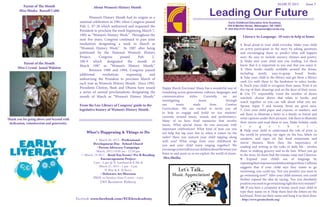
Happy March Everyone! Music has a wonderful way of
translating across generations, cultures, languages, and
communication styles. Currently, we are
investigating music through
our music study from Creative
Curriculum. We are excited to invite you all
to help us engage and build on our students’
curiosity around music, sound, and performance.
Many of us have fond memories that involve
music. What special music do you associate with
important celebrations? What kind of beat can you
not help but tap your feet to when it comes on the
radio? Have you noticed your child tapping along
with you? What songs from your childhood do
you and your child enjoy singing together? We
encourageyoutotalktoyourchildrenaboutthemusicyou
listen to and assist us as we explore the world of music.
-Mrs.Sheika
Literacy-to-Language: 10 ways to help at home
1. Read aloud to your child everyday. Make your child
an active participant in the story by asking questions
and encouraging them to predict what will happen
next. Be sure to include nursery rhymes and poetry.
2. Make sure your child sees you reading. Let them
know that it is important to you and that you enjoy it.
3. Have books readily available around the house,
including sturdy, easy-to-grasp board books.
4. Take your child to the library and get them a library
card. Go with them to the bookstore to select books.
5. Teach your child to recognize their name. Print it on
the top of their drawings and on the door of their room.
6. Use TV responsibly. Limit the number of shows
watched, choose shows that relate to books, and
watch together so you can talk about what you see.
Sprout, Super Y and Sesame Street are good ones.
7. Give your child paper and crayons, or markers, and
ask them to illustrate a letter to a family or friend and
write captions under their pictures. Ask them to illustrate
their stories and read them to you. Make holiday cards
t o g e t h e r .
8. Help your child to understand the role of print in
the world by pointing out signs on the bus, labels on
sneakers, and signs on fast food restaurants and
movie theaters. Show then the importance of
reading and writing in the tasks of daily life - involve
them in making grocery and to-do lists. When you go
to the store, let them find the tomato soup and Cheerios.
9. Expand your child’s use of language by
repeatingtheirresponsesandelaboratingonthem.Cullinan
suggests that if your child says they wants to go
swimming, you could say, “Are you positive you want to
go swimming now?” After your child answers, you could
further expand the idea by saying, “Are you absolutely
positiveyouwanttogoswimmingrightthisveryminute?”
10. If you have a computer at home, teach your child to
type their name on it. Help them find the letters on the
keyboard. Print out their name and hang it on their door.
- http://www.greatschools.org/
MARCH 2015	 Issue 3
Early Childhood Education Arts Academy
705 N Market Street, Wilmington, DE 19801
P: 302-652-0101 Email: surquhart@ccacde.org
What’s Happening & Things to Do
• March 20, 2015 - Professional
Development Day - School Closed
• Parent Advocacy Campaign
March, 2015 10:30 am - 12:30 pm
• March, 18 2015 - Book’Em Event/ Pre K Reading
Encouragement Project
3 pm - 4 pm @ N. Lombard & E 9th St
March 21, 2015 - 1 pm - 2 pm
N. Pine & E. 9t Street
• Delaware Art Museum
FREE on Sundays from12 noon - 4 pm.
2301 Kentmere Parkway
Facebook: www.facebook.com/ECEArtsAcademy
Parent of The Month
Miss Shieka- Russell Cobb
Parent of the Month
Miss Crystal- Jamal Walston
About Women’s History Month
	 Women’s History Month had its origins as a
national celebration in 1981 when Congress passed
Pub. L. 97-28 which authorized and requested the
President to proclaim the week beginning March 7,
1982 as “Women’s History Week.” Throughout the
next five years, Congress continued to pass joint
resolutions designating a week in March as
“Women’s History Week.” In 1987 after being
petitioned by the National Women’s History
Project, Congress passed Pub. L.
100-9 which designated the month of
March 1987 as “Women’s History Month.”
	 Between 1988 and 1994, Congress passed
additional resolutions requesting and
authorizing the President to proclaim March of
each year as Women’s History Month. Since 1995,
Presidents Clinton, Bush and Obama have issued
a series of annual proclamations designating the
month of March as “Women’s History Month.”
From the Law Library of Congress’ guide to the
legislative history of Women’s History Month.
Thank you for going above and beyond with
dedication, volunteerism and generosity.
STRENGTHENING FAMILIES
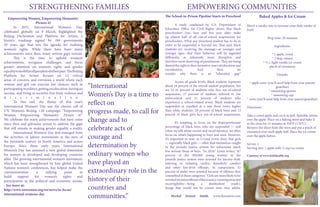
Empowering Women, Empowering Humanity:
Picture it!
	 In 2015, International Women’s Day,
celebrated globally on 8 March, highlighted the
Beijing Declaration and Platform for Action, a
historic roadmap signed by 189 governments
20 years ago that sets the agenda for realizing
women’s rights. While there have been many
achievements since then, many serious gaps remain.
	 This is the time to uphold women’s
achievements, recognize challenges, and focus
greater attention on women’s rights and gender
equalitytomobilizeallpeopletodotheirpart.TheBeijing
Platform for Action focuses on 12 critical
areas of concern, and envisions a world where each
woman and girl can exercise her choices, such as
participatinginpolitics,gettinganeducation,havingan
income, and living in societies free from violence and
d i s c r i m i n a t i o n .
	 To this end, the theme of this year’s
International Women’s Day was the clarion call of
UN Women’s Beijing +20 campaign “Empowering
Women, Empowering Humanity: Picture it!”
We celebrate the many achievements that have come
since then and galvanize action to address the gaps
that still remain in making gender equality a reality.
	 International Women’s Day first emerged from
the activities of labour movements at the turn of
the twentieth century in North America and across
Europe. Since those early years, International
Women’s Day has assumed a new global dimension
for women in developed and developing countries
alike. The growing international women’s movement,
which has been strengthened by four global United
Nations women’s conferences, has helped make the
commemoration a rallying point to
build support for women’s rights and
participation in the political and economic arenas.
- See more at:
http://www.unwomen.org/en/news/in-focus/
international-womens-day
EMPOWERING COMMUNITIES
Baked Apples & Ice Cream
Here’s a sneaky way to increase your daily intake of
fruit!
Prep time: 20 minutes
Ingredients:
* 1 apple, cored
* 2 tbsp. raisins
* ½ c. light vanilla ice cream
pinch of cinnamon
Utensils:
* apple corer (you’ll need help from your parent/
guardian)
* measuring spoons
* measuring cup
* oven (you’ll need help from your parent/guardian)
Directions:
Take a cored apple and cut it in half. Sprinkle raisins
over the apple. Place on a baking sheet and bake it
in the oven for 15 minutes at 350°F (176°C).
Remove the sheet from the oven and put a pinch of
cinnamon over each apple half. Place the ice cream
over the apple halves.
Serves: 1
Serving size: 1 apple with ½ cup ice cream
Courtesy of www.kidshealth.org
The School-to-Prison Pipeline Starts in Preschool
	 A study conducted by U.S. Department of
Education Office for Civil Rights shows that black
preschoolers (yes, four and five year olds) make
up almost half of all out-of-school suspensions for
preschoolers. What any preschool student has to do in
order to be suspended is beyond me. That said, black
students are receiving the message—at younger and
younger ages—that their behavior will be regarded
differently, as inherently more disruptive and
therefore more deserving of punishment. They are being
denied the right to their formative years of education and
socialization. And then we
wonder why there is an “education gap.”
	 Across all grade levels, Black students represent
about 16 percent of the overall student population, but
are 32-42 percent of students who face out-of-school
suspension, 27 percent of students referred to law
enforcement and 31 percent of students who
experience a school-related arrest. Black students are
suspended or expelled at a rate three times higher
than white students. 20 percent of black boys and 12
percent of black girls face out-of-school suspensions.
	 It’s tempting to focus on the disproportionate
percentage of black boys who are suspended — and
when we talk about racism and racial injustice, we often
focus on what’s happening to boys and men. However,
it’s important to note, as Crystal Lewis does, that girls
— especially black girls — often find themselves caught
in the juvenile justice system for infractions much
less serious those of boys. “In 2010,” Lewis writes, “67
percent of the 500,000 young women in the
juvenile justice system were arrested for larceny-theft,
loitering or violating curfew, disorderly conduct
and other low-level offenses. In comparison, 52
percent of males were arrested because of offenses they
committed in these categories.” Girls are more likely to be
arrestedonstatusoffenses(liketruancy,runningawayand
incorrigibility—being a disobedient youth),
things that would not be crimes were they adults.
- Mychal Denzel Smith, www.thenation.com
“International
Women’s Day is a time to
reflect on
progress made, to call for
change and to
celebrate acts of
courage and
determination by
ordinary women who
have played an
extraordinary role in the
history of their
countries and
communities.”

March Newsletter ECEAA

  • 1.
    Leading Our Future HappyMarch Everyone! Music has a wonderful way of translating across generations, cultures, languages, and communication styles. Currently, we are investigating music through our music study from Creative Curriculum. We are excited to invite you all to help us engage and build on our students’ curiosity around music, sound, and performance. Many of us have fond memories that involve music. What special music do you associate with important celebrations? What kind of beat can you not help but tap your feet to when it comes on the radio? Have you noticed your child tapping along with you? What songs from your childhood do you and your child enjoy singing together? We encourageyoutotalktoyourchildrenaboutthemusicyou listen to and assist us as we explore the world of music. -Mrs.Sheika Literacy-to-Language: 10 ways to help at home 1. Read aloud to your child everyday. Make your child an active participant in the story by asking questions and encouraging them to predict what will happen next. Be sure to include nursery rhymes and poetry. 2. Make sure your child sees you reading. Let them know that it is important to you and that you enjoy it. 3. Have books readily available around the house, including sturdy, easy-to-grasp board books. 4. Take your child to the library and get them a library card. Go with them to the bookstore to select books. 5. Teach your child to recognize their name. Print it on the top of their drawings and on the door of their room. 6. Use TV responsibly. Limit the number of shows watched, choose shows that relate to books, and watch together so you can talk about what you see. Sprout, Super Y and Sesame Street are good ones. 7. Give your child paper and crayons, or markers, and ask them to illustrate a letter to a family or friend and write captions under their pictures. Ask them to illustrate their stories and read them to you. Make holiday cards t o g e t h e r . 8. Help your child to understand the role of print in the world by pointing out signs on the bus, labels on sneakers, and signs on fast food restaurants and movie theaters. Show then the importance of reading and writing in the tasks of daily life - involve them in making grocery and to-do lists. When you go to the store, let them find the tomato soup and Cheerios. 9. Expand your child’s use of language by repeatingtheirresponsesandelaboratingonthem.Cullinan suggests that if your child says they wants to go swimming, you could say, “Are you positive you want to go swimming now?” After your child answers, you could further expand the idea by saying, “Are you absolutely positiveyouwanttogoswimmingrightthisveryminute?” 10. If you have a computer at home, teach your child to type their name on it. Help them find the letters on the keyboard. Print out their name and hang it on their door. - http://www.greatschools.org/ MARCH 2015 Issue 3 Early Childhood Education Arts Academy 705 N Market Street, Wilmington, DE 19801 P: 302-652-0101 Email: surquhart@ccacde.org What’s Happening & Things to Do • March 20, 2015 - Professional Development Day - School Closed • Parent Advocacy Campaign March, 2015 10:30 am - 12:30 pm • March, 18 2015 - Book’Em Event/ Pre K Reading Encouragement Project 3 pm - 4 pm @ N. Lombard & E 9th St March 21, 2015 - 1 pm - 2 pm N. Pine & E. 9t Street • Delaware Art Museum FREE on Sundays from12 noon - 4 pm. 2301 Kentmere Parkway Facebook: www.facebook.com/ECEArtsAcademy Parent of The Month Miss Shieka- Russell Cobb Parent of the Month Miss Crystal- Jamal Walston About Women’s History Month Women’s History Month had its origins as a national celebration in 1981 when Congress passed Pub. L. 97-28 which authorized and requested the President to proclaim the week beginning March 7, 1982 as “Women’s History Week.” Throughout the next five years, Congress continued to pass joint resolutions designating a week in March as “Women’s History Week.” In 1987 after being petitioned by the National Women’s History Project, Congress passed Pub. L. 100-9 which designated the month of March 1987 as “Women’s History Month.” Between 1988 and 1994, Congress passed additional resolutions requesting and authorizing the President to proclaim March of each year as Women’s History Month. Since 1995, Presidents Clinton, Bush and Obama have issued a series of annual proclamations designating the month of March as “Women’s History Month.” From the Law Library of Congress’ guide to the legislative history of Women’s History Month. Thank you for going above and beyond with dedication, volunteerism and generosity.
  • 2.
    STRENGTHENING FAMILIES Empowering Women,Empowering Humanity: Picture it! In 2015, International Women’s Day, celebrated globally on 8 March, highlighted the Beijing Declaration and Platform for Action, a historic roadmap signed by 189 governments 20 years ago that sets the agenda for realizing women’s rights. While there have been many achievements since then, many serious gaps remain. This is the time to uphold women’s achievements, recognize challenges, and focus greater attention on women’s rights and gender equalitytomobilizeallpeopletodotheirpart.TheBeijing Platform for Action focuses on 12 critical areas of concern, and envisions a world where each woman and girl can exercise her choices, such as participatinginpolitics,gettinganeducation,havingan income, and living in societies free from violence and d i s c r i m i n a t i o n . To this end, the theme of this year’s International Women’s Day was the clarion call of UN Women’s Beijing +20 campaign “Empowering Women, Empowering Humanity: Picture it!” We celebrate the many achievements that have come since then and galvanize action to address the gaps that still remain in making gender equality a reality. International Women’s Day first emerged from the activities of labour movements at the turn of the twentieth century in North America and across Europe. Since those early years, International Women’s Day has assumed a new global dimension for women in developed and developing countries alike. The growing international women’s movement, which has been strengthened by four global United Nations women’s conferences, has helped make the commemoration a rallying point to build support for women’s rights and participation in the political and economic arenas. - See more at: http://www.unwomen.org/en/news/in-focus/ international-womens-day EMPOWERING COMMUNITIES Baked Apples & Ice Cream Here’s a sneaky way to increase your daily intake of fruit! Prep time: 20 minutes Ingredients: * 1 apple, cored * 2 tbsp. raisins * ½ c. light vanilla ice cream pinch of cinnamon Utensils: * apple corer (you’ll need help from your parent/ guardian) * measuring spoons * measuring cup * oven (you’ll need help from your parent/guardian) Directions: Take a cored apple and cut it in half. Sprinkle raisins over the apple. Place on a baking sheet and bake it in the oven for 15 minutes at 350°F (176°C). Remove the sheet from the oven and put a pinch of cinnamon over each apple half. Place the ice cream over the apple halves. Serves: 1 Serving size: 1 apple with ½ cup ice cream Courtesy of www.kidshealth.org The School-to-Prison Pipeline Starts in Preschool A study conducted by U.S. Department of Education Office for Civil Rights shows that black preschoolers (yes, four and five year olds) make up almost half of all out-of-school suspensions for preschoolers. What any preschool student has to do in order to be suspended is beyond me. That said, black students are receiving the message—at younger and younger ages—that their behavior will be regarded differently, as inherently more disruptive and therefore more deserving of punishment. They are being denied the right to their formative years of education and socialization. And then we wonder why there is an “education gap.” Across all grade levels, Black students represent about 16 percent of the overall student population, but are 32-42 percent of students who face out-of-school suspension, 27 percent of students referred to law enforcement and 31 percent of students who experience a school-related arrest. Black students are suspended or expelled at a rate three times higher than white students. 20 percent of black boys and 12 percent of black girls face out-of-school suspensions. It’s tempting to focus on the disproportionate percentage of black boys who are suspended — and when we talk about racism and racial injustice, we often focus on what’s happening to boys and men. However, it’s important to note, as Crystal Lewis does, that girls — especially black girls — often find themselves caught in the juvenile justice system for infractions much less serious those of boys. “In 2010,” Lewis writes, “67 percent of the 500,000 young women in the juvenile justice system were arrested for larceny-theft, loitering or violating curfew, disorderly conduct and other low-level offenses. In comparison, 52 percent of males were arrested because of offenses they committed in these categories.” Girls are more likely to be arrestedonstatusoffenses(liketruancy,runningawayand incorrigibility—being a disobedient youth), things that would not be crimes were they adults. - Mychal Denzel Smith, www.thenation.com “International Women’s Day is a time to reflect on progress made, to call for change and to celebrate acts of courage and determination by ordinary women who have played an extraordinary role in the history of their countries and communities.”