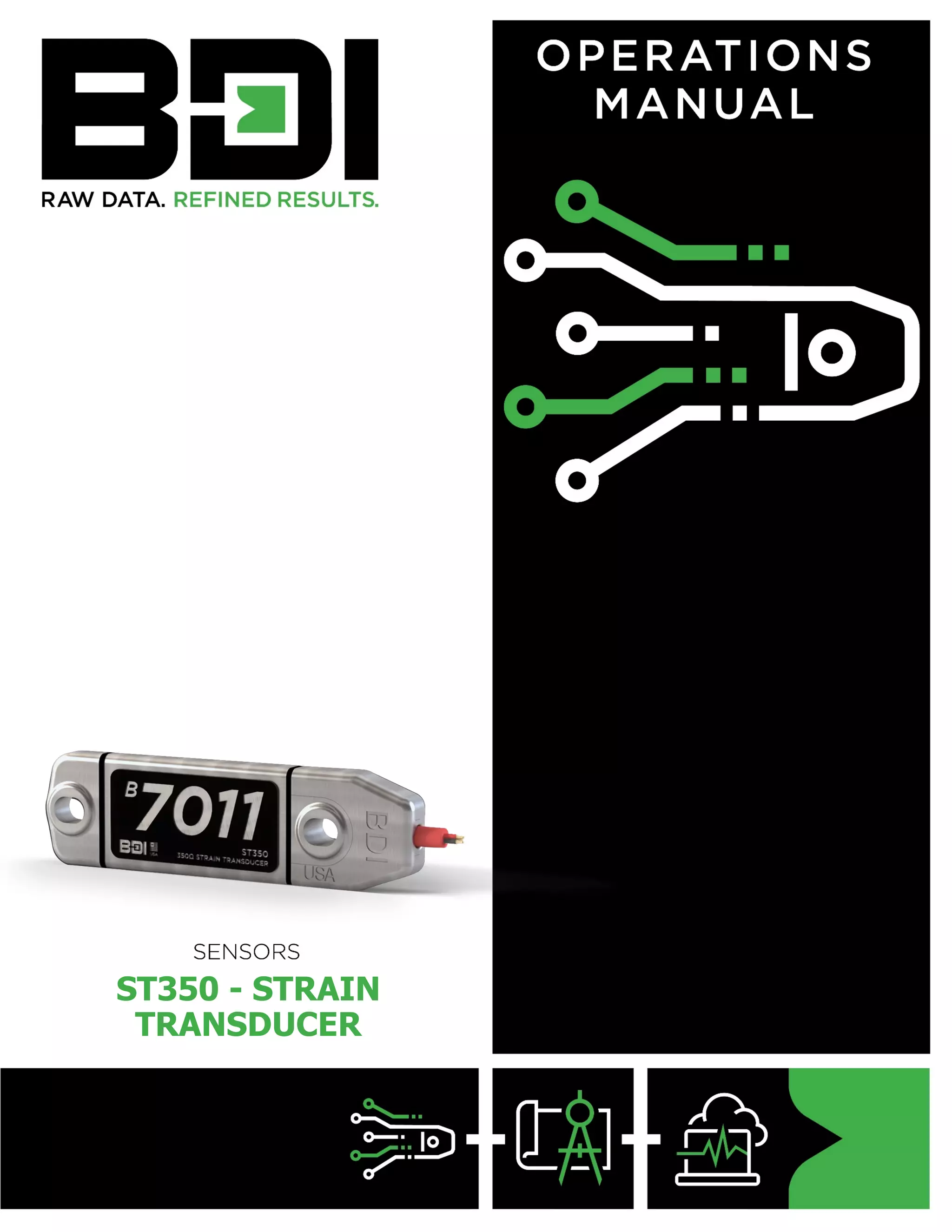
ST350 - STRAIN
TRANSDUCER
Doc. 201511 | Rev. A
OPERATIONS MANUAL: ST350 STRAIN TRANSDUCER
3
Document Revision History
Document Rev. Date ECO Changes
n/a 1.0 5/15/2012 n/a Initial release document
n/a 2.0 6/7/2012
n/a
 Updated to reflect the change in hardware
 Document formatting updated
n/a 2.1 1/2/2013
n/a  Interim version-minor changes to formatting
n/a 2.2 4/2/2013
n/a
 Updated to reflect the recent CE compliance approval
 Power ratings updated
201511 A 7/20/18
155
 Updated to include new corrosion protection
 Minor changes to specifications
 New template and styles were applied
 Added doc. number
No part of this operations manual may be reproduced, by any means, without the written consent of BDI.
The information contained within this manual is believed to be accurate and reliable. However, BDI assumes no responsibility
for errors, omissions or misinterpretations. The information herein is subject to change without notification.
Copyright © 1989 – 2018
Bridge Diagnostics, Inc. (dba BDI)
BDITEST.COM
+1.303.494.3230
+1.303.494.5027
P
F
740 S PIERCE AVE UNIT 15
LOUISVILLE CO 80027
4
WARRANTY INFORMATION
BDI warrants its products to be free from defects in materials and workmanship under normal use and service for thirty-six (36)
months from date of shipment. This warranty shall be void if any products have been subjected to modification, misuse, neglect,
accidents of nature, or shipping damage. Batteries have no warranty.
All equipment manufactured by BDI is intended for use by a qualified professional only. Under this warranty BDI's obligation is
limited to repairing or replacing (at BDI's option) of defective products. In no event shall BDI be liable for punitive, exemplary,
special, indirect, incidental, or consequential damages and the customer shall assume all costs of removing, reinstalling, and
shipping of defective products. EXCEPT AS STATED HEREIN, BDI MAKES NO WARRANTIES, EXPRESSED OR IMPLIED, AND
SPECIFICALLY DISCLAIMS ANY IMPLIED WARRANTY OF FITNESS FOR A PARTICULAR PURPOSE OR MERCHANTABILITY.
Before returning any product, BDI technical support must be contacted at +1-303-494-3230 or by visiting BDITEST.COM/contact
and submitting a request. A technician will help determine the nature of the problem and if it cannot be resolved, authorization
will be given to return the item. A return merchandise authorization (RMA) will be sent to the customer to be filled out and
shipped back with the equipment. BDI will not accept shipment of any product without prior authorization as provided herein.
Ship all equipment to:
BDI
ATTN: TECHNICAL SUPPORT
740 S PIERCE AVE UNIT 15
LOUISVILLE CO 80027
+1.303.494.3230
Doc. 201511 | Rev. A
OPERATIONS MANUAL: ST350 STRAIN TRANSDUCER
5
TABLE OF CONTENTS
1. Introduction .............................................................................................................................................................7
1.1 About the ST350 Strain Transducer.......................................................................................................................7
1.2 About this manual ...............................................................................................................................................7
2. ST350 Overview........................................................................................................................................................8
2.1 Technical Specifications .......................................................................................................................................8
2.2 Options and Accessories.......................................................................................................................................9
2.3 Applications ......................................................................................................................................................10
3. Operation...............................................................................................................................................................10
3.1 Theory of Operation ..........................................................................................................................................10
3.2 Potential Strain Measurement Issues................................................................................................................... 11
3.2.1 Temperature Variation...............................................................................................................................11
3.2.2 Instrumentation Cable Issues ..................................................................................................................... 12
3.3 Connecting to Data Acquisition Systems .............................................................................................................. 12
3.3.1 Excitation Voltage .....................................................................................................................................12
3.3.2 Electrical Connections................................................................................................................................12
3.3.3 Applying Calibration Factors ....................................................................................................................... 13
3.4 Verifying ST350 Output......................................................................................................................................13
3.4.1 Resistance Test.........................................................................................................................................13
3.4.2 Resolution/Noise Test................................................................................................................................14
3.4.3 Sensor Response Test ...............................................................................................................................14
3.4.4 Field Adjusting Excessive Offsets ................................................................................................................ 15
3.5 Verifying Accuracy.............................................................................................................................................15
3.5.1 Factory Calibration ....................................................................................................................................15
3.5.2 Items for Consideration for User Verification Tests ....................................................................................... 15
4. Installation .............................................................................................................................................................17
4.1 General Installation Guide ..................................................................................................................................17
4.1.1 Prepare Mounting Area ..............................................................................................................................17
4.1.2 Installation ...............................................................................................................................................18
4.2 Installation on Steel Members.............................................................................................................................19
4.1 Installation on Concrete Members....................................................................................................................... 23
4.1.1 Concrete Mounting Studs ........................................................................................................................... 23
4.1.2 Attaching ST350 with Extension to R/C Members ......................................................................................... 24
4.1.3 Attaching Extension to the ST350 ............................................................................................................... 25
4.2 Installation on Other Surfaces.............................................................................................................................29
4.2.1 Timber Members.......................................................................................................................................29
4.2.2 Composite Materials ..................................................................................................................................29
5. Maintenance & Recalibration ....................................................................................................................................29
5.1 Maintenance Considerations ...............................................................................................................................29
5.2 Recalibration.....................................................................................................................................................29
BDITEST.COM
+1.303.494.3230
+1.303.494.5027
P
F
740 S PIERCE AVE UNIT 15
LOUISVILLE CO 80027
6
LIST OF TABLES
Table 1: ST350 Specifications..........................................................................................................................................8
Table 2: ST350 Options and Accessories ..........................................................................................................................9
Table 3: Typical Applications for ST350 strain transducers ...............................................................................................10
Table 4: ST350 Wiring Designations & Intelliducer Pinout ................................................................................................12
Table 5: ST350 Extension Limits....................................................................................................................................24
Table 6: Gage Extension Factors ...................................................................................................................................24
Table 7: Maximum Strain Ranges ..................................................................................................................................25
LIST OF FIGURES
Figure 1: ST350 Drawing (inches) ...................................................................................................................................8
Figure 2: ST350 Schematic ...........................................................................................................................................11
Figure 3: Noise levels of the ST350 on a 24-bit data acquisition system ............................................................................14
Figure 4: Typical Smooth Output Response and Zero Offset.............................................................................................14
Figure 5: Alignment Marking for ST350 Installation .........................................................................................................18
Figure 6: Mounting Position & Surface Preparation Marks ................................................................................................18
Figure 7: Typical ST350 Installation...............................................................................................................................19
Figure 8: Identifying Metric vs. Imperial Tabs.................................................................................................................19
Figure 9: Mounting Tabs on the ST350 using the Tab Jig.................................................................................................20
Figure 10: Marking ST350 Center Mounting Location.......................................................................................................20
Figure 11: Tab Removal Tool (TRT)...............................................................................................................................21
Figure 12: TRT with a Tab Inserted ...............................................................................................................................22
Figure 13: Removing a Tab with the TRT .......................................................................................................................22
Figure 14: ST350 Concrete Drilling Jig ...........................................................................................................................23
Figure 15: ST350 Extension Mounting Jig .......................................................................................................................26
Figure 16: ST350 Extension Mounting Diagram...............................................................................................................26
Figure 17: Aligning ST350 and Extension in the Jig .........................................................................................................27
Figure 18: Extension Alignment Tab...............................................................................................................................27
Figure 19: Attaching Tab to Extension ...........................................................................................................................27
Figure 20: ST350 With Extensions Attached to an R/C Structure.......................................................................................28
Doc. 201511 | Rev. A
OPERATIONS MANUAL: ST350 STRAIN TRANSDUCER
7
1. INTRODUCTION
1.1 ABOUT THE ST350 STRAIN TRANSDUCER
The ST350 strain transducers have been designed for recording dynamic and other induced strains on all types of structural
members and to be compatible with most data acquisition systems. While mostly used in rugged field applications, they are also
suitable for many laboratory and manufacturing scenarios. The ST350 internal circuitry consists of a full Wheatstone Bridge with
four fully-active 350Ω foil gages optimized to provide a high electrical output for a given strain magnitude. Each transducer is
individually calibrated with a highly-accurate, N.I.S.T.-traceable calibration system.
Each unit is fully sealed, designed to exceed the IP67 rating, and equipped with two pre-drilled mounting holes to keep the gage
lengths consistent for all installations. Based on the structure’s material and length of time the ST350 is to be installed, various
mounting techniques can be used including adhesives, welding, expandable anchors, and screws.
1.2 ABOUT THIS MANUAL
This is a comprehensive document that explains the functions and features of the ST350. BDI also manufactures two types of
data acquisition systems, which will be referenced throughout the manual.
1. Structural Testing System (STS): Rugged, wireless, battery powered DAQ that includes an intelligent (Intelliducer)
connector design, which makes the system extremely easy to deploy on a variety of field projects.
2. Structural Monitoring System (SMS): Modular system with 4- or 16-channel nodes that can be used in laboratories or
on permanent large scales monitoring projects.
The following highlighted message blocks will periodically appear and contain important information that the user should be
aware of.
STOP: This symbol and corresponding message represents information regarding the device that if not
followed could lead to damaging the device! Pay close attention to this message.
WARNING: This symbol and corresponding message represents vital information and is critical for the
device operation and/or the operational settings/configuration.
INFORMATION: This symbol and corresponding message represents general information and/or tips on
successfully operating/configuring the device.
BDITEST.COM
+1.303.494.3230
+1.303.494.5027
P
F
740 S PIERCE AVE UNIT 15
LOUISVILLE CO 80027
8
2. ST350 OVERVIEW
2.1 TECHNICAL SPECIFICATIONS
Figure 1: ST350 Drawing (inches)
Table 1: ST350 Specifications
MODEL ST350
TYPE 350Ω
CIRCUIT Full Wheatstone bridge with 4 active 350Ω strain gages
EXCITATION VOLTAGE +1.0 to +10.0 Vdc
OUTPUT mV level, ratiometric to Excitation Voltage
OFFSET < 1.5 mV at time and temperature of calibration
POWER RATING:
MAX
TYPICAL
INTELLIDUCER1
300 mW
72 mW @ +5.0 Vdc
13 mW @ +5.0 Vdc
STRAIN RANGE ±4,000 µε (Calibrated to ±2,000 µε)
FORCE REQUIRED FOR 1,000µε ~17 lb (~76N)
TYPICAL SENSITIVITY ~500 με/mVout/Vin
ACCURACY2
< ±1%
CALIBRATION
Individually calibrated using N.I.S.T.-traceable automated system.
Calibration curve & factor provided
THERMISTOR (OPTIONAL) 3 kΩ - NTC
EFFECTIVE GAGE LENGTH 3.0 in (76.2 mm) [Gage Extensions available for R/C structures]
CABLE
Custom lead cable length made to order:
IC-02-187 [22 AWG, 2 shielded pair, drain wire, red PVC jacket]
IC-02-250 [22 AWG, 2 shielded pair, drain wire, blue PVC jacket]
IC-03-250 [24 AWG, 3 shielded pair, drain wire, black PVC jacket]
HOUSING Machined 6061 Aluminum Alloy
Doc. 201511 | Rev. A
OPERATIONS MANUAL: ST350 STRAIN TRANSDUCER
9
CORROSION PROTECTION Hard Anodized Clear (MIL-A-8625 Type III)
WEATHER PROTECTION
Designed to exceed IP67
Optional 100 ft (30 m), waterproofing available
TEMPERATURE RATING3
-58° to +176 °F (-50° to +80 °C)
SIZE 4.38 in x 1.25 in x 0.50 in (111 mm x 32 mm x 12.7 mm)
WEIGHT 0.19 lb (85 g)
MOUNTING HOLES
Through holes for ¼ in (M6) bolts or anchors
Reusable mounting tabs (gluing/welding)
1
Intelliducer connector required with STS Intelliducer data acquisition nodes.
2
Accuracy defined at the calibrated ±2,000 µε range.
3
Temperature limit based on instrumentation cable operating temperatures, call BDI for wide temperature range cable options.
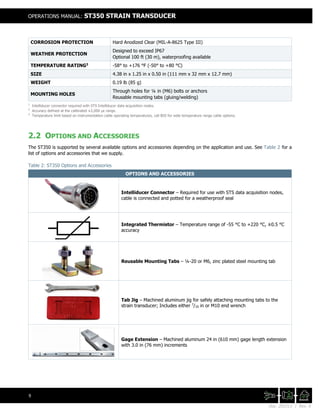
2.2 OPTIONS AND ACCESSORIES
The ST350 is supported by several available options and accessories depending on the application and use. See Table 2 for a
list of options and accessories that we supply.
Table 2: ST350 Options and Accessories
OPTIONS AND ACCESSORIES
Intelliducer Connector – Required for use with STS data acquisition nodes,
cable is connected and potted for a weatherproof seal
Integrated Thermistor – Temperature range of -55 °C to +220 °C, ±0.5 °C
accuracy
Reusable Mounting Tabs – ¼-20 or M6, zinc plated steel mounting tab
Tab Jig – Machined aluminum jig for safely attaching mounting tabs to the
strain transducer; Includes either 7
/16 in or M10 end wrench
Gage Extension – Machined aluminum 24 in (610 mm) gage length extension
with 3.0 in (76 mm) increments
BDITEST.COM
+1.303.494.3230
+1.303.494.5027
P
F
740 S PIERCE AVE UNIT 15
LOUISVILLE CO 80027
10
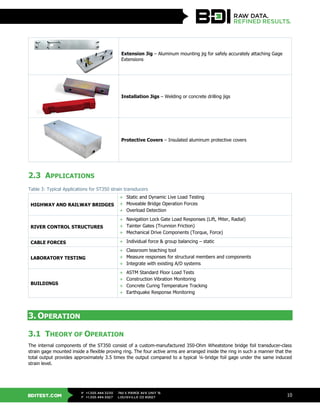
Extension Jig – Aluminum mounting jig for safely accurately attaching Gage
Extensions
Installation Jigs – Welding or concrete drilling jigs
Protective Covers – Insulated aluminum protective covers
2.3 APPLICATIONS
Table 3: Typical Applications for ST350 strain transducers
HIGHWAY AND RAILWAY BRIDGES
+ Static and Dynamic Live Load Testing
+ Moveable Bridge Operation Forces
+ Overload Detection
RIVER CONTROL STRUCTURES
+ Navigation Lock Gate Load Responses (Lift, Miter, Radial)
+ Tainter Gates (Trunnion Friction)
+ Mechanical Drive Components (Torque, Force)
CABLE FORCES + Individual force & group balancing – static
LABORATORY TESTING
+ Classroom teaching tool
+ Measure responses for structural members and components
+ Integrate with existing A/D systems
BUILDINGS
+ ASTM Standard Floor Load Tests
+ Construction Vibration Monitoring
+ Concrete Curing Temperature Tracking
+ Earthquake Response Monitoring
3. OPERATION
3.1 THEORY OF OPERATION
The internal components of the ST350 consist of a custom-manufactured 350-Ohm Wheatstone bridge foil transducer-class
strain gage mounted inside a flexible proving ring. The four active arms are arranged inside the ring in such a manner that the
total output provides approximately 3.5 times the output compared to a typical ¼-bridge foil gage under the same induced
strain level.
Doc. 201511 | Rev. A
OPERATIONS MANUAL: ST350 STRAIN TRANSDUCER
11
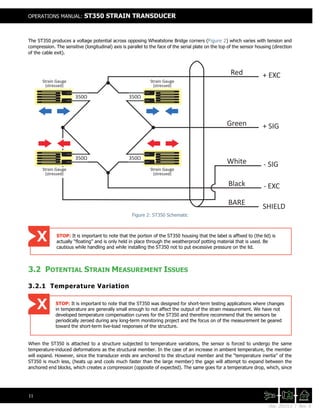
The ST350 produces a voltage potential across opposing Wheatstone Bridge corners (Figure 2) which varies with tension and
compression. The sensitive (longitudinal) axis is parallel to the face of the serial plate on the top of the sensor housing (direction
of the cable exit).
Figure 2: ST350 Schematic
3.2 POTENTIAL STRAIN MEASUREMENT ISSUES
3.2.1 Temperature Variation
When the ST350 is attached to a structure subjected to temperature variations, the sensor is forced to undergo the same
temperature-induced deformations as the structural member. In the case of an increase in ambient temperature, the member
will expand. However, since the transducer ends are anchored to the structural member and the “temperature inertia” of the
ST350 is much less, (heats up and cools much faster than the large member) the gage will attempt to expand between the
anchored end blocks, which creates a compression (opposite of expected). The same goes for a temperature drop, which, since
STOP: It is important to note that the portion of the ST350 housing that the label is affixed to (the lid) is
actually “floating” and is only held in place through the weatherproof potting material that is used. Be
cautious while handling and while installing the ST350 not to put excessive pressure on the lid.
STOP: It is important to note that the ST350 was designed for short-term testing applications where changes
in temperature are generally small enough to not affect the output of the strain measurement. We have not
developed temperature compensation curves for the ST350 and therefore recommend that the sensors be
periodically zeroed during any long-term monitoring project and the focus on of the measurement be geared
toward the short-term live-load responses of the structure.
BDITEST.COM
+1.303.494.3230
+1.303.494.5027
P
F
740 S PIERCE AVE UNIT 15
LOUISVILLE CO 80027
12
the gage cools off faster than the member, will register tension. If the sensor is to be mounted on the structure for an extended
period of time, it will need to have its zero-offset reset periodically as it drifts around with temperature changes.
If the ST350 is exposed to direct sunlight during live-load tests, such as on truss members or on top of a concrete slab, significant
temperature drift can be experienced during short periods of time due to changing cloud cover and/or breezes. Covering the
ST350 with foam and aluminum tape can usually reduce or eliminate this problem. BDI also supplied insulated aluminum covers
that help reduce these effects greatly.
3.2.2 Instrumentation Cable Issues
The output responses for the ST350 will vary slightly depending on the length of the instrumentation cable due to resistance of
the lead wires. To address this, ST350s are calibrated with the instrumentation cable installed, meaning that this resistance has
automatically been taken into account through the calibration process. If, however, the user splices a significantly long cable to
the cable that has been supplied with the unit, a small error that is approximately the ratio of the additional resistance to the
gage resistance will be introduced. Therefore, BDI always recommends calibrating the transducer with the cable that is going
to be used in the field.
3.3 CONNECTING TO DATA ACQUISITION SYSTEMS
This section outlines how to connect and test the ST350 for most standard data acquisition systems that are designed to handle
a differential voltage output.
3.3.1 Excitation Voltage
It is recommended that the Wheatstone bridge excitation voltage be at or below +10 Vdc since higher voltages can cause drift
and stability issues due to gage heating. For example, the BDI STS/SMS data acquisition systems uses a regulated +5 Vdc
excitation voltage which provides excellent results. Allowing the electronics and the gages to warm up for several minutes is
also recommended. A small amount of drift will be detected during the warming process, but should stabilize within several
minutes.
3.3.2 Electrical Connections
The ST350 uses a standard Wheatstone Bridge 4-wire hookup. Table 4 outlines the wiring color/signal connections and includes
the pinout for Intelliducer connectors used with the STS data acquisition nodes.
Table 4: ST350 Wiring Designations & Intelliducer Pinout
INSTRUMENTATION CABLE TYPE
SIGNAL INTELLIDUCER PINOUTIC-02-187
& IC-02-250
IC-03-250
RED RED + Excitation G
BLACK BLACK (PAIRED W/ RED) - Excitation (GND) K
GREEN GREEN + Signal C
WHITE BLACK (PAIRED W/ GREEN) - Signal J
BARE ALL BARE WIRES Shield/Drain (Earth GND) Integrated into pin K
N/A WHITE + Temp B
N/A BLACK (PAIRED W/ WHITE) - Temp Integrated into pin K
INFORMATION: When using the ST350 with any STS data acquisition node, the connection has already
been pre-wired to the twist-lock plug and no further action is necessary.
Doc. 201511 | Rev. A
OPERATIONS MANUAL: ST350 STRAIN TRANSDUCER
13
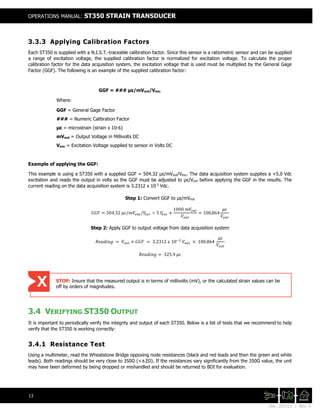
3.3.3 Applying Calibration Factors
Each ST350 is supplied with a N.I.S.T.-traceable calibration factor. Since this sensor is a ratiometric sensor and can be supplied
a range of excitation voltage, the supplied calibration factor is normalized for excitation voltage. To calculate the proper
calibration factor for the data acquisition system, the excitation voltage that is used must be multiplied by the General Gage
Factor (GGF). The following is an example of the supplied calibration factor:
GGF = ### με/mVout/Vexc
Where:
GGF = General Gage Factor
### = Numeric Calibration Factor
με = microstrain (strain x 10-6)
mVout = Output Voltage in Millivolts DC
Vexc = Excitation Voltage supplied to sensor in Volts DC
Example of applying the GGF:
This example is using a ST350 with a supplied GGF = 504.32 με/mVout/Vexc. The data acquisition system supplies a +5.0 Vdc
excitation and reads the output in volts so the GGF must be adjusted to με/Vout before applying the GGF in the results. The
current reading on the data acquisition system is 3.2312 x 10⁻³
Vdc.
Step 1: Convert GGF to με/mVout
𝐺𝐺𝐺𝐺𝐺𝐺 = 504.32 𝜇𝜇𝜇𝜇/𝑚𝑚𝑚𝑚𝑜𝑜 𝑜𝑜𝑜𝑜/𝑉𝑉𝑒𝑒𝑒𝑒𝑒𝑒 ÷ 5 𝑉𝑉𝑒𝑒𝑒𝑒𝑒𝑒 ×
1000 𝑚𝑚𝑚𝑚𝑜𝑜 𝑜𝑜𝑜𝑜
𝑉𝑉𝑜𝑜 𝑜𝑜𝑜𝑜
= 100,864
𝜇𝜇𝜇𝜇
𝑉𝑉𝑜𝑜 𝑜𝑜𝑜𝑜
Step 2: Apply GGF to output voltage from data acquisition system
𝑅𝑅𝑅𝑅𝑅𝑅𝑅𝑅𝑅𝑅𝑅𝑅 𝑅𝑅 = 𝑉𝑉𝑜𝑜𝑜𝑜𝑜𝑜 × 𝐺𝐺𝐺𝐺𝐺𝐺 = 3.2312 𝑥𝑥 10−3
𝑉𝑉𝑜𝑜𝑜𝑜𝑜𝑜 × 100,864
𝜇𝜇𝜇𝜇
𝑉𝑉𝑜𝑜 𝑢𝑢𝑡𝑡
𝑅𝑅𝑅𝑅𝑅𝑅𝑅𝑅𝑅𝑅𝑅𝑅 𝑅𝑅 = 325.9 𝜇𝜇𝜇𝜇
3.4 VERIFYING ST350 OUTPUT
It is important to periodically verify the integrity and output of each ST350. Below is a list of tests that we recommend to help
verify that the ST350 is working correctly:
3.4.1 Resistance Test
Using a multimeter, read the Wheatstone Bridge opposing node resistances (black and red leads and then the green and white
leads). Both readings should be very close to 350Ω (<±2Ω). If the resistances vary significantly from the 350Ω value, the unit
may have been deformed by being dropped or mishandled and should be returned to BDI for evaluation.
STOP: Insure that the measured output is in terms of millivolts (mV), or the calculated strain values can be
off by orders of magnitudes.
BDITEST.COM
+1.303.494.3230
+1.303.494.5027
P
F
740 S PIERCE AVE UNIT 15
LOUISVILLE CO 80027
14
The ST350 has been designed to minimize the amount of maintenance required to keep it operational. Before each use it is
recommended that every sensor be visually inspected for damage and powered on to ensure it is working properly. This should
be done two to three weeks before any scheduled testing in case any repairs are required.
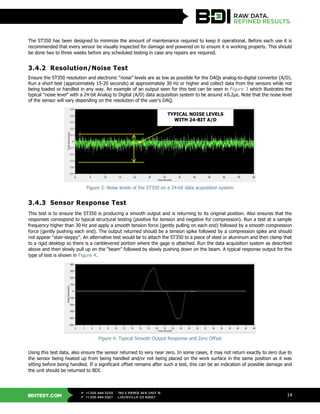
3.4.2 Resolution/Noise Test
Ensure the ST350 resolution and electronic “noise” levels are as low as possible for the DAQs analog-to-digital convertor (A/D).
Run a short test (approximately 15-20 seconds) at approximately 30 Hz or higher and collect data from the sensors while not
being loaded or handled in any way. An example of an output seen for this test can be seen in Figure 3 which illustrates the
typical “noise level” with a 24-bit Analog to Digital (A/D) data acquisition system to be around ±0.2με. Note that the noise level
of the sensor will vary depending on the resolution of the user’s DAQ.
Figure 3: Noise levels of the ST350 on a 24-bit data acquisition system
3.4.3 Sensor Response Test
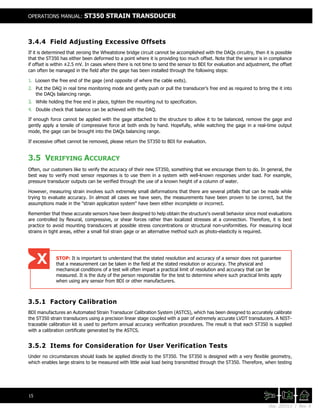
This test is to ensure the ST350 is producing a smooth output and is returning to its original position. Also ensures that the
responses correspond to typical structural testing (positive for tension and negative for compression). Run a test at a sample
frequency higher than 30 Hz and apply a smooth tension force (gently pulling on each end) followed by a smooth compression
force (gently pushing each end). The output returned should be a tension spike followed by a compression spike and should
not appear “stair-steppy”. An alternative test would be to attach the ST350 to a piece of steel or aluminum and then clamp that
to a rigid desktop so there is a cantilevered portion where the gage is attached. Run the data acquisition system as described
above and then slowly pull up on the “beam” followed by slowly pushing down on the beam. A typical response output for this
type of test is shown in Figure 4.
Figure 4: Typical Smooth Output Response and Zero Offset
Using this test data, also ensure the sensor returned to very near zero. In some cases, it may not return exactly to zero due to
the sensor being heated up from being handled and/or not being placed on the work surface in the same position as it was
sitting before being handled. If a significant offset remains after such a test, this can be an indication of possible damage and
the unit should be returned to BDI.
TYPICAL NOISE LEVELS
WITH 24-BIT A/D
Doc. 201511 | Rev. A
OPERATIONS MANUAL: ST350 STRAIN TRANSDUCER
15
3.4.4 Field Adjusting Excessive Offsets
If it is determined that zeroing the Wheatstone bridge circuit cannot be accomplished with the DAQs circuitry, then it is possible
that the ST350 has either been deformed to a point where it is providing too much offset. Note that the sensor is in compliance
if offset is within ±2.5 mV. In cases where there is not time to send the sensor to BDI for evaluation and adjustment, the offset
can often be managed in the field after the gage has been installed through the following steps:
1. Loosen the free end of the gage (end opposite of where the cable exits).
2. Put the DAQ in real time monitoring mode and gently push or pull the transducer’s free end as required to bring the it into
the DAQs balancing range.
3. While holding the free end in place, tighten the mounting nut to specification.
4. Double check that balance can be achieved with the DAQ.
If enough force cannot be applied with the gage attached to the structure to allow it to be balanced, remove the gage and
gently apply a tensile of compressive force at both ends by hand. Hopefully, while watching the gage in a real-time output
mode, the gage can be brought into the DAQs balancing range.
If excessive offset cannot be removed, please return the ST350 to BDI for evaluation.
3.5 VERIFYING ACCURACY
Often, our customers like to verify the accuracy of their new ST350, something that we encourage them to do. In general, the
best way to verify most sensor responses is to use them in a system with well-known responses under load. For example,
pressure transducer outputs can be verified through the use of a known height of a column of water.
However, measuring strain involves such extremely small deformations that there are several pitfalls that can be made while
trying to evaluate accuracy. In almost all cases we have seen, the measurements have been proven to be correct, but the
assumptions made in the "strain application system" have been either incomplete or incorrect.
Remember that these accurate sensors have been designed to help obtain the structure's overall behavior since most evaluations
are controlled by flexural, compressive, or shear forces rather than localized stresses at a connection. Therefore, it is best
practice to avoid mounting transducers at possible stress concentrations or structural non-uniformities. For measuring local
strains in tight areas, either a small foil strain gage or an alternative method such as photo-elasticity is required.
3.5.1 Factory Calibration
BDI manufactures an Automated Strain Transducer Calibration System (ASTCS), which has been designed to accurately calibrate
the ST350 strain transducers using a precision linear stage coupled with a pair of extremely accurate LVDT transducers. A NIST-
traceable calibration kit is used to perform annual accuracy verification procedures. The result is that each ST350 is supplied
with a calibration certificate generated by the ASTCS.
3.5.2 Items for Consideration for User Verification Tests
Under no circumstances should loads be applied directly to the ST350. The ST350 is designed with a very flexible geometry,
which enables large strains to be measured with little axial load being transmitted through the ST350. Therefore, when testing
STOP: It is important to understand that the stated resolution and accuracy of a sensor does not guarantee
that a measurement can be taken in the field at the stated resolution or accuracy. The physical and
mechanical conditions of a test will often impart a practical limit of resolution and accuracy that can be
measured. It is the duty of the person responsible for the test to determine where such practical limits apply
when using any sensor from BDI or other manufacturers.
BDITEST.COM
+1.303.494.3230
+1.303.494.5027
P
F
740 S PIERCE AVE UNIT 15
LOUISVILLE CO 80027
16
typical structural members, the stiffness of the ST350 is inconsequential. The ST350 is intended to provide a measure of strain;
it is not a load cell.
Often, the first verification test to be performed is either on a bending beam or compression/tension specimen in a laboratory
testing machine, with the results compared to the output of a foil strain gage or the theoretical strain value. Remember that
these sensors are designed to measure "axial strain", flexural bending on structural members can be determined via axial strain
measurements as long as the applied curvature is relatively small such that the small angle theory is applicable (SIN θ = θ).
This means that if bending stresses are to be measured, it is best to use a beam with a minimum depth of approximately 12 in
(305 mm) or more, since the ST350 will actually be offset from the beam surface slightly due to the thickness of the mounting
tabs. However, with the beam depth of 12 in (305 mm) or more, this difference is minimal. Another thing to watch out for
during a beam bending test; is that it is very difficult to apply the load to the beam without inducing torsion or lateral bending.
This occurs because the beam was not perfectly "straight" or because the end conditions are not perfectly level with one another.
To minimize this, the ST350 should be mounted with the tab/adhesive technique to the center of the flanges, rather than with
C-Clamps on the edge of the flanges.
Attempting to measure strain on a thin strip of metal mounted as a cantilever beam is not a good verification test for these
sensors. The primary problem with a thin bending specimen is that a large degree of curvature is required to obtain a small
level of surface strain. In other the words, the ST350 will simply be bent rather than elongated. Furthermore, the actual location
of the ST350 will be relatively far from the neutral axis compared to the surface (exaggerated again by the thickness of the tabs
if they are used). Therefore, significant errors are induced when comparing surface strains obtained by a foil strain gage and
the ST350 reading.
For calibration purposes, it is highly recommended that strains be compared at constant moment regions rather than at locations
with significant moment gradients. For the "bending beam" type of test, we recommend a beam at least 10 to 12 feet (3 to 4
m) long, with a shorter beam 4 to 6 feet (1 to 2 m) set on top (with "pins" under each end), and the load cell above that. This
"4-point" type of setup will supply a constant moment region at mid-span. Remember, the strain measured from the ST350 is
averaged over the 3 in (76.2 mm) gage length. Therefore, any error in gage placement or in the assumed strain gradient will
cause errors in subsequent data comparisons.
In almost every case we have seen, a specimen that is supposedly undergoing tension only is actually bending as well. A popular
test is to use a "dog bone" with the ST350 mounted on one side and then the whole assembly put into tension. It is almost
impossible to get pure tension in this setup since the specimen may be slightly bent to begin with and "straightens out" slightly.
Also, since the ST350 themselves have a small amount of stiffness, they will cause a non-symmetrical system. Another
consideration is the distance of the centroid of the ST350 to the specimen's neutral axis. Since bending will most likely occur,
the output from the ST350 may be reduced or amplified since its centroid is about ¼ in (6.4 mm) away from the foil gage
(further from the neutral axis), and this might be the "compression" or "tension" side of the specimen. This phenomenon is very
critical on small laboratory specimens, but insignificant on larger structures where the depths of the sections are usually much
bigger.
For the tension test to be successful, the ST350 should be mounted on both sides of the specimen (on all four sides if the
stiffnesses are similar in two directions) and the output averaged to determine the tension strain. In addition, the specimen
should be relatively stiff compared to the ST350.
If a compression test is being attempted, then the ST350s need to be at least two-member depths away from the ends, (a
criterion for plane strain), with ST350’s mounted on both sides of the specimen and the data averaged. For compression
specimens, it may be necessary to place ST350’s on all four sides since it can often be difficult to know the exact orientation of
the neutral axis if the stiffness is approximately the same in both directions.
Using reinforced concrete as a test specimen material is a poor choice since inaccuracies in the reinforcement locations and
variations in the concrete's elastic modulus (often up to 20%) can cause larger errors than the accuracy range of the ST350.
For example, more aggregate near the surface of one gage will affect the modulus in that area. BDI addresses these issues with
reinforced concrete by using BDI gage extensions (which effectively multiply the strain over anywhere from two to eight gage
lengths). This approach amplifies the signal, thus also improving the signal to noise ratio. With a gage length that is too short,
stress concentrations, micro-cracking, or local effects might have an unusually large effect on the measurements.
For reinforced concrete structures (non-pre-stressed or post tensioned), because of the margins of unknowns in concrete
modulus, load magnitudes, placement of reinforcement, etc., in general, we prefer not to use measurements where the
maximum strain is less than about 30με if we are making conclusions based on the magnitude of strain. (Note that 2με is almost
10% of a 30με peak). This translates into only about 100 psi in concrete and 1ksi in steel, which is quite accurate for analytical
Doc. 201511 | Rev. A
OPERATIONS MANUAL: ST350 STRAIN TRANSDUCER
17
modeling and load rating reinforced concrete structures. For these types of structures, numbers that are claimed to be more
accurate are probably suspect. Using the ST350 on pre-stressed concrete will usually provide excellent measurements, not only
because there shouldn't be any cracking, but also the concrete modulus usually tends to be more uniform.
We understand that concrete strains are not as accurate as those taken on steel structures and therefore attempt to maximize
the accuracy with the gage extensions.
MEASURING THE APPLIED STRAIN OR LOAD:
Often, the output of a strain gage-based load cell is used in a testing machine as the basis for comparisons in
tension/compression tests. However, we have found that many of these units may not have been calibrated with N.I.S.T.
traceable equipment for years and may be producing inaccurate results. If a gage is manually read for hydraulic pressure, then
the result will be sensitive to jacking friction. Also, if stress and strain are being calculated (σ = E·ε, σ = My/I, etc.), then very
accurate measurements of the cross-sectional areas are required.
MAGNITUDE OF APPLIED LOADS:
Calibration tests should always be run up near the maximum safe linear range of the system. This will give the required
confidence that the output from the ST350 is indeed linear over the range of stresses interest.
We are confident that if the above precautions are taken, the ST350 will provide very accurate and reproducible results. If you
have any questions on the above discussion or have a lab testing "pitfall" experience that you would like to have us investigate
or think it may help other users, please contact us.
4. INSTALLATION
There are several alternative mounting methods that can be used depending on the orientation, location, material being
mounted to (steel, concrete, timber), and the length of test (hours, weeks, months, years). Due to the large number of
variables associated with adhesive use (thermal cycles, UV exposure, vibration, impact, moisture, corrosion of base steel,
etc.,) adhesive is recommended for temporary testing and monitoring applications only. Please contact BDI for further
mounting alternatives.
4.1 GENERAL INSTALLATION GUIDE
The ST350 can be installed on many structure types and in all types of applications, so it is impossible to outline all the details
for each installation. However, with practice and experience, the user can select from a combination of the mounting techniques
that BDI has developed over the years depending on the application. There are several alternative mounting methods that can
be used depending on the orientation, location, material being mounted to (steel, concrete, timber), and the length of test
(hours, weeks, months, years). Please contact BDI for further information.
4.1.1 Prepare Mounting Area
The ST350 only measures strain in the axis in which it is aligned with, therefore the more accurate the alignment, the more
accurate the measurements will be. The easiest way to align the ST350 is to mark a “grid” type pattern for both the proper foot
placement and measurement axis. First, locate the center-line of the gaging area in both the longitudinal and transverse
directions. For example, if measurements are to be obtained at the mid-span of a joist, locate the midpoint between the supports
and the center-line of the joist. The longitudinal mark should be about 8 in (203 mm) long and the transverse mark about 4 in
(102 mm) long. This will allow the marks to be seen while the ST350 is being positioned. This can be seen in Figure 5.
BDITEST.COM
+1.303.494.3230
+1.303.494.5027
P
F
740 S PIERCE AVE UNIT 15
LOUISVILLE CO 80027
18
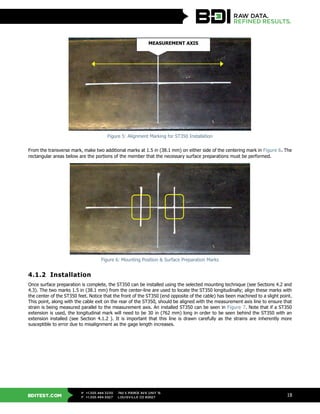
Figure 5: Alignment Marking for ST350 Installation
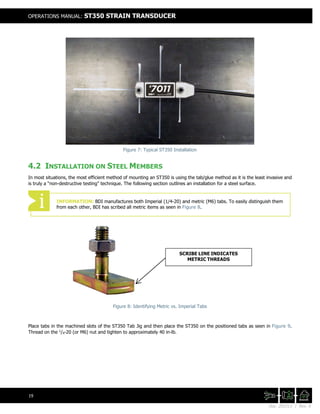
From the transverse mark, make two additional marks at 1.5 in (38.1 mm) on either side of the centering mark in Figure 6. The
rectangular areas below are the portions of the member that the necessary surface preparations must be performed.
Figure 6: Mounting Position & Surface Preparation Marks
4.1.2 Installation
Once surface preparation is complete, the ST350 can be installed using the selected mounting technique (see Sections 4.2 and
4.3). The two marks 1.5 in (38.1 mm) from the center-line are used to locate the ST350 longitudinally; align these marks with
the center of the ST350 feet. Notice that the front of the ST350 (end opposite of the cable) has been machined to a slight point.
This point, along with the cable exit on the rear of the ST350, should be aligned with the measurement axis line to ensure that
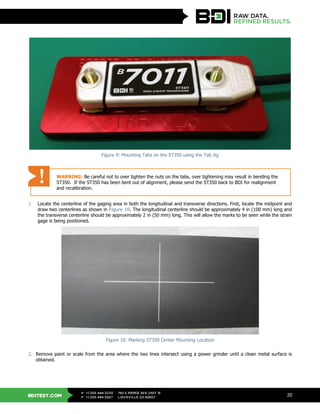
strain is being measured parallel to the measurement axis. An installed ST350 can be seen in Figure 7. Note that if a ST350
extension is used, the longitudinal mark will need to be 30 in (762 mm) long in order to be seen behind the ST350 with an
extension installed (see Section 4.1.2 ). It is important that this line is drawn carefully as the strains are inherently more
susceptible to error due to misalignment as the gage length increases.
MEASUREMENT AXIS
Doc. 201511 | Rev. A
OPERATIONS MANUAL: ST350 STRAIN TRANSDUCER
19
Figure 7: Typical ST350 Installation
4.2 INSTALLATION ON STEEL MEMBERS
In most situations, the most efficient method of mounting an ST350 is using the tab/glue method as it is the least invasive and
is truly a “non-destructive testing” technique. The following section outlines an installation for a steel surface.
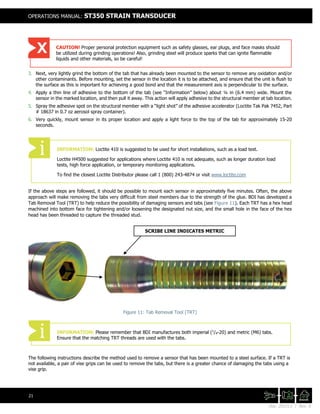
Figure 8: Identifying Metric vs. Imperial Tabs
Place tabs in the machined slots of the ST350 Tab Jig and then place the ST350 on the positioned tabs as seen in Figure 9.
Thread on the 1
/4-20 (or M6) nut and tighten to approximately 40 in-lb.
INFORMATION: BDI manufactures both Imperial (1/4-20) and metric (M6) tabs. To easily distinguish them
from each other, BDI has scribed all metric items as seen in Figure 8.
SCRIBE LINE INDICATES
METRIC THREADS
BDITEST.COM
+1.303.494.3230
+1.303.494.5027
P
F
740 S PIERCE AVE UNIT 15
LOUISVILLE CO 80027
20
Figure 9: Mounting Tabs on the ST350 using the Tab Jig
1. Locate the centerline of the gaging area in both the longitudinal and transverse directions. First, locate the midpoint and
draw two centerlines as shown in Figure 10. The longitudinal centerline should be approximately 4 in (100 mm) long and
the transverse centerline should be approximately 2 in (50 mm) long. This will allow the marks to be seen while the strain
gage is being positioned.
Figure 10: Marking ST350 Center Mounting Location
2. Remove paint or scale from the area where the two lines intersect using a power grinder until a clean metal surface is
obtained.
WARNING: Be careful not to over tighten the nuts on the tabs, over tightening may result in bending the
ST350. If the ST350 has been bent out of alignment, please send the ST350 back to BDI for realignment
and recalibration.
Doc. 201511 | Rev. A
OPERATIONS MANUAL: ST350 STRAIN TRANSDUCER
21
3. Next, very lightly grind the bottom of the tab that has already been mounted to the sensor to remove any oxidation and/or
other contaminants. Before mounting, set the sensor in the location it is to be attached, and ensure that the unit is flush to
the surface as this is important for achieving a good bond and that the measurement axis is perpendicular to the surface.
4. Apply a thin line of adhesive to the bottom of the tab (see “Information” below) about ¼ in (6.4 mm) wide. Mount the
sensor in the marked location, and then pull it away. This action will apply adhesive to the structural member at tab location.
5. Spray the adhesive spot on the structural member with a “light shot” of the adhesive accelerator (Loctite Tak Pak 7452, Part
# 18637 in 0.7 oz aerosol spray container).
6. Very quickly, mount sensor in its proper location and apply a light force to the top of the tab for approximately 15-20
seconds.
If the above steps are followed, it should be possible to mount each sensor in approximately five minutes. Often, the above
approach will make removing the tabs very difficult from steel members due to the strength of the glue. BDI has developed a
Tab Removal Tool (TRT) to help reduce the possibility of damaging sensors and tabs (see Figure 11). Each TRT has a hex head
machined into bottom face for tightening and/or loosening the designated nut size, and the small hole in the face of the hex
head has been threaded to capture the threaded stud.
Figure 11: Tab Removal Tool (TRT)
The following instructions describe the method used to remove a sensor that has been mounted to a steel surface. If a TRT is
not available, a pair of vise grips can be used to remove the tabs, but there is a greater chance of damaging the tabs using a
vise grip.
CAUTION! Proper personal protection equipment such as safety glasses, ear plugs, and face masks should
be utilized during grinding operations! Also, grinding steel will produce sparks that can ignite flammable
liquids and other materials, so be careful!
INFORMATION: Loctite 410 is suggested to be used for short installations, such as a load test.
Loctite H4500 suggested for applications where Loctite 410 is not adequate, such as longer duration load
tests, high force application, or temporary monitoring applications.
To find the closest Loctite Distributor please call 1 (800) 243-4874 or visit www.loctite.com
INFORMATION: Please remember that BDI manufactures both imperial (1
/4-20) and metric (M6) tabs.
Ensure that the matching TRT threads are used with the tabs.
SCRIBE LINE INDICATES METRIC
BDITEST.COM
+1.303.494.3230
+1.303.494.5027
P
F
740 S PIERCE AVE UNIT 15
LOUISVILLE CO 80027
22
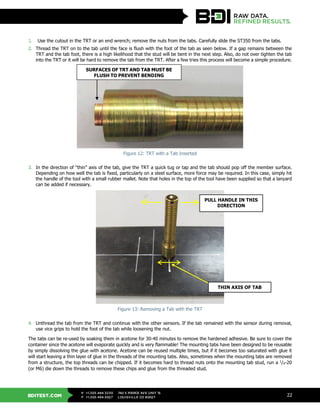
1. Use the cutout in the TRT or an end wrench; remove the nuts from the tabs. Carefully slide the ST350 from the tabs.
2. Thread the TRT on to the tab until the face is flush with the foot of the tab as seen below. If a gap remains between the
TRT and the tab foot, there is a high likelihood that the stud will be bent in the next step. Also, do not over tighten the tab
into the TRT or it will be hard to remove the tab from the TRT. After a few tries this process will become a simple procedure.
Figure 12: TRT with a Tab Inserted
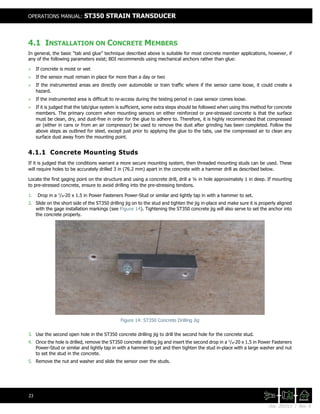
3. In the direction of “thin” axis of the tab, give the TRT a quick tug or tap and the tab should pop off the member surface.
Depending on how well the tab is fixed, particularly on a steel surface, more force may be required. In this case, simply hit
the handle of the tool with a small rubber mallet. Note that holes in the top of the tool have been supplied so that a lanyard
can be added if necessary.
Figure 13: Removing a Tab with the TRT
4. Unthread the tab from the TRT and continue with the other sensors. If the tab remained with the sensor during removal,
use vice grips to hold the foot of the tab while loosening the nut.
The tabs can be re-used by soaking them in acetone for 30-40 minutes to remove the hardened adhesive. Be sure to cover the
container since the acetone will evaporate quickly and is very flammable! The mounting tabs have been designed to be reusable
by simply dissolving the glue with acetone. Acetone can be reused multiple times, but if it becomes too saturated with glue it
will start leaving a thin layer of glue in the threads of the mounting tabs. Also, sometimes when the mounting tabs are removed
from a structure, the top threads can be chipped. If it becomes hard to thread nuts onto the mounting tab stud, run a 1
/4-20
(or M6) die down the threads to remove these chips and glue from the threaded stud.
PULL HANDLE IN THIS
DIRECTION
SURFACES OF TRT AND TAB MUST BE
FLUSH TO PREVENT BENDING
THIN AXIS OF TAB
Doc. 201511 | Rev. A
OPERATIONS MANUAL: ST350 STRAIN TRANSDUCER
23
4.1 INSTALLATION ON CONCRETE MEMBERS
In general, the basic “tab and glue” technique described above is suitable for most concrete member applications, however, if
any of the following parameters exist; BDI recommends using mechanical anchors rather than glue:
+ If concrete is moist or wet
+ If the sensor must remain in place for more than a day or two
+ If the instrumented areas are directly over automobile or train traffic where if the sensor came loose, it could create a
hazard.
+ If the instrumented area is difficult to re-access during the testing period in case sensor comes loose.
+ If it is judged that the tab/glue system is sufficient, some extra steps should be followed when using this method for concrete
members. The primary concern when mounting sensors on either reinforced or pre-stressed concrete is that the surface
must be clean, dry, and dust-free in order for the glue to adhere to. Therefore, it is highly recommended that compressed
air (either in cans or from an air compressor) be used to remove the dust after grinding has been completed. Follow the
above steps as outlined for steel, except just prior to applying the glue to the tabs, use the compressed air to clean any
surface dust away from the mounting point.
4.1.1 Concrete Mounting Studs
If it is judged that the conditions warrant a more secure mounting system, then threaded mounting studs can be used. These
will require holes to be accurately drilled 3 in (76.2 mm) apart in the concrete with a hammer drill as described below.
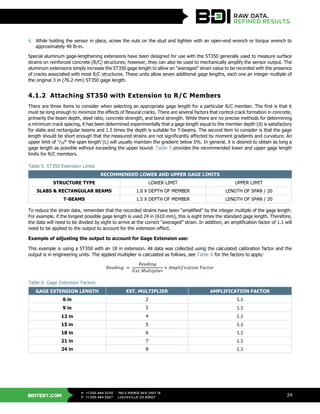
Locate the first gaging point on the structure and using a concrete drill, drill a ¼ in hole approximately 1 in deep. If mounting
to pre-stressed concrete, ensure to avoid drilling into the pre-stressing tendons.
1. Drop in a 1
/4-20 x 1.5 in Power Fasteners Power-Stud or similar and lightly tap in with a hammer to set.
2. Slide on the short side of the ST350 drilling jig on to the stud and tighten the jig in-place and make sure it is properly aligned
with the gage installation markings (see Figure 14). Tightening the ST350 concrete jig will also serve to set the anchor into
the concrete properly.
Figure 14: ST350 Concrete Drilling Jig
3. Use the second open hole in the ST350 concrete drilling jig to drill the second hole for the concrete stud.
4. Once the hole is drilled, remove the ST350 concrete drilling jig and insert the second drop in a 1
/4-20 x 1.5 in Power Fasteners
Power-Stud or similar and lightly tap in with a hammer to set and then tighten the stud in-place with a large washer and nut
to set the stud in the concrete.
5. Remove the nut and washer and slide the sensor over the studs.
BDITEST.COM
+1.303.494.3230
+1.303.494.5027
P
F
740 S PIERCE AVE UNIT 15
LOUISVILLE CO 80027
24
6. While holding the sensor in place, screw the nuts on the stud and tighten with an open-end wrench or torque wrench to
approximately 40 lb-in.
Special aluminum gage-lengthening extensions have been designed for use with the ST350 generally used to measure surface
strains on reinforced concrete (R/C) structures; however, they can also be used to mechanically amplify the sensor output. The
aluminum extensions simply increase the ST350 gage length to allow an “averaged” strain value to be recorded with the presence
of cracks associated with most R/C structures. These units allow seven additional gage lengths, each one an integer multiple of
the original 3 in (76.2 mm) ST350 gage length.
4.1.2 Attaching ST350 with Extension to R/C Members
There are three items to consider when selecting an appropriate gage length for a particular R/C member. The first is that it
must be long enough to minimize the effects of flexural cracks. There are several factors that control crack formation in concrete,
primarily the beam depth, steel ratio, concrete strength, and bond strength. While there are no precise methods for determining
a minimum crack spacing, it has been determined experimentally that a gage length equal to the member depth (d) is satisfactory
for slabs and rectangular beams and 1.5 times the depth is suitable for T-beams. The second item to consider is that the gage
length should be short enough that the measured strains are not significantly affected by moment gradients and curvature. An
upper limit of 1
/20
th
the span length (L) will usually maintain the gradient below 5%. In general, it is desired to obtain as long a
gage length as possible without exceeding the upper bound. Table 5 provides the recommended lower and upper gage length
limits for R/C members.
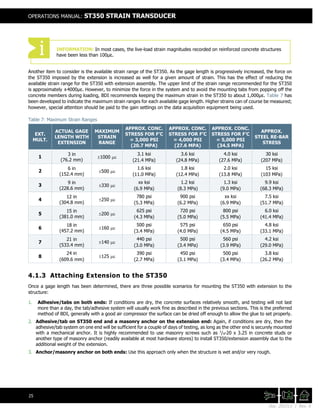
Table 5: ST350 Extension Limits
RECOMMENDED LOWER AND UPPER GAGE LIMITS
STRUCTURE TYPE LOWER LIMIT UPPER LIMIT
SLABS & RECTANGULAR BEAMS 1.0 X DEPTH OF MEMBER LENGTH OF SPAN / 20
T-BEAMS 1.5 X DEPTH OF MEMBER LENGTH OF SPAN / 20
To reduce the strain data, remember that the recorded strains have been “amplified” by the integer multiple of the gage length.
For example, if the longest possible gage length is used 24 in (610 mm), this is eight times the standard gage length. Therefore,
the data will need to be divided by eight to arrive at the correct “averaged” strain. In addition, an amplification factor of 1.1 will
need to be applied to the output to account for the extension effect.
Example of adjusting the output to account for Gage Extension use:
This example is using a ST350 with an 18 in extension. All data was collected using the calculated calibration factor and the
output is in engineering units. The applied multiplier is calculated as follows, see Table 6 for the factors to apply:
𝑅𝑅𝑅𝑅𝑅𝑅𝑅𝑅𝑅𝑅𝑅𝑅 𝑅𝑅 =
𝑅𝑅𝑅𝑅𝑅𝑅𝑅𝑅𝑅𝑅𝑅𝑅 𝑅𝑅
𝐸𝐸𝐸𝐸𝐸𝐸. 𝑀𝑀𝑀𝑀𝑀𝑀𝑀𝑀𝑀𝑀𝑀𝑀𝑀𝑀𝑀𝑀𝑀𝑀𝑀𝑀
× 𝐴𝐴𝐴𝐴𝐴𝐴𝐴𝐴𝐴𝐴𝐴𝐴𝐴𝐴𝐴𝐴𝐴𝐴𝐴𝐴𝐴𝐴𝐴𝐴𝐴𝐴 𝐹𝐹𝐹𝐹𝐹𝐹𝐹𝐹𝐹𝐹𝐹𝐹
Table 6: Gage Extension Factors
GAGE EXTENSION LENGTH EXT. MULTIPLIER AMPLIFICATION FACTOR
6 in 2 1.1
9 in 3 1.1
12 in 4 1.1
15 in 5 1.1
18 in 6 1.1
21 in 7 1.1
24 in 8 1.1
Doc. 201511 | Rev. A
OPERATIONS MANUAL: ST350 STRAIN TRANSDUCER
25
Another item to consider is the available strain range of the ST350. As the gage length is progressively increased, the force on
the ST350 imposed by the extension is increased as well for a given amount of strain. This has the effect of reducing the
available strain range for the ST350 with extension assembly. The upper limit of the strain range recommended for the ST350
is approximately ±4000με. However, to minimize the force in the system and to avoid the mounting tabs from popping off the
concrete members during loading, BDI recommends keeping the maximum strain in the ST350 to about 1,000με. Table 7 has
been developed to indicate the maximum strain ranges for each available gage length. Higher strains can of course be measured;
however, special attention should be paid to the gain settings on the data acquisition equipment being used.
Table 7: Maximum Strain Ranges
EXT.
MULT.
ACTUAL GAGE
LENGTH WITH
EXTENSION
MAXIMUM
STRAIN
RANGE
APPROX. CONC.
STRESS FOR F’C
= 3,000 PSI
(20.7 MPA)
APPROX. CONC.
STRESS FOR F’C
= 4,000 PSI
(27.6 MPA)
APPROX. CONC.
STRESS FOR F’C
= 5,000 PSI
(34.5 MPA)
APPROX.
STEEL RE-BAR
STRESS
1
3 in
(76.2 mm)
±1000 µε
3.1 ksi
(21.4 MPa)
3.6 ksi
(24.8 MPa)
4.0 ksi
(27.6 MPa)
30 ksi
(207 MPa)
2
6 in
(152.4 mm)
±500 µε
1.6 ksi
(11.0 MPa)
1.8 ksi
(12.4 MPa)
2.0 ksi
(13.8 MPa)
15 ksi
(103 MPa)
3
9 in
(228.6 mm)
±330 µε
xx ksi
(6.9 MPa)
1.2 ksi
(8.3 MPa)
1.3 ksi
(9.0 MPa)
9.9 ksi
(68.3 MPa)
4
12 in
(304.8 mm)
±250 µε
780 psi
(5.3 MPa)
900 psi
(6.2 MPa)
xx ksi
(6.9 MPa)
7.5 ksi
(51.7 MPa)
5
15 in
(381.0 mm)
±200 µε
625 psi
(4.3 MPa)
720 psi
(5.0 MPa)
800 psi
(5.5 MPa)
6.0 ksi
(41.4 MPa)
6
18 in
(457.2 mm)
±160 µε
500 psi
(3.4 MPa)
575 psi
(4.0 MPa)
650 psi
(4.5 MPa)
4.8 ksi
(33.1 MPa)
7
21 in
(533.4 mm)
±140 µε
440 psi
(3.0 MPa)
500 psi
(3.4 MPa)
560 psi
(3.9 MPa)
4.2 ksi
(29.0 MPa)
8
24 in
(609.6 mm)
±125 µε
390 psi
(2.7 MPa)
450 psi
(3.1 MPa)
500 psi
(3.4 MPa)
3.8 ksi
(26.2 MPa)
4.1.3 Attaching Extension to the ST350
Once a gage length has been determined, there are three possible scenarios for mounting the ST350 with extension to the
structure:
1. Adhesive/tabs on both ends: If conditions are dry, the concrete surfaces relatively smooth, and testing will not last
more than a day, the tab/adhesive system will usually work fine as described in the previous sections. This is the preferred
method of BDI, generally with a good air compressor the surface can be dried off enough to allow the glue to set properly.
2. Adhesive/tab on ST350 end and a masonry anchor on the extension end: Again, if conditions are dry, then the
adhesive/tab system on one end will be sufficient for a couple of days of testing, as long as the other end is securely mounted
with a mechanical anchor. It is highly recommended to use masonry screws such as 1
/4-20 x 3.25 in concrete studs or
another type of masonry anchor (readily available at most hardware stores) to install ST350/extension assembly due to the
additional weight of the extension.
3. Anchor/masonry anchor on both ends: Use this approach only when the structure is wet and/or very rough.
INFORMATION: In most cases, the live-load strain magnitudes recorded on reinforced concrete structures
have been less than 100με.
BDITEST.COM
+1.303.494.3230
+1.303.494.5027
P
F
740 S PIERCE AVE UNIT 15
LOUISVILLE CO 80027
26
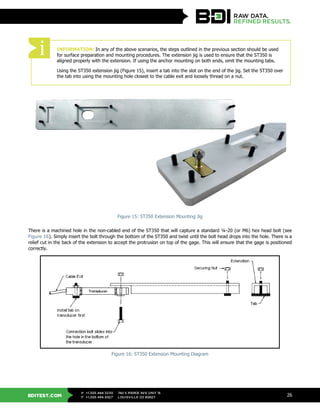
Figure 15: ST350 Extension Mounting Jig
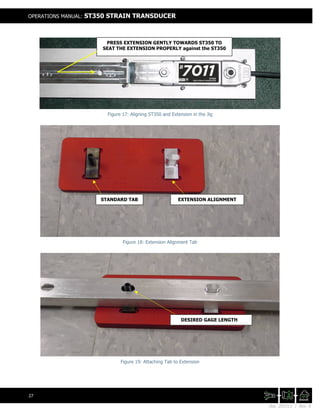
There is a machined hole in the non-cabled end of the ST350 that will capture a standard ¼-20 (or M6) hex head bolt (see
Figure 16). Simply insert the bolt through the bottom of the ST350 and twist until the bolt head drops into the hole. There is a
relief cut in the back of the extension to accept the protrusion on top of the gage. This will ensure that the gage is positioned
correctly.
Figure 16: ST350 Extension Mounting Diagram
INFORMATION: In any of the above scenarios, the steps outlined in the previous section should be used
for surface preparation and mounting procedures. The extension jig is used to ensure that the ST350 is
aligned properly with the extension. If using the anchor mounting on both ends, omit the mounting tabs.
Using the ST350 extension jig (Figure 15), insert a tab into the slot on the end of the jig. Set the ST350 over
the tab into using the mounting hole closest to the cable exit and loosely thread on a nut.
Doc. 201511 | Rev. A
OPERATIONS MANUAL: ST350 STRAIN TRANSDUCER
27
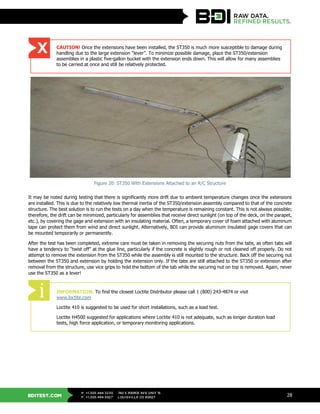
Figure 17: Aligning ST350 and Extension in the Jig
Figure 18: Extension Alignment Tab
Figure 19: Attaching Tab to Extension
PRESS EXTENSION GENTLY TOWARDS ST350 TO
SEAT THE EXTENSION PROPERLY against the ST350
DESIRED GAGE LENGTH
STANDARD TAB EXTENSION ALIGNMENT
BDITEST.COM
+1.303.494.3230
+1.303.494.5027
P
F
740 S PIERCE AVE UNIT 15
LOUISVILLE CO 80027
28
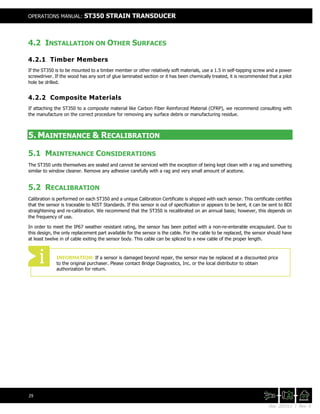
Figure 20: ST350 With Extensions Attached to an R/C Structure
It may be noted during testing that there is significantly more drift due to ambient temperature changes once the extensions
are installed. This is due to the relatively low thermal inertia of the ST350/extension assembly compared to that of the concrete
structure. The best solution is to run the tests on a day when the temperature is remaining constant. This is not always possible;
therefore, the drift can be minimized, particularly for assemblies that receive direct sunlight (on top of the deck, on the parapet,
etc.), by covering the gage and extension with an insulating material. Often, a temporary cover of foam attached with aluminum
tape can protect them from wind and direct sunlight. Alternatively, BDI can provide aluminum insulated gage covers that can
be mounted temporarily or permanently.
After the test has been completed, extreme care must be taken in removing the securing nuts from the tabs, as often tabs will
have a tendency to “twist off” at the glue line, particularly if the concrete is slightly rough or not cleaned off properly. Do not
attempt to remove the extension from the ST350 while the assembly is still mounted to the structure. Back off the securing nut
between the ST350 and extension by holding the extension only. If the tabs are still attached to the ST350 or extension after
removal from the structure, use vice grips to hold the bottom of the tab while the securing nut on top is removed. Again, never
use the ST350 as a lever!
CAUTION! Once the extensions have been installed, the ST350 is much more susceptible to damage during
handling due to the large extension “lever”. To minimize possible damage, place the ST350/extension
assemblies in a plastic five-gallon bucket with the extension ends down. This will allow for many assemblies
to be carried at once and still be relatively protected.
INFORMATION: To find the closest Loctite Distributor please call 1 (800) 243-4874 or visit
www.loctite.com
Loctite 410 is suggested to be used for short installations, such as a load test.
Loctite H4500 suggested for applications where Loctite 410 is not adequate, such as longer duration load
tests, high force application, or temporary monitoring applications.
Doc. 201511 | Rev. A
OPERATIONS MANUAL: ST350 STRAIN TRANSDUCER
29
4.2 INSTALLATION ON OTHER SURFACES
4.2.1 Timber Members
If the ST350 is to be mounted to a timber member or other relatively soft materials, use a 1.5 in self-tapping screw and a power
screwdriver. If the wood has any sort of glue laminated section or it has been chemically treated, it is recommended that a pilot
hole be drilled.
4.2.2 Composite Materials
If attaching the ST350 to a composite material like Carbon Fiber Reinforced Material (CFRP), we recommend consulting with
the manufacture on the correct procedure for removing any surface debris or manufacturing residue.
5. MAINTENANCE & RECALIBRATION
5.1 MAINTENANCE CONSIDERATIONS
The ST350 units themselves are sealed and cannot be serviced with the exception of being kept clean with a rag and something
similar to window cleaner. Remove any adhesive carefully with a rag and very small amount of acetone.
5.2 RECALIBRATION
Calibration is performed on each ST350 and a unique Calibration Certificate is shipped with each sensor. This certificate certifies
that the sensor is traceable to NIST Standards. If this sensor is out of specification or appears to be bent, it can be sent to BDI
straightening and re-calibration. We recommend that the ST350 is recalibrated on an annual basis; however, this depends on
the frequency of use.
In order to meet the IP67 weather resistant rating, the sensor has been potted with a non-re-enterable encapsulant. Due to
this design, the only replacement part available for the sensor is the cable. For the cable to be replaced, the sensor should have
at least twelve in of cable exiting the sensor body. This cable can be spliced to a new cable of the proper length.
INFORMATION: If a sensor is damaged beyond repair, the sensor may be replaced at a discounted price
to the original purchaser. Please contact Bridge Diagnostics, Inc. or the local distributor to obtain
authorization for return.
P +1.303.494.3230
F +1.303.494.5027
740 S PIERCE AVE UNIT 15
LOUISVILLE CO 80027
BDITEST.COM
sales@bditest.com

Manual strain-transducer-st350-201511-rev-a-

  • 1.
  • 3.
    Doc. 201511 |Rev. A OPERATIONS MANUAL: ST350 STRAIN TRANSDUCER 3 Document Revision History Document Rev. Date ECO Changes n/a 1.0 5/15/2012 n/a Initial release document n/a 2.0 6/7/2012 n/a  Updated to reflect the change in hardware  Document formatting updated n/a 2.1 1/2/2013 n/a  Interim version-minor changes to formatting n/a 2.2 4/2/2013 n/a  Updated to reflect the recent CE compliance approval  Power ratings updated 201511 A 7/20/18 155  Updated to include new corrosion protection  Minor changes to specifications  New template and styles were applied  Added doc. number No part of this operations manual may be reproduced, by any means, without the written consent of BDI. The information contained within this manual is believed to be accurate and reliable. However, BDI assumes no responsibility for errors, omissions or misinterpretations. The information herein is subject to change without notification. Copyright © 1989 – 2018 Bridge Diagnostics, Inc. (dba BDI)
  • 4.
    BDITEST.COM +1.303.494.3230 +1.303.494.5027 P F 740 S PIERCEAVE UNIT 15 LOUISVILLE CO 80027 4 WARRANTY INFORMATION BDI warrants its products to be free from defects in materials and workmanship under normal use and service for thirty-six (36) months from date of shipment. This warranty shall be void if any products have been subjected to modification, misuse, neglect, accidents of nature, or shipping damage. Batteries have no warranty. All equipment manufactured by BDI is intended for use by a qualified professional only. Under this warranty BDI's obligation is limited to repairing or replacing (at BDI's option) of defective products. In no event shall BDI be liable for punitive, exemplary, special, indirect, incidental, or consequential damages and the customer shall assume all costs of removing, reinstalling, and shipping of defective products. EXCEPT AS STATED HEREIN, BDI MAKES NO WARRANTIES, EXPRESSED OR IMPLIED, AND SPECIFICALLY DISCLAIMS ANY IMPLIED WARRANTY OF FITNESS FOR A PARTICULAR PURPOSE OR MERCHANTABILITY. Before returning any product, BDI technical support must be contacted at +1-303-494-3230 or by visiting BDITEST.COM/contact and submitting a request. A technician will help determine the nature of the problem and if it cannot be resolved, authorization will be given to return the item. A return merchandise authorization (RMA) will be sent to the customer to be filled out and shipped back with the equipment. BDI will not accept shipment of any product without prior authorization as provided herein. Ship all equipment to: BDI ATTN: TECHNICAL SUPPORT 740 S PIERCE AVE UNIT 15 LOUISVILLE CO 80027 +1.303.494.3230
  • 5.
    Doc. 201511 |Rev. A OPERATIONS MANUAL: ST350 STRAIN TRANSDUCER 5 TABLE OF CONTENTS 1. Introduction .............................................................................................................................................................7 1.1 About the ST350 Strain Transducer.......................................................................................................................7 1.2 About this manual ...............................................................................................................................................7 2. ST350 Overview........................................................................................................................................................8 2.1 Technical Specifications .......................................................................................................................................8 2.2 Options and Accessories.......................................................................................................................................9 2.3 Applications ......................................................................................................................................................10 3. Operation...............................................................................................................................................................10 3.1 Theory of Operation ..........................................................................................................................................10 3.2 Potential Strain Measurement Issues................................................................................................................... 11 3.2.1 Temperature Variation...............................................................................................................................11 3.2.2 Instrumentation Cable Issues ..................................................................................................................... 12 3.3 Connecting to Data Acquisition Systems .............................................................................................................. 12 3.3.1 Excitation Voltage .....................................................................................................................................12 3.3.2 Electrical Connections................................................................................................................................12 3.3.3 Applying Calibration Factors ....................................................................................................................... 13 3.4 Verifying ST350 Output......................................................................................................................................13 3.4.1 Resistance Test.........................................................................................................................................13 3.4.2 Resolution/Noise Test................................................................................................................................14 3.4.3 Sensor Response Test ...............................................................................................................................14 3.4.4 Field Adjusting Excessive Offsets ................................................................................................................ 15 3.5 Verifying Accuracy.............................................................................................................................................15 3.5.1 Factory Calibration ....................................................................................................................................15 3.5.2 Items for Consideration for User Verification Tests ....................................................................................... 15 4. Installation .............................................................................................................................................................17 4.1 General Installation Guide ..................................................................................................................................17 4.1.1 Prepare Mounting Area ..............................................................................................................................17 4.1.2 Installation ...............................................................................................................................................18 4.2 Installation on Steel Members.............................................................................................................................19 4.1 Installation on Concrete Members....................................................................................................................... 23 4.1.1 Concrete Mounting Studs ........................................................................................................................... 23 4.1.2 Attaching ST350 with Extension to R/C Members ......................................................................................... 24 4.1.3 Attaching Extension to the ST350 ............................................................................................................... 25 4.2 Installation on Other Surfaces.............................................................................................................................29 4.2.1 Timber Members.......................................................................................................................................29 4.2.2 Composite Materials ..................................................................................................................................29 5. Maintenance & Recalibration ....................................................................................................................................29 5.1 Maintenance Considerations ...............................................................................................................................29 5.2 Recalibration.....................................................................................................................................................29
  • 6.
    BDITEST.COM +1.303.494.3230 +1.303.494.5027 P F 740 S PIERCEAVE UNIT 15 LOUISVILLE CO 80027 6 LIST OF TABLES Table 1: ST350 Specifications..........................................................................................................................................8 Table 2: ST350 Options and Accessories ..........................................................................................................................9 Table 3: Typical Applications for ST350 strain transducers ...............................................................................................10 Table 4: ST350 Wiring Designations & Intelliducer Pinout ................................................................................................12 Table 5: ST350 Extension Limits....................................................................................................................................24 Table 6: Gage Extension Factors ...................................................................................................................................24 Table 7: Maximum Strain Ranges ..................................................................................................................................25 LIST OF FIGURES Figure 1: ST350 Drawing (inches) ...................................................................................................................................8 Figure 2: ST350 Schematic ...........................................................................................................................................11 Figure 3: Noise levels of the ST350 on a 24-bit data acquisition system ............................................................................14 Figure 4: Typical Smooth Output Response and Zero Offset.............................................................................................14 Figure 5: Alignment Marking for ST350 Installation .........................................................................................................18 Figure 6: Mounting Position & Surface Preparation Marks ................................................................................................18 Figure 7: Typical ST350 Installation...............................................................................................................................19 Figure 8: Identifying Metric vs. Imperial Tabs.................................................................................................................19 Figure 9: Mounting Tabs on the ST350 using the Tab Jig.................................................................................................20 Figure 10: Marking ST350 Center Mounting Location.......................................................................................................20 Figure 11: Tab Removal Tool (TRT)...............................................................................................................................21 Figure 12: TRT with a Tab Inserted ...............................................................................................................................22 Figure 13: Removing a Tab with the TRT .......................................................................................................................22 Figure 14: ST350 Concrete Drilling Jig ...........................................................................................................................23 Figure 15: ST350 Extension Mounting Jig .......................................................................................................................26 Figure 16: ST350 Extension Mounting Diagram...............................................................................................................26 Figure 17: Aligning ST350 and Extension in the Jig .........................................................................................................27 Figure 18: Extension Alignment Tab...............................................................................................................................27 Figure 19: Attaching Tab to Extension ...........................................................................................................................27 Figure 20: ST350 With Extensions Attached to an R/C Structure.......................................................................................28
  • 7.
    Doc. 201511 |Rev. A OPERATIONS MANUAL: ST350 STRAIN TRANSDUCER 7 1. INTRODUCTION 1.1 ABOUT THE ST350 STRAIN TRANSDUCER The ST350 strain transducers have been designed for recording dynamic and other induced strains on all types of structural members and to be compatible with most data acquisition systems. While mostly used in rugged field applications, they are also suitable for many laboratory and manufacturing scenarios. The ST350 internal circuitry consists of a full Wheatstone Bridge with four fully-active 350Ω foil gages optimized to provide a high electrical output for a given strain magnitude. Each transducer is individually calibrated with a highly-accurate, N.I.S.T.-traceable calibration system. Each unit is fully sealed, designed to exceed the IP67 rating, and equipped with two pre-drilled mounting holes to keep the gage lengths consistent for all installations. Based on the structure’s material and length of time the ST350 is to be installed, various mounting techniques can be used including adhesives, welding, expandable anchors, and screws. 1.2 ABOUT THIS MANUAL This is a comprehensive document that explains the functions and features of the ST350. BDI also manufactures two types of data acquisition systems, which will be referenced throughout the manual. 1. Structural Testing System (STS): Rugged, wireless, battery powered DAQ that includes an intelligent (Intelliducer) connector design, which makes the system extremely easy to deploy on a variety of field projects. 2. Structural Monitoring System (SMS): Modular system with 4- or 16-channel nodes that can be used in laboratories or on permanent large scales monitoring projects. The following highlighted message blocks will periodically appear and contain important information that the user should be aware of. STOP: This symbol and corresponding message represents information regarding the device that if not followed could lead to damaging the device! Pay close attention to this message. WARNING: This symbol and corresponding message represents vital information and is critical for the device operation and/or the operational settings/configuration. INFORMATION: This symbol and corresponding message represents general information and/or tips on successfully operating/configuring the device.
  • 8.
    BDITEST.COM +1.303.494.3230 +1.303.494.5027 P F 740 S PIERCEAVE UNIT 15 LOUISVILLE CO 80027 8 2. ST350 OVERVIEW 2.1 TECHNICAL SPECIFICATIONS Figure 1: ST350 Drawing (inches) Table 1: ST350 Specifications MODEL ST350 TYPE 350Ω CIRCUIT Full Wheatstone bridge with 4 active 350Ω strain gages EXCITATION VOLTAGE +1.0 to +10.0 Vdc OUTPUT mV level, ratiometric to Excitation Voltage OFFSET < 1.5 mV at time and temperature of calibration POWER RATING: MAX TYPICAL INTELLIDUCER1 300 mW 72 mW @ +5.0 Vdc 13 mW @ +5.0 Vdc STRAIN RANGE ±4,000 µε (Calibrated to ±2,000 µε) FORCE REQUIRED FOR 1,000µε ~17 lb (~76N) TYPICAL SENSITIVITY ~500 με/mVout/Vin ACCURACY2 < ±1% CALIBRATION Individually calibrated using N.I.S.T.-traceable automated system. Calibration curve & factor provided THERMISTOR (OPTIONAL) 3 kΩ - NTC EFFECTIVE GAGE LENGTH 3.0 in (76.2 mm) [Gage Extensions available for R/C structures] CABLE Custom lead cable length made to order: IC-02-187 [22 AWG, 2 shielded pair, drain wire, red PVC jacket] IC-02-250 [22 AWG, 2 shielded pair, drain wire, blue PVC jacket] IC-03-250 [24 AWG, 3 shielded pair, drain wire, black PVC jacket] HOUSING Machined 6061 Aluminum Alloy
  • 9.
    Doc. 201511 |Rev. A OPERATIONS MANUAL: ST350 STRAIN TRANSDUCER 9 CORROSION PROTECTION Hard Anodized Clear (MIL-A-8625 Type III) WEATHER PROTECTION Designed to exceed IP67 Optional 100 ft (30 m), waterproofing available TEMPERATURE RATING3 -58° to +176 °F (-50° to +80 °C) SIZE 4.38 in x 1.25 in x 0.50 in (111 mm x 32 mm x 12.7 mm) WEIGHT 0.19 lb (85 g) MOUNTING HOLES Through holes for ¼ in (M6) bolts or anchors Reusable mounting tabs (gluing/welding) 1 Intelliducer connector required with STS Intelliducer data acquisition nodes. 2 Accuracy defined at the calibrated ±2,000 µε range. 3 Temperature limit based on instrumentation cable operating temperatures, call BDI for wide temperature range cable options. 2.2 OPTIONS AND ACCESSORIES The ST350 is supported by several available options and accessories depending on the application and use. See Table 2 for a list of options and accessories that we supply. Table 2: ST350 Options and Accessories OPTIONS AND ACCESSORIES Intelliducer Connector – Required for use with STS data acquisition nodes, cable is connected and potted for a weatherproof seal Integrated Thermistor – Temperature range of -55 °C to +220 °C, ±0.5 °C accuracy Reusable Mounting Tabs – ¼-20 or M6, zinc plated steel mounting tab Tab Jig – Machined aluminum jig for safely attaching mounting tabs to the strain transducer; Includes either 7 /16 in or M10 end wrench Gage Extension – Machined aluminum 24 in (610 mm) gage length extension with 3.0 in (76 mm) increments
  • 10.
    BDITEST.COM +1.303.494.3230 +1.303.494.5027 P F 740 S PIERCEAVE UNIT 15 LOUISVILLE CO 80027 10 Extension Jig – Aluminum mounting jig for safely accurately attaching Gage Extensions Installation Jigs – Welding or concrete drilling jigs Protective Covers – Insulated aluminum protective covers 2.3 APPLICATIONS Table 3: Typical Applications for ST350 strain transducers HIGHWAY AND RAILWAY BRIDGES + Static and Dynamic Live Load Testing + Moveable Bridge Operation Forces + Overload Detection RIVER CONTROL STRUCTURES + Navigation Lock Gate Load Responses (Lift, Miter, Radial) + Tainter Gates (Trunnion Friction) + Mechanical Drive Components (Torque, Force) CABLE FORCES + Individual force & group balancing – static LABORATORY TESTING + Classroom teaching tool + Measure responses for structural members and components + Integrate with existing A/D systems BUILDINGS + ASTM Standard Floor Load Tests + Construction Vibration Monitoring + Concrete Curing Temperature Tracking + Earthquake Response Monitoring 3. OPERATION 3.1 THEORY OF OPERATION The internal components of the ST350 consist of a custom-manufactured 350-Ohm Wheatstone bridge foil transducer-class strain gage mounted inside a flexible proving ring. The four active arms are arranged inside the ring in such a manner that the total output provides approximately 3.5 times the output compared to a typical ¼-bridge foil gage under the same induced strain level.
  • 11.
    Doc. 201511 |Rev. A OPERATIONS MANUAL: ST350 STRAIN TRANSDUCER 11 The ST350 produces a voltage potential across opposing Wheatstone Bridge corners (Figure 2) which varies with tension and compression. The sensitive (longitudinal) axis is parallel to the face of the serial plate on the top of the sensor housing (direction of the cable exit). Figure 2: ST350 Schematic 3.2 POTENTIAL STRAIN MEASUREMENT ISSUES 3.2.1 Temperature Variation When the ST350 is attached to a structure subjected to temperature variations, the sensor is forced to undergo the same temperature-induced deformations as the structural member. In the case of an increase in ambient temperature, the member will expand. However, since the transducer ends are anchored to the structural member and the “temperature inertia” of the ST350 is much less, (heats up and cools much faster than the large member) the gage will attempt to expand between the anchored end blocks, which creates a compression (opposite of expected). The same goes for a temperature drop, which, since STOP: It is important to note that the portion of the ST350 housing that the label is affixed to (the lid) is actually “floating” and is only held in place through the weatherproof potting material that is used. Be cautious while handling and while installing the ST350 not to put excessive pressure on the lid. STOP: It is important to note that the ST350 was designed for short-term testing applications where changes in temperature are generally small enough to not affect the output of the strain measurement. We have not developed temperature compensation curves for the ST350 and therefore recommend that the sensors be periodically zeroed during any long-term monitoring project and the focus on of the measurement be geared toward the short-term live-load responses of the structure.
  • 12.
    BDITEST.COM +1.303.494.3230 +1.303.494.5027 P F 740 S PIERCEAVE UNIT 15 LOUISVILLE CO 80027 12 the gage cools off faster than the member, will register tension. If the sensor is to be mounted on the structure for an extended period of time, it will need to have its zero-offset reset periodically as it drifts around with temperature changes. If the ST350 is exposed to direct sunlight during live-load tests, such as on truss members or on top of a concrete slab, significant temperature drift can be experienced during short periods of time due to changing cloud cover and/or breezes. Covering the ST350 with foam and aluminum tape can usually reduce or eliminate this problem. BDI also supplied insulated aluminum covers that help reduce these effects greatly. 3.2.2 Instrumentation Cable Issues The output responses for the ST350 will vary slightly depending on the length of the instrumentation cable due to resistance of the lead wires. To address this, ST350s are calibrated with the instrumentation cable installed, meaning that this resistance has automatically been taken into account through the calibration process. If, however, the user splices a significantly long cable to the cable that has been supplied with the unit, a small error that is approximately the ratio of the additional resistance to the gage resistance will be introduced. Therefore, BDI always recommends calibrating the transducer with the cable that is going to be used in the field. 3.3 CONNECTING TO DATA ACQUISITION SYSTEMS This section outlines how to connect and test the ST350 for most standard data acquisition systems that are designed to handle a differential voltage output. 3.3.1 Excitation Voltage It is recommended that the Wheatstone bridge excitation voltage be at or below +10 Vdc since higher voltages can cause drift and stability issues due to gage heating. For example, the BDI STS/SMS data acquisition systems uses a regulated +5 Vdc excitation voltage which provides excellent results. Allowing the electronics and the gages to warm up for several minutes is also recommended. A small amount of drift will be detected during the warming process, but should stabilize within several minutes. 3.3.2 Electrical Connections The ST350 uses a standard Wheatstone Bridge 4-wire hookup. Table 4 outlines the wiring color/signal connections and includes the pinout for Intelliducer connectors used with the STS data acquisition nodes. Table 4: ST350 Wiring Designations & Intelliducer Pinout INSTRUMENTATION CABLE TYPE SIGNAL INTELLIDUCER PINOUTIC-02-187 & IC-02-250 IC-03-250 RED RED + Excitation G BLACK BLACK (PAIRED W/ RED) - Excitation (GND) K GREEN GREEN + Signal C WHITE BLACK (PAIRED W/ GREEN) - Signal J BARE ALL BARE WIRES Shield/Drain (Earth GND) Integrated into pin K N/A WHITE + Temp B N/A BLACK (PAIRED W/ WHITE) - Temp Integrated into pin K INFORMATION: When using the ST350 with any STS data acquisition node, the connection has already been pre-wired to the twist-lock plug and no further action is necessary.
  • 13.
    Doc. 201511 |Rev. A OPERATIONS MANUAL: ST350 STRAIN TRANSDUCER 13 3.3.3 Applying Calibration Factors Each ST350 is supplied with a N.I.S.T.-traceable calibration factor. Since this sensor is a ratiometric sensor and can be supplied a range of excitation voltage, the supplied calibration factor is normalized for excitation voltage. To calculate the proper calibration factor for the data acquisition system, the excitation voltage that is used must be multiplied by the General Gage Factor (GGF). The following is an example of the supplied calibration factor: GGF = ### με/mVout/Vexc Where: GGF = General Gage Factor ### = Numeric Calibration Factor με = microstrain (strain x 10-6) mVout = Output Voltage in Millivolts DC Vexc = Excitation Voltage supplied to sensor in Volts DC Example of applying the GGF: This example is using a ST350 with a supplied GGF = 504.32 με/mVout/Vexc. The data acquisition system supplies a +5.0 Vdc excitation and reads the output in volts so the GGF must be adjusted to με/Vout before applying the GGF in the results. The current reading on the data acquisition system is 3.2312 x 10⁻³ Vdc. Step 1: Convert GGF to με/mVout 𝐺𝐺𝐺𝐺𝐺𝐺 = 504.32 𝜇𝜇𝜇𝜇/𝑚𝑚𝑚𝑚𝑜𝑜 𝑜𝑜𝑜𝑜/𝑉𝑉𝑒𝑒𝑒𝑒𝑒𝑒 ÷ 5 𝑉𝑉𝑒𝑒𝑒𝑒𝑒𝑒 × 1000 𝑚𝑚𝑚𝑚𝑜𝑜 𝑜𝑜𝑜𝑜 𝑉𝑉𝑜𝑜 𝑜𝑜𝑜𝑜 = 100,864 𝜇𝜇𝜇𝜇 𝑉𝑉𝑜𝑜 𝑜𝑜𝑜𝑜 Step 2: Apply GGF to output voltage from data acquisition system 𝑅𝑅𝑅𝑅𝑅𝑅𝑅𝑅𝑅𝑅𝑅𝑅 𝑅𝑅 = 𝑉𝑉𝑜𝑜𝑜𝑜𝑜𝑜 × 𝐺𝐺𝐺𝐺𝐺𝐺 = 3.2312 𝑥𝑥 10−3 𝑉𝑉𝑜𝑜𝑜𝑜𝑜𝑜 × 100,864 𝜇𝜇𝜇𝜇 𝑉𝑉𝑜𝑜 𝑢𝑢𝑡𝑡 𝑅𝑅𝑅𝑅𝑅𝑅𝑅𝑅𝑅𝑅𝑅𝑅 𝑅𝑅 = 325.9 𝜇𝜇𝜇𝜇 3.4 VERIFYING ST350 OUTPUT It is important to periodically verify the integrity and output of each ST350. Below is a list of tests that we recommend to help verify that the ST350 is working correctly: 3.4.1 Resistance Test Using a multimeter, read the Wheatstone Bridge opposing node resistances (black and red leads and then the green and white leads). Both readings should be very close to 350Ω (<±2Ω). If the resistances vary significantly from the 350Ω value, the unit may have been deformed by being dropped or mishandled and should be returned to BDI for evaluation. STOP: Insure that the measured output is in terms of millivolts (mV), or the calculated strain values can be off by orders of magnitudes.
  • 14.
    BDITEST.COM +1.303.494.3230 +1.303.494.5027 P F 740 S PIERCEAVE UNIT 15 LOUISVILLE CO 80027 14 The ST350 has been designed to minimize the amount of maintenance required to keep it operational. Before each use it is recommended that every sensor be visually inspected for damage and powered on to ensure it is working properly. This should be done two to three weeks before any scheduled testing in case any repairs are required. 3.4.2 Resolution/Noise Test Ensure the ST350 resolution and electronic “noise” levels are as low as possible for the DAQs analog-to-digital convertor (A/D). Run a short test (approximately 15-20 seconds) at approximately 30 Hz or higher and collect data from the sensors while not being loaded or handled in any way. An example of an output seen for this test can be seen in Figure 3 which illustrates the typical “noise level” with a 24-bit Analog to Digital (A/D) data acquisition system to be around ±0.2με. Note that the noise level of the sensor will vary depending on the resolution of the user’s DAQ. Figure 3: Noise levels of the ST350 on a 24-bit data acquisition system 3.4.3 Sensor Response Test This test is to ensure the ST350 is producing a smooth output and is returning to its original position. Also ensures that the responses correspond to typical structural testing (positive for tension and negative for compression). Run a test at a sample frequency higher than 30 Hz and apply a smooth tension force (gently pulling on each end) followed by a smooth compression force (gently pushing each end). The output returned should be a tension spike followed by a compression spike and should not appear “stair-steppy”. An alternative test would be to attach the ST350 to a piece of steel or aluminum and then clamp that to a rigid desktop so there is a cantilevered portion where the gage is attached. Run the data acquisition system as described above and then slowly pull up on the “beam” followed by slowly pushing down on the beam. A typical response output for this type of test is shown in Figure 4. Figure 4: Typical Smooth Output Response and Zero Offset Using this test data, also ensure the sensor returned to very near zero. In some cases, it may not return exactly to zero due to the sensor being heated up from being handled and/or not being placed on the work surface in the same position as it was sitting before being handled. If a significant offset remains after such a test, this can be an indication of possible damage and the unit should be returned to BDI. TYPICAL NOISE LEVELS WITH 24-BIT A/D
  • 15.
    Doc. 201511 |Rev. A OPERATIONS MANUAL: ST350 STRAIN TRANSDUCER 15 3.4.4 Field Adjusting Excessive Offsets If it is determined that zeroing the Wheatstone bridge circuit cannot be accomplished with the DAQs circuitry, then it is possible that the ST350 has either been deformed to a point where it is providing too much offset. Note that the sensor is in compliance if offset is within ±2.5 mV. In cases where there is not time to send the sensor to BDI for evaluation and adjustment, the offset can often be managed in the field after the gage has been installed through the following steps: 1. Loosen the free end of the gage (end opposite of where the cable exits). 2. Put the DAQ in real time monitoring mode and gently push or pull the transducer’s free end as required to bring the it into the DAQs balancing range. 3. While holding the free end in place, tighten the mounting nut to specification. 4. Double check that balance can be achieved with the DAQ. If enough force cannot be applied with the gage attached to the structure to allow it to be balanced, remove the gage and gently apply a tensile of compressive force at both ends by hand. Hopefully, while watching the gage in a real-time output mode, the gage can be brought into the DAQs balancing range. If excessive offset cannot be removed, please return the ST350 to BDI for evaluation. 3.5 VERIFYING ACCURACY Often, our customers like to verify the accuracy of their new ST350, something that we encourage them to do. In general, the best way to verify most sensor responses is to use them in a system with well-known responses under load. For example, pressure transducer outputs can be verified through the use of a known height of a column of water. However, measuring strain involves such extremely small deformations that there are several pitfalls that can be made while trying to evaluate accuracy. In almost all cases we have seen, the measurements have been proven to be correct, but the assumptions made in the "strain application system" have been either incomplete or incorrect. Remember that these accurate sensors have been designed to help obtain the structure's overall behavior since most evaluations are controlled by flexural, compressive, or shear forces rather than localized stresses at a connection. Therefore, it is best practice to avoid mounting transducers at possible stress concentrations or structural non-uniformities. For measuring local strains in tight areas, either a small foil strain gage or an alternative method such as photo-elasticity is required. 3.5.1 Factory Calibration BDI manufactures an Automated Strain Transducer Calibration System (ASTCS), which has been designed to accurately calibrate the ST350 strain transducers using a precision linear stage coupled with a pair of extremely accurate LVDT transducers. A NIST- traceable calibration kit is used to perform annual accuracy verification procedures. The result is that each ST350 is supplied with a calibration certificate generated by the ASTCS. 3.5.2 Items for Consideration for User Verification Tests Under no circumstances should loads be applied directly to the ST350. The ST350 is designed with a very flexible geometry, which enables large strains to be measured with little axial load being transmitted through the ST350. Therefore, when testing STOP: It is important to understand that the stated resolution and accuracy of a sensor does not guarantee that a measurement can be taken in the field at the stated resolution or accuracy. The physical and mechanical conditions of a test will often impart a practical limit of resolution and accuracy that can be measured. It is the duty of the person responsible for the test to determine where such practical limits apply when using any sensor from BDI or other manufacturers.
  • 16.
    BDITEST.COM +1.303.494.3230 +1.303.494.5027 P F 740 S PIERCEAVE UNIT 15 LOUISVILLE CO 80027 16 typical structural members, the stiffness of the ST350 is inconsequential. The ST350 is intended to provide a measure of strain; it is not a load cell. Often, the first verification test to be performed is either on a bending beam or compression/tension specimen in a laboratory testing machine, with the results compared to the output of a foil strain gage or the theoretical strain value. Remember that these sensors are designed to measure "axial strain", flexural bending on structural members can be determined via axial strain measurements as long as the applied curvature is relatively small such that the small angle theory is applicable (SIN θ = θ). This means that if bending stresses are to be measured, it is best to use a beam with a minimum depth of approximately 12 in (305 mm) or more, since the ST350 will actually be offset from the beam surface slightly due to the thickness of the mounting tabs. However, with the beam depth of 12 in (305 mm) or more, this difference is minimal. Another thing to watch out for during a beam bending test; is that it is very difficult to apply the load to the beam without inducing torsion or lateral bending. This occurs because the beam was not perfectly "straight" or because the end conditions are not perfectly level with one another. To minimize this, the ST350 should be mounted with the tab/adhesive technique to the center of the flanges, rather than with C-Clamps on the edge of the flanges. Attempting to measure strain on a thin strip of metal mounted as a cantilever beam is not a good verification test for these sensors. The primary problem with a thin bending specimen is that a large degree of curvature is required to obtain a small level of surface strain. In other the words, the ST350 will simply be bent rather than elongated. Furthermore, the actual location of the ST350 will be relatively far from the neutral axis compared to the surface (exaggerated again by the thickness of the tabs if they are used). Therefore, significant errors are induced when comparing surface strains obtained by a foil strain gage and the ST350 reading. For calibration purposes, it is highly recommended that strains be compared at constant moment regions rather than at locations with significant moment gradients. For the "bending beam" type of test, we recommend a beam at least 10 to 12 feet (3 to 4 m) long, with a shorter beam 4 to 6 feet (1 to 2 m) set on top (with "pins" under each end), and the load cell above that. This "4-point" type of setup will supply a constant moment region at mid-span. Remember, the strain measured from the ST350 is averaged over the 3 in (76.2 mm) gage length. Therefore, any error in gage placement or in the assumed strain gradient will cause errors in subsequent data comparisons. In almost every case we have seen, a specimen that is supposedly undergoing tension only is actually bending as well. A popular test is to use a "dog bone" with the ST350 mounted on one side and then the whole assembly put into tension. It is almost impossible to get pure tension in this setup since the specimen may be slightly bent to begin with and "straightens out" slightly. Also, since the ST350 themselves have a small amount of stiffness, they will cause a non-symmetrical system. Another consideration is the distance of the centroid of the ST350 to the specimen's neutral axis. Since bending will most likely occur, the output from the ST350 may be reduced or amplified since its centroid is about ¼ in (6.4 mm) away from the foil gage (further from the neutral axis), and this might be the "compression" or "tension" side of the specimen. This phenomenon is very critical on small laboratory specimens, but insignificant on larger structures where the depths of the sections are usually much bigger. For the tension test to be successful, the ST350 should be mounted on both sides of the specimen (on all four sides if the stiffnesses are similar in two directions) and the output averaged to determine the tension strain. In addition, the specimen should be relatively stiff compared to the ST350. If a compression test is being attempted, then the ST350s need to be at least two-member depths away from the ends, (a criterion for plane strain), with ST350’s mounted on both sides of the specimen and the data averaged. For compression specimens, it may be necessary to place ST350’s on all four sides since it can often be difficult to know the exact orientation of the neutral axis if the stiffness is approximately the same in both directions. Using reinforced concrete as a test specimen material is a poor choice since inaccuracies in the reinforcement locations and variations in the concrete's elastic modulus (often up to 20%) can cause larger errors than the accuracy range of the ST350. For example, more aggregate near the surface of one gage will affect the modulus in that area. BDI addresses these issues with reinforced concrete by using BDI gage extensions (which effectively multiply the strain over anywhere from two to eight gage lengths). This approach amplifies the signal, thus also improving the signal to noise ratio. With a gage length that is too short, stress concentrations, micro-cracking, or local effects might have an unusually large effect on the measurements. For reinforced concrete structures (non-pre-stressed or post tensioned), because of the margins of unknowns in concrete modulus, load magnitudes, placement of reinforcement, etc., in general, we prefer not to use measurements where the maximum strain is less than about 30με if we are making conclusions based on the magnitude of strain. (Note that 2με is almost 10% of a 30με peak). This translates into only about 100 psi in concrete and 1ksi in steel, which is quite accurate for analytical
  • 17.
    Doc. 201511 |Rev. A OPERATIONS MANUAL: ST350 STRAIN TRANSDUCER 17 modeling and load rating reinforced concrete structures. For these types of structures, numbers that are claimed to be more accurate are probably suspect. Using the ST350 on pre-stressed concrete will usually provide excellent measurements, not only because there shouldn't be any cracking, but also the concrete modulus usually tends to be more uniform. We understand that concrete strains are not as accurate as those taken on steel structures and therefore attempt to maximize the accuracy with the gage extensions. MEASURING THE APPLIED STRAIN OR LOAD: Often, the output of a strain gage-based load cell is used in a testing machine as the basis for comparisons in tension/compression tests. However, we have found that many of these units may not have been calibrated with N.I.S.T. traceable equipment for years and may be producing inaccurate results. If a gage is manually read for hydraulic pressure, then the result will be sensitive to jacking friction. Also, if stress and strain are being calculated (σ = E·ε, σ = My/I, etc.), then very accurate measurements of the cross-sectional areas are required. MAGNITUDE OF APPLIED LOADS: Calibration tests should always be run up near the maximum safe linear range of the system. This will give the required confidence that the output from the ST350 is indeed linear over the range of stresses interest. We are confident that if the above precautions are taken, the ST350 will provide very accurate and reproducible results. If you have any questions on the above discussion or have a lab testing "pitfall" experience that you would like to have us investigate or think it may help other users, please contact us. 4. INSTALLATION There are several alternative mounting methods that can be used depending on the orientation, location, material being mounted to (steel, concrete, timber), and the length of test (hours, weeks, months, years). Due to the large number of variables associated with adhesive use (thermal cycles, UV exposure, vibration, impact, moisture, corrosion of base steel, etc.,) adhesive is recommended for temporary testing and monitoring applications only. Please contact BDI for further mounting alternatives. 4.1 GENERAL INSTALLATION GUIDE The ST350 can be installed on many structure types and in all types of applications, so it is impossible to outline all the details for each installation. However, with practice and experience, the user can select from a combination of the mounting techniques that BDI has developed over the years depending on the application. There are several alternative mounting methods that can be used depending on the orientation, location, material being mounted to (steel, concrete, timber), and the length of test (hours, weeks, months, years). Please contact BDI for further information. 4.1.1 Prepare Mounting Area The ST350 only measures strain in the axis in which it is aligned with, therefore the more accurate the alignment, the more accurate the measurements will be. The easiest way to align the ST350 is to mark a “grid” type pattern for both the proper foot placement and measurement axis. First, locate the center-line of the gaging area in both the longitudinal and transverse directions. For example, if measurements are to be obtained at the mid-span of a joist, locate the midpoint between the supports and the center-line of the joist. The longitudinal mark should be about 8 in (203 mm) long and the transverse mark about 4 in (102 mm) long. This will allow the marks to be seen while the ST350 is being positioned. This can be seen in Figure 5.
  • 18.
    BDITEST.COM +1.303.494.3230 +1.303.494.5027 P F 740 S PIERCEAVE UNIT 15 LOUISVILLE CO 80027 18 Figure 5: Alignment Marking for ST350 Installation From the transverse mark, make two additional marks at 1.5 in (38.1 mm) on either side of the centering mark in Figure 6. The rectangular areas below are the portions of the member that the necessary surface preparations must be performed. Figure 6: Mounting Position & Surface Preparation Marks 4.1.2 Installation Once surface preparation is complete, the ST350 can be installed using the selected mounting technique (see Sections 4.2 and 4.3). The two marks 1.5 in (38.1 mm) from the center-line are used to locate the ST350 longitudinally; align these marks with the center of the ST350 feet. Notice that the front of the ST350 (end opposite of the cable) has been machined to a slight point. This point, along with the cable exit on the rear of the ST350, should be aligned with the measurement axis line to ensure that strain is being measured parallel to the measurement axis. An installed ST350 can be seen in Figure 7. Note that if a ST350 extension is used, the longitudinal mark will need to be 30 in (762 mm) long in order to be seen behind the ST350 with an extension installed (see Section 4.1.2 ). It is important that this line is drawn carefully as the strains are inherently more susceptible to error due to misalignment as the gage length increases. MEASUREMENT AXIS
  • 19.
    Doc. 201511 |Rev. A OPERATIONS MANUAL: ST350 STRAIN TRANSDUCER 19 Figure 7: Typical ST350 Installation 4.2 INSTALLATION ON STEEL MEMBERS In most situations, the most efficient method of mounting an ST350 is using the tab/glue method as it is the least invasive and is truly a “non-destructive testing” technique. The following section outlines an installation for a steel surface. Figure 8: Identifying Metric vs. Imperial Tabs Place tabs in the machined slots of the ST350 Tab Jig and then place the ST350 on the positioned tabs as seen in Figure 9. Thread on the 1 /4-20 (or M6) nut and tighten to approximately 40 in-lb. INFORMATION: BDI manufactures both Imperial (1/4-20) and metric (M6) tabs. To easily distinguish them from each other, BDI has scribed all metric items as seen in Figure 8. SCRIBE LINE INDICATES METRIC THREADS
  • 20.
    BDITEST.COM +1.303.494.3230 +1.303.494.5027 P F 740 S PIERCEAVE UNIT 15 LOUISVILLE CO 80027 20 Figure 9: Mounting Tabs on the ST350 using the Tab Jig 1. Locate the centerline of the gaging area in both the longitudinal and transverse directions. First, locate the midpoint and draw two centerlines as shown in Figure 10. The longitudinal centerline should be approximately 4 in (100 mm) long and the transverse centerline should be approximately 2 in (50 mm) long. This will allow the marks to be seen while the strain gage is being positioned. Figure 10: Marking ST350 Center Mounting Location 2. Remove paint or scale from the area where the two lines intersect using a power grinder until a clean metal surface is obtained. WARNING: Be careful not to over tighten the nuts on the tabs, over tightening may result in bending the ST350. If the ST350 has been bent out of alignment, please send the ST350 back to BDI for realignment and recalibration.
  • 21.
    Doc. 201511 |Rev. A OPERATIONS MANUAL: ST350 STRAIN TRANSDUCER 21 3. Next, very lightly grind the bottom of the tab that has already been mounted to the sensor to remove any oxidation and/or other contaminants. Before mounting, set the sensor in the location it is to be attached, and ensure that the unit is flush to the surface as this is important for achieving a good bond and that the measurement axis is perpendicular to the surface. 4. Apply a thin line of adhesive to the bottom of the tab (see “Information” below) about ¼ in (6.4 mm) wide. Mount the sensor in the marked location, and then pull it away. This action will apply adhesive to the structural member at tab location. 5. Spray the adhesive spot on the structural member with a “light shot” of the adhesive accelerator (Loctite Tak Pak 7452, Part # 18637 in 0.7 oz aerosol spray container). 6. Very quickly, mount sensor in its proper location and apply a light force to the top of the tab for approximately 15-20 seconds. If the above steps are followed, it should be possible to mount each sensor in approximately five minutes. Often, the above approach will make removing the tabs very difficult from steel members due to the strength of the glue. BDI has developed a Tab Removal Tool (TRT) to help reduce the possibility of damaging sensors and tabs (see Figure 11). Each TRT has a hex head machined into bottom face for tightening and/or loosening the designated nut size, and the small hole in the face of the hex head has been threaded to capture the threaded stud. Figure 11: Tab Removal Tool (TRT) The following instructions describe the method used to remove a sensor that has been mounted to a steel surface. If a TRT is not available, a pair of vise grips can be used to remove the tabs, but there is a greater chance of damaging the tabs using a vise grip. CAUTION! Proper personal protection equipment such as safety glasses, ear plugs, and face masks should be utilized during grinding operations! Also, grinding steel will produce sparks that can ignite flammable liquids and other materials, so be careful! INFORMATION: Loctite 410 is suggested to be used for short installations, such as a load test. Loctite H4500 suggested for applications where Loctite 410 is not adequate, such as longer duration load tests, high force application, or temporary monitoring applications. To find the closest Loctite Distributor please call 1 (800) 243-4874 or visit www.loctite.com INFORMATION: Please remember that BDI manufactures both imperial (1 /4-20) and metric (M6) tabs. Ensure that the matching TRT threads are used with the tabs. SCRIBE LINE INDICATES METRIC
  • 22.
    BDITEST.COM +1.303.494.3230 +1.303.494.5027 P F 740 S PIERCEAVE UNIT 15 LOUISVILLE CO 80027 22 1. Use the cutout in the TRT or an end wrench; remove the nuts from the tabs. Carefully slide the ST350 from the tabs. 2. Thread the TRT on to the tab until the face is flush with the foot of the tab as seen below. If a gap remains between the TRT and the tab foot, there is a high likelihood that the stud will be bent in the next step. Also, do not over tighten the tab into the TRT or it will be hard to remove the tab from the TRT. After a few tries this process will become a simple procedure. Figure 12: TRT with a Tab Inserted 3. In the direction of “thin” axis of the tab, give the TRT a quick tug or tap and the tab should pop off the member surface. Depending on how well the tab is fixed, particularly on a steel surface, more force may be required. In this case, simply hit the handle of the tool with a small rubber mallet. Note that holes in the top of the tool have been supplied so that a lanyard can be added if necessary. Figure 13: Removing a Tab with the TRT 4. Unthread the tab from the TRT and continue with the other sensors. If the tab remained with the sensor during removal, use vice grips to hold the foot of the tab while loosening the nut. The tabs can be re-used by soaking them in acetone for 30-40 minutes to remove the hardened adhesive. Be sure to cover the container since the acetone will evaporate quickly and is very flammable! The mounting tabs have been designed to be reusable by simply dissolving the glue with acetone. Acetone can be reused multiple times, but if it becomes too saturated with glue it will start leaving a thin layer of glue in the threads of the mounting tabs. Also, sometimes when the mounting tabs are removed from a structure, the top threads can be chipped. If it becomes hard to thread nuts onto the mounting tab stud, run a 1 /4-20 (or M6) die down the threads to remove these chips and glue from the threaded stud. PULL HANDLE IN THIS DIRECTION SURFACES OF TRT AND TAB MUST BE FLUSH TO PREVENT BENDING THIN AXIS OF TAB
  • 23.
    Doc. 201511 |Rev. A OPERATIONS MANUAL: ST350 STRAIN TRANSDUCER 23 4.1 INSTALLATION ON CONCRETE MEMBERS In general, the basic “tab and glue” technique described above is suitable for most concrete member applications, however, if any of the following parameters exist; BDI recommends using mechanical anchors rather than glue: + If concrete is moist or wet + If the sensor must remain in place for more than a day or two + If the instrumented areas are directly over automobile or train traffic where if the sensor came loose, it could create a hazard. + If the instrumented area is difficult to re-access during the testing period in case sensor comes loose. + If it is judged that the tab/glue system is sufficient, some extra steps should be followed when using this method for concrete members. The primary concern when mounting sensors on either reinforced or pre-stressed concrete is that the surface must be clean, dry, and dust-free in order for the glue to adhere to. Therefore, it is highly recommended that compressed air (either in cans or from an air compressor) be used to remove the dust after grinding has been completed. Follow the above steps as outlined for steel, except just prior to applying the glue to the tabs, use the compressed air to clean any surface dust away from the mounting point. 4.1.1 Concrete Mounting Studs If it is judged that the conditions warrant a more secure mounting system, then threaded mounting studs can be used. These will require holes to be accurately drilled 3 in (76.2 mm) apart in the concrete with a hammer drill as described below. Locate the first gaging point on the structure and using a concrete drill, drill a ¼ in hole approximately 1 in deep. If mounting to pre-stressed concrete, ensure to avoid drilling into the pre-stressing tendons. 1. Drop in a 1 /4-20 x 1.5 in Power Fasteners Power-Stud or similar and lightly tap in with a hammer to set. 2. Slide on the short side of the ST350 drilling jig on to the stud and tighten the jig in-place and make sure it is properly aligned with the gage installation markings (see Figure 14). Tightening the ST350 concrete jig will also serve to set the anchor into the concrete properly. Figure 14: ST350 Concrete Drilling Jig 3. Use the second open hole in the ST350 concrete drilling jig to drill the second hole for the concrete stud. 4. Once the hole is drilled, remove the ST350 concrete drilling jig and insert the second drop in a 1 /4-20 x 1.5 in Power Fasteners Power-Stud or similar and lightly tap in with a hammer to set and then tighten the stud in-place with a large washer and nut to set the stud in the concrete. 5. Remove the nut and washer and slide the sensor over the studs.
  • 24.
    BDITEST.COM +1.303.494.3230 +1.303.494.5027 P F 740 S PIERCEAVE UNIT 15 LOUISVILLE CO 80027 24 6. While holding the sensor in place, screw the nuts on the stud and tighten with an open-end wrench or torque wrench to approximately 40 lb-in. Special aluminum gage-lengthening extensions have been designed for use with the ST350 generally used to measure surface strains on reinforced concrete (R/C) structures; however, they can also be used to mechanically amplify the sensor output. The aluminum extensions simply increase the ST350 gage length to allow an “averaged” strain value to be recorded with the presence of cracks associated with most R/C structures. These units allow seven additional gage lengths, each one an integer multiple of the original 3 in (76.2 mm) ST350 gage length. 4.1.2 Attaching ST350 with Extension to R/C Members There are three items to consider when selecting an appropriate gage length for a particular R/C member. The first is that it must be long enough to minimize the effects of flexural cracks. There are several factors that control crack formation in concrete, primarily the beam depth, steel ratio, concrete strength, and bond strength. While there are no precise methods for determining a minimum crack spacing, it has been determined experimentally that a gage length equal to the member depth (d) is satisfactory for slabs and rectangular beams and 1.5 times the depth is suitable for T-beams. The second item to consider is that the gage length should be short enough that the measured strains are not significantly affected by moment gradients and curvature. An upper limit of 1 /20 th the span length (L) will usually maintain the gradient below 5%. In general, it is desired to obtain as long a gage length as possible without exceeding the upper bound. Table 5 provides the recommended lower and upper gage length limits for R/C members. Table 5: ST350 Extension Limits RECOMMENDED LOWER AND UPPER GAGE LIMITS STRUCTURE TYPE LOWER LIMIT UPPER LIMIT SLABS & RECTANGULAR BEAMS 1.0 X DEPTH OF MEMBER LENGTH OF SPAN / 20 T-BEAMS 1.5 X DEPTH OF MEMBER LENGTH OF SPAN / 20 To reduce the strain data, remember that the recorded strains have been “amplified” by the integer multiple of the gage length. For example, if the longest possible gage length is used 24 in (610 mm), this is eight times the standard gage length. Therefore, the data will need to be divided by eight to arrive at the correct “averaged” strain. In addition, an amplification factor of 1.1 will need to be applied to the output to account for the extension effect. Example of adjusting the output to account for Gage Extension use: This example is using a ST350 with an 18 in extension. All data was collected using the calculated calibration factor and the output is in engineering units. The applied multiplier is calculated as follows, see Table 6 for the factors to apply: 𝑅𝑅𝑅𝑅𝑅𝑅𝑅𝑅𝑅𝑅𝑅𝑅 𝑅𝑅 = 𝑅𝑅𝑅𝑅𝑅𝑅𝑅𝑅𝑅𝑅𝑅𝑅 𝑅𝑅 𝐸𝐸𝐸𝐸𝐸𝐸. 𝑀𝑀𝑀𝑀𝑀𝑀𝑀𝑀𝑀𝑀𝑀𝑀𝑀𝑀𝑀𝑀𝑀𝑀𝑀𝑀 × 𝐴𝐴𝐴𝐴𝐴𝐴𝐴𝐴𝐴𝐴𝐴𝐴𝐴𝐴𝐴𝐴𝐴𝐴𝐴𝐴𝐴𝐴𝐴𝐴𝐴𝐴 𝐹𝐹𝐹𝐹𝐹𝐹𝐹𝐹𝐹𝐹𝐹𝐹 Table 6: Gage Extension Factors GAGE EXTENSION LENGTH EXT. MULTIPLIER AMPLIFICATION FACTOR 6 in 2 1.1 9 in 3 1.1 12 in 4 1.1 15 in 5 1.1 18 in 6 1.1 21 in 7 1.1 24 in 8 1.1
  • 25.
    Doc. 201511 |Rev. A OPERATIONS MANUAL: ST350 STRAIN TRANSDUCER 25 Another item to consider is the available strain range of the ST350. As the gage length is progressively increased, the force on the ST350 imposed by the extension is increased as well for a given amount of strain. This has the effect of reducing the available strain range for the ST350 with extension assembly. The upper limit of the strain range recommended for the ST350 is approximately ±4000με. However, to minimize the force in the system and to avoid the mounting tabs from popping off the concrete members during loading, BDI recommends keeping the maximum strain in the ST350 to about 1,000με. Table 7 has been developed to indicate the maximum strain ranges for each available gage length. Higher strains can of course be measured; however, special attention should be paid to the gain settings on the data acquisition equipment being used. Table 7: Maximum Strain Ranges EXT. MULT. ACTUAL GAGE LENGTH WITH EXTENSION MAXIMUM STRAIN RANGE APPROX. CONC. STRESS FOR F’C = 3,000 PSI (20.7 MPA) APPROX. CONC. STRESS FOR F’C = 4,000 PSI (27.6 MPA) APPROX. CONC. STRESS FOR F’C = 5,000 PSI (34.5 MPA) APPROX. STEEL RE-BAR STRESS 1 3 in (76.2 mm) ±1000 µε 3.1 ksi (21.4 MPa) 3.6 ksi (24.8 MPa) 4.0 ksi (27.6 MPa) 30 ksi (207 MPa) 2 6 in (152.4 mm) ±500 µε 1.6 ksi (11.0 MPa) 1.8 ksi (12.4 MPa) 2.0 ksi (13.8 MPa) 15 ksi (103 MPa) 3 9 in (228.6 mm) ±330 µε xx ksi (6.9 MPa) 1.2 ksi (8.3 MPa) 1.3 ksi (9.0 MPa) 9.9 ksi (68.3 MPa) 4 12 in (304.8 mm) ±250 µε 780 psi (5.3 MPa) 900 psi (6.2 MPa) xx ksi (6.9 MPa) 7.5 ksi (51.7 MPa) 5 15 in (381.0 mm) ±200 µε 625 psi (4.3 MPa) 720 psi (5.0 MPa) 800 psi (5.5 MPa) 6.0 ksi (41.4 MPa) 6 18 in (457.2 mm) ±160 µε 500 psi (3.4 MPa) 575 psi (4.0 MPa) 650 psi (4.5 MPa) 4.8 ksi (33.1 MPa) 7 21 in (533.4 mm) ±140 µε 440 psi (3.0 MPa) 500 psi (3.4 MPa) 560 psi (3.9 MPa) 4.2 ksi (29.0 MPa) 8 24 in (609.6 mm) ±125 µε 390 psi (2.7 MPa) 450 psi (3.1 MPa) 500 psi (3.4 MPa) 3.8 ksi (26.2 MPa) 4.1.3 Attaching Extension to the ST350 Once a gage length has been determined, there are three possible scenarios for mounting the ST350 with extension to the structure: 1. Adhesive/tabs on both ends: If conditions are dry, the concrete surfaces relatively smooth, and testing will not last more than a day, the tab/adhesive system will usually work fine as described in the previous sections. This is the preferred method of BDI, generally with a good air compressor the surface can be dried off enough to allow the glue to set properly. 2. Adhesive/tab on ST350 end and a masonry anchor on the extension end: Again, if conditions are dry, then the adhesive/tab system on one end will be sufficient for a couple of days of testing, as long as the other end is securely mounted with a mechanical anchor. It is highly recommended to use masonry screws such as 1 /4-20 x 3.25 in concrete studs or another type of masonry anchor (readily available at most hardware stores) to install ST350/extension assembly due to the additional weight of the extension. 3. Anchor/masonry anchor on both ends: Use this approach only when the structure is wet and/or very rough. INFORMATION: In most cases, the live-load strain magnitudes recorded on reinforced concrete structures have been less than 100με.
  • 26.
    BDITEST.COM +1.303.494.3230 +1.303.494.5027 P F 740 S PIERCEAVE UNIT 15 LOUISVILLE CO 80027 26 Figure 15: ST350 Extension Mounting Jig There is a machined hole in the non-cabled end of the ST350 that will capture a standard ¼-20 (or M6) hex head bolt (see Figure 16). Simply insert the bolt through the bottom of the ST350 and twist until the bolt head drops into the hole. There is a relief cut in the back of the extension to accept the protrusion on top of the gage. This will ensure that the gage is positioned correctly. Figure 16: ST350 Extension Mounting Diagram INFORMATION: In any of the above scenarios, the steps outlined in the previous section should be used for surface preparation and mounting procedures. The extension jig is used to ensure that the ST350 is aligned properly with the extension. If using the anchor mounting on both ends, omit the mounting tabs. Using the ST350 extension jig (Figure 15), insert a tab into the slot on the end of the jig. Set the ST350 over the tab into using the mounting hole closest to the cable exit and loosely thread on a nut.
  • 27.
    Doc. 201511 |Rev. A OPERATIONS MANUAL: ST350 STRAIN TRANSDUCER 27 Figure 17: Aligning ST350 and Extension in the Jig Figure 18: Extension Alignment Tab Figure 19: Attaching Tab to Extension PRESS EXTENSION GENTLY TOWARDS ST350 TO SEAT THE EXTENSION PROPERLY against the ST350 DESIRED GAGE LENGTH STANDARD TAB EXTENSION ALIGNMENT
  • 28.
    BDITEST.COM +1.303.494.3230 +1.303.494.5027 P F 740 S PIERCEAVE UNIT 15 LOUISVILLE CO 80027 28 Figure 20: ST350 With Extensions Attached to an R/C Structure It may be noted during testing that there is significantly more drift due to ambient temperature changes once the extensions are installed. This is due to the relatively low thermal inertia of the ST350/extension assembly compared to that of the concrete structure. The best solution is to run the tests on a day when the temperature is remaining constant. This is not always possible; therefore, the drift can be minimized, particularly for assemblies that receive direct sunlight (on top of the deck, on the parapet, etc.), by covering the gage and extension with an insulating material. Often, a temporary cover of foam attached with aluminum tape can protect them from wind and direct sunlight. Alternatively, BDI can provide aluminum insulated gage covers that can be mounted temporarily or permanently. After the test has been completed, extreme care must be taken in removing the securing nuts from the tabs, as often tabs will have a tendency to “twist off” at the glue line, particularly if the concrete is slightly rough or not cleaned off properly. Do not attempt to remove the extension from the ST350 while the assembly is still mounted to the structure. Back off the securing nut between the ST350 and extension by holding the extension only. If the tabs are still attached to the ST350 or extension after removal from the structure, use vice grips to hold the bottom of the tab while the securing nut on top is removed. Again, never use the ST350 as a lever! CAUTION! Once the extensions have been installed, the ST350 is much more susceptible to damage during handling due to the large extension “lever”. To minimize possible damage, place the ST350/extension assemblies in a plastic five-gallon bucket with the extension ends down. This will allow for many assemblies to be carried at once and still be relatively protected. INFORMATION: To find the closest Loctite Distributor please call 1 (800) 243-4874 or visit www.loctite.com Loctite 410 is suggested to be used for short installations, such as a load test. Loctite H4500 suggested for applications where Loctite 410 is not adequate, such as longer duration load tests, high force application, or temporary monitoring applications.
  • 29.
    Doc. 201511 |Rev. A OPERATIONS MANUAL: ST350 STRAIN TRANSDUCER 29 4.2 INSTALLATION ON OTHER SURFACES 4.2.1 Timber Members If the ST350 is to be mounted to a timber member or other relatively soft materials, use a 1.5 in self-tapping screw and a power screwdriver. If the wood has any sort of glue laminated section or it has been chemically treated, it is recommended that a pilot hole be drilled. 4.2.2 Composite Materials If attaching the ST350 to a composite material like Carbon Fiber Reinforced Material (CFRP), we recommend consulting with the manufacture on the correct procedure for removing any surface debris or manufacturing residue. 5. MAINTENANCE & RECALIBRATION 5.1 MAINTENANCE CONSIDERATIONS The ST350 units themselves are sealed and cannot be serviced with the exception of being kept clean with a rag and something similar to window cleaner. Remove any adhesive carefully with a rag and very small amount of acetone. 5.2 RECALIBRATION Calibration is performed on each ST350 and a unique Calibration Certificate is shipped with each sensor. This certificate certifies that the sensor is traceable to NIST Standards. If this sensor is out of specification or appears to be bent, it can be sent to BDI straightening and re-calibration. We recommend that the ST350 is recalibrated on an annual basis; however, this depends on the frequency of use. In order to meet the IP67 weather resistant rating, the sensor has been potted with a non-re-enterable encapsulant. Due to this design, the only replacement part available for the sensor is the cable. For the cable to be replaced, the sensor should have at least twelve in of cable exiting the sensor body. This cable can be spliced to a new cable of the proper length. INFORMATION: If a sensor is damaged beyond repair, the sensor may be replaced at a discounted price to the original purchaser. Please contact Bridge Diagnostics, Inc. or the local distributor to obtain authorization for return.
  • 30.
    P +1.303.494.3230 F +1.303.494.5027 740S PIERCE AVE UNIT 15 LOUISVILLE CO 80027 BDITEST.COM sales@bditest.com