MANUAL
INTRODUCTION
3
/ Introduction
Introduction
The project 50 + Innovative Coaching is a European project
set up by partners LEVANTO (Belgium), BFI Wien (Austria)
Promente (Austria) Central College Nottingham (UK), CIS
(Italy), ITSC (Romania) and EUROMASC (Norway).
The base of the project is the development of an ECVET-
matrix1
on coaching skills. The European Commission is
promoting the development of ECVET-matrices in order to
describe and identify competences needed for professions
in different sectors. EU’s Leonardo da Vinci Programme
for vocational training is funding projects that realise
ECVET-matrices.
50+ Innovative Coaching is one of those projects.
The 50+ IC project has developed a complete ECVET based
qualification matrix covering the criteria for a coach 50+.
The training 50+ IC is based on the learning outcome
descriptions of the matrix. This will secure that training
targets and course content are in compliance with the
qualification criteria.
You can find the ECVET matrix for a coach 50+ on the
website www.ic50plus.eu.
1 The European Credit System for Vocational Education and Training
(ECVET) is a technical framework for the transfer and recognition of
individuals’ learning outcomes with a view to achieving a qualification.
Pdf
ECVET matrix for
a coach 50+
4
/ Introduction
Situation on the
labour market
The European countries are facing an ageing population
without precedent. This has its consequences for the
labour market. The amount of employees who leave the
labour market is increasing at a fast pace. In addition entry
of young workers is decreasing, with the implication that
people have to work longer to keep the labour market in
balance. Therefore it is necessary to increase the low par-
ticipation rate of older employees.
The project started with a research into the situation of
the 50+ workforce in the different countries. The general
research with facts and statistics was complemented with
interviews in SME’s to have an insight into the reality of the
workplace. In general there were similarities in the employ-
ment rate and in the perception of workers 50+ in the
SME’s. Promoting the employability of older workers and
keeping them in work for longer is a central issue. Although
countries take measures to increase the participation rate,
the existing culture towards older employees – in the polit-
ical environment, in society as well as in companies – is
still conservative. This affects the attitude, prejudices and
thoughts regarding working longer.
5
/ Introduction
The 50+ Innovative
Coaching project
The scope of the European 50+ IC project is to create
innovative ways of supporting people 50+ in the workplace.
Supporting this group will help them to develop further and
retain the skills, knowledge and history they bring to the
business. Coaching is an effective way of doing so.
The partners in the project developed a programme to
train participants to become a coach 50+. The objective of
the training is to give the participants the necessary infor-
mation, tools and methods to sharpen their competences
as a coach. In a solution focused way they learn to coach
employees aged 50+ in order to reach the perspective of
a new, positive turn in their careers. The coach acts within
the context of the company and is aware of the conse-
quences for the colleagues, for the content of the function,
for possible adjustments to the workplace…
We would like to point out that supporting older employees
by introducing coaches 50+ will only have results when it is
included in an age-related policy and an openness towards
50+ employees. In Module 1 this topic will be discussed.
6
/ Introduction
Target group
The training is intended for participants who already have a
general basis or a practical experience in coaching people
and have built up coaching skills whether on a formal or
an informal way. Essentially we are targeting participants
who have experiences of working with groups. Depending
on the job or position of the coach there will be a different
starting point:
•• Manager: has a leadership role and is in this point
of view not necessarily neutral. This can mean that
coachees will not speak entirely freely especially when
they are stuck on items in their career. Trust is essential
to fulfill the role as a coach. This will be part of the 50+IC
training, particular in the practice of the solution focused
coaching method.
•• HR-manager or mentor: monitoring the competences of
employees is inherent to the job and this makes a neutral
role more evident.
•• External coach: is a professional and the neutral role
is more obvious. Other factors such as insight into
the culture of the company, the relationships between
colleagues and career possibilities can be barriers to
achieve a good result.
coach
The results
of the project
50+ Innovative
Coaching are on
the website.
7
/ Introduction
Set up of the manual
The manual has been produced to give an overview of the
content of the training. It is in the first place meant for
trainers 50+ IC but also the participants of the training or
companies can find it useful.
The 5 modules of the training can be used in a flexible way
depending on the knowledge and the experience of the
participants.
In every module we give a short background section
followed by the approach and the tools that can be used.
TRAINING
PROGRAM
9
/ Training
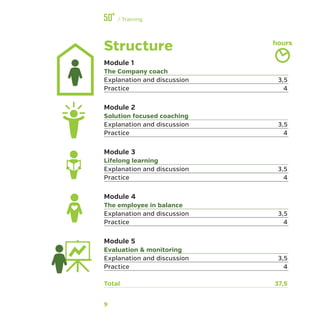
Structure
Module 1
The Company coach	
Explanation and discussion	 3,5
Practice	4
Module 2
Solution focused coaching	
Explanation and discussion	 3,5
Practice	4
Module 3
Lifelong learning	
Explanation and discussion	 3,5	
Practice	4
Module 4
The employee in balance	
Explanation and discussion	 3,5
Practice	4
Module 5
Evaluation & monitoring	
Explanation and discussion	 3,5
Practice	4
Total	37,5
hours
10
/ Training
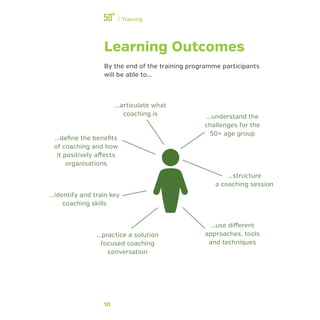
Learning Outcomes
By the end of the training programme participants
will be able to...
...articulate what
coaching is
...define the benefits
of coaching and how
it positively affects
organisations
...identify and train key
coaching skills
...practice a solution
focused coaching
conversation
...use different
approaches, tools
and techniques
...structure
a coaching session
...understand the
challenges for the
50+ age group
11
/ Training
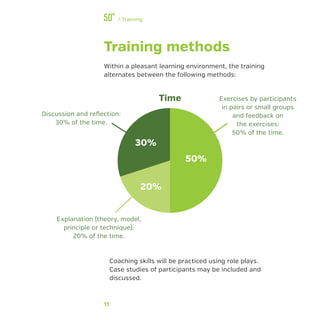
Training methods
Within a pleasant learning environment, the training
alternates between the following methods:
Exercises by participants
in pairs or small groups
and feedback on
the exercises:
50% of the time.
Explanation (theory, model,
principle or technique):
20% of the time.
Discussion and reflection:
30% of the time.
Time
50%
30%
20%
Coaching skills will be practiced using role plays.
Case studies of participants may be included and
discussed.
12
/ Training
Expectations of the
trainees
Beforehand the trainees will be asked about their expec-
tations. During the programme the participants will be
addressed and they will be coached in the skills and devel-
opment they wish to work on.
?
MODULE 1
THE COMPANY
COACH
14
Module 1 / The company coach
Objectives
•• Have a balanced idea of the situation and perception of
employees 50+.
•• Explore the benefits and challenges of employing and
retaining staff aged 50+ as part of the workforce.
•• Get the essence of an age related policy and the connec-
tion with the tool coaching 50+.
•• Have a profound idea of the meaning and the necessary
skills of coaching.
15
Module 1 / The company coach
Employment of
50+ workforce (part 1)
Background information
As a background, the trainer gives information, facts and
statistics on employment of 50+ workforce in a national
and European context.
Reinforce a positive image of people
50+ in a company
1. Stereotypes and prejudices reduced
The negative image of workers aged 50+ in society and
companies often prevents the recruitment and retention
of these persons. Prejudices as “older workers don’t fit in
an energetic and fast-paced workplace”, “they can’t keep
up and don’t want to work as hard as is required” or “older
workers are unwilling to share job knowledge and skills” are
deeply embedded in the fabric of society.
Nevertheless there is evidence that older workers exhibit
greater motivation and engagement in a stimulating envi-
ronment than younger workers. They may require somewhat
more time to learn a new skill or process, evidence indicates
they have greater retention, higher learning achievement
and are far more likely to complete their field of study.
16
Module 1 / The company coach
Perhaps we need to re-examine if we are confusing activity
and motion with efficiency and results. Continued reliance
on the characterization of a workplace as fast-paced and
constantly changing is no basis for excluding older job
seekers.
Older workers are also essential in ‘knowledge transfer’ to
their younger colleagues. Observation indicates that older
workers are exceptionally effective at sharing information
and guiding younger colleagues.
2. Stimuli to keep on working
At a national level: to keep older workforce engaged, most
European countries have introduced measures to reduce
labour costs for employers.
At company level: companies, especial SME’s, see the
technical competences, the familiarity with the company
and the acquired expertise as stimulating factors in order
to retain older workers.
At the level of the employee: besides the financial aspect,
employees see the recognition and appreciation of their
skills and knowledge as stimulating factors as well as
enjoying the social contacts with their colleagues.
Article
Older worker
stereotypes
17
Module 1 / The company coach
3. Age related policy
To avoid that a great deal of knowledge and experience is
lost from the organization, the employer has to invest in
the careers of (older) workers and has to support them to
maintain an active and interesting career. He should antici-
pate the natural aging process of people and pay attention
to the relationship between person’s stages of life and their
career phases. The balance between workload and capacity
is an important aspect to keep the employees 50+ fit until
they draw their pension.
Research shows that employers need to manage and
develop their employees aged 50+ more effectively. This
can be organised by introducing an age-related policy into
the company.
The age-related policy aims to retain and optimize com-
petences, knowledge and experience of employees,
taking into account changing needs and abilities of every
employee. This HR policy is not only directed towards
‘older’ employees, but covers all ages and therefore all life
stages.
Evidence has shown that age-related policy leads to more
appreciation and a stronger motivation of the employees.
50+ Innovative Coaching is meant to be a tool to enhance
the employability of workers aged 50+ by coaching in a
solution focused way.
Article
Waiting for
age related HR
policies support
employability
pdf
Age diversity
practices
in Belgian
organisations
18
Module 1 / The company coach
Coaching 50+ (part 2)
What is coaching?
Coaching is supporting the coachee in setting appropriate
goals. The coach facilitates the exploration of needs, moti-
vations, desires, skills and thought processes in order to
assist the individual in making real, lasting change. It’s the
art of asking good questions, knowing when and how to ask
them and actively listen to the answer. Focused questions
raise awareness and awareness is the start of someone
choosing to take responsibility for change.
How?
•• Observe, listen and ask questions to understand the
situation
•• Use questioning techniques to facilitate own thought
processes in order to identify solutions and actions (see
module 2, Solution Focused coaching)
•• Creatively apply coaching tools and techniques
•• Encourage a commitment to action and the development
of lasting personal growth and change
•• Maintain an appreciative, positive regard for the coachee:
be at all times supportive and non-judgmental of the
views, lifestyle and aspirations of the coachee
19
Module 1 / The company coach
•• Encourage the coachee to take responsibility for his/her
own professional development
•• Evaluate the process and the outcomes of the coaching
trajectory and ensure the coachee is achieving his/her
personal goals
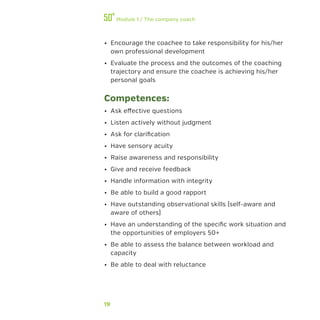
Competences:
•• Ask effective questions
•• Listen actively without judgment
•• Ask for clarification
•• Have sensory acuity
•• Raise awareness and responsibility
•• Give and receive feedback
•• Handle information with integrity
•• Be able to build a good rapport
•• Have outstanding observational skills (self-aware and
aware of others)
•• Have an understanding of the specific work situation and
the opportunities of employers 50+
•• Be able to assess the balance between workload and
capacity
•• Be able to deal with reluctance
20
Module 1 / The company coach
The training
This module gives the necessary background to the future
coach to start the coaching’s process. By discussion and
exercise the participant will be able to detect the necessary
skills to become a coach 50+ and what it needs to sharpen
them.
Approach
Presentation of information with facts and statistics
Interactive exercises and discussions: participants generate
ideas in small groups or pairs. The trainer leads the plenary
discussion to top up ideas and ensure the main points of
the theory are covered.
Tools
Power point presentation and hand-outs
Flip chart, post it notes
Exercises in pairs
MODULE 2
SOLUTION FOCUSED
COACHING
22
Module 2 / Solution focused coaching
Objectives
•• To introduce the solution focused approach
•• To explain and to practice solution focused techniques
and tools
•• To offer techniques in order to develop win-win solutions
by mediation
Solution Focused
Coaching (SFC)
The solution focused approach was developed in the
early 1980s by a research group in the USA. They began
to experiment with ‘what might work’ instead of finding
‘what caused the problem’. In coaching it has turned out
as a powerful technique in helping the coachee explor-
ing the world of possibilities, seeing new solutions and
perspectives.
Starting from the desired target, focusing on what is
already going right helps the coachee in designing the ‘pos-
sible future’ and to identify small steps to reach the goal.
The method seems simple in theory. Because we are not
used to it, the difficulty lies in staying focused on the
positive. To train your solution focused skills demands
a lot of practice.
23
Module 2 / Solution focused coaching
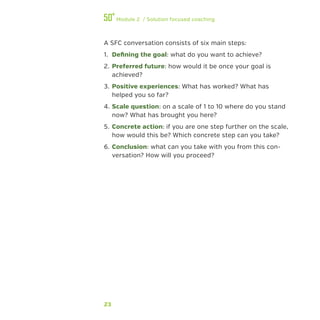
A SFC conversation consists of six main steps:
1.	 Defining the goal: what do you want to achieve?
2.	Preferred future: how would it be once your goal is
achieved?
3.	Positive experiences: What has worked? What has
helped you so far?
4.	Scale question: on a scale of 1 to 10 where do you stand
now? What has brought you here?
5.	 Concrete action: if you are one step further on the scale,
how would this be? Which concrete step can you take?
6.	Conclusion: what can you take with you from this con-
versation? How will you proceed?
24
Module 2 / Solution focused coaching
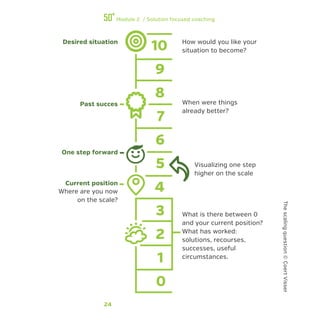
10
9
8
7
6
5
4
3
2
1
0
Visualizing one step
higher on the scale
Thescalingquestion©CoertVisser
Desired situation
Past succes
Current position
How would you like your
situation to become?
When were things
already better?
Where are you now
on the scale?
What is there between 0
and your current position?
What has worked:
solutions, recourses,
successes, useful
circumstances.
One step forward
25
Module 2 / Solution focused coaching
Mediation
When a person 50+ is stuck due to a conflict in the work-
place, the use of the mediation technique is advised. A
mediator is the neutral and impartial third party who helps
participants (either individuals or teams) to discuss difficult
issues and negotiating mutually agreeable solutions to a
conflict.
In solution focused mediation the goal is to develop win-
win solutions, which encourages collaboration instead of
conflict like the win-lose solutions.
Trust, collaboration and responsibility are the main assets
to achieve win-win solutions.
26
Module 2 / Solution focused coaching
The training
The solution focused approach is especially useful for the
employees 50+, as it can be more difficult for them to see
a professional future with ‘possibilities’. It can be that they
stay focused on the past experiences and expertise with-
out knowing how to cope with changes in the job and the
company. The language of solutions helps the employees
to open themselves to new perspectives, new possibilities
and opportunities to change the way they act. This can
motivate them ‘to move’ from their comfort zone and take
a new step in their career.
In the practical sessions the participants — especially when
they are managers — are trained to be a neutral coach with
a focus on observation and listening abilities. The role of
the coach is to stimulate ownership by the coachee and to
refrain from giving solutions.
27
Module 2 / Solution focused coaching
Approach
Each participant brings a case from their own company
with a focus on 50+ situations.
For the role play each participant assumes different roles:
•• Coachee: experiences the power of the solution focused
approach
•• Coach: practices the solution focused approach, tech-
niques and tools
•• Observer: gives feedback on how the solution focused
technique is used during the exercises
Timetable for each coaching session is:
•• coaching session 30 minutes
•• feedback 10 minutes
The trainer supervises the groups answering questions,
supporting the coach during the session with the coachee
and giving feedback to the coach.
28
Module 2 / Solution focused coaching
Tools
For the coach: ‘Solution Focused Questions’ as a reference
set of questions
For the observer: ‘Observer Sheet’ to organise his/her
feedback.
Article
Solution-focused Coaching:
Simply Effective
MODULE 3
LIFELONG LEARNING
30
Module 3 / Lifelong learning
Objectives
•• To emphasize the importance of Lifelong Learning and its
role in our society.
•• To know how to stimulate Lifelong Learning for 50+
•• To be able to test, identify and discuss learning styles.
Lifelong Learning
For decades Lifelong Learning has been an important
instrument to implement in companies as a human
resource development strategy. Within the EU a strategic
framework has been developed as a basis for European
cooperation in education and training.
Nowadays Lifelong Learning is becoming more and more
important in our careers: employees have to cope with
new technological approaches and IT-applications, they
have more responsibility and autonomy in their jobs and
the workload can be higher than before. Moreover a career
is not as uniform as it was before especially because peo-
ple have to work for longer. Therefore employees have to
become more flexible and need to be open to learn at all
times and in different ways.
31
Module 3 / Lifelong learning
Lifelong Learning is the ongoing, voluntary, and self-mo-
tivated pursuit of knowledge and skills for either personal
or professional reasons. For companies it is important to
monitor the acquired knowledge of their employees either
by formal or informal learning and to stimulate opportuni-
ties to sharpen their skills.
Regarding the 50+ workforce the company has to be aware
that people aged 50+ are a heterogeneous group with a
variety of accumulated job experiences, life topics and
learning experiences. This makes an individual approach
necessary.
The training
Specifically for employees aged 50 + continuing to learn is
important. Throughout their life and career these people
have gained a lot of skills and expertise. Nevertheless it is
necessary to update these skills on a regular basis to keep
up with rapidly changing techniques and working methods.
Providing learning opportunities tailored to the individual is
important to increase enthusiasm and motivation.
The role of the coach is to stimulate and motivate the coa-
chee to evolve competences and to take responsibility for
their career. The coach helps the coachee to identify his/her
learning needs, depending on the goal the coachee wants
to achieve. The learning style test helps to find out what
32
Module 3 / Lifelong learning
the suited learning methods are. Coach and coachee can
explore how the company can provide appropriate learning
opportunities and what is needed to realize them.
This way of coaching can open up future perspectives and
overcome possible resistance towards continuous learning.
Approach
•• Input and presentation of the background of Lifelong
Learning
•• Exchange of business experiences among the
participants
•• Apply the learning style test
Tools
Learning style test: can be found on various education and
psychological platforms. Interesting tests are for example
the test elaborated by Honey and Mumford, Halb and Kolb.
Go to the test
MODULE 4
IN BALANCE:
CAPACITY AND
STRENGTH
34
Module 4 / In balance: capacity and strength
Objectives
•• To understand the importance of good working
conditions
•• To know how to analyse the workplace
•• To know how to analyse the personal energy balance
•• To explore jobcrafting as a possible solution
The importance of
good working conditions
Creating good working conditions is a basis to motivate
employees and to use and evolve resources. It is impor-
tant that companies analyse the working conditions of the
employees on a regular base to monitor their performance.
The analysis should be done in different areas:
35
Module 4 / In balance: capacity and strength
Analysis of the workplace
The analysis of the workplace refers to the working envi-
ronment such as physical load and factors such as the
quantity of light, noise and space that can influence the
work. On the other hand it also includes working conditions,
such as workflow, participation, team spirit and develop-
ment options. A tool for the analysis of the workplace is
the ‘Impulse – Test’: It is a document with a standardized
questionnaire that evaluates the burdens and resources of
the workplace.
Analysis of the job performance
The analysis of the job performance is a description of
the daily work with a focus on the workload and the work
capacity, on the tasks the employee enjoys and the tasks
which are harder to carry out. It is important to explore
strengths, good cooperation with colleagues and the
(line) manager, professional success and development
opportunities.
Analysis of personal energy balance
The energy balance shows how much time the coachee
uses for everyday activities and if s/he gains or loses
energy by doing these activities. Health coaching can be an
important method to work on this. It refers mainly to health
subjects like stress, work-life-balance, physical exercises,
nutrition, recreation, sleep, ...
36
Module 4 / In balance: capacity and strength
The training
The obstacles for 50+ workers may lie in different areas.
Physical or psychological barriers, need for additional train-
ing to catch up with changing ways of working and a lack
of perspectives that can cause decreasing motivation. The
barriers can be detected by analysis of the workplace and
the personal situation. Based on the results of the analysis
coach and coachee are able to define the steps that can
be taken to improve the situation and overcome possible
barriers.
There are different ways to do this. The Solution focused
way helps to visualise the ‘perfect situation’ and to open
up the way to get there. Also other tools help to analyse
barriers and go for a solution.
37
Module 4 / In balance: capacity and strength
Approach
The exercises are organized as follows:
•• analysis of the workplace: individual
•• analysis of the competences, skills and knowledge:
role-play coach and coachee
•• analysis energy balance: coach, coachee and observer
•• health coaching: coach, coachee and observer
Tools
Analysis of the workplace: Impulse test
Analysis energy balance: Line chart
Health coaching: Spider chart
Go to the impulse test
(German website)
MODULE 5
EVALUATION
AND MONITORING
39
Module 5 / Evaluation
Objectives
•• To get an insight in evaluation types
•• To get an insight in monitoring and feedback
•• To improve the skill of feedback conversations
Monitoring the
coaching process
During the solution focused conversations the coach can
get an insight in the specific work situation and individual
background of the coachee s/he guides. The coach will
monitor the ongoing professional development of the coa-
chee and keep track of his/her progress and performance
trend. This is a chance for the coach to identify opportuni-
ties for continuing the coaching.
Monitoring the development of the coachee contains differ-
ent elements:
40
Module 5 / Evaluation
Feedback
Basically feedback is information about how we are doing
in our efforts to reach a goal. Constructive feedback is
delivered with respect and a genuine desire to assist an
individual to improve. Giving and receiving feedback is a
crucial coaching skill. The coach gets to know the coachee
and vice-versa and understands what kind of feedback
works best. The coach supports the coachee to link the
feedback as much as possible to the preconceived goals.
By monitoring the process and the evolution of the coa-
chee, the coach can respond appropriately.
Self-assessment
Through self-assessment the coachee gradually gets more
self-insight and understanding of his/her own abilities and
performance. We must not forget a person often is well
aware of the own strengths and weaknesses. The focus
of the self-assessment is gaining ownership. To make this
possible it is important the coach creates an open and
confidential atmosphere.
Formative evaluation
Formative evaluation is an on-going process that allows
given feedback to be implemented during a coaching cycle.
It facilitates a continual improvement of the coaching pro-
cess and helps to achieve the goals and benefits both for
the coachee and the company.
41
Module 5 / Evaluation
The training
In general the coaching process of employees 50 + requires
a specific approach. Being coached, receiving feedback and
monitoring are HR-tools that 50+ workers are not neces-
sarily used to in their early careers. It is only in the last
decade(s) these methods have been introduced so widely
in companies. Being coached and gaining self-insight might
evoke some reluctance. The skill of the coach lies in build-
ing confidence and making the conversations open and
trustful. The coach tries to grow belief in opportunities and
new perspectives regardless of age so the coachee can
progress step by step towards a renewing career.
42
Module 5 / Evaluation
Approach
•• Discussion and exchange of evaluation types used.
•• Brainstorm on key questions for self-assessment of a
50+ employee
•• Role-play self-assessment
•• Discussion about effective feedback on reality based
experiences
•• Role-play: training in the skill of giving and receiving
feedback
Tools
Pdf
Facts about feedback
Colophon
The project 50+ Innovative Coaching is funded by
the Leonardo Transfer of Innovation Programme
which is part of the European Union’s Lifelong
Learning Programme.
Contribution:
Alison Watkins (CCN)
Anit Vissers (Levanto)
Bettina Telfser (Pro Mente)
Elena Mauro (CIS)
Istvan Soos (ITSC)
Rolf Aslaksrud Kristiansen (EUROMASC Ltd)
Ulla Sever (BFI)
Editing:
Anit Vissers (Levanto)
Lay-out:
MadebyHanna
The content of this communication reflects the views only of
the author, and the EU cannot be held responsible for any use
which may be made of the information contained therein.
Links see the digital version
of the manual
www.ic50plus.eu/category/
results/
The project 50+ Innovative Coaching
is funded by the Leonardo Transfer of
Innovation Programme which is part of
the European Union’s Lifelong Learning
Programme.
www.ic50plus.eu

Manual 50plus Innovative coaching

  • 1.
  • 2.
  • 3.
    3 / Introduction Introduction The project50 + Innovative Coaching is a European project set up by partners LEVANTO (Belgium), BFI Wien (Austria) Promente (Austria) Central College Nottingham (UK), CIS (Italy), ITSC (Romania) and EUROMASC (Norway). The base of the project is the development of an ECVET- matrix1 on coaching skills. The European Commission is promoting the development of ECVET-matrices in order to describe and identify competences needed for professions in different sectors. EU’s Leonardo da Vinci Programme for vocational training is funding projects that realise ECVET-matrices. 50+ Innovative Coaching is one of those projects. The 50+ IC project has developed a complete ECVET based qualification matrix covering the criteria for a coach 50+. The training 50+ IC is based on the learning outcome descriptions of the matrix. This will secure that training targets and course content are in compliance with the qualification criteria. You can find the ECVET matrix for a coach 50+ on the website www.ic50plus.eu. 1 The European Credit System for Vocational Education and Training (ECVET) is a technical framework for the transfer and recognition of individuals’ learning outcomes with a view to achieving a qualification. Pdf ECVET matrix for a coach 50+
  • 4.
    4 / Introduction Situation onthe labour market The European countries are facing an ageing population without precedent. This has its consequences for the labour market. The amount of employees who leave the labour market is increasing at a fast pace. In addition entry of young workers is decreasing, with the implication that people have to work longer to keep the labour market in balance. Therefore it is necessary to increase the low par- ticipation rate of older employees. The project started with a research into the situation of the 50+ workforce in the different countries. The general research with facts and statistics was complemented with interviews in SME’s to have an insight into the reality of the workplace. In general there were similarities in the employ- ment rate and in the perception of workers 50+ in the SME’s. Promoting the employability of older workers and keeping them in work for longer is a central issue. Although countries take measures to increase the participation rate, the existing culture towards older employees – in the polit- ical environment, in society as well as in companies – is still conservative. This affects the attitude, prejudices and thoughts regarding working longer.
  • 5.
    5 / Introduction The 50+Innovative Coaching project The scope of the European 50+ IC project is to create innovative ways of supporting people 50+ in the workplace. Supporting this group will help them to develop further and retain the skills, knowledge and history they bring to the business. Coaching is an effective way of doing so. The partners in the project developed a programme to train participants to become a coach 50+. The objective of the training is to give the participants the necessary infor- mation, tools and methods to sharpen their competences as a coach. In a solution focused way they learn to coach employees aged 50+ in order to reach the perspective of a new, positive turn in their careers. The coach acts within the context of the company and is aware of the conse- quences for the colleagues, for the content of the function, for possible adjustments to the workplace… We would like to point out that supporting older employees by introducing coaches 50+ will only have results when it is included in an age-related policy and an openness towards 50+ employees. In Module 1 this topic will be discussed.
  • 6.
    6 / Introduction Target group Thetraining is intended for participants who already have a general basis or a practical experience in coaching people and have built up coaching skills whether on a formal or an informal way. Essentially we are targeting participants who have experiences of working with groups. Depending on the job or position of the coach there will be a different starting point: •• Manager: has a leadership role and is in this point of view not necessarily neutral. This can mean that coachees will not speak entirely freely especially when they are stuck on items in their career. Trust is essential to fulfill the role as a coach. This will be part of the 50+IC training, particular in the practice of the solution focused coaching method. •• HR-manager or mentor: monitoring the competences of employees is inherent to the job and this makes a neutral role more evident. •• External coach: is a professional and the neutral role is more obvious. Other factors such as insight into the culture of the company, the relationships between colleagues and career possibilities can be barriers to achieve a good result. coach The results of the project 50+ Innovative Coaching are on the website.
  • 7.
    7 / Introduction Set upof the manual The manual has been produced to give an overview of the content of the training. It is in the first place meant for trainers 50+ IC but also the participants of the training or companies can find it useful. The 5 modules of the training can be used in a flexible way depending on the knowledge and the experience of the participants. In every module we give a short background section followed by the approach and the tools that can be used.
  • 8.
  • 9.
    9 / Training Structure Module 1 TheCompany coach Explanation and discussion 3,5 Practice 4 Module 2 Solution focused coaching Explanation and discussion 3,5 Practice 4 Module 3 Lifelong learning Explanation and discussion 3,5 Practice 4 Module 4 The employee in balance Explanation and discussion 3,5 Practice 4 Module 5 Evaluation & monitoring Explanation and discussion 3,5 Practice 4 Total 37,5 hours
  • 10.
    10 / Training Learning Outcomes Bythe end of the training programme participants will be able to... ...articulate what coaching is ...define the benefits of coaching and how it positively affects organisations ...identify and train key coaching skills ...practice a solution focused coaching conversation ...use different approaches, tools and techniques ...structure a coaching session ...understand the challenges for the 50+ age group
  • 11.
    11 / Training Training methods Withina pleasant learning environment, the training alternates between the following methods: Exercises by participants in pairs or small groups and feedback on the exercises: 50% of the time. Explanation (theory, model, principle or technique): 20% of the time. Discussion and reflection: 30% of the time. Time 50% 30% 20% Coaching skills will be practiced using role plays. Case studies of participants may be included and discussed.
  • 12.
    12 / Training Expectations ofthe trainees Beforehand the trainees will be asked about their expec- tations. During the programme the participants will be addressed and they will be coached in the skills and devel- opment they wish to work on. ?
  • 13.
  • 14.
    14 Module 1 /The company coach Objectives •• Have a balanced idea of the situation and perception of employees 50+. •• Explore the benefits and challenges of employing and retaining staff aged 50+ as part of the workforce. •• Get the essence of an age related policy and the connec- tion with the tool coaching 50+. •• Have a profound idea of the meaning and the necessary skills of coaching.
  • 15.
    15 Module 1 /The company coach Employment of 50+ workforce (part 1) Background information As a background, the trainer gives information, facts and statistics on employment of 50+ workforce in a national and European context. Reinforce a positive image of people 50+ in a company 1. Stereotypes and prejudices reduced The negative image of workers aged 50+ in society and companies often prevents the recruitment and retention of these persons. Prejudices as “older workers don’t fit in an energetic and fast-paced workplace”, “they can’t keep up and don’t want to work as hard as is required” or “older workers are unwilling to share job knowledge and skills” are deeply embedded in the fabric of society. Nevertheless there is evidence that older workers exhibit greater motivation and engagement in a stimulating envi- ronment than younger workers. They may require somewhat more time to learn a new skill or process, evidence indicates they have greater retention, higher learning achievement and are far more likely to complete their field of study.
  • 16.
    16 Module 1 /The company coach Perhaps we need to re-examine if we are confusing activity and motion with efficiency and results. Continued reliance on the characterization of a workplace as fast-paced and constantly changing is no basis for excluding older job seekers. Older workers are also essential in ‘knowledge transfer’ to their younger colleagues. Observation indicates that older workers are exceptionally effective at sharing information and guiding younger colleagues. 2. Stimuli to keep on working At a national level: to keep older workforce engaged, most European countries have introduced measures to reduce labour costs for employers. At company level: companies, especial SME’s, see the technical competences, the familiarity with the company and the acquired expertise as stimulating factors in order to retain older workers. At the level of the employee: besides the financial aspect, employees see the recognition and appreciation of their skills and knowledge as stimulating factors as well as enjoying the social contacts with their colleagues. Article Older worker stereotypes
  • 17.
    17 Module 1 /The company coach 3. Age related policy To avoid that a great deal of knowledge and experience is lost from the organization, the employer has to invest in the careers of (older) workers and has to support them to maintain an active and interesting career. He should antici- pate the natural aging process of people and pay attention to the relationship between person’s stages of life and their career phases. The balance between workload and capacity is an important aspect to keep the employees 50+ fit until they draw their pension. Research shows that employers need to manage and develop their employees aged 50+ more effectively. This can be organised by introducing an age-related policy into the company. The age-related policy aims to retain and optimize com- petences, knowledge and experience of employees, taking into account changing needs and abilities of every employee. This HR policy is not only directed towards ‘older’ employees, but covers all ages and therefore all life stages. Evidence has shown that age-related policy leads to more appreciation and a stronger motivation of the employees. 50+ Innovative Coaching is meant to be a tool to enhance the employability of workers aged 50+ by coaching in a solution focused way. Article Waiting for age related HR policies support employability pdf Age diversity practices in Belgian organisations
  • 18.
    18 Module 1 /The company coach Coaching 50+ (part 2) What is coaching? Coaching is supporting the coachee in setting appropriate goals. The coach facilitates the exploration of needs, moti- vations, desires, skills and thought processes in order to assist the individual in making real, lasting change. It’s the art of asking good questions, knowing when and how to ask them and actively listen to the answer. Focused questions raise awareness and awareness is the start of someone choosing to take responsibility for change. How? •• Observe, listen and ask questions to understand the situation •• Use questioning techniques to facilitate own thought processes in order to identify solutions and actions (see module 2, Solution Focused coaching) •• Creatively apply coaching tools and techniques •• Encourage a commitment to action and the development of lasting personal growth and change •• Maintain an appreciative, positive regard for the coachee: be at all times supportive and non-judgmental of the views, lifestyle and aspirations of the coachee
  • 19.
    19 Module 1 /The company coach •• Encourage the coachee to take responsibility for his/her own professional development •• Evaluate the process and the outcomes of the coaching trajectory and ensure the coachee is achieving his/her personal goals Competences: •• Ask effective questions •• Listen actively without judgment •• Ask for clarification •• Have sensory acuity •• Raise awareness and responsibility •• Give and receive feedback •• Handle information with integrity •• Be able to build a good rapport •• Have outstanding observational skills (self-aware and aware of others) •• Have an understanding of the specific work situation and the opportunities of employers 50+ •• Be able to assess the balance between workload and capacity •• Be able to deal with reluctance
  • 20.
    20 Module 1 /The company coach The training This module gives the necessary background to the future coach to start the coaching’s process. By discussion and exercise the participant will be able to detect the necessary skills to become a coach 50+ and what it needs to sharpen them. Approach Presentation of information with facts and statistics Interactive exercises and discussions: participants generate ideas in small groups or pairs. The trainer leads the plenary discussion to top up ideas and ensure the main points of the theory are covered. Tools Power point presentation and hand-outs Flip chart, post it notes Exercises in pairs
  • 21.
  • 22.
    22 Module 2 /Solution focused coaching Objectives •• To introduce the solution focused approach •• To explain and to practice solution focused techniques and tools •• To offer techniques in order to develop win-win solutions by mediation Solution Focused Coaching (SFC) The solution focused approach was developed in the early 1980s by a research group in the USA. They began to experiment with ‘what might work’ instead of finding ‘what caused the problem’. In coaching it has turned out as a powerful technique in helping the coachee explor- ing the world of possibilities, seeing new solutions and perspectives. Starting from the desired target, focusing on what is already going right helps the coachee in designing the ‘pos- sible future’ and to identify small steps to reach the goal. The method seems simple in theory. Because we are not used to it, the difficulty lies in staying focused on the positive. To train your solution focused skills demands a lot of practice.
  • 23.
    23 Module 2 /Solution focused coaching A SFC conversation consists of six main steps: 1. Defining the goal: what do you want to achieve? 2. Preferred future: how would it be once your goal is achieved? 3. Positive experiences: What has worked? What has helped you so far? 4. Scale question: on a scale of 1 to 10 where do you stand now? What has brought you here? 5. Concrete action: if you are one step further on the scale, how would this be? Which concrete step can you take? 6. Conclusion: what can you take with you from this con- versation? How will you proceed?
  • 24.
    24 Module 2 /Solution focused coaching 10 9 8 7 6 5 4 3 2 1 0 Visualizing one step higher on the scale Thescalingquestion©CoertVisser Desired situation Past succes Current position How would you like your situation to become? When were things already better? Where are you now on the scale? What is there between 0 and your current position? What has worked: solutions, recourses, successes, useful circumstances. One step forward
  • 25.
    25 Module 2 /Solution focused coaching Mediation When a person 50+ is stuck due to a conflict in the work- place, the use of the mediation technique is advised. A mediator is the neutral and impartial third party who helps participants (either individuals or teams) to discuss difficult issues and negotiating mutually agreeable solutions to a conflict. In solution focused mediation the goal is to develop win- win solutions, which encourages collaboration instead of conflict like the win-lose solutions. Trust, collaboration and responsibility are the main assets to achieve win-win solutions.
  • 26.
    26 Module 2 /Solution focused coaching The training The solution focused approach is especially useful for the employees 50+, as it can be more difficult for them to see a professional future with ‘possibilities’. It can be that they stay focused on the past experiences and expertise with- out knowing how to cope with changes in the job and the company. The language of solutions helps the employees to open themselves to new perspectives, new possibilities and opportunities to change the way they act. This can motivate them ‘to move’ from their comfort zone and take a new step in their career. In the practical sessions the participants — especially when they are managers — are trained to be a neutral coach with a focus on observation and listening abilities. The role of the coach is to stimulate ownership by the coachee and to refrain from giving solutions.
  • 27.
    27 Module 2 /Solution focused coaching Approach Each participant brings a case from their own company with a focus on 50+ situations. For the role play each participant assumes different roles: •• Coachee: experiences the power of the solution focused approach •• Coach: practices the solution focused approach, tech- niques and tools •• Observer: gives feedback on how the solution focused technique is used during the exercises Timetable for each coaching session is: •• coaching session 30 minutes •• feedback 10 minutes The trainer supervises the groups answering questions, supporting the coach during the session with the coachee and giving feedback to the coach.
  • 28.
    28 Module 2 /Solution focused coaching Tools For the coach: ‘Solution Focused Questions’ as a reference set of questions For the observer: ‘Observer Sheet’ to organise his/her feedback. Article Solution-focused Coaching: Simply Effective
  • 29.
  • 30.
    30 Module 3 /Lifelong learning Objectives •• To emphasize the importance of Lifelong Learning and its role in our society. •• To know how to stimulate Lifelong Learning for 50+ •• To be able to test, identify and discuss learning styles. Lifelong Learning For decades Lifelong Learning has been an important instrument to implement in companies as a human resource development strategy. Within the EU a strategic framework has been developed as a basis for European cooperation in education and training. Nowadays Lifelong Learning is becoming more and more important in our careers: employees have to cope with new technological approaches and IT-applications, they have more responsibility and autonomy in their jobs and the workload can be higher than before. Moreover a career is not as uniform as it was before especially because peo- ple have to work for longer. Therefore employees have to become more flexible and need to be open to learn at all times and in different ways.
  • 31.
    31 Module 3 /Lifelong learning Lifelong Learning is the ongoing, voluntary, and self-mo- tivated pursuit of knowledge and skills for either personal or professional reasons. For companies it is important to monitor the acquired knowledge of their employees either by formal or informal learning and to stimulate opportuni- ties to sharpen their skills. Regarding the 50+ workforce the company has to be aware that people aged 50+ are a heterogeneous group with a variety of accumulated job experiences, life topics and learning experiences. This makes an individual approach necessary. The training Specifically for employees aged 50 + continuing to learn is important. Throughout their life and career these people have gained a lot of skills and expertise. Nevertheless it is necessary to update these skills on a regular basis to keep up with rapidly changing techniques and working methods. Providing learning opportunities tailored to the individual is important to increase enthusiasm and motivation. The role of the coach is to stimulate and motivate the coa- chee to evolve competences and to take responsibility for their career. The coach helps the coachee to identify his/her learning needs, depending on the goal the coachee wants to achieve. The learning style test helps to find out what
  • 32.
    32 Module 3 /Lifelong learning the suited learning methods are. Coach and coachee can explore how the company can provide appropriate learning opportunities and what is needed to realize them. This way of coaching can open up future perspectives and overcome possible resistance towards continuous learning. Approach •• Input and presentation of the background of Lifelong Learning •• Exchange of business experiences among the participants •• Apply the learning style test Tools Learning style test: can be found on various education and psychological platforms. Interesting tests are for example the test elaborated by Honey and Mumford, Halb and Kolb. Go to the test
  • 33.
  • 34.
    34 Module 4 /In balance: capacity and strength Objectives •• To understand the importance of good working conditions •• To know how to analyse the workplace •• To know how to analyse the personal energy balance •• To explore jobcrafting as a possible solution The importance of good working conditions Creating good working conditions is a basis to motivate employees and to use and evolve resources. It is impor- tant that companies analyse the working conditions of the employees on a regular base to monitor their performance. The analysis should be done in different areas:
  • 35.
    35 Module 4 /In balance: capacity and strength Analysis of the workplace The analysis of the workplace refers to the working envi- ronment such as physical load and factors such as the quantity of light, noise and space that can influence the work. On the other hand it also includes working conditions, such as workflow, participation, team spirit and develop- ment options. A tool for the analysis of the workplace is the ‘Impulse – Test’: It is a document with a standardized questionnaire that evaluates the burdens and resources of the workplace. Analysis of the job performance The analysis of the job performance is a description of the daily work with a focus on the workload and the work capacity, on the tasks the employee enjoys and the tasks which are harder to carry out. It is important to explore strengths, good cooperation with colleagues and the (line) manager, professional success and development opportunities. Analysis of personal energy balance The energy balance shows how much time the coachee uses for everyday activities and if s/he gains or loses energy by doing these activities. Health coaching can be an important method to work on this. It refers mainly to health subjects like stress, work-life-balance, physical exercises, nutrition, recreation, sleep, ...
  • 36.
    36 Module 4 /In balance: capacity and strength The training The obstacles for 50+ workers may lie in different areas. Physical or psychological barriers, need for additional train- ing to catch up with changing ways of working and a lack of perspectives that can cause decreasing motivation. The barriers can be detected by analysis of the workplace and the personal situation. Based on the results of the analysis coach and coachee are able to define the steps that can be taken to improve the situation and overcome possible barriers. There are different ways to do this. The Solution focused way helps to visualise the ‘perfect situation’ and to open up the way to get there. Also other tools help to analyse barriers and go for a solution.
  • 37.
    37 Module 4 /In balance: capacity and strength Approach The exercises are organized as follows: •• analysis of the workplace: individual •• analysis of the competences, skills and knowledge: role-play coach and coachee •• analysis energy balance: coach, coachee and observer •• health coaching: coach, coachee and observer Tools Analysis of the workplace: Impulse test Analysis energy balance: Line chart Health coaching: Spider chart Go to the impulse test (German website)
  • 38.
  • 39.
    39 Module 5 /Evaluation Objectives •• To get an insight in evaluation types •• To get an insight in monitoring and feedback •• To improve the skill of feedback conversations Monitoring the coaching process During the solution focused conversations the coach can get an insight in the specific work situation and individual background of the coachee s/he guides. The coach will monitor the ongoing professional development of the coa- chee and keep track of his/her progress and performance trend. This is a chance for the coach to identify opportuni- ties for continuing the coaching. Monitoring the development of the coachee contains differ- ent elements:
  • 40.
    40 Module 5 /Evaluation Feedback Basically feedback is information about how we are doing in our efforts to reach a goal. Constructive feedback is delivered with respect and a genuine desire to assist an individual to improve. Giving and receiving feedback is a crucial coaching skill. The coach gets to know the coachee and vice-versa and understands what kind of feedback works best. The coach supports the coachee to link the feedback as much as possible to the preconceived goals. By monitoring the process and the evolution of the coa- chee, the coach can respond appropriately. Self-assessment Through self-assessment the coachee gradually gets more self-insight and understanding of his/her own abilities and performance. We must not forget a person often is well aware of the own strengths and weaknesses. The focus of the self-assessment is gaining ownership. To make this possible it is important the coach creates an open and confidential atmosphere. Formative evaluation Formative evaluation is an on-going process that allows given feedback to be implemented during a coaching cycle. It facilitates a continual improvement of the coaching pro- cess and helps to achieve the goals and benefits both for the coachee and the company.
  • 41.
    41 Module 5 /Evaluation The training In general the coaching process of employees 50 + requires a specific approach. Being coached, receiving feedback and monitoring are HR-tools that 50+ workers are not neces- sarily used to in their early careers. It is only in the last decade(s) these methods have been introduced so widely in companies. Being coached and gaining self-insight might evoke some reluctance. The skill of the coach lies in build- ing confidence and making the conversations open and trustful. The coach tries to grow belief in opportunities and new perspectives regardless of age so the coachee can progress step by step towards a renewing career.
  • 42.
    42 Module 5 /Evaluation Approach •• Discussion and exchange of evaluation types used. •• Brainstorm on key questions for self-assessment of a 50+ employee •• Role-play self-assessment •• Discussion about effective feedback on reality based experiences •• Role-play: training in the skill of giving and receiving feedback Tools Pdf Facts about feedback
  • 43.
    Colophon The project 50+Innovative Coaching is funded by the Leonardo Transfer of Innovation Programme which is part of the European Union’s Lifelong Learning Programme. Contribution: Alison Watkins (CCN) Anit Vissers (Levanto) Bettina Telfser (Pro Mente) Elena Mauro (CIS) Istvan Soos (ITSC) Rolf Aslaksrud Kristiansen (EUROMASC Ltd) Ulla Sever (BFI) Editing: Anit Vissers (Levanto) Lay-out: MadebyHanna The content of this communication reflects the views only of the author, and the EU cannot be held responsible for any use which may be made of the information contained therein. Links see the digital version of the manual www.ic50plus.eu/category/ results/
  • 44.
    The project 50+Innovative Coaching is funded by the Leonardo Transfer of Innovation Programme which is part of the European Union’s Lifelong Learning Programme. www.ic50plus.eu