Key Account Management Marketing and Sales Excellence   Team Mission : Deliver “World Class” Key Account & Territory Management
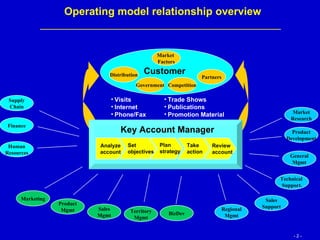
Operating model relationship overview Key Account Manager Customer Competition Government Technical  Support. Market Research Marketing Product Mgmt General Mgmt Sales Mgmt Territory Mgmt Sales Support Product Development Supply Chain Human Resources Finance Regional Mgmt Trade Shows Publications Promotion Material Visits Internet Phone/Fax Distribution BizDev Partners Market  Factors Analyze account Set objectives Plan strategy Take action Review account
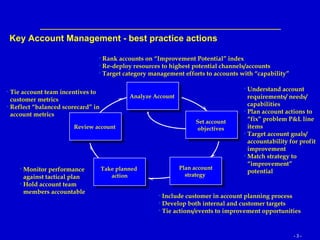
Key Account Management - best practice actions Rank accounts on “Improvement Potential” index Re-deploy resources to highest potential channels/accounts Target category management efforts to accounts with “capability” Understand account requirements/ needs/ capabilities Plan account actions to “fix” problem P&L line items Target account goals/ accountability for profit improvement Match strategy to “improvement” potential Include customer in account planning process Develop both internal and customer targets Tie actions/events to improvement opportunities Monitor performance against tactical plan Hold account team members accountable Tie account team incentives to customer metrics Reflect “balanced scorecard” in account metrics Set account  objectives  Plan account strategy  Take planned  action Review account  Analyze Account
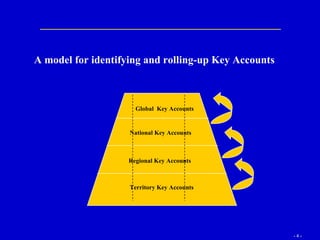
Territory Key Accounts Regional Key Accounts National Key Accounts Global  Key Accounts A model for identifying and rolling-up Key Accounts
Key Account Management Process diagrams
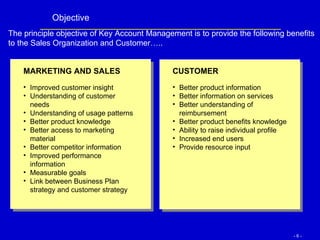
Objective The principle objective of Key Account Management is to provide the following benefits  to the Sales Organization and Customer….. MARKETING AND SALES Improved customer insight Understanding of customer needs Understanding of usage patterns Better product knowledge Better access to marketing  material Better competitor information Improved performance information Measurable goals Link between Business Plan strategy and customer strategy CUSTOMER Better product information Better information on services Better understanding of reimbursement Better product benefits knowledge Ability to raise individual profile Increased end users Provide resource input
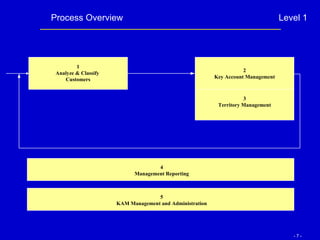
Process Overview Level 1 2 Key Account Management 3 Territory Management 4 Management Reporting 5 KAM Management and Administration 1 Analyze & Classify  Customers
1 - Analyze and Classify Customers
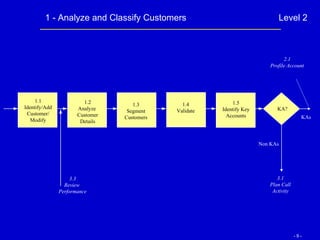
1 - Analyze and Classify Customers Level 2 1.1 Identify/Add Customer/ Modify 1.2 Analyze  Customer Details 1.3 Segment Customers 1.4 Validate 1.5 Identify Key Accounts 3.3 Review  Performance KA? Non KAs KAs 3.1 Plan Call Activity 2.1 Profile Account
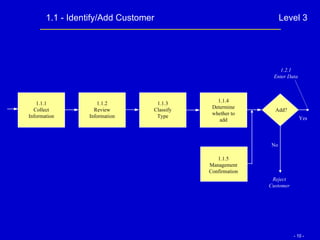
1.1 - Identify/Add Customer Level 3 1.1.4 Determine whether to add Add? No Yes Reject Customer 1.2.1 Enter Data 1.1.5 Management Confirmation 1.1.1 Collect Information 1.1.2 Review Information 1.1.3 Classify Type
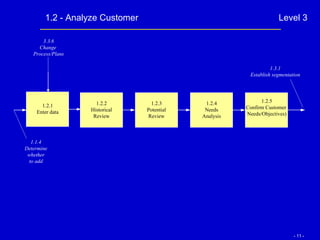
1.2 - Analyze Customer Level 3 1.2.2 Historical Review 1.2.3 Potential Review 1.2.4 Needs Analysis 1.2.5 Confirm Customer  Needs/Objectives) 1.1.4 Determine whether to add 1.3.1 Establish segmentation 3.3.6 Change  Process/Plans 1.2.1 Enter data
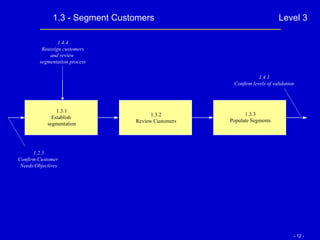
1.3 - Segment Customers Level 3 1.3.1 Establish  segmentation 1.3.2 Review Customers 1.3.3 Populate Segments 1.4.1 Confirm levels of validation 1.2.5 Confirm Customer  Needs/Objectives 1.4.4 Reassign customers and review  segmentation process
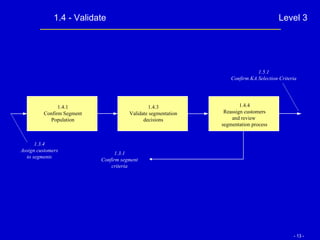
1.4 - Validate Level 3 1.4.1 Confirm Segment Population 1.4.3 Validate segmentation decisions 1.4.4 Reassign customers and review  segmentation process 1.5.1 Confirm KA Selection Criteria 1.3.4 Assign customers to segments 1.3.1 Confirm segment criteria
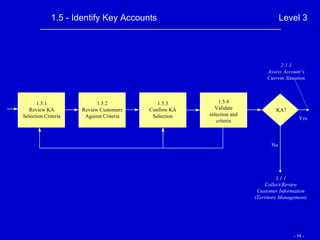
1.5 - Identify Key Accounts Level 3 1.5.4 Validate selection and criteria KA? No Yes 2.1.1 Assess Account’s Current Situation 3.1.1 Collect/Review Customer Information (Territory Management) 1.5.1 Review KA Selection Criteria 1.5.2 Review Customers Against Criteria 1.5.3 Confirm KA Selection
2 - Key Account Management
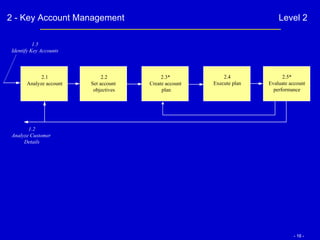
2 - Key Account Management Level 2 1.5 Identify Key Accounts 1.2 Analyze Customer  Details 2.1 Analyze account 2.2 Set account  objectives 2.3* Create account plan 2.4 Execute plan 2.5* Evaluate account performance
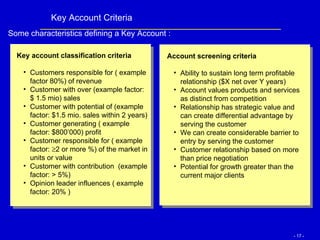
Key Account Criteria Some characteristics defining a Key Account : Key account classification criteria  Customers responsible for ( example factor 80%) of revenue Customer with over (example factor: $ 1.5 mio) sales Customer with potential of (example factor: $1.5 mio. sales within 2 years) Customer generating ( example factor: $800’000) profit Customer responsible for ( example factor:   2 or more %) of the market in units or value Customer with contribution  (example factor: > 5%) Opinion leader influences ( example factor: 20% ) Account screening criteria Ability to sustain long term profitable relationship ($X net over Y years) Account values products and services as distinct from competition Relationship has strategic value and can create differential advantage by serving the customer We can create considerable barrier to entry by serving the customer Customer relationship based on more than price negotiation Potential for growth greater than the current major clients
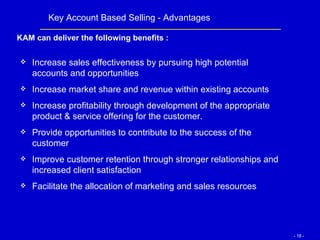
Increase sales effectiveness by pursuing high potential accounts and opportunities  Increase market share and revenue within existing accounts Increase profitability through development of the appropriate product & service offering for the customer. Provide opportunities to contribute to the success of the customer Improve customer retention through stronger relationships and increased client satisfaction Facilitate the allocation of marketing and sales resources Key Account Based Selling - Advantages KAM can deliver the following benefits :
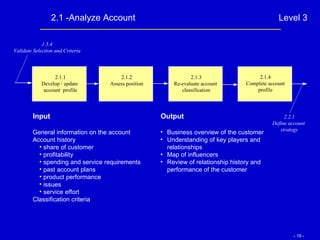
General information on the account Account history share of customer profitability spending and service requirements past account plans product performance issues service effort Classification criteria 2.1 -Analyze Account Level 3 1.5.4 Validate Selection and Criteria 2.2.1 Define account  strategy Output Business overview of the customer Understanding of key players and relationships Map of influencers Review of relationship history and performance of the customer Input 2.1.1 Develop / update  account  profile 2.1.2 Assess position 2.1.3 Re-evaluate account  classification 2.1.4 Complete account profile
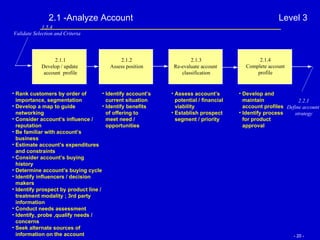
2.1 -Analyze Account Level 3 1.5.4 Validate Selection and Criteria 2.2.1 Define account  strategy Rank customers by order of importance, segmentation Develop a map to guide networking Consider account’s influence / reputation Be familiar with account’s business Estimate account’s expenditures and constraints Consider account’s buying history Determine account’s buying cycle Identify influencers / decision makers Identify prospect by product line / treatment modality ; 3rd party information Conduct needs assessment Identify, probe ,qualify needs / concerns Seek alternate sources of information on the account Assess account’s potential / financial viability Establish prospect segment / priority Identify account’s current situation Identify benefits of offering to meet need / opportunities Develop and maintain account profiles Identify process for product approval 2.1.1 Develop / update  account  profile 2.1.2 Assess position 2.1.3 Re-evaluate account  classification 2.1.4 Complete account profile
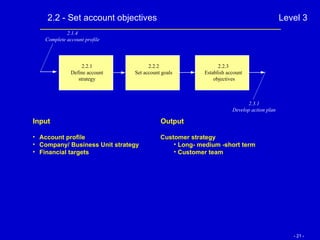
2.2 - Set account objectives Level 3 2.1.4 Complete account profile 2.3.1 Develop action plan Account profile Company/ Business Unit strategy Financial targets Output Customer strategy Long- medium -short term Customer team Input 2.2.1 Define account strategy 2.2.2 Set account goals 2.2.3 Establish account objectives
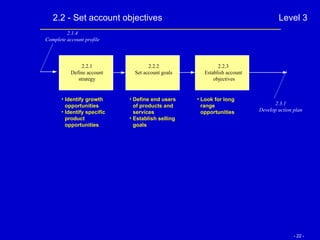
2.2 - Set account objectives Level 3 2.1.4 Complete account profile 2.3.1 Develop action plan Define end users of products and services Establish selling goals Identify growth opportunities Identify specific product opportunities Look for long range opportunities 2.2.1 Define account strategy 2.2.2 Set account goals 2.2.3 Establish account objectives
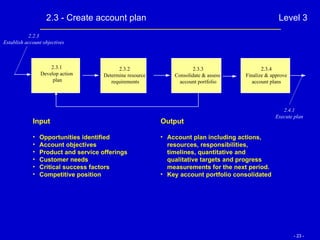
2.3 - Create account plan Level 3 2.2.3 Establish account objectives 2.4.1 Execute plan Opportunities identified Account objectives Product and service offerings Customer needs Critical success factors Competitive position Output Account plan including actions, resources, responsibilities, timelines, quantitative and qualitative targets and progress measurements for the next period. Key account portfolio consolidated Input 2.3.1 Develop action plan 2.3.2 Determine resource requirements 2.3.4 Finalize & approve account plans 2.3.3 Consolidate & assess  account portfolio
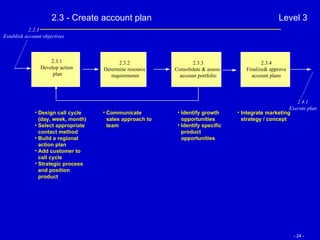
2.3 - Create account plan Level 3 2.2.3 Establish account objectives 2.4.1 Execute plan Design call cycle (day, week, month) Select appropriate contact method Build a regional action plan Add customer to call cycle Strategic process and position product Communicate sales approach to team Identify growth opportunities Identify specific product opportunities Integrate marketing strategy / concept 2.3.1 Develop action plan 2.3.2 Determine resource requirements 2.3.4 Finalize& approve account plans 2.3.3 Consolidate & assess  account portfolio
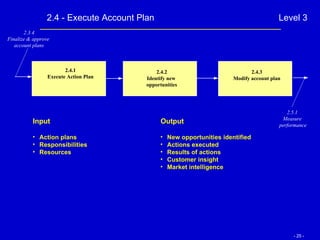
2.4 - Execute Account Plan Level 3 2.3.4 Finalize & approve  account plans 2.5.1 Measure performance Action plans  Responsibilities Resources Output New opportunities identified Actions executed Results of actions Customer insight Market intelligence Input 2.4.1 Execute Action Plan 2.4.2 Identify new  opportunities 2.4.3 Modify account plan
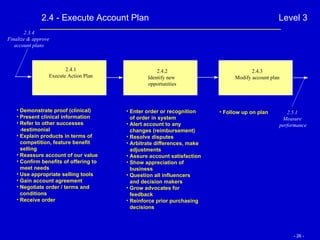
2.4 - Execute Account Plan Level 3 2.3.4 Finalize & approve  account plans 2.5.1 Measure performance Demonstrate proof (clinical) Present clinical information Refer to other successes -testimonial Explain products in terms of competition, feature benefit selling Reassure account of our value Confirm benefits of offering to meet needs Use appropriate selling tools Gain account agreement Negotiate order / terms and conditions Receive order Enter order or recognition of order in system Alert account to any changes (reimbursement) Resolve disputes Arbitrate differences, make adjustments Assure account satisfaction Show appreciation of business Question all influencers and decision makers Grow advocates for feedback Reinforce prior purchasing decisions Follow up on plan 2.4.1 Execute Action Plan 2.4.2 Identify new  opportunities 2.4.3 Modify account plan
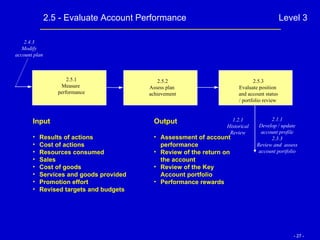
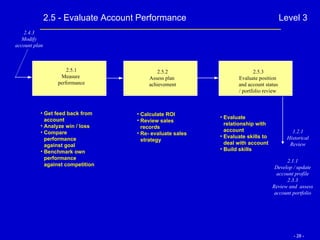
2.5 - Evaluate Account Performance Level 3 2.4.3 Modify account plan 1.2.1 Historical Review 2.1.1 Develop / update account profile 2.3.3 Review and  assess account portfolio Results of actions Cost of actions Resources consumed Sales Cost of goods Services and goods provided Promotion effort Revised targets and budgets Output Assessment of account performance Review of the return on the account Review of the Key Account portfolio Performance rewards Input 2.5.1 Measure  performance 2.5.2 Assess plan  achievement 2.5.3 Evaluate position  and account status / portfolio review
2.5 - Evaluate Account Performance Level 3 2.4.3 Modify account plan 1.2.1 Historical Review 2.1.1 Develop / update account profile 2.3.3 Review and  assess account portfolio Get feed back from account Analyze win / loss Compare performance against goal Benchmark own performance against competition Calculate ROI Review sales records Re- evaluate sales strategy Evaluate relationship with account Evaluate skills to deal with account  Build skills 2.5.1 Measure  performance 2.5.2 Assess plan  achievement 2.5.3 Evaluate position  and account status / portfolio review
3 - Territory Management
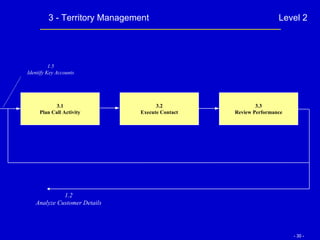
3 - Territory Management Level 2 3.1 Plan Call Activity 3.2 Execute Contact 3.3 Review Performance 1.5 Identify Key Accounts 1.2 Analyze Customer Details
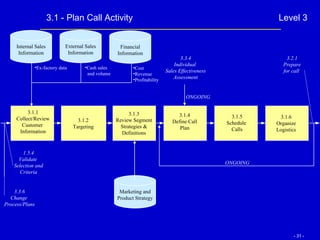
3.1 - Plan Call Activity Level 3 3.1.5 Schedule  Calls 3.1.6 Organize Logistics 3.3.4 Individual  Sales Effectiveness Assessment 3.1.3 Review Segment Strategies & Definitions 3.1.4 Define Call Plan 3.1.1 Collect/Review Customer  Information 3.1.2 Targeting ONGOING ONGOING Internal Sales Information External Sales Information Financial Information Cost Revenue Profitability Cash sales  and volume Ex-factory data 3.2.1 Prepare for call  3.3.6 Change  Process/Plans 1.5.4 Validate  Selection and Criteria Marketing and Product Strategy
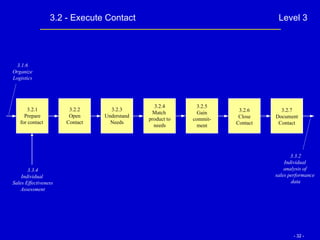
3.2 - Execute Contact Level 3  3.2.1 Prepare for contact  3.2.2 Open Contact 3.2.4 Match  product to needs 3.2.6 Close Contact 3.2.7 Document Contact 3.2.3 Understand Needs 3.2.5 Gain commit- ment 3.3.4 Individual  Sales Effectiveness Assessment 3.1.6 Organize Logistics 3.3.2 Individual  analysis of  sales performance  data
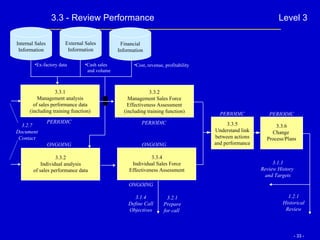
3.3 - Review Performance Level 3 3.3.1 Management analysis of sales performance data (including training function) 3.3.4 Individual Sales Force Effectiveness Assessment 3.3.6 Change  Process/Plans 3.3.2 Individual analysis of sales performance data 3.3.2 Management Sales Force Effectiveness Assessment (including training function) ONGOING ONGOING ONGOING PERIODIC PERIODIC PERIODIC 3.2.1 Prepare for call  3.1.1 Review History  and Targets 3.2.7 Document Contact 1.2.1 Historical Review 3.1.4 Define Call Objectives Internal Sales Information External Sales Information Financial Information Cost, revenue, profitability Cash sales  and volume Ex-factory data 3.3.5 Understand link between actions and performance PERIODIC
4 - Management Reporting
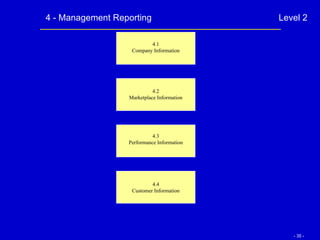
4 - Management Reporting Level 2 4.1 Company Information 4.2 Marketplace Information 4.3 Performance Information 4.4 Customer Information
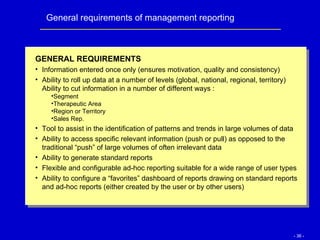
General requirements of management reporting GENERAL REQUIREMENTS Information entered once only (ensures motivation, quality and consistency) Ability to roll up data at a number of levels (global, national, regional, territory) Ability to cut information in a number of different ways : Segment Therapeutic Area Region or Territory Sales Rep. Tool to assist in the identification of patterns and trends in large volumes of data Ability to access specific relevant information (push or pull) as opposed to the traditional “push” of large volumes of often irrelevant data Ability to generate standard reports Flexible and configurable ad-hoc reporting suitable for a wide range of user types Ability to configure a “favorites” dashboard of reports drawing on standard reports and ad-hoc reports (either created by the user or by other users)
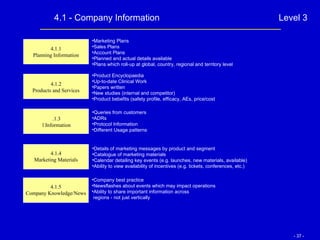
4.1 - Company Information Level 3 4.1.1 Planning Information 4.1.2 Products and Services .1.3 l Information 4.1.4 Marketing Materials Product Encyclopaedia Up-to-date Clinical Work Papers written New studies (internal and competitor) Product bebefits (safety profile, efficacy, AEs, price/cost 4.1.5 Company Knowledge/News Queries from customers ADRs Protocol Information Different Usage patterns Company best practice Newsflashes about events which may impact operations Ability to share important information across regions - not just vertically Details of marketing messages by product and segment Catalogue of marketing materials Calendar detailing key events (e.g. launches, new materials, available) Ability to view availability of incentives (e.g. tickets, conferences, etc.) Marketing Plans Sales Plans Account Plans Planned and actual details available Plans which roll-up at global, country, regional and territory level
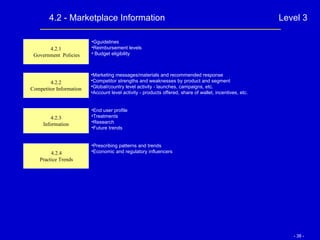
4.2 - Marketplace Information Level 3 4.2.1 Government  Policies Gguidelines Reimbursement levels Budget eligibility 4.2.2 Competitor Information Marketing messages/materials and recommended response Competitor strengths and weaknesses by product and segment Global/country level activity - launches, campaigns, etc. Account level activity - products offered, share of wallet, incentives, etc. 4.2.3 Information End user profile Treatments Research Future trends 4.2.4 Practice Trends Prescribing patterns and trends Economic and regulatory influencers
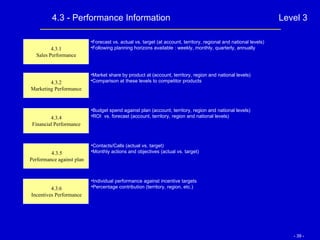
4.3 - Performance Information Level 3 4.3.1 Sales Performance 4.3.2 Marketing Performance Market share by product at (account, territory, region and national levels) Comparison at these levels to competitor products 4.3.4 Financial Performance Budget spend against plan (account, territory, region and national levels) ROI  vs. forecast (account, territory, region and national levels) 4.3.5 Performance against plan Contacts/Calls (actual vs. target) Monthly actions and objectives (actual vs. target) 4.3.6 Incentives Performance Individual performance against incentive targets Percentage contribution (territory, region, etc.) Forecast vs. actual vs. target (at account, territory, regional and national levels) Following planning horizons available : weekly, monthly, quarterly, annually
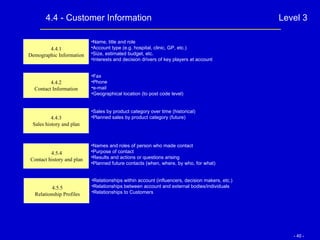
4.4 - Customer Information Level 3 4.4.1 Demographic Information Name, title and role Account type (e.g. hospital, clinic, GP, etc.) Size, estimated budget, etc. Interests and decision drivers of key players at account 4.4.2 Contact Information Fax Phone e-mail Geographical location (to post code level) 4.4.3 Sales history and plan Sales by product category over time (historical) Planned sales by product category (future) 4.5.4 Contact history and plan Names and roles of person who made contact Purpose of contact Results and actions or questions arising Planned future contacts (when, where, by who, for what) 4.5.5 Relationship Profiles Relationships within account (influencers, decision makers, etc.) Relationships between account and external bodies/individuals Relationships to Customers

Management processexample

  • 1.
    Key Account ManagementMarketing and Sales Excellence Team Mission : Deliver “World Class” Key Account & Territory Management
  • 2.
    Operating model relationshipoverview Key Account Manager Customer Competition Government Technical Support. Market Research Marketing Product Mgmt General Mgmt Sales Mgmt Territory Mgmt Sales Support Product Development Supply Chain Human Resources Finance Regional Mgmt Trade Shows Publications Promotion Material Visits Internet Phone/Fax Distribution BizDev Partners Market Factors Analyze account Set objectives Plan strategy Take action Review account
  • 3.
    Key Account Management- best practice actions Rank accounts on “Improvement Potential” index Re-deploy resources to highest potential channels/accounts Target category management efforts to accounts with “capability” Understand account requirements/ needs/ capabilities Plan account actions to “fix” problem P&L line items Target account goals/ accountability for profit improvement Match strategy to “improvement” potential Include customer in account planning process Develop both internal and customer targets Tie actions/events to improvement opportunities Monitor performance against tactical plan Hold account team members accountable Tie account team incentives to customer metrics Reflect “balanced scorecard” in account metrics Set account objectives Plan account strategy Take planned action Review account Analyze Account
  • 4.
    Territory Key AccountsRegional Key Accounts National Key Accounts Global Key Accounts A model for identifying and rolling-up Key Accounts
  • 5.
    Key Account ManagementProcess diagrams
  • 6.
    Objective The principleobjective of Key Account Management is to provide the following benefits to the Sales Organization and Customer….. MARKETING AND SALES Improved customer insight Understanding of customer needs Understanding of usage patterns Better product knowledge Better access to marketing material Better competitor information Improved performance information Measurable goals Link between Business Plan strategy and customer strategy CUSTOMER Better product information Better information on services Better understanding of reimbursement Better product benefits knowledge Ability to raise individual profile Increased end users Provide resource input
  • 7.
    Process Overview Level1 2 Key Account Management 3 Territory Management 4 Management Reporting 5 KAM Management and Administration 1 Analyze & Classify Customers
  • 8.
    1 - Analyzeand Classify Customers
  • 9.
    1 - Analyzeand Classify Customers Level 2 1.1 Identify/Add Customer/ Modify 1.2 Analyze Customer Details 1.3 Segment Customers 1.4 Validate 1.5 Identify Key Accounts 3.3 Review Performance KA? Non KAs KAs 3.1 Plan Call Activity 2.1 Profile Account
  • 10.
    1.1 - Identify/AddCustomer Level 3 1.1.4 Determine whether to add Add? No Yes Reject Customer 1.2.1 Enter Data 1.1.5 Management Confirmation 1.1.1 Collect Information 1.1.2 Review Information 1.1.3 Classify Type
  • 11.
    1.2 - AnalyzeCustomer Level 3 1.2.2 Historical Review 1.2.3 Potential Review 1.2.4 Needs Analysis 1.2.5 Confirm Customer Needs/Objectives) 1.1.4 Determine whether to add 1.3.1 Establish segmentation 3.3.6 Change Process/Plans 1.2.1 Enter data
  • 12.
    1.3 - SegmentCustomers Level 3 1.3.1 Establish segmentation 1.3.2 Review Customers 1.3.3 Populate Segments 1.4.1 Confirm levels of validation 1.2.5 Confirm Customer Needs/Objectives 1.4.4 Reassign customers and review segmentation process
  • 13.
    1.4 - ValidateLevel 3 1.4.1 Confirm Segment Population 1.4.3 Validate segmentation decisions 1.4.4 Reassign customers and review segmentation process 1.5.1 Confirm KA Selection Criteria 1.3.4 Assign customers to segments 1.3.1 Confirm segment criteria
  • 14.
    1.5 - IdentifyKey Accounts Level 3 1.5.4 Validate selection and criteria KA? No Yes 2.1.1 Assess Account’s Current Situation 3.1.1 Collect/Review Customer Information (Territory Management) 1.5.1 Review KA Selection Criteria 1.5.2 Review Customers Against Criteria 1.5.3 Confirm KA Selection
  • 15.
    2 - KeyAccount Management
  • 16.
    2 - KeyAccount Management Level 2 1.5 Identify Key Accounts 1.2 Analyze Customer Details 2.1 Analyze account 2.2 Set account objectives 2.3* Create account plan 2.4 Execute plan 2.5* Evaluate account performance
  • 17.
    Key Account CriteriaSome characteristics defining a Key Account : Key account classification criteria Customers responsible for ( example factor 80%) of revenue Customer with over (example factor: $ 1.5 mio) sales Customer with potential of (example factor: $1.5 mio. sales within 2 years) Customer generating ( example factor: $800’000) profit Customer responsible for ( example factor:  2 or more %) of the market in units or value Customer with contribution (example factor: > 5%) Opinion leader influences ( example factor: 20% ) Account screening criteria Ability to sustain long term profitable relationship ($X net over Y years) Account values products and services as distinct from competition Relationship has strategic value and can create differential advantage by serving the customer We can create considerable barrier to entry by serving the customer Customer relationship based on more than price negotiation Potential for growth greater than the current major clients
  • 18.
    Increase sales effectivenessby pursuing high potential accounts and opportunities Increase market share and revenue within existing accounts Increase profitability through development of the appropriate product & service offering for the customer. Provide opportunities to contribute to the success of the customer Improve customer retention through stronger relationships and increased client satisfaction Facilitate the allocation of marketing and sales resources Key Account Based Selling - Advantages KAM can deliver the following benefits :
  • 19.
    General information onthe account Account history share of customer profitability spending and service requirements past account plans product performance issues service effort Classification criteria 2.1 -Analyze Account Level 3 1.5.4 Validate Selection and Criteria 2.2.1 Define account strategy Output Business overview of the customer Understanding of key players and relationships Map of influencers Review of relationship history and performance of the customer Input 2.1.1 Develop / update account profile 2.1.2 Assess position 2.1.3 Re-evaluate account classification 2.1.4 Complete account profile
  • 20.
    2.1 -Analyze AccountLevel 3 1.5.4 Validate Selection and Criteria 2.2.1 Define account strategy Rank customers by order of importance, segmentation Develop a map to guide networking Consider account’s influence / reputation Be familiar with account’s business Estimate account’s expenditures and constraints Consider account’s buying history Determine account’s buying cycle Identify influencers / decision makers Identify prospect by product line / treatment modality ; 3rd party information Conduct needs assessment Identify, probe ,qualify needs / concerns Seek alternate sources of information on the account Assess account’s potential / financial viability Establish prospect segment / priority Identify account’s current situation Identify benefits of offering to meet need / opportunities Develop and maintain account profiles Identify process for product approval 2.1.1 Develop / update account profile 2.1.2 Assess position 2.1.3 Re-evaluate account classification 2.1.4 Complete account profile
  • 21.
    2.2 - Setaccount objectives Level 3 2.1.4 Complete account profile 2.3.1 Develop action plan Account profile Company/ Business Unit strategy Financial targets Output Customer strategy Long- medium -short term Customer team Input 2.2.1 Define account strategy 2.2.2 Set account goals 2.2.3 Establish account objectives
  • 22.
    2.2 - Setaccount objectives Level 3 2.1.4 Complete account profile 2.3.1 Develop action plan Define end users of products and services Establish selling goals Identify growth opportunities Identify specific product opportunities Look for long range opportunities 2.2.1 Define account strategy 2.2.2 Set account goals 2.2.3 Establish account objectives
  • 23.
    2.3 - Createaccount plan Level 3 2.2.3 Establish account objectives 2.4.1 Execute plan Opportunities identified Account objectives Product and service offerings Customer needs Critical success factors Competitive position Output Account plan including actions, resources, responsibilities, timelines, quantitative and qualitative targets and progress measurements for the next period. Key account portfolio consolidated Input 2.3.1 Develop action plan 2.3.2 Determine resource requirements 2.3.4 Finalize & approve account plans 2.3.3 Consolidate & assess account portfolio
  • 24.
    2.3 - Createaccount plan Level 3 2.2.3 Establish account objectives 2.4.1 Execute plan Design call cycle (day, week, month) Select appropriate contact method Build a regional action plan Add customer to call cycle Strategic process and position product Communicate sales approach to team Identify growth opportunities Identify specific product opportunities Integrate marketing strategy / concept 2.3.1 Develop action plan 2.3.2 Determine resource requirements 2.3.4 Finalize& approve account plans 2.3.3 Consolidate & assess account portfolio
  • 25.
    2.4 - ExecuteAccount Plan Level 3 2.3.4 Finalize & approve account plans 2.5.1 Measure performance Action plans Responsibilities Resources Output New opportunities identified Actions executed Results of actions Customer insight Market intelligence Input 2.4.1 Execute Action Plan 2.4.2 Identify new opportunities 2.4.3 Modify account plan
  • 26.
    2.4 - ExecuteAccount Plan Level 3 2.3.4 Finalize & approve account plans 2.5.1 Measure performance Demonstrate proof (clinical) Present clinical information Refer to other successes -testimonial Explain products in terms of competition, feature benefit selling Reassure account of our value Confirm benefits of offering to meet needs Use appropriate selling tools Gain account agreement Negotiate order / terms and conditions Receive order Enter order or recognition of order in system Alert account to any changes (reimbursement) Resolve disputes Arbitrate differences, make adjustments Assure account satisfaction Show appreciation of business Question all influencers and decision makers Grow advocates for feedback Reinforce prior purchasing decisions Follow up on plan 2.4.1 Execute Action Plan 2.4.2 Identify new opportunities 2.4.3 Modify account plan
  • 27.
    2.5 - EvaluateAccount Performance Level 3 2.4.3 Modify account plan 1.2.1 Historical Review 2.1.1 Develop / update account profile 2.3.3 Review and assess account portfolio Results of actions Cost of actions Resources consumed Sales Cost of goods Services and goods provided Promotion effort Revised targets and budgets Output Assessment of account performance Review of the return on the account Review of the Key Account portfolio Performance rewards Input 2.5.1 Measure performance 2.5.2 Assess plan achievement 2.5.3 Evaluate position and account status / portfolio review
  • 28.
    2.5 - EvaluateAccount Performance Level 3 2.4.3 Modify account plan 1.2.1 Historical Review 2.1.1 Develop / update account profile 2.3.3 Review and assess account portfolio Get feed back from account Analyze win / loss Compare performance against goal Benchmark own performance against competition Calculate ROI Review sales records Re- evaluate sales strategy Evaluate relationship with account Evaluate skills to deal with account Build skills 2.5.1 Measure performance 2.5.2 Assess plan achievement 2.5.3 Evaluate position and account status / portfolio review
  • 29.
    3 - TerritoryManagement
  • 30.
    3 - TerritoryManagement Level 2 3.1 Plan Call Activity 3.2 Execute Contact 3.3 Review Performance 1.5 Identify Key Accounts 1.2 Analyze Customer Details
  • 31.
    3.1 - PlanCall Activity Level 3 3.1.5 Schedule Calls 3.1.6 Organize Logistics 3.3.4 Individual Sales Effectiveness Assessment 3.1.3 Review Segment Strategies & Definitions 3.1.4 Define Call Plan 3.1.1 Collect/Review Customer Information 3.1.2 Targeting ONGOING ONGOING Internal Sales Information External Sales Information Financial Information Cost Revenue Profitability Cash sales and volume Ex-factory data 3.2.1 Prepare for call 3.3.6 Change Process/Plans 1.5.4 Validate Selection and Criteria Marketing and Product Strategy
  • 32.
    3.2 - ExecuteContact Level 3 3.2.1 Prepare for contact 3.2.2 Open Contact 3.2.4 Match product to needs 3.2.6 Close Contact 3.2.7 Document Contact 3.2.3 Understand Needs 3.2.5 Gain commit- ment 3.3.4 Individual Sales Effectiveness Assessment 3.1.6 Organize Logistics 3.3.2 Individual analysis of sales performance data
  • 33.
    3.3 - ReviewPerformance Level 3 3.3.1 Management analysis of sales performance data (including training function) 3.3.4 Individual Sales Force Effectiveness Assessment 3.3.6 Change Process/Plans 3.3.2 Individual analysis of sales performance data 3.3.2 Management Sales Force Effectiveness Assessment (including training function) ONGOING ONGOING ONGOING PERIODIC PERIODIC PERIODIC 3.2.1 Prepare for call 3.1.1 Review History and Targets 3.2.7 Document Contact 1.2.1 Historical Review 3.1.4 Define Call Objectives Internal Sales Information External Sales Information Financial Information Cost, revenue, profitability Cash sales and volume Ex-factory data 3.3.5 Understand link between actions and performance PERIODIC
  • 34.
    4 - ManagementReporting
  • 35.
    4 - ManagementReporting Level 2 4.1 Company Information 4.2 Marketplace Information 4.3 Performance Information 4.4 Customer Information
  • 36.
    General requirements ofmanagement reporting GENERAL REQUIREMENTS Information entered once only (ensures motivation, quality and consistency) Ability to roll up data at a number of levels (global, national, regional, territory) Ability to cut information in a number of different ways : Segment Therapeutic Area Region or Territory Sales Rep. Tool to assist in the identification of patterns and trends in large volumes of data Ability to access specific relevant information (push or pull) as opposed to the traditional “push” of large volumes of often irrelevant data Ability to generate standard reports Flexible and configurable ad-hoc reporting suitable for a wide range of user types Ability to configure a “favorites” dashboard of reports drawing on standard reports and ad-hoc reports (either created by the user or by other users)
  • 37.
    4.1 - CompanyInformation Level 3 4.1.1 Planning Information 4.1.2 Products and Services .1.3 l Information 4.1.4 Marketing Materials Product Encyclopaedia Up-to-date Clinical Work Papers written New studies (internal and competitor) Product bebefits (safety profile, efficacy, AEs, price/cost 4.1.5 Company Knowledge/News Queries from customers ADRs Protocol Information Different Usage patterns Company best practice Newsflashes about events which may impact operations Ability to share important information across regions - not just vertically Details of marketing messages by product and segment Catalogue of marketing materials Calendar detailing key events (e.g. launches, new materials, available) Ability to view availability of incentives (e.g. tickets, conferences, etc.) Marketing Plans Sales Plans Account Plans Planned and actual details available Plans which roll-up at global, country, regional and territory level
  • 38.
    4.2 - MarketplaceInformation Level 3 4.2.1 Government Policies Gguidelines Reimbursement levels Budget eligibility 4.2.2 Competitor Information Marketing messages/materials and recommended response Competitor strengths and weaknesses by product and segment Global/country level activity - launches, campaigns, etc. Account level activity - products offered, share of wallet, incentives, etc. 4.2.3 Information End user profile Treatments Research Future trends 4.2.4 Practice Trends Prescribing patterns and trends Economic and regulatory influencers
  • 39.
    4.3 - PerformanceInformation Level 3 4.3.1 Sales Performance 4.3.2 Marketing Performance Market share by product at (account, territory, region and national levels) Comparison at these levels to competitor products 4.3.4 Financial Performance Budget spend against plan (account, territory, region and national levels) ROI vs. forecast (account, territory, region and national levels) 4.3.5 Performance against plan Contacts/Calls (actual vs. target) Monthly actions and objectives (actual vs. target) 4.3.6 Incentives Performance Individual performance against incentive targets Percentage contribution (territory, region, etc.) Forecast vs. actual vs. target (at account, territory, regional and national levels) Following planning horizons available : weekly, monthly, quarterly, annually
  • 40.
    4.4 - CustomerInformation Level 3 4.4.1 Demographic Information Name, title and role Account type (e.g. hospital, clinic, GP, etc.) Size, estimated budget, etc. Interests and decision drivers of key players at account 4.4.2 Contact Information Fax Phone e-mail Geographical location (to post code level) 4.4.3 Sales history and plan Sales by product category over time (historical) Planned sales by product category (future) 4.5.4 Contact history and plan Names and roles of person who made contact Purpose of contact Results and actions or questions arising Planned future contacts (when, where, by who, for what) 4.5.5 Relationship Profiles Relationships within account (influencers, decision makers, etc.) Relationships between account and external bodies/individuals Relationships to Customers