




Evaluation & Treatment of
Hypertriglyceridedemia
Presented By:
Dr. Md. Jahid Hasan, MBBS
Ex-Honorary Medical Officer
Department of Endocrinology and Metabolism
DMCH
jahidjpg61@gmail.com
: An Endocrine Society Clinical Practice Guideline
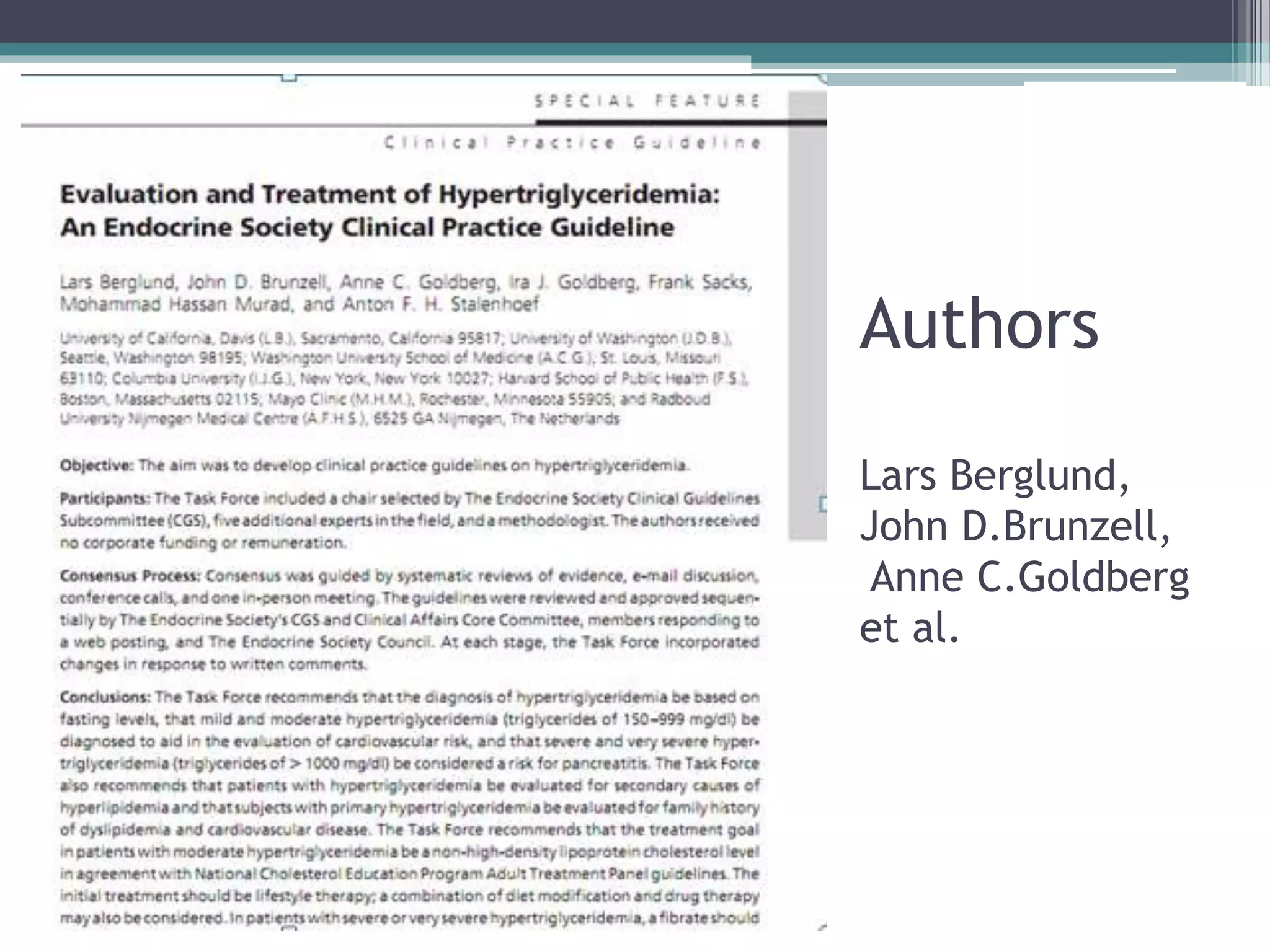
Authors
Lars Berglund,
John D.Brunzell,
Anne C.Goldberg
et al.
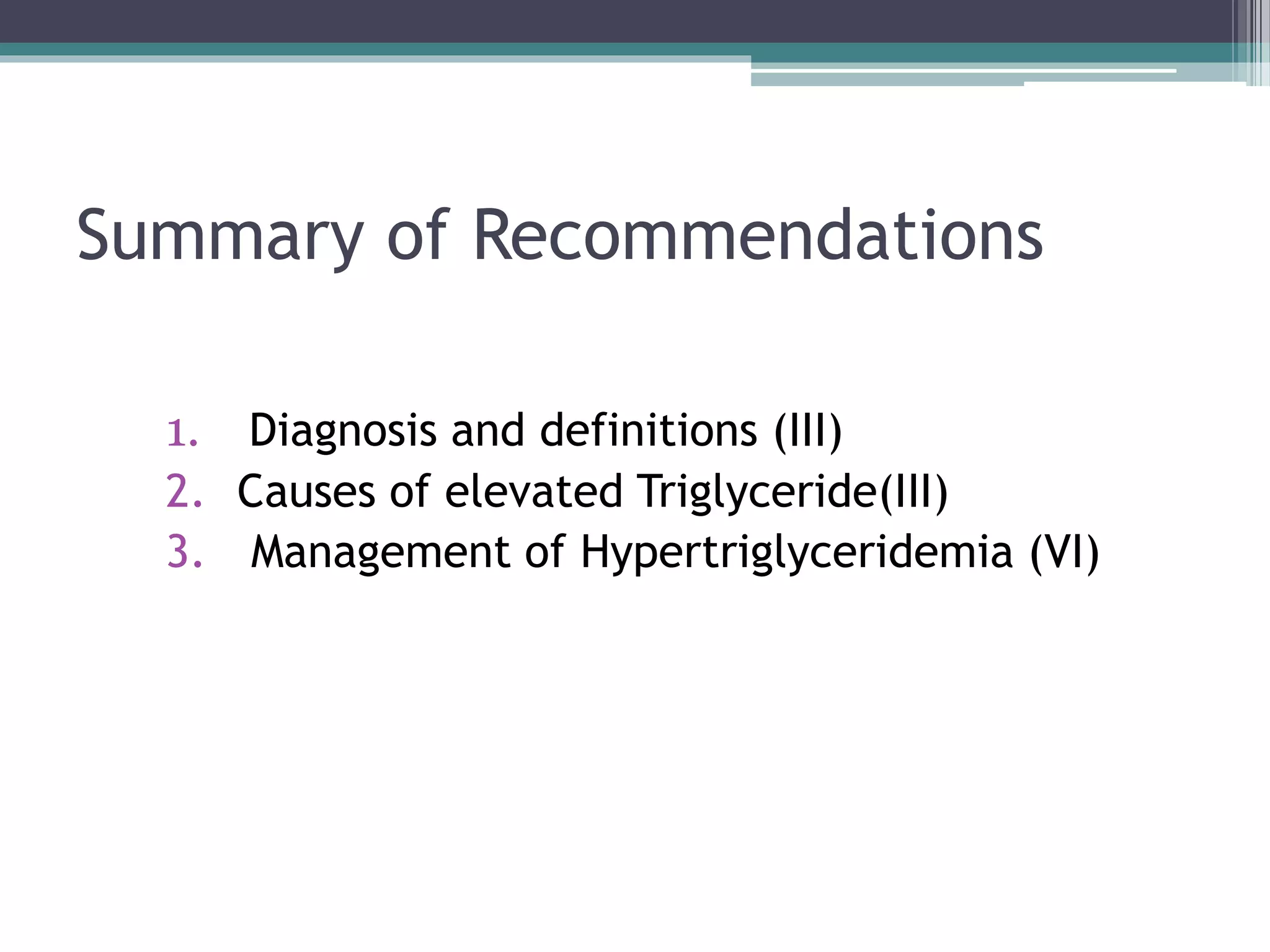
Summary of Recommendations
1. Diagnosis and definitions (III)
2. Causes of elevated Triglyceride(III)
3. Management of Hypertriglyceridemia (VI)
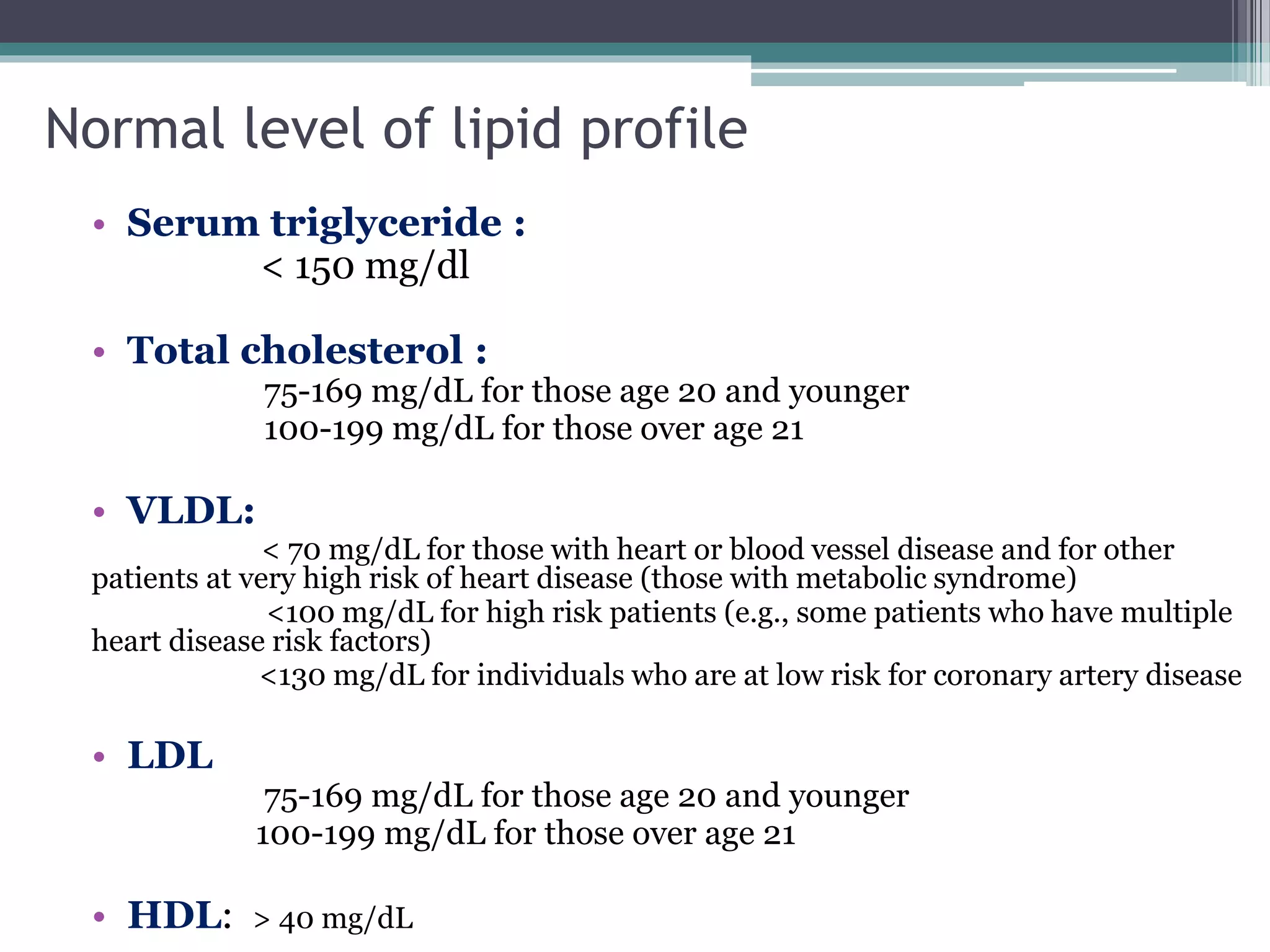
Normal level of lipid profile
• Serum triglyceride :
< 150 mg/dl
• Total cholesterol :
75-169 mg/dL for those age 20 and younger
100-199 mg/dL for those over age 21
• VLDL:
< 70 mg/dL for those with heart or blood vessel disease and for other
patients at very high risk of heart disease (those with metabolic syndrome)
<100 mg/dL for high risk patients (e.g., some patients who have multiple
heart disease risk factors)
<130 mg/dL for individuals who are at low risk for coronary artery disease
• LDL
75-169 mg/dL for those age 20 and younger
100-199 mg/dL for those over age 21
• HDL: > 40 mg/dL
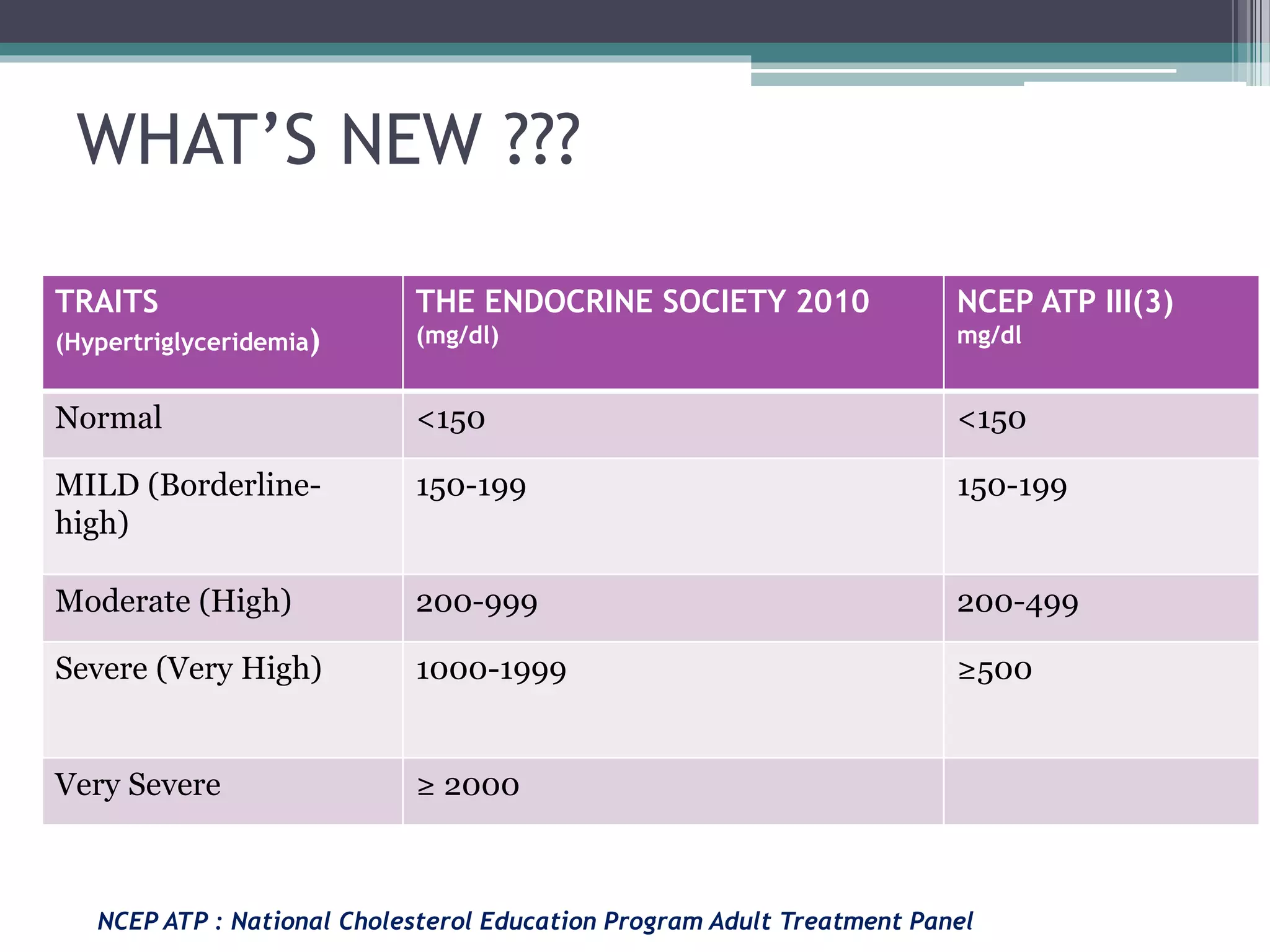
WHAT’S NEW ???
TRAITS
(Hypertriglyceridemia)
THE ENDOCRINE SOCIETY 2010
(mg/dl)
NCEP ATP III(3)
mg/dl
Normal <150 <150
MILD (Borderline-
high)
150-199 150-199
Moderate (High) 200-999 200-499
Severe (Very High) 1000-1999 ≥500
Very Severe ≥ 2000
NCEP ATP : National Cholesterol Education Program Adult Treatment Panel
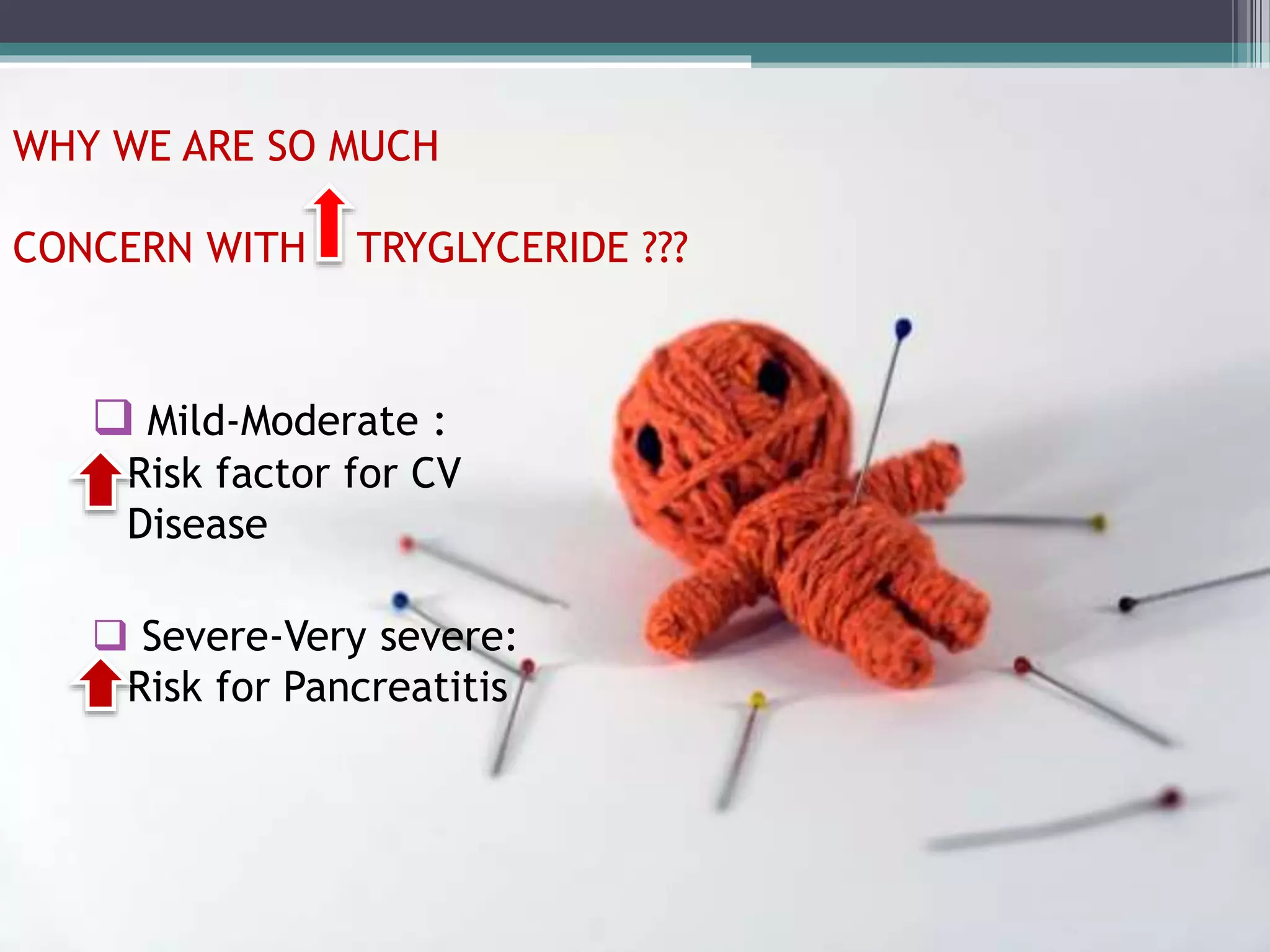
WHY WE ARE SO MUCH
CONCERN WITH TRYGLYCERIDE ???
 Mild-Moderate :
Risk factor for CV
Disease
 Severe-Very severe:
Risk for Pancreatitis
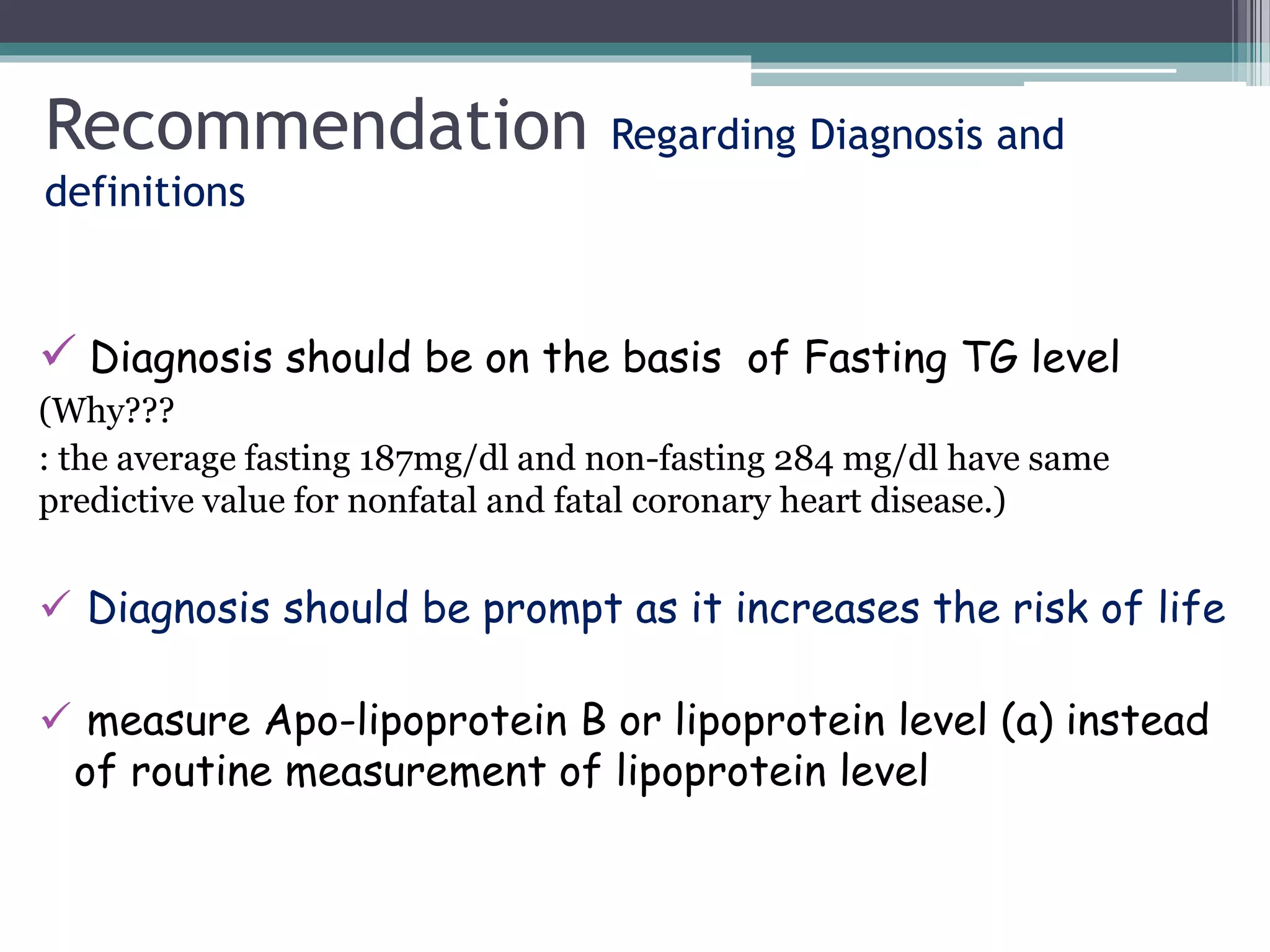
Recommendation Regarding Diagnosis and
definitions
 Diagnosis should be on the basis of Fasting TG level
(Why???
: the average fasting 187mg/dl and non-fasting 284 mg/dl have same
predictive value for nonfatal and fatal coronary heart disease.)
 Diagnosis should be prompt as it increases the risk of life
 measure Apo-lipoprotein B or lipoprotein level (a) instead
of routine measurement of lipoprotein level
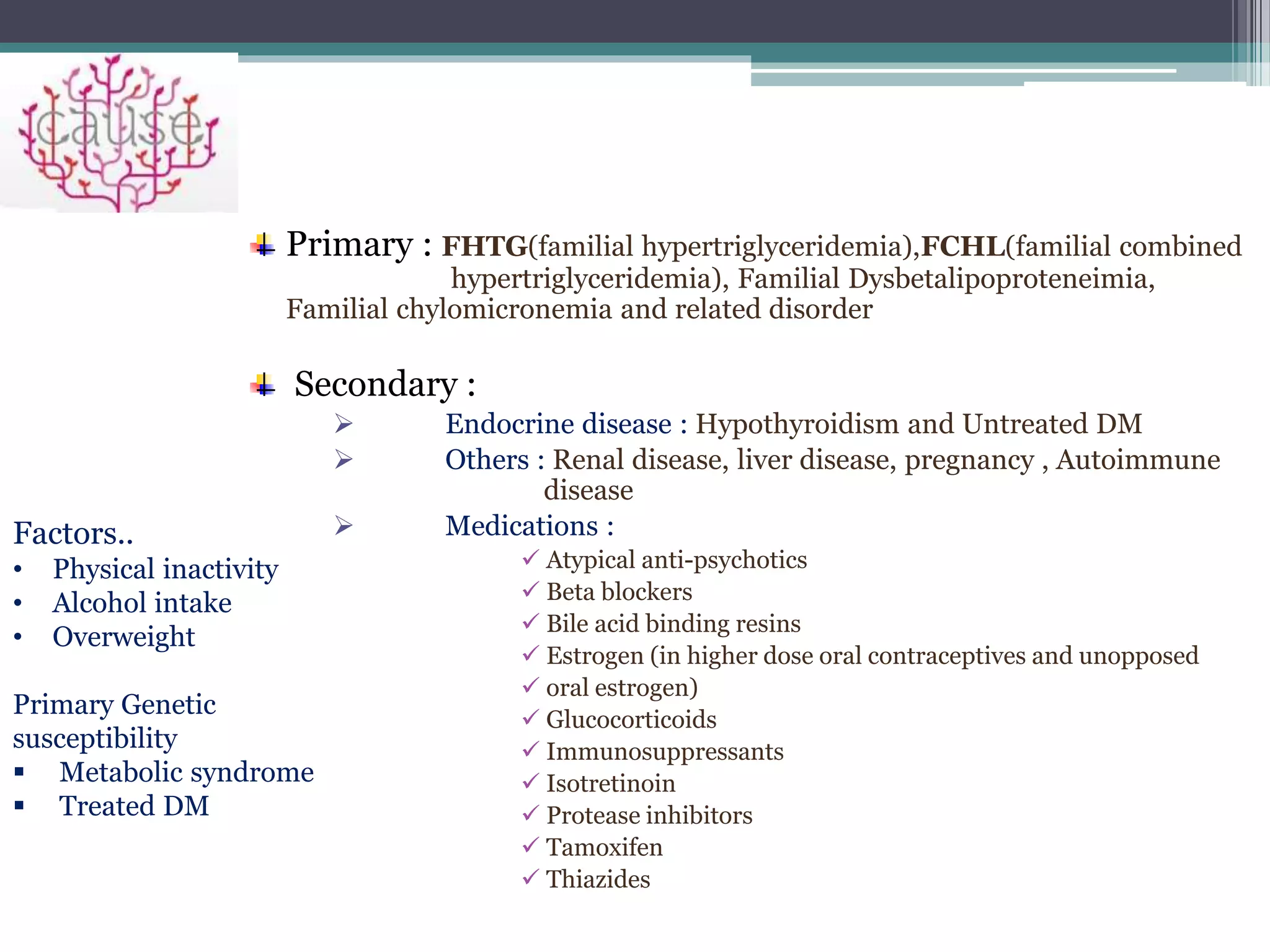
Primary : FHTG(familial hypertriglyceridemia),FCHL(familial combined
hypertriglyceridemia), Familial Dysbetalipoproteneimia,
Familial chylomicronemia and related disorder
Secondary :
 Endocrine disease : Hypothyroidism and Untreated DM
 Others : Renal disease, liver disease, pregnancy , Autoimmune
disease
 Medications :
 Atypical anti-psychotics
 Beta blockers
 Bile acid binding resins
 Estrogen (in higher dose oral contraceptives and unopposed
 oral estrogen)
 Glucocorticoids
 Immunosuppressants
 Isotretinoin
 Protease inhibitors
 Tamoxifen
 Thiazides
Factors..
• Physical inactivity
• Alcohol intake
• Overweight
Primary Genetic
susceptibility
 Metabolic syndrome
 Treated DM
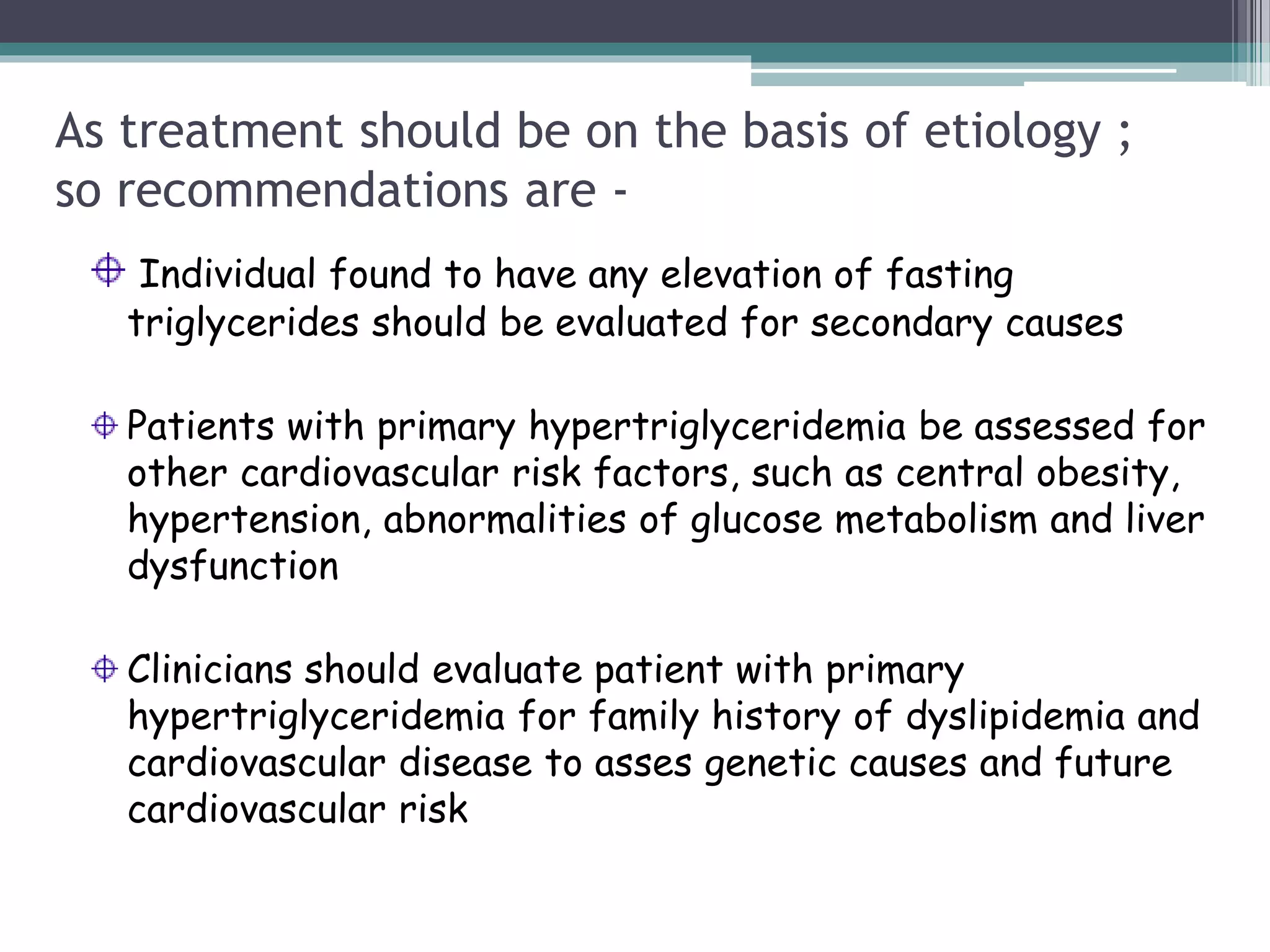
As treatment should be on the basis of etiology ;
so recommendations are -
Individual found to have any elevation of fasting
triglycerides should be evaluated for secondary causes
Patients with primary hypertriglyceridemia be assessed for
other cardiovascular risk factors, such as central obesity,
hypertension, abnormalities of glucose metabolism and liver
dysfunction
Clinicians should evaluate patient with primary
hypertriglyceridemia for family history of dyslipidemia and
cardiovascular disease to asses genetic causes and future
cardiovascular risk
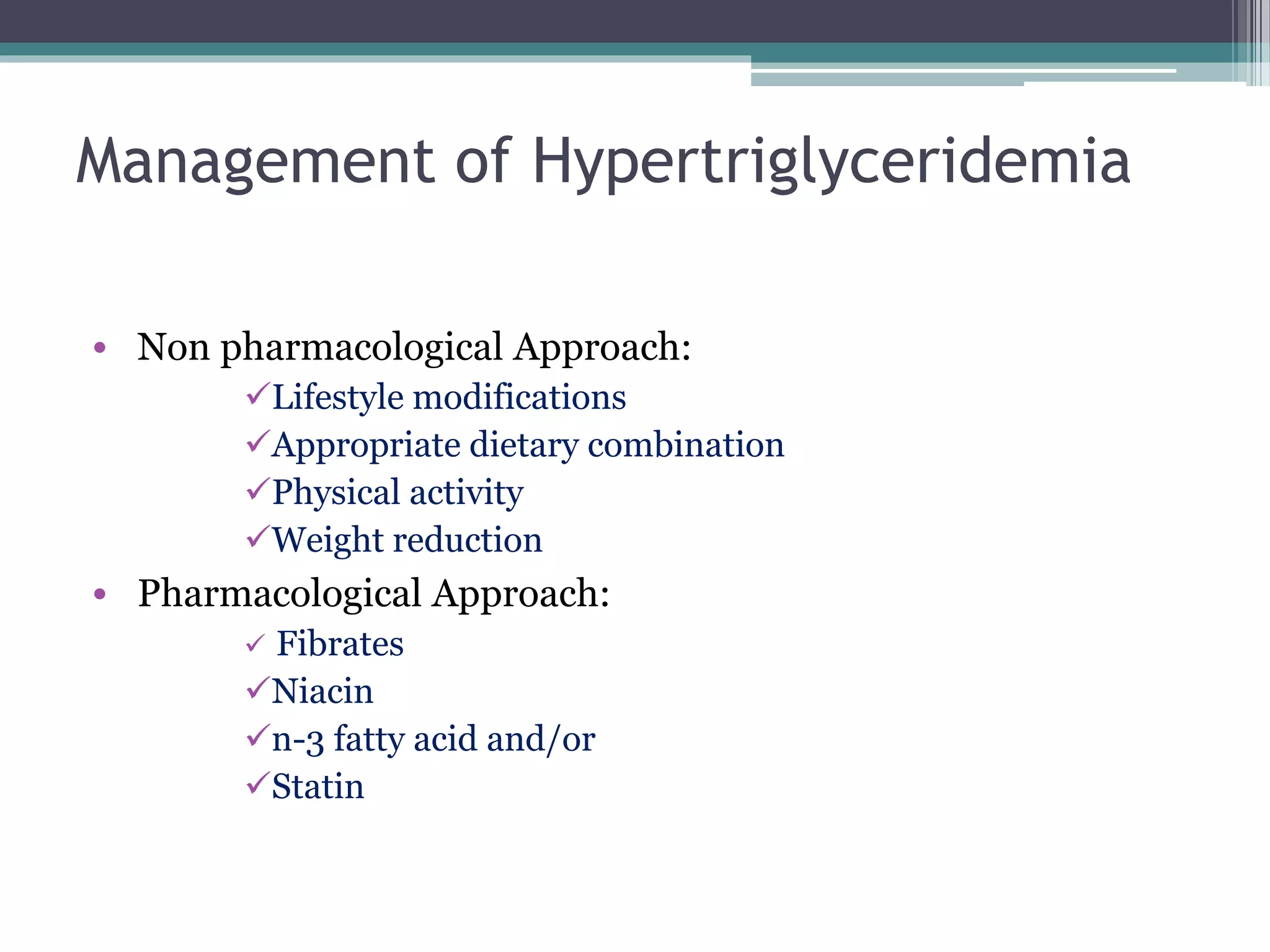
Management of Hypertriglyceridemia
• Non pharmacological Approach:
Lifestyle modifications
Appropriate dietary combination
Physical activity
Weight reduction
• Pharmacological Approach:
 Fibrates
Niacin
n-3 fatty acid and/or
Statin
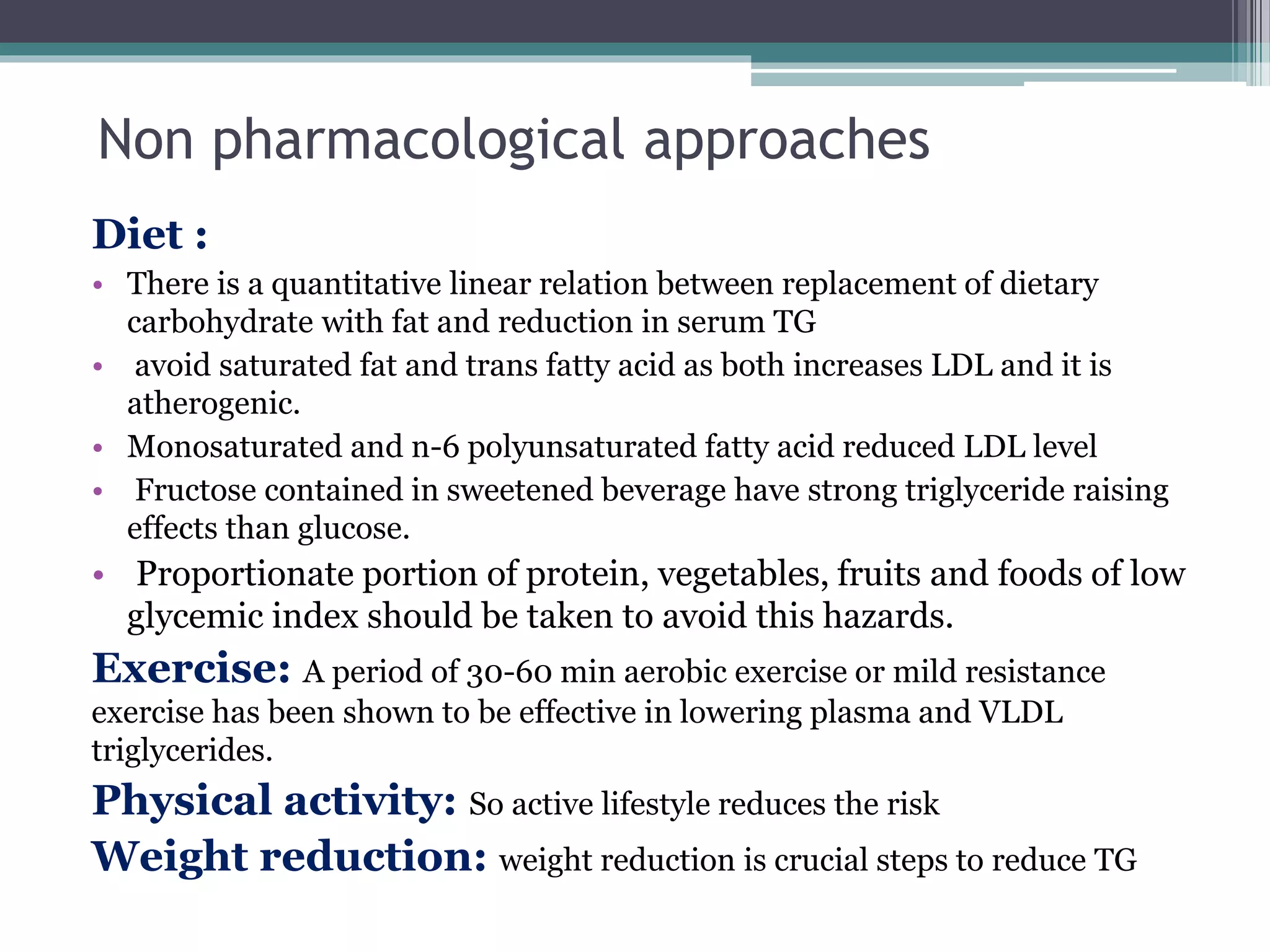
Non pharmacological approaches
Diet :
• There is a quantitative linear relation between replacement of dietary
carbohydrate with fat and reduction in serum TG
• avoid saturated fat and trans fatty acid as both increases LDL and it is
atherogenic.
• Monosaturated and n-6 polyunsaturated fatty acid reduced LDL level
• Fructose contained in sweetened beverage have strong triglyceride raising
effects than glucose.
• Proportionate portion of protein, vegetables, fruits and foods of low
glycemic index should be taken to avoid this hazards.
Exercise: A period of 30-60 min aerobic exercise or mild resistance
exercise has been shown to be effective in lowering plasma and VLDL
triglycerides.
Physical activity: So active lifestyle reduces the risk
Weight reduction: weight reduction is crucial steps to reduce TG
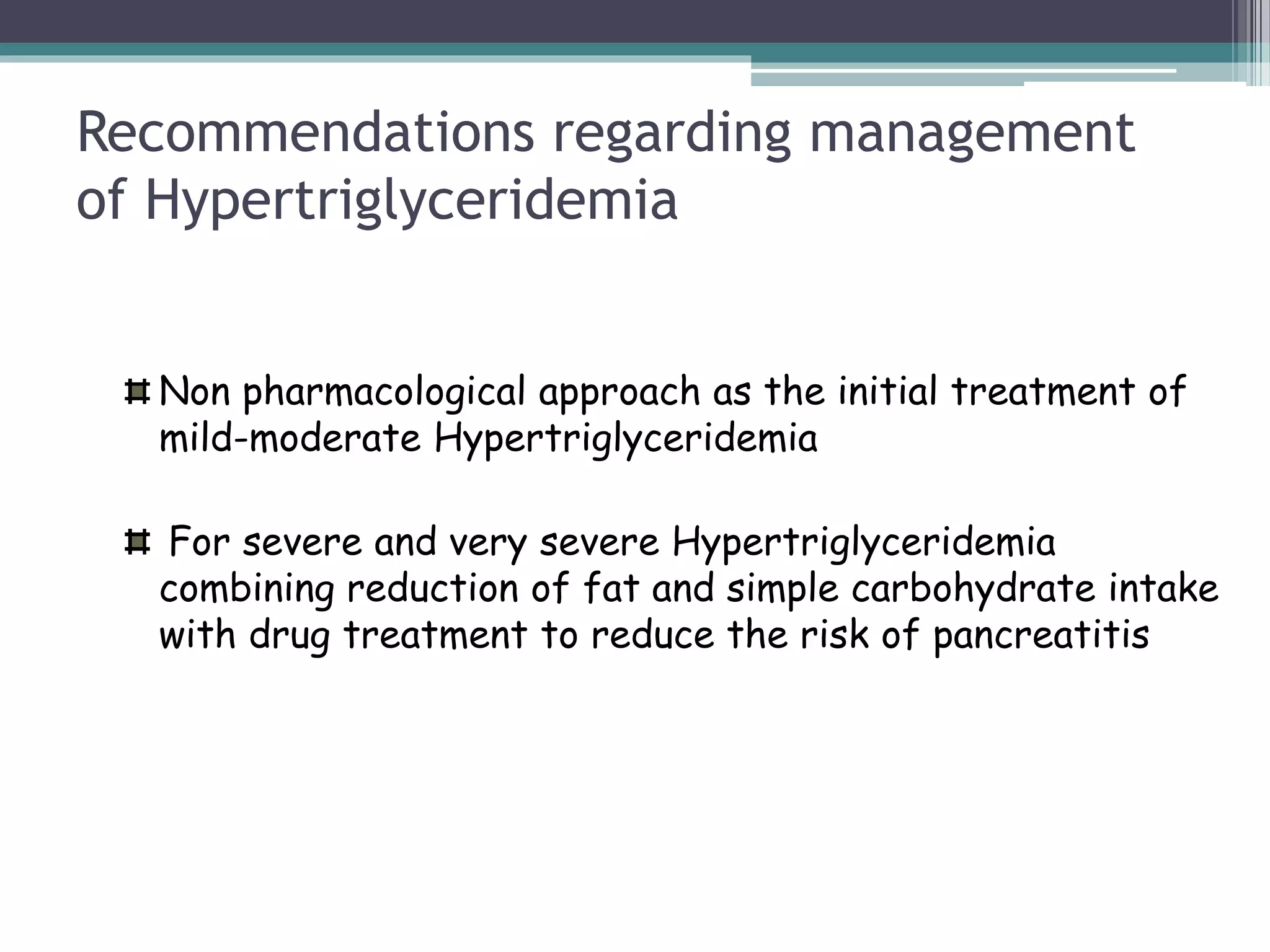
Recommendations regarding management
of Hypertriglyceridemia
Non pharmacological approach as the initial treatment of
mild-moderate Hypertriglyceridemia
For severe and very severe Hypertriglyceridemia
combining reduction of fat and simple carbohydrate intake
with drug treatment to reduce the risk of pancreatitis
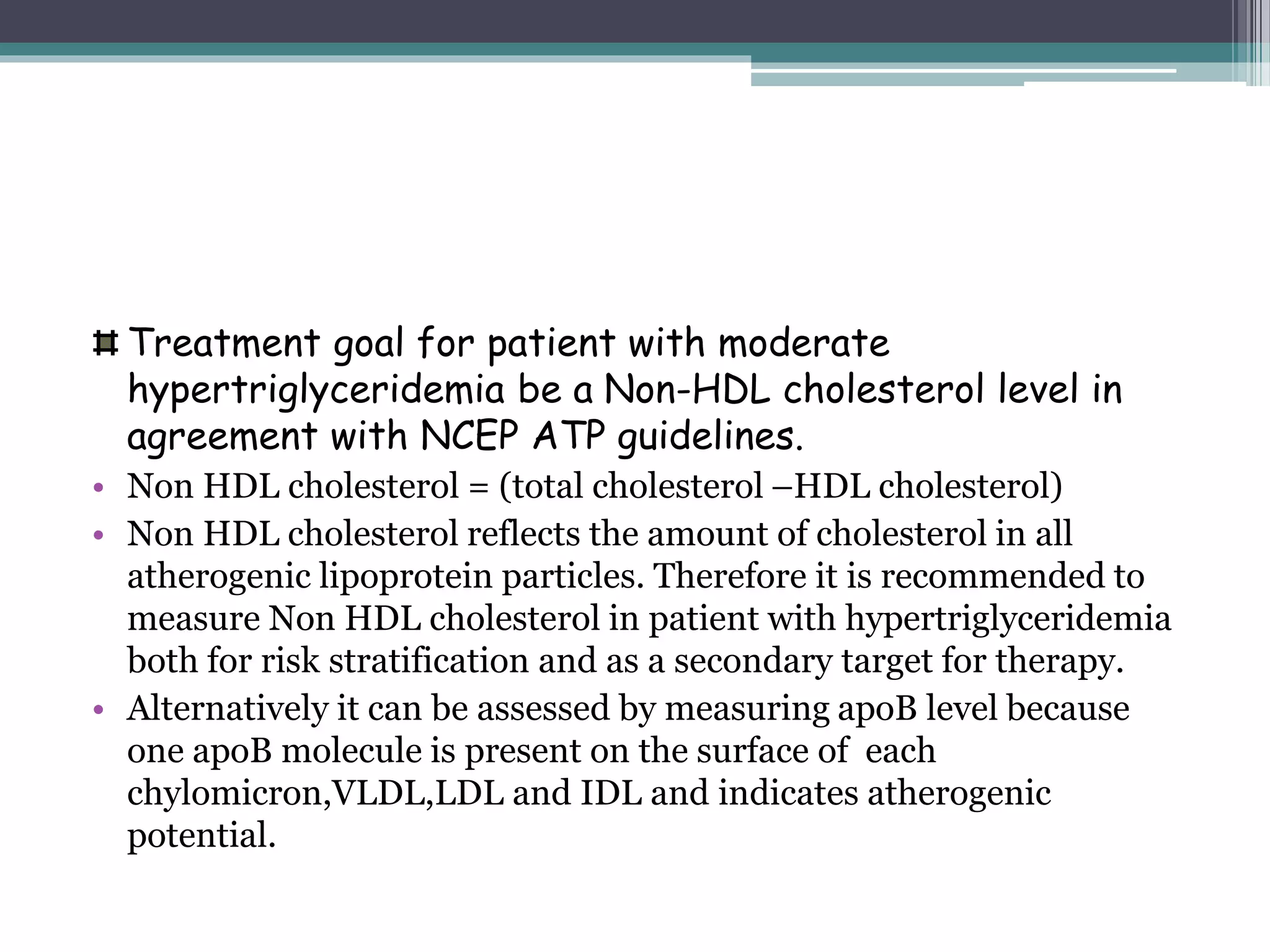
Treatment goal for patient with moderate
hypertriglyceridemia be a Non-HDL cholesterol level in
agreement with NCEP ATP guidelines.
• Non HDL cholesterol = (total cholesterol –HDL cholesterol)
• Non HDL cholesterol reflects the amount of cholesterol in all
atherogenic lipoprotein particles. Therefore it is recommended to
measure Non HDL cholesterol in patient with hypertriglyceridemia
both for risk stratification and as a secondary target for therapy.
• Alternatively it can be assessed by measuring apoB level because
one apoB molecule is present on the surface of each
chylomicron,VLDL,LDL and IDL and indicates atherogenic
potential.
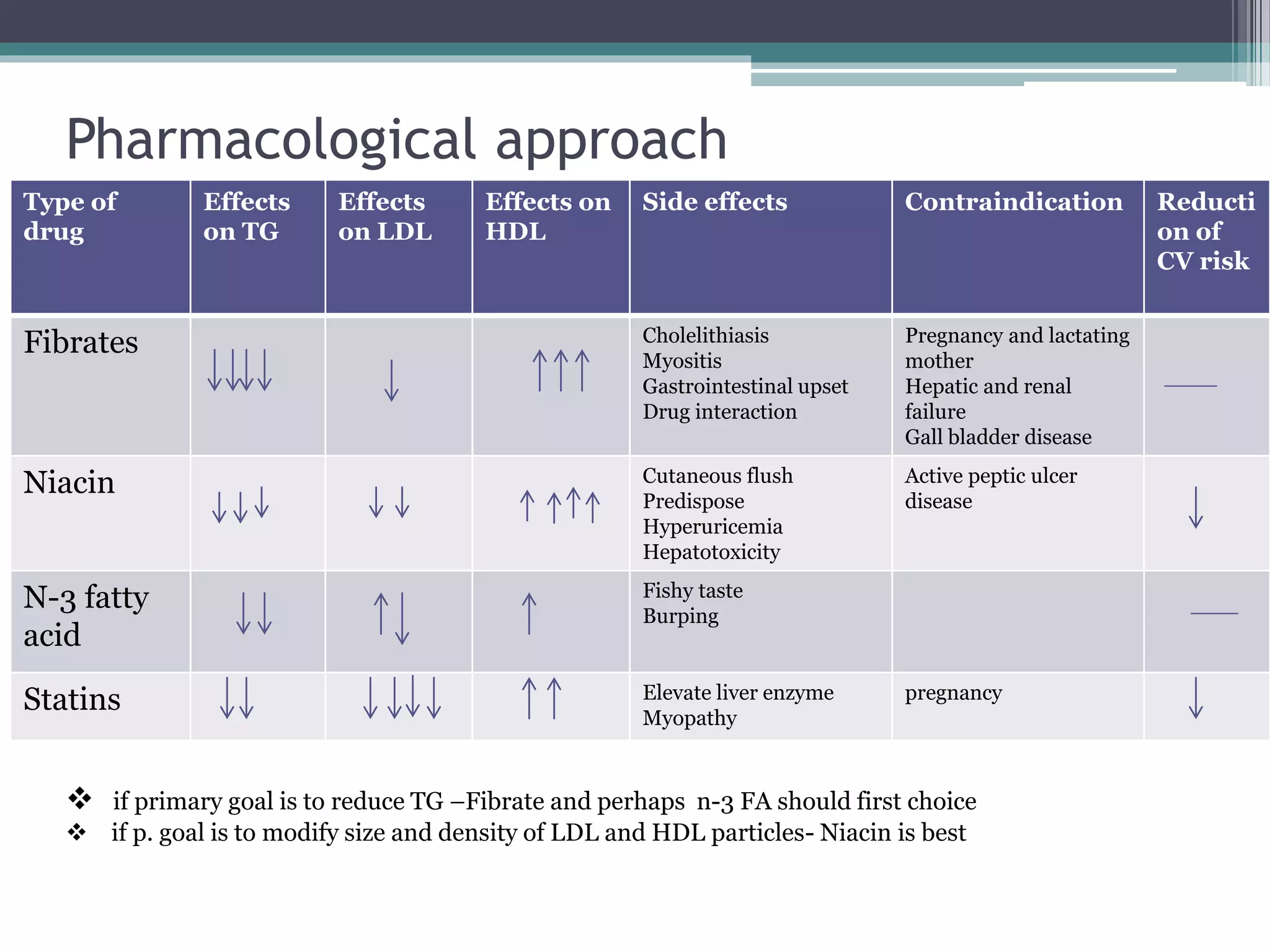
Pharmacological approach
Type of
drug
Effects
on TG
Effects
on LDL
Effects on
HDL
Side effects Contraindication Reducti
on of
CV risk
Fibrates Cholelithiasis
Myositis
Gastrointestinal upset
Drug interaction
Pregnancy and lactating
mother
Hepatic and renal
failure
Gall bladder disease
Niacin Cutaneous flush
Predispose
Hyperuricemia
Hepatotoxicity
Active peptic ulcer
disease
N-3 fatty
acid
Fishy taste
Burping
Statins Elevate liver enzyme
Myopathy
pregnancy
 if primary goal is to reduce TG –Fibrate and perhaps n-3 FA should first choice
 if p. goal is to modify size and density of LDL and HDL particles- Niacin is best
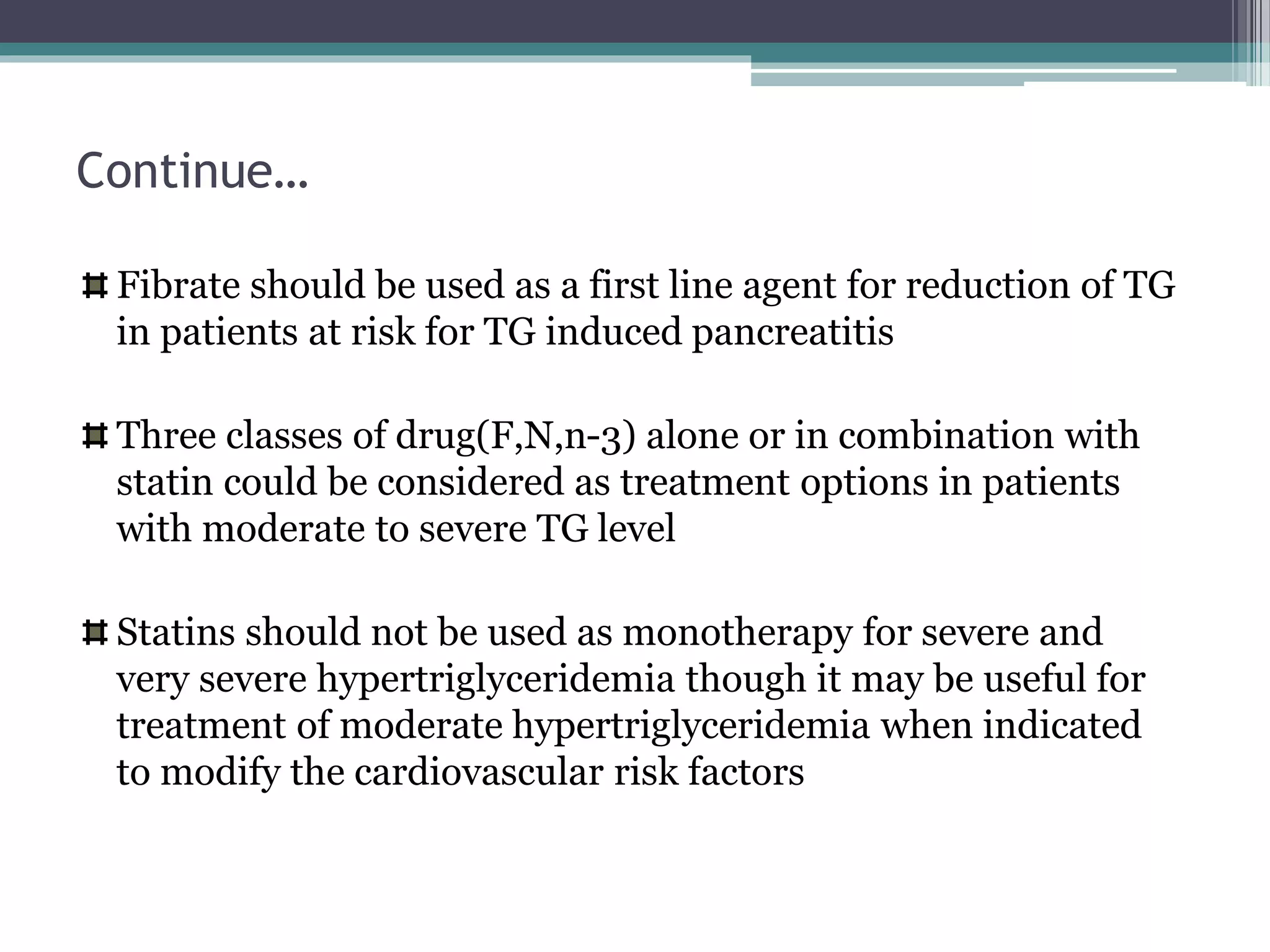
Continue…
Fibrate should be used as a first line agent for reduction of TG
in patients at risk for TG induced pancreatitis
Three classes of drug(F,N,n-3) alone or in combination with
statin could be considered as treatment options in patients
with moderate to severe TG level
Statins should not be used as monotherapy for severe and
very severe hypertriglyceridemia though it may be useful for
treatment of moderate hypertriglyceridemia when indicated
to modify the cardiovascular risk factors
The End
Management of hypertriglyceredemia newer update

Management of hypertriglyceredemia newer update

  • 1.
    Evaluation & Treatmentof Hypertriglyceridedemia Presented By: Dr. Md. Jahid Hasan, MBBS Ex-Honorary Medical Officer Department of Endocrinology and Metabolism DMCH jahidjpg61@gmail.com : An Endocrine Society Clinical Practice Guideline
  • 4.
  • 5.
    Summary of Recommendations 1.Diagnosis and definitions (III) 2. Causes of elevated Triglyceride(III) 3. Management of Hypertriglyceridemia (VI)
  • 6.
    Normal level oflipid profile • Serum triglyceride : < 150 mg/dl • Total cholesterol : 75-169 mg/dL for those age 20 and younger 100-199 mg/dL for those over age 21 • VLDL: < 70 mg/dL for those with heart or blood vessel disease and for other patients at very high risk of heart disease (those with metabolic syndrome) <100 mg/dL for high risk patients (e.g., some patients who have multiple heart disease risk factors) <130 mg/dL for individuals who are at low risk for coronary artery disease • LDL 75-169 mg/dL for those age 20 and younger 100-199 mg/dL for those over age 21 • HDL: > 40 mg/dL
  • 7.
    WHAT’S NEW ??? TRAITS (Hypertriglyceridemia) THEENDOCRINE SOCIETY 2010 (mg/dl) NCEP ATP III(3) mg/dl Normal <150 <150 MILD (Borderline- high) 150-199 150-199 Moderate (High) 200-999 200-499 Severe (Very High) 1000-1999 ≥500 Very Severe ≥ 2000 NCEP ATP : National Cholesterol Education Program Adult Treatment Panel
  • 8.
    WHY WE ARESO MUCH CONCERN WITH TRYGLYCERIDE ???  Mild-Moderate : Risk factor for CV Disease  Severe-Very severe: Risk for Pancreatitis
  • 9.
    Recommendation Regarding Diagnosisand definitions  Diagnosis should be on the basis of Fasting TG level (Why??? : the average fasting 187mg/dl and non-fasting 284 mg/dl have same predictive value for nonfatal and fatal coronary heart disease.)  Diagnosis should be prompt as it increases the risk of life  measure Apo-lipoprotein B or lipoprotein level (a) instead of routine measurement of lipoprotein level
  • 10.
    Primary : FHTG(familialhypertriglyceridemia),FCHL(familial combined hypertriglyceridemia), Familial Dysbetalipoproteneimia, Familial chylomicronemia and related disorder Secondary :  Endocrine disease : Hypothyroidism and Untreated DM  Others : Renal disease, liver disease, pregnancy , Autoimmune disease  Medications :  Atypical anti-psychotics  Beta blockers  Bile acid binding resins  Estrogen (in higher dose oral contraceptives and unopposed  oral estrogen)  Glucocorticoids  Immunosuppressants  Isotretinoin  Protease inhibitors  Tamoxifen  Thiazides Factors.. • Physical inactivity • Alcohol intake • Overweight Primary Genetic susceptibility  Metabolic syndrome  Treated DM
  • 11.
    As treatment shouldbe on the basis of etiology ; so recommendations are - Individual found to have any elevation of fasting triglycerides should be evaluated for secondary causes Patients with primary hypertriglyceridemia be assessed for other cardiovascular risk factors, such as central obesity, hypertension, abnormalities of glucose metabolism and liver dysfunction Clinicians should evaluate patient with primary hypertriglyceridemia for family history of dyslipidemia and cardiovascular disease to asses genetic causes and future cardiovascular risk
  • 12.
    Management of Hypertriglyceridemia •Non pharmacological Approach: Lifestyle modifications Appropriate dietary combination Physical activity Weight reduction • Pharmacological Approach:  Fibrates Niacin n-3 fatty acid and/or Statin
  • 13.
    Non pharmacological approaches Diet: • There is a quantitative linear relation between replacement of dietary carbohydrate with fat and reduction in serum TG • avoid saturated fat and trans fatty acid as both increases LDL and it is atherogenic. • Monosaturated and n-6 polyunsaturated fatty acid reduced LDL level • Fructose contained in sweetened beverage have strong triglyceride raising effects than glucose. • Proportionate portion of protein, vegetables, fruits and foods of low glycemic index should be taken to avoid this hazards. Exercise: A period of 30-60 min aerobic exercise or mild resistance exercise has been shown to be effective in lowering plasma and VLDL triglycerides. Physical activity: So active lifestyle reduces the risk Weight reduction: weight reduction is crucial steps to reduce TG
  • 14.
    Recommendations regarding management ofHypertriglyceridemia Non pharmacological approach as the initial treatment of mild-moderate Hypertriglyceridemia For severe and very severe Hypertriglyceridemia combining reduction of fat and simple carbohydrate intake with drug treatment to reduce the risk of pancreatitis
  • 15.
    Treatment goal forpatient with moderate hypertriglyceridemia be a Non-HDL cholesterol level in agreement with NCEP ATP guidelines. • Non HDL cholesterol = (total cholesterol –HDL cholesterol) • Non HDL cholesterol reflects the amount of cholesterol in all atherogenic lipoprotein particles. Therefore it is recommended to measure Non HDL cholesterol in patient with hypertriglyceridemia both for risk stratification and as a secondary target for therapy. • Alternatively it can be assessed by measuring apoB level because one apoB molecule is present on the surface of each chylomicron,VLDL,LDL and IDL and indicates atherogenic potential.
  • 16.
    Pharmacological approach Type of drug Effects onTG Effects on LDL Effects on HDL Side effects Contraindication Reducti on of CV risk Fibrates Cholelithiasis Myositis Gastrointestinal upset Drug interaction Pregnancy and lactating mother Hepatic and renal failure Gall bladder disease Niacin Cutaneous flush Predispose Hyperuricemia Hepatotoxicity Active peptic ulcer disease N-3 fatty acid Fishy taste Burping Statins Elevate liver enzyme Myopathy pregnancy  if primary goal is to reduce TG –Fibrate and perhaps n-3 FA should first choice  if p. goal is to modify size and density of LDL and HDL particles- Niacin is best
  • 17.
    Continue… Fibrate should beused as a first line agent for reduction of TG in patients at risk for TG induced pancreatitis Three classes of drug(F,N,n-3) alone or in combination with statin could be considered as treatment options in patients with moderate to severe TG level Statins should not be used as monotherapy for severe and very severe hypertriglyceridemia though it may be useful for treatment of moderate hypertriglyceridemia when indicated to modify the cardiovascular risk factors
  • 19.