8th edition
Steven P. Robbins
Mary Coulter

PowerPoint Presentation by Charlie Cook
Copyright © 2005 Prentice Hall, Inc.
All rights reserved.
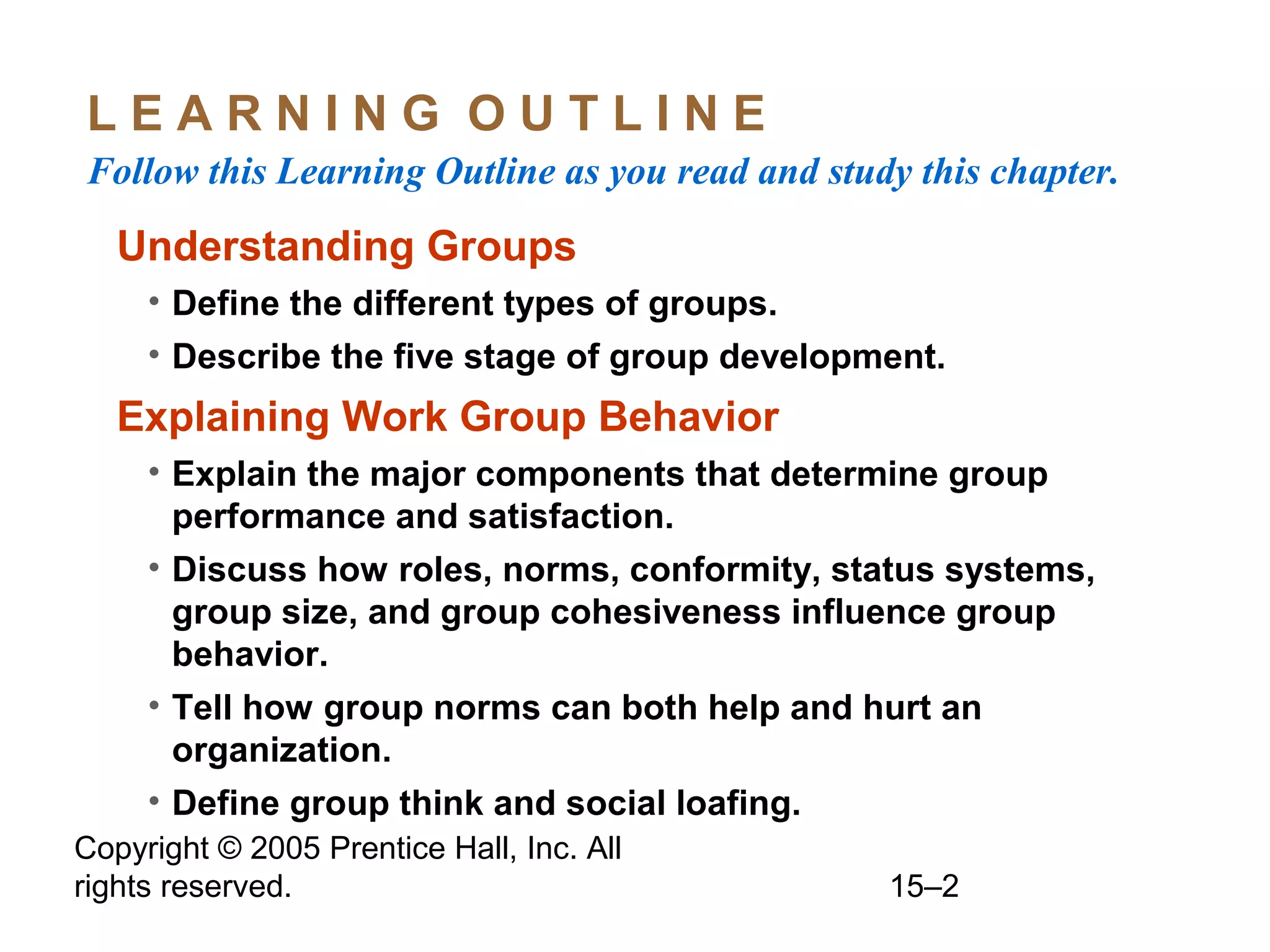
LEARNING OUTLINE
Follow this Learning Outline as you read and study this chapter.

Understanding Groups
• Define the different types of groups.
• Describe the five stage of group development.

Explaining Work Group Behavior
• Explain the major components that determine group
performance and satisfaction.
• Discuss how roles, norms, conformity, status systems,
group size, and group cohesiveness influence group
behavior.
• Tell how group norms can both help and hurt an
organization.
• Define group think and social loafing.
Copyright © 2005 Prentice Hall, Inc. All
rights reserved.

15–2
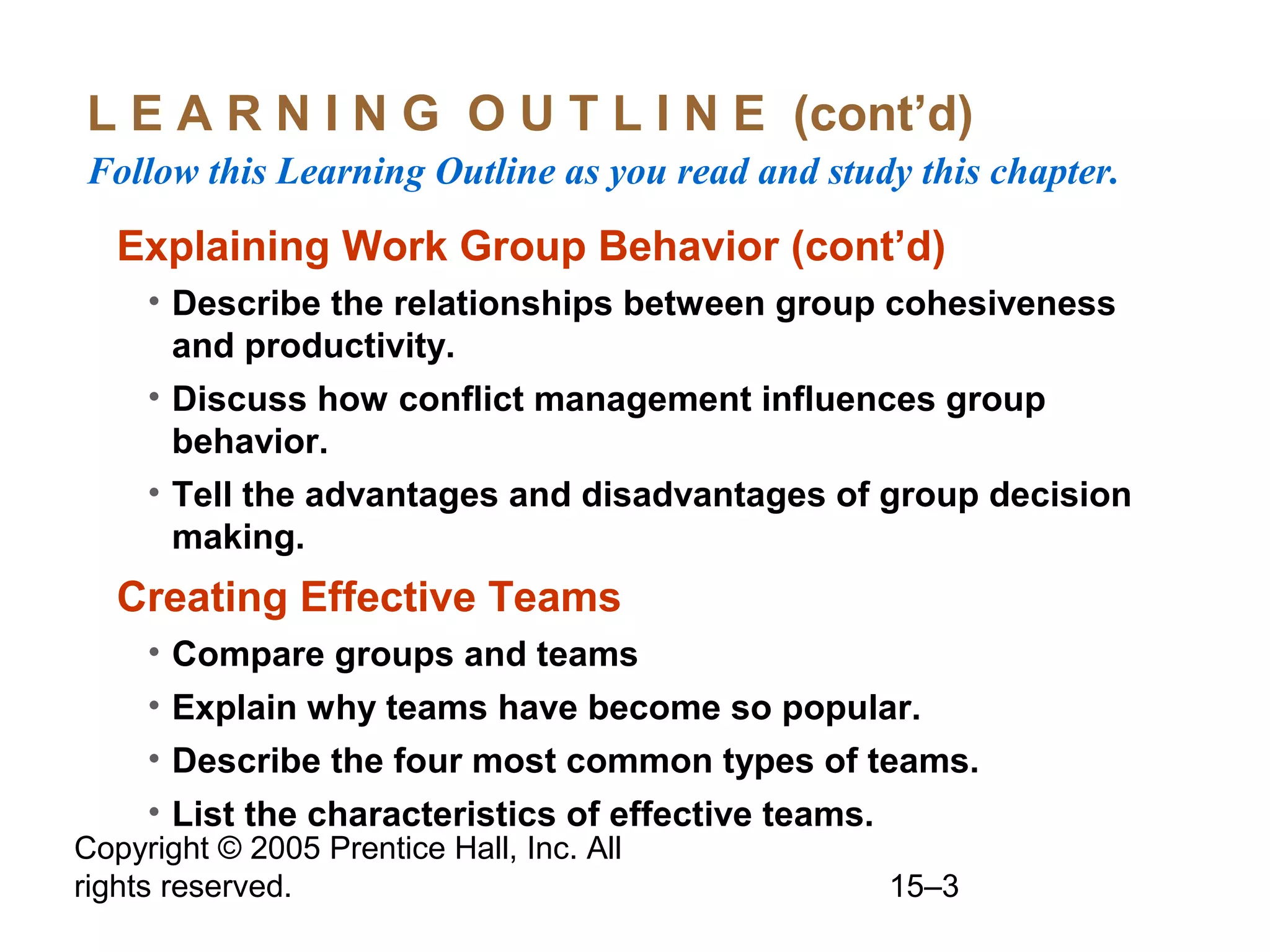
L E A R N I N G O U T L I N E (cont’d)
Follow this Learning Outline as you read and study this chapter.

Explaining Work Group Behavior (cont’d)
• Describe the relationships between group cohesiveness
and productivity.
• Discuss how conflict management influences group
behavior.
• Tell the advantages and disadvantages of group decision
making.

Creating Effective Teams
• Compare groups and teams
• Explain why teams have become so popular.
• Describe the four most common types of teams.
• List the characteristics of effective teams.

Copyright © 2005 Prentice Hall, Inc. All
rights reserved.

15–3
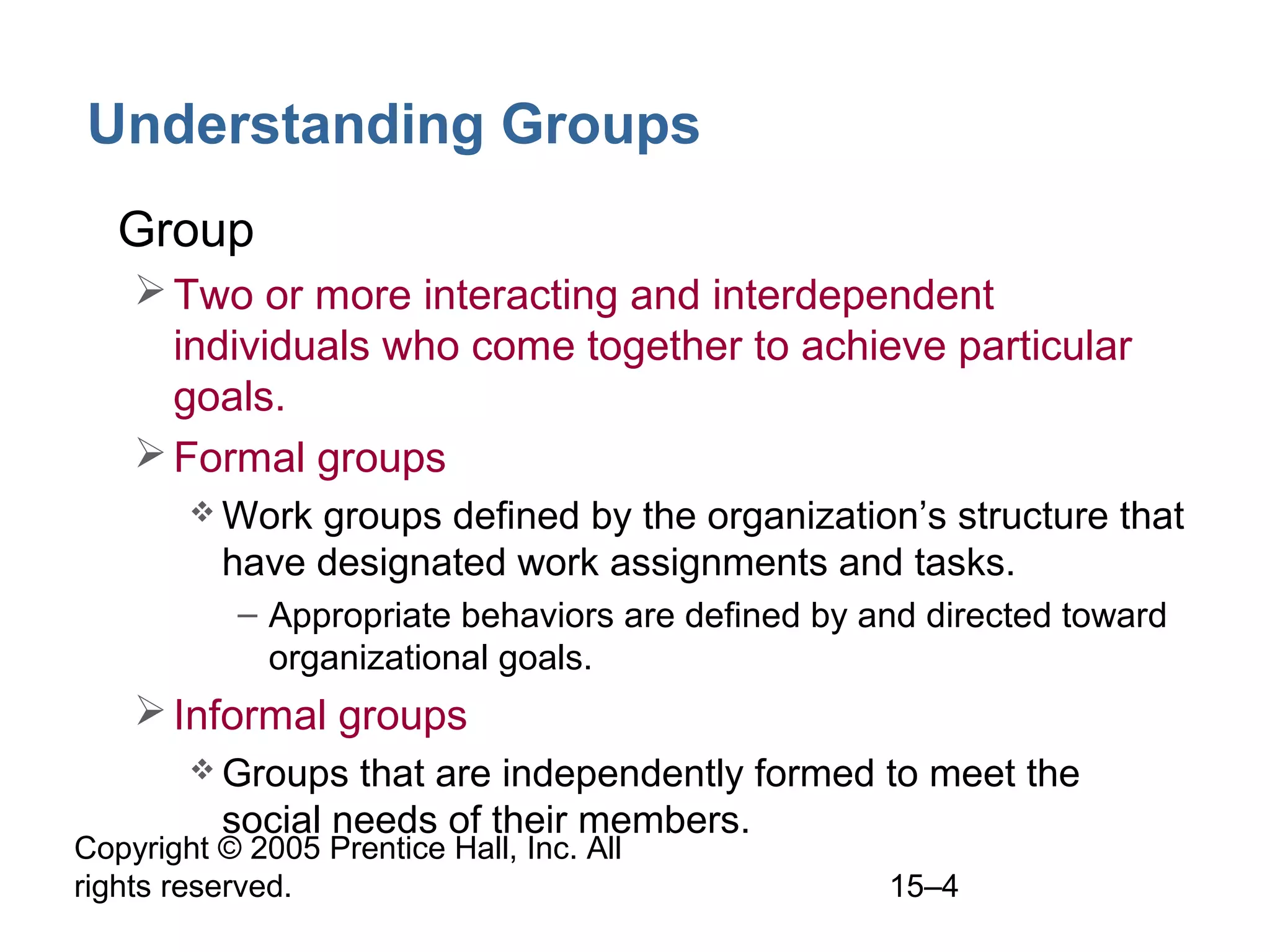
Understanding Groups
• Group
 Two or more interacting and interdependent
individuals who come together to achieve particular
goals.
 Formal groups
 Work

groups defined by the organization’s structure that
have designated work assignments and tasks.
– Appropriate behaviors are defined by and directed toward
organizational goals.

 Informal groups
 Groups

that are independently formed to meet the
social needs of their members.

Copyright © 2005 Prentice Hall, Inc. All
rights reserved.

15–4
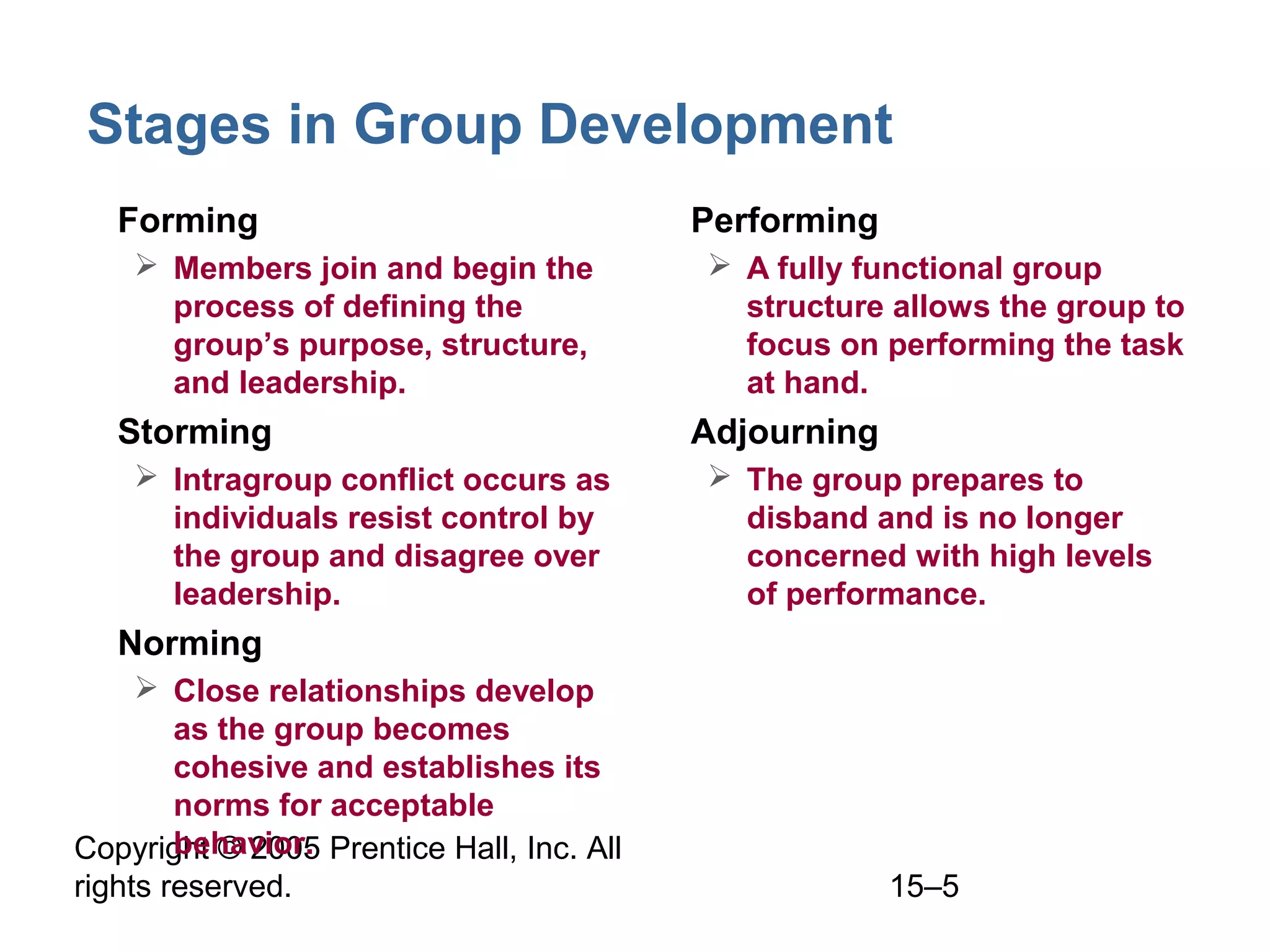
Stages in Group Development
• Forming
 Members join and begin the
process of defining the
group’s purpose, structure,
and leadership.

• Storming
 Intragroup conflict occurs as
individuals resist control by
the group and disagree over
leadership.

• Performing
 A fully functional group
structure allows the group to
focus on performing the task
at hand.

• Adjourning
 The group prepares to
disband and is no longer
concerned with high levels
of performance.

• Norming
 Close relationships develop
as the group becomes
cohesive and establishes its
norms for acceptable
behavior.
Copyright © 2005 Prentice Hall, Inc. All
rights reserved.

15–5
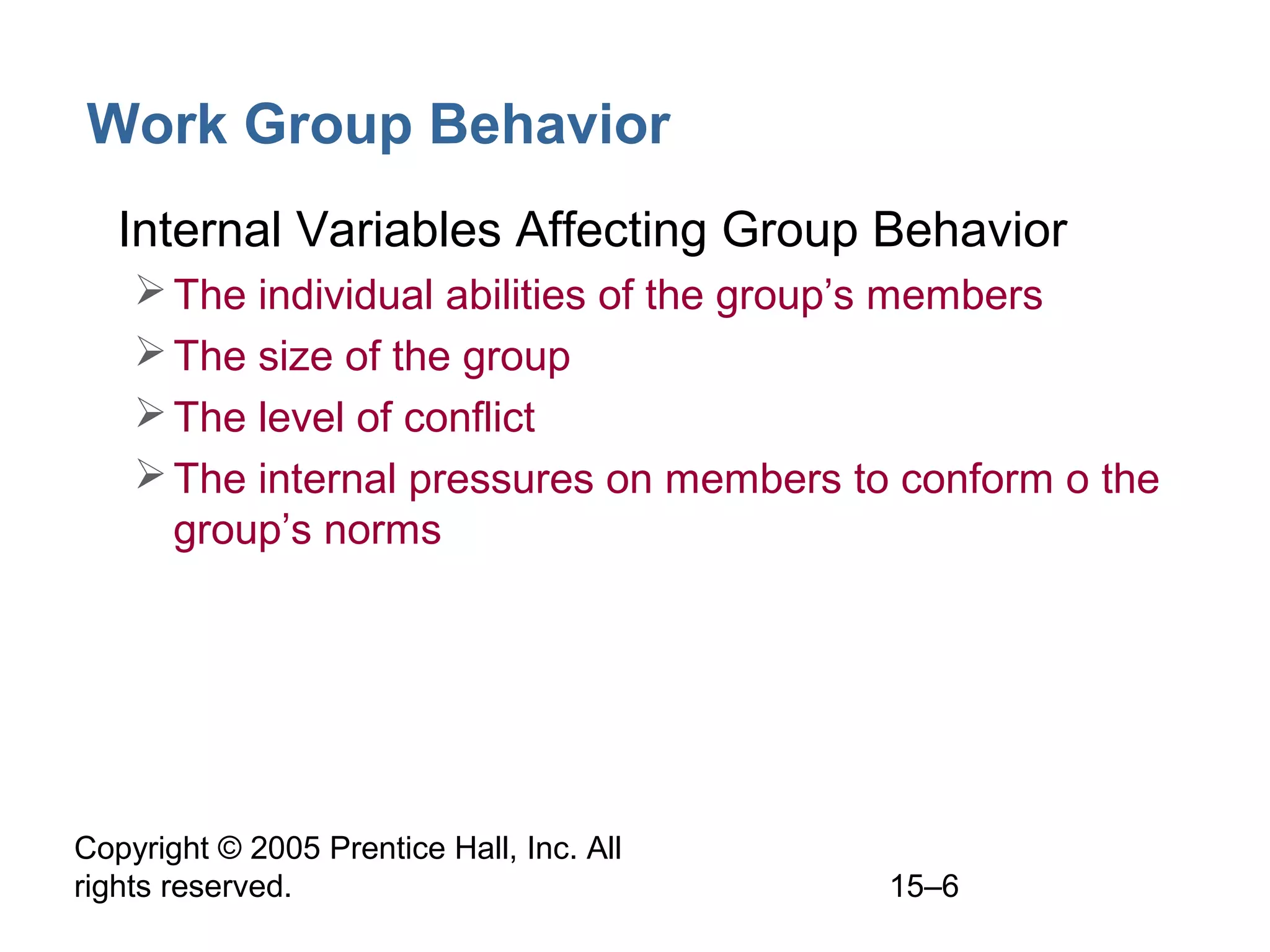
Work Group Behavior
• Internal Variables Affecting Group Behavior
 The individual abilities of the group’s members
 The size of the group
 The level of conflict
 The internal pressures on members to conform o the
group’s norms

Copyright © 2005 Prentice Hall, Inc. All
rights reserved.

15–6
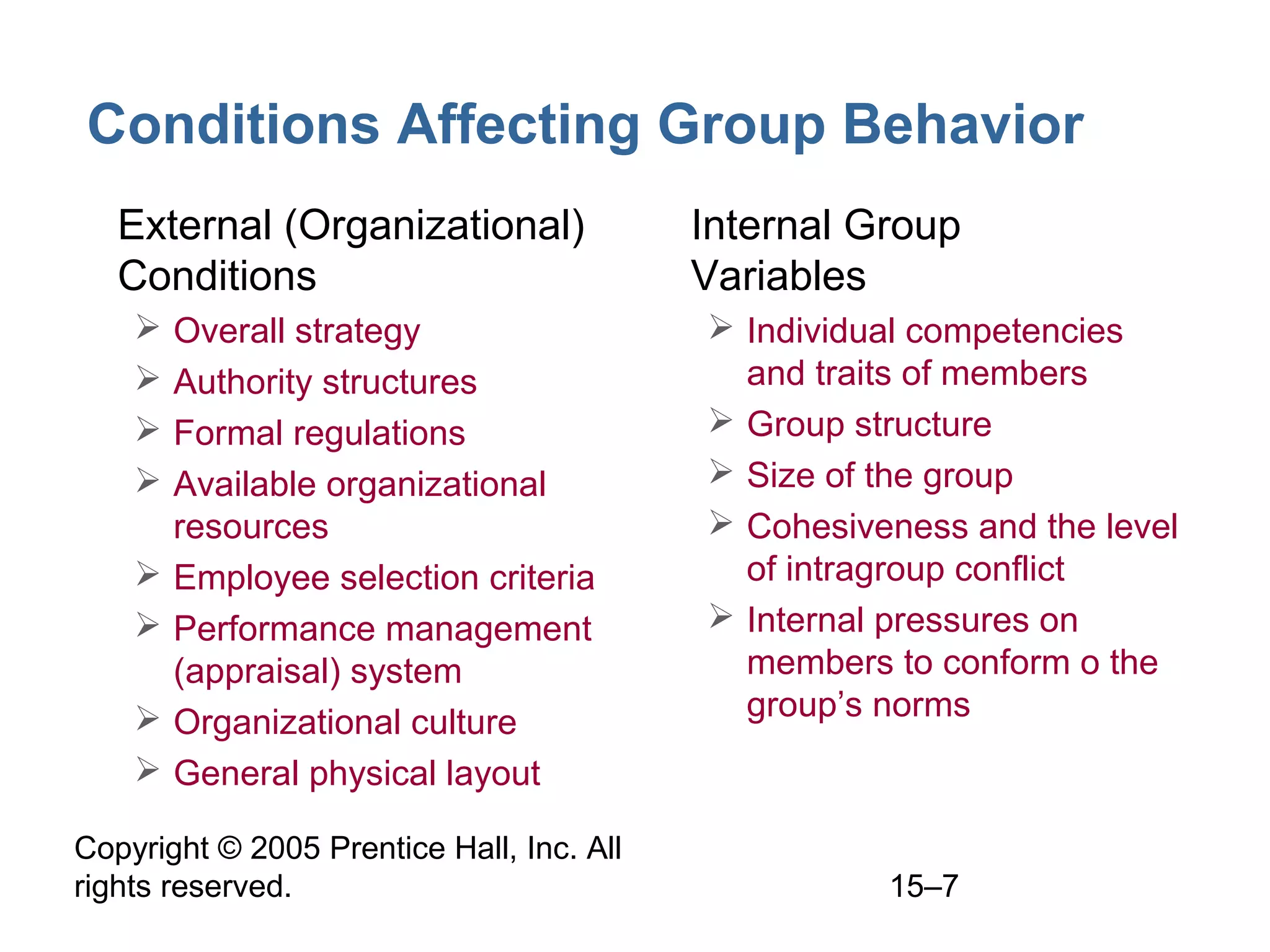
Conditions Affecting Group Behavior
• External (Organizational)
Conditions









Overall strategy
Authority structures
Formal regulations
Available organizational
resources
Employee selection criteria
Performance management
(appraisal) system
Organizational culture
General physical layout

Copyright © 2005 Prentice Hall, Inc. All
rights reserved.

• Internal Group
Variables
 Individual competencies
and traits of members
 Group structure
 Size of the group
 Cohesiveness and the level
of intragroup conflict
 Internal pressures on
members to conform o the
group’s norms

15–7
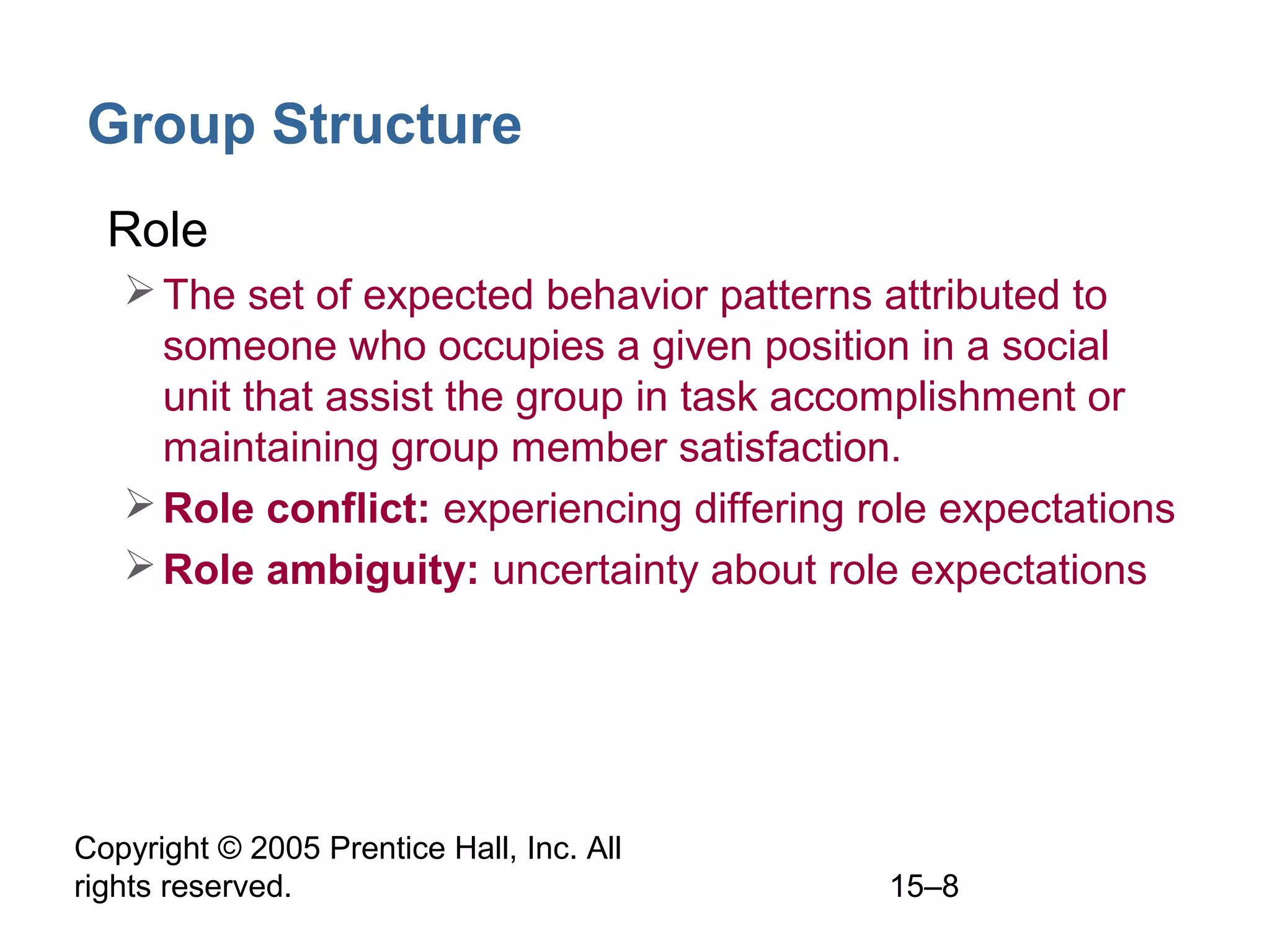
Group Structure
• Role
 The set of expected behavior patterns attributed to
someone who occupies a given position in a social
unit that assist the group in task accomplishment or
maintaining group member satisfaction.
 Role conflict: experiencing differing role expectations
 Role ambiguity: uncertainty about role expectations

Copyright © 2005 Prentice Hall, Inc. All
rights reserved.

15–8
Group Structure (cont’d)
• Norms
 Acceptable standards or expectations that are shared
by the group’s members.
 Common types of norms
 Effort

and performance

– Output levels, absenteeism, promptness, socializing
 Dress
 Loyalty

Copyright © 2005 Prentice Hall, Inc. All
rights reserved.

15–9
Group Structure (cont’d)
• Conformity
 Individuals conform in order to be accepted by groups.
 Group pressures can have an effect on an individual
member’s judgment and attitudes.
 The effect of conformity is not as strong as it once
was, although still a powerful force.
 Groupthink
 The

extensive pressure of others in a strongly cohesive
or threatened group that causes individual members to
change their opinions to conform to that of the group.

Copyright © 2005 Prentice Hall, Inc. All
rights reserved.

15–10
Group Structure (cont’d)
• Status System
 The formal or informal prestige grading, position, or
ranking system for members of a group that serves as
recognition for individual contributions to the group
and as a behavioral motivator.
 Formal

status systems are effective when the perceived
ranking of an individual and the status symbols
accorded that individual are congruent.

Copyright © 2005 Prentice Hall, Inc. All
rights reserved.

15–11
Group Structure: Group Size
• Small groups
 Complete tasks faster
than larger groups.
 Make more effective use
of facts.

• Large groups

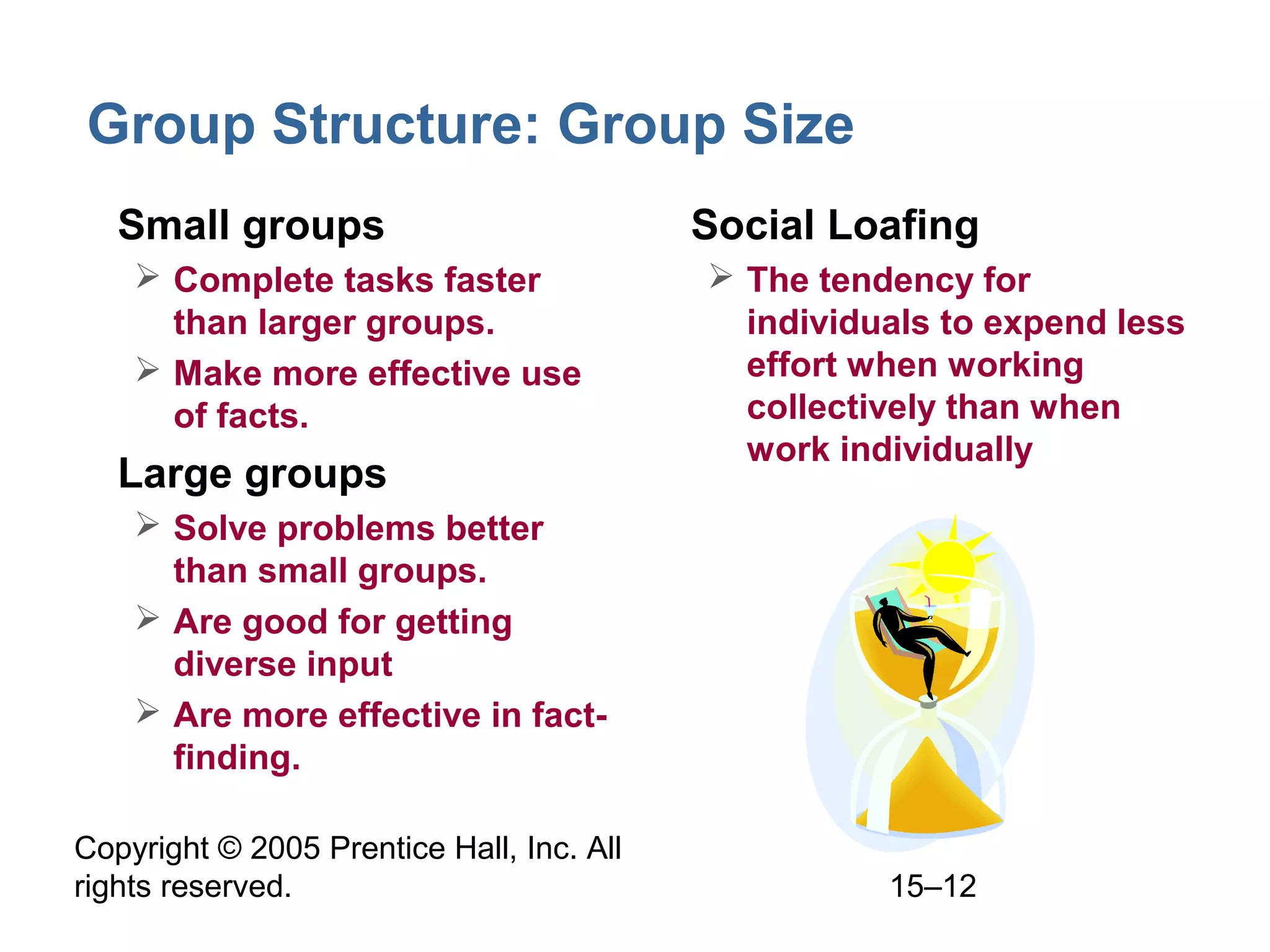
• Social Loafing
 The tendency for
individuals to expend less
effort when working
collectively than when
work individually

 Solve problems better
than small groups.
 Are good for getting
diverse input
 Are more effective in factfinding.
Copyright © 2005 Prentice Hall, Inc. All
rights reserved.

15–12
Group Structure (cont’d)
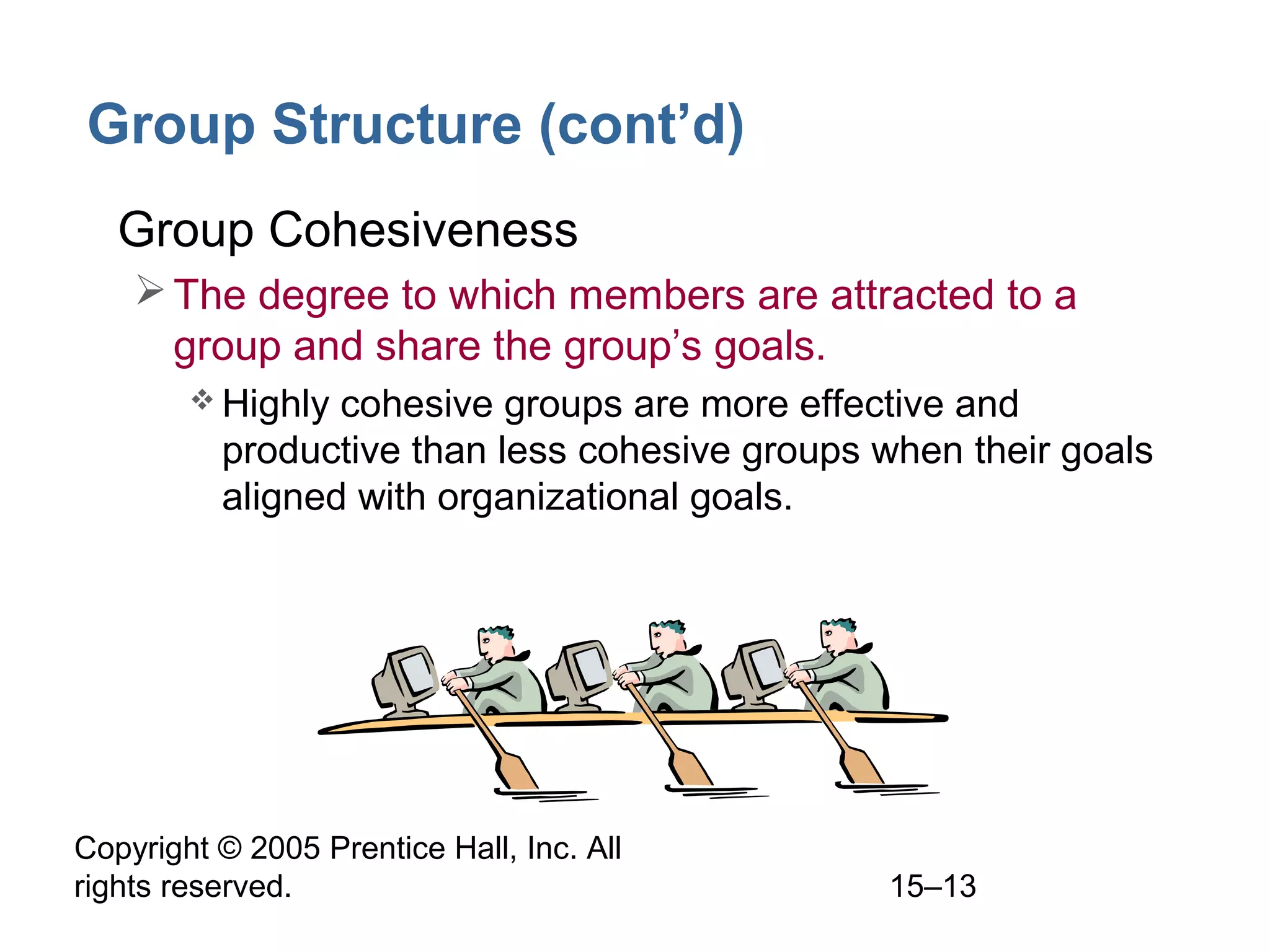
• Group Cohesiveness
 The degree to which members are attracted to a
group and share the group’s goals.
 Highly

cohesive groups are more effective and
productive than less cohesive groups when their goals
aligned with organizational goals.

Copyright © 2005 Prentice Hall, Inc. All
rights reserved.

15–13
Group Processes:
Group Decision Making
• Advantages
 Generates more complete
information and
knowledge.
 Generates more diverse
alternatives

• Disadvantages
 Time consuming
 Minority domination
 Pressures to conform
 Ambiguous responsibility

 Increases acceptance of a
solution
 Increases legitimacy of
decision
Copyright © 2005 Prentice Hall, Inc. All
rights reserved.

15–14
Group Processes: Conflict Management
• Conflict
 The perceived incompatible differences in a group
resulting in some form of interference with or
opposition to its assigned tasks.
 Traditional

view: conflict must it avoided.

 Human

relations view: conflict is a natural and
inevitable outcome in any group.

 Interactionist

view: conflict can be a positive force and
is absolutely necessary for effective group performance.

Copyright © 2005 Prentice Hall, Inc. All
rights reserved.

15–15
Group Processes: Conflict Management
(cont’d)
• Categories of Conflict
 Functional conflicts are constructive.
 Dysfunction conflicts are destructive.

• Types of Conflict
 Task conflict: content and goals of the work
 Relationship conflict: interpersonal relationships
 Process conflict: how the work gets done

Copyright © 2005 Prentice Hall, Inc. All
rights reserved.

15–16
Group Processes: Conflict Management
(cont’d)
• Techniques to Reduce Conflict:
 Avoidance
 Accommodation
 Forcing
 Compromise
 Collaboration

Copyright © 2005 Prentice Hall, Inc. All
rights reserved.

15–17
Group Tasks
• Highly complex and interdependent tasks
require:
 Effective communications: discussion among group
members.
 Controlled conflict: More interaction among group
members.

Copyright © 2005 Prentice Hall, Inc. All
rights reserved.

15–18
Advantages of Using Teams
• Teams outperform individuals.
• Teams provide a way to better use employee
talents.
• Teams are more flexible and responsive.
• Teams can be quickly assembled, deployed,
refocused, and disbanded.

Copyright © 2005 Prentice Hall, Inc. All
rights reserved.

15–19
What Is a Team?
• Work Team
 A group whose members work intensely on a specific
common goal using their positive synergy, individual
and mutual accountability, and complementary skills.

• Types of Teams
 Problem-solving teams
 Self-managed work teams
 Cross-functional teams
 Virtual teams
Copyright © 2005 Prentice Hall, Inc. All
rights reserved.

15–20
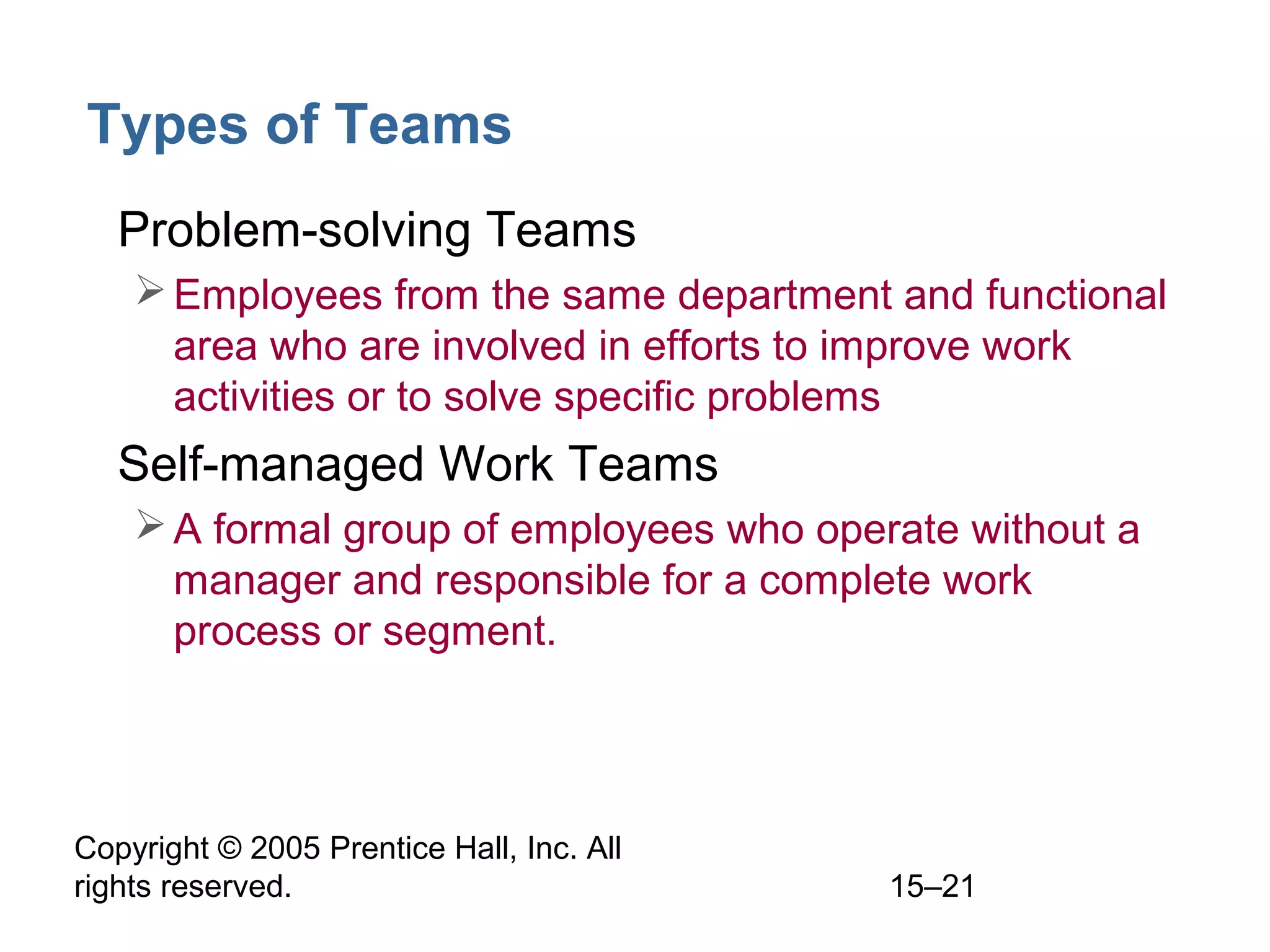
Types of Teams
• Problem-solving Teams
 Employees from the same department and functional
area who are involved in efforts to improve work
activities or to solve specific problems

• Self-managed Work Teams
 A formal group of employees who operate without a
manager and responsible for a complete work
process or segment.

Copyright © 2005 Prentice Hall, Inc. All
rights reserved.

15–21
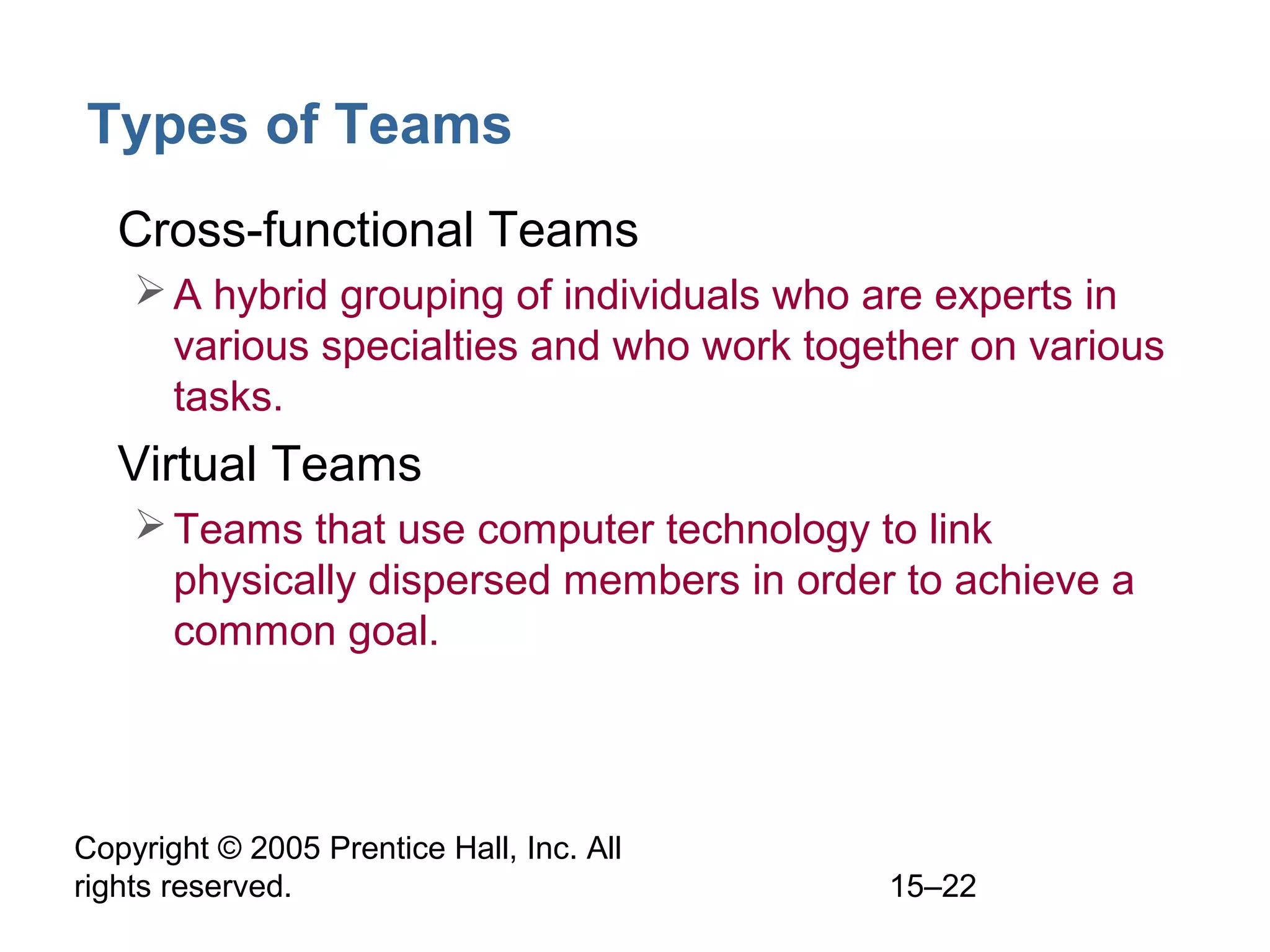
Types of Teams
• Cross-functional Teams
 A hybrid grouping of individuals who are experts in
various specialties and who work together on various
tasks.

• Virtual Teams
 Teams that use computer technology to link
physically dispersed members in order to achieve a
common goal.

Copyright © 2005 Prentice Hall, Inc. All
rights reserved.

15–22
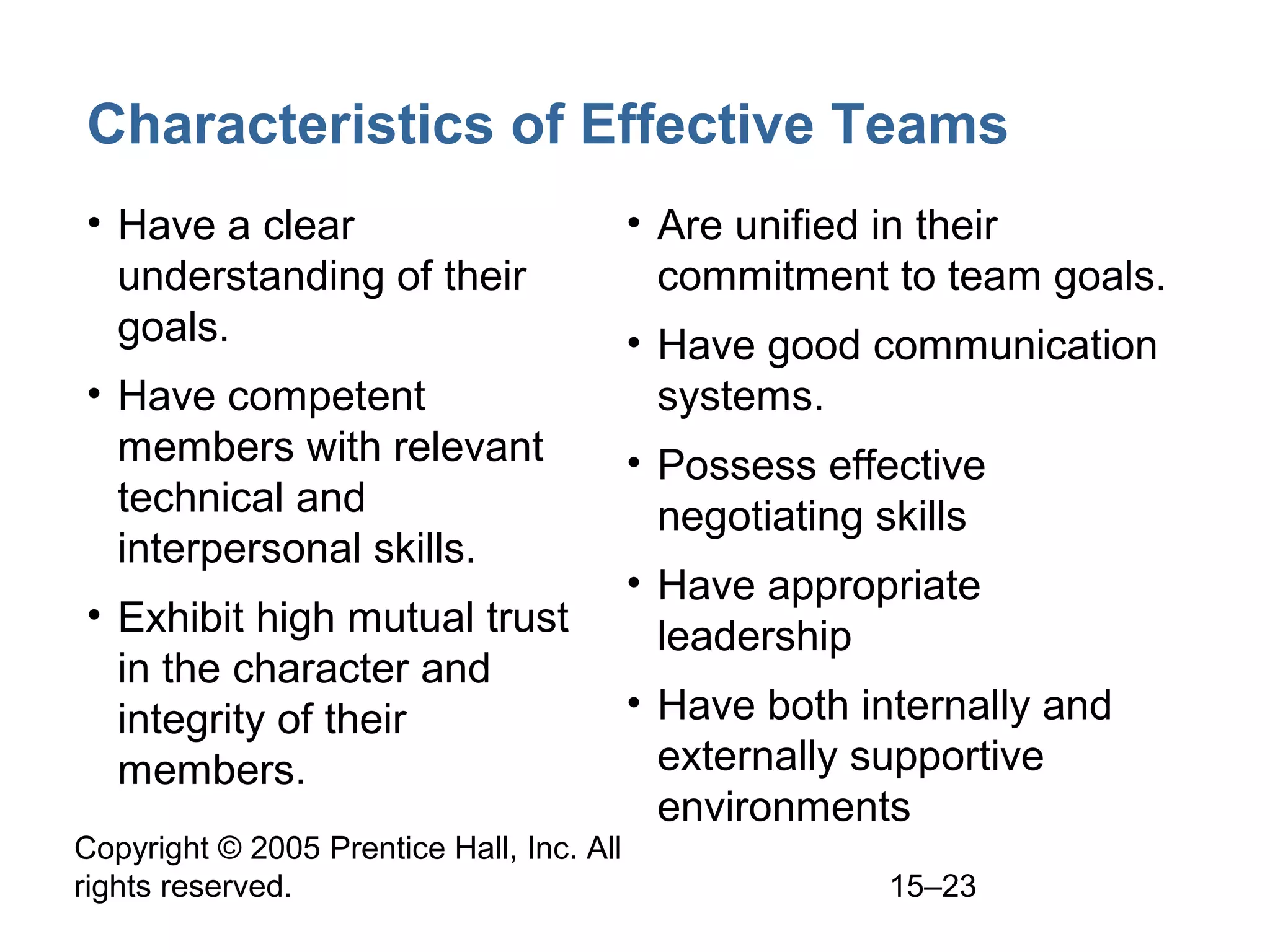
Characteristics of Effective Teams
• Have a clear
understanding of their
goals.
• Have competent
members with relevant
technical and
interpersonal skills.
• Exhibit high mutual trust
in the character and
integrity of their
members.
Copyright © 2005 Prentice Hall, Inc. All
rights reserved.

• Are unified in their
commitment to team goals.
• Have good communication
systems.
• Possess effective
negotiating skills
• Have appropriate
leadership
• Have both internally and
externally supportive
environments
15–23

Management ch15 (2)

  • 1.
    8th edition Steven P.Robbins Mary Coulter PowerPoint Presentation by Charlie Cook Copyright © 2005 Prentice Hall, Inc. All rights reserved.
  • 2.
    LEARNING OUTLINE Follow thisLearning Outline as you read and study this chapter. Understanding Groups • Define the different types of groups. • Describe the five stage of group development. Explaining Work Group Behavior • Explain the major components that determine group performance and satisfaction. • Discuss how roles, norms, conformity, status systems, group size, and group cohesiveness influence group behavior. • Tell how group norms can both help and hurt an organization. • Define group think and social loafing. Copyright © 2005 Prentice Hall, Inc. All rights reserved. 15–2
  • 3.
    L E AR N I N G O U T L I N E (cont’d) Follow this Learning Outline as you read and study this chapter. Explaining Work Group Behavior (cont’d) • Describe the relationships between group cohesiveness and productivity. • Discuss how conflict management influences group behavior. • Tell the advantages and disadvantages of group decision making. Creating Effective Teams • Compare groups and teams • Explain why teams have become so popular. • Describe the four most common types of teams. • List the characteristics of effective teams. Copyright © 2005 Prentice Hall, Inc. All rights reserved. 15–3
  • 4.
    Understanding Groups • Group Two or more interacting and interdependent individuals who come together to achieve particular goals.  Formal groups  Work groups defined by the organization’s structure that have designated work assignments and tasks. – Appropriate behaviors are defined by and directed toward organizational goals.  Informal groups  Groups that are independently formed to meet the social needs of their members. Copyright © 2005 Prentice Hall, Inc. All rights reserved. 15–4
  • 5.
    Stages in GroupDevelopment • Forming  Members join and begin the process of defining the group’s purpose, structure, and leadership. • Storming  Intragroup conflict occurs as individuals resist control by the group and disagree over leadership. • Performing  A fully functional group structure allows the group to focus on performing the task at hand. • Adjourning  The group prepares to disband and is no longer concerned with high levels of performance. • Norming  Close relationships develop as the group becomes cohesive and establishes its norms for acceptable behavior. Copyright © 2005 Prentice Hall, Inc. All rights reserved. 15–5
  • 6.
    Work Group Behavior •Internal Variables Affecting Group Behavior  The individual abilities of the group’s members  The size of the group  The level of conflict  The internal pressures on members to conform o the group’s norms Copyright © 2005 Prentice Hall, Inc. All rights reserved. 15–6
  • 7.
    Conditions Affecting GroupBehavior • External (Organizational) Conditions         Overall strategy Authority structures Formal regulations Available organizational resources Employee selection criteria Performance management (appraisal) system Organizational culture General physical layout Copyright © 2005 Prentice Hall, Inc. All rights reserved. • Internal Group Variables  Individual competencies and traits of members  Group structure  Size of the group  Cohesiveness and the level of intragroup conflict  Internal pressures on members to conform o the group’s norms 15–7
  • 8.
    Group Structure • Role The set of expected behavior patterns attributed to someone who occupies a given position in a social unit that assist the group in task accomplishment or maintaining group member satisfaction.  Role conflict: experiencing differing role expectations  Role ambiguity: uncertainty about role expectations Copyright © 2005 Prentice Hall, Inc. All rights reserved. 15–8
  • 9.
    Group Structure (cont’d) •Norms  Acceptable standards or expectations that are shared by the group’s members.  Common types of norms  Effort and performance – Output levels, absenteeism, promptness, socializing  Dress  Loyalty Copyright © 2005 Prentice Hall, Inc. All rights reserved. 15–9
  • 10.
    Group Structure (cont’d) •Conformity  Individuals conform in order to be accepted by groups.  Group pressures can have an effect on an individual member’s judgment and attitudes.  The effect of conformity is not as strong as it once was, although still a powerful force.  Groupthink  The extensive pressure of others in a strongly cohesive or threatened group that causes individual members to change their opinions to conform to that of the group. Copyright © 2005 Prentice Hall, Inc. All rights reserved. 15–10
  • 11.
    Group Structure (cont’d) •Status System  The formal or informal prestige grading, position, or ranking system for members of a group that serves as recognition for individual contributions to the group and as a behavioral motivator.  Formal status systems are effective when the perceived ranking of an individual and the status symbols accorded that individual are congruent. Copyright © 2005 Prentice Hall, Inc. All rights reserved. 15–11
  • 12.
    Group Structure: GroupSize • Small groups  Complete tasks faster than larger groups.  Make more effective use of facts. • Large groups • Social Loafing  The tendency for individuals to expend less effort when working collectively than when work individually  Solve problems better than small groups.  Are good for getting diverse input  Are more effective in factfinding. Copyright © 2005 Prentice Hall, Inc. All rights reserved. 15–12
  • 13.
    Group Structure (cont’d) •Group Cohesiveness  The degree to which members are attracted to a group and share the group’s goals.  Highly cohesive groups are more effective and productive than less cohesive groups when their goals aligned with organizational goals. Copyright © 2005 Prentice Hall, Inc. All rights reserved. 15–13
  • 14.
    Group Processes: Group DecisionMaking • Advantages  Generates more complete information and knowledge.  Generates more diverse alternatives • Disadvantages  Time consuming  Minority domination  Pressures to conform  Ambiguous responsibility  Increases acceptance of a solution  Increases legitimacy of decision Copyright © 2005 Prentice Hall, Inc. All rights reserved. 15–14
  • 15.
    Group Processes: ConflictManagement • Conflict  The perceived incompatible differences in a group resulting in some form of interference with or opposition to its assigned tasks.  Traditional view: conflict must it avoided.  Human relations view: conflict is a natural and inevitable outcome in any group.  Interactionist view: conflict can be a positive force and is absolutely necessary for effective group performance. Copyright © 2005 Prentice Hall, Inc. All rights reserved. 15–15
  • 16.
    Group Processes: ConflictManagement (cont’d) • Categories of Conflict  Functional conflicts are constructive.  Dysfunction conflicts are destructive. • Types of Conflict  Task conflict: content and goals of the work  Relationship conflict: interpersonal relationships  Process conflict: how the work gets done Copyright © 2005 Prentice Hall, Inc. All rights reserved. 15–16
  • 17.
    Group Processes: ConflictManagement (cont’d) • Techniques to Reduce Conflict:  Avoidance  Accommodation  Forcing  Compromise  Collaboration Copyright © 2005 Prentice Hall, Inc. All rights reserved. 15–17
  • 18.
    Group Tasks • Highlycomplex and interdependent tasks require:  Effective communications: discussion among group members.  Controlled conflict: More interaction among group members. Copyright © 2005 Prentice Hall, Inc. All rights reserved. 15–18
  • 19.
    Advantages of UsingTeams • Teams outperform individuals. • Teams provide a way to better use employee talents. • Teams are more flexible and responsive. • Teams can be quickly assembled, deployed, refocused, and disbanded. Copyright © 2005 Prentice Hall, Inc. All rights reserved. 15–19
  • 20.
    What Is aTeam? • Work Team  A group whose members work intensely on a specific common goal using their positive synergy, individual and mutual accountability, and complementary skills. • Types of Teams  Problem-solving teams  Self-managed work teams  Cross-functional teams  Virtual teams Copyright © 2005 Prentice Hall, Inc. All rights reserved. 15–20
  • 21.
    Types of Teams •Problem-solving Teams  Employees from the same department and functional area who are involved in efforts to improve work activities or to solve specific problems • Self-managed Work Teams  A formal group of employees who operate without a manager and responsible for a complete work process or segment. Copyright © 2005 Prentice Hall, Inc. All rights reserved. 15–21
  • 22.
    Types of Teams •Cross-functional Teams  A hybrid grouping of individuals who are experts in various specialties and who work together on various tasks. • Virtual Teams  Teams that use computer technology to link physically dispersed members in order to achieve a common goal. Copyright © 2005 Prentice Hall, Inc. All rights reserved. 15–22
  • 23.
    Characteristics of EffectiveTeams • Have a clear understanding of their goals. • Have competent members with relevant technical and interpersonal skills. • Exhibit high mutual trust in the character and integrity of their members. Copyright © 2005 Prentice Hall, Inc. All rights reserved. • Are unified in their commitment to team goals. • Have good communication systems. • Possess effective negotiating skills • Have appropriate leadership • Have both internally and externally supportive environments 15–23