4 - 3
Trainingon
Management and Organization Skills
For CETU Regional Representatives
Tahisas 21-23/2013
Panorama Hotel, Addis Ababa, Ethiopia
4.
1. To beinvolved in the learning process.
2. To contribute your thoughts and ideas
to the group (so we can learn from you
and your experiences!)
3. To network with others.
4. To enjoy experiences.
Reasons for we all to be here:
5
5.
4 - 5
1
Introduction
Setting norms
Time management
Reporters
Energizing team
Expectations
Climate Setting
6.
Introduction
6
1. Name
2. Educationalbackground
3. Work experience
4. What you like most?
5. What you hate most?
6. Your future plan
7. What do you expect from this
training?
7.
Dr. Temesgen DagneAkal , Ph.D., MBA, MCom,
PGDHRM, PGDIM, PGDIBO, BSc, DIM,AFP, CPMS, CLM
Assistant Professor, Researcher and Consultant
Associate Consultant at Ethiopian Management
Institute
Co-founder and Consultant at Super Consult Plc.
Project Advisor of FNV the Netherlands in Ethiopia
Trainer at Addis Chamber Training Institute
Board Member at ECDSWC in PEHAA
7
Facilitator
Mode of Delivery
Presentation of concepts
Questions, exercises and reflections
Brainstorming
Relating concepts with practical situations
Group discussions
Presentations
12
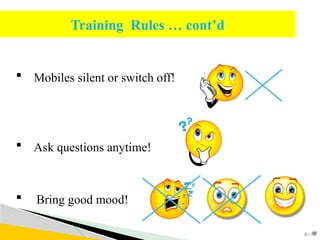
Everyone isequal.
Be punctual when returning from breaks.
One person speaks at a time, no side talking or
interrupting.
Respect confidentiality.
Respect other people’s thoughts and opinions.
Training Rules
4- 14
Objectives of theTraining
The main aim of the training is to strengthen
organisational and management structure of the
local branches of CETU through organizing
management and organizational skills training.
16
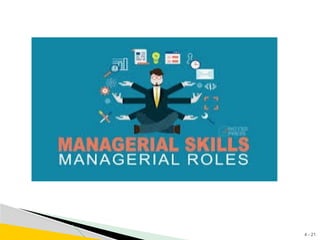
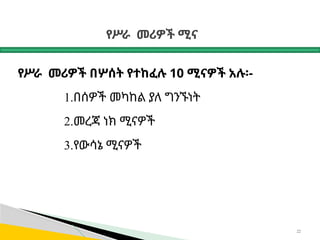
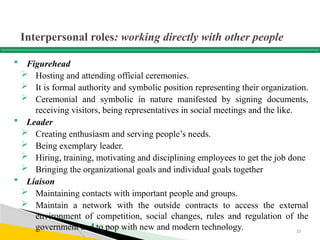
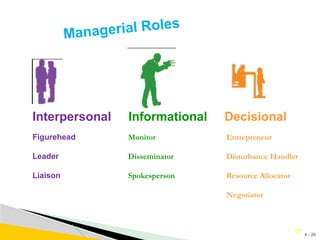
Interpersonal roles: workingdirectly with other people
Figurehead
Hosting and attending official ceremonies.
It is formal authority and symbolic position representing their organization.
Ceremonial and symbolic in nature manifested by signing documents,
receiving visitors, being representatives in social meetings and the like.
Leader
Creating enthusiasm and serving people’s needs.
Being exemplary leader.
Hiring, training, motivating and disciplining employees to get the job done
Bringing the organizational goals and individual goals together
Liaison
Maintaining contacts with important people and groups.
Maintain a network with the outside contracts to access the external
environment of competition, social changes, rules and regulation of the
government and to pop with new and modern technology. 23
24.
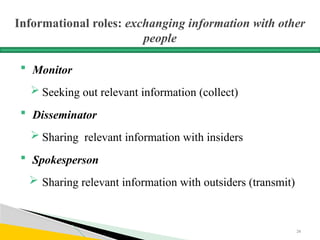
Informational roles: exchanginginformation with other
people
Monitor
Seeking out relevant information (collect)
Disseminator
Sharing relevant information with insiders
Spokesperson
Sharing relevant information with outsiders (transmit)
24
25.
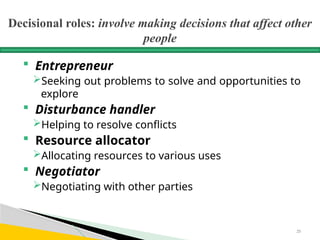
Decisional roles: involvemaking decisions that affect other
people
Entrepreneur
Seeking out problems to solve and opportunities to
explore
Disturbance handler
Helping to resolve conflicts
Resource allocator
Allocating resources to various uses
Negotiator
Negotiating with other parties
25
Managerial Networks
Managers andteam leaders should be able to
develop, maintain, and work well within:
Task networks: of specific job-related contacts
Career networks: of career guidance and opportunity
resources
Social networks: of trustworthy friends and peers.
27
28.
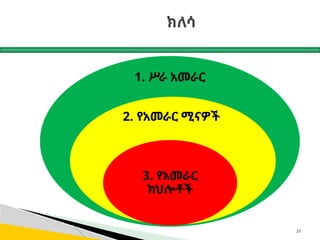
Levels of Management/Typesof Managers
1. Top-level management
Small group of people responsible for the overall management of
an organization. They are also called executives.
Responsible for the establishment of organizational goals, plans,
strategies, board operating policy and guidelines.
Guide the organization’s interactions with its environment.
Meaning, they are responsible for interacting with representatives
of the external environment.
They oversee the overall planning of the organization, work with middle
level managers in implementing, planning, maintaining, and in
controlling of the progress of the organization.
Typical titles: “chief executive officer,” “president,” & “vice president.”
28
29.
Levels of Management… cont’d
2. Middle level management
All managers above the supervisory level, but below the top
level management
Direct the activities of lower-level managers & sometimes
those of operating employees
Principal responsibilities: direct the activities that implement
organizations’ policies & balance the demands of their
managers with the capacities of their employers.
Translating executive order into operation and mainly for
implementing the overall organizational plan.
29
30.
Levels of Management… cont’d
3. Supervisory level management/First – line managers
Direct non-management employees; they do not supervise other
managers.
It involves day-today operations almost exclusively.
Concerned with coordination in the sense of finding some
immediate solution to operating problems.
Primarily concerned with making of concrete, immediate and
highly personal contact with employees.
These managers are truly “people in the middle” as much as
they must integrate organizational and personal need.
30
31.
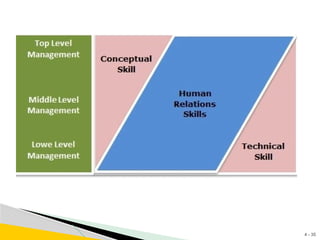
Managerial Skills
Askill is an ability to translate knowledge into action
that results in a desired performance.
Robert Katz divides the essential managerial skills
into three categories: technical, human, and
conceptual.
He further suggests that the relative importance of
these skills varies across the different levels of
management.
Next slides will present the three skills
31
32.
Managerial Skills …cont’d
1. Technical Skills
Ability to perform specialized tasks.
This skill involves proficiency at using selected
methods, processes, and procedures to accomplish
tasks.
Some technical skills require preparatory education,
whereas others are acquired through specific training
and on-the-job experience.
It is essential for the first line managers than the others
(middle and top level managers).
32
33.
Managerial Skills …cont’d
2. Human Skills
Ability to work well with other people or a spirit of trust,
enthusiasm, and genuine involvement in interpersonal
relationships.
This skill is central to managerial work and team
leadership
A person with good human skills will have a high degree
of self-awareness and a capacity for understanding or
empathizing with the feelings of others.
People with this skill are able to interact well with
others, engage in persuasive communications, deal
successfully with disagreements and conflicts, and
more.
It is equally important for all levels of manages. 33
34.
Managerial Skills... Cont’d
3.Conceptual Skills
Ability to see and understand how the whole organizational system
works, and how the parts are interrelated. This capacity to analyze
and solve complex and interrelated problems is a conceptual skill.
It involves identifying of problems and opportunities, gather and
interpret relevant information, and make good problem-solving
decisions that serve the organization’s purpose.
Senior executives are concerned more with issues of organizational
purpose, mission, and strategy. Broader, more ambiguous, and
longer term decisions dominate attention at these higher levels, thus
conceptual skills gain a relative importance here.
34
4 - 41
41
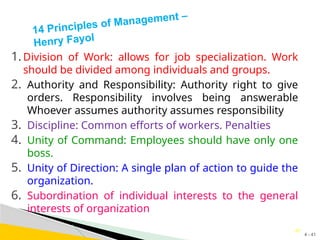
14Principles of Management –
Henry Fayol
1.Division of Work: allows for job specialization. Work
should be divided among individuals and groups.
2. Authority and Responsibility: Authority right to give
orders. Responsibility involves being answerable
Whoever assumes authority assumes responsibility
3. Discipline: Common efforts of workers. Penalties
4. Unity of Command: Employees should have only one
boss.
5. Unity of Direction: A single plan of action to guide the
organization.
6. Subordination of individual interests to the general
interests of organization
42.
4 - 42
42
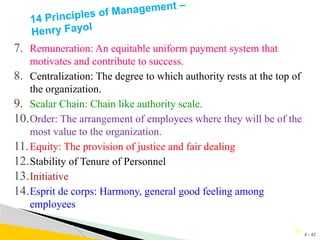
14Principles of Management –
Henry Fayol
7. Remuneration: An equitable uniform payment system that
motivates and contribute to success.
8. Centralization: The degree to which authority rests at the top of
the organization.
9. Scalar Chain: Chain like authority scale.
10.Order: The arrangement of employees where they will be of the
most value to the organization.
11.Equity: The provision of justice and fair dealing
12.Stability of Tenure of Personnel
13.Initiative
14.Esprit de corps: Harmony, general good feeling among
employees
44
“ Planning withoutaction is futile, action without
plan is fatal.”
Cornelius Fichtner
45.
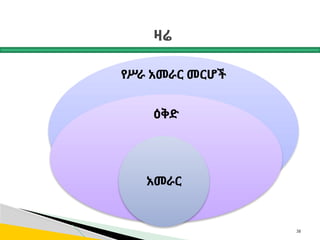
Planning
Introduction
Planning isa primary management function.
It is the activity that allows managers to determine what they
want and how to get it.
It involves:
Selecting of the missions and objectives
Selecting actions to achieve them
Decision-making that is, choosing from among alternative future
courses of action.
Planning and controlling are closely interrelated
45
46.
Basic concepts ofPlanning
Planning is an ever-present feature of modern life
Personal or informal plans give purpose to our lives. In a similar
fashion, more formalized plans enable managers to mobilize
their intentions to accomplish organizational purposes
In organizations, planning is the process of setting goals and
choosing the means to achieve those goals. It is the processes
of determining how the organization can get where it wants to
go
Without plans:
Managers cannot know how to organize people and resources
They may not even have a clear idea of what they need to
organize
They cannot lead with confidence or expect others to follow
them
Managers and their followers have little chance of achieving
their goals 46
47.
Basic concepts …cont’d
Planning is preparing today for tomorrow. It provides answers
to at least six basic questions in regard to any intended
activity:
@What (the goal or goals)
@When (the timeframe for accomplishment of an activity)
@Where (the place or places where the plans or planning will
reach its conclusion)
@Who (which people will perform the tasks)
@How (the specific steps or methods to reach the goals)
@How much (resources necessary to reach the goals)
47
48.
Importance of Goals
Goals provide a sense of direction. Without a goal,
individuals and their organizations tend to muddle along.
Goals focus our efforts. In selecting a single goal or a set of
related goals, we establish priorities and make a commitment
about the way we will use our scarce resources.
Goals guide our plans and decisions.
Goals help us evaluate our progress. A clearly stated,
measurable goal with a specific deadline becomes a standard
of performance that lets individuals and managers alike
evaluate their progress. Thus, goals are an essential part of
controlling
48
49.
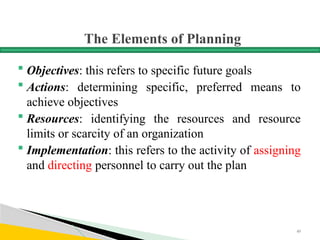
The Elements ofPlanning
Objectives: this refers to specific future goals
Actions: determining specific, preferred means to
achieve objectives
Resources: identifying the resources and resource
limits or scarcity of an organization
Implementation: this refers to the activity of assigning
and directing personnel to carry out the plan
49
50.
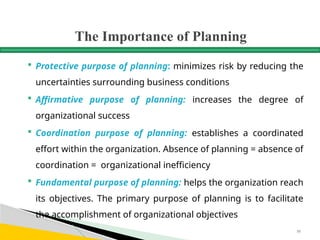
The Importance ofPlanning
Protective purpose of planning: minimizes risk by reducing the
uncertainties surrounding business conditions
Affirmative purpose of planning: increases the degree of
organizational success
Coordination purpose of planning: establishes a coordinated
effort within the organization. Absence of planning = absence of
coordination = organizational inefficiency
Fundamental purpose of planning: helps the organization reach
its objectives. The primary purpose of planning is to facilitate
the accomplishment of organizational objectives
50
51.
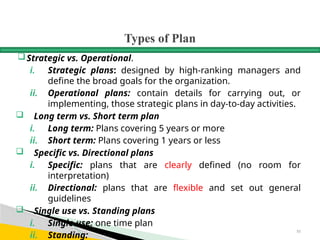
Types of Plan
Strategicvs. Operational.
i. Strategic plans: designed by high-ranking managers and
define the broad goals for the organization.
ii. Operational plans: contain details for carrying out, or
implementing, those strategic plans in day-to-day activities.
Long term vs. Short term plan
i. Long term: Plans covering 5 years or more
ii. Short term: Plans covering 1 years or less
Specific vs. Directional plans
i. Specific: plans that are clearly defined (no room for
interpretation)
ii. Directional: plans that are flexible and set out general
guidelines
Single use vs. Standing plans
i. Single use: one time plan
ii. Standing:
51
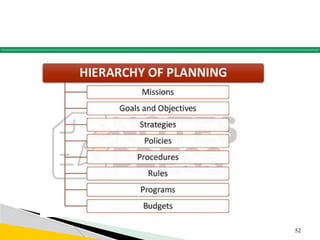
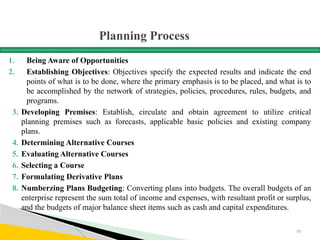
Planning Process
1. BeingAware of Opportunities
2. Establishing Objectives: Objectives specify the expected results and indicate the end
points of what is to be done, where the primary emphasis is to be placed, and what is to
be accomplished by the network of strategies, policies, procedures, rules, budgets, and
programs.
3. Developing Premises: Establish, circulate and obtain agreement to utilize critical
planning premises such as forecasts, applicable basic policies and existing company
plans.
4. Determining Alternative Courses
5. Evaluating Alternative Courses
6. Selecting a Course
7. Formulating Derivative Plans
8. Numberzing Plans Budgeting: Converting plans into budgets. The overall budgets of an
enterprise represent the sum total of income and expenses, with resultant profit or surplus,
and the budgets of major balance sheet items such as cash and capital expenditures.
53
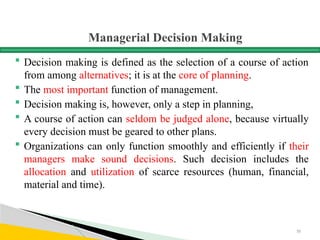
Managerial Decision Making
Decision making is defined as the selection of a course of action
from among alternatives; it is at the core of planning.
The most important function of management.
Decision making is, however, only a step in planning,
A course of action can seldom be judged alone, because virtually
every decision must be geared to other plans.
Organizations can only function smoothly and efficiently if their
managers make sound decisions. Such decision includes the
allocation and utilization of scarce resources (human, financial,
material and time).
55
56.
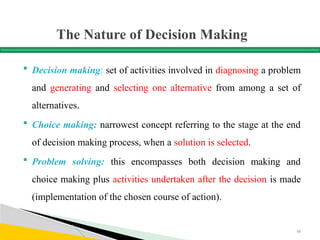
The Nature ofDecision Making
Decision making: set of activities involved in diagnosing a problem
and generating and selecting one alternative from among a set of
alternatives.
Choice making: narrowest concept referring to the stage at the end
of decision making process, when a solution is selected.
Problem solving: this encompasses both decision making and
choice making plus activities undertaken after the decision is made
(implementation of the chosen course of action).
56
57.
Types of DecisionMaking
1. Programmed decisions
Made in accordance with written or unwritten policies, procedures, or
rules that simplify decision making in recurring situations by limiting or
excluding alternatives.
Limit our freedom because the individual has less latitude in deciding
what to do.
2. Non programmed decisions
Specific solutions created through an unstructured process to deal with
non routine problems.
Deal with unusual or exceptional problems
As one moves up the organizational hierarchy, the ability to make non
programmed decisions becomes more important.
Most management development programs try to improve managers’
abilities to make non programmed decisions, usually by teaching them
to analyze problems systematically and to make logical decisions.
57
58.
Decision Environments
Problem solvingdecisions in organizations are typically made under three
different conditions or environments: certainty, risk and uncertainty.
i. Certain environments: exist when information is sufficient to predict the
results of each alternative in advance of implementation. Certainty is an ideal
condition for managerial decision making. Unfortunately certainty is the
exception instead of the rule in decision environments.
ii. Risk environments: exist when decision makers lack complete certainly
regarding the outcomes of various course of action, but they are aware of the
probabilities associates with their occurrence.
iii. Uncertain environments: exist when managers have so little information on
hand that they can not even assign probabilities to various alternatives and
their possible outcomes. This is the most difficult of the three decision
environments. Uncertainty forces decision makers to heavily rely on
individual and group creativity to succeed in problem solving.
58
59.
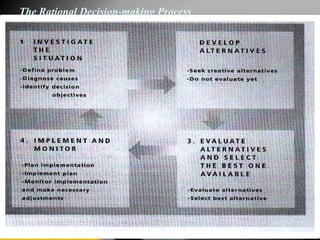
Rational Decision MakingProcess
Managers who weigh their options and calculate optimal
levels of risk are using the rational model of decision making.
This model is especially useful in making non programmed
decisions
No approach to decision making can guarantee that a manager
will always make the right decision. But managers who use a
rational, intelligent, and systematic approach are more likely
than other managers to come up with high quality solutions
The basic process of rational decision making involves the
four stages discussed in the following slides
59
60.
Stage 1: Investigatethe Situation
A thorough investigation has three aspects:
i. Define the Problem: the problem has to be defined in terms of the
organizational objectives that are being blocked. This helps to
avoid confusing symptoms with problems.
ii. Diagnose the Causes. Managers can ask a number of diagnostic
questions.
iii. Identify the Decision objectives. decide what would constitute an
effective solution. Most problems consist of several elements, and a
manager is unlikely to find one solution that will work for all of
them. If a solution enables managers to achieve organizational
objectives, it is a successful one.
What should be noted about all three aspects of problem investigation is
the importance of a manager’s education about the world and his or her
imagination!
60
61.
Stage 2: DevelopAlternatives
This stage may be reasonably simple for most programmed
decisions but not so simple for complex non-programmed
decisions, especially if there are time constraints.
Too often the temptation to accept the first feasible alternative
prevents managers from finding the best solutions for their
problems.
To prevent this, no major decision should be made until
several alternatives have been developed.
To increase their creativity at this task, some managers turn to
individual or group brainstorming, in which participants
spontaneously propose alternatives even if they seem
unrealistic or fantastic.
61
62.
Stage 3: Evaluatealternatives and select the
best one available
Once managers have developed a set of alternatives, they must evaluate each one
on the basis of three key questions
i. Is this alternative Feasible? In terms of resources & legal/ethical obligations?
ii. Is The Alternative a Satisfactory Solution? does it meet the decision
objectives? does it have an acceptable chance of succeeding?
iii.What are the Possible Consequences for the Rest of the Organization?
Alternatives with negative consequences should be eliminated, of course, and
alternatives with positive consequences will usually be favored over those with
merely neutral consequences.
When selecting from among alternatives, managers can use three basic approaches.
i. Experience: Reliance on past experience
ii. Experimentation: scientific inquiry
iii.Research and Analysis: solving a problem by first comprehending it. It involves
a search for relationships among the more critical of the variables, constraints,
and premises that bear upon the goal sought. It is the pencil-and-paper (or,
better, the computer-and-printout) approach to decision making.
62
63.
Stage 4: Implementand monitor the decision
Managers are ready to make plans to cope with the requirements and
problems that may be encountered in putting it into effect.
Implementing a decision involves more than giving appropriate
orders.
Resources must be acquired and allocated as necessary.
Responsibility needs to be assigned for the specific tasks involved.
Procedure are set up for progress reports and prepare to make
corrections if new problems should arise.
Actions taken to implement a decision must be monitored.
Are things working according to plan?
What is happening in the internal and external environments as a result
of the decision?
Are people performing according to expectations?
What is the competition doing in response?
63
Organizing
The Concept ofOrganizing and Organization Structure
The term organizing stems from the word organism, which
means an entity with parts so integrated.
Is bringing together and coordinating human and physical
resources to accomplish the objectives established in the
planning process.
It involves developing a structure to coordinate the efforts of
different people.
Process of achieving a coordinated effort through the design
of structure of tasks, authority relationships, people, and
communication
66
67.
Fundamental steps (buildingblocks) of Organizing
1. Division of work/labor
Breakdown of a complex task into components so that
individuals are responsible for a limited set of activities instead
of the task as a whole.
Divide the total workload into tasks that can logically and
comfortably be performed by individuals or groups
No one person is physically or psychologically able to perform
all the operations that make up most complex tasks-even
assuming one person could acquire all the specialized skills
needed to do so.
Thus, division of work creates simplified tasks that can be
learned and completed relatively quickly. Thus it fosters
specialization, as each person becomes expert in a certain job.
67
68.
Fundamental steps …cont’d
2. Departmentalization
Combine tasks in a logical and efficient manner.
To keep track of the complex web of formal
relationships in an organization, managers typically
draw up an organization chart to depict how work is
divided.
In an organization chart, boxes represent the logical
groupings of work activities that we call departments.
Departmentalization, therefore, is the result of managers
deciding what work activities, once they are divided into
jobs, can be connected in “like” groupings.
68
69.
Fundamental steps …cont’d
3. Hierarchy
Specify who reports to whom in the organization
This concept pertains to the span of management
The span of management control refers to the number of
people and departments that report directly to a particular
manager.
Once work is divided, departments created, and the span
of control chosen, managers can decided on a chain of
command- a plan that specifies who reports to whom in
an organization
69
70.
Fundamental steps …cont’d
4. Coordination
Set up mechanisms for integrating departmental activities
into a coherent whole and monitoring the effectiveness of
that integration
Without coordination, people would lose sight of their roles
within the total organization and be tempted to pursue their
own departmental interests at the expense or organizational
goals.
The extent of coordination depends on the nature of the tasks
performed and the degree of interdependence of people in the
various units performing them
70
71.
Organization structure
Is aformal framework that shows a set of tasks assigned to
individuals and departments, reporting relationships and the design
of systems to effectively coordinate employees across departments.
A diagram or chart of all the positions in an organization and their
formal relationship to one another. It illustrates an organization’s overall shape or
configuration in comprehensive manner.
An organization chart shows:
The hierarchical structure that is typical of most organizations
The number of management layers
Degrees of authority, status, and compensation
How an organization’s activities are departmentalized
The work being done in each position
Relations between superiors and subordinates-who reports to whom
How many subordinates report directly to each manager
Career pathways to the top; and
Formal channels of communication. 71
72.
The Importance ofOrganizing
Promotes collaboration and negotiation. Thus, it improves
communication within the organization
It sets clear-cut lines of authority and responsibility for each
individuals or department’s
Improves the directing and controlling functions of managers
Develops maximum use of all organization resources.
Encourages employee’s creativity, decision-making, & independent
thinking based on well-defined policies, rules & procedures
It helps to adopt new technologies. Effective managers continuously
react to changes
It reduces internal and external problems through controlling and
planning units of the organization
72
73.
Formal vs. InformalOrganization
Formal organization
Intentional structure of roles in a formally organized enterprise. Describing
an organization as “formal,” however does not mean there is anything
inherently inflexible or unduly confining about it. Formal organization must
be flexible.
Informal organization
Is the undocumented and officially unrecognized relationships between
members of an organization that inevitably emerge out of the personal and
group needs of employees.
Chester Barnard described informal organization as any joint personal
activity without conscious joint purpose, even though contributing to joint
results.
It is much easier to ask for help on an organization problem from someone
you know personally, even if he or she may be in a different department,
than from someone you know only as a name on an organization chart.
73
74.
Work Specialization/Division ofLabor
Traced back to Adam Smith's discussion of division of labor
and his conclusion was specialization increases employees’
productivity.
Is dividing large tasks into smaller packages of work to be
distributed among several people.
74
75.
Span of Management(span of control)
Number of subordinates and departments reporting directly to
a given manager.
Once work divided, departments created, and the span of
control chosen, managers can decided on a chain of command-
a plan that specifies who reports to whom in an organization
The result of these decisions is a pattern of multiple levels that
is called a hierarchy.
Choosing an appropriate span of management control for an
organizational hierarchy is important for two reasons.
i. Affects what happens to work relationships in one particular department.
ii. Affects the speed of decision making in situations where multiple levels in
the organizational hierarchy are necessarily involved.
75
76.
Span of Management
According to classical school , the number of subordinates to be
controlled by any executive is from 6-8 persons.
Others recommended that the span of control to be between 4-7
subordinates per manager.
However, the majority argues that as one goes up in the organization
hierarchy, he or she should have to deal with smaller number of
subordinates.
This is because top executives should deal with a great variety of
complex issues and ill-structured problems. Likewise, middle level
managers have a narrow span of control than supervisory level
managers.
Thus, it is advisable to compare the advantages and disadvantages
of wide and narrow span of control.
76
77.
The Sources ofPower
John French and Bertram Raven have identified five sources or basis of power.
1. Reward Power is defined as power derived from the ability to reward
another person, for carrying out orders, which may be expressed or implied.
2. Coercive Power: negative side of reward power. Influencer’s ability to
punish the influencee for not meeting requirements. Punishment may range
from a reprimand to loss of a job.
3. Legitimate power is defined as power that exists when a subordinate or
influence acknowledges that the influencer has a “right” or is lawfully
entitled to exert influence-within certain bounds; also called formal authority.
Such power can be downward or upward
4. Expert Power: power based on the belief that the influencer has specific
knowledge or expertise that the influence does not.
5. Referent power: power based on the desire of the influencee to be like or
identify with the influencer. For example, popular, conscientious managers
will have referent power if employees are motivated to emulate their work
habits.
77
78.
The Concept ofPower, Authority and
Responsibility
Authority may be viewed as the cement that holds the various
levels of an organization together complemented by
equivalent responsibility.
Power, a much broader concept than authority, is the ability of
individuals or groups to induce or influence the beliefs or
actions of other persons or groups.
Authority is the right in a position to exercise discretion in
making decisions affecting others. It is, of course, one type of
power, but power in an organization setting.
78
79.
The Concept ofAuthority and Responsibility
Authority is the right to give orders and the power to exact obedience. It
is the power to make decisions, which guide the actions of others. Thus,
a person with authority influences the behavior of others. It is derived
from the person’s official position in the organization, not because of
their personal characteristics.
Responsibility is the obligation of an individual to carry out assigned
duties to the best of his or her ability. It is what one is expected to
perform a duty as required by the superiors or as prescribed by the job.
Managers with authority are responsible for other people, money, and
resources.
Unlike authority, responsibility cannot be assigned or given away. It
must be willingly accepted.
Thus, authority should be given only to managers who are willing to
assume an equal amount of responsibility.
79
80.
Sources of Authority
Thereare three major theories about the sources of authority.
1. Top-down/classical view of authority: This is also called formal or
institutional authority. It assumes that authority originates from the top
high-level of the organization and passed lawfully to the bottom. That is,
authority flows from the elected president or owner to middle managers
and then, to first-line managers.
2. Acceptance or bottom-up theory of authority: directives of management
will be implemented as long as the subordinates accepted it & willing to
implement it. The formal authority becomes nominal until subordinates
accept it.
3. The competence theory of authority. A person gives orders or command
80
81.
Delegation
Delegation is conferringauthority from one manager or
organization level to another in order to accomplish particular
assignments.
It is the process of allocating tasks to subordinates, giving
them adequate authority to carry out those assignments, and
making them obligated to complete the tasks satisfactorily.
The Importance of Delegation of Authority
1. Enables managers to perform higher-level work
2. Results into better decisions
3. Improves morale and enterprise sprit of subordinates.
4. Without delegation, the chief executive, would be the only
management member of the enterprise
5. Delegation can develop subordinates
81
82.
አመራር
82
Effective leadership isnot about making speeches or
being liked; leadership is defined by results not
attributes. Peter Drucker
4 - 94
Whatis conflict?
• A battle, contest or opposing forces existing
between primitive desires and moral, religious
or ethical ideas (Webster’s Dictionary)
• A state of incompatibility of ideas between two
or more parties or individuals.
• Conflict management is the practice of
identifying and handling conflict in a sensible,
fair and efficient manner.
95.
4 - 95
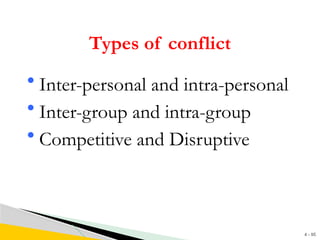
Typesof conflict
• Inter-personal and intra-personal
• Inter-group and intra-group
• Competitive and Disruptive
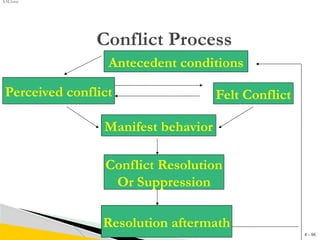
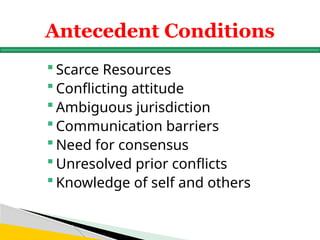
Scarce Resources
Conflicting attitude
Ambiguous jurisdiction
Communication barriers
Need for consensus
Unresolved prior conflicts
Knowledge of self and others
Antecedent Conditions
98.
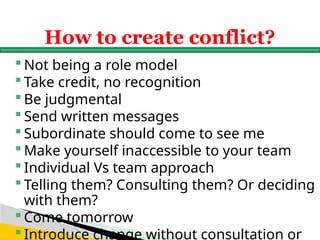
Not beinga role model
Take credit, no recognition
Be judgmental
Send written messages
Subordinate should come to see me
Make yourself inaccessible to your team
Individual Vs team approach
Telling them? Consulting them? Or deciding
with them?
Come tomorrow
Introduce change without consultation or
How to create conflict?
99.
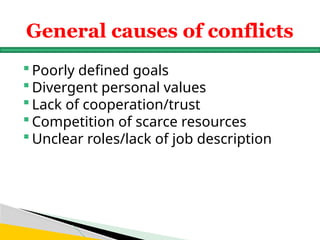
Poorly definedgoals
Divergent personal values
Lack of cooperation/trust
Competition of scarce resources
Unclear roles/lack of job description
General causes of conflicts
4 - 104
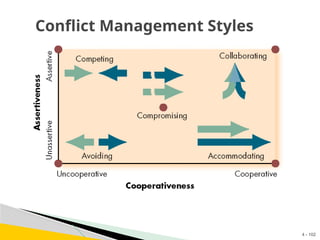
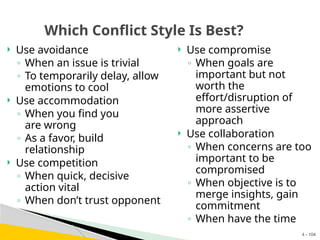
WhichConflict Style Is Best?
Use compromise
◦ When goals are
important but not
worth the
effort/disruption of
more assertive
approach
Use collaboration
◦ When concerns are too
important to be
compromised
◦ When objective is to
merge insights, gain
commitment
◦ When have the time
Use avoidance
◦ When an issue is trivial
◦ To temporarily delay, allow
emotions to cool
Use accommodation
◦ When you find you
are wrong
◦ As a favor, build
relationship
Use competition
◦ When quick, decisive
action vital
◦ When don’t trust opponent
105.
4 - 105
ConflictManagement
Techniques
Focus on compromising,
collaborating styles
Focus on (superordinate)
shared goals requiring
cooperation
Use communication skills
Use problem solving/
decision-making skills
Expansion of resources
Smoothing
Altering human variable
Altering structural variables
Bringing in outsiders
Restructuring the
organization
Appointing a devil’s
advocate
Authoritative command
106.
S.M.Israr
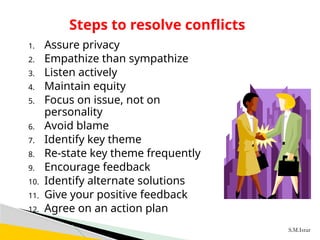
Steps to resolveconflicts
1. Assure privacy
2. Empathize than sympathize
3. Listen actively
4. Maintain equity
5. Focus on issue, not on
personality
6. Avoid blame
7. Identify key theme
8. Re-state key theme frequently
9. Encourage feedback
10. Identify alternate solutions
11. Give your positive feedback
12. Agree on an action plan
107.
S.M.Israr
How to preventconflicts
Frequent meeting of your team
Allow your team to express openly
Sharing objectives
Having a clear and detailed job description
Distributing task fairly
Never criticize team members publicly
Always be fair and just with your team
Being a role model
108.
S.M.Israr
Conclusion
Conflict isunavoidable
Complexity of organizational relationship
Interaction among workers
Dependence of workers on one another
S.M.Israr
Conclusion (Cont’d)
Poorlymanaged conflicts
◦ Unfavorable with counter productive
results
◦ Problems and negative attitude
Well managed conflicts
◦ Stimulate competition
◦ Identify legitimate differences
◦ Powerful source of motivation
111.
What is negotiation?
Negotiationtakes place when two or more
people, with differing views, come together to
attempt to reach agreement on an issue. It is
persuasive communication or bargaining.
“Negotiation is about getting the best possible deal
in the best possible way.”
112.
Types of negotiation
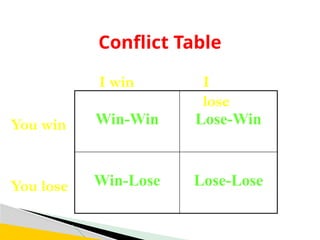
Distributive (win-lose)
Integrative (win-win)
Benefits of win-win
113.
What have younegotiated?
What have you successfully negotiated ?
What factors helped enable your success?
114.
Planning to negotiate
Establish your objectives
Establish other party’s objectives
Frame negotiation as a joint search for a
solution
Identify areas of agreement
Trouble shoot disagreements: bargain & seek
alternative solutions, introduce trade offs
Agreement and close: summarise and ensure
acceptance
115.
How to influenceothers
The three ‘Ps’:
◦ Position (power?)
◦ Perspective (empathy)
◦ Problems (solutions)
116.
Factors for success
◦Legitimacy of your case
◦ Confidence in presenting it
◦ Courtesy to the other party
◦ Adaptation to the other party’s style
◦ Rapport
◦ Incentives and trade offs
◦ Research the bigger picture
4 - 118
Man is constantly interacting with other
individuals.
People in organizations typically spend over 75%
of their time in an interpersonal situation.
Effective communication is an essential component
of organizational success whether it is at
interpersonal, intergroup, organizational or external
levels.
Introduction
1
119.
4 - 119
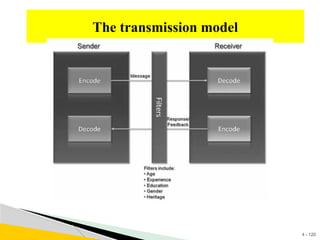
Most people come up with sentence
“Communication is the act or transmitting and
receiving information”.
This come from the reason we tend to think
communication is a technical process.
The transmission model
1
4 - 121
The transmission model assumes that the
communication is always intentional: that the
sender always communicates for a purpose, and
always knows that the purpose is.
We communicate a great deal without meaning to,
through body language, eye movement, and tone of
voice.
Problems with the transmission model
1
122.
4 - 122
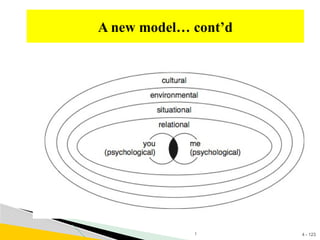
The new model suggests three important principles:
1) Communication is continuous
2) Communication is complicated
3) Communication is contextual
The meaning of communication is affected by at least
five different contests:
a) Psychological
b) Relational
c) Situational
d) Environmental
e) Cultural
A new model of communication
1
4 - 124
Communication drives from Latin word communis,
meaning ‘common’, ‘shared.’
Communication is the process of creating shared
understanding.
Communication is the process by which meanings
are exchanged between people the use of common
set of symbols (i.e. usually language).
The transmission model
1
125.
4 - 125
People are always communicating.
We communicate to: share our ideas and opinions, provide
feedback to others, get information from others, gain power
and influence, develop social relationships, obtain results
and maintain self-expression and our culture.
Organizational benefits of effective communications are
increase productivity, anticipate problems, make decisions,
coordinate workflow, supervise others, develop
relationships and better understanding in the workplace in
general.
Why Communication?
1
126.
4 - 126
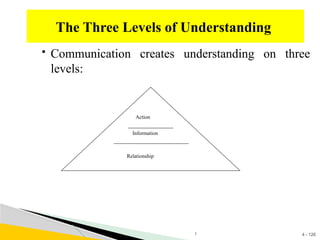
Communication creates understanding on three
levels:
The Three Levels of Understanding
1
Action
Information
Relationship
127.
4 - 127
It is the most important reason for communication.
It helps to create personal and social bonding.
The first task in any conversation is to create
rapport.
Building rapport is a pattern-matching process.
We create rapport through:
a) verbal behavior;
b) Vocal behavior; and
c) Physical behavior
Relationship
1
128.
4 - 128
Once we created a relaxed relationship, we are
ready to share information.
Information is the shape of our thinking.
We create information inside our heads.
Creating information means displaying it in a form
that the other person can recognize.
Information is dynamic.
Information
1
129.
4 - 129
The days of simply telling people what to do and
expecting them to do it are long gone.
Persuasion is the ability to sell your ideas.
The key to effective persuasion is having powerful
ideas and delivering them well.
Information alone will never influence anyone to act.
Persuasion consists of three appeals using the skills of
the persuader themselves:
1. Appealing to their (audience ability) reasons
2. Appealing to the audience’s sense of your character or
reputation
3. Appealing to their emotions/feelings
The Skills of Persuasion
1
130.
4 - 130
The process of working out how to persuade them
consists of five elements:
1. Identifying the core idea
2. Arranging your ideas logically
3. Developing an appropriate style in the language
you use
4. Remembering your ideas
5. Delivering your ideas with words, visual cues and
non-verbal behavior
The Skills of Persuasion … cont’d
1
131.
4 - 131
There are four different styles of communicating:
1. Passive
2. Aggressive
3. Passive-Aggressive
4. Assertive
Communication Styles
1
132.
4 - 132
It is characterized by a low-energy level.
The body posture may include lowered eyelids and
little or no eye contact.
Normally, the passive person may respond to your
questions “ I don’t know (sigh),” “ I will do
whatever you want to do”, “ It doesn’t matter.”
Passive
1
133.
4 - 133
Examplesof passive behavior include:
Deliberately avoiding disagreements
Backing down when faced with aggressive behaviour
Putting up with situations which annoy or frustrate you
when you could, in fact, do something about it
Saying ‘yes’ when you really want to say ‘no’
Not being honest about how you feel, and not asking
for what you want increase other get angry or upset, or
think badly of you
Ignoring your own needs and wishes
Always putting other people first
Putting yourself down by making unnecessarily
apologies
Passive… cont’d
1
134.
4 - 134
Theconsequences of your passive behavior:
Health problems, such as depression, low back
pain, digestive problems, insomnia
Feeling of anger, frustration and self-pity
A downward spiral of low confidence and low self
esteem
Loss of respect
Breakdown of work relationships as people realize
that they are able to take advantage of you and then
feel guilty
Passive… cont’d
1
135.
4 - 135
It is characterized by a high output of energy.
The body posture may have an overbearing quality
to it.
This person my physically lean into the
conversation.
A loud tone of voice, and direct, glaring eye contact
may season your conversation.
Aggressive person may interrupt and often will not
ask for your ideas or opinions.
Aggressive
1
136.
4 - 136
Examplesof aggressive behavior include:
Putting your own need first, every time
Getting your own way, no matter what you have to
achieve your objective
Making it very difficult for other people to hold a
different opinion
Using verbal or physical intimidation such
shouting, swearing, staring, throwing papers
around, slamming doors.
Taking advantage of people who are behaving non
assertively
Manipulating people to get your own way.
Aggressive… cont’d
1
137.
4 - 137
TheConsequences of aggressive behavior:
Health problems such as ulcers, hypertension,
migraine, exhaustion.
Feelings of guild or regret
Loss of trust and respect
Isolation from colleagues and friends
Aggressive… cont’d
1
138.
4 - 138
It is characterized by indirectness.
It is a very destructive communication style and it
is often hart to identify.
One indicator is sarcasm, which often leaves you
confused about which was the real message.
Passive-Aggressive
1
139.
4 - 139
It is characterized by a direct, straightforward
approach to others.
To body stance is strong and flexible.
It includes eye contact and a confident tone of
voice.
An assertive person is aware that a workable
compromise or a win-win solution will be the best
result for both in the long run.
Assertive
1
140.
4 - 140
Examplesof assertive behavior:
Communicating your needs, wishes, feelings and opinions calmly,
clearly, directly, honestly, and factually.
Recognizing that every one (this means you and the rest
of the world too) has the right to hold their own views
and opinions
Recognizing that other people may operate in a
different way to you and allowing them to work in their
own way, at their own pace
Listening carefully to other people may operate in a
different way to your, and allowing them to work in their
own way, at their own pace.
Listening carefully to other people, even when you
disagree
Saying’ no’ when you choose to
Wanting to reach a workable solution and accepting
Assertive…
1
141.
4 - 141
Rewardsof assertive behavior:
Fewer stress-related health problems
Improved self confidence, self-esteem and self
respect
Increased respect from others
Improved work relationship as people being to gain
confidence in you honesty and openness
Realize that you say what you mean and mean
what you say
Recognize that you are a safe pair of hand
Know where they stand
Fill free to make suggestion and offer up creative
ideas
Assertive…
1
142.
4 - 142
Tipsof developing assertiveness
Here are some communication techniques that can
help you convey a positive assertive attitude:
Use suitable facial expressions, always maintaining
good eye contact.
Keep your voice firm but pleasant.
Pay careful attention to your posture and gestures.
Listen and let people know you have heard what
they said.
Ask questions for clarification.
Look for a win-win approach to problem solving.
Assertive…
1
143.
Barriers to Communication
1.Physical barriers
2. Cultural barriers
3. Experiential barriers
4. Motivational barriers
5. Emotional barriers
6. Linguistic barriers
7. Nonverbal barriers
8. Completion barriers
143
144.
7C’s and 4S’sfor Communication
The 7C’s:
1. Credibility … Build trust
2. Courtesy … Improves relationships
3. Clarity … makes comprehension easier
4. Correctness … Builds confidence
5. Consistency … Introduces stability
6. Concreteness … Reinforces confidence
7. Conciseness … Saves time
144
145.
7C’s and 4S’sfor Communication
The 4S’s:
1. Shortness … Economizes
2. Simplicity …Impresses
3. Strength … Convinces
4. Sincerity … Appeals
145
146.
3. Types ofCommunication
Basic Types of Communication based on:
1. Functions: Internal and External
2. Side: One way and two way
3. Scope: intrapersonal, interpersonal, group and
mass
4. Form: Oral/face to face and Written
5. Form: Verbal and non-verbal
6. Formality: Downward, upward, horizontal,
and cross-channel/Diagonal
146
147.
Verbal Communication
Thereare various skills in verbal communication
including which includes:
1. Writing
2. Conversation
3. Giving positive feedback
4. Listening
147
148.
Verbal Communication …
1.Writing
There are five stages of efficient writings
composition:
a. Gather information
b. Organizing thought
c. Focus the message
d. Draft the document
e. Edit the document
148
Verbal Communication…
The sevenproven strategies to improve your
conversation are:
1. Clarify your objectives
2. Structure your thinking
3. Manage your time
4. Find common ground
5. Move beyond argument
6. Summarize often
7. Use visuals
150
151.
Verbal Communication…
3. GivingPositive Feedback
There are two kinds of feedback:
a. Positive feedback
b. Negative feedback
Feedback on ideas and information rather than on
the person.
151
152.
Verbal Communication…
4. Listeningin Communication
Hearing Vs Listening
Hearing: An automatic process in which sound waves
stimulate nerve impulses to the brain
Listening: a voluntary process that goes beyond simply
reacting to sounds and includes understanding,
analyzing, evaluating, and responding.
Listening requires concentration and entails
synthesizing new information with what was
already known.
152
153.
Verbal Communication…
4. Listeningin Communication
Know your listening style:
There are four types of listening: for
information, enjoyment, evaluation and feeling
The following are some of the listening styles
of individuals:
a. Appreciative listening
b. Emphatic listening
c. Discriminative listening
d. Analytical listening
153
154.
Verbal Communication…
4. Listeningin Communication
Factors that affect interactive listening:
Speakers’ communication style
Emotional distraction
Message content
154
155.
Verbal Communication…
4. Listeningin Communication
Improving Listening Skills
Find areas of interest
Judge content, not delivery
Hold your fire
Listen for ideas
Be flexible
Work at listening
Resist destructions
Exercise your mind
Keep your mind open
Capitalize on thought speed.
155
156.
Non Verbal Communication
According to management expert Peter Drucker, “the
most important thing in communication is to hear what
isn’t being said”.
A non-verbal message is that is not written or spoken.
The nonverbal message may accompany verbal
message (smiling as you great the colleague) or it may
occur alone (selecting the back seat when entering the
conference room).
Nonverbal messages are typically more spontaneous
than verbal messages, but don’t mean that they are less
important.
156
157.
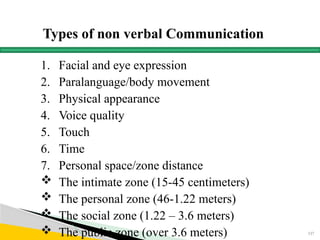
Types of nonverbal Communication
1. Facial and eye expression
2. Paralanguage/body movement
3. Physical appearance
4. Voice quality
5. Touch
6. Time
7. Personal space/zone distance
The intimate zone (15-45 centimeters)
The personal zone (46-1.22 meters)
The social zone (1.22 – 3.6 meters)
The public zone (over 3.6 meters) 157
158.
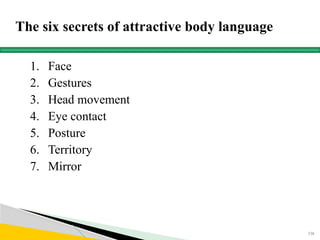
The six secretsof attractive body language
1. Face
2. Gestures
3. Head movement
4. Eye contact
5. Posture
6. Territory
7. Mirror
158
159.
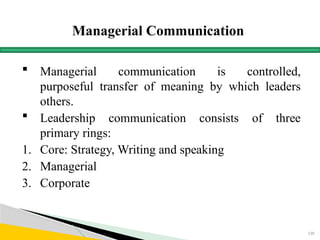
Managerial Communication
Managerialcommunication is controlled,
purposeful transfer of meaning by which leaders
others.
Leadership communication consists of three
primary rings:
1. Core: Strategy, Writing and speaking
2. Managerial
3. Corporate
159
160.
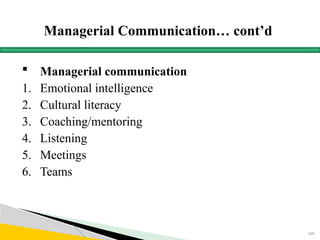
Managerial Communication… cont’d
Managerial communication
1. Emotional intelligence
2. Cultural literacy
3. Coaching/mentoring
4. Listening
5. Meetings
6. Teams
160
161.
Managerial Communication… cont’d
Corporate communication
1. Employee relations
2. Change communication
3. Media relations
4. Crisis communication
5. Image/reputation management
161
መሃላ
Oath
I promise toapply the skill, knowledge
and attitude I got from this training to
realize my personal, organization and
Ethiopian vision. (Three times)
ከስልጠናው ያገኘሁትን ዕውቀት፣ ክህሎት እና
አመለካከት የራሴን፣ የተቋሜንና የኢትዮጵያን ራዕይ
ለማሳከት ተግባር ላይ ለማዋል ቃል እገባለሁ! (ሦስተ
ጊዜ)
4- 164