







Making evidence accessible to clinicians Dr Charles Young Editor,  BMJ Clinical Evidence
Why bother? Canadian observational study of  BMJ Clinical Evidence  integrated into a computerised physician order entry system  Antibiotic use before and after integration (334 children; 2 weeks – 2 years) Children receiving antibiotics fell from 35% - 22% (P=0.016) Readily accessible clinical evidence at the point of care associated with a significant reduction in antibiotic use. King WJ ,  Le  Saux  N ,  Sampson M ,  Gaboury  I ,  Norris M ,  Moher  D .  Effect of point of care information on inpatient management of bronchiolitis.   BMC Pediatrics  2007. Jan 24 7
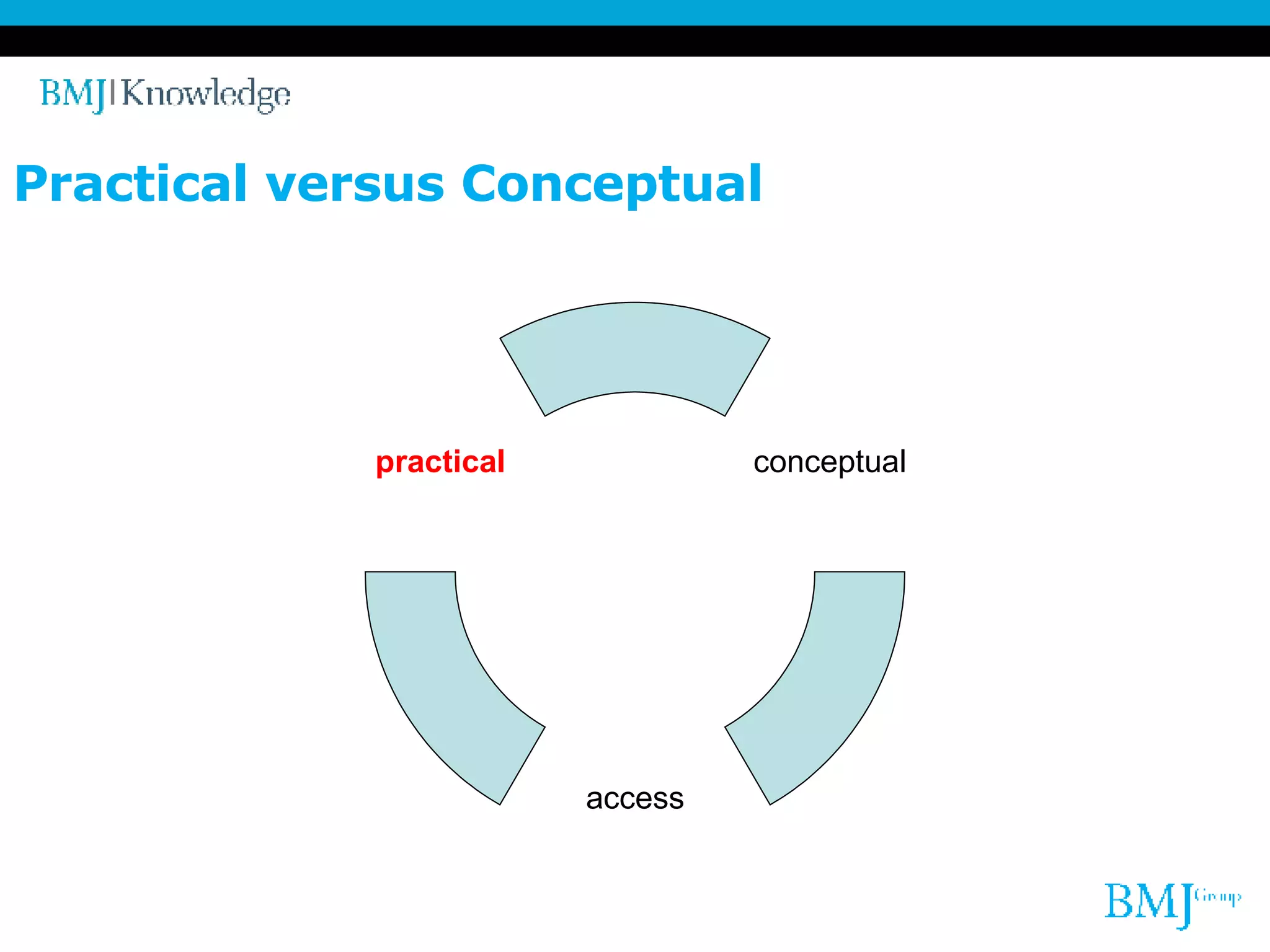
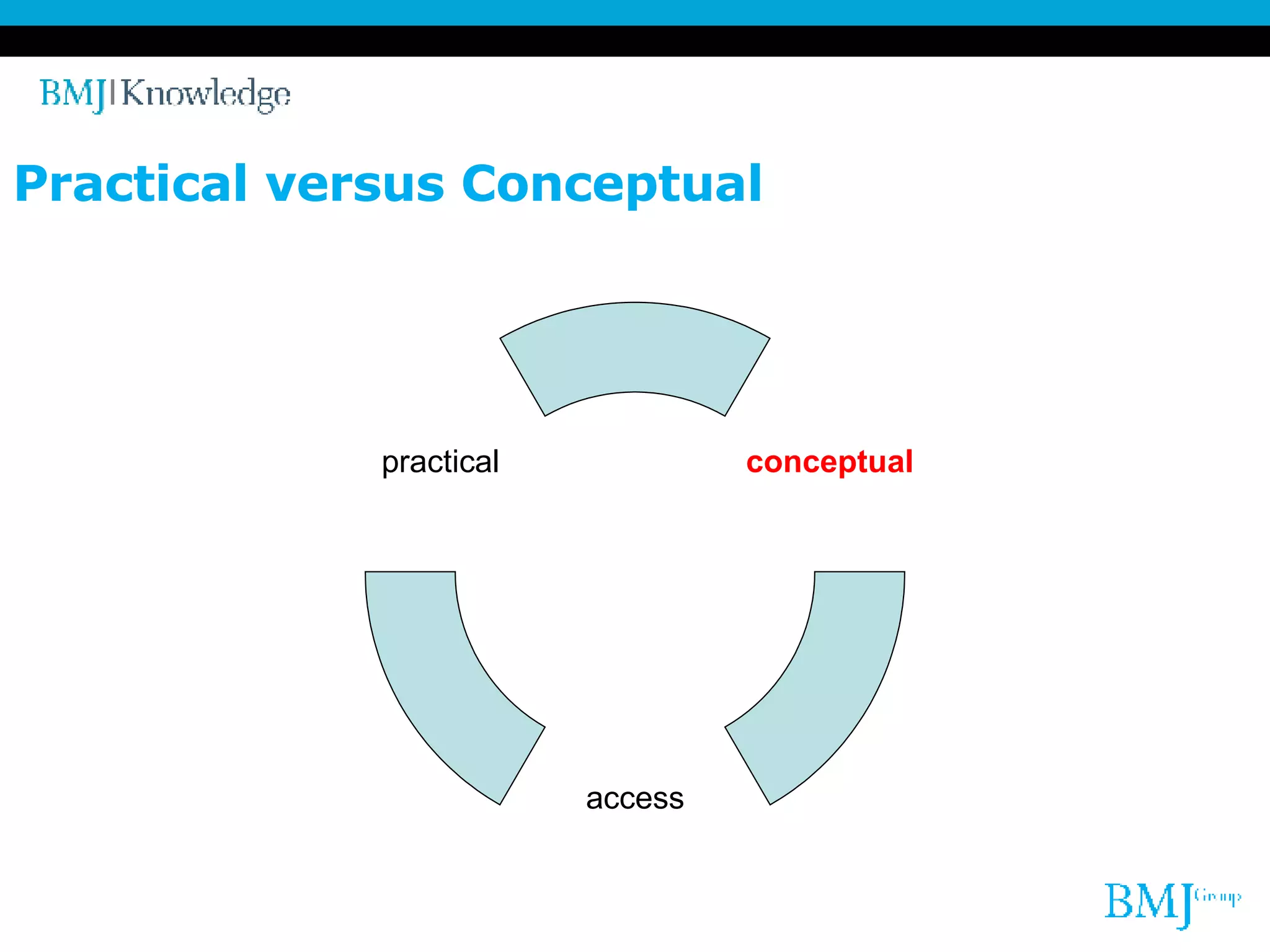
Practical versus Conceptual conceptual access practical
Progress
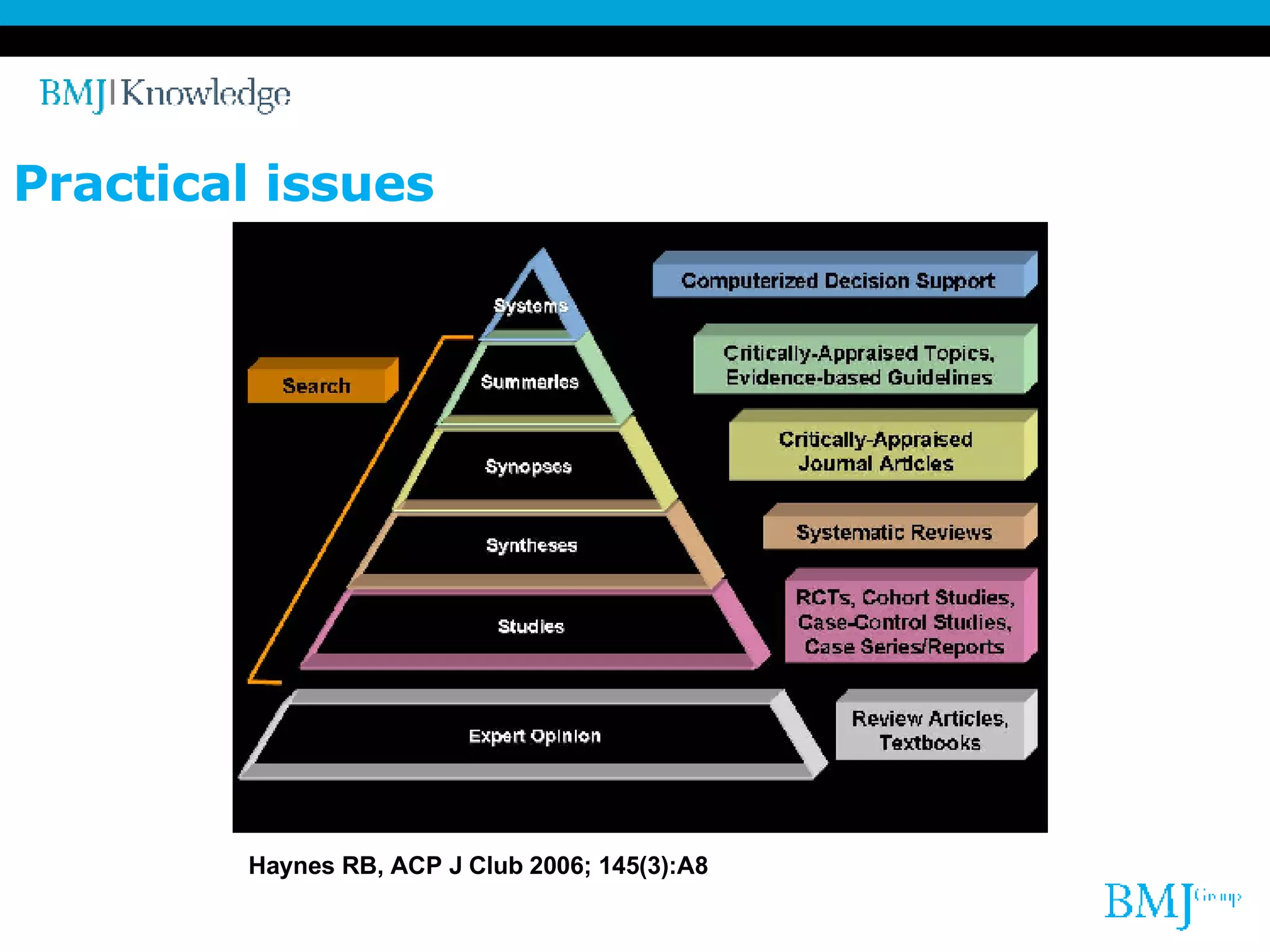
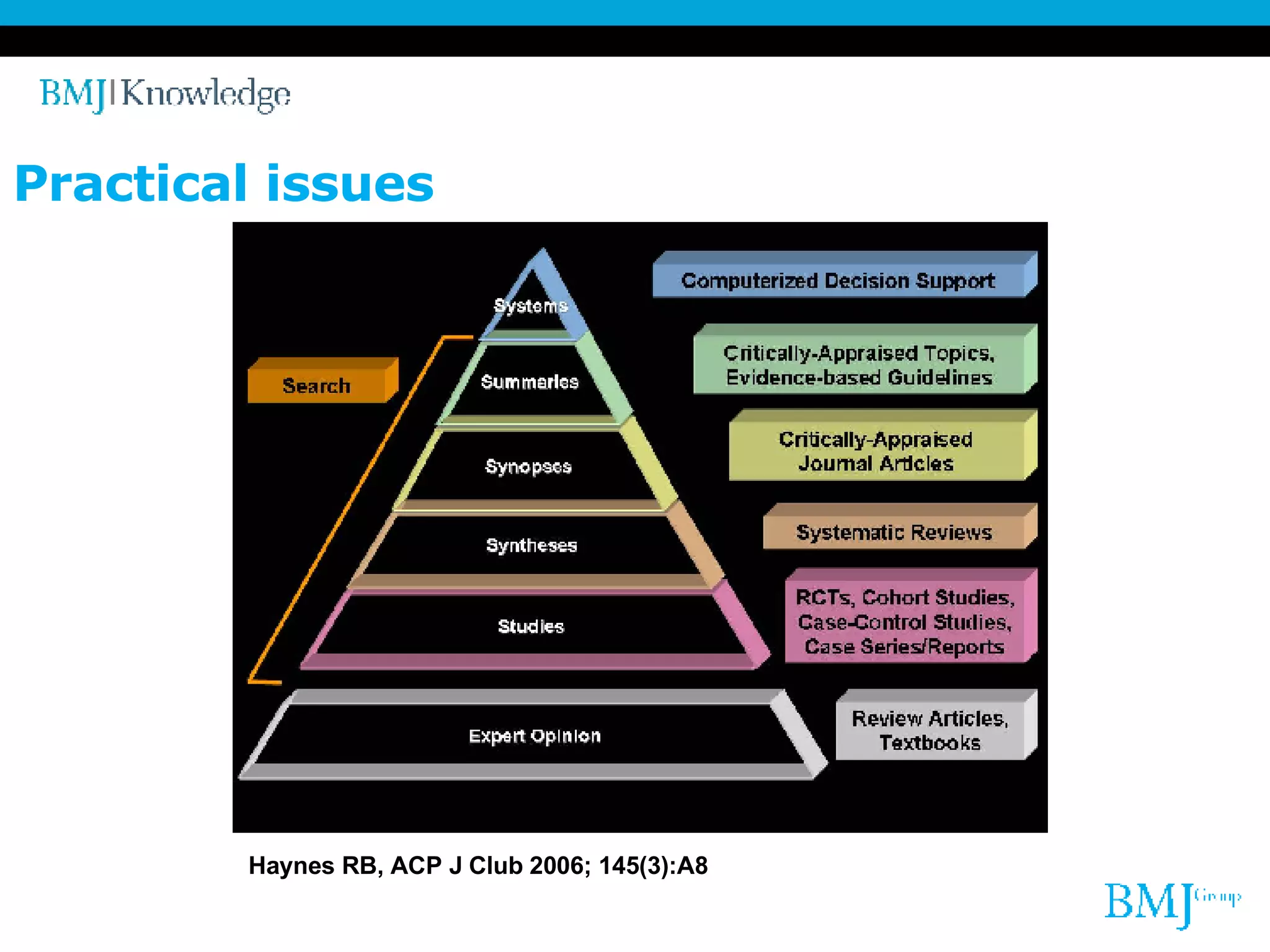
Practical issues Haynes RB, ACP J Club 2006; 145(3):A8
Why publish the full paper? “most readers of medical journals don't read the original articles. They may scan the abstract, but it's the rarest of beasts who reads an article from beginning to end, critically appraising it as he or she goes.” Smith R. BMJ  2004;328 (19 June), doi:10.1136/bmj.328.7454.0-h
But…… “Significant results in abstracts are common but should generally be disbelieved. “ Gøtzsche P C. BMJ  2006;333:231-234 (29 July), doi:10.1136/bmj.38895.410451.79
Progress
Practical issues Haynes RB, ACP J Club 2006; 145(3):A8
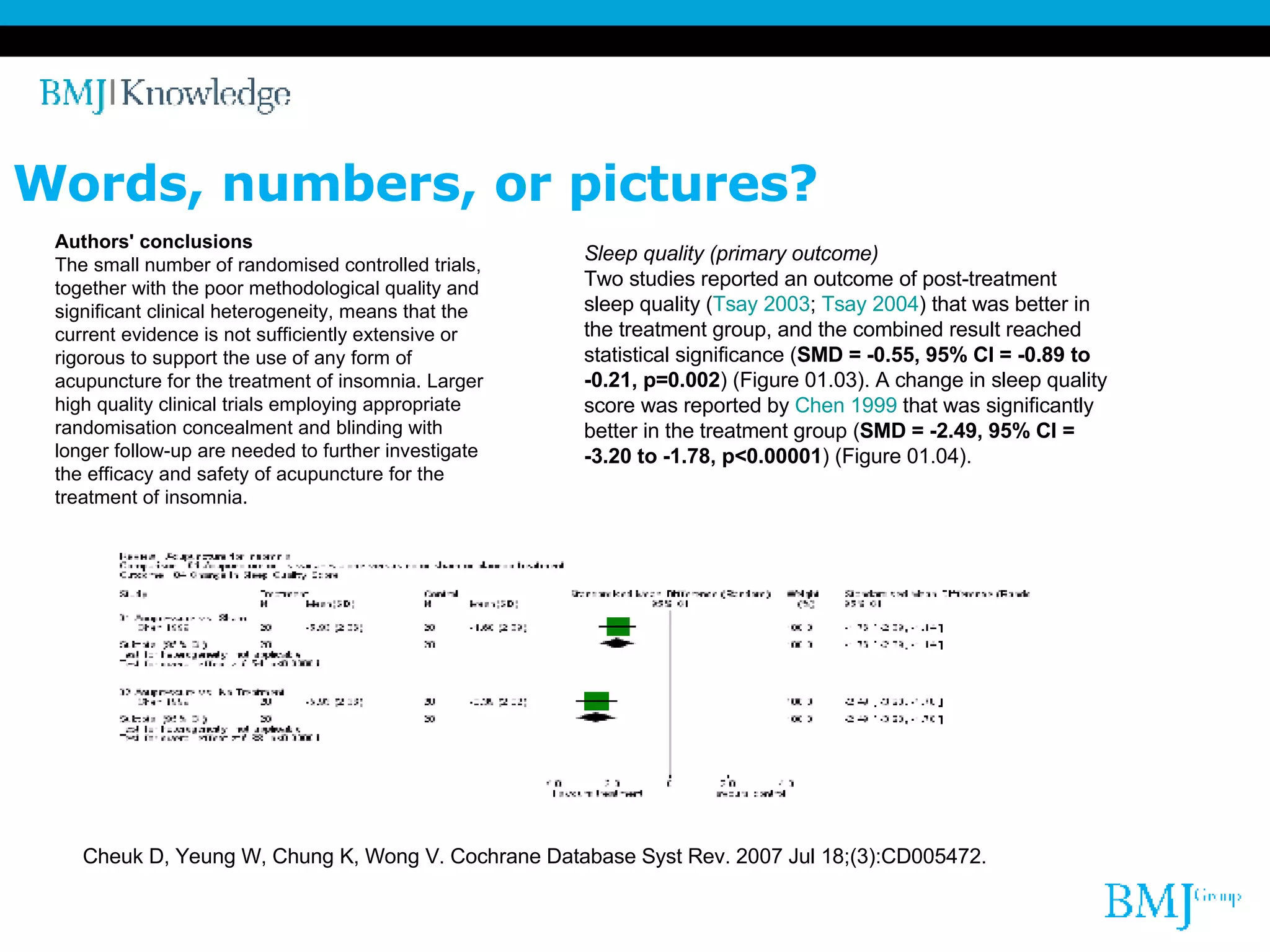
Words, numbers, or pictures? Authors' conclusions The small number of randomised controlled trials, together with the poor methodological quality and significant clinical heterogeneity, means that the current evidence is not sufficiently extensive or rigorous to support the use of any form of acupuncture for the treatment of insomnia. Larger high quality clinical trials employing appropriate randomisation concealment and blinding with longer follow-up are needed to further investigate the efficacy and safety of acupuncture for the treatment of insomnia. Sleep quality (primary outcome) Two studies reported an outcome of post-treatment sleep quality ( Tsay  2003 ;  Tsay  2004 ) that was better in the treatment group, and the combined result reached statistical significance ( SMD = -0.55, 95% CI = -0.89 to -0.21, p=0.002 ) (Figure 01.03). A change in sleep quality score was reported by  Chen 1999  that was significantly better in the treatment group ( SMD = -2.49, 95% CI = -3.20 to -1.78, p<0.00001 ) (Figure 01.04). Cheuk D, Yeung W, Chung K, Wong V. Cochrane Database Syst Rev. 2007 Jul 18;(3):CD005472.
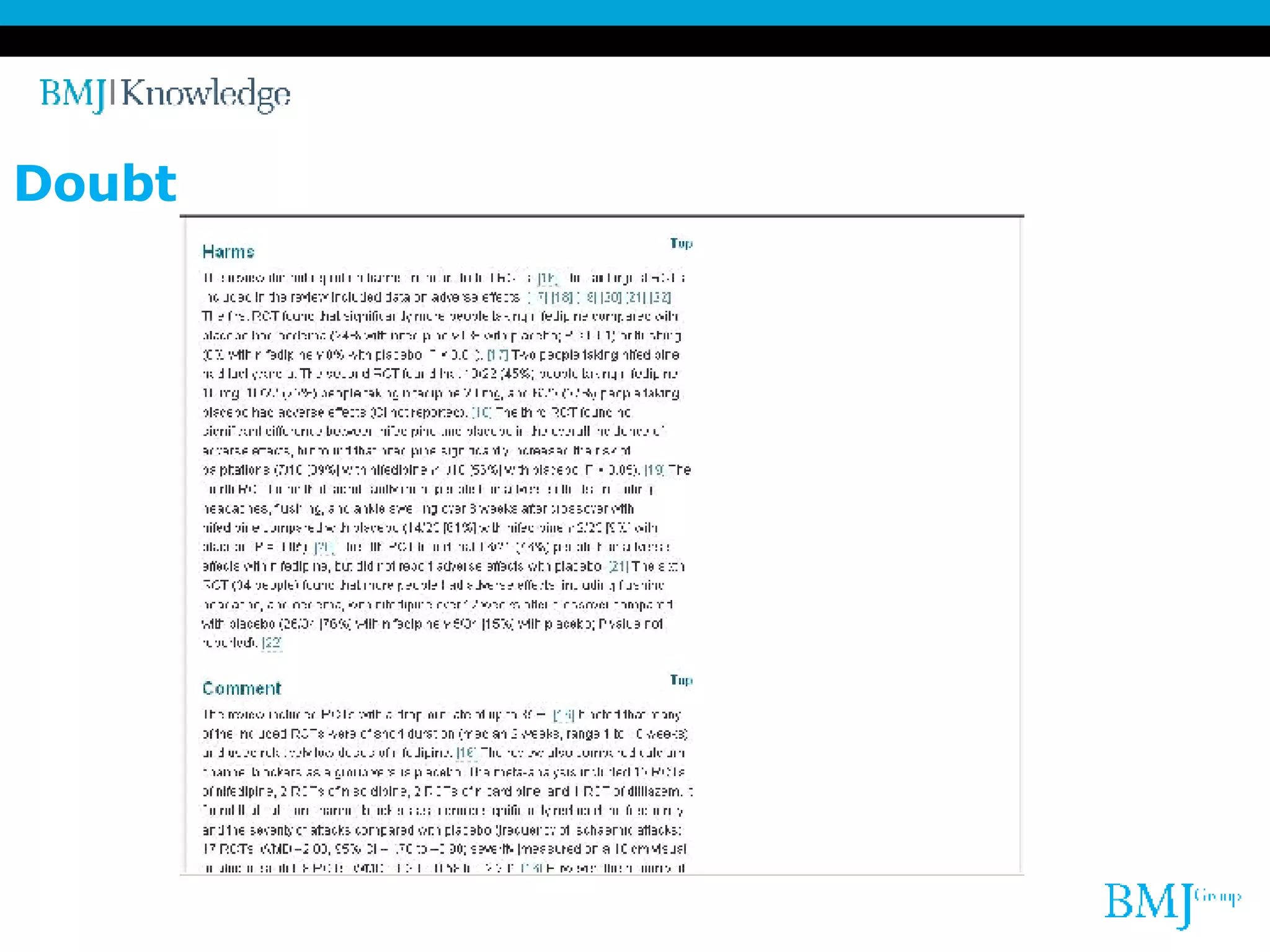
Doubt
Doubt
Doubt
Doubt
Doubt
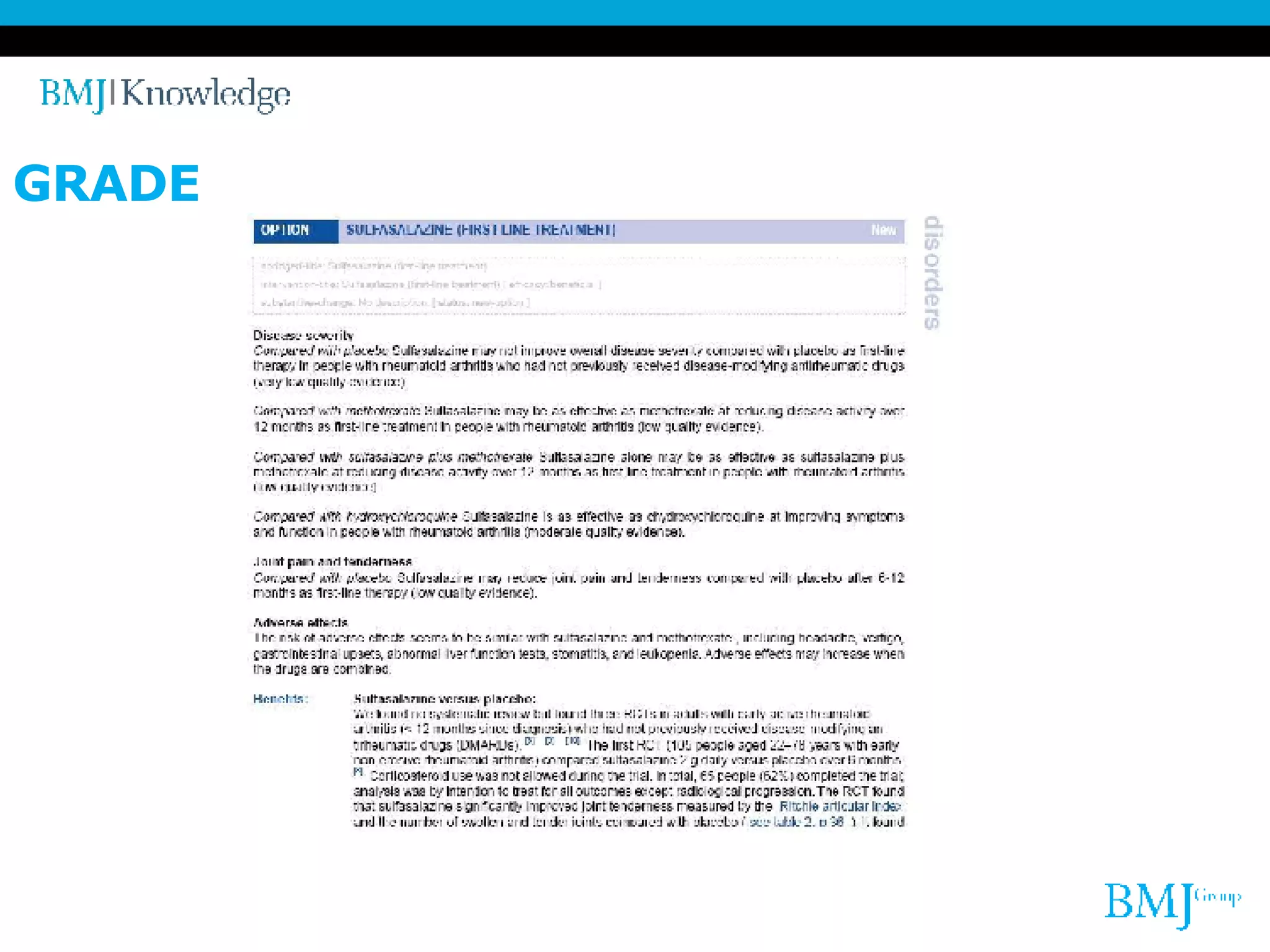
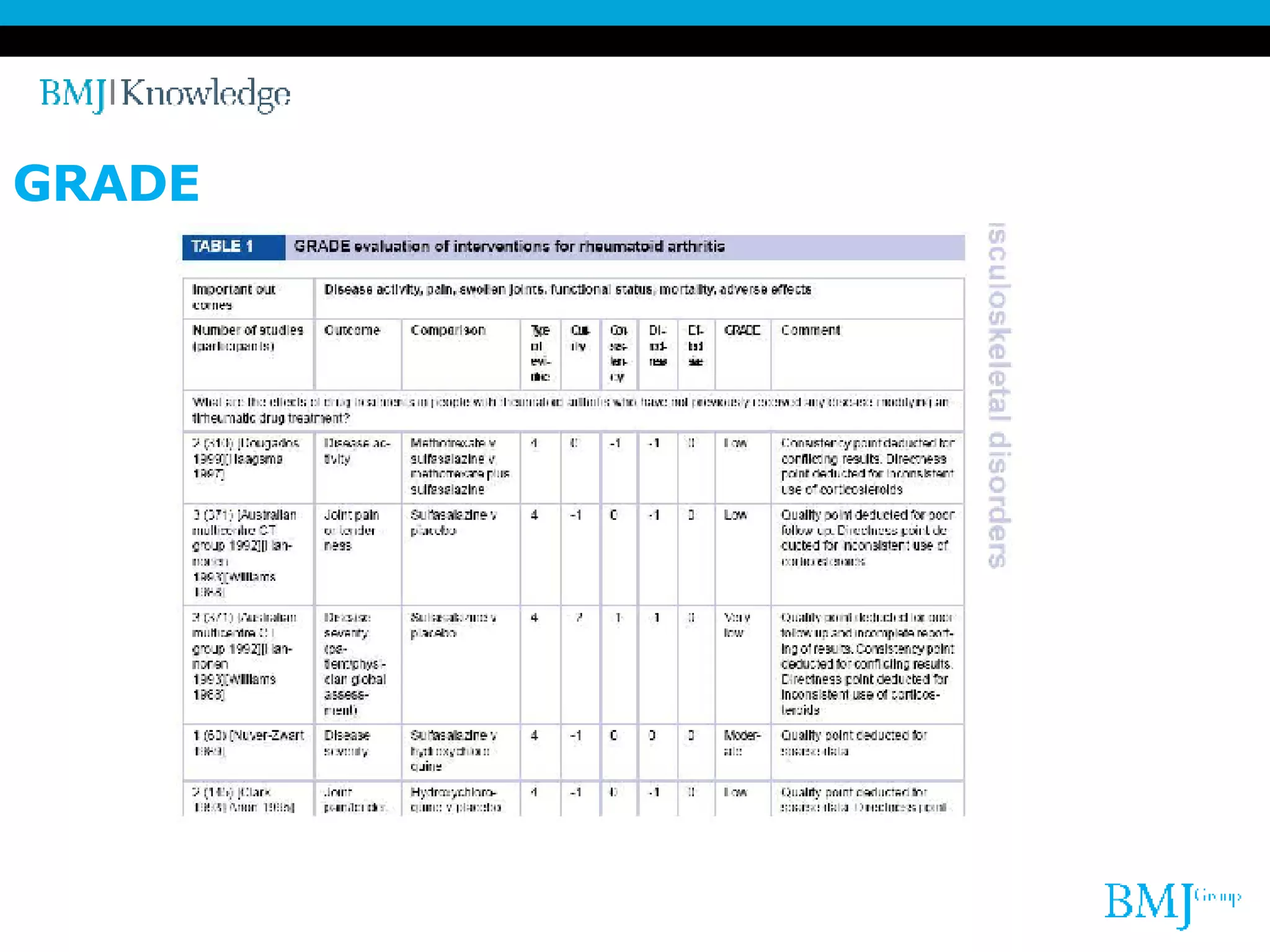
GRADE - categories High-quality evidence Moderate-quality evidence Low-quality evidence Very low-quality evidence
GRADE - components Type of study: RCT or not? Quality: sparse data, methodology Consistency: do all studies agree? Directness: are results generaliseable? Effect size: does it make a big difference to outcomes?
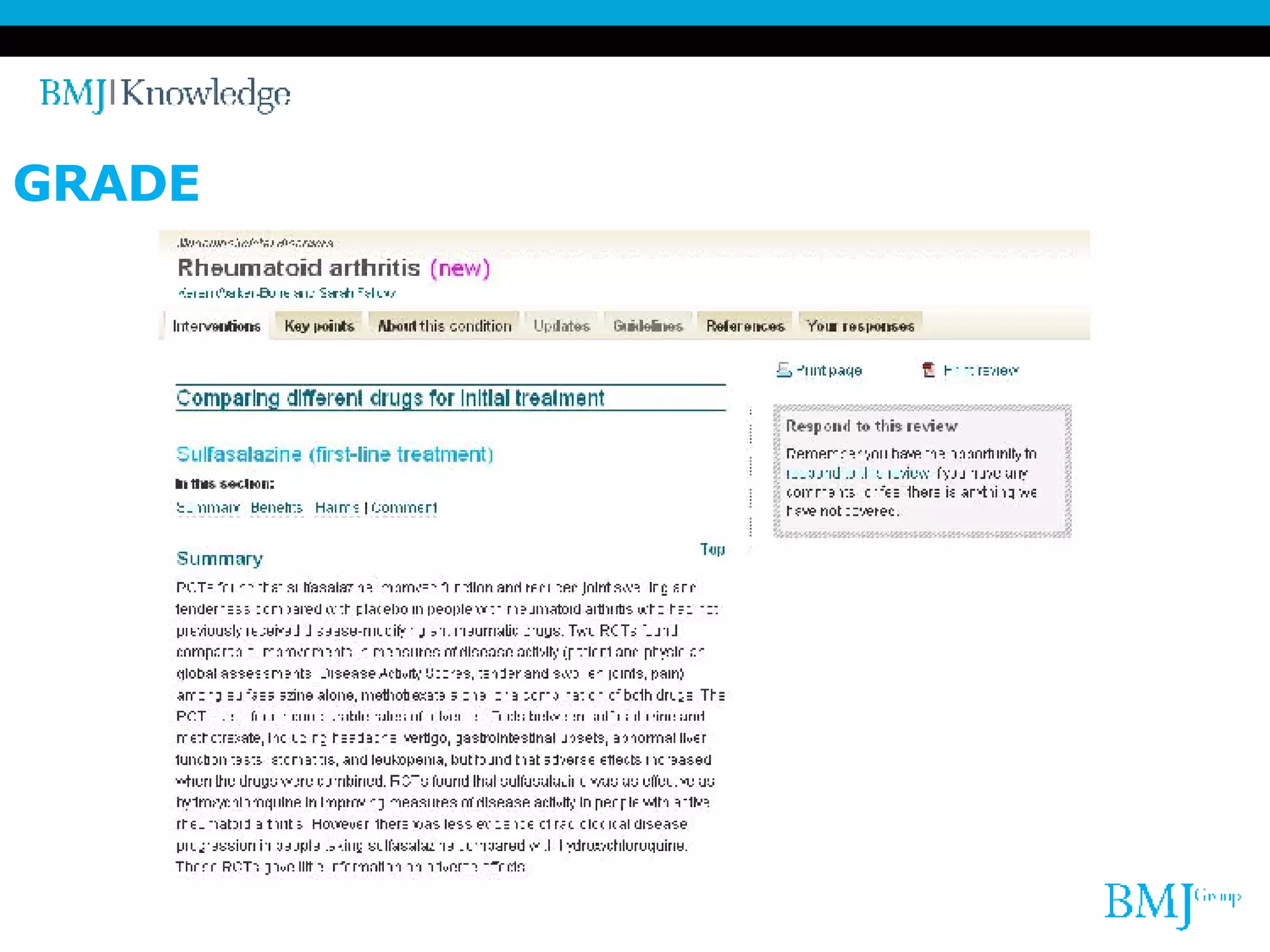
GRADE
GRADE
GRADE
Updating What does updating mean to us and our users? How do update schedules fit into clinical practice? Do we really have to recreate the entire review each time?
St Thomas’ Hospital ED
St Thomas’ ED
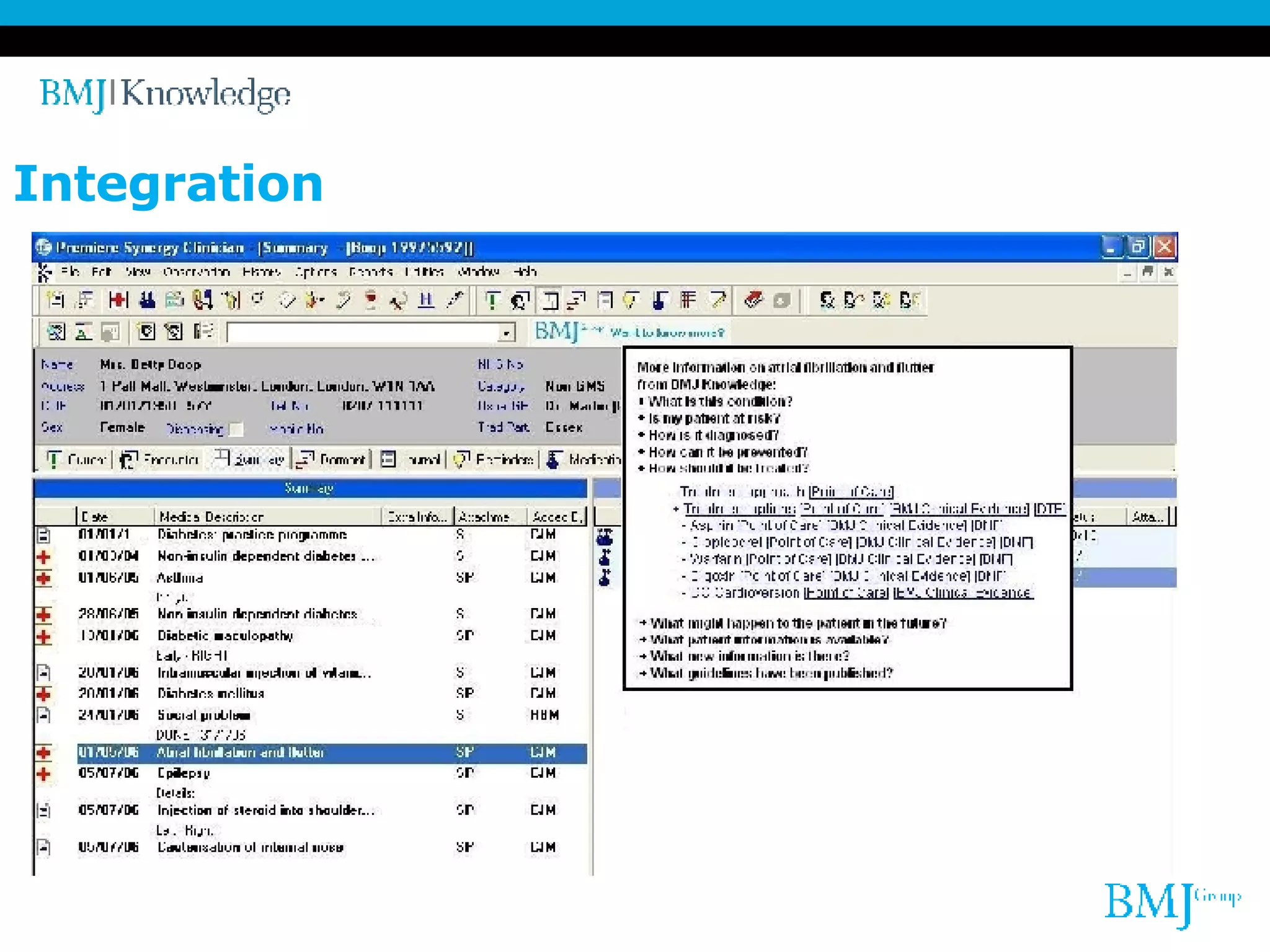
Integration
Integration
Practical versus Conceptual conceptual access practical
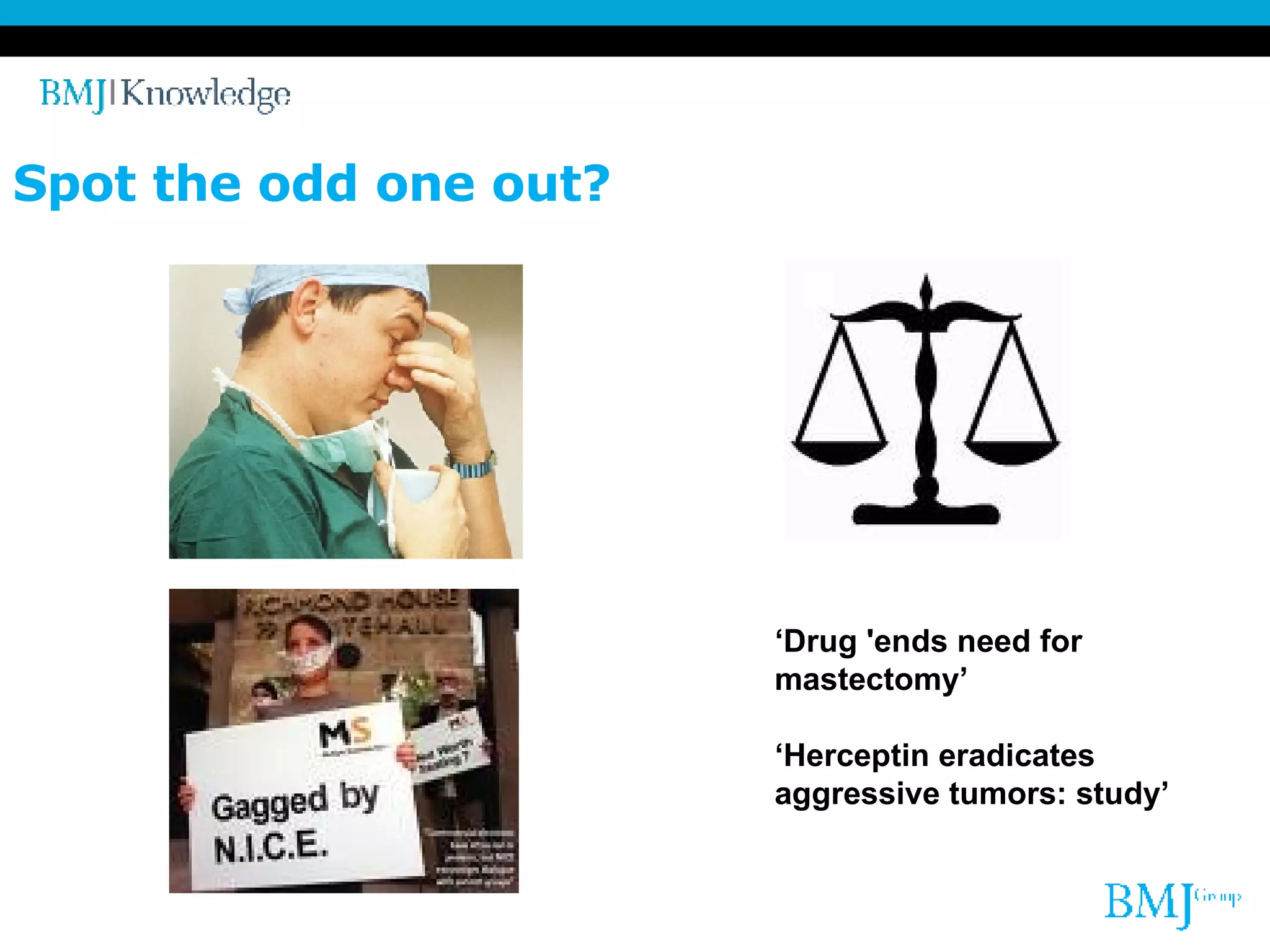
Spot the odd one out? ‘ Drug 'ends need for mastectomy’ ‘ Herceptin eradicates aggressive tumors: study’
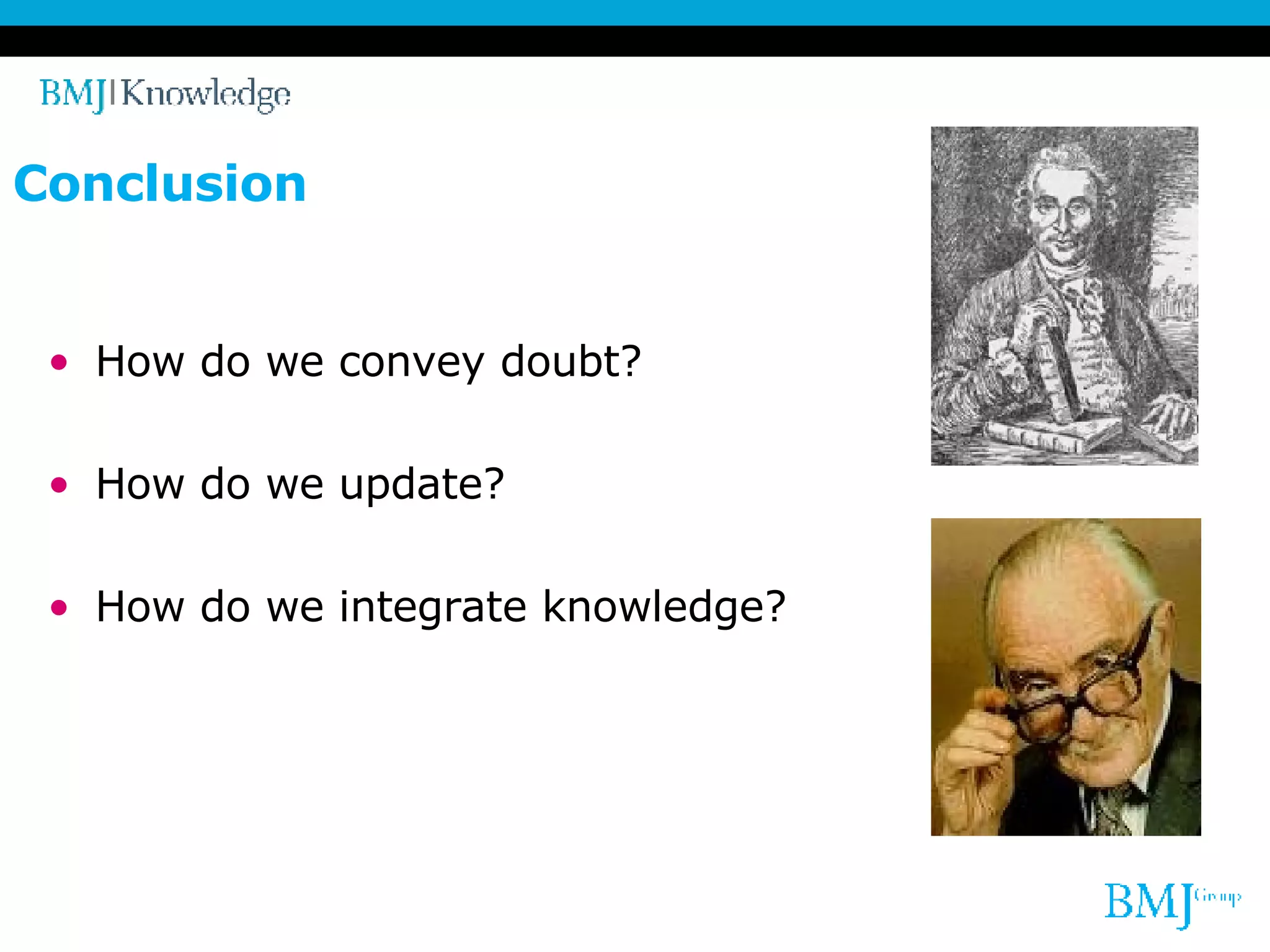
Conclusion How do we convey doubt? How do we update? How do we integrate knowledge?

Making evidence accessible to clinicians

  • 1.
    Making evidence accessibleto clinicians Dr Charles Young Editor, BMJ Clinical Evidence
  • 2.
    Why bother? Canadianobservational study of BMJ Clinical Evidence integrated into a computerised physician order entry system Antibiotic use before and after integration (334 children; 2 weeks – 2 years) Children receiving antibiotics fell from 35% - 22% (P=0.016) Readily accessible clinical evidence at the point of care associated with a significant reduction in antibiotic use. King WJ , Le Saux N , Sampson M , Gaboury I , Norris M , Moher D . Effect of point of care information on inpatient management of bronchiolitis. BMC Pediatrics 2007. Jan 24 7
  • 3.
    Practical versus Conceptualconceptual access practical
  • 4.
  • 5.
    Practical issues HaynesRB, ACP J Club 2006; 145(3):A8
  • 6.
    Why publish thefull paper? “most readers of medical journals don't read the original articles. They may scan the abstract, but it's the rarest of beasts who reads an article from beginning to end, critically appraising it as he or she goes.” Smith R. BMJ  2004;328 (19 June), doi:10.1136/bmj.328.7454.0-h
  • 7.
    But…… “Significant resultsin abstracts are common but should generally be disbelieved. “ Gøtzsche P C. BMJ  2006;333:231-234 (29 July), doi:10.1136/bmj.38895.410451.79
  • 8.
  • 9.
    Practical issues HaynesRB, ACP J Club 2006; 145(3):A8
  • 10.
    Words, numbers, orpictures? Authors' conclusions The small number of randomised controlled trials, together with the poor methodological quality and significant clinical heterogeneity, means that the current evidence is not sufficiently extensive or rigorous to support the use of any form of acupuncture for the treatment of insomnia. Larger high quality clinical trials employing appropriate randomisation concealment and blinding with longer follow-up are needed to further investigate the efficacy and safety of acupuncture for the treatment of insomnia. Sleep quality (primary outcome) Two studies reported an outcome of post-treatment sleep quality ( Tsay 2003 ; Tsay 2004 ) that was better in the treatment group, and the combined result reached statistical significance ( SMD = -0.55, 95% CI = -0.89 to -0.21, p=0.002 ) (Figure 01.03). A change in sleep quality score was reported by Chen 1999 that was significantly better in the treatment group ( SMD = -2.49, 95% CI = -3.20 to -1.78, p<0.00001 ) (Figure 01.04). Cheuk D, Yeung W, Chung K, Wong V. Cochrane Database Syst Rev. 2007 Jul 18;(3):CD005472.
  • 11.
  • 12.
  • 13.
  • 14.
  • 15.
  • 16.
    GRADE - categoriesHigh-quality evidence Moderate-quality evidence Low-quality evidence Very low-quality evidence
  • 17.
    GRADE - componentsType of study: RCT or not? Quality: sparse data, methodology Consistency: do all studies agree? Directness: are results generaliseable? Effect size: does it make a big difference to outcomes?
  • 18.
  • 19.
  • 20.
  • 21.
    Updating What doesupdating mean to us and our users? How do update schedules fit into clinical practice? Do we really have to recreate the entire review each time?
  • 22.
  • 23.
  • 24.
  • 25.
  • 26.
    Practical versus Conceptualconceptual access practical
  • 27.
    Spot the oddone out? ‘ Drug 'ends need for mastectomy’ ‘ Herceptin eradicates aggressive tumors: study’
  • 28.
    Conclusion How dowe convey doubt? How do we update? How do we integrate knowledge?