EVIDENCE BASED HEALTHCARE
                   Aarti Sareen
                 M.S.P.T.(Honours)
Evidence-based history
• Evidence-based philosophies integrate a health
  professional’s experience and knowledge with the
  best currently available clinical evidence.

• It was introduced as EBM by ACP Journal Club in
  1991 and this editorial was the impetus for a a series
  called the Users’ Guides to the Medical Literature in
  order to help clinician decide how to incorporate
  these philosophies in to their daily practice.
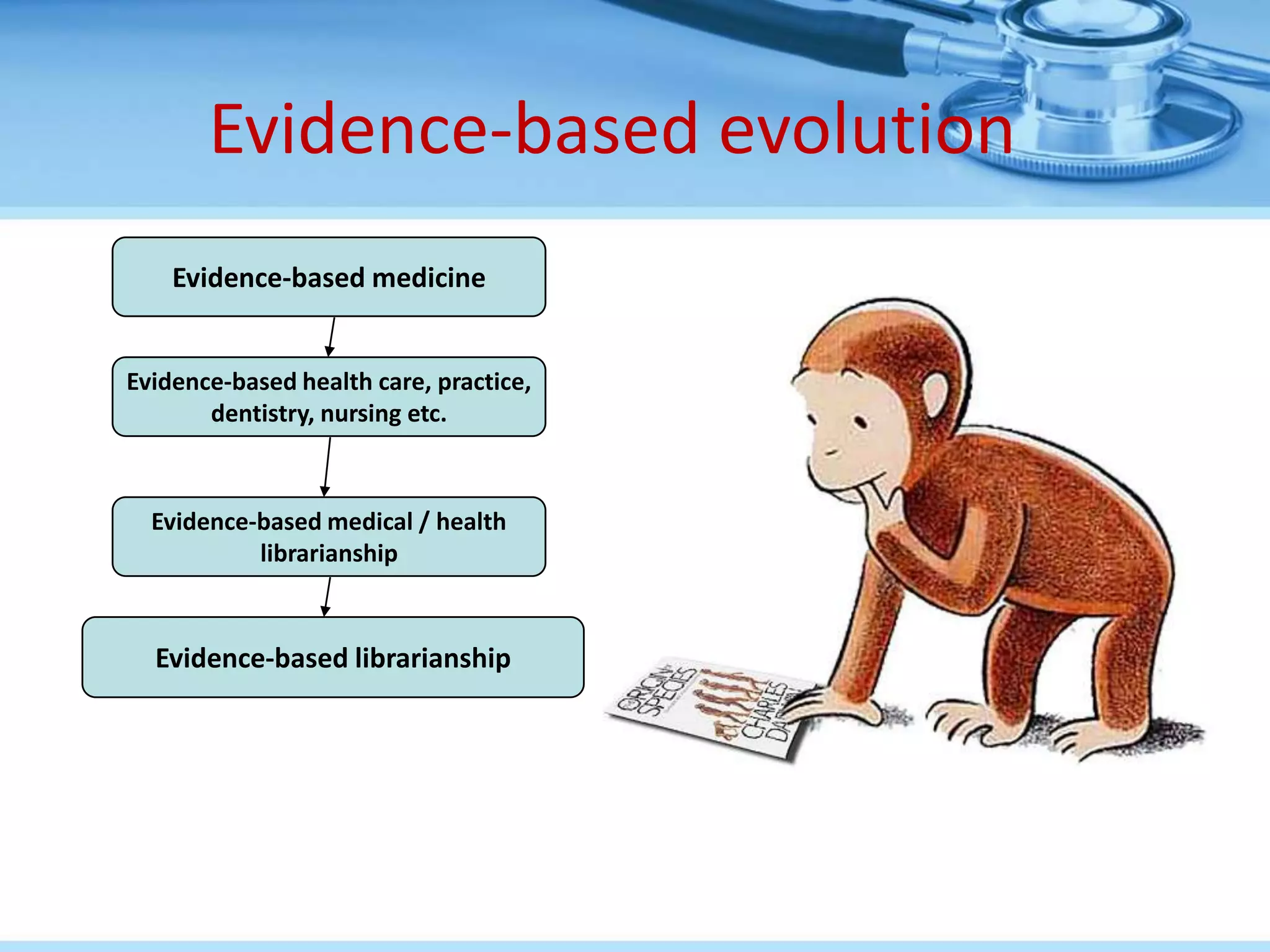
Evidence-based evolution
    Evidence-based medicine


Evidence-based health care, practice,
       dentistry, nursing etc.


  Evidence-based medical / health
           librarianship


  Evidence-based librarianship
Evidence based health care
• is the conscientious use of current best evidence in making
  decisions about the care of individual patients or the delivery
  of health services. Current best evidence is up-to-date
  information from relevant, valid research about the effects of
  different forms of health care, the potential for harm from
  exposure to particular agents, the accuracy of diagnostic tests,
  and the predictive power of prognostic factors


•   Cochrane AL. Effectiveness and Efficiency : Random Reflections on Health Services. London: Nuffield Provincial Hospitals
    Trust, 1972. Reprinted in 1989 in association with the BMJ. Reprinted in 1999 for Nuffield Trust by the Royal Society of
    Medicine Press, London, ISBN 1-85315-394-X.
Health care professionals
• a person who by education, training,
  certification, or licensure is qualified to and is
  engaged in providing health care.
Why to go for evidence based
        health care
Knowing is not enough; we
must apply
Willing is not enough; we
must do…..
Goethe
Clinical Decisions
         • Achieving a diagnosis

         • Estimating a prognosis

         • Choosing to intervene

         • Choosing an
           intervention

         • Determining Harm
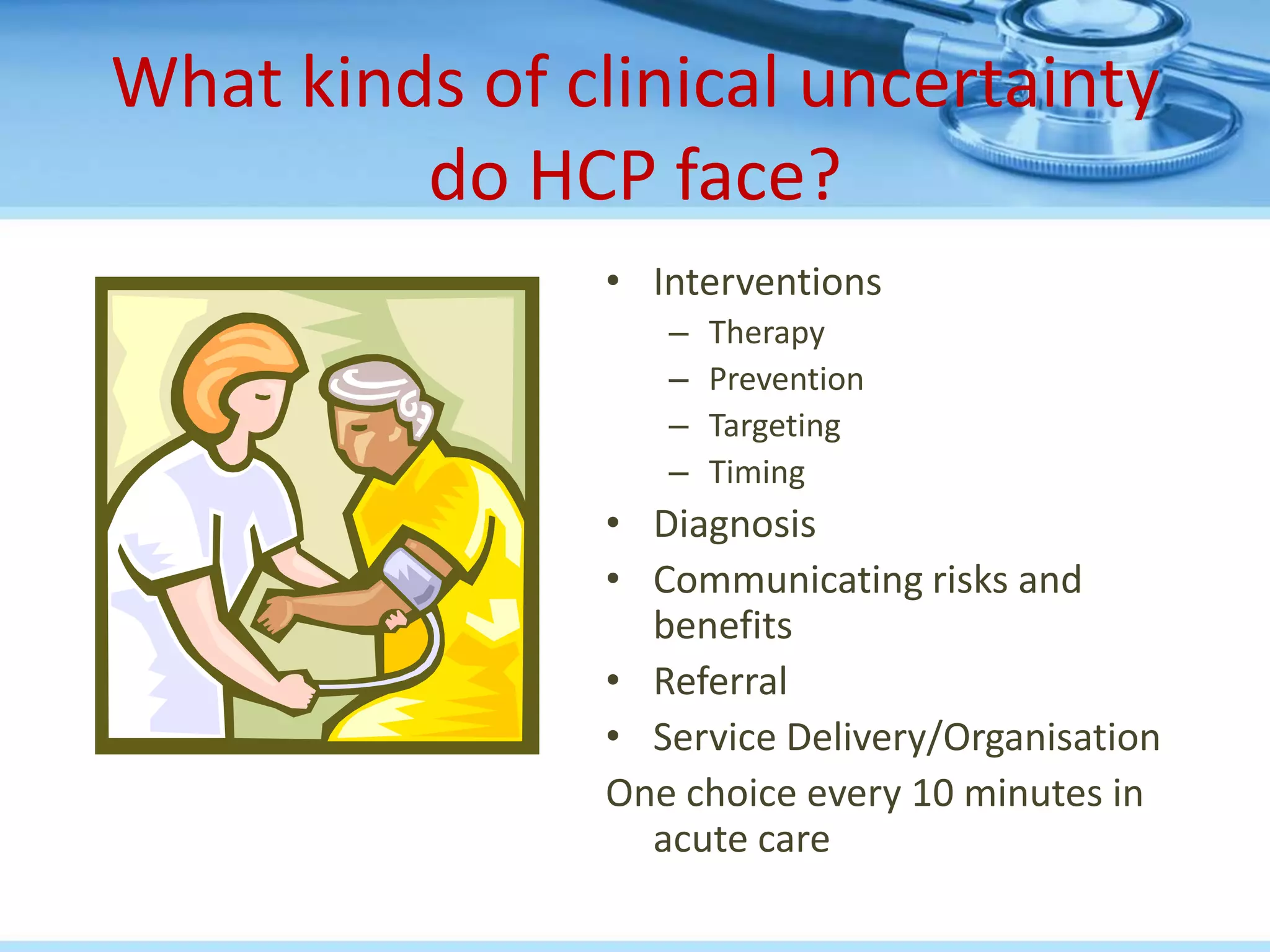
What kinds of clinical uncertainty
         do HCP face?
                • Interventions
                   –   Therapy
                   –   Prevention
                   –   Targeting
                   –   Timing
                • Diagnosis
                • Communicating risks and
                  benefits
                • Referral
                • Service Delivery/Organisation
                One choice every 10 minutes in
                  acute care
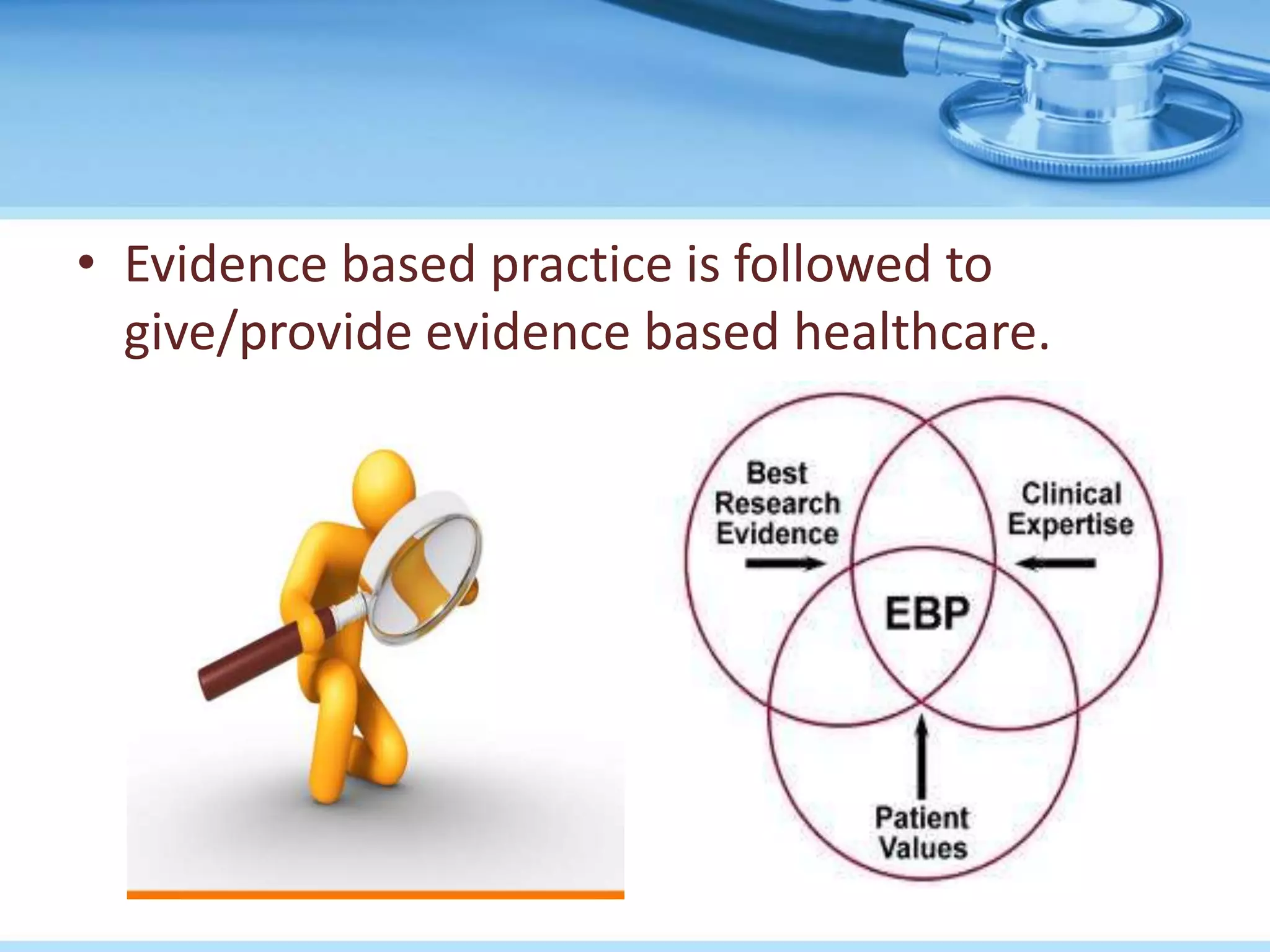
• Evidence based practice is followed to
  give/provide evidence based healthcare.
Evidence-based approach

    1. Formation of a clinical question (s) (usually from an existing
     clinical scenario). It is formed using the following formula of
     PICO(T):
•          Patient/population
•          Intervention
•          Comparison
•          Outcome
•          Time
Population
Who are the relevant people?
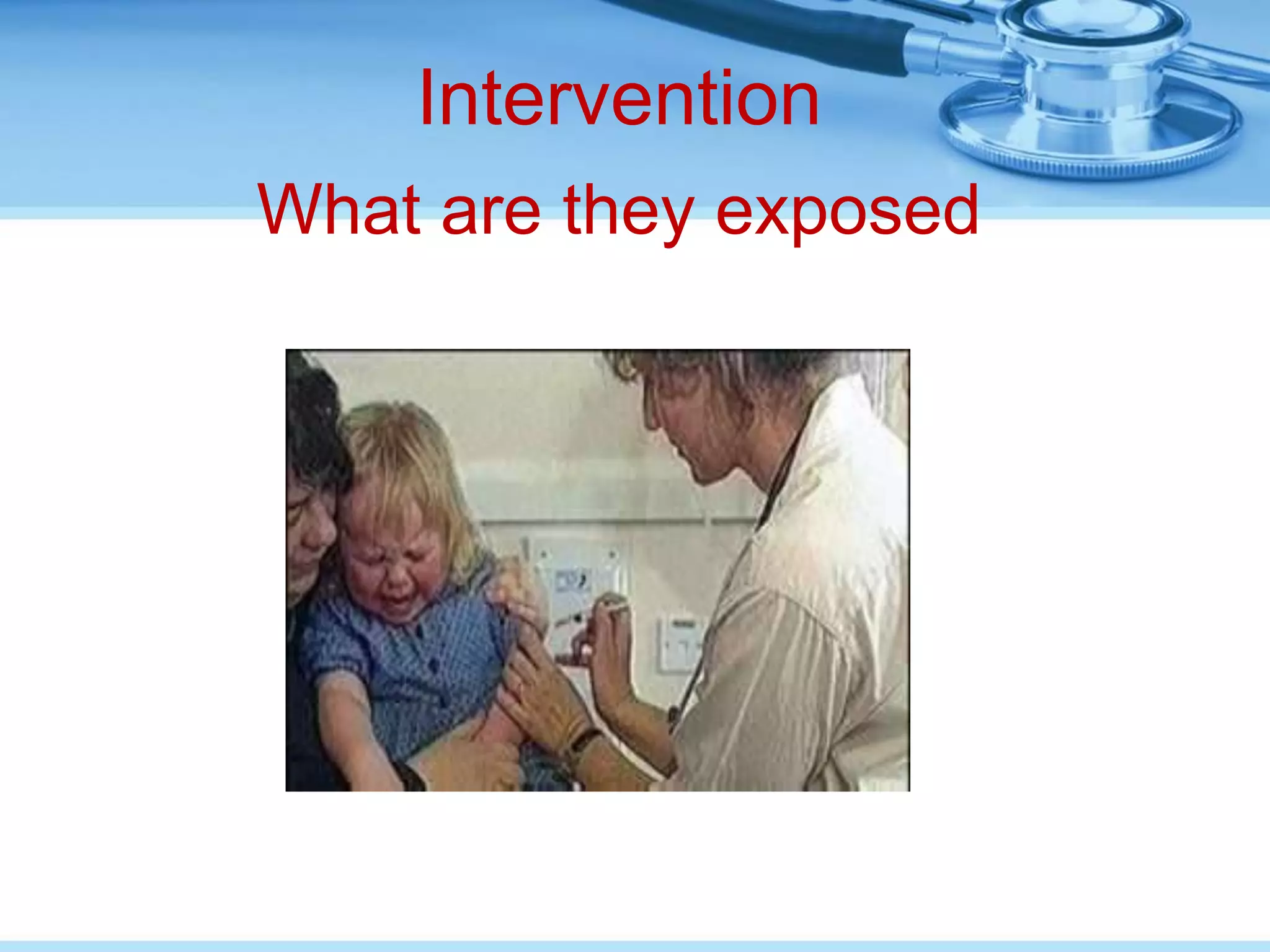
Intervention
What are they exposed
         to?
Alternative or control
     intervention
Outcome (what are the person-
  level consequences we are
         interested in?)
Evidence-based approach
2. A literature search to identify the evidence
– Biomedical database searches, textbook searches,
  grey literature, hand searching etc.

3. Critical Appraisal of the literature search
results

4. Application of the results to the patient

5. Quality assurance of the previous steps
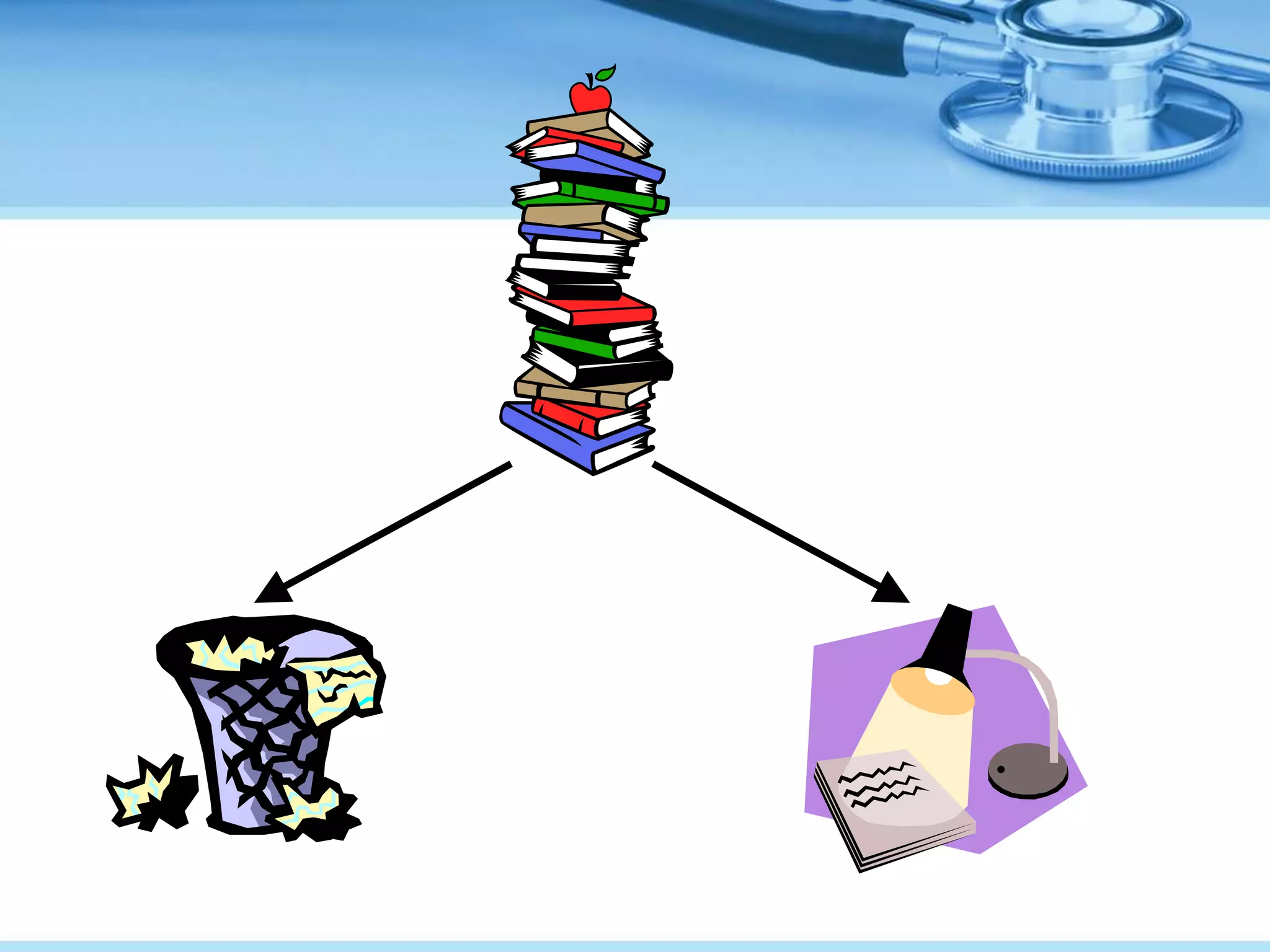
The total body of
               research is distilled
               down to a conclusion
               based on the best
               available, reliable and
Poor quality
               relevant research
and/or
irrelevant
research
Example

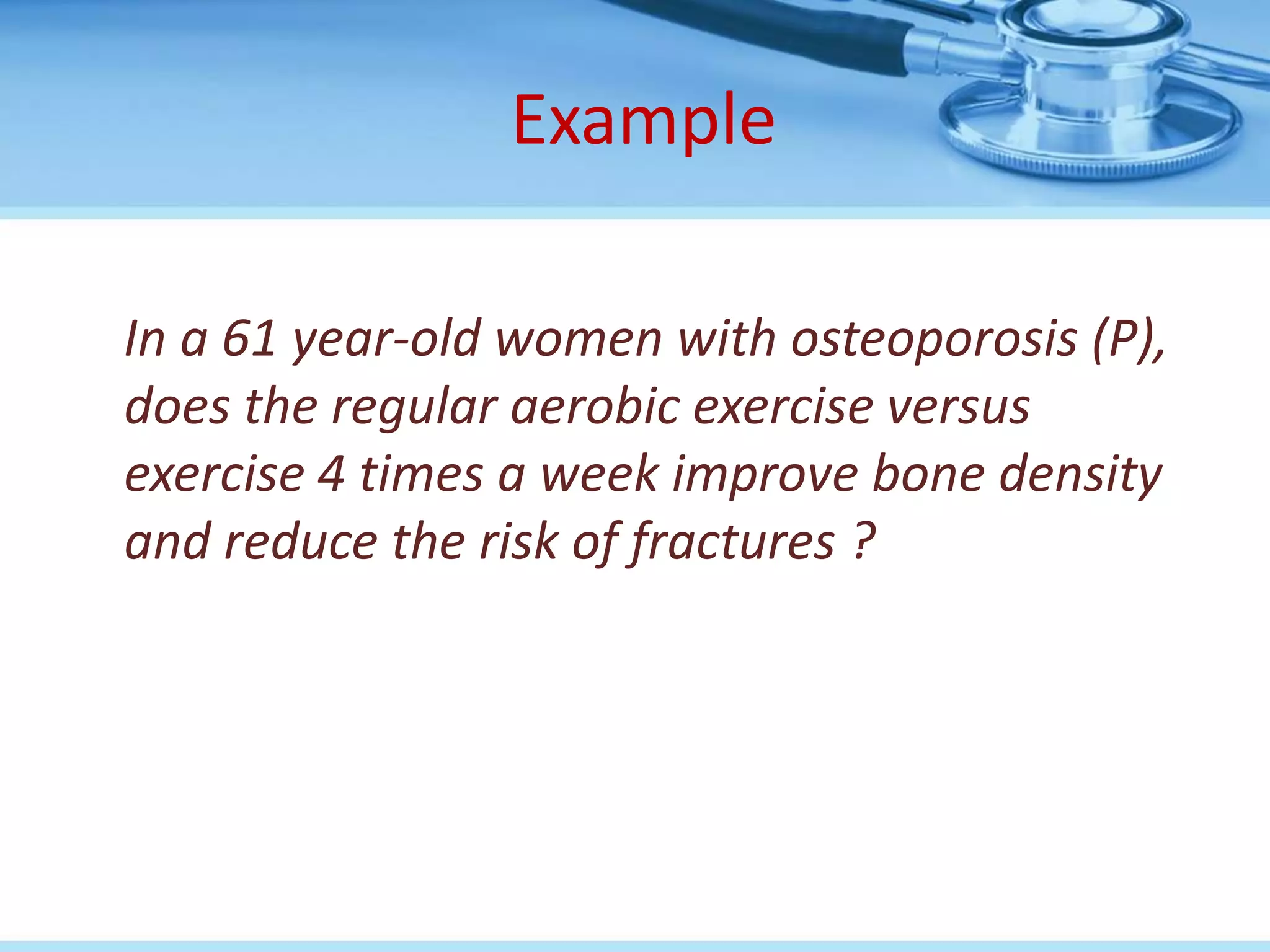
In a 61 year-old women with osteoporosis (P),
does the regular aerobic exercise versus
exercise 4 times a week improve bone density
and reduce the risk of fractures ?
Only approximately 10% of articles
  in the most prestigious internal
medicine journals can be regarded
as “valid” and ready for application
Redesign the healthcare services
10 rules for redesigning health care
1. Care based on continuous healing relationships--care
whenever its needed, not just through face to face visits
2. Customization based on patient needs and values
3. The patient as the source of control
4. Shared knowledge and free flow of information
5.Evidence based decision making
6. Safety as a system property
7. The need for transparency--all information available, including
the system’s performance on safety, evidence based practice,
and patient satisfaction
8. Anticipation of needs
10 rules for redesigning health care


• 9. Continuous decrease in waste
• 10. Cooperation among clinicians
Six challenges for health care
                 organizations
• 1. Design seamless, coordinated care
• 2. Make effective use of IT, including automating
  patient records
• 3. Manage knowledge so that it is delivered into
  patient care
• 4. Coordinate care across patient conditions,
  services, and settings over time
• 5. Advance the effectiveness of teams
• 6. Incorporate measurement of care processes and
  outcomes into daily practice
Getting evidence into health care delivery

1.   Ongoing analysis and synthesis of medical evidence
2.   Delineation of guidelines
3.   Identification of best practices in design of care processes
4.   Better dissemination to professionals and public
5.   Decision support tools
6.   Goals for improvement
7.   Measures of quality for priority conditions
Evidence based healthcare

Evidence based healthcare

  • 1.
    EVIDENCE BASED HEALTHCARE Aarti Sareen M.S.P.T.(Honours)
  • 2.
    Evidence-based history • Evidence-basedphilosophies integrate a health professional’s experience and knowledge with the best currently available clinical evidence. • It was introduced as EBM by ACP Journal Club in 1991 and this editorial was the impetus for a a series called the Users’ Guides to the Medical Literature in order to help clinician decide how to incorporate these philosophies in to their daily practice.
  • 3.
    Evidence-based evolution Evidence-based medicine Evidence-based health care, practice, dentistry, nursing etc. Evidence-based medical / health librarianship Evidence-based librarianship
  • 4.
    Evidence based healthcare • is the conscientious use of current best evidence in making decisions about the care of individual patients or the delivery of health services. Current best evidence is up-to-date information from relevant, valid research about the effects of different forms of health care, the potential for harm from exposure to particular agents, the accuracy of diagnostic tests, and the predictive power of prognostic factors • Cochrane AL. Effectiveness and Efficiency : Random Reflections on Health Services. London: Nuffield Provincial Hospitals Trust, 1972. Reprinted in 1989 in association with the BMJ. Reprinted in 1999 for Nuffield Trust by the Royal Society of Medicine Press, London, ISBN 1-85315-394-X.
  • 5.
    Health care professionals •a person who by education, training, certification, or licensure is qualified to and is engaged in providing health care.
  • 6.
    Why to gofor evidence based health care
  • 7.
    Knowing is notenough; we must apply Willing is not enough; we must do….. Goethe
  • 8.
    Clinical Decisions • Achieving a diagnosis • Estimating a prognosis • Choosing to intervene • Choosing an intervention • Determining Harm
  • 9.
    What kinds ofclinical uncertainty do HCP face? • Interventions – Therapy – Prevention – Targeting – Timing • Diagnosis • Communicating risks and benefits • Referral • Service Delivery/Organisation One choice every 10 minutes in acute care
  • 10.
    • Evidence basedpractice is followed to give/provide evidence based healthcare.
  • 11.
    Evidence-based approach 1. Formation of a clinical question (s) (usually from an existing clinical scenario). It is formed using the following formula of PICO(T): • Patient/population • Intervention • Comparison • Outcome • Time
  • 12.
    Population Who are therelevant people?
  • 13.
  • 14.
  • 15.
    Outcome (what arethe person- level consequences we are interested in?)
  • 16.
    Evidence-based approach 2. Aliterature search to identify the evidence – Biomedical database searches, textbook searches, grey literature, hand searching etc. 3. Critical Appraisal of the literature search results 4. Application of the results to the patient 5. Quality assurance of the previous steps
  • 17.
    The total bodyof research is distilled down to a conclusion based on the best available, reliable and Poor quality relevant research and/or irrelevant research
  • 18.
    Example In a 61year-old women with osteoporosis (P), does the regular aerobic exercise versus exercise 4 times a week improve bone density and reduce the risk of fractures ?
  • 19.
    Only approximately 10%of articles in the most prestigious internal medicine journals can be regarded as “valid” and ready for application
  • 20.
  • 21.
    10 rules forredesigning health care 1. Care based on continuous healing relationships--care whenever its needed, not just through face to face visits 2. Customization based on patient needs and values 3. The patient as the source of control 4. Shared knowledge and free flow of information 5.Evidence based decision making 6. Safety as a system property 7. The need for transparency--all information available, including the system’s performance on safety, evidence based practice, and patient satisfaction 8. Anticipation of needs
  • 22.
    10 rules forredesigning health care • 9. Continuous decrease in waste • 10. Cooperation among clinicians
  • 23.
    Six challenges forhealth care organizations • 1. Design seamless, coordinated care • 2. Make effective use of IT, including automating patient records • 3. Manage knowledge so that it is delivered into patient care • 4. Coordinate care across patient conditions, services, and settings over time • 5. Advance the effectiveness of teams • 6. Incorporate measurement of care processes and outcomes into daily practice
  • 24.
    Getting evidence intohealth care delivery 1. Ongoing analysis and synthesis of medical evidence 2. Delineation of guidelines 3. Identification of best practices in design of care processes 4. Better dissemination to professionals and public 5. Decision support tools 6. Goals for improvement 7. Measures of quality for priority conditions