Python was createdby Guido van Rossum in
1991 and further developed by the Python
Software Foundation. It was designed with
focus on code readability and its syntax
allows us to express concepts in fewer lines of
code.
3.
Python’s simpleand readable syntax makes it beginner-friendly.
Python runs seamlessly on Windows, macOS and Linux.
Includes libraries for tasks like web development, data analysis and machine
learning.
Variable types are determined automatically at runtime, simplifying code writing.
Supports multiple programming paradigms, including object-oriented, functional
and procedural programming.
Python is free to use, distribute and modify.
5.
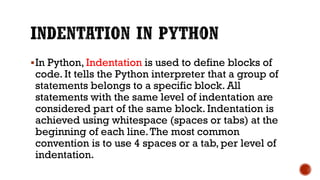
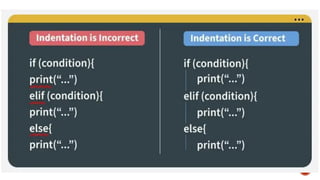
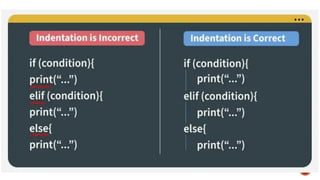
In Python, Indentationis used to define blocks of
code. It tells the Python interpreter that a group of
statements belongs to a specific block. All
statements with the same level of indentation are
considered part of the same block. Indentation is
achieved using whitespace (spaces or tabs) at the
beginning of each line.The most common
convention is to use 4 spaces or a tab, per level of
indentation.
7.
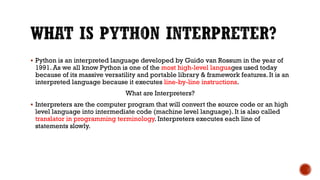
Python isan interpreted language developed by Guido van Rossum in the year of
1991. As we all know Python is one of the most high-level languages used today
because of its massive versatility and portable library & framework features. It is an
interpreted language because it executes line-by-line instructions.
What are Interpreters?
Interpreters are the computer program that will convert the source code or an high
level language into intermediate code (machine level language). It is also called
translator in programming terminology. Interpreters executes each line of
statements slowly.
8.
Python interpreteris written in C programming language as we all know that C is
considered as mother of all programming languages, Python interpreter called
"CPython".
9.
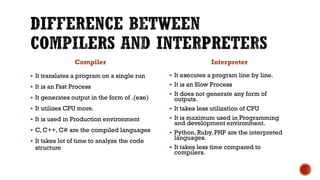
Compiler
It translatesa program on a single run
It is an Fast Process
It generates output in the form of .(exe)
It utilizes CPU more.
It is used in Production environment
C, C++, C# are the compiled languages
It takes lot of time to analyze the code
structure
Interpreter
It executes a program line by line.
It is an Slow Process
It does not generate any form of
outputs.
It takes less utilization of CPU
It is maximum used in Programming
and development environment.
Python, Ruby, PHP are the interpreted
languages.
It takes less time compared to
compilers.
10.
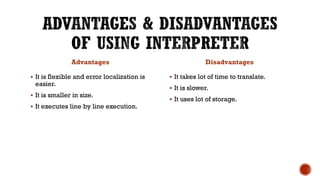
Advantages
It isflexible and error localization is
easier.
It is smaller in size.
It executes line by line execution.
Disadvantages
It takes lot of time to translate.
It is slower.
It uses lot of storage.
12.
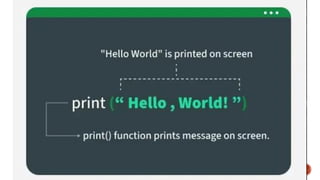
Understanding input andoutput operations is
fundamental to Python programming.With the
print() function, we can display output in various
formats, while the input() function enables
interaction with users by gathering input during
program execution.
13.
Python's input() functionis used to take user
input. By default, it returns the user input in
form of a string.
14.
Output formatting inPython with various
techniques including the format() method,
manipulation of the sep and end parameters, f-
strings and the versatile % operator.These
methods enable precise control over how data is
displayed, enhancing the readability and
effectiveness of your Python programs.


![5G Explained! A High Level Overview [Introduction]](https://cdn.slidesharecdn.com/ss_thumbnails/5gexplainedahighleveloverview-260119165306-cc137a3e-thumbnail.jpg?width=640&height=640&fit=bounds)


