Main Street 101 What we do… And why we do it!
The Main Street approach  encourages forward-thinking economic development  in an historic preservation context  so this community asset and legacy can be passed on to future generations. MAIN STREET 101
Main Street exists in over  1,200 cities and towns in 40 states  across the nation.  These programs rely on the help of the National Main Street Center and statewide programs like the Kentucky Main Street Program.
MAIN STREET 101
THE FOUNDATIONS OF MAIN STREET Main Street 101 MAIN STREET 101
The National Trust Main Street Center's experience in helping communities bring their commercial corridors back to life has shown time and time again that the Main Street Four-Point Approach succeeds.  MAIN STREET 101
The success of the Main Street approach is based on a four point strategy: Design Organization Promotion Economic Restructuring … easy to remember…  DOPE
The Four Points are guided by the following eight principles.  For a Main Street program to be successful, it must whole-heartedly embrace the following time-tested principles: MAIN STREET 101
Main Street has 8 guiding principles 1. Comprehensive .  A single project cannot revitalize a downtown. Address all areas that need attention An ongoing series of initiatives is vital to build community support and create lasting progress Follow all “Four Points” MAIN STREET 101 ORGANIZATION PROMOTION ECONOMIC RESTRUCTURING DESIGN
Main Street has 8 guiding principles   2.  Incremental .  Downtown declined over time.  Improvements must be gradual.  THERE IS NO QUICK FIX! Small projects make a big difference. They demonstrate that “things are happening” on Main Street. Small successes will hone the skills and confidence the program will need to tackle more complex projects.  MAIN STREET 101
Main Street has 8 guiding principles   3.  Self –Help .  A will to succeed is critical. The National Main Street Center, the State, and individual professionals can provide valuable direction and technical assistance. Local leadership can breed long-term success by fostering and demonstrating community involvement and commitment to the revitalization effort.  MAIN STREET 101
Main Street has 8 guiding principles   4.  Public/Private Partnership . Public & Private entities must be involved.   For an effective partnership, each must recognize the strengths and weaknesses of the other.  MAIN STREET 101
Main Street has 8 guiding principles   5.  Identifying and Capitalizing on Existing Assets.   Unique offerings and local assets provide the solid foundation for a successful Main Street initiative.    MAIN STREET 101
Main Street has 8 guiding principles 6. Quality .  From storefront design to promotional campaigns to special events,  quality must be instilled in the organization .    MAIN STREET 101
Main Street has 8 guiding principles 7.  Change .  Changing community attitudes and habits is essential to bring about a commercial district renaissance.  A carefully planned Main Street program will help shift public perceptions and practices to support and sustain the revitalization process .   MAIN STREET 101
Main Street has 8 guiding principles 8.  Action Oriented .  Frequent visible changes in the look and activities of the commercial district will reinforce the perception of positive change.  Small, but dramatic, improvements early in the process will remind the community that the revitalization effort is underway.  MAIN STREET 101
WHY DO WE REVITALIZE OUR DOWNTOWNS? Main Street 101 MAIN STREET 101
MAIN STREET 101
Why we Revitalize  The downtown commercial district is the most visible indicator of  community pride economic health social health  The downtown is the visual representation of the community's heritage.
Why we Revitalize The downtown can either be an asset or a liability in efforts to recruit: new residents new businesses and industries Retirees Young people tourists, and others to your community… … and to keep those you already have.  MAIN STREET 101
Why we Revitalize Quality of life is what separates successful cities and towns from declining communities.  TIP:  Many Site Selectors representing industries and corporations consider the downtown’s visual appearance and the area’s quality of life when selecting where to locate.  MAIN STREET 101
REVITALIZATION PARTNERS Business Owners Property Owners Government Residents/Consumers Civic Organizations Chamber of Commerce Preservationists Economic & Community Dev. Groups Financial Institutions Utilities Schools Social Service Agencies Religious Institutions Media Regional Planners MAIN STREET 101
ORGANIZATION Main Street 101 MAIN STREET 101
ORGANIZATION …  is the key to a successful downtown revitalization program.  Organization helps such diverse groups as bankers, city officials, merchants, chambers of a commerce, civic organizations, and individual citizens to work together more effectively. MAIN STREET 101
ORGANIZATION Partnership Building Volunteer Development Fundraising  Public Relations & Outreach Program Structure and Goals MAIN STREET 101
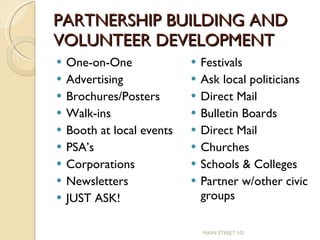
PARTNERSHIP BUILDING AND VOLUNTEER DEVELOPMENT One-on-One Advertising Brochures/Posters Walk-ins Booth at local events PSA’s Corporations Newsletters JUST ASK! Festivals Ask local politicians Direct Mail Bulletin Boards Direct Mail Churches Schools & Colleges Partner w/other civic groups MAIN STREET 101
ORGANIZATION Partnership Building Volunteer Development Fundraising  Public Relations & Outreach Program Structure and Goals MAIN STREET 101
FUNDRAISING THAT NECESSARY EVIL MAIN STREET 101
“ A GIFT  TO  THE ORGANIZATION IS A GIFT  THROUGH  THE ORGANIZATION.” - KAY SPRINKEL GRACE – BEYOND FUNDRAISING,  NEW STRATEGIES FOR NONPROFIT INNOVATION AND INVESTMENT MAIN STREET 101
FUNDRAISING Well rounded Main Street Programs have the following fundraising sources: 1/3 Public Sources 1/3 Stakeholder Support 1/3 Earned Income MAIN STREET 101
FUNDRAISING Sources of Funding: Public sector support Private sector membership Sponsorships Product Sales Event Revenue Contracts, fees for services Cooperative advertising MAIN STREET 101
THE BOARD & FUNDRAISING Ensure the program is well funded. Develop a strategic business plan for organization funding. Monitoring the financial condition of the organization. Supporting fundraising efforts of the organization. Make a financial contribution. MAIN STREET 101
THE BOARD & FUNDRAISING The Main Street program's budget should be adequate to achieve the program's goals.  The dollar amount that is "adequate" for a program budget varies depending on local costs of living,  and may be different for small town, midsize,  and urban Main Street programs. General guidelines for  minimum  operating budgets are:  MAIN STREET 101
THE BOARD & FUNDRAISING small town programs:  $40,000+ annually (populations of less than 5,000 people)  midsize community programs:  $60,000+ annually (populations between 5,000 - 50,000)  large town or urban neighborhood programs:  $100,000+ annually (community or neighborhood population greater than 50,000 people) MAIN STREET 101
THE BOARD & FUNDRAISING The budget should be specifically dedicated for the purpose of revitalizing the commercial district.  The Main Street program's budget should contain funds adequate to cover the salary and benefits of staff; office expenses; travel; professional development; and committee activities.  Revenue sources are varied and broad-based, including appropriate support from the municipal government.  MAIN STREET 101
THE BOARD & FUNDRAISING There is a strategy in place to help maintain stable funding.  There is a process in place for financial oversight and management.  Regular monthly financial reports are made by the treasurer to the board. MAIN STREET 101
PUT AWAY THE TIN CUP! Present your Main Street Program not as an organization that is needy but as an organization that meets needs. Be able to sell your role in the community MAIN STREET 101
MEMBERSHIP CAMPAIGN Populate a list of potential donors: Historic district residents Event participants Registrants at events Polk directory Send Letters & Dues Request. Second letters are often necessary. Follow up with a thank you! Publish list of donors. MAIN STREET 101
Heart of Danville Membership Levels: Individual - $25 Family - $50 Small Business - $125 Professional - $175 Business - $250 Corporation - $500 Leadership - $1,000 Renaissance - $2,500 < $4,999 Cornerstone - $5,000 + MAIN STREET 101 Already collected $13,000 to date
ORGANIZATION COMMITTEE FUNDRAISING RESPONSIBILITIES Prepare fundraising materials Conduct annual membership campaign Plan annual dinner/membership meeting Implement other fundraising activities MAIN STREET 101
STAFF’S FUNDRAISING RESPONSIBILITIES Serve as ambassador  Make sure work plan is implemented Help recruit new members Assist with the preparation of membership & fundraising materials Track contributions & recordkeeping. MAIN STREET 101
ORGANIZATION Partnership Building Volunteer Development Fundraising  Public Relations & Outreach Program Structure and Goals MAIN STREET 101
PUBLIC RELATIONS & OUTREACH MAIN STREET 101 Newsletters Brochure  E-mail Blasts  Website Facebook Media Relations Public Speaking & Presentations Annual Report
ORGANIZATION Partnership Building Volunteer Development Fundraising  Public Relations & Outreach Program Structure and Goals MAIN STREET 101
IDEAL STRUCTURE MAIN STREET 101
ORGANIZATIONAL ALTERNATIVES City government Chamber of Commerce Convention & Visitors Bureau Downtown Merchant’s Association An Existing Development Organization MAIN STREET 101
BOARD OF DIRECTORS Broad Based A  WORKING  board Usually 9 to 13 members Ability to give 4 to 10 hrs/month Contains the 3 w’s . . .  the Wise the Workers the Wealthy MAIN STREET 101
BOARD OF DIRECTORS OFFICERS President/Vice President Secretary Treasurer Members at Large MAIN STREET 101
ROLE OF THE BOARD Funding Financial Management Advocacy Policy Personnel Management Planning Should hold regular meetings – pref. monthly. MAIN STREET 101
ROLE OF THE BOARD LEGAL STUFF Articles of Incorporation Bylaws Policy Manual 990 Requirements Tax returns (990 if non-profit) Insurance MAIN STREET 101
ROLE OF THE MAIN STREET MANAGER Program Administration Public relations Work plan coordination Development Implementation Volunteer management Monitoring & evaluation of projects Resource to board & committees MAIN STREET 101
MANAGER CHARACTERISTICS Excellent people skills Good communication skills Self starter Computer skills Delegate & multi-task Thick Skinned Able to work more than the suggested hours of your job description. MAIN STREET 101
STAFFING POLICIES The Main Street executive director should be paid a salary consistent with those of other community development professionals within the city, state, or region in which the program operates.  The minimum amount of time the Main Street executive director works each week should be consistent with comparable Main Street programs in the city, state, or region.  The executive director should be adequately trained — and should continue learning about revitalization techniques and about issues affecting traditional commercial districts.  MAIN STREET 101
STAFFING POLICIES The executive director has a written job description that correlates with the roles and responsibilities of a Main Street director.  There is a formal system in place for evaluating the performance of the executive director on an annual basis.  Adequate staff management policies and procedures are in place.  MAIN STREET 101
PLANNING FOR MAIN STREET MAIN STREET 101 MAIN STREET 101
WORK PLAN The work plan should contain a balance of activities in each of the four broad program areas that comprise the Main Street approach — design, organization, promotion, and economic restructuring.  The work plan should contain measurable objectives, including timelines, budgets, desired outcomes, and specific responsibilities.  The work plan should be reviewed, and a new one should be developed annually.  Ideally, the full board and committees will be involved in developing the annual work plan. At a minimum, the full board should adopt/approve the annual work plan.  The work plan should distribute work activities and tasks to a broad range of volunteers and program participants.  There has been significant progress in each of the four points based on the work plan submitted for the previous year.  MAIN STREET 101
WORK PLAN 12 to 18-month To-Do List Project management tool Volunteer management tool Budgeting Tool Record-keeping tool Should reflect the 4-Points & 8 Principles of Main Street MAIN STREET 101
VISION STATEMENT Where you are going… Preferred future of the district Inspiring Consensus,  developed by broad cross-section of community Comprehensive Uses significant improvements Specific, sensory language Reality check for activities and planning MAIN STREET 101
Heart of Danville Vision Statement -  The Heart of Danville is a leader in developing and maintaining our community as a regional center for better government, commerce, tourism, education, health, historic preservation and quality of life! MAIN STREET 101
MISSION STATEMENT Who you are, what you are doing… Concise Easily understood Distinct from other organizations The Mission of the Heart of Danville is to stimulate the economic vitality of the Central Business District, while protecting the historic integrity of our community MAIN STREET 101
PRINCIPLES OF ORGANIZATION Widespread community support Broad-based community representation in an advisory capacity. A distinct constituency A clear, shared sense of mission and a well defined set of goals & objectives. Committed, dependable funding. MAIN STREET 101
PRINCIPLES OF ORGANIZATION A well-thought-out work plan based on the four points of the Main Street Approach Working committees Full-time management A commitment to work and succeed over time Strong public-private partnership MAIN STREET 101
TIPS FOR SUCCESS The board is a working, functional board that understands its roles and responsibilities and is willing to put forth the effort to make the program succeed.  Committee members assume responsibility for the implementation of the work plan.  The program has a dedicated governing body, its own rules of operation, its own budget, and its own bylaws, and is empowered to carry out Main Street's mission, even if the Main Street program is a part of a larger organization.  The board has well-managed, regular monthly meetings, with an advance agenda and regular distribution of minutes.  Committees have regularly scheduled monthly meetings with an advance agenda that addresses the committee work plan.  MAIN STREET 101
TIPS FOR SUCCESS Know your local ordinances: Slum & Blight Parking Zoning Know the Who’s Who in town and get them on your team! Know your Certification Requirements and make sure your board does too! MAIN STREET 101
WARNING SIGNS  There are time-tested warning signs that your program is in trouble. Assess your program on an annual basis.  Do any of these signs sound familiar?  There’s time to make adjustments and get your program back on track. MAIN STREET 101
MAIN STREET 101
DESIGN
DESIGN … Means getting Main Street into top physical shape.  Capitalizing on its best assets — such as historic buildings and pedestrian-oriented streets — is just part of the story.  MAIN STREET 101
DESIGN Design activities also include instilling good maintenance practices in the commercial district, enhancing the physical appearance of the commercial district by rehabilitating historic buildings, encouraging appropriate new construction, developing sensitive design management systems, and long-term planning.   MAIN STREET 101
DESIGN An inviting atmosphere, created through attractive window displays, parking areas, building improvements, street furniture, signs, sidewalks, street lights, and landscaping, conveys a positive visual message about the commercial district and what it has to offer.  MAIN STREET 101
DESIGN Beauty is in the Details! MAIN STREET 101
Why is Preservation Important? Buildings are unique and help build a sense of place Community history Craftsmanship Supports economic development MAIN STREET 101
Historic Preservation is NOT… Saving every building Anti-change New buildings dressed in “colonial” motifs Returning downtown to a particular style, theme or year MAIN STREET 101
ROLE OF THE DESIGN CMTEE. Promote the physical image of downtown Educate community about good design that  enhances the image of the district as well as individual businesses Encourage quality improvements to public spaces and private properties Guide future downtown growth and shape regulations Motivate others by targeting key projects and creating incentives Work with your local historic preservation commission and historical society MAIN STREET 101
DESIGN PRINCIPLES Appreciate what already exists Design with compatibility in mind Avoid “mall” formulas Recognize limitations of improvement projects Establish unified goals for design improvements Stress Quality Cultural landscape planning must be comprehensive – gateways and neighborhoods must be considered in design MAIN STREET 101
DESIGN WORK PLAN CONSIDER What defines our character? Inventory buildings, assets, landmarks, architectural styles Develop a vision How will our future look? Evaluate existing conditions How do we look now? Prioritize short term and long term issues/goals Work Plan What do we need to do to achieve our vision? Board Approval Historic Preservation Commission approval MAIN STREET 101
DESIGN COMPONENTS MAIN STREET 101
OTHER DESIGN PROJECTS MAIN STREET 101
DESIGN TIPS Always take before and after photos Start small in projects you select Involve the community MAIN STREET 101
DESIGN MAIN STREET 101
MAIN STREET 101
ECONOMIC DEVELOPMENT
ECONOMIC RESTRUCTURING … strengthens a community's existing economic assets while expanding and diversifying its economic base.  MAIN STREET 101
ECONOMIC RESTRUCTURING Learning the districts current economic conditions and identifying opportunities for market growth.  Strengthening existing businesses and recruiting new ones. Finding new economic uses for traditional Main Street buildings. Developing financial incentives and capital for building rehabilitation. Monitoring the economic performance of the district. MAIN STREET 101
ECONOMIC RESTRUCTURING Learning the districts current economic conditions and identifying opportunities for market growth. Gather all readily available information: Census of population. Census of retail trade. State sales tax reports for past five years. Trends in assessed value of Main St. real estate Any market analyses recently conducted MAIN STREET 101
ECONOMIC RESTRUCTURING MAIN STREET 101 Types of Information to Gather Examples of Cmtee Projects Buildings & businesses Business Inventory Building Inventory (partner w/Design Committee) use PVA as a resource. Demographic & Retail Sales Data Data Collection (Census, sales tax reports etc.) Original Research Downtown Business Survey Downtown User Survey Analysis of Retail Leakage and Surpluses in the Community Sales “gap” analysis
ECONOMIC RESTRUCTURING Strengthening existing businesses and recruiting new ones. Resist the temptation! Don’t start recruiting new businesses right away.  It’s wiser to help existing businesses expand before attracting new ones. MAIN STREET 101
MAIN STREET 101 Strengthening Business by Examples of Committee Projects Providing business owners with information on changing markets Business improvement seminars Retailers resource library Newsletter business assistance column Recruiting Complementary Businesses to strengthen an existing business cluster Business cluster analysis Targeted Business Recruitment Developing financial assistance and incentives to help existing businesses expand, upgrade, or reinvest in inventory Study of financing needs Identification of sources (e.g., SBA) Financial incentive program for business expansions or improvements
ECONOMIC RESTRUCTURING Finding new economic uses for traditional Main Street buildings. BE REALISTIC!  It is unlikely that your district will be able to support the retail uses it supported 50 years ago. Consider these uses: Housing Small Scale Industries Medical Entertainment Offices Religious or Civic uses MAIN STREET 101
MAIN STREET 101
MAIN STREET 101
MAIN STREET 101 Diversifying Main Street Uses Committee Projects Planning & Zoning – revising land use regulations to allow a broad range of uses downtown. Revision of Comprehensive Plan. Removal of regulatory barriers to developing upper-story uses. Housing – identify under-used upper floor spaces and large, white-elephant bldgs. Inventory vacant spaces. Financial incentive program to develop upper-floor housing. Small-Scale Industry – using vacant space for industries such as publishing, telecommunications, small-scale assembly operations, and consulting firms. Coordination with regional industrial development groups. Recruitment of ‘home-based cottage industries.’
ECONOMIC RESTRUCTURING Developing financial incentives and capital for building rehabilitation. MAIN STREET 101 Main Street Investment Needs Examples of Committee Projects Small Scale Improvements Matching-Fund Grant Pool Visual Merchandising Seminars Low-Interest Revolving Loan Fund Major Building Rehabilitations “ Community Initiated Development” Tax Credits Business Expansions Market Analysis “ Over the counter” updates on market opportunities provided to business owners.
ECONOMIC RESTRUCTURING Monitoring the economic performance of the district.  Measuring Main Street’s economic performance involves the following: Collecting Base Line Data Sales Tax Data Find out assessed values of buildings in the district Conduct consumer surveys MAIN STREET 101
ECONOMIC RESTRUCTURING Record information on economic change Keep track of monthly changes in jobs, businesses and property investment. Measure Annual Performance Conduct annual business survey to measure changes and compile an annual report summarizing the net changes in jobs and businesses in the district. MAIN STREET 101
MAIN STREET 101
MAIN STREET 101
RECENT DOWNTOWN TRENDS Traditional 9 to 5 shopping is obsolete. Young consumers grew up shopping in the mall.  Their expectations as consumers have been shaped by this experience In the past 10 years, retail space has quadrupled in price… while retail sales have increased less than 10%. MAIN STREET 101
MARKET ANALYSIS MAIN STREET 101 MAIN STREET 101
MARKET ANALYSIS Before you can sell your downtown to prospective businesses, you need to know more about it than anyone else in the community! MAIN STREET 101
MARKET ANALYSIS Sales gap surveys Intercept surveys Business surveys Telephone surveys Demographic trend information Customer groups Trade area Downtown’s strengths & weaknesses Competition comparison Business mix MAIN STREET 101
THE FACTS OF LIFE… about downtown revitalization There are no “hand-outs” Most resources are local Not everyone will like you Everyone has an agenda There is no formula MAIN STREET 101
THE FACTS OF LIFE… about downtown revitalization 1.  There are no “hand-outs” Traditional grants shun projects that involve commercial enterprises and the days of Urban Renewal “big fix” projects are gone. 2.  Most resources are local Whether you need people or money to make projects happen, they are most likely going to be found in the community MAIN STREET 101
THE FACTS OF LIFE… about downtown revitalization 3.  Not everyone will like you! Not even everyone you must work with. You must forge coalitions that have never been formed, and many of the people involved may not be used to talking to each other. 4.  Everyone has an agenda …  and it’s probably not just downtown revitalization.  YOU must create the culture – and priority – for Main Street’s renewal. MAIN STREET 101
5.  There’s no formula No magic answers or easy solutions.  The Main Street Approach cannot save you from hard work, but it can substantially improve your chances for success. MAIN STREET 101 THE FACTS OF LIFE… about downtown revitalization
ECONOMIC RESTRUCTURING DO’S & DON’T‘S MAIN STREET 101 MAIN STREET 101
DO  Do educational training Publish your data Develop partnerships Update data regularly MAIN STREET 101
DON’T Don’t forget why you collect data Don’t focus on recruitment first Don’t ignore upper floors Don’t get the ‘big fix’ mentality MAIN STREET 101
PROMOTION
PROMOTION sells a positive image of the commercial district and encourages consumers and investors to live, work, shop, play and invest in the Main Street district.  MAIN STREET 101
PROMOTION The job of the Promotion Committee is to PROMOTE downtown as the center of commerce, culture and community life. MAIN STREET 101
DEFINE YOUR IMAGE ENVIRONMENT – buildings, streets, landscapes, utility fixtures, dilapidation and cleanliness. ATTITUDES – merchants, businesses, people, property owners, employees, residents and shoppers. MAIN STREET 101
DEFINE YOUR IMAGE MAIN STREET 101
DEFINE YOUR IMAGE ACTIVITIES – goods, services and other uses of downtown – in terms of variety, quality & value. QUALITY – appropriate style and sophistication of promotional activities & materials. MAIN STREET 101
PROMOTION COMMITTEE MAIN STREET 101 Elements of an Image Campaign Examples of Committee Projects Image advertising :  Promotes Main Street’s unique qualities and market position through newspaper, radio, television and direct mail. “ Service is our signature” poster series. “ The owner is home” ad campaign “ Shop Downtown” radio jingle Collateral materials:  Repeat the logo/graphic on print materials, public signs, souvenirs and in businesses. Logo for Main Street program. Entrance sign or banners w/logo. Shopping bags, buttons, t-shirts w/logo. Media Relations:  Generate publicity through accurate, detailed, and interesting press releases and timely communication w/media contacts who have been carefully cultivated. Media kits on downtown program Press receptions for major projects Annual report on the program TV, Radio and news interviews Image-Building Events:   Help the community recognize and celebrate the Main Street’s importance and progress through public displays and events Downtown progress awards Ribbon-cuttings for new projects “ before & after” renovation displays
PROMOTION COMMITTEE Retail Promotions MAIN STREET 101 Types of Retail Promotions Example of Cmtee Projects Cooperative Promotions:  focuses on the comparative aspects of retailing in the district, clustering stores that are the same category and can be promoted together. Spring Fashion Show Taste of Main Street Restaurant Guide Antique Days co-op ads for stores Mother’s Day promotion of gift shops Cross-Retail Promotion  groups businesses w/complimentary goods in one retail event or in coordinated displays. Joint window displays: clothing w/jewelry Home Improvement promotion of furniture & hardware stores Niche promotion  focuses attention, not on the product mix, but on a specific consumer group targeted through special flyers, coupons, posters and mailings. Appreciation Days for Seniors Employee Coupons Jury Duty Coupons Dad’s Day Out Shopping Promotion After school specials for students
RETAIL PROMOTION IDEAS Weekly e-news that is “retail” focused E-Coupons either monthly or weekly Posters Retail Events MAIN STREET 101
MAIN STREET 101
MAIN STREET 101
MAIN STREET 101
PROMOTION COMMITTEE Special Events Before you do a lavish party on Main Street for the entire community, the promotion committee must decide what the event should accomplish. Traffic Building – festivals Target a specific niche – antique car show Know your audience before you plan! MAIN STREET 101
PROMOTION COMMITTEE Special Events MAIN STREET 101 Categories of Special Events Examples of Committee Projects Community Heritage.  Acknowledge local arts, industry, talent and agriculture or celebrate the history or architecture of the community Crafts on the square fair Strawberry Festival of local produce Candlelight tour of historic buildings “ Ugliest pickup truck” contest/parade Special Holidays.   Focus on traditional and unconventional holidays that celebrate dates & events that have meaning for the entire community. Halloween  pumpkin carving contest “ Dickens of a Christmas” event Fourth of July parade “ Cinco de Mayo” festival “ Kwaanza” celebration Social Events.   Develop unusual activities that enliven public spaces and attract people downtown, especially those who wouldn’t normally come downtown. “ Friday’s at 5” after-work street parties “ Lunch on the Square” concert events. “ Just Desserts” gala concert & dinner  Saturday Health Fair on the sidewalks
Antique & Garden Show MAIN STREET 101
Special Events MAIN STREET 101
PROMOTION Advertising Campaign Image & Branding Campaign Quality Materials that represent the program’s values and image.  NEVER give off the cut and paste look. MAIN STREET 101
JULIE  WAGNER HEART OF DANVILLE 859-236-1909 [email_address] WWW.DOWNTOWNDANVILLE.COM QUESTIONS? MAIN STREET 101

Main Street 101

  • 1.
    Main Street 101What we do… And why we do it!
  • 2.
    The Main Streetapproach  encourages forward-thinking economic development in an historic preservation context so this community asset and legacy can be passed on to future generations. MAIN STREET 101
  • 3.
    Main Street existsin over 1,200 cities and towns in 40 states across the nation. These programs rely on the help of the National Main Street Center and statewide programs like the Kentucky Main Street Program.
  • 4.
  • 5.
    THE FOUNDATIONS OFMAIN STREET Main Street 101 MAIN STREET 101
  • 6.
    The National TrustMain Street Center's experience in helping communities bring their commercial corridors back to life has shown time and time again that the Main Street Four-Point Approach succeeds. MAIN STREET 101
  • 7.
    The success ofthe Main Street approach is based on a four point strategy: Design Organization Promotion Economic Restructuring … easy to remember… DOPE
  • 8.
    The Four Pointsare guided by the following eight principles. For a Main Street program to be successful, it must whole-heartedly embrace the following time-tested principles: MAIN STREET 101
  • 9.
    Main Street has8 guiding principles 1. Comprehensive . A single project cannot revitalize a downtown. Address all areas that need attention An ongoing series of initiatives is vital to build community support and create lasting progress Follow all “Four Points” MAIN STREET 101 ORGANIZATION PROMOTION ECONOMIC RESTRUCTURING DESIGN
  • 10.
    Main Street has8 guiding principles   2. Incremental . Downtown declined over time. Improvements must be gradual. THERE IS NO QUICK FIX! Small projects make a big difference. They demonstrate that “things are happening” on Main Street. Small successes will hone the skills and confidence the program will need to tackle more complex projects. MAIN STREET 101
  • 11.
    Main Street has8 guiding principles   3. Self –Help . A will to succeed is critical. The National Main Street Center, the State, and individual professionals can provide valuable direction and technical assistance. Local leadership can breed long-term success by fostering and demonstrating community involvement and commitment to the revitalization effort. MAIN STREET 101
  • 12.
    Main Street has8 guiding principles   4. Public/Private Partnership . Public & Private entities must be involved. For an effective partnership, each must recognize the strengths and weaknesses of the other. MAIN STREET 101
  • 13.
    Main Street has8 guiding principles   5. Identifying and Capitalizing on Existing Assets. Unique offerings and local assets provide the solid foundation for a successful Main Street initiative.   MAIN STREET 101
  • 14.
    Main Street has8 guiding principles 6. Quality . From storefront design to promotional campaigns to special events, quality must be instilled in the organization .   MAIN STREET 101
  • 15.
    Main Street has8 guiding principles 7. Change . Changing community attitudes and habits is essential to bring about a commercial district renaissance. A carefully planned Main Street program will help shift public perceptions and practices to support and sustain the revitalization process .   MAIN STREET 101
  • 16.
    Main Street has8 guiding principles 8. Action Oriented . Frequent visible changes in the look and activities of the commercial district will reinforce the perception of positive change. Small, but dramatic, improvements early in the process will remind the community that the revitalization effort is underway. MAIN STREET 101
  • 17.
    WHY DO WEREVITALIZE OUR DOWNTOWNS? Main Street 101 MAIN STREET 101
  • 18.
  • 19.
    Why we Revitalize The downtown commercial district is the most visible indicator of community pride economic health social health  The downtown is the visual representation of the community's heritage.
  • 20.
    Why we RevitalizeThe downtown can either be an asset or a liability in efforts to recruit: new residents new businesses and industries Retirees Young people tourists, and others to your community… … and to keep those you already have. MAIN STREET 101
  • 21.
    Why we RevitalizeQuality of life is what separates successful cities and towns from declining communities. TIP: Many Site Selectors representing industries and corporations consider the downtown’s visual appearance and the area’s quality of life when selecting where to locate. MAIN STREET 101
  • 22.
    REVITALIZATION PARTNERS BusinessOwners Property Owners Government Residents/Consumers Civic Organizations Chamber of Commerce Preservationists Economic & Community Dev. Groups Financial Institutions Utilities Schools Social Service Agencies Religious Institutions Media Regional Planners MAIN STREET 101
  • 23.
    ORGANIZATION Main Street101 MAIN STREET 101
  • 24.
    ORGANIZATION … is the key to a successful downtown revitalization program. Organization helps such diverse groups as bankers, city officials, merchants, chambers of a commerce, civic organizations, and individual citizens to work together more effectively. MAIN STREET 101
  • 25.
    ORGANIZATION Partnership BuildingVolunteer Development Fundraising Public Relations & Outreach Program Structure and Goals MAIN STREET 101
  • 26.
    PARTNERSHIP BUILDING ANDVOLUNTEER DEVELOPMENT One-on-One Advertising Brochures/Posters Walk-ins Booth at local events PSA’s Corporations Newsletters JUST ASK! Festivals Ask local politicians Direct Mail Bulletin Boards Direct Mail Churches Schools & Colleges Partner w/other civic groups MAIN STREET 101
  • 27.
    ORGANIZATION Partnership BuildingVolunteer Development Fundraising Public Relations & Outreach Program Structure and Goals MAIN STREET 101
  • 28.
    FUNDRAISING THAT NECESSARYEVIL MAIN STREET 101
  • 29.
    “ A GIFT TO THE ORGANIZATION IS A GIFT THROUGH THE ORGANIZATION.” - KAY SPRINKEL GRACE – BEYOND FUNDRAISING, NEW STRATEGIES FOR NONPROFIT INNOVATION AND INVESTMENT MAIN STREET 101
  • 30.
    FUNDRAISING Well roundedMain Street Programs have the following fundraising sources: 1/3 Public Sources 1/3 Stakeholder Support 1/3 Earned Income MAIN STREET 101
  • 31.
    FUNDRAISING Sources ofFunding: Public sector support Private sector membership Sponsorships Product Sales Event Revenue Contracts, fees for services Cooperative advertising MAIN STREET 101
  • 32.
    THE BOARD &FUNDRAISING Ensure the program is well funded. Develop a strategic business plan for organization funding. Monitoring the financial condition of the organization. Supporting fundraising efforts of the organization. Make a financial contribution. MAIN STREET 101
  • 33.
    THE BOARD &FUNDRAISING The Main Street program's budget should be adequate to achieve the program's goals. The dollar amount that is &quot;adequate&quot; for a program budget varies depending on local costs of living, and may be different for small town, midsize, and urban Main Street programs. General guidelines for minimum operating budgets are: MAIN STREET 101
  • 34.
    THE BOARD &FUNDRAISING small town programs: $40,000+ annually (populations of less than 5,000 people) midsize community programs: $60,000+ annually (populations between 5,000 - 50,000) large town or urban neighborhood programs: $100,000+ annually (community or neighborhood population greater than 50,000 people) MAIN STREET 101
  • 35.
    THE BOARD &FUNDRAISING The budget should be specifically dedicated for the purpose of revitalizing the commercial district. The Main Street program's budget should contain funds adequate to cover the salary and benefits of staff; office expenses; travel; professional development; and committee activities. Revenue sources are varied and broad-based, including appropriate support from the municipal government. MAIN STREET 101
  • 36.
    THE BOARD &FUNDRAISING There is a strategy in place to help maintain stable funding. There is a process in place for financial oversight and management. Regular monthly financial reports are made by the treasurer to the board. MAIN STREET 101
  • 37.
    PUT AWAY THETIN CUP! Present your Main Street Program not as an organization that is needy but as an organization that meets needs. Be able to sell your role in the community MAIN STREET 101
  • 38.
    MEMBERSHIP CAMPAIGN Populatea list of potential donors: Historic district residents Event participants Registrants at events Polk directory Send Letters & Dues Request. Second letters are often necessary. Follow up with a thank you! Publish list of donors. MAIN STREET 101
  • 39.
    Heart of DanvilleMembership Levels: Individual - $25 Family - $50 Small Business - $125 Professional - $175 Business - $250 Corporation - $500 Leadership - $1,000 Renaissance - $2,500 < $4,999 Cornerstone - $5,000 + MAIN STREET 101 Already collected $13,000 to date
  • 40.
    ORGANIZATION COMMITTEE FUNDRAISINGRESPONSIBILITIES Prepare fundraising materials Conduct annual membership campaign Plan annual dinner/membership meeting Implement other fundraising activities MAIN STREET 101
  • 41.
    STAFF’S FUNDRAISING RESPONSIBILITIESServe as ambassador Make sure work plan is implemented Help recruit new members Assist with the preparation of membership & fundraising materials Track contributions & recordkeeping. MAIN STREET 101
  • 42.
    ORGANIZATION Partnership BuildingVolunteer Development Fundraising Public Relations & Outreach Program Structure and Goals MAIN STREET 101
  • 43.
    PUBLIC RELATIONS &OUTREACH MAIN STREET 101 Newsletters Brochure E-mail Blasts Website Facebook Media Relations Public Speaking & Presentations Annual Report
  • 44.
    ORGANIZATION Partnership BuildingVolunteer Development Fundraising Public Relations & Outreach Program Structure and Goals MAIN STREET 101
  • 45.
  • 46.
    ORGANIZATIONAL ALTERNATIVES Citygovernment Chamber of Commerce Convention & Visitors Bureau Downtown Merchant’s Association An Existing Development Organization MAIN STREET 101
  • 47.
    BOARD OF DIRECTORSBroad Based A WORKING board Usually 9 to 13 members Ability to give 4 to 10 hrs/month Contains the 3 w’s . . . the Wise the Workers the Wealthy MAIN STREET 101
  • 48.
    BOARD OF DIRECTORSOFFICERS President/Vice President Secretary Treasurer Members at Large MAIN STREET 101
  • 49.
    ROLE OF THEBOARD Funding Financial Management Advocacy Policy Personnel Management Planning Should hold regular meetings – pref. monthly. MAIN STREET 101
  • 50.
    ROLE OF THEBOARD LEGAL STUFF Articles of Incorporation Bylaws Policy Manual 990 Requirements Tax returns (990 if non-profit) Insurance MAIN STREET 101
  • 51.
    ROLE OF THEMAIN STREET MANAGER Program Administration Public relations Work plan coordination Development Implementation Volunteer management Monitoring & evaluation of projects Resource to board & committees MAIN STREET 101
  • 52.
    MANAGER CHARACTERISTICS Excellentpeople skills Good communication skills Self starter Computer skills Delegate & multi-task Thick Skinned Able to work more than the suggested hours of your job description. MAIN STREET 101
  • 53.
    STAFFING POLICIES TheMain Street executive director should be paid a salary consistent with those of other community development professionals within the city, state, or region in which the program operates. The minimum amount of time the Main Street executive director works each week should be consistent with comparable Main Street programs in the city, state, or region. The executive director should be adequately trained — and should continue learning about revitalization techniques and about issues affecting traditional commercial districts. MAIN STREET 101
  • 54.
    STAFFING POLICIES Theexecutive director has a written job description that correlates with the roles and responsibilities of a Main Street director. There is a formal system in place for evaluating the performance of the executive director on an annual basis. Adequate staff management policies and procedures are in place. MAIN STREET 101
  • 55.
    PLANNING FOR MAINSTREET MAIN STREET 101 MAIN STREET 101
  • 56.
    WORK PLAN Thework plan should contain a balance of activities in each of the four broad program areas that comprise the Main Street approach — design, organization, promotion, and economic restructuring. The work plan should contain measurable objectives, including timelines, budgets, desired outcomes, and specific responsibilities. The work plan should be reviewed, and a new one should be developed annually. Ideally, the full board and committees will be involved in developing the annual work plan. At a minimum, the full board should adopt/approve the annual work plan. The work plan should distribute work activities and tasks to a broad range of volunteers and program participants. There has been significant progress in each of the four points based on the work plan submitted for the previous year. MAIN STREET 101
  • 57.
    WORK PLAN 12to 18-month To-Do List Project management tool Volunteer management tool Budgeting Tool Record-keeping tool Should reflect the 4-Points & 8 Principles of Main Street MAIN STREET 101
  • 58.
    VISION STATEMENT Whereyou are going… Preferred future of the district Inspiring Consensus, developed by broad cross-section of community Comprehensive Uses significant improvements Specific, sensory language Reality check for activities and planning MAIN STREET 101
  • 59.
    Heart of DanvilleVision Statement - The Heart of Danville is a leader in developing and maintaining our community as a regional center for better government, commerce, tourism, education, health, historic preservation and quality of life! MAIN STREET 101
  • 60.
    MISSION STATEMENT Whoyou are, what you are doing… Concise Easily understood Distinct from other organizations The Mission of the Heart of Danville is to stimulate the economic vitality of the Central Business District, while protecting the historic integrity of our community MAIN STREET 101
  • 61.
    PRINCIPLES OF ORGANIZATIONWidespread community support Broad-based community representation in an advisory capacity. A distinct constituency A clear, shared sense of mission and a well defined set of goals & objectives. Committed, dependable funding. MAIN STREET 101
  • 62.
    PRINCIPLES OF ORGANIZATIONA well-thought-out work plan based on the four points of the Main Street Approach Working committees Full-time management A commitment to work and succeed over time Strong public-private partnership MAIN STREET 101
  • 63.
    TIPS FOR SUCCESSThe board is a working, functional board that understands its roles and responsibilities and is willing to put forth the effort to make the program succeed. Committee members assume responsibility for the implementation of the work plan. The program has a dedicated governing body, its own rules of operation, its own budget, and its own bylaws, and is empowered to carry out Main Street's mission, even if the Main Street program is a part of a larger organization. The board has well-managed, regular monthly meetings, with an advance agenda and regular distribution of minutes. Committees have regularly scheduled monthly meetings with an advance agenda that addresses the committee work plan. MAIN STREET 101
  • 64.
    TIPS FOR SUCCESSKnow your local ordinances: Slum & Blight Parking Zoning Know the Who’s Who in town and get them on your team! Know your Certification Requirements and make sure your board does too! MAIN STREET 101
  • 65.
    WARNING SIGNS There are time-tested warning signs that your program is in trouble. Assess your program on an annual basis. Do any of these signs sound familiar? There’s time to make adjustments and get your program back on track. MAIN STREET 101
  • 66.
  • 67.
  • 68.
    DESIGN … Meansgetting Main Street into top physical shape. Capitalizing on its best assets — such as historic buildings and pedestrian-oriented streets — is just part of the story. MAIN STREET 101
  • 69.
    DESIGN Design activitiesalso include instilling good maintenance practices in the commercial district, enhancing the physical appearance of the commercial district by rehabilitating historic buildings, encouraging appropriate new construction, developing sensitive design management systems, and long-term planning.  MAIN STREET 101
  • 70.
    DESIGN An invitingatmosphere, created through attractive window displays, parking areas, building improvements, street furniture, signs, sidewalks, street lights, and landscaping, conveys a positive visual message about the commercial district and what it has to offer. MAIN STREET 101
  • 71.
    DESIGN Beauty isin the Details! MAIN STREET 101
  • 72.
    Why is PreservationImportant? Buildings are unique and help build a sense of place Community history Craftsmanship Supports economic development MAIN STREET 101
  • 73.
    Historic Preservation isNOT… Saving every building Anti-change New buildings dressed in “colonial” motifs Returning downtown to a particular style, theme or year MAIN STREET 101
  • 74.
    ROLE OF THEDESIGN CMTEE. Promote the physical image of downtown Educate community about good design that enhances the image of the district as well as individual businesses Encourage quality improvements to public spaces and private properties Guide future downtown growth and shape regulations Motivate others by targeting key projects and creating incentives Work with your local historic preservation commission and historical society MAIN STREET 101
  • 75.
    DESIGN PRINCIPLES Appreciatewhat already exists Design with compatibility in mind Avoid “mall” formulas Recognize limitations of improvement projects Establish unified goals for design improvements Stress Quality Cultural landscape planning must be comprehensive – gateways and neighborhoods must be considered in design MAIN STREET 101
  • 76.
    DESIGN WORK PLANCONSIDER What defines our character? Inventory buildings, assets, landmarks, architectural styles Develop a vision How will our future look? Evaluate existing conditions How do we look now? Prioritize short term and long term issues/goals Work Plan What do we need to do to achieve our vision? Board Approval Historic Preservation Commission approval MAIN STREET 101
  • 77.
  • 78.
    OTHER DESIGN PROJECTSMAIN STREET 101
  • 79.
    DESIGN TIPS Alwaystake before and after photos Start small in projects you select Involve the community MAIN STREET 101
  • 80.
  • 81.
  • 82.
  • 83.
  • 84.
  • 85.
  • 86.
  • 87.
  • 88.
  • 89.
    ECONOMIC RESTRUCTURING …strengthens a community's existing economic assets while expanding and diversifying its economic base.  MAIN STREET 101
  • 90.
    ECONOMIC RESTRUCTURING Learningthe districts current economic conditions and identifying opportunities for market growth. Strengthening existing businesses and recruiting new ones. Finding new economic uses for traditional Main Street buildings. Developing financial incentives and capital for building rehabilitation. Monitoring the economic performance of the district. MAIN STREET 101
  • 91.
    ECONOMIC RESTRUCTURING Learningthe districts current economic conditions and identifying opportunities for market growth. Gather all readily available information: Census of population. Census of retail trade. State sales tax reports for past five years. Trends in assessed value of Main St. real estate Any market analyses recently conducted MAIN STREET 101
  • 92.
    ECONOMIC RESTRUCTURING MAINSTREET 101 Types of Information to Gather Examples of Cmtee Projects Buildings & businesses Business Inventory Building Inventory (partner w/Design Committee) use PVA as a resource. Demographic & Retail Sales Data Data Collection (Census, sales tax reports etc.) Original Research Downtown Business Survey Downtown User Survey Analysis of Retail Leakage and Surpluses in the Community Sales “gap” analysis
  • 93.
    ECONOMIC RESTRUCTURING Strengtheningexisting businesses and recruiting new ones. Resist the temptation! Don’t start recruiting new businesses right away. It’s wiser to help existing businesses expand before attracting new ones. MAIN STREET 101
  • 94.
    MAIN STREET 101Strengthening Business by Examples of Committee Projects Providing business owners with information on changing markets Business improvement seminars Retailers resource library Newsletter business assistance column Recruiting Complementary Businesses to strengthen an existing business cluster Business cluster analysis Targeted Business Recruitment Developing financial assistance and incentives to help existing businesses expand, upgrade, or reinvest in inventory Study of financing needs Identification of sources (e.g., SBA) Financial incentive program for business expansions or improvements
  • 95.
    ECONOMIC RESTRUCTURING Findingnew economic uses for traditional Main Street buildings. BE REALISTIC! It is unlikely that your district will be able to support the retail uses it supported 50 years ago. Consider these uses: Housing Small Scale Industries Medical Entertainment Offices Religious or Civic uses MAIN STREET 101
  • 96.
  • 97.
  • 98.
    MAIN STREET 101Diversifying Main Street Uses Committee Projects Planning & Zoning – revising land use regulations to allow a broad range of uses downtown. Revision of Comprehensive Plan. Removal of regulatory barriers to developing upper-story uses. Housing – identify under-used upper floor spaces and large, white-elephant bldgs. Inventory vacant spaces. Financial incentive program to develop upper-floor housing. Small-Scale Industry – using vacant space for industries such as publishing, telecommunications, small-scale assembly operations, and consulting firms. Coordination with regional industrial development groups. Recruitment of ‘home-based cottage industries.’
  • 99.
    ECONOMIC RESTRUCTURING Developingfinancial incentives and capital for building rehabilitation. MAIN STREET 101 Main Street Investment Needs Examples of Committee Projects Small Scale Improvements Matching-Fund Grant Pool Visual Merchandising Seminars Low-Interest Revolving Loan Fund Major Building Rehabilitations “ Community Initiated Development” Tax Credits Business Expansions Market Analysis “ Over the counter” updates on market opportunities provided to business owners.
  • 100.
    ECONOMIC RESTRUCTURING Monitoringthe economic performance of the district. Measuring Main Street’s economic performance involves the following: Collecting Base Line Data Sales Tax Data Find out assessed values of buildings in the district Conduct consumer surveys MAIN STREET 101
  • 101.
    ECONOMIC RESTRUCTURING Recordinformation on economic change Keep track of monthly changes in jobs, businesses and property investment. Measure Annual Performance Conduct annual business survey to measure changes and compile an annual report summarizing the net changes in jobs and businesses in the district. MAIN STREET 101
  • 102.
  • 103.
  • 104.
    RECENT DOWNTOWN TRENDSTraditional 9 to 5 shopping is obsolete. Young consumers grew up shopping in the mall. Their expectations as consumers have been shaped by this experience In the past 10 years, retail space has quadrupled in price… while retail sales have increased less than 10%. MAIN STREET 101
  • 105.
    MARKET ANALYSIS MAINSTREET 101 MAIN STREET 101
  • 106.
    MARKET ANALYSIS Beforeyou can sell your downtown to prospective businesses, you need to know more about it than anyone else in the community! MAIN STREET 101
  • 107.
    MARKET ANALYSIS Salesgap surveys Intercept surveys Business surveys Telephone surveys Demographic trend information Customer groups Trade area Downtown’s strengths & weaknesses Competition comparison Business mix MAIN STREET 101
  • 108.
    THE FACTS OFLIFE… about downtown revitalization There are no “hand-outs” Most resources are local Not everyone will like you Everyone has an agenda There is no formula MAIN STREET 101
  • 109.
    THE FACTS OFLIFE… about downtown revitalization 1. There are no “hand-outs” Traditional grants shun projects that involve commercial enterprises and the days of Urban Renewal “big fix” projects are gone. 2. Most resources are local Whether you need people or money to make projects happen, they are most likely going to be found in the community MAIN STREET 101
  • 110.
    THE FACTS OFLIFE… about downtown revitalization 3. Not everyone will like you! Not even everyone you must work with. You must forge coalitions that have never been formed, and many of the people involved may not be used to talking to each other. 4. Everyone has an agenda … and it’s probably not just downtown revitalization. YOU must create the culture – and priority – for Main Street’s renewal. MAIN STREET 101
  • 111.
    5. There’sno formula No magic answers or easy solutions. The Main Street Approach cannot save you from hard work, but it can substantially improve your chances for success. MAIN STREET 101 THE FACTS OF LIFE… about downtown revitalization
  • 112.
    ECONOMIC RESTRUCTURING DO’S& DON’T‘S MAIN STREET 101 MAIN STREET 101
  • 113.
    DO Doeducational training Publish your data Develop partnerships Update data regularly MAIN STREET 101
  • 114.
    DON’T Don’t forgetwhy you collect data Don’t focus on recruitment first Don’t ignore upper floors Don’t get the ‘big fix’ mentality MAIN STREET 101
  • 115.
  • 116.
    PROMOTION sells apositive image of the commercial district and encourages consumers and investors to live, work, shop, play and invest in the Main Street district.  MAIN STREET 101
  • 117.
    PROMOTION The jobof the Promotion Committee is to PROMOTE downtown as the center of commerce, culture and community life. MAIN STREET 101
  • 118.
    DEFINE YOUR IMAGEENVIRONMENT – buildings, streets, landscapes, utility fixtures, dilapidation and cleanliness. ATTITUDES – merchants, businesses, people, property owners, employees, residents and shoppers. MAIN STREET 101
  • 119.
    DEFINE YOUR IMAGEMAIN STREET 101
  • 120.
    DEFINE YOUR IMAGEACTIVITIES – goods, services and other uses of downtown – in terms of variety, quality & value. QUALITY – appropriate style and sophistication of promotional activities & materials. MAIN STREET 101
  • 121.
    PROMOTION COMMITTEE MAINSTREET 101 Elements of an Image Campaign Examples of Committee Projects Image advertising : Promotes Main Street’s unique qualities and market position through newspaper, radio, television and direct mail. “ Service is our signature” poster series. “ The owner is home” ad campaign “ Shop Downtown” radio jingle Collateral materials: Repeat the logo/graphic on print materials, public signs, souvenirs and in businesses. Logo for Main Street program. Entrance sign or banners w/logo. Shopping bags, buttons, t-shirts w/logo. Media Relations: Generate publicity through accurate, detailed, and interesting press releases and timely communication w/media contacts who have been carefully cultivated. Media kits on downtown program Press receptions for major projects Annual report on the program TV, Radio and news interviews Image-Building Events: Help the community recognize and celebrate the Main Street’s importance and progress through public displays and events Downtown progress awards Ribbon-cuttings for new projects “ before & after” renovation displays
  • 122.
    PROMOTION COMMITTEE RetailPromotions MAIN STREET 101 Types of Retail Promotions Example of Cmtee Projects Cooperative Promotions: focuses on the comparative aspects of retailing in the district, clustering stores that are the same category and can be promoted together. Spring Fashion Show Taste of Main Street Restaurant Guide Antique Days co-op ads for stores Mother’s Day promotion of gift shops Cross-Retail Promotion groups businesses w/complimentary goods in one retail event or in coordinated displays. Joint window displays: clothing w/jewelry Home Improvement promotion of furniture & hardware stores Niche promotion focuses attention, not on the product mix, but on a specific consumer group targeted through special flyers, coupons, posters and mailings. Appreciation Days for Seniors Employee Coupons Jury Duty Coupons Dad’s Day Out Shopping Promotion After school specials for students
  • 123.
    RETAIL PROMOTION IDEASWeekly e-news that is “retail” focused E-Coupons either monthly or weekly Posters Retail Events MAIN STREET 101
  • 124.
  • 125.
  • 126.
  • 127.
    PROMOTION COMMITTEE SpecialEvents Before you do a lavish party on Main Street for the entire community, the promotion committee must decide what the event should accomplish. Traffic Building – festivals Target a specific niche – antique car show Know your audience before you plan! MAIN STREET 101
  • 128.
    PROMOTION COMMITTEE SpecialEvents MAIN STREET 101 Categories of Special Events Examples of Committee Projects Community Heritage. Acknowledge local arts, industry, talent and agriculture or celebrate the history or architecture of the community Crafts on the square fair Strawberry Festival of local produce Candlelight tour of historic buildings “ Ugliest pickup truck” contest/parade Special Holidays. Focus on traditional and unconventional holidays that celebrate dates & events that have meaning for the entire community. Halloween pumpkin carving contest “ Dickens of a Christmas” event Fourth of July parade “ Cinco de Mayo” festival “ Kwaanza” celebration Social Events. Develop unusual activities that enliven public spaces and attract people downtown, especially those who wouldn’t normally come downtown. “ Friday’s at 5” after-work street parties “ Lunch on the Square” concert events. “ Just Desserts” gala concert & dinner Saturday Health Fair on the sidewalks
  • 129.
    Antique & GardenShow MAIN STREET 101
  • 130.
  • 131.
    PROMOTION Advertising CampaignImage & Branding Campaign Quality Materials that represent the program’s values and image. NEVER give off the cut and paste look. MAIN STREET 101
  • 132.
    JULIE WAGNERHEART OF DANVILLE 859-236-1909 [email_address] WWW.DOWNTOWNDANVILLE.COM QUESTIONS? MAIN STREET 101

Editor's Notes

  • #11 Without the will to succeed and the desire to work hard to create change, no downtown revitalization program will succeed. Grant programs help fund pieces of the work plan and consultants can provide guidance, but without local initiative and leadership, your downtown revitalization effort will not be successful. NO QUICK FIX!
  • #13 A public-private partnership is needed to make meaningful, long-term downtown revitalization possible. Both public (city and county government) and private entities (non-profit, property owners, banks, etc.) must be involved, as neither can bring about sustainable change alone. Each sector has unique skills and particular areas in which it works most effectively. Combining the talents of both groups brings together all the skills necessary for revitalization to occur in a unified program.
  • #14 Each Kentucky downtown is unique and has special characteristics that set it apart from others. By creating a strong revitalization effort based on the downtown’s unique heritage, each local Main Street program creates an organizational structure that builds on its own specific opportunities. In this way, the Main Street program is adaptable.
  • #15 Historic commercial buildings embody quality construction, craft and style that cannot be replicated today. No shopping center can imitate these qualities or authenticity. The quality along with the services offered by businesses make the downtown unique in the marketplace and give it a marketing advantage. Projects undertaken by the local Main Street program should reflect this high level of quality to reinforce the special characteristics of downtown.
  • #16 Economic changes experienced by downtown commercial areas in recent decades have made some shoppers and investors question the ability of downtown to regain economic vitality. Physical decay has caused many people to forget how important the downtown commercial buildings are to shaping the community’s identity and explaining its unique history. Changing people’s investment attitudes is central to a successful revitalization program.
  • #17 By identifying and prioritizing the major issues that downtown must confront, revitalization organizations can develop work programs that break down the large issues into smaller tasks. By developing a strong network of volunteer support, Main Street programs can build organizational structures capable of achieving the quantifiable tasks mapped out in the work plan.
  • #20 Downtown is the Community’s Living Room. It belongs to everyone, and should be carefully protected and preserved.
  • #21 Retirees and families consider quality of the community before moving.
  • #26 Fundraising for both projects and overall operations.
  • #28 Fundraising for both projects and overall operations.
  • #32 There are very few to no grants (or none I’ve found) for operations.
  • #42 Help schedule appointments, attend meetings, but say nothing! Make sure that the program does what you say you’re going to do.
  • #43 Fundraising for both projects and overall operations.
  • #44 News Constant Contact
  • #45 Fundraising for both projects and overall operations.
  • #66 Refer to the yellow sheets in your materials.
  • #93 Partners in this project are: PVA, City, County, Economic Development Agencies, businesses that have conducted their own research. SHOW HOD’S BUILDING INVENTORY
  • #102 Sample in your packet of questionnaire
  • #105 Transportation planning supports sprawl. RETAIL COSTS/RETAIL GROWTH IMPACTS THE DOWNTOWN DISTRICTS.
  • #118 How many parades do you see at Wal-Mart or on the by-pass?