Instruction Manual – Magnetostrictive Level Transmitter
1. Overview
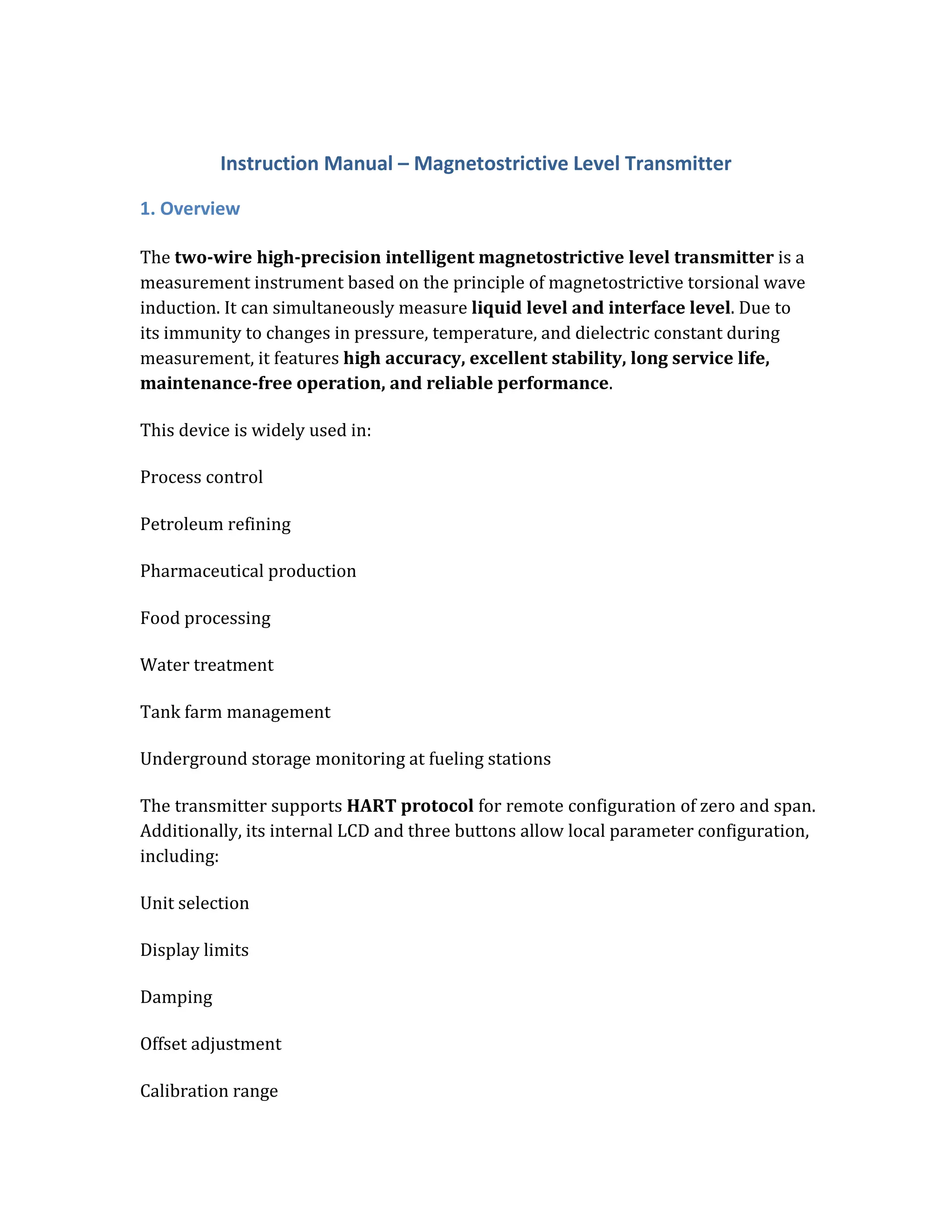
The two-wire high-precision intelligent magnetostrictive level transmitter is a
measurement instrument based on the principle of magnetostrictive torsional wave
induction. It can simultaneously measure liquid level and interface level. Due to
its immunity to changes in pressure, temperature, and dielectric constant during
measurement, it features high accuracy, excellent stability, long service life,
maintenance-free operation, and reliable performance.
This device is widely used in:
Process control
Petroleum refining
Pharmaceutical production
Food processing
Water treatment
Tank farm management
Underground storage monitoring at fueling stations
The transmitter supports HART protocol for remote configuration of zero and span.
Additionally, its internal LCD and three buttons allow local parameter configuration,
including:
Unit selection
Display limits
Damping
Offset adjustment
Calibration range
Fine tuning
Factory reset
2. Working Principle
The transmitter consists of:
An electronic module
A magnetostrictive waveguide
A float with a built-in permanent magnet
During operation:
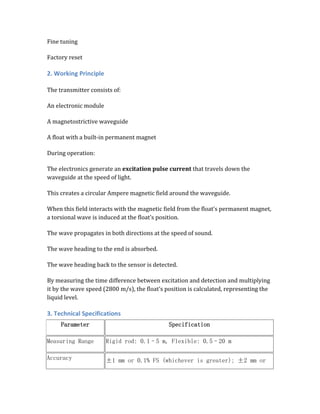
The electronics generate an excitation pulse current that travels down the
waveguide at the speed of light.
This creates a circular Ampere magnetic field around the waveguide.
When this field interacts with the magnetic field from the float’s permanent magnet,
a torsional wave is induced at the float’s position.
The wave propagates in both directions at the speed of sound.
The wave heading to the end is absorbed.
The wave heading back to the sensor is detected.
By measuring the time difference between excitation and detection and multiplying
it by the wave speed (2800 m/s), the float’s position is calculated, representing the
liquid level.
3. Technical Specifications
Parameter Specification
Measuring Range Rigid rod: 0.1–5 m, Flexible: 0.5–20 m
Accuracy ±1 mm or 0.1% FS (whichever is greater); ±2 mm or
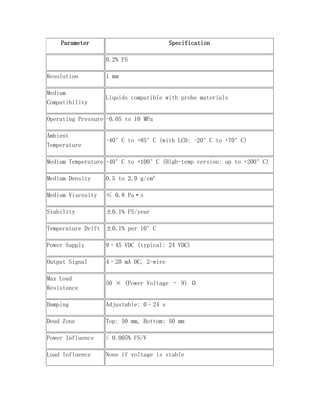
Parameter Specification
0.2% FS
Resolution 1 mm
Medium
Compatibility
Liquids compatible with probe materials
Operating Pressure -0.05 to 10 MPa
Ambient
Temperature
-40°C to +85°C (with LCD: -20°C to +70°C)
Medium Temperature -40°C to +100°C (High-temp version: up to +200°C)
Medium Density 0.5 to 2.0 g/cm³
Medium Viscosity ≤ 0.8 Pa·s
Stability ±0.1% FS/year
Temperature Drift ±0.1% per 10°C
Power Supply 9–45 VDC (typical: 24 VDC)
Output Signal 4–20 mA DC, 2-wire
Max Load
Resistance
50 × (Power Voltage – 9) Ω
Damping Adjustable: 0–24 s
Dead Zone Top: 50 mm, Bottom: 50 mm
Power Influence < 0.005% FS/V
Load Influence None if voltage is stable
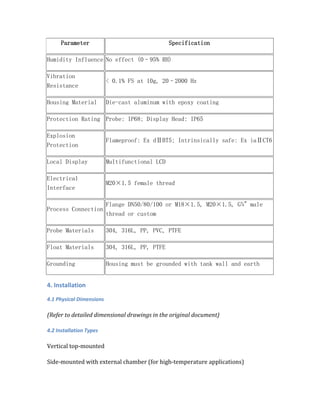
Parameter Specification
Humidity Influence No effect (0–95% RH)
Vibration
Resistance
< 0.1% FS at 10g, 20–2000 Hz
Housing Material Die-cast aluminum with epoxy coating
Protection Rating Probe: IP68; Display Head: IP65
Explosion
Protection
Flameproof: Ex dⅡBT5; Intrinsically safe: Ex iaⅡCT6
Local Display Multifunctional LCD
Electrical
Interface
M20×1.5 female thread
Process Connection
Flange DN50/80/100 or M18×1.5, M20×1.5, G¾" male
thread or custom
Probe Materials 304, 316L, PP, PVC, PTFE
Float Materials 304, 316L, PP, PTFE
Grounding Housing must be grounded with tank wall and earth
4. Installation
4.1 Physical Dimensions
(Refer to detailed dimensional drawings in the original document)
4.2 Installation Types
Vertical top-mounted
Side-mounted with external chamber (for high-temperature applications)
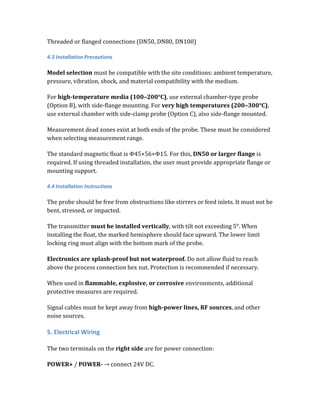
Threaded or flanged connections (DN50, DN80, DN100)
4.3 Installation Precautions
Model selection must be compatible with the site conditions: ambient temperature,
pressure, vibration, shock, and material compatibility with the medium.
For high-temperature media (100–200°C), use external chamber-type probe
(Option B), with side-flange mounting. For very high temperatures (200–300°C),
use external chamber with side-clamp probe (Option C), also side-flange mounted.
Measurement dead zones exist at both ends of the probe. These must be considered
when selecting measurement range.
The standard magnetic float is Φ45×56×Φ15. For this, DN50 or larger flange is
required. If using threaded installation, the user must provide appropriate flange or
mounting support.
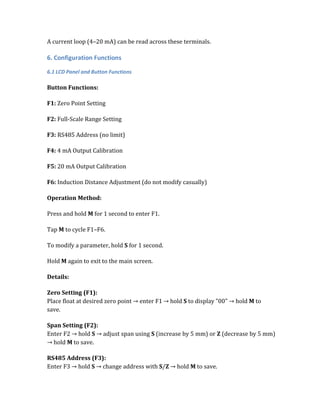
4.4 Installation Instructions
The probe should be free from obstructions like stirrers or feed inlets. It must not be
bent, stressed, or impacted.
The transmitter must be installed vertically, with tilt not exceeding 5°. When
installing the float, the marked hemisphere should face upward. The lower limit
locking ring must align with the bottom mark of the probe.
Electronics are splash-proof but not waterproof. Do not allow fluid to reach
above the process connection hex nut. Protection is recommended if necessary.
When used in flammable, explosive, or corrosive environments, additional
protective measures are required.
Signal cables must be kept away from high-power lines, RF sources, and other
noise sources.
5. Electrical Wiring
The two terminals on the right side are for power connection:
POWER+ / POWER- → connect 24V DC.
A current loop (4–20 mA) can be read across these terminals.
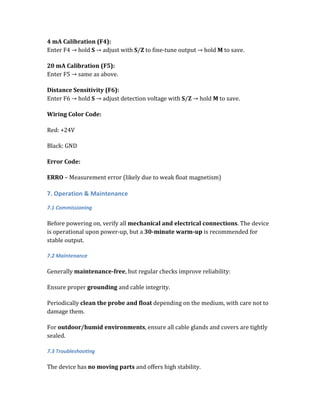
6. Configuration Functions
6.1 LCD Panel and Button Functions
Button Functions:
F1: Zero Point Setting
F2: Full-Scale Range Setting
F3: RS485 Address (no limit)
F4: 4 mA Output Calibration
F5: 20 mA Output Calibration
F6: Induction Distance Adjustment (do not modify casually)
Operation Method:
Press and hold M for 1 second to enter F1.
Tap M to cycle F1–F6.
To modify a parameter, hold S for 1 second.
Hold M again to exit to the main screen.
Details:
Zero Setting (F1):
Place float at desired zero point → enter F1 → hold S to display "00" → hold M to
save.
Span Setting (F2):
Enter F2 → hold S → adjust span using S (increase by 5 mm) or Z (decrease by 5 mm)
→ hold M to save.
RS485 Address (F3):
Enter F3 → hold S → change address with S/Z → hold M to save.
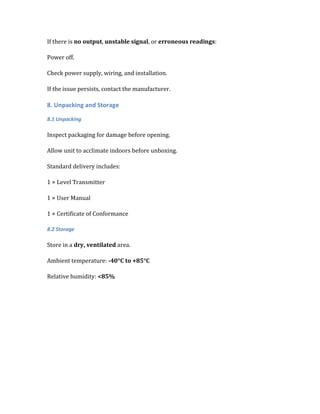
4 mA Calibration (F4):
Enter F4 → hold S → adjust with S/Z to fine-tune output → hold M to save.
20 mA Calibration (F5):
Enter F5 → same as above.
Distance Sensitivity (F6):
Enter F6 → hold S → adjust detection voltage with S/Z → hold M to save.
Wiring Color Code:
Red: +24V
Black: GND
Error Code:
ERRO – Measurement error (likely due to weak float magnetism)
7. Operation & Maintenance
7.1 Commissioning
Before powering on, verify all mechanical and electrical connections. The device
is operational upon power-up, but a 30-minute warm-up is recommended for
stable output.
7.2 Maintenance
Generally maintenance-free, but regular checks improve reliability:
Ensure proper grounding and cable integrity.
Periodically clean the probe and float depending on the medium, with care not to
damage them.
For outdoor/humid environments, ensure all cable glands and covers are tightly
sealed.
7.3 Troubleshooting
The device has no moving parts and offers high stability.
If there is no output, unstable signal, or erroneous readings:
Power off.
Check power supply, wiring, and installation.
If the issue persists, contact the manufacturer.
8. Unpacking and Storage
8.1 Unpacking
Inspect packaging for damage before opening.
Allow unit to acclimate indoors before unboxing.
Standard delivery includes:
1 × Level Transmitter
1 × User Manual
1 × Certificate of Conformance
8.2 Storage
Store in a dry, ventilated area.
Ambient temperature: -40°C to +85°C
Relative humidity: <85%

Magnetostrictive_Level_Transmitter_Manual.pdf

  • 1.
    Instruction Manual –Magnetostrictive Level Transmitter 1. Overview The two-wire high-precision intelligent magnetostrictive level transmitter is a measurement instrument based on the principle of magnetostrictive torsional wave induction. It can simultaneously measure liquid level and interface level. Due to its immunity to changes in pressure, temperature, and dielectric constant during measurement, it features high accuracy, excellent stability, long service life, maintenance-free operation, and reliable performance. This device is widely used in: Process control Petroleum refining Pharmaceutical production Food processing Water treatment Tank farm management Underground storage monitoring at fueling stations The transmitter supports HART protocol for remote configuration of zero and span. Additionally, its internal LCD and three buttons allow local parameter configuration, including: Unit selection Display limits Damping Offset adjustment Calibration range
  • 2.
    Fine tuning Factory reset 2.Working Principle The transmitter consists of: An electronic module A magnetostrictive waveguide A float with a built-in permanent magnet During operation: The electronics generate an excitation pulse current that travels down the waveguide at the speed of light. This creates a circular Ampere magnetic field around the waveguide. When this field interacts with the magnetic field from the float’s permanent magnet, a torsional wave is induced at the float’s position. The wave propagates in both directions at the speed of sound. The wave heading to the end is absorbed. The wave heading back to the sensor is detected. By measuring the time difference between excitation and detection and multiplying it by the wave speed (2800 m/s), the float’s position is calculated, representing the liquid level. 3. Technical Specifications Parameter Specification Measuring Range Rigid rod: 0.1–5 m, Flexible: 0.5–20 m Accuracy ±1 mm or 0.1% FS (whichever is greater); ±2 mm or
  • 3.
    Parameter Specification 0.2% FS Resolution1 mm Medium Compatibility Liquids compatible with probe materials Operating Pressure -0.05 to 10 MPa Ambient Temperature -40°C to +85°C (with LCD: -20°C to +70°C) Medium Temperature -40°C to +100°C (High-temp version: up to +200°C) Medium Density 0.5 to 2.0 g/cm³ Medium Viscosity ≤ 0.8 Pa·s Stability ±0.1% FS/year Temperature Drift ±0.1% per 10°C Power Supply 9–45 VDC (typical: 24 VDC) Output Signal 4–20 mA DC, 2-wire Max Load Resistance 50 × (Power Voltage – 9) Ω Damping Adjustable: 0–24 s Dead Zone Top: 50 mm, Bottom: 50 mm Power Influence < 0.005% FS/V Load Influence None if voltage is stable
  • 4.
    Parameter Specification Humidity InfluenceNo effect (0–95% RH) Vibration Resistance < 0.1% FS at 10g, 20–2000 Hz Housing Material Die-cast aluminum with epoxy coating Protection Rating Probe: IP68; Display Head: IP65 Explosion Protection Flameproof: Ex dⅡBT5; Intrinsically safe: Ex iaⅡCT6 Local Display Multifunctional LCD Electrical Interface M20×1.5 female thread Process Connection Flange DN50/80/100 or M18×1.5, M20×1.5, G¾" male thread or custom Probe Materials 304, 316L, PP, PVC, PTFE Float Materials 304, 316L, PP, PTFE Grounding Housing must be grounded with tank wall and earth 4. Installation 4.1 Physical Dimensions (Refer to detailed dimensional drawings in the original document) 4.2 Installation Types Vertical top-mounted Side-mounted with external chamber (for high-temperature applications)
  • 5.
    Threaded or flangedconnections (DN50, DN80, DN100) 4.3 Installation Precautions Model selection must be compatible with the site conditions: ambient temperature, pressure, vibration, shock, and material compatibility with the medium. For high-temperature media (100–200°C), use external chamber-type probe (Option B), with side-flange mounting. For very high temperatures (200–300°C), use external chamber with side-clamp probe (Option C), also side-flange mounted. Measurement dead zones exist at both ends of the probe. These must be considered when selecting measurement range. The standard magnetic float is Φ45×56×Φ15. For this, DN50 or larger flange is required. If using threaded installation, the user must provide appropriate flange or mounting support. 4.4 Installation Instructions The probe should be free from obstructions like stirrers or feed inlets. It must not be bent, stressed, or impacted. The transmitter must be installed vertically, with tilt not exceeding 5°. When installing the float, the marked hemisphere should face upward. The lower limit locking ring must align with the bottom mark of the probe. Electronics are splash-proof but not waterproof. Do not allow fluid to reach above the process connection hex nut. Protection is recommended if necessary. When used in flammable, explosive, or corrosive environments, additional protective measures are required. Signal cables must be kept away from high-power lines, RF sources, and other noise sources. 5. Electrical Wiring The two terminals on the right side are for power connection: POWER+ / POWER- → connect 24V DC.
  • 6.
    A current loop(4–20 mA) can be read across these terminals. 6. Configuration Functions 6.1 LCD Panel and Button Functions Button Functions: F1: Zero Point Setting F2: Full-Scale Range Setting F3: RS485 Address (no limit) F4: 4 mA Output Calibration F5: 20 mA Output Calibration F6: Induction Distance Adjustment (do not modify casually) Operation Method: Press and hold M for 1 second to enter F1. Tap M to cycle F1–F6. To modify a parameter, hold S for 1 second. Hold M again to exit to the main screen. Details: Zero Setting (F1): Place float at desired zero point → enter F1 → hold S to display "00" → hold M to save. Span Setting (F2): Enter F2 → hold S → adjust span using S (increase by 5 mm) or Z (decrease by 5 mm) → hold M to save. RS485 Address (F3): Enter F3 → hold S → change address with S/Z → hold M to save.
  • 7.
    4 mA Calibration(F4): Enter F4 → hold S → adjust with S/Z to fine-tune output → hold M to save. 20 mA Calibration (F5): Enter F5 → same as above. Distance Sensitivity (F6): Enter F6 → hold S → adjust detection voltage with S/Z → hold M to save. Wiring Color Code: Red: +24V Black: GND Error Code: ERRO – Measurement error (likely due to weak float magnetism) 7. Operation & Maintenance 7.1 Commissioning Before powering on, verify all mechanical and electrical connections. The device is operational upon power-up, but a 30-minute warm-up is recommended for stable output. 7.2 Maintenance Generally maintenance-free, but regular checks improve reliability: Ensure proper grounding and cable integrity. Periodically clean the probe and float depending on the medium, with care not to damage them. For outdoor/humid environments, ensure all cable glands and covers are tightly sealed. 7.3 Troubleshooting The device has no moving parts and offers high stability.
  • 8.
    If there isno output, unstable signal, or erroneous readings: Power off. Check power supply, wiring, and installation. If the issue persists, contact the manufacturer. 8. Unpacking and Storage 8.1 Unpacking Inspect packaging for damage before opening. Allow unit to acclimate indoors before unboxing. Standard delivery includes: 1 × Level Transmitter 1 × User Manual 1 × Certificate of Conformance 8.2 Storage Store in a dry, ventilated area. Ambient temperature: -40°C to +85°C Relative humidity: <85%