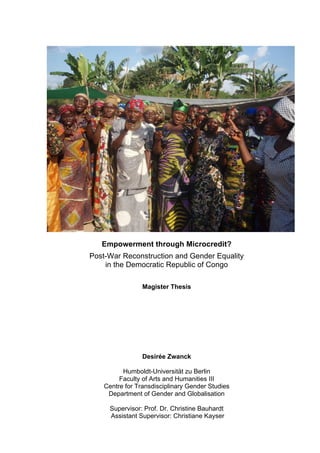
Empowerment through Microcredit?
Post-War Reconstruction and Gender Equality
in the Democratic Republic of Congo
Magister Thesis
Desirée Zwanck
Humboldt-Universität zu Berlin
Faculty of Arts and Humanities III
Centre for Transdisciplinary Gender Studies
Department of Gender and Globalisation
Supervisor: Prof. Dr. Christine Bauhardt
Assistant Supervisor: Christiane Kayser
i
Zusammenfassung (German Summary)
Die vorliegende Magisterarbeit in den Gender Studies (verortet im Fachbereich
Gender und Globalisierung am Institut für Wirtschafts- und Sozialwissenschaften des
Landbaus der Landwirtschaftlich-Gärtnerischen Fakultät) setzt sich mit der Frage
auseinander, ob und wie Kleinkredite die Situation von ressourcenarmen
Kleinbäuerinnen dergestalt verbessern können, dass sie deren Empowerment
fördern.
Die Arbeit zeigt auf, dass Kleinkredite nur dann eine positive Auswirkung auf
Geschlechtergerechtigkeit haben, wenn sie von sozial und kulturell orientierten
Maßnahmen begleitet werden. Dafür spielt die Kooperation mit Männern eine ebenso
große Rolle wie eine entwicklungspolitische Perspektive, welche die Bedürfnisse und
Sorgen, aber auch die Strategien und Stärken der lokalen Bevölkerung respektiert
und sich nach diesen richtet.
Dabei konzentriert sich die Arbeit auf den Kontext der Nachkriegsgesellschaft in der
ostkongolesischen Provinz Maniema und auf das dortige Wiederaufbauprojekt „Heal
my People“ der lokalen Nichtregierungsorganisation HEAL Africa. Bei dem Projekt
handelt es sich um eine Maßnahme zur ganzheitlichen Heilung und Reintegration
von Frauen die als Überlebende von Vergewaltigungen gesundheitliche und
psychische Schäden davongetragen haben bzw. von den negativen Auswirkungen
des erst kürzlich beigelegten Konfliktes in besonderer Weise betroffen sind (z.B.
durch Verwitwung oder extreme Ressourcenarmut).
In der Einleitung werden das Thema, die Hypothesen und die Fragestellung
dargelegt. Die Verortung der Arbeit in den Sozialwissenschaften wird hier ebenso
erörtert wie die postmoderne, feministische Herangehensweise. Das erste Kapitel
stellt theoretische und praktische Ansätze zu Frauen und Gender in der
internationalen Entwicklungszusammenarbeit vor. Das zweite Kapitel führt in den
Kontext der Demokratischen Republik Kongo ein und beschreibt das Projekt „Heal
my People“. Im dritten Kapitel werden Herangehensweise und Methodik einer
weitgehend qualitativen Feldforschung dargestellt die im Oktober und November
2007 in Maniema durchgeführt wurde.
In den folgenden drei Kapiteln werden die Ergebnisse der Feldforschung dargelegt
und in Bezug zum theoretischen Hintergrund gesetzt. Geschlechterverhältnisse in
Maniema und der Zusammenhang zwischen der Vergabe von Kleinkrediten und
Empowerment werden dabei auf drei Ebenen analysiert: dem Individuum, dem
Haushalt und der Gemeinschaft. Die Schlussfolgerungen werden im siebten Kapitel
zusammengefasst.
ii
Table of Contents
Abbreviations ........................................................................................................................iii	
  
Glossary .................................................................................................................................iii	
  
Acknowledgements...............................................................................................................iv	
  
Introduction ............................................................................................................................1	
  
1. International Development and Gender Equality ............................................................9	
  
1.2	
  Approaches	
  to	
  Women	
  and	
  Gender	
  in	
  Development ...........................................................11	
  
1.2.1	
  Women’s	
  Marginalisation	
  and	
  the	
  Welfare	
  Approach..................................................................12	
  
1.2.2	
  Women	
  in	
  Development ............................................................................................................................14	
  
1.2.3	
  Gender	
  and	
  Development..........................................................................................................................16	
  
1.2.4	
  Women’s	
  Empowerment...........................................................................................................................18	
  
1.3	
  Microcredit:	
  A	
  Tool	
  for	
  Women’s	
  Empowerment?................................................................19	
  
2. War and Post-War Reconstruction in Maniema ............................................................21	
  
2.1	
  War	
  and	
  the	
  Post-­War	
  Situation..................................................................................................21	
  
2.1.1	
  Historical	
  Context.........................................................................................................................................21	
  
2.1.2	
  The	
  Post-­‐Conflict	
  Situation	
  and	
  Sexualised	
  Violence....................................................................23	
  
2.2	
  HEAL	
  Africa:	
  A	
  Local	
  Approach	
  to	
  Reconstruction................................................................25	
  
3. Methodology .....................................................................................................................29	
  
3.1	
  Feminist	
  Perspectives	
  of	
  Empirical	
  Research.........................................................................29	
  
3.2	
  Research	
  Methodology ...................................................................................................................31	
  
3.2.1	
  Qualitative	
  Interviewing............................................................................................................................31	
  
3.2.2	
  Participatory	
  Action	
  Research ................................................................................................................34	
  
4. Gendered Experiences: The Individual ..........................................................................37	
  
4.1	
  Women’s	
  Personal	
  Experiences...................................................................................................38	
  
4.1.1	
  Gender-­‐Based	
  Discrimination.................................................................................................................38	
  
4.1.2	
  Experiences	
  of	
  War	
  and	
  Sexualised	
  Violence...................................................................................39	
  
4.1.2	
  Building	
  (Self-­‐)Respect	
  Through	
  Microcredit?................................................................................40	
  
5. Gendered Hierarchies: The Household..........................................................................45	
  
5.1	
  Labour	
  and	
  Income ..........................................................................................................................46	
  
5.1.1	
  Labour	
  Distribution.....................................................................................................................................46	
  
5.1.2	
  Impacts	
  of	
  Microcredit	
  on	
  Labour	
  and	
  Income ...............................................................................48	
  
5.2	
  Trade	
  and	
  Mobility...........................................................................................................................50	
  
5.2.1	
  Conditions	
  of	
  Trade	
  and	
  Mobility..........................................................................................................50	
  
5.2.2	
  Impact	
  of	
  Microcredit	
  on	
  Trade	
  and	
  Mobility ..................................................................................52	
  
5.3	
  Resource	
  Ownership	
  and	
  Control...............................................................................................53	
  
5.3.1	
  Excursus:	
  Cooperative	
  Conflict...............................................................................................................53	
  
5.3.2	
  Hierarchies	
  in	
  Resource	
  Ownership	
  and	
  Control ...........................................................................55	
  
5.3.3	
  Impact	
  of	
  Microcredit	
  on	
  Resource	
  Ownership	
  and	
  Control.....................................................58	
  
6. Gendered Networks: The Community ............................................................................60	
  
6.1	
  Social	
  Capital	
  and	
  Reciprocity	
  in	
  Maniema..............................................................................61	
  
6.2	
  Women’s	
  Solidarity	
  Networks......................................................................................................65	
  
6.2.1	
  Women’s	
  Solidarity	
  Networks	
  in	
  Maniema.......................................................................................65	
  
6.2.2	
  ‘Heal	
  My	
  People’	
  Solidarity	
  Groups	
  as	
  a	
  New	
  Social	
  Force.........................................................66	
  
7. Conclusion........................................................................................................................70	
  
Bibliography .........................................................................................................................74	
  
Printed	
  Resources ...................................................................................................................................74	
  
Electronic	
  Resources..............................................................................................................................77	
  
Eidesstattliche Erklärung ....................................................................................................79	
  
iii
List of Figures
Dialogue Box 1: Changes in Family Relationships…………………………………..43
Dialogue Box 2: Discussion on Ownership During Workshop in Pangi……………57
Dialogue Box 3: Emergency Support Options………………………………………..68
Abbreviations
CEDAW Convention on the Elimination of All Forms of Discrimination
against Women
CONADER Commission Nationale de Désarmement, Démobilisation et
Réinsertion
DAWN Development Alternatives with Women for a New Era
DRC Democratic Republic of Congo
FP female participant
HMPM Heal My People Maniema
HEAL Africa Health, Education, Action and Leadership for Africa
IGA income-generating activity
KfW Kreditanstalt für Wiederaufbau
IMF International Monetary Fund
MONUC Mission des Nations Unies en République Démocratique du
Congo
MP male participant
NGO non-governmental organisation
PAR participatory action research
SAP structural adjustment program
UN United Nations
Q question by facilitator
Glossary
bwana Swahili term for ‘sir', ‘master’ and ‘spirit’
kitu kwa kitu Swahili term for barter / exchange of goods
likilimba Swahili term for rotational and communal (field) work
Magister In Germany, the Magister is a first degree that requires four to
six years of study and is equivalent of a Master’s Degree
Rega Ethnic group in Maniema
tontine Investment vehicle that combines elements of group savings,
group life insurance and lottery (named after 16th
century
Banker Lorenzo di Tonti). In Congo, it is used to describe
rotational savings accounts.
Zimba Ethnic group in Maniema
iv
Acknowledgements
First and foremost, I thank the people of Maniema who have lavished me with their
hospitality and shared their time, concerns and hopes with me so that this survey
could be completed. I also thank HEAL Africa and its ever-friendly and helpful staff
that has greatly facilitated my stay in Goma as well as my research in Maniema. I
am particularly grateful for the substantial advice and kind cooperation of the
program manager Gwendolyn Lusi and her assistant, Harper Mcconnell.
Similarly, I would like to thank the entire staff of ‘Heal My People Maniema’ for their
kind support and advice in all matters related to the completion of this document. I
am very grateful to the project director Muliri Kabekatyo, as well as training
coordinator Julienne Chakupewa, IGA coordinator Francesca Ferusi and monitoring
and evaluation officer Albert Mushiaramina. My gratitude goes out also to trainers
Kahindo Vihamba and Omoyi, who took every measure to make the stay in
Maniema comfortable.
I would further like to express my gratitude for the outstanding cooperation of
Marceline Ndarabu, supervisor of ‘Heal My People’ in Kipaka and Godelive
Akilyabo, supervisor in Kampene, for their courage and inspiration as well as their
excellent Swahili/French translation during my research. I would also like to thank
Pastor Nehemiah and Pastor Michel Pierre Sumaili Bukanga from Kampene for their
translation.
I am equally indebted to the Nehemiah Committees of Kipaka, Kampene and Pangi,
who supported the planning and implementation of my research in every way
possible. I would like to thank members of all three committees for their curiosity
and their willingness to share their thoughts and aspirations.
Furthermore, I would like to thank the professionals, programs and organizations
that cooperated with me in this research and provided me with their knowledge and
expertise, namely Dr. Birgit Niebuhr of the KfW, Noella Katembo of Choisir la Vie,
Neema Mayala of Maternité à Moindre Risque, Joseph Ciza of Heal My People
Nord-Kivu, Pastor Jules Bolingo of the Nehemiah Commitees, Jules Barhalengwa of
Women for Women, as well as Samuel Ferguson of Hekima/World Relief and Achim
Koch of GTZ Jeunesse Kindu. Last but not least, the KAP study on sexual violence
conducted by Andrea McPherson has been of tremendous help for my
understanding of the subject matter.
In Germany, I would like to express my gratitude to my supervisor Prof. Dr. Christine
Bauhardt for her valuable input in conceptual and theoretical questions. The same is
true for my assistant supervisor Christiane Kayser, whom I also want to thank
because she opened up the possibility of this research to me and encouraged me to
accomplish it. I further want to thank Dr. Ilona Pache, Course Coordinator of the
Humboldt University’s Centre for Transdisciplinary Gender Studies for her kind
support in the planning of my research trip. Last but not least, I am deeply grateful to
the constructive criticism, the support and advice of my colleagues and friends,
especially Danielle Lanyard and Julika Schmitz.
1
Introduction
In 2006, the Nobel Committee awarded the Peace Price to Muhammad Yunus,
Bangladeshi professor of economics and founder of the pioneering microcredit
organisation Grameen Bank. His work to end poverty was honoured as an important
contribution to peace. In the Committee’s words,
Lasting peace cannot be achieved unless large population groups find
ways in which to break out of poverty. Micro-credit is one such way.
Development from below also serves to advance democracy and human
rights (Nobel Foundation 2006).
The potential of microcredit lies in its ability to reach the most disadvantaged groups
of society and to provide them with means to improve their living situation on their
own account. As the Committee’s laudation shows, this development ‘from below’ is
commonly regarded as a way to advance peace and equality. One of microcredit’s
frequently cited qualities is that it is especially attractive to women because it
provides them with a supreme avenue towards empowerment, meaning the
achievement of greater social, economic and political power. The most perceptible
proof of this idea is that 97% of the Grameen Bank’s eight million borrowers are
female.
Can we assume that there is indeed a connection between the three elements of
microcredit, women’s empowerment and peace? Does micro-level economic
development have empowering effects on women, and in what way may this
empowerment contribute to peace? In exploring these issues, the present Magister
thesis attempts to tie in theoretical considerations regarding women’s empowerment
with research on the everyday realities of resource-poor rural women in societies
affected by war. By explicitly connecting the issues of war, sexualised violence and
women’s empowerment through microcredit, the paper offers a unique perspective
within the field of development studies.
The empirical part of the study was carried out in the framework of the ‘Heal My
People Maniema’ (HMPM) microcredit program in Maniema province, Eastern
Democratic Republic of Congo (DRC). The program constitutes a post-war
reconstruction effort that mainly focuses on women who have survived rape. Feminist
thought has long challenged public perception of rape as a crime committed by
abnormal men unable to control their lust and instead regarded it as ‘an act of
2
violence committed by “normal” men against women: […] primarily a mechanism of
control and intimidation’ (Mosse 1993: 60). Therefore, the prevalence of rape in war
and post-war situations can be understood as both a result and a constituent of
women’s lack of power. However, the issue of rape survivors is largely missing from
discourses on microcredit and empowerment.
Since 1993, war and armed conflict have dominated the Eastern provinces of the
DRC, which include North and South Kivu as well as Maniema. Though Maniema
has experienced a relatively stable period of peace starting in 2005, the conflict’s
aftermath still weighs heavily on the population. Communities suffer from profound
lack of capital, which is further amplified by the absence of functional infrastructure
for secure and adequate social services, as well as unfavourable political and legal
conditions.
In addition to the adversity experienced by the entire population of Maniema, women
are faced with gender-related forms of discrimination that put them at a relative
disadvantage to men. During the war, women were frequently subjected to rape, and
many women still suffer negative consequences for their health and social status. In
addition, factors such as limited control over economic resources and limited access
to education restrict women’s agency (their capacity to make choices and to act on
these choices), making them especially susceptible to sexual and economic
exploitation. At the same time, women play a central role as economic providers and
social networkers, with a strong potential to enhance post-war reconstruction efforts
and foster peace.
All of the above factors expose a need to strengthen the social, economic and
political position of resource-poor women in rural Maniema who have survived rape
and/or have been otherwise negatively affected by the consequences of war. The
primary cognitive interest of this thesis is whether and how this can be achieved with
the help of microcredit. In order to examine this issue, the argument is structured into
three hypotheses, each of which corresponds to one are of women’s development at
the microlevel of society: the individual, the household and the community. Though
all of these three sub-levels are interconnected, they are treated separately here in
order to facilitate a differentiated microlevel analysis of empowerment. The paper
does not address the broader and more impersonalised macrolevel of national and
international development.
3
The first hypothesis suggests that participation in a microcredit program enhances
the personal empowerment of rural Congolese women who have survived rape.
Individual empowerment is defined here as increased awareness of personal value,
strength and interest, as well as an increased ability to act on this awareness. The
paper asks how exactly this change be achieved by using the tool of microcredit.
The second hypothesis proposes that women’s access to microcredit strengthens
their position at the household sub-level. At this level, empowerment is characterised
by a change in gendered hierarchies in the distribution of labour, resources and
decision-making power that reduces women’s relative disadvantage to men. The
paper examines how the introduction of microcredit induces this change.
The third hypothesis put forward here is that in the post-war environment of rural
Maniema, microcredit can empower the concerned group of women at the
community sub-level. At this level, empowerment is defined as the creation or
recreation of women’s solidarity networks and women’s heightened social and
political influence. The paper inquires how microcredit encourages this process.
With its focus on social, economic and political development of the resource-poor,
the thesis pertains to the field of development studies. Academic discourse on
international development evolved from the preoccupation with economic progress
for newly decolonised countries in the 1950s and 1960s. From its beginnings,
development studies exposed a strong practical focus in trying to delineate paths for
action against the perceived ‘problems’ of these countries, such as poverty or lack of
social services. Initially, development policies and programs were strongly influenced
and informed by economics and natural science, which were believed to be
universally applicable to all societies. When an increasing number of scholars
realised that this focus was not sufficient to address the specific cultural, social or
political conditions in different societies, development studies came to encompass a
more diverse range of disciplines, such as social and political science.
Though multidisciplinary in character, development studies often remain limited to a
eurocentric viewpoint. This is due to the hegemonic character of European-originated
development thought. The ideas of progress, modernisation and the free-market
economy that constitute the mainstream of international development have been
postulated as universally valid ‘truths’ that other societies should adhere to.
At the same time, development studies have offered a fertile ground for alternative
visions that challenge mainstream thought and attempt to change international
4
development discourse from within. Notably, works from developing countries and
feminist works have increasingly placed the local, micro-level realities of resource-
poor people at the centre. In doing so, they have often been successful in informing
more differentiated and inclusionary development policies and programs.
The present thesis is a contribution to this more critical stream of development
studies. It recognises the hegemonic underpinnings of the idea of international
development, but it does not reject the idea per se. As this paper intends to show,
some of the ideas and analytical tools created by critical development scholars can
be utilised to promote equality within individual societies as well as between
developed and developing countries.
From this vantage point, the use of language is critical. The term ‘Third World
Country’ will be avoided here, as it was coined in the 20th
century to describe those
countries that were considered to be the least developed. Today, development
scholars regard the term as obsolete and derogatory because it fixates resource-poor
countries at the bottom of a scale of measurement that was created from within the
so-called ‘First World’ of capitalist, industrialised, and mostly European nations
(Hermassi 1980).
In an attempt to avoid this form of implicit judgement, the term ‘developing country’ is
employed here. Its transitory nature suggests that resource-poor countries are in a
process that wealthier, ‘developed countries’ have completed to a larger degree. The
state of a country’s development is not considered an actual reality here. Instead it is
regarded as an ideological concept, a way of interpreting certain nations according to
standardised economic criteria - such as infrastructure, industry, gross domestic
product, democratic structures and implementation of human rights.
Development language tends to describe the people in developing countries as ‘the
poor’ or ‘the rural poor’, which implies a general state of lack and victimhood. This
terminology does not allow for a view of economically disadvantaged people that
recognises their capacities and potential. People in many African societies may, for
instance, lack financial capital and tangible resources, but they possess a wealth of
social networks and traditional knowledge. This is why the term ‘resource-poor’,
which is now commonly used in development literature, seems more appropriate. It
signifies a relative disadvantage in some resources, thereby defining a circumstance
rather than an innate state of being.
5
Within the broader field of development studies, this paper is located in the discipline
of social sciences, more specifically in the field of sociology, or the scientific study of
societies. On first sight, we may intuitively consider economics to be a more suitable
discipline for an analysis of a rural microcredit program. Yet we need to consider that
dominant economic discourses, namely classical and neoclassical liberalism, see
human beings as nuclear entities that are driven by rational self-interest and compete
with each other in an impartial, ‘free’ market (Blau and Ferber 1986: 20-21). Such a
view does not allow for the importance of other factors that inform human life, e.g. the
relationships between people or the cultural dimensions of social interaction.
In contrast, sociology focuses on social context. It proposes that individuals are
integrated into, and influenced by, social networks that form their identity and provide
them with a framework of knowledge, beliefs, values, rights and obligations (Weber
1925). Moreover, sociology sees social relations not as egalitarian, but hierarchical,
signifying that they are stratified by inequalities in resources, status and capabilities.
If we examine microcredit with regard to women’s empowerment from a sociological
viewpoint, we describe a process that breaks down and changes these social
hierarchies.
Nonetheless, sociology is subject to some limitations that are similar to development
studies, as it also originates from and reflects European scientific thought. Early 19th
century theorists in sociology were still firmly dedicated to the methods of natural
science with its paradigms of rationality and objectivity. This school of ‘positivists’
suggested that social phenomena could be understood through empirical evidence,
which they equated with incontestable and universal ‘truth’.
Their views were partly challenged by antipositivists such as Weber, who claimed
that sociological research should not use the same tools and methods as the natural
sciences (1949: 63; 110-111). Based on the recognition that human societies are
governed by unique principles such as cultural norms and values, antipositivists
called for a more suitable conceptual framework for social analysis. This movement
ultimately led to the development of the tools and methods that were implemented
both in the empirical research and the evaluation of results that inform the present
thesis.
Despite sociology’s push away from natural sciences, its methods continue to be
influenced by the idea that scientific research and discourse can be neutral or
objective. Feminist sociologists have challenged this supposed objectivity by arguing
6
that it conceals male bias (Nickel 2000: 132-133). They argue that scientific
discourse originated from a context dominated by European men and is imbued with
the inherently subjective viewpoint of this group - even if today, the scientist may be
non-European or female.
The problem of male bias can be exemplified by sociology’s long-standing omission
or misjudgement of women’s specific concerns and the concerns of other
marginalized groups (Nickel 2000: 132-133). One of the great achievements of
feminist scholars since the 1970s has been to bring these concerns to the attention
of scientific debates. This push has eventually led to the introduction of an
interdisciplinary body of discourse that is subsumed under the term ‘gender studies’.
‘Gender’ can be defined as a constitutive element of social relationships that is based
on perceived differences and deeply embedded in the attitudes, knowledge and
practices of both women and men. Gender is generally cited as a cultural construct in
opposition to the immutable, ‘natural’ difference of sex. Butler contests this view by
claiming that sex is ‘as culturally constructed as gender’ (1990: 7). Biological
difference is thus a signifier of the gendered structure of society, which is reinforced
through economic imbalances, religious beliefs, cultural practices and educational
systems.
These imbalances point towards Scott’s proposition that ‘gender is a primary way of
signifying relationships of power’ (2007: 66). She asserts that gender relations are
not only a field in which power is articulated and manifested, but that gender is a
constituent of power itself. Beyond social relations and the institutionalised
inequalities between women and men, this perspective is particularly useful when
analysing a context of sexualised violence in wartime. In this setting, power is
signified and asserted based on symbolic attributions of masculinity and femininity.
In analysing relationships of power, gender offers a guide to contestation and
resistance, making it a key tool for feminist thought and activism. The term ‘feminist’
is defined here as any individual who perceives and is ready to act against the
prevalence of hegemonic power and inequality within a given context. Even though
this paper focuses mainly on women’s empowerment, feminism is not limited to
women alone and does not only relate to ‘women’s issues’. Feminism is an attitude, a
perspective that is critical of all forms of power and dominance. It compels to take
action, to challenge hierarchies and to change them. Therefore, feminism is never
7
exclusively theoretical, but is always already a form of activism that has concrete
practical implications.
As a White, European feminist scholar in the field of development studies, I find
myself in a double bind. I desire to take action against the oppressive systems that
often affect women from developing countries, but at the same time, I operate from
within a position of economic, cultural, political and racial privilege. In doing so, I am
inclined to take a eurocentric standpoint, thereby reinforcing and reproducing some
of the very same social hierarchies that I intend to deconstruct. To the extent that this
means that all women are not equal, we may argue with Mohanty that there is no
common ground for women’s activism, no ‘global sisterhood’ united by a universal
female experience of male oppression (1989-1990: 180).
In order to approach to this dilemma, I employ postmodern feminism. This stream of
feminist thought discusses multiple forms of oppression along the lines of race, class
or ethnicity. It deconstructs scientific paradigms of objectivity and neutrality by
asserting that the researcher is equally as embedded in social context as is the
‘object’ of the research. This signifies that any ‘truth’ that we produce is always
already biased, and we can only deconstruct this bias through self-reflectivity (Spivak
1990: 19). With this in mind, I do not reject the idea of sisterhood altogether, but
rather the notion that this is a natural state or an abstract principle that exists as a
given. Much rather, I agree with Sen and Grown that sisterhood, signifying a specific
kind of sharing and solidarity, is ‘a concrete goal that must be achieved through a
process of debate and action’ (1987: 24).
This concrete goal of solidarity between women can at least partly be achieved
through an approach to development that gives women’s empowerment a paramount
role. The idea of empowerment did not evolve from European academia, but from the
work of feminists in developing countries. It creates favourable conditions for debate
and action because it allows a twofold view on power imbalances that correlates with
postmodern feminist thought: it simultaneously addresses hierarchies between
women and men, and hierarchies between developed and developing countries.
The empowerment approach challenges development literature’s recurring bias that
resource-poor rural women are a homogenous group of passive victims who need
feminists and experts from developed countries to come to their rescue. The task of
development interventions should not be to ‘empower’ women, but rather to create a
favourable environment and provide the ways by which they can empower
8
themselves. Empowerment thus constitutes the process of their coming into power,
of taking directed action by devising their own strategies for agency and autonomy.
The present thesis draws from the theoretical work of sociologists and other scholars
from developed and developing countries that are mainly concerned with issues of
feminism and gender analysis and development. In addition, the paper is based on
an empirical research carried out from November to December 2007 with women and
men in resource-poor rural communities across Maniema province in Eastern DRC.
The research was commissioned by the Congolese non-governmental organisation
(NGO) HEAL Africa, that sought to measure the impact of the HMPM microcredit
program, seeking recommendations on how to improve the program. Rather than
being ‘prescribed’ a gender analysis by a foreign donor, the organisation actively
sought the perspective of an external, European-educated researcher. As a foreign
scholar, I was able to learn from the experience and knowledge of the Congolese
staff at HEAL Africa, who proved to me more than once that it does not take
academic theory in order to understand the value of feminism and women’s
empowerment in people’s lives. Thanks to them, the present thesis has become the
live account of a learning process.
My argument is thus situated at the intersection of theory and practice, which is
characterised by contradictions and fractures. Theories on empowerment that have
been developed within the academic settings of development studies may often not
apply to the actually realities of resource-poor women. Similarly, these realities may
contest academic theories. If we are able to recognise and to brave these tensions,
our theoretical considerations may be useful tools to analyse and inform
development practice.
The paper is structured into seven main chapters. The first chapter deals with the
background of theories and paradigms within development studies that concern
women and gender. The second chapter takes a closer look at the research location
of Maniema with particular regard to its post-war status, the issue of sexualised
violence against women, and the work of HEAL Africa and HMPM. Chapter three
discusses the methodology for measuring empowerment from a feminist standpoint.
Chapters four to six each present one part of the results of the empirical research as
they relate to the three sub-levels of the individual, the household and the
community. These chapters examine the status quo of gendered hierarchies at the
respective sub-levels, the interventions of the HMPM microcredit program and their
9
impact with regard to women’s empowerment. Chapter seven contains my
conclusion.
1. International Development and Gender Equality
This chapter begins with a brief overview of the context of international development.
It then discusses different development approaches to women and gender from the
1950s until present, namely the welfare approach, Women in Development (WID),
Gender and Development (GAD) and women’s empowerment. The final section
introduces microcredit as a possible tool for women’s empowerment.
1.1 International Development
The countries nowadays described as ‘developing’ have frequently been controlled
directly or indirectly by European or North American powers during colonial rule.
Especially between the 17th
and the 19th
century, these countries became subjected
to a European-dominated ‘world system’, of trade, colonisation, financial investment,
political relationships and military aggression. The economic and political control over
subject territories under colonial rule turned them into ‘sources of cheap raw
materials, food, and labour, as well as markets for ruling country’s manufacturers’
(Sen and Grown 1987: 29). Forced commercialisation and systems of private
property turned subsistent, self-provisioning communities into dependents.
The concept of development emerged from the 19th
century experience of
modernisation and industrialisation in Europe. It was founded on a strong belief in the
linear progress of societies and that it could be achieved based on ‘scientific’
disciplines like economics or natural science. Based on these ideas, Europeans
tended to perceive and describe foreign societies as backwards (De Groot 1991:
111-12). When former colonies reached for independence in the post-World War II
era, the economic development of these nations became an issue of international
concern. The principal development actors of the time were the United Nations (UN)
and the World Bank, who in the 1950s and 1960s were joined by numerous non-
governmental organisations. ‘International development’ was equated economic
growth.
Newly created nations were thus encouraged to follow European models of economic
growth, for instance through capital inputs and technical assistance (meaning training
10
and knowledge transfer). Social services and infrastructure were created to support
the development process. The economic benefits of this transition were believed to
eventually ‘trickle down’ throughout society, reaching even its least privileged
members (Mosse 1993: 11).
Especially on the capitalist side of the iron curtain, economic growth was seen as a
measure to guarantee individual freedom. In 1955, William Arthur Lewis, one of the
founders of development economics, made the following remark:
The advantage of economic growth is not that wealth increases
happiness, but that it increases the range of human choice (…). The case
of economic growth is that it gives man greater control over his
environment, and thereby increases his freedom (2003: 420).
However, while development policies and programs had raised the Gross National
Product of many developing countries by the 1970, the problems of the resource-
poor persisted. The promise of freedom hinged on the failure to provide adequate
social opportunities for all members of society. Development scholars and
practitioners began to promote measures that were directly aimed at the resource-
poor (Arndt 1987: 101). Beginning in the 1970s, the orientation of multilateral
development organisations shifted to pursue ‘basic human needs’, with development
projects focusing nutrition, health, water, sanitation and housing.
Proponents of this strategy argued that the provision for basic needs was
indispensable to offer micro-level strategies and opportunities to resource-poor
people in order to enable their full participation in the development process (Sen
1999: 20-22). Meanwhile, scholars from developing countries were commonly critical
of the basic needs approach, believing that its hidden agenda was to diminish
economic growth in developing countries and lock them into a state of backwardness
(Kabeer 2001: 7-8).
Eventually, criticism of development led to a paradigm shift. Resource-poor people
were no longer regarded as passive recipients, but as active stakeholders in the
development process. Economic self-help activities became a main focal point of
governmental and non-governmental development organisations, with the underlying
idea that if people can provide themselves with economic profit, this does not only
improve their actual situation but also promote their self-dependency in the future.
(Deutscher Bundestag 1995: 3-8; 48). Development organisations have since
adapted their programs to foster the participation and capacity building.
11
Regardless of these efforts, international development continues deeply intertwined
with European hegemonic power, consolidated during colonisation and reinforced
through the expansion of world markets commonly known as ‘globalisation’.
Development critics claim that even though today, this system may also benefit other,
non-European actors, it is still marked by profit-oriented behaviour and high deficits in
ethical standards. The strong links between international development and global
financial institutions and trade agreements dedicated to neoliberal models of
unregulated economic growth are seen to undermine local decision-making
processes (Mies 2002: 60-77). Development interventions often leave unequal
economic treaties and political imbalances between developing and developed
countries unquestioned, thereby reducing the potential to instigate significant
changes. The humanitarian nature of many development efforts has therefore been
accused of simply lending a friendlier face to globalisation, while deep-seated
structural inequalities persist (Mies 2002: 71-73).
Critical examinations of development expose the contradiction between its declared
goal of ending inequalities and its investment into an inherently unequal, globalising
world system. While it is important to recognize this inherent weakness, it should not
obstruct the practical need for well-directed measures in developing countries that
directly reach out to those most negatively affected by economic inequality. As
Barakat and Chard point out, it’s especially in regions suffering from war and armed
conflict where development interventions can be ‘a response to endemic, deep-
seated deficits that undermine people’s lives both physically and psychologically’
(2005: 175).
1.2 Approaches to Women and Gender in Development
Women’s situations in developing countries are often marked by discrimination,
marginalisation, and extreme resource poverty. The following chapter offers an
overview of some of the ways in which development policy and practice have
handled the ‘woman’s question’. The approaches discussed here have often evolved
simultaneously and are not always mutually exclusive. They all continue to be
employed in development, often even simultaneously. However, for reasons of
clarity, they are presented in chronological order.
12
1.2.1 Women’s Marginalisation and the Welfare Approach
The early theories that equated development with economic growth rarely addressed
women explicitly. If women were mentioned, it was to show that they would profit
from growth and modernisation, since they were believed to ultimately overcome any
discriminatory traditions (Andorfer 1995: 10). In 1955, Lewis stated that:
Women benefit from growth even more than men. (…) Woman gains
freedom from drudgery, is emancipated from the seclusion of the
household, and gains at last the chance to be a full human being,
exercising her talents in the same way as men (2003: 422).
These words imply that only participation in the free market allows human beings to
realise their potential, and not the supposed ‘drudgery’ that is household work. In
fact, Lewis implies that it is only participation in the market that allows women to
become fully human.
His statement is a reflection of classical economic theory, which views the household
as a secluded sphere in which ‘reproductive’ (informal, unpaid and ‘feminine’) work
takes place. Classical and neoclassical models of society and the market exhibit
strong tendencies to ignore and/or devalue this ‘reproductive’ sphere, placing
singular emphasis on ‘productive’ (formal, income-generating and ‘masculine’)
activities, which are viewed as the single contributing factor to generating economic
growth (Blau and Ferber 1986: 20-21).
Feminist economists have challenged this view by defining the reproduction of labour
power as ‘the renewal of the capacity of energy to labour expended in production’
(Bujra 1979: 20), thereby highlighting the significance of women’s ‘reproductive’
contribution to the economy. The production of goods and their consumption also
takes place within the household and that the actual humans that undertake
‘productive’ activities are created and nurtured from within the ‘reproductive’. The
distinction between the two spheres thus appears to be an artificial construct, which
stems from gendered hierarchies in economic thought and has little relevance to the
actual realities ‘in the field’.
As Mackintosh (1984: 9) suggests, the sexual division of labour in society should be
viewed as an ‘intersection of two sets of social forces: capitalism and patriarchy’:
while the former is a system of economic hegemony, the ladder is a system of male
hegemony. This idea is confounded by Kabeer’s assertion that
Women’s labour in the home relieves men of the tasks associated with
maintaining both their own bodies and the domestic locations where such
13
maintenance takes place, thereby freeing them to behave ‘as if’ they were
indeed the disembodied rational agents of liberal theory (2001: 29).
Classical economic theory thus confounds hierarchies in the way that labour,
resources, recognition and power are distributed (Jacobsen 1994).
During these early development decades of the 1950s and 1960s, the focus on
neoclassical policies in capitalist countries led to a marginalisation of women (Sen
and Grown 1987: 31). Policies sought to transfer control of the economy from the
public to the private sector through deregulation, decentralization and promotion of a
global free-market economy. This entailed commercialisation and private property,
which reduced women’s access to resources.
Development efforts tended to get directed to men, thereby failing to recognize the
central role women play as household managers and producers1
. In many cases,
social and cultural norms that ensure women’s economic and legal dependency on
men were enforced in this way (Gittinger 1990: 3). Mainstream development efforts
were mainly directed towards men, focusing on jobs and the industry (Kabeer 2001:
5). Accordingly, men entered the development process as household heads and
‘productive’ agents, while women were supposed to become better housewives,
mothers and ‘at-risk’ producers.
Lewis’ theory that women would automatically benefit from economic growth was
disproved when women turned out to be disproportionably represented among the
resource-poor and powerless of the world, leading to a ‘feminisation of poverty’
(Mosse 1993: 116). If development programs and policies addressed women, it was
in terms of the welfare approach. Welfare provided women with food aid and family
planning measures. The welfare approach attempted to ease the burden of ‘women’s
labour’, but it did so from a narrowly defined, eurocentric view of gender relations that
ignored women’s ‘productive’ capacity. While this constituted a first recognition that
women had different needs than men, it almost entirely eclipsed their ‘productive’
role, their social and economic capacities and their potential for agency. Women’s
subordination was left unchallenged.
1
According to studies from sub-Saharan Africa, African women make up approximately 70
percent of the total food production by engaging in agricultural and commercial activities
mostly geared at household consumption (Gittinger 1990: 3).
14
1.2.2 Women in Development
The first work that contested the notion that women and men equally benefited from
development was Ester Boserup’s study ‘Women’s Role in Economic Development’
published in 1970. Boserup stated that economic modernisation had increased men’s
labour productivity but ousted women from most productive processes (1970: 1-15).
She was the first to draw attention to the fact that international technical cooperation
focused almost exclusively on teaching new farming techniques to male farmers
(1970: 53-57).
Boserup’s work inspired liberal feminist scholars and practitioners to push for a
broader inclusion of women into development. Studies focusing on the intersection of
women’s ‘reproductive’ and ‘productive’ labour were now carried out in all regions of
the world, with the goal to appropriately recognize women in all policy and
programming (Rogers 1980: 181-192). This new discourse was subsumed under the
term ‘Women in Development’ (WID).
In the light of new policy approaches that emphasised basic needs, women were now
identified as crucial development agents and the UN became one of the central
platforms for the promotion of WID, declaring the years 1976 to 1985 as the ‘UN-
Decade for Women’. Over the course of these ten years, three international women’s
conferences were held, 1975 in Mexico, 1980 in Copenhagen and 1985 in Nairobi. In
1979, the Convention on the Elimination of All Forms of Discrimination against
Women (CEDAW) was passed. Today 185 countries have ratified it, making up over
90 percent of UN member states (United Nations 2006).
The two major approaches that emerged from WID were anti-poverty and efficiency.
The anti-poverty approach attempted to end the marginalisation of women in
development by no longer limiting them to the ‘reproductive’ sphere and instead
recognising their potential as providers. It directed ‘women-specific’ measures
towards them in order to improve their access to resources and income and to
increase their productivity. This was often done in terms of special projects for
income generating activities (IGAs), such as handicraft or small-scale agricultural
production and trade.
The anti-poverty approach constituted a first step away from limiting women solely to
their roles as housewives and mothers. However, it showed similarities to the welfare
approach since it did not handle women’s poverty as an issue of subordination and
15
did not attempt to change their relative position in society. As a result, it often placed
additional work on women without improvements in their autonomy or agency.
After the 1980s debt crisis, numerous developing countries faced growing
macroeconomic problems, which they tried to tackle with loans from the International
Monetary Fund (IMF). The IMF tied these loans to policies of economic efficiency and
debt repayment through structural adjustment programs (SAPs). These programs
became the central macroeconomic approach in development, obliging developing
countries to further market liberalisation, export-oriented production, privatisation and
reduction of social services.
From this context, the efficiency approach emerged. While promoters of anti-poverty
had still been preoccupied with proving that development marginalised women,
promoters of the efficiency approach were preoccupied with showing the negative
effects this had on development. The efficiency approach proposed that the
liberalisation process could be enhanced if women were explicitly recognized.
Women then were mostly regarded in their capacity to compensate for the negative
results of SAPs. Their poverty was seen more in terms of their lack of participation
and agency within ‘formal’, ‘productive’ structures, which was to be balanced out
through opening up new opportunities of resource and capital ownership and broader
access to the labour market. The efficiency approach also promoted IGAs as a
central tool. It focused on women’s role as subsistence farmers, improving their
opportunities for the processing and marketing of products, typically through creating
and supporting women’s cooperatives and providing them with technological
innovations such as rice mills.
Since the efficiency approach did not challenge neoclassical premises or the
supposed need for SAPs, it came to be highly persuasive to development
organisations such as the World Bank (Kabeer 2001: 25). In the process, women’s
domestic duties were ignored while they faced increasing pressure to produce goods
and social services, which did little to balance out their relative disadvantage to men
(Elson 1995: 168-185; Moser 1989: 1814). Both WID approaches, anti-poverty and
efficiency, thus had in common that they sought corrective reforms that largely left
the status quo of dominant social and economic hierarchies of society untouched
(Kabeer 2001: 12).
16
1.2.3 Gender and Development
From the mid 1980s onwards, feminist scholars and activists brought about another
shift in approaches to women and development. They were still dedicated to the
general goal of efficiency, but focused more on the structures that determine
women’s and men’s relative positions within society. Whereas most WID scholars
rejected the emerging notion that women’s capacities were in any way different from
those of men, the new paradigm specifically emphasised gender differences. This
approach was subsumed under the term Gender and Development (GAD).
GAD scholars contended that women and men inhabit different roles in society that
are based on inequality and give rise to different needs. Because women start from a
position of relative disadvantage, they need to be specifically strengthened and
encouraged in order to participate in development and benefit from it. This
constituted another difference to earlier approaches, which tended to see women as
a homogenous group. GAD thereby pursued a more just and equitable distribution of
assets along the lines of relevant social factors such as gender, class, ethnicity and
age. Resource-poor women were differentiated by these additional factors.
Caroline Moser created a central conceptual framework to plan for development
interventions from a GAD perspective. She suggested the use of gender as an
analytical approach to development planning:
Women will always be marginalized in planning theory and practice until
theoretical feminist concerns are adequately incorporated into a gender
planning framework, which is recognized in its own right as a specific
planning approach (1989: 1800).
According to Moser, women’s development should be addressed in terms of practical
and strategic needs (1989: 1804-06). ‘Practical needs’ result from differences in
labour distribution. They can be tackled by facilitating and supporting women’s
specific roles, for example by giving inputs in healthcare and water. Though these
material assets constitute an important first step to improving women’s living
situation, it does not necessarily help to end their subordination. Moser stated that
the satisfaction of practical needs did not question existing gendered hierarchies.
Instead, it may have contributed to their reproduction by ascribing women to the
domestic sphere or burdening them with ever increasing workloads.
‘Strategic needs’ of women concern the underlying structures of society that create
and perpetuate gender subordination. Strategic needs are met when women obtain
control over their own bodies and sexualities and can participate as equal partners in
17
social and political processes. This can involve ending discrimination in the judiciary
system, in education and the labour market as well as eliminating sexualised
violence.
In addition, Moser (1989: 1801) designed an analytical planning tool named the ‘triple
role of women’. It includes the common distinction between women’s ‘reproductive’
and ‘productive’ roles, while adding a third component of women’s community
managing work. This involves women’s roles as protectors and caretakers of the
community, for example by creating solidarity groups and engaging in reciprocal
exchange. Moser asserts that women’s support for the community is often not
valued, since it is seen as an extension of women’s ‘natural’, domestic role as
housewives and mothers, and thus ‘non-productive’.
The analytical tools of practical and strategic needs and the triple role of women
allowed for a more differentiated view of the activities of resource-poor women in
developing countries, laying the groundwork for well-conceived development
interventions. Gender-specific research after GAD models has been highly efficient in
proving that much of a development project’s success, if not all of it, depends on
sensitivity to gender issues. The need for gender-segregated analysis of labour and
income is now widely recognized in academic research and practical development
planning and policy (Andorfer 1995: 35).
Due to its interdisciplinary character, gender analysis can be adapted into diverse
fields of discourse and action, a characteristic that corresponds well with the diversity
of development issues and stakeholders. Further, gender analysis acknowledges that
each discipline or situation requires a uniquely modified response. This is a sensible
point of departure, considering that each developmental effort needs to adapt to
specific local conditions and requirements. Gender analysis places each situation in
a broader context of inequality, such as male dominance, colonialism or
globalisation.
Despite a generally high level of differentiation and social consciousness among
GAD scholars and practitioners, they are not free from European-originated
development discourse that sets developed countries as the standardised ideal all
societies have to reach. The focus is on integrating resource-poor people into this
project rather than questioning the unequal and often exploitative relationships
between developed and developing countries (Andorfer 1995: 46). GAD scholars
thereby continue to imply a view of women from developing countries as victims of
18
poverty, discrimination and oppression. This denies them a chance to speak for
themselves and voice their opinions to an attentive audience.
1.2.4 Women’s Empowerment
At the end of the 1980s, a new development paradigm emerged from the Southern
side of the globe. Often labelled ‘Third World Feminism’, it was most closely
associated with the political manifest ‘Development, Crises and Alternative Visions’
delivered by a women’s network, Development Alternatives with Women for a New
Era (DAWN), during the preparations for the final conference of the UN-Decade for
women in 1984. DAWN, which at the time consisted of activists and scholars from
over 60 developing countries, demanded adequate recognition of women’s diversity
and the multitude of feminisms across the world (Sen and Grown 1987: 18). The
manifest discussed development as a structural transformation of economic, political
and cultural power at three levels: the local, the national and the international.
DAWN rejected the idea that integrative approaches such as GAD could be a
panacea to women’s diverse problems in a globalising world order. Instead, they
voiced a sharp and direct critique of the capitalist world system and the model of
neoclassical globalisation: ‘A development process that shrinks and poisons the pie
available to poor people, and then leaves women scrambling for a larger relative
share, is not in women’s interest’ (Sen and Grown 1987: 20).
DAWN regarded the unchallenged top-down approach to development (project
identification, planning and implementation) as both a result of, and a way to
reproduce, economic and political inequalities. They demanded that the voices of the
resource-poor would be heard and promoted a people-centred approach, asserting
that ‘absence of local participation in favour of a more bureaucratic approach is not
only undemocratic and inequitable, but highly inefficient’ (Sen and Grown 1987: 40).
Since DAWN evolved almost simultaneously with GAD, both approaches mutually
influenced one another. While addressing interlocking and multiple forms of
oppression, DAWN always allotted gender equality a paramount role above all other
struggles:
For many women, problems of nationality, class, and race are inextricably
linked to their specific oppression as women. Defining feminism to include
the struggle against all forms of oppression is both legitimate and
necessary. In many instances gender equality must be accompanied by
changes on these other fronts (Sen and Grown 1987: 19).
19
Based on these assertions, DAWN introduced the concept of ‘empowerment’ that is
central to this Magister thesis. It implies that while some parts of society hold
economic, social or political power, some groups have less, or no power at all.
Women are thought to be on the losing side of this equation due to their subordinate
position within a patriarchal system that is solidified by cultural norms, social divisions
of labour, marital customs as well as educative and legal systems. Empowerment
differs from previous approaches because it places women’s participation and
agency at the centre: it is neither seen as an added contributing factor to efficiency,
nor as an elite, top-down approach for development planners and policy makers, but
as a central motor for social change:
Only by sharpening the links between equality, development, and peace,
can we show that the ‘basic rights’ of the poor and the transformation of
the institutions that subordinate women are inextricably linked. They can
be achieved together through the self-empowerment of women (Sen and
Grown 1987: 81).
The use of the word ‘self-empowerment’ is significant. It stresses that DAWN does
not favour a setting in which women are being empowered by any external agents.
They may benefit from gender-sensitive programs that provide them with useful tools,
but resource-poor communities must initiate change themselves. Women’s
grassroots initiatives and local organisations of Women from developing countries
are promoted as the central nuclei for social change. They present an opportunity for
community organizing and a potential arena for transformation.
From the perspective of women’s self-empowerment, power is not a form of
dominance over others in the sense that ‘women gain and men loose’. Instead,
power is crucial for its potential to increase women’s capacity for inner strength and
self-reliance, their right to determine life choices and gain control over material and
nonmaterial resources, to shape their own environment and influence decision-
making processes (Moser 1989: 1814; Schultz 2002: 63). While this means that men
need to share certain privileges, they gain the opportunity of an equal partnership
with women with direct and measurable benefits to the entire community.
1.3 Microcredit: A Tool for Women’s Empowerment?
In recent years, empowerment discourse has gained ground. Microcredit and IGAs
have been appropriated as essential tools to support the idea of self-empowerment.
According to the previously mentioned noble laureate Muhammad Yunus, ‘the able-
20
bodied poor don’t want or need charity. The dole only increases their misery, robs
them of incentive, and, more important, of self-respect’ (2003: 205).
The most compelling argument for microcredit is that the formal finance sector is ill
prepared to make credit accessible to the resource-poor. This especially affects
women, whose lack of resources leads to a lack of liability and bars them from
accessing credit from conventional banks. Microcredit offers small denominations
and alternative security measures such as savings groups and women’s solidarity
groups in which liability and risks can be shared. Loan takers invest their credit into
IGAs that are often supported by special vocational training programs, focusing on
women’s capacities as entrepreneurs in informal, small-scale business.
Yunus points out that women are more reliable loan takers, because their payback
rates are higher and they use their assets more effectively for poverty-reducing
measures than men (2003: 70-72). Based on the case of Bangladesh, he observes
that resource-poor women are willing to work harder to lift themselves and their
families out of poverty than men. According to Yunus, ‘when a destitute father earns
extra income he focuses more attention on himself’, whereas women’s aspirations
are geared towards the need of their children and the household (Yunus 2003: 72).
Though some scholars are critical of microcredit, they do not challenge the concept
per se, but its appropriation by neoclassical economists (Wichterich 2007). Today,
the World Bank is the strongest promoter of microcredit. Their policies tend to treat
resource-poor women as an ideal ‘target’ of economic investment, but do little to
improve their actual status in society. In doing so, neoclassical policy makers remain
dedicated primarily to the goals of WID efficiency (Batliwala and Dhanraj 2006: 382).
Yet women’s empowerment does not come as an automatic benefit of microcredit.
While not negating the successes made by microcredit programs, critical studies
warn that microcredit schemes may expose women to great pressure while failing to
adequately recognize risks such as male control over women’s income or women’s
failure to reimburse. While it can be confirmed that resource-poor women sacrifice
themselves for their families and communities, are reliable in debt repayment and are
more impervious against corruption, these potentials arise from women’s struggle for
survival and should serve their own empowerment, and not political and economic
ends of ‘poverty alleviation’ (Batliwala and Dhanraj 2006: 373-74).
Microcredit can be a tool for empowerment can be achieved through microcredit
under the condition that strategic complementary measures ensure that microcredit
21
furthers women’s participation, their agency and their autonomy (Stromquist 1993:
265). Moser’s GAD tools for gender planning can be helpful here, as they provide a
framework to ensure that microcredit programs for women are effective in breaking
down barriers to gender equality. As DAWN has argued, all action concerned with
resource-poor women has to be reflective of global inequalities and respectful of the
voices and opinions of women from developing countries.
2. War and Post-War Reconstruction in Maniema
The following chapter provides an introduction to the research location of Maniema
province in DRC. It outlines the historical background of war and armed conflict
while highlighting some trends in the post-war situation. The chapter emphasises the
issue of sexualised violence and introduces the work of the local non-governmental
organisation (NGO) HEAL Africa.
2.1 War and the Post-War Situation
2.1.1 Historical Context
The DRC is six times the size of the Federal Republic of Germany and has a
population of 53 millions. The population consists of almost 250 different ethnic
groups, almost each with their own language or dialect. In pre-colonial times, the
most common system of political organisation was the kinship group ruled by a local
chief. The Portuguese, who first arrived at the Congolese shore in 1482, did not
comprehend of these lose and dynamic structures as a form of civilisation and
instead labelled them as primitive (Chiari 2006: 15-16; 20-21). Europeans
subsequently used this form of cultural discrimination to legitimise enslaving the
people they encountered in the Congo and selling them to colonies in the Caribbean
and the Americas.
In 1885, the Belgian King Leopold II secured the entire territory of the Congo for
himself in the course of the Berlin Africa Conference in 1885. He thereby ended the
dominion of Arab-Swahili slave hunters and traders operating in the Eastern region of
what is nowadays the DRC. While the experience of slave hunts and Arab-Swahili
culture left a strong imprint on societies in the region, it was European rule that
created the structures of systematic exploitation affecting them until today (Ngongo
2007: 36-55). Leopold commissioned Belgian companies with the economic
22
exploitation of the Congo through mining, logging and the extraction of natural
rubber, also known as cautchouc. In order to achieve maximum profits, local peoples
were brutally enslaved and abused, leading to the death of millions.2
As these atrocities became publicly known and denounced across Europe, Leopold
was pressured into selling his personal colony to the Belgian state in 1908. However,
this shift did little to improve the situation of the Congolese, mainly because the
companies that were in charge of exploiting raw materials did not change. The ‘Force
Publique’, Leopold’s original colonial army consisting of white European officers and
an ethnically mixed African soldiery, stayed in place until 1965 and put down
repeated uprisings and rebellions.
After the end of World War II, a national liberation movement developed and finally
achieved independence in 1960. In 1965, after a period of wars and civil wars,
General Joseph Désiré Mobutu took power as president of the independent
Congolese state. Through a political project of ‘Africanisation’, Mobutu attempted to
define an authentic nationalism and a return to pre-colonial structures that entailed
the eventual disenfranchisement and the expulsion of all foreigners and foreign
companies. This was followed by a gradual collapse of the national economy from
the late 1970s onwards. The state abandoned the public sector, leaving the
Congolese citizenry to fend for itself. In the meantime, Mobutu’s government
recklessly exploited the country’s rich resources. Regardless of these actions, the
USA and other Western powers regarded Mobutu as an ally against communism and
backed his regime until the end of the Cold War.
In the early 1990s, while Mobutu’s opponents tried to seize power and establish a
democratic parliament, ethnic conflicts over territorial resources led to a war in Masisi
territory. This constituted the first in a long series of wars largely fought in the Eastern
provinces of the country. In 1994, members of the Hutu ethno-political group, who
were mainly responsible for the genocide in Rwanda, fled across the border to
Eastern Congo. The militant core moved on to form the FDLR rebel group that
continues to destabilise the region until this day.
After the overthrow of the Mobutu regime in 1996/97, the country experienced a
number of wars that to a large extent also involved its Eastern neighbours Rwanda,
Uganda and Burundi. The effects on the population were devastating, with several
2
According to Hochschild, the number of Congolese that died during colonisation may be as high as ten million (2000: 220-
233).
23
million dead. All warring factions have used rape and other forms of sexualised
violence as a systematic strategy to attack their respective ‘enemy population’, which
has been destructive to the social order of society.
Though war supposedly ended in 2003, the DRC remained in an unstable state of
political transition until 2006. The MONUC (Mission des Nations Unies en République
Démocratique du Congo) was therefore installed across DRC. They remain the
largest UN peacekeeping mission worldwide as the ongoing insecurity in the country
has not yet allowed setting a date for their withdrawal.
On the 30th
of July 2006, the DRC had their first free elections in 46 years and the
Congolese voted for a new parliament with Joseph Kabila as president. In most parts
of the country, the population now experiences a phase of relative stability. Yet, all-
pervasive insecurity, armed conflict and a culture of violence continue to exist and
are particularly rampant in the Eastern provinces of North and South Kivu as well as
in Ituri district in Province Orientale. Relative peace could be established in Maniema
province, though the state of security is fragile due to local rebel groups (Mai-Mai).
2.1.2 The Post-Conflict Situation and Sexualised Violence
Even after the successful elections, the DRC is marked by corruption,
mismanagement, violence, ethnic conflict and battles over economic resources.
Involved in these conflicts are local and provincial leaders, who often instrumentalise
ethnic fault lines to fuel conflict and employ various militias (Djateng, Kayser and
Mavinga 2008: 21-22; 50). In the Eastern region, all conflict parties, including the
Congolese national army, behave like occupying powers, recklessly exploiting
resources and violating human rights. Foreign investors are equally involved as they
seek to access Congo’s mineral resources (Johnson and Tegera 2005: 13-14; 22).
In Maniema province, were fighting lasted until 2005, the local population is only
beginning to recover from the effects of war. Though improved by recent
reconstruction efforts, Maniema’s infrastructure remains the least developed of the
entire country. Development efforts are severely hindered by the lack of viable
transport routes, the lack of hospitals, schools and training centres and the near non-
existence of financial institutions. The population has limited access to capital,
technical training and employment opportunities.
Other regions across the continent are faced with similar problems, with one in every
five people in Sub-Saharan Africa directly affected by civil war (Elbadawi and
24
Ndung’u 2005: 18). Economic poverty can be identified as both an outcome of, and a
major cause for, the perpetuation of conflict. As Elbadawi and Ndung’u point out:
Conflict and post-conflict countries face a development tragedy. Without
political stability and peace there can be no lasting economic
development. Countries emerging from conflict continue to suffer poverty
and therefore, lingering risks of renewed conflict (2005: 20-21).
Barakat and Chard define violence as the central feature that distinguishes a post-
war situation from natural catastrophes or chronic poverty. Violence damages social
institutions on every level. For this reason, interventions cannot be limited to financial
assistance, ‘nor can collective violence be regarded as a temporary aberration on an
aid-to-peace continuum’ (2005: 177). In order to get out of the ‘conflict-poverty trap’,
other root causes of conflict besides resource poverty need to be addressed. Rule of
law, the legal system, political liberalisation and democratic accountability are equally
important preconditions for peace.
At present, the international community plays a central role in ensuring peace in post-
war situations, helping to mediate and recreate trust between warring factions (Fosu
2005: 237). These needs are particularly urgent where women are concerned. As we
will see in chapter 4, the poorly addressed post-conflict situation in Maniema has
negative effects on women’s social and economic condition. The combination of
economic poverty, insecurity and impunity makes women especially vulnerable to
violence, reducing their capacity to participate in the reconstruction process on equal
terms with men and to make their own contributions to building peace.
In the Congolese wars, soldiers have used sexual aggression as a way to destroy
entire communities and reduce their perceived enemy to a weaker, ‘female’ status.
The heavily reported act of raping women in front of their male relatives in order to
humiliate them exemplifies the symbolic nature of this act. Moreover, men have also
been subjected to various forms of sexualised violence, including the mutilation of
male sexual organs. This evidence suggests that rape is not related to sexual desire,
but to a desire for power, just as gender signifies relationships of power that are not
necessarily connected to the physical ‘reality’ of the body (Scott 2007: 66).
‘Rape’ in this context refers to the act of forced penetration of a person's body. Yet,
rape is not the only way that violence can be exercised through sexual abuse. The
term ‘sexualised violence’ allows for a broader understanding of what constitutes an
abuse, e.g. forced coercion into other sexual practices, sexual exploitation of minors
and subordinates or forced prostitution. Sexualised violence is not limited to outlawed
25
or criminal activity. Forced marriage and forced intercourse between spouses is no
less a form of abuse than rape by a stranger (HEAL Africa 2007).
Even though fighting has stopped in many parts of Eastern Congo, sexualised
violence still prevails. For women in Maniema, sexualised violence has not ended
with the war. They continue to be affected by widespread incidents of rape and a
culture of impunity that results from the absence of a strong Congolese state,
incapacity to enforce the penal code and the weakening of traditional authorities (e.g.
community chiefs). For the women and young girls who have had the courage to
publicly identify their rapists, prosecutions are slow to nonexistent. The ongoing
assaults against women create a society in which security is not available to a
considerable part of the population.
This issue cannot be tackled by foreign support alone, but must evolve from within
society, building on people’s capacities for social action and change. Like many other
regions that suffer from prolonged conflict, societies in the East of the DRC fall back
on a great diversity of local, ‘informal’ and often traditional structures. As Kayser
highlights, it would equal a boycott of people’s hopes not to recognize, rehabilitate
and strengthen these networks (2006: 141).
Especially regarding sexualised violence, numerous local and international
organisations operate in Maniema. Church groups, faith-based organisations, female
lawyers, women’s cooperatives, health services and the UN all make their own
contribution to ending sexualised violence in Maniema. These can be viewed as part
of a larger process towards rebuilding a functioning, just and equitable society.
Especially non-governmental organisations are crucial elements of civil society that
can potentially further women’s empowerment.
2.2 HEAL Africa: A Local Approach to Reconstruction
HEAL Africa is a grassroots organisation that is led by locally based program
directors. Its name stands for Health, Education, Action and Leadership for Africa.
The organisation works in multiple partnerships with stakeholders of Congolese civil
society as well as national and regional institutions and international donor
organisations. HEAL Africa is engaged in several development coalitions to tackle
issues such as HIV/AIDS, sexualised violence, reproductive health and early
childhood development.
26
All of HEAL Africa’s assets and work is locally owned and invested, lending the
organisation high credibility and acceptance among Congolese communities. The
director of HMPM, Muliri Kabekatyo, who has been a leader in HEAL’s programs to
address sexualised violence since 2003, has lead a provincial group of protestant
women’s union (Division Femme et Famille de l’Eglise du Christ au Congo) for 20
years. A female leader like ‘Maman Muliri’ is able to organise communities while
providing relevant education and advice.
A crucial element of HEAL Africa’s work is its primary focus of training and equipping
new leaders in a long-term approach, rather than just solving short term needs. Due
to its inclusionary approach in working through the faith-based community in DRC,
HEAL Africa reaches a large proportion of rural communities. HEAL Africa's
programs actively involve all faith communities in Eastern DRC (Protestant, Catholic,
Muslim, Animist).
With support from the Congolese National Commission for Disarmament,
Demobilization and Reintegration (CONADER) and the German Development Bank
(KfW), HEAL Africa launched HMPM in 2005. It is as a holistic program for the
medical, psychological and social rehabilitation of women who have been raped
during or after the war. HEAL Africa is a local partner within the joint effort of the
German and the Congolese government to further the reintegration of former
combatants into society and to rebuild peace. The economic revival of the region is
seen as a crucial factor in achieving this goal. This involves support for small
agricultural projects, provision of microcredit and reconstruction efforts in basic
infrastructure.
A project that has been exported from a foreign country is likely to differ from one
that has been created within the country where it is needed. If a project is planned at
the desks of foreign ‘development experts’, it may lack adequacy and create new
conflicts within communities. HMPM is locally conceived and implemented and well
adapted to local needs and strategies. KfW contributes financial support and some
technical assistance. This setting may be characterised as a synergy between
developing and developed countries that is based on collaboration and participation.
The HMPM program attempts empower women by providing holistic care that
addresses a broad range of issues affecting local communities. A holistic approach
has multiple dimensions, targeting multiple disadvantages such as poor health,
27
illiteracy, isolation, material dependency and psychological consequences such as
fear, depression or a sense of powerlessness (Kabeer 2005: 67).
Rape survivors are provided with medical care and surgery to heal the physical
damages resulting from rape and to treat sexually transmitted diseases. Medical
personnel in local health centres and hospitals are receive training, equipment and
medication. In order to address the psychological consequences of rape, the
program trains and employs 120 local counsellors do engage in trauma work with
rape survivors. They identify rape survivors and establish the contact with the
program, counsel them to help them overcome traumatic experiences and aid them
in their return to a ‘normal’ way of life. In order to reintegrate rape survivors into their
social life, the counsellors also mediate with husbands and other family members of
survivors.
In order to further the socio-economic reintegration of survivors, but also as a general
reconstruction effort, the program offers microcredit and vocational training. This is
seen as a way to provide economic opportunities to resource-poor women, rebuild
self-esteem among rape survivors and ensure their sustainable integration into the
community. Other microcredit programs in Eastern DRC mainly focus on farmers
and small entrepreneurs who already possess some notions of financial
management. Due to women’s lack of financial and other resources, these programs
often fail to respond to their specific needs.
When introducing microcredit into a community, the program organises a meeting
with community members to learn about their living conditions and needs. Individual
and collective concerns are brought up and discussed in order to agree on core
issues and strategies. It is ensured that all stakeholders, and especially the
participants in the microcredit program, are able to influence the planning and
implementation processes. The local counsellors serve as mediators, or negotiators,
between the program and the community in weighing options and defining the
program procedure. Even though this process is time-intensive it is of great
importance because women’s needs can vary greatly depending on their social and
economic environment. In Kindu, the provincial capital of Maniema, where
commercial activities are strong, women tend to express a need for small enterprise
start-up capital. In rural areas, where women still regard cash as tied to risks and rely
mostly on barter, they lean towards microcredit in form of ‘life assets’ like livestock.
28
Rural participants are joined in solidarity groups of six, each of which elects a
president, a vice-president and a treasurer. They sign an agreement, read out in
public, that states all conditions, including those of repayment. They then receive a
micro-loan in form of livestock. The program does not yet ask for any interest. The
investment that women make consists of sparing their time and energy in what is
already a very busy working week.
However, the animals are not a gift, since they must be reimbursed in full. If a group
has received six goats, they must breed them and give six goats back to the program
eventually. The animals are then used to form new groups. In this way, other women
can also become participants and receive microcredit later on, making the program
expansive and potentially self-sustaining. If adequately prepared, women’s solidarity
groups may reach a state in which they can administer the goats self-dependently.
This would signify a high level of self-empowerment.
When new participant enters the program, they receive a basic training in livestock
rearing and animal health. The program also offers training in tailoring, baking and
soap production so that the women can diversify their activities. In addition, it
contains literacy classes in order to prepare them for broader social, economic and
political activities and increase their capacity for participation in society. Consensus
building at the household and community levels is a core objective of the program.
Therefore, counsellors ensure the husband agrees with his wife’s loan and
participation in a solidarity group. In some households, this requires several
negotiating sessions, but the counsellors are generally successful in achieving the
consent of male family members.
The success of solidarity groups is monitored in two major ways. Firstly, the local
counsellors regularly report back to the central program management. Secondly,
group formation works as a ‘tangible collateral’ (Osmani 1998: 69): because the
whole group is liable for their success or failure, a bond of mutual responsibility ties
the members together. The peer pressure that arises from this system is a
mechanism of control that is meant to ensure the timely reimbursement of lent
livestock.
As a final component, HMPM lobbies against impunity and cooperates with local,
mostly faith-based leaders to mobilise communities against sexualised violence.
Sensitisation sessions are meant to create a more favourable environment for rape
survivors and who would otherwise get rejected by their communities. They also aim
29
to create awareness to ensure that sexualised violence is outlawed, prevented and
punished. To date, the program lacks a judicial component. In the future, HMPM will
offer training on women’s rights and install legal clinics where rape survivors can
receive counselling.
The external evaluation process is conducted regularly in close cooperation with the
donor, who appoints development consultants from the DRC and Germany that
regularly conduct evaluations in the project area. This synergetic process allows to
define goals clearly, to set indicators and to reflect if activities are in line with the
initial goals or if these goals need to be reconsidered and reset.
3. Methodology
This chapter discusses feminist approaches to empirical research and defines the
methodological framework for the present Magister thesis. In addition, the chapter
elaborates on the specific methods and tools that were implemented during the
research, namely qualitative questionnaires and participatory action workshops.
3.1 Feminist Perspectives of Empirical Research
Academic studies frequently deal with rural women’s work in terms of ‘feminist
empiricism’. Empiricism is a scientific epistemological theory emphasising sensory
experience and evidence as the basis for knowledge. All hypotheses and theories
must be verified by testing them against the natural world, while discounting innate
ideas or the inborn mental capacities that are advocated by ‘rationalists’. Pro-
empiricist feminists do not challenge the existing methodological norms of science
but use traditional, objectivist means in order to correct sexist or eurocentric bias in
science.
Feminist criticism has been concerned with empiricism’s failure to understand
meaning in context, leaving aside cultural distinctions in its search for rules and laws
that apply to all people all the time. As Harding argues, empiricists distort reality with
concealed subjectivism, as their emphasis on the supposed objectivity and rationality
of science fails to question the tacit biases of scientific work (Harding 1986: 24-25).
By contrast feminist, feminist standpoint theory rejects the very idea of scientific
objectivity and argues that every scientist is embedded in social context that
influences their academic agency, choice of topic and interpretation of results.
30
(Harding 1986: 26-27). According to feminist standpoint theorists, men’s dominant
position in social life leads to pertinacious and partial understandings of reality, while
women’s subjugated position renders their worldview more complete. This unique
female perspective is defined as ‘a morally and scientifically preferable grounding for
our interpretations and explanations of nature and social life’ (1986: 26).
Objections of standpoint theory echo the criticisms of a ‘global sisterhood’ of women
in feminist development studies (see above, page 7), as both insist that there is no
unified perspective of women per se. Class, ethnicity, culture and other factors divide
women’s social experience, rendering a universal standpoint questionable. In
attempting to identify a universal structure of reality, feminist standpoint theory
exchanges a man-centred approach for a woman-centred approach, thereby failing
to deconstruct the alliance between power and knowledge inherent to scientific
discourse (1986: 138).
From the vantage point of postmodern feminism, it may be an important step to
formulate a woman-centred hypothesis, yet the ultimate goal of feminist scholarship
should be freedom from gender loyalties. Postmodernism may integrate elements of
feminist empiricism and standpoint theory while renouncing the possibility of any
essential, super ordinate scientific theory or narrative, since it is ‘the very view of the
ruler that falsely universalises’ (Harding 1986: 26). As Spivak indicates, feminism
needs universal narratives in order to dismantles the deeply rooted alliances
between scientific thought and sexism, racism or imperialism. In order not to be
trapped by these narratives, theorists need to continuously question them, and in
doing so, reflect on their personal standpoints (1990: 29-30). Spivak calls this
process of self-reflection a ‘radical acceptance of vulnerability’ (1990: 18) – the
recognition that any claim of universal truth is vulnerable to subjectivity and
limitation.
My thesis contains elements of all three feminist perspectives of empirical research.
The empiricist element consists of using empirical evidence to prove or disprove my
hypotheses and to provide answers to my questions. To the degree that these
answers are used to draw general conclusions, they are presented as having
universal value in the empiricist sense. The standpoint element highlights the specific
social embeddedness of both researcher and researched. Also the focus on women’s
specific experiences and capacities to promote post-war reconstruction and peace
supports the idea of a distinct feminist standpoint. Finally, by acknowledging the
31
limitations, fractures and contradictions stemming from my subjective position and
my attempt to create a coherent argument, I adhere to the principles of postmodern
feminist thought.
3.2 Research Methodology
During a period of one-month period in October and November 2007, I carried out a
qualitative research to observe impacts of the HMPM microcredit program on
women’s empowerment at the three sub-levels of the individual, the household and
the community. The research sites included the towns of Kipaka, Kampene and the
recently incorporated Pangi, as well as some of the surrounding villages. During this
time, I conducted 31 semi-structured interviews with individual female participants in
the microcredit program. In addition, I designed a participatory action research
workshop for each of the three research sites.
3.2.1 Qualitative Interviewing
Qualitative interviewing is adaptable to feminist sociological research because it
respects interviewer and interviewed, their positions and their respective versions of
‘the truth’. By comparison, the stripping away of context and the interchangeability of
interviewees that are characteristic for quantitative surveys can have a
homogenising effect. Quantitative methods often reject the idea that there may be
several realities, as evidenced when interviewees offer different reconstructions of
the same event. This makes them less suitable for feminist research.
Qualitative interviews can be regarded as modifications or extensions of ordinary
conversations, allowing for a focus on the understanding, knowledge and insights of
interviewees. The interview content, specifically the order and choice of questions
and issues, may be adapted to the interviewee’s state of knowledge and
understanding (Rubin and Rubin 1995: 6). As I focused on the people-centred,
participatory concept of empowerment and on women in their capacity as
autonomous individuals, I extended the implications of what one studies to the
methods of doing research, ruling out quantitative surveys.
In qualitative research, there are two kinds of questionnaire design: unstructured and
semi-structured. With an unstructured format, the researcher suggests a broad topic
for discussion and lets the interviewee elaborate freely on the issue. The semi-
structured format is used in order to ask for more specific information, allowing the
32
interviewer to steer the interview by posing a set of predetermined questions (though
there is room for spontaneous probing and deviation from the order of questions).
Due to the narrow time frame the need to examine well-defined areas of people’s
lives, I chose a semi-structured format.
Prior to using my initial questionnaire design, I rapidly encountered the very
limitations to scientific ‘objectivity’ that I discussed previously in this chapter (see
3.1). As I choose which areas of women’s lives would be the most relevant to their
empowerment, I applied my own subjective judgement as a European feminist. For
instance, I defined women’s empowerment strongly in terms of personal autonomy
and equal access to education and income. Through preliminary interviews with
HEAL Africa project staff and other NGOs, I learned that these factors do not have
the same significance in Maniema, where women’s personal strength is defined
more in terms of their ability to provide to the basic needs of their families and their
communities.
As I gained a better understanding of the situation in the field, I adapted the
questionnaire as far as possible to the everyday realities of resource-poor rural
women. I then conducted pilot interviews among rural refugee women staying in
Goma. This test showed that I had to restructure some of the questions for better
understanding, while adding or discarding others.
During the one-month research trip to Maniema, I visited interview partners in their
homes in small towns and remote villages in the areas of Kipaka and Kampene
(HMPM had not yet started a microcredit program in Pangi, so no interviews were
conducted there). Interviewees were chosen from a list of HMPM program
participants by random probability sampling. The interviewees included women aged
25 to 70 who could be married in mono- or polygynous unions, divorced or widowed.
All interviewees were rape survivors and/or otherwise marginalized, e.g. due to
extreme resource-poverty or widowhood. All interviewees had received microcredit
up to 15 months prior to the time of research.
During the actual research, the questionnaire had to be lightly adjusted in order to
adapt to concepts and realities distinctive to Maniema (for example, to ask about
local concepts such as likilimba and kitu kwa kitu that will be explained further
below). All interviews were recorded both in written form and using digital recording. I
analysed data simultaneously to the interviewing process in order to examine
concepts and themes occurring repeatedly and to emphasize them during later
33
interviews. Interviewing was continued until the content of responses became
repetitive, indicating that a point of saturation was reached.
I worked with local translators to facilitate French-Swahili translation. Swahili is the
African lingua franca of the East of the DRC3
. Some of the women could not
understand or speak Swahili properly, in which case the local translators resorted to
local languages such as Kirega and Kizimba. Though women with a sufficient
educational status are rare in rural Maniema I insisted on working with female
translators. Since cultural conventions in Maniema often hinder women from
speaking confidently and openly with men, it was particularly important to provide
female translators to interview women.
The need for translation evidences the limitations of a foreign researcher neither
versed in the local language, nor familiar with the concepts, mentalities, norms or
values that inform people’s speech. Several incidents of avert misunderstandings
could be corrected through double-checking and reiteration. However, it is likely that
others went unnoticed or were coloured by my own subjective understanding of what
was said, leading to distorted research results.
Adhering to ethical standards, all interviewees were informed about the nature and
objectives of the interview and asked whether they were comfortable with answering
the questions. To encourage open and critical remarks, interviewees were assured
that their replies would be considered in the program implementation, but be kept
anonymous. This appeared especially important because many of the interviewees
have survived rape, rendering talk about their life experiences highly sensitive.
The fact that none of the names of interviewees were marked down created a
paradox. Even though the intention was to respect the individual privacy of
interviewees, the result was that they were homogenised as nameless, and therefore
arbitrary, ‘program participants’. In retrospect, this incapacitated me to acknowledge
the contribution individual contributions of rural women, giving more textual weight to
development scholars and practitioners whose names are, after all, listed in the
acknowledgement section and the bibliography of this paper. In retrospect, it may
have been more consistent with the proposed feminist principles of this research not
3
Arab-Swahili slave traders in the second half of the 19th century introduced Swahili to the Eastern provinces of what is
nowadays the DRC. As such, it is not a native language of the DRC. Few rural Congolese learn it as their mother tongue,
yet most people (even with very basic education) know to speak Swahili as it is one of the four official African languages of
DRC. French is the lingua franca of educated Congolese (secondary school and higher). Due to their better educational
status, their heightened participation in public life and their greater mobility, men are more proficient than women both in
Swahili and French.
34
to assume that the interviewees needed privacy and anonymity, but to ask them
whether they would like their names to be marked and discuss the implications of
either choice.
Some field notes were not collected through questionnaires, but rather through
unstructured, informal conversation and observation. The remoteness of some of the
villages required lengthy travel and overnight stops, allowing for casual evening
conversations during which information on the historical, social and cultural context
could be gathered. In these settings, local Congolese offered accounts of their
experiences during the war, shared their memories of colonialism and voiced their
views of international development efforts.
3.2.2 Participatory Action Research
Participatory Action Research (PAR) is a qualitative method designed to produce
practical and relevant results that can inform theory. PAR is not so much concerned
with the universality of results, but places more value on the relevance of the findings
to the researcher and the local collaborators. It corresponds with my research
approach that focuses on social while questioning scientific ideas that regard
empirical evidence as essential ‘truth’.
PAR was conceived to make development research more applicable to the needs of
those being studied, and encourage them to actively participate in the research
process and its outcomes (Center for Collaborative Action Research). Research
should not be a one-sided interrogation, but hopefully improve the situation of the
community; for example by inspiring them to think about or discuss an issue that had
not occurred to them previously or by devising innovative strategies for change. To
meet these objectives, PAR is usually carried out in a cyclic, long-term approach.
Since there is a constant need to adapt to changing situations, action research is
located at the intersection between theory and practice: an interactive research
phase is followed by a reflective phase in which the researcher formulates new plans
for action during the next research cycle. Over time, action researchers can develop
a deep understanding of how forces interact to create series of complex patterns
(Center for Collaborative Action Research).
Due to the narrow time frame, I was unable to integrate the cyclical aspect of PAR.
My research constitutes a short-term, singular experience to all participants. This is a
considerable shortcoming, because the issues that were touched upon in workshops
35
and discussions would need further follow-up that could not be provided by a short-
term ‘research tourist’: participants appreciated the opportunity to discuss issues of
gender equality, the importance of women’s empowerment and how to reach it, but
also stated that they needed more time for discussion.
This issue underlined the general problem that, despite the participatory character of
my research, I remained an outsider seeking to intervene in a foreign environment.
Robert Chambers contends that researchers from developed countries (or from any
urban setting) doing research with the rural resource-poor cannot avoid ‘core-
periphery perception and thinking’ (1983: 141). He claims that a partial remedy to the
issue of power imbalances and intrusion is to respect to the values and priorities of
the people that are most affected by these interventions. As I invited open debate
during PAR workshops, I could at least partly serve this goal of respectful interaction.
Workshop participants were chosen and invited through Nehemiah Committees (local
groups of spiritual leaders that are trained and supported by HEAL Africa). As HMPM
program staff insisted on using this system, I was unable to apply random probability
sampling and had to rely on the Committees’ choices. This means that my sample
was filtered by the Committees and may not be fully representative of the community.
Yet I was able to demand certain criteria were respected, choosing both women and
men of different age, status and religious background. Mixed workshops provided
more balanced information on social relations and hierarchies. They invited all
participants to reflect on the status quo of gender equality in their communities and to
devise strategies for a reconstruction effort in which women and men are equal
partners.
However, the choice to carry out mixed workshops also created a strong need for
adequate, gender-sensitive facilitation. Since women in Maniema are generally not
encouraged to speak out in public meetings, they needed to be especially supported
to voice their opinions. Conversely, men needed to be frequently reminded of
respecting women’s speaking time without interrupting or mocking what they had to
say. Due to the controversial character of some of the issues that were discussed as
well as my outsider status, gender-sensitive facilitation proved a delicate task.
Cooperation with both male and female translators facilitated this process as they
helped to bridge the rifts and differences in male-female communication.
Interestingly, when attempting to translate the contributions of female participants,
male translators sometimes did not grasp the meaning and needed to be corrected
36
by their female counterparts. The presence of both male and female translators
created where women and men communicated in a progressively reflective and
careful way. Male participants became more sensitive to their own dominant
speaking behaviour and personally encouraged women to voice their opinions.
Workshop activities were inspired by Chambers’ conceptualisation of ‘practical
appraisal for outsiders’ (1983: 199-207). Group activities and games were chosen as
a way to potentially suspend status and social differences between women and men.
As an introductory exercise, women and men worked separately on drawing a
timeline. They described the average day of a woman or a man, designating pre-
prepared graphics of labour and free-time activities in rural DRC. This exercise aimed
at obtaining information on the division of labour within the household while sparking
a debate about gendered responsibilities.
All participants were then joined in a circle while the translators read out short
statements such as ‘it is dangerous for women to travel long distances’ or ‘if a
woman falls ill, her husband takes over her work’. Participants were asked to identify
these statements as true or false and to justify their opinions. Facilitation or
intervention was avoided here so that participants could determine the course of
discussions and chose when to move on to another statement. The exercise allowed
for casual dialogue during which some central gender-related issues could be
explored.
For the third exercise, participants were divided into four mixed groups. Each group
dealt with a gender-related issue, for example the spending behaviour of women and
men or gendered differences in resource ownership. Since a sufficient number of
workshop participants were literate, they were asked to mark the groups’ ideas on a
flipcharts and to present them. Aside from inspiring lively dialogue on issues of
justice and gender equality, this exercise provided differentiated insights into the
gendered rules and norms of society.
The fourth and final exercise placed women who have survived sexualised violence
at the centre. It was a simulation game in which the community was split up into two
mixed groups. The game was based on the fictional character of ‘Espérance’, a
woman who has survived war rape and wants to return to ‘normal life’. The first
group identified people, institutions, norms or rules that could help her to achieve
this goal. The second group was asked to identify ways to prevent ‘Espérance’ from
reaching her goal. For each valid point (validity was measured by independent
37
judges of both genders) ‘Espérance’ could take one step backward or forward,
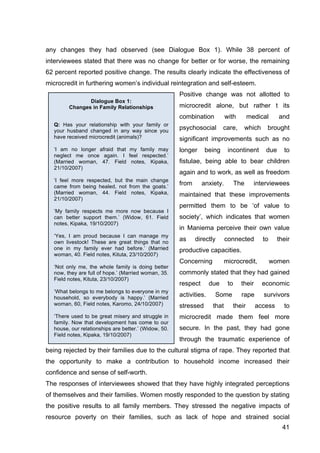
increasing the score of the respective group.
This game (which usually ended with only a slight advantage for the ‘negative’ side)
was designed as a method to enable an outside researcher to understand the
problems faced by resource-poor women in general, and those of rape survivors in
particular. It was also an opportunity for people to reflect on the positives and the
negatives of community life while placing the concerns of women at the centre.
The absence of a secretary made digital recording of the entire workshops an
important prerequisite. I was unable to take notes during the workshops, except
during the second exercise when participants were free to discuss without
facilitation. Like the interviews and informal observations, the PAR workshops were
transcribed into a catalogue of field notes.
4. Gendered Experiences: The Individual
This chapter discusses research results concerned with the individual sub-level. The
underlying hypothesis of the chapter is that participation in a microcredit program
can enhance the personal empowerment of individual women. The focus lies on
cultural forms of discrimination and violence against women and how they can be
overcome through microcredit.
In sociological theory, the individual is defined as the self, meaning the perspective of
a person as it relates to their conception of themselves. This self-perception is to a
large degree determined by a person’s interactions with their social environment
(Callero 2003: 119-121). Through the process of socialisation, the individual
internalises concepts, values and norms that govern his or her behaviour. According
to Foucault, the self is coerced into existence through a system of rewards and
punishments (1983: 93-95; 134-136). It is not a self-determined agent but a
mechanism of control that works from the inside out by creating a self-regulating
subject. A Foucauldian perspective of the individual characterizes it as a central
locus for exercising power.
A view of the individual/self as a social and cultural construct and a product of power
relations does not necessarily negate its potential as a social force (Callero 2003:
128). In order to realize this potential, cognitive recognition of personal subordination
is an important prerequisite. In patriarchal systems, women commonly internalise a
38
subordinate social position to the degree that they fully accept this position as part of
their personal identity. If women’s awareness of personal value, strength and
interest is increased, the groundwork for individual empowerment is laid (Sen 1990:
126).
A note on terminology: rape survivors are often described as ‘rape victims’. This
choice of terms encloses women in the passive position of the victim and does not
recognise their potential to recover and determine their own fate. Alternatively, the
term ‘rape survivor’ acknowledges the potentially lethal outcomes of rape as well as
the strength and perseverance necessary to continue life after rape.
4.1 Women’s Personal Experiences
4.1.1 Gender-Based Discrimination
The mutual reinforcement between male control of resources/power and cultural
subordination of women (Sen and Grown 1987: 28) can also be observed for the
context of Maniema province. Participants in Kipaka, Kampene and Pangi stated that
women are subjected to an intricate system of norms and rules limiting their mobility,
agency and autonomy. Women are commonly seen as ‘servants’ to their husbands
and families. Positive concepts of femininity include ‘central source of life’, ‘educator’
and ‘supreme counsellor’. The emphasis on women’s reproductive role can have an
adverse impact on their health and physical well-being. Forced and premature
marriages are widespread in rural Maniema. Girls are married from age 14 and are
expected to bear children until they reach the age of 35 to 40. Among the
reproductive health problems experienced by women are miscarriages, childbed
deaths, uterine prolepses and fistulae.
Men legitimise discriminatory practices against women by citing select passages
from the Koran or the Bible. In all of the sampled communities, women are faced with
cultural prejudice that degrades their physical and mental capacities and their social
behaviour. The majority of women in Maniema are illiterate and therefore ill prepared
to reject discriminatory customs, denounce the acts of violence inflicted on them or
demand control over resources or their own bodies. All of the above forms of
discrimination are amplified by women’s lack of access to participation in ‘public’ life,
leaving them less informed on their rights as human beings and as citizens of the
Congolese state and therefore, less able to protect and defend their rights.
39
4.1.2 Experiences of War and Sexualised Violence
While both women and men have been traumatized by wars and civil wars fought in
Maniema, their experiences have differed. Ex-combatants (who are mostly male)
often face difficulties when trying to reintegrate into their communities. The war
experience and post-war economic poverty have severely damaged traditional
masculine images of ‘protector’, ‘builder’ and ‘master of the house’, and conditioned
violent assertions of masculinity as cultural norm. When ex-combatants are
reintegrated, they tend to put additional strain on their communities as they are
demoralized and often lack motivation to engage in social and economic activities
(Schroeder 2004: 26).
Women have been less involved in military actions but have been more affected by
attacks on the civilian population. Many have been widowed or their husbands
remain absent or unproductive due to physical and psychological trauma. Many of
these women are now de facto household heads and sole caretakers of their
families. In Maniema, this role is especially difficult to fulfil, since economic
resources, transport routes and infrastructure for social services have been largely
destroyed.
The legacy of war rapes affects women in various ways. Firstly, they deal with
physical effects such as sexually transmitted diseases and rectovaginal fistulae4
. In
the aftermath of war, husbands and families have frequently ostracized rape
survivors due to cultural stigma that holds the victim responsible for the crime.
Grounds for rejection are partly of economic nature, as the physical damage that
makes it impossible for women to fulfil their traditional roles. Within the double bind of
resource poverty and subordination of women, women who no longer fulfil their
reproductive and productive tasks are considered to be of little value.
Rape survivors often suffer from the psychological consequences of violence. Among
the documented psychological effects of rape on women in Maniema count post-
traumatic stress disorder, depression, loss of self-worth and feelings of shame and
guilt. As women continue to be confronted with rape and sexualised violence until
today, they lack the protected social environment that is needed for recovery.
In her illuminating study on the knowledge, attitudes and practices regarding
sexualised violence in Maniema, Andrea McPherson has been able to show that the
4
A fistula is a tear in the wall of the vagina that connects it to the urine and/or bowel tract and results in incontinence.
40
war has created a culture in which sexualised exploitation, rape and abuse of women
has become a societal norm. During the war, soldiers abused their power and
exploited women’s sexuality. Now that the war is over, ‘traumatically damaged men
attempt to redefine their masculinity through a re-enactment of the behaviour of
powerful men’ (2007: 43-44).
As Mosse reminds us, fear of violence remains a key factor hindering women’s
participation in development (1993: 59-61). High prevalence of rape spreads fear and
reduces women’s self-esteem, self-worth and agency. This has a disempowering
effect on women, as exemplified by the situation in Maniema, where women fear to
travel or to let their daughters go to school.
Rape frequently takes the form of ‘blackmail’, or ‘forced prostitution’, as the need to
make ends meet forces women and girls to trade sex for food, household items or
healthcare. When this issue was addressed in the PAR workshops, women rejected
the term ‘prostitution’, as it implies a voluntary decision on behalf of the woman. They
stressed the fact that when a woman trades her own body in order to ensure her own
and her family’s survival, this is an involuntary sexual act, and therefore, a case of
rape.
Sexualised exploitation of women can be seen as one of the results of military
occupation. Male participants claimed that women had been in a ‘privileged’ position
during the war because they could trade sex for survival. These statements show
men’s disregard for women’s suffering through sexual exploitation, but also the fact
that women’s bodies are seen as a form of currency.
4.1.2 Building (Self-)Respect Through Microcredit?
HMPM provides women with start-up capital in the form of as a strategy for
reconciliation and reintegration. Bluntly put, a husband whose wife was raped will be
more easily persuaded to accept her back if her return is connected to an increase in
material assets for the household. This economic boost is thought to facilitate the
psycho-social work and family or husband/wife mediation.
From a European feminist perspective, women should be respected and appreciated
for who they are as human beings and not for the material gain they may bring. From
this vantage point, I was initially critical of an economic incentive for reconciliation
and reintegration of rape survivors. In order to gauge how microcredit affects
women’s positions within the household, I interviewed program participants about
41
Dialogue Box 1:
Changes in Family Relationships
Q: Has your relationship with your family or
your husband changed in any way since you
have received microcredit (animals)?
‘I am no longer afraid that my family may
neglect me once again. I feel respected.’
(Married woman, 47. Field notes, Kipaka,
21/10/2007)
‘I feel more respected, but the main change
came from being healed, not from the goats.’
(Married woman, 44. Field notes, Kipaka,
21/10/2007)
‘My family respects me more now because I
can better support them.’ (Widow, 61. Field
notes, Kipaka, 19/10/2007)
‘Yes, I am proud because I can manage my
own livestock! These are great things that no
one in my family ever had before.’ (Married
woman, 40. Field notes, Kituta, 23/10/2007)
‘Not only me, the whole family is doing better
now, they are full of hope.’ (Married woman, 35.
Field notes, Kituta, 23/10/2007)
‘What belongs to me belongs to everyone in my
household, so everybody is happy.’ (Married
woman, 60, Field notes, Karomo, 24/10/2007)
‘There used to be great misery and struggle in
family. Now that development has come to our
house, our relationships are better.’ (Widow, 50.
Field notes, Kipaka, 19/10/2007)
any changes they had observed (see Dialogue Box 1). While 38 percent of
interviewees stated that there was no change for better or for worse, the remaining
62 percent reported positive change. The results clearly indicate the effectiveness of
microcredit in furthering women’s individual reintegration and self-esteem.
Positive change was not allotted to
microcredit alone, but rather t its
combination with medical and
psychosocial care, which brought
significant improvements such as no
longer being incontinent due to
fistulae, being able to bear children
again and to work, as well as freedom
from anxiety. The interviewees
maintained that these improvements
permitted them to be ‘of value to
society’, which indicates that women
in Maniema perceive their own value
as directly connected to their
productive capacities.
Concerning microcredit, women
commonly stated that they had gained
respect due to their economic
activities. Some rape survivors
stressed that their access to
microcredit made them feel more
secure. In the past, they had gone
through the traumatic experience of
being rejected by their families due to the cultural stigma of rape. They reported that
the opportunity to make a contribution to household income increased their
confidence and sense of self-worth.
The responses of interviewees showed that they have highly integrated perceptions
of themselves and their families. Women mostly responded to the question by stating
the positive results to all family members. They stressed the negative impacts of
resource poverty on their families, such as lack of hope and strained social
42
relationships, all of which had been improved by microcredit. From women’s
responses, it became clear that they identify with their families and perceive the
interests of their family members as their own interests.
In some cases, they defied the very concept of personal ownership over resources
and stressed that all their assets were shared among family members. When asked
to elaborate on this issue, women stated that husband and wife could each have their
own assets, but that in a case of emergency, everybody’s resources would ultimately
be pooled together; if any family member has access to resources, everybody’s
perceived security improves. Microcredit for women can therefore constitute an
important measure for post-war reconstruction, since it offers all family members with
more financial security and therefore, added motivation for reconstruction.
Interviewees tended to paint perfect pictures of their family relations, eclipsing any
issues of male control, domestic violence or demanding household duties. This
behaviour is better understood in the light of cultural norms that define women’s
behaviour. In Maniema, women are expected to accept their living conditions
uncomplainingly (Namukenge 2007: 27; 57). This cultural expectation leaves
gendered power structures unquestioned and can be interpreted as a way to uphold
male-dominated structures. However, it must be considered that the ability to
manage their many arduous tasks is also an essential source of women’s identity
and personal satisfaction.
During the interviewing process, it became clear that several married women
provided nearly everything that is needed for the family’s survival, yet they stated that
their husband was the household head and made the decisions. When confronted
with the question ‘if you manage almost the entire household, what makes your
husband the household head?’ Some of the younger women seemed uncomfortable
about this question, shrugging it off with laughter, but most women explained that
they respected their husband’s role as household head in order not to diminish his
social status. They were fully aware of their own contributions to the household and
stated that they were the ‘strong ones’, while their husbands were ‘weak’ and could
never handle what women can handle. This signifies that women regard their
subordinate position in the household not as a natural or innate quality, but as a
performative act bolstering the traditional order of society.
These findings oppose Amartya Sen’s theory that rural women in developing
countries are likely to internalise subordination, lacking perception of their own self-
43
interest and being concerned solely with family welfare (1990: 126). Much rather, we
may argue with Bina Agarwal, rejecting the allegation of a ‘false’ or lacking
consciousness in women. She asserts that empowerment is not built on sharpening
women’s sense of self-interest, but demands ‘improvement in their ability to pursue
that interest, including by strengthening their bargaining power’ (1994: 57). For
instance, while it may seem that women supposedly sacrifice their personal well-
being for the benefit of their children and kin, this can also be interpreted as an
investment towards their personal future security (435). This idea is particularly
pervasive for the context of Maniema, where children are the single most important
form of retirement insurance.
As Agarwal contends, the logic of development studies tends to suggest that the only
‘true’ perception is that of the independent self, and not that of the self that is
embedded in kinship (1994: 33). However, to women in Maniema, empowerment
may not equate autonomy from their roles as mothers and housewives, but rather
reaching a higher status and greater security within these roles. As a European
feminist, I may not be able to fully comprehend of Congolese women’s perceptions
self-interest and well-being, but it is essential that I do not project my own ideas of
empowerment as the ultimate benchmark.
Women in Maniema need personal ownership and the possibility to earn an income
in order to fulfil self-interest. When viewed in this light, microcredit may be regarded
as an important tool towards empowerment. Even though additional work may put
additional strains on women, the benefit of increased financial security may be worth
the effort in order to serve their empowerment (see 5.1.2). Women who had already
reimbursed animals expressed their pride in being able to contribute to the
development of the community.
This may be especially valid with regard to sexualised violence. Women’s increased
direct access to financial resources diminishes pressure to sell their bodies for
services and goods. By reducing the likelihood of the women forcing themselves into
sex trade for economic survival, their chances of increasing and maintaining their
self-respect and integrity are heightened. In Pangi, the resource-poorest of the three
research locations, female participants claimed that women who have enough capital
to pay for all social services and basic needs can protect themselves and their
daughters against sexualised violence.
44
In addition, the literacy trainings provided by HMPM can raise women’s self-esteem.
Female interviewees explained that an illiterate individual is not considered a
‘valuable member of the community’ and will be largely excluded from public
decision-making processes, for example during church meetings, parents’ meetings
at school or the occasional sensitisations and workshops on development issues that
are conducted by non-governmental and governmental organisations in Maniema.
After having received literacy classes, women stated that they had gained confidence
to voice their opinions in these meetings, as other community members were more
likely to consider their contributions. These changes are especially important for
younger women, who are discouraged from speaking out due to their lack of status.
Mothers above the age of 40 and especially widows are more confident in public
debates with men. This indicates that women enjoy a higher amount of respect once
they have reached a certain age and fulfilled their ‘reproductive’ role.
In summary, participants in the microcredit program now have a stronger position
within the community and have obtained new perspectives and skills. This
contributes to their perception of self-worth and strengthens their ability to participate
in community life. The positive effect of literacy trainings shows that material
incentives need to be connected to additional capacity building in order to improve
women’s social standing in the communities and fulfil women’s strategic needs.
That said, there are also certain risks connected to HMPM’s approach. The majority
of female interviewees stated that they encountered jealousy and hostility from non-
participant community members who are not fully aware or simply doubt that they,
too will benefit if new groups are formed with the animals that were reimbursed by
the old groups.
Men commonly criticise the fact that they cannot directly participate. Indeed, HMPM
integrates men in more indirect ways: through the work of mediation and consensus
building with the husbands of program participants and through the work with male
community leaders in the Nehemiah Committees. Some of these leaders participated
in the workshops and exposed a high level of sensitivity to gender issues. They were
exceptionally outspoken in promoting respect and cooperation between women and
men, making them important advocates for women’s empowerment. Yet, none of
these activities allow men to directly participate in economic development.
In the PAR workshops and in the few personal interviews that were conducted with
men, they demonstrated awareness of the social, cultural and economic issues that
45
affect their wives, their families and their communities. However, they are often
unable to tackle these issues and to live up to their roles as providers, ‘protectors’
and ‘builders’. The abuses men inflict on women can partly be read as expressions of
their own feelings of disempowerment, yet little is done to convince men of the
necessity to make better life choices and abstain from violence. Women’s highly
integrated perceptions of themselves in relation to their families show the futility of a
single-gender approach that largely excludes men.
If we consider that the self is created by one’s social environment and interaction,
then one of the ways towards women’s individual empowerment is to improve the
quality of their social relationships. For instance, it may not be enough to empower
women economically when rape is still a widespread issue and there is a wide range
of customs that enforce women’s subordination. The fact that 38% of women had not
yet been able to note any changes in their social relations despite receiving
microcredit sustains this idea and suggests that men need to be more actively
involved at all levels of the project.
Group discussions in the PAR workshops have shown that communities in Maniema
do not necessarily view gender relations as set in stone. Equality between women
and men is seen as a sign of progression from traditional village life to more modern,
‘urban’ lifestyles. Research participants have repeatedly claimed that sexualised
violence and women’s subordination can and should be eliminated, preferably using
any of these techniques: healing men physically and mentally, creating employment
opportunities, distributing information on civil and human rights as well as publicly
condemning and punishing sexualised violence. These are the suggestions of male
villagers in Maniema. If their ideas are not recognized, women’s empowerment will
be opposed, diminished and even prevented by their own husbands, fathers and
brothers.
5. Gendered Hierarchies: The Household
The following chapter outlines research results concerned with the household sub-
level and the hypothesis that women’s access to microcredit has an empowering
effect at this level. It examines three major areas of (mainly economic) cooperation
between men and women in the household: the distribution of labour, gendered
hierarchies in trade and mobility, and finally, resource ownership and control.
46
Regarding decision-making processes, special emphasis is placed on the concept of
cooperative conflict.
The household is defined here as the central intersection between the ‘productive’
and ‘reproductive’ sphere. However varied in form and composition, it can be seen as
a universal social institution, as an arena of everyday life that is tied into the
relationships of kinship and residence. Naila Kabeer defines the household as ‘a
useful analytical construct’ for social and economic theory and contends that
The economy of the household (…) refers to the rules, relations and
practices that govern the household production, acquisition and
distribution of the valued resources essential for meeting the needs of its
members (2001: 114-15).
Empowerment at the household sub-level can thus be defined as changes that
reduce women’s relative disadvantage to men in resource production, distribution
and control.
5.1 Labour and Income
5.1.1 Labour Distribution
Maniema is the least populated province of DRC, with an estimated 1.3 million
inhabitants in an area about the size of England. The overwhelming majority of the
population lives in a rural setting. For their survival, people in Maniema depend
primarily on agricultural activities (shifting cultivation, stock farming and pisciculture),
and small-scale trade. These activities can be characterised as ‘informal’, as they are
geared towards subsistence and do not generate viable revenues, taxes or
employment opportunities.
As of yet, government policies in DRC do little to strengthen the agricultural sector
and encourage the population to turn a profit from their farming activities. The
informal subsistence economy is still regarded as inferior, something that people do
‘on the side’. On the contrary, formal employment in mines and urban centres is seen
as the benchmark of economic progress. As Johnson and Tegera point out,
discrimination against the agricultural sector hinders sustainable development as
profits made from working in the mining sector and other professions are usually
short-lived and only benefit the people directly involved (Johnson and Tegera 2005:
9; 15). Women are underrepresented in the professions for a number of reasons,
such as social and cultural attitudes that discriminate against women in the
47
professional field, lack of education and training, high competition due to
unemployment and lack of mobility and time.
Since women are a lot more active in the informal or agricultural sector, their work is
automatically denigrated and deemed to be of less importance and less prestige
than the more male-oriented, formal economy - however underdeveloped and
sporadic it may be at this point in Maniema. Here lies a central issue in Maniema’s
society today: women are a crucial force in sustaining local communities through
their social and economic activities, yet their contributions are not adequately
recognised by local leaders as well as government legislation and administration.
Women handle the majority of tasks in subsistence agriculture. They remain in
charge of seed storage, weeding, sowing, tending, cropping and the transport of
harvests. The lack of technology that facilitates agricultural and domestic tasks
makes fieldwork a time- and energy-consuming endeavour for women in Maniema.
They fetch water and firewood and process the food. In addition, they often engage
in income-generating activities such as soap making and fish farming and do most of
the local marketing of foodstuffs themselves.
Moreover, women are in charge of housework and childcare. Housework includes a
broad range of work-intensive tasks, such as fetching water and firewood and
preparing meals by grinding manioc, peeling rice or pressing palm oil. Added to this
is the large number of children in every household (among he households sampled
for this research, the number of children ranged anywhere between 3 and 12).
Despite women’s high productivity, men do not value their economic contribution,
which reduces women’s bargaining power at the household sub-level.
Information on men and women’s work duties was gathered using a ‘timeline’ PAR
exercise. In each of the three workshops that took place in Kipaka, Kampene and
Pangi, women and men stressed the importance of their respective labour
contributions. While women highlighted the magnitude of their work and accused
men of being far less productive, men tried to diminish the importance of women’s
work. In all three communities, women eventually ‘won’ the argument because a
pastor or community leader, confirmed women’s statements with regard to the
timeline exercise that clearly showed men’s greater access to free time and leisure.
The heated debates exposed how women actively - and sometimes successfully -
demand recognition for their work input and do not necessarily adhere to the cultural
ideal of the ‘uncomplaining’ woman.
48
However, indications of women’s higher workload should not suggest that men in
Maniema are idle. As Whitehead asserts, men in rural Africa may often appear
unproductive, while they may be ‘occupied in various activities such as developing
social networks, making contacts, gathering information, and attempting to find
income opportunities’ (1999: 58). While it is true that women’s workload exceeds that
of men, we should be cautious not to reproduce images of the ‘lazy Africa man’ that
were an integral part of racist and colonial discourses (49).
As a general rule, women’s work duties are more consistent and involve daily chores,
while men’s informal work input is more sporadic. Nonetheless, the subsistence-
related work duties of men involve arduous tasks, such as the clearing of farmland. In
some households men also participate in hoeing the ground and harvesting the
crops. Other men’s work responsibilities include the construction and maintenance of
housing, stables and roads.
Both women and men stated that a functional household is one where wife and
husband make equal contributions of skill and labour and live an ideal that can be
described as ‘household-as-unity’. Despite these voiced ideals, women repeatedly
stated that most men had forsaken it in action and exposed oppressive and
exploitative behaviour. Men reacted to this by pointing towards the generally negative
effects of economic poverty. Quoting one male participant in a workshop in Kipaka,
Also men work hard. We are all farmers. We all have difficulties. Life is
easier when we find paid labour, because then we can devise other
ways to live, and the woman also finds some time to rest. But because
we are all farmers, her life is also hard (field notes, 20/10/2007).
Lack of income intensifies the need for labour in subsistence agriculture, leaving little
room for alternative decisions for the male in the rural community. Yet men often
abuse their privileged position and refuse cooperation. Both perspectives surfaced in
PAR workshops with equal relevance.
5.1.2 Impacts of Microcredit on Labour and Income
IGAs are an essential element of the HMPM microcredit program. Since all
participants receive microcredit in form of livestock, they are exposed to risks: it takes
at least a year before breeding generates viable income, and animals may become
affected by disease. Participants are therefore encouraged to diversify their activities.
Diversification reduces risks and helps participants in the microcredit program to
overcome doubts and fears that may arise during the initial phase until revenue is
49
generated. HMPM solidarity groups produce soap, run savings accounts or grow
crops such as peanuts and rice on joint plots.
The individual progress of IGA diversification has differed significantly from
community to community. The quality of counselling can be identified as the central
reason for this. When asked about the counsel and training that they had received,
some participants in the microcredit program recalled only a basic IGA training. Not
only were these the same women that had made the least progress in diversification,
they were also the ones that unanimously expressed the need for further instruction.
Conversely, women reporting successful IGAs also recounted extensive training that
had taught them additional skills such as baking or soap making and trained them in
income management, savings and profit maximisation. These participants also
expressed greater satisfaction with the amount of training they had received.
Microcredit is thus more likely to increase women’s economic autonomy when
accompanied by adequate training and council on diversification and income
management. However, not all HMPM supervisors and counsellors adhere to these
norms in a consistent manner, pointing up the need for close quality checks, e.g.
monitoring and evaluation.
While it is important to recognise women’s central role in agricultural activities, the
potential role of men in food and income provision should not be ignored. Local
counsellors reported that women could operate a lot more effectively if they
implement IGAs with some support from their husbands. Husbands and sons were
reported to help with HMPM activities, for example by building stables and collecting
fodder.
As discussed in chapter 1.2.2, WID scholars criticise a singular focus on income and
formal activities, as it increases pressure on women to produce goods and services
while ignoring their domestic duties (see 1.2.2). None of the interviewees could
validate WID concerns, as they reported no pressure or stress related to their
participation in HMPM. They claimed to easily manage the additional work arising
from participation in the program, mainly because they were supported by other
members of their solidarity groups, and in some cases by their husbands, children,
neighbours and other relatives. This may be a hint towards the importance of men’s
integration into IGAs.
That said, the result may be distorted by the research setting, as I am a foreign and
German researcher (the donor KfW is also German) and I worked with the local head
50
counsellor or supervisor as translator. Despite the declared anonymity of the
questionnaires, interviewees may have felt the need to emphasise their successes in
the program while eclipsing possible weaknesses for fear of saying ‘the wrong thing’.
However, the general attitude of female interviewees was one of confidence in their
ability to take on additional tasks. They frequently stressed that sacrifices in time and
labour had to be made if women wanted to strengthen their own position. Women of
all ages forcefully expressed their desire for education and paying jobs, for example
as teachers, and receive vocational training, for example in dressmaking. They also
criticised that men had better access to the profitable agricultural activities of fish
farming or operating oil presses, and they debated ways in which women could also
engage in these activities.
Regardless of these results, women’s sole responsibility for housework, childcare
and most agricultural tasks can be seen as an impediment to their strategic needs.
Lessening the informal work burden gives women time for other activities and
increases their agency. For this reason, women’s workloads and tasks need to be re-
negotiated among all members of the community.
In this regard, the cooperation between HMPM and the Nehemiah Committees is
another important complementary measure. Local leaders can influence the
community to implement important lifestyle changes. At the time of writing, the
Nehemiah Committees were drafting gender recommendations. The Committee of
Kipaka presented a preview of their ideas. They plan to acquire water wells and
manioc mills in order to reduce the time and labour intensity of women’s traditional
tasks, to educate boys so that they will help with housework, and to promote respect
of women’s labour. Most importantly, the Committee claims that these changes must
begin in their own households so that they will serve as role models to others.
5.2 Trade and Mobility
5.2.1 Conditions of Trade and Mobility
Due to the absence of road links between Maniema and other provinces, household
items like clothing and kitchenware, as well as staples like salt and cooking oil need
to be flown in. The prices for these goods are accordingly high, driving up the general
cost of living in Maniema. Within most areas, motorised travel is a daunting task, as it
must rely on narrow dirt roads and ill-maintained bridges. The majority of inhabitants
51
resort to travel by bicycle or on foot, transporting their cargos over distances of up to
150 km and more.
As a general rule, women travel 20 to 50 km from their homesteads, whereas men
travel more frequently over longer distances of up to 250 km. This difference results
from women’s responsibilities in the household that do not permit them extended
absences. Many women reported that they were also afraid of being raped if they
travelled without male protection. Another reason is that travelling women are met
with distrust from their husbands. During group discussions, men expressed their
worries that women who travel too much will eventually leave the ‘hard work’ of
family life behind and chose the ‘easy life’ of prostitutes.
Regardless of these restrictions, trade is essential to fulfilling women’s role as
providers – and trade is often impossible without travel. For example, women from
the village of Kituta in the Kipaka area carry their harvests in loads of up to 50 kg to
sell them in the provincial capital of Kasongo, which is approximately 40 km away.
Rice traders from Kasongo regularly visit the village and hire local women as porters.
For transporting 30 kg of rice to Kasongo, a woman receives one and a half kg of
salt. This labour takes a toll on women’s health. They frequently suffer from
deformations of the spine, migraines and prolepsis caused by life-long carrying.
Women’s health could be improved and their mobility increased by using bicycles,
but during the four weeks I spent in Maniema, I never saw a woman near a bicycle,
let alone pushing one or riding on top. Male interviewees claimed that bicycles were
for men, because they are ‘physically stronger’ than women and can therefore make
better use of bikes in order to transport heavier loads. Yet it is more likely that a
bicycle is a sign of status men reserve as a male privilege, as carrying food, firewood
or drinking water on one’s back is reserved for women only, and no self-respecting
man should be seen doing this. The majority of men view bikes as personal
possessions that they chose to share with their sons, but not with their wives and
daughters. Apart from these cultural connotations, women cannot own bicycles due
to economic differentials: while men sporadically have time to earn a substantial
amount of currency - for example by working in the mining sector - women remain
unable to do so and therefore can’t afford to purchase bicycles (the cost of a bicycle
is approximately 100 USD).
Local sales options are often limited, meaning that bigger profits can be made if trade
is connected to long-distance travel. This puts women at a disadvantage because of
52
the above-mentioned restrictions to their mobility. Women who cannot travel often
sell to middlemen. These merchants are mostly male and barter natural produce like
peanuts or rice with the women at dumping prices in order to sell them with a high
profit margin in the market towns or the provincial capital. Since currency often has
no value in rural areas, the women trade their produce directly for commodities such
as salt, flour and vegetable oil, household items or clothing. In the interior of
Maniema, these goods are worth more than five times than their buying price in
towns like Goma in North Kivu. This equates to relatively high revenue potential
generated from long-distance trade, but with the direct beneficiaries remaining
generally male. This means that the pattern where women mostly engage in
subsistence agriculture, while men dominate the activities that generate currency, is
repeated in trade.
Meanwhile, kitu kwa kitu - the barter of goods, an essential survival technique during
the war, continues to be widely practiced among the rural population. Though this
barter economy is informal and marginalized, its economic weight should not be
underestimated. Women may largely remain outside of the monetary economy, but
they are the ones who engage in kitu kwa kitu on a daily basis, not only trading with
middlemen and market vendors, but also bartering with other women in their
neighbourhoods and communities and engaging in trade chains to maximise their
profits. Women produce cake that they then trade for salt, they produce soap and
trade it for fish, or they grow rice and trade it for kitchenware.
Women’s economic exchange outside of ‘formal’ monetary structures is not limited
to goods alone. Both women and men trade their skills and labour for natural
produce. In Kampene, many households hire field workers during the most work-
intensive periods of the year, and pay them in natural produce. It is also common to
cultivate part of someone’s field for a share of the harvest. Women often weed
wealthier people’s fields in exchange for using their machines, such as oil presses or
rice hullers.
5.2.2 Impact of Microcredit on Trade and Mobility
The access to start-up capital has revived women’s entrepreneurial spirit and they
often use their newly acquired skills to engage in trade chains to maximise their
profits. A 36 year old, married participant from the village of Karomo in the Kipaka
research site is a typical example. Together with her solidarity group, she learned
53
how to produce soap. The women pooled resources to buy the necessary raw
materials and share the revenue. With the revenue, said program participant buys
fish from a farm, then trades the fish for valuable vegetable oil. Finally, she sells the
vegetable oil for cash, adding nearly 50% to the profit she had made from selling
soap (field notes, 24/10/2007).
In this case, a cash infusion meets women’s existing economic capacities, allowing
them to realize their potential. Especially in Kampene, women are skilled traders who
have years of experience with barter and exchange. If these skills are strengthened,
they increase their income while significantly reviving the local economy. Most
women there state that in the future, they would like to invest their income only partly
in livestock, but and more into household items such as furniture, kitchenware and
clothing, which they can then sell in the market.
To enhance women’s ability to trade, their mobility needs to be increased. Mobility
can also be seen as a central precondition of agency and autonomy. The mediation
work of HMPM counsellors can be stated as having a beneficial impact. As a number
of female interviewees explained, their husbands had started to be less suspicious of
letting their wives travel. The fact that the local counsellors travel consistently over
very long distances and periods of time while always returning home to their families
diminishes cultural perceptions connecting travel to prostitution and ‘runaway wives’.
From an economic point of view, the poor state of roads and women’s lack of
transport remain problematic. A local initiative that was observed outside of HMPM
may present a solution: in Kipaka, a local group of female merchants has pooled
resources to purchase a bike that they rotationally use to do long-distance trade. This
initiative proves women’s inventiveness and capacity for organisation as well as the
potential to overcome cultural gender biases. If women continue to gain more control
over resources, GMPM participants may also start ‘travel groups’ of this kind.
5.3 Resource Ownership and Control
5.3.1 Excursus: Cooperative Conflict
While international development organisations often measure empowerment by
women’s access to resources, more critical feminist researchers seek to measure
empowerment by women’s actual agency over these resources, specifically their
power to make decisions at the household sub-level. This idea correlates with
54
Moser’s planning tool of practical and strategic gender needs, which is based on the
idea that while availability of resources is of practical concern to women, it is their
ability to control these resources that can potentially change gendered hierarchies
(see 1.2.3).
Dominant neoclassical paradigms in household analysis suggest that there is no
need to challenge the distribution of resources and their control at the household
sub-level. Especially the ‘New Home Economics’ theory after Becker assumes the
presence of one altruistic (and implicitly male) household member, who controls
economic resources and makes benevolent transfers to other members of the
household (Becker 1976: 284-85). This is thought to create a ‘joint utility function’ in
which all members pool their resources and remain loyal to their household head.
According to Nancy Folbre, this theory constitutes a paradox: while neoclassical
economic assumptions argue that individuals act always within their own, narrowly
defined self-interest, economists ‘seem to be wedded to a rosy picture of the
household as “home, sweet home”, since it is both implicitly and explicitly defined as
a place of altruism and cooperation’ (1988: 249). She argues that presupposing the
existence of a household altruist means to presumptively deny any domestic
conflicts that may arise in the distribution of costs and benefits and the possibility of
exploitation of subordinate family members.
Gender-sensitive household analyses more accurately acknowledge the likelihood of
unequal power relations. As Sen argues, women’s lack of empowerment is
manifested, inter alia, in the relative weakness of women’s bargaining power in
situations characterized by ‘cooperative conflict’ (1990:124). Sen’s concept offers a
way to explore decision-making processes in situations where men and women deal
with conflicts of interest, though cooperation is equally of interest to them.
At the household sub-level, these conflicts are often not addressed explicitly.
Negotiating processes are more implicit, since they are governed by norms and rules
that make negotiation seem an automatic process. One important governing factor in
this process is the ‘breakdown position’ of household members, representing the
status quo of a person and their alternative options or emergency solutions for the
case that a conflict of interest cannot be resolved and cooperation breaks down (Sen
1990: 135-140). Women’s breakdown position is weakened due to obligations in
housework and childcare that tie them to the private sphere, lesser ownership of
assets, lack of education and discriminatory laws and conventions.
55
As a result, women have less bargaining power within cooperative conflicts and men
will be more likely to be able to influence decisions in their favour. This can lead to
women having fewer resources allocated to their specific needs, such as food,
healthcare or education. The heavily documented incident of women’s lower
nutritional status and health in most male-dominated societies in Asia and Africa (see
Osmani: 1998: 67) underlines this point.
5.3.2 Hierarchies in Resource Ownership and Control
In rural Maniema, economic poverty affects everyone, yet women incur the greatest
disadvantage due to their lack of property. The resources women manage and the
profits they generate are generally not their own. Economic resources such as land,
harvest, livestock, housing and household items are considered to belong to the
husband and the husband’s family. Most marriages are not civil, but customary
unions, leaving the wife unable to claim any property as would normally be foreseen
in the Congolese Family Code. If the husband dies, it is not uncommon that his family
will claim his household assets and disenfranchise the widow. As children are
customarily considered to belong to their father, widows and divorced women are
frequently forced to give up her children to their former husband’s family.
The payment of an economically significant bride price also contributes to gender
hierarchies as it encourages attitudes towards women that objectify them as men’s
personal possessions, thereby reducing them to the gains made from their
‘productive’ and ‘reproductive’ capacities. While in urban areas, this practice is now
losing some of its importance and taking on a more symbolic character, it is still
widespread in the rural areas that were the focus of this research. The argument that
‘she was paid for’ significantly reduces a woman’s status and breakdown position in
the household.
Among women, the predominant attitude towards the bride price is one of
ambivalence. The bride price offers mothers a rare chance of direct resource control
due to cultural attitudes in Maniema that regard a girl’s virginity as an economic
resource owned by her mother, entitling her to settle the bride price and decide on its
use. Mothers are thus encouraged to uphold the bride price tradition even if they are
aware of its harmful effects on the status of their daughters within the husband’s
family.
56
A case frequently cited by women and men is that married women who move into
their husband’s family home experience oppression and exploitation at the hands of
their mothers in law. This signifies that hierarchies at the household sub-level also
exist between women of different status and age, and that those with more
bargaining power are likely to participate in discriminatory practices against weaker
household members.
Polygynous unions are condoned and practiced by members of all ethnic and
religious groups in Maniema. A frequent reason for conflict at the household sub-
level occurs when the husband uses household assets to pay the bride price for a
second wife without the first wife’s consent. However, not all women are opposed to
having one or several co-wives: the first wife will often enjoy considerable power and
the overall burden of labour is shared.
In all of the cases cited above, men are not the sole ‘perpetrators’ of women’s
oppression. Much rather, they act within a hierarchical system upheld by both women
and men. Whether a widow is disenfranchised by her sisters-in-law, a girl is sold to
the highest bidder by her mother, or a second wife’s labour is exploited by a powerful
first wife – it’s often women themselves who reproduce and perpetuate gendered
forms of discrimination.
In male-female relationships, distribution of resource control and power in decision-
making processes is a major arena for cooperative conflict, as husbands and wives
tend to have different priorities. Household members who have control over income
will try to invest as much as possible into fulfilling their socially expected obligations
(Fapohunda 1988: 150). PAR workshops exposed that men in Maniema are more
likely to spend income on personal forms of consumption, such as electronic
equipment and bicycles, while women allocate a higher share of their income to
children’s needs and collective consumption.
From a legal standpoint, the husband is regarded as the household head, a status
directly linked to his position as proprietor of household resources (see Dialogue Box
2). The Congolese Family Code sustains this custom, as it decrees that men
dominate the household and make economic decisions (Schroeder 2004: 193).
Women must first ask permission from their husbands before they implement any
economic decisions of their own. This increases men’s sense of entitlement to
economic privilege and strengthens their breakdown position.
57
If women challenge men’s decisions, it is common that they experience severe
repercussions such as divorce (which often leaves the woman without any economic
support) and physical violence. Female interviewees and workshop participants
stated that in case there was a serious debate in the household, men were generally
willing to resort to beating their wives. This has an intimidating effect on women,
rendering them less inclined to engage in overt bargaining and conflict. Overall,
women’s weaker breakdown position offers them with fewer opportunities to fulfil
their allocative priorities.
Nevertheless, the affirmation that ‘the man is the boss’ (see Dialogue Box 2), stated
repeatedly by male workshop attendees across all three research locations, does not
reflect the de facto situation in every household. This is due to three reasons. Firstly,
the war has left many women without a husband and they manage their households
largely on their own. Secondly, though women may conform to male dominance, they
may hold subversive opinions of men’s power (see 4.1.2). Thirdly, women often play
have considerable decision-making power in household management: during
personal interviews, 60 percent of married women stated that they were able to
influence their husband’s economic decisions. Husbands ‘unofficially’ consult their
wives prior to taking any major decisions, thus confirming the intrinsic value placed
on women’s expertise in household management.
These findings point towards the limitations of this thesis, as its framework cannot
meet the need for further, more in-depth research on decision-making power and
Dialogue Box 2: Discussion on Ownership During Workshop in Pangi
[legend: Q = question by facilitator / FP = female participant / MP = male participant]
Q: ‘Who controls the possessions of the household - the house, the field and the children?’
MP 1: ‘In the house, the man is the boss. The woman is under the supervision of her husband.’
FP 1: ‘All household planning must be done together, because wife and husband form a unity
(sont comme une seule personne). When deciding anything the husband must consult
his wife first.’
MP 2: ‘You have to distinguish European culture from African culture. In Europe, women and
men put all their things together, but in Africa, it is the man that brings along the riches.’
MP 3: ‘Man and woman manage the possessions together, but the husband is the boss (…).’
FP 2: ‘But I ask the men here to tell me, can a man really make a decision without his wife?’
MP 4: ‘No, he can’t. All decisions must be made together.’
MP 5: ‘I don’t agree. Here, traditionally, all belongs to the husband. In the city, it is maybe
possible that decisions are made together, but not here in the village.’
FP 2: ‘Here, the reality of every day is that the goods belong to the man and so, the woman
cannot make a decision without her husband and if she tries to do so anyways, she will
be chased from her house or beaten.’
(Field notes, 09/11/2007)
58
negotiating processes. As shown in Dialogue Box 2, attitudes around this issue
varied greatly throughout the research. While some describe shared resource control
as conventional wisdom, others view it as a foreign concept that has taken root in
urban areas, but has no place in traditional village life. This shows the multifaceted
and dynamic nature of gender relations in Maniema as well as the potential for a
reinterpretation of customary family norms.
5.3.3 Impact of Microcredit on Resource Ownership and Control
Married Participants of the HMPM microcredit program were asked whether
decisions over household resources were still the same, or whether there was any
change since the program began. Several women explained that having their own
assets made their husbands more inclined ‘to listen’. Is this proof of pro-microcredit
theories contending that once women are in control over their own material
resources, they may be less threatened by sanctions such as repression, rejection
and divorce because they do not have to fully rely on their husband’s possessions?
Does microcredit provide a stronger incentive to contest decisions that concern the
household, women’s own labour and that of their children, their mobility and their
‘reproductive’ capacities, signifying that their breakdown position would improve?
A common criticism of microcredit for women is that men may use women’s income
for themselves or that women may invest into men’s activities. While this is a valid
point, Kabeer cautions us not to assume that men’s access to their wife’s resources
can never be a rational choice made by women themselves (1998: 7). In other words,
joint management of credit does not necessarily represent an appropriation of
women’s resources. In the case of HMPM, it’s not surprising that women who share a
household with an economically active husband prefer to pool their resources in
order to increase their joint profits. When asked about their strategies for income
management, several interviewees stated that they regularly hand over their income
to their husbands, who then use it to engage in long-distance trade and share the
revenues with their wives. According to these women, sharing their assets did not
diminish their gains in bargaining power.
The level of economic autonomy can depend on the social and cultural environment.
For example, there is a subtle, yet important difference between the customs of the
Zimba ethnic group in the Kipaka area and the Rega ethnic group in Kampene and
Pangi. According to Zimba custom, the husband usually inherits and owns the
59
livestock, while women participate in breeding as well as revenue management.
Should the wife own livestock, this is reversed: the husband can now access and
control his wife’s livestock and the income generated from it.
According to Rega custom, women are entirely excluded from all activities
concerning livestock. Before the inception of the program, it was entirely impossible
for Rega women to access enough capital to purchase a goat. As one interviewee
from Kampene stated: ‘Even if I took my chillies and sat in the market every day of
my life, I could never have saved this money’ (a goat costs 50-60 USD). Just as men
would not share their economic assets, the division persists when a Rega wife
receives goats: she can refuse the husband access to the animals and any profits
made from them.
This means that impact of microcredit can differ depending on which ethnic group
clients belong to, as a Zimba husband could easily access and exploit his wife’s
resources to his own benefit, such as the purchase of status symbols. While many
husbands commonly pool resources with their spouses, they are still entitled to more
assets, more status and therefore, more power. This means that women are prone to
economic exploitation. From a standpoint of empowerment, it may be more
favourable if microcredit can create a space of economic independence for women.
In Maniema, resource ownership is directly connected to protection and power,
particularly in relation to recent memories of insecurity. During the war, wealthier
community members reportedly saved the lives of their kin by paying off military with
livestock. Interviewees reported that they were more respected by their neighbours,
as they were now in the position of ‘bwana’, a masculine title that can mean lord,
boss or husband (sic!). Economic assets can thus allow women to transcend their
gender role and, to some degree, ‘become male’. Gender roles are tied in with a
complex and context-specific set of governing principles, such as economic control.
The economic support afforded by microcredit permits women to transcend these
hierarchies regardless of their biological sex, affirming to Scott’s view of gender as a
signifier for power (see Introduction).
The data suggests women use microcredit to make important contributions to
economic development. 95 percent of interviewees stated that they invest revenue in
education and health of their children, children’s clothing and on household items.
These spending patterns confirm that a woman’s profit is a family’s profit. Microcredit
for women in Maniema can thus be an essential step out of the vicious cycle of
60
conflict and resource poverty, which would confirm the WID perspective (see 2.1.2).
Meanwhile, critics of microcredit are cautious of regarding economic support as a
panacea with automatically empowering effects (see 1.3). Women should not be
reduced to their capacity for economic advancement, as this does not accommodate
their strategic needs.
Serving women’s strategic needs is key to empowerment through microcredit.
Women need training in order to use their assets strategically, for example by
investing into girl’s education. Most girls in Maniema are denied education. While
women are often responsible for paying school fees, they can rarely afford to send all
their children to school. They then adhere to norms privileging boys’ education.
Thanks to HMPM’s approach that couples gender training with microcredit,
interviewees stated that they already use, or are planning to use, their personal
income to enrol their daughters in school. This increases the likelihood that the next
generation of women in Maniema will possess increased capacities for self-
empowerment.
If women have alternative areas of economic control and their poverty in resources is
reduced, they may be more inclined to equally oppose other, potentially
discriminatory practices such as early marriage of their daughters or the bride price.
Also, microcredit may provide women with enough economic independence to exit a
‘bad marriage’ through divorce, raising their bargaining power significantly. However,
these results would constitute more long-term results and could not be confirmed as
of yet. It may be equally important to refute a single-gender approach in favour of a
more integrated view that also stresses men’s capacities and responsibilities as
providers.
6. Gendered Networks: The Community
This chapter outlines results concerned with the community sub-level. It is based on
the third hypothesis of this paper, which suggests that microcredit can have an
empowering effect on women’s position and their activities within the community. The
chapter examines the concepts of social capital and reciprocity in Maniema in
general and women’s solidarity networks in particular. It evaluates HMPM solidarity
groups and their potential as a new social force for empowerment.
61
Sociologists distinguish between two major uses of the term ‘community’. The first
represents a geographical notion, such as the village or the neighbourhood. The
second is concerned with the relationships between people around their common
needs, interests and skills, such as a woman’s network. These two are, however, not
mutually exclusive (McMillan and Chavis 1986: 8). A shared geographical community
can be seen as a base on which a ‘relational’ sense of community can be built. This
sense is stated to arise from four elements: membership, influence, integration and
fulfilment of needs as well as shared emotional connections (8-14).
From this vantage point, empowerment at the community sub-level can be defined as
the creation or recreation of women’s solidarity networks and women’s heightened
social and political influence. Stromquist defines the precondition for empowerment
at the community sub-level as women’s participation in a collective and successful
enterprise that is apt to foster their sense of independence, competence and agency
(1993: 262). Using indicators from a 1979 book by US-American feminist scholar and
activist Sara Evans, Stromquist defines the necessity of a ‘revolutionary collective
identity’ built on the four characteristics cited below:
1. an ideology that is capable of recognizing oppression and justifying
action against it by offering an alternative vision for the future;
2. social spaces that allow members of an oppressed group to develop an
own valued identity;
3. role models, signifying individuals that break free from oppressive
behaviour patterns;
4. and finally, networks of solidarity and social relations that support social
action and can be turned into a movement for change (1993: 263).
The hypothesis of empowerment through microcredit at community level was tested
against these basic criteria.
6.1 Social Capital and Reciprocity in Maniema
Despite the aftermath of war, roots of traditional support systems in Maniema still
thrive. A considerable wealth of social support systems continues to exist among
members of the same family, the same community, or the same ethnicity.
Community-based and church-based organisations play an important role in creating
and upholding structures of civil society in Maniema. These can be single-gender or
mixed groups that engage in a broad variety of communal activities, many of which
are economic.
62
Informal associations in Maniema are social networks that are built around single
individuals who establish one-on-one ties. They are characterized by loose and flat
structures, signifying that they allow relations between individuals that are less
marked by authority than they would be in formal associations or institutions. Based
on these networks, regular community life continues: children are sent to school,
health centres and hospitals operate and countless community and church-based
organisations engage in projects to better their living situation. They build wells and
housing, form savings groups and represent their interests towards international non-
governmental organisations, donors and the politico-administrative authorities.
European media reports on the DRC tend to paint a rather one-sided picture of chaos
and distress, failing to represent the creativity and strength of the Congolese and
their complex strategies for survival. To the degree that I was astounded to observe
functioning social structures in Maniema, I realised that I had been preconditioned to
expect incapacitated people living in broken communities. I had to unlearn prejudice
in order to see Maniema’s communities wealth of ‘social capital’. According to
Warren, Thompson and Saegert,
Social capital refers to the set of resources that inhere in relationships of
trust and cooperation between people. (…) Social capital is a collective
asset, a feature of communities, rather than an individual property (2001:
1).
Social capital in Maniema can be exemplified by the custom of exchanging gifts. The
economic demands caused by such central events as a wedding, a birth or a burial,
but also by sickness or other emergencies, are buffered by gifts from members of the
kinship group. This practice of mutual giving is so important in Maniema that, if a
family is entirely unable to spare any goods, they will rather borrow food from a third
household than show up empty-handed at a special occasion. If visitors come to the
house, hospitality demands that they receive a gift, commonly a meal, and
sometimes a precious item, for instance a chicken. When I tried to reject the life
chickens I was offered in nearly every house I visited, I was told that ‘the one who
gives is not poor’, meaning that any refusal would have been seen as an insult, as
people take pride in being able to give.
The economy of giving is not limited to special occasions. Women exchange
presents in the form of natural products with one another on a daily basis, such as an
occasional handful of salt or pint of peanuts. The gifts work like a communal
insurance, since everyone who gives can expect to be rewarded at some point.
63
Therefore, farmers may find it more important to invest their resources into networks
than into accumulating their own livestock resources. In the case of a visitor from the
donor country and organisation, many women may have felt that they ‘owed’ me a
gift, but also that their generosity may not be forgotten in the future.
This is not to suggest that gifts are only motivated by rational economic interest. By
giving, people can also show they are invested into a relationship, pay respect to
authority or expose altruistic behaviour. If we contend with Bollig (1998: 5) that in
every economy, elements of altruism are contained within any interest-driven
interaction - while at the same time, there are always elements of economic interest
contained in moral behaviour and altruism - then the economic activities in informal
networks in Maniema compare to any other complex economic system and should
not be dismissed as marginal, ‘informal’ or unstructured.
Economic and social relations between households do not only create solidarity, but
they also facilitate the exchange of services, knowledge and ideas. If these
connections are weakened, entire systems of production are destabilised. One
example for this is likilimba, a system of rotational fieldwork. Five or more families
can form an informal solidarity group farming on joint plots. Though likilimba remains
in place across Maniema, the war has weakened people’s productivity and social
bonds, which in turn has weakened joint farming systems.
Nevertheless, knowledge about economic networks has not been lost. When asked
to compare individual work to group work, workshop participants were able to relate
to their experiences with likilimba and described the advantages of group work
including pooling of resources, skill and knowledge, higher productivity and solidarity
with weaker members of society. Post-war reconstruction may be facilitated through
reviving and building on this knowledge.
Rotational groups are characterised by a high degree of reciprocity and equality in
leadership, decision-making and the distribution of resources. Rotating labour is a
common form of human coexistence and labour organisation around the world. In the
rural south, monetised economies, where almost all ‘productive’ labour is considered
a paid service, constitute rather an exception than a norm. Most societies recognise
at least to a certain degree that there are some tasks that are better achieved
through collective efforts (March and Taqqu 1986: 55). In rotational labour
associations, everyone can expect that their input will at some point be reciprocated
as the group takes turns to perform for each member.
64
The discussion around informal insurance arrangements in rural communities by
scholars from various disciplines centres mainly on risk as a predominant factor in
village life (Thomas and Worrall 2002: 2). Apart from the risk of a bad harvest and
losing animals to sickness, the risk factor is particularly prevalent in the Eastern
DRC as a region that is still at the brink of another civil war. Within this context,
communal insurance is an important response to risk.
Economic poverty puts solidarity to the test. People who lack resources cannot give
incapacitating them to ‘insure’ themselves sufficiently. Sharing and exchanging is
seen as a duty, but when the capacity for solidarity is weakened, it becomes very
difficult to maintain social structures. During the Kampene workshop, women and
men discussed the fact that the war had ‘destroyed hospitality’ (field notes,
31/10/2007). The claimed that they needed to revitalize their economy in order to
revive the custom of hospitality and gift exchange.
These findings highlight the crucial role of solidarity and social capital in Maniema as
well as the need to revive them. As Christiane Kayser points out, the economic
reconstruction in Maniema and other parts of DRC can only be successful if it is built
on local community structures and initiatives (2006: 144). Here lies the greatest
potential for women’s empowerment and for building peace. Women play an
especially important role in community managing work, namely in sharing of work
duties and social care. These activities go beyond women’s productive or
reproductive roles. This community managing work constitutes the third part within
Moser’s concept of the triple role of women (see 1.2.3).
Especially in times of social insecurity, women are an important force in maintaining
and re-establishing the social networks that ultimately make up civil society
(Lachenmann 1997: 395). The PAR workshops revealed that even though men often
lead in mixed solidarity groups, they unequivocally nominate female treasurers.
Women are believed to be more reliable when handling money and more likely to act
in the interest of the community. Paradoxically, global development policy defines
women as a particularly ‘vulnerable’ group, while they are the ones who build and
secure strong social networks, enhancing the social and economic survival of
themselves, their families and their communities (Lachenmann 1997: 404).
65
6.2 Women’s Solidarity Networks
6.2.1 Women’s Solidarity Networks in Maniema
Support networks can play an important role for women, as they can simultaneously
serve two goals. The first is to pursue reactive, or defensive strategies to protect
themselves from shared adversities and serve their practical needs (March and
Taqqu 1986: 33). This defensive form of solidarity is based on women’s mutual
exclusion from male-dominated loci of power, resources and support. At the same
time, women’s networks also offer a place for more offensive activities through which
they establish resources of their own and make their opinions heard.
Women in Maniema commonly pool resources and labour in the course of their
everyday work, forming a base for the ‘shared economics of being female’ (March
and Taqqu 1986: 45). Hauling water, gathering fodder, washing clothes and
preparing meals regularly puts women in cooperative contact, necessitating mutual
support. In the tradition of the Rega ethnic group, all married women of a village or a
neighbourhood form automatically form a solidarity network.
In these networks, women exchange advice and pool economic resources. They
create rotational savings accounts, the so-called tontines, and form labour
associations. The funds from these savings are often used to reduce reproductive
health risks. Catastrophes and crises can also activate women’s networks.
Pregnancy, childbirth, prolonged illnesses or death strain women beyond capacity so
that members of a network temporarily take over household tasks and offer
consolation. In case a child falls ill, mothers’ support networks help to care for the
other children and provide financial support for medical treatment. Networks are also
paramount when their children get married, when mothers rely on the support of
other women to help them prepare for and celebrate the wedding.
The current resource poverty results in an inability to give that has a particularly
adverse effect on women, who draw a large share of their resources and power from
social networks. If women lack the capability to repair their social relations, they enter
a vicious cycle, where their lack of resources and power is reinforced by their lack of
capacities for solidarity and vice versa. Interviewees expressed strong regret over the
shattering of women’s networks in many villages and neighbourhoods. Wherever
possible, women make personal investments to gradually revive their networks.
66
Informal credit associations give women a chance to pool their resources. They
follow two simple rules: rotation and regularity. In Kampene, market women already
engage in rotational savings accounts. For example, one group of 10 female vendors
meet once a week to pool together 2 USD each. In strict rotation, the entire fund of
20 USD is then handed to one member, allowing her to make a significant investment
that boosts her commercial activities. The weekly meetings also provide an
opportunity for social exchange.
Even though informal credit associations do not exclude men, women dominate in
this field. It is a way to compensate for women’s exclusion from formal ways of
acquiring credit, lack of education and weaker legal status. As we have seen, women
in Maniema lack opportunities to engage in formal economic activities, but rely on
systems of interpersonal bonds and mutual trust in order to pool labour and capital.
Rotational savings groups are a vital factor in rebuilding these networks and
promoting women’s economic advancement.
Credit associations are also favourable from a safety standpoint. Rural Congolese
women prefer savings mechanisms that do not involve the accumulation of currency
but facilitate investments into livestock or commerce. The collapse of the Congolese
currency in 1994 and years of economic uncertainty thereafter have led people to
lose trust in currency savings. Interviewees recounted that several informal credit
associations had been in place in their communities before the war, but that these
could not be revived as of yet.
6.2.2 ‘Heal My People’ Solidarity Groups as a New Social Force
The HMPM microcredit program has created solidarity groups of six participants to
receive and manage microcredit inputs and IGAs (see 2.2.2). In view of the existence
of women’s networks in Maniema, I wondered why these groups were created. Since
traditional structures of solidarity remain at least partly intact, microcredit loans could
have been given to existing informal associations in order to strengthen and
transform them.
As I learned through several expert interviews with HMPM and other NGO staff,
working with ‘traditional’ networks may have hinged on the fundamental contradiction
between the flexible and elusive character of women’s informal associations and the
more rigid structural requirements of a microcredit intervention. Had the program
directly accessed women’s networks, this might have had a negative impact on the
67
loose, equitable, and deeply personal relationships prevalent in informal networks. As
Schultz argues, instrumentalising traditional women’s spaces for economic
development may prove problematic, since this can marginalize and abandon the
non-economic aspects of these networks (Schultz 2002: 70).
The ‘artificial’ solidarity groups are a possible bridge between traditional networks
and development interventions. On the foundation of sharing, they are modelled after
informal associations, yet they pursue the active and innovative strategies of
microcredit and IGAs. In doing so, they are less defensive, but rather proactive
towards the advancement of women’s strategic needs.
The relative advantage of these groups is amplified by their potential for changing
social hierarchies. Traditional solidarity networks are generally beneficial, but they
can also hinder women’s empowerment. As female interviewees stated, only
‘respectable women’ could be part of these networks, meaning women who adhere
to the norms of women’s role in society. This often excludes, for example, women
who are divorced or who cannot bear children. Rape survivors have often been met
with prejudice from other community members, leading to their exclusion from local
solidarity networks.
Women’s informal associations can thus be prone to rather ‘non-solidary’ behaviour
that may perpetuate gender-based discrimination. My field research in Maniema
frequently confronted me with fractures in the idealised image of self-sacrificing,
overwhelmingly egalitarian women that is promoted in development literature, and
especially literature on microcredit. Women hold up the bride price tradition, they
exert violence on their daughters in law, they can promote hostility towards other
ethnic groups, and their networks can be socially exclusive. These aspects need to
be considered in order to discard idealised images of women and regard them as
complex human beings. If the ultimate goal of women’s empowerment is gender
equality, then it is crucial that women overcome their own prejudices and their
partaking in hegemonic hierarchies. HMPM groups may be a step in this direction,
because they build on traditions of solidarity, but are less firmly rooted in existing
social hierarchies.
Rape survivors and other women are grouped together in a 4:2 ratio. They acquire
and manage economic resources in a joint effort and share the revenues. The groups
have clearly delineated rules such as regular meetings as well as structures of
membership and responsibility. All decisions are made democratically. In this way,
68
women pool and increase resources, they receive knowledge and training and they
work, trade and accomplish their various tasks together. An additional benefit of the
integrative approach of HMPM is that in mixed ethnic environments such as the
market towns of Kampene and Kipaka, women of different tribal backgrounds
cooperate within the groups. The war has often fuelled hatred between different
tribes and destroyed solidarity. Participation in the program helps women to
overcome these issues and cooperate across ethnic barriers.
Women repeatedly stated that they enjoyed the regular meetings that allow them to
exchange advice on difficulties in their every-day lives. Due to traumatic war
experiences and ensuing distrust, communication between neighbouring households
had often been destroyed. Participants in the program stated that they were glad to
‘talk to each other again’. Especially for women who have survived rape, the results
are positive because they are joined together with other women who have not been
raped. As some of the women have stated, this helped to reduce their stigmatisation
and isolation within the community.
Interviewees said that they could now participate more intensively in kitu kwa kitu and
that their relationships with other community members had been strengthened. Since
women in Maniema need to rely on networks of reciprocal exchange, the fact that
they can once again invest more into extended friendly and family relationships
insures them for future emergency situations. This aids to serve their strategic needs
of empowerment, because it improves their bargaining position in their marital
relationship. Should a disruption occur within the marriage, extended social
relationships can serve as a measure of insurance for the woman.
Microcredit has thus been effective in reviving solidarity and reciprocity between
women. HMPM solidarity groups are on
their way to becoming a central social
force for women, as exemplified by the
responses interviewees gave when
asked whom they would turn to in case
of emergency such as sickness,
divorce, natural catastrophe or war.
Interviewees could give multiple
answers.
Dialogue Box 3:
Emergency Support Options
Whom would you ask for help in a case of
emergency?
• Family members - 19
• Other members of GMPM solidarity
group - 12
• Other community members - 10
• Church - 6
• No-one - 1
69
Dialogue Box 3 presents the frequency of replies. Family members (husband,
children and extended family) were named 19 times, making them the most important
support system. 12 women said that they would ask the other members of their group
for help. This shows that HMPM solidarity groups are seen by their members as a
viable system of support that women are already more likely to rely on than other
community members (mentioned 10 times) and the church (mentioned 6 times).
While HMPM solidarity groups are supported in their development, trained and
accompanied over a longer period of time, they experiment with new communication
techniques, for example through workshops and meetings. Through the solidarity
groups, women have carved out an autonomous space that is a crucial source of
support for women and essential part of their lives. Within this exclusively female
space, existing social relationships are strengthened and new ones are created.
HMPM’s local approach, which strongly invests in the intimate rapport counsellors on
the ground establish with participants in the microcredit program, is essential for
reviving solidarity among women in Maniema. None of the counsellors are trained
development professionals, but they are familiar with local women’s needs,
weaknesses and strengths. Local HMPM counsellors travel over long distances,
receive training and earn a steady income. They are seen as pioneers of social
change, not only through their mediation and training efforts, but also as tangible role
models for women’s empowerment.
Another indicator for the potency of HMPM solidarity groups is the quality of their
performances in song and dance. Women use musical performance in order to
create coherence, strengthen solidarity and transport new ideas of empowerment
and development. For instance, the HMPM head counsellor in the village of Karomo
(Kipaka research site) has helped to build solidarity groups that are especially
coherent and successful. The great economic and social progress of the groups in
this area was reflected by their exceptionally dynamic and diverse performance.
The field research in Karomo coincided with a meeting of HMPM participants forming
new groups with already reimbursed livestock. For this occasion, the women
performed various, self-composed songs. During one dance the women marched in
rows, staging a mock performance of male military power while singing about
women’s unity and strength. During each chorus, the women suddenly stopped
marching and singing. With grim facial expressions, they pointed their fingers
70
forward (see photograph on front cover), shouting ‘Attention, Mister, women are
bringing development!’
This performance suggests that some HMPM participants have been able to develop
a ‘revolutionary collective identity’ in Evan’s sense. This is further proven by a
number of observations I made during my research, such as women’s lively
participation in controversial discussions during PAR workshops, solidarity groups
offering a social space where women can regain self-esteem and the role model
function of local counsellors and successful participants.
Women’s microcredit projects are often not at the centre, but at the periphery of
planning processes in development, small-scale in character, uncoordinated, lacking
concern for financial viability, capacity to grow or expand, or replicability (Sen and
Grown 1987: 82). However, it is the very smallness and local situatedness of the
HMPM that has enabled it to genuinely reach out to local women and allowed many
among them to improve their living situation while increasing their agency and self-
esteem to articulate needs and demands.
7. Conclusion
The present Magister thesis has examined microcredit as a way to empower women
in rural Maniema who have survived rape and/or have been otherwise negatively
affected by the consequences of war. It has shown that even though microcredit can
be an essential tool towards women’s empowerment, it needs to be accompanied by
an integrated, community-based approach that addresses the different
manifestations of women’s gendered subordination at various levels. In placing the
strategies and capacities of resource-poor rural women at the centre, the HMPM
program offers an adequate response to women’s day-to-day experiences and builds
on their intellectual, emotional and cultural resources.
The postmodern feminist perspective on development studies and sociological
research that informed this paper has enabled a differentiated view of social context
during which I was able to adequately reflect on my own subjective assumptions as a
European academic. Qualitative and participatory research created a space for
people’s personal accounts and interpretations of their subjective positions. At times,
theoretical considerations have been contested by the actual realties of rural
women’s lives, while at other times, they helped to interpret empirical results. This
71
has resulted in an account of women’s empowerment that is neither universally
applicable nor objective, but complex, contradictory, and context-specific.
At the individual sub-level, the results support the assertion that the combination of
medical care, husband-wife mediation and microcredit are a successful strategy in
reintegrating rape survivors into their households in a positive way, increasing their
well-being and self-respect. Since women’s vulnerability to sexualised violence is
coupled to their poverty in resources, microcredit can be stated as having an
empowering effect.
However, we have seen that women in Maniema are aware of subordination and that
they may contest it through their own, context-specific strategies. Their highly
integrated perceptions of themselves in relation to their families may imbue them with
a different definition of what constitutes self-interest and power. Women’s domestic
role as providers is a source for of inequality and limitation to women, but it is also
their central locus of power, strength and respect. A development approach that
ignores women’s ‘reproductive’ role is thus not adequate to the situation of women in
rural Maniema. However, if they can be supported in their role as providers through
microcredit, this may, in the long run, not only serve strategic, but also practical
gender needs.
Ownership over resources has had a particularly strong impact on changing
gendered hierarchies, since it allows women to partake in a traditionally ‘male’ realm
of power. Yet, while availability of resources is of practical concern to women, it is
their ability to control these resources that can potentially change gendered
hierarchies. The concept of cooperative conflict has been useful in showing that
microcredit can increase women’s economic control by improving their scope of
economic activity and their breakdown position within the household.
While a space of absolute economic autonomy may seem favourable from an
empowerment standpoint, the research has shown how economic pressure can join
women and men into a joint survival effort. Cultural ideals encourage cooperation
and mutual support between the men and women. Involving men more strongly in
subsistence tasks and community care has thus been identified as an essential step
towards gender equality.
At the community sub-level, solidarity and reciprocity have emerged as central
elements of Maniema’s communities. They result in a relatively high amount of social
capital, but have currently been weakened. Social disruption and the lack of
72
economic assets have had an especially negative effect on women, who draw a
considerable amount of support and strength from solidarity networks. The creation
of microcredit solidarity groups has thus had a highly positive impact on women’s
position within the community. Through these newly formed social institutions,
women have obtained a crucial measure for economic and social safety. At the same
time, these groups allow women to form strategic alliances for greater both economic
and political power.
The thesis provides an evidence base that contest the image of women in Eastern
Congo as disempowered, passive victims of male dominance. Their relationship to
male hegemonic power is multifaceted: they may partake in it, covertly contest it or,
in yet other instances, openly parody it. This confirms the central assumption of
DAWN; which regards women as powerful agents within their societies.
However, gender discrimination does exist, and it cannot be eliminated by gender
discrimination alone. Literacy trainings as well as social and cultural sensitisation are
equally as important. They offer women with new opportunities for participation and
may help to overcome attitudes and practices that are discriminatory against women.
Women’s emphasis on good companionship, training and education shows that
economic terms of ‘profitability’ and income are not sufficient to measure the
empowering effects of microcredit. Sociological and qualitative analysis has therefore
proven to be a more adequate framework for examining micro-level development
efforts.
With regard to the promotion of peace in Maniema, the impact of the microcredit
program could be identified in three major ways. Firstly, microcredit increases
women’s financial security, allowing them to reduce economic exploitation and
abuse. Together with sensitisation efforts, microcredit can reduce the incident of
sexualised violence. This constitutes an important precondition for increasing
women’s agency, rebuilding a functional society and reducing conflict within the
community.
Secondly, giving microcredit and training to women proves an essential measure for
rebuilding local economies, since it strengthens women’s central role as providers
within their families and their manifold entrepreneurial activities in subsistence
agriculture and trade. If the economy is enhanced at this sub-level, communities may
be adequately prepared to engage in further development efforts and exit the cycle of
poverty and conflict.
73
Thirdly, we have seen that women ultimately secure the capacity for solidarity and
the chances for the social and economic survival of themselves, their families as well
as their communities. Within the solidarity groups, women foster social coherence
and understanding. Therefore, microcredit with a solidarity group approach can
promote peace building.
While acknowledging that gender relations need to be put in perspective,
discrimination against women should not be legitimised as ‘cultural customs’ exempt
from outside judgement. I believe that every society should regard gender equality
and human rights as inseparable, though each society must recognise this on their
own account, using its own strategies. European feminists should avoid reproducing
colonial dynamics and impose their ideas on foreign women. However, we can offer
our strategies, while adapting lessons learned from other women’s struggles. In this
mutual process, in which we can correct and complete our own ideas in cooperation
and exchange with women and men from non-European societies.
With respect to the activist implications of a feminist approach to science, I want to
end this thesis with some strategic recommendations. The HMPM program provides
an excellent example of a locally adapted development effort. Across rural
communities in Eastern DRC, it could be promoted as an entry point for wider social
and political mobilisation around gender issues and as a basis for actions taken
against domestic violence or sexualised violence. In the context of international
development, microcredit programs of this kind should be streamlined and integrated
into a broader vision. Actions to improve women’s status are widely ineffective as
long as they are not coupled with long-term, visionary strategies to put women in
control of their lives and resources.
The ‘big white elephant’ of this paper is when and how the Congolese government
and the international community will recognise the need for macrolevel changes that
truly advance the self-empowerment of resource-poor women and their communities.
Good governance, a working civil society, basic education and basic health care are
all conditions that cannot be provided by a local microcredit program. Peace building,
conflict resolution and reconciliation at the local level need to be accompanied by
parallel efforts at the national and international levels. Fair trade agreements are just
as crucial as an embargo on weapon transports to African countries. Only by removal
of these macrolevel obstacles may resource-poor rural women fully realise their own
visions for self-empowerment.
74
Bibliography
Printed Resources
Agarwal, Bina (1994), A Field of One’s Own: Gender and Land Rights in South Asia.
Cambridge: Cambridge University Press.
Andorfer, Veronika (1995), Von der Integration zum Empowerment: Zur
Frauenförderung in der Entwicklungspolitik. Frankfurt am Main: IKO -Verlag für
Interkulturelle Kommunikation.
Arndt, H.W. (1987), Economic Development: The History of an Idea. Chicago:
University of Chicago Press.
Barakat, Sultan and Margaret Chard (2005), ‘Building Post-War Capacity: Where to
Start?’ In: Sultan Barakat (ed), After the Conflict: Reconstruction and Development in
the Aftermath of War. London: I.B. Tauris, 173-190.
Batliwala, Srilatha and Deepa Dhanraj (2006), ‘Gender-Mythen, die Frauen
instrumentalisieren’. In: Peripherie 26/103, 373-385.
Becker, Gary (1976), The Economic Approach to Human Behavior. Chicago:
University of Chicago Press.
Blau, Francine D. and Marianne A. Ferber (1986), The Economics of Women, Men
and Work. New Jersey: Prentice-Hall.
Bollig, Michael (1998), ‘Moral Economy and Self-Interest: Kinship, Friendship and
Exchange among the Pokot (N. W. Kenya)’. In: Thomas Schweizer and Douglas R.
White (eds), Kinship, Networks and Exchange. Cambridge: Cambridge University
Press, 137-157.
Boserup, Ester (1970), Women’s Role in Economic Development. London: George
Allen and Unwin Ltd.
Bujra, Janet M. (1979), ‘Introductory: Female solidarity & the sexual division of
labor’. In: Patricia Caplan and Janet M. Bujra, Women United, Women Divided:
Comparative Studies of Ten Contemporary Cultures. Bloomington: Indiana University
Press, 13-45.
Butler, Judith (1990), Gender Trouble: Feminism and the Subversion of Identity.
New York: Routledge.
Callero, Peter L. (2003), ‘The Sociology of the Self’. In: Annual Review of Sociology
29, 115-133.
Chambers, Robert (1983), Rural Development: Putting the Last First. London:
Longman.
Chiari, Bernhard (2006), ‘Geschichtsloses Afrika? Das Königreich Kongo vor der
Entdeckung durch die Portugiesen 1482’. In: Bernhard Chiari and Dieter H. Kollmer
(eds), Wegweiser zur Geschichte: Demokratische Republik Kongo. Paderborn:
Ferdinand Schöningh, 15-21.
De Groot, Joanna (1991), ‘Conceptions and Misconceptions: The Historical and
Cultural Context of Discussion on Women and Development’. In: Afshar, Haleh (ed),
Women, Development and Survival in the Third World. London: Longman, 107-135.
75
Deutscher Bundestag (1995), Anhörung zum Thema Selbsthilfeorientierung zur
Armutsbekämpfung. Drucksache 13/3395.
Djateng, Flaubert, Christiane Kayser and Marie-José Mavinga (2008), Demystifying
Impact: Our Work for Change. Kinshasa: CPS-Grands Lacs/EED.
Elbadawi, Ibrahim A. and Njuguna S. Ndung’u (2005), ‘The Economic and Political
Consequences of Conflict and Implications for Post-Conflict Recovery in Africa’. In:
Augustin Kwasi Fosu (ed), Post-Conflict Economies in Africa. Houndmills: Palgrave
Macmillan, 18-44.
Elbaki, Hermassi (1980), The Third World Reassessed. Berkeley: Berkeley:
University of California Press.
Elson, Diane (1995), ‘Male bias in macroeconomics: the case of structural
adjustment’. In: Diane Elson (ed), Male Bias in the Development Process.
Manchester: Manchester University Press, 164-199.
Fapohunda, Eleanor R. (1988), ‘The Nonpooling Household: A Challenge to Theory’.
In: Daisy Dyer and Judith Bruce (eds), A Home Divided: Women and Income in the
Third World. Stanford: Stanford University Press, 143-112.
Folbre, Nancy (1988), ‘The Black Four of Hearts: Toward a New Paradigm of
Household Economics’. In: Daisy Dyer and Judith Bruce (eds), A Home Divided:
Women and Income in the Third World. Stanford: Stanford University Press, 248-
262.
Fosu, Augustin Kwasi (2005), ‘Post-Conflict Economies in Africa: Synthesis and
Lessons’. In: Augustin Kwasi Fosu, Post-Conflict Economies in Africa. Houndmills:
Palgrave Macmillan, 231-40.
Foucault, Michel (1983), Der Wille zum Wissen: Sexualität und Wahrheit Band 1.
Frankfurt am Main: Suhrkamp.
Gittinger, J. Price et al. (1990), Household Food Security and the Role of Women.
Washington: The World Bank.
Harding, Sandra (1986), The Science Question in Feminism. Ithaca: Cornell
University Press.
HEAL Africa (2007), Mobilisation communautaire pour la promotion des droits de la
femme. Goma: Heal Africa.
Hochschild, Adam (2000), Schatten über dem Kongo. Stuttgart: Klett-Cotta.
Illich, Ivan (1997), ‘Development as Planned Poverty’. In: Majid Rahnem and Victoria
Bawtree (eds), The Post-Development Reader. London: Zed Books, 94-101.
Jakobsen, Joyce (1994), The Economics of Gender. Cambridge: Blackwell.
Johnson, Dominic and Aloys Tegera (2005), Les ressources minées: La faillité de la
politique minière de la RDC. Goma: Pole Institute.
Kabeer, Naila (1998), Money Can’t Buy Me Love? Re-evaluating Gender, Credit and
Empowerment in Rural Bangladesh. IDS Discussion Paper No. 363.
Kabeer, Naila (2001), Reversed Realities: Gender Hierarchies in Development
Thought. London: Verso.
76
Kabeer, Naila (2005), ‘Direct social impacts for the Millennium Development Goals’.
In: James Copestake et al. (eds), Money with a Mission Volume 1: Microfinance and
Poverty Reduction. Warwickshire: ITDG Publishing, 66-93.
Kayser, Christiane (2006), ‘Pfeiler des Alltagslebens: Lokale Initiativen und
zivilgesellschaftliche Gruppen’. In: Bernhard Chiari and Dieter H. Kollmer (eds),
Wegweiser zur Geschichte: Demokratische Republik Kongo. Paderborn: Ferdinand
Schöningh, 141-147.
Lachenmann, Gudrun (1997), ‘Selbstorganisation sozialer Sicherheit von Frauen in
Entwicklungsländern’. In: Marianne Braig, Ursula Ferdinand and Martha Zapata
(eds), Begegnungen und Einmischungen. Festschrift für Renate Rott zum 60.
Geburtstag. Stuttgart: Verlag Hans-Dieter Heinz, 395-415.h
Lewis, W. Arthur (2003), The Theory of Economic Growth. London: Routledge.
Mackintosh, Maureen (1984), ‘Gender and economics: the sexual division of labour
and the subordination of women’. In: Kate Young, Carol Wolkowitz and Roslyn
McCullagh (eds), Of Marriage and the Market: women’s subordination internationally
and its lessons. London: Routledge & Kegan Paul, 3-17.
March, Kathryn S. and Rachelle L. Taqqu (1986), Women’s Informal Associations in
Developing Countries: Catalysts for Change? Boulder: Westview Press.
McMillan, David W. and David M. Chavis (1986), ‘Sense of Community: A Definition
and Theory’. In: Journal of Community Psychology 14, 6-23.
McPherson, Andrea (2007), Preliminary Findings and Considerations from Research
into the Knowledge Attitudes and Practices towards Sexual Violence and Womens
Rights in Pangi. Goma: HEAL Africa & KFW.
Mies, Maria (2002), Globalisierung von unten: Der Kampf gegen die Herrschaft der
Konzerne. Hamburg: Europäische Verlagsanstalt.
Mohanty, Chandra T. (1989-1990), ‘On Race and Voice: Challenges for Liberal
Education in the 1990s’. In: Cultural Critique 14, 179-208.
Moser, Caroline O.N. (1989), ‘Gender Planning in the Third World: Meeting Practical
and Strategic Gender Needs’. World Development 17/11, 1799-1825.
Mosse, Julia Cleves (1993), Half the World, Half a Chance: An Introduction to
Gender and Development. Oxford: Oxfam.
Namukenge, Lyly Sabwa et al. (2007), Femmes du Maniema: Entre Tradition et
Émancipation. Kindu: GTZ.
Nickel, Hildegard Maria (2000), ‚Sozialwissenschaften’. In: Christine von Braun/Inge
Stephan (eds): Gender-Studien: eine Einführung. Weimar: Metzler, 130-141.
Ngongo, Putshu Clément et al. (2007), Bref aperçu historique du Maniema des
origines à nos jours. Kindu: GTZ.
Osmani, Lutfun N. Khan (1998), ‘The Grameen Bank Experiment: Empowerment of
Women through Credit’. In: Haleh Afshar (ed): Women and Empowerment:
Illustrations from the Third World. New York: St. Martin’s Press, 67-85.
Parpart, Jane L. (1995), ‘Post-modernism, gender and development’. In: Jonathan
Crush (ed), Power of Development. London: Routledge, 253-265.
77
Rogers, Barbara (1980), The Domestication of Women: Discrimination in
Developing Societies. London: Kogan Page.
Rubin, Herbert J. and Irene S. Rubin (1995), Qualitative Interviewing: The Art of
Hearing Data. Thousand Oaks: Sage Publications, Inc.
Scott, Joan W. (2007), ‘Gender: A Useful Category of Historical Analysis’. In:
Richard Parker (ed),. London: Routledge, 57-75.
Schroeder, Emily (2004), ‘A Window of Opportunity in the Democratic Republic of
the Congo: Incorporating a Gender Perspective in the Disarmament, Demobilization
and Reintegration Process’. Peace, Conflict & Development 5, Bradford, 1-45.
Schultz, Ulrike (2002), ‘Das Konzept des empowerment bei der Evaluierung von
Frauenkreditprogrammen in Afrika’. In: afrika spectrum 37/1, 61-79.
Sen, Amartya K. (1990), ‘Gender and Cooperative Conflicts’. In: Irene Tinker (ed),
Persistent Inequalities. Women and World Development. New York: Oxford
University Press, 123-149.
Sen, Amartya K. (1999), Development as Freedom. New York: Anchor Books.
Sen, Gita and Caren Grown (1987), Development, Crises and Alternative Visions:
Third World Women’s Perspectives. London: Earthscan Publications Ltd.
Spivak, Gayatri Chakravorty et al. (1990), ‘The Post-modern Condition: The End of
Politics?’ In: Gayatri Chakravorty Spivak (ed), The Post-colonial Critic: Interviews,
Strategies, Dialogues. New York: Routledge, 17-34.
Stromquist, Nelly P. (1993), „Praktische und theoretische Grundlagen für
‘Empowerment’“. Nord-Süd aktuell 7/2, 259-266.
Thomas, Jonathan P. and Tim Worrall (2002), Gift-Giving, Quasi-Credit and
Reciprocity, CES Info Working Papers 687/9. Munich: CESifo.
Warren, Mark R., J. Phillip Thompson and Susan Saegert (2001), ‘The Role of Social
Capital in Combating Poverty’. In: Social Capital and Poor Communities. New York:
Russell Sage Foundation, 1-29.
Weber, Max (1949), The Methodology of the Social Sciences. New York: The Free
Press.
Whitehead, Anne (1999), ‘”Lazy men”, time use and rural development in Zambia’.
In: Gender and Development 7/3, 49-61.
Yunus, Muhammad (2003), Banker to the Poor: Micro-Lending and the Battle
Against World Poverty. New York: Public Affairs.
Electronic Resources
Heal Africa, What Makes Heal Africa Different? Retrieved April 18th 2008 from
http://healafrica.org/cms/about/what-makes-heal-africa-different/.
Center for Collaborative Action Research, Understanding Action Research.
Retrieved April 18th
2008 from http://cadres.pepperdine.edu/ccar/define.html.
The Nobel Foundation (2006), Press Release: The Nobel Peace Prize for 2006.
Retrieved April 18th
2008 from
http://nobelprize.org/nobel_prizes/peace/laureates/2006/press.html.
78
United Nations, Division for the Advancement of Women (2006), Convention on the
Elimination of All Forms of Discrimination against Women: States Parties. Retrieved
April 18th 2008 from http://www.un.org/womenwatch/daw/cedaw/states.htm.
Weber, Max (first published 1925), Economy and Society: Understanding Sociology.
Retrieved April 18th
2008 from:
http://www.ne.jp/asahi/moriyuki/abukuma/weber/method/basic/basic_concept_frame.
html.
Wichterich, Christa (2007), Neoliberale Mikrodarlehen: Kleine Kredite, großer
Mythos. Retrieved April 18th
2008 from
http://www.taz.de/index.php?id=archiv&dig=2007/07/10/a0001.
79
Eidesstattliche Erklärung
Ich versichere eidesstattlich durch meine Unterschrift, dass ich, Desiree Zwanck,
geboren am 27.06.1979, die vorstehende Arbeit selbständig und ohne fremde Hilfe
angefertigt und alle Stellen, die ich wörtlich oder annähernd wörtlich aus
Veröffentlichungen entnommen habe, als solche kenntlich gemacht habe, mich auch
keiner anderen als der angegebenen Literatur oder sonstiger Hilfsmittel bedient
habe. Die Arbeit hat keiner anderen Prüfungsbehörde als dem der Philosophischen
Fakultät III der Humboldt-Universität zu Berlin in derselben oder einer ähnlichen
Fassung zur Erlangung eines akademischen Grades vorgelegen.
Ort:............................................... Datum:..........................................
Unterschrift.................................................

Magisterarbeit__Zwanck_Apr_2008

  • 1.
    Empowerment through Microcredit? Post-WarReconstruction and Gender Equality in the Democratic Republic of Congo Magister Thesis Desirée Zwanck Humboldt-Universität zu Berlin Faculty of Arts and Humanities III Centre for Transdisciplinary Gender Studies Department of Gender and Globalisation Supervisor: Prof. Dr. Christine Bauhardt Assistant Supervisor: Christiane Kayser
  • 2.
    i Zusammenfassung (German Summary) Dievorliegende Magisterarbeit in den Gender Studies (verortet im Fachbereich Gender und Globalisierung am Institut für Wirtschafts- und Sozialwissenschaften des Landbaus der Landwirtschaftlich-Gärtnerischen Fakultät) setzt sich mit der Frage auseinander, ob und wie Kleinkredite die Situation von ressourcenarmen Kleinbäuerinnen dergestalt verbessern können, dass sie deren Empowerment fördern. Die Arbeit zeigt auf, dass Kleinkredite nur dann eine positive Auswirkung auf Geschlechtergerechtigkeit haben, wenn sie von sozial und kulturell orientierten Maßnahmen begleitet werden. Dafür spielt die Kooperation mit Männern eine ebenso große Rolle wie eine entwicklungspolitische Perspektive, welche die Bedürfnisse und Sorgen, aber auch die Strategien und Stärken der lokalen Bevölkerung respektiert und sich nach diesen richtet. Dabei konzentriert sich die Arbeit auf den Kontext der Nachkriegsgesellschaft in der ostkongolesischen Provinz Maniema und auf das dortige Wiederaufbauprojekt „Heal my People“ der lokalen Nichtregierungsorganisation HEAL Africa. Bei dem Projekt handelt es sich um eine Maßnahme zur ganzheitlichen Heilung und Reintegration von Frauen die als Überlebende von Vergewaltigungen gesundheitliche und psychische Schäden davongetragen haben bzw. von den negativen Auswirkungen des erst kürzlich beigelegten Konfliktes in besonderer Weise betroffen sind (z.B. durch Verwitwung oder extreme Ressourcenarmut). In der Einleitung werden das Thema, die Hypothesen und die Fragestellung dargelegt. Die Verortung der Arbeit in den Sozialwissenschaften wird hier ebenso erörtert wie die postmoderne, feministische Herangehensweise. Das erste Kapitel stellt theoretische und praktische Ansätze zu Frauen und Gender in der internationalen Entwicklungszusammenarbeit vor. Das zweite Kapitel führt in den Kontext der Demokratischen Republik Kongo ein und beschreibt das Projekt „Heal my People“. Im dritten Kapitel werden Herangehensweise und Methodik einer weitgehend qualitativen Feldforschung dargestellt die im Oktober und November 2007 in Maniema durchgeführt wurde. In den folgenden drei Kapiteln werden die Ergebnisse der Feldforschung dargelegt und in Bezug zum theoretischen Hintergrund gesetzt. Geschlechterverhältnisse in Maniema und der Zusammenhang zwischen der Vergabe von Kleinkrediten und Empowerment werden dabei auf drei Ebenen analysiert: dem Individuum, dem Haushalt und der Gemeinschaft. Die Schlussfolgerungen werden im siebten Kapitel zusammengefasst.
  • 3.
    ii Table of Contents Abbreviations........................................................................................................................iii   Glossary .................................................................................................................................iii   Acknowledgements...............................................................................................................iv   Introduction ............................................................................................................................1   1. International Development and Gender Equality ............................................................9   1.2  Approaches  to  Women  and  Gender  in  Development ...........................................................11   1.2.1  Women’s  Marginalisation  and  the  Welfare  Approach..................................................................12   1.2.2  Women  in  Development ............................................................................................................................14   1.2.3  Gender  and  Development..........................................................................................................................16   1.2.4  Women’s  Empowerment...........................................................................................................................18   1.3  Microcredit:  A  Tool  for  Women’s  Empowerment?................................................................19   2. War and Post-War Reconstruction in Maniema ............................................................21   2.1  War  and  the  Post-­War  Situation..................................................................................................21   2.1.1  Historical  Context.........................................................................................................................................21   2.1.2  The  Post-­‐Conflict  Situation  and  Sexualised  Violence....................................................................23   2.2  HEAL  Africa:  A  Local  Approach  to  Reconstruction................................................................25   3. Methodology .....................................................................................................................29   3.1  Feminist  Perspectives  of  Empirical  Research.........................................................................29   3.2  Research  Methodology ...................................................................................................................31   3.2.1  Qualitative  Interviewing............................................................................................................................31   3.2.2  Participatory  Action  Research ................................................................................................................34   4. Gendered Experiences: The Individual ..........................................................................37   4.1  Women’s  Personal  Experiences...................................................................................................38   4.1.1  Gender-­‐Based  Discrimination.................................................................................................................38   4.1.2  Experiences  of  War  and  Sexualised  Violence...................................................................................39   4.1.2  Building  (Self-­‐)Respect  Through  Microcredit?................................................................................40   5. Gendered Hierarchies: The Household..........................................................................45   5.1  Labour  and  Income ..........................................................................................................................46   5.1.1  Labour  Distribution.....................................................................................................................................46   5.1.2  Impacts  of  Microcredit  on  Labour  and  Income ...............................................................................48   5.2  Trade  and  Mobility...........................................................................................................................50   5.2.1  Conditions  of  Trade  and  Mobility..........................................................................................................50   5.2.2  Impact  of  Microcredit  on  Trade  and  Mobility ..................................................................................52   5.3  Resource  Ownership  and  Control...............................................................................................53   5.3.1  Excursus:  Cooperative  Conflict...............................................................................................................53   5.3.2  Hierarchies  in  Resource  Ownership  and  Control ...........................................................................55   5.3.3  Impact  of  Microcredit  on  Resource  Ownership  and  Control.....................................................58   6. Gendered Networks: The Community ............................................................................60   6.1  Social  Capital  and  Reciprocity  in  Maniema..............................................................................61   6.2  Women’s  Solidarity  Networks......................................................................................................65   6.2.1  Women’s  Solidarity  Networks  in  Maniema.......................................................................................65   6.2.2  ‘Heal  My  People’  Solidarity  Groups  as  a  New  Social  Force.........................................................66   7. Conclusion........................................................................................................................70   Bibliography .........................................................................................................................74   Printed  Resources ...................................................................................................................................74   Electronic  Resources..............................................................................................................................77   Eidesstattliche Erklärung ....................................................................................................79  
  • 4.
    iii List of Figures DialogueBox 1: Changes in Family Relationships…………………………………..43 Dialogue Box 2: Discussion on Ownership During Workshop in Pangi……………57 Dialogue Box 3: Emergency Support Options………………………………………..68 Abbreviations CEDAW Convention on the Elimination of All Forms of Discrimination against Women CONADER Commission Nationale de Désarmement, Démobilisation et Réinsertion DAWN Development Alternatives with Women for a New Era DRC Democratic Republic of Congo FP female participant HMPM Heal My People Maniema HEAL Africa Health, Education, Action and Leadership for Africa IGA income-generating activity KfW Kreditanstalt für Wiederaufbau IMF International Monetary Fund MONUC Mission des Nations Unies en République Démocratique du Congo MP male participant NGO non-governmental organisation PAR participatory action research SAP structural adjustment program UN United Nations Q question by facilitator Glossary bwana Swahili term for ‘sir', ‘master’ and ‘spirit’ kitu kwa kitu Swahili term for barter / exchange of goods likilimba Swahili term for rotational and communal (field) work Magister In Germany, the Magister is a first degree that requires four to six years of study and is equivalent of a Master’s Degree Rega Ethnic group in Maniema tontine Investment vehicle that combines elements of group savings, group life insurance and lottery (named after 16th century Banker Lorenzo di Tonti). In Congo, it is used to describe rotational savings accounts. Zimba Ethnic group in Maniema
  • 5.
    iv Acknowledgements First and foremost,I thank the people of Maniema who have lavished me with their hospitality and shared their time, concerns and hopes with me so that this survey could be completed. I also thank HEAL Africa and its ever-friendly and helpful staff that has greatly facilitated my stay in Goma as well as my research in Maniema. I am particularly grateful for the substantial advice and kind cooperation of the program manager Gwendolyn Lusi and her assistant, Harper Mcconnell. Similarly, I would like to thank the entire staff of ‘Heal My People Maniema’ for their kind support and advice in all matters related to the completion of this document. I am very grateful to the project director Muliri Kabekatyo, as well as training coordinator Julienne Chakupewa, IGA coordinator Francesca Ferusi and monitoring and evaluation officer Albert Mushiaramina. My gratitude goes out also to trainers Kahindo Vihamba and Omoyi, who took every measure to make the stay in Maniema comfortable. I would further like to express my gratitude for the outstanding cooperation of Marceline Ndarabu, supervisor of ‘Heal My People’ in Kipaka and Godelive Akilyabo, supervisor in Kampene, for their courage and inspiration as well as their excellent Swahili/French translation during my research. I would also like to thank Pastor Nehemiah and Pastor Michel Pierre Sumaili Bukanga from Kampene for their translation. I am equally indebted to the Nehemiah Committees of Kipaka, Kampene and Pangi, who supported the planning and implementation of my research in every way possible. I would like to thank members of all three committees for their curiosity and their willingness to share their thoughts and aspirations. Furthermore, I would like to thank the professionals, programs and organizations that cooperated with me in this research and provided me with their knowledge and expertise, namely Dr. Birgit Niebuhr of the KfW, Noella Katembo of Choisir la Vie, Neema Mayala of Maternité à Moindre Risque, Joseph Ciza of Heal My People Nord-Kivu, Pastor Jules Bolingo of the Nehemiah Commitees, Jules Barhalengwa of Women for Women, as well as Samuel Ferguson of Hekima/World Relief and Achim Koch of GTZ Jeunesse Kindu. Last but not least, the KAP study on sexual violence conducted by Andrea McPherson has been of tremendous help for my understanding of the subject matter. In Germany, I would like to express my gratitude to my supervisor Prof. Dr. Christine Bauhardt for her valuable input in conceptual and theoretical questions. The same is true for my assistant supervisor Christiane Kayser, whom I also want to thank because she opened up the possibility of this research to me and encouraged me to accomplish it. I further want to thank Dr. Ilona Pache, Course Coordinator of the Humboldt University’s Centre for Transdisciplinary Gender Studies for her kind support in the planning of my research trip. Last but not least, I am deeply grateful to the constructive criticism, the support and advice of my colleagues and friends, especially Danielle Lanyard and Julika Schmitz.
  • 6.
    1 Introduction In 2006, theNobel Committee awarded the Peace Price to Muhammad Yunus, Bangladeshi professor of economics and founder of the pioneering microcredit organisation Grameen Bank. His work to end poverty was honoured as an important contribution to peace. In the Committee’s words, Lasting peace cannot be achieved unless large population groups find ways in which to break out of poverty. Micro-credit is one such way. Development from below also serves to advance democracy and human rights (Nobel Foundation 2006). The potential of microcredit lies in its ability to reach the most disadvantaged groups of society and to provide them with means to improve their living situation on their own account. As the Committee’s laudation shows, this development ‘from below’ is commonly regarded as a way to advance peace and equality. One of microcredit’s frequently cited qualities is that it is especially attractive to women because it provides them with a supreme avenue towards empowerment, meaning the achievement of greater social, economic and political power. The most perceptible proof of this idea is that 97% of the Grameen Bank’s eight million borrowers are female. Can we assume that there is indeed a connection between the three elements of microcredit, women’s empowerment and peace? Does micro-level economic development have empowering effects on women, and in what way may this empowerment contribute to peace? In exploring these issues, the present Magister thesis attempts to tie in theoretical considerations regarding women’s empowerment with research on the everyday realities of resource-poor rural women in societies affected by war. By explicitly connecting the issues of war, sexualised violence and women’s empowerment through microcredit, the paper offers a unique perspective within the field of development studies. The empirical part of the study was carried out in the framework of the ‘Heal My People Maniema’ (HMPM) microcredit program in Maniema province, Eastern Democratic Republic of Congo (DRC). The program constitutes a post-war reconstruction effort that mainly focuses on women who have survived rape. Feminist thought has long challenged public perception of rape as a crime committed by abnormal men unable to control their lust and instead regarded it as ‘an act of
  • 7.
    2 violence committed by“normal” men against women: […] primarily a mechanism of control and intimidation’ (Mosse 1993: 60). Therefore, the prevalence of rape in war and post-war situations can be understood as both a result and a constituent of women’s lack of power. However, the issue of rape survivors is largely missing from discourses on microcredit and empowerment. Since 1993, war and armed conflict have dominated the Eastern provinces of the DRC, which include North and South Kivu as well as Maniema. Though Maniema has experienced a relatively stable period of peace starting in 2005, the conflict’s aftermath still weighs heavily on the population. Communities suffer from profound lack of capital, which is further amplified by the absence of functional infrastructure for secure and adequate social services, as well as unfavourable political and legal conditions. In addition to the adversity experienced by the entire population of Maniema, women are faced with gender-related forms of discrimination that put them at a relative disadvantage to men. During the war, women were frequently subjected to rape, and many women still suffer negative consequences for their health and social status. In addition, factors such as limited control over economic resources and limited access to education restrict women’s agency (their capacity to make choices and to act on these choices), making them especially susceptible to sexual and economic exploitation. At the same time, women play a central role as economic providers and social networkers, with a strong potential to enhance post-war reconstruction efforts and foster peace. All of the above factors expose a need to strengthen the social, economic and political position of resource-poor women in rural Maniema who have survived rape and/or have been otherwise negatively affected by the consequences of war. The primary cognitive interest of this thesis is whether and how this can be achieved with the help of microcredit. In order to examine this issue, the argument is structured into three hypotheses, each of which corresponds to one are of women’s development at the microlevel of society: the individual, the household and the community. Though all of these three sub-levels are interconnected, they are treated separately here in order to facilitate a differentiated microlevel analysis of empowerment. The paper does not address the broader and more impersonalised macrolevel of national and international development.
  • 8.
    3 The first hypothesissuggests that participation in a microcredit program enhances the personal empowerment of rural Congolese women who have survived rape. Individual empowerment is defined here as increased awareness of personal value, strength and interest, as well as an increased ability to act on this awareness. The paper asks how exactly this change be achieved by using the tool of microcredit. The second hypothesis proposes that women’s access to microcredit strengthens their position at the household sub-level. At this level, empowerment is characterised by a change in gendered hierarchies in the distribution of labour, resources and decision-making power that reduces women’s relative disadvantage to men. The paper examines how the introduction of microcredit induces this change. The third hypothesis put forward here is that in the post-war environment of rural Maniema, microcredit can empower the concerned group of women at the community sub-level. At this level, empowerment is defined as the creation or recreation of women’s solidarity networks and women’s heightened social and political influence. The paper inquires how microcredit encourages this process. With its focus on social, economic and political development of the resource-poor, the thesis pertains to the field of development studies. Academic discourse on international development evolved from the preoccupation with economic progress for newly decolonised countries in the 1950s and 1960s. From its beginnings, development studies exposed a strong practical focus in trying to delineate paths for action against the perceived ‘problems’ of these countries, such as poverty or lack of social services. Initially, development policies and programs were strongly influenced and informed by economics and natural science, which were believed to be universally applicable to all societies. When an increasing number of scholars realised that this focus was not sufficient to address the specific cultural, social or political conditions in different societies, development studies came to encompass a more diverse range of disciplines, such as social and political science. Though multidisciplinary in character, development studies often remain limited to a eurocentric viewpoint. This is due to the hegemonic character of European-originated development thought. The ideas of progress, modernisation and the free-market economy that constitute the mainstream of international development have been postulated as universally valid ‘truths’ that other societies should adhere to. At the same time, development studies have offered a fertile ground for alternative visions that challenge mainstream thought and attempt to change international
  • 9.
    4 development discourse fromwithin. Notably, works from developing countries and feminist works have increasingly placed the local, micro-level realities of resource- poor people at the centre. In doing so, they have often been successful in informing more differentiated and inclusionary development policies and programs. The present thesis is a contribution to this more critical stream of development studies. It recognises the hegemonic underpinnings of the idea of international development, but it does not reject the idea per se. As this paper intends to show, some of the ideas and analytical tools created by critical development scholars can be utilised to promote equality within individual societies as well as between developed and developing countries. From this vantage point, the use of language is critical. The term ‘Third World Country’ will be avoided here, as it was coined in the 20th century to describe those countries that were considered to be the least developed. Today, development scholars regard the term as obsolete and derogatory because it fixates resource-poor countries at the bottom of a scale of measurement that was created from within the so-called ‘First World’ of capitalist, industrialised, and mostly European nations (Hermassi 1980). In an attempt to avoid this form of implicit judgement, the term ‘developing country’ is employed here. Its transitory nature suggests that resource-poor countries are in a process that wealthier, ‘developed countries’ have completed to a larger degree. The state of a country’s development is not considered an actual reality here. Instead it is regarded as an ideological concept, a way of interpreting certain nations according to standardised economic criteria - such as infrastructure, industry, gross domestic product, democratic structures and implementation of human rights. Development language tends to describe the people in developing countries as ‘the poor’ or ‘the rural poor’, which implies a general state of lack and victimhood. This terminology does not allow for a view of economically disadvantaged people that recognises their capacities and potential. People in many African societies may, for instance, lack financial capital and tangible resources, but they possess a wealth of social networks and traditional knowledge. This is why the term ‘resource-poor’, which is now commonly used in development literature, seems more appropriate. It signifies a relative disadvantage in some resources, thereby defining a circumstance rather than an innate state of being.
  • 10.
    5 Within the broaderfield of development studies, this paper is located in the discipline of social sciences, more specifically in the field of sociology, or the scientific study of societies. On first sight, we may intuitively consider economics to be a more suitable discipline for an analysis of a rural microcredit program. Yet we need to consider that dominant economic discourses, namely classical and neoclassical liberalism, see human beings as nuclear entities that are driven by rational self-interest and compete with each other in an impartial, ‘free’ market (Blau and Ferber 1986: 20-21). Such a view does not allow for the importance of other factors that inform human life, e.g. the relationships between people or the cultural dimensions of social interaction. In contrast, sociology focuses on social context. It proposes that individuals are integrated into, and influenced by, social networks that form their identity and provide them with a framework of knowledge, beliefs, values, rights and obligations (Weber 1925). Moreover, sociology sees social relations not as egalitarian, but hierarchical, signifying that they are stratified by inequalities in resources, status and capabilities. If we examine microcredit with regard to women’s empowerment from a sociological viewpoint, we describe a process that breaks down and changes these social hierarchies. Nonetheless, sociology is subject to some limitations that are similar to development studies, as it also originates from and reflects European scientific thought. Early 19th century theorists in sociology were still firmly dedicated to the methods of natural science with its paradigms of rationality and objectivity. This school of ‘positivists’ suggested that social phenomena could be understood through empirical evidence, which they equated with incontestable and universal ‘truth’. Their views were partly challenged by antipositivists such as Weber, who claimed that sociological research should not use the same tools and methods as the natural sciences (1949: 63; 110-111). Based on the recognition that human societies are governed by unique principles such as cultural norms and values, antipositivists called for a more suitable conceptual framework for social analysis. This movement ultimately led to the development of the tools and methods that were implemented both in the empirical research and the evaluation of results that inform the present thesis. Despite sociology’s push away from natural sciences, its methods continue to be influenced by the idea that scientific research and discourse can be neutral or objective. Feminist sociologists have challenged this supposed objectivity by arguing
  • 11.
    6 that it concealsmale bias (Nickel 2000: 132-133). They argue that scientific discourse originated from a context dominated by European men and is imbued with the inherently subjective viewpoint of this group - even if today, the scientist may be non-European or female. The problem of male bias can be exemplified by sociology’s long-standing omission or misjudgement of women’s specific concerns and the concerns of other marginalized groups (Nickel 2000: 132-133). One of the great achievements of feminist scholars since the 1970s has been to bring these concerns to the attention of scientific debates. This push has eventually led to the introduction of an interdisciplinary body of discourse that is subsumed under the term ‘gender studies’. ‘Gender’ can be defined as a constitutive element of social relationships that is based on perceived differences and deeply embedded in the attitudes, knowledge and practices of both women and men. Gender is generally cited as a cultural construct in opposition to the immutable, ‘natural’ difference of sex. Butler contests this view by claiming that sex is ‘as culturally constructed as gender’ (1990: 7). Biological difference is thus a signifier of the gendered structure of society, which is reinforced through economic imbalances, religious beliefs, cultural practices and educational systems. These imbalances point towards Scott’s proposition that ‘gender is a primary way of signifying relationships of power’ (2007: 66). She asserts that gender relations are not only a field in which power is articulated and manifested, but that gender is a constituent of power itself. Beyond social relations and the institutionalised inequalities between women and men, this perspective is particularly useful when analysing a context of sexualised violence in wartime. In this setting, power is signified and asserted based on symbolic attributions of masculinity and femininity. In analysing relationships of power, gender offers a guide to contestation and resistance, making it a key tool for feminist thought and activism. The term ‘feminist’ is defined here as any individual who perceives and is ready to act against the prevalence of hegemonic power and inequality within a given context. Even though this paper focuses mainly on women’s empowerment, feminism is not limited to women alone and does not only relate to ‘women’s issues’. Feminism is an attitude, a perspective that is critical of all forms of power and dominance. It compels to take action, to challenge hierarchies and to change them. Therefore, feminism is never
  • 12.
    7 exclusively theoretical, butis always already a form of activism that has concrete practical implications. As a White, European feminist scholar in the field of development studies, I find myself in a double bind. I desire to take action against the oppressive systems that often affect women from developing countries, but at the same time, I operate from within a position of economic, cultural, political and racial privilege. In doing so, I am inclined to take a eurocentric standpoint, thereby reinforcing and reproducing some of the very same social hierarchies that I intend to deconstruct. To the extent that this means that all women are not equal, we may argue with Mohanty that there is no common ground for women’s activism, no ‘global sisterhood’ united by a universal female experience of male oppression (1989-1990: 180). In order to approach to this dilemma, I employ postmodern feminism. This stream of feminist thought discusses multiple forms of oppression along the lines of race, class or ethnicity. It deconstructs scientific paradigms of objectivity and neutrality by asserting that the researcher is equally as embedded in social context as is the ‘object’ of the research. This signifies that any ‘truth’ that we produce is always already biased, and we can only deconstruct this bias through self-reflectivity (Spivak 1990: 19). With this in mind, I do not reject the idea of sisterhood altogether, but rather the notion that this is a natural state or an abstract principle that exists as a given. Much rather, I agree with Sen and Grown that sisterhood, signifying a specific kind of sharing and solidarity, is ‘a concrete goal that must be achieved through a process of debate and action’ (1987: 24). This concrete goal of solidarity between women can at least partly be achieved through an approach to development that gives women’s empowerment a paramount role. The idea of empowerment did not evolve from European academia, but from the work of feminists in developing countries. It creates favourable conditions for debate and action because it allows a twofold view on power imbalances that correlates with postmodern feminist thought: it simultaneously addresses hierarchies between women and men, and hierarchies between developed and developing countries. The empowerment approach challenges development literature’s recurring bias that resource-poor rural women are a homogenous group of passive victims who need feminists and experts from developed countries to come to their rescue. The task of development interventions should not be to ‘empower’ women, but rather to create a favourable environment and provide the ways by which they can empower
  • 13.
    8 themselves. Empowerment thusconstitutes the process of their coming into power, of taking directed action by devising their own strategies for agency and autonomy. The present thesis draws from the theoretical work of sociologists and other scholars from developed and developing countries that are mainly concerned with issues of feminism and gender analysis and development. In addition, the paper is based on an empirical research carried out from November to December 2007 with women and men in resource-poor rural communities across Maniema province in Eastern DRC. The research was commissioned by the Congolese non-governmental organisation (NGO) HEAL Africa, that sought to measure the impact of the HMPM microcredit program, seeking recommendations on how to improve the program. Rather than being ‘prescribed’ a gender analysis by a foreign donor, the organisation actively sought the perspective of an external, European-educated researcher. As a foreign scholar, I was able to learn from the experience and knowledge of the Congolese staff at HEAL Africa, who proved to me more than once that it does not take academic theory in order to understand the value of feminism and women’s empowerment in people’s lives. Thanks to them, the present thesis has become the live account of a learning process. My argument is thus situated at the intersection of theory and practice, which is characterised by contradictions and fractures. Theories on empowerment that have been developed within the academic settings of development studies may often not apply to the actually realities of resource-poor women. Similarly, these realities may contest academic theories. If we are able to recognise and to brave these tensions, our theoretical considerations may be useful tools to analyse and inform development practice. The paper is structured into seven main chapters. The first chapter deals with the background of theories and paradigms within development studies that concern women and gender. The second chapter takes a closer look at the research location of Maniema with particular regard to its post-war status, the issue of sexualised violence against women, and the work of HEAL Africa and HMPM. Chapter three discusses the methodology for measuring empowerment from a feminist standpoint. Chapters four to six each present one part of the results of the empirical research as they relate to the three sub-levels of the individual, the household and the community. These chapters examine the status quo of gendered hierarchies at the respective sub-levels, the interventions of the HMPM microcredit program and their
  • 14.
    9 impact with regardto women’s empowerment. Chapter seven contains my conclusion. 1. International Development and Gender Equality This chapter begins with a brief overview of the context of international development. It then discusses different development approaches to women and gender from the 1950s until present, namely the welfare approach, Women in Development (WID), Gender and Development (GAD) and women’s empowerment. The final section introduces microcredit as a possible tool for women’s empowerment. 1.1 International Development The countries nowadays described as ‘developing’ have frequently been controlled directly or indirectly by European or North American powers during colonial rule. Especially between the 17th and the 19th century, these countries became subjected to a European-dominated ‘world system’, of trade, colonisation, financial investment, political relationships and military aggression. The economic and political control over subject territories under colonial rule turned them into ‘sources of cheap raw materials, food, and labour, as well as markets for ruling country’s manufacturers’ (Sen and Grown 1987: 29). Forced commercialisation and systems of private property turned subsistent, self-provisioning communities into dependents. The concept of development emerged from the 19th century experience of modernisation and industrialisation in Europe. It was founded on a strong belief in the linear progress of societies and that it could be achieved based on ‘scientific’ disciplines like economics or natural science. Based on these ideas, Europeans tended to perceive and describe foreign societies as backwards (De Groot 1991: 111-12). When former colonies reached for independence in the post-World War II era, the economic development of these nations became an issue of international concern. The principal development actors of the time were the United Nations (UN) and the World Bank, who in the 1950s and 1960s were joined by numerous non- governmental organisations. ‘International development’ was equated economic growth. Newly created nations were thus encouraged to follow European models of economic growth, for instance through capital inputs and technical assistance (meaning training
  • 15.
    10 and knowledge transfer).Social services and infrastructure were created to support the development process. The economic benefits of this transition were believed to eventually ‘trickle down’ throughout society, reaching even its least privileged members (Mosse 1993: 11). Especially on the capitalist side of the iron curtain, economic growth was seen as a measure to guarantee individual freedom. In 1955, William Arthur Lewis, one of the founders of development economics, made the following remark: The advantage of economic growth is not that wealth increases happiness, but that it increases the range of human choice (…). The case of economic growth is that it gives man greater control over his environment, and thereby increases his freedom (2003: 420). However, while development policies and programs had raised the Gross National Product of many developing countries by the 1970, the problems of the resource- poor persisted. The promise of freedom hinged on the failure to provide adequate social opportunities for all members of society. Development scholars and practitioners began to promote measures that were directly aimed at the resource- poor (Arndt 1987: 101). Beginning in the 1970s, the orientation of multilateral development organisations shifted to pursue ‘basic human needs’, with development projects focusing nutrition, health, water, sanitation and housing. Proponents of this strategy argued that the provision for basic needs was indispensable to offer micro-level strategies and opportunities to resource-poor people in order to enable their full participation in the development process (Sen 1999: 20-22). Meanwhile, scholars from developing countries were commonly critical of the basic needs approach, believing that its hidden agenda was to diminish economic growth in developing countries and lock them into a state of backwardness (Kabeer 2001: 7-8). Eventually, criticism of development led to a paradigm shift. Resource-poor people were no longer regarded as passive recipients, but as active stakeholders in the development process. Economic self-help activities became a main focal point of governmental and non-governmental development organisations, with the underlying idea that if people can provide themselves with economic profit, this does not only improve their actual situation but also promote their self-dependency in the future. (Deutscher Bundestag 1995: 3-8; 48). Development organisations have since adapted their programs to foster the participation and capacity building.
  • 16.
    11 Regardless of theseefforts, international development continues deeply intertwined with European hegemonic power, consolidated during colonisation and reinforced through the expansion of world markets commonly known as ‘globalisation’. Development critics claim that even though today, this system may also benefit other, non-European actors, it is still marked by profit-oriented behaviour and high deficits in ethical standards. The strong links between international development and global financial institutions and trade agreements dedicated to neoliberal models of unregulated economic growth are seen to undermine local decision-making processes (Mies 2002: 60-77). Development interventions often leave unequal economic treaties and political imbalances between developing and developed countries unquestioned, thereby reducing the potential to instigate significant changes. The humanitarian nature of many development efforts has therefore been accused of simply lending a friendlier face to globalisation, while deep-seated structural inequalities persist (Mies 2002: 71-73). Critical examinations of development expose the contradiction between its declared goal of ending inequalities and its investment into an inherently unequal, globalising world system. While it is important to recognize this inherent weakness, it should not obstruct the practical need for well-directed measures in developing countries that directly reach out to those most negatively affected by economic inequality. As Barakat and Chard point out, it’s especially in regions suffering from war and armed conflict where development interventions can be ‘a response to endemic, deep- seated deficits that undermine people’s lives both physically and psychologically’ (2005: 175). 1.2 Approaches to Women and Gender in Development Women’s situations in developing countries are often marked by discrimination, marginalisation, and extreme resource poverty. The following chapter offers an overview of some of the ways in which development policy and practice have handled the ‘woman’s question’. The approaches discussed here have often evolved simultaneously and are not always mutually exclusive. They all continue to be employed in development, often even simultaneously. However, for reasons of clarity, they are presented in chronological order.
  • 17.
    12 1.2.1 Women’s Marginalisationand the Welfare Approach The early theories that equated development with economic growth rarely addressed women explicitly. If women were mentioned, it was to show that they would profit from growth and modernisation, since they were believed to ultimately overcome any discriminatory traditions (Andorfer 1995: 10). In 1955, Lewis stated that: Women benefit from growth even more than men. (…) Woman gains freedom from drudgery, is emancipated from the seclusion of the household, and gains at last the chance to be a full human being, exercising her talents in the same way as men (2003: 422). These words imply that only participation in the free market allows human beings to realise their potential, and not the supposed ‘drudgery’ that is household work. In fact, Lewis implies that it is only participation in the market that allows women to become fully human. His statement is a reflection of classical economic theory, which views the household as a secluded sphere in which ‘reproductive’ (informal, unpaid and ‘feminine’) work takes place. Classical and neoclassical models of society and the market exhibit strong tendencies to ignore and/or devalue this ‘reproductive’ sphere, placing singular emphasis on ‘productive’ (formal, income-generating and ‘masculine’) activities, which are viewed as the single contributing factor to generating economic growth (Blau and Ferber 1986: 20-21). Feminist economists have challenged this view by defining the reproduction of labour power as ‘the renewal of the capacity of energy to labour expended in production’ (Bujra 1979: 20), thereby highlighting the significance of women’s ‘reproductive’ contribution to the economy. The production of goods and their consumption also takes place within the household and that the actual humans that undertake ‘productive’ activities are created and nurtured from within the ‘reproductive’. The distinction between the two spheres thus appears to be an artificial construct, which stems from gendered hierarchies in economic thought and has little relevance to the actual realities ‘in the field’. As Mackintosh (1984: 9) suggests, the sexual division of labour in society should be viewed as an ‘intersection of two sets of social forces: capitalism and patriarchy’: while the former is a system of economic hegemony, the ladder is a system of male hegemony. This idea is confounded by Kabeer’s assertion that Women’s labour in the home relieves men of the tasks associated with maintaining both their own bodies and the domestic locations where such
  • 18.
    13 maintenance takes place,thereby freeing them to behave ‘as if’ they were indeed the disembodied rational agents of liberal theory (2001: 29). Classical economic theory thus confounds hierarchies in the way that labour, resources, recognition and power are distributed (Jacobsen 1994). During these early development decades of the 1950s and 1960s, the focus on neoclassical policies in capitalist countries led to a marginalisation of women (Sen and Grown 1987: 31). Policies sought to transfer control of the economy from the public to the private sector through deregulation, decentralization and promotion of a global free-market economy. This entailed commercialisation and private property, which reduced women’s access to resources. Development efforts tended to get directed to men, thereby failing to recognize the central role women play as household managers and producers1 . In many cases, social and cultural norms that ensure women’s economic and legal dependency on men were enforced in this way (Gittinger 1990: 3). Mainstream development efforts were mainly directed towards men, focusing on jobs and the industry (Kabeer 2001: 5). Accordingly, men entered the development process as household heads and ‘productive’ agents, while women were supposed to become better housewives, mothers and ‘at-risk’ producers. Lewis’ theory that women would automatically benefit from economic growth was disproved when women turned out to be disproportionably represented among the resource-poor and powerless of the world, leading to a ‘feminisation of poverty’ (Mosse 1993: 116). If development programs and policies addressed women, it was in terms of the welfare approach. Welfare provided women with food aid and family planning measures. The welfare approach attempted to ease the burden of ‘women’s labour’, but it did so from a narrowly defined, eurocentric view of gender relations that ignored women’s ‘productive’ capacity. While this constituted a first recognition that women had different needs than men, it almost entirely eclipsed their ‘productive’ role, their social and economic capacities and their potential for agency. Women’s subordination was left unchallenged. 1 According to studies from sub-Saharan Africa, African women make up approximately 70 percent of the total food production by engaging in agricultural and commercial activities mostly geared at household consumption (Gittinger 1990: 3).
  • 19.
    14 1.2.2 Women inDevelopment The first work that contested the notion that women and men equally benefited from development was Ester Boserup’s study ‘Women’s Role in Economic Development’ published in 1970. Boserup stated that economic modernisation had increased men’s labour productivity but ousted women from most productive processes (1970: 1-15). She was the first to draw attention to the fact that international technical cooperation focused almost exclusively on teaching new farming techniques to male farmers (1970: 53-57). Boserup’s work inspired liberal feminist scholars and practitioners to push for a broader inclusion of women into development. Studies focusing on the intersection of women’s ‘reproductive’ and ‘productive’ labour were now carried out in all regions of the world, with the goal to appropriately recognize women in all policy and programming (Rogers 1980: 181-192). This new discourse was subsumed under the term ‘Women in Development’ (WID). In the light of new policy approaches that emphasised basic needs, women were now identified as crucial development agents and the UN became one of the central platforms for the promotion of WID, declaring the years 1976 to 1985 as the ‘UN- Decade for Women’. Over the course of these ten years, three international women’s conferences were held, 1975 in Mexico, 1980 in Copenhagen and 1985 in Nairobi. In 1979, the Convention on the Elimination of All Forms of Discrimination against Women (CEDAW) was passed. Today 185 countries have ratified it, making up over 90 percent of UN member states (United Nations 2006). The two major approaches that emerged from WID were anti-poverty and efficiency. The anti-poverty approach attempted to end the marginalisation of women in development by no longer limiting them to the ‘reproductive’ sphere and instead recognising their potential as providers. It directed ‘women-specific’ measures towards them in order to improve their access to resources and income and to increase their productivity. This was often done in terms of special projects for income generating activities (IGAs), such as handicraft or small-scale agricultural production and trade. The anti-poverty approach constituted a first step away from limiting women solely to their roles as housewives and mothers. However, it showed similarities to the welfare approach since it did not handle women’s poverty as an issue of subordination and
  • 20.
    15 did not attemptto change their relative position in society. As a result, it often placed additional work on women without improvements in their autonomy or agency. After the 1980s debt crisis, numerous developing countries faced growing macroeconomic problems, which they tried to tackle with loans from the International Monetary Fund (IMF). The IMF tied these loans to policies of economic efficiency and debt repayment through structural adjustment programs (SAPs). These programs became the central macroeconomic approach in development, obliging developing countries to further market liberalisation, export-oriented production, privatisation and reduction of social services. From this context, the efficiency approach emerged. While promoters of anti-poverty had still been preoccupied with proving that development marginalised women, promoters of the efficiency approach were preoccupied with showing the negative effects this had on development. The efficiency approach proposed that the liberalisation process could be enhanced if women were explicitly recognized. Women then were mostly regarded in their capacity to compensate for the negative results of SAPs. Their poverty was seen more in terms of their lack of participation and agency within ‘formal’, ‘productive’ structures, which was to be balanced out through opening up new opportunities of resource and capital ownership and broader access to the labour market. The efficiency approach also promoted IGAs as a central tool. It focused on women’s role as subsistence farmers, improving their opportunities for the processing and marketing of products, typically through creating and supporting women’s cooperatives and providing them with technological innovations such as rice mills. Since the efficiency approach did not challenge neoclassical premises or the supposed need for SAPs, it came to be highly persuasive to development organisations such as the World Bank (Kabeer 2001: 25). In the process, women’s domestic duties were ignored while they faced increasing pressure to produce goods and social services, which did little to balance out their relative disadvantage to men (Elson 1995: 168-185; Moser 1989: 1814). Both WID approaches, anti-poverty and efficiency, thus had in common that they sought corrective reforms that largely left the status quo of dominant social and economic hierarchies of society untouched (Kabeer 2001: 12).
  • 21.
    16 1.2.3 Gender andDevelopment From the mid 1980s onwards, feminist scholars and activists brought about another shift in approaches to women and development. They were still dedicated to the general goal of efficiency, but focused more on the structures that determine women’s and men’s relative positions within society. Whereas most WID scholars rejected the emerging notion that women’s capacities were in any way different from those of men, the new paradigm specifically emphasised gender differences. This approach was subsumed under the term Gender and Development (GAD). GAD scholars contended that women and men inhabit different roles in society that are based on inequality and give rise to different needs. Because women start from a position of relative disadvantage, they need to be specifically strengthened and encouraged in order to participate in development and benefit from it. This constituted another difference to earlier approaches, which tended to see women as a homogenous group. GAD thereby pursued a more just and equitable distribution of assets along the lines of relevant social factors such as gender, class, ethnicity and age. Resource-poor women were differentiated by these additional factors. Caroline Moser created a central conceptual framework to plan for development interventions from a GAD perspective. She suggested the use of gender as an analytical approach to development planning: Women will always be marginalized in planning theory and practice until theoretical feminist concerns are adequately incorporated into a gender planning framework, which is recognized in its own right as a specific planning approach (1989: 1800). According to Moser, women’s development should be addressed in terms of practical and strategic needs (1989: 1804-06). ‘Practical needs’ result from differences in labour distribution. They can be tackled by facilitating and supporting women’s specific roles, for example by giving inputs in healthcare and water. Though these material assets constitute an important first step to improving women’s living situation, it does not necessarily help to end their subordination. Moser stated that the satisfaction of practical needs did not question existing gendered hierarchies. Instead, it may have contributed to their reproduction by ascribing women to the domestic sphere or burdening them with ever increasing workloads. ‘Strategic needs’ of women concern the underlying structures of society that create and perpetuate gender subordination. Strategic needs are met when women obtain control over their own bodies and sexualities and can participate as equal partners in
  • 22.
    17 social and politicalprocesses. This can involve ending discrimination in the judiciary system, in education and the labour market as well as eliminating sexualised violence. In addition, Moser (1989: 1801) designed an analytical planning tool named the ‘triple role of women’. It includes the common distinction between women’s ‘reproductive’ and ‘productive’ roles, while adding a third component of women’s community managing work. This involves women’s roles as protectors and caretakers of the community, for example by creating solidarity groups and engaging in reciprocal exchange. Moser asserts that women’s support for the community is often not valued, since it is seen as an extension of women’s ‘natural’, domestic role as housewives and mothers, and thus ‘non-productive’. The analytical tools of practical and strategic needs and the triple role of women allowed for a more differentiated view of the activities of resource-poor women in developing countries, laying the groundwork for well-conceived development interventions. Gender-specific research after GAD models has been highly efficient in proving that much of a development project’s success, if not all of it, depends on sensitivity to gender issues. The need for gender-segregated analysis of labour and income is now widely recognized in academic research and practical development planning and policy (Andorfer 1995: 35). Due to its interdisciplinary character, gender analysis can be adapted into diverse fields of discourse and action, a characteristic that corresponds well with the diversity of development issues and stakeholders. Further, gender analysis acknowledges that each discipline or situation requires a uniquely modified response. This is a sensible point of departure, considering that each developmental effort needs to adapt to specific local conditions and requirements. Gender analysis places each situation in a broader context of inequality, such as male dominance, colonialism or globalisation. Despite a generally high level of differentiation and social consciousness among GAD scholars and practitioners, they are not free from European-originated development discourse that sets developed countries as the standardised ideal all societies have to reach. The focus is on integrating resource-poor people into this project rather than questioning the unequal and often exploitative relationships between developed and developing countries (Andorfer 1995: 46). GAD scholars thereby continue to imply a view of women from developing countries as victims of
  • 23.
    18 poverty, discrimination andoppression. This denies them a chance to speak for themselves and voice their opinions to an attentive audience. 1.2.4 Women’s Empowerment At the end of the 1980s, a new development paradigm emerged from the Southern side of the globe. Often labelled ‘Third World Feminism’, it was most closely associated with the political manifest ‘Development, Crises and Alternative Visions’ delivered by a women’s network, Development Alternatives with Women for a New Era (DAWN), during the preparations for the final conference of the UN-Decade for women in 1984. DAWN, which at the time consisted of activists and scholars from over 60 developing countries, demanded adequate recognition of women’s diversity and the multitude of feminisms across the world (Sen and Grown 1987: 18). The manifest discussed development as a structural transformation of economic, political and cultural power at three levels: the local, the national and the international. DAWN rejected the idea that integrative approaches such as GAD could be a panacea to women’s diverse problems in a globalising world order. Instead, they voiced a sharp and direct critique of the capitalist world system and the model of neoclassical globalisation: ‘A development process that shrinks and poisons the pie available to poor people, and then leaves women scrambling for a larger relative share, is not in women’s interest’ (Sen and Grown 1987: 20). DAWN regarded the unchallenged top-down approach to development (project identification, planning and implementation) as both a result of, and a way to reproduce, economic and political inequalities. They demanded that the voices of the resource-poor would be heard and promoted a people-centred approach, asserting that ‘absence of local participation in favour of a more bureaucratic approach is not only undemocratic and inequitable, but highly inefficient’ (Sen and Grown 1987: 40). Since DAWN evolved almost simultaneously with GAD, both approaches mutually influenced one another. While addressing interlocking and multiple forms of oppression, DAWN always allotted gender equality a paramount role above all other struggles: For many women, problems of nationality, class, and race are inextricably linked to their specific oppression as women. Defining feminism to include the struggle against all forms of oppression is both legitimate and necessary. In many instances gender equality must be accompanied by changes on these other fronts (Sen and Grown 1987: 19).
  • 24.
    19 Based on theseassertions, DAWN introduced the concept of ‘empowerment’ that is central to this Magister thesis. It implies that while some parts of society hold economic, social or political power, some groups have less, or no power at all. Women are thought to be on the losing side of this equation due to their subordinate position within a patriarchal system that is solidified by cultural norms, social divisions of labour, marital customs as well as educative and legal systems. Empowerment differs from previous approaches because it places women’s participation and agency at the centre: it is neither seen as an added contributing factor to efficiency, nor as an elite, top-down approach for development planners and policy makers, but as a central motor for social change: Only by sharpening the links between equality, development, and peace, can we show that the ‘basic rights’ of the poor and the transformation of the institutions that subordinate women are inextricably linked. They can be achieved together through the self-empowerment of women (Sen and Grown 1987: 81). The use of the word ‘self-empowerment’ is significant. It stresses that DAWN does not favour a setting in which women are being empowered by any external agents. They may benefit from gender-sensitive programs that provide them with useful tools, but resource-poor communities must initiate change themselves. Women’s grassroots initiatives and local organisations of Women from developing countries are promoted as the central nuclei for social change. They present an opportunity for community organizing and a potential arena for transformation. From the perspective of women’s self-empowerment, power is not a form of dominance over others in the sense that ‘women gain and men loose’. Instead, power is crucial for its potential to increase women’s capacity for inner strength and self-reliance, their right to determine life choices and gain control over material and nonmaterial resources, to shape their own environment and influence decision- making processes (Moser 1989: 1814; Schultz 2002: 63). While this means that men need to share certain privileges, they gain the opportunity of an equal partnership with women with direct and measurable benefits to the entire community. 1.3 Microcredit: A Tool for Women’s Empowerment? In recent years, empowerment discourse has gained ground. Microcredit and IGAs have been appropriated as essential tools to support the idea of self-empowerment. According to the previously mentioned noble laureate Muhammad Yunus, ‘the able-
  • 25.
    20 bodied poor don’twant or need charity. The dole only increases their misery, robs them of incentive, and, more important, of self-respect’ (2003: 205). The most compelling argument for microcredit is that the formal finance sector is ill prepared to make credit accessible to the resource-poor. This especially affects women, whose lack of resources leads to a lack of liability and bars them from accessing credit from conventional banks. Microcredit offers small denominations and alternative security measures such as savings groups and women’s solidarity groups in which liability and risks can be shared. Loan takers invest their credit into IGAs that are often supported by special vocational training programs, focusing on women’s capacities as entrepreneurs in informal, small-scale business. Yunus points out that women are more reliable loan takers, because their payback rates are higher and they use their assets more effectively for poverty-reducing measures than men (2003: 70-72). Based on the case of Bangladesh, he observes that resource-poor women are willing to work harder to lift themselves and their families out of poverty than men. According to Yunus, ‘when a destitute father earns extra income he focuses more attention on himself’, whereas women’s aspirations are geared towards the need of their children and the household (Yunus 2003: 72). Though some scholars are critical of microcredit, they do not challenge the concept per se, but its appropriation by neoclassical economists (Wichterich 2007). Today, the World Bank is the strongest promoter of microcredit. Their policies tend to treat resource-poor women as an ideal ‘target’ of economic investment, but do little to improve their actual status in society. In doing so, neoclassical policy makers remain dedicated primarily to the goals of WID efficiency (Batliwala and Dhanraj 2006: 382). Yet women’s empowerment does not come as an automatic benefit of microcredit. While not negating the successes made by microcredit programs, critical studies warn that microcredit schemes may expose women to great pressure while failing to adequately recognize risks such as male control over women’s income or women’s failure to reimburse. While it can be confirmed that resource-poor women sacrifice themselves for their families and communities, are reliable in debt repayment and are more impervious against corruption, these potentials arise from women’s struggle for survival and should serve their own empowerment, and not political and economic ends of ‘poverty alleviation’ (Batliwala and Dhanraj 2006: 373-74). Microcredit can be a tool for empowerment can be achieved through microcredit under the condition that strategic complementary measures ensure that microcredit
  • 26.
    21 furthers women’s participation,their agency and their autonomy (Stromquist 1993: 265). Moser’s GAD tools for gender planning can be helpful here, as they provide a framework to ensure that microcredit programs for women are effective in breaking down barriers to gender equality. As DAWN has argued, all action concerned with resource-poor women has to be reflective of global inequalities and respectful of the voices and opinions of women from developing countries. 2. War and Post-War Reconstruction in Maniema The following chapter provides an introduction to the research location of Maniema province in DRC. It outlines the historical background of war and armed conflict while highlighting some trends in the post-war situation. The chapter emphasises the issue of sexualised violence and introduces the work of the local non-governmental organisation (NGO) HEAL Africa. 2.1 War and the Post-War Situation 2.1.1 Historical Context The DRC is six times the size of the Federal Republic of Germany and has a population of 53 millions. The population consists of almost 250 different ethnic groups, almost each with their own language or dialect. In pre-colonial times, the most common system of political organisation was the kinship group ruled by a local chief. The Portuguese, who first arrived at the Congolese shore in 1482, did not comprehend of these lose and dynamic structures as a form of civilisation and instead labelled them as primitive (Chiari 2006: 15-16; 20-21). Europeans subsequently used this form of cultural discrimination to legitimise enslaving the people they encountered in the Congo and selling them to colonies in the Caribbean and the Americas. In 1885, the Belgian King Leopold II secured the entire territory of the Congo for himself in the course of the Berlin Africa Conference in 1885. He thereby ended the dominion of Arab-Swahili slave hunters and traders operating in the Eastern region of what is nowadays the DRC. While the experience of slave hunts and Arab-Swahili culture left a strong imprint on societies in the region, it was European rule that created the structures of systematic exploitation affecting them until today (Ngongo 2007: 36-55). Leopold commissioned Belgian companies with the economic
  • 27.
    22 exploitation of theCongo through mining, logging and the extraction of natural rubber, also known as cautchouc. In order to achieve maximum profits, local peoples were brutally enslaved and abused, leading to the death of millions.2 As these atrocities became publicly known and denounced across Europe, Leopold was pressured into selling his personal colony to the Belgian state in 1908. However, this shift did little to improve the situation of the Congolese, mainly because the companies that were in charge of exploiting raw materials did not change. The ‘Force Publique’, Leopold’s original colonial army consisting of white European officers and an ethnically mixed African soldiery, stayed in place until 1965 and put down repeated uprisings and rebellions. After the end of World War II, a national liberation movement developed and finally achieved independence in 1960. In 1965, after a period of wars and civil wars, General Joseph Désiré Mobutu took power as president of the independent Congolese state. Through a political project of ‘Africanisation’, Mobutu attempted to define an authentic nationalism and a return to pre-colonial structures that entailed the eventual disenfranchisement and the expulsion of all foreigners and foreign companies. This was followed by a gradual collapse of the national economy from the late 1970s onwards. The state abandoned the public sector, leaving the Congolese citizenry to fend for itself. In the meantime, Mobutu’s government recklessly exploited the country’s rich resources. Regardless of these actions, the USA and other Western powers regarded Mobutu as an ally against communism and backed his regime until the end of the Cold War. In the early 1990s, while Mobutu’s opponents tried to seize power and establish a democratic parliament, ethnic conflicts over territorial resources led to a war in Masisi territory. This constituted the first in a long series of wars largely fought in the Eastern provinces of the country. In 1994, members of the Hutu ethno-political group, who were mainly responsible for the genocide in Rwanda, fled across the border to Eastern Congo. The militant core moved on to form the FDLR rebel group that continues to destabilise the region until this day. After the overthrow of the Mobutu regime in 1996/97, the country experienced a number of wars that to a large extent also involved its Eastern neighbours Rwanda, Uganda and Burundi. The effects on the population were devastating, with several 2 According to Hochschild, the number of Congolese that died during colonisation may be as high as ten million (2000: 220- 233).
  • 28.
    23 million dead. Allwarring factions have used rape and other forms of sexualised violence as a systematic strategy to attack their respective ‘enemy population’, which has been destructive to the social order of society. Though war supposedly ended in 2003, the DRC remained in an unstable state of political transition until 2006. The MONUC (Mission des Nations Unies en République Démocratique du Congo) was therefore installed across DRC. They remain the largest UN peacekeeping mission worldwide as the ongoing insecurity in the country has not yet allowed setting a date for their withdrawal. On the 30th of July 2006, the DRC had their first free elections in 46 years and the Congolese voted for a new parliament with Joseph Kabila as president. In most parts of the country, the population now experiences a phase of relative stability. Yet, all- pervasive insecurity, armed conflict and a culture of violence continue to exist and are particularly rampant in the Eastern provinces of North and South Kivu as well as in Ituri district in Province Orientale. Relative peace could be established in Maniema province, though the state of security is fragile due to local rebel groups (Mai-Mai). 2.1.2 The Post-Conflict Situation and Sexualised Violence Even after the successful elections, the DRC is marked by corruption, mismanagement, violence, ethnic conflict and battles over economic resources. Involved in these conflicts are local and provincial leaders, who often instrumentalise ethnic fault lines to fuel conflict and employ various militias (Djateng, Kayser and Mavinga 2008: 21-22; 50). In the Eastern region, all conflict parties, including the Congolese national army, behave like occupying powers, recklessly exploiting resources and violating human rights. Foreign investors are equally involved as they seek to access Congo’s mineral resources (Johnson and Tegera 2005: 13-14; 22). In Maniema province, were fighting lasted until 2005, the local population is only beginning to recover from the effects of war. Though improved by recent reconstruction efforts, Maniema’s infrastructure remains the least developed of the entire country. Development efforts are severely hindered by the lack of viable transport routes, the lack of hospitals, schools and training centres and the near non- existence of financial institutions. The population has limited access to capital, technical training and employment opportunities. Other regions across the continent are faced with similar problems, with one in every five people in Sub-Saharan Africa directly affected by civil war (Elbadawi and
  • 29.
    24 Ndung’u 2005: 18).Economic poverty can be identified as both an outcome of, and a major cause for, the perpetuation of conflict. As Elbadawi and Ndung’u point out: Conflict and post-conflict countries face a development tragedy. Without political stability and peace there can be no lasting economic development. Countries emerging from conflict continue to suffer poverty and therefore, lingering risks of renewed conflict (2005: 20-21). Barakat and Chard define violence as the central feature that distinguishes a post- war situation from natural catastrophes or chronic poverty. Violence damages social institutions on every level. For this reason, interventions cannot be limited to financial assistance, ‘nor can collective violence be regarded as a temporary aberration on an aid-to-peace continuum’ (2005: 177). In order to get out of the ‘conflict-poverty trap’, other root causes of conflict besides resource poverty need to be addressed. Rule of law, the legal system, political liberalisation and democratic accountability are equally important preconditions for peace. At present, the international community plays a central role in ensuring peace in post- war situations, helping to mediate and recreate trust between warring factions (Fosu 2005: 237). These needs are particularly urgent where women are concerned. As we will see in chapter 4, the poorly addressed post-conflict situation in Maniema has negative effects on women’s social and economic condition. The combination of economic poverty, insecurity and impunity makes women especially vulnerable to violence, reducing their capacity to participate in the reconstruction process on equal terms with men and to make their own contributions to building peace. In the Congolese wars, soldiers have used sexual aggression as a way to destroy entire communities and reduce their perceived enemy to a weaker, ‘female’ status. The heavily reported act of raping women in front of their male relatives in order to humiliate them exemplifies the symbolic nature of this act. Moreover, men have also been subjected to various forms of sexualised violence, including the mutilation of male sexual organs. This evidence suggests that rape is not related to sexual desire, but to a desire for power, just as gender signifies relationships of power that are not necessarily connected to the physical ‘reality’ of the body (Scott 2007: 66). ‘Rape’ in this context refers to the act of forced penetration of a person's body. Yet, rape is not the only way that violence can be exercised through sexual abuse. The term ‘sexualised violence’ allows for a broader understanding of what constitutes an abuse, e.g. forced coercion into other sexual practices, sexual exploitation of minors and subordinates or forced prostitution. Sexualised violence is not limited to outlawed
  • 30.
    25 or criminal activity.Forced marriage and forced intercourse between spouses is no less a form of abuse than rape by a stranger (HEAL Africa 2007). Even though fighting has stopped in many parts of Eastern Congo, sexualised violence still prevails. For women in Maniema, sexualised violence has not ended with the war. They continue to be affected by widespread incidents of rape and a culture of impunity that results from the absence of a strong Congolese state, incapacity to enforce the penal code and the weakening of traditional authorities (e.g. community chiefs). For the women and young girls who have had the courage to publicly identify their rapists, prosecutions are slow to nonexistent. The ongoing assaults against women create a society in which security is not available to a considerable part of the population. This issue cannot be tackled by foreign support alone, but must evolve from within society, building on people’s capacities for social action and change. Like many other regions that suffer from prolonged conflict, societies in the East of the DRC fall back on a great diversity of local, ‘informal’ and often traditional structures. As Kayser highlights, it would equal a boycott of people’s hopes not to recognize, rehabilitate and strengthen these networks (2006: 141). Especially regarding sexualised violence, numerous local and international organisations operate in Maniema. Church groups, faith-based organisations, female lawyers, women’s cooperatives, health services and the UN all make their own contribution to ending sexualised violence in Maniema. These can be viewed as part of a larger process towards rebuilding a functioning, just and equitable society. Especially non-governmental organisations are crucial elements of civil society that can potentially further women’s empowerment. 2.2 HEAL Africa: A Local Approach to Reconstruction HEAL Africa is a grassroots organisation that is led by locally based program directors. Its name stands for Health, Education, Action and Leadership for Africa. The organisation works in multiple partnerships with stakeholders of Congolese civil society as well as national and regional institutions and international donor organisations. HEAL Africa is engaged in several development coalitions to tackle issues such as HIV/AIDS, sexualised violence, reproductive health and early childhood development.
  • 31.
    26 All of HEALAfrica’s assets and work is locally owned and invested, lending the organisation high credibility and acceptance among Congolese communities. The director of HMPM, Muliri Kabekatyo, who has been a leader in HEAL’s programs to address sexualised violence since 2003, has lead a provincial group of protestant women’s union (Division Femme et Famille de l’Eglise du Christ au Congo) for 20 years. A female leader like ‘Maman Muliri’ is able to organise communities while providing relevant education and advice. A crucial element of HEAL Africa’s work is its primary focus of training and equipping new leaders in a long-term approach, rather than just solving short term needs. Due to its inclusionary approach in working through the faith-based community in DRC, HEAL Africa reaches a large proportion of rural communities. HEAL Africa's programs actively involve all faith communities in Eastern DRC (Protestant, Catholic, Muslim, Animist). With support from the Congolese National Commission for Disarmament, Demobilization and Reintegration (CONADER) and the German Development Bank (KfW), HEAL Africa launched HMPM in 2005. It is as a holistic program for the medical, psychological and social rehabilitation of women who have been raped during or after the war. HEAL Africa is a local partner within the joint effort of the German and the Congolese government to further the reintegration of former combatants into society and to rebuild peace. The economic revival of the region is seen as a crucial factor in achieving this goal. This involves support for small agricultural projects, provision of microcredit and reconstruction efforts in basic infrastructure. A project that has been exported from a foreign country is likely to differ from one that has been created within the country where it is needed. If a project is planned at the desks of foreign ‘development experts’, it may lack adequacy and create new conflicts within communities. HMPM is locally conceived and implemented and well adapted to local needs and strategies. KfW contributes financial support and some technical assistance. This setting may be characterised as a synergy between developing and developed countries that is based on collaboration and participation. The HMPM program attempts empower women by providing holistic care that addresses a broad range of issues affecting local communities. A holistic approach has multiple dimensions, targeting multiple disadvantages such as poor health,
  • 32.
    27 illiteracy, isolation, materialdependency and psychological consequences such as fear, depression or a sense of powerlessness (Kabeer 2005: 67). Rape survivors are provided with medical care and surgery to heal the physical damages resulting from rape and to treat sexually transmitted diseases. Medical personnel in local health centres and hospitals are receive training, equipment and medication. In order to address the psychological consequences of rape, the program trains and employs 120 local counsellors do engage in trauma work with rape survivors. They identify rape survivors and establish the contact with the program, counsel them to help them overcome traumatic experiences and aid them in their return to a ‘normal’ way of life. In order to reintegrate rape survivors into their social life, the counsellors also mediate with husbands and other family members of survivors. In order to further the socio-economic reintegration of survivors, but also as a general reconstruction effort, the program offers microcredit and vocational training. This is seen as a way to provide economic opportunities to resource-poor women, rebuild self-esteem among rape survivors and ensure their sustainable integration into the community. Other microcredit programs in Eastern DRC mainly focus on farmers and small entrepreneurs who already possess some notions of financial management. Due to women’s lack of financial and other resources, these programs often fail to respond to their specific needs. When introducing microcredit into a community, the program organises a meeting with community members to learn about their living conditions and needs. Individual and collective concerns are brought up and discussed in order to agree on core issues and strategies. It is ensured that all stakeholders, and especially the participants in the microcredit program, are able to influence the planning and implementation processes. The local counsellors serve as mediators, or negotiators, between the program and the community in weighing options and defining the program procedure. Even though this process is time-intensive it is of great importance because women’s needs can vary greatly depending on their social and economic environment. In Kindu, the provincial capital of Maniema, where commercial activities are strong, women tend to express a need for small enterprise start-up capital. In rural areas, where women still regard cash as tied to risks and rely mostly on barter, they lean towards microcredit in form of ‘life assets’ like livestock.
  • 33.
    28 Rural participants arejoined in solidarity groups of six, each of which elects a president, a vice-president and a treasurer. They sign an agreement, read out in public, that states all conditions, including those of repayment. They then receive a micro-loan in form of livestock. The program does not yet ask for any interest. The investment that women make consists of sparing their time and energy in what is already a very busy working week. However, the animals are not a gift, since they must be reimbursed in full. If a group has received six goats, they must breed them and give six goats back to the program eventually. The animals are then used to form new groups. In this way, other women can also become participants and receive microcredit later on, making the program expansive and potentially self-sustaining. If adequately prepared, women’s solidarity groups may reach a state in which they can administer the goats self-dependently. This would signify a high level of self-empowerment. When new participant enters the program, they receive a basic training in livestock rearing and animal health. The program also offers training in tailoring, baking and soap production so that the women can diversify their activities. In addition, it contains literacy classes in order to prepare them for broader social, economic and political activities and increase their capacity for participation in society. Consensus building at the household and community levels is a core objective of the program. Therefore, counsellors ensure the husband agrees with his wife’s loan and participation in a solidarity group. In some households, this requires several negotiating sessions, but the counsellors are generally successful in achieving the consent of male family members. The success of solidarity groups is monitored in two major ways. Firstly, the local counsellors regularly report back to the central program management. Secondly, group formation works as a ‘tangible collateral’ (Osmani 1998: 69): because the whole group is liable for their success or failure, a bond of mutual responsibility ties the members together. The peer pressure that arises from this system is a mechanism of control that is meant to ensure the timely reimbursement of lent livestock. As a final component, HMPM lobbies against impunity and cooperates with local, mostly faith-based leaders to mobilise communities against sexualised violence. Sensitisation sessions are meant to create a more favourable environment for rape survivors and who would otherwise get rejected by their communities. They also aim
  • 34.
    29 to create awarenessto ensure that sexualised violence is outlawed, prevented and punished. To date, the program lacks a judicial component. In the future, HMPM will offer training on women’s rights and install legal clinics where rape survivors can receive counselling. The external evaluation process is conducted regularly in close cooperation with the donor, who appoints development consultants from the DRC and Germany that regularly conduct evaluations in the project area. This synergetic process allows to define goals clearly, to set indicators and to reflect if activities are in line with the initial goals or if these goals need to be reconsidered and reset. 3. Methodology This chapter discusses feminist approaches to empirical research and defines the methodological framework for the present Magister thesis. In addition, the chapter elaborates on the specific methods and tools that were implemented during the research, namely qualitative questionnaires and participatory action workshops. 3.1 Feminist Perspectives of Empirical Research Academic studies frequently deal with rural women’s work in terms of ‘feminist empiricism’. Empiricism is a scientific epistemological theory emphasising sensory experience and evidence as the basis for knowledge. All hypotheses and theories must be verified by testing them against the natural world, while discounting innate ideas or the inborn mental capacities that are advocated by ‘rationalists’. Pro- empiricist feminists do not challenge the existing methodological norms of science but use traditional, objectivist means in order to correct sexist or eurocentric bias in science. Feminist criticism has been concerned with empiricism’s failure to understand meaning in context, leaving aside cultural distinctions in its search for rules and laws that apply to all people all the time. As Harding argues, empiricists distort reality with concealed subjectivism, as their emphasis on the supposed objectivity and rationality of science fails to question the tacit biases of scientific work (Harding 1986: 24-25). By contrast feminist, feminist standpoint theory rejects the very idea of scientific objectivity and argues that every scientist is embedded in social context that influences their academic agency, choice of topic and interpretation of results.
  • 35.
    30 (Harding 1986: 26-27).According to feminist standpoint theorists, men’s dominant position in social life leads to pertinacious and partial understandings of reality, while women’s subjugated position renders their worldview more complete. This unique female perspective is defined as ‘a morally and scientifically preferable grounding for our interpretations and explanations of nature and social life’ (1986: 26). Objections of standpoint theory echo the criticisms of a ‘global sisterhood’ of women in feminist development studies (see above, page 7), as both insist that there is no unified perspective of women per se. Class, ethnicity, culture and other factors divide women’s social experience, rendering a universal standpoint questionable. In attempting to identify a universal structure of reality, feminist standpoint theory exchanges a man-centred approach for a woman-centred approach, thereby failing to deconstruct the alliance between power and knowledge inherent to scientific discourse (1986: 138). From the vantage point of postmodern feminism, it may be an important step to formulate a woman-centred hypothesis, yet the ultimate goal of feminist scholarship should be freedom from gender loyalties. Postmodernism may integrate elements of feminist empiricism and standpoint theory while renouncing the possibility of any essential, super ordinate scientific theory or narrative, since it is ‘the very view of the ruler that falsely universalises’ (Harding 1986: 26). As Spivak indicates, feminism needs universal narratives in order to dismantles the deeply rooted alliances between scientific thought and sexism, racism or imperialism. In order not to be trapped by these narratives, theorists need to continuously question them, and in doing so, reflect on their personal standpoints (1990: 29-30). Spivak calls this process of self-reflection a ‘radical acceptance of vulnerability’ (1990: 18) – the recognition that any claim of universal truth is vulnerable to subjectivity and limitation. My thesis contains elements of all three feminist perspectives of empirical research. The empiricist element consists of using empirical evidence to prove or disprove my hypotheses and to provide answers to my questions. To the degree that these answers are used to draw general conclusions, they are presented as having universal value in the empiricist sense. The standpoint element highlights the specific social embeddedness of both researcher and researched. Also the focus on women’s specific experiences and capacities to promote post-war reconstruction and peace supports the idea of a distinct feminist standpoint. Finally, by acknowledging the
  • 36.
    31 limitations, fractures andcontradictions stemming from my subjective position and my attempt to create a coherent argument, I adhere to the principles of postmodern feminist thought. 3.2 Research Methodology During a period of one-month period in October and November 2007, I carried out a qualitative research to observe impacts of the HMPM microcredit program on women’s empowerment at the three sub-levels of the individual, the household and the community. The research sites included the towns of Kipaka, Kampene and the recently incorporated Pangi, as well as some of the surrounding villages. During this time, I conducted 31 semi-structured interviews with individual female participants in the microcredit program. In addition, I designed a participatory action research workshop for each of the three research sites. 3.2.1 Qualitative Interviewing Qualitative interviewing is adaptable to feminist sociological research because it respects interviewer and interviewed, their positions and their respective versions of ‘the truth’. By comparison, the stripping away of context and the interchangeability of interviewees that are characteristic for quantitative surveys can have a homogenising effect. Quantitative methods often reject the idea that there may be several realities, as evidenced when interviewees offer different reconstructions of the same event. This makes them less suitable for feminist research. Qualitative interviews can be regarded as modifications or extensions of ordinary conversations, allowing for a focus on the understanding, knowledge and insights of interviewees. The interview content, specifically the order and choice of questions and issues, may be adapted to the interviewee’s state of knowledge and understanding (Rubin and Rubin 1995: 6). As I focused on the people-centred, participatory concept of empowerment and on women in their capacity as autonomous individuals, I extended the implications of what one studies to the methods of doing research, ruling out quantitative surveys. In qualitative research, there are two kinds of questionnaire design: unstructured and semi-structured. With an unstructured format, the researcher suggests a broad topic for discussion and lets the interviewee elaborate freely on the issue. The semi- structured format is used in order to ask for more specific information, allowing the
  • 37.
    32 interviewer to steerthe interview by posing a set of predetermined questions (though there is room for spontaneous probing and deviation from the order of questions). Due to the narrow time frame the need to examine well-defined areas of people’s lives, I chose a semi-structured format. Prior to using my initial questionnaire design, I rapidly encountered the very limitations to scientific ‘objectivity’ that I discussed previously in this chapter (see 3.1). As I choose which areas of women’s lives would be the most relevant to their empowerment, I applied my own subjective judgement as a European feminist. For instance, I defined women’s empowerment strongly in terms of personal autonomy and equal access to education and income. Through preliminary interviews with HEAL Africa project staff and other NGOs, I learned that these factors do not have the same significance in Maniema, where women’s personal strength is defined more in terms of their ability to provide to the basic needs of their families and their communities. As I gained a better understanding of the situation in the field, I adapted the questionnaire as far as possible to the everyday realities of resource-poor rural women. I then conducted pilot interviews among rural refugee women staying in Goma. This test showed that I had to restructure some of the questions for better understanding, while adding or discarding others. During the one-month research trip to Maniema, I visited interview partners in their homes in small towns and remote villages in the areas of Kipaka and Kampene (HMPM had not yet started a microcredit program in Pangi, so no interviews were conducted there). Interviewees were chosen from a list of HMPM program participants by random probability sampling. The interviewees included women aged 25 to 70 who could be married in mono- or polygynous unions, divorced or widowed. All interviewees were rape survivors and/or otherwise marginalized, e.g. due to extreme resource-poverty or widowhood. All interviewees had received microcredit up to 15 months prior to the time of research. During the actual research, the questionnaire had to be lightly adjusted in order to adapt to concepts and realities distinctive to Maniema (for example, to ask about local concepts such as likilimba and kitu kwa kitu that will be explained further below). All interviews were recorded both in written form and using digital recording. I analysed data simultaneously to the interviewing process in order to examine concepts and themes occurring repeatedly and to emphasize them during later
  • 38.
    33 interviews. Interviewing wascontinued until the content of responses became repetitive, indicating that a point of saturation was reached. I worked with local translators to facilitate French-Swahili translation. Swahili is the African lingua franca of the East of the DRC3 . Some of the women could not understand or speak Swahili properly, in which case the local translators resorted to local languages such as Kirega and Kizimba. Though women with a sufficient educational status are rare in rural Maniema I insisted on working with female translators. Since cultural conventions in Maniema often hinder women from speaking confidently and openly with men, it was particularly important to provide female translators to interview women. The need for translation evidences the limitations of a foreign researcher neither versed in the local language, nor familiar with the concepts, mentalities, norms or values that inform people’s speech. Several incidents of avert misunderstandings could be corrected through double-checking and reiteration. However, it is likely that others went unnoticed or were coloured by my own subjective understanding of what was said, leading to distorted research results. Adhering to ethical standards, all interviewees were informed about the nature and objectives of the interview and asked whether they were comfortable with answering the questions. To encourage open and critical remarks, interviewees were assured that their replies would be considered in the program implementation, but be kept anonymous. This appeared especially important because many of the interviewees have survived rape, rendering talk about their life experiences highly sensitive. The fact that none of the names of interviewees were marked down created a paradox. Even though the intention was to respect the individual privacy of interviewees, the result was that they were homogenised as nameless, and therefore arbitrary, ‘program participants’. In retrospect, this incapacitated me to acknowledge the contribution individual contributions of rural women, giving more textual weight to development scholars and practitioners whose names are, after all, listed in the acknowledgement section and the bibliography of this paper. In retrospect, it may have been more consistent with the proposed feminist principles of this research not 3 Arab-Swahili slave traders in the second half of the 19th century introduced Swahili to the Eastern provinces of what is nowadays the DRC. As such, it is not a native language of the DRC. Few rural Congolese learn it as their mother tongue, yet most people (even with very basic education) know to speak Swahili as it is one of the four official African languages of DRC. French is the lingua franca of educated Congolese (secondary school and higher). Due to their better educational status, their heightened participation in public life and their greater mobility, men are more proficient than women both in Swahili and French.
  • 39.
    34 to assume thatthe interviewees needed privacy and anonymity, but to ask them whether they would like their names to be marked and discuss the implications of either choice. Some field notes were not collected through questionnaires, but rather through unstructured, informal conversation and observation. The remoteness of some of the villages required lengthy travel and overnight stops, allowing for casual evening conversations during which information on the historical, social and cultural context could be gathered. In these settings, local Congolese offered accounts of their experiences during the war, shared their memories of colonialism and voiced their views of international development efforts. 3.2.2 Participatory Action Research Participatory Action Research (PAR) is a qualitative method designed to produce practical and relevant results that can inform theory. PAR is not so much concerned with the universality of results, but places more value on the relevance of the findings to the researcher and the local collaborators. It corresponds with my research approach that focuses on social while questioning scientific ideas that regard empirical evidence as essential ‘truth’. PAR was conceived to make development research more applicable to the needs of those being studied, and encourage them to actively participate in the research process and its outcomes (Center for Collaborative Action Research). Research should not be a one-sided interrogation, but hopefully improve the situation of the community; for example by inspiring them to think about or discuss an issue that had not occurred to them previously or by devising innovative strategies for change. To meet these objectives, PAR is usually carried out in a cyclic, long-term approach. Since there is a constant need to adapt to changing situations, action research is located at the intersection between theory and practice: an interactive research phase is followed by a reflective phase in which the researcher formulates new plans for action during the next research cycle. Over time, action researchers can develop a deep understanding of how forces interact to create series of complex patterns (Center for Collaborative Action Research). Due to the narrow time frame, I was unable to integrate the cyclical aspect of PAR. My research constitutes a short-term, singular experience to all participants. This is a considerable shortcoming, because the issues that were touched upon in workshops
  • 40.
    35 and discussions wouldneed further follow-up that could not be provided by a short- term ‘research tourist’: participants appreciated the opportunity to discuss issues of gender equality, the importance of women’s empowerment and how to reach it, but also stated that they needed more time for discussion. This issue underlined the general problem that, despite the participatory character of my research, I remained an outsider seeking to intervene in a foreign environment. Robert Chambers contends that researchers from developed countries (or from any urban setting) doing research with the rural resource-poor cannot avoid ‘core- periphery perception and thinking’ (1983: 141). He claims that a partial remedy to the issue of power imbalances and intrusion is to respect to the values and priorities of the people that are most affected by these interventions. As I invited open debate during PAR workshops, I could at least partly serve this goal of respectful interaction. Workshop participants were chosen and invited through Nehemiah Committees (local groups of spiritual leaders that are trained and supported by HEAL Africa). As HMPM program staff insisted on using this system, I was unable to apply random probability sampling and had to rely on the Committees’ choices. This means that my sample was filtered by the Committees and may not be fully representative of the community. Yet I was able to demand certain criteria were respected, choosing both women and men of different age, status and religious background. Mixed workshops provided more balanced information on social relations and hierarchies. They invited all participants to reflect on the status quo of gender equality in their communities and to devise strategies for a reconstruction effort in which women and men are equal partners. However, the choice to carry out mixed workshops also created a strong need for adequate, gender-sensitive facilitation. Since women in Maniema are generally not encouraged to speak out in public meetings, they needed to be especially supported to voice their opinions. Conversely, men needed to be frequently reminded of respecting women’s speaking time without interrupting or mocking what they had to say. Due to the controversial character of some of the issues that were discussed as well as my outsider status, gender-sensitive facilitation proved a delicate task. Cooperation with both male and female translators facilitated this process as they helped to bridge the rifts and differences in male-female communication. Interestingly, when attempting to translate the contributions of female participants, male translators sometimes did not grasp the meaning and needed to be corrected
  • 41.
    36 by their femalecounterparts. The presence of both male and female translators created where women and men communicated in a progressively reflective and careful way. Male participants became more sensitive to their own dominant speaking behaviour and personally encouraged women to voice their opinions. Workshop activities were inspired by Chambers’ conceptualisation of ‘practical appraisal for outsiders’ (1983: 199-207). Group activities and games were chosen as a way to potentially suspend status and social differences between women and men. As an introductory exercise, women and men worked separately on drawing a timeline. They described the average day of a woman or a man, designating pre- prepared graphics of labour and free-time activities in rural DRC. This exercise aimed at obtaining information on the division of labour within the household while sparking a debate about gendered responsibilities. All participants were then joined in a circle while the translators read out short statements such as ‘it is dangerous for women to travel long distances’ or ‘if a woman falls ill, her husband takes over her work’. Participants were asked to identify these statements as true or false and to justify their opinions. Facilitation or intervention was avoided here so that participants could determine the course of discussions and chose when to move on to another statement. The exercise allowed for casual dialogue during which some central gender-related issues could be explored. For the third exercise, participants were divided into four mixed groups. Each group dealt with a gender-related issue, for example the spending behaviour of women and men or gendered differences in resource ownership. Since a sufficient number of workshop participants were literate, they were asked to mark the groups’ ideas on a flipcharts and to present them. Aside from inspiring lively dialogue on issues of justice and gender equality, this exercise provided differentiated insights into the gendered rules and norms of society. The fourth and final exercise placed women who have survived sexualised violence at the centre. It was a simulation game in which the community was split up into two mixed groups. The game was based on the fictional character of ‘Espérance’, a woman who has survived war rape and wants to return to ‘normal life’. The first group identified people, institutions, norms or rules that could help her to achieve this goal. The second group was asked to identify ways to prevent ‘Espérance’ from reaching her goal. For each valid point (validity was measured by independent
  • 42.
    37 judges of bothgenders) ‘Espérance’ could take one step backward or forward, increasing the score of the respective group. This game (which usually ended with only a slight advantage for the ‘negative’ side) was designed as a method to enable an outside researcher to understand the problems faced by resource-poor women in general, and those of rape survivors in particular. It was also an opportunity for people to reflect on the positives and the negatives of community life while placing the concerns of women at the centre. The absence of a secretary made digital recording of the entire workshops an important prerequisite. I was unable to take notes during the workshops, except during the second exercise when participants were free to discuss without facilitation. Like the interviews and informal observations, the PAR workshops were transcribed into a catalogue of field notes. 4. Gendered Experiences: The Individual This chapter discusses research results concerned with the individual sub-level. The underlying hypothesis of the chapter is that participation in a microcredit program can enhance the personal empowerment of individual women. The focus lies on cultural forms of discrimination and violence against women and how they can be overcome through microcredit. In sociological theory, the individual is defined as the self, meaning the perspective of a person as it relates to their conception of themselves. This self-perception is to a large degree determined by a person’s interactions with their social environment (Callero 2003: 119-121). Through the process of socialisation, the individual internalises concepts, values and norms that govern his or her behaviour. According to Foucault, the self is coerced into existence through a system of rewards and punishments (1983: 93-95; 134-136). It is not a self-determined agent but a mechanism of control that works from the inside out by creating a self-regulating subject. A Foucauldian perspective of the individual characterizes it as a central locus for exercising power. A view of the individual/self as a social and cultural construct and a product of power relations does not necessarily negate its potential as a social force (Callero 2003: 128). In order to realize this potential, cognitive recognition of personal subordination is an important prerequisite. In patriarchal systems, women commonly internalise a
  • 43.
    38 subordinate social positionto the degree that they fully accept this position as part of their personal identity. If women’s awareness of personal value, strength and interest is increased, the groundwork for individual empowerment is laid (Sen 1990: 126). A note on terminology: rape survivors are often described as ‘rape victims’. This choice of terms encloses women in the passive position of the victim and does not recognise their potential to recover and determine their own fate. Alternatively, the term ‘rape survivor’ acknowledges the potentially lethal outcomes of rape as well as the strength and perseverance necessary to continue life after rape. 4.1 Women’s Personal Experiences 4.1.1 Gender-Based Discrimination The mutual reinforcement between male control of resources/power and cultural subordination of women (Sen and Grown 1987: 28) can also be observed for the context of Maniema province. Participants in Kipaka, Kampene and Pangi stated that women are subjected to an intricate system of norms and rules limiting their mobility, agency and autonomy. Women are commonly seen as ‘servants’ to their husbands and families. Positive concepts of femininity include ‘central source of life’, ‘educator’ and ‘supreme counsellor’. The emphasis on women’s reproductive role can have an adverse impact on their health and physical well-being. Forced and premature marriages are widespread in rural Maniema. Girls are married from age 14 and are expected to bear children until they reach the age of 35 to 40. Among the reproductive health problems experienced by women are miscarriages, childbed deaths, uterine prolepses and fistulae. Men legitimise discriminatory practices against women by citing select passages from the Koran or the Bible. In all of the sampled communities, women are faced with cultural prejudice that degrades their physical and mental capacities and their social behaviour. The majority of women in Maniema are illiterate and therefore ill prepared to reject discriminatory customs, denounce the acts of violence inflicted on them or demand control over resources or their own bodies. All of the above forms of discrimination are amplified by women’s lack of access to participation in ‘public’ life, leaving them less informed on their rights as human beings and as citizens of the Congolese state and therefore, less able to protect and defend their rights.
  • 44.
    39 4.1.2 Experiences ofWar and Sexualised Violence While both women and men have been traumatized by wars and civil wars fought in Maniema, their experiences have differed. Ex-combatants (who are mostly male) often face difficulties when trying to reintegrate into their communities. The war experience and post-war economic poverty have severely damaged traditional masculine images of ‘protector’, ‘builder’ and ‘master of the house’, and conditioned violent assertions of masculinity as cultural norm. When ex-combatants are reintegrated, they tend to put additional strain on their communities as they are demoralized and often lack motivation to engage in social and economic activities (Schroeder 2004: 26). Women have been less involved in military actions but have been more affected by attacks on the civilian population. Many have been widowed or their husbands remain absent or unproductive due to physical and psychological trauma. Many of these women are now de facto household heads and sole caretakers of their families. In Maniema, this role is especially difficult to fulfil, since economic resources, transport routes and infrastructure for social services have been largely destroyed. The legacy of war rapes affects women in various ways. Firstly, they deal with physical effects such as sexually transmitted diseases and rectovaginal fistulae4 . In the aftermath of war, husbands and families have frequently ostracized rape survivors due to cultural stigma that holds the victim responsible for the crime. Grounds for rejection are partly of economic nature, as the physical damage that makes it impossible for women to fulfil their traditional roles. Within the double bind of resource poverty and subordination of women, women who no longer fulfil their reproductive and productive tasks are considered to be of little value. Rape survivors often suffer from the psychological consequences of violence. Among the documented psychological effects of rape on women in Maniema count post- traumatic stress disorder, depression, loss of self-worth and feelings of shame and guilt. As women continue to be confronted with rape and sexualised violence until today, they lack the protected social environment that is needed for recovery. In her illuminating study on the knowledge, attitudes and practices regarding sexualised violence in Maniema, Andrea McPherson has been able to show that the 4 A fistula is a tear in the wall of the vagina that connects it to the urine and/or bowel tract and results in incontinence.
  • 45.
    40 war has createda culture in which sexualised exploitation, rape and abuse of women has become a societal norm. During the war, soldiers abused their power and exploited women’s sexuality. Now that the war is over, ‘traumatically damaged men attempt to redefine their masculinity through a re-enactment of the behaviour of powerful men’ (2007: 43-44). As Mosse reminds us, fear of violence remains a key factor hindering women’s participation in development (1993: 59-61). High prevalence of rape spreads fear and reduces women’s self-esteem, self-worth and agency. This has a disempowering effect on women, as exemplified by the situation in Maniema, where women fear to travel or to let their daughters go to school. Rape frequently takes the form of ‘blackmail’, or ‘forced prostitution’, as the need to make ends meet forces women and girls to trade sex for food, household items or healthcare. When this issue was addressed in the PAR workshops, women rejected the term ‘prostitution’, as it implies a voluntary decision on behalf of the woman. They stressed the fact that when a woman trades her own body in order to ensure her own and her family’s survival, this is an involuntary sexual act, and therefore, a case of rape. Sexualised exploitation of women can be seen as one of the results of military occupation. Male participants claimed that women had been in a ‘privileged’ position during the war because they could trade sex for survival. These statements show men’s disregard for women’s suffering through sexual exploitation, but also the fact that women’s bodies are seen as a form of currency. 4.1.2 Building (Self-)Respect Through Microcredit? HMPM provides women with start-up capital in the form of as a strategy for reconciliation and reintegration. Bluntly put, a husband whose wife was raped will be more easily persuaded to accept her back if her return is connected to an increase in material assets for the household. This economic boost is thought to facilitate the psycho-social work and family or husband/wife mediation. From a European feminist perspective, women should be respected and appreciated for who they are as human beings and not for the material gain they may bring. From this vantage point, I was initially critical of an economic incentive for reconciliation and reintegration of rape survivors. In order to gauge how microcredit affects women’s positions within the household, I interviewed program participants about
  • 46.
    41 Dialogue Box 1: Changesin Family Relationships Q: Has your relationship with your family or your husband changed in any way since you have received microcredit (animals)? ‘I am no longer afraid that my family may neglect me once again. I feel respected.’ (Married woman, 47. Field notes, Kipaka, 21/10/2007) ‘I feel more respected, but the main change came from being healed, not from the goats.’ (Married woman, 44. Field notes, Kipaka, 21/10/2007) ‘My family respects me more now because I can better support them.’ (Widow, 61. Field notes, Kipaka, 19/10/2007) ‘Yes, I am proud because I can manage my own livestock! These are great things that no one in my family ever had before.’ (Married woman, 40. Field notes, Kituta, 23/10/2007) ‘Not only me, the whole family is doing better now, they are full of hope.’ (Married woman, 35. Field notes, Kituta, 23/10/2007) ‘What belongs to me belongs to everyone in my household, so everybody is happy.’ (Married woman, 60, Field notes, Karomo, 24/10/2007) ‘There used to be great misery and struggle in family. Now that development has come to our house, our relationships are better.’ (Widow, 50. Field notes, Kipaka, 19/10/2007) any changes they had observed (see Dialogue Box 1). While 38 percent of interviewees stated that there was no change for better or for worse, the remaining 62 percent reported positive change. The results clearly indicate the effectiveness of microcredit in furthering women’s individual reintegration and self-esteem. Positive change was not allotted to microcredit alone, but rather t its combination with medical and psychosocial care, which brought significant improvements such as no longer being incontinent due to fistulae, being able to bear children again and to work, as well as freedom from anxiety. The interviewees maintained that these improvements permitted them to be ‘of value to society’, which indicates that women in Maniema perceive their own value as directly connected to their productive capacities. Concerning microcredit, women commonly stated that they had gained respect due to their economic activities. Some rape survivors stressed that their access to microcredit made them feel more secure. In the past, they had gone through the traumatic experience of being rejected by their families due to the cultural stigma of rape. They reported that the opportunity to make a contribution to household income increased their confidence and sense of self-worth. The responses of interviewees showed that they have highly integrated perceptions of themselves and their families. Women mostly responded to the question by stating the positive results to all family members. They stressed the negative impacts of resource poverty on their families, such as lack of hope and strained social
  • 47.
    42 relationships, all ofwhich had been improved by microcredit. From women’s responses, it became clear that they identify with their families and perceive the interests of their family members as their own interests. In some cases, they defied the very concept of personal ownership over resources and stressed that all their assets were shared among family members. When asked to elaborate on this issue, women stated that husband and wife could each have their own assets, but that in a case of emergency, everybody’s resources would ultimately be pooled together; if any family member has access to resources, everybody’s perceived security improves. Microcredit for women can therefore constitute an important measure for post-war reconstruction, since it offers all family members with more financial security and therefore, added motivation for reconstruction. Interviewees tended to paint perfect pictures of their family relations, eclipsing any issues of male control, domestic violence or demanding household duties. This behaviour is better understood in the light of cultural norms that define women’s behaviour. In Maniema, women are expected to accept their living conditions uncomplainingly (Namukenge 2007: 27; 57). This cultural expectation leaves gendered power structures unquestioned and can be interpreted as a way to uphold male-dominated structures. However, it must be considered that the ability to manage their many arduous tasks is also an essential source of women’s identity and personal satisfaction. During the interviewing process, it became clear that several married women provided nearly everything that is needed for the family’s survival, yet they stated that their husband was the household head and made the decisions. When confronted with the question ‘if you manage almost the entire household, what makes your husband the household head?’ Some of the younger women seemed uncomfortable about this question, shrugging it off with laughter, but most women explained that they respected their husband’s role as household head in order not to diminish his social status. They were fully aware of their own contributions to the household and stated that they were the ‘strong ones’, while their husbands were ‘weak’ and could never handle what women can handle. This signifies that women regard their subordinate position in the household not as a natural or innate quality, but as a performative act bolstering the traditional order of society. These findings oppose Amartya Sen’s theory that rural women in developing countries are likely to internalise subordination, lacking perception of their own self-
  • 48.
    43 interest and beingconcerned solely with family welfare (1990: 126). Much rather, we may argue with Bina Agarwal, rejecting the allegation of a ‘false’ or lacking consciousness in women. She asserts that empowerment is not built on sharpening women’s sense of self-interest, but demands ‘improvement in their ability to pursue that interest, including by strengthening their bargaining power’ (1994: 57). For instance, while it may seem that women supposedly sacrifice their personal well- being for the benefit of their children and kin, this can also be interpreted as an investment towards their personal future security (435). This idea is particularly pervasive for the context of Maniema, where children are the single most important form of retirement insurance. As Agarwal contends, the logic of development studies tends to suggest that the only ‘true’ perception is that of the independent self, and not that of the self that is embedded in kinship (1994: 33). However, to women in Maniema, empowerment may not equate autonomy from their roles as mothers and housewives, but rather reaching a higher status and greater security within these roles. As a European feminist, I may not be able to fully comprehend of Congolese women’s perceptions self-interest and well-being, but it is essential that I do not project my own ideas of empowerment as the ultimate benchmark. Women in Maniema need personal ownership and the possibility to earn an income in order to fulfil self-interest. When viewed in this light, microcredit may be regarded as an important tool towards empowerment. Even though additional work may put additional strains on women, the benefit of increased financial security may be worth the effort in order to serve their empowerment (see 5.1.2). Women who had already reimbursed animals expressed their pride in being able to contribute to the development of the community. This may be especially valid with regard to sexualised violence. Women’s increased direct access to financial resources diminishes pressure to sell their bodies for services and goods. By reducing the likelihood of the women forcing themselves into sex trade for economic survival, their chances of increasing and maintaining their self-respect and integrity are heightened. In Pangi, the resource-poorest of the three research locations, female participants claimed that women who have enough capital to pay for all social services and basic needs can protect themselves and their daughters against sexualised violence.
  • 49.
    44 In addition, theliteracy trainings provided by HMPM can raise women’s self-esteem. Female interviewees explained that an illiterate individual is not considered a ‘valuable member of the community’ and will be largely excluded from public decision-making processes, for example during church meetings, parents’ meetings at school or the occasional sensitisations and workshops on development issues that are conducted by non-governmental and governmental organisations in Maniema. After having received literacy classes, women stated that they had gained confidence to voice their opinions in these meetings, as other community members were more likely to consider their contributions. These changes are especially important for younger women, who are discouraged from speaking out due to their lack of status. Mothers above the age of 40 and especially widows are more confident in public debates with men. This indicates that women enjoy a higher amount of respect once they have reached a certain age and fulfilled their ‘reproductive’ role. In summary, participants in the microcredit program now have a stronger position within the community and have obtained new perspectives and skills. This contributes to their perception of self-worth and strengthens their ability to participate in community life. The positive effect of literacy trainings shows that material incentives need to be connected to additional capacity building in order to improve women’s social standing in the communities and fulfil women’s strategic needs. That said, there are also certain risks connected to HMPM’s approach. The majority of female interviewees stated that they encountered jealousy and hostility from non- participant community members who are not fully aware or simply doubt that they, too will benefit if new groups are formed with the animals that were reimbursed by the old groups. Men commonly criticise the fact that they cannot directly participate. Indeed, HMPM integrates men in more indirect ways: through the work of mediation and consensus building with the husbands of program participants and through the work with male community leaders in the Nehemiah Committees. Some of these leaders participated in the workshops and exposed a high level of sensitivity to gender issues. They were exceptionally outspoken in promoting respect and cooperation between women and men, making them important advocates for women’s empowerment. Yet, none of these activities allow men to directly participate in economic development. In the PAR workshops and in the few personal interviews that were conducted with men, they demonstrated awareness of the social, cultural and economic issues that
  • 50.
    45 affect their wives,their families and their communities. However, they are often unable to tackle these issues and to live up to their roles as providers, ‘protectors’ and ‘builders’. The abuses men inflict on women can partly be read as expressions of their own feelings of disempowerment, yet little is done to convince men of the necessity to make better life choices and abstain from violence. Women’s highly integrated perceptions of themselves in relation to their families show the futility of a single-gender approach that largely excludes men. If we consider that the self is created by one’s social environment and interaction, then one of the ways towards women’s individual empowerment is to improve the quality of their social relationships. For instance, it may not be enough to empower women economically when rape is still a widespread issue and there is a wide range of customs that enforce women’s subordination. The fact that 38% of women had not yet been able to note any changes in their social relations despite receiving microcredit sustains this idea and suggests that men need to be more actively involved at all levels of the project. Group discussions in the PAR workshops have shown that communities in Maniema do not necessarily view gender relations as set in stone. Equality between women and men is seen as a sign of progression from traditional village life to more modern, ‘urban’ lifestyles. Research participants have repeatedly claimed that sexualised violence and women’s subordination can and should be eliminated, preferably using any of these techniques: healing men physically and mentally, creating employment opportunities, distributing information on civil and human rights as well as publicly condemning and punishing sexualised violence. These are the suggestions of male villagers in Maniema. If their ideas are not recognized, women’s empowerment will be opposed, diminished and even prevented by their own husbands, fathers and brothers. 5. Gendered Hierarchies: The Household The following chapter outlines research results concerned with the household sub- level and the hypothesis that women’s access to microcredit has an empowering effect at this level. It examines three major areas of (mainly economic) cooperation between men and women in the household: the distribution of labour, gendered hierarchies in trade and mobility, and finally, resource ownership and control.
  • 51.
    46 Regarding decision-making processes,special emphasis is placed on the concept of cooperative conflict. The household is defined here as the central intersection between the ‘productive’ and ‘reproductive’ sphere. However varied in form and composition, it can be seen as a universal social institution, as an arena of everyday life that is tied into the relationships of kinship and residence. Naila Kabeer defines the household as ‘a useful analytical construct’ for social and economic theory and contends that The economy of the household (…) refers to the rules, relations and practices that govern the household production, acquisition and distribution of the valued resources essential for meeting the needs of its members (2001: 114-15). Empowerment at the household sub-level can thus be defined as changes that reduce women’s relative disadvantage to men in resource production, distribution and control. 5.1 Labour and Income 5.1.1 Labour Distribution Maniema is the least populated province of DRC, with an estimated 1.3 million inhabitants in an area about the size of England. The overwhelming majority of the population lives in a rural setting. For their survival, people in Maniema depend primarily on agricultural activities (shifting cultivation, stock farming and pisciculture), and small-scale trade. These activities can be characterised as ‘informal’, as they are geared towards subsistence and do not generate viable revenues, taxes or employment opportunities. As of yet, government policies in DRC do little to strengthen the agricultural sector and encourage the population to turn a profit from their farming activities. The informal subsistence economy is still regarded as inferior, something that people do ‘on the side’. On the contrary, formal employment in mines and urban centres is seen as the benchmark of economic progress. As Johnson and Tegera point out, discrimination against the agricultural sector hinders sustainable development as profits made from working in the mining sector and other professions are usually short-lived and only benefit the people directly involved (Johnson and Tegera 2005: 9; 15). Women are underrepresented in the professions for a number of reasons, such as social and cultural attitudes that discriminate against women in the
  • 52.
    47 professional field, lackof education and training, high competition due to unemployment and lack of mobility and time. Since women are a lot more active in the informal or agricultural sector, their work is automatically denigrated and deemed to be of less importance and less prestige than the more male-oriented, formal economy - however underdeveloped and sporadic it may be at this point in Maniema. Here lies a central issue in Maniema’s society today: women are a crucial force in sustaining local communities through their social and economic activities, yet their contributions are not adequately recognised by local leaders as well as government legislation and administration. Women handle the majority of tasks in subsistence agriculture. They remain in charge of seed storage, weeding, sowing, tending, cropping and the transport of harvests. The lack of technology that facilitates agricultural and domestic tasks makes fieldwork a time- and energy-consuming endeavour for women in Maniema. They fetch water and firewood and process the food. In addition, they often engage in income-generating activities such as soap making and fish farming and do most of the local marketing of foodstuffs themselves. Moreover, women are in charge of housework and childcare. Housework includes a broad range of work-intensive tasks, such as fetching water and firewood and preparing meals by grinding manioc, peeling rice or pressing palm oil. Added to this is the large number of children in every household (among he households sampled for this research, the number of children ranged anywhere between 3 and 12). Despite women’s high productivity, men do not value their economic contribution, which reduces women’s bargaining power at the household sub-level. Information on men and women’s work duties was gathered using a ‘timeline’ PAR exercise. In each of the three workshops that took place in Kipaka, Kampene and Pangi, women and men stressed the importance of their respective labour contributions. While women highlighted the magnitude of their work and accused men of being far less productive, men tried to diminish the importance of women’s work. In all three communities, women eventually ‘won’ the argument because a pastor or community leader, confirmed women’s statements with regard to the timeline exercise that clearly showed men’s greater access to free time and leisure. The heated debates exposed how women actively - and sometimes successfully - demand recognition for their work input and do not necessarily adhere to the cultural ideal of the ‘uncomplaining’ woman.
  • 53.
    48 However, indications ofwomen’s higher workload should not suggest that men in Maniema are idle. As Whitehead asserts, men in rural Africa may often appear unproductive, while they may be ‘occupied in various activities such as developing social networks, making contacts, gathering information, and attempting to find income opportunities’ (1999: 58). While it is true that women’s workload exceeds that of men, we should be cautious not to reproduce images of the ‘lazy Africa man’ that were an integral part of racist and colonial discourses (49). As a general rule, women’s work duties are more consistent and involve daily chores, while men’s informal work input is more sporadic. Nonetheless, the subsistence- related work duties of men involve arduous tasks, such as the clearing of farmland. In some households men also participate in hoeing the ground and harvesting the crops. Other men’s work responsibilities include the construction and maintenance of housing, stables and roads. Both women and men stated that a functional household is one where wife and husband make equal contributions of skill and labour and live an ideal that can be described as ‘household-as-unity’. Despite these voiced ideals, women repeatedly stated that most men had forsaken it in action and exposed oppressive and exploitative behaviour. Men reacted to this by pointing towards the generally negative effects of economic poverty. Quoting one male participant in a workshop in Kipaka, Also men work hard. We are all farmers. We all have difficulties. Life is easier when we find paid labour, because then we can devise other ways to live, and the woman also finds some time to rest. But because we are all farmers, her life is also hard (field notes, 20/10/2007). Lack of income intensifies the need for labour in subsistence agriculture, leaving little room for alternative decisions for the male in the rural community. Yet men often abuse their privileged position and refuse cooperation. Both perspectives surfaced in PAR workshops with equal relevance. 5.1.2 Impacts of Microcredit on Labour and Income IGAs are an essential element of the HMPM microcredit program. Since all participants receive microcredit in form of livestock, they are exposed to risks: it takes at least a year before breeding generates viable income, and animals may become affected by disease. Participants are therefore encouraged to diversify their activities. Diversification reduces risks and helps participants in the microcredit program to overcome doubts and fears that may arise during the initial phase until revenue is
  • 54.
    49 generated. HMPM solidaritygroups produce soap, run savings accounts or grow crops such as peanuts and rice on joint plots. The individual progress of IGA diversification has differed significantly from community to community. The quality of counselling can be identified as the central reason for this. When asked about the counsel and training that they had received, some participants in the microcredit program recalled only a basic IGA training. Not only were these the same women that had made the least progress in diversification, they were also the ones that unanimously expressed the need for further instruction. Conversely, women reporting successful IGAs also recounted extensive training that had taught them additional skills such as baking or soap making and trained them in income management, savings and profit maximisation. These participants also expressed greater satisfaction with the amount of training they had received. Microcredit is thus more likely to increase women’s economic autonomy when accompanied by adequate training and council on diversification and income management. However, not all HMPM supervisors and counsellors adhere to these norms in a consistent manner, pointing up the need for close quality checks, e.g. monitoring and evaluation. While it is important to recognise women’s central role in agricultural activities, the potential role of men in food and income provision should not be ignored. Local counsellors reported that women could operate a lot more effectively if they implement IGAs with some support from their husbands. Husbands and sons were reported to help with HMPM activities, for example by building stables and collecting fodder. As discussed in chapter 1.2.2, WID scholars criticise a singular focus on income and formal activities, as it increases pressure on women to produce goods and services while ignoring their domestic duties (see 1.2.2). None of the interviewees could validate WID concerns, as they reported no pressure or stress related to their participation in HMPM. They claimed to easily manage the additional work arising from participation in the program, mainly because they were supported by other members of their solidarity groups, and in some cases by their husbands, children, neighbours and other relatives. This may be a hint towards the importance of men’s integration into IGAs. That said, the result may be distorted by the research setting, as I am a foreign and German researcher (the donor KfW is also German) and I worked with the local head
  • 55.
    50 counsellor or supervisoras translator. Despite the declared anonymity of the questionnaires, interviewees may have felt the need to emphasise their successes in the program while eclipsing possible weaknesses for fear of saying ‘the wrong thing’. However, the general attitude of female interviewees was one of confidence in their ability to take on additional tasks. They frequently stressed that sacrifices in time and labour had to be made if women wanted to strengthen their own position. Women of all ages forcefully expressed their desire for education and paying jobs, for example as teachers, and receive vocational training, for example in dressmaking. They also criticised that men had better access to the profitable agricultural activities of fish farming or operating oil presses, and they debated ways in which women could also engage in these activities. Regardless of these results, women’s sole responsibility for housework, childcare and most agricultural tasks can be seen as an impediment to their strategic needs. Lessening the informal work burden gives women time for other activities and increases their agency. For this reason, women’s workloads and tasks need to be re- negotiated among all members of the community. In this regard, the cooperation between HMPM and the Nehemiah Committees is another important complementary measure. Local leaders can influence the community to implement important lifestyle changes. At the time of writing, the Nehemiah Committees were drafting gender recommendations. The Committee of Kipaka presented a preview of their ideas. They plan to acquire water wells and manioc mills in order to reduce the time and labour intensity of women’s traditional tasks, to educate boys so that they will help with housework, and to promote respect of women’s labour. Most importantly, the Committee claims that these changes must begin in their own households so that they will serve as role models to others. 5.2 Trade and Mobility 5.2.1 Conditions of Trade and Mobility Due to the absence of road links between Maniema and other provinces, household items like clothing and kitchenware, as well as staples like salt and cooking oil need to be flown in. The prices for these goods are accordingly high, driving up the general cost of living in Maniema. Within most areas, motorised travel is a daunting task, as it must rely on narrow dirt roads and ill-maintained bridges. The majority of inhabitants
  • 56.
    51 resort to travelby bicycle or on foot, transporting their cargos over distances of up to 150 km and more. As a general rule, women travel 20 to 50 km from their homesteads, whereas men travel more frequently over longer distances of up to 250 km. This difference results from women’s responsibilities in the household that do not permit them extended absences. Many women reported that they were also afraid of being raped if they travelled without male protection. Another reason is that travelling women are met with distrust from their husbands. During group discussions, men expressed their worries that women who travel too much will eventually leave the ‘hard work’ of family life behind and chose the ‘easy life’ of prostitutes. Regardless of these restrictions, trade is essential to fulfilling women’s role as providers – and trade is often impossible without travel. For example, women from the village of Kituta in the Kipaka area carry their harvests in loads of up to 50 kg to sell them in the provincial capital of Kasongo, which is approximately 40 km away. Rice traders from Kasongo regularly visit the village and hire local women as porters. For transporting 30 kg of rice to Kasongo, a woman receives one and a half kg of salt. This labour takes a toll on women’s health. They frequently suffer from deformations of the spine, migraines and prolepsis caused by life-long carrying. Women’s health could be improved and their mobility increased by using bicycles, but during the four weeks I spent in Maniema, I never saw a woman near a bicycle, let alone pushing one or riding on top. Male interviewees claimed that bicycles were for men, because they are ‘physically stronger’ than women and can therefore make better use of bikes in order to transport heavier loads. Yet it is more likely that a bicycle is a sign of status men reserve as a male privilege, as carrying food, firewood or drinking water on one’s back is reserved for women only, and no self-respecting man should be seen doing this. The majority of men view bikes as personal possessions that they chose to share with their sons, but not with their wives and daughters. Apart from these cultural connotations, women cannot own bicycles due to economic differentials: while men sporadically have time to earn a substantial amount of currency - for example by working in the mining sector - women remain unable to do so and therefore can’t afford to purchase bicycles (the cost of a bicycle is approximately 100 USD). Local sales options are often limited, meaning that bigger profits can be made if trade is connected to long-distance travel. This puts women at a disadvantage because of
  • 57.
    52 the above-mentioned restrictionsto their mobility. Women who cannot travel often sell to middlemen. These merchants are mostly male and barter natural produce like peanuts or rice with the women at dumping prices in order to sell them with a high profit margin in the market towns or the provincial capital. Since currency often has no value in rural areas, the women trade their produce directly for commodities such as salt, flour and vegetable oil, household items or clothing. In the interior of Maniema, these goods are worth more than five times than their buying price in towns like Goma in North Kivu. This equates to relatively high revenue potential generated from long-distance trade, but with the direct beneficiaries remaining generally male. This means that the pattern where women mostly engage in subsistence agriculture, while men dominate the activities that generate currency, is repeated in trade. Meanwhile, kitu kwa kitu - the barter of goods, an essential survival technique during the war, continues to be widely practiced among the rural population. Though this barter economy is informal and marginalized, its economic weight should not be underestimated. Women may largely remain outside of the monetary economy, but they are the ones who engage in kitu kwa kitu on a daily basis, not only trading with middlemen and market vendors, but also bartering with other women in their neighbourhoods and communities and engaging in trade chains to maximise their profits. Women produce cake that they then trade for salt, they produce soap and trade it for fish, or they grow rice and trade it for kitchenware. Women’s economic exchange outside of ‘formal’ monetary structures is not limited to goods alone. Both women and men trade their skills and labour for natural produce. In Kampene, many households hire field workers during the most work- intensive periods of the year, and pay them in natural produce. It is also common to cultivate part of someone’s field for a share of the harvest. Women often weed wealthier people’s fields in exchange for using their machines, such as oil presses or rice hullers. 5.2.2 Impact of Microcredit on Trade and Mobility The access to start-up capital has revived women’s entrepreneurial spirit and they often use their newly acquired skills to engage in trade chains to maximise their profits. A 36 year old, married participant from the village of Karomo in the Kipaka research site is a typical example. Together with her solidarity group, she learned
  • 58.
    53 how to producesoap. The women pooled resources to buy the necessary raw materials and share the revenue. With the revenue, said program participant buys fish from a farm, then trades the fish for valuable vegetable oil. Finally, she sells the vegetable oil for cash, adding nearly 50% to the profit she had made from selling soap (field notes, 24/10/2007). In this case, a cash infusion meets women’s existing economic capacities, allowing them to realize their potential. Especially in Kampene, women are skilled traders who have years of experience with barter and exchange. If these skills are strengthened, they increase their income while significantly reviving the local economy. Most women there state that in the future, they would like to invest their income only partly in livestock, but and more into household items such as furniture, kitchenware and clothing, which they can then sell in the market. To enhance women’s ability to trade, their mobility needs to be increased. Mobility can also be seen as a central precondition of agency and autonomy. The mediation work of HMPM counsellors can be stated as having a beneficial impact. As a number of female interviewees explained, their husbands had started to be less suspicious of letting their wives travel. The fact that the local counsellors travel consistently over very long distances and periods of time while always returning home to their families diminishes cultural perceptions connecting travel to prostitution and ‘runaway wives’. From an economic point of view, the poor state of roads and women’s lack of transport remain problematic. A local initiative that was observed outside of HMPM may present a solution: in Kipaka, a local group of female merchants has pooled resources to purchase a bike that they rotationally use to do long-distance trade. This initiative proves women’s inventiveness and capacity for organisation as well as the potential to overcome cultural gender biases. If women continue to gain more control over resources, GMPM participants may also start ‘travel groups’ of this kind. 5.3 Resource Ownership and Control 5.3.1 Excursus: Cooperative Conflict While international development organisations often measure empowerment by women’s access to resources, more critical feminist researchers seek to measure empowerment by women’s actual agency over these resources, specifically their power to make decisions at the household sub-level. This idea correlates with
  • 59.
    54 Moser’s planning toolof practical and strategic gender needs, which is based on the idea that while availability of resources is of practical concern to women, it is their ability to control these resources that can potentially change gendered hierarchies (see 1.2.3). Dominant neoclassical paradigms in household analysis suggest that there is no need to challenge the distribution of resources and their control at the household sub-level. Especially the ‘New Home Economics’ theory after Becker assumes the presence of one altruistic (and implicitly male) household member, who controls economic resources and makes benevolent transfers to other members of the household (Becker 1976: 284-85). This is thought to create a ‘joint utility function’ in which all members pool their resources and remain loyal to their household head. According to Nancy Folbre, this theory constitutes a paradox: while neoclassical economic assumptions argue that individuals act always within their own, narrowly defined self-interest, economists ‘seem to be wedded to a rosy picture of the household as “home, sweet home”, since it is both implicitly and explicitly defined as a place of altruism and cooperation’ (1988: 249). She argues that presupposing the existence of a household altruist means to presumptively deny any domestic conflicts that may arise in the distribution of costs and benefits and the possibility of exploitation of subordinate family members. Gender-sensitive household analyses more accurately acknowledge the likelihood of unequal power relations. As Sen argues, women’s lack of empowerment is manifested, inter alia, in the relative weakness of women’s bargaining power in situations characterized by ‘cooperative conflict’ (1990:124). Sen’s concept offers a way to explore decision-making processes in situations where men and women deal with conflicts of interest, though cooperation is equally of interest to them. At the household sub-level, these conflicts are often not addressed explicitly. Negotiating processes are more implicit, since they are governed by norms and rules that make negotiation seem an automatic process. One important governing factor in this process is the ‘breakdown position’ of household members, representing the status quo of a person and their alternative options or emergency solutions for the case that a conflict of interest cannot be resolved and cooperation breaks down (Sen 1990: 135-140). Women’s breakdown position is weakened due to obligations in housework and childcare that tie them to the private sphere, lesser ownership of assets, lack of education and discriminatory laws and conventions.
  • 60.
    55 As a result,women have less bargaining power within cooperative conflicts and men will be more likely to be able to influence decisions in their favour. This can lead to women having fewer resources allocated to their specific needs, such as food, healthcare or education. The heavily documented incident of women’s lower nutritional status and health in most male-dominated societies in Asia and Africa (see Osmani: 1998: 67) underlines this point. 5.3.2 Hierarchies in Resource Ownership and Control In rural Maniema, economic poverty affects everyone, yet women incur the greatest disadvantage due to their lack of property. The resources women manage and the profits they generate are generally not their own. Economic resources such as land, harvest, livestock, housing and household items are considered to belong to the husband and the husband’s family. Most marriages are not civil, but customary unions, leaving the wife unable to claim any property as would normally be foreseen in the Congolese Family Code. If the husband dies, it is not uncommon that his family will claim his household assets and disenfranchise the widow. As children are customarily considered to belong to their father, widows and divorced women are frequently forced to give up her children to their former husband’s family. The payment of an economically significant bride price also contributes to gender hierarchies as it encourages attitudes towards women that objectify them as men’s personal possessions, thereby reducing them to the gains made from their ‘productive’ and ‘reproductive’ capacities. While in urban areas, this practice is now losing some of its importance and taking on a more symbolic character, it is still widespread in the rural areas that were the focus of this research. The argument that ‘she was paid for’ significantly reduces a woman’s status and breakdown position in the household. Among women, the predominant attitude towards the bride price is one of ambivalence. The bride price offers mothers a rare chance of direct resource control due to cultural attitudes in Maniema that regard a girl’s virginity as an economic resource owned by her mother, entitling her to settle the bride price and decide on its use. Mothers are thus encouraged to uphold the bride price tradition even if they are aware of its harmful effects on the status of their daughters within the husband’s family.
  • 61.
    56 A case frequentlycited by women and men is that married women who move into their husband’s family home experience oppression and exploitation at the hands of their mothers in law. This signifies that hierarchies at the household sub-level also exist between women of different status and age, and that those with more bargaining power are likely to participate in discriminatory practices against weaker household members. Polygynous unions are condoned and practiced by members of all ethnic and religious groups in Maniema. A frequent reason for conflict at the household sub- level occurs when the husband uses household assets to pay the bride price for a second wife without the first wife’s consent. However, not all women are opposed to having one or several co-wives: the first wife will often enjoy considerable power and the overall burden of labour is shared. In all of the cases cited above, men are not the sole ‘perpetrators’ of women’s oppression. Much rather, they act within a hierarchical system upheld by both women and men. Whether a widow is disenfranchised by her sisters-in-law, a girl is sold to the highest bidder by her mother, or a second wife’s labour is exploited by a powerful first wife – it’s often women themselves who reproduce and perpetuate gendered forms of discrimination. In male-female relationships, distribution of resource control and power in decision- making processes is a major arena for cooperative conflict, as husbands and wives tend to have different priorities. Household members who have control over income will try to invest as much as possible into fulfilling their socially expected obligations (Fapohunda 1988: 150). PAR workshops exposed that men in Maniema are more likely to spend income on personal forms of consumption, such as electronic equipment and bicycles, while women allocate a higher share of their income to children’s needs and collective consumption. From a legal standpoint, the husband is regarded as the household head, a status directly linked to his position as proprietor of household resources (see Dialogue Box 2). The Congolese Family Code sustains this custom, as it decrees that men dominate the household and make economic decisions (Schroeder 2004: 193). Women must first ask permission from their husbands before they implement any economic decisions of their own. This increases men’s sense of entitlement to economic privilege and strengthens their breakdown position.
  • 62.
    57 If women challengemen’s decisions, it is common that they experience severe repercussions such as divorce (which often leaves the woman without any economic support) and physical violence. Female interviewees and workshop participants stated that in case there was a serious debate in the household, men were generally willing to resort to beating their wives. This has an intimidating effect on women, rendering them less inclined to engage in overt bargaining and conflict. Overall, women’s weaker breakdown position offers them with fewer opportunities to fulfil their allocative priorities. Nevertheless, the affirmation that ‘the man is the boss’ (see Dialogue Box 2), stated repeatedly by male workshop attendees across all three research locations, does not reflect the de facto situation in every household. This is due to three reasons. Firstly, the war has left many women without a husband and they manage their households largely on their own. Secondly, though women may conform to male dominance, they may hold subversive opinions of men’s power (see 4.1.2). Thirdly, women often play have considerable decision-making power in household management: during personal interviews, 60 percent of married women stated that they were able to influence their husband’s economic decisions. Husbands ‘unofficially’ consult their wives prior to taking any major decisions, thus confirming the intrinsic value placed on women’s expertise in household management. These findings point towards the limitations of this thesis, as its framework cannot meet the need for further, more in-depth research on decision-making power and Dialogue Box 2: Discussion on Ownership During Workshop in Pangi [legend: Q = question by facilitator / FP = female participant / MP = male participant] Q: ‘Who controls the possessions of the household - the house, the field and the children?’ MP 1: ‘In the house, the man is the boss. The woman is under the supervision of her husband.’ FP 1: ‘All household planning must be done together, because wife and husband form a unity (sont comme une seule personne). When deciding anything the husband must consult his wife first.’ MP 2: ‘You have to distinguish European culture from African culture. In Europe, women and men put all their things together, but in Africa, it is the man that brings along the riches.’ MP 3: ‘Man and woman manage the possessions together, but the husband is the boss (…).’ FP 2: ‘But I ask the men here to tell me, can a man really make a decision without his wife?’ MP 4: ‘No, he can’t. All decisions must be made together.’ MP 5: ‘I don’t agree. Here, traditionally, all belongs to the husband. In the city, it is maybe possible that decisions are made together, but not here in the village.’ FP 2: ‘Here, the reality of every day is that the goods belong to the man and so, the woman cannot make a decision without her husband and if she tries to do so anyways, she will be chased from her house or beaten.’ (Field notes, 09/11/2007)
  • 63.
    58 negotiating processes. Asshown in Dialogue Box 2, attitudes around this issue varied greatly throughout the research. While some describe shared resource control as conventional wisdom, others view it as a foreign concept that has taken root in urban areas, but has no place in traditional village life. This shows the multifaceted and dynamic nature of gender relations in Maniema as well as the potential for a reinterpretation of customary family norms. 5.3.3 Impact of Microcredit on Resource Ownership and Control Married Participants of the HMPM microcredit program were asked whether decisions over household resources were still the same, or whether there was any change since the program began. Several women explained that having their own assets made their husbands more inclined ‘to listen’. Is this proof of pro-microcredit theories contending that once women are in control over their own material resources, they may be less threatened by sanctions such as repression, rejection and divorce because they do not have to fully rely on their husband’s possessions? Does microcredit provide a stronger incentive to contest decisions that concern the household, women’s own labour and that of their children, their mobility and their ‘reproductive’ capacities, signifying that their breakdown position would improve? A common criticism of microcredit for women is that men may use women’s income for themselves or that women may invest into men’s activities. While this is a valid point, Kabeer cautions us not to assume that men’s access to their wife’s resources can never be a rational choice made by women themselves (1998: 7). In other words, joint management of credit does not necessarily represent an appropriation of women’s resources. In the case of HMPM, it’s not surprising that women who share a household with an economically active husband prefer to pool their resources in order to increase their joint profits. When asked about their strategies for income management, several interviewees stated that they regularly hand over their income to their husbands, who then use it to engage in long-distance trade and share the revenues with their wives. According to these women, sharing their assets did not diminish their gains in bargaining power. The level of economic autonomy can depend on the social and cultural environment. For example, there is a subtle, yet important difference between the customs of the Zimba ethnic group in the Kipaka area and the Rega ethnic group in Kampene and Pangi. According to Zimba custom, the husband usually inherits and owns the
  • 64.
    59 livestock, while womenparticipate in breeding as well as revenue management. Should the wife own livestock, this is reversed: the husband can now access and control his wife’s livestock and the income generated from it. According to Rega custom, women are entirely excluded from all activities concerning livestock. Before the inception of the program, it was entirely impossible for Rega women to access enough capital to purchase a goat. As one interviewee from Kampene stated: ‘Even if I took my chillies and sat in the market every day of my life, I could never have saved this money’ (a goat costs 50-60 USD). Just as men would not share their economic assets, the division persists when a Rega wife receives goats: she can refuse the husband access to the animals and any profits made from them. This means that impact of microcredit can differ depending on which ethnic group clients belong to, as a Zimba husband could easily access and exploit his wife’s resources to his own benefit, such as the purchase of status symbols. While many husbands commonly pool resources with their spouses, they are still entitled to more assets, more status and therefore, more power. This means that women are prone to economic exploitation. From a standpoint of empowerment, it may be more favourable if microcredit can create a space of economic independence for women. In Maniema, resource ownership is directly connected to protection and power, particularly in relation to recent memories of insecurity. During the war, wealthier community members reportedly saved the lives of their kin by paying off military with livestock. Interviewees reported that they were more respected by their neighbours, as they were now in the position of ‘bwana’, a masculine title that can mean lord, boss or husband (sic!). Economic assets can thus allow women to transcend their gender role and, to some degree, ‘become male’. Gender roles are tied in with a complex and context-specific set of governing principles, such as economic control. The economic support afforded by microcredit permits women to transcend these hierarchies regardless of their biological sex, affirming to Scott’s view of gender as a signifier for power (see Introduction). The data suggests women use microcredit to make important contributions to economic development. 95 percent of interviewees stated that they invest revenue in education and health of their children, children’s clothing and on household items. These spending patterns confirm that a woman’s profit is a family’s profit. Microcredit for women in Maniema can thus be an essential step out of the vicious cycle of
  • 65.
    60 conflict and resourcepoverty, which would confirm the WID perspective (see 2.1.2). Meanwhile, critics of microcredit are cautious of regarding economic support as a panacea with automatically empowering effects (see 1.3). Women should not be reduced to their capacity for economic advancement, as this does not accommodate their strategic needs. Serving women’s strategic needs is key to empowerment through microcredit. Women need training in order to use their assets strategically, for example by investing into girl’s education. Most girls in Maniema are denied education. While women are often responsible for paying school fees, they can rarely afford to send all their children to school. They then adhere to norms privileging boys’ education. Thanks to HMPM’s approach that couples gender training with microcredit, interviewees stated that they already use, or are planning to use, their personal income to enrol their daughters in school. This increases the likelihood that the next generation of women in Maniema will possess increased capacities for self- empowerment. If women have alternative areas of economic control and their poverty in resources is reduced, they may be more inclined to equally oppose other, potentially discriminatory practices such as early marriage of their daughters or the bride price. Also, microcredit may provide women with enough economic independence to exit a ‘bad marriage’ through divorce, raising their bargaining power significantly. However, these results would constitute more long-term results and could not be confirmed as of yet. It may be equally important to refute a single-gender approach in favour of a more integrated view that also stresses men’s capacities and responsibilities as providers. 6. Gendered Networks: The Community This chapter outlines results concerned with the community sub-level. It is based on the third hypothesis of this paper, which suggests that microcredit can have an empowering effect on women’s position and their activities within the community. The chapter examines the concepts of social capital and reciprocity in Maniema in general and women’s solidarity networks in particular. It evaluates HMPM solidarity groups and their potential as a new social force for empowerment.
  • 66.
    61 Sociologists distinguish betweentwo major uses of the term ‘community’. The first represents a geographical notion, such as the village or the neighbourhood. The second is concerned with the relationships between people around their common needs, interests and skills, such as a woman’s network. These two are, however, not mutually exclusive (McMillan and Chavis 1986: 8). A shared geographical community can be seen as a base on which a ‘relational’ sense of community can be built. This sense is stated to arise from four elements: membership, influence, integration and fulfilment of needs as well as shared emotional connections (8-14). From this vantage point, empowerment at the community sub-level can be defined as the creation or recreation of women’s solidarity networks and women’s heightened social and political influence. Stromquist defines the precondition for empowerment at the community sub-level as women’s participation in a collective and successful enterprise that is apt to foster their sense of independence, competence and agency (1993: 262). Using indicators from a 1979 book by US-American feminist scholar and activist Sara Evans, Stromquist defines the necessity of a ‘revolutionary collective identity’ built on the four characteristics cited below: 1. an ideology that is capable of recognizing oppression and justifying action against it by offering an alternative vision for the future; 2. social spaces that allow members of an oppressed group to develop an own valued identity; 3. role models, signifying individuals that break free from oppressive behaviour patterns; 4. and finally, networks of solidarity and social relations that support social action and can be turned into a movement for change (1993: 263). The hypothesis of empowerment through microcredit at community level was tested against these basic criteria. 6.1 Social Capital and Reciprocity in Maniema Despite the aftermath of war, roots of traditional support systems in Maniema still thrive. A considerable wealth of social support systems continues to exist among members of the same family, the same community, or the same ethnicity. Community-based and church-based organisations play an important role in creating and upholding structures of civil society in Maniema. These can be single-gender or mixed groups that engage in a broad variety of communal activities, many of which are economic.
  • 67.
    62 Informal associations inManiema are social networks that are built around single individuals who establish one-on-one ties. They are characterized by loose and flat structures, signifying that they allow relations between individuals that are less marked by authority than they would be in formal associations or institutions. Based on these networks, regular community life continues: children are sent to school, health centres and hospitals operate and countless community and church-based organisations engage in projects to better their living situation. They build wells and housing, form savings groups and represent their interests towards international non- governmental organisations, donors and the politico-administrative authorities. European media reports on the DRC tend to paint a rather one-sided picture of chaos and distress, failing to represent the creativity and strength of the Congolese and their complex strategies for survival. To the degree that I was astounded to observe functioning social structures in Maniema, I realised that I had been preconditioned to expect incapacitated people living in broken communities. I had to unlearn prejudice in order to see Maniema’s communities wealth of ‘social capital’. According to Warren, Thompson and Saegert, Social capital refers to the set of resources that inhere in relationships of trust and cooperation between people. (…) Social capital is a collective asset, a feature of communities, rather than an individual property (2001: 1). Social capital in Maniema can be exemplified by the custom of exchanging gifts. The economic demands caused by such central events as a wedding, a birth or a burial, but also by sickness or other emergencies, are buffered by gifts from members of the kinship group. This practice of mutual giving is so important in Maniema that, if a family is entirely unable to spare any goods, they will rather borrow food from a third household than show up empty-handed at a special occasion. If visitors come to the house, hospitality demands that they receive a gift, commonly a meal, and sometimes a precious item, for instance a chicken. When I tried to reject the life chickens I was offered in nearly every house I visited, I was told that ‘the one who gives is not poor’, meaning that any refusal would have been seen as an insult, as people take pride in being able to give. The economy of giving is not limited to special occasions. Women exchange presents in the form of natural products with one another on a daily basis, such as an occasional handful of salt or pint of peanuts. The gifts work like a communal insurance, since everyone who gives can expect to be rewarded at some point.
  • 68.
    63 Therefore, farmers mayfind it more important to invest their resources into networks than into accumulating their own livestock resources. In the case of a visitor from the donor country and organisation, many women may have felt that they ‘owed’ me a gift, but also that their generosity may not be forgotten in the future. This is not to suggest that gifts are only motivated by rational economic interest. By giving, people can also show they are invested into a relationship, pay respect to authority or expose altruistic behaviour. If we contend with Bollig (1998: 5) that in every economy, elements of altruism are contained within any interest-driven interaction - while at the same time, there are always elements of economic interest contained in moral behaviour and altruism - then the economic activities in informal networks in Maniema compare to any other complex economic system and should not be dismissed as marginal, ‘informal’ or unstructured. Economic and social relations between households do not only create solidarity, but they also facilitate the exchange of services, knowledge and ideas. If these connections are weakened, entire systems of production are destabilised. One example for this is likilimba, a system of rotational fieldwork. Five or more families can form an informal solidarity group farming on joint plots. Though likilimba remains in place across Maniema, the war has weakened people’s productivity and social bonds, which in turn has weakened joint farming systems. Nevertheless, knowledge about economic networks has not been lost. When asked to compare individual work to group work, workshop participants were able to relate to their experiences with likilimba and described the advantages of group work including pooling of resources, skill and knowledge, higher productivity and solidarity with weaker members of society. Post-war reconstruction may be facilitated through reviving and building on this knowledge. Rotational groups are characterised by a high degree of reciprocity and equality in leadership, decision-making and the distribution of resources. Rotating labour is a common form of human coexistence and labour organisation around the world. In the rural south, monetised economies, where almost all ‘productive’ labour is considered a paid service, constitute rather an exception than a norm. Most societies recognise at least to a certain degree that there are some tasks that are better achieved through collective efforts (March and Taqqu 1986: 55). In rotational labour associations, everyone can expect that their input will at some point be reciprocated as the group takes turns to perform for each member.
  • 69.
    64 The discussion aroundinformal insurance arrangements in rural communities by scholars from various disciplines centres mainly on risk as a predominant factor in village life (Thomas and Worrall 2002: 2). Apart from the risk of a bad harvest and losing animals to sickness, the risk factor is particularly prevalent in the Eastern DRC as a region that is still at the brink of another civil war. Within this context, communal insurance is an important response to risk. Economic poverty puts solidarity to the test. People who lack resources cannot give incapacitating them to ‘insure’ themselves sufficiently. Sharing and exchanging is seen as a duty, but when the capacity for solidarity is weakened, it becomes very difficult to maintain social structures. During the Kampene workshop, women and men discussed the fact that the war had ‘destroyed hospitality’ (field notes, 31/10/2007). The claimed that they needed to revitalize their economy in order to revive the custom of hospitality and gift exchange. These findings highlight the crucial role of solidarity and social capital in Maniema as well as the need to revive them. As Christiane Kayser points out, the economic reconstruction in Maniema and other parts of DRC can only be successful if it is built on local community structures and initiatives (2006: 144). Here lies the greatest potential for women’s empowerment and for building peace. Women play an especially important role in community managing work, namely in sharing of work duties and social care. These activities go beyond women’s productive or reproductive roles. This community managing work constitutes the third part within Moser’s concept of the triple role of women (see 1.2.3). Especially in times of social insecurity, women are an important force in maintaining and re-establishing the social networks that ultimately make up civil society (Lachenmann 1997: 395). The PAR workshops revealed that even though men often lead in mixed solidarity groups, they unequivocally nominate female treasurers. Women are believed to be more reliable when handling money and more likely to act in the interest of the community. Paradoxically, global development policy defines women as a particularly ‘vulnerable’ group, while they are the ones who build and secure strong social networks, enhancing the social and economic survival of themselves, their families and their communities (Lachenmann 1997: 404).
  • 70.
    65 6.2 Women’s SolidarityNetworks 6.2.1 Women’s Solidarity Networks in Maniema Support networks can play an important role for women, as they can simultaneously serve two goals. The first is to pursue reactive, or defensive strategies to protect themselves from shared adversities and serve their practical needs (March and Taqqu 1986: 33). This defensive form of solidarity is based on women’s mutual exclusion from male-dominated loci of power, resources and support. At the same time, women’s networks also offer a place for more offensive activities through which they establish resources of their own and make their opinions heard. Women in Maniema commonly pool resources and labour in the course of their everyday work, forming a base for the ‘shared economics of being female’ (March and Taqqu 1986: 45). Hauling water, gathering fodder, washing clothes and preparing meals regularly puts women in cooperative contact, necessitating mutual support. In the tradition of the Rega ethnic group, all married women of a village or a neighbourhood form automatically form a solidarity network. In these networks, women exchange advice and pool economic resources. They create rotational savings accounts, the so-called tontines, and form labour associations. The funds from these savings are often used to reduce reproductive health risks. Catastrophes and crises can also activate women’s networks. Pregnancy, childbirth, prolonged illnesses or death strain women beyond capacity so that members of a network temporarily take over household tasks and offer consolation. In case a child falls ill, mothers’ support networks help to care for the other children and provide financial support for medical treatment. Networks are also paramount when their children get married, when mothers rely on the support of other women to help them prepare for and celebrate the wedding. The current resource poverty results in an inability to give that has a particularly adverse effect on women, who draw a large share of their resources and power from social networks. If women lack the capability to repair their social relations, they enter a vicious cycle, where their lack of resources and power is reinforced by their lack of capacities for solidarity and vice versa. Interviewees expressed strong regret over the shattering of women’s networks in many villages and neighbourhoods. Wherever possible, women make personal investments to gradually revive their networks.
  • 71.
    66 Informal credit associationsgive women a chance to pool their resources. They follow two simple rules: rotation and regularity. In Kampene, market women already engage in rotational savings accounts. For example, one group of 10 female vendors meet once a week to pool together 2 USD each. In strict rotation, the entire fund of 20 USD is then handed to one member, allowing her to make a significant investment that boosts her commercial activities. The weekly meetings also provide an opportunity for social exchange. Even though informal credit associations do not exclude men, women dominate in this field. It is a way to compensate for women’s exclusion from formal ways of acquiring credit, lack of education and weaker legal status. As we have seen, women in Maniema lack opportunities to engage in formal economic activities, but rely on systems of interpersonal bonds and mutual trust in order to pool labour and capital. Rotational savings groups are a vital factor in rebuilding these networks and promoting women’s economic advancement. Credit associations are also favourable from a safety standpoint. Rural Congolese women prefer savings mechanisms that do not involve the accumulation of currency but facilitate investments into livestock or commerce. The collapse of the Congolese currency in 1994 and years of economic uncertainty thereafter have led people to lose trust in currency savings. Interviewees recounted that several informal credit associations had been in place in their communities before the war, but that these could not be revived as of yet. 6.2.2 ‘Heal My People’ Solidarity Groups as a New Social Force The HMPM microcredit program has created solidarity groups of six participants to receive and manage microcredit inputs and IGAs (see 2.2.2). In view of the existence of women’s networks in Maniema, I wondered why these groups were created. Since traditional structures of solidarity remain at least partly intact, microcredit loans could have been given to existing informal associations in order to strengthen and transform them. As I learned through several expert interviews with HMPM and other NGO staff, working with ‘traditional’ networks may have hinged on the fundamental contradiction between the flexible and elusive character of women’s informal associations and the more rigid structural requirements of a microcredit intervention. Had the program directly accessed women’s networks, this might have had a negative impact on the
  • 72.
    67 loose, equitable, anddeeply personal relationships prevalent in informal networks. As Schultz argues, instrumentalising traditional women’s spaces for economic development may prove problematic, since this can marginalize and abandon the non-economic aspects of these networks (Schultz 2002: 70). The ‘artificial’ solidarity groups are a possible bridge between traditional networks and development interventions. On the foundation of sharing, they are modelled after informal associations, yet they pursue the active and innovative strategies of microcredit and IGAs. In doing so, they are less defensive, but rather proactive towards the advancement of women’s strategic needs. The relative advantage of these groups is amplified by their potential for changing social hierarchies. Traditional solidarity networks are generally beneficial, but they can also hinder women’s empowerment. As female interviewees stated, only ‘respectable women’ could be part of these networks, meaning women who adhere to the norms of women’s role in society. This often excludes, for example, women who are divorced or who cannot bear children. Rape survivors have often been met with prejudice from other community members, leading to their exclusion from local solidarity networks. Women’s informal associations can thus be prone to rather ‘non-solidary’ behaviour that may perpetuate gender-based discrimination. My field research in Maniema frequently confronted me with fractures in the idealised image of self-sacrificing, overwhelmingly egalitarian women that is promoted in development literature, and especially literature on microcredit. Women hold up the bride price tradition, they exert violence on their daughters in law, they can promote hostility towards other ethnic groups, and their networks can be socially exclusive. These aspects need to be considered in order to discard idealised images of women and regard them as complex human beings. If the ultimate goal of women’s empowerment is gender equality, then it is crucial that women overcome their own prejudices and their partaking in hegemonic hierarchies. HMPM groups may be a step in this direction, because they build on traditions of solidarity, but are less firmly rooted in existing social hierarchies. Rape survivors and other women are grouped together in a 4:2 ratio. They acquire and manage economic resources in a joint effort and share the revenues. The groups have clearly delineated rules such as regular meetings as well as structures of membership and responsibility. All decisions are made democratically. In this way,
  • 73.
    68 women pool andincrease resources, they receive knowledge and training and they work, trade and accomplish their various tasks together. An additional benefit of the integrative approach of HMPM is that in mixed ethnic environments such as the market towns of Kampene and Kipaka, women of different tribal backgrounds cooperate within the groups. The war has often fuelled hatred between different tribes and destroyed solidarity. Participation in the program helps women to overcome these issues and cooperate across ethnic barriers. Women repeatedly stated that they enjoyed the regular meetings that allow them to exchange advice on difficulties in their every-day lives. Due to traumatic war experiences and ensuing distrust, communication between neighbouring households had often been destroyed. Participants in the program stated that they were glad to ‘talk to each other again’. Especially for women who have survived rape, the results are positive because they are joined together with other women who have not been raped. As some of the women have stated, this helped to reduce their stigmatisation and isolation within the community. Interviewees said that they could now participate more intensively in kitu kwa kitu and that their relationships with other community members had been strengthened. Since women in Maniema need to rely on networks of reciprocal exchange, the fact that they can once again invest more into extended friendly and family relationships insures them for future emergency situations. This aids to serve their strategic needs of empowerment, because it improves their bargaining position in their marital relationship. Should a disruption occur within the marriage, extended social relationships can serve as a measure of insurance for the woman. Microcredit has thus been effective in reviving solidarity and reciprocity between women. HMPM solidarity groups are on their way to becoming a central social force for women, as exemplified by the responses interviewees gave when asked whom they would turn to in case of emergency such as sickness, divorce, natural catastrophe or war. Interviewees could give multiple answers. Dialogue Box 3: Emergency Support Options Whom would you ask for help in a case of emergency? • Family members - 19 • Other members of GMPM solidarity group - 12 • Other community members - 10 • Church - 6 • No-one - 1
  • 74.
    69 Dialogue Box 3presents the frequency of replies. Family members (husband, children and extended family) were named 19 times, making them the most important support system. 12 women said that they would ask the other members of their group for help. This shows that HMPM solidarity groups are seen by their members as a viable system of support that women are already more likely to rely on than other community members (mentioned 10 times) and the church (mentioned 6 times). While HMPM solidarity groups are supported in their development, trained and accompanied over a longer period of time, they experiment with new communication techniques, for example through workshops and meetings. Through the solidarity groups, women have carved out an autonomous space that is a crucial source of support for women and essential part of their lives. Within this exclusively female space, existing social relationships are strengthened and new ones are created. HMPM’s local approach, which strongly invests in the intimate rapport counsellors on the ground establish with participants in the microcredit program, is essential for reviving solidarity among women in Maniema. None of the counsellors are trained development professionals, but they are familiar with local women’s needs, weaknesses and strengths. Local HMPM counsellors travel over long distances, receive training and earn a steady income. They are seen as pioneers of social change, not only through their mediation and training efforts, but also as tangible role models for women’s empowerment. Another indicator for the potency of HMPM solidarity groups is the quality of their performances in song and dance. Women use musical performance in order to create coherence, strengthen solidarity and transport new ideas of empowerment and development. For instance, the HMPM head counsellor in the village of Karomo (Kipaka research site) has helped to build solidarity groups that are especially coherent and successful. The great economic and social progress of the groups in this area was reflected by their exceptionally dynamic and diverse performance. The field research in Karomo coincided with a meeting of HMPM participants forming new groups with already reimbursed livestock. For this occasion, the women performed various, self-composed songs. During one dance the women marched in rows, staging a mock performance of male military power while singing about women’s unity and strength. During each chorus, the women suddenly stopped marching and singing. With grim facial expressions, they pointed their fingers
  • 75.
    70 forward (see photographon front cover), shouting ‘Attention, Mister, women are bringing development!’ This performance suggests that some HMPM participants have been able to develop a ‘revolutionary collective identity’ in Evan’s sense. This is further proven by a number of observations I made during my research, such as women’s lively participation in controversial discussions during PAR workshops, solidarity groups offering a social space where women can regain self-esteem and the role model function of local counsellors and successful participants. Women’s microcredit projects are often not at the centre, but at the periphery of planning processes in development, small-scale in character, uncoordinated, lacking concern for financial viability, capacity to grow or expand, or replicability (Sen and Grown 1987: 82). However, it is the very smallness and local situatedness of the HMPM that has enabled it to genuinely reach out to local women and allowed many among them to improve their living situation while increasing their agency and self- esteem to articulate needs and demands. 7. Conclusion The present Magister thesis has examined microcredit as a way to empower women in rural Maniema who have survived rape and/or have been otherwise negatively affected by the consequences of war. It has shown that even though microcredit can be an essential tool towards women’s empowerment, it needs to be accompanied by an integrated, community-based approach that addresses the different manifestations of women’s gendered subordination at various levels. In placing the strategies and capacities of resource-poor rural women at the centre, the HMPM program offers an adequate response to women’s day-to-day experiences and builds on their intellectual, emotional and cultural resources. The postmodern feminist perspective on development studies and sociological research that informed this paper has enabled a differentiated view of social context during which I was able to adequately reflect on my own subjective assumptions as a European academic. Qualitative and participatory research created a space for people’s personal accounts and interpretations of their subjective positions. At times, theoretical considerations have been contested by the actual realties of rural women’s lives, while at other times, they helped to interpret empirical results. This
  • 76.
    71 has resulted inan account of women’s empowerment that is neither universally applicable nor objective, but complex, contradictory, and context-specific. At the individual sub-level, the results support the assertion that the combination of medical care, husband-wife mediation and microcredit are a successful strategy in reintegrating rape survivors into their households in a positive way, increasing their well-being and self-respect. Since women’s vulnerability to sexualised violence is coupled to their poverty in resources, microcredit can be stated as having an empowering effect. However, we have seen that women in Maniema are aware of subordination and that they may contest it through their own, context-specific strategies. Their highly integrated perceptions of themselves in relation to their families may imbue them with a different definition of what constitutes self-interest and power. Women’s domestic role as providers is a source for of inequality and limitation to women, but it is also their central locus of power, strength and respect. A development approach that ignores women’s ‘reproductive’ role is thus not adequate to the situation of women in rural Maniema. However, if they can be supported in their role as providers through microcredit, this may, in the long run, not only serve strategic, but also practical gender needs. Ownership over resources has had a particularly strong impact on changing gendered hierarchies, since it allows women to partake in a traditionally ‘male’ realm of power. Yet, while availability of resources is of practical concern to women, it is their ability to control these resources that can potentially change gendered hierarchies. The concept of cooperative conflict has been useful in showing that microcredit can increase women’s economic control by improving their scope of economic activity and their breakdown position within the household. While a space of absolute economic autonomy may seem favourable from an empowerment standpoint, the research has shown how economic pressure can join women and men into a joint survival effort. Cultural ideals encourage cooperation and mutual support between the men and women. Involving men more strongly in subsistence tasks and community care has thus been identified as an essential step towards gender equality. At the community sub-level, solidarity and reciprocity have emerged as central elements of Maniema’s communities. They result in a relatively high amount of social capital, but have currently been weakened. Social disruption and the lack of
  • 77.
    72 economic assets havehad an especially negative effect on women, who draw a considerable amount of support and strength from solidarity networks. The creation of microcredit solidarity groups has thus had a highly positive impact on women’s position within the community. Through these newly formed social institutions, women have obtained a crucial measure for economic and social safety. At the same time, these groups allow women to form strategic alliances for greater both economic and political power. The thesis provides an evidence base that contest the image of women in Eastern Congo as disempowered, passive victims of male dominance. Their relationship to male hegemonic power is multifaceted: they may partake in it, covertly contest it or, in yet other instances, openly parody it. This confirms the central assumption of DAWN; which regards women as powerful agents within their societies. However, gender discrimination does exist, and it cannot be eliminated by gender discrimination alone. Literacy trainings as well as social and cultural sensitisation are equally as important. They offer women with new opportunities for participation and may help to overcome attitudes and practices that are discriminatory against women. Women’s emphasis on good companionship, training and education shows that economic terms of ‘profitability’ and income are not sufficient to measure the empowering effects of microcredit. Sociological and qualitative analysis has therefore proven to be a more adequate framework for examining micro-level development efforts. With regard to the promotion of peace in Maniema, the impact of the microcredit program could be identified in three major ways. Firstly, microcredit increases women’s financial security, allowing them to reduce economic exploitation and abuse. Together with sensitisation efforts, microcredit can reduce the incident of sexualised violence. This constitutes an important precondition for increasing women’s agency, rebuilding a functional society and reducing conflict within the community. Secondly, giving microcredit and training to women proves an essential measure for rebuilding local economies, since it strengthens women’s central role as providers within their families and their manifold entrepreneurial activities in subsistence agriculture and trade. If the economy is enhanced at this sub-level, communities may be adequately prepared to engage in further development efforts and exit the cycle of poverty and conflict.
  • 78.
    73 Thirdly, we haveseen that women ultimately secure the capacity for solidarity and the chances for the social and economic survival of themselves, their families as well as their communities. Within the solidarity groups, women foster social coherence and understanding. Therefore, microcredit with a solidarity group approach can promote peace building. While acknowledging that gender relations need to be put in perspective, discrimination against women should not be legitimised as ‘cultural customs’ exempt from outside judgement. I believe that every society should regard gender equality and human rights as inseparable, though each society must recognise this on their own account, using its own strategies. European feminists should avoid reproducing colonial dynamics and impose their ideas on foreign women. However, we can offer our strategies, while adapting lessons learned from other women’s struggles. In this mutual process, in which we can correct and complete our own ideas in cooperation and exchange with women and men from non-European societies. With respect to the activist implications of a feminist approach to science, I want to end this thesis with some strategic recommendations. The HMPM program provides an excellent example of a locally adapted development effort. Across rural communities in Eastern DRC, it could be promoted as an entry point for wider social and political mobilisation around gender issues and as a basis for actions taken against domestic violence or sexualised violence. In the context of international development, microcredit programs of this kind should be streamlined and integrated into a broader vision. Actions to improve women’s status are widely ineffective as long as they are not coupled with long-term, visionary strategies to put women in control of their lives and resources. The ‘big white elephant’ of this paper is when and how the Congolese government and the international community will recognise the need for macrolevel changes that truly advance the self-empowerment of resource-poor women and their communities. Good governance, a working civil society, basic education and basic health care are all conditions that cannot be provided by a local microcredit program. Peace building, conflict resolution and reconciliation at the local level need to be accompanied by parallel efforts at the national and international levels. Fair trade agreements are just as crucial as an embargo on weapon transports to African countries. Only by removal of these macrolevel obstacles may resource-poor rural women fully realise their own visions for self-empowerment.
  • 79.
    74 Bibliography Printed Resources Agarwal, Bina(1994), A Field of One’s Own: Gender and Land Rights in South Asia. Cambridge: Cambridge University Press. Andorfer, Veronika (1995), Von der Integration zum Empowerment: Zur Frauenförderung in der Entwicklungspolitik. Frankfurt am Main: IKO -Verlag für Interkulturelle Kommunikation. Arndt, H.W. (1987), Economic Development: The History of an Idea. Chicago: University of Chicago Press. Barakat, Sultan and Margaret Chard (2005), ‘Building Post-War Capacity: Where to Start?’ In: Sultan Barakat (ed), After the Conflict: Reconstruction and Development in the Aftermath of War. London: I.B. Tauris, 173-190. Batliwala, Srilatha and Deepa Dhanraj (2006), ‘Gender-Mythen, die Frauen instrumentalisieren’. In: Peripherie 26/103, 373-385. Becker, Gary (1976), The Economic Approach to Human Behavior. Chicago: University of Chicago Press. Blau, Francine D. and Marianne A. Ferber (1986), The Economics of Women, Men and Work. New Jersey: Prentice-Hall. Bollig, Michael (1998), ‘Moral Economy and Self-Interest: Kinship, Friendship and Exchange among the Pokot (N. W. Kenya)’. In: Thomas Schweizer and Douglas R. White (eds), Kinship, Networks and Exchange. Cambridge: Cambridge University Press, 137-157. Boserup, Ester (1970), Women’s Role in Economic Development. London: George Allen and Unwin Ltd. Bujra, Janet M. (1979), ‘Introductory: Female solidarity & the sexual division of labor’. In: Patricia Caplan and Janet M. Bujra, Women United, Women Divided: Comparative Studies of Ten Contemporary Cultures. Bloomington: Indiana University Press, 13-45. Butler, Judith (1990), Gender Trouble: Feminism and the Subversion of Identity. New York: Routledge. Callero, Peter L. (2003), ‘The Sociology of the Self’. In: Annual Review of Sociology 29, 115-133. Chambers, Robert (1983), Rural Development: Putting the Last First. London: Longman. Chiari, Bernhard (2006), ‘Geschichtsloses Afrika? Das Königreich Kongo vor der Entdeckung durch die Portugiesen 1482’. In: Bernhard Chiari and Dieter H. Kollmer (eds), Wegweiser zur Geschichte: Demokratische Republik Kongo. Paderborn: Ferdinand Schöningh, 15-21. De Groot, Joanna (1991), ‘Conceptions and Misconceptions: The Historical and Cultural Context of Discussion on Women and Development’. In: Afshar, Haleh (ed), Women, Development and Survival in the Third World. London: Longman, 107-135.
  • 80.
    75 Deutscher Bundestag (1995),Anhörung zum Thema Selbsthilfeorientierung zur Armutsbekämpfung. Drucksache 13/3395. Djateng, Flaubert, Christiane Kayser and Marie-José Mavinga (2008), Demystifying Impact: Our Work for Change. Kinshasa: CPS-Grands Lacs/EED. Elbadawi, Ibrahim A. and Njuguna S. Ndung’u (2005), ‘The Economic and Political Consequences of Conflict and Implications for Post-Conflict Recovery in Africa’. In: Augustin Kwasi Fosu (ed), Post-Conflict Economies in Africa. Houndmills: Palgrave Macmillan, 18-44. Elbaki, Hermassi (1980), The Third World Reassessed. Berkeley: Berkeley: University of California Press. Elson, Diane (1995), ‘Male bias in macroeconomics: the case of structural adjustment’. In: Diane Elson (ed), Male Bias in the Development Process. Manchester: Manchester University Press, 164-199. Fapohunda, Eleanor R. (1988), ‘The Nonpooling Household: A Challenge to Theory’. In: Daisy Dyer and Judith Bruce (eds), A Home Divided: Women and Income in the Third World. Stanford: Stanford University Press, 143-112. Folbre, Nancy (1988), ‘The Black Four of Hearts: Toward a New Paradigm of Household Economics’. In: Daisy Dyer and Judith Bruce (eds), A Home Divided: Women and Income in the Third World. Stanford: Stanford University Press, 248- 262. Fosu, Augustin Kwasi (2005), ‘Post-Conflict Economies in Africa: Synthesis and Lessons’. In: Augustin Kwasi Fosu, Post-Conflict Economies in Africa. Houndmills: Palgrave Macmillan, 231-40. Foucault, Michel (1983), Der Wille zum Wissen: Sexualität und Wahrheit Band 1. Frankfurt am Main: Suhrkamp. Gittinger, J. Price et al. (1990), Household Food Security and the Role of Women. Washington: The World Bank. Harding, Sandra (1986), The Science Question in Feminism. Ithaca: Cornell University Press. HEAL Africa (2007), Mobilisation communautaire pour la promotion des droits de la femme. Goma: Heal Africa. Hochschild, Adam (2000), Schatten über dem Kongo. Stuttgart: Klett-Cotta. Illich, Ivan (1997), ‘Development as Planned Poverty’. In: Majid Rahnem and Victoria Bawtree (eds), The Post-Development Reader. London: Zed Books, 94-101. Jakobsen, Joyce (1994), The Economics of Gender. Cambridge: Blackwell. Johnson, Dominic and Aloys Tegera (2005), Les ressources minées: La faillité de la politique minière de la RDC. Goma: Pole Institute. Kabeer, Naila (1998), Money Can’t Buy Me Love? Re-evaluating Gender, Credit and Empowerment in Rural Bangladesh. IDS Discussion Paper No. 363. Kabeer, Naila (2001), Reversed Realities: Gender Hierarchies in Development Thought. London: Verso.
  • 81.
    76 Kabeer, Naila (2005),‘Direct social impacts for the Millennium Development Goals’. In: James Copestake et al. (eds), Money with a Mission Volume 1: Microfinance and Poverty Reduction. Warwickshire: ITDG Publishing, 66-93. Kayser, Christiane (2006), ‘Pfeiler des Alltagslebens: Lokale Initiativen und zivilgesellschaftliche Gruppen’. In: Bernhard Chiari and Dieter H. Kollmer (eds), Wegweiser zur Geschichte: Demokratische Republik Kongo. Paderborn: Ferdinand Schöningh, 141-147. Lachenmann, Gudrun (1997), ‘Selbstorganisation sozialer Sicherheit von Frauen in Entwicklungsländern’. In: Marianne Braig, Ursula Ferdinand and Martha Zapata (eds), Begegnungen und Einmischungen. Festschrift für Renate Rott zum 60. Geburtstag. Stuttgart: Verlag Hans-Dieter Heinz, 395-415.h Lewis, W. Arthur (2003), The Theory of Economic Growth. London: Routledge. Mackintosh, Maureen (1984), ‘Gender and economics: the sexual division of labour and the subordination of women’. In: Kate Young, Carol Wolkowitz and Roslyn McCullagh (eds), Of Marriage and the Market: women’s subordination internationally and its lessons. London: Routledge & Kegan Paul, 3-17. March, Kathryn S. and Rachelle L. Taqqu (1986), Women’s Informal Associations in Developing Countries: Catalysts for Change? Boulder: Westview Press. McMillan, David W. and David M. Chavis (1986), ‘Sense of Community: A Definition and Theory’. In: Journal of Community Psychology 14, 6-23. McPherson, Andrea (2007), Preliminary Findings and Considerations from Research into the Knowledge Attitudes and Practices towards Sexual Violence and Womens Rights in Pangi. Goma: HEAL Africa & KFW. Mies, Maria (2002), Globalisierung von unten: Der Kampf gegen die Herrschaft der Konzerne. Hamburg: Europäische Verlagsanstalt. Mohanty, Chandra T. (1989-1990), ‘On Race and Voice: Challenges for Liberal Education in the 1990s’. In: Cultural Critique 14, 179-208. Moser, Caroline O.N. (1989), ‘Gender Planning in the Third World: Meeting Practical and Strategic Gender Needs’. World Development 17/11, 1799-1825. Mosse, Julia Cleves (1993), Half the World, Half a Chance: An Introduction to Gender and Development. Oxford: Oxfam. Namukenge, Lyly Sabwa et al. (2007), Femmes du Maniema: Entre Tradition et Émancipation. Kindu: GTZ. Nickel, Hildegard Maria (2000), ‚Sozialwissenschaften’. In: Christine von Braun/Inge Stephan (eds): Gender-Studien: eine Einführung. Weimar: Metzler, 130-141. Ngongo, Putshu Clément et al. (2007), Bref aperçu historique du Maniema des origines à nos jours. Kindu: GTZ. Osmani, Lutfun N. Khan (1998), ‘The Grameen Bank Experiment: Empowerment of Women through Credit’. In: Haleh Afshar (ed): Women and Empowerment: Illustrations from the Third World. New York: St. Martin’s Press, 67-85. Parpart, Jane L. (1995), ‘Post-modernism, gender and development’. In: Jonathan Crush (ed), Power of Development. London: Routledge, 253-265.
  • 82.
    77 Rogers, Barbara (1980),The Domestication of Women: Discrimination in Developing Societies. London: Kogan Page. Rubin, Herbert J. and Irene S. Rubin (1995), Qualitative Interviewing: The Art of Hearing Data. Thousand Oaks: Sage Publications, Inc. Scott, Joan W. (2007), ‘Gender: A Useful Category of Historical Analysis’. In: Richard Parker (ed),. London: Routledge, 57-75. Schroeder, Emily (2004), ‘A Window of Opportunity in the Democratic Republic of the Congo: Incorporating a Gender Perspective in the Disarmament, Demobilization and Reintegration Process’. Peace, Conflict & Development 5, Bradford, 1-45. Schultz, Ulrike (2002), ‘Das Konzept des empowerment bei der Evaluierung von Frauenkreditprogrammen in Afrika’. In: afrika spectrum 37/1, 61-79. Sen, Amartya K. (1990), ‘Gender and Cooperative Conflicts’. In: Irene Tinker (ed), Persistent Inequalities. Women and World Development. New York: Oxford University Press, 123-149. Sen, Amartya K. (1999), Development as Freedom. New York: Anchor Books. Sen, Gita and Caren Grown (1987), Development, Crises and Alternative Visions: Third World Women’s Perspectives. London: Earthscan Publications Ltd. Spivak, Gayatri Chakravorty et al. (1990), ‘The Post-modern Condition: The End of Politics?’ In: Gayatri Chakravorty Spivak (ed), The Post-colonial Critic: Interviews, Strategies, Dialogues. New York: Routledge, 17-34. Stromquist, Nelly P. (1993), „Praktische und theoretische Grundlagen für ‘Empowerment’“. Nord-Süd aktuell 7/2, 259-266. Thomas, Jonathan P. and Tim Worrall (2002), Gift-Giving, Quasi-Credit and Reciprocity, CES Info Working Papers 687/9. Munich: CESifo. Warren, Mark R., J. Phillip Thompson and Susan Saegert (2001), ‘The Role of Social Capital in Combating Poverty’. In: Social Capital and Poor Communities. New York: Russell Sage Foundation, 1-29. Weber, Max (1949), The Methodology of the Social Sciences. New York: The Free Press. Whitehead, Anne (1999), ‘”Lazy men”, time use and rural development in Zambia’. In: Gender and Development 7/3, 49-61. Yunus, Muhammad (2003), Banker to the Poor: Micro-Lending and the Battle Against World Poverty. New York: Public Affairs. Electronic Resources Heal Africa, What Makes Heal Africa Different? Retrieved April 18th 2008 from http://healafrica.org/cms/about/what-makes-heal-africa-different/. Center for Collaborative Action Research, Understanding Action Research. Retrieved April 18th 2008 from http://cadres.pepperdine.edu/ccar/define.html. The Nobel Foundation (2006), Press Release: The Nobel Peace Prize for 2006. Retrieved April 18th 2008 from http://nobelprize.org/nobel_prizes/peace/laureates/2006/press.html.
  • 83.
    78 United Nations, Divisionfor the Advancement of Women (2006), Convention on the Elimination of All Forms of Discrimination against Women: States Parties. Retrieved April 18th 2008 from http://www.un.org/womenwatch/daw/cedaw/states.htm. Weber, Max (first published 1925), Economy and Society: Understanding Sociology. Retrieved April 18th 2008 from: http://www.ne.jp/asahi/moriyuki/abukuma/weber/method/basic/basic_concept_frame. html. Wichterich, Christa (2007), Neoliberale Mikrodarlehen: Kleine Kredite, großer Mythos. Retrieved April 18th 2008 from http://www.taz.de/index.php?id=archiv&dig=2007/07/10/a0001.
  • 84.
    79 Eidesstattliche Erklärung Ich versichereeidesstattlich durch meine Unterschrift, dass ich, Desiree Zwanck, geboren am 27.06.1979, die vorstehende Arbeit selbständig und ohne fremde Hilfe angefertigt und alle Stellen, die ich wörtlich oder annähernd wörtlich aus Veröffentlichungen entnommen habe, als solche kenntlich gemacht habe, mich auch keiner anderen als der angegebenen Literatur oder sonstiger Hilfsmittel bedient habe. Die Arbeit hat keiner anderen Prüfungsbehörde als dem der Philosophischen Fakultät III der Humboldt-Universität zu Berlin in derselben oder einer ähnlichen Fassung zur Erlangung eines akademischen Grades vorgelegen. Ort:............................................... Datum:.......................................... Unterschrift.................................................