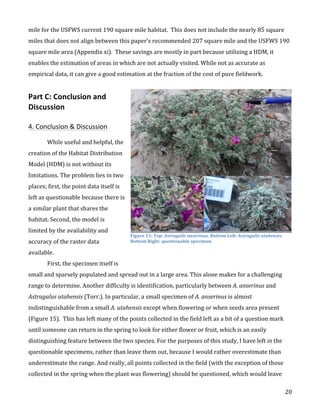
1	


A.anserinus	
  Habitat	
  Modeling	
  Internship	
  	
  
Robert	
  Machol	
  
University	
  of	
  Utah	
  Professional	
  Master	
  of	
  Science	
  and	
  Technology	
  
In	
  conjunction	
  with:	
  Utah	
  Department	
  of	
  Agriculture	
  and	
  Food	
  
March	
  2015	


  2	
  
Table	
  of	
  Contents:	


Abstract…………………………………………………………………………………………………….3	
  
Introduction………………………………………………………………………………………………4	
  
Part	
  A:	
  Model	
  Development	
  
1.	
  Methods……………………………………………………………………………………….6	
  
2.	
  Results…………………………………………………………………………………………13	
  
Part	
  B:	
  Business	
  Analysis	
  
3.	
  Recommendations………………………………………………………………………17	
  
Part	
  C:	
  Conclusion	
  and	
  Discussion	
  
4.	
  Conclusion	
  &	
  Discussion……………………………………………………………..20	
  
5.	
  Recommendations………………………………………………………………….…..23	
  
Acknowledgements…………………………………………………………………………………24	
  
References……………………………………………………………………………………………...25	
  
Appendices	
  
Appendix	
  i:	
  Soil	
  Data	
  Analysis…………………………………………………….…..26	
  
Appendix	
  ii:	
  Raster	
  Data	
  Keys	
  …………………………………………………….…..29	
  
Appendix	
  iii:	
  Batch	
  Attempts	
  Using	
  Model	
  Builder…………………………35	
  
Appendix	
  iv:	
  Python	
  Script	
  for	
  Resample	
  and	
  Aggregation………….…..36	
  
Appendix	
  v:	
  Models	
  Verified	
  in	
  Field	
  With	
  Corresponding	
  Points......37	
  
Appendix	
  vi:	
  Field	
  Notes…………………………………………..……………………..39	
  
Appendix	
  vii:	
  HyperNich	
  Model……………………………………………………….47	
  
Appendix	
  viii:	
  Various	
  Models	
  Created	
  in	
  R……………………………………..48	
  
Appendix	
  ix:	
  Sample	
  R	
  code…………………………………………………………….51	
  
Appendix	
  x:	
  Colinearity	
  Analysis……………………………………………………..56	
  
Appendix	
  xi:	
  Final	
  Map	
  and	
  Recommendation…………………………………57	


  3	
  
Abstract:	
  	
  
The	
  purpose	
  of	
  this	
  project	
  and	
  internship	
  with	
  Utah	
  Department	
  of	
  Agriculture	
  (UDAF)	
  
was	
  to	
  create	
  a	
  Habitat	
  Distribution	
  Model	
  (HDM)	
  for	
  the	
  endemic	
  species	
  of	
  Astragalis	
  anserinus	
  
(Goose	
  Creek	
  Milkvetch)	
  located	
  in	
  the	
  corner	
  of	
  Utah,	
  Idaho	
  and	
  Nevada	
  (Atwood,	
  Goodrich,	
  &	
  
Welsh,	
  2011).	
  	
  The	
  current	
  range	
  is	
  listed	
  by	
  the	
  U.S.	
  Fish	
  and	
  Wildlife	
  Services	
  (USFWS)	
  to	
  be	
  
around	
  190	
  square	
  miles	
  (U.S.	
  Fish	
  and	
  Wildlife	
  Services,	
  2014).	
  Two	
  HDM	
  are	
  created	
  and	
  used	
  in	
  
the	
  final	
  125	
  square	
  mile	
  area	
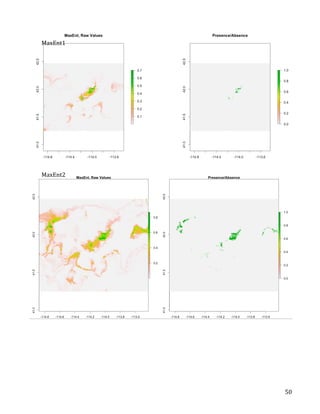
  (MaxEnt1	
  and	
  MaxEnt2),	
  while	
  the	
  recommended	
  habitat	
  area	
  is	
  
207	
  square	
  miles.	
  	
  The	
  HDM	
  were	
  created	
  using	
  the	
  Maximum	
  Entropy	
  (MaxEnt)	
  algorithm	
  
(Hijmans	
  et	
  al,	
  2013).	


Generally,	
  methods	
  were	
  to	
  collect	
  as	
  much	
  environmental	
  data	
  on	
  the	
  area	
  in	
  as	
  much	
  
detail	
  as	
  possible,	
  with	
  a	
  goal	
  to	
  have	
  raster	
  data	
  at	
  3-­‐meter	
  resolution.	
  Course	
  data	
  utilized	
  
bilinear	
  interpolation	
  and	
  was	
  made	
  “fuzzy”	
  to	
  better	
  fit	
  the	
  area	
  at	
  the	
  target	
  resolution.	
  	
  After	
  
aligning	
  the	
  data	
  using	
  ESRI	
  ArcMap	
  (commercial	
  GIS	
  application),	
  and	
  Python	
  (open	
  source	
  
programming	
  language),	
  the	
  third-­‐party	
  Dismo	
  package	
  in	
  R	
  (a	
  statistical	
  analysis	
  language),	
  was	
  
used	
  to	
  build	
  and	
  analyze	
  various	
  models	
  as	
  to	
  where	
  A.	
  anserinus	
  currently	
  grows.	
  The	
  Dismo	
  
package	
  is	
  an	
  add-­‐on	
  program	
  specifically	
  made	
  to	
  model	
  species	
  distributions,	
  by	
  Robert	
  J.	
  
Hijmans,	
  Steven	
  Phillips,	
  John	
  Leathwick	
  and	
  Jane	
  Elithas.	
  In	
  addition,	
  a	
  model	
  built	
  by	
  a	
  
commercial	
  program,	
  HyperNiche,	
  was	
  used	
  for	
  verification	
  of	
  the	
  work	
  done	
  in	
  R.	
  
During	
  the	
  course	
  of	
  the	
  internship,	
  my	
  mentor	
  at	
  UDAF,	
  Bracken	
  Davis,	
  and	
  I	
  added	
  a	
  
mixture	
  of	
  about	
  700	
  presence	
  and	
  absence	
  points,	
  along	
  with	
  other	
  points	
  of	
  data	
  collected	
  by	
  
USFWS,	
  to	
  have	
  a	
  total	
  of	
  about	
  1000	
  presence	
  and	
  absence	
  points	
  in	
  the	
  study	
  area.	
  
Unfortunately,	
  many	
  of	
  the	
  presence	
  points	
  are	
  not	
  fully	
  confirmed,	
  as	
  Astragalis	
  anserinus	
  is	
  very	
  
hard	
  to	
  differentiate?	
  Astragalis	
  utahensis	
  (Torr.).	
  In	
  fact,	
  without	
  seedpods	
  or	
  flowers	
  to	
  
differentiate	
  the	
  two	
  species,	
  they	
  are	
  virtually	
  impossible	
  to	
  tell	
  a	
  small	
  specimen	
  apart.	
  Some	
  of	
  
the	
  outlier	
  positive	
  presence	
  points,	
  I	
  believe,	
  are	
  questionable	
  and	
  more	
  likely	
  than	
  not,	
  there	
  are	
  
false	
  positives	
  among	
  the	
  presence	
  points.	
  	
  Verification	
  of	
  these	
  points	
  would	
  need	
  to	
  take	
  place	
  in	
  
the	
  spring/early	
  summer	
  while	
  (and	
  if)	
  the	
  plant	
  is	
  flowering.	
  	
  
The	
  cost-­‐benefit	
  analysis	
  of	
  this	
  study	
  would	
  imply	
  that	
  creating	
  a	
  HDM	
  is	
  a	
  much	
  better	
  
use	
  of	
  time,	
  compared	
  to	
  field	
  verification,	
  purely	
  for	
  the	
  reason	
  that	
  the	
  HDM	
  will	
  predict	
  where	
  a	
  
plant	
  is	
  based	
  on	
  current	
  information.	
  However,	
  creating	
  a	
  model	
  is	
  easy,	
  running	
  and	
  interpreting	
  
analytics	
  on	
  the	
  model	
  can	
  be	
  difficult.	
  	
  Of	
  the	
  two	
  models	
  used	
  for	
  the	
  final	
  recommended	
  habitat,	
  
the	
  MaxEnt2	
  model	
  was	
  simplified	
  so	
  that	
  the	
  analytics	
  were	
  run,	
  with	
  decent	
  results,	
  showing	
  an	
  
  4	
  
AUC	
  score	
  mean	
  of	
  72.6	
  (where	
  0.5	
  is	
  a	
  guess,	
  1.0	
  shows	
  all	
  true	
  positives).	
  MaxEnt1	
  model	
  was	
  
too	
  large	
  to	
  run	
  the	
  analytics,	
  but	
  seems	
  the	
  better	
  model	
  from	
  a	
  user	
  point	
  of	
  view.	
  A	
  combination	
  
of	
  the	
  two	
  models	
  was	
  created	
  to	
  better	
  represent	
  empirical	
  data,	
  and	
  a	
  third	
  model	
  is	
  highly	
  
recommended	
  after	
  field	
  verification	
  of	
  both	
  the	
  model,	
  and	
  questionable	
  data	
  can	
  be	
  completed.	
  
This	
  study	
  brings	
  up	
  many	
  questions	
  about	
  A.	
  anserinus,	
  and	
  shows	
  how	
  little	
  we	
  know	
  
about	
  the	
  plant.	
  A	
  discussion	
  of	
  these	
  questions	
  is	
  of	
  the	
  opinion	
  of	
  the	
  author	
  alone,	
  but	
  is	
  not	
  
without	
  relevance.	
  	
  These	
  questions	
  include	
  whether	
  the	
  plant	
  is	
  particularly	
  tolerant	
  to	
  the	
  lack	
  
of	
  soil	
  nutrients,	
  and	
  if	
  A.	
  anserinus	
  is	
  limited	
  in	
  range	
  by	
  anything	
  other	
  than	
  seed	
  dispersion.	
  
Finally,	
  a	
  question	
  of	
  protecting	
  the	
  plant	
  might	
  do	
  the	
  plant	
  more	
  harm	
  than	
  good,	
  simply	
  by	
  
stretching	
  the	
  resources	
  used	
  to	
  fight	
  invasive	
  species	
  in	
  order	
  to	
  comply	
  with	
  the	
  higher	
  cost	
  
management	
  necessitated	
  by	
  the	
  Endangered	
  Species	
  Act.	


Introduction:	
  
	
   The	
  modeling	
  the	
  distribution	
  of	
  species	
  is	
  becoming	
  an	
  increasingly	
  important	
  component	
  
in	
  conservation	
  planning	
  (Pearson,	
  2007).	
  Conservation	
  planning	
  can	
  benefit	
  from	
  these	
  models	
  in	
  
many	
  ways.	
  These	
  can	
  range	
  from	
  identifying	
  sites	
  and	
  borders,	
  understanding	
  the	
  social	
  and	
  
ecological	
  impact	
  within	
  a	
  site,	
  identifying	
  threats	
  within	
  a	
  site,	
  and	
  helping	
  to	
  prioritize	
  
resources,	
  to	
  name	
  a	
  few.	
  	
  	
  The	
  goal	
  of	
  this	
  project	
  was	
  to	
  create	
  a	
  Habitat	
  Distribution	
  Model	
  
(HDM)	
  on	
  the	
  endemic	
  plant,	
  Astragalis	
  anserinus	
  (Goose	
  Creek	
  Milkvetch),	
  and	
  assess	
  the	
  
possible	
  impact	
  in	
  which	
  the	
  HDM	
  might	
  have	
  on	
  the	
  conservation	
  planning.	


Astragalis	
  anserinus	
  is	
  currently	
  being	
  considered	
  as	
  threatened	
  by	
  the	
  US	
  Fish	
  and	
  Wildlife	
  
Service.	
  A.	
  anserinus	
  has	
  only	
  been	
  found	
  an	
  area	
  of	
  approximately	
  17	
  square	
  acres	
  in	
  Utah,	
  with	
  a	
  
total	
  range	
  that	
  is	
  approximately	
  190	
  square	
  miles	
  in	
  Nevada,	
  Idaho,	
  and	
  Utah	
  in	
  and	
  around	
  the	
  
Goose	
  Creek	
  Drainage	
  (Figure	
  1).	
  The	
  Goose	
  Creek	
  Drainage	
  is	
  recognized	
  as	
  an	
  area	
  to	
  preserve	
  
by	
  some	
  wilderness	
  conservation	
  groups,	
  and	
  is	
  listed	
  as	
  an	
  area	
  to	
  be	
  considered	
  for	
  protection	
  
within	
  the	
  National	
  Wilderness	
  Preservation	
  Program.	
  The	
  Biodiversity	
  found	
  within	
  the	
  Goose	
  
Creek	
  Drainage	
  is	
  unique	
  because	
  it	
  is	
  grassland	
  with	
  gentle	
  topography	
  and	
  a	
  transition	
  zone	
  
between	
  the	
  Great	
  Basin	
  and	
  Snake	
  River	
  Plain	
  (Lukez,	
  2011).	
  	
  In	
  2004,	
  a	
  petition	
  for	
  the	
  endemic	
  
species	
  was	
  given	
  to	
  the	
  U.S.	
  Fish	
  and	
  Wildlife	
  to	
  put	
  A.	
  anserinus	
  under	
  the	
  protection	
  of	
  the	
  
Endangered	
  Species	
  Act,	
  and	
  this	
  decision	
  is	
  assumed	
  to	
  occur	
  by	
  2016	
  (U.S. Fish and Wildlife
Service, 2014).	


  5	
  
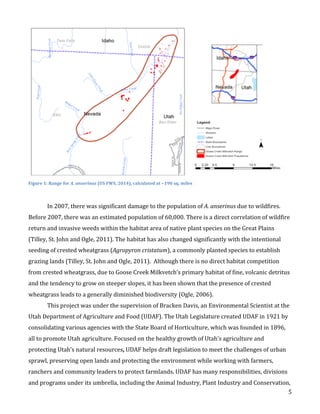
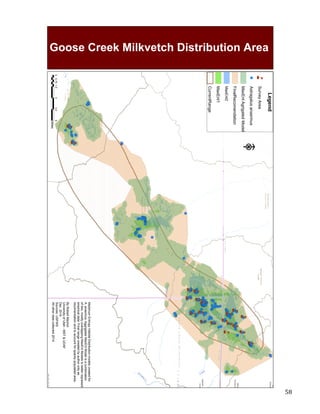
Figure	
  1:	
  Range	
  for	
  A.	
  anserinus	
  (US	
  FWS,	
  2014),	
  calculated	
  at	
  ~190	
  sq.	
  miles	


In	
  2007,	
  there	
  was	
  significant	
  damage	
  to	
  the	
  population	
  of	
  A.	
  anserinus	
  due	
  to	
  wildfires.	
  
Before	
  2007,	
  there	
  was	
  an	
  estimated	
  population	
  of	
  60,000.	
  There	
  is	
  a	
  direct	
  correlation	
  of	
  wildfire	
  
return	
  and	
  invasive	
  weeds	
  within	
  the	
  habitat	
  area	
  of	
  native	
  plant	
  species	
  on	
  the	
  Great	
  Plains	
  
(Tilley,	
  St.	
  John	
  and	
  Ogle,	
  2011).	
  The	
  habitat	
  has	
  also	
  changed	
  significantly	
  with	
  the	
  intentional	
  
seeding	
  of	
  crested	
  wheatgrass	
  (Agropyron	
  cristatum),	
  a	
  commonly	
  planted	
  species	
  to	
  establish	
  
grazing	
  lands	
  (Tilley,	
  St.	
  John	
  and	
  Ogle,	
  2011).	
  	
  Although	
  there	
  is	
  no	
  direct	
  habitat	
  competition	
  
from	
  crested	
  wheatgrass,	
  due	
  to	
  Goose	
  Creek	
  Milkvetch’s	
  primary	
  habitat	
  of	
  fine,	
  volcanic	
  detritus	
  
and	
  the	
  tendency	
  to	
  grow	
  on	
  steeper	
  slopes,	
  it	
  has	
  been	
  shown	
  that	
  the	
  presence	
  of	
  crested	
  
wheatgrass	
  leads	
  to	
  a	
  generally	
  diminished	
  biodiversity	
  (Ogle,	
  2006).	
  	
  
This	
  project	
  was	
  under	
  the	
  supervision	
  of	
  Bracken	
  Davis,	
  an	
  Environmental	
  Scientist	
  at	
  the	
  
Utah	
  Department	
  of	
  Agriculture	
  and	
  Food	
  (UDAF).	
  The	
  Utah	
  Legislature	
  created	
  UDAF	
  in	
  1921	
  by	
  
consolidating	
  various	
  agencies	
  with	
  the	
  State	
  Board	
  of	
  Horticulture,	
  which	
  was	
  founded	
  in	
  1896,	
  
all	
  to	
  promote	
  Utah	
  agriculture.	
  Focused	
  on	
  the	
  healthy	
  growth	
  of	
  Utah’s	
  agriculture	
  and	
  
protecting	
  Utah’s	
  natural	
  resources,	
  UDAF	
  helps	
  draft	
  legislation	
  to	
  meet	
  the	
  challenges	
  of	
  urban	
  
sprawl,	
  preserving	
  open	
  lands	
  and	
  protecting	
  the	
  environment	
  while	
  working	
  with	
  farmers,	
  
ranchers	
  and	
  community	
  leaders	
  to	
  protect	
  farmlands.	
  UDAF	
  has	
  many	
  responsibilities,	
  divisions	
  
and	
  programs	
  under	
  its	
  umbrella,	
  including	
  the	
  Animal	
  Industry,	
  Plant	
  Industry	
  and	
  Conservation,	
  
  6	
  
Food	
  Regulatory	
  Services,	
  Marketing	
  and	
  Economic	
  Development,	
  Conservation	
  Commission,	
  
Homeland	
  Security,	
  Laboratory	
  Services,	
  Administrative	
  Services,	
  and	
  Communications	
  and	
  Public	
  
Information.	
  	
  “The	
  Department	
  of	
  Agriculture	
  and	
  Food	
  is	
  responsible	
  for	
  the	
  administration	
  of	
  
Utah's	
  agricultural	
  laws,	
  which	
  mandate	
  a	
  wide	
  variety	
  of	
  activities	
  including	
  inspection,	
  
regulation,	
  information,	
  rulemaking,	
  loan	
  issuance,	
  marketing	
  and	
  development,	
  pest	
  and	
  disease	
  
control,	
  improving	
  the	
  economic	
  position	
  of	
  agriculture,	
  
and	
  consumer	
  protection”	
  (Utah	
  Department	
  of	
  
Agriculture,	
  2014).	
  	
  It	
  is,	
  therefore,	
  part	
  of	
  UDAF’s	
  
responsibility	
  to	
  make	
  sure	
  that	
  Utah’s	
  lands	
  are	
  managed	
  
in	
  a	
  manner	
  that	
  conserves	
  all	
  species,	
  including	
  A.	
  
anserinus,	
  where	
  possible.	


Part	
  A:	
  Model	
  Development	


1.	
  Methods	


   This	
  project	
  began	
  with	
  the	
  collection	
  of	
  various	
  environmental	
  data	
  pertaining	
  to	
  the	
  
study	
  area.	
  	
  The	
  study	
  area	
  chosen	
  gave	
  a	
  wide	
  berth	
  of	
  the	
  known	
  habitat	
  of	
  A.	
  ansernius,	
  in	
  the	
  
hopes	
  of	
  finding	
  the	
  plant	
  well	
  outside	
  of	
  the	
  known	
  range.	
  	
  The	
  overall	
  study	
  area	
  was	
  
approximately	
  100	
  miles	
  in	
  both	
  length	
  and	
  width,	
  giving	
  an	
  approximate	
  1000	
  square	
  mile	
  study	
  
area	
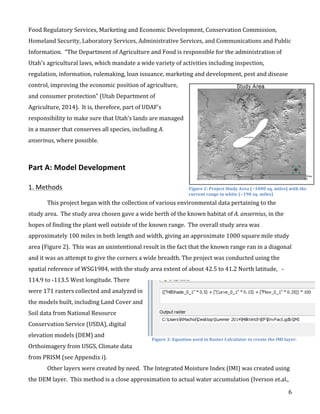
  (Figure	
  2).	
  	
  This	
  was	
  an	
  unintentional	
  result	
  in	
  the	
  fact	
  that	
  the	
  known	
  range	
  ran	
  in	
  a	
  diagonal	
  
and	
  it	
  was	
  an	
  attempt	
  to	
  give	
  the	
  corners	
  a	
  wide	
  breadth.	
  The	
  project	
  was	
  conducted	
  using	
  the	
  
spatial	
  reference	
  of	
  WSG1984,	
  with	
  the	
  study	
  area	
  extent	
  of	
  about	
  42.5	
  to	
  41.2	
  North	
  latitude,	
  	
  	
  -­‐
114.9	
  to	
  -­‐113.5	
  West	
  longitude.	
  There	
  
were	
  171	
  rasters	
  collected	
  and	
  analyzed	
  in	
  
the	
  models	
  built,	
  including	
  Land	
  Cover	
  and	
  
Soil	
  data	
  from	
  National	
  Resource	
  
Conservation	
  Service	
  (USDA),	
  digital	
  
elevation	
  models	
  (DEM)	
  and	
  
Orthoimagery	
  from	
  USGS,	
  Climate	
  data	
  
from	
  PRISM	
  (see	
  Appendix	
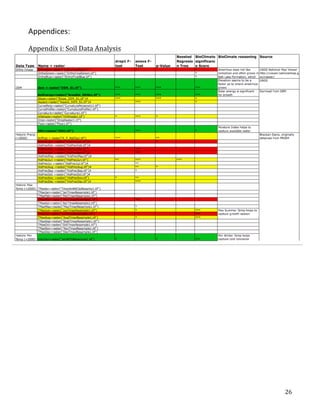
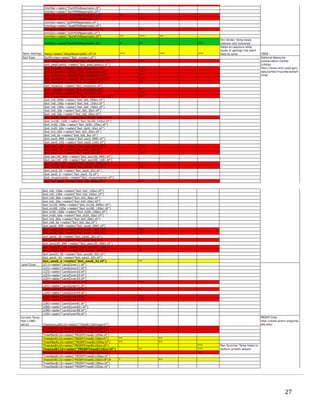
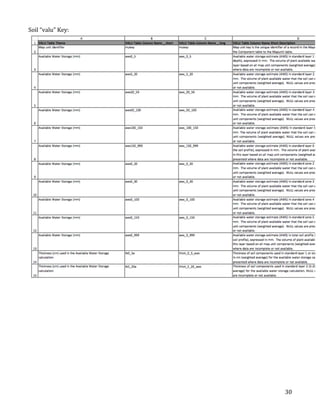
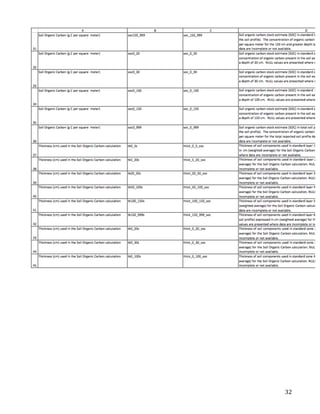
  i).	


Other	
  layers	
  were	
  created	
  by	
  need.	
  	
  The	
  Integrated	
  Moisture	
  Index	
  (IMI)	
  was	
  created	
  using	
  
the	
  DEM	
  layer.	
  	
  This	
  method	
  is	
  a	
  close	
  approximation	
  to	
  actual	
  water	
  accumulation	
  (Iverson	
  et.al.,	
  
Figure	
  2:	
  Project	
  Study	
  Area	
  (~1000	
  sq.	
  miles)	
  with	
  the	
  
current	
  range	
  in	
  white	
  (~190	
  sq.	
  miles)	
  
Figure	
  3:	
  Equation	
  used	
  in	
  Raster	
  Calculator	
  to	
  create	
  the	
  IMI	
  layer:	
  	
  
  7	
  
1997,	
  Figure	
  3).	
  	
  Solar	
  energy	
  was	
  also	
  created	
  off	
  of	
  the	
  DEM	
  in	
  ArcMap,	
  a	
  process	
  that	
  took	
  10	
  
days	
  to	
  run	
  for	
  the	
  given	
  study	
  area.	
  The	
  
results	
  given	
  were	
  a	
  calculation	
  of	
  the	
  average	
  
watt-­‐hours	
  per	
  square	
  meter	
  for	
  the	
  entire	
  
year.	
  	
  
Any	
  categorical	
  data	
  was	
  separated	
  into	
  
its	
  own	
  individual	
  raster	
  layer	
  and	
  given	
  a	
  
score	
  of	
  0	
  or	
  1	
  (absence	
  or	
  presence),	
  and	
  then	
  
given	
  fuzzy	
  values	
  decreasing	
  over	
  9	
  meters	
  (3	
  
cells).	
  	
  	
  The	
  landcover	
  data	
  and	
  the	
  geology	
  
data	
  necessitated	
  a	
  mosaic	
  function	
  to	
  combine	
  
multiple	
  areas	
  together,	
  and	
  then	
  the	
  data	
  layer	
  
names	
  had	
  to	
  be	
  aligned	
  and	
  changed	
  as	
  the	
  
various	
  data	
  had	
  the	
  annoying	
  habit	
  of	
  
changing	
  names	
  as	
  it	
  crossed	
  state	
  boundaries	
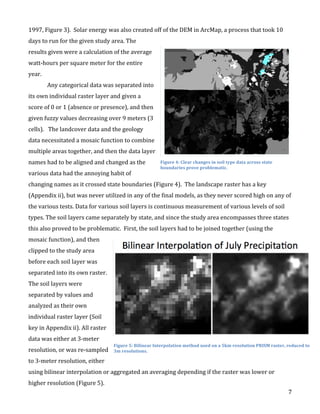
  (Figure	
  4).	
  	
  The	
  landscape	
  raster	
  has	
  a	
  key	
  
(Appendix	
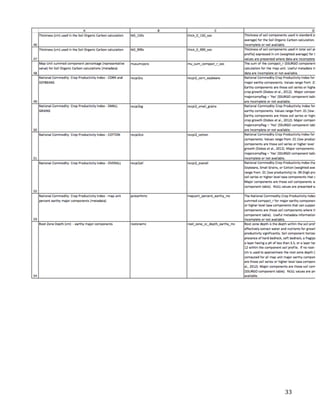
  ii),	
  but	
  was	
  never	
  utilized	
  in	
  any	
  of	
  the	
  final	
  models,	
  as	
  they	
  never	
  scored	
  high	
  on	
  any	
  of	
  
the	
  various	
  tests.	
  Data	
  for	
  various	
  soil	
  layers	
  is	
  continuous	
  measurement	
  of	
  various	
  levels	
  of	
  soil	
  
types.	
  The	
  soil	
  layers	
  came	
  separately	
  by	
  state,	
  and	
  since	
  the	
  study	
  area	
  encompasses	
  three	
  states	
  
this	
  also	
  proved	
  to	
  be	
  problematic.	
  	
  First,	
  the	
  soil	
  layers	
  had	
  to	
  be	
  joined	
  together	
  (using	
  the	
  
mosaic	
  function),	
  and	
  then	
  
clipped	
  to	
  the	
  study	
  area	
  
before	
  each	
  soil	
  layer	
  was	
  
separated	
  into	
  its	
  own	
  raster.	
  
The	
  soil	
  layers	
  were	
  
separated	
  by	
  values	
  and	
  
analyzed	
  as	
  their	
  own	
  
individual	
  raster	
  layer	
  (Soil	
  
key	
  in	
  Appendix	
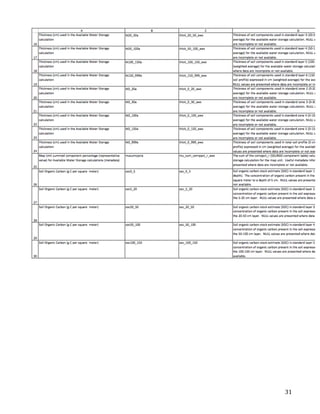
  ii).	
  All	
  raster	
  
data	
  was	
  either	
  at	
  3-­‐meter	
  
resolution,	
  or	
  was	
  re-­‐sampled	
  
to	
  3-­‐meter	
  resolution,	
  either	
  
using	
  bilinear	
  interpolation	
  or	
  aggregated	
  an	
  averaging	
  depending	
  if	
  the	
  raster	
  was	
  lower	
  or	
  
higher	
  resolution	
  (Figure	
  5).	
  	
  
Figure	
  4:	
  Clear	
  changes	
  in	
  soil	
  type	
  data	
  across	
  state	
  
boundaries	
  prove	
  problematic.	
  
Figure	
  5:	
  Bilinear	
  Interpolation	
  method	
  used	
  on	
  a	
  5km	
  resolution	
  PRISM	
  raster,	
  reduced	
  to	
  
3m	
  resolutions.	
  
  8	
  
Much	
  of	
  the	
  raster	
  
manipulation	
  took	
  place	
  in	
  ArcMap,	
  
but	
  the	
  development	
  of	
  all	
  HDM	
  
building	
  took	
  place	
  in	
  R,	
  which	
  is	
  
where	
  a	
  Non-­‐Coincident	
  problem	
  
was	
  recognized.	
  For	
  the	
  model	
  
building	
  to	
  take	
  place,	
  each	
  raster	
  
had	
  to	
  have	
  exactly	
  the	
  same	
  
columns	
  and	
  rows.	
  	
  The	
  Non-­‐
Coincident	
  problem	
  occurred	
  in	
  
ArcMap	
  with	
  a	
  bug	
  in	
  the	
  Clip	
  
function;	
  an	
  extra	
  row	
  or	
  column	
  
would	
  be	
  added	
  to	
  the	
  raster.	
  	
  At	
  the	
  
size	
  and	
  resolution	
  the	
  rasters	
  were	
  
in,	
  this	
  was	
  evidently	
  a	
  bug	
  with	
  
ArcMap	
  that	
  did	
  not	
  tend	
  to	
  occur	
  
with	
  smaller	
  rasters.	
  	
  Among	
  the	
  
solutions	
  tried	
  was	
  a	
  homemade	
  
version	
  of	
  re-­‐sampling	
  and	
  clipping	
  
in	
  which	
  a	
  raster	
  would	
  have	
  values	
  
averaged	
  into	
  points,	
  based	
  on	
  
number	
  of	
  required	
  columns	
  and	
  
rows.	
  	
  These	
  points	
  would	
  then	
  be	
  
turned	
  back	
  into	
  a	
  raster,	
  now	
  with	
  
the	
  averaged	
  given	
  value.	
  	
  In	
  small	
  
test	
  rasters,	
  this	
  was	
  a	
  successful	
  
strategy,	
  but	
  would	
  fail	
  in	
  large-­‐scale	
  runs.	
  	
  Of	
  course,	
  it	
  would	
  be	
  a	
  few	
  days	
  of	
  running	
  before	
  the	
  
process	
  would	
  come	
  back	
  with	
  an	
  error.	
  Eventually,	
  an	
  alternative	
  to	
  the	
  Clip	
  function,	
  Extract	
  By	
  
Rectangle,	
  ran	
  successfully	
  at	
  large	
  scale.	
  	
  Various	
  models	
  using	
  Model	
  Builder	
  was	
  used	
  to	
  
automate	
  this	
  process,	
  which	
  would	
  work	
  in	
  test	
  runs	
  but	
  they	
  would	
  again	
  fail	
  in	
  large	
  scale	
  and	
  
batch	
  (Appendix	
  iii).	
  	
  Later,	
  I	
  needed	
  to	
  aggregate	
  rasters	
  to	
  a	
  larger,	
  30	
  meter,	
  resolution,	
  when	
  
Python	
  scripts	
  were	
  utilized	
  with	
  success	
  (Appendix	
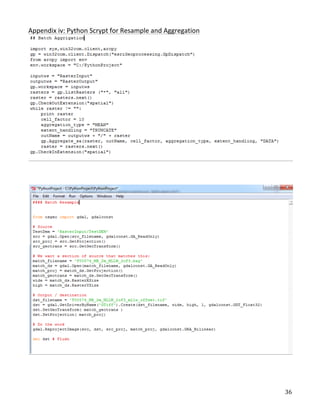
  iv).	
  	
  
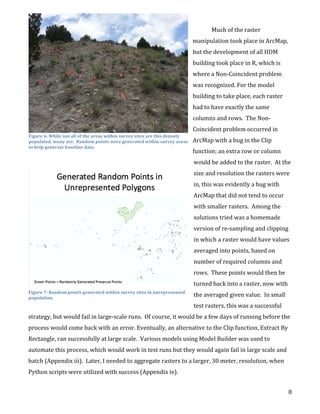
Figure	
  7:	
  Random	
  points	
  generated	
  within	
  survey	
  sites	
  in	
  unrepresented	
  
population.	
  
Figure	
  6:	
  While	
  not	
  all	
  of	
  the	
  areas	
  within	
  survey	
  sites	
  are	
  this	
  densely	
  
populated,	
  many	
  are.	
  	
  Random	
  points	
  were	
  generated	
  within	
  survey	
  areas	
  
to	
  help	
  generate	
  baseline	
  data.	
  
  9	
  
During	
  this	
  project,	
  both	
  point	
  and	
  polygon	
  data	
  were	
  obtained	
  from	
  US	
  Fish	
  and	
  Wild	
  Life	
  
Services.	
  	
  While	
  some	
  point	
  data	
  were	
  previously	
  collected,	
  much	
  of	
  the	
  point	
  data	
  were	
  outside	
  of	
  
polygon	
  survey	
  sites.	
  	
  These	
  survey	
  sites	
  where	
  known	
  populations	
  of	
  A.	
  anserinus	
  species.	
  	
  For	
  
this	
  study,	
  random	
  points	
  were	
  generated	
  within	
  the	
  survey	
  polygons.	
  	
  While	
  this	
  is	
  not	
  the	
  best	
  
situation	
  (real	
  data	
  is	
  better	
  than	
  pseudo	
  data),	
  given	
  the	
  limited	
  time	
  and	
  resources,	
  and	
  taking	
  
into	
  account	
  the	
  size	
  of	
  the	
  study	
  area,	
  this	
  technique	
  helped	
  to	
  get	
  baseline	
  environmental	
  data	
  
from	
  rasters	
  (elevation,	
  
temperature,	
  etc.)	
  in	
  the	
  
modeling	
  program.	
  	
  It	
  is	
  within	
  
these	
  polygons	
  that	
  A.	
  anserinus	
  
grows	
  in	
  fairly	
  dense	
  populations	
  
(Figure	
  6),	
  and	
  by	
  creating	
  
random	
  points	
  within	
  the	
  
polygons,	
  the	
  model	
  will	
  have	
  the	
  
assigned	
  environmental	
  data	
  
from	
  these	
  known	
  areas	
  without	
  
the	
  need	
  to	
  visit	
  these	
  sights.	
  
Within	
  each	
  survey	
  site,	
  up	
  to	
  
three	
  random	
  points	
  were	
  
collected,	
  spaced	
  by	
  at	
  least	
  a	
  
quarter	
  mile.	
  	
  This	
  limited	
  some	
  smaller	
  survey	
  sites	
  to	
  only	
  one	
  or	
  two	
  random	
  points,	
  while	
  
larger	
  sites	
  were	
  given	
  a	
  maximum	
  of	
  three	
  points	
  to	
  capture	
  the	
  general	
  environmental	
  values	
  of	
  
the	
  give	
  polygons	
  without	
  overwhelming	
  the	
  model	
  with	
  a	
  huge	
  amount	
  of	
  unverified	
  points	
  	
  
(Figure	
  7).	
  A	
  half-­‐mile	
  buffer	
  around	
  the	
  polygons	
  was	
  created	
  to	
  capture	
  some	
  of	
  the	
  absence	
  
data.	
  	
  Ideally,	
  in	
  the	
  future,	
  the	
  polygon	
  sites	
  can	
  have	
  verified	
  point	
  data	
  assigned	
  by	
  field	
  
observations	
  for	
  further	
  modeling	
  endeavors	
  such	
  as	
  this	
  one.	
  	
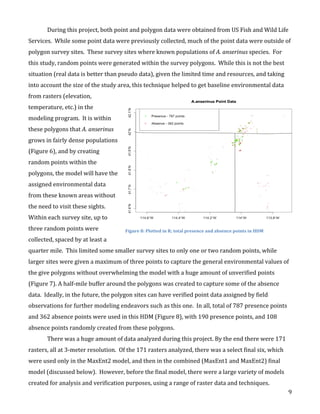
  In	
  all,	
  total	
  of	
  787	
  presence	
  points	
  
and	
  362	
  absence	
  points	
  were	
  used	
  in	
  this	
  HDM	
  (Figure	
  8),	
  with	
  190	
  presence	
  points,	
  and	
  108	
  
absence	
  points	
  randomly	
  created	
  from	
  these	
  polygons.	
  
There	
  was	
  a	
  huge	
  amount	
  of	
  data	
  analyzed	
  during	
  this	
  project.	
  By	
  the	
  end	
  there	
  were	
  171	
  
rasters,	
  all	
  at	
  3-­‐meter	
  resolution.	
  	
  Of	
  the	
  171	
  rasters	
  analyzed,	
  there	
  was	
  a	
  select	
  final	
  six,	
  which	
  
were	
  used	
  only	
  in	
  the	
  MaxEnt2	
  model,	
  and	
  then	
  in	
  the	
  combined	
  (MaxEnt1	
  and	
  MaxEnt2)	
  final	
  
model	
  (discussed	
  below).	
  	
  However,	
  before	
  the	
  final	
  model,	
  there	
  were	
  a	
  large	
  variety	
  of	
  models	
  
created	
  for	
  analysis	
  and	
  verification	
  purposes,	
  using	
  a	
  range	
  of	
  raster	
  data	
  and	
  techniques.	
  
Figure	
  8:	
  Plotted	
  in	
  R;	
  total	
  presence	
  and	
  absence	
  points	
  in	
  HDM	
  
  10	
  
Compiling	
  and	
  sorting	
  through	
  the	
  171	
  rasters	
  through	
  various	
  means,	
  with	
  commonsense	
  
prioritizing,	
  cut	
  the	
  171	
  rasters	
  to	
  six	
  final	
  rasters	
  (Appendix	
  i).	
  	
  	
  How	
  significant	
  raster	
  data	
  is	
  to	
  
the	
  various	
  models	
  can	
  change	
  depending	
  on	
  how	
  you	
  analyze	
  the	
  data.	
  	
  For	
  example,	
  fitting	
  data	
  
to	
  a	
  linear	
  model	
  will	
  give	
  you	
  different	
  error	
  report	
  than	
  a	
  curved	
  model.	
  	
  
Included	
  in	
  the	
  analysis	
  of	
  relevant	
  data,	
  rasters	
  were	
  “fit”	
  to	
  a	
  variety	
  of	
  models	
  and	
  then	
  analysis	
  
of	
  those	
  rasters	
  would	
  be	
  conducted	
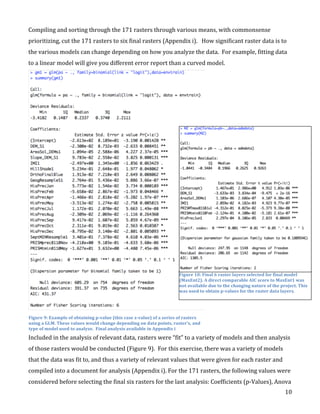
  (Figure	
  9).	
  	
  For	
  this	
  exercise,	
  there	
  was	
  a	
  variety	
  of	
  models	
  
that	
  the	
  data	
  was	
  fit	
  to,	
  and	
  thus	
  a	
  variety	
  of	
  relevant	
  values	
  that	
  were	
  given	
  for	
  each	
  raster	
  and	
  
compiled	
  into	
  a	
  document	
  for	
  analysis	
  (Appendix	
  i).	
  For	
  the	
  171	
  rasters,	
  the	
  following	
  values	
  were	
  
considered	
  before	
  selecting	
  the	
  final	
  six	
  rasters	
  for	
  the	
  last	
  analysis:	
  Coefficients	
  (p-­‐Values),	
  Anova	
  
Figure	
  9:	
  Example	
  of	
  obtaining	
  p-­‐value	
  (this	
  case	
  z-­‐value)	
  of	
  a	
  series	
  of	
  rasters	
  
using	
  a	
  GLM.	
  These	
  values	
  would	
  change	
  depending	
  on	
  data	
  points,	
  raster’s,	
  and	
  
type	
  of	
  model	
  used	
  to	
  analyze.	
  	
  Final	
  analysis	
  available	
  in	
  Appendix	
  i	
  
Figure	
  10:	
  Final	
  6	
  raster	
  layers	
  selected	
  for	
  final	
  model	
  
(MaxEnt2).	
  A	
  direct	
  comparable	
  AIC	
  score	
  to	
  MaxEnt1	
  was	
  
not	
  available	
  due	
  to	
  the	
  changing	
  nature	
  of	
  the	
  project.	
  This	
  
was	
  used	
  to	
  obtain	
  p-­‐values	
  for	
  the	
  raster	
  data	
  layers.	


  11	
  
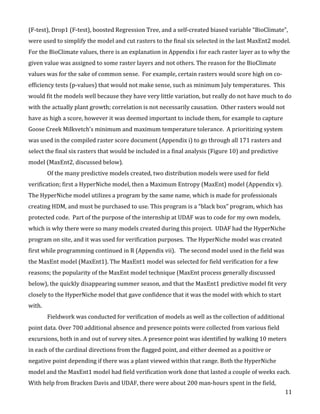
(F-­‐test),	
  Drop1	
  (F-­‐test),	
  boosted	
  Regression	
  Tree,	
  and	
  a	
  self-­‐created	
  biased	
  variable	
  “BioClimate”,	
  
were	
  used	
  to	
  simplify	
  the	
  model	
  and	
  cut	
  rasters	
  to	
  the	
  final	
  six	
  selected	
  in	
  the	
  last	
  MaxEnt2	
  model.	
  	
  
For	
  the	
  BioClimate	
  values,	
  there	
  is	
  an	
  explanation	
  in	
  Appendix	
  i	
  for	
  each	
  raster	
  layer	
  as	
  to	
  why	
  the	
  
given	
  value	
  was	
  assigned	
  to	
  some	
  raster	
  layers	
  and	
  not	
  others.	
  The	
  reason	
  for	
  the	
  BioClimate	
  
values	
  was	
  for	
  the	
  sake	
  of	
  common	
  sense.	
  	
  For	
  example,	
  certain	
  rasters	
  would	
  score	
  high	
  on	
  co-­‐
efficiency	
  tests	
  (p-­‐values)	
  that	
  would	
  not	
  make	
  sense,	
  such	
  as	
  minimum	
  July	
  temperatures.	
  	
  This	
  
would	
  fit	
  the	
  models	
  well	
  because	
  they	
  have	
  very	
  little	
  variation,	
  but	
  really	
  do	
  not	
  have	
  much	
  to	
  do	
  
with	
  the	
  actually	
  plant	
  growth;	
  correlation	
  is	
  not	
  necessarily	
  causation.	
  	
  Other	
  rasters	
  would	
  not	
  
have	
  as	
  high	
  a	
  score,	
  however	
  it	
  was	
  deemed	
  important	
  to	
  include	
  them,	
  for	
  example	
  to	
  capture	
  
Goose	
  Creek	
  Milkvetch’s	
  minimum	
  and	
  maximum	
  temperature	
  tolerance.	
  	
  A	
  prioritizing	
  system	
  
was	
  used	
  in	
  the	
  compiled	
  raster	
  score	
  document	
  (Appendix	
  i)	
  to	
  go	
  through	
  all	
  171	
  rasters	
  and	
  
select	
  the	
  final	
  six	
  rasters	
  that	
  would	
  be	
  included	
  in	
  a	
  final	
  analysis	
  (Figure	
  10)	
  and	
  predictive	
  
model	
  (MaxEnt2,	
  discussed	
  below).	


Of	
  the	
  many	
  predictive	
  models	
  created,	
  two	
  distribution	
  models	
  were	
  used	
  for	
  field	
  
verification;	
  first	
  a	
  HyperNiche	
  model,	
  then	
  a	
  Maximum	
  Entropy	
  (MaxEnt)	
  model	
  (Appendix	
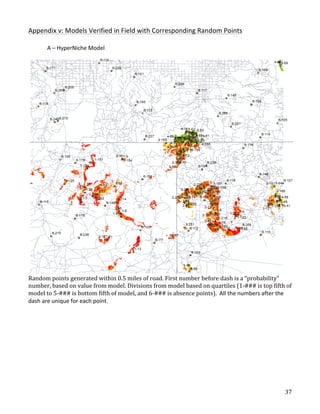
  v).	
  	
  
The	
  HyperNiche	
  model	
  utilizes	
  a	
  program	
  by	
  the	
  same	
  name,	
  which	
  is	
  made	
  for	
  professionals	
  
creating	
  HDM,	
  and	
  must	
  be	
  purchased	
  to	
  use.	
  This	
  program	
  is	
  a	
  “black	
  box”	
  program,	
  which	
  has	
  
protected	
  code.	
  	
  Part	
  of	
  the	
  purpose	
  of	
  the	
  internship	
  at	
  UDAF	
  was	
  to	
  code	
  for	
  my	
  own	
  models,	
  
which	
  is	
  why	
  there	
  were	
  so	
  many	
  models	
  created	
  during	
  this	
  project.	
  	
  UDAF	
  had	
  the	
  HyperNiche	
  
program	
  on	
  site,	
  and	
  it	
  was	
  used	
  for	
  verification	
  purposes.	
  	
  The	
  HyperNiche	
  model	
  was	
  created	
  
first	
  while	
  programming	
  continued	
  in	
  R	
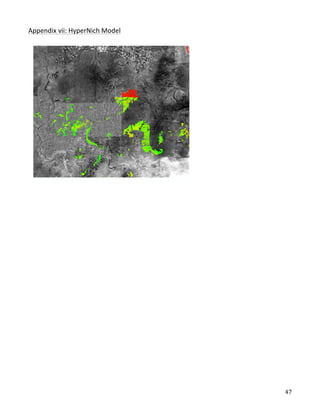
  (Appendix	
  vii).	
  	
  	
  The	
  second	
  model	
  used	
  in	
  the	
  field	
  was	
  
the	
  MaxEnt	
  model	
  (MaxEnt1).	
  The	
  MaxEnt1	
  model	
  was	
  selected	
  for	
  field	
  verification	
  for	
  a	
  few	
  
reasons;	
  the	
  popularity	
  of	
  the	
  MaxEnt	
  model	
  technique	
  (MaxEnt	
  process	
  generally	
  discussed	
  
below),	
  the	
  quickly	
  disappearing	
  summer	
  season,	
  and	
  that	
  the	
  MaxEnt1	
  predictive	
  model	
  fit	
  very	
  
closely	
  to	
  the	
  HyperNiche	
  model	
  that	
  gave	
  confidence	
  that	
  it	
  was	
  the	
  model	
  with	
  which	
  to	
  start	
  
with.	


Fieldwork	
  was	
  conducted	
  for	
  verification	
  of	
  models	
  as	
  well	
  as	
  the	
  collection	
  of	
  additional	
  
point	
  data.	
  Over	
  700	
  additional	
  absence	
  and	
  presence	
  points	
  were	
  collected	
  from	
  various	
  field	
  
excursions,	
  both	
  in	
  and	
  out	
  of	
  survey	
  sites.	
  A	
  presence	
  point	
  was	
  identified	
  by	
  walking	
  10	
  meters	
  
in	
  each	
  of	
  the	
  cardinal	
  directions	
  from	
  the	
  flagged	
  point,	
  and	
  either	
  deemed	
  as	
  a	
  positive	
  or	
  
negative	
  point	
  depending	
  if	
  there	
  was	
  a	
  plant	
  viewed	
  within	
  that	
  range.	
  Both	
  the	
  HyperNiche	
  
model	
  and	
  the	
  MaxEnt1	
  model	
  had	
  field	
  verification	
  work	
  done	
  that	
  lasted	
  a	
  couple	
  of	
  weeks	
  each.	
  	
  
With	
  help	
  from	
  Bracken	
  Davis	
  and	
  UDAF,	
  there	
  were	
  about	
  200	
  man-­‐hours	
  spent	
  in	
  the	
  field,	
  
  12	
  
approximately	
  half	
  the	
  time	
  on	
  each	
  predictive	
  model	
  (HyperNiche	
  and	
  MaxEnt1),	
  and	
  field	
  notes	
  
were	
  collected	
  during	
  verification	
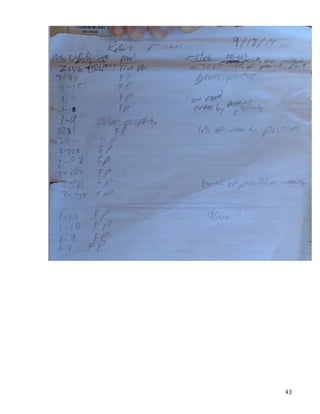
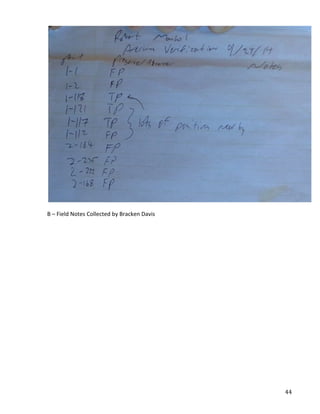
  (Appendix	
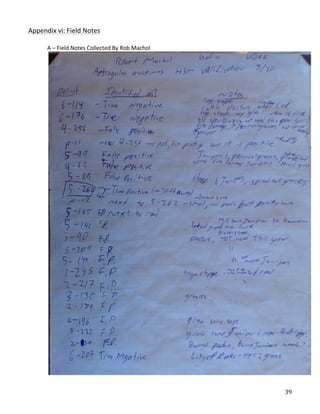
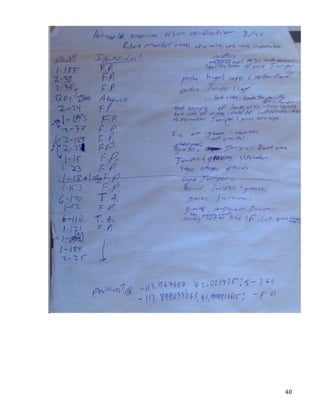
  vi).	
  	
  A	
  final	
  model	
  was	
  created	
  using	
  Maximum	
  
Entropy	
  (MaxEnt1	
  and	
  MaxEnt2	
  in	
  Appendix	
  vii)	
  and	
  an	
  error	
  report	
  was	
  created	
  for	
  MaxEnt2	
  
(error	
  report	
  in	
  Results	
  section	
  below).	
  Example	
  coding	
  used	
  in	
  R	
  for	
  the	
  MaxEnt	
  model,	
  along	
  
with	
  raster	
  and	
  point	
  analysis	
  is	
  available	
  in	
  the	
  Appendix	
  section	
  (Appendix	
  ix).	
  	
  	
  The	
  MaxEnt2	
  
model	
  has	
  a	
  new	
  area	
  in	
  the	
  Northeast	
  section	
  of	
  the	
  study	
  area	
  that	
  is	
  showing	
  positive	
  results,	
  
but	
  at	
  this	
  time	
  has	
  not	
  yet	
  been	
  surveyed	
  nor	
  field	
  verified.	
  	
  This	
  model	
  has	
  not	
  been	
  field	
  verified	
  
because	
  of	
  the	
  ending	
  of	
  the	
  summer/fall	
  season,	
  as	
  well	
  as	
  the	
  ending	
  of	
  the	
  UDAF	
  internship.	
  	
  
In	
  the	
  beginning,	
  it	
  was	
  not	
  predetermined	
  that	
  the	
  MaxEnt	
  program	
  was	
  to	
  be	
  selected	
  as	
  
a	
  final	
  modeling	
  technique,	
  but	
  rather	
  through	
  analyzing	
  and	
  experimenting	
  with	
  a	
  variety	
  of	
  
modeling	
  techniques	
  that	
  the	
  MaxEnt	
  method	
  was	
  selected	
  for	
  this	
  study.	
  	
  The	
  creation	
  of	
  many	
  
predictive	
  models	
  were	
  created	
  and	
  analyzed	
  in	
  R	
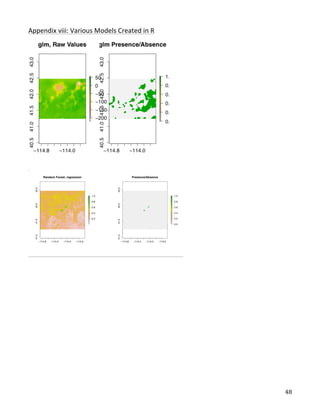
  (Appendix	
  viii)	
  before	
  and	
  after	
  the	
  first	
  MaxEnt	
  
model,	
  and	
  in	
  the	
  end	
  the	
  MaxEnt	
  models	
  were	
  selected	
  as	
  the	
  final	
  HDM.	
  Many	
  of	
  the	
  models	
  
created	
  had	
  almost	
  no	
  positive	
  area,	
  or	
  extremely	
  limited	
  area	
  determined	
  to	
  be	
  A.	
  anserinus	
  
habitat.	
  The	
  first	
  MaxEnt	
  model	
  (MaxEnt1)	
  not	
  only	
  looked	
  good,	
  but	
  it	
  fit	
  the	
  area	
  which	
  was	
  
previously	
  known	
  to	
  be	
  A.	
  anserinus	
  habitat,	
  and	
  had	
  positive	
  areas	
  that	
  matched	
  the	
  HyperNiche	
  
model	
  as	
  well.	
  	
  This	
  was	
  encouraging,	
  because	
  the	
  two	
  models	
  utilized	
  different	
  combinations	
  of	
  
raster	
  data	
  to	
  create	
  similar	
  predictive	
  maps	
  (Appendix	
  v).	
  After	
  determining	
  that	
  MaxEnt	
  fit	
  the	
  
study	
  area	
  well,	
  it	
  was	
  utilized	
  for	
  field	
  verification	
  and	
  then	
  determined	
  as	
  the	
  primary	
  model	
  for	
  
the	
  remainder	
  of	
  the	
  study.	


MaxEnt	
  has	
  been	
  identified	
  by	
  many	
  studies	
  to	
  be	
  a	
  highly	
  competitive	
  method	
  (Beane,	
  et	
  
al,	
  2013).	
  The	
  MaxEnt	
  modeling	
  technique	
  itself	
  is	
  a	
  robust	
  modeling	
  method,	
  utilizing	
  a	
  
presences-­‐only	
  input	
  technique	
  to	
  build	
  models.	
  The	
  MaxEnt	
  output	
  is	
  created	
  from	
  probability	
  
distributions	
  from	
  incomplete	
  information	
  to	
  produce	
  probabilities	
  from	
  zero	
  to	
  one.	
  The	
  
presence-­‐only	
  MaxEnt	
  takes	
  a	
  list	
  of	
  location	
  inputs,	
  along	
  with	
  given	
  environmental	
  data	
  (i.e.,	
  
temperature,	
  elevation,	
  etc.)	
  across	
  the	
  study	
  area	
  by	
  cells.	
  MaxEnt	
  then	
  takes	
  a	
  sample	
  of	
  
background	
  locations	
  that	
  is	
  compared	
  against	
  the	
  presence	
  locations.	
  	
  The	
  environmental	
  data	
  at	
  
the	
  presence	
  locations,	
  as	
  well	
  as	
  the	
  background	
  locations,	
  are	
  taken	
  into	
  account	
  when	
  creating	
  
the	
  output.	
  The	
  negative	
  data	
  (or	
  absence	
  points),	
  which	
  is	
  always	
  suspect	
  because	
  there	
  is	
  no	
  way	
  
to	
  know	
  if	
  the	
  plant	
  wont	
  grow	
  at	
  a	
  location	
  (just	
  that	
  it	
  is	
  currently	
  not	
  there),	
  is	
  not	
  required	
  in	
  
the	
  creation	
  of	
  the	
  model.	
  	
  The	
  negative	
  data	
  is	
  used	
  for	
  testing	
  purposes,	
  and	
  the	
  model	
  can	
  use	
  
both	
  categorical	
  and	
  continuous	
  data	
  (Beane,	
  et	
  al,	
  2013).	
  	
  There	
  are	
  a	
  multitude	
  of	
  settings	
  and	
  
interpretations	
  of	
  MaxEnt	
  modeling	
  technique	
  itself,	
  which	
  go	
  beyond	
  the	
  scope	
  of	
  this	
  study.	
  	
  
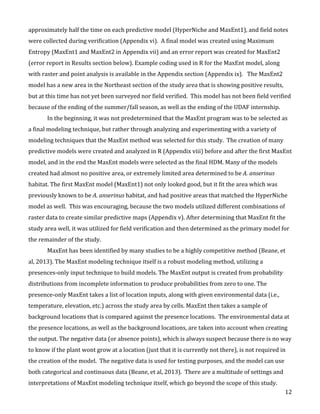
  13	
  
Entire	
  papers	
  have	
  been	
  written	
  on	
  the	
  various	
  techniques	
  that	
  can	
  be	
  utilized	
  for	
  MaxEnt	
  alone	
  
(Merow,	
  et.al.,	
  2013),	
  but	
  for	
  this	
  study	
  the	
  default	
  settings	
  were	
  used	
  or	
  otherwise	
  specified	
  by	
  
the	
  document	
  by	
  Hijmans	
  &	
  Elith,	
  	
  Species	
  distribution	
  modeling	
  with	
  r	
  (2013).	
  Discussed	
  below	
  
are	
  the	
  implementations	
  and	
  considerations	
  taken	
  for	
  Spatial	
  Bias	
  within	
  the	
  MaxEnt	
  modeling.	
  	
  
The	
  program	
  for	
  Maximum	
  Entropy	
  is	
  a	
  third	
  party	
  package	
  that	
  was	
  freely	
  downloaded	
  and	
  
incorporated	
  into	
  R	
  as	
  a	
  machine-­‐learning	
  program	
  (Hijmans	
  &	
  Elith,	
  2013).	


2.	
  Results	
  
The	
  final	
  six	
  raster	
  layers	
  were	
  selected	
  as	
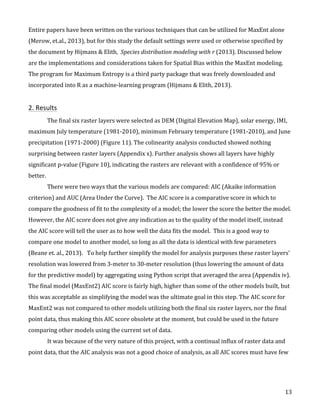
  DEM	
  (Digital	
  Elevation	
  Map),	
  solar	
  energy,	
  IMI,	
  
maximum	
  July	
  temperature	
  (1981-­‐2010),	
  minimum	
  February	
  temperature	
  (1981-­‐2010),	
  and	
  June	
  
precipitation	
  (1971-­‐2000)	
  (Figure	
  11).	
  The	
  colinearity	
  analysis	
  conducted	
  showed	
  nothing	
  
surprising	
  between	
  raster	
  layers	
  (Appendix	
  x).	
  Further	
  analysis	
  shows	
  all	
  layers	
  have	
  highly	
  
significant	
  p-­‐value	
  (Figure	
  10),	
  indicating	
  the	
  rasters	
  are	
  relevant	
  with	
  a	
  confidence	
  of	
  95%	
  or	
  
better.	
  	
  
There	
  were	
  two	
  ways	
  that	
  the	
  various	
  models	
  are	
  compared:	
  AIC	
  (Akaike	
  information	
  
criterion)	
  and	
  AUC	
  (Area	
  Under	
  the	
  Curve).	
  	
  The	
  AIC	
  score	
  is	
  a	
  comparative	
  score	
  in	
  which	
  to	
  
compare	
  the	
  goodness	
  of	
  fit	
  to	
  the	
  complexity	
  of	
  a	
  model;	
  the	
  lower	
  the	
  score	
  the	
  better	
  the	
  model.	
  	
  
However,	
  the	
  AIC	
  score	
  does	
  not	
  give	
  any	
  indication	
  as	
  to	
  the	
  quality	
  of	
  the	
  model	
  itself,	
  instead	
  
the	
  AIC	
  score	
  will	
  tell	
  the	
  user	
  as	
  to	
  how	
  well	
  the	
  data	
  fits	
  the	
  model.	
  	
  This	
  is	
  a	
  good	
  way	
  to	
  
compare	
  one	
  model	
  to	
  another	
  model,	
  so	
  long	
  as	
  all	
  the	
  data	
  is	
  identical	
  with	
  few	
  parameters	
  
(Beane	
  et.	
  al.,	
  2013).	
  	
  	
  To	
  help	
  further	
  simplify	
  the	
  model	
  for	
  analysis	
  purposes	
  these	
  raster	
  layers’	
  
resolution	
  was	
  lowered	
  from	
  3-­‐meter	
  to	
  30-­‐meter	
  resolution	
  (thus	
  lowering	
  the	
  amount	
  of	
  data	
  
for	
  the	
  predictive	
  model)	
  by	
  aggregating	
  using	
  Python	
  script	
  that	
  averaged	
  the	
  area	
  (Appendix	
  iv).	
  
The	
  final	
  model	
  (MaxEnt2)	
  AIC	
  score	
  is	
  fairly	
  high,	
  higher	
  than	
  some	
  of	
  the	
  other	
  models	
  built,	
  but	
  
this	
  was	
  acceptable	
  as	
  simplifying	
  the	
  model	
  was	
  the	
  ultimate	
  goal	
  in	
  this	
  step.	
  The	
  AIC	
  score	
  for	
  
MaxEnt2	
  was	
  not	
  compared	
  to	
  other	
  models	
  utilizing	
  both	
  the	
  final	
  six	
  raster	
  layers,	
  nor	
  the	
  final	
  
point	
  data,	
  thus	
  making	
  this	
  AIC	
  score	
  obsolete	
  at	
  the	
  moment,	
  but	
  could	
  be	
  used	
  in	
  the	
  future	
  
comparing	
  other	
  models	
  using	
  the	
  current	
  set	
  of	
  data.	
  	
  
It	
  was	
  because	
  of	
  the	
  very	
  nature	
  of	
  this	
  project,	
  with	
  a	
  continual	
  influx	
  of	
  raster	
  data	
  and	
  
point	
  data,	
  that	
  the	
  AIC	
  analysis	
  was	
  not	
  a	
  good	
  choice	
  of	
  analysis,	
  as	
  all	
  AIC	
  scores	
  must	
  have	
  few	
  
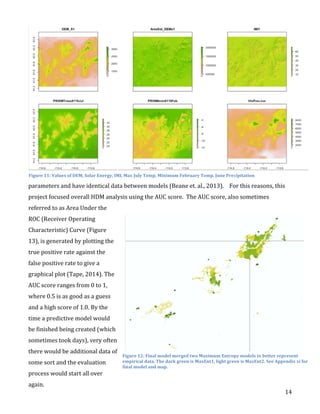
  14	
  
parameters	
  and	
  have	
  identical	
  data	
  between	
  models	
  (Beane	
  et.	
  al.,	
  2013).	


  For	
  this	
  reasons,	
  this	
  
project	
  focused	
  overall	
  HDM	
  analysis	
  using	
  the	
  AUC	
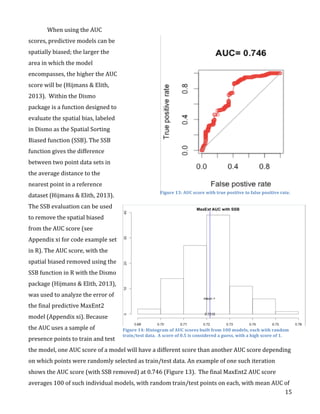
  score.	
  	
  The	
  AUC	
  score,	
  also	
  sometimes	
  
referred	
  to	
  as	
  Area	
  Under	
  the	
  
ROC	
  (Receiver	
  Operating	
  
Characteristic)	
  Curve	
  (Figure	
  
13),	
  is	
  generated	
  by	
  plotting	
  the	
  
true	
  positive	
  rate	
  against	
  the	
  
false	
  positive	
  rate	
  to	
  give	
  a	
  
graphical	
  plot	
  (Tape,	
  2014).	
  The	
  
AUC	
  score	
  ranges	
  from	
  0	
  to	
  1,	
  
where	
  0.5	
  is	
  as	
  good	
  as	
  a	
  guess	
  
and	
  a	
  high	
  score	
  of	
  1.0.	
  By	
  the	
  
time	
  a	
  predictive	
  model	
  would	
  
be	
  finished	
  being	
  created	
  (which	
  
sometimes	
  took	
  days),	
  very	
  often	
  
there	
  would	
  be	
  additional	
  data	
  of	
  
some	
  sort	
  and	
  the	
  evaluation	
  
process	
  would	
  start	
  all	
  over	
  
again.	
  	
  
Figure	
  11:	
  Values	
  of	
  DEM,	
  Solar	
  Energy,	
  IMI,	
  Max	
  July	
  Temp,	
  Minimum	
  February	
  Temp,	
  June	
  Precipitation	
  
Figure	
  12:	
  Final	
  model	
  merged	
  two	
  Maximum	
  Entropy	
  models	
  to	
  better	
  represent	
  
empirical	
  data.	
  The	
  dark	
  green	
  is	
  MaxEnt1,	
  light	
  green	
  is	
  MaxEnt2.	
  See	
  Appendix	
  xi	
  for	
  
final	
  model	
  and	
  map.	
  
  15	
  
When	
  using	
  the	
  AUC	
  
scores,	
  predictive	
  models	
  can	
  be	
  
spatially	
  biased;	
  the	
  larger	
  the	
  
area	
  in	
  which	
  the	
  model	
  
encompasses,	
  the	
  higher	
  the	
  AUC	
  
score	
  will	
  be	
  (Hijmans	
  &	
  Elith,	
  
2013).	
  	
  Within	
  the	
  Dismo	
  
package	
  is	
  a	
  function	
  designed	
  to	
  
evaluate	
  the	
  spatial	
  bias,	
  labeled	
  
in	
  Dismo	
  as	
  the	
  Spatial	
  Sorting	
  
Biased	
  function	
  (SSB).	
  The	
  SSB	
  
function	
  gives	
  the	
  difference	
  
between	
  two	
  point	
  data	
  sets	
  in	
  
the	
  average	
  distance	
  to	
  the	
  
nearest	
  point	
  in	
  a	
  reference	
  
dataset	
  (Hijmans	
  &	
  Elith,	
  2013).	
  	
  
The	
  SSB	
  evaluation	
  can	
  be	
  used	
  
to	
  remove	
  the	
  spatial	
  biased	
  
from	
  the	
  AUC	
  score	
  (see	
  
Appendix	
  xi	
  for	
  code	
  example	
  set	
  
in	
  R).	
  The	
  AUC	
  score,	
  with	
  the	
  
spatial	
  biased	
  removed	
  using	
  the	
  
SSB	
  function	
  in	
  R	
  with	
  the	
  Dismo	
  
package	
  (Hijmans	
  &	
  Elith,	
  2013),	
  
was	
  used	
  to	
  analyze	
  the	
  error	
  of	
  
the	
  final	
  predictive	
  MaxEnt2	
  
model	
  (Appendix	
  xi).	
  Because	
  
the	
  AUC	
  uses	
  a	
  sample	
  of	
  
presence	
  points	
  to	
  train	
  and	
  test	
  
the	
  model,	
  one	
  AUC	
  score	
  of	
  a	
  model	
  will	
  have	
  a	
  different	
  score	
  than	
  another	
  AUC	
  score	
  depending	
  
on	
  which	
  points	
  were	
  randomly	
  selected	
  as	
  train/test	
  data.	
  An	
  example	
  of	
  one	
  such	
  iteration	
  
shows	
  the	
  AUC	
  score	
  (with	
  SSB	
  removed)	
  at	
  0.746	
  (Figure	
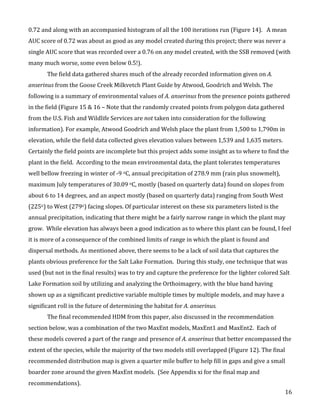
  13).	
  	
  The	
  final	
  MaxEnt2	
  AUC	
  score	
  
averages	
  100	
  of	
  such	
  individual	
  models,	
  with	
  random	
  train/test	
  points	
  on	
  each,	
  with	
  mean	
  AUC	
  of	
  
Figure	
  13:	
  AUC	
  score	
  with	
  true	
  positive	
  to	
  false	
  positive	
  rate.	
  
Figure	
  14:	
  Histogram	
  of	
  AUC	
  scores	
  built	
  from	
  100	
  models,	
  each	
  with	
  random	
  
train/test	
  data.	
  	
  A	
  score	
  of	
  0.5	
  is	
  considered	
  a	
  guess,	
  with	
  a	
  high	
  score	
  of	
  1.	
  
  16	
  
0.72	
  and	
  along	
  with	
  an	
  accompanied	
  histogram	
  of	
  all	
  the	
  100	
  iterations	
  run	
  (Figure	
  14).	
  	
  	
  A	
  mean	
  
AUC	
  score	
  of	
  0.72	
  was	
  about	
  as	
  good	
  as	
  any	
  model	
  created	
  during	
  this	
  project;	
  there	
  was	
  never	
  a	
  
single	
  AUC	
  score	
  that	
  was	
  recorded	
  over	
  a	
  0.76	
  on	
  any	
  model	
  created,	
  with	
  the	
  SSB	
  removed	
  (with	
  
many	
  much	
  worse,	
  some	
  even	
  below	
  0.5!).	
  	
  
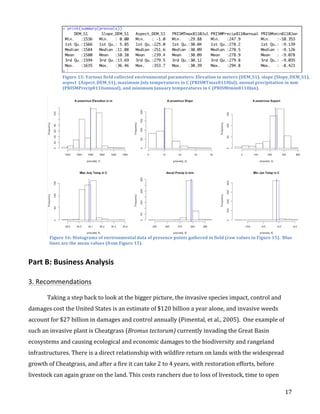
The	
  field	
  data	
  gathered	
  shares	
  much	
  of	
  the	
  already	
  recorded	
  information	
  given	
  on	
  A.	
  
anserinus	
  from	
  the	
  Goose	
  Creek	
  Milkvetch	
  Plant	
  Guide	
  by	
  Atwood,	
  Goodrich	
  and	
  Welsh.	
  The	
  
following	
  is	
  a	
  summary	
  of	
  environmental	
  values	
  of	
  A.	
  anserinus	
  from	
  the	
  presence	
  points	
  gathered	
  
in	
  the	
  field	
  (Figure	
  15	
  &	
  16	
  –	
  Note	
  that	
  the	
  randomly	
  created	
  points	
  from	
  polygon	
  data	
  gathered	
  
from	
  the	
  U.S.	
  Fish	
  and	
  Wildlife	
  Services	
  are	
  not	
  taken	
  into	
  consideration	
  for	
  the	
  following	
  
information).	
  For	
  example,	
  Atwood	
  Goodrich	
  and	
  Welsh	
  place	
  the	
  plant	
  from	
  1,500	
  to	
  1,790m	
  in	
  
elevation,	
  while	
  the	
  field	
  data	
  collected	
  gives	
  elevation	
  values	
  between	
  1,539	
  and	
  1,635	
  meters.	
  	
  
Certainly	
  the	
  field	
  points	
  are	
  incomplete	
  but	
  this	
  project	
  adds	
  some	
  insight	
  as	
  to	
  where	
  to	
  find	
  the	
  
plant	
  in	
  the	
  field.	
  	
  According	
  to	
  the	
  mean	
  environmental	
  data,	
  the	
  plant	
  tolerates	
  temperatures	
  
well	
  bellow	
  freezing	
  in	
  winter	
  of	
  -­‐9	
  oC,	
  annual	
  precipitation	
  of	
  278.9	
  mm	
  (rain	
  plus	
  snowmelt),	
  
maximum	
  July	
  temperatures	
  of	
  30.09	
  oC,	
  mostly	
  (based	
  on	
  quarterly	
  data)	
  found	
  on	
  slopes	
  from	
  
about	
  6	
  to	
  14	
  degrees,	
  and	
  an	
  aspect	
  mostly	
  (based	
  on	
  quarterly	
  data)	
  ranging	
  from	
  South	
  West	
  
(225o)	
  to	
  West	
  (279o)	
  facing	
  slopes.	
  Of	
  particular	
  interest	
  on	
  these	
  six	
  parameters	
  listed	
  is	
  the	
  
annual	
  precipitation,	
  indicating	
  that	
  there	
  might	
  be	
  a	
  fairly	
  narrow	
  range	
  in	
  which	
  the	
  plant	
  may	
  
grow.	
  	
  While	
  elevation	
  has	
  always	
  been	
  a	
  good	
  indication	
  as	
  to	
  where	
  this	
  plant	
  can	
  be	
  found,	
  I	
  feel	
  
it	
  is	
  more	
  of	
  a	
  consequence	
  of	
  the	
  combined	
  limits	
  of	
  range	
  in	
  which	
  the	
  plant	
  is	
  found	
  and	
  
dispersal	
  methods.	
  As	
  mentioned	
  above,	
  there	
  seems	
  to	
  be	
  a	
  lack	
  of	
  soil	
  data	
  that	
  captures	
  the	
  
plants	
  obvious	
  preference	
  for	
  the	
  Salt	
  Lake	
  Formation.	
  	
  During	
  this	
  study,	
  one	
  technique	
  that	
  was	
  
used	
  (but	
  not	
  in	
  the	
  final	
  results)	
  was	
  to	
  try	
  and	
  capture	
  the	
  preference	
  for	
  the	
  lighter	
  colored	
  Salt	
  
Lake	
  Formation	
  soil	
  by	
  utilizing	
  and	
  analyzing	
  the	
  Orthoimagery,	
  with	
  the	
  blue	
  band	
  having	
  
shown	
  up	
  as	
  a	
  significant	
  predictive	
  variable	
  multiple	
  times	
  by	
  multiple	
  models,	
  and	
  may	
  have	
  a	
  
significant	
  roll	
  in	
  the	
  future	
  of	
  determining	
  the	
  habitat	
  for	
  A.	
  anserinus.	
  	
  
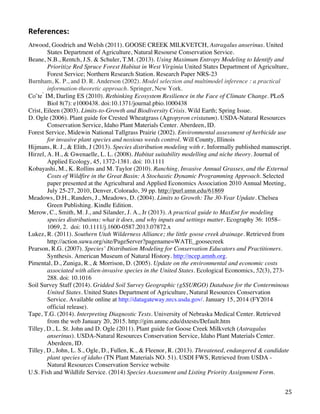
The	
  final	
  recommended	
  HDM	
  from	
  this	
  paper,	
  also	
  discussed	
  in	
  the	
  recommendation	
  
section	
  below,	
  was	
  a	
  combination	
  of	
  the	
  two	
  MaxEnt	
  models,	
  MaxEnt1	
  and	
  MaxEnt2.	
  	
  Each	
  of	
  
these	
  models	
  covered	
  a	
  part	
  of	
  the	
  range	
  and	
  presence	
  of	
  A.	
  anserinus	
  that	
  better	
  encompassed	
  the	
  
extent	
  of	
  the	
  species,	
  while	
  the	
  majority	
  of	
  the	
  two	
  models	
  still	
  overlapped	
  (Figure	
  12).	
  The	
  final	
  
recommended	
  distribution	
  map	
  is	
  given	
  a	
  quarter	
  mile	
  buffer	
  to	
  help	
  fill	
  in	
  gaps	
  and	
  give	
  a	
  small	
  
boarder	
  zone	
  around	
  the	
  given	
  MaxEnt	
  models.	
  	
  (See	
  Appendix	
  xi	
  for	
  the	
  final	
  map	
  and	
  
recommendations).	
  	
  
  17	


Part	
  B:	
  Business	
  Analysis	


3.	
  Recommendations	


   Taking	
  a	
  step	
  back	
  to	
  look	
  at	
  the	
  bigger	
  picture,	
  the	
  invasive	
  species	
  impact,	
  control	
  and	
  
damages	
  cost	
  the	
  United	
  States	
  is	
  an	
  estimate	
  of	
  $120	
  billion	
  a	
  year	
  alone,	
  and	
  invasive	
  weeds	
  
account	
  for	
  $27	
  billion	
  in	
  damages	
  and	
  control	
  annually	
  (Pimental,	
  et	
  al.,	
  2005).	
  	
  One	
  example	
  of	
  
such	
  an	
  invasive	
  plant	
  is	
  Cheatgrass	
  (Bromus	
  tectorum)	
  currently	
  invading	
  the	
  Great	
  Basin	
  
ecosystems	
  and	
  causing	
  ecological	
  and	
  economic	
  damages	
  to	
  the	
  biodiversity	
  and	
  rangeland	
  
infrastructures.	
  There	
  is	
  a	
  direct	
  relationship	
  with	
  wildfire	
  return	
  on	
  lands	
  with	
  the	
  widespread	
  
growth	
  of	
  Cheatgrass,	
  and	
  after	
  a	
  fire	
  it	
  can	
  take	
  2	
  to	
  4	
  years,	
  with	
  restoration	
  efforts,	
  before	
  
livestock	
  can	
  again	
  graze	
  on	
  the	
  land.	
  This	
  costs	
  ranchers	
  due	
  to	
  loss	
  of	
  livestock,	
  time	
  to	
  open	
  
Figure	
  15:	
  Various	
  field	
  collected	
  environmental	
  parameters:	
  Elevation	
  in	
  meters	
  (DEM_S1),	
  slope	
  (Slope_DEM_S1),	
  
aspect	
  	
  (Aspect_DEM_S1),	
  maximum	
  July	
  temperatures	
  in	
  C	
  (PRISMTmax8110Jul),	
  annual	
  precipitation	
  in	
  mm	
  
(PRISMPrecip8110annual),	
  and	
  minimum	
  January	
  temperatures	
  in	
  C	
  (PRISMtmin8110Jan).	


Figure	
  16:	
  Histograms	
  of	
  environmental	
  data	
  of	
  presence	
  points	
  gathered	
  in	
  field	
  (raw	
  values	
  in	
  Figure	
  15).	
  	
  Blue	
  
lines	
  are	
  the	
  mean	
  values	
  (from	
  Figure	
  15).	
  	
  
  18	
  
lands	
  up	
  for	
  grazing	
  again,	
  and	
  restoration	
  costs.	
  	
  Areas	
  that	
  are	
  in	
  a	
  degraded	
  state	
  have	
  a	
  
tendency	
  to	
  stay	
  that	
  way	
  unless	
  serious	
  restoration	
  efforts	
  take	
  place,	
  and	
  even	
  then	
  it	
  can	
  take	
  
upwards	
  of	
  a	
  century	
  to	
  restore	
  to	
  healthy	
  conditions,	
  if	
  they	
  can	
  be	
  restored	
  at	
  all.	
  Prevention	
  is	
  
key	
  with	
  a	
  healthy	
  sagebrush	
  rangeland	
  (which	
  our	
  Astragalis	
  anserinus	
  is	
  found),	
  costing	
  
~$20/acre	
  per	
  year	
  for	
  treatment	
  with	
  100%	
  effective	
  rate.	
  	
  With	
  ecological	
  degradation	
  due	
  to	
  
overuse	
  and	
  noxious	
  weed	
  invasion,	
  costs	
  and	
  time	
  for	
  restoration	
  projects	
  skyrocket	
  and	
  
methods	
  are	
  not	
  nearly	
  as	
  effective.	
  	
  Wildfire	
  rates	
  and	
  cost	
  per	
  acre	
  rates	
  increase	
  by	
  a	
  factor	
  of	
  
10,	
  and	
  pre-­‐fire	
  control	
  work	
  is	
  much	
  more	
  effective	
  than	
  post-­‐fire	
  restoration	
  efforts	
  (Kobayashi	
  
et	
  al.,	
  2010).	
  	
  With	
  this	
  in	
  mind,	
  we	
  turn	
  our	
  attention	
  back	
  to	
  the	
  Astragalis	
  anserinus	
  habitat.	
  
Continued	
  control	
  work	
  is	
  crucial	
  for	
  maintaining	
  high	
  biodiversity	
  and	
  ecological	
  resilience	
  in	
  
the	
  face	
  of	
  invasive	
  species,	
  such	
  as	
  the	
  Cheatgrass	
  example	
  above.	
  	
  If	
  and	
  when	
  A.	
  anserinus	
  is	
  
officially	
  on	
  the	
  Threatened	
  and	
  Endangered	
  List,	
  UDAF	
  will	
  have	
  to	
  change	
  certain	
  types	
  of	
  
control	
  work,	
  for	
  example	
  how	
  it	
  sprays	
  chemical	
  agents	
  in	
  the	
  area,	
  which	
  would	
  be	
  limited	
  due	
  
to	
  state	
  and	
  federal	
  guidelines	
  in	
  an	
  area	
  with	
  a	
  protested	
  species	
  (Environmental	
  Assessment,	
  
2002).	
  	
  This	
  HDM	
  could	
  help	
  agencies	
  by	
  focusing	
  the	
  A.	
  anserinus	
  range	
  down	
  to	
  a	
  smaller	
  area,	
  
the	
  survey	
  work	
  needed	
  will	
  hopefully	
  be	
  significantly	
  narrowed,	
  saving	
  time	
  and	
  money.	
  
Currently,	
  the	
  suggested	
  habitat	
  range	
  from	
  the	
  USFWS	
  is	
  approximately	
  190	
  square	
  miles.	
  	
  
The	
  final	
  model	
  created	
  had	
  an	
  area	
  of	
  125	
  square	
  miles,	
  a	
  decrease	
  in	
  area	
  of	
  65.8%.	
  However,	
  
because	
  the	
  final	
  model	
  is	
  fragmented	
  with	
  large	
  gaps	
  between	
  areas,	
  the	
  final	
  recommended	
  area	
  
(Appendix	
  xi)	
  has	
  an	
  area	
  of	
  about	
  207	
  square	
  miles,	
  about	
  a	
  9%	
  increase	
  of	
  size.	
  	
  While	
  this	
  will	
  
increase	
  the	
  management	
  and	
  invasive	
  control	
  costs	
  of	
  the	
  overall	
  habitat	
  area,	
  there	
  is	
  a	
  
difference	
  of	
  about	
  85	
  square	
  miles	
  that	
  the	
  current	
  range	
  and	
  the	
  recommended	
  range	
  do	
  not	
  
align	
  (which	
  is	
  about	
  45%	
  of	
  the	
  total	
  recommended	
  207	
  square	
  mile	
  range),	
  which	
  would	
  save	
  a	
  
tremendous	
  amount	
  in	
  funding	
  fieldwork	
  to	
  find	
  the	
  this	
  difference	
  in	
  range	
  by	
  field	
  work	
  alone.	


   Let’s	
  focus	
  on	
  a	
  more	
  comprehensive	
  cost/benefit	
  analysis	
  of	
  comparing	
  a	
  HDM	
  to	
  a	
  pure	
  
fieldwork	
  approach	
  to	
  a	
  computer	
  modeling	
  approach.	
  	
  A	
  fieldwork	
  approach	
  to	
  finding	
  the	
  
habitat	
  would	
  involve	
  walking	
  transects	
  across	
  the	
  land	
  to	
  find	
  the	
  plant.	
  	
  A	
  square	
  acre	
  is	
  208.71	
  
feet	
  squared,	
  which	
  we	
  will	
  round	
  down	
  to	
  200	
  square	
  feet	
  for	
  the	
  ease	
  of	
  this	
  calculation.	
  The	
  
fieldwork	
  that	
  I	
  was	
  a	
  part	
  of,	
  we	
  were	
  walking	
  transects	
  which	
  was	
  about	
  10	
  to	
  20	
  feet	
  apart,	
  lets	
  
say	
  for	
  this	
  comparison	
  20	
  feet	
  apart.	
  Bracken	
  Davis	
  suggested	
  that	
  this	
  transect	
  could	
  be	
  as	
  far	
  
apart	
  as	
  50	
  feet	
  apart;	
  let’s	
  look	
  at	
  both	
  to	
  look	
  at	
  maximum	
  and	
  minimum	
  costs.	
  	
  	
  Walking	
  one	
  
square	
  acre	
  (200	
  ft)	
  of	
  transecting	
  20	
  feet	
  apart	
  (200	
  ft2	
  acre	
  at	
  20	
  foot	
  transects	
  apart	
  =	
  10	
  
transects/acre),	
  gives	
  10	
  transects	
  *	
  200ft	
  =	
  2000	
  ft/square	
  acre.	
  At	
  50	
  feet	
  per	
  transect,	
  it	
  would	
  
  19	
  
be	
  4	
  transects	
  *	
  200ft	
  =	
  800	
  ft/	
  square	
  acre.	
  Walking	
  at	
  1	
  mile/hour	
  is	
  equivalent	
  to	
  walking	
  5280	
  
feet	
  per	
  hour,	
  so	
  walking	
  800	
  to	
  2000	
  feet	
  per	
  square	
  acre	
  is	
  the	
  equivalent	
  of	
  0.15	
  to	
  0.38	
  hour	
  
per	
  acre.	
  	
  Now,	
  calculate	
  the	
  per	
  hour	
  cost	
  of	
  the	
  employee	
  to	
  figure	
  out	
  the	
  dollar	
  per	
  acre	
  costs.	
  
For	
  simplicity’s	
  sake,	
  let’s	
  use	
  a	
  field	
  workers	
  pay	
  rate	
  of	
  around	
  $15/hour	
  (This	
  could	
  range	
  from	
  
$10/	
  hour	
  to	
  over	
  $30/hour,	
  depending	
  on	
  who	
  is	
  doing	
  the	
  work).	
  This	
  could	
  then	
  range	
  from	
  
0.15	
  hour/acre	
  *	
  $15/hour	
  =	
  $2.25/hour	
  to	
  0.38	
  hour/acre	
  *	
  $15/hour	
  =	
  $5.7/hour,	
  depending	
  on	
  
how	
  you	
  space	
  out	
  the	
  transects.	
  (Note:	
  On	
  the	
  higher	
  end	
  of	
  this	
  would	
  be	
  an	
  employee	
  making	
  
$30	
  per	
  hour,	
  walking	
  transects	
  at	
  10	
  feet	
  apart,	
  maxing	
  the	
  field-­‐work	
  cost	
  of	
  upwards	
  of	
  
$22.8/hour!)	
  	
  	
  Let’s	
  suppose	
  fieldwork	
  was	
  conducted	
  in	
  this	
  fashion	
  over	
  the	
  current	
  190	
  square	
  
mile	
  of	
  habitat	
  recognized	
  by	
  the	
  US	
  FWS	
  (US	
  FWS,	
  2014),	
  this	
  works	
  out	
  to	
  be	
  121600	
  acres.	
  
Calculating	
  this	
  into	
  the	
  equation	
  would	
  give	
  800-­‐2000ft/square	
  acre	
  *121600	
  acres	
  =	
  9,728,000	
  –	
  
243,200,000	
  linear	
  feet	
  for	
  the	
  range.	
  	
  This	
  would	
  work	
  out	
  to	
  take	
  1,842	
  –	
  46,061	
  man-­‐hours	
  (at	
  1	
  
mile/hour	
  walking	
  speed).	
  Again,	
  at	
  a	
  moderate	
  $15/hour	
  this	
  would	
  cost	
  from	
  $27,630	
  –	
  
$690,908!	
  	
  
Goose	
  Creek	
  Range	
  is	
  in	
  a	
  remote	
  part	
  of	
  the	
  state,	
  hundreds	
  of	
  miles	
  from	
  Salt	
  Lake	
  City.	
  	
  Lets	
  
work	
  with	
  the	
  average	
  of	
  these	
  two	
  calculations	
  above,	
  of	
  23,952	
  man-­‐hours	
  at	
  $359,280	
  for	
  
simplicities	
  sake.	
  	
  If	
  a	
  crew	
  spent	
  a	
  15-­‐week	
  summer,	
  working	
  40	
  hours	
  per	
  week,	
  it	
  would	
  take	
  a	
  
crew	
  of	
  40	
  people	
  to	
  complete.	
  Calculating	
  in	
  the	
  cost	
  of	
  per	
  diem	
  of	
  camping	
  at	
  $200	
  per	
  week	
  per	
  
employee	
  (about	
  average	
  for	
  meals	
  and	
  lodging	
  per	
  week	
  from	
  UDAF)	
  times	
  the	
  40	
  employees	
  for	
  
15	
  weeks	
  is	
  $120,000.	
  The	
  distance	
  from	
  Salt	
  Lake	
  City,	
  Utah	
  to	
  Grouse	
  Creek,	
  Utah	
  (according	
  to	
  
Google	
  Maps)	
  is	
  212	
  miles.	
  Driving	
  this	
  distance	
  each	
  way	
  each	
  week,	
  plus	
  another	
  100	
  miles	
  in	
  
the	
  field	
  per	
  week,	
  for	
  a	
  total	
  of	
  about	
  500	
  miles	
  at	
  $0.50/mile	
  (State	
  of	
  Utah	
  employee	
  
reimbursement	
  rate)	
  per	
  week	
  for	
  8	
  vehicles	
  each	
  for	
  15	
  weeks	
  would	
  be	
  another	
  $30,000	
  in	
  
vehicle	
  costs.	
  	
  This	
  would	
  put	
  a	
  pure	
  field-­‐work	
  approach	
  in	
  costs,	
  at	
  the	
  average	
  of	
  23,952	
  man-­‐
hours	
  at	
  $359,280	
  +	
  camping	
  per	
  diem	
  of	
  $120,000	
  +	
  vehicle	
  expenses	
  of	
  $30,000	
  to	
  equal	
  a	
  grand	
  
total	
  of	
  $509,280.	


Using	
  an	
  all-­‐field	
  work	
  approach	
  gives	
  an	
  average	
  dollar-­‐per-­‐square-­‐mile	
  rate	
  of	
  $2,680.	
  Now,	
  
compare	
  that	
  with	
  the	
  cost	
  of	
  creating	
  a	
  HDM	
  via	
  computer.	
  This	
  HDM	
  was	
  a	
  combined	
  effort	
  of	
  
both	
  office	
  (roughly	
  500	
  man-­‐hours	
  @	
  $15/hour	
  =	
  $7,500)	
  and	
  field	
  (200	
  man-­‐hours	
  $3,000)	
  with	
  
a	
  total	
  cost,	
  when	
  including	
  fieldwork	
  costs	
  (camping	
  per	
  diem	
  at	
  5	
  weeks	
  *	
  $200	
  =	
  $1000,	
  plus	
  
vehicle	
  costs	
  at	
  5	
  weeks	
  at	
  $250/week	
  at	
  $1250),	
  to	
  be	
  approximately	
  $12,750	
  (Note:	
  as	
  an	
  intern,	
  
I	
  was	
  paid	
  $10/hour,	
  but	
  this	
  also	
  includes	
  Bracken	
  Davis’s	
  time	
  at	
  a	
  much	
  higher	
  rate,	
  so	
  the	
  
$15/hour	
  average	
  was	
  used).	
  	
  Looking	
  at	
  the	
  computer-­‐based	
  HDM,	
  this	
  is	
  a	
  cost	
  of	
  $67	
  per	
  square	
  
  20	
  
mile	
  for	
  the	
  USFWS	
  current	
  190	
  square	
  mile	
  habitat.	
  	
  This	
  does	
  not	
  include	
  the	
  nearly	
  85	
  square	
  
miles	
  that	
  does	
  not	
  align	
  between	
  this	
  paper’s	
  recommended	
  207	
  square	
  mile	
  and	
  the	
  USFWS	
  190	
  
square	
  mile	
  area	
  (Appendix	
  xi).	
  	
  These	
  savings	
  are	
  mostly	
  in	
  part	
  because	
  utilizing	
  a	
  HDM,	
  it	
  
enables	
  the	
  estimation	
  of	
  areas	
  in	
  which	
  are	
  not	
  actually	
  visited.	
  While	
  not	
  as	
  accurate	
  as	
  
empirical	
  data,	
  it	
  can	
  give	
  a	
  good	
  estimation	
  at	
  the	
  fraction	
  of	
  the	
  cost	
  of	
  pure	
  fieldwork.	
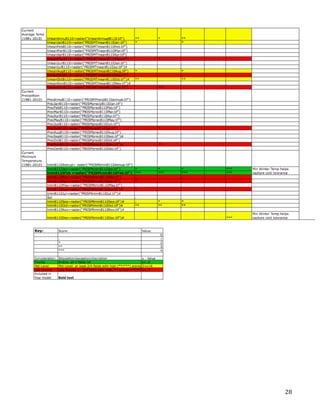


Part	
  C:	
  Conclusion	
  and	
  
Discussion	


4.	
  Conclusion	
  &	
  Discussion	


   While	
  useful	
  and	
  helpful,	
  the	
  
creation	
  of	
  the	
  Habitat	
  Distribution	
  
Model	
  (HDM)	
  is	
  not	
  without	
  its	
  
limitations.	
  The	
  problem	
  lies	
  in	
  two	
  
places;	
  first,	
  the	
  point	
  data	
  itself	
  is	
  
left	
  as	
  questionable	
  because	
  there	
  is	
  
a	
  similar	
  plant	
  that	
  shares	
  the	
  
habitat.	
  Second,	
  the	
  model	
  is	
  
limited	
  by	
  the	
  availability	
  and	
  
accuracy	
  of	
  the	
  raster	
  data	
  
available.	


First,	
  the	
  specimen	
  itself	
  is	
  
small	
  and	
  sparsely	
  populated	
  and	
  spread	
  out	
  in	
  a	
  large	
  area.	
  This	
  alone	
  makes	
  for	
  a	
  challenging	
  
range	
  to	
  determine.	
  Another	
  difficulty	
  is	
  identification,	
  particularly	
  between	
  A.	
  anserinus	
  and	
  
Astragalus	
  utahensis	
  (Torr.).	
  In	
  particular,	
  a	
  small	
  specimen	
  of	
  A.	
  anserinus	
  is	
  almost	
  
indistinguishable	
  from	
  a	
  small	
  A.	
  utahensis	
  except	
  when	
  flowering	
  or	
  when	
  seeds	
  area	
  present	
  
(Figure	
  15).	
  	
  This	
  has	
  left	
  many	
  of	
  the	
  points	
  collected	
  in	
  the	
  field	
  left	
  as	
  a	
  bit	
  of	
  a	
  question	
  mark	
  
until	
  someone	
  can	
  return	
  in	
  the	
  spring	
  to	
  look	
  for	
  either	
  flower	
  or	
  fruit,	
  which	
  is	
  an	
  easily	
  
distinguishing	
  feature	
  between	
  the	
  two	
  species.	
  For	
  the	
  purposes	
  of	
  this	
  study,	
  I	
  have	
  left	
  in	
  the	
  
questionable	
  specimens,	
  rather	
  than	
  leave	
  them	
  out,	
  because	
  I	
  would	
  rather	
  overestimate	
  than	
  
underestimate	
  the	
  range.	
  And	
  really,	
  all	
  points	
  collected	
  in	
  the	
  field	
  (with	
  the	
  exception	
  of	
  those	
  
collected	
  in	
  the	
  spring	
  when	
  the	
  plant	
  was	
  flowering)	
  should	
  be	
  questioned,	
  which	
  would	
  leave	
  
Figure	
  15:	
  Top:	
  Astragalis	
  anserinus.	
  Bottom	
  Left:	
  Astragalis	
  utahensis.	
  
Bottom	
  Right:	
  questionable	
  specimen.	


  21	
  
out	
  a	
  lot	
  of	
  collected	
  data!	
  Field	
  validation	
  work	
  is	
  yet	
  to	
  be	
  continued	
  on	
  this	
  project,	
  I	
  have	
  no	
  
doubt.	
  
Second	
  problem,	
  the	
  raster	
  data	
  is	
  limited	
  both	
  in	
  size	
  and	
  scope.	
  	
  Much	
  of	
  the	
  data	
  was	
  in	
  
5km	
  resolution	
  (all	
  PRISM	
  data),	
  which	
  for	
  this	
  study	
  was	
  much	
  too	
  large.	
  	
  While	
  all	
  precautions	
  
went	
  into	
  maintaining	
  the	
  integrity	
  of	
  the	
  data,	
  the	
  variation	
  from	
  such	
  large	
  resolution	
  is	
  bound	
  
to	
  leave	
  large	
  discrepancies	
  between	
  estimated	
  and	
  actual	
  information.	
  	
  The	
  other	
  problem	
  lies	
  in	
  
the	
  lack	
  of	
  representation	
  available	
  for	
  the	
  type	
  of	
  data	
  that	
  would	
  best	
  represent	
  where	
  A.	
  
anserinus	
  lives.	
  	
  Much	
  of	
  the	
  habitat	
  where	
  A.	
  anserinus	
  was	
  found	
  was	
  in	
  a	
  particular	
  set	
  of	
  soil,	
  
known	
  as	
  Salt	
  Lake	
  Formation	
  in	
  Utah.	
  	
  The	
  geology	
  layer	
  found	
  that	
  contains	
  the	
  layer	
  did	
  not	
  
have	
  the	
  level	
  of	
  detail	
  that	
  would	
  capture	
  the	
  plants	
  preferred	
  soil	
  type,	
  and	
  even	
  the	
  data	
  would	
  
change	
  at	
  the	
  state	
  borders	
  due	
  to	
  one	
  state	
  calling	
  the	
  same	
  layers	
  of	
  geology	
  by	
  a	
  different	
  name	
  
(see	
  Figure	
  4).	
  Soil	
  data	
  is	
  improving,	
  and	
  there	
  are	
  areas	
  that	
  contain	
  the	
  data	
  that	
  was	
  required,	
  
but	
  only	
  in	
  select	
  areas	
  and	
  not	
  at	
  the	
  scope	
  of	
  the	
  entire	
  study	
  area	
  that	
  the	
  analysis	
  took	
  place.	
  	
  
These	
  two	
  important	
  details	
  greatly	
  limits	
  the	
  HDM	
  created.	
  	
  The	
  last	
  HDM,	
  MaxEnt2,	
  needs	
  
to	
  be	
  validated	
  in	
  the	
  field,	
  particularly	
  the	
  northern	
  prediction	
  area,	
  which	
  has	
  not	
  been	
  surveyed.	
  	
  
Most	
  likely,	
  the	
  predicted	
  area	
  in	
  the	
  Northern	
  end	
  of	
  the	
  map	
  is	
  a	
  false	
  positive	
  area	
  because	
  the	
  
indicated	
  area	
  was	
  well	
  outside	
  the	
  current	
  range	
  of	
  A.anserinus,	
  and	
  for	
  the	
  purposes	
  of	
  this	
  
project	
  was	
  ignored	
  in	
  the	
  final	
  results.	
  	
  However,	
  the	
  main	
  body	
  of	
  the	
  HDM	
  encompassed	
  much	
  
of	
  the	
  empirical	
  data	
  that	
  MaxEnt1	
  did	
  not,	
  which	
  is	
  why	
  the	
  final	
  model	
  is	
  an	
  aggregated	
  version	
  
of	
  both	
  MaxEnt1	
  and	
  MaxEnt2.	
  	
  The	
  final	
  model	
  selected	
  is	
  a	
  combination	
  on	
  the	
  first	
  MaxEnt	
  
model	
  run	
  in	
  R,	
  along	
  with	
  the	
  main	
  body	
  of	
  the	
  second	
  Maximum	
  Entropy	
  model.	
  	
  The	
  first	
  model	
  
was	
  too	
  data-­‐intense	
  to	
  run	
  analysis	
  on,	
  taking	
  two	
  days	
  to	
  run	
  a	
  single	
  model	
  (the	
  analysis	
  ran	
  
100	
  models	
  and	
  compiled	
  the	
  returned	
  average	
  AUC	
  in	
  Figure14).	
  The	
  first	
  MaxEnt1	
  model	
  also	
  
did	
  not	
  have	
  as	
  many	
  points	
  of	
  data	
  because	
  of	
  the	
  ongoing	
  fieldwork	
  during	
  this	
  project.	
  	
  As	
  
mentioned	
  above,	
  further	
  work	
  on	
  verification	
  of	
  the	
  model	
  should	
  be	
  done	
  to	
  help	
  enhance	
  the	
  
current	
  model.	
  
During	
  this	
  study,	
  questions	
  have	
  arisen	
  based	
  on	
  my	
  personal	
  observations.	
  For	
  example,	
  
Goose	
  Creek	
  milkvetch	
  does	
  not	
  appear	
  to	
  like	
  competition	
  and	
  the	
  species	
  grows	
  on	
  very	
  
distinguishable	
  outcrops	
  of	
  a	
  particular	
  geologic	
  formation,	
  the	
  Salt	
  Lake	
  formation.	
  The	
  plant	
  
does	
  not	
  generally	
  grow	
  near	
  other	
  species,	
  and	
  this	
  has	
  me	
  questioning	
  what	
  is	
  different	
  about	
  
the	
  soil	
  that	
  this	
  species	
  tends	
  to	
  prefer	
  to	
  grow.	
  I	
  believe	
  that	
  there	
  must	
  be	
  something	
  chemically	
  
different	
  that	
  keeps	
  other	
  species	
  of	
  plant	
  from	
  growing	
  on	
  the	
  Salt	
  Lake	
  formation,	
  and	
  I	
  am	
  
  22	
  
believe	
  that	
  there	
  might	
  be	
  a	
  lack	
  of	
  some	
  kind	
  of	
  nutrient	
  or	
  other	
  biological	
  agent	
  that	
  A.	
  
anserinus	
  is	
  tolerant	
  of	
  that	
  other	
  species	
  are	
  not.	
  	
  
The	
  study	
  area	
  that	
  was	
  shown	
  to	
  contain	
  A.	
  anserinus	
  is	
  very	
  similar	
  to	
  other	
  areas	
  in	
  the	
  
region.	
  I	
  believe	
  that	
  because	
  A.	
  anserinus	
  does	
  not	
  have	
  a	
  method	
  of	
  seed	
  dispersion	
  that	
  allows	
  
for	
  a	
  large	
  distribution,	
  habitat	
  areas	
  that	
  seemed	
  like	
  suitable	
  habitat	
  did	
  not	
  have	
  the	
  species	
  
present.	
  	
  Other	
  than	
  gravity	
  and	
  water	
  (maybe	
  an	
  extreme	
  wind	
  event?),	
  the	
  seed	
  does	
  not	
  fall	
  far	
  
from	
  the	
  plant.	
  	
  I	
  believe	
  there	
  is	
  a	
  very	
  good	
  chance	
  that	
  the	
  plant	
  could	
  grow	
  in	
  other	
  areas	
  that	
  
it	
  currently	
  does	
  not.	
  	
  To	
  show	
  this	
  I	
  would	
  suggest	
  a	
  study	
  where	
  A.	
  anserinus	
  seedpods	
  are	
  
dispersed	
  in	
  these	
  other	
  areas	
  to	
  see	
  if	
  the	
  plant	
  does	
  indeed	
  developed	
  in	
  these	
  other	
  areas.	
  	
  The	
  
models	
  developed	
  show	
  high	
  probabilities	
  in	
  areas,	
  such	
  as	
  the	
  adjacent	
  area	
  of	
  Grouse	
  Creek,	
  
where	
  a	
  study	
  such	
  as	
  this	
  could	
  be	
  done.	
  	
  I	
  would	
  even	
  suggest	
  bringing	
  the	
  plant	
  into	
  areas	
  that	
  
A.	
  utahensis	
  grows	
  in	
  other	
  corners	
  of	
  the	
  state	
  to	
  see	
  if	
  it	
  would	
  take	
  root.	
  	
  That	
  would	
  help	
  
determine	
  if	
  A.	
  anserinus	
  is	
  growing	
  in	
  the	
  study	
  area	
  because	
  of	
  its	
  narrow	
  niche	
  requirements	
  or	
  
simply	
  as	
  a	
  matter	
  of	
  its	
  limited	
  mechanism	
  of	
  dispersion.	
  	
  
Finally,	
  I	
  would	
  like	
  to	
  explore	
  the	
  relationship	
  that	
  A.	
  anserinus	
  has	
  with	
  the	
  current	
  land	
  
management.	
  The	
  area	
  in	
  which	
  A.	
  anserinus	
  is	
  distributed	
  is	
  primarily	
  ranching	
  and	
  cattle	
  lands.	
  	
  
The	
  plant	
  is	
  generally	
  poisonous,	
  and	
  is	
  not	
  a	
  known	
  food	
  supply	
  for	
  most	
  of	
  the	
  animals	
  in	
  the	
  
area	
  (maybe	
  nibbled	
  on	
  by	
  rabbits?).	
  	
  Being	
  trampled	
  by	
  cattle,	
  invasive	
  species	
  such	
  as	
  leafy	
  
spurge,	
  and	
  wild	
  fire	
  are	
  the	
  most	
  prevalent	
  danger	
  to	
  the	
  plant	
  (U.S.	
  Fish	
  and	
  Wildlife	
  Service,	
  
2014).	
  	
  There	
  is	
  no	
  eminent	
  large	
  development	
  of	
  the	
  land	
  or	
  other	
  major	
  threats	
  outside	
  of	
  those	
  
listed	
  above.	
  	
  Climate	
  change	
  could	
  be	
  a	
  factor	
  on	
  the	
  plant,	
  however	
  more	
  studies	
  would	
  need	
  to	
  
be	
  done	
  on	
  how	
  it	
  has	
  been	
  changing	
  over	
  time,	
  and	
  perhaps	
  a	
  future	
  HDM	
  could	
  be	
  created	
  with	
  
predicted	
  temperatures	
  and	
  moister	
  data.	
  With	
  these	
  factors	
  in	
  mind,	
  and	
  counter-­‐intuitive	
  to	
  the	
  
conservationist	
  (such	
  as	
  myself),	
  listing	
  the	
  plant	
  could	
  very	
  well	
  create	
  a	
  situation	
  that	
  would	
  do	
  
A.	
  anserinus	
  more	
  harm	
  than	
  good.	
  By	
  listing	
  the	
  plant	
  on	
  the	
  endangered	
  species	
  list,	
  it	
  would	
  
change	
  how	
  the	
  land	
  is	
  managed.	
  	
  Given	
  the	
  limited	
  amount	
  of	
  resources	
  agencies	
  such	
  as	
  UDAF	
  
and	
  BLM	
  have	
  to	
  work	
  with,	
  dealing	
  with	
  the	
  invasive	
  species	
  is	
  difficult	
  and	
  costly	
  as	
  it	
  is.	
  	
  I	
  
believe	
  that	
  currently,	
  invasive	
  species	
  are	
  the	
  highest	
  risk	
  to	
  A.	
  anserinus,	
  combined	
  with	
  wildfire.	
  
If	
  protected	
  under	
  the	
  Endangered	
  Species	
  Act,	
  controlled	
  burns,	
  using	
  herbicides	
  and	
  other	
  
methods	
  of	
  management	
  on	
  invasive	
  species	
  would	
  become	
  more	
  tedious	
  and	
  costly,	
  and	
  thus	
  
perhaps	
  not	
  be	
  as	
  effective	
  for	
  the	
  area.	
  	
  Listing	
  a	
  plant	
  on	
  the	
  Endangered	
  Species	
  Act	
  will	
  help	
  
protect	
  A.	
  anserinus	
  from	
  human	
  interference,	
  and	
  this	
  is	
  an	
  area	
  where	
  that	
  is	
  already	
  restricted	
  
simply	
  due	
  to	
  the	
  nature	
  of	
  the	
  open	
  range.	
  	
  Without	
  any	
  major	
  human	
  development	
  plans,	
  a	
  
  23	
  
listing	
  in	
  the	
  Endangered	
  Species	
  Act	
  could	
  then	
  limit	
  how	
  agencies	
  and	
  private	
  landowners	
  can	
  
control	
  what	
  I	
  believe	
  is	
  a	
  larger	
  threat	
  to	
  the	
  plant,	
  which	
  is	
  invasive	
  species	
  in	
  general.	
  	
  I	
  believe	
  
that	
  because	
  the	
  immediate	
  future	
  in	
  the	
  A.	
  anserinus	
  range	
  does	
  not	
  have	
  a	
  large	
  amount	
  of	
  
human	
  development,	
  which	
  is	
  primarily	
  what	
  protecting	
  the	
  plant	
  under	
  the	
  Endangered	
  Species	
  
Act	
  will	
  help,	
  that	
  it	
  may	
  be	
  counterproductive	
  in	
  protecting	
  the	
  plant	
  if	
  it	
  interferes	
  with	
  the	
  
invasive	
  weed	
  and	
  fire	
  management.	
  This	
  needs	
  to	
  be	
  taken	
  into	
  consideration	
  when	
  looking	
  at	
  
how	
  to	
  best	
  benefit	
  A.anserinus	
  and	
  the	
  people	
  who	
  manage	
  the	
  lands	
  in	
  which	
  it	
  is	
  found.	


5.	
  Recommendations	
  
	
   Before	
  I	
  dive	
  into	
  the	
  final	
  recommendation,	
  let	
  me	
  be	
  the	
  first	
  to	
  remind	
  the	
  reader	
  that	
  
"essentially,	
  all	
  models	
  are	
  wrong,	
  but	
  some	
  are	
  useful"	
  (George	
  E.P.	
  Box).	
  That	
  being	
  said,	
  and	
  
remembering	
  the	
  two	
  general	
  problems	
  from	
  the	
  section	
  above,	
  the	
  final	
  recommendation	
  (Figure	
  
16)	
  is	
  an	
  area	
  that	
  combines	
  the	
  two	
  Maximum	
  Extent	
  (MaxEnt)	
  models	
  into	
  a	
  single	
  area	
  (Figure	
  
12).	
  	
  The	
  reason	
  for	
  this	
  is	
  that	
  the	
  MaxEnt1	
  model	
  covered	
  some	
  of	
  the	
  empirical	
  data,	
  while	
  
MaxEnt2	
  covered	
  other	
  areas	
  of	
  the	
  empirical	
  data,	
  and	
  a	
  combination	
  of	
  the	
  two	
  seemed	
  to	
  fit	
  the	
  
data	
  the	
  best.	
  While	
  it	
  visually	
  seemed	
  better	
  of	
  the	
  two	
  MaxEnt	
  models,	
  MaxEnt	
  1	
  was	
  much	
  too	
  
big	
  to	
  run	
  the	
  same	
  statistical	
  analysis	
  that	
  was	
  run	
  on	
  MaxEnt2.	
  MaxEnt2	
  however	
  needs	
  field	
  
verification	
  particularly	
  in	
  the	
  northeastern	
  area	
  where	
  a	
  new	
  predicted	
  positive	
  area	
  has	
  
occurred.	
  So,	
  a	
  combination	
  of	
  the	
  two	
  models	
  seemed	
  best.	
  	
  If	
  one	
  was	
  to	
  choose	
  a	
  single	
  model	
  
today,	
  MaEnt1	
  fits	
  the	
  current	
  range	
  and	
  empirical	
  data	
  the	
  best.	
  More	
  work	
  could	
  be	
  
accomplished	
  to	
  improve	
  the	
  model,	
  centered	
  on	
  the	
  confirmation	
  of	
  questionable	
  presence	
  points	
  
along	
  with	
  verification	
  of	
  false	
  positives	
  on	
  MaxEnt2.	
  	
  A	
  Third	
  MaxEnt	
  model	
  could	
  be	
  very	
  useful	
  
to	
  run,	
  after	
  these	
  points	
  are	
  verified.	


  24	


Figure	
  16:	
  Final	
  Recommended	
  Habitat	
  for	
  A.	
  anserinus.	
  See	
  Appendix	
  xi	
  for	
  a	
  full	
  page	
  view	
  of	
  same	
  map.	


Acknowledgments	


I	
  have	
  had	
  help	
  on	
  this	
  project	
  from	
  many,	
  but	
  Bracken	
  Davis	
  was	
  my	
  mentor	
  at	
  UDAF	
  and	
  
has	
  helped	
  a	
  tremendous	
  amount.	
  	
  My	
  committee	
  members	
  at	
  the	
  University	
  of	
  Utah	
  were	
  
wonderfully	
  at	
  encouraging	
  me	
  in	
  this	
  endeavor,	
  and	
  my	
  thanks	
  goes	
  out	
  to	
  Philip	
  Dennison,	
  
Mitchell	
  Power,	
  and	
  especially	
  Simon	
  Brewer	
  who	
  repeatedly	
  answered	
  my	
  annoying	
  email	
  
questions	
  about	
  various	
  methods	
  on	
  modeling.	
  	
  I	
  received	
  help	
  and	
  encouragement	
  from	
  an	
  array	
  
of	
  people,	
  and	
  a	
  special	
  thanks	
  goes	
  out	
  Jena	
  Lewinsohn	
  at	
  the	
  Federal	
  Wildlife	
  Services	
  and	
  
Robert	
  Fitz	
  at	
  the	
  Department	
  of	
  Natural	
  Resources.	
  	
  And,	
  lets	
  not	
  forget	
  my	
  wonderful	
  wife	
  who	
  
has	
  proof	
  read	
  this	
  for	
  me	
  numerous	
  times	
  as	
  well.	
  There	
  were	
  many	
  more	
  that	
  I	
  have	
  met	
  and	
  
learned	
  from	
  along	
  the	
  way,	
  and	
  my	
  thanks	
  goes	
  out	
  to	
  all	
  that	
  took	
  me	
  under	
  their	
  wing	
  during	
  
this	
  project.
n n
n n
nn n n nn
n
n nnn
nn
nn
n
WWF, USGS, EPA, Esri
GooseCreekMilkvetchDistributionArea
F
Legend
n Survey Area
!( Astragalus anserinus
MaxEnt Agrigated Model
FinalRecomendation
MaxEnt2
MaxEnt1
CurrentRange
0 1.5 3 4.5 60.75
Miles
Maximum Entropy Habitat Distribution models created for
A. anserinus. Aggrigated MaxEnt Model is a combination
of two, mostly overlapping MaxEnt Models to better represent
empirical data. Final range created by author only as
recomendation and to account for sparsly populated area.
By Robert Machol
University of Utah - MST & UDAF
Dec. 2014
Sources: USFWS
All other data collected 2014
  25	
  
References:	
  	
  
Atwood, Goodrich and Welsh (2011). GOOSE CREEK MILKVETCH, Astragalus anserinus. United
States Department of Agriculture, Natural Resourse Conservation Service.
Beane, N.B., Rentch, J.S. & Schuler, T.M. (2013). Using Maximum Entropy Modeling to Identify and
Prioritize Red Spruce Forest Habitat in West Virginia United States Department of Agriculture,
Forest Service; Northern Research Station. Research Paper NRS-23
Burnham, K. P., and D. R. Anderson (2002). Model selection and multimodel inference : a practical
information-theoretic approach. Springer, New York.
Coˆte ́ IM, Darling ES (2010). Rethinking Ecosystem Resilience in the Face of Climate Change. PLoS
Biol 8(7): e1000438. doi:10.1371/journal.pbio.1000438
Crist, Eileen (2003). Limits-to-Growth and Biodiversity Crisis. Wild Earth; Spring Issue.
D. Ogle (2006). Plant guide for Crested Wheatgrass (Agropyron cristatum). USDA-Natural Resources
Conservation Service, Idaho Plant Materials Center. Aberdeen, ID.
Forest Service, Midewin National Tallgrass Prairie (2002). Environmental assessment of herbicide use
for invasive plant species and noxious weeds control. Will County, Illinois
Hijmans, R. J., & Elith, J (2013). Species distribution modeling with r. Informally published manuscript.
Hirzel, A. H., & Gwenaelle, L. L. (2008). Habitat suitability modelling and niche theory. Journal of
Applied Ecology, 45, 1372-1381. doi: 10.1111
Kobayashi, M., K. Rollins and M. Taylor (2010). Ranching, Invasive Annual Grasses, and the External
Costs of Wildfire in the Great Basin: A Stochastic Dynamic Programming Approach. Selected
paper presented at the Agricultural and Applied Economics Association 2010 Annual Meeting,
July 25-27, 2010, Denver, Colorado, 39 pp. http://purl.umn.edu/61869
Meadows, D.H., Randers, J., Meadows, D. (2004). Limits to Growth: The 30-Year Update. Chelsea
Green Publishing. Kindle Edition.
Merow, C., Smith, M. J., and Silander, J. A., Jr (2013). A practical guide to MaxEnt for modeling
species distributions: what it does, and why inputs and settings matter. Ecography 36: 1058–
1069, 2. doi: 10.1111/j.1600-0587.2013.07872.x
Lukez, R. (2011). Southern Utah Wilderness Alliance; the little goose creek drainage. Retrieved from
http://action.suwa.org/site/PageServer?pagename=WATE_goosecreek
Pearson, R.G. (2007). Species’ Distribution Modeling for Conservation Educators and Practitioners.
Synthesis. American Museum of Natural History. http://ncep.amnh.org.
Pimental, D., Zuniga, R., & Morrison, D. (2005). Update on the environmental and economic costs
associated with alien-invasive species in the United States. Ecological Economics, 52(3), 273-
288. doi: 10.1016
Soil Survey Staff (2014). Gridded Soil Survey Geographic (gSSURGO) Database for the Conterminous
United States. United States Department of Agriculture, Natural Resources Conservation
Service. Available online at http://datagateway.nrcs.usda.gov/. January 15, 2014 (FY2014
official release).
Tape, T.G. (2014). Interpreting Diagnostic Tests. University of Nebraska Medical Center. Retrieved
from the web January 20, 2015. http://gim.unmc.edu/dxtests/Default.htm
Tilley, D., L. St. John and D. Ogle (2011). Plant guide for Goose Creek Milkvetch (Astragalus
anserinus). USDA-Natural Resources Conservation Service, Idaho Plant Materials Center.
Aberdeen, ID.
Tilley, D., John, L. S., Ogle, D., Fullen, K., & Fleenor, R. (2013). Threatened, endangered & candidate
plant species of idaho (TN Plant Materials NO. 51). USDI FWS, Retrieved from USDA -
Natural Resources Conservation Service website
U.S. Fish and Wildlife Service. (2014) Species Assessment and Listing Priority Assignment Form. 	
  
  26	
  
Appendices:	


Appendix	
  i:	
  Soil	
  Data	
  Analysis	


  27	


  28	


  29	
  
Appendix	
  ii:	
  Raster	
  Data	
  Keys	


Land	
  Cover	
  Key:	


  30	
  
Soil	
  “valu”	
  Key:	


  31	


  32	


  33	


  34	


  35	
  
Appendix	
  iii:	
  Batch	
  attempts	
  using	
  Model	
  Builder	


Below:“Home-­‐made”	
  resample	
  attempt	


Below:	
  Simple	
  “project-­‐clip-­‐resample”	
  model	


  36	
  
Appendix	
  iv:	
  Python	
  Scrypt	
  for	
  Resample	
  and	
  Aggregation	


  37	
  
Appendix	
  v:	
  Models	
  Verified	
  in	
  Field	
  with	
  Corresponding	
  Random	
  Points	


   A	
  –	
  HyperNiche	
  Model	


Random	
  points	
  generated	
  within	
  0.5	
  miles	
  of	
  road.	
  First	
  number	
  before	
  dash	
  is	
  a	
  “probability”	
  
number,	
  based	
  on	
  value	
  from	
  model.	
  Divisions	
  from	
  model	
  based	
  on	
  quartiles	
  (1-­‐###	
  is	
  top	
  fifth	
  of	
  
model	
  to	
  5-­‐###	
  is	
  bottom	
  fifth	
  of	
  model,	
  and	
  6-­‐###	
  is	
  absence	
  points).	
  	
  All	
  the	
  numbers	
  after	
  the	
  
dash	
  are	
  unique	
  for	
  each	
  point.	


  38	


   B	
  –	
  MaxEnt1	
  Model	


Maximum	
  Entropy	
  model	
  with	
  randomly	
  generated	
  points	
  within	
  0.5	
  miles	
  of	
  the	
  road.	
  	
  First	
  number	
  
before	
  the	
  dash	
  indicates	
  whether	
  the	
  random	
  point	
  was	
  generated	
  from	
  actual	
  model	
  (2-­‐###)	
  or	
  from	
  
raw	
  values	
  which	
  are	
  high,	
  but	
  did	
  not	
  get	
  included	
  in	
  the	
  actual	
  model	
  (1-­‐###).	
  All	
  the	
  numbers	
  after	
  
the	
  dash	
  are	
  unique	
  for	
  each	
  point.	


  39	
  
Appendix	
  vi:	
  Field	
  Notes	


A	
  –	
  Field	
  Notes	
  Collected	
  By	
  Rob	
  Machol	


  40	


  41	


  42	


  43	


  44	


B	
  –	
  Field	
  Notes	
  Collected	
  by	
  Bracken	
  Davis	


  45	


  46	


  47	
  
Appendix	
  vii:	
  HyperNich	
  Model	


  48	
  
Appendix	
  viii:	
  Various	
  Models	
  Created	
  in	
  R
  49	


  50	


MaxEnt1	
  
MaxEnt2	
  
  51	
  
Appendix	
  ix:	
  Sample	
  R	
  code	
  	
  
####	
  MaxEnt	
  Code	
  Example	
  
####	
  Robert	
  Machol	
  
####	
  UofU	
  -­‐	
  MST	
  &	
  UDAF	
  
####	
  Ded	
  2014	


##Set	
  working	
  directory	
  
setwd("~/Documents/MST/Summer	
  2014/Final	
  Project")	
  
##Load	
  dismo	
  library	
  
library("dismo",	
  lib.loc="/Library/Frameworks/R.framework/Versions/3.1/Resources/library")	
  
##Load	
  maptools	
  	
  
library("maptools",	
  lib.loc="/Library/Frameworks/R.framework/Versions/3.1/Resources/library")	
  
##rgdal	
  	
  
library("rgdal",	
  lib.loc="/Library/Frameworks/R.framework/Versions/3.1/Resources/library")	
  
##	
  proj4	
  spatial	
  plotting	
  
library("proj4",	
  lib.loc="/Library/Frameworks/R.framework/Versions/3.1/Resources/library")	
  
##scales-­‐	
  for	
  transparnt	
  plotting	
  
library("scales",	
  lib.loc="/Library/Frameworks/R.framework/Versions/3.1/Resources/library")	
  
##Corgram	
  to	
  view	
  colinearity	
  
library("corrgram",	
  lib.loc="/Library/Frameworks/R.framework/Versions/3.1/Resources/library")	
  
##MASS	
  to	
  write	
  Matrix	
  
library("MASS",	
  lib.loc="/Library/Frameworks/R.framework/Versions/3.1/Resources/library")	


#####Load	
  rasters	
  #####	
  
##	
  cut	
  from	
  171	
  rasters	
  to	
  6	
  according	
  to	
  'DataFileList.xlsx'	
  
##	
  @	
  30m	
  resolution	


dem	
  =	
  raster("RasterOutput/DEM_S1.tif")	
  
SolEnergy=raster("RasterOutput/AreaSol_DEMs1.tif")	
  
IMI=raster("RasterOutput/IMI1.tif")	
  
TmaxJul8110=raster("RasterOutput/PRISMTmax8110Jul.tif")	
  
tmin8110Feb	
  =raster("RasterOutput/PRISMtmin8110Feb.tif")	
  
HisPrecJun	
  =	
  raster("RasterOutput/HisPrecJun1.tif")	


#	
  Envirofiles	
  Stack	
  
envirofiles	
  =	
  (c(dem,SolEnergy,IMI,TmaxJul8110,tmin8110Feb,HisPrecJun))	
  
enviropredictors=(stack(envirofiles))	
  
summary(enviropredictors)	


#####Load	
  Points######	
  
##	
  Presence	
  points:	
  
Points	
  =	
  read.csv("PresentFinal.csv")	
  
Points	
  
##	
  I	
  only	
  want	
  the	
  coordinates...	
  
Pointsxy	
  =	
  Points[,1:2]	
  
Pointsxy	
  #787	
  points	
  
##Absence	
  Points:	
  
Absence	
  =	
  read.csv("NegsFinal.csv")	
  
Absencexy	
  =	
  Absence[,1:2]	
  
Absencexy	
  #362	
  points	
  
#tail(Absencexy)	


####	
  Points	
  &	
  Coordinate	
  Metadata:	
  ####	
  
  52	
  
##cooridinates	
  for	
  study	
  area:	
  42.47,41.24	
  &	
  -­‐114.88,-­‐113.42	
  	
  
##Geographic	
  Coordinate	
  System:	
  	
  GCS_WGS_1984	
  
##Datum:	
  	
  	
  D_WGS_1984	
  
##Prime	
  Meridian:	
  	
  	
  Greenwich	
  
##Angular	
  Unit:	
  	
   Degree	


####	
  Plot	
  Points:	
  ####	
  
par=(mfrow=c(1,1))	
  
PointsCRS	
  =	
  CRS("+proj=longlat	
  +ellps=WGS84")	
  
Points.sp	
  =	
  SpatialPoints(cbind(Pointsxy$XCoord,	
  Pointsxy$YCoord),	
  proj4string=PointsCRS)	
  
summary(Points.sp)	
  
bbox(Points.sp)	
  
proj4string(Points.sp)	
  
coordinates(Points.sp)	
  
Points.spdf	
  =	
  SpatialPointsDataFrame(cbind(Pointsxy$XCoord,	
  Pointsxy$YCoord),	
  Pointsxy,	


  proj4string	
  =	
  PointsCRS)	
  
summary(Points.spdf)	
  
plot(Points.spdf)	


###	
  General	
  visualization	
  of	
  point	
  data	
  ###	
  
##USA	
  Download	
  
USA	
  =	
  getData('GADM',	
  country='USA',	
  level	
  =	
  1)	
  
Absence.spdf	
  =	
  SpatialPointsDataFrame(cbind(Absencexy$XCoord,	
  Absencexy$YCoord),	


  Absence,	
  proj4string	
  =	
  PointsCRS)	
  
plot(USA,	
  xlim=c(-­‐114.45,	
  -­‐113.9),	
  ylim=c(41.6,42.1),	
  axes=TRUE)#Point	
  Coordinates	
  
points(Pointsxy$XCoord,	
  Pointsxy$YCoord,	
  col=alpha("green",	
  0.3),	
  cex=.5,	
  pch=3)#Include	
  accual	
  and	
  
random	
  from	
  survey	
  plots	
  
points(Absencexy$XCoord,	
  Absence$YCoord,	
  col=alpha("red",	
  0.3),	
  cex=.5,	
  pch=4)#Include	
  accual	
  and	
  
random	
  from	
  survey	
  plots	
  
legend("topleft",	
  legend	
  =	
  c("Presence	
  -­‐	
  787	
  points",	
  "Absence	
  -­‐	
  362	
  points"),	
  col	
  =	
  c("green",	
  "red"),	
  pch	
  =	
  
c(3,4)	
  )	
  
title(	
  	
  main="A.anserinus	
  Point	
  Data")	


##All	
  predictors	
  
plot	
  (enviropredictors)	


#######	
  Extract	
  Values	
  From	
  Rasters	
  Via	
  Points	
  ###########	
  
##Presence	
  Values:	
  
presvals=extract(enviropredictors,Pointsxy)#(RnR)	
  
##Absence	
  VAlues	
  
absvals=extract(enviropredictors,Absencexy)#(RnR)	


##for	
  presence	
  or	
  absence	
  points,	
  we	
  will	
  call	
  "pb"	
  (new	
  variable,	
  0	
  absence	
  points,	
  1	
  presence	
  points)	
  
pb	
  =c(rep(1,nrow(presvals)),	
  rep(0,nrow(absvals)))	
  
##combine	
  these	
  points	
  into	
  a	
  singel	
  data.frame	
  
admdata=data.frame(cbind(pb,rbind(presvals,absvals)))	
  
names(admdata)	
  
summary(admdata)	
  
##vissually	
  check	
  for	
  Collinearity:	
  
##Plot	
  data	
  in	
  pairs	


pairs(admdata[,2:6],cex=0.1,	
  fig=TRUE)	
  
library("corrgram",	
  lib.loc="/Library/Frameworks/R.framework/Versions/3.1/Resources/library")	
  
par(mfrow=c(1,1))	
  
  53	
  
corrgram(admdata[,2:6],	
  order=TRUE,	
  lower.panel=panel.shade,	


  upper.panel=panel.pie,	
  text.panel=panel.txt,	


  main="A.anserinus	
  Collinearity	
  Data")	
  
corrgram(admdata[,2:6],	
  order=TRUE,	
  lower.panel=panel.ellipse,	


  upper.panel=panel.pts,	
  text.panel=panel.txt,	


  diag.panel=panel.minmax,	


  main="A.anserinus	
  Collinearity	
  Data")	


####Model	
  Fitting:	
  Generalized	
  Linear	
  Model(glm)####	
  
gc()	
  #clear	
  garbage	
  from	
  memmory	
  
M2	
  =	
  glm(formula=pb~.,data=admdata)	


summary(M2)	
  
##Bioclim	
  only	
  takes	
  presence	
  values	
  
bc=	
  bioclim(presvals)	
  
pairs(bc)	


##Predicting	
  GLM	
  
pM2	
  =	
  predict(enviropredictors,	
  M2,	
  na.rm=TRUE)	
  
plot(pM2)	
  
title(main	
  =	
  "Generalized	
  Linear	
  Model	
  Raw	
  Value")	
  
summary(M2)	


####	
  Train/Test	
  data	
  ####	
  
##get	
  training/testing	
  sets	
  of	
  data	
  from	
  admdata	
  
head(admdata)	
  
samp	
  =	
  sample(nrow(admdata),	
  round(0.75*nrow(admdata)))	
  
traindata=admdata[samp,]	
  
traindata=traindata[traindata[,1]	
  ==	
  1,	
  2:7]	
  
testdata=admdata[-­‐samp,]	


pres	
  =	
  admdata[admdata[,1]	
  ==	
  1,	
  2:7]	
  
absen	
  =	
  admdata[admdata[,1]	
  ==	
  0,	
  2:7]	


##AUC	
  could	
  be	
  biased	
  due	
  to	
  high	
  extent	
  =	
  high	
  AUC	
  values	
  (Lobo	
  et	
  al.	
  2008,	
  Jimenez-­‐Valverde	
  2011)	
  
##So,	
  get	
  rid	
  of	
  "spatial	
  sorting	
  bias"	
  via	
  "point-­‐wise	
  distance	
  sampling"	
  
nr=nrow(Pointsxy)	
  
s=sample(nr,0.25*nr)	
  
pres_train=Pointsxy[-­‐s,]	
  
pres_test=Pointsxy[s,]	
  
nr=nrow(Absencexy)	
  
s=sample(nr,0.25*nr)	
  
back_train=Absencexy[-­‐s,]	
  
back_test=Absencexy[s,]	
  
sb=ssb(pres_test,back_test,pres_train)	
  
sb[,1]/sb[,2]	
  
##Spacial	
  Sorting	
  Bias	
  (SSB)	
  =	
  0.326	
  	
  (If	
  no	
  bias	
  SSB=1)	


##Create	
  subsample	
  where	
  SSB	
  is	
  removed	
  
i	
  =	
  pwdSample(pres_test,back_test,pres_train,	
  n=1,tr=0.1)	
  
pres_test_pwd=pres_test[!is.na(i[,1]),]	
  
back_test_pwd=back_test[na.omit(as.vector(i)),]	
  
  54	
  
sb2=ssb(pres_test_pwd,back_test_pwd,pres_train)	
  
sb2[1]/sb2[2]	
  
##SSB	
  =	
  0.999	
  -­‐-­‐	
  Much	
  Reduced!	


###Visualize	
  train/test	
  points	
  
r=raster(enviropredictors,1)	
  
plot(!is.na(r),col=c('white','light	
  grey'),legend=FALSE)	
  
points(back_train,	
  pch='-­‐',	
  cex=0.5,	
  col=	
  'yellow')	
  
points(back_test,	
  pch='-­‐',	
  cex=0.5,	
  col=	
  'black')	
  
points(pres_train,	
  pch=	
  '+'	
  ,	
  col=	
  'green'	
  )	
  
points(pres_test,	
  pch=	
  '+'	
  ,	
  col=	
  'blue'	
  )	


  ##########	
  MaxEnt	
  ##############	
  	
  
##Note!	
  Most	
  widely	
  used	
  SDM	
  algorythm	
  (according	
  to	
  Hijmans	
  and	
  Elith)	
  
##limit	
  extent:	
  
ext	
  =	
  extent(-­‐144.6,	
  -­‐113.7,	
  41.5,	
  42.3)	
  
##Uses	
  "jar"	
  package	
  -­‐	
  http://www.cs.princeton.edu/~schapire/maxent/	
  	
  
jar	
  <-­‐	
  paste(system.file(package="dismo"),	
  "/java/maxent.jar",	
  sep='')	
  
jar	
  
if	
  (file.exists(jar)){	


  xm=maxent(enviropredictors,pres_train,	
  ext	
  =	
  ext)	


  plot(xm)	
  
}	
  else	
  {	


  cat('cannot	
  run	
  this	
  example	
  because	
  maent	
  is	
  not	
  available')	


  plot(1)	
  
}	
  
response(xm)	


e	
  =	
  evaluate(pres_test,back_test,xm,enviropredictors)	
  
e	
  #AUC=0.7712	
  
px=predict(enviropredictors,xm,progress='')	
  
par(mfrow=c(1,2))	
  
plot(px,main='MaxEnt,	
  Raw	
  Values')	
  
trpx=threshold(e,'spec_sens')	
  
plot(px>trpx,	
  main='Presence/Absence')	
  
points(pres_train,	
  pch='+')	
  
##Write	
  raw	
  data	
  as	
  raster	
  
writeRaster(px,file="RawMaxExt.tif",overwrite=TRUE)	
  
##Write	
  pres/abs	
  model	
  as	
  raster	
  
MaxExtPresAbs=(px>trpx)	
  
writeRaster(MaxExtPresAbs,file="MaxExtPresAbs.tif",overwrite=TRUE)	


####	
  Max	
  Ext	
  Evaluation	
  ####	
  
e=evaluate(testdata[testdata==1,],	
  testdata[testdata==0,],	
  xm)	
  
e	
  
plot(e,'ROC')	
  
##AUC	
  value	
  =	
  .827	
  (guess	
  @	
  .5)	
  	
  
##k-­‐fold	
  -­‐	
  do	
  it	
  agin	
  k	
  times	
  
pres	
  =	
  admdata[admdata[,1]	
  ==	
  1,	
  2:7]	
  
absen	
  =	
  admdata[admdata[,1]	
  ==	
  0,	
  2:7]	
  
k	
  =	
  100	
  ##I	
  am	
  going	
  to	
  run	
  this	
  10	
  times	
  
group	
  =	
  kfold(pres,	
  k)	
  ##presence	
  only,	
  which	
  is	
  good	
  becuase	
  the	
  absence	
  falls	
  very	
  close	
  
##absence	
  is	
  supposed	
  to	
  be	
  used	
  to	
  test	
  model	
  
  55	
  
group[1:100]	
  
unique(group)	
  
e=list()	
  
for	
  (i	
  in	
  1:k)	
  {	


  train=pres[group!=i,]	


  test=pres[group==i,]	


  xm=maxent(enviropredictors,pres_train)	


  e[[i]]=evaluate(p=test,a=absen,xm)	
  
}	
  
e	
  
##AUC	
  values	
  for	
  sensitivity(true	
  positive	
  rate)	
  
##	


  and	
  specificity	
  (true	
  negaitive	
  rate)	


##With	
  SSB:	
  
evaluate(xm,	
  p=pres_test,a=back_test,x=enviropredictors)	
  
##AUC	
  with	
  	
  =0.719	
  (0.5	
  is	
  guess)	
  
##SSB	
  removed	
  
evaluate(xm,	
  p=pres_test_pwd,	
  a=back_test_pwd,	
  x=enviropredictors)	
  
##AUC	
  SSB	
  reduced	
  =	
  0.621	
  
##These	
  numbers	
  changed	
  each	
  time	
  you	
  run	
  new	
  model,	
  so...	


##Hist	
  for	
  AUC	
  with	
  SSB	
  removed	
  
k	
  =	
  100	
  ##I	
  am	
  going	
  to	
  run	
  this	
  100	
  times	
  
group	
  =	
  kfold(pres,	
  k)	
  ##presence	
  only,	
  which	
  is	
  good	
  becuase	
  the	
  absence	
  falls	
  very	
  close	
  
##absence	
  is	
  supposed	
  to	
  be	
  used	
  to	
  test	
  model	
  
group[1:100]	
  
unique(group)	
  
e=list()	
  
for	
  (i	
  in	
  1:k)	
  {	


  j	
  =	
  pwdSample(pres_test,back_test,pres_train,	
  n=1,tr=0.1)	


  pres_test_pwd=pres_test[!is.na(j[,1]),]	


  back_test_pwd=back_test[na.omit(as.vector(j)),]	


  sb2=ssb(pres_test_pwd,back_test_pwd,pres_train)	


  xm=maxent(enviropredictors,pres_train)	


  e[[i]]=evaluate(xm,	
  p=pres_test,a=back_test,x=enviropredictors)	
  
}	
  
e	
  
##AUC	
  values	
  for	
  sensitivity(true	
  positive	
  rate)	
  
##	


  and	
  specificity	
  (true	
  negaitive	
  rate)	


auc	
  =	
  sapply(e,function(x){slot(x,'auc')}	
  )	
  
auc	
  
par(mar=c(1,1,1,0))	
  
par(oma=c(1,1,0.5,0))	
  
par(mfrow=c(1,1))	
  
hist(auc,	
  main	
  =	
  'MaxExt	
  AUC	
  with	
  SSB',	
  sub	
  =	
  'mean	
  =	
  0.796')	
  
meanauc	
  =	
  mean(auc)	
  #0.745	
  
abline(v	
  =	
  meanauc,	
  col	
  =	
  "blue",	
  lwd	
  =	
  2)	
  
text(meanauc,	
  0	
  ,	
  round(meanauc,	
  4))	
  
text(meanauc,	
  6	
  ,	
  "mean	
  =	
  ",	
  cex	
  =	
  1)	
  
TprTnr	
  =	
  sapply(e,function(x){	
  x@t[which.max(x@TPR	
  +	
  x@TNR)]	
  }	
  )	
  
TprTnr	
  
par(mar=c(1,1,1,0))	
  
  56	
  
par(oma=c(1,1,0.5,0))	
  
par(mfrow=c(1,1))	
  
hist(TprTnr,	
  main	
  =	
  'MaxExt	
  Tpr	
  +	
  Tnr	
  max	
  with	
  SSB',	
  sub	
  =	
  'mean	
  =...'	
  )	
  
meanTprTnr	
  =	
  mean(TprTnr)	
  #0.745	
  
meanTprTnr	
  
abline(v	
  =	
  meanTprTnr,	
  col	
  =	
  "blue",	
  lwd	
  =	
  2)	
  
text(meanTprTnr,	
  0.5	
  ,	
  round(meanTprTnr,	
  4))	
  
text(meanTprTnr,	
  1.5	
  ,	
  "mean	
  =	
  ",	
  cex	
  =	
  1)	


Appendix	
  x:	
  Colinearity	
  Analysis	


  57	


Appendix	
  xi:	
  Final	
  map	
  and	
  Recommendation	


  58	


nn
nn
nnnnnn
n
nnnn
nn
nn
n
WWF,USGS,EPA,Esri
Goose Creek Milkvetch Distribution Area
F
Legend
nSurveyArea
!(Astragalusanserinus
MaxEntAgrigatedModel
FinalRecomendation
MaxEnt2
MaxEnt1
CurrentRange
01.534.560.75
Miles
MaximumEntropyHabitatDistributionmodelscreatedfor
A.anserinus.AggrigatedMaxEntModelisacombination
oftwo,mostlyoverlappingMaxEntModelstobetterrepresent
empiricaldata.Finalrangecreatedbyauthoronlyas
recomendationandtoaccountforsparslypopulatedarea.
ByRobertMachol
UniversityofUtah-MST&UDAF
Dec.2014
Sources:USFWS
Allotherdatacollected2014

MacholInternship5

  • 1.
      1                                 A.anserinus  Habitat  Modeling  Internship     Robert  Machol   University  of  Utah  Professional  Master  of  Science  and  Technology   In  conjunction  with:  Utah  Department  of  Agriculture  and  Food   March  2015        
  • 2.
      2   Table  of  Contents:     Abstract…………………………………………………………………………………………………….3   Introduction………………………………………………………………………………………………4   Part  A:  Model  Development   1.  Methods……………………………………………………………………………………….6   2.  Results…………………………………………………………………………………………13   Part  B:  Business  Analysis   3.  Recommendations………………………………………………………………………17   Part  C:  Conclusion  and  Discussion   4.  Conclusion  &  Discussion……………………………………………………………..20   5.  Recommendations………………………………………………………………….…..23   Acknowledgements…………………………………………………………………………………24   References……………………………………………………………………………………………...25   Appendices   Appendix  i:  Soil  Data  Analysis…………………………………………………….…..26   Appendix  ii:  Raster  Data  Keys  …………………………………………………….…..29   Appendix  iii:  Batch  Attempts  Using  Model  Builder…………………………35   Appendix  iv:  Python  Script  for  Resample  and  Aggregation………….…..36   Appendix  v:  Models  Verified  in  Field  With  Corresponding  Points......37   Appendix  vi:  Field  Notes…………………………………………..……………………..39   Appendix  vii:  HyperNich  Model……………………………………………………….47   Appendix  viii:  Various  Models  Created  in  R……………………………………..48   Appendix  ix:  Sample  R  code…………………………………………………………….51   Appendix  x:  Colinearity  Analysis……………………………………………………..56   Appendix  xi:  Final  Map  and  Recommendation…………………………………57      
  • 3.
      3   Abstract:     The  purpose  of  this  project  and  internship  with  Utah  Department  of  Agriculture  (UDAF)   was  to  create  a  Habitat  Distribution  Model  (HDM)  for  the  endemic  species  of  Astragalis  anserinus   (Goose  Creek  Milkvetch)  located  in  the  corner  of  Utah,  Idaho  and  Nevada  (Atwood,  Goodrich,  &   Welsh,  2011).    The  current  range  is  listed  by  the  U.S.  Fish  and  Wildlife  Services  (USFWS)  to  be   around  190  square  miles  (U.S.  Fish  and  Wildlife  Services,  2014).  Two  HDM  are  created  and  used  in   the  final  125  square  mile  area  (MaxEnt1  and  MaxEnt2),  while  the  recommended  habitat  area  is   207  square  miles.    The  HDM  were  created  using  the  Maximum  Entropy  (MaxEnt)  algorithm   (Hijmans  et  al,  2013).       Generally,  methods  were  to  collect  as  much  environmental  data  on  the  area  in  as  much   detail  as  possible,  with  a  goal  to  have  raster  data  at  3-­‐meter  resolution.  Course  data  utilized   bilinear  interpolation  and  was  made  “fuzzy”  to  better  fit  the  area  at  the  target  resolution.    After   aligning  the  data  using  ESRI  ArcMap  (commercial  GIS  application),  and  Python  (open  source   programming  language),  the  third-­‐party  Dismo  package  in  R  (a  statistical  analysis  language),  was   used  to  build  and  analyze  various  models  as  to  where  A.  anserinus  currently  grows.  The  Dismo   package  is  an  add-­‐on  program  specifically  made  to  model  species  distributions,  by  Robert  J.   Hijmans,  Steven  Phillips,  John  Leathwick  and  Jane  Elithas.  In  addition,  a  model  built  by  a   commercial  program,  HyperNiche,  was  used  for  verification  of  the  work  done  in  R.   During  the  course  of  the  internship,  my  mentor  at  UDAF,  Bracken  Davis,  and  I  added  a   mixture  of  about  700  presence  and  absence  points,  along  with  other  points  of  data  collected  by   USFWS,  to  have  a  total  of  about  1000  presence  and  absence  points  in  the  study  area.   Unfortunately,  many  of  the  presence  points  are  not  fully  confirmed,  as  Astragalis  anserinus  is  very   hard  to  differentiate?  Astragalis  utahensis  (Torr.).  In  fact,  without  seedpods  or  flowers  to   differentiate  the  two  species,  they  are  virtually  impossible  to  tell  a  small  specimen  apart.  Some  of   the  outlier  positive  presence  points,  I  believe,  are  questionable  and  more  likely  than  not,  there  are   false  positives  among  the  presence  points.    Verification  of  these  points  would  need  to  take  place  in   the  spring/early  summer  while  (and  if)  the  plant  is  flowering.     The  cost-­‐benefit  analysis  of  this  study  would  imply  that  creating  a  HDM  is  a  much  better   use  of  time,  compared  to  field  verification,  purely  for  the  reason  that  the  HDM  will  predict  where  a   plant  is  based  on  current  information.  However,  creating  a  model  is  easy,  running  and  interpreting   analytics  on  the  model  can  be  difficult.    Of  the  two  models  used  for  the  final  recommended  habitat,   the  MaxEnt2  model  was  simplified  so  that  the  analytics  were  run,  with  decent  results,  showing  an  
  • 4.
      4   AUC  score  mean  of  72.6  (where  0.5  is  a  guess,  1.0  shows  all  true  positives).  MaxEnt1  model  was   too  large  to  run  the  analytics,  but  seems  the  better  model  from  a  user  point  of  view.  A  combination   of  the  two  models  was  created  to  better  represent  empirical  data,  and  a  third  model  is  highly   recommended  after  field  verification  of  both  the  model,  and  questionable  data  can  be  completed.   This  study  brings  up  many  questions  about  A.  anserinus,  and  shows  how  little  we  know   about  the  plant.  A  discussion  of  these  questions  is  of  the  opinion  of  the  author  alone,  but  is  not   without  relevance.    These  questions  include  whether  the  plant  is  particularly  tolerant  to  the  lack   of  soil  nutrients,  and  if  A.  anserinus  is  limited  in  range  by  anything  other  than  seed  dispersion.   Finally,  a  question  of  protecting  the  plant  might  do  the  plant  more  harm  than  good,  simply  by   stretching  the  resources  used  to  fight  invasive  species  in  order  to  comply  with  the  higher  cost   management  necessitated  by  the  Endangered  Species  Act.         Introduction:     The  modeling  the  distribution  of  species  is  becoming  an  increasingly  important  component   in  conservation  planning  (Pearson,  2007).  Conservation  planning  can  benefit  from  these  models  in   many  ways.  These  can  range  from  identifying  sites  and  borders,  understanding  the  social  and   ecological  impact  within  a  site,  identifying  threats  within  a  site,  and  helping  to  prioritize   resources,  to  name  a  few.      The  goal  of  this  project  was  to  create  a  Habitat  Distribution  Model   (HDM)  on  the  endemic  plant,  Astragalis  anserinus  (Goose  Creek  Milkvetch),  and  assess  the   possible  impact  in  which  the  HDM  might  have  on  the  conservation  planning.       Astragalis  anserinus  is  currently  being  considered  as  threatened  by  the  US  Fish  and  Wildlife   Service.  A.  anserinus  has  only  been  found  an  area  of  approximately  17  square  acres  in  Utah,  with  a   total  range  that  is  approximately  190  square  miles  in  Nevada,  Idaho,  and  Utah  in  and  around  the   Goose  Creek  Drainage  (Figure  1).  The  Goose  Creek  Drainage  is  recognized  as  an  area  to  preserve   by  some  wilderness  conservation  groups,  and  is  listed  as  an  area  to  be  considered  for  protection   within  the  National  Wilderness  Preservation  Program.  The  Biodiversity  found  within  the  Goose   Creek  Drainage  is  unique  because  it  is  grassland  with  gentle  topography  and  a  transition  zone   between  the  Great  Basin  and  Snake  River  Plain  (Lukez,  2011).    In  2004,  a  petition  for  the  endemic   species  was  given  to  the  U.S.  Fish  and  Wildlife  to  put  A.  anserinus  under  the  protection  of  the   Endangered  Species  Act,  and  this  decision  is  assumed  to  occur  by  2016  (U.S. Fish and Wildlife Service, 2014).    
  • 5.
      5   Figure  1:  Range  for  A.  anserinus  (US  FWS,  2014),  calculated  at  ~190  sq.  miles     In  2007,  there  was  significant  damage  to  the  population  of  A.  anserinus  due  to  wildfires.   Before  2007,  there  was  an  estimated  population  of  60,000.  There  is  a  direct  correlation  of  wildfire   return  and  invasive  weeds  within  the  habitat  area  of  native  plant  species  on  the  Great  Plains   (Tilley,  St.  John  and  Ogle,  2011).  The  habitat  has  also  changed  significantly  with  the  intentional   seeding  of  crested  wheatgrass  (Agropyron  cristatum),  a  commonly  planted  species  to  establish   grazing  lands  (Tilley,  St.  John  and  Ogle,  2011).    Although  there  is  no  direct  habitat  competition   from  crested  wheatgrass,  due  to  Goose  Creek  Milkvetch’s  primary  habitat  of  fine,  volcanic  detritus   and  the  tendency  to  grow  on  steeper  slopes,  it  has  been  shown  that  the  presence  of  crested   wheatgrass  leads  to  a  generally  diminished  biodiversity  (Ogle,  2006).     This  project  was  under  the  supervision  of  Bracken  Davis,  an  Environmental  Scientist  at  the   Utah  Department  of  Agriculture  and  Food  (UDAF).  The  Utah  Legislature  created  UDAF  in  1921  by   consolidating  various  agencies  with  the  State  Board  of  Horticulture,  which  was  founded  in  1896,   all  to  promote  Utah  agriculture.  Focused  on  the  healthy  growth  of  Utah’s  agriculture  and   protecting  Utah’s  natural  resources,  UDAF  helps  draft  legislation  to  meet  the  challenges  of  urban   sprawl,  preserving  open  lands  and  protecting  the  environment  while  working  with  farmers,   ranchers  and  community  leaders  to  protect  farmlands.  UDAF  has  many  responsibilities,  divisions   and  programs  under  its  umbrella,  including  the  Animal  Industry,  Plant  Industry  and  Conservation,  
  • 6.
      6   Food  Regulatory  Services,  Marketing  and  Economic  Development,  Conservation  Commission,   Homeland  Security,  Laboratory  Services,  Administrative  Services,  and  Communications  and  Public   Information.    “The  Department  of  Agriculture  and  Food  is  responsible  for  the  administration  of   Utah's  agricultural  laws,  which  mandate  a  wide  variety  of  activities  including  inspection,   regulation,  information,  rulemaking,  loan  issuance,  marketing  and  development,  pest  and  disease   control,  improving  the  economic  position  of  agriculture,   and  consumer  protection”  (Utah  Department  of   Agriculture,  2014).    It  is,  therefore,  part  of  UDAF’s   responsibility  to  make  sure  that  Utah’s  lands  are  managed   in  a  manner  that  conserves  all  species,  including  A.   anserinus,  where  possible.       Part  A:  Model  Development     1.  Methods       This  project  began  with  the  collection  of  various  environmental  data  pertaining  to  the   study  area.    The  study  area  chosen  gave  a  wide  berth  of  the  known  habitat  of  A.  ansernius,  in  the   hopes  of  finding  the  plant  well  outside  of  the  known  range.    The  overall  study  area  was   approximately  100  miles  in  both  length  and  width,  giving  an  approximate  1000  square  mile  study   area  (Figure  2).    This  was  an  unintentional  result  in  the  fact  that  the  known  range  ran  in  a  diagonal   and  it  was  an  attempt  to  give  the  corners  a  wide  breadth.  The  project  was  conducted  using  the   spatial  reference  of  WSG1984,  with  the  study  area  extent  of  about  42.5  to  41.2  North  latitude,      -­‐ 114.9  to  -­‐113.5  West  longitude.  There   were  171  rasters  collected  and  analyzed  in   the  models  built,  including  Land  Cover  and   Soil  data  from  National  Resource   Conservation  Service  (USDA),  digital   elevation  models  (DEM)  and   Orthoimagery  from  USGS,  Climate  data   from  PRISM  (see  Appendix  i).       Other  layers  were  created  by  need.    The  Integrated  Moisture  Index  (IMI)  was  created  using   the  DEM  layer.    This  method  is  a  close  approximation  to  actual  water  accumulation  (Iverson  et.al.,   Figure  2:  Project  Study  Area  (~1000  sq.  miles)  with  the   current  range  in  white  (~190  sq.  miles)   Figure  3:  Equation  used  in  Raster  Calculator  to  create  the  IMI  layer:    
  • 7.
      7   1997,  Figure  3).    Solar  energy  was  also  created  off  of  the  DEM  in  ArcMap,  a  process  that  took  10   days  to  run  for  the  given  study  area.  The   results  given  were  a  calculation  of  the  average   watt-­‐hours  per  square  meter  for  the  entire   year.     Any  categorical  data  was  separated  into   its  own  individual  raster  layer  and  given  a   score  of  0  or  1  (absence  or  presence),  and  then   given  fuzzy  values  decreasing  over  9  meters  (3   cells).      The  landcover  data  and  the  geology   data  necessitated  a  mosaic  function  to  combine   multiple  areas  together,  and  then  the  data  layer   names  had  to  be  aligned  and  changed  as  the   various  data  had  the  annoying  habit  of   changing  names  as  it  crossed  state  boundaries  (Figure  4).    The  landscape  raster  has  a  key   (Appendix  ii),  but  was  never  utilized  in  any  of  the  final  models,  as  they  never  scored  high  on  any  of   the  various  tests.  Data  for  various  soil  layers  is  continuous  measurement  of  various  levels  of  soil   types.  The  soil  layers  came  separately  by  state,  and  since  the  study  area  encompasses  three  states   this  also  proved  to  be  problematic.    First,  the  soil  layers  had  to  be  joined  together  (using  the   mosaic  function),  and  then   clipped  to  the  study  area   before  each  soil  layer  was   separated  into  its  own  raster.   The  soil  layers  were   separated  by  values  and   analyzed  as  their  own   individual  raster  layer  (Soil   key  in  Appendix  ii).  All  raster   data  was  either  at  3-­‐meter   resolution,  or  was  re-­‐sampled   to  3-­‐meter  resolution,  either   using  bilinear  interpolation  or  aggregated  an  averaging  depending  if  the  raster  was  lower  or   higher  resolution  (Figure  5).     Figure  4:  Clear  changes  in  soil  type  data  across  state   boundaries  prove  problematic.   Figure  5:  Bilinear  Interpolation  method  used  on  a  5km  resolution  PRISM  raster,  reduced  to   3m  resolutions.  
  • 8.
      8   Much  of  the  raster   manipulation  took  place  in  ArcMap,   but  the  development  of  all  HDM   building  took  place  in  R,  which  is   where  a  Non-­‐Coincident  problem   was  recognized.  For  the  model   building  to  take  place,  each  raster   had  to  have  exactly  the  same   columns  and  rows.    The  Non-­‐ Coincident  problem  occurred  in   ArcMap  with  a  bug  in  the  Clip   function;  an  extra  row  or  column   would  be  added  to  the  raster.    At  the   size  and  resolution  the  rasters  were   in,  this  was  evidently  a  bug  with   ArcMap  that  did  not  tend  to  occur   with  smaller  rasters.    Among  the   solutions  tried  was  a  homemade   version  of  re-­‐sampling  and  clipping   in  which  a  raster  would  have  values   averaged  into  points,  based  on   number  of  required  columns  and   rows.    These  points  would  then  be   turned  back  into  a  raster,  now  with   the  averaged  given  value.    In  small   test  rasters,  this  was  a  successful   strategy,  but  would  fail  in  large-­‐scale  runs.    Of  course,  it  would  be  a  few  days  of  running  before  the   process  would  come  back  with  an  error.  Eventually,  an  alternative  to  the  Clip  function,  Extract  By   Rectangle,  ran  successfully  at  large  scale.    Various  models  using  Model  Builder  was  used  to   automate  this  process,  which  would  work  in  test  runs  but  they  would  again  fail  in  large  scale  and   batch  (Appendix  iii).    Later,  I  needed  to  aggregate  rasters  to  a  larger,  30  meter,  resolution,  when   Python  scripts  were  utilized  with  success  (Appendix  iv).     Figure  7:  Random  points  generated  within  survey  sites  in  unrepresented   population.   Figure  6:  While  not  all  of  the  areas  within  survey  sites  are  this  densely   populated,  many  are.    Random  points  were  generated  within  survey  areas   to  help  generate  baseline  data.  
  • 9.
      9   During  this  project,  both  point  and  polygon  data  were  obtained  from  US  Fish  and  Wild  Life   Services.    While  some  point  data  were  previously  collected,  much  of  the  point  data  were  outside  of   polygon  survey  sites.    These  survey  sites  where  known  populations  of  A.  anserinus  species.    For   this  study,  random  points  were  generated  within  the  survey  polygons.    While  this  is  not  the  best   situation  (real  data  is  better  than  pseudo  data),  given  the  limited  time  and  resources,  and  taking   into  account  the  size  of  the  study  area,  this  technique  helped  to  get  baseline  environmental  data   from  rasters  (elevation,   temperature,  etc.)  in  the   modeling  program.    It  is  within   these  polygons  that  A.  anserinus   grows  in  fairly  dense  populations   (Figure  6),  and  by  creating   random  points  within  the   polygons,  the  model  will  have  the   assigned  environmental  data   from  these  known  areas  without   the  need  to  visit  these  sights.   Within  each  survey  site,  up  to   three  random  points  were   collected,  spaced  by  at  least  a   quarter  mile.    This  limited  some  smaller  survey  sites  to  only  one  or  two  random  points,  while   larger  sites  were  given  a  maximum  of  three  points  to  capture  the  general  environmental  values  of   the  give  polygons  without  overwhelming  the  model  with  a  huge  amount  of  unverified  points     (Figure  7).  A  half-­‐mile  buffer  around  the  polygons  was  created  to  capture  some  of  the  absence   data.    Ideally,  in  the  future,  the  polygon  sites  can  have  verified  point  data  assigned  by  field   observations  for  further  modeling  endeavors  such  as  this  one.    In  all,  total  of  787  presence  points   and  362  absence  points  were  used  in  this  HDM  (Figure  8),  with  190  presence  points,  and  108   absence  points  randomly  created  from  these  polygons.   There  was  a  huge  amount  of  data  analyzed  during  this  project.  By  the  end  there  were  171   rasters,  all  at  3-­‐meter  resolution.    Of  the  171  rasters  analyzed,  there  was  a  select  final  six,  which   were  used  only  in  the  MaxEnt2  model,  and  then  in  the  combined  (MaxEnt1  and  MaxEnt2)  final   model  (discussed  below).    However,  before  the  final  model,  there  were  a  large  variety  of  models   created  for  analysis  and  verification  purposes,  using  a  range  of  raster  data  and  techniques.   Figure  8:  Plotted  in  R;  total  presence  and  absence  points  in  HDM  
  • 10.
      10   Compiling  and  sorting  through  the  171  rasters  through  various  means,  with  commonsense   prioritizing,  cut  the  171  rasters  to  six  final  rasters  (Appendix  i).      How  significant  raster  data  is  to   the  various  models  can  change  depending  on  how  you  analyze  the  data.    For  example,  fitting  data   to  a  linear  model  will  give  you  different  error  report  than  a  curved  model.     Included  in  the  analysis  of  relevant  data,  rasters  were  “fit”  to  a  variety  of  models  and  then  analysis   of  those  rasters  would  be  conducted  (Figure  9).    For  this  exercise,  there  was  a  variety  of  models   that  the  data  was  fit  to,  and  thus  a  variety  of  relevant  values  that  were  given  for  each  raster  and   compiled  into  a  document  for  analysis  (Appendix  i).  For  the  171  rasters,  the  following  values  were   considered  before  selecting  the  final  six  rasters  for  the  last  analysis:  Coefficients  (p-­‐Values),  Anova   Figure  9:  Example  of  obtaining  p-­‐value  (this  case  z-­‐value)  of  a  series  of  rasters   using  a  GLM.  These  values  would  change  depending  on  data  points,  raster’s,  and   type  of  model  used  to  analyze.    Final  analysis  available  in  Appendix  i   Figure  10:  Final  6  raster  layers  selected  for  final  model   (MaxEnt2).  A  direct  comparable  AIC  score  to  MaxEnt1  was   not  available  due  to  the  changing  nature  of  the  project.  This   was  used  to  obtain  p-­‐values  for  the  raster  data  layers.    
  • 11.
      11   (F-­‐test),  Drop1  (F-­‐test),  boosted  Regression  Tree,  and  a  self-­‐created  biased  variable  “BioClimate”,   were  used  to  simplify  the  model  and  cut  rasters  to  the  final  six  selected  in  the  last  MaxEnt2  model.     For  the  BioClimate  values,  there  is  an  explanation  in  Appendix  i  for  each  raster  layer  as  to  why  the   given  value  was  assigned  to  some  raster  layers  and  not  others.  The  reason  for  the  BioClimate   values  was  for  the  sake  of  common  sense.    For  example,  certain  rasters  would  score  high  on  co-­‐ efficiency  tests  (p-­‐values)  that  would  not  make  sense,  such  as  minimum  July  temperatures.    This   would  fit  the  models  well  because  they  have  very  little  variation,  but  really  do  not  have  much  to  do   with  the  actually  plant  growth;  correlation  is  not  necessarily  causation.    Other  rasters  would  not   have  as  high  a  score,  however  it  was  deemed  important  to  include  them,  for  example  to  capture   Goose  Creek  Milkvetch’s  minimum  and  maximum  temperature  tolerance.    A  prioritizing  system   was  used  in  the  compiled  raster  score  document  (Appendix  i)  to  go  through  all  171  rasters  and   select  the  final  six  rasters  that  would  be  included  in  a  final  analysis  (Figure  10)  and  predictive   model  (MaxEnt2,  discussed  below).       Of  the  many  predictive  models  created,  two  distribution  models  were  used  for  field   verification;  first  a  HyperNiche  model,  then  a  Maximum  Entropy  (MaxEnt)  model  (Appendix  v).     The  HyperNiche  model  utilizes  a  program  by  the  same  name,  which  is  made  for  professionals   creating  HDM,  and  must  be  purchased  to  use.  This  program  is  a  “black  box”  program,  which  has   protected  code.    Part  of  the  purpose  of  the  internship  at  UDAF  was  to  code  for  my  own  models,   which  is  why  there  were  so  many  models  created  during  this  project.    UDAF  had  the  HyperNiche   program  on  site,  and  it  was  used  for  verification  purposes.    The  HyperNiche  model  was  created   first  while  programming  continued  in  R  (Appendix  vii).      The  second  model  used  in  the  field  was   the  MaxEnt  model  (MaxEnt1).  The  MaxEnt1  model  was  selected  for  field  verification  for  a  few   reasons;  the  popularity  of  the  MaxEnt  model  technique  (MaxEnt  process  generally  discussed   below),  the  quickly  disappearing  summer  season,  and  that  the  MaxEnt1  predictive  model  fit  very   closely  to  the  HyperNiche  model  that  gave  confidence  that  it  was  the  model  with  which  to  start   with.       Fieldwork  was  conducted  for  verification  of  models  as  well  as  the  collection  of  additional   point  data.  Over  700  additional  absence  and  presence  points  were  collected  from  various  field   excursions,  both  in  and  out  of  survey  sites.  A  presence  point  was  identified  by  walking  10  meters   in  each  of  the  cardinal  directions  from  the  flagged  point,  and  either  deemed  as  a  positive  or   negative  point  depending  if  there  was  a  plant  viewed  within  that  range.  Both  the  HyperNiche   model  and  the  MaxEnt1  model  had  field  verification  work  done  that  lasted  a  couple  of  weeks  each.     With  help  from  Bracken  Davis  and  UDAF,  there  were  about  200  man-­‐hours  spent  in  the  field,  
  • 12.
      12   approximately  half  the  time  on  each  predictive  model  (HyperNiche  and  MaxEnt1),  and  field  notes   were  collected  during  verification  (Appendix  vi).    A  final  model  was  created  using  Maximum   Entropy  (MaxEnt1  and  MaxEnt2  in  Appendix  vii)  and  an  error  report  was  created  for  MaxEnt2   (error  report  in  Results  section  below).  Example  coding  used  in  R  for  the  MaxEnt  model,  along   with  raster  and  point  analysis  is  available  in  the  Appendix  section  (Appendix  ix).      The  MaxEnt2   model  has  a  new  area  in  the  Northeast  section  of  the  study  area  that  is  showing  positive  results,   but  at  this  time  has  not  yet  been  surveyed  nor  field  verified.    This  model  has  not  been  field  verified   because  of  the  ending  of  the  summer/fall  season,  as  well  as  the  ending  of  the  UDAF  internship.     In  the  beginning,  it  was  not  predetermined  that  the  MaxEnt  program  was  to  be  selected  as   a  final  modeling  technique,  but  rather  through  analyzing  and  experimenting  with  a  variety  of   modeling  techniques  that  the  MaxEnt  method  was  selected  for  this  study.    The  creation  of  many   predictive  models  were  created  and  analyzed  in  R  (Appendix  viii)  before  and  after  the  first  MaxEnt   model,  and  in  the  end  the  MaxEnt  models  were  selected  as  the  final  HDM.  Many  of  the  models   created  had  almost  no  positive  area,  or  extremely  limited  area  determined  to  be  A.  anserinus   habitat.  The  first  MaxEnt  model  (MaxEnt1)  not  only  looked  good,  but  it  fit  the  area  which  was   previously  known  to  be  A.  anserinus  habitat,  and  had  positive  areas  that  matched  the  HyperNiche   model  as  well.    This  was  encouraging,  because  the  two  models  utilized  different  combinations  of   raster  data  to  create  similar  predictive  maps  (Appendix  v).  After  determining  that  MaxEnt  fit  the   study  area  well,  it  was  utilized  for  field  verification  and  then  determined  as  the  primary  model  for   the  remainder  of  the  study.       MaxEnt  has  been  identified  by  many  studies  to  be  a  highly  competitive  method  (Beane,  et   al,  2013).  The  MaxEnt  modeling  technique  itself  is  a  robust  modeling  method,  utilizing  a   presences-­‐only  input  technique  to  build  models.  The  MaxEnt  output  is  created  from  probability   distributions  from  incomplete  information  to  produce  probabilities  from  zero  to  one.  The   presence-­‐only  MaxEnt  takes  a  list  of  location  inputs,  along  with  given  environmental  data  (i.e.,   temperature,  elevation,  etc.)  across  the  study  area  by  cells.  MaxEnt  then  takes  a  sample  of   background  locations  that  is  compared  against  the  presence  locations.    The  environmental  data  at   the  presence  locations,  as  well  as  the  background  locations,  are  taken  into  account  when  creating   the  output.  The  negative  data  (or  absence  points),  which  is  always  suspect  because  there  is  no  way   to  know  if  the  plant  wont  grow  at  a  location  (just  that  it  is  currently  not  there),  is  not  required  in   the  creation  of  the  model.    The  negative  data  is  used  for  testing  purposes,  and  the  model  can  use   both  categorical  and  continuous  data  (Beane,  et  al,  2013).    There  are  a  multitude  of  settings  and   interpretations  of  MaxEnt  modeling  technique  itself,  which  go  beyond  the  scope  of  this  study.    
  • 13.
      13   Entire  papers  have  been  written  on  the  various  techniques  that  can  be  utilized  for  MaxEnt  alone   (Merow,  et.al.,  2013),  but  for  this  study  the  default  settings  were  used  or  otherwise  specified  by   the  document  by  Hijmans  &  Elith,    Species  distribution  modeling  with  r  (2013).  Discussed  below   are  the  implementations  and  considerations  taken  for  Spatial  Bias  within  the  MaxEnt  modeling.     The  program  for  Maximum  Entropy  is  a  third  party  package  that  was  freely  downloaded  and   incorporated  into  R  as  a  machine-­‐learning  program  (Hijmans  &  Elith,  2013).         2.  Results   The  final  six  raster  layers  were  selected  as  DEM  (Digital  Elevation  Map),  solar  energy,  IMI,   maximum  July  temperature  (1981-­‐2010),  minimum  February  temperature  (1981-­‐2010),  and  June   precipitation  (1971-­‐2000)  (Figure  11).  The  colinearity  analysis  conducted  showed  nothing   surprising  between  raster  layers  (Appendix  x).  Further  analysis  shows  all  layers  have  highly   significant  p-­‐value  (Figure  10),  indicating  the  rasters  are  relevant  with  a  confidence  of  95%  or   better.     There  were  two  ways  that  the  various  models  are  compared:  AIC  (Akaike  information   criterion)  and  AUC  (Area  Under  the  Curve).    The  AIC  score  is  a  comparative  score  in  which  to   compare  the  goodness  of  fit  to  the  complexity  of  a  model;  the  lower  the  score  the  better  the  model.     However,  the  AIC  score  does  not  give  any  indication  as  to  the  quality  of  the  model  itself,  instead   the  AIC  score  will  tell  the  user  as  to  how  well  the  data  fits  the  model.    This  is  a  good  way  to   compare  one  model  to  another  model,  so  long  as  all  the  data  is  identical  with  few  parameters   (Beane  et.  al.,  2013).      To  help  further  simplify  the  model  for  analysis  purposes  these  raster  layers’   resolution  was  lowered  from  3-­‐meter  to  30-­‐meter  resolution  (thus  lowering  the  amount  of  data   for  the  predictive  model)  by  aggregating  using  Python  script  that  averaged  the  area  (Appendix  iv).   The  final  model  (MaxEnt2)  AIC  score  is  fairly  high,  higher  than  some  of  the  other  models  built,  but   this  was  acceptable  as  simplifying  the  model  was  the  ultimate  goal  in  this  step.  The  AIC  score  for   MaxEnt2  was  not  compared  to  other  models  utilizing  both  the  final  six  raster  layers,  nor  the  final   point  data,  thus  making  this  AIC  score  obsolete  at  the  moment,  but  could  be  used  in  the  future   comparing  other  models  using  the  current  set  of  data.     It  was  because  of  the  very  nature  of  this  project,  with  a  continual  influx  of  raster  data  and   point  data,  that  the  AIC  analysis  was  not  a  good  choice  of  analysis,  as  all  AIC  scores  must  have  few  
  • 14.
      14   parameters  and  have  identical  data  between  models  (Beane  et.  al.,  2013).        For  this  reasons,  this   project  focused  overall  HDM  analysis  using  the  AUC  score.    The  AUC  score,  also  sometimes   referred  to  as  Area  Under  the   ROC  (Receiver  Operating   Characteristic)  Curve  (Figure   13),  is  generated  by  plotting  the   true  positive  rate  against  the   false  positive  rate  to  give  a   graphical  plot  (Tape,  2014).  The   AUC  score  ranges  from  0  to  1,   where  0.5  is  as  good  as  a  guess   and  a  high  score  of  1.0.  By  the   time  a  predictive  model  would   be  finished  being  created  (which   sometimes  took  days),  very  often   there  would  be  additional  data  of   some  sort  and  the  evaluation   process  would  start  all  over   again.     Figure  11:  Values  of  DEM,  Solar  Energy,  IMI,  Max  July  Temp,  Minimum  February  Temp,  June  Precipitation   Figure  12:  Final  model  merged  two  Maximum  Entropy  models  to  better  represent   empirical  data.  The  dark  green  is  MaxEnt1,  light  green  is  MaxEnt2.  See  Appendix  xi  for   final  model  and  map.  
  • 15.
      15   When  using  the  AUC   scores,  predictive  models  can  be   spatially  biased;  the  larger  the   area  in  which  the  model   encompasses,  the  higher  the  AUC   score  will  be  (Hijmans  &  Elith,   2013).    Within  the  Dismo   package  is  a  function  designed  to   evaluate  the  spatial  bias,  labeled   in  Dismo  as  the  Spatial  Sorting   Biased  function  (SSB).  The  SSB   function  gives  the  difference   between  two  point  data  sets  in   the  average  distance  to  the   nearest  point  in  a  reference   dataset  (Hijmans  &  Elith,  2013).     The  SSB  evaluation  can  be  used   to  remove  the  spatial  biased   from  the  AUC  score  (see   Appendix  xi  for  code  example  set   in  R).  The  AUC  score,  with  the   spatial  biased  removed  using  the   SSB  function  in  R  with  the  Dismo   package  (Hijmans  &  Elith,  2013),   was  used  to  analyze  the  error  of   the  final  predictive  MaxEnt2   model  (Appendix  xi).  Because   the  AUC  uses  a  sample  of   presence  points  to  train  and  test   the  model,  one  AUC  score  of  a  model  will  have  a  different  score  than  another  AUC  score  depending   on  which  points  were  randomly  selected  as  train/test  data.  An  example  of  one  such  iteration   shows  the  AUC  score  (with  SSB  removed)  at  0.746  (Figure  13).    The  final  MaxEnt2  AUC  score   averages  100  of  such  individual  models,  with  random  train/test  points  on  each,  with  mean  AUC  of   Figure  13:  AUC  score  with  true  positive  to  false  positive  rate.   Figure  14:  Histogram  of  AUC  scores  built  from  100  models,  each  with  random   train/test  data.    A  score  of  0.5  is  considered  a  guess,  with  a  high  score  of  1.  
  • 16.
      16   0.72  and  along  with  an  accompanied  histogram  of  all  the  100  iterations  run  (Figure  14).      A  mean   AUC  score  of  0.72  was  about  as  good  as  any  model  created  during  this  project;  there  was  never  a   single  AUC  score  that  was  recorded  over  a  0.76  on  any  model  created,  with  the  SSB  removed  (with   many  much  worse,  some  even  below  0.5!).     The  field  data  gathered  shares  much  of  the  already  recorded  information  given  on  A.   anserinus  from  the  Goose  Creek  Milkvetch  Plant  Guide  by  Atwood,  Goodrich  and  Welsh.  The   following  is  a  summary  of  environmental  values  of  A.  anserinus  from  the  presence  points  gathered   in  the  field  (Figure  15  &  16  –  Note  that  the  randomly  created  points  from  polygon  data  gathered   from  the  U.S.  Fish  and  Wildlife  Services  are  not  taken  into  consideration  for  the  following   information).  For  example,  Atwood  Goodrich  and  Welsh  place  the  plant  from  1,500  to  1,790m  in   elevation,  while  the  field  data  collected  gives  elevation  values  between  1,539  and  1,635  meters.     Certainly  the  field  points  are  incomplete  but  this  project  adds  some  insight  as  to  where  to  find  the   plant  in  the  field.    According  to  the  mean  environmental  data,  the  plant  tolerates  temperatures   well  bellow  freezing  in  winter  of  -­‐9  oC,  annual  precipitation  of  278.9  mm  (rain  plus  snowmelt),   maximum  July  temperatures  of  30.09  oC,  mostly  (based  on  quarterly  data)  found  on  slopes  from   about  6  to  14  degrees,  and  an  aspect  mostly  (based  on  quarterly  data)  ranging  from  South  West   (225o)  to  West  (279o)  facing  slopes.  Of  particular  interest  on  these  six  parameters  listed  is  the   annual  precipitation,  indicating  that  there  might  be  a  fairly  narrow  range  in  which  the  plant  may   grow.    While  elevation  has  always  been  a  good  indication  as  to  where  this  plant  can  be  found,  I  feel   it  is  more  of  a  consequence  of  the  combined  limits  of  range  in  which  the  plant  is  found  and   dispersal  methods.  As  mentioned  above,  there  seems  to  be  a  lack  of  soil  data  that  captures  the   plants  obvious  preference  for  the  Salt  Lake  Formation.    During  this  study,  one  technique  that  was   used  (but  not  in  the  final  results)  was  to  try  and  capture  the  preference  for  the  lighter  colored  Salt   Lake  Formation  soil  by  utilizing  and  analyzing  the  Orthoimagery,  with  the  blue  band  having   shown  up  as  a  significant  predictive  variable  multiple  times  by  multiple  models,  and  may  have  a   significant  roll  in  the  future  of  determining  the  habitat  for  A.  anserinus.     The  final  recommended  HDM  from  this  paper,  also  discussed  in  the  recommendation   section  below,  was  a  combination  of  the  two  MaxEnt  models,  MaxEnt1  and  MaxEnt2.    Each  of   these  models  covered  a  part  of  the  range  and  presence  of  A.  anserinus  that  better  encompassed  the   extent  of  the  species,  while  the  majority  of  the  two  models  still  overlapped  (Figure  12).  The  final   recommended  distribution  map  is  given  a  quarter  mile  buffer  to  help  fill  in  gaps  and  give  a  small   boarder  zone  around  the  given  MaxEnt  models.    (See  Appendix  xi  for  the  final  map  and   recommendations).    
  • 17.
      17     Part  B:  Business  Analysis     3.  Recommendations       Taking  a  step  back  to  look  at  the  bigger  picture,  the  invasive  species  impact,  control  and   damages  cost  the  United  States  is  an  estimate  of  $120  billion  a  year  alone,  and  invasive  weeds   account  for  $27  billion  in  damages  and  control  annually  (Pimental,  et  al.,  2005).    One  example  of   such  an  invasive  plant  is  Cheatgrass  (Bromus  tectorum)  currently  invading  the  Great  Basin   ecosystems  and  causing  ecological  and  economic  damages  to  the  biodiversity  and  rangeland   infrastructures.  There  is  a  direct  relationship  with  wildfire  return  on  lands  with  the  widespread   growth  of  Cheatgrass,  and  after  a  fire  it  can  take  2  to  4  years,  with  restoration  efforts,  before   livestock  can  again  graze  on  the  land.  This  costs  ranchers  due  to  loss  of  livestock,  time  to  open   Figure  15:  Various  field  collected  environmental  parameters:  Elevation  in  meters  (DEM_S1),  slope  (Slope_DEM_S1),   aspect    (Aspect_DEM_S1),  maximum  July  temperatures  in  C  (PRISMTmax8110Jul),  annual  precipitation  in  mm   (PRISMPrecip8110annual),  and  minimum  January  temperatures  in  C  (PRISMtmin8110Jan).       Figure  16:  Histograms  of  environmental  data  of  presence  points  gathered  in  field  (raw  values  in  Figure  15).    Blue   lines  are  the  mean  values  (from  Figure  15).    
  • 18.
      18   lands  up  for  grazing  again,  and  restoration  costs.    Areas  that  are  in  a  degraded  state  have  a   tendency  to  stay  that  way  unless  serious  restoration  efforts  take  place,  and  even  then  it  can  take   upwards  of  a  century  to  restore  to  healthy  conditions,  if  they  can  be  restored  at  all.  Prevention  is   key  with  a  healthy  sagebrush  rangeland  (which  our  Astragalis  anserinus  is  found),  costing   ~$20/acre  per  year  for  treatment  with  100%  effective  rate.    With  ecological  degradation  due  to   overuse  and  noxious  weed  invasion,  costs  and  time  for  restoration  projects  skyrocket  and   methods  are  not  nearly  as  effective.    Wildfire  rates  and  cost  per  acre  rates  increase  by  a  factor  of   10,  and  pre-­‐fire  control  work  is  much  more  effective  than  post-­‐fire  restoration  efforts  (Kobayashi   et  al.,  2010).    With  this  in  mind,  we  turn  our  attention  back  to  the  Astragalis  anserinus  habitat.   Continued  control  work  is  crucial  for  maintaining  high  biodiversity  and  ecological  resilience  in   the  face  of  invasive  species,  such  as  the  Cheatgrass  example  above.    If  and  when  A.  anserinus  is   officially  on  the  Threatened  and  Endangered  List,  UDAF  will  have  to  change  certain  types  of   control  work,  for  example  how  it  sprays  chemical  agents  in  the  area,  which  would  be  limited  due   to  state  and  federal  guidelines  in  an  area  with  a  protested  species  (Environmental  Assessment,   2002).    This  HDM  could  help  agencies  by  focusing  the  A.  anserinus  range  down  to  a  smaller  area,   the  survey  work  needed  will  hopefully  be  significantly  narrowed,  saving  time  and  money.   Currently,  the  suggested  habitat  range  from  the  USFWS  is  approximately  190  square  miles.     The  final  model  created  had  an  area  of  125  square  miles,  a  decrease  in  area  of  65.8%.  However,   because  the  final  model  is  fragmented  with  large  gaps  between  areas,  the  final  recommended  area   (Appendix  xi)  has  an  area  of  about  207  square  miles,  about  a  9%  increase  of  size.    While  this  will   increase  the  management  and  invasive  control  costs  of  the  overall  habitat  area,  there  is  a   difference  of  about  85  square  miles  that  the  current  range  and  the  recommended  range  do  not   align  (which  is  about  45%  of  the  total  recommended  207  square  mile  range),  which  would  save  a   tremendous  amount  in  funding  fieldwork  to  find  the  this  difference  in  range  by  field  work  alone.         Let’s  focus  on  a  more  comprehensive  cost/benefit  analysis  of  comparing  a  HDM  to  a  pure   fieldwork  approach  to  a  computer  modeling  approach.    A  fieldwork  approach  to  finding  the   habitat  would  involve  walking  transects  across  the  land  to  find  the  plant.    A  square  acre  is  208.71   feet  squared,  which  we  will  round  down  to  200  square  feet  for  the  ease  of  this  calculation.  The   fieldwork  that  I  was  a  part  of,  we  were  walking  transects  which  was  about  10  to  20  feet  apart,  lets   say  for  this  comparison  20  feet  apart.  Bracken  Davis  suggested  that  this  transect  could  be  as  far   apart  as  50  feet  apart;  let’s  look  at  both  to  look  at  maximum  and  minimum  costs.      Walking  one   square  acre  (200  ft)  of  transecting  20  feet  apart  (200  ft2  acre  at  20  foot  transects  apart  =  10   transects/acre),  gives  10  transects  *  200ft  =  2000  ft/square  acre.  At  50  feet  per  transect,  it  would  
  • 19.
      19   be  4  transects  *  200ft  =  800  ft/  square  acre.  Walking  at  1  mile/hour  is  equivalent  to  walking  5280   feet  per  hour,  so  walking  800  to  2000  feet  per  square  acre  is  the  equivalent  of  0.15  to  0.38  hour   per  acre.    Now,  calculate  the  per  hour  cost  of  the  employee  to  figure  out  the  dollar  per  acre  costs.   For  simplicity’s  sake,  let’s  use  a  field  workers  pay  rate  of  around  $15/hour  (This  could  range  from   $10/  hour  to  over  $30/hour,  depending  on  who  is  doing  the  work).  This  could  then  range  from   0.15  hour/acre  *  $15/hour  =  $2.25/hour  to  0.38  hour/acre  *  $15/hour  =  $5.7/hour,  depending  on   how  you  space  out  the  transects.  (Note:  On  the  higher  end  of  this  would  be  an  employee  making   $30  per  hour,  walking  transects  at  10  feet  apart,  maxing  the  field-­‐work  cost  of  upwards  of   $22.8/hour!)      Let’s  suppose  fieldwork  was  conducted  in  this  fashion  over  the  current  190  square   mile  of  habitat  recognized  by  the  US  FWS  (US  FWS,  2014),  this  works  out  to  be  121600  acres.   Calculating  this  into  the  equation  would  give  800-­‐2000ft/square  acre  *121600  acres  =  9,728,000  –   243,200,000  linear  feet  for  the  range.    This  would  work  out  to  take  1,842  –  46,061  man-­‐hours  (at  1   mile/hour  walking  speed).  Again,  at  a  moderate  $15/hour  this  would  cost  from  $27,630  –   $690,908!     Goose  Creek  Range  is  in  a  remote  part  of  the  state,  hundreds  of  miles  from  Salt  Lake  City.    Lets   work  with  the  average  of  these  two  calculations  above,  of  23,952  man-­‐hours  at  $359,280  for   simplicities  sake.    If  a  crew  spent  a  15-­‐week  summer,  working  40  hours  per  week,  it  would  take  a   crew  of  40  people  to  complete.  Calculating  in  the  cost  of  per  diem  of  camping  at  $200  per  week  per   employee  (about  average  for  meals  and  lodging  per  week  from  UDAF)  times  the  40  employees  for   15  weeks  is  $120,000.  The  distance  from  Salt  Lake  City,  Utah  to  Grouse  Creek,  Utah  (according  to   Google  Maps)  is  212  miles.  Driving  this  distance  each  way  each  week,  plus  another  100  miles  in   the  field  per  week,  for  a  total  of  about  500  miles  at  $0.50/mile  (State  of  Utah  employee   reimbursement  rate)  per  week  for  8  vehicles  each  for  15  weeks  would  be  another  $30,000  in   vehicle  costs.    This  would  put  a  pure  field-­‐work  approach  in  costs,  at  the  average  of  23,952  man-­‐ hours  at  $359,280  +  camping  per  diem  of  $120,000  +  vehicle  expenses  of  $30,000  to  equal  a  grand   total  of  $509,280.       Using  an  all-­‐field  work  approach  gives  an  average  dollar-­‐per-­‐square-­‐mile  rate  of  $2,680.  Now,   compare  that  with  the  cost  of  creating  a  HDM  via  computer.  This  HDM  was  a  combined  effort  of   both  office  (roughly  500  man-­‐hours  @  $15/hour  =  $7,500)  and  field  (200  man-­‐hours  $3,000)  with   a  total  cost,  when  including  fieldwork  costs  (camping  per  diem  at  5  weeks  *  $200  =  $1000,  plus   vehicle  costs  at  5  weeks  at  $250/week  at  $1250),  to  be  approximately  $12,750  (Note:  as  an  intern,   I  was  paid  $10/hour,  but  this  also  includes  Bracken  Davis’s  time  at  a  much  higher  rate,  so  the   $15/hour  average  was  used).    Looking  at  the  computer-­‐based  HDM,  this  is  a  cost  of  $67  per  square  
  • 20.
      20   mile  for  the  USFWS  current  190  square  mile  habitat.    This  does  not  include  the  nearly  85  square   miles  that  does  not  align  between  this  paper’s  recommended  207  square  mile  and  the  USFWS  190   square  mile  area  (Appendix  xi).    These  savings  are  mostly  in  part  because  utilizing  a  HDM,  it   enables  the  estimation  of  areas  in  which  are  not  actually  visited.  While  not  as  accurate  as   empirical  data,  it  can  give  a  good  estimation  at  the  fraction  of  the  cost  of  pure  fieldwork.       Part  C:  Conclusion  and   Discussion     4.  Conclusion  &  Discussion         While  useful  and  helpful,  the   creation  of  the  Habitat  Distribution   Model  (HDM)  is  not  without  its   limitations.  The  problem  lies  in  two   places;  first,  the  point  data  itself  is   left  as  questionable  because  there  is   a  similar  plant  that  shares  the   habitat.  Second,  the  model  is   limited  by  the  availability  and   accuracy  of  the  raster  data   available.       First,  the  specimen  itself  is   small  and  sparsely  populated  and  spread  out  in  a  large  area.  This  alone  makes  for  a  challenging   range  to  determine.  Another  difficulty  is  identification,  particularly  between  A.  anserinus  and   Astragalus  utahensis  (Torr.).  In  particular,  a  small  specimen  of  A.  anserinus  is  almost   indistinguishable  from  a  small  A.  utahensis  except  when  flowering  or  when  seeds  area  present   (Figure  15).    This  has  left  many  of  the  points  collected  in  the  field  left  as  a  bit  of  a  question  mark   until  someone  can  return  in  the  spring  to  look  for  either  flower  or  fruit,  which  is  an  easily   distinguishing  feature  between  the  two  species.  For  the  purposes  of  this  study,  I  have  left  in  the   questionable  specimens,  rather  than  leave  them  out,  because  I  would  rather  overestimate  than   underestimate  the  range.  And  really,  all  points  collected  in  the  field  (with  the  exception  of  those   collected  in  the  spring  when  the  plant  was  flowering)  should  be  questioned,  which  would  leave   Figure  15:  Top:  Astragalis  anserinus.  Bottom  Left:  Astragalis  utahensis.   Bottom  Right:  questionable  specimen.    
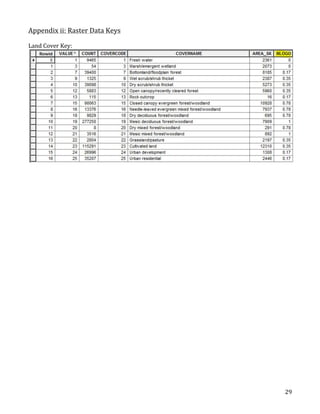
  • 21.
      21   out  a  lot  of  collected  data!  Field  validation  work  is  yet  to  be  continued  on  this  project,  I  have  no   doubt.   Second  problem,  the  raster  data  is  limited  both  in  size  and  scope.    Much  of  the  data  was  in   5km  resolution  (all  PRISM  data),  which  for  this  study  was  much  too  large.    While  all  precautions   went  into  maintaining  the  integrity  of  the  data,  the  variation  from  such  large  resolution  is  bound   to  leave  large  discrepancies  between  estimated  and  actual  information.    The  other  problem  lies  in   the  lack  of  representation  available  for  the  type  of  data  that  would  best  represent  where  A.   anserinus  lives.    Much  of  the  habitat  where  A.  anserinus  was  found  was  in  a  particular  set  of  soil,   known  as  Salt  Lake  Formation  in  Utah.    The  geology  layer  found  that  contains  the  layer  did  not   have  the  level  of  detail  that  would  capture  the  plants  preferred  soil  type,  and  even  the  data  would   change  at  the  state  borders  due  to  one  state  calling  the  same  layers  of  geology  by  a  different  name   (see  Figure  4).  Soil  data  is  improving,  and  there  are  areas  that  contain  the  data  that  was  required,   but  only  in  select  areas  and  not  at  the  scope  of  the  entire  study  area  that  the  analysis  took  place.     These  two  important  details  greatly  limits  the  HDM  created.    The  last  HDM,  MaxEnt2,  needs   to  be  validated  in  the  field,  particularly  the  northern  prediction  area,  which  has  not  been  surveyed.     Most  likely,  the  predicted  area  in  the  Northern  end  of  the  map  is  a  false  positive  area  because  the   indicated  area  was  well  outside  the  current  range  of  A.anserinus,  and  for  the  purposes  of  this   project  was  ignored  in  the  final  results.    However,  the  main  body  of  the  HDM  encompassed  much   of  the  empirical  data  that  MaxEnt1  did  not,  which  is  why  the  final  model  is  an  aggregated  version   of  both  MaxEnt1  and  MaxEnt2.    The  final  model  selected  is  a  combination  on  the  first  MaxEnt   model  run  in  R,  along  with  the  main  body  of  the  second  Maximum  Entropy  model.    The  first  model   was  too  data-­‐intense  to  run  analysis  on,  taking  two  days  to  run  a  single  model  (the  analysis  ran   100  models  and  compiled  the  returned  average  AUC  in  Figure14).  The  first  MaxEnt1  model  also   did  not  have  as  many  points  of  data  because  of  the  ongoing  fieldwork  during  this  project.    As   mentioned  above,  further  work  on  verification  of  the  model  should  be  done  to  help  enhance  the   current  model.   During  this  study,  questions  have  arisen  based  on  my  personal  observations.  For  example,   Goose  Creek  milkvetch  does  not  appear  to  like  competition  and  the  species  grows  on  very   distinguishable  outcrops  of  a  particular  geologic  formation,  the  Salt  Lake  formation.  The  plant   does  not  generally  grow  near  other  species,  and  this  has  me  questioning  what  is  different  about   the  soil  that  this  species  tends  to  prefer  to  grow.  I  believe  that  there  must  be  something  chemically   different  that  keeps  other  species  of  plant  from  growing  on  the  Salt  Lake  formation,  and  I  am  
  • 22.
      22   believe  that  there  might  be  a  lack  of  some  kind  of  nutrient  or  other  biological  agent  that  A.   anserinus  is  tolerant  of  that  other  species  are  not.     The  study  area  that  was  shown  to  contain  A.  anserinus  is  very  similar  to  other  areas  in  the   region.  I  believe  that  because  A.  anserinus  does  not  have  a  method  of  seed  dispersion  that  allows   for  a  large  distribution,  habitat  areas  that  seemed  like  suitable  habitat  did  not  have  the  species   present.    Other  than  gravity  and  water  (maybe  an  extreme  wind  event?),  the  seed  does  not  fall  far   from  the  plant.    I  believe  there  is  a  very  good  chance  that  the  plant  could  grow  in  other  areas  that   it  currently  does  not.    To  show  this  I  would  suggest  a  study  where  A.  anserinus  seedpods  are   dispersed  in  these  other  areas  to  see  if  the  plant  does  indeed  developed  in  these  other  areas.    The   models  developed  show  high  probabilities  in  areas,  such  as  the  adjacent  area  of  Grouse  Creek,   where  a  study  such  as  this  could  be  done.    I  would  even  suggest  bringing  the  plant  into  areas  that   A.  utahensis  grows  in  other  corners  of  the  state  to  see  if  it  would  take  root.    That  would  help   determine  if  A.  anserinus  is  growing  in  the  study  area  because  of  its  narrow  niche  requirements  or   simply  as  a  matter  of  its  limited  mechanism  of  dispersion.     Finally,  I  would  like  to  explore  the  relationship  that  A.  anserinus  has  with  the  current  land   management.  The  area  in  which  A.  anserinus  is  distributed  is  primarily  ranching  and  cattle  lands.     The  plant  is  generally  poisonous,  and  is  not  a  known  food  supply  for  most  of  the  animals  in  the   area  (maybe  nibbled  on  by  rabbits?).    Being  trampled  by  cattle,  invasive  species  such  as  leafy   spurge,  and  wild  fire  are  the  most  prevalent  danger  to  the  plant  (U.S.  Fish  and  Wildlife  Service,   2014).    There  is  no  eminent  large  development  of  the  land  or  other  major  threats  outside  of  those   listed  above.    Climate  change  could  be  a  factor  on  the  plant,  however  more  studies  would  need  to   be  done  on  how  it  has  been  changing  over  time,  and  perhaps  a  future  HDM  could  be  created  with   predicted  temperatures  and  moister  data.  With  these  factors  in  mind,  and  counter-­‐intuitive  to  the   conservationist  (such  as  myself),  listing  the  plant  could  very  well  create  a  situation  that  would  do   A.  anserinus  more  harm  than  good.  By  listing  the  plant  on  the  endangered  species  list,  it  would   change  how  the  land  is  managed.    Given  the  limited  amount  of  resources  agencies  such  as  UDAF   and  BLM  have  to  work  with,  dealing  with  the  invasive  species  is  difficult  and  costly  as  it  is.    I   believe  that  currently,  invasive  species  are  the  highest  risk  to  A.  anserinus,  combined  with  wildfire.   If  protected  under  the  Endangered  Species  Act,  controlled  burns,  using  herbicides  and  other   methods  of  management  on  invasive  species  would  become  more  tedious  and  costly,  and  thus   perhaps  not  be  as  effective  for  the  area.    Listing  a  plant  on  the  Endangered  Species  Act  will  help   protect  A.  anserinus  from  human  interference,  and  this  is  an  area  where  that  is  already  restricted   simply  due  to  the  nature  of  the  open  range.    Without  any  major  human  development  plans,  a  
  • 23.
      23   listing  in  the  Endangered  Species  Act  could  then  limit  how  agencies  and  private  landowners  can   control  what  I  believe  is  a  larger  threat  to  the  plant,  which  is  invasive  species  in  general.    I  believe   that  because  the  immediate  future  in  the  A.  anserinus  range  does  not  have  a  large  amount  of   human  development,  which  is  primarily  what  protecting  the  plant  under  the  Endangered  Species   Act  will  help,  that  it  may  be  counterproductive  in  protecting  the  plant  if  it  interferes  with  the   invasive  weed  and  fire  management.  This  needs  to  be  taken  into  consideration  when  looking  at   how  to  best  benefit  A.anserinus  and  the  people  who  manage  the  lands  in  which  it  is  found.     5.  Recommendations     Before  I  dive  into  the  final  recommendation,  let  me  be  the  first  to  remind  the  reader  that   "essentially,  all  models  are  wrong,  but  some  are  useful"  (George  E.P.  Box).  That  being  said,  and   remembering  the  two  general  problems  from  the  section  above,  the  final  recommendation  (Figure   16)  is  an  area  that  combines  the  two  Maximum  Extent  (MaxEnt)  models  into  a  single  area  (Figure   12).    The  reason  for  this  is  that  the  MaxEnt1  model  covered  some  of  the  empirical  data,  while   MaxEnt2  covered  other  areas  of  the  empirical  data,  and  a  combination  of  the  two  seemed  to  fit  the   data  the  best.  While  it  visually  seemed  better  of  the  two  MaxEnt  models,  MaxEnt  1  was  much  too   big  to  run  the  same  statistical  analysis  that  was  run  on  MaxEnt2.  MaxEnt2  however  needs  field   verification  particularly  in  the  northeastern  area  where  a  new  predicted  positive  area  has   occurred.  So,  a  combination  of  the  two  models  seemed  best.    If  one  was  to  choose  a  single  model   today,  MaEnt1  fits  the  current  range  and  empirical  data  the  best.  More  work  could  be   accomplished  to  improve  the  model,  centered  on  the  confirmation  of  questionable  presence  points   along  with  verification  of  false  positives  on  MaxEnt2.    A  Third  MaxEnt  model  could  be  very  useful   to  run,  after  these  points  are  verified.        
  • 24.
      24       Figure  16:  Final  Recommended  Habitat  for  A.  anserinus.  See  Appendix  xi  for  a  full  page  view  of  same  map.         Acknowledgments     I  have  had  help  on  this  project  from  many,  but  Bracken  Davis  was  my  mentor  at  UDAF  and   has  helped  a  tremendous  amount.    My  committee  members  at  the  University  of  Utah  were   wonderfully  at  encouraging  me  in  this  endeavor,  and  my  thanks  goes  out  to  Philip  Dennison,   Mitchell  Power,  and  especially  Simon  Brewer  who  repeatedly  answered  my  annoying  email   questions  about  various  methods  on  modeling.    I  received  help  and  encouragement  from  an  array   of  people,  and  a  special  thanks  goes  out  Jena  Lewinsohn  at  the  Federal  Wildlife  Services  and   Robert  Fitz  at  the  Department  of  Natural  Resources.    And,  lets  not  forget  my  wonderful  wife  who   has  proof  read  this  for  me  numerous  times  as  well.  There  were  many  more  that  I  have  met  and   learned  from  along  the  way,  and  my  thanks  goes  out  to  all  that  took  me  under  their  wing  during   this  project. n n n n nn n n nn n n nnn nn nn n WWF, USGS, EPA, Esri GooseCreekMilkvetchDistributionArea F Legend n Survey Area !( Astragalus anserinus MaxEnt Agrigated Model FinalRecomendation MaxEnt2 MaxEnt1 CurrentRange 0 1.5 3 4.5 60.75 Miles Maximum Entropy Habitat Distribution models created for A. anserinus. Aggrigated MaxEnt Model is a combination of two, mostly overlapping MaxEnt Models to better represent empirical data. Final range created by author only as recomendation and to account for sparsly populated area. By Robert Machol University of Utah - MST & UDAF Dec. 2014 Sources: USFWS All other data collected 2014
  • 25.
      25   References:     Atwood, Goodrich and Welsh (2011). GOOSE CREEK MILKVETCH, Astragalus anserinus. United States Department of Agriculture, Natural Resourse Conservation Service. Beane, N.B., Rentch, J.S. & Schuler, T.M. (2013). Using Maximum Entropy Modeling to Identify and Prioritize Red Spruce Forest Habitat in West Virginia United States Department of Agriculture, Forest Service; Northern Research Station. Research Paper NRS-23 Burnham, K. P., and D. R. Anderson (2002). Model selection and multimodel inference : a practical information-theoretic approach. Springer, New York. Coˆte ́ IM, Darling ES (2010). Rethinking Ecosystem Resilience in the Face of Climate Change. PLoS Biol 8(7): e1000438. doi:10.1371/journal.pbio.1000438 Crist, Eileen (2003). Limits-to-Growth and Biodiversity Crisis. Wild Earth; Spring Issue. D. Ogle (2006). Plant guide for Crested Wheatgrass (Agropyron cristatum). USDA-Natural Resources Conservation Service, Idaho Plant Materials Center. Aberdeen, ID. Forest Service, Midewin National Tallgrass Prairie (2002). Environmental assessment of herbicide use for invasive plant species and noxious weeds control. Will County, Illinois Hijmans, R. J., & Elith, J (2013). Species distribution modeling with r. Informally published manuscript. Hirzel, A. H., & Gwenaelle, L. L. (2008). Habitat suitability modelling and niche theory. Journal of Applied Ecology, 45, 1372-1381. doi: 10.1111 Kobayashi, M., K. Rollins and M. Taylor (2010). Ranching, Invasive Annual Grasses, and the External Costs of Wildfire in the Great Basin: A Stochastic Dynamic Programming Approach. Selected paper presented at the Agricultural and Applied Economics Association 2010 Annual Meeting, July 25-27, 2010, Denver, Colorado, 39 pp. http://purl.umn.edu/61869 Meadows, D.H., Randers, J., Meadows, D. (2004). Limits to Growth: The 30-Year Update. Chelsea Green Publishing. Kindle Edition. Merow, C., Smith, M. J., and Silander, J. A., Jr (2013). A practical guide to MaxEnt for modeling species distributions: what it does, and why inputs and settings matter. Ecography 36: 1058– 1069, 2. doi: 10.1111/j.1600-0587.2013.07872.x Lukez, R. (2011). Southern Utah Wilderness Alliance; the little goose creek drainage. Retrieved from http://action.suwa.org/site/PageServer?pagename=WATE_goosecreek Pearson, R.G. (2007). Species’ Distribution Modeling for Conservation Educators and Practitioners. Synthesis. American Museum of Natural History. http://ncep.amnh.org. Pimental, D., Zuniga, R., & Morrison, D. (2005). Update on the environmental and economic costs associated with alien-invasive species in the United States. Ecological Economics, 52(3), 273- 288. doi: 10.1016 Soil Survey Staff (2014). Gridded Soil Survey Geographic (gSSURGO) Database for the Conterminous United States. United States Department of Agriculture, Natural Resources Conservation Service. Available online at http://datagateway.nrcs.usda.gov/. January 15, 2014 (FY2014 official release). Tape, T.G. (2014). Interpreting Diagnostic Tests. University of Nebraska Medical Center. Retrieved from the web January 20, 2015. http://gim.unmc.edu/dxtests/Default.htm Tilley, D., L. St. John and D. Ogle (2011). Plant guide for Goose Creek Milkvetch (Astragalus anserinus). USDA-Natural Resources Conservation Service, Idaho Plant Materials Center. Aberdeen, ID. Tilley, D., John, L. S., Ogle, D., Fullen, K., & Fleenor, R. (2013). Threatened, endangered & candidate plant species of idaho (TN Plant Materials NO. 51). USDI FWS, Retrieved from USDA - Natural Resources Conservation Service website U.S. Fish and Wildlife Service. (2014) Species Assessment and Listing Priority Assignment Form.  
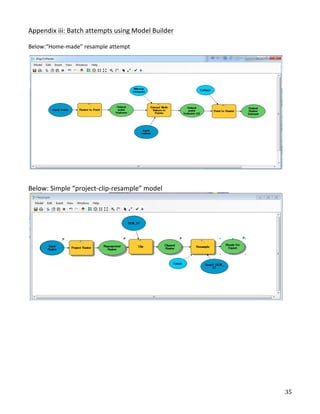
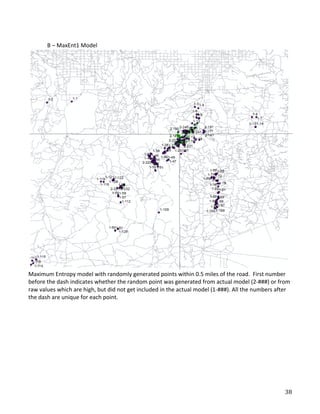
  • 26.
      26   Appendices:     Appendix  i:  Soil  Data  Analysis    
  • 27.
      27      
  • 28.
      28          
  • 29.
      29   Appendix  ii:  Raster  Data  Keys     Land  Cover  Key:                                  
  • 30.
      30   Soil  “valu”  Key:    
  • 31.
      31      
  • 32.
      32        
  • 33.
  • 34.
      34                                    
  • 35.
      35   Appendix  iii:  Batch  attempts  using  Model  Builder     Below:“Home-­‐made”  resample  attempt       Below:  Simple  “project-­‐clip-­‐resample”  model                
  • 36.
      36   Appendix  iv:  Python  Scrypt  for  Resample  and  Aggregation                    
  • 37.
      37   Appendix  v:  Models  Verified  in  Field  with  Corresponding  Random  Points         A  –  HyperNiche  Model       Random  points  generated  within  0.5  miles  of  road.  First  number  before  dash  is  a  “probability”   number,  based  on  value  from  model.  Divisions  from  model  based  on  quartiles  (1-­‐###  is  top  fifth  of   model  to  5-­‐###  is  bottom  fifth  of  model,  and  6-­‐###  is  absence  points).    All  the  numbers  after  the   dash  are  unique  for  each  point.      
  • 38.
      38         B  –  MaxEnt1  Model     Maximum  Entropy  model  with  randomly  generated  points  within  0.5  miles  of  the  road.    First  number   before  the  dash  indicates  whether  the  random  point  was  generated  from  actual  model  (2-­‐###)  or  from   raw  values  which  are  high,  but  did  not  get  included  in  the  actual  model  (1-­‐###).  All  the  numbers  after   the  dash  are  unique  for  each  point.          
  • 39.
      39   Appendix  vi:  Field  Notes     A  –  Field  Notes  Collected  By  Rob  Machol    
  • 40.
  • 41.
  • 42.
  • 43.
  • 44.
      44       B  –  Field  Notes  Collected  by  Bracken  Davis      
  • 45.
  • 46.
      46          
  • 47.
      47   Appendix  vii:  HyperNich  Model          
  • 48.
      48   Appendix  viii:  Various  Models  Created  in  R
  • 49.
  • 50.
      50               MaxEnt1   MaxEnt2  
  • 51.
      51   Appendix  ix:  Sample  R  code     ####  MaxEnt  Code  Example   ####  Robert  Machol   ####  UofU  -­‐  MST  &  UDAF   ####  Ded  2014     ##Set  working  directory   setwd("~/Documents/MST/Summer  2014/Final  Project")   ##Load  dismo  library   library("dismo",  lib.loc="/Library/Frameworks/R.framework/Versions/3.1/Resources/library")   ##Load  maptools     library("maptools",  lib.loc="/Library/Frameworks/R.framework/Versions/3.1/Resources/library")   ##rgdal     library("rgdal",  lib.loc="/Library/Frameworks/R.framework/Versions/3.1/Resources/library")   ##  proj4  spatial  plotting   library("proj4",  lib.loc="/Library/Frameworks/R.framework/Versions/3.1/Resources/library")   ##scales-­‐  for  transparnt  plotting   library("scales",  lib.loc="/Library/Frameworks/R.framework/Versions/3.1/Resources/library")   ##Corgram  to  view  colinearity   library("corrgram",  lib.loc="/Library/Frameworks/R.framework/Versions/3.1/Resources/library")   ##MASS  to  write  Matrix   library("MASS",  lib.loc="/Library/Frameworks/R.framework/Versions/3.1/Resources/library")     #####Load  rasters  #####   ##  cut  from  171  rasters  to  6  according  to  'DataFileList.xlsx'   ##  @  30m  resolution     dem  =  raster("RasterOutput/DEM_S1.tif")   SolEnergy=raster("RasterOutput/AreaSol_DEMs1.tif")   IMI=raster("RasterOutput/IMI1.tif")   TmaxJul8110=raster("RasterOutput/PRISMTmax8110Jul.tif")   tmin8110Feb  =raster("RasterOutput/PRISMtmin8110Feb.tif")   HisPrecJun  =  raster("RasterOutput/HisPrecJun1.tif")     #  Envirofiles  Stack   envirofiles  =  (c(dem,SolEnergy,IMI,TmaxJul8110,tmin8110Feb,HisPrecJun))   enviropredictors=(stack(envirofiles))   summary(enviropredictors)     #####Load  Points######   ##  Presence  points:   Points  =  read.csv("PresentFinal.csv")   Points   ##  I  only  want  the  coordinates...   Pointsxy  =  Points[,1:2]   Pointsxy  #787  points   ##Absence  Points:   Absence  =  read.csv("NegsFinal.csv")   Absencexy  =  Absence[,1:2]   Absencexy  #362  points   #tail(Absencexy)     ####  Points  &  Coordinate  Metadata:  ####  
  • 52.
      52   ##cooridinates  for  study  area:  42.47,41.24  &  -­‐114.88,-­‐113.42     ##Geographic  Coordinate  System:    GCS_WGS_1984   ##Datum:      D_WGS_1984   ##Prime  Meridian:      Greenwich   ##Angular  Unit:     Degree     ####  Plot  Points:  ####   par=(mfrow=c(1,1))   PointsCRS  =  CRS("+proj=longlat  +ellps=WGS84")   Points.sp  =  SpatialPoints(cbind(Pointsxy$XCoord,  Pointsxy$YCoord),  proj4string=PointsCRS)   summary(Points.sp)   bbox(Points.sp)   proj4string(Points.sp)   coordinates(Points.sp)   Points.spdf  =  SpatialPointsDataFrame(cbind(Pointsxy$XCoord,  Pointsxy$YCoord),  Pointsxy,                                                                              proj4string  =  PointsCRS)   summary(Points.spdf)   plot(Points.spdf)     ###  General  visualization  of  point  data  ###   ##USA  Download   USA  =  getData('GADM',  country='USA',  level  =  1)   Absence.spdf  =  SpatialPointsDataFrame(cbind(Absencexy$XCoord,  Absencexy$YCoord),                                                                                Absence,  proj4string  =  PointsCRS)   plot(USA,  xlim=c(-­‐114.45,  -­‐113.9),  ylim=c(41.6,42.1),  axes=TRUE)#Point  Coordinates   points(Pointsxy$XCoord,  Pointsxy$YCoord,  col=alpha("green",  0.3),  cex=.5,  pch=3)#Include  accual  and   random  from  survey  plots   points(Absencexy$XCoord,  Absence$YCoord,  col=alpha("red",  0.3),  cex=.5,  pch=4)#Include  accual  and   random  from  survey  plots   legend("topleft",  legend  =  c("Presence  -­‐  787  points",  "Absence  -­‐  362  points"),  col  =  c("green",  "red"),  pch  =   c(3,4)  )   title(    main="A.anserinus  Point  Data")     ##All  predictors   plot  (enviropredictors)     #######  Extract  Values  From  Rasters  Via  Points  ###########   ##Presence  Values:   presvals=extract(enviropredictors,Pointsxy)#(RnR)   ##Absence  VAlues   absvals=extract(enviropredictors,Absencexy)#(RnR)     ##for  presence  or  absence  points,  we  will  call  "pb"  (new  variable,  0  absence  points,  1  presence  points)   pb  =c(rep(1,nrow(presvals)),  rep(0,nrow(absvals)))   ##combine  these  points  into  a  singel  data.frame   admdata=data.frame(cbind(pb,rbind(presvals,absvals)))   names(admdata)   summary(admdata)   ##vissually  check  for  Collinearity:   ##Plot  data  in  pairs       pairs(admdata[,2:6],cex=0.1,  fig=TRUE)   library("corrgram",  lib.loc="/Library/Frameworks/R.framework/Versions/3.1/Resources/library")   par(mfrow=c(1,1))  
  • 53.
      53   corrgram(admdata[,2:6],  order=TRUE,  lower.panel=panel.shade,                    upper.panel=panel.pie,  text.panel=panel.txt,                    main="A.anserinus  Collinearity  Data")   corrgram(admdata[,2:6],  order=TRUE,  lower.panel=panel.ellipse,                    upper.panel=panel.pts,  text.panel=panel.txt,                    diag.panel=panel.minmax,                    main="A.anserinus  Collinearity  Data")       ####Model  Fitting:  Generalized  Linear  Model(glm)####   gc()  #clear  garbage  from  memmory   M2  =  glm(formula=pb~.,data=admdata)     summary(M2)   ##Bioclim  only  takes  presence  values   bc=  bioclim(presvals)   pairs(bc)     ##Predicting  GLM   pM2  =  predict(enviropredictors,  M2,  na.rm=TRUE)   plot(pM2)   title(main  =  "Generalized  Linear  Model  Raw  Value")   summary(M2)     ####  Train/Test  data  ####   ##get  training/testing  sets  of  data  from  admdata   head(admdata)   samp  =  sample(nrow(admdata),  round(0.75*nrow(admdata)))   traindata=admdata[samp,]   traindata=traindata[traindata[,1]  ==  1,  2:7]   testdata=admdata[-­‐samp,]       pres  =  admdata[admdata[,1]  ==  1,  2:7]   absen  =  admdata[admdata[,1]  ==  0,  2:7]     ##AUC  could  be  biased  due  to  high  extent  =  high  AUC  values  (Lobo  et  al.  2008,  Jimenez-­‐Valverde  2011)   ##So,  get  rid  of  "spatial  sorting  bias"  via  "point-­‐wise  distance  sampling"   nr=nrow(Pointsxy)   s=sample(nr,0.25*nr)   pres_train=Pointsxy[-­‐s,]   pres_test=Pointsxy[s,]   nr=nrow(Absencexy)   s=sample(nr,0.25*nr)   back_train=Absencexy[-­‐s,]   back_test=Absencexy[s,]   sb=ssb(pres_test,back_test,pres_train)   sb[,1]/sb[,2]   ##Spacial  Sorting  Bias  (SSB)  =  0.326    (If  no  bias  SSB=1)     ##Create  subsample  where  SSB  is  removed   i  =  pwdSample(pres_test,back_test,pres_train,  n=1,tr=0.1)   pres_test_pwd=pres_test[!is.na(i[,1]),]   back_test_pwd=back_test[na.omit(as.vector(i)),]  
  • 54.
      54   sb2=ssb(pres_test_pwd,back_test_pwd,pres_train)   sb2[1]/sb2[2]   ##SSB  =  0.999  -­‐-­‐  Much  Reduced!     ###Visualize  train/test  points   r=raster(enviropredictors,1)   plot(!is.na(r),col=c('white','light  grey'),legend=FALSE)   points(back_train,  pch='-­‐',  cex=0.5,  col=  'yellow')   points(back_test,  pch='-­‐',  cex=0.5,  col=  'black')   points(pres_train,  pch=  '+'  ,  col=  'green'  )   points(pres_test,  pch=  '+'  ,  col=  'blue'  )              ##########  MaxEnt  ##############     ##Note!  Most  widely  used  SDM  algorythm  (according  to  Hijmans  and  Elith)   ##limit  extent:   ext  =  extent(-­‐144.6,  -­‐113.7,  41.5,  42.3)   ##Uses  "jar"  package  -­‐  http://www.cs.princeton.edu/~schapire/maxent/     jar  <-­‐  paste(system.file(package="dismo"),  "/java/maxent.jar",  sep='')   jar   if  (file.exists(jar)){      xm=maxent(enviropredictors,pres_train,  ext  =  ext)      plot(xm)   }  else  {      cat('cannot  run  this  example  because  maent  is  not  available')      plot(1)   }   response(xm)     e  =  evaluate(pres_test,back_test,xm,enviropredictors)   e  #AUC=0.7712   px=predict(enviropredictors,xm,progress='')   par(mfrow=c(1,2))   plot(px,main='MaxEnt,  Raw  Values')   trpx=threshold(e,'spec_sens')   plot(px>trpx,  main='Presence/Absence')   points(pres_train,  pch='+')   ##Write  raw  data  as  raster   writeRaster(px,file="RawMaxExt.tif",overwrite=TRUE)   ##Write  pres/abs  model  as  raster   MaxExtPresAbs=(px>trpx)   writeRaster(MaxExtPresAbs,file="MaxExtPresAbs.tif",overwrite=TRUE)     ####  Max  Ext  Evaluation  ####   e=evaluate(testdata[testdata==1,],  testdata[testdata==0,],  xm)   e   plot(e,'ROC')   ##AUC  value  =  .827  (guess  @  .5)     ##k-­‐fold  -­‐  do  it  agin  k  times   pres  =  admdata[admdata[,1]  ==  1,  2:7]   absen  =  admdata[admdata[,1]  ==  0,  2:7]   k  =  100  ##I  am  going  to  run  this  10  times   group  =  kfold(pres,  k)  ##presence  only,  which  is  good  becuase  the  absence  falls  very  close   ##absence  is  supposed  to  be  used  to  test  model  
  • 55.
      55   group[1:100]   unique(group)   e=list()   for  (i  in  1:k)  {      train=pres[group!=i,]      test=pres[group==i,]      xm=maxent(enviropredictors,pres_train)      e[[i]]=evaluate(p=test,a=absen,xm)   }   e   ##AUC  values  for  sensitivity(true  positive  rate)   ##        and  specificity  (true  negaitive  rate)     ##With  SSB:   evaluate(xm,  p=pres_test,a=back_test,x=enviropredictors)   ##AUC  with    =0.719  (0.5  is  guess)   ##SSB  removed   evaluate(xm,  p=pres_test_pwd,  a=back_test_pwd,  x=enviropredictors)   ##AUC  SSB  reduced  =  0.621   ##These  numbers  changed  each  time  you  run  new  model,  so...     ##Hist  for  AUC  with  SSB  removed   k  =  100  ##I  am  going  to  run  this  100  times   group  =  kfold(pres,  k)  ##presence  only,  which  is  good  becuase  the  absence  falls  very  close   ##absence  is  supposed  to  be  used  to  test  model   group[1:100]   unique(group)   e=list()   for  (i  in  1:k)  {      j  =  pwdSample(pres_test,back_test,pres_train,  n=1,tr=0.1)      pres_test_pwd=pres_test[!is.na(j[,1]),]      back_test_pwd=back_test[na.omit(as.vector(j)),]      sb2=ssb(pres_test_pwd,back_test_pwd,pres_train)      xm=maxent(enviropredictors,pres_train)      e[[i]]=evaluate(xm,  p=pres_test,a=back_test,x=enviropredictors)   }   e   ##AUC  values  for  sensitivity(true  positive  rate)   ##        and  specificity  (true  negaitive  rate)     auc  =  sapply(e,function(x){slot(x,'auc')}  )   auc   par(mar=c(1,1,1,0))   par(oma=c(1,1,0.5,0))   par(mfrow=c(1,1))   hist(auc,  main  =  'MaxExt  AUC  with  SSB',  sub  =  'mean  =  0.796')   meanauc  =  mean(auc)  #0.745   abline(v  =  meanauc,  col  =  "blue",  lwd  =  2)   text(meanauc,  0  ,  round(meanauc,  4))   text(meanauc,  6  ,  "mean  =  ",  cex  =  1)   TprTnr  =  sapply(e,function(x){  x@t[which.max(x@TPR  +  x@TNR)]  }  )   TprTnr   par(mar=c(1,1,1,0))  
  • 56.
      56   par(oma=c(1,1,0.5,0))   par(mfrow=c(1,1))   hist(TprTnr,  main  =  'MaxExt  Tpr  +  Tnr  max  with  SSB',  sub  =  'mean  =...'  )   meanTprTnr  =  mean(TprTnr)  #0.745   meanTprTnr   abline(v  =  meanTprTnr,  col  =  "blue",  lwd  =  2)   text(meanTprTnr,  0.5  ,  round(meanTprTnr,  4))   text(meanTprTnr,  1.5  ,  "mean  =  ",  cex  =  1)     Appendix  x:  Colinearity  Analysis    
  • 57.
      57           Appendix  xi:  Final  map  and  Recommendation      
  • 58.
      58       nn nn nnnnnn n nnnn nn nn n WWF,USGS,EPA,Esri Goose Creek Milkvetch Distribution Area F Legend nSurveyArea !(Astragalusanserinus MaxEntAgrigatedModel FinalRecomendation MaxEnt2 MaxEnt1 CurrentRange 01.534.560.75 Miles MaximumEntropyHabitatDistributionmodelscreatedfor A.anserinus.AggrigatedMaxEntModelisacombination oftwo,mostlyoverlappingMaxEntModelstobetterrepresent empiricaldata.Finalrangecreatedbyauthoronlyas recomendationandtoaccountforsparslypopulatedarea. ByRobertMachol UniversityofUtah-MST&UDAF Dec.2014 Sources:USFWS Allotherdatacollected2014