Audience Appeal
 Shakespeare demonstrated the Elizabethan belief
that the country is stable only if the King is good
and virtuous.
 The play was considered a thriller because it
dramatizes a threat to an anointed King and the
perceived evil behind the threat
 Shakespeare included a lot of blood and murder,
which the Elizabethans expected to see in a tragedy.
 Elizabethans believed that evil occurs in darkness,
which is a recurring theme in Macbeth.
Historical Background
 Not very accurate about the real Macbeth, king
of Scotland from 1040-1057.
 Ruled peacefully for a long time
 Instead it’s directed toward the new King, James.
 A problem of successon:
There was no Tudor successor to the throne of
England after Elizabeth died.
Elizabeth chose James VI of Scotland to succeed
her.
Why?
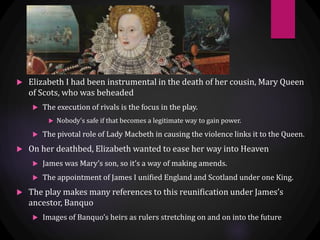
 Elizabeth I had been instrumental in the death of her cousin, Mary Queen
of Scots, who was beheaded
 The execution of rivals is the focus in the play.
 Nobody’s safe if that becomes a legitimate way to gain power.
 The pivotal role of Lady Macbeth in causing the violence links it to the Queen.
 On her deathbed, Elizabeth wanted to ease her way into Heaven
 James was Mary’s son, so it’s a way of making amends.
 The appointment of James I unified England and Scotland under one King.
 The play makes many references to this reunification under James’s
ancestor, Banquo
 Images of Banquo’s heirs as rulers stretching on and on into the future
Shakespeare’s tribute to
King James I
 Shakespeare wrote Macbeth in 1606, during King
James’ reign.
 The setting is Scotland, King James’ homeland
 Macbeth isn’t one of the king’s ancestors, so he can’t be the
good guy, in spite of his fairly long peaceful rule (1040-1057).
 Banquo was an ancestor of James and is shown in the
play to be a virtuous person.
 Also invoked in the play: witchcraft
 James believed himself to be an expert on witchcraft, so he
would have been highly entertained by its role in Macbeth.
So What ReallyHappens?
 Good guy goes bad
 Guy wants power
 Married to a woman who wants power
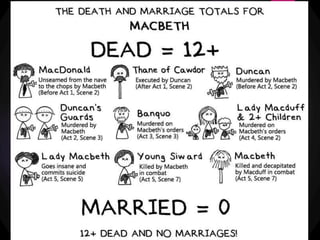
 Kills people- LOTS of people
 Gets power
 Gets paranoid
 anyone could do the same to him, and some want to
 Loses allies/friends
 Wants more power! Kill! Kill!
 Gets what’s coming to him in the end
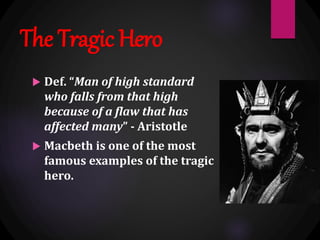
The Tragic Hero
 Def. “Man of high standard
who falls from that high
because of a flaw that has
affected many” - Aristotle
 Macbeth is one of the most
famous examples of the tragic
hero.
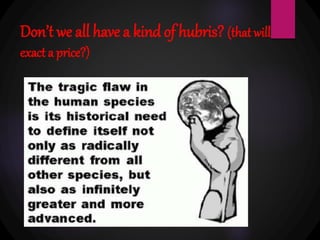
Don’t we all have a kind of hubris? (that will
exact a price?)
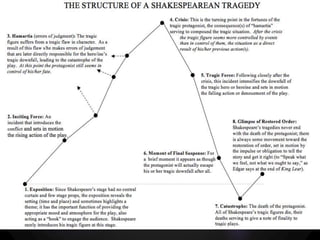
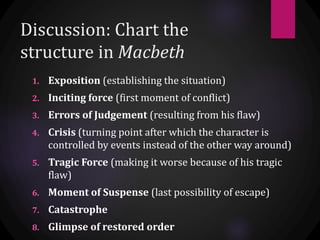
Discussion: Chart the
structure in Macbeth
1. Exposition (establishing the situation)
2. Inciting force (first moment of conflict)
3. Errors of Judgement (resulting from his flaw)
4. Crisis (turning point after which the character is
controlled by events instead of the other way around)
5. Tragic Force (making it worse because of his tragic
flaw)
6. Moment of Suspense (last possibility of escape)
7. Catastrophe
8. Glimpse of restored order

macbeth background history and tragedy (1).pptx

  • 2.
    Audience Appeal  Shakespearedemonstrated the Elizabethan belief that the country is stable only if the King is good and virtuous.  The play was considered a thriller because it dramatizes a threat to an anointed King and the perceived evil behind the threat  Shakespeare included a lot of blood and murder, which the Elizabethans expected to see in a tragedy.  Elizabethans believed that evil occurs in darkness, which is a recurring theme in Macbeth.
  • 3.
    Historical Background  Notvery accurate about the real Macbeth, king of Scotland from 1040-1057.  Ruled peacefully for a long time  Instead it’s directed toward the new King, James.  A problem of successon: There was no Tudor successor to the throne of England after Elizabeth died. Elizabeth chose James VI of Scotland to succeed her. Why?
  • 4.
     Elizabeth Ihad been instrumental in the death of her cousin, Mary Queen of Scots, who was beheaded  The execution of rivals is the focus in the play.  Nobody’s safe if that becomes a legitimate way to gain power.  The pivotal role of Lady Macbeth in causing the violence links it to the Queen.  On her deathbed, Elizabeth wanted to ease her way into Heaven  James was Mary’s son, so it’s a way of making amends.  The appointment of James I unified England and Scotland under one King.  The play makes many references to this reunification under James’s ancestor, Banquo  Images of Banquo’s heirs as rulers stretching on and on into the future
  • 5.
    Shakespeare’s tribute to KingJames I  Shakespeare wrote Macbeth in 1606, during King James’ reign.  The setting is Scotland, King James’ homeland  Macbeth isn’t one of the king’s ancestors, so he can’t be the good guy, in spite of his fairly long peaceful rule (1040-1057).  Banquo was an ancestor of James and is shown in the play to be a virtuous person.  Also invoked in the play: witchcraft  James believed himself to be an expert on witchcraft, so he would have been highly entertained by its role in Macbeth.
  • 7.
    So What ReallyHappens? Good guy goes bad  Guy wants power  Married to a woman who wants power  Kills people- LOTS of people  Gets power  Gets paranoid  anyone could do the same to him, and some want to  Loses allies/friends  Wants more power! Kill! Kill!  Gets what’s coming to him in the end
  • 10.
    The Tragic Hero Def. “Man of high standard who falls from that high because of a flaw that has affected many” - Aristotle  Macbeth is one of the most famous examples of the tragic hero.
  • 11.
    Don’t we allhave a kind of hubris? (that will exact a price?)
  • 12.
    Discussion: Chart the structurein Macbeth 1. Exposition (establishing the situation) 2. Inciting force (first moment of conflict) 3. Errors of Judgement (resulting from his flaw) 4. Crisis (turning point after which the character is controlled by events instead of the other way around) 5. Tragic Force (making it worse because of his tragic flaw) 6. Moment of Suspense (last possibility of escape) 7. Catastrophe 8. Glimpse of restored order