MONOCLONAL
ANTIBODIES
PRESENTER : DR. KAMAL OJAH

DEPT. OF PHARMACOLOGY
JORHAT MEDICAL COLLEGE
-What are antibodies
-History
-Immunoglobulin structure
Production
Types
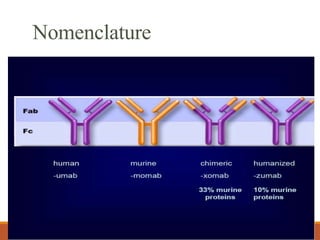
Nomenclature
Application and Side Effects
Examples
Conclusion
Introduction
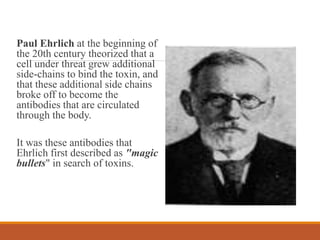
Paul Ehrlich at the beginning of
the 20th century theorized that a
cell under threat grew additional
side-chains to bind the toxin, and
that these additional side chains
broke off to become the
antibodies that are circulated
through the body.
It was these antibodies that
Ehrlich first described as "magic
bullets" in search of toxins.
History of MAB development
1964 Littlefield developed a way to isolate hybrid
cells from 2 parent cell lines using the
hypoxanthine-aminopterin-thymidine (HAT)
selection media.
1975 Kohler and Milstein provided the most
outstanding proof of the clonal selection theory by
fusion of normal and malignant cells
What are antibodies?
An antibody is a protein used by the immune system to identify
and neutralize foreign objects like bacteria and viruses. Each
antibody recognizes a specific antigen unique to its target.
Monoclonal antibodies (mAb) are antibodies that are identical
because they are produced by one type of immune cell, all clones
of a single parent cell.
Polyclonal antibodies are antibodies that are derived from
different cell lines. They differ in amino acid sequence.
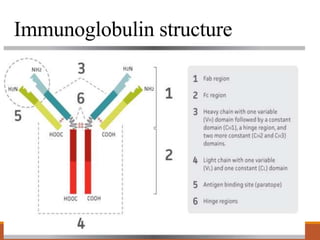
Immunoglobulin structure
Characters of Monoclonal
Antibodies
Monoclonal antibodies (mAb) are a single type
of antibody that are identical and are directed
against a specific epitope (antigen, antigenic
determinant) and are produced by B-cell clones of
a single parent or a single hybridoma cell line.
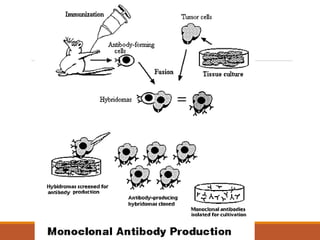
A hybridoma cell line is formed by the fusion of a
one B-cell lymphocyte with a myeloma cell.
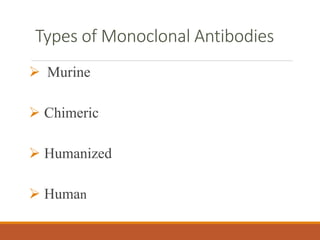
Types of Monoclonal Antibodies
 Murine
 Chimeric
 Humanized
 Human
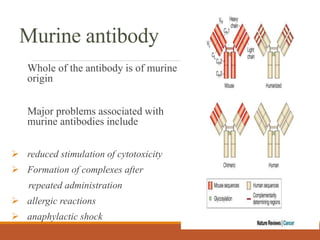
Murine antibody
Whole of the antibody is of murine
origin
Major problems associated with
murine antibodies include
 reduced stimulation of cytotoxicity
 Formation of complexes after
repeated administration
 allergic reactions
 anaphylactic shock
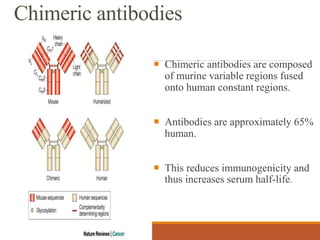
Chimeric antibodies
 Chimeric antibodies are composed
of murine variable regions fused
onto human constant regions.
 Antibodies are approximately 65%
human.
 This reduces immunogenicity and
thus increases serum half-life.
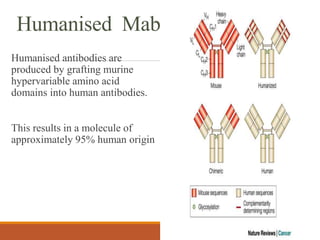
Humanised Mab
Humanised antibodies are
produced by grafting murine
hypervariable amino acid
domains into human antibodies.
This results in a molecule of
approximately 95% human origin
Human Monoclonal antibody
 Genes for variable Fab portion of human
Abs is inserted in genome of bacteriophage
and replicated by recombinant DNA
technology. e. g. Adalimumab
Nomenclature
Applications of Monoclonal
Antibodies
 Diagnostic Applications
- Detects protein of interest either by
blotting or immunofluorescence
 Therapeutic Applications
Transplant rejection
Cancer
Autoimmune disorders
Inflammatory disease
DIAGNOSTICS
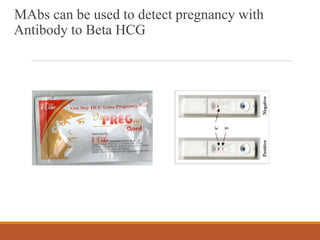
MAbs can be used to detect pregnancy with
Antibody to Beta HCG
MAbs in MP Card Test
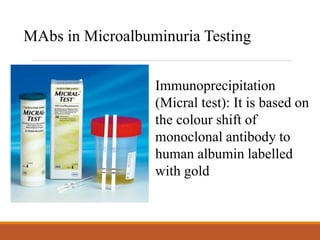
MAbs in Microalbuminuria Testing
Immunoprecipitation
(Micral test): It is based on
the colour shift of
monoclonal antibody to
human albumin labelled
with gold
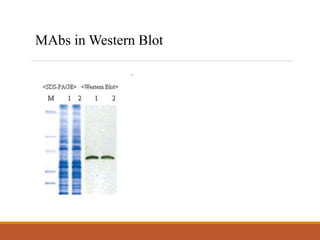
MAbs in Western Blot
THERAPEUTIC
Muromonab (OKT-3)
First FDA-approved therapeutic monoclonal
antibody was a murine CD3 specific in 1986
Target CD3 and their blockade suppresses
activity of T cells
Indicated in prevention of transplant rejection
in patients receiving kidney, Heart, liver
transplants.
Capromab pendetide
Capromab pendetide is a murine monoclonal
antibody specific for prostate specific membrane
antigen.
It is coupled to isotopic indium ( 111 In) and is
used in patients with biopsy-confirmed prostate
cancer to determine extent of disease.
Abciximab
Chimeric antibody binds to GP IIb/IIIa receptors on
platelets and prevents their aggregation
 Antiplatelet agent approved 2 mg IV
 In patients undergoing PCI
 In patients with unstable angina not responding to
conventional medical therapy when PCI is planned within
24 hours
Rituximab
mAb binds to CD20 protein on normal and malignant B
lymphocytes
MOA: Complement-mediated lysis,
Antibody-dependent cellular cytotoxicity,
Induction of apoptosis in the malignant lymphoma cells.
Rituximab approved in dose of 375 mg IV weekly for 4
weeks for treatment of non hodgkins lymphoma, CLL
S/E – severe infusion reactions, steven johnson’s
syndrome
Ofatumumab
Ofatumumab is a human IgG 1 monoclonal antibody.
It is approved for patients with chronic lymphocytic
leukemia (CLL) who are refractory to fludarabine.
There is a slight risk of hepatitis B virus reactivation in
patients taking ofatumumab.
Basiliximab
Basiliximab is a chimeric mouse-human
monoclonal antibody to the α chain (CD25)
of the IL-2 receptor of T cells.
It is used to prevent rejection in organ
transplantation, especially
in kidney transplants.
Palivizumab
Palivizumab is produced by recombinant DNA
technology.
It is used in the prevention of respiratory syncytial
virus (RSV) infections.
Palivizumab is a humanized monoclonal antibody
(IgG) directed against an epitope in the A antigenic
site of the F protein of RSV.
Palivizumab is dosed once a month via
intramuscular (IM) injection.
Infliximab
Infliximab is a human-mouse chimeric IgG 1 monoclonal
antibody possessing human constant (Fc) regions and
murine variable regions.
It is administered intravenously but has the same anti-
TNF-α activity as adalimumab and etanercept.
approved for use in Crohn’s disease, ulcerative colitis,
rheumatoid arthritis, ankylosing spondylitis, plaque
psoriasis, and psoriatic arthritis.
Adalimumab
Adalimumab is a completely human IgG 1
approved for use in patients with rheumatoid
arthritis, psoriatic arthritis, ankylosing spondylitis,
Crohn’s disease, and plaque psoriasis.
blocks the interaction of TNF-α with TNF
receptors on cell surfaces
 lyses cells expressingTNF-α in the presence of
complement.
Omalizumab
Omalizumab is an anti-IgE recombinant
humanized monoclonal antibody that is approved
for the treatment of asthma in adult and adolescent
patients whose symptoms are refractory to inhaled
corticosteroids.
The antibody blocks the binding of IgE to the high-
affinity Fc receptor on basophils and mast cells,
which suppresses IgE-mediated release of type I
allergy mediators such as histamine and
leukotrienes.
Trastuzumab
It is indicated only for breast cancers that
overexpress Her2/neu.
Associated with a significant improvement
in overall survival in the metastatic breast
cancer.
Eculizumab
Eculizumab is a humanized monoclonal
antibody that is the first therapy approved for the
treatment of paroxysmal nocturnal
hemoglobinuria (PNH),
Eculizumab also is the first agent approved for the
treatment of atypical hemolytic uremic
syndrome (aHUS),
Side effects
•Allergic reactions, such as hives or itching
• Flu-like symptoms, including chills, fatigue, fever, and
muscle aches and pains
• Nausea
• Diarrhea
• Skin rashes
CONT.
Infusion reactions. Severe allergy-like reactions
can occur and, in very few cases, lead to death
Cardiac complications Certain monoclonal
antibodies may cause heart failure.
Bleeding. Some of the monoclonal antibody may
cause bleeding.
CONCLUSION:
 The monoclonal antibody production
technology has revolutionized the world of
Biotechnology.
Advances in genetic engineering over the years
have provided numerous ways to design MAbs
that are more robust and efficacious compared
with their original murine version.
MAb technology in conjunction with
recombinant DNA technology has
successfully led to the reconstruction of
chimeric, humanized and fully human
antibodies and has enormous potentials
for therapeutic uses.
Mabjeevan 141027001544-conversion-gate01

Mabjeevan 141027001544-conversion-gate01

  • 1.
    MONOCLONAL ANTIBODIES PRESENTER : DR.KAMAL OJAH DEPT. OF PHARMACOLOGY JORHAT MEDICAL COLLEGE
  • 2.
    -What are antibodies -History -Immunoglobulinstructure Production Types Nomenclature Application and Side Effects Examples Conclusion Introduction
  • 3.
    Paul Ehrlich atthe beginning of the 20th century theorized that a cell under threat grew additional side-chains to bind the toxin, and that these additional side chains broke off to become the antibodies that are circulated through the body. It was these antibodies that Ehrlich first described as "magic bullets" in search of toxins.
  • 4.
    History of MABdevelopment 1964 Littlefield developed a way to isolate hybrid cells from 2 parent cell lines using the hypoxanthine-aminopterin-thymidine (HAT) selection media. 1975 Kohler and Milstein provided the most outstanding proof of the clonal selection theory by fusion of normal and malignant cells
  • 5.
    What are antibodies? Anantibody is a protein used by the immune system to identify and neutralize foreign objects like bacteria and viruses. Each antibody recognizes a specific antigen unique to its target. Monoclonal antibodies (mAb) are antibodies that are identical because they are produced by one type of immune cell, all clones of a single parent cell. Polyclonal antibodies are antibodies that are derived from different cell lines. They differ in amino acid sequence.
  • 6.
  • 7.
    Characters of Monoclonal Antibodies Monoclonalantibodies (mAb) are a single type of antibody that are identical and are directed against a specific epitope (antigen, antigenic determinant) and are produced by B-cell clones of a single parent or a single hybridoma cell line. A hybridoma cell line is formed by the fusion of a one B-cell lymphocyte with a myeloma cell.
  • 9.
    Types of MonoclonalAntibodies  Murine  Chimeric  Humanized  Human
  • 10.
    Murine antibody Whole ofthe antibody is of murine origin Major problems associated with murine antibodies include  reduced stimulation of cytotoxicity  Formation of complexes after repeated administration  allergic reactions  anaphylactic shock
  • 11.
    Chimeric antibodies  Chimericantibodies are composed of murine variable regions fused onto human constant regions.  Antibodies are approximately 65% human.  This reduces immunogenicity and thus increases serum half-life.
  • 12.
    Humanised Mab Humanised antibodiesare produced by grafting murine hypervariable amino acid domains into human antibodies. This results in a molecule of approximately 95% human origin
  • 13.
    Human Monoclonal antibody Genes for variable Fab portion of human Abs is inserted in genome of bacteriophage and replicated by recombinant DNA technology. e. g. Adalimumab
  • 14.
  • 15.
    Applications of Monoclonal Antibodies Diagnostic Applications - Detects protein of interest either by blotting or immunofluorescence  Therapeutic Applications Transplant rejection Cancer Autoimmune disorders Inflammatory disease
  • 16.
  • 17.
    MAbs can beused to detect pregnancy with Antibody to Beta HCG
  • 18.
    MAbs in MPCard Test
  • 19.
    MAbs in MicroalbuminuriaTesting Immunoprecipitation (Micral test): It is based on the colour shift of monoclonal antibody to human albumin labelled with gold
  • 20.
  • 21.
  • 22.
    Muromonab (OKT-3) First FDA-approvedtherapeutic monoclonal antibody was a murine CD3 specific in 1986 Target CD3 and their blockade suppresses activity of T cells Indicated in prevention of transplant rejection in patients receiving kidney, Heart, liver transplants.
  • 23.
    Capromab pendetide Capromab pendetideis a murine monoclonal antibody specific for prostate specific membrane antigen. It is coupled to isotopic indium ( 111 In) and is used in patients with biopsy-confirmed prostate cancer to determine extent of disease.
  • 24.
    Abciximab Chimeric antibody bindsto GP IIb/IIIa receptors on platelets and prevents their aggregation  Antiplatelet agent approved 2 mg IV  In patients undergoing PCI  In patients with unstable angina not responding to conventional medical therapy when PCI is planned within 24 hours
  • 25.
    Rituximab mAb binds toCD20 protein on normal and malignant B lymphocytes MOA: Complement-mediated lysis, Antibody-dependent cellular cytotoxicity, Induction of apoptosis in the malignant lymphoma cells. Rituximab approved in dose of 375 mg IV weekly for 4 weeks for treatment of non hodgkins lymphoma, CLL S/E – severe infusion reactions, steven johnson’s syndrome
  • 26.
    Ofatumumab Ofatumumab is ahuman IgG 1 monoclonal antibody. It is approved for patients with chronic lymphocytic leukemia (CLL) who are refractory to fludarabine. There is a slight risk of hepatitis B virus reactivation in patients taking ofatumumab.
  • 27.
    Basiliximab Basiliximab is achimeric mouse-human monoclonal antibody to the α chain (CD25) of the IL-2 receptor of T cells. It is used to prevent rejection in organ transplantation, especially in kidney transplants.
  • 28.
    Palivizumab Palivizumab is producedby recombinant DNA technology. It is used in the prevention of respiratory syncytial virus (RSV) infections. Palivizumab is a humanized monoclonal antibody (IgG) directed against an epitope in the A antigenic site of the F protein of RSV. Palivizumab is dosed once a month via intramuscular (IM) injection.
  • 29.
    Infliximab Infliximab is ahuman-mouse chimeric IgG 1 monoclonal antibody possessing human constant (Fc) regions and murine variable regions. It is administered intravenously but has the same anti- TNF-α activity as adalimumab and etanercept. approved for use in Crohn’s disease, ulcerative colitis, rheumatoid arthritis, ankylosing spondylitis, plaque psoriasis, and psoriatic arthritis.
  • 30.
    Adalimumab Adalimumab is acompletely human IgG 1 approved for use in patients with rheumatoid arthritis, psoriatic arthritis, ankylosing spondylitis, Crohn’s disease, and plaque psoriasis. blocks the interaction of TNF-α with TNF receptors on cell surfaces  lyses cells expressingTNF-α in the presence of complement.
  • 31.
    Omalizumab Omalizumab is ananti-IgE recombinant humanized monoclonal antibody that is approved for the treatment of asthma in adult and adolescent patients whose symptoms are refractory to inhaled corticosteroids. The antibody blocks the binding of IgE to the high- affinity Fc receptor on basophils and mast cells, which suppresses IgE-mediated release of type I allergy mediators such as histamine and leukotrienes.
  • 32.
    Trastuzumab It is indicatedonly for breast cancers that overexpress Her2/neu. Associated with a significant improvement in overall survival in the metastatic breast cancer.
  • 33.
    Eculizumab Eculizumab is ahumanized monoclonal antibody that is the first therapy approved for the treatment of paroxysmal nocturnal hemoglobinuria (PNH), Eculizumab also is the first agent approved for the treatment of atypical hemolytic uremic syndrome (aHUS),
  • 34.
    Side effects •Allergic reactions,such as hives or itching • Flu-like symptoms, including chills, fatigue, fever, and muscle aches and pains • Nausea • Diarrhea • Skin rashes
  • 35.
    CONT. Infusion reactions. Severeallergy-like reactions can occur and, in very few cases, lead to death Cardiac complications Certain monoclonal antibodies may cause heart failure. Bleeding. Some of the monoclonal antibody may cause bleeding.
  • 36.
    CONCLUSION:  The monoclonalantibody production technology has revolutionized the world of Biotechnology. Advances in genetic engineering over the years have provided numerous ways to design MAbs that are more robust and efficacious compared with their original murine version.
  • 37.
    MAb technology inconjunction with recombinant DNA technology has successfully led to the reconstruction of chimeric, humanized and fully human antibodies and has enormous potentials for therapeutic uses.