INTRODUCTION to MEDIA and
INFORMATION LITERACY
MEDIA and INFORMATION LITERACY (MIL)
After going through this lesson, you are expected to:
1. Describe how communication is affected by media and
information.
2. Identify the similarities and differences of media,
information, literacy, and technology literacy.
3. Discuss responsible use of media and information.
What is communication?
•is a process by which information is exchanged
between individuals through a common system, signs,
or behavior.
•is the process by which messages or information is
sent from one place or person to another, or the
message itself.
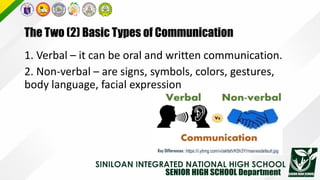
The Two (2) Basic Types of Communication
1. Verbal – it can be oral and written communication.
2. Non-verbal – are signs, symbols, colors, gestures,
body language, facial expression
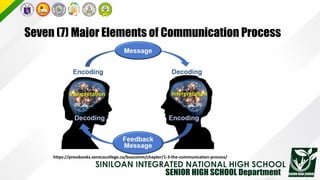
Seven (7) Major Elements of Communication Process
https://pressbooks.senecacollege.ca/buscomm/chapter/1-3-the-communication-process/
Comparison Between Feedback and Response
The difference between response and feedback is that
response is an answer or reply, or something in the
nature of an answer or reply while feedback is critical
assessment on information produced.
The Origin of the Word “Media”
• Print – magazines, journals, and newspapers –
publications.
• Radio and television were added to the mix. However, the
term “publications” would not stretch to fit. Needing a
term that would encompass all these means of
communication.
• Writers borrowed the term “media” from advertising
people, and used it since then to accommodate there
means of communication and even the newer ones, such
as the internet. (Turow 2009)
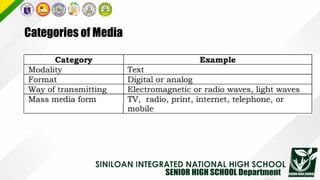
Categories of Media
Media Literacy
• is the ability to access, analyze, response to a range of
media.
• It also evaluates and create media in a variety of forms.
• It aims to empower citizens by providing them with the
competencies (knowledge and skills) necessary to engage
with traditional media and new technologies.
• Example of “range of media” are: print, moving images,
other hybrid forms such as multimedia text.
Information Literacy
• is the ability to recognize when information is needed, and to
locate, evaluate, and effectively communicate information in
its various formats.
• is about using, managing, gathering, and verifying
information. Students learn how to evaluate the quality,
credibility, validity of websites, and give proper credit from
effective search strategies to evaluation techniques.
Technology (Digital) Literacy
• is the ability of an individual, either working independently
or with others, to responsibly, appropriately, and effectively
use technological tools. Using these tools an individual can
access, manage, integrate, evaluate, create and
communicate information.
Media and Information Literacy
Media literacy, information literacy, and technology
literacy are all similar in terms of goals. They all share
the common goal of cultivating people’s ability to
access, understand, use, evaluate, and create media
messages, information, or content using information
technology. They are all similar to the mastery and
understanding of a thing.
Why is it important to be a media and
information literate individual?
Being Media and Information Literate Individual
There are two factors that can influence you to become
a media and information literate individual.
1. Critical thinking
2. Technology

M1......................................

  • 1.
    INTRODUCTION to MEDIAand INFORMATION LITERACY MEDIA and INFORMATION LITERACY (MIL)
  • 2.
    After going throughthis lesson, you are expected to: 1. Describe how communication is affected by media and information. 2. Identify the similarities and differences of media, information, literacy, and technology literacy. 3. Discuss responsible use of media and information.
  • 3.
    What is communication? •isa process by which information is exchanged between individuals through a common system, signs, or behavior. •is the process by which messages or information is sent from one place or person to another, or the message itself.
  • 4.
    The Two (2)Basic Types of Communication 1. Verbal – it can be oral and written communication. 2. Non-verbal – are signs, symbols, colors, gestures, body language, facial expression
  • 5.
    Seven (7) MajorElements of Communication Process https://pressbooks.senecacollege.ca/buscomm/chapter/1-3-the-communication-process/
  • 6.
    Comparison Between Feedbackand Response The difference between response and feedback is that response is an answer or reply, or something in the nature of an answer or reply while feedback is critical assessment on information produced.
  • 7.
    The Origin ofthe Word “Media” • Print – magazines, journals, and newspapers – publications. • Radio and television were added to the mix. However, the term “publications” would not stretch to fit. Needing a term that would encompass all these means of communication. • Writers borrowed the term “media” from advertising people, and used it since then to accommodate there means of communication and even the newer ones, such as the internet. (Turow 2009)
  • 8.
  • 9.
    Media Literacy • isthe ability to access, analyze, response to a range of media. • It also evaluates and create media in a variety of forms. • It aims to empower citizens by providing them with the competencies (knowledge and skills) necessary to engage with traditional media and new technologies. • Example of “range of media” are: print, moving images, other hybrid forms such as multimedia text.
  • 10.
    Information Literacy • isthe ability to recognize when information is needed, and to locate, evaluate, and effectively communicate information in its various formats. • is about using, managing, gathering, and verifying information. Students learn how to evaluate the quality, credibility, validity of websites, and give proper credit from effective search strategies to evaluation techniques.
  • 11.
    Technology (Digital) Literacy •is the ability of an individual, either working independently or with others, to responsibly, appropriately, and effectively use technological tools. Using these tools an individual can access, manage, integrate, evaluate, create and communicate information.
  • 12.
    Media and InformationLiteracy Media literacy, information literacy, and technology literacy are all similar in terms of goals. They all share the common goal of cultivating people’s ability to access, understand, use, evaluate, and create media messages, information, or content using information technology. They are all similar to the mastery and understanding of a thing.
  • 13.
    Why is itimportant to be a media and information literate individual?
  • 14.
    Being Media andInformation Literate Individual There are two factors that can influence you to become a media and information literate individual. 1. Critical thinking 2. Technology