M Advertising 3rd Edition Schaefer Solutions
Manual download pdf
https://testbankfan.com/product/m-advertising-3rd-edition-schaefer-
solutions-manual/
Visit testbankfan.com to explore and download the complete
collection of test banks or solution manuals!
Here are some recommended products for you. Click the link to
download, or explore more at testbankfan.com
M Advertising 3rd Edition Schaefer Test Bank
https://testbankfan.com/product/m-advertising-3rd-edition-schaefer-
test-bank/
M Advertising 2nd Edition Arens Solutions Manual
https://testbankfan.com/product/m-advertising-2nd-edition-arens-
solutions-manual/
M Advertising 2nd Edition Arens Test Bank
https://testbankfan.com/product/m-advertising-2nd-edition-arens-test-
bank/
Canadian Organizational Behaviour 7th Edition McShane Test
Bank
https://testbankfan.com/product/canadian-organizational-behaviour-7th-
edition-mcshane-test-bank/
Basic Marketing Research 8th Edition Brown Test Bank
https://testbankfan.com/product/basic-marketing-research-8th-edition-
brown-test-bank/
Statistics For Managers Using Microsoft Excel 7th Edition
Levine Solutions Manual
https://testbankfan.com/product/statistics-for-managers-using-
microsoft-excel-7th-edition-levine-solutions-manual/
Essentials of Corporate Finance 7th Edition ross Solutions
Manual
https://testbankfan.com/product/essentials-of-corporate-finance-7th-
edition-ross-solutions-manual/
Intermediate Accounting Reporting and Analysis 3rd Edition
Wahlen Solutions Manual
https://testbankfan.com/product/intermediate-accounting-reporting-and-
analysis-3rd-edition-wahlen-solutions-manual/
Developmental Math 3rd Edition Lial Test Bank
https://testbankfan.com/product/developmental-math-3rd-edition-lial-
test-bank/
Financial and Managerial Accounting 15th Edition Warren
Test Bank
https://testbankfan.com/product/financial-and-managerial-
accounting-15th-edition-warren-test-bank/
Chapter 09—Creative Execution: Art and Copy
9-1
Copyright © 2018 McGraw-Hill Education. All rights reserved. No reproduction or distribution without the prior written consent of
McGraw-Hill Education.
CHAPTER NINE
CREATIVE EXECUTION: ART AND COPY
This chapter introduces the role of art and copy—the nonverbal and verbal elements of message
strategy—in print, radio, television, and on the Web. It also describes the artists, copywriters, and a
variety of specialists who follow specific procedures for conceptualizing, designing, writing, and
producing IMC messages. To be successful, creatives must be conversant with copywriting and
commercial art terms and formats used in the business. They must also develop an aesthetic sensitivity
so they can recognize, create, evaluate, or recommend quality work.
Learning Objectives:
LO 09-01 Describe the factors involved in creating print ads.
LO 09-02 List the types of copy and explain how great copy is created in print ads.
LO 09-03 Outline how great copy is created in electronic ads.
LO 09-04 Discuss the role of art in electronic ads.
LO 09-05 Review the unique requirements in writing for the Web.
What’s New?
Our new opening vignette gives the background behind McCann’s “Dumb Ways to Die”
safety PSA for the Australia Metro Trains network. The award-winning campaign uses a
highly creative approach to reduce unsafe behaviors around trains. This chapter features seven
“My Ad Campaign” boxes. The first helps students understand the importance of product
facts. The second offers advice from industry legend George Felton about how to write great
headlines and copy. “My Ad Campaign” box number three discusses the chief focus for
visuals. Box number four gives practical tips about layout and design. Box five gives advice
for writing effective copy, and box six provides similar advice for composing radio
commercials. The last box provides advice for creating television commercials.
Application Exercises
Ad Creation Process
Identify the Types of Headlines
Creating TV Commercials
Dumb Ways to Die
Electronic Creativity: Bleachable Moments
Chapter 09—Creative Execution: Art and Copy
9-2
Copyright © 2018 McGraw-Hill Education. All rights reserved. No reproduction or distribution without the prior written consent of
McGraw-Hill Education.
TEACHING TIPS AND STRATEGIES
Using the Opening Vignette in the Classroom
If you have Internet access in the classroom, show students the “Dumb Ways to Die” spot
(https://youtu.be/IJNR2EpS0jw). If not, ask your students to watch it at home. The ad nicely
demonstrates how creativity and a big idea come together. The point is to illustrate the
creative aspects of advertising deployed on a very serious subject. Ask students to identify
and discuss the creative elements of the spot (copy, art, music, etc.). Then ask them if they
believe it would be effective in changing people’s behaviors. Can creativity sometimes get in
the way of a message? This is a good entry point for discussion of the creative work in
advertising.
Other Tips and Strategies
In this chapter, students are introduced to how ads are created. In television, storyboard scripts are
used to design commercials. Some DVDs have “special features” that show storyboards and the scene
concurrently. I have a couple of movies that I show the class to demonstrate the phenomenon. By
watching the storyboard and the resulting scene, the students get a good idea of why storyboards are so
important in setting up a commercial. A useful DVD for this concept is the special edition of the
movie Suicide Kings (Artisan Home Entertainment, 1998).
Technology and software allow graphic designers to create more effective ads for print. I like to divide
students into groups and have them use different programs to create an ad (usually for the advertising
campaign). Students are amazed at how easy it is to add effects such as darkness or stars to pictures.
They also have fun adding text to pictures. I have had students create animated images. Students enjoy
being creative while simultaneously learning the benefits that software brings to creative departments.
In-class activities can include creating a copy platform for a brand (real or imagined) or pairing up
students as copywriters and art directors and having them work on a rough layout.
Web Resources for Enhancing Your Lectures:
AdWorks http://www.adworkscorp.com
Right Brain Works www.gocreate.com
B Creative www.bcreative.com
Design & Publishing Center www.graphic-design.com
Art Directors Club http://www.adcglobal.org/
American Institute of Graphic Arts www.aiga.org
Copy Chef www.copychef.com
Chapter 09—Creative Execution: Art and Copy
9-3
Copyright © 2018 McGraw-Hill Education. All rights reserved. No reproduction or distribution without the prior written consent of
McGraw-Hill Education.
Ads of the World http://adsoftheworld.com/
Video Resources:
Dumb Ways to Die ad https://www.youtube.com/watch?v=IJNR2EpS0jw&feature=youtu.be
Lubriderm alligator
commercial, 2015
https://www.youtube.com/watch?v=c8mrWAkUM2Y
Flo / Progressive
(presenter
commercial)
https://www.youtube.com/watch?v=3PFebslqRiI
Dyson vacuum
(demonstration
commercial with
humor
https://www.youtube.com/watch?v=aaQ_c1UoXF8
The Tissue Test
(Slice-of-life
commercial)
https://www.youtube.com/watch?v=AP3sCUbChlI
Android Friends
Furever (most shared
viral ad of 2015)
https://www.youtube.com/watch?v=vnVuqfXohxc
Will It Blend? iPhone
6 Plus (viral ad for
BlendTec)
https://www.youtube.com/watch?v=lBUJcD6Ws6s
My Ad Campaign [9-A]: Product Facts for Creatives
My Ad Campaign [9-B]: Creating Great Headlines and Copy
My Ad Campaign [9-C]: Determining the Chief Focus for Visuals
My Ad Campaign [9-D]: Design Principles
Ethical Issues: Imitation, Plagiarism, or Flattery?
My Ad Campaign [9-E]: Writing Effective Copy
My Ad Campaign [9-F]: Creating Effective Radio Commercials
My Ad Campaign [9-G]: Creating Effective TV Commercials
Chapter 09—Creative Execution: Art and Copy
9-4
Copyright © 2018 McGraw-Hill Education. All rights reserved. No reproduction or distribution without the prior written consent of
McGraw-Hill Education.
LECTURE OUTLINE
I. Vignette—The story of how McCann’s Melbourne, Australia, office developed a creative PSA
campaign called “Dumb Ways to Die” to reduce fatal accidents around trains.
II. Delivering on the Big Idea: Integrating the Visual and the Verbal
A. The “Dumb Ways to Die” ad demonstrates that what’s shown is just as important as
what’s said.
B. The nonverbal aspect of an ad carries at least half the burden of communication. It helps
position the product and create personality for the brand. It creates the mood of the ad.
III. The Art of Creating Print Advertising
A. Designing the Print Ad
1. Design refers to how the art director chooses and structures the artistic elements of an
ad. A director sets a style—the manner in which a thought or image is expressed—by
choosing particular artistic elements and blending them in a unique way.
2. Clean lines, formally composed photographs, and sparse copy give ads the breathing
room needed to draw the reader’s eye from one element to the next. Sufficient white
space gives and ad unity and balance.
B. The Use of Layouts
A layout is an overall orderly arrangement of the elements of an ad: visual(s), headline,
subheads, body copy, slogan, seal, logo, and signature. The layout serves several
purposes.
1. It helps both the agency and the client anticipate how the ad will look and feel. This
provides the client a tangible item to review, correct, change, and approve.
2. It helps the creative team develop the ad’s psychological elements: the nonverbal and
symbolic components. Advertisers want their ads to create brand personality, build
brand equity, and create an image or mood that reflects and enhances the advertiser
and the product.
3. Once the best design is chosen, it serves as a blueprint.
C. Advertising Design and Production: The Creative and Approval Process
The design process serves as both a creative and an approval process. In the creative
phase, designers use preliminary versions of the art to establish the ad’s look and feel. The
approval process takes place at each step of the entire design process.
1. Thumbnail Sketches—The thumbnail sketch (or thumbnail) is a very small, rough,
rapidly produced drawing the artist uses to visualize layout approaches without
wasting time on details.
2. Rough Layout—In a rough, the artists draw to the actual size of the ad.
3. Dummy—A dummy presents the handheld look and feel of brochures, multipage
materials, or point-of-purchase displays.
4. Comprehensive and Mechanical—The comprehensive layout, or comp, is a highly
refined facsimile of the finished ad. Copy for the comp is typeset on a computer and
positioned with the visuals, and the ad is printed as a full-color proof. At this stage, all
the visuals are final.
Chapter 09—Creative Execution: Art and Copy
9-5
Copyright © 2018 McGraw-Hill Education. All rights reserved. No reproduction or distribution without the prior written consent of
McGraw-Hill Education.
5. Approval—The work of the copywriter and art director is always subject to approval.
The larger the agency and the larger the client, the more formidable this process
becomes.
APPLICATION EXERCISE: Ad Creation Process
Activity Summary: In this activity, students are reminded that the ad creation process begins
with abstract ideas and then goes through a series of steps leading to a finished advertisement.
In the exercise, students click and drag steps in this process into columns that identify if they
are part of the first, second, or third stage of ad development. (Note: A keyboard accessible
version of this activity is also available.)
Type: Click and Drag
Learning Objectives:
Learning Objective: 09-01 Describe the factors involved in creating print ads.
Difficulty Level: 1 Easy
Blooms: Analyze
AACSB: Analytical Thinking
Follow-Up Activity: Instructors could ask students to produce thumbnails for an
advertisement for a common household product, such as soap.
My Ad Campaign [9-A]: Product Facts for Creatives
Art directors and copywriters must have a thorough understanding of the brand to create
advertising that resonates. Make sure your creatives have the information that will help them
write copy that sizzles and create layouts that stop consumers dead in their tracks.
• Proprietary information
Product’s trade name.
Trademark.
Product symbol.
Other copyrighted or patented information.
• History
When was the product created or invented?
Who introduced it?
Has it had other names?
Have there been product changes?
Is there any “romance” to it?
• Research
Are research results available?
Chapter 09—Creative Execution: Art and Copy
9-6
Copyright © 2018 McGraw-Hill Education. All rights reserved. No reproduction or distribution without the prior written consent of
McGraw-Hill Education.
What research about the product does the supplier have?
Which research will be most useful for each medium?
• Life cycle
What is the product’s life or use span?
What stage is it in now and what style of copy should be used for that stage?
What stages are competitors in?
• Market position
What is the product’s share of the total market?
Does its market share suggest a positioning strategy?
What position does the company wish to occupy?
• Competitive information
Who are the product’s competitors?
Does the product have any advantages over them?
Does it have any disadvantages?
Are they all about the same?
Do rival products present problems that this one solves?
• Product image
How do people view the product?
What do they like about it?
What do they dislike about it?
Is it a luxury?
Is it a necessity?
Is it a habit?
Is it self-indulgent?
Do people have to have it but wish they didn’t?
• Customer use
How is the product used?
Are there other possible uses?
How frequently is it bought?
What type of person uses the product?
Why is the product bought?
Personal use.
Gift.
Work.
What type of person uses the product most (heavy user)?
How much does the heavy user buy?
Chapter 09—Creative Execution: Art and Copy
9-7
Copyright © 2018 McGraw-Hill Education. All rights reserved. No reproduction or distribution without the prior written consent of
McGraw-Hill Education.
Where do the best customers live?
• Performance
What does the product do?
What might it be expected to do that it does not?
How does it work?
How is it made or produced?
What’s in it?
Raw materials.
Special ingredients.
Preservatives.
Chemicals.
Nutrients.
• What are its physical characteristics?
Smell.
Appearance.
Color.
Texture.
Taste.
Others.
• Effectiveness
Is there proof the product has been tested and works well?
Do any government or other regulations need to be mentioned or observed?
How does it work compared to its competitors?
• Manufacturing
How is the product made?
How long does it take?
How many steps are in the process?
How many people are involved in making it?
Are any special machines used?
Where is it made?
• Distribution
How widely is the product distributed?
Are there exclusive sellers?
Is there a ready supply or a limited amount?
Is it available for a short season?
What channels of distribution must be reached?
Chapter 09—Creative Execution: Art and Copy
9-8
Copyright © 2018 McGraw-Hill Education. All rights reserved. No reproduction or distribution without the prior written consent of
McGraw-Hill Education.
• Packaging
Unit size or sizes offered.
Package shape.
Package design.
Styling.
Color.
Special protection for product.
A carrier for product.
Package label.
D. Principles of Design: Which Design Formats Work Best
The advertiser has only a second or two to grab the reader’s attention. Studies show large
numbers of people ignore ads. Good design not only commands attention but also holds it.
1. Advertisers use many types of layouts. Traditionally, the highest scoring ads employ a
standard, poster-style format (also called a picture-window layout or Ayer No. 1 in
the trade), which features a single dominant visual that occupies most of the ad’s total
area.
2. Advertising research indicates the following:
a. Ads scoring in the top third have visuals averaging 82 percent of the space.
b. Next in ranking, ads feature one large picture and two smaller ones.
c. Visuals can stop the reader and arouse interest, so their content must be
interesting.
d. Headlines also stop the reader and may actually contribute more to long-term
memory than the visual.
e. When the headline appears below the illustration, the ad typically gains about 10
percent more readership.
f. Readership can drop if ads have more than 50 words.
g. Copy blocks should be kept to 20 percent of the ad.
h. Ads for high-involvement products do better with long, informative copy when
the advertiser is more interested in quality of readership rather than quantity.
i. For best results, company signatures and logos should be placed in the lower
right-hand corner or across the bottom of the ad, but need not occupy more than 5
to 10 percent of the area.
3. Advertising author Roy Paul Nelson points out that principles of design are to the
layout artist what the rules of grammar are to the writer. Basic rules of design include
the following:
a. The design must be in balance.
b. Space within the ad should be broken into pleasing proportions.
c. A directional pattern should be evident so the reader knows what sequence in
which to read copy.
d. Some force should hold the ad together and give it unity.
Chapter 09—Creative Execution: Art and Copy
9-9
Copyright © 2018 McGraw-Hill Education. All rights reserved. No reproduction or distribution without the prior written consent of
McGraw-Hill Education.
e. One element, or one part of the ad, should have enough emphasis to dominate all
others.
E. The Use of Visuals in Print Advertising
Artists who paint, sketch, and draw in advertising are called illustrators. The artists who
produce pictures with a camera are photographers. Together they are responsible for all
the visuals, or pictures, we see in advertising.
1. Purpose of the Visual—Because it carries so much responsibility for an ad’s success,
the visual, or picture, should be designed with several goals in mind:
a. Capture the reader’s attention.
b. Clarify claims made by the copy.
c. Identify the brand.
d. Show the product actually being used.
e. Qualify readers by stopping those who are legitimate prospects.
f. Convince the reader of the truth of copy claims.
g. Arouse the reader’s interest in the headline.
h. Emphasize the product’s unique features.
i. Create a favorable impression of product or advertiser.
j. Provide continuity for the campaign by using a unified visual technique in each
ad.
2. Selecting the Visual—The kind of picture used is often determined during the
visualization process. Selecting an appropriate photo or visual is a difficult creative
task. Art directors deal with several basic issues:
a. Is a visual needed for effective communication?
b. If a visual is required, how many should there be?
b. Should the visual be black-and-white or color? Is this a budgetary decision?
c. What should the subject of the picture be? Is that subject relevant to the
advertiser’s creative strategy?
d. Should the ad use a hand-rendered illustration, a photograph, or a computer-
generated illustration?
e. What technical and budgetary issues must be considered?
My Ad Campaign [9-B]: Creating Great Headlines and Copy
George Felton, in his book Advertising Concept and Copy, offers the following suggestions
for aspiring copywriters:
Headlines
 “Achieve synergy, not redundancy.” The headlines and artwork should work together to
create an idea, but not be completely redundant.
 “Let the consumer do some of the work.” Avoid ads that insult the audience’s intelligence.
 “Combine overstatement and understatement.” If the visual is BIG, make the headline
small. And vice versa.
 “Emphasize one idea per ad.” If you have several ideas, show how they are linked to make
them one.
Chapter 09—Creative Execution: Art and Copy
9-10
Copyright © 2018 McGraw-Hill Education. All rights reserved. No reproduction or distribution without the prior written consent of
McGraw-Hill Education.
Copy
Freelance copywriter John Kuraoka offers some excellent advice for new copywriters at
http://www.kuraoka.com/how-to-write-better-ads.html.
Here are summaries of his recommendations for your visuals:
 Capture the reader’s attention.
 Clarify copy claims.
 Let the reader know the ad is directed at him or her.
 Show the product in use.
 Offer evidence for copy claims.
 Emphasize the product’s unique features or benefits.
 Unify the different ads in the campaign.
 Check Yourself 9–1
1. What is a layout? What purposes does it serve in the process of print ad development,
approval, and production?
A layout provides for an orderly arrangement of the needed elements in an ad: visuals,
headline, subheads, body copy, and slogans. It allows the agency and client to develop
the ad and agree to its content.
2. How does an art director choose from among design formats?
Art directors choose design formats that attract customers and draw them into the ads.
A poster style format with a single, dominant visual has proven to be effective.
3. What is the purpose of the visual in a print ad?
A visual must capture the reader’s attention, demonstrate the product being used, and
emphasize the product’s unique features.
IV. Producing Great Copy in Print Advertising
In print advertising, the key format elements are the visual(s), headlines, subheads, body copy,
slogans, logos, and signatures. Copywriters can correlate the visual and headline to the
attention step of the creative pyramid. The interest step typically corresponds to the subhead
and the first paragraph of body copy. Body copy handles credibility and desire, and the action
step takes place with the logo, slogan, and signature block.
My Ad Campaign [9-C]: Determining the Chief Focus for Visuals
Selecting the focus for advertising visuals is a major step in the creative process. It often
determines how well the big idea is executed. Print advertising uses many standard subjects
for ad visuals, including
1. The package containing the product. Especially important for packaged goods, it helps the
consumer identify the product on the grocery shelf.
2. The product alone. This usually does not work well for nonpackaged goods.
3. The product in use. Automobile ads typically show a car in use while talking about its
ride, luxury, handling, or economy. Cosmetics ads usually show the product in use with a
close-up photo of a beautiful woman or a virile man.
Chapter 09—Creative Execution: Art and Copy
9-11
Copyright © 2018 McGraw-Hill Education. All rights reserved. No reproduction or distribution without the prior written consent of
McGraw-Hill Education.
4. How to use the product. Recipe ads featuring a new way to use food products have
historically pulled very high readership scores.
5. Product features. Computer software ads frequently show the monitor screen so the
prospect can see how the software features are displayed.
6. Comparison of products. The advertiser shows its product next to a competitor’s and
compares important features.
7. User benefit. It’s often difficult to illustrate intangible user benefits. However, marketers
know that the best way to get customers’ attention is to show how the product will benefit
them, so it’s worth the extra creative effort.
8. Humor. If used well, a humorous visual can make an entertaining and lasting impression.
But it can also destroy credibility if used inappropriately.
9. Testimonial. Before-and-after endorsements are very effective for weight-loss products,
skin care lotions, and bodybuilding courses.
10. Negative appeal. Sometimes visuals point out what happens if you don’t use the product.
If done well, that can spark interest.
A. Headlines
The headline contains the words in the leading position of the advertisement. These are
the words that will be read first and are situated to draw the most attention. Headlines
usually appear in larger type than other parts of the ad.
1. Role of Headlines
a. Effective headlines do the following:
i. Attract attention to the ad.
ii. Engage the audience.
iii. Explain the visual.
iv. Lead the audience into the body of the ad.
v. Present the key benefit.
b. Headlines should engage the reader—fast—and give a reason to read the rest of
the ad.
c. Ideally, headlines should do the following:
i. Present the complete selling idea. Three to five times as many people read the
headline as read the body copy. Most headlines average eight words.
ii. Offer a benefit that is apparent to the reader and easy to grasp.
iii. Present product news.
My Ad Campaign [9-D]: Design Principles
Make sure your layout follows these rules of thumb for creating attractive, informative ads.
Balance
The optical center is the reference point that determines the layout’s balance. The optical
center is about one-eighth of a page above the physical center of the page. Balance is achieved
through the arrangement of elements on the page—the left side of the optical center versus the
right, above the optical center versus below.
Chapter 09—Creative Execution: Art and Copy
9-12
Copyright © 2018 McGraw-Hill Education. All rights reserved. No reproduction or distribution without the prior written consent of
McGraw-Hill Education.
___Formal balance. Perfect symmetry is the key to formal balance: matched elements on
either side of a line dissecting the ad have equal optical weight. This technique strikes a
dignified, stable, conservative image.
___Informal balance. A visually balanced ad has elements of different size, shape, color
intensity, or darkness at different distances from the optical center. Like a teeter-totter, an
object of greater optical weight near the center can be balanced by an object of less weight
farther from the center. Many ads use informal balance to make the ad more interesting,
imaginative, and exciting.
Movement
Movement is the principle of design that causes the audience to read the material in the
desired sequence. It can be achieved through a variety of techniques.
___People or animals can be positioned so that their eyes direct the reader’s eyes to the next
important element.
___Devices such as pointing fingers, boxes, lines, or arrows (or moving the actors or the
camera or changing scenes) direct attention from element to element.
___Design can take advantage of readers’ natural tendency to start at the top left corner of the
page and proceed in a Z motion to the lower right.
___Comic-strip sequence and pictures with captions force the reader to start at the beginning
and follow the sequence in order to grasp the message.
___Use of white space and color emphasizes a body of type or an illustration. Eyes will go
from a dark element to a light one, or from color to noncolor.
___Size itself attracts attention because readers are drawn to the biggest and most dominant
element on the page, then to smaller elements
Proportion
___Elements should be accorded space based on their importance to the entire ad. Attention-
getting elements are usually given more space. Avoid the monotony of giving equal
amounts of space to each element.
White Space (Isolation)
___White space is the part of the ad not occupied by other elements (note that white space
may be some color other than white). White space helps focus attention on an isolated
element—it makes the copy appear to be in a spotlight. White space is an important
contributor to the ad’s overall image.
Contrast
___An effective way of drawing attention to a particular element is to use contrast in color,
size, or style; for example, a reverse ad (white letters against a dark background) or a
black-and-white ad with a red border.
Clarity and Simplicity
Chapter 09—Creative Execution: Art and Copy
9-13
Copyright © 2018 McGraw-Hill Education. All rights reserved. No reproduction or distribution without the prior written consent of
McGraw-Hill Education.
___Any elements that can be eliminated without damaging the overall effect should be cut.
Too many type styles; type that is too small; too many reverses, illustrations, or boxed
items; and unnecessary copy make for an overly complex layout and an ad that is hard to
read.
Unity
___Unity means that an ad’s many different elements must relate to one another in such a way
that the ad gives a singular, harmonious impression. Balance, movement, proportion,
contrast, and color may all contribute to unity of design. Many other techniques can be
used: type styles from the same family, borders around ads to hold elements together,
overlapping one picture or element on another, judicious use of white space, graphic tools
such as boxes, arrows, or tints.
Continuity
___Continuity is the relationship of one ad to the rest of the campaign. This is achieved by
using the same design format, style, and tone; the same spokesperson; or the same graphic
element, logo, cartoon character, or catchy slogan.
Ethical Issues: Imitation, Plagiarism, or Flattery?
1. Some art directors claim that “coincidental invention” explains why many ads look the
same. Do you think that’s really possible?
Answer guidelines:
Plagiarism is, in essence, using another’s idea or product and trying to pass it off as one’s
own original idea or product. A freelance artist created an illustration using Photoshop
software that distorted a photograph, found in a promotional brochure, of a man with a
clock face for a head. The photographer then saw the illustration published in Newsday, a
Long Island, New York, newspaper (tabloid size) and sued the publication.
In another case, a historian was sued and his credibility was damaged when a few
paragraphs of his book used some of the same words and short phrases from a footnoted
source.
When an ad “borrows” a concept or “look” (by modifying an existing model), the
advertiser can usurp the creativity of others and pay a big price. In addition, today’s
software can more easily create distorted images that mislead—and that’s illegal.
Defenses to claims of plagiarism include:
a. It is possible, although not probable, that two or more similar executions could be
developed by different advertisers at the same time, particularly in the same product
category.
b. Intent is a key issue that must sometimes be proven in law. People often get a hot idea,
not realizing that they actually saw something like it in the media a few months
earlier—they just forgot what they had seen and lacked true “intent” to actually steal
the idea.
c. Courts will ask: Is the initial idea original enough to be plagiarized?
d. The law will seek proof that a chain of events existed for the alleged pirate to have
had access to the idea.
Chapter 09—Creative Execution: Art and Copy
9-14
Copyright © 2018 McGraw-Hill Education. All rights reserved. No reproduction or distribution without the prior written consent of
McGraw-Hill Education.
There is no denying that success breeds imitation, and not just in ad agencies. Alfred
Whitehead contended a hundred years ago that the history of Western philosophy was one
long footnote to Plato, and, indeed, his basic ideas do form the foundation of some of
contemporary philosophy. “Imitation is the sincerest form of flattery.” It is almost
impossible to get an imitator to admit copycat advertising, let alone pull it from the
marketplace. Once an advertising campaign is out there, millions of dollars have probably
been committed to executing it, but a successful lawsuit can stop it from running.
2. Who wins and who loses when advertising is imitated? Do you believe that it’s actually an
advantage to be copied?
Answer guidelines:
The crux of the problem may be that imitation is an accepted part of the business, at least
unofficially. Clients tend to avoid the debate, perhaps because they’re more comfortable
with well-worn ideas than with bold, original concepts. Many art directors and writers
collect competitive ads for inspiration. And advertising is such a highly collaborative
process that it’s often difficult to determine each individual’s creative contribution.
Few art directors and writers are likely to say it’s an advantage to be copied. They are
least likely to be concerned when the ads in question are for non-competing products and
therefore are aimed at different consumer bases.
3. What would you do if a client asked you to copy an ad that was already running? Is it
acceptable to plagiarize advertising ideas, as long as they are recycled “in a useful way”?
Client awareness of the issue can be raised by reminding them of the consequences of
legal action and consumer backlash that may occur from plagiarizing.
Sometimes clients even request that a competitor’s advertising be copied. That is also why
there are so many voice-over announcers who mimic famous voices and announcing
styles. The creative person who goes along with the client’s request to imitate a successful
campaign jeopardizes his or her financial future and career. The only way to avoid
compromising personal ethics is to come up with something better, and then convince the
client to run it instead. However, that can be a very dicey proposition.
4. Is plagiarism justified by the contention that “there are very few original ideas”?
Answer guidelines:
Yes: “There are very few original ideas,” according to Philip Circus, an advertising law
consultant to the Newspaper Society in London. “Plagiarism is the name of the game in
advertising. It’s about recycling ideas in a useful way.”
No: Jim Golden, executive producer of DMH MacGuffin, says, “All we have in this
business are creativity and ideas. The moment someone infringes on that, they’re reaching
into the very core of the business and ripping it out.” Ultimately, advertisers must stop
“borrowing” ideas from each other and demand greater creativity from themselves.
2. Types of headlines—Copywriters use many variations of headlines depending on the
advertising strategy. Typically, they use the headline that presents the big idea most
successfully. Headlines may be classified by the type of information they carry:
a. Benefit headlines promise the audience that experiencing the utility of the
product or service will be rewarding.
b. News/information headlines announce news or promise information.
c. Provocative headlines provoke the reader’s curiosity.
Chapter 09—Creative Execution: Art and Copy
9-15
Copyright © 2018 McGraw-Hill Education. All rights reserved. No reproduction or distribution without the prior written consent of
McGraw-Hill Education.
d. Question headlines ask a question, encouraging readers to search for the answer
in the body of the ad.
e. Command headlines order readers to do something; sometimes this might seem
negative, but readers pay attention to such headlines.
APPLICATION EXERCISE: Identify the Types of Headlines
Activity Summary: This activity tests student knowledge of the different types of headlines
used in advertising. In the exercise, students click and drag sample headlines to the boxes that
identify what type of headline each one exemplifies. (Note: A keyboard accessible version of
this activity is also available.)
Type: Click and Drag
Learning Objectives:
Learning Objective: 09-02 List the types of copy and explain how great copy is created in
print ads.
Difficulty Level: 1 Easy
Blooms: Analyze
AACSB: Analytical Thinking
Follow-Up Activity: Instructors could ask volunteers to suggest headlines that could be used
in an advertising campaign aimed at convincing more people to ride the bus. Instructors
should challenge students to use all of the different types of headlines.
B. Subheads
1. A subhead is an additional smaller headline that may appear above or below headline.
A subhead above the headline is called a kicker (or overline), while those below the
headline are called underlines. Subheads may also appear in body copy.
2. Subheads are usually set smaller than the headline but larger than the body copy.
Subheads generally appear in boldface type, italic type, or a different color. Most
people only read the headline and subhead. Subheads usually support the interest step
best.
3. Subheads are longer and more like sentences than headlines.
C. Body Copy
The advertiser tells the complete story in the body copy, or text. The body copy
comprises the interest, credibility, desire, and often even the action steps. It is a logical
continuation of the headline and subheads, set in smaller type. It must speak to the
reader’s self-interest, explaining how the product or service satisfies the customer’s need.
1. Body Copy Styles—Experienced copywriters look for the technique and style with the
greatest sales appeal for the idea being presented. Common copy styles include the
following:
a. Straight-sell copy immediately explains or develops the headline and visual in a
straightforward, factual presentation that appeals to the prospect’s intelligence.
Chapter 09—Creative Execution: Art and Copy
9-16
Copyright © 2018 McGraw-Hill Education. All rights reserved. No reproduction or distribution without the prior written consent of
McGraw-Hill Education.
b. Institutional copy promotes a philosophy or extols the merits of an organization
rather than product features.
c. Narrative copy tells a story. Ideal for the creative writer, narrative copy sets up a
situation and then resolves it at the last minute by having the product or service
come to the rescue. Allows for emotional appeals.
d. Dialogue/monologue copy adds the believability that narrative copy sometimes
lacks. The characters portrayed in a print ad do the selling in their own words.
e. Picture-caption copy uses illustrations and captions to tell the story. It is
particularly useful for products that have a number of different uses or come in a
variety of styles or designs.
f. Device copy may be used to enhance attention, interest, and memorability. Device
copy uses figures of speech as well as humor and exaggeration. These can help
people remember the brand and tend to affect attitudes favorably. Humor comes
with certain issues:
i. Humor should always be used carefully and never be in questionable taste.
ii. Humor grows old very quickly.
iii. Some believe humor distracts readers.
My Ad Campaign [9-E]: Writing Effective Copy
 Get to the main point—fast.
 Emphasize one major idea simply and clearly.
 Be single-minded. Don’t try to do too much. If you chase more than one rabbit at a time,
you’ll catch none.
 Position the product clearly.
 Keep the brand name up front and reinforce it.
 Write with the consumer’s ultimate benefit in mind.
 Write short sentences. Use easy, familiar words and themes people understand.
 Don’t waste words. Say what you have to say—nothing more, nothing less. Don’t pad,
but don’t skimp.
 Avoid bragging and boasting. Write from the reader’s point of view, not your own.
Avoid “we,” “us,” and “our.”
 Avoid clichés. They’re crutches; learn to get along without them. Bright, surprising words
and phrases perk up readers and keep them reading.
 Write with flair. Drum up excitement. Make sure your own enthusiasm comes through in
the copy.
 Use vivid language. Use lots of verbs and adverbs.
 Stick to the present tense, active voice. It’s crisper. Avoid the past tense and passive
voice. Exceptions should be deliberate, for special effect.
 Use personal pronouns. Remember, you’re talking to just one person, so talk as you
would to a friend. Use “you” and “your” whenever appropriate.
 Use contractions. They’re fast, personal, natural. People talk in contractions (listen to
yourself).
Chapter 09—Creative Execution: Art and Copy
9-17
Copyright © 2018 McGraw-Hill Education. All rights reserved. No reproduction or distribution without the prior written consent of
McGraw-Hill Education.
 Don’t overpunctuate. It kills copy flow. Excessive commas are the chief culprits. Don’t
give readers any excuse to jump ship.
 Read the copy aloud. Hear how it sounds; catch errors. The written word is considerably
different from the spoken word so listen to it.
 Rewrite and write tight. Edit mercilessly. Tell the whole story and no more. When
you’re finished, stop.
2. Formatting Body Copy—The keys to good body copy are simplicity, order,
credibility, and clarity. Four basic format elements are used to construct body copy:
a. The lead-in paragraph is a bridge between the headline and the sales idea
presented in the text. It is part of the interest step.
b. Interior paragraphs develop credibility by providing proof for claims and build
desire by using language that stirs the imagination.
c. A trial close can be interspersed in the interior paragraphs with suggestions to act
now. The trial close encourages a consumer to make the buying decision early.
d. The close is the real action step. A good close asks consumers to do something
and tells them how. The close can be direct or indirect. A direct close seeks
immediate response in the form of a purchase, a store or website visit, or a request
for further information.
D. Slogans
1. Many slogans (also called themelines or taglines) begin as successful headlines, and,
through continuous use, become standard statements (not only in advertising but also
for salespeople and company employees, e.g., “Diamonds are forever” or “Reach out
and touch someone”).
2. Slogans have two purposes:
a. Provide continuity to an ad series.
b. Reduce an advertising message strategy to a brief, repeatable, and memorable
positioning statement.
E. Seals, Logo, and Signatures
1. A seal is awarded only when a product meets standards established by a particular
organization, such as the Good Housekeeping Institute or Underwriters Laboratories.
Because these organizations are recognized authorities, their seals provide an
independent, valued endorsement for the advertiser’s product.
2. Logotypes and signatures are special designs of the advertiser’s company name or
product name. Like trademarks, they give the product or company individuality and
quick recognition.
 Check Yourself 9–2
1. What are the key format elements in a print ad?
Key format elements include the use and placement of visuals, headline, body copy,
slogan, seal, logo, and signature.
2. What are some important types of headlines?
Chapter 09—Creative Execution: Art and Copy
9-18
Copyright © 2018 McGraw-Hill Education. All rights reserved. No reproduction or distribution without the prior written consent of
McGraw-Hill Education.
Important types of headlines are benefit headlines (which promise that experiencing
the utility of the product or service will be rewarding), news/information headlines
(which announce news or promise information), provocative headlines (which
provoke curiosity), question headlines (which encourage readers to search for the
answer in the body of the ad), and command headlines (which order the reader to do
something).
3. When would an advertiser use straight-sell copy rather than device copy?
Straight-sell copy works with concise facts and is good for high think-involvement
products or products that are difficult to use, while device copy opts for figures of
speech, humor, and exaggeration, and is good for building brand recognition.
V. Creating Great Copy in Electronic Media
For electronic media, the fundamental elements—the five steps of the creative pyramid—
remain the primary guides, but the copywriting formats differ. Radio and television writers
prepare scripts and storyboards.
A. Writing Radio Copy
1. A script resembles a two-column list. On the left side, speakers’ names are arranged
vertically along with descriptions of any sound effects (SFX) and music. The right
column contains the dialogue, called the audio.
2. Radio listeners usually decide within five to eight seconds whether to pay attention;
thus, radio copy must be intrusive (people listen while doing something else).
2. Scripts must fit time slots. With electronic compression, ads can now include 10 to 30
percent more copy than text read live. The following is a good rule of thumb:
10 seconds = 20–25 words
20 seconds = 40–45 words
30 seconds = 60–70 words
60 seconds = 130–150 words
3. Radio writing must be clear because the listener cannot refer back to clarify meaning.
B. Writing Television Copy
1. Radio’s basic two-column format also works for television, but in a TV script, the left
side is titled “Video” and the right side “Audio.”
a. The video column describes the visuals and production: camera angles, action,
scenery, and stage directions.
b. The audio column lists spoken copy, sound effects, and music.
2. The writer sets the tone and the language that determines the visuals.
My Ad Campaign [9-F]: Creating Effective Radio Commercials
Writing for radio takes a sharp ear, empathy for the listener, and the ability to create pictures
inside the consumer’s head. These tips will help you create great radio spots.
 Make the big idea crystal clear. Concentrate on one main selling point. Radio is a good
medium for building brand awareness, but not for making long lists of copy points or
complex arguments.
 Mention the advertiser’s name early and often. If the product or company name is
tricky, consider spelling it out.
Chapter 09—Creative Execution: Art and Copy
9-19
Copyright © 2018 McGraw-Hill Education. All rights reserved. No reproduction or distribution without the prior written consent of
McGraw-Hill Education.
 Take time to set the scene and establish the premise. A 30-second commercial that
nobody remembers is a waste of money. Fight for 60-second spots.
 Use familiar sound effects. Ice tinkling in a glass, birds chirping, or a door shutting can
create a visual image. Music also works if its meaning is clear.
 Paint pictures with your words. Use descriptive language to make the ad more
memorable.
 Make every word count. Use active voice and more verbs than adjectives. Be
conversational. Use pronounceable words and short sentences.
 Be outrageous. The best comic commercials begin with a totally absurd premise from
which all developments follow logically. But remember, if you can’t write humor really
well, go for drama.
 Ask for the order. Try to get listeners to take action.
 Remember that radio is a local medium. Adjust your commercials to the language of
your listeners and the time of day they’ll run.
 Presentation counts a lot. Even the best scripts look boring on paper. Acting, timing,
vocal quirks, and sound effects bring them to life.
 Check Yourself 9–3
1. From the writer’s perspective, what are the important differences between a radio
listener and a print ad reader?
Radio copywriting must be clear and concise. The listener can’t refer back to previous
words, as one might while reading a print ad. Also, the English language has a variety
of homonyms—words that sound alike and can cause problems in an audio format.
2. What is the approximate word limit of a 30-second radio ad?
A 30-second radio ad can feature a maximum of 60 to 70 words.
3. What are the two columns labeled in a TV script?
In a TV script, the left side is “video” and the right side is “audio.”
VI. The Role of Art in Radio and TV Advertising
A. Developing the Artistic Concept for Commercials
Creating the concept for a radio or TV commercial is similar to creating the concepts for
print ads.
1. The first step is to determine the big idea.
2. Then the art director and copywriter must decide what commercial format to use.
3. The next step is to write a script containing the necessary copy or dialogue plus a
basic description of any music, sound effect, and/or camera views.
4. In both radio and TV, the art director assists the copywriter in script development.
Artistic development in television is much more extensive. Using the TV script, the
art director creates a series of storyboard roughs to present the artistic approach, the
action sequences, and the style of the commercial.
B. Formats for Radio and TV Commercials
Similar to print advertising, the format for a broadcast ad serves as a template for
arranging message elements into a pattern. Eight common commercial formats can be
used for either radio or television:
Chapter 09—Creative Execution: Art and Copy
9-20
Copyright © 2018 McGraw-Hill Education. All rights reserved. No reproduction or distribution without the prior written consent of
McGraw-Hill Education.
1. The straight announcement is the oldest and simplest type of radio or TV
commercial, and is probably the easiest to write. One person, usually a radio or TV
announcer, delivers the sales message.
a. In radio, a straight announcement can also be designed as an integrated
commercial—that is, it can be woven into a show or tailored to a given program.
b. For TV, an announcer may deliver the sales message on camera or off screen, as
a voice-over, while a demonstration, slide, or film shows on screen.
2. Presenter commercials use one person or a character to present the product and carry
the sales message. Some presenters are celebrities, like Brad Pitt for Calvin Klein. A
radio personality (such as Rush Limbaugh or Howard Stern) may ad-lib an ad
message live in his or her own style.
3. Testimonial ads allow a satisfied user to tell how effective the product is; this can be
highly credible in both TV and radio advertising.
4. Demonstration spots are especially suitable for television. Products can be
demonstrated in use, in competition, or before and after.
5. Musical commercials (or jingles), if done well, can have an enormous impact on the
success of a commercial. Done poorly, they can waste the advertising budget and
annoy audiences.
6. Slice-of-life (problem-solution) ads are a dramatization of a real-life situation where
an issue is discussed and resolved with a successful trial use of the product. The key to
effective slice-of-life commercials is simplicity. Often a mnemonic device can
dramatize the product benefit and trigger instant recall; e.g., the Aflac duck reminds
users that Aflac is there to pay bills if you get hurt and can’t work.
7. The lifestyle technique presents a user rather than presenting the product, showing
characters working in various occupations and participating in many pastimes. For
example, the person who drinks the product would be more strongly presented than
the product’s features.
8. Animation, such as cartoons, puppet characters, and demonstrations (e.g., pounding
headache) with computer-generated graphics are very effective for communicating
difficult messages or for reaching specialized markets (e.g., children).
My Ad Campaign [9-G]: Creating Effective TV Commercials
 Begin at the finish. Concentrate on the final impression the commercial will make.
 Create an attention-getting opening. An opening that is visually surprising or full of
action, drama, humor, or human interest sets the context and allows a smooth transition to
the rest of the commercial.
 Use a situation that grows naturally out of the sales story. Avoid distracting gimmicks.
Make it easy for viewers to identify with the characters.
 Characters are the living symbol of the product. They should be appealing, believable,
nondistracting, and most of all, relevant.
 Keep it simple. The sequence of ideas should be easy to follow. Keep the number of
elements in the commercial to a bare minimum.
 Write concise audio copy. The video should carry most of the weight. Fewer than 2
words per second is effective for demonstrations. For a 60-second commercial, 101 to 110
words is most effective; more than 170 words is too talky.
 Make demonstrations dramatic but believable. They should always be true to life and
avoid the appearance of camera tricks.
Chapter 09—Creative Execution: Art and Copy
9-21
Copyright © 2018 McGraw-Hill Education. All rights reserved. No reproduction or distribution without the prior written consent of
McGraw-Hill Education.
 Let the words interpret the picture and prepare viewers for the next scene. Use
conversational language; avoid “ad talk,” hype, and puffery.
 Run scenes five or six seconds on average. Rarely should a scene run less than three
seconds. Offer a variety of movement-filled scenes without “jumping.”
 Keep the look of the video fresh and new.
C. Outlining a TV Commercial
After the creative team selects the big idea and format, the art director and the writer
develop the script. The art director’s role is important, for he or she must work with a
variety of professionals in producing the spot (producers, directors, lighting technicians,
and set designers).
1. Storyboard Design
a. Once the basic script is completed, the art director must turn the video portion of
the script into real images. This is done with a storyboard, a sheet preprinted with
a series of 8 to 20 blank windows (frames) in the shape of TV screens.
b. Like a rough layout in print advertising, the storyboard works like a comic strip to
portray how each scene will appear and in what sequence. It helps executives,
clients, and creatives visualize the action and story.
2. To supplement the storyboard or pretest a concept, a commercial may be taped in
rough form using the writers and artists as actors.
3. Alternatively, an animatic may be shot. This is a filmstrip composed of the sketches
in the storyboard accompanied by the audio portion of the commercial synchronized
on tape.
APPLICATION EXERCISE: Creating TV Commercials
Activity Summary: In this activity, students demonstrate their knowledge of broadcast
commercials. The exercise presents students with a case study about a creative team at an
advertising agency that is developing a new commercial for a client. It then asks students
multiple choice questions about different types of commercials and how commercials are
developed.
Type: Case Analysis
Learning Objectives:
Learning Objective: 09-03 Outline how great copy is created for electronic ads.
Difficulty Level: 1 Easy, 2 Medium
Blooms: Analyze, Remember
AACSB: Analytical Thinking
Follow-Up Activity: Instructors could show students commercials and ask them to identify
what type each one is an example of. Alternatively, instructors could as volunteers to describe
examples of the various types of broadcast commercials that they have encountered in their
own lives.
Chapter 09—Creative Execution: Art and Copy
9-22
Copyright © 2018 McGraw-Hill Education. All rights reserved. No reproduction or distribution without the prior written consent of
McGraw-Hill Education.
APPLICATION EXERCISE: Dumb Ways to Die
Activity Summary: In this activity, students are instructed to review the text, paying
particular attention to the opening vignette about Metro Trains' "Dumb Ways to Die"
campaign. They then view a commercial from that campaign and answer multiple choice
questions about how it was created, the format it uses, and why the ad takes the form that it
does.
Type: Video Case
Learning Objectives:
Learning Objective: 09-03 Outline how great copy is created for electronic ads.
Learning Objective: 09-04 Discuss the role of art in electronic ads.
Difficulty Level: 1 Easy, 2 Medium
Blooms: Apply, Remember
AACSB: Reflective Thinking
Follow-Up Activity: Instructors could propose other common formats for commercials (e.g.,
straight announcement, demonstration) and ask students whether or not they would be suitable
for Metro Trains' campaign. Students should be pressed to explain why the various formats
are, or are not, suitable.
APPLICATION EXERCISE: Electronic Creativity: Bleachable Moments
Activity Summary: This activity teaches students about the use of creativity in electronic
media with a real-life example, the "Bleachable Moments" campaign for Clorox. In the
exercise, students view a video that describes the development of the campaign and shows
examples of how it deployed creativity. They then answer multiple choice questions about the
campaign.
Type: Video Case
Learning Objectives:
Learning Objective: 09-03 Outline how great copy is created for electronic ads.
Learning Objective: 09-06 Differentiate the important print and broadcast production methods.
Difficulty Level: 1 Easy, 2 Medium
Blooms: Evaluate, Remember, Understand
AACSB: Reflective Thinking
Follow-Up Activity: Instructors could assign students into small groups and task them with
creating a television script for a new ad in the "Bleachable Moments" campaign. Students
should be instructed to maintain the style and approach of the real campaign, and also
encouraged to use creativity in their commercial.
Chapter 09—Creative Execution: Art and Copy
9-23
Copyright © 2018 McGraw-Hill Education. All rights reserved. No reproduction or distribution without the prior written consent of
McGraw-Hill Education.
 Check Yourself 9–4
1. What is a storyboard?
A storyboard is a preprinted sheet with 8 to 20 blank frames, which can be used to
illustrate the text, sound effects, and camera angles for a TV commercial.
2. What is the oldest and simplest radio or TV commercial format?
The oldest format is the straight announcement, where a radio or TV announcer
delivers the sales message.
3. What TV format would help present the user rather than the product?
The lifestyle technique positions the user in an attractive lifestyle as the primary
selling point of the ad.
VII. Writing for the Web
Digital media are young, and advertisers and agencies are still learning how best to use
these platforms. Research is beginning to offer concrete suggestions that can help a
designer create more effective digital messages.
A. Interactivity
1. The interactive nature of the Internet creates opportunities for a mutually
satisfying dialogue between advertiser and consumer.
2. Ultimately, that dialogue can help build brand loyalty and lead to a sale.
3. Conversely, companies that use digital media ineffectively (or ignore the medium
altogether) may lose new customers or damage their relationships with existing
ones.
B. E-fluentials
1. Internet users are often important opinion leaders.
2. Burson-Marsteller, a New York PR firm, has published research indicating that
there is a small but highly influential group of heavy Internet users who are likely
to share their opinions with others.
3. These users are referred to as e-fluentials.
C. Company Websites
1. When designing a company website, it is important to understand why people
visit the site.
2. Effectively designed websites help visitors find information quickly and
efficiently. The layout of the site should match common scanning patterns.
3. Colors and photographs should be carefully chosen to enhance the layout, attract
Internet users, and guide their gaze through the page.
D. Banner Ads
1. The purpose of a banner ad is to bring Internet users to a website other than the
one they intended to visit.
2. Once the dominant advertising approach, banner ads now compete with many
other online forms.
3. Effective banner ads are simple, focused, and clear about a product’s benefit and
make use of a striking image and emphasize a palette of rich, powerful colors.
E. Viral Ads
Chapter 09—Creative Execution: Art and Copy
9-24
Copyright © 2018 McGraw-Hill Education. All rights reserved. No reproduction or distribution without the prior written consent of
McGraw-Hill Education.
Special video commercials on the Web are often called “viral” ads because they rely
on Internet users to spread messages to others. Viral ads must be entertaining and
informative or they won’t be passed along to others. Matthew Yeoman makes five
recommendations about creating a successful viral message:
1. Don’t be traditional: Messages that look like TV or print ads aren’t shared. Use a
big idea that captivates and motivates sharing.
2. Reality attracts: Use real people and real situations.
3. Push the envelope: People won’t watch a blender viral, unless the viral features a
blender shredding an iPhone, a paintball, or a DVD. BlendTec found success
doing just that.
4. Thank your users: Pepsi has created a game featured right on its vending
machines that offers free sodas for those who play and win.
5. Find partners: How could A&A’s The Walking Dead collaborate with UC Irvine?
My creating a MOOC about zombies, of course. And who can resist zombies?
 Check Yourself 9–5
1. What should a web ad designer understand about the medium?
Web ad designers must write in a specific style:
 Information must be concise and comprehensive.
 Numbered lists and bulleted items are helpful.
 The Web provides space for in-depth elaboration where necessary.
 The text should be scannable.
 Text should be written in an objective rather than a promotional style.
2. In what ways are Internet users different from users of traditional media?
Internet users are interactive with their media and are often opinion leaders.
Exploring the Variety of Random
Documents with Different Content
Many of the fallen menhirs in these alignments have been restored
to their upright position by the French Government. Some of them
may have been overturned in compliance with the decree of 658 a.d.
above referred to. Several of the loftier menhirs are surmounted by
crosses of stone or iron.
Both circles and alignments are associated with holidays and the
lighting of fires on certain days of the year. This custom has
remained more general in Brittany than in Britain. At Mount St.
Michael, near Carnac, the custom still prevails of lighting a large
bonfire on its summit at the time of the summer solstice; others,
kindled on prominent eminences for a distance of twenty or thirty
miles round, reply to it. These fires are locally called “Tan Heol,” and
also by a later use, Tan St. Jean. In Scotland there was a similar
custom in the first week in May under the name of Bel Tan, or Baal’s
Fire; the synonym for summer used by Sir Walter Scott in the “Lady
of the Lake”:—
Ours is no sapling chance-sown by the fountain,
Blooming at Beltane in winter to fade.
At Kerlescant the winter solstice is celebrated by a holiday, whilst
Menec greets the summer solstice, and Kermario the equinoxes, with
festivals. Concerning these fires and the associated customs Mr.
Frazer’s “Golden Bough” is a perfect mine of information and should
be consulted. It may simply be said here that the May and
November, and June and December fires seem to be the most
ancient. It is stated that the Balder bale fires on Mayday Eve were
recognised by the primitive race, and I shall prove this in the sequel
when British customs are referred to. On the introduction of
Christianity the various customs were either transferred to or
reorganised in association with church festivals; but as some of
these, such as Easter, are movable feasts, it is difficult to follow the
dates.
Regarding both circles and alignments in the light of the
orientation theory, we may consider simple circles with a central
stone as a collection of sight-lines from the central stone to one or
more of the outer ones, or the interval between any two; indicating
the place of the rise or setting of either the sun or a star on some
particular day of the year, which day, in the case of the sun, will be a
new year’s day.
Alignments, on the other hand, will play the same part as the
sight-lines in the circles.
Sometimes the sight-line may be indicated by a menhir outside,
and even at a considerable distance from, the circle; later on tumuli
replaced menhirs.
The dolmens have, I am convinced, been in many cases not
graves originally, but darkened observing places whence to observe
along a sight-line; this would be best done by means of an allée
couverte, the predecessor of the darkened naos at Stonehenge,
shielded by its covered trilithons.
In order to obtain some measurements to test the orientation
theory in Britain, I found that Stonehenge is the ancient monument
in this country which lends itself to accurate theodolite work better
than any other. Mr. Spence’s excellent work on astronomical lines at
Stenness, where the stones, till some years ago at all events, have
been more respected than further south, suggested a beginning
there, but the distance from London made it impossible.
Avebury and Stanton Drew are well known to a great many
archæologists; there are also other very wonderful stone circles near
Keswick and in other parts of England; but unfortunately it is very
much more difficult to get astronomical data from these ancient
monuments than it is in the case of Stonehenge, one reason being
that Stonehenge itself lies high, and the horizon round it in all
directions is pretty nearly the same height, so that the important
question of the heights of the hills along the sight-line—a matter
which is fundamental from an astronomical point of view, although it
has been neglected, so far as I can make out, by most who have
made observations on these ancient monuments—is quite a simple
one at Stonehenge. Hence it was much easier to determine a date
there than by working at any of the other ancient remains to which I
have referred.
In orientation generally—such orientation as has been dealt with
by Mr. Penrose and myself in Egypt and in Greece—the question
frequently was a change in direction in the axis of a temple, or the
laying down of the axis of a temple, by means of observations of
stars. Unfortunately for us as archæologists, not as astronomers, the
changes of position of the stars, owing to certain causes, chiefly the
precessional movement, are very considerable; so that if a temple
pointed to a star in one year, in two or three hundred years it would
no longer point to the same star, but to another.
These star observations were requisite in order to warn the priests
about an hour before sunrise so that they might prepare for the
morning sacrifice which always took place at the first appearance of
the sun. Hence the morning star to be visible in the dawn must be a
bright one, and the further north or south of the sun’s rising place it
rose, the more easily it would be seen. Some stars so chosen rose
not far from the north point of the horizon. The alignments with
small azimuths referred to in the British circles (p. 36) I believe to be
connected with the Egyptian and Greek practice.
Acting on a very old tradition, some people from Salisbury and
other surrounding places go to observe the sunrise on the longest
day of the year at Stonehenge. We therefore are perfectly justified in
assuming that it was a solar temple used for observation in the
height of midsummer. But at dawn in midsummer in these latitudes
the sky is so bright that it is not easy to see stars even if we get up
in the morning to look for them; stars, therefore, were not in
question, so that some other principle had to be adopted, and that
was to point the temple directly to the position on the horizon at
which the sun rose on that particular day of the year, and no other.
Now, if there were no change in the position of the sun, that, of
course, would go on for ever and ever; but, fortunately for
archæologists, there is a slight change in the position of the sun, as
there is in the case of a star, but for a different reason; the planes of
the ecliptic and of the equator undergo a slight change in the angle
included between them. So far as we know, that angle has been
gradually getting less for many thousands of years, so that, in the
case of Stonehenge, if we wish to determine the date, having no
stars to help us, the only thing that we can hope to get any
information from is the very slow change of this angle; that,
therefore, was the special point which Mr. Penrose and I were
anxious to study at Stonehenge, for the reason that we seemed in a
position to do it there more conveniently than anywhere else in
Britain.
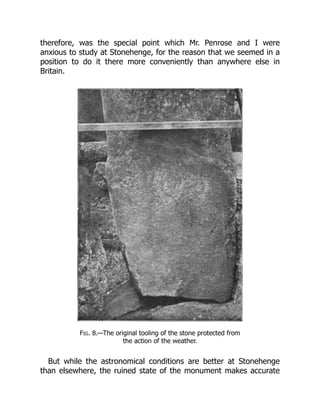
Fig. 8.—The original tooling of the stone protected from
the action of the weather.
But while the astronomical conditions are better at Stonehenge
than elsewhere, the ruined state of the monument makes accurate
measurements very difficult.
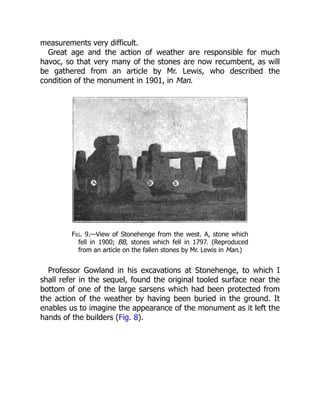
Great age and the action of weather are responsible for much
havoc, so that very many of the stones are now recumbent, as will
be gathered from an article by Mr. Lewis, who described the
condition of the monument in 1901, in Man.
Fig. 9.—View of Stonehenge from the west. A, stone which
fell in 1900; BB, stones which fell in 1797. (Reproduced
from an article on the fallen stones by Mr. Lewis in Man.)
Professor Gowland in his excavations at Stonehenge, to which I
shall refer in the sequel, found the original tooled surface near the
bottom of one of the large sarsens which had been protected from
the action of the weather by having been buried in the ground. It
enables us to imagine the appearance of the monument as it left the
hands of the builders (Fig. 8).
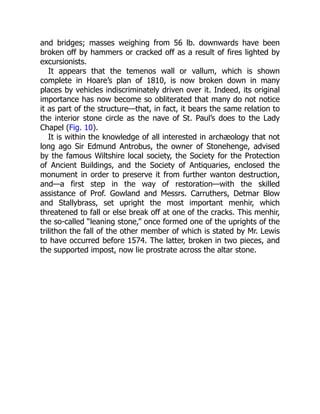
Fig. 10.—Copy of Hoare’s plan of 1810, showing the
unbroken Vallum and its relation with the Avenue.
But the real destructive agent has been man himself; savages
could not have played more havoc with the monument than the
English who have visited it at different times for different purposes.
It is said the fall of one great stone was caused in 1620 by some
excavations, but this has been doubted; the fall of another in 1797
was caused by gipsies digging a hole in which to shelter, and boil
their kettle; many of the stones have been used for building walls
and bridges; masses weighing from 56 lb. downwards have been
broken off by hammers or cracked off as a result of fires lighted by
excursionists.
It appears that the temenos wall or vallum, which is shown
complete in Hoare’s plan of 1810, is now broken down in many
places by vehicles indiscriminately driven over it. Indeed, its original
importance has now become so obliterated that many do not notice
it as part of the structure—that, in fact, it bears the same relation to
the interior stone circle as the nave of St. Paul’s does to the Lady
Chapel (Fig. 10).
It is within the knowledge of all interested in archæology that not
long ago Sir Edmund Antrobus, the owner of Stonehenge, advised
by the famous Wiltshire local society, the Society for the Protection
of Ancient Buildings, and the Society of Antiquaries, enclosed the
monument in order to preserve it from further wanton destruction,
and—a first step in the way of restoration—with the skilled
assistance of Prof. Gowland and Messrs. Carruthers, Detmar Blow
and Stallybrass, set upright the most important menhir, which
threatened to fall or else break off at one of the cracks. This menhir,
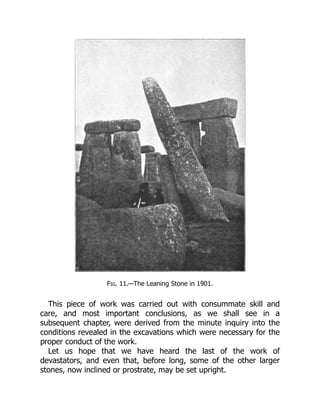
the so-called “leaning stone,” once formed one of the uprights of the
trilithon the fall of the other member of which is stated by Mr. Lewis
to have occurred before 1574. The latter, broken in two pieces, and
the supported impost, now lie prostrate across the altar stone.
Fig. 11.—The Leaning Stone in 1901.
This piece of work was carried out with consummate skill and
care, and most important conclusions, as we shall see in a
subsequent chapter, were derived from the minute inquiry into the
conditions revealed in the excavations which were necessary for the
proper conduct of the work.
Let us hope that we have heard the last of the work of
devastators, and even that, before long, some of the other larger
stones, now inclined or prostrate, may be set upright.
Since Sir Edmund Antrobus, the present owner, has acted on the
advice of the societies I have named to enclose the monument, with
a view to guard it from destruction and desecration, he has been
assailed on all sides. It is not a little surprising that the “unclimbable
wire fence” recommended by the societies in question (the Bishop of
Bristol being the president of the Wiltshire society at the time) is by
some regarded as a suggestion that the property is not national, the
fact being that the nation has not bought the property, and that it
has been private property for centuries, and treated in the way we
have seen.
Let us hope also that before long the gaps in the vallum may be
filled up. These, as I have already stated, take away from the
meaning of an important part of one of the most imposing
monuments of the world. In the meantime, it is comforting to know
that, thanks to what Sir Edmund Antrobus has done, no more stones
will be stolen, or broken by sledge-hammers; that fires; that
excavations such as were apparently the prime cause of the
disastrous fall of one of the majestic trilithons in 1797; that litter,
broken bottles and the like, with which too many British sightseers
mark their progress, besides much indecent desecration, are things
of the past.
If Stonehenge had been built in Italy, or France, or Germany, it
would have been in charge of the State long ago.
I now pass from the monument itself to a reference to some of
the traditions and historical statements concerning it.
Those who are interested in these matters should thank the
Wiltshire Archæological and Natural History Society, which is to be
warmly congratulated on its persistent and admirable efforts to do all
in its power to enable the whole nation to learn about the venerable
monuments of antiquity which it has practically taken under its
scientific charge. It has published two most important volumes[9]
dealing specially with Stonehenge, including both its traditions and
history.
With regard to Mr. Long’s memoir, it may be stated that it includes
important extracts from notices of Stonehenge from the time of
Henry of Huntingdon (twelfth century) to Hoare (1812), and that all
extant information is given touching on the questions by whom the
stones were erected, whence they came, and what was the object of
the structure.
From Mr. Harrison’s more recently published bibliography, no
reference to Stonehenge by any ancient author, no letter to the
Times for the last twenty years dealing with any question touching
the monuments, seems to be omitted.
It is very sad to read, both in Mr. Long’s volume and the
bibliography, of the devastation which has been allowed to go on for
so many years and of the various forms it has taken.
As almost the whole of the notes which follow deal with the
assumption of Stonehenge having been a solar temple, a short
reference to the earliest statements concerning this view is
desirable; and, again, as the approximate date arrived at by Mr.
Penrose and myself in 1901 is an early one, a few words may be
added indicating the presence in Britain at that time of a race of
men capable of designing and executing such work. I quote from the
paper communicated by Mr. Penrose and myself to the Royal
Society:—
“As to the first point, Diodorus Siculus (ii., 47, ed. Didot, p. 116)
has preserved a statement of Hecatæus in which Stonehenge alone
can by any probability be referred to.
“‘We think that no one will consider it foreign to our subject to say
a word respecting the Hyperboreans.
“‘Amongst the writers who have occupied themselves with the
mythology of the ancients, Hecatæus and some others tell us that
opposite the land of the Celts [ἑν τοις ἁντιπεραν της Κελτικης
τοποις] there exists in the Ocean an island not smaller than Sicily,
and which, situated under the constellation of The Bear, is inhabited
by the Hyperboreans; so called because they live beyond the point
from which the North wind blows.... If one may believe the same
mythology, Latona was born in this island, and for that reason the
inhabitants honour Apollo more than any other deity. A sacred
enclosure [νησον] is dedicated to him in the island, as well as a
magnificent circular temple adorned with many rich offerings.... The
Hyperboreans are in general very friendly to the Greeks.’”
“The Hecatæus above referred to was probably Hecatæus of
Abdera, in Thrace, fourth century b.c.; a friend of Alexander the
Great. This Hecatæus is said to have written a history of the
Hyperboreans: that it was Hecatæus of Miletus, an historian of the
sixth century b.c., is less likely.
“As to the second point, although we cannot go so far back in
evidence of the power and civilisation of the Britons, there is an
argument of some value to be drawn from the fine character of the
coinage issued by British kings early in the second century b.c., and
from the statement of Julius Cæsar (‘De Bello Gallico,’ vi., c. 14) that
in the schools of the Druids the subjects taught included the
movements of the stars, the size of the earth, and the nature of
things (multa præterea de sideribus et eorum motu, de mundi
magnitudine, de rerum natura, de deorum immortalium vi ac
potestate disputant et juventuti tradunt).
“Studies of such a character seem quite consistent with, and to
demand, a long antecedent period of civilisation.”
Henry of Huntingdon is the first English writer to refer to
Stonehenge, which he calls Stanenges. Geoffrey of Monmouth
(1138) and Giraldus Cambrensis come next.
In 1771, Dr. John Smith, in a work entitled “Choir Gawr, the Grand
Orrery of the Ancient Druids, called Stonehenge, Astronomically
Explained, and proved to be a Temple for Observing the Motions of
the Heavenly Bodies,” wrote as follows:—
“From many and repeated visits, I conceived it to be an
astronomical temple; and from what I could recollect to have read of
it, no author had as yet investigated its uses. Without an instrument
or any assistance whatever, but White’s ‘Ephemeris,’ I began my
survey. I suspected the stone called The Friar’s Heel to be the index
that would disclose the uses of this structure; nor was I deceived.
This stone stands in a right line with the centre of the temple,
pointing to the north-east. I first drew a circle round the vallum of
the ditch and divided it into 360 equal parts; and then a right line
through the body of the temple to the Friar’s Heel; at the
[5]
[6]
[7]
[8]
[9]
[10]
intersection of these lines I reckoned the sun’s greatest amplitude at
the summer solstice, in this latitude, to be about 60 degrees, and
fixed the eastern points accordingly. Pursuing this plan, I soon
discovered the uses of all the detached stones, as well as those that
formed the body of the temple.”
With regard to this “Choir Gawr,” translated Chorea Gigantum,
Leland’s opinion is quoted (Long, p. 51) that we should read Choir
vawr, the equivalent of which is Chorea nobilis or magna.[10]
In spite of Inigo Jones’s (1600) dictum that Stonehenge was of
Roman origin, Stukeley came to the conclusion in 1723 that the
Druids were responsible for its building; and Halley, who visited it in
1720—probably with Stukeley—concluded from the weathering of
the stones that it was at least 3000 years old; if he only had taken
his theodolite with him, how much his interest in the monument
would have been increased!
See especially Nature, July 2, 1891 p. 201.
Gardner, Paisley and London.
“The Prehistoric Stone Monuments of the British Isles—Cornwall.”
“The French Stonehenge: An Account of the Principal Megalithic
Remains in the Morbihan Archipelago.” By T. Cato Worsfold, F. R. Hist.
S., F.R.S.I. (London: Bemrose and Sons, Ltd.)
The Wiltshire Archaeological and Natural History Magazine:
“Stonehenge and its Barrows.” By William Long, M.A., F.S.A. 1876.
The Wiltshire Archaeological and Natural History Magazine:
“Stonehenge Bibliography Number.” By W. Jerome Harrison. 1902.
Mr. Morien Morgan informs me that Cor y Gawres is correct, and means
Choir of the Giantess Cariadwen, the Welsh Neith, Nyth (Nydd).
CHAPTER VI
GENERAL ARCHITECTURE OF STONEHENGE
Although I have before hinted that the astronomical use of the
Egyptian temples and British circles was the same, there is at first
sight a vast difference in the general plan of structure.
This has chiefly depended upon the fact that the riches and
population of ancient Egypt were so great that that people could
afford to build a temple to a particular star, or to the sun’s position
on any particular day of the year. The temple axis along the line
pointing to the celestial body involved, then became the chief
feature, and tens of years were spent in lengthening, constricting
and embellishing it.
Fig. 12.—The axis of the Temple of Karnak,
looking south-east, from outside the
north-west pylon (from a photograph by
the author).
From one end of an Egyptian temple to the other we find the axis
marked out by narrow apertures in the various pylons, and many
walls with doors crossing the axis. There are seventeen or eighteen
of these apertures in the solar temple of Amen-Rā at Karnak, limiting
the light which falls into the Holy of Holies or Sanctuary. This
construction gives one a very definite impression that every part of
the temple was built to subserve a special object, viz., to limit the
sunlight which fell on its front into a narrow beam, and to carry it to
the other extremity of the temple—into the sanctuary, where the
high priest performed his functions. The sanctuary was always
blocked. There is no case in which the beam of light can pass
absolutely through a temple (Figs. 12 and 13).
Fig. 13.—Plan of the Temple of Ramses II. in the Memnonia at Thebes (from
Lepsius), showing the pylon at the open end, the various doors along the axis,
the sanctuary at the closed end, and the temple at right angles.
In Britain the case was different, there was neither skill nor
workers sufficient to erect such stately piles, and as a consequence
one structure had to do the work of several and it had to be done in
the most economical way. Hence the circle with the observer at the
centre and practically a temple axis in every direction among which
could be chosen the chief directions required, each alignment being
defined by stones, more or less distant, or openings in the circle
itself.
Now for some particulars with regard to those parts of
Stonehenge which lend themselves to the inquiry.
The main architecture of Stonehenge consisted of an external
circle of about 100 feet in diameter, composed of thirty large upright
stones, named sarsens, connected by continuous lintels. The upright
stones formerly stood 14 feet above the surface of the ground. They
have nobs or tenons on the top which fit into mortice holes in the
lintels. Within this peristyle there was originally an inner structure of
ten still larger upright stones, arranged in the shape of a horseshoe,
formed by five isolated trilithons which rose progressively from N.E.
to S.W., the loftiest stones being 25 feet above the ground. About
one-half of these uprights have fallen, and a still greater number of
the imposts which they originally carried.
Fig. 14.—One of the remaining Trilithons.
There is also another circle of smaller upright stones, respecting
which the only point requiring notice now is that none of them would
have interrupted the line of the axis of the avenue. The circular
temple was also surrounded by the earthen bank, shown in Fig. 15,
of about 300 feet in diameter, interrupted towards the north-east by
receiving into itself the banks forming the avenue before mentioned,
which is about 50 feet across. Within this avenue, no doubt an old
via sacra, and looking north-east from the centre of the temple, at
about 250 feet distance and considerably to the right hand of the
axis, stands an isolated stone, which from a mediæval legend has
been named the Friar’s Heel.
Fig. 15.—General plan; the outer circle, naos and avenue of Stonehenge.
F.H. = Friar’s Heel.
The axis passes very nearly centrally through an intercolumniation
(so to call it) between two uprights of the external circle and
between the uprights of the westernmost trilithon as it originally
stood. Of this trilithon the southernmost upright with the lintel stone
fell in 1620, but the companion survived as the leaning stone which
formed a conspicuous and picturesque object for many years, but
happily now restored to its original more dignified and safer
condition of vertically. The inclination of this stone, however, took
place in the direction of the axis of the avenue, and as the distance
between it and its original companion is known both by the analogy
of the two perfect trilithons and by the measure of the mortice holes
on the lintel they formerly supported, we obtain by bisection the
distance, 11 inches, from its edge, of a point in the continuation of
the central axis of the avenue and temple.
The banks which form the avenue have suffered much
degradation. It appears from Sir Richard Colt Hoare’s account that at
the beginning of the last century they were distinguishable for a
much greater distance than at present, but they are still discernible,
especially on the northern side, for more than 1300 feet from the
centre of the temple, and particularly the line of the bottom of the
ditch from which the earth was taken to form the bank, and which
runs parallel to it.
CHAPTER VII
ASTRONOMICAL OBSERVATIONS AT STONEHENGE IN 1901[11]
An investigation was undertaken by Mr. Penrose and myself in the
spring of 1901, as a sequel to analogous work in Egypt and Greece,
with a view to determine whether the orientation theory could throw
any light upon the date of the foundation of Stonehenge, concerning
which authorities vary in their estimates by some thousands of
years. Ours was not the first attempt to obtain the date of
Stonehenge by means of astronomical considerations. In Mr. Godfrey
Higgins’ work[12] he refers to a method of attack connected with
precession. This furnished him with the date 4000 b.c.
More recently, Prof. W. M. Flinders Petrie,[13] whose plan of the
stones is a valuable contribution to the study of Stonehenge, was led
by his measures of the orientation to a date very greatly in the
opposite direction, but, owing to an error in his application of the
change of obliquity, clearly a mistaken one.
The chief astronomical evidence in favour of the solar temple
theory lies in the fact that the “avenue,” as it is called, formed by
two ancient earthen banks, extends for a considerable distance from
the structure, in the general direction of the sunrise at the summer
solstice, precisely in the same way as in Egypt a long avenue of
sphinxes indicates the principal outlook of a temple.
These earthen banks defining the avenue do not exist alone. As
will be seen from the sketch plan (Fig. 15), there is a general
common line of direction for the avenue and the principal axis of the
structure; and the general design of the building, together with the
position and shape of the naos, indicates a close connection of the
whole temple structure with the direction of the avenue. There may
have been other pylon and screen equivalents as in other ancient
temples, which have disappeared, the object being to confine the
illumination to a small part of the naos. There can be little doubt,
also, that the temple was originally roofed in, and that the sun’s first
ray, suddenly shining into the darkness, formed a fundamental part
of the cultus.
With regard to the question of the roof, however, the above
suggestion, I now find, is not new, the view having been held by no
less an authority than Dr. Thurnham, who apparently was led to it by
the representations of the Scandinavian temples as covered and
enclosed structures.
Since the actual observation of sunrise was doubtless made within
the sanctuary itself, we seem justified in taking the orientation of the
axis to be the same as that of the avenue, and since in the present
state of the S.W. trilithon the direction of the avenue can probably
be determined with greater accuracy than that of the temple axis
itself, the estimate of date must be based upon the orientation of
the avenue. Further evidence will be given, however, to show that
the direction of the axis of the temple, so far as it can now be
determined, is sufficiently accordant with the direction of the
avenue.
The orientation of this avenue may be examined upon the same
principles that have been found successful in the case of Greek and
Egyptian temples—that is, on the assumption that Stonehenge was a
solar temple, and that the greatest function took place at sunrise on
the longest day of the year. This not only had a religious motive; it
had also the economic value of marking officially and distinctly that
time of the year and the beginning of an annual period.
It is, indeed, possible that the present structure may have had
other capabilities, such as being connected with the May year, the
equinoxes or the winter solstice; but it is with its uses at the summer
solstice alone that we now deal.
There is a difference in treatment between the observations
required for Stonehenge and those which are available for Greek or
Egyptian solar temples. In the case of the latter, the effect of the
precession of the equinoxes upon the stars, which as warning clock
stars were almost invariably connected with those temples, offers
the best measure of the dates of foundation; but in Britain, owing to
the brightness of the dawn at the summer solstice, such a star could
not have been employed, so that we can rely only on the secular
change of the obliquity as affecting the azimuth of the point of
sunrise. This requires the measurements to be taken with very great
precision, and as the azimuth of the place of sunrise varies with the
latitude, and as a datum point on the horizon in a known position
was also required, Colonel Johnston, R.E., the Director-General of
the Ordnance Survey, was asked for and obligingly supplied the
following particulars:
Centre of stone circle, Stonehenge {
Lat. 51° 10′ 42″
Long. W. 1 49 99
Centre of spire, Salisbury Cathedral {
Lat. 51° 3′ 52″
Long. 1 47 45
The real point was to determine the direction of the so-called
avenue. Measurements taken from the line of the bottom of the
ditch assisted materially those taken from the crown of the bank
itself. With this help and by using the southern bank and ditch
whenever it admitted of recognition, a fair estimate of the central
line could be arrived at. To verify this, two pegs were placed at
points 140 feet apart along the line near the commencement of the
avenue, and four others at distances averaging 100 feet apart nearer
the further recognisable extremity, and their directions were
measured with the theodolite, independently by two observers, the
reference point being Salisbury Spire, of which the exact bearing had
been communicated by Colonel Johnston.
This bearing was also measured locally by observations of the Sun
and of Polaris, the mean of which differed by less than 20″ from the
Ordnance value. The resulting observations gave for the axis of the
avenue nearest the commencement an azimuth of 49° 38′ 48″, and
for that of the more distant part 49° 32′ 54″. The mean of these two
lines drawn from the central interval of the great trilithon, already
referred to, passes between two of the sarsens of the exterior circle,
which have an opening of about 4 feet, within a few inches of their
middle point, the deviation being northwards. This may be
considered to prove the close coincidence of the original axis of the
temple with the direction of the avenue.
This value of the azimuth, the mean of which is 49° 35′ 51″, is
confirmed by the information, also supplied from the Ordnance
Survey, that from the centre of the temple, the bearing to the N.E.
of the principal bench mark on a hill, about 8 miles distant, the
bench mark being very near a well-known ancient fortified British
encampment named Silbury or Sidbury, is 49° 34′ 18″; and that the
same line continued through Stonehenge, to the south-west, strikes
another ancient fortification, namely, Grovely Castle, about 6 miles
distant, and at practically the same azimuth, viz., 49° 35′ 51″. For
the above reasons 49° 34′ 18″ has been adopted for the azimuth of
the avenue.
The summer solstice sunrise in 1901 was also watched for by Mr.
Howard Payn on five successive mornings, viz., June 21 to 25, and
was successfully observed on the last occasion. As soon as the Sun’s
limb was sufficiently above the horizon for its bisection to be well
measured, it was found to be 8′ 40″ northwards of the peak of the
Friar’s Heel, which was used as the reference point; the altitude of
the horizon being 35′ 48″. The azimuth of this peak from the point
of observation had been previously ascertained to be 50° 39′ 5″,
giving for that of the Sun when measured, 50° 30′ 25″; by
calculation that of the Sun, with the limb 2′ above the horizon,
should be 50° 30′ 54″. This observation was therefore completely in
accordance with the results which had been obtained otherwise.
The time which would elapse between geometrical sunrise, that is,
with the upper limb tangential with the horizon, and that which is
here supposed, would be about 17 seconds, and the difference of
azimuth would be 3′ 15″.
The remaining point was to find what value should be given to the
Sun’s declination when it appeared showing itself 2′ above the
horizon, the azimuth being 49° 34′ 18″.
The data obtained for the determination of the required epoch
were as follows:—
(1.) The elevation of the local horizon at the sunrise point seen by
a man standing between the uprights of the great trilithon (a
distance of about 8000 feet) is about 35′ 30″, and 2′ additional for
Sun’s upper limb makes 37′ 30″.
(2.) -Refraction + parallax, 27′ 20″.
(3.) Sun’s semi-diameter, allowance being made for greater
eccentricity than at present, 15′ 45″.
(4.) Sun’s azimuth, 49° 34′ 18″, and N. latitude, 51° 10′ 42″.
From the above data the Sun’s declination works out 23° 54′ 30″
N., and by Stockwell’s tables of the obliquity, which are based upon
modern determinations of the elements of the solar system,[14] the
date is found to be 1680 b.c.
It is to be understood that on account of the slight uncertainty as
to the original line of observation and the very slow rate of change in
the obliquity of the ecliptic, the date thus derived may possibly be in
error by 200 years more or less; this gives us a date of construction
lying between say 1900 and 1500 b.c.
In this investigation the so-called Friar’s Heel was used only as a
convenient point for reference and verification in measurement, and
no theory was formed as to its purpose. It is placed at some
distance, as before mentioned, to the south of the axis of the
avenue, so that at the date arrived at for the erection of the temple
the Sun must have completely risen before it was vertically over the
summit of the stone. It may be remarked, further, that more than
500 years must yet elapse before such a coincidence can take place
at the beginning of sunrise.
In an Appendix certain details of the observations are given.
In the next chapter I propose to show that an independent
archæological inquiry carried out, in a most complete and admirable
way, just after Mr. Penrose and myself had obtained our conclusion,
entirely corroborates the date at which we had arrived.
[11]
[12]
[13]
[14]
This chapter and the end of the previous one are mainly based on the
paper communicated by Mr. Penrose and myself to the Royal Society
(see Proceedings, Royal Society, vol. 69, p. 137 et seq.).
The Celtic Druids. 4to. London. 1827.
Stonehenge, &c. 1880.
Smithsonian Contributions to Knowledge, vol. xviii. No. 232, table 9.
Washington. 1873. For curve, see page 130.
CHAPTER VIII
ARCHÆOLOGICAL OBSERVATIONS AT STONEHENGE, 1901
Soon after Mr. Penrose and myself had made our astronomical
survey of Stonehenge in 1901, some archæological results of the
highest importance were obtained by Professor Gowland. The
operations which secured them were designed and carried out in
order to re-erect the leaning stone which threatened to fall, a piece
of work recommended to Sir Edmund Antrobus by the Society of
Antiquaries of London and other learned bodies, and conducted at
his desire and expense.
Fig. 16.—The arrangements for raising the stone, looking north-east.
They were necessarily on a large scale, for the great monolith,
“the leaning stone,” is the largest in England, the Rudston monolith
excepted. It stood behind the altar stone, over which it leant at an
angle of 65 degrees, resting at one point against a small stone of
syenite. Half-way up it had a fracture one-third across it; the weight
of stone above this fracture was a dangerous strain on it, so that
both powerful machinery and great care and precautions had to be
used. Professor Gowland was charged by the Society of Antiquaries
with the conduct of the excavations necessary in the work. The
engineering operations were planned by Mr. Carruthers, and Mr.
Detmar Blow was responsible for the local superintendence. Mr. Blow
thus describes the arrangements (Journal Institute of British
Architects, 3rd series, ix., January, 1902):—
“A strong cradle of 12-inch square baulks of timber was bolted
round the stone, with packing and felt, to prevent any marking of
the stone. To the cradle were fixed two 1-inch steel eyebolts to
receive the blocks for two six-folds of 6-inch ropes. These were
secured and wound on to two strong winches fifty feet away, with
four men at each winch. When the ropes were thoroughly tight, the
first excavation was made as the stone was raised on its west side.”
Fig. 17.—The cradle and supports, looking west.
The method employed by Professor Gowland in the excavation
should be a model for all future work of the kind.
Above each space to be excavated was placed a frame of wood,
bearing on its long sides the letters A to H, and on its short sides the
letters R M L, each letter being on a line one foot distant from the
next. By this means the area to be excavated was divided into
squares each having the dimension of a square foot. A long rod
divided into 6-inch spaces, numbered from 1 to 16, was also
provided for indicating the depth from the datum line of anything
found. In this way a letter on the long sides of the frame, together
with one on the short sides, and a number on the vertical rod,
indicated the position of any object found in any part of the
excavation.
Excavations were necessary because to secure the stone for the
future the whole of the adjacent soil had to be removed down to the
rock level, so that it could be replaced by concrete.
Fig. 18.—The frame used to locate the finds.
All results were registered by Professor Gowland in relation to a
datum line 337·4 feet above sea level. The material was removed in
buckets, and carefully sifted through a series of sieves 1-inch, 1
⁄2-
inch, 1
⁄4-inch, and 1
⁄8-inch mesh, in order that the smallest object
might not be overlooked.
From the exhaustive account of his work given by Professor
Gowland to the Society of Antiquaries (Archaeologia, lviii.), I gather
three results of the highest importance from the point of view I am
considering. These were, first, the finding of an enormous number of
implements; secondly, the disposition and relative quantities of the
chippings of the sarsen and blue stones; and thirdly, the discovery of
the method by which the stones were originally erected.
I will take the implements first. This, in a condensed form, is what
Professor Gowland says about them:—
More than a hundred flint implements were found, and the greater
number occurred in the stratum of chalk rubble which either directly
overlaid or was on a level with the bed rock. They may all be
arranged generally in the following classes:—
Class I.—Axes roughly chipped and of rude forms, but having well-
defined, more or less sharp cutting edges.
Class II.—Hammerstones, with more or less well-chipped, sharp
curved edges. Most may be correctly termed hammer-axes. They are
chipped to an edge at one end, but at the other are broad and thick,
and in many examples terminated there by a more or less flat
surface. In some the natural coating of the flint is left untouched at
the thick end.
Class III.—Hammerstones, more or less rounded. Some specimens
appear to have once had distinct working edges, but they are now
much blunted and battered by use.
In addition to the above flint implements were found about thirty
hammerstones, consisting of large pebbles or small boulders of the
hard quartzite variety of sarsen. Some have been roughly broken
into convenient forms for holding in the hand, whilst a few have
been rudely trimmed into more regular shapes. They vary in weight
from about a pound up to six and a half pounds. To these we have
to add mauls, a more remarkable kind of hammerstone than those
just enumerated. They are ponderous boulders of the quartzite
variety of sarsen with their broadest sides more or less flat. Their
weights range from about 40 lb. to 64 lb.
How came these flints and stones where they were found? Prof.
Gowland gives an answer which everybody will accept. The
implements must be regarded as the discarded tools of the builders
of Stonehenge, dumped down into the holes as they became unfit
for use, and, in fact, used to pack the monoliths as they were
erected. We read:—“Dealing with the cavity occupied by No. 55
before its fall, the mauls were found wedged in below the front of its
base to act together with the large blocks of sarsen as supports” (p.
54). Nearly all bear evidence of extremely rough usage, their edges
being jagged and broken, just as we should expect to find after such
rough employment. We evidently have to deal with builders doing
their work in the Stone and not in the Bronze age. But was the age
Palæolithic or Neolithic?
Prof. Gowland writes:—
“Perhaps the most striking features of the flint implements is their
extreme rudeness, and that there is not a single ground or polished
specimen among them. This, at first sight and without due
consideration, might be taken to indicate an extremely remote age.
But in this connection it must be borne in mind that in the building
of such a stupendous structure as Stonehenge, the tools required
must have been numbered by thousands. The work, too, was of the
roughest character, and for such only rude tools were required. The
highly finished and polished implements which we are accustomed
to consider, and rightly so, as characteristic of Neolithic man, would
find no place in such work. They required too much labour and time
for their manufacture, and, when made, could not have been more
effective than the hammer-axes and hammerstones found in the
excavations, which could be so easily fashioned by merely rudely
shaping the natural flints, with which the district abounds, by a few
well directed blows of a sarsen pebble.”
On this ground Prof. Gowland is of opinion that, notwithstanding
their rudeness, they may be legitimately ascribed to the Neolithic
age, and, it may be, near its termination, that is, before the Bronze
age, the commencement of which has been placed at 1400 b.c. by
Sir John Evans for Britain, though he is inclined to think that
estimate too low, and 2000 b.c. by Montelius for Italy.
Welcome to our website – the perfect destination for book lovers and
knowledge seekers. We believe that every book holds a new world,
offering opportunities for learning, discovery, and personal growth.
That’s why we are dedicated to bringing you a diverse collection of
books, ranging from classic literature and specialized publications to
self-development guides and children's books.
More than just a book-buying platform, we strive to be a bridge
connecting you with timeless cultural and intellectual values. With an
elegant, user-friendly interface and a smart search system, you can
quickly find the books that best suit your interests. Additionally,
our special promotions and home delivery services help you save time
and fully enjoy the joy of reading.
Join us on a journey of knowledge exploration, passion nurturing, and
personal growth every day!
testbankfan.com
M Advertising 3rd Edition Schaefer Solutions Manual

  • 1.
    M Advertising 3rdEdition Schaefer Solutions Manual download pdf https://testbankfan.com/product/m-advertising-3rd-edition-schaefer- solutions-manual/ Visit testbankfan.com to explore and download the complete collection of test banks or solution manuals!
  • 2.
    Here are somerecommended products for you. Click the link to download, or explore more at testbankfan.com M Advertising 3rd Edition Schaefer Test Bank https://testbankfan.com/product/m-advertising-3rd-edition-schaefer- test-bank/ M Advertising 2nd Edition Arens Solutions Manual https://testbankfan.com/product/m-advertising-2nd-edition-arens- solutions-manual/ M Advertising 2nd Edition Arens Test Bank https://testbankfan.com/product/m-advertising-2nd-edition-arens-test- bank/ Canadian Organizational Behaviour 7th Edition McShane Test Bank https://testbankfan.com/product/canadian-organizational-behaviour-7th- edition-mcshane-test-bank/
  • 3.
    Basic Marketing Research8th Edition Brown Test Bank https://testbankfan.com/product/basic-marketing-research-8th-edition- brown-test-bank/ Statistics For Managers Using Microsoft Excel 7th Edition Levine Solutions Manual https://testbankfan.com/product/statistics-for-managers-using- microsoft-excel-7th-edition-levine-solutions-manual/ Essentials of Corporate Finance 7th Edition ross Solutions Manual https://testbankfan.com/product/essentials-of-corporate-finance-7th- edition-ross-solutions-manual/ Intermediate Accounting Reporting and Analysis 3rd Edition Wahlen Solutions Manual https://testbankfan.com/product/intermediate-accounting-reporting-and- analysis-3rd-edition-wahlen-solutions-manual/ Developmental Math 3rd Edition Lial Test Bank https://testbankfan.com/product/developmental-math-3rd-edition-lial- test-bank/
  • 4.
    Financial and ManagerialAccounting 15th Edition Warren Test Bank https://testbankfan.com/product/financial-and-managerial- accounting-15th-edition-warren-test-bank/
  • 5.
    Chapter 09—Creative Execution:Art and Copy 9-1 Copyright © 2018 McGraw-Hill Education. All rights reserved. No reproduction or distribution without the prior written consent of McGraw-Hill Education. CHAPTER NINE CREATIVE EXECUTION: ART AND COPY This chapter introduces the role of art and copy—the nonverbal and verbal elements of message strategy—in print, radio, television, and on the Web. It also describes the artists, copywriters, and a variety of specialists who follow specific procedures for conceptualizing, designing, writing, and producing IMC messages. To be successful, creatives must be conversant with copywriting and commercial art terms and formats used in the business. They must also develop an aesthetic sensitivity so they can recognize, create, evaluate, or recommend quality work. Learning Objectives: LO 09-01 Describe the factors involved in creating print ads. LO 09-02 List the types of copy and explain how great copy is created in print ads. LO 09-03 Outline how great copy is created in electronic ads. LO 09-04 Discuss the role of art in electronic ads. LO 09-05 Review the unique requirements in writing for the Web. What’s New? Our new opening vignette gives the background behind McCann’s “Dumb Ways to Die” safety PSA for the Australia Metro Trains network. The award-winning campaign uses a highly creative approach to reduce unsafe behaviors around trains. This chapter features seven “My Ad Campaign” boxes. The first helps students understand the importance of product facts. The second offers advice from industry legend George Felton about how to write great headlines and copy. “My Ad Campaign” box number three discusses the chief focus for visuals. Box number four gives practical tips about layout and design. Box five gives advice for writing effective copy, and box six provides similar advice for composing radio commercials. The last box provides advice for creating television commercials. Application Exercises Ad Creation Process Identify the Types of Headlines Creating TV Commercials Dumb Ways to Die Electronic Creativity: Bleachable Moments
  • 6.
    Chapter 09—Creative Execution:Art and Copy 9-2 Copyright © 2018 McGraw-Hill Education. All rights reserved. No reproduction or distribution without the prior written consent of McGraw-Hill Education. TEACHING TIPS AND STRATEGIES Using the Opening Vignette in the Classroom If you have Internet access in the classroom, show students the “Dumb Ways to Die” spot (https://youtu.be/IJNR2EpS0jw). If not, ask your students to watch it at home. The ad nicely demonstrates how creativity and a big idea come together. The point is to illustrate the creative aspects of advertising deployed on a very serious subject. Ask students to identify and discuss the creative elements of the spot (copy, art, music, etc.). Then ask them if they believe it would be effective in changing people’s behaviors. Can creativity sometimes get in the way of a message? This is a good entry point for discussion of the creative work in advertising. Other Tips and Strategies In this chapter, students are introduced to how ads are created. In television, storyboard scripts are used to design commercials. Some DVDs have “special features” that show storyboards and the scene concurrently. I have a couple of movies that I show the class to demonstrate the phenomenon. By watching the storyboard and the resulting scene, the students get a good idea of why storyboards are so important in setting up a commercial. A useful DVD for this concept is the special edition of the movie Suicide Kings (Artisan Home Entertainment, 1998). Technology and software allow graphic designers to create more effective ads for print. I like to divide students into groups and have them use different programs to create an ad (usually for the advertising campaign). Students are amazed at how easy it is to add effects such as darkness or stars to pictures. They also have fun adding text to pictures. I have had students create animated images. Students enjoy being creative while simultaneously learning the benefits that software brings to creative departments. In-class activities can include creating a copy platform for a brand (real or imagined) or pairing up students as copywriters and art directors and having them work on a rough layout. Web Resources for Enhancing Your Lectures: AdWorks http://www.adworkscorp.com Right Brain Works www.gocreate.com B Creative www.bcreative.com Design & Publishing Center www.graphic-design.com Art Directors Club http://www.adcglobal.org/ American Institute of Graphic Arts www.aiga.org Copy Chef www.copychef.com
  • 7.
    Chapter 09—Creative Execution:Art and Copy 9-3 Copyright © 2018 McGraw-Hill Education. All rights reserved. No reproduction or distribution without the prior written consent of McGraw-Hill Education. Ads of the World http://adsoftheworld.com/ Video Resources: Dumb Ways to Die ad https://www.youtube.com/watch?v=IJNR2EpS0jw&feature=youtu.be Lubriderm alligator commercial, 2015 https://www.youtube.com/watch?v=c8mrWAkUM2Y Flo / Progressive (presenter commercial) https://www.youtube.com/watch?v=3PFebslqRiI Dyson vacuum (demonstration commercial with humor https://www.youtube.com/watch?v=aaQ_c1UoXF8 The Tissue Test (Slice-of-life commercial) https://www.youtube.com/watch?v=AP3sCUbChlI Android Friends Furever (most shared viral ad of 2015) https://www.youtube.com/watch?v=vnVuqfXohxc Will It Blend? iPhone 6 Plus (viral ad for BlendTec) https://www.youtube.com/watch?v=lBUJcD6Ws6s My Ad Campaign [9-A]: Product Facts for Creatives My Ad Campaign [9-B]: Creating Great Headlines and Copy My Ad Campaign [9-C]: Determining the Chief Focus for Visuals My Ad Campaign [9-D]: Design Principles Ethical Issues: Imitation, Plagiarism, or Flattery? My Ad Campaign [9-E]: Writing Effective Copy My Ad Campaign [9-F]: Creating Effective Radio Commercials My Ad Campaign [9-G]: Creating Effective TV Commercials
  • 8.
    Chapter 09—Creative Execution:Art and Copy 9-4 Copyright © 2018 McGraw-Hill Education. All rights reserved. No reproduction or distribution without the prior written consent of McGraw-Hill Education. LECTURE OUTLINE I. Vignette—The story of how McCann’s Melbourne, Australia, office developed a creative PSA campaign called “Dumb Ways to Die” to reduce fatal accidents around trains. II. Delivering on the Big Idea: Integrating the Visual and the Verbal A. The “Dumb Ways to Die” ad demonstrates that what’s shown is just as important as what’s said. B. The nonverbal aspect of an ad carries at least half the burden of communication. It helps position the product and create personality for the brand. It creates the mood of the ad. III. The Art of Creating Print Advertising A. Designing the Print Ad 1. Design refers to how the art director chooses and structures the artistic elements of an ad. A director sets a style—the manner in which a thought or image is expressed—by choosing particular artistic elements and blending them in a unique way. 2. Clean lines, formally composed photographs, and sparse copy give ads the breathing room needed to draw the reader’s eye from one element to the next. Sufficient white space gives and ad unity and balance. B. The Use of Layouts A layout is an overall orderly arrangement of the elements of an ad: visual(s), headline, subheads, body copy, slogan, seal, logo, and signature. The layout serves several purposes. 1. It helps both the agency and the client anticipate how the ad will look and feel. This provides the client a tangible item to review, correct, change, and approve. 2. It helps the creative team develop the ad’s psychological elements: the nonverbal and symbolic components. Advertisers want their ads to create brand personality, build brand equity, and create an image or mood that reflects and enhances the advertiser and the product. 3. Once the best design is chosen, it serves as a blueprint. C. Advertising Design and Production: The Creative and Approval Process The design process serves as both a creative and an approval process. In the creative phase, designers use preliminary versions of the art to establish the ad’s look and feel. The approval process takes place at each step of the entire design process. 1. Thumbnail Sketches—The thumbnail sketch (or thumbnail) is a very small, rough, rapidly produced drawing the artist uses to visualize layout approaches without wasting time on details. 2. Rough Layout—In a rough, the artists draw to the actual size of the ad. 3. Dummy—A dummy presents the handheld look and feel of brochures, multipage materials, or point-of-purchase displays. 4. Comprehensive and Mechanical—The comprehensive layout, or comp, is a highly refined facsimile of the finished ad. Copy for the comp is typeset on a computer and positioned with the visuals, and the ad is printed as a full-color proof. At this stage, all the visuals are final.
  • 9.
    Chapter 09—Creative Execution:Art and Copy 9-5 Copyright © 2018 McGraw-Hill Education. All rights reserved. No reproduction or distribution without the prior written consent of McGraw-Hill Education. 5. Approval—The work of the copywriter and art director is always subject to approval. The larger the agency and the larger the client, the more formidable this process becomes. APPLICATION EXERCISE: Ad Creation Process Activity Summary: In this activity, students are reminded that the ad creation process begins with abstract ideas and then goes through a series of steps leading to a finished advertisement. In the exercise, students click and drag steps in this process into columns that identify if they are part of the first, second, or third stage of ad development. (Note: A keyboard accessible version of this activity is also available.) Type: Click and Drag Learning Objectives: Learning Objective: 09-01 Describe the factors involved in creating print ads. Difficulty Level: 1 Easy Blooms: Analyze AACSB: Analytical Thinking Follow-Up Activity: Instructors could ask students to produce thumbnails for an advertisement for a common household product, such as soap. My Ad Campaign [9-A]: Product Facts for Creatives Art directors and copywriters must have a thorough understanding of the brand to create advertising that resonates. Make sure your creatives have the information that will help them write copy that sizzles and create layouts that stop consumers dead in their tracks. • Proprietary information Product’s trade name. Trademark. Product symbol. Other copyrighted or patented information. • History When was the product created or invented? Who introduced it? Has it had other names? Have there been product changes? Is there any “romance” to it? • Research Are research results available?
  • 10.
    Chapter 09—Creative Execution:Art and Copy 9-6 Copyright © 2018 McGraw-Hill Education. All rights reserved. No reproduction or distribution without the prior written consent of McGraw-Hill Education. What research about the product does the supplier have? Which research will be most useful for each medium? • Life cycle What is the product’s life or use span? What stage is it in now and what style of copy should be used for that stage? What stages are competitors in? • Market position What is the product’s share of the total market? Does its market share suggest a positioning strategy? What position does the company wish to occupy? • Competitive information Who are the product’s competitors? Does the product have any advantages over them? Does it have any disadvantages? Are they all about the same? Do rival products present problems that this one solves? • Product image How do people view the product? What do they like about it? What do they dislike about it? Is it a luxury? Is it a necessity? Is it a habit? Is it self-indulgent? Do people have to have it but wish they didn’t? • Customer use How is the product used? Are there other possible uses? How frequently is it bought? What type of person uses the product? Why is the product bought? Personal use. Gift. Work. What type of person uses the product most (heavy user)? How much does the heavy user buy?
  • 11.
    Chapter 09—Creative Execution:Art and Copy 9-7 Copyright © 2018 McGraw-Hill Education. All rights reserved. No reproduction or distribution without the prior written consent of McGraw-Hill Education. Where do the best customers live? • Performance What does the product do? What might it be expected to do that it does not? How does it work? How is it made or produced? What’s in it? Raw materials. Special ingredients. Preservatives. Chemicals. Nutrients. • What are its physical characteristics? Smell. Appearance. Color. Texture. Taste. Others. • Effectiveness Is there proof the product has been tested and works well? Do any government or other regulations need to be mentioned or observed? How does it work compared to its competitors? • Manufacturing How is the product made? How long does it take? How many steps are in the process? How many people are involved in making it? Are any special machines used? Where is it made? • Distribution How widely is the product distributed? Are there exclusive sellers? Is there a ready supply or a limited amount? Is it available for a short season? What channels of distribution must be reached?
  • 12.
    Chapter 09—Creative Execution:Art and Copy 9-8 Copyright © 2018 McGraw-Hill Education. All rights reserved. No reproduction or distribution without the prior written consent of McGraw-Hill Education. • Packaging Unit size or sizes offered. Package shape. Package design. Styling. Color. Special protection for product. A carrier for product. Package label. D. Principles of Design: Which Design Formats Work Best The advertiser has only a second or two to grab the reader’s attention. Studies show large numbers of people ignore ads. Good design not only commands attention but also holds it. 1. Advertisers use many types of layouts. Traditionally, the highest scoring ads employ a standard, poster-style format (also called a picture-window layout or Ayer No. 1 in the trade), which features a single dominant visual that occupies most of the ad’s total area. 2. Advertising research indicates the following: a. Ads scoring in the top third have visuals averaging 82 percent of the space. b. Next in ranking, ads feature one large picture and two smaller ones. c. Visuals can stop the reader and arouse interest, so their content must be interesting. d. Headlines also stop the reader and may actually contribute more to long-term memory than the visual. e. When the headline appears below the illustration, the ad typically gains about 10 percent more readership. f. Readership can drop if ads have more than 50 words. g. Copy blocks should be kept to 20 percent of the ad. h. Ads for high-involvement products do better with long, informative copy when the advertiser is more interested in quality of readership rather than quantity. i. For best results, company signatures and logos should be placed in the lower right-hand corner or across the bottom of the ad, but need not occupy more than 5 to 10 percent of the area. 3. Advertising author Roy Paul Nelson points out that principles of design are to the layout artist what the rules of grammar are to the writer. Basic rules of design include the following: a. The design must be in balance. b. Space within the ad should be broken into pleasing proportions. c. A directional pattern should be evident so the reader knows what sequence in which to read copy. d. Some force should hold the ad together and give it unity.
  • 13.
    Chapter 09—Creative Execution:Art and Copy 9-9 Copyright © 2018 McGraw-Hill Education. All rights reserved. No reproduction or distribution without the prior written consent of McGraw-Hill Education. e. One element, or one part of the ad, should have enough emphasis to dominate all others. E. The Use of Visuals in Print Advertising Artists who paint, sketch, and draw in advertising are called illustrators. The artists who produce pictures with a camera are photographers. Together they are responsible for all the visuals, or pictures, we see in advertising. 1. Purpose of the Visual—Because it carries so much responsibility for an ad’s success, the visual, or picture, should be designed with several goals in mind: a. Capture the reader’s attention. b. Clarify claims made by the copy. c. Identify the brand. d. Show the product actually being used. e. Qualify readers by stopping those who are legitimate prospects. f. Convince the reader of the truth of copy claims. g. Arouse the reader’s interest in the headline. h. Emphasize the product’s unique features. i. Create a favorable impression of product or advertiser. j. Provide continuity for the campaign by using a unified visual technique in each ad. 2. Selecting the Visual—The kind of picture used is often determined during the visualization process. Selecting an appropriate photo or visual is a difficult creative task. Art directors deal with several basic issues: a. Is a visual needed for effective communication? b. If a visual is required, how many should there be? b. Should the visual be black-and-white or color? Is this a budgetary decision? c. What should the subject of the picture be? Is that subject relevant to the advertiser’s creative strategy? d. Should the ad use a hand-rendered illustration, a photograph, or a computer- generated illustration? e. What technical and budgetary issues must be considered? My Ad Campaign [9-B]: Creating Great Headlines and Copy George Felton, in his book Advertising Concept and Copy, offers the following suggestions for aspiring copywriters: Headlines  “Achieve synergy, not redundancy.” The headlines and artwork should work together to create an idea, but not be completely redundant.  “Let the consumer do some of the work.” Avoid ads that insult the audience’s intelligence.  “Combine overstatement and understatement.” If the visual is BIG, make the headline small. And vice versa.  “Emphasize one idea per ad.” If you have several ideas, show how they are linked to make them one.
  • 14.
    Chapter 09—Creative Execution:Art and Copy 9-10 Copyright © 2018 McGraw-Hill Education. All rights reserved. No reproduction or distribution without the prior written consent of McGraw-Hill Education. Copy Freelance copywriter John Kuraoka offers some excellent advice for new copywriters at http://www.kuraoka.com/how-to-write-better-ads.html. Here are summaries of his recommendations for your visuals:  Capture the reader’s attention.  Clarify copy claims.  Let the reader know the ad is directed at him or her.  Show the product in use.  Offer evidence for copy claims.  Emphasize the product’s unique features or benefits.  Unify the different ads in the campaign.  Check Yourself 9–1 1. What is a layout? What purposes does it serve in the process of print ad development, approval, and production? A layout provides for an orderly arrangement of the needed elements in an ad: visuals, headline, subheads, body copy, and slogans. It allows the agency and client to develop the ad and agree to its content. 2. How does an art director choose from among design formats? Art directors choose design formats that attract customers and draw them into the ads. A poster style format with a single, dominant visual has proven to be effective. 3. What is the purpose of the visual in a print ad? A visual must capture the reader’s attention, demonstrate the product being used, and emphasize the product’s unique features. IV. Producing Great Copy in Print Advertising In print advertising, the key format elements are the visual(s), headlines, subheads, body copy, slogans, logos, and signatures. Copywriters can correlate the visual and headline to the attention step of the creative pyramid. The interest step typically corresponds to the subhead and the first paragraph of body copy. Body copy handles credibility and desire, and the action step takes place with the logo, slogan, and signature block. My Ad Campaign [9-C]: Determining the Chief Focus for Visuals Selecting the focus for advertising visuals is a major step in the creative process. It often determines how well the big idea is executed. Print advertising uses many standard subjects for ad visuals, including 1. The package containing the product. Especially important for packaged goods, it helps the consumer identify the product on the grocery shelf. 2. The product alone. This usually does not work well for nonpackaged goods. 3. The product in use. Automobile ads typically show a car in use while talking about its ride, luxury, handling, or economy. Cosmetics ads usually show the product in use with a close-up photo of a beautiful woman or a virile man.
  • 15.
    Chapter 09—Creative Execution:Art and Copy 9-11 Copyright © 2018 McGraw-Hill Education. All rights reserved. No reproduction or distribution without the prior written consent of McGraw-Hill Education. 4. How to use the product. Recipe ads featuring a new way to use food products have historically pulled very high readership scores. 5. Product features. Computer software ads frequently show the monitor screen so the prospect can see how the software features are displayed. 6. Comparison of products. The advertiser shows its product next to a competitor’s and compares important features. 7. User benefit. It’s often difficult to illustrate intangible user benefits. However, marketers know that the best way to get customers’ attention is to show how the product will benefit them, so it’s worth the extra creative effort. 8. Humor. If used well, a humorous visual can make an entertaining and lasting impression. But it can also destroy credibility if used inappropriately. 9. Testimonial. Before-and-after endorsements are very effective for weight-loss products, skin care lotions, and bodybuilding courses. 10. Negative appeal. Sometimes visuals point out what happens if you don’t use the product. If done well, that can spark interest. A. Headlines The headline contains the words in the leading position of the advertisement. These are the words that will be read first and are situated to draw the most attention. Headlines usually appear in larger type than other parts of the ad. 1. Role of Headlines a. Effective headlines do the following: i. Attract attention to the ad. ii. Engage the audience. iii. Explain the visual. iv. Lead the audience into the body of the ad. v. Present the key benefit. b. Headlines should engage the reader—fast—and give a reason to read the rest of the ad. c. Ideally, headlines should do the following: i. Present the complete selling idea. Three to five times as many people read the headline as read the body copy. Most headlines average eight words. ii. Offer a benefit that is apparent to the reader and easy to grasp. iii. Present product news. My Ad Campaign [9-D]: Design Principles Make sure your layout follows these rules of thumb for creating attractive, informative ads. Balance The optical center is the reference point that determines the layout’s balance. The optical center is about one-eighth of a page above the physical center of the page. Balance is achieved through the arrangement of elements on the page—the left side of the optical center versus the right, above the optical center versus below.
  • 16.
    Chapter 09—Creative Execution:Art and Copy 9-12 Copyright © 2018 McGraw-Hill Education. All rights reserved. No reproduction or distribution without the prior written consent of McGraw-Hill Education. ___Formal balance. Perfect symmetry is the key to formal balance: matched elements on either side of a line dissecting the ad have equal optical weight. This technique strikes a dignified, stable, conservative image. ___Informal balance. A visually balanced ad has elements of different size, shape, color intensity, or darkness at different distances from the optical center. Like a teeter-totter, an object of greater optical weight near the center can be balanced by an object of less weight farther from the center. Many ads use informal balance to make the ad more interesting, imaginative, and exciting. Movement Movement is the principle of design that causes the audience to read the material in the desired sequence. It can be achieved through a variety of techniques. ___People or animals can be positioned so that their eyes direct the reader’s eyes to the next important element. ___Devices such as pointing fingers, boxes, lines, or arrows (or moving the actors or the camera or changing scenes) direct attention from element to element. ___Design can take advantage of readers’ natural tendency to start at the top left corner of the page and proceed in a Z motion to the lower right. ___Comic-strip sequence and pictures with captions force the reader to start at the beginning and follow the sequence in order to grasp the message. ___Use of white space and color emphasizes a body of type or an illustration. Eyes will go from a dark element to a light one, or from color to noncolor. ___Size itself attracts attention because readers are drawn to the biggest and most dominant element on the page, then to smaller elements Proportion ___Elements should be accorded space based on their importance to the entire ad. Attention- getting elements are usually given more space. Avoid the monotony of giving equal amounts of space to each element. White Space (Isolation) ___White space is the part of the ad not occupied by other elements (note that white space may be some color other than white). White space helps focus attention on an isolated element—it makes the copy appear to be in a spotlight. White space is an important contributor to the ad’s overall image. Contrast ___An effective way of drawing attention to a particular element is to use contrast in color, size, or style; for example, a reverse ad (white letters against a dark background) or a black-and-white ad with a red border. Clarity and Simplicity
  • 17.
    Chapter 09—Creative Execution:Art and Copy 9-13 Copyright © 2018 McGraw-Hill Education. All rights reserved. No reproduction or distribution without the prior written consent of McGraw-Hill Education. ___Any elements that can be eliminated without damaging the overall effect should be cut. Too many type styles; type that is too small; too many reverses, illustrations, or boxed items; and unnecessary copy make for an overly complex layout and an ad that is hard to read. Unity ___Unity means that an ad’s many different elements must relate to one another in such a way that the ad gives a singular, harmonious impression. Balance, movement, proportion, contrast, and color may all contribute to unity of design. Many other techniques can be used: type styles from the same family, borders around ads to hold elements together, overlapping one picture or element on another, judicious use of white space, graphic tools such as boxes, arrows, or tints. Continuity ___Continuity is the relationship of one ad to the rest of the campaign. This is achieved by using the same design format, style, and tone; the same spokesperson; or the same graphic element, logo, cartoon character, or catchy slogan. Ethical Issues: Imitation, Plagiarism, or Flattery? 1. Some art directors claim that “coincidental invention” explains why many ads look the same. Do you think that’s really possible? Answer guidelines: Plagiarism is, in essence, using another’s idea or product and trying to pass it off as one’s own original idea or product. A freelance artist created an illustration using Photoshop software that distorted a photograph, found in a promotional brochure, of a man with a clock face for a head. The photographer then saw the illustration published in Newsday, a Long Island, New York, newspaper (tabloid size) and sued the publication. In another case, a historian was sued and his credibility was damaged when a few paragraphs of his book used some of the same words and short phrases from a footnoted source. When an ad “borrows” a concept or “look” (by modifying an existing model), the advertiser can usurp the creativity of others and pay a big price. In addition, today’s software can more easily create distorted images that mislead—and that’s illegal. Defenses to claims of plagiarism include: a. It is possible, although not probable, that two or more similar executions could be developed by different advertisers at the same time, particularly in the same product category. b. Intent is a key issue that must sometimes be proven in law. People often get a hot idea, not realizing that they actually saw something like it in the media a few months earlier—they just forgot what they had seen and lacked true “intent” to actually steal the idea. c. Courts will ask: Is the initial idea original enough to be plagiarized? d. The law will seek proof that a chain of events existed for the alleged pirate to have had access to the idea.
  • 18.
    Chapter 09—Creative Execution:Art and Copy 9-14 Copyright © 2018 McGraw-Hill Education. All rights reserved. No reproduction or distribution without the prior written consent of McGraw-Hill Education. There is no denying that success breeds imitation, and not just in ad agencies. Alfred Whitehead contended a hundred years ago that the history of Western philosophy was one long footnote to Plato, and, indeed, his basic ideas do form the foundation of some of contemporary philosophy. “Imitation is the sincerest form of flattery.” It is almost impossible to get an imitator to admit copycat advertising, let alone pull it from the marketplace. Once an advertising campaign is out there, millions of dollars have probably been committed to executing it, but a successful lawsuit can stop it from running. 2. Who wins and who loses when advertising is imitated? Do you believe that it’s actually an advantage to be copied? Answer guidelines: The crux of the problem may be that imitation is an accepted part of the business, at least unofficially. Clients tend to avoid the debate, perhaps because they’re more comfortable with well-worn ideas than with bold, original concepts. Many art directors and writers collect competitive ads for inspiration. And advertising is such a highly collaborative process that it’s often difficult to determine each individual’s creative contribution. Few art directors and writers are likely to say it’s an advantage to be copied. They are least likely to be concerned when the ads in question are for non-competing products and therefore are aimed at different consumer bases. 3. What would you do if a client asked you to copy an ad that was already running? Is it acceptable to plagiarize advertising ideas, as long as they are recycled “in a useful way”? Client awareness of the issue can be raised by reminding them of the consequences of legal action and consumer backlash that may occur from plagiarizing. Sometimes clients even request that a competitor’s advertising be copied. That is also why there are so many voice-over announcers who mimic famous voices and announcing styles. The creative person who goes along with the client’s request to imitate a successful campaign jeopardizes his or her financial future and career. The only way to avoid compromising personal ethics is to come up with something better, and then convince the client to run it instead. However, that can be a very dicey proposition. 4. Is plagiarism justified by the contention that “there are very few original ideas”? Answer guidelines: Yes: “There are very few original ideas,” according to Philip Circus, an advertising law consultant to the Newspaper Society in London. “Plagiarism is the name of the game in advertising. It’s about recycling ideas in a useful way.” No: Jim Golden, executive producer of DMH MacGuffin, says, “All we have in this business are creativity and ideas. The moment someone infringes on that, they’re reaching into the very core of the business and ripping it out.” Ultimately, advertisers must stop “borrowing” ideas from each other and demand greater creativity from themselves. 2. Types of headlines—Copywriters use many variations of headlines depending on the advertising strategy. Typically, they use the headline that presents the big idea most successfully. Headlines may be classified by the type of information they carry: a. Benefit headlines promise the audience that experiencing the utility of the product or service will be rewarding. b. News/information headlines announce news or promise information. c. Provocative headlines provoke the reader’s curiosity.
  • 19.
    Chapter 09—Creative Execution:Art and Copy 9-15 Copyright © 2018 McGraw-Hill Education. All rights reserved. No reproduction or distribution without the prior written consent of McGraw-Hill Education. d. Question headlines ask a question, encouraging readers to search for the answer in the body of the ad. e. Command headlines order readers to do something; sometimes this might seem negative, but readers pay attention to such headlines. APPLICATION EXERCISE: Identify the Types of Headlines Activity Summary: This activity tests student knowledge of the different types of headlines used in advertising. In the exercise, students click and drag sample headlines to the boxes that identify what type of headline each one exemplifies. (Note: A keyboard accessible version of this activity is also available.) Type: Click and Drag Learning Objectives: Learning Objective: 09-02 List the types of copy and explain how great copy is created in print ads. Difficulty Level: 1 Easy Blooms: Analyze AACSB: Analytical Thinking Follow-Up Activity: Instructors could ask volunteers to suggest headlines that could be used in an advertising campaign aimed at convincing more people to ride the bus. Instructors should challenge students to use all of the different types of headlines. B. Subheads 1. A subhead is an additional smaller headline that may appear above or below headline. A subhead above the headline is called a kicker (or overline), while those below the headline are called underlines. Subheads may also appear in body copy. 2. Subheads are usually set smaller than the headline but larger than the body copy. Subheads generally appear in boldface type, italic type, or a different color. Most people only read the headline and subhead. Subheads usually support the interest step best. 3. Subheads are longer and more like sentences than headlines. C. Body Copy The advertiser tells the complete story in the body copy, or text. The body copy comprises the interest, credibility, desire, and often even the action steps. It is a logical continuation of the headline and subheads, set in smaller type. It must speak to the reader’s self-interest, explaining how the product or service satisfies the customer’s need. 1. Body Copy Styles—Experienced copywriters look for the technique and style with the greatest sales appeal for the idea being presented. Common copy styles include the following: a. Straight-sell copy immediately explains or develops the headline and visual in a straightforward, factual presentation that appeals to the prospect’s intelligence.
  • 20.
    Chapter 09—Creative Execution:Art and Copy 9-16 Copyright © 2018 McGraw-Hill Education. All rights reserved. No reproduction or distribution without the prior written consent of McGraw-Hill Education. b. Institutional copy promotes a philosophy or extols the merits of an organization rather than product features. c. Narrative copy tells a story. Ideal for the creative writer, narrative copy sets up a situation and then resolves it at the last minute by having the product or service come to the rescue. Allows for emotional appeals. d. Dialogue/monologue copy adds the believability that narrative copy sometimes lacks. The characters portrayed in a print ad do the selling in their own words. e. Picture-caption copy uses illustrations and captions to tell the story. It is particularly useful for products that have a number of different uses or come in a variety of styles or designs. f. Device copy may be used to enhance attention, interest, and memorability. Device copy uses figures of speech as well as humor and exaggeration. These can help people remember the brand and tend to affect attitudes favorably. Humor comes with certain issues: i. Humor should always be used carefully and never be in questionable taste. ii. Humor grows old very quickly. iii. Some believe humor distracts readers. My Ad Campaign [9-E]: Writing Effective Copy  Get to the main point—fast.  Emphasize one major idea simply and clearly.  Be single-minded. Don’t try to do too much. If you chase more than one rabbit at a time, you’ll catch none.  Position the product clearly.  Keep the brand name up front and reinforce it.  Write with the consumer’s ultimate benefit in mind.  Write short sentences. Use easy, familiar words and themes people understand.  Don’t waste words. Say what you have to say—nothing more, nothing less. Don’t pad, but don’t skimp.  Avoid bragging and boasting. Write from the reader’s point of view, not your own. Avoid “we,” “us,” and “our.”  Avoid clichés. They’re crutches; learn to get along without them. Bright, surprising words and phrases perk up readers and keep them reading.  Write with flair. Drum up excitement. Make sure your own enthusiasm comes through in the copy.  Use vivid language. Use lots of verbs and adverbs.  Stick to the present tense, active voice. It’s crisper. Avoid the past tense and passive voice. Exceptions should be deliberate, for special effect.  Use personal pronouns. Remember, you’re talking to just one person, so talk as you would to a friend. Use “you” and “your” whenever appropriate.  Use contractions. They’re fast, personal, natural. People talk in contractions (listen to yourself).
  • 21.
    Chapter 09—Creative Execution:Art and Copy 9-17 Copyright © 2018 McGraw-Hill Education. All rights reserved. No reproduction or distribution without the prior written consent of McGraw-Hill Education.  Don’t overpunctuate. It kills copy flow. Excessive commas are the chief culprits. Don’t give readers any excuse to jump ship.  Read the copy aloud. Hear how it sounds; catch errors. The written word is considerably different from the spoken word so listen to it.  Rewrite and write tight. Edit mercilessly. Tell the whole story and no more. When you’re finished, stop. 2. Formatting Body Copy—The keys to good body copy are simplicity, order, credibility, and clarity. Four basic format elements are used to construct body copy: a. The lead-in paragraph is a bridge between the headline and the sales idea presented in the text. It is part of the interest step. b. Interior paragraphs develop credibility by providing proof for claims and build desire by using language that stirs the imagination. c. A trial close can be interspersed in the interior paragraphs with suggestions to act now. The trial close encourages a consumer to make the buying decision early. d. The close is the real action step. A good close asks consumers to do something and tells them how. The close can be direct or indirect. A direct close seeks immediate response in the form of a purchase, a store or website visit, or a request for further information. D. Slogans 1. Many slogans (also called themelines or taglines) begin as successful headlines, and, through continuous use, become standard statements (not only in advertising but also for salespeople and company employees, e.g., “Diamonds are forever” or “Reach out and touch someone”). 2. Slogans have two purposes: a. Provide continuity to an ad series. b. Reduce an advertising message strategy to a brief, repeatable, and memorable positioning statement. E. Seals, Logo, and Signatures 1. A seal is awarded only when a product meets standards established by a particular organization, such as the Good Housekeeping Institute or Underwriters Laboratories. Because these organizations are recognized authorities, their seals provide an independent, valued endorsement for the advertiser’s product. 2. Logotypes and signatures are special designs of the advertiser’s company name or product name. Like trademarks, they give the product or company individuality and quick recognition.  Check Yourself 9–2 1. What are the key format elements in a print ad? Key format elements include the use and placement of visuals, headline, body copy, slogan, seal, logo, and signature. 2. What are some important types of headlines?
  • 22.
    Chapter 09—Creative Execution:Art and Copy 9-18 Copyright © 2018 McGraw-Hill Education. All rights reserved. No reproduction or distribution without the prior written consent of McGraw-Hill Education. Important types of headlines are benefit headlines (which promise that experiencing the utility of the product or service will be rewarding), news/information headlines (which announce news or promise information), provocative headlines (which provoke curiosity), question headlines (which encourage readers to search for the answer in the body of the ad), and command headlines (which order the reader to do something). 3. When would an advertiser use straight-sell copy rather than device copy? Straight-sell copy works with concise facts and is good for high think-involvement products or products that are difficult to use, while device copy opts for figures of speech, humor, and exaggeration, and is good for building brand recognition. V. Creating Great Copy in Electronic Media For electronic media, the fundamental elements—the five steps of the creative pyramid— remain the primary guides, but the copywriting formats differ. Radio and television writers prepare scripts and storyboards. A. Writing Radio Copy 1. A script resembles a two-column list. On the left side, speakers’ names are arranged vertically along with descriptions of any sound effects (SFX) and music. The right column contains the dialogue, called the audio. 2. Radio listeners usually decide within five to eight seconds whether to pay attention; thus, radio copy must be intrusive (people listen while doing something else). 2. Scripts must fit time slots. With electronic compression, ads can now include 10 to 30 percent more copy than text read live. The following is a good rule of thumb: 10 seconds = 20–25 words 20 seconds = 40–45 words 30 seconds = 60–70 words 60 seconds = 130–150 words 3. Radio writing must be clear because the listener cannot refer back to clarify meaning. B. Writing Television Copy 1. Radio’s basic two-column format also works for television, but in a TV script, the left side is titled “Video” and the right side “Audio.” a. The video column describes the visuals and production: camera angles, action, scenery, and stage directions. b. The audio column lists spoken copy, sound effects, and music. 2. The writer sets the tone and the language that determines the visuals. My Ad Campaign [9-F]: Creating Effective Radio Commercials Writing for radio takes a sharp ear, empathy for the listener, and the ability to create pictures inside the consumer’s head. These tips will help you create great radio spots.  Make the big idea crystal clear. Concentrate on one main selling point. Radio is a good medium for building brand awareness, but not for making long lists of copy points or complex arguments.  Mention the advertiser’s name early and often. If the product or company name is tricky, consider spelling it out.
  • 23.
    Chapter 09—Creative Execution:Art and Copy 9-19 Copyright © 2018 McGraw-Hill Education. All rights reserved. No reproduction or distribution without the prior written consent of McGraw-Hill Education.  Take time to set the scene and establish the premise. A 30-second commercial that nobody remembers is a waste of money. Fight for 60-second spots.  Use familiar sound effects. Ice tinkling in a glass, birds chirping, or a door shutting can create a visual image. Music also works if its meaning is clear.  Paint pictures with your words. Use descriptive language to make the ad more memorable.  Make every word count. Use active voice and more verbs than adjectives. Be conversational. Use pronounceable words and short sentences.  Be outrageous. The best comic commercials begin with a totally absurd premise from which all developments follow logically. But remember, if you can’t write humor really well, go for drama.  Ask for the order. Try to get listeners to take action.  Remember that radio is a local medium. Adjust your commercials to the language of your listeners and the time of day they’ll run.  Presentation counts a lot. Even the best scripts look boring on paper. Acting, timing, vocal quirks, and sound effects bring them to life.  Check Yourself 9–3 1. From the writer’s perspective, what are the important differences between a radio listener and a print ad reader? Radio copywriting must be clear and concise. The listener can’t refer back to previous words, as one might while reading a print ad. Also, the English language has a variety of homonyms—words that sound alike and can cause problems in an audio format. 2. What is the approximate word limit of a 30-second radio ad? A 30-second radio ad can feature a maximum of 60 to 70 words. 3. What are the two columns labeled in a TV script? In a TV script, the left side is “video” and the right side is “audio.” VI. The Role of Art in Radio and TV Advertising A. Developing the Artistic Concept for Commercials Creating the concept for a radio or TV commercial is similar to creating the concepts for print ads. 1. The first step is to determine the big idea. 2. Then the art director and copywriter must decide what commercial format to use. 3. The next step is to write a script containing the necessary copy or dialogue plus a basic description of any music, sound effect, and/or camera views. 4. In both radio and TV, the art director assists the copywriter in script development. Artistic development in television is much more extensive. Using the TV script, the art director creates a series of storyboard roughs to present the artistic approach, the action sequences, and the style of the commercial. B. Formats for Radio and TV Commercials Similar to print advertising, the format for a broadcast ad serves as a template for arranging message elements into a pattern. Eight common commercial formats can be used for either radio or television:
  • 24.
    Chapter 09—Creative Execution:Art and Copy 9-20 Copyright © 2018 McGraw-Hill Education. All rights reserved. No reproduction or distribution without the prior written consent of McGraw-Hill Education. 1. The straight announcement is the oldest and simplest type of radio or TV commercial, and is probably the easiest to write. One person, usually a radio or TV announcer, delivers the sales message. a. In radio, a straight announcement can also be designed as an integrated commercial—that is, it can be woven into a show or tailored to a given program. b. For TV, an announcer may deliver the sales message on camera or off screen, as a voice-over, while a demonstration, slide, or film shows on screen. 2. Presenter commercials use one person or a character to present the product and carry the sales message. Some presenters are celebrities, like Brad Pitt for Calvin Klein. A radio personality (such as Rush Limbaugh or Howard Stern) may ad-lib an ad message live in his or her own style. 3. Testimonial ads allow a satisfied user to tell how effective the product is; this can be highly credible in both TV and radio advertising. 4. Demonstration spots are especially suitable for television. Products can be demonstrated in use, in competition, or before and after. 5. Musical commercials (or jingles), if done well, can have an enormous impact on the success of a commercial. Done poorly, they can waste the advertising budget and annoy audiences. 6. Slice-of-life (problem-solution) ads are a dramatization of a real-life situation where an issue is discussed and resolved with a successful trial use of the product. The key to effective slice-of-life commercials is simplicity. Often a mnemonic device can dramatize the product benefit and trigger instant recall; e.g., the Aflac duck reminds users that Aflac is there to pay bills if you get hurt and can’t work. 7. The lifestyle technique presents a user rather than presenting the product, showing characters working in various occupations and participating in many pastimes. For example, the person who drinks the product would be more strongly presented than the product’s features. 8. Animation, such as cartoons, puppet characters, and demonstrations (e.g., pounding headache) with computer-generated graphics are very effective for communicating difficult messages or for reaching specialized markets (e.g., children). My Ad Campaign [9-G]: Creating Effective TV Commercials  Begin at the finish. Concentrate on the final impression the commercial will make.  Create an attention-getting opening. An opening that is visually surprising or full of action, drama, humor, or human interest sets the context and allows a smooth transition to the rest of the commercial.  Use a situation that grows naturally out of the sales story. Avoid distracting gimmicks. Make it easy for viewers to identify with the characters.  Characters are the living symbol of the product. They should be appealing, believable, nondistracting, and most of all, relevant.  Keep it simple. The sequence of ideas should be easy to follow. Keep the number of elements in the commercial to a bare minimum.  Write concise audio copy. The video should carry most of the weight. Fewer than 2 words per second is effective for demonstrations. For a 60-second commercial, 101 to 110 words is most effective; more than 170 words is too talky.  Make demonstrations dramatic but believable. They should always be true to life and avoid the appearance of camera tricks.
  • 25.
    Chapter 09—Creative Execution:Art and Copy 9-21 Copyright © 2018 McGraw-Hill Education. All rights reserved. No reproduction or distribution without the prior written consent of McGraw-Hill Education.  Let the words interpret the picture and prepare viewers for the next scene. Use conversational language; avoid “ad talk,” hype, and puffery.  Run scenes five or six seconds on average. Rarely should a scene run less than three seconds. Offer a variety of movement-filled scenes without “jumping.”  Keep the look of the video fresh and new. C. Outlining a TV Commercial After the creative team selects the big idea and format, the art director and the writer develop the script. The art director’s role is important, for he or she must work with a variety of professionals in producing the spot (producers, directors, lighting technicians, and set designers). 1. Storyboard Design a. Once the basic script is completed, the art director must turn the video portion of the script into real images. This is done with a storyboard, a sheet preprinted with a series of 8 to 20 blank windows (frames) in the shape of TV screens. b. Like a rough layout in print advertising, the storyboard works like a comic strip to portray how each scene will appear and in what sequence. It helps executives, clients, and creatives visualize the action and story. 2. To supplement the storyboard or pretest a concept, a commercial may be taped in rough form using the writers and artists as actors. 3. Alternatively, an animatic may be shot. This is a filmstrip composed of the sketches in the storyboard accompanied by the audio portion of the commercial synchronized on tape. APPLICATION EXERCISE: Creating TV Commercials Activity Summary: In this activity, students demonstrate their knowledge of broadcast commercials. The exercise presents students with a case study about a creative team at an advertising agency that is developing a new commercial for a client. It then asks students multiple choice questions about different types of commercials and how commercials are developed. Type: Case Analysis Learning Objectives: Learning Objective: 09-03 Outline how great copy is created for electronic ads. Difficulty Level: 1 Easy, 2 Medium Blooms: Analyze, Remember AACSB: Analytical Thinking Follow-Up Activity: Instructors could show students commercials and ask them to identify what type each one is an example of. Alternatively, instructors could as volunteers to describe examples of the various types of broadcast commercials that they have encountered in their own lives.
  • 26.
    Chapter 09—Creative Execution:Art and Copy 9-22 Copyright © 2018 McGraw-Hill Education. All rights reserved. No reproduction or distribution without the prior written consent of McGraw-Hill Education. APPLICATION EXERCISE: Dumb Ways to Die Activity Summary: In this activity, students are instructed to review the text, paying particular attention to the opening vignette about Metro Trains' "Dumb Ways to Die" campaign. They then view a commercial from that campaign and answer multiple choice questions about how it was created, the format it uses, and why the ad takes the form that it does. Type: Video Case Learning Objectives: Learning Objective: 09-03 Outline how great copy is created for electronic ads. Learning Objective: 09-04 Discuss the role of art in electronic ads. Difficulty Level: 1 Easy, 2 Medium Blooms: Apply, Remember AACSB: Reflective Thinking Follow-Up Activity: Instructors could propose other common formats for commercials (e.g., straight announcement, demonstration) and ask students whether or not they would be suitable for Metro Trains' campaign. Students should be pressed to explain why the various formats are, or are not, suitable. APPLICATION EXERCISE: Electronic Creativity: Bleachable Moments Activity Summary: This activity teaches students about the use of creativity in electronic media with a real-life example, the "Bleachable Moments" campaign for Clorox. In the exercise, students view a video that describes the development of the campaign and shows examples of how it deployed creativity. They then answer multiple choice questions about the campaign. Type: Video Case Learning Objectives: Learning Objective: 09-03 Outline how great copy is created for electronic ads. Learning Objective: 09-06 Differentiate the important print and broadcast production methods. Difficulty Level: 1 Easy, 2 Medium Blooms: Evaluate, Remember, Understand AACSB: Reflective Thinking Follow-Up Activity: Instructors could assign students into small groups and task them with creating a television script for a new ad in the "Bleachable Moments" campaign. Students should be instructed to maintain the style and approach of the real campaign, and also encouraged to use creativity in their commercial.
  • 27.
    Chapter 09—Creative Execution:Art and Copy 9-23 Copyright © 2018 McGraw-Hill Education. All rights reserved. No reproduction or distribution without the prior written consent of McGraw-Hill Education.  Check Yourself 9–4 1. What is a storyboard? A storyboard is a preprinted sheet with 8 to 20 blank frames, which can be used to illustrate the text, sound effects, and camera angles for a TV commercial. 2. What is the oldest and simplest radio or TV commercial format? The oldest format is the straight announcement, where a radio or TV announcer delivers the sales message. 3. What TV format would help present the user rather than the product? The lifestyle technique positions the user in an attractive lifestyle as the primary selling point of the ad. VII. Writing for the Web Digital media are young, and advertisers and agencies are still learning how best to use these platforms. Research is beginning to offer concrete suggestions that can help a designer create more effective digital messages. A. Interactivity 1. The interactive nature of the Internet creates opportunities for a mutually satisfying dialogue between advertiser and consumer. 2. Ultimately, that dialogue can help build brand loyalty and lead to a sale. 3. Conversely, companies that use digital media ineffectively (or ignore the medium altogether) may lose new customers or damage their relationships with existing ones. B. E-fluentials 1. Internet users are often important opinion leaders. 2. Burson-Marsteller, a New York PR firm, has published research indicating that there is a small but highly influential group of heavy Internet users who are likely to share their opinions with others. 3. These users are referred to as e-fluentials. C. Company Websites 1. When designing a company website, it is important to understand why people visit the site. 2. Effectively designed websites help visitors find information quickly and efficiently. The layout of the site should match common scanning patterns. 3. Colors and photographs should be carefully chosen to enhance the layout, attract Internet users, and guide their gaze through the page. D. Banner Ads 1. The purpose of a banner ad is to bring Internet users to a website other than the one they intended to visit. 2. Once the dominant advertising approach, banner ads now compete with many other online forms. 3. Effective banner ads are simple, focused, and clear about a product’s benefit and make use of a striking image and emphasize a palette of rich, powerful colors. E. Viral Ads
  • 28.
    Chapter 09—Creative Execution:Art and Copy 9-24 Copyright © 2018 McGraw-Hill Education. All rights reserved. No reproduction or distribution without the prior written consent of McGraw-Hill Education. Special video commercials on the Web are often called “viral” ads because they rely on Internet users to spread messages to others. Viral ads must be entertaining and informative or they won’t be passed along to others. Matthew Yeoman makes five recommendations about creating a successful viral message: 1. Don’t be traditional: Messages that look like TV or print ads aren’t shared. Use a big idea that captivates and motivates sharing. 2. Reality attracts: Use real people and real situations. 3. Push the envelope: People won’t watch a blender viral, unless the viral features a blender shredding an iPhone, a paintball, or a DVD. BlendTec found success doing just that. 4. Thank your users: Pepsi has created a game featured right on its vending machines that offers free sodas for those who play and win. 5. Find partners: How could A&A’s The Walking Dead collaborate with UC Irvine? My creating a MOOC about zombies, of course. And who can resist zombies?  Check Yourself 9–5 1. What should a web ad designer understand about the medium? Web ad designers must write in a specific style:  Information must be concise and comprehensive.  Numbered lists and bulleted items are helpful.  The Web provides space for in-depth elaboration where necessary.  The text should be scannable.  Text should be written in an objective rather than a promotional style. 2. In what ways are Internet users different from users of traditional media? Internet users are interactive with their media and are often opinion leaders.
  • 29.
    Exploring the Varietyof Random Documents with Different Content
  • 30.
    Many of thefallen menhirs in these alignments have been restored to their upright position by the French Government. Some of them may have been overturned in compliance with the decree of 658 a.d. above referred to. Several of the loftier menhirs are surmounted by crosses of stone or iron. Both circles and alignments are associated with holidays and the lighting of fires on certain days of the year. This custom has remained more general in Brittany than in Britain. At Mount St. Michael, near Carnac, the custom still prevails of lighting a large bonfire on its summit at the time of the summer solstice; others, kindled on prominent eminences for a distance of twenty or thirty miles round, reply to it. These fires are locally called “Tan Heol,” and also by a later use, Tan St. Jean. In Scotland there was a similar custom in the first week in May under the name of Bel Tan, or Baal’s Fire; the synonym for summer used by Sir Walter Scott in the “Lady of the Lake”:— Ours is no sapling chance-sown by the fountain, Blooming at Beltane in winter to fade. At Kerlescant the winter solstice is celebrated by a holiday, whilst Menec greets the summer solstice, and Kermario the equinoxes, with festivals. Concerning these fires and the associated customs Mr. Frazer’s “Golden Bough” is a perfect mine of information and should be consulted. It may simply be said here that the May and November, and June and December fires seem to be the most ancient. It is stated that the Balder bale fires on Mayday Eve were recognised by the primitive race, and I shall prove this in the sequel when British customs are referred to. On the introduction of Christianity the various customs were either transferred to or reorganised in association with church festivals; but as some of these, such as Easter, are movable feasts, it is difficult to follow the dates. Regarding both circles and alignments in the light of the orientation theory, we may consider simple circles with a central stone as a collection of sight-lines from the central stone to one or more of the outer ones, or the interval between any two; indicating
  • 31.
    the place ofthe rise or setting of either the sun or a star on some particular day of the year, which day, in the case of the sun, will be a new year’s day. Alignments, on the other hand, will play the same part as the sight-lines in the circles. Sometimes the sight-line may be indicated by a menhir outside, and even at a considerable distance from, the circle; later on tumuli replaced menhirs. The dolmens have, I am convinced, been in many cases not graves originally, but darkened observing places whence to observe along a sight-line; this would be best done by means of an allée couverte, the predecessor of the darkened naos at Stonehenge, shielded by its covered trilithons. In order to obtain some measurements to test the orientation theory in Britain, I found that Stonehenge is the ancient monument in this country which lends itself to accurate theodolite work better than any other. Mr. Spence’s excellent work on astronomical lines at Stenness, where the stones, till some years ago at all events, have been more respected than further south, suggested a beginning there, but the distance from London made it impossible. Avebury and Stanton Drew are well known to a great many archæologists; there are also other very wonderful stone circles near Keswick and in other parts of England; but unfortunately it is very much more difficult to get astronomical data from these ancient monuments than it is in the case of Stonehenge, one reason being that Stonehenge itself lies high, and the horizon round it in all directions is pretty nearly the same height, so that the important question of the heights of the hills along the sight-line—a matter which is fundamental from an astronomical point of view, although it has been neglected, so far as I can make out, by most who have made observations on these ancient monuments—is quite a simple one at Stonehenge. Hence it was much easier to determine a date there than by working at any of the other ancient remains to which I have referred. In orientation generally—such orientation as has been dealt with by Mr. Penrose and myself in Egypt and in Greece—the question
  • 32.
    frequently was achange in direction in the axis of a temple, or the laying down of the axis of a temple, by means of observations of stars. Unfortunately for us as archæologists, not as astronomers, the changes of position of the stars, owing to certain causes, chiefly the precessional movement, are very considerable; so that if a temple pointed to a star in one year, in two or three hundred years it would no longer point to the same star, but to another. These star observations were requisite in order to warn the priests about an hour before sunrise so that they might prepare for the morning sacrifice which always took place at the first appearance of the sun. Hence the morning star to be visible in the dawn must be a bright one, and the further north or south of the sun’s rising place it rose, the more easily it would be seen. Some stars so chosen rose not far from the north point of the horizon. The alignments with small azimuths referred to in the British circles (p. 36) I believe to be connected with the Egyptian and Greek practice. Acting on a very old tradition, some people from Salisbury and other surrounding places go to observe the sunrise on the longest day of the year at Stonehenge. We therefore are perfectly justified in assuming that it was a solar temple used for observation in the height of midsummer. But at dawn in midsummer in these latitudes the sky is so bright that it is not easy to see stars even if we get up in the morning to look for them; stars, therefore, were not in question, so that some other principle had to be adopted, and that was to point the temple directly to the position on the horizon at which the sun rose on that particular day of the year, and no other. Now, if there were no change in the position of the sun, that, of course, would go on for ever and ever; but, fortunately for archæologists, there is a slight change in the position of the sun, as there is in the case of a star, but for a different reason; the planes of the ecliptic and of the equator undergo a slight change in the angle included between them. So far as we know, that angle has been gradually getting less for many thousands of years, so that, in the case of Stonehenge, if we wish to determine the date, having no stars to help us, the only thing that we can hope to get any information from is the very slow change of this angle; that,
  • 33.
    therefore, was thespecial point which Mr. Penrose and I were anxious to study at Stonehenge, for the reason that we seemed in a position to do it there more conveniently than anywhere else in Britain. Fig. 8.—The original tooling of the stone protected from the action of the weather. But while the astronomical conditions are better at Stonehenge than elsewhere, the ruined state of the monument makes accurate
  • 34.
    measurements very difficult. Greatage and the action of weather are responsible for much havoc, so that very many of the stones are now recumbent, as will be gathered from an article by Mr. Lewis, who described the condition of the monument in 1901, in Man. Fig. 9.—View of Stonehenge from the west. A, stone which fell in 1900; BB, stones which fell in 1797. (Reproduced from an article on the fallen stones by Mr. Lewis in Man.) Professor Gowland in his excavations at Stonehenge, to which I shall refer in the sequel, found the original tooled surface near the bottom of one of the large sarsens which had been protected from the action of the weather by having been buried in the ground. It enables us to imagine the appearance of the monument as it left the hands of the builders (Fig. 8).
  • 35.
    Fig. 10.—Copy ofHoare’s plan of 1810, showing the unbroken Vallum and its relation with the Avenue. But the real destructive agent has been man himself; savages could not have played more havoc with the monument than the English who have visited it at different times for different purposes. It is said the fall of one great stone was caused in 1620 by some excavations, but this has been doubted; the fall of another in 1797 was caused by gipsies digging a hole in which to shelter, and boil their kettle; many of the stones have been used for building walls
  • 36.
    and bridges; massesweighing from 56 lb. downwards have been broken off by hammers or cracked off as a result of fires lighted by excursionists. It appears that the temenos wall or vallum, which is shown complete in Hoare’s plan of 1810, is now broken down in many places by vehicles indiscriminately driven over it. Indeed, its original importance has now become so obliterated that many do not notice it as part of the structure—that, in fact, it bears the same relation to the interior stone circle as the nave of St. Paul’s does to the Lady Chapel (Fig. 10). It is within the knowledge of all interested in archæology that not long ago Sir Edmund Antrobus, the owner of Stonehenge, advised by the famous Wiltshire local society, the Society for the Protection of Ancient Buildings, and the Society of Antiquaries, enclosed the monument in order to preserve it from further wanton destruction, and—a first step in the way of restoration—with the skilled assistance of Prof. Gowland and Messrs. Carruthers, Detmar Blow and Stallybrass, set upright the most important menhir, which threatened to fall or else break off at one of the cracks. This menhir, the so-called “leaning stone,” once formed one of the uprights of the trilithon the fall of the other member of which is stated by Mr. Lewis to have occurred before 1574. The latter, broken in two pieces, and the supported impost, now lie prostrate across the altar stone.
  • 37.
    Fig. 11.—The LeaningStone in 1901. This piece of work was carried out with consummate skill and care, and most important conclusions, as we shall see in a subsequent chapter, were derived from the minute inquiry into the conditions revealed in the excavations which were necessary for the proper conduct of the work. Let us hope that we have heard the last of the work of devastators, and even that, before long, some of the other larger stones, now inclined or prostrate, may be set upright.
  • 38.
    Since Sir EdmundAntrobus, the present owner, has acted on the advice of the societies I have named to enclose the monument, with a view to guard it from destruction and desecration, he has been assailed on all sides. It is not a little surprising that the “unclimbable wire fence” recommended by the societies in question (the Bishop of Bristol being the president of the Wiltshire society at the time) is by some regarded as a suggestion that the property is not national, the fact being that the nation has not bought the property, and that it has been private property for centuries, and treated in the way we have seen. Let us hope also that before long the gaps in the vallum may be filled up. These, as I have already stated, take away from the meaning of an important part of one of the most imposing monuments of the world. In the meantime, it is comforting to know that, thanks to what Sir Edmund Antrobus has done, no more stones will be stolen, or broken by sledge-hammers; that fires; that excavations such as were apparently the prime cause of the disastrous fall of one of the majestic trilithons in 1797; that litter, broken bottles and the like, with which too many British sightseers mark their progress, besides much indecent desecration, are things of the past. If Stonehenge had been built in Italy, or France, or Germany, it would have been in charge of the State long ago. I now pass from the monument itself to a reference to some of the traditions and historical statements concerning it. Those who are interested in these matters should thank the Wiltshire Archæological and Natural History Society, which is to be warmly congratulated on its persistent and admirable efforts to do all in its power to enable the whole nation to learn about the venerable monuments of antiquity which it has practically taken under its scientific charge. It has published two most important volumes[9] dealing specially with Stonehenge, including both its traditions and history. With regard to Mr. Long’s memoir, it may be stated that it includes important extracts from notices of Stonehenge from the time of
  • 39.
    Henry of Huntingdon(twelfth century) to Hoare (1812), and that all extant information is given touching on the questions by whom the stones were erected, whence they came, and what was the object of the structure. From Mr. Harrison’s more recently published bibliography, no reference to Stonehenge by any ancient author, no letter to the Times for the last twenty years dealing with any question touching the monuments, seems to be omitted. It is very sad to read, both in Mr. Long’s volume and the bibliography, of the devastation which has been allowed to go on for so many years and of the various forms it has taken. As almost the whole of the notes which follow deal with the assumption of Stonehenge having been a solar temple, a short reference to the earliest statements concerning this view is desirable; and, again, as the approximate date arrived at by Mr. Penrose and myself in 1901 is an early one, a few words may be added indicating the presence in Britain at that time of a race of men capable of designing and executing such work. I quote from the paper communicated by Mr. Penrose and myself to the Royal Society:— “As to the first point, Diodorus Siculus (ii., 47, ed. Didot, p. 116) has preserved a statement of Hecatæus in which Stonehenge alone can by any probability be referred to. “‘We think that no one will consider it foreign to our subject to say a word respecting the Hyperboreans. “‘Amongst the writers who have occupied themselves with the mythology of the ancients, Hecatæus and some others tell us that opposite the land of the Celts [ἑν τοις ἁντιπεραν της Κελτικης τοποις] there exists in the Ocean an island not smaller than Sicily, and which, situated under the constellation of The Bear, is inhabited by the Hyperboreans; so called because they live beyond the point from which the North wind blows.... If one may believe the same mythology, Latona was born in this island, and for that reason the inhabitants honour Apollo more than any other deity. A sacred enclosure [νησον] is dedicated to him in the island, as well as a
  • 40.
    magnificent circular templeadorned with many rich offerings.... The Hyperboreans are in general very friendly to the Greeks.’” “The Hecatæus above referred to was probably Hecatæus of Abdera, in Thrace, fourth century b.c.; a friend of Alexander the Great. This Hecatæus is said to have written a history of the Hyperboreans: that it was Hecatæus of Miletus, an historian of the sixth century b.c., is less likely. “As to the second point, although we cannot go so far back in evidence of the power and civilisation of the Britons, there is an argument of some value to be drawn from the fine character of the coinage issued by British kings early in the second century b.c., and from the statement of Julius Cæsar (‘De Bello Gallico,’ vi., c. 14) that in the schools of the Druids the subjects taught included the movements of the stars, the size of the earth, and the nature of things (multa præterea de sideribus et eorum motu, de mundi magnitudine, de rerum natura, de deorum immortalium vi ac potestate disputant et juventuti tradunt). “Studies of such a character seem quite consistent with, and to demand, a long antecedent period of civilisation.” Henry of Huntingdon is the first English writer to refer to Stonehenge, which he calls Stanenges. Geoffrey of Monmouth (1138) and Giraldus Cambrensis come next. In 1771, Dr. John Smith, in a work entitled “Choir Gawr, the Grand Orrery of the Ancient Druids, called Stonehenge, Astronomically Explained, and proved to be a Temple for Observing the Motions of the Heavenly Bodies,” wrote as follows:— “From many and repeated visits, I conceived it to be an astronomical temple; and from what I could recollect to have read of it, no author had as yet investigated its uses. Without an instrument or any assistance whatever, but White’s ‘Ephemeris,’ I began my survey. I suspected the stone called The Friar’s Heel to be the index that would disclose the uses of this structure; nor was I deceived. This stone stands in a right line with the centre of the temple, pointing to the north-east. I first drew a circle round the vallum of the ditch and divided it into 360 equal parts; and then a right line through the body of the temple to the Friar’s Heel; at the
  • 41.
    [5] [6] [7] [8] [9] [10] intersection of theselines I reckoned the sun’s greatest amplitude at the summer solstice, in this latitude, to be about 60 degrees, and fixed the eastern points accordingly. Pursuing this plan, I soon discovered the uses of all the detached stones, as well as those that formed the body of the temple.” With regard to this “Choir Gawr,” translated Chorea Gigantum, Leland’s opinion is quoted (Long, p. 51) that we should read Choir vawr, the equivalent of which is Chorea nobilis or magna.[10] In spite of Inigo Jones’s (1600) dictum that Stonehenge was of Roman origin, Stukeley came to the conclusion in 1723 that the Druids were responsible for its building; and Halley, who visited it in 1720—probably with Stukeley—concluded from the weathering of the stones that it was at least 3000 years old; if he only had taken his theodolite with him, how much his interest in the monument would have been increased! See especially Nature, July 2, 1891 p. 201. Gardner, Paisley and London. “The Prehistoric Stone Monuments of the British Isles—Cornwall.” “The French Stonehenge: An Account of the Principal Megalithic Remains in the Morbihan Archipelago.” By T. Cato Worsfold, F. R. Hist. S., F.R.S.I. (London: Bemrose and Sons, Ltd.) The Wiltshire Archaeological and Natural History Magazine: “Stonehenge and its Barrows.” By William Long, M.A., F.S.A. 1876. The Wiltshire Archaeological and Natural History Magazine: “Stonehenge Bibliography Number.” By W. Jerome Harrison. 1902. Mr. Morien Morgan informs me that Cor y Gawres is correct, and means Choir of the Giantess Cariadwen, the Welsh Neith, Nyth (Nydd).
  • 42.
    CHAPTER VI GENERAL ARCHITECTUREOF STONEHENGE Although I have before hinted that the astronomical use of the Egyptian temples and British circles was the same, there is at first sight a vast difference in the general plan of structure. This has chiefly depended upon the fact that the riches and population of ancient Egypt were so great that that people could afford to build a temple to a particular star, or to the sun’s position on any particular day of the year. The temple axis along the line pointing to the celestial body involved, then became the chief feature, and tens of years were spent in lengthening, constricting and embellishing it.
  • 43.
    Fig. 12.—The axisof the Temple of Karnak, looking south-east, from outside the north-west pylon (from a photograph by the author). From one end of an Egyptian temple to the other we find the axis marked out by narrow apertures in the various pylons, and many walls with doors crossing the axis. There are seventeen or eighteen of these apertures in the solar temple of Amen-Rā at Karnak, limiting the light which falls into the Holy of Holies or Sanctuary. This
  • 44.
    construction gives onea very definite impression that every part of the temple was built to subserve a special object, viz., to limit the sunlight which fell on its front into a narrow beam, and to carry it to the other extremity of the temple—into the sanctuary, where the high priest performed his functions. The sanctuary was always blocked. There is no case in which the beam of light can pass absolutely through a temple (Figs. 12 and 13). Fig. 13.—Plan of the Temple of Ramses II. in the Memnonia at Thebes (from Lepsius), showing the pylon at the open end, the various doors along the axis, the sanctuary at the closed end, and the temple at right angles. In Britain the case was different, there was neither skill nor workers sufficient to erect such stately piles, and as a consequence one structure had to do the work of several and it had to be done in the most economical way. Hence the circle with the observer at the centre and practically a temple axis in every direction among which could be chosen the chief directions required, each alignment being defined by stones, more or less distant, or openings in the circle itself. Now for some particulars with regard to those parts of Stonehenge which lend themselves to the inquiry.
  • 45.
    The main architectureof Stonehenge consisted of an external circle of about 100 feet in diameter, composed of thirty large upright stones, named sarsens, connected by continuous lintels. The upright stones formerly stood 14 feet above the surface of the ground. They have nobs or tenons on the top which fit into mortice holes in the lintels. Within this peristyle there was originally an inner structure of ten still larger upright stones, arranged in the shape of a horseshoe, formed by five isolated trilithons which rose progressively from N.E. to S.W., the loftiest stones being 25 feet above the ground. About one-half of these uprights have fallen, and a still greater number of the imposts which they originally carried. Fig. 14.—One of the remaining Trilithons. There is also another circle of smaller upright stones, respecting which the only point requiring notice now is that none of them would
  • 46.
    have interrupted theline of the axis of the avenue. The circular temple was also surrounded by the earthen bank, shown in Fig. 15, of about 300 feet in diameter, interrupted towards the north-east by receiving into itself the banks forming the avenue before mentioned, which is about 50 feet across. Within this avenue, no doubt an old via sacra, and looking north-east from the centre of the temple, at about 250 feet distance and considerably to the right hand of the axis, stands an isolated stone, which from a mediæval legend has been named the Friar’s Heel.
  • 47.
    Fig. 15.—General plan;the outer circle, naos and avenue of Stonehenge. F.H. = Friar’s Heel. The axis passes very nearly centrally through an intercolumniation (so to call it) between two uprights of the external circle and between the uprights of the westernmost trilithon as it originally stood. Of this trilithon the southernmost upright with the lintel stone fell in 1620, but the companion survived as the leaning stone which formed a conspicuous and picturesque object for many years, but happily now restored to its original more dignified and safer condition of vertically. The inclination of this stone, however, took place in the direction of the axis of the avenue, and as the distance between it and its original companion is known both by the analogy of the two perfect trilithons and by the measure of the mortice holes on the lintel they formerly supported, we obtain by bisection the distance, 11 inches, from its edge, of a point in the continuation of the central axis of the avenue and temple. The banks which form the avenue have suffered much degradation. It appears from Sir Richard Colt Hoare’s account that at the beginning of the last century they were distinguishable for a much greater distance than at present, but they are still discernible, especially on the northern side, for more than 1300 feet from the centre of the temple, and particularly the line of the bottom of the ditch from which the earth was taken to form the bank, and which runs parallel to it.
  • 48.
    CHAPTER VII ASTRONOMICAL OBSERVATIONSAT STONEHENGE IN 1901[11] An investigation was undertaken by Mr. Penrose and myself in the spring of 1901, as a sequel to analogous work in Egypt and Greece, with a view to determine whether the orientation theory could throw any light upon the date of the foundation of Stonehenge, concerning which authorities vary in their estimates by some thousands of years. Ours was not the first attempt to obtain the date of Stonehenge by means of astronomical considerations. In Mr. Godfrey Higgins’ work[12] he refers to a method of attack connected with precession. This furnished him with the date 4000 b.c. More recently, Prof. W. M. Flinders Petrie,[13] whose plan of the stones is a valuable contribution to the study of Stonehenge, was led by his measures of the orientation to a date very greatly in the opposite direction, but, owing to an error in his application of the change of obliquity, clearly a mistaken one. The chief astronomical evidence in favour of the solar temple theory lies in the fact that the “avenue,” as it is called, formed by two ancient earthen banks, extends for a considerable distance from the structure, in the general direction of the sunrise at the summer solstice, precisely in the same way as in Egypt a long avenue of sphinxes indicates the principal outlook of a temple. These earthen banks defining the avenue do not exist alone. As will be seen from the sketch plan (Fig. 15), there is a general common line of direction for the avenue and the principal axis of the structure; and the general design of the building, together with the position and shape of the naos, indicates a close connection of the whole temple structure with the direction of the avenue. There may
  • 49.
    have been otherpylon and screen equivalents as in other ancient temples, which have disappeared, the object being to confine the illumination to a small part of the naos. There can be little doubt, also, that the temple was originally roofed in, and that the sun’s first ray, suddenly shining into the darkness, formed a fundamental part of the cultus. With regard to the question of the roof, however, the above suggestion, I now find, is not new, the view having been held by no less an authority than Dr. Thurnham, who apparently was led to it by the representations of the Scandinavian temples as covered and enclosed structures. Since the actual observation of sunrise was doubtless made within the sanctuary itself, we seem justified in taking the orientation of the axis to be the same as that of the avenue, and since in the present state of the S.W. trilithon the direction of the avenue can probably be determined with greater accuracy than that of the temple axis itself, the estimate of date must be based upon the orientation of the avenue. Further evidence will be given, however, to show that the direction of the axis of the temple, so far as it can now be determined, is sufficiently accordant with the direction of the avenue. The orientation of this avenue may be examined upon the same principles that have been found successful in the case of Greek and Egyptian temples—that is, on the assumption that Stonehenge was a solar temple, and that the greatest function took place at sunrise on the longest day of the year. This not only had a religious motive; it had also the economic value of marking officially and distinctly that time of the year and the beginning of an annual period. It is, indeed, possible that the present structure may have had other capabilities, such as being connected with the May year, the equinoxes or the winter solstice; but it is with its uses at the summer solstice alone that we now deal. There is a difference in treatment between the observations required for Stonehenge and those which are available for Greek or Egyptian solar temples. In the case of the latter, the effect of the precession of the equinoxes upon the stars, which as warning clock
  • 50.
    stars were almostinvariably connected with those temples, offers the best measure of the dates of foundation; but in Britain, owing to the brightness of the dawn at the summer solstice, such a star could not have been employed, so that we can rely only on the secular change of the obliquity as affecting the azimuth of the point of sunrise. This requires the measurements to be taken with very great precision, and as the azimuth of the place of sunrise varies with the latitude, and as a datum point on the horizon in a known position was also required, Colonel Johnston, R.E., the Director-General of the Ordnance Survey, was asked for and obligingly supplied the following particulars: Centre of stone circle, Stonehenge { Lat. 51° 10′ 42″ Long. W. 1 49 99 Centre of spire, Salisbury Cathedral { Lat. 51° 3′ 52″ Long. 1 47 45 The real point was to determine the direction of the so-called avenue. Measurements taken from the line of the bottom of the ditch assisted materially those taken from the crown of the bank itself. With this help and by using the southern bank and ditch whenever it admitted of recognition, a fair estimate of the central line could be arrived at. To verify this, two pegs were placed at points 140 feet apart along the line near the commencement of the avenue, and four others at distances averaging 100 feet apart nearer the further recognisable extremity, and their directions were measured with the theodolite, independently by two observers, the reference point being Salisbury Spire, of which the exact bearing had been communicated by Colonel Johnston. This bearing was also measured locally by observations of the Sun and of Polaris, the mean of which differed by less than 20″ from the Ordnance value. The resulting observations gave for the axis of the avenue nearest the commencement an azimuth of 49° 38′ 48″, and for that of the more distant part 49° 32′ 54″. The mean of these two lines drawn from the central interval of the great trilithon, already referred to, passes between two of the sarsens of the exterior circle, which have an opening of about 4 feet, within a few inches of their
  • 51.
    middle point, thedeviation being northwards. This may be considered to prove the close coincidence of the original axis of the temple with the direction of the avenue. This value of the azimuth, the mean of which is 49° 35′ 51″, is confirmed by the information, also supplied from the Ordnance Survey, that from the centre of the temple, the bearing to the N.E. of the principal bench mark on a hill, about 8 miles distant, the bench mark being very near a well-known ancient fortified British encampment named Silbury or Sidbury, is 49° 34′ 18″; and that the same line continued through Stonehenge, to the south-west, strikes another ancient fortification, namely, Grovely Castle, about 6 miles distant, and at practically the same azimuth, viz., 49° 35′ 51″. For the above reasons 49° 34′ 18″ has been adopted for the azimuth of the avenue. The summer solstice sunrise in 1901 was also watched for by Mr. Howard Payn on five successive mornings, viz., June 21 to 25, and was successfully observed on the last occasion. As soon as the Sun’s limb was sufficiently above the horizon for its bisection to be well measured, it was found to be 8′ 40″ northwards of the peak of the Friar’s Heel, which was used as the reference point; the altitude of the horizon being 35′ 48″. The azimuth of this peak from the point of observation had been previously ascertained to be 50° 39′ 5″, giving for that of the Sun when measured, 50° 30′ 25″; by calculation that of the Sun, with the limb 2′ above the horizon, should be 50° 30′ 54″. This observation was therefore completely in accordance with the results which had been obtained otherwise. The time which would elapse between geometrical sunrise, that is, with the upper limb tangential with the horizon, and that which is here supposed, would be about 17 seconds, and the difference of azimuth would be 3′ 15″. The remaining point was to find what value should be given to the Sun’s declination when it appeared showing itself 2′ above the horizon, the azimuth being 49° 34′ 18″. The data obtained for the determination of the required epoch were as follows:—
  • 52.
    (1.) The elevationof the local horizon at the sunrise point seen by a man standing between the uprights of the great trilithon (a distance of about 8000 feet) is about 35′ 30″, and 2′ additional for Sun’s upper limb makes 37′ 30″. (2.) -Refraction + parallax, 27′ 20″. (3.) Sun’s semi-diameter, allowance being made for greater eccentricity than at present, 15′ 45″. (4.) Sun’s azimuth, 49° 34′ 18″, and N. latitude, 51° 10′ 42″. From the above data the Sun’s declination works out 23° 54′ 30″ N., and by Stockwell’s tables of the obliquity, which are based upon modern determinations of the elements of the solar system,[14] the date is found to be 1680 b.c. It is to be understood that on account of the slight uncertainty as to the original line of observation and the very slow rate of change in the obliquity of the ecliptic, the date thus derived may possibly be in error by 200 years more or less; this gives us a date of construction lying between say 1900 and 1500 b.c. In this investigation the so-called Friar’s Heel was used only as a convenient point for reference and verification in measurement, and no theory was formed as to its purpose. It is placed at some distance, as before mentioned, to the south of the axis of the avenue, so that at the date arrived at for the erection of the temple the Sun must have completely risen before it was vertically over the summit of the stone. It may be remarked, further, that more than 500 years must yet elapse before such a coincidence can take place at the beginning of sunrise. In an Appendix certain details of the observations are given. In the next chapter I propose to show that an independent archæological inquiry carried out, in a most complete and admirable way, just after Mr. Penrose and myself had obtained our conclusion, entirely corroborates the date at which we had arrived.
  • 53.
    [11] [12] [13] [14] This chapter andthe end of the previous one are mainly based on the paper communicated by Mr. Penrose and myself to the Royal Society (see Proceedings, Royal Society, vol. 69, p. 137 et seq.). The Celtic Druids. 4to. London. 1827. Stonehenge, &c. 1880. Smithsonian Contributions to Knowledge, vol. xviii. No. 232, table 9. Washington. 1873. For curve, see page 130.
  • 54.
    CHAPTER VIII ARCHÆOLOGICAL OBSERVATIONSAT STONEHENGE, 1901 Soon after Mr. Penrose and myself had made our astronomical survey of Stonehenge in 1901, some archæological results of the highest importance were obtained by Professor Gowland. The operations which secured them were designed and carried out in order to re-erect the leaning stone which threatened to fall, a piece of work recommended to Sir Edmund Antrobus by the Society of Antiquaries of London and other learned bodies, and conducted at his desire and expense. Fig. 16.—The arrangements for raising the stone, looking north-east.
  • 55.
    They were necessarilyon a large scale, for the great monolith, “the leaning stone,” is the largest in England, the Rudston monolith excepted. It stood behind the altar stone, over which it leant at an angle of 65 degrees, resting at one point against a small stone of syenite. Half-way up it had a fracture one-third across it; the weight of stone above this fracture was a dangerous strain on it, so that both powerful machinery and great care and precautions had to be used. Professor Gowland was charged by the Society of Antiquaries with the conduct of the excavations necessary in the work. The engineering operations were planned by Mr. Carruthers, and Mr. Detmar Blow was responsible for the local superintendence. Mr. Blow thus describes the arrangements (Journal Institute of British Architects, 3rd series, ix., January, 1902):— “A strong cradle of 12-inch square baulks of timber was bolted round the stone, with packing and felt, to prevent any marking of the stone. To the cradle were fixed two 1-inch steel eyebolts to receive the blocks for two six-folds of 6-inch ropes. These were secured and wound on to two strong winches fifty feet away, with four men at each winch. When the ropes were thoroughly tight, the first excavation was made as the stone was raised on its west side.”
  • 56.
    Fig. 17.—The cradleand supports, looking west. The method employed by Professor Gowland in the excavation should be a model for all future work of the kind. Above each space to be excavated was placed a frame of wood, bearing on its long sides the letters A to H, and on its short sides the letters R M L, each letter being on a line one foot distant from the next. By this means the area to be excavated was divided into squares each having the dimension of a square foot. A long rod divided into 6-inch spaces, numbered from 1 to 16, was also
  • 57.
    provided for indicatingthe depth from the datum line of anything found. In this way a letter on the long sides of the frame, together with one on the short sides, and a number on the vertical rod, indicated the position of any object found in any part of the excavation. Excavations were necessary because to secure the stone for the future the whole of the adjacent soil had to be removed down to the rock level, so that it could be replaced by concrete. Fig. 18.—The frame used to locate the finds. All results were registered by Professor Gowland in relation to a datum line 337·4 feet above sea level. The material was removed in buckets, and carefully sifted through a series of sieves 1-inch, 1 ⁄2- inch, 1 ⁄4-inch, and 1 ⁄8-inch mesh, in order that the smallest object might not be overlooked.
  • 58.
    From the exhaustiveaccount of his work given by Professor Gowland to the Society of Antiquaries (Archaeologia, lviii.), I gather three results of the highest importance from the point of view I am considering. These were, first, the finding of an enormous number of implements; secondly, the disposition and relative quantities of the chippings of the sarsen and blue stones; and thirdly, the discovery of the method by which the stones were originally erected. I will take the implements first. This, in a condensed form, is what Professor Gowland says about them:— More than a hundred flint implements were found, and the greater number occurred in the stratum of chalk rubble which either directly overlaid or was on a level with the bed rock. They may all be arranged generally in the following classes:— Class I.—Axes roughly chipped and of rude forms, but having well- defined, more or less sharp cutting edges. Class II.—Hammerstones, with more or less well-chipped, sharp curved edges. Most may be correctly termed hammer-axes. They are chipped to an edge at one end, but at the other are broad and thick, and in many examples terminated there by a more or less flat surface. In some the natural coating of the flint is left untouched at the thick end. Class III.—Hammerstones, more or less rounded. Some specimens appear to have once had distinct working edges, but they are now much blunted and battered by use. In addition to the above flint implements were found about thirty hammerstones, consisting of large pebbles or small boulders of the hard quartzite variety of sarsen. Some have been roughly broken into convenient forms for holding in the hand, whilst a few have been rudely trimmed into more regular shapes. They vary in weight from about a pound up to six and a half pounds. To these we have to add mauls, a more remarkable kind of hammerstone than those just enumerated. They are ponderous boulders of the quartzite variety of sarsen with their broadest sides more or less flat. Their weights range from about 40 lb. to 64 lb. How came these flints and stones where they were found? Prof. Gowland gives an answer which everybody will accept. The
  • 59.
    implements must beregarded as the discarded tools of the builders of Stonehenge, dumped down into the holes as they became unfit for use, and, in fact, used to pack the monoliths as they were erected. We read:—“Dealing with the cavity occupied by No. 55 before its fall, the mauls were found wedged in below the front of its base to act together with the large blocks of sarsen as supports” (p. 54). Nearly all bear evidence of extremely rough usage, their edges being jagged and broken, just as we should expect to find after such rough employment. We evidently have to deal with builders doing their work in the Stone and not in the Bronze age. But was the age Palæolithic or Neolithic? Prof. Gowland writes:— “Perhaps the most striking features of the flint implements is their extreme rudeness, and that there is not a single ground or polished specimen among them. This, at first sight and without due consideration, might be taken to indicate an extremely remote age. But in this connection it must be borne in mind that in the building of such a stupendous structure as Stonehenge, the tools required must have been numbered by thousands. The work, too, was of the roughest character, and for such only rude tools were required. The highly finished and polished implements which we are accustomed to consider, and rightly so, as characteristic of Neolithic man, would find no place in such work. They required too much labour and time for their manufacture, and, when made, could not have been more effective than the hammer-axes and hammerstones found in the excavations, which could be so easily fashioned by merely rudely shaping the natural flints, with which the district abounds, by a few well directed blows of a sarsen pebble.” On this ground Prof. Gowland is of opinion that, notwithstanding their rudeness, they may be legitimately ascribed to the Neolithic age, and, it may be, near its termination, that is, before the Bronze age, the commencement of which has been placed at 1400 b.c. by Sir John Evans for Britain, though he is inclined to think that estimate too low, and 2000 b.c. by Montelius for Italy.
  • 60.
    Welcome to ourwebsite – the perfect destination for book lovers and knowledge seekers. We believe that every book holds a new world, offering opportunities for learning, discovery, and personal growth. That’s why we are dedicated to bringing you a diverse collection of books, ranging from classic literature and specialized publications to self-development guides and children's books. More than just a book-buying platform, we strive to be a bridge connecting you with timeless cultural and intellectual values. With an elegant, user-friendly interface and a smart search system, you can quickly find the books that best suit your interests. Additionally, our special promotions and home delivery services help you save time and fully enjoy the joy of reading. Join us on a journey of knowledge exploration, passion nurturing, and personal growth every day! testbankfan.com