Live Virtual Class 2010


      IBM z/VSE V4.3 - More capacity for growth


        Ingolf Salm
        salm@de.ibm.com


   12/14/2010                                 © 2010 IBM Corporation
Live Virtual Class 2010


Trademarks
    The following are trademarks of the International Business Machines Corporation in the United States, other countries, or both.

     Not all common law marks used by IBM are listed on this page. Failure of a mark to appear does not mean that IBM does not use the mark nor does it mean that the product is not
     actively marketed or is not significant within its relevant market.
     Those trademarks followed by ® are registered trademarks of IBM in the United States; all others are trademarks or common law marks of IBM in the United States.


       For a complete list of IBM Trademarks, see www.ibm.com/legal/copytrade.shtml:

       *, AS/400®, e business(logo)®, DBE, ESCO, eServer, FICON, IBM®, IBM (logo)®, iSeries®, MVS, OS/390®, pSeries®, RS/6000®, S/30, VM/ESA®, VSE/ESA, z/VSE,
       WebSphere®, xSeries®, z/OS®, zSeries®, z/VM®, System i, System i5, System p, System p5, System x, System z, System z9®, System z10®, BladeCenter®


The following are trademarks or registered trademarks of other companies.

      Adobe, the Adobe logo, PostScript, and the PostScript logo are either registered trademarks or trademarks of Adobe Systems Incorporated in the United States, and/or other countries.
      Cell Broadband Engine is a trademark of Sony Computer Entertainment, Inc. in the United States, other countries, or both and is used under license therefrom.
      Java and all Java-based trademarks are trademarks of Sun Microsystems, Inc. in the United States, other countries, or both.
      Microsoft, Windows, Windows NT, and the Windows logo are trademarks of Microsoft Corporation in the United States, other countries, or both.
      Intel, Intel logo, Intel Inside, Intel Inside logo, Intel Centrino, Intel Centrino logo, Celeron, Intel Xeon, Intel SpeedStep, Itanium, and Pentium are trademarks or registered trademarks of Intel
      Corporation or its subsidiaries in the United States and other countries.
      UNIX is a registered trademark of The Open Group in the United States and other countries.
      Linux is a registered trademark of Linus Torvalds in the United States, other countries, or both.
      ITIL is a registered trademark, and a registered community trademark of the Office of Government Commerce, and is registered in the U.S. Patent and Trademark Office.
      IT Infrastructure Library is a registered trademark of the Central Computer and Telecommunications Agency, which is now part of the Office of Government Commerce.
* All other products may be trademarks or registered trademarks of their respective companies.

    Notes:
    Performance is in Internal Throughput Rate (ITR) ratio based on measurements and projections using standard IBM benchmarks in a controlled environment. The actual throughput that any user will
    experience will vary depending upon considerations such as the amount of multiprogramming in the user's job stream, the I/O configuration, the storage configuration, and the workload processed.
    Therefore, no assurance can be given that an individual user will achieve throughput improvements equivalent to the performance ratios stated here.
    IBM hardware products are manufactured from new parts, or new and serviceable used parts. Regardless, our warranty terms apply.
    All customer examples cited or described in this presentation are presented as illustrations of the manner in which some customers have used IBM products and the results they may have achieved. Actual
    environmental costs and performance characteristics will vary depending on individual customer configurations and conditions.
    This publication was produced in the United States. IBM may not offer the products, services or features discussed in this document in other countries, and the information may be subject to change without
    notice. Consult your local IBM business contact for information on the product or services available in your area.
    All statements regarding IBM's future direction and intent are subject to change or withdrawal without notice, and represent goals and objectives only.
    Information about non-IBM products is obtained from the manufacturers of those products or their published announcements. IBM has not tested those products and cannot confirm the performance,
    compatibility, or any other claims related to non-IBM products. Questions on the capabilities of non-IBM products should be addressed to the suppliers of those products.
    Prices subject to change without notice. Contact your IBM representative or Business Partner for the most current pricing in your geography.


2
2                                                                                                                                                                                              © 2010 IBM Corporation
Live Virtual Class 2010


Agenda

      Roadmap

      VSE strategy

      z/VSE 4.3 key functions

      Statement of Direction: 64 bit virtual addressing


3                                                         © 2010 IBM Corporation
Live Virtual Class 2010

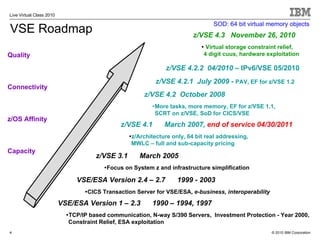
                                                                               SOD: 64 bit virtual memory objects
VSE Roadmap                                                             z/VSE 4.3 November 26, 2010
                                                                             Virtual storage constraint relief,
Quality                                                                     4 digit cuus, hardware exploitation

                                                              z/VSE 4.2.2 04/2010 – IPv6/VSE 05/2010
                                                          z/VSE 4.2.1 July 2009 - PAV, EF for z/VSE 1.2
Connectivity
                                                      z/VSE 4.2 October 2008
                                                         •More tasks, more memory, EF for z/VSE 1.1,
                                                          SCRT on z/VSE, SoD for CICS/VSE
z/OS Affinity
                                              z/VSE 4.1      March 2007, end of service 04/30/2011
                                                 z/Architecture only, 64 bit real addressing,
                                                 MWLC – full and sub-capacity pricing
Capacity
                                     z/VSE 3.1      March 2005
                                         Focus on System z and infrastructure simplification

                               VSE/ESA Version 2.4 – 2.7          1999 - 2003
                                  CICS Transaction Server for VSE/ESA, e-business, interoperability

                          VSE/ESA Version 1 – 2.3        1990 – 1994, 1997
                            TCP/IP based communication, N-way S/390 Servers, Investment Protection - Year 2000,
                            Constraint Relief, ESA exploitation
4                                                                                                     © 2010 IBM Corporation
Live Virtual Class 2010


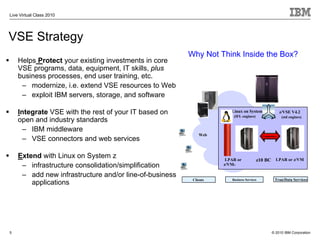
VSE Strategy
                                                        Why Not Think Inside the Box?
    Helps Protect your existing investments in core
    VSE programs, data, equipment, IT skills, plus
    business processes, end user training, etc.
     – modernize, i.e. extend VSE resources to Web
     – exploit IBM servers, storage, and software

    Integrate VSE with the rest of your IT based on                   Linux on System z
                                                                       (IFL engines)
                                                                                                       z/VSE V4.2
                                                                                                        (std engines)
    open and industry standards
      – IBM middleware
                                                            Web                           Connectors
      – VSE connectors and web services

    Extend with Linux on System z                                   LPAR or            z10 BC LPAR or z/VM
     – infrastructure consolidation/simplification                 z/VM®

     – add new infrastructure and/or line-of-business
                                                         Clients      Business Services           Tran/Data Services
        applications


5                                                                                               © 2010 IBM Corporation
Live Virtual Class 2010


z/VSE 4.3
    Preview: 10/2009, Announced: 10/2010, planned GA: 11/26/2010

    IBM System z10 / z196 exploitation
      – Dynamically add of CPUs
      – Large (1 megabyte) page support
      – Static power saving mode for SCRT (z196)

    Virtual storage constraint relief for 24 bit (CICS) programs

    4 digit device addresses (CUUs)

    Basic Security Manager (BSM) will allow to protect MQ resources

    Monitoring agent based on SNMP (Simple Network Management Protocol)

    Linux Fast Path

    Midrange Workload License Charges (MWLC) with sub-capacity mode
      – Sub-Capacity Reporting Tool (SCRT) – available with z/VSE 4.1 and later (z9 / z10 / z196 only)

    FSU from z/VSE 4.1 and 4.2

6                                                                                                        © 2010 IBM Corporation
Live Virtual Class 2010


Requirements addressed in z/VSE 4.3
    MR1120076646 - Provide 24-bit GETVIS-shortage relief
    by moving additional VSE/VSAM control blocks (including the CLWA) and
    executable code into 31-bit area
    MR0719046030, WAVV200413 - Move large system modules in 31-bit SVA
    WAVV200715 - Allow 4 digit cuu for compatibility
    MR0426071917 - Enhance cuu range from 3 to 4 digits
    MR0411056737 - Port z/OS LE changes to CEEFETCH Macro
    MR0511075750 - LIBR CATALOG from SYSLNK
    MR0626082059 - LIBR RENAME with DATE=OLD
    MR0729082910 - VSE Connectors - Support Numeric Decimal Data with decimal points
    MR071707545 - BSM XREF Service
    WAVV200820 - Audit enhancements - integrate DTSECTAB
    WAVV200830 - Job Control Commands (JCCs) and Job Control Statements (JCSs)
    whose effect extends beyond the end of the current VSE job should be subject to security
    checks.
    MR0071008 - Redirection of Power Punch Entries
    WAVV200721 - Cancel job output when output limit reached
    - Restart PNET TCP/IP passive connection
    WAVV200721 - Flush Power jobs when output limit is exceeded
    MR0525093425 - API for AMDSB
    MR0820095815 - Enhancement to SHOWCB macro
    WAVV200841, MR1027084841 - Summary list for record mapfile
7                                                                                   © 2010 IBM Corporation
Live Virtual Class 2010


                             Supported z/VSE Environments
                  z/VSE 4.1, 4.2 and 4.3 (will) run on the following platforms only

                          –IBM e-server zSeries processors (z800, z900, z890, z990)
                          –IBM System z9 Business Class (z9 BC)
                          –IBM System z9 Enterprise Class (z9 EC)
                          –IBM System z10 Business Class (z10 BC)
                          –IBM System z10 Enterprise Class (z10 EC)
                          –IBM zEnterprise 196 (z196)

                  and supports
                           uni- and multiprocessors
                           Basic mode (z800, z900 only), as z/VM guest or in LPAR
                           z/VSE 4.1, 4.2 or 4.3 (will) run under all supported z/VM releases,
                            including z/VM 6.1. z/VM 6.1 requires z10 technology.


8                                                                                                © 2010 IBM Corporation
Live Virtual Class 2010


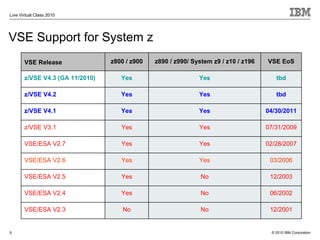
VSE Support for System z
       VSE Release               z800 / z900   z890 / z990/ System z9 / z10 / z196   VSE EoS

       z/VSE V4.3 (GA 11/2010)      Yes                       Yes                       tbd

       z/VSE V4.2                   Yes                       Yes                       tbd

       z/VSE V4.1                   Yes                       Yes                    04/30/2011

       z/VSE V3.1                   Yes                       Yes                    07/31/2009

       VSE/ESA V2.7                 Yes                       Yes                    02/28/2007

       VSE/ESA V2.6                 Yes                       Yes                     03/2006

       VSE/ESA V2.5                 Yes                        No                     12/2003

       VSE/ESA V2.4                 Yes                        No                     06/2002

       VSE/ESA V2.3                  No                        No                     12/2001


9                                                                                     © 2010 IBM Corporation
Live Virtual Class 2010


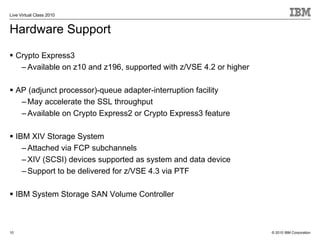
Hardware Support
     Crypto Express3
      – Available on z10 and z196, supported with z/VSE 4.2 or higher

     AP (adjunct processor)-queue adapter-interruption facility
      – May accelerate the SSL throughput
      – Available on Crypto Express2 or Crypto Express3 feature

     IBM XIV Storage System
       – Attached via FCP subchannels
       – XIV (SCSI) devices supported as system and data device
       – Support to be delivered for z/VSE 4.3 via PTF

     IBM System Storage SAN Volume Controller


10                                                                      © 2010 IBM Corporation
Live Virtual Class 2010


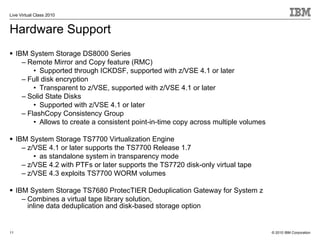
Hardware Support
     IBM System Storage DS8000 Series
       – Remote Mirror and Copy feature (RMC)
           • Supported through ICKDSF, supported with z/VSE 4.1 or later
       – Full disk encryption
           • Transparent to z/VSE, supported with z/VSE 4.1 or later
       – Solid State Disks
           • Supported with z/VSE 4.1 or later
       – FlashCopy Consistency Group
           • Allows to create a consistent point-in-time copy across multiple volumes

     IBM System Storage TS7700 Virtualization Engine
       – z/VSE 4.1 or later supports the TS7700 Release 1.7
           • as standalone system in transparency mode
       – z/VSE 4.2 with PTFs or later supports the TS7720 disk-only virtual tape
       – z/VSE 4.3 exploits TS7700 WORM volumes

     IBM System Storage TS7680 ProtecTIER Deduplication Gateway for System z
       – Combines a virtual tape library solution,
         inline data deduplication and disk-based storage option


11                                                                                      © 2010 IBM Corporation
Live Virtual Class 2010


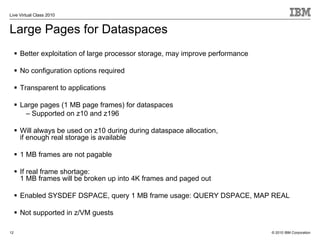
Large Pages for Dataspaces
     Better exploitation of large processor storage, may improve performance

     No configuration options required

     Transparent to applications

     Large pages (1 MB page frames) for dataspaces
       – Supported on z10 and z196

     Will always be used on z10 during during dataspace allocation,
     if enough real storage is available

     1 MB frames are not pagable

     If real frame shortage:
     1 MB frames will be broken up into 4K frames and paged out

     Enabled SYSDEF DSPACE, query 1 MB frame usage: QUERY DSPACE, MAP REAL

     Not supported in z/VM guests

12                                                                             © 2010 IBM Corporation
Live Virtual Class 2010


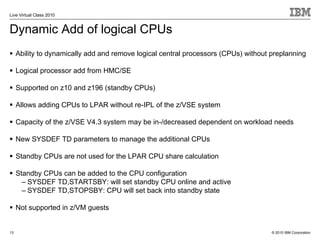
Dynamic Add of logical CPUs
     Ability to dynamically add and remove logical central processors (CPUs) without preplanning

     Logical processor add from HMC/SE

     Supported on z10 and z196 (standby CPUs)

     Allows adding CPUs to LPAR without re-IPL of the z/VSE system

     Capacity of the z/VSE V4.3 system may be in-/decreased dependent on workload needs

     New SYSDEF TD parameters to manage the additional CPUs

     Standby CPUs are not used for the LPAR CPU share calculation

     Standby CPUs can be added to the CPU configuration
       – SYSDEF TD,STARTSBY: will set standby CPU online and active
       – SYSDEF TD,STOPSBY: CPU will set back into standby state

     Not supported in z/VM guests


13                                                                                   © 2010 IBM Corporation
Live Virtual Class 2010


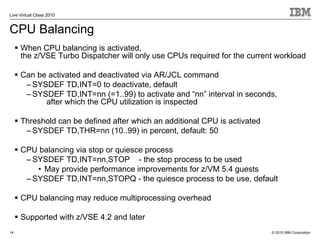
CPU Balancing
     When CPU balancing is activated,
     the z/VSE Turbo Dispatcher will only use CPUs required for the current workload

     Can be activated and deactivated via AR/JCL command
      – SYSDEF TD,INT=0 to deactivate, default
      – SYSDEF TD,INT=nn (=1..99) to activate and “nn” interval in seconds,
           after which the CPU utilization is inspected

     Threshold can be defined after which an additional CPU is activated
      – SYSDEF TD,THR=nn (10..99) in percent, default: 50

     CPU balancing via stop or quiesce process
      – SYSDEF TD,INT=nn,STOP - the stop process to be used
         • May provide performance improvements for z/VM 5.4 guests
      – SYSDEF TD,INT=nn,STOPQ - the quiesce process to be use, default

     CPU balancing may reduce multiprocessing overhead

     Supported with z/VSE 4.2 and later
14                                                                         © 2010 IBM Corporation
Live Virtual Class 2010


CPU Balancing …
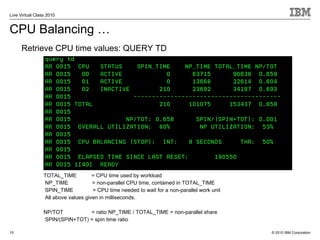
      Retrieve CPU time values: QUERY TD


                 TOTAL_TIME          = CPU time used by workload
                 NP_TIME             = non-parallel CPU time, contained in TOTAL_TIME
                 SPIN_TIME           = CPU time needed to wait for a non-parallel work unit
                 All above values given in milliseconds.

                 NP/TOT          = ratio NP_TIME / TOTAL_TIME = non-parallel share
                 SPIN/(SPIN+TOT) = spin time ratio

15                                                                                            © 2010 IBM Corporation
Live Virtual Class 2010


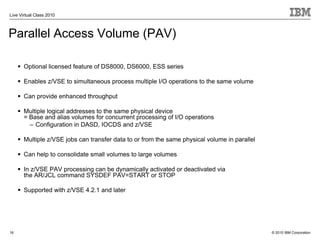
Parallel Access Volume (PAV)

       Optional licensed feature of DS8000, DS6000, ESS series

       Enables z/VSE to simultaneous process multiple I/O operations to the same volume

       Can provide enhanced throughput

       Multiple logical addresses to the same physical device
       = Base and alias volumes for concurrent processing of I/O operations
         – Configuration in DASD, IOCDS and z/VSE

       Multiple z/VSE jobs can transfer data to or from the same physical volume in parallel

       Can help to consolidate small volumes to large volumes

       In z/VSE PAV processing can be dynamically activated or deactivated via
       the AR/JCL command SYSDEF PAV=START or STOP

       Supported with z/VSE 4.2.1 and later


16                                                                                             © 2010 IBM Corporation
Live Virtual Class 2010


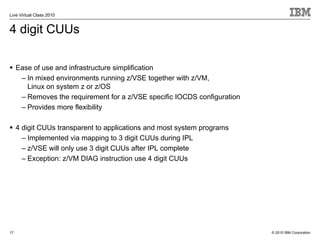
4 digit CUUs

     Ease of use and infrastructure simplification
      – In mixed environments running z/VSE together with z/VM,
        Linux on system z or z/OS
      – Removes the requirement for a z/VSE specific IOCDS configuration
      – Provides more flexibility

     4 digit CUUs transparent to applications and most system programs
       – Implemented via mapping to 3 digit CUUs during IPL
       – z/VSE will only use 3 digit CUUs after IPL complete
       – Exception: z/VM DIAG instruction use 4 digit CUUs


17                                                                         © 2010 IBM Corporation
Live Virtual Class 2010


4 digit CUUs
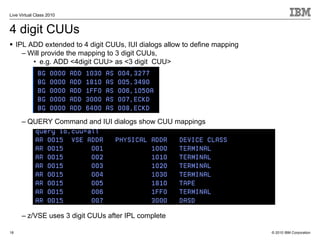
     IPL ADD extended to 4 digit CUUs, IUI dialogs allow to define mapping
       – Will provide the mapping to 3 digit CUUs,
          • e.g. ADD <4digit CUU> as <3 digit CUU>


      – QUERY Command and IUI dialogs show CUU mappings


      – z/VSE uses 3 digit CUUs after IPL complete

18                                                                           © 2010 IBM Corporation
Live Virtual Class 2010


CICS Considerations
     z/VSE 4.3 will no longer offer CICS/VSE 2.3 as part of the z/VSE 4.3 base
       – Fulfills the statement of direction in announcement from October 9, 2007
       – Coexistence environment removed which includes DL/I V1.10
       – Migration from CICS/VSE to CICS TS on z/VSE 4.2 or earlier
       – Most migration inhibitors should be removed with recent improvements
          • Basic Security Manager (BSM) enhancements
          • More tasks
          • Virtual constraint relief

     DOS/VS RPG II compiler support for CICS TS
      – Allows RPG programs implemented for CICS/VSE V2.3 to run with CICS TS
      – Will be available on z/VSE 4.2 (z/VSE 4.1) via PTF (see Info. APAR II4447)

     New DL/I VSE 1.12 release
      – Optional product of z/VSE 4.3 (the only DL/I release)
      – Provides constraint release (DL/I resources moved above the 16 MB line)
      – Replaces DL/I VSE 1.11 and DL/I DOS/VS 1.10
19                                                                                   © 2010 IBM Corporation
Live Virtual Class 2010


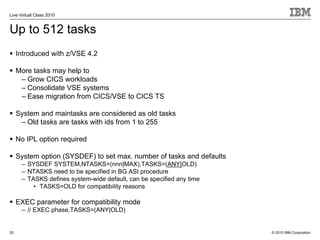
Up to 512 tasks
     Introduced with z/VSE 4.2

     More tasks may help to
      – Grow CICS workloads
      – Consolidate VSE systems
      – Ease migration from CICS/VSE to CICS TS

     System and maintasks are considered as old tasks
      – Old tasks are tasks with ids from 1 to 255

     No IPL option required

     System option (SYSDEF) to set max. number of tasks and defaults
      – SYSDEF SYSTEM,NTASKS=(nnn|MAX),TASKS=(ANY|OLD)
      – NTASKS need to be specified in BG ASI procedure
      – TASKS defines system-wide default, can be specified any time
          • TASKS=OLD for compatibility reasons

     EXEC parameter for compatibility mode
      – // EXEC phase,TASKS=(ANY|OLD)


20                                                                     © 2010 IBM Corporation
Live Virtual Class 2010


Up to 512 tasks …
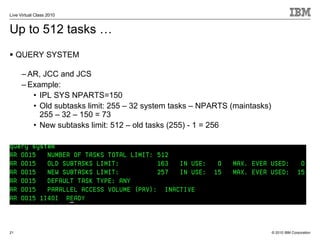
     QUERY SYSTEM

      – AR, JCC and JCS
      – Example:
         • IPL SYS NPARTS=150
         • Old subtasks limit: 255 – 32 system tasks – NPARTS (maintasks)
           255 – 32 – 150 = 73
         • New subtasks limit: 512 – old tasks (255) - 1 = 256


21                                                                          © 2010 IBM Corporation
Live Virtual Class 2010


Security Enhancements

Lightweight Directory Access Protocol (LDAP)
  – Sign-on support for CICS TS introduced with z/VSE 4.2
  – LDAP client on z/VSE, LDAP server running on a non-z/VSE system
      • Connected via TCP/IP network
  – LDAP sign-on enables users to z/VSE with long company-wide userids / passwords
      • Userids/passwords can be up to 64 character
  – Allows centralized management of userids
      • Password rules and password renewal can be enforced via LDAP server
  – z/VSE 4.3: Sign-on support for batch jobs, new IUI dialog for the LDAP support

Basic Security manager (BSM)
 – Security for WebSphere MQ for z/VSE V3 to protect MQ resources
 – Includes DTSECTAB resources into SMF logging and reporting
 – BSM cross reference reports
 – Selected JCL statements can be protected by BSM

22                                                                    © 2010 IBM Corporation
Live Virtual Class 2010


Encryption Facility for z/VSE

     Optional priced feature for VSE Central Functions V8

     Supports the use of SAM files, VSE/VSAM files, VSE library members, tapes,
     virtual tapes as input or output

     Requires CP Assist for Cryptographic Function (CPACF)
      – no charge feature, only on z890, z990, z9, z10 and z196 servers

     Extends affinity between z/VSE and z/OS
      – Function roughly equivalent to EF for z/OS 1.1
      – Compatible with EF for z/OS V1.1 (Encryption Facility System z format)
         • EF for z/VSE tapes can be read by EF for z/VSE, EF for z/OS, EF for z/OS Java Client,
           and Decryption Client for z/OS,
         • EF for z/OS V1.1 and EF for z/OS Java client tapes can be read by EF for z/VSE V1.1


23                                                                                  © 2010 IBM Corporation
Live Virtual Class 2010


Encryption Facility for z/VSE ...

     EF for z/VSE 1.1
      – Announced: 10/2007, GA: 11/2007
      – Supports z/VSE 4.1
      – Function roughly equivalent to EF for z/OS V1.1

     EF for z/VSE 1.2
      – Announced: 04/2009, GA: 07/2009
      – Supports z/VSE 4.2 and later
      – Supports openPGP standard
      – Optional compression using ZIP or ZLIB algorithms

     EF for z/VSE complements z/VSE support for IBM TS1120 / TS1130 tape
      – TS1120 / TS1130 preferred solution for high volume backup/archive
      – EF option for limited backup/archive and/or exchange with partners with no TS1120/TS1130


24                                                                                © 2010 IBM Corporation
Live Virtual Class 2010


TCP/IP Connectivity for z/VSE
     TCP/IP connectivity for IPv4 communication
      – TCP/IP for VSE/ESA 1.5 – licensed from CSI International
      – IPv6/VSE – licensed from Barnard Software, Inc. (BSI)
      – Linux fast path (LFP)
      – EZA socket interface, new function calls
      – LE/C socket API

     TCP/IP connectivity for IPv6 communication
      – IPv6/VSE
      – EZA socket interface, new function calls

     All TCP/IP stacks can run concurrently within one z/VSE system

     z/VM queue-I/O assist for real networking devices
       – Performance assist for OSA-Express adapters and HiperSockets


25                                                                      © 2010 IBM Corporation
Live Virtual Class 2010


IPv6/VSE

Announced: 04/06/2010, GA 05/28/2010, to be updated 11/26/2010

Full function IPv4 (with November update) and IPv6 stack with applications
 –MWLC with sub-capacity option for IPv6/VSE product
 –Supported releases: z/VSE 4.2 plus PTFs or z/VSE 4.3
 –Optional Product of z/VSE 4.3

IPv6 solution for z/VSE
  –Includes the IPv6 stack, IPv6 APIs and IPv6-enabled applications
     • IBM’s EZA Assembler interfaces support IPv4 and IPv6 communication
  –Extends 32 bit addresses (used in IPv4) to 128 bit addresses
  –To meet requirements of governmental agencies for products


26                                                                © 2010 IBM Corporation
Live Virtual Class 2010


IPv6/VSE - Functionality
     IPv6/VSE’s dual stack support: allows IPv6-enabled applications to transparently
     communicate with partners via either IPv6 or IPv4 network

     IPv6 tunneling: encapsulates IPv6 datagrams within IPv4 packets
     allows communication with IPv6 networks, even if local infrastructure is IPv4

     IPv4 and IPv6 enabled applications:
       – FTP server, FTP client
       – Batch FTP client
       – TN3270E server
       – NTP client / server to query time of day to synch TOD clock
       – System logger client to log e.g. z/VSE messages to Linux
       – Batch email client
       – Batch LPR + TN3270E / FTP / DIRECT printer sessions
       – Batch remote execution client
       – Batch PING
       – GZIP data compression
       – REXX automation
       – DBCS support: FTP client / server, LPR, batch email client, GZIP


27                                                                                      © 2010 IBM Corporation
Live Virtual Class 2010


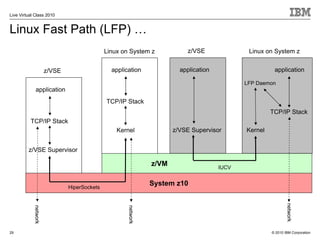
Linux Fast Path (LFP)

          Provided with the z/VSE 4.3 base product – no additional charge

          LFP uses an IUCV connection between z/VSE and Linux on System z
           – Both – z/VSE and Linux – need to be z/VM guests of the same z/VM
           – Routes the socket request to Linux on System z
               • Without using the local TCP/IP stack
           – LFP daemon on Linux forwards the socket request to the Linux TCP/IP stack
           – Will run best in z/VM mode LPAR (z/VM 5.4 or higher)
               • Available on z10 and z196
               • Linux on System z on IFL, z/VSE on standard processors

          LFP is transparent to IBM socket APIs
           – Supported APIs: LE/C socket API, EZA socket / EZASMI interface, …
           – Transparent to IBM applications (DB2 client, Connectors, Power PNET)
           – No standard TCP/IP applications (Telnet, FTP, …) provided

          System requirements:
           – z/VM 5.4 or higher
           – Linux on System z distribution (min. SLES 10 SP3 or RHEL 5.5)


28                                                                                  © 2010 IBM Corporation
Live Virtual Class 2010


Linux Fast Path (LFP) …
                                             Linux on System z            z/VSE               Linux on System z


                      z/VSE                    application              application                    application

                                                                                             LFP Daemon
              application
                                             TCP/IP Stack
                                                                                                      TCP/IP Stack
          TCP/IP Stack
                                                 Kernel               z/VSE Supervisor       Kernel


         z/VSE Supervisor

                                                               z/VM                   IUCV


                              HiperSockets
                                                               System z10


                                                                                                              network
            network


                                                     network


29                                                                                                    © 2010 IBM Corporation
Live Virtual Class 2010


Connectors

     E-business Connectors
      –Supports decimal datatypes such as PACKED and ZONED
        with implied positions
      –VSAM redirector support for CICS TS subtasking

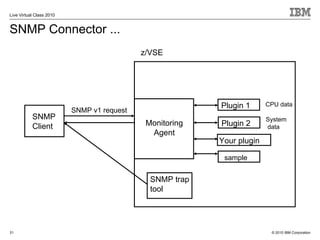
     SNMP Connector
      –SNMP (Simple Network Management Protocol) V1 protocol
      –Allows to monitor system events on a network
      –Clients can retrieve z/VSE specific system and performance data
      –Performance monitors may collect the data for planning purposes


30                                                                 © 2010 IBM Corporation
Live Virtual Class 2010


SNMP Connector ...
                                            z/VSE


                                                          Plugin 1      CPU data
                          SNMP v1 request
           SNMP                                                         System
           Client                            Monitoring   Plugin 2      data
                                              Agent
                                                          Your plugin

                                                           sample


                                              SNMP trap
                                              tool


31                                                                       © 2010 IBM Corporation
Live Virtual Class 2010


Enhancements for z/VSE Components

     Language Envionment
      –Support of BEAR (break-event-address register) feature for debugging
      –PL/I multitasking for improved performance
      –LE/C TCP/IP socket API multiplexer for multiple TCP/IP stacks

     VSAM enhancements
      –Constraint relief: control blocks and buffers moved to 31 bit storage
            • New DLBL option: BUFDAT=RMODE31
              VSE/VSAM data buffers to be allocated in 31-bit Partition Getvis
      –GETVIS subpools for VSAM storage
      –SHOWCB macro shows new fields and attributes


32                                                                               © 2010 IBM Corporation
Live Virtual Class 2010


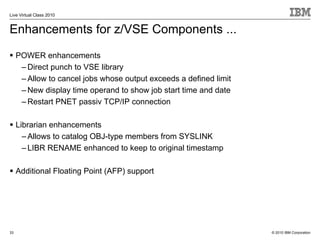
Enhancements for z/VSE Components ...
     POWER enhancements
      – Direct punch to VSE library
      – Allow to cancel jobs whose output exceeds a defined limit
      – New display time operand to show job start time and date
      – Restart PNET passiv TCP/IP connection

     Librarian enhancements
       – Allows to catalog OBJ-type members from SYSLINK
       – LIBR RENAME enhanced to keep to original timestamp

     Additional Floating Point (AFP) support


33                                                                  © 2010 IBM Corporation
Live Virtual Class 2010


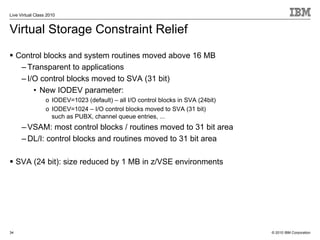
Virtual Storage Constraint Relief
     Control blocks and system routines moved above 16 MB
      – Transparent to applications
      – I/O control blocks moved to SVA (31 bit)
          • New IODEV parameter:
                  o IODEV=1023 (default) – all I/O control blocks in SVA (24bit)
                  o IODEV=1024 – I/O control blocks moved to SVA (31 bit)
                    such as PUBX, channel queue entries, ...
      – VSAM: most control blocks / routines moved to 31 bit area
      – DL/I: control blocks and routines moved to 31 bit area

     SVA (24 bit): size reduced by 1 MB in z/VSE environments


34                                                                                 © 2010 IBM Corporation
Live Virtual Class 2010


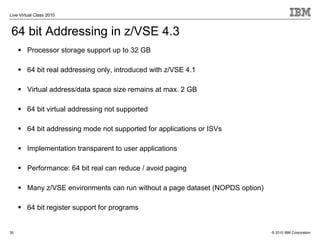
64 bit Addressing in z/VSE 4.3
        Processor storage support up to 32 GB

        64 bit real addressing only, introduced with z/VSE 4.1

        Virtual address/data space size remains at max. 2 GB

        64 bit virtual addressing not supported

        64 bit addressing mode not supported for applications or ISVs

        Implementation transparent to user applications

        Performance: 64 bit real can reduce / avoid paging

        Many z/VSE environments can run without a page dataset (NOPDS option)

        64 bit register support for programs


35                                                                              © 2010 IBM Corporation
Live Virtual Class 2010


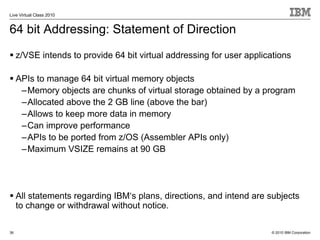
64 bit Addressing: Statement of Direction
     z/VSE intends to provide 64 bit virtual addressing for user applications

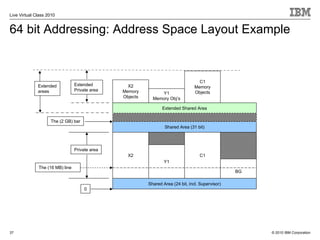
     APIs to manage 64 bit virtual memory objects
      –Memory objects are chunks of virtual storage obtained by a program
      –Allocated above the 2 GB line (above the bar)
      –Allows to keep more data in memory
      –Can improve performance
      –APIs to be ported from z/OS (Assembler APIs only)
      –Maximum VSIZE remains at 90 GB


     All statements regarding IBM‘s plans, directions, and intend are subjects
     to change or withdrawal without notice.

36                                                                     © 2010 IBM Corporation
Live Virtual Class 2010


64 bit Addressing: Address Space Layout Example


                                                                                    C1
              Extended           Extended         X2                              Memory
              areas              Private area   Memory         Y1                 Objects
                                                Objects     Memory Obj’s

                                                                 Extended Shared Area

                    The (2 GB) bar
                                                                  Shared Area (31 bit)


                                 Private area
                                                  X2                                C1
                                                                  Y1
              The (16 MB) line
                                                                                                   BG

                                                          Shared Area (24 bit, incl. Supervisor)
                                      0


37                                                                                                      © 2010 IBM Corporation
Live Virtual Class 2010


More Information

         … on VSE home page: http://ibm.com/vse

         Hints and Tips for z/VSE V4.2:
             ftp://ftp.software.ibm.com/eserver/zseries/zos/vse/pdf3/zvse41/hint9mm2.pdf


         IBM Redbooks:

            – Introduction to the New Mainframe: z/VSE Basics
              http://www.redbooks.ibm.com/abstracts/sg247436.html?Open

            – Security on IBM z/VSE
              http://www.redbooks.ibm.com/redpieces/abstracts/sg247691.html

            – z/VSE Using DB2 on Linux for System z
              http://www.redbooks.ibm.com/abstracts/sg247690.html?Open


38                                                                                   © 2010 IBM Corporation

IBM z/VSE V4.3 - More capacity for growth

  • 1.
    Live Virtual Class2010 IBM z/VSE V4.3 - More capacity for growth Ingolf Salm salm@de.ibm.com 12/14/2010 © 2010 IBM Corporation
  • 2.
    Live Virtual Class2010 Trademarks The following are trademarks of the International Business Machines Corporation in the United States, other countries, or both. Not all common law marks used by IBM are listed on this page. Failure of a mark to appear does not mean that IBM does not use the mark nor does it mean that the product is not actively marketed or is not significant within its relevant market. Those trademarks followed by ® are registered trademarks of IBM in the United States; all others are trademarks or common law marks of IBM in the United States. For a complete list of IBM Trademarks, see www.ibm.com/legal/copytrade.shtml: *, AS/400®, e business(logo)®, DBE, ESCO, eServer, FICON, IBM®, IBM (logo)®, iSeries®, MVS, OS/390®, pSeries®, RS/6000®, S/30, VM/ESA®, VSE/ESA, z/VSE, WebSphere®, xSeries®, z/OS®, zSeries®, z/VM®, System i, System i5, System p, System p5, System x, System z, System z9®, System z10®, BladeCenter® The following are trademarks or registered trademarks of other companies. Adobe, the Adobe logo, PostScript, and the PostScript logo are either registered trademarks or trademarks of Adobe Systems Incorporated in the United States, and/or other countries. Cell Broadband Engine is a trademark of Sony Computer Entertainment, Inc. in the United States, other countries, or both and is used under license therefrom. Java and all Java-based trademarks are trademarks of Sun Microsystems, Inc. in the United States, other countries, or both. Microsoft, Windows, Windows NT, and the Windows logo are trademarks of Microsoft Corporation in the United States, other countries, or both. Intel, Intel logo, Intel Inside, Intel Inside logo, Intel Centrino, Intel Centrino logo, Celeron, Intel Xeon, Intel SpeedStep, Itanium, and Pentium are trademarks or registered trademarks of Intel Corporation or its subsidiaries in the United States and other countries. UNIX is a registered trademark of The Open Group in the United States and other countries. Linux is a registered trademark of Linus Torvalds in the United States, other countries, or both. ITIL is a registered trademark, and a registered community trademark of the Office of Government Commerce, and is registered in the U.S. Patent and Trademark Office. IT Infrastructure Library is a registered trademark of the Central Computer and Telecommunications Agency, which is now part of the Office of Government Commerce. * All other products may be trademarks or registered trademarks of their respective companies. Notes: Performance is in Internal Throughput Rate (ITR) ratio based on measurements and projections using standard IBM benchmarks in a controlled environment. The actual throughput that any user will experience will vary depending upon considerations such as the amount of multiprogramming in the user's job stream, the I/O configuration, the storage configuration, and the workload processed. Therefore, no assurance can be given that an individual user will achieve throughput improvements equivalent to the performance ratios stated here. IBM hardware products are manufactured from new parts, or new and serviceable used parts. Regardless, our warranty terms apply. All customer examples cited or described in this presentation are presented as illustrations of the manner in which some customers have used IBM products and the results they may have achieved. Actual environmental costs and performance characteristics will vary depending on individual customer configurations and conditions. This publication was produced in the United States. IBM may not offer the products, services or features discussed in this document in other countries, and the information may be subject to change without notice. Consult your local IBM business contact for information on the product or services available in your area. All statements regarding IBM's future direction and intent are subject to change or withdrawal without notice, and represent goals and objectives only. Information about non-IBM products is obtained from the manufacturers of those products or their published announcements. IBM has not tested those products and cannot confirm the performance, compatibility, or any other claims related to non-IBM products. Questions on the capabilities of non-IBM products should be addressed to the suppliers of those products. Prices subject to change without notice. Contact your IBM representative or Business Partner for the most current pricing in your geography. 2 2 © 2010 IBM Corporation
  • 3.
    Live Virtual Class2010 Agenda Roadmap VSE strategy z/VSE 4.3 key functions Statement of Direction: 64 bit virtual addressing 3 © 2010 IBM Corporation
  • 4.
    Live Virtual Class2010 SOD: 64 bit virtual memory objects VSE Roadmap z/VSE 4.3 November 26, 2010 Virtual storage constraint relief, Quality 4 digit cuus, hardware exploitation z/VSE 4.2.2 04/2010 – IPv6/VSE 05/2010 z/VSE 4.2.1 July 2009 - PAV, EF for z/VSE 1.2 Connectivity z/VSE 4.2 October 2008 •More tasks, more memory, EF for z/VSE 1.1, SCRT on z/VSE, SoD for CICS/VSE z/OS Affinity z/VSE 4.1 March 2007, end of service 04/30/2011 z/Architecture only, 64 bit real addressing, MWLC – full and sub-capacity pricing Capacity z/VSE 3.1 March 2005 Focus on System z and infrastructure simplification VSE/ESA Version 2.4 – 2.7 1999 - 2003 CICS Transaction Server for VSE/ESA, e-business, interoperability VSE/ESA Version 1 – 2.3 1990 – 1994, 1997 TCP/IP based communication, N-way S/390 Servers, Investment Protection - Year 2000, Constraint Relief, ESA exploitation 4 © 2010 IBM Corporation
  • 5.
    Live Virtual Class2010 VSE Strategy Why Not Think Inside the Box? Helps Protect your existing investments in core VSE programs, data, equipment, IT skills, plus business processes, end user training, etc. – modernize, i.e. extend VSE resources to Web – exploit IBM servers, storage, and software Integrate VSE with the rest of your IT based on Linux on System z (IFL engines) z/VSE V4.2 (std engines) open and industry standards – IBM middleware Web Connectors – VSE connectors and web services Extend with Linux on System z LPAR or z10 BC LPAR or z/VM – infrastructure consolidation/simplification z/VM® – add new infrastructure and/or line-of-business Clients Business Services Tran/Data Services applications 5 © 2010 IBM Corporation
  • 6.
    Live Virtual Class2010 z/VSE 4.3 Preview: 10/2009, Announced: 10/2010, planned GA: 11/26/2010 IBM System z10 / z196 exploitation – Dynamically add of CPUs – Large (1 megabyte) page support – Static power saving mode for SCRT (z196) Virtual storage constraint relief for 24 bit (CICS) programs 4 digit device addresses (CUUs) Basic Security Manager (BSM) will allow to protect MQ resources Monitoring agent based on SNMP (Simple Network Management Protocol) Linux Fast Path Midrange Workload License Charges (MWLC) with sub-capacity mode – Sub-Capacity Reporting Tool (SCRT) – available with z/VSE 4.1 and later (z9 / z10 / z196 only) FSU from z/VSE 4.1 and 4.2 6 © 2010 IBM Corporation
  • 7.
    Live Virtual Class2010 Requirements addressed in z/VSE 4.3 MR1120076646 - Provide 24-bit GETVIS-shortage relief by moving additional VSE/VSAM control blocks (including the CLWA) and executable code into 31-bit area MR0719046030, WAVV200413 - Move large system modules in 31-bit SVA WAVV200715 - Allow 4 digit cuu for compatibility MR0426071917 - Enhance cuu range from 3 to 4 digits MR0411056737 - Port z/OS LE changes to CEEFETCH Macro MR0511075750 - LIBR CATALOG from SYSLNK MR0626082059 - LIBR RENAME with DATE=OLD MR0729082910 - VSE Connectors - Support Numeric Decimal Data with decimal points MR071707545 - BSM XREF Service WAVV200820 - Audit enhancements - integrate DTSECTAB WAVV200830 - Job Control Commands (JCCs) and Job Control Statements (JCSs) whose effect extends beyond the end of the current VSE job should be subject to security checks. MR0071008 - Redirection of Power Punch Entries WAVV200721 - Cancel job output when output limit reached - Restart PNET TCP/IP passive connection WAVV200721 - Flush Power jobs when output limit is exceeded MR0525093425 - API for AMDSB MR0820095815 - Enhancement to SHOWCB macro WAVV200841, MR1027084841 - Summary list for record mapfile 7 © 2010 IBM Corporation
  • 8.
    Live Virtual Class2010 Supported z/VSE Environments z/VSE 4.1, 4.2 and 4.3 (will) run on the following platforms only –IBM e-server zSeries processors (z800, z900, z890, z990) –IBM System z9 Business Class (z9 BC) –IBM System z9 Enterprise Class (z9 EC) –IBM System z10 Business Class (z10 BC) –IBM System z10 Enterprise Class (z10 EC) –IBM zEnterprise 196 (z196) and supports uni- and multiprocessors Basic mode (z800, z900 only), as z/VM guest or in LPAR z/VSE 4.1, 4.2 or 4.3 (will) run under all supported z/VM releases, including z/VM 6.1. z/VM 6.1 requires z10 technology. 8 © 2010 IBM Corporation
  • 9.
    Live Virtual Class2010 VSE Support for System z VSE Release z800 / z900 z890 / z990/ System z9 / z10 / z196 VSE EoS z/VSE V4.3 (GA 11/2010) Yes Yes tbd z/VSE V4.2 Yes Yes tbd z/VSE V4.1 Yes Yes 04/30/2011 z/VSE V3.1 Yes Yes 07/31/2009 VSE/ESA V2.7 Yes Yes 02/28/2007 VSE/ESA V2.6 Yes Yes 03/2006 VSE/ESA V2.5 Yes No 12/2003 VSE/ESA V2.4 Yes No 06/2002 VSE/ESA V2.3 No No 12/2001 9 © 2010 IBM Corporation
  • 10.
    Live Virtual Class2010 Hardware Support Crypto Express3 – Available on z10 and z196, supported with z/VSE 4.2 or higher AP (adjunct processor)-queue adapter-interruption facility – May accelerate the SSL throughput – Available on Crypto Express2 or Crypto Express3 feature IBM XIV Storage System – Attached via FCP subchannels – XIV (SCSI) devices supported as system and data device – Support to be delivered for z/VSE 4.3 via PTF IBM System Storage SAN Volume Controller 10 © 2010 IBM Corporation
  • 11.
    Live Virtual Class2010 Hardware Support IBM System Storage DS8000 Series – Remote Mirror and Copy feature (RMC) • Supported through ICKDSF, supported with z/VSE 4.1 or later – Full disk encryption • Transparent to z/VSE, supported with z/VSE 4.1 or later – Solid State Disks • Supported with z/VSE 4.1 or later – FlashCopy Consistency Group • Allows to create a consistent point-in-time copy across multiple volumes IBM System Storage TS7700 Virtualization Engine – z/VSE 4.1 or later supports the TS7700 Release 1.7 • as standalone system in transparency mode – z/VSE 4.2 with PTFs or later supports the TS7720 disk-only virtual tape – z/VSE 4.3 exploits TS7700 WORM volumes IBM System Storage TS7680 ProtecTIER Deduplication Gateway for System z – Combines a virtual tape library solution, inline data deduplication and disk-based storage option 11 © 2010 IBM Corporation
  • 12.
    Live Virtual Class2010 Large Pages for Dataspaces Better exploitation of large processor storage, may improve performance No configuration options required Transparent to applications Large pages (1 MB page frames) for dataspaces – Supported on z10 and z196 Will always be used on z10 during during dataspace allocation, if enough real storage is available 1 MB frames are not pagable If real frame shortage: 1 MB frames will be broken up into 4K frames and paged out Enabled SYSDEF DSPACE, query 1 MB frame usage: QUERY DSPACE, MAP REAL Not supported in z/VM guests 12 © 2010 IBM Corporation
  • 13.
    Live Virtual Class2010 Dynamic Add of logical CPUs Ability to dynamically add and remove logical central processors (CPUs) without preplanning Logical processor add from HMC/SE Supported on z10 and z196 (standby CPUs) Allows adding CPUs to LPAR without re-IPL of the z/VSE system Capacity of the z/VSE V4.3 system may be in-/decreased dependent on workload needs New SYSDEF TD parameters to manage the additional CPUs Standby CPUs are not used for the LPAR CPU share calculation Standby CPUs can be added to the CPU configuration – SYSDEF TD,STARTSBY: will set standby CPU online and active – SYSDEF TD,STOPSBY: CPU will set back into standby state Not supported in z/VM guests 13 © 2010 IBM Corporation
  • 14.
    Live Virtual Class2010 CPU Balancing When CPU balancing is activated, the z/VSE Turbo Dispatcher will only use CPUs required for the current workload Can be activated and deactivated via AR/JCL command – SYSDEF TD,INT=0 to deactivate, default – SYSDEF TD,INT=nn (=1..99) to activate and “nn” interval in seconds, after which the CPU utilization is inspected Threshold can be defined after which an additional CPU is activated – SYSDEF TD,THR=nn (10..99) in percent, default: 50 CPU balancing via stop or quiesce process – SYSDEF TD,INT=nn,STOP - the stop process to be used • May provide performance improvements for z/VM 5.4 guests – SYSDEF TD,INT=nn,STOPQ - the quiesce process to be use, default CPU balancing may reduce multiprocessing overhead Supported with z/VSE 4.2 and later 14 © 2010 IBM Corporation
  • 15.
    Live Virtual Class2010 CPU Balancing … Retrieve CPU time values: QUERY TD TOTAL_TIME = CPU time used by workload NP_TIME = non-parallel CPU time, contained in TOTAL_TIME SPIN_TIME = CPU time needed to wait for a non-parallel work unit All above values given in milliseconds. NP/TOT = ratio NP_TIME / TOTAL_TIME = non-parallel share SPIN/(SPIN+TOT) = spin time ratio 15 © 2010 IBM Corporation
  • 16.
    Live Virtual Class2010 Parallel Access Volume (PAV) Optional licensed feature of DS8000, DS6000, ESS series Enables z/VSE to simultaneous process multiple I/O operations to the same volume Can provide enhanced throughput Multiple logical addresses to the same physical device = Base and alias volumes for concurrent processing of I/O operations – Configuration in DASD, IOCDS and z/VSE Multiple z/VSE jobs can transfer data to or from the same physical volume in parallel Can help to consolidate small volumes to large volumes In z/VSE PAV processing can be dynamically activated or deactivated via the AR/JCL command SYSDEF PAV=START or STOP Supported with z/VSE 4.2.1 and later 16 © 2010 IBM Corporation
  • 17.
    Live Virtual Class2010 4 digit CUUs Ease of use and infrastructure simplification – In mixed environments running z/VSE together with z/VM, Linux on system z or z/OS – Removes the requirement for a z/VSE specific IOCDS configuration – Provides more flexibility 4 digit CUUs transparent to applications and most system programs – Implemented via mapping to 3 digit CUUs during IPL – z/VSE will only use 3 digit CUUs after IPL complete – Exception: z/VM DIAG instruction use 4 digit CUUs 17 © 2010 IBM Corporation
  • 18.
    Live Virtual Class2010 4 digit CUUs IPL ADD extended to 4 digit CUUs, IUI dialogs allow to define mapping – Will provide the mapping to 3 digit CUUs, • e.g. ADD <4digit CUU> as <3 digit CUU> – QUERY Command and IUI dialogs show CUU mappings – z/VSE uses 3 digit CUUs after IPL complete 18 © 2010 IBM Corporation
  • 19.
    Live Virtual Class2010 CICS Considerations z/VSE 4.3 will no longer offer CICS/VSE 2.3 as part of the z/VSE 4.3 base – Fulfills the statement of direction in announcement from October 9, 2007 – Coexistence environment removed which includes DL/I V1.10 – Migration from CICS/VSE to CICS TS on z/VSE 4.2 or earlier – Most migration inhibitors should be removed with recent improvements • Basic Security Manager (BSM) enhancements • More tasks • Virtual constraint relief DOS/VS RPG II compiler support for CICS TS – Allows RPG programs implemented for CICS/VSE V2.3 to run with CICS TS – Will be available on z/VSE 4.2 (z/VSE 4.1) via PTF (see Info. APAR II4447) New DL/I VSE 1.12 release – Optional product of z/VSE 4.3 (the only DL/I release) – Provides constraint release (DL/I resources moved above the 16 MB line) – Replaces DL/I VSE 1.11 and DL/I DOS/VS 1.10 19 © 2010 IBM Corporation
  • 20.
    Live Virtual Class2010 Up to 512 tasks Introduced with z/VSE 4.2 More tasks may help to – Grow CICS workloads – Consolidate VSE systems – Ease migration from CICS/VSE to CICS TS System and maintasks are considered as old tasks – Old tasks are tasks with ids from 1 to 255 No IPL option required System option (SYSDEF) to set max. number of tasks and defaults – SYSDEF SYSTEM,NTASKS=(nnn|MAX),TASKS=(ANY|OLD) – NTASKS need to be specified in BG ASI procedure – TASKS defines system-wide default, can be specified any time • TASKS=OLD for compatibility reasons EXEC parameter for compatibility mode – // EXEC phase,TASKS=(ANY|OLD) 20 © 2010 IBM Corporation
  • 21.
    Live Virtual Class2010 Up to 512 tasks … QUERY SYSTEM – AR, JCC and JCS – Example: • IPL SYS NPARTS=150 • Old subtasks limit: 255 – 32 system tasks – NPARTS (maintasks) 255 – 32 – 150 = 73 • New subtasks limit: 512 – old tasks (255) - 1 = 256 21 © 2010 IBM Corporation
  • 22.
    Live Virtual Class2010 Security Enhancements Lightweight Directory Access Protocol (LDAP) – Sign-on support for CICS TS introduced with z/VSE 4.2 – LDAP client on z/VSE, LDAP server running on a non-z/VSE system • Connected via TCP/IP network – LDAP sign-on enables users to z/VSE with long company-wide userids / passwords • Userids/passwords can be up to 64 character – Allows centralized management of userids • Password rules and password renewal can be enforced via LDAP server – z/VSE 4.3: Sign-on support for batch jobs, new IUI dialog for the LDAP support Basic Security manager (BSM) – Security for WebSphere MQ for z/VSE V3 to protect MQ resources – Includes DTSECTAB resources into SMF logging and reporting – BSM cross reference reports – Selected JCL statements can be protected by BSM 22 © 2010 IBM Corporation
  • 23.
    Live Virtual Class2010 Encryption Facility for z/VSE Optional priced feature for VSE Central Functions V8 Supports the use of SAM files, VSE/VSAM files, VSE library members, tapes, virtual tapes as input or output Requires CP Assist for Cryptographic Function (CPACF) – no charge feature, only on z890, z990, z9, z10 and z196 servers Extends affinity between z/VSE and z/OS – Function roughly equivalent to EF for z/OS 1.1 – Compatible with EF for z/OS V1.1 (Encryption Facility System z format) • EF for z/VSE tapes can be read by EF for z/VSE, EF for z/OS, EF for z/OS Java Client, and Decryption Client for z/OS, • EF for z/OS V1.1 and EF for z/OS Java client tapes can be read by EF for z/VSE V1.1 23 © 2010 IBM Corporation
  • 24.
    Live Virtual Class2010 Encryption Facility for z/VSE ... EF for z/VSE 1.1 – Announced: 10/2007, GA: 11/2007 – Supports z/VSE 4.1 – Function roughly equivalent to EF for z/OS V1.1 EF for z/VSE 1.2 – Announced: 04/2009, GA: 07/2009 – Supports z/VSE 4.2 and later – Supports openPGP standard – Optional compression using ZIP or ZLIB algorithms EF for z/VSE complements z/VSE support for IBM TS1120 / TS1130 tape – TS1120 / TS1130 preferred solution for high volume backup/archive – EF option for limited backup/archive and/or exchange with partners with no TS1120/TS1130 24 © 2010 IBM Corporation
  • 25.
    Live Virtual Class2010 TCP/IP Connectivity for z/VSE TCP/IP connectivity for IPv4 communication – TCP/IP for VSE/ESA 1.5 – licensed from CSI International – IPv6/VSE – licensed from Barnard Software, Inc. (BSI) – Linux fast path (LFP) – EZA socket interface, new function calls – LE/C socket API TCP/IP connectivity for IPv6 communication – IPv6/VSE – EZA socket interface, new function calls All TCP/IP stacks can run concurrently within one z/VSE system z/VM queue-I/O assist for real networking devices – Performance assist for OSA-Express adapters and HiperSockets 25 © 2010 IBM Corporation
  • 26.
    Live Virtual Class2010 IPv6/VSE Announced: 04/06/2010, GA 05/28/2010, to be updated 11/26/2010 Full function IPv4 (with November update) and IPv6 stack with applications –MWLC with sub-capacity option for IPv6/VSE product –Supported releases: z/VSE 4.2 plus PTFs or z/VSE 4.3 –Optional Product of z/VSE 4.3 IPv6 solution for z/VSE –Includes the IPv6 stack, IPv6 APIs and IPv6-enabled applications • IBM’s EZA Assembler interfaces support IPv4 and IPv6 communication –Extends 32 bit addresses (used in IPv4) to 128 bit addresses –To meet requirements of governmental agencies for products 26 © 2010 IBM Corporation
  • 27.
    Live Virtual Class2010 IPv6/VSE - Functionality IPv6/VSE’s dual stack support: allows IPv6-enabled applications to transparently communicate with partners via either IPv6 or IPv4 network IPv6 tunneling: encapsulates IPv6 datagrams within IPv4 packets allows communication with IPv6 networks, even if local infrastructure is IPv4 IPv4 and IPv6 enabled applications: – FTP server, FTP client – Batch FTP client – TN3270E server – NTP client / server to query time of day to synch TOD clock – System logger client to log e.g. z/VSE messages to Linux – Batch email client – Batch LPR + TN3270E / FTP / DIRECT printer sessions – Batch remote execution client – Batch PING – GZIP data compression – REXX automation – DBCS support: FTP client / server, LPR, batch email client, GZIP 27 © 2010 IBM Corporation
  • 28.
    Live Virtual Class2010 Linux Fast Path (LFP) Provided with the z/VSE 4.3 base product – no additional charge LFP uses an IUCV connection between z/VSE and Linux on System z – Both – z/VSE and Linux – need to be z/VM guests of the same z/VM – Routes the socket request to Linux on System z • Without using the local TCP/IP stack – LFP daemon on Linux forwards the socket request to the Linux TCP/IP stack – Will run best in z/VM mode LPAR (z/VM 5.4 or higher) • Available on z10 and z196 • Linux on System z on IFL, z/VSE on standard processors LFP is transparent to IBM socket APIs – Supported APIs: LE/C socket API, EZA socket / EZASMI interface, … – Transparent to IBM applications (DB2 client, Connectors, Power PNET) – No standard TCP/IP applications (Telnet, FTP, …) provided System requirements: – z/VM 5.4 or higher – Linux on System z distribution (min. SLES 10 SP3 or RHEL 5.5) 28 © 2010 IBM Corporation
  • 29.
    Live Virtual Class2010 Linux Fast Path (LFP) … Linux on System z z/VSE Linux on System z z/VSE application application application LFP Daemon application TCP/IP Stack TCP/IP Stack TCP/IP Stack Kernel z/VSE Supervisor Kernel z/VSE Supervisor z/VM IUCV HiperSockets System z10 network network network 29 © 2010 IBM Corporation
  • 30.
    Live Virtual Class2010 Connectors E-business Connectors –Supports decimal datatypes such as PACKED and ZONED with implied positions –VSAM redirector support for CICS TS subtasking SNMP Connector –SNMP (Simple Network Management Protocol) V1 protocol –Allows to monitor system events on a network –Clients can retrieve z/VSE specific system and performance data –Performance monitors may collect the data for planning purposes 30 © 2010 IBM Corporation
  • 31.
    Live Virtual Class2010 SNMP Connector ... z/VSE Plugin 1 CPU data SNMP v1 request SNMP System Client Monitoring Plugin 2 data Agent Your plugin sample SNMP trap tool 31 © 2010 IBM Corporation
  • 32.
    Live Virtual Class2010 Enhancements for z/VSE Components Language Envionment –Support of BEAR (break-event-address register) feature for debugging –PL/I multitasking for improved performance –LE/C TCP/IP socket API multiplexer for multiple TCP/IP stacks VSAM enhancements –Constraint relief: control blocks and buffers moved to 31 bit storage • New DLBL option: BUFDAT=RMODE31 VSE/VSAM data buffers to be allocated in 31-bit Partition Getvis –GETVIS subpools for VSAM storage –SHOWCB macro shows new fields and attributes 32 © 2010 IBM Corporation
  • 33.
    Live Virtual Class2010 Enhancements for z/VSE Components ... POWER enhancements – Direct punch to VSE library – Allow to cancel jobs whose output exceeds a defined limit – New display time operand to show job start time and date – Restart PNET passiv TCP/IP connection Librarian enhancements – Allows to catalog OBJ-type members from SYSLINK – LIBR RENAME enhanced to keep to original timestamp Additional Floating Point (AFP) support 33 © 2010 IBM Corporation
  • 34.
    Live Virtual Class2010 Virtual Storage Constraint Relief Control blocks and system routines moved above 16 MB – Transparent to applications – I/O control blocks moved to SVA (31 bit) • New IODEV parameter: o IODEV=1023 (default) – all I/O control blocks in SVA (24bit) o IODEV=1024 – I/O control blocks moved to SVA (31 bit) such as PUBX, channel queue entries, ... – VSAM: most control blocks / routines moved to 31 bit area – DL/I: control blocks and routines moved to 31 bit area SVA (24 bit): size reduced by 1 MB in z/VSE environments 34 © 2010 IBM Corporation
  • 35.
    Live Virtual Class2010 64 bit Addressing in z/VSE 4.3 Processor storage support up to 32 GB 64 bit real addressing only, introduced with z/VSE 4.1 Virtual address/data space size remains at max. 2 GB 64 bit virtual addressing not supported 64 bit addressing mode not supported for applications or ISVs Implementation transparent to user applications Performance: 64 bit real can reduce / avoid paging Many z/VSE environments can run without a page dataset (NOPDS option) 64 bit register support for programs 35 © 2010 IBM Corporation
  • 36.
    Live Virtual Class2010 64 bit Addressing: Statement of Direction z/VSE intends to provide 64 bit virtual addressing for user applications APIs to manage 64 bit virtual memory objects –Memory objects are chunks of virtual storage obtained by a program –Allocated above the 2 GB line (above the bar) –Allows to keep more data in memory –Can improve performance –APIs to be ported from z/OS (Assembler APIs only) –Maximum VSIZE remains at 90 GB All statements regarding IBM‘s plans, directions, and intend are subjects to change or withdrawal without notice. 36 © 2010 IBM Corporation
  • 37.
    Live Virtual Class2010 64 bit Addressing: Address Space Layout Example C1 Extended Extended X2 Memory areas Private area Memory Y1 Objects Objects Memory Obj’s Extended Shared Area The (2 GB) bar Shared Area (31 bit) Private area X2 C1 Y1 The (16 MB) line BG Shared Area (24 bit, incl. Supervisor) 0 37 © 2010 IBM Corporation
  • 38.
    Live Virtual Class2010 More Information … on VSE home page: http://ibm.com/vse Hints and Tips for z/VSE V4.2: ftp://ftp.software.ibm.com/eserver/zseries/zos/vse/pdf3/zvse41/hint9mm2.pdf IBM Redbooks: – Introduction to the New Mainframe: z/VSE Basics http://www.redbooks.ibm.com/abstracts/sg247436.html?Open – Security on IBM z/VSE http://www.redbooks.ibm.com/redpieces/abstracts/sg247691.html – z/VSE Using DB2 on Linux for System z http://www.redbooks.ibm.com/abstracts/sg247690.html?Open 38 © 2010 IBM Corporation