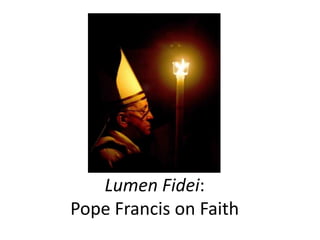
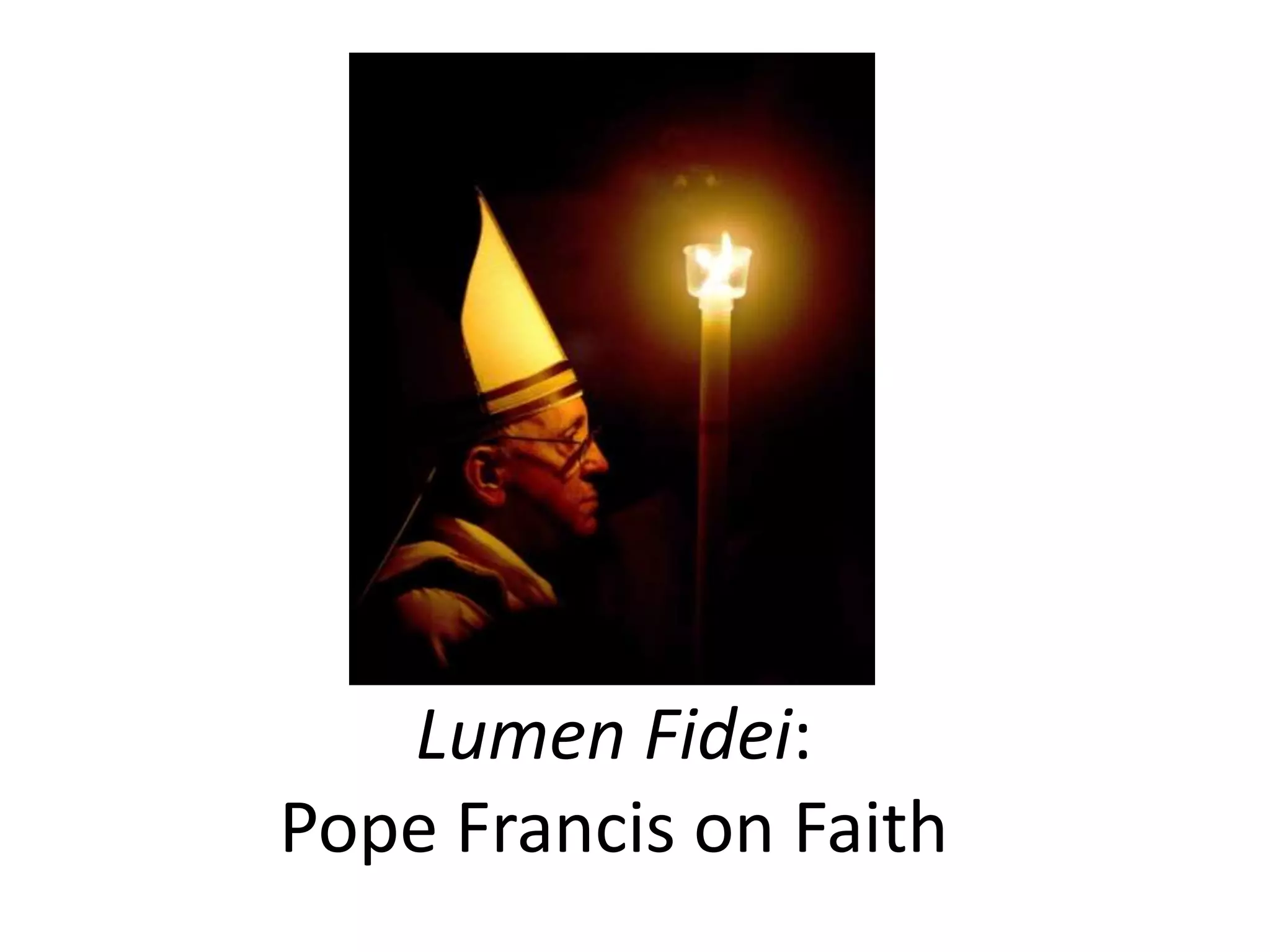
Lumen Fidei:
Pope Francis on Faith
I. Introduction
Introduction
Lumen Fidei (“Light of Faith”) is Pope Francis’s
first encyclical
Three questions to answer before looking at the
encyclical:
1. What is the Year of Faith?
2. What is a pope?
3. Who is Pope Francis?
1. What Is the Year of Faith?
Lumen Fidei has appeared during
the “Year of “Faith”
Q. What’s the Year of Faith?
A.
• Proclaimed by Pope Benedict
XVI
• Began last October 11
– 50th anniversary of opening of
Vatican II
– 20th anniversary of publication of
Catechism

• Ends Sunday
– November 24 = Feast of Christ
the King
1. What Is the Year of Faith?
What’s the Point of the Year of Faith?
“This year will be a propitious occasion
for the faithful to understand more
profoundly that the foundation of
Christian faith is ‘the encounter with an
event, a person, which gives life a new
horizon and a decisive direction.’
Founded on the encounter with the
Risen Christ, faith can be rediscovered in
its wholeness and all its splendor. ‘In our
days too faith is a gift to rediscover, to
cultivate and to bear witness to’
because the Lord ‘grants each one of us
to live the beauty and joy of being
Christians.’” (Pastoral Recommendations
for the Year of Faith)
1. What Is the Year of Faith?
• The Year of Faith is an
occasion to reflect on two
main dimensions of our faith:
1. Encounter: Faith as springing
from a personal relationship
Jesus
2. Witness: Faith as shaping the
way we carry ourselves in the
world

• Both these themes are
fleshed out in Lumen Fidei
2. What Is the Pope?
Lumen Fidei is a letter from the pope
Q. What, exactly, is the pope?
A. What ISN’T the Pope?
1. CEO of Catholic Inc.
– The pope is not like the director of a company who has ultimate
personal authority over whatever the company does
– Rather, the pope is like a trustee whose role is to protect what

2. Totalitarian “Dear Leader”
– St. Ignatius may have gone a bit overboard when he wrote, “To
be right in everything, we ought always to hold that the white
which I see, is black, if the Hierarchical Church so decides it.”

3. Living voice of God among us
– 19th c. English Catholic W.G. Ward misunderstood the nature of
the papacy when he quipped that “I should like a new *infallible+
Papal Bull every morning with my Times at breakfast.”
2. What Is the Pope?
The papacy is an office that
has two main dimensions:
1. The pope is the bishop
of Rome
2. The pope exercises the
Petrine ministry
2. What Is the Pope?
1. Bishop of Rome
• A bishop like any other bishop
–

•

A bishop unlike any other
bishop
–

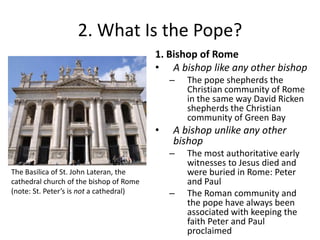
The Basilica of St. John Lateran, the
cathedral church of the bishop of Rome
(note: St. Peter’s is not a cathedral)

The pope shepherds the
Christian community of Rome
in the same way David Ricken
shepherds the Christian
community of Green Bay

–

The most authoritative early
witnesses to Jesus died and
were buried in Rome: Peter
and Paul
The Roman community and
the pope have always been
associated with keeping the
faith Peter and Paul
proclaimed
2. What Is the Pope?
2. Petrine Ministry
Biblical roots
• Mt 16:13-19: “You are Peter *Petros], and upon
this rock [petram+ I will build my Church.”
• Jn 21:1-23: “Feed my lambs … Tend my sheep.”
The meaning of the ministry
• Touchstone of orthodoxy: You can find out
whether you’re preaching the same Gospel as
Jesus by checking with the Church of Rome
– Pope has personal responsibility for preserving
Peter’s confession of faith through time
– Pope is living voice of Tradition of the Church
Ancient statue of St.
Peter in St. Peter’s
Basilica, Vatican City

• Center of unity: You can find out whether you’re
in communion with the whole church by
checking whether you’re in communion with
Rome
– Pope has a personal responsibility to work for
unity of the Church
3. Who Is Pope Francis?
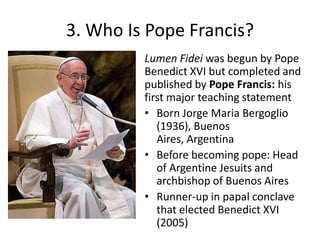
Lumen Fidei was begun by Pope
Benedict XVI but completed and
published by Pope Francis: his
first major teaching statement
• Born Jorge Maria Bergoglio
(1936), Buenos
Aires, Argentina
• Before becoming pope: Head
of Argentine Jesuits and
archbishop of Buenos Aires
• Runner-up in papal conclave
that elected Benedict XVI
(2005)
3. Who Is Pope Francis?
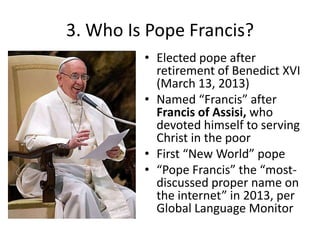
• Elected pope after
retirement of Benedict XVI
(March 13, 2013)
• Named “Francis” after
Francis of Assisi, who
devoted himself to serving
Christ in the poor
• First “New World” pope
• “Pope Francis” the “mostdiscussed proper name on
the internet” in 2013, per
Global Language Monitor
II. Lumen Fidei on Faith
Introduction
• Lumen Fidei an “encyclical”:
– Letter by Pope Francis to the “universal Church”
– i.e., a letter to the worldwide community of
Christians in communion with the bishop of
Rome, i.e. the pope

• Official version written in Latin language
• Official title comes from the first words in the
Latin version: “Lumen fidei”: the “light of
faith”
Introduction
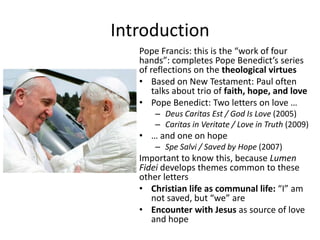
Pope Francis: this is the “work of four
hands”: completes Pope Benedict’s series
of reflections on the theological virtues
• Based on New Testament: Paul often
talks about trio of faith, hope, and love
• Pope Benedict: Two letters on love …
– Deus Caritas Est / God Is Love (2005)
– Caritas in Veritate / Love in Truth (2009)

• … and one on hope
– Spe Salvi / Saved by Hope (2007)

Important to know this, because Lumen
Fidei develops themes common to these
other letters
• Christian life as communal life: “I” am
not saved, but “we” are
• Encounter with Jesus as source of love
and hope
Introduction
Four main themes:
1. Faith as Encounter
2. Faith as Light
3. Faith as Communal
4. Faith as a Way of Seeing
Faith as Encounter
• First theme: Faith is born of an encounter with
Jesus, not memorizing the contents of the
Creed or Catechism.
• Quote: “In the love of God revealed in
Jesus, faith perceives the foundation on which
all reality and its final destiny rest.” (15)
• Let’s unpack this a bit …
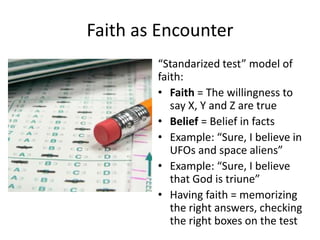
Faith as Encounter
“Standarized test” model of
faith:
• Faith = The willingness to
say X, Y and Z are true
• Belief = Belief in facts
• Example: “Sure, I believe in
UFOs and space aliens”
• Example: “Sure, I believe
that God is triune”
• Having faith = memorizing
the right answers, checking
the right boxes on the test
Faith as Encounter
Problems with “standardized
test” faith:
• It confesses a God remote
from the world
• “Our culture has lost its sense
of God’s tangible presence
and activity in our world. We
think that God is to be found
in the beyond, on another
level of reality, far removed
from our everyday
relationships.” (17)
• It doesn’t make any difference
whether it’s true or not
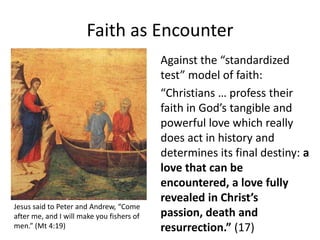
Faith as Encounter

Jesus said to Peter and Andrew, “Come
after me, and I will make you fishers of
men.” (Mt 4:19)

Against the “standardized
test” model of faith:
“Christians … profess their
faith in God’s tangible and
powerful love which really
does act in history and
determines its final destiny: a
love that can be
encountered, a love fully
revealed in Christ’s
passion, death and
resurrection.” (17)
Faith as Encounter
Reflection questions:
• How have I
encountered Jesus?
• Is my faith just a list of
facts, or is it rooted in
the person of Jesus?

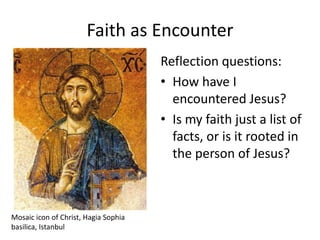
Mosaic icon of Christ, Hagia Sophia
basilica, Istanbul
Faith as Light
• Second theme: Faith does not lead us into
darkness and irrationality, but into light and
truth.
• Quote: “Jesus *is+ the true sun ‘whose rays
bestow life’.” (1)
• Let’s unpack this a bit …
Faith as Light
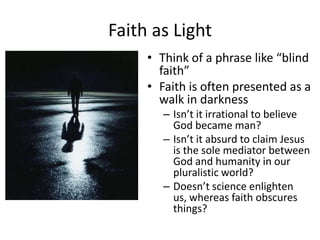
• Think of a phrase like “blind
faith”
• Faith is often presented as a
walk in darkness
– Isn’t it irrational to believe
God became man?
– Isn’t it absurd to claim Jesus
is the sole mediator between
God and humanity in our
pluralistic world?
– Doesn’t science enlighten
us, whereas faith obscures
things?
Faith as Light
Lumen Fidei talks about
faith as a light: hence the
title!
1. Seeing the light
2. Reflecting the light
Faith as Light
1. Seeing the light
• Faith allows us to see further
than reason and science allow:
– Origin of all things
– Beyond veil of death
– True meaning of life

• In a sense, the lack of faith is a
kind of darkness
• “Unless you believe, you will
not understand.” (Is 7:9: one of
St. Augustine’s favorite verses)
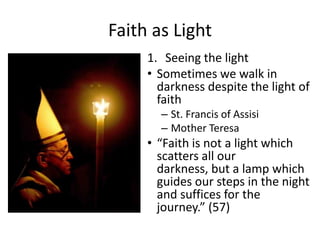
Faith as Light
1. Seeing the light
• Sometimes we walk in
darkness despite the light of
faith
– St. Francis of Assisi
– Mother Teresa

• “Faith is not a light which
scatters all our
darkness, but a lamp which
guides our steps in the night
and suffices for the
journey.” (57)
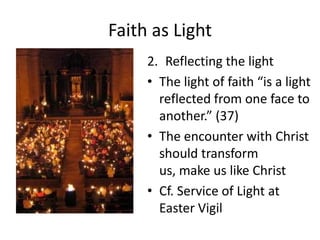
Faith as Light
2. Reflecting the light
• The light of faith “is a light
reflected from one face to
another.” (37)
• The encounter with Christ
should transform
us, make us like Christ
• Cf. Service of Light at
Easter Vigil
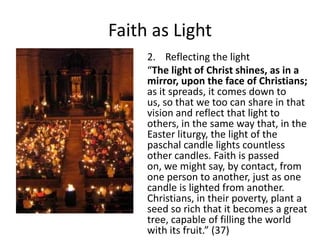
Faith as Light
2. Reflecting the light
“The light of Christ shines, as in a
mirror, upon the face of Christians;
as it spreads, it comes down to
us, so that we too can share in that
vision and reflect that light to
others, in the same way that, in the
Easter liturgy, the light of the
paschal candle lights countless
other candles. Faith is passed
on, we might say, by contact, from
one person to another, just as one
candle is lighted from another.
Christians, in their poverty, plant a
seed so rich that it becomes a great
tree, capable of filling the world
with its fruit.” (37)
Faith as Light
Reflection questions:
• How has faith enlightened me?
• What aspects of my life are illuminated by
Jesus?
• How has faith been a “lamp for my way” in
dark times?
• In whose face do I see Christ’s light?
Faith as Communal
• Third theme: Faith is never just my faith, it is
always also our faith.
• Quote: “The individual’s act of faith finds its
place within a community, within the common
‘we’ of the people who, in faith, are like a
single person.” (14)
• Let’s unpack this a bit …
Faith as Communal

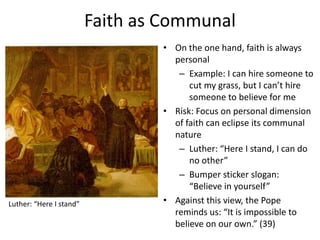
Luther: “Here I stand”

• On the one hand, faith is always
personal
– Example: I can hire someone to
cut my grass, but I can’t hire
someone to believe for me
• Risk: Focus on personal dimension
of faith can eclipse its communal
nature
– Luther: “Here I stand, I can do
no other”
– Bumper sticker slogan:
“Believe in yourself”
• Against this view, the Pope
reminds us: “It is impossible to
believe on our own.” (39)
Faith as Communal
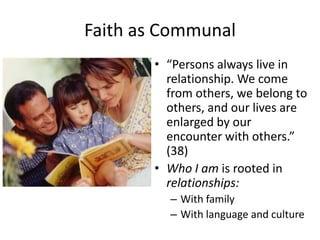
• “Persons always live in
relationship. We come
from others, we belong to
others, and our lives are
enlarged by our
encounter with others.”
(38)
• Who I am is rooted in
relationships:
– With family
– With language and culture
Faith as Communal
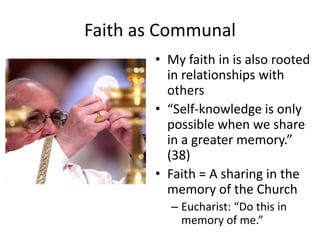
• My faith in is also rooted
in relationships with
others
• “Self-knowledge is only
possible when we share
in a greater memory.”
(38)
• Faith = A sharing in the
memory of the Church
– Eucharist: “Do this in
memory of me.”
Faith as Communal
Reflection questions:
• Who have I received my faith from?
• How have my memories been shaped by the
Church’s memory?
Faith as a Way of Seeing
• Fourth theme: Faith is the Holy Spirit’s way of
helping us see the world through the eyes of
Jesus.
• Quote: “Faith does not merely gaze at
Jesus, but sees things as Jesus himself sees
them, with his own eyes: it is a participation in
his way of seeing.” (18)
• Let’s unpack this a bit …
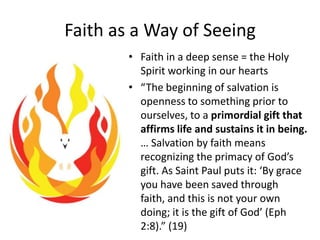
Faith as a Way of Seeing
• Faith in a deep sense = the Holy
Spirit working in our hearts
• “The beginning of salvation is
openness to something prior to
ourselves, to a primordial gift that
affirms life and sustains it in being.
… Salvation by faith means
recognizing the primacy of God’s
gift. As Saint Paul puts it: ‘By grace
you have been saved through
faith, and this is not your own
doing; it is the gift of God’ (Eph
2:8).” (19)
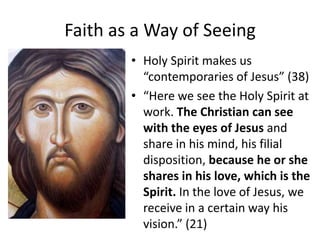
Faith as a Way of Seeing
• Holy Spirit makes us
“contemporaries of Jesus” (38)
• “Here we see the Holy Spirit at
work. The Christian can see
with the eyes of Jesus and
share in his mind, his filial
disposition, because he or she
shares in his love, which is the
Spirit. In the love of Jesus, we
receive in a certain way his
vision.” (21)
Faith as a Way of Seeing
Reflection questions:
• What signs do I see in my own life that I have
personally received the gift of the Holy Spirit?
• How do I see myself as a “contemporary of
Christ”?
• Do I think I am able to look at the world
through Christ’s eyes? Why or why not?
Conclusion
Four main themes:
1. Faith as Encounter
2. Faith as Light
3. Faith as Communal
4. Faith as a Way of Seeing
Conclusion
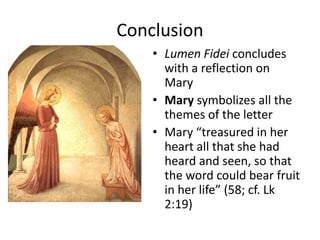
• Lumen Fidei concludes
with a reflection on
Mary
• Mary symbolizes all the
themes of the letter
• Mary “treasured in her
heart all that she had
heard and seen, so that
the word could bear fruit
in her life” (58; cf. Lk
2:19)
Conclusion
For more information:
• Read the encyclical!
– Available online
– Available from On This Rock or Amazon.com

• Explore Mary as an icon of faithful discipleship
through our Advent program
– Mondays in December (2, 9, 16, 23)
– 9:00–10:30 am or 6:00–7:30 pm

• This presentation available on the parish
website, http://stjudeoshkosh.org

Lumen Fidei: Pope Francis on Faith (Presented by St. Jude Oshkosh Faith Formation)

  • 1.
  • 2.
  • 3.
    Introduction Lumen Fidei (“Lightof Faith”) is Pope Francis’s first encyclical Three questions to answer before looking at the encyclical: 1. What is the Year of Faith? 2. What is a pope? 3. Who is Pope Francis?
  • 4.
    1. What Isthe Year of Faith? Lumen Fidei has appeared during the “Year of “Faith” Q. What’s the Year of Faith? A. • Proclaimed by Pope Benedict XVI • Began last October 11 – 50th anniversary of opening of Vatican II – 20th anniversary of publication of Catechism • Ends Sunday – November 24 = Feast of Christ the King
  • 5.
    1. What Isthe Year of Faith? What’s the Point of the Year of Faith? “This year will be a propitious occasion for the faithful to understand more profoundly that the foundation of Christian faith is ‘the encounter with an event, a person, which gives life a new horizon and a decisive direction.’ Founded on the encounter with the Risen Christ, faith can be rediscovered in its wholeness and all its splendor. ‘In our days too faith is a gift to rediscover, to cultivate and to bear witness to’ because the Lord ‘grants each one of us to live the beauty and joy of being Christians.’” (Pastoral Recommendations for the Year of Faith)
  • 6.
    1. What Isthe Year of Faith? • The Year of Faith is an occasion to reflect on two main dimensions of our faith: 1. Encounter: Faith as springing from a personal relationship Jesus 2. Witness: Faith as shaping the way we carry ourselves in the world • Both these themes are fleshed out in Lumen Fidei
  • 7.
    2. What Isthe Pope? Lumen Fidei is a letter from the pope Q. What, exactly, is the pope? A. What ISN’T the Pope? 1. CEO of Catholic Inc. – The pope is not like the director of a company who has ultimate personal authority over whatever the company does – Rather, the pope is like a trustee whose role is to protect what 2. Totalitarian “Dear Leader” – St. Ignatius may have gone a bit overboard when he wrote, “To be right in everything, we ought always to hold that the white which I see, is black, if the Hierarchical Church so decides it.” 3. Living voice of God among us – 19th c. English Catholic W.G. Ward misunderstood the nature of the papacy when he quipped that “I should like a new *infallible+ Papal Bull every morning with my Times at breakfast.”
  • 8.
    2. What Isthe Pope? The papacy is an office that has two main dimensions: 1. The pope is the bishop of Rome 2. The pope exercises the Petrine ministry
  • 9.
    2. What Isthe Pope? 1. Bishop of Rome • A bishop like any other bishop – • A bishop unlike any other bishop – The Basilica of St. John Lateran, the cathedral church of the bishop of Rome (note: St. Peter’s is not a cathedral) The pope shepherds the Christian community of Rome in the same way David Ricken shepherds the Christian community of Green Bay – The most authoritative early witnesses to Jesus died and were buried in Rome: Peter and Paul The Roman community and the pope have always been associated with keeping the faith Peter and Paul proclaimed
  • 10.
    2. What Isthe Pope? 2. Petrine Ministry Biblical roots • Mt 16:13-19: “You are Peter *Petros], and upon this rock [petram+ I will build my Church.” • Jn 21:1-23: “Feed my lambs … Tend my sheep.” The meaning of the ministry • Touchstone of orthodoxy: You can find out whether you’re preaching the same Gospel as Jesus by checking with the Church of Rome – Pope has personal responsibility for preserving Peter’s confession of faith through time – Pope is living voice of Tradition of the Church Ancient statue of St. Peter in St. Peter’s Basilica, Vatican City • Center of unity: You can find out whether you’re in communion with the whole church by checking whether you’re in communion with Rome – Pope has a personal responsibility to work for unity of the Church
  • 11.
    3. Who IsPope Francis? Lumen Fidei was begun by Pope Benedict XVI but completed and published by Pope Francis: his first major teaching statement • Born Jorge Maria Bergoglio (1936), Buenos Aires, Argentina • Before becoming pope: Head of Argentine Jesuits and archbishop of Buenos Aires • Runner-up in papal conclave that elected Benedict XVI (2005)
  • 12.
    3. Who IsPope Francis? • Elected pope after retirement of Benedict XVI (March 13, 2013) • Named “Francis” after Francis of Assisi, who devoted himself to serving Christ in the poor • First “New World” pope • “Pope Francis” the “mostdiscussed proper name on the internet” in 2013, per Global Language Monitor
  • 13.
  • 14.
    Introduction • Lumen Fideian “encyclical”: – Letter by Pope Francis to the “universal Church” – i.e., a letter to the worldwide community of Christians in communion with the bishop of Rome, i.e. the pope • Official version written in Latin language • Official title comes from the first words in the Latin version: “Lumen fidei”: the “light of faith”
  • 15.
    Introduction Pope Francis: thisis the “work of four hands”: completes Pope Benedict’s series of reflections on the theological virtues • Based on New Testament: Paul often talks about trio of faith, hope, and love • Pope Benedict: Two letters on love … – Deus Caritas Est / God Is Love (2005) – Caritas in Veritate / Love in Truth (2009) • … and one on hope – Spe Salvi / Saved by Hope (2007) Important to know this, because Lumen Fidei develops themes common to these other letters • Christian life as communal life: “I” am not saved, but “we” are • Encounter with Jesus as source of love and hope
  • 16.
    Introduction Four main themes: 1.Faith as Encounter 2. Faith as Light 3. Faith as Communal 4. Faith as a Way of Seeing
  • 17.
    Faith as Encounter •First theme: Faith is born of an encounter with Jesus, not memorizing the contents of the Creed or Catechism. • Quote: “In the love of God revealed in Jesus, faith perceives the foundation on which all reality and its final destiny rest.” (15) • Let’s unpack this a bit …
  • 18.
    Faith as Encounter “Standarizedtest” model of faith: • Faith = The willingness to say X, Y and Z are true • Belief = Belief in facts • Example: “Sure, I believe in UFOs and space aliens” • Example: “Sure, I believe that God is triune” • Having faith = memorizing the right answers, checking the right boxes on the test
  • 19.
    Faith as Encounter Problemswith “standardized test” faith: • It confesses a God remote from the world • “Our culture has lost its sense of God’s tangible presence and activity in our world. We think that God is to be found in the beyond, on another level of reality, far removed from our everyday relationships.” (17) • It doesn’t make any difference whether it’s true or not
  • 20.
    Faith as Encounter Jesussaid to Peter and Andrew, “Come after me, and I will make you fishers of men.” (Mt 4:19) Against the “standardized test” model of faith: “Christians … profess their faith in God’s tangible and powerful love which really does act in history and determines its final destiny: a love that can be encountered, a love fully revealed in Christ’s passion, death and resurrection.” (17)
  • 21.
    Faith as Encounter Reflectionquestions: • How have I encountered Jesus? • Is my faith just a list of facts, or is it rooted in the person of Jesus? Mosaic icon of Christ, Hagia Sophia basilica, Istanbul
  • 22.
    Faith as Light •Second theme: Faith does not lead us into darkness and irrationality, but into light and truth. • Quote: “Jesus *is+ the true sun ‘whose rays bestow life’.” (1) • Let’s unpack this a bit …
  • 23.
    Faith as Light •Think of a phrase like “blind faith” • Faith is often presented as a walk in darkness – Isn’t it irrational to believe God became man? – Isn’t it absurd to claim Jesus is the sole mediator between God and humanity in our pluralistic world? – Doesn’t science enlighten us, whereas faith obscures things?
  • 24.
    Faith as Light LumenFidei talks about faith as a light: hence the title! 1. Seeing the light 2. Reflecting the light
  • 25.
    Faith as Light 1.Seeing the light • Faith allows us to see further than reason and science allow: – Origin of all things – Beyond veil of death – True meaning of life • In a sense, the lack of faith is a kind of darkness • “Unless you believe, you will not understand.” (Is 7:9: one of St. Augustine’s favorite verses)
  • 26.
    Faith as Light 1.Seeing the light • Sometimes we walk in darkness despite the light of faith – St. Francis of Assisi – Mother Teresa • “Faith is not a light which scatters all our darkness, but a lamp which guides our steps in the night and suffices for the journey.” (57)
  • 27.
    Faith as Light 2.Reflecting the light • The light of faith “is a light reflected from one face to another.” (37) • The encounter with Christ should transform us, make us like Christ • Cf. Service of Light at Easter Vigil
  • 28.
    Faith as Light 2.Reflecting the light “The light of Christ shines, as in a mirror, upon the face of Christians; as it spreads, it comes down to us, so that we too can share in that vision and reflect that light to others, in the same way that, in the Easter liturgy, the light of the paschal candle lights countless other candles. Faith is passed on, we might say, by contact, from one person to another, just as one candle is lighted from another. Christians, in their poverty, plant a seed so rich that it becomes a great tree, capable of filling the world with its fruit.” (37)
  • 29.
    Faith as Light Reflectionquestions: • How has faith enlightened me? • What aspects of my life are illuminated by Jesus? • How has faith been a “lamp for my way” in dark times? • In whose face do I see Christ’s light?
  • 30.
    Faith as Communal •Third theme: Faith is never just my faith, it is always also our faith. • Quote: “The individual’s act of faith finds its place within a community, within the common ‘we’ of the people who, in faith, are like a single person.” (14) • Let’s unpack this a bit …
  • 31.
    Faith as Communal Luther:“Here I stand” • On the one hand, faith is always personal – Example: I can hire someone to cut my grass, but I can’t hire someone to believe for me • Risk: Focus on personal dimension of faith can eclipse its communal nature – Luther: “Here I stand, I can do no other” – Bumper sticker slogan: “Believe in yourself” • Against this view, the Pope reminds us: “It is impossible to believe on our own.” (39)
  • 32.
    Faith as Communal •“Persons always live in relationship. We come from others, we belong to others, and our lives are enlarged by our encounter with others.” (38) • Who I am is rooted in relationships: – With family – With language and culture
  • 33.
    Faith as Communal •My faith in is also rooted in relationships with others • “Self-knowledge is only possible when we share in a greater memory.” (38) • Faith = A sharing in the memory of the Church – Eucharist: “Do this in memory of me.”
  • 34.
    Faith as Communal Reflectionquestions: • Who have I received my faith from? • How have my memories been shaped by the Church’s memory?
  • 35.
    Faith as aWay of Seeing • Fourth theme: Faith is the Holy Spirit’s way of helping us see the world through the eyes of Jesus. • Quote: “Faith does not merely gaze at Jesus, but sees things as Jesus himself sees them, with his own eyes: it is a participation in his way of seeing.” (18) • Let’s unpack this a bit …
  • 36.
    Faith as aWay of Seeing • Faith in a deep sense = the Holy Spirit working in our hearts • “The beginning of salvation is openness to something prior to ourselves, to a primordial gift that affirms life and sustains it in being. … Salvation by faith means recognizing the primacy of God’s gift. As Saint Paul puts it: ‘By grace you have been saved through faith, and this is not your own doing; it is the gift of God’ (Eph 2:8).” (19)
  • 37.
    Faith as aWay of Seeing • Holy Spirit makes us “contemporaries of Jesus” (38) • “Here we see the Holy Spirit at work. The Christian can see with the eyes of Jesus and share in his mind, his filial disposition, because he or she shares in his love, which is the Spirit. In the love of Jesus, we receive in a certain way his vision.” (21)
  • 38.
    Faith as aWay of Seeing Reflection questions: • What signs do I see in my own life that I have personally received the gift of the Holy Spirit? • How do I see myself as a “contemporary of Christ”? • Do I think I am able to look at the world through Christ’s eyes? Why or why not?
  • 39.
    Conclusion Four main themes: 1.Faith as Encounter 2. Faith as Light 3. Faith as Communal 4. Faith as a Way of Seeing
  • 40.
    Conclusion • Lumen Fideiconcludes with a reflection on Mary • Mary symbolizes all the themes of the letter • Mary “treasured in her heart all that she had heard and seen, so that the word could bear fruit in her life” (58; cf. Lk 2:19)
  • 41.
    Conclusion For more information: •Read the encyclical! – Available online – Available from On This Rock or Amazon.com • Explore Mary as an icon of faithful discipleship through our Advent program – Mondays in December (2, 9, 16, 23) – 9:00–10:30 am or 6:00–7:30 pm • This presentation available on the parish website, http://stjudeoshkosh.org