Southeast University
Department of Pharmacy
Submitter By:
Tamanna Islam (2020000300030)
Junaeid Hassan (2020000300011)
Nazmul Hassan Redoy (2020000300001)
Radaunul Karib Sakib (2020000300008)
Submitted To:
Nodi Islam
Lecturer, Department of English
Southeast University
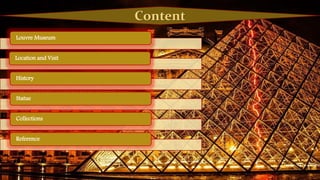
Louvre museum
Louvre Museum
Location and Visit
History
Statue
Collections
Reference
Content
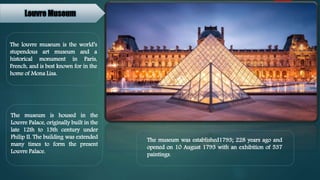
The louvre museum is the world’s
stupendous art museum and a
historical monument in Paris,
French, and is best known for in the
home of Mona Lisa.
The museum is housed in the
Louvre Palace, originally built in the
late 12th to 13th century under
Philip II. The building was extended
many times to form the present
Louvre Palace.
The museum was established1793; 228 years ago and
opened on 10 August 1793 with an exhibition of 537
paintings.
The Louvre museum is located inside the Louvre Palace, in
the center of Paris, adjacent to the Tuileries Gardens. The
two nearest Metro stations are Louvre-Rivoli and Palais
Royal-Museum the Louvre, the latter having a direct
underground access to the Carrousel du Louvre
commercial mall.
At the time of initial opening in 1793, the French
Republican calendar had imposed ten-days "weeks" the
first six days of which were reserved for visits by artists
and foreigners and the last three for visits by the
general public.
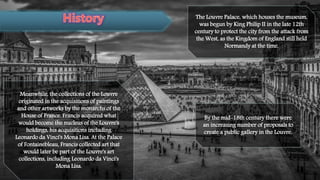
The Louvre Palace, which houses the museum,
was begun by King Philip II in the late 12th
century to protect the city from the attack from
the West, as the Kingdom of England still held
Normandy at the time.
Meanwhile, the collections of the Louvre
originated in the acquisitions of paintings
and other artworks by the monarchs of the
House of France. Francis acquired what
would become the nucleus of the Louvre's
holdings, his acquisitions including
Leonardo da Vinci's Mona Lisa. At the Palace
of Fontainebleau, Francis collected art that
would later be part of the Louvre's art
collections, including Leonardo da Vinci's
Mona Lisa.
By the mid-18th century there were
an increasing number of proposals to
create a public gallery in the Louvre.
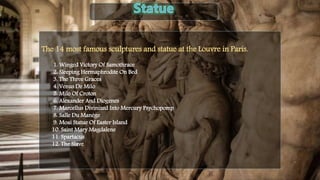
The 14 most famous sculptures and statue at the Louvre in Paris.
1. Winged Victory Of Samothrace
2. Sleeping Hermaphrodite On Bed
3. The Three Graces
4. Venus De Milo
5. Milo Of Croton
6. Alexander And Diogenes
7. Marcellus Divinized Into Mercury Psychopomp
8. Salle Du Manège
9. Moai Statue Of Easter Island
10. Saint Mary Magdalene
11. Spartacus
12. The Slave
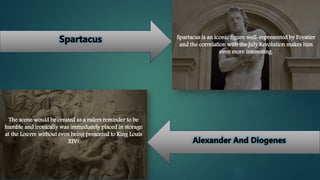
Spartacus is an iconic figure well-represented by Foyatier
and the correlation with the July Revolution makes him
even more interesting.
The scene would be created as a rulers reminder to be
humble and ironically was immediately placed in storage
at the Louvre without even being presented to King Louis
XIV!
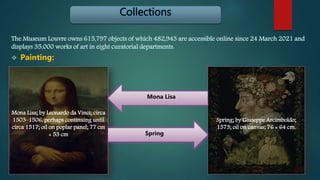
The Museum Louvre owns 615,797 objects of which 482,943 are accessible online since 24 March 2021 and
displays 35,000 works of art in eight curatorial departments.
 Painting:
Spring
Mona Lisa
Mona Lisa; by Leonardo da Vinci; circa
1503–1506, perhaps continuing until
circa 1517; oil on poplar panel; 77 cm
× 53 cm
Spring; by Giuseppe Arcimboldo;
1573; oil on canvas; 76 × 64 cm.
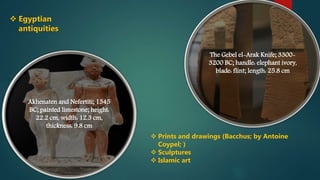
Akhenaten and Nefertiti; 1345
BC; painted limestone; height:
22.2 cm, width: 12.3 cm,
thickness: 9.8 cm
The Gebel el-Arak Knife; 3300-
3200 BC; handle: elephant ivory,
blade: flint; length: 25.8 cm
 Egyptian
antiquities
 Prints and drawings (Bacchus; by Antoine
Coypel; )
 Sculptures
 Islamic art
https://en.wikipedia.org/wiki/Louvre
https://pixabay.com/photos/paris-louvre-museum-architecture-1060231/
https://thetourguy.com/travel-blog/france/paris/louvre/most-famous-
statues-at-the-louvre-in-paris/
https://www.louvre.fr/enRRRe
Reference:
Louvre Museum

Louvre Museum

  • 2.
    Southeast University Department ofPharmacy Submitter By: Tamanna Islam (2020000300030) Junaeid Hassan (2020000300011) Nazmul Hassan Redoy (2020000300001) Radaunul Karib Sakib (2020000300008) Submitted To: Nodi Islam Lecturer, Department of English Southeast University
  • 3.
  • 4.
    Louvre Museum Location andVisit History Statue Collections Reference Content
  • 5.
    The louvre museumis the world’s stupendous art museum and a historical monument in Paris, French, and is best known for in the home of Mona Lisa. The museum is housed in the Louvre Palace, originally built in the late 12th to 13th century under Philip II. The building was extended many times to form the present Louvre Palace. The museum was established1793; 228 years ago and opened on 10 August 1793 with an exhibition of 537 paintings.
  • 6.
    The Louvre museumis located inside the Louvre Palace, in the center of Paris, adjacent to the Tuileries Gardens. The two nearest Metro stations are Louvre-Rivoli and Palais Royal-Museum the Louvre, the latter having a direct underground access to the Carrousel du Louvre commercial mall. At the time of initial opening in 1793, the French Republican calendar had imposed ten-days "weeks" the first six days of which were reserved for visits by artists and foreigners and the last three for visits by the general public.
  • 7.
    The Louvre Palace,which houses the museum, was begun by King Philip II in the late 12th century to protect the city from the attack from the West, as the Kingdom of England still held Normandy at the time. Meanwhile, the collections of the Louvre originated in the acquisitions of paintings and other artworks by the monarchs of the House of France. Francis acquired what would become the nucleus of the Louvre's holdings, his acquisitions including Leonardo da Vinci's Mona Lisa. At the Palace of Fontainebleau, Francis collected art that would later be part of the Louvre's art collections, including Leonardo da Vinci's Mona Lisa. By the mid-18th century there were an increasing number of proposals to create a public gallery in the Louvre.
  • 8.
    The 14 mostfamous sculptures and statue at the Louvre in Paris. 1. Winged Victory Of Samothrace 2. Sleeping Hermaphrodite On Bed 3. The Three Graces 4. Venus De Milo 5. Milo Of Croton 6. Alexander And Diogenes 7. Marcellus Divinized Into Mercury Psychopomp 8. Salle Du Manège 9. Moai Statue Of Easter Island 10. Saint Mary Magdalene 11. Spartacus 12. The Slave
  • 9.
    Spartacus is aniconic figure well-represented by Foyatier and the correlation with the July Revolution makes him even more interesting. The scene would be created as a rulers reminder to be humble and ironically was immediately placed in storage at the Louvre without even being presented to King Louis XIV!
  • 10.
    The Museum Louvreowns 615,797 objects of which 482,943 are accessible online since 24 March 2021 and displays 35,000 works of art in eight curatorial departments.  Painting: Spring Mona Lisa Mona Lisa; by Leonardo da Vinci; circa 1503–1506, perhaps continuing until circa 1517; oil on poplar panel; 77 cm × 53 cm Spring; by Giuseppe Arcimboldo; 1573; oil on canvas; 76 × 64 cm.
  • 11.
    Akhenaten and Nefertiti;1345 BC; painted limestone; height: 22.2 cm, width: 12.3 cm, thickness: 9.8 cm The Gebel el-Arak Knife; 3300- 3200 BC; handle: elephant ivory, blade: flint; length: 25.8 cm  Egyptian antiquities  Prints and drawings (Bacchus; by Antoine Coypel; )  Sculptures  Islamic art
  • 12.