Logistics Overview for North Carolina
June 2, 2016
Charles HW Edwards
Transportation
Outline
• Evolving Freight Logistics Network
• Why Logistics Is Important
• We Now Know Who We Are – North Carolina’s
Supply Chain
• New Challenges Everyday
•Role of NC Department of Transportation
2
Transportation
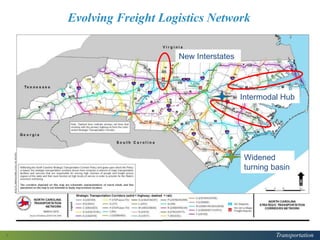
Evolving Freight Logistics Network
3
New Interstates
Widened
turning basin
Intermodal Hub
Transportation
Why Logistics Is Important
4
Each North Carolinian generates / consumes 20 tons of
freight per year
* 1 tractor-trailer (TL) load per resident per year = 9+
million TL per year
• Can’t continue to expand and build roads
• Need to meet different requirements in different
regions
• Optimize existing transport network and services
Transportation
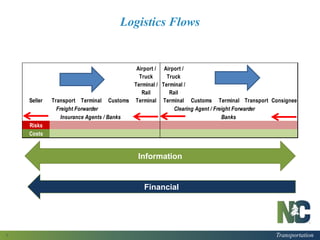
Logistics Flows
5
Seller Transport Terminal Customs Customs Terminal Transport Consignee
Risks
Costs
Port /
Airport /
Truck
Terminal /
Rail
Terminal
Port /
Airport /
Truck
Terminal /
Rail
Terminal
Clearing Agent / Freight ForwarderFreight Forwarder
Insurance Agents / Banks Banks
Information
Financial
Transportation
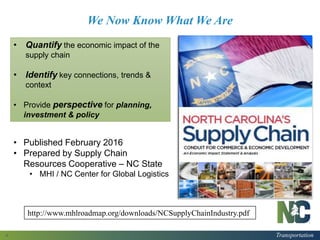
We Now Know What We Are
6
• Published February 2016
• Prepared by Supply Chain
Resources Cooperative – NC State
• MHI / NC Center for Global Logistics
• Quantify the economic impact of the
supply chain
• Identify key connections, trends &
context
• Provide perspective for planning,
investment & policy
http://www.mhlroadmap.org/downloads/NCSupplyChainIndustry.pdf
Transportation
Summary Findings
7
• One of every 4 employed
• Present in every county
• Traditional industries important
• Average annual labor income: $67,780
- 156% of NC average annual wage of
$43,280
- 52% more than US average annual
wage of $44,888
• Total paid state taxes equal about 58%
from all sources (2013)
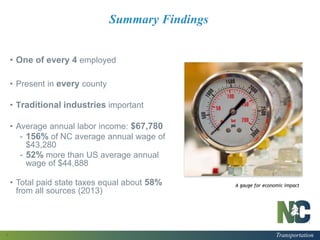
A gauge for economic impact
Transportation
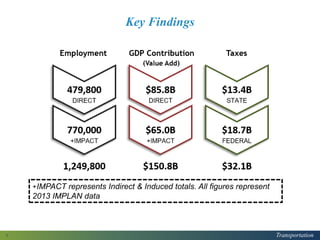
Key Findings
8
+IMPACT represents Indirect & Induced totals. All figures represent
2013 IMPLAN data
Transportation
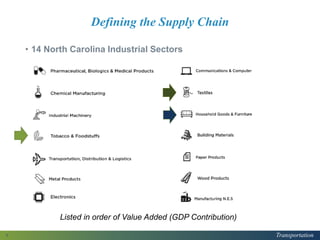
Defining the Supply Chain
• 14 North Carolina Industrial Sectors
9
Listed in order of Value Added (GDP Contribution)
Transportation
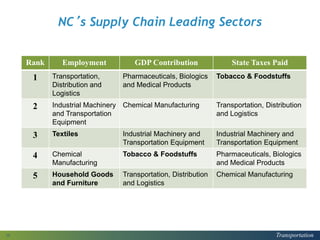
NC’s Supply Chain Leading Sectors
Rank Employment GDP Contribution State Taxes Paid
1 Transportation,
Distribution and
Logistics
Pharmaceuticals, Biologics
and Medical Products
Tobacco & Foodstuffs
2 Industrial Machinery
and Transportation
Equipment
Chemical Manufacturing Transportation, Distribution
and Logistics
3 Textiles Industrial Machinery and
Transportation Equipment
Industrial Machinery and
Transportation Equipment
4 Chemical
Manufacturing
Tobacco & Foodstuffs Pharmaceuticals, Biologics
and Medical Products
5 Household Goods
and Furniture
Transportation, Distribution
and Logistics
Chemical Manufacturing
10
Transportation
NC’s Supply Chain Leading Sectors
11
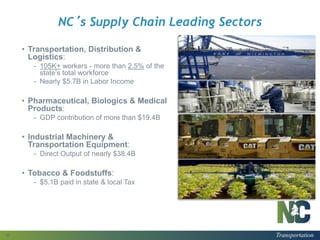
• Transportation, Distribution &
Logistics:
- 105K+ workers - more than 2.5% of the
state’s total workforce
- Nearly $5.7B in Labor Income
• Pharmaceutical, Biologics & Medical
Products:
- GDP contribution of more than $19.4B
• Industrial Machinery &
Transportation Equipment:
- Direct Output of nearly $38.4B
• Tobacco & Foodstuffs:
- $5.1B paid in state & local Tax
Transportation
New Challenges Everyday
• General
• New economic paradigm
• Anti-globalization sentiment
• Circular economy and logistics
• Specific
• e-Commerce
• Internet of Things
• Modal shift and selection
• Truck driver shortage – FMCSA / HOS rules
• Class 1 railroads’ new focus / strategy
• Chief supply chain manager
• Disruptions and delays
12
Transportation
Role of NC Department of Transportation
• Focus – what does it really take to move freight?
• Optimized Infrastructure – Meet needs of freight flows
• ‘The’ key economic development factor
• Shift freight to rail
• Urban and rural freight corridors / Blue shield
• Intersection geometry for trucks
• Multi-state perspective
• Truck driver rest areas
• Flexible Infrastructure – Accommodate and employ new technologies
• Autonomous vehicles
• Internet of Things
• Public transit for last mile pick-up / delivery operations
13
Transportation
We plan for freight flows that never stop!
14

Logistics Overview for North Carolina

  • 1.
    Logistics Overview forNorth Carolina June 2, 2016 Charles HW Edwards
  • 2.
    Transportation Outline • Evolving FreightLogistics Network • Why Logistics Is Important • We Now Know Who We Are – North Carolina’s Supply Chain • New Challenges Everyday •Role of NC Department of Transportation 2
  • 3.
    Transportation Evolving Freight LogisticsNetwork 3 New Interstates Widened turning basin Intermodal Hub
  • 4.
    Transportation Why Logistics IsImportant 4 Each North Carolinian generates / consumes 20 tons of freight per year * 1 tractor-trailer (TL) load per resident per year = 9+ million TL per year • Can’t continue to expand and build roads • Need to meet different requirements in different regions • Optimize existing transport network and services
  • 5.
    Transportation Logistics Flows 5 Seller TransportTerminal Customs Customs Terminal Transport Consignee Risks Costs Port / Airport / Truck Terminal / Rail Terminal Port / Airport / Truck Terminal / Rail Terminal Clearing Agent / Freight ForwarderFreight Forwarder Insurance Agents / Banks Banks Information Financial
  • 6.
    Transportation We Now KnowWhat We Are 6 • Published February 2016 • Prepared by Supply Chain Resources Cooperative – NC State • MHI / NC Center for Global Logistics • Quantify the economic impact of the supply chain • Identify key connections, trends & context • Provide perspective for planning, investment & policy http://www.mhlroadmap.org/downloads/NCSupplyChainIndustry.pdf
  • 7.
    Transportation Summary Findings 7 • Oneof every 4 employed • Present in every county • Traditional industries important • Average annual labor income: $67,780 - 156% of NC average annual wage of $43,280 - 52% more than US average annual wage of $44,888 • Total paid state taxes equal about 58% from all sources (2013) A gauge for economic impact
  • 8.
    Transportation Key Findings 8 +IMPACT representsIndirect & Induced totals. All figures represent 2013 IMPLAN data
  • 9.
    Transportation Defining the SupplyChain • 14 North Carolina Industrial Sectors 9 Listed in order of Value Added (GDP Contribution)
  • 10.
    Transportation NC’s Supply ChainLeading Sectors Rank Employment GDP Contribution State Taxes Paid 1 Transportation, Distribution and Logistics Pharmaceuticals, Biologics and Medical Products Tobacco & Foodstuffs 2 Industrial Machinery and Transportation Equipment Chemical Manufacturing Transportation, Distribution and Logistics 3 Textiles Industrial Machinery and Transportation Equipment Industrial Machinery and Transportation Equipment 4 Chemical Manufacturing Tobacco & Foodstuffs Pharmaceuticals, Biologics and Medical Products 5 Household Goods and Furniture Transportation, Distribution and Logistics Chemical Manufacturing 10
  • 11.
    Transportation NC’s Supply ChainLeading Sectors 11 • Transportation, Distribution & Logistics: - 105K+ workers - more than 2.5% of the state’s total workforce - Nearly $5.7B in Labor Income • Pharmaceutical, Biologics & Medical Products: - GDP contribution of more than $19.4B • Industrial Machinery & Transportation Equipment: - Direct Output of nearly $38.4B • Tobacco & Foodstuffs: - $5.1B paid in state & local Tax
  • 12.
    Transportation New Challenges Everyday •General • New economic paradigm • Anti-globalization sentiment • Circular economy and logistics • Specific • e-Commerce • Internet of Things • Modal shift and selection • Truck driver shortage – FMCSA / HOS rules • Class 1 railroads’ new focus / strategy • Chief supply chain manager • Disruptions and delays 12
  • 13.
    Transportation Role of NCDepartment of Transportation • Focus – what does it really take to move freight? • Optimized Infrastructure – Meet needs of freight flows • ‘The’ key economic development factor • Shift freight to rail • Urban and rural freight corridors / Blue shield • Intersection geometry for trucks • Multi-state perspective • Truck driver rest areas • Flexible Infrastructure – Accommodate and employ new technologies • Autonomous vehicles • Internet of Things • Public transit for last mile pick-up / delivery operations 13
  • 14.
    Transportation We plan forfreight flows that never stop! 14